WO2018135506A1 - ルテニウム錯体を用いた還元方法 - Google Patents
ルテニウム錯体を用いた還元方法 Download PDFInfo
- Publication number
- WO2018135506A1 WO2018135506A1 PCT/JP2018/001084 JP2018001084W WO2018135506A1 WO 2018135506 A1 WO2018135506 A1 WO 2018135506A1 JP 2018001084 W JP2018001084 W JP 2018001084W WO 2018135506 A1 WO2018135506 A1 WO 2018135506A1
- Authority
- WO
- WIPO (PCT)
- Prior art keywords
- group
- formula
- substituted
- ruthenium complex
- unsubstituted
- Prior art date
- Legal status (The legal status is an assumption and is not a legal conclusion. Google has not performed a legal analysis and makes no representation as to the accuracy of the status listed.)
- Ceased
Links
Classifications
-
- B—PERFORMING OPERATIONS; TRANSPORTING
- B01—PHYSICAL OR CHEMICAL PROCESSES OR APPARATUS IN GENERAL
- B01J—CHEMICAL OR PHYSICAL PROCESSES, e.g. CATALYSIS OR COLLOID CHEMISTRY; THEIR RELEVANT APPARATUS
- B01J31/00—Catalysts comprising hydrides, coordination complexes or organic compounds
- B01J31/16—Catalysts comprising hydrides, coordination complexes or organic compounds containing coordination complexes
- B01J31/22—Organic complexes
-
- C—CHEMISTRY; METALLURGY
- C07—ORGANIC CHEMISTRY
- C07C—ACYCLIC OR CARBOCYCLIC COMPOUNDS
- C07C213/00—Preparation of compounds containing amino and hydroxy, amino and etherified hydroxy or amino and esterified hydroxy groups bound to the same carbon skeleton
- C07C213/02—Preparation of compounds containing amino and hydroxy, amino and etherified hydroxy or amino and esterified hydroxy groups bound to the same carbon skeleton by reactions involving the formation of amino groups from compounds containing hydroxy groups or etherified or esterified hydroxy groups
-
- C—CHEMISTRY; METALLURGY
- C07—ORGANIC CHEMISTRY
- C07C—ACYCLIC OR CARBOCYCLIC COMPOUNDS
- C07C215/00—Compounds containing amino and hydroxy groups bound to the same carbon skeleton
- C07C215/68—Compounds containing amino and hydroxy groups bound to the same carbon skeleton having amino groups bound to carbon atoms of six-membered aromatic rings and hydroxy groups bound to acyclic carbon atoms or to carbon atoms of rings other than six-membered aromatic rings of the same carbon skeleton
-
- C—CHEMISTRY; METALLURGY
- C07—ORGANIC CHEMISTRY
- C07C—ACYCLIC OR CARBOCYCLIC COMPOUNDS
- C07C29/00—Preparation of compounds having hydroxy or O-metal groups bound to a carbon atom not belonging to a six-membered aromatic ring
- C07C29/132—Preparation of compounds having hydroxy or O-metal groups bound to a carbon atom not belonging to a six-membered aromatic ring by reduction of an oxygen containing functional group
- C07C29/136—Preparation of compounds having hydroxy or O-metal groups bound to a carbon atom not belonging to a six-membered aromatic ring by reduction of an oxygen containing functional group of >C=O containing groups, e.g. —COOH
- C07C29/143—Preparation of compounds having hydroxy or O-metal groups bound to a carbon atom not belonging to a six-membered aromatic ring by reduction of an oxygen containing functional group of >C=O containing groups, e.g. —COOH of ketones
- C07C29/145—Preparation of compounds having hydroxy or O-metal groups bound to a carbon atom not belonging to a six-membered aromatic ring by reduction of an oxygen containing functional group of >C=O containing groups, e.g. —COOH of ketones with hydrogen or hydrogen-containing gases
-
- C—CHEMISTRY; METALLURGY
- C07—ORGANIC CHEMISTRY
- C07C—ACYCLIC OR CARBOCYCLIC COMPOUNDS
- C07C29/00—Preparation of compounds having hydroxy or O-metal groups bound to a carbon atom not belonging to a six-membered aromatic ring
- C07C29/132—Preparation of compounds having hydroxy or O-metal groups bound to a carbon atom not belonging to a six-membered aromatic ring by reduction of an oxygen containing functional group
- C07C29/136—Preparation of compounds having hydroxy or O-metal groups bound to a carbon atom not belonging to a six-membered aromatic ring by reduction of an oxygen containing functional group of >C=O containing groups, e.g. —COOH
- C07C29/147—Preparation of compounds having hydroxy or O-metal groups bound to a carbon atom not belonging to a six-membered aromatic ring by reduction of an oxygen containing functional group of >C=O containing groups, e.g. —COOH of carboxylic acids or derivatives thereof
- C07C29/149—Preparation of compounds having hydroxy or O-metal groups bound to a carbon atom not belonging to a six-membered aromatic ring by reduction of an oxygen containing functional group of >C=O containing groups, e.g. —COOH of carboxylic acids or derivatives thereof with hydrogen or hydrogen-containing gases
-
- C—CHEMISTRY; METALLURGY
- C07—ORGANIC CHEMISTRY
- C07C—ACYCLIC OR CARBOCYCLIC COMPOUNDS
- C07C31/00—Saturated compounds having hydroxy or O-metal groups bound to acyclic carbon atoms
- C07C31/13—Monohydroxylic alcohols containing saturated rings
- C07C31/133—Monohydroxylic alcohols containing saturated rings monocyclic
-
- C—CHEMISTRY; METALLURGY
- C07—ORGANIC CHEMISTRY
- C07C—ACYCLIC OR CARBOCYCLIC COMPOUNDS
- C07C33/00—Unsaturated compounds having hydroxy or O-metal groups bound to acyclic carbon atoms
- C07C33/18—Monohydroxylic alcohols containing only six-membered aromatic rings as cyclic part
- C07C33/20—Monohydroxylic alcohols containing only six-membered aromatic rings as cyclic part monocyclic
-
- C—CHEMISTRY; METALLURGY
- C07—ORGANIC CHEMISTRY
- C07C—ACYCLIC OR CARBOCYCLIC COMPOUNDS
- C07C33/00—Unsaturated compounds having hydroxy or O-metal groups bound to acyclic carbon atoms
- C07C33/18—Monohydroxylic alcohols containing only six-membered aromatic rings as cyclic part
- C07C33/20—Monohydroxylic alcohols containing only six-membered aromatic rings as cyclic part monocyclic
- C07C33/22—Benzylalcohol; phenethyl alcohol
-
- C—CHEMISTRY; METALLURGY
- C07—ORGANIC CHEMISTRY
- C07C—ACYCLIC OR CARBOCYCLIC COMPOUNDS
- C07C33/00—Unsaturated compounds having hydroxy or O-metal groups bound to acyclic carbon atoms
- C07C33/26—Polyhydroxylic alcohols containing only six-membered aromatic rings as cyclic part
Definitions
- the present invention relates to a reduction method using a ruthenium complex.
- Non-Patent Document 1 discloses a ruthenium complex having a nitrogen-containing bidentate ligand represented by the formula (1), and performs structural analysis of the crystal.
- Patent Document 1 discloses a ruthenium complex represented by the formula (2). is doing. By using the ruthenium complex, amides or lactams can be reduced to alcohols or amino alcohols, respectively.
- Non-Patent Document 2 discloses a ruthenium complex represented by the formula (3). Using the ruthenium complex, cyclohexanone is reduced to cyclohexyl alcohol.
- An object of the present invention is to provide a ruthenium complex that can be a reduction catalyst that can be applied to industrial production.
- the inventor has conducted studies to achieve the above object, and as a result, has completed the present invention including the following aspects.
- At least one selected from compounds, Formula [III] AB [III] (In the formula [III], A and B are bonded by a single bond.
- A represents the formula [a1].
- R 1 represents a substituent
- p represents an integer of 0 to 3
- * represents a bonding position with B.
- R 2 represents a substituent
- q represents an integer of 0 to 4
- * represents a bonding position with B
- B represents a substituted or unsubstituted heterocyclyl. Indicates a group.
- At least one of the atoms adjacent to the ring atom bonded to A is a heteroatom or a carbene carbon.
- the ruthenium complex according to the present invention is useful as a reduction catalyst.
- the reduction catalyst according to the present invention for example, ketones, aldehydes, esters and amides can be reduced. Since the catalyst according to the present invention has high activity, the reduction reaction rate can be sufficiently improved even with a small amount of use.
- the ruthenium complex of the present invention is a complex prepared from at least one selected from the compounds represented by the formulas [I] and [II] and the compound represented by the formula [III].
- X 1 represents an anionic group.
- the anionic group include CF 3 SO 3 ⁇ , BF 4 ⁇ , PF 6 ⁇ , ClO 4 ⁇ ; halogeno groups such as fluoro group, chloro group, bromo group and iodo group; hydride group; hydroxyl group; acetylacetonate and the like A substituted or unsubstituted diketonate group; a substituted or unsubstituted cyclopentadienyl group; a vinyl group, a 1-propenyl group, a 2-propenyl group, a 1-butenyl group, a 2-butenyl group, a 3-butenyl group, 1- Methyl-2-propenyl group, 2-methyl-2-propenyl group, 1-pentenyl group, 2-pentenyl group, 3-pentenyl group, 4-pentenyl group, 1-methyl-2-butenyl group, 2-methyl-2 -
- Alkenyl group methyl group, ethyl group, n-propyl group, i-propyl group, n-butyl group, s-butyl group, i-butyl group, t-butyl group, n-pentyl group, n-hexyl group, etc.
- Substituted or unsubstituted alkyl group substituted or unsubstituted aryl group such as phenyl group and naphthyl group; methoxy group, ethoxy group, n-propoxy group, i-propoxy group, n-butoxy group, s-butoxy group, i A substituted or unsubstituted alkoxy group such as -butoxy group and t-butoxy group; a substituted or unsubstituted aryloxy group such as phenoxy group and 1-naphthoxy group; a methoxycarbonyl group, ethoxycarbonyl group, n-propoxycarbonyl group, Substituted or unsubstituted alkyl such as i-propoxycarbonyl group, n-butoxycarbonyl group, t-butoxycarbonyl group, etc.
- Z 1 represents a substituted or unsubstituted cyclopentadienyl group.
- Z 1 include a cyclopentadienyl group, 1,3-diisopropylcyclopentadienyl group, tetraphenylcyclopentadienyl group, pentamethylcyclopentadienyl group and the like.
- L 1 represents a neutral ligand.
- the neutral ligand may be a monodentate ligand or a bidentate ligand.
- m represents 2 or 3 when L 1 is a monodentate ligand, and represents 1 when L 1 is a bidentate ligand.
- Examples of the “substituent” in “substituted or unsubstituted” of the groups exemplified for X 1 and Z 1 include the same groups as those in the formula [III] described later.
- Specific examples of the compound represented by the formula [I] include chloro (1,5-cyclooctadiene) (pentamethylcyclopentadienyl) ruthenium (II), chloro (norbornadiene) (pentamethylcyclopentadienyl). ) Ruthenium (II), chloro (isoprene) (pentamethylcyclopentadienyl) ruthenium (II), and the like.
- X 2 represents an anionic group.
- the anionic group include CF 3 SO 3 ⁇ , BF 4 ⁇ , PF 6 ⁇ , ClO 4 ⁇ ; halogeno groups such as fluoro group, chloro group, bromo group and iodo group; hydride group; hydroxyl group; acetylacetonate and the like A substituted or unsubstituted diketonate group; a substituted or unsubstituted cyclopentadienyl group; a vinyl group, a 1-propenyl group, a 2-propenyl group, a 1-butenyl group, a 2-butenyl group, a 3-butenyl group, 1- Methyl-2-propenyl group, 2-methyl-2-propenyl group, 1-pentenyl group, 2-pentenyl group, 3-pentenyl group, 4-pentenyl group, 1-methyl-2-butenyl group, 2-methyl-2-butenyl group,
- Alkenyl group methyl group, ethyl group, n-propyl group, i-propyl group, n-butyl group, s-butyl group, i-butyl group, t-butyl group, n-pentyl group, n-hexyl group, etc.
- Substituted or unsubstituted alkyl group substituted or unsubstituted aryl group such as phenyl group and naphthyl group; methoxy group, ethoxy group, n-propoxy group, i-propoxy group, n-butoxy group, s-butoxy group, i A substituted or unsubstituted alkoxy group such as -butoxy group and t-butoxy group; a substituted or unsubstituted aryloxy group such as phenoxy group and 1-naphthoxy group; a methoxycarbonyl group, ethoxycarbonyl group, n-propoxycarbonyl group, Substituted or unsubstituted alkyl such as i-propoxycarbonyl group, n-butoxycarbonyl group, t-butoxycarbonyl group, etc.
- Z 2 represents a substituted or unsubstituted cyclopentadienyl group.
- Z 2 include a cyclopentadienyl group, 1,3-diisopropylcyclopentadienyl group, tetraphenylcyclopentadienyl group, pentamethylcyclopentadienyl group and the like.
- n represents an integer of 2 to 4.
- Examples of the “substituent” in “substituted or unsubstituted” of the groups exemplified as X 2 and Z 2 include the same groups as the substituents in the formula [III] described later.
- A represents a structure represented by the formula [a1] or the formula [a2].
- R 1 represents a substituent.
- Substituents include C1-6 alkyl groups, C3-8 cycloalkyl groups, C6-10 aryl groups, 3-6 membered heterocyclyl groups, hydroxyl groups, C1-6 alkoxy groups, C6-10 aryloxy groups, carboxyl groups, Halogeno group, C1-6 haloalkyl group, C6-10 haloaryl group, C1-6 haloalkoxy group, amino group (group represented by NH 2 ), C1-6 alkyl-substituted amino group, C6-10 arylamino group, C1 ⁇ 7 acylamino group, C1-6 alkoxycarbonylamino group, C1-6 alkylthio group, C6-10 arylthio group, heteroarylthio group, C7-11 aralkylthio group, C1-6 alkylsulfinyl group, C6-10 arylsulfinyl group , Heteroarylsulfiny
- p represents an integer of 0 to 3.
- R 2 represents a substituent.
- Substituents include C1-6 alkyl groups, C3-8 cycloalkyl groups, C6-10 aryl groups, 3-6 membered heterocyclyl groups, hydroxyl groups, C1-6 alkoxy groups, C6-10 aryloxy groups, carboxyl groups, Halogeno group, C1-6 haloalkyl group, C6-10 haloaryl group, C1-6 haloalkoxy group, amino group (group represented by NH 2 ), C1-6 alkyl-substituted amino group, C6-10 arylamino group, C1 -7 acylamino group, C1-6 alkoxycarbonylamino group, C1-6 alkylthio group, C6-10 arylthio group, heteroarylthio group, C7-11 aralkylthio group, C1-6 alkylsulfinyl group, C6-10 arylsulfinyl group , Heteroarylsulfinyl
- q represents an integer of 0 to 4.
- C1-6 alkyl group includes methyl group, ethyl group, n-propyl group, i-propyl group, n-butyl group, s-butyl group, i-butyl group, t-butyl group, and n-pentyl group. And n-hexyl group.
- the “C3-8 cycloalkyl group” is a monocyclic or polycyclic alkyl group, for example, a cyclopropyl group, a cyclobutyl group, a cyclopentyl group, a cyclohexyl group, a cycloheptyl group, a cyclooctyl group, a bicyclooctyl group. And a bicycloheptyl group.
- “C6-10 aryl group” means a monocyclic or polycyclic aryl group.
- a partially saturated group is included in addition to the fully unsaturated group.
- Examples thereof include a phenyl group, a naphthyl group, an azulenyl group, an indenyl group, an indanyl group, and a tetralinyl group.
- Examples of the “3- to 6-membered heterocyclyl group” include the same groups as those exemplified for B in the formula [III] described later.
- Examples of the “C1-6 alkoxy group” include methoxy group, ethoxy group, n-propoxy group, i-propoxy group, n-butoxy group, s-butoxy group, i-butoxy group, t-butoxy group and the like.
- Examples of the “C6-10 aryloxy group” include a phenoxy group and a 1-naphthoxy group.
- Examples of the “halogeno group” include a fluoro group, a chloro group, a bromo group, and an iodo group.
- C1-6 haloalkyl group examples include chloromethyl group, bromomethyl group, fluoromethyl group, trifluoromethyl group, trichloromethyl group, tribromomethyl group, 2,2,2-trichloroethyl group, 2,2,3 , 3,3-pentafluoropropyl group or 1-chlorobutyl group, 6-fluorohexyl group, 6,6,6-trifluorohexyl group and the like.
- C6-10 haloaryl group examples include 4-chlorophenyl, 4-bromophenyl, 3,5-dichlorophenyl and the like.
- Examples of the “C1-6 haloalkoxy group” include chloromethoxy group, bromomethoxy group, fluoromethoxy, trifluoromethoxy group and the like.
- Examples of the “C1-6 alkyl-substituted amino group” include monoalkylamino groups such as methylamino group, ethylamino group, n-propylamino group, n-butylamino group, n-hexylamino group; dimethylamino group, diethylamino group And dialkylamino groups such as a di-n-propylamino group, a di-n-butylamino group, and an N-methyl-N-hexylamino group.
- Examples of the “C6-10 arylamino group” include a phenylamino group and a diphenylamino group.
- Examples of the “C1-7 acylamino group” include an acetylamino group and a diacetylamino group.
- Examples of the “C1-6 alkoxycarbonylamino group” include a methoxycarbonylamino group and a dimethoxycarbonylamino group.
- Examples of the “C1-6 alkylthio group” include methylthio group, ethylthio group, n-propylthio group, t-butylthio group, 1-ethylpropylthio group, n-hexylthio group and the like.
- Examples of the “C6-10 arylthio group” include a phenylthio group and a naphthylthio group.
- Examples of the “heteroarylthio group” include a furylthio group, a thienylthio group, a pyrrolylthio group, a pyridinylthio group, a pyrazinylthio group, and a pyridinylthio group.
- Examples of the “C7-11 aralkylthio group” include benzylthio group, phenethylthio group, naphthylmethylthio group and the like.
- C1-6 alkylsulfinyl group examples include methylsulfinyl group, ethylsulfinyl group, t-butylsulfinyl group and the like.
- C6-10 arylsulfinyl group examples include a phenylsulfinyl group and a naphthylsulfinyl group.
- heteroarylsulfinyl group examples include a furylsulfinyl group, a thienylsulfenyl group, a pyrrolylsulfenyl group, a pyridinylsulfenyl group, a pyrazinylsulfenyl group, and a pyridinylsulfenyl group.
- C7-11 aralkylsulfinyl group include benzylsulfenyl group, phenethylsulfenyl group, naphthylmethylsulfenyl group and the like.
- C1-6 alkylsulfonyl group examples include a methylsulfonyl group, an ethylsulfonyl group, a t-butylsulfonyl group and the like.
- C6-10 arylsulfonyl group examples include a phenylsulfonyl group and a naphthylsulfonyl group.
- heterocyclylsulfonyl group examples include an aziridinylsulfonyl group, an epoxysulfonyl group, a pyrrolyl sulfonyl group, a furylsulfonyl group, a thienylsulfonyl group, and the like.
- B represents a substituted or unsubstituted heterocyclyl group.
- at least one of the atoms adjacent to the ring atom bonded to A is a heteroatom or a carbene carbon.
- heterocyclyl group includes 1 to 4 heteroatoms selected from the group consisting of a nitrogen atom, an oxygen atom and a sulfur atom as ring constituent atoms.
- the heterocyclyl group may be monocyclic or polycyclic. In the polycyclic heterocyclyl group, if at least one ring is a hetero ring, the remaining ring may be a saturated alicyclic ring, an unsaturated alicyclic ring or an aromatic ring.
- heterocyclyl group examples include a 3-6 membered saturated heterocyclyl group, a 5-6 membered heteroaryl group, a 5-6 membered partially unsaturated heterocyclyl group, and a 9-10 membered heteroaryl group.
- Examples of the 3- to 6-membered saturated heterocyclyl group include aziridinyl group, epoxy group, pyrrolidinyl group, tetrahydrofuranyl group, thiazolidinyl group, piperidyl group, piperazinyl group, morpholinyl group, dioxolanyl group and dioxanyl group.
- Examples of 5-membered heteroaryl groups include pyrrolyl, furyl, thienyl, imidazolyl, pyrazolyl, oxazolyl, isoxazolyl, thiazolyl, isothiazolyl, triazolyl, oxadiazolyl, thiadiazolyl, tetrazolyl Can do.
- Examples of the 6-membered heteroaryl group include a pyridyl group, a pyrazinyl group, a pyrimidinyl group, a pyridanidyl group, and a triazinyl group.
- Examples of the 5- to 6-membered partially unsaturated heterocyclyl group include 2,3-dihydropyrrolyl group, 2,3-dihydropyridinyl group, 2,3-dihydrothiazolyl group, 2,3-dihydrofuranyl group, An imidazolinyl group etc. can be mentioned.
- the 9 to 10 membered heteroaryl group is a bicyclic heterocyclyl group having a benzene ring, and examples thereof include an indolyl group, a quinolinyl group, a benzimidazolyl group, a benzofuranyl group, and a benzothiazolinyl group.
- Examples of the substituent for the heterocyclyl group include a C1-6 alkyl group, a C3-8 cycloalkyl group, a C6-10 aryl group, a 3-6 membered heterocyclyl group, a hydroxyl group, a C1-6 alkoxy group, a C6-10 aryloxy group, Carboxyl group, halogeno group, C1-6 haloalkyl group, C6-10 haloaryl group, C1-6 haloalkoxy group, amino group (group represented by NH 2 ), C1-6 alkyl-substituted amino group, C6-10 arylamino Group, C1-7 acylamino group, C1-6 alkoxycarbonylamino group, C1-6 alkylthio group, C6-10 arylthio group, heteroarylthio group, C7-11 aralkylthio group, C1-6 alkylsulfinyl group, C6-10 Arylsulfinyl group, heteroarylsulf
- R 1 and R a each independently represent a substituent
- p represents an integer of 0 to 3
- p1 represents an integer of 0 to 4.
- Substituents in R 1, R a may be mentioned the same as R 1 in the formula [a1].
- R 1 and R b each independently represent a substituent
- p represents an integer of 0 to 3
- p2 represents an integer of 0 to 3.
- Substituents in R 1, R b may be exemplified the same as R 1 in the formula [a1].
- R 1 and R c each independently represents a substituent
- p represents an integer of 0 to 3
- p3 represents an integer of 0 to 3.
- Substituents in R 1, R c may be mentioned the same as R 1 in the formula [a1].
- R 1 and R d each independently represent a substituent
- R 3 represents a C1-6 alkyl group
- p represents an integer of 0 to 3
- p4 represents 0 to 4 represents any integer.
- Substituents in R 1, R d may include the same ones as R 1 in the formula [a1].
- R 1 and R e each independently represents a substituent
- R 4 represents a C1-6 alkyl group
- p represents an integer of 0 to 3
- p5 represents 0 to 4 represents any integer.
- Substituents in R 1, R e may be mentioned the same as R 1 in the formula [a1].
- R 2 and R f each independently represent a substituent
- q represents an integer of 0 to 4
- p6 represents an integer of 0 to 4.
- Substituent in R 2, R f may be mentioned the same as R 2 in the formula [a2].
- R 2 and R g each independently represent a substituent
- q represents an integer of 0 to 4
- p7 represents an integer of 0 to 2.
- Examples of the substituent for R 2 and R g include the same as R 2 in formula [a2].
- R 2 and R h each independently represent a substituent
- q represents an integer of 0 to 4
- p8 represents an integer of 0 to 4.
- R 2, R h definitive substituent group include the same as R 2 in the formula [a2].
- the ruthenium complex of the present invention is obtained by mixing and reacting at least one selected from the compounds represented by the formula [I] and the formula [II] with the compound represented by the formula [III] in an organic solvent. Can be prepared.
- organic solvent used in the reaction examples include aromatic hydrocarbons such as benzene, toluene and xylene; aliphatic hydrocarbons such as pentane and hexane; dichloromethane, chloroform, trichloromethane, carbon tetrachloride, and 1,2-dichloroethane.
- Halogen ethers such as; ethers such as diethyl ether, tetrahydrofuran (THF), 1,2-dimethoxyethane, 1,4-dioxane; alcohols such as methanol, ethanol, n-propanol, isopropanol, butanol, and benzyl alcohol N, N-dimethylformamide (DMF), N, N-dimethylacetamide, 1,3-dimethylimidazolidine, 1,3-dimethyl-2-imidazolidinone, N-methylpyrrolidone, hexamethylphosphoric triamide (HMPT) Amides; acetonitrile, nitriles such as benzonitrile; and the like dimethyl sulfoxide (DMSO). These solvents can be used alone or in admixture of two or more.
- ethers such as diethyl ether, tetrahydrofuran (THF), 1,2-dimethoxyethane, 1,
- the amount of solvent used is preferably 1 to 100 ml, more preferably 5 to 30 ml, with respect to 1 g of the reactant.
- the temperature during the reaction is usually room temperature to the boiling point of the reaction solvent, preferably 25 to 100 ° C.
- the reaction time varies depending on the reaction scale, but is usually 0.1 to 48 hours, preferably 0.1 to 18 hours.
- the solution containing the ruthenium complex may be used as it is as a catalyst for the reduction reaction, or the ruthenium complex is isolated from the solution containing the ruthenium complex by a known method and used as the catalyst for the reduction reaction, etc. May be used.
- the amount of the compound represented by the formula [III] is preferably 0.5 to 5 mol, more preferably 1.0 to 1 mol with respect to 1 mol of the compound represented by the formula [I] and the formula [II]. 1.5 moles.
- the method of the present invention uses a ruthenium complex prepared from at least one selected from a compound represented by the formula [I] and a compound represented by the formula [II] and a compound represented by the formula [III].
- ketones, aldehydes, esters and amides are reduced in the presence of a hydrogen donor and a base.
- Examples of the hydrogen donor include hydrogen gas, isopropanol, formic acid, formate, and the like. These can be used alone or in combination of two or more. Of these, hydrogen gas is preferred.
- Examples of the base include inorganic bases such as sodium hydroxide, potassium hydroxide, sodium carbonate, potassium carbonate, alkoxides such as sodium methoxide, sodium ethoxide, sodium t-butoxide, potassium t-butoxide, ammonia, C3-30
- bases such as organic amines. These can be used alone or in combination of two or more.
- Specific examples of the C3-30 organic amines include triethylamine, tributylamine, diisopropylethylamine, isopropyldimethylamine, trimethylamine, n-trioctylamine, iso-trioctylamine, 1,8-diazabicyclo [5.4.0].
- the amount of the base to be used is not particularly limited, but is an amount that is 1 mol or more with respect to 1 mol of the ruthenium complex.
- ketones include acetone, methyl ethyl ketone, methyl isobutyl ketone, acetophenone, and benzophenone.
- aldehydes examples include formaldehyde, acetaldehyde, and benzaldehyde.
- esters examples include methyl benzoate, ethyl benzoate, isopropyl benzoate, methyl 3-phenylpropionate, methyl cyclopropanecarboxylate, and phthalide.
- amides examples include N-methylacetanilide and 1-phenyl-2-pyrrolidone.
- solvent used for the reduction reaction water; alcohol solvents such as methanol, ethanol, 2-propanol, tert-butyl alcohol, trifluoroethanol, hexafluoroisopropanol; aromatic solvents such as toluene and xylene; diethyl ether, tetrahydrofuran Ether solvents such as 2-methyltetrahydrofuran; halogen solvents such as dichloromethane and chloroform can be used.
- alcohol solvents such as methanol, ethanol, 2-propanol, tert-butyl alcohol, trifluoroethanol, hexafluoroisopropanol
- aromatic solvents such as toluene and xylene
- diethyl ether, tetrahydrofuran Ether solvents such as 2-methyltetrahydrofuran
- halogen solvents such as dichloromethane and chloroform
- the amount of the ruthenium complex used is such that ruthenium in the complex is preferably 0.001 to 100 mmol, more preferably 0.06 to 20 mmol, relative to 1 mol of the substrate.
- the amount of the hydrogen donor to be used is preferably 1 mol or more, more preferably 2 mol or more, further preferably 10 mol or more, still more preferably 20 mol or more with respect to 1 mol of the functional group to be reduced in the substrate. It is.
- the temperature during the reduction reaction can be selected from the range of preferably ⁇ 20 to 150 ° C., more preferably 0 to 100 ° C.
- the time for the reduction reaction varies depending on the amount of catalyst used, but is preferably 0.1 to 100 hours, more preferably 0.1 to 10 hours.
- the product can be separated and purified by general operations such as distillation, extraction, chromatography, and recrystallization.
- Example 1 (Hydrogenation of acetophenone) To a glass autoclave were added 5 mg (0.01 mmol) of ruthenium complex 1 and 11 mg (0.1 mmol) of potassium t-butoxide, and the atmosphere was replaced with argon. 1.20 g (10 mmol) of acetophenone was dissolved in 5 ml of isopropanol, degassed, and then purged with argon. The acetophenone solution was transferred to an autoclave and stirred at room temperature for 1 hour under a hydrogen atmosphere of 0.9 MPa. After releasing the residual pressure, GC analysis (FID) was performed. 1-phenylethane-1-ol was obtained at a relative area ratio of 98.9%.
- FID GC analysis
- Example 2 (Hydrogenation of acetophenone) The hydrogenation reaction of acetophenone was performed in the same manner as in Example 1 except that the ruthenium complex 4 was used instead of the ruthenium complex 1. 1-Phenylethane-1-ol was obtained at a relative area ratio of 99.6%.
- Example 3 (Hydrogenation of acetophenone) The hydrogenation reaction of acetophenone was performed in the same manner as in Example 1 except that the ruthenium complex 5 was used instead of the ruthenium complex 1. 1-phenylethane-1-ol was obtained at a relative area ratio of 96.3%.
- Example 4 (Hydrogenation of acetophenone) The hydrogenation reaction of acetophenone was performed in the same manner as in Example 1 except that the ruthenium complex 6 was used instead of the ruthenium complex 1. 1-Phenylethane-1-ol was obtained at a relative area ratio of 99.7%.
- Example 5 (Hydrogenation of acetophenone) The hydrogenation reaction of acetophenone was carried out in the same manner as in Example 1 except that ruthenium complex 3 was used instead of ruthenium complex 1. 1-phenylethane-1-ol was obtained at a relative area ratio of 98.6%.
- Example 6 (hydrogenation of methyl benzoate) After adding 5 mg (0.01 mmol) of ruthenium complex 1 to the metal autoclave, the reaction system was purged with argon. 2.72 g (20 mmol) of methyl benzoate was dissolved in 7.5 ml of tetrahydrofuran, degassed, and purged with argon. The ester solution was transferred to the autoclave followed by the addition of 1 ml of 1M potassium t-butoxide / tetrahydrofuran solution. The mixture was stirred at 80 ° C. for 3 hours under a hydrogen atmosphere of 5 MPa. After cooling, HPLC analysis was performed.
- Benzyl alcohol was produced with a relative area ratio of 95.6% (quantitative analysis yield 92.4%).
- methyl benzoate was present in a relative area ratio of 1.7% and benzyl benzoate was present in a relative area ratio of 0.3%.
- Example 7 (hydrogenation of methyl benzoate) A hydrogenation reaction of methyl benzoate was carried out in the same manner as in Example 6 except that ruthenium complex 3 was used instead of ruthenium complex 1. Benzyl alcohol was produced with a relative area ratio of 77.1%. In addition, methyl benzoate was present in a relative area ratio of 15.4% and benzyl benzoate was present in a relative area ratio of 5.7%.
- Comparative Example 1 (hydrogenation of methyl benzoate) A hydrogenation reaction of methyl benzoate was performed in the same manner as in Example 6 except that ruthenium complex A was used instead of ruthenium complex 1. Benzyl alcohol was produced with a relative area ratio of 39.7%. In addition, methyl benzoate was present at a relative area ratio of 54.0% and benzyl benzoate was present at a relative area ratio of 4.5%.
- Example 8 (hydrogenation of phthalide)
- a metal autoclave 2.68 g (20 mmol) of phthalide and 4 mg (0.01 mmol) of ruthenium complex 2 were added and substituted with argon.
- 10 ml of degassed tetrahydrofuran 1 ml (5 mol%) of a potassium t-butoxide / tetrahydrofuran solution (1M)
- the reaction solution was neutralized with acetic acid and concentrated by silica gel column chromatography to obtain 2.47 g (yield 89%) of 1,2-benzenedimethanol.
- Example 9 (phthalide hydrogenation)
- a metal autoclave 2.68 g (20 mmol) of phthalide and 4 mg (0.01 mmol) of ruthenium complex 3 were placed and substituted with argon. Thereto were added 10 ml of degassed tetrahydrofuran and 1 ml (5 mol%) of a potassium t-butoxide / tetrahydrofuran solution (1M), and the mixture was stirred at 80 ° C. for 5 hours in a 5 MPa hydrogen atmosphere. After cooling, the reaction mixture was neutralized with acetic acid and concentrated by silica gel column chromatography to obtain 2.30 g of 1,2-benzenedimethanol (yield 83%).
- Example 10 (hydrogenation of phthalides) A metal autoclave was charged with 2.68 g (20 mmol) of phthalide and 5 mg (0.01 mmol) of ruthenium complex 1 and substituted with argon. Thereto were added 10 ml of degassed tetrahydrofuran and 1 ml (5 mol%) of a potassium t-butoxide / tetrahydrofuran solution (1M), and the mixture was stirred at 80 ° C. for 5 hours in a 5 MPa hydrogen atmosphere. After cooling, the reaction solution was neutralized with acetic acid and concentrated by silica gel column chromatography to obtain 2.47 g (yield 89%) of 1,2-benzenedimethanol.
- Example 11 (hydrogenation of isopropyl benzoate) 5 mg (0.01 mmol) of ruthenium complex 1 was added to the metal autoclave, and the atmosphere was replaced with argon. 3.28 g (20 mmol) of isopropyl benzoate was dissolved in 7.5 ml of tetrahydrofuran, degassed, and purged with argon. The ester solution was transferred to an autoclave followed by the addition of 1 ml of 1M potassium t-butoxide / tetrahydrofuran solution. The mixture was stirred at 80 ° C. for 1.5 hours under a hydrogen atmosphere of 5 MPa. After cooling, the reaction solution was sampled and subjected to HPLC analysis (UV wavelength: 210 nm) to obtain benzyl alcohol with a relative area ratio of 91.2% (quantitative analysis yield: 87.8%).
- HPLC analysis UV wavelength: 210 nm
- Example 12 (Hydrogenation of methyl 3-phenylpropionate) 5 mg (0.01 mmol) of ruthenium complex 1 was placed in a metal autoclave and purged with argon. In a Schlenk tube, 1.64 g (10 mmol) of methyl 3-phenylpropionate was added to 10 ml of tetrahydrofuran, deaerated, and purged with argon. The ester solution was transferred to an autoclave, and then 0.5 ml (5 mol%) of potassium t-butoxide / tetrahydrofuran solution (1M) was added. The mixture was stirred at 80 ° C. for 5 hours under a hydrogen atmosphere of 5 MPa. After cooling and neutralizing with acetic acid, the reaction solution was concentrated. Purification by silica gel column chromatography gave 1.15 g (yield 84%) of 3-phenylpropanol.
- Example 13 (hydrogenation of methyl cyclopropanecarboxylate) 5 mg (0.01 mmol) of ruthenium complex 1 was added to the metal autoclave, and the atmosphere was replaced with argon. 1.00 g (10 mmol) of methyl cyclopropanecarboxylate was dissolved in 10 ml of tetrahydrofuran, degassed, and purged with argon. The ester solution was transferred to an autoclave, followed by the addition of 0.5 ml of 1M potassium t-butoxide / tetrahydrofuran solution. The mixture was stirred at 80 ° C. for 5 hours under a hydrogen atmosphere of 5 MPa.
- reaction solution was sampled and subjected to GC analysis (FID) to obtain cyclopropylmethanol with a relative area ratio of 80.1%.
- FID GC analysis
- Example 14 (Hydrogenation of 1-phenyl-2-pyrrolidone) A metal autoclave was charged with 5 mg (0.01 mmol) of ruthenium complex 1 and purged with argon. In a Schlenk tube, 1.61 g (10 mmol) of 1-phenyl-2-pyrrolidone was added to 10 ml of tetrahydrofuran, deaerated, and purged with argon. The lactam solution was transferred to the autoclave, and then 0.5 ml (5 mol%) of potassium t-butoxide / tetrahydrofuran solution (1M) was added. The mixture was stirred at 80 ° C. for 5 hours under a hydrogen atmosphere of 5 MPa.
- Example 15 (Hydrogenation of methyl benzoate) A hydrogenation reaction of methyl benzoate was carried out in the same manner as in Example 6 except that ruthenium complex 7 was used instead of ruthenium complex 1. Benzyl alcohol was produced with a relative area ratio of 80%. In addition, methyl benzoate was present in a relative area ratio of 7.7% and benzyl benzoate was present in a relative area ratio of 5.6%.
- Example 16 (hydrogenation of methyl benzoate) A hydrogenation reaction of methyl benzoate was carried out in the same manner as in Example 6 except that ruthenium complex 8 was used instead of ruthenium complex 1. Benzyl alcohol was produced with a relative area ratio of 63.9%. In addition, methyl benzoate was present in a relative area ratio of 21.9% and benzyl benzoate was present in a relative area ratio of 12.2%.
Landscapes
- Chemical & Material Sciences (AREA)
- Organic Chemistry (AREA)
- Chemical Kinetics & Catalysis (AREA)
- Inorganic Chemistry (AREA)
- Engineering & Computer Science (AREA)
- Materials Engineering (AREA)
- Organic Low-Molecular-Weight Compounds And Preparation Thereof (AREA)
- Low-Molecular Organic Synthesis Reactions Using Catalysts (AREA)
- Catalysts (AREA)
Abstract
本発明の目的は、工業的な生産に適用できる還元触媒となり得るルテニウム錯体を提供することである。 式〔I〕 Ru(X1)(L1)m(Z1) 〔I〕 (式〔I〕中、X1はアニオン性基を示し、Z1は置換若しくは無置換のシクロペンタジエニル基を示し、L1は中性の配位子を示し、mは1~3のいずれかの整数を示す。)で表される化合物及び式〔II〕 [Ru(X2)(Z2)]n 〔II〕 (式〔II〕中、X2は、アニオン性基を示し、Z2は、置換若しくは無置換のシクロペンタジエニル基を示し、nは、2~4の整数を示す。)で表される化合物から選ばれる少なくとも一種と、 式〔III〕 A-B 〔III〕 (式〔III〕中、Aは式〔a1〕などを示し、Bは置換若しくは無置換のヘテロシクリル基を示す。ただし、前記置換若しくは無置換のヘテロシクリル基は、Aと結合する環構成原子に隣接する原子の少なくとも1つが、ヘテロ原子又はカルベン炭素である。)で表される化合物とから調製されるルテニウム錯体を用いて、水素供与体及び塩基の存在下で、ケトン類、アルデヒド類、エステル類又はアミド類を還元する。
Description
本発明は、ルテニウム錯体を用いた還元方法に関する。本願は、2017年1月19日に出願された日本国特許出願第2017-007132号に対し優先権を主張し、その内容をここに援用する。
非特許文献1は、式(1)で表される窒素含有二座配位子を有するルテニウム錯体を開示しており、その結晶の構造解析を行っている。
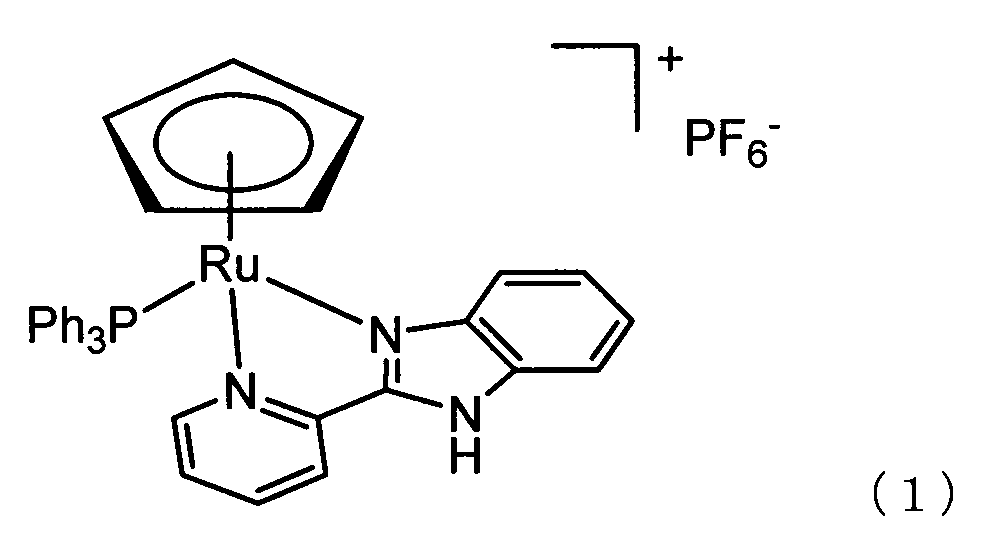
また、窒素含有二座配位子を有するルテニウム錯体は還元反応の触媒などとして様々な構造のものが提案されており、例えば、特許文献1は、式(2)で表されるルテニウム錯体を開示している。そのルテニウム錯体を用いることでアミド類又はラクタム類を、それぞれアルコール類又はアミノアルコール類に還元することができる。

非特許文献2は、式(3)で表されるルテニウム錯体を開示している。そのルテニウム錯体を用いて、シクロヘキサノンをシクロヘキシルアルコールに還元している。
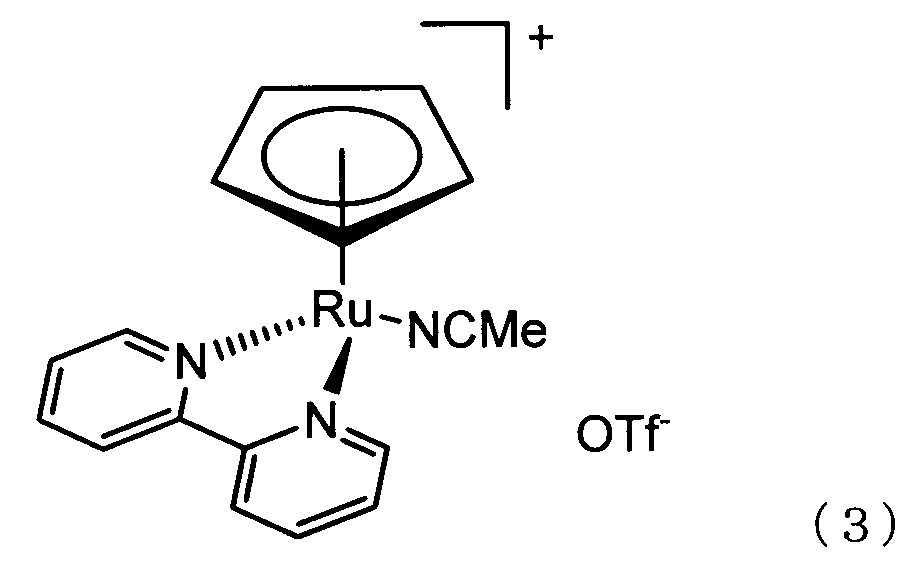
そのルテニウム錯体による還元は、水素化以外にも脱水素化も進行し、様々な副生成物も併せて得られるようである。
Polyhedron, Volume: 26, Issue: 14, Pages: 3638-3644, Journal, 2007
Organometallics, Volume: 32, Issue: 21, Pages: 6541-6554, Journal; 2013
本発明の目的は、工業的な生産に適用できる還元触媒となり得るルテニウム錯体を提供することである。
本発明者は、上記目的を達成するために検討を重ねた結果、以下の態様を包含する本発明を完成するに至った。
式〔I〕
Ru(X1)(L1)m(Z1) 〔I〕
(式〔I〕中、X1は、アニオン性基を示し、Z1は、置換若しくは無置換のシクロペンタジエニル基を示し、L1は、中性の配位子を示し、mは、L1が単座配位子の場合は2又は3を示し、L1が二座配位子の場合は1を示す。)で表される化合物、及び式〔II〕
[Ru(X2)(Z2)]n 〔II〕
(式〔II〕中、X2は、アニオン性基を示し、Z2は、置換若しくは無置換のシクロペンタジエニル基を示し、nは、2~4の整数を示す。)で表される化合物から選ばれる少なくとも一種と、
式〔III〕
A-B 〔III〕
(式〔III〕中、AとBは単結合で結合する。Aは、式〔a1〕

(式〔a1〕中、R1は置換基を示し、pは0~3いずれかの整数を示し、*はBとの結合位置を示す。)
又は、式〔a2〕
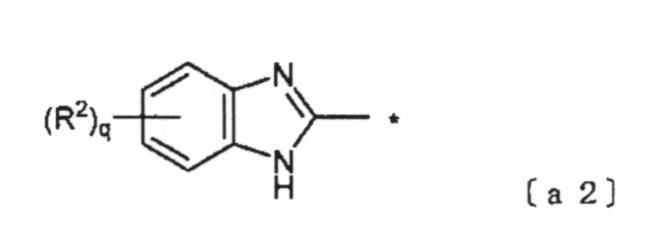
(式〔a2〕中、R2は置換基を示し、qは0~4いずれかの整数を示し、*はBとの結合位置を示す。)を示し、Bは、置換若しくは無置換のヘテロシクリル基を示す。ただし、前記置換若しくは無置換のヘテロシクリル基は、Aと結合する環構成原子に隣接する原子の少なくとも1つが、ヘテロ原子又はカルベン炭素である。)で表される化合物とから調製されるルテニウム錯体を用いて、水素供与体及び塩基の存在下で、ケトン類、アルデヒド類、エステル類又はアミド類を還元する方法。
Ru(X1)(L1)m(Z1) 〔I〕
(式〔I〕中、X1は、アニオン性基を示し、Z1は、置換若しくは無置換のシクロペンタジエニル基を示し、L1は、中性の配位子を示し、mは、L1が単座配位子の場合は2又は3を示し、L1が二座配位子の場合は1を示す。)で表される化合物、及び式〔II〕
[Ru(X2)(Z2)]n 〔II〕
(式〔II〕中、X2は、アニオン性基を示し、Z2は、置換若しくは無置換のシクロペンタジエニル基を示し、nは、2~4の整数を示す。)で表される化合物から選ばれる少なくとも一種と、
式〔III〕
A-B 〔III〕
(式〔III〕中、AとBは単結合で結合する。Aは、式〔a1〕
又は、式〔a2〕
本発明に係るルテニウム錯体は、還元触媒として有用である。本発明に係る還元触媒を用いると、例えば、ケトン類、アルデヒド類、エステル類、アミド類を還元することができる。本発明に係る触媒は活性が高いので少量の使用でも十分に還元反応速度を向上させることができる。
(ルテニウム錯体)
本発明のルテニウム錯体は、式〔I〕及び式〔II〕で表される化合物から選ばれる少なくとも一種と、式〔III〕で表される化合物とから調製される錯体である。
本発明のルテニウム錯体は、式〔I〕及び式〔II〕で表される化合物から選ばれる少なくとも一種と、式〔III〕で表される化合物とから調製される錯体である。
(式〔I〕で表される化合物)
式〔I〕で表される化合物は、以下で表される。
Ru(X1)(L1)m(Z1) 〔I〕
式〔I〕で表される化合物は、以下で表される。
Ru(X1)(L1)m(Z1) 〔I〕
式〔I〕において、X1は、アニオン性基を示す。アニオン性基としては、CF3SO3
-、BF4
-、PF6
-、ClO4
-;フルオロ基、クロロ基、ブロモ基、ヨード基などのハロゲノ基;ヒドリド基;ヒドロキシル基;アセチルアセトネートなどの置換若しくは無置換のジケトネート基;置換若しくは無置換のシクロペンタジエニル基;ビニル基、1-プロペニル基、2-プロペニル基、1-ブテニル基、2-ブテニル基、3-ブテニル基、1-メチル-2-プロペニル基、2-メチル-2-プロペニル基、1-ペンテニル基、2-ペンテニル基、3-ペンテニル基、4-ペンテニル基、1-メチル-2-ブテニル基、2-メチル-2-ブテニル基、1-ヘキセニル基、2-ヘキセニル基、3-ヘキセニル基、4-ヘキセニル基、5-ヘキセニル基などの置換若しくは無置換のアルケニル基;メチル基、エチル基、n-プロピル基、i-プロピル基、n-ブチル基、s-ブチル基、i-ブチル基、t-ブチル基、n-ペンチル基、n-ヘキシル基などの置換若しくは無置換のアルキル基;フェニル基、ナフチル基などの置換若しくは無置換のアリール基;メトキシ基、エトキシ基、n-プロポキシ基、i-プロポキシ基、n-ブトキシ基、s-ブトキシ基、i-ブトキシ基、t-ブトキシ基などの置換若しくは無置換のアルコキシ基;フェノキシ基、1-ナフトキシ基などの置換若しくは無置換のアリールオキシ基;メトキシカルボニル基、エトキシカルボニル基、n-プロポキシカルボニル基、i-プロポキシカルボニル基、n-ブトキシカルボニル基、t-ブトキシカルボニル基などの置換若しくは無置換のアルコキシカルボニル基;カルボキシル基、メトキシカルボニル基、エトキシカルボニル基などの置換若しくは無置換のカルボキシル基;メチルスルフォネート基、エチルスルフォネート基、t-ブチルスルフォネート基などの置換若しくは無置換のアルキルスルフォネート基;フェニルスルフォネート基などの置換若しくは無置換のアリールスルフォネート基;メチルチオ基、エチルチオ基、n-プロピルチオ基、i-プロピルチオ基、n-ブチルチオ基、i-ブチルチオ基、s-ブチルチオ基、t-ブチルチオ基などの置換若しくは無置換のアルキルチオ基;ビニルチオ基、アリルチオ基などの置換若しくは無置換のアルケニルチオ基;フェニルチオ基、ナフチルチオ基などの置換若しくは無置換のアリールチオ基;メチルスルホニル基、エチルスルホニル基、t-ブチルスルホニル基などの置換若しくは無置換のアルキルスルホニル基;及び メチルスルフィニル基、エチルスルフィニル基、t-ブチルスルフィニル基などの置換若しくは無置換のアルキルスルフィニル基を挙げることができる。これらのうち、CF3SO3
-、PF6
-、ハロゲノ基、置換若しくは無置換のアルコキシ基が好ましい。
式〔I〕において、Z1は、置換若しくは無置換のシクロペンタジエニル基を示す。Z1の具体例としては、シクロペンタジエニル基、1,3-ジイソプロピルシクロペンタジエニル基、テトラフェニルシクロペンタジエニル基、ペンタメチルシクロペンタジエニル基などを挙げることができる。
式〔I〕において、L1は、中性の配位子を示す。中性の配位子は、単座配位子であってもよいし、二座配位子であってもよい。
中性の単座配位子としては、水(H2O)、アルコール類(ROH)、エーテル類(ROR’)ケトン類(RC(=O)R’)、エステル類(RC(=O)OR’)、チオール類(RSH)、スルフィド類(RSR’)、スルホキシド類(RS(=O)R’)、アミン類(RR’R”N)、アミド類(RR’NC(=O)R”)、アセトニトリルなどのニトリル類(RCN)、イソニトリル類(RNC)、二級ホスフィン類(RR’PH)、二級ホスフィンオキシド類(RR’P(=O)H)、トリフェニルホスフィンなどの三級ホスフィン類(RR’R”P)、ホスファイト類((RO)(R’O)(R”O)P)、カルベン(RR’C:)、ナイトレン(RN::)、シリレン(RR’Si:)、水素分子(H2)、窒素分子(N2)、一酸化炭素(CO)及び一酸化窒素(NO)などを挙げることができる。
中性の二座配位子としては、上記の単座配位子2つが結合した二座配位子や、1,5-シクロオクタジエン、ノルボルナジエン、イソプレンなどを挙げることができる。
中性の単座配位子としては、水(H2O)、アルコール類(ROH)、エーテル類(ROR’)ケトン類(RC(=O)R’)、エステル類(RC(=O)OR’)、チオール類(RSH)、スルフィド類(RSR’)、スルホキシド類(RS(=O)R’)、アミン類(RR’R”N)、アミド類(RR’NC(=O)R”)、アセトニトリルなどのニトリル類(RCN)、イソニトリル類(RNC)、二級ホスフィン類(RR’PH)、二級ホスフィンオキシド類(RR’P(=O)H)、トリフェニルホスフィンなどの三級ホスフィン類(RR’R”P)、ホスファイト類((RO)(R’O)(R”O)P)、カルベン(RR’C:)、ナイトレン(RN::)、シリレン(RR’Si:)、水素分子(H2)、窒素分子(N2)、一酸化炭素(CO)及び一酸化窒素(NO)などを挙げることができる。
中性の二座配位子としては、上記の単座配位子2つが結合した二座配位子や、1,5-シクロオクタジエン、ノルボルナジエン、イソプレンなどを挙げることができる。
式〔I〕において、mは、L1が単座配位子の場合は2又は3を示し、L1が二座配位子の場合は1を示す。
上記X1及びZ1に例示された基の「置換若しくは無置換の」における「置換基」としては、後述する式〔III〕における置換基と同様の基が挙げられる。
式〔I〕で表される化合物として、具体的には、クロロ(1,5-シクロオクタジエン)(ペンタメチルシクロペンタジエニル)ルテニウム(II)、クロロ(ノルボルナジエン)(ペンタメチルシクロペンタジエニル)ルテニウム(II)、クロロ(イソプレン)(ペンタメチルシクロペンタジエニル)ルテニウム(II)などを挙げることができる。
(式〔II〕で表される化合物)
式〔II〕で表される化合物は、以下で表される。
[Ru(X2)(Z2)]n 〔II〕
式〔II〕で表される化合物は、以下で表される。
[Ru(X2)(Z2)]n 〔II〕
式〔II〕において、X2は、アニオン性基を示す。アニオン性基としては、CF3SO3
-、BF4
-、PF6
-、ClO4
-;フルオロ基、クロロ基、ブロモ基、ヨード基などのハロゲノ基;ヒドリド基;ヒドロキシル基;アセチルアセトネートなどの置換若しくは無置換のジケトネート基;置換若しくは無置換のシクロペンタジエニル基;ビニル基、1-プロペニル基、2-プロペニル基、1-ブテニル基、2-ブテニル基、3-ブテニル基、1-メチル-2-プロペニル基、2-メチル-2-プロペニル基、1-ペンテニル基、2-ペンテニル基、3-ペンテニル基、4-ペンテニル基、1-メチル-2-ブテニル基、2-メチル-2-ブテニル基、1-ヘキセニル基、2-ヘキセニル基、3-ヘキセニル基、4-ヘキセニル基、5-ヘキセニル基などの置換若しくは無置換のアルケニル基;メチル基、エチル基、n-プロピル基、i-プロピル基、n-ブチル基、s-ブチル基、i-ブチル基、t-ブチル基、n-ペンチル基、n-ヘキシル基などの置換若しくは無置換のアルキル基;フェニル基、ナフチル基などの置換若しくは無置換のアリール基;メトキシ基、エトキシ基、n-プロポキシ基、i-プロポキシ基、n-ブトキシ基、s-ブトキシ基、i-ブトキシ基、t-ブトキシ基などの置換若しくは無置換のアルコキシ基;フェノキシ基、1-ナフトキシ基などの置換若しくは無置換のアリールオキシ基;メトキシカルボニル基、エトキシカルボニル基、n-プロポキシカルボニル基、i-プロポキシカルボニル基、n-ブトキシカルボニル基、t-ブトキシカルボニル基などの置換若しくは無置換のアルコキシカルボニル基;カルボキシル基、メトキシカルボニル基、エトキシカルボニル基などの置換若しくは無置換のカルボキシル基;メチルスルフォネート基、エチルスルフォネート基、t-ブチルスルフォネート基などの置換若しくは無置換のアルキルスルフォネート基;フェニルスルフォネート基などの置換若しくは無置換のアリールスルフォネート基;メチルチオ基、エチルチオ基、n-プロピルチオ基、i-プロピルチオ基、n-ブチルチオ基、i-ブチルチオ基、s-ブチルチオ基、t-ブチルチオ基などの置換若しくは無置換のアルキルチオ基;ビニルチオ基、アリルチオ基などの置換若しくは無置換のアルケニルチオ基;フェニルチオ基、ナフチルチオ基などの置換若しくは無置換のアリールチオ基;メチルスルホニル基、エチルスルホニル基、t-ブチルスルホニル基などの置換若しくは無置換のアルキルスルホニル基;及び メチルスルフィニル基、エチルスルフィニル基、t-ブチルスルフィニル基などの置換若しくは無置換のアルキルスルフィニル基を挙げることができる。これらのうち、CF3SO3
-、PF6
-、ハロゲノ基、置換若しくは無置換のアルコキシ基が好ましい。
式〔II〕において、Z2は、置換若しくは無置換のシクロペンタジエニル基を示す。Z2の具体例としては、シクロペンタジエニル基、1,3-ジイソプロピルシクロペンタジエニル基、テトラフェニルシクロペンタジエニル基、ペンタメチルシクロペンタジエニル基などを挙げることができる。
式〔II〕において、nは、2~4の整数を示す。
上記X2及びZ2に例示された基の「置換若しくは無置換の」における「置換基」としては、後述する式〔III〕における置換基と同様の基が挙げられる。
式〔II〕で表される化合物として、具体的には(ペンタメチルシクロペンタジエニル)ルテニウム(II)クロリド四量体、(ペンタメチルシクロペンタジエニル)ルテニウム(II)メトキシド二量体などを挙げることができる。
(式〔III〕で表される化合物)
式〔III〕で表される化合物は、以下で表される。
A-B 〔III〕
式〔III〕で表される化合物は、以下で表される。
A-B 〔III〕
式〔III〕中、AとBは単結合で結合する。
式〔III〕中、Aは、式〔a1〕又は式〔a2〕で表される構造を示す。

式〔a1〕中、R1は、置換基を示す。置換基としては、C1~6アルキル基、C3~8シクロアルキル基、C6~10アリール基、3~6員ヘテロシクリル基、ヒドロキシル基、C1~6アルコキシ基、C6~10アリールオキシ基、カルボキシル基、ハロゲノ基、C1~6ハロアルキル基、C6~10ハロアリール基、C1~6ハロアルコキシ基、アミノ基(NH2で表される基)、C1~6アルキル置換アミノ基、C6~10アリールアミノ基、C1~7アシルアミノ基、C1~6アルコキシカルボニルアミノ基、C1~6アルキルチオ基、C6~10アリールチオ基、ヘテロアリールチオ基、C7~11アラルキルチオ基、C1~6アルキルスルフィニル基、C6~10アリールスルフィニル基、ヘテロアリールスルフィニル基、C7~11アラルキルスルフィニル基、C1~6アルキルスルホニル基、C6~10アリールスルホニル基、ヘテロシクリルスルホニル基、シアノ基、ニトロ基などを挙げることができる。
式〔a1〕中、pは0~3いずれかの整数を示す。
式〔a1〕中、*はBとの結合位置を示す。

式〔a2〕中、R2は置換基を示す。置換基としては、C1~6アルキル基、C3~8シクロアルキル基、C6~10アリール基、3~6員ヘテロシクリル基、ヒドロキシル基、C1~6アルコキシ基、C6~10アリールオキシ基、カルボキシル基、ハロゲノ基、C1~6ハロアルキル基、C6~10ハロアリール基、C1~6ハロアルコキシ基、アミノ基(NH2で表される基)、C1~6アルキル置換アミノ基、C6~10アリールアミノ基、C1~7アシルアミノ基、C1~6アルコキシカルボニルアミノ基、C1~6アルキルチオ基、C6~10アリールチオ基、ヘテロアリールチオ基、C7~11アラルキルチオ基、C1~6アルキルスルフィニル基、C6~10アリールスルフィニル基、ヘテロアリールスルフィニル基、C7~11アラルキルスルフィニル基、C1~6アルキルスルホニル基、C6~10アリールスルホニル基、ヘテロシクリルスルホニル基、シアノ基、ニトロ基などを挙げることができる。
式〔a2〕中、qは0~4いずれかの整数を示す。
式〔a2〕中、*はBとの結合位置を示す。
上記R1及びR2において、
「C1~6アルキル基」としては、メチル基、エチル基、n-プロピル基、i-プロピル基、n-ブチル基、s-ブチル基、i-ブチル基、t-ブチル基、n-ペンチル基、n-ヘキシル基などが挙げられる。
「C3~8シクロアルキル基」としては、単環又は多環のアルキル基であり、例えば、シクロプロピル基、シクロブチル基、シクロペンチル基、シクロへキシル基、シクロヘプチル基、シクロオクチル基、ビシクロオクチル基、ビシクロヘプチル基などが挙げられる。
「C6~10アリール基」は、単環又は多環のアリール基を意味する。ここで、多環アリール基の場合は、完全不飽和に加え、部分飽和の基も包含する。例えばフェニル基、ナフチル基、アズレニル基、インデニル基、インダニル基、テトラリニル基などが挙げられる。
「3~6員ヘテロシクリル基」としては、後述する式〔III〕のBに例示するものと同様の基が挙げられる。
「C1~6アルコキシ基」としては、メトキシ基、エトキシ基、n-プロポキシ基、i-プロポキシ基、n-ブトキシ基、s-ブトキシ基、i-ブトキシ基、t-ブトキシ基などが挙げられる。
「C6~10アリールオキシ基」としては、フェノキシ基、1-ナフトキシ基などが挙げられる。
「ハロゲノ基」としては、フルオロ基、クロロ基、ブロモ基、ヨード基などが挙げられる。
「C1~6ハロアルキル基」としては、クロロメチル基、ブロモメチル基、フルオロメチル基、トリフルオロメチル基、トリクロロメチル基、トリブロモメチル基、2,2,2-トリクロロエチル基、2,2,3,3,3-ペンタフルオロプロピル基又は1-クロロブチル基、6-フルオロへヘキシル基、6,6,6―トリフルオロへキシル基などが挙げられる。
「C6~10ハロアリール基」としては、4-クロロフェニル、4-ブロモフェニル、3,5-ジクロロフェニルなどが挙げられる。
「C1~6ハロアルコキシ基」としては、クロロメトキシ基、ブロモメトキシ基、フルオロメトキシ、トリフルオロメトキシ基などが挙げられる。
「C1~6アルキル置換アミノ基」としては、メチルアミノ基、エチルアミノ基、n-プロピルアミノ基、n-ブチルアミノ基、n-へキシルアミノ基などのモノアルキルアミノ基;ジメチルアミノ基、ジエチルアミノ基、ジ-n-プロピルアミノ基、ジ-n-ブチルアミノ基、N-メチル-N-ヘキシルアミノ基などのジアルキルアミノ基が挙げられる。
「C6~10アリールアミノ基」としては、フェニルアミノ基、ジフェニルアミノ基などが挙げられる。
「C1~7アシルアミノ基」としては、アセチルアミノ基、ジアセチルアミノ基などが挙げられる。
「C1~6アルコキシカルボニルアミノ基」としては、メトキシカルボニルアミノ基、ジメトキシカルボニルアミノ基などが挙げられる。
「C1~6アルキルチオ基」としては、メチルチオ基、エチルチオ基、n-プロピルチオ基、t-ブチルチオ基、1-エチルプロピルチオ基、n-ヘキシルチオ基などが挙げられる。
「C6~10アリールチオ基」としては、フェニルチオ基、ナフチルチオ基などが挙げられる。
「ヘテロアリールチオ基」としては、フリルチオ基、チエニルチオ基、ピロリルチオ基、ピリジニルチオ基、ピラジニルチオ基、ピリジニルチオ基などが挙げられる。
「C7~11アラルキルチオ基」としては、ベンジルチオ基、フェネチルチオ基、ナフチルメチルチオ基などが挙げられる。
「C1~6アルキルスルフィニル基」としては、メチルスルフィニル基、エチルスルフィニル基、t-ブチルスルフィニル基などが挙げられる。
「C6~10アリールスルフィニル基」としては、フェニルスルフィニル基、ナフチルスルフィニル基などが挙げられる。
「ヘテロアリールスルフィニル基」としては、フリルスルフィニル基、チエニルスルフェニル基、ピロリルスルフェニル基、ピリジニルスルフェニル基、ピラジニルスルフェニル基、ピリジニルスルフェニル基などが挙げられる。
「C7~11アラルキルスルフィニル基」としては、ベンジルスルフェニル基、フェネチルスルフェニル基、ナフチルメチルスルフェニル基などが挙げられる。
「C1~6アルキルスルホニル基」としては、メチルスルホニル基、エチルスルホニル基、t-ブチルスルホニル基などが挙げられる。
「C6~10アリールスルホニル基」としては、フェニルスルホニル基、ナフチルスルホニル基などが挙げられる。
「ヘテロシクリルスルホニル基」としては、アジリジニルスルホニル基、エポキシスルホニル基、ピロリルフルホニル基、フリルスルホニル基、チエニルスルホニル基などが挙げられる。
「C1~6アルキル基」としては、メチル基、エチル基、n-プロピル基、i-プロピル基、n-ブチル基、s-ブチル基、i-ブチル基、t-ブチル基、n-ペンチル基、n-ヘキシル基などが挙げられる。
「C3~8シクロアルキル基」としては、単環又は多環のアルキル基であり、例えば、シクロプロピル基、シクロブチル基、シクロペンチル基、シクロへキシル基、シクロヘプチル基、シクロオクチル基、ビシクロオクチル基、ビシクロヘプチル基などが挙げられる。
「C6~10アリール基」は、単環又は多環のアリール基を意味する。ここで、多環アリール基の場合は、完全不飽和に加え、部分飽和の基も包含する。例えばフェニル基、ナフチル基、アズレニル基、インデニル基、インダニル基、テトラリニル基などが挙げられる。
「3~6員ヘテロシクリル基」としては、後述する式〔III〕のBに例示するものと同様の基が挙げられる。
「C1~6アルコキシ基」としては、メトキシ基、エトキシ基、n-プロポキシ基、i-プロポキシ基、n-ブトキシ基、s-ブトキシ基、i-ブトキシ基、t-ブトキシ基などが挙げられる。
「C6~10アリールオキシ基」としては、フェノキシ基、1-ナフトキシ基などが挙げられる。
「ハロゲノ基」としては、フルオロ基、クロロ基、ブロモ基、ヨード基などが挙げられる。
「C1~6ハロアルキル基」としては、クロロメチル基、ブロモメチル基、フルオロメチル基、トリフルオロメチル基、トリクロロメチル基、トリブロモメチル基、2,2,2-トリクロロエチル基、2,2,3,3,3-ペンタフルオロプロピル基又は1-クロロブチル基、6-フルオロへヘキシル基、6,6,6―トリフルオロへキシル基などが挙げられる。
「C6~10ハロアリール基」としては、4-クロロフェニル、4-ブロモフェニル、3,5-ジクロロフェニルなどが挙げられる。
「C1~6ハロアルコキシ基」としては、クロロメトキシ基、ブロモメトキシ基、フルオロメトキシ、トリフルオロメトキシ基などが挙げられる。
「C1~6アルキル置換アミノ基」としては、メチルアミノ基、エチルアミノ基、n-プロピルアミノ基、n-ブチルアミノ基、n-へキシルアミノ基などのモノアルキルアミノ基;ジメチルアミノ基、ジエチルアミノ基、ジ-n-プロピルアミノ基、ジ-n-ブチルアミノ基、N-メチル-N-ヘキシルアミノ基などのジアルキルアミノ基が挙げられる。
「C6~10アリールアミノ基」としては、フェニルアミノ基、ジフェニルアミノ基などが挙げられる。
「C1~7アシルアミノ基」としては、アセチルアミノ基、ジアセチルアミノ基などが挙げられる。
「C1~6アルコキシカルボニルアミノ基」としては、メトキシカルボニルアミノ基、ジメトキシカルボニルアミノ基などが挙げられる。
「C1~6アルキルチオ基」としては、メチルチオ基、エチルチオ基、n-プロピルチオ基、t-ブチルチオ基、1-エチルプロピルチオ基、n-ヘキシルチオ基などが挙げられる。
「C6~10アリールチオ基」としては、フェニルチオ基、ナフチルチオ基などが挙げられる。
「ヘテロアリールチオ基」としては、フリルチオ基、チエニルチオ基、ピロリルチオ基、ピリジニルチオ基、ピラジニルチオ基、ピリジニルチオ基などが挙げられる。
「C7~11アラルキルチオ基」としては、ベンジルチオ基、フェネチルチオ基、ナフチルメチルチオ基などが挙げられる。
「C1~6アルキルスルフィニル基」としては、メチルスルフィニル基、エチルスルフィニル基、t-ブチルスルフィニル基などが挙げられる。
「C6~10アリールスルフィニル基」としては、フェニルスルフィニル基、ナフチルスルフィニル基などが挙げられる。
「ヘテロアリールスルフィニル基」としては、フリルスルフィニル基、チエニルスルフェニル基、ピロリルスルフェニル基、ピリジニルスルフェニル基、ピラジニルスルフェニル基、ピリジニルスルフェニル基などが挙げられる。
「C7~11アラルキルスルフィニル基」としては、ベンジルスルフェニル基、フェネチルスルフェニル基、ナフチルメチルスルフェニル基などが挙げられる。
「C1~6アルキルスルホニル基」としては、メチルスルホニル基、エチルスルホニル基、t-ブチルスルホニル基などが挙げられる。
「C6~10アリールスルホニル基」としては、フェニルスルホニル基、ナフチルスルホニル基などが挙げられる。
「ヘテロシクリルスルホニル基」としては、アジリジニルスルホニル基、エポキシスルホニル基、ピロリルフルホニル基、フリルスルホニル基、チエニルスルホニル基などが挙げられる。
式〔III〕中、Bは、置換若しくは無置換のヘテロシクリル基を示す。ただし、前記置換若しくは無置換のヘテロシクリル基は、Aと結合する環構成原子に隣接する原子の少なくとも1つが、ヘテロ原子又はカルベン炭素である。
上記の「ヘテロシクリル基」とは、窒素原子、酸素原子及び硫黄原子からなる群から選ばれる1~4個のヘテロ原子を環の構成原子として含むものである。ヘテロシクリル基は、単環及び多環のいずれであってもよい。多環ヘテロシクリル基は、少なくとも一つの環がヘテロ環であれば、残りの環が飽和脂環、不飽和脂環又は芳香環のいずれであってもよい。「ヘテロシクリル基」としては、3~6員飽和ヘテロシクリル基、5~6員ヘテロアリール基、5~6員部分不飽和ヘテロシクリル基、9~10員ヘテロアリール基などを挙げることができる。
3~6員飽和ヘテロシクリル基としては、アジリジニル基、エポキシ基、ピロリジニル基、テトラヒドロフラニル基、チアゾリジニル基、ピペリジル基、ピペラジニル基、モルホリニル基、ジオキソラニル基、ジオキサニル基などを挙げることができる。
5員ヘテロアリール基としては、ピロリル基、フリル基、チエニル基、イミダゾリル基、ピラゾリル基、オキサゾリル基、イソオキサゾリル基、チアゾリル基、イソチアゾリル基、トリアゾリル基、オキサジアゾリル基、チアジアゾリル基、テトラゾリル基などを挙げることができる。
6員ヘテロアリール基としては、ピリジル基、ピラジニル基、ピリミジニル基、ピリダニジル基、トリアジニル基などを挙げることができる。
6員ヘテロアリール基としては、ピリジル基、ピラジニル基、ピリミジニル基、ピリダニジル基、トリアジニル基などを挙げることができる。
5~6員部分不飽和ヘテロシクリル基としては、2,3-ジヒドロピロリル基、2,3-ジヒドロピリジニル基、2,3-ジヒドロチアゾリル基、2,3-ジヒドロフラニル基、イミダゾリニル基などを挙げることができる。
9~10員ヘテロアリール基は、ベンゼン環を有する二環式ヘテロシクリル基であり、インドリル基、キノリニル基、ベンゾイミダゾリル基、ベンゾフラニル基、ベンゾチアゾリニル基などを挙げることができる。
ヘテロシクリル基の置換基としては、C1~6アルキル基、C3~8シクロアルキル基、C6~10アリール基、3~6員ヘテロシクリル基、ヒドロキシル基、C1~6アルコキシ基、C6~10アリールオキシ基、カルボキシル基、ハロゲノ基、C1~6ハロアルキル基、C6~10ハロアリール基、C1~6ハロアルコキシ基、アミノ基(NH2で表される基)、C1~6アルキル置換アミノ基、C6~10アリールアミノ基、C1~7アシルアミノ基、C1~6アルコキシカルボニルアミノ基、C1~6アルキルチオ基、C6~10アリールチオ基、ヘテロアリールチオ基、C7~11アラルキルチオ基、C1~6アルキルスルフィニル基、C6~10アリールスルフィニル基、ヘテロアリールスルフィニル基、C7~11アラルキルスルフィニル基、C1~6アルキルスルホニル基、C6~10アリールスルホニル基、ヘテロシクリルスルホニル基、シアノ基、ニトロ基などを挙げることができる。
式〔III〕で表される化合物としては、具体的に、式〔III-1〕~式〔III-8〕で表される化合物を挙げることができる。
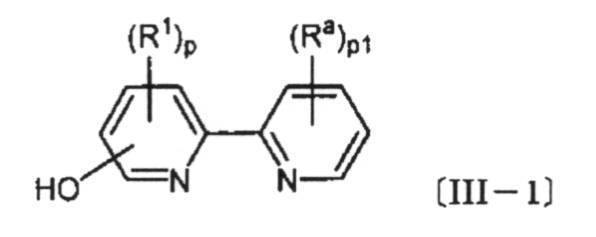
式〔III-1〕中、R1、Raはそれぞれ独立に置換基を示し、pは0~3いずれかの整数を示し、p1は0~4いずれかの整数を示す。R1、Raにおける置換基は、式〔a1〕中のR1と同じものを挙げることができる。
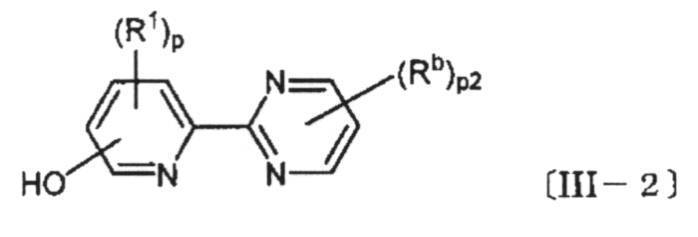
式〔III-2〕中、R1、Rbはそれぞれ独立に置換基を示し、pは0~3いずれかの整数を示し、p2は0~3いずれかの整数を示す。R1、Rbにおける置換基は、式〔a1〕中のR1と同じものを挙げることができる。
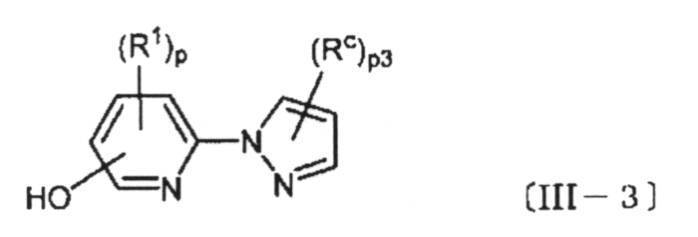
式〔III-3〕中、R1、Rcはそれぞれ独立に置換基を示し、pは0~3いずれかの整数を示し、p3は0~3いずれかの整数を示す。R1、Rcにおける置換基は、式〔a1〕中のR1と同じものを挙げることができる。

式〔III-4〕中、R1、Rdはそれぞれ独立に置換基を示し、R3は、C1~6アルキル基を示し、pは0~3いずれかの整数を示し、p4は0~4いずれかの整数を示す。R1、Rdにおける置換基は、式〔a1〕中のR1と同じものを挙げることができる。

式〔III-5〕中、R1、Reはそれぞれ独立に置換基を示し、R4は、C1~6アルキル基を示し、pは0~3いずれかの整数を示し、p5は0~4いずれかの整数を示す。R1、Reにおける置換基は、式〔a1〕中のR1と同じものを挙げることができる。
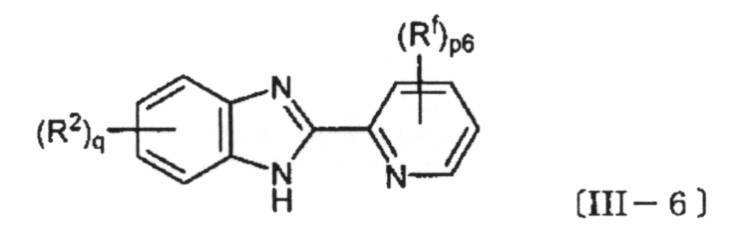
式〔III-6〕中、R2、Rfはそれぞれ独立に置換基を示し、qは0~4いずれかの整数を示し、p6は0~4いずれかの整数を示す。R2、Rfにおける置換基は、式〔a2〕中のR2と同じものを挙げることができる。
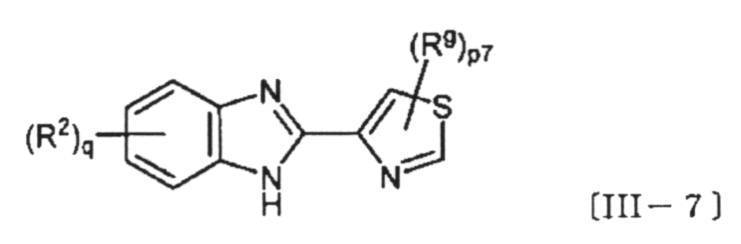
式〔III-7〕中、R2、Rgはそれぞれ独立に置換基を示し、qは0~4いずれかの整数を示し、p7は0~2いずれかの整数を示す。R2、Rgにおける置換基は、式〔a2〕中のR2と同じものを挙げることができる。

式〔III-8〕中、R2、Rhはそれぞれ独立に置換基を示し、qは0~4いずれかの整数を示し、p8は0~4いずれかの整数を示す。R2、Rhおける置換基は、式〔a2〕中のR2と同じものを挙げることができる。
(ルテニウム錯体の調製方法)
本発明のルテニウム錯体は、有機溶媒中で、式〔I〕及び式〔II〕で表される化合物から選ばれる少なくとも一種と、式〔III〕で表される化合物とを混合し、反応させることにより、調製することができる。
本発明のルテニウム錯体は、有機溶媒中で、式〔I〕及び式〔II〕で表される化合物から選ばれる少なくとも一種と、式〔III〕で表される化合物とを混合し、反応させることにより、調製することができる。
反応に用いる有機溶媒としては、例えば、ベンゼン、トルエン、キシレンなどの芳香族炭化水素類;ペンタン、ヘキサンなどの脂肪族炭化水素類;ジクロロメタン、クロロホルム、トリクロロメタン、四塩化炭素、1,2-ジクロロエタンなどのハロゲン炭化水素類;ジエチルエーテル、テトラヒドロフラン(THF)、1,2-ジメトキシエタン、1,4-ジオキサンなどのエーテル類;メタノール、エタノール、n-プロパノール、イソプロパノール、ブタノール、ベンジルアルコールなどのアルコール類;N,N-ジメチルホルムアミド(DMF)、N,N-ジメチルアセタミド、1,3-ジメチルイミダゾリジン、1,3-ジメチル-2-イミダゾリジノン、N-メチルピロリドン、ヘキサメチルリン酸トリアミド(HMPT)などのアミド類;アセトニトリル、ベンゾニトリルなどのニトリル類;ジメチルスルホキシド(DMSO)などを挙げることができる。これらの溶媒は単独で又は2種以上を混合して使用することができる。
溶媒の使用量は、反応物質1gに対して、好ましくは1~100ml、より好ましくは5~30mlである。
反応時の温度は、通常、室温~反応溶媒の沸点、好ましくは25~100℃である。反応に掛ける時間は、反応スケールによっても異なるが、通常、0.1~48時間、好ましくは0.1~18時間である。
反応完了後、ルテニウム錯体を含む溶液をそのまま還元反応用の触媒などとして使用してもよいし、ルテニウム錯体を含む溶液から公知の方法でルテニウム錯体を単離し、それを還元反応用の触媒などとして使用してもよい。
式〔III〕で表される化合物の使用量は、式〔I〕及び式〔II〕で表される化合物1モルに対して、好ましくは0.5~5モル、より好ましくは1.0~1.5モルである。
(還元方法)
本発明の方法は、式〔I〕で表される化合物及び式〔II〕で表される化合物から選ばれる少なくとも一種と、式〔III〕で表される化合物とから調製されるルテニウム錯体を用いて、水素供与体及び塩基の存在下で、ケトン類、アルデヒド類、エステル類、アミド類を還元する方法である。
本発明の方法は、式〔I〕で表される化合物及び式〔II〕で表される化合物から選ばれる少なくとも一種と、式〔III〕で表される化合物とから調製されるルテニウム錯体を用いて、水素供与体及び塩基の存在下で、ケトン類、アルデヒド類、エステル類、アミド類を還元する方法である。
水素供与体としては、水素ガス、イソプロパノール、ギ酸、ギ酸塩などを挙げることができる。これらは1種単独で又は2種以上を組み合わせて用いることができる。なかでも水素ガスが好ましい。
塩基としては、水酸化ナトリウム、水酸化カリウム、炭酸ナトリウム、炭酸カリウムなどの無機塩基類、ナトリウムメトキシド、ナトリウムエトキシド、ナトリウムt-ブトキシド、カリウムt-ブトキシドなどのアルコキシド、アンモニア、C3~30の有機アミン類などの塩基を挙げることができる。これらは1種単独で又は2種以上を組み合わせて用いることができる。
C3~30の有機アミン類としては具体的にはトリエチルアミン、トリブチルアミン、ジイソプロピルエチルアミン、イソプロピルジメチルアミン、トリメチルアミン、n-トリオクチルアミン、iso-トリオクチルアミン、1,8-ジアザビシクロ[5.4.0]ウンデカ-7-エン、1,5-ジアザビシクロ[4.3.0]ノナ-5-エン、1,4-ジアザビシクロ[2.2.2]オクタンなどが挙げられる。
使用する塩基の量は、特に限定されないが、ルテニウム錯体1モルに対して、1モル以上となる量である。
C3~30の有機アミン類としては具体的にはトリエチルアミン、トリブチルアミン、ジイソプロピルエチルアミン、イソプロピルジメチルアミン、トリメチルアミン、n-トリオクチルアミン、iso-トリオクチルアミン、1,8-ジアザビシクロ[5.4.0]ウンデカ-7-エン、1,5-ジアザビシクロ[4.3.0]ノナ-5-エン、1,4-ジアザビシクロ[2.2.2]オクタンなどが挙げられる。
使用する塩基の量は、特に限定されないが、ルテニウム錯体1モルに対して、1モル以上となる量である。
ケトン類としては、アセトン、メチルエチルケトン、メチルイソブチルケトン、アセトフェノン、ベンゾフェノンなどを挙げることができる。
アルデヒド類としては、ホルムアルデヒド、アセトアルデヒド、ベンズアルデヒドなどを挙げることができる。
エステル類としては、安息香酸メチル、安息香酸エチル、安息香酸イソプロピル、3-フェニルプロピオン酸メチル、シクロプロパンカルボン酸メチル、フタリドなどを挙げることができる。
アミド類としては、N-メチルアセトアニリド、1-フェニル-2-ピロリドンなどを挙げることができる。
還元反応に用いられる溶媒として、水;メタノール、エタノール、2-プロパノール、tert-ブチルアルコール、トリフルオロエタノール、ヘキサフルオロイソプロパノールなどのアルコール系溶媒;トルエン、キシレンなどの芳香族系溶媒;ジエチルエーテル、テトラヒドロフラン、2-メチルテトラヒドロフランなどのエーテル系溶媒;ジクロロメタン、クロロホルムなどのハロゲン系溶媒などを用いることができる。ギ酸及び/又はギ酸塩を水素供与体として用いる場合は、ギ酸及び/又はギ酸塩が溶媒の役割を兼ねるので、前記の溶媒を用いてもよいし、用いなくてもよい。これら溶媒は、1種単独で又は2種以上を組み合わせて使用することができる。
ルテニウム錯体の使用量は、錯体中のルテニウムが、基質1モルに対して、好ましくは0.001~100ミリモル、より好ましくは0.06~20ミリモルとなる量である。
水素供与体の使用量は、基質中の還元対象となる官能基1モルに対して、好ましくは1モル以上、より好ましくは2モル以上、さらに好ましくは10モル以上、よりさらに好ましくは20モル以上である。
還元反応時の温度は、好ましくは-20~150℃、より好ましくは0~100℃の範囲などから選択することができる。
還元反応に掛ける時間は、触媒の使用量によって異なるが、好ましくは0.1~100時間、より好ましくは0.1~10時間である。
反応完了後、蒸留、抽出、クロマトグラフィー、再結晶などの一般的操作により、生成物を分離、精製することができる。
次に、実施例を示し、本発明をより詳しく説明する。ただし、本発明はこれら実施例に限定されるものではない。
合成例1
シュレンク管にテトラヒドロフラン2mlと、2-(2-ピリジル)ベンズイミダゾール(下記化合物(1))40mg(0.2mmol)を加え、脱気した後、反応容器内をアルゴン置換した。そこに、クロロ(1,5-シクロオクタジエン)(ペンタメチルシクロペンタジエニル)ルテニウム(II)76mg(0.2mmol)を加え、5分間還流した。溶液を濃縮後、乾固することによりルテニウム錯体1を調製した。
シュレンク管にテトラヒドロフラン2mlと、2-(2-ピリジル)ベンズイミダゾール(下記化合物(1))40mg(0.2mmol)を加え、脱気した後、反応容器内をアルゴン置換した。そこに、クロロ(1,5-シクロオクタジエン)(ペンタメチルシクロペンタジエニル)ルテニウム(II)76mg(0.2mmol)を加え、5分間還流した。溶液を濃縮後、乾固することによりルテニウム錯体1を調製した。
合成例2~合成例8
化合物(1)の代わりに下記化合物(2)~(8)を用いること以外は、合成例1と同様にして、ルテニウム錯体2~ルテニウム錯体8を調製した。
化合物(1)の代わりに下記化合物(2)~(8)を用いること以外は、合成例1と同様にして、ルテニウム錯体2~ルテニウム錯体8を調製した。
比較合成例1、2
化合物(1)の代わりに下記化合物(A)を用いること以外は、合成例1と同様にして、ルテニウム錯体Aを調製した。
同様に下記化合物(B)を用いることで、ルテニウム錯体Bを調製した。
化合物(1)の代わりに下記化合物(A)を用いること以外は、合成例1と同様にして、ルテニウム錯体Aを調製した。
同様に下記化合物(B)を用いることで、ルテニウム錯体Bを調製した。

実施例1 (アセトフェノンの水素化)
ガラスオートクレーブにルテニウム錯体1を5mg(0.01mmol)とカリウムt-ブトキシド11mg(0.1mmol)を加え、アルゴン置換した。アセトフェノン1.20g(10mmol)をイソプロパノール5mlに溶解し、脱気した後、アルゴン置換した。オートクレーブにアセトフェノン溶液を移送し、0.9MPaの水素雰囲気下、室温で1時間撹拌した。残圧を解放後、GC分析(FID)を行った。相対面積比98.9%にて1-フェニルエタン-1-オールが得られた。
ガラスオートクレーブにルテニウム錯体1を5mg(0.01mmol)とカリウムt-ブトキシド11mg(0.1mmol)を加え、アルゴン置換した。アセトフェノン1.20g(10mmol)をイソプロパノール5mlに溶解し、脱気した後、アルゴン置換した。オートクレーブにアセトフェノン溶液を移送し、0.9MPaの水素雰囲気下、室温で1時間撹拌した。残圧を解放後、GC分析(FID)を行った。相対面積比98.9%にて1-フェニルエタン-1-オールが得られた。
実施例2 (アセトフェノンの水素化)
ルテニウム錯体1の代わりにルテニウム錯体4を用いること以外は、実施例1と同様にしてアセトフェノンの水素化反応を行った。相対面積比99.6%にて1-フェニルエタン-1-オールが得られた。
ルテニウム錯体1の代わりにルテニウム錯体4を用いること以外は、実施例1と同様にしてアセトフェノンの水素化反応を行った。相対面積比99.6%にて1-フェニルエタン-1-オールが得られた。
実施例3 (アセトフェノンの水素化)
ルテニウム錯体1の代わりにルテニウム錯体5を用いること以外は、実施例1と同様にしてアセトフェノンの水素化反応を行った。相対面積比96.3%にて1-フェニルエタン-1-オールが得られた。
ルテニウム錯体1の代わりにルテニウム錯体5を用いること以外は、実施例1と同様にしてアセトフェノンの水素化反応を行った。相対面積比96.3%にて1-フェニルエタン-1-オールが得られた。
実施例4 (アセトフェノンの水素化)
ルテニウム錯体1の代わりにルテニウム錯体6を用いること以外は、実施例1と同様にしてアセトフェノンの水素化反応を行った。相対面積比99.7%にて1-フェニルエタン-1-オールが得られた。
ルテニウム錯体1の代わりにルテニウム錯体6を用いること以外は、実施例1と同様にしてアセトフェノンの水素化反応を行った。相対面積比99.7%にて1-フェニルエタン-1-オールが得られた。
実施例5 (アセトフェノンの水素化)
ルテニウム錯体1の代わりにルテニウム錯体3を用いること以外は、実施例1と同様にしてアセトフェノンの水素化反応を行った。相対面積比98.6%にて1-フェニルエタン-1-オールが得られた。
ルテニウム錯体1の代わりにルテニウム錯体3を用いること以外は、実施例1と同様にしてアセトフェノンの水素化反応を行った。相対面積比98.6%にて1-フェニルエタン-1-オールが得られた。
実施例6(安息香酸メチルの水素化)
金属オートクレーブにルテニウム錯体1を5mg(0.01mmol)加えた後、反応系内をアルゴン置換した。安息香酸メチル2.72g(20mmol)をテトラヒドロフラン7.5mlに溶解し、脱気した後、アルゴン置換した。オートクレーブにエステル溶液を移送し、続いて1M カリウムt-ブトキシド/テトラヒドロフラン溶液1mlを加えた。5MPaの水素雰囲気下、80℃で3時間撹拌した。冷却後、HPLC分析を行った。ベンジルアルコールが、相対面積比95.6%(定量分析収率92.4%)で生成した。その他に、安息香酸メチルが、相対面積比1.7%、安息香酸ベンジルが相対面積比0.3%で存在していた。
金属オートクレーブにルテニウム錯体1を5mg(0.01mmol)加えた後、反応系内をアルゴン置換した。安息香酸メチル2.72g(20mmol)をテトラヒドロフラン7.5mlに溶解し、脱気した後、アルゴン置換した。オートクレーブにエステル溶液を移送し、続いて1M カリウムt-ブトキシド/テトラヒドロフラン溶液1mlを加えた。5MPaの水素雰囲気下、80℃で3時間撹拌した。冷却後、HPLC分析を行った。ベンジルアルコールが、相対面積比95.6%(定量分析収率92.4%)で生成した。その他に、安息香酸メチルが、相対面積比1.7%、安息香酸ベンジルが相対面積比0.3%で存在していた。
実施例7 (安息香酸メチルの水素化)
ルテニウム錯体1の代わりにルテニウム錯体3を用いること以外は、実施例6と同様にして安息香酸メチルの水素化反応を行った。ベンジルアルコールが、相対面積比77.1%で生成した。その他に、安息香酸メチルが相対面積比15.4%、安息香酸ベンジルが相対面積比5.7%で存在していた。
ルテニウム錯体1の代わりにルテニウム錯体3を用いること以外は、実施例6と同様にして安息香酸メチルの水素化反応を行った。ベンジルアルコールが、相対面積比77.1%で生成した。その他に、安息香酸メチルが相対面積比15.4%、安息香酸ベンジルが相対面積比5.7%で存在していた。
比較例1 (安息香酸メチルの水素化)
ルテニウム錯体1の代わりにルテニウム錯体Aを用いること以外は、実施例6と同様にして安息香酸メチルの水素化反応を行った。ベンジルアルコールが、相対面積比39.7%で生成した。その他に、安息香酸メチルが相対面積比54.0%、安息香酸ベンジルが相対面積比4.5%で存在していた。
ルテニウム錯体1の代わりにルテニウム錯体Aを用いること以外は、実施例6と同様にして安息香酸メチルの水素化反応を行った。ベンジルアルコールが、相対面積比39.7%で生成した。その他に、安息香酸メチルが相対面積比54.0%、安息香酸ベンジルが相対面積比4.5%で存在していた。
比較例2 (アセトフェノンの水素化)
ガラスオートクレーブにルテニウム錯体Bを10mg(0.02mmol)とカリウムt-ブトキシド22mg(0.2mmol)を加え、アルゴン置換した。アセトフェノン1.20g(10mmol)をイソプロパノール5mlに溶解し、脱気した後、アルゴン置換した。オートクレーブにアセトフェノン溶液を移送し、0.9MPaの水素雰囲気下、室温で1時間撹拌した。残圧を解放後、GC分析(FID)を行った。相対面積比2.3%にて1-フェニルエタン-1-オールが得られた。
ガラスオートクレーブにルテニウム錯体Bを10mg(0.02mmol)とカリウムt-ブトキシド22mg(0.2mmol)を加え、アルゴン置換した。アセトフェノン1.20g(10mmol)をイソプロパノール5mlに溶解し、脱気した後、アルゴン置換した。オートクレーブにアセトフェノン溶液を移送し、0.9MPaの水素雰囲気下、室温で1時間撹拌した。残圧を解放後、GC分析(FID)を行った。相対面積比2.3%にて1-フェニルエタン-1-オールが得られた。
実施例8(フタリドの水素化)
金属オートクレーブにフタリド2.68g(20mmol)及びルテニウム錯体2を4mg(0.01mmol)入れ、アルゴン置換した。そこに脱気したテトラヒドロフラン10mlとカリウムt-ブトキシド/テトラヒドロフラン溶液(1M)1ml(5mol%)を加え、5MPaの水素雰囲気下、80℃で5時間撹拌した。冷却後、酢酸で中和して反応液を濃縮し、シリカゲルカラムクロマトグラフィーにて精製することで、1,2-ベンゼンジメタノールを2.47g(収率89%)得た。
金属オートクレーブにフタリド2.68g(20mmol)及びルテニウム錯体2を4mg(0.01mmol)入れ、アルゴン置換した。そこに脱気したテトラヒドロフラン10mlとカリウムt-ブトキシド/テトラヒドロフラン溶液(1M)1ml(5mol%)を加え、5MPaの水素雰囲気下、80℃で5時間撹拌した。冷却後、酢酸で中和して反応液を濃縮し、シリカゲルカラムクロマトグラフィーにて精製することで、1,2-ベンゼンジメタノールを2.47g(収率89%)得た。
実施例9 (フタリドの水素化)
金属オートクレーブにフタリド2.68g(20mmol)及びルテニウム錯体3を4mg(0.01mmol)入れ、アルゴン置換した。そこに脱気したテトラヒドロフラン10mlとカリウムt-ブトキシド/テトラヒドロフラン溶液(1M)1ml(5mol%)を加え、5MPaの水素雰囲気下、80℃で5時間撹拌した。冷却後、酢酸で中和して反応液を濃縮し、シリカゲルカラムクロマトグラフィーにて精製することで、1,2-ベンゼンジメタノールを2.30g(収率83%)得た。
金属オートクレーブにフタリド2.68g(20mmol)及びルテニウム錯体3を4mg(0.01mmol)入れ、アルゴン置換した。そこに脱気したテトラヒドロフラン10mlとカリウムt-ブトキシド/テトラヒドロフラン溶液(1M)1ml(5mol%)を加え、5MPaの水素雰囲気下、80℃で5時間撹拌した。冷却後、酢酸で中和して反応液を濃縮し、シリカゲルカラムクロマトグラフィーにて精製することで、1,2-ベンゼンジメタノールを2.30g(収率83%)得た。
実施例10(フタリドの水素化)
金属オートクレーブにフタリド2.68g(20mmol)及びルテニウム錯体1を5mg(0.01mmol)を入れ、アルゴン置換した。そこに脱気したテトラヒドロフラン10mlとカリウムt-ブトキシド/テトラヒドロフラン溶液(1M)1ml(5mol%)を加え、5MPaの水素雰囲気下、80℃で5時間撹拌した。冷却後、酢酸で中和して反応液を濃縮し、シリカゲルカラムクロマトグラフィーにて精製することで、1,2-ベンゼンジメタノールを2.47g(収率89%)得た。
金属オートクレーブにフタリド2.68g(20mmol)及びルテニウム錯体1を5mg(0.01mmol)を入れ、アルゴン置換した。そこに脱気したテトラヒドロフラン10mlとカリウムt-ブトキシド/テトラヒドロフラン溶液(1M)1ml(5mol%)を加え、5MPaの水素雰囲気下、80℃で5時間撹拌した。冷却後、酢酸で中和して反応液を濃縮し、シリカゲルカラムクロマトグラフィーにて精製することで、1,2-ベンゼンジメタノールを2.47g(収率89%)得た。
実施例11 (安息香酸イソプロピルの水素化)
金属オートクレーブにルテニウム錯体1を5mg(0.01mmol)を加え、アルゴン置換した。安息香酸イソプロピル3.28g(20mmol)をテトラヒドロフラン7.5mlに溶解し、脱気した後、アルゴン置換した。オートクレーブにエステル溶液を移送し、続いて1Mカリウムt-ブトキシド/テトラヒドロフラン溶液1mlを加えた。5MPaの水素雰囲気下、80℃で1.5時間撹拌した。冷却後、反応液をサンプリングしてHPLC分析(UV波長210nm)を行い、相対面積比91.2%(定量分析収率87.8%)でベンジルアルコールを得た。
金属オートクレーブにルテニウム錯体1を5mg(0.01mmol)を加え、アルゴン置換した。安息香酸イソプロピル3.28g(20mmol)をテトラヒドロフラン7.5mlに溶解し、脱気した後、アルゴン置換した。オートクレーブにエステル溶液を移送し、続いて1Mカリウムt-ブトキシド/テトラヒドロフラン溶液1mlを加えた。5MPaの水素雰囲気下、80℃で1.5時間撹拌した。冷却後、反応液をサンプリングしてHPLC分析(UV波長210nm)を行い、相対面積比91.2%(定量分析収率87.8%)でベンジルアルコールを得た。
実施例12 (3-フェニルプロピオン酸メチルの水素化)
金属オートクレーブにルテニウム錯体1を5mg(0.01mmol)入れ、アルゴン置換した。シュレンクチューブ中、3-フェニルプロピオン酸メチル1.64g(10mmol)をテトラヒドロフラン10mlに加え、脱気した後、アルゴン置換した。オートクレーブにエステル溶液を移送し、続いてカリウムt-ブトキシド/テトラヒドロフラン溶液(1M)0.5ml(5mol%)を加えた。5MPaの水素雰囲気下、80℃で5時間撹拌した。冷却後、酢酸で中和した後、反応液を濃縮した。シリカゲルカラムクロマトグラフィーにて精製することで、3-フェニルプロパノールを1.15g(収率84%)得た。
金属オートクレーブにルテニウム錯体1を5mg(0.01mmol)入れ、アルゴン置換した。シュレンクチューブ中、3-フェニルプロピオン酸メチル1.64g(10mmol)をテトラヒドロフラン10mlに加え、脱気した後、アルゴン置換した。オートクレーブにエステル溶液を移送し、続いてカリウムt-ブトキシド/テトラヒドロフラン溶液(1M)0.5ml(5mol%)を加えた。5MPaの水素雰囲気下、80℃で5時間撹拌した。冷却後、酢酸で中和した後、反応液を濃縮した。シリカゲルカラムクロマトグラフィーにて精製することで、3-フェニルプロパノールを1.15g(収率84%)得た。
実施例13(シクロプロパンカルボン酸メチルの水素化)
金属オートクレーブにルテニウム錯体1を5mg(0.01mmol)加え、アルゴン置換した。シクロプロパンカルボン酸メチル1.00g(10mmol)をテトラヒドロフラン10mlに溶解し、脱気した後、アルゴン置換した。オートクレーブにエステル溶液を移送し、続いて1Mカリウムt-ブトキシド/テトラヒドロフラン溶液0.5mlを加えた。5MPaの水素雰囲気下、80℃で5時間撹拌した。冷却後、反応液をサンプリングしてGC分析(FID)を行い、相対面積比80.1%でシクロプロピルメタノールを得た。その他はシクロプロパンカルボン酸メチル9.8%、シクロプロパンカルボン酸シクロプロピルメチル7.9%であった。
金属オートクレーブにルテニウム錯体1を5mg(0.01mmol)加え、アルゴン置換した。シクロプロパンカルボン酸メチル1.00g(10mmol)をテトラヒドロフラン10mlに溶解し、脱気した後、アルゴン置換した。オートクレーブにエステル溶液を移送し、続いて1Mカリウムt-ブトキシド/テトラヒドロフラン溶液0.5mlを加えた。5MPaの水素雰囲気下、80℃で5時間撹拌した。冷却後、反応液をサンプリングしてGC分析(FID)を行い、相対面積比80.1%でシクロプロピルメタノールを得た。その他はシクロプロパンカルボン酸メチル9.8%、シクロプロパンカルボン酸シクロプロピルメチル7.9%であった。
実施例14 (1-フェニル-2-ピロリドンの水素化)
金属オートクレーブにルテニウム錯体1を5mg(0.01mmol)を入れ、アルゴン置換した。シュレンクチューブ中、1-フェニル-2-ピロリドン1.61g(10mmol)をテトラヒドロフラン10mlに加え、脱気した後、アルゴン置換した。オートクレーブにラクタム溶液を移送し、続いてカリウムt-ブトキシド/テトラヒドロフラン溶液(1M)0.5ml(5mol%)を加えた。5MPaの水素雰囲気下、80℃で5時間撹拌した。冷却後、塩化アンモニウム水溶液を加えてトルエンにて抽出した後、飽和食塩水にて洗浄した。硫酸マグネシウム乾燥し、濃縮した後、シリカゲルカラムクロマトグラフィーにて精製することで、4-(フェニルアミノ)ブタノールを1.24g(収率75%)を得た。
金属オートクレーブにルテニウム錯体1を5mg(0.01mmol)を入れ、アルゴン置換した。シュレンクチューブ中、1-フェニル-2-ピロリドン1.61g(10mmol)をテトラヒドロフラン10mlに加え、脱気した後、アルゴン置換した。オートクレーブにラクタム溶液を移送し、続いてカリウムt-ブトキシド/テトラヒドロフラン溶液(1M)0.5ml(5mol%)を加えた。5MPaの水素雰囲気下、80℃で5時間撹拌した。冷却後、塩化アンモニウム水溶液を加えてトルエンにて抽出した後、飽和食塩水にて洗浄した。硫酸マグネシウム乾燥し、濃縮した後、シリカゲルカラムクロマトグラフィーにて精製することで、4-(フェニルアミノ)ブタノールを1.24g(収率75%)を得た。
実施例15 (安息香酸メチルの水素化)
ルテニウム錯体1の代わりにルテニウム錯体7を用いること以外は、実施例6と同様にして安息香酸メチルの水素化反応を行った。ベンジルアルコールが、相対面積比80%で生成した。その他に、安息香酸メチルが相対面積比7.7%、安息香酸ベンジルが相対面積比5.6%で存在していた。
ルテニウム錯体1の代わりにルテニウム錯体7を用いること以外は、実施例6と同様にして安息香酸メチルの水素化反応を行った。ベンジルアルコールが、相対面積比80%で生成した。その他に、安息香酸メチルが相対面積比7.7%、安息香酸ベンジルが相対面積比5.6%で存在していた。
実施例16 (安息香酸メチルの水素化)
ルテニウム錯体1の代わりにルテニウム錯体8を用いること以外は、実施例6と同様にして安息香酸メチルの水素化反応を行った。ベンジルアルコールが、相対面積比63.9%で生成した。その他に、安息香酸メチルが相対面積比21.9%、安息香酸ベンジルが相対面積比12.2%で存在していた。
ルテニウム錯体1の代わりにルテニウム錯体8を用いること以外は、実施例6と同様にして安息香酸メチルの水素化反応を行った。ベンジルアルコールが、相対面積比63.9%で生成した。その他に、安息香酸メチルが相対面積比21.9%、安息香酸ベンジルが相対面積比12.2%で存在していた。
Claims (1)
- 式〔I〕
Ru(X1)(L1)m(Z1) 〔I〕
(式〔I〕中、X1は、アニオン性基を示し、Z1は、置換若しくは無置換のシクロペンタジエニル基を示し、L1は、中性の配位子を示し、mは、L1が単座配位子の場合は2又は3を示し、L1が二座配位子の場合は1を示す。)で表される化合物、及び式〔II〕
[Ru(X2)(Z2)]n 〔II〕
(式〔II〕中、X2は、アニオン性基を示し、Z2は、置換若しくは無置換のシクロペンタジエニル基を示し、nは、2~4の整数を示す。)で表される化合物から選ばれる少なくとも一種と、
式〔III〕
A-B 〔III〕
(式〔III〕中、AとBは単結合で結合する。Aは、式〔a1〕

又は、式〔a2〕

Priority Applications (1)
| Application Number | Priority Date | Filing Date | Title |
|---|---|---|---|
| JP2018563349A JP6751162B2 (ja) | 2017-01-19 | 2018-01-17 | ルテニウム錯体を用いた還元方法 |
Applications Claiming Priority (2)
| Application Number | Priority Date | Filing Date | Title |
|---|---|---|---|
| JP2017007132 | 2017-01-19 | ||
| JP2017-007132 | 2017-01-19 |
Publications (1)
| Publication Number | Publication Date |
|---|---|
| WO2018135506A1 true WO2018135506A1 (ja) | 2018-07-26 |
Family
ID=62909256
Family Applications (1)
| Application Number | Title | Priority Date | Filing Date |
|---|---|---|---|
| PCT/JP2018/001084 Ceased WO2018135506A1 (ja) | 2017-01-19 | 2018-01-17 | ルテニウム錯体を用いた還元方法 |
Country Status (2)
| Country | Link |
|---|---|
| JP (1) | JP6751162B2 (ja) |
| WO (1) | WO2018135506A1 (ja) |
Cited By (3)
| Publication number | Priority date | Publication date | Assignee | Title |
|---|---|---|---|---|
| CN112209916A (zh) * | 2020-10-23 | 2021-01-12 | 河北师范大学 | 一种钌配合物、制备方法和催化用途 |
| CN113264504A (zh) * | 2021-06-08 | 2021-08-17 | 西安交通大学 | 生物质高效制氢催化体系循环利用的方法 |
| WO2023228980A1 (ja) * | 2022-05-25 | 2023-11-30 | ダイキン工業株式会社 | フルオロポリエーテル基含有化合物の製造方法 |
Citations (1)
| Publication number | Priority date | Publication date | Assignee | Title |
|---|---|---|---|---|
| JP2004217632A (ja) * | 2002-12-25 | 2004-08-05 | National Institute Of Advanced Industrial & Technology | 新規化合物、それを用いた触媒、それを用いた二酸化炭素と水素から蟻酸を製造する方法及び二酸化炭素の固定化方法 |
Family Cites Families (1)
| Publication number | Priority date | Publication date | Assignee | Title |
|---|---|---|---|---|
| JP5328135B2 (ja) * | 2006-11-29 | 2013-10-30 | 国立大学法人京都大学 | 新規ルテニウム系触媒およびそれを用いた1,1−ジチオ−1−アルケンの製造方法 |
-
2018
- 2018-01-17 JP JP2018563349A patent/JP6751162B2/ja active Active
- 2018-01-17 WO PCT/JP2018/001084 patent/WO2018135506A1/ja not_active Ceased
Patent Citations (1)
| Publication number | Priority date | Publication date | Assignee | Title |
|---|---|---|---|---|
| JP2004217632A (ja) * | 2002-12-25 | 2004-08-05 | National Institute Of Advanced Industrial & Technology | 新規化合物、それを用いた触媒、それを用いた二酸化炭素と水素から蟻酸を製造する方法及び二酸化炭素の固定化方法 |
Non-Patent Citations (4)
Cited By (7)
| Publication number | Priority date | Publication date | Assignee | Title |
|---|---|---|---|---|
| CN112209916A (zh) * | 2020-10-23 | 2021-01-12 | 河北师范大学 | 一种钌配合物、制备方法和催化用途 |
| CN112209916B (zh) * | 2020-10-23 | 2021-06-01 | 河北师范大学 | 一种钌配合物、制备方法和催化用途 |
| CN113264504A (zh) * | 2021-06-08 | 2021-08-17 | 西安交通大学 | 生物质高效制氢催化体系循环利用的方法 |
| CN113264504B (zh) * | 2021-06-08 | 2024-02-06 | 西咸新区青氢华屹能源科技有限公司 | 生物质高效制氢催化体系循环利用的方法 |
| WO2023228980A1 (ja) * | 2022-05-25 | 2023-11-30 | ダイキン工業株式会社 | フルオロポリエーテル基含有化合物の製造方法 |
| JP2023174585A (ja) * | 2022-05-25 | 2023-12-07 | ダイキン工業株式会社 | フルオロポリエーテル基含有化合物の製造方法 |
| JP7421154B2 (ja) | 2022-05-25 | 2024-01-24 | ダイキン工業株式会社 | フルオロポリエーテル基含有化合物の製造方法 |
Also Published As
| Publication number | Publication date |
|---|---|
| JPWO2018135506A1 (ja) | 2019-11-07 |
| JP6751162B2 (ja) | 2020-09-02 |
Similar Documents
| Publication | Publication Date | Title |
|---|---|---|
| Wang et al. | Photo-organocatalytic enantioselective α-hydroxylation of β-keto esters and β-keto amides with oxygen under phase transfer catalysis | |
| JP6751162B2 (ja) | ルテニウム錯体を用いた還元方法 | |
| CN102603660B (zh) | 一种1h-1,2,3-三唑类化合物的制备方法 | |
| WO2009145323A1 (ja) | 多環式化合物を用いるアルコールの酸化方法 | |
| CN108822145B (zh) | 一种磺酰胺类化合物及其制备方法和应用 | |
| CN113121438B (zh) | 一种异喹啉酮类化合物的制备方法 | |
| CN101861315B (zh) | 2-氮杂金刚烷类的制造方法 | |
| TWI466874B (zh) | A method for producing a heterocyclic derivative of a phenyl group substituted by a coupling method using a transition metal catalyst | |
| Yang et al. | Synthesis of N-arylsulfonamides through a Pd-catalyzed reduction coupling reaction of nitroarenes with sodium arylsulfinates | |
| Wang et al. | Facile synthesis of sulfonyl amidines via carbon–nitrogen bond formation mediated by FeCl3 | |
| DK2610248T3 (en) | PROCESS FOR THE PREPARATION OF PHENYL-substituted heterocyclic derivative by means of the coupling method using a palladium compound | |
| CA2112795A1 (en) | Process for the preparation of biphenyl derivatives | |
| Yang et al. | Direct N‐Arylation of Azaheterocycles with Aryl Halides under Ligand‐free Condition | |
| CN114181122A (zh) | 一种苄位硫醚类化合物及其制备方法 | |
| JP6802841B2 (ja) | ローダミン色素の合成方法 | |
| CN110872249A (zh) | 一种α,α,β-三羰基硫叶立德化合物的合成方法 | |
| Nuzhdin et al. | Reductive amination of 5-hydroxymethylfurfural by the hydrogenation of intermediate imines in the presence of a Pt/Al2O3 catalyst in a flow reactor | |
| CN102405221B (zh) | 由二环氨基甲酸酯化合物制备2-氮杂金刚烷化合物的方法 | |
| Dhote et al. | Rediscovering Bacon's hydrazine/phenylhydrazine mediated cyclization of 2, 2′-dicarbonylbi (hetero) aryls: construction of (5-azo)-/indazolo [2, 3-a] quinolines | |
| Grigg et al. | Catalytic processes for the functionalisation and desymmetrisation of malononitrile derivatives | |
| CN115286575A (zh) | 一种喹啉酮并七八元环类衍生物及其合成方法和应用 | |
| WO2023090336A1 (ja) | ハロビニルイミダゾール化合物の製造方法 | |
| CN106565535A (zh) | 2‑重氮‑1‑芳基酮类化合物的制备方法 | |
| WO2011027865A1 (ja) | 新規な2-アザアダマンタン化合物及びその製造方法 | |
| CN113980004B (zh) | 一种具有呋喃-2(5h)-酮骨架的化合物及其制备方法 |
Legal Events
| Date | Code | Title | Description |
|---|---|---|---|
| 121 | Ep: the epo has been informed by wipo that ep was designated in this application |
Ref document number: 18741971 Country of ref document: EP Kind code of ref document: A1 |
|
| ENP | Entry into the national phase |
Ref document number: 2018563349 Country of ref document: JP Kind code of ref document: A |
|
| NENP | Non-entry into the national phase |
Ref country code: DE |
|
| 122 | Ep: pct application non-entry in european phase |
Ref document number: 18741971 Country of ref document: EP Kind code of ref document: A1 |