WO2018093575A1 - Compositions and methods for improving the quality of chemically treated hair - Google Patents
Compositions and methods for improving the quality of chemically treated hair Download PDFInfo
- Publication number
- WO2018093575A1 WO2018093575A1 PCT/US2017/059817 US2017059817W WO2018093575A1 WO 2018093575 A1 WO2018093575 A1 WO 2018093575A1 US 2017059817 W US2017059817 W US 2017059817W WO 2018093575 A1 WO2018093575 A1 WO 2018093575A1
- Authority
- WO
- WIPO (PCT)
- Prior art keywords
- acid
- composition
- hair
- compounds
- polymeric
- Prior art date
- Legal status (The legal status is an assumption and is not a legal conclusion. Google has not performed a legal analysis and makes no representation as to the accuracy of the status listed.)
- Ceased
Links
Classifications
-
- A—HUMAN NECESSITIES
- A61—MEDICAL OR VETERINARY SCIENCE; HYGIENE
- A61K—PREPARATIONS FOR MEDICAL, DENTAL OR TOILETRY PURPOSES
- A61K8/00—Cosmetics or similar toiletry preparations
- A61K8/18—Cosmetics or similar toiletry preparations characterised by the composition
- A61K8/72—Cosmetics or similar toiletry preparations characterised by the composition containing organic macromolecular compounds
- A61K8/81—Cosmetics or similar toiletry preparations characterised by the composition containing organic macromolecular compounds obtained by reactions involving only carbon-to-carbon unsaturated bonds
- A61K8/8164—Compositions of homopolymers or copolymers of compounds having one or more unsaturated aliphatic radicals, each having only one carbon-to-carbon double bond, and at least one being terminated by a carboxyl radical, and containing at least one other carboxyl radical in the molecule, or of salts, anhydrides, esters, amides, imides or nitriles thereof; Compositions of derivatives of such polymers, e.g. poly (methyl vinyl ether-co-maleic anhydride)
-
- A—HUMAN NECESSITIES
- A61—MEDICAL OR VETERINARY SCIENCE; HYGIENE
- A61K—PREPARATIONS FOR MEDICAL, DENTAL OR TOILETRY PURPOSES
- A61K8/00—Cosmetics or similar toiletry preparations
- A61K8/18—Cosmetics or similar toiletry preparations characterised by the composition
- A61K8/19—Cosmetics or similar toiletry preparations characterised by the composition containing inorganic ingredients
-
- A—HUMAN NECESSITIES
- A61—MEDICAL OR VETERINARY SCIENCE; HYGIENE
- A61K—PREPARATIONS FOR MEDICAL, DENTAL OR TOILETRY PURPOSES
- A61K8/00—Cosmetics or similar toiletry preparations
- A61K8/18—Cosmetics or similar toiletry preparations characterised by the composition
- A61K8/19—Cosmetics or similar toiletry preparations characterised by the composition containing inorganic ingredients
- A61K8/22—Peroxides; Oxygen; Ozone
-
- A—HUMAN NECESSITIES
- A61—MEDICAL OR VETERINARY SCIENCE; HYGIENE
- A61K—PREPARATIONS FOR MEDICAL, DENTAL OR TOILETRY PURPOSES
- A61K8/00—Cosmetics or similar toiletry preparations
- A61K8/18—Cosmetics or similar toiletry preparations characterised by the composition
- A61K8/30—Cosmetics or similar toiletry preparations characterised by the composition containing organic compounds
- A61K8/33—Cosmetics or similar toiletry preparations characterised by the composition containing organic compounds containing oxygen
- A61K8/36—Carboxylic acids; Salts or anhydrides thereof
- A61K8/362—Polycarboxylic acids
-
- A—HUMAN NECESSITIES
- A61—MEDICAL OR VETERINARY SCIENCE; HYGIENE
- A61K—PREPARATIONS FOR MEDICAL, DENTAL OR TOILETRY PURPOSES
- A61K8/00—Cosmetics or similar toiletry preparations
- A61K8/18—Cosmetics or similar toiletry preparations characterised by the composition
- A61K8/30—Cosmetics or similar toiletry preparations characterised by the composition containing organic compounds
- A61K8/33—Cosmetics or similar toiletry preparations characterised by the composition containing organic compounds containing oxygen
- A61K8/36—Carboxylic acids; Salts or anhydrides thereof
- A61K8/365—Hydroxycarboxylic acids; Ketocarboxylic acids
-
- A—HUMAN NECESSITIES
- A61—MEDICAL OR VETERINARY SCIENCE; HYGIENE
- A61K—PREPARATIONS FOR MEDICAL, DENTAL OR TOILETRY PURPOSES
- A61K8/00—Cosmetics or similar toiletry preparations
- A61K8/18—Cosmetics or similar toiletry preparations characterised by the composition
- A61K8/30—Cosmetics or similar toiletry preparations characterised by the composition containing organic compounds
- A61K8/40—Cosmetics or similar toiletry preparations characterised by the composition containing organic compounds containing nitrogen
- A61K8/41—Amines
-
- A—HUMAN NECESSITIES
- A61—MEDICAL OR VETERINARY SCIENCE; HYGIENE
- A61Q—SPECIFIC USE OF COSMETICS OR SIMILAR TOILETRY PREPARATIONS
- A61Q5/00—Preparations for care of the hair
- A61Q5/08—Preparations for bleaching the hair
-
- A—HUMAN NECESSITIES
- A61—MEDICAL OR VETERINARY SCIENCE; HYGIENE
- A61Q—SPECIFIC USE OF COSMETICS OR SIMILAR TOILETRY PREPARATIONS
- A61Q5/00—Preparations for care of the hair
- A61Q5/12—Preparations containing hair conditioners
-
- A—HUMAN NECESSITIES
- A61—MEDICAL OR VETERINARY SCIENCE; HYGIENE
- A61K—PREPARATIONS FOR MEDICAL, DENTAL OR TOILETRY PURPOSES
- A61K2800/00—Properties of cosmetic compositions or active ingredients thereof or formulation aids used therein and process related aspects
- A61K2800/80—Process related aspects concerning the preparation of the cosmetic composition or the storage or application thereof
- A61K2800/88—Two- or multipart kits
- A61K2800/884—Sequential application
Definitions
- compositions and methods for chemically treating hair comprising the compositions, and methods for using the
- compositions that enhance the appearance of keratinous substrates such as hair, e.g., by changing the color, style, and/or shape of the hair, and/or by imparting various cosmetic properties to hair, such as shine and conditioning.
- Many of the known compositions and processes for enhancing the appearance of hair involve chemical treatments to the hair.
- the process of changing the color of hair can involve depositing an artificial color onto the hair which provides a different shade or color to the hair, and/or lifting the color of the hair, such as lightening the color of dark hair to lighter shades.
- the process of lifting the color of hair also known as lightening (or bleaching)
- Lightening of hair is typically evaluated by the variation in tone height before and after the application of a hair color-altering composition onto hair. This variation corresponds to the degree or level of lightening or lift.
- tone is based on the classification of the natural shades, one tone separating each shade from the shade immediately following or preceding it, which is well known to hairstyling professionals.
- the tone heights or levels can range from 1 (black) to 10 (light blond), one unit corresponding to one tone; thus, the higher the number, the lighter the shade or the greater the degree of lift.
- hair lightening or color lifting compositions and hair coloring or dyeing compositions possess an alkalinity such that these compositions have a pH value of above 7, typically being at pH 9 and above, and may generally require the presence of an alkalizing agent such as ammonia or an ammonia gas generating compound and/or an amine or ammonium-based compound in amounts sufficient to make such compositions alkaline.
- the alkalizing agent causes the hair shaft to swell, thus allowing the small oxidative dye molecules to penetrate the cuticle and cortex before the oxidation condensation process is completed.
- the resulting larger-sized colored complexes from the oxidative reaction are then trapped inside the hair fiber, thereby permanently altering the color of the hair.
- compositions for styling or altering the shape of hair can relax or straighten curly or kinky hair, including wavy hair. Straightening or relaxing the curls of very curly hair may increase the manageability and ease of styling of such hair.
- Compositions for permanent waving the hair will impart a curl or a wave to otherwise straight hair.
- Different types of compositions can be applied onto hair in order to change its shape and make it more manageable, such as alkaline and acidic compositions.
- Hair relaxers, straighteners, perms, and/or waves may either be applied in a hair salon by a professional or in the home by the individual consumer.
- both natural and sensitized or chemically treated hair can contain several kinds of negatively charged moieties, for example, carboxylates (resulting from the hydrolysis of amino acids and thioester bonds) and/or sulfonates (resulting from the oxidation of disulfide bonds). These negatively charged moieties can degrade the cosmetic properties of the hair.
- the disulfide bonds in hair can be reduced or broken, resulting in the formation of thiol groups and/or cysteic acid.
- one objective of the disclosure is to provide novel compositions that can provide advantageous effects such as strengthening of the hair fiber, protecting hair fibers from damage or further damage, enhanced properties such as softness, shine, conditioning, healthy appearance, while at the same time, providing desired effects such as coloring, lightening, straightening, relaxing, and/or shaping.
- compositions, kits, and methods for chemically treating hair in particular human hair of the head.
- the compositions and methods are unique because they dramatically improve the quality of the chemically treated hair. Damage during chemical treatment is mitigated and the hair exhibits dramatically improved softness, smoothness, and discipline.
- compositions include one or more polymeric acid compounds and/or polymeric acid anhydride compounds in addition to one or more active agents that chemically treat the hair. Also, the compositions may optionally include one or more non-polymeric, mono-, di-, and/or tri-carboxylic acids; and may optionally include one or more mono- and/or di-amines.
- the active agents for chemically treating the hair may be, for example, oxidizing agents, reducing agents, non-reducing agents for shaping hair, dyeing agents, and mixtures thereof.
- the composition may be, for example, a hair lightening or bleaching composition, a hair coloring or dyeing composition, or a hair perming or straightening composition.
- the instant disclosure also relates to methods for chemically treating hair.
- compositions are applied to the hair and allowed to remain on the hair for a period of time sufficient to achieve a desired result.
- a composition is allowed to remain on the hair for about 1 min. to about 45 min. and then the composition is rinsed from the hair.
- the methods do not require the use of heat. Accordingly, the methods may be carried out at room temperature (about 20°C to about 30°C) or at a temperature of about 1 0°C to about 50°C.
- the separate compositions are typically sequentially applied to the hair a period of about 2 hours. These methods also do not require the use of heat.
- the method may be carried out at room temperature (e.g., from about 20°C to about 30°C) or at a temperature of about 1 0°C to about 50°C.
- kits comprising the compositions described herein.
- a kit may include a composition comprising one or more polymeric acid compounds and/or polymeric acid anhydride compounds and one or more active agents for chemically treating the hair; and optionally a second composition comprising one or more second active ingredients.
- the kit may include a composition comprising one or more polymeric acid compounds and/or polymeric acid anhydride compounds, and separately a composition comprising one or more active agents.
- the kit may also optionally include additional compositions, for example a composition comprising one or more second active agents.
- compositions typically include: (a) one or more polymeric acid compounds and/or polymeric acid anhydride compounds; and (b) one or more active agents.
- the one or more polymeric acid compounds and/or polymeric acid anhydride compounds has recurring units. The recurring units may be derived from one more of the following acids (or anhydrides, salts, or derivatives of the acids):
- crotonic acid (ii) acrylic or methacrylic acid, (iv) ethylene-a,p-dicarboxylic acid, and/or (v) allyloxyacetic acid, methallyloxyacetic acid, 3-allyloxypropionic acid, allylthioacetic acid, allylaminoacetic acid, vinylacetic acid, vinyloxyacetic acid, crotyloxyacetic acid, 3-butenoic acid, 4- pentenoic acid, 10-undecenoic acid, allylmalonic acid, maleamic acid, itaconamic acid or N-monohydroxyalkyl- or N-dihydroxy-alkyl- maleamic or -itaconamic acids.
- the one or more polymeric acid compounds and/or polymeric acid anhydride compounds are ethylene-a,p-dicarboxylic acids, anhydrides, salts, or derivatives thereof.
- Suitable ⁇ , ⁇ -unsaturated carboxylic acids for copolymerization with ethylene are ⁇ , ⁇ -unsaturated aliphatic mono- or di-carboxylic acids having 3 to 8 or 3 to 5 carbon atoms.
- Non-limiting examples include acrylic acid, methacrylic acid, a-ethylmethacrylic acid, maleic acid, fumaric acid, and itaconic acid anhydrides, salts, or derivatives thereof.
- maleic acid, anhydrides, salts, or derivatives thereof are appropriate. Accordingly, the instant disclosure relates to compositions that include: (a) one or more polymers containing recurring units derived from maleic acid and/or maleic anhydride; and (b) one or more active agents.
- Non-limiting examples of polymeric acid compounds and/or polymeric acid anhydride compounds include maleic anhydride copolymers such as poly(styrene- alt-maleic anhydride), poly(methyl vinyl ether-alt-maleic anhydride), poly(ethylene-g- maleic anhydride), poly(isobutylene-alt-maleic anhydride), polyisoprene-g-maleic anhydride, poly(maleic anhydride-alt-1 -octadecene), poly(ethylene-co-ethyl acrylate- co-maleic anhydride), polyethylene-graft-maleic anhydride, and mixtures thereof.
- maleic anhydride copolymers such as poly(styrene- alt-maleic anhydride), poly(methyl vinyl ether-alt-maleic anhydride), poly(ethylene-g- maleic anhydride), poly(isobutylene-alt-maleic anhydride), polyisoprene-g-maleic anhydride, poly(
- polymeric acid compounds and/or polymeric acid anhydride compounds include maleic acid copolymers such as butyl ester of ethylene/MA copolymer, butyl ester of PVM/MA copolymer, calcium/sodium salt of PVM/MA copolymer, ethyl ester of PVM/MA copolymer, ethylene/MA copolymer, isobutylene/MA copolymer, isopropyl ester of PVM/MA copolymer, octadecene/MA copolymer, polyethylene/isopropyl maleate/MA copolymer, polyvinyl methyl ether (PVM)/MA copolymer, PVM/MA decadiene crosspolymer, sodium C4-C12
- maleic acid copolymers such as butyl ester of ethylene/MA copolymer, butyl ester of PVM/MA copolymer, calcium/sodium salt of PVM/MA copolymer,
- MA/diisobutylene copolymer sodium PVM/MA/decadiene crosspolymer, stearylvinyl ether/MA copolymer, styrene/MA copolymer, and mixtures thereof.
- the total amount of the polymeric acid compounds and/or polymeric acid anhydride compounds may vary. For example, in some cases the total amount is about 0.01 to about 25 wt.%, based on the total weight of the composition. However, the total amount of the one or more polymeric acid compounds and/or polymeric acid anhydride compounds may be about 0.01 to about 20 wt.%, about 0.01 to about 1 5 wt.%, about 0.01 to about 10 wt.%, about 0.01 to about 8 wt.%, 0.01 to about 5 wt.%, about 0.01 to about 4 wt.%, about 0.01 to about 3 wt.%, about 0.1 to about 1 0 wt.%, about 0.1 to about 8 wt.%, about 01 to about 5 wt.%, about 0.1 to about 4 wt.%, or about 0.1 to about 3 wt.%.
- an “active agent,” in the context of the instant disclosure, relates to a compound, molecule, or combination of compounds/molecules that chemically changes hair.
- an active agent may reduce disulfide bonds, reestablish or form disulfide bonds, remove melanin from the hair, covalently bond to the hair, etc.
- Non-limiting examples of active agents include oxidizing agents, reducing agents, non-reducing agents for shaping hair, dyeing agents, and mixtures thereof.
- the composition for chemically treating hair may be a hair lightening or bleaching composition, hair coloring composition, a hair perming or straightening composition, or a mixture thereof.
- Hair lightening compositions typically include one or more oxidizing agents.
- oxidizing agents include peroxides, persulfates, perborates, percarbonates, and mixtures thereof.
- the hair lightening composition includes one or more persulfates, such as those selected from the group consisting of sodium persulfate, potassium persulfate, ammonium persulfate, and mixtures thereof.
- the hair lightening compositions include peroxide, such as hydrogen peroxide.
- Hair perming or straightening compositions typically include one or more reducing agents.
- reducing agents include cysteine or a derivative of cysteine, cysteamine or a derivative of cysteamine, thiolactic acid or an ester of thiolactic acid, thioglycolic acid or an ester of thioglycolic acid, thioglycerol, and mixtures thereof.
- the reducing agent is a glyceryl or glycol monothioglycolate, diammonium dithiodiglycolate, ammonium thioglycolate, or a mixture thereof.
- Non-reducing agents for shaping hair may be one or more hydroxide compounds, non-hydroxide compounds, or mixtures thereof.
- the hydroxide compounds may be alkali metal hydroxides, alkaline-earth metal hydroxides, transition metal hydroxides, and mixtures thereof.
- Non-limiting examples include of hydroxide compounds include sodium hydroxide, potassium hydroxide, lithium hydroxide, calcium hydroxide, magnesium hydroxide, barium hydroxide, strontium hydroxide, manganese hydroxide, zinc hydroxide, guanidine hydroxide, and mixtures thereof.
- the non-hydroxide compounds may include one or more ethyleneamines, alkanolamines, amino acids, or mixtures thereof.
- Non-limiting examples of non- hydroxide compounds include ethylenediamine, monoethanolamine,
- the compositions when the compositions include hydrogen peroxide as an active agent, the composition further comprises a second oxidizing agent other than hydrogen peroxide and/or the compositions includes an oxidative dye precursor.
- the second oxidizing agent is a persulfate.
- persulfates include potassium persulfate, sodium persulfate, ammonium persulfate, and mixtures thereof.
- Hair coloring or dyeing compositions typically include one or more colorants or dyeing agents.
- colorants or dyeing agents include direct dyes, oxidative dyes, direct action dyes, natural dyes, metallic dyes, reactive dyes, and mixtures thereof.
- compositions may also optionally include (c) one or more non-polymeric, mono-, di-, and/or tri- carboxylic acids; and may optionally include (d) one or more mono-amines, diamines, and/or polyamines having more than 2 amino groups.
- Non-limiting examples of mono-carboxylic acids include formic acid, acetic acid, propionic acid, butyric acid, valeric acid, caproic acid, entanthic acid, caprylic acid, pelargonic acid, capric acid, undecylic acid, lauric acid, tridecylic acid, lauric acid, tridecylic acid, myristic acid, pentadecylic acid, palmitic acid, margaric acid, stearic acid, nonadecylic acid, arachidic acid, and mixtures thereof.
- Non-limiting examples of di-carboxylic acids include oxalic acid, malonic acid, malic acid, glutaric acid, citraconic acid, succinic acid, adipic acid, tartaric acid, fumaric acid, maleic acid, sebacic acid, azelaic acid, dodecanedioic acid, phthalic acid, isophthalic acid, terephthalic acid, 2,6-naphthalene dicarboxylic acid, and mixtures thereof.
- Non-limiting examples of tri-carboxylic acids include citric acid, isocitric acid, aconitric acid, propane-1 ,2,3-tricarboxylic acid, benzene-1 ,3,5-tricarboxylic acid, and mixtures thereof.
- compositions include one or more di-carboxylic acids, such as those set forth above. Additionally, in some instances, the compositions include a di-carboxylic acid selected from the group consisting of maleic acid, malonic acid, and mixtures thereof; and in some cases, the compositions include at least maleic acid.
- the total amount of the one or more mono-, di-, and/or tri-carboxylic acids may vary but in some instances, the total amount is about 1 to about 50 wt.%, based on the total weight of the composition. In some cases, the total amount of the one or more mono-, di-, and/or tri-carboxylic acids, if present, is about 1 to about 40 wt.%, about 1 to about 30 wt.%, about 1 to about 25 wt.%, about 1 to about 20 wt.%, about 5 to about 50 wt.%, about 5 to about 40 wt.%, about 5 to about 30 wt.%, about 5 to about 25 wt.%, or about 5 to about 20 wt.%.
- the one or more monoamines and/or diamines may be primary, secondary, or tertiary amines, or mixtures thereof.
- the monoamines and diamines may be alkyl amines, amidoamines, amino silicones, alkoxylated monoamines, and mixtures thereof.
- Non-limiting examples include aminosilicones, polyvinylamines, aminated polysaccharides, amine substituted polyalkylene glycols, amine substituted polyacrylate crosspolymers, amine substituted polyacrylates, amine substituted polymethacrylates, proteins, protein derivatives, amine substituted polyesters, polyamino acids, polyalkylamines, diethylene triamine, triethylenetetramine, spermidine, spermine and mixtures thereof.
- the composition includes one or more monoamines selected from the group consisting of
- butanolamine isobutanolamine, methylethanolamine, butylethanolamine, and mixtures thereof.
- Non-limiting examples of diamines include ethylenediamine (1 ,2- diaminoethane), 1 ,3-diaminopropane (propane-1 ,3-diamine), putrescine (butane-1 ,4- diamine), cadaverine (pentane-1 ,5-diamine), hexamethylenediamine (hexane-1 ,6- diamine), 1 ,2-diaminopropane, diphenylethylenediamine, diaminocyclohexane, xylylenediamine (o-xylylenediamine, m-xylylenediamine, and p-xylylenediamine), phenylenediamine (o-phenylenediamine, m-phenylenediamine, p-phenylenediamine) , 2,5-diaminotoluene, dimethyl-4-phenylenediamine, N,N'-di-2-
- Polyamines have more than 2 amino groups and may be a polymer comprising multiple amino groups including homopolymers, copolymers, and terpolymers.
- the polyamine may be an alkoxylated polyamine having at least two amino groups and at least one degree of alkoxylation.
- the alkoxylation is provided by an alkylene oxide group such as, for example, ethylene oxide and/or propylene oxide.
- the compositions do not include polymers having dimethylamino moieties, i.e., the compositions are free of essentially free of polyamines that are polymers having dimethylamino moieties.
- compositions of the instant disclosure are free or essentially free of VP/DMAPA acrylates copolymer.
- VP/DMAPA acrylates copolymer is a copolymer of vinylpyrrolidone anddimethylaminopropylacrylamide or
- compositions of the instant disclosure include an oxidizing agent, the compositions are free or essentially free of
- compositions of the instant disclosure include hydrogen peroxide, the compositions are free or essentially free of VP/DMAPA acrylates copolymer.
- individual polyamines that may be include or excluded from the instant compositions include include polyethyleneimines, polyvinylamines, aminated polysaccharides, amine substituted polyalkylene glycols, amine substituted polyacrylate crosspolymers, amine substituted polyacrylates, amine substituted polymethacrylates, amine substituted polyesters, polyamino acids, polyalkylamines, diethylene triamines, triethylenetetramines, and mixtures thereof.
- Polyimide-1 may also optionally be included or excluded, or present in an amount less than about 5 wt.%, about 4 wt.%, about 3 wt.%, about 2 wt.%, about 1 wt.%, about 0.5 wt.%, about 0.1 wt.%, about 0.05 wt.% or about 0.01 wt.%.
- the total amount of the one or more mono-amines, di-amines, and/or polyamines may vary, but in some cases, the total amount is about 0.1 to about 35 wt.%, based on the total weight of the composition. In some cases, the total amount is about 0.1 to about 30 wt.%, about 0.1 to about 25 wt.%, about 0.1 to about 20 wt.%, about 0.1 to about 15 wt.%, about 0.1 to about 10 wt.%, about 0.5 to about 35 wt.%, about 0.5 to about 30 wt.%, about 0.5 to about 25 wt.%, about 0.5 to about 20 wt.%, about 0.5 to about 15 wt.%, about 0.5 to about 10 wt.%, about 1 to about 35 wt.%, about 1 to about 30 wt.%, about 1 to about 25 wt.%, about 1 to about 20 wt.%, about 1 to about 1 5 wt.%,
- the instant disclosure also relates to methods for chemically treating hair using compositions described above.
- the methods may include applying to the hair a composition for chemically treating the hair comprising one or more polymeric acid compounds and/or polymeric acid anhydride compounds and one or more agents for chemically treating the hair.
- the compositions optionally include one or more non-polymeric, mono-, di-, and/or tri-carboxylic acids; and optionally include one or more mono-amines, di-amines, and/or polyamines having more than 2 amino groups.
- the disclosure relates to methods for lightening or bleaching hair, methods for altering the color of hair, methods for coloring or dyeing the hair, methods for perming hair, methods for straightening hair, methods for reducing hair frizz, methods for conditioning hair, methods for improving the quality of the chemically treated hair, and methods for improving the softness, smoothness, and discipline of hair.
- the one or more polymeric acid compounds and/or polymeric acid anhydride compounds are in a separate composition than the one or more active agents and the methods include: (i) applying to the hair a composition comprising one or more polymeric acid compounds and/or polymeric acid anhydride compounds; and (ii) applying to the hair a composition comprising one or more active agents.
- compositions may optionally include one or more non-polymeric, mono-, di-, and/or tri-carboxylic acids; and may optionally include one or more mono- and/or di-amines.
- the compositions are typically sequentially applied to the hair within a 24 hour period. In some cases, the compositions are applied to the hair within a 10 hour period, a 4 hour period, a 2 hour period, a 1 hour period, or a 30 min. period.
- the composition comprising the one or more polymeric acid compounds and/or polymeric acid anhydride compounds may be applied first and the composition comprising the one or more active agents may be applied second.
- composition comprising the one or more active agents is applied first followed by application of the composition comprising the one or more polymeric acid compounds and/or polymeric acid anhydride compounds.
- the sequential application of these compositions can be carried out repeatedly, for example, the sequential application can be carried out 1 , 2, 3, 4, 5 or more times within a period of 24 hours.
- compositions described above are typically allowed to remain on the hair for a period of time sufficient to achieve a desired result, and then rinsed from the hair.
- the compositions may be applied to the hair for about 1 min. to about 1 hour, about 1 min. to about 45 min., about 1 min. to about 30 min., about 1 min. and about 20 min., about 1 min. to about 1 5 min., about 10 min., or about 5 min., and then rinsed from the hair.
- the methods are unique because they do not require heat to attain the dramatic improvements in cosmetic and/or sensorial properties (e.g., softness, smoothness, discipline, conditioning, etc.).
- the methods are typically carried out at room temperature (about 20°C to about 30°C).
- methods can be performed without allowing the hair and the compositions applied to the hair to reach a temperate above about 50 °C or about 60°C.
- the methods can be performed without applying heat during treatment or after treatment. Accordingly, the methods may be carried out at a temperature of about 10°C to about 60°C, about 15°C to about 50°C, about 15°C to about 40°C, or about 15°C to about 30°C.
- kits comprising the compositions described herein.
- a kit may include a composition comprising one or more more polymeric acid compounds and/or polymeric acid anhydride compounds and one or more active agents for chemically treating the hair; and optionally a second composition comprising one or more second active ingredients.
- the kit may include a composition comprising one or more more polymeric acid compounds and/or polymeric acid anhydride compounds, and separately a composition comprising one or more active agents.
- the kit may also optionally include additional compositions, for example a composition comprising one or more second active agents; or a compositions comprising one or more conditioning agent (or polymers) or one or more coloring agents (or dyes).
- conditioning agents including cationic conditioning agents, thickeners, surfactants including ionic surfactants, nonionic surfactants, amphoteric surfactants and/or zwitterionic surfactants, stabilizers, pH modifiers, buffers, etc., may also optionally be included (or excluded) from the compositions.
- the polymeric acid and polymeric acid anhydride compounds of the present disclosure are polymers derived from at least one of carboxylics acid, sulfonic acids, and phosphoric acids, and generally have a number-average molecular mass ranging from 500 to 5,000,000.
- the polymeric acid and polymeric acid anhydride compounds may be chosen from aliphatic, cycloaliphatic and aromatic polyacids, unsaturated polyacids, and associative polyacids.
- the carboxylic groups may be provided, for example, by unsaturated monocarboxylic or dicarboxylic acid monomers such as those corresponding to the following formula: in which: n is an integer ranging from 0 to 1 0, Ai is chosen from methylene groups, optionally connected to the carbon atom of the unsaturated group, or to the neighboring methylene group when n is greater than 1 , via a hetero atom such as oxygen and sulfur, R a is chosen from hydrogen phenyl groups, and benzyl groups, R b is chosen from hydrogen, (Ci -4 )alkyl groups, for example, methyl and ethyl, and carboxyl groups, and R c is chosen from hydrogen, lower alkyl groups, -CH2-COOH groups, phenyl groups, and benz
- Suitable polymers comprising carboxylic groups include, for example:
- C) copolymers derived from crotonic acid such as those comprising vinyl acetate or propionate units in their chain and optionally other monomers such as allylic esters or methallylic esters, vinyl ether or vinyl ester of a linear or branched saturated carboxylic acid with a long hydrocarbon-based chain such as those comprising at least 5 carbon atoms, it being possible for these polymers optionally to be grafted and crosslinked, or alternatively another vinyl, allylic or methallylic ester monomer of an alpha- or beta-cyclic carboxylic acid.
- Such polymers are described, for example, in French Patent Nos. 1 222 944, 1 580 545, 2 265 782, 2 265 781 , 1 564 1 1 0, and 2 439 798.
- a non-limiting example of a suitable commercial product is the resin 28-29-30 sold by National Starch;
- Such polymers are described, for example, in U.S. Pat. Nos. 2,047,398, 2,723,248, and 2, 102,1 13 and British Patent No. 839 805.
- Suitable commercial products include, for example, those sold under the names GANTREZ S and ES by ISP, copolymers comprising (i) at least one unit chosen from maleic, citraconic, and itaconic acid units and (ii) at least one monomer chosen from allylic or methallylic esters optionally comprising at least one group chosen from acrylamide, methacrylamide, and alpha-olefin groups, acrylic esters, methacrylic esters, acrylic acids, methacrylic acids, and vinylpyrrolidone in their chain, the acid functions of these copolymers optionally being monoesterified or monoamidated.
- copolymers comprising (i) at least one unit chosen from maleic, citraconic, and itaconic acid units and (ii) at least one monomer chosen from allylic or methallylic esters optionally comprising at least one group chosen from acrylamide, methacrylamide, and alpha-olefin groups, acrylic esters, methacrylic esters, acrylic acids,
- anionic polyurethanes such as the product sold by BASF under the name LUVISET PUR.
- the polymeric acid and polymeric acid anhydride compounds comprising sulfonic groups may be polymers comprising vinylsulfonic, styrenesulfonic, naphthalenesulfonic, and/or acrylamidoalkylsulfonic units. These polymers may be chosen, for example, from: polyvinylsulfonic acid salts having a molecular weight ranging from 1 000 to 1 00,000, as well as copolymers with an unsaturated
- polystyrenesulfonic acid salts such as the sodium salts sold, for example, under the name FLEXAN 130 by National Starch. These compounds are described, for example, in French Patent No. 2 198 71 9; polyacrylamidesulfonic acid salts, such as those mentioned in U.S. Pat. No. 4,128,631 , for example,
- the polymeric acid and polymeric acid anhydride compounds may be chosen from those of grafted silicone type comprising a polysiloxane portion and a portion consisting of a non-silicone organic chain, one of the two portions constituting the main chain of the polymer, the other being grafted onto the said main chain.
- grafted silicone type comprising a polysiloxane portion and a portion consisting of a non-silicone organic chain, one of the two portions constituting the main chain of the polymer, the other being grafted onto the said main chain.
- Such polymers may include, for example, copolymers that can be obtained by radical polymerization from a monomer mixture comprising:
- v being a number from 5 to 700; the weight percentages being calculated relative to the total weight of the monomers.
- grafted silicone polymers include, but are not limited to, polydimethylsiloxanes (PDMSs) onto which are grafted, via a thiopropylene-type connecting chain, mixed polymer units of the poly(meth)acrylic acid type and of the polyalkyl (meth)acrylate type and polydimethylsiloxanes (PDMSs) onto which are grafted, via a thiopropylene-type connecting chain, polymer units of the polyisobutyl (meth)acrylate type.
- functionalized silicone or non-silicone polyurethanes may also be used as film-forming polymers.
- suitable polyurethanes include those disclosed in European Patent Nos. 0 751 162, 0 637 600, 0 648 485, 0 619 1 1 1 , and 0 656 021 , French Patent No. 2 743 297, and International Patent Application Publication No. WO 94/03510.
- the polymers may be chosen from acrylic acid copolymers, such as the acrylic acid/ethyl acrylate/N-tert-butylacrylamide terpolymers sold under the name ULTRAHOLD Strong by BASF, copolymers derived from crotonic acid, such as vinyl acetate/vinyl tert-butylbenzoate/crotonic acid terpolymers and the crotonic acid/vinyl acetate/vinyl neododecanoate terpolymers sold under the name Resin 28-29-30 by National Starch, polymers derived from maleic, fumaric, or itaconic acids with isobutylene, vinyl esters, vinyl ethers, vinyl halides, phenylvinyl derivatives and acrylic acid and esters thereof, such as the methyl vinyl ether/monoesterified maleic acid copolymers sold, for example, under the name GANTREZ by ISP, the copolymers of methacrylic acid and
- the polymers may, in at least some cases, be chosen from the methyl vinyl ether/monoesterified maleic acid copolymers sold under the name GANTREZ ES 425 by ISP, the acrylic acid/ethyl acrylate/N-tert-butylacrylamide terpolymers sold under the name ULTRAHOLD Strong by BASF, the copolymers of methacrylic acid and of methyl methacrylate sold under the name EUDRAGIT L by Rohm Pharma, the vinyl acetate/vinyl tert-butylbenzoate/crotonic acid terpolymers and the crotonic acid/vinyl acetate/vinyl neododecanoate terpolymers sold under the name Resin 28- 29-30 by National Starch, the copolymers of methacrylic acid and of ethyl acrylate sold under the name LUVIMER MAEX and MAE by BASF, the
- vinylpyrrolidone/acrylic acid/lauryl methacrylate terpolymers sold under the name ACRYLIDONE LM by ISP, and the polyurethane LUVISET PUR sold by BASF.
- the polymeric acid and polymeric acid anhydride compounds of the present disclosure may also include, for example, those polymers comprising units B and C distributed randomly in the polymer chain, in which B denotes a unit derived from a monomer comprising at least one basic nitrogen atom and C denotes a unit derived from an acid monomer comprising at least one group chosen from carboxylic and sulfonic groups, or alternatively B and C may denote groups derived from monomers chosen from carboxybetaine and sulfobetaine zwitterionic monomers.
- B and C may also denote a cationic polymer chain comprising primary, secondary, tertiary, and/or quaternary amine groups, in which at least one of the amine groups bears a carboxylic or sulfonic group connected via a hydrocarbon- based group or alternatively B and C form part of a chain of a polymer containing an alpha-dicarboxylic ethylene unit in which one of the carboxylic groups has been made to react with a polyamine containing one or more primary or secondary amine groups.
- Non-limiting examples of polymers corresponding to the definition given above include:
- a basic monomer derived from a substituted vinyl compound comprising at least one basic atom (for example, an amino function) such as dialkylaminoalkyl methacrylate and acrylate, and dialkylaminoalkylmethacrylamides and dialkylaminoalkylacrylamides.
- a commercially available product is the sodium acrylate/acrylamidopropyl trimethylammonium chloride copolymer sold under the name POLYQUART KE
- the vinyl compound may also be a dialkyldiallylammonium salt such as diethyldiallylammonium chloride.
- the copolymers of acrylic acid and of the latter monomer are sold, for example, under the names MERQUAT 280, MERQUAT 295, and MERQUAT Plus 3330 by Calgon.
- (2) polymers comprising units derived from: a) at least one monomer chosen from acrylamides and methacrylamides substituted on the nitrogen atom with an alkyl group, b) at least one acidic comonomer comprising at least one reactive carboxylic group, and c) at least one basic comonomer such as esters containing primary, secondary, tertiary, and quaternary amine substituents of acrylic and methacrylic acids and the product of quaternization of dimethylaminoethyl methacrylate with dimethyl or diethyl sulfate.
- the N-substituted acrylamides or methacrylamides may include compounds in which the alkyl groups comprise from 2 to 12 carbon atoms, for example, N- ethylacrylamide, N-tert-butylacrylamide, N-tert-octylacrylamide, N-octylacrylamide, N-decylacrylamide, N-dodecylacrylamide, and the corresponding methacrylamides.
- the acidic comonomers may be chosen, for example, from acrylic acid, methacrylic acid, crotonic acid, itaconic acid, maleic acid, fumaric acid, and alkyl monoesters, comprising from 1 to 4 carbon atoms, of maleic or fumaric acids and anhydrides.
- Suitable basic comonomers include, for example, aminoethyl, butylaminoethyl, ⁇ , ⁇ '-dimethylaminoethyl, and N-tert-butylaminoethyl methacrylates.
- a further non-limiting example is the copolymer whose CTFA (4th edition, 1991 ) name is octylacrylamide/acrylates/butylaminoethyl methacrylate copolymer, such as the products sold under the names AMPHOMER and LOVOCRYL 47 by National Starch.
- R10 is chosen from divalent groups derived from a saturated dicarboxylic acid, mono- or dicarboxylic aliphatic acids comprising an ethylenic double bond, esters of lower alkanols, comprising from 1 to 6 carbon atoms, of these acids, and groups derived from the addition of any one of said acids to a bis(primary) or bis(secondary) amine
- Z is a group derived from a bis(primary), mono- or bis(secondary) polyalkylene-polyamine and, in at least one embodiment, may represent: a) in an amount ranging from 60 to 100 mol %, the group
- polyamino amides in an amount ranging from 0 to 20 mol %, the -NH-(CH 2 )6)-NH- group derived from hexamethylenediamine, these polyamino amides being crosslinked by addition reaction of a difunctional crosslinking agent chosen from epihalohydrins, diepoxides, dianhydrides, and bis-unsaturated derivatives, using from 0.025 to 0.35 mol of crosslinking agent per amine group of the polyamino amide and acylated by the action of an entity chosen from acrylic acid, chloroacetic acid, an alkane sultone, and salts thereof.
- a difunctional crosslinking agent chosen from epihalohydrins, diepoxides, dianhydrides, and bis-unsaturated derivatives
- the saturated carboxylic acids may be chosen from acids comprising from 6 to 10 carbon atoms, such as adipic acid, 2,2,4-trimethyladipic acid, 2,4,4- trimethyladipic acid, terephthalic acid, and acids comprising an ethylenic double bond, for instance acrylic acid, methacrylic acid, and itaconic acid.
- the alkane sultones used in the acylation may be chosen, for example, from propane sultone and butane sultone, and the salts of the acylating agents may be chosen from sodium and potassium salts.
- y and z which may be identical or different, are integers ranging from 1 to 3
- F1 ⁇ 2 and R13 which may be identical or different, are chosen from hydrogen and methyl, ethyl, and propyl groups
- Ri 4 and R15 which may be identical or different, are chosen from hydrogen and alkyl groups such that the sum of the carbon atoms in Ry and Ry does not exceed 1 0.
- the polymers comprising such units may also contain units derived from nonzwitterionic monomers such as dimethylaminoethyl acrylate, dimethylaminoethyl methacrylate, diethylaminoethyl acrylate, diethylaminoethyl methacrylate, alkyl acrylates, alkyl methacrylates, acrylamides, methacrylamides, and vinyl acetate.
- nonzwitterionic monomers such as dimethylaminoethyl acrylate, dimethylaminoethyl methacrylate, diethylaminoethyl acrylate, diethylaminoethyl methacrylate, alkyl acrylates, alkyl methacrylates, acrylamides, methacrylamides, and vinyl acetate.
- Non-limiting example of such copolymers include butyl methacrylate/N,N- dimethylcarboxyaminoethyl methacrylate copoly
- R 16 is a group of formula:
- Ri 7 , Rie, and Rig which may be identical or different, are chosen from hydrogen, methyl, hydroxyl, acetoxy, and amino residues,
- R 20 is chosen from hydrogen, CH 3 0, CH 3 CH 2 0, and phenyl groups
- R 21 is chosen from hydrogen and lower alkyl groups such as methyl and ethyl
- R 22 is chosen from hydrogen and CrC 6 lower alkyl groups such as methyl and ethyl
- R 24 is chosen from -CH 2 -CH 2 -, -CH 2 -CH 2 -CH 2 -, and -CH 2 -CH(CH 3 )- groups
- R 23 is chosen from C1 -C6 lower alkyl groups such as methyl and ethyl and groups corresponding to the formula: -R 24 -N(R 22 ) 2 -, wherein R 24 is chosen from -CH 2 -CH 2 -, - CH 2 -CH 2 -CH 2 -, and -CH 2 -CH(CH 3 )- groups, and R 22 has
- polymers derived from the N-carboxyalkylation of chitosan such as N- carboxymethylchitosan and N-carboxybutylchitosan.
- E or E' is chosen from the symbols E or E', wherein E or E', which may be identical or different, are chosen from divalent groups that are alkylene groups comprising a straight or branched chain comprising up to 7 carbon atoms in the main chain, which is unsubstituted or substituted with hydroxyl groups and which may contain, in addition to oxygen, nitrogen, and sulfur atoms, 1 to 3 aromatic and/or heterocyclic rings; the oxygen, nitrogen, and sulfur atoms being present in the form of an entity chosen from ether, thioether, sulfoxide, sulfone, sulfonium, alkylamine, and alkenylamine groups, hydroxyl, benzylamine, amine oxide, quaternary ammonium, amide, imide, alcohol, ester, and/or urethane groups.
- E or E' which may be identical or different, are chosen from divalent groups that are alkylene groups comprising a straight or branched chain comprising up to 7 carbon
- E and E' is chosen from the symbols E and E', and at least once E'; E having the meaning given above and E' being a divalent group that is an alkylene group with a straight or branched chain having up to 7 carbon atoms in the main chain, which is unsubstituted or substituted with at least one hydroxyl group and containing at least one nitrogen atom, the nitrogen atom being substituted with an alkyl chain that is optionally interrupted by an oxygen atom and comprising at least one carboxyl function or at least one hydroxyl function and betainized by reaction with an entity chosen from chloroacetic acid and sodium chloroacetate.
- (9) (C1 -C5) alkyl vinyl ether/maleic acid copolymers partially modified by semiamidation with an ⁇ , ⁇ -dialkylaminoalkylamine such as N,N- dimethylaminopropylamine or by semiesterification with an N,N-dialkylaminoalkynol.
- These copolymers may also contain other vinyl comonomers such as
- the polyacid of the present disclosure may also be chosen from silicone acids such as polysilicone-8 (3M brand silicones "Plus” polymer VS 80, commercially available from 3M company) which has the structure: where R represents the acrylates copolymer radical.
- silicone acids such as polysilicone-8 (3M brand silicones "Plus” polymer VS 80, commercially available from 3M company) which has the structure: where R represents the acrylates copolymer radical.
- the polymeric acid and polymeric acid anhydride compound is chosen from VA/crotonates copolymer (and) isopropyl alcohol, Butyl ester of PVM/MA copolymer, isopropyl ester of PVM/MA copolymer, Ethyl ester of PVM/MA copolymer, VA/crotonates/vinyl neodecanoate copolymer, VA/crotonates copolymer, Ethylene/acrylic acid copolymer, VA/vinyl butyl benzoate/crotonates copolymer, Acrylates/octylacrylamide copolymer, Acrylates/t-Butylacrylamide copolymer, VP/acrylates/lauryl methacrylate copolymer, Styrene/acrylates copolymer, Acrylates copolymer, Polyacrylate-3, Carbomer, Acrylates/C10-30 alkyl acrylate crosspolymer and mixtures
- the polymeric acid and polymeric acid anhydride compound is one more maleic acid and/or maleic anhydride polymers.
- the one or more maleic acid and/or maleic anhydride polymers may be homopolymers and/or copolymers.
- Non-limiting examples of maleic anhydride copolymers include poly(styrene-alt- maleic anhydride), poly(methyl vinyl ether-alt-maleic anhydride), poly(ethylene-g- maleic anhydride), poly(isobutylene-alt-maleic anhydride), polyisoprene-g-maleic anhydride, poly(maleic anhydride-alt-1 -octadecene), poly(ethylene-co-ethyl acrylate- co-maleic anhydride), polyethylene-graft-maleic anhydride, and mixtures thereof.
- Non-limiting examples maleic acid copolymers selected from the group consisting of butyl ester of ethylene/MA copolymer, butyl ester of PVM/MA copolymer, calcium/sodium salt of PVM/MA copolymer, ethyl ester of PVM/MA copolymer, ethylene/MA copolymer, isobutylene/MA copolymer, isopropyl ester of PVM/MA copolymer, octadecene/MA copolymer, polyethylene/isopropyl
- maleate/MA copolymer polyvinyl methyl ether (PVM)/MA copolymer, PVM/MA decadiene crosspolymer, sodium C4-C1 2 olein/maleic acid copolymer, sodium isooctylene/MA copolymer, sodium MA/diisobutylene copolymer, sodium PVM/MA/decadiene crosspolymer, stearylvinyl ether/MA copolymer, styrene/MA copolymer, and mixtures thereof.
- PVM polyvinyl methyl ether
- PVM/MA decadiene crosspolymer sodium C4-C1 2 olein/maleic acid copolymer
- sodium isooctylene/MA copolymer sodium MA/diisobutylene copolymer
- sodium PVM/MA/decadiene crosspolymer sodium PVM/MA/decadiene crosspolymer
- the maleic acid polymer may include homopolymers and copolymers of maleic acid.
- the maleic acid polymer has a molecular weight of between about 500 and about 5,000 g/mol.
- suitable maleic acid polymers include AQUATREAT AR-801 available from AIco Chemical, Chattanooga, Tenn., OPTIDOSE 4210 available from Dow and BELCLENE 200 available from Houghton Chemical Corporation.
- the maleic acid polymer is a maleic/methylvinyl ether copolymer (PVM/MA copolymer), which may have a molecular weight of between about 125,000 g/mol and about 800,000 g/mol, and/or a polydispersity index of between about 2 and 6.
- PVM/MA copolymer maleic/methylvinyl ether copolymer
- the maleic and methylvinyl ether monomer segments may be randomly arranged and/or have alternating segments such that the resulting maleic/methylvinyl ether copolymer has the following general structure:
- maleic/methylvinyl ether copolymers examples are commercially available from ISP under the tradename "GANTREZ,” as well as other suppliers such as SigmaAldrich. Mixtures of maleic acid polymers and maleic/methylvinyl ether copolymers may also be employed.
- the polymeric acid and polymeric acid anhydride compound in some cases, can be a poly(maleic anhydride/alkene-1 ) compound.
- the "maleic anhydride” component in this case includes ⁇ , ⁇ ,-olefinically unsaturated dicarboxylic acid anhydride comonomers represented by the structural formula: wherein Ri and R2 are independently selected from the group consisting of hydrogen, halogen, cyano, and aliphatic and aromatic substituents such as alkyl, aryl, alkaryl, aralkyi, cycloaliphatic, and the like, containing between one and about ten carbon atoms.
- Compounds corresponding to the above formula include maleic anhydride, chloromaleic anhydride, 2,3-dichloromaleic anhydride, cyanomaleic anhydride, 2,3- dicyanomaleic anhydride, methylmaleic anhydride, 2,3-dimethylmaleic anhydride, ethylmaleic anhydride, propylmaleic anhydride, butylmaleic anhydride, 2,3-di-n- butylmaleic anhydride, phenylmaleic anhydride, benzylmaleic anhydride,
- alkene-1 is meant to include alphaolefinically unsaturated hydrocarbons containing between 2 and about 6 carbon atoms.
- Illustrative of preferred alkene-1 comonomers are ethylene, Propylene, isobutylene, butene-1 , pentene-1 and hexene-1 .
- maleic anhydride polymers include, but are not limited to, A-C 573 A (ETHYLENE-MALEIC ANHYDRIDE COPOLYMER) from Honeywell, A-C 596 A (PROPYLENE-MALEIC ANHYDRIDE COPOLYMER) from Honeywell, A-C 597 (PROPYLENE-MALEIC ANHYDRIDE COPOLYMER) from Honeywell, ZEMAC copolymers (from VERTELLUS) which are 1 :1 copolymers of ethylene and maleic anhydride, polyisobutylene-maleic anhydride sold under the trade name ISOBAM (from Kuraray), polyisoprene-graft-maleic anhydride sold by Sigma Aldrich, poly(maleic anhydride-octadecene) sold by Chevron Philips Chemical Co., poly (ethylene-co-butyl acrylate-co-maleic anhydride) sold under the trade name of LOTADER (e.g.
- the total amount of the one or more polymeric acid and polymeric acid anhydride compounds will vary depending on the composition.
- the total amount of the one or more polymeric acid and polymeric acid anhydride compounds may be about 0.01 to about 10 wt.%, about 0.01 to about 5 wt.%, about 0.01 to about 4 wt.%, about 0.01 to about 3 wt.%, about 0.01 to about 2 wt.%, about 0.1 to about 10 wt.%, about 0.1 to about 5 wt.%, about 0.1 to about 4 wt.%, about 0.1 to about 3 wt.%, or about 0.1 to about 2 wt.%, based on the total weight of the composition.
- Oxidizing agents may be selected from, for example, peroxides, persulfates, perborates percarbonates, alkali metal bromates, ferricyanides, peroxygenated salts, or a mixture thereof.
- Oxidizing agents that may also be used include at least one redox enzyme such as laccases, peroxidases, and 2-electron oxidoreductases, such as uricase, where appropriate in the presence of their respective donor or co-factor. Oxygen in the air may also be employed as an oxidizing agent.
- the oxidizing agent is a persulfate and/or a monopersulfate such as, for example, potassium persulfate, sodium persulfate, ammonium persulfate, as well as mixtures thereof.
- the oxidizing agents in the present disclosure are selected from hydrogen peroxide, potassium persulfate, sodium persulfate, and mixtures thereof.
- One or more oxidizing agents are typically included in an oxidizing
- An oxidizing composition may be a hair lightening or bleaching composition or it may be a neutralizing composition or a developer composition.
- the total amount of the one or more oxidizing agents in an oxidizing composition is essentially 1 00% (as is the case for some powdered oxidation compositions).
- the total amount of the one or more oxidizing agents is about 1 to about 80 wt.%, about 1 to about 70 wt.%, about 1 to about 60 wt.%, about 1 to about 50 wt.%, about 1 to about 40 wt.%, about 5 to about 80 wt.%, about 5 to about 70 wt.%, about 5 to about 60 wt.%, about 5 to about 50 wt.%, about 5 to about 40 wt.%, about 10 to about 80 wt.%, about 1 0 to about 70 wt.%, about 10 to about 60 wt.%, about 10 to about 50 wt.%, or about 10 to about 40 wt.%, based on the total weight of the composition.
- Reducing agents are well known for use in hair care compositions. Typical reducing agents are capable of reducing the disulfide bonds in the hair to produce free thiol groups. Non-limiting examples of suitable reducing agents
- cysteine thioglycerol includethioglycolic acid and thioglycolic acid salts and esters, thiolactic acid and thiolactic acid salts and esters, cysteine thioglycerol, thioglycolic hydrazide, thioglycolamide, glycerol monothioglycolate, sodium metabisulfite, beta- mercaptopropionic acid, N-hydroxyethyl mercapto-acetamide, N-methyl mercapto- acetamide, beta-mercapto-ethylamine, beta-mercaptopropionamide, 2-mercapto- ethanesulfonic acid, dimercaptoadipic acid, dithiothreitol, homocysteinethiolactone, cysteine derivatives, polythiol derivatives formed by the addition of cysteamine onto a maleic anhydride-alkylvinylether copolymer, inorganic sulf
- One or more reducing agents may be included in reducing compositions.
- the total amount of the one or more reducing agents can vary, but in some cases, the total amount of the one or more reducing agents is about 0.1 to about 25 wt.%, about 0.1 to about 20 wt.%, about 0.1 to about 15 wt.%, 0.1 to about 10 wt.%, 0.1 to about 5 wt.%, about 1 to about 25 wt.%, about 1 to about 20 wt.%, about 1 to about 15 wt.%, about 1 to about 1 0 wt.%, or about 1 to about 5 wt.%, based on the total weight of the composition.
- Non-reducing agents for shaping hair may be one or more hydroxide compounds, non-hydroxide compounds, or mixtures thereof.
- the hydroxide compounds may be alkali metal hydroxides, alkaline-earth metal hydroxides, transition metal hydroxides, and mixtures thereof.
- Non-limiting examples include of hydroxide compounds include sodium hydroxide, potassium hydroxide, lithium hydroxide, calcium hydroxide, magnesium hydroxide, barium hydroxide, strontium hydroxide, manganese hydroxide, zinc hydroxide, guanidine hydroxide, and mixtures thereof.
- Neutralizing agents are well known for use in hair care compositions.
- the hair is treated with a neutralizing agent or composition containing a neutralizing agent.
- the neutralizing agent may be an oxidizing agent chosen from hydrogen peroxide, urea hydrogen peroxide, alkali metal bromates, or persalts, such as perborates and persulphates.
- One or more neutralizing agents may be included in neutralizing compositions.
- the total amount of the one or more neutralizing agents can vary, but in some cases, the total amount of the one or more neutralizing agents is about 0.1 to about 25 wt.%, about 0.1 to about 20 wt.%, about 0.1 to about 15 wt.%, 0.1 to about 10 wt.%, 0.1 to about 5 wt.%, about 1 to about 25 wt.%, about 1 to about 20 wt.%, about 1 to about 15 wt.%, about 1 to about 1 0 wt.%, or about 1 to about 5 wt.%, based on the total weight of the composition.
- a color-altering composition Before, after, or simultaneously with the hair lightening composition, a color-altering composition may be used.
- the color-altering composition may be formed by combining a hair lightening composition according to the instant disclosure, a developer composition (typically comprising hydrogen peroxide) and a colorant.
- the coloring compositions of the present disclosure include at least one colorant compound chosen from oxidative dye precursors, direct dyes, pigments, and mixtures thereof.
- the oxidation dyes are generally chosen from one or more oxidation bases optionally combined with one or more couplers.
- the oxidation bases are chosen from para-phenylenediamines,
- para-phenylenediamines that may be mentioned, for example, are para-phenylenediamine, para-toluenediamine, 2-chloro-para-phenylenediamine, 2,3- dimethyl-para-phenylenediamine, 2,6-dimethyl-para-phenylenediamine, 2,6-diethyl- para-phenylenediamine, 2,5-dimethyl-para-phenylenediamine, N,N-dimethyl-para- phenylenediamine, ⁇ , ⁇ -diethyl-para-phenylenediamine, N,N-dipropyl-para- phenylenediamine, 4-amino-N,N-diethyl-3-methylaniline, N,N-bis(.beta.- hydroxyethyl)-para-phenylenediamine, 4-N,N-bis(.beta.-hydroxyethyl)amino-2- methylaniline, 4-N,N,N
- para-phenylenediamine para-toluenediamine, 2-isopropyl-para-phenylenediamine, 2- ⁇ - hydroxyethyl-para-phenylenediamine, 2- -hydroxyethyloxy-para-phenylenediamine, 2,6-dimethyl-para-phenylenediamine, 2,6-diethyl-para-phenylenediamine, 2,3- dimethyl-para-phenylenediamine, N,N-bis( -hydroxyethyl)-para-phenylenediamine, 2-chloro-para-phenylenediamine and 2-p-acetylaminoethyloxy-para- phenylenediamine, and the addition salts thereof with an acid, are particularly preferred.
- the bis(phenyl)alkylenediamines that may be mentioned, for example, are N,N'-bis( -hydroxyethyl)-N,N'-bis(4'-aminophenyl)-1 ,3-diaminopropano- 1, ⁇ , ⁇ '- bis( -hydroxyethyl)-N,N'-bis(4'-aminophenyl)ethylenediamine, N,N'-bis(4- aminophenyl)tetramethylenediamine, N,N'-bis( -hydroxyethyl)-N,N'-bis(4- aminophenyl)tetramethylenediamin- e, N,N'-bis(4- methylaminophenyl)tetramethylenediamine, N,N'-bis(ethyl)-N,N'-bis(4'-amino-3'- methylphenyl)ethylenediamine and 1 ,8-bis(2,5-diamin
- para-aminophenols that may be mentioned, for example, are para- aminophenol, 4-amino-3-methylphenol, 4-amino-3-fluorophenol, 4-amino-3- chlorophenol, 4-amino-3-hydroxymethylphenol, 4-amino-2-methylphenol, 4-amino-2- hydroxymethylphenol, 4-amino-2-methoxymethylphenol, 4-amino-2- aminomethylphenol, 4-amino-2-( -hydroxyethylaminomethyl)phenol and 4-amino-2- fluorophenol, and the addition salts thereof with an acid.
- ortho-aminophenols that may be mentioned, for example, are 2- aminophenol, 2-amino-5-methylphenol, 2-amino-6-methylphenol and 5-acetamido-2- aminophenol, and the addition salts thereof.
- heterocyclic bases that may be mentioned, for example, are pyridine derivatives, pyrimidine derivatives and pyrazole derivatives.
- pyridine derivatives that may be mentioned are the compounds such as 2,5-diaminopyridine, 2-(4-methoxyphenyl)amino-3-aminopyridine and 3,4- diaminopyridine, and the addition salts thereof.
- Other pyridine oxidation bases that are useful in the present disclosure are the 3-aminopyrazolo[1 ,5-a]pyridine oxidation bases or the addition salts thereof described, for example, in patent application FR 2 801 308.
- Examples that may be mentioned include pyrazolo[1 ,5-a]pyrid-3-ylamine, 2-acetylaminopyrazolo[1 ,5-a]pyrid-3-ylamine, 2-morpholin-4-ylpyrazolo[1 ,5-a]pyrid-3- ylamine, 3-aminopyrazolo[1 ,5-a]pyridine-2-carboxylic acid, 2-methoxypyrazolo[1 ,5- a]pyrid-3-ylamine, (3-aminopyrazolo[1 ,5-a]pyrid-7-yl)methanol, 2-(3- aminopyrazolo[1 ,5-a]pyrid-5-yl)ethanol, 2-(3-aminopyrazolo[1 ,5-a]pyrid-7-yl)ethanol, (3-aminopyrazolo[1 ,5-a]pyrid-2-yl)methanol, 3,6-di
- pyrimidine derivatives that may be mentioned are compounds such as 2,4,5, 6-tetraaminopyrimidine, 4-hydroxy-2,5,6-triaminopyrimidine, 2- hydroxy-4,5,6-triaminopyrimidine, 2,4-dihydroxy-5,6-diaminopyrimidine, 2,5,6- triaminopyrimidine and their addition salts and their tautomeric forms, when a tautomeric equilibrium exists.
- pyrazole derivatives that may be mentioned are compounds such as 4,5-diamino-1 -methyl-pyrazole, 4,5-diamino-1-( -hydroxyethyl)pyrazole, 3,4- diamino-pyrazole, 4,5-diamino-1 -(4'-chlorobenzyl)pyrazole, 4,5-diamino-1 ,3- dimethylpyrazole, 4,5-diamino-3-methyl-1 -phenyl-pyrazole, 4,5-diamino-1 -methyl-3- phenylpyrazole, 4-amino-1 ,3-dimethyl-5-hydrazinopyrazole, 1 -benzyl-4,5-diamino-3- methyl-pyrazole, 4,5-diamino-3-tert-butyl-1 -methylpyrazole, 4,5-diamino-1 -tert-butyl- 3-methylpyrazole, 4,5-ddi
- Pyrazole derivatives that may also be mentioned include diamino-N,N- dihydropyrazolopyrazolones such as the following compounds and the addition salts thereof: 2,3-diamino-6,7-dihydro-1 H,5H-pyrazolo[1 ,2-a]pyrazol-1 -one, 2-amino-3- ethylamino-6,7-dihydro-1 H,5H-pyrazolo[1 ,2-a]pyrazol-1 -one, 2-amino-3- isopropylamino-6,7-dihydro-1 H,5H-pyrazolo[1 ,2-a]pyrazol-1 -one, 2-amino-3- (pyrrolidin-1 -yl)-6,7-dihydro-1 H,5H-pyrazolo[1 ,2-a]pyrazol-1 -on- e, 4,5-diamino-1 ,2- dimethyl-1 ,2-dihydropyr
- 2,3-Diamino-6,7-dihydro-1 H,5H-pyrazolo[1 ,2- a]pyrazol-1 -one and/or a salt thereof will preferably be used.
- 4,5-Diamino-1 -( ⁇ - hydroxyethyl)pyrazole and/or 2,3-diamino-6,7-dihydro-1 H,5H-pyrazolo[1 ,2-a]pyrazol- 1 -one and/or a salt thereof will preferentially be used as heterocyclic bases.
- Composition according to the present disclosure may optionally comprise one or more couplers advantageously chosen from those conventionally used in the dyeing or coloring of keratin fibers.
- couplers mention may be made especially of meta- phenylenediamines, meta-aminophenols, meta-diphenols, naphthalene-based couplers and heterocyclic couplers, and also the addition salts thereof.
- addition salts of the oxidation bases and couplers that may be used in the context of the disclosure are especially selected from the addition salts with an acid such as the hydrochlorides, hydrobromides, sulfates, citrates, succinates, tartrates, lactates, tosylates, benzenesulfonates, phosphates and acetates.
- an acid such as the hydrochlorides, hydrobromides, sulfates, citrates, succinates, tartrates, lactates, tosylates, benzenesulfonates, phosphates and acetates.
- the oxidation base(s) each advantageously represent from 0.001 % to 1 0% by weight relative to the total weight of the composition, and preferably from 0.005% to 5% by weight relative to the total weight of the compositions of the present disclosure.
- compositions of the present disclosure are provided.
- compositions according to the disclosure may optionally comprise b) one or more synthetic or natural direct dyes, chosen from anionic and nonionic species, preferably cationic or nonionic species, either as sole dyes or in addition to the oxidation dye(s).
- Suitable direct dyes include azo direct dyes; (poly)methine dyes such as cyanins, hemicyanins and styryls; carbonyl dyes; azine dyes; nitro(hetero)aryl dyes; tri(hetero)arylmethane dyes; porphyrin dyes; phthalocyanin dyes, and natural direct dyes, alone or as mixtures.
- direct dyes are cationic direct dyes. Mention may be made of the hydrazono cationic dyes of formulas (Va) and (V'a), the azo cationic dyes (Via) and (Vl'a) and the diazo cationic dyes (Vila) below:
- Het + represents a cationic heteroaryl radical, preferably bearing an endocyclic cationic charge, such as imidazolium, indolium or pyridinium, optionally substituted preferentially with one or more (CrC 8 ) alkyl groups such as methyl;
- Ar + representing an aryl radical, such as phenyl or naphthyl, bearing an exocyclic cationic charge, preferentially ammonium, particularly tri(d- C8)alkylammonium such as trimethylammonium;
- Ar represents an aryl group, especially phenyl, which is optionally substituted, preferentially with one or more electron-donating groups such as i) optionally substituted (CrC 8 )alkyl, ii) optionally substituted (CrC 8 )alkoxy, iii) (di)(C C 8 )(alkyl)amino optionally substituted on the alkyl group(s) with a hydroxyl group, iv) aryl(CrC 8 )alkylamino, v) optionally substituted N-( Ci-C 8 )alkyl-N-aryl(Cr
- Ar represents a julolidine group
- - Ar' is an optionally substituted divalent (hetero)arylene group such as phenylene, particularly para-phenylene, or naphthalene, which are optionally substituted, preferentially with one or more groups (CrC 8 )alkyl, hydroxyl or (Cr C 8 )alkoxy
- Ar is an optionally substituted (hetero)aryl group such as phenyl or pyrazolyl, which are optionally substituted, preferentially with one or more groups (Ci-C 8 )alkyl, hydroxyl, (di)( Ci-C 8 )(alkyl)amino, (CrC 8 )alkoxy or phenyl;
- R a and R b which may be identical or different, represent a hydrogen atom or a group (CrC 8 )alkyl, which is optionally substituted, preferentially with a hydroxyl group;
- R a and Rb represent a hydrogen atom or a group (Ci- C 4 )alkyl, which is optionally substituted with a hydroxyl group;
- An " represents an anionic counter-ion such as mesylate or halide.
- the azo and hydrazono cationic dyes bearing an endocyclic cationic charge of formulae (Va), (V'a) and (Via) as defined previously. More particularly those of formulae (Va), (V'a) and (Via) derived from the dyes described in patent applications WO 95/15144, WO 95/01772 and EP-714954, which are incorporated herein by reference in their entirety.
- the cationic part is derived from the following derivatives:
- R 1 representing a (Ci-C 4 ) alkyl group such as methyl
- R 2 and R 3 which are identical or different, represent a hydrogen atom or a (Ci-C 4 )alkyl group, such as methyl;
- R 4 represents a hydrogen atom or an electron-donating group such as optionally substituted (Ci-C8)alkyl, optionally substituted (Ci-C8)alkoxy, or (di)( Ci- C8)(alkyl)amino optionally substituted on the alkyl group(s) with a hydroxyl group; particularly, R 4 is a hydrogen atom, Z represents a CH group or a nitrogen atom, preferentially CH;
- An " represents an anionic counter-ion such as mesylate or halide.
- the dye of formulae (Va-1 ) and (Vla-1 ) is chosen from Basic Red , Basic Yellow 87 and Basic Orange 31 or derivatives thereof:
- the direct dye(s) more particularly represent from 0.001 % to 10% by weight and preferably from 0.005% to 5% by weight of the total weight of the compositions of the present disclosure.
- the mono-, di-, and/or tri-carboxylic acids may be chosen especially from linear, branched and/or cyclic, saturated or unsaturated, or even aromatic, polycarboxylic acids, containing 2 to 50 or 2 to 40 carbon atoms, in particular 3 to 36, 3 to 18, or 4 to 12 carbon atoms, or even 5 to 1 0 carbon atoms; the acid comprising one, two, or three carboxylic groups COOH; and possibly comprising 1 to 10 or 1 to 6 identical or different heteroatoms, chosen from O, N and S; and/or possibly comprising at least one perfluoro radical chosen from -CF 2 - (divalent) or -CF 3 .
- the mono-, di-, and/or tri-carboxylic acids are saturated, linear and aliphatic and contain 2 to 36 carbon atoms or 3 to 18 carbon atoms or even 4 to 12 carbon atoms; or alternatively are aromatic and contain 8 to 12 carbon atoms.
- the cyclic anhydride of a polycarboxylic acid may correspond to one of the following formulae:
- a and B represent a hydrogen atom or together form an aromatic ring containing in total 6 to 10 carbon atoms.
- dicarboxylic acids such as decanedioic acid, dodecanedioic acid, cyclopropanedicarboxylic acid, cyclohexanedicarboxylic acid, cyclobutanedicarboxylic acid, naphthalene-1 ,4- dicarboxylic acid, naphthalene-2,3-dicarboxylic acid, naphthalene-2,6-dicarboxylic acid, suberic acid, oxalic acid, malonic acid, succinic acid, phthalic acid, terephthalic acid, isophthalic acid, tetrahydrophthalic acid, hexahydrophthalic acid, pimelic acid, sebacic acid, azelaic acid, glutaric acid, adipic acid, fumaric acid, male
- sugar-based mono-, di-, and/or tri-carboxylic acids which may be obtained especially by oxidation of an aldose, and comprising 1 , 2, or 3 carboxylic groups COOH; and/or a cyclic anhydride of such a polycarboxylic acid; and/or
- mono-, di-, and/or tri-carboxylic acids (including heterocyclic) amino acids i.e. polycarboxylic acids containing a saturated or unsaturated, linear, branched and/or cyclic chain, optionally comprising at least one heteroatom chosen from O, N and/or S, especially 1 to 1 0 identical or different heteroatoms, and/or optionally comprising at least one perfluoro radical -CF 2 - or -CF 3 ; and also
- amine function especially NR 1 R 2 with R 1 and R 2 , independently of each other, chosen from H and C1-C12 alkyl, especially 1 to 3 identical or different amine functions, and moreover containing 1 , 2, or 3 carboxylic acid groups COOH; and/or a cyclic anhydride of such a
- naphthostyril-5,6-dicarboxylic acid 3-phenyl-2,4-quinolinedicarboxylic acid 3,4- dimethyl-2,5-dicarboxythiophene 3,4-diphenyl-2,5-thiophenedicarboxylic acid 2,5- diphenyl-3,4-furandicarboxylic acid 7-oxo-7H-benzimidazo[2,1 - a]benz[de]isoquinoline-3,4-dicarboxylic acid 2,3-dihydro-1 ,3-dioxo-1 H- benz[de]isoquinoline-6,7-dicarboxylic acid 3,4-bis(phenylmethoxy)-2,5- furandicarboxylic acid 4,4'-bibenzoic acid-2,2'-sulfone 2,7-diphenyl-m-anthrazoline- 4,5-dicarboxylic acid 2,4-pyrimidinedicarboxylic acid 2-phenyl-4,5- thi
- the total amount of the mono-, di-, and/or tri-carboxylic acids can vary depending on the type of composition.
- the total amount of mono-, di-, and/or tricarboxylic acids is typically about 1 to about 50 wt.%, based on the total weight of the composition.
- the total amount of the one or more mono-, di-, and/or tri-carboxylic acids is about 1 to about 40 wt.%, about 1 to about 30 wt.%, about 1 to about 25 wt.%, about 1 to about 20 wt.%, about 5 to about 50 wt.%, about 5 to about 40 wt.%, about 5 to about 30 wt.%, about 5 to about 25 wt.%, or about 5 to about 20 wt.%.
- monoamines are suitable for use herein.
- monoamines methylamine, ethylamine, isopropylamine and n-propylamine, or of a diamine selected from the group consisting of ethylenediamine, 1 ,2-propanediamine, 1 ,3-propanediamine, 1 ,2-butanediamine, 1 ,3-butanediamine and 1 ,4-butanediamine or of an alkanolamine selected from the group consisting of monoethanolamine, 2- aminopropan-1 -ol and 1 -aminopropan-2-ol, or of a specialty amine selected from the group consisting of 1 ,2,3-triaminopropane, 1 ,3-diaminopropan-2-ol, 1 ,2-diamino- propan-3-ol, 1 -aminopropanediol, 2-aminopropanediol, glucosamine and isomaltine and/or pipe
- the monoamine may be an alkyi monoamine of the present disclosure are amine compounds having one amino group.
- alkyi monoamines include aliphatic amine compounds corresponding to the following formula and their salts:
- R is a hydrocarbon radical containing at least 6 carbon atoms.
- R can be linear or branched, acyclic or cyclic, saturated or unsaturated, aliphatic or aromatic, substituted or unsubstituted.
- R is a linear or branched, acyclic alkyi or alkenyl group or an alkyi phenyl group; and the groups R', which may be identical or different, represent H or a hydrocarbon radical containing less than 6 carbon atoms.
- the groups R' which may be identical or different, are linear or branched, acyclic or cyclic, saturated or unsaturated, substituted or unsubstituted. In some cases, the groups R', which may be identical or different, are H or a methyl group.
- alkyi monoamines include, but are not limited to the following examples: dimethyl lauramine, dimethyl behenamine, dimethyl cocamine, dimethyl myristamine, dimethyl palmitamine, dimethyl stearamine, dimethyl tallowamine, dimethyl soyamine, stearamine, soyamine, cocamine, lauramine, palmitamine, oleamine, tallow amine and mixtures thereof.
- alkyi monoamines include amidoamine compounds corresponding to the following formula and their salts:
- R is a hydrocarbon radical containing at least 6 carbon atoms.
- R can be linear or branched, acyclic or cyclic, saturated or unsaturated, aliphatic or aromatic, substituted or unsubstituted.
- R is a linear or branched, acyclic alkyi or alkenyl group or an alkyi phenyl group; and R' is a divalent hydrocarbon radical containing less than 6 carbon atoms, or 2 or 3 carbon atoms, and R" is H or a hydrocarbon radical containing less than 6 carbon atoms.
- R" is linear or branched, acyclic or cyclic, saturated or unsaturated, substituted or unsubstituted.
- R" is a linear or branched, acyclic alkyl or alkenyl group. In some cases, R" is H or a methyl group.
- amidoamines include, but are not limited to the following:
- sunflowerseedamidopropyl dimethylamine sunflowerseedamidopropyl dimethylamine, almondamidopropyl dimethylamine, avocadoamidopropyl dimethylamine, babassuamidopropyl dimethylamine, cocamidopropyl dimethylamine, minkamidopropyl dimethylamine, oatamidopropyl dimethylamine, sesamidopropyl dimethylamine, tallamidopropyl dimethylamine, brassicaamidopropyl dimethylamine, olivamidopropyl dimethylamine,
- palmitamidopropyl dimethylamine palmitamidopropyl dimethylamine, stearamidoethyldiethylamine, and mixtures thereof.
- the monoamine may be an alkoxylated monoamine.
- the alkoxylated monoamines are chosen from amine compounds having an amino group and at least one degree of alkoxylation.
- the alkoxylation is provided by an alkylene oxide group which is often chosen from ethylene oxide and propylene oxide.
- Non-limiting examples of suitable alkoxylated monoamines include
- R is a hydrocarbon radical containing at least 6 carbon atoms.
- R can be linear or branched, acyclic or cyclic, saturated or unsaturated, aliphatic or aromatic, substituted or unsubstituted;
- x and y independently of one another, represent numbers of from 0 to 100 provided that the sum of x+y is >0;
- the groups R' which may be identical or different, represent hydrogen, or an alkyl group such as a methyl group.
- R is a linear or branched, acyclic alkyl or alkenyl group or an alkyl phenyl group;
- x and y independently of one another, are each typically a number from 0 to 30.
- one R' group is hydrogen, and the other one is methyl.
- alkoxylated monoamines include PEG-2 Cocamine, PEG-3 Cocamine, PEG-5 Cocamine, PEG-10 Cocamine, PEG-15 Cocamine, PEG- 20 Cocamine, PEG-2 Lauramine, PEG-12 Palmitamine, PEG-2 Rapeseedamine, PEG-2 Oleamine, PEG-5 Oleamine, PEG-6 Oleamine, PEG-10 Oleamine, PEG-15 Oleamine, PEG-20 Oleamine, PEG-25 Oleamine, and PEG-30 Oleamine.
- Other examples are alkoxylated derivatives of soyamine, stearamine and tallow amine.
- Suitable alkoxylated monoamines include compounds corresponding the following formula:
- R is a hydrocarbon radical containing at least 6 carbon atoms.
- R can be linear or branched, acyclic or cyclic, saturated or unsaturated, aliphatic or aromatic, substituted or unsubstituted; x represents a number of from 1 to 100; R' represents hydrogen, or an alkyl group such as in particular a methyl group; and R" is a hydrogen or a hydrocarbon radical.
- R is a linear or branched, acyclic alkyl or alkenyl group or an alkyl phenyl group; x is typically a number from 1 to 30.
- R" is a hydrocarbon radical group, this group may be linear or branched, saturated or unsaturated, substituted or unsubstituted.
- the hydrocarbon radical represented by R" may also contain an alkoxylated moiety (as defined by
- R" contains at least one alkoxylated moiety, the total number of alkoxylation in the formula may range from 1 to 1 20.
- alkoxylated monoamines include PEG-3 Tallow
- Aminopropylamine, and PEG-1 05 Behenyl Propylenediamine.
- alkoxylated monoamines include compounds corresponding to the following formula:
- R is a hydrocarbon radical containing at least 6 carbon atoms.
- R can be linear or branched, acyclic or cyclic, saturated or unsaturated, aliphatic or aromatic, substituted or unsubstituted;
- x and y independently of one another, represent numbers of from 0 to 100 with the proviso that the sum of x+y is >0;
- the groups R' which may be identical or different, represent hydrogen, or an alkyl group such as in particular a methyl group.
- R is a linear or branched, acyclic alkyl or alkenyl group or an alkyl phenyl group;
- x and y independently of one another, are each typically a number from 0 to 30.
- alkoxylated monoamines examples include polyetheramines containing a monoamine group. These polyetheramines are commercially available from Hunstman under the tradename JEFFAMINE (M series such as M-600, M-1000, M-2005 and M-2070) and SURFONAMINE series (B-60, B- 100, B-200, L-100, L-200, L-207, L-300).
- JEFFAMINE M series such as M-600, M-1000, M-2005 and M-2070
- SURFONAMINE series B-60, B- 100, B-200, L-100, L-200, L-207, L-300.
- the monamines may be selected from the group consisting of 3-isopropoxypropylamine, 3-methoxypropylamine,
- Non-limiting examples of diamines that may be useful may be primary amines and secondary amines.
- the diamine can include both primary and secondary amine groups.
- Optional diamines may include at least one ethylene oxide group. For example, between 1 and 4 ethylene oxide groups can be present in the diamine.
- the diamine may optionally include propylene oxide groups. For example, between 1 and 4 propylene oxide groups can be present in the diamine.
- Non-limiting examples of diamines include 4,9-dioxadodecane-diamine; 4, 7, 1 0-trioxa-1 ,1 3- tridecanediamine; ethylenediamino; polyoxypropylene diamine; polyethylene glycol diamine; triethylene glycol diamine (2OE); n-(2-hydroxyethyl)-ethylenediamine; 1 ,3- diaminopropane; 1 ,7-diaminoheptane; 1 ,4-diaminobutane; 1 ,2-diaminopropane; 1 ,6- diaminohexane; 1 ,1 1 -diamino-3,6,9-trioxaundecane; 1 ,5-diaminopentane;
- polyoxyethylene diamine 2,2-dimethyl-1 ,3-propanediamine; 2,2- bis(aminoethoxy)propane; 4,7,1 0-trioxa-1 ,1 3-tridecanediamine; 1 ,3-diaminopentane; 4,7,10-trioxa-1 ,13; 1 ,5-diamino-2-methylpentane; (3s,4s)-(-)-3,4-hexanediamine dihydrochloride; 1 ,9-diaminononane, and mixtures thereof.
- diamines may be selected from the group consisting of 4,9- dioxadodecane-diamine, 4, 7, 10-trioxa-1 ,13-tridecanediamine, ethylenediamino, polyoxypropylene diamine, polyethylene glycol diamine, triethylene glycol diamine (2OE); n-(2-hydroxyethyl)-ethylenediamine; 1 ,3-diaminopropane, 1 ,7- diaminoheptane, 1 ,4-diaminobutane, 1 ,2-diaminopropane, 1 ,6-diaminohexane, 1 ,1 1 - diamino-3,6,9-trioxaundecane, 1 ,5-diaminopentane, polyoxyethylene diamine, 2,2- dimethyl-1 ,3-propanediamine, 2,2-bis(aminoethoxy)propane, 4,7,10-trioxa-1 ,13-
- Polyamines have more than two amino groups.
- the composition of the instant disclosure may include one or more polyamines, but in some cases, the compositions are free or essentially free of polyamines.
- the polyamine may be, for example, aminated polysaccharides comprising multiple amino groups, such as, for example, hydrolysates of aminated polysaccharides.
- the polyamine may also be a polymer comprising multiple amino groups including homopolymers, copolymers, and terpolymers.
- polyamines are chosen from polyethyleneimines.
- Polyethyleneimines may optionally be substituted.
- polyethyleneimines which may be used include LUPASOL products commercially available from BASF.
- LUPASOL polyethyleneimines include LUPASOL PS, LUPASOL PL, LUPASOL PR8515, LUPASOL G20, LUPASOL G35 as well as LUPASOL SC Polythyleneimine Reaction Products (such as LUPASOL SC-61 B, LUPASOL SC-62J, and LUPASOL SC-86X).
- EPOMIN EPOMIN SP-006
- Suitable polyamines s also be chosen from polyvinylamines. Examples thereof include LUPAMINES 9095, 9030, 901 0, 5095, 1595 from BASF.
- the polyamine compounds can also be substituted.
- An example of such a compound is PEG-15 Cocopolyamine from Cognis.
- the polyamine is chosen from proteins and protein derivatives.
- suitable proteins and protein derivatives include those listed at pages 1701 to 1703 of the C.T.F.A. International Cosmetic Ingredient Dictionary and Handbook, 8 th edition, vol. 2, (2000), which is incorporated herein by reference in its entirety.
- the at least one polyamine is chosen from wheat protein, soy protein, oat protein, collagen, and keratin protein.
- the polyamine may be an alkoxylated polyamine.
- the alkoxylated polyamine may be an alkoxylated polyamine.
- polyamines may be chosen from amine compounds having at least two amino groups and at least one degree of alkoxylation.
- the alkoxylation is provided by an alkylene oxide group which may be chosen from ethylene oxide and propylene oxide.
- suitable alkoxylated polyamines include compounds corresponding to the following formula:
- R represents a -CH2-, -CH 2 CH 2 -, -CHCH 3 - or -C(CH 3 ) 2 - group, or a hydrocarbon radical containing at least 3 carbon atoms that is linear or branched, acyclic or cyclic, saturated or unsaturated, aliphatic or aromatic, substituted or unsubstituted;
- x, y, and z independently of one another, represent numbers of from 0 to about 1 00;
- R' represents hydrogen, or an alkyl group, preferably a methyl group; and The sum of x+y+z is at least 1 .
- R is a linear or branched, acyclic alkyl or alkenyl group or an alkyl phenyl group; x, y, and z independently of one another, preferably represent numbers ranging from 2 to 1 00.
- Non-limiting examples of the alkoxylated polyamines include, for example, tetradecyloxypropyl-1 ,3-diaminopropane; a C12-14 alkyl oxypropyl-1 ,3- diaminopropane; a C12-15 alkyloxypropyl amine and other similar materials that are commercially available from Tomah under the tradename of TOMAH DA-1 7.
- Other examples of alkoxylated polyamines are diamine compounds belonging to the Jeffamine series such as the JEFFAMINE D and JEFFAMINE ED series available from Huntsman Corporation, Salt Lake City, Utah.
- JEFFAMINE D230 examples include JEFFAMINE D400, JEFFAMINE D2000, JEFFAMINE D4000, JEFFAMINE HK-51 1 , JEFFAMINE ED600, JEFFAMINE ED900, and JEFFAMINE ED2003.
- JEFFAMINE D series compounds are amine terminated PPGs (polypropylene glycols) and JEFFAMINE ED series compounds are polyether diamine based with a predominantly PEG (polyethylene glycol) backbone.
- suitable alkoxylated polyamines in the diamine form include compounds corresponding to the following formula:
- alkoxylated polyamines are diamine compounds belonging to the
- alkoxylated polyamines in the triamine form include compounds corresponding to the following formula: ⁇ CHCH 3 CH 2 0) 3 ⁇ 4 CH 2 C ( R) C3 ⁇ 4 ( OCH 2 CHC3 ⁇ 4 ) 2 !3 ⁇ 4
- alkoxylated polyamines are triamine compounds belonging to the JEFFAMINE series such as the JEFFAMINE T series available from Huntsman Corporation, Salt Lake City, Utah. Examples of the JEFFAMINE T series
- JEFFAMINE T series compounds are triamines made by reacting PO with a triol initiator followed by aminating the terminal hydroxyl groups.
- the total amount of the one or more amines may vary depending on the type of composition. In some cases, the total amount of the one or more amines is about 0.1 to about 35 wt.%, based on the total weight of the composition. In some cases, the total amount of the one or more amines is about 0.1 to about 30 wt.%, about 0.1 to about 25 wt.%, about 0.1 to about 20 wt.%, about 0.1 to about 15 wt.%, about 0.1 to about 1 0 wt.%, about 0.5 to about 35 wt.%, about 0.5 to about 30 wt.%, about 0.5 to about 25 wt.%, about 0.5 to about 20 wt.%, about 0.5 to about 15 wt.%, about 0.5 to about 1 0 wt.%, about 1 to about 35 wt.%, about 1 to about 30 wt.%, about 1 to about 25 wt.%, about 1 to about 20 wt.%,
- the cationic conditioning agent employed in the compositions of the present invention can be a monoalkyl quaternary amine, such as stearyltrimonium chloride, soyatrimonium chloride or coco-ethyldimonium ethosulfate.
- suitable cationic conditioning agents include, but are not limited to, behentrimonium chloride, dialkyl quaternary amines, such as dicetyldimonium chloride, dicocodimethyl ammonium chloride or distearyldi methyl ammonium chloride; and polyquaternium compounds, such as Polyquaternium-6, Polyquaternium-22 or Polyquaternium-5.
- cationic conditioning agents may be chosen from
- polyquaterium-1 0 also called quaternized polyhydroxyethyl cellulose
- cetrimonium chloride also called cetyl trimethyl ammonium chloride, CTAC
- behentrimonium chloride also known as docosyl trimethyl ammonium chloride
- behentrimonium methosulfate steartrimonium chloride, stearalkonium chloride, dicetyldimonium chloride, hydroxypropyltrimonium chloride, cocotrimonium methosulfate, olealkonium chloride, steartrimonium chloride, babassuamidopropalkonium chloride,
- Polyacrylate-1 Crosspolymer steardimonium hydroxypropyl hydrolyzed wheat protein, behenamidopropyl PG-dimonium chloride, lauryldimonium hydroxypropyl hydrolyzed soy protein, aminopropyl dimethicone, Quaterium-8, and
- the cationic conditioning agents are cationic conditioning polymers.
- cationic conditioning polymers that can be used include, without limitation, cationic cellulose, cationic proteins, and cationic polymers.
- the cationic polymers can have a vinyl group backbone of amino and/or quaternary ammonium monomers.
- Cationic amino and quaternary ammonium monomers include, without limitation, dialkylamino alkylmethacrylate, monoalkylaminoalkyl acrylate, monoalkylaminoalkyl methacrylate, trialkyl methacryoloxyalkyl ammonium salt, trialkyl acryloxyalkyl ammonium salts, diallyl quaternary ammonium salts, vinyl compounds substituted with dialkyl aminoalkyl acrylate, and vinyl quaternary ammonium monomers having cyclic cationic nitrogen containing rings such as pyridinium, imidazolium, or quaternized pyrrolidine.
- Other examples of cationic conditioning polymers that can be used include, without limitation,
- hydroxypropyltrimonium honey cocodimonium silk amino acids, cocodimonium hydroxypropyl hydrolyzed wheat or silk protein
- polyquaternium-5 polyquaternium- 1 1 , polyquaternium-2, polyquaternium-4, polyquaternium-6, polyquaternium-7, polyquaternium-14, polyquaternium-16, polyquaternium-22, polyquaternium-10, and guar hydroxypropyltrimonium chloride.
- quaternized polymeric cationic conditioning agents are particularly useful.
- Particularly preferred are quaternary nitrogen polymers prepared by the polymerization of a dialkyldiallylammonium salt or copolymer thereof in which the alkyl group contains 1 to about 1 8 carbon atoms, and more preferably where the alkyl group is methyl or ethyl. Details concerning the preparation of these polymers can be found in U.S. Pat. Nos. 3,288,770, 3,412,019 and 4,772,462, incorporated herein by reference.
- cationic homopolymers and copolymers of polydiallyldimethylammonium chloride are available in aqueous compositions sold under the trademark MERQUAT by the Calgon Corporation, subsidiary of Merck & Co., Pittsburgh, Pa.
- the homopolymer which is named Polyquaternium-6 in the CTFA Cosmetic Ingredient Dictionary, 3rd Ed., published in 1982 by the Cosmetic Toiletry and Fragrance Association, Inc. (hereafter CTFA Dictionary and CTFA name), is sold under the trademark MERQUAT-100, and is described as having a weight average molecular weight of approximately 100,000.
- a copolymer reaction product of dimethyldiallylammonium chloride with acrylamide monomers is named Polyquaternium-7 in the CTFA Dictionary, is described as having a weight average molecular weight of approximately 500,000 and is sold under the trademark MERQUAT-550.
- Another copolymer reaction product of dimethyldiallylammonium chloride with acrylic acids having a weight average molecular weight from about 50,000 to about 1 0,000,000 has the CTFA name Polyquaternium-22 and is sold under the trademark MERQUAT-280.
- Polyquaternium-6 is particularly preferred.
- polymeric conditioners include cationic copolymers of
- polymeric conditioners also include cationic cellulosic polymers of hydroxyethyl cellulose reacted with epichlorohydrin and quaternized with trimethylamine, sold under the trademark POLYMER JR in various viscosity grades and molecular sizes by Union Carbide Corporation,
- Polyquaternium 10 in the CTFA Dictionary. Also useful are quaternized copolymers of hydroxyethylcellulose and dimethyldimethylammonium chloride, having the CTFA name Polyquaternium-4, sold in varying molecular weights under the trademark CELQUAT by National Starch and Chemical Corporation, Bridgewater, N.J.
- Smaller molecule cationic non-polymeric conditioning agents can also be utilized herein.
- Exemplary small-molecule conditioning agents can include monofunctional or difunctional quaternary ammonium compounds, such as stearyldimethylbenzylammonium chloride, dimethyldi-(hydrogenated
- Non-polymeric conditioning agents can also include the quaternary ammonium salts of gluconamide derivatives, such as gamma- gluconamidopropyldimethyl-2-hydroxyethyl-ammonium chloride and
- minkamidopropyldimethyl-2-hydroxyethylammonium chloride identified respectively by the CTFA names Quaternium 22 and Quaternium 26. Details for the preparation of these materials are found in U.S. Pat. Nos. 3,766,267 and 4,012,398, respectively, and the materials are sold under the trademark CERAPHYL by Van Dyk & Co., Belleville, N.J. Also useful are bis-quaternary ammonium compounds which are dimers, such as 2-hydroxy propylene-bis-1 ,3-(dimethylstearyl ammonium chloride, designated the CTFA name, Hydroxypropyl Bisstearyldimonium chloride. The preparation of these and other bis-quat materials is described in U.S. Pat. No.
- Exemplary unquaternized polymers having tertiary amino nitrogen groups that become quaternized when protonated can include water-soluble proteinaceous quaternary ammonium compounds.
- Cocodimonium hydrolyzed animal protein for example, is the CTFA name for a chemically-modified quaternary ammonium derivative of hydrolyzed collagen protein having from about 12 to about 18 carbons in at least one aliphatic alkyl group, a weight average molecular weight from about 2500 to about 12,000, and an isoionic point in a range from about 9.5 to about 1 1 .5. This material and structurally related materials are sold under the trademarks
- the total amount of the one or more conditioning agents may vary. In some cases, the total amount of the one or more conditioning agents is from about 0.1 to about 25 wt.%, about 0.1 to about 20 wt.%, about 0.1 to about 15 wt.%, 0.1 to about 10 wt.%, 0.1 to about 5 wt.%, about 1 to about 25 wt.%, about 1 to about 20 wt.%, about 1 to about 1 5 wt.%, about 1 to about 1 0 wt.%, or about 1 to about 5 wt.%, based on the total weight of the composition.
- compositions may contain one or more thickeners or viscosity modifying agents.
- Classes of such agents include, but are not limited to, viscous liquids, such as polyethylene glycol, semisynthetic polymers, such as semisynthetic cellulose derivatives, synthetic polymers, such as carbomers, poloxamers, and
- polyethyleneimines e.g., PEI-1 0
- naturally occurring polymers such as acacia, tragacanth, alginates (e.g., sodium alginate), carrageenan, vegetable gums, such as xanthan gum, petroleum jelly, waxes, particulate associate colloids, such as bentonite, colloidal silicon dioxide, and microcrystalline cellulose
- surfactants such as PPG-2 hydroxyethyl coco/isostearamide
- emulsifiers such as disteareth-75 IPDI
- salts such as sodium chloride, and combinations thereof.
- the total amount of the one or more thickening agents may vary, but in some cases is about 0.1 to about 1 5 wt.%, about 0.1 to about 10 wt.%, about 0.1 to about 8 wt.%, about 0.1 to about 6 wt.%, about 0.1 to about 5 wt.%, about 0.5 to about 10 wt.%, about 0.5 to about 8 wt.%, about 0.5 to about wt.%, about 0.5 to about 5 wt.%, about 1 to about 1 0 wt.%, about 1 to about 8 wt.%, about 1 to about 6 wt.%, or about 1 to about 5 wt.%, based on the total weight of the composition.
- preservatives may be included in the compositions described herein for treating hair.
- Suitable preservatives include, but are not limited to, glycerin containing compounds (e.g., glycerin or ethylhexylglycerin or phenoxyethanol), benzyl alcohol, parabens (methylparaben, ethylparaben, propylparaben,
- butylparaben, isobutylparaben, etc. sodium benzoate, ethylenediamine-tetraacetic acid (EDTA), potassium sorbate, and/or grapefruit seed extract, or combinations thereof. More than one preservative may be included in the composition.
- preservatives are known in the cosmetics industries and include salicylic acid, DMDM Hydantoin, Formaldahyde, Chlorphenism, Triclosan, Imidazolidinyl Urea, Diazolidinyl Urea, Sorbic Acid, Methylisothiazolinone, Sodium Dehydroacetate, Dehydroacetic Acid, Quaternium-15, Stearalkonium Chloride, Zinc Pyrithione, Sodium Metabisulfite, 2-Bromo-2-Nitropropane, Chlorhexidine Digluconate,
- Salicylate Citric Acid
- Neem Oil Essential Oils (various), Lactic Acid, and Vitamin E (tocopherol).
- the total amount of the one or more preservatives, when present, may vary. In some cases, the total amount of the one or more preservatives is about 0.01 to about 5 wt.%, about 0.01 to about 4 wt.%, about 0.15 to about 1 wt.%, or about 1 to about 3 wt.%, based on the total weight of the composition.
- Suitable components such as those listed in the instant disclosure (including those listed above), may be included or excluded from the hair care formulations depending on the specific combination of other components, the form of the compositions, and/or the use of the formulation (e.g., hair spray, cream, conditioner, etc.).
- the bleach composition may comprise at least one oxidizing agent chosen from persulfates, perborates, percarbonates, peracids, bromates, their salts, and mixtures thereof.
- the at least one oxidizing agent is chosen from alkali metal salts of perborates, percarbonates, bromates, and persulfates, such as, for example, ammonium, sodium, and potassium salts.
- the bleach composition may also optionally comprise a cosmetically acceptable carrier.
- the at least one oxidizing agent of the bleach compositions of the disclosure is utilized in an amount sufficient to lighten or "bleach" hair.
- the at least one oxidizing agent of the bleach composition may be present in an amount ranging from about 10% by weight to about 100% by weight, such as from about 20% to about 90% by weight, from about 30% to about 80% by weight, or from about 40% to about 75% by weight, based on the total weight of the bleach composition.
- the at least one oxidizing agent of the bleach composition may be present in an amount ranging from about 5% to about 50%, such as about 1 0% to about 45%, or about 15% to about 40%.
- the at least one oxidizing agent of the bleach composition may be present in an amount of at least 40% by weight, based on the total weight of the bleach composition.
- the bleach composition may be in any form, such as, for example, in the form of a powder, gel, liquid, foam, lotion, cream, mousse, and emulsion.
- the bleach composition may be anhydrous.
- water may be added as an activator, by mixing it with the bleach composition.
- the bleach composition of the present dislosure may also contain acid and alkali pH adjusters, which are well known in the art in the cosmetic treatment of keratin fibers, such as hair.
- pH adjusters include, but are not limited to, sodium metasilicate, silicate compounds, citric acid, ascorbic acid, and carbonate compounds.
- the pH adjusters may, in various embodiments, be present in the bleach composition in an amount effective to provide the color-altering composition with a pH ranging from about 1 to about 7 when the bleach composition is combined with the developer composition.
- the amount of pH adjuster may be present, in various embodiments, in an amount of at least about 0.01 %, such as at least about 0.1 %, at least about 0.2%, or at least about 0.5%.
- the bleach composition is acidic, with the pH ranging from about 1 to about 7; and in some cases, the bleach composition has a pH higher than about 7.
- the pH may be measured in a 1 % solution in water.
- Colorants may also optionally be present in the bleach compositions.
- the colorants useful according to various embodiments of the disclosure are those colorants that are stable in the bleach composition, and can impart additional toning and coloring to hair.
- Exemplary hair colorants include, but are not limited to, pigments, liposoluble dyes, direct dyes, nacreous pigments, pearling agents, leuco dyes, optical lightening colorants, natural colorants and optically-variable pigments.
- Developer compositions often include peroxide, such as hydrogen peroxide.
- the developer composition may also optionally comprise a cosmetically acceptable carrier.
- the hydrogen peroxide may be present in an amount of at least about 1 % by weight, based on the total weight of the developer composition. In some cases, hydrogen peroxide is present in an amount ranging from about 0.1 % to about 80% by weight, such as from about 1 .0% to about 75% by weight, or from about 2% to about 10% by weight, based on the total weight of the developer composition.
- the hydrogen peroxide may be present in the developer composition in an amount ranging from about 2% to about 25%, such as about 4% to about 20%, about 6% to about 15%, or about 7% to about 1 0%.
- the cosmetically acceptable carrier of the developer composition may, for example, be present in an amount ranging from about 0.5% to about 99% by weight, such as from about 5% to about 95% by weight, relative to the total weight of the developer composition.
- the pH of the developer composition can range from about 1 to about 5, such as from about 2 to about 4, and it may be adjusted to the desired value using pH adjusters that are well known in the art in the cosmetic treatment of keratin fibers, including, for example, those described herein.
- the developer composition may be in the form of a powder, gel, liquid, foam, lotion, cream, mousse, and emulsion.
- water may be added as an activator, by mixing it with the developer composition.
- the developer composition may, in various cases, comprise additional components such as, for example, at least one auxiliary ingredient chosen from rheology-modifying agents, chelants, fatty substances, ceramides,
- the bleach composition and developer composition may be combined to form the lightening composition or color-altering composition in a ratio of bleach composition to developer composition ranging from about 1 :1 to about 1 :5, such as from about 1 :1 to about 1 :2, or about 1 :2 to about 1 :4.
- compositions for altering the shape of the hair comprise hair shaping agents for example, agents for straightening, relaxing, and/or shaping the hair.
- hair shaping agents may optionally be chosen from inorganic hydroxides or organic hydroxides, for example sodium hydroxide, potassium hydroxide, lithium hydroxide, calcium hydroxide, or guanidine hydroxide, or may be chosen from organic amines and other non-hydroxide compounds.
- the hair relaxing agents may be chosen from thiol compounds such as cysteine, cysteamine, N-substituted cysteamines, alkyl substituted mercaptoacetamides, dimercaptoadipic acid, thioglycerol, thiolactic acid, thioglycolic acid or its salts, (e.g., a thioglycolate), monothioglycolic acid esters such as diol esters of thioglycolic acid, glyceryl monothioglycolate, thiocholine or its salts, amino thiols, and thiols attached to low molecular weight polymers, sulfites such as sodium hyposulfite, and bisulfites such as ammonium or sodium bisulfite.
- thiol compounds such as cysteine, cysteamine, N-substituted cysteamines, alkyl substituted mercaptoacetamides, dimercaptoadip
- the hair shaping composition may also comprise a cosmetically acceptable carrier.
- the cosmetically acceptable carrier may, for example, be present in the shape-altering composition in an amount ranging from about 1 % to about 40% by weight, such as from about 5% to about 35% by weight, or about 1 0% to about 30% by weight of the shape-altering composition.
- the hair shaping composition comprises or is used in conjunction with at least one neutralizer (for example, in a neutralizing composition), for example an oxidizing agent.
- oxidizing agents include peroxides, bromates, and perborates, e.g., hydrogen peroxide, potassium bromate, sodium bromate and sodium perborate.
- the shape-altering composition may be left on the hair for a period of time sufficient to achieve the desired alteration in hair shape.
- the shape- altering composition may be left on the hair for up to one hour, such as from about 3 minutes to about 45 minutes, from about 5 minutes to about 30 minutes, or from about 10 minutes to about 20 minutes.
- the shape-altering composition may be left on the hair for a period up to about 30 minutes, such as, for example, from about 1 to about 30 minutes, about 1 to about 10 minutes, or about 1 to about 5 minutes.
- One skilled in the art will, by considering various factors such as starting hair shape and desired hair shape, be able to determine an appropriate amount of time to leave the shape-altering composition on the hair in order to achieve the desired alternation in hair shape.
- the shape-altering composition may, optionally, be shampooed and/or rinsed off the hair.
- compositions described herein may be in any suitable physical form. Suitable forms include, but are not limited to low to moderate viscosity liquids, lotions, milks, mousses, sprays, gels, creams, conditioners, and the like.
- compositions described herein for treating hair may be in the form of a spray.
- the spray typically includes a cosmetically acceptable carrier.
- the carrier is water or a water and alcohol mixture.
- the spray formulation optionally includes an antioxidant, sunscreen agent, vitamin, protein, peptide, plant extract, humectant, oil, emollient, lubricant, thickener, hair conditioning agent, polymer, and/or surfactant.
- the hair spray formulations may be dispensed from containers that include aerosol dispensers or pump spray dispensers. Such dispensers are known in the art and are commercially available from a variety of manufacturers.
- a propellant may be used to force the composition out of the container.
- Suitable propellants include, but are not limited to, a liquefiable gas or a halogenated propellant.
- suitable propellants include dimethyl ether and hydrocarbon propellants such as propane, n-butane, iso-butane, CFCs, and CFC-replacement propellants.
- the propellants may be used singly or admixed.
- the amount of propellant may range from about 10% to about 60% by weight of the formulation.
- the propellant may be separated from the hair repair formulation as in a two compartment container.
- Other suitable aerosol dispensers are those characterized by the propellant being compressed air, which can be filled into the dispenser using a pump or equivalent device prior to use.
- Conventional non-aerosol pump spray dispensers i.e., atomizers, may also be used to apply the hair strengthening formulation to the hair.
- compositions disclosed herein may be in the form of a conditioner.
- the conditioner may include one or more conditioning agents, such as cationic polymers derived from polysaccharides, for example cationic cellulose derivatives, cationic starch derivatives, cationic guar derivatives and cationic locust bean gum
- the formulation may comprise other synthetic or natural polymers or polymers derived from biological preparation processes, which are functionalized, where appropriate, for example with cationic or neutral groups. These polymers may have a stabilizing or strengthening action on the compositions, and/or a conditioning action (deposition on the surface of the skin or the hair).
- compositions disclosed herein for may be in the form of a cream.
- the hair swatches were then evaluated by three independent experts for sensorial characteristics (combability, smoothness, and discipline). Each individual expert ranked the hair swatches according to a four point scale, where "1 " represents the best result and "4" represents the worst result. All three experts arrived at the same conclusions, which are shown below.
- Hair bleached with no additive provided the worst cosmetic properties as it was most difficult to comb, roughest, and had the least amount of discipline.
- the addition of maleic acid and monoethanol amine, as with Formula 1 provided minor improvements to cosmetic properties.
- the addition of a polymeric acid compounds and/or polymeric acid anhydride compound (PVM/MA copolymer), as with Formula 2 provided significant improvement.
- Removal of maleic acid, as with Formula 3, and monoethanol amine, as with Formula 4 demonstrated the highest level of cosmeticity. This indicates that chemical treatments containing a polymeric acid compounds and/or polymeric acid anhydride compound (PVM/MA copolymer), either in its natural state (Formula 4) or neutralized with amine (Formula 3), provides surprisingly good cosmetic properties.
- one or more means “at least one” and thus includes individual components as well as mixtures/combinations.
- Keratinous substrates as used herein, includes, but is not limited to keratin fibers such as hair and/or scalp on the human head.
- Constanting means imparting to one or more hair fibers at least one property chosen from combability, moisture-retentivity, luster, shine, and softness.
- the state of conditioning can be evaluated by any means known in the art, such as, for example, measuring, and comparing, the ease of combability of the treated hair and of the untreated hair in terms of combing work (gm-in), and consumer perception.
- treat refers to the application of the compositions of the present disclosure onto the surface of keratinous substrates such as hair.
- 'treat and its grammatical variations as used herein also refers to contacting keratinous substrates such as hair with the compositions of the present disclosure.
- a "rinse-off" product refers to a composition such as a hair care composition that is rinsed and/or washed with water either after or during the application of the composition onto the keratinous substrate, and before drying and/or styling said keratinous substrate. At least a portion of the composition is removed from the keratinous substrate during the rinsing and/or washing.
- stable means that the composition does not exhibit phase separation and/or crystallization.
- Volatile as used herein, means having a flash point of less than about
- Non-volatile as used herein, means having a flash point of greater than about 100 Q C.
- ranges provided are meant to include every specific range within, and combination of sub ranges between, the given ranges.
- a range from 1 -5 includes specifically 1 , 2, 3, 4 and 5, as well as sub ranges such as 2-5, 3- 5, 2-3, 2-4, 1 -4, etc.
- compositions may include less than about 1 wt.%, less than about 0.5 wt.%, less than about 0.1 wt.%, or none of the specified material.
Landscapes
- Health & Medical Sciences (AREA)
- Life Sciences & Earth Sciences (AREA)
- Veterinary Medicine (AREA)
- Animal Behavior & Ethology (AREA)
- General Health & Medical Sciences (AREA)
- Public Health (AREA)
- Birds (AREA)
- Epidemiology (AREA)
- Emergency Medicine (AREA)
- Chemical & Material Sciences (AREA)
- Inorganic Chemistry (AREA)
- Dermatology (AREA)
- Cosmetics (AREA)
Abstract
The present disclosure relates to hair care compositions for chemically treating hair, to kits comprising the compositions, and to methods for treating hair with the compositions. The compositions include one or more polymeric acid compounds and/or polymeric acid anhydride compounds in addition to one or more active agents for chemically treating the hair. Additionally, the compositions can optionally include one or more non-polymeric, mono-, di-, and/or tri-carboxylic acids and/or one or more mono- and/or di-amines and/or polyamines. Hair treated with the compositions exhibits improved softness, smoothness, and discipline.
Description
TITLE
COMPOSITIONS AND METHODS FOR IMPROVING THE QUALITY OF CHEMICALLY TREATED HAIR
FIELD OF THE DISCLOSURE
The present disclosure relates to compositions and methods for chemically treating hair, kits comprising the compositions, and methods for using the
compositions.
BACKGROUND
Many consumers desire to use cosmetic and care compositions that enhance the appearance of keratinous substrates such as hair, e.g., by changing the color, style, and/or shape of the hair, and/or by imparting various cosmetic properties to hair, such as shine and conditioning. Many of the known compositions and processes for enhancing the appearance of hair involve chemical treatments to the hair.
The process of changing the color of hair, for example, can involve depositing an artificial color onto the hair which provides a different shade or color to the hair, and/or lifting the color of the hair, such as lightening the color of dark hair to lighter shades. The process of lifting the color of hair, also known as lightening (or bleaching), generally requires the use of oxidizing agents. Lightening of hair is typically evaluated by the variation in tone height before and after the application of a hair color-altering composition onto hair. This variation corresponds to the degree or level of lightening or lift. The notion of "tone" is based on the classification of the natural shades, one tone separating each shade from the shade immediately following or preceding it, which is well known to hairstyling professionals. The tone heights or levels can range from 1 (black) to 10 (light blond), one unit corresponding to one tone; thus, the higher the number, the lighter the shade or the greater the degree of lift.
In general, hair lightening or color lifting compositions and hair coloring or dyeing compositions possess an alkalinity such that these compositions have a pH value of above 7, typically being at pH 9 and above, and may generally require the presence of an alkalizing agent such as ammonia or an ammonia gas generating compound and/or an amine or ammonium-based compound in amounts sufficient to
make such compositions alkaline. The alkalizing agent causes the hair shaft to swell, thus allowing the small oxidative dye molecules to penetrate the cuticle and cortex before the oxidation condensation process is completed. The resulting larger-sized colored complexes from the oxidative reaction are then trapped inside the hair fiber, thereby permanently altering the color of the hair.
Additionally, there are many techniques and compositions for styling or altering the shape of hair. For example, hair care products referred to as "hair relaxers" or "hair straighteners" can relax or straighten curly or kinky hair, including wavy hair. Straightening or relaxing the curls of very curly hair may increase the manageability and ease of styling of such hair. Compositions for permanent waving the hair will impart a curl or a wave to otherwise straight hair. Different types of compositions can be applied onto hair in order to change its shape and make it more manageable, such as alkaline and acidic compositions. Hair relaxers, straighteners, perms, and/or waves may either be applied in a hair salon by a professional or in the home by the individual consumer.
While dyeing or color lifting compositions can effectively alter the color of hair, and relaxing, straightening, perming, and waving compositions can effective alter the shape of the hair, these chemical treatments can damage the hair fibers and/or irritate the scalp. Thus, in order to reduce or avoid damage to hair, as well as to improve the cosmetic performance of the compositions, the use of new and additional components and novel combinations of ingredients are continuously sought.
However, the choice of components or combinations of ingredients could pose difficulties insofar as they cannot be detrimental to other cosmetic attributes such as ease and uniformity of application, rheology or viscosity properties and stability of the compositions, color deposit and target shade formation, and/or result into more disadvantages such as increased damage or a less healthy look to the hair. It would therefore be desirable to provide the consumer with compositions and methods that can chemically treat the hair while providing other cosmetic
advantages such as shine, conditioning, fiber strength, and/or a healthy appearance to the hair, but avoiding or minimizing damage to the hair.
Further, both natural and sensitized or chemically treated hair can contain several kinds of negatively charged moieties, for example, carboxylates (resulting from the hydrolysis of amino acids and thioester bonds) and/or sulfonates (resulting from the oxidation of disulfide bonds). These negatively charged moieties can degrade the cosmetic properties of the hair. Moreover, when hair is chemically treated or damaged, the disulfide bonds in hair (disulfide linkages between two cysteine units) can be reduced or broken, resulting in the formation of thiol groups and/or cysteic acid.
Thus, one objective of the disclosure is to provide novel compositions that can provide advantageous effects such as strengthening of the hair fiber, protecting hair fibers from damage or further damage, enhanced properties such as softness, shine, conditioning, healthy appearance, while at the same time, providing desired effects such as coloring, lightening, straightening, relaxing, and/or shaping.
SUMMARY OF THE DISCLOSURE
The present disclosure relates to compositions, kits, and methods for chemically treating hair, in particular human hair of the head. The compositions and methods are unique because they dramatically improve the quality of the chemically treated hair. Damage during chemical treatment is mitigated and the hair exhibits dramatically improved softness, smoothness, and discipline.
The compositions include one or more polymeric acid compounds and/or polymeric acid anhydride compounds in addition to one or more active agents that chemically treat the hair. Also, the compositions may optionally include one or more non-polymeric, mono-, di-, and/or tri-carboxylic acids; and may optionally include one or more mono- and/or di-amines.
The active agents for chemically treating the hair may be, for example, oxidizing agents, reducing agents, non-reducing agents for shaping hair, dyeing agents, and mixtures thereof. Depending on the type of active agent(s), the composition may be, for example, a hair lightening or bleaching composition, a hair coloring or dyeing composition, or a hair perming or straightening composition.
The instant disclosure also relates to methods for chemically treating hair.
The compositions are applied to the hair and allowed to remain on the hair for a period of time sufficient to achieve a desired result. Typically, a composition is
allowed to remain on the hair for about 1 min. to about 45 min. and then the composition is rinsed from the hair. The methods do not require the use of heat. Accordingly, the methods may be carried out at room temperature (about 20°C to about 30°C) or at a temperature of about 1 0°C to about 50°C.
Also described are methods for treating hair, wherein the one or more polymeric acid compounds and/or polymeric acid anhydride compounds and the one or more active agents are in different compositions that are sequentially applied to the hair. The separate compositions are typically sequentially applied to the hair a period of about 2 hours. These methods also do not require the use of heat.
Therefore, the method may be carried out at room temperature (e.g., from about 20°C to about 30°C) or at a temperature of about 1 0°C to about 50°C.
Finally, the instant disclosure relates to kits comprising the compositions described herein. For example, a kit may include a composition comprising one or more polymeric acid compounds and/or polymeric acid anhydride compounds and one or more active agents for chemically treating the hair; and optionally a second composition comprising one or more second active ingredients. Also, in some cases, the kit may include a composition comprising one or more polymeric acid compounds and/or polymeric acid anhydride compounds, and separately a composition comprising one or more active agents. The kit may also optionally include additional compositions, for example a composition comprising one or more second active agents.
DETAILED DESCRIPTION OF THE DISCLOSURE
Hair chemically treated with compositions, kits, and methods according to the instant disclosure exhibits dramatic improvements in softness, smoothness, and discipline. The compositions typically include: (a) one or more polymeric acid compounds and/or polymeric acid anhydride compounds; and (b) one or more active agents. The one or more polymeric acid compounds and/or polymeric acid anhydride compounds has recurring units. The recurring units may be derived from one more of the following acids (or anhydrides, salts, or derivatives of the acids):
(i) styrene sulfonic acid,
(ii) crotonic acid,
(iii) acrylic or methacrylic acid, (iv) ethylene-a,p-dicarboxylic acid, and/or (v) allyloxyacetic acid, methallyloxyacetic acid, 3-allyloxypropionic acid, allylthioacetic acid, allylaminoacetic acid, vinylacetic acid, vinyloxyacetic acid, crotyloxyacetic acid, 3-butenoic acid, 4- pentenoic acid, 10-undecenoic acid, allylmalonic acid, maleamic acid, itaconamic acid or N-monohydroxyalkyl- or N-dihydroxy-alkyl- maleamic or -itaconamic acids.
In some cases, the one or more polymeric acid compounds and/or polymeric acid anhydride compounds are ethylene-a,p-dicarboxylic acids, anhydrides, salts, or derivatives thereof. Suitable α,β-unsaturated carboxylic acids for copolymerization with ethylene are α,β-unsaturated aliphatic mono- or di-carboxylic acids having 3 to 8 or 3 to 5 carbon atoms. Non-limiting examples include acrylic acid, methacrylic acid, a-ethylmethacrylic acid, maleic acid, fumaric acid, and itaconic acid anhydrides, salts, or derivatives thereof. In some instances in particular, maleic acid, anhydrides, salts, or derivatives thereof are appropriate. Accordingly, the instant disclosure relates to compositions that include: (a) one or more polymers containing recurring units derived from maleic acid and/or maleic anhydride; and (b) one or more active agents.
Non-limiting examples of polymeric acid compounds and/or polymeric acid anhydride compounds include maleic anhydride copolymers such as poly(styrene- alt-maleic anhydride), poly(methyl vinyl ether-alt-maleic anhydride), poly(ethylene-g- maleic anhydride), poly(isobutylene-alt-maleic anhydride), polyisoprene-g-maleic anhydride, poly(maleic anhydride-alt-1 -octadecene), poly(ethylene-co-ethyl acrylate- co-maleic anhydride), polyethylene-graft-maleic anhydride, and mixtures thereof.
Further non-limiting examples of polymeric acid compounds and/or polymeric acid anhydride compounds include maleic acid copolymers such as butyl ester of ethylene/MA copolymer, butyl ester of PVM/MA copolymer, calcium/sodium salt of PVM/MA copolymer, ethyl ester of PVM/MA copolymer, ethylene/MA copolymer, isobutylene/MA copolymer, isopropyl ester of PVM/MA copolymer, octadecene/MA copolymer, polyethylene/isopropyl maleate/MA copolymer, polyvinyl methyl ether
(PVM)/MA copolymer, PVM/MA decadiene crosspolymer, sodium C4-C12
olein/maleic acid copolymer, sodium isooctylene/MA copolymer, sodium
MA/diisobutylene copolymer, sodium PVM/MA/decadiene crosspolymer, stearylvinyl ether/MA copolymer, styrene/MA copolymer, and mixtures thereof.
The total amount of the polymeric acid compounds and/or polymeric acid anhydride compounds may vary. For example, in some cases the total amount is about 0.01 to about 25 wt.%, based on the total weight of the composition. However, the total amount of the one or more polymeric acid compounds and/or polymeric acid anhydride compounds may be about 0.01 to about 20 wt.%, about 0.01 to about 1 5 wt.%, about 0.01 to about 10 wt.%, about 0.01 to about 8 wt.%, 0.01 to about 5 wt.%, about 0.01 to about 4 wt.%, about 0.01 to about 3 wt.%, about 0.1 to about 1 0 wt.%, about 0.1 to about 8 wt.%, about 01 to about 5 wt.%, about 0.1 to about 4 wt.%, or about 0.1 to about 3 wt.%.
An "active agent," in the context of the instant disclosure, relates to a compound, molecule, or combination of compounds/molecules that chemically changes hair. For example, an active agent may reduce disulfide bonds, reestablish or form disulfide bonds, remove melanin from the hair, covalently bond to the hair, etc. Non-limiting examples of active agents include oxidizing agents, reducing agents, non-reducing agents for shaping hair, dyeing agents, and mixtures thereof. Based on the type of active agent, the composition for chemically treating hair may be a hair lightening or bleaching composition, hair coloring composition, a hair perming or straightening composition, or a mixture thereof.
Hair lightening compositions typically include one or more oxidizing agents. Non-limiting examples of oxidizing agents include peroxides, persulfates, perborates, percarbonates, and mixtures thereof. In some cases, the hair lightening composition includes one or more persulfates, such as those selected from the group consisting of sodium persulfate, potassium persulfate, ammonium persulfate, and mixtures thereof. In some cases, the hair lightening compositions include peroxide, such as hydrogen peroxide.
Hair perming or straightening compositions typically include one or more reducing agents. Non-limiting examples of reducing agents include cysteine or a derivative of cysteine, cysteamine or a derivative of cysteamine, thiolactic acid or an
ester of thiolactic acid, thioglycolic acid or an ester of thioglycolic acid, thioglycerol, and mixtures thereof. In some cases, the reducing agent is a glyceryl or glycol monothioglycolate, diammonium dithiodiglycolate, ammonium thioglycolate, or a mixture thereof.
Hair straightening or relaxing compositions may include one or more non- reducing agents for shaping hair. Non-reducing agents for shaping hair may be one or more hydroxide compounds, non-hydroxide compounds, or mixtures thereof. For instance, the hydroxide compounds may be alkali metal hydroxides, alkaline-earth metal hydroxides, transition metal hydroxides, and mixtures thereof. Non-limiting examples include of hydroxide compounds include sodium hydroxide, potassium hydroxide, lithium hydroxide, calcium hydroxide, magnesium hydroxide, barium hydroxide, strontium hydroxide, manganese hydroxide, zinc hydroxide, guanidine hydroxide, and mixtures thereof.
The non-hydroxide compounds may include one or more ethyleneamines, alkanolamines, amino acids, or mixtures thereof. Non-limiting examples of non- hydroxide compounds include ethylenediamine, monoethanolamine,
diethanolamine, propanolamine, isopropanolamine, triethanolamine, butanolamine, isobutanolamine, methylethanolamine, butylethanolamine, arginine, lysine, and mixtures thereof. In some cases, when the compositions include hydrogen peroxide as an active agent, the composition further comprises a second oxidizing agent other than hydrogen peroxide and/or the compositions includes an oxidative dye precursor. For example, in some cases the second oxidizing agent is a persulfate. Non-limiting examples of persulfates include potassium persulfate, sodium persulfate, ammonium persulfate, and mixtures thereof.
Hair coloring or dyeing compositions typically include one or more colorants or dyeing agents. Non-limiting examples of colorants or dyeing agents include direct dyes, oxidative dyes, direct action dyes, natural dyes, metallic dyes, reactive dyes, and mixtures thereof.
In addition to the (a) one or more polymeric acid compounds and/or polymeric acid anhydride compounds and (b) one or more active agents, the compositions may also optionally include (c) one or more non-polymeric, mono-, di-, and/or tri-
carboxylic acids; and may optionally include (d) one or more mono-amines, diamines, and/or polyamines having more than 2 amino groups.
Non-limiting examples of mono-carboxylic acids include formic acid, acetic acid, propionic acid, butyric acid, valeric acid, caproic acid, entanthic acid, caprylic acid, pelargonic acid, capric acid, undecylic acid, lauric acid, tridecylic acid, lauric acid, tridecylic acid, myristic acid, pentadecylic acid, palmitic acid, margaric acid, stearic acid, nonadecylic acid, arachidic acid, and mixtures thereof.
Non-limiting examples of di-carboxylic acids include oxalic acid, malonic acid, malic acid, glutaric acid, citraconic acid, succinic acid, adipic acid, tartaric acid, fumaric acid, maleic acid, sebacic acid, azelaic acid, dodecanedioic acid, phthalic acid, isophthalic acid, terephthalic acid, 2,6-naphthalene dicarboxylic acid, and mixtures thereof.
Non-limiting examples of tri-carboxylic acids include citric acid, isocitric acid, aconitric acid, propane-1 ,2,3-tricarboxylic acid, benzene-1 ,3,5-tricarboxylic acid, and mixtures thereof.
In some cases, the compositions include one or more di-carboxylic acids, such as those set forth above. Additionally, in some instances, the compositions include a di-carboxylic acid selected from the group consisting of maleic acid, malonic acid, and mixtures thereof; and in some cases, the compositions include at least maleic acid.
The total amount of the one or more mono-, di-, and/or tri-carboxylic acids may vary but in some instances, the total amount is about 1 to about 50 wt.%, based on the total weight of the composition. In some cases, the total amount of the one or more mono-, di-, and/or tri-carboxylic acids, if present, is about 1 to about 40 wt.%, about 1 to about 30 wt.%, about 1 to about 25 wt.%, about 1 to about 20 wt.%, about 5 to about 50 wt.%, about 5 to about 40 wt.%, about 5 to about 30 wt.%, about 5 to about 25 wt.%, or about 5 to about 20 wt.%.
The one or more monoamines and/or diamines may be primary, secondary, or tertiary amines, or mixtures thereof. For instance, the monoamines and diamines may be alkyl amines, amidoamines, amino silicones, alkoxylated monoamines, and mixtures thereof. Non-limiting examples include aminosilicones, polyvinylamines, aminated polysaccharides, amine substituted polyalkylene glycols, amine substituted
polyacrylate crosspolymers, amine substituted polyacrylates, amine substituted polymethacrylates, proteins, protein derivatives, amine substituted polyesters, polyamino acids, polyalkylamines, diethylene triamine, triethylenetetramine, spermidine, spermine and mixtures thereof. In some cases, the composition includes one or more monoamines selected from the group consisting of
monoethanolamine, propanolamine, isopropanolamine, triethanolamine,
butanolamine, isobutanolamine, methylethanolamine, butylethanolamine, and mixtures thereof.
Non-limiting examples of diamines include ethylenediamine (1 ,2- diaminoethane), 1 ,3-diaminopropane (propane-1 ,3-diamine), putrescine (butane-1 ,4- diamine), cadaverine (pentane-1 ,5-diamine), hexamethylenediamine (hexane-1 ,6- diamine), 1 ,2-diaminopropane, diphenylethylenediamine, diaminocyclohexane, xylylenediamine (o-xylylenediamine, m-xylylenediamine, and p-xylylenediamine), phenylenediamine (o-phenylenediamine, m-phenylenediamine, p-phenylenediamine) , 2,5-diaminotoluene, dimethyl-4-phenylenediamine, N,N'-di-2-butyl-1 ,4- phenylenediamine, 4,4'-diaminobiphenyl, 1 ,8-diaminonaphthalene, and mixtures thereof.
Polyamines have more than 2 amino groups and may be a polymer comprising multiple amino groups including homopolymers, copolymers, and terpolymers. For instance, the polyamine may be an alkoxylated polyamine having at least two amino groups and at least one degree of alkoxylation. The alkoxylation is provided by an alkylene oxide group such as, for example, ethylene oxide and/or propylene oxide. In some cases, the compositions do not include polymers having dimethylamino moieties, i.e., the compositions are free of essentially free of polyamines that are polymers having dimethylamino moieties.
In some instances, the compositions of the instant disclosure are free or essentially free of VP/DMAPA acrylates copolymer. VP/DMAPA acrylates copolymer is a copolymer of vinylpyrrolidone anddimethylaminopropylacrylamide or
methacrylamide. In some cases, when the compositions of the instant disclosure include an oxidizing agent, the compositions are free or essentially free of
VP/DMAPA acrylates copolymer. In some cases, when the compositions of the instant disclosure include hydrogen peroxide, the compositions are free or essentially free of VP/DMAPA acrylates copolymer. Furthermore, individual
polyamines that may be include or excluded from the instant compositions include include polyethyleneimines, polyvinylamines, aminated polysaccharides, amine substituted polyalkylene glycols, amine substituted polyacrylate crosspolymers, amine substituted polyacrylates, amine substituted polymethacrylates, amine substituted polyesters, polyamino acids, polyalkylamines, diethylene triamines, triethylenetetramines, and mixtures thereof. Polyimide-1 may also optionally be included or excluded, or present in an amount less than about 5 wt.%, about 4 wt.%, about 3 wt.%, about 2 wt.%, about 1 wt.%, about 0.5 wt.%, about 0.1 wt.%, about 0.05 wt.% or about 0.01 wt.%.
The total amount of the one or more mono-amines, di-amines, and/or polyamines may vary, but in some cases, the total amount is about 0.1 to about 35 wt.%, based on the total weight of the composition. In some cases, the total amount is about 0.1 to about 30 wt.%, about 0.1 to about 25 wt.%, about 0.1 to about 20 wt.%, about 0.1 to about 15 wt.%, about 0.1 to about 10 wt.%, about 0.5 to about 35 wt.%, about 0.5 to about 30 wt.%, about 0.5 to about 25 wt.%, about 0.5 to about 20 wt.%, about 0.5 to about 15 wt.%, about 0.5 to about 10 wt.%, about 1 to about 35 wt.%, about 1 to about 30 wt.%, about 1 to about 25 wt.%, about 1 to about 20 wt.%, about 1 to about 1 5 wt.%, about 1 to about 10 wt.%, or about 3 to about 8 wt.%.
The instant disclosure also relates to methods for chemically treating hair using compositions described above. For example, the methods may include applying to the hair a composition for chemically treating the hair comprising one or more polymeric acid compounds and/or polymeric acid anhydride compounds and one or more agents for chemically treating the hair. The compositions optionally include one or more non-polymeric, mono-, di-, and/or tri-carboxylic acids; and optionally include one or more mono-amines, di-amines, and/or polyamines having more than 2 amino groups.
Depending on the type of active agent(s), the disclosure relates to methods for lightening or bleaching hair, methods for altering the color of hair, methods for coloring or dyeing the hair, methods for perming hair, methods for straightening hair, methods for reducing hair frizz, methods for conditioning hair, methods for improving the quality of the chemically treated hair, and methods for improving the softness, smoothness, and discipline of hair.
In some methods, the one or more polymeric acid compounds and/or polymeric acid anhydride compounds are in a separate composition than the one or more active agents and the methods include: (i) applying to the hair a composition comprising one or more polymeric acid compounds and/or polymeric acid anhydride compounds; and (ii) applying to the hair a composition comprising one or more active agents. One or both of the compositions may optionally include one or more non-polymeric, mono-, di-, and/or tri-carboxylic acids; and may optionally include one or more mono- and/or di-amines. When the one or more polymeric acid compounds and/or polymeric acid anhydride compounds are in separate compositions, the compositions are typically sequentially applied to the hair within a 24 hour period. In some cases, the compositions are applied to the hair within a 10 hour period, a 4 hour period, a 2 hour period, a 1 hour period, or a 30 min. period. The composition comprising the one or more polymeric acid compounds and/or polymeric acid anhydride compounds may be applied first and the composition comprising the one or more active agents may be applied second. In some cases the order is reversed. The composition comprising the one or more active agents is applied first followed by application of the composition comprising the one or more polymeric acid compounds and/or polymeric acid anhydride compounds. The sequential application of these compositions can be carried out repeatedly, for example, the sequential application can be carried out 1 , 2, 3, 4, 5 or more times within a period of 24 hours.
The compositions described above are typically allowed to remain on the hair for a period of time sufficient to achieve a desired result, and then rinsed from the hair. The compositions may be applied to the hair for about 1 min. to about 1 hour, about 1 min. to about 45 min., about 1 min. to about 30 min., about 1 min. and about 20 min., about 1 min. to about 1 5 min., about 10 min., or about 5 min., and then rinsed from the hair.
The methods are unique because they do not require heat to attain the dramatic improvements in cosmetic and/or sensorial properties (e.g., softness, smoothness, discipline, conditioning, etc.). Thus, the methods are typically carried out at room temperature (about 20°C to about 30°C). In particular, methods can be performed without allowing the hair and the compositions applied to the hair to reach a temperate above about 50 °C or about 60°C. The methods can be performed without applying heat during treatment or after treatment. Accordingly, the methods
may be carried out at a temperature of about 10°C to about 60°C, about 15°C to about 50°C, about 15°C to about 40°C, or about 15°C to about 30°C.
Finally, the instant disclosure relates to kits comprising the compositions described herein. For example, a kit may include a composition comprising one or more more polymeric acid compounds and/or polymeric acid anhydride compounds and one or more active agents for chemically treating the hair; and optionally a second composition comprising one or more second active ingredients. Also, in some cases, the kit may include a composition comprising one or more more polymeric acid compounds and/or polymeric acid anhydride compounds, and separately a composition comprising one or more active agents. The kit may also optionally include additional compositions, for example a composition comprising one or more second active agents; or a compositions comprising one or more conditioning agent (or polymers) or one or more coloring agents (or dyes).
Preservatives, conditioning agents including cationic conditioning agents, thickeners, surfactants including ionic surfactants, nonionic surfactants, amphoteric surfactants and/or zwitterionic surfactants, stabilizers, pH modifiers, buffers, etc., may also optionally be included (or excluded) from the compositions.
More exhaustive but non-limiting lists of components that may be useful in the compositions of the instant disclosure are presented below.
Polymeric Acid and Polymeric Acid Anhydride Compounds
The polymeric acid and polymeric acid anhydride compounds of the present disclosure are polymers derived from at least one of carboxylics acid, sulfonic acids, and phosphoric acids, and generally have a number-average molecular mass ranging from 500 to 5,000,000.
The polymeric acid and polymeric acid anhydride compounds may be chosen from aliphatic, cycloaliphatic and aromatic polyacids, unsaturated polyacids, and associative polyacids. The carboxylic groups may be provided, for example, by unsaturated monocarboxylic or dicarboxylic acid monomers such as those corresponding to the following formula:
 in which: n is an integer ranging from 0 to 1 0, Ai is chosen from methylene groups, optionally connected to the carbon atom of the unsaturated group, or to the neighboring methylene group when n is greater than 1 , via a hetero atom such as oxygen and sulfur, Ra is chosen from hydrogen phenyl groups, and benzyl groups, Rb is chosen from hydrogen, (Ci-4)alkyl groups, for example, methyl and ethyl, and carboxyl groups, and Rc is chosen from hydrogen, lower alkyl groups, -CH2-COOH groups, phenyl groups, and benzyl groups.
Suitable polymers comprising carboxylic groups include, for example:
A) acrylic or methacrylic acid homo- and copolymers, and salts thereof, for example, the products sold under the names VERSICOL E and K by Allied Colloid and Ultrahold by BASF, copolymers of acrylic acid and of acrylamide, and sodium salts of polyhydroxycarboxylic acid;
B) copolymers of acrylic or methacrylic acid with a monoethylenic monomer such as ethylene, styrene, vinyl esters, acrylic or methacrylic acid esters, optionally grafted onto a polyalkylene glycol such as polyethylene glycol and optionally crosslinked. Such polymers are described, for example, in French Patent No. 1 222 944 and German Patent Application No. 2 330 956, the copolymers of this type comprising an optionally N-alkylated and/or hydroxyalkylated acrylamide unit in their chain as described, for example, in Luxembourg Patent Application Nos. 75370 and 75371 . Other examples include copolymers of acrylic acid and of C1 -C4 alkyl methacrylate and terpolymers of vinylpyrrolidone, of acrylic acid and of methacrylate of C1 -C20 alkyl, for example of lauryl, such as the product sold by ISP under the name ACRYLIDONE LM and methacrylic acid/ethyl acrylate/tert-butyl acrylate terpolymers such as the product sold under the name LUVIMER 1 00 P by BASF;
C) copolymers derived from crotonic acid such as those comprising vinyl acetate or propionate units in their chain and optionally other monomers such as allylic esters or methallylic esters, vinyl ether or vinyl ester of a linear or branched saturated carboxylic acid with a long hydrocarbon-based chain such as those
comprising at least 5 carbon atoms, it being possible for these polymers optionally to be grafted and crosslinked, or alternatively another vinyl, allylic or methallylic ester monomer of an alpha- or beta-cyclic carboxylic acid. Such polymers are described, for example, in French Patent Nos. 1 222 944, 1 580 545, 2 265 782, 2 265 781 , 1 564 1 1 0, and 2 439 798. A non-limiting example of a suitable commercial product is the resin 28-29-30 sold by National Starch;
D) copolymers derived from C4-C8 monounsaturated carboxylic acids chosen from: copolymers comprising (i) at least one entity chosen from maleic, fumaric, and itaconic acids and anhydrides and (ii) at least one monomer chosen from vinyl esters, vinyl ethers, vinyl halides, phenylvinyl derivatives, and acrylic acid and its esters, the acid functions of these copolymers optionally being monoesterified or monoamidated. Such polymers are described, for example, in U.S. Pat. Nos. 2,047,398, 2,723,248, and 2, 102,1 13 and British Patent No. 839 805. Suitable commercial products include, for example, those sold under the names GANTREZ S and ES by ISP, copolymers comprising (i) at least one unit chosen from maleic, citraconic, and itaconic acid units and (ii) at least one monomer chosen from allylic or methallylic esters optionally comprising at least one group chosen from acrylamide, methacrylamide, and alpha-olefin groups, acrylic esters, methacrylic esters, acrylic acids, methacrylic acids, and vinylpyrrolidone in their chain, the acid functions of these copolymers optionally being monoesterified or monoamidated. These polymers are described, for example, in French Patent Nos. 2 350 384 and 2 357 241 ;
E) polyacrylamides comprising carboxylate groups; and
F) anionic polyurethanes, such as the product sold by BASF under the name LUVISET PUR.
The polymeric acid and polymeric acid anhydride compounds comprising sulfonic groups may be polymers comprising vinylsulfonic, styrenesulfonic, naphthalenesulfonic, and/or acrylamidoalkylsulfonic units. These polymers may be chosen, for example, from: polyvinylsulfonic acid salts having a molecular weight ranging from 1 000 to 1 00,000, as well as copolymers with an unsaturated
comonomer such as acrylic or methacrylic acids and their esters, as well as acrylamide and its derivatives, vinyl ethers, and vinylpyrrolidone;
polystyrenesulfonic acid salts, such as the sodium salts sold, for example, under the name FLEXAN 130 by National Starch. These compounds are described, for example, in French Patent No. 2 198 71 9; polyacrylamidesulfonic acid salts, such as those mentioned in U.S. Pat. No. 4,128,631 , for example,
polyacrylamidoethylpropanesulfonic acid.
The polymeric acid and polymeric acid anhydride compounds may be chosen from those of grafted silicone type comprising a polysiloxane portion and a portion consisting of a non-silicone organic chain, one of the two portions constituting the main chain of the polymer, the other being grafted onto the said main chain. These polymers are described, for example, in European Patent Application Nos. 0 412 704, 0 412 707, 0 640 105, and 0 582 152, International Patent Application
Publication Nos. WO 95/00578 and WO 93/23009, and U.S. Pat. Nos. 4,693,935, 4,728,571 , and 4,972,037. Such polymers may include, for example, copolymers that can be obtained by radical polymerization from a monomer mixture comprising:
a) 50 to 90 percent by weight of tert-butyl acrylate;
b) 0 to 40 percent by weight of acrylic acid; c) 5 to 40 percent by weight of silicone macromer of formula (II):

Other examples of grafted silicone polymers include, but are not limited to, polydimethylsiloxanes (PDMSs) onto which are grafted, via a thiopropylene-type connecting chain, mixed polymer units of the poly(meth)acrylic acid type and of the polyalkyl (meth)acrylate type and polydimethylsiloxanes (PDMSs) onto which are grafted, via a thiopropylene-type connecting chain, polymer units of the polyisobutyl (meth)acrylate type.
In some cases, functionalized silicone or non-silicone polyurethanes may also be used as film-forming polymers. Examples of suitable polyurethanes include those disclosed in European Patent Nos. 0 751 162, 0 637 600, 0 648 485, 0 619 1 1 1 , and 0 656 021 , French Patent No. 2 743 297, and International Patent Application Publication No. WO 94/03510.
Also, the polymers may be chosen from acrylic acid copolymers, such as the acrylic acid/ethyl acrylate/N-tert-butylacrylamide terpolymers sold under the name ULTRAHOLD Strong by BASF, copolymers derived from crotonic acid, such as vinyl acetate/vinyl tert-butylbenzoate/crotonic acid terpolymers and the crotonic acid/vinyl acetate/vinyl neododecanoate terpolymers sold under the name Resin 28-29-30 by National Starch, polymers derived from maleic, fumaric, or itaconic acids with isobutylene, vinyl esters, vinyl ethers, vinyl halides, phenylvinyl derivatives and acrylic acid and esters thereof, such as the methyl vinyl ether/monoesterified maleic acid copolymers sold, for example, under the name GANTREZ by ISP, the copolymers of methacrylic acid and of methyl methacrylate sold under the name EUDRAGIT L by Rohm Pharma, the copolymers of methacrylic acid and of ethyl acrylate sold under the name LUVIMER MAEX and MAE by BASF, the vinyl acetate/crotonic acid copolymers and the vinyl acetate/crotonic acid copolymers grafted with polyethylene glycol sold under the name ARISTOFLEX A by BASF, and the polyurethane LUVISET PUR sold by BASF.
The polymers may, in at least some cases, be chosen from the methyl vinyl ether/monoesterified maleic acid copolymers sold under the name GANTREZ ES 425 by ISP, the acrylic acid/ethyl acrylate/N-tert-butylacrylamide terpolymers sold under the name ULTRAHOLD Strong by BASF, the copolymers of methacrylic acid and of methyl methacrylate sold under the name EUDRAGIT L by Rohm Pharma, the vinyl acetate/vinyl tert-butylbenzoate/crotonic acid terpolymers and the crotonic acid/vinyl acetate/vinyl neododecanoate terpolymers sold under the name Resin 28- 29-30 by National Starch, the copolymers of methacrylic acid and of ethyl acrylate sold under the name LUVIMER MAEX and MAE by BASF, the
vinylpyrrolidone/acrylic acid/lauryl methacrylate terpolymers sold under the name ACRYLIDONE LM by ISP, and the polyurethane LUVISET PUR sold by BASF.
The polymeric acid and polymeric acid anhydride compounds of the present disclosure may also include, for example, those polymers comprising units B and C
distributed randomly in the polymer chain, in which B denotes a unit derived from a monomer comprising at least one basic nitrogen atom and C denotes a unit derived from an acid monomer comprising at least one group chosen from carboxylic and sulfonic groups, or alternatively B and C may denote groups derived from monomers chosen from carboxybetaine and sulfobetaine zwitterionic monomers.
B and C may also denote a cationic polymer chain comprising primary, secondary, tertiary, and/or quaternary amine groups, in which at least one of the amine groups bears a carboxylic or sulfonic group connected via a hydrocarbon- based group or alternatively B and C form part of a chain of a polymer containing an alpha-dicarboxylic ethylene unit in which one of the carboxylic groups has been made to react with a polyamine containing one or more primary or secondary amine groups.
Non-limiting examples of polymers corresponding to the definition given above include:
(1 ) polymers resulting from the copolymerization of a monomer derived from a vinyl compound comprising a carboxylic group such as acrylic acid, methacrylic acid, maleic acid, and alpha-chloroacrylic acid, and a basic monomer derived from a substituted vinyl compound comprising at least one basic atom (for example, an amino function), such as dialkylaminoalkyl methacrylate and acrylate, and dialkylaminoalkylmethacrylamides and dialkylaminoalkylacrylamides. Such compounds are described, for example, in U.S. Pat. No. 3,836,537. A non-limiting example of a commercially available product is the sodium acrylate/acrylamidopropyl trimethylammonium chloride copolymer sold under the name POLYQUART KE 3033 by Henkel.
The vinyl compound may also be a dialkyldiallylammonium salt such as diethyldiallylammonium chloride. The copolymers of acrylic acid and of the latter monomer are sold, for example, under the names MERQUAT 280, MERQUAT 295, and MERQUAT Plus 3330 by Calgon.
(2) polymers comprising units derived from: a) at least one monomer chosen from acrylamides and methacrylamides substituted on the nitrogen atom with an alkyl group, b) at least one acidic comonomer comprising at least one reactive carboxylic group, and c) at least one basic comonomer such as esters containing
primary, secondary, tertiary, and quaternary amine substituents of acrylic and methacrylic acids and the product of quaternization of dimethylaminoethyl methacrylate with dimethyl or diethyl sulfate.
The N-substituted acrylamides or methacrylamides may include compounds in which the alkyl groups comprise from 2 to 12 carbon atoms, for example, N- ethylacrylamide, N-tert-butylacrylamide, N-tert-octylacrylamide, N-octylacrylamide, N-decylacrylamide, N-dodecylacrylamide, and the corresponding methacrylamides.
The acidic comonomers may be chosen, for example, from acrylic acid, methacrylic acid, crotonic acid, itaconic acid, maleic acid, fumaric acid, and alkyl monoesters, comprising from 1 to 4 carbon atoms, of maleic or fumaric acids and anhydrides. Suitable basic comonomers include, for example, aminoethyl, butylaminoethyl, Ν,Ν'-dimethylaminoethyl, and N-tert-butylaminoethyl methacrylates. A further non-limiting example is the copolymer whose CTFA (4th edition, 1991 ) name is octylacrylamide/acrylates/butylaminoethyl methacrylate copolymer, such as the products sold under the names AMPHOMER and LOVOCRYL 47 by National Starch.
(3) crosslinked and acylated polyamino amides partially or totally derived from polyamino amides of the following formula:
CO-R10-CO-Z (III) in which: R10 is chosen from divalent groups derived from a saturated dicarboxylic acid, mono- or dicarboxylic aliphatic acids comprising an ethylenic double bond, esters of lower alkanols, comprising from 1 to 6 carbon atoms, of these acids, and groups derived from the addition of any one of said acids to a bis(primary) or bis(secondary) amine, and Z is a group derived from a bis(primary), mono- or bis(secondary) polyalkylene-polyamine and, in at least one embodiment, may represent: a) in an amount ranging from 60 to 100 mol %, the group
-NH (CH2)x-NHp
where x=2 and p=2 or 3, or alternatively, x=3 and p=2 this group being derived from diethylenetriamine, from triethylenetetraamine, or from
dipropylenetriamine;
b) in an amount ranging from 0 to 40 mol %, the group (IV) above in which x=2 and p=1 and which is derived from ethylenediamine, or the group derived from piperazine:

The saturated carboxylic acids may be chosen from acids comprising from 6 to 10 carbon atoms, such as adipic acid, 2,2,4-trimethyladipic acid, 2,4,4- trimethyladipic acid, terephthalic acid, and acids comprising an ethylenic double bond, for instance acrylic acid, methacrylic acid, and itaconic acid.
The alkane sultones used in the acylation may be chosen, for example, from propane sultone and butane sultone, and the salts of the acylating agents may be chosen from sodium and potassium salts.
(4) polymers comprising zwitterionic units of the following formula:

The polymers comprising such units may also contain units derived from nonzwitterionic monomers such as dimethylaminoethyl acrylate, dimethylaminoethyl methacrylate, diethylaminoethyl acrylate, diethylaminoethyl methacrylate, alkyl acrylates, alkyl methacrylates, acrylamides, methacrylamides, and vinyl acetate. Non-limiting example of such copolymers include butyl methacrylate/N,N- dimethylcarboxyaminoethyl methacrylate copolymers.
(5) polymers derived from chitosan comprising monomer units chosen from units of formula (D)-(F):

(E)

(F)
the unit (D) being present in an amount ranging from 0% to 30%, the unit (E) in an amount ranging from 5% to 50%, and the unit (F) in an amount ranging from 30% to 90%, it being understood that, in this unit (F), R16 is a group of formula:

monoalkylamine residues and dialkylamine residues that are optionally interrupted by at least one nitrogen atom and/or optionally substituted with at least one group chosen from amine, hydroxyl, carboxyl, alkylthio, and sulfonic groups, alkylthio residues in which the alkyl group comprises an amino residue, at least one of the groups Ri7, Ri8, and Rig being, in this case, a hydrogen atom; or, if q=1 , R17, R18, and Rig are each hydrogen atoms, as well as the acid and base addition salts of these compounds.
(6) polymers described, for example, in French Patent No. 1 400 366 and comprising the repeating unit of the following formula:
 in which: R20 is chosen from hydrogen, CH30, CH3CH20, and phenyl groups, R21 is chosen from hydrogen and lower alkyl groups such as methyl and ethyl, R22 is chosen from hydrogen and CrC6 lower alkyl groups such as methyl and ethyl, R24 is chosen from -CH2-CH2-, -CH2-CH2-CH2-, and -CH2-CH(CH3)- groups, and R23 is chosen from C1 -C6 lower alkyl groups such as methyl and ethyl and groups corresponding to the formula: -R24-N(R22)2-, wherein R24 is chosen from -CH2-CH2-, - CH2-CH2-CH2-, and -CH2-CH(CH3)- groups, and R22 has the definition given above.
(7) polymers derived from the N-carboxyalkylation of chitosan, such as N- carboxymethylchitosan and N-carboxybutylchitosan.
(8) amphoteric polymers of the type -D-X-D-X chosen from:
a) polymers obtained by the action of chloroacetic acid or sodium chloroacetate on compounds containing at least one unit of formula:
-D-X-D-X-D- wherein D denotes a group

b) polymers of formula:
-D-X-D-X- wherein D denotes a group

(9) (C1 -C5) alkyl vinyl ether/maleic acid copolymers partially modified by semiamidation with an Ν,Ν-dialkylaminoalkylamine such as N,N- dimethylaminopropylamine or by semiesterification with an N,N-dialkylaminoalkynol. These copolymers may also contain other vinyl comonomers such as
vinylcaprolactam.
The polyacid of the present disclosure may also be chosen from silicone acids such as polysilicone-8 (3M brand silicones "Plus" polymer VS 80, commercially available from 3M company) which has the structure:
 where R represents the acrylates copolymer radical.
In some instances, the polymeric acid and polymeric acid anhydride compound is chosen from VA/crotonates copolymer (and) isopropyl alcohol, Butyl ester of PVM/MA copolymer, isopropyl ester of PVM/MA copolymer, Ethyl ester of PVM/MA copolymer, VA/crotonates/vinyl neodecanoate copolymer, VA/crotonates copolymer, Ethylene/acrylic acid copolymer, VA/vinyl butyl benzoate/crotonates copolymer, Acrylates/octylacrylamide copolymer, Acrylates/t-Butylacrylamide copolymer, VP/acrylates/lauryl methacrylate copolymer, Styrene/acrylates copolymer, Acrylates copolymer, Polyacrylate-3, Carbomer, Acrylates/C10-30 alkyl acrylate crosspolymer and mixtures thereof.
In some cases, the polymeric acid and polymeric acid anhydride compound is one more maleic acid and/or maleic anhydride polymers. The one or more maleic acid and/or maleic anhydride polymers may be homopolymers and/or copolymers. Non-limiting examples of maleic anhydride copolymers include poly(styrene-alt- maleic anhydride), poly(methyl vinyl ether-alt-maleic anhydride), poly(ethylene-g- maleic anhydride), poly(isobutylene-alt-maleic anhydride), polyisoprene-g-maleic anhydride, poly(maleic anhydride-alt-1 -octadecene), poly(ethylene-co-ethyl acrylate- co-maleic anhydride), polyethylene-graft-maleic anhydride, and mixtures thereof.
Non-limiting examples maleic acid copolymers selected from the group consisting of butyl ester of ethylene/MA copolymer, butyl ester of PVM/MA copolymer, calcium/sodium salt of PVM/MA copolymer, ethyl ester of PVM/MA copolymer, ethylene/MA copolymer, isobutylene/MA copolymer, isopropyl ester of PVM/MA copolymer, octadecene/MA copolymer, polyethylene/isopropyl
maleate/MA copolymer, polyvinyl methyl ether (PVM)/MA copolymer, PVM/MA decadiene crosspolymer, sodium C4-C1 2 olein/maleic acid copolymer, sodium isooctylene/MA copolymer, sodium MA/diisobutylene copolymer, sodium
PVM/MA/decadiene crosspolymer, stearylvinyl ether/MA copolymer, styrene/MA copolymer, and mixtures thereof.
The maleic acid polymer may include homopolymers and copolymers of maleic acid. In one embodiment, the maleic acid polymer has a molecular weight of between about 500 and about 5,000 g/mol. Examples of suitable maleic acid polymers include AQUATREAT AR-801 available from AIco Chemical, Chattanooga, Tenn., OPTIDOSE 4210 available from Dow and BELCLENE 200 available from Houghton Chemical Corporation.
In some cases, the maleic acid polymer is a maleic/methylvinyl ether copolymer (PVM/MA copolymer), which may have a molecular weight of between about 125,000 g/mol and about 800,000 g/mol, and/or a polydispersity index of between about 2 and 6. The maleic and methylvinyl ether monomer segments may be randomly arranged and/or have alternating segments such that the resulting maleic/methylvinyl ether copolymer has the following general structure:

Examples of suitable maleic/methylvinyl ether copolymers are commercially available from ISP under the tradename "GANTREZ," as well as other suppliers such as SigmaAldrich. Mixtures of maleic acid polymers and maleic/methylvinyl ether copolymers may also be employed.
The polymeric acid and polymeric acid anhydride compound, in some cases, can be a poly(maleic anhydride/alkene-1 ) compound. The "maleic anhydride" component in this case includes α,β,-olefinically unsaturated dicarboxylic acid anhydride comonomers represented by the structural formula:
 wherein Ri and R2 are independently selected from the group consisting of hydrogen, halogen, cyano, and aliphatic and aromatic substituents such as alkyl, aryl, alkaryl, aralkyi, cycloaliphatic, and the like, containing between one and about ten carbon atoms.
Compounds corresponding to the above formula include maleic anhydride, chloromaleic anhydride, 2,3-dichloromaleic anhydride, cyanomaleic anhydride, 2,3- dicyanomaleic anhydride, methylmaleic anhydride, 2,3-dimethylmaleic anhydride, ethylmaleic anhydride, propylmaleic anhydride, butylmaleic anhydride, 2,3-di-n- butylmaleic anhydride, phenylmaleic anhydride, benzylmaleic anhydride,
cyclohexylmaleic anhydride, and the like.
The term "alkene-1 " is meant to include alphaolefinically unsaturated hydrocarbons containing between 2 and about 6 carbon atoms. Illustrative of preferred alkene-1 comonomers are ethylene, Propylene, isobutylene, butene-1 , pentene-1 and hexene-1 .
Other maleic anhydride polymers include, but are not limited to, A-C 573 A (ETHYLENE-MALEIC ANHYDRIDE COPOLYMER) from Honeywell, A-C 596 A (PROPYLENE-MALEIC ANHYDRIDE COPOLYMER) from Honeywell, A-C 597 (PROPYLENE-MALEIC ANHYDRIDE COPOLYMER) from Honeywell, ZEMAC copolymers (from VERTELLUS) which are 1 :1 copolymers of ethylene and maleic anhydride, polyisobutylene-maleic anhydride sold under the trade name ISOBAM (from Kuraray), polyisoprene-graft-maleic anhydride sold by Sigma Aldrich, poly(maleic anhydride-octadecene) sold by Chevron Philips Chemical Co., poly (ethylene-co-butyl acrylate-co-maleic anhydride) sold under the trade name of LOTADER (e.g. 2210, 321 0, 4210, and 3410 grades) by Arkema, copolymers in which the butyl acrylate is replaced by other alkyl acrylates (including methyl acrylate [grades 3430, 4404, and 4503] and ethyl acrylate [grades 6200, 8200, 3300, TX
8030, 7500, 5500, 4700, and 4720) also sold by Arkema under the LOTADER name, and isobutylene maleic anhydride copolymer sold under the name ACO-5013 by ISP.
The total amount of the one or more polymeric acid and polymeric acid anhydride compounds will vary depending on the composition. The total amount of the one or more polymeric acid and polymeric acid anhydride compounds may be about 0.01 to about 10 wt.%, about 0.01 to about 5 wt.%, about 0.01 to about 4 wt.%, about 0.01 to about 3 wt.%, about 0.01 to about 2 wt.%, about 0.1 to about 10 wt.%, about 0.1 to about 5 wt.%, about 0.1 to about 4 wt.%, about 0.1 to about 3 wt.%, or about 0.1 to about 2 wt.%, based on the total weight of the composition.
Active Agents
Oxidizing Agents
Oxidizing agents may be selected from, for example, peroxides, persulfates, perborates percarbonates, alkali metal bromates, ferricyanides, peroxygenated salts, or a mixture thereof. Oxidizing agents that may also be used include at least one redox enzyme such as laccases, peroxidases, and 2-electron oxidoreductases, such as uricase, where appropriate in the presence of their respective donor or co-factor. Oxygen in the air may also be employed as an oxidizing agent.
In some cases, the oxidizing agent is a persulfate and/or a monopersulfate such as, for example, potassium persulfate, sodium persulfate, ammonium persulfate, as well as mixtures thereof. In one embodiment, the oxidizing agents in the present disclosure are selected from hydrogen peroxide, potassium persulfate, sodium persulfate, and mixtures thereof.
One or more oxidizing agents are typically included in an oxidizing
composition. An oxidizing composition may be a hair lightening or bleaching composition or it may be a neutralizing composition or a developer composition. In some cases, the total amount of the one or more oxidizing agents in an oxidizing composition is essentially 1 00% (as is the case for some powdered oxidation compositions). In some cases, the total amount of the one or more oxidizing agents is about 1 to about 80 wt.%, about 1 to about 70 wt.%, about 1 to about 60 wt.%, about 1 to about 50 wt.%, about 1 to about 40 wt.%, about 5 to about 80 wt.%, about
5 to about 70 wt.%, about 5 to about 60 wt.%, about 5 to about 50 wt.%, about 5 to about 40 wt.%, about 10 to about 80 wt.%, about 1 0 to about 70 wt.%, about 10 to about 60 wt.%, about 10 to about 50 wt.%, or about 10 to about 40 wt.%, based on the total weight of the composition.
Reducing Agents
Reducing agents are well known for use in hair care compositions. Typical reducing agents are capable of reducing the disulfide bonds in the hair to produce free thiol groups. Non-limiting examples of suitable reducing agents
includethioglycolic acid and thioglycolic acid salts and esters, thiolactic acid and thiolactic acid salts and esters, cysteine thioglycerol, thioglycolic hydrazide, thioglycolamide, glycerol monothioglycolate, sodium metabisulfite, beta- mercaptopropionic acid, N-hydroxyethyl mercapto-acetamide, N-methyl mercapto- acetamide, beta-mercapto-ethylamine, beta-mercaptopropionamide, 2-mercapto- ethanesulfonic acid, dimercaptoadipic acid, dithiothreitol, homocysteinethiolactone, cysteine derivatives, polythiol derivatives formed by the addition of cysteamine onto a maleic anhydride-alkylvinylether copolymer, inorganic sulfites, inorganic bisulfites, cysteamine and its derivatives, dithioerythritol, organic phosphines, and mixtures thereof.
One or more reducing agents may be included in reducing compositions. The total amount of the one or more reducing agents can vary, but in some cases, the total amount of the one or more reducing agents is about 0.1 to about 25 wt.%, about 0.1 to about 20 wt.%, about 0.1 to about 15 wt.%, 0.1 to about 10 wt.%, 0.1 to about 5 wt.%, about 1 to about 25 wt.%, about 1 to about 20 wt.%, about 1 to about 15 wt.%, about 1 to about 1 0 wt.%, or about 1 to about 5 wt.%, based on the total weight of the composition.
Non-Reducing Agents for Shaping Hair
Non-reducing agents for shaping hair may be one or more hydroxide compounds, non-hydroxide compounds, or mixtures thereof. For instance, the hydroxide compounds may be alkali metal hydroxides, alkaline-earth metal hydroxides, transition metal hydroxides, and mixtures thereof. Non-limiting examples include of hydroxide compounds include sodium hydroxide, potassium hydroxide, lithium hydroxide, calcium hydroxide, magnesium hydroxide, barium
hydroxide, strontium hydroxide, manganese hydroxide, zinc hydroxide, guanidine hydroxide, and mixtures thereof.
Neutralizing Agents
Neutralizing agents are well known for use in hair care compositions. In some cases, after treating hair with compositions of the present disclosure comprising active agents chosen from reducing agents for curling or shaping the hair (as in perming and hair straightening systems), the hair is treated with a neutralizing agent or composition containing a neutralizing agent. For instance, the neutralizing agent may be an oxidizing agent chosen from hydrogen peroxide, urea hydrogen peroxide, alkali metal bromates, or persalts, such as perborates and persulphates. One or more neutralizing agents may be included in neutralizing compositions. The total amount of the one or more neutralizing agents can vary, but in some cases, the total amount of the one or more neutralizing agents is about 0.1 to about 25 wt.%, about 0.1 to about 20 wt.%, about 0.1 to about 15 wt.%, 0.1 to about 10 wt.%, 0.1 to about 5 wt.%, about 1 to about 25 wt.%, about 1 to about 20 wt.%, about 1 to about 15 wt.%, about 1 to about 1 0 wt.%, or about 1 to about 5 wt.%, based on the total weight of the composition.
Colorants
Before, after, or simultaneously with the hair lightening composition, a color- altering composition may be used. For example, the color-altering composition may be formed by combining a hair lightening composition according to the instant disclosure, a developer composition (typically comprising hydrogen peroxide) and a colorant. Typically, the coloring compositions of the present disclosure include at least one colorant compound chosen from oxidative dye precursors, direct dyes, pigments, and mixtures thereof. The oxidation dyes are generally chosen from one or more oxidation bases optionally combined with one or more couplers. By way of example, the oxidation bases are chosen from para-phenylenediamines,
bis(phenyl)alkylenediamines, para-aminophenols, ortho-aminophenols and heterocyclic bases, and the addition salts thereof.
Among the para-phenylenediamines that may be mentioned, for example, are para-phenylenediamine, para-toluenediamine, 2-chloro-para-phenylenediamine, 2,3- dimethyl-para-phenylenediamine, 2,6-dimethyl-para-phenylenediamine, 2,6-diethyl-
para-phenylenediamine, 2,5-dimethyl-para-phenylenediamine, N,N-dimethyl-para- phenylenediamine, Ν,Ν-diethyl-para-phenylenediamine, N,N-dipropyl-para- phenylenediamine, 4-amino-N,N-diethyl-3-methylaniline, N,N-bis(.beta.- hydroxyethyl)-para-phenylenediamine, 4-N,N-bis(.beta.-hydroxyethyl)amino-2- methylaniline, 4-N,N-bis(.beta.-hydroxyethyl)amino-2-chloroaniline, 2-.beta.- hydroxyethyl-para-phenylenediamine, 2-methoxymethyl-para-phenylenediamine, 2- fluoro-para-phenylenediamine, 2-isopropyl-para-phenylenediamine, N-(.beta.- hydroxypropyl)-para-phenylenediamine, 2-hydroxymethyl-para-phenylenediamine, N,N-dimethyl-3-methyl-para-phenylenediamine, N-ethyl-N-(.beta.-hydroxyethyl)- para-phenylenediamine, N-(P,v-dihydroxypropyl)-para-phenylenediamine, N-(4'- aminophenyl)-para-phenylenediamine, N-phenyl-para-phenylenediamine, 2-β- hydroxyethyloxy-para-phenylenediamine, 2-p-acetylaminoethyloxy-para- phenylenediamine, N-(P-methoxyethyl)-para-phenylenediamine, 4- aminophenylpyrrolidine, 2-thienyl-para-phenylenediamine, 2-p-hydroxyethylamino-5- aminotoluene and 3-hydroxy-1 -(4'-aminophenyl)pyrrolidine, and the addition salts thereof with an acid.
Among the para-phenylenediamines mentioned above, para- phenylenediamine, para-toluenediamine, 2-isopropyl-para-phenylenediamine, 2-β- hydroxyethyl-para-phenylenediamine, 2- -hydroxyethyloxy-para-phenylenediamine, 2,6-dimethyl-para-phenylenediamine, 2,6-diethyl-para-phenylenediamine, 2,3- dimethyl-para-phenylenediamine, N,N-bis( -hydroxyethyl)-para-phenylenediamine, 2-chloro-para-phenylenediamine and 2-p-acetylaminoethyloxy-para- phenylenediamine, and the addition salts thereof with an acid, are particularly preferred.
Among the bis(phenyl)alkylenediamines that may be mentioned, for example, are N,N'-bis( -hydroxyethyl)-N,N'-bis(4'-aminophenyl)-1 ,3-diaminopropano- 1, Ν,Ν'- bis( -hydroxyethyl)-N,N'-bis(4'-aminophenyl)ethylenediamine, N,N'-bis(4- aminophenyl)tetramethylenediamine, N,N'-bis( -hydroxyethyl)-N,N'-bis(4- aminophenyl)tetramethylenediamin- e, N,N'-bis(4- methylaminophenyl)tetramethylenediamine, N,N'-bis(ethyl)-N,N'-bis(4'-amino-3'- methylphenyl)ethylenediamine and 1 ,8-bis(2,5-diaminophenoxy)-3,6-dioxaoctane, and the addition salts thereof.
Among the para-aminophenols that may be mentioned, for example, are para- aminophenol, 4-amino-3-methylphenol, 4-amino-3-fluorophenol, 4-amino-3- chlorophenol, 4-amino-3-hydroxymethylphenol, 4-amino-2-methylphenol, 4-amino-2- hydroxymethylphenol, 4-amino-2-methoxymethylphenol, 4-amino-2- aminomethylphenol, 4-amino-2-( -hydroxyethylaminomethyl)phenol and 4-amino-2- fluorophenol, and the addition salts thereof with an acid.
Among the ortho-aminophenols that may be mentioned, for example, are 2- aminophenol, 2-amino-5-methylphenol, 2-amino-6-methylphenol and 5-acetamido-2- aminophenol, and the addition salts thereof.
Among the heterocyclic bases that may be mentioned, for example, are pyridine derivatives, pyrimidine derivatives and pyrazole derivatives.
Among the pyridine derivatives that may be mentioned are the compounds such as 2,5-diaminopyridine, 2-(4-methoxyphenyl)amino-3-aminopyridine and 3,4- diaminopyridine, and the addition salts thereof. Other pyridine oxidation bases that are useful in the present disclosure are the 3-aminopyrazolo[1 ,5-a]pyridine oxidation bases or the addition salts thereof described, for example, in patent application FR 2 801 308. Examples that may be mentioned include pyrazolo[1 ,5-a]pyrid-3-ylamine, 2-acetylaminopyrazolo[1 ,5-a]pyrid-3-ylamine, 2-morpholin-4-ylpyrazolo[1 ,5-a]pyrid-3- ylamine, 3-aminopyrazolo[1 ,5-a]pyridine-2-carboxylic acid, 2-methoxypyrazolo[1 ,5- a]pyrid-3-ylamine, (3-aminopyrazolo[1 ,5-a]pyrid-7-yl)methanol, 2-(3- aminopyrazolo[1 ,5-a]pyrid-5-yl)ethanol, 2-(3-aminopyrazolo[1 ,5-a]pyrid-7-yl)ethanol, (3-aminopyrazolo[1 ,5-a]pyrid-2-yl)methanol, 3,6-diaminopyrazolo[1 ,5-a]pyridine, 3,4- diaminopyrazolo[1 ,5-a]pyridine, pyrazolo[1 ,5-a]pyridine-3,7-diamine, 7-morpholin-4- ylpyrazolo[1 ,5-a]pyrid-3-ylamine, pyrazolo[1 ,5-a]pyridine-3,5-diamine, 5-morpholin-4- ylpyrazolo[1 ,5-a]pyrid-3-ylamine, 2-[(3-aminopyrazolo[1 ,5-a]pyrid-5-yl)(2- hydroxyethyl)amino]ethanol, 2-[(3-aminopyrazolo[1 ,5-a]pyrid-7-yl)(2- hydroxyethyl)amino]ethanol, 3-aminopyrazolo[1 ,5-a]pyridin-5-ol, 3- aminopyrazolo[1 ,5-a]pyridin-4-ol, 3-aminopyrazolo[1 ,5-a]pyridin-6-ol, 3- aminopyrazolo[1 ,5-a]pyridin-7-ol, 2-.quadrature.-hydroxyethoxy-3-amino- pyrazolo[1 ,5-a]pyridine; 2-(4-dimethylpyperazinium-1 -yl)-3-amino-pyrazolo[1 ,5- a]pyridine; and the addition salts thereof.
More particularly oxidation bases that are useful in the present disclosure are selected from 3-aminopyrazolo-[1 ,5-a]-pyridines and preferably substituted on carbon atom 2 by:
(a) one (di)(CrC6)(alkyl)amino group wherein said alkyl group can be substituted by at least one hydroxy, amino, imidazolium group;
(b) one heterocycloalkyl group containing from 5 to 7 members chain, and from 1 to 3 heteroatoms, potentially cationic, potentially substituted by one or more (CrC6-alkyl, such as di(C1 -C4)alkylpiperazinium; or
(c) one (CrC6)alkoxy potentially substituted by one or more hydroxy groups such as .quadrature. -hydroxyalkoxy, and the addition salts thereof.
Among the pyrimidine derivatives that may be mentioned are compounds such as 2,4,5, 6-tetraaminopyrimidine, 4-hydroxy-2,5,6-triaminopyrimidine, 2- hydroxy-4,5,6-triaminopyrimidine, 2,4-dihydroxy-5,6-diaminopyrimidine, 2,5,6- triaminopyrimidine and their addition salts and their tautomeric forms, when a tautomeric equilibrium exists.
Among the pyrazole derivatives that may be mentioned are compounds such as 4,5-diamino-1 -methyl-pyrazole, 4,5-diamino-1-( -hydroxyethyl)pyrazole, 3,4- diamino-pyrazole, 4,5-diamino-1 -(4'-chlorobenzyl)pyrazole, 4,5-diamino-1 ,3- dimethylpyrazole, 4,5-diamino-3-methyl-1 -phenyl-pyrazole, 4,5-diamino-1 -methyl-3- phenylpyrazole, 4-amino-1 ,3-dimethyl-5-hydrazinopyrazole, 1 -benzyl-4,5-diamino-3- methyl-pyrazole, 4,5-diamino-3-tert-butyl-1 -methylpyrazole, 4,5-diamino-1 -tert-butyl- 3-methylpyrazole, 4,5-diamino-1 -(P-hydroxyethyl)-3-methylpyrazole, 4,5-diamino-1 - ethyl-3-methyl-pyrazole, 4,5-diamino-1 -ethyl-3-(4'-methoxyphenyl)pyrazole, 4,5- diamino-1 -ethyl-3-hydroxymethylpyrazole, 4,5-diamino-3-hydroxymethyl-1 - methylpyrazole, 4,5-diamino-3-hydroxymethyl-1 -isopropylpyrazole, 4,5-diamino-3- methyl-1 -isopropylpyrazole, 4-amino-5-(2'-aminoethyl)amino-1 ,3-dimethylpyrazole, 3,4,5-triaminopyrazole, 1 -methyl-3,4,5-triaminopyrazole, 3,5-diamino-1 -methyl-4- methylaminopyrazole, 3, 5-diamino-4-( -hydroxyethyl)amino-1 -methylpyrazole, and the addition salts thereof. 4,5-Diamino-1 -( -methoxyethyl)pyrazole may also be used.
Pyrazole derivatives that may also be mentioned include diamino-N,N- dihydropyrazolopyrazolones such as the following compounds and the addition salts
thereof: 2,3-diamino-6,7-dihydro-1 H,5H-pyrazolo[1 ,2-a]pyrazol-1 -one, 2-amino-3- ethylamino-6,7-dihydro-1 H,5H-pyrazolo[1 ,2-a]pyrazol-1 -one, 2-amino-3- isopropylamino-6,7-dihydro-1 H,5H-pyrazolo[1 ,2-a]pyrazol-1 -one, 2-amino-3- (pyrrolidin-1 -yl)-6,7-dihydro-1 H,5H-pyrazolo[1 ,2-a]pyrazol-1 -on- e, 4,5-diamino-1 ,2- dimethyl-1 ,2-dihydropyrazol-3-one, 4,5-diamino-1 ,2-diethyl-1 ,2-dihydropyrazol-3- one, 4,5-diamino-1 ,2-di-(2-hydroxyethyl)-1 ,2-dihydropyrazol-3-one, 2-amino-3-(2- hydroxyethyl)amino-6,7-dihydro-1 H,5H-pyrazolo[1 ,2-a]pyrazol- 1 -one, 2-amino-3- dimethylamino-6,7-dihydro-1 H,5H-pyrazolo[1 ,2-a]pyrazol-1 - one, 2,3-diamino- 5,6,7,8-tetrahydro-1 H,6H-pyridazino[1 ,2-a]pyrazol-1 -one, 4-amino-1 ,2-diethyl-5- (pyrrolidin-1 -yl)-1 ,2-dihydropyrazol-3-one, 4-amino-5-(3-dimethylaminopyrrolidin-1 - yl)-1 ,2-diethyl-1 ,2-dihydropyrazol- -3-one, 2,3-diamino-6-hydroxy-6,7-dihydro-1 H,5H- pyrazolo[1 ,2-a]pyrazol-1 -o- ne. 2,3-Diamino-6,7-dihydro-1 H,5H-pyrazolo[1 ,2- a]pyrazol-1 -one and/or a salt thereof will preferably be used. 4,5-Diamino-1 -(β- hydroxyethyl)pyrazole and/or 2,3-diamino-6,7-dihydro-1 H,5H-pyrazolo[1 ,2-a]pyrazol- 1 -one and/or a salt thereof will preferentially be used as heterocyclic bases.
Composition according to the present disclosure may optionally comprise one or more couplers advantageously chosen from those conventionally used in the dyeing or coloring of keratin fibers.
Among these couplers, mention may be made especially of meta- phenylenediamines, meta-aminophenols, meta-diphenols, naphthalene-based couplers and heterocyclic couplers, and also the addition salts thereof.
Mention may be made, for example, of 2-methyl-5-aminophenol, 5-Ν-(β- hydroxyethyl)amino-2-methylphenol, 3-aminophenol, 5-amino-6-chloro-o-cresol (3- amino-2-chloro-6-methylphenol), 1 ,3-dihydroxybenzene, 1 ,3-dihydroxy-2-methyl- benzene, 4-chloro-1 ,3-dihydroxybenzene, 2,4-diamino-1 -(β- hydroxyethyloxy)benzene, 2-amino-4-( -hydroxyethylamino)-1 -methoxybenzene, 1 ,3-diaminobenzene, 1 ,3-bis(2,4-diamino-phenoxy)propane, 3-ureidoaniline, 3- ureido-1 -dimethylamino-benzene, sesamol, 1 - -hydroxyethylamino-3,4-methylene- dioxybenzene, a-naphthol, 2-methyl-1 -naphthol, 6-hydroxyindole, 4-hydroxyindole, 4- hydroxy-N-methylindole, 2-amino-3-hydroxypyridine, 6-hydroxybenzomorpholine, 3,5-diamino-2,6-dimethoxypyridine, 1 -N-( -hydroxyethyl)amino-3,4-methylene- dioxybenzene, 2,6-bis(J-hydroxyethylamino)toluene, 6-hydroxy-indoline, 2,6- dihydroxy-4-methylpyridine, 1 -H-3-methylpyrazol-5-one, 1 -phenyl-3-methylpyrazol-5-
one, 2,6-dimethyl-pyrazolo[1 ,5-b]-1 ,2,4-triazole, 2,6-dimethyl[3,2-c]-1 ,2,4-triazole and 6-methylpyrazolo[1 ,5-a]benzimidazole, the addition salts thereof with an acid, and mixtures thereof.
In general, the addition salts of the oxidation bases and couplers that may be used in the context of the disclosure are especially selected from the addition salts with an acid such as the hydrochlorides, hydrobromides, sulfates, citrates, succinates, tartrates, lactates, tosylates, benzenesulfonates, phosphates and acetates.
The oxidation base(s) each advantageously represent from 0.001 % to 1 0% by weight relative to the total weight of the composition, and preferably from 0.005% to 5% by weight relative to the total weight of the compositions of the present disclosure.
The coupler(s), if they are present, each advantageously represent from 0.001 % to 10% by weight relative to the total weight of the composition, and preferably from 0.005% to 5% by weight relative to the total weight of the
compositions of the present disclosure.
Compositions according to the disclosure may optionally comprise b) one or more synthetic or natural direct dyes, chosen from anionic and nonionic species, preferably cationic or nonionic species, either as sole dyes or in addition to the oxidation dye(s).
Examples of suitable direct dyes that may be mentioned include azo direct dyes; (poly)methine dyes such as cyanins, hemicyanins and styryls; carbonyl dyes; azine dyes; nitro(hetero)aryl dyes; tri(hetero)arylmethane dyes; porphyrin dyes; phthalocyanin dyes, and natural direct dyes, alone or as mixtures.
Many direct dyes are cationic direct dyes. Mention may be made of the hydrazono cationic dyes of formulas (Va) and (V'a), the azo cationic dyes (Via) and (Vl'a) and the diazo cationic dyes (Vila) below:
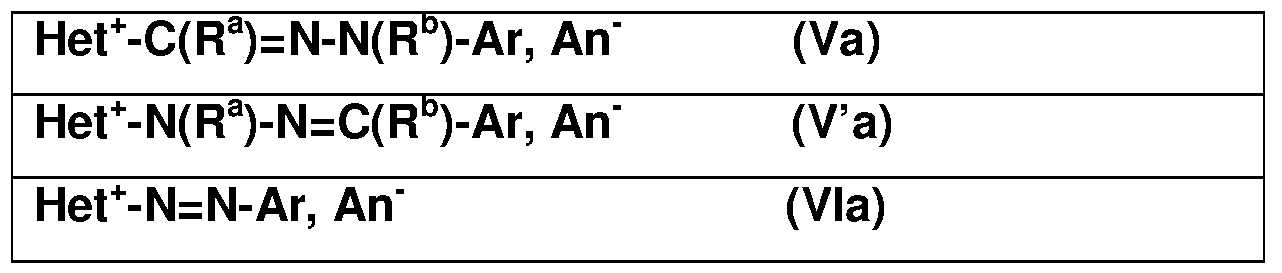
Het+-N=N-Ar'-N=N-Ar, An (Vila)
in which formulas (Va), (V'a), (Via), (Vl'a) and (Vila):
Het+ represents a cationic heteroaryl radical, preferably bearing an endocyclic cationic charge, such as imidazolium, indolium or pyridinium, optionally substituted preferentially with one or more (CrC8) alkyl groups such as methyl;
Ar+ representing an aryl radical, such as phenyl or naphthyl, bearing an exocyclic cationic charge, preferentially ammonium, particularly tri(d- C8)alkylammonium such as trimethylammonium;
Ar represents an aryl group, especially phenyl, which is optionally substituted, preferentially with one or more electron-donating groups such as i) optionally substituted (CrC8)alkyl, ii) optionally substituted (CrC8)alkoxy, iii) (di)(C C8)(alkyl)amino optionally substituted on the alkyl group(s) with a hydroxyl group, iv) aryl(CrC8)alkylamino, v) optionally substituted N-( Ci-C8)alkyl-N-aryl(Cr
C8)alkylamino or alternatively Ar represents a julolidine group;
- Ar' is an optionally substituted divalent (hetero)arylene group such as phenylene, particularly para-phenylene, or naphthalene, which are optionally substituted, preferentially with one or more groups (CrC8)alkyl, hydroxyl or (Cr C8)alkoxy
Ar" is an optionally substituted (hetero)aryl group such as phenyl or pyrazolyl, which are optionally substituted, preferentially with one or more groups (Ci-C8)alkyl, hydroxyl, (di)( Ci-C8)(alkyl)amino, (CrC8)alkoxy or phenyl;
Ra and Rb, which may be identical or different, represent a hydrogen atom or a group (CrC8)alkyl, which is optionally substituted, preferentially with a hydroxyl group;
- or alternatively the substituent Ra with a substituent of Het+ and/or Rb with a substituent of Ar and/or Ra with Rb form, together with the atoms that bear them, a (hetero)cycloalkyl;
particularly, Ra and Rb represent a hydrogen atom or a group (Ci- C4)alkyl, which is optionally substituted with a hydroxyl group;
An" represents an anionic counter-ion such as mesylate or halide. In particular, mention may be made of the azo and hydrazono cationic dyes bearing an endocyclic cationic charge of formulae (Va), (V'a) and (Via) as defined previously. More particularly those of formulae (Va), (V'a) and (Via) derived from the dyes described in patent applications WO 95/15144, WO 95/01772 and EP-714954, which are incorporated herein by reference in their entirety.
In some cases, the cationic part is derived from the following derivatives:

- R1 representing a (Ci-C4) alkyl group such as methyl;
R2 and R3, which are identical or different, represent a hydrogen atom or a (Ci-C4)alkyl group, such as methyl; and
R4 represents a hydrogen atom or an electron-donating group such as optionally substituted (Ci-C8)alkyl, optionally substituted (Ci-C8)alkoxy, or (di)( Ci- C8)(alkyl)amino optionally substituted on the alkyl group(s) with a hydroxyl group; particularly, R4 is a hydrogen atom,
Z represents a CH group or a nitrogen atom, preferentially CH;
An" represents an anionic counter-ion such as mesylate or halide.
Particularly, the dye of formulae (Va-1 ) and (Vla-1 ) is chosen from Basic Red , Basic Yellow 87 and Basic Orange 31 or derivatives thereof:

Basic Red 51

Basic Orange 31

Basic Yellow 87
Among the natural direct dyes that may be used according to the disclosure, mention may be made of lawsone, juglone, alizarin, purpurin, carminic acid, kermesic acid, purpurogallin, protocatechaldehyde, indigo, isatin, curcumin, spinulosin, apigenidin and orceins. Extracts or decoctions containing these natural dyes and in particular henna-based poultices or extracts may also be used.
When they are present, the direct dye(s) more particularly represent from 0.001 % to 10% by weight and preferably from 0.005% to 5% by weight of the total weight of the compositions of the present disclosure.
Mono- Pi-, and Tri-Carboxylic Acids
The mono-, di-, and/or tri-carboxylic acids may be chosen especially from linear, branched and/or cyclic, saturated or unsaturated, or even aromatic, polycarboxylic acids, containing 2 to 50 or 2 to 40 carbon atoms, in particular 3 to 36, 3 to 18, or 4 to 12 carbon atoms, or even 5 to 1 0 carbon atoms; the acid comprising one, two, or three carboxylic groups COOH; and possibly comprising 1 to 10 or 1 to 6 identical or different heteroatoms, chosen from O, N and S; and/or possibly comprising at least one perfluoro radical chosen from -CF2- (divalent) or -CF3.
In some cases, the mono-, di-, and/or tri-carboxylic acids are saturated, linear and aliphatic and contain 2 to 36 carbon atoms or 3 to 18 carbon atoms or even 4 to 12 carbon atoms; or alternatively are aromatic and contain 8 to 12 carbon atoms.
The cyclic anhydride of a polycarboxylic acid may correspond to one of the following formulae:
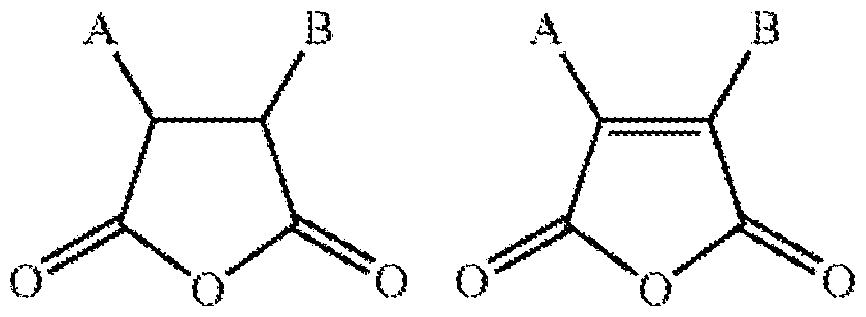
a saturated or unsaturated, linear, branched and/or cyclic aliphatic, or alternatively aromatic, carbon-based radical; containing 1 to 16 carbon atoms, 2 to 10 carbon atoms or even 4 to 8 carbon atoms, especially methyl or ethyl, or alternatively A and B taken together form a saturated or unsaturated, or even aromatic, ring comprising in total 5 to 14, especially 5 to 10 or even 6 to 7 carbon atoms. In some cases, A and B represent a hydrogen atom or together form an aromatic ring containing in total 6 to 10 carbon atoms.
Among the mono-, di-, and/or tri-carboxylic acids or anhydrides thereof that may be used, mention may be made, alone or as a mixture, of: dicarboxylic acids such as decanedioic acid, dodecanedioic acid, cyclopropanedicarboxylic acid, cyclohexanedicarboxylic acid, cyclobutanedicarboxylic acid, naphthalene-1 ,4- dicarboxylic acid, naphthalene-2,3-dicarboxylic acid, naphthalene-2,6-dicarboxylic acid, suberic acid, oxalic acid, malonic acid, succinic acid, phthalic acid, terephthalic acid, isophthalic acid, tetrahydrophthalic acid, hexahydrophthalic acid, pimelic acid, sebacic acid, azelaic acid, glutaric acid, adipic acid, fumaric acid, maleic acid, itaconic acid and fatty acid dimers (especially of C36); tricarboxylic acids such as cyclohexanetricarboxylic acid, trimellitic acid, 1 ,2,3-benzenetricarboxylic acid and 1 ,3,5-benzenetricarboxylic acid, tetracarboxylic acids such as butanetetracarboxylic acid and pyromellitic acid, cyclic anhydrides of these acids and especially phthalic anhydride, trimellitic anhydride, maleic anhydride and succinic anhydride.
Mention may also be made of mono-, di-, and/or tri-carboxylic acids chosen, alone or as a mixture, from:
(i) mono-, di-, and/or tri-carboxylic acids containing a saturated or unsaturated, linear or branched chain comprising at least one heteroatom chosen from O, N and/or S, especially 1 to 1 0 identical or different heteroatoms, and/or comprising at least one perfluoro radical -CF2- or -CF3 and moreover containing 1 , 2, or 3 carboxylic groups COOH; and/or a cyclic anhydride of such a polycarboxylic acid; and/or
(ii) saturated or unsaturated, or even aromatic, heterocyclic mono-, di-, and/or tri-carboxylic acids comprising at least one heteroatom chosen from 0, N and/or S, especially 1 to 10, or even 1 to 4, identical or different heteroatoms, and 1 , 2, or 3 carboxylic groups COOH; and/or a cyclic anhydride of such a polycarboxylic acid; and/or
(iii) sugar-based mono-, di-, and/or tri-carboxylic acids, which may be obtained especially by oxidation of an aldose, and comprising 1 , 2, or 3 carboxylic groups COOH; and/or a cyclic anhydride of such a polycarboxylic acid; and/or
(iv) itaconic anhydride;
(v) mono-, di-, and/or tri-carboxylic acids (including heterocyclic) amino acids, i.e. polycarboxylic acids containing a saturated or unsaturated, linear, branched and/or cyclic chain, optionally comprising at least one heteroatom chosen from O, N and/or S, especially 1 to 1 0 identical or different heteroatoms, and/or optionally comprising at least one perfluoro radical -CF2- or -CF3; and also
comprising at least one primary, secondary or tertiary amine function (especially NR1 R2 with R1 and R2, independently of each other, chosen from H and C1-C12 alkyl), especially 1 to 3 identical or different amine functions, and moreover containing 1 , 2, or 3 carboxylic acid groups COOH; and/or a cyclic anhydride of such a
polycarboxylic acid.
Mention may be made most particularly, alone or as a mixture, of the following di-carboxylic acids: (i) 2,2'-[1 ,5-pentanediylbis(thio)]bis-acetic acid 6,6'-[(1 ,2-dioxo- 1 ,2-ethanediyl)diimino]bis-hexanoic acid 2,2'-sulfinylbis-acetic acid 4, 13-dioxo- 3,5,12,14-tetraazahexadecanedioic acid poly(ethylene glycol)disuccinate, especially of mass 250-600 poly(ethylene glycol)bis(carboxymethyl) ether, especially of mass 250-600 poly[oxy(1 ,2-dicarboxy-1 ,2-ethanediyl)], especially of DP<10 8- [(carboxymethyl)amino]-8-oxooctanoic acid 2,2'-[methylenebis(sulfonyl)]bis-acetic
acid 4,4'-(1 ,6-hexanediyldiimino)bis[4-oxobutanoic acid] 4,9-dioxo-3,5,8, 10- tetraazadodecanedioic acid 4-[(1 -carboxyethyl)amino]-4-oxobutanoic acid 6-[(3- carboxy-1 -oxopropyl)amino]hexanoic acid N,N'-(1 ,6-dioxo-1 ,6-hexanediyl)bis-glycine N,N'-(1 ,6-dioxo-1 ,6-hexanediyl)bis-phenylalanine N,N'-(1 ,3-dioxo-1 ,3- propanediyl)bis-glycine 4,4'-[(1 ,4-dioxo-1 ,4-butanediyl)diimino]bis-butanoic acid 4,4'- [(1 ,6-dioxo-1 ,6-hexanediyl)diimino]bis-butanoic acid 6,6'-[1 ,6- hexanediylbis(iminocarbonylimino)]bis-hexanoic acid N-benzoyl-S- (carboxymethyl)cysteine N,N'-(2,2,3,3-tetrafluoro-1 ,4-dioxo-1 ,4-butanediyl)bis- glycine N,N'-(2,2,3,3-tetrafluoro-1 ,4-dioxo-1 ,4-butanediyl)bis-alanine 4,4'-[(2,2,3,3- tetrafluoro-1 ,4-dioxo-1 ,4-butanoic acid N,N'-(1 ,5-dioxo-1 ,5-pentanediyl)bis-glycine N,N'-(1 ,9-dioxo-1 ,9-nonanediyl)bis-glycine N,N'-(1 ,10-dioxo-1 ,10-decanediyl)bis[N- methyl]glycine bis(3-carboxypropyl)ester of propanedioic acid 7,1 6-dioxo-6,8,15, 17- tetraazadocosanedioic acid N-benzoyl-N-(2-carboxyethyl)glycine [2-[(2- carboxymethyl)amino]-2-oxoethyl]benzenepropanoic acid [2-[(2-carboxyethyl)amino]-
2- oxoethyl]benzenepropanoic acid (ii) 4,7,9,12-tetraoxapentadecanedioic acid 2,3- pyridinedicarboxylic acid 4-pyranone-2,6-dicarboxylic acid 2,5-pyrazinedicarboxylic acid 2,5-pyridinedicarboxylic acid 2,3-benzofurandicarboxylic acid 7- oxabicyclo[2.2.1 ]heptane-2,3-dicarboxylic acid 3,4-pyridinedicarboxylic acid 2,4- pyridinedicarboxylic acid 3,5-pyridinedicarboxylic acid 2,6-pyridinedicarboxylic acid
1 H-imidazole-4,5-dicarboxylic acid 2,3-quinolinedicarboxylic acid 6,6,7,7-tetrafluoro-
3- oxabicyclo[3.2.0]heptane-2,4-dicarboxylic acid 2,6-pyrazinedicarboxylic acid 2,6- dimethyl-3,5-pyridinedicarboxylic acid 1 -phenyl-1 H-pyrazole-3,4-dicarboxylic acid 2,5-furandicarboxylic acid 3,4-furandicarboxylic acid 1 ,2,5-thiadiazole-3,4- dicarboxylic acid 1 ,4-dihydro-1 ,2,4,5-tetrazine-3,6-dicarboxylic acid 2,3- furandicarboxylic acid 3,4-thiophenedicarboxylic acid 1 H-1 ,2,3-triazole-4,5- dicarboxylic acid 2-methylimidazole-4,5-dicarboxylic acid 2,4-quinolinedicarboxylic acid naphtho[2,1 -b]furan-1 ,2-dicarboxylic acid 3,4-quinolinedicarboxylic acid 7- oxabicyclo[2.2.1 ]hept-5-ene-2,3-dicarboxylic acid 2,3-quinoxalinedicarboxylic acid
1 .4- piperazinedicarboxylic acid 2,5-dimethyl-3,4-furandicarboxylic acid tetrahydro-
2.5- thiophenedicarboxylic acid 4-phenyl-3,5-pyridinedicarboxylic acid thieno[3,2- b]thiophene-2,5-dicarboxylic acid 3-methyl-2,4-thiophenedicarboxylic acid
naphthostyril-5,6-dicarboxylic acid 3-phenyl-2,4-quinolinedicarboxylic acid 3,4- dimethyl-2,5-dicarboxythiophene 3,4-diphenyl-2,5-thiophenedicarboxylic acid 2,5- diphenyl-3,4-furandicarboxylic acid 7-oxo-7H-benzimidazo[2,1 -
a]benz[de]isoquinoline-3,4-dicarboxylic acid 2,3-dihydro-1 ,3-dioxo-1 H- benz[de]isoquinoline-6,7-dicarboxylic acid 3,4-bis(phenylmethoxy)-2,5- furandicarboxylic acid 4,4'-bibenzoic acid-2,2'-sulfone 2,7-diphenyl-m-anthrazoline- 4,5-dicarboxylic acid 2,4-pyrimidinedicarboxylic acid 2-phenyl-4,5- thiazoledicarboxylic acid 6-phenyl-2,3-pyridinedicarboxylic acid 5,6-dimethyl-2,3- pyrazinedicarboxylic acid 3,7-dibenzothiophenedicarboxylic acid 9-oxo-9H-xanthene- 1 ,7-dicarboxylic acid 2-(1 ,1 -dimethylethyl)-H-imidazole-4,5-dicarboxylic acid 6,7- quinolinedicarboxylic acid 6-methyl-2,3-pyridinedicarboxylic acid 4,5- pyrimidinedicarboxylic acid 2-methyl-3,4-furandicarboxylic acid 1 ,2- indolizinedicarboxylic acid 2,8-dibenzothiophenedicarboxylic acid 3,6- pyridazinedicarboxylic acid 1 ,10-phenanthroline-2,9-dicarboxylic acid 1 ,4,5,6- tetrahydro-5,6-dioxo-2,3-pyrazinedicarboxylic acid 3,4-dimethoxy-2,5- furandicarboxylic acid 2-ethyl-4,5-imidazoledicarboxylic acid 2-propyl-1 H-imidazole- 4,5-dicarboxylic acid 4-phenyl-2,5-pyridinedicarboxylic acid 4,5- pyridazinedicarboxylic acid 1 ,4,5,8-tetrahydro-1 ,4:5,8-diepoxynaphthalene-4a,8a- dicarboxylic acid 5,5-dioxide-2,8-dibenzothiophenedicarboxylic acid pyrazolo[1 ,5- a] pyridine-2,3-dicarboxylic acid 2,3-dihydro-1 H-pyrrolizine-1 ,7-dicarboxylic acid 6- methyl-2,4,5-pyridinetricarboxylic acid pyrrolo[2, 1 ,5-cd]indolizine-5,6-dicarboxylic acid 3,4-bis(2,2,3,3,4,4,4-heptafluorobutyl)-1 H-pyrrole-2,5-dicarboxylic acid
6,7,9,1 0,1 7,18,20,21 -octahydrodibenzo[b,k]-[1 , 4,7,10, 13,1 6]hexaoxacyclooc- tadecin-2,14-dicarboxylic acid 6,7,9,10,17,18,20,21 -octahydrodibenzo[b,k]-
[1 ,4,7, 10,1 3,1 6]hexaoxacyclooc- tadecin-2,13-dicarboxylic acid 2-methyl-3,4- quinolinedicarboxylic acid 4,7-quinolinedicarboxylic acid 3,5-isoxazoledicarboxylic acid 2-(trifluoromethyl)-3,4-furandicarboxylic acid 5-(trifluoromethyl)-2,4- furandicarboxylic acid 6-methyl-2,4-quinolinedicarboxylic acid 5-oxo-1 ,2- pyrrolidinedicarboxylic acid 5-ethyl-2,3-pyridinedicarboxylic acid 1 ,2-dihydro-2-oxo- 3,4-quinolinedicarboxylic acid 4,6-phenoxathiindicarboxylic acid 10,10-dioxide 1 ,9- phenoxathiindicarboxylic acid 3,4-dihydro-2H-1 ,4-thiazine-3,5-dicarboxylic acid 2,7- di(tert-butyl)-9,9-dimethyl-4,5-xanthenedicarboxylic acid 6-methyl-2,3- quinoxalinedicarboxylic acid 3,7-quinolinedicarboxylic acid 2,5-quinolinedicarboxylic acid 2-methyl-6-phenyl-3,4-pyridinedicarboxylic acid 3,4-dimethylthieno[2,3- b] thiophene-2,5-dicarboxylic acid 3,4-dimethoxythiophene-2,5-dicarboxylic acid 5- methyl-3,4-isoxazoledicarboxylic acid 2,6-bis(aminocarbonyl)-3,5- pyridinedicarboxylic acid 3,5-bis(aminocarbonyl)-2,6-pyrazinedicarboxylic acid 2,3-
pyridinedicarboxylic acid 6-(1 ,1 -dimethylethyl)-2-ethyl-3,4-pyridinedicarboxylic acid 3-methyl-5-phenyl-2,4-thiophenedicarboxylic acid 1 ,2-dihydro-2-oxo-6-phenyl-3,5- pyridinedicarboxylic acid 8-methyl-2,4-quinolinedicarboxylic acid 4-ethyl-2,6- dimethyl-3,5-pyridinedicarboxylic acid 5-(phenoxymethyl)-2,4-furandicarboxylic acid 5-(acetylamino)-3-methyl-2,4-thiophenedicarboxylic acid 2-(4-heptylphenyl)-4,8- quinolinedicarboxylic acid 2,8-bis(4-heptylphenyl)pyrido[3,2-g]quinoline-4,6- dicarboxylic acid 1 ,2,3,4,6,7,8,9-octahydro-2,8-dioxopyrido[3,2]-quinoline-3,7- dicarboxylic acid 2,8-dimethylpyrido[3,2-g]quinoline-3,7-dicarboxylic acid 5,6- quinolinedicarboxylic acid 6-ethyl-2-methylcinchomeronic acid 2-methyl-6- propylcinchomeronic acid 6-isopropyl-2-methylcinchomeronic acid 6-tert-butyl-2- methylcinchomeronic acid 1 ,4-dimethyl-7-oxabicyclo[2.2.1 ]heptane-2,3-dicarboxylic acid 1 ,2-dihydro-2-oxo-3,8-quinolinedicarboxylic acid 1 ,2-dihydro-2-oxo-3,6- quinolinedicarboxylic acid 1 ,2-dihydro-2-oxo-3,7-quinolinedicarboxylic acid 3,7- dimethyl-2,8-diphenylpyrido[3,2-g]quinoline-4,6-dicarboxylic acid 8-methyl-2,3- quinolinedicarboxylic acid 3-[[(1 ,1 -dimethylethyl)amino]sulfonyl]-2,5- thiophenedicarboxylic acid 4-(acetylamino)-2,3-thiophenedicarboxylic acid 2,5- pyridinedicarboxylic acid 2,6-pyridinedicarboxylic acid 2,4-thiophenedicarboxylic acid 2,5-thiophenedicarboxylic acid 1 ,4-pyran-2,6-dicarboxylic acid (iii) ribaric acid glucaric acid xylaric acid arabinaric acid mannaric acid idaric acid altraric acid L- glucaric acid L-arabinaric acid allaric acid galactaric acid meso-tartaric acid D- glucaric acid L-idaric acid hexaric acid 2,3-dihydroxybutanedioic acid D-tartaric acid D,L-tartaric acid D-glucaric acid tartaric acid tetrahydroxysuccinic acid 2-carboxy-2,3- dideoxy-D-manno-2-octulopyranosonic acid methyl-3-deoxy-D-arabino-2- heptulopyranosaric acid D-lyxo-2-heptulopyranosaric acid 2,6-anhydro-L-glycero-L- galactoheptaric acid (iv) 1 ,4,5,8-naphthalenetetracarboxylic acid 1 ,4-monoanhydride itaconic anhydride (v) 1 ,4-dihydro-4-oxo-2,6-pyridinedicarboxylic acid 2,6- piperidinedicarboxylic acid 1 H-pyrrole-3,4-dicarboxylic acid 4-amino-2,6-dicarboxylic acid 1 -methyl-1 H-pyrazole-3,4-dicarboxylic acid 2,3-piperidinedicarboxylic acid 1 - methyl-1 H-imidazole-4,5-dicarboxylic acid 2,4-thiazolidinedicarboxylic acid 1 - (phenylmethyl)-l H-imidazole-4,5-dicarboxylic acid 5-amino-6-oxo-2,3- piperidinedicarboxylic acid 5-amino-6-oxo-2,4-piperidinedicarboxylic acid 5-amino-6- oxo-2, 3-piperidinedicarboxylic acid 5-amino-6-oxo[2S-(2a,4 ,5a)]-2,4- piperidinedicarboxylic acid (2S,4R)-2,4-pyrrolidinedicarboxylic acid (2S-cis)-2,4- pyrrolidinedicarboxylic acid 2-amino-1 H-imidazole-4,5-dicarboxylic acid 2,5-
pyrrolidinedicarboxylic acid 4-amino-3,5-isothiazoledicarboxylic acid 1 -methyl- 1 H- pyrazole-3,5-dicarboxylic acid 7-(diethylamino)-2-oxo-2H-1 -benzopyran-3,4- dicarboxylic acid 3,4-diethyl-1 H-pyrrole-2,5-dicarboxylic acid 1 -phenyl-1 H-pyrrole-
3.4- dicarboxylic acid cis-2,3-piperazinedicarboxylic acid 2,3-piperazinedicarboxylic acid 2,5-piperazinedicarboxylic acid 2,6-piperazinedicarboxylic acid 2-amino-3,5- pyridinedicarboxylic acid 2-methylpyrrole-3,4-dicarboxylic acid 4-(methylamino)-2,6- pyridinedicarboxylic acid 2-amino-6-methyl-3,4-pyridinedicarboxylic acid 5-amino-2- methyl-3,4-pyridinedicarboxylic acid 2-amino-6-methyl-3,5-pyridinedicarboxylic acid
2.5- dimethylpyrrole-3,4-dicarboxylic acid 2,5-dimethylpyrrole-3,4-dicarboxylic acid 2- amino-6-hydroxy-3,5-pyridinedicarboxylic acid 2,4-pyrrolidinedicarboxylic acid 1 H- indole-2,4-dicarboxylic acid 1 H-indole-2,6-dicarboxylic acid 1 H-indole-2,5- dicarboxylic acid 5-phenyl-2,4-pyrrolidinedicarboxylic acid 5-methyl-2,4- pyrrolidinedicarboxylic acid trans-2,4-azetidinedicarboxylic acid cis-2,4- azetidinedicarboxylic acid 3,5-piperidinedicarboxylic acid 2,3-pyrrolidinedicarboxylic acid 2,3-azetidinedicarboxylic acid 3,4-pyrrolidinedicarboxylic acid 2,3-dihydro-6H-
1 ,4-dioxino[2,3-c]pyrrole-5,7-dicarboxylic acid 1 H-imidazole-2,4-dicarboxylic acid 1 - butyl-1 H-pyrrole-2,3-dicarboxylic acid 3-amino-1 -oxide-2,4-pyridinedicarboxylic acid 2,3-dihydro-5-phenyl-1 H-pyrrolizine-6,7-dicarboxylic acid 3a,4,5,9b-tetrahydro-3H- cyclopenta[c]quinoline-4,6-dicarboxylic acid 3a,4,5,9b-tetrahydro-3H- cyclopenta[c]quinoline-4,8-dicarboxylic acid 2,3-dihydro-1 H-imidazole-4,5- dicarboxylic acid 5-amino-6-methyllutidinic acid 1 H-indole-3,7-dicarboxylic acid 3,3- dimethyl-2,6-piperidinedicarboxylic acid 1 -butyl-2,5-pyrrolidinedicarboxylic acid 1 H- indole-4,6-dicarboxylic acid 1 -(phenylmethyl)-3,4-pyrrolidinedicarboxylic acid 3- (carboxymethyl)-l H-indole-2,6-dicarboxylic acid 3,4-bis(2,2,2-trifluoroethyl)-1 H- pyrrole-2,5-dicarboxylic acid 9-hexyl-9H-carbazole-3,6-dicarboxylic acid 3-methyl-5- (1 -piperazinylsulfonyl)-2,4-thiophenedicarboxylic acid 2,3,4,9-tetrahydro-1 H- carbazole-5,7-dicarboxylic acid 2,3-dimethyl-1 H-indole-4,6-dicarboxylic acid 7- amino-1 ,4-dihydro-4-oxo-3,6-quinolinedicarboxylic acid 5-amino-3-methyl-2,4- thiophenedicarboxylic acid (m-tolylimino)diacetic acid (o-tolylimino)diacetic acid D- cystathionine phenethyliminodiacetic acid 2-benzyl-2,2'-iminodiacetic acid L-a- glutamyl-L-alanyl-L-alanine Ν,Ν'-dibenzylethylenediaminediacetic acid N-L-γ- glutamyl-D-alanine glycyl-L-glutamylglycine N-(carboxymethyl)-N-(tetrahydro-1 ,1 - dioxido-3-thienyl)glycine N-(2-carboxyethyl)-N-phenyl-beta-alanine N- (carboxymethyl)-N-octylglycine N-(tert-butoxycarbonyl)iminodiacetic acid N-
(carboxymethyl)-L-alanine N-(6-aminohexyl)-N-(carboxymethyl)glycine N- (carboxymethyl)-N-tetradecylglycine N-(1 -carboxyethyl)-D-alanine N- (carboxymethyl)-D-alanine decyliminodiacetic acid 3,3'-(dimethylhydrazono)bis- propanoic acid N-(carboxymethyl)-N-[2-(2,6-dioxo-4-morpholinyl)ethyl]glycine N- alpha-aspartylglycine N-beta-aspartylglycine N-L-alpha-aspartyl-beta-alanine 3,4- xylylamino-N,N-diacetic acid N-(1 -carboxyethyl)alanine N-(carboxymethyl)alanine Ν,Ν'-methylenebis-glycine N-(aminomethyl)-N-(carboxymethyl)glycine N- (aminomethyl)-N-(carboxymethyl)glycine 2,2'-(methylhydrazono)bis-acetic acid N-(2- carboxyethyl)-N-(4-methylphenyl)-beta-alanine N-(2-carboxyethyl)-N-(3- methylphenyl)-beta-alanine 3-[(carboxymethyl)amino]alanine D-alpha-aspartyl-D- alanine N-(2-carboxyethyl)-N-(1 -oxohexadecyl)-beta-alanine N-(2-carboxyethyl)-N- (1 -oxodecyl)-beta-alanine N-(2-carboxyethyl)-N-(1 -oxotetradecyl)-beta-alanine amino[(carboxymethyl)thio]acetic acid N,N'-1 ,6-hexanediylbis-beta-alanine N- (carboxymethyl)-N-phenyl-beta-alanine N-(1 -carboxyethyl)-L-alanine L-glutamic acid L-aspartic acid.
The total amount of the mono-, di-, and/or tri-carboxylic acids can vary depending on the type of composition. The total amount of mono-, di-, and/or tricarboxylic acids is typically about 1 to about 50 wt.%, based on the total weight of the composition. In some cases, the total amount of the one or more mono-, di-, and/or tri-carboxylic acids is about 1 to about 40 wt.%, about 1 to about 30 wt.%, about 1 to about 25 wt.%, about 1 to about 20 wt.%, about 5 to about 50 wt.%, about 5 to about 40 wt.%, about 5 to about 30 wt.%, about 5 to about 25 wt.%, or about 5 to about 20 wt.%.
Amines
Monamines
Many monoamines are suitable for use herein. Non-limiting examples of monoamines methylamine, ethylamine, isopropylamine and n-propylamine, or of a diamine selected from the group consisting of ethylenediamine, 1 ,2-propanediamine, 1 ,3-propanediamine, 1 ,2-butanediamine, 1 ,3-butanediamine and 1 ,4-butanediamine or of an alkanolamine selected from the group consisting of monoethanolamine, 2- aminopropan-1 -ol and 1 -aminopropan-2-ol, or of a specialty amine selected from the group consisting of 1 ,2,3-triaminopropane, 1 ,3-diaminopropan-2-ol, 1 ,2-diamino-
propan-3-ol, 1 -aminopropanediol, 2-aminopropanediol, glucosamine and isomaltine and/or piperazine, or of a piperazine derivative selected from the group consisting of 2-methylpiperazine, 2,6-dimethylpiperazine, 2,5-dimethylpiperazine, 2,5- bis(aminomethyl)piperazine, 2,6-bis(aminomethyl)piperazine, 2-aminomethyl-5- methylpiperazine and 2-aminomethyl-6-methylpiperazine
The monoamine may be an alkyi monoamine of the present disclosure are amine compounds having one amino group. Non-limiting examples of alkyi monoamines include aliphatic amine compounds corresponding to the following formula and their salts:
RN(R')2 (IA)
wherein R is a hydrocarbon radical containing at least 6 carbon atoms. In addition, R can be linear or branched, acyclic or cyclic, saturated or unsaturated, aliphatic or aromatic, substituted or unsubstituted. Typically, R is a linear or branched, acyclic alkyi or alkenyl group or an alkyi phenyl group; and the groups R', which may be identical or different, represent H or a hydrocarbon radical containing less than 6 carbon atoms. In addition, the groups R', which may be identical or different, are linear or branched, acyclic or cyclic, saturated or unsaturated, substituted or unsubstituted. In some cases, the groups R', which may be identical or different, are H or a methyl group.
In some cases, alkyi monoamines include, but are not limited to the following examples: dimethyl lauramine, dimethyl behenamine, dimethyl cocamine, dimethyl myristamine, dimethyl palmitamine, dimethyl stearamine, dimethyl tallowamine, dimethyl soyamine, stearamine, soyamine, cocamine, lauramine, palmitamine, oleamine, tallow amine and mixtures thereof.
Other non-limiting examples of alkyi monoamines include amidoamine compounds corresponding to the following formula and their salts:
RCONHR'N(R")2
wherein: R is a hydrocarbon radical containing at least 6 carbon atoms. In addition, R can be linear or branched, acyclic or cyclic, saturated or unsaturated, aliphatic or aromatic, substituted or unsubstituted. Typically, R is a linear or branched, acyclic alkyi or alkenyl group or an alkyi phenyl group; and R' is a divalent hydrocarbon radical containing less than 6 carbon atoms, or 2 or 3 carbon atoms,
and R" is H or a hydrocarbon radical containing less than 6 carbon atoms. In addition, R" is linear or branched, acyclic or cyclic, saturated or unsaturated, substituted or unsubstituted. Typically, R" is a linear or branched, acyclic alkyl or alkenyl group. In some cases, R" is H or a methyl group.
Examples of amidoamines include, but are not limited to the following:
oleamidopropyl dimethylamine, stearamidopropyl dimethylamine,
isostearamidopropyl dimethylamine, stearamidoethyl dimethylamine,
lauramidopropyl dimethylamine, myristamidopropyl dimethylamine,
behenamidopropyl dimethylamine, dilinoleamidopropyl dimethylamine,
palmitamidopropyl dimethylamine, ricinoleamindopropyl dimethylamine,
soyamidopropyl dimethylamine, wheat germamidopropyl dimethylamine,
sunflowerseedamidopropyl dimethylamine, almondamidopropyl dimethylamine, avocadoamidopropyl dimethylamine, babassuamidopropyl dimethylamine, cocamidopropyl dimethylamine, minkamidopropyl dimethylamine, oatamidopropyl dimethylamine, sesamidopropyl dimethylamine, tallamidopropyl dimethylamine, brassicaamidopropyl dimethylamine, olivamidopropyl dimethylamine,
palmitamidopropyl dimethylamine, stearamidoethyldiethylamine, and mixtures thereof.
The monoamine may be an alkoxylated monoamine. The alkoxylated monoamines are chosen from amine compounds having an amino group and at least one degree of alkoxylation. The alkoxylation is provided by an alkylene oxide group which is often chosen from ethylene oxide and propylene oxide.
Non-limiting examples of suitable alkoxylated monoamines include
compounds corresponding to the following formula:
RN[(R'CHCH20)xH][(R'CHCH20)yH]
wherein R is a hydrocarbon radical containing at least 6 carbon atoms. R can be linear or branched, acyclic or cyclic, saturated or unsaturated, aliphatic or aromatic, substituted or unsubstituted; x and y, independently of one another, represent numbers of from 0 to 100 provided that the sum of x+y is >0; the groups R', which may be identical or different, represent hydrogen, or an alkyl group such as a methyl group. Typically, R is a linear or branched, acyclic alkyl or alkenyl group or an alkyl phenyl group; x and y, independently of one another, are each typically a
number from 0 to 30. Typically, one R' group is hydrogen, and the other one is methyl.
Non-limiting examples of alkoxylated monoamines include PEG-2 Cocamine, PEG-3 Cocamine, PEG-5 Cocamine, PEG-10 Cocamine, PEG-15 Cocamine, PEG- 20 Cocamine, PEG-2 Lauramine, PEG-12 Palmitamine, PEG-2 Rapeseedamine, PEG-2 Oleamine, PEG-5 Oleamine, PEG-6 Oleamine, PEG-10 Oleamine, PEG-15 Oleamine, PEG-20 Oleamine, PEG-25 Oleamine, and PEG-30 Oleamine. Other examples are alkoxylated derivatives of soyamine, stearamine and tallow amine.
Other non-limiting examples of suitable alkoxylated monoamines include compounds corresponding the following formula:

wherein R is a hydrocarbon radical containing at least 6 carbon atoms. R can be linear or branched, acyclic or cyclic, saturated or unsaturated, aliphatic or aromatic, substituted or unsubstituted; x represents a number of from 1 to 100; R' represents hydrogen, or an alkyl group such as in particular a methyl group; and R" is a hydrogen or a hydrocarbon radical. Typically, R is a linear or branched, acyclic alkyl or alkenyl group or an alkyl phenyl group; x is typically a number from 1 to 30. When R" is a hydrocarbon radical group, this group may be linear or branched, saturated or unsaturated, substituted or unsubstituted. The hydrocarbon radical represented by R" may also contain an alkoxylated moiety (as defined by
[(R'CHCH20)yH]), and/or heteroatoms such as nitrogen. When R" contains at least one alkoxylated moiety, the total number of alkoxylation in the formula may range from 1 to 1 20. Examples of alkoxylated monoamines include PEG-3 Tallow
Aminopropylamine, PEG-1 0 Tallow Aminopropylamine, PEG-15 Tallow
Aminopropylamine, and PEG-1 05 Behenyl Propylenediamine.
Additional non-limiting examples of alkoxylated monoamines include compounds corresponding to the following formula:
R(R'CHCH20)x(R'CHCH20)yNHy
wherein R is a hydrocarbon radical containing at least 6 carbon atoms. R can be linear or branched, acyclic or cyclic, saturated or unsaturated, aliphatic or aromatic, substituted or unsubstituted; x and y, independently of one another, represent numbers of from 0 to 100 with the proviso that the sum of x+y is >0; the
groups R', which may be identical or different, represent hydrogen, or an alkyl group such as in particular a methyl group. Typically, R is a linear or branched, acyclic alkyl or alkenyl group or an alkyl phenyl group; x and y, independently of one another, are each typically a number from 0 to 30. Examples of alkoxylated monoamines include polyetheramines containing a monoamine group. These polyetheramines are commercially available from Hunstman under the tradename JEFFAMINE (M series such as M-600, M-1000, M-2005 and M-2070) and SURFONAMINE series (B-60, B- 100, B-200, L-100, L-200, L-207, L-300).
In some cases, the monamines may be selected from the group consisting of 3-isopropoxypropylamine, 3-methoxypropylamine,
tris(hydroxymethyl)aminomethane, 3-ethoxypropylamine, 3-(2-ethylhexyloxy)- propylamine, 2-(2-aminoethoxy)ethanol, 3-butoxypropylamine, and
monoethanolamine, and mixtures thereof;
Diamines
Non-limiting examples of diamines that may be useful may be primary amines and secondary amines. The diamine can include both primary and secondary amine groups. Optional diamines may include at least one ethylene oxide group. For example, between 1 and 4 ethylene oxide groups can be present in the diamine. The diamine may optionally include propylene oxide groups. For example, between 1 and 4 propylene oxide groups can be present in the diamine. Non-limiting examples of diamines include 4,9-dioxadodecane-diamine; 4, 7, 1 0-trioxa-1 ,1 3- tridecanediamine; ethylenediamino; polyoxypropylene diamine; polyethylene glycol diamine; triethylene glycol diamine (2OE); n-(2-hydroxyethyl)-ethylenediamine; 1 ,3- diaminopropane; 1 ,7-diaminoheptane; 1 ,4-diaminobutane; 1 ,2-diaminopropane; 1 ,6- diaminohexane; 1 ,1 1 -diamino-3,6,9-trioxaundecane; 1 ,5-diaminopentane;
polyoxyethylene diamine ; 2,2-dimethyl-1 ,3-propanediamine; 2,2- bis(aminoethoxy)propane; 4,7,1 0-trioxa-1 ,1 3-tridecanediamine; 1 ,3-diaminopentane; 4,7,10-trioxa-1 ,13; 1 ,5-diamino-2-methylpentane; (3s,4s)-(-)-3,4-hexanediamine dihydrochloride; 1 ,9-diaminononane, and mixtures thereof.
In some cases, diamines may be selected from the group consisting of 4,9- dioxadodecane-diamine, 4, 7, 10-trioxa-1 ,13-tridecanediamine, ethylenediamino, polyoxypropylene diamine, polyethylene glycol diamine, triethylene glycol diamine
(2OE); n-(2-hydroxyethyl)-ethylenediamine; 1 ,3-diaminopropane, 1 ,7- diaminoheptane, 1 ,4-diaminobutane, 1 ,2-diaminopropane, 1 ,6-diaminohexane, 1 ,1 1 - diamino-3,6,9-trioxaundecane, 1 ,5-diaminopentane, polyoxyethylene diamine, 2,2- dimethyl-1 ,3-propanediamine, 2,2-bis(aminoethoxy)propane, 4,7,10-trioxa-1 , 13- tridecanediamine, 1 ,3-diaminopentane, 4,7,1 0-trioxa-1 ,13; 1 ,5-diamino-2- methylpentane, (3s,4s)-(-)-3,4-hexanediamine dihydrochloride, 1 ,9-diaminononane, and mixtures thereof.
Polyamines
Polyamines have more than two amino groups. In some cases, the composition of the instant disclosure may include one or more polyamines, but in some cases, the compositions are free or essentially free of polyamines. The polyamine may be, for example, aminated polysaccharides comprising multiple amino groups, such as, for example, hydrolysates of aminated polysaccharides.
The polyamine may also be a polymer comprising multiple amino groups including homopolymers, copolymers, and terpolymers.
In some cases, polyamines are chosen from polyethyleneimines.
Polyethyleneimines may optionally be substituted. Non-limiting examples of polyethyleneimines which may be used include LUPASOL products commercially available from BASF. Suitable examples of LUPASOL polyethyleneimines include LUPASOL PS, LUPASOL PL, LUPASOL PR8515, LUPASOL G20, LUPASOL G35 as well as LUPASOL SC Polythyleneimine Reaction Products (such as LUPASOL SC-61 B, LUPASOL SC-62J, and LUPASOL SC-86X). Other non-limiting examples of polyethyleneimines which may be used in the composition according to the present invention are the EPOMIN products commercially available from Aceto. Suitable examples of EPOMIN polyethyleneimines include EPOMIN SP-006,
EPOMIN SP-012, EPOMIN SP-01 8, and EPOMIN P-1000. Suitable polyamines s also be chosen from polyvinylamines. Examples thereof include LUPAMINES 9095, 9030, 901 0, 5095, 1595 from BASF.
The polyamine compounds can also be substituted. An example of such a compound is PEG-15 Cocopolyamine from Cognis.
In some cases, the polyamine is chosen from proteins and protein derivatives. Non-limiting examples of suitable proteins and protein derivatives f include those
listed at pages 1701 to 1703 of the C.T.F.A. International Cosmetic Ingredient Dictionary and Handbook, 8th edition, vol. 2, (2000), which is incorporated herein by reference in its entirety. In some cases, the at least one polyamine is chosen from wheat protein, soy protein, oat protein, collagen, and keratin protein.
The polyamine may be an alkoxylated polyamine. The alkoxylated
polyamines may be chosen from amine compounds having at least two amino groups and at least one degree of alkoxylation. The alkoxylation is provided by an alkylene oxide group which may be chosen from ethylene oxide and propylene oxide. Non-limiting examples of suitable alkoxylated polyamines include compounds corresponding to the following formula:
NH2R(R'CHCH2O)x(R'CHCH2O)y(R'CHCH2O)z- RNH2 wherein R represents a -CH2-, -CH2CH2-, -CHCH3- or -C(CH3)2- group, or a hydrocarbon radical containing at least 3 carbon atoms that is linear or branched, acyclic or cyclic, saturated or unsaturated, aliphatic or aromatic, substituted or unsubstituted; x, y, and z independently of one another, represent numbers of from 0 to about 1 00; R' represents hydrogen, or an alkyl group, preferably a methyl group; and The sum of x+y+z is at least 1 . In some cases, R is a linear or branched, acyclic alkyl or alkenyl group or an alkyl phenyl group; x, y, and z independently of one another, preferably represent numbers ranging from 2 to 1 00.
Non-limiting examples of the alkoxylated polyamines include, for example, tetradecyloxypropyl-1 ,3-diaminopropane; a C12-14 alkyl oxypropyl-1 ,3- diaminopropane; a C12-15 alkyloxypropyl amine and other similar materials that are commercially available from Tomah under the tradename of TOMAH DA-1 7. Other examples of alkoxylated polyamines are diamine compounds belonging to the Jeffamine series such as the JEFFAMINE D and JEFFAMINE ED series available from Huntsman Corporation, Salt Lake City, Utah. Examples of these Jeffamine compounds are JEFFAMINE D230, JEFFAMINE D400, JEFFAMINE D2000, JEFFAMINE D4000, JEFFAMINE HK-51 1 , JEFFAMINE ED600, JEFFAMINE ED900, and JEFFAMINE ED2003. JEFFAMINE D series compounds are amine terminated PPGs (polypropylene glycols) and JEFFAMINE ED series compounds are polyether diamine based with a predominantly PEG (polyethylene glycol) backbone.
Other non-limiting examples of suitable alkoxylated polyamines in the diamine form include compounds corresponding to the following formula:
NH2(CH2)xOCH2CH20(CH2)xN H2
wherein x is 2 or 3.
Examples of alkoxylated polyamines are diamine compounds belonging to the
JEFFAMINE series available from Huntsman Corporation, Salt Lake City, Utah, such as JEFFAMINE EDR148, and JEFFAMINE EDR176.
Additional non-limiting examples of alkoxylated polyamines in the triamine form include compounds corresponding to the following formula: { CHCH3CH20) ¾CH2C ( R) C¾ ( OCH2CHC¾ ) 2 !¾
{ CHi ) , ( OCH2CHCH,. Kf NH»
;
wherein R is hydrogen, -CH2 or -C2H5, n=0 or 1 , and x, y, and z independently of one another, represent numbers of from 0 to 100 and the sum of x+y+z is at least 1 .
Examples of alkoxylated polyamines are triamine compounds belonging to the JEFFAMINE series such as the JEFFAMINE T series available from Huntsman Corporation, Salt Lake City, Utah. Examples of the JEFFAMINE T series
compounds are JEFFAMINE T403, JEFFAMINE T3000, and JEFFAMINE T5000. JEFFAMINE T series compounds are triamines made by reacting PO with a triol initiator followed by aminating the terminal hydroxyl groups.
The total amount of the one or more amines may vary depending on the type of composition. In some cases, the total amount of the one or more amines is about 0.1 to about 35 wt.%, based on the total weight of the composition. In some cases, the total amount of the one or more amines is about 0.1 to about 30 wt.%, about 0.1 to about 25 wt.%, about 0.1 to about 20 wt.%, about 0.1 to about 15 wt.%, about 0.1 to about 1 0 wt.%, about 0.5 to about 35 wt.%, about 0.5 to about 30 wt.%, about 0.5 to about 25 wt.%, about 0.5 to about 20 wt.%, about 0.5 to about 15 wt.%, about 0.5 to about 1 0 wt.%, about 1 to about 35 wt.%, about 1 to about 30 wt.%, about 1 to
about 25 wt.%, about 1 to about 20 wt.%, about 1 to about 15 wt.%, about 1 to about 10 wt.%, or about 3 to about 8 wt.%.
ADDITIONAL COMPONENTS
Cationic Conditioning Compounds
The cationic conditioning agent employed in the compositions of the present invention can be a monoalkyl quaternary amine, such as stearyltrimonium chloride, soyatrimonium chloride or coco-ethyldimonium ethosulfate. Other suitable cationic conditioning agents include, but are not limited to, behentrimonium chloride, dialkyl quaternary amines, such as dicetyldimonium chloride, dicocodimethyl ammonium chloride or distearyldi methyl ammonium chloride; and polyquaternium compounds, such as Polyquaternium-6, Polyquaternium-22 or Polyquaternium-5.
For example, cationic conditioning agents may be chosen from
polyquaterium-1 0 (also called quaternized polyhydroxyethyl cellulose), cetrimonium chloride (also called cetyl trimethyl ammonium chloride, CTAC), behentrimonium chloride (also known as docosyl trimethyl ammonium chloride), behentrimonium methosulfate, steartrimonium chloride, stearalkonium chloride, dicetyldimonium chloride, hydroxypropyltrimonium chloride, cocotrimonium methosulfate, olealkonium chloride, steartrimonium chloride, babassuamidopropalkonium chloride,
brassicamidopropyl dimethylamine, Quaternium-91 , Salcare/PQ-37, Quaternium-22, Quaternium-87, Polyquaternium-4, Polyquaternium-6, Polyquaternium-1 1 ,
Polyquaternium-44, Polyquaternium-67, amodimethicone, lauryl betaine,
Polyacrylate-1 Crosspolymer, steardimonium hydroxypropyl hydrolyzed wheat protein, behenamidopropyl PG-dimonium chloride, lauryldimonium hydroxypropyl hydrolyzed soy protein, aminopropyl dimethicone, Quaterium-8, and
dilinoleamidopropyl dimethylamine dimethicone PEG-7 phosphate.
In some instances, the cationic conditioning agents are cationic conditioning polymers. Examples of cationic conditioning polymers that can be used include, without limitation, cationic cellulose, cationic proteins, and cationic polymers. The cationic polymers can have a vinyl group backbone of amino and/or quaternary ammonium monomers. Cationic amino and quaternary ammonium monomers include, without limitation, dialkylamino alkylmethacrylate, monoalkylaminoalkyl acrylate, monoalkylaminoalkyl methacrylate, trialkyl methacryoloxyalkyl ammonium
salt, trialkyl acryloxyalkyl ammonium salts, diallyl quaternary ammonium salts, vinyl compounds substituted with dialkyl aminoalkyl acrylate, and vinyl quaternary ammonium monomers having cyclic cationic nitrogen containing rings such as pyridinium, imidazolium, or quaternized pyrrolidine. Other examples of cationic conditioning polymers that can be used include, without limitation,
hydroxypropyltrimonium honey, cocodimonium silk amino acids, cocodimonium hydroxypropyl hydrolyzed wheat or silk protein, polyquaternium-5, polyquaternium- 1 1 , polyquaternium-2, polyquaternium-4, polyquaternium-6, polyquaternium-7, polyquaternium-14, polyquaternium-16, polyquaternium-22, polyquaternium-10, and guar hydroxypropyltrimonium chloride.
In some cases quaternized polymeric cationic conditioning agents are particularly useful. Particularly preferred are quaternary nitrogen polymers prepared by the polymerization of a dialkyldiallylammonium salt or copolymer thereof in which the alkyl group contains 1 to about 1 8 carbon atoms, and more preferably where the alkyl group is methyl or ethyl. Details concerning the preparation of these polymers can be found in U.S. Pat. Nos. 3,288,770, 3,412,019 and 4,772,462, incorporated herein by reference. For example, cationic homopolymers and copolymers of polydiallyldimethylammonium chloride are available in aqueous compositions sold under the trademark MERQUAT by the Calgon Corporation, subsidiary of Merck & Co., Pittsburgh, Pa. The homopolymer, which is named Polyquaternium-6 in the CTFA Cosmetic Ingredient Dictionary, 3rd Ed., published in 1982 by the Cosmetic Toiletry and Fragrance Association, Inc. (hereafter CTFA Dictionary and CTFA name), is sold under the trademark MERQUAT-100, and is described as having a weight average molecular weight of approximately 100,000. A copolymer reaction product of dimethyldiallylammonium chloride with acrylamide monomers is named Polyquaternium-7 in the CTFA Dictionary, is described as having a weight average molecular weight of approximately 500,000 and is sold under the trademark MERQUAT-550. Another copolymer reaction product of dimethyldiallylammonium chloride with acrylic acids having a weight average molecular weight from about 50,000 to about 1 0,000,000 has the CTFA name Polyquaternium-22 and is sold under the trademark MERQUAT-280. Polyquaternium-6 is particularly preferred.
Other polymeric conditioners include cationic copolymers of
methylvinylimidazolium chloride and vinyl pyrrolidone, sold commercially by BASF
Aktiengesellschaft, West Germany under the trademark LUVIQUAT at three comonomer ratios, namely at ratios of 95/5, 50/50 and 30/70 methylvinylimidazolium chloride to polyvinylpyrrolidone. These copolymers at all three comonomer ratios have the CTFA name Polyquaternium 16. Polymeric conditioners also include cationic cellulosic polymers of hydroxyethyl cellulose reacted with epichlorohydrin and quaternized with trimethylamine, sold under the trademark POLYMER JR in various viscosity grades and molecular sizes by Union Carbide Corporation,
Danbury, Conn. These series of polymers are named Polyquaternium 10 in the CTFA Dictionary. Also useful are quaternized copolymers of hydroxyethylcellulose and dimethyldimethylammonium chloride, having the CTFA name Polyquaternium-4, sold in varying molecular weights under the trademark CELQUAT by National Starch and Chemical Corporation, Bridgewater, N.J.
Smaller molecule cationic non-polymeric conditioning agents can also be utilized herein. Exemplary small-molecule conditioning agents can include monofunctional or difunctional quaternary ammonium compounds, such as stearyldimethylbenzylammonium chloride, dimethyldi-(hydrogenated
tallow)ammonium chloride, and the like. Non-polymeric conditioning agents can also include the quaternary ammonium salts of gluconamide derivatives, such as gamma- gluconamidopropyldimethyl-2-hydroxyethyl-ammonium chloride and
minkamidopropyldimethyl-2-hydroxyethylammonium chloride identified respectively by the CTFA names Quaternium 22 and Quaternium 26. Details for the preparation of these materials are found in U.S. Pat. Nos. 3,766,267 and 4,012,398, respectively, and the materials are sold under the trademark CERAPHYL by Van Dyk & Co., Belleville, N.J. Also useful are bis-quaternary ammonium compounds which are dimers, such as 2-hydroxy propylene-bis-1 ,3-(dimethylstearyl ammonium chloride, designated the CTFA name, Hydroxypropyl Bisstearyldimonium chloride. The preparation of these and other bis-quat materials is described in U.S. Pat. No.
4,734,277, and such materials are sold under the trademark JORDAQUAT DIMER by Jordan Chemical Company, Folcroft, Pa.
Exemplary unquaternized polymers having tertiary amino nitrogen groups that become quaternized when protonated can include water-soluble proteinaceous quaternary ammonium compounds. Cocodimonium hydrolyzed animal protein, for example, is the CTFA name for a chemically-modified quaternary ammonium
derivative of hydrolyzed collagen protein having from about 12 to about 18 carbons in at least one aliphatic alkyl group, a weight average molecular weight from about 2500 to about 12,000, and an isoionic point in a range from about 9.5 to about 1 1 .5. This material and structurally related materials are sold under the trademarks
CROQUAT and CROTEIN by Croda, Inc., New York, N.Y.
The total amount of the one or more conditioning agents, if present, may vary. In some cases, the total amount of the one or more conditioning agents is from about 0.1 to about 25 wt.%, about 0.1 to about 20 wt.%, about 0.1 to about 15 wt.%, 0.1 to about 10 wt.%, 0.1 to about 5 wt.%, about 1 to about 25 wt.%, about 1 to about 20 wt.%, about 1 to about 1 5 wt.%, about 1 to about 1 0 wt.%, or about 1 to about 5 wt.%, based on the total weight of the composition.
Thickening Agents
The compositions may contain one or more thickeners or viscosity modifying agents. Classes of such agents include, but are not limited to, viscous liquids, such as polyethylene glycol, semisynthetic polymers, such as semisynthetic cellulose derivatives, synthetic polymers, such as carbomers, poloxamers, and
polyethyleneimines (e.g., PEI-1 0), naturally occurring polymers, such as acacia, tragacanth, alginates (e.g., sodium alginate), carrageenan, vegetable gums, such as xanthan gum, petroleum jelly, waxes, particulate associate colloids, such as bentonite, colloidal silicon dioxide, and microcrystalline cellulose, surfactants, such as PPG-2 hydroxyethyl coco/isostearamide, emulsifiers, such as disteareth-75 IPDI, and salts, such as sodium chloride, and combinations thereof.
The total amount of the one or more thickening agents may vary, but in some cases is about 0.1 to about 1 5 wt.%, about 0.1 to about 10 wt.%, about 0.1 to about 8 wt.%, about 0.1 to about 6 wt.%, about 0.1 to about 5 wt.%, about 0.5 to about 10 wt.%, about 0.5 to about 8 wt.%, about 0.5 to about wt.%, about 0.5 to about 5 wt.%, about 1 to about 1 0 wt.%, about 1 to about 8 wt.%, about 1 to about 6 wt.%, or about 1 to about 5 wt.%, based on the total weight of the composition.
Preservatives
One or more preservatives may be included in the compositions described herein for treating hair. Suitable preservatives include, but are not limited to, glycerin containing compounds (e.g., glycerin or ethylhexylglycerin or phenoxyethanol),
benzyl alcohol, parabens (methylparaben, ethylparaben, propylparaben,
butylparaben, isobutylparaben, etc.), sodium benzoate, ethylenediamine-tetraacetic acid (EDTA), potassium sorbate, and/or grapefruit seed extract, or combinations thereof. More than one preservative may be included in the composition. Other preservatives are known in the cosmetics industries and include salicylic acid, DMDM Hydantoin, Formaldahyde, Chlorphenism, Triclosan, Imidazolidinyl Urea, Diazolidinyl Urea, Sorbic Acid, Methylisothiazolinone, Sodium Dehydroacetate, Dehydroacetic Acid, Quaternium-15, Stearalkonium Chloride, Zinc Pyrithione, Sodium Metabisulfite, 2-Bromo-2-Nitropropane, Chlorhexidine Digluconate,
Polyaminopropyl biguanide, Benzalkonium Chloride, Sodium Sulfite, Sodium
Salicylate, Citric Acid, Neem Oil, Essential Oils (various), Lactic Acid, and Vitamin E (tocopherol).
The total amount of the one or more preservatives, when present, may vary. In some cases, the total amount of the one or more preservatives is about 0.01 to about 5 wt.%, about 0.01 to about 4 wt.%, about 0.15 to about 1 wt.%, or about 1 to about 3 wt.%, based on the total weight of the composition.
Suitable components, such as those listed in the instant disclosure (including those listed above), may be included or excluded from the hair care formulations depending on the specific combination of other components, the form of the compositions, and/or the use of the formulation (e.g., hair spray, cream, conditioner, etc.).
EXAMPLE TYPES OF ACTIVE COMPOSITIONS
Bleach Compositions
When hair lightening or color-altering uses separate bleach and developer compositions, the bleach composition may comprise at least one oxidizing agent chosen from persulfates, perborates, percarbonates, peracids, bromates, their salts, and mixtures thereof. In some instances, the at least one oxidizing agent is chosen from alkali metal salts of perborates, percarbonates, bromates, and persulfates, such as, for example, ammonium, sodium, and potassium salts. The bleach composition may also optionally comprise a cosmetically acceptable carrier.
The at least one oxidizing agent of the bleach compositions of the disclosure is utilized in an amount sufficient to lighten or "bleach" hair. By way of example only,
the at least one oxidizing agent of the bleach composition may be present in an amount ranging from about 10% by weight to about 100% by weight, such as from about 20% to about 90% by weight, from about 30% to about 80% by weight, or from about 40% to about 75% by weight, based on the total weight of the bleach composition. In further embodiments, the at least one oxidizing agent of the bleach composition may be present in an amount ranging from about 5% to about 50%, such as about 1 0% to about 45%, or about 15% to about 40%. In some cases, the at least one oxidizing agent of the bleach composition may be present in an amount of at least 40% by weight, based on the total weight of the bleach composition.
The bleach composition may be in any form, such as, for example, in the form of a powder, gel, liquid, foam, lotion, cream, mousse, and emulsion.
In some cases, the bleach composition may be anhydrous. Optionally, water may be added as an activator, by mixing it with the bleach composition.
The bleach composition of the present dislosure may also contain acid and alkali pH adjusters, which are well known in the art in the cosmetic treatment of keratin fibers, such as hair. Such pH adjusters include, but are not limited to, sodium metasilicate, silicate compounds, citric acid, ascorbic acid, and carbonate compounds.
The pH adjusters may, in various embodiments, be present in the bleach composition in an amount effective to provide the color-altering composition with a pH ranging from about 1 to about 7 when the bleach composition is combined with the developer composition. By way of example, the amount of pH adjuster may be present, in various embodiments, in an amount of at least about 0.01 %, such as at least about 0.1 %, at least about 0.2%, or at least about 0.5%.
In some cases, the bleach composition is acidic, with the pH ranging from about 1 to about 7; and in some cases, the bleach composition has a pH higher than about 7. When the bleach composition is in powder form, the pH may be measured in a 1 % solution in water.
Colorants may also optionally be present in the bleach compositions. The colorants useful according to various embodiments of the disclosure are those colorants that are stable in the bleach composition, and can impart additional toning and coloring to hair. Exemplary hair colorants include, but are not limited to,
pigments, liposoluble dyes, direct dyes, nacreous pigments, pearling agents, leuco dyes, optical lightening colorants, natural colorants and optically-variable pigments.
Developer Compositions
Developer compositions often include peroxide, such as hydrogen peroxide. The developer composition may also optionally comprise a cosmetically acceptable carrier. The hydrogen peroxide may be present in an amount of at least about 1 % by weight, based on the total weight of the developer composition. In some cases, hydrogen peroxide is present in an amount ranging from about 0.1 % to about 80% by weight, such as from about 1 .0% to about 75% by weight, or from about 2% to about 10% by weight, based on the total weight of the developer composition.
Furthermore, the hydrogen peroxide may be present in the developer composition in an amount ranging from about 2% to about 25%, such as about 4% to about 20%, about 6% to about 15%, or about 7% to about 1 0%.
The cosmetically acceptable carrier of the developer composition may, for example, be present in an amount ranging from about 0.5% to about 99% by weight, such as from about 5% to about 95% by weight, relative to the total weight of the developer composition.
The pH of the developer composition can range from about 1 to about 5, such as from about 2 to about 4, and it may be adjusted to the desired value using pH adjusters that are well known in the art in the cosmetic treatment of keratin fibers, including, for example, those described herein.
The developer composition may be in the form of a powder, gel, liquid, foam, lotion, cream, mousse, and emulsion.
Optionally, water may be added as an activator, by mixing it with the developer composition.
The developer composition may, in various cases, comprise additional components such as, for example, at least one auxiliary ingredient chosen from rheology-modifying agents, chelants, fatty substances, ceramides,
alkoxyaminosilicones, and silanes, and any other component known in the art to be useful in a developer composition.
In some instances, the bleach composition and developer composition may be combined to form the lightening composition or color-altering composition in a ratio of bleach composition to developer composition ranging from about 1 :1 to about 1 :5, such as from about 1 :1 to about 1 :2, or about 1 :2 to about 1 :4.
Shape-Altering Compositions
Compositions for altering the shape of the hair comprise hair shaping agents for example, agents for straightening, relaxing, and/or shaping the hair. By way of example, hair shaping agents may optionally be chosen from inorganic hydroxides or organic hydroxides, for example sodium hydroxide, potassium hydroxide, lithium hydroxide, calcium hydroxide, or guanidine hydroxide, or may be chosen from organic amines and other non-hydroxide compounds. In some cases, the hair relaxing agents may be chosen from thiol compounds such as cysteine, cysteamine, N-substituted cysteamines, alkyl substituted mercaptoacetamides, dimercaptoadipic acid, thioglycerol, thiolactic acid, thioglycolic acid or its salts, (e.g., a thioglycolate), monothioglycolic acid esters such as diol esters of thioglycolic acid, glyceryl monothioglycolate, thiocholine or its salts, amino thiols, and thiols attached to low molecular weight polymers, sulfites such as sodium hyposulfite, and bisulfites such as ammonium or sodium bisulfite.
The hair shaping composition may also comprise a cosmetically acceptable carrier. The cosmetically acceptable carrier may, for example, be present in the shape-altering composition in an amount ranging from about 1 % to about 40% by weight, such as from about 5% to about 35% by weight, or about 1 0% to about 30% by weight of the shape-altering composition.
In some cases, the hair shaping composition comprises or is used in conjunction with at least one neutralizer (for example, in a neutralizing composition), for example an oxidizing agent. Exemplary useful oxidizing agents include peroxides, bromates, and perborates, e.g., hydrogen peroxide, potassium bromate, sodium bromate and sodium perborate.
The shape-altering composition may be left on the hair for a period of time sufficient to achieve the desired alteration in hair shape. For example, the shape- altering composition may be left on the hair for up to one hour, such as from about 3 minutes to about 45 minutes, from about 5 minutes to about 30 minutes, or from
about 10 minutes to about 20 minutes. In further embodiments, the shape-altering composition may be left on the hair for a period up to about 30 minutes, such as, for example, from about 1 to about 30 minutes, about 1 to about 10 minutes, or about 1 to about 5 minutes. One skilled in the art will, by considering various factors such as starting hair shape and desired hair shape, be able to determine an appropriate amount of time to leave the shape-altering composition on the hair in order to achieve the desired alternation in hair shape.
If desired, the shape-altering composition may, optionally, be shampooed and/or rinsed off the hair.
FORMS
The compositions described herein may be in any suitable physical form. Suitable forms include, but are not limited to low to moderate viscosity liquids, lotions, milks, mousses, sprays, gels, creams, conditioners, and the like.
i. Spray
The compositions described herein for treating hair may be in the form of a spray. The spray typically includes a cosmetically acceptable carrier. In some embodiments, the carrier is water or a water and alcohol mixture. The spray formulation optionally includes an antioxidant, sunscreen agent, vitamin, protein, peptide, plant extract, humectant, oil, emollient, lubricant, thickener, hair conditioning agent, polymer, and/or surfactant.
The hair spray formulations may be dispensed from containers that include aerosol dispensers or pump spray dispensers. Such dispensers are known in the art and are commercially available from a variety of manufacturers.
When the hair spray formulation is dispensed from a pressurized aerosol container, a propellant may be used to force the composition out of the container. Suitable propellants include, but are not limited to, a liquefiable gas or a halogenated propellant. Examples of suitable propellants include dimethyl ether and hydrocarbon propellants such as propane, n-butane, iso-butane, CFCs, and CFC-replacement propellants. The propellants may be used singly or admixed.
The amount of propellant may range from about 10% to about 60% by weight of the formulation. The propellant may be separated from the hair repair formulation
as in a two compartment container. Other suitable aerosol dispensers are those characterized by the propellant being compressed air, which can be filled into the dispenser using a pump or equivalent device prior to use. Conventional non-aerosol pump spray dispensers, i.e., atomizers, may also be used to apply the hair strengthening formulation to the hair.
ii. Conditioners
The compositions disclosed herein may be in the form of a conditioner. The conditioner may include one or more conditioning agents, such as cationic polymers derived from polysaccharides, for example cationic cellulose derivatives, cationic starch derivatives, cationic guar derivatives and cationic locust bean gum
derivatives, synthetic cationic polymers, mixtures or combinations of these agents. The formulation may comprise other synthetic or natural polymers or polymers derived from biological preparation processes, which are functionalized, where appropriate, for example with cationic or neutral groups. These polymers may have a stabilizing or strengthening action on the compositions, and/or a conditioning action (deposition on the surface of the skin or the hair).
iii. Creams
The compositions disclosed herein for may be in the form of a cream.
Implementation of the present disclosure is provided by way of the following examples. The examples serve to illustrate the technology without being limiting in nature.
Example 1
(Formulations)

Present in the raw material known by the tradename STYLEZE XT3 and commercially available from Ashland. INCI Name: Aqua (and)
Polyimide-1 (and) PVM/MA Copolymer (and) Caprylyl Glycol.
Example 2
(Hair Lightening)
15 grams of a bleach composition was mixed with 1 5 grams of a developer composition, and 4 grams of Formulation 1 , 2, 3, or 4 of Example 1 . Each of the four mixtures was separately applied to regular bleach hair swatches for 35 minutes. After 35 minutes, the swatches were rinsed with water, shampooed once, and blown dry. The components of the bleach composition and the developer composition are provided below.
Bleach Composition


The hair swatches were then evaluated by three independent experts for sensorial characteristics (combability, smoothness, and discipline). Each individual expert ranked the hair swatches according to a four point scale, where "1 " represents the best result and "4" represents the worst result. All three experts arrived at the same conclusions, which are shown below.

1 Hair bleached using only the combination of bleach powder and bleach developer (1 :1 ratio) (no maleic acid, no monoethanolamine, no maleic acid polymer).
Hair bleached with no additive (Control) provided the worst cosmetic properties as it was most difficult to comb, roughest, and had the least amount of discipline. The addition of maleic acid and monoethanol amine, as with Formula 1 , provided minor improvements to cosmetic properties. However, the addition of a polymeric acid compounds and/or polymeric acid anhydride compound (PVM/MA copolymer), as with Formula 2, provided significant improvement. Removal of maleic acid, as with Formula 3, and monoethanol amine, as with Formula 4 demonstrated the highest level of cosmeticity. This indicates that chemical treatments containing a polymeric acid compounds and/or polymeric acid anhydride
compound (PVM/MA copolymer), either in its natural state (Formula 4) or neutralized with amine (Formula 3), provides surprisingly good cosmetic properties.
The foregoing description illustrates and describes the disclosure.
Additionally, the disclosure shows and describes only the preferred embodiments but, as mentioned above, it is to be understood that it is capable to use in various other combinations, modifications, and environments and is capable of changes or modifications within the scope of the invention concepts as expressed herein, commensurate with the above teachings and/or the skill or knowledge of the relevant art. The embodiments described herein above are further intended to explain best modes known by applicant and to enable others skilled in the art to utilize the disclosure in such, or other, embodiments and with the various modifications required by the particular applications or uses thereof. Accordingly, the description is not intended to limit the invention to the form disclosed herein. Also, it is intended to the appended claims be construed to include alternative embodiments.
As used herein, the terms "comprising," "having," and "including" are used in their open, non-limiting sense.
The terms "a," "an," and "the" are understood to encompass the plural as well as the singular.
The expression "one or more" means "at least one" and thus includes individual components as well as mixtures/combinations.
Other than in the operating examples, or where otherwise indicated, all numbers expressing quantities of ingredients and/or reaction conditions are to be understood as being modified in all instances by the term "about," meaning within +/- 5% of the indicated number.
All percentages, parts and ratios herein are based upon the total weight of the compositions of the present invention, unless otherwise indicated.
"Keratinous substrates" as used herein, includes, but is not limited to keratin fibers such as hair and/or scalp on the human head.
"Conditioning" as used herein means imparting to one or more hair fibers at least one property chosen from combability, moisture-retentivity, luster, shine, and softness. The state of conditioning can be evaluated by any means known in the art,
such as, for example, measuring, and comparing, the ease of combability of the treated hair and of the untreated hair in terms of combing work (gm-in), and consumer perception.
The term "treat" (and its grammatical variations) as used herein refers to the application of the compositions of the present disclosure onto the surface of keratinous substrates such as hair. The term 'treat" (and its grammatical variations) as used herein also refers to contacting keratinous substrates such as hair with the compositions of the present disclosure.
A "rinse-off" product refers to a composition such as a hair care composition that is rinsed and/or washed with water either after or during the application of the composition onto the keratinous substrate, and before drying and/or styling said keratinous substrate. At least a portion of the composition is removed from the keratinous substrate during the rinsing and/or washing.
The term "stable" as used herein means that the composition does not exhibit phase separation and/or crystallization.
"Volatile", as used herein, means having a flash point of less than about
100QC.
"Non-volatile", as used herein, means having a flash point of greater than about 100QC.
As used herein, all ranges provided are meant to include every specific range within, and combination of sub ranges between, the given ranges. Thus, a range from 1 -5, includes specifically 1 , 2, 3, 4 and 5, as well as sub ranges such as 2-5, 3- 5, 2-3, 2-4, 1 -4, etc.
Other than in the operating examples, or where otherwise indicated, all numbers expressing quantities of ingredients and/or reaction conditions are to be understood as being modified in all instances by the term "about," meaning within +/- 5% of the indicated number.
The term "substantially free" or "essentially free" as used herein means that there is less than about 2% by weight of a specific material added to a composition, based on the total weight of the compositions. Nonetheless, the compositions may
include less than about 1 wt.%, less than about 0.5 wt.%, less than about 0.1 wt.%, or none of the specified material.
All ranges and values disclosed herein are inclusive and combinable. For examples, any value or point described herein that falls within a range described herein can serve as a minimum or maximum value to derive a sub-range, etc.
All publications and patent applications cited in this specification are herein incorporated by reference, and for any and all purposes, as if each individual publication or patent application were specifically and individually indicated to be incorporated by reference. In the event of an inconsistency between the present disclosure and any publications or patent application incorporated herein by reference, the present disclosure controls.
Claims
A composition for chemically treating hair comprising:
(a) one or more polymeric acid compounds and/or polymeric acid
anhydride compounds; and
(b) one or more active agents; wherein if the active agent includes
hydrogen peroxide, the composition further comprises:
(i) a second oxidizing agent chosen from persulfates; and/or
(ii) an oxidative dye precursor.
The composition of claim 1 , wherein the one or more polymeric acid compounds and/or polymeric acid anhydride compounds are polymers containing recurring units derived from one or more of the following acids, anhydrides, salts, or derivatives thereof:
(i) styrene sulfonic acid,
(ii) crotonic acid,
(iii) acrylic or methacrylic acid,
(iv) ethylene-a,p-dicarboxylic acid, and/or
(v) allyloxyacetic acid, methallyloxyacetic acid, 3-allyloxypropionic acid, allylthioacetic acid, allylaminoacetic acid, vinylacetic acid, vinyloxyacetic acid, crotyloxyacetic acid, 3-butenoic acid, 4- pentenoic acid, 10-undecenoic acid, allylmalonic acid, maleamic acid, itaconamic acid or N-monohydroxyalkyl- or N-dihydroxy-alkyl- maleamic or -itaconamic acids.
The composition of claim 1 or 2, wherein (a) is chosen from a polymer containing recurring units derived from maleic acid and/or maleic anhydride.
The composition of any one of claims 1 -3 comprising one or more active agents selected from the group consisting of oxidizing agents, reducing agents, non-reducing agents for shaping hair, dyeing agents, and mixtures thereof.
The composition of any one of claims 1 -4 selected from the group consisting of:
(i) a hair lightening composition comprising one or more oxidizing agents selected from the group consisting of one or more peroxides, persulfates, perborates, percarbonates, and mixtures thereof;
(ii) a hair perming or straightening composition comprising one or more reducing agents selected from the group consisting of cysteine or a derivative of cysteine, cysteamine or a derivative of cysteamine, thiolactic acid or an ester of thiolactic acid, thioglycolic acid or an ester of thioglycolic acid, thioglycerol, and mixtures thereof;
(iii) a hair straightening or relaxing composition comprising one or more non-reducing agents for shaping hair selected from the group consisting of hydroxide compounds, non-hydroxide compounds, and mixtures thereof; and
(iv) a hair coloring composition comprising one or more dyeing agents selected from the group consisting of direct dyes, oxidative dyes, direct action dyes, natural dyes, metallic dyes, reactive dyes, and mixtures thereof.
The composition of any one of claims 1 -5 comprising one or more hydroxide compounds selected from the group consisting of alkali metal hydroxides, alkaline-earth metal hydroxides, transition metal hydroxides, and mixtures thereof.
The composition of any one of claims 1 -5 comprising one or more non- hydroxide compounds selected from the group consisting of one or more ethyieneamine, alkanolamine. amino acid, and mixtures thereof.
The composition of any one of claim 1 -7, further comprising:
(c) one or more non-polymeric, mono-, di-, and/or tri-carboxylic acids; and/or
(d) one or more mono-amines, di-amines, and/or polyamines having more than 2 amino groups.
9. The composition of claim 8 comprising:
one or more di-carboxylic acids selected from the group consisting of oxalic acid, malonic acid, malic acid, glutaric acid, citraconic acid, succinic acid, adipic acid, tartaric acid, fumaric acid, maleic acid, sebacic acid, azelaic acid, dodecanedioic acid, phthalic acid, isophthalic acid, terephthalic acid, 2,6- naphthalene dicarboxylic acid, and mixtures thereof; and/or
one or more tri-carboxylic acids including citric acid, isocitric acid, aconitic acid, propane-1 ,2, 3, -tricarboxylic acid, trimesic acid, and mixtures thereof.
10. The composition of claim 8 comprising:
one or more mono- and/or di-amines selected from the group consisting of one or more alkyl amines, amidoamines, amino silicones, alkoxylated monoamines, and mixtures thereof; and/or
one or more polyamines that are not polymers having dimethylamino moieties.
1 1 . The composition of any one of claims 1 -10 comprising one or more
alkoxylated polyamines.
12. A method for chemically treating hair comprising:
i. applying to the hair a composition of claim 1 ; and
ii. allowing the composition of claim 1 to remain on the hair for about 1 to about 45 minutes.
13. The method of claim 12 carried out at a temperature between 10°C and 50°C.
14. A method for chemically treating hair comprising applying to the hair a
composition comprising one or more polymeric acid compounds and/or polymeric acid anhydride compounds and separately applying to the hair a composition comprising one or more active agents.
15. The method of claim 14, wherein the composition comprising the one or more polymeric acid compounds and/or polymeric acid anhydride compounds and
the composition comprising the one or more active agents are sequentially applied to the hair within a period of 2 hours.
16. The method of claim 14 or 1 5 carried out at a temperature between 10°C and 50°C.
17. The method of any one of claims 14-1 6, wherein the composition comprising the one or more polymeric acid compounds and/or polymeric acid anhydride compounds further comprises one or more non-polymeric, mono-, di-, and/or tri-carboxylic acids and/or one or more mono- and/or di-amines.
18. A kit comprising a composition of claim 1 and separately a composition
comprising one or more second active agents that are different than the one or more active agents in the composition of claim 1 .
19. A kit comprising a composition comprising one or more polymeric acid
compounds and/or polymeric acid anhydride compounds, and separately a composition comprising one or more active agents.
Applications Claiming Priority (2)
| Application Number | Priority Date | Filing Date | Title |
|---|---|---|---|
| US15/357,056 US11135150B2 (en) | 2016-11-21 | 2016-11-21 | Compositions and methods for improving the quality of chemically treated hair |
| US15/357,056 | 2016-11-21 |
Publications (1)
| Publication Number | Publication Date |
|---|---|
| WO2018093575A1 true WO2018093575A1 (en) | 2018-05-24 |
Family
ID=62144603
Family Applications (1)
| Application Number | Title | Priority Date | Filing Date |
|---|---|---|---|
| PCT/US2017/059817 Ceased WO2018093575A1 (en) | 2016-11-21 | 2017-11-03 | Compositions and methods for improving the quality of chemically treated hair |
Country Status (2)
| Country | Link |
|---|---|
| US (1) | US11135150B2 (en) |
| WO (1) | WO2018093575A1 (en) |
Families Citing this family (11)
| Publication number | Priority date | Publication date | Assignee | Title |
|---|---|---|---|---|
| JP2018514570A (en) | 2015-05-01 | 2018-06-07 | ロレアル | Use of activators in chemical processing |
| CN108495686A (en) | 2015-11-24 | 2018-09-04 | 欧莱雅 | Composition for handling hair |
| JP6873994B2 (en) | 2015-11-24 | 2021-05-19 | ロレアル | Composition for treating hair |
| EP3380062B1 (en) | 2015-11-24 | 2021-07-07 | L'oreal | Compositions for treating the hair |
| US11433011B2 (en) | 2017-05-24 | 2022-09-06 | L'oreal | Methods for treating chemically relaxed hair |
| EP4011355A1 (en) | 2017-12-29 | 2022-06-15 | L'oreal | Compositions for altering the color of hair |
| US11090249B2 (en) | 2018-10-31 | 2021-08-17 | L'oreal | Hair treatment compositions, methods, and kits for treating hair |
| DE102018221973A1 (en) * | 2018-12-17 | 2020-06-18 | Henkel Ag & Co. Kgaa | HAIR CONDITIONING SPRAY TREATMENT |
| US11419809B2 (en) | 2019-06-27 | 2022-08-23 | L'oreal | Hair treatment compositions and methods for treating hair |
| WO2022112961A1 (en) * | 2020-11-30 | 2022-06-02 | Jean Paul Myne' Srl | Cosmetic composition for the treatment of keratinic fibers and method comprising the application of said composition to the keratinic fibers |
| IT202100031967A1 (en) * | 2021-12-21 | 2023-06-21 | Beauty & Business S P A | COMPOSITIONS FOR HAIR DYEING IN GEL OR GEL-EMULSION FORM |
Citations (8)
| Publication number | Priority date | Publication date | Assignee | Title |
|---|---|---|---|---|
| US6645478B2 (en) * | 2001-06-22 | 2003-11-11 | L'oreal S.A. | Reshapable hair styling composition comprising (meth)acrylic copolymers of four or more monomers |
| US20050193501A1 (en) * | 2004-03-02 | 2005-09-08 | Unilever Home & Personal Care Usa, Division Of Conopco, Inc. | Efficient two-step method of coloring and lightening hair with less damage |
| US20060075580A1 (en) * | 2004-10-12 | 2006-04-13 | Unilever Home & Personal Care Usa, Division Of Conopco, Inc. | Two step hair coloring compositions delivering deeper, long-lasting color |
| US20060093571A1 (en) * | 2004-10-29 | 2006-05-04 | Jan Glinski | Hair and skin protecting compositions based on esters or ethers of betulin |
| US20110056508A1 (en) * | 2008-05-16 | 2011-03-10 | Wibke Gross | Bleaching agent comprising cationic 3,4-dihydroisoquinoline derivatives, special alkanol amines and hydrogen peroxide |
| US7905926B2 (en) * | 2007-07-03 | 2011-03-15 | L'oréal | Methods and kits for permanently coloring hair |
| US20120288459A1 (en) * | 2010-05-19 | 2012-11-15 | Wilfried Burg | Oxidizing Composition for the Treatment of Keratin Fibers |
| US20160058688A1 (en) * | 2013-05-16 | 2016-03-03 | Henkel Ag & Co. Kgaa | Transparent bleaching compositions with proteins and/or silicone oils |
Family Cites Families (445)
| Publication number | Priority date | Publication date | Assignee | Title |
|---|---|---|---|---|
| US2271378A (en) | 1939-08-30 | 1942-01-27 | Du Pont | Pest control |
| US2273780A (en) | 1939-12-30 | 1942-02-17 | Du Pont | Wax acryalte ester blends |
| US2261002A (en) | 1941-06-17 | 1941-10-28 | Du Pont | Organic nitrogen compounds |
| US2388614A (en) | 1942-05-05 | 1945-11-06 | Du Pont | Disinfectant compositions |
| US2375853A (en) | 1942-10-07 | 1945-05-15 | Du Pont | Diamine derivatives |
| US2454547A (en) | 1946-10-15 | 1948-11-23 | Rohm & Haas | Polymeric quaternary ammonium salts |
| US2674580A (en) | 1950-07-20 | 1954-04-06 | Colgate Palmolive Co | Liquid shampoo |
| GB713675A (en) | 1951-11-09 | 1954-08-18 | Mozes Juda Lewenstein | Improvements in the preparation of compounds having a narcotic effect and the products obtained thereby |
| GB741307A (en) | 1952-01-03 | 1955-11-30 | Monsavon L Orfal | Hair-treating compositions |
| GB773559A (en) | 1954-01-29 | 1957-04-24 | Gillette Co | Improvements in or relating to meth ods and compositions for permanent waving of hair |
| US2850351A (en) | 1955-08-19 | 1958-09-02 | Joseph E Moore | Process of reacting reduced keratin with cross-linking polyimides or polyamides and chemically modified keratin containing the aforesaid crosslinkages |
| US2961347A (en) | 1957-11-13 | 1960-11-22 | Hercules Powder Co Ltd | Process for preventing shrinkage and felting of wool |
| US3193464A (en) | 1961-05-31 | 1965-07-06 | Sales Affilites Inc | Hydrogen peroxide hair bleaching composition and method |
| US3142623A (en) | 1961-11-15 | 1964-07-28 | Oreal | Permanent waving of hair and analogous processes |
| BE626050A (en) | 1962-03-30 | |||
| US3227615A (en) | 1962-05-29 | 1966-01-04 | Hercules Powder Co Ltd | Process and composition for the permanent waving of hair |
| US3206462A (en) | 1962-10-31 | 1965-09-14 | Dow Chemical Co | Quaternary poly(oxyalkylene)alkylbis(diethylenetriamine) compounds |
| US3288770A (en) | 1962-12-14 | 1966-11-29 | Peninsular Chem Res Inc | Water soluble quaternary ammonium polymers |
| DE1220969B (en) | 1964-11-25 | 1966-07-14 | Ernst Kruegermeyer & Co Seruba | Process for improving structurally damaged hair |
| GB1125794A (en) | 1965-01-27 | 1968-08-28 | Iichiro Takeda | Improvements in the straightening of hair |
| US3412019A (en) | 1965-05-25 | 1968-11-19 | Calgon Corp | Method of flocculating suspended particulate matter from an aqueous medium |
| DE1492175A1 (en) | 1965-07-07 | 1970-02-12 | Schwarzkopf Gmbh Hans | Method for coloring living hair |
| US3472840A (en) | 1965-09-14 | 1969-10-14 | Union Carbide Corp | Quaternary nitrogen-containing cellulose ethers |
| FR1492597A (en) | 1965-09-14 | 1967-08-18 | Union Carbide Corp | New cellulose ethers containing quaternary nitrogen |
| US3472243A (en) | 1965-09-27 | 1969-10-14 | Clairol Inc | Treating damaged living human hair with water soluble polymerizable vinyl monomers |
| LU49584A1 (en) | 1965-10-05 | 1967-04-05 | ||
| CH491153A (en) | 1967-09-28 | 1970-05-31 | Sandoz Ag | Process for the production of new cation-active, water-soluble polyamides |
| US3589978A (en) | 1967-09-29 | 1971-06-29 | Gen Mills Inc | Process of making water repellent paper using a fatty polyisocyanate and a cationic gum ether and product therefrom |
| US3655869A (en) | 1969-01-02 | 1972-04-11 | Monsanto Co | Treatment of diarrhea employing certain basic polyelectrolyte polymers |
| US3766267A (en) | 1971-03-03 | 1973-10-16 | Dyk & Co Inc Van | Quaternary halides of gluconamides |
| US4013787A (en) | 1971-11-29 | 1977-03-22 | Societe Anonyme Dite: L'oreal | Piperazine based polymer and hair treating composition containing the same |
| FR2280361A2 (en) | 1974-08-02 | 1976-02-27 | Oreal | HAIR TREATMENT AND CONDITIONING COMPOSITIONS |
| LU64371A1 (en) | 1971-11-29 | 1973-06-21 | ||
| DE2225541A1 (en) | 1972-05-26 | 1973-12-06 | Boris Dr Janistyn | Cosmetic/pharmaceutical compsn - improving skin complexion |
| USRE30199E (en) | 1973-11-29 | 1980-01-29 | Henkel Kommanditgesellschaft Auf Aktien (Henkel Kgaa) | Oxidation hair dyes based upon tetraaminopyrimidine developers |
| US4003699A (en) | 1974-11-22 | 1977-01-18 | Henkel & Cie G.M.B.H. | Oxidation hair dyes based upon tetraaminopyrimidine developers |
| DE2359399C3 (en) | 1973-11-29 | 1979-01-25 | Henkel Kgaa, 4000 Duesseldorf | Hair dye |
| US4189468A (en) | 1973-11-30 | 1980-02-19 | L'oreal | Crosslinked polyamino-polyamide in hair conditioning compositions |
| US4277581A (en) | 1973-11-30 | 1981-07-07 | L'oreal | Polyamino-polyamide crosslinked with crosslinking agent |
| FR2368508A2 (en) | 1977-03-02 | 1978-05-19 | Oreal | HAIR CONDITIONING COMPOSITION |
| LU68901A1 (en) | 1973-11-30 | 1975-08-20 | ||
| US4172887A (en) | 1973-11-30 | 1979-10-30 | L'oreal | Hair conditioning compositions containing crosslinked polyaminopolyamides |
| US4025627A (en) | 1973-12-18 | 1977-05-24 | Millmaster Onyx Corporation | Microbiocidal polymeric quaternary ammonium compounds |
| US3874870A (en) | 1973-12-18 | 1975-04-01 | Mill Master Onyx Corp | Microbiocidal polymeric quarternary ammonium compounds |
| US3929990A (en) | 1973-12-18 | 1975-12-30 | Millmaster Onyx Corp | Microbiocidal polymeric quaternary ammonium compounds |
| US4166894A (en) | 1974-01-25 | 1979-09-04 | Calgon Corporation | Functional ionene compositions and their use |
| DK659674A (en) | 1974-01-25 | 1975-09-29 | Calgon Corp | |
| US5196189A (en) | 1974-05-16 | 1993-03-23 | Societe Anonyme Dite: L'oreal | Quaternized polymer for use as a cosmetic agent in cosmetic compositions for the hair and skin |
| US4948579A (en) | 1974-05-16 | 1990-08-14 | Societe Anonyme Dite: L'oreal | Quaternized polymer for use as a cosmetic agent in cosmetic compositions for the hair and skin |
| US4422853A (en) | 1974-05-16 | 1983-12-27 | L'oreal | Hair dyeing compositions containing quaternized polymer |
| CH611156A5 (en) | 1974-05-16 | 1979-05-31 | Oreal | |
| US4217914A (en) | 1974-05-16 | 1980-08-19 | L'oreal | Quaternized polymer for use as a cosmetic agent in cosmetic compositions for the hair and skin |
| US4005193A (en) | 1974-08-07 | 1977-01-25 | Millmaster Onyx Corporation | Microbiocidal polymeric quaternary ammonium compounds |
| US3966904A (en) | 1974-10-03 | 1976-06-29 | Millmaster Onyx Corporation | Quaternary ammonium co-polymers for controlling the proliferation of bacteria |
| US4025617A (en) | 1974-10-03 | 1977-05-24 | Millmaster Onyx Corporation | Anti-microbial quaternary ammonium co-polymers |
| US4026945A (en) | 1974-10-03 | 1977-05-31 | Millmaster Onyx Corporation | Anti-microbial quaternary ammonium co-polymers |
| US4027020A (en) | 1974-10-29 | 1977-05-31 | Millmaster Onyx Corporation | Randomly terminated capped polymers |
| US4001432A (en) | 1974-10-29 | 1977-01-04 | Millmaster Onyx Corporation | Method of inhibiting the growth of bacteria by the application thereto of capped polymers |
| US4025653A (en) | 1975-04-07 | 1977-05-24 | Millmaster Onyx Corporation | Microbiocidal polymeric quaternary ammonium compounds |
| AT365448B (en) | 1975-07-04 | 1982-01-11 | Oreal | COSMETIC PREPARATION |
| US4197865A (en) | 1975-07-04 | 1980-04-15 | L'oreal | Treating hair with quaternized polymers |
| US4012398A (en) | 1975-09-16 | 1977-03-15 | Van Dyk & Company, Incorporated | Quaternary halides of mink oil amides |
| CH1669775A4 (en) | 1975-12-23 | 1977-06-30 | ||
| US4031307A (en) | 1976-05-03 | 1977-06-21 | Celanese Corporation | Cationic polygalactomannan compositions |
| GB1584364A (en) | 1976-06-21 | 1981-02-11 | Unilever Ltd | Shampoo |
| LU76955A1 (en) | 1977-03-15 | 1978-10-18 | ||
| LU78153A1 (en) | 1977-09-20 | 1979-05-25 | Oreal | COSMETIC COMPOSITIONS BASED ON QUATERNARY POLYAMMONIUM POLYMERS AND PREPARATION PROCESS |
| US4131576A (en) | 1977-12-15 | 1978-12-26 | National Starch And Chemical Corporation | Process for the preparation of graft copolymers of a water soluble monomer and polysaccharide employing a two-phase reaction system |
| FR2421607A1 (en) | 1978-04-06 | 1979-11-02 | Oreal | TWO-STAGE KERATINIC FIBER DYING PROCESS BY PH VARIATION |
| US4970066A (en) | 1978-06-15 | 1990-11-13 | L'oreal | Hair dye or bleach supports of quaternized polymers |
| US4348202A (en) | 1978-06-15 | 1982-09-07 | L'oreal | Hair dye or bleach supports |
| DE2929865A1 (en) | 1979-07-24 | 1981-02-19 | Wella Ag | METHOD FOR PERMANENT HAIR DEFORMING |
| US4412943A (en) | 1981-02-23 | 1983-11-01 | Kao Soap Co., Ltd. | Liquid detergent composition |
| LU83349A1 (en) | 1981-05-08 | 1983-03-24 | Oreal | AEROSOL FOAM COMPOSITION BASED ON CATIONIC POLYMER AND ANIONIC POLYMER |
| LU84708A1 (en) | 1983-03-23 | 1984-11-14 | Oreal | THICKENED OR GELLIED HAIR CONDITIONING COMPOSITION CONTAINING AT LEAST ONE CATIONIC POLYMER, AT LEAST ONE ANIONIC POLYMER AND AT LEAST ONE XANTHANE GUM |
| DE3375135D1 (en) | 1983-04-15 | 1988-02-11 | Miranol Inc | Polyquaternary ammonium compounds and cosmetic compositions containing them |
| US4770873A (en) | 1983-06-15 | 1988-09-13 | Clairol, Incorporated | Neutralizing composition and method for hair waving and straightening |
| US4812307A (en) | 1983-07-06 | 1989-03-14 | Chesebrough-Pond's Inc. | Crosslinking of hair thiols using glutathione disulfide |
| AU571671B2 (en) | 1984-04-12 | 1988-04-21 | Revlon Inc. | Alkyltrialkosilane hair strengthening and permanent wave composition |
| US4734277A (en) | 1984-12-03 | 1988-03-29 | Jordan Chemical Company | Bis-quaternary ammonium compounds |
| FR2596985B1 (en) | 1986-04-10 | 1990-08-24 | Oreal | COSMETIC COMPOSITIONS FOR DYEING OR COLORING HAIR |
| DE3627746A1 (en) | 1986-08-16 | 1988-02-18 | Henkel Kgaa | METHOD FOR PERMANENT HAIR DEFORMING |
| US4772462A (en) | 1986-10-27 | 1988-09-20 | Calgon Corporation | Hair products containing dimethyl diallyl ammonium chloride/acrylic acid-type polymers |
| JPH0751492B2 (en) | 1986-12-17 | 1995-06-05 | 株式会社資生堂 | Pre-hair rinse type hair treatment composition |
| US5385938B1 (en) | 1986-12-23 | 1997-07-15 | Tristrata Inc | Method of using glycolic acid for treating wrinkles |
| US4793992A (en) | 1987-03-25 | 1988-12-27 | Redken Laboratories, Inc. | Hair treatment composition |
| US4793993A (en) | 1987-07-06 | 1988-12-27 | Chesebrough-Pond's Inc. | Crosslinking of hair thiols |
| DE3871450D1 (en) | 1987-07-16 | 1992-07-02 | Unilever Nv | AGENT FOR HAIR TREATMENT. |
| ZA885143B (en) | 1987-07-16 | 1990-03-28 | Unilever Plc | Hair treatment product |
| JP2526099B2 (en) | 1988-07-07 | 1996-08-21 | 花王株式会社 | Keratin fiber dyeing composition |
| US4906460A (en) | 1988-08-05 | 1990-03-06 | Sorenco | Additive for hair treatment compositions |
| DE3843892A1 (en) | 1988-12-24 | 1990-06-28 | Wella Ag | OXIDATION HAIR AGENTS CONTAINING DIAMINOPYRAZOL DERIVATIVES AND NEW DIAMINOPYRAZOLE DERIVATIVES |
| FR2654617B1 (en) | 1989-11-20 | 1993-10-08 | Oreal | COSMETIC REDUCING COMPOSITION FOR PERMANENT CONTAINING, AS REDUCING AGENT, ALETHEINE OR ONE OF ITS SALTS, AND ITS USE IN A PROCESS OF PERMANENT DEFORMATION OF HAIR. |
| EP0437075B1 (en) | 1990-01-09 | 1993-12-15 | Dow Corning Corporation | Siloxane conditioners for hair |
| FR2676173B1 (en) | 1991-05-06 | 1993-08-13 | Oreal | COSMETIC COMPOSITION CONTAINING AN ODORLESS ALKALINATING AGENT. |
| WO1993000882A1 (en) | 1991-07-08 | 1993-01-21 | R.M. Walker Healthcare Products, Inc. | Neutralizing rinse and improved method for chemically relaxing hair |
| US5293885A (en) | 1991-07-11 | 1994-03-15 | Johnson Products Co., Inc. | Hair relaxer and post-relaxer hair brightener system |
| DE4133957A1 (en) | 1991-10-14 | 1993-04-15 | Wella Ag | HAIR DYE CONTAINING AMINOPYRAZOLE DERIVATIVES AND NEW PYRAZOLE DERIVATIVES |
| FI941969A0 (en) | 1991-10-29 | 1994-04-28 | Procter & Gamble | Shampoo compositions containing silicone, cationic polymer and oily liquid as therapeutic agents |
| JP3053939B2 (en) | 1991-12-17 | 2000-06-19 | 花王株式会社 | Keratinized fiber dyeing composition |
| US5221286A (en) | 1992-07-17 | 1993-06-22 | Eastman Kodak Company | Cold mix emulsions used as a developer composition for oxidative hair dyes and for hair bleaches |
| ATE157242T1 (en) | 1992-09-21 | 1997-09-15 | Procter & Gamble | MOISTURIZING LIPSTICK COMPOSITIONS |
| US5663366A (en) | 1992-10-16 | 1997-09-02 | Wella Aktiengesellschat | Process for the synthesis of 4,5-diaminopyrazole derivatives useful for dyeing hair |
| DE4234887A1 (en) | 1992-10-16 | 1994-04-21 | Wella Ag | Oxidation hair dye containing 4,5-diaminopyrazole derivatives as well as new 4,5-diaminopyrazole derivatives and process for their preparation |
| DE4234885A1 (en) | 1992-10-16 | 1994-04-21 | Wella Ag | Process for the preparation of 4,5-diaminopyrazole derivatives, their use for dyeing hair and new pyrazole derivatives |
| KR960009640B1 (en) | 1992-10-16 | 1996-07-23 | 주식회사 태평양 | Hair color rinse composition |
| DE4300320A1 (en) | 1993-01-08 | 1994-07-14 | Hartmann Haarkosmetik Gmbh | Prepn. of permanent waving compsn. for use on hair of any quality |
| US5350572A (en) | 1993-02-18 | 1994-09-27 | Shiseido Co., Ltd. | Permanent waving composition |
| DE4314317A1 (en) | 1993-04-30 | 1994-11-03 | Henkel Kgaa | Agent containing isatin for dyeing keratin fibers |
| GB9406678D0 (en) | 1994-04-05 | 1994-05-25 | Albright & Wilson | Concentrated aqueous based surfactant compositions |
| US6090762A (en) | 1993-05-07 | 2000-07-18 | Albright & Wilson Uk Limited | Aqueous based surfactant compositions |
| ES2119213T3 (en) | 1993-06-30 | 1998-10-01 | Procter & Gamble | CONDITIONING CHAMPUSES CONTAINING MULTI-PURPOSE METAL CATIONS. |
| SG72661A1 (en) | 1993-07-01 | 2000-05-23 | Procter & Gamble | Thermoplastic elastomeric copolymers and hair and skin care compositions containing the same |
| TW311089B (en) | 1993-07-05 | 1997-07-21 | Ciba Sc Holding Ag | |
| US5565216A (en) | 1993-07-21 | 1996-10-15 | Carson Products Company | Hair relaxer compositions |
| FR2708197B1 (en) | 1993-07-28 | 1995-09-08 | Oreal | New compositions based on hydrogen peroxide and their use as fixers for perms. |
| BR9407627A (en) | 1993-08-23 | 1997-01-21 | Procter & Gamble | Thermoplastic elastomeric copolymers grafted with silicone and skin and hair care compositions containing them |
| TW325998B (en) | 1993-11-30 | 1998-02-01 | Ciba Sc Holding Ag | Dyeing keratin-containing fibers |
| JPH08198732A (en) | 1994-01-27 | 1996-08-06 | Kao Corp | Hair treatment composition |
| GB9415911D0 (en) | 1994-08-05 | 1994-09-28 | Unilever Plc | Hair styling composition and method |
| US5635168A (en) | 1994-09-21 | 1997-06-03 | Business Resources Group, Inc. | Composition for treating hair |
| EP0704210B1 (en) | 1994-09-30 | 2002-12-04 | L'oreal | Use of an agonist of a receptor associated to a chloride channel in the treatment of wrinkles |
| ES2215944T3 (en) | 1994-11-03 | 2004-10-16 | Ciba Specialty Chemicals Holding Inc. | CATIONIC IMIDAZOLAZOIC COLORS. |
| DE4440957A1 (en) | 1994-11-17 | 1996-05-23 | Henkel Kgaa | Oxidation dye |
| FR2733749B1 (en) | 1995-05-05 | 1997-06-13 | Oreal | COMPOSITIONS FOR DYEING KERATINIC FIBERS CONTAINING DIAMINO PYRAZOLES, DYEING PROCESS, NOVEL DIAMINO PYRAZOLES, AND PREPARATION METHOD THEREOF |
| US6013250A (en) | 1995-06-28 | 2000-01-11 | L'oreal S. A. | Composition for treating hair against chemical and photo damage |
| US5651960A (en) | 1995-09-22 | 1997-07-29 | Helene Curtis, Inc. | Method and composition for removing semi-permanent color from human hair |
| TW453881B (en) | 1995-10-16 | 2001-09-11 | Kao Corp | Cosmetic composition comprising amide derivatives |
| DE19539264C2 (en) | 1995-10-21 | 1998-04-09 | Goldwell Gmbh | Hair Dye |
| DE19543988A1 (en) | 1995-11-25 | 1997-05-28 | Wella Ag | Oxidative hair dye composition |
| GB9526633D0 (en) | 1995-12-29 | 1996-02-28 | Procter & Gamble | Hair colouring compositions |
| US5688291A (en) | 1996-06-27 | 1997-11-18 | L'avante Garde, Inc. | Composition for simultaneously lightening and coloring hair |
| DE19635877C2 (en) | 1996-09-04 | 2002-10-24 | Goldwell Gmbh | Means for brightening, improving the gloss and coloring of human hair |
| GB9626712D0 (en) | 1996-12-23 | 1997-02-12 | Procter & Gamble | Hair colouring compositions |
| US6432147B1 (en) | 1996-12-23 | 2002-08-13 | The Procter & Gamble Company | Hair coloring compositions |
| US6398821B1 (en) | 1996-12-23 | 2002-06-04 | The Procter & Gamble Company | Hair coloring compositions |
| US6309426B1 (en) | 1996-12-23 | 2001-10-30 | The Procter & Gamble Company | Hair coloring compositions |
| GB9626778D0 (en) | 1996-12-23 | 1997-02-12 | Procter & Gamble | Hair coloring compositions |
| JP4074352B2 (en) | 1997-01-27 | 2008-04-09 | 花王株式会社 | Hair cosmetics |
| US6015574A (en) | 1997-06-09 | 2000-01-18 | L'oreal | Lipophilic carrier systems |
| EP1011611A1 (en) | 1997-08-29 | 2000-06-28 | The Procter & Gamble Company | Hair conditioning compositions |
| US6241971B1 (en) | 1997-09-25 | 2001-06-05 | The Procter & Gamble Company | Hair styling compositions comprising mineral salt, lipophilic material, and low levels of surfactant |
| US5993792A (en) | 1997-11-13 | 1999-11-30 | Tiro Industries Incorporated | System for customized hair products containing surfactants |
| US5985803A (en) | 1997-12-05 | 1999-11-16 | The Lubrizol Corporation | Polyethoxylated alcohol-based phosphonates for metal working lubricants |
| BR9807422A (en) | 1997-12-19 | 2000-03-21 | Wella Ag | Process to shape and volume human hair |
| US6036966A (en) | 1998-02-17 | 2000-03-14 | Youssefyeh; Rena T. | Skin treatment compositions comprising protein and enzyme extracts |
| US20040067212A1 (en) | 1998-03-11 | 2004-04-08 | Kabushiki Kaisha Soken | Skin conditioner |
| GB9808310D0 (en) | 1998-04-20 | 1998-06-17 | Unilever Plc | Shampoo compositions |
| JP2002518414A (en) | 1998-06-22 | 2002-06-25 | ザ、プロクター、エンド、ギャンブル、カンパニー | Treated wipes |
| EP0978272A1 (en) | 1998-08-07 | 2000-02-09 | Kao Corporation | Medulla care preparation |
| JP3208382B2 (en) | 1998-12-28 | 2001-09-10 | 花王株式会社 | Hair cleanser |
| JP2000229821A (en) | 1999-02-09 | 2000-08-22 | Nakano Seiyaku Kk | Treating agent for acidic hair dye and dyeing of hair therewith |
| FR2789896B1 (en) | 1999-02-18 | 2001-05-04 | Oreal | WASHING COMPOSITION OF KERATINIC MATERIALS BASED ON ORGANIC SILICON COMPOUNDS SOLUBLE IN WATER |
| JP4036560B2 (en) | 1999-02-23 | 2008-01-23 | 三菱鉛筆株式会社 | Liquid cosmetics |
| US6299697B1 (en) | 1999-08-25 | 2001-10-09 | Shibaura Mechatronics Corporation | Method and apparatus for processing substrate |
| US6767875B1 (en) | 1999-09-03 | 2004-07-27 | The Procter & Gamble Company | Hair conditioning composition comprising carboxylic acid/carboxylate copolymer and moisturizing agent |
| JP2001081013A (en) | 1999-09-10 | 2001-03-27 | Soken Kk | Hair cleansing agent |
| ATE366129T1 (en) | 1999-11-11 | 2007-07-15 | Procter & Gamble | HAIR CARE AND ANTI-DANDRUFF PRODUCTS |
| FR2801308B1 (en) | 1999-11-19 | 2003-05-09 | Oreal | KERATINIC FIBER DYEING COMPOSITIONS CONTAINING 3-AMINO PYRAZOLO- [1, (- a] -PYRIDINES, DYEING PROCESS, NEWS 3-AMINO PYRAZOLO- [1,5-a] -PYRIDINES |
| JP3420143B2 (en) | 1999-12-02 | 2003-06-23 | 花王株式会社 | Hair treatment agent |
| FR2802093B1 (en) | 1999-12-08 | 2002-01-18 | Oreal | COMPOSITION FOR DISCOLORATION OR PERMANENT DEFORMATION OF KERATINIC FIBERS COMPRISING A THICKENING POLYMER WITH AMINOPLASTE-ETHER SKELETON |
| DE19962869A1 (en) | 1999-12-24 | 2001-06-28 | Henkel Kgaa | Use of optionally hydrated silica compounds to reduce oxidative damage to keratinic fibers, especially during bleaching and oxidation dyeing of hair |
| JP3638490B2 (en) | 2000-01-07 | 2005-04-13 | 花王株式会社 | Treatment composition for dyeing hair |
| JP3696473B2 (en) | 2000-03-16 | 2005-09-21 | 花王株式会社 | Keratinous fiber dyeing composition |
| US20010042276A1 (en) | 2000-03-30 | 2001-11-22 | Shiseido Co., Ltd. | Hair dye fixatives, hair dyes and hair dyeing methods |
| EP1184364B1 (en) | 2000-04-07 | 2010-07-28 | Mitsui Chemicals, Inc. | Comb-shaped diol, water-soluble polyurethane, and use thereof |
| CN1297688C (en) | 2000-05-30 | 2007-01-31 | 杰富意钢铁株式会社 | Organic coating covered steel sheet and manufacturing method thereof |
| JP4596689B2 (en) | 2000-06-26 | 2010-12-08 | 株式会社資生堂 | Cleaning composition |
| CN1186004C (en) | 2000-06-26 | 2005-01-26 | 株式会社资生堂 | Hair grooming compsns. |
| TWI278328B (en) | 2000-07-21 | 2007-04-11 | Kao Corp | Hair cosmetic composition |
| FR2813016B1 (en) | 2000-08-21 | 2002-10-11 | Oreal | COLORING COMPOSITION FOR DYED KERATINIC FIBERS |
| US20030215415A1 (en) | 2000-09-08 | 2003-11-20 | The Procter & Gamble Company | Hair conditioning compositions comprising particles |
| MXPA03002057A (en) | 2000-09-08 | 2003-07-24 | Procter & Gamble | Hair conditioning compositions comprising particles. |
| JP2002097115A (en) | 2000-09-20 | 2002-04-02 | Ken Suzawa | Hair-growing agent |
| JP4417538B2 (en) | 2000-10-16 | 2010-02-17 | ホーユー株式会社 | Hair treatment method |
| DE10051773A1 (en) | 2000-10-19 | 2002-04-25 | Henkel Kgaa | Use of short-chain carboxylic acids as color stabilizers in dyeing keratin fibers, optionally in combination with polymers, surfactants, fats, protein hydrolysates and/or UV-filters |
| DE10051774A1 (en) | 2000-10-19 | 2002-04-25 | Henkel Kgaa | Use of short-chain carboxylic acids as restructuring agents for keratin fibers, optionally in combination with polymers, surfactants, fats, protein hydrolysates and/or UV-filters |
| US6426065B1 (en) | 2000-11-07 | 2002-07-30 | Clairol Incorporated | Use of tris(hydroxymethyl)aminomethane in cold permanent waving processes |
| FR2816210B1 (en) | 2000-11-08 | 2005-02-25 | Oreal | COMPOSITION FOR THE PERMANENT DECOLORATION OR DEFORMATION OF KERATIN FIBERS COMPRISING A CATIONIC ASSOCIATIVE POLYURETHANE |
| FR2818538B1 (en) | 2000-12-22 | 2003-02-07 | Oreal | COMPOSITION FOR OXIDATION DYEING OF KERATINIC FIBERS COMPRISING AT LEAST ONE 4,5 OR 3,4-DIAMINO PYRAZOLE OR A TRIAMINO PYRAZOLE AND AT LEAST ONE SELECTED CARBONYL COMPOUND, AND DYEING METHOD |
| FR2819403B1 (en) | 2001-01-12 | 2004-10-15 | Oreal | COSMETIC COMPOSITIONS CONTAINING A FRUCTANE, A POLYSACCHARIDE AND A BENEFICIAL AGENT AND USES THEREOF |
| US6602493B2 (en) | 2001-02-15 | 2003-08-05 | Avlon Industries, Inc. | Hair relaxer system and method therefor |
| US7186275B2 (en) | 2001-03-20 | 2007-03-06 | The Procter & Gamble Company | Compositions suitable for the treatment of hair comprising chelants and methods for reducing oxidative hair damage |
| US6669933B2 (en) | 2001-05-10 | 2003-12-30 | Revlon Consumer Products Corporation | Method and compositions for coloring hair |
| JP2002356408A (en) | 2001-05-30 | 2002-12-13 | Milbon Co Ltd | Hair treatment and hair setting method using the same |
| JP2002363048A (en) | 2001-05-31 | 2002-12-18 | Nicca Chemical Co Ltd | First agent for two-agent type hair dyeing and bleaching agent composition, two-agent type hair dyeing and bleaching agent composition kit and method for treating hair by using the kit |
| KR100761217B1 (en) | 2001-07-04 | 2007-10-04 | 주식회사 엘지생활건강 | Hair dye composition |
| WO2003017959A1 (en) | 2001-08-30 | 2003-03-06 | Nonogawa Shoji Ltd. | Hair treatment agent composition and method for production thereof |
| JP2003095876A (en) | 2001-09-25 | 2003-04-03 | Hoyu Co Ltd | Hair treatment agent |
| FR2831818B1 (en) | 2001-11-08 | 2004-07-16 | Oreal | OXIDIZING COMPOSITION FOR THE TREATMENT OF KERATINIC FIBERS COMPRISING A PARTICULAR AMINO SILICONE |
| AU2003211241A1 (en) | 2002-02-21 | 2003-09-09 | Yugen Kaisha Okada Giken | Treating agent for protecting animal fiber |
| CN1311003C (en) | 2002-03-20 | 2007-04-18 | Ge拜尔硅股份有限公司 | Branched polyorganosiloxane polymers |
| CA2682799A1 (en) | 2002-06-04 | 2003-12-11 | The Procter & Gamble Company | Conditioning shampoo compositions containing surfactant and cationic copolymer combination that forms liquid crystals |
| FR2841129A1 (en) | 2002-06-21 | 2003-12-26 | Oreal | Use of taurine, hypotaurine, homotaurine or their salts to prepare topical compositions for treating or preventing hair follicle aging or alopecia |
| KR20050013099A (en) | 2002-06-25 | 2005-02-02 | 가부시키가이샤 시세이도 | Detergent compositions |
| JP4190809B2 (en) | 2002-06-25 | 2008-12-03 | 株式会社資生堂 | Cleaning composition |
| JP4127777B2 (en) | 2002-08-09 | 2008-07-30 | 花王株式会社 | Hair cleaning composition |
| BRPI0313821B1 (en) | 2002-08-30 | 2015-04-14 | Isp Investments Inc | Natural Touch Polymers |
| AU2003284595A1 (en) | 2002-11-26 | 2004-06-18 | Kao Corporation | Cosmetic hair preparation |
| US20040216244A1 (en) | 2002-12-13 | 2004-11-04 | L'oreal | Dyeing composition comprising a cationic tertiary para-phenylenediamine and an organic diacid, methods and uses |
| US20040181883A1 (en) | 2002-12-20 | 2004-09-23 | Frederic Legrand | Pasty anhydrous composition for simultaneously bleaching and dyeing human keratin fibers comprising at least one peroxygenated salt, at least one alkaline agent, at least one inert organic liquid and at least one cationic direct dye; process using such a compound; and kit comprising such a compound |
| CN100438852C (en) | 2002-12-25 | 2008-12-03 | 花王株式会社 | hair cleanser |
| US7306662B2 (en) | 2006-05-11 | 2007-12-11 | Lam Research Corporation | Plating solution for electroless deposition of copper |
| US20040202689A1 (en) | 2003-03-17 | 2004-10-14 | Unilever Home & Personal Care Usa, Division Of Conopco, Inc. | Terpenoid fragrance components stabilized with malonic acid salts |
| US20050036970A1 (en) | 2003-03-25 | 2005-02-17 | L'oreal S.A. | Reducing compositions for bleaching or permanently reshaping keratin fibres comprising polycarboxylic acids and salts thereof as complexing agents |
| US7186278B2 (en) | 2003-04-01 | 2007-03-06 | L'oreal S.A. | Composition for dyeing human keratin materials, comprising at least one fluorescent dye and at least one compound comprising an acid functional group and processes therefor |
| KR20040098688A (en) | 2003-05-15 | 2004-11-26 | 삼성전자주식회사 | Optical module |
| US20040241114A1 (en) | 2003-05-30 | 2004-12-02 | Gupta Shyam K. | Hair Care and Nail Care Compositions Based on Ion-Pair Delivery System for Gender and Ethnic Selective Applications |
| EP1484047A1 (en) | 2003-06-02 | 2004-12-08 | The Procter & Gamble Company | Hair colouring compositions |
| DE50303835D1 (en) | 2003-06-18 | 2006-07-27 | Goldschmidt Gmbh | Hair treatment compositions and hair aftertreatment agents for protection against damage caused by chemical treatment and for repairing already damaged hair containing as active substance alkylguanidine compounds |
| WO2005011623A1 (en) | 2003-08-01 | 2005-02-10 | Kao Corporation | Hair grooming preparation |
| DE10337863A1 (en) | 2003-08-18 | 2005-03-17 | Merck Patent Gmbh | Use of chromene-4-one derivatives |
| DE10339912B4 (en) | 2003-08-29 | 2016-07-21 | Ivoclar Vivadent Ag | Dental coating materials, their use and methods of coating a substrate surface |
| US20050095215A1 (en) | 2003-11-03 | 2005-05-05 | Popp Karl F. | Antimicrobial shampoo compositions |
| JP2005154348A (en) | 2003-11-26 | 2005-06-16 | Lion Corp | Hair cosmetics |
| ATE496615T1 (en) | 2003-12-05 | 2011-02-15 | Kpss Kao Gmbh | HAIR CONDITIONING AND CLEANSING COMPOSITION |
| EP1541117A1 (en) | 2003-12-12 | 2005-06-15 | Tiense Suikerraffinaderij N.V. | Cosmetic rinse-off compositions comprising inulin-type fructan |
| US7390478B2 (en) | 2004-02-23 | 2008-06-24 | Sebastian International, Inc. | Hair thickening composition and method |
| JP4381169B2 (en) | 2004-02-27 | 2009-12-09 | 花王株式会社 | Hair cosmetics |
| JP4422508B2 (en) | 2004-02-27 | 2010-02-24 | 花王株式会社 | Hair cosmetics |
| EP1591102A1 (en) | 2004-04-30 | 2005-11-02 | The Procter & Gamble Company | Process and kit-of-parts for improved hair conditioning after coloring, bleaching or perming |
| KR100684985B1 (en) | 2004-07-30 | 2007-02-20 | 한국화학연구원 | Self-forming permants |
| WO2006011771A1 (en) | 2004-07-30 | 2006-02-02 | Korea Research Institute Of Chemical Technology | Self-molding permanent agent and method for proceeding free-rod and free-band type permanent |
| LT1791791T (en) | 2004-09-27 | 2019-09-10 | Special Water Patents B.V. | Methods and compositions for treatment of water |
| JP2006117606A (en) | 2004-10-22 | 2006-05-11 | Shiseido Co Ltd | Hair cosmetic |
| DE102004052480A1 (en) | 2004-10-28 | 2006-05-04 | Henkel Kgaa | Dyeing composition for keratin fibres which contains a reducing agent |
| US7776318B2 (en) | 2004-11-26 | 2010-08-17 | L'oreal S.A. | Liquid cleaning composition comprising at least one anionic surfactant and its use for cleansing human keratin materials |
| FR2878441B1 (en) | 2004-11-26 | 2008-09-19 | Oreal | LIQUID CLEANING COMPOSITION BASED ON ANIONIC SURFACTANTS; USES FOR CLEANING HUMAN KERATINIC MATERIALS |
| KR20060059564A (en) | 2004-11-29 | 2006-06-02 | 건국대학교 산학협력단 | Hair Treatments Containing Weak Acids |
| FR2880888B1 (en) | 2005-01-20 | 2010-12-24 | Oreal | USE OF AMINODITHIOL AS A REDUCING AGENT FOR THE PERMANENT DEFORMATION OF HAIR |
| US7815901B2 (en) | 2005-01-28 | 2010-10-19 | L'ORéAL S.A. | Hair treatment method |
| FR2881954B1 (en) | 2005-02-11 | 2007-03-30 | Oreal | COSMETIC COMPOSITION COMPRISING A CATION, A CATIONIC POLYMER, A SOLID COMPOUND AND A STARCH AND COSMETIC TREATMENT PROCESS |
| US20060182702A1 (en) | 2005-02-11 | 2006-08-17 | L'oreal | Composition containing a cation, a cationic polymer, a solid compound and a starch, and cosmetic treatment process |
| US7754194B2 (en) | 2005-04-06 | 2010-07-13 | L'oréal | Hair relaxer compositions utilizing bioactive glass |
| TW200638867A (en) | 2005-05-06 | 2006-11-16 | Golden Biotechnology Corp | Incubation and application methods for the culture of antrodia camphorata |
| JP2006327994A (en) | 2005-05-26 | 2006-12-07 | Okada Giken:Kk | Hair-protecting agent |
| FR2886136B1 (en) | 2005-05-31 | 2007-08-10 | Oreal | COMPOSITION FOR DYING KERATIN FIBERS COMPRISING AT LEAST ONE DIAMINO-N, N-DIHYDRO-PYRAZOLONE DERIVATIVE AND A CATIONIC OXIDATION DYE |
| CN104018364B (en) | 2005-06-15 | 2017-01-11 | 巴斯夫欧洲公司 | Cationic oligomeric azo dyes |
| DE102005031705A1 (en) | 2005-07-05 | 2007-01-18 | Henkel Kgaa | Composition containing L-carnitine or L-carnitine derivatives and at least one further substance selected from taurine and its derivatives and at least one active substance obtainable from plants of the genus Echinacea |
| ZA200606791B (en) | 2005-08-18 | 2008-05-28 | Unilever Plc | Method for relaxing hair |
| EP1931427A4 (en) | 2005-09-12 | 2008-12-03 | Avlon Ind Inc | Keratin-protective curl minimizer compositions, method, and kit therefor |
| US7736633B2 (en) | 2005-09-28 | 2010-06-15 | E.I. Du Pont De Nemours And Company | Method for enhancing effects of colorants and conditioners |
| FR2892629B1 (en) | 2005-10-28 | 2012-04-27 | Oreal | COSMETIC COMPOSITION COMPRISING AT LEAST ONE PARTICULAR FIXING POLYMER AND AT LEAST ONE IONIC AND / OR NON-IONIC SURFACTANT |
| US20070160560A1 (en) | 2005-10-28 | 2007-07-12 | Ludivine Laurent | Cosmetic composition comprising at least one fixative polymer and at least one surfactant chosen from ionic and nonionic surfactants |
| US7449029B2 (en) | 2005-11-16 | 2008-11-11 | L'oreal | Composition and process for color hair |
| US7820147B2 (en) | 2005-11-18 | 2010-10-26 | Mata Michael T | Hair restorative compositions and methods for treating damaged hair and safely chemically treating hair |
| FR2894816B1 (en) | 2005-12-16 | 2008-02-01 | Oreal | COSMETIC OR PHARMACEUTICAL COMPOSITION COMPRISING A COPOLYMER HAVING AT LEAST ONE IONIZABLE GROUP AND COSMETIC TREATMENT METHOD |
| US20070190008A1 (en) | 2005-12-20 | 2007-08-16 | Catherine Campain | Process for permanently reshaping the hair, comprising applying to the hair at least one precipitated fixing polymer, and multi-compartment device |
| CN101395164A (en) | 2006-01-10 | 2009-03-25 | 罗伊·J·于 | N- (phosphonoalkyl) -amino acids, derivatives and compositions thereof, and methods of use |
| EP1847248A1 (en) | 2006-04-21 | 2007-10-24 | Schrader, Andreas, Dr. | Cosmetic agent for protecting or regenerating the hair or the skin |
| US20080066773A1 (en) | 2006-04-21 | 2008-03-20 | Anderson Daniel G | In situ polymerization for hair treatment |
| FR2900413B1 (en) | 2006-04-28 | 2008-06-13 | Seppic Sa | NOVEL PROCESS FOR IMPROVING THE FOAMING PROPERTIES OF CLEANING AND / OR FOAMING FORMULATIONS FOR TOPICAL USE |
| EP1880707A1 (en) | 2006-07-21 | 2008-01-23 | Wella Aktiengesellschaft | Method and composition for permanently shaping hair |
| EP1880709A1 (en) | 2006-07-21 | 2008-01-23 | Wella Aktiengesellschaft | Method and composition for permanently shaping hair |
| GB0617024D0 (en) | 2006-08-30 | 2006-10-11 | Unilever Plc | Hair treatment compositions incorporating hair substantive polymers |
| FR2905597B1 (en) | 2006-09-12 | 2008-10-17 | Oreal L' | METHOD FOR REMOVING ODOR FROM KERATINOUS MATERIALS IN CONTACT WITH WATER TREATED WITH A HALOGEN DISINFECTANT |
| US20100004391A1 (en) | 2006-11-17 | 2010-01-07 | David Mark Haddleton | Method for derivatizing hair with a reactive polyethylene glycol |
| FR2910275B1 (en) | 2006-12-20 | 2010-06-04 | Oreal | USE OF A SILICONE IN A HAIR FORMING COMPOSITION COMPRISING AN ALCOXYSILANE CONTAINING A SOLUBILIZING FUNCTIONAL GROUP |
| WO2008092933A1 (en) | 2007-01-31 | 2008-08-07 | Basf Se | Cationic conditioning agent |
| US20080210253A1 (en) | 2007-02-05 | 2008-09-04 | Jose Antonio Carballada | Hair care composition |
| US20080187506A1 (en) | 2007-02-05 | 2008-08-07 | Jose Antonio Carballada | Hair care composition |
| US20100111885A1 (en) | 2007-02-20 | 2010-05-06 | Shiseido Company, Ltd. | Hair-Shape Controlling Composition |
| JP2008303207A (en) | 2007-05-07 | 2008-12-18 | Kao Corp | Method for producing ether carboxylate |
| DE102007027856A1 (en) | 2007-06-13 | 2008-12-24 | Henkel Ag & Co. Kgaa | Oxidation colorant for coloring keratin-containing fibers with atmospheric oxygen as the sole oxidant |
| JP2009007283A (en) | 2007-06-27 | 2009-01-15 | Lion Corp | Hair cosmetics |
| EP2022467A1 (en) | 2007-08-07 | 2009-02-11 | KPSS-Kao Professional Salon Services GmbH | Two-phase composition for conditioning hair |
| US20090041713A1 (en) | 2007-08-10 | 2009-02-12 | Conopco, Inc. D/B/A Unilever | Hair Care Composition |
| US20090041701A1 (en) | 2007-08-10 | 2009-02-12 | Conopco, Inc. D/B/A Unilever | Hair care composition |
| US20090053165A1 (en) * | 2007-08-20 | 2009-02-26 | Mark Anthony Brown | Method for Treating Damaged Hair |
| US20090087398A1 (en) | 2007-08-20 | 2009-04-02 | Mark Anthony Brown | Method for Treating Damaged Hair |
| DE102007039745A1 (en) | 2007-08-22 | 2009-02-26 | Henkel Ag & Co. Kgaa | Hair treatment product with conditioner (s) and melatonin / agomelatine |
| US20090071493A1 (en) | 2007-09-14 | 2009-03-19 | L'oreal | Compositions and methods for conditioning hair |
| US20140171354A1 (en) | 2007-10-18 | 2014-06-19 | Ecolab Usa Inc. | Detergent composition containing an amps copolymer and a maleic acid polymer |
| US7972388B2 (en) | 2007-10-30 | 2011-07-05 | L'oreal S.A. | Methods and kits for maintaining the condition of colored hair |
| JP5496456B2 (en) | 2007-12-28 | 2014-05-21 | 花王株式会社 | Hair cosmetics |
| FR2929508B1 (en) | 2008-04-08 | 2010-06-04 | Oreal | PROCESS FOR PERMANENT DEFORMATION OF KERATIN FIBERS HAVING AN ACIDIC PRETREATMENT STEP |
| EP2113242A1 (en) | 2008-05-02 | 2009-11-04 | Pangaea Laboratories Limited | Antioxidant for use in cosmetic, medicated and pharmaceutical preparations |
| US8357356B2 (en) | 2008-06-19 | 2013-01-22 | Aveda Corporation | Stabilized hydrogen peroxide compositions and methods |
| DE102008002707A1 (en) | 2008-06-27 | 2009-12-31 | Evonik Goldschmidt Gmbh | Hair treatment compositions and hair aftertreatment agents for protection against damage caused by chemical treatment and for repairing damaged hair already containing etherguanidines as active substances |
| DE102008036075A1 (en) | 2008-08-04 | 2010-02-11 | Henkel Ag & Co. Kgaa | Nourishing hair cleanser with bioactive substances |
| JP2010065022A (en) | 2008-08-12 | 2010-03-25 | Kao Corp | Hair treatment composition |
| DE102008048438A1 (en) | 2008-09-23 | 2010-03-25 | Henkel Ag & Co. Kgaa | Compositions for reducing breakage of keratinic fibers |
| FR2937640B1 (en) | 2008-10-27 | 2011-02-25 | Oreal | USE OF AT LEAST ONE LYSINE DERIVED COMPOUND FOR CONDITIONING KERATIN FIBERS, COSMETIC COMPOSITION CONTAINING THE SAME, AND METHOD OF CONDITIONING FIBERS |
| BRPI0919999B1 (en) | 2008-10-29 | 2017-03-07 | L' Oreal | gel makeup and process to straighten or relax hair |
| FR2939030B1 (en) | 2008-12-02 | 2011-05-06 | Oreal | USE OF TAURINE FOR THE TREATMENT OF CANITIA |
| JP5411655B2 (en) | 2008-12-03 | 2014-02-12 | 株式会社ミルボン | Hair treatment method and hair treatment agent |
| US9421154B2 (en) | 2008-12-18 | 2016-08-23 | L'oreal | Composition and process for relaxing or straightening hair |
| FR2940102B1 (en) | 2008-12-19 | 2016-03-11 | Oreal | KERATIN FIBER OXIDATION DYEING COMPOSITION COMPRISING A FATTY BODY, A THICKENER AND AN OXIDATION COLORING PRECURSOR |
| FR2944441B1 (en) | 2008-12-19 | 2012-02-17 | Oreal | COMPOSITION COMPRISING A FATTY BODY AND A WATER-SOLUBLE ACTIVE, PROCESSING METHOD EMPLOYING THE SAME |
| US20100158964A1 (en) | 2008-12-22 | 2010-06-24 | Corey Thomas Cunningham | Personal Care Composition Providing Quietness and Softness Enhancement and Articles Using the Same |
| US8163861B2 (en) | 2009-01-15 | 2012-04-24 | Living Proof, Inc. | Beta-amino ester compounds and uses thereof |
| WO2010083368A2 (en) | 2009-01-16 | 2010-07-22 | Neocutis Sa | Calcium sequestration compositions and methods of treating skin pigmentation disorders and conditions |
| US20120022037A1 (en) | 2009-03-31 | 2012-01-26 | Kao Corporation | Aqueous hair cleansing agent |
| JP2010235523A (en) | 2009-03-31 | 2010-10-21 | Kao Corp | Aqueous hair cleanser |
| JP5866137B2 (en) | 2009-04-30 | 2016-02-17 | ロレアル | Lightening and / or coloring of human keratin fibers and apparatus using a composition comprising an aminotrialkoxysilane or aminotrialkenyloxysilane compound |
| JP5653007B2 (en) | 2009-06-12 | 2015-01-14 | ホーユー株式会社 | Hair treatment composition |
| JP5670097B2 (en) | 2009-06-19 | 2015-02-18 | 花王株式会社 | Two-layer separated hair cosmetic |
| EP2277498A1 (en) | 2009-07-22 | 2011-01-26 | KPSS-Kao Professional Salon Services GmbH | Composition and method for coulouring hair |
| DE102009044974A1 (en) | 2009-07-23 | 2011-01-27 | Henkel Ag & Co. Kgaa | Use of dihydroquercetin and at least one amino acid to positively influence the natural pigmentation process |
| IT1395122B1 (en) | 2009-07-29 | 2012-09-05 | Giuliani Spa | COMPOSITION FOR PHARMACEUTICAL OR COSMETIC OR DIETETIC USE PERFORMING A HAIR PIGMENTATION EFFECT |
| EP2295029A1 (en) | 2009-09-14 | 2011-03-16 | The Procter & Gamble Company | Method of chemically modifying the internal region of a hair shaft |
| FR2949970B1 (en) | 2009-09-15 | 2011-09-02 | Oreal | USE OF A SICCATIVE OIL FOR PROTECTING THE COLOR FROM THE WASHING OF KERATINIC FIBERS ARTIFICIALLY DYED; COLORING PROCESSES |
| US20120244082A1 (en) | 2009-12-18 | 2012-09-27 | Kao Germany Gmbh | Hair styling gel foam |
| JP2011170838A (en) | 2010-01-20 | 2011-09-01 | Sanyo Electric Co Ltd | Image processing device and electronic apparatus |
| JP2013528578A (en) | 2010-04-28 | 2013-07-11 | ユニリーバー・ナームローゼ・ベンノートシヤープ | Hair care composition |
| FR2959917B1 (en) | 2010-05-11 | 2012-07-27 | Oreal | HAIR PROCESSING PROCESS |
| US20110311463A1 (en) | 2010-06-16 | 2011-12-22 | Diamond George B | Hair spray and hair mousse with natural ingredients |
| JP5341029B2 (en) | 2010-06-18 | 2013-11-13 | 花王株式会社 | Aqueous hair cleanser |
| WO2012021472A2 (en) | 2010-08-09 | 2012-02-16 | L'oreal S. A. | Compositions and methods for sealing the surface of keratinous substrates |
| US9364420B2 (en) | 2010-08-18 | 2016-06-14 | Kao Usa Inc. | Hair conditioning compositions |
| WO2012029514A1 (en) | 2010-08-31 | 2012-03-08 | 大塚製薬株式会社 | Composition for cleaning scalp and head hair |
| EP2613760A2 (en) | 2010-09-07 | 2013-07-17 | Segetis, Inc. | Compositions for dyeing keratin fibers |
| FR2965174B1 (en) | 2010-09-24 | 2013-04-12 | Oreal | COSMETIC COMPOSITION COMPRISING AT LEAST ONE HYGROSCOPIC SALT, AT LEAST ONE AROMATIC POLYOL ETHER AND AT LEAST ONE DIOL, COSMETIC PROCESSING PROCESS |
| CN101966136A (en) | 2010-09-28 | 2011-02-09 | 广州温雅日用化妆品有限公司 | Method for straightening and dyeing hair |
| CN102451117B (en) | 2010-10-19 | 2016-04-06 | 花王株式会社 | Cleansing composition |
| FR2966351B1 (en) | 2010-10-26 | 2015-12-18 | Oreal | COSMETIC COMPOSITION COMPRISING FATTY CHAIN ALCOXYSILANE, ANIONIC SURFACTANT AND NONIONIC, AMPHOTERIC OR ZWITTERIONIC SURFACTANT. |
| FR2966352B1 (en) | 2010-10-26 | 2016-03-25 | Oreal | COSMETIC COMPOSITION COMPRISING A FATTY CHAIN ALCOXYSILANE AND A CATIONIC POLYMER |
| WO2012055811A1 (en) | 2010-10-26 | 2012-05-03 | L'oreal | Cosmetic composition comprising a fatty-chain alkoxysilane and a cationic or nonionic surfactant. |
| US11406578B2 (en) | 2010-11-25 | 2022-08-09 | L'oreal | Process for stripping keratin fibres using a composition comprising a sulfinic acid derivative and an acidic aqueous composition |
| EP2460511A1 (en) | 2010-12-01 | 2012-06-06 | KPSS-Kao Professional Salon Services GmbH | Composition for the permanent shaping of human hair |
| WO2012075274A1 (en) | 2010-12-01 | 2012-06-07 | Isp Investments Inc. | Durable styling compositions and the uses thereof |
| KR101274668B1 (en) | 2010-12-06 | 2013-06-14 | 성균관대학교산학협력단 | TEMPERATURE AND pH-SENSITIVE STAR-SHAPED BLOCK COPOLYMER HAVING EXCELLENT BIOADHESIVE PROPERTY AND METHOD OF MAKING THE SAME AND INJECTABLE HYDROGELS USING THEREOF |
| EP2651516B1 (en) | 2010-12-17 | 2017-06-14 | L'Oréal | Dye composition comprising a heterocyclic oxidation base and a 4-aminoindole coupler |
| DE102010063584A1 (en) | 2010-12-20 | 2012-06-21 | Henkel Ag & Co. Kgaa | Cationic styrene / acrylate copolymers in hair treatment agents |
| DE102010064052A1 (en) | 2010-12-23 | 2012-06-28 | Henkel Ag & Co. Kgaa | Process for reshaping keratin-containing fibers |
| EP2471504A1 (en) | 2010-12-28 | 2012-07-04 | KPSS-Kao Professional Salon Services GmbH | Two-part hair colouring composition |
| EP2478892A1 (en) | 2011-01-19 | 2012-07-25 | The Procter & Gamble Company | Composition for chemically modifying the internal region of a hair shaft |
| EP2561855B1 (en) | 2011-01-19 | 2017-10-11 | The Procter and Gamble Company | Method for chemically modifying the internal region of a hair shaft |
| FR2975901B1 (en) | 2011-06-01 | 2014-12-05 | Oreal | PROCESS FOR TREATING DEFRISED KERATINOUS FIBERS |
| FR2975899B1 (en) | 2011-06-01 | 2015-03-06 | Oreal | PROCESS FOR TREATING DEFRISED KERATINOUS FIBERS |
| FR2975900B1 (en) | 2011-06-01 | 2015-02-20 | Oreal | PROCESS FOR TREATING DEFRISED KERATINOUS FIBERS |
| US9180086B2 (en) | 2011-06-01 | 2015-11-10 | L'oreal | Process for treating straightened keratin fibres |
| US20120329650A1 (en) | 2011-06-23 | 2012-12-27 | Agrinos AS | Agricultural Uses of HYTd |
| WO2013019969A2 (en) | 2011-08-03 | 2013-02-07 | Melaleuca, Inc. | Hair care compositions |
| WO2013029859A1 (en) | 2011-08-26 | 2013-03-07 | Henkel Ag & Co. Kgaa | Agent comprising hydrogen peroxide having improved viscosity adjustment |
| EP2756838B1 (en) | 2011-09-16 | 2016-07-20 | NOF Corporation | Shampoo composition |
| US20130118996A1 (en) | 2011-11-10 | 2013-05-16 | General Electric Company | Hexahydrotriazines, synthesis and use |
| CN102397232A (en) | 2011-11-19 | 2012-04-04 | 大连得达科技发展有限公司 | Fatigue-relieving shampoo |
| DE102011086924A1 (en) | 2011-11-23 | 2013-05-23 | Henkel Ag & Co. Kgaa | Hair conditioning agents |
| FR2984116B1 (en) | 2011-12-19 | 2014-08-22 | Oreal | KERATIN FIBER OXIDATION COLORING COMPOSITION COMPRISING PARTICULATE FATTY ALCOHOLS, A LIQUID FATTY BODY, AND A CATIONIC POLYMER |
| DE102011089612A1 (en) | 2011-12-22 | 2013-06-27 | Henkel Ag & Co. Kgaa | Body care with improved skin hydration |
| TWI437027B (en) | 2011-12-29 | 2014-05-11 | Ind Tech Res Inst | Flexible maleimide polymer, and method for preparing the same |
| FR2987742B1 (en) | 2012-03-09 | 2014-09-26 | Oreal | PROCESSING PROCESS FOR THE PROTECTION AND REPAIR OF KERATIN FIBERS USING OXIDE POLYSACCHARIDES |
| WO2013136480A1 (en) | 2012-03-15 | 2013-09-19 | ホーユー株式会社 | Hair dye and hair dyeing method |
| US9283156B2 (en) | 2012-03-30 | 2016-03-15 | Zotos International, Inc. | Hair treatment and revitalizing composition and methods |
| US20130309190A1 (en) * | 2012-05-15 | 2013-11-21 | L'oreal S.A. | Hair cosmetic and styling compositions based on maleic acid copolymers and polyamines |
| MX366321B (en) | 2012-06-01 | 2019-07-05 | Unilever Nv | Kit comprising a hair conditioning composition and an activator composition. |
| ITMI20121323A1 (en) | 2012-07-27 | 2014-01-28 | Giuliani Spa | PHARMACEUTICAL COMPOSITION OR COSMETICAPER THE TREATMENT OF ALOPECIA |
| US9458414B2 (en) | 2012-09-21 | 2016-10-04 | Gfbiochemicals Limited | Cleaning, surfactant, and personal care compositions |
| DE102012219585A1 (en) | 2012-10-25 | 2014-04-30 | Henkel Ag & Co. Kgaa | Hair care preparations with selected amino acids and / or selected oligopeptides and a selected cationic keratin hydrolyzate |
| ES2796742T3 (en) | 2012-11-05 | 2020-11-30 | Hercules Llc | Composition comprising a conditioning and / or styling polymer |
| FR2997846B1 (en) | 2012-11-09 | 2023-10-20 | Oreal | COMPOSITION COMPRISING A DICARBONYL DERIVATIVE AND AN ACID, THE PROCESS FOR SMOOTHING KERATIN FIBERS FROM THIS COMPOSITION |
| US10596100B2 (en) | 2012-12-19 | 2020-03-24 | L'oreal | Cosmetic compositions containing an alkoxysilane and a silsesquioxane resin |
| FR3001385B1 (en) | 2013-01-31 | 2015-10-30 | Oreal | COMPOSITION COMPRISING A CARBOXYLIC DIACID AND OIL AND METHOD OF WASHING HAIR |
| ITMI20130218A1 (en) | 2013-02-18 | 2014-08-19 | Giuliani Spa | COMPOSITION FOR COSMETIC USE TO PRODUCE A HAIR PIGMENTATION EFFECT |
| EP2969021B1 (en) | 2013-03-15 | 2019-08-07 | ISP Investments LLC | Hair care compositions comprising polyelectrolyte complexes for durable benefits |
| ITMI20130555A1 (en) | 2013-04-09 | 2014-10-10 | Giuliani Spa | PHARMACEUTICAL OR COSMETIC COMPOSITION TO COUNTER SKIN AGING THROUGH AN ANTI-INFLAMMATORY ACTION |
| CA2949933A1 (en) | 2013-06-26 | 2014-12-31 | L'oreal | Cosmetic composition for lightening or dyeing the hair, comprising two basic agents, an acid and an oxidizing agent |
| US9839600B2 (en) | 2013-06-28 | 2017-12-12 | L'oreal | Compositions and methods for treating hair |
| US9884004B2 (en) | 2013-06-28 | 2018-02-06 | L'oreal | Compositions and methods for treating hair |
| US9095518B2 (en) | 2013-08-01 | 2015-08-04 | Liqwd, Inc. | Methods for fixing hair and skin |
| US20150037270A1 (en) | 2013-08-01 | 2015-02-05 | Liqwd, Inc. | Compositions and Kits for Hair and Skin |
| US20150034119A1 (en) | 2013-08-01 | 2015-02-05 | Liqwd, Inc. | Hair Color Smoothing Compositions and Methods |
| UA116148C2 (en) | 2013-08-01 | 2018-02-12 | Ліквд, Інк. | METHODS OF HAIR AND SKIN RESTORATION |
| EP3036009A1 (en) | 2013-08-23 | 2016-06-29 | The Procter & Gamble Company | Hair colouring methods and kits thereof |
| CA2918829A1 (en) | 2013-08-23 | 2015-02-26 | The Procter & Gamble Company | Hair colouring methods and kits thereof |
| WO2015033351A1 (en) | 2013-09-06 | 2015-03-12 | Jubilant Life Sciences Limited | Anti-dandruff compositions and hair care formulations containing zinc pyrithione and quaternary ammonium salt |
| EP2857003A1 (en) | 2013-10-02 | 2015-04-08 | The Procter and Gamble Company | Hair conditioning composition comprising ammonium thioglycolate and/or ammonium thiolactate |
| WO2015058942A1 (en) | 2013-10-25 | 2015-04-30 | Unilever N.V. | A liquid disinfecting composition |
| KR20160077206A (en) | 2013-11-08 | 2016-07-01 | 루브리졸 어드밴스드 머티어리얼스, 인코포레이티드 | Semi-permanent hair straightening composition and method |
| US20160303013A1 (en) | 2013-11-21 | 2016-10-20 | Conopco, Inc., D/B/A Unilever | Method of treating hair |
| GB201402257D0 (en) | 2014-02-10 | 2014-03-26 | Revolymer Ltd | Novel Peracid - containing particle |
| US20150283041A1 (en) | 2014-04-02 | 2015-10-08 | L'oreal | Compositions for altering the appearance of hair |
| MX389718B (en) | 2014-05-16 | 2025-03-20 | Olaplex Inc | KERATIN TREATMENT FORMULATIONS AND METHODS. |
| JP6448079B2 (en) | 2014-06-13 | 2019-01-09 | 互応化学工業株式会社 | Cosmetic composition |
| DE102014213317A1 (en) | 2014-07-09 | 2016-01-14 | Henkel Ag & Co. Kgaa | Improved discoloration of dyed keratin fibers |
| DE102014213325A1 (en) | 2014-07-09 | 2016-01-14 | Henkel Ag & Co. Kgaa | Improved discoloration of dyed keratin fibers |
| DE102014213318A1 (en) | 2014-07-09 | 2016-01-14 | Henkel Ag & Co. Kgaa | Improved discoloration of dyed keratin fibers |
| EP3015135B1 (en) | 2014-10-29 | 2020-09-09 | Noxell Corporation | Hair colouration with a cationic or anionic coloured polymer, method and kit thereof |
| KR101922543B1 (en) | 2014-11-28 | 2018-11-28 | (주)아모레퍼시픽 | Hair cosmetic composition comprising maleic acid as active ingredient |
| FR3029776B1 (en) | 2014-12-10 | 2019-11-29 | L'oreal | ANHYDROUS COMPOSITION IN THE FORM OF AEROSOL COMPRISING AN ANTI-TRANSPIRANT ACTIVE, A NON-WATER-SOLUBLE FILMOGENIC ETHYLENIC POLYMER AND SEQUENCE AND A PHENYLIC SILICONE |
| DE102014225545A1 (en) | 2014-12-11 | 2016-06-16 | Henkel Ag & Co. Kgaa | "Improved discoloration of dyed keratin fibers" |
| US20160166479A1 (en) | 2014-12-16 | 2016-06-16 | L'oreal | Use of trialkoxysilane derivatives to modify the appearance of emulsion-type cosmetic compositions |
| WO2016098870A1 (en) | 2014-12-18 | 2016-06-23 | L'oreal | Process for treating keratin fibers technical field |
| US20160175238A1 (en) | 2014-12-19 | 2016-06-23 | L'oreal | Hair cosmetic composition containing a polyurethane latex polymer and a silicone-organic polymer compound |
| WO2016100885A1 (en) | 2014-12-19 | 2016-06-23 | L'oreal | Hair cosmetic composition |
| FR3030240B1 (en) | 2014-12-23 | 2017-07-28 | Oreal | PROCESS FOR TREATING KERATIN FIBERS WITH A COMPOSITION COMPRISING AN AMINO ACID |
| GB201501583D0 (en) | 2015-01-30 | 2015-03-18 | Univ Strathclyde | Uses of co-crystals |
| WO2016161360A1 (en) | 2015-04-03 | 2016-10-06 | Nutech Ventures | Effective hair styling compositions and processes |
| US9597273B2 (en) | 2015-04-24 | 2017-03-21 | Liqwd, Inc. | Methods for treating relaxed hair |
| JP2018514570A (en) | 2015-05-01 | 2018-06-07 | ロレアル | Use of activators in chemical processing |
| DE102015208788A1 (en) * | 2015-05-12 | 2016-11-17 | Henkel Ag & Co. Kgaa | Means for the gentle oxidative lightening of keratin-containing fibers |
| DE102015210751A1 (en) | 2015-06-12 | 2016-12-15 | Henkel Ag & Co. Kgaa | Emulsions for improved reductive discoloration of keratinic fibers |
| EP3313363A1 (en) | 2015-06-26 | 2018-05-02 | H.S.A. Hair Styling Applications S.P.A. | Protective and restructuring hair composition |
| US10568823B2 (en) | 2015-07-10 | 2020-02-25 | Hercules Llc | Method of strengthening hair fibers and protecting dyed hair color from fading or wash-out |
| US10398914B2 (en) | 2015-09-08 | 2019-09-03 | Kao Germany Gmbh | Process for treating hair |
| BR112018004644B1 (en) | 2015-09-08 | 2021-06-01 | Kao Germany Gmbh | PROCESS FOR SEMIPERMANENT STRAIGHTENING AND PERMANENT STYLING OF HAIR AND KIT |
| EP3346972B1 (en) | 2015-09-08 | 2021-05-26 | Kao Germany GmbH | Process for treating hair |
| US10398634B2 (en) | 2015-09-08 | 2019-09-03 | Kao Germany Gmbh | Process for oxidative dyeing hair |
| WO2017041909A1 (en) | 2015-09-08 | 2017-03-16 | Kao Germany Gmbh | Process for treating hair |
| US10632053B2 (en) | 2015-09-08 | 2020-04-28 | Kao Germany Gmbh | Process for bleaching hair |
| US11110041B2 (en) | 2015-09-08 | 2021-09-07 | Kao Germany Gmbh | Process for permanent shaping hair |
| CN105267066B (en) | 2015-10-08 | 2019-06-11 | 知识产权全资有限公司 | Method for treating hair and kit therefor |
| DE102015221460B4 (en) | 2015-11-03 | 2022-11-10 | Henkel Ag & Co. Kgaa | Permanent waving process with improved care performance and waving effect |
| DE102015222216A1 (en) | 2015-11-11 | 2017-05-11 | Henkel Ag & Co. Kgaa | Reductive color print with sulfinic acid derivatives in paste form |
| DE102015222214A1 (en) | 2015-11-11 | 2017-05-11 | Henkel Ag & Co. Kgaa | Improved discoloration of dyed keratin fibers |
| JP6834376B2 (en) | 2015-11-17 | 2021-02-24 | 日油株式会社 | Surfactant composition |
| EP3377030B1 (en) | 2015-11-20 | 2020-05-06 | Henkel AG & Co. KGaA | Hair-care agent and method for oxidative hair dying or bleaching |
| JP6882315B2 (en) | 2015-11-24 | 2021-06-02 | ロレアル | Composition for treating hair |
| CN108495686A (en) | 2015-11-24 | 2018-09-04 | 欧莱雅 | Composition for handling hair |
| JP6873994B2 (en) | 2015-11-24 | 2021-05-19 | ロレアル | Composition for treating hair |
| DE102015223196A1 (en) | 2015-11-24 | 2017-05-24 | Henkel Ag & Co. Kgaa | Agents and methods for cleaning and / or caring for damaged keratinic fibers |
| EP3380062B1 (en) | 2015-11-24 | 2021-07-07 | L'oreal | Compositions for treating the hair |
| DE102015223840A1 (en) | 2015-12-01 | 2017-06-14 | Henkel Ag & Co. Kgaa | Powerful hair treatment with anti-washout effect |
| DE102015223820A1 (en) | 2015-12-01 | 2017-06-01 | Henkel Ag & Co. Kgaa | "Powerful hair treatment products with structurally strengthening effect" |
| DE102015223829A1 (en) | 2015-12-01 | 2017-06-01 | Henkel Ag & Co. Kgaa | Powerful hair treatment with anti-washout effect |
| DE102015223832A1 (en) | 2015-12-01 | 2017-06-01 | Henkel Ag & Co. Kgaa | Powerful hair treatment with anti-washout effect |
| DE102015223828A1 (en) | 2015-12-01 | 2016-09-15 | Henkel Ag & Co. Kgaa | Powerful hair treatment with anti-washout effect |
| DE102015223817A1 (en) | 2015-12-01 | 2017-06-01 | Henkel Ag & Co. Kgaa | Powerful hair treatment agent with structure-strengthening effect |
| WO2017096154A1 (en) | 2015-12-04 | 2017-06-08 | The Procter & Gamble Company | Hair care regimen using compositions comprising moisture control materials |
| FR3044904B1 (en) | 2015-12-14 | 2019-05-31 | L'oreal | COMPOSITION COMPRISING THE ASSOCIATION OF PARTICULAR ALCOXYSILANES AND SURFACTANT |
| DE102015225137A1 (en) | 2015-12-14 | 2017-06-14 | Henkel Ag & Co. Kgaa | Oxidizing agent for the oxidative dyeing and bleaching treatment of keratin fibers with reduced damage |
| DE102015225895A1 (en) | 2015-12-18 | 2017-06-22 | Henkel Ag & Co. Kgaa | Special oxidizing agent preparations and processes for the oxidative color change of keratinic fibers |
| DE102016200688A1 (en) | 2016-01-20 | 2017-07-20 | Henkel Ag & Co. Kgaa | Keratin fiber-sparing agents and methods for oxidative hair coloring |
| CN105902404A (en) | 2016-06-14 | 2016-08-31 | 知识产权全资有限公司 | Hair-strengthening ingredients and methods |
| CN105902403A (en) | 2016-05-19 | 2016-08-31 | 知识产权全资有限公司 | Hair-strengthening ingredients and methods |
| DE102016209471A1 (en) | 2016-05-31 | 2017-11-30 | Henkel Ag & Co. Kgaa | Bleaching agent and method for gentle oxidative hair lightening I |
| FR3052977B1 (en) | 2016-06-24 | 2020-06-19 | L'oreal | COMPOSITION COMPRISING AT LEAST ONE ACRYLATE POLYMER AND AT LEAST ONE SILICONE SELECTED AMONG THE SILICONES FUNCTIONALIZED BY AT LEAST ONE MERCAPTO OR THIOL GROUP |
| EP3281623B1 (en) | 2016-08-12 | 2019-07-31 | Noxell Corporation | Hair coloring composition for providing a film on keratin fibers |
| CN106265109A (en) | 2016-08-22 | 2017-01-04 | 知识产权全资有限公司 | Hair-strengthening ingredients and methods to strengthen and give hair a great feel |
| US20180055751A1 (en) | 2016-08-31 | 2018-03-01 | L'oreal | Compositions comprising an associaton of cationic compounds, silane compounds, esters and fatty substances |
| US20180116942A1 (en) | 2016-10-31 | 2018-05-03 | L'oreal | Compositions for chemically treated hair |
| WO2018085478A1 (en) | 2016-11-02 | 2018-05-11 | L'oreal | Hair lightening compositions and methods of use |
| US20180140532A1 (en) | 2016-11-21 | 2018-05-24 | L'oreal | Compositions and methods for restructuring chemically treated hair |
| US10004673B1 (en) | 2017-02-08 | 2018-06-26 | L'oreal | Hair treatment composition comprising Michael addition product and methods for treating hair |
| US9918923B1 (en) | 2017-02-28 | 2018-03-20 | L'oreal | Leave-on hair styling compositions and methods of use |
| US20180280271A1 (en) | 2017-03-31 | 2018-10-04 | L'oreal | Kits and methods for treating hair |
| WO2018183858A1 (en) | 2017-03-31 | 2018-10-04 | L'oreal | Hair-treatment compositions |
| US20180280267A1 (en) | 2017-03-31 | 2018-10-04 | L'oreal | Kits and methods for treating hair |
| WO2018183880A1 (en) | 2017-03-31 | 2018-10-04 | L'oreal | Methods for treating hair |
| US10576307B2 (en) | 2017-05-24 | 2020-03-03 | L'oreal | Hair-treatment compositions, methods, and kits for treating hair |
| US10561599B2 (en) | 2017-05-24 | 2020-02-18 | L'oreal | Methods and kits for treating chemically relaxed hair |
| US11433011B2 (en) | 2017-05-24 | 2022-09-06 | L'oreal | Methods for treating chemically relaxed hair |
| EP4011355A1 (en) | 2017-12-29 | 2022-06-15 | L'oreal | Compositions for altering the color of hair |
| US11090249B2 (en) | 2018-10-31 | 2021-08-17 | L'oreal | Hair treatment compositions, methods, and kits for treating hair |
-
2016
- 2016-11-21 US US15/357,056 patent/US11135150B2/en not_active Expired - Fee Related
-
2017
- 2017-11-03 WO PCT/US2017/059817 patent/WO2018093575A1/en not_active Ceased
Patent Citations (8)
| Publication number | Priority date | Publication date | Assignee | Title |
|---|---|---|---|---|
| US6645478B2 (en) * | 2001-06-22 | 2003-11-11 | L'oreal S.A. | Reshapable hair styling composition comprising (meth)acrylic copolymers of four or more monomers |
| US20050193501A1 (en) * | 2004-03-02 | 2005-09-08 | Unilever Home & Personal Care Usa, Division Of Conopco, Inc. | Efficient two-step method of coloring and lightening hair with less damage |
| US20060075580A1 (en) * | 2004-10-12 | 2006-04-13 | Unilever Home & Personal Care Usa, Division Of Conopco, Inc. | Two step hair coloring compositions delivering deeper, long-lasting color |
| US20060093571A1 (en) * | 2004-10-29 | 2006-05-04 | Jan Glinski | Hair and skin protecting compositions based on esters or ethers of betulin |
| US7905926B2 (en) * | 2007-07-03 | 2011-03-15 | L'oréal | Methods and kits for permanently coloring hair |
| US20110056508A1 (en) * | 2008-05-16 | 2011-03-10 | Wibke Gross | Bleaching agent comprising cationic 3,4-dihydroisoquinoline derivatives, special alkanol amines and hydrogen peroxide |
| US20120288459A1 (en) * | 2010-05-19 | 2012-11-15 | Wilfried Burg | Oxidizing Composition for the Treatment of Keratin Fibers |
| US20160058688A1 (en) * | 2013-05-16 | 2016-03-03 | Henkel Ag & Co. Kgaa | Transparent bleaching compositions with proteins and/or silicone oils |
Also Published As
| Publication number | Publication date |
|---|---|
| US20180140531A1 (en) | 2018-05-24 |
| US11135150B2 (en) | 2021-10-05 |
Similar Documents
| Publication | Publication Date | Title |
|---|---|---|
| US11135150B2 (en) | Compositions and methods for improving the quality of chemically treated hair | |
| WO2018128678A2 (en) | Compositions and methods for restructuring chemically treated hair | |
| US11559474B2 (en) | Hair lightening compositions and methods of use | |
| US10004673B1 (en) | Hair treatment composition comprising Michael addition product and methods for treating hair | |
| US10993896B2 (en) | Compositions for altering the color of hair | |
| ES2332276T3 (en) | USE OF SPECIFIC PORPHYRIN OR PHTALOCIANINE FOR COLORING HUMAN KERATINIC MATERIALS, COMPOSITIONS THAT INCLUDE THEM, COLORING PROCESSES AND COMPOUNDS. | |
| US9186314B2 (en) | Compositions and methods for sealing the surface of keratinous substrates | |
| US20220062142A1 (en) | Hair lightening compositions providing damage protection and sensorial benefits and methods of use | |
| WO2018081399A1 (en) | Compositions for chemically treated hair | |
| EP3233201B1 (en) | Dye composition comprising a para-phenylenediamine oxidation base and an amphoteric or cationic polymer in a medium rich in fatty substances | |
| CN102018636A (en) | Usage of drying oil for wash-protecting the color of artificially dyed keratin fibers | |
| WO2017109182A1 (en) | Composition comprising at least two different starches and a colouring agent | |
| US20100021396A1 (en) | Tinting mousse | |
| US20060277695A1 (en) | Caring oxidation coloring agent in a tube | |
| EP1938791A2 (en) | Cosmetic composition for keratinous substrates containing triarylmethane compounds | |
| US20100316586A1 (en) | Styling agent for keratin fibers | |
| AU2005287669B2 (en) | Color-modifying agents comprising moringa extract | |
| US20220054394A1 (en) | Gent for dyeing hair, containing at least one organic silicon compound i | |
| EP4204100A1 (en) | Hair lightening compositions providing damage protection and sensorial benefits and methods of use | |
| US20120204896A1 (en) | Polyamides of fatty acid dimers and diamines for fixing a hairstyle | |
| US20240358612A1 (en) | Method for dyeing keratinous material, comprising the use of an organosilicon compound, a dyeing compound, a sealing reagent and a post-treatment agent | |
| US7625412B2 (en) | Composition for coloring keratin fibres | |
| WO2025129303A1 (en) | Methods for treating keratin fibers with osmolytes, carboxylic acids and amino acids | |
| WO2025129290A1 (en) | Methods for treating keratin fibers in a dyeing process | |
| US20250082555A1 (en) | Process for dyeing keratin fibres using a cosmetic composition comprising propane-1,3-diol and a dyeing composition |
Legal Events
| Date | Code | Title | Description |
|---|---|---|---|
| 121 | Ep: the epo has been informed by wipo that ep was designated in this application |
Ref document number: 17870704 Country of ref document: EP Kind code of ref document: A1 |
|
| NENP | Non-entry into the national phase |
Ref country code: DE |
|
| 122 | Ep: pct application non-entry in european phase |
Ref document number: 17870704 Country of ref document: EP Kind code of ref document: A1 |