WO2018074127A1 - 過酸化水素水溶液の精製方法および精製装置 - Google Patents
過酸化水素水溶液の精製方法および精製装置 Download PDFInfo
- Publication number
- WO2018074127A1 WO2018074127A1 PCT/JP2017/033646 JP2017033646W WO2018074127A1 WO 2018074127 A1 WO2018074127 A1 WO 2018074127A1 JP 2017033646 W JP2017033646 W JP 2017033646W WO 2018074127 A1 WO2018074127 A1 WO 2018074127A1
- Authority
- WO
- WIPO (PCT)
- Prior art keywords
- exchange resin
- type
- hydrogen peroxide
- gel
- aromatic monomer
- Prior art date
- Legal status (The legal status is an assumption and is not a legal conclusion. Google has not performed a legal analysis and makes no representation as to the accuracy of the status listed.)
- Ceased
Links
Images

Classifications
-
- C—CHEMISTRY; METALLURGY
- C01—INORGANIC CHEMISTRY
- C01B—NON-METALLIC ELEMENTS; COMPOUNDS THEREOF; METALLOIDS OR COMPOUNDS THEREOF NOT COVERED BY SUBCLASS C01C
- C01B15/00—Peroxides; Peroxyhydrates; Peroxyacids or salts thereof; Superoxides; Ozonides
- C01B15/01—Hydrogen peroxide
- C01B15/013—Separation; Purification; Concentration
- C01B15/0135—Purification by solid ion-exchangers or solid chelating agents
-
- B—PERFORMING OPERATIONS; TRANSPORTING
- B01—PHYSICAL OR CHEMICAL PROCESSES OR APPARATUS IN GENERAL
- B01D—SEPARATION
- B01D61/00—Processes of separation using semi-permeable membranes, e.g. dialysis, osmosis or ultrafiltration; Apparatus, accessories or auxiliary operations specially adapted therefor
- B01D61/58—Multistep processes
-
- C—CHEMISTRY; METALLURGY
- C01—INORGANIC CHEMISTRY
- C01B—NON-METALLIC ELEMENTS; COMPOUNDS THEREOF; METALLOIDS OR COMPOUNDS THEREOF NOT COVERED BY SUBCLASS C01C
- C01B15/00—Peroxides; Peroxyhydrates; Peroxyacids or salts thereof; Superoxides; Ozonides
- C01B15/01—Hydrogen peroxide
- C01B15/013—Separation; Purification; Concentration
-
- B—PERFORMING OPERATIONS; TRANSPORTING
- B01—PHYSICAL OR CHEMICAL PROCESSES OR APPARATUS IN GENERAL
- B01D—SEPARATION
- B01D61/00—Processes of separation using semi-permeable membranes, e.g. dialysis, osmosis or ultrafiltration; Apparatus, accessories or auxiliary operations specially adapted therefor
- B01D61/02—Reverse osmosis; Hyperfiltration ; Nanofiltration
-
- B—PERFORMING OPERATIONS; TRANSPORTING
- B01—PHYSICAL OR CHEMICAL PROCESSES OR APPARATUS IN GENERAL
- B01D—SEPARATION
- B01D61/00—Processes of separation using semi-permeable membranes, e.g. dialysis, osmosis or ultrafiltration; Apparatus, accessories or auxiliary operations specially adapted therefor
- B01D61/02—Reverse osmosis; Hyperfiltration ; Nanofiltration
- B01D61/025—Reverse osmosis; Hyperfiltration
-
- B—PERFORMING OPERATIONS; TRANSPORTING
- B01—PHYSICAL OR CHEMICAL PROCESSES OR APPARATUS IN GENERAL
- B01D—SEPARATION
- B01D69/00—Semi-permeable membranes for separation processes or apparatus characterised by their form, structure or properties; Manufacturing processes specially adapted therefor
- B01D69/02—Semi-permeable membranes for separation processes or apparatus characterised by their form, structure or properties; Manufacturing processes specially adapted therefor characterised by their properties
-
- B—PERFORMING OPERATIONS; TRANSPORTING
- B01—PHYSICAL OR CHEMICAL PROCESSES OR APPARATUS IN GENERAL
- B01J—CHEMICAL OR PHYSICAL PROCESSES, e.g. CATALYSIS OR COLLOID CHEMISTRY; THEIR RELEVANT APPARATUS
- B01J39/00—Cation exchange; Use of material as cation exchangers; Treatment of material for improving the cation exchange properties
- B01J39/04—Processes using organic exchangers
- B01J39/05—Processes using organic exchangers in the strongly acidic form
-
- B—PERFORMING OPERATIONS; TRANSPORTING
- B01—PHYSICAL OR CHEMICAL PROCESSES OR APPARATUS IN GENERAL
- B01J—CHEMICAL OR PHYSICAL PROCESSES, e.g. CATALYSIS OR COLLOID CHEMISTRY; THEIR RELEVANT APPARATUS
- B01J39/00—Cation exchange; Use of material as cation exchangers; Treatment of material for improving the cation exchange properties
- B01J39/08—Use of material as cation exchangers; Treatment of material for improving the cation exchange properties
- B01J39/16—Organic material
- B01J39/18—Macromolecular compounds
- B01J39/20—Macromolecular compounds obtained by reactions only involving unsaturated carbon-to-carbon bonds
-
- B—PERFORMING OPERATIONS; TRANSPORTING
- B01—PHYSICAL OR CHEMICAL PROCESSES OR APPARATUS IN GENERAL
- B01J—CHEMICAL OR PHYSICAL PROCESSES, e.g. CATALYSIS OR COLLOID CHEMISTRY; THEIR RELEVANT APPARATUS
- B01J41/00—Anion exchange; Use of material as anion exchangers; Treatment of material for improving the anion exchange properties
- B01J41/04—Processes using organic exchangers
- B01J41/05—Processes using organic exchangers in the strongly basic form
-
- B—PERFORMING OPERATIONS; TRANSPORTING
- B01—PHYSICAL OR CHEMICAL PROCESSES OR APPARATUS IN GENERAL
- B01J—CHEMICAL OR PHYSICAL PROCESSES, e.g. CATALYSIS OR COLLOID CHEMISTRY; THEIR RELEVANT APPARATUS
- B01J41/00—Anion exchange; Use of material as anion exchangers; Treatment of material for improving the anion exchange properties
- B01J41/08—Use of material as anion exchangers; Treatment of material for improving the anion exchange properties
- B01J41/12—Macromolecular compounds
- B01J41/14—Macromolecular compounds obtained by reactions only involving unsaturated carbon-to-carbon bonds
-
- B—PERFORMING OPERATIONS; TRANSPORTING
- B01—PHYSICAL OR CHEMICAL PROCESSES OR APPARATUS IN GENERAL
- B01J—CHEMICAL OR PHYSICAL PROCESSES, e.g. CATALYSIS OR COLLOID CHEMISTRY; THEIR RELEVANT APPARATUS
- B01J47/00—Ion-exchange processes in general; Apparatus therefor
- B01J47/02—Column or bed processes
- B01J47/026—Column or bed processes using columns or beds of different ion exchange materials in series
- B01J47/028—Column or bed processes using columns or beds of different ion exchange materials in series with alternately arranged cationic and anionic exchangers
-
- C—CHEMISTRY; METALLURGY
- C02—TREATMENT OF WATER, WASTE WATER, SEWAGE, OR SLUDGE
- C02F—TREATMENT OF WATER, WASTE WATER, SEWAGE, OR SLUDGE
- C02F1/00—Treatment of water, waste water, or sewage
- C02F1/42—Treatment of water, waste water, or sewage by ion-exchange
-
- C—CHEMISTRY; METALLURGY
- C02—TREATMENT OF WATER, WASTE WATER, SEWAGE, OR SLUDGE
- C02F—TREATMENT OF WATER, WASTE WATER, SEWAGE, OR SLUDGE
- C02F1/00—Treatment of water, waste water, or sewage
- C02F1/44—Treatment of water, waste water, or sewage by dialysis, osmosis or reverse osmosis
- C02F1/441—Treatment of water, waste water, or sewage by dialysis, osmosis or reverse osmosis by reverse osmosis
-
- C—CHEMISTRY; METALLURGY
- C08—ORGANIC MACROMOLECULAR COMPOUNDS; THEIR PREPARATION OR CHEMICAL WORKING-UP; COMPOSITIONS BASED THEREON
- C08F—MACROMOLECULAR COMPOUNDS OBTAINED BY REACTIONS ONLY INVOLVING CARBON-TO-CARBON UNSATURATED BONDS
- C08F212/00—Copolymers of compounds having one or more unsaturated aliphatic radicals, each having only one carbon-to-carbon double bond, and at least one being terminated by an aromatic carbocyclic ring
- C08F212/02—Monomers containing only one unsaturated aliphatic radical
- C08F212/04—Monomers containing only one unsaturated aliphatic radical containing one ring
- C08F212/06—Hydrocarbons
- C08F212/08—Styrene
-
- C—CHEMISTRY; METALLURGY
- C08—ORGANIC MACROMOLECULAR COMPOUNDS; THEIR PREPARATION OR CHEMICAL WORKING-UP; COMPOSITIONS BASED THEREON
- C08F—MACROMOLECULAR COMPOUNDS OBTAINED BY REACTIONS ONLY INVOLVING CARBON-TO-CARBON UNSATURATED BONDS
- C08F8/00—Chemical modification by after-treatment
- C08F8/18—Introducing halogen atoms or halogen-containing groups
- C08F8/20—Halogenation
-
- C—CHEMISTRY; METALLURGY
- C08—ORGANIC MACROMOLECULAR COMPOUNDS; THEIR PREPARATION OR CHEMICAL WORKING-UP; COMPOSITIONS BASED THEREON
- C08F—MACROMOLECULAR COMPOUNDS OBTAINED BY REACTIONS ONLY INVOLVING CARBON-TO-CARBON UNSATURATED BONDS
- C08F8/00—Chemical modification by after-treatment
- C08F8/34—Introducing sulfur atoms or sulfur-containing groups
- C08F8/36—Sulfonation; Sulfation
-
- B—PERFORMING OPERATIONS; TRANSPORTING
- B01—PHYSICAL OR CHEMICAL PROCESSES OR APPARATUS IN GENERAL
- B01D—SEPARATION
- B01D2311/00—Details relating to membrane separation process operations and control
- B01D2311/04—Specific process operations in the feed stream; Feed pretreatment
-
- B—PERFORMING OPERATIONS; TRANSPORTING
- B01—PHYSICAL OR CHEMICAL PROCESSES OR APPARATUS IN GENERAL
- B01D—SEPARATION
- B01D2311/00—Details relating to membrane separation process operations and control
- B01D2311/06—Specific process operations in the permeate stream
-
- B—PERFORMING OPERATIONS; TRANSPORTING
- B01—PHYSICAL OR CHEMICAL PROCESSES OR APPARATUS IN GENERAL
- B01D—SEPARATION
- B01D2311/00—Details relating to membrane separation process operations and control
- B01D2311/10—Temperature control
-
- B—PERFORMING OPERATIONS; TRANSPORTING
- B01—PHYSICAL OR CHEMICAL PROCESSES OR APPARATUS IN GENERAL
- B01D—SEPARATION
- B01D2311/00—Details relating to membrane separation process operations and control
- B01D2311/26—Further operations combined with membrane separation processes
- B01D2311/2623—Ion-Exchange
-
- B—PERFORMING OPERATIONS; TRANSPORTING
- B01—PHYSICAL OR CHEMICAL PROCESSES OR APPARATUS IN GENERAL
- B01D—SEPARATION
- B01D2313/00—Details relating to membrane modules or apparatus
- B01D2313/22—Cooling or heating elements
- B01D2313/221—Heat exchangers
-
- B—PERFORMING OPERATIONS; TRANSPORTING
- B01—PHYSICAL OR CHEMICAL PROCESSES OR APPARATUS IN GENERAL
- B01D—SEPARATION
- B01D2325/00—Details relating to properties of membranes
- B01D2325/20—Specific permeability or cut-off range
-
- B—PERFORMING OPERATIONS; TRANSPORTING
- B01—PHYSICAL OR CHEMICAL PROCESSES OR APPARATUS IN GENERAL
- B01D—SEPARATION
- B01D61/00—Processes of separation using semi-permeable membranes, e.g. dialysis, osmosis or ultrafiltration; Apparatus, accessories or auxiliary operations specially adapted therefor
- B01D61/14—Ultrafiltration; Microfiltration
- B01D61/147—Microfiltration
-
- B—PERFORMING OPERATIONS; TRANSPORTING
- B01—PHYSICAL OR CHEMICAL PROCESSES OR APPARATUS IN GENERAL
- B01D—SEPARATION
- B01D71/00—Semi-permeable membranes for separation processes or apparatus characterised by the material; Manufacturing processes specially adapted therefor
- B01D71/02—Inorganic material
- B01D71/024—Oxides
- B01D71/025—Aluminium oxide
-
- C—CHEMISTRY; METALLURGY
- C02—TREATMENT OF WATER, WASTE WATER, SEWAGE, OR SLUDGE
- C02F—TREATMENT OF WATER, WASTE WATER, SEWAGE, OR SLUDGE
- C02F1/00—Treatment of water, waste water, or sewage
- C02F1/42—Treatment of water, waste water, or sewage by ion-exchange
- C02F2001/422—Treatment of water, waste water, or sewage by ion-exchange using anionic exchangers
-
- C—CHEMISTRY; METALLURGY
- C02—TREATMENT OF WATER, WASTE WATER, SEWAGE, OR SLUDGE
- C02F—TREATMENT OF WATER, WASTE WATER, SEWAGE, OR SLUDGE
- C02F1/00—Treatment of water, waste water, or sewage
- C02F1/42—Treatment of water, waste water, or sewage by ion-exchange
- C02F2001/425—Treatment of water, waste water, or sewage by ion-exchange using cation exchangers
-
- C—CHEMISTRY; METALLURGY
- C02—TREATMENT OF WATER, WASTE WATER, SEWAGE, OR SLUDGE
- C02F—TREATMENT OF WATER, WASTE WATER, SEWAGE, OR SLUDGE
- C02F2101/00—Nature of the contaminant
- C02F2101/10—Inorganic compounds
- C02F2101/108—Boron compounds
-
- C—CHEMISTRY; METALLURGY
- C02—TREATMENT OF WATER, WASTE WATER, SEWAGE, OR SLUDGE
- C02F—TREATMENT OF WATER, WASTE WATER, SEWAGE, OR SLUDGE
- C02F2101/00—Nature of the contaminant
- C02F2101/30—Organic compounds
Definitions
- the present invention relates to a purification method and a purification apparatus for an aqueous hydrogen peroxide solution. Specifically, the present invention relates to a purification method and a purification apparatus for efficiently removing total organic carbon (TOC) and boron in an aqueous hydrogen peroxide solution that is difficult to remove by ion exchange treatment.
- TOC total organic carbon
- the aqueous hydrogen peroxide solution is generally produced as follows by auto-oxidation of an anthracene derivative (anthraquinone auto-oxidation method).
- anthraquinone auto-oxidation method When 2-ethylanthrahydroquinone or 2-amylanthrahydroquinone is dissolved in a solvent and mixed with oxygen in the air, the anthrahydroquinone is oxidized to produce anthraquinone and hydrogen peroxide.
- the produced hydrogen peroxide is extracted using ion-exchanged water to separate anthraquinone and hydrogen peroxide.
- the obtained extract is distilled under reduced pressure to obtain a hydrogen peroxide aqueous solution having a concentration of 30 to 60% by weight.
- By-product, anthraquinone is converted back to anthrahydroquinone by hydrogen reduction with nickel or palladium catalyst and reused.
- a 30 to 60 wt% aqueous hydrogen peroxide solution obtained by distillation under reduced pressure is not necessarily highly pure, and hydrogen peroxide is decomposed by contained metal impurities.
- a stabilizer hydrogen peroxide decomposition inhibitor
- Stabilizers include inorganic chelating agents such as phosphates, pyrophosphates and stannates, and organic chelating agents such as phosphonic acids such as ethylenediaminetetramethylene, ethylenediaminetetraacetic acid, and nitrilotriacetic acid.
- it is added in the order of mg / L in a 30 to 60 wt% hydrogen peroxide number solution.
- a high-purity hydrogen peroxide aqueous solution used as a cleaning chemical solution or the like in the manufacturing process of electronic parts is obtained by purifying a 30 to 60 wt% aqueous hydrogen peroxide solution to which a stabilizer is added in this way.
- the quality required for an aqueous hydrogen peroxide solution is a metal concentration of less than 10 ng / L and a TOC concentration of less than 10 mg / L.
- a 30 to 60% by weight aqueous hydrogen peroxide solution with a stabilizer added is adsorbed resin, ion exchange resin, chelate resin, reverse osmosis membrane, ultrafiltration membrane, precision Purification by combining a filtration membrane or the like is performed (for example, Patent Documents 1 and 2).
- the standard operating pressure of the reverse osmosis membrane is 1.
- a 47 MPa low-pressure reverse osmosis membrane or an ultra-low pressure reverse osmosis membrane having a standard operating pressure of 0.75 MPa is used.
- Patent Document 1 describes the operating pressure of the reverse osmosis membrane to be used as 0.49 to 1.5 MPa.
- Permitted document 2 describes that the operating pressure of the reverse osmosis membrane is 1.5 MPa or less and preferably in the range of 0.5 to 1.0 MPa.
- the organic substance concentration in the ultrapure water used for cleaning is controlled to 1 ⁇ g / L or less as total organic carbon (TOC; Total Organic Carbon), but TOC in a 30 to 35% by weight hydrogen peroxide aqueous solution of the chemical solution. Is managed in the mg / L order which is 1000 times higher than ultrapure water. For this reason, the TOC in the hydrogen peroxide aqueous solution is a cause of increasing the TOC concentration in the cleaning liquid.
- TOC Total Organic Carbon
- SC1 Standard Clean 1 cleaning solution
- SC1 Standard Clean 1 cleaning solution
- 30-35 wt% hydrogen peroxide aqueous solution and ultrapure water mainly used for the purpose of removing fine particles
- 30-35 wt% hydrogen peroxide Since the aqueous solution is diluted only to about 1/3 to 1/10 by volume with ultrapure water, the TOC concentration in the SC1 cleaning solution immediately before use for cleaning is a chemical solution such as an aqueous hydrogen peroxide solution other than ultrapure water. It is determined by the amount brought in from.
- SC2 Standard Clean 2
- 30-35 wt% hydrogen peroxide aqueous solution is super Since the volume ratio is only diluted to about 1/5 to 1/10 with pure water, the TOC concentration in the SC2 cleaning solution immediately before use for cleaning is also brought from chemical solutions other than ultrapure water such as aqueous hydrogen peroxide. Determined by quantity.
- the high-pressure type reverse osmosis membrane separation apparatus used for the purification of aqueous hydrogen peroxide solution is conventionally used in a seawater desalination plant, and a membrane for treating seawater with a high salt concentration with a reverse osmosis membrane.
- the surface effective pressure (difference between the primary side pressure and the secondary side pressure) is used as a high pressure of about 5.52 MPa.
- the applicant of the present application has proposed that a high-pressure reverse osmosis membrane separation device for seawater desalination is used for the primary pure water system of ultrapure water production equipment and the treatment of boron-containing water (Patent Documents 3 to 5). Conventionally, no proposal has been made to use a high-pressure type reverse osmosis membrane separation apparatus for purification of an aqueous hydrogen peroxide solution.
- An object of the present invention is to provide a purification method and a purification apparatus that efficiently remove TOC and boron in an aqueous hydrogen peroxide solution to purify the aqueous hydrogen peroxide solution stably and with high purity.
- the present inventor can efficiently remove TOC and boron in an aqueous hydrogen peroxide solution by treating the aqueous hydrogen peroxide solution with a high-pressure reverse osmosis membrane separation device, and purify it stably and with high purity. I found out that I can.
- High pressure type reverse osmosis membranes are conventionally used for seawater desalination, but high pressure type reverse osmosis membranes have a dense skin layer on the membrane surface compared to low pressure type or ultra low pressure type reverse osmosis membranes. Although the amount of permeated water per operating pressure is low, the removal rate of TOC and boron is high, so that the aqueous hydrogen peroxide solution can be highly purified using a high-pressure reverse osmosis membrane separator.
- the gist of the present invention is as follows.
- the high-pressure type reverse osmosis membrane device has an effective pressure of 2.0 MPa, a pure water permeation flux at a temperature of 25 ° C. of 0.6 to 1.3 m 3 / m 2 / day, and NaCl.
- the permeated water is converted into a first gel-type H-type strong cation exchange resin, a gel-type salt-type strong anion exchange resin, and a second gel-type H-type strong cation.
- a method for purifying an aqueous hydrogen peroxide solution characterized in that the treatment is performed by sequentially contacting an exchange resin.
- the first gel type H-type strong cation exchange resin is an H-type strong cation exchange resin having a crosslinking degree of 9% or more, or manufactured through the following steps (a) and (b): H-type strong cation exchange resin, wherein the second gel-type H-type strong cation exchange resin is an H-type strong cation exchange resin having a crosslinking degree of 6% or less, and an H-type strong cation exchange resin having a crosslinking degree of 9% or more.
- a method for purifying an aqueous hydrogen peroxide solution which is an H-type strong cation exchange resin produced through the following steps (a) and (b):
- the gel-type salt-type strong anion exchange resin is produced through the following steps (c), (d), (e), (f) and (g): A method for purifying an aqueous hydrogen peroxide solution, which is a salt-type strong anion exchange resin.
- (d) The polymerization temperature in step (c) is adjusted to 18 ° C. or more and 250 ° C. or less, and the crosslinking is performed.
- the crosslinkable aromatic monomer content (purity) of the polymerizable aromatic monomer By setting the crosslinkable aromatic monomer content (purity) of the polymerizable aromatic monomer to 57% by weight or more, the content of the eluting compound represented by the chemical formula (I) is reduced to the monovinyl aromatic monomer and the crosslinkable aromatic monomer.
- Z represents a hydrogen atom or an alkyl group.
- l represents a natural number.
- X represents a hydrogen atom, a halogen atom, or an alkyl group which may be substituted with a halogen atom.
- Y represents a halogen atom.
- m and n each independently represent a natural number.
- the reverse osmosis membrane separation device is a high-pressure type reverse osmosis membrane separation device in a device for purifying the aqueous hydrogen peroxide solution through a reverse osmosis membrane separation device. apparatus.
- the high-pressure reverse osmosis membrane device has an effective pressure of 2.0 MPa, a pure water permeation flux at a temperature of 25 ° C. of 0.6 to 1.3 m 3 / m 2 / day, and NaCl.
- An apparatus for purifying an aqueous hydrogen peroxide solution characterized by having a removal rate of 99.5% or more.
- the ion exchange device includes a first gel type H-type strong cation exchange resin tower, a gel type salt type strong anion exchange resin tower, and a second gel type H-type strong cation exchange resin tower.
- the permeated water is sequentially passed through the first gel-type H-type strong cation exchange resin tower, the gel-type salt-type strong anion exchange resin tower, and the second gel-type H-type strong cation exchange resin tower.
- Means for purifying an aqueous hydrogen peroxide solution is provided.
- the gel type H-type strong cation exchange resin packed in the first gel type H-type strong cation exchange resin tower is an H-type strong cation exchange resin having a crosslinking degree of 9% or more, or A gel-type H-type strong cation exchange resin manufactured through the following steps (a) and (b) and packed in the second gel-type H-type strong cation exchange resin tower: , An H-type strong cation exchange resin having a crosslinking degree of 6% or less, an H-type strong cation exchange resin having a crosslinking degree of 9% or more, or an H-type strong cation exchange resin produced through the following steps (a) and (b) An apparatus for purifying an aqueous hydrogen peroxide solution.
- the gel salt strong anion exchange resin packed in the gel salt strong anion exchange resin tower is the following (c), (d), (e), ( An apparatus for purifying an aqueous hydrogen peroxide solution, wherein the apparatus is a salt-type strong anion exchange resin produced through steps f) and (g).
- (C) Step of obtaining a crosslinked copolymer by copolymerizing a monovinyl aromatic monomer and a crosslinkable aromatic monomer (d) The polymerization temperature in step (c) is adjusted to 18 ° C. or more and 250 ° C. or less, and the crosslinking is performed.
- the crosslinkable aromatic monomer content (purity) of the polymerizable aromatic monomer By setting the crosslinkable aromatic monomer content (purity) of the polymerizable aromatic monomer to 57% by weight or more, the content of the eluting compound represented by the chemical formula (I) is reduced to the monovinyl aromatic monomer and the crosslinkable aromatic monomer.
- Z represents a hydrogen atom or an alkyl group.
- l represents a natural number.
- X represents a hydrogen atom, a halogen atom, or an alkyl group which may be substituted with a halogen atom.
- Y represents a halogen atom.
- m and n each independently represent a natural number.
- the metal in the hydrogen peroxide aqueous solution but also TOC and boron can be removed to a high degree using a high-pressure reverse osmosis membrane separator, and a highly demanded high-purity hydrogen peroxide aqueous solution can be obtained. Regardless of the Lot, it becomes possible to manufacture stably and reliably.
- the treatment is performed by a high pressure type reverse osmosis membrane separation device.
- FIG. 1 is a system diagram showing an example of an embodiment of an apparatus for purifying an aqueous hydrogen peroxide solution of the present invention.
- Figs. 2a and 2b are system diagrams showing an embodiment of an ion exchange apparatus suitable for the present invention.
- Fig. 1 is a system diagram showing an embodiment of an apparatus for purifying hydrogen peroxide aqueous solution of the present invention.
- Fig. 1 is a purification apparatus for purifying an aqueous hydrogen peroxide solution by sequentially passing an unpurified aqueous hydrogen peroxide solution through a heat exchanger 1, a microfiltration membrane separation device 2, and a high-pressure reverse osmosis membrane separation device 3.
- the heat exchanger 1 adjusts the unpurified aqueous hydrogen peroxide solution at 5 to 25 ° C. obtained by the above-described vacuum distillation or the like so as not to raise the temperature compared to before the start of treatment. Thereby, oxidative deterioration of the reverse osmosis membrane due to hydrogen peroxide self-decomposition can be suppressed.
- the microfiltration membrane separation device 2 is for removing impurities such as fine particles in the aqueous hydrogen peroxide solution. Details of the high-pressure reverse osmosis membrane separation device 3 will be described below.
- the ion exchange treatment in which the permeated water of the high pressure type reverse osmosis membrane separation device 3 is further brought into contact with the gel type strong ion exchange resin in two or more stages.
- the ion exchange treatment is preferably a treatment of sequentially contacting the first gel type H-type strong cation exchange resin, the gel type salt type strong anion exchange resin, and the second gel type H-type strong cation exchange resin.
- cationic metal ion impurities in the permeated water of the high pressure type reverse osmosis membrane are removed by the treatment with the first gel type H type strong cation exchange resin, and then the gel type salt type strong anion exchange resin.
- Treatment removes anionic metal impurities, chloride ions and sulfate ions, and further treatment with the second gel-type H-type strong cation exchange resin produces impurities as impurities in the previous gel-type salt-type strong anion exchange resin.
- a trace amount of metal ion impurities such as Na + , K + , and Al 3+ can be highly removed.
- aqueous hydrogen peroxide solution examples include industrial hydrogen peroxide aqueous solutions produced by known production methods such as the aforementioned anthraquinone auto-oxidation method and the direct synthesis method in which hydrogen and oxygen are directly reacted.
- the hydrogen peroxide concentration of the aqueous hydrogen peroxide solution is not particularly limited as long as it is 70% by weight or less.
- the aqueous hydrogen peroxide solution for industrial use is defined by industrial standards as having a hydrogen peroxide concentration of 35% by weight, 45% by weight, and 60% by weight, and is usually one of these concentrations.
- the aqueous hydrogen peroxide solution is a stabilizer such as an inorganic chelating agent such as phosphate, pyrophosphate or stannate, or a phosphonic acid such as ethylenediaminetetramethylene, or an organic chelating agent such as ethylenediaminetetraacetic acid or nitrilotriacetic acid. 1 type (s) or 2 or more types may be included. Most of the stabilizer in the aqueous hydrogen peroxide solution is usually removed by treatment with a high-pressure reverse osmosis membrane separator.
- a high pressure type reverse osmosis membrane separation device used for reverse osmosis membrane separation treatment of an aqueous hydrogen peroxide solution is a reverse osmosis membrane separation device conventionally used for seawater desalination.
- the high-pressure reverse osmosis membrane has a dense skin layer on the membrane surface as compared with a low-pressure or ultra-low pressure reverse osmosis membrane used for purification of a conventional aqueous hydrogen peroxide solution.
- the high-pressure type reverse osmosis membrane has a higher removal rate of organic matter and boron, although the amount of permeated water per unit operating pressure is lower than that of the low-pressure type or ultra-low pressure type reverse osmosis membrane.
- the high-pressure reverse osmosis membrane separation device has a low amount of permeated water per unit operating pressure, and in the present invention, the permeation flux of pure water at an effective pressure of 2.0 MPa and a temperature of 25 ° C. is 0.6 to A material having a characteristic of 1.3 m 3 / m 2 / day and a NaCl removal rate of 99.5% or more is preferably used.
- the effective pressure is an effective pressure acting on the membrane obtained by subtracting the osmotic pressure difference and the secondary pressure from the average operating pressure.
- the NaCl removal rate is the removal rate at 25 ° C. and an effective pressure of 2.0 PMa with respect to a NaCl aqueous solution having a NaCl concentration of 32000 mg / L.
- the high pressure type reverse osmosis membrane has a dense skin layer compared to the low pressure or ultra low pressure type reverse osmosis membrane, so the high pressure type reverse osmosis membrane is a unit compared to the low pressure type or ultra low pressure type reverse osmosis membrane.
- the amount of permeated water per operating pressure is low, the TOC removal rate and boron removal rate are extremely high.
- the high-pressure reverse osmosis membrane separator used in the present invention is preferably an aromatic polyamide membrane.
- the membrane shape of the high-pressure type reverse osmosis membrane is not particularly limited, and may be any of 4 inch RO membrane, 8 inch RO membrane, 16 inch RO membrane, etc. such as spiral type and hollow core type.
- an aqueous hydrogen peroxide solution is passed through such a high-pressure type reverse osmosis membrane separator at an operating pressure of 0.5 to 3.0 MPa, preferably 1.0 MPa or more, and a water recovery rate of 50 to 90%. It is preferable to perform reverse osmosis membrane separation treatment. These values vary depending on the salt concentration of the aqueous hydrogen peroxide solution.
- the permeated water obtained by treating the aqueous hydrogen peroxide solution with a high-pressure reverse osmosis membrane separation device is preferably further treated with an ion exchange device.
- the ion exchange device is preferably an ion exchange device comprising two or more towers filled with a gel-type strong ion exchange resin.
- the ion exchange apparatus which provided the gel type
- the high-pressure reverse osmosis membrane permeated water is a first gel-type H-type strong cation exchange resin tower (hereinafter sometimes referred to as “first H tower”) 11, a gel-type salt-type strong anion.
- Exchange resin tower hereinafter sometimes referred to as “OH tower”
- second H tower second gel type H-type strong cation exchange resin tower
- FIG. 1 The ion exchange apparatus shown in FIG.
- a salt gel type strong anion exchange resin tower in the ion exchange apparatus 2a a first gel type salt type strong anion exchange resin tower (hereinafter sometimes referred to as “first OH tower”) 12A and a second gel type.
- first OH tower a first gel type salt type strong anion exchange resin tower
- second OH tower A salt type strong anion exchange resin tower (hereinafter sometimes referred to as “second OH tower”) 12B is arranged in two stages in series.
- Each ion exchange resin tower is not limited to being provided in one stage, and may be provided in two or more stages.
- the high pressure reverse osmosis membrane permeated water is treated by contacting the first gel type H-type strong cation exchange resin, the gel type salt type strong anion exchange resin, and the second gel type H type strong cation exchange resin in this order.
- Each ion exchange resin is not limited to a form packed in different towers, and two or more ion exchange resins may be laminated in the same tower via a water-permeable partition plate.
- the first H tower 11 When the high-pressure reverse osmosis membrane permeated water is sequentially passed through the first H tower 11, the OH tower 12 (or the first OH tower 12A and the second OH tower 12B), and the second H tower 13 for purification, the first H tower 11 is charged.
- an H-type strong cation exchange resin having a crosslinking degree of 9% or more hereinafter sometimes referred to as “highly crosslinked resin”
- the second gel-type H-type strong cation packed into the second H tower 13 using the H-type strong cation exchange resin hereinafter sometimes referred to as “(a) to (b) resin” produced through the process.
- an H-type strong cation exchange resin having a crosslinking degree of 6% or less (hereinafter sometimes referred to as “low-crosslinking resin”), a highly crosslinked resin having a crosslinking degree of 9% or more, or (a) to (b) resin OH tower 12 (first OH tower 12A and / or As a gel type salt type strong anion exchange resin packed in 2OH tower 12B), a salt type strong anion exchange resin produced through the following steps (c), (d), (e), (f) and (g) (Hereinafter sometimes referred to as “(c) to (g) resin”) is preferably used.
- step (C) Step of obtaining a crosslinked copolymer by copolymerizing a monovinyl aromatic monomer and a crosslinkable aromatic monomer
- step (d) The polymerization temperature in step (c) is adjusted to 18 ° C. or more and 250 ° C. or less, and the crosslinking is performed.
- the crosslinkable aromatic monomer content (purity) of the polymerizable aromatic monomer is adjusted to 57% by weight or more, the content of the eluting compound represented by the chemical formula (I) is reduced to the monovinyl aromatic monomer and the crosslinkable aromatic monomer.
- Z represents a hydrogen atom or an alkyl group.
- l represents a natural number.
- X represents a hydrogen atom, a halogen atom, or an alkyl group which may be substituted with a halogen atom.
- Y represents a halogen atom.
- m and n each independently represent a natural number.
- the gel type resin is used as the ion exchange resin for the following reason.
- the gel type has a smaller surface area than the porous type, and has higher oxidation resistance to hydrogen peroxide in the purification of aqueous hydrogen peroxide solution.
- the stability can be increased, which is preferable.
- Crosslinking degree means the weight ratio of the crosslinkable aromatic monomer to the total weight of the monovinylaromatic monomer and the crosslinkable aromatic monomer that is the crosslinking agent used in the production of the ion exchange resin, and is used in this field. The definition is the same. The greater the amount of the crosslinkable aromatic monomer used, the more the chain structure of the resin is cross-linked, resulting in a dense resin with more network structure, and the smaller the amount of crosslinkable aromatic monomer used, the larger the network.
- the degree of crosslinking of the ion exchange resin used in Patent Document 2 is set to 6 to 10, preferably 7 to 9.
- the degree of cross-linking of the highly cross-linked resin is 9% or more, preferably more than 9%, more preferably 10 to 20%, particularly preferably 11 to 16% from the balance of oxidation resistance and processing efficiency. If the degree of crosslinking is 12% or more, the oxidation resistance and the elution resistance are particularly excellent.
- the gel-type H-type strong cation exchange resin having a crosslinking degree of 6% or less used for the second H tower 13 has higher removal efficiency and washing efficiency than the standard crosslinked resin, and the OH tower 12 (first OH tower 12A, second OH tower) in the previous stage. Since TOC (amine or the like) eluted from 12B) can be efficiently removed, it is suitable as a gel-type H-type strong cation exchange resin packed in the second H tower 13.
- the degree of crosslinking of the low-crosslinking resin is 6% or less, preferably less than 6%, for example, 5% or less, and the lower limit thereof is usually 4% because the lower limit of the degree of crosslinking of commercially available ion exchange resins is about 4%. %.
- the low cross-linked resin preferably has a ⁇ TOC in the ultrapure water flow test of (i) below of 20 ⁇ g / L or less.
- the quality of ultrapure water used in the above (i) ultrapure water flow test is resistivity: 18.0 M ⁇ ⁇ cm or more, TOC; 2 ⁇ g / L or less, silica; 0.1 ⁇ g / L or less, ⁇ 50 nm or more fine particles 5 pcs / mL or less, metal; 1 ng / L or less, anion; 1 ng / L or less.
- the resins (a) to (b) are produced through the steps (a) and (b) described above, and the amount of TOC eluted from the resin is small. Such (a) to (b) By filling the first H column 11 and / or the second H column 12 with the resin, a high-purity aqueous hydrogen peroxide solution can be obtained stably.
- Examples of the monovinyl aromatic monomer used in the step (a) include one or more of alkyl-substituted styrene such as styrene, methylstyrene, and ethylstyrene, or halogen-substituted styrene such as bromostyrene.
- alkyl-substituted styrene such as styrene, methylstyrene, and ethylstyrene
- halogen-substituted styrene such as bromostyrene.
- Preferred is styrene or a monomer mainly composed of styrene.
- crosslinkable aromatic monomer examples include one or more of divinylbenzene, trivinylbenzene, divinyltoluene, divinyltoluene and the like. Divinylbenzene is preferred.
- the amount of the crosslinkable aromatic monomer used varies depending on whether the resin (a) to (b) is used in the first H tower 11 or the second H tower 13.
- the amount of the crosslinkable aromatic monomer used is 9% or more, particularly 10 to 20%, particularly 11 to 16% in terms of the weight ratio to the total monomer weight so that a highly crosslinked resin can be obtained. It is preferable.
- the amount used of the crosslinkable aromatic monomer is 6% or less in terms of the weight ratio based on the total monomer weight, so that the amount used becomes the above highly crosslinked resin or the low crosslinked resin is obtained. In particular, it is preferably 4 to 6%.
- the degree of crosslinking of the resin is not limited to 9% or more or 6% or less, and can be set in a wide range of 4 to 20%.
- radical polymerization initiator dibenzoyl peroxide, lauroyl peroxide, t-butyl hydroperoxide, azobisisobutyronitrile and the like can be obtained, but at least benzozoyl peroxide and t-butyl peroxybenzoate are used.
- the polymerization mode is not particularly limited, and the polymerization can be performed in various modes such as solution polymerization, emulsion polymerization, suspension polymerization and the like.
- a suspension polymerization method that can obtain a uniform bead-shaped copolymer is preferably employed.
- the suspension polymerization method can be carried out by selecting a known reaction condition using a solvent, a dispersion stabilizer or the like generally used for the production of this type of copolymer.
- the polymerization temperature in the copolymerization reaction is 70 ° C. or higher and 250 ° C. or lower, preferably 150 ° C. or lower, more preferably 140 ° C. or lower. If the polymerization temperature is too high, depolymerization occurs at the same time, and the degree of polymerization completion is lowered. If the polymerization temperature is too low, the degree of polymerization completion will be insufficient.
- the polymerization atmosphere can be carried out under air or under an inert gas. As the inert gas, nitrogen, carbon dioxide, argon or the like can be used.
- Sulfonation in the step (b) can be performed according to a conventional method.
- the resins (a) to (b) thus obtained usually have a low elution property with a ⁇ TOC of 5 ⁇ g / L or less in the above-mentioned (i) ultrapure water flow test.
- ⁇ Gel type salt type strong anion exchange resin> There are no particular restrictions on the type of salt form of the gel-type salt-type strong anion exchange resin packed in the OH tower 12 (first OH tower 12A, second OH tower 12B) and the method for producing the salt form.
- the salt form include carbonate form, bicarbonate form, halogen (F, Cl, Br) form, and sulfuric acid form. Bicarbonate form and carbonate form are preferred.
- This gel-type salt-type strong anion exchange resin is preferably the above-mentioned resins (c) to (g) because the amount of elution from the resin is small and a high-purity hydrogen peroxide aqueous solution can be obtained stably. .
- Examples of the monovinyl aromatic monomer used in the step (c) include one or more of alkyl-substituted styrene such as styrene, methylstyrene, and ethylstyrene, or halogen-substituted styrene such as bromostyrene.
- alkyl-substituted styrene such as styrene, methylstyrene, and ethylstyrene
- halogen-substituted styrene such as bromostyrene.
- Preferred is styrene or a monomer mainly composed of styrene.
- crosslinkable aromatic monomer examples include one or more of divinylbenzene, trivinylbenzene, divinyltoluene, divinyltoluene and the like. Divinylbenzene is preferred.
- the amount of the crosslinkable aromatic monomer used may be such a ratio that (c) to (g) resins having a suitable degree of crosslinking can be obtained.
- the copolymerization reaction of the monovinyl aromatic monomer and the crosslinkable aromatic monomer can be performed based on a known technique using a radical polymerization initiator.
- a radical polymerization initiator one or more of dibenzoyl peroxide, lauroyl peroxide, t-butyl hydroperoxide, azobisisobutyronitrile and the like are used.
- the radical polymerization initiator is usually used in an amount of 0.05% by weight or more and 5% by weight or less based on the total monomer weight.
- the polymerization mode is not particularly limited, and the polymerization can be performed in various modes such as solution polymerization, emulsion polymerization, suspension polymerization and the like.
- the suspension polymerization method that can obtain a uniform bead-shaped copolymer is preferably employed.
- the suspension polymerization method can be carried out by selecting a known reaction condition using a solvent, a dispersion stabilizer or the like generally used for the production of this type of copolymer.
- the polymerization temperature in the copolymerization reaction is usually room temperature (about 18 ° C. to 25 ° C.) or higher, preferably 40 ° C. or higher, more preferably 70 ° C. or higher, usually 250 ° C. or lower, preferably 150 ° C. or lower, more preferably. 140 ° C. or lower. If the polymerization temperature is too high, depolymerization occurs at the same time, and the degree of polymerization completion is lowered. If the polymerization temperature is too low, the degree of polymerization completion will be insufficient.
- the polymerization atmosphere can be carried out under air or under an inert gas. As the inert gas, nitrogen, carbon dioxide, argon or the like can be used.
- the alkyl group of Z of the eluting compound represented by the formula (I) in the step (d) is an alkyl group having 1 to 8 carbon atoms. Preferably, they are a methyl group, an ethyl group, a propyl group, and a butyl group, and more preferably a methyl group and an ethyl group.
- the content of the eluting compound (I) in the cross-linked copolymer to be subjected to the haloalkylation in the step (e) is more than 400 ⁇ g with respect to 1 g of the hydrogen peroxide solution, residual impurities and generation of decomposition products are suppressed. It is not possible to obtain an anion exchange resin with little eluate.
- the content of the eluting compound (I) is preferably as small as possible, preferably 30 ⁇ g or less, more preferably 200 ⁇ g or less, with respect to 1 g of the hydrogen peroxide solution, and usually the lower limit is about 50 ⁇ g.
- the step (d) is performed simultaneously with the (c) step, particularly by adjusting the polymerization conditions in the (c) step. For example, by adjusting the polymerization temperature in the step (c) to 18 ° C. or more and 250 ° C. or less, the degree of completion of the polymerization can be increased, and a crosslinked copolymer in which the eluting compound (I) is reduced can be obtained.
- the crosslinkable aromatic monomer for example, divinylbenzene, non-polymerizable impurities such as diethylbenzene exist, and this causes generation of the eluting compound (I). Therefore, the crosslinkable aromatic monomer used for the polymerization is used.
- a cross-linked copolymer having a low content of eluting compound (I) by selecting and using a specific grade such that the content (purity) of the cross-linkable aromatic monomer is 57% by weight or more. Can do.
- the crosslinkable aromatic monomer content (purity) of the crosslinkable aromatic monomer is particularly preferably 60% by weight or more, and more preferably 80% by weight or more.
- the content of non-polymerizable impurities in the crosslinkable aromatic monomer is usually 5% by weight or less, preferably 3% by weight or less, and more preferably 1% by weight or less per monomer weight. If the content of impurities in the cross-linkable aromatic monomer is too large, a chain transfer reaction to the impurities is likely to occur during polymerization, and the amount of the eluting oligomer (polystyrene) remaining in the polymer after the polymerization may increase. Thus, it is not possible to obtain a crosslinked copolymer having a low content of the eluting compound (I).
- the resulting crosslinked copolymer is washed to remove the eluting compound (I), thereby obtaining a crosslinked copolymer having a reduced eluting compound content.
- the step of haloalkylating the crosslinked copolymer of (e) comprises reacting the crosslinked copolymer obtained in the step (d) with a haloalkylating agent in a swollen state in the presence of a Friedel-Crafts reaction catalyst. This is a step of haloalkylation.
- the crosslinked copolymer In order to swell the crosslinked copolymer, a swelling solvent such as dichloroethane can be used. In order to sufficiently proceed with halomethylation, the crosslinked copolymer is preferably swollen only by the haloalkylating agent.
- Friedel-Crafts reaction catalysts include Lewis acid catalysts such as zinc chloride, iron (III) chloride, tin (IV) chloride, and aluminum chloride. These catalysts may be used individually by 1 type, and may mix and use 2 or more types.
- haloalkylating agent In order for the haloalkylating agent to act not only as a reaction reagent but also as a swelling solvent for the copolymer, it is preferable to use a haloalkylating agent having a high affinity for the copolymer.
- haloalkylating agents include halogen compounds such as chloromethyl methyl ether, methylene chloride, bis (chloromethyl) ether, polyvinyl chloride, and bis (chloromethyl) benzene. These may be used alone or in combination of two or more.
- a more preferred haloalkylating agent is chloromethyl methyl ether.
- the haloalkylation in the present invention is preferably chloromethylation.
- the haloalkyl group introduction rate is 80% or less, preferably 75% or less, more preferably 70%, based on the theoretical halogen content when the monovinyl aromatic monomer is assumed to be haloalkylated at 100 mol%. % Or less is preferable.
- Increasing this haloalkyl group introduction rate (percentage of the proportion of halogen atoms introduced relative to the theoretical halogen content assuming that the monovinyl aromatic monomer is haloalkylated at 100 mol%) increases the cross-linking
- the main chain of the coalescence breaks or an excessively introduced haloalkyl group is released after introduction and causes impurities.
- the introduction rate of the haloalkyl group it is possible to obtain an anion exchange resin with less eluate by suppressing the generation of impurities.
- a specific method for introducing a haloalkyl group is as follows.
- the amount of the haloalkylating agent used is selected from a wide range depending on the degree of crosslinking of the crosslinked copolymer and other conditions, but is preferably an amount that at least sufficiently swells the crosslinked copolymer. 1 times or more, preferably 2 times or more, usually 50 times or less, preferably 20 times or less.
- the amount of Friedel-Crafts reaction catalyst used is usually 0.001 to 7 times, preferably 0.1 to 0.7 times, more preferably 0.1 to 0.7 times the weight of the cross-linked copolymer. Double the amount.
- Examples of means for setting the haloalkyl group introduction rate to the crosslinked copolymer to 80% or less include means for reducing the reaction temperature, using a catalyst having low activity, and reducing the amount of catalyst added.
- the main factors that affect the reaction between the cross-linked copolymer and the haloalkylating agent include reaction temperature, activity (type) of Friedel-Crafts reaction catalyst and its addition amount, haloalkylating agent addition amount, etc. By adjusting these conditions, the haloalkyl group introduction rate can be controlled.
- the reaction temperature varies depending on the type of Friedel-Crafts reaction catalyst used, but is usually 0 to 55 ° C.
- the preferred reaction temperature range varies depending on the haloalkylating agent used and the Friedel-Crafts reaction catalyst.
- the preferred reaction temperature is usually 30 ° C. or higher, preferably 35 ° C. or higher, usually 50 ° C. or lower, Preferably it is 45 degrees C or less. At this time, excessive introduction of the haloalkyl group can be suppressed by appropriately selecting the reaction time and the like.
- the post-crosslinking reaction also proceeds simultaneously. Since it also has the meaning of ensuring the strength of the final product by post-crosslinking reaction, it is better to secure a certain amount of time for the haloalkyl group introduction reaction.
- the reaction time for haloalkylation is preferably 30 minutes or longer, more preferably 3 hours or longer, and even more preferably 5 hours or longer.
- the reaction time for haloalkylation is preferably 24 hours or less, more preferably 12 hours or less, and even more preferably 9 hours or less.
- the haloalkylated cross-linked copolymer (haloalkylated cross-linked copolymer) is washed with the above-mentioned specific solvent, whereby the eluent compound (hereinafter referred to as “eluent”).
- the content of the eluting compound (II) is preferably 400 ⁇ g or less, more preferably 100 ⁇ g with respect to 1 g of the haloalkylated crosslinked copolymer.
- the content of the eluting compound (II) is large, it is not possible to obtain an anion exchange resin with a small amount of the eluting material in which the remaining of impurities and the generation of decomposition products are suppressed.
- the content of the eluting compound (II) is preferably as small as possible, the lower limit is usually about 30 ⁇ g.
- the alkyl group which may be substituted with a halogen atom of X is usually an alkyl group having 1 to 10 carbon atoms or a haloalkyl group, preferably a methyl group, an ethyl group, a propyl group, a butyl group.
- a halomethyl group, a haloethyl group, a halopropyl group, and a halobutyl group and more preferably a methyl group, an ethyl group, a halomethyl group, and a haloethyl group.
- n is usually 1 or more, usually 8 or less, preferably 4 or less, more preferably 2 or less.
- the above-described washing method using a solvent can be performed by a column method in which a haloalkylated crosslinked copolymer is packed in a column and water is passed through the solvent, or a batch washing method.
- the washing temperature is usually room temperature (20 ° C.) or higher, preferably 30 ° C. or higher, more preferably 50 ° C. or higher, particularly preferably 90 ° C. or higher, usually 150 ° C. or lower, preferably 130 ° C. or lower, more preferably 120 ° C. or lower. It is. If the washing temperature is too high, the polymer will be decomposed and haloalkyl groups may be removed. If the washing temperature is too low, the washing efficiency is lowered.
- the contact time with the solvent is usually 5 minutes or more, preferably the time for which the crosslinked copolymer swells 80% or more, and usually 4 hours or less. If the contact time is too short, the cleaning efficiency is lowered, and if the contact time is too long, the productivity is lowered.
- the step (g) is a step of producing an anion exchange resin by introducing an amino group by reacting an amine compound with the haloalkylated crosslinked copolymer from which the eluting compound (II) has been removed.
- Introduction of an amino group can be easily performed by a known technique. For example, a method in which a haloalkylated cross-linked copolymer is suspended in a solvent and reacted with trimethylamine or dimethylethanolamine can be mentioned.
- solvent used in this introduction reaction for example, water, toluene, dioxane, dimethylformamide, dichloroethane or the like is used alone or in combination.
- the salt form strong anion exchange resin filled in the OH tower 2 (first OH tower 2A, second OH tower 2B) can be obtained.
- the salt-type strong anion exchange resin obtained by converting the resins (c) to (g) into a salt form is usually a low elution having a ⁇ TOC of 20 ⁇ g / L or less in the above-mentioned (i) ultrapure water flow test. It's sex.
- Example of resin tower configuration Specific examples of the ion exchange device include those having the following resin tower configuration.
- Configuration example 1 Highly cross-linked resin tower ⁇ Gel-type salt-type strong anion exchange resin tower ⁇ Low-crosslinking resin tower sequentially processed
- Example 2 High-crosslink resin tower ⁇ Gel-type salt-type strong anion exchange resin tower ⁇ High-crosslinking resin tower What to process
- the amount of elution from the first H column 11 is reduced by filling the first H column 11 with the highly crosslinked resin excellent in oxidation resistance, and the latter OH column 12 (first OH column 12A, The load on the second OH tower 12B) can be reduced.
- the gel type salt-form strong anion of the OH tower 12 (the first OH tower 12A and the second OH tower 12B) in the first stage in the second H tower 13 in the latter stage.
- the TOC (amine or the like) eluted from the exchange resin can be efficiently removed and regenerated by washing more efficiently in the second H tower 13. If it is the structural example 2 which uses highly crosslinked resin for the 2nd H tower 13 of a back
- impurities such as metal ions in the permeated water of the high pressure reverse osmosis membrane are highly ion exchange removed by the gel type salt type strong anion exchange resin and the gel type H type strong cation exchange resin.
- the elution of TOC from the resin can be prevented, and a high-purity aqueous hydrogen peroxide solution can be obtained stably.
- the amount of resin charged to the resin tower and the water flow conditions There are no particular restrictions on the amount of resin charged to the resin tower and the water flow conditions. Depending on the impurity concentration of the aqueous hydrogen peroxide solution before purification, the gel type salt type strong anion exchange resin and the gel type H type strong cation exchange resin can be filled. It is preferable to design the amount (volume ratio) and space velocity (SV) in a balanced manner.
- Example 1 An industrial hydrogen peroxide aqueous solution was passed through a high-pressure reverse osmosis membrane separator having the following specifications at a water temperature of 25 ° C. and an operating pressure of 2.0 MPa, and treated at a water recovery rate of 70%.
- the boron concentration was adjusted to 100 ⁇ g / L.
- High-pressure reverse osmosis membrane separator High-pressure reverse osmosis membrane: Nitto Denko Co., Ltd. aromatic polyamide reverse osmosis membrane “SWC4 +” Pure water permeation flux at an effective pressure of 2.0 MPa and a temperature of 25 ° C .: 0.78 m 3 / m 2 / day NaCl removal rate (NaCl concentration 32000 mg / L) at an effective pressure of 2.0 MPa and a temperature of 25 ° C .: 99.8%
- the TOC concentration of the feed water (inlet water) of the high-pressure type reverse osmosis membrane separator and the TOC concentration of the obtained permeated water were measured with an offline TOC meter (TOC-V CPH manufactured by Shimadzu Corporation). The results are shown in Table 1.
- Example 1 A low pressure reverse osmosis membrane (“ES-20” manufactured by Nitto Denko Corporation) was used instead of the high pressure type reverse osmosis membrane, and the treatment was performed under the same conditions as in Example 1 except that water was passed at an operating pressure of 0.5 MPa. Similarly, the TOC concentration of the reverse osmosis membrane water supply and the obtained permeated water was measured. The results are shown in Table 1.
- Table 1 shows the following. TOC can be efficiently removed by processing with a high-pressure reverse osmosis membrane separation apparatus having a dense skin layer on the membrane surface and a high TOC removal rate.
- the boron concentration in the permeated water of the high-pressure reverse osmosis membrane separation device in Example 1 could be reduced to about 8 ⁇ g / L, and the load on the ion exchange device in the subsequent stage could be reduced.
- the boron concentration in the permeated water of the low-pressure reverse osmosis membrane device in Comparative Example 1 was about 70 ⁇ g / L.
- the conditions of the reverse osmosis membrane to be applied are clarified, so that the TOC concentration in the hydrogen peroxide solution can be efficiently increased. , Can be greatly reduced, and manufacturing costs can be reduced.
Landscapes
- Chemical & Material Sciences (AREA)
- Organic Chemistry (AREA)
- Chemical Kinetics & Catalysis (AREA)
- Water Supply & Treatment (AREA)
- Engineering & Computer Science (AREA)
- Inorganic Chemistry (AREA)
- Health & Medical Sciences (AREA)
- Medicinal Chemistry (AREA)
- Polymers & Plastics (AREA)
- Nanotechnology (AREA)
- Hydrology & Water Resources (AREA)
- Life Sciences & Earth Sciences (AREA)
- Environmental & Geological Engineering (AREA)
- General Chemical & Material Sciences (AREA)
- Separation Using Semi-Permeable Membranes (AREA)
- Addition Polymer Or Copolymer, Post-Treatments, Or Chemical Modifications (AREA)
Abstract
過酸化水素水溶液を、高圧型逆浸透膜分離装置3で逆浸透膜分離処理する過酸化水素水溶液の精製方法。高圧型逆浸透膜は、低圧型または超低圧型の逆浸透膜に比べて膜表面に緻密なスキン層があるため、単位操作圧力あたりの膜透過水量は低いものの、TOCとホウ素の除去率は高い。高圧型逆浸透膜透過水は、更にゲル型強イオン交換樹脂を充填した、2塔以上からなるイオン交換装置でイオン交換処理することが好ましい。
Description
本発明は、過酸化水素水溶液の精製方法および精製装置に係る。詳しくは、本発明は、イオン交換処理では除去しにくい過酸化水素水溶液中の全有機炭素(Total Organic Carbon;TOC)とホウ素を効率よく除去する精製方法と精製装置に関する。
過酸化水素水溶液は、一般的にアントラセン誘導体の自動酸化(アントラキノン自動酸化法)により、次のようにして製造されている。
2-エチルアントラヒドロキノンもしくは2-アミルアントラヒドロキノンを溶媒に溶解し、空気中の酸素と混合するとアントラヒドロキノンが酸化されてアントラキノンと過酸化水素が生じる。生成した過酸化水素をイオン交換水を用いて抽出し、アントラキノンと過酸化水素を分離する。得られた抽出液を減圧蒸留することにより30~60重量%濃度の過酸化水素水溶液を得る。副生成物であるアントラキノンはニッケルまたはパラジウム触媒による水素還元でアントラヒドロキノンに戻され再利用される。
2-エチルアントラヒドロキノンもしくは2-アミルアントラヒドロキノンを溶媒に溶解し、空気中の酸素と混合するとアントラヒドロキノンが酸化されてアントラキノンと過酸化水素が生じる。生成した過酸化水素をイオン交換水を用いて抽出し、アントラキノンと過酸化水素を分離する。得られた抽出液を減圧蒸留することにより30~60重量%濃度の過酸化水素水溶液を得る。副生成物であるアントラキノンはニッケルまたはパラジウム触媒による水素還元でアントラヒドロキノンに戻され再利用される。
減圧蒸留で得られた30~60重量%の過酸化水素水溶液は必ずしも純度が高いとは限らず、含有する金属不純物で過酸化水素が分解してしまう。
特許文献1では、過酸化水素水溶液に安定剤(過酸化水素分解抑制剤)を添加して、過酸化水素の分解を抑制している。
安定剤としては、リン酸塩、ピロリン酸塩、錫酸塩などの無機キレート剤や、エチレンジアミンテトラメチレンなどのホスホン酸、エチレンジアミン四酢酸、ニトリロトリ酢酸などの有機キレート剤があり、減圧蒸留で得られた30~60重量%過酸化水素数溶液中にmg/Lオーダーで添加されている。
安定剤としては、リン酸塩、ピロリン酸塩、錫酸塩などの無機キレート剤や、エチレンジアミンテトラメチレンなどのホスホン酸、エチレンジアミン四酢酸、ニトリロトリ酢酸などの有機キレート剤があり、減圧蒸留で得られた30~60重量%過酸化水素数溶液中にmg/Lオーダーで添加されている。
電子部品の製造工程で洗浄薬液等として使用される高純度の過酸化水素水溶液は、このように安定剤が添加された30~60重量%の過酸化水素水溶液を精製して得られる。
電子部品の製造工程で洗浄薬液として使用する場合、過酸化水素水溶液に求められる品質は、金属濃度が10ng/L未満、TOC濃度が10mg/L未満である。この要求水質を達成するために、安定剤が添加された30~60重量%の過酸化水素水溶液を、吸着樹脂、イオン交換樹脂、キレート樹脂、更にこれらに逆浸透膜、限外濾過膜、精密濾過膜などを組み合わせて精製することが行われている(例えば特許文献1,2)。
過酸化水素水溶液の精製に逆浸透膜を用いる場合、過酸化水素水溶液は塩類濃度が低いものであるため、逆浸透膜としては、超純水等の製造におけると同様に、標準運転圧力1.47MPaの低圧逆浸透膜や標準運転圧力0.75MPaの超低圧逆浸透膜が用いられている。例えば、特許文献1には、用いる逆浸透膜の操作圧力について0.49~1.5MPaと記載されている。許文献2には、逆浸透膜の操作圧力は1.5MPa以下で0.5~1.0MPaの範囲が好ましいと記載されている。
ウェーハと半導体の製造工程で洗浄に使用する薬液の不純物として、有機物濃度のより一層の低減が求められている。
洗浄に使用される超純水中の有機物濃度は全有機炭素(TOC;Total Organic Carbon)として1μg/L以下で管理されているが、薬液の30~35重量%の過酸化水素水溶液中のTOCは超純水に比べて1000倍以上も高いmg/Lオーダーで管理されている。このため、過酸化水素水溶液中のTOCが洗浄液中のTOC濃度を高める原因となっている。
例えば、主に微粒子除去を目的として用いられるアンモニア水と30~35重量%の過酸化水素水溶液と超純水を混合したSC1(Standard Clean 1)洗浄液においては、30~35重量%の過酸化水素水溶液は超純水により容積比として1/3~1/10程度にしか希釈されないため、洗浄に使用する直前のSC1洗浄液中のTOC濃度は、超純水以外の、過酸化水素水溶液等の薬液からの持ち込みで量で決定される。
主に金属除去を目的として用いられる塩酸と30~35重量%の過酸化水素水溶液と超純水を混合したSC2(Standard Clean 2)洗浄液においても、30~35重量%の過酸化水素水溶液は超純水により容積比として1/5~1/10程度にしか希釈されないため、洗浄に使用する直前のSC2洗浄液中のTOC濃度もまた、過酸化水素水溶液等の超純水以外の薬液からの持ち込み量で決定される。
本発明において、過酸化水素水溶液の精製に用いる高圧型逆浸透膜分離装置は、従来、海水淡水化プラントに用いられているものであり、塩分濃度の高い海水を逆浸透膜処理するために膜面有効圧力(1次側圧力と2次側圧力との差)を5.52MPa程度の高圧として使用されている。本願出願人は、海水淡水化用高圧型逆浸透膜分離装置を、超純水製造装置の一次純水システムや、ホウ素含有水の処理に利用することを提案した(特許文献3~5)。従来、高圧型逆浸透膜分離装置を過酸化水素水溶液の精製に用いる提案はなされていない。
最近の高機能ウェーハや高機能半導体の製造工程においては、洗浄液中の有機物に起因する歩留まり低下が不定期に起きる問題が顕在化している。
この問題は洗浄液中の過酸化水素水溶液中のTOC濃度が管理濃度以下であるものの製造Lot毎でばらつくことにある。このばらつきは、従来の過酸化水素水溶液のイオン交換処理や、これと逆浸透膜分離処理との組み合わせによる精製処理では、過酸化水素水溶液中のTOCとホウ素を十分に除去し得ないことに起因する。
本発明は、過酸化水素水溶液中のTOCとホウ素を効率的に除去して安定にかつ高純度に過酸化水素水溶液を精製する精製方法と精製装置を提供することを課題とする。
本発明者は、過酸化水素水溶液を高圧型逆浸透膜分離装置を用いて処理することにより、過酸化水素水溶液中のTOC及びホウ素を効率的に除去して安定にかつ高純度に精製することができることを見出した。
高圧型逆浸透膜は、従来、海水淡水化に用いられているが、高圧型逆浸透膜は低圧型または超低圧型の逆浸透膜に比べて膜表面に緻密なスキン層があるため、単位操作圧力あたりの膜透過水量は低いものの、TOCとホウ素の除去率は高いものであることから、高圧型逆浸透膜分離装置を用いて過酸化水素水溶液を高度に精製することができる。
本発明は以下を要旨とする。
[1] 過酸化水素水溶液を逆浸透膜分離処理して精製する方法において、該逆浸透膜分離処理を高圧型逆浸透膜分離装置を用いて行うことを特徴とする過酸化水素水溶液の精製方法。
[2] [1]において、前記高圧型逆浸透膜装置が、有効圧力2.0MPa、温度25℃における純水の透過流束が0.6~1.3m3/m2/dayで、NaCl除去率が99.5%以上の特性を有するものであることを特徴とする過酸化水素水溶液の精製方法。
[3] [1]または[2]において、前記逆浸透膜分離処理の透過水を、さらにイオン交換樹脂に接触させるイオン交換処理を行うことを特徴とする過酸化水素水溶液の精製方法。
[4] [3]において、前記イオン交換処理が、前記透過水を、第1のゲル型H形強カチオン交換樹脂、ゲル型塩形強アニオン交換樹脂、および第2のゲル型H形強カチオン交換樹脂に順次接触させる処理であることを特徴とする過酸化水素水溶液の精製方法。
[5] [4]において、前記第1のゲル型H形強カチオン交換樹脂が、架橋度9%以上のH形強カチオン交換樹脂、または、下記(a)および(b)の工程を経て製造されたH形強カチオン交換樹脂であり、前記第2のゲル型H形強カチオン交換樹脂が、架橋度6%以下のH形強カチオン交換樹脂、架橋度9%以上のH形強カチオン交換樹脂、または、下記(a)および(b)の工程を経て製造されたH形強カチオン交換樹脂であることを特徴とする過酸化水素水溶液の精製方法。
(a)モノビニル芳香族モノマーと、架橋性芳香族モノマー中の非重合性の不純物含有量が3重量%以下である架橋性芳香族モノマーとを、ラジカル重合開始剤を全モノマー重量に対して0.05重量%以上、5重量%以下で用い、かつ該ラジカル重合開始剤として少なくもと過酸化ベンゾゾイルおよびt-ブチルパーオキシベンゾエートを用い、重合温度を70℃以上、250℃以下にして共重合させて架橋共重合体を得る工程
(b)該架橋共重合体をスルホン化する工程
(a)モノビニル芳香族モノマーと、架橋性芳香族モノマー中の非重合性の不純物含有量が3重量%以下である架橋性芳香族モノマーとを、ラジカル重合開始剤を全モノマー重量に対して0.05重量%以上、5重量%以下で用い、かつ該ラジカル重合開始剤として少なくもと過酸化ベンゾゾイルおよびt-ブチルパーオキシベンゾエートを用い、重合温度を70℃以上、250℃以下にして共重合させて架橋共重合体を得る工程
(b)該架橋共重合体をスルホン化する工程
[6] [4]または[5]において、前記ゲル型塩形強アニオン交換樹脂が、下記(c)、(d)、(e)、(f)および(g)の工程を経て製造された塩形強アニオン交換樹脂であることを特徴とする過酸化水素水溶液の精製方法。
(c)モノビニル芳香族モノマーと架橋性芳香族モノマーとを共重合させて架橋共重合体を得る工程
(d)(c)工程における重合温度を18℃以上、250℃以下に調整し、該架橋性芳香族モノマーの架橋性芳香族モノマー含有量(純度)を57重量%以上とすることで、化学式(I)で示される溶出性化合物の含有量を、モノビニル芳香族モノマーと架橋性芳香族モノマーとの架橋共重合体1gに対して400μg以下とする工程
(c)モノビニル芳香族モノマーと架橋性芳香族モノマーとを共重合させて架橋共重合体を得る工程
(d)(c)工程における重合温度を18℃以上、250℃以下に調整し、該架橋性芳香族モノマーの架橋性芳香族モノマー含有量(純度)を57重量%以上とすることで、化学式(I)で示される溶出性化合物の含有量を、モノビニル芳香族モノマーと架橋性芳香族モノマーとの架橋共重合体1gに対して400μg以下とする工程
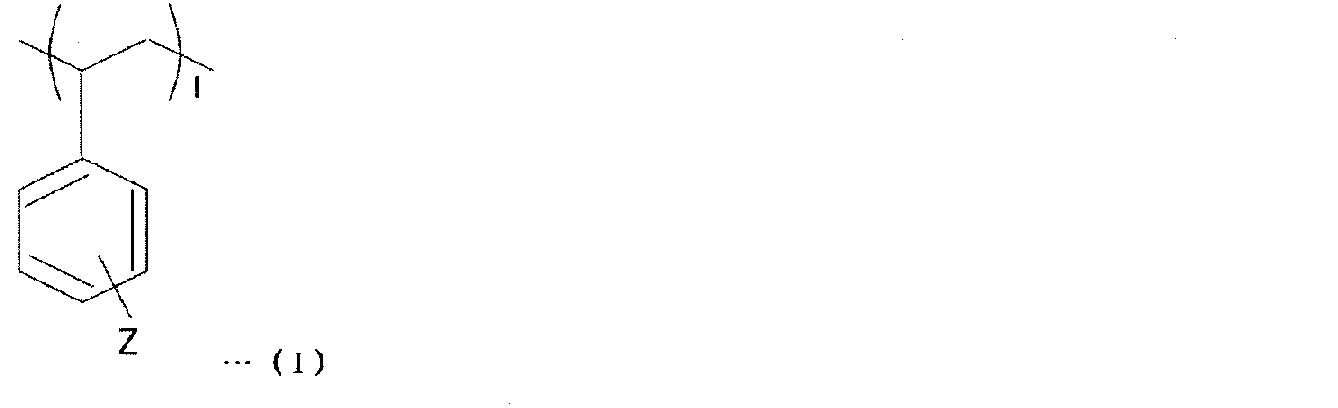
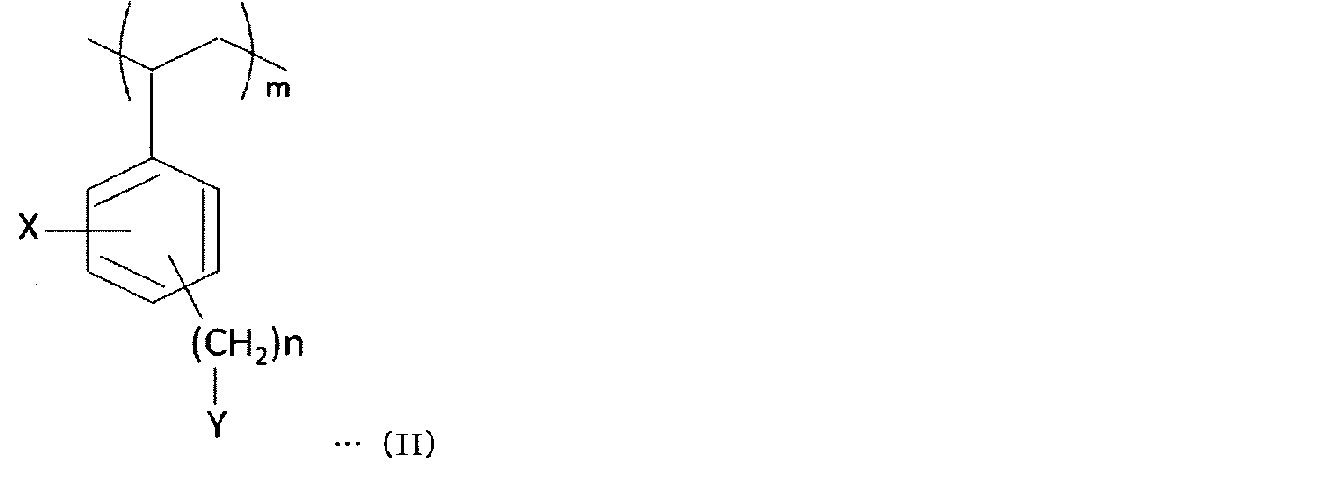
(e)該溶出性化合物の含有量が架橋重合体1gに対して400μg以下の架橋共重合体を、フリーデル・クラフツ反応触媒を架橋共重合体の重量に対して0.001~0.7倍量使用することによりハロアルキル化する工程
(f)ハロアルキル化架橋共重合体を、ベンゼン、トルエン、キシレン、アセトン、ジエチルエーテル、メチラール、ジクロロメタン、クロロホルム、ジクロロエタン、およびトリクロロエタンからなる群より選ばれる少なくとも一つの溶媒により洗浄することにより、ハロアルキル化された架橋重合体から、化学式(II)で示される溶出性化合物を除去する工程
(f)ハロアルキル化架橋共重合体を、ベンゼン、トルエン、キシレン、アセトン、ジエチルエーテル、メチラール、ジクロロメタン、クロロホルム、ジクロロエタン、およびトリクロロエタンからなる群より選ばれる少なくとも一つの溶媒により洗浄することにより、ハロアルキル化された架橋重合体から、化学式(II)で示される溶出性化合物を除去する工程

(g)該溶出性化合物が除去されたハロアルキル化架橋重合体をアミン化合物と反応させる工程
[7] 過酸化水素水溶液を逆浸透膜分離装置に通水して精製する装置において、該逆浸透膜分離装置が高圧型逆浸透膜分離装置であることを特徴とする過酸化水素水溶液の精製装置。
[8] [7]において、前記高圧型逆浸透膜装置が、有効圧力2.0MPa、温度25℃における純水の透過流束が0.6~1.3m3/m2/dayで、NaCl除去率が99.5%以上の特性を有するものであることを特徴とする過酸化水素水溶液の精製装置。
[9] [7]または[8]において、前記逆浸透膜分離装置の透過水が通水されるイオン交換装置を有することを特徴とする過酸化水素水溶液の精製装置。
[10] [9]において、前記イオン交換装置は、第1のゲル型H形強カチオン交換樹脂塔、ゲル型塩形強アニオン交換樹脂塔、および第2のゲル型H形強カチオン交換樹脂塔と、前記透過水を該第1のゲル型H形強カチオン交換樹脂塔、該ゲル型塩形強アニオン交換樹脂塔、および該第2のゲル型H形強カチオン交換樹脂塔に順次通水する手段とを有することを特徴とする過酸化水素水溶液の精製装置。
[11] [10]において、前記第1のゲル型H形強カチオン交換樹脂塔に充填されたゲル型H形強カチオン交換樹脂が、架橋度9%以上のH形強カチオン交換樹脂、または、下記(a)および(b)の工程を経て製造されたH形強カチオン交換樹脂であり、前記第2のゲル型H形強カチオン交換樹脂塔に充填されたゲル型H形強カチオン交換樹脂が、架橋度6%以下のH形強カチオン交換樹脂、架橋度9%以上のH形強カチオン交換樹脂、または、下記(a)および(b)の工程を経て製造されたH形強カチオン交換樹脂であることを特徴とする過酸化水素水溶液の精製装置。
(a)モノビニル芳香族モノマーと、架橋性芳香族モノマー中の非重合性の不純物含有量が3重量%以下である架橋性芳香族モノマーとを、ラジカル重合開始剤を全モノマー重量に対して0.05重量%以上、5重量%以下で用い、かつ該ラジカル重合開始剤として少なくもと過酸化ベンゾゾイルおよびt-ブチルパーオキシベンゾエートを用い、重合温度を70℃以上、250℃以下にして共重合させて架橋共重合体を得る工程
(b)該架橋共重合体をスルホン化する工程
(a)モノビニル芳香族モノマーと、架橋性芳香族モノマー中の非重合性の不純物含有量が3重量%以下である架橋性芳香族モノマーとを、ラジカル重合開始剤を全モノマー重量に対して0.05重量%以上、5重量%以下で用い、かつ該ラジカル重合開始剤として少なくもと過酸化ベンゾゾイルおよびt-ブチルパーオキシベンゾエートを用い、重合温度を70℃以上、250℃以下にして共重合させて架橋共重合体を得る工程
(b)該架橋共重合体をスルホン化する工程
[12] [10]または[11]において、前記ゲル型塩形強アニオン交換樹脂塔に充填されたゲル型塩形強アニオン交換樹脂が、下記(c)、(d)、(e)、(f)および(g)の工程を経て製造された塩形強アニオン交換樹脂であることを特徴とする過酸化水素水溶液の精製装置。
(c)モノビニル芳香族モノマーと架橋性芳香族モノマーとを共重合させて架橋共重合体を得る工程
(d)(c)工程における重合温度を18℃以上、250℃以下に調整し、該架橋性芳香族モノマーの架橋性芳香族モノマー含有量(純度)を57重量%以上とすることで、化学式(I)で示される溶出性化合物の含有量を、モノビニル芳香族モノマーと架橋性芳香族モノマーとの架橋共重合体1gに対して400μg以下とする工程
(c)モノビニル芳香族モノマーと架橋性芳香族モノマーとを共重合させて架橋共重合体を得る工程
(d)(c)工程における重合温度を18℃以上、250℃以下に調整し、該架橋性芳香族モノマーの架橋性芳香族モノマー含有量(純度)を57重量%以上とすることで、化学式(I)で示される溶出性化合物の含有量を、モノビニル芳香族モノマーと架橋性芳香族モノマーとの架橋共重合体1gに対して400μg以下とする工程

(e)該溶出性化合物の含有量が架橋重合体1gに対して400μg以下の架橋共重合体を、フリーデル・クラフツ反応触媒を架橋共重合体の重量に対して0.001~0.7倍量使用することによりハロアルキル化する工程
(f)ハロアルキル化架橋共重合体を、ベンゼン、トルエン、キシレン、アセトン、ジエチルエーテル、メチラール、ジクロロメタン、クロロホルム、ジクロロエタン、およびトリクロロエタンからなる群より選ばれる少なくとも一つの溶媒により洗浄することにより、ハロアルキル化された架橋重合体から、化学式(II)で示される溶出性化合物を除去する工程
(f)ハロアルキル化架橋共重合体を、ベンゼン、トルエン、キシレン、アセトン、ジエチルエーテル、メチラール、ジクロロメタン、クロロホルム、ジクロロエタン、およびトリクロロエタンからなる群より選ばれる少なくとも一つの溶媒により洗浄することにより、ハロアルキル化された架橋重合体から、化学式(II)で示される溶出性化合物を除去する工程

(g)該溶出性化合物が除去されたハロアルキル化架橋重合体をアミン化合物と反応させる工程
本発明によれば、高圧型逆浸透膜分離装置を用いて、過酸化水素水溶液中の金属のみならずTOC及びホウ素を高度に除去することができ、要求が厳しい高純度の過酸化水素水溶液をLotによらず、安定かつ確実に製造することが可能になる。
本発明によれば、例えば、逆浸透膜分離装置とイオン交換装置を組み合わせて過酸化水素水溶液を精製する場合、高圧型逆浸透膜分離装置による処理を行う。これにより、TOCのみならず金属イオンを高度に除去した高純度の透過水を得ることができ、この透過水を処理するイオン交換装置の負荷を軽減し、装置全体での処理コストを削減することができる。
以下に、図面を参照して本発明の過酸化水素水溶液の精製方法および精製装置について詳細に説明する。以下の記載は本発明の実施形態の一例であって、本発明はその要旨を超えない限り、以下の記載に限定されるものではない。
Fig.1は、本発明の過酸化水素水溶液の精製装置の実施の形態を示す系統図である。
Fig.1の過酸化水素水溶液の精製装置は、未精製過酸化水素水溶液を熱交換器1、精密濾過膜分離装置2及び高圧型逆浸透膜分離装置3に順次通水して精製するものである。
熱交換器1は、前述の減圧蒸留等により得られた5~25℃の未精製過酸化水素水溶液を処理開始前と比較して温度を上昇させないように調整するものである。これにより、過酸化水素の自己分解による逆浸透膜の酸化劣化を抑制することができる。精密濾過膜分離装置2は、過酸化水素水溶液中の微粒子等の不純物を除去するためのものである。
高圧型逆浸透膜分離装置3の詳細については、以下に説明する。
高圧型逆浸透膜分離装置3の詳細については、以下に説明する。
本発明では、高圧型逆浸透膜分離装置3の透過水を、さらにゲル型強イオン交換樹脂に接触させるイオン交換処理を2段以上行って処理することが好ましい。イオン交換処理は、第1のゲル型H形強カチオン交換樹脂、ゲル型塩形強アニオン交換樹脂、および第2のゲル型H形強カチオン交換樹脂に順次接触させる処理であることが好ましい。
このようなイオン交換処理では、第1のゲル型H形強カチオン交換樹脂による処理で、高圧型逆浸透膜透過水中のカチオン性の金属イオン不純物が除去され、次いでゲル型塩形強アニオン交換樹脂による処理で、アニオン性の金属不純物や塩素イオン、硫酸イオンが除去され、更に、第2のゲル型H形強カチオン交換樹脂による処理で、前段のゲル型塩形強アニオン交換樹脂中に不純物として含まれる微量のNa+、K+、Al3+などの金属イオン不純物などを高度に除去することができる。
[過酸化水素水溶液]
精製対象の過酸化水素水溶液としては、前述のアントラキノン自動酸化法や、水素と酸素を直接反応させる直接合成法など、公知の製造法によって製造された工業用過酸化水素水溶液が挙げられる。過酸化水素水溶液の過酸化水素濃度は70重量%以下であれば特に制限されない。日本国内においては、工業用過酸化水素水溶液は工業用規格で過酸化水素濃度35重量%、45重量%、60重量%と定められており、通常はそのいずれかの濃度である。
精製対象の過酸化水素水溶液としては、前述のアントラキノン自動酸化法や、水素と酸素を直接反応させる直接合成法など、公知の製造法によって製造された工業用過酸化水素水溶液が挙げられる。過酸化水素水溶液の過酸化水素濃度は70重量%以下であれば特に制限されない。日本国内においては、工業用過酸化水素水溶液は工業用規格で過酸化水素濃度35重量%、45重量%、60重量%と定められており、通常はそのいずれかの濃度である。
過酸化水素水溶液は、前述の通り、リン酸塩、ピロリン酸塩、錫酸塩などの無機キレート剤や、エチレンジアミンテトラメチレンなどのホスホン酸、エチレンジアミン四酢酸、ニトリロトリ酢酸などの有機キレート剤といった安定剤の1種または2種以上を含んでいてもよい。過酸化水素水溶液中の安定剤は、通常、高圧型逆浸透膜分離装置による処理でその大半が除去される。
[高圧型逆浸透膜分離装置]
過酸化水素水溶液の逆浸透膜分離処理に用いる高圧型逆浸透膜分離装置は、従来、海水淡水化に用いられている逆浸透膜分離装置である。高圧逆浸透膜は、従来の過酸化水素水溶液の精製に用いられている低圧または超低圧逆浸透膜に比べて膜表面のスキン層が緻密となっている。そのため、高圧型逆浸透膜は低圧型または超低圧型逆浸透膜に比べて単位操作圧力当たりの膜透過水量は低いものの有機物やホウ素の除去率が高い。
過酸化水素水溶液の逆浸透膜分離処理に用いる高圧型逆浸透膜分離装置は、従来、海水淡水化に用いられている逆浸透膜分離装置である。高圧逆浸透膜は、従来の過酸化水素水溶液の精製に用いられている低圧または超低圧逆浸透膜に比べて膜表面のスキン層が緻密となっている。そのため、高圧型逆浸透膜は低圧型または超低圧型逆浸透膜に比べて単位操作圧力当たりの膜透過水量は低いものの有機物やホウ素の除去率が高い。
高圧型逆浸透膜分離装置は、上述の通り、単位操作圧力当たりの膜透過水量は低く、本発明においては、有効圧力2.0MPa、温度25℃における純水の透過流束が0.6~1.3m3/m2/dayで、NaCl除去率99.5%以上の特性を有するものを好適に用いる。有効圧力とは平均操作圧力から浸透圧差と二次側圧力とを差し引いた膜に働く有効な圧力である。NaCl除去率はNaCl濃度32000mg/LのNaCl水溶液に対する25℃、有効圧力2.0PMaでの除去率である。平均操作圧力は、膜の一次側における膜供給水の圧力(運転圧力)と濃縮水の圧力(濃縮水出口圧力)の平均値で、以下式により表される。
平均操作圧力=(運転圧力+濃縮水出口圧力)/2
平均操作圧力=(運転圧力+濃縮水出口圧力)/2
高圧型逆浸透膜は、低圧または超低圧型逆浸透膜に比べて膜表面のスキン層が緻密となっているため、高圧型逆浸透膜は低圧型または超低圧型逆浸透膜に比べて単位操作圧力当りの膜透過水量は低いもののTOC除去率やホウ素除去率は極端に高い。
本発明で用いる高圧型逆浸透膜分離装置は芳香族ポリアミド系の膜であることが好ましい。高圧型逆浸透膜の膜形状は、特に限定されるものではなく、例えばスパイラル型、中空子型等、4インチRO膜、8インチRO膜、16インチRO膜などのいずれでもよい。
本発明においては、このような高圧型逆浸透膜分離装置に、過酸化水素水溶液を操作圧力0.5~3.0MPa、好ましくは1.0MPa以上、水回収率50~90%で通水して逆浸透膜分離処理することが好ましい。これらの値は、過酸化水素水溶液の塩類濃度等によって変化する。
[イオン交換装置]
高圧型逆浸透膜分離装置により過酸化水素水溶液を処理して得られた透過水は、更にイオン交換装置で処理することが好ましい。イオン交換装置は、ゲル型強イオン交換樹脂を充填した、2塔以上からなるイオン交換装置が好ましい。特に制限はないが、ゲル型塩形強アニオン交換樹脂塔の前後にゲル型H形強カチオン交換樹脂塔を設けたイオン交換装置が好ましい。
高圧型逆浸透膜分離装置により過酸化水素水溶液を処理して得られた透過水は、更にイオン交換装置で処理することが好ましい。イオン交換装置は、ゲル型強イオン交換樹脂を充填した、2塔以上からなるイオン交換装置が好ましい。特に制限はないが、ゲル型塩形強アニオン交換樹脂塔の前後にゲル型H形強カチオン交換樹脂塔を設けたイオン交換装置が好ましい。
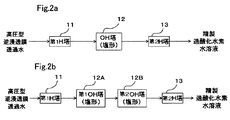
以下に、本発明に好適なイオン交換装置について、Figs.2a,2bを参照して説明する。
Fig.2aに示すイオン交換装置は、高圧逆浸透膜透過水を、第1のゲル型H形強カチオン交換樹脂塔(以下「第1H塔」と称す場合がある。)11、ゲル型塩形強アニオン交換樹脂塔(以下「OH塔」と称す場合がある。)12、第2のゲル型H形強カチオン交換樹脂塔(以下「第2H塔」と称す場合がある)13の順で通水して精製過酸化水素水溶液を得るものである。
Fig.2bに示すイオン交換装置は、Fig.2aのイオン交換装置における塩形ゲル型強アニオン交換樹脂塔として、第1のゲル型塩形強アニオン交換樹脂塔(以下「第1OH塔」と称す場合がある。)12Aと第2のゲル型塩形強アニオン交換樹脂塔(以下「第2OH塔」と称す場合がある。)12Bとを直列2段に配置したものである。
各イオン交換樹脂塔は、1段に設けられるものに限らず、2段以上の多段に設けられていてもよい。
高圧逆浸透膜透過水を第1のゲル型H形強カチオン交換樹脂、ゲル型塩形強アニオン交換樹脂、および第2のゲル型H形強カチオン交換樹脂の順で接触させて処理するものであればよく、各イオン交換樹脂は異なる塔に充填されている形態に限定されず、2以上のイオン交換樹脂が同一の塔内に通水性の仕切板を介して積層されていてもよい。
高圧逆浸透膜透過水を、第1H塔11、OH塔12(あるいは第1OH塔12Aおよび第2OH塔12B)、第2H塔13に順次通水して精製するに当たり、第1H塔11に充填する第1のゲル型H形強カチオン交換樹脂として、架橋度9%以上のH形強カチオン交換樹脂(以下「高架橋樹脂」と称す場合がある。)、または、下記(a)および(b)の工程を経て製造されたH形強カチオン交換樹脂(以下「(a)~(b)樹脂」と称す場合がある。)を用い、第2H塔13に充填する第2のゲル型H形強カチオン交換樹脂として、架橋度6%以下のH形強カチオン交換樹脂(以下「低架橋樹脂」と称す場合がある。)、架橋度9%以上の高架橋樹脂、または、(a)~(b)樹脂を用い、OH塔12(第1OH塔12Aおよび/または第2OH塔12B)に充填するゲル型塩形強アニオン交換樹脂として、下記(c)、(d)、(e)、(f)および(g)の工程を経て製造された塩形強アニオン交換樹脂(以下「(c)~(g)樹脂」と称す場合がある)を用いることが好ましい。
(a)モノビニル芳香族モノマーと、架橋性芳香族モノマー中の非重合性の不純物含有量が3重量%以下である架橋性芳香族モノマーとを、ラジカル重合開始剤を全モノマー重量に対して0.05重量%以上、5重量%以下で用い、かつ該ラジカル重合開始剤として少なくもと過酸化ベンゾゾイルおよびt-ブチルパーオキシベンゾエートを用い、重合温度を70℃以上、250℃以下にして共重合させて架橋共重合体を得る工程
(b)該架橋共重合体をスルホン化する工程
(b)該架橋共重合体をスルホン化する工程
(c)モノビニル芳香族モノマーと架橋性芳香族モノマーとを共重合させて架橋共重合体を得る工程
(d)(c)工程における重合温度を18℃以上、250℃以下に調整し、該架橋性芳香族モノマーの架橋性芳香族モノマー含有量(純度)を57重量%以上とすることで、化学式(I)で示される溶出性化合物の含有量を、モノビニル芳香族モノマーと架橋性芳香族モノマーとの架橋共重合体1gに対して400μg以下とする工程
(d)(c)工程における重合温度を18℃以上、250℃以下に調整し、該架橋性芳香族モノマーの架橋性芳香族モノマー含有量(純度)を57重量%以上とすることで、化学式(I)で示される溶出性化合物の含有量を、モノビニル芳香族モノマーと架橋性芳香族モノマーとの架橋共重合体1gに対して400μg以下とする工程

(e)該溶出性化合物の含有量が架橋重合体1gに対して400μg以下の架橋共重合体を、フリーデル・クラフツ反応触媒を架橋共重合体の重量に対して0.001~0.7倍量使用することによりハロアルキル化する工程
(f)ハロアルキル化架橋共重合体を、ベンゼン、トルエン、キシレン、アセトン、ジエチルエーテル、メチラール、ジクロロメタン、クロロホルム、ジクロロエタン、およびトリクロロエタンからなる群より選ばれる少なくとも一つの溶媒により洗浄することにより、ハロアルキル化された架橋重合体から、化学式(II)で示される溶出性化合物を除去する工程
(f)ハロアルキル化架橋共重合体を、ベンゼン、トルエン、キシレン、アセトン、ジエチルエーテル、メチラール、ジクロロメタン、クロロホルム、ジクロロエタン、およびトリクロロエタンからなる群より選ばれる少なくとも一つの溶媒により洗浄することにより、ハロアルキル化された架橋重合体から、化学式(II)で示される溶出性化合物を除去する工程
(g)該溶出性化合物が除去されたハロアルキル化架橋重合体をアミン化合物と反応させる工程
イオン交換樹脂として、ゲル型樹脂を用いるのは、以下の理由による。
イオン交換樹脂には、ゲル型とポーラス型とがあるが、ゲル型の方がポーラス型よりも表面積が小さく、過酸化水素水溶液の精製において過酸化水素に対する耐酸化性が高く、精製純度および精製安定性を上げることができ、好ましい。
イオン交換樹脂には、ゲル型とポーラス型とがあるが、ゲル型の方がポーラス型よりも表面積が小さく、過酸化水素水溶液の精製において過酸化水素に対する耐酸化性が高く、精製純度および精製安定性を上げることができ、好ましい。
「架橋度」とは、イオン交換樹脂の製造に用いるモノビニル芳香族モノマーと架橋剤である架橋性芳香族モノマーの重量の合計に対する架橋性芳香族モノマーの重量割合を意味し、当該分野において使われている定義と同様である。
架橋性芳香族モノマーの使用量が多い程、樹脂の鎖状構造が架橋されて網目構造部分の多い密な樹脂となり、架橋性芳香族モノマーの使用量が少ないと網目の大きい樹脂が得られる。
市販のイオン交換樹脂の架橋度は4~20%程度であり、通常の水処理には、イオンを除去しやすい領域である架橋度8%程度の樹脂が標準架橋樹脂として使用されている。このため、特許文献2でも用いるイオン交換樹脂の架橋度は6~10、好ましくは7~9とされている。
架橋性芳香族モノマーの使用量が多い程、樹脂の鎖状構造が架橋されて網目構造部分の多い密な樹脂となり、架橋性芳香族モノマーの使用量が少ないと網目の大きい樹脂が得られる。
市販のイオン交換樹脂の架橋度は4~20%程度であり、通常の水処理には、イオンを除去しやすい領域である架橋度8%程度の樹脂が標準架橋樹脂として使用されている。このため、特許文献2でも用いるイオン交換樹脂の架橋度は6~10、好ましくは7~9とされている。
<高架橋樹脂>
第1H塔11の第1のゲル型H形強カチオン交換樹脂および/または第2H塔13の第2のゲル型H形強カチオン交換樹脂に用いられる架橋度9%以上のゲル型H形強カチオン交換樹脂は、過酸化水素に対する耐酸化性に優れ、低溶出性の樹脂であるため、これを例えば第1H塔11に用いることにより、溶出物による後段のOH塔12(第1OH塔12A,第2OH塔12B)の負荷を低減して精製処理を安定化させることができる。
従って、第1H塔11には、このような高架橋樹脂を充填することが好ましい。
第2H塔13に高架橋樹脂を用いた場合は、第2H塔13でも高い耐酸化性を得ることができる。
第1H塔11の第1のゲル型H形強カチオン交換樹脂および/または第2H塔13の第2のゲル型H形強カチオン交換樹脂に用いられる架橋度9%以上のゲル型H形強カチオン交換樹脂は、過酸化水素に対する耐酸化性に優れ、低溶出性の樹脂であるため、これを例えば第1H塔11に用いることにより、溶出物による後段のOH塔12(第1OH塔12A,第2OH塔12B)の負荷を低減して精製処理を安定化させることができる。
従って、第1H塔11には、このような高架橋樹脂を充填することが好ましい。
第2H塔13に高架橋樹脂を用いた場合は、第2H塔13でも高い耐酸化性を得ることができる。
高架橋樹脂の架橋度は9%以上、好ましくは9%を超え、耐酸化性と処理効率のバランスから、より好ましくは10~20%、特に好ましくは11~16%である。架橋度が12%以上であれば、特に耐酸化性、耐溶出性に優れる。
<低架橋樹脂>
第2H塔13に用いられる架橋度6%以下のゲル型H形強カチオン交換樹脂は、標準架橋樹脂よりも除去効率、洗浄効率が高く、前段のOH塔12(第1OH塔12A,第2OH塔12B)から溶出するTOC(アミン等)を効率的に除去することができるため、第2H塔13に充填するゲル型H形強カチオン交換樹脂として適している。
第2H塔13に用いられる架橋度6%以下のゲル型H形強カチオン交換樹脂は、標準架橋樹脂よりも除去効率、洗浄効率が高く、前段のOH塔12(第1OH塔12A,第2OH塔12B)から溶出するTOC(アミン等)を効率的に除去することができるため、第2H塔13に充填するゲル型H形強カチオン交換樹脂として適している。
低架橋樹脂の架橋度は6%以下、好ましくは6%未満、例えば5%以下であり、その下限については、市販のイオン交換樹脂の架橋度の下限が4%程度であることにより、通常4%程度である。
低架橋樹脂は、下記(i)の超純水通水試験におけるΔTOCが20μg/L以下であることが好ましい。
(i)超純水通水試験
1) 空の測定カラム単体に、測定対象の低架橋樹脂量に対して50hr-1の空間速度(Space Velocity;SV)で超純水を通水し、通水1時間後の該測定カラム単体出口水のTOC濃度(TOC0)を分析する。
2) 上記1)の測定カラムに、測定対象の低架橋樹脂を充填後、該低架橋樹脂を充填した測定カラムに、該低架橋樹脂量に対して50hr-1のSVで超純水を通水し、通水1時間後の該測定カラム出口水のTOC濃度(TOC1)を分析する。
3) 上記1),2)の分析結果から、下記式でΔTOCを算出する。
ΔTOC=TOC1-TOC0
1) 空の測定カラム単体に、測定対象の低架橋樹脂量に対して50hr-1の空間速度(Space Velocity;SV)で超純水を通水し、通水1時間後の該測定カラム単体出口水のTOC濃度(TOC0)を分析する。
2) 上記1)の測定カラムに、測定対象の低架橋樹脂を充填後、該低架橋樹脂を充填した測定カラムに、該低架橋樹脂量に対して50hr-1のSVで超純水を通水し、通水1時間後の該測定カラム出口水のTOC濃度(TOC1)を分析する。
3) 上記1),2)の分析結果から、下記式でΔTOCを算出する。
ΔTOC=TOC1-TOC0
上記の(i)超純水通水試験で使用する超純水の水質は、抵抗率;18.0MΩ・cm以上、TOC;2μg/L以下、シリカ;0.1μg/L以下、φ50nm以上微粒子;5個/mL以下、金属;1ng/L以下、アニオン;1ng/L以下である。
上記(i)超純水通水試験によるΔTOCが20μg/L以下の低架橋樹脂であれば、樹脂からのTOCの溶出量が少なく、このような低架橋樹脂を後段の第2H塔13に充填して用いることにより、高純度過酸化水素水溶液を安定に得ることができる。
<(a)~(b)樹脂>
(a)~(b)樹脂は、前述の(a)および(b)の工程を経て製造されたものであり、樹脂からのTOCの溶出量が少なく、このような(a)~(b)樹脂を第1H塔11および/または第2H塔12に充填して用いることにより、高純度過酸化水素水溶液を安定に得ることができる。
(a)~(b)樹脂は、前述の(a)および(b)の工程を経て製造されたものであり、樹脂からのTOCの溶出量が少なく、このような(a)~(b)樹脂を第1H塔11および/または第2H塔12に充填して用いることにより、高純度過酸化水素水溶液を安定に得ることができる。
(a)の工程で用いるモノビニル芳香族モノマーとしては、スチレン、メチルスチレン、エチルスチレンなどのアルキル置換スチレン、またはブロモスチレンなどのハロゲン置換スチレンなどの1種または2種以上が挙げられる。好ましくはスチレン或いはスチレンを主体とするモノマーである。
架橋性芳香族モノマーとしては、ジビニルベンゼン、トリビニルベンゼン、ジビニルトルエン、ジビニルトルエンなどの1種または2種以上が挙げられる。好ましくはジビニルベンゼンである。
架橋性芳香族モノマーの使用量は、当該(a)~(b)樹脂を第1H塔11に用いるか、第2H塔13に用いるかによって異なる。第1H塔11に用いる場合は、高架橋樹脂が得られるように、架橋性芳香族モノマーの使用量は全モノマー重量に対する重量割合で9%以上、特に10~20%、とりわけ11~16%とすることがことが好ましい。第2H塔13に用いる場合は、上記の高架橋樹脂となる使用量であるか、低架橋樹脂が得られるように、架橋性芳香族モノマーの使用量は全モノマー重量に対する重量割合で6%以下、特に4~6%とすることが好ましい。
(a)~(b)樹脂の架橋度は、9%以上あるいは6%以下に限定されるものではなく4~20%の範囲で幅広く設定することができる。
ラジカル重合開始剤としては、過酸化ジベンゾイル、過酸化ラウロイル、t-ブチルハイドロパーオキサイド、アゾビスイソブチロニトリルなどが得られるが、少なくとも、過酸化ベンゾゾイルおよびt-ブチルパーオキシベンゾエートを用いる。
重合様式は、特に限定されるものではなく、溶液重合、乳化重合、懸濁重合等の種々の様式で重合を行うことができる。均一なビーズ状の共重合体が得られる懸濁重合法が好ましく採用される。懸濁重合法は、一般にこの種の共重合体の製造に使用される溶媒、分散安定剤等を用い、公知の反応条件を選択して行うことができる。
共重合反応における重合温度は、70℃以上、250℃以下、好ましくは150℃以下、更に好ましくは140℃以下である。重合温度が高すぎると解重合が併発し重合完結度がかえって低下する。重合温度が低すぎると重合完結度が不十分となる。
重合雰囲気は、空気下もしくは不活性ガス下で実施可能である。不活性ガスとしては窒素、二酸化炭素、アルゴン等が使用できる。
重合雰囲気は、空気下もしくは不活性ガス下で実施可能である。不活性ガスとしては窒素、二酸化炭素、アルゴン等が使用できる。
(b)の工程のスルホン化は常法に従って行うことができる。
このようにして得られる(a)~(b)樹脂は、通常、前述の(i)超純水通水試験によるΔTOCが5μg/L以下の低溶出性のものである。
<ゲル型塩形強アニオン交換樹脂>
OH塔12(第1OH塔12A,第2OH塔12B)に充填するゲル型塩形強アニオン交換樹脂の塩形の種類や塩形への製法については特に制限はない。塩形としては炭酸塩形、重炭酸塩形、ハロゲン(F,Cl,Br)形、硫酸形等が挙げられる。好ましくは重炭酸塩形、炭酸塩形である。
OH塔12(第1OH塔12A,第2OH塔12B)に充填するゲル型塩形強アニオン交換樹脂の塩形の種類や塩形への製法については特に制限はない。塩形としては炭酸塩形、重炭酸塩形、ハロゲン(F,Cl,Br)形、硫酸形等が挙げられる。好ましくは重炭酸塩形、炭酸塩形である。
このゲル型塩形強アニオン交換樹脂は、前述の(c)~(g)樹脂であることが、樹脂からの溶出量が少なく、高純度過酸化水素水溶液を安定に得ることができるため、好ましい。
(c)の工程で用いるモノビニル芳香族モノマーとしては、スチレン、メチルスチレン、エチルスチレンなどのアルキル置換スチレン、またはブロモスチレンなどのハロゲン置換スチレンなどの1種または2種以上が挙げられる。好ましくはスチレン或いはスチレンを主体とするモノマーである。
架橋性芳香族系モノマーとしては、ジビニルベンゼン、トリビニルベンゼン、ジビニルトルエン、ジビニルトルエンなどの1種または2種以上が挙げられる。好ましくはジビニルベンゼンである。
架橋性芳香族モノマーの使用量は、好適な架橋度の(c)~(g)樹脂が得られるような割合であればよい。
モノビニル芳香族モノマーと架橋性芳香族モノマーとの共重合反応は、ラジカル重合開始剤を用いて公知の技術に基づいて行うことができる。
ラジカル重合開始剤としては、過酸化ジベンゾイル、過酸化ラウロイル、t-ブチルハイドロパーオキサイド、アゾビスイソブチロニトリル等の1種又は2種以上が用いられる。ラジカル重合開始剤は、通常、全モノマー重量に対して0.05重量%以上、5重量%以下で用いられる。
ラジカル重合開始剤としては、過酸化ジベンゾイル、過酸化ラウロイル、t-ブチルハイドロパーオキサイド、アゾビスイソブチロニトリル等の1種又は2種以上が用いられる。ラジカル重合開始剤は、通常、全モノマー重量に対して0.05重量%以上、5重量%以下で用いられる。
重合様式は、特に限定されるものではなく、溶液重合、乳化重合、懸濁重合等の種々の様式で重合を行うことができる。このうち均一なビーズ状の共重合体が得られる懸濁重合法が好ましく採用される。懸濁重合法は、一般にこの種の共重合体の製造に使用される溶媒、分散安定剤等を用い、公知の反応条件を選択して行うことができる。
共重合反応における重合温度は、通常、室温(約18℃~25℃)以上、好ましくは40℃以上、さらに好ましくは70℃以上であり、通常250℃以下、好ましくは150℃以下、更に好ましくは140℃以下である。重合温度が高すぎると解重合が併発し重合完結度がかえって低下する。重合温度が低すぎると重合完結度が不十分となる。
重合雰囲気は、空気下もしくは不活性ガス下で実施可能である。不活性ガスとしては窒素、二酸化炭素、アルゴン等が使用できる。
重合雰囲気は、空気下もしくは不活性ガス下で実施可能である。不活性ガスとしては窒素、二酸化炭素、アルゴン等が使用できる。
(d)の工程における前記式(I)で示される溶出性化合物(以下「溶出性化合物(I)」と称す場合がある。)のZのアルキル基は炭素数1~8のアルキル基であり、好ましくはメチル基、エチル基、プロピル基、ブチル基であり、さらに好ましくはメチル基、エチル基である。
(e)の工程のハロアルキル化に供する架橋共重合体中の溶出性化合物(I)の含有量が、過酸化水素水溶液1gに対して400μgより多いと、不純物の残存や分解物の発生が抑制された、溶出物の少ないアニオン交換樹脂を得ることができない。溶出性化合物(I)の含有量は少ない程好ましく、好ましくは過酸化水素水溶液1gに対して30μg以下、より好ましくは200μg以下であり、通常その下限は50μg程度である。
(d)工程は、特に、(c)工程における重合条件を調整することにより、(c)工程と同時に行われる。例えば、(c)工程における重合温度を18℃以上、250℃以下に調整することにより、重合の完結度を高めて、溶出性化合物(I)が低減された架橋共重合体を得ることができる。架橋性芳香族モノマー、例えば、ジビニルベンゼン中には、ジエチルベンゼン等の非重合性の不純物が存在し、これが溶出性化合物(I)の生成の原因となることから、重合に用いる架橋性芳香族モノマーとして、当該架橋性芳香族モノマー含有量(純度)が57重量%以上というような、特定のグレードを選択して使用することで溶出性化合物(I)含有量の少ない架橋共重合体を得ることができる。
架橋性芳香族モノマーの架橋性芳香族モノマー含有量(純度)は、特に好ましくは60重量%以上、さらに好ましくは80重量%以上である。架橋性芳香族モノマー中の非重合性の不純物含有量は、モノマー重量当り通常5重量%以下、好ましくは3重量%以下、更に好ましくは1重量%以下である。架橋性芳香族モノマーの不純物含有量が多すぎると、重合時に不純物に対する連鎖移動反応を起こしやすくなるため、重合終了後のポリマー中に残存する溶出性オリゴマー(ポリスチレン)の量が増加することがあり、溶出性化合物(I)含有量の少ない架橋共重合体を得ることができない。
重合後、得られた架橋共重合体を洗浄することによって溶出性化合物(I)を除去して、溶出性化合物含有量が低減された架橋共重合体を得ることもできる。
(e)の架橋共重合体をハロアルキル化する工程は、(d)工程で得られた架橋共重合体を、膨潤状態で、フリーデル・クラフツ反応触媒の存在下、ハロアルキル化剤を反応させてハロアルキル化する工程である。
架橋共重合体を膨潤させるには、膨潤溶媒、例えばジクロロエタンを使用することができる。十分にハロメチル化を進行させるために、架橋共重合体はハロアルキル化剤のみにより膨潤させるのが好ましい。
フリーデル・クラフツ反応触媒としては、塩化亜鉛、塩化鉄(III)、塩化スズ(IV)、塩化アルミニウム等のルイス酸触媒が挙げられる。これらの触媒は1種を単独で用いても良く、2種以上を混合して用いても良い。
ハロアルキル化剤を反応試薬としてだけではなく共重合体の膨潤溶媒として作用させるには、共重合体との親和性が高いものを用いることが好ましい。このようなハロアルキル化剤としては、例えば、クロロメチルメチルエーテル、塩化メチレン、ビス(クロロメチル)エーテル、ポリ塩化ビニル、ビス(クロロメチル)ベンゼン等のハロゲン化合物が挙げられる。これらは1種を単独で用いても良く、2種以上を混合して用いても良い。より好ましいハロアルキル化剤はクロロメチルメチルエーテルである。本発明におけるハロアルキル化は、好ましくはクロロメチル化である。
(e)工程におけるハロアルキル基導入率は、モノビニル芳香族モノマーが100モル%ハロアルキル化されたと仮定したときの理論上のハロゲン含有率に対して80%以下、好ましくは75%以下、更に好ましくは70%以下とすることが好ましい。このハロアルキル基導入率(モノビニル芳香族モノマーが100モル%ハロアルキル化されたと仮定したときの理論上のハロゲン含有率に対する導入されたハロゲン原子の割合の百分率)を高くすると、導入時において、架橋共重合体の主鎖が切れたり、過剰に導入されたハロアルキル基が、導入後に遊離して不純物の原因となる。ハロアルキル基導入率を制限することにより、不純物の生成を抑制して溶出物の少ないアニオン交換樹脂を得ることができる。
ハロアルキル基の導入量を抑えることにより、ハロアルキル化工程での副反応も低減するので、溶出性のオリゴマーも発生しにくくなる。また、発生する副生物も、従来処方と比べて後工程で洗浄除去されにくい物質が少なくなる。その結果、溶出物量が著しく少ないアニオン交換樹脂を得ることができる。
具体的なハロアルキル基導入方法は以下の通りである。
ハロアルキル化剤の使用量は、架橋共重合体の架橋度、その他の条件により広い範囲から選ばれるが、少なくとも架橋共重合体を十分に膨潤させる量が好ましく、架橋共重合体に対して、通常1重量倍以上、好ましくは2重量倍以上であり、通常50重量倍以下、好ましくは20重量倍以下である。
ハロアルキル化剤の使用量は、架橋共重合体の架橋度、その他の条件により広い範囲から選ばれるが、少なくとも架橋共重合体を十分に膨潤させる量が好ましく、架橋共重合体に対して、通常1重量倍以上、好ましくは2重量倍以上であり、通常50重量倍以下、好ましくは20重量倍以下である。
フリーデル・クラフツ反応触媒の使用量は通常架橋共重合体の重量に対して0.001~7倍量、好ましくは0.1~0.7倍量、更に好ましくは0.1~0.7倍量である。
架橋共重合体へのハロアルキル基導入率を80%以下とするための手段としては、反応温度を低くする、活性の低い触媒を用いる、触媒添加量を少なくする等の手段が挙げられる。架橋共重合体とハロアルキル化剤との反応に影響を与える主因子としては、反応温度、フリーデル・クラフツ反応触媒の活性(種類)およびその添加量、ハロアルキル化剤添加量等が挙げられるため、これらの条件を調整することによりハロアルキル基導入率を制御することができる。
反応温度は、用いるフリーデル・クラフツ反応触媒の種類によっても異なるが、通常0~55℃である。好ましい反応温度の範囲は、使用するハロアルキル化剤、フリーデル・クラフツ反応触媒によって異なる。例えばハロアルキル化剤にクロロメチルメチルエーテルを用い、フリーデル・クラフツ反応触媒に塩化亜鉛を用いた場合には、好ましい反応温度は通常30℃以上、好ましくは35℃以上であり、通常50℃以下、好ましくは45℃以下である。この際、反応時間等を適宜選択することにより、過度のハロアルキル基導入を抑制することができる。
ハロアルキル基導入反応では、後架橋反応も同時に進行している。後架橋反応により最終製品の強度を確保する意味もあるので、ハロアルキル基導入反応の時間はある程度確保するほうがよい。ハロアルキル化の反応時間は好ましくは30分以上、より好ましくは3時間以上、更に好ましくは5時間以上である。ハロアルキル化の反応時間は好ましくは24時間以下、更に好ましくは12時間以下、さらに好ましくは9時間以下である。
(f)の工程は、ハロアルキル化された架橋共重合体(ハロアルキル化架橋共重合体)を前述の特定の溶媒で洗浄することにより、前記(II)で示される溶出性化合物(以下「溶出性化合物(II)」と称す場合がある。)を除去する処理を行って、ハロアルキル化架橋共重合体1gに対して、溶出性化合物(II)の含有量が好ましくは400μg以下、より好ましくは100μg以下、特に好ましくは50μg以下、とりわけ好ましくは30μg以下となるように、ハロアルキル化架橋共重合体を精製する工程である。溶出性化合物(II)含有量が多いと、不純物の残存や分解物の発生が抑制された、溶出物の少ないアニオン交換樹脂を得ることができない。溶出性化合物(II)の含有量は少ない程好ましいが、通常その下限は30μg程度である。
式(II)において、Xのハロゲン原子で置換されていても良いアルキル基は、通常炭素数1~10のアルキル基又はハロアルキル基であり、好ましくは、メチル基、エチル基、プロピル基、ブチル基、ハロメチル基、ハロエチル基、ハロプロピル基、ハロブチル基であり、さらに好ましくは、メチル基、エチル基、ハロメチル基、ハロエチル基である。
nは通常1以上であり、通常8以下、好ましくは4以下、さらに好ましくは2以下である。
nは通常1以上であり、通常8以下、好ましくは4以下、さらに好ましくは2以下である。
前述の溶媒による洗浄方法は、ハロアルキル化架橋共重合体をカラムに詰めて溶媒を通水するカラム方式か、或いはバッチ洗浄法で行うことができる。
洗浄温度は、通常室温(20℃)以上、好ましくは30℃以上、更に好ましくは50℃以上、特に好ましくは90℃以上で、通常150℃以下、好ましくは130℃以下、更に好ましくは120℃以下である。洗浄温度が高すぎると重合体の分解やハロアルキル基脱落を併発する。洗浄温度が低すぎると洗浄効率が低下する。
溶媒との接触時間は、通常5分以上、好ましくは架橋共重合体が80%以上膨潤する時間以上であり、通常4時間以下である。接触時間が短すぎると洗浄効率が低下し、接触時間が長すぎると生産性が低下する。
(g)の工程は、溶出性化合物(II)が除去されたハロアルキル化架橋共重合体にアミン化合物を反応させることにより、アミノ基を導入してアニオン交換樹脂を製造する工程である。アミノ基の導入は公知の技術で容易に実施することができる。
例えば、ハロアルキル化架橋共重合体を溶媒中に懸濁し、トリメチルアミンやジメチルエタノールアミンと反応させる方法が挙げられる。
例えば、ハロアルキル化架橋共重合体を溶媒中に懸濁し、トリメチルアミンやジメチルエタノールアミンと反応させる方法が挙げられる。
この導入反応の際に用いられる溶媒としては、例えば水、トルエン、ジオキサン、ジメチルホルムアミド、ジクロロエタン等が単独で、あるいは混合して用いられる。
その後は公知の方法によって塩形を各種の形に変えることによって、OH塔2(第1OH塔2A,第2OH塔2B)に充填する塩形強アニオン交換樹脂を得ることができる。
このようにして得られる(c)~(g)樹脂を塩形にした塩形強アニオン交換樹脂は、通常、前述の(i)超純水通水試験によるΔTOCが20μg/L以下の低溶出性のものである。
<樹脂塔構成例>
イオン交換装置の具体例としては、例えば以下の樹脂塔構成のものが挙げられる。
構成例1:高架橋樹脂塔→ゲル型塩形強アニオン交換樹脂塔→低架橋樹脂塔で順次処理するもの
構成例2:高架橋樹脂塔→ゲル型塩形強アニオン交換樹脂塔→高架橋樹脂塔で順次処理するもの
イオン交換装置の具体例としては、例えば以下の樹脂塔構成のものが挙げられる。
構成例1:高架橋樹脂塔→ゲル型塩形強アニオン交換樹脂塔→低架橋樹脂塔で順次処理するもの
構成例2:高架橋樹脂塔→ゲル型塩形強アニオン交換樹脂塔→高架橋樹脂塔で順次処理するもの
前述の通り、前段の第1H塔11に、耐酸化性に優れた高架橋樹脂を充填することにより、第1H塔11からの溶出量を低減して、後段のOH塔12(第1OH塔12A,第2OH塔12B)の負荷を軽減することができる。
後段の第2H塔13に低架橋樹脂を用いる構成例1であれば、後段の第2H塔13において、前段のOH塔12(第1OH塔12A,第2OH塔12B)のゲル型塩形強アニオン交換樹脂から溶出するTOC(アミン等)をこの第2H塔13において、効率的に除去すると共に、更に効率的に洗浄して再生することができる。
後段の第2H塔13に高架橋樹脂を用いる構成例2であれば、この第2H塔13においても耐酸化性を十分に高いものとして溶出量を低減することができる。
後段の第2H塔13に低架橋樹脂を用いる構成例1であれば、後段の第2H塔13において、前段のOH塔12(第1OH塔12A,第2OH塔12B)のゲル型塩形強アニオン交換樹脂から溶出するTOC(アミン等)をこの第2H塔13において、効率的に除去すると共に、更に効率的に洗浄して再生することができる。
後段の第2H塔13に高架橋樹脂を用いる構成例2であれば、この第2H塔13においても耐酸化性を十分に高いものとして溶出量を低減することができる。
上記構成例1,2のいずれであっても、ゲル型塩形強アニオン交換樹脂とゲル型H形強カチオン交換樹脂により高圧型逆浸透膜透過水中の金属イオン等の不純物を高度にイオン交換除去した上で、樹脂からのTOCの溶出を防止して、高純度過酸化水素水溶液を安定に得ることができる。
樹脂塔への樹脂充填量や通水条件には特に制限はなく、精製前過酸化水素水溶液の不純物濃度に応じて、ゲル型塩形強アニオン交換樹脂とゲル型H形強カチオン交換樹脂の充填量(容積比)や空間速度(SV)をバランスよく設計することが好ましい。
以下に実施例および比較例を挙げて本発明をより具体的に説明する。
以下の実施例および比較例では、TOC約15mg/Lの35重量%工業用過酸化水素水溶液(pH中性)の精製処理を行った。
[実施例1]
下記仕様の高圧型逆浸透膜分離装置に工業用過酸化水素水溶液を、水温25℃、操作圧力2.0MPaで通水し、水回収率70%で処理した。なお、ホウ素濃度は100μg/Lに調整した。
下記仕様の高圧型逆浸透膜分離装置に工業用過酸化水素水溶液を、水温25℃、操作圧力2.0MPaで通水し、水回収率70%で処理した。なお、ホウ素濃度は100μg/Lに調整した。
<高圧型逆浸透膜分離装置>
高圧型逆浸透膜:日東電工(株)製 芳香族ポリアミド系逆浸透膜「SWC4+」
有効圧力2.0MPa、温度25℃における純水透過流束:0.78m3/m2/day
有効圧力2.0MPa、温度25℃におけるNaCl除去率(NaCl濃度32000mg/L):99.8%
高圧型逆浸透膜:日東電工(株)製 芳香族ポリアミド系逆浸透膜「SWC4+」
有効圧力2.0MPa、温度25℃における純水透過流束:0.78m3/m2/day
有効圧力2.0MPa、温度25℃におけるNaCl除去率(NaCl濃度32000mg/L):99.8%
高圧型逆浸透膜分離装置の給水(入口水)のTOC濃度と得られた透過水のTOC濃度をオフラインTOC計(島津製作所(株)製 TOC-V CPH)で測定した。結果を表1に示した。
[比較例1]
高圧型逆浸透膜の代りに、低圧逆浸透膜(日東電工(株)製「ES-20」)を用い、操作圧力0.5MPaで通水したこと以外は、実施例1と同条件で処理し、同様に逆浸透膜給水と得られた透過水のTOC濃度を測定した。結果を表1に示した。
高圧型逆浸透膜の代りに、低圧逆浸透膜(日東電工(株)製「ES-20」)を用い、操作圧力0.5MPaで通水したこと以外は、実施例1と同条件で処理し、同様に逆浸透膜給水と得られた透過水のTOC濃度を測定した。結果を表1に示した。

表1より以下のことが分かる。
膜表面に緻密なスキン層がありTOC除去率の高い高圧型逆浸透膜分離装置で処理することにより、TOCを効率よく除去できる。
実施例1における高圧型逆浸透膜分離装置の透過水中のホウ素濃度は、約8μg/Lにまで低減でき、後段のイオン交換装置の負荷を低減できた。一方、比較例1における低圧逆浸透膜装置の透過水中のホウ素濃度は、約70μg/Lであった。
従って、不純物除去率の高い高圧型逆浸透膜分離装置を適用することで、後段のイオン交換装置のイオン交換能の低下を抑制することができ、再生不良や処理時間の低下の頻度を下げる(再生頻度の低減)ことができることが分かる。
膜表面に緻密なスキン層がありTOC除去率の高い高圧型逆浸透膜分離装置で処理することにより、TOCを効率よく除去できる。
実施例1における高圧型逆浸透膜分離装置の透過水中のホウ素濃度は、約8μg/Lにまで低減でき、後段のイオン交換装置の負荷を低減できた。一方、比較例1における低圧逆浸透膜装置の透過水中のホウ素濃度は、約70μg/Lであった。
従って、不純物除去率の高い高圧型逆浸透膜分離装置を適用することで、後段のイオン交換装置のイオン交換能の低下を抑制することができ、再生不良や処理時間の低下の頻度を下げる(再生頻度の低減)ことができることが分かる。
このように、本発明によれば、逆浸透膜装置を用いた過酸化水素水溶液の精製において、適用する逆浸透膜の条件を明確にすることで、過酸化水素水溶液中のTOC濃度を効率よく、大幅に低減することができ、製造コストを削減することができる。
本発明を特定の態様を用いて詳細に説明したが、本発明の意図と範囲を離れることなく様々な変更が可能であることは当業者に明らかである。
本出願は、2016年10月20日付で出願された日本特許出願2016-206085に基づいており、その全体が引用により援用される。
本出願は、2016年10月20日付で出願された日本特許出願2016-206085に基づいており、その全体が引用により援用される。
1 熱交換器
2 精密濾過膜分離装置
3 高圧型逆浸透膜分離装置
11 第1のゲル型H形強カチオン交換樹脂塔(第1H塔)
12 ゲル型塩形強アニオン交換樹脂塔(OH塔)
12A 第1のゲル型塩形強アニオン交換樹脂塔(第1OH塔)
12B 第2のゲル型塩形強アニオン交換樹脂塔(第2OH塔)
13 第2のゲル型H形強カチオン交換樹脂塔(第2H塔)
2 精密濾過膜分離装置
3 高圧型逆浸透膜分離装置
11 第1のゲル型H形強カチオン交換樹脂塔(第1H塔)
12 ゲル型塩形強アニオン交換樹脂塔(OH塔)
12A 第1のゲル型塩形強アニオン交換樹脂塔(第1OH塔)
12B 第2のゲル型塩形強アニオン交換樹脂塔(第2OH塔)
13 第2のゲル型H形強カチオン交換樹脂塔(第2H塔)
Claims (12)
- 過酸化水素水溶液を逆浸透膜分離処理して精製する方法において、該逆浸透膜分離処理を高圧型逆浸透膜分離装置を用いて行うことを特徴とする過酸化水素水溶液の精製方法。
- 請求項1において、前記高圧型逆浸透膜装置が、有効圧力2.0MPa、温度25℃における純水の透過流束が0.6~1.3m3/m2/dayで、NaCl除去率が99.5%以上の特性を有するものであることを特徴とする過酸化水素水溶液の精製方法。
- 請求項1または2において、前記逆浸透膜分離処理の透過水を、さらにイオン交換樹脂に接触させるイオン交換処理を行うことを特徴とする過酸化水素水溶液の精製方法。
- 請求項3において、前記イオン交換処理が、前記透過水を、第1のゲル型H形強カチオン交換樹脂、ゲル型塩形強アニオン交換樹脂、および第2のゲル型H形強カチオン交換樹脂に順次接触させる処理であることを特徴とする過酸化水素水溶液の精製方法。
- 請求項4において、前記第1のゲル型H形強カチオン交換樹脂が、架橋度9%以上のH形強カチオン交換樹脂、または、下記(a)および(b)の工程を経て製造されたH形強カチオン交換樹脂であり、
前記第2のゲル型H形強カチオン交換樹脂が、架橋度6%以下のH形強カチオン交換樹脂、架橋度9%以上のH形強カチオン交換樹脂、または、下記(a)および(b)の工程を経て製造されたH形強カチオン交換樹脂であることを特徴とする過酸化水素水溶液の精製方法。
(a)モノビニル芳香族モノマーと、架橋性芳香族モノマー中の非重合性の不純物含有量が3重量%以下である架橋性芳香族モノマーとを、ラジカル重合開始剤を全モノマー重量に対して0.05重量%以上、5重量%以下で用い、かつ該ラジカル重合開始剤として少なくもと過酸化ベンゾゾイルおよびt-ブチルパーオキシベンゾエートを用い、重合温度を70℃以上、250℃以下にして共重合させて架橋共重合体を得る工程
(b)該架橋共重合体をスルホン化する工程 - 請求項4または5において、前記ゲル型塩形強アニオン交換樹脂が、下記(c)、(d)、(e)、(f)および(g)の工程を経て製造された塩形強アニオン交換樹脂であることを特徴とする過酸化水素水溶液の精製方法。
(c)モノビニル芳香族モノマーと架橋性芳香族モノマーとを共重合させて架橋共重合体を得る工程
(d)(c)工程における重合温度を18℃以上、250℃以下に調整し、該架橋性芳香族モノマーの架橋性芳香族モノマー含有量(純度)を57重量%以上とすることで、化学式(I)で示される溶出性化合物の含有量を、モノビニル芳香族モノマーと架橋性芳香族モノマーとの架橋共重合体1gに対して400μg以下とする工程

(e)該溶出性化合物の含有量が架橋重合体1gに対して400μg以下の架橋共重合体を、フリーデル・クラフツ反応触媒を架橋共重合体の重量に対して0.001~0.7倍量使用することによりハロアルキル化する工程
(f)ハロアルキル化架橋共重合体を、ベンゼン、トルエン、キシレン、アセトン、ジエチルエーテル、メチラール、ジクロロメタン、クロロホルム、ジクロロエタン、およびトリクロロエタンからなる群より選ばれる少なくとも一つの溶媒により洗浄することにより、ハロアルキル化された架橋重合体から、化学式(II)で示される溶出性化合物を除去する工程

(g)該溶出性化合物が除去されたハロアルキル化架橋重合体をアミン化合物と反応させる工程 - 過酸化水素水溶液を逆浸透膜分離装置に通水して精製する装置において、該逆浸透膜分離装置が高圧型逆浸透膜分離装置であることを特徴とする過酸化水素水溶液の精製装置。
- 請求項7において、前記高圧型逆浸透膜装置が、有効圧力2.0MPa、温度25℃における純水の透過流束が0.6~1.3m3/m2/dayで、NaCl除去率が99.5%以上の特性を有するものであることを特徴とする過酸化水素水溶液の精製装置。
- 請求項7または8において、前記逆浸透膜分離装置の透過水が通水されるイオン交換装置を有することを特徴とする過酸化水素水溶液の精製装置。
- 請求項9において、前記イオン交換装置は、第1のゲル型H形強カチオン交換樹脂塔、ゲル型塩形強アニオン交換樹脂塔、および第2のゲル型H形強カチオン交換樹脂塔と、前記透過水を該第1のゲル型H形強カチオン交換樹脂塔、該ゲル型塩形強アニオン交換樹脂塔、および該第2のゲル型H形強カチオン交換樹脂塔に順次通水する手段とを有することを特徴とする過酸化水素水溶液の精製装置。
- 請求項10において、前記第1のゲル型H形強カチオン交換樹脂塔に充填されたゲル型H形強カチオン交換樹脂が、架橋度9%以上のH形強カチオン交換樹脂、または、下記(a)および(b)の工程を経て製造されたH形強カチオン交換樹脂であり、
前記第2のゲル型H形強カチオン交換樹脂塔に充填されたゲル型H形強カチオン交換樹脂が、架橋度6%以下のH形強カチオン交換樹脂、架橋度9%以上のH形強カチオン交換樹脂、または、下記(a)および(b)の工程を経て製造されたH形強カチオン交換樹脂であることを特徴とする過酸化水素水溶液の精製装置。
(a)モノビニル芳香族モノマーと、架橋性芳香族モノマー中の非重合性の不純物含有量が3重量%以下である架橋性芳香族モノマーとを、ラジカル重合開始剤を全モノマー重量に対して0.05重量%以上、5重量%以下で用い、かつ該ラジカル重合開始剤として少なくもと過酸化ベンゾゾイルおよびt-ブチルパーオキシベンゾエートを用い、重合温度を70℃以上、250℃以下にして共重合させて架橋共重合体を得る工程
(b)該架橋共重合体をスルホン化する工程 - 請求項10または11において、前記ゲル型塩形強アニオン交換樹脂塔に充填されたゲル型塩形強アニオン交換樹脂が、下記(c)、(d)、(e)、(f)および(g)の工程を経て製造された塩形強アニオン交換樹脂であることを特徴とする過酸化水素水溶液の精製装置。
(c)モノビニル芳香族モノマーと架橋性芳香族モノマーとを共重合させて架橋共重合体を得る工程
(d)(c)工程における重合温度を18℃以上、250℃以下に調整し、該架橋性芳香族モノマーの架橋性芳香族モノマー含有量(純度)を57重量%以上とすることで、化学式(I)で示される溶出性化合物の含有量を、モノビニル芳香族モノマーと架橋性芳香族モノマーとの架橋共重合体1gに対して400μg以下とする工程

(e)該溶出性化合物の含有量が架橋重合体1gに対して400μg以下の架橋共重合体を、フリーデル・クラフツ反応触媒を架橋共重合体の重量に対して0.001~0.7倍量使用することによりハロアルキル化する工程
(f)ハロアルキル化架橋共重合体を、ベンゼン、トルエン、キシレン、アセトン、ジエチルエーテル、メチラール、ジクロロメタン、クロロホルム、ジクロロエタン、およびトリクロロエタンからなる群より選ばれる少なくとも一つの溶媒により洗浄することにより、ハロアルキル化された架橋重合体から、化学式(II)で示される溶出性化合物を除去する工程
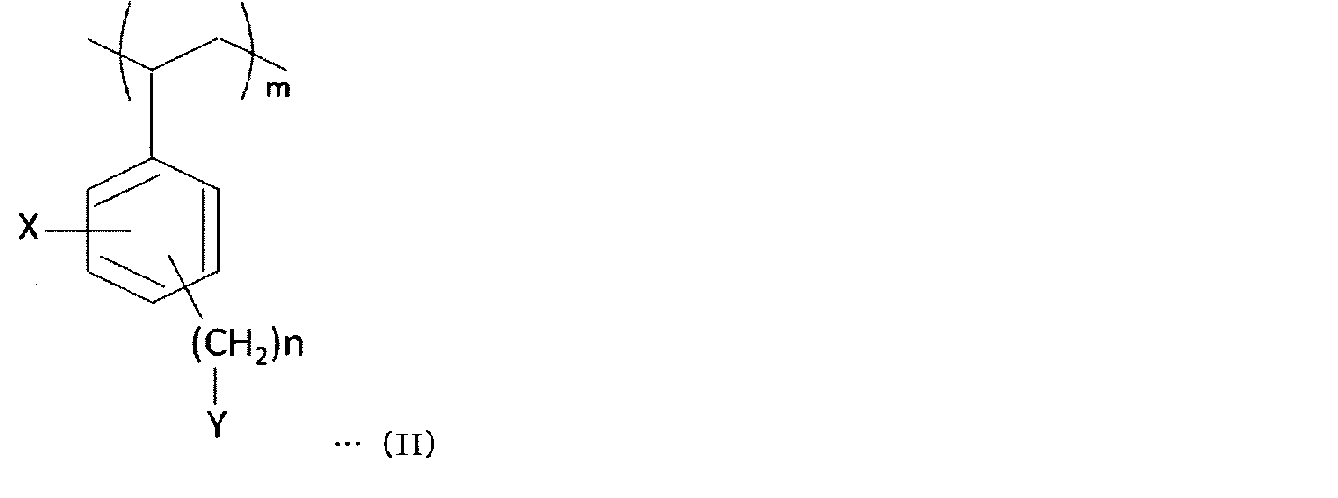
(g)該溶出性化合物が除去されたハロアルキル化架橋重合体をアミン化合物と反応させる工程
Priority Applications (3)
| Application Number | Priority Date | Filing Date | Title |
|---|---|---|---|
| KR1020197010416A KR102407556B1 (ko) | 2016-10-20 | 2017-09-19 | 과산화수소 수용액의 정제 방법 및 정제 장치 |
| CN201780064041.9A CN109843792A (zh) | 2016-10-20 | 2017-09-19 | 过氧化氢水溶液的纯化方法及纯化装置 |
| US16/341,610 US20200290873A1 (en) | 2016-10-20 | 2017-09-19 | Aqueous hydrogen peroxide purification method and purification system |
Applications Claiming Priority (2)
| Application Number | Priority Date | Filing Date | Title |
|---|---|---|---|
| JP2016206085A JP6365624B2 (ja) | 2016-10-20 | 2016-10-20 | 過酸化水素水溶液の精製方法および精製装置 |
| JP2016-206085 | 2016-10-20 |
Publications (1)
| Publication Number | Publication Date |
|---|---|
| WO2018074127A1 true WO2018074127A1 (ja) | 2018-04-26 |
Family
ID=62018600
Family Applications (1)
| Application Number | Title | Priority Date | Filing Date |
|---|---|---|---|
| PCT/JP2017/033646 Ceased WO2018074127A1 (ja) | 2016-10-20 | 2017-09-19 | 過酸化水素水溶液の精製方法および精製装置 |
Country Status (6)
| Country | Link |
|---|---|
| US (1) | US20200290873A1 (ja) |
| JP (1) | JP6365624B2 (ja) |
| KR (1) | KR102407556B1 (ja) |
| CN (1) | CN109843792A (ja) |
| TW (1) | TWI722248B (ja) |
| WO (1) | WO2018074127A1 (ja) |
Cited By (2)
| Publication number | Priority date | Publication date | Assignee | Title |
|---|---|---|---|---|
| CN112789241A (zh) * | 2018-08-17 | 2021-05-11 | Oci 有限公司 | 用于提纯过氧化氢的方法 |
| WO2024190575A1 (ja) * | 2023-03-10 | 2024-09-19 | 三菱瓦斯化学株式会社 | 精製された過酸化水素水溶液及びその製造方法 |
Families Citing this family (5)
| Publication number | Priority date | Publication date | Assignee | Title |
|---|---|---|---|---|
| JP7357635B2 (ja) * | 2018-10-19 | 2023-10-06 | オルガノ株式会社 | 水酸化テトラアルキルアンモニウム含有液の処理システム及び処理方法 |
| CN110577195B (zh) * | 2019-09-23 | 2021-05-28 | 杭州精欣化工有限公司 | 一种半导体级过氧化氢水溶液的制备方法 |
| WO2021202625A1 (en) * | 2020-03-31 | 2021-10-07 | Ecolab Usa Inc. | Method for quenching peroxycarboxylic acid runaway reactions |
| CN112062096B (zh) * | 2020-08-31 | 2022-08-23 | 北京化工大学 | 一种电子级过氧化氢水溶液的生产装置及生产方法 |
| EP4163252A1 (en) * | 2021-10-06 | 2023-04-12 | Solvay SA | Method for purifying an aqueous hydrogen peroxide solution |
Citations (5)
| Publication number | Priority date | Publication date | Assignee | Title |
|---|---|---|---|---|
| JPH11180704A (ja) * | 1997-12-19 | 1999-07-06 | Ube Ind Ltd | 高純度過酸化水素水溶液の製造方法 |
| JP2002080207A (ja) * | 2000-06-21 | 2002-03-19 | Santoku Kagaku Kogyo Kk | 精製過酸化水素水の製造方法 |
| JP2007507411A (ja) * | 2003-10-02 | 2007-03-29 | ソルヴェイ | 水性過酸化物溶液の精製方法、それによって得られる溶液及びそれらの使用 |
| WO2008129984A1 (ja) * | 2007-04-19 | 2008-10-30 | Kurita Water Industries Ltd. | アニオン交換樹脂の製造方法、アニオン交換樹脂、カチオン交換樹脂の製造方法、カチオン交換樹脂、混床樹脂および電子部品・材料洗浄用超純水の製造方法 |
| JP2012188318A (ja) * | 2011-03-10 | 2012-10-04 | Santoku Kagaku Kogyo Kk | 精製過酸化水素水の製造方法 |
Family Cites Families (6)
| Publication number | Priority date | Publication date | Assignee | Title |
|---|---|---|---|---|
| FR2763930B1 (fr) * | 1997-05-27 | 1999-07-30 | Chemoxal Sa | Procede de preparation d'une solution ultra-pure de peroxyde d'hydrogene par echange ionique sequence : anionique- cationique-anionique-cationique |
| JP3978546B2 (ja) | 1997-11-07 | 2007-09-19 | 三菱瓦斯化学株式会社 | 高純度過酸化水素水溶液の製造方法 |
| JP5834492B2 (ja) | 2011-05-25 | 2015-12-24 | 栗田工業株式会社 | 超純水製造装置 |
| JP5733351B2 (ja) | 2013-07-22 | 2015-06-10 | 栗田工業株式会社 | ホウ素含有水の処理方法及び装置 |
| JP5900527B2 (ja) | 2014-03-31 | 2016-04-06 | 栗田工業株式会社 | 低分子量有機物含有水の処理方法 |
| KR20160023261A (ko) * | 2014-08-22 | 2016-03-03 | 동우 화인켐 주식회사 | 과산화수소의 정제방법 |
-
2016
- 2016-10-20 JP JP2016206085A patent/JP6365624B2/ja active Active
-
2017
- 2017-09-19 WO PCT/JP2017/033646 patent/WO2018074127A1/ja not_active Ceased
- 2017-09-19 CN CN201780064041.9A patent/CN109843792A/zh active Pending
- 2017-09-19 KR KR1020197010416A patent/KR102407556B1/ko active Active
- 2017-09-19 US US16/341,610 patent/US20200290873A1/en not_active Abandoned
- 2017-09-29 TW TW106133523A patent/TWI722248B/zh active
Patent Citations (5)
| Publication number | Priority date | Publication date | Assignee | Title |
|---|---|---|---|---|
| JPH11180704A (ja) * | 1997-12-19 | 1999-07-06 | Ube Ind Ltd | 高純度過酸化水素水溶液の製造方法 |
| JP2002080207A (ja) * | 2000-06-21 | 2002-03-19 | Santoku Kagaku Kogyo Kk | 精製過酸化水素水の製造方法 |
| JP2007507411A (ja) * | 2003-10-02 | 2007-03-29 | ソルヴェイ | 水性過酸化物溶液の精製方法、それによって得られる溶液及びそれらの使用 |
| WO2008129984A1 (ja) * | 2007-04-19 | 2008-10-30 | Kurita Water Industries Ltd. | アニオン交換樹脂の製造方法、アニオン交換樹脂、カチオン交換樹脂の製造方法、カチオン交換樹脂、混床樹脂および電子部品・材料洗浄用超純水の製造方法 |
| JP2012188318A (ja) * | 2011-03-10 | 2012-10-04 | Santoku Kagaku Kogyo Kk | 精製過酸化水素水の製造方法 |
Cited By (6)
| Publication number | Priority date | Publication date | Assignee | Title |
|---|---|---|---|---|
| CN112789241A (zh) * | 2018-08-17 | 2021-05-11 | Oci 有限公司 | 用于提纯过氧化氢的方法 |
| JP2021534066A (ja) * | 2018-08-17 | 2021-12-09 | オーシーアイ カンパニー リミテッドOCI Company Ltd. | 過酸化水素の精製方法 |
| JP7242833B2 (ja) | 2018-08-17 | 2023-03-20 | オーシーアイ カンパニー リミテッド | 過酸化水素の精製方法 |
| CN112789241B (zh) * | 2018-08-17 | 2024-03-26 | Oci 有限公司 | 用于提纯过氧化氢的方法 |
| US12258268B2 (en) | 2018-08-17 | 2025-03-25 | Oci Company Ltd. | Method for purifying hydrogen peroxide |
| WO2024190575A1 (ja) * | 2023-03-10 | 2024-09-19 | 三菱瓦斯化学株式会社 | 精製された過酸化水素水溶液及びその製造方法 |
Also Published As
| Publication number | Publication date |
|---|---|
| CN109843792A (zh) | 2019-06-04 |
| KR102407556B1 (ko) | 2022-06-10 |
| US20200290873A1 (en) | 2020-09-17 |
| JP2018065726A (ja) | 2018-04-26 |
| TWI722248B (zh) | 2021-03-21 |
| KR20190072526A (ko) | 2019-06-25 |
| JP6365624B2 (ja) | 2018-08-01 |
| TW201829296A (zh) | 2018-08-16 |
Similar Documents
| Publication | Publication Date | Title |
|---|---|---|
| JP6365624B2 (ja) | 過酸化水素水溶液の精製方法および精製装置 | |
| US11014085B2 (en) | Concentrating lithium carbonate after regeneration of lithium sorbent | |
| CN101827792B (zh) | 纯水制造装置及纯水制造方法 | |
| TWI754042B (zh) | 超純水製造系統及超純水製造方法 | |
| JP2005538827A (ja) | 水からの有機不純物除去方法 | |
| WO2004014548A1 (ja) | ホウ素選択吸着能を有する有機多孔質体、これを用いたホウ素除去モジュールおよび超純水製造装置 | |
| WO1999048820A1 (en) | Electric desalting apparatus | |
| CN107108285A (zh) | 电去离子装置及纯水制造装置 | |
| KR20140071943A (ko) | 과산화수소 수용액의 정제 방법 및 정제 장치 | |
| JP2017176968A (ja) | 電気脱イオン装置及び脱イオン水の製造方法 | |
| CN102307651A (zh) | 从电渗析废弃物流回收甜菜碱的方法 | |
| US5928621A (en) | Process for the preparation of an ultra pure solution of hydrogen peroxide by ion exchange with recycling | |
| US6001324A (en) | Process for the preparation of an ultra pure hydrogen peroxide solution by ion exchange in the presence of acetate ions | |
| JP2001191080A (ja) | 電気脱イオン装置及びそれを用いた電気脱イオン化処理方法 | |
| JP6365623B2 (ja) | 過酸化水素水溶液の精製方法および精製装置 | |
| TW201934495A (zh) | 硼的去除方法,及純水或超純水的製造方法 | |
| CN120435436A (zh) | 电去离子系统的再生方法和通过使用所述再生方法纯化过氧化氢的方法 | |
| WO2020179426A1 (ja) | 純水製造装置及び純水製造装置の運転方法 | |
| CN115745237A (zh) | 一种用于草甘膦废水的深度除磷处理方法 | |
| CN107922217B (zh) | 净化水的方法 | |
| JP4511500B2 (ja) | 水素イオン形強酸性陽イオン交換樹脂 | |
| JP3248602B2 (ja) | 超純水の製造方法 | |
| CN120390724A (zh) | 用于纯化过氧化氢的方法 | |
| JP3902799B2 (ja) | 水素イオン形強酸性陽イオン交換樹脂 | |
| TW202525769A (zh) | 精製四級銨化合物水溶液之製造方法 |
Legal Events
| Date | Code | Title | Description |
|---|---|---|---|
| 121 | Ep: the epo has been informed by wipo that ep was designated in this application |
Ref document number: 17861963 Country of ref document: EP Kind code of ref document: A1 |
|
| ENP | Entry into the national phase |
Ref document number: 20197010416 Country of ref document: KR Kind code of ref document: A |
|
| NENP | Non-entry into the national phase |
Ref country code: DE |
|
| 122 | Ep: pct application non-entry in european phase |
Ref document number: 17861963 Country of ref document: EP Kind code of ref document: A1 |