WO2018070147A1 - ベーストレッドゴム部材、及びそれを用いた空気入りタイヤ - Google Patents
ベーストレッドゴム部材、及びそれを用いた空気入りタイヤ Download PDFInfo
- Publication number
- WO2018070147A1 WO2018070147A1 PCT/JP2017/032217 JP2017032217W WO2018070147A1 WO 2018070147 A1 WO2018070147 A1 WO 2018070147A1 JP 2017032217 W JP2017032217 W JP 2017032217W WO 2018070147 A1 WO2018070147 A1 WO 2018070147A1
- Authority
- WO
- WIPO (PCT)
- Prior art keywords
- mass
- parts
- rubber
- base tread
- rubber member
- Prior art date
- Legal status (The legal status is an assumption and is not a legal conclusion. Google has not performed a legal analysis and makes no representation as to the accuracy of the status listed.)
- Ceased
Links
- OPVUSKKHWWYLOV-SREVYHEPSA-N COC(/C=C\C(Nc(cc1)ccc1N)=O)=O Chemical compound COC(/C=C\C(Nc(cc1)ccc1N)=O)=O OPVUSKKHWWYLOV-SREVYHEPSA-N 0.000 description 1
Classifications
-
- B—PERFORMING OPERATIONS; TRANSPORTING
- B60—VEHICLES IN GENERAL
- B60C—VEHICLE TYRES; TYRE INFLATION; TYRE CHANGING; CONNECTING VALVES TO INFLATABLE ELASTIC BODIES IN GENERAL; DEVICES OR ARRANGEMENTS RELATED TO TYRES
- B60C1/00—Tyres characterised by the chemical composition or the physical arrangement or mixture of the composition
- B60C1/0016—Compositions of the tread
-
- B—PERFORMING OPERATIONS; TRANSPORTING
- B60—VEHICLES IN GENERAL
- B60C—VEHICLE TYRES; TYRE INFLATION; TYRE CHANGING; CONNECTING VALVES TO INFLATABLE ELASTIC BODIES IN GENERAL; DEVICES OR ARRANGEMENTS RELATED TO TYRES
- B60C1/00—Tyres characterised by the chemical composition or the physical arrangement or mixture of the composition
-
- B—PERFORMING OPERATIONS; TRANSPORTING
- B60—VEHICLES IN GENERAL
- B60C—VEHICLE TYRES; TYRE INFLATION; TYRE CHANGING; CONNECTING VALVES TO INFLATABLE ELASTIC BODIES IN GENERAL; DEVICES OR ARRANGEMENTS RELATED TO TYRES
- B60C11/00—Tyre tread bands; Tread patterns; Anti-skid inserts
- B60C11/0008—Tyre tread bands; Tread patterns; Anti-skid inserts characterised by the tread rubber
-
- C—CHEMISTRY; METALLURGY
- C08—ORGANIC MACROMOLECULAR COMPOUNDS; THEIR PREPARATION OR CHEMICAL WORKING-UP; COMPOSITIONS BASED THEREON
- C08K—Use of inorganic or non-macromolecular organic substances as compounding ingredients
- C08K3/00—Use of inorganic substances as compounding ingredients
- C08K3/02—Elements
- C08K3/04—Carbon
-
- C—CHEMISTRY; METALLURGY
- C08—ORGANIC MACROMOLECULAR COMPOUNDS; THEIR PREPARATION OR CHEMICAL WORKING-UP; COMPOSITIONS BASED THEREON
- C08K—Use of inorganic or non-macromolecular organic substances as compounding ingredients
- C08K3/00—Use of inorganic substances as compounding ingredients
- C08K3/34—Silicon-containing compounds
- C08K3/36—Silica
-
- C—CHEMISTRY; METALLURGY
- C08—ORGANIC MACROMOLECULAR COMPOUNDS; THEIR PREPARATION OR CHEMICAL WORKING-UP; COMPOSITIONS BASED THEREON
- C08K—Use of inorganic or non-macromolecular organic substances as compounding ingredients
- C08K5/00—Use of organic ingredients
- C08K5/16—Nitrogen-containing compounds
- C08K5/20—Carboxylic acid amides
-
- C—CHEMISTRY; METALLURGY
- C08—ORGANIC MACROMOLECULAR COMPOUNDS; THEIR PREPARATION OR CHEMICAL WORKING-UP; COMPOSITIONS BASED THEREON
- C08L—COMPOSITIONS OF MACROMOLECULAR COMPOUNDS
- C08L7/00—Compositions of natural rubber
-
- C—CHEMISTRY; METALLURGY
- C08—ORGANIC MACROMOLECULAR COMPOUNDS; THEIR PREPARATION OR CHEMICAL WORKING-UP; COMPOSITIONS BASED THEREON
- C08L—COMPOSITIONS OF MACROMOLECULAR COMPOUNDS
- C08L9/00—Compositions of homopolymers or copolymers of conjugated diene hydrocarbons
-
- C—CHEMISTRY; METALLURGY
- C08—ORGANIC MACROMOLECULAR COMPOUNDS; THEIR PREPARATION OR CHEMICAL WORKING-UP; COMPOSITIONS BASED THEREON
- C08K—Use of inorganic or non-macromolecular organic substances as compounding ingredients
- C08K2201/00—Specific properties of additives
- C08K2201/002—Physical properties
- C08K2201/006—Additives being defined by their surface area
Definitions
- the present invention relates to a base tread rubber member and a pneumatic tire using the same.
- carbon black As a filler for a rubber composition for tires, carbon black is widely used in terms of good reinforcement and wear resistance. In order to improve the low heat build-up by blending carbon black, a method of using carbon black having a large particle diameter or a method of reducing the amount of carbon black can be considered.
- an object of the present invention is to provide a base tread rubber member and a pneumatic tire using the same, which can improve low heat buildup while maintaining tear resistance.
- R 1 and R 2 represent a hydrogen atom, an alkyl group having 1 to 20 carbon atoms, an alkenyl group having 1 to 20 carbon atoms, or an alkynyl group having 1 to 20 carbon atoms, and R 1 and R 2 May be the same or different.
- M + represents sodium ion, potassium ion or lithium ion.
- the pneumatic tire according to the present invention is manufactured using the base tread rubber member.
- low heat build-up can be improved while maintaining or improving tear resistance.
- the base tread rubber member 10 to 70 parts by mass of carbon black having a nitrogen adsorption specific surface area of 20 to 80 m 2 / g and 100 to 200 parts by mass of diene rubber, and a nitrogen adsorption specific surface area of 80 to 200 m.
- the rubber composition contains 1 to 10 parts by mass of 2 / g silica and 0.1 to 10 parts by mass of the compound represented by the general formula (I).
- diene rubber used as a rubber component in the rubber composition according to the present embodiment examples include natural rubber (NR), isoprene rubber (IR), butadiene rubber (BR), styrene butadiene rubber (SBR), and styrene- Examples include isoprene copolymer rubber, butadiene-isoprene copolymer rubber, and styrene-isoprene-butadiene copolymer rubber. These diene rubbers can be used alone or in a blend of two or more.
- the rubber component is preferably natural rubber, butadiene rubber, styrene butadiene rubber, or a blend of two or more thereof.
- the diene rubber it is preferable to use a blend rubber of natural rubber and another diene rubber, and it is particularly preferable to use a blend rubber of natural rubber (NR) and butadiene rubber (BR).
- NR natural rubber
- BR butadiene rubber
- the content ratio of the natural rubber in the diene rubber is not particularly limited, but is preferably 30 to 100% by mass, and more preferably 50 to 90% by mass.
- the diene rubber is a blend rubber of natural rubber (NR) and butadiene rubber (BR), the ratio of both is not particularly limited, but the ratio of NR / BR is 30/70 to 100/0 by mass ratio. It is preferable that the ratio is 50/50 to 90/10.
- the butadiene rubber (that is, polybutadiene rubber) is not particularly limited, and examples thereof include (A1) high cis butadiene rubber, (A2) syndiotactic crystal-containing butadiene rubber, and (A3) modified butadiene rubber. Any of these may be used alone or in combination of two or more.
- Examples of the high cis BR of (A1) include butadiene rubber having a cis content (that is, a cis-1,4 bond content) of 90% by mass or more (preferably 95% by mass or more).
- a cobalt-based catalyst is used.
- Examples thereof include cobalt-based butadiene rubber polymerized by polymerization, nickel-based butadiene rubber polymerized using a nickel-based catalyst, and rare earth-based butadiene rubber polymerized using a rare-earth element-based catalyst.
- the rare earth butadiene rubber neodymium butadiene rubber polymerized using a neodymium catalyst is preferable, the cis content is 96% by mass or more, and the vinyl content (that is, the 1,2-vinyl bond content). Those less than 1.0% by mass (preferably 0.8% by mass or less) are preferably used.
- the use of rare earth butadiene rubber is advantageous for improving the low heat generation.
- the cis content and the vinyl content are values calculated by the integration ratio of 1 H-NMR spectrum.
- Specific examples of the cobalt-based BR include “UBEPOL BR” manufactured by Ube Industries, Ltd.
- Specific examples of neodymium BR include “Buna CA22” and “Buna CA25” manufactured by LANXESS.
- the syndiotactic crystal-containing butadiene rubber (SPB-containing BR) of (A2) is a rubber resin composite in which syndiotactic-1,2-polybutadiene crystals (SPB) are dispersed in a high-cis butadiene rubber as a matrix. Some butadiene rubber is used.
- SPB-containing BR is advantageous for improving the hardness.
- the SPB content in the SPB-containing BR is not particularly limited, and may be, for example, 2.5 to 30% by mass or 10 to 20% by mass.
- the SPB content in the SPB-containing BR is determined by measuring the boiling n-hexane insoluble matter.
- a specific example of the SPB-containing BR is “UBEPOL VCR” manufactured by Ube Industries, Ltd.
- Examples of the modified BR of (A3) include amine-modified BR and tin-modified BR. Use of the modified BR is advantageous for improving low heat build-up.
- the modified BR may be a terminal-modified BR in which a functional group is introduced into at least one end of the molecular chain of BR, or a main-chain modified BR in which a functional group is introduced into the main chain. May be a main chain terminal-modified BR in which is introduced.
- Specific examples of the modified BR include “BR1250H” (amine terminal-modified BR) manufactured by Nippon Zeon Co., Ltd.
- the high-cis BR of (A1) and the SPB-containing BR of (A2) are used in combination, 100 parts by mass of the diene rubber is 40 to 70 parts by mass of NR and / or IR, and 20 to 40 parts by mass. High cis BR and 10 to 30 parts by mass of SPB-containing BR may be included. Further, when the high cis BR of (A1) and the modified BR of (A3) are used in combination, 100 parts by mass of the diene rubber is 40 to 70 parts by mass of NR and / or IR, and 20 to 40 parts by mass of the high cis BR. It may contain 10 to 30 parts by mass of modified BR.
- cobalt-based BR and neodymium-based BR are used in combination as the high cis BR of (A1)
- 100 parts by mass of the diene rubber is 40 to 70 parts by mass of NR and / or IR, and 20 to 40 parts by mass of cobalt-based rubber. It may contain BR and 10 to 30 parts by mass of neodymium BR.
- carbon black and silica are used as a reinforcing filler.
- the carbon black is not particularly limited as long as the nitrogen adsorption specific surface area (N 2 SA) measured according to JIS K6217-2 is 20 to 80 m 2 / g, and preferably the nitrogen adsorption specific surface area is 25 to 70 m 2 / g, more preferably 25 to 60 m 2 / g, and particularly preferably 35 to 50 m 2 / g.
- N 2 SA nitrogen adsorption specific surface area measured according to JIS K6217-2
- the nitrogen adsorption specific surface area is 25 to 70 m 2 / g, more preferably 25 to 60 m 2 / g, and particularly preferably 35 to 50 m 2 / g.
- GPF grade and FEF grade carbon black are exemplified.
- the nitrogen adsorption specific surface area is 20 m 2 / g or more, the reinforcing property is excellent.
- a nitrogen adsorption specific surface area larger than 80 m 2 / g is used, no significant deterioration in
- the carbon black content is 10 to 70 parts by weight with respect to 100 parts by weight of the diene rubber, and preferably 10 to 50 parts by weight, more preferably from the viewpoint of achieving both low heat buildup and tear resistance. Is 20 to 50 parts by mass.
- the carbon black content is 10 parts by mass or more, the reinforcing property is excellent, and when it is 70 parts by mass or less, the low heat build-up property is excellent.
- the silica is not particularly limited as long as the nitrogen adsorption specific surface area (BET) measured according to the BET method described in JIS K6430 is 80 to 200 m 2 / g, and preferably the nitrogen adsorption specific surface area is 100 to 200 m. 2 / g, more preferably 110 to 190 m 2 / g, and particularly preferably 130 to 190 m 2 / g. Further, wet silica such as wet precipitation silica or wet gel silica is preferably used. When the nitrogen adsorption specific surface area is 200 m 2 / g or less, the effect of improving the tear resistance when used in combination with the compound represented by formula (I) is excellent.
- BET nitrogen adsorption specific surface area
- the content of silica is 1 to 10 parts by mass with respect to 100 parts by mass of the diene rubber, and is preferably 3 to 10 parts by mass from the viewpoint of achieving both low heat generation properties and tear resistance.
- the content of the reinforcing filler is not particularly limited, and is preferably 10 to 80 parts by weight, more preferably 20 to 50 parts by weight based on 100 parts by weight of the diene rubber. Parts by mass, more preferably 30 to 50 parts by mass.
- silica When silica is contained, it may further contain a silane coupling agent such as sulfide silane or mercaptosilane, but it is preferable not to contain a silane coupling agent.
- silane coupling agent When the silane coupling agent is contained, the content is preferably 2 to 20% by mass with respect to the silica content.
- R 1 and R 2 represent a hydrogen atom, an alkyl group having 1 to 20 carbon atoms, an alkenyl group having 1 to 20 carbon atoms, or an alkynyl group having 1 to 20 carbon atoms, and R 1 and R 2 May be the same or different.
- Examples of the alkyl group for R 1 and R 2 include a methyl group, an ethyl group, an n-propyl group, an isopropyl group, an n-butyl group, a sec-butyl group, and a tert-butyl group.
- Examples of the alkenyl group for R 1 and R 2 include a vinyl group, an allyl group, a 1-propenyl group, and a 1-methylethenyl group.
- Examples of the alkynyl group for R 1 and R 2 include an ethynyl group and a propargyl group.
- alkyl groups, alkenyl groups and alkynyl groups preferably have 1 to 10 carbon atoms, more preferably 1 to 5 carbon atoms.
- R 1 and R 2 are preferably a hydrogen atom or an alkyl group having 1 to 5 carbon atoms, more preferably a hydrogen atom or a methyl group, and still more preferably a hydrogen atom.
- —NR 1 R 2 in formula (I) is preferably —NH 2 , —NHCH 3 , or —N (CH 3 ) 2 , more preferably —NH 2 .
- M + in the formula (I) represents sodium ion, potassium ion or lithium ion, preferably sodium ion.
- the content of the compound represented by the above formula (I) is 0.1 to 10 parts by mass with respect to 100 parts by mass of the diene rubber, and preferably 0.5 to 8 parts by mass from the viewpoint of low heat generation. Part, more preferably 1 to 5 parts by weight. By being 0.1 mass part or more, it is excellent in the effect of improving low heat build-up, and by being 10 mass parts or less, deterioration of tear resistance can be suppressed.
- the terminal amine of the compound of formula (I) reacts with the functional group on the surface of carbon black, and the carbon-carbon double bond moiety located between the amide group of the compound of formula (I) and the carboxylate It is presumed that by binding to the polymer, the dispersibility of the carbon black can be improved and contributed to the low heat generation.
- process oil in addition to the above-described components, process oil, zinc white, stearic acid, softener, plasticizer, wax, anti-aging agent, vulcanization used in ordinary rubber industry Compounding chemicals such as an agent and a vulcanization accelerator can be appropriately blended within a normal range.
- the vulcanizing agent examples include sulfur components such as powdered sulfur, precipitated sulfur, colloidal sulfur, insoluble sulfur, and highly dispersible sulfur.
- the content thereof is 100 parts by mass of diene rubber.
- the amount is preferably 0.1 to 10 parts by mass, more preferably 0.5 to 5 parts by mass.
- the content of the vulcanization accelerator is preferably 0.1 to 7 parts by mass, more preferably 0.5 to 5 parts by mass with respect to 100 parts by mass of the diene rubber.
- the rubber composition according to the present embodiment can be prepared by kneading according to a conventional method using a commonly used Banbury mixer, kneader, roll, or other mixer. That is, in the first mixing stage, the rubber component is mixed with the reinforcing filler and the compound of formula (I) with other additives except the vulcanizing agent and the vulcanization accelerator, and then obtained.
- a rubber composition can be prepared by adding and mixing a vulcanizing agent and a vulcanization accelerator in the final mixing stage.
- the rubber composition thus obtained can be used as a rubber member used for a tread rubber constituting a ground contact surface of a tire, and in particular, a tread rubber base tread having a two-layer structure of a cap rubber and a base tread rubber.
- a rubber member used for a tread rubber constituting a ground contact surface of a tire, and in particular, a tread rubber base tread having a two-layer structure of a cap rubber and a base tread rubber.
- the rubber composition is extruded into a predetermined cross-sectional shape corresponding to the base tread portion, or a ribbon-shaped rubber strip made of the rubber composition is spirally wound on a drum to form a base tread portion.
- an unvulcanized base tread rubber member can be obtained.
- Such a base tread rubber member is assembled into a tire shape according to a conventional method together with other tire members constituting the tire such as an inner liner, a carcass, a belt, a bead core, a bead filler, and a sidewall, and then a green tire (unvulcanized tire). ) Is obtained. Then, the obtained green tire is vulcanized and molded at 140 to 180 ° C., for example, according to a conventional method, whereby a pneumatic tire having a base tread portion made of the base tread rubber member is obtained.
- the type of pneumatic tire according to the present embodiment is not particularly limited, and examples thereof include various tires such as tires for passenger cars and heavy-duty tires used for trucks and buses.
- Zinc flower “No. 1 Zinc flower” manufactured by Mitsui Mining & Smelting Co., Ltd. ⁇ Wax: Nippon Seiwa Co., Ltd. “OZOACE0355” ⁇ Stearic acid: “Industrial stearic acid” manufactured by Kao Corporation ⁇ Sulfur: “5% oil-treated powder sulfur” manufactured by Tsurumi Chemical Co., Ltd. ⁇ Vulcanization accelerator: “Noxeller NS-P” manufactured by Ouchi Shinsei Chemical Co., Ltd.
- the obtained rubber compositions were evaluated for tear resistance and low heat build-up.
- the evaluation method is as follows.
- -Tear resistance Measured according to JIS K6252. That is, using a sample punched out with a specified crescent shape and having a notch of 0.50 ⁇ 0.08 mm in the center of the indentation, a test was performed at a tensile speed of 500 mm / min with a tensile tester manufactured by Shimadzu Corporation.
- Comparative Example 1 The maximum value of the tearing force until the test piece is cut is read, the result of Comparative Example 1 is set to 100, and the results of Examples 1 to 4 and Comparative Examples 2 to 5 are displayed as indices, Comparative Example 1-2
- the result of Example 1-2 is displayed as an index
- the result of Comparative Example 1-3 is displayed as 100
- the result of Example 1-3 is displayed as an index
- the result of Reference Example 1 is set as 100.
- the result of Reference Example 2 was expressed as an index.
- a value of 90 or more indicates excellent tear resistance.
- Comparative Example 1 is set to 100
- the results of Examples 1 to 4 and Comparative Examples 2 to 5 are displayed as indices
- the result of Comparative Example 1-2 is set to 100
- the result of Example 1-2 The result of Comparative Example 1-3 was displayed as 100
- the result of Example 1-3 was displayed as an index
- the result of Reference Example 1 was set as 100
- the result of Reference Example 2 was displayed as an index. If the index is 98 or less, tan ⁇ is small, indicating that it has excellent low heat buildup.
- Example 1 The results are as shown in Table 1. In each of Examples 1 to 4, Example 1-2, and Example 1-3, the low heat build-up was improved while maintaining or improving the tear resistance. It was recognized that
- Example 2 in which a predetermined silica was further added improved the tear resistance from 77 to 102.
- this improvement effect was a remarkable effect as compared with the improvement in tear resistance observed when a predetermined silica was added to the rubber composition. .
- Comparative Example 4 in which the content of the predetermined silica was more than 10 parts by mass with respect to 100 parts by mass of the diene rubber, the deterioration of low heat generation was recognized.
- the base tread rubber member of the present invention can be used for various tires such as passenger cars, light trucks and buses.
Landscapes
- Chemical & Material Sciences (AREA)
- Health & Medical Sciences (AREA)
- Chemical Kinetics & Catalysis (AREA)
- Medicinal Chemistry (AREA)
- Polymers & Plastics (AREA)
- Organic Chemistry (AREA)
- Engineering & Computer Science (AREA)
- Mechanical Engineering (AREA)
- Compositions Of Macromolecular Compounds (AREA)
- Tires In General (AREA)
Abstract
耐引き裂き性を維持しつつ、低発熱性を向上させることができる、ベーストレッドゴム部材、及びそれを用いた空気入りタイヤを提供する。 ジエン系ゴム100質量部に対して、窒素吸着比表面積が20~80m2/gのカーボンブラックを10~70質量部、窒素吸着比表面積が80~200m2/gのシリカを1~10質量部、下記の一般式(I)で表される化合物(式中、R1,R2は、水素原子、アルキル基、アルケニル基又はアルキニル基を示し、M+はNa+,K+,又はLi+)を0.1~10質量部含有するゴム組成物からなる、ベーストレッドゴム部材とする。
Description
本発明は、ベーストレッドゴム部材、及びそれを用いた空気入りタイヤに関するものである。
近年、自動車に対する低発熱性の要請が高まり、低発熱性に優れたゴム部材を提供することが望まれている。
タイヤ用ゴム組成物の充填剤としては、補強性と耐摩耗性が良好であるという点でカーボンブラックが汎用されている。カーボンブラック配合で低発熱性を改善する場合、粒子径の大きいカーボンブラックを使用する方法や、カーボンブラック量を少なくするといった方法が考えられる。
また、ゴム組成物の低燃費性を改善するために、アミン化合物である(2Z)-4-[(4-アミノフェニル)アミノ]-4-オキソ-2-ブテン酸塩を配合することが知られている(特許文献1~3参照)。
しかしながら、粒子径の大きいカーボンブラックと上記アミン化合物を併用した場合、耐引き裂き性が悪化するという問題があった。
本発明は、以上の点に鑑み、耐引き裂き性を維持しつつ、低発熱性を向上させることができる、ベーストレッドゴム部材、及びそれを用いた空気入りタイヤを提供することを目的とする。
本発明に係るベーストレッドゴム部材は、ジエン系ゴム100質量部に対して、窒素吸着比表面積が20~80m2/gのカーボンブラックを10~70質量部、窒素吸着比表面積が80~200m2/gのシリカを1~10質量部、下記の一般式(I)で表される化合物を0.1~10質量部含有するゴム組成物からなるものとする。
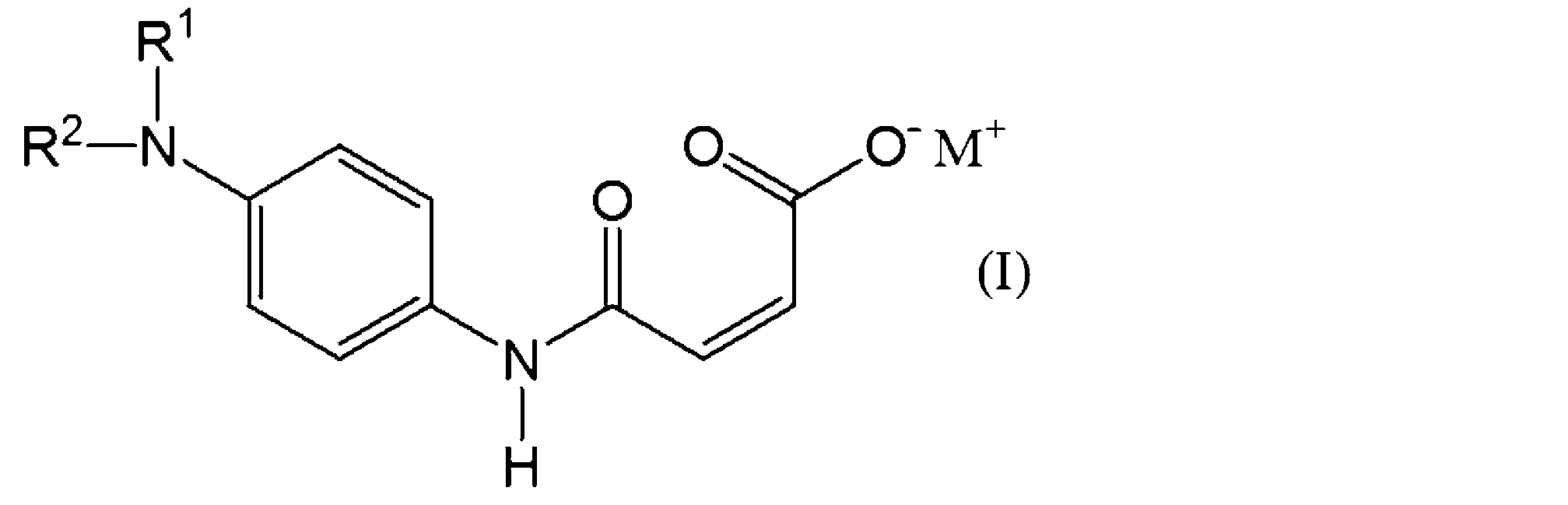
式(I)中、R1及びR2は、水素原子、炭素数1~20のアルキル基、炭素数1~20のアルケニル基又は炭素数1~20のアルキニル基を示し、R1及びR2は同一であっても異なっていてもよい。M+はナトリウムイオン、カリウムイオン又はリチウムイオンを示す。
また、本発明に係る空気入りタイヤは、上記ベーストレッドゴム部材を用いて作製されたものとする。
本発明によれば、耐引き裂き性を維持乃至向上させつつ、低発熱性を向上させることができる。
以下、本発明の実施に関連する事項について詳細に説明する。
本実施形態に係るベーストレッドゴム部材は、ジエン系ゴム100質量部に対して、窒素吸着比表面積が20~80m2/gのカーボンブラックを10~70質量部、窒素吸着比表面積が80~200m2/gのシリカを1~10質量部、一般式(I)で表される化合物を0.1~10質量部含有するゴム組成物からなるものとする。
本実施形態に係るゴム組成物において、ゴム成分として用いられるジエン系ゴムとしては、例えば、天然ゴム(NR)、イソプレンゴム(IR)、ブタジエンゴム(BR)、スチレンブタジエンゴム(SBR)、スチレン-イソプレン共重合体ゴム、ブタジエン-イソプレン共重合体ゴム、スチレン-イソプレン-ブタジエン共重合体ゴムなどが挙げられる。これらジエン系ゴムは、いずれか1種単独で、又は2種以上ブレンドして用いることができる。上記ゴム成分は、好ましくは、天然ゴム、ブタジエンゴム、スチレンブタジエンゴム、又はこれらの2種以上のブレンドである。
ジエン系ゴムとして、天然ゴムと他のジエン系ゴムとのブレンドゴムを用いることが好ましく、特に好ましくは、天然ゴム(NR)とブタジエンゴム(BR)とのブレンドゴムを用いることである。
ジエン系ゴム中の天然ゴムの含有割合は、特に限定されないが、30~100質量%であることが好ましく、50~90質量%であることがより好ましい。
ジエン系ゴムが天然ゴム(NR)とブタジエンゴム(BR)とのブレンドゴムの場合、両者の比率は、特に限定しないが、NR/BRの比率が、質量比で30/70~100/0であることが好ましく、50/50~90/10であることがより好ましい。
ブタジエンゴム(即ち、ポリブタジエンゴム)としては、特に限定されず、例えば、(A1)ハイシスブタジエンゴム、(A2)シンジオタクチック結晶含有ブタジエンゴム、及び、(A3)変性ブタジエンゴムなどが挙げられる。これらはいずれか1種又は2種以上組み合わせて用いることができる。
(A1)のハイシスBRとしては、シス含量(即ち、シス-1,4結合含有量)が90質量%以上(好ましくは95質量%以上)のブタジエンゴムが挙げられ、例えば、コバルト系触媒を用いて重合されたコバルト系ブタジエンゴム、ニッケル系触媒を用いて重合されたニッケル系ブタジエンゴム、希土類元素系触媒を用いて重合された希土類系ブタジエンゴムが挙げられる。希土類系ブタジエンゴムとしては、ネオジウム系触媒を用いて重合されたネオジウム系ブタジエンゴムが好ましく、シス含量が96質量%以上であり、かつ、ビニル含量(即ち、1,2-ビニル結合含有量)が1.0質量%未満(好ましくは0.8質量%以下)のものが好ましく用いられる。希土類系ブタジエンゴムの使用は、低発熱性の向上に有利である。なお、シス含量及びビニル含量は、1H-NMRスペクトルの積分比により算出される値である。コバルト系BRの具体例としては、宇部興産(株)製の「UBEPOL BR」等が挙げられる。ネオジウム系BRの具体例としては、ランクセス社製の「ブナCA22」、「ブナCA25」等が挙げられる。
(A2)のシンジオタクチック結晶含有ブタジエンゴム(SPB含有BR)としては、シンジオタクチック-1,2-ポリブタジエン結晶(SPB)が、マトリックスとしてのハイシスブタジエンゴム中に分散したゴム樹脂複合体であるブタジエンゴムが用いられる。SPB含有BRの使用は、硬度の向上に有利である。SPB含有BR中におけるSPBの含有率は特に限定されず、例えば、2.5~30質量%でもよく、10~20質量%でもよい。なお、SPB含有BR中におけるSPBの含有率は、沸騰n-ヘキサン不溶解分を測定することで求められる。SPB含有BRの具体例としては、宇部興産(株)製の「UBEPOL VCR」が挙げられる。
(A3)の変性BRとしては、例えば、アミン変性BR、スズ変性BRなどが挙げられる。変性BRの使用は、低発熱性の向上に有利である。変性BRは、BRの分子鎖の少なくとも一方の末端に官能基が導入された末端変性BRでもよく、主鎖中に官能基が導入された主鎖変性BRでもよく、主鎖及び末端に官能基が導入された主鎖末端変性BRでもよい。変性BRの具体例としては、日本ゼオン(株)製の「BR1250H」(アミン末端変性BR)が挙げられる。
一実施形態において、(A1)のハイシスBRと(A2)のSPB含有BRを併用する場合、ジエン系ゴム100質量部は、40~70質量部のNR及び/又はIRと、20~40質量部のハイシスBRと、10~30質量部のSPB含有BRとを含むものでもよい。また、(A1)のハイシスBRと(A3)の変性BRを併用する場合、ジエン系ゴム100質量部は、40~70質量部のNR及び/又はIRと、20~40質量部のハイシスBRと、10~30質量部の変性BRとを含むものでもよい。また、(A1)のハイシスBRとしてコバルト系BRとネオジウム系BRを併用する場合、ジエン系ゴム100質量部は、40~70質量部のNR及び/又はIRと、20~40質量部のコバルト系BRと、10~30質量部のネオジウム系BRとを含むものでもよい。
本実施形態に係るゴム組成物には、補強性充填剤として、カーボンブラック及びシリカを用いる。
上記カーボンブラックとしては、JIS K6217-2に準じて測定した窒素吸着比表面積(N2SA)が20~80m2/gのものであれば特に限定されず、好ましくは窒素吸着比表面積が25~70m2/gのものであり、より好ましくは25~60m2/gのものであり、特に好ましくは35~50m2/gのものである。具体的にはGPF級、FEF級のカーボンブラックが例示される。窒素吸着比表面積が20m2/g以上であることにより、補強性に優れる。なお、窒素吸着比表面積が80m2/gより大きいものを用いた場合には、式(I)で表される化合物との併用による耐引き裂き性の大きな悪化は認められない。
カーボンブラックの含有量としては、ジエン系ゴム100質量部に対して10~70質量部であり、低発熱性と耐引き裂き性の両立の観点から、好ましくは10~50質量部であり、より好ましくは20~50質量部である。カーボンブラックの含有量が、10質量部以上であることにより補強性に優れ、70質量部以下であることにより、低発熱性に優れる。
シリカとしては、JIS K6430に記載のBET法に準じて測定した窒素吸着比表面積(BET)が80~200m2/gのものであれば特に限定されず、好ましくは窒素吸着比表面積が100~200m2/gのものであり、より好ましくは110~190m2/gのものであり、特に好ましくは130~190m2/gのものである。また、湿式沈降法シリカや湿式ゲル法シリカなどの湿式シリカが好ましく用いられる。窒素吸着比表面積が200m2/g以下であることにより、式(I)で表される化合物と併用した場合の耐引き裂き性の向上効果に優れる。
シリカの含有量としては、ジエン系ゴム100質量部に対して1~10質量部であり、低発熱性と耐引き裂き性の両立の観点から、3~10質量部であることが好ましい。
補強性充填剤の含有量(カーボンブラックとシリカとの合計量)は、特に限定されず、ジエン系ゴム100質量部に対して10~80質量部であることが好ましく、より好ましくは20~50質量部であり、さらに好ましくは30~50質量部である。
シリカを含有する場合、スルフィドシラン、メルカプトシランなどのシランカップリング剤をさらに含有してもよいが、シランカップリング剤を含有しないほうが好ましい。シランカップリング剤を含有する場合、その含有量はシリカ含有量に対して2~20質量%であることが好ましい。
本実施形態に係るゴム組成物には、下記一般式(I)で表される化合物を用いる。

式(I)中、R1及びR2は、水素原子、炭素数1~20のアルキル基、炭素数1~20のアルケニル基又は炭素数1~20のアルキニル基を示し、R1及びR2は同一であっても異なっていてもよい。
R1及びR2のアルキル基としては、例えば、メチル基、エチル基、n-プロピル基、イソプロピル基、n-ブチル基、sec-ブチル基、tert-ブチル基などを挙げることができる。R1及びR2のアルケニル基としては、例えば、ビニル基、アリル基、1-プロペニル基、1-メチルエテニル基などを挙げることができる。R1及びR2のアルキニル基としては、例えば、エチニル基、プロパルギル基などを挙げることができる。これらのアルキル基、アルケニル基及びアルキニル基の炭素数としては、1~10であることが好ましく、より好ましくは1~5である。R1及びR2としては、好ましくは、水素原子、又は、炭素数1~5のアルキル基であり、より好ましくは、水素原子、又は、メチル基であり、更に好ましくは、水素原子である。一実施形態において、式(I)中の-NR1R2は、-NH2、-NHCH3、又は、-N(CH3)2であることが好ましく、より好ましくは-NH2である。
式(I)中のM+は、ナトリウムイオン、カリウムイオン又はリチウムイオンを示し、好ましくはナトリウムイオンである。
上記式(I)で表される化合物の含有量は、ジエン系ゴム100質量部に対して、0.1~10質量部であり、低発熱性の観点から、好ましくは0.5~8質量部であり、より好ましくは1~5質量部である。0.1質量部以上であることにより、低発熱性の向上効果に優れ、10質量部以下であることにより、耐引き裂き性の悪化を抑えることができる。
上記式(I)で表される化合物を含有することにより、低発熱性の向上効果が認められる。そのメカニズムは定かではないが、次のように考えられる。
すなわち、式(I)の化合物の末端のアミンとカーボンブラック表面の官能基が反応し、また式(I)の化合物のアミド基とカルボン酸塩との間に位置する炭素-炭素二重結合部分がポリマーと結合することにより、カーボンブラックの分散性を向上させることができ、低発熱性に寄与したものと推測する。
一方、大粒径のカーボンブラックと式(I)の化合物を併用した場合、式(I)の化合物と一部のカーボンブラックとの反応が促進され、耐引き裂き性が悪化する場合があった。これに対し、窒素吸着比表面積が所定の範囲内であるシリカをさらに含有することにより、耐引き裂き性を維持しつつ低発熱性を向上させることができた。そのメカニズムも定かではないが、シリカが式(I)の化合物を吸着することで、カーボンブラックと式(I)の化合物との反応が適度に緩和され、シリカ自体も耐引き裂き性の向上に寄与するため、結果として耐引き裂き性を維持しつつ低発熱性を向上させることができたものと推測する。
本実施形態に係るゴム組成物には、上記した各成分に加え、通常のゴム工業で使用されているプロセスオイル、亜鉛華、ステアリン酸、軟化剤、可塑剤、ワックス、老化防止剤、加硫剤、加硫促進剤などの配合薬品類を通常の範囲内で適宜配合することができる。
上記加硫剤としては、粉末硫黄、沈降硫黄、コロイド硫黄、不溶性硫黄、高分散性硫黄などの硫黄成分が挙げられ、特に限定するものではないが、その含有量はジエン系ゴム100質量部に対して0.1~10質量部であることが好ましく、より好ましくは0.5~5質量部である。また、加硫促進剤の含有量としては、ジエン系ゴム100質量部に対して0.1~7質量部であることが好ましく、より好ましくは0.5~5質量部である。
本実施形態に係るゴム組成物は、通常用いられるバンバリーミキサーやニーダー、ロール等の混合機を用いて、常法に従い混練し作製することができる。すなわち、第一混合段階で、ゴム成分に対し、補強性充填剤、及び式(I)の化合物とともに、加硫剤及び加硫促進剤を除く他の添加剤を添加混合し、次いで、得られた混合物に、最終混合段階で加硫剤及び加硫促進剤を添加混合してゴム組成物を調製することができる。
このようにして得られるゴム組成物は、タイヤの接地面を構成するトレッドゴムに用いられるゴム部材とすることができ、特にキャップゴムとベーストレッドゴムとの2層構造からなるトレッドゴムのベーストレッドゴム部材として用いられる。例えば、上記ゴム組成物をベーストレッド部に対応した所定の断面形状に押出成形したり、あるいはまた、上記ゴム組成物からなるリボン状のゴムストリップをドラム上で螺旋状に巻回してベーストレッド部に対応した断面形状に形成したりすることで、未加硫のベーストレッドゴム部材が得られる。かかるベーストレッドゴム部材は、インナーライナー、カーカス、ベルト、ビードコア、ビードフィラー及びサイドウォールなどのタイヤを構成する他のタイヤ部材とともに、常法に従って、タイヤ形状に組み立てられてグリーンタイヤ(未加硫タイヤ)が得られる。そして、得られたグリーンタイヤを、常法に従い、例えば140~180℃で加硫成型することにより、上記ベーストレッドゴム部材からなるベーストレッド部を備えた空気入りタイヤが得られる。
本実施形態に係る空気入りタイヤの種類としては、特に限定されず、乗用車用タイヤ、トラックやバスなどに用いられる重荷重用タイヤなどの各種のタイヤが挙げられる。
以下、本発明の実施例を示すが、本発明はこれらの実施例に限定されるものではない。
バンバリーミキサーを使用し、下記表1に示す配合(質量部)に従い、まず、第一混合段階(ノンプロ練り工程)で、加硫促進剤、及び硫黄を除く成分を添加混合し(排出温度=160℃)、次いで、得られた混合物に、最終混合段階(プロ練り工程)で、加硫促進剤及び硫黄を添加混合して(排出温度=90℃)、ベーストレッドゴム部材として用いられるゴム組成物を調製した。
表1中の各成分の詳細は以下の通りである。
・NR:RSS#3
・BR:宇部興産(株)製「BR150」
・カーボンブラック1:FEF級、東海カーボン(株)製「シーストSO」(N2SA=42m2/g)
・カーボンブラック2:GPF級、東海カーボン(株)製「シーストV」(N2SA=27m2/g)
・カーボンブラック3:HAF級、東海カーボン(株)製「シーストKH」(N2SA=90m2/g)
・シリカ1:エボニック社製「9100GR」(BET=235m2/g)
・シリカ2:エボニック社製「VN3」(BET=180m2/g)
・シリカ3:Rhodia社製「1115MP」(BET=115m2/g)
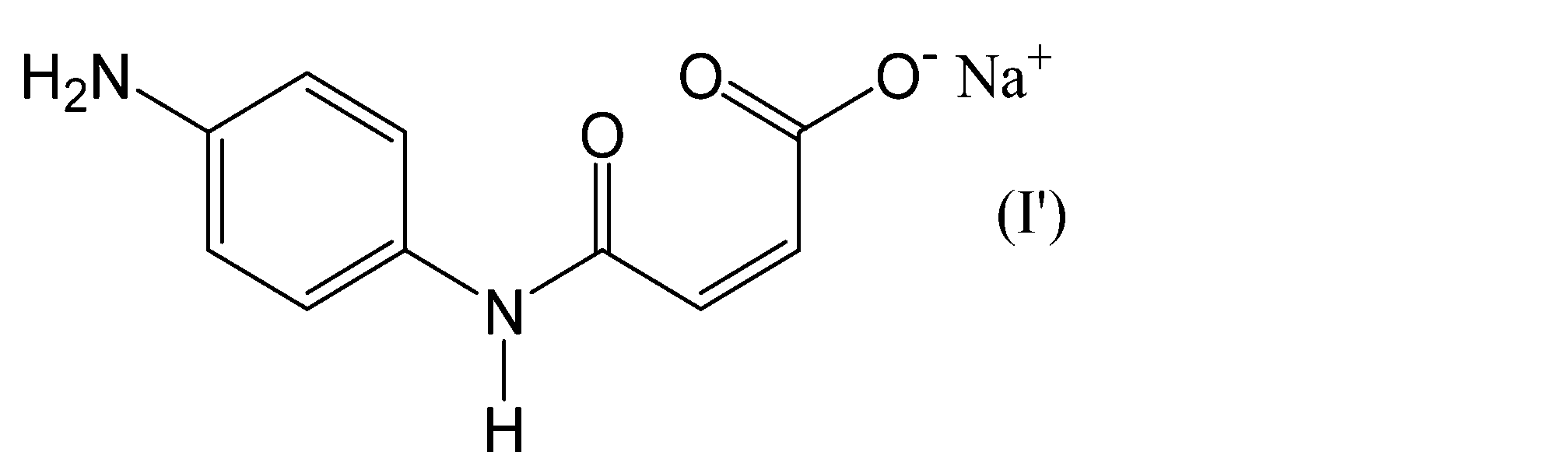
・化合物(I):住友化学(株)製の(2Z)-4-[(4-アミノフェニル)アミノ]-4-オキソ-2-ブテン酸ナトリウム(下記式(I’)で表される化合物)
・NR:RSS#3
・BR:宇部興産(株)製「BR150」
・カーボンブラック1:FEF級、東海カーボン(株)製「シーストSO」(N2SA=42m2/g)
・カーボンブラック2:GPF級、東海カーボン(株)製「シーストV」(N2SA=27m2/g)
・カーボンブラック3:HAF級、東海カーボン(株)製「シーストKH」(N2SA=90m2/g)
・シリカ1:エボニック社製「9100GR」(BET=235m2/g)
・シリカ2:エボニック社製「VN3」(BET=180m2/g)
・シリカ3:Rhodia社製「1115MP」(BET=115m2/g)
・化合物(I):住友化学(株)製の(2Z)-4-[(4-アミノフェニル)アミノ]-4-オキソ-2-ブテン酸ナトリウム(下記式(I’)で表される化合物)
・亜鉛華:三井金属鉱業(株)製「1号亜鉛華」
・ワックス:日本精蝋(株)製「OZOACE0355」
・ステアリン酸:花王(株)製「工業用ステアリン酸」
・硫黄:鶴見化学工業(株)製「5%油処理粉末硫黄」
・加硫促進剤:大内新興化学工業(株)製「ノクセラーNS-P」
・ワックス:日本精蝋(株)製「OZOACE0355」
・ステアリン酸:花王(株)製「工業用ステアリン酸」
・硫黄:鶴見化学工業(株)製「5%油処理粉末硫黄」
・加硫促進剤:大内新興化学工業(株)製「ノクセラーNS-P」
得られた各ゴム組成物について、耐引き裂き性、及び低発熱性を評価した。評価方法は次の通りである。
・耐引き裂き性:JIS K6252に準拠して測定した。すなわち、規定のクレセント形で打ち抜き、くぼみ中央に0.50±0.08mmの切れ込みを入れたサンプルを用い、(株)島津製作所製の引張試験機によって500mm/minの引張り速度で試験を行い、試験片が切断に至るまでの引き裂く力の最大値を読み取り、比較例1の結果を100として、実施例1~4、及び比較例2~5の結果を指数で表示し、比較例1-2の結果を100として、実施例1-2の結果を指数で表示し、比較例1-3の結果を100として、実施例1-3の結果を指数で表示し、参考例1の結果を100として、参考例2の結果を指数で表示した。値が90以上であれば、耐引き裂き性が優れることを示す。
・低発熱性:JIS K6394に準拠して測定した。すなわち、150℃で30分間加硫した試験片について、東洋精機(株)製の粘弾性試験機によって、温度60℃、静歪み10%、動歪み1%、周波数10Hzの条件で損失係数tanδを測定し、比較例1の結果を100として、実施例1~4、及び比較例2~5の結果を指数で表示し、比較例1-2の結果を100として、実施例1-2の結果を指数で表示し、比較例1-3の結果を100として、実施例1-3の結果を指数で表示し、参考例1の結果を100として、参考例2の結果を指数で表示した。指数が98以下であればtanδが小さく、低発熱性に優れることを示す。
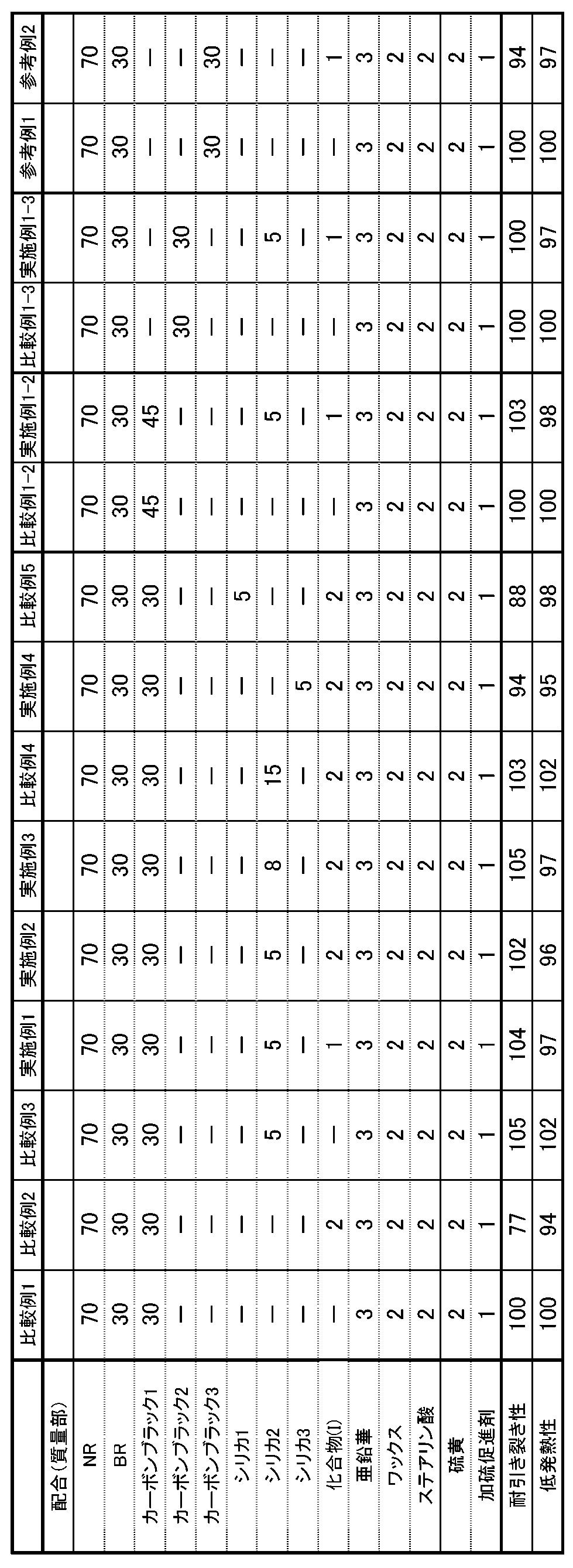
結果は、表1に示す通りであり、実施例1~4、実施例1-2、実施例1-3は、いずれにおいても、耐引き裂き性を維持乃至向上させつつ、低発熱性が向上したことが認められた。
また、比較例1と比較例2との対比から、化合物(I)の添加により、低発熱性の向上効果が認められるものの、耐引き裂き性が100から77に悪化することが認められた。
比較例2に対して、さらに所定のシリカを添加した実施例2は、耐引き裂き性が77から102に向上することが認められた。この向上効果は、比較例1と比較例3との対比より、ゴム組成物に対して、所定のシリカを添加した場合に認められる耐引き裂き性の向上効果と比較して顕著な効果であった。
また、所定のシリカの含有量が、ジエン系ゴム100質量部に対して10質量部より多い比較例4は、低発熱性の悪化が認められた。
また、窒素吸着比表面積が80~200m2/gではないシリカを添加した比較例5では、化合物(I)の添加による耐引き裂き性の悪化を補うことができなかった。
なお、参考例1と参考例2との対比より、ゴム組成物に対して、窒素吸着比表面積が90m2/gのカーボンブラックと化合物(I)を添加した場合、耐引き裂き性の大きな悪化は認められなかった。
本発明のベーストレッドゴム部材は、乗用車、ライトトラック・バス等の各種タイヤに用いることができる。
Claims (2)
- ジエン系ゴム100質量部に対して、
窒素吸着比表面積が20~80m2/gのカーボンブラックを10~70質量部、
窒素吸着比表面積が80~200m2/gのシリカを1~10質量部、
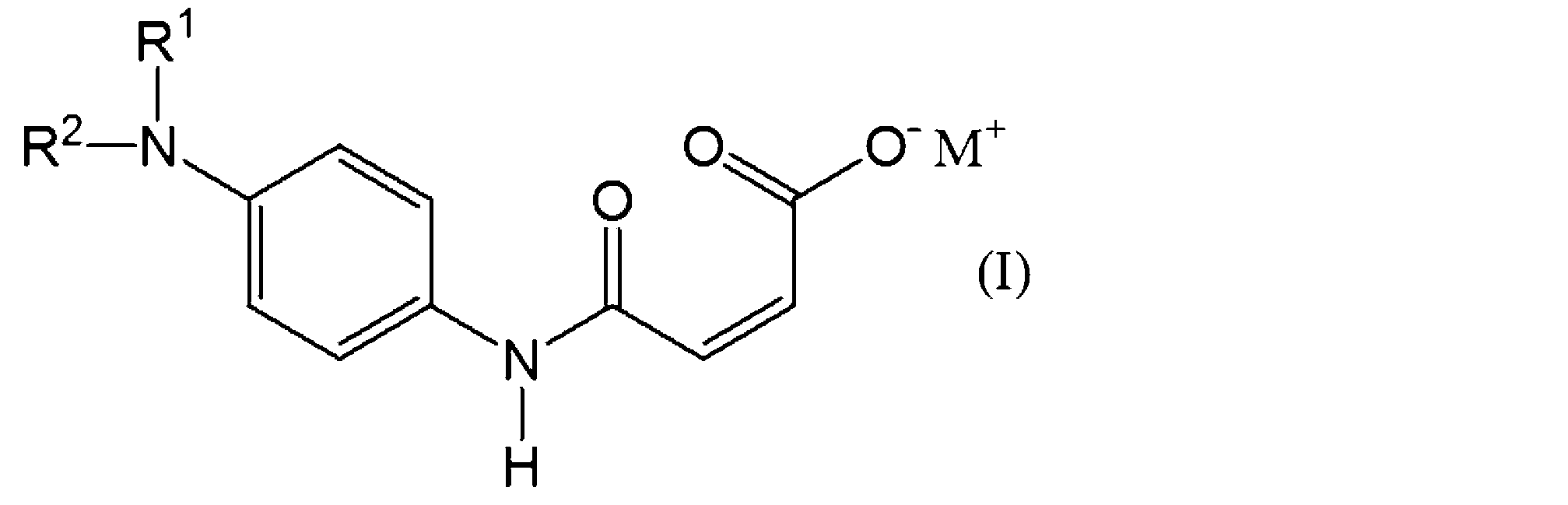
下記の一般式(I)で表される化合物を0.1~10質量部含有するゴム組成物からなる、ベーストレッドゴム部材。
- 請求項1に記載のベーストレッドゴム部材を用いて作製された、空気入りタイヤ。
Priority Applications (4)
| Application Number | Priority Date | Filing Date | Title |
|---|---|---|---|
| CN201780055525.7A CN109804011A (zh) | 2016-10-14 | 2017-09-07 | 基底胎面胶部件及使用了该基底胎面胶部件的充气轮胎 |
| US16/331,707 US20190233621A1 (en) | 2016-10-14 | 2017-09-07 | Base tread rubber member and pneumatic tire using same |
| MYPI2019001160A MY188708A (en) | 2016-10-14 | 2017-09-07 | Base tread rubber member and pneumatic tire using same |
| DE112017005198.3T DE112017005198B4 (de) | 2016-10-14 | 2017-09-07 | Basislaufflächenkautschukelement und pneumatischer Reifen, der dieses verwendet |
Applications Claiming Priority (2)
| Application Number | Priority Date | Filing Date | Title |
|---|---|---|---|
| JP2016-202903 | 2016-10-14 | ||
| JP2016202903A JP6779742B2 (ja) | 2016-10-14 | 2016-10-14 | ベーストレッドゴム部材、及びそれを用いた空気入りタイヤ |
Publications (1)
| Publication Number | Publication Date |
|---|---|
| WO2018070147A1 true WO2018070147A1 (ja) | 2018-04-19 |
Family
ID=61905211
Family Applications (1)
| Application Number | Title | Priority Date | Filing Date |
|---|---|---|---|
| PCT/JP2017/032217 Ceased WO2018070147A1 (ja) | 2016-10-14 | 2017-09-07 | ベーストレッドゴム部材、及びそれを用いた空気入りタイヤ |
Country Status (6)
| Country | Link |
|---|---|
| US (1) | US20190233621A1 (ja) |
| JP (1) | JP6779742B2 (ja) |
| CN (1) | CN109804011A (ja) |
| DE (1) | DE112017005198B4 (ja) |
| MY (1) | MY188708A (ja) |
| WO (1) | WO2018070147A1 (ja) |
Cited By (2)
| Publication number | Priority date | Publication date | Assignee | Title |
|---|---|---|---|---|
| JP2020070320A (ja) * | 2018-10-30 | 2020-05-07 | 住友ゴム工業株式会社 | ゴム組成物 |
| JPWO2020026657A1 (ja) * | 2018-07-31 | 2021-08-02 | 住友理工株式会社 | 防振ゴム組成物およびその製造方法、ならびに防振ゴム部材 |
Families Citing this family (4)
| Publication number | Priority date | Publication date | Assignee | Title |
|---|---|---|---|---|
| JP7013825B2 (ja) * | 2017-12-04 | 2022-02-01 | 住友ゴム工業株式会社 | タイヤ外層用ゴム組成物及び空気入りタイヤ |
| WO2020045575A1 (ja) | 2018-08-30 | 2020-03-05 | 大塚化学株式会社 | ゴム組成物、ゴム材料、及びそれらの用途、並びに添加剤 |
| JP7288749B2 (ja) * | 2018-11-05 | 2023-06-08 | Toyo Tire株式会社 | 防振ゴム用ゴム組成物および防振ゴム |
| JP7472670B2 (ja) * | 2020-06-17 | 2024-04-23 | 住友ゴム工業株式会社 | タイヤ |
Citations (5)
| Publication number | Priority date | Publication date | Assignee | Title |
|---|---|---|---|---|
| JP2013209605A (ja) * | 2011-04-26 | 2013-10-10 | Sumitomo Chemical Co Ltd | ゴム組成物 |
| JP2014095020A (ja) * | 2012-11-08 | 2014-05-22 | Sumitomo Rubber Ind Ltd | ゴム組成物及び空気入りタイヤ |
| JP2014095015A (ja) * | 2012-11-08 | 2014-05-22 | Sumitomo Rubber Ind Ltd | サイドウォール、ウイング、ベーストレッド、サイドウォールパッキン、ブレーカークッション又はタイガム用ゴム組成物及び空気入りタイヤ |
| JP2014095017A (ja) * | 2012-11-08 | 2014-05-22 | Sumitomo Rubber Ind Ltd | スチールコード被覆、スチールコード隣接ストリップ又はタイガム用ゴム組成物及び空気入りタイヤ |
| JP2017178994A (ja) * | 2016-03-28 | 2017-10-05 | 住友ゴム工業株式会社 | 乗用車用タイヤ |
Family Cites Families (9)
| Publication number | Priority date | Publication date | Assignee | Title |
|---|---|---|---|---|
| JP5420882B2 (ja) * | 2008-11-06 | 2014-02-19 | 住友ゴム工業株式会社 | インスレーション用ゴム組成物及びタイヤ |
| JP6031506B2 (ja) * | 2012-03-02 | 2016-11-24 | 株式会社ブリヂストン | ゴム組成物およびゴム組成物の製造方法 |
| US9670341B2 (en) * | 2012-11-02 | 2017-06-06 | Bridgestone Corporation | Rubber compositions comprising metal carboxylates and processes for making the same |
| BR102013028645A2 (pt) * | 2012-11-08 | 2016-06-21 | Sumitomo Rubber Ind | composição de borracha para banda de rodagem, e pneumático |
| JP5719823B2 (ja) | 2012-11-08 | 2015-05-20 | 住友ゴム工業株式会社 | ゴム組成物及び空気入りタイヤ |
| JP5745491B2 (ja) | 2012-11-08 | 2015-07-08 | 住友ゴム工業株式会社 | ベーストレッド用ゴム組成物及び空気入りタイヤ |
| CN103804724B (zh) * | 2012-11-08 | 2018-01-12 | 住友橡胶工业株式会社 | 橡胶组合物及充气轮胎 |
| BR102013028758A2 (pt) | 2012-11-08 | 2017-07-11 | Sumitomo Rubber Industries, Ltd. | Rubber compositions for square axle, side wall sealing, base wheel band, brake shock, steel cabin coat, strip adjacent to steel cables, intermediate rubber and side wall and tires |
| JP6720047B2 (ja) * | 2016-10-14 | 2020-07-08 | Toyo Tire株式会社 | タイヤ部材の製造方法 |
-
2016
- 2016-10-14 JP JP2016202903A patent/JP6779742B2/ja active Active
-
2017
- 2017-09-07 MY MYPI2019001160A patent/MY188708A/en unknown
- 2017-09-07 US US16/331,707 patent/US20190233621A1/en not_active Abandoned
- 2017-09-07 WO PCT/JP2017/032217 patent/WO2018070147A1/ja not_active Ceased
- 2017-09-07 CN CN201780055525.7A patent/CN109804011A/zh active Pending
- 2017-09-07 DE DE112017005198.3T patent/DE112017005198B4/de not_active Expired - Fee Related
Patent Citations (5)
| Publication number | Priority date | Publication date | Assignee | Title |
|---|---|---|---|---|
| JP2013209605A (ja) * | 2011-04-26 | 2013-10-10 | Sumitomo Chemical Co Ltd | ゴム組成物 |
| JP2014095020A (ja) * | 2012-11-08 | 2014-05-22 | Sumitomo Rubber Ind Ltd | ゴム組成物及び空気入りタイヤ |
| JP2014095015A (ja) * | 2012-11-08 | 2014-05-22 | Sumitomo Rubber Ind Ltd | サイドウォール、ウイング、ベーストレッド、サイドウォールパッキン、ブレーカークッション又はタイガム用ゴム組成物及び空気入りタイヤ |
| JP2014095017A (ja) * | 2012-11-08 | 2014-05-22 | Sumitomo Rubber Ind Ltd | スチールコード被覆、スチールコード隣接ストリップ又はタイガム用ゴム組成物及び空気入りタイヤ |
| JP2017178994A (ja) * | 2016-03-28 | 2017-10-05 | 住友ゴム工業株式会社 | 乗用車用タイヤ |
Cited By (4)
| Publication number | Priority date | Publication date | Assignee | Title |
|---|---|---|---|---|
| JPWO2020026657A1 (ja) * | 2018-07-31 | 2021-08-02 | 住友理工株式会社 | 防振ゴム組成物およびその製造方法、ならびに防振ゴム部材 |
| JP7285258B2 (ja) | 2018-07-31 | 2023-06-01 | 住友理工株式会社 | 防振ゴム組成物およびその製造方法、ならびに防振ゴム部材 |
| JP2020070320A (ja) * | 2018-10-30 | 2020-05-07 | 住友ゴム工業株式会社 | ゴム組成物 |
| JP7151380B2 (ja) | 2018-10-30 | 2022-10-12 | 住友ゴム工業株式会社 | ゴム組成物 |
Also Published As
| Publication number | Publication date |
|---|---|
| MY188708A (en) | 2021-12-24 |
| US20190233621A1 (en) | 2019-08-01 |
| DE112017005198B4 (de) | 2022-05-25 |
| JP6779742B2 (ja) | 2020-11-04 |
| JP2018062629A (ja) | 2018-04-19 |
| CN109804011A (zh) | 2019-05-24 |
| DE112017005198T5 (de) | 2019-07-04 |
Similar Documents
| Publication | Publication Date | Title |
|---|---|---|
| CN102958990B (zh) | 轮胎用橡胶组合物和充气轮胎 | |
| CN102884120B (zh) | 轮胎胎面用橡胶组合物 | |
| JP5367860B2 (ja) | サイドウォール用ゴム組成物およびそれを用いたタイヤ | |
| JP6779742B2 (ja) | ベーストレッドゴム部材、及びそれを用いた空気入りタイヤ | |
| WO2013008927A1 (ja) | タイヤ用ゴム組成物 | |
| JP5569655B2 (ja) | タイヤ用ゴム組成物、空気入りタイヤ | |
| CN103804731A (zh) | 用于胎面的橡胶组合物及充气轮胎 | |
| JP2005263999A (ja) | ゴム組成物の製造方法 | |
| WO2015166931A1 (ja) | タイヤトレッド用ゴム組成物 | |
| WO2018070148A1 (ja) | トレッドゴム部材の製造方法、及びタイヤの製造方法 | |
| JP5474334B2 (ja) | ゴム組成物及び空気入りタイヤ | |
| CN107108910A (zh) | 硫化橡胶组合物的制备方法、硫化橡胶组合物以及使用其的无钉防滑轮胎 | |
| JP5860684B2 (ja) | タイヤトレッド用ゴム組成物の製造方法 | |
| JP5289890B2 (ja) | ゴム組成物及び空気入りタイヤ | |
| JP7159566B2 (ja) | タイヤ用ゴム組成物 | |
| JP2006063285A (ja) | タイヤサイドウォール用ゴム組成物および空気入りタイヤ | |
| JP2008111014A (ja) | タイヤベーストレッド用ゴム組成物 | |
| CN107011552B (zh) | 硫化橡胶组合物和使用有该硫化橡胶组合物的轮胎 | |
| JP2008111012A (ja) | タイヤキャップトレッド用ゴム組成物 | |
| JP2020117579A (ja) | タイヤ用ゴム組成物 | |
| JP2013155308A (ja) | キャップトレッド、ベーストレッド、サイドウォール、カーカス、クリンチ又はビードエイペックス用ゴム組成物及び空気入りタイヤ | |
| JP5065651B2 (ja) | タイヤサイドウォール用ゴム組成物 | |
| JP2006063287A (ja) | タイヤサイドウォール用ゴム組成物および空気入りタイヤ | |
| JP6657759B2 (ja) | タイヤ用ゴム組成物 | |
| JP7160668B2 (ja) | タイヤ用ゴム組成物の製造方法 |
Legal Events
| Date | Code | Title | Description |
|---|---|---|---|
| 121 | Ep: the epo has been informed by wipo that ep was designated in this application |
Ref document number: 17860801 Country of ref document: EP Kind code of ref document: A1 |
|
| 122 | Ep: pct application non-entry in european phase |
Ref document number: 17860801 Country of ref document: EP Kind code of ref document: A1 |