WO2018066694A1 - トイレシステム、トイレ管理方法、及びトイレ管理プログラム - Google Patents
トイレシステム、トイレ管理方法、及びトイレ管理プログラム Download PDFInfo
- Publication number
- WO2018066694A1 WO2018066694A1 PCT/JP2017/036481 JP2017036481W WO2018066694A1 WO 2018066694 A1 WO2018066694 A1 WO 2018066694A1 JP 2017036481 W JP2017036481 W JP 2017036481W WO 2018066694 A1 WO2018066694 A1 WO 2018066694A1
- Authority
- WO
- WIPO (PCT)
- Prior art keywords
- toilet
- door
- user
- abnormality
- toilet booth
- Prior art date
- Legal status (The legal status is an assumption and is not a legal conclusion. Google has not performed a legal analysis and makes no representation as to the accuracy of the status listed.)
- Ceased
Links
Images

Classifications
-
- G—PHYSICS
- G05—CONTROLLING; REGULATING
- G05B—CONTROL OR REGULATING SYSTEMS IN GENERAL; FUNCTIONAL ELEMENTS OF SUCH SYSTEMS; MONITORING OR TESTING ARRANGEMENTS FOR SUCH SYSTEMS OR ELEMENTS
- G05B19/00—Program-control systems
- G05B19/02—Program-control systems electric
- G05B19/18—Numerical control [NC], i.e. automatically operating machines, in particular machine tools, e.g. in a manufacturing environment, so as to execute positioning, movement or co-ordinated operations by means of program data in numerical form
- G05B19/4155—Numerical control [NC], i.e. automatically operating machines, in particular machine tools, e.g. in a manufacturing environment, so as to execute positioning, movement or co-ordinated operations by means of program data in numerical form characterised by program execution, i.e. part program or machine function execution, e.g. selection of a program
-
- G—PHYSICS
- G08—SIGNALLING
- G08B—SIGNALLING SYSTEMS, e.g. PERSONAL CALLING SYSTEMS; ORDER TELEGRAPHS; ALARM SYSTEMS
- G08B13/00—Burglar, theft or intruder alarms
- G08B13/18—Actuation by interference with heat, light, or radiation of shorter wavelength; Actuation by intruding sources of heat, light, or radiation of shorter wavelength
- G08B13/189—Actuation by interference with heat, light, or radiation of shorter wavelength; Actuation by intruding sources of heat, light, or radiation of shorter wavelength using passive radiation detection systems
- G08B13/194—Actuation by interference with heat, light, or radiation of shorter wavelength; Actuation by intruding sources of heat, light, or radiation of shorter wavelength using passive radiation detection systems using image scanning and comparing systems
- G08B13/196—Actuation by interference with heat, light, or radiation of shorter wavelength; Actuation by intruding sources of heat, light, or radiation of shorter wavelength using passive radiation detection systems using image scanning and comparing systems using television cameras
- G08B13/19602—Image analysis to detect motion of the intruder, e.g. by frame subtraction
-
- A—HUMAN NECESSITIES
- A47—FURNITURE; DOMESTIC ARTICLES OR APPLIANCES; COFFEE MILLS; SPICE MILLS; SUCTION CLEANERS IN GENERAL
- A47K—SANITARY EQUIPMENT; ACCESSORIES THEREFOR, e.g. TOILET ACCESSORIES
- A47K17/00—Other sanitary equipment not covered by the other groups of this subclass ; Holders for toilet brushes
-
- E—FIXED CONSTRUCTIONS
- E03—WATER SUPPLY; SEWERAGE
- E03D—WATER-CLOSETS OR URINALS WITH FLUSHING DEVICES; FLUSHING VALVES THEREFOR
- E03D11/00—Other component parts of water-closets, e.g. noise-reducing means in the flushing system, flushing pipes mounted in the bowl, seals for the bowl outlet, devices preventing overflow of the bowl contents; devices forming a water seal in the bowl after flushing, devices eliminating obstructions in the bowl outlet or preventing backflow of water and excrements from the waterpipe
-
- G—PHYSICS
- G08—SIGNALLING
- G08B—SIGNALLING SYSTEMS, e.g. PERSONAL CALLING SYSTEMS; ORDER TELEGRAPHS; ALARM SYSTEMS
- G08B21/00—Alarms responsive to a single specified undesired or abnormal condition and not otherwise provided for
- G08B21/02—Alarms for ensuring the safety of persons
- G08B21/04—Alarms for ensuring the safety of persons responsive to non-activity, e.g. of elderly persons
- G08B21/0407—Alarms for ensuring the safety of persons responsive to non-activity, e.g. of elderly persons based on behaviour analysis
- G08B21/043—Alarms for ensuring the safety of persons responsive to non-activity, e.g. of elderly persons based on behaviour analysis detecting an emergency event, e.g. a fall
-
- G—PHYSICS
- G08—SIGNALLING
- G08B—SIGNALLING SYSTEMS, e.g. PERSONAL CALLING SYSTEMS; ORDER TELEGRAPHS; ALARM SYSTEMS
- G08B21/00—Alarms responsive to a single specified undesired or abnormal condition and not otherwise provided for
- G08B21/02—Alarms for ensuring the safety of persons
- G08B21/04—Alarms for ensuring the safety of persons responsive to non-activity, e.g. of elderly persons
- G08B21/0438—Sensor means for detecting
- G08B21/0492—Sensor dual technology, i.e. two or more technologies collaborate to extract unsafe condition, e.g. video tracking and RFID tracking
-
- G—PHYSICS
- G05—CONTROLLING; REGULATING
- G05B—CONTROL OR REGULATING SYSTEMS IN GENERAL; FUNCTIONAL ELEMENTS OF SUCH SYSTEMS; MONITORING OR TESTING ARRANGEMENTS FOR SUCH SYSTEMS OR ELEMENTS
- G05B2219/00—Program-control systems
- G05B2219/30—Nc systems
- G05B2219/40—Robotics, robotics mapping to robotics vision
- G05B2219/40062—Door opening
Definitions
- the present invention relates to a toilet system, a toilet management method, and a toilet management program.
- an object of the present invention is to provide a technique for controlling a toilet booth door according to the situation in the toilet booth when an abnormality occurs.
- the toilet system is: A detection unit for detecting the state in the toilet booth; An abnormality determination unit that determines the occurrence and type of abnormality based on the detection result of the detection unit; A door control unit that controls opening and closing of the door according to the type of the abnormality when it is determined that the abnormality has occurred.
- the toilet system of the present invention can control the door of the toilet booth according to the situation in the toilet booth when an abnormality occurs.
- the toilet system is:
- the detection unit detects the state of the user in the toilet booth based on at least one of the position, movement, or shape of an object in the toilet booth;
- the abnormality determination unit determines that an abnormality has occurred, and the door control unit performs control to open the door.
- the first condition is that a maximum value of the height of the user detected by the detection unit is equal to or less than a predetermined lower limit value, or the user is stationary for a predetermined time or more. It is good.
- the detection unit detects a state of a user in the toilet booth based on at least one of a position, movement, or shape of an object in the toilet booth, When the user's state satisfies a predetermined second condition, the abnormality determination unit may determine that an abnormality has occurred, and the door control unit may maintain a state where the door is closed.
- the second condition exceeds a predetermined upper limit value, the user exists, the shape of a toilet facility provided in the toilet booth is changed by the user, or The user may perform a specific operation on the toilet facility.
- the detection unit detects entry / exit of a user with respect to the toilet booth, and the toilet booth before the user enters and the toilet booth after the user exits
- the abnormality determination unit determines that an abnormality has occurred, and the door control unit Control to close the door may be performed.
- the toilet management method is: A detection step for detecting a condition in the toilet booth; An abnormality determination step for determining the occurrence of an abnormality and its type based on the detection result of the detection step; When it is determined that the abnormality has occurred, a door control step for controlling the opening and closing of the door according to the type of the abnormality, Is executed by the computer.
- the first condition is that a maximum value of the height of the user detected by the detection unit is equal to or less than a predetermined lower limit value, or the user is stationary for a predetermined time or more. It is good as well.
- the detection unit detects a state of a user in the toilet booth based on at least one of a position, movement, or shape of an object in the toilet booth, When the user's state satisfies a predetermined second condition, the abnormality determination unit may determine that an abnormality has occurred, and the door control unit may maintain a state where the door is closed.
- the second condition exceeds a predetermined upper limit value, the user is present, the shape of toilet facilities provided in the toilet booth is changed by the user, or The user may perform a specific operation on the toilet facility.
- the detection unit detects entry / exit of a user with respect to the toilet booth, and the toilet booth before the user enters and the toilet booth after the user exits And when the object that did not exist in the toilet booth before entering the room is present in the toilet booth after leaving, the abnormality determination unit determines that an abnormality has occurred, and the door control unit May perform control to close the door.
- the present invention may be a toilet management program for causing a computer to execute the toilet management method.
- the present invention it is possible to provide a technology for controlling the toilet booth door according to the situation in the toilet booth when an abnormality occurs.
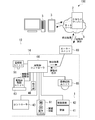
- FIG. 1 is a diagram showing a configuration of the entire toilet system according to the first embodiment.
- a toilet system 100 includes a toilet facility 10 and a management server 2, which are connected to each other via a network 5 such as the Internet.
- the toilet facility 1 detects the state in the toilet booth 14 provided in the toilet facility 10 and notifies the management server 2 that the user stays in the toilet booth 14 for a predetermined time or more.
- an alarm is transmitted to the manager terminal 3 or the like, and the door of the toilet booth 14 is controlled.
- 1 illustrates an example in which the toilet system 100 does not include the administrator terminal 3, the toilet system 100 may include the administrator terminal 3.
- the toilet facility 10 is a toilet used by the public in a commercial facility such as a department store or a station.
- the toilet facility 10 is provided on each of a plurality of buildings and each of a plurality of floors of the building, for example.
- the toilet facility 10 detects the state in a toilet booth by the control apparatus 44 provided in the toilet booth 14, and transmits to the management server 2 regularly as usage information.
- the management server 2 receives the usage information from the toilet facility 1 and performs a process of outputting a preliminary warning to the user in the toilet booth 14 and a process of sending an alarm to the administrator based on the usage information.
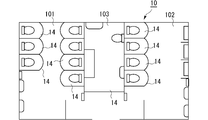
- FIG. 2 is a view showing an example of a toilet facility 10
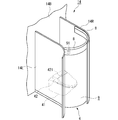
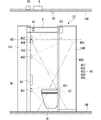
- FIG. 3 is a perspective view showing a toilet booth 14 provided in the toilet facility 10
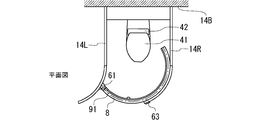
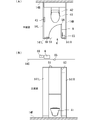
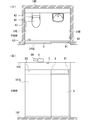
- FIG. 4 is a plan view showing the toilet booth 14
- FIG. 5 is a front view showing the toilet booth 14.
- FIGS. 6 and 6 show a toilet booth 14 with the door 9 as an opening door
- FIG. 7 shows a toilet booth 14 with the door 9 as a sliding door.
- the toilet facility 10 is divided into, for example, a female toilet facility 101, a male toilet facility 102, and a multipurpose toilet facility 103.
- a plurality of toilet booths 14 are provided in the toilet facility 101 for women and the toilet facility 102 for men.
- the multipurpose toilet facility 103 in FIG. 2 has an example of one toilet booth 14, the multipurpose toilet facility 103 may have a plurality of toilet booths 14.
- the toilet booth 14 is a space provided with a toilet facility 1 that is surrounded by doors, walls, and the like and is usually used by only one person at a time. Note that the toilet booth 14 is not strictly limited to being used alone, and may be one in which an assistant or an infant can enter the room at the same time as the user.
- the toilet booth 14 includes a pair of left and right side walls 14L and 14R and a rear wall 14B that surround three sides, and a door 9 that opens and closes the doorway 4 of the toilet booth 14.
- a toilet 41 is installed in the toilet booth 14 surrounded by the side walls 14L and 14R and the rear wall 14B and the door 9 on all sides.
- the walls 14L, 14R, 14B and the door 9 that surround the toilet booth 14 may have a height that reaches the ceiling 14C from the floor 14F.
- the left and right side walls 14L, 14R and the door as shown in FIG. A space is provided between 9 and the ceiling 14C to allow air to flow.
- left and right refer to the left and right sides when facing the entrance 4 from the outside of the toilet
- front and rear refer to the front and rear when seated on the toilet 41
- upper and lower refer to the ceiling 14C side and the toilet 41 is the installation surface (floor) 14F side.
- the left and right side walls 14L and 14R are plate members that have a cross-sectional J shape, that is, one side is linear and the other side is curved (secondary curved surface) (FIGS. 2 and 3). If there is an adjacent toilet booth 14, the left wall 14L also serves as the right wall 14R of another toilet booth 14 adjacent to the left of the toilet booth 14, and the right wall 14R is another toilet adjacent to the right of the toilet booth 14. It also serves as the left side wall 14L of the booth 14.
- the guide rail 8 is installed on the inner upper side of the right side wall 14R (see FIG. 2).
- the guide rail 8 having one end held by the right side wall 14R passes through the upper part of the entrance / exit 4, and the other end is fixed to the left side wall 14L.
- the guide rail 8 is also installed inside the toilet booth on the left side wall 14 ⁇ / b> L that also serves as the right side wall of the left side toilet booth 14.
- a door drive unit 63 is installed in the vicinity of the guide rail 8 at the upper front end of the right side wall 14R.
- the door 9 is installed in a suspended state on the guide rail 8, and the door 9 is moved along the guide rail 8 by the door driving unit 63 to open and close the doorway 4.
- the guide rail 8 is provided with a lock 91, and the door driving unit 63 controls the locking / unlocking of the lock 91 as the door 9 is driven.
- An operation panel 61 having an opening / closing button for the door 9 and electrically connected to the door drive unit 63 is installed on the inner surface of the left end portion of the door 9.
- the close button of the operation panel 61 is pressed by the user's operation, the door drive unit 63 is driven to close the door 9, and the lock 91 is moved to the door 9 in a state where the left end of the door 9 is in contact with the left side wall 14L. The door is locked by engaging with the door.
- the opening button on the operation panel 61 is pressed, the door drive unit 63 drives the lock 91 to release the engagement with the door 9 and opens the door 9 to drive the door 9 in the opening direction.
- the lock 91 is not limited to the structure that is provided on the guide rail 8 and engages with the door 9, but is provided on the left side wall 14 ⁇ / b> L, the right side wall 14 ⁇ / b> R, the floor 14 ⁇ / b> F, etc. It may be configured to do so. Conversely, the door 9 may be configured to be prevented from opening by engaging with the guide rail 8, the left side wall 14L, the right side wall 14R, the floor 14F, and the like. In this example, when the door 9 is closed, the lock 91 is locked to prevent the door 9 from being opened. However, the closed door 9 cannot be easily opened from the outside, for example, the other person manually The lock 91 may be omitted if the door drive unit 63 does not rotate and the door 9 does not move even when force is applied to open the door 9.
- FIG. 3 to 5 show an example of a toilet booth using the rotary door 9, but the present invention is not limited to this, and a configuration in which the door 9 is an open door as shown in FIG. In this way, the door 9 may be a sliding door.
- the toilet booth 14 shown in FIG. 6 is surrounded on three sides by a pair of left and right side walls 14L and 14R and a rear wall 14B.
- a left front wall 141L is provided on the left side of the front surface, and a right front wall 141R is provided on the right side of the front surface.
- An opening between the front wall 141L and the right front wall 141R serves as an entrance / exit 4.
- a door 9 is slidably attached to the left end of the right front wall 141R via a hinge (not shown).
- a door drive unit 63 is provided on the hinge side upper portion of the door 9, and the door 9 is opened and closed by the door drive unit 63.
- the door drive unit 63 opens the doorway 4 by turning the door tip 9A of the door 9 inward with the hinge as the central axis, and the door tip 9A is received by the right end of the left front wall 141L. To the closed state.
- an operation panel 61 for operating opening and closing by the door drive unit 63.
- an upper frame 142 is placed on the upper ends of the left front wall 141L and the right front wall 141R, and a lock 91 is provided on the upper frame 142.
- the lock 91 is driven by the door drive unit 63 as the door 9 is opened and closed. When the door 9 is closed, the lock 91 is locked by being engaged with the door 9 to prevent the door from being opened.
- the toilet booth 14 shown in FIG. 7 is surrounded on three sides by side walls 14L, 14R and a rear wall 14B, and a front wall 141L is provided on the left side of the front surface, between the left front wall 141L and the front end of the right side wall 14R.
- the opening is the doorway 4.
- a guide rail 8 is provided above the left front wall 141 ⁇ / b> L and the right side wall 14 ⁇ / b> R, and a door drive unit 63 is provided along the guide rail 8.
- the door 9 is installed in a suspended state on the guide rail 8, and the door 9 is moved along the guide rail 8 by the door driving unit 63 to open and close the doorway 4.
- the guide rail 8 is provided with a lock 91, and the door driving unit 63 controls the locking / unlocking of the lock 91 as the door 9 is driven. For example, when the door 9 is closed, it is locked by being engaged with the door 9 to prevent the door from being opened.
- an operation panel 61 for operating the door drive unit 63 to open and close is provided.
- the toilet booth 14 includes a toilet 41 such as a toilet 41, a toilet seat device 42, a controller 43, an operation panel 61, a control device 44, a detection unit 46, and an image recording unit 65.
- a toilet 41 such as a toilet 41, a toilet seat device 42, a controller 43, an operation panel 61, a control device 44, a detection unit 46, and an image recording unit 65.
- Toilet facility 1 is a facility that is placed in the toilet booth and is mainly used directly by users.
- the toilet facility 1 may include toilet booth walls 14L, 14R, 14B, a floor 14F, a shelf, a paper holder, and the like.
- the toilet facility 1 should just be what a user can touch in a toilet booth.
- the image recording unit 65 includes a camera that captures the inside of the toilet booth and a memory that records the captured image.
- the toilet seat device 42 is provided on a Western-style toilet 41, and has a function of heating the S seat surface on which the user is seated and a function of discharging warm water to wash the user's anus and local area.
- the toilet seat device 42 includes a seating sensor 421 that detects whether or not the user is seated. Based on the detection result of the seating sensor 421, the seating of the user is detected and the seating is detected after a predetermined time has elapsed. If the user stops standing up, that is, if the user determines that he / she has stood up, control to release the washing water for washing the toilet seat, or if the user is not seated, the seat surface temperature is lowered to save Control to set the power mode.
- the toilet 41 is not limited to the Western style, and may be a Japanese style. When the Japanese style toilet 41 is provided, the toilet seat device 42 is omitted.
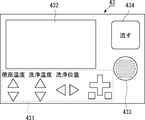
- the controller 43 has an operation unit 431 that performs operations such as setting the temperature of the toilet seat device 42 and setting the cleaning position.
- the controller 43 includes a display unit 432 and a speaker 433.
- the display unit 432 displays information received from the control device 44 in addition to the set temperature of the toilet seat, the temperature of the warm water for cleaning, the cleaning position, and the like.
- the speaker 433 outputs an operation sound when the operation unit 431 is operated, a sound related to a preliminary warning to be described later, a simulated sound that simulates a sound of washing water for cleaning the toilet bowl, and the like.
- the detection unit 46 is a sensor for detecting the position, movement (movement), and shape of an object in the toilet booth.
- the detection unit 46 is a human sensor that detects the presence of a user using, for example, infrared rays, radio waves, or ultrasonic waves.
- the detection unit 46 may be a passive sensor that detects the presence of a user by sensing infrared rays emitted by the user, or transmits infrared rays, radio waves, or ultrasonic waves from a transmitter. When the ultrasonic wave is changed by being interrupted or reflected by the user, an active sensor may be used that detects the presence of the user by capturing the change with a receiver.
- a plurality of human sensors having different positions of target areas to be detected are provided, and the position where the user exists is specified depending on which human sensor has detected.
- a sensor 461 whose detection target area is the lower limit height H1 or less a sensor 462 whose detection target area is the upper limit height H2 or more, and a detection target between the lower limit height H1 and the upper limit height H2.
- a sensor 463 serving as a region is provided.
- the detection unit 46 may detect the movement of the user based on the received infrared rays, radio waves, and changes in the intensity and phase of the ultrasonic waves. Furthermore, the detection unit 46 may use a sensor of another device.
- a seating sensor 421 of the toilet seat device 42 or a sensor (not shown) for detecting that a user has entered the toilet booth 14 and operating lighting, air conditioning, a deodorizer, or the like is used as the detection unit 46. May be. Further, the operation panel 61 or the door drive unit 63 may be used as the detection unit 46 to acquire the open / closed state of the door 9.
- the detection unit 46 may include a ToF (Time (Of Flight) distance image sensor that mainly detects the shape of an object in the toilet booth, or a three-dimensional scanner (laser scanner).
- the ToF distance image sensor or the three-dimensional scanner may detect the position and shape of the object at a predetermined cycle, and obtain the temporal change in the position and shape of the object as the movement and operation of the object from the detection result.
- the control device 44 has a function of transmitting information detected by the detection unit 46 to the management server 2 and a function of receiving a control signal related to the control of the door 9 from the management server 2.
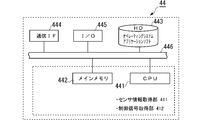
- the control device 44 includes a CPU 441, a main storage device 442, an auxiliary storage device 443, a communication IF (Interface) 444, an input / output IF (Interface) 445, and a communication bus 446.
- the CPU 441 performs a process described in this embodiment by executing a program.
- the CPU 441 provides functions of the sensor information acquisition unit 411 and the control signal acquisition unit 412.
- the sensor information acquisition unit 411 acquires the detection result by the detection unit 46 at a predetermined timing to obtain sensor information, and transmits the sensor information to the management server 2 via the router unit 69 and the network 5.
- Each toilet booth 14 is assigned identification information for the management server 2 to identify each toilet booth, and the sensor information acquisition unit 411 transmits a detection result together with this identification information.
- the control signal acquisition unit 412 receives a control signal for the door 9 from the management server 2 via the network 5 and the router unit 69 and notifies the door drive unit 63 of the control signal to control the door 9.
- the main storage device 442 is used as a cache for programs and data read by the CPU 441 and as a work area for the CPU.
- the main storage device 442 is a RAM (Random Access Memory), a ROM (Read Only Memory), or the like.
- the auxiliary storage device 443 stores programs executed by the CPU 441, setting information used in the present embodiment, and the like.
- the auxiliary storage device 443 is an HDD, an SSD, a flash memory, or the like.
- the communication IF 444 transmits / receives data to / from other computer devices.
- the communication IF 444 is specifically a wired or wireless network card or the like.
- the input / output IF 445 is connected to the input / output device, and receives input from a computer user or outputs information to the user.
- the input / output IF 445 of this embodiment is connected to the controller 43 as an input / output device, and receives input from the operation unit 431, performs display output to the display unit 432, and outputs sound to a speaker.
- the above components are connected by a communication bus 446. Note that a plurality of these components may be provided, or some of the components may not be provided.
- control device 44 may be provided for each toilet booth 14, but one control device is provided for the plurality of toilet booths 14, and the state of the plurality of toilet booths 14 is acquired by one control device. Then, the control signal to the plurality of toilet booths 14 may be transmitted to the management server 2 and the door drive unit 63 of each toilet booth 14 may be notified by one control device 44.
- FIG. 10 is a diagram showing a hardware configuration of the management server 2.
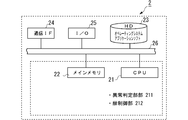
- the management server 2 is a so-called computer having a CPU 21, a main storage device 22, an auxiliary storage device 23, a communication IF (Interface) 24, an input / output IF (Interface) 25, and a communication bus 26.
- the CPU 21 executes a program that is executed in the main storage device 22 and provides functions of the abnormality determination unit 211 and the door control unit 212.
- the abnormality determination unit 211 determines the occurrence and type of abnormality based on the state of the toilet booth 14 acquired from the control device 44, that is, the detection result of the detection unit 46.
- the abnormality determination unit 211 determines the type of abnormality depending on which condition the detection result of the detection unit 46 satisfies among the multiple conditions for determining the occurrence of abnormality. For example, when the first condition is satisfied, the abnormality determination unit 211 determines that the user has fallen.
- the first condition of this example is that the maximum value of the height of the user detected by the detection unit 46 is not more than a predetermined lower limit value, or that the user is stationary for a predetermined time or more.
- the shape of the object in the toilet booth is acquired with a three-dimensional scanner or ToF distance image sensor, and the user is identified by pattern matching, and the height information of the user is acquired. At this time, if the maximum value of the height information is equal to or lower than the lower limit value H1, it is determined that the user has fallen.
- a user is periodically detected by a three-dimensional scanner or a ToF distance image sensor, and when the shape of the user has not changed for a predetermined time or more, it is determined that the user is stationary for a predetermined time or more.
- the abnormality determination unit 211 determines that the user is an illegal intruder when the detection result of the detection unit 46 satisfies the second condition.
- the second condition of this example is that the user is present exceeding a predetermined upper limit, the shape of the toilet equipment 1 provided in the toilet booth is changed by the user, or the toilet equipment 1 The user has performed a specific action.
- the shape of the normal state of the toilet equipment 1 in the toilet booth is acquired in advance by the three-dimensional scanner, ToF distance image sensor, and image recording unit 65, and this is stored as a reference pattern.
- the shape of the toilet equipment 1 is acquired at a predetermined cycle (for example, 1/30 seconds to 600 seconds) with the three-dimensional scanner, the ToF distance image sensor, and the image recording unit 65.
- a predetermined cycle for example, 1/30 seconds to 600 seconds
- the difference between the detected pattern of the toilet facility 1 and the reference pattern occurs compared to the reference pattern, the user has changed the shape of the toilet facility 1, that is, the user has performed an illegal act such as destruction or decomposition. judge.
- the image recording unit 65 acquires an image in the toilet booth and detects a specific action of the user by pattern recognition. For example, an operation of destroying, for example, hitting a toilet equipment at a predetermined speed or more, an operation of touching a toilet bowl or a waste container with both hands, an operation of performing an injection, an operation of placing an object on a shelf, or an operation of removing clothes are detected.
- the abnormality determining unit 211 detects an operation such as hitting the toilet equipment 1 at a predetermined speed or more, bringing a lighter fire close to the toilet equipment 1, or coloring the toilet equipment 1 with graffiti or spray, It is determined that the second condition is satisfied, assuming that the user performs a specific operation on the facility 1.
- the abnormality determination unit 211 indicates that the user has touched the toilet bowl or the trash container with both hands for a predetermined time T4 (for example, 1 minute) or longer and that the user has not performed the action of taking off clothes after entering the room.
- T4 for example, 1 minute
- the detection unit 46 it is determined that the user has installed a voyeur camera or the like (specific operation) in the toilet bowl or filth box (toilet facility), that is, the second condition is satisfied.
- a voyeur camera or the like specific operation
- filth box toilet facility
- the operation is such that the lid is opened with one hand, the filth is put in with the other hand, and the lid is closed.
- the abnormality determination unit 211 detects an operation in which the user applies the syringe to the abdomen, thigh, or arm and an operation to reach the shelf or the trash container immediately after that, the abnormality determination unit 211 places the syringe needle on the shelf or Since there is a possibility that it was thrown into the trash bin, it is determined to be abnormal. For example, there is no problem with insulin self-injection or adrenaline self-injection in the toilet booth, but if you leave the needle after the injection in a shelf or trash can, other users may be injured. Detect as abnormal. In this case, since the injection needle itself is thin and small, it is difficult to detect with a camera, but it is estimated that the injection needle is left by detecting the operation of the user who handles the syringe.
- the abnormality determination unit 211 determines that there is a residue in the toilet booth when the detection result of the detection unit 46 satisfies the third condition.
- the third condition of this example is that there are objects that were not in the toilet booth after the user exits before entering the room, as compared with the toilet booth before the user enters the room.
- the shape of the object in the toilet booth is acquired before the user enters the room and after the user leaves, and compared with this, the number of objects can be increased after leaving. For example, it is determined that there is a residue.
- the door control unit 212 When the abnormality determination unit 211 determines that an abnormality has occurred, the door control unit 212 generates a control signal for opening / closing the door 9 according to the type of the abnormality, and transmits the control signal to the control device 44. By doing so, the door 9 is controlled.
- the main storage device 22 is used as a cache for programs and data read by the CPU 21 and a work area for the CPU 21.
- the main storage device 22 is a RAM (Random Access Memory), a ROM (Read Only Memory), or the like.
- the auxiliary storage device 23 stores programs executed by the CPU 21, setting information used in the present embodiment, and the like.
- the auxiliary storage device 23 is an HDD, an SSD, a flash memory, or the like.
- the communication IF 24 transmits / receives data to / from other computer devices.
- the communication IF 24 is a wired or wireless network card or the like.
- the input / output IF 25 is appropriately connected to output means such as a display device and a printer, input means such as a keyboard and pointing device, and input / output means such as a drive device.
- the drive device is a removable storage medium read / write device, such as an input / output device for a flash memory card, a USB adapter for connecting a USB memory, or the like.
- the removable storage medium may be a disk medium such as a CD (Compact Disc) or a DVD (Digital Versatile Disk).
- the drive device reads the program from the removable storage medium and stores it in the auxiliary storage device 23.
- the auxiliary storage device 23 stores programs executed by the CPU 21, setting information used in the present embodiment, and the like.
- the auxiliary storage device 23 is an HDD, an SSD, a flash memory, or the like.
- the auxiliary storage device 23 exchanges data with the drive device.
- the auxiliary storage device 23 stores a program installed from the drive device.
- the auxiliary storage device 23 reads out the program and delivers it to the main storage device 22. Further, the auxiliary storage device 23 stores a condition table.
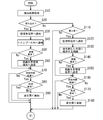
- 11 and 12 are explanatory diagrams of a toilet management method executed by the management server 2 in accordance with the toilet management program.
- the control device 44 transmits the entry time together with the identification information of the toilet booth 14 to the management server 2. Similarly, when the detection unit 46 detects the exit, the control device 44 transmits to the management server 2 information indicating the exit together with the identification information of the toilet booth 14.
- the control device 44 transmits to the management server 2 information indicating the exit together with the identification information of the toilet booth 14.
- any of the sensors 92, 421, 461, 462, and 463 is turned on, it is detected that the user has entered the toilet booth 14, and used when all the sensors are turned off. It is detected that the person has left the toilet booth 14.
- the management server 2 executes the processes of FIG. 11 and FIG. 12, and repeatedly executes the information until the user leaves the toilet booth 14. To do.
- the management server 2 requests the control device 44 of the toilet booth 14 specified by the received identification information to transmit the detection result of each sensor as user information, and the detection result from the control device 44. That is, the state of the toilet booth 14 is acquired (step S10).
- the management server 2 determines whether or not the user has fallen depending on whether or not the detection result satisfies the first condition (step S20).
- the management server 2 transmits an email notifying the occurrence of the fall to the administrator terminal 3 (Step S30).
- the controller 44 is notified of the occurrence of the fall, and the display on the display unit 432 of the controller 43 and the sound output from the speaker 433, “The fall was detected, so the administrator was notified. No relief is required. If this is the case, select cancel. " As a result, the user is notified that the fall has been reported, and the user is notified to perform a canceling operation when no relief is required.
- the management server 2 determines whether or not an image transmission request has been received from the administrator terminal 3.
- an image transmission request is received from the administrator terminal 3 (step S50, Yes)
- an image captured by the image recording unit 65 in the toilet booth 14 is transmitted to the administrator terminal 3 (step S50). S60).
- an image transmission request is not received from the administrator terminal 3 (No in step S50)
- the process proceeds to step S70 without transmitting an image.
- step S70 the management server 2 determines whether or not a predetermined time has elapsed since the user entered the toilet booth 14 and it was determined in step S20 that the first collapse occurred.
- the management server 2 determines that the predetermined time has not elapsed (No at Step S70)
- the management server 2 proceeds to Step S210 in FIG. 12 and determines that the predetermined time has elapsed (Step S70, Yes).
- step S80, Yes When cancellation is requested from the administrator terminal 3 or the control device 44 (step S80, Yes), the management server 2 proceeds to step S210 in FIG. 12, and when cancellation is not requested (step S80, No), the door A control signal for opening the door 9 is transmitted to the control device 44 so that the door 9 is opened.
- the control for opening the door 9 may be control for opening the doorway 4 by moving the door 9 by the door drive unit 63, or control for unlocking the lock 91 without moving the door 9. It may be. For example, if the door 9 can be opened manually by unlocking the lock 91, the lock 91 is only unlocked in step S90, and the administrator arrives at the toilet booth 14. Try to open the door manually. Thereby, from the time when the door is opened in step S90 until the manager arrives, the doorway 4 can be closed, and unnecessary opening can be suppressed.
- the door 9 is moved by a predetermined amount in the opening direction in step S90, and the door 9 is stopped in a state where a predetermined gap is opened.
- the user may put his hand through this gap and operate the operation panel 61 to open the door.
- step S20 determines whether it is an illegal intruder by whether a detection result satisfies the 2nd condition (step) (step S20). S110). When it determines with an illegal intruder (step S110, Yes), the management server 2 transmits the mail which notifies generation
- control for maintaining the door 9 in the closed state is that the door 9 is closed and locked if the door 9 is open, and the door 9 is opened even if the operation panel 61 is opened in the locked state. The state where the door 9 is closed without accepting the operation is maintained.
- the management server 2 determines whether or not there is an image transmission request from the administrator terminal 3 (step S140).
- an image transmission request is received from the administrator terminal 3 (step S140, Yes)
- an image captured by the image recording unit 65 in the toilet booth 14 is transmitted to the administrator terminal 3 (step S140). S150).
- the process proceeds to Step S160 without transmitting an image.
- step S160 the management server 2 determines whether or not a predetermined time has elapsed since the user entered the toilet booth 14 and it was determined in step S110 that an illegal intruder was first generated.
- the management server 2 determines that the predetermined time has not elapsed (step S160, No)
- the management server 2 proceeds to step S210 in FIG. 12 and determines that the predetermined time has elapsed (step S160, Yes).
- the administrator terminal 3 notifies the management server 2 of cancellation.
- step S130 If cancellation is not requested from the administrator terminal 3 (step S170, No), the management server 2 proceeds to step S210 in FIG. 12, and if cancellation is requested (step S170, Yes), step S130.
- a control signal is transmitted to the control device 44 so as to stop the control for keeping the door 9 closed in step S180 (step S180).
- the control device 44 performs control so as to perform an operation of opening the door 9 as usual when an operation of opening the operation panel 61 is performed.
- the door 9 may be moved in the opening direction to return to the state before step S130 is executed.
- step S210 the management server 2 determines whether or not the user has left the toilet booth 14, and if the user has not left (step S210, NO), the process of FIG. 12 ends.
- step S210, Yes the management server 2 displays the image in the toilet booth 14 after the user leaves and the toilet booth before the user enters the room. 14 are acquired and compared (step S220).
- the management server 2 determines whether or not a residue has occurred depending on whether or not the comparison result satisfies the third condition (step S230).
- the management server 2 stores the image obtained after the user exited at Step S220 in the memory (Step S240). The process of 12 is finished.
- the image stored in the memory is used as an image before the user enters and exits when the next user enters the toilet booth and performs the comparison in step S220.
- the management server 2 uses the image recording unit 65 to notify the administrator terminal 3 of the message that the residue has occurred and the toilet booth 14. The taken image is transmitted to the administrator terminal 3 by e-mail (step S250). Further, the management server 2 notifies the control device 44 of the occurrence of the residue, and displays on the display unit 432 of the controller 43 and the sound output from the speaker 433, “There is a forgotten item. If it is, please select cancel. " Thus, the occurrence of forgotten items is notified, and when the forgotten items are collected, the user is notified to perform a cancel operation.
- the management server 2 determines whether or not a predetermined time has elapsed since the residue was detected in Step S230 (Step S270), and if the predetermined time has not elapsed (No in Step S270). Wait until a predetermined time has elapsed.
- This predetermined time can be arbitrarily set, and is, for example, 30 to 120 seconds, and preferably 60 to 90 seconds.
- the management server 2 determines whether or not a cancel request has been received from the control device 44 or the administrator terminal 3 (step S80). For example, when the user collects forgotten things and operates the operation unit 431 to input cancellation, the control device 44 transmits to the management server 2 a detection result indicating that cancellation of the residue has been detected. If the administrator determines that the door does not need to be closed as a result of checking the image, the administrator terminal 3 inputs a cancellation, and the administrator terminal 3 notifies the management server 2 of the cancellation.
- the management server 2 terminates the process of FIG. 12 without controlling the door 9 when cancellation is requested from the administrator terminal 3 or the control device 44 (step S280, Yes). Moreover, when cancellation is not requested
- the control apparatus which received the control signal which closes this door 9 moves the door 9 by the door drive unit 63, closes the entrance / exit 4, and locks it. Thereby, when the user's forgotten thing or a suspicious thing exists in the toilet booth 14, the control which the door 9 closes is performed.
- the type of abnormality can be determined depending on whether the detection result of the detection unit 46 satisfies the first condition to the third condition, and this abnormality type, that is, in the toilet booth.
- the toilet booth door can be controlled according to the situation.
- the toilet system of this embodiment performs the control which opens the door 9, when it determines with the detection result satisfy
- the toilet system of the present embodiment closes the door in order to keep the user in the toilet booth when the detection result satisfies the second condition and it is determined that the voyeurism or the toilet facility 1 has been destroyed. It is possible to perform control to maintain the state.
- the toilet system of the present embodiment can perform control to close the door when the detection result satisfies the third condition and there is a residue in the toilet booth. For this reason, when a user has left something in the toilet booth, it is possible to prevent a third person from holding the left item by closing the door 9. Moreover, when a suspicious object is left in the toilet booth, it is possible to prevent the next user from inadvertently touching the suspicious object by closing the door 9.
Landscapes
- Health & Medical Sciences (AREA)
- Engineering & Computer Science (AREA)
- Physics & Mathematics (AREA)
- General Physics & Mathematics (AREA)
- Public Health (AREA)
- General Health & Medical Sciences (AREA)
- Gerontology & Geriatric Medicine (AREA)
- Business, Economics & Management (AREA)
- Emergency Management (AREA)
- Automation & Control Theory (AREA)
- Human Computer Interaction (AREA)
- Manufacturing & Machinery (AREA)
- Water Supply & Treatment (AREA)
- Hydrology & Water Resources (AREA)
- Life Sciences & Earth Sciences (AREA)
- Psychiatry (AREA)
- Social Psychology (AREA)
- Psychology (AREA)
- Computer Vision & Pattern Recognition (AREA)
- Multimedia (AREA)
- Epidemiology (AREA)
- Sanitary Device For Flush Toilet (AREA)
- Toilet Supplies (AREA)
- Emergency Alarm Devices (AREA)
- Alarm Systems (AREA)
Priority Applications (4)
| Application Number | Priority Date | Filing Date | Title |
|---|---|---|---|
| US16/339,870 US10955822B2 (en) | 2016-10-07 | 2017-10-06 | Toilet system, toilet management method, and recording medium |
| SG11201903078UA SG11201903078UA (en) | 2016-10-07 | 2017-10-06 | Toilet system, toilet management method, and toilet management program |
| EP17858530.3A EP3525188A4 (en) | 2016-10-07 | 2017-10-06 | Toilet system, toilet management method, and toilet management program |
| CN201780061515.4A CN109791724B (zh) | 2016-10-07 | 2017-10-06 | 卫生间系统、卫生间管理方法、以及存储介质 |
Applications Claiming Priority (2)
| Application Number | Priority Date | Filing Date | Title |
|---|---|---|---|
| JP2016199451A JP6636892B2 (ja) | 2016-10-07 | 2016-10-07 | トイレシステム、トイレ管理方法、及びトイレ管理プログラム |
| JP2016-199451 | 2016-10-07 |
Publications (1)
| Publication Number | Publication Date |
|---|---|
| WO2018066694A1 true WO2018066694A1 (ja) | 2018-04-12 |
Family
ID=61831900
Family Applications (1)
| Application Number | Title | Priority Date | Filing Date |
|---|---|---|---|
| PCT/JP2017/036481 Ceased WO2018066694A1 (ja) | 2016-10-07 | 2017-10-06 | トイレシステム、トイレ管理方法、及びトイレ管理プログラム |
Country Status (6)
| Country | Link |
|---|---|
| US (1) | US10955822B2 (https=) |
| EP (1) | EP3525188A4 (https=) |
| JP (1) | JP6636892B2 (https=) |
| CN (1) | CN109791724B (https=) |
| SG (1) | SG11201903078UA (https=) |
| WO (1) | WO2018066694A1 (https=) |
Cited By (3)
| Publication number | Priority date | Publication date | Assignee | Title |
|---|---|---|---|---|
| CN110989424A (zh) * | 2019-11-15 | 2020-04-10 | 得力集团有限公司 | 一种无线低功耗人体感应装置及其使用方法 |
| JP2020130789A (ja) * | 2019-02-22 | 2020-08-31 | 株式会社 千葉通信システム | トイレ管理システム |
| CN113790764A (zh) * | 2021-09-28 | 2021-12-14 | 安徽省产品质量监督检验研究院(国家排灌及节水设备产品质量监督检验中心) | 一种智能马桶综合检测方法 |
Families Citing this family (11)
| Publication number | Priority date | Publication date | Assignee | Title |
|---|---|---|---|---|
| CN110443978B (zh) * | 2019-08-08 | 2021-06-18 | 南京联舜科技有限公司 | 一种摔倒报警设备及方法 |
| CN110738819A (zh) * | 2019-10-23 | 2020-01-31 | 合肥盛东信息科技有限公司 | 一种非穿戴入厕摔倒监测报警系统 |
| CN111012359A (zh) * | 2019-12-26 | 2020-04-17 | 湖南大学 | 摔倒检测方法、装置及存储介质 |
| DE102020205215A1 (de) * | 2020-04-24 | 2021-10-28 | Diehl Aviation Gilching Gmbh | Steuerungs- und Informationsanlage für einen Waschraum eines Flugzeugs, Waschraum mit der Steuerungs- und Informationsanlage, Flugzeug mit dem Waschraum und Steuerungs- und Informationsverfahren |
| JP7644891B2 (ja) * | 2021-01-28 | 2025-03-13 | Toto株式会社 | 水まわり機器の通信システム |
| JP7600927B2 (ja) * | 2021-08-06 | 2024-12-17 | Toto株式会社 | トイレシステム |
| CN114753757A (zh) * | 2022-03-14 | 2022-07-15 | 青岛海尔空调器有限总公司 | 用于卫生间控制的方法及装置、终端设备 |
| US12605019B2 (en) * | 2022-03-16 | 2026-04-21 | Toto Ltd. | Abnormality detection system |
| JP2023136215A (ja) * | 2022-03-16 | 2023-09-29 | Toto株式会社 | 異常検知システム |
| JP7712678B2 (ja) * | 2022-04-28 | 2025-07-24 | 三協エアテック株式会社 | トイレ監視システム |
| CN115218440B (zh) * | 2022-07-11 | 2025-08-19 | 青岛海尔空调器有限总公司 | 空调的控制方法、装置、系统及空调 |
Citations (5)
| Publication number | Priority date | Publication date | Assignee | Title |
|---|---|---|---|---|
| JP2002188204A (ja) * | 2000-12-22 | 2002-07-05 | Toto Ltd | トイレブースシステム |
| JP2007058406A (ja) | 2005-08-23 | 2007-03-08 | Toto Ltd | セキュリティシステム |
| JP2007241446A (ja) | 2006-03-06 | 2007-09-20 | Toto Ltd | セキュリティシステム |
| JP4991771B2 (ja) | 2009-02-06 | 2012-08-01 | 有限会社メディカルソフト | 警報装置 |
| JP2015087882A (ja) * | 2013-10-29 | 2015-05-07 | 株式会社木村技研 | トイレシステム |
Family Cites Families (5)
| Publication number | Priority date | Publication date | Assignee | Title |
|---|---|---|---|---|
| EP1036384A2 (en) * | 1997-12-03 | 2000-09-20 | Walter Di Fulvio | Control device for a toilet |
| AUPQ303799A0 (en) * | 1999-09-24 | 1999-10-21 | Right Hemisphere Pty Limited | Safety cubicle |
| US20110316703A1 (en) * | 2010-04-29 | 2011-12-29 | Andy Butler | System and Method for Ensuring Sanitation Procedures in Restrooms |
| JP2014214594A (ja) * | 2013-04-30 | 2014-11-17 | 株式会社Nttファシリティーズ | トイレシステム |
| DE102017010521B4 (de) * | 2017-11-14 | 2025-01-09 | Drägerwerk AG & Co. KGaA | Vorrichtung, Verfahren und Computerprogramm für ein Medizingerät |
-
2016
- 2016-10-07 JP JP2016199451A patent/JP6636892B2/ja active Active
-
2017
- 2017-10-06 SG SG11201903078UA patent/SG11201903078UA/en unknown
- 2017-10-06 WO PCT/JP2017/036481 patent/WO2018066694A1/ja not_active Ceased
- 2017-10-06 US US16/339,870 patent/US10955822B2/en not_active Expired - Fee Related
- 2017-10-06 CN CN201780061515.4A patent/CN109791724B/zh not_active Expired - Fee Related
- 2017-10-06 EP EP17858530.3A patent/EP3525188A4/en not_active Withdrawn
Patent Citations (5)
| Publication number | Priority date | Publication date | Assignee | Title |
|---|---|---|---|---|
| JP2002188204A (ja) * | 2000-12-22 | 2002-07-05 | Toto Ltd | トイレブースシステム |
| JP2007058406A (ja) | 2005-08-23 | 2007-03-08 | Toto Ltd | セキュリティシステム |
| JP2007241446A (ja) | 2006-03-06 | 2007-09-20 | Toto Ltd | セキュリティシステム |
| JP4991771B2 (ja) | 2009-02-06 | 2012-08-01 | 有限会社メディカルソフト | 警報装置 |
| JP2015087882A (ja) * | 2013-10-29 | 2015-05-07 | 株式会社木村技研 | トイレシステム |
Non-Patent Citations (1)
| Title |
|---|
| See also references of EP3525188A4 |
Cited By (4)
| Publication number | Priority date | Publication date | Assignee | Title |
|---|---|---|---|---|
| JP2020130789A (ja) * | 2019-02-22 | 2020-08-31 | 株式会社 千葉通信システム | トイレ管理システム |
| CN110989424A (zh) * | 2019-11-15 | 2020-04-10 | 得力集团有限公司 | 一种无线低功耗人体感应装置及其使用方法 |
| CN110989424B (zh) * | 2019-11-15 | 2023-08-11 | 得力集团有限公司 | 一种无线低功耗人体感应装置及其使用方法 |
| CN113790764A (zh) * | 2021-09-28 | 2021-12-14 | 安徽省产品质量监督检验研究院(国家排灌及节水设备产品质量监督检验中心) | 一种智能马桶综合检测方法 |
Also Published As
| Publication number | Publication date |
|---|---|
| CN109791724A (zh) | 2019-05-21 |
| SG11201903078UA (en) | 2019-05-30 |
| EP3525188A4 (en) | 2020-06-24 |
| EP3525188A1 (en) | 2019-08-14 |
| JP6636892B2 (ja) | 2020-01-29 |
| US20190243342A1 (en) | 2019-08-08 |
| JP2018060475A (ja) | 2018-04-12 |
| CN109791724B (zh) | 2021-01-29 |
| US10955822B2 (en) | 2021-03-23 |
Similar Documents
| Publication | Publication Date | Title |
|---|---|---|
| JP6636892B2 (ja) | トイレシステム、トイレ管理方法、及びトイレ管理プログラム | |
| JP7193095B2 (ja) | セキュリティ管理システム | |
| JP6261946B2 (ja) | トイレシステム | |
| CN111542866B (zh) | 洗手间管理系统、以及洗手间管理方法 | |
| JP6659033B2 (ja) | トイレシステム | |
| JP2017163289A (ja) | セキュリティ管理システム | |
| WO2023067331A1 (en) | Smart-lock system and method of operating the smart-lock | |
| US12094313B2 (en) | Environment sensing for care systems | |
| JP2016218773A (ja) | 浴室内緊急事態検知システム | |
| CN110945571A (zh) | 安全管理系统 | |
| JP2017159033A (ja) | 天井裏隠ぺい型トイレブース長居抑止装置 | |
| JP2008261549A (ja) | キッチン設備制御システム | |
| JP2022027121A (ja) | トイレシステム及びトイレ管理方法 | |
| TWI642020B (zh) | 人流管制保全系統 | |
| JP2003099878A (ja) | 人体異常検知装置 | |
| JP2005301778A (ja) | 室内事故検知装置およびそのプログラム | |
| HK40074918A (en) | Toilet management system and toilet management method | |
| JP5845372B1 (ja) | 健康状態監視システム | |
| HK40032867A (en) | Toilet management system and toilet management method | |
| JP7563239B2 (ja) | 管理装置 | |
| JP2025037732A (ja) | 盗撮検出装置及び盗撮検出方法 | |
| HK40032867B (zh) | 洗手间管理系统、以及洗手间管理方法 | |
| JP2025137976A (ja) | 浴室システム | |
| JP2025171665A (ja) | 制御装置およびプログラム |
Legal Events
| Date | Code | Title | Description |
|---|---|---|---|
| 121 | Ep: the epo has been informed by wipo that ep was designated in this application |
Ref document number: 17858530 Country of ref document: EP Kind code of ref document: A1 |
|
| NENP | Non-entry into the national phase |
Ref country code: DE |
|
| ENP | Entry into the national phase |
Ref document number: 2017858530 Country of ref document: EP Effective date: 20190507 |
|
| WWW | Wipo information: withdrawn in national office |
Ref document number: 2017858530 Country of ref document: EP |