WO2018066549A1 - 電気化学キャパシタ - Google Patents
電気化学キャパシタ Download PDFInfo
- Publication number
- WO2018066549A1 WO2018066549A1 PCT/JP2017/035943 JP2017035943W WO2018066549A1 WO 2018066549 A1 WO2018066549 A1 WO 2018066549A1 JP 2017035943 W JP2017035943 W JP 2017035943W WO 2018066549 A1 WO2018066549 A1 WO 2018066549A1
- Authority
- WO
- WIPO (PCT)
- Prior art keywords
- electrode
- electrochemical capacitor
- electrolyte
- active material
- electrode active
- Prior art date
- Legal status (The legal status is an assumption and is not a legal conclusion. Google has not performed a legal analysis and makes no representation as to the accuracy of the status listed.)
- Ceased
Links
Images

Classifications
-
- H—ELECTRICITY
- H01—ELECTRIC ELEMENTS
- H01G—CAPACITORS; CAPACITORS, RECTIFIERS, DETECTORS, SWITCHING DEVICES, LIGHT-SENSITIVE OR TEMPERATURE-SENSITIVE DEVICES OF THE ELECTROLYTIC TYPE
- H01G11/00—Hybrid capacitors, i.e. capacitors having different positive and negative electrodes; Electric double-layer [EDL] capacitors; Processes for the manufacture thereof or of parts thereof
- H01G11/02—Hybrid capacitors, i.e. capacitors having different positive and negative electrodes; Electric double-layer [EDL] capacitors; Processes for the manufacture thereof or of parts thereof using combined reduction-oxidation reactions, e.g. redox arrangement or solion
-
- H—ELECTRICITY
- H01—ELECTRIC ELEMENTS
- H01G—CAPACITORS; CAPACITORS, RECTIFIERS, DETECTORS, SWITCHING DEVICES, LIGHT-SENSITIVE OR TEMPERATURE-SENSITIVE DEVICES OF THE ELECTROLYTIC TYPE
- H01G11/00—Hybrid capacitors, i.e. capacitors having different positive and negative electrodes; Electric double-layer [EDL] capacitors; Processes for the manufacture thereof or of parts thereof
- H01G11/54—Electrolytes
- H01G11/58—Liquid electrolytes
- H01G11/62—Liquid electrolytes characterised by the solute, e.g. salts, anions or cations therein
-
- Y—GENERAL TAGGING OF NEW TECHNOLOGICAL DEVELOPMENTS; GENERAL TAGGING OF CROSS-SECTIONAL TECHNOLOGIES SPANNING OVER SEVERAL SECTIONS OF THE IPC; TECHNICAL SUBJECTS COVERED BY FORMER USPC CROSS-REFERENCE ART COLLECTIONS [XRACs] AND DIGESTS
- Y02—TECHNOLOGIES OR APPLICATIONS FOR MITIGATION OR ADAPTATION AGAINST CLIMATE CHANGE
- Y02E—REDUCTION OF GREENHOUSE GAS [GHG] EMISSIONS, RELATED TO ENERGY GENERATION, TRANSMISSION OR DISTRIBUTION
- Y02E60/00—Enabling technologies; Technologies with a potential or indirect contribution to GHG emissions mitigation
- Y02E60/13—Energy storage using capacitors
Definitions
- the present invention relates to an electrochemical capacitor, and more particularly to an electrochemical capacitor in which two electrodes are disposed apart from each other in a non-aqueous electrolyte.
- An electrochemical capacitor is a capacitor that uses a capacity that is generated due to a physicochemical reaction between an electrode (electrode active material) and an ion (electrolyte ion) in an electrolytic solution, and is a device that stores electrical energy (storage) Device).
- a metal oxide or layered material (or intercalation compound) is used as an electrode active material, and a reaction involving the transfer of electrons between the electrode and ions in the electrolyte (for example, an electrode active material) (Capacitance (pseudocapacitance)) due to the occurrence of a change in the oxidation number of the metal elements constituting the metal is called “pseudocapacitor” or “redox capacitor”.
- an electrochemical capacitor using MnO 2 as an electrode active material is conventionally known (see Non-Patent Documents 1 to 4).
- electrochemical capacitors using MXene as an electrode active material are also known (see Patent Documents 1 and 2 and Non-Patent Documents 5 to 6).
- MXene is a kind of so-called two-dimensional material, and, as will be described later, is a layered material having a form of a plurality of layers, and each layer has M n + 1 X n (where M is at least one third type).
- X is a carbon atom and / or nitrogen atom
- n is 1, 2 or 3
- each X is in an octahedral array of M Is a material having a crystal lattice located at, and having a termination (or modification) T such as a hydroxyl group, a fluorine atom, an oxygen atom and a hydrogen atom on the surface of each layer.
- an electrolytic solution that can be used in an electrochemical capacitor
- an aqueous electrolytic solution electrolytic solution in which an electrolyte is dissolved in an aqueous solvent
- a nonaqueous electrolytic solution electrolytic solution or ionic liquid in which an electrolyte is dissolved in a nonaqueous solvent
- An electrolyte solution comprising:
- the operating potential range (referred to as “potential window”) of the electrochemical capacitor is limited to a maximum of 1.2 V or less so as not to cause water electrolysis, and thus energy density (1/2 ⁇ It is calculated in CV 2, wherein, C is the specific capacity (more specifically, the electrode active material per unit volume capacity (F / cm 3) or the electrode active material unit mass per volume (F / g), or less, herein These are collectively referred to as “specific capacity”, and V means the operating potential range (V)).
- the usable temperature range of the electrochemical capacitor is limited to a temperature at which water can be stably present as a liquid (a temperature at which freezing and vaporization does not occur).
- the non-aqueous electrolyte has an advantage that such a difficulty can be avoided.
- ionic liquids which can function alone as electrolytes and can function as non-aqueous solvents and electrolytes when used with other electrolytes
- a larger operating potential range contributes significantly to obtaining higher energy densities.
- Non-Patent Document 2 unless MnO 2 has a slow voltage scanning speed of about 5 mV / s, a sufficient specific capacity cannot be obtained (see, for example, FIG. 5 of Non-Patent Document 2), a larger voltage scanning speed of 10 mV / s, At a voltage scanning speed of 20 mV / s, which is generally applied in the performance evaluation of an electric double layer capacitor which is another electrochemical capacitor, only a small specific capacity can be obtained, and there is a question of practicality.
- the thickness of MnO 2 is not thin, a sufficient specific capacity cannot be obtained (for example, the thickness is 1 ⁇ m or less with reference to Non-Patent Documents 3 to 4), and the total amount of the electrode active material As a result, the capacity (F) of the electrochemical capacitor cannot be increased, which is not practically suitable for increasing the capacity.
- Non-Patent Document 6 describes an electrochemical capacitor using a free standing film of Ti 3 C 2 T x (T x means a surface functional group) as an electrode and a 1 M sulfuric acid aqueous solution as an electrolyte.
- Non-Patent Document 5 uses a Ti 3 C 2 T x dry film (thickness not described) as an electrode and 1-ethyl-3-methylimidazolium bis (trifluoromethylsulfonyl) imide (not shown) as an electrolyte.
- Electrochemical capacitors using EMI-TFSI have a narrow operating potential range (potential window) and are understood to have a specific capacity of less than 1 F / g at a voltage scanning speed of 20 mV / s.
- an electrochemical capacitor using an EMI-TFSI impregnated Ti 3 C 2 T x ionogel film (thickness not stated) and using EMI-TFSI as the electrolyte at a voltage scanning rate of 20 mV / s, 70 F / g It was described that a specific capacity of 3 V and an operating potential range (potential window) of 3 V were obtained, and that similar results were obtained when the electrode thickness was increased to 400 ⁇ m. Is ( Figure 3b of the non-patent document 5, FIG. 3d, see Figure 5b, etc.).
- An object of the present invention is to achieve a sufficiently large specific capacity, particularly a capacity per unit volume of an electrode active material, in an electrochemical capacitor using MXene as an electrode active material and a non-aqueous electrolyte as an electrolyte. To do.
- an electrochemical capacitor in which two electrodes are spaced apart in a non-aqueous electrolyte, Either of the two electrodes is a layered material including a plurality of layers as an electrode active material, and each layer has the following formula: M n + 1 X n (Wherein M is at least one group 3, 4, 5, 6, 7 metal; X is a carbon atom, a nitrogen atom or a combination thereof; n is 1, 2 or 3) A group consisting of a hydroxyl group, a fluorine atom, an oxygen atom, and a hydrogen atom on at least one of the two opposing surfaces of each layer, each having a crystal lattice in which each X is located in an M octahedral array A layered material having at least one modification or termination T selected from An electrochemical capacitor is provided in which the non-aqueous electrolyte includes a non-aqueous solvent and an electrolyte that generates protons in the non-aqueous solvent
- the electrochemical capacitor of the present invention in the electrochemical capacitor using the predetermined layered material (also referred to as “MXene” in the present specification) as the electrode active material and using a nonaqueous electrolytic solution as the electrolytic solution.
- a sufficiently large specific capacity, particularly a capacity per unit volume of the electrode active material can be achieved.
- the non-aqueous solvent may be an ionic liquid.
- the non-aqueous solvent may be an aprotic solvent.
- the aprotic solvent may include at least one selected from the group consisting of acetonitrile, propylene carbonate, ethylene carbonate, dimethyl carbonate, ethyl methyl carbonate, and diethyl carbonate.
- M may be titanium and X may be a carbon atom or a nitrogen atom.
- the electrode including the layered material as an electrode active material may be a negative electrode, and the other electrode may be a positive electrode including carbon as an electrode active material.
- an electrolyte that generates protons in a non-aqueous solvent is introduced into the non-aqueous electrolyte.
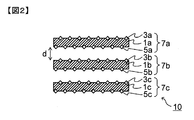
- FIG. 1 is a schematic cross-sectional view illustrating an electrochemical capacitor according to one embodiment of the present invention. It is a schematic schematic cross section which shows MXene which is a layered material which can be utilized for the electromagnetic shielding material in one embodiment of this invention.
- the electrochemical capacitor 20 of this embodiment has a configuration in which two electrodes 15a and 15b are spaced apart from each other in the non-aqueous electrolyte 13.
- the total number of electrodes may be at least two, and is not limited to only two, and three or more electrodes may exist.
- the two electrodes 15a and 15b are electrically connected to the terminals A and B, and can function as a working electrode and a counter electrode, particularly as a negative electrode and a positive electrode.
- the two electrodes 15 a and 15 b can be arranged in any suitable container (or cell) 11 and separated from each other in the nonaqueous electrolyte solution 13 with, for example, the separator 17 interposed therebetween.
- any appropriate member can be used as long as it does not hinder the movement of the electrolyte ions in the non-electrolytic solution 13.
- a porous film of polyolefin such as polypropylene or polytetrafluoroethylene can be used.
- the material of the container 11 is not particularly limited, and may be a metal such as stainless steel, a resin such as polytetrafluoroethylene, or any other appropriate material.
- the container 11 may be sealed or opened, and an empty space may or may not exist in the container 11.
- the electrodes 15a and 15b are spaced apart from each other in any appropriate form other than the form shown in the container 11, such as being laminated and wound with the separator 17 interposed therebetween. May be.
- One of the two electrodes 15a and 15b (in this specification, the first electrode 15a of the first electrode 15a and the second electrode 15b) is a predetermined layered material including a plurality of layers as an electrode active material. Including.
- the electrode active material refers to a substance that exchanges electrons with the electrolyte ions in the non-electrolytic solution 13.
- the predetermined layered material that can be used in this embodiment is MXene and is defined as follows: A layered material comprising a plurality of layers, each layer having the following formula: M n + 1 X n (Wherein M is at least one Group 3, 4, 5, 6, 7 metal, so-called early transition metals such as Sc, Ti, Zr, Hf, V, Nb, Ta, Cr, Mo and At least one selected from the group consisting of Mn, X is a carbon atom, a nitrogen atom or a combination thereof; n is 1, 2 or 3) A group consisting of a hydroxyl group, a fluorine atom, an oxygen atom, and a hydrogen atom on at least one of the two opposing surfaces of each layer, each having a crystal lattice in which each X is located in an M octahedral array Layered material with at least one modification or termination T selected from more (this is also referred to as “M n + 1 X n T s ”, where s
- Such MXene can be obtained by selectively etching A atoms from the MAX phase.
- the MAX phase has the following formula: M n + 1 AX n Wherein M, X and n are as described above, A is at least one group 12, 13, 14, 15, 16 element, usually a group A element, typically IIIA And in particular, may comprise at least one selected from the group consisting of Al, Ga, In, Tl, Si, Ge, Sn, Pb, P, As, S and Cd, preferably Al) A crystal structure in which each X has a crystal lattice located in an octahedral array of M, and a layer composed of A atoms is located between the layers represented by M n + 1 X n Have.
- one layer of X atoms is arranged between each of n + 1 layers of M atoms (also collectively referred to as “M n + 1 X n layer”), and the (n + 1) th M
- M n + 1 X n layer a repeating unit in which a layer of A atoms (“A atomic layer”) is arranged.
- a atomic layer a repeating unit in which a layer of A atoms
- an etching solution usually an aqueous solution of fluorine-containing acid is used on the exposed surface of the M n + 1 X n layer.
- the surface is terminated by modification of hydroxyl groups, fluorine atoms, oxygen atoms, hydrogen atoms, and the like that are not limited thereto.
- M is titanium and X is a carbon atom or a nitrogen atom.
- the MAX phase is Ti 3 AlC 2 and MXene is Ti 3 C 2 T s .
- MXene may contain a relatively small amount of remaining A atoms, for example, 10% by mass or less based on the original A atoms.
- MXene 10 obtained in this way has M n + 1 X n layers 1a, 1b, 1c modified or terminated with surface modifications T3a, 5a, 3b, 5b, 3c, 5c.
- MXene10 is a laminated body (multilayer structure) in which a plurality of MXene layers are separated from each other (single-layer structure), and the plurality of MXene layers are laminated apart from each other.
- the MXene can be an individual MXene layer (monolayer) and / or a collection of stacks of MXene layers (which can also be referred to as particles, powders or flakes).
- MXene layers which can also be referred to as particles, powders or flakes.
- two adjacent MXene layers for example, 7a and 7b, 7b and 7c
- 7a and 7b, 7b and 7c may not necessarily be completely separated from each other, and may be partially in contact with each other.
- each layer of MXene is, for example, not less than 0.8 nm and not more than 5 nm, particularly not less than 0.8 nm and not more than 3 nm.
- the maximum dimension in a plane (two-dimensional sheet surface) parallel to the layer (mainly may vary depending on the number of M atomic layers included in each layer) is, for example, 0.1 ⁇ m or more and 200 ⁇ m or less, particularly 1 ⁇ m or more and 40 ⁇ m or less.
- the total number of layers may be 2 or more, for example, 50 or more and 100,000 or less, particularly 1,000 or more and 20,000 or less, and the thickness in the stacking direction is, for example, 0.1 ⁇ m or more. It is 200 ⁇ m or less, particularly 1 ⁇ m or more and 40 ⁇ m or less, and the maximum dimension in a plane (two-dimensional sheet surface) perpendicular to the stacking direction is, for example, 0.1 ⁇ m or more and 100 ⁇ m or less, particularly 1 ⁇ m or more and 20 ⁇ m or less.
- these dimensions are calculated
- SEM scanning electron microscope
- TEM transmission electron microscope
- the first electrode 15a (also referred to as “MXene electrode”) may be substantially composed only of MXene which is an electrode active material, or may be configured by adding a binder or the like thereto.
- the binder can typically be a resin, and for example, at least one selected from the group consisting of polytetrafluoroethylene, polyvinylidene fluoride, styrene butadiene rubber, and the like can be used.
- the other second electrode 15b only needs to include any appropriate material that can function as a counter electrode of the first electrode 1a as an electrode active material.
- the second electrode 15b includes carbon as an electrode active material such as activated carbon, graphite, carbon nanotube, graphene, carbon black, etc.
- the first electrode 15a functions as a negative electrode
- the second electrode 15b serves as a positive electrode. Function.
- the binder etc. may be added and comprised to this.
- the binder can typically be a resin, and for example, at least one selected from the group consisting of polytetrafluoroethylene, polyvinylidene fluoride, styrene butadiene rubber, and the like can be used.
- the first electrode 15a and the second electrode 15b may be independent from each other in the form of a free-standing film, or may be formed in the form of a film and / or film on a current collector (not shown). Good. Any appropriate conductive material may be used for the current collector, but may be made of, for example, stainless steel, aluminum, an aluminum alloy, or the like.
- the non-aqueous electrolyte solution 13 includes a non-aqueous solvent and an electrolyte that generates protons in the non-aqueous solvent (referred to herein as “proton source electrolyte”).
- the proton source electrolyte can be any suitable electrolyte as long as it can generate protons in the non-aqueous solvent used.
- the electrolyte is one that dissolves in the non-aqueous solvent to be used and is ionized into a cation and an anion, and the proton source electrolyte only needs to contain a proton (H + ) as a cation.
- the proton source electrolyte for example, at least one selected from the group consisting of bis (trifluoromethylsulfonyl) imide (HTFSI), tetrafluoroboric acid (HBF 4 ), hexafluorophosphoric acid (HPF 6 ) and the like is used. Can be done.
- the non-aqueous solvent may be any solvent that can dissolve and ionize the proton source electrolyte, and may or may not be an electrolyte itself.
- the non-aqueous solvent may be at least one selected from the group consisting of an ionic liquid and any other suitable organic solvent.
- the ionic liquid can itself function as an electrolyte and can be ionized into a cation and an anion in the electrolyte.
- the ionic liquid include 1-ethyl-3-methylimidazolium bis (trifluoromethylsulfonyl) imide (EMI-TFSI), lithium perchlorate-2-oxazolidinone (LiClO 4 -OZO), 1-ethyl-3 -Methylimidazolium dicyanamide (EMI-DCA), 1-ethyl-3-methylimidazolium tetrafluoroborate (EMI-BF 4 ), 1-butyl-1-methylpyrodinium-dicyanamide (BMP-DCA), etc. At least one selected from the group consisting of can be used. Ionic liquids also have the advantage that they are very stable and difficult to volatilize.
- aprotic solvents can be used.
- the aprotic solvent is at least one selected from the group consisting of acetonitrile (AN), propylene carbonate (PC), ethylene carbonate (EC), dimethyl carbonate, ethyl methyl carbonate (EMC), diethyl carbonate (DEC), and the like. Species can be used.
- the molar ratio of the nonaqueous solvent: proton source electrolyte is not particularly limited, but may be, for example, 100: 1 to 50, particularly 100: 1 to 20, and more particularly 100: 2 to 10.
- the nonaqueous electrolytic solution 13 may contain a relatively small amount of any appropriate additive in addition to the nonaqueous solvent and the proton source electrolyte.
- the terminals A and B of the electrochemical capacitor 20 can be connected to a load for discharging. At this time, protons in the electrolyte 13 and / or protons bound to the electrode active material of the second electrode 15b are attracted to the first electrode 15a and bound to MXene, which is the electrode active material of the first electrode 15a. .
- bond is used in a very broad sense and means that they are combined by some physicochemical reaction.
- charging can be performed by connecting the terminals A and B of the electrochemical capacitor 20 to a power source.
- protons in the electrolyte 13 and / or protons bound to MXene which is the electrode active material of the first electrode 15a, are attracted to the second electrode 15b and bound to the electrode active material of the second electrode 15b.
- protons are inserted into a gap or the like of carbon that is the electrode active material of the second electrode 15b.
- MXene has a larger gap between layers compared to an oxide-based material such as MnO 2 , protons in the non-aqueous electrolyte are easily accessible through the gap. Further, MXene, compared to oxide-based materials such as MnO 2, since the carrier density (carrier concentration) is extremely high, the exchange of access protons and electrons, is less resistance when the electron transfer. From these facts, the accessibility of protons and the subsequent exchange of charges are easier than an electrode containing MXene as an electrode active material, compared to an electrode containing an oxide-based material such as MnO 2 as an electrode active material. Less susceptible to electrode thickness.
- MXnene electrode the first electrode 15a (MXnene electrode) side and the oxidation number (valence) of M changes in such charge and discharge.
- M, X and n are as described above, and x, y, z and m are arbitrary integers satisfying y> m.
- MnO 2 when MnO 2 is used as an electrode active material, protons cannot contribute to redox (MnO 2 is dissolved by protons, so an electrolyte that generates protons cannot be used), but MXene is used as an electrode active material. In this case, protons can contribute to redox.
- the electrochemical capacitor of this embodiment in an electrochemical capacitor using MXene as the electrode active material and using a non-aqueous electrolyte as the electrolyte, protons are generated in the non-aqueous electrolyte in a non-aqueous solvent.
- a sufficiently large specific capacity particularly a capacity per unit volume of the electrode active material, can be achieved.
- MXene is used as the electrode active material and an aqueous electrolyte is used as the electrolyte.
- An energy density equivalent to or higher than that of a conventional electrochemical capacitor can be achieved.
- a non-aqueous electrolyte is used.
- a non-aqueous electrolyte generally, a larger operating potential range is obtained compared to when an aqueous electrolyte is used, and a wider usable temperature range is obtained.
- the electrochemical capacitor of this embodiment has an operating potential range (potential window) of 1.5 V or more, particularly 2.0 V or more, preferably 2.5 V or more, depending on the composition of the non-aqueous electrolyte used. More preferably, it is 3 V or more, and the upper limit is not particularly limited, but it can typically be 4 V or less, and the usable temperature range can be ⁇ 40 to 85 ° C., particularly ⁇ 40 to 70 ° C.
- MXene is used as the electrode active material.
- MXene compared to using MnO 2 , non-capacity is less likely to decrease even when the electrode thickness is increased, and preferably a large capacity can be secured, and therefore the electrode thickness is increased.
- it is 3 ⁇ m or more, particularly 5 ⁇ m or more, and the upper limit is not particularly limited, but can be typically 30 ⁇ m or less.
- Electrode active material (MXene) per unit volume capacity for example, 30F / cm 3 or more, particularly 50F / cm 3 or more, preferably 80F / cm 3 or higher, more preferably at 150F / cm 3 or more, the upper limit is not particularly limited Typically, it can be set to 1500 F / cm 3 or less.
- the electrochemical capacitor of the present embodiment can obtain a sufficient specific capacity even when the voltage scanning speed is not small.
- the voltage scanning speed is, for example, 10 mV / s or more, typically 20 mV / s or more, particularly 50 mV / s or more, and the upper limit is not particularly limited. For example, it can be 1000 mV / s or less. Typically, it can be 100 mV / s or less.
- MXene in which M is titanium and X is a carbon atom or a nitrogen atom in the above formula.
- MXene for example, M is molybdenum, vanadium, etc.
- the specific capacity is less likely to decrease even when the voltage scanning speed is increased. Obtainable.
- Example 1 The electrochemical capacitor was assembled as follows, and the electrochemical performance was evaluated by measuring the potential window and specific capacity by electrochemical measurement.
- ⁇ Dispersion containing Ti 3 C 2 T s in water as MXene electrode MXene was obtained as follows. First, 1 g of Ti 3 AlC 2 synthesized according to the disclosure of Patent Document 2 was immersed in an etching solution obtained by mixing 1 g of LiF and 10 cc of 6 mol / L hydrochloric acid, and was subjected to etching. Etching was carried out for 24 hours while maintaining the etching solution at 35 ° C. and stirring with a magnetic stirrer. After etching, the resulting precipitate was washed with water to obtain Ti 3 C 2 T s in the form of clay.
- an etching solution obtained by mixing 1 g of LiF and 10 cc of 6 mol / L hydrochloric acid, and was subjected to etching. Etching was carried out for 24 hours while maintaining the etching solution at 35 ° C. and stirring with a magnetic stirrer. After etching, the resulting precipitate was washed with water to obtain
- Ti 3 C 2 T s was weighed into a container, added with 10 mL of water, and dispersed with an ultrasonic cleaner (Heated Ultrasonic Cleaner, manufactured by SHARPERTEK).
- An ultrasonic cleaner Heated Ultrasonic Cleaner, manufactured by SHARPERTEK.
- a dispersion containing Ti 3 C 2 T s in water (hereinafter simply referred to as “Ti 3 C 2 T s -water dispersion”) was prepared.
- the ultrasonic cleaning was performed for 1 hour while cooling the container with an ice water bath. After ultrasonic cleaning, Ti 3 C 2 T s had a particle size of 400 nm to 800 nm (40 number average dimensions based on TEM picture).
- the Ti 3 C 2 T s -water dispersion obtained by the above operation was degassed with Ar and then ultrasonically cleaned for 1 hour. Thereafter, the resulting dispersion liquid is subjected to a membrane filtration (Celgard Inc., Celgard (R) 3501, a polypropylene porous membrane), a flexible free-standing film consisting essentially Ti 3 C 2 T s It was.
- a membrane filtration Celgard Inc., Celgard (R) 3501, a polypropylene porous membrane
- a flexible free-standing film consisting essentially Ti 3 C 2 T s It was.
- the mass ratio of MXene (Ti 3 C 2 T s ) which was delaminated and became a stable suspension was about 45 mass%. Freestanding film of the resulting Ti 3 C 2 T s
- the thickness of the obtained MXene (Ti 3 C 2 T s ) electrode was 17.0 ⁇ m, the specific gravity was 3.75 g / cm 3 (see Table 1), and the conductivity was 4445.97 S / cm. .
- the thickness used the average value measured 5 points
- the conductivity was an average value measured at five points using a four-probe measuring instrument (manufactured by Jandel Engineering Ltd.).
- -Counter electrode Mechanically a premix slurry comprising ethanol, activated carbon (Kuraray Co., Ltd., YP-50), and polytetrafluoroethylene (PTFE) binder (60 mass% suspension in water, Sigma Aldrich) And then punched into a circle with a diameter of 5 mm was prepared as an activated carbon film.
- the obtained counter electrode was composed of 95% by mass of activated carbon and 5% by mass of PTFE, and the thickness was about 300 ⁇ m.
- Nonaqueous electrolyte EMI-TFSI (product number Im0208A50, manufactured by Solvionic, Inc.) that is a nonaqueous solvent (ionic liquid) and HTFSI (product number 15220-5G, manufactured by Sigma Aldrich) that is a proton source electrolyte :
- EMI-TFSI product number Im0208A50, manufactured by Solvionic, Inc.
- HTFSI product number 15220-5G, manufactured by Sigma Aldrich
- Electrochemical performance evaluation The electrochemical capacitor assembled above was set to 5 mV / s, 10 mV / s, 20 mV / s, 50 mV / s, and 100 mV / s using VMP3 manufactured by BioLogic. CV curve was measured. By measuring the potential window from the obtained CV curve and integrating the measurement data on the discharge side of the CV curve, the capacity per unit capacity of MXene (F / g) and the capacity per unit volume of MXene (F / cm 3 ) are integrated as specific capacities. Was calculated. The results are shown in Table 2.
- Example 2 The thickness of the produced MXene electrode was 11.6 ⁇ m, the specific gravity was 2.59 g / cm 3 , and acetonitrile (manufactured by Sigma Aldrich, product number 271004-1L) as a non-aqueous solvent and a proton source electrolyte A mixture obtained by mixing HTFSI (manufactured by Sigma Aldrich, product number 15220-5G) at a molar ratio of nonaqueous solvent: proton source electrolyte of 100: 2 was used as a nonaqueous electrolyte (see Table 1). In addition, the electrochemical capacitor was assembled and the electrochemical performance was evaluated in the same manner as in Example 1 except that the cell material was polytetrafluoroethylene. The results are shown in Table 2.
- Example 3 The thickness of the produced MXene electrode was 11.6 ⁇ m, the specific gravity was 2.50 g / cm 3 , and acetonitrile (manufactured by Sigma Aldrich, product number 271004-1L) as a non-aqueous solvent and a proton source electrolyte
- acetonitrile manufactured by Sigma Aldrich, product number 271004-1L
- a proton source electrolyte A mixture obtained by mixing HTFSI (manufactured by Sigma Aldrich, product number 15220-5G) at a molar ratio of nonaqueous solvent: proton source electrolyte of 100: 10 was used as a nonaqueous electrolyte (see Table 1).
- the electrochemical capacitor was assembled and the electrochemical performance was evaluated in the same manner as in Example 1 except that the cell material was polytetrafluoroethylene. The results are shown in Table 2.
- Example 2 The produced MXene electrode had a thickness of 11.6 ⁇ m, a specific gravity of 2.34 g / cm 3 , and only non-aqueous acetonitrile (Sigma Aldrich, product number 271004-1L) was non-aqueous.
- An electrochemical capacitor was assembled and evaluated for electrochemical performance in the same manner as in Example 1 except that it was used as an electrolytic solution (see Table 1) and that the cell material was polytetrafluoroethylene. The results are shown in Table 2.
- a potential window of 1.5 V or more, preferably 2.0 V or more, more preferably 3.0 V is obtained.
- a capacity per unit volume of electrode active material (MXene) of 100 F / cm 3 or more, preferably 180 F / cm 3 at a voltage scanning speed of 20 mV / s was obtained.
- the capacity per unit volume of the electrode active material (MXene) was 5 F / cm 3 or less at the same voltage scanning speed of 20 mV / s, which was extremely small.
- the electrochemical capacitor of the present invention can be used in a wide variety of fields as an electricity storage device, but is not limited thereto.
Landscapes
- Engineering & Computer Science (AREA)
- Power Engineering (AREA)
- Chemical & Material Sciences (AREA)
- Chemical Kinetics & Catalysis (AREA)
- Microelectronics & Electronic Packaging (AREA)
- Electrochemistry (AREA)
- Electric Double-Layer Capacitors Or The Like (AREA)
Abstract
2つの電極が非水電解液中に離間して配置された電気化学キャパシタであって、前記2つの電極のいずれかが、電極活物質として、複数の層を含む層状材料であって、各層が、以下の式:Mn+1Xn(式中、Mは、少なくとも1種の第3、4、5、6、7族金属であり、Xは、炭素原子、窒素原子またはそれらの組み合わせであり、nは、1、2または3である)で表され、かつ、各XがMの八面体アレイ内に位置する結晶格子を有し、各層の互いに対向する2つの表面の少なくとも一方に、水酸基、フッ素原子、酸素原子および水素原子からなる群より選択される少なくとも1種の修飾または終端Tを有する層状材料を含み、前記非水電解液が、非水溶媒と、該非水溶媒中でプロトンを生じる電解質とを含む、電気化学キャパシタ。
Description
本発明は、電気化学キャパシタに関し、より詳細には、2つの電極が非水電解液中に離間して配置された電気化学キャパシタに関する。
電気化学キャパシタは、電極(電極活物質)と電解液中のイオン(電解質イオン)との間での物理化学反応に起因して発現する容量を利用したキャパシタであり、電気エネルギーを蓄えるデバイス(蓄電デバイス)として使用可能である。電気化学キャパシタのうち、電極活物質に金属酸化物や層状材料(またはインターカレーション化合物)等を利用し、電極と電解液中のイオンとの間で電子の授受を伴う反応(例えば電極活物質を構成している金属元素の酸化数変化)が生じることにより容量(疑似容量)が発現するものは「シュードキャパシタ」や「レドックスキャパシタ」などと呼ばれている。
かかる電気化学キャパシタ(特にシュードキャパシタ)として、従来、電極活物質にMnO2を使用した電気化学キャパシタが知られている(非特許文献1~4参照)。また、電極活物質にMXeneを使用した電気化学キャパシタも知られている(特許文献1~2および非特許文献5~6参照)。MXeneは、いわゆる二次元材料の1種であり、後述するように、複数の層の形態を有する層状材料であって、各層は、Mn+1Xn(式中、Mは少なくとも1種の第3、4、5、6、7族金属であり、Xは炭素原子および/または窒素原子であり、nは1、2または3である)で表され、かつ、各XがMの八面体アレイ内に位置する結晶格子を有し、各層の表面に、例えば水酸基、フッ素原子、酸素原子および水素原子などの終端(または修飾)Tを有する材料である。
Ming-Jay Deng, et al., "High-performance electrochemical pseudo-capacitor based on MnO2 nanowires/Ni foam as electrode with a novel Li-ion quasi-ionic liquid as electrolyte", Energy & Environmental Science, 2011, Vol. 4, pp. 3942-3946
Yun-Shan Li, et al., "Doped butylmethylpyrrolidinium-dicyanamide ionic liquid as an electrolyte for MnO2 supercapacitors", Journal of Materials Chemistry, 2012, Vol. 22, pp. 6274-6279
Carlos Alberto Castro Ruiz, et al., "Electrochemical and Spectroelectrochemical Evidence of Redox Transitions Involving Protons in Thin MnO2 Electrodes in Protic Ionic Liquids", The Journal of Physical Chemistry C, 2013, Vol. 117, pp. 20397-20405
Jeng-Kuei Chang, et al., "Evaluation of Ionic Liquid Electrolytes for Use in Manganese Oxide Supercapacitors", Electrochemical and Solid-State Letters, 2009, Vol. 12, Issue 1, pp. A19-A22
Zifeng Lin, et al., "Capacitance of Ti3C2TX MXene in ionic liquid electrolyte", Journal of Power Sources, 2016, Vol. 326, pp. 575-579
Michael Ghidiu, et al., "Conductive two-dimensional titanium carbide ‘clay’ with high volumetric capacitance", Nature, 04 Dec 2014, Vol. 516, pp. 78-81
電気化学キャパシタに使用可能な電解液として、一般的に、水系電解液(電解質を水溶媒に溶解させた電解液)と非水電解液(電解質を非水溶媒に溶解させた電解液またはイオン液体から成る電解液)とが知られている。水系電解液の場合、電気化学キャパシタの動作電位範囲(「電位窓」と呼ばれる)が、水の電気分解を生じないように最大1.2V以下に制限され、よって、エネルギー密度(1/2×CV2で計算され、式中、Cは比容量(より詳細には電極活物質単位体積あたり容量(F/cm3)または電極活物質単位質量あたり容量(F/g)、以下、本明細書においてこれらを総称して「比容量」と言う)を意味し、Vは動作電位範囲(V)を意味する)が制限されるという難点がある。また、水系電解液の場合、電気化学キャパシタの使用可能温度範囲が、水が液体で安定に存在し得る温度(凍結および気化を起こさない温度)に制限されるという難点もある。他方、非水電解液は、かかる難点を回避できるという利点がある。非水電解液のなかでも、イオン液体(単独で電解質として機能し得、他の電解質と共に用いる場合には非水溶媒かつ電解質として機能し得る)は、安定性が非常に高く、揮発し難いので好ましい。より大きい動作電位範囲は、より高いエネルギー密度を得るのに顕著に寄与する。
より高いエネルギー密度を得るには、動作電位範囲がより大きいことに加えて、比容量も大きいほうが好ましい。しかしながら、電極活物質にMnO2またはMXeneを使用し、かつ電解液に非水電解液(特にイオン液体)を使用した電気化学キャパシタにおいて、十分に大きい比容量、特に電極活物質単位体積あたり容量(F/cm3)を達成することは未だなされていない(非特許文献1~5参照)。
本発明者らの見解によれば、電極活物質にMnO2を使用して、実用に適した電気化学キャパシタを得ることは困難であると考えられる。これは、MnO2特有の問題(例えば電解質イオンがMnO2にアクセスし難いこと)に起因している。第一に、MnO2は低密度(多孔質)の状態でないと、十分な比容量が得られない、即ち、MnO2単位体積あたり容量(F/cm3)が小さく、嵩張るという実用上の不都合がある(既報の多くは、単位質量あたり容量(F/g)での報告であり、実用上より重要な単位体積あたり容量(F/cm3)での報告は少ない)。第二に、MnO2は5mV/s程度の遅い電圧走査速度でないと、十分な比容量が得られず(例えば非特許文献2の図5参照)、より大きな10mV/sの電圧走査速度や、他の電気化学キャパシタである電気二重層キャパシタの性能評価において一般的に適用される20mV/sの電圧走査速度では、小さな比容量しか得られず、実用性に疑問がある。第三に、MnO2は厚さが薄い状態でないと、十分な比容量が得られず(例えば非特許文献3~4を参照して厚さ1μmまたはそれ以下である)、電極活物質の総量、ひいては電気化学キャパシタの容量(F)を大きくできず、実用上、大容量化に適さない。
そこで、本発明者らは、電極活物質にMXeneを使用した電気化学キャパシタ(特許文献1および非特許文献5~6参照)に着目した。電極活物質にMXeneを使用し、かつ電解液に水系電解液を使用した電気化学キャパシタでは、十分に大きい比容量、特に電極活物質単位体積あたり容量(F/cm3)が達成されている。例えば非特許文献6には、電極にTi3C2Tx(Txは表面官能基を意味する)のフリースタンディングフィルムを使用し、かつ電解液に1Mの硫酸水溶液を使用した電気化学キャパシタにおいて、電極厚さ5μm、20mV/sの電圧走査速度で、約800F/cm3の比容量および0.65Vの動作電位範囲(電位窓)が得られたことが記載されている(非特許文献6の図3a、図3d、図3e等参照)。
しかしながら、上述のように、電極活物質にMXeneを使用し、かつ電解液に非水電解液を使用した電気化学キャパシタにおいて、十分に大きい比容量、特に電極活物質単位体積あたり容量(F/cm3)を達成することは未だなされていない。例えば非特許文献5には、電極にTi3C2Txドライフィルム(厚さ記載なし)を使用し、かつ電解液に1-エチル-3-メチルイミダゾリウムビス(トリフルオロメチルスルホニル)イミド(EMI-TFSI)を使用した電気化学キャパシタは、動作電位範囲(電位窓)が狭く、20mV/sの電圧走査速度で、1F/g未満の比容量となると解されるのに対して、電極にEMI-TFSI含浸Ti3C2Txイオノゲルフィルム(厚さ記載なし)を使用し、かつ電解液にEMI-TFSIを使用した電気化学キャパシタにおいて、20mV/sの電圧走査速度で、70F/gの比容量および3Vの動作電位範囲(電位窓)が得られたこと、および電極厚さをより厚い400μmとした場合にも同様の結果が得られたことが記載されている(非特許文献5の図3b、図3d、図5b等参照)。
本発明は、電極活物質にMXeneを使用し、かつ電解液に非水電解液を使用した電気化学キャパシタにおいて、十分に大きい比容量、特に電極活物質単位体積あたり容量を達成することを目的とする。
本発明の1つの要旨によれば、2つの電極が非水電解液中に離間して配置された電気化学キャパシタであって、
前記2つの電極のいずれかが、電極活物質として、複数の層を含む層状材料であって、各層が、以下の式:
Mn+1Xn
(式中、Mは、少なくとも1種の第3、4、5、6、7族金属であり、
Xは、炭素原子、窒素原子またはそれらの組み合わせであり、
nは、1、2または3である)
で表され、かつ、各XがMの八面体アレイ内に位置する結晶格子を有し、各層の互いに対向する2つの表面の少なくとも一方に、水酸基、フッ素原子、酸素原子および水素原子からなる群より選択される少なくとも1種の修飾または終端Tを有する層状材料を含み、
前記非水電解液が、非水溶媒と、該非水溶媒中でプロトンを生じる電解質とを含む、電気化学キャパシタが提供される。
前記2つの電極のいずれかが、電極活物質として、複数の層を含む層状材料であって、各層が、以下の式:
Mn+1Xn
(式中、Mは、少なくとも1種の第3、4、5、6、7族金属であり、
Xは、炭素原子、窒素原子またはそれらの組み合わせであり、
nは、1、2または3である)
で表され、かつ、各XがMの八面体アレイ内に位置する結晶格子を有し、各層の互いに対向する2つの表面の少なくとも一方に、水酸基、フッ素原子、酸素原子および水素原子からなる群より選択される少なくとも1種の修飾または終端Tを有する層状材料を含み、
前記非水電解液が、非水溶媒と、該非水溶媒中でプロトンを生じる電解質とを含む、電気化学キャパシタが提供される。
かかる本発明の電気化学キャパシタによれば、電極活物質に上記所定の層状材料(本明細書において「MXene」とも言う)を使用し、かつ電解液に非水電解液を使用した電気化学キャパシタにおいて、非水電解液に、非水溶媒中でプロトンを生じる電解質を導入することによって、十分に大きい比容量、特に電極活物質単位体積あたり容量を達成することができる。
本発明の1つの態様において、前記非水溶媒は、イオン液体であり得る。
本発明の1つの態様において、前記非水溶媒は、非プロトン性溶媒であり得る。非プロトン性溶媒は、アセトニトリル、プロピレンカーボネート、エチレンカーボネート、ジメチルカーボネート、エチルメチルカーボネート、およびジエチルカーボネートから成る群より選択される少なくとも1種を含み得る。
本発明の1つの態様において、前記式において、Mがチタンであり得、Xが炭素原子または窒素原子である得る。
本発明の1つの態様において、前記2つの電極のうち、電極活物質として前記層状材料を含む電極が負極であり得、もう一方の電極が電極活物質として炭素を含む正極であり得る。
本発明によれば、電極活物質にMXeneを使用し、かつ電解液に非水電解液を使用した電気化学キャパシタにおいて、非水電解液に、非水溶媒中でプロトンを生じる電解質を導入することによって、十分に大きい比容量、特に電極活物質単位体積あたり容量を達成することができる。
本発明の電気化学キャパシタの実施形態について以下に詳述するが、本発明はかかる実施形態に限定されるものではない。
図1を参照して、本実施形態の電気化学キャパシタ20は、2つの電極15a、15bが非水電解液13中に離間して配置された構成を有する。電極の総数は少なくとも2つであればよく、2つのみに限定されるものではなく、3つまたはそれ以上の電極が存在していてもよい。2つの電極15a、15bは、端子A、Bに電気的に接続され、作用電極および対向電極として、特に負極および正極として機能し得る。図示する態様において、2つの電極15a、15bは、任意の適切な容器(またはセル)11内において、非水電解液13中に、例えばセパレータ17を挟んで、互いに離間して配置され得る。セパレータ17は、非電解液13中の電解質イオンの移動を妨げない限り、任意の適切な部材が使用可能であり、例えばポリプロピレン、ポリテトラフルオロエチレンなどのポリオレフィンの多孔質膜などが使用され得る。容器11の材質は特に限定されず、例えば、ステンレス鋼などの金属や、ポリテトラフルオロエチレンなどの樹脂、その他任意の適切な材料であってよい。容器11は密閉されていても開放されていてもよく、容器11内に空寸が存在していても存在していなくてもよい。なお、電極15a、15bは、容器11内において、セパレータ17をそれらの間に挟んで積層されて巻回されている等、図示する形態以外の任意の適切な形態で互いに離間して配置されていてもよい。
2つの電極15a、15bのいずれか一方(本明細書において第1電極15aおよび第2電極15bのうち第1電極15aとする)が、電極活物質として、複数の層を含む所定の層状材料を含む。電極活物質とは、非電解液13中の電解質イオンとの間で電子の授受を行う物質を言う。
本実施形態において使用可能な所定の層状材料はMXeneであり、次のように規定される:
複数の層を含む層状材料であって、各層が、以下の式:
Mn+1Xn
(式中、Mは、少なくとも1種の第3、4、5、6、7族金属であり、いわゆる早期遷移金属、例えばSc、Ti、Zr、Hf、V、Nb、Ta、Cr、MoおよびMnからなる群より選択される少なくとも1種を含み得、
Xは、炭素原子、窒素原子またはそれらの組み合わせであり、
nは、1、2または3である)
で表され、かつ、各XがMの八面体アレイ内に位置する結晶格子を有し、各層の互いに対向する2つの表面の少なくとも一方に、水酸基、フッ素原子、酸素原子および水素原子からなる群より選択される少なくとも1種の修飾または終端Tを有する層状材料(これは「Mn+1XnTs」とも表され、sは任意の数であり、従来、sに代えてxが使用されることもある)。
複数の層を含む層状材料であって、各層が、以下の式:
Mn+1Xn
(式中、Mは、少なくとも1種の第3、4、5、6、7族金属であり、いわゆる早期遷移金属、例えばSc、Ti、Zr、Hf、V、Nb、Ta、Cr、MoおよびMnからなる群より選択される少なくとも1種を含み得、
Xは、炭素原子、窒素原子またはそれらの組み合わせであり、
nは、1、2または3である)
で表され、かつ、各XがMの八面体アレイ内に位置する結晶格子を有し、各層の互いに対向する2つの表面の少なくとも一方に、水酸基、フッ素原子、酸素原子および水素原子からなる群より選択される少なくとも1種の修飾または終端Tを有する層状材料(これは「Mn+1XnTs」とも表され、sは任意の数であり、従来、sに代えてxが使用されることもある)。
かかるMXeneは、MAX相からA原子を選択的にエッチングすることにより得ることできる。MAX相は、以下の式:
Mn+1AXn
(式中、M、Xおよびnは、上記の通りであり、Aは、少なくとも1種の第12、13、14、15、16族元素であり、通常はA族元素、代表的にはIIIA族およびIVA族であり、より詳細にはAl、Ga、In、Tl、Si、Ge、Sn、Pb、P、As、SおよびCdからなる群より選択される少なくとも1種を含み得、好ましくはAlである)
で表され、かつ、各XがMの八面体アレイ内に位置する結晶格子を有し、Mn+1Xnで表される層の間に、A原子により構成される層が位置した結晶構造を有する。MAX相は、概略的には、n+1層のM原子の層の各間にX原子の層が1層ずつ配置され(これらを合わせて「Mn+1Xn層」とも称する)、n+1番目のM原子の層の次の層としてA原子の層(「A原子層」)が配置された繰り返し単位を有する。MAX相からA原子が選択的にエッチングされることにより、A原子層が除去されて、露出したMn+1Xn層の表面にエッチング液(通常、含フッ素酸の水溶液が使用されるがこれに限定されない)中に存在する水酸基、フッ素原子、酸素原子および水素原子等が修飾して、かかる表面を終端する。
Mn+1AXn
(式中、M、Xおよびnは、上記の通りであり、Aは、少なくとも1種の第12、13、14、15、16族元素であり、通常はA族元素、代表的にはIIIA族およびIVA族であり、より詳細にはAl、Ga、In、Tl、Si、Ge、Sn、Pb、P、As、SおよびCdからなる群より選択される少なくとも1種を含み得、好ましくはAlである)
で表され、かつ、各XがMの八面体アレイ内に位置する結晶格子を有し、Mn+1Xnで表される層の間に、A原子により構成される層が位置した結晶構造を有する。MAX相は、概略的には、n+1層のM原子の層の各間にX原子の層が1層ずつ配置され(これらを合わせて「Mn+1Xn層」とも称する)、n+1番目のM原子の層の次の層としてA原子の層(「A原子層」)が配置された繰り返し単位を有する。MAX相からA原子が選択的にエッチングされることにより、A原子層が除去されて、露出したMn+1Xn層の表面にエッチング液(通常、含フッ素酸の水溶液が使用されるがこれに限定されない)中に存在する水酸基、フッ素原子、酸素原子および水素原子等が修飾して、かかる表面を終端する。
上記の式において、Mがチタンであり、Xが炭素原子または窒素原子であることが好ましい。例えば、MAX相は、Ti3AlC2であり、MXeneは、Ti3C2Tsである。
なお、本発明において、MXeneは、残留するA原子を比較的少量、例えば元のA原子に対して10質量%以下で含んでいてもよい。
図2に模式的に示すように、このようにして得られるMXene10は、Mn+1Xn層1a、1b、1cが修飾または終端T 3a、5a、3b、5b、3c、5cで表面修飾または終端されたMXene層7a、7b、7c(これは「Mn+1XnTs」とも表され、sは任意の数である)を2つ以上有する層状材料であり得る(図中、3つの層を例示的に示しているが、これに限定されない)。MXene10は、かかる複数のMXene層が個々に分離されて存在するもの(単層構造体)であっても、複数のMXene層が互いに離間して積層された積層体(多層構造体)であっても、それらの混合物であってもよい。MXeneは、個々のMXene層(単層)および/またはMXene層の積層体の集合体(粒子、粉末またはフレークとも称され得る)であり得る。積層体である場合、隣接する2つのMXene層(例えば7aと7b、7bと7c)は、必ずしも完全に離間していなくてもよく、部分的に接触していてもよい。
本実施形態を限定するものではないが、MXeneの各層(上記のMXene層7a、7b、7cに相当する)の厚さは、例えば0.8nm以上5nm以下、特に0.8nm以上3nm以下であり(主に、各層に含まれるM原子層の数により異なり得る)、層に平行な平面(二次元シート面)内における最大寸法は、例えば0.1μm以上200μm以下、特に1μm以上40μm以下である。MXeneが積層体である場合、個々の積層体について、層間距離(または空隙寸法、図1中にdにて示す)は、例えば0.8nm以上10nm以下、特に0.8nm以上5nm以下、より特に約1nmであり、層の総数は、2以上であればよいが、例えば50以上100,000以下、特に1,000以上20,000以下であり、積層方向の厚さは、例えば0.1μm以上200μm以下、特に1μm以上40μm以下であり、積層方向に垂直な平面(二次元シート面)内における最大寸法は、例えば0.1μm以上100μm以下、特に1μm以上20μm以下である。なお、これら寸法は、走査型電子顕微鏡(SEM)または透過型電子顕微鏡(TEM)写真に基づく数平均寸法(例えば少なくとも40個の数平均)として求められる。
第1電極15a(「MXene電極」とも言う)は、電極活物質であるMXeneのみから実質的に構成されていても、これにバインダ等が添加されて構成されていてもよい。バインダは、代表的には樹脂であり得、例えばポリテトラフルオロエチレン、ポリビニリデンフルオライド、スチレンブタジエンゴムなどからなる群より選択される少なくとも1種を使用し得る。
もう一方の第2電極15bは、上記第1電極1aの対向電極として機能し得る任意の適切な材料を電極活物質として含むものであればよい。例えば、第2電極15bは、電極活物質として炭素、例えば活性炭、グラファイト、カーボンナノチューブ、グラフェン、カーボンブラックなどを含み、この場合、第1電極15aが負極として機能し、第2電極15bが正極として機能する。第2電極15bは、電極活物質のみから実質的に構成されていても、これにバインダ等が添加されて構成されていてもよい。バインダは、代表的には樹脂であり得、例えばポリテトラフルオロエチレン、ポリビニリデンフルオライド、スチレンブタジエンゴムなどからなる群より選択される少なくとも1種を使用し得る。
第1電極15aおよび第2電極15bは、互いに独立して、フリースタンディングフィルムの形態であっても、集電体(図示せず)の上にフィルムおよび/または膜の形態で形成されていてもよい。集電体には、任意の適切な導電性材料を使用してよいが、例えばステンレス鋼、アルミ、アルミ合金などから構成され得る。
非水電解液13は、非水溶媒と、この非水溶媒中でプロトンを生じる電解質(本明細書において「プロトンソース電解質」と言う)とを含む。
プロトンソース電解質は、使用する非水溶媒中でプロトンを生じ得る限り任意の適切な電解質であり得る。電解質は、使用する非水溶媒に溶解して陽イオンと陰イオンとに電離するものを言い、プロトンソース電解質は陽イオンとしてプロトン(H+)を含むものであればよい。プロトンソース電解質としては、例えば、ビス(トリフルオロメチルスルホニル)イミド(HTFSI)、テトラフルオロホウ酸(HBF4)、ヘキサフルオロリン酸(HPF6)などからなる群より選択される少なくとも1種が使用され得る。
非水溶媒は、プロトンソース電解質を溶解および電離させ得るものであればよく、それ自体が電解質であっても、電解質でなくてもよい。非水溶媒は、イオン液体およびその他の任意の適切な有機溶媒からなる群より選択される少なくとも1種であってよい。
イオン液体は、それ自体が電解質として機能し得、電解液中で陽イオンと陰イオンに電離し得る。イオン液体としては、例えば、1-エチル-3-メチルイミダゾリウムビス(トリフルオロメチルスルホニル)イミド(EMI-TFSI)、過塩素酸リチウム-2-オキサゾリジノン(LiClO4-OZO)、1-エチル-3-メチルイミダゾリウムジシアナミド(EMI-DCA)、1-エチル-3-メチルイミダゾリウムテトラフルオロボレート(EMI-BF4)、1-ブチル-1-メチルピロジニウム-ジシアナミド(BMP-DCA)などからなる群より選択される少なくとも1種が使用され得る。イオン液体は、安定性が非常に高く、揮発し難いという利点もある。
その他の有機溶媒としては、非プロトン性溶媒が使用され得る。非プロトン性溶媒としては、アセトニトリル(AN)、プロピレンカーボネート(PC)、エチレンカーボネート(EC)、ジメチルカーボネート、エチルメチルカーボネート(EMC)、およびジエチルカーボネート(DEC)などから成る群より選択される少なくとも1種が使用され得る。
非水電解液13において、非水溶媒:プロトンソース電解質のモル比は、特に限定されないが、例えば100:1~50、特に100:1~20、より特に100:2~10であってよい。
非水電解液13は、非水溶媒およびプロトンソース電解質のほか、任意の適切な添加剤を比較的少量で含んでいてもよい。
かかる電気化学キャパシタ20の端子A、Bを負荷に接続して、放電を行い得る。このとき、電解液13中のプロトンおよび/または第2電極15bの電極活物質に結合していたプロトンは、第1電極15aに引き寄せられ、第1電極15aの電極活物質であるMXeneに結合する。なお、本明細書において、「結合」とは、極めて広範な意味で使用され、何らかの物理化学反応により組み合わせられることを意味する。
また、電気化学キャパシタ20の端子A、Bを電源に接続して、充電を行い得る。このとき、電解液13中のプロトンおよび/または第1電極15aの電極活物質であるMXeneに結合していたプロトンは、第2電極15bに引き寄せられ、第2電極15bの電極活物質に結合する。第2電極15bの電極活物質に炭素を用いる場合、プロトンは、第2電極15bの電極活物質である炭素の隙間等に挿入される。
MXeneは、MnO2等の酸化物系材料に比較して、層間の空隙が大きいことから、非水電解液中のプロトンがこの空隙を通ってアクセスし易い。また、MXeneは、MnO2等の酸化物系材料に比較して、キャリア密度(キャリア濃度)が極めて高いことから、アクセスしたプロトンと電子の授受を、電子移動する際の抵抗が小さい。これらのことから、プロトンのアクセスとその後の電荷のやり取りのし易さが、MXeneを電極活物質として含む電極は、MnO2等の酸化物系材料を電極活物質として含む電極に比較して、電極の厚みによる影響を受け難い。
本発明はいかなる理論によっても拘束されないが、かかる充放電において、第1電極15a(MXnene電極)側では以下の酸化還元反応が起こって、Mの酸化数(価数)が変化するものと考えられる。
Mn+1Xn(OH)xOyFz+mH+ ←→ Mn+1Xn(OH)x+mOy-mFz
(式中、M、Xおよびnは、上記の通りであり、x、y、zおよびmは、y>mを満たす任意の整数である。)
Mn+1Xn(OH)xOyFz+mH+ ←→ Mn+1Xn(OH)x+mOy-mFz
(式中、M、Xおよびnは、上記の通りであり、x、y、zおよびmは、y>mを満たす任意の整数である。)
従来、例えば電極活物質にMnO2を使用する場合、プロトンは酸化還元に寄与できない(MnO2がプロトンで溶解してしまうため、プロトンを生じる電解質を使用できない)が、電極活物質にMXeneを使用する場合には、プロトンが酸化還元に寄与し得る。
本実施形態の電気化学キャパシタによれば、電極活物質にMXeneを使用し、かつ電解液に非水電解液を使用した電気化学キャパシタにおいて、非水電解液に、非水溶媒中でプロトンを生じる電解質を導入することによって、十分に大きい比容量、特に電極活物質単位体積あたり容量を達成することができ、これにより、電極活物質にMXeneを使用し、かつ電解液に水系電解液を使用した従来の電気化学キャパシタと同等またはそれ以上のエネルギー密度を達成することができる。
本実施形態の電気化学キャパシタにおいては、非水電解液を使用している。非水電解液を使用する場合、一般的に、水系電解液を使用した場合に比べて、大きい動作電位範囲が得られ、より幅広い使用可能温度範囲が得られる。例えば、本実施形態の電気化学キャパシタは、使用する非水電解液の組成にもよるが、動作電位範囲(電位窓)が、1.5V以上、特に2.0V以上、好ましくは2.5V以上、より好ましくは3V以上で、上限は特に限定されないが代表的には4V以下であり得、使用可能温度範囲が、-40~85℃、特に-40~70℃であり得る。
本実施形態の電気化学キャパシタにおいては、電極活物質にMXeneを使用している。MXeneを使用する場合、MnO2を使用する場合に比べて、電極厚みを大きくしても非容量が低下し難く、好ましくは大容量を確保することができ、よって、電極厚みをより大きくすることができ、例えば3μm以上、特に5μm以上で、上限は特に限定されないが代表的には30μm以下とすることができる。
本実施形態の電気化学キャパシタにおいては、非水電解液に、非水溶媒中でプロトンを生じる電解質を導入することによって、十分に大きい比容量、特に電極活物質単位体積あたり容量を達成することができる。電極活物質(MXene)単位体積あたり容量は、例えば30F/cm3以上、特に50F/cm3以上、好ましくは80F/cm3以上、より好ましくは150F/cm3以上で、上限は特に限定されないが代表的には1500F/cm3以下とすることができる。
本実施形態の電気化学キャパシタは、電圧走査速度が小さくなくても、十分な比容量を得ることができる。電圧走査速度は、例えば10mV/s以上、代表的には20mV/s以上、特に50mV/s以上で、上限は特に限定されず、例えば1000mV/sでも可能であり、それ以下であってよいが、代表的には100mV/s以下とすることができる。
とりわけ、MXeneとして、上記の式中で、Mがチタンであり、Xが炭素原子または窒素原子であるものを使用することが好ましい。この場合、他のMXene(例えばMがモリブデン、バナジウム等であるもの)に比べて、より高い導電性が得られるため、例えば電圧走査速度を大きくしても比容量が低下し難い等の効果を得ることができる。
(実施例1)
以下のようにして電気化学キャパシタを組み立てて、電気化学測定により電位窓および比容量を測定して、電気化学性能を評価した。
以下のようにして電気化学キャパシタを組み立てて、電気化学測定により電位窓および比容量を測定して、電気化学性能を評価した。
・MXene電極
MXeneとしてTi3C2Tsを水中に含む分散物を下記のようにして得た。
まず、特許文献2の開示内容に従って合成したTi3AlC2 1gを、LiF 1gおよび6mol/Lの塩酸 10ccを混合してなるエッチング液に浸漬してエッチングに付した。エッチングは、エッチング液を35℃に保持してマグネティックスターラーで撹拌しながら、24時間に亘って実施した。エッチング後、これにより得られた沈殿物を水で洗浄して粘土状物の形態でTi3C2Tsを得た。
次いで、これにより得られた粘土状のTi3C2Tsを容器中に50mg秤量し、これに水10mLを加えて、超音波洗浄機(Heated Ultrasonic Cleaner、SHARPERTEK社製)にて分散を行い、Ti3C2Tsを水中に含む分散液(以下、単に「Ti3C2Ts-水分散液」と言う)を調製した。超音波洗浄は、上記容器を氷水バスで冷却しながら1時間に亘って実施した。超音波洗浄後、Ti3C2Tsは、400nm~800nmの粒径(TEM写真に基づく40個の数平均の寸法)を有していた。
上記操作により得られたTi3C2Ts-水分散液を、Arで脱気し、次いで、1時間超音波洗浄した。その後、この分散液を膜ろ過に付して(Celgard社製、Celgard(登録商標)3501、ポリプロピレン多孔質膜)、Ti3C2Tsから実質的になる可撓性のフリースタンディングフィルムを得た。ここで、層間剥離されて安定な懸濁物となったMXene(Ti3C2Ts)の質量割合は約45質量%であった。
これにより得られたTi3C2Tsのフリースタンディングフィルムを直径3.86mmの円形に打ち抜いてMXene電極とした。得られたMXene(Ti3C2Ts)電極の厚さは17.0μmであり、比重は3.75g/cm3であり(表1参照)、導電率は4445.97S/cmであった。なお、厚さは、マイクロメータ(株式会社ミツトヨ製)を用いて5点測定した平均値を用いた。導電率は、4探針測定器(Jandel Engineering Ltd.製)を用いて5点測定した平均値を用いた。
MXeneとしてTi3C2Tsを水中に含む分散物を下記のようにして得た。
まず、特許文献2の開示内容に従って合成したTi3AlC2 1gを、LiF 1gおよび6mol/Lの塩酸 10ccを混合してなるエッチング液に浸漬してエッチングに付した。エッチングは、エッチング液を35℃に保持してマグネティックスターラーで撹拌しながら、24時間に亘って実施した。エッチング後、これにより得られた沈殿物を水で洗浄して粘土状物の形態でTi3C2Tsを得た。
次いで、これにより得られた粘土状のTi3C2Tsを容器中に50mg秤量し、これに水10mLを加えて、超音波洗浄機(Heated Ultrasonic Cleaner、SHARPERTEK社製)にて分散を行い、Ti3C2Tsを水中に含む分散液(以下、単に「Ti3C2Ts-水分散液」と言う)を調製した。超音波洗浄は、上記容器を氷水バスで冷却しながら1時間に亘って実施した。超音波洗浄後、Ti3C2Tsは、400nm~800nmの粒径(TEM写真に基づく40個の数平均の寸法)を有していた。
上記操作により得られたTi3C2Ts-水分散液を、Arで脱気し、次いで、1時間超音波洗浄した。その後、この分散液を膜ろ過に付して(Celgard社製、Celgard(登録商標)3501、ポリプロピレン多孔質膜)、Ti3C2Tsから実質的になる可撓性のフリースタンディングフィルムを得た。ここで、層間剥離されて安定な懸濁物となったMXene(Ti3C2Ts)の質量割合は約45質量%であった。
これにより得られたTi3C2Tsのフリースタンディングフィルムを直径3.86mmの円形に打ち抜いてMXene電極とした。得られたMXene(Ti3C2Ts)電極の厚さは17.0μmであり、比重は3.75g/cm3であり(表1参照)、導電率は4445.97S/cmであった。なお、厚さは、マイクロメータ(株式会社ミツトヨ製)を用いて5点測定した平均値を用いた。導電率は、4探針測定器(Jandel Engineering Ltd.製)を用いて5点測定した平均値を用いた。
・対向電極
エタノール、活性炭(株式会社クラレ製、YP-50)、およびポリテトラフルオロエチレン(PTFE)バインダ(60質量%水中懸濁物、Sigma Aldrich社製)を含んで成るプレミックススラリーを機械的に加工し、直径5mmの円形に打ち抜いたものを活性炭膜として準備した。得られた対向電極は、95質量%の活性炭および5質量%のPTFEから構成されており、厚さは約300μmであった。
エタノール、活性炭(株式会社クラレ製、YP-50)、およびポリテトラフルオロエチレン(PTFE)バインダ(60質量%水中懸濁物、Sigma Aldrich社製)を含んで成るプレミックススラリーを機械的に加工し、直径5mmの円形に打ち抜いたものを活性炭膜として準備した。得られた対向電極は、95質量%の活性炭および5質量%のPTFEから構成されており、厚さは約300μmであった。
・セパレータ
市販のセパレータ(Celgard社製、Celgard(登録商標)3501、ポリプロピレン多孔質膜)を直径6mmに打ち抜いたセパレータ膜を2枚準備した。
市販のセパレータ(Celgard社製、Celgard(登録商標)3501、ポリプロピレン多孔質膜)を直径6mmに打ち抜いたセパレータ膜を2枚準備した。
・非水電解液
非水溶媒(イオン液体)であるEMI-TFSI(Solvionic社製、製品番号Im0208A50)およびプロトンソース電解質であるHTFSI(Sigma Aldrich社製、製品番号15220-5G)を、非水溶媒:プロトンソース電解質のモル比100:10で混合してなる混合物を非水電解液として使用した(表1参照)。
非水溶媒(イオン液体)であるEMI-TFSI(Solvionic社製、製品番号Im0208A50)およびプロトンソース電解質であるHTFSI(Sigma Aldrich社製、製品番号15220-5G)を、非水溶媒:プロトンソース電解質のモル比100:10で混合してなる混合物を非水電解液として使用した(表1参照)。
・電気化学キャパシタの組み立て
セルボディにSwagelokチューブ継手(Swagelok社製、製品番号SS-810-3BT、SUS316製、T字型)を用い、その対向する開口部のそれぞれに、フェルール(Swagelok社製、製品番号T-810-SET、ポリテトラフルオロエチレン製)および引き出し電極(直径12mm、長さ50mmのSUS316製丸棒)を組み合わせて使用して、3極Swagelokセルとした。この3極Swagelokセルにて、上記の通り準備したMXene電極を作用電極とし、過剰容量の活性炭膜を対向電極とし、これらの間にセパレータ膜2枚を配置し、1M KCl中のAgワイヤを参照電極に使用し、非水電解液をセルに充填して、蓄電デバイス評価用の電気化学キャパシタを組み立てた。
セルボディにSwagelokチューブ継手(Swagelok社製、製品番号SS-810-3BT、SUS316製、T字型)を用い、その対向する開口部のそれぞれに、フェルール(Swagelok社製、製品番号T-810-SET、ポリテトラフルオロエチレン製)および引き出し電極(直径12mm、長さ50mmのSUS316製丸棒)を組み合わせて使用して、3極Swagelokセルとした。この3極Swagelokセルにて、上記の通り準備したMXene電極を作用電極とし、過剰容量の活性炭膜を対向電極とし、これらの間にセパレータ膜2枚を配置し、1M KCl中のAgワイヤを参照電極に使用し、非水電解液をセルに充填して、蓄電デバイス評価用の電気化学キャパシタを組み立てた。
・電気化学性能評価
上記で組み立てた電気化学キャパシタを、BioLogic社製VMP3を用い、電圧走査速度を5mV/s、10mV/s、20mV/s、50mV/s、100mV/sに設定し、それぞれについてCVカーブを測定した。得られたCVカーブから電位窓を測定し、CVカーブの放電側の測定データを積分することにより比容量としてMXene単位質量あたり容量(F/g)およびMXene単位体積あたり容量(F/cm3)を算出した。結果を表2に示す。
上記で組み立てた電気化学キャパシタを、BioLogic社製VMP3を用い、電圧走査速度を5mV/s、10mV/s、20mV/s、50mV/s、100mV/sに設定し、それぞれについてCVカーブを測定した。得られたCVカーブから電位窓を測定し、CVカーブの放電側の測定データを積分することにより比容量としてMXene単位質量あたり容量(F/g)およびMXene単位体積あたり容量(F/cm3)を算出した。結果を表2に示す。
(比較例1)
非水溶媒(イオン液体)であるEMI-DCA(Sigma Aldrich社製、製品番号00796-5G-F)のみを非水電解液として使用したこと(表1参照)以外は、実施例1と同様にして、電気化学キャパシタを組み立てて、電気化学性能評価を行った。結果を表2に示す。
非水溶媒(イオン液体)であるEMI-DCA(Sigma Aldrich社製、製品番号00796-5G-F)のみを非水電解液として使用したこと(表1参照)以外は、実施例1と同様にして、電気化学キャパシタを組み立てて、電気化学性能評価を行った。結果を表2に示す。
(実施例2)
作製したMXene電極の厚さが11.6μmであり、比重が2.59g/cm3であったこと、および非水溶媒であるアセトニトリル(Sigma Aldrich社製、製品番号271004-1L)およびプロトンソース電解質であるHTFSI(Sigma Aldrich社製、製品番号15220-5G)を、非水溶媒:プロトンソース電解質のモル比100:2で混合してなる混合物を非水電解液として使用したこと(表1参照)、ならびにセル材質をポリテトラフルオロエチレンとしたこと以外は、実施例1と同様にして、電気化学キャパシタを組み立てて、電気化学性能評価を行った。結果を表2に示す。
作製したMXene電極の厚さが11.6μmであり、比重が2.59g/cm3であったこと、および非水溶媒であるアセトニトリル(Sigma Aldrich社製、製品番号271004-1L)およびプロトンソース電解質であるHTFSI(Sigma Aldrich社製、製品番号15220-5G)を、非水溶媒:プロトンソース電解質のモル比100:2で混合してなる混合物を非水電解液として使用したこと(表1参照)、ならびにセル材質をポリテトラフルオロエチレンとしたこと以外は、実施例1と同様にして、電気化学キャパシタを組み立てて、電気化学性能評価を行った。結果を表2に示す。
(実施例3)
作製したMXene電極の厚さが11.6μmであり、比重が2.50g/cm3であったこと、および非水溶媒であるアセトニトリル(Sigma Aldrich社製、製品番号271004-1L)およびプロトンソース電解質であるHTFSI(Sigma Aldrich社製、製品番号15220-5G)を、非水溶媒:プロトンソース電解質のモル比100:10で混合してなる混合物を非水電解液として使用したこと(表1参照)、ならびにセル材質をポリテトラフルオロエチレンとしたこと以外は、実施例1と同様にして、電気化学キャパシタを組み立てて、電気化学性能評価を行った。結果を表2に示す。
作製したMXene電極の厚さが11.6μmであり、比重が2.50g/cm3であったこと、および非水溶媒であるアセトニトリル(Sigma Aldrich社製、製品番号271004-1L)およびプロトンソース電解質であるHTFSI(Sigma Aldrich社製、製品番号15220-5G)を、非水溶媒:プロトンソース電解質のモル比100:10で混合してなる混合物を非水電解液として使用したこと(表1参照)、ならびにセル材質をポリテトラフルオロエチレンとしたこと以外は、実施例1と同様にして、電気化学キャパシタを組み立てて、電気化学性能評価を行った。結果を表2に示す。
(比較例2)
作製したMXene電極の厚さが11.6μmであり、比重が2.34g/cm3であったこと、および非水溶媒であるアセトニトリル(Sigma Aldrich社製、製品番号271004-1L)のみを非水電解液として使用したこと(表1参照)、ならびにセル材質をポリテトラフルオロエチレンとしたこと以外は、実施例1と同様にして、電気化学キャパシタを組み立てて、電気化学性能評価を行った。結果を表2に示す。
作製したMXene電極の厚さが11.6μmであり、比重が2.34g/cm3であったこと、および非水溶媒であるアセトニトリル(Sigma Aldrich社製、製品番号271004-1L)のみを非水電解液として使用したこと(表1参照)、ならびにセル材質をポリテトラフルオロエチレンとしたこと以外は、実施例1と同様にして、電気化学キャパシタを組み立てて、電気化学性能評価を行った。結果を表2に示す。

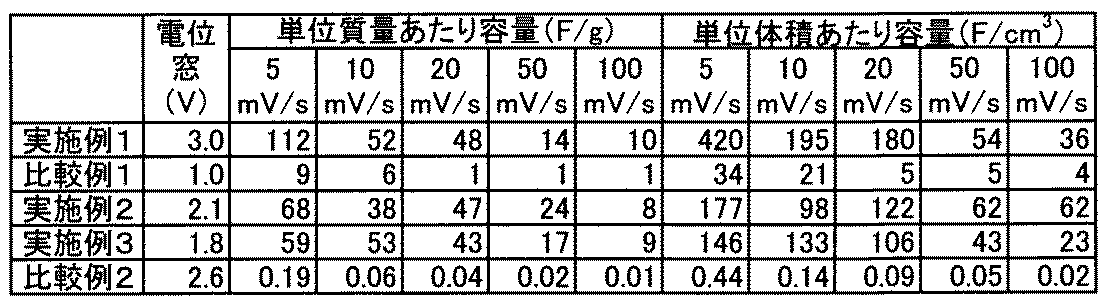
表2から理解されるように、実施例1~3では、10μm以上の大きい電極厚みであっても、1.5V以上、好ましくは2.0V以上、より好ましくは3.0Vの電位窓が得られ、例えば電圧走査速度20mV/sで100F/cm3以上、好ましくは180F/cm3の電極活物質(MXene)単位体積あたり容量が得られた。他方、比較例1~2では、同じく電圧走査速度20mV/sにおいて、電極活物質(MXene)単位体積あたり容量は5F/cm3以下であり、極めて小さかった。
本発明の電気化学キャパシタは、蓄電デバイスとして幅広く様々な分野に利用可能であるが、これに限定されない。
1a、1b、1c Mn+1Xn層
3a、5a、3b、5b、3c、5c 修飾または終端T
7a、7b、7c MXene層
10 MXene(層状材料)
11 容器(セル)
13 非水電解液
15a、15b 電極
17 セパレータ
20 電気化学キャパシタ
A、B 端子
3a、5a、3b、5b、3c、5c 修飾または終端T
7a、7b、7c MXene層
10 MXene(層状材料)
11 容器(セル)
13 非水電解液
15a、15b 電極
17 セパレータ
20 電気化学キャパシタ
A、B 端子
Claims (6)
- 2つの電極が非水電解液中に離間して配置された電気化学キャパシタであって、
前記2つの電極のいずれかが、電極活物質として、複数の層を含む層状材料であって、各層が、以下の式:
Mn+1Xn
(式中、Mは、少なくとも1種の第3、4、5、6、7族金属であり、
Xは、炭素原子、窒素原子またはそれらの組み合わせであり、
nは、1、2または3である)
で表され、かつ、各XがMの八面体アレイ内に位置する結晶格子を有し、各層の互いに対向する2つの表面の少なくとも一方に、水酸基、フッ素原子、酸素原子および水素原子からなる群より選択される少なくとも1種の修飾または終端Tを有する層状材料を含み、
前記非水電解液が、非水溶媒と、該非水溶媒中でプロトンを生じる電解質とを含む、電気化学キャパシタ。 - 前記非水溶媒が、イオン液体である、請求項1に記載の電気化学キャパシタ。
- 前記非水溶媒が、非プロトン性溶媒である、請求項1または2に記載の電気化学キャパシタ。
- 前記非プロトン性溶媒が、アセトニトリル、プロピレンカーボネート、エチレンカーボネート、ジメチルカーボネート、エチルメチルカーボネート、およびジエチルカーボネートから成る群より選択される少なくとも1種を含む、請求項3に記載の電気化学キャパシタ。
- 前記式において、Mがチタンであり、Xが炭素原子または窒素原子である、請求項1~4のいずれかに記載の電気化学キャパシタ。
- 前記2つの電極のうち、電極活物質として前記層状材料を含む電極が負極であり、もう一方の電極が電極活物質として炭素を含む正極である、請求項1~5のいずれかに記載の電気化学キャパシタ。
Applications Claiming Priority (4)
| Application Number | Priority Date | Filing Date | Title |
|---|---|---|---|
| US201662404935P | 2016-10-06 | 2016-10-06 | |
| US62/404,935 | 2016-10-06 | ||
| US201762554164P | 2017-09-05 | 2017-09-05 | |
| US62/554,164 | 2017-09-05 |
Publications (1)
| Publication Number | Publication Date |
|---|---|
| WO2018066549A1 true WO2018066549A1 (ja) | 2018-04-12 |
Family
ID=61831732
Family Applications (1)
| Application Number | Title | Priority Date | Filing Date |
|---|---|---|---|
| PCT/JP2017/035943 Ceased WO2018066549A1 (ja) | 2016-10-06 | 2017-10-03 | 電気化学キャパシタ |
Country Status (1)
| Country | Link |
|---|---|
| WO (1) | WO2018066549A1 (ja) |
Cited By (12)
| Publication number | Priority date | Publication date | Assignee | Title |
|---|---|---|---|---|
| WO2020075718A1 (en) * | 2018-10-10 | 2020-04-16 | Murata Manufacturing Co., Ltd. | Electrochemical capacitor |
| WO2020242982A1 (en) * | 2019-05-24 | 2020-12-03 | Drexel University | Mxene-polymer separators for li-ion batteries |
| JPWO2021025026A1 (ja) * | 2019-08-05 | 2021-02-11 | ||
| CN112830491A (zh) * | 2020-03-16 | 2021-05-25 | 四川大学 | MnAlCn-1相粉末的制备方法 |
| WO2021124958A1 (ja) * | 2019-12-16 | 2021-06-24 | 株式会社村田製作所 | 電気化学キャパシタ |
| WO2021124957A1 (ja) * | 2019-12-16 | 2021-06-24 | 株式会社村田製作所 | 電気化学キャパシタおよび電気化学キャパシタ用電極の製造方法 |
| JPWO2022050114A1 (ja) * | 2020-09-02 | 2022-03-10 | ||
| WO2023048087A1 (en) * | 2021-09-24 | 2023-03-30 | Murata Manufacturing Co., Ltd. | Two-dimensional particles, conductive film, conductive paste and method for producing two-dimensional particles |
| WO2023047861A1 (ja) * | 2021-09-27 | 2023-03-30 | 株式会社村田製作所 | 導電性2次元粒子含有組成物、導電性膜、および導電性2次元粒子含有組成物の製造方法 |
| CN116195007A (zh) * | 2020-08-03 | 2023-05-30 | 株式会社村田制作所 | 导电性复合材料 |
| US11830672B2 (en) | 2016-11-23 | 2023-11-28 | KYOCERA AVX Components Corporation | Ultracapacitor for use in a solder reflow process |
| US20250329504A1 (en) * | 2021-11-24 | 2025-10-23 | Administrators Of The Tulane Educational Fund | Engineering the Interlayer Spacing by Pre-Intercalation for High Performance Supercapacitor MXene Electrodes in Room Temperature Ionic Liquid |
Citations (3)
| Publication number | Priority date | Publication date | Assignee | Title |
|---|---|---|---|---|
| US20150210044A1 (en) * | 2011-06-21 | 2015-07-30 | Drexel University | Compositions comprising free-standing two-dimensional nanocrystals |
| WO2016012275A1 (en) * | 2014-07-22 | 2016-01-28 | Basf Se | Composites comprising mxenes for cathodes of lithium sulfur cells |
| JP2016063171A (ja) * | 2014-09-22 | 2016-04-25 | 国立大学法人 東京大学 | 層状化合物を含む電極材料 |
-
2017
- 2017-10-03 WO PCT/JP2017/035943 patent/WO2018066549A1/ja not_active Ceased
Patent Citations (3)
| Publication number | Priority date | Publication date | Assignee | Title |
|---|---|---|---|---|
| US20150210044A1 (en) * | 2011-06-21 | 2015-07-30 | Drexel University | Compositions comprising free-standing two-dimensional nanocrystals |
| WO2016012275A1 (en) * | 2014-07-22 | 2016-01-28 | Basf Se | Composites comprising mxenes for cathodes of lithium sulfur cells |
| JP2016063171A (ja) * | 2014-09-22 | 2016-04-25 | 国立大学法人 東京大学 | 層状化合物を含む電極材料 |
Cited By (20)
| Publication number | Priority date | Publication date | Assignee | Title |
|---|---|---|---|---|
| US11830672B2 (en) | 2016-11-23 | 2023-11-28 | KYOCERA AVX Components Corporation | Ultracapacitor for use in a solder reflow process |
| WO2020075718A1 (en) * | 2018-10-10 | 2020-04-16 | Murata Manufacturing Co., Ltd. | Electrochemical capacitor |
| WO2020242982A1 (en) * | 2019-05-24 | 2020-12-03 | Drexel University | Mxene-polymer separators for li-ion batteries |
| JPWO2021025026A1 (ja) * | 2019-08-05 | 2021-02-11 | ||
| WO2021025026A1 (ja) * | 2019-08-05 | 2021-02-11 | 株式会社村田製作所 | 導電性材料、導電性フィルム、電気化学キャパシタ、導電性材料の製造方法および導電性フィルムの製造方法 |
| JP7001207B2 (ja) | 2019-08-05 | 2022-01-19 | 株式会社村田製作所 | 導電性材料、導電性フィルム、電気化学キャパシタ、導電性材料の製造方法および導電性フィルムの製造方法 |
| US12033809B2 (en) | 2019-08-05 | 2024-07-09 | Murata Manufacturing Co., Ltd. | Conductive material, conductive film, electrochemical capacitor, conductive material production method, and conductive film production method |
| WO2021124958A1 (ja) * | 2019-12-16 | 2021-06-24 | 株式会社村田製作所 | 電気化学キャパシタ |
| WO2021124957A1 (ja) * | 2019-12-16 | 2021-06-24 | 株式会社村田製作所 | 電気化学キャパシタおよび電気化学キャパシタ用電極の製造方法 |
| CN112830491A (zh) * | 2020-03-16 | 2021-05-25 | 四川大学 | MnAlCn-1相粉末的制备方法 |
| CN112830491B (zh) * | 2020-03-16 | 2023-03-24 | 四川大学 | MnAlCn-1相粉末的制备方法 |
| CN116195007A (zh) * | 2020-08-03 | 2023-05-30 | 株式会社村田制作所 | 导电性复合材料 |
| JP7501645B2 (ja) | 2020-09-02 | 2024-06-18 | 株式会社村田製作所 | 導電性2次元粒子およびその製造方法 |
| JPWO2022050114A1 (ja) * | 2020-09-02 | 2022-03-10 | ||
| WO2023048087A1 (en) * | 2021-09-24 | 2023-03-30 | Murata Manufacturing Co., Ltd. | Two-dimensional particles, conductive film, conductive paste and method for producing two-dimensional particles |
| JPWO2023047861A1 (ja) * | 2021-09-27 | 2023-03-30 | ||
| WO2023047861A1 (ja) * | 2021-09-27 | 2023-03-30 | 株式会社村田製作所 | 導電性2次元粒子含有組成物、導電性膜、および導電性2次元粒子含有組成物の製造方法 |
| JP7670151B2 (ja) | 2021-09-27 | 2025-04-30 | 株式会社村田製作所 | 導電性2次元粒子含有組成物、導電性膜、および導電性2次元粒子含有組成物の製造方法 |
| US12509592B2 (en) | 2021-09-27 | 2025-12-30 | Murata Manufacturing Co., Ltd. | Conductive two-dimensional particle-containing composition, conductive film, and method of producing conductive two-dimensional particle-containing composition |
| US20250329504A1 (en) * | 2021-11-24 | 2025-10-23 | Administrators Of The Tulane Educational Fund | Engineering the Interlayer Spacing by Pre-Intercalation for High Performance Supercapacitor MXene Electrodes in Room Temperature Ionic Liquid |
Similar Documents
| Publication | Publication Date | Title |
|---|---|---|
| WO2018066549A1 (ja) | 電気化学キャパシタ | |
| Yin et al. | Electrochemical zinc ion capacitors: fundamentals, materials, and systems | |
| Dong et al. | Multivalent metal ion hybrid capacitors: a review with a focus on zinc-ion hybrid capacitors | |
| Tian et al. | An aqueous metal-ion capacitor with oxidized carbon nanotubes and metallic zinc electrodes | |
| JP6195236B2 (ja) | アルミニウム二次電池 | |
| Kwabi et al. | Controlling solution-mediated reaction mechanisms of oxygen reduction using potential and solvent for aprotic lithium–oxygen batteries | |
| Chodankar et al. | An innovative concept of use of redox-active electrolyte in asymmetric capacitor based on MWCNTs/MnO2 and Fe2O3 thin films | |
| Yi et al. | Durable sodium battery with a flexible Na3Zr2Si2PO12–PVDF–HFP composite electrolyte and sodium/carbon cloth anode | |
| Ma et al. | Multilayered paper-like electrodes composed of alternating stacked mesoporous Mo 2 N nanobelts and reduced graphene oxide for flexible all-solid-state supercapacitors | |
| Katakabe et al. | Electric double-layer capacitors using “bucky gels” consisting of an ionic liquid and carbon nanotubes | |
| Chae et al. | Nanostructured materials for the construction of asymmetrical supercapacitors | |
| WO2019181526A1 (ja) | 電気化学キャパシタ | |
| US20110261502A1 (en) | Charge storage device architecture for increasing energy and power density | |
| CN114026663A (zh) | 导电性材料、导电性薄膜、电化学电容器、导电性材料的制造方法及导电性薄膜的制造方法 | |
| Singh et al. | Designing one dimensional Co-Ni/Co3O4-NiO core/shell nano-heterostructure electrodes for high-performance pseudocapacitor | |
| US20120050950A1 (en) | Lithium ion capacitor | |
| WO2020004173A1 (ja) | 電気化学キャパシタ | |
| WO2020179585A1 (ja) | 電気化学キャパシタ | |
| Guo et al. | High current enabled stable lithium anode for ultralong cycling life of lithium–oxygen batteries | |
| US20180047519A1 (en) | Graphene nanoribbon-based materials and their use in electronic devices | |
| JP6208443B2 (ja) | 二次電池用負極およびそれを用いた二次電池 | |
| Xu et al. | MoO 3@ Ni nanowire array hierarchical anode for high capacity and superior longevity all-metal-oxide asymmetric supercapacitors | |
| Rehman et al. | Transition Metal Dichalcogenides, Conducting Polymers, and Their Nanocomposites as Supercapacitor Electrode Materials | |
| JP2019186512A (ja) | 電極シートと電気化学的エネルギー貯蔵素子 | |
| JP7156626B2 (ja) | 二次電池用電極材料及びそれを用いた高出力密度二次電池 |
Legal Events
| Date | Code | Title | Description |
|---|---|---|---|
| 121 | Ep: the epo has been informed by wipo that ep was designated in this application |
Ref document number: 17858387 Country of ref document: EP Kind code of ref document: A1 |
|
| NENP | Non-entry into the national phase |
Ref country code: DE |
|
| 122 | Ep: pct application non-entry in european phase |
Ref document number: 17858387 Country of ref document: EP Kind code of ref document: A1 |
|
| NENP | Non-entry into the national phase |
Ref country code: JP |