WO2018043696A1 - ラジカル重合による分子量分布を制御されたポリマーの製造方法 - Google Patents
ラジカル重合による分子量分布を制御されたポリマーの製造方法 Download PDFInfo
- Publication number
- WO2018043696A1 WO2018043696A1 PCT/JP2017/031550 JP2017031550W WO2018043696A1 WO 2018043696 A1 WO2018043696 A1 WO 2018043696A1 JP 2017031550 W JP2017031550 W JP 2017031550W WO 2018043696 A1 WO2018043696 A1 WO 2018043696A1
- Authority
- WO
- WIPO (PCT)
- Prior art keywords
- liquid
- polymer
- electrospray
- phase
- liquid sample
- Prior art date
- Legal status (The legal status is an assumption and is not a legal conclusion. Google has not performed a legal analysis and makes no representation as to the accuracy of the status listed.)
- Ceased
Links
Images

Classifications
-
- C—CHEMISTRY; METALLURGY
- C08—ORGANIC MACROMOLECULAR COMPOUNDS; THEIR PREPARATION OR CHEMICAL WORKING-UP; COMPOSITIONS BASED THEREON
- C08F—MACROMOLECULAR COMPOUNDS OBTAINED BY REACTIONS ONLY INVOLVING CARBON-TO-CARBON UNSATURATED BONDS
- C08F2/00—Processes of polymerisation
-
- C—CHEMISTRY; METALLURGY
- C08—ORGANIC MACROMOLECULAR COMPOUNDS; THEIR PREPARATION OR CHEMICAL WORKING-UP; COMPOSITIONS BASED THEREON
- C08F—MACROMOLECULAR COMPOUNDS OBTAINED BY REACTIONS ONLY INVOLVING CARBON-TO-CARBON UNSATURATED BONDS
- C08F2/00—Processes of polymerisation
- C08F2/58—Polymerisation initiated by direct application of electric current
Definitions
- the present invention relates to a method for producing a polymer whose molecular weight distribution is controlled by radical polymerization. More specifically, a polymer having a relatively narrow molecular weight distribution can be produced without using an additive such as a surfactant or a dispersant by performing radical polymerization in micro droplets generated by submerged electrospray method. It relates to a method that can be performed.
- Radical polymerization is a general method for polymerizing monomers having a double bond between carbon atoms (carbon-carbon double bond, C ⁇ C).
- a monomer and a polymerization initiator are dissolved in a solvent, and free radicals are generated from the polymerization initiator by heat or light to carry out the polymerization reaction.
- Such radical reaction by free radicals is a high-speed reaction, and the reaction is completed in a short time. However, the reaction is difficult to control, and a polymer having a broad molecular weight distribution is usually generated.
- a method of controlling the molecular weight distribution by a process method is also known.
- a radical polymerization method using a microreactor is known.
- it is not suitable for synthesizing a polymer having a molecular weight of about tens of thousands, and for synthesizing a polymer having a higher molecular weight, there are problems such as blockage of a channel. .
- Patent Document 1 An in-liquid electrospray method in which a liquid sample is electrostatically sprayed in a medium liquid placed in an electric field has attracted attention (Patent Document 1).
- a first liquid spray nozzle (ESN1) for electrostatically spraying a first liquid sample containing a predetermined compound into an electric field and a second liquid sample containing a predetermined compound are applied to the electric field.
- a second electrospray nozzle (ESN2) for electrostatic spraying is installed in the medium liquid, a potential difference is applied between ESN1 and ESN2, and positively and negatively charged droplets are removed from ESN1 and ESN2.
- Electrostatic spraying causes positively charged droplets and negatively charged droplets to collide and fuse by electrostatic attraction.
- each of the ESN nozzles is charged with a positively or negatively charged metal ion solution droplet and a reductant solution droplet charged oppositely to the metal ion solution droplet.
- the metal nanoparticles are synthesized by electrostatic spraying, colliding and fusing in a medium liquid by electrostatic attraction, causing a reduction reaction of metal ions in the droplets (Patent Document 1).
- the present invention provides a production method capable of producing a polymer having a controlled molecular weight distribution by a simple technique when a polymer is produced by polymerizing a monomer having a double bond between carbon atoms by a radical reaction. This is the issue.
- a first liquid sample containing a monomer having a double bond between carbon atoms is electrostatically sprayed with positively or negatively charged first droplets and a first initiator containing a radical initiator.
- a method for producing a polymer by an electrospray method can be provided.
- the first liquid sample is electrostatically sprayed from a first electrospray nozzle (ESN1) placed in the medium liquid
- ESN2 electrospray nozzle
- an electrode that counters a positively or negatively charged first droplet electrostatically sprayed with a first liquid sample containing a monomer having a double bond between carbon atoms and a radical initiator.
- a method for producing a polymer by an electrospray method in a liquid which includes at least a step of obtaining a polymer by performing a polymerization reaction in a medium liquid in which is installed.
- the first liquid sample may be electrostatically sprayed from an electrospray nozzle installed in the medium liquid.
- the medium liquid includes an upper first liquid phase and a lower second liquid phase; the first droplets are electrostatically sprayed into the first liquid phase; The state arrange
- positioned in the said 2nd liquid phase may be sufficient.
- a method for producing a polymer by a submerged electrospray method in a medium liquid including a two-phase separated upper first liquid phase and a lower second liquid phase.
- a first liquid sample containing a monomer having a double bond between carbon atoms is positively or negatively charged first droplet electrostatically sprayed in the phase of the first liquid;
- a liquid phase or a second liquid sample containing a radical initiator dissolved in the second liquid phase is subjected to a polymerization reaction in a state where a counter electrode is placed in the second liquid phase.
- a method for producing a polymer by an electrospray method in liquid can be provided which includes at least a step of obtaining a polymer.
- the first liquid sample may be electrostatically sprayed from an electrospray nozzle installed in the medium liquid.
- a first liquid sample containing a monomer having a double bond between carbon atoms is electrostatically sprayed into a medium liquid in which an electric field is formed by an electrospray method in liquid, and a radical initiator is contained.
- the second liquid sample is electrostatically sprayed into a medium liquid that forms an electric field, and both are collided and fused to continuously produce a polymer whose molecular weight distribution is controlled efficiently without special stirring. can do.
- the reaction proceeds in droplets with a limited volume generated in the medium liquid by the liquid electrospray method, whereby a polymer with controlled molecular weight growth can be generated.
- the spray device includes a first droplet of the first liquid sample that is positively or negatively charged by electrostatic spraying, and a second liquid of the second liquid sample that is charged oppositely to the first droplet.
- a first droplet of the first liquid sample that is positively or negatively charged by electrostatic spraying
- a second liquid of the second liquid sample that is charged oppositely to the first droplet.
- the combination of an electrospray nozzle is provided at the point of the ease of installation.
- two electrospray nozzles are preferably opposed to each other in a medium liquid, and a potential difference is given to both.
- the electrostatically charged droplets are electrostatically sprayed, and the positively charged droplets and the negatively charged droplets are collided and fused by electrostatic attraction.
- a first liquid sample containing a monomer having a double bond between carbon atoms is electrostatically sprayed into an electric field from one electrospray nozzle in a medium liquid, and a radical initiator is discharged from the other electrospray nozzle.
- a first electrospray nozzle for electrostatic spraying a first liquid sample containing a monomer having a double bond between carbon atoms, and a second containing a radical initiator.
- a second electrospray nozzle for electrostatically spraying a liquid sample, and a reaction unit that is installed between ESN1 and ESN2 and includes a medium liquid for reacting charged droplets sprayed from ESN1 and ESN2 And a potential difference is applied between ESN1 and ESN2, and monomers and radical initiators having a double bond between carbon atoms from ESN1 and ESN2 are electrostatically sprayed to the reaction part, respectively.
- ESN1 and ESN2 provided at intervals in the medium liquid are preferably a pair or a plurality of pairs, but the number of ESN1 and ESN2 may be different.
- ESN1 and ESN2 are preferably arranged so that the first droplet and the second droplet sprayed by each can form many intersections, and more preferably, they are arranged at opposing positions.
- the in-liquid electrospray method is, for example, a method in which a liquid sample is electrostatically sprayed into a medium liquid placed in an electric field.
- a medium liquid that is sprayed from a nozzle or the like and becomes a field for radical polymerization reaction is not particularly limited as long as it can form an electric field, but has a low dielectric constant (in this specification, “low dielectric constant”). May be referred to as “rate liquid”).
- the low dielectric constant liquid examples include liquids having a relative dielectric constant of preferably 25 or less, more preferably 20 or less, still more preferably 15 or less, still more preferably 10 or less, and particularly preferably 5 or less.
- Such medium liquid is preferably a substance that is liquid at room temperature (25 ° C.), hydrocarbons such as n-hexane, pentane, decane, benzene, toluene, xylene; cyclopentyl methyl ether (relative dielectric constant 4.76), diisopropyl Ethers such as ether (dielectric constant 3.81) and methyl-t-butyl ether (dielectric constant 2.6); benzyl chloride (dielectric constant 7.0), chloroform (dielectric constant 6.15), 1- Chlorooctane (dielectric constant 5.05), carbon tetrachloride (dielectric constant 2.238), halogenated hydrocarbons such as perfluorohexane;
- halogen contained in the halogenated hydrocarbon examples include chlorine, fluorine, bromine and iodine.
- These medium liquids can be used alone or in combination of two or more.
- An electric field is formed between ESN1 and ESN2 by using a low dielectric constant liquid that does not substantially energize even if a potential difference is generated between the ESN1 side and the ESN2 side of the reaction unit, and the first liquid sample (between carbon atoms)
- a monomer having a double bond) and the second sample (radical initiator) are preferable because they can be electrostatically sprayed in the form of charged droplets.
- the amount of the medium liquid in the reaction part can be set as appropriate depending on the size of the reaction system.
- R 1 R 2 C CR 3 R 4 (I)
- R 1 , R 2 , R 3 and R 4 may be the same or different and are preferably independently a hydrogen atom, an alkyl group, an alkenyl group, an alkynyl group, an aryl group, an aryloxy group, Selected from the group consisting of alkoxy groups, acetoxy groups, formyl groups, carboxyl groups, ester groups, amide groups, nitrile groups, amino groups, nitro groups, halogen groups, boron groups, phosphine groups, sulfo groups and silyl groups, Furthermore, as a substituent, an alkyl group, an alkenyl group, an alkynyl group, an aryl group, an aryloxy group, an alkyl group, an alkenyl group, an alkynyl group, an aryl group, an aryloxy group, an alkyl group, an alkenyl group, an alkynyl group
- ethylene, propylene, butene, pentene, hexene, styrene, etc. In principle, although it is not limited to carbon number, if it mentions strongly), it is preferable. Includes hydrocarbons having 2 to 1000 carbon atoms, acrylic acid, methacrylic acid, vinyl ether, acrylonitrile, acrylamide and derivatives thereof. These may be used alone or in combination of two or more.
- Monomers that are gaseous at room temperature, such as ethylene, propylene, and butene, are preferably dissolved in a solvent that is liquid at room temperature to form the first liquid sample.
- the monomer having a double bond between carbon atoms is preferably water-soluble from the viewpoint of easy generation of electrospray, and examples thereof include acrylic acid, methacrylic acid, vinyl ether, acrylonitrile and acrylamide.
- the monomer having a double bond between carbon atoms is preferably a compound that is liquid at a reaction temperature, for example, room temperature. However, if it is solid at the reaction temperature, it can be dissolved in an appropriate solvent to form a liquid sample. . Even if the monomer is liquid at the reaction temperature, it may be dissolved in an appropriate solvent to form a liquid sample.
- the solvent used for dissolving the monomer is not particularly limited as long as it can dissolve the monomer, and examples thereof include water and alcohol (ethanol and the like). These solvents can be used alone or in combination of two or more. Such a solvent may be either highly compatible with the medium liquid or low compatible.
- the concentration of the monomer solution is not particularly limited. For example, the concentration is suitably within the range of 0.1 to 100% by mass, preferably 10 to 100% by mass, more preferably 50 to 100% by mass, and further preferably 70 to 100% by mass. Can be set.
- any one selected from azo, peroxide, redox and the like can be used, but an azo radical initiator is preferable from the viewpoint of chemical stability against high voltage.
- an azo radical initiator water-soluble ones are preferable from the viewpoint of easy generation of electrospray, and examples include azonitrile, azocarboxylic acid, azoamide, azoamidine, azoimidazoline, and one or two of these. More than types can be used.
- the amount of the radical initiator is preferably 5% by weight or less, more preferably 2% by weight or less, based on the monomer having a double bond between carbon atoms.
- the radical initiator may be used by dissolving in water or other solvent.
- the solvent used for dissolving the radical initiator is not particularly limited as long as it can dissolve the radical initiator, and examples thereof include water and alcohol (ethanol and the like). These solvents can be used alone or in combination of two or more. Such a solvent may be either highly compatible with the medium liquid or low compatible.
- the concentration of the radical initiator solution is not particularly limited, but is, for example, 0.01 to 90% by mass, preferably 0.1 to 50% by mass, more preferably 0.1 to 10% by mass, and still more preferably 0.1 to It can be appropriately set within the range of ⁇ 1% by mass.
- the solvent in the first liquid sample that is the solvent of the monomer solution and the solvent in the second liquid sample that is the solvent of the radical initiator solution each contain the same type of solvent. Is preferred.
- a polymer is produced by introducing a solution containing a monomer having a double bond between carbon atoms as a first liquid sample into one of two pumps with an electrospray nozzle capable of applying a high voltage, A solution containing a radical initiator is introduced into the other liquid sample as the second liquid sample, and the electrospray nozzles ESN1 and ESN2 are placed in the medium liquid at an interval, or ESN1 and ESN2 are placed in the first part of the reaction unit containing the medium liquid. And a second end is connected so as to allow liquid to pass through, a potential difference is applied to both, and positively and negatively charged droplets are electrostatically sprayed, and positively charged droplets and negatively charged droplets are electrostatically charged. Achieved by collision and fusion by attractive force.
- ESN1 and ESN2 provided at intervals in the medium liquid are preferably a pair or a plurality of pairs, but the number of ESN1 and ESN2 may be different.
- ESN1 and ESN2 include a stainless tube, a capillary tube whose surface is plated with a metal such as gold, and a carbon capillary tube in order to form an electric field therebetween.
- a capillary tube may be further partially covered with a metal tube such as stainless steel or a carbon tube with its tip exposed.
- the distance between ESN1 and ESN2 is not particularly limited, and can be appropriately set within a range of, for example, 1 cm or more, preferably 2 cm or more.
- the upper limit of the distance between ESN1 and ESN2 is not particularly limited, and can be appropriately set according to the dimensions of the electrospray device.
- the lower limit of the potential difference applied between ESN1 and ESN2 is not particularly limited, and can be appropriately set within a range of 0.1 kV or more, preferably 2 kV or more, for example.
- the upper limit of the potential difference applied between ESN1 and ESN2 is not particularly limited, and can be appropriately set within a range of, for example, 20 kV or less, preferably 15 kV or less.
- a method for providing a potential difference between ESN1 and ESN2 is not particularly limited.
- ESN1 and ESN2 A method of controlling the potential of ESN1 with respect to the reference potential and ESN2 with respect to the reference potential using two power supplies after setting the reference potential between the two may be used. It is only necessary to generate a potential difference between ESN1 and ESN2, and the first liquid sample droplet containing a monomer having a double bond between carbon atoms is positive, and the second liquid sample containing a radical initiator is positive. The second droplet may be negatively charged or vice versa.
- ESN1 is a positive potential
- ESN2 is a negative potential
- ESN1 is a negative potential
- ESN2 is a positive potential
- ESN1 is zero and ESN2 is negative
- the potential of ESN1 is Even if 0 and ESN2 is a positive potential, ESN1 may be a negative potential and ESN2 potential may be zero, or ESN1 may be a positive potential and ESN2 potential may be zero.
- FIG. 1 shows a specific example of an apparatus for performing an in-liquid electrospray method using two electrospray nozzles.
- First electrospray nozzle (ESN1) 11 for electrostatically spraying a first liquid sample 1 containing a monomer having a double bond between carbon atoms into an electric field, and a second liquid sample 2 containing a radical initiator
- a second electrospray nozzle (ESN2) 12 for electrostatically spraying the liquid into the electric field is opposed and installed in the medium liquid 3, and a potential difference is generated between the first electrospray nozzle 11 and the second electrospray nozzle 12.
- a power supply 13 is provided.
- the positively charged droplet 1a is electrostatically sprayed from the first electrospray nozzle 11
- the negatively charged droplet 2a is electrostatically sprayed from the second electrospray nozzle 12, and is collided and fused by electrostatic attraction.
- the polymerization reaction can be carried out.
- one electrospray nozzle may be installed in the spray device.
- a first liquid sample containing a monomer having a double bond between carbon atoms and a radical initiator is contained in one electrospray nozzle, or a first liquid sample containing a monomer having a double bond between carbon atoms is contained.
- One liquid sample can be contained in an electrospray nozzle and the radical initiator can be dissolved in the medium liquid.
- a counter electrode is installed in the medium liquid.
- the medium liquid may be one phase or may be composed of two phase liquids to be separated.
- the two-phase liquids can be placed one on top of the other, and the upper first liquid and the lower second liquid are preferably a combination of a highly polar solvent and a less polar solvent.
- the combination of the first liquid and the second liquid includes kerosene and water, kerosene and methanol, kerosene and acetic acid, kerosene and acetonitrile, kerosene and dimethylformamide, kerosene and dimethylacetamide, kerosene and dimethylsulfoxide, kerosene and sulfolane.
- kerosene may be replaced by other low polarity solvents such as, but not limited to, hexane, hebutane, octane, nonane, decane, dodecane, benzene, toluene, xylene, and the like.
- the volume ratio of the first liquid to the second liquid can be arbitrarily set as long as the electrospray nozzle is immersed in only one liquid.
- the electrode is installed in the medium liquid.
- the medium liquid has two phases
- the material of the electrode is not particularly limited, but is preferably one that does not corrode by the medium liquid.
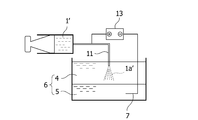
- FIG. 1 A specific example of an apparatus for performing an in-liquid electrospray method using one electrospray nozzle is shown in FIG.
- the first electrospray nozzle 11 and the second liquid are disposed in a first liquid phase 4 of a medium liquid 6 including an upper first liquid phase 4 and a lower second liquid phase 5.
- a power source 13 is installed to provide a potential difference between the electrodes 7 installed in the phase 5.
- the droplet 1a ′ of the first liquid sample is electrostatically sprayed from the first electrospray nozzle 11, and the polymerization reaction can be performed.
- the polymerization reaction can be carried out in a mode in which the medium liquid is in one phase. In this case, electrostatic spraying is performed toward the counter electrode.
- a liquid sample containing a monomer having a double bond between carbon atoms is contained in one electrospray nozzle, and in the first liquid phase or the second liquid phase.
- the polymerization reaction can be carried out in a mode including each of the second liquid samples containing the radical initiator, the situation where the polymerization reaction proceeds until reaching the electrospray nozzle and the flow path is completely blocked. Can be prevented.
- the reaction temperature depends on the solvent used for each dissolution, the solvent used in the reaction section, and the radical initiator, and is higher than the radical generation temperature of the radical initiator and What is necessary is just to be below the boiling point.
- the spray rate from each nozzle may be a rate at which electrospray is generated in the medium liquid to be used, and is preferably 1 to 500 ⁇ L / min, more preferably 1 to 100 ⁇ L / min.
- the reaction time when each electrostatic spray is continued, the reaction is progressing, but the reaction can also be terminated at the end of each electrostatic spray. If the produced polymer is continuously taken out of the system by liquid separation while spraying each component, the polymer can be continuously produced.
- the polymer After completion of the polymerization reaction using the in-liquid electrospray method, the polymer can be separated from the liquid medium by an ordinary method such as decantation, and the obtained polymer is washed as necessary.
- the molecular weight distribution of the polymer produced in the present invention is represented by the ratio Mw / Mn of the weight average molecular weight Mw and the number average molecular weight Mn, and Mw / Mn is preferably 1.0 or more and 2.0 or less. More preferably, it is 1.0 or more and 1.8 or less.
- the weight average molecular weight Mw and the number average molecular weight Mn can be determined in terms of polyethylene glycol using gel permeation chromatography (GPC).
- Example 1 The apparatus shown in FIG. 1 was used, 120 mL of n-dodecane was used as a solvent in the reaction part, ESN1 and ESN2 made of stainless steel were immersed, and the distance between the opposing ESNs was set to 20 mm. The solvent is heated to 60 ° C., 1 mL of a sodium acrylate 3.8 mol / L aqueous solution is used as the first liquid sample (ESN1 side), and 2,2′-bis (2-imidazoline-2) is used as the second liquid sample (ESN2 side).
- Example 8 Using the apparatus shown in FIG. 2, 100 mL of kerosene is used as the solvent (first liquid) in the reaction section, ESN1 made of stainless steel is immersed, 20 mL of water is used as the second liquid, and the opposing electrode is immersed in water. did. Both the solvent layer and the aqueous layer were heated to 60 ° C., and 4 mL of an aqueous solution containing 3.8 mol / L sodium acrylate as the first liquid sample and 4.4 ⁇ 10 ⁇ 6 mol / L ammonium persulfate as the radical initiator was used.
- the reaction was carried out for 15 minutes by applying -8.0 kV to ESN1 and electrostatically spraying the first liquid sample into kerosene at 0.02 mL / min from ESN1 to the counter electrode.
- the kesilon phase was removed by decantation, water was removed from the aqueous layer by lyophilization, and the remaining powder was dissolved in water and analyzed by GPC.
- Example 9 Using the apparatus shown in FIG. 2, 100 mL of dodecane is used as the solvent (first liquid) in the reaction section, ESN1 made of stainless steel is immersed, 20 mL of acetonitrile is used as the second liquid, and the opposing electrode is placed in acetonitrile. Soaked. Both the solvent layer and the acetonitrile layer were heated to 60 ° C., and 4 mL of an aqueous solution containing 3.7 mol / L sodium acrylate as the first liquid sample and 3.3 ⁇ 10 ⁇ 5 mol / L ammonium persulfate as the radical initiator was used.
- the reaction was carried out for 15 minutes by electrostatically spraying the first liquid sample into dodecane at 0.02 mL / min from ESN1 with +3.0 kV applied to ESN1 and ⁇ 3.0 kV applied to the counter electrode. .
- a polymer having a narrow molecular weight distribution can be produced by causing a monomer having a double bond between carbon atoms and a radical initiator to collide with each other using positive and negative electrosprays in a low dielectric constant liquid.
- the method of the present invention can be used for the production of various functional polymers.
- nano-level function control can be performed.
- Electrode 11 First electrospray nozzle (ESN1) 12 Second electrospray nozzle (ESN2)
Landscapes
- Chemical & Material Sciences (AREA)
- Health & Medical Sciences (AREA)
- Chemical Kinetics & Catalysis (AREA)
- Medicinal Chemistry (AREA)
- Polymers & Plastics (AREA)
- Organic Chemistry (AREA)
- Life Sciences & Earth Sciences (AREA)
- Molecular Biology (AREA)
- Polymerisation Methods In General (AREA)
- Addition Polymer Or Copolymer, Post-Treatments, Or Chemical Modifications (AREA)
Abstract
ラジカル反応により炭素原子間の二重結合を有するモノマーを重合させてポリマーを製造する場合において、簡便な手法により分子量分布が制御されたポリマーを生成させることができる製造法を提供する。炭素原子間の二重結合を有するモノマーを含有する第1液体試料が静電噴霧された正又は負に帯電した第1液滴と、ラジカル開始剤を含有する第2液体試料が静電噴霧され、第1液滴とは逆に帯電した第2液滴とを、媒体液体中で衝突させて重合反応を行い、ポリマーを得るステップを少なくとも含む、液中エレクトロスプレー法によるポリマーの製造方法を提供する。
Description
本発明は、ラジカル重合による分子量分布を制御されたポリマーの製造方法に関する。さらに詳しくは、液中エレクトロスプレー法により発生する微小液滴中でラジカル重合を行うことにより、界面活性剤や分散剤等の添加物を用いなくても、比較的狭い分子量分布を持つポリマーを製造できる方法に関するものである。
ラジカル重合は、炭素原子間の二重結合(炭素と炭素の二重結合、C=C)を有するモノマーを重合させるための一般的な方法である。通常、モノマーと重合開始剤を溶媒に溶解させ、熱あるいは光で重合開始剤よりフリーラジカルを発生させて重合反応を行なう。このようなフリーラジカルによるラジカル反応は高速な反応であり、短時間で反応は終了するが、反応の制御が困難であり、通常幅広い分子量分布を持つポリマーが生成する。
ポリマーの持つ特性は分子量分布に依存するため、より幅の狭い分子量分布を持つポリマー合成の手法が各種開発されてきた。その一つとして、リビングラジカル重合法があるが、反応速度が低いため、ある程度の分子量を持つポリマーを合成するには長い反応時間を必要とする。
他方、プロセス的な手法により分子量分布を制御する方法も知られている。その一つとして、マイクロリアクターを用いたラジカル重合法が知られているが、分子量数万程度のポリマー合成に留まり、それ以上の分子量のポリマー合成では流路の閉塞等の問題もあり、適さない。
近年、電場におかれた媒体液体中に液体試料を静電噴霧する液中エレクトロスプレー法が注目されている(特許文献1)。液中エレクトロスプレー法では、例えば、所定の化合物を含有する第1液体試料を電場中に静電噴霧するための第1エレクトロスプレーノズル(ESN1)及び所定の化合物を含有する第2液体試料を電場中に静電噴霧するための第2エレクトロスプレーノズル(ESN2)を媒体液体中に設置し、該ESN1と該ESN2との間に電位差を与え、正及び負に帯電した液滴をESN1及びESN2から静電噴霧し、正に帯電した液滴と負に帯電した液滴とを静電引力によって衝突・融合させる。具体的には、液中エレクトロスプレー法を用いて、正又は負に帯電した金属イオン溶液の液滴と、金属イオン溶液の液滴とは逆に帯電した還元剤溶液の液滴を各ESNノズルから静電噴霧し、静電引力によって媒体液体中で衝突・融合させ、金属イオンの還元反応を液滴内で起こし、金属ナノ粒子を合成している(特許文献1)。
また、液中エレクトロスプレー法において、媒体液体中で第1物質と第2物質とを反応させて反応生成物である分散体を得る際に、第2の液体相及び低誘電率液体相を重ねて配置して2相分離した媒体液体を使用して反応させ、反応生成物が低誘電率液体相で分散する場合には低誘電率液体相にて得られた分散液から反応生成物を回収する一方で、反応生成物が第2の液体相で分散する場合には第2の液体相にて得られた分散液から反応生成物を回収することによって、ポリマー粒子等を得ている。このような2相にすることにより、反応により発生した気体によってノズルの噴霧口と第2の液体相との間で通電が発生してノズルと電極の電位差が消失するのを防いでいる(特許文献2)。
本発明は、ラジカル反応により炭素原子間の二重結合を有するモノマーを重合させてポリマーを製造する場合において、簡便な手法により分子量分布が制御されたポリマーを生成させることができる製造法を提供することを課題とする。
上記のような課題を鑑み、鋭意研究開発を進めた結果、液中エレクトロスプレー法をモノマーの重合に適用することにより、驚くべきことに分子量分布が制御されたポリマーが得られることを見出し、本発明を完成した。
本発明の一つの形態では、炭素原子間の二重結合を有するモノマーを含有する第1液体試料が静電噴霧された正又は負に帯電した第1液滴と、ラジカル開始剤を含有する第2液体試料が静電噴霧された、前記第1液滴とは逆に帯電した第2液滴とを、媒体液体中で衝突させて重合反応を行い、ポリマーを得るステップを少なくとも含む、液中エレクトロスプレー法によるポリマーの製造方法が提供できる。
前記第1液体試料が前記媒体液体中に設置された第1のエレクトロスプレーノズル (ESN1)から静電噴霧され、前記第2液体試料が前記媒体液体中に設置された第2のエレクトロスプレーノズル(ESN2)から静電噴霧されてもよい。
本発明の別の形態では、炭素原子間の二重結合を有するモノマーとラジカル開始剤を含有する第1液体試料が静電噴霧された正又は負に帯電した第1液滴を、対抗する電極を設置した媒体液体中で重合反応させ、ポリマーを得るステップを少なくとも含む、液中エレクトロスプレー法によるポリマーの製造方法が提供できる。
前記第1液体試料が前記媒体液体中に設置されたエレクトロスプレーノズルから静電噴霧されてもよい。
前記媒体液体が上層の第1の液体の相と下層の第2の液体の相とを含み、前記第1液滴は、前記第1の液体の相中に静電噴霧され、前記電極は、前記第2の液体の相中に配置された状態であってもよい。
本発明の更に別の形態では、2相分離した上層の第1の液体の相と下層の第2の液体の相とを含む媒体液体中における、液中エレクトロスプレー法によるポリマーの製造方法であって、炭素原子間の二重結合を有するモノマーを含有する第1液体試料が前記第1の液体の相中で静電噴霧された正又は負に帯電した第1液滴と、前記第1の液体の相又は前記第2の液体の相中に溶解させた、ラジカル開始剤を含有する第2液体試料とを、対抗する電極を前記第2の液体の相中で設置した状態で重合反応させ、ポリマーを得るステップを少なくとも含む、液中エレクトロスプレー法によるポリマーの製造方法が提供できる。
前記第1液体試料が前記媒体液体中に設置されたエレクトロスプレーノズルから静電噴霧されてもよい。
本発明によれば、液中エレクトロスプレー法により、炭素原子間の二重結合を持つモノマーを含有する第1液体試料を、電場を形成した媒体液体中に静電噴霧し、ラジカル開始剤を含有する第2液体試料を、電場を形成した媒体液体中に静電噴霧し、両者を衝突・融合させることにより、特別な撹拌を行うことなく効率よく分子量分布が制御されたポリマーを連続的に製造することができる。液体エレクトロスプレー法により媒体液体中で生成する体積が微小に限定された液滴内で反応が進行することにより、分子量成長が制御されたポリマーを生成させることができる。
以下、本発明を実施するための形態として、液中エレクトロスプレー法を用いたラジカル重合によるポリマー製造方法の典型的な実施形態を説明するが、本発明は記載の具体的な実施形態に限定はされない。
噴霧装置は、ある実施形態においては、静電噴霧により、正又は負に帯電した第1液体試料の第1液滴と、第1液滴とは逆に帯電した第2液体試料の第2液滴を、媒体液体中で衝突できる装置であれば特に限定されないが、設置の容易さの点において好ましくはエレクトロスプレーノズルの組合せを備える。
2台のエレクトロスプレーノズルを用いて液中エレクトロスプレー法を行う場合を例にとると、例えば、2台のエレクトロスプレーノズルを媒体液体中で好ましくは対向させ、両者に電位差を与え、正及び負に帯電した液滴を静電噴霧し、正に帯電した液滴と負に帯電した液滴とを静電引力によって衝突・融合させる。このとき、媒体液体中で一方のエレクトロスプレーノズルから炭素原子間の二重結合を持つモノマーを含有する第1液体試料を電場中に静電噴霧し、もう一方のエレクトロスプレーノズルからラジカル開始剤を含有する第2液体試料を電場中に静電噴霧し、それらの液滴を衝突・融合させることにより、特別な撹拌を行うことなく効率よく分子量分布が制御されたポリマーを製造することができる。
2台のエレクトロスプレーノズルを用いて液中エレクトロスプレー法を行う場合を例にとると、例えば、2台のエレクトロスプレーノズルを媒体液体中で好ましくは対向させ、両者に電位差を与え、正及び負に帯電した液滴を静電噴霧し、正に帯電した液滴と負に帯電した液滴とを静電引力によって衝突・融合させる。このとき、媒体液体中で一方のエレクトロスプレーノズルから炭素原子間の二重結合を持つモノマーを含有する第1液体試料を電場中に静電噴霧し、もう一方のエレクトロスプレーノズルからラジカル開始剤を含有する第2液体試料を電場中に静電噴霧し、それらの液滴を衝突・融合させることにより、特別な撹拌を行うことなく効率よく分子量分布が制御されたポリマーを製造することができる。
本発明の一つの形態では、炭素原子間の二重結合を持つモノマーを含有する第1液体試料を静電噴霧するための第1エレクトロスプレーノズル(ESN1)と、ラジカル開始剤を含有する第2液体試料を静電噴霧するための第2エレクトロスプレーノズル(ESN2)と、ESN1及びESN2の間に設置され、ESN1及びESN2から噴霧される帯電した液滴を反応させるための媒体液体を含む反応部とを有する反応系を用意し、ESN1とESN2との間に電位差を与えて、ESN1及びESN2から炭素原子間の二重結合を持つモノマー及びラジカル開始剤をそれぞれ反応部へ静電噴霧し、反応部においてそれぞれ正負に帯電した炭素原子間の二重結合を持つモノマーを含有する第1液体試料の第1液滴とラジカル開始剤を含有する第2液体試料の第2液滴とを静電引力によって衝突・融合させることにより反応させて分子量分布が制御されたポリマーを得ることができる、液中エレクトロスプレー法によるポリマー製造方法を提供する。
媒体液体中に間隔を開けて設けるESN1とESN2とは一対や複数対のように対となっていることが好ましいが、ESN1とESN2との数が異なっていてもよい。ESN1とESN2は、それぞれが噴霧する第1液滴と第2液滴が多くの交点を形成できるように配置することが好ましく、より好ましくは対向する位置に配置する。
媒体液体中に間隔を開けて設けるESN1とESN2とは一対や複数対のように対となっていることが好ましいが、ESN1とESN2との数が異なっていてもよい。ESN1とESN2は、それぞれが噴霧する第1液滴と第2液滴が多くの交点を形成できるように配置することが好ましく、より好ましくは対向する位置に配置する。
液中エレクトロスプレー法は、例えば、電場におかれた媒体液体中に液体試料を静電噴霧する方法である。液体試料がノズル等から噴霧され、ラジカル重合反応の場となる媒体液体は、電場を形成することができるものであれば特に限定されないが、誘電率が低いもの(本明細書において、「低誘電率液体」と示すこともある。)が好ましい。
低誘電率液体としては、比誘電率が、好ましくは25以下、より好ましくは20以下、さらに好ましくは15以下、さらにより好ましくは10以下、特に好ましくは5以下である液体が挙げられる。かかる媒体液体としては、室温(25℃)で液体である物質が好ましく、n-ヘキサン、ペンタン、デカン、ベンゼン、トルエン、キシレン等の炭化水素;シクロペンチルメチルエーテル(比誘電率4.76)、ジイソプロピルエーテル(比誘電率3.81)、メチル-t-ブチルエーテル(比誘電率2.6)等のエーテル;塩化ベンジル(比誘電率7.0)、クロロホルム(比誘電率6.15)、1-クロロオクタン(比誘電率5.05)、四塩化炭素(比誘電率2.238)、パーフルオロヘキサン等のハロゲン化炭化水素;エタノール(比誘電率24.55)、1-ブタノール(比誘電率17.51)、1-ペンタノール(比誘電率13.9)、1-オクタノール(比誘電率10.3)等のアルコール等が挙げられる。ハロゲン化炭化水素に含まれるハロゲンとしては、塩素、フッ素、臭素、ヨウ素等が挙げられる。これらの媒体液体は1種単独で又は2種類以上を混合して用いることができる。
反応部のESN1側とESN2側で電位差を生じさせても実質的に通電しない低誘電率液体を用いることによって、ESN1とESN2との間に電場が形成され、第1液体試料(炭素原子間の二重結合を持つモノマー)及び第2試料(ラジカル開始剤)を帯電した液滴状で静電噴霧することができるため好ましい。なお、反応部における媒体液体の量は反応系のサイズによって適宜設定できる。
反応部のESN1側とESN2側で電位差を生じさせても実質的に通電しない低誘電率液体を用いることによって、ESN1とESN2との間に電場が形成され、第1液体試料(炭素原子間の二重結合を持つモノマー)及び第2試料(ラジカル開始剤)を帯電した液滴状で静電噴霧することができるため好ましい。なお、反応部における媒体液体の量は反応系のサイズによって適宜設定できる。
原料として用いることができる炭素原子間の二重結合を持つモノマーとしては、任意のものを用いることができるが、好ましくは下記一般式(I)で表されるものを用いることができる。
R1R2C=CR3R4 ・・・(I)
上式中、R1、R2、R3及びR4は、同じでも異なってもよく、独立して、好ましくは、水素原子、アルキル基、アルケニル基、アルキニル基、アリール基、アリールオキシ基、アルコキシ基、アセトキシ基、ホルミル基、カルボキシル基、エステル基、アミド基、ニトリル基、アミノ基、ニトロ基、ハロゲン基、ボロン基、ホスフィン基、スルホ基及びシリル基からなる群から選ばれ、それらはさらに置換基としてアルキル基、アルケニル基、アルキニル基、アリール基、アリールオキシ基、アルコキシ基、アセトキシ基、ホルミル基、カルボキシル基、エステル基、アミド基、ニトリル基、アミノ基、ニトロ基、ハロゲン基、ボロン基、ホスフィン基、スルホ基及びシリル基からなる群選ばれる1つ以上を有していてもよい。また、R1、R2、R3及びR4のうちの2以上が環を形成していてもよい。
R1R2C=CR3R4 ・・・(I)
上式中、R1、R2、R3及びR4は、同じでも異なってもよく、独立して、好ましくは、水素原子、アルキル基、アルケニル基、アルキニル基、アリール基、アリールオキシ基、アルコキシ基、アセトキシ基、ホルミル基、カルボキシル基、エステル基、アミド基、ニトリル基、アミノ基、ニトロ基、ハロゲン基、ボロン基、ホスフィン基、スルホ基及びシリル基からなる群から選ばれ、それらはさらに置換基としてアルキル基、アルケニル基、アルキニル基、アリール基、アリールオキシ基、アルコキシ基、アセトキシ基、ホルミル基、カルボキシル基、エステル基、アミド基、ニトリル基、アミノ基、ニトロ基、ハロゲン基、ボロン基、ホスフィン基、スルホ基及びシリル基からなる群選ばれる1つ以上を有していてもよい。また、R1、R2、R3及びR4のうちの2以上が環を形成していてもよい。
炭素原子間の二重結合を持つモノマーとしては特に限定はされないが、例えば、エチレン、プロピレン、ブテン、ペンテン、ヘキセン及びスチレン等の(原理的に炭素数には限定されないが、強いて挙げれば)好ましくは炭素数2~1000の炭化水素、アクリル酸、メタクリル酸、ビニルエーテル、アクリロニトリル、アクリルアミド及びこれらの誘導体が挙げられる。これらは単独で用いてもよく、二種類以上を組み合わせて用いてもよい。エチレン、プロピレン及びブテンのように室温で気体であるモノマーは、好ましくは室温で液体となる溶媒に溶解させることにより第1液体試料とする。
炭素原子間の二重結合を有するモノマーは、エレクトロスプレーの発生のし易さの点から好ましくは水溶性であり、例えば、アクリル酸、メタクリル酸、ビニルエーテル、アクリロニトリル、アクリルアミドが挙げられる。
炭素原子間の二重結合を有するモノマーは、エレクトロスプレーの発生のし易さの点から好ましくは水溶性であり、例えば、アクリル酸、メタクリル酸、ビニルエーテル、アクリロニトリル、アクリルアミドが挙げられる。
炭素原子間の二重結合を持つモノマーとしては、反応温度、例えば、室温で液体である化合物が好ましいが、反応温度で固体であれば、適当な溶媒に溶解して液体試料とすることができる。なお、モノマーが反応温度で液体であっても、適当な溶媒に溶解して液体試料としてもよい。
モノマーの溶解に使用する溶媒としては、モノマーを溶解できるものであれば特に限定されず、例えば、水、アルコール(エタノール等)等が挙げられる。これらの溶媒は1種単独で又は2種類以上を混合して用いることができる。かかる溶媒としては、媒体液体に対し相溶性の高いものであっても相溶性の低いものであってもよい。
モノマー溶液の濃度は、特に限定されないが、例えば、0.1~100質量%、好ましくは10~100質量%、より好ましくは50~100質量%、さらに好ましくは70~100質量の範囲内で適宜設定することができる。
モノマーの溶解に使用する溶媒としては、モノマーを溶解できるものであれば特に限定されず、例えば、水、アルコール(エタノール等)等が挙げられる。これらの溶媒は1種単独で又は2種類以上を混合して用いることができる。かかる溶媒としては、媒体液体に対し相溶性の高いものであっても相溶性の低いものであってもよい。
モノマー溶液の濃度は、特に限定されないが、例えば、0.1~100質量%、好ましくは10~100質量%、より好ましくは50~100質量%、さらに好ましくは70~100質量の範囲内で適宜設定することができる。
ラジカル開始剤としては、アゾ系、過酸化物系、レドックス系などの中から任意のものを用いることができるが、高電圧に対する化学的安定性の点からアゾ系ラジカル開始剤が好ましい。
アゾ系ラジカル開始剤としては、エレクトロスプレーの発生のし易さの点から水溶性のものが好ましく、アゾニトリル、アゾカルボン酸、アゾアミド、アゾアミジン、アゾイミダゾリン等を挙げることができ、これらの1種類または2種類以上を使用することができる。ラジカル開始剤の量は、炭素原子間の二重結合を持つモノマーに対して、5重量%以下であることが好ましく、より好ましくは2重量%以下である。
アゾ系ラジカル開始剤としては、エレクトロスプレーの発生のし易さの点から水溶性のものが好ましく、アゾニトリル、アゾカルボン酸、アゾアミド、アゾアミジン、アゾイミダゾリン等を挙げることができ、これらの1種類または2種類以上を使用することができる。ラジカル開始剤の量は、炭素原子間の二重結合を持つモノマーに対して、5重量%以下であることが好ましく、より好ましくは2重量%以下である。
ラジカル開始剤は、水やその他の溶媒に溶解して用いてもよい。
ラジカル開始剤の溶解に使用する溶媒としては、ラジカル開始剤を溶解できるものであれば特に限定されず、例えば、水、アルコール(エタノール等)等が挙げられる。これらの溶媒は1種単独で又は2種類以上を混合して用いることができる。かかる溶媒としては、媒体液体に対し相溶性の高いものであっても相溶性の低いものであってもよい。
ラジカル開始剤溶液の濃度は、特に限定されないが、例えば、0.01~90質量%、好ましくは0.1~50質量%、より好ましくは0.1~10質量%、さらに好ましくは0.1~1質量%の範囲内で適宜設定することができる。
ラジカル開始剤の溶解に使用する溶媒としては、ラジカル開始剤を溶解できるものであれば特に限定されず、例えば、水、アルコール(エタノール等)等が挙げられる。これらの溶媒は1種単独で又は2種類以上を混合して用いることができる。かかる溶媒としては、媒体液体に対し相溶性の高いものであっても相溶性の低いものであってもよい。
ラジカル開始剤溶液の濃度は、特に限定されないが、例えば、0.01~90質量%、好ましくは0.1~50質量%、より好ましくは0.1~10質量%、さらに好ましくは0.1~1質量%の範囲内で適宜設定することができる。
モノマー溶液の溶媒である第1液体試料中の溶媒と、ラジカル開始剤溶液の溶媒である第2液体試料中の溶媒とがそれぞれ同じ種類の溶媒を含むことが、液滴を融合しやすくさせるために好ましい。
ポリマーの製造は、例えば、高電圧を与えることが可能なエレクトロスプレーノズル付の二台のポンプの一方に第1液体試料として炭素原子間の二重結合を持つモノマーを含有する溶液を導入し、もう一方に第2液体試料としてラジカル開始剤を含有する溶液を導入し、エレクトロスプレーノズルESN1とESN2を媒体液体中に間隔を開けて置くか、ESN1とESN2を媒体液体を含む反応部の第1及び第2の端に通液可能に連結し、両者に電位差を与え、正及び負に帯電した液滴を静電噴霧し、正に帯電した液滴と負に帯電した液滴とを静電引力によって衝突・融合させることにより達成される。媒体液体中に間隔を開けて設けるESN1とESN2とは一対や複数対のように対となっていることが好ましいが、ESN1とESN2との数が異なっていてもよい。
ESN1及びESN2としては、両者の間で電場を形成させるために、ステンレスチューブ、表面を金等の金属でメッキしたキャピラリーチューブ、炭素キャピラリーチューブ等が挙げられる。かかるキャピラリーチューブは、さらに、その先端が露出するような状態でステンレス等の金属チューブあるいは炭素チューブでその一部が覆われていてもよい。
ESN1とESN2との間の距離は、特に限定されず、例えば、1cm以上、好ましくは2cm以上の範囲内で適宜設定することができる。ESN1とESN2との間の距離の上限は特に限定されず、エレクトロスプレー装置の寸法に合わせて適宜設定し得る。
ESN1とESN2との間に与える電位差の下限は、特に限定されず、例えば、0.1kV以上、好ましくは2kV以上の範囲内で適宜設定することができる。ESN1とESN2との間に与える電位差の上限は、特に限定されず、例えば、20kV以下、好ましくは15kV以下の範囲内で適宜設定することができる。
ESN1とESN2との間に与える電位差を与える方法は、特に限定されず、例えば、1つの電源をESN1及びESN2に接続し、ESN1とESN2との間に電圧を印加しても、ESN1とESN2との間に基準となる電位を設定した上で、2つの電源を使用して基準となる電位に対するESN1の電位及び基準となる電位に対するESN2を制御する方法を用いてもよい。ESN1とESN2との間に電位差が生じればよく、炭素原子間の二重結合を持つモノマーを含有する第1液体試料の第1液滴が正に、ラジカル開始剤を含む第2液体試料の第2液滴が負に帯電するようにしてもよいし、その逆でもよい。例えば、ESN1を+の電位としESN2を-の電位としても、ESN1を-の電位としESN2を+の電位としても、ESN1の電位が0でESN2が-の電位であっても、ESN1の電位が0でESN2が+の電位であっても、ESN1が-の電位でESN2の電位が0であっても、ESN1が+の電位でESN2の電位が0であってもよい。
ESN1とESN2との間に与える電位差を与える方法は、特に限定されず、例えば、1つの電源をESN1及びESN2に接続し、ESN1とESN2との間に電圧を印加しても、ESN1とESN2との間に基準となる電位を設定した上で、2つの電源を使用して基準となる電位に対するESN1の電位及び基準となる電位に対するESN2を制御する方法を用いてもよい。ESN1とESN2との間に電位差が生じればよく、炭素原子間の二重結合を持つモノマーを含有する第1液体試料の第1液滴が正に、ラジカル開始剤を含む第2液体試料の第2液滴が負に帯電するようにしてもよいし、その逆でもよい。例えば、ESN1を+の電位としESN2を-の電位としても、ESN1を-の電位としESN2を+の電位としても、ESN1の電位が0でESN2が-の電位であっても、ESN1の電位が0でESN2が+の電位であっても、ESN1が-の電位でESN2の電位が0であっても、ESN1が+の電位でESN2の電位が0であってもよい。
2台のエレクトロスプレーノズルを用いて液中エレクトロスプレー法を行う装置の具体例を図1に示す。炭素原子間の二重結合を持つモノマーを含有する第1液体試料1を電場中に静電噴霧するための第1エレクトロスプレーノズル(ESN1)11と、ラジカル開始剤を含有する第2液体試料2を電場中に静電噴霧するための第2エレクトロスプレーノズル(ESN2)12を対向させ、媒体液体3中に設置し、第1エレクトロスプレーノズル11と第2エレクトロスプレーノズル12との間に電位差を与える電源13を設置する。これにより、第1エレクトロスプレーノズル11から正に帯電した液滴1aが静電噴霧され、第2エレクトロスプレーノズル12から負に帯電した液滴2aが静電噴霧され、静電引力によって衝突・融合させ、重合反応を行うことができる。
本発明の別の実施形態においては、噴霧装置に設置するエレクトロスプレーノズルは1台であってもよい。この場合は、炭素原子間の二重結合を持つモノマー及びラジカル開始剤を含有する第1液体試料を一つのエレクトロスプレーノズルに含有するか、炭素原子間の二重結合を持つモノマーを含有する第1液体試料をエレクトロスプレーノズルに含有しラジカル開始剤は媒体液体中に溶解させることができる。エレクトロスプレーノズルを1台とする場合には、対抗する電極を媒体液体中に設置する。
エレクトロスプレーノズルを1台設置する実施形態においては、媒体液体は、1相でもよく、分離する2相の液体から構成されていてもよい。2相の液体は、重ねて配置することができ、上層の第1の液体と下層の第2の液体は、極性の高い溶媒と極性の低い溶媒との組み合わせであることが好ましい。
例えば、第1の液体と第2の液体との組み合わせは、ケロシンと水、ケロシンとメタノール、ケロシンと酢酸、ケロシンとアセトニトリル、ケロシンとジメチルホルムアミド、ケロシンとジメチルアセトアミド、ケロシンとジメチルスルホキシド、ケロシンとスルホランを挙げることができ、またケロシンを他の低極性溶媒、例えばヘキサン、へブタン、オクタン、ノナン、デカン、ドデカン、ベンゼン、トルエン、キシレンなどに置き換えてもよいが、これらに限定されない。
また、第1の液体と第2の液体との体積比は、エレクトロスプレーノズルが一方の液体にのみ浸されるものであれば、任意に設定できる。
例えば、第1の液体と第2の液体との組み合わせは、ケロシンと水、ケロシンとメタノール、ケロシンと酢酸、ケロシンとアセトニトリル、ケロシンとジメチルホルムアミド、ケロシンとジメチルアセトアミド、ケロシンとジメチルスルホキシド、ケロシンとスルホランを挙げることができ、またケロシンを他の低極性溶媒、例えばヘキサン、へブタン、オクタン、ノナン、デカン、ドデカン、ベンゼン、トルエン、キシレンなどに置き換えてもよいが、これらに限定されない。
また、第1の液体と第2の液体との体積比は、エレクトロスプレーノズルが一方の液体にのみ浸されるものであれば、任意に設定できる。
エレクトロスプレーノズルを1台設置する実施形態においては、電極は、媒体液体中に設置するが、媒体液体が2相である場合は、極性の高い液体の相に設置するのが好ましい。これにより、2相の界面が持つ電位に向けて帯電液滴が噴霧される。電極の材質は特に限定されないが、媒体液体により腐食しないものが好ましい。
1台のエレクトロスプレーノズルを用いて液中エレクトロスプレー法を行う装置の具体例を図2に示す。炭素原子間の二重結合を持つモノマーとラジカル開始剤を含有する第1液体試料1’を電場中に静電噴霧するための第1エレクトロスプレーノズル(ESN1)11を、2相分離するように上層の第1の液体の相4と下層の第2の液体の相5とを含む媒体液体6の第1の液体の相4中に設置し、第1エレクトロスプレーノズル11と第2の液体の相5中に設置された電極7との間に電位差を与える電源13を設置する。これにより、第1エレクトロスプレーノズル11から第1液体試料の液滴1a’が静電噴霧され、重合反応を行うことができる。
なお、図示はしないが、媒体液体が1相の態様で重合反応を行うこともできるが、この場合は対電極に向けて静電噴霧が行われる。
また、図示はしないが、1台のエレクトロスプレーノズルには炭素原子間の二重結合を持つモノマーを含有する液体試料を、及び第1の液体の相又は前記第2の液体の相中にはラジカル開始剤を含有する第2液体試料をそれぞれ含む態様で重合反応を行うこともできるが、これによりエレクトロスプレーノズルまでに至る間で重合反応が進行し、流路が閉塞してしまう事態を完全に防ぐことができきる 。
なお、図示はしないが、媒体液体が1相の態様で重合反応を行うこともできるが、この場合は対電極に向けて静電噴霧が行われる。
また、図示はしないが、1台のエレクトロスプレーノズルには炭素原子間の二重結合を持つモノマーを含有する液体試料を、及び第1の液体の相又は前記第2の液体の相中にはラジカル開始剤を含有する第2液体試料をそれぞれ含む態様で重合反応を行うこともできるが、これによりエレクトロスプレーノズルまでに至る間で重合反応が進行し、流路が閉塞してしまう事態を完全に防ぐことができきる 。
反応温度は、モノマー溶液又はラジカル開始剤溶液を用いる場合には各溶解に用いる溶媒と、反応部に使用する溶媒と、ラジカル開始剤に依存し、ラジカル開始剤のラジカル生成温度以上かつ各溶媒の沸点以下であればよい。
各ノズルからの噴霧速度は、使用する媒体液体中でエレクトロスプレーが発生する速度であればよく、1~500μL/minが好ましく、より好ましくは1~100μL/minである。
反応時間は、各静電噴霧が継続している場合には反応が進行しているが、各静電噴霧の終了とともに、反応も終了できる。各成分噴霧を行ないながら、生成したポリマーを分液により連続的に系外に取り出すなら、連続的にポリマーを製造することができる。
各ノズルからの噴霧速度は、使用する媒体液体中でエレクトロスプレーが発生する速度であればよく、1~500μL/minが好ましく、より好ましくは1~100μL/minである。
反応時間は、各静電噴霧が継続している場合には反応が進行しているが、各静電噴霧の終了とともに、反応も終了できる。各成分噴霧を行ないながら、生成したポリマーを分液により連続的に系外に取り出すなら、連続的にポリマーを製造することができる。
液中エレクトロスプレー法を用いた重合反応終了後は、デカンテーション等の通常の方法により液体媒体からポリマーを分離することができ、必要に応じて得られたポリマーを洗浄する。
本発明で製造されるポリマーの分子量分布は、重量平均分子量Mwと数平均分子量Mnの比Mw/Mnで表されるが、Mw/Mnが、好ましくは1.0以上で2.0以下であり、より好ましくは1.0以上1.8以下である。重量平均分子量Mw及び数平均分子量Mnは、ゲルパーミエーションクロマトグラフィー(GPC)を用いてポリエチレングリコール換算で求めることができる。
以下、液中エレクトロスプレー法によるラジカル重合について実施例を用いて詳述するが、本発明はかかる特定の実施形態に限定されない。
[実施例1]
図1に示す装置を使用し、反応部の溶媒としてn-ドデカン120mLを用い、ステンレス製のESN1とESN2を浸漬し、対向するESN間の距離を20mmとした。溶媒を60℃に加熱し、第1液体試料(ESN1側)としてアクリル酸ナトリウム3.8mol/L水溶液を1mL、第2液体試料(ESN2側)として2,2’-ビス(2-イミダゾリン-2-イル)[2,2’-アゾビスプロパン]・2塩酸塩6.9mmol/L水溶液1mLを用い、ESN1に+4.0kV、ESN2に-4.0kVの高電圧を印加し、各ESNより0.01mL/minで試料をドデカン中の高電場に静電噴霧し、衝突・融合することにより60分間反応を行なった。
反応後、n-ドデカン相をデカンテーションにより除き、残留したゲル状物質をTHFにて洗浄後、水に溶解させ、GPCで分析したところ、Mn=301,000、Mn/Mw=1.99のポリアクリル酸ナトリウムと分析された。
図1に示す装置を使用し、反応部の溶媒としてn-ドデカン120mLを用い、ステンレス製のESN1とESN2を浸漬し、対向するESN間の距離を20mmとした。溶媒を60℃に加熱し、第1液体試料(ESN1側)としてアクリル酸ナトリウム3.8mol/L水溶液を1mL、第2液体試料(ESN2側)として2,2’-ビス(2-イミダゾリン-2-イル)[2,2’-アゾビスプロパン]・2塩酸塩6.9mmol/L水溶液1mLを用い、ESN1に+4.0kV、ESN2に-4.0kVの高電圧を印加し、各ESNより0.01mL/minで試料をドデカン中の高電場に静電噴霧し、衝突・融合することにより60分間反応を行なった。
反応後、n-ドデカン相をデカンテーションにより除き、残留したゲル状物質をTHFにて洗浄後、水に溶解させ、GPCで分析したところ、Mn=301,000、Mn/Mw=1.99のポリアクリル酸ナトリウムと分析された。
[実施例2]
第2液体試料(ESN2側)として2,2’-ビス(2-イミダゾリン-2-イル)[2,2’-アゾビスプロパン]を用いた他は実施例1と同様に反応を行なった。反応後、n-ドデカン相をデカンテーションにより除き、残留物を水に溶解させてGPCで分析したところ、Mn=562,000、Mn/Mw=1.67のポリアクリル酸ナトリウムと分析された。
第2液体試料(ESN2側)として2,2’-ビス(2-イミダゾリン-2-イル)[2,2’-アゾビスプロパン]を用いた他は実施例1と同様に反応を行なった。反応後、n-ドデカン相をデカンテーションにより除き、残留物を水に溶解させてGPCで分析したところ、Mn=562,000、Mn/Mw=1.67のポリアクリル酸ナトリウムと分析された。
[実施例3]
第1液体試料として、アクリル酸を用いた他は実施例1と同様に反応を行なった。反応後、n-ドデカン相をデカンテーションにより除き、残留物を水に溶解させてGPCで分析したところ、Mn=51000、Mn/Mw=1.32のポリアクリル酸と分析された。
第1液体試料として、アクリル酸を用いた他は実施例1と同様に反応を行なった。反応後、n-ドデカン相をデカンテーションにより除き、残留物を水に溶解させてGPCで分析したところ、Mn=51000、Mn/Mw=1.32のポリアクリル酸と分析された。
[実施例4]
反応部の溶媒としてトルエンを用いた他は実施例1と同様に反応を行なった。反応後、トルエン相をデカンテーションにより除き、残留物を水に溶解させてGPCで分析したところ、Mn=344000、Mn/Mw=1.76のポリアクリル酸ナトリウムと分析された。
反応部の溶媒としてトルエンを用いた他は実施例1と同様に反応を行なった。反応後、トルエン相をデカンテーションにより除き、残留物を水に溶解させてGPCで分析したところ、Mn=344000、Mn/Mw=1.76のポリアクリル酸ナトリウムと分析された。
[実施例5]
電圧としてESN1に+5.0kV、ESN2に-5.0kVの高電圧を印加した他は実施例1と同様に反応を行なった。反応後、n-ドデカン相をデカンテーションにより除き、残留物を水に溶解させてGPCで分析したところ、Mn=332000、Mn/Mw=1.85のポリアクリル酸ナトリウムと分析された。
電圧としてESN1に+5.0kV、ESN2に-5.0kVの高電圧を印加した他は実施例1と同様に反応を行なった。反応後、n-ドデカン相をデカンテーションにより除き、残留物を水に溶解させてGPCで分析したところ、Mn=332000、Mn/Mw=1.85のポリアクリル酸ナトリウムと分析された。
[実施例6]
電圧としてESN1に-4.0kV、ESN2に+4.0kVの高電圧を印加した他は実施例2と同様に反応を行なった。反応後、n-ドデカン相をデカンテーションにより除き、残留物を水に溶解させてGPCで分析したところ、Mn=80000、Mn/Mw=1.10のポリアクリル酸ナトリウムと分析された。
電圧としてESN1に-4.0kV、ESN2に+4.0kVの高電圧を印加した他は実施例2と同様に反応を行なった。反応後、n-ドデカン相をデカンテーションにより除き、残留物を水に溶解させてGPCで分析したところ、Mn=80000、Mn/Mw=1.10のポリアクリル酸ナトリウムと分析された。
[実施例7]
第2液体試料(ESN2側)として2,2’-アゾビス[N-(2-カルボキシエチル)-2-メチルプロピオンアミジン]・4水和物を用い、ESN1に-4.0kV、ESN2に+4.0kVの高電圧を印加した他は実施例1と同様に反応を行なった。反応後、n-ドデカン相をデカンテーションにより除き、残留物を水に溶解させてGPCで分析したところ、Mn=81000、Mn/Mw=1.14のポリアクリル酸ナトリウムと分析された。
第2液体試料(ESN2側)として2,2’-アゾビス[N-(2-カルボキシエチル)-2-メチルプロピオンアミジン]・4水和物を用い、ESN1に-4.0kV、ESN2に+4.0kVの高電圧を印加した他は実施例1と同様に反応を行なった。反応後、n-ドデカン相をデカンテーションにより除き、残留物を水に溶解させてGPCで分析したところ、Mn=81000、Mn/Mw=1.14のポリアクリル酸ナトリウムと分析された。
[実施例8]
図2に示す装置を使用し、反応部の溶媒(第1の液体)としてケロシン100mLを用い、ステンレス製のESN1を浸漬し、第2の液体として水20mLを用い、対向する電極を水中に浸漬した。溶媒層と水層を共に60℃に加熱し、第1液体試料としてアクリル酸ナトリウム3.8mol/Lおよびラジカル開始剤として過硫酸アンモニウム4.4×10-6mol/Lを含む水溶液を4mL用い、ESN1に-8.0kV印加し、対抗電極にESN1より0.02mL/minで第1液体試料をケロシン中に静電噴霧することにより15分間反応を行なった。
反応後、ケシロン相をデカンテーションにより除き、水層より水を凍結乾燥により除去して残留した粉体を水に溶解させ、GPCで分析したところ、Mn=818,000、Mn/Mw=2.57のポリマーと分析された。
図2に示す装置を使用し、反応部の溶媒(第1の液体)としてケロシン100mLを用い、ステンレス製のESN1を浸漬し、第2の液体として水20mLを用い、対向する電極を水中に浸漬した。溶媒層と水層を共に60℃に加熱し、第1液体試料としてアクリル酸ナトリウム3.8mol/Lおよびラジカル開始剤として過硫酸アンモニウム4.4×10-6mol/Lを含む水溶液を4mL用い、ESN1に-8.0kV印加し、対抗電極にESN1より0.02mL/minで第1液体試料をケロシン中に静電噴霧することにより15分間反応を行なった。
反応後、ケシロン相をデカンテーションにより除き、水層より水を凍結乾燥により除去して残留した粉体を水に溶解させ、GPCで分析したところ、Mn=818,000、Mn/Mw=2.57のポリマーと分析された。
[実施例9]
図2に示す装置を使用し、反応部の溶媒(第1の液体)としてドデカン100mLを用い、ステンレス製のESN1を浸漬し、第2の液体としてアセトニトリル20mLを用い、対向する電極をアセトニトリル中に浸漬した。溶媒層とアセトニトリル層を共に60℃に加熱し、第1液体試料としてアクリル酸ナトリウム3.7mol/Lおよびラジカル開始剤として過硫酸アンモニウム3.3×10-5mol/Lを含む水溶液を4mL用い、ESN1に+3.0kV印加し、対抗電極に-3.0kVの印加を行なった状態でESN1より0.02mL/minで第1液体試料をドデカン中に静電噴霧することにより15分間反応を行なった。
反応後、ドデカン相をデカンテーションにより除き、アセトニトリル層に析出した粉体を回収して水に溶解させ、GPCで分析したところ、Mn=956,000、Mn/Mw=2.13のポリマーと分析された。
図2に示す装置を使用し、反応部の溶媒(第1の液体)としてドデカン100mLを用い、ステンレス製のESN1を浸漬し、第2の液体としてアセトニトリル20mLを用い、対向する電極をアセトニトリル中に浸漬した。溶媒層とアセトニトリル層を共に60℃に加熱し、第1液体試料としてアクリル酸ナトリウム3.7mol/Lおよびラジカル開始剤として過硫酸アンモニウム3.3×10-5mol/Lを含む水溶液を4mL用い、ESN1に+3.0kV印加し、対抗電極に-3.0kVの印加を行なった状態でESN1より0.02mL/minで第1液体試料をドデカン中に静電噴霧することにより15分間反応を行なった。
反応後、ドデカン相をデカンテーションにより除き、アセトニトリル層に析出した粉体を回収して水に溶解させ、GPCで分析したところ、Mn=956,000、Mn/Mw=2.13のポリマーと分析された。
[比較例1]
実施例1で用いたアクリル酸ナトリウム3.8mol/L水溶液1mLと2,2’-ビス(2-イミダゾリン-2-イル)[2,2’-アゾビスプロパン]・2塩酸塩水溶液6.9mmol/L水溶液1mLを試験管に加え、ブロックヒーターを用いて60℃で60分間反応させた。反応後ゲル状物質を水に溶解させ、GPCで分析したところ、Mn=226,000、Mn/Mw=2.37のポリアクリル酸ナトリウムと分析された。
実施例1で用いたアクリル酸ナトリウム3.8mol/L水溶液1mLと2,2’-ビス(2-イミダゾリン-2-イル)[2,2’-アゾビスプロパン]・2塩酸塩水溶液6.9mmol/L水溶液1mLを試験管に加え、ブロックヒーターを用いて60℃で60分間反応させた。反応後ゲル状物質を水に溶解させ、GPCで分析したところ、Mn=226,000、Mn/Mw=2.37のポリアクリル酸ナトリウムと分析された。
上記の結果から、低誘電率液体中で炭素原子間の二重結合を有するモノマーとラジカル開始剤をそれぞれ正負のエレクトロスプレーを用いて衝突させることにより、分子量分布が狭いポリマーを製造できることが分かる。
本発明の方法は各種機能性ポリマーの製造に利用することができる。分子量分布が制御されることにより、ナノレベルの機能制御を行なうことができる。
1、1’ 第1液体試料
1a、1a’ 第1液体試料の液滴
2 第2液体試料
2a 第2液体試料の液滴
3、6 媒体液体
4 第1の液体の相
5 第2の液体の相
7 電極
11 第1エレクトロスプレーノズル(ESN1)
12 第2エレクトロスプレーノズル(ESN2)
1a、1a’ 第1液体試料の液滴
2 第2液体試料
2a 第2液体試料の液滴
3、6 媒体液体
4 第1の液体の相
5 第2の液体の相
7 電極
11 第1エレクトロスプレーノズル(ESN1)
12 第2エレクトロスプレーノズル(ESN2)
Claims (10)
- 炭素原子間の二重結合を有するモノマーを含有する第1液体試料が静電噴霧された正又は負に帯電した第1液滴と、
ラジカル開始剤を含有する第2液体試料が静電噴霧された、前記第1液滴とは逆に帯電した第2液滴とを、
媒体液体中で衝突させて重合反応させ、ポリマーを得るステップを少なくとも含む、液中エレクトロスプレー法によるポリマーの製造方法。 - 前記第1液体試料が前記媒体液体中に設置された第1のエレクトロスプレーノズルから静電噴霧され、前記第2液体試料が前記媒体液体中に設置された第2のエレクトロスプレーノズルから静電噴霧される、請求項1に記載の液中エレクトロスプレー法によるポリマーの製造方法。
- 炭素原子間の二重結合を有するモノマーとラジカル開始剤を含有する第1液体試料が静電噴霧された正又は負に帯電した第1液滴を、対抗する電極を設置した媒体液体中で重合反応させ、ポリマーを得るステップを少なくとも含む、液中エレクトロスプレー法によるポリマーの製造方法。
- 前記第1液体試料が前記媒体液体中に設置されたエレクトロスプレーノズルから静電噴霧される、請求項3に記載の液中エレクトロスプレー法によるポリマーの製造方法。
- 前記媒体液体が上層の第1の液体の相と下層の第2の液体の相とを含み、
前記第1液滴は、前記第1の液体の相中に静電噴霧され、
前記電極は、前記第2の液体の相中に配置する、請求項3又は4に記載の製造方法。 - 2相分離した上層の第1の液体の相と下層の第2の液体の相とを含む媒体液体中における、液中エレクトロスプレー法によるポリマーの製造方法であって、
炭素原子間の二重結合を有するモノマーを含有する第1液体試料が前記第1の液体の相中で静電噴霧された正又は負に帯電した第1液滴と、
前記第1の液体の相又は前記第2の液体の相中に溶解させた、ラジカル開始剤を含有する第2液体試料とを、
対抗する電極を前記第2の液体の相中で設置した状態で重合反応させ、ポリマーを得るステップを少なくとも含む、液中エレクトロスプレー法によるポリマーの製造方法。 - 前記第1液体試料が前記第1の液体の相中に設置されたエレクトロスプレーノズルから静電噴霧される、請求項6に記載の液中エレクトロスプレー法によるポリマーの製造方法。
- 前記炭素原子間の二重結合を有するモノマーが、水溶性である請求項1~7に記載の製造方法。
- 前記ラジカル開始剤が、水溶性である請求項1~8に記載の製造方法。
- 前記ラジカル開始剤が、アゾ化合物である請求項1~9のいずれかに記載の製造方法。
Applications Claiming Priority (2)
| Application Number | Priority Date | Filing Date | Title |
|---|---|---|---|
| JP2016-171882 | 2016-09-02 | ||
| JP2016171882A JP2019196412A (ja) | 2016-09-02 | 2016-09-02 | ラジカル重合による分子量分布を制御されたポリマーの製造方法 |
Publications (1)
| Publication Number | Publication Date |
|---|---|
| WO2018043696A1 true WO2018043696A1 (ja) | 2018-03-08 |
Family
ID=61305274
Family Applications (1)
| Application Number | Title | Priority Date | Filing Date |
|---|---|---|---|
| PCT/JP2017/031550 Ceased WO2018043696A1 (ja) | 2016-09-02 | 2017-09-01 | ラジカル重合による分子量分布を制御されたポリマーの製造方法 |
Country Status (2)
| Country | Link |
|---|---|
| JP (1) | JP2019196412A (ja) |
| WO (1) | WO2018043696A1 (ja) |
Cited By (4)
| Publication number | Priority date | Publication date | Assignee | Title |
|---|---|---|---|---|
| WO2019225675A1 (ja) * | 2018-05-25 | 2019-11-28 | 三菱ケミカルエンジニアリング株式会社 | 反応生成物製造装置、反応生成物製造方法 |
| JP2020169271A (ja) * | 2019-04-03 | 2020-10-15 | 国立研究開発法人産業技術総合研究所 | 含フッ素ポリマーの製造方法 |
| CN112679631A (zh) * | 2020-12-22 | 2021-04-20 | 宁波南大光电材料有限公司 | 一种去除合成树脂中的小分子物质的方法 |
| JP2021172888A (ja) * | 2020-04-17 | 2021-11-01 | 国立大学法人福井大学 | 不織布の製造方法、不織布の製造装置、および不織布 |
Families Citing this family (1)
| Publication number | Priority date | Publication date | Assignee | Title |
|---|---|---|---|---|
| CN116024589B (zh) * | 2023-01-09 | 2025-07-08 | 陕西复融氢氨能源科技有限公司 | 一种非接触式微液滴电合成装置及合成方法 |
Citations (5)
| Publication number | Priority date | Publication date | Assignee | Title |
|---|---|---|---|---|
| JP2002012669A (ja) * | 2000-06-28 | 2002-01-15 | Amedix:Kk | 微粒高分子ゲルの製造方法 |
| JP2009074224A (ja) * | 2007-08-30 | 2009-04-09 | National Institute For Materials Science | エレクトロスピニング法とそれを実施する繊維製造装置。 |
| WO2012173262A1 (ja) * | 2011-06-16 | 2012-12-20 | 独立行政法人産業技術総合研究所 | エレクトロスプレーによるマイクロ反応場形成装置及び化学反応制御方法 |
| JP2014224337A (ja) * | 2014-03-18 | 2014-12-04 | 独立行政法人産業技術総合研究所 | 液中エレクトロスプレー法及び液中エレクトロスプレー装置 |
| JP2015213905A (ja) * | 2015-05-15 | 2015-12-03 | 国立研究開発法人産業技術総合研究所 | 液中エレクトロスプレー法及び液中エレクトロスプレー装置 |
-
2016
- 2016-09-02 JP JP2016171882A patent/JP2019196412A/ja active Pending
-
2017
- 2017-09-01 WO PCT/JP2017/031550 patent/WO2018043696A1/ja not_active Ceased
Patent Citations (5)
| Publication number | Priority date | Publication date | Assignee | Title |
|---|---|---|---|---|
| JP2002012669A (ja) * | 2000-06-28 | 2002-01-15 | Amedix:Kk | 微粒高分子ゲルの製造方法 |
| JP2009074224A (ja) * | 2007-08-30 | 2009-04-09 | National Institute For Materials Science | エレクトロスピニング法とそれを実施する繊維製造装置。 |
| WO2012173262A1 (ja) * | 2011-06-16 | 2012-12-20 | 独立行政法人産業技術総合研究所 | エレクトロスプレーによるマイクロ反応場形成装置及び化学反応制御方法 |
| JP2014224337A (ja) * | 2014-03-18 | 2014-12-04 | 独立行政法人産業技術総合研究所 | 液中エレクトロスプレー法及び液中エレクトロスプレー装置 |
| JP2015213905A (ja) * | 2015-05-15 | 2015-12-03 | 国立研究開発法人産業技術総合研究所 | 液中エレクトロスプレー法及び液中エレクトロスプレー装置 |
Cited By (9)
| Publication number | Priority date | Publication date | Assignee | Title |
|---|---|---|---|---|
| WO2019225675A1 (ja) * | 2018-05-25 | 2019-11-28 | 三菱ケミカルエンジニアリング株式会社 | 反応生成物製造装置、反応生成物製造方法 |
| JPWO2019225675A1 (ja) * | 2018-05-25 | 2021-07-08 | 三菱ケミカルエンジニアリング株式会社 | 反応生成物製造装置、反応生成物製造方法 |
| JP7288687B2 (ja) | 2018-05-25 | 2023-06-08 | 国立研究開発法人産業技術総合研究所 | 反応生成物製造装置、反応生成物製造方法 |
| JP2020169271A (ja) * | 2019-04-03 | 2020-10-15 | 国立研究開発法人産業技術総合研究所 | 含フッ素ポリマーの製造方法 |
| JP7297235B2 (ja) | 2019-04-03 | 2023-06-26 | 国立研究開発法人産業技術総合研究所 | 含フッ素ポリマーの製造方法 |
| JP2021172888A (ja) * | 2020-04-17 | 2021-11-01 | 国立大学法人福井大学 | 不織布の製造方法、不織布の製造装置、および不織布 |
| JP7511226B2 (ja) | 2020-04-17 | 2024-07-05 | 国立大学法人福井大学 | 不織布の製造方法、および不織布の製造装置 |
| CN112679631A (zh) * | 2020-12-22 | 2021-04-20 | 宁波南大光电材料有限公司 | 一种去除合成树脂中的小分子物质的方法 |
| CN112679631B (zh) * | 2020-12-22 | 2022-07-08 | 宁波南大光电材料有限公司 | 一种去除合成树脂中的小分子物质的方法 |
Also Published As
| Publication number | Publication date |
|---|---|
| JP2019196412A (ja) | 2019-11-14 |
Similar Documents
| Publication | Publication Date | Title |
|---|---|---|
| JP2019196412A (ja) | ラジカル重合による分子量分布を制御されたポリマーの製造方法 | |
| Barboiu et al. | Metal catalyzed living radical polymerization of acrylonitrile initiated with sulfonyl chlorides | |
| Fowler et al. | Aryl amidine and tertiary amine switchable surfactants and their application in the emulsion polymerization of methyl methacrylate | |
| Jiang et al. | Photoorganocatalyzed reversible-deactivation alternating copolymerization of chlorotrifluoroethylene and vinyl ethers under ambient conditions: facile access to main-chain fluorinated copolymers | |
| Wang et al. | Control of dispersity and grafting density of particle brushes by variation of ATRP catalyst concentration | |
| Rolland et al. | Effect of polymerization components on Oxygen-Tolerant Photo-ATRP | |
| Men et al. | Cationic poly (ionic liquid) with tunable lower critical solution temperature-type phase transition | |
| Anastasaki et al. | Photoinduced synthesis of α, ω-telechelic sequence-controlled multiblock copolymers | |
| Wang et al. | Enhancing mechanically induced ATRP by promoting interfacial electron transfer from piezoelectric nanoparticles to Cu catalysts | |
| Xu et al. | A robust and versatile photoinduced living polymerization of conjugated and unconjugated monomers and its oxygen tolerance | |
| Chern | Principles and applications of emulsion polymerization | |
| Anastasaki et al. | Synthesis of well-defined poly (acrylates) in ionic liquids via copper (II)-mediated photoinduced living radical polymerization | |
| Sun et al. | Preparation of well-defined polymers and DNA–polymer bioconjugates via small-volume eATRP in the presence of air | |
| Tang et al. | Effects of initiator structure on activation rate constants in ATRP | |
| Sen et al. | Surface modification approach to TiO2 nanofluids with high particle concentration, low viscosity, and electrochemical activity | |
| Yan et al. | CO2-responsive pickering emulsions stabilized by a bio-based rigid surfactant with nanosilica | |
| Alagi et al. | Fast and complete neutralization of thiocarbonylthio compounds using trialkylborane and oxygen: application to their removal from RAFT-synthesized polymers | |
| JP2017524797A (ja) | フローリアクタ中でのアクリルポリマーの合成 | |
| JP2014177538A (ja) | 重合体の製造方法 | |
| Neal et al. | Control of particle size in the self-assembly of amphiphilic statistical copolymers | |
| Hussain et al. | Charge generation in low-polarity solvents: poly (ionic liquid)-functionalized particles | |
| Maximiano et al. | Ambient temperature transition-metal-free dissociative electron transfer reversible addition–fragmentation chain transfer polymerization (DET-RAFT) of methacrylates, acrylates, and styrene | |
| Growney et al. | Star diblock copolymer concentration dictates the degree of dispersion of carbon black particles in nonpolar media: Bridging flocculation versus steric stabilization | |
| Põhako-Esko et al. | Increased conductivity of polymerized ionic liquids through the use of a nonpolymerizable ionic liquid additive | |
| Byard et al. | Cationic sterically stabilized diblock copolymer nanoparticles exhibit exceptional tolerance toward added salt |
Legal Events
| Date | Code | Title | Description |
|---|---|---|---|
| 121 | Ep: the epo has been informed by wipo that ep was designated in this application |
Ref document number: 17846699 Country of ref document: EP Kind code of ref document: A1 |
|
| NENP | Non-entry into the national phase |
Ref country code: DE |
|
| 122 | Ep: pct application non-entry in european phase |
Ref document number: 17846699 Country of ref document: EP Kind code of ref document: A1 |
|
| NENP | Non-entry into the national phase |
Ref country code: JP |