WO2018043455A1 - 高強度溶接金属 - Google Patents
高強度溶接金属 Download PDFInfo
- Publication number
- WO2018043455A1 WO2018043455A1 PCT/JP2017/030848 JP2017030848W WO2018043455A1 WO 2018043455 A1 WO2018043455 A1 WO 2018043455A1 JP 2017030848 W JP2017030848 W JP 2017030848W WO 2018043455 A1 WO2018043455 A1 WO 2018043455A1
- Authority
- WO
- WIPO (PCT)
- Prior art keywords
- amount
- weld metal
- less
- oxide
- containing oxide
- Prior art date
- Legal status (The legal status is an assumption and is not a legal conclusion. Google has not performed a legal analysis and makes no representation as to the accuracy of the status listed.)
- Ceased
Links
Images



Classifications
-
- C—CHEMISTRY; METALLURGY
- C22—METALLURGY; FERROUS OR NON-FERROUS ALLOYS; TREATMENT OF ALLOYS OR NON-FERROUS METALS
- C22C—ALLOYS
- C22C38/00—Ferrous alloys, e.g. steel alloys
-
- C—CHEMISTRY; METALLURGY
- C22—METALLURGY; FERROUS OR NON-FERROUS ALLOYS; TREATMENT OF ALLOYS OR NON-FERROUS METALS
- C22C—ALLOYS
- C22C38/00—Ferrous alloys, e.g. steel alloys
- C22C38/18—Ferrous alloys, e.g. steel alloys containing chromium
- C22C38/40—Ferrous alloys, e.g. steel alloys containing chromium with nickel
- C22C38/54—Ferrous alloys, e.g. steel alloys containing chromium with nickel with boron
-
- B—PERFORMING OPERATIONS; TRANSPORTING
- B23—MACHINE TOOLS; METAL-WORKING NOT OTHERWISE PROVIDED FOR
- B23K—SOLDERING OR UNSOLDERING; WELDING; CLADDING OR PLATING BY SOLDERING OR WELDING; CUTTING BY APPLYING HEAT LOCALLY, e.g. FLAME CUTTING; WORKING BY LASER BEAM
- B23K35/00—Rods, electrodes, materials, or media, for use in soldering, welding, or cutting
- B23K35/22—Rods, electrodes, materials, or media, for use in soldering, welding, or cutting characterised by the composition or nature of the material
- B23K35/24—Selection of soldering or welding materials proper
- B23K35/30—Selection of soldering or welding materials proper with the principal constituent melting at less than 1550°C
Definitions
- the present invention relates to a high-strength weld metal, and more particularly to a high-strength weld metal excellent in CTOD (Cracking Opening Displacement, crack tip opening displacement) characteristics among toughness evaluation criteria.
- CTOD Cross Opening Displacement, crack tip opening displacement
- the toughness required for offshore structures is a characteristic called a crack tip opening displacement (hereinafter sometimes referred to as “CTOD”) characteristic, and a weld metal having excellent CTOD characteristics and a tensile strength of 780 MPa or more is required. ing.
- CTOD crack tip opening displacement
- the CTOD characteristic is one of indexes for evaluating the fracture toughness of a structure in which a defect exists, and is calculated by measuring a CTOD value immediately before a crack progresses rapidly by a CTOD test. Even if a small test such as a conventional V-notch Charpy impact test shows a good result, a CTOD test of a welded joint of a large structure does not necessarily show a good fracture toughness value.
- the amount of O (oxygen) and the amount of Ti in a welded joint are adjusted, the amount of O is set to 20 ppm or more, and a predetermined amount or more of fine Ti oxide is secured, and the amount of O is 70 ppm at most.
- the CTOD characteristics of the electron beam welded joint are improved by suppressing the amount of coarse oxide (particle size of 2.0 ⁇ m or more).
- the oxygen contained in a welded joint is about 70 ppm at most. Oxygen is present as an oxide in the welding material before welding. Excessive suppression of oxygen after welding also affects the design of other weld metal components and suppresses the freedom of component design. become.
- Patent Document 2 discloses a technique for improving the fracture toughness value by making the amount of Ni in the welded joint more than 4% and making the hardness of the weld metal part equal to or greater than the hardness of the base metal part. Has been. However, the addition of a large amount of Ni causes an increase in cost.
- the present invention is a weld metal made in view of the above-described problems, and an object thereof is to obtain a high-strength weld metal having excellent CTOD characteristics.
- the present invention that has achieved the above problems %
- % By mass C: 0.02 to 0.12%, Si: 0.10 to 0.90%, Mn: 1.0 to 2.0%, Cu: 0 to 0.12%, Ni: 1.0 to 3.5%
- Cr more than 0 to 1.0% and Mo: 0.5 to 1.5%
- Ca 0 to 0.005%
- Ti 0 to 0.0050%
- Al 0.005 to 0.050%
- O 0.010 to 0.050%
- the balance is a weld metal consisting of Fe and inevitable impurities,
- the average equivalent circle diameter of the Al-containing oxide in the weld metal is 0.5 to 1.0 ⁇ m, and the number density of the Al-containing oxide is 0.005 to 0.015 / ⁇ m 2 .
- the contents of Al, Ti, and O (oxygen) are appropriately controlled, and the average equivalent circle diameter and number density of the Al-containing oxide are within a predetermined range. Since it is controlled, the development of unstable brittle cracks can be suppressed. For this reason, the progress of the stable ductile crack can be promoted and the CTOD characteristics can be improved. Further, since the contents of C, Mn, Cu, Ni, Cr, and Mo are controlled with each other as well as the individual contents of chemical components of the weld metal, high strength can be achieved.
- FIG. 1 is a graph showing the magnitude of adhesion work between oxides of various elements of Ti, Si, Mg, Ca and Al and a matrix (welded metal).
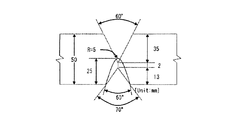
- FIG. 2 is a view showing the groove shape of the base steel plate used in the examples and the welding lamination procedure.
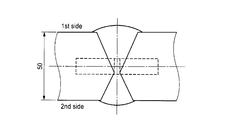
- FIG. 3A is a diagram illustrating a sampling position of the tensile test piece in the example.
- FIG. 3B is a diagram illustrating a sampling position of the CTOD test piece in the example.
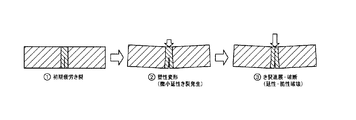
- FIG. 4A is a diagram showing a process in which a CTOD specimen is broken.
- FIG. 4B is a graph showing the relationship between the crack opening (mm) and the indentation load (kN).
- the present inventors examined in detail the crack propagation mechanism in the CTOD test in order to improve the CTOD characteristics of the weld metal.
- a ductile crack grows stably, and when it reaches a certain limit, it progresses at a stretch and leads to fracture.
- high strain and stress are generated at the crack tip. The lower the strain and stress at the crack tip, the harder the unstable brittle crack that grows at a stretch, the more stable ductile crack grows, and the higher the CTOD characteristics.
- the oxide effective for improving the CTOD characteristics is an oxide containing Al, and the present invention has been completed.
- inclusion interface when inclusions are present in the weld metal, peeling occurs at the interface between the inclusions and the matrix (hereinafter sometimes simply referred to as “inclusion interface”) due to the load, and voids are generated.
- inclusion interface When a void is generated near the crack tip, distortion and stress are also generated in the void.
- the strain and stress generated in the void near the crack tip is a dispersion of the strain and stress generated in the crack tip, and the present inventors can adjust the size and amount of the void to properly adjust the crack tip. It was thought that the strain and stress of the crack can be efficiently dispersed, and the strain and stress at the crack tip can be reduced. At the same time, the strain and stress generated in the voids were appropriately controlled, and it was considered possible to stably generate and grow ductile cracks.
- the present inventors examined the generation of voids at the inclusion interface, particularly from the viewpoint of work of adhesion at the inclusion interface.
- the adhesion work is the energy required to adhere the matrix and inclusions in the state where solid phase inclusions exist in the liquid phase matrix, and this adhesion work is small. It was thought that the adhesive force at the inclusion interface decreased after the matrix was solidified and was easily peeled off.
- the inventors focused on oxides among the inclusions, and studied the work of adhesion of these oxides for elements such as Ti, Si, Mg, Ca, and Al, which have high oxide forming ability.
- FIG. 1 shows the magnitude of work of adhesion between oxides of various elements of Ti, Si, Mg, Ca and Al and a matrix (welded metal).
- adhesion work “BJ Keene, Contact angles and work of adhesion between gerrous melts and non-metallic solids, Slag atlas, 2nd edition (1995), pp. 51, 39” is used. Further, the contact angle ⁇ between the oxides of various elements and the matrix used was a value shown in “Supervision by Samsonov, latest oxide manual, physicochemical properties, Nisso News Agency (1978)”.
- the adhesion work of Al oxide (Al 2 O 3 ) is the smallest, and Ti oxide (TiO 2 ), Si oxide (SiO 2 ) It can be seen that the adhesion work of 2 ) exceeds 1000 mJm -2 and is very large. That is, it can be seen that the Al oxide is most easily peeled off at the interface with the matrix, and voids are easily formed.
- the separation at the inclusion interface is also considered to be affected by the strength difference between the inclusion and the matrix, and the greater the strength difference, the greater the stress concentration at the inclusion interface, so the inclusion interface tends to peel off, Voids are likely to occur.
- the Al-containing oxide usually has a longitudinal elastic modulus about twice that of steel and has a very large difference in strength from the matrix. From this point of view, it is an inclusion that is likely to generate voids from the interface. It can be said.
- the Al-containing oxide is useful for forming a void having an appropriate size, and the Al-containing oxide is also effective from the viewpoint of the size of such a void.
- the Al-containing oxide means an element in which peaks of Al and O (oxygen) are detected when elemental analysis is performed by EPMA (electron beam microanalyzer), and includes elements other than Al. It may be a complex oxide. However, since the elements (Ti, Ca, Mg, etc.) forming the oxide are suppressed to a small amount in the present invention as described later, the Al-containing oxide in the present invention is preferably 5% in terms of the number of atoms. It is a single oxide of Al containing the above Al or a composite oxide containing Si and containing 5% or more of Al by atomic percentage.
- the Si oxide has a large adhesion work and the interface is less likely to be peeled off than the Al oxide, the composite oxide of Al and Si is less likely to peel off the interface than the single oxide of Al.
- the ratio of the number of Al and Si atoms in the oxide is Al> Si, the interface is sufficiently easy to peel off and voids are likely to be generated, which is preferable. I understood.
- the Al-containing oxide in the weld metal of the present invention has an average equivalent circle diameter of 0.5 ⁇ m or more, preferably 0.6 ⁇ m or more, and 1.0 ⁇ m or less, preferably 0.75 ⁇ m or less. is there.
- the void formed at the interface between the Al-containing oxide of this size and the matrix becomes larger than the size of the Al-containing oxide due to the macro deformation of the surroundings, and the size is approximately four times the area of the Al-containing oxide. It is clear from the study by the present inventors that this value is effective, and voids of such a size are effective in dispersing and reducing the distortion at the crack tip.
- the measuring method of the average equivalent circle diameter of the Al-containing oxide will be described in detail in the column of Examples described later.
- the number density of the Al-containing oxide is 0.005 (/ ⁇ m 2 ) or more, preferably 0.00, in order to effectively exhibit the effect of reducing the crack tip distortion by the void. 008 (/ ⁇ m 2 ) or more, and 0.015 (/ ⁇ m 2 ) or less, preferably 0.013 (/ ⁇ m 2 ) or less. This is because if the number density of the Al-containing oxide is too small, the effect of dispersing the strain is not sufficient, whereas if the number density is too large, the total amount of strain near the crack tip increases.
- the method for measuring the number density of the Al-containing oxide will be described in detail in the column of Examples described later.
- the chemical components of the weld metal of the present invention will be described below.
- a predetermined amount of the above-mentioned Al-containing oxide is formed, and in order to obtain a weld metal having a tensile strength of 780 MPa or more, the content of particularly strong deoxidizing elements (Ti, Al) and oxygen in the weld metal is included. It is characterized in that the content (C, Mn, Cu, Ni, Cr, Mo) of elements having a large influence on the amount and strength are mutually adjusted.
- the content of the chemical component shown below means mass%.
- the percentage (mass%) based on mass is synonymous with the percentage (weight%) based on weight.
- C 0.02 to 0.12% C is an element indispensable for ensuring the strength of the weld metal. Therefore, the C amount is set to 0.02% or more.
- the amount of C is preferably 0.03% or more, and more preferably 0.05% or more.
- the C amount is set to 0.12% or less.
- the amount of C is preferably 0.10% or less, and more preferably 0.061% or less.
- Si 0.10-0.90%
- Si is a deoxidizing element, has an action of cleaning the weld metal, and has an action of strengthening the weld metal by solid solution strengthening when it remains in the weld metal. Therefore, the Si amount is determined to be 0.10% or more.
- the amount of Si is preferably 0.19% or more, more preferably 0.30% or more.
- the amount of Si is excessive, the amount of Al in the oxide decreases at the same time that the Si is excessively contained in the oxide, and the adhesion work of the Al-containing oxide is reduced. It becomes difficult to separate from the interface of the weld metal. As a result, voids are less likely to occur and the CTOD characteristics are degraded.
- the Si amount is set to 0.90% or less.
- the amount of Si is preferably 0.70% or less, more preferably 0.68% or less, and further preferably 0.60% or less.
- Mn 1.0 to 2.0% Mn has the effect of ensuring the strength and toughness of the weld metal by refining the structure. Therefore, the amount of Mn is set to 1.0% or more.
- the amount of Mn is preferably 1.2% or more, more preferably 1.3% or more.
- the amount of Mn is set to 2.0% or less.
- the amount of Mn is preferably 1.9% or less, more preferably 1.8% or less.
- Cu 0.12% or less (including 0%) Cu is an effective element for ensuring strength and toughness. However, in the case of coated arc welding, which is generally used, the strength is increased with other elements. Too much. Therefore, the amount of Cu is set to 0.12% or less, preferably 0.07% or less, more preferably 0.06% or less. On the other hand, Cu may not be contained, but the lower limit of the amount of Cu in the case of inclusion is, for example, 0.04%.
- Ni 1.0-3.5%
- Ni is an effective element for ensuring strength and toughness. Therefore, the Ni content is determined to be 1.0% or more.
- the amount of Ni is preferably 1.3% or more, more preferably 1.5% or more, and particularly preferably 2.4% or more.
- the Ni content is determined to be 3.5% or less.
- the amount of Ni is preferably 2.5% or less.
- Cr and Mo are effective elements for ensuring strength.
- the Cr content should be greater than 0%, but is preferably 0.07% or more, and more preferably 0.15% or more.
- the amount of Mo is 0.5% or more, preferably 0.6% or more.
- the Cr content is 1.0% or less
- the Mo content is 1.5% or less.
- the amount of Cr is preferably 0.8% or less, more preferably 0.6% or less, and further preferably 0.2% or less.
- the amount of Mo is preferably 1.3% or less, more preferably 1.0% or less, and further preferably 0.77% or less.
- Cr and Mo may each be contained independently, and both may be contained simultaneously.
- Ca 0.005% or less (including 0%)
- Ca is a strong deoxidizing element and has a function of cleaning the weld metal by a deoxidizing action.
- the Ca content is preferably 0.002% or more, more preferably 0.003% or more.
- Ca forms an oxide with a small work of adhesion at the interface with the weld metal.
- the Ca content is determined to be 0.005% or less.
- the amount of Ca is more preferably 0.004% or less. Further, the Ca content may be 0%.
- Ti 0.0050% or less (including 0%) Ti has the effect of cleaning the weld metal by deoxidation.
- the Ti amount is preferably 0.0005% or more, more preferably 0.0010% or more, and further preferably 0.0020% or more.
- the Ti amount is determined to be 0.0050% or less.
- the amount of Ti is preferably 0.0040% or less, and more preferably 0.0030% or less. In addition, it may be 0% from the viewpoint of securing the Al-containing oxide described above.
- Al 0.005 to 0.050%
- Al is a strong deoxidizing element and has a function of cleaning the weld metal by a deoxidizing action.
- excellent oxide inclusions that easily peel off at the interface are generated, so that voids are likely to occur during the CTOD test, and distortion at the crack tip can be dispersed in the voids, improving CTOD characteristics. be able to. Therefore, the Al content is determined to be 0.005% or more.
- the amount of Al is preferably 0.008% or more, more preferably 0.010% or more, and further preferably 0.020% or more.
- the Al content is determined to be 0.050% or less.
- the amount of Al is preferably 0.046% or less, more preferably 0.040% or less, and still more preferably 0.030% or less.
- O 0.010 to 0.050%
- O is an element necessary for forming an appropriate amount of an Al-containing oxide. Therefore, the O amount is determined to be 0.010% or more.
- the amount of O is preferably 0.015% or more, and more preferably 0.020% or more.
- the amount of O is set to 0.050% or less.
- the amount of O is preferably 0.045% or less, and more preferably 0.040% or less.
- the chemical components of the weld metal of the present invention are as described above, and the balance is substantially iron (Fe). However, it is naturally allowed that inevitable impurities brought into the weld metal are brought into the weld metal depending on the situation of the raw materials, materials, manufacturing equipment, and the like.
- the above equation (1) is an equation calculated experimentally from the relationship between the content and strength of each element.
- Each element contained in the formula (1) is an element that affects the strength of the weld metal, and [C] + [Si] / 24 + [Mn] / 6 + [Ni] / 40 + [Cr] / 5 + [Mo ] / 4 (hereinafter referred to as X value) is 0.40 or more, the strength of the weld metal can be improved (780 MPa or more). On the other hand, if the X value exceeds 0.70, the toughness deteriorates due to the strength of the weld metal becoming too high.
- the content may be set to 0.
- the weld metal of the present invention can be obtained by performing welding while appropriately adjusting the composition of the welding material such as the coated arc welding rod to be used, the composition of the base material, and the welding conditions in consideration of the respective balances.
- a welding material for obtaining the weld metal of the present invention for example, assuming a coated arc welding, a coated arc welding rod having the following composition can be used.
- C 0.005 to 0.008%
- Si 0.5 to 0.9%
- SiO 2 2.7 to 2.9%
- Mn 1.4 to 1 .6%
- Cu 0.01% or less
- Ni 1.7-2.1%
- Cr 0.01% or less
- Mo 0.4-0.6%
- CaCO 3 9.0-9 .3%
- Ti 0.001% or less
- Al 0.20 to 0.40%
- Al 2 O 3 0.120 to 0.130%
- the balance being iron and inevitable impurities.
- arc stabilizers and slag generators general metal carbonates such as lime, metal fluorides such as fluorite, oxides such as alumina and rutile, Mg, iron powder, alkaline components, etc. Can be added. Furthermore, water glass containing sodium silicate or potassium silicate can be used as the fixing agent.
- the coating rate of the coating agent for the coated arc welding rod is not particularly limited, but is preferably 22 to 45% by mass.
- the coverage is calculated by “the mass of the coating / the total mass of the welding rod ⁇ 100”. If the coating rate of the coating agent is 22% by mass or more, the shield of the molten pool is unlikely to be insufficient, and the amount of N and the amount of diffusible hydrogen in the weld metal tend to decrease. Therefore, the toughness and crack resistance of the weld metal are likely to be improved. On the other hand, if the coverage is 45% by mass or less, the arc becomes more stable. In addition, the coverage here is the ratio of the coating agent in the whole stick
- ASTM standard A517 steel plate can be used as the base material steel plate.
- a coated welding rod having the chemical composition shown in Table 1 (the amount of each component is expressed in mass%, the balance being iron and inevitable impurities), and a groove-shaped mother shown in FIG. 2 (unit: mm) Welding was performed under the following welding conditions using a steel plate. The welding was performed according to the lamination procedure shown in FIG. In the base steel plate, C: 0.12%, Si: 0.24%, Mn: 0.79%, P: 0.005%, S: 0.003%, Cu: 0% by mass. .21%, Ni: 0.79%, Cr: 0.49%, Mo: 0.45%, V: 0.040%, B: 0.0007%, the balance being iron and inevitable impurities A steel plate was used.
- test piece A1 test piece of JIS Z2201 was taken from the position shown in FIG. 3A, and a tensile test of the weld metal was performed according to JIS Z2241. Further, CTOD specimens were collected from the position shown in FIG. 3B in accordance with WES1108 (Japan Welding Association standard), and the CTOD value was measured at ⁇ 40 ° C.
- the tensile strength (TS) and the CTOD value are 780 MPa or more and 0.10 mm or more, respectively, and in the CTOD test, the fracture in which brittle cracks do not occur and grow until the load under test reaches the maximum value.
- TS tensile strength
- CTOD CTOD
- a failure in which a brittle crack occurred and grew until the load reached the maximum value was rejected as an unstable failure.
- the stable fracture and the unstable fracture were judged as follows.
- FIG. 4A shows a process in which destruction occurs in the CTOD test piece.
- FIG. 4B shows the relationship between the crack opening (mm) and the indentation load (kN). Then, a ductile fracture and a ductile fracture up to the maximum load, and a brittle fracture after that were evaluated as a stable fracture, and a brittle fracture up to the maximum load was evaluated as an unstable fracture
- the analysis target elements of EDX are C, Si, Mn, Ni, Cr, Mo, Ca, Al, Ti, Cu, and O (oxygen), and the atomic percentage of Al in the Al-containing oxide is the analysis target element. It is the atomic percentage of Al when the total is normalized to 100%. In the observation, inclusions having a major axis having a size of less than 0.1 ⁇ m were excluded from the measurement target because it was difficult to analyze with EPMA.
- Test No. Nos. 1 to 6 are excellent in tensile strength and CTOD value because the chemical composition of the weld metal, the average equivalent circle diameter of the Al-containing oxide, and the number density of the Al-containing oxide satisfy the requirements of the present invention. It resulted in destruction.
- test no. Nos. 7 to 14 are those in which at least one of the chemical components of the weld metal, the average equivalent circle diameter of the Al-containing oxide, and the number density of the Al-containing oxide deviated from the requirements of the present invention. At least one of stable fracture and unstable fracture) was inferior.
- Test No. 7 since the amount of Si was larger than the range of the present invention, CTOD deteriorated and unstable destruction occurred. In addition, Test No. In No. 7, the atomic percentage of Si in the oxide was larger than the atomic percentage of Al.
- Test No. 8 since the amount of Si was larger than the range of the present invention, CTOD deteriorated and unstable destruction occurred.
- Test No. 7 the atomic percentage of Si in the oxide was larger than the atomic percentage of Al. Further, the atomic percentage of Al in the oxide was as low as 1.2%.
Landscapes
- Chemical & Material Sciences (AREA)
- Engineering & Computer Science (AREA)
- Materials Engineering (AREA)
- Mechanical Engineering (AREA)
- Metallurgy (AREA)
- Organic Chemistry (AREA)
- Nonmetallic Welding Materials (AREA)
Abstract
本発明は、質量%で、C:0.02~0.12%、Si:0.10~0.90%、Mn:1.0~2.0%、Cu:0~0.12%、Ni:1.0~3.5%、Cr:0超~1.0%及びMo:0.5~1.5%から選ばれる少なくとも1種、Ca:0~0.005%、Ti:0~0.0050%、Al:0.005~0.050%、及びO:0.010~0.050%を含有し、残部がFe及び不可避的不純物からなる溶接金属であって、前記溶接金属中の、Al含有酸化物の平均円相当径が0.5~1.0μmであり、前記Al含有酸化物の個数密度が0.005~0.015/μm2であり、C、Si、Mn、Ni、Cr及びMoの質量%表示の含有量が特定の関係式を満足することを特徴とする、CTOD特性に優れた高強度溶接金属に関する。
Description
本発明は高強度溶接金属に関するものであり、より詳細には靭性の評価基準の中でも特にCTOD(Crack Tip Opening Displacement、亀裂先端開口変位量)特性に優れた高強度溶接金属に関するものである。
近年、海洋構造物は大型化および寒冷地化が進み、海洋構造物に用いられる鋼板および溶接部には更なる高強度および高靭性が求められている。海洋構造物に求められる靭性は、特に亀裂先端開口変位量(以下、「CTOD」という場合がある)特性と呼ばれる特性であり、当該CTOD特性に優れ、引張強度が780MPa以上の溶接金属が求められている。
CTOD特性とは、欠陥が存在する構造物の破壊靭性を評価する指標の一つであり、亀裂が急速に進展する直前のCTOD値をCTOD試験で測定することによって算出される。従来のVノッチシャルピー衝撃試験のような小型の試験では良好な結果を示しても、大型構造物の溶接継手のCTOD試験では必ずしも良好な破壊靭性値を示すとは限らない。
亀裂等の欠陥が存在する場合、負荷中に発生するボイドが連結することにより破壊が進展することが知られており、従来はボイドの発生源である介在物(主に酸化物)を微細に分散させた上で、結晶粒を微細化させCTOD特性を向上させる試みがなされている。
例えば、特許文献1では、溶接継手中のO(酸素)量とTi量とを調整し、O量を20ppm以上として微細なTi酸化物を所定量以上確保するとともに、O量は多くても70ppm程度として粗大な(粒径2.0μm以上の)酸化物の量を抑制することによって電子ビーム溶接継手のCTOD特性を向上させている。特許文献1では粗大な酸化物を抑制するために溶接継手に含有される酸素は多くても70ppm程度である。酸素は溶接前の溶接材料では酸化物として存在しており、溶接後の酸素を過度に抑制することは、そのほかの溶接金属成分の設計にも影響を及ぼし、成分設計の自由度を抑制することになる。
また、特許文献2では、溶接継手のNi量を4%超にするとともに、溶接金属部の硬さを母材部の硬さの所定以上にすることによって、破壊靭性値を向上させる技術が開示されている。しかし、Niの多量添加はコスト増加を招く。
本発明は、上記した課題に鑑みてなされた溶接金属であって、CTOD特性に優れた高強度溶接金属を得ることを目的とする。
上記課題を達成した本発明は、
質量%で、
C:0.02~0.12%、
Si:0.10~0.90%、
Mn:1.0~2.0%、
Cu:0~0.12%、
Ni:1.0~3.5%、
Cr:0超~1.0%及びMo:0.5~1.5%から選ばれる少なくとも1種、
Ca:0~0.005%、
Ti:0~0.0050%、
Al:0.005~0.050%、及び
O:0.010~0.050%を含有し、
残部がFe及び不可避不純物からなる溶接金属であって、
前記溶接金属中の、Al含有酸化物の平均円相当径が0.5~1.0μmであり、前記Al含有酸化物の個数密度が0.005~0.015/μm2であり、
下記(1)式
0.40≦[C]+[Si]/24+[Mn]/6+[Ni]/40+[Cr]/5+[Mo]/4≦0.70 ・・・(1)
(但し、[ ]は各元素の質量%表示の含有量を意味する。)
を満足することを特徴とする、高強度溶接金属に関する。
質量%で、
C:0.02~0.12%、
Si:0.10~0.90%、
Mn:1.0~2.0%、
Cu:0~0.12%、
Ni:1.0~3.5%、
Cr:0超~1.0%及びMo:0.5~1.5%から選ばれる少なくとも1種、
Ca:0~0.005%、
Ti:0~0.0050%、
Al:0.005~0.050%、及び
O:0.010~0.050%を含有し、
残部がFe及び不可避不純物からなる溶接金属であって、
前記溶接金属中の、Al含有酸化物の平均円相当径が0.5~1.0μmであり、前記Al含有酸化物の個数密度が0.005~0.015/μm2であり、
下記(1)式
0.40≦[C]+[Si]/24+[Mn]/6+[Ni]/40+[Cr]/5+[Mo]/4≦0.70 ・・・(1)
(但し、[ ]は各元素の質量%表示の含有量を意味する。)
を満足することを特徴とする、高強度溶接金属に関する。
本発明によれば、溶接金属の化学成分の中でも特にAl、Ti、およびO(酸素)の含有量を適切に制御するとともに、Al含有酸化物の平均円相当径と個数密度とを所定範囲に制御しているため、不安定な脆性亀裂の進展を抑制することができる。このため、安定した延性亀裂の進展を促進し、CTOD特性を向上させることができる。さらに溶接金属の化学成分の個別の含有量とともにC、Mn、Cu、Ni、Cr、Moの含有量を相互に制御しているため高強度を達成することができる。
本発明者らは、溶接金属のCTOD特性を向上させるため、CTOD試験における亀裂進展のメカニズムについて詳細に検討した。CTOD試験では、延性亀裂が安定して成長し、ある限界に達すると一気に進展して破壊に至るが、亀裂の成長過程では亀裂先端に高いひずみおよび応力が発生する。この亀裂先端での歪みおよび応力が低いほど一気に進展する不安定な脆性亀裂は成長しにくく、安定して進展する延性亀裂が成長しCTOD特性も高くなる。
従来は、介在物に起因するボイドが連結することによって破壊が進展し、介在物の存在はCTOD特性を劣化させるものと考えられており、上記した特許文献1に開示されているように、粗大な(粒径2.0μm以上の)介在物を抑制し、さらに微細な酸化物を所定量以上確保して組織を微細化することによってCTOD特性を向上させていた。
しかし、本発明者らが検討した結果、ある程度の大きさの介在物を適切に分散させてボイドを積極的に形成させれば、安定した延性亀裂を成長させることができ、却ってCTOD特性を向上させることができること、このようなCTOD特性の向上に有効な酸化物はAlを含有する酸化物であることを見出し、本発明を完成した。
すなわち溶接金属中に介在物が存在する場合、負荷がかかることによって介在物とマトリックスとの界面(以下、単に「介在物界面」という場合がある。)で剥離が起こり、ボイドが発生するが、亀裂先端付近にボイドを発生させると、ボイドにも歪みおよび応力が発生することとなる。この亀裂先端付近のボイドに発生する歪みおよび応力は、亀裂先端に発生していた歪みおよび応力が分散したものであり、本発明者らはボイドの大きさと量とを適切に調整すれば亀裂先端の歪みおよび応力を効率的に分散させることができ、亀裂先端の歪みおよび応力を低減することが可能であると考えた。同時に、ボイドに発生する歪みおよび応力を適正に制御し、安定的に延性亀裂を発生・成長させることが可能であると考えた。
上記のように、亀裂先端付近で発生した歪みおよび応力をボイドに分散させることによって亀裂先端の歪みおよび応力を低減するためには、CTOD試験における負荷の初期に介在物界面が剥離し、ボイドが形成される必要がある。そこで本発明者らは介在物界面のボイドの発生について、特に介在物界面での付着仕事の観点から検討した。ここで、付着仕事とは、液相のマトリックス中に固相の介在物が存在している状態において、マトリックスと介在物とを付着させるのに必要なエネルギーのことであり、この付着仕事が小さいほど、マトリックスが固まった後に介在物界面の接着力が小さくなり剥離しやすくなるものと考えた。
本発明者らは、介在物の中でも酸化物に着目し、酸化物の形成能の高いTi、Si、Mg、CaおよびAlという元素について、これらの酸化物の付着仕事について検討した。
図1に、Ti、Si、Mg、CaおよびAlの各種元素の酸化物とマトリックス(溶接金属)との付着仕事の大きさを示す。付着仕事は、「B.J.Keene, Contact angles and work of adhesion between gerrous melts and non-metallic solids、Slag atlas、2nd edition(1995), pp.513-539」に示される値を用いた。また、各種元素の酸化物とマトリックスとの間の接触角θは、「サムソノフ監修、最新酸化物便覧、物理化学性質、日ソ通信社(1978)」に示される値を用いた。
図1によれば、Ti、Si、Mg、CaおよびAlの元素の中で、Al酸化物(Al2O3)の付着仕事が最も小さく、Ti酸化物(TiO2)、Si酸化物(SiO2)の付着仕事が1000mJm-2を超え非常に大きいことが分かる。すなわち、Al酸化物がマトリックスとの界面で最も剥離しやすく、ボイドを形成しやすいことが分かる。
また、介在物界面での剥離は、介在物とマトリックスの強度差の影響も受けると考えられ、該強度差が大きいほど介在物界面の応力集中が大きくなるため、介在物界面が剥離しやすく、ボイドが発生しやすくなる。Al含有酸化物は、通常、鋼の2倍程度の縦弾性係数を有しており、マトリックスとの強度差も極めて大きく、このような観点からも界面からのボイド発生が起こりやすい介在物であると言える。
さらに、上述したように亀裂先端の歪みおよび応力を効率的に分散させるためには、適切なサイズのボイドを適正な個数形成させることが必要である。なぜなら、ボイドのサイズが小さすぎると、亀裂先端の歪みおよび応力を効率的に分散させることができず、一方ボイドのサイズが大きすぎると、亀裂先端付近に発生する歪みおよび応力の総量が大きくなり、亀裂先端の歪みおよび応力も大きくなってしまうためである。本発明者らの検討によれば、Al含有酸化物は適切なサイズのボイド形成に有用であり、このようなボイドのサイズ観点からもAl含有酸化物は有効であることが分かった。
本発明においてAl含有酸化物とは、EPMA(電子線マイクロアナライザ)で元素分析を行った際に、AlとO(酸素)のピークが検出されるものを言い、Al以外の他の元素が含まれる複合酸化物であってもよい。但し、後述するように本発明では酸化物を形成する元素(Ti、Ca、Mgなど)が少量に抑えられているため、本発明におけるAl含有酸化物は、好ましくは、原子数%で5%以上のAlを含むAlの単独酸化物であるか、または原子数%で5%以上のAlを含みなおかつSiを含有する複合酸化物である。
ここで、Si酸化物は付着仕事が大きく、界面がAl酸化物に比べ剥離しにくいため、AlとSiとの複合酸化物は、Alの単独酸化物に比べ界面が剥離しにくくなる。これに対し、本発明者の検討の結果、酸化物中のAlとSiとの原子数割合がAl>Siであれば、界面は十分に剥離しやすくなり、ボイドが発生しやすくなるため好ましいことが分かった。
ここで、本発明の溶接金属におけるAl含有酸化物は、平均円相当径が0.5μm以上、好ましくは0.6μm以上であり、また、1.0μm以下、好ましくは0.75μm以下のものである。このようなサイズのAl含有酸化物とマトリックスとの界面に形成されるボイドは、周辺のマクロな変形によってAl含有酸化物のサイズより大きくなり、そのサイズはAl含有酸化物の面積のおよそ4倍の値となることが本発明者らの検討により明らかとなっており、このようなサイズのボイドが亀裂先端の歪みを分散させて低減するのに有効である。なお、Al含有酸化物の平均円相当径の測定方法は、後述の実施例の欄において詳述する。
また、本発明の溶接金属において、ボイドによって亀裂先端の歪みを低減するという効果を有効に発揮させるために、Al含有酸化物の個数密度は0.005(/μm2)以上、好ましくは0.008(/μm2)以上であり、また、0.015(/μm2)以下、好ましくは0.013(/μm2)以下である。Al含有酸化物の個数密度が少なすぎると、歪みを分散させる効果が十分でなく、一方、該個数密度が多すぎると亀裂先端付近の歪みの総量が大きくなってしまうためである。なお、Al含有酸化物の個数密度の測定方法は、後述の実施例の欄において詳述する。
次に、本発明の溶接金属の化学成分について以下に説明する。本発明では、上述したAl含有酸化物を所定量形成させ、かつ引張強度が780MPa以上である溶接金属を得るため、特に溶接金属中の強脱酸元素量(Ti、Al)と酸素との含有量、および強度への影響の大きい元素の含有量(C、Mn、Cu、Ni、Cr、Mo)を相互に調整している点に特徴を有している。
なお、以下に示す化学成分の含有量は、特段の記載がない限りにおいて、全て質量%を意味するものである。また、本明細書において、質量を基準とする百分率(質量%)は、重量を基準とする百分率(重量%)と同義である。
C:0.02~0.12%
Cは、溶接金属の強度を確保するためには欠くことのできない元素である。そこでC量を0.02%以上と定めた。C量は、好ましくは0.03%以上であり、より好ましくは0.05%以上である。一方、C量が過剰になると硬質組織が生成することによって靭性が劣化する。そこでC量は0.12%以下と定めた。C量は、好ましくは0.10%以下であり、より好ましくは0.061%以下である。
Cは、溶接金属の強度を確保するためには欠くことのできない元素である。そこでC量を0.02%以上と定めた。C量は、好ましくは0.03%以上であり、より好ましくは0.05%以上である。一方、C量が過剰になると硬質組織が生成することによって靭性が劣化する。そこでC量は0.12%以下と定めた。C量は、好ましくは0.10%以下であり、より好ましくは0.061%以下である。
Si:0.10~0.90%
Siは、脱酸元素であり、溶接金属を清浄にする作用を有し、また溶接金属中に歩留まった場合は、固溶強化により溶接金属を強化する作用を有する。そこでSi量は0.10%以上と定めた。Si量は、好ましくは0.19%以上であり、より好ましくは0.30%以上である。一方、Si量が過剰になると、酸化物中に過剰にSiが含まれると同時に酸化物中のAl量が減少するようになり、Al含有酸化物の付着仕事が低下して、該酸化物と溶接金属の界面とが剥離しにくくなる。その結果、ボイドが発生しにくくなり、CTOD特性が低下する。また、溶接金属の強度が上昇しすぎたり、硬質組織が生成したりすることによって靭性が低下しやすくなる。そこでSi量は0.90%以下と定めた。Si量は、好ましくは0.70%以下であり、より好ましくは0.68%以下であり、さらに好ましくは0.60%以下である。
Siは、脱酸元素であり、溶接金属を清浄にする作用を有し、また溶接金属中に歩留まった場合は、固溶強化により溶接金属を強化する作用を有する。そこでSi量は0.10%以上と定めた。Si量は、好ましくは0.19%以上であり、より好ましくは0.30%以上である。一方、Si量が過剰になると、酸化物中に過剰にSiが含まれると同時に酸化物中のAl量が減少するようになり、Al含有酸化物の付着仕事が低下して、該酸化物と溶接金属の界面とが剥離しにくくなる。その結果、ボイドが発生しにくくなり、CTOD特性が低下する。また、溶接金属の強度が上昇しすぎたり、硬質組織が生成したりすることによって靭性が低下しやすくなる。そこでSi量は0.90%以下と定めた。Si量は、好ましくは0.70%以下であり、より好ましくは0.68%以下であり、さらに好ましくは0.60%以下である。
Mn:1.0~2.0%
Mnは、組織を微細化することによって溶接金属の強度および靭性を確保する作用を有する。そこでMn量は1.0%以上と定めた。Mn量は、好ましくは1.2%以上であり、より好ましくは1.3%以上である。一方、Mn量が過剰になると、焼入れ性が増大しすぎることによって靭性が劣化する。そこでMn量は2.0%以下と定めた。Mn量は、好ましくは1.9%以下であり、より好ましくは1.8%以下である。
Mnは、組織を微細化することによって溶接金属の強度および靭性を確保する作用を有する。そこでMn量は1.0%以上と定めた。Mn量は、好ましくは1.2%以上であり、より好ましくは1.3%以上である。一方、Mn量が過剰になると、焼入れ性が増大しすぎることによって靭性が劣化する。そこでMn量は2.0%以下と定めた。Mn量は、好ましくは1.9%以下であり、より好ましくは1.8%以下である。
Cu:0.12%以下(0%を含む)
Cuは強度および靭性を確保するのに有効な元素であるが、一般的によく用いられる被覆アーク溶接などの場合は、ほかの元素で強度を高めているため、Cuが過剰になると強度が高くなりすぎる。そこで、Cu量は0.12%以下、好ましくは0.07%以下、より好ましくは0.06%以下と定めた。一方、Cuは含有させなくてもよいが、含有させる場合のCu量の下限は、例えば0.04%である。
Cuは強度および靭性を確保するのに有効な元素であるが、一般的によく用いられる被覆アーク溶接などの場合は、ほかの元素で強度を高めているため、Cuが過剰になると強度が高くなりすぎる。そこで、Cu量は0.12%以下、好ましくは0.07%以下、より好ましくは0.06%以下と定めた。一方、Cuは含有させなくてもよいが、含有させる場合のCu量の下限は、例えば0.04%である。
Ni:1.0~3.5%
Niは強度および靭性を確保するのに有効な元素である。そこでNi量は1.0%以上と定めた。Ni量は、好ましくは1.3%以上であり、より好ましくは1.5%以上であり、特に好ましくは2.4%以上である。一方、Niは過剰になると焼入れ性が増大しすぎることによって靭性が劣化する。そこで、Ni量は3.5%以下と定めた。Ni量は、好ましくは2.5%以下である。
Niは強度および靭性を確保するのに有効な元素である。そこでNi量は1.0%以上と定めた。Ni量は、好ましくは1.3%以上であり、より好ましくは1.5%以上であり、特に好ましくは2.4%以上である。一方、Niは過剰になると焼入れ性が増大しすぎることによって靭性が劣化する。そこで、Ni量は3.5%以下と定めた。Ni量は、好ましくは2.5%以下である。
Cr:1.0%以下(0%を含まない)及びMo:0.5~1.5%から選ばれる少なくとも1種
CrおよびMoは、いずれも強度を確保するのに有効な元素である。このような作用を有効に発揮させるためには、Cr量は0%よりも多ければよいが、0.07%以上とすることが好ましく、0.15%以上とすることがより好ましい。Mo量は0.5%以上であり、好ましくは0.6%以上である。
CrおよびMoは、いずれも強度を確保するのに有効な元素である。このような作用を有効に発揮させるためには、Cr量は0%よりも多ければよいが、0.07%以上とすることが好ましく、0.15%以上とすることがより好ましい。Mo量は0.5%以上であり、好ましくは0.6%以上である。
一方、CrおよびMoは、いずれも過剰になると焼入れ性が増大しすぎることによって靭性が劣化する。そこで、Cr量は1.0%以下とし、Mo量は1.5%以下とする。Cr量は、好ましくは0.8%以下であり、より好ましくは0.6%以下であり、さらに好ましくは0.2%以下である。Mo量は、好ましくは1.3%以下であり、より好ましくは1.0%以下であり、さらに好ましくは0.77%以下である。なお、CrおよびMoは、それぞれ単独で含有されていてもよいし、両方同時に含有されていてもよい。
Ca:0.005%以下(0%を含む)
Caは、強脱酸元素であり、脱酸作用により溶接金属を清浄にする作用を有する。このような作用を有効に発揮させるためには、Ca量は0.002%以上とすることが好ましく、より好ましくは0.003%以上である。また、Caは溶接金属との界面の付着仕事が小さい酸化物を形成させるが、Ca量が過剰になってCa系酸化物が多くなると、上記したAl含有酸化物を確保することができない。そこで、Ca量は0.005%以下と定めた。Ca量は、より好ましくは0.004%以下である。また、Ca量は0%であってもよい。
Caは、強脱酸元素であり、脱酸作用により溶接金属を清浄にする作用を有する。このような作用を有効に発揮させるためには、Ca量は0.002%以上とすることが好ましく、より好ましくは0.003%以上である。また、Caは溶接金属との界面の付着仕事が小さい酸化物を形成させるが、Ca量が過剰になってCa系酸化物が多くなると、上記したAl含有酸化物を確保することができない。そこで、Ca量は0.005%以下と定めた。Ca量は、より好ましくは0.004%以下である。また、Ca量は0%であってもよい。
Ti:0.0050%以下(0%を含む)
Tiは、脱酸作用により溶接金属を清浄にする作用を有する。このような作用を有効に発揮させるためには、Ti量は0.0005%以上が好ましく、より好ましくは0.0010%以上であり、さらに好ましくは0.0020%以上である。一方、Tiの酸化物はマトリックスとの付着仕事が大きく、界面で剥離しにくいため、上記したような亀裂先端の歪みを低減させる効果が少なく、Ti量が多くなると所望のAl含有酸化物を確保することができない。従って、Ti量は0.0050%以下と定めた。Ti量は、好ましくは0.0040%以下であり、より好ましくは0.0030%以下である。なお、上述したAl含有酸化物の確保の観点からは0%であってもよい。
Tiは、脱酸作用により溶接金属を清浄にする作用を有する。このような作用を有効に発揮させるためには、Ti量は0.0005%以上が好ましく、より好ましくは0.0010%以上であり、さらに好ましくは0.0020%以上である。一方、Tiの酸化物はマトリックスとの付着仕事が大きく、界面で剥離しにくいため、上記したような亀裂先端の歪みを低減させる効果が少なく、Ti量が多くなると所望のAl含有酸化物を確保することができない。従って、Ti量は0.0050%以下と定めた。Ti量は、好ましくは0.0040%以下であり、より好ましくは0.0030%以下である。なお、上述したAl含有酸化物の確保の観点からは0%であってもよい。
Al:0.005~0.050%
Alは、強脱酸元素であり脱酸作用により溶接金属を清浄にする作用を有する。また、上述した通り、界面剥離しやすい優れた酸化物系介在物を生成するため、CTOD試験時にボイドが発生しやすく、亀裂先端の歪みを該ボイドに分散させることができ、CTOD特性を向上させることができる。そこでAl量は0.005%以上と定めた。Al量は、好ましくは0.008%以上であり、より好ましくは0.010%以上であり、さらに好ましくは0.020%以上である。一方、Al量が過剰になると、Al含有酸化物の個数密度が増加しすぎて却ってCTOD特性が劣化する。そこでAl量は0.050%以下と定めた。Al量は、好ましくは0.046%以下であり、より好ましくは0.040%以下であり、さらに好ましくは0.030%以下である。
Alは、強脱酸元素であり脱酸作用により溶接金属を清浄にする作用を有する。また、上述した通り、界面剥離しやすい優れた酸化物系介在物を生成するため、CTOD試験時にボイドが発生しやすく、亀裂先端の歪みを該ボイドに分散させることができ、CTOD特性を向上させることができる。そこでAl量は0.005%以上と定めた。Al量は、好ましくは0.008%以上であり、より好ましくは0.010%以上であり、さらに好ましくは0.020%以上である。一方、Al量が過剰になると、Al含有酸化物の個数密度が増加しすぎて却ってCTOD特性が劣化する。そこでAl量は0.050%以下と定めた。Al量は、好ましくは0.046%以下であり、より好ましくは0.040%以下であり、さらに好ましくは0.030%以下である。
O:0.010~0.050%
Oは、Al含有酸化物を適量形成させるために必要な元素である。そこでO量は0.010%以上と定めた。O量は、好ましくは0.015%以上であり、より好ましくは0.020%以上である。一方、O量が過剰になると酸化物の量が過剰となってCTOD特性が劣化する。そこで、O量は0.050%以下と定めた。O量は、好ましくは0.045%以下であり、より好ましくは0.040%以下である。
Oは、Al含有酸化物を適量形成させるために必要な元素である。そこでO量は0.010%以上と定めた。O量は、好ましくは0.015%以上であり、より好ましくは0.020%以上である。一方、O量が過剰になると酸化物の量が過剰となってCTOD特性が劣化する。そこで、O量は0.050%以下と定めた。O量は、好ましくは0.045%以下であり、より好ましくは0.040%以下である。
本発明の溶接金属の化学成分は上記の通りであり、残部は実質的に鉄(Fe)である。但し、原料、資材、製造設備等の状況によって持ち込まれる不可避不純物が溶接金属中に持ち込まれることは当然に許容される。
さらに、上記した化学成分のうち、C、Mn、Cu、Ni、Cr、Moの各量は下記(1)式を満たすことが重要である。
0.40≦[C]+[Si]/24+[Mn]/6+[Ni]/40+[Cr]/5+[Mo]/4≦0.70 ・・・(1)
0.40≦[C]+[Si]/24+[Mn]/6+[Ni]/40+[Cr]/5+[Mo]/4≦0.70 ・・・(1)
上記(1)式は、各元素の含有量と強度の関係から、実験的に算出された式である。上記(1)式に含有される各元素は、溶接金属の強度に影響する元素であり、[C]+[Si]/24+[Mn]/6+[Ni]/40+[Cr]/5+[Mo]/4の値(以下、X値と呼ぶ。)を0.40以上とすることによって溶接金属の強度を向上(780MPa以上)させることができる。一方、X値が0.70を超えると溶接金属の強度が高くなりすぎることによって靭性が劣化する。なお、上記(1)式を計算するに際して、含有されない元素がある場合は、その含有量を0として計算すればよい。
なお、上述した[ ]は各元素の含有量(質量%)を意味するものである。
本発明の溶接金属は、用いる被覆アーク溶接棒等の溶接材料の組成、母材の組成、及び溶接条件等を、それぞれのバランスを考慮しながら適宜調整して溶接を行うことにより得ることができる。
本発明の溶接金属を得るための溶接材料として、例えば被覆アーク溶接を想定すると以下の組成を有する被覆アーク溶接棒を用いることができる。
本発明の溶接金属を得るための溶接材料として、例えば被覆アーク溶接を想定すると以下の組成を有する被覆アーク溶接棒を用いることができる。
具体的には、質量%において、C:0.005~0.008%、Si:0.5~0.9%、SiO2:2.7~2.9%、Mn:1.4~1.6%、Cu:0.01%以下、Ni:1.7~2.1%、Cr:0.01%以下、Mo:0.4~0.6%、CaCO3:9.0~9.3%、Ti:0.001%以下、Al:0.20~0.40%、Al2O3:0.120~0.130%を含有し、残部は鉄および不可避不純物である。
また、アーク安定剤およびスラグ生成剤としては、一般的な石灰等の金属炭酸塩、蛍石等の金属フッ化物、アルミナ及びルチール等の酸化物、Mg、鉄粉、アルカリ成分等を必要に応じて添加することができる。さらに、固着剤としては、珪酸ソーダ又は珪酸カリを含有する水ガラスを使用することができる。
被覆アーク溶接棒の被覆剤の被覆率は特に規定されるものではないが、22~45質量%とすることが好ましい。被覆率は「被覆剤の質量/溶接棒全質量×100」により算出される。被覆剤の被覆率が22質量%以上であれば、溶融プールのシールド不足となりにくく、溶接金属中のN量及び拡散性水素量が低下しやすくなる。そのため、溶接金属の靭性及び耐割れ性が向上しやすい。一方、被覆率が45質量%以下であれば、アークがより安定しやすくなる。なお、ここでの被覆率は、焼成後の棒全体における被覆剤の割合である。
母材鋼板としては、例えばASTM規格 A517鋼板などを用いることができる。
以下、実施例を挙げて本発明をより具体的に説明するが、本発明はもとより下記実施例により制限を受けるものではなく、前・後記の趣旨に適合し得る範囲で適当に変更を加えて実施することも勿論可能であり、それらはいずれも本発明の技術的範囲に包含される。
実施例として被覆アーク溶接により得られる溶接金属について説明する。表1に示す化学成分組成(なお、各成分量は質量%表示であり、残部は鉄および不可避不純物である)を有する被覆溶接棒と、図2に示す(単位はmm)開先形状の母材鋼板を用い、以下の溶接条件によって溶接を行った。溶接は、図2に示す積層要領で行った。なお、母材鋼板には、質量%で、C:0.12%、Si:0.24%、Mn:0.79%、P:0.005%、S:0.003%、Cu:0.21%、Ni:0.79%、Cr:0.49%、Mo:0.45%、V:0.040%、B:0.0007%を含有し、残部が鉄および不可避不純物である鋼板を用いた。
(溶接条件)
電流 :130A
電圧 :22~23V
入熱量 :2.5kJ/mm
予熱温度およびパス間温度:90~110℃
電流 :130A
電圧 :22~23V
入熱量 :2.5kJ/mm
予熱温度およびパス間温度:90~110℃

(1)溶接金属の組成
得られた溶接金属の組成を表2に示す(なお、各成分量は質量%表示であり、残部は鉄および不可避不純物である)。また、下記式であらわされるX値を算出し、表2にあわせて示す。
X値=[C]+[Si]/24+[Mn]/6+[Ni]/40+[Cr]/5+[Mo]/4
(但し、[ ]は各元素の含有量(質量%)を意味する。)
得られた溶接金属の組成を表2に示す(なお、各成分量は質量%表示であり、残部は鉄および不可避不純物である)。また、下記式であらわされるX値を算出し、表2にあわせて示す。
X値=[C]+[Si]/24+[Mn]/6+[Ni]/40+[Cr]/5+[Mo]/4
(但し、[ ]は各元素の含有量(質量%)を意味する。)
(2)試験片の作製
図3Aに示す位置から、JIS Z2201号のA1号試験片を採取し、JIS Z2241に従って溶接金属の引張試験を行った。また、図3Bに示す位置からWES1108号(日本溶接協会規格)に準拠してCTOD試験片を採取し、-40℃でCTOD値を測定した。
図3Aに示す位置から、JIS Z2201号のA1号試験片を採取し、JIS Z2241に従って溶接金属の引張試験を行った。また、図3Bに示す位置からWES1108号(日本溶接協会規格)に準拠してCTOD試験片を採取し、-40℃でCTOD値を測定した。
本実施例では、引張強度(TS)、およびCTOD値について、それぞれ780MPa以上、0.10mm以上であり、なおかつCTOD試験においては試験中の荷重が最大値に達するまで脆性亀裂が発生・成長しない破壊を安定破壊として合格とし、荷重が最大値に達するまで脆性亀裂が発生・成長する破壊を不安定破壊として不合格とした。
安定破壊と不安定破壊については、具体的には、以下のようにして判断した。図4Aに、CTOD試験片に破壊が発生する過程を示す。また、図4Bには、き裂の開き量(mm)と押し込み荷重(kN)との関係を示す。そして、延性破壊したものと、最大荷重まで延性破壊し、その後に脆性破壊したものを安定破壊として評価し、最大荷重までに脆性破壊したものを不安定破壊と評価した。
安定破壊と不安定破壊については、具体的には、以下のようにして判断した。図4Aに、CTOD試験片に破壊が発生する過程を示す。また、図4Bには、き裂の開き量(mm)と押し込み荷重(kN)との関係を示す。そして、延性破壊したものと、最大荷重まで延性破壊し、その後に脆性破壊したものを安定破壊として評価し、最大荷重までに脆性破壊したものを不安定破壊と評価した。
(3)Al含有酸化物の測定
上記引張試験片の採取位置と同一部位の、100μm×100μmの領域を、電子線マイクロプローブX線分析装置を用いて倍率1000倍で観察し、得られた画像を画像解析してAl含有酸化物の平均円相当径(μm)および個数密度(/μm2)を測定した。Al含有酸化物の判別については、前記領域にて観察された酸化物のうち、アルミと酸素とを含有することが確認されたものをAl含有酸化物と判断した。さらに、前記領域にて観察されたAl含有酸化物を、EDXで分析し、EDXの分析結果からAl含有酸化物中のAlの原子数%を測定した。EDXの分析対象元素は、C、Si、Mn、Ni、Cr、Mo、Ca、Al、Ti、Cu、O(酸素)とし、Al含有酸化物中のAlの原子数%は、分析対象元素の合計を100%に規格化したときのAlの原子数%である。なお、観察にあたって、長径が0.1μm未満のサイズの介在物はEPMAでの分析が困難であるため測定対象から除外した。
上記引張試験片の採取位置と同一部位の、100μm×100μmの領域を、電子線マイクロプローブX線分析装置を用いて倍率1000倍で観察し、得られた画像を画像解析してAl含有酸化物の平均円相当径(μm)および個数密度(/μm2)を測定した。Al含有酸化物の判別については、前記領域にて観察された酸化物のうち、アルミと酸素とを含有することが確認されたものをAl含有酸化物と判断した。さらに、前記領域にて観察されたAl含有酸化物を、EDXで分析し、EDXの分析結果からAl含有酸化物中のAlの原子数%を測定した。EDXの分析対象元素は、C、Si、Mn、Ni、Cr、Mo、Ca、Al、Ti、Cu、O(酸素)とし、Al含有酸化物中のAlの原子数%は、分析対象元素の合計を100%に規格化したときのAlの原子数%である。なお、観察にあたって、長径が0.1μm未満のサイズの介在物はEPMAでの分析が困難であるため測定対象から除外した。

試験No.1~6は、溶接金属の化学成分、Al含有酸化物の平均円相当径、およびAl含有酸化物の個数密度が本発明の要件を満たしているため、引張強度およびCTOD値に優れ、なおかつ安定破壊する結果となった。
一方、試験No.7~14は、溶接金属の化学成分、Al含有酸化物の平均円相当径、およびAl含有酸化物の個数密度の少なくともいずれかが本発明要件を外れたため、引張強度、CTOD値および破壊形態(安定破壊あるいは不安定破壊)の少なくともいずれかが劣る結果となった。
試験No.7は、Si量が本発明の範囲より多かったため、CTODが劣化し、不安定破壊した。なお、試験No.7では、酸化物中のSiの原子数%がAlの原子数%よりも多くなっていた。
試験No.8は、Si量が本発明の範囲より多かったため、CTODが劣化し、不安定破壊した。なお、試験No.7では、酸化物中のSiの原子数%がAlの原子数%よりも多くなっていた。また、酸化物中のAlの原子数%が1.2%と少なかった。
試験No.9は、Al及びO量が本発明の範囲より多かったために、Al含有酸化物の平均円相当径が大きくなり、またAl含有酸化物の個数密度が大きくなり、不安定破壊した。
試験No.10は、Al量が本発明の範囲より少なかったために、Al含有酸化物の平均円相当径が小さくなり、不安定破壊した。
試験No.11は、Ca及びTi量が本発明の範囲より多かったために、CTODが劣化し、不安定破壊した。なお、酸化物中のAlの原子数%が1.2%と少なかった。
試験No.12は、O量が本発明の範囲より少なかったために、Al含有酸化物の個数密度が小さくなり、CTODが劣化し、不安定破壊した。
試験No.13は、C量が本発明の範囲より多く、式(1)が大きくなったため、引張強度が高くなりすぎ、CTODが劣化し、不安定破壊した。
試験No.14は、C量およびMn量が本発明の範囲より少なく、式(1)が小さくなったため、引張強度が小さくなった。
以上、本発明を上記具体例に基づいて詳細に説明したが、本発明は上記具体例に限定されるものではなく、本発明の範疇を逸脱しない限りにおいて、あらゆる変形や変更が可能である。
なお、本出願は、2016年8月30日付けで出願された日本特許出願(特願2016-168180)に基づいており、その全体が引用により援用される。
なお、本出願は、2016年8月30日付けで出願された日本特許出願(特願2016-168180)に基づいており、その全体が引用により援用される。
Claims (3)
- 質量%で、
C:0.02~0.12%、
Si:0.10~0.90%、
Mn:1.0~2.0%、
Cu:0~0.12%、
Ni:1.0~3.5%、
Cr:0超~1.0%及びMo:0.5~1.5%から選ばれる少なくとも1種、
Ca:0~0.005%、
Ti:0~0.0050%、
Al:0.005~0.050%、及び
O:0.010~0.050%を含有し、
残部がFe及び不可避不純物からなる溶接金属であって、
前記溶接金属中の、Al含有酸化物の平均円相当径が0.5~1.0μmであり、前記Al含有酸化物の個数密度が0.005~0.015/μm2であり、
下記(1)式
0.40≦[C]+[Si]/24+[Mn]/6+[Ni]/40+[Cr]/5+[Mo]/4≦0.70 ・・・(1)
(但し、[ ]は各元素の質量%表示の含有量を意味する。)
を満足することを特徴とする、高強度溶接金属。 - 前記Al含有酸化物は、Alを原子数%で5原子%以上の割合で含むことを特徴とする、請求項1に記載の高強度溶接金属。
- 前記Al含有酸化物は、Siを含み、AlとSiとの原子数割合がAl>Siなる関係を満足することを特徴とする、請求項2に記載の高強度溶接金属。
Applications Claiming Priority (2)
| Application Number | Priority Date | Filing Date | Title |
|---|---|---|---|
| JP2016-168180 | 2016-08-30 | ||
| JP2016168180A JP2018034174A (ja) | 2016-08-30 | 2016-08-30 | 高強度溶接金属 |
Publications (1)
| Publication Number | Publication Date |
|---|---|
| WO2018043455A1 true WO2018043455A1 (ja) | 2018-03-08 |
Family
ID=61300916
Family Applications (1)
| Application Number | Title | Priority Date | Filing Date |
|---|---|---|---|
| PCT/JP2017/030848 Ceased WO2018043455A1 (ja) | 2016-08-30 | 2017-08-29 | 高強度溶接金属 |
Country Status (2)
| Country | Link |
|---|---|
| JP (1) | JP2018034174A (ja) |
| WO (1) | WO2018043455A1 (ja) |
Families Citing this family (1)
| Publication number | Priority date | Publication date | Assignee | Title |
|---|---|---|---|---|
| CN109465570B (zh) * | 2018-12-13 | 2022-02-01 | 郑州机械研究所有限公司 | 一种Ti-Si高温钎料 |
Citations (5)
| Publication number | Priority date | Publication date | Assignee | Title |
|---|---|---|---|---|
| JP2006257481A (ja) * | 2005-03-16 | 2006-09-28 | Kobe Steel Ltd | 低温靭性に優れた高強度溶接金属 |
| JP2008068274A (ja) * | 2006-09-12 | 2008-03-27 | Kobe Steel Ltd | 低温靭性に優れた高強度溶接金属 |
| JP2008163456A (ja) * | 2006-12-04 | 2008-07-17 | Nippon Steel Corp | 低温靱性に優れた高強度厚肉ラインパイプ用溶接鋼管及びその製造方法 |
| JP2012006073A (ja) * | 2010-05-25 | 2012-01-12 | Kobe Steel Ltd | Ctod特性に優れた高強度溶接金属 |
| JP2014133258A (ja) * | 2013-01-11 | 2014-07-24 | Kobe Steel Ltd | 耐水素脆化感受性に優れた溶接金属 |
-
2016
- 2016-08-30 JP JP2016168180A patent/JP2018034174A/ja active Pending
-
2017
- 2017-08-29 WO PCT/JP2017/030848 patent/WO2018043455A1/ja not_active Ceased
Patent Citations (5)
| Publication number | Priority date | Publication date | Assignee | Title |
|---|---|---|---|---|
| JP2006257481A (ja) * | 2005-03-16 | 2006-09-28 | Kobe Steel Ltd | 低温靭性に優れた高強度溶接金属 |
| JP2008068274A (ja) * | 2006-09-12 | 2008-03-27 | Kobe Steel Ltd | 低温靭性に優れた高強度溶接金属 |
| JP2008163456A (ja) * | 2006-12-04 | 2008-07-17 | Nippon Steel Corp | 低温靱性に優れた高強度厚肉ラインパイプ用溶接鋼管及びその製造方法 |
| JP2012006073A (ja) * | 2010-05-25 | 2012-01-12 | Kobe Steel Ltd | Ctod特性に優れた高強度溶接金属 |
| JP2014133258A (ja) * | 2013-01-11 | 2014-07-24 | Kobe Steel Ltd | 耐水素脆化感受性に優れた溶接金属 |
Also Published As
| Publication number | Publication date |
|---|---|
| JP2018034174A (ja) | 2018-03-08 |
Similar Documents
| Publication | Publication Date | Title |
|---|---|---|
| KR100922095B1 (ko) | 가스 실드 아크 용접 플럭스 함유 와이어 | |
| CN103338894B (zh) | 耐氢脆化敏感性优异的焊接金属 | |
| JP5218200B2 (ja) | 溶接金属および溶接材料 | |
| KR101937553B1 (ko) | 2상 스테인리스강용 아크 용접용 플럭스 코어드 와이어 및 용접 금속 | |
| JP5606985B2 (ja) | 耐水素脆化感受性に優れた溶接金属 | |
| JP5671364B2 (ja) | クリープ特性に優れた溶接金属 | |
| JP5170297B1 (ja) | Ni基耐熱合金用溶接材料ならびにそれを用いてなる溶接金属および溶接継手 | |
| JP2018039025A (ja) | ガスシールドアーク溶接用フラックス入りワイヤ及び溶接金属 | |
| JP2010227945A (ja) | 溶接まま及び応力除去焼鈍後の強度、靭性に優れた溶接金属並びにその溶接金属によって接合された溶接構造物 | |
| WO2014148447A1 (ja) | 溶接熱影響部の靭性に優れた鋼材 | |
| JP5551990B2 (ja) | Ctod特性に優れた高強度溶接金属 | |
| WO2012091413A2 (ko) | 용접이음부 저온인성 및 용접작업성이 우수한 플럭스 코어드 아크 용접 와이어 및 이를 이용한 용접이음부 | |
| US20220281037A1 (en) | Stainless steel flux cored wire for manufacturing lng tank | |
| JP2010115701A (ja) | 低温靭性に優れた高強度溶接金属 | |
| JP6235402B2 (ja) | 強度、靭性および耐sr割れ性に優れた溶接金属 | |
| JP3579610B2 (ja) | 低温靱性に優れた溶接金属 | |
| KR102133172B1 (ko) | 가스 실드 아크 용접용 플럭스 코어드 와이어 및 용접 금속 | |
| JP4841400B2 (ja) | 高張力鋼用ガスシールドアーク溶接フラックス入りワイヤ | |
| JP2008149341A (ja) | ガスシールドアーク溶接用フラックス入りワイヤ | |
| WO2018043455A1 (ja) | 高強度溶接金属 | |
| JP2004315962A (ja) | 低温靭性に優れた高強度溶接金属 | |
| JP2017001094A (ja) | 溶接金属及び溶接構造体 | |
| JP2017001048A (ja) | 溶接金属、溶接構造体、及びフラックス入りワイヤ | |
| WO2018047879A1 (ja) | ガスシールドアーク溶接用フラックス入りワイヤ及び溶接金属 | |
| JPH08174275A (ja) | 高張力鋼用ガスシールドアーク溶接フラックス入りワイヤ |
Legal Events
| Date | Code | Title | Description |
|---|---|---|---|
| 121 | Ep: the epo has been informed by wipo that ep was designated in this application |
Ref document number: 17846460 Country of ref document: EP Kind code of ref document: A1 |
|
| NENP | Non-entry into the national phase |
Ref country code: DE |
|
| 122 | Ep: pct application non-entry in european phase |
Ref document number: 17846460 Country of ref document: EP Kind code of ref document: A1 |