WO2018038244A1 - 凍結生イースト成形体及びその製造方法 - Google Patents
凍結生イースト成形体及びその製造方法 Download PDFInfo
- Publication number
- WO2018038244A1 WO2018038244A1 PCT/JP2017/030471 JP2017030471W WO2018038244A1 WO 2018038244 A1 WO2018038244 A1 WO 2018038244A1 JP 2017030471 W JP2017030471 W JP 2017030471W WO 2018038244 A1 WO2018038244 A1 WO 2018038244A1
- Authority
- WO
- WIPO (PCT)
- Prior art keywords
- frozen
- yeast
- molded body
- raw yeast
- weight
- Prior art date
- Legal status (The legal status is an assumption and is not a legal conclusion. Google has not performed a legal analysis and makes no representation as to the accuracy of the status listed.)
- Ceased
Links
Classifications
-
- C—CHEMISTRY; METALLURGY
- C12—BIOCHEMISTRY; BEER; SPIRITS; WINE; VINEGAR; MICROBIOLOGY; ENZYMOLOGY; MUTATION OR GENETIC ENGINEERING
- C12N—MICROORGANISMS OR ENZYMES; COMPOSITIONS THEREOF; PROPAGATING, PRESERVING, OR MAINTAINING MICROORGANISMS; MUTATION OR GENETIC ENGINEERING; CULTURE MEDIA
- C12N1/00—Microorganisms; Compositions thereof; Processes of propagating, maintaining or preserving microorganisms or compositions thereof; Processes of preparing or isolating a composition containing a microorganism; Culture media therefor
- C12N1/14—Fungi; Culture media therefor
- C12N1/16—Yeasts; Culture media therefor
- C12N1/18—Baker's yeast; Brewer's yeast
-
- A—HUMAN NECESSITIES
- A21—BAKING; EDIBLE DOUGHS
- A21D—TREATMENT OF FLOUR OR DOUGH FOR BAKING, e.g. BY ADDITION OF MATERIALS; BAKING; BAKERY PRODUCTS
- A21D8/00—Methods for preparing or baking dough
- A21D8/02—Methods for preparing dough; Treating dough prior to baking
- A21D8/04—Methods for preparing dough; Treating dough prior to baking treating dough with microorganisms or enzymes
- A21D8/047—Methods for preparing dough; Treating dough prior to baking treating dough with microorganisms or enzymes with yeasts
-
- C—CHEMISTRY; METALLURGY
- C12—BIOCHEMISTRY; BEER; SPIRITS; WINE; VINEGAR; MICROBIOLOGY; ENZYMOLOGY; MUTATION OR GENETIC ENGINEERING
- C12N—MICROORGANISMS OR ENZYMES; COMPOSITIONS THEREOF; PROPAGATING, PRESERVING, OR MAINTAINING MICROORGANISMS; MUTATION OR GENETIC ENGINEERING; CULTURE MEDIA
- C12N1/00—Microorganisms; Compositions thereof; Processes of propagating, maintaining or preserving microorganisms or compositions thereof; Processes of preparing or isolating a composition containing a microorganism; Culture media therefor
- C12N1/14—Fungi; Culture media therefor
- C12N1/16—Yeasts; Culture media therefor
- C12N1/18—Baker's yeast; Brewer's yeast
- C12N1/185—Saccharomyces isolates
Definitions
- the present invention relates to a frozen raw yeast molded product obtained by freezing raw yeast, and a method for producing the same.
- the distribution form of bread yeast is roughly classified into raw yeast, dry yeast and semi-dry yeast.
- Fresh yeast is also called compressed yeast and is sold in block or powder form.
- Such fresh yeast has a strong ability to decompose sugar compared to dry yeast or semi-dry yeast, and has features such as good flavor and high fermenting power, and is most widely distributed in the market.
- fresh yeast is vulnerable to drying and temperature changes and must be stored refrigerated. If it is not stored in refrigeration, it will rot soon, and even if it is stored in refrigeration, the storage period is generally from two weeks to one month.
- raw yeast is fragile and easily collapses during manufacturing, distribution, storage, and weighing, which complicates the weighing work prior to blending into bread dough, and causes hygiene problems and cleaning work associated with weighing. This has been an obstacle to the simplification and efficiency of the bread making process.
- Non-Patent Document 1 describes that if raw yeast is stored frozen, a part of the yeast is killed and the fermenting power is weakened.
- Patent Document 1 describes granular frozen yeast, which is only a frozen dry or semi-dry yeast having a dry substance content of 70 to 85%, and has the ability to decompose sugar as described above. However, there was a problem that fermentation power was low.
- Patent Document 2 describes a pellet-shaped frozen raw yeast obtained by freezing raw yeast and realizing long-term storage of the raw yeast.
- the compressed raw yeast is kneaded with an edible fat or emulsifier, or a pelleted frozen raw yeast in which the edible fat or emulsifier is smeared on the pellet surface, and the size of the pellet is a lattice.
- Pelletized frozen raw yeast is described in which 40% or less is passed through a sieve having a width of 0.9 mm, and 80% or more is passed through a sieve having a width of 25 mm.
- the pelleted frozen raw yeast is used when the yeast is used. It is described that it has excellent meterability, workability, and dispersibility in flour dough, and can be used in the same manner as ordinary raw yeast.
- the pellet-shaped frozen raw yeast described in Patent Document 2 it was necessary to add extra raw materials such as edible oils and fats and emulsifiers in order to produce this.
- the pellet-shaped frozen raw yeast has a problem that it is difficult to measure yeast by counting the number of each pellet because the particle size of the pellets specifically disclosed is as small as 3 mm (Example).
- the purpose of the present invention is that raw yeast is frozen without adding edible oils and fats and emulsifiers, maintains the fermentative power of raw yeast even after long-term storage, and freeze-formed bodies are firmly consolidated with each other.
- the object is to provide a frozen raw yeast molded body that can be easily divided even if consolidated, and that can measure the yeast by counting the number of frozen molded bodies.
- the present inventors have a substantially spherical shape consisting of raw yeast and having a maximum width in a specific range, and the yeast content and moisture content are in a specific range.
- Frozen raw yeast compacts are free of edible oils and emulsifiers and are excellent in long-term storage.
- the frozen compacts are not firmly consolidated with each other and can be easily divided even when consolidated.
- the inventors have found that measuring the number of bodies makes it possible to measure yeast, and have completed the present invention.
- the first of the present invention is a frozen raw yeast molded body, wherein the molded body is a frozen raw yeast, and the molded body has a substantially spherical shape with a maximum width of 2 to 20 cm. And having a yeast content of 25 to 40% by dry weight and a moisture content of 60 to 75% by weight based on the total weight of the frozen raw yeast molded body.
- the maximum contact area where the frozen raw yeast compacts can contact each other is 20% or less with respect to the total surface area of one compact.
- the frozen green yeast molded body is a frozen green yeast having a density of 0.90 to 1.20 g / cm 3 .
- the second of the present invention relates to a package filled with a plurality of the frozen raw yeast molded bodies.
- the variation coefficient of the weight of the molded body is 0.050 or less.
- a third aspect of the present invention includes a step of forming raw yeast into a substantially spherical shape having a maximum width of 2 to 20 cm, and freezing the obtained molded product to obtain a frozen raw yeast molded product.
- the present invention relates to a method for producing a frozen raw yeast molded product, wherein the yeast content is 25 to 40% by weight as dry weight and the water content is 60 to 75% by weight relative to the total weight of the yeast molded product.
- the 4th of this invention is related with the manufacturing method of bread dough including the process of kneading the said frozen raw yeast molded object and other bread dough raw materials, and manufacturing bread dough.
- the frozen raw yeast molded body is mixed in the bread dough raw material in a frozen state without thawing or after thawing.
- 5th of this invention is related with the manufacturing method of bread including the process of heat-cooking the bread dough obtained by the said manufacturing method, and obtaining bread.
- the sixth aspect of the present invention includes a step of forming raw yeast into a substantially spherical shape having a maximum width of 2 to 20 cm, and freezing the obtained molded product, and the total weight of the obtained frozen raw yeast molded product
- the present invention relates to a method for preventing caking of a frozen raw yeast molded product having a yeast content of 25 to 40% by weight as a dry weight and a water content of 60 to 75% by weight.
- the raw yeast is frozen without adding edible fats and oils and the fermenting power of the raw yeast is maintained even after long-term storage.
- the frozen molded bodies do not firmly solidify each other, and even if they are consolidated, they can be easily divided. Can do.
- the frozen raw yeast molded body of the present invention (hereinafter, also referred to as a frozen molded body) is obtained by freezing raw yeast and molding it into a predetermined shape.
- the freeze-molded product is a product to which edible oils and fats and an emulsifier are not added, and an additive-free product consisting essentially of raw yeast is preferable.
- the frozen raw yeast molded body of the present invention Since the frozen raw yeast molded body of the present invention is frozen, it can be stored for a long period of time as compared with raw yeast that has not been frozen and is simply refrigerated. Moreover, even after long-term storage, the fermentative power of unfrozen raw yeast is maintained. In addition, since the frozen raw yeast molded product of the present invention is frozen, the shape of the molded product is less likely to collapse even when subjected to external impacts during manufacturing, distribution, storage, and weighing compared to an unfrozen molded product. The weights of the plurality of molded bodies are uniform, and counting the number of molded bodies has an advantage that is directly linked to the weighing of yeast.
- fresh yeast is also called compressed yeast and is a yeast having a high water content. In this respect, it is different from dry yeast (moisture content of 5 to 10% by weight) or semi-dry yeast (moisture content of 15 to 30% by weight) which has been subjected to a drying process and has a low water content.
- the fresh yeast in the present invention has a dry weight of 25 to 40% by weight and a moisture content of 60 to 75% by weight with respect to the total weight of the frozen raw yeast compact. If the water content is less than 60% by weight, it may be difficult for the yeast to maintain a predetermined shape, and it may be difficult to form the predetermined shape.
- the yeast content is 30 to 35% by weight and the water content is 65 to 70% by weight.
- the yeast strain used in the present invention is not particularly limited as long as it is a strain whose fermentability does not drop significantly by freezing, and examples thereof include the following Saccharomyces cerevisiae.
- CFB27-1 deposit number FERM BP-15903, described in Japanese Patent No. 4357007, used in the examples listed in Table 1 described later
- KCY1160 deposit number FERM P-16926, described in Japanese Patent No. 4475144
- KCY1170 Deposit No. FERM P-20408, described in Patent No. 4475144
- KSY290 Deposit No. FERM P-18863, Patent No. 4411864, No. 4513383
- KSY68-9290 Deposit No.
- KCY1249 deposit number NITE BP-1270, described in Japanese Patent No. 5767624
- KCY1251 deposited number NITE BP-1272, patented
- KCY1217 deposit number NITE BP-1058, described in Japanese Patent No. 5907161, used in Examples etc. listed in Table 10 described later
- KCY1222 deposit number NITE BP-1059, Japanese Patent No. 5907161) Described later Used in the examples etc. listed in Table 11
- KSY735 deposited number NITE P-731, described in Japanese Patent No. 5926494
- KSY736 deposited number NITE P-1071, described in Japanese Patent No. 5926494
- KSY737 deposited
- the predetermined shape of the frozen green yeast product of the present invention is a substantially spherical shape.
- the substantially spherical shape means a rounded shape, and specifically includes a spherical shape, an ellipsoidal shape, a cylindrical shape, a bowl shape (a shape obtained by rounding the corners of a cylindrical shape), and the like.
- a shape that does not include a flat surface is preferable, and a spherical shape and an ellipsoidal shape are more preferable.
- the shape of the molded body is approximately spherical, the surface area of the frozen molded body, that is, the contact area is reduced, so that the frozen molded bodies are difficult to consolidate and form a solid consolidated mass even when consolidated. It becomes difficult. Therefore, even if the compacts are consolidated to form a consolidated mass, the consolidated mass can be easily divided with a standard grip force of a general adult of about 5 kg / cm 2 . Weighing yeast by counting can be performed easily. On the other hand, when a frozen molded body is formed into an angular shape such as a rectangular parallelepiped shape or a cubic shape, the contact area between the frozen molded bodies increases, and the frozen molded bodies easily consolidate and are not easily divided. It becomes easy to form a solid lump. Therefore, it may not be easy to measure yeast by counting the number of molded bodies.
- the ratio of the maximum contact area that can be brought into contact with each other with respect to the total surface area of one frozen raw yeast compact (hereinafter referred to as the maximum contact area ratio) is smaller. If the maximum contact area ratio is too large, the compacts may be firmly consolidated, which makes it difficult to divide the consolidated lump and may make it difficult to measure yeast by counting the number of compacts.
- the maximum contact area ratio is preferably 20% or less, more preferably 16% or less, and even more preferably 10% or less.
- the maximum contact area ratio is a calculated value calculated based on the shape of the frozen molded body. For example, in the case of a spherical or ellipsoidal shaped body, the maximum contact area ratio is 0%, and in the case of a cylindrical shaped body, the surface area of both bottom surfaces occupies the total surface area of the cylinder.
- the maximum width in a substantially spherical shape is 2 cm or more and 20 cm or less.
- the maximum width is smaller than 2 cm, the molded body is too small, and it becomes difficult to count the number of molded bodies and measure the yeast.
- the surface of the frozen molded body is easy to stick and difficult to handle during weighing, and the frozen molded body is easy to consolidate, and the consolidated mass is also difficult to divide. Makes it difficult to weigh yeast.
- the maximum width is larger than 20 cm, it becomes difficult to hold the frozen molded body by hand, and it becomes difficult to divide the consolidated mass, and it becomes difficult to count the number of molded bodies and measure the yeast.
- the maximum width is preferably 3 cm or more and 15 cm or less, more preferably 4 cm or more and 10 cm or less.
- the maximum width means the maximum diameter or side in a substantially spherical shape. In the case of a sphere, the maximum width indicates the diameter. In the case of an ellipsoid, the maximum width indicates the maximum diameter of the three diameters. In the case of a cylinder, the maximum width indicates the larger of the height and the bottom diameter.
- the minimum width is not particularly limited. However, if the minimum width is too small, the surfaces of the frozen molded bodies are likely to be sticky, the frozen molded bodies may be easily consolidated, and the shape of the molded bodies may be easily collapsed. Is preferably 0.5 cm or more, more preferably 1 cm or more, and further preferably 2 cm or more.
- the weight of one frozen raw yeast molded product of the present invention is not particularly limited. However, if the weight of one molded body is too small, the molded bodies are consolidated to form a large consolidated lump, and it is difficult to count the number of molded bodies and measure yeast. Further, since the surface of the frozen molded body is easily melted, the surface of the molded body becomes sticky, so that handling at the time of counting becomes difficult, and the coefficient of variation of the weight of the molded body may be increased. On the other hand, if the weight of one molded body is too large, it takes time to freeze, and the shape of the molded body tends to collapse during manufacturing and distribution, and as a result, the coefficient of variation in the weight of the molded body may increase. There is. From the above viewpoints, the weight per frozen molded body is preferably 1 to 1000 g, more preferably 3 to 500 g, and still more preferably 10 to 300 g.
- the density of the frozen raw yeast molded product of the present invention is not particularly limited. However, if the density of raw yeast just before freezing is too small, the shape of the molded body tends to collapse when subjected to an impact from the outside, and as a result, the coefficient of variation in the weight of the molded body may increase. Conversely, if the density of raw yeast immediately before freezing is too high, molding becomes difficult. In view of the above, after adjusting the density of fresh yeast in 0.90 ⁇ 1.20g / cm 3, it is preferred to freezing, 1.00 ⁇ 1.10g / cm 3 is more preferable.
- the method for producing the frozen raw yeast molded product of the present invention is not particularly limited.
- Raw yeast may be produced by freezing after compression molding or cutting into a predetermined shape, or it may be produced by freezing block-like bulk yeast and cutting it into a desired shape. May be.
- the former production method is preferable from the viewpoint of ease of molding and the difficulty of collapse of the molded body.
- the specific method of molding is not particularly limited, and examples thereof include a method of putting raw yeast in a mold having a predetermined shape and applying pressure, and a method of molding by extrusion molding. Moreover, the density of a molded object can be adjusted with the pressure at the time of this shaping
- the specific method is not particularly limited, for example, by performing molding while measuring the density of the molded body using a 3D volume laser meter Selnac-WinVM210 (manufactured by ASTEX), according to the measured molded body density. Thus, the pressure applied during molding may be adjusted.
- Refrigeration may be either quick freezing or slow freezing, and the cooling rate at the time of freezing is not particularly limited.
- the frozen raw yeast molded body of the present invention can be a package in which a plurality of frozen molded bodies are filled in one container.
- This package may be formed by putting a plurality of frozen molded bodies into one container, or formed by freezing a plurality of unfrozen raw yeast molded bodies into one container and then freezing. You can also.
- the number of freeze-formed bodies filled in one container is not particularly limited, but is preferably about 2 to 1000, more preferably 5 to 500, and still more preferably 10 to 100.
- the container is not particularly limited as long as it can store a frozen molded body inside and can be held under freezing, and a box, a bag, a bottle, a cup, or the like can be used. Moreover, the container comprised with the wrapping paper may be sufficient.
- the material of the container is not particularly limited, but a container having a resin layer formed on at least the inner surface is preferable because the frozen molded body is difficult to adhere to the inner wall of the container.
- the opening of the container is preferably sealable.
- the frozen bodies When such a package is filled with a plurality of frozen bodies, the frozen bodies may usually come into contact with each other and solidify. However, according to the frozen molded body of the present invention, the frozen molded bodies are firmly attached to each other even if they come into contact with each other. Since it can be easily divided even if it is consolidated, the yeast can be weighed by taking out the frozen molded body from the package and counting the number of frozen molded bodies.
- the variation in the weight of the molded body is smaller.
- the coefficient of variation of the molded body weight is 0.050 or less. More preferably, it is 0.014 or less, More preferably, it is 0.010 or less, More preferably, it is 0.003 or less.
- the variation coefficient of the molded body weight is an index indicating the variation in the weight of the molded body, and means that the smaller the value of the variation coefficient, the smaller the variation in the weight of the molded body.
- the coefficient of variation is obtained by measuring the weight of each of 40 randomly selected compacts and calculating the average value and standard deviation of the weight of each compact based on the measurement results. Is calculated by dividing by the average value. When the number of freeze-formed bodies included in one package is less than 40, 40 freeze-formed bodies are randomly collected from a plurality of packages, and the coefficient of variation is calculated for the 40 freeze-formed bodies. Good.
- the consolidated body is divided into individual molded bodies. According to the freeze-formed product of the present invention, since it can be easily divided even if it is consolidated, even if it is a coefficient of variation in weight measured after dividing the consolidated mass, it can be set to a low value as described above. it can.
- the frozen raw yeast molded body of the present invention In the production of bread dough using the frozen raw yeast molded body of the present invention, the frozen raw yeast molded body in the same amount as the amount of yeast used in the conventional method is mixed with other bread dough ingredients and kneaded, and if necessary, primary fermentation is performed. The dough is divided and molded to obtain bread dough.
- the bread dough may be one that has undergone proofing (final fermentation) after molding, or one that has not been subjected to proofing.
- the bread dough may be frozen.
- Other bread dough ingredients include sugars, dairy products, eggs, salt, antioxidants, fats and oils, and the like as appropriate in addition to flour such as wheat flour.
- the frozen molded product of the present invention When mixing the frozen raw yeast molded product of the present invention with other bread dough raw materials, the frozen molded product may be thawed and then blended with other bread dough raw materials, but in a frozen state without thawing the frozen molded product You may mix
- the frozen raw yeast shaped product of the present invention is suitably easily disintegrated even when frozen, and can be disintegrated and dispersed in bread dough by stirring during mixing.
- the bread dough can be produced by thawing and / or proofing as necessary, and then cooking by heating in a conventional manner.
- Example 1 Kaneka pressed raw yeast having a dry matter weight of 32% is packed in a mold having the shape and dimensions shown in Table 1, compression-molded using a hand press, and the shape, dimensions, density and weight shown in Table 1 ( The weight of the green body) was obtained. The dry weight of yeast in the molded product was 32.1%.
- CFB27-1 deposit number FERM BP-15903, described in Japanese Patent No. 4357007 was used as a yeast strain.
- Examples 2 to 6 In the same manner as in Example 1, according to Table 1, a green yeast molded product and a frozen raw yeast molded package were obtained.
- the whole amount of the green yeast molded body was packed in a polyethylene bag, and in this bag-packed state, it was frozen in an air-cooled freezer at ⁇ 20 ° C. for 1 week to obtain a package of frozen raw yeast molded body.
- Example 11 of Patent Document 2 a package of fine frozen raw yeast in which edible fats and emulsifiers were kneaded was obtained. Specifically, it is as follows.
- Kaneka bulk pressed raw yeast 500 g with a dry matter weight of 32% is kneaded with an emulsifier (sorbitan monostearate) and edible fat (rapeseed rapeseed oil) according to the formulation in Table 1, and then molded with a spherical granulator, A spherical raw yeast molded body having a diameter of 3.0 mm was obtained. Subsequently, the entire amount of the green yeast product was packed in a polyethylene bag and frozen in an air-cooled freezer at ⁇ 20 ° C. for 1 week in this bagged state to obtain a package of frozen raw yeast.
- an emulsifier sorbitan monostearate
- edible fat rapeseed rapeseed oil
- Test Example 1 Each evaluation was performed according to the following methods for the molded bodies or their packages obtained in Examples, Comparative Examples and Reference Examples.
- each molded body was taken out, the weight of each molded body was measured, and the standard deviation of the weight of each molded body was divided by the average value of the weight of each molded body to calculate the coefficient of variation in weight. .
- each unfrozen raw yeast compact was taken out from the package refrigerated at 4 ° C. for 1 day, and the weight of each compact was measured in the same manner to calculate the weight variation count. .
- Table 1 shows the results obtained as described above.
- Examples 1 to 6 maintain a large amount of gas generation even after long-term storage, and the frozen molded bodies are less likely to collapse, the frozen bodies are less likely to consolidate, and can be easily divided even when consolidated.
- the counting operation for counting the number of molded bodies was easy.
- Comparative Examples 1 to 3 which were not frozen, the amount of gas generated after long-term storage was significantly reduced, and the molded product was relatively easily collapsed.
- Comparative Example 4 formed in a bulk shape, in addition to low long-term storability, frozen bodies were easily consolidated and formed a consolidated lump that could not be easily divided, making counting work difficult.
- Comparative Example 5 in which the maximum width of the molded body was small and Comparative Examples 6 and 7 molded in a rectangular parallelepiped shape, the frozen bodies were easily consolidated, forming a consolidated mass that could not be easily divided, and the counting operation was difficult.
- Comparative Example 1 additives such as edible fats and oils and emulsifiers were added, and the counting operation was difficult because of being minutely formed.
- Example 2 With respect to the frozen raw yeast molded body of Example 2 and the unfrozen raw yeast molded body of Comparative Example 1, breads (one loaf and pullman) were produced according to Formulation 1 and Condition 1 of Table 2.
- the frozen raw yeast molded body was stored in a freezer at ⁇ 20 ° C. for 3 months and then mixed with other bread dough raw materials in a frozen state without being thawed.
- the quality of the produced bread was evaluated based on the following amount of generated middle gas, amount of proof gas, specific volume of bread, and bread flavor.
- Middle gas generation amount and proof gas generation amount were measured for each 20g of dough after medium mixing and bench time, respectively, by measuring the total gas generation amount using Farmograph II (manufactured by ATOO). Was multiplied by 2.5 to calculate a gas generation amount corresponding to 50 g of the dough.
- the pan specific volume was calculated by measuring the volume of the produced one loaf with a 3D laser volume meter Selnac-WinVM210 (manufactured by ASTEX) and dividing this by the weight of the one loaf.
- the bread flavor was subjected to sensory evaluation on the manufactured pullman based on the following criteria.
- Table 3 shows that the frozen raw yeast molded product was not stored in any of the medium gas generation amount, the proof gas generation amount, the bread specific volume, and the bread flavor although it was after being frozen and stored for 3 months.
- the evaluation is equivalent to that of a frozen raw yeast molded product, and it can be seen that the yeast has excellent long-term storage stability.
- the quality of the produced bread was evaluated based on the amount of proof gas produced, the specific volume of bread, and the bread flavor by the same method as described above.
- Table 5 shows the results obtained as described above.
- the frozen raw yeast molded product is an unfrozen raw yeast molded product with respect to any of the amount of generated proof gas, the specific volume of bread, and the bread flavor, even after being frozen and stored for 3 months. It is understood that the yeast has excellent long-term storage stability.
- Example 4 The frozen raw yeast molded body of Example 2 was thawed at 25 ° C. for 8 hours. It is assumed that this is subjected to cold thawing once. Next, cold thawing at ⁇ 20 ° C. for 16 hours and 25 ° C. for 8 hours was performed 1 to 3 times. Each of these was cold-thawed 2-4 times. Based on the following criteria, the frozen raw yeast compacts subjected to these 1 to 4 cold thawings were evaluated for fermentation power after thawing, shape retention of the compacts upon freezing, and properties of the compacts after thawing. did. About the unfrozen raw yeast molded object of the comparative example 1, the fermenting power and the property of the molded object were evaluated.
- the amount of carbon dioxide generated at 30 ° C. for 2 hours was measured in accordance with the high sugar dough carbon dioxide measurement method of the yeast test method for bread specified by the East Industries Association.
- the shape-retaining property of the molded body when frozen was evaluated in three stages depending on whether or not the yeast molded body at the time of freezing retained the shape of an unfrozen raw yeast molded body.
- the frozen raw yeast molded product of the present invention which has been thawed only once exhibits a fermenting power equivalent to that of the unfrozen raw yeast molded product, and retains the shape and hardness of the unfrozen raw yeast molded product.
- the thing which performed cold thawing twice or more confirmed the fall of fermentation power, the change of shape, and softening. From the above results, it is better to avoid freezing again after thawing the frozen raw yeast compact once.
- Test Example 5 The frozen raw yeast molded body of Example 2 and the unfrozen raw yeast molded body of Comparative Example 1 were allowed to stand in a refrigerator at 4 ° C., and the fermentation power after 2 days and 1 month was the same as in Test Example 4. The method was evaluated.
- both the frozen raw yeast molded body and the unfrozen raw yeast molded body showed a significant decrease in fermentation power after refrigerated storage for 1 month. This was more significant than the decrease in fermentation power in the molded body. For this reason, after thawing the frozen raw yeast molded article, it is better to use it immediately without refrigerated storage for a long time.
- Example 7 to 12 Comparative Examples 8 to 14, Reference Example 2 Except that KGLY59 (deposit number FERM BP-20635, described in Japanese Patent No. 4839860) was used as a yeast strain, a molded product was obtained in the same manner as in Examples 1 to 6, Comparative Examples 1 to 7, and Reference Example 1. And got its package. The dry weight of yeast in each molded body was 31.5%. Various evaluations were performed on these molded bodies and their packages according to Test Example 1. Table 8 shows the obtained results.
- Example 13 to 18, Comparative Examples 15 to 21, Reference Example 3 Except that KCY1254 (deposit number NITE BP-1396, described in Japanese Patent No. 5767624) was used as a yeast strain, a molded product was obtained in the same manner as in Examples 1 to 6, Comparative Examples 1 to 7, and Reference Example 1. And got its package. The dry weight of yeast in each molded body was 32.4%. Various evaluations were performed on these molded bodies and their packages according to Test Example 1. Table 9 shows the obtained results.
- Example 19 to 24, Comparative Examples 22 to 28, Reference Example 4 Except that KCY1217 (deposit number NITE BP-1058, described in Patent No. 5907161) was used as a yeast strain, a molded product was obtained in the same manner as in Examples 1 to 6, Comparative Examples 1 to 7, and Reference Example 1. And got its package. The dry matter weight of yeast in each molded body was 32.9%. Various evaluations were performed on these molded bodies and their packages according to Test Example 1. Table 10 shows the obtained results.
- Example 5 Examples 25 to 30, Comparative Examples 29 to 35, Reference Example 5 Except that KCY1222 (deposit number NITE BP-1059, described in Patent No. 5907161) was used as a yeast strain, a molded product was obtained in the same manner as in Examples 1 to 6, Comparative Examples 1 to 7, and Reference Example 1. And got its package. The dry matter weight of yeast in each molded body was 32.3%. Various evaluations were performed on these molded bodies and their packages according to Test Example 1. The obtained results are shown in Table 11.
- Comparative Examples 11, 18, 25, and 32 formed in bulk the long-term storage stability is low, the frozen bodies are easily consolidated, and a consolidated lump that cannot be easily divided is formed. It was difficult.
- Comparative Examples 12, 19, 26, and 33 in which the maximum width of the molded body is small, and Comparative Examples 13, 14, 20, 21, 27, 28, 34, and 35 molded in a rectangular parallelepiped the frozen bodies are consolidated. It was easy to form a consolidated lump that could not be easily divided, and the counting operation was difficult.
- additives such as edible oils and fats and emulsifiers were added, and the counting work was difficult because they were minutely formed.
Landscapes
- Life Sciences & Earth Sciences (AREA)
- Mycology (AREA)
- Engineering & Computer Science (AREA)
- Health & Medical Sciences (AREA)
- Chemical & Material Sciences (AREA)
- Bioinformatics & Cheminformatics (AREA)
- Organic Chemistry (AREA)
- Biotechnology (AREA)
- Zoology (AREA)
- Wood Science & Technology (AREA)
- Genetics & Genomics (AREA)
- Microbiology (AREA)
- Botany (AREA)
- Biomedical Technology (AREA)
- Virology (AREA)
- Tropical Medicine & Parasitology (AREA)
- Medicinal Chemistry (AREA)
- Biochemistry (AREA)
- General Engineering & Computer Science (AREA)
- General Health & Medical Sciences (AREA)
- Food Science & Technology (AREA)
- Bakery Products And Manufacturing Methods Therefor (AREA)
- Micro-Organisms Or Cultivation Processes Thereof (AREA)
Abstract
食用油脂や乳化剤を添加せずに生イーストが凍結されており、長期保存後も生イーストの発酵力を維持し、また、凍結成形体同士が互いに強固に固結することなく、たとえ固結しても容易に分割でき、凍結成形体の個数を数えることでイーストの計量が可能な凍結生イースト成形体を提供すること。
生イーストが凍結され、最大幅が2~20cmの略球形の形状を有する、凍結生イースト成形体。前記凍結生イースト成形体の全重量に対して、イースト含量が乾燥重量として25~40重量%であり、水分含量が60~75重量%である。好ましくは、前記凍結生イースト成形体同士が接触しうる最大の接触面積が、該成形体1個の全表面積に対し20%以下である。
Description
本発明は、生イーストを凍結してなる凍結生イースト成形体、及びその製造方法に関する。
近年、製パン業界では人材の流動化および国際化のために不慣れな作業者が多くなり、また、コスト競争が激化しているため、製パン工程の簡便化および効率化が求められている。
製パン用イーストの流通形態は、生イースト、ドライイースト、セミドライイーストに大別される。生イーストは、圧搾イーストともいわれ、ブロック状または粉状の形状で販売されている。このような生イーストは、ドライイーストまたはセミドライイーストと比べて砂糖を分解する力が強く、風味が良好で発酵力が高い等の特長が支持され、市場で最も多く流通している。
しかしながら、生イーストは乾燥や温度変化に弱く、冷蔵で保存する必要がある。冷蔵で保存しないとすぐに腐ってしまい、また、冷蔵で保存しても保存期間は一般に2週間から長くて1カ月とされている。
加えて、生イーストは脆く、製造、流通、保存、及び計量時に崩壊しやすいために、パン生地に配合する前の計量作業が煩雑となり、また、計量に付随して衛生問題や清掃作業が発生するという問題があり、製パン工程の簡便化および効率化の障害となっていた。
一方、生イーストの保存期間を延長するために、生イーストを冷凍で保存することが考えられる。しかし、非特許文献1では、生イーストを冷凍で保存すると、酵母の一部が死滅して発酵力が弱くなるので、生イーストは冷凍しない方が賢明であると記載されている。
特許文献1では、粒状の冷凍イーストが記載されているが、これは、乾燥物質含量が70~85%のドライイーストまたはセミドライイーストを冷凍したものにすぎず、上述のように砂糖を分解する力が十分ではなく、発酵力が低いという問題があった。
特許文献2では、生イーストを凍結して生イーストの長期保存を実現したペレット状の凍結生イーストが記載されている。当該文献では、圧搾生イーストを食用油脂または乳化剤と練合してあるか、あるいは、ペレット表面に食用油脂または乳化剤が塗抹してあるペレット状凍結生イーストであって、ペレットの大きさが、格子幅0.9mmの篩を通るものが40%以下、25mmの篩を通るものが80%以上であるペレット状凍結生イーストが記載されており、当該ペレット状凍結生イーストは、イーストを使用する際の計量性、作業性、小麦粉生地中での分散性に優れ、通常の生イーストと同様に使用できると記載されている。
Journal of Biochemistry, 1997年, 54巻, 234-240頁
しかし、特許文献2に記載のペレット状凍結生イーストでは、これを製造するために、食用油脂や乳化剤といった原料を余分に添加する必要があった。また、当該ペレット状凍結生イーストは、具体的に開示されているペレットの粒径が3mmと小さく(実施例)、各ペレットの個数を数えてイーストを計量することが難しいという問題があった。
また、食用油脂や乳化剤を使用せずに生イーストを凍結してなる従来の成形体は、特に未凍結の成形体同士を密着させた状態で冷凍して凍結させた場合に、凍結した成形体同士が互いに強固に固結して、容易に分割できないという問題があり、成形体の個数を数えてのイーストの計量が困難であった。
本発明の目的は、食用油脂や乳化剤を添加せずに生イーストが凍結されており、長期保存後も生イーストの発酵力を維持し、また、凍結成形体同士が互いに強固に固結することなく、たとえ固結しても容易に分割でき、凍結成形体の個数を数えることでイーストの計量が可能な凍結生イースト成形体を提供することである。
本発明者らは上記課題を解決するために鋭意研究を重ねた結果、生イーストからなり、最大幅が特定範囲にある略球形の形状を有し、イースト含量、及び水分含量が特定範囲にある凍結生イースト成形体は、食用油脂や乳化剤が添加されておらず、長期保存性に優れ、凍結成形体同士が互いに強固に固結することなく、たとえ固結しても容易に分割でき、成形体の個数を数えることでイーストの計量が可能になることを見出し、本発明を完成するに至った。
即ち、本発明の第一は、凍結生イースト成形体であって、前記成形体は、生イーストが凍結されたものであり、前記成形体は、最大幅が2~20cmの略球形の形状を有し、前記凍結生イースト成形体の全重量に対して、イースト含量が乾燥重量として25~40重量%であり、水分含量が60~75重量%である、凍結生イースト成形体に関する。好ましくは、前記凍結生イースト成形体同士が接触しうる最大の接触面積が、該成形体1個の全表面積に対し20%以下である。好ましくは、前記凍結生イースト成形体は、密度が0.90~1.20g/cm3の生イーストが凍結されたものである。
本発明の第二は、前記凍結生イースト成形体が複数個充填されたパッケージに関する。好ましくは、成形体重量の変動係数が0.050以下である。
本発明の第三は、生イーストを、最大幅が2~20cmの略球形となるように成形し、得られた成形体を冷凍して凍結生イースト成形体を得る工程を含み、前記凍結生イースト成形体の全重量に対して、イースト含量が乾燥重量として25~40重量%であり、水分含量が60~75重量%である、凍結生イースト成形体の製造方法に関する。
本発明の第四は、前記凍結生イースト成形体と他のパン生地原材料とを混捏してパン生地を製造する工程を含む、パン生地の製造方法に関する。好ましくは、前記凍結生イースト成形体を、解凍せず凍結状態のまま、又は、解凍して、前記パン生地原材料に配合して混捏する。
本発明の第五は、前記製造方法により得られたパン生地を加熱調理してパンを得る工程を含む、パンの製造方法に関する。
本発明の第六は、生イーストを、最大幅が2~20cmの略球形となるように成形し、得られた成形体を冷凍する工程を含み、得られた凍結生イースト成形体の全重量に対して、イースト含量が乾燥重量として25~40重量%であり、水分含量が60~75重量%である、凍結生イースト成形体の固結防止方法に関する。
本発明に従えば、食用油脂や乳化剤を添加せずに生イーストが凍結されており、長期保存後も生イーストの発酵力を維持している。また、未凍結の成形体同士を密着させた状態で冷凍して製造した場合であっても、凍結成形体同士が互いに強固に固結することなく、たとえ固結しても容易に分割することができる。さらに、凍結成形体の個数を数えることでイーストを計量することが可能となり、イーストの計量作業を簡便化及び効率化することができる。
以下、本発明につき、さらに詳細に説明する。
本発明の凍結生イースト成形体(以下、凍結成形体ともいう)は、生イーストが凍結されており、所定の形状に成形されたものである。当該凍結成形体は、食用油脂や乳化剤が添加されていないものであり、実質的に、生イーストのみからなる無添加のものが好ましい。
本発明の凍結生イースト成形体は、凍結されているので、未凍結で単なる冷蔵保管の生イーストと比較して長期間保存することが可能になる。しかも、長期間保存後であっても、未凍結の生イーストの発酵力が維持されている。また、本発明の凍結生イースト成形体は、凍結されているので、未凍結の成形体と比較して、製造、流通、保存及び計量時に外部から衝撃を受けても成形体の形状が崩れにくく、複数の成形体の重量が均一に揃っており、成形体の個数を数えることがイーストの計量に直結する利点がある。
本発明において、生イーストは圧搾イーストとも呼ばれるもので、水分含量が高いイーストである。この点で、乾燥工程に付されて水分含量が低いドライイースト(水分含量5~10重量%)や、セミドライイースト(水分含量15~30重量%)とは異なる。本発明における生イーストは、前記凍結生イースト成形体の全重量に対して、乾燥重量でイースト含量が25~40重量%であり、水分含量が60~75重量%である。水分含量が60重量%より少ないと、イーストが所定の形状を保持しにくく所定の形状への成形が難しくなる場合がある。逆に水分含量が75重量%より多いと、イーストにべたつきが生じ、各成形体同士が固結しやすくなる恐れがあり、また、長期保存後の生イーストの発酵力が低下し、成形体が崩壊しやすくなる傾向がある。好ましくはイースト含量が30~35重量%、水分含量が65~70重量%である。
本発明で使用するイーストの菌株は、冷凍保存によって発酵力が大幅に落ちない菌株である限り特に限定されないが、例えば、以下のサッカロマイセス・セレビシエが挙げられる。CFB27-1(寄託番号FERM BP-15903、特許第4357007号に記載、後述する表1に掲載した実施例等で使用)、KCY1160(寄託番号FERM P-16962、特許第4475144号に記載)、KCY1170(寄託番号FERM P-20408、特許第4475144号に記載)、KSY290(寄託番号FERM P-18863、特許第4411864号、特許第4513383号に記載)、KSY68-9290(寄託番号FERM P-20204、特許第4839809号に記載)、KSY85-596(寄託番号FERM P-20295、特許第4839809号に記載)、KKK47(寄託番号FERM BP-7267、特許第4565789号に記載)、KGLY59(寄託番号FERM BP-20635、特許第4839860号に記載、後述する表8に掲載した実施例等で使用)、KCY1254(寄託番号NITE BP-1396、特許第5677624号に記載、後述する表9に掲載した実施例等で使用)、KCY1240(寄託番号NITE BP-1269、特許第5677624号に記載)、KCY1249(寄託番号NITE BP-1270、特許第5677624号に記載)、KCY1251(寄託番号NITE BP-1272、特許第5677624号に記載)、KCY1217(寄託番号NITE BP-1058、特許第5907161号に記載、後述する表10に掲載した実施例等で使用)、KCY1222(寄託番号NITE BP-1059、特許第5907161号に記載、後述する表11に掲載した実施例等で使用)、KSY735(寄託番号NITE P-731、特許第5926494号に記載)、KSY736(寄託番号NITE P-1071、特許第5926494号に記載)、KSY737(寄託番号NITE P-1072、特許第5926494号に記載)。
本発明の凍結生イースト成形体が有する所定の形状とは、略球形である。略球形とは、丸みを帯びた形状を意味し、具体的には、球形、楕円体形、円柱形、俵形(円柱の角を丸めた形状)等が挙げられる。これらのうち、本発明の効果の観点から、平面を含まない形状が好ましく、球形、楕円体形がより好ましい。
成形体の形状が略球状であると、凍結成形体の表面積、すなわち接触面積が減少するため、凍結成形体同士が固結しにくく、また、固結しても強固な固結塊を形成しにくくなる。そのため、たとえ成形体同士が固結して固結塊が形成されても、5kg/cm2程度の、一般成人の標準的な握力で容易に固結塊を分割できるので、成形体の個数の計数によるイーストの計量を容易に実施することができる。一方、凍結成形体を直方体形や立方体状形の角張った形状に成形すると、凍結成形体同士の接触面積が大きくなり、凍結成形体同士が固結しやすく、また、簡単には分割できない強固な固結塊を形成しやすくなる。そのため、成形体の個数の計数によるイーストの計量が容易ではない場合がある。
以上の観点から、凍結生イースト成形体1個の全表面積に対して、当該成形体同士が接触しうる最大の接触面積が占める割合(以下、最大接触面積割合という)は、小さいほうが好ましい。最大接触面積割合が大きすぎると、成形体同士が強固に固結する恐れがあるため、固結塊を分割しにくくなり、成形体の個数の計数によるイーストの計量が容易でなくなる恐れがある。具体的には、最大接触面積割合は、20%以下であることが好ましく、より好ましくは16%以下、さらに好ましくは10%以下である。なお、最大接触面積割合は、凍結成形体の形状に基づいて算出する計算値である。例えば、球状又は楕円体状の成形体の場合、最大接触面積割合は0%であり、円柱状の成形体の場合、その円柱の全表面積に対して両底面の表面積が占める割合である。
本発明の凍結生イースト成形体は、略球形における最大幅が2cm以上20cm以下である。最大幅が2cmより小さくなると、成形体が小さすぎて成形体の個数を数えてイーストの計量をすることが困難になる。また、凍結成形体の表面がべたつきやすく、計量時に取り扱いにくくなるとともに、凍結成形体が固結しやすくなり、また、固結塊も分割しにくくなるため、この点からも成形体の個数の計数によるイーストの計量が困難になる。また、最大幅が20cmより大きくなると、凍結成形体を手で持ちにくくなり、固結塊の分割が容易でなくなるので、成形体の個数を数えてイーストの計量をすることが困難になる。最大幅は、好ましくは3cm以上15cm以下であり、より好ましくは4cm以上10cm以下である。なお、最大幅とは、略球形における最大の径又は辺を意味する。球形の場合、最大幅は直径を指し、楕円体形の場合、3つの径のうち最大の径を指し、円柱形の場合、高さ及び底面の直径のうち大きいほうを指す。
また、本発明の凍結生イースト成形体の形状が球形以外の、楕円体形や円柱形の場合、その最小幅は特に限定されない。しかし、最小幅が小さくなりすぎると、凍結成形体の表面がべたつきやすく、凍結成形体同士が固結しやすくなる恐れがあり、また、成形体の形状が崩れやすくなる恐れがあるので、最小幅は0.5cm以上であることが好ましく、1cm以上であることがより好ましく、2cm以上であることがさらに好ましい。
本発明の凍結生イースト成形体1個の重量は特に限定されない。しかし、成形体1個の重量が小さすぎると、成形体同士が固結して大きな固結塊を形成しやすくなるので、成形体の個数を数えてイーストの計量をすることが困難になる。また、凍結成形体の表面が融け易くなるため成形体表面がべたつくことで、計数時の取り扱いが難しくなり、成形体の重量の変動係数が大きくなる恐れがある。一方、成形体1個の重量が大きすぎると、凍結するまでに時間を要し、また、製造及び流通時に成形体の形状が崩れやすく、その結果、成形体の重量の変動係数が大きくなる恐れがある。以上の観点から、凍結成形体1個あたりの重量は1~1000gであることが好ましく、より好ましくは3~500g、さらに好ましくは10~300gである。
本発明の凍結生イースト成形体の密度は特に限定されない。しかし、凍結直前の生イーストの密度が小さすぎると、外部から衝撃を受けた際に成形体の形状が崩れやすく、結果、成形体の重量の変動係数が大きくなる恐れがある。逆に凍結直前の生イーストの密度が大きすぎると、成形が困難になる。以上の観点から、生イーストの密度を0.90~1.20g/cm3に調節した後、凍結することが好ましく、1.00~1.10g/cm3がより好ましい。
本発明の凍結生イースト成形体を製造する方法は特に限定されない。生イーストを、所定の形状に圧縮成形又は切削成形した後に冷凍を行なうことで製造しても良いし、ブロック状などの塊状の生イーストを冷凍した後に所望の形状に切削成形することで製造しても良い。しかし、成形の容易さ、及び成形体の崩壊しにくさの観点から、前者の製造方法が好ましい。
成形の具体的な方法としては特に限定されないが、例えば、生イーストを所定の形状を有する型に入れて、圧力をかける方法や、押出成形により成形を行なう方法が挙げられる。また、この成形時の圧力により成形体の密度を調整することができる。また、成形体の密度を調整するには成形時に適用する圧力を調整すればよい。その具体的な方法は特に限定されないが、例えば、3D体積レーザー計Selnac-WinVM210(ASTEX社製)を用いて成形体の密度を測定しながら成形を行なうことで、測定された成形体密度に応じて、成形中に加える圧力を調整すればよい。
冷凍は、急速冷凍、緩慢冷凍のいずれであってもよく、冷凍する際の冷却速度は特に限定されない。
本発明の凍結生イースト成形体は、1つの容器に複数個の凍結成形体が充填されてなるパッケージとすることができる。このパッケージは、複数個の凍結成形体を1つの容器に投入することで形成しても良いし、未凍結の生イースト成形体を複数個1つの容器に投入した後、凍結することで形成することもできる。1つの容器に充填されている凍結成形体の個数は特に限定されないが、例えば、2~1000個程度が好ましく、5~500個がより好ましく、10~100個がさらに好ましい。
容器としては、凍結成形体を内部に収納でき、冷凍下で保持できるものであれば特に限定されず、箱、袋、瓶、カップなどを使用できる。また、包装紙で構成した容器であってもよい。容器の素材は特に限定されないが、凍結成形体が容器の内壁に付着しにくいため、少なくとも内面に樹脂層が形成されている容器が好ましい。容器の開口部は密封できることが好ましい。
このようなパッケージに複数の凍結体を充填すると、通常、凍結体同士が接触して固結する恐れがあるが、本発明の凍結成形体によると、接触しても凍結成形体同士が互いに強固に固結することなく、たとえ固結しても容易に分割できるので、パッケージから凍結成形体を取り出して凍結成形体の個数を数えることでイーストの計量が可能になる。
さらに、凍結成形体を複数個含むパッケージでは、成形体の重量におけるバラツキが小さいほうが好ましい。成形体の重量のバラツキが小さいほど、成形体の個数を数えることによるイーストの計量がより正確に実現される。具体的には、成形体重量の変動係数が0.050以下であることが好ましい。より好ましくは0.014以下、さらに好ましくは0.010以下、よりさらに好ましくは0.003以下である。
成形体重量の変動係数とは、成形体の重量におけるバラツキを示す指標であり、変動係数の値が小さいほど成形体の重量におけるバラツキが少ないことを意味する。当該変動係数は、例えば、無作為に選んだ40個の成形体それぞれの重量を測定し、その測定結果に基づき成形体1個の重量の平均値と標準偏差を算出し、得られた標準偏差を平均値で除することで算出される。1つのパッケージに含まれる凍結成形体の個数が40個未満の場合は、複数のパッケージから40個の凍結成形体を無作為に集めて、その40個の凍結成形体について変動係数を算出すればよい。成形体1個の重量を測定するにあたっては、パッケージ内で固結塊が形成されている場合、その固結塊を個々の成形体に分割してから行なう。本発明の凍結成形体によると、固結していても容易に分割できるので、固結塊を分割してから測定した重量の変動係数であっても、上記のように低い数値とすることができる。
本発明の凍結生イースト成形体を用いたパン生地製造では、常法におけるイースト使用量と同量の凍結生イースト成形体を、他のパン生地原材料に混合して混捏し、必要に応じて一次発酵を行い、生地を分割、成型してパン生地を得る。当該パン生地は、成型後にホイロ(最終発酵)を行なったものであっても良いし、ホイロを行なう前のものであっても良い。また、当該パン生地は冷凍されたものであってもよい。他のパン生地原材料には、小麦粉等の穀粉の他、必要に応じて、糖類、乳製品、卵、食塩、酸化防止剤、油脂、水等が適宜含まれる。
本発明の凍結生イースト成形体を他のパン生地原材料に混合する際には、凍結成形体を解凍してから他のパン生地原材料に配合しても良いが、凍結成形体を解凍することなく凍結状態のまま配合しても良い。本発明の凍結生イースト成形体は、凍結されていても適度に崩壊しやすく、混合時の撹拌により崩壊してパン生地中に分散することができる。
上記パン生地は、必要に応じて解凍及び/又はホイロを行なった後、常法により加熱調理することでパンを製造することができる。
以下に実施例を示し、本発明をより具体的に説明するが、本発明はこれらの実施例に何ら限定されるものではない。
(実施例1)
乾燥物重量32%のカネカ製圧搾生イーストを、表1に示した形状及び寸法の鋳型に詰め、ハンドプレス機を用いて圧縮成形し、表1に示した形状、寸法、密度、および重量(成形体1個あたりの重量)の生イースト成形体を得た。該成形体中のイーストの乾燥物重量は32.1%であった。この実施例では、イーストの菌株としてCFB27-1(寄託番号FERM BP-15903、特許第4357007号に記載)を使用した。
乾燥物重量32%のカネカ製圧搾生イーストを、表1に示した形状及び寸法の鋳型に詰め、ハンドプレス機を用いて圧縮成形し、表1に示した形状、寸法、密度、および重量(成形体1個あたりの重量)の生イースト成形体を得た。該成形体中のイーストの乾燥物重量は32.1%であった。この実施例では、イーストの菌株としてCFB27-1(寄託番号FERM BP-15903、特許第4357007号に記載)を使用した。
続いて、該生イースト成形体40個をポリエチレン袋に詰めて、この袋詰めの状態で、-20℃の空冷式冷凍庫で2ヶ月間冷凍して、凍結生イースト成形体が40個入ったパッケージを得た。なお、前記袋詰めの際、パッケージ中のイースト成形体同士は互いに密着するように袋詰めを行なった。
(実施例2~6)
実施例1と同様に表1に従って、生イースト成形体、および凍結生イースト成形体のパッケージを得た。
実施例1と同様に表1に従って、生イースト成形体、および凍結生イースト成形体のパッケージを得た。
(比較例1~3)
実施例1と同様に表1に従って、生イースト成形体を得て袋詰めを行なったが、その後の冷凍作業を行なわなかった。
実施例1と同様に表1に従って、生イースト成形体を得て袋詰めを行なったが、その後の冷凍作業を行なわなかった。
(比較例4)
バルク状(無定形の粉末状)に成形した乾燥物重量32%のカネカ製圧搾生イースト500gをポリエチレン袋に詰めて、この袋詰めの状態で、-20℃の空冷式冷凍庫で1週間冷凍し、バルク状凍結生イーストのパッケージを得た。この時、各バルク片の重量の範囲は0.0001~5.0gであった。
バルク状(無定形の粉末状)に成形した乾燥物重量32%のカネカ製圧搾生イースト500gをポリエチレン袋に詰めて、この袋詰めの状態で、-20℃の空冷式冷凍庫で1週間冷凍し、バルク状凍結生イーストのパッケージを得た。この時、各バルク片の重量の範囲は0.0001~5.0gであった。
(比較例5)
乾燥物重量32%のカネカ製バルク状圧搾生イースト500gを、球形造粒機で成形し、直径が3.0mmの球状の生イースト成形体を得た。
乾燥物重量32%のカネカ製バルク状圧搾生イースト500gを、球形造粒機で成形し、直径が3.0mmの球状の生イースト成形体を得た。
続いて、該生イースト成形体全量をポリエチレン袋に詰めて、この袋詰めの状態で、-20℃の空冷式冷凍庫で1週間冷凍し、凍結生イースト成形体のパッケージを得た。
(比較例6~7)
実施例1と同様に表1に従って、直方体形状の生イースト成形体、および凍結生イースト成形体のパッケージを得た。
実施例1と同様に表1に従って、直方体形状の生イースト成形体、および凍結生イースト成形体のパッケージを得た。
(参考例1)
特許文献2の実施例11に沿って、食用油脂および乳化剤を練り合わせた微小な凍結生イーストのパッケージを得た。具体的には、以下のとおりである。
特許文献2の実施例11に沿って、食用油脂および乳化剤を練り合わせた微小な凍結生イーストのパッケージを得た。具体的には、以下のとおりである。
乾燥物重量32%のカネカ製バルク状圧搾生イースト500gを、表1の配合に従い乳化剤(ソルビタンモノステアレート)及び食用油脂(ナタネ硬化油)と練合した後、球形造粒機で成形し、直径が3.0mmの球状の生イースト成形体を得た。続いて当該生イースト成形体全量をポリエチレン袋に詰めて、この袋詰めの状態で、-20℃の空冷式冷凍庫で1週間冷凍し、凍結生イーストのパッケージを得た。
(試験例1)
実施例、比較例及び参考例で得られた成形体またはそのパッケージについて、以下の方法に従って各評価を行なった。
実施例、比較例及び参考例で得られた成形体またはそのパッケージについて、以下の方法に従って各評価を行なった。
(1)長期保存性
実施例1~6、比較例4~7、および参考例1に関しては、4℃で1日間冷蔵保管した後の未凍結の生イースト成形体、及び、-20℃で2ヶ月間冷凍保管した後の凍結生イースト成形体について、イースト工業会が定めるパン用酵母試験法の高糖生地炭酸ガス測定法に準じ、30℃2時間の炭酸ガス発生量を測定した。未凍結の1日間冷蔵保管品の炭酸ガス発生量に対する2ヶ月間冷凍保管品の炭酸ガス発生量の割合を算出することで、長期保存性を評価した。なお、凍結生イースト成形体は、解凍せず凍結状態のまま上記試験に供した。
実施例1~6、比較例4~7、および参考例1に関しては、4℃で1日間冷蔵保管した後の未凍結の生イースト成形体、及び、-20℃で2ヶ月間冷凍保管した後の凍結生イースト成形体について、イースト工業会が定めるパン用酵母試験法の高糖生地炭酸ガス測定法に準じ、30℃2時間の炭酸ガス発生量を測定した。未凍結の1日間冷蔵保管品の炭酸ガス発生量に対する2ヶ月間冷凍保管品の炭酸ガス発生量の割合を算出することで、長期保存性を評価した。なお、凍結生イースト成形体は、解凍せず凍結状態のまま上記試験に供した。
一方、比較例1~3に関しては、生イースト成形体を4℃で1日間及び2ヶ月間冷蔵保管した後、同様に炭酸ガス発生量を測定し、1日間冷蔵保管品の炭酸ガス発生量に対する2ヶ月間冷蔵保管品の炭酸ガス発生量の割合を算出することで、長期保存性を評価した。
(評価基準)1:炭酸ガス発生量が70%未満、2:炭酸ガス発生量が70%以上80%未満、3:炭酸ガス発生量が80%以上90%未満、4:炭酸ガス発生量が90%以上95%未満、5:炭酸ガス発生量が95%以上
(2)崩壊し難さ
実施例1~6、比較例4~7、および参考例1の凍結生イースト成形体および比較例1~3の生イースト成形体について、成形体一つを両手の手の平で上下に軽く挟み、両手を平行にしたまま反対方向に移動させることにより手の平で成形体を10回転がして、成形体の崩壊し難さを以下の基準で評価した。
(2)崩壊し難さ
実施例1~6、比較例4~7、および参考例1の凍結生イースト成形体および比較例1~3の生イースト成形体について、成形体一つを両手の手の平で上下に軽く挟み、両手を平行にしたまま反対方向に移動させることにより手の平で成形体を10回転がして、成形体の崩壊し難さを以下の基準で評価した。
(評価基準)1:非常に崩壊し易い、2:崩壊し易い、3:やや崩壊し難い、4:崩壊し難い、5:非常に崩壊し難い
(3)凍結成形体の固結し難さ
袋詰めして-20℃で2ヶ月間冷凍保管した後、パッケージから凍結成形体を取り出して固結の状況を観察し、凍結成形体同士の固結し難さを以下の基準で評価した。
(3)凍結成形体の固結し難さ
袋詰めして-20℃で2ヶ月間冷凍保管した後、パッケージから凍結成形体を取り出して固結の状況を観察し、凍結成形体同士の固結し難さを以下の基準で評価した。
(評価基準)1:成形体同士が固結し、大きな塊が形成されている、2:成形体同士が固結し、やや大きな塊が形成されている、3:成形体同士が固結し、小さな塊が形成されている、4:成形体同士はあまり固結していない、5:成形体同士は殆ど固結していない
(4)固結塊の分割し易さ
袋詰めして-20℃で2ヶ月間冷凍保管した後、2個以上の凍結成形体が固結してなる塊を取り出し、その固結塊のなかで隣り合った凍結成形体をそれぞれ左右の手で持ち、固結部へ5kg/cm2程度の力(一般成人の標準的な握力)を加えて、容易に固結塊を分割できるか否かで、固結塊の分割し易さを評価した。
(4)固結塊の分割し易さ
袋詰めして-20℃で2ヶ月間冷凍保管した後、2個以上の凍結成形体が固結してなる塊を取り出し、その固結塊のなかで隣り合った凍結成形体をそれぞれ左右の手で持ち、固結部へ5kg/cm2程度の力(一般成人の標準的な握力)を加えて、容易に固結塊を分割できるか否かで、固結塊の分割し易さを評価した。
(評価基準)1:非常に分割し難い、2:分割し難い、3:やや分割し易い、4:分割し易い、5:非常に分割し易い
(5)計数作業の容易性
実施例1~6、比較例4~7、および参考例1の凍結生イースト成形体について、比較例1~3のブロック状の未凍結の生イースト成形体を基準にして、各成形体の大きさや、成形体の崩壊し難さ、凍結成形体の固結し難さ、固結塊の分割し易さを総合的に考慮して、成形体の個数を数える計数作業の容易性を評価した。
(5)計数作業の容易性
実施例1~6、比較例4~7、および参考例1の凍結生イースト成形体について、比較例1~3のブロック状の未凍結の生イースト成形体を基準にして、各成形体の大きさや、成形体の崩壊し難さ、凍結成形体の固結し難さ、固結塊の分割し易さを総合的に考慮して、成形体の個数を数える計数作業の容易性を評価した。
(評価基準)1:計数作業が比較例1~3と比較して極めて困難である、2:計数作業が比較例1~3と比較して困難である、3:計数作業が比較例1~3と同等である、4:計数作業が比較例1~3より容易である、5:計数作業が比較例1~3より極めて容易である
(6)重量の変動係数
-20℃で2ヶ月間冷凍保管したパッケージを20cmの高さから3回自然落下させてパッケージ内で大きな固結塊を分割した後、さらに、パッケージの外側から5kg/cm2程度の力を加えて小さな固結塊を分割した。その後、一つ一つの成形体を取り出し、各成形体の重量を測定し、各成形体の重量の標準偏差を、各成形体の重量の平均値で除して、重量の変動係数を算出した。比較例1~3に関しては、4℃で1日間冷蔵保管したパッケージから一つ一つの未凍結の生イースト成形体を取り出し、同様に各成形体の重量を測定し、重量の変動計数を算出した。
(6)重量の変動係数
-20℃で2ヶ月間冷凍保管したパッケージを20cmの高さから3回自然落下させてパッケージ内で大きな固結塊を分割した後、さらに、パッケージの外側から5kg/cm2程度の力を加えて小さな固結塊を分割した。その後、一つ一つの成形体を取り出し、各成形体の重量を測定し、各成形体の重量の標準偏差を、各成形体の重量の平均値で除して、重量の変動係数を算出した。比較例1~3に関しては、4℃で1日間冷蔵保管したパッケージから一つ一つの未凍結の生イースト成形体を取り出し、同様に各成形体の重量を測定し、重量の変動計数を算出した。
以上により得られた結果を表1に示す。

表1より、実施例1~6は、長期保存後も多いガス発生量を維持しており、凍結成形体は崩壊しにくく、凍結体同士が固結しにくく、固結しても容易に分割でき、成形体の個数を数える計数作業が容易であった。一方、凍結をしていない比較例1~3は、長期保存後のガス発生量が大幅に低下するとともに、成形体が比較的崩壊しやすいものであった。バルク状に成形を行なった比較例4は、長期保存性が低いことに加え、凍結体同士が固結しやすく、容易に分割できない固結塊を形成し、計数作業が困難であった。成形体の最大幅が小さい比較例5や直方体に成形した比較例6及び7は、凍結体同士が固結しやすく、容易に分割できない固結塊を形成し、計数作業が困難であった。参考例1は、食用油脂及び乳化剤といった添加物が添加されており、微小に成形されているため計数作業が困難であった。
(試験例2)
実施例2の凍結生イースト成形体、及び、比較例1の未凍結の生イースト成形体に関し、表2の配合1、条件1に従ってパン(ワンローフ及びプルマン)を製造した。なお、凍結生イースト成形体については、-20℃の冷凍庫に3ヶ月間保管後、解凍せず凍結状態のまま、他のパン生地原材料と混合した。未凍結の生イースト成形体については、4℃で1日間冷蔵保管後、そのまま、他のパン生地原材料と混合した。
実施例2の凍結生イースト成形体、及び、比較例1の未凍結の生イースト成形体に関し、表2の配合1、条件1に従ってパン(ワンローフ及びプルマン)を製造した。なお、凍結生イースト成形体については、-20℃の冷凍庫に3ヶ月間保管後、解凍せず凍結状態のまま、他のパン生地原材料と混合した。未凍結の生イースト成形体については、4℃で1日間冷蔵保管後、そのまま、他のパン生地原材料と混合した。
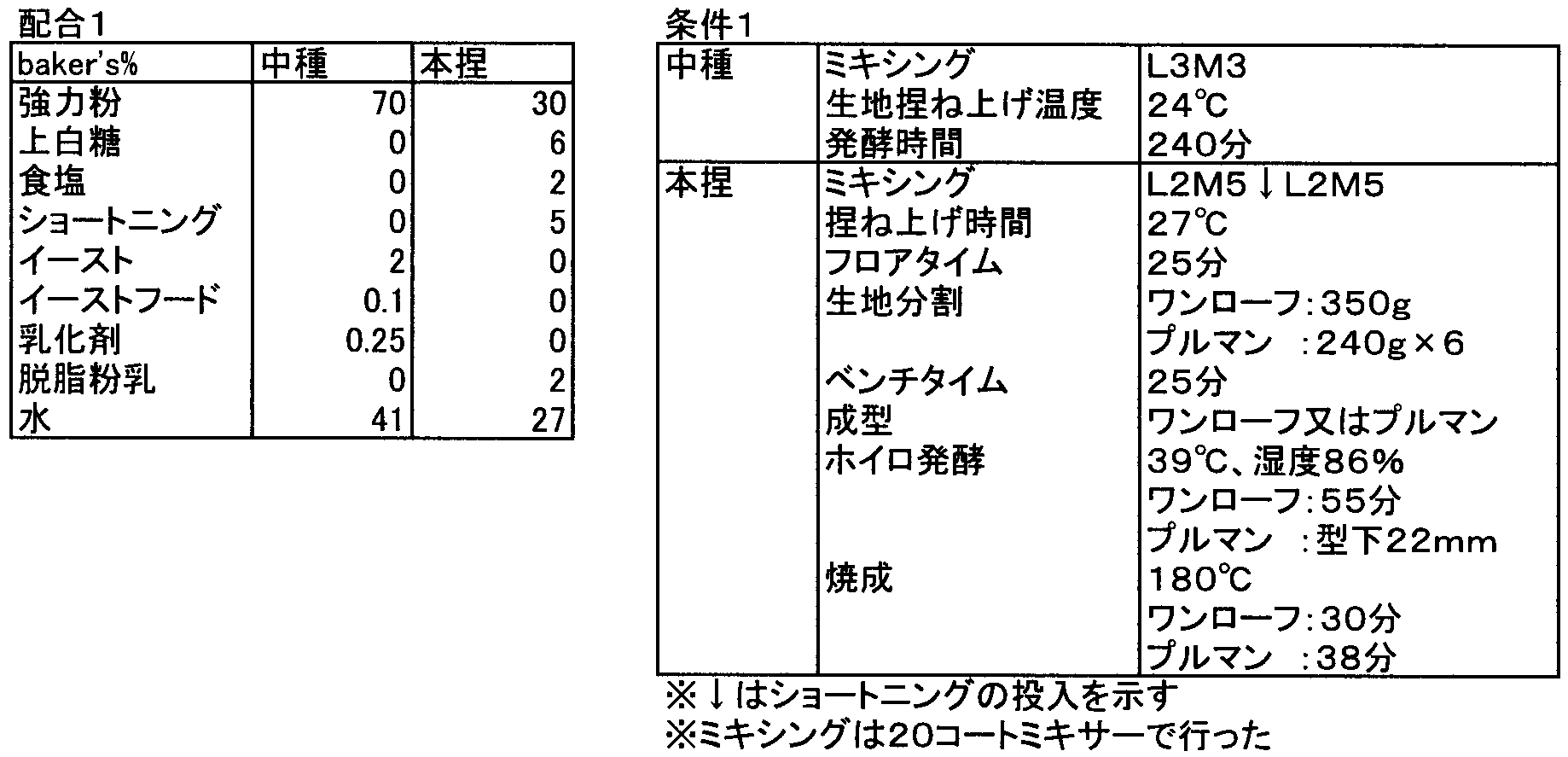
製造したパンの品質は、下記の中種ガス発生量、ホイロガス発生量、パン比容積、及び、パン風味を基に評価した。
中種ガス発生量及びホイロガス発生量は、それぞれ、中種ミキシング及びベンチタイム終了後の生地20gについて、ファーモグラフII(ATOO社製)を用いて全ガス発生量を測定し、全ガス発生量に2.5を乗じることで、生地50gに相当するガス発生量を算出した。
パン比容積は、製造したワンローフの体積を3Dレーザー体積計Selnac-WinVM210(ASTEX社製)により測定し、これをワンローフの重量で除すことにより算出した。
パン風味は、製造したプルマンについて、以下の基準に基づき官能評価を行なった。
(パン風味の官能評価基準)
○:未凍結の生イーストを使用して製造したプルマンと同等の良好な風味
△:未凍結の生イーストを使用して製造したプルマンと比べ、やや風味が劣る
×:未凍結の生イーストを使用して製造したプルマンと比べ、風味が劣る
以上により得られた結果を表3に示す。
○:未凍結の生イーストを使用して製造したプルマンと同等の良好な風味
△:未凍結の生イーストを使用して製造したプルマンと比べ、やや風味が劣る
×:未凍結の生イーストを使用して製造したプルマンと比べ、風味が劣る
以上により得られた結果を表3に示す。
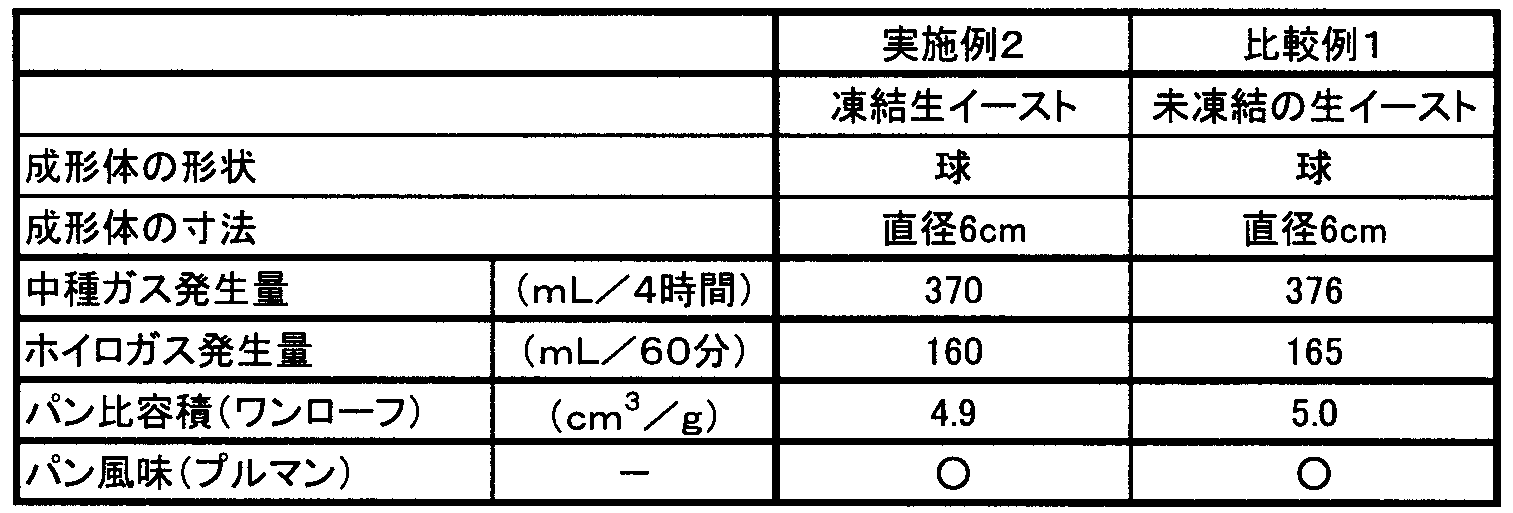
表3より、凍結生イースト成形体は、3ヶ月間冷凍保管を行なった後であるにも関わらず、中種ガス発生量、ホイロガス発生量、パン比容積、及びパン風味のいずれについても、未凍結の生イースト成形体と同等の評価がされており、イーストの長期保存性に優れていることが分かる。
(試験例3)
実施例2の凍結生イースト成形体、及び、比較例1の未凍結の生イースト成形体に関し、表4の配合2、条件2に従って中糖パン生地を成型した後、当該パン生地の冷凍及び解凍を経てロールパンを製造した。なお、凍結生イースト成形体については、-20℃の冷凍庫に3ヶ月間保管後、解凍せず凍結状態のまま、他のパン生地原材料と混合した。
実施例2の凍結生イースト成形体、及び、比較例1の未凍結の生イースト成形体に関し、表4の配合2、条件2に従って中糖パン生地を成型した後、当該パン生地の冷凍及び解凍を経てロールパンを製造した。なお、凍結生イースト成形体については、-20℃の冷凍庫に3ヶ月間保管後、解凍せず凍結状態のまま、他のパン生地原材料と混合した。

製造したパンの品質は、上述と同様の方法によって、ホイロガス発生量、パン比容積、及び、パン風味を基に評価した。
以上により得られた結果を表5に示す。
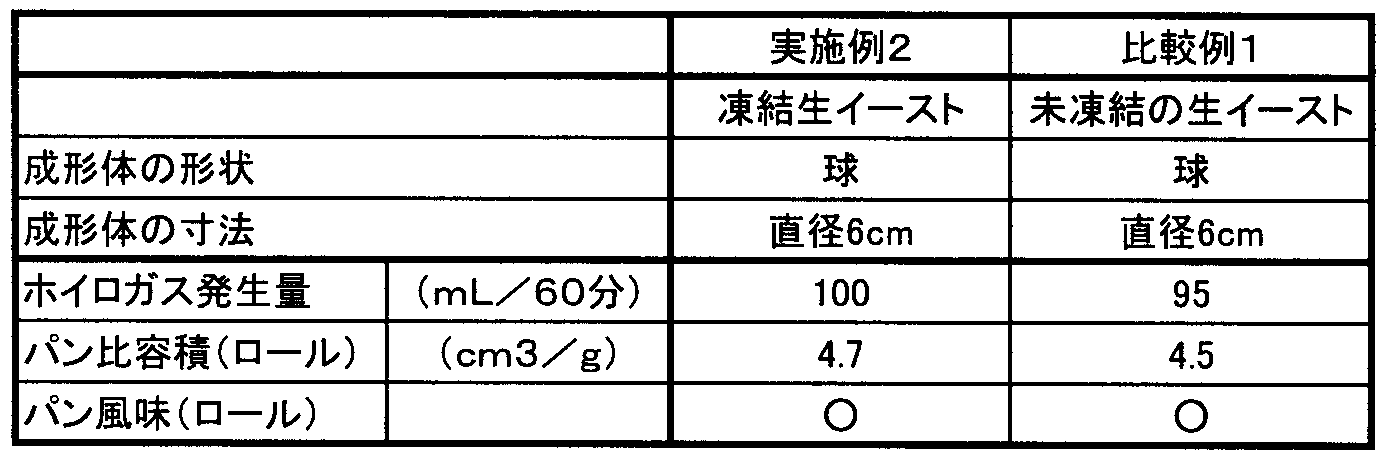
表5より、凍結生イースト成形体は、3ヶ月間冷凍保管を行なった後であるにも関わらず、ホイロガス発生量、パン比容積、及びパン風味のいずれについても、未凍結の生イースト成形体と同等の評価がされており、イーストの長期保存性に優れていることが分かる。
(試験例4)
実施例2の凍結生イースト成形体を25℃8時間で解凍した。これを、冷解凍を1回施したものとする。次いで-20℃16時間及び25℃8時間の冷解凍を1~3回行なった。これらをそれぞれ、冷解凍を2~4回施したものとする。これら1~4回の冷解凍を施した凍結生イースト成形体を、下記の基準に基づき、解凍後の発酵力、凍結時の成形体の保形性、及び解凍後の成形体の性状を評価した。比較例1の未凍結の生イースト成形体については、発酵力、及び成形体の性状を評価した。
実施例2の凍結生イースト成形体を25℃8時間で解凍した。これを、冷解凍を1回施したものとする。次いで-20℃16時間及び25℃8時間の冷解凍を1~3回行なった。これらをそれぞれ、冷解凍を2~4回施したものとする。これら1~4回の冷解凍を施した凍結生イースト成形体を、下記の基準に基づき、解凍後の発酵力、凍結時の成形体の保形性、及び解凍後の成形体の性状を評価した。比較例1の未凍結の生イースト成形体については、発酵力、及び成形体の性状を評価した。
発酵力については、イースト工業会が定めるパン用酵母試験法の高糖生地炭酸ガス測定法に準じ、30℃2時間の炭酸ガス発生量を測定した。
凍結時の成形体の保形性については、凍結時のイースト成形体が未凍結の生イースト成形体の形状を保持しているかどうかにより、3段階評価を行なった。
(凍結時の成形体の保形性の評価基準)
○:未凍結の生イースト成形体の形状と同一である
△:未凍結の生イースト成形体の形状からやや形状が変化している
×:未凍結の生イースト成形体の形状から大きく形状が変化している
成形体の性状については、解凍後の生イースト成形体の表面を指で押したときに感じる柔らかさにより、3段階評価を行なった。
○:未凍結の生イースト成形体の形状と同一である
△:未凍結の生イースト成形体の形状からやや形状が変化している
×:未凍結の生イースト成形体の形状から大きく形状が変化している
成形体の性状については、解凍後の生イースト成形体の表面を指で押したときに感じる柔らかさにより、3段階評価を行なった。
(成形体の性状の評価基準)
○:未凍結の生イースト成形体と同程度に硬い
△:未凍結の生イースト成形体と比べ、やや柔らかい
×:未凍結の生イースト成形体と比べ、非常に柔らかい
以上により得られた結果を表6に示す。
○:未凍結の生イースト成形体と同程度に硬い
△:未凍結の生イースト成形体と比べ、やや柔らかい
×:未凍結の生イースト成形体と比べ、非常に柔らかい
以上により得られた結果を表6に示す。

表6より、本発明の凍結生イースト成形体を1度だけ解凍したものは、未凍結の生イースト成形体と同等の発酵力を示し、未凍結の生イースト成形体の形状及び硬さを保持しているが、2回以上の冷解凍を施したものは発酵力の低下や、形状の変化及び軟化が確認された。以上の結果から、凍結生イースト成形体を一度解凍した後に、再び凍結することは避けたほうがよい。
(試験例5)
実施例2の凍結生イースト成形体、及び、比較例1の未凍結の生イースト成形体を4℃の冷蔵庫に静置して2日後、及び1ヶ月後の発酵力を、試験例4と同様の方法で評価した。
実施例2の凍結生イースト成形体、及び、比較例1の未凍結の生イースト成形体を4℃の冷蔵庫に静置して2日後、及び1ヶ月後の発酵力を、試験例4と同様の方法で評価した。
以上により得られた結果を表7に示す。

表7より、凍結生イースト成形体、未凍結の生イースト成形体いずれも、1ヶ月間冷蔵保管後に発酵力が大きく低下したが、凍結生イースト成形体における発酵力低下は、未凍結の生イースト成形体における発酵力低下よりも著しいものであった。このことから、凍結生イースト成形体を一旦解凍した後は、長期にわたって冷蔵保管をすることなく、速やかに使用したほうがよい。
(実施例7~12、比較例8~14、参考例2)
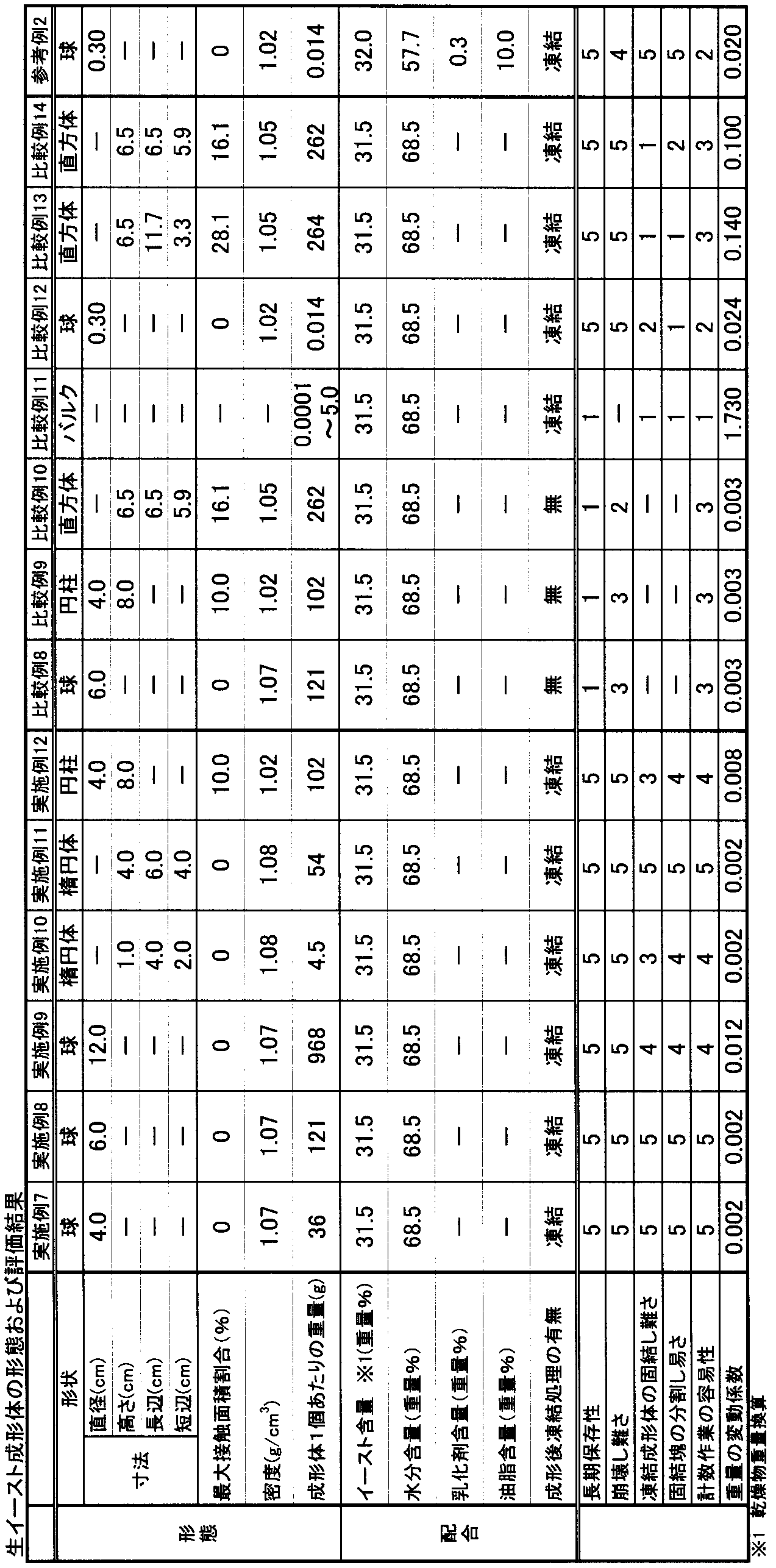
イーストの菌株としてKGLY59(寄託番号FERM BP-20635、特許第4839860号に記載)を使用した以外は、実施例1~6、比較例1~7、及び参考例1と同様にして、成形体、及びそのパッケージを得た。各成形体中のイーストの乾燥物重量は31.5%であった。これら成形体、及びそのパッケージについて、試験例1に従って各種評価を行なった。得られた結果を表8に示す。
イーストの菌株としてKGLY59(寄託番号FERM BP-20635、特許第4839860号に記載)を使用した以外は、実施例1~6、比較例1~7、及び参考例1と同様にして、成形体、及びそのパッケージを得た。各成形体中のイーストの乾燥物重量は31.5%であった。これら成形体、及びそのパッケージについて、試験例1に従って各種評価を行なった。得られた結果を表8に示す。
(実施例13~18、比較例15~21、参考例3)
イーストの菌株としてKCY1254(寄託番号NITE BP-1396、特許第5677624号に記載)を使用した以外は、実施例1~6、比較例1~7、及び参考例1と同様にして、成形体、及びそのパッケージを得た。各成形体中のイーストの乾燥物重量は32.4%であった。これら成形体、及びそのパッケージについて、試験例1に従って各種評価を行なった。得られた結果を表9に示す。
イーストの菌株としてKCY1254(寄託番号NITE BP-1396、特許第5677624号に記載)を使用した以外は、実施例1~6、比較例1~7、及び参考例1と同様にして、成形体、及びそのパッケージを得た。各成形体中のイーストの乾燥物重量は32.4%であった。これら成形体、及びそのパッケージについて、試験例1に従って各種評価を行なった。得られた結果を表9に示す。

(実施例19~24、比較例22~28、参考例4)
イーストの菌株としてKCY1217(寄託番号NITE BP-1058、特許第5907161号に記載)を使用した以外は、実施例1~6、比較例1~7、及び参考例1と同様にして、成形体、及びそのパッケージを得た。各成形体中のイーストの乾燥物重量は32.9%であった。これら成形体、及びそのパッケージについて、試験例1に従って各種評価を行なった。得られた結果を表10に示す。
イーストの菌株としてKCY1217(寄託番号NITE BP-1058、特許第5907161号に記載)を使用した以外は、実施例1~6、比較例1~7、及び参考例1と同様にして、成形体、及びそのパッケージを得た。各成形体中のイーストの乾燥物重量は32.9%であった。これら成形体、及びそのパッケージについて、試験例1に従って各種評価を行なった。得られた結果を表10に示す。

(実施例25~30、比較例29~35、参考例5)
イーストの菌株としてKCY1222(寄託番号NITE BP-1059、特許第5907161号に記載)を使用した以外は、実施例1~6、比較例1~7、及び参考例1と同様にして、成形体、及びそのパッケージを得た。各成形体中のイーストの乾燥物重量は32.3%であった。これら成形体、及びそのパッケージについて、試験例1に従って各種評価を行なった。得られた結果を表11に示す。
イーストの菌株としてKCY1222(寄託番号NITE BP-1059、特許第5907161号に記載)を使用した以外は、実施例1~6、比較例1~7、及び参考例1と同様にして、成形体、及びそのパッケージを得た。各成形体中のイーストの乾燥物重量は32.3%であった。これら成形体、及びそのパッケージについて、試験例1に従って各種評価を行なった。得られた結果を表11に示す。
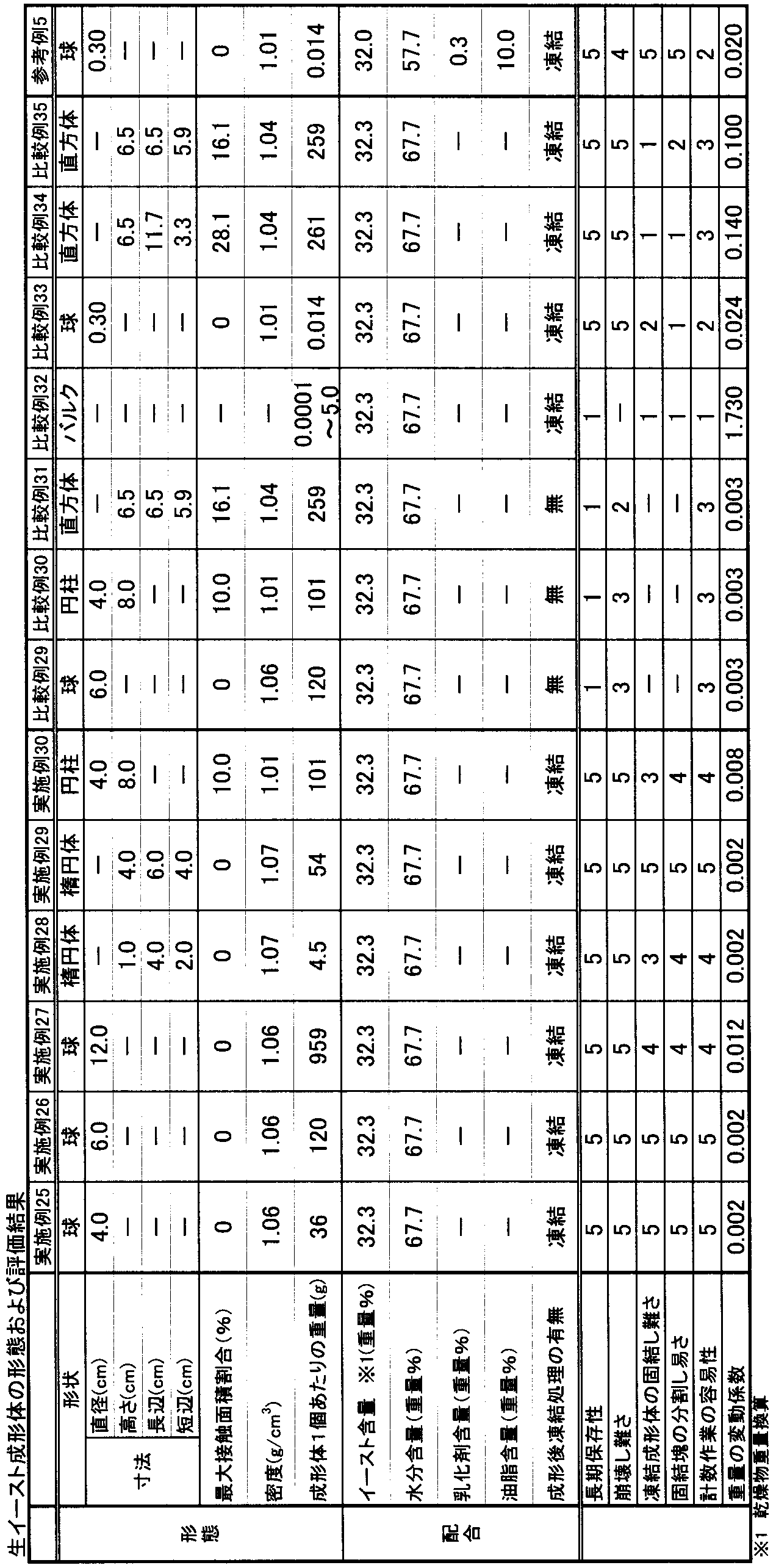
異なる菌株を使用した表8~表11の各実施例及び比較例においても、表1の各実施例及び比較例と同じ傾向の結果が得られた。すなわち、各実施例は、長期保存後も多いガス発生量を維持しており、凍結成形体は崩壊しにくく、凍結体同士が固結しにくく、固結しても容易に分割でき、成形体の個数を数える計数作業が容易であった。一方、凍結をしていない比較例8~10、15~17、22~24、及び29~31は、長期保存後はガス発生量が大幅に低下するとともに、成形体が比較的崩壊しやすいものであった。バルク状に成形を行なった比較例11、18、25、及び32は、長期保存性が低いことに加え、凍結体同士が固結しやすく、容易に分割できない固結塊を形成し、計数作業が困難であった。成形体の最大幅が小さい比較例12、19、26、及び33や、直方体に成形した比較例13、14、20、21、27、28、34、及び35は、凍結体同士が固結しやすく、容易に分割できない固結塊を形成し、計数作業が困難であった。各参考例は、食用油脂及び乳化剤といった添加物が添加されており、微小に成形されているため計数作業が困難であった。
Claims (10)
- 凍結生イースト成形体であって、
前記成形体は、生イーストが凍結されたものであり、
前記成形体は、最大幅が2~20cmの略球形の形状を有し、
前記凍結生イースト成形体の全重量に対して、イースト含量が乾燥重量として25~40重量%であり、水分含量が60~75重量%である、凍結生イースト成形体。 - 前記凍結生イースト成形体同士が接触しうる最大の接触面積が、該成形体1個の全表面積に対し20%以下である、請求項1に記載の凍結生イースト成形体。
- 前記凍結生イースト成形体は、密度が0.90~1.20g/cm3の生イーストが凍結されたものである、請求項1又は2に記載の凍結生イースト成形体。
- 請求項1~3何れかに記載の凍結生イースト成形体が複数個充填されたパッケージ。
- 成形体重量の変動係数が0.050以下である、請求項4に記載のパッケージ。
- 生イーストを、最大幅が2~20cmの略球形となるように成形し、得られた成形体を冷凍して凍結生イースト成形体を得る工程を含み、前記凍結生イースト成形体の全重量に対して、イースト含量が乾燥重量として25~40重量%であり、水分含量が60~75重量%である、凍結生イースト成形体の製造方法。
- 請求項1~3何れかに記載の凍結生イースト成形体と他のパン生地原材料とを混捏してパン生地を製造する工程を含む、パン生地の製造方法。
- 前記凍結生イースト成形体を、解凍せず凍結状態のまま、又は、解凍して、前記パン生地原材料に配合して混捏する、請求項7に記載のパン生地の製造方法。
- 請求項7又は8に記載の製造方法により得られたパン生地を加熱調理してパンを得る工程を含む、パンの製造方法。
- 生イーストを、最大幅が2~20cmの略球形となるように成形し、得られた成形体を冷凍する工程を含み、得られた凍結生イースト成形体の全重量に対して、イースト含量が乾燥重量として25~40重量%であり、水分含量が60~75重量%である、凍結生イースト成形体の固結防止方法。
Priority Applications (3)
| Application Number | Priority Date | Filing Date | Title |
|---|---|---|---|
| JP2018535775A JP6574525B2 (ja) | 2016-08-26 | 2017-08-25 | 凍結生イースト成形体及びその製造方法 |
| CN201780033369.4A CN109312294B (zh) | 2016-08-26 | 2017-08-25 | 冻结鲜酵母成形体及其制造方法 |
| US16/327,026 US20210282412A1 (en) | 2016-08-26 | 2017-08-25 | Frozen fresh yeast formed body and method for producing same |
Applications Claiming Priority (2)
| Application Number | Priority Date | Filing Date | Title |
|---|---|---|---|
| JP2016166205 | 2016-08-26 | ||
| JP2016-166205 | 2016-08-26 |
Publications (1)
| Publication Number | Publication Date |
|---|---|
| WO2018038244A1 true WO2018038244A1 (ja) | 2018-03-01 |
Family
ID=61244860
Family Applications (1)
| Application Number | Title | Priority Date | Filing Date |
|---|---|---|---|
| PCT/JP2017/030471 Ceased WO2018038244A1 (ja) | 2016-08-26 | 2017-08-25 | 凍結生イースト成形体及びその製造方法 |
Country Status (4)
| Country | Link |
|---|---|
| US (1) | US20210282412A1 (ja) |
| JP (1) | JP6574525B2 (ja) |
| CN (1) | CN109312294B (ja) |
| WO (1) | WO2018038244A1 (ja) |
Cited By (1)
| Publication number | Priority date | Publication date | Assignee | Title |
|---|---|---|---|---|
| WO2019167938A1 (ja) * | 2018-02-27 | 2019-09-06 | 株式会社カネカ | 凍結生イースト成形体及びその製造方法 |
Citations (3)
| Publication number | Priority date | Publication date | Assignee | Title |
|---|---|---|---|---|
| JPH0984579A (ja) * | 1995-09-26 | 1997-03-31 | Asahi Chem Ind Co Ltd | ペレット状凍結生イースト |
| WO2012128186A1 (ja) * | 2011-03-18 | 2012-09-27 | 株式会社カネカ | 新規パン酵母 |
| WO2013161303A1 (ja) * | 2012-04-26 | 2013-10-31 | 株式会社カネカ | 新規パン酵母 |
Family Cites Families (5)
| Publication number | Priority date | Publication date | Assignee | Title |
|---|---|---|---|---|
| GB1196786A (en) * | 1967-11-23 | 1970-07-01 | Distillers Co Yeast Ltd | Yeast and method for its production |
| GB2196018B (en) * | 1986-09-18 | 1990-07-11 | Fuji Seiki Machine Works | Fracture of cells by impact of a frozen suspension thereof. |
| US6000229A (en) * | 1998-04-24 | 1999-12-14 | Dippin' Dots, Inc. | Cryogenic processor for liquid feed preparation of a free-flowing frozen product and method for freezing liquid composition |
| US7288370B1 (en) * | 2000-11-20 | 2007-10-30 | Lasaffre Et Cie | Baker's yeasts and strains for their preparation |
| CN101899429A (zh) * | 2009-05-31 | 2010-12-01 | 重庆医科大学 | 基于多孔微囊技术构建新型高效生物催化剂 |
-
2017
- 2017-08-25 JP JP2018535775A patent/JP6574525B2/ja active Active
- 2017-08-25 CN CN201780033369.4A patent/CN109312294B/zh active Active
- 2017-08-25 WO PCT/JP2017/030471 patent/WO2018038244A1/ja not_active Ceased
- 2017-08-25 US US16/327,026 patent/US20210282412A1/en not_active Abandoned
Patent Citations (3)
| Publication number | Priority date | Publication date | Assignee | Title |
|---|---|---|---|---|
| JPH0984579A (ja) * | 1995-09-26 | 1997-03-31 | Asahi Chem Ind Co Ltd | ペレット状凍結生イースト |
| WO2012128186A1 (ja) * | 2011-03-18 | 2012-09-27 | 株式会社カネカ | 新規パン酵母 |
| WO2013161303A1 (ja) * | 2012-04-26 | 2013-10-31 | 株式会社カネカ | 新規パン酵母 |
Cited By (2)
| Publication number | Priority date | Publication date | Assignee | Title |
|---|---|---|---|---|
| WO2019167938A1 (ja) * | 2018-02-27 | 2019-09-06 | 株式会社カネカ | 凍結生イースト成形体及びその製造方法 |
| JPWO2019167938A1 (ja) * | 2018-02-27 | 2020-08-20 | 株式会社カネカ | 凍結生イースト成形体及びその製造方法 |
Also Published As
| Publication number | Publication date |
|---|---|
| JPWO2018038244A1 (ja) | 2019-03-28 |
| US20210282412A1 (en) | 2021-09-16 |
| JP6574525B2 (ja) | 2019-09-11 |
| CN109312294A (zh) | 2019-02-05 |
| CN109312294B (zh) | 2023-04-04 |
Similar Documents
| Publication | Publication Date | Title |
|---|---|---|
| ES2543183T5 (es) | Masa para galletas | |
| JP2020202881A (ja) | 共押出スナック製品 | |
| JP2009201423A (ja) | 製菓製パン用材料及びそれを用いた穀粉加熱加工食品 | |
| MX2013014324A (es) | Recipientes comestibles para productos de confiteria congelados. | |
| EP2651240B1 (en) | Stock cube | |
| JP6574525B2 (ja) | 凍結生イースト成形体及びその製造方法 | |
| JP6948188B2 (ja) | 凍結生イースト成形体及びその製造方法 | |
| JP3717557B2 (ja) | ペレット状凍結生イースト | |
| JP4655071B2 (ja) | クリスピーな食感を有するソフトな焼き菓子 | |
| JP6454484B2 (ja) | 固化用粉末、それを用いた組合せ菓子、及び無水ブドウ糖固化物の固化平準化方法 | |
| AU2019412491B2 (en) | Portioned granola food product which disintegrates in a liquid such as milk | |
| JP5464969B2 (ja) | 複合油性菓子の製造方法 | |
| JP6810826B2 (ja) | 凍結生イースト成形体及びその製造方法 | |
| JP7760179B2 (ja) | 蕎麦玉、蕎麦玉の製造方法、および蕎麦の製造方法 | |
| US20210045393A1 (en) | Pastry Premix Compositions and Methods for Preparing Same | |
| CN201961672U (zh) | 饼伴侣 | |
| RU2260954C1 (ru) | Способ производства сахарного печенья | |
| KR102324948B1 (ko) | 몰디드 콘과자용 믹스 조성물 및 이를 이용한 몰디드 콘과자 | |
| PH22017000089Y1 (en) | Process of producing cacao (theobroma cacao l.) pastillas de muscovado (saccharum officinarum l.) | |
| AU2013100586A4 (en) | Tortainer | |
| Amaraegbu et al. | Effect of spent yeast fortification on physical characteristics of cassava-wheat composite bread. | |
| KR20260000012U (ko) | 옥수수 보리스펀지케이크 | |
| RU2620663C2 (ru) | Способ изготовления кулинарного изделия из теста с начинкой | |
| KR20260000193U (ko) | 옥수수,보리케이크,카스텔라 | |
| JPS6028248B2 (ja) | 焼成パンの製造方法 |
Legal Events
| Date | Code | Title | Description |
|---|---|---|---|
| 121 | Ep: the epo has been informed by wipo that ep was designated in this application |
Ref document number: 17843720 Country of ref document: EP Kind code of ref document: A1 |
|
| ENP | Entry into the national phase |
Ref document number: 2018535775 Country of ref document: JP Kind code of ref document: A |
|
| NENP | Non-entry into the national phase |
Ref country code: DE |
|
| 122 | Ep: pct application non-entry in european phase |
Ref document number: 17843720 Country of ref document: EP Kind code of ref document: A1 |