WO2018020877A1 - 微細粒子の分散固定方法 - Google Patents
微細粒子の分散固定方法 Download PDFInfo
- Publication number
- WO2018020877A1 WO2018020877A1 PCT/JP2017/021818 JP2017021818W WO2018020877A1 WO 2018020877 A1 WO2018020877 A1 WO 2018020877A1 JP 2017021818 W JP2017021818 W JP 2017021818W WO 2018020877 A1 WO2018020877 A1 WO 2018020877A1
- Authority
- WO
- WIPO (PCT)
- Prior art keywords
- fine particles
- suspension
- dispersion
- substrate
- drying
- Prior art date
- Legal status (The legal status is an assumption and is not a legal conclusion. Google has not performed a legal analysis and makes no representation as to the accuracy of the status listed.)
- Ceased
Links
Images



Classifications
-
- G—PHYSICS
- G01—MEASURING; TESTING
- G01N—INVESTIGATING OR ANALYSING MATERIALS BY DETERMINING THEIR CHEMICAL OR PHYSICAL PROPERTIES
- G01N1/00—Sampling; Preparing specimens for investigation
- G01N1/28—Preparing specimens for investigation including physical details of (bio-)chemical methods covered elsewhere, e.g. G01N33/50, C12Q
Definitions
- the present invention relates to a method for dispersing and fixing fine particles to give evaluation and observation of fine particles, and in particular, a suspension in which fine particles are dispersed is dropped on a substrate and dried to maintain the dispersed state of the fine particles.
- the present invention relates to a method of fixing it while standing.
- the fine particles When evaluating and observing fine particles with an electron microscope or an atomic force microscope (AFM), the fine particles may be fixed on a smooth substrate for evaluation.
- a silicon wafer having high smoothness or a cleaved surface of mica is used, and a dispersion liquid containing fine particles is dropped from the capillary tube on the substrate and dried.
- the evaluation or the like is performed by selecting a portion having a small overlap between the fine particles (see Non-Patent Document 1).
- dispersion in the dispersion, dispersion is maintained without agglomeration due to electrostatic interaction between fine particles.
- the electrostatic repulsive force is lost and agglomeration occurs.
- a freeze-drying method has been proposed in which a frozen membrane of a dispersion that has been rapidly frozen before agglomeration is decompressed to sublimate water, and a substrate sample is prepared while maintaining the dispersion state of fine particles in the dispersion. .
- a freezing medium such as t-butanol having a melting point in the range of ⁇ 30 to 30 ° C.
- a highly active solvent such as water
- additives such as a dispersant are generally added at the time of slurry preparation, but a compound that imparts dispersibility and stability of fine particles in the slurry such as an amphiphilic substance such as a surfactant may not be added. It is preferred.
- Patent Document 2 discloses that in a freeze-drying method, a small amount of a dispersion is dropped on a cooling substrate made of silicon or the like and rapidly frozen as in an inkjet. It is said that water, ethanol, methanol or the like can be used as a solvent for the dispersion.
- the heat capacity of water is large, and it takes a certain amount of time for the surface of the water film to freeze, during which fine particles eliminated by ice crystal growth form a giant aggregate with a particle size of about 1 ⁇ m. End up.
- This frozen film has a structure in which an ice thin film containing almost no fine particles and a giant aggregate are dispersed on an ice thin film in which fine particles are dispersed. If this is decompressed and dried while maintaining a low temperature, the giant aggregate collides with the surrounding fine particles and is absorbed, resulting in a freeze-dried sample consisting essentially of aggregates.
- the present invention has been made in view of the situation as described above, and an object of the present invention is to provide a method for dispersing and fixing fine particles by a freeze-drying method that can give higher dispersion stability.
- a suspension in which fine particles are dispersed in water is dropped on a substrate and dried to disperse and fix the fine particles.
- the suspension is dropped on a cooling substrate to form a thin film while freezing.
- the drying step may include a step of evaporating the water-derived ice after increasing the concentration of the polyhydric alcohol while sublimating the ice. According to this invention, it is possible to give higher dispersion stability without forming aggregates of fine particles during the formation of ice and sublimation due to the interaction between the fine particles and the polyhydric alcohol.
- an island part derived from evaporation of the polyhydric alcohol may be formed. According to this invention, higher dispersion stability can be provided from the interaction between the fine particles and the polyhydric alcohol while maintaining the dispersion density of the fine particles.
- the drying step may be characterized by evacuating to 10 ⁇ 2 Pa or less. According to this invention, it is possible to evaporate the polyalcohol after increasing the concentration of the polyhydric alcohol while sublimating the ice more reliably, thereby giving higher dispersion stability.
- the polyhydric alcohol may be any one of glycerin, ethylene glycol, diethylene glycol, and propylene glycol, or a mixture thereof. According to this invention, it is possible to give higher dispersion stability without forming aggregates of fine particles during the formation of ice and sublimation due to the interaction between the fine particles and the polyhydric alcohol.
- the fine particles may have an average particle size of nanometer order. According to this invention, in the method for dispersing and fixing fine particles by the freeze-drying method, higher dispersion stability can be provided, and even in the case of nanoparticles that are very likely to aggregate, the dispersed state can be maintained.
- a liquid preparation step (S1) for preparing a fine particle suspension a liquid preparation step (S1) for preparing a fine particle suspension, a dropping step (S2) for dropping a predetermined amount of suspension onto the cooling substrate, and a cooling substrate.
- a freezing step (S3) for freezing the formed suspension film and a vacuum drying step (S4) for drying the substrate provided with the frozen suspension film in a vacuum are included.
- the fine particle suspension (slurry) liquid gives water as a solvent a dispersant together with fine particles as necessary, and can reduce the vapor pressure here, for example, by adding a polyhydric alcohol, an ultrasonic stirrer, etc. It is prepared by mixing with.
- the fine particles may be of any type such as metal or inorganic, but are fine particles having a cohesive property, typically submicron order and nano order particle sizes.
- PVP polyvinylpyrrolidone
- PEI polyethyleneimine
- the polyhydric alcohol is preferably any one of glycerin, ethylene glycol, diethylene glycol, and propylene glycol, or a mixture thereof.
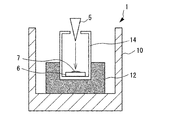
- the dripping and freezing apparatus 1 applies a predetermined amount of fine particle suspension from the micropipette 5 onto the cooled substrate 6 to form a thinly spread film, which is instantly applied.
- This is a device for freezing to form a frozen membrane 7.
- the dripping freezing apparatus 1 is configured such that an aluminum block 12 is installed in a low-temperature tank 10 of a small refrigerator, a sample container 14 is fitted into a hole provided in the aluminum block 12, and the substrate 6 is set on the bottom of the sample container 14. ing.
- the substrate 6 is typically a smooth silicon substrate for electronic devices, and is typically cooled to about ⁇ 80 ° C. via the aluminum block 12 and the sample container 14.
- the micropipette 5 is directly above the substrate 6, can drop a predetermined amount of fine particle suspension under the same conditions, and can stably form the frozen film 7 having the same thickness.
- a fine particle suspension of about 10 ⁇ l is appropriately placed on the substrate 6 from a height of 500 mm or more.
- this drop height in order to stably drop the liquid onto the substrate 6, it is preferable to surround the drop path and prevent a disturbance factor, for example, by dropping inside the sample container 14 having a high side wall. .
- the drop speed hardly changes even if the volume changes, so the speed at the time of collision with the substrate 6 drops. It depends on the height. That is, if the position of the micropipette 5 is set at a certain height from the substrate 6, the spread of the fine particle suspension on the substrate 6 can be made constant, and the thickness of the thinly spread film can be made constant. .
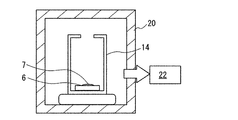
- the frozen film 7 is transferred together with the substrate 6 together with the sample container 14 into the vacuum chamber 20, and the inside is decompressed by a vacuum pump 22, for example, a vacuum system combining a turbo molecular pump and an oil rotary pump. .
- a vacuum pump 22 for example, a vacuum system combining a turbo molecular pump and an oil rotary pump.
- a high vacuum state of about 10 ⁇ 2 Pa is set.
- the substrate 6 can easily find and observe a place having a similar particle size distribution, particle density, and dispersibility. In addition, observation can be made easier because the frozen membrane 7 can be obtained from a larger amount of fine particle suspension.
- the apparatus does not require liquid nitrogen, a special high heat conduction material, or a special apparatus, and is excellent in cost and operability.
- the silicon substrates A and B were maintained at ⁇ 80 ° C. in a freezer for 10 minutes (freezing step: S3). These were transferred to a vacuum chamber and evacuation was started. It took about 30 seconds from the transfer to the start of vacuum. After roughing with an oil rotary pump, vacuuming was performed within 1 minute by operating a Varian V-70 turbo pump (vacuum drying step: S4). In order to completely dry glycerin, vacuuming was performed for about 3 hours. During drying, the surface of the silicon substrate was continuously observed with a camera, and complete evaporation of glycerin was confirmed. Further, the silicon substrate A manufactured from the suspension A and the silicon substrate B manufactured from the suspension 2 were both evacuated for the same time in order to match the manufacturing conditions.
- the silicon substrates A and B were transferred from the vacuum chamber to the atmosphere and evaluated with an optical microscope and a scanning electron microscope.
- the silicon substrates A and B were set on an optical microscope, and white light was irradiated obliquely from above, and the scattered light was observed with a microscope.
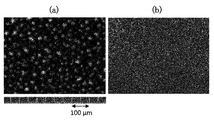
- the silicon substrate A many light spots that shine strongly in white were observed (FIG. 5A).
- the silicon substrate B scattered light of a light spot that shines weakly in blue and white and a blue cloud-like spot surrounding the spot was observed (FIG. 5B).
- the above method can be widely applied to various fine particles regardless of the affinity with water. That is, not only a suspension containing silica spheres, but also polystyrene latex (FIG. 8 (a), diameter: 100 nm, manufactured by Micromod, trade name micromer (registered trademark)) and alumina (FIG. 8 (b), particle size : ⁇ 1 ⁇ m, manufactured by Suehiro Co., Ltd., alumina abrasive) can also be uniformly dispersed. The same applies to copper oxide particles (FIG. 9A) and iron oxide particles (FIG. 9B).
Landscapes
- Physics & Mathematics (AREA)
- Health & Medical Sciences (AREA)
- Life Sciences & Earth Sciences (AREA)
- Chemical & Material Sciences (AREA)
- Analytical Chemistry (AREA)
- Biochemistry (AREA)
- General Health & Medical Sciences (AREA)
- General Physics & Mathematics (AREA)
- Immunology (AREA)
- Pathology (AREA)
- Sampling And Sample Adjustment (AREA)
Abstract
より高い分散安定性を与え得る凍結乾燥法による微細粒子の分散固定方法の提供。 懸濁液を冷却基板上に滴下して薄膜を形成させつつ凍結させる凍結工程と、真空引きして乾燥させる乾燥工程と、を含む。懸濁液には多価アルコールを添加して蒸気圧を低下させて乾燥させることを特徴とする。
Description
本発明は、微細粒子の評価及び観察を与えるための該微細粒子の分散固定方法に関し、特に、微細粒子を分散した懸濁液を基板上に滴下し乾燥させ該微細粒子の分散状態を維持させたまま固定する方法に関する。
電子顕微鏡や原子間力顕微鏡(AFM)などで微細粒子の評価及び観察をするにあたって、平滑な基板上に微細粒子を固定させて評価等を行うことがある。基板には高い平滑度を有するシリコンウエハやマイカの劈開面が利用されて、この上に微細粒子を含む分散液をキャピラリ管から滴下し乾燥させ、得られる同心円状の凝集組織、いわゆる「コーヒーリング」から微細粒子同士の重なりの少ない箇所を選択して評価等を行うのである(非特許文献1参照)。
ここで、分散液中では、微細粒子間の静電相互作用によって凝集せずに分散を維持しているが、基板上で乾燥させると、静電反発力が失われて凝集してしまう。そこで、凝集しないうちに急速冷凍させた分散液の凍結膜を減圧して水を昇華させ、分散液中の微細粒子の分散状態を保持したまま基板試料を作成する凍結乾燥法が提案されている。
例えば、特許文献1では、凍結乾燥法において、分散(懸濁)液の分散媒として水のように活性の高い溶媒ではなく、融点を-30~30℃の範囲に有するt-ブタノールなどの凍結乾燥時の昇華を容易とするような蒸気圧の高い有機溶媒を用いることを開示している。また、スラリー調整時に分散剤等の添加剤を一般的に加えるが、かかる界面活性剤等の両親媒性物質などのスラリー中での微細粒子の分散性や安定性を与える化合物は加えないことが好ましいとしている。
また、特許文献2では、凍結乾燥法において、インクジェットの如きで分散液をシリコンなどからなる冷却基板の上に微少量滴下させて急速凍結させることを開示している。分散液の溶媒には、水、エタノール、メタノールなどが使用され得るとしている。
R.D.Deegan et al.; Nature; vol.389; 23 Oct. 1997
凍結乾燥法の基板に用いられるシリコンウエハの熱伝導率及び熱容量はそれほど大きくない。そのため、広く普及している摂氏-80度程度の低温熱源に接触させ、その上に熱容量の大きい水を含む分散液を載せても、凝固潜熱の影響もあって、冷却速度を大きくすることができない。
ここで、水の熱容量は大きく、水の被膜表面が凍結するまでには一定の時間を要し、その間に氷の結晶成長によって排除された微細粒子が1μm程度の粒径の巨大凝集体をつくってしまう。この凍結膜は、微細粒子の分散した氷薄膜の上に、ほとんど微細粒子をふくまない氷薄膜と巨大凝集体が分散して乗っかった構造となる。これを低温維持しつつ減圧・乾燥すると、巨大凝集体が周囲の微細粒子に衝突して吸収し、ほぼ凝集体のみからなる凍結乾燥試料となってしまう。
本発明は、上記したような状況に鑑みてなされたものであって、その目的とするところは、より高い分散安定性を与え得る凍結乾燥法による微細粒子の分散固定方法の提供にある。
本発明による水に微細粒子を分散させた懸濁液を基板上に滴下し乾燥させ該微細粒子を分散固定する方法は、前記懸濁液を冷却基板上に滴下して薄膜を形成させつつ凍結させる凍結工程と、真空引きして乾燥させる乾燥工程と、を含み、前記懸濁液に多価アルコールを添加して蒸気圧を低下させて乾燥させることを特徴とする。
かかる発明によれば、凍結乾燥法による微細粒子の分散固定方法において、より高い分散安定性を与え得るのである。これにより、懸濁液の滴下量を多くしても微細粒子の分散状態を維持できるとともに、基板に熱伝導率及び熱容量の比較的小さいシリコンウエハを使用し得る。
上記した発明において、前記乾燥工程は、前記水由来の氷を昇華させつつ前記多価アルコールの濃度を高めてからこれを蒸発させる工程を含むことを特徴としてもよい。かかる発明によれば、微細粒子と多価アルコールの相互作用から氷の形成及び昇華時に微細粒子の凝集体を形成させず、より高い分散安定性を与え得るのである。
上記した発明において、前記多価アルコールの蒸発由来のアイランド部を形成することを特徴としてもよい。かかる発明によれば、微細粒子の分散密度を維持しつつ、微細粒子と多価アルコールの相互作用から、より高い分散安定性を与え得るのである。
上記した発明において、前記乾燥工程は、10-2Pa以下に真空引きすることを特徴としてもよい。かかる発明によれば、より確実に氷を昇華させつつ多価アルコールの濃度を高めてからこれを蒸発させ得て、より高い分散安定性を与え得るのである。
上記した発明において、前記多価アルコールはグリセリン、エチレングリコール、ジエチレングリコール、プロピレングリコールのいずれか1つ又はこれらの混合物であることを特徴としてもよい。かかる発明によれば、微細粒子と多価アルコールの相互作用から氷の形成及び昇華時に微細粒子の凝集体を形成させず、より高い分散安定性を与え得るのである。
上記した発明において、前記微細粒子は、ナノメーターオーダーの平均粒径であることを特徴としてもよい。かかる発明によれば、凍結乾燥法による微細粒子の分散固定方法において、より高い分散安定性を与え得て、非常に凝集しやすいナノ粒子であっても分散状態を維持できるのである。
以下に、本発明による1つの実施例である微細粒子の分散固定方法について、図1に併せて図2及び図3を参照しつつ、説明する。
図1に示すように、本実施例では、微細粒子懸濁液を調製する液調製工程(S1)、所定量の懸濁液を冷却基板上に滴下させる滴下工程(S2)、冷却基板上に形成された懸濁液膜を凍結させる凍結工程(S3)、凍結した懸濁液膜を与えた基板を真空中で乾燥させる真空乾燥工程(S4)を含む。
[液調製工程:S1]
微細粒子懸濁(スラリー)液は、溶媒としての水に微細粒子とともに必要に応じて分散剤を与えるとともに、ここでは蒸気圧を低下させ得る、例えば多価アルコールを添加して、超音波攪拌機などで混合して調製される。
微細粒子懸濁(スラリー)液は、溶媒としての水に微細粒子とともに必要に応じて分散剤を与えるとともに、ここでは蒸気圧を低下させ得る、例えば多価アルコールを添加して、超音波攪拌機などで混合して調製される。
微細粒子は、金属系又は無機系などの種類を問わないが、凝集性を有する微細な粒径、典型的には、サブミクロンオーダー、ナノオーダーの粒径を有する粉体である。分散剤はPVP(ポリビニルピロリドン)やPEI(ポリエチレンイミン)などを用い得る。そして、多価アルコールとしては、グリセリン、エチレングリコール、ジエチレングリコール、プロピレングリコールのいずれか1つ又はこれらの混合物であることが好ましい。
[滴下工程:S2]
図2に示すように、滴下凍結装置1は、マイクロピペット5から所定量の微細粒子懸濁液を冷却された基板6の上に適下し、薄く拡がった膜を形成させ、これを瞬時に凍結させて凍結膜7とさせる装置である。
図2に示すように、滴下凍結装置1は、マイクロピペット5から所定量の微細粒子懸濁液を冷却された基板6の上に適下し、薄く拡がった膜を形成させ、これを瞬時に凍結させて凍結膜7とさせる装置である。
滴下凍結装置1は、小型冷凍機の低温槽10内にアルミブロック12を設置してこれに設けられた孔に試料容器14を嵌め込み、この試料容器14の底部に基板6をセットするようになっている。基板6は典型的には平滑な電子デバイス用のシリコン基板であって、アルミブロック12及び試料容器14を介して典型的には-80℃程度に冷却される。マイクロピペット5は、基板6の直上にあって所定量の微細粒子懸濁液を同一条件で滴下でき、安定して同一厚さの凍結膜7を形成できる。
典型的には、10μl程度の微細粒子懸濁液を500mm以上の高さから基板6の上に適下する。この落下高さの場合、安定して基板6の上に滴下させるには、側壁の高い試料容器14の内部で滴下を行うなど、落下経路を包囲して外乱要因を防ぐようにすることが好ましい。
また、マイクロピペット5から適下される微細粒子懸濁液の量を10μl程度とすることで、その体積が変化しても落下速度はほとんど変化しなくなるから基板6への衝突時の速度は落下高さに依存するようになる。つまり、マイクロピペット5の位置を基板6から一定の高さにしておけば、基板6上の微細粒子懸濁液の拡がりを一定に出来て、薄く拡がった膜の厚さを一定に出来るのである。
[凍結工程:S3]
基板6上に薄く拡がった微細粒子懸濁液は、瞬間的に凍結し凍結膜7となるが、冷却温度との平衡に達するまで低温槽10内で十分に静置する。なお、基板6上の微細粒子懸濁液の拡がりによる厚さを0.1mmにすると、10msec程度で凍結していると見積もられる。一方、これが1mmであると1sec近くを要することになって微細粒子の凝集を生じさせてしまう。
基板6上に薄く拡がった微細粒子懸濁液は、瞬間的に凍結し凍結膜7となるが、冷却温度との平衡に達するまで低温槽10内で十分に静置する。なお、基板6上の微細粒子懸濁液の拡がりによる厚さを0.1mmにすると、10msec程度で凍結していると見積もられる。一方、これが1mmであると1sec近くを要することになって微細粒子の凝集を生じさせてしまう。
[真空乾燥工程:S4]
図3に示すように、凍結膜7を基板6とともに試料容器14ごと真空槽20内に移送し、真空ポンプ22、例えば、ターボ分子ポンプと油回転ポンプとを組み合わせた真空系で内部を減圧する。典型的には、10-2Pa程度の高真空状態とする。これにより、低い蒸気圧の多価アルコールの如きであっても蒸発し、完全に蒸発させるためには十分な時間保持する。
図3に示すように、凍結膜7を基板6とともに試料容器14ごと真空槽20内に移送し、真空ポンプ22、例えば、ターボ分子ポンプと油回転ポンプとを組み合わせた真空系で内部を減圧する。典型的には、10-2Pa程度の高真空状態とする。これにより、低い蒸気圧の多価アルコールの如きであっても蒸発し、完全に蒸発させるためには十分な時間保持する。
かかる基板6は、より高い分散安定性をもって凍結膜7を得られるため、粒径分布や粒子密度、分散性の似たような場所を容易に探して観察することが出来る。また、より多くの量の微細粒子懸濁液から凍結膜7を得られることからも観察をより容易に出来るようになる。
以上によれば、従来採用されていた自然乾燥法では得られない、均一なナノレベルまでの微細粒子分散状態を、より高い分散安定性をもって達成できる。更に、従来の凍結真空乾燥法では得られない、熱伝導率及び熱容量の比較的小さいシリコン平坦基板上への均一なナノ粒子分散を達成できる。また、装置では、液体窒素や特殊な高熱伝導素材、特殊な装置を必要とせず、コストや操作性においても優れるのである。
[実施例]
平均直径100nm、粒子濃度1×10⁻¹⁰個/cm3のシリカ球懸濁液(独Micromod社、商品名sicastar(登録商標))を用意した(懸濁液A)。4mlの懸濁液Aに50μlのグリセリンを混合し、さらに超音波攪拌を行って懸濁液Bを調製した(液調製工程:S1)。
平均直径100nm、粒子濃度1×10⁻¹⁰個/cm3のシリカ球懸濁液(独Micromod社、商品名sicastar(登録商標))を用意した(懸濁液A)。4mlの懸濁液Aに50μlのグリセリンを混合し、さらに超音波攪拌を行って懸濁液Bを調製した(液調製工程:S1)。
サイニクス社製の小型冷凍機(製品名:CryoPorter)を用いて、銅板(直径25mm、厚さ2mm)に張り付けられた2枚の電子デバイス用シリコン基板A及びB(厚さ0.5mm)を-80℃に冷却した。この上に10μLの懸濁液A及びBを高さ110cmの位置からそれぞれ滴下した(滴下工程:S2)。
その後、シリコン基板A及びBは10分間冷凍機の中で-80℃に維持した(凍結工程:S3)。これらを真空槽に移送して真空引きを開始した。なお、移送から真空開始までは約30秒だった。油回転ポンプによる粗引きの後、1分以内にVarian社製V-70ターボポンプを動作させて真空引きを行った(真空乾燥工程:S4)。なお、グリセリンを完全に乾燥させるため約3時間の真空引きを行った。乾燥中はカメラによって連続的にシリコン基板表面を観察し、グリセリンの完全な蒸発を確認した。また、懸濁液Aから作製されたシリコン基板Aと、懸濁液2から作製されたシリコン基板Bとは、作製条件を合わせるためにどちらも同じ時間だけ真空引きを行った。
次に、シリコン基板A及びBを真空槽から大気下に移送し、光学顕微鏡、走査型電子顕微鏡にて評価を行った。
まず、図4に示すように、シリコン基板A及びBに斜め上方から白色光を照射し、直上から光散乱を観察すると、シリコン基板Aでは液滴の跡が均一に白色に濁ったように観察される(図4(a))。一方、シリコン基板Bで同じ条件で観察すると、液滴の跡は均一に透明感のある青白い面として観察された(図4(b))。
図5に示すように、シリコン基板A及びBを光学顕微鏡にセットし、斜め上方から白色光を照射してその散乱光を顕微鏡観察した。シリコン基板Aでは白色に強く光る光点が多数観察された(図5(a))。一方、シリコン基板Bでは青白く弱く光る光点とそれを取り巻く青い雲状の斑点の散乱光が観察された(図5(b))。
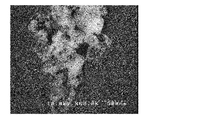
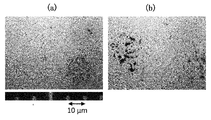
図6に示すように、シリコン基板Aを電子顕微鏡で観察したところ、ナノ粒子はほとんど見られず、強く青白く光る光点はナノ粒子が多数凝集した上に、さらに市販試料に含まれる分散剤に覆われた構造になっているものと推測される。
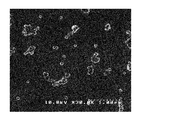
一方、図7に示すように、シリコン基板Bの弱く青白く光る雲状の斑点では、比較的粒子数の少ない凝集体、もしくは孤立粒子が分散した状態にあることが分かる。
なお、上記方法は、水との親和性の高低に関わらず、広く各種微細粒子に適用し得る。つまり、シリカ球を含む懸濁液だけでなく、ポリスチレンラテックス(図8(a)、直径:100nm、独Micromod社製、商品名micromer(登録商標))やアルミナ(図8(b)、粒径:~1μm、株式会社末広社製、アルミナ研磨剤)でも同様に均一分散できる。また、酸化銅粒子(図9(a))や酸化鉄粒子(図9(b))でも同様である。
以上、本発明による実施例及びこれに基づく変形例を説明したが、本発明は必ずしもこれに限定されるものではなく、当業者であれば、本発明の主旨又は添付した特許請求の範囲を逸脱することなく、様々な代替実施例及び改変例を見出すことができるであろう。
1 滴下凍結装置
5 マイクロピペット
6 基板
7 凍結膜
10 低温槽
12 アルミブロック
14 試料容器
5 マイクロピペット
6 基板
7 凍結膜
10 低温槽
12 アルミブロック
14 試料容器
Claims (6)
- 水に微細粒子を分散させた懸濁液を基板上に滴下し乾燥させ該微細粒子を分散固定する方法であって、
前記懸濁液を冷却基板上に滴下して薄膜を形成させつつ凍結させる凍結工程と、真空引きして乾燥させる乾燥工程と、を含み、前記懸濁液に多価アルコールを添加して蒸気圧を低下させて乾燥させることを特徴とする微細粒子の分散固定方法。 - 前記多価アルコールはグリセリン、エチレングリコール、ジエチレングリコール、プロピレングリコールのいずれか1つ又はこれらの混合物であることを特徴とする請求項1記載の分散固定方法。
- 前記乾燥工程は、前記水由来の氷を昇華させつつ前記多価アルコールの濃度を高めてからこれを蒸発させる工程を含むことを特徴とする請求項2記載の分散固定方法。
- 前記多価アルコールの蒸発由来のアイランド部を形成することを特徴とする請求項3記載の分散固定方法。
- 前記乾燥工程は、10-2Pa以下に真空引きすることを特徴とする請求項4記載の分散固定方法。
- 前記微細粒子は、ナノメーターオーダーの平均粒径であることを特徴とする請求項5記載の分散固定方法。
Priority Applications (1)
| Application Number | Priority Date | Filing Date | Title |
|---|---|---|---|
| JP2018529427A JP6760614B2 (ja) | 2016-07-29 | 2017-06-13 | 微細粒子の分散固定方法 |
Applications Claiming Priority (2)
| Application Number | Priority Date | Filing Date | Title |
|---|---|---|---|
| JP2016149513 | 2016-07-29 | ||
| JP2016-149513 | 2016-07-29 |
Publications (1)
| Publication Number | Publication Date |
|---|---|
| WO2018020877A1 true WO2018020877A1 (ja) | 2018-02-01 |
Family
ID=61016693
Family Applications (1)
| Application Number | Title | Priority Date | Filing Date |
|---|---|---|---|
| PCT/JP2017/021818 Ceased WO2018020877A1 (ja) | 2016-07-29 | 2017-06-13 | 微細粒子の分散固定方法 |
Country Status (2)
| Country | Link |
|---|---|
| JP (1) | JP6760614B2 (ja) |
| WO (1) | WO2018020877A1 (ja) |
Cited By (3)
| Publication number | Priority date | Publication date | Assignee | Title |
|---|---|---|---|---|
| JP2020141129A (ja) * | 2019-02-28 | 2020-09-03 | エスケーハイニックス株式会社SK hynix Inc. | 垂直型メモリ装置 |
| JP2020153960A (ja) * | 2019-03-23 | 2020-09-24 | 国立大学法人浜松医科大学 | 微量液滴に含まれる微粒子の光学・電子顕微鏡による定量方法 |
| JP2021135141A (ja) * | 2020-02-26 | 2021-09-13 | 国立研究開発法人産業技術総合研究所 | 粒子評価用標本の作製装置及び作製方法 |
Citations (7)
| Publication number | Priority date | Publication date | Assignee | Title |
|---|---|---|---|---|
| JP2002180365A (ja) * | 2000-12-12 | 2002-06-26 | Tsukishima Kikai Co Ltd | シート状高分子吸水体の製造装置および製造方法 |
| JP2006210682A (ja) * | 2005-01-28 | 2006-08-10 | Seiko Epson Corp | 基板乾燥装置、基板処理システム、電気光学装置の製造方法、電気光学装置、および電子機器 |
| JP2007084860A (ja) * | 2005-09-20 | 2007-04-05 | Mitsui Mining & Smelting Co Ltd | フレーク銀粉の製造方法及び、その製造方法で製造されたフレーク銀粉 |
| JP2010008141A (ja) * | 2008-06-25 | 2010-01-14 | Canon Inc | 固体試料の作製装置、固体試料の作製方法及び試料の観察方法 |
| JP2010266086A (ja) * | 2009-05-12 | 2010-11-25 | Soka Univ | 凍結乾燥装置および試料の凍結乾燥方法、ならびに凍結乾燥装置を有する電子顕微鏡用試料作製装置および電子顕微鏡用試料の作製方法 |
| WO2014057564A1 (ja) * | 2012-10-11 | 2014-04-17 | 岩谷産業株式会社 | 凍結乾燥法を用いたナノ粒子乾燥体の製造方法 |
| JP2015141083A (ja) * | 2014-01-28 | 2015-08-03 | 国立研究開発法人産業技術総合研究所 | 顕微鏡用試料担持片の作製方法およびその装置 |
Family Cites Families (1)
| Publication number | Priority date | Publication date | Assignee | Title |
|---|---|---|---|---|
| AU650045B2 (en) * | 1990-09-12 | 1994-06-09 | Lifecell Corporation | Method and apparatus for cryopreparation dry stabilization and rehydration of biological suspensions |
-
2017
- 2017-06-13 JP JP2018529427A patent/JP6760614B2/ja active Active
- 2017-06-13 WO PCT/JP2017/021818 patent/WO2018020877A1/ja not_active Ceased
Patent Citations (7)
| Publication number | Priority date | Publication date | Assignee | Title |
|---|---|---|---|---|
| JP2002180365A (ja) * | 2000-12-12 | 2002-06-26 | Tsukishima Kikai Co Ltd | シート状高分子吸水体の製造装置および製造方法 |
| JP2006210682A (ja) * | 2005-01-28 | 2006-08-10 | Seiko Epson Corp | 基板乾燥装置、基板処理システム、電気光学装置の製造方法、電気光学装置、および電子機器 |
| JP2007084860A (ja) * | 2005-09-20 | 2007-04-05 | Mitsui Mining & Smelting Co Ltd | フレーク銀粉の製造方法及び、その製造方法で製造されたフレーク銀粉 |
| JP2010008141A (ja) * | 2008-06-25 | 2010-01-14 | Canon Inc | 固体試料の作製装置、固体試料の作製方法及び試料の観察方法 |
| JP2010266086A (ja) * | 2009-05-12 | 2010-11-25 | Soka Univ | 凍結乾燥装置および試料の凍結乾燥方法、ならびに凍結乾燥装置を有する電子顕微鏡用試料作製装置および電子顕微鏡用試料の作製方法 |
| WO2014057564A1 (ja) * | 2012-10-11 | 2014-04-17 | 岩谷産業株式会社 | 凍結乾燥法を用いたナノ粒子乾燥体の製造方法 |
| JP2015141083A (ja) * | 2014-01-28 | 2015-08-03 | 国立研究開発法人産業技術総合研究所 | 顕微鏡用試料担持片の作製方法およびその装置 |
Cited By (5)
| Publication number | Priority date | Publication date | Assignee | Title |
|---|---|---|---|---|
| JP2020141129A (ja) * | 2019-02-28 | 2020-09-03 | エスケーハイニックス株式会社SK hynix Inc. | 垂直型メモリ装置 |
| JP7623102B2 (ja) | 2019-02-28 | 2025-01-28 | エスケーハイニックス株式会社 | 垂直型メモリ装置 |
| JP2020153960A (ja) * | 2019-03-23 | 2020-09-24 | 国立大学法人浜松医科大学 | 微量液滴に含まれる微粒子の光学・電子顕微鏡による定量方法 |
| JP7246076B2 (ja) | 2019-03-23 | 2023-03-27 | 国立大学法人浜松医科大学 | 微量液滴に含まれる微粒子の光学・電子顕微鏡による定量方法 |
| JP2021135141A (ja) * | 2020-02-26 | 2021-09-13 | 国立研究開発法人産業技術総合研究所 | 粒子評価用標本の作製装置及び作製方法 |
Also Published As
| Publication number | Publication date |
|---|---|
| JP6760614B2 (ja) | 2020-09-23 |
| JPWO2018020877A1 (ja) | 2019-02-21 |
Similar Documents
| Publication | Publication Date | Title |
|---|---|---|
| Vafaei et al. | Effect of nanoparticles on sessile droplet contact angle | |
| Balzer et al. | Dipole-assisted self-assembly of light-emitting p-nP needles on mica | |
| US10526492B2 (en) | Process for manufacturing boron nitride agglomerates | |
| JP6760614B2 (ja) | 微細粒子の分散固定方法 | |
| JP6034855B2 (ja) | 自己分散性ナノ粒子 | |
| Castillo et al. | Silica cubes with tunable coating thickness and porosity: From hematite filled silica boxes to hollow silica bubbles | |
| JP6780998B2 (ja) | 基板処理装置及び基板処理方法 | |
| JP6898073B2 (ja) | 基板処理装置及び基板処理方法 | |
| TW201941330A (zh) | 基板處理方法及基板處理裝置 | |
| Chiu et al. | Room temperature vibrational photoluminescence and field emission of nanoscaled tris-(8-hydroxyquinoline) aluminum crystalline film | |
| Kim et al. | Fabrication of periodic nanoparticle clusters using a soft lithographic template | |
| Sun et al. | In situ TEM observation of the vapor–solid–solid growth of< 001 [combining macron]> InAs nanowires | |
| JPH07126005A (ja) | シリコンコロイドの製造方法 | |
| Mayoral et al. | On the behavior of Ag nanowires under high temperature: in situ characterization by aberration-corrected STEM | |
| US8308977B2 (en) | Methods and systems for monitoring and controlling surfactant concentration in liquid crystal colloidal dispersions | |
| WO2014057564A1 (ja) | 凍結乾燥法を用いたナノ粒子乾燥体の製造方法 | |
| CN115304096A (zh) | 氧化铟纳米颗粒晶圆级成膜方法、薄膜及应用 | |
| EP1930063A1 (en) | Method for preparation of nanoparticles and apparatus for the production thereof | |
| JP6708327B2 (ja) | 微細粒子の観察方法 | |
| JP2021135141A (ja) | 粒子評価用標本の作製装置及び作製方法 | |
| TWI829142B (zh) | 基板處理方法及處理液 | |
| WO2020111144A1 (ja) | ラテックスの製造方法及びラテックス | |
| Samanta et al. | Self-assembly of fluorocarbon-coated FePt nanoparticles for controlling structure and wettability of surfaces | |
| Kim et al. | Suspension stability and consolidation behavior of ultrafine BaTiO3 particles in nonazeotropic solvent system | |
| CN117446796B (zh) | 一种氟改性石墨烯材料及其制备方法与应用 |
Legal Events
| Date | Code | Title | Description |
|---|---|---|---|
| WWE | Wipo information: entry into national phase |
Ref document number: 2018529427 Country of ref document: JP |
|
| 121 | Ep: the epo has been informed by wipo that ep was designated in this application |
Ref document number: 17833887 Country of ref document: EP Kind code of ref document: A1 |
|
| NENP | Non-entry into the national phase |
Ref country code: DE |
|
| 122 | Ep: pct application non-entry in european phase |
Ref document number: 17833887 Country of ref document: EP Kind code of ref document: A1 |