WO2017222028A1 - Mwf型ゼオライト - Google Patents
Mwf型ゼオライト Download PDFInfo
- Publication number
- WO2017222028A1 WO2017222028A1 PCT/JP2017/023095 JP2017023095W WO2017222028A1 WO 2017222028 A1 WO2017222028 A1 WO 2017222028A1 JP 2017023095 W JP2017023095 W JP 2017023095W WO 2017222028 A1 WO2017222028 A1 WO 2017222028A1
- Authority
- WO
- WIPO (PCT)
- Prior art keywords
- mwf
- type zeolite
- zeolite
- gas
- peak
- Prior art date
- Legal status (The legal status is an assumption and is not a legal conclusion. Google has not performed a legal analysis and makes no representation as to the accuracy of the status listed.)
- Ceased
Links
Images
Classifications
-
- B—PERFORMING OPERATIONS; TRANSPORTING
- B01—PHYSICAL OR CHEMICAL PROCESSES OR APPARATUS IN GENERAL
- B01J—CHEMICAL OR PHYSICAL PROCESSES, e.g. CATALYSIS OR COLLOID CHEMISTRY; THEIR RELEVANT APPARATUS
- B01J20/00—Solid sorbent compositions or filter aid compositions; Sorbents for chromatography; Processes for preparing, regenerating or reactivating thereof
- B01J20/02—Solid sorbent compositions or filter aid compositions; Sorbents for chromatography; Processes for preparing, regenerating or reactivating thereof comprising inorganic material
- B01J20/10—Solid sorbent compositions or filter aid compositions; Sorbents for chromatography; Processes for preparing, regenerating or reactivating thereof comprising inorganic material comprising silica or silicate
- B01J20/16—Alumino-silicates
- B01J20/18—Synthetic zeolitic molecular sieves
-
- B—PERFORMING OPERATIONS; TRANSPORTING
- B01—PHYSICAL OR CHEMICAL PROCESSES OR APPARATUS IN GENERAL
- B01D—SEPARATION
- B01D53/00—Separation of gases or vapours; Recovering vapours of volatile solvents from gases; Chemical or biological purification of waste gases, e.g. engine exhaust gases, smoke, fumes, flue gases, aerosols
- B01D53/02—Separation of gases or vapours; Recovering vapours of volatile solvents from gases; Chemical or biological purification of waste gases, e.g. engine exhaust gases, smoke, fumes, flue gases, aerosols by adsorption, e.g. preparative gas chromatography
-
- B—PERFORMING OPERATIONS; TRANSPORTING
- B01—PHYSICAL OR CHEMICAL PROCESSES OR APPARATUS IN GENERAL
- B01D—SEPARATION
- B01D53/00—Separation of gases or vapours; Recovering vapours of volatile solvents from gases; Chemical or biological purification of waste gases, e.g. engine exhaust gases, smoke, fumes, flue gases, aerosols
- B01D53/02—Separation of gases or vapours; Recovering vapours of volatile solvents from gases; Chemical or biological purification of waste gases, e.g. engine exhaust gases, smoke, fumes, flue gases, aerosols by adsorption, e.g. preparative gas chromatography
- B01D53/04—Separation of gases or vapours; Recovering vapours of volatile solvents from gases; Chemical or biological purification of waste gases, e.g. engine exhaust gases, smoke, fumes, flue gases, aerosols by adsorption, e.g. preparative gas chromatography with stationary adsorbents
-
- B—PERFORMING OPERATIONS; TRANSPORTING
- B01—PHYSICAL OR CHEMICAL PROCESSES OR APPARATUS IN GENERAL
- B01D—SEPARATION
- B01D53/00—Separation of gases or vapours; Recovering vapours of volatile solvents from gases; Chemical or biological purification of waste gases, e.g. engine exhaust gases, smoke, fumes, flue gases, aerosols
- B01D53/26—Drying gases or vapours
- B01D53/261—Drying gases or vapours by adsorption
-
- B—PERFORMING OPERATIONS; TRANSPORTING
- B01—PHYSICAL OR CHEMICAL PROCESSES OR APPARATUS IN GENERAL
- B01D—SEPARATION
- B01D53/00—Separation of gases or vapours; Recovering vapours of volatile solvents from gases; Chemical or biological purification of waste gases, e.g. engine exhaust gases, smoke, fumes, flue gases, aerosols
- B01D53/26—Drying gases or vapours
- B01D53/28—Selection of materials for use as drying agents
-
- B—PERFORMING OPERATIONS; TRANSPORTING
- B01—PHYSICAL OR CHEMICAL PROCESSES OR APPARATUS IN GENERAL
- B01J—CHEMICAL OR PHYSICAL PROCESSES, e.g. CATALYSIS OR COLLOID CHEMISTRY; THEIR RELEVANT APPARATUS
- B01J20/00—Solid sorbent compositions or filter aid compositions; Sorbents for chromatography; Processes for preparing, regenerating or reactivating thereof
- B01J20/30—Processes for preparing, regenerating, or reactivating
- B01J20/305—Addition of material, later completely removed, e.g. as result of heat treatment, leaching or washing, e.g. for forming pores
- B01J20/3057—Use of a templating or imprinting material ; filling pores of a substrate or matrix followed by the removal of the substrate or matrix
-
- B—PERFORMING OPERATIONS; TRANSPORTING
- B01—PHYSICAL OR CHEMICAL PROCESSES OR APPARATUS IN GENERAL
- B01J—CHEMICAL OR PHYSICAL PROCESSES, e.g. CATALYSIS OR COLLOID CHEMISTRY; THEIR RELEVANT APPARATUS
- B01J20/00—Solid sorbent compositions or filter aid compositions; Sorbents for chromatography; Processes for preparing, regenerating or reactivating thereof
- B01J20/30—Processes for preparing, regenerating, or reactivating
- B01J20/3078—Thermal treatment, e.g. calcining or pyrolizing
-
- B—PERFORMING OPERATIONS; TRANSPORTING
- B01—PHYSICAL OR CHEMICAL PROCESSES OR APPARATUS IN GENERAL
- B01J—CHEMICAL OR PHYSICAL PROCESSES, e.g. CATALYSIS OR COLLOID CHEMISTRY; THEIR RELEVANT APPARATUS
- B01J20/00—Solid sorbent compositions or filter aid compositions; Sorbents for chromatography; Processes for preparing, regenerating or reactivating thereof
- B01J20/30—Processes for preparing, regenerating, or reactivating
- B01J20/3085—Chemical treatments not covered by groups B01J20/3007 - B01J20/3078
-
- B—PERFORMING OPERATIONS; TRANSPORTING
- B01—PHYSICAL OR CHEMICAL PROCESSES OR APPARATUS IN GENERAL
- B01J—CHEMICAL OR PHYSICAL PROCESSES, e.g. CATALYSIS OR COLLOID CHEMISTRY; THEIR RELEVANT APPARATUS
- B01J20/00—Solid sorbent compositions or filter aid compositions; Sorbents for chromatography; Processes for preparing, regenerating or reactivating thereof
- B01J20/30—Processes for preparing, regenerating, or reactivating
- B01J20/34—Regenerating or reactivating
-
- C—CHEMISTRY; METALLURGY
- C01—INORGANIC CHEMISTRY
- C01B—NON-METALLIC ELEMENTS; COMPOUNDS THEREOF; METALLOIDS OR COMPOUNDS THEREOF NOT COVERED BY SUBCLASS C01C
- C01B39/00—Compounds having molecular sieve and base-exchange properties, e.g. crystalline zeolites; Their preparation; After-treatment, e.g. ion-exchange or dealumination
- C01B39/02—Crystalline aluminosilicate zeolites; Isomorphous compounds thereof; Direct preparation thereof; Preparation thereof starting from a reaction mixture containing a crystalline zeolite of another type, or from preformed reactants; After-treatment thereof
- C01B39/46—Other types characterised by their X-ray diffraction pattern and their defined composition
- C01B39/48—Other types characterised by their X-ray diffraction pattern and their defined composition using at least one organic template directing agent
-
- B—PERFORMING OPERATIONS; TRANSPORTING
- B01—PHYSICAL OR CHEMICAL PROCESSES OR APPARATUS IN GENERAL
- B01D—SEPARATION
- B01D2253/00—Adsorbents used in seperation treatment of gases and vapours
- B01D2253/10—Inorganic adsorbents
- B01D2253/106—Silica or silicates
- B01D2253/108—Zeolites
- B01D2253/1085—Zeolites characterized by a silicon-aluminium ratio
-
- B—PERFORMING OPERATIONS; TRANSPORTING
- B01—PHYSICAL OR CHEMICAL PROCESSES OR APPARATUS IN GENERAL
- B01D—SEPARATION
- B01D2256/00—Main component in the product gas stream after treatment
- B01D2256/24—Hydrocarbons
- B01D2256/245—Methane
-
- B—PERFORMING OPERATIONS; TRANSPORTING
- B01—PHYSICAL OR CHEMICAL PROCESSES OR APPARATUS IN GENERAL
- B01D—SEPARATION
- B01D2257/00—Components to be removed
- B01D2257/50—Carbon oxides
- B01D2257/504—Carbon dioxide
-
- B—PERFORMING OPERATIONS; TRANSPORTING
- B01—PHYSICAL OR CHEMICAL PROCESSES OR APPARATUS IN GENERAL
- B01D—SEPARATION
- B01D2257/00—Components to be removed
- B01D2257/80—Water
-
- Y—GENERAL TAGGING OF NEW TECHNOLOGICAL DEVELOPMENTS; GENERAL TAGGING OF CROSS-SECTIONAL TECHNOLOGIES SPANNING OVER SEVERAL SECTIONS OF THE IPC; TECHNICAL SUBJECTS COVERED BY FORMER USPC CROSS-REFERENCE ART COLLECTIONS [XRACs] AND DIGESTS
- Y02—TECHNOLOGIES OR APPLICATIONS FOR MITIGATION OR ADAPTATION AGAINST CLIMATE CHANGE
- Y02C—CAPTURE, STORAGE, SEQUESTRATION OR DISPOSAL OF GREENHOUSE GASES [GHG]
- Y02C20/00—Capture or disposal of greenhouse gases
- Y02C20/40—Capture or disposal of greenhouse gases of CO2
-
- Y—GENERAL TAGGING OF NEW TECHNOLOGICAL DEVELOPMENTS; GENERAL TAGGING OF CROSS-SECTIONAL TECHNOLOGIES SPANNING OVER SEVERAL SECTIONS OF THE IPC; TECHNICAL SUBJECTS COVERED BY FORMER USPC CROSS-REFERENCE ART COLLECTIONS [XRACs] AND DIGESTS
- Y02—TECHNOLOGIES OR APPLICATIONS FOR MITIGATION OR ADAPTATION AGAINST CLIMATE CHANGE
- Y02P—CLIMATE CHANGE MITIGATION TECHNOLOGIES IN THE PRODUCTION OR PROCESSING OF GOODS
- Y02P20/00—Technologies relating to chemical industry
- Y02P20/151—Reduction of greenhouse gas [GHG] emissions, e.g. CO2
Definitions
- the present invention relates to an MWF-type zeolite, an MWF-type zeolite production method, a gas separation method, and an MWF-type zeolite regeneration method.
- Zeolites can be used as adsorbents, desiccants, separation agents, catalysts, catalyst carriers, detergent aids, ion exchange agents, wastewater treatment agents, fertilizers, food additives, cosmetic additives, etc.
- the MWF-type zeolite means a zeolite having an MWF structure with a code that defines the structure of the zeolite defined by International Zeolite Association (IZA).
- IZA International Zeolite Association
- Patent Document 1 discloses ZSM-25, which is a kind of MWF-type zeolite. Further, as described in Patent Document 2 and Non-Patent Document 1, in recent years, the structure of ZSM-25, which is a kind of MWF-type zeolite, has been clarified.
- the structure is reported to be a zeolite having a regular hexahedral crystal system Im3m space group and pores composed of an oxygen 8-membered ring.
- carbon dioxide by selectively adsorbing carbon dioxide, it has been reported to be used for separation of carbon dioxide and methane and separation of carbon dioxide and nitrogen.
- the present invention has been made in view of the above circumstances.
- the distortion and defects of the crystal lattice are small, the crystal microstructure is clearly formed, and carbon dioxide (CO 2 ) adsorption with respect to the adsorption amount of methane (CH 4 ).
- the object is to provide an MWF-type zeolite with high selectivity.
- the present inventors have found that the diffraction pattern obtained by subjecting the MWF-type zeolite to X-ray diffraction measurement has a specific diffraction peak intensity ratio within a predetermined range.
- the present inventors have found that the subject of the present application can be solved, and have made the present invention.
- MWF type zeolite having a value of 23 or more.
- [6] A method for producing an MWF-type zeolite according to any one of [1] to [5], Preparation of mixed gel containing silica source containing silicon, aluminum source containing aluminum, alkali metal source containing at least one selected from alkali metal (M1) and alkaline earth metal (M2), and water Including steps,
- the molar ratio of each component in the mixed gel is calculated as an oxide of each element for the silicon, aluminum, alkali metal (M1) and alkaline earth metal (M2), the following formulas (1) and (2)
- the molar ratios ⁇ , ⁇ , ⁇ , and ⁇ represented by (3) and (4) are 5.0 ⁇ ⁇ ⁇ 12, 1.3 ⁇ ⁇ 3.2, 100 ⁇ ⁇ ⁇ 3000, and 0.10.
- ⁇ SiO 2 / Al 2 O 3 (1)
- ⁇ (M1 2 O + M2O) / Al 2 O 3 (2)
- ⁇ H 2 O / Al 2 O 3 (3)
- ⁇ OH ⁇ / SiO 2 (4)
- the mixed gel further contains an organic structure directing agent R,
- a gas mixture comprising a plurality of gas components is brought into contact with the MWF-type zeolite according to any one of [1] to [5], and a gas component having a large adsorption amount by the MWF-type zeolite is converted from the gas mixture into the MWF-type zeolite.
- a method for separating gas comprising the step of adsorbing and separating.
- the gas mixture is carbon dioxide, hydrogen, oxygen, nitrogen, methane, ethane, ethylene, propane, propylene, normal butane, isobutane, 1-butene, 2-butene, isobutene, sulfur hexafluoride, helium, carbon monoxide,
- the gas separation method according to [10] comprising at least two gas components selected from the group consisting of nitric oxide and water.
- a method for regenerating an MWF-type zeolite comprising a step of regenerating the MWF-type zeolite by desorbing a gas component adsorbed on the MWF-type zeolite by the gas separation method according to [11].
- the MWF-type zeolite has few crystal lattice distortions and defects, a crystal microstructure is clearly formed, and carbon dioxide (CO 2 ) adsorption selectivity is high with respect to the adsorption amount of methane (CH 4 ). Can be provided.
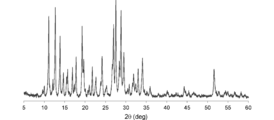
- FIG. 2 is an X-ray diffraction (XRD) diagram of the MWF-type zeolite obtained in Example 1.
- FIG. 2 is an X-ray diffraction (XRD) diagram of the MWF-type zeolite obtained in Example 1.
- the present embodiment a mode for carrying out the present invention (hereinafter referred to as “the present embodiment”) will be described in detail.
- the present invention is not limited to the following description, and various modifications can be made within the scope of the gist thereof.
- the X-ray diffraction pattern is obtained by irradiating X-ray using CuK ⁇ as a radiation source on the surface of zeolite fixed uniformly on a non-reflective sample plate for powder to obtain a scanning axis of ⁇ / 2 ⁇ .
- the structure is clear.
- B / A is 0.63 or more, preferably 0.635 or more, and more preferably 0.64 or more.
- a large peak height A suggests that higher-order structures such as 8-membered ring structures are clear, that is, fine structures are regularly arranged and pores are appropriately formed. It is thought that.
- the molecular sieving effect of MWF-type zeolite acts on gas molecules of different sizes, and CO 2 enters the pores, but CH 4 does not easily enter the pores. Therefore, it is considered that the adsorption amount ratio of CO 2 / CH 4 can be maximized.
- B / A is 0.80 or less, preferably 0.79 or less, and more preferably 0.78 or less.
- the range of B / A is that the fine structure is clear, the Si—O or Al—O bond has few defects, the gas adsorption site is less likely to be lost, and the higher-order structure is clear and the pores are small. Is in the range of 0.63 to 0.80 from the viewpoint that the molecular sieve effect of the MWF-type zeolite works.
- the peak near 2 ⁇ 51.6 ° is a diffraction peak of (18 180), and when this peak height is C, B / A has a high SN ratio, making it easy to compare the height ratio.
- C / A is high-angle reflection, and the measurement accuracy of the peak itself is high with respect to the change of the crystal lattice. Therefore, by setting both B / A and C / A to an appropriate range, CO 2 / Although CH 4 selectivity is increased, C / A is preferably 0.36 or more from the viewpoint of higher accuracy by using C / A and further increasing the CO 2 / CH 4 adsorption ratio. Is more preferably 37 or more, and further preferably 0.38 or more.
- C / A is preferably 0.52 or less, more preferably 0.50 or less, and 0.48 or less from the same viewpoint as above. More preferably.
- D / A represents the distortion of the crystal lattice in three directions with respect to the long-period structures such as 8-membered ring structures, It can be said that the higher D / A is isotropic with less distortion in the crystal lattice.
- D / A is 0.75 or more, more preferably 0.78 or more, and further preferably 0.80 or more.
- B / A and C / A can be measured by the methods described in the examples described later, and both are the composition ratio of the mixed gel and the conditions during the hydrothermal synthesis (heating temperature and heating time).
- Etc. can be adjusted to the above range by a method of adjusting to a preferable range described later.
- the peak half-value width obtained by X-ray diffraction indicates the crystallinity of the crystal lattice plane where the diffraction occurs and is preferably narrow.
- the adsorption amount ratio of CO 2 / CH 4 can be maximized because the adsorption amount can be maximized.
- the value of the said peak half width can be adjusted to the said range by the method etc. which adjust the conditions (heating temperature and heating time), etc. at the time of hydrothermal synthesis
- the MWF-type zeolite of this embodiment can also be specified as follows. That is, the saturated carbon dioxide adsorption amount of the MWF-type zeolite measured when the MWF-type zeolite and carbon dioxide are placed in a system of 25 ° C. and 760 mmHg is a (cm 3 / g), and the MWF-type zeolite And when the saturated methane adsorption amount of the MWF type zeolite measured when the methane is placed in a system of 25 ° C.
- the MWF type zeolite of this embodiment can also be specified as follows. That is, when the MWF-type zeolite and carbon dioxide are placed in a system at 25 ° C. and 760 mmHg, the carbon dioxide saturated adsorption amount a of the MWF-type zeolite is 10 cm 3 / g or more at 25 ° C.
- the methane saturated adsorption amount b of the MWF type zeolite measured when the type zeolite and methane are placed in a system of 25 ° C. and 760 mmHg is 3.5 cm 3 / g or less.
- the MWF-type zeolite of the present embodiment has high purity and high carbon dioxide (CO 2 ) adsorption selectivity, as suggested by having such characteristics.
- the MWF-type zeolite of the present embodiment has a high adsorption capacity for carbon dioxide (CO 2 ), a low adsorption capacity for methane, a saturated adsorption amount for carbon dioxide (CO 2 ), and a saturated adsorption amount for methane (CH 4 ). It can be said that the ratio is large.
- the MWF-type zeolite of the present embodiment has a gas component having a large amount of adsorption and a gas component having a small amount of adsorption by the MWF-type zeolite because of its high purity and high selectivity for carbon dioxide (CO 2 ) adsorption. Can be separated.
- Each saturated adsorption amount can be measured by the method described in Examples described later.
- the value of a / b can be adjusted to the above range, for example, by producing MWF-type zeolite based on the method for producing MWF-type zeolite described later. More specifically, by optimizing the components and composition of the mixed gel, hydrothermal synthesis temperature, and firing temperature, which will be described later, MWF type skeleton crystals are appropriately formed, and defects in the crystals are reduced.
- each of the saturated adsorption amounts a and b can be adjusted to the above ranges by, for example, producing an MWF type zeolite based on a method for producing an MWF type zeolite described later. More specifically, when a zeolite having a pore size larger than that of the MWF type skeleton and a different skeleton is formed, both the CO 2 saturated adsorption amount and the CH 4 saturated adsorption amount tend to increase. In addition, when the pores are blocked, the CO 2 saturated adsorption amount and the CH 4 saturated adsorption amount tend to decrease.
- the method for producing an MWF-type zeolite according to the present embodiment includes a silica source containing silicon, an aluminum source containing aluminum, an alkali metal source containing at least one selected from an alkali metal (M1) and an alkaline earth metal (M2), And a preparation step of a mixed gel containing water.
- a silica source containing silicon an aluminum source containing aluminum
- an alkali metal source containing at least one selected from an alkali metal (M1) and an alkaline earth metal (M2) and a preparation step of a mixed gel containing water.
- M1 alkali metal
- M2 alkaline earth metal
- the preparation process of the mixed gel is not particularly limited.
- these components including a silica source, an aluminum source, an alkali metal source, water, and, if necessary, an organic structure directing agent can be mixed at one time or in multiple stages.
- the order of mixing in multiple stages is not limited and may be appropriately selected depending on the conditions used.
- a precursor that forms a cis structure that is considered to be a constituent element of MWF-type zeolite and does not contain an organic structure-directing agent is produced.
- a mixed solution containing an alkali metal source, an aluminum source, and a silica source and to have a stirring step and an aging step.
- the temperature of the mixing, stirring, and aging process is preferably 15 ° C. or less.
- the time of mixing, stirring, and aging step is preferably 10 minutes or more and 24 hours or less, more preferably 20 minutes or more and 12 hours or less, more preferably 30 minutes or more, from the viewpoint of preventing excessive condensation reaction and sufficiently uniform mixing. Most preferred is 8 hours or less.
- the stirring is not particularly limited as long as it is a commonly used stirring method, and specific examples include a method using blade stirring, vibration stirring, rocking stirring, centrifugal stirring, and the like.
- the rotational speed of stirring is not particularly limited as long as it is a generally used stirring speed, for example, it may be 1 rpm or more and less than 2000 rpm.
- the time of the mixing step is not particularly limited, and can be appropriately selected depending on the temperature of the mixing step. For example, the time of the mixing step is more than 0 minutes and 1000 hours or less. From the viewpoint of excellent economic efficiency, a higher raw material addition rate in the mixing step is preferable because of high production efficiency. On the other hand, from the viewpoint of suppressing an excessive condensation reaction between Al and Si and achieving both precursor formation and uniform mixing, the addition rate is preferably slow.
- the aging step may be performed either by standing or stirring.
- stirring in the ripening step it is not particularly limited as long as it is a commonly used stirring method, but specific examples include a method using blade stirring, vibration stirring, rocking stirring, centrifugal stirring, and the like.
- the rotational speed of stirring is not particularly limited as long as it is a generally used stirring speed, for example, it may be 1 rpm or more and less than 2000 rpm.
- the mixed gel in the present embodiment is a mixture containing a silica source, an aluminum source, an alkali metal source, and water as essential components, and preferably an organic structure directing agent.
- the silica source means a component in the mixed gel that is a raw material of silicon contained in the zeolite produced from the mixed gel
- the aluminum source is a raw material of aluminum contained in the zeolite produced from the mixed gel.
- the component in the mixed gel is an alkali metal source
- the alkali metal source is a component in the mixed gel that is a raw material of the alkali metal and / or alkaline earth metal contained in the zeolite produced from the mixed gel.
- the silica source is not particularly limited as long as it is generally used, but specific examples include amorphous silica, colloidal silica, wet silica, dry silica, silica gel, sodium silicate, amorphous aluminosilicate. Gels, tetraethoxysilane (TEOS), trimethylethoxysilane, and the like can be given. These compounds may be used alone or in combination.
- TEOS tetraethoxysilane
- trimethylethoxysilane and the like can be given. These compounds may be used alone or in combination.
- the amorphous aluminosilicate gel is a silica source and an aluminum source.
- amorphous silica, colloidal silica, wet method silica, dry method silica, and silica gel are preferable because zeolite having a high crystallinity tends to be obtained.
- colloidal silica, wet method silica, and dry method silica are more preferable.
- colloidal silica include, but are not limited to, Ludox (registered trademark), Syton (registered trademark), Nalco (registered trademark), and Snowtex (registered trademark).
- wet process silica examples include, but are not limited to, for example, Hi-Sil (registered trademark), Ultrasil (registered trademark), Valcasil (registered trademark), Santocel (registered trademark), Valron-Estersil (registered trademark), Tokusil ( (Registered trademark), Zeosil (registered trademark), Carplex (registered trademark), Mizukasil (registered trademark), Sylysia (registered trademark), Syloid (registered trademark), Gasil (registered trademark), Silcron (registered trademark), Nipgel (registered trademark) ), Nipsil (registered trademark).
- Hi-Sil registered trademark
- Ultrasil registered trademark
- Valcasil registered trademark
- Santocel registered trademark
- Valron-Estersil registered trademark
- Tokusil (Registered trademark)
- Zeosil registered trademark
- Carplex registered trademark
- Mizukasil registered trademark
- Sylysia registered trademark
- Syloid registered trademark
- dry process silica examples include HDK (registered trademark), Aerosil (registered trademark), Reolosil (registered trademark), Cab-O-Sil (registered trademark), Francil (registered trademark), and Arc Silica (registered trademark).
- the aluminum source is not particularly limited as long as it is generally used, but specific examples include sodium aluminate, aluminum sulfate, aluminum nitrate, aluminum acetate, aluminum hydroxide, aluminum oxide, aluminum chloride, aluminum alkoxide. , Metal aluminum, amorphous aluminosilicate gel, and the like. These compounds may be used alone or in combination. Of these, sodium aluminate, aluminum sulfate, aluminum nitrate, aluminum acetate, aluminum hydroxide, aluminum chloride, and aluminum alkoxide are preferable because zeolite having a high crystallinity tends to be obtained. From the same viewpoint, sodium aluminate and aluminum hydroxide are more preferable, and sodium aluminate is more preferable.
- alkali metal source The kind of alkali in the alkali metal source is not particularly limited, and any alkali metal and / or any alkaline earth metal compound can be used.
- the alkali metal source include, but are not limited to, alkali metal or alkaline earth metal hydroxides, bicarbonates, carbonates, acetates, sulfates, nitrates, and the like. These compounds may be used alone or in combination.
- alkali metal and alkaline earth metal used as the alkali metal source Li, Na, K, Rb, Cs, Ca, Mg, Sr, Ba and the like can be usually used.
- the alkali metal and alkaline earth metal used as the alkali metal source may be used alone or in combination.
- the alkali metal source is not limited to, for example, sodium hydroxide, sodium acetate, sodium sulfate, sodium nitrate, sodium carbonate, sodium bicarbonate, potassium hydroxide, potassium acetate, potassium sulfate, potassium nitrate , Potassium carbonate, potassium bicarbonate, lithium hydroxide, lithium acetate, lithium sulfate, lithium nitrate, lithium carbonate, lithium bicarbonate, rubidium hydroxide, rubidium acetate, rubidium sulfate, rubidium nitrate, rubidium carbonate, rubidium bicarbonate, hydroxide Cesium, cesium acetate, cesium sulfate, cesium nitrate, cesium carbonate, cesium bicarbonate,
- sodium hydroxide, potassium hydroxide, lithium hydroxide, rubidium hydroxide, cesium hydroxide, calcium hydroxide, magnesium hydroxide, strontium hydroxide, barium hydroxide are preferable, sodium hydroxide, potassium hydroxide, Lithium hydroxide, rubidium hydroxide, and cesium hydroxide are more preferable, and sodium hydroxide is more preferable.
- the organic structure directing agent in the case of producing zeolite by hydrothermal synthesis of the mixed gel is a compound that acts to promote crystallization into a zeolite structure.
- an organic structure directing agent can be used as necessary. It is more preferable to synthesize using a mixed gel containing an organic structure-directing agent from the viewpoint that crystal formation of the MWF type skeleton becomes easier and / or the synthesis time is shortened and the cost is excellent when producing zeolite.
- the organic structure-directing agent is not particularly limited as long as it can form a desired MWF-type zeolite. Moreover, the organic structure directing agent may be used alone or in combination.
- organic structure directing agent examples include, but are not limited to, amines, quaternary ammonium salts, alcohols, ethers, amides, alkylureas, alkylthioureas, cyanoalkanes, and nitrogen as a hetero atom.
- Alicyclic heterocyclic compounds can be used, preferably a quaternary ammonium salt, more preferably a tetraalkylammonium salt, still more preferably a tetraethylammonium salt. Such salts are accompanied by anions.
- Such anions include, but are not limited to, halogen ions such as Cl ⁇ , Br ⁇ and I ⁇ , hydroxide ions, acetate ions, sulfate ions, nitrate ions, carbonate ions and carbonate ions. Hydrogen ions are included. Of these, halogen ions and hydroxide ions are preferable, and halogen ions are more preferable from the viewpoint of easier crystal formation of the MWF type skeleton.
- composition ratio of mixed gel Silica source and OH in the mixed gel - ratio of, OH for SiO 2 - molar ratio, i.e., OH - / expressed in SiO 2 (OH - hydroxide contained in the alkali metal source, and / or an organic structure directing agent Is a product ion).
- the 8-membered ring structure is formed without defects, the molecular sieving effect is exhibited, and the CH 4 adsorption amount is reduced.
- the intensity ratio of peak A derived from a higher order structure such as an 8-membered ring structure is high. That is, in order to form an 8-membered ring structure clearly, the cis structure and its precursor are assembled without collapsing. It is desirable to form a higher order structure. From these viewpoints, it is preferable to prevent re-dissolution of the grown zeolite, and in order to suppress dissolution, it is preferable that the amount of OH ⁇ is small.
- the CO 2 adsorption site may be reduced and the CO 2 adsorption amount may be reduced. is there.
- the peaks B and C derived from a finer structure parallel to the surface belonging to the peak A are relatively high.
- the MWF-type zeolite having a large amount of CO 2 adsorption and a small amount of CH 4 adsorption is limited to the case where B / A and C / A are in a specific range.
- Results inventors have studied intensively, OH present in the synthesis solution - the amount of, with respect to SiO 2, 0.10 ⁇ OH - / if SiO 2 ⁇ 0.60, the SiO or Al-O It is possible to synthesize an MWF-type zeolite that can have a specific ratio of B / A and C / A without generating defects or bond distortion.
- OH ⁇ / SiO 2 is more preferably 0.15 or more, and further preferably 0.18 or more.
- OH ⁇ / SiO 2 is more preferably less than 0.40, and even more preferably 0.35 or less.
- the ratio of the silica source to the aluminum source in the mixed gel is expressed as a molar ratio of oxides of the respective elements, that is, SiO 2 / Al 2 O 3 .
- This SiO 2 / Al 2 O 3 is not particularly limited as long as it is a ratio capable of forming zeolite, but is preferably 5.0 or more because it tends to suppress formation of zeolite having a skeleton different from the MWF type skeleton. More preferably, it is 6.0 or more. From the same viewpoint, it is more preferably 6.8 or more.
- SiO 2 / Al 2 O 3 is preferably 12 or less and more preferably 10 or less because it tends to suppress formation of zeolite having a skeleton different from the MWF-type skeleton. From the same viewpoint, it is more preferably 7.8 or less.
- the ratio of the aluminum source to the alkali metal source in the mixed gel is expressed as an added molar ratio of M1 2 O and M2O to Al 2 O 3 , that is, (M1 2 O + M2O) / Al 2 O 3 (where M1 is an alkali metal) And M2 represents an alkaline earth metal).
- the (M1 2 O + M 2 O) / Al 2 O 3 is preferably 1.3 or more, and more preferably 1.5 or more, from the viewpoint of easier crystal formation of the MWF type skeleton. From the same viewpoint, it is more preferably 1.7 or more.
- (M1 2 O + M 2 O) / Al 2 O 3 is preferably 3.2 or less, more preferably 2.5 or less, from the viewpoint of suppressing the formation of zeolite having a skeleton different from the MWF type skeleton. From the same viewpoint, it is more preferably 2.2 or less.
- the mixed gel comprising an organic structure directing agent, the ratio of aluminum source and an organic structure directing agent in the mixed gel, the molar ratio of the organic structure-directing agent for Al 2 O 3, i.e. expressed as R / Al 2 O 3 (Where R represents an organic structure directing agent). It is preferably 2.0 or more, more preferably 3.0 or more, from the viewpoint that crystal formation of the MWF type skeleton becomes easier and / or the synthesis time is shortened and the cost is excellent when producing zeolite. preferable. From the viewpoint of suppressing the formation of zeolite having a skeleton different from the MWF type skeleton, it is more preferably 4.0 or more.
- R / Al 2 O 3 is preferably 50 or less, and more preferably 30 or less, from the viewpoint that the synthesis time is shortened and the economy at the time of producing zeolite is excellent. From the viewpoint that formation of zeolite having a skeleton different from the MWF type skeleton can be suppressed, it is more preferably 20 or less.
- the ratio of aluminum source to water in the mixed gel is expressed as the molar ratio of water to Al 2 O 3 , that is, H 2 O / Al 2 O 3 . Since the components in the mixed gel tend to be more uniformly dispersed, it is preferably 100 or more, and more preferably 200 or more.
- the method for producing an MWF-type zeolite according to this embodiment includes at least one selected from a silica source containing silicon, an aluminum source containing aluminum, an alkali metal (M1), and an alkaline earth metal (M2).
- the molar ratios ⁇ , ⁇ , ⁇ , and ⁇ represented by the following formulas (1), (2), (3), and (4) are 5.0 ⁇ ⁇ ⁇ It is particularly preferable to satisfy 12, 1.3 ⁇ ⁇ ⁇ 3.2, 100 ⁇ ⁇ ⁇ 3000, and 0.10 ⁇ ⁇ ⁇ 0.60.
- the MWF-type zeolite according to this embodiment is obtained by the above-described method for producing an MWF-type zeolite according to this embodiment.
- ⁇ SiO 2 / Al 2 O 3 (1)
- ⁇ (M1 2 O + M2O) / Al 2 O 3 (2)
- ⁇ H 2 O / Al 2 O 3 (3)
- ⁇ OH ⁇ / SiO 2 (4)
- the mixed gel further includes an organic structure directing agent R, and the following formula ( More preferably, the molar ratio ⁇ represented by 5) satisfies 2.0 ⁇ ⁇ ⁇ 50.
- the method for producing an MWF-type zeolite according to this embodiment preferably further includes a hydrothermal synthesis step in which the hydrothermal synthesis temperature is 100 ° C. to 170 ° C. That is, preferably, the mixed gel obtained by the preparation step is hydrothermally synthesized by holding it at a predetermined temperature for a predetermined time with stirring or standing.
- the temperature of the hydrothermal synthesis is not particularly limited as long as it is a commonly used temperature, but it is preferably 100 ° C. or higher from the viewpoint that the synthesis time is shortened and the economy in producing zeolite is excellent.
- the temperature is more preferably 110 ° C. or more, and further preferably 115 ° C. or more. Since it exists in the tendency which can suppress decomposition
- the hydrothermal synthesis time is not particularly limited as long as it is generally used, and can be appropriately selected depending on the hydrothermal synthesis temperature.
- the hydrothermal synthesis time is preferably 3 hours or more, more preferably 10 hours or more, from the point that the MWF skeleton is formed. From the viewpoint of increasing the yield of MWF-type zeolite and being excellent in economic efficiency, it is more preferably 24 hours or longer. Since there exists a tendency which can suppress decomposition
- the container in which the mixed gel is put is not particularly limited as long as it is a commonly used container, but when the pressure in the container increases at a predetermined temperature, or under a gas pressure that does not inhibit crystallization. In such a case, it is preferable to place in a pressure vessel and perform hydrothermal synthesis.
- the pressure vessel is not particularly limited, and various shapes such as a spherical shape, a vertically long shape, and a horizontally long shape can be used.
- the pressure vessel When the mixed gel in the pressure vessel is agitated, the pressure vessel is rotated in the vertical direction and / or the horizontal direction, but is preferably rotated in the vertical direction.
- the rotation speed is not particularly limited as long as it is in a generally used range, but it is preferably 1 to 50 rpm, and more preferably 10 to 40 rpm.
- the hydrothermal synthesis step in order to preferably stir the mixed gel, there is a method of using a vertically long pressure-resistant container and rotating it in the vertical direction.
- the separation method is not particularly limited as long as it is a general method, and filtration, decantation, spray drying methods (rotary spray, Nozzle spraying and ultrasonic spraying), a drying method using a rotary evaporator, a vacuum drying method, a freeze drying method, a natural drying method, or the like can be used.
- separation can be performed by filtration or decantation.
- the separated product may be used as it is, or may be washed with water or a predetermined solvent. If necessary, the separated product can be dried.
- the temperature for drying the separated product is not particularly limited as long as it is a general drying temperature, but it is usually from room temperature to 150 ° C. or less.
- the atmosphere for drying is not particularly limited as long as it is a commonly used atmosphere, but usually an air atmosphere, an atmosphere to which an inert gas such as nitrogen or argon or oxygen is added is used.
- the MWF-type zeolite can be calcined and used.
- the firing temperature is not particularly limited as long as it is a commonly used temperature. However, when it is desired to remove the organic structure directing agent, the remaining ratio can be reduced, so that it is preferably 300 ° C. or higher, and 350 ° C. or higher. It is more preferable that It is more preferable that the temperature is 400 ° C. or higher from the viewpoint that the firing time is shortened and the economical efficiency in producing zeolite is excellent. Since the crystallinity of the zeolite tends to be maintained, the temperature is preferably less than 550 ° C, more preferably 530 ° C or less, and further preferably 500 ° C or less.
- the firing time is not particularly limited as long as the organic structure directing agent is sufficiently removed, and can be appropriately selected depending on the firing temperature. However, the proportion of the remaining organic structure directing agent tends to be reduced. Therefore, it is preferably 0.5 hours or more, more preferably 1 hour or more, and further preferably 3 hours or more. Since the crystallinity of the zeolite tends to be maintained, it is preferably 20 days or less, more preferably 10 days or less, and even more preferably 7 days or less.
- the firing atmosphere is not particularly limited as long as it is a commonly used atmosphere, but usually an air atmosphere, an atmosphere added with an inert gas such as nitrogen or argon, or oxygen is used.
- cation exchange is not limited to the following, for example, NH 4 NO 3 , LiNO 3 , NaNO 3 , KNO 3 , RbNO 3 , CsNO 3 , Be (NO 3 ) 2 , Ca (NO 3 ) 2 , Mg (NO 3) ) 2 , Sr (NO 3 ) 2 , Ba (NO 3 ) 2 and the like, or nitrate ions contained in the nitrate are halide ions, sulfate ions, carbonate ions, hydrogen carbonate ions, acetate ions, phosphate ions, phosphorus ions
- a salt which is an oxyhydrogen ion, or an acid such as nitric acid or hydrochloric acid can be used.
- the cation exchange temperature is not particularly limited as long as it is a general cation exchange temperature, but is usually from room temperature to 100 ° C. or less.
- the separation method is not particularly limited as long as it is a general method. Filtration, decantation, spray drying methods (rotary spray, nozzle spray, ultrasonic spray, etc.), rotary evaporator A drying method using a vacuum, a vacuum drying method, a freeze-drying method, a natural drying method, or the like can be used. Usually, separation can be performed by filtration or decantation.
- the separated product may be used as it is, or may be washed with water or a predetermined solvent. If necessary, the separated product can be dried.
- the temperature for drying the separated product is not particularly limited as long as it is a general drying temperature, but it is usually from room temperature to 150 ° C. or less.
- the atmosphere for drying is not particularly limited as long as it is a commonly used atmosphere, but usually an air atmosphere, an atmosphere to which an inert gas such as nitrogen or argon or oxygen is added is used.
- ammonium type zeolite can be converted to proton type zeolite by calcining the zeolite.
- the gas component having a large adsorption amount by the MWF-type zeolite can be selectively adsorbed on the MWF-type zeolite and separated. That is, in the gas separation method of this embodiment, a gas mixture composed of a plurality of gas components is brought into contact with the MWF-type zeolite of this embodiment, and a gas component having a large adsorption amount is adsorbed to the MWF-type zeolite from the gas mixture. And separating.
- the gas mixture examples include, but are not limited to, for example, carbon dioxide, hydrogen, oxygen, nitrogen, methane, ethane, ethylene, propane, propylene, normal butane, isobutane, 1-butene, 2-butene, isobutene, and hexafluoride.
- examples include those containing at least one component selected from sulfur, helium, carbon monoxide, nitric oxide, water and the like.
- the two components are preferably a combination of a component having a large adsorption amount and a component having a small adsorption amount by the MWF-type zeolite of the present embodiment.
- Illustrative examples of combinations of gas mixtures include, but are not limited to, at least one component selected from the group consisting of carbon dioxide and water, and at least one component selected from the group consisting of oxygen, nitrogen and methane.
- the gas mixture contained in is mentioned.
- Some industrial processes that use zeolite as an adsorbent, such as drying in a closed system that does not require a regeneration step SF 6 gas drying, multilayer glass interlayer drying, refrigerant drying, etc.
- the gas adsorbed on the MWF-type zeolite can be divided into the heat regeneration (TSA) method, pressure regeneration (PSA) method, pressure temperature swing adsorption (depending on the desorption method (regeneration method) of the components adsorbed in the zeolite pores).
- TSA heat regeneration
- PSA pressure regeneration
- PTSA substitution method
- purge method purge method or a combination of the above methods can be used for recovery, and at the same time, the MWF-type zeolite can be regenerated. That is, the zeolite regeneration method of this embodiment includes a step of regenerating the MWF zeolite by desorbing the gas component adsorbed on the MWF zeolite by the gas separation method of the present embodiment.
- the use of the MWF-type zeolite of the present embodiment is not particularly limited.
- separation agents such as various gases and liquids, electrolyte membranes such as fuel cells, fillers of various resin molded bodies, membrane reactors, or hydrocracking Catalysts for alkylation, catalyst carriers for supporting metals, metal oxides, adsorbents, desiccants, detergent aids, ion exchangers, wastewater treatment agents, fertilizers, food additives, cosmetic additives, etc. Can do.
- Crystal structure analysis The crystal structure analysis was performed according to the following procedure. (1) The dried product obtained in each Example and Comparative Example was used as a sample and pulverized in an agate mortar. (2) The sample of (1) above was fixed uniformly on a non-reflective sample plate for powder, crystal structure analysis was performed under the following conditions, and predetermined peak intensity and half-value width were measured.
- X-ray diffractometer Rigaku's powder X-ray diffractometer “RINT2500” (trade name)
- X-ray source Cu tube (40 kV, 200 mA)
- Measurement temperature 25 ° C
- Measurement range 5 to 60 ° (0.02 ° / step)
- Measurement speed 0.2 ° / min
- Slit width sinuming, divergence, light reception: 1 °, 1 °, 0.15 mm
- the gas adsorption isotherm was measured according to the following procedure. (1) Using the fired product obtained in each example and comparative example as a sample, 0.2 g was placed in a 12 mm cell (manufactured by Micro Meritics). (2) The sample placed in the cell of (1) above was placed in a gas adsorption measuring device “3-Flex” (trade name) manufactured by Micro Meritics, and heated and degassed at 250 ° C. and 0.001 mmHg or less for 12 hours. did.
- the saturated carbon dioxide adsorption amount of the MWF type zeolite measured when the MWF type zeolite and carbon dioxide are placed in a system of 25 ° C. and 760 mmHg is defined as a (cm 3 / g)
- Example 1 62.02 g of water, 0.91 g of sodium hydroxide (NaOH, manufactured by Wako Pure Chemical Industries, Ltd.) and 1.64 g of sodium aluminate (NaAlO 2 , manufactured by Wako Pure Chemical Industries, Ltd.) are added and dissolved, and the aqueous solution is dissolved. Obtained. While stirring this aqueous solution at 10 ° C., 10.67 g of colloidal silica (Ludox AS-40, manufactured by Grace) was added at a rate of 1 cc / min. After stirring this solution at 10 ° C.
- the mixed gel was charged into a 200 mL stainless steel autoclave containing a fluororesin inner cylinder, hydrothermally synthesized at 125 ° C. for 7 days while being kept at 20 rpm, and the product was filtered and dried at 120 ° C.
- a powdery zeolite was obtained.
- the XRD spectrum of the obtained zeolite is shown in FIG. From the spectrum, it was confirmed that the obtained zeolite was MWF type zeolite. Furthermore, since no peaks derived from other zeolites or amorphous silica alumina were observed, it was evaluated as a high-purity MWF type zeolite.
- the adsorption selectivity (a / b) was 278.
- FP410 Yamato Scientific Co., Ltd.
- the mixed gel was hydrothermally synthesized at 125 ° C. for 7 days with stirring, and the product was filtered and dried at 120 ° C. to obtain a powdery zeolite.
- the mixed gel was hydrothermally synthesized at 125 ° C.
- ⁇ to ⁇ represent the following molar ratios.
- ⁇ SiO 2 / Al 2 O 3
- ⁇ (M1 2 O + M 2 O) / Al 2 O 3
- ⁇ H 2 O / Al 2 O 3
- ⁇ OH ⁇ / SiO 2
- ⁇ R / Al 2 O 3
- B / A and C / A in Table 1 are calculated
- the MWF-type zeolite according to the present invention includes a separating agent such as various gases and liquids, an electrolyte membrane such as a fuel cell, a filler of various resin moldings, a membrane reactor, a catalyst such as hydrocracking and alkylation, a metal, and a metal oxide. It has industrial applicability as a supporting catalyst carrier such as adsorbent, desiccant, detergent aid, ion exchanger, wastewater treatment agent, fertilizer, food additive, cosmetic additive and the like.
Landscapes
- Chemical & Material Sciences (AREA)
- Chemical Kinetics & Catalysis (AREA)
- Analytical Chemistry (AREA)
- Organic Chemistry (AREA)
- Engineering & Computer Science (AREA)
- General Chemical & Material Sciences (AREA)
- Oil, Petroleum & Natural Gas (AREA)
- Life Sciences & Earth Sciences (AREA)
- Inorganic Chemistry (AREA)
- Geology (AREA)
- General Life Sciences & Earth Sciences (AREA)
- Physics & Mathematics (AREA)
- Thermal Sciences (AREA)
- Materials Engineering (AREA)
- Silicates, Zeolites, And Molecular Sieves (AREA)
- Solid-Sorbent Or Filter-Aiding Compositions (AREA)
- Separation Of Gases By Adsorption (AREA)
Abstract
Description
ここで、MWF型ゼオライトとは、International Zeolite Association(IZA)が定めるゼオライトの構造を規定するコードでMWF構造のゼオライトを意味する。特許文献1において、MWF型ゼオライトの一種であるZSM-25が開示されている。また、特許文献2、非特許文献1にあるように、近年になってMWF型ゼオライトの一種であるZSM-25の構造が明らかとなった。該構造は、正六面体結晶系のIm3mの空間群を有し、酸素8員環で構成された細孔を有するゼオライトであると報告されている。加えて二酸化炭素を選択的に吸着することにより、二酸化炭素とメタンの分離や二酸化炭素と窒素の分離に使用することが報告されている。
しかしながら、特許文献1、特許文献2、非特許文献1等で開示されているMWF型ゼオライトでは、そのガス分離能は上記のような高度な要求に対しては十分ではない。
〔1〕
X線回折により得られるピークにおいて、2θ=11.1及び13.8°付近のピーク高さをそれぞれA及びBとしたとき、0.63≦B/A≦0.80を満たす、MWF型ゼオライト。
〔2〕
X線回折により得られるピークにおいて、2θ=51.6°付近のピーク高さをCとしたとき、0.36≦C/A≦0.52を満たす、〔1〕に記載のMWF型ゼオライト。
〔3〕
X線回折により得られるピークにおいて、2θ=11.1°付近のピークの半値幅が0.31以下を満たす、〔1〕又は〔2〕に記載のMWF型ゼオライト。
〔4〕
MWF型ゼオライトであって、
前記MWF型ゼオライト及び二酸化炭素を25℃、760mmHgの系に置いた場合に測定される当該MWF型ゼオライトの二酸化炭素飽和吸着量をa(cm3/g)とし、
前記MWF型ゼオライト及びメタンを25℃、760mmHgの系に置いた場合に測定される当該MWF型ゼオライトのメタン飽和吸着量をb(cm3/g)とするとき、前記aを前記bで除した値が23以上である、MWF型ゼオライト。
〔5〕
MWF型ゼオライトであって、
前記MWF型ゼオライト及び二酸化炭素を25℃、760mmHgの系に置いた場合に測定される当該MWF型ゼオライトの二酸化炭素飽和吸着量aが10cm3/g以上であり、
前記MWF型ゼオライト及びメタンを25℃、760mmHgの系に置いた場合に測定される当該MWF型ゼオライトのメタン飽和吸着量bが3.5cm3/g以下である、MWF型ゼオライト。
〔6〕
〔1〕~〔5〕のいずれかに記載のMWF型ゼオライトの製造方法であって、
珪素を含むシリカ源と、アルミニウムを含むアルミ源と、アルカリ金属(M1)及びアルカリ土類金属(M2)から選ばれる少なくとも1種を含むアルカリ金属源と、水と、を含有する混合ゲルの調製工程を含み、
前記混合ゲルにおける各成分のモル比を、前記珪素、アルミニウム、アルカリ金属(M1)及びアルカリ土類金属(M2)については各元素の酸化物として算出するとき、下記式(1)、(2)、(3)及び(4)で表されるモル比α、β、γ、δが、5.0≦α≦12、1.3≦β≦3.2、100≦γ≦3000及び0.10≦δ≦0.60を満たす、MWF型ゼオライトの製造方法。
α=SiO2/Al2O3 (1)
β=(M12O+M2O)/Al2O3 (2)
γ=H2O/Al2O3 (3)
δ=OH-/SiO2 (4)
〔7〕
前記混合ゲルが、さらに有機構造規定剤Rを含み、
下記式(5)で表されるモル比εが、2.00≦ε≦50を満たす、〔6〕に記載のMWF型ゼオライトの製造方法。
ε=R/Al2O3 (5)
〔8〕
水熱合成温度が100℃~170℃である水熱合成工程をさらに含む、〔6〕又は〔7〕のいずれかに記載のMWF型ゼオライトの製造方法。
〔9〕
焼成温度が300℃以上550℃未満である焼成工程をさらに含む、〔6〕~〔8〕のいずれかに記載のMWF型ゼオライトの製造方法。
〔10〕
〔1〕~〔5〕のいずれかに記載のMWF型ゼオライトに複数の気体成分からなる気体混合物を接触させ、前記気体混合物から、前記MWF型ゼオライトによる吸着量の大きい気体成分を前記MWF型ゼオライトに吸着させて分離する工程を含む、気体の分離方法。
〔11〕
前記気体混合物が、二酸化炭素、水素、酸素、窒素、メタン、エタン、エチレン、プロパン、プロピレン、ノルマルブタン、イソブタン、1-ブテン、2-ブテン、イソブテン、六フッ化硫黄、ヘリウム、一酸化炭素、一酸化窒素及び水よりなる群から選ばれる少なくとも2種の気体成分を含む、〔10〕に記載の気体の分離方法。
〔12〕
〔10〕又は〔11〕に記載の気体の分離方法によりMWF型ゼオライトに吸着した気体成分を脱着させて前記MWF型ゼオライトを再生させる工程を含む、MWF型ゼオライトの再生方法。
本実施形態のMWF型ゼオライトは、X線回折により得られるピークにおいて、2θ=11.1及び13.8°付近のピーク高さをそれぞれA及びBとしたとき、0.61≦B/A≦0.83を満たす。
ここで、X線回折パターンとはゼオライトを粉末用無反射試料板上に均一に固定した表面にCuKαを線源とするX線を照射して、走査軸をθ/2θとして得るものである。
2θ=11.1°付近のピークとは11.1°±0.1°の範囲に存在するピークのうち最大のものを指す。
2θ=13.8°付近のピークとは13.8°±0.2°の範囲に存在するピークで最大のものを指す。
一方、ピーク高さAの値が大きいことは、8員環構造等の高次構造が明瞭である、すなわち、微細な構造が規則正しく配列し、細孔が適切に形成されていることを示唆していると考えられる。細孔構造が適切に欠損なく形成されることで、大きさの異なるガス分子に対するMWF型ゼオライトの分子篩効果が働き、CO2は細孔内に入れるが、CH4は細孔内に入りにくくなるためCO2/CH4の吸着量比を最大にできると考えられる。この観点から、Aの値が大きいことも重要であり、B/Aは0.80以下であり、0.79以下であることが好ましく、0.78以下であることがより好ましい。
つまり、B/Aの範囲は、微細な構造が明瞭で、Si-OあるいはAl-O結合に欠損が少なく、ガス吸着サイトの欠損が発生しにくいこと、及び高次構造が明瞭で、細孔が適切に形成されており、MWF型ゼオライトの分子篩効果が働くことの観点から0.63~0.80の範囲である。
ピーク高さCとAとの関係についても、上記と同様の観点から、C/Aが0.52以下であることが好ましく、0.50以下であることがより好ましく、0.48以下であることがさらに好ましい。
ここで、2θ=51.6°付近のピークとは51.6°±0.4°の範囲に存在するピークのうち最大のものを指す。
ここで、2θ=12.7°付近のピークとは12.7°±0.2°の範囲に存在するピークのうち最大のものを指す。
なお、上記ピーク半値幅の値は、混合ゲルの組成比、水熱合成時の条件(加熱温度や加熱時間)等を後述する好ましい範囲に調整する方法等により、上記範囲に調整することができる。
本実施形態のMWF型ゼオライトは、次のように特定することもできる。すなわち、当該MWF型ゼオライト及び二酸化炭素を25℃、760mmHgの系に置いた場合に測定される当該MWF型ゼオライトの二酸化炭素飽和吸着量をa(cm3/g)とし、また、当該MWF型ゼオライト及びメタンを25℃、760mmHgの系に置いた場合に測定される当該MWF型ゼオライトのメタン飽和吸着量をb(cm3/g)とするとき、aをbで除した値(a/b)が23以上である。
また、本実施形態のMWF型ゼオライトは、次のように特定することもできる。すなわち、MWF型ゼオライト及び二酸化炭素を25℃、760mmHgの系に置いた場合に測定される当該MWF型ゼオライトの二酸化炭素飽和吸着量aが25℃、760mmHgで10cm3/g以上であり、当該MWF型ゼオライト及びメタンを25℃、760mmHgの系に置いた場合に測定される当該MWF型ゼオライトのメタン飽和吸着量bが3.5cm3/g以下である。
本実施形態のMWF型ゼオライトは、このような特徴を有することから示唆されるように、純度が高く、二酸化炭素(CO2)吸着の選択性が高い。すなわち、本実施形態のMWF型ゼオライトは、二酸化炭素(CO2)に対する吸着能が高く、メタンに対する吸着能が低く、二酸化炭素(CO2)に対する飽和吸着量とメタン(CH4)に対する飽和吸着量との比が大きいものということができる。このように、本実施形態のMWF型ゼオライトは、その純度の高さ及び二酸化炭素(CO2)吸着の選択性の高さから、当該MWF型ゼオライトによる吸着量の大きい気体成分と小さい気体成分とを分離することができる。すなわち、この吸着能の差を利用して気体を分離する用途に好適に用いることができる。
上記の各飽和吸着量は、後述する実施例に記載の方法により測定することができる。また、上記a/bの値は、例えば、後述するMWF型ゼオライトの製法方法に基づいてMWF型ゼオライトを製造すること等により、上記範囲に調整することができる。より詳細には、後述する混合ゲルの成分・組成、水熱合成温度、焼成温度などを最適化することで、MWF型骨格の結晶が適切に形成される、結晶内の欠陥が少なくなる、MWF型骨格と異なる骨格を有するゼオライトの形成が抑制されている、焼成においてMWF型骨格が保たれている等の要因が推定され、結果としてa/bの値が増加する傾向にある。ただし、上記作用機序に限定されるものではない。一方、混合ゲルの組成を後述する好ましい範囲から変更する場合や、反応温度を高温にするなどしてMWF型骨格と異なる骨格を有するゼオライトが多く形成される場合、選択性は低下する傾向にある。
さらに、上記の各飽和吸着量a及びbについても、例えば、後述するMWF型ゼオライトの製法方法に基づいてMWF型ゼオライトを製造すること等により、それぞれ上記範囲に調整することができる。より詳細には、MWF型骨格より大きい細孔径、及び異なる骨格を有するゼオライトが形成する場合、CO2飽和吸着量もCH4飽和吸着量も増加する傾向にある。また、細孔が塞がれるなどした場合には、CO2飽和吸着量もCH4飽和吸着量も減少する傾向にある。
本実施形態に係るMWF型ゼオライトの製造方法は、珪素を含むシリカ源、アルミニウムを含むアルミ源、アルカリ金属(M1)及びアルカリ土類金属(M2)から選ばれる少なくとも1種を含むアルカリ金属源、及び水を含有する混合ゲルの調製工程を含むものである。
以下、混合ゲル及びこれに含まれる各成分について説明する。
混合ゲルの調製工程は、特に限定されないが、例えば、シリカ源、アルミ源、アルカリ金属源、水、及び必要に応じて有機構造規定剤を一時にあるいは多段階で混合する混合工程と、この混合工程で得られた混合物の熟成工程とを含んでもよい。
混合工程は、シリカ源、アルミ源、アルカリ金属源、水、及び必要に応じて有機構造規定剤を含むこれら成分を一時にあるいは多段階で混合することができる。
多段階で混合する際の順序は限定されず、用いる条件により適宜選択すればよい。多段階で混合する際には、撹拌あるいは無撹拌のどちらで行ってもよいが、MWF型ゼオライトの構成要素であり、有機構造規定剤を含有しないと考えられるgis構造を形成させる前駆体を作る観点から、アルカリ金属源、アルミ源、シリカ源を含む混合液を用い、撹拌工程と熟成工程があることが好ましい。アルミ源とシリカ源を混合し、熟成する際には、AlとSiの過度な縮合反応を抑制し、前駆体の形成と均一混合を両立させる観点から、低温にすることが好ましい。具体的には、混合、撹拌、熟成工程の温度は15℃以下であることが好ましい。混合、撹拌、熟成工程の時間は、過度な縮合反応を防げ、十分に均一混合できる観点から、10分以上、24時間以下が好ましく、20分以上、12時間以下がさらに好ましく、30分以上、8時間以下が最も好ましい。
撹拌する際には、一般的に使用される撹拌方法であれば特に限定されないが、具体例としては、翼撹拌、振動撹拌、揺動撹拌、遠心式撹拌などを用いる方法が挙げられる。
撹拌の回転速度は一般的に用いられる撹拌速度であれば特に限定されないが、例えば、1rpm以上2000rpm未満であることが挙げられる。
混合工程の時間は、特に限定されず、混合工程の温度により適宜選択することができるが、例えば、0分を超え、1000時間以下が挙げられる。
混合工程における原料の添加速度は、経済性に優れる観点から、速い方が、生産効率が高く好ましい。一方で、AlとSiの過度な縮合反応を抑制し、前駆体の形成と均一混合を両立させる観点から、添加速度は遅い方が好ましい。これらの観点から、100cc程度の混合ゲルを調整する場合、0.1cc/min以上100cc/min以下であることが好ましく、0.2cc/min以上50cc/min以下であることがさらに好ましく、0.5cc/min以上10cc/min以下であることが最も好ましい。
熟成工程は静置あるいは撹拌のどちらで行ってもよい。
熟成工程で撹拌する際には、一般的に使用される撹拌方法であれば特に限定されないが、具体例としては、翼撹拌、振動撹拌、揺動撹拌、遠心式撹拌などを用いる方法が挙げられる。
撹拌の回転速度は一般的に用いられる撹拌速度であれば特に限定されないが、例えば、1rpm以上2000rpm未満であることが挙げられる。
本実施形態における混合ゲルとは、シリカ源、アルミ源、アルカリ金属源、及び水を必須成分として含み、好ましくは有機構造規定剤を含む混合物のことである。
シリカ源とは、該混合ゲルから製造されたゼオライトに含まれる珪素の原料となる該混合ゲル中の成分をいい、アルミ源とは、該混合ゲルから製造されたゼオライトに含まれるアルミニウムの原料となる該混合ゲル中の成分をいい、アルカリ金属源とは、該混合ゲルから製造されたゼオライトに含まれるアルカリ金属及び/又はアルカリ土類金属の原料となる該混合ゲル中の成分をいう。
シリカ源としては、一般的に使用されるものであれば特に限定されないが、具体例としては、無定形シリカ、コロイダルシリカ、湿式法シリカ、乾式法シリカ、シリカゲル、ケイ酸ナトリウム、無定形アルミノシリケートゲル、テトラエトキシシラン(TEOS)、トリメチルエトキシシラン等が挙げられる。これらの化合物は、単独で使用しても、複数を組み合わせて使用してもよい。ここで、無定形アルミノシリケートゲルは、シリカ源であるとともにアルミ源となる。
これらの中でも、結晶化度の高いゼオライトが得られる傾向にあることから、無定形シリカ、コロイダルシリカ、湿式法シリカ、乾式法シリカ、シリカゲルであることが好ましい。同様の観点から、コロイダルシリカ、湿式法シリカ、乾式法シリカであることがより好ましい。
コロイダルシリカとしては、以下に限定されないが、例えば、Ludox(登録商標)、Syton(登録商標)、Nalco(登録商標)、Snowtex(登録商標)が挙げられる。
湿式法シリカとしては、以下に限定されないが、例えば、Hi-Sil(登録商標)、Ultrasil(登録商標)、Vulcasil(登録商標)、Santocel(登録商標)、Valron-Estersil(登録商標)、Tokusil(登録商標)、Zeosil(登録商標)、Carplex(登録商標)、Mizukasil(登録商標)、Sylysia(登録商標)、Syloid(登録商標)、Gasil(登録商標)、Silcron(登録商標)、Nipgel(登録商標)、Nipsil(登録商標)が挙げられる。
乾式法シリカは、例えば、HDK(登録商標)、Aerosil(登録商標)、Reolosil(登録商標)、Cab-O-Sil(登録商標)、Fransil(登録商標)、ArcSilica(登録商標)が挙げられる。
アルミ源としては、一般的に使用されるものであれば特に限定されないが、具体例としては、アルミン酸ナトリウム、硫酸アルミニウム、硝酸アルミニウム、酢酸アルミニウム、水酸化アルミニウム、酸化アルミニウム、塩化アルミニウム、アルミニウムアルコキシド、金属アルミニウム、無定形アルミノシリケートゲル等が挙げられる。これらの化合物は、単独で使用しても、複数を組み合わせて使用してもよい。
これらの中でも、結晶化度の高いゼオライトが得られる傾向にあることから、アルミン酸ナトリウム、硫酸アルミニウム、硝酸アルミニウム、酢酸アルミニウム、水酸化アルミニウム、塩化アルミニウム、アルミニウムアルコキシドであることが好ましい。同様の観点からアルミン酸ナトリウム、水酸化アルミニウムであることがより好ましく、アルミン酸ナトリウムであることがさらに好ましい。
アルカリ金属源におけるアルカリの種類は特に限定されず、任意のアルカリ金属、及び/又は任意のアルカリ土類金属化合物を使用することができる。
アルカリ金属源は、以下に限定されないが、例えば、アルカリ金属又はアルカリ土類金属の水酸化物、炭酸水素塩、炭酸塩、酢酸塩、硫酸塩、硝酸塩などが挙げられる。これらの化合物は、単独でも、複数を組み合わせて使用してもよい。
アルカリ金属源として用いるアルカリ金属及びアルカリ土類金属は、通常Li、Na、K、Rb、Cs、Ca、Mg、Sr、Ba等を用いることができる。MWF型骨格の結晶形成がより容易となる観点から、Na、Kであることが好ましく、Naであることがより好ましい。また、アルカリ金属源として用いるアルカリ金属及びアルカリ土類金属は単独でも、複数を組み合わせて使用してもよい。
具体的には、アルカリ金属源としては、以下に限定されないが、例えば、水酸化ナトリウム、酢酸ナトリウム、硫酸ナトリウム、硝酸ナトリウム、炭酸ナトリウム、炭酸水素ナトリウム、水酸化カリウム、酢酸カリウム、硫酸カリウム、硝酸カリウム、炭酸カリウム、炭酸水素カリウム、水酸化リチウム、酢酸リチウム、硫酸リチウム、硝酸リチウム、炭酸リチウム、炭酸水素リチウム、水酸化ルビジウム、酢酸ルビジウム、硫酸ルビジウム、硝酸ルビジウム、炭酸ルビジウム、炭酸水素ルビジウム、水酸化セシウム、酢酸セシウム、硫酸セシウム、硝酸セシウム、炭酸セシウム、炭酸水素セシウム、水酸化カルシウム、酢酸カルシウム、硫酸カルシウム、硝酸カルシウム、炭酸カルシウム、炭酸水素カルシウム、水酸化マグネシウム、酢酸マグネシウム、硫酸マグネシウム、硝酸マグネシウム、炭酸マグネシウム、炭酸水素マグネシウム、水酸化ストロンチウム、酢酸ストロンチウム、硫酸ストロンチウム、硝酸ストロンチウム、炭酸ストロンチウム、炭酸水素ストロンチウム、水酸化バリウム、酢酸バリウム、硫酸バリウム、硝酸バリウム、炭酸バリウム、炭酸水素バリウム等が挙げられる。
これらの中でも、水酸化ナトリウム、水酸化カリウム、水酸化リチウム、水酸化ルビジウム、水酸化セシウム、水酸化カルシウム、水酸化マグネシウム、水酸化ストロンチウム、水酸化バリウムが好ましく、水酸化ナトリウム、水酸化カリウム、水酸化リチウム、水酸化ルビジウム、水酸化セシウムがより好ましく、水酸化ナトリウムがさらに好ましい。
混合ゲルを水熱合成することによってゼオライトを製造する場合の有機構造規定剤は、ゼオライト構造への結晶化を促進する作用をする化合物である。ゼオライトの結晶化においては、必要に応じて有機構造規定剤を用いることができる。MWF型骨格の結晶形成がより容易となる、及び/又は合成時間が短くなり、ゼオライトを製造する際の経済性に優れる点から、有機構造規定剤を含む混合ゲルを用いて合成する方が好ましい。
有機構造規定剤は、所望のMWF型ゼオライトを形成しうるものであれば種類は問わず、如何なるものであってもよい。また、有機構造規定剤は単独でも、複数を組み合わせて使用してもよい。
有機構造規定剤としては、以下に限定されないが、例えば、アミン類、4級アンモニウム塩類、アルコール類、エーテル類、アミド類、アルキル尿素類、アルキルチオ尿素類、シアノアルカン類、ヘテロ原子として窒素を含む脂環式複素環化合物類を用いることができ、好ましくは4級アンモニウム塩、より好ましくはテトラアルキルアンモニウム塩、さらに好ましくはテトラエチルアンモニウム塩を用いる。
このような塩は、アニオンを伴う。このようなアニオンを代表するものには、以下に限定されないが、例えば、Cl-、Br-、I-などのハロゲンイオンや水酸化物イオン、酢酸イオン、硫酸イオン、硝酸イオン、炭酸イオン及び炭酸水素イオンが含まれる。これらの中で、MWF型骨格の結晶形成がより容易となる観点からハロゲンイオン、水酸化物イオンであることが好ましく、ハロゲンイオンであることがより好ましい。
〔混合ゲルの組成比〕
混合ゲル中のシリカ源とOH-の比は、SiO2に対するOH-のモル比、すなわちOH-/SiO2で表す(OH-はアルカリ金属源、及び/又は有機構造規定剤に含まれる水酸化物イオンである)。本実施形態のMWF型ゼオライトを合成するには、前駆体オリゴマーを合成する条件を制御することが望ましい。
8員環構造が欠損なく形成されることで分子篩効果が発現し、CH4吸着量が低減する。8員環構造等の高次構造に由来するピークAの強度比が高い、すなわち、8員環構造を明瞭に形成させるためには、gis構造等やその前駆体が崩壊することなく組み上がって高次構造を形成することが望ましい。これらの観点から、成長したゼオライトの再溶解を防ぐことが好ましく、溶解を抑制するためにはOH-が少ない方が好ましい。
一方で、8員環や骨格を構成する微細構造、すなわち、Si-OやAl-Oの結合に欠損や歪みがあるとCO2吸着サイトが低減し、CO2吸着量が低減する可能性がある。この様な微細構造が欠損や歪みなく形成された場合は、ピークAに帰属する面と平行で、より微細な構造に由来するピークBやCが相対的に高くなる。Si-OあるいはAl-Oの欠損や結合の歪を発生させないためには、原料となるシリカ源やアルミ源をより溶解させる方が好ましく、これらをより溶解させるためにはOH-が多い方が好ましい。
したがって、CO2吸着量が多いと同時にCH4吸着量が少ないMWF型ゼオライトはB/AとC/Aが特定の範囲にある場合に限られる。発明者が鋭意検討した結果、合成液中に存在するOH-の量は、SiO2に対し、0.10≦OH-/SiO2≦0.60であれば、Si-OあるいはAl-Oの欠損や結合の歪を発生させることなく、B/AとC/Aを特定比にすることができるMWF型ゼオライトを合成できる。
OH-/SiO2は上記の範囲の中でも、0.15以上であることがより好ましく、0.18以上であることがさらに好ましい。
OH-/SiO2は上記の範囲の中でも、0.40未満であることがより好ましく、0.35以下であることがさらに好ましい。
混合ゲル中のシリカ源とアルミ源の比は、それぞれの元素の酸化物のモル比、すなわちSiO2/Al2O3として表す。
このSiO2/Al2O3は、ゼオライトが形成可能な比であれば特に限定されないが、MWF型骨格と異なる骨格を有するゼオライトの形成が抑制できる傾向にあることから、5.0以上が好ましく、6.0以上であることがより好ましい。同様の観点から、6.8以上であることがさらに好ましい。
SiO2/Al2O3は、MWF型骨格と異なる骨格を有するゼオライトの形成が抑制できる傾向にあることから、12以下であることが好ましく、10以下であることがより好ましい。同様の観点から、7.8以下であることがさらに好ましい。
混合ゲル中のアルミ源とアルカリ金属源の比は、Al2O3に対するM12OとM2Oの加算モル比、すなわち(M12O+M2O)/Al2O3として表す(ここで、M1はアルカリ金属を示し、M2はアルカリ土類金属を示す)。なお、この(M12O+M2O)/Al2O3は、MWF型骨格の結晶形成がより容易となる観点から、1.3以上であることが好ましく、1.5以上であることがより好ましい。同様の観点から、1.7以上であることがさらに好ましい。
(M12O+M2O)/Al2O3は、MWF型骨格と異なる骨格を有するゼオライトの形成が抑制できる観点から3.2以下であることが好ましく、2.5以下がより好ましい。同様の観点から、2.2以下であることがさらに好ましい。
混合ゲル中に有機構造規定剤を含む場合は、混合ゲル中のアルミ源と有機構造規定剤の比は、Al2O3に対する有機構造規定剤のモル比、すなわちR/Al2O3として表す(ここでRは有機構造規定剤を示す)。MWF型骨格の結晶形成がより容易となる、及び/又は合成時間が短くなり、ゼオライトを製造する際の経済性に優れる点から、2.0以上であることが好ましく、3.0以上がより好ましい。MWF型骨格と異なる骨格を有するゼオライトの形成が抑制できる観点から、4.0以上であることがさらに好ましい。
R/Al2O3は、合成時間が短くなり、ゼオライトを製造する際の経済性に優れる点から、50以下であることが好ましく、30以下であることがより好ましい。MWF型骨格と異なる骨格を有するゼオライトの形成が抑制できる観点から、20以下であることがさらに好ましい。
混合ゲル中のアルミ源と水の比は、Al2O3に対する水のモル比、すなわちH2O/Al2O3として表す。混合ゲル中の成分がより均一に分散される傾向にあることから、100以上であることが好ましく、200以上であることがより好ましい。MWF型骨格と異なる骨格を有するゼオライトの形成が抑制できる観点から、300以上であることがさらに好ましい。
H2O/Al2O3は合成時間が短くなり、ゼオライトを製造する際の経済性に優れる点から、3000以下であることが好ましく、1000以下であることがより好ましい。MWF型骨格と異なる骨格を有するゼオライトの形成が抑制できる観点から、500以下であることがさらに好ましい。
以上のとおり、本実施形態に係るMWF型ゼオライトの製造方法は、珪素を含むシリカ源と、アルミニウムを含むアルミ源と、アルカリ金属(M1)及びアルカリ土類金属(M2)から選ばれる少なくとも1種を含むアルカリ金属源と、水と、を含有する混合ゲルの調製工程を含み、前記混合ゲルにおける各成分のモル比を、前記珪素、アルミニウム、アルカリ金属(M1)及びアルカリ土類金属(M2)については各元素の酸化物として算出するとき、下記式(1)、(2)、(3)及び(4)で表されるモル比α、β、γ、δが、5.0≦α≦12、1.3≦β≦3.2、100≦γ≦3000及び0.10≦δ≦0.60を満たすことがとりわけ好ましい。本実施形態に係るMWF型ゼオライトは、上述した本実施形態に係るMWF型ゼオライトの製造方法により得られるものであることが特に好ましい。
α=SiO2/Al2O3 (1)
β=(M12O+M2O)/Al2O3 (2)
γ=H2O/Al2O3 (3)
δ=OH-/SiO2 (4)
さらに、本実施形態に係るMWF型ゼオライトの製造方法において、モル比α、β、γ、δが上記範囲を満たし、かつ、混合ゲルが、さらに有機構造規定剤Rを含み、かつ、下記式(5)で表されるモル比εが、2.0≦ε≦50を満たすことが一層好ましい。
ε=R/Al2O3 (5)
必ずしも混合ゲル中に種結晶を存在させる必要は無いが、予め製造したMWF型ゼオライトを種結晶として混合ゲルに添加して、本実施形態のMWF型ゼオライトを得ることもできる。
本実施形態に係るMWF型ゼオライトの製造方法において、水熱合成温度が100℃~170℃である水熱合成工程をさらに含むことが好ましい。すなわち、好ましくは、調製工程により得た混合ゲルを所定の温度で、所定の時間、撹拌又は静置状態で保持することにより水熱合成する。
水熱合成の温度は、一般的に用いられる温度であれば特に限定されないが、合成時間が短くなり、ゼオライト製造する際の経済性に優れる点から、100℃以上であることが好ましい。MWF型骨格と異なる骨格を有するゼオライトの形成が抑制できる観点から、110℃以上であることがより好ましく、115℃以上であることがさらに好ましい。
有機構造規定剤の分解を抑制できる傾向にあることから、170℃以下であることが好ましい。MWF型骨格と異なる骨格を有するゼオライトの形成が抑制できる観点から、155℃以下であることがより好ましく、145℃以下であることがさらに好ましい。
水熱合成の温度は一定でもよいし、段階的に変化させてもよい。
水熱合成の時間は一般的に用いられる時間であれば特に限定されず、水熱合成の温度により適宜選択することができる。
水熱合成の時間は、MWF骨格が形成される点から、3時間以上であることが好ましく、10時間以上であることがより好ましい。MWF型ゼオライトの収量が高まり、経済性に優れる観点から、さらに好ましくは24時間以上である。
有機構造規定剤の分解を抑制できる傾向にあることから、30日以下であることが好ましく、20日以下であることがより好ましい。MWF型骨格と異なる骨格を有するゼオライトの形成が抑制できる観点から、10日以下であることがさらに好ましい。
水熱合成工程において、混合ゲルを入れる容器は一般的に用いられる容器であれば特に限定されないが、所定の温度において容器内の圧力が高まる場合、又は、結晶化を阻害しない気体加圧下とする場合には、耐圧容器に入れ、水熱合成することが好ましい。
耐圧容器は、特に限定されず、例えば、球形状、縦長状、横長状等の各種の形状を用いることができる。
耐圧容器内の混合ゲルを撹拌する際には、耐圧容器を上下方向に及び/又は左右方向に回転させるが、好ましくは上下方向に回転させる。
耐圧容器を上下方向に回転させる場合、その回転速度は一般的に用いられる範囲であれば特に限定されないが、1~50rpmが好ましく、10~40rpmであることがより好ましい。
水熱合成工程において、混合ゲルを好ましく撹拌するには、耐圧容器として縦長のものを用い、これを上下方向に回転させる方法が挙げられる。
水熱合成工程後、生成物である固体と水を含む液体とを分離するが、その分離方法は一般的な方法であれば特に限定されず、濾過、デカンテーション、噴霧乾燥法(回転噴霧、ノズル噴霧及び超音波噴霧など)、回転蒸発器を用いた乾燥法、真空乾燥法、凍結乾燥法、又は自然乾燥法等を用いることができ、通常は濾過又はデカンテーションにより分離することができる。
分離されたものはそのまま用いても、水、又は所定の溶剤で洗浄しても構わない。必要に応じ、分離されたものを乾燥することができる。
分離されたものを乾燥する温度は、一般的な乾燥する温度であれば特に限定されないが、通常、室温から150℃以下である。
乾燥する際の雰囲気は、一般的に用いられる雰囲気であれば特に限定されないが、通常、空気雰囲気、窒素、アルゴンなどの不活性ガスや酸素を付加した雰囲気が用いられる。
必要に応じて、MWF型ゼオライトを焼成して用いることができる。焼成する温度は、一般的に用いられる温度であれば特に限定されないが、有機構造規定剤を除去したい場合、その残っている割合を少なくできることから、300℃以上であることが好ましく、350℃以上であることがより好ましい。焼成の時間が短くなり、ゼオライトを製造する際の経済性に優れる点から、400℃以上であることがさらに好ましい。
ゼオライトの結晶性が保持される傾向にあることから、550℃未満であることが好ましく、530℃以下であることがより好ましく、500℃以下であることがさらに好ましい。
焼成する時間は、有機構造規定剤が十分除去される時間であれば特に限定されず、焼成の温度により適宜選択することができるが、有機構造規定剤が残っている割合を少なくできる傾向にあることから、0.5時間以上であることが好ましく、1時間以上であることがより好ましく、3時間以上であることがさらに好ましい。
ゼオライトの結晶性が保持される傾向にあることから、20日以下であることが好ましく、10日以下であることがより好ましく、7日以下であることがさらに好ましい。
焼成の雰囲気は、一般的に用いられる雰囲気であれば特に限定されないが、通常、空気雰囲気、窒素、アルゴンなどの不活性ガスや酸素を付加した雰囲気が用いられる。
必要に応じて、MWF型ゼオライトを、所望のカチオン型へカチオン交換を行うことができる。カチオン交換は、以下に限定されないが、例えば、NH4NO3、LiNO3、NaNO3、KNO3、RbNO3、CsNO3、Be(NO3)2、Ca(NO3)2、Mg(NO3)2、Sr(NO3)2、Ba(NO3)2など硝酸塩、あるいは前記硝酸塩に含まれる硝酸イオンがハロゲン化物イオン、硫酸イオン、炭酸イオン、炭酸水素イオン、酢酸イオン、リン酸イオン、リン酸水素イオンである塩、硝酸や塩酸などの酸を用いることができる。
カチオン交換の温度は、一般的なカチオン交換の温度であれば特に限定されないが、通常、室温から100℃以下である。
カチオン交換後のゼオライトを分離する際、その分離方法は一般的な方法であれば特に限定されず、濾過、デカンテーション、噴霧乾燥法(回転噴霧、ノズル噴霧及び超音波噴霧など)、回転蒸発器を用いた乾燥法、真空乾燥法、凍結乾燥法、又は自然乾燥法等を用いることができ、通常は濾過又はデカンテーションにより分離することができる。
分離されたものはそのまま用いても、水、又は所定の溶剤で洗浄しても構わない。必要に応じ、分離されたものを乾燥することができる。
分離されたものを乾燥する温度は、一般的な乾燥する温度であれば特に限定されないが、通常、室温から150℃以下である。
乾燥する際の雰囲気は、一般的に用いられる雰囲気であれば特に限定されないが、通常、空気雰囲気、窒素、アルゴンなどの不活性ガスや酸素を付加した雰囲気が用いられる。
さらに、アンモニウム型ゼオライトは該ゼオライトを焼成することによりプロトン型ゼオライトに変換することもできる。
本実施形態のMWF型ゼオライトを用いることで、気体混合物の成分のうち、MWF型ゼオライトによる吸着量の大きい気体成分を、MWF型ゼオライトに選択的に吸着させ、分離することができる。すなわち、本実施形態の気体の分離方法は、本実施形態のMWF型ゼオライトに複数の気体成分からなる気体混合物を接触させ、前記気体混合物から、吸着量の大きい気体成分を前記MWF型ゼオライトに吸着させて分離する工程を含む。
気体混合物としては、以下に限定されないが、例えば、二酸化炭素、水素、酸素、窒素、メタン、エタン、エチレン、プロパン、プロピレン、ノルマルブタン、イソブタン、1-ブテン、2-ブテン、イソブテン、六フッ化硫黄、ヘリウム、一酸化炭素、一酸化窒素及び水などから選ばれる少なくとも1種の成分を含むものが挙げられる。
さらに気体混合物としては、上記成分の少なくとも2種の成分を含むものがより好ましい。この場合、2種の成分としては、本実施形態のMWF型ゼオライトによる吸着量の大きい成分と吸着量の小さい成分の組合せが好ましい。
気体混合物の組み合わせを例示すると、以下に限定されないが、二酸化炭素及び水からなる群より選ばれる少なくとも1種の成分と、酸素、窒素及びメタンからなる群より選ばれる少なくとも1種の成分とを主に含む気体混合物が挙げられる。
ゼオライトを吸着剤として使用されている工業プロセスの中には、再生工程を必要としない密閉系での乾燥(SF6ガスの乾燥、複層ガラスの層間乾燥、冷媒の乾燥など)のような使用方法もあるが、多くの場合には再生して吸着剤として再利用する。
MWF型ゼオライトに吸着された気体は、ゼオライトの細孔内に吸着された成分の脱着法(再生方式)の違いにより、熱再生(TSA)法、圧力再生(PSA)法、圧力温度スイング吸着(PTSA)法、置換法、パージ法又は上記方法の組み合わせなどの方法を用いて回収することができ、同時に前記MWF型ゼオライトを再生することができる。すなわち、本実施形態のゼオライトの再生方法は、本実施形態の気体の分離方法によりMWF型ゼオライトに吸着した気体成分を脱着させて前記MWF型ゼオライトを再生させる工程を含む。
本実施形態のMWF型ゼオライトの用途は、特に限定されるものではなく、例えば、各種ガス及び液などの分離剤、燃料電池などの電解質膜、各種樹脂成形体のフィラー、メンブランリアクター、あるいはハイドロクラッキング、アルキレーションなどの触媒、金属、金属酸化物などの担持用触媒担体、吸着剤、乾燥剤、洗剤助剤、イオン交換剤、排水処理剤、肥料、食品添加物、化粧品添加物等として用いることができる。
結晶構造解析は以下の手順で行った。
(1)各実施例及び比較例で得られた乾燥物を試料として、メノウ乳鉢で粉砕した。
(2)上記(1)の試料を粉末用無反射試料板上に均一に固定し、下記条件で結晶構造解析を行い、所定のピーク強度及び半値幅を測定した。
X線回折装置(XRD):リガク社製粉末X線回折装置「RINT2500型」(商品名)
X線源:Cu管球(40kV、200mA)
測定温度:25℃
測定範囲:5~60°(0.02°/step)
測定速度:0.2°/分
スリット幅(散乱、発散、受光):1°、1°、0.15mm
ガス吸着等温線測定は以下の手順で行った。
(1)各実施例及び比較例で得られた焼成物を試料とし、12mmセル(Micro Meritics社製)に0.2g入れた。
(2)上記(1)のセルに入れた試料をMicro Meritics社製ガス吸着測定装置「3-Flex」(商品名)に設置し、250℃、0.001mmHg以下で12時間加熱真空脱気処理した。
(3)上記(2)の処理後のセルに入れた試料を25℃の恒温循環水中に入れ、試料の温度が25±0.2℃になった後、液化炭酸ガス(住友精化株式会社製、純度99.9質量%以上)又はメタンガス(住友精化株式会社製、純度99.0質量%以上)を用いて絶対圧0.25~760mmHgまで測定した。なお、上記測定中、圧力を経時的に測定し、その圧力変動が0.001%/10sec以下となったときに飽和吸着量に達したものと判定した。
ガス吸着等温線測定において、当該MWF型ゼオライト及び二酸化炭素を25℃、760mmHgの系に置いた場合に測定される当該MWF型ゼオライトの二酸化炭素飽和吸着量をa(cm3/g)とし、また、当該MWF型ゼオライト及びメタンを25℃、760mmHgの系に置いた場合に測定される当該MWF型ゼオライトのメタン飽和吸着量をb(cm3/g)とするとき、aをbで除した値(a/b)を吸着選択率として算出した。
水62.02gと水酸化ナトリウム(NaOH、和光純薬工業株式会社製)0.91gとアルミン酸ナトリウム(NaAlO2、和光純薬工業株式会社製)1.64gを添加して溶解させ、水溶液を得た。この水溶液を10℃で撹拌しながらコロイダルシリカ(Ludox AS-40、Grace社製)10.67gを1cc/minの速度で添加した。この溶液を10℃で1時間撹拌した後、有機構造規定剤としてテトラエチルアンモニウムブロミド(東京化成工業株式会社製)11.15gを添加して混合し、10℃で3時間撹拌することで混合ゲルを調製した。混合ゲルの組成は、α=SiO2/Al2O3=7.1、β=Na2O/Al2O3=2.1、γ=H2O/Al2O3=380、δ=OH-/SiO2=0.32、ε=R/Al2O3=5.3であった。混合ゲルをフッ素樹脂内筒の入った200mLのステンレス製オートクレーブに仕込み、上下撹拌回転数20rpmで保持しながら125℃で7日間水熱合成し、生成物をろ過して120℃で乾燥した後、粉末状のゼオライトを得た。
得られたゼオライトのXRDスペクトルを図1に示す。スペクトルより、得られたゼオライトがMWF型ゼオライトであることを確認した。さらに、他のゼオライトや非晶質シリカアルミナなどに由来するピークが見られなかったことから、高純度のMWF型ゼオライトであると評価した。XRDパターンから得られるピーク強度比については、B/A=0.79であり、C/A=0.44であり、ピーク半値幅については、Aは0.18deg、Bは0.19deg、Cは0.22degであった。
得られたMWF型ゼオライトのCO2及びCH4の吸着等温線を測定すると、25℃、760mmHgでの吸着量はそれぞれ、CO2:66.8cm3/g、CH4:0.2cm3/gであり、吸着選択率(a/b)は278であった。
水酸化ナトリウムの量を0.72gとし、混合ゲルの組成比をβ=Na2O/Al2O3=1.9、δ=OH-/SiO2=0.25とした以外、実施例1と同様にしてゼオライトを合成した。
得られたMWF型ゼオライトのXRDパターンから、B/A=0.80であり、C/A=0.42であり、ピーク半値幅については、Aは0.19deg、Bは0.19deg、Cは0.23degであった。
得られたMWF型ゼオライトのCO2及びCH4の吸着等温線を測定すると、25℃、760mmHgでの吸着量はそれぞれ、CO2:67.4cm3/g、CH4:0.3cm3/gであり、吸着選択率(a/b)は225であった。
テトラエチルアンモニウムブロミドの量を17.50gとし、混合ゲルの組成比をε=R/Al2O3=8.3とした以外、実施例2と同様にしてゼオライトを合成した。
得られたMWF型ゼオライトのXRDパターンから、B/A=0.65であり、C/A=0.37であり、ピーク半値幅については、Aは0.20deg、Bは0.22deg、Cは0.27degであった。
得られたMWF型ゼオライトのCO2及びCH4の吸着等温線を測定すると、25℃、760mmHgでの吸着量はそれぞれ、CO2:72.7cm3/g、CH4:0.5cm3/gであり、吸着選択率(a/b)は145であった。
水の量を61.39g、コロイダルシリカの量を11.72gとし、混合ゲルの組成比をα=SiO2/Al2O3=7.8、δ=OH-/SiO2=0.29とした以外、実施例1と同様にしてゼオライトを合成した。
得られたMWF型ゼオライトのXRDパターンから、B/A=0.77であり、C/A=0.51であり、ピーク半値幅については、Aは0.22deg、Bは0.25deg、Cは0.28degであった。
得られたMWF型ゼオライトのCO2及びCH4の吸着等温線を測定すると、25℃、760mmHgでの吸着量はそれぞれ、CO2:70.6cm3/g、CH4:0.7cm3/gであり、吸着選択率(a/b)は101であった。
実施例1で得られたゼオライト粉末を電気炉(ヤマト科学株式会社製、FP410)に入れ、空気下において450℃で24時間焼成した。
得られたMWF型ゼオライトのXRDパターンから、B/A=0.65であり、C/A=0.14であり、ピーク半値幅については、Aは0.26deg、Bは0.28deg、Cは0.52degであった。
得られたMWF型ゼオライトのCO2及びCH4の吸着等温線を測定すると、25℃、760mmHgでの吸着量はそれぞれ、CO2:43.5cm3/g、CH4:0.5cm3/gであり、吸着選択率(a/b)は89であった。
水20.00gと水酸化ナトリウム(NaOH、和光純薬工業株式会社製)1.52gと有機構造規定剤としてテトラエチルアンモニウムブロミド(東京化成工業株式会社製)11.15gを混合したものと、水42.00gと水酸化アルミニウム(Al(OH)3、Aldrich社製)1.94gとコロイダルシリカ(Ludox AS-40、Grace社製)10.67gを混合したものを混合し、28℃で24時間撹拌することで混合ゲルを調製した。混合ゲルの組成は、α=SiO2/Al2O3=7.1、β=Na2O/Al2O3=1.9、γ=H2O/Al2O3=380、δ=OH-/SiO2=0.54、ε=R/Al2O3=5.3であった。混合ゲルを撹拌しながら125℃で7日間水熱合成し、生成物をろ過して120℃で乾燥した後、粉末状のゼオライトを得た。
得られたMWF型ゼオライトのXRDパターンから、B/A=0.56であり、C/A=0.30であり、ピーク半値幅については、Aは0.21deg、Bは0.22deg、Cは0.42degであった。
得られたMWF型ゼオライトのCO2及びCH4の吸着等温線を測定すると、25℃、760mmHgでの吸着量はそれぞれ、CO2:78.4cm3/g、CH4:3.6cm3/gであり、吸着選択率(a/b)は22であった。
水69.76gと水酸化ナトリウム(NaOH、和光純薬工業株式会社製)0.85gとアルミン酸ナトリウム(NaAlO2、和光純薬工業株式会社製)1.64gを添加して溶解させ、水溶液を得た。この水溶液を28℃で撹拌しながらコロイダルシリカ(Ludox AS-40、Grace社製)13.53gを1cc/minの速度で添加した。この溶液を28℃で1時間撹拌した後、有機構造規定剤としてテトラエチルアンモニウムブロミド(東京化成工業株式会社製)39.36gを添加して混合し、28℃で3時間撹拌することで混合ゲルを調製した。混合ゲルの組成は、α=SiO2/Al2O3=9.0、β=Na2O/Al2O3=3.1、γ=H2O/Al2O3=428、δ=OH-/SiO2=0.47、ε=R/Al2O3=18.7であった。混合ゲルを撹拌しながら125℃で7日間水熱合成し、生成物をろ過して120℃で乾燥した後、粉末状のゼオライトを得た。
得られたMWF型ゼオライトのXRDパターンから、B/A=0.88であり、C/A=0.55であり、ピーク半値幅については、Aは0.45deg、Bは0.36deg、Cは0.63degであった。
得られたMWF型ゼオライトのCO2及びCH4の吸着等温線を測定すると、25℃、760mmHgでの吸着量はそれぞれ、CO2:65.3cm3/g、CH4:6.5cm3/gであり、吸着選択率(a/b)は10であった。
混合ゲルの調製温度を50℃とした以外、実施例1と同様にしてゼオライトを合成した。
得られたMWF型ゼオライトのXRDパターンから、B/A=0.86であり、C/A=0.59であり、ピーク半値幅については、Aは0.28deg、Bは0.24deg、Cは0.30degであった。
得られたMWF型ゼオライトのCO2及びCH4の吸着等温線を測定すると、25℃、760mmHgでの吸着量はそれぞれ、CO2:70.0cm3/g、CH4:4.9cm3/gであり、吸着選択率(a/b)は14であった。
原料の添加順を水とアルミン酸ナトリウム(NaAlO2、和光純薬工業株式会社製)とテトラブチルアンモニウムブロミド(東京化成工業株式会社製)を混合した溶液に、コロイダルシリカ(Ludox AS-40、Grace社製)と水酸化ナトリウム(NaOH、和光純薬工業株式会社製)を添加するとした以外、実施例1と同様にしてゼオライトを合成した。
得られたMWF型ゼオライトのXRDパターンから、B/A=0.60であり、C/A=0.34であり、ピーク半値幅については、Aは0.20deg、Bは0.21deg、Cは0.24degであった。
得られたMWF型ゼオライトのCO2及びCH4の吸着等温線を測定すると、25℃、760mmHgでの吸着量はそれぞれ、CO2:9.2cm3/g、CH4:1.6cm3/gであり、吸着選択率(a/b)は6であった。

α=SiO2/Al2O3、
β=(M12O+M2O)/Al2O3、
γ=H2O/Al2O3、
δ=OH-/SiO2、
ε=R/Al2O3 (Rは有機構造規定剤を表す。)
また、表1中におけるB/A及びC/Aは次のように求められる。
B/A=(2θ=13.8°付近のピーク強度)/(2θ=11.1°付近のピーク強度)
C/A=(2θ=51.6°付近のピーク強度)/(2θ=11.1°付近のピーク強度)
Claims (12)
- X線回折により得られるピークにおいて、2θ=11.1及び13.8°付近のピーク高さをそれぞれA及びBとしたとき、0.63≦B/A≦0.80を満たす、MWF型ゼオライト。
- X線回折により得られるピークにおいて、2θ=51.6°付近のピーク高さをCとしたとき、0.36≦C/A≦0.52を満たす、請求項1に記載のMWF型ゼオライト。
- X線回折により得られるピークにおいて、2θ=11.1°付近のピークの半値幅が0.31以下を満たす、請求項1又は2に記載のMWF型ゼオライト。
- MWF型ゼオライトであって、
前記MWF型ゼオライト及び二酸化炭素を25℃、760mmHgの系に置いた場合に測定される当該MWF型ゼオライトの二酸化炭素飽和吸着量をa(cm3/g)とし、
前記MWF型ゼオライト及びメタンを25℃、760mmHgの系に置いた場合に測定される当該MWF型ゼオライトのメタン飽和吸着量をb(cm3/g)とするとき、前記aを前記bで除した値が23以上である、MWF型ゼオライト。 - MWF型ゼオライトであって、
前記MWF型ゼオライト及び二酸化炭素を25℃、760mmHgの系に置いた場合に測定される当該MWF型ゼオライトの二酸化炭素飽和吸着量aが10cm3/g以上であり、
前記MWF型ゼオライト及びメタンを25℃、760mmHgの系に置いた場合に測定される当該MWF型ゼオライトのメタン飽和吸着量bが3.5cm3/g以下である、MWF型ゼオライト。 - 請求項1~5のいずれか1項に記載のMWF型ゼオライトの製造方法であって、
珪素を含むシリカ源と、アルミニウムを含むアルミ源と、アルカリ金属(M1)及びアルカリ土類金属(M2)から選ばれる少なくとも1種を含むアルカリ金属源と、水と、を含有する混合ゲルの調製工程を含み、
前記混合ゲルにおける各成分のモル比を、前記珪素、アルミニウム、アルカリ金属(M1)及びアルカリ土類金属(M2)については各元素の酸化物として算出するとき、下記式(1)、(2)、(3)及び(4)で表されるモル比α、β、γ、δが、5.0≦α≦12、1.3≦β≦3.2、100≦γ≦3000及び0.10≦δ≦0.60を満たす、MWF型ゼオライトの製造方法。
α=SiO2/Al2O3 (1)
β=(M12O+M2O)/Al2O3 (2)
γ=H2O/Al2O3 (3)
δ=OH-/SiO2 (4) - 前記混合ゲルが、さらに有機構造規定剤Rを含み、
下記式(5)で表されるモル比εが、2.00≦ε≦50を満たす、請求項6に記載のMWF型ゼオライトの製造方法。
ε=R/Al2O3 (5) - 水熱合成温度が100℃~170℃である水熱合成工程をさらに含む、請求項6又は7のいずれか1項に記載のMWF型ゼオライトの製造方法。
- 焼成温度が300℃以上550℃未満である焼成工程をさらに含む、請求項6~8のいずれか1項に記載のMWF型ゼオライトの製造方法。
- 請求項1~5のいずれか1項に記載のMWF型ゼオライトに複数の気体成分からなる気体混合物を接触させ、前記気体混合物から、前記MWF型ゼオライトによる吸着量の大きい気体成分を前記MWF型ゼオライトに吸着させて分離する工程を含む、気体の分離方法。
- 前記気体混合物が、二酸化炭素、水素、酸素、窒素、メタン、エタン、エチレン、プロパン、プロピレン、ノルマルブタン、イソブタン、1-ブテン、2-ブテン、イソブテン、六フッ化硫黄、ヘリウム、一酸化炭素、一酸化窒素及び水よりなる群から選ばれる少なくとも2種の気体成分を含む、請求項10に記載の気体の分離方法。
- 請求項10又は11に記載の気体の分離方法によりMWF型ゼオライトに吸着した気体成分を脱着させて前記MWF型ゼオライトを再生させる工程を含む、MWF型ゼオライトの再生方法。
Priority Applications (4)
| Application Number | Priority Date | Filing Date | Title |
|---|---|---|---|
| CN201780003184.9A CN108025920B (zh) | 2016-06-23 | 2017-06-22 | Mwf型沸石 |
| AU2017282418A AU2017282418B2 (en) | 2016-06-23 | 2017-06-22 | MWF-type zeolite |
| JP2018524167A JP6505323B2 (ja) | 2016-06-23 | 2017-06-22 | Mwf型ゼオライト |
| US15/764,656 US10625240B2 (en) | 2016-06-23 | 2017-06-22 | MWF-type zeolite |
Applications Claiming Priority (4)
| Application Number | Priority Date | Filing Date | Title |
|---|---|---|---|
| JP2016-124726 | 2016-06-23 | ||
| JP2016124726 | 2016-06-23 | ||
| JP2016-191106 | 2016-09-29 | ||
| JP2016191106 | 2016-09-29 |
Publications (1)
| Publication Number | Publication Date |
|---|---|
| WO2017222028A1 true WO2017222028A1 (ja) | 2017-12-28 |
Family
ID=60784133
Family Applications (1)
| Application Number | Title | Priority Date | Filing Date |
|---|---|---|---|
| PCT/JP2017/023095 Ceased WO2017222028A1 (ja) | 2016-06-23 | 2017-06-22 | Mwf型ゼオライト |
Country Status (5)
| Country | Link |
|---|---|
| US (1) | US10625240B2 (ja) |
| JP (1) | JP6505323B2 (ja) |
| CN (1) | CN108025920B (ja) |
| AU (1) | AU2017282418B2 (ja) |
| WO (1) | WO2017222028A1 (ja) |
Cited By (5)
| Publication number | Priority date | Publication date | Assignee | Title |
|---|---|---|---|---|
| JP2018131369A (ja) * | 2017-02-17 | 2018-08-23 | 旭化成株式会社 | Mwf型ゼオライト |
| JP2018135430A (ja) * | 2017-02-21 | 2018-08-30 | 旭化成株式会社 | 複合体 |
| JP2018203604A (ja) * | 2017-06-09 | 2018-12-27 | 旭化成株式会社 | Mwf型ゼオライト |
| JP2020014978A (ja) * | 2018-07-23 | 2020-01-30 | 旭化成株式会社 | ガス分離方法 |
| JP2021155227A (ja) * | 2020-03-25 | 2021-10-07 | 三菱ケミカル株式会社 | Mwf型ゼオライトの製造方法及びmwf型ゼオライト |
Families Citing this family (2)
| Publication number | Priority date | Publication date | Assignee | Title |
|---|---|---|---|---|
| KR101598723B1 (ko) * | 2014-12-30 | 2016-03-03 | 포항공과대학교 산학협력단 | 제올라이트 pst-20 및 그 제조방법, 이를 이용한 이산화탄소의 선택적 분리방법 |
| CN116332197A (zh) * | 2023-03-10 | 2023-06-27 | 东北大学 | 一种具有分子陷阱门效应的分子筛的制备方法及其应用 |
Citations (1)
| Publication number | Priority date | Publication date | Assignee | Title |
|---|---|---|---|---|
| US4247416A (en) * | 1979-02-28 | 1981-01-27 | Mobil Oil Corporation | Crystalline zeolite ZSM-25 |
Family Cites Families (8)
| Publication number | Priority date | Publication date | Assignee | Title |
|---|---|---|---|---|
| FR2808520B1 (fr) * | 2000-05-05 | 2002-08-02 | Inst Francais Du Petrole | Procede de preparation d'une zeolithe de type structural euo , la zeolithe obtenue et son utilisation en tant que catalyseur d'isomerisation des c8 aromatiques |
| WO2010090049A1 (ja) * | 2009-02-05 | 2010-08-12 | 日本碍子株式会社 | Ddr型ゼオライト紛体、及びddr型ゼオライト粉体の製造方法 |
| CN108031300B (zh) * | 2012-02-24 | 2022-02-08 | 三菱化学株式会社 | 沸石膜复合体 |
| JP6010113B2 (ja) * | 2012-03-30 | 2016-10-19 | 日本碍子株式会社 | Ddr型ゼオライト種結晶の製造方法及びddr型ゼオライト膜の製造方法 |
| KR102033207B1 (ko) * | 2012-12-06 | 2019-10-16 | 엑손모빌 리서치 앤드 엔지니어링 컴퍼니 | 안정된 흡착 활성을 갖는 디디알 유형의 제올라이트를 사용하는 가스 분리 방법 |
| WO2015001123A1 (en) * | 2013-07-05 | 2015-01-08 | Danmarks Tekniske Universitet | Method for producing zeolites and zeotypes |
| KR101555149B1 (ko) | 2014-07-08 | 2015-10-07 | 포항공과대학교 산학협력단 | Zsm-25 제올라이트를 이용한 이산화탄소의 선택적 분리방법 |
| CN105645431B (zh) * | 2016-03-24 | 2018-03-02 | 中国铝业股份有限公司 | 4a沸石的制备方法及设备、该4a沸石 |
-
2017
- 2017-06-22 JP JP2018524167A patent/JP6505323B2/ja active Active
- 2017-06-22 US US15/764,656 patent/US10625240B2/en active Active
- 2017-06-22 AU AU2017282418A patent/AU2017282418B2/en active Active
- 2017-06-22 CN CN201780003184.9A patent/CN108025920B/zh active Active
- 2017-06-22 WO PCT/JP2017/023095 patent/WO2017222028A1/ja not_active Ceased
Patent Citations (1)
| Publication number | Priority date | Publication date | Assignee | Title |
|---|---|---|---|---|
| US4247416A (en) * | 1979-02-28 | 1981-01-27 | Mobil Oil Corporation | Crystalline zeolite ZSM-25 |
Non-Patent Citations (2)
| Title |
|---|
| JUNG GI MIN ET AL.: "Zeolites ZSM-25 and PST- 20:Selective Carbon Dioxide Adsorbents at High Pressures", THE JOURNAL OF PHYSICAL CHEMISTRY C, vol. 121, 4 December 2017 (2017-12-04), pages 3404 - 3409, XP055446813 * |
| PENG GUO ET AL.: "A zeolite family with expanding structural complexity and embedded isoreticular structures", NATURE, vol. 524, 6 August 2015 (2015-08-06), XP055446805 * |
Cited By (7)
| Publication number | Priority date | Publication date | Assignee | Title |
|---|---|---|---|---|
| JP2018131369A (ja) * | 2017-02-17 | 2018-08-23 | 旭化成株式会社 | Mwf型ゼオライト |
| JP2018135430A (ja) * | 2017-02-21 | 2018-08-30 | 旭化成株式会社 | 複合体 |
| JP2018203604A (ja) * | 2017-06-09 | 2018-12-27 | 旭化成株式会社 | Mwf型ゼオライト |
| JP2020014978A (ja) * | 2018-07-23 | 2020-01-30 | 旭化成株式会社 | ガス分離方法 |
| JP7185433B2 (ja) | 2018-07-23 | 2022-12-07 | 旭化成株式会社 | ガス分離方法 |
| JP2021155227A (ja) * | 2020-03-25 | 2021-10-07 | 三菱ケミカル株式会社 | Mwf型ゼオライトの製造方法及びmwf型ゼオライト |
| JP7501031B2 (ja) | 2020-03-25 | 2024-06-18 | 三菱ケミカル株式会社 | Mwf型ゼオライトの製造方法及びmwf型ゼオライト |
Also Published As
| Publication number | Publication date |
|---|---|
| AU2017282418B2 (en) | 2019-04-18 |
| CN108025920B (zh) | 2021-04-13 |
| CN108025920A (zh) | 2018-05-11 |
| US20180280924A1 (en) | 2018-10-04 |
| JPWO2017222028A1 (ja) | 2018-08-16 |
| US10625240B2 (en) | 2020-04-21 |
| JP6505323B2 (ja) | 2019-04-24 |
| AU2017282418A1 (en) | 2018-04-19 |
Similar Documents
| Publication | Publication Date | Title |
|---|---|---|
| JP7185433B2 (ja) | ガス分離方法 | |
| JP6505323B2 (ja) | Mwf型ゼオライト | |
| JP6714789B2 (ja) | Gis型ゼオライト | |
| JP6552728B2 (ja) | Gis型ゼオライト | |
| JP7685605B2 (ja) | Gis型ゼオライト、吸着材、及び分離方法 | |
| JP7505002B2 (ja) | Gis型ゼオライト | |
| JP7686077B2 (ja) | Gis型ゼオライト、吸着材、及び分離方法 | |
| JP7742406B2 (ja) | Gis型ゼオライト成形体、吸着装置、分離方法、及びgis型ゼオライト | |
| JP7109184B2 (ja) | Mwf型ゼオライト、及び気体の分離方法 | |
| JP6975635B2 (ja) | Mwf型ゼオライト | |
| JP6797045B2 (ja) | Mwf型ゼオライト | |
| JP2023146805A (ja) | ゼオライト成形体、吸着装置、及び精製ガスの製造方法 | |
| WO2023190603A1 (ja) | Gis型ゼオライト、ゼオライト成形体、吸着装置、及び精製ガスの製造方法 | |
| JP2023146647A (ja) | ゼオライト成形体、吸着装置、及び精製ガスの製造方法 | |
| CN119013230A (zh) | Gis型沸石、沸石成型体、吸附装置以及精制气体的制造方法 |
Legal Events
| Date | Code | Title | Description |
|---|---|---|---|
| ENP | Entry into the national phase |
Ref document number: 2018524167 Country of ref document: JP Kind code of ref document: A |
|
| WWE | Wipo information: entry into national phase |
Ref document number: 15764656 Country of ref document: US |
|
| ENP | Entry into the national phase |
Ref document number: 2017282418 Country of ref document: AU Date of ref document: 20170622 Kind code of ref document: A |
|
| 121 | Ep: the epo has been informed by wipo that ep was designated in this application |
Ref document number: 17815494 Country of ref document: EP Kind code of ref document: A1 |
|
| NENP | Non-entry into the national phase |
Ref country code: DE |
|
| 122 | Ep: pct application non-entry in european phase |
Ref document number: 17815494 Country of ref document: EP Kind code of ref document: A1 |