WO2017195888A1 - 固体培地での微生物の増殖能を増強する方法 - Google Patents
固体培地での微生物の増殖能を増強する方法 Download PDFInfo
- Publication number
- WO2017195888A1 WO2017195888A1 PCT/JP2017/018039 JP2017018039W WO2017195888A1 WO 2017195888 A1 WO2017195888 A1 WO 2017195888A1 JP 2017018039 W JP2017018039 W JP 2017018039W WO 2017195888 A1 WO2017195888 A1 WO 2017195888A1
- Authority
- WO
- WIPO (PCT)
- Prior art keywords
- acid
- cyclodextrin
- medium
- microorganism
- fatty acid
- Prior art date
- Legal status (The legal status is an assumption and is not a legal conclusion. Google has not performed a legal analysis and makes no representation as to the accuracy of the status listed.)
- Ceased
Links
Images


Classifications
-
- C—CHEMISTRY; METALLURGY
- C12—BIOCHEMISTRY; BEER; SPIRITS; WINE; VINEGAR; MICROBIOLOGY; ENZYMOLOGY; MUTATION OR GENETIC ENGINEERING
- C12N—MICROORGANISMS OR ENZYMES; COMPOSITIONS THEREOF; PROPAGATING, PRESERVING, OR MAINTAINING MICROORGANISMS; MUTATION OR GENETIC ENGINEERING; CULTURE MEDIA
- C12N1/00—Microorganisms; Compositions thereof; Processes of propagating, maintaining or preserving microorganisms or compositions thereof; Processes of preparing or isolating a composition containing a microorganism; Culture media therefor
-
- C—CHEMISTRY; METALLURGY
- C12—BIOCHEMISTRY; BEER; SPIRITS; WINE; VINEGAR; MICROBIOLOGY; ENZYMOLOGY; MUTATION OR GENETIC ENGINEERING
- C12N—MICROORGANISMS OR ENZYMES; COMPOSITIONS THEREOF; PROPAGATING, PRESERVING, OR MAINTAINING MICROORGANISMS; MUTATION OR GENETIC ENGINEERING; CULTURE MEDIA
- C12N1/00—Microorganisms; Compositions thereof; Processes of propagating, maintaining or preserving microorganisms or compositions thereof; Processes of preparing or isolating a composition containing a microorganism; Culture media therefor
- C12N1/26—Processes using, or culture media containing, hydrocarbons
- C12N1/28—Processes using, or culture media containing, hydrocarbons aliphatic
-
- C—CHEMISTRY; METALLURGY
- C12—BIOCHEMISTRY; BEER; SPIRITS; WINE; VINEGAR; MICROBIOLOGY; ENZYMOLOGY; MUTATION OR GENETIC ENGINEERING
- C12N—MICROORGANISMS OR ENZYMES; COMPOSITIONS THEREOF; PROPAGATING, PRESERVING, OR MAINTAINING MICROORGANISMS; MUTATION OR GENETIC ENGINEERING; CULTURE MEDIA
- C12N1/00—Microorganisms; Compositions thereof; Processes of propagating, maintaining or preserving microorganisms or compositions thereof; Processes of preparing or isolating a composition containing a microorganism; Culture media therefor
- C12N1/38—Chemical stimulation of growth or activity by addition of chemical compounds which are not essential growth factors; Stimulation of growth by removal of a chemical compound
Definitions
- the present invention relates to a method for enhancing the growth ability of microorganisms, an agent for enhancing the growth ability of microorganisms, and the like.
- Non-patent Document 1 Non-patent Document 1
- Non-Patent Document 2 a method using a low-concentration nutrient medium
- Non-Patent Documents 3 and 4 a method for suppressing the generation of active oxygen
- Non-Patent Documents 3 and 4 a method using gellan gum as a solidifying agent instead of agar
- Non-Patent Document 2 References 5 and 6
- a method for separating microorganisms without using a solid medium has also been attempted.
- Non-Patent Document 7 a separation method that not only estimates the number of bacteria but also separates them by using a 96-well multiplate on the principle of the Most Probable Number (MPN) method.
- MPN Most Probable Number
- Masaki et al. is a temperature-sensitive mutant of Escherichia coli for the purpose of obtaining a mutant that can grow on a liquid medium but cannot form a colony on a solid medium. 5 mutants were obtained from this collection (Non-patent Document 15). By analyzing these mutants, mutants of the condensing enzyme gene fabB in the fatty acid synthase cycle were obtained (Non-patent Document 16). This result indicates that the function of the fabB gene is important for the growth ability and colony formation ability on a solid medium. However, since these mutant strains are strains obtained using the mutagen methylnitronitrosoguanidine, they contain many mutations in addition to the fabB gene, have a complicated genetic background and many unknown portions.
- cyclodextrin is a kind of cyclic oligosaccharide having a cyclic structure in which 5 or more molecules of D-glucose are usually bonded by ⁇ (1 ⁇ 4) glucoside bond.
- Commonly used cyclodextrins are those in which 6 to 8 molecules of glucose are bound, those in which 6 molecules of glucose are bound are ⁇ -cyclodextrin, those in which 7 molecules of glucose are bound are ⁇ -cyclodextrin, A combination of 8 molecules of glucose is called ⁇ -cyclodextrin.
- Cyclodextrins are known to have the effect of incorporating other molecules (guest molecules) into the vacancies inside the cyclic structure and including the guest molecules.
- cyclodextrin especially methyl- ⁇ -cyclodextrin, has the property of removing lipids from the cell membrane when brought into contact with cells, and it has become clear from experiments using animal cells that cell viability decreases. (Non-patent Documents 17 and 18).
- microorganisms when microorganisms are cultured in a medium containing a fatty acid having 5 or more carbon atoms encapsulated in cyclodextrin, the ability of the microorganisms to grow colonies can be enhanced. Has never been known before.
- An object of the present invention is to more strongly enhance the growth ability of microorganisms by improving the above problems (a) to (c) when a fatty acid having 5 or more carbon atoms such as oleic acid is added to a medium.
- An object of the present invention is to provide a method for enhancing the growth ability of microorganisms, an agent for enhancing the growth ability of microorganisms, and the like.
- a fatty acid having 5 or more carbon atoms usually has very low solubility in water (culture solution) and cannot be added directly to the medium.
- the present inventors have found that the above-mentioned problems can be solved by using the above-mentioned fatty acid solubilized by inclusion in cyclodextrin (hereinafter also referred to as “cyclodextrin inclusion fatty acid”).
- cyclodextrins such as methyl- ⁇ -cyclodextrin have the property of removing lipids in the cell membrane when contacted with cells, and that cell viability is reduced. It became clear by experiments (Non-patent Document 17). For this reason, it has been considered that it is not appropriate to use cyclodextrins such as methyl- ⁇ -cyclodextrin for the purpose of enhancing the growth ability of microorganisms. However, the present inventors have found that cyclodextrins such as methyl- ⁇ -cyclodextrin do not inhibit the growth ability of microorganisms such as bacteria.
- the present inventors have found the above findings and completed the present invention.
- the cyclodextrin-containing fatty acid can be sterilized by a sterile filtration method, and can be suspended more uniformly in the liquid medium before solidification than the above emulsion. Is not toxic to microorganisms such as bacteria like surfactants. Therefore, it has become possible to produce a fatty acid-containing solid medium containing a higher concentration and more evenly of cyclodextrin inclusion fatty acid sterilized by a sterile filtration method.
- a fatty acid-containing liquid medium containing cyclodextrin-inclusion fatty acid at a higher concentration and more uniformly is prepared by using cyclodextrin-inclusion fatty acid. Became possible. Then, by culturing microorganisms in these fatty acid-containing solid medium and fatty acid-containing liquid medium, it has become possible to enhance the growth ability of the microorganisms more strongly.
- the present invention (1) A method for enhancing the growth ability of a microorganism, comprising a step of culturing the microorganism in a medium containing a fatty acid having 5 or more carbon atoms, which is included in cyclodextrin, (2) The method for enhancing the growth ability of a microorganism according to (1) above, wherein the culture medium is a solid medium, and the growth ability of the microorganism is the growth ability of the microorganism on the solid medium, (3)
- the cyclodextrin is one or more selected from methyl- ⁇ -cyclodextrin, hydroxypropyl- ⁇ -cyclodextrin, ⁇ -cyclodextrin and ⁇ -cyclodextrin,
- the fatty acid having 5 or more carbon atoms is one or more selected from the group consisting of fatty acids in the range of 5 to 30 carbon atoms.
- a method for enhancing the growth ability of the microorganism according to any one of the above (5) Fatty acid is oleic acid, palmitoleic acid, cis-vaccenic acid, caproleic acid, Linderic acid, myristoleic acid, linoleic acid, linolenic acid, mead acid, dihomolinolenic acid, arachidonic acid, eicosatetraenoic acid, e
- the method for enhancing the growth ability of the microorganism according to (4) above which is one or more selected from icosapentaenoic acid, docosahexaenoic acid and nervonic acid, (6)
- the medium is a solid medium
- the total concentration of fatty acids having 5 or more carbon atoms in the medium is in the range of 0.075 to 500 ⁇ g / mL
- the medium is a liquid medium
- the present invention also provides: (9)
- the present invention relates to a method for growing a microorganism, comprising a step of culturing the microorganism in a medium containing a fatty acid having 5 or more carbon atoms, which is included in cyclodextrin.
- the present invention provides (10) It relates to an agent for enhancing the growth ability of microorganisms containing a fatty acid having 5 or more carbon atoms, which is included in cyclodextrin.
- the present invention it is possible to provide a method for enhancing the growth ability of microorganisms and the like that can enhance the growth ability of microorganisms more strongly.
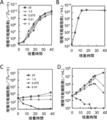
- FIG. 1A shows the number of proliferating cells when E. coli wild strain (MG1655) is cultured in a solid medium containing oleic acid emulsified with Triton® X-100 (hereinafter sometimes referred to as “emulsified oleic acid”). The result of analyzing is shown.
- FIG. 1B shows the results of analyzing the number of proliferative cells when MG1655 strain is cultured in a liquid medium containing emulsified oleic acid.
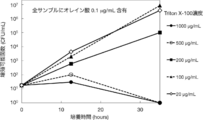
- 1C and D show the results of analyzing the number of proliferating cells when the fatty acid synthase (FabB) gene deficient ( ⁇ fabB) strain of Escherichia coli was cultured in a solid medium and a liquid medium containing emulsified oleic acid, respectively. Show. The result of analyzing the number of proliferating cells when the ⁇ fabB strain was cultured in a liquid medium containing 0.1 ⁇ g / mL (oleic acid concentration) emulsified oleic acid and a Triton X-100 concentration of 20 to 1000 ⁇ g / mL. Show.
- FabB fatty acid synthase
- ⁇ fabB fatty acid synthase
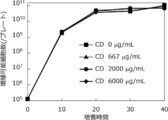
- the results of analyzing the number of proliferating cells when MG1655 strain is cultured in a solid medium having a methyl- ⁇ -cyclodextrin concentration of 0 to 6000 ⁇ g / mL are shown. “CD” in the figure represents methyl- ⁇ -cyclodextrin.
- the results of analyzing the number of proliferating cells when the ⁇ fabB strain is cultured in a solid medium containing 20-180 ⁇ g / mL (oleic acid equivalent concentration) of methyl- ⁇ -cyclodextrin-encapsulated oleic acid are shown.
- the results of analyzing the number of proliferating cells when an E are shown.
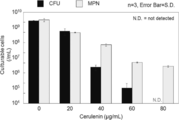
- coli wild strain (MG1655) is cultured in an M9-CAGlc liquid medium containing or not containing a predetermined concentration of cerulenin, which is a fatty acid synthase (such as FabB) inhibitor, are shown.
- the numerical value on the horizontal axis of the graph represents the concentration of cerulenin ( ⁇ g / mL) in the medium, and the numerical value on the vertical axis represents the number of proliferative cells.
- the black bar graph on the left represents CFU (colony forming unit) measured by seeding the culture medium after the above-mentioned culture on a solid medium
- the light gray bar graph on the right is a liquid medium.
- the number of proliferative cells measured by the MPN method when cultured The result of analyzing the number of proliferating cells when 168 strains of Bacillus subtilis (Bacillus subtilis) are cultured in an SPMM-CAGlc liquid medium containing or not containing a predetermined concentration of cerulenin, which is a fatty acid synthase inhibitor, is shown.
- the numerical value on the horizontal axis of the graph represents the concentration of cerulenin ( ⁇ g / mL) in the medium, and the numerical value on the vertical axis represents the number of proliferative cells.
- the black bar graph on the left represents the CFU measured by seeding the culture medium after the above-mentioned culture in a solid medium
- the light gray bar graph on the right represents MPN when cultured in a liquid medium.
- MG1655 E. coli wild strain
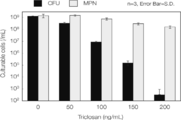
- M9-CAGlc liquid medium containing or not containing a predetermined concentration of triclosan, which is a fatty acid synthase (FabI) inhibitor
- the numerical value on the horizontal axis of the graph represents the triclosan concentration (ng / mL) in the medium, and the numerical value on the vertical axis represents the number of proliferative cells.
- the black bar graph on the left represents CFU measured by inoculating the culture medium after the above-mentioned culture on a solid medium
- the light gray bar graph on the right represents MPN when cultured in a liquid medium. Represents the number of proliferative cells measured by the method.
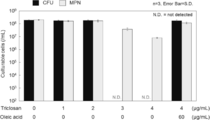
- the results of analyzing the number of proliferative cells when the Corynebacterium glutamicum ATCC13032 strain is cultured in a CM2B liquid medium containing or not containing a predetermined concentration of triclosan, which is a fatty acid synthase (FabI) inhibitor, are shown.
- the numerical value on the horizontal axis of the graph represents the triclosan concentration ( ⁇ g / mL) in the medium, and the numerical value on the vertical axis represents the number of proliferative cells.
- the black bar graph on the left represents CFU measured by inoculating the culture medium after the above-mentioned culture on a solid medium
- the light gray bar graph on the right represents MPN when cultured in a liquid medium. Represents the number of proliferative cells measured by the method.
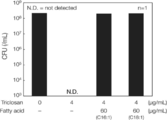
- the results when 60 ⁇ g / mL (in terms of oleic acid concentration) of cyclodextrin inclusion oleic acid is added together with 4 ⁇ g / mL triclosan are shown in the first and second graphs from the right.
- the present invention includes a method for enhancing the growth ability of a microorganism (hereinafter referred to as “the method of the present invention”), which comprises the step of culturing the microorganism in a medium containing a fatty acid having 5 or more carbon atoms encapsulated in cyclodextrin. And a method of growing a microorganism characterized by including a step of culturing the microorganism in a medium containing a fatty acid having 5 or more carbon atoms encapsulated in cyclodextrin (hereinafter referred to as “enhancement method”). It is also indicated as “Proliferation method of the present invention”).
- the present invention also comprises an agent for enhancing the growth ability of a microorganism containing a fatty acid having 5 or more carbon atoms, which is included in cyclodextrin (hereinafter also referred to as “the enhancer of the present invention”).
- the enhancement method of the present invention and the growth method of the present invention are not particularly limited as long as they include a step of culturing a microorganism in a medium containing a fatty acid having 5 or more carbon atoms, which is included in cyclodextrin, but such a method is required.
- a step of isolating all or part of the microorganisms grown by the culturing step may be included.
- this isolation step a known isolation method can be used.
- the isolation step may be performed using the type of microorganism, the presence / absence or degree of desired activity, the presence / absence or degree of desired properties, and the like as indicators.
- “Cyclodextrin” in the present specification includes cyclodextrin derivatives having inclusion action in addition to cyclodextrin in a narrow sense.
- Preferred examples of such cyclodextrins in the narrow sense include ⁇ -cyclodextrin, ⁇ -cyclodextrin in which 7 molecules of glucose are bonded, and ⁇ -cyclodextrin in which 8 molecules of glucose are bonded.
- some or all of the glucose groups constituting the cyclodextrin in the narrow sense include hydroxyl groups at the 2-position, 3-position, and 6-position, such as methyl group, ethyl group, propyl group, and butyl group.
- hydroxyl groups constituting glucose in the narrowly defined cyclodextrin are the 2-, 3- and 6-position hydroxyl groups.
- Methyl group, ethyl group, propyl group, butyl group, hydroxy group More preferably, a compound modified with one or two or more groups selected from the group consisting of a group consisting of a thiol group, a hydroxyethyl group and a hydroxypropyl group, particularly, a part or all of glucose constituting a cyclodextrin in a narrow sense Of the hydroxyl group at the 2-, 3-, and 6-positions of methyl (methyl- ⁇ -cyclodextrin) and a part or all of glucose constituting the cyclodextrin in the narrow sense.
- a compound in which the hydroxyl group at the position is modified with a hydroxypropyl group (hydroxypropyl- ⁇ -cyclodextrin) is more preferred, and among them, methyl- ⁇ -cycl
- cyclodextrin may be used, or two or more types may be used in combination.
- Various cyclodextrins may be commercially available, or may be prepared by chemical means or biological means.
- the “fatty acid having 5 or more carbon atoms” may be an unsaturated fatty acid or a saturated fatty acid as long as it is a fatty acid having 5 or more carbon atoms, but is preferably an unsaturated fatty acid, and is a linear unsaturated fatty acid. Is more preferable.
- the fatty acid may be a linear fatty acid, a branched fatty acid, or a cyclic fatty acid, preferably a linear fatty acid.
- the number of carbon atoms of the fatty acid is not particularly limited as long as it is 5 or more, but is preferably within the range of 5 to 30, more preferably within the range of 8 to 28, still more preferably within the range of 10 to 26, and more preferably 12. Within the range of ⁇ 22.
- the number of double bonds between carbons of the unsaturated fatty acid may be one or two or more, but is preferably in the range of 1 to 5, preferably in the range of 1 to 4. More preferred.
- linear unsaturated fatty acids having 5 or more carbon atoms include caproleic acid (C10: 1), Lindelic acid (C12: 1), myristoleic acid (C14: 1), palmitoleic acid (C16: 1), olein Acid (C18: 1), cis-vaccenic acid (C18: 1), linoleic acid (C18: 2), linolenic acid (C18: 3), mead acid (C20: 3), dihomolinolenic acid (C20: 3), Examples include arachidonic acid (C20: 4), eicosatetraenoic acid (C20: 4), eicosapentaenoic acid (C20: 5), docosahexaenoic acid (C22: 6), nervonic acid (C24: 1), and the like.
- Palmitoleic acid (C16: 1), oleic acid (C18: 1), cis-vaccenic acid (C18: 1) linoleic acid (C18: 2), linolenic acid (C18: 3), mead acid ( 20: 3), dihomolinolenic acid (C20: 3), arachidonic acid (C20: 4), and eicosatetraenoic acid (C20: 4) are preferable.
- oleic acid, palmitoleic acid, cis-vaccenic acid are preferable. Particularly preferred is mentioned.
- linear saturated fatty acids having 5 or more carbon atoms include caproic acid (C6: 0), enanthic acid (C7: 0), caprylic acid (C8: 0), pelargonic acid (C9: 0), capric acid ( C10: 0), lauric acid (C12: 0), myristic acid (C14: 0), pentadecylic acid (C15: 0), palmitic acid (C16: 0), margaric acid (C17: 0), stearic acid (C18: 0), arachidic acid (C20: 0), henicosylic acid (C21: 0), behenic acid (C22: 0), lignoceric acid (C24: 0), serotic acid (C26: 0), montanic acid (C28: 0) And melicic acid (C30: 0), among them, myristic acid (C14: 0), palmitic acid (C16: 0), stearic acid (
- cyclic fatty acids having 5 or more carbon atoms include hydonocarbic acid (C16), shawl moulinic acid (C18), and gollic acid (C18).
- branched fatty acid having 5 or more carbon atoms include 2-ethylbutanoic acid, isopentanoic acid, 2-methylpentanoic acid, 2-ethylpentanoic acid, 12-hydroxystearic acid, isostearic acid, and isononanoic acid.
- one type of fatty acid having 5 or more carbon atoms may be used, or two or more types may be used in combination.
- Various fatty acids may be commercially available products, or those extracted from food materials containing fatty acids (animal fats and oils, edible fats and oils, etc.).
- “substance X included in cyclodextrin” means that all or part of substance X (guest molecule) is taken into the hydrophobic pores inside the cyclic structure of cyclodextrin (host molecule). Means that Whether or not the substance X is included in the cyclodextrin is determined by using circular dichroism spectrum or NMR spectrum in the solution state, and in the solid state by thermal analysis DSC, powder X-ray, etc., cyclodextrin alone, guest molecule alone It can be confirmed by comparing the physical mixture with the CD inclusion.
- the weight ratio of cyclodextrin to fatty acid in the fatty acid having 5 or more carbon atoms (cyclodextrin-containing fatty acid) included in cyclodextrin is as long as it can proliferate the growth ability of the target microorganism.
- the fatty acid is within a range of 0.1 to 90 parts by weight, preferably within a range of 0.2 to 45 parts by weight, and more preferably 0.3 to 30 parts by weight with respect to 100 parts by weight of cyclodextrin.
- the range of parts by weight more preferably within the range of 1 to 9 parts by weight, even more preferably within the range of 1.5 to 6 parts by weight, and particularly preferably within the range of 2 to 4.5 parts by weight. it can.
- the method for preparing the cyclodextrin inclusion fatty acid in the present invention is not particularly limited, and for example, a known method such as a kneading method, a saturated aqueous solution method, an emulsification method, a mixing and pulverizing method can be used.
- a known method such as a kneading method, a saturated aqueous solution method, an emulsification method, a mixing and pulverizing method can be used.
- a kneading method a small amount of water is added to the host molecule to make a paste, and a certain amount of guest molecules are added thereto and kneaded well with a kneader or the like. The method of obtaining is mentioned.
- a saturated aqueous solution of host molecules is prepared, and then a certain amount of guest molecules are added and mixed, followed by stirring and mixing for 30 minutes to several days.
- examples thereof include a method obtained by precipitation.
- a 20-50% suspension of host molecules is prepared, a certain amount of guest molecules are added thereto, and emulsified with a homogenizer to obtain guest molecules included in the host molecules.
- the mixed pulverization method include a method in which a host molecule and a guest molecule are put in a vibration mill and pulverized to obtain a guest molecule included in the host molecule.
- the liquid containing the cyclodextrin inclusion fatty acid obtained by each method is dried (preferably lyophilized). do it.
- the storage may be at room temperature, but is preferably performed at a temperature of 4 ° C. or lower from the viewpoint of enabling longer-term storage.
- the medium in the present invention is not particularly limited as long as it is a medium containing a fatty acid having 5 or more carbon atoms (cyclodextrin inclusion fatty acid) encapsulated in cyclodextrin, but in addition to this, components necessary for the growth of microorganisms are added.
- the medium of the present invention may be a solid medium or a liquid medium. However, it can improve the detection rate of microbial contamination or infection in the field of food and clinical examination, and can improve the screening efficiency in the field of screening of microorganisms useful from the natural world.
- a solid medium is preferable because it can be improved, and the significance of the present invention is greater.
- the concentration of the cyclodextrin-inclusion fatty acid in the medium in the present invention is not particularly limited as long as the growth ability of the target microorganism can be enhanced.
- concentration of the cyclodextrin-inclusion fatty acid in the medium in the present invention is not particularly limited as long as the growth ability of the target microorganism can be enhanced.
- in the range of 0.075 to 500 ⁇ g / mL preferably in the range of 0.1 to 500 ⁇ g / mL, more preferably in the range of 1 to 500 ⁇ g / mL, and still more preferably in the range of 5 to 500 ⁇ g / mL.
- mL Within the range of mL, more preferably within the range of 10 to 500 ⁇ g / mL, even more preferably within the range of 20 to 500 ⁇ g / mL, more preferably within the range of 40 to 500 ⁇ g / mL, still more preferably within the range of 60 to 500 ⁇ g / mL.
- the range more preferably within the range of 80 to 500 ⁇ g / mL, even more preferably within the range of 100 to 500 ⁇ g / mL, more preferably 1 0 include a range of ⁇ 500 [mu] g / mL, also from the viewpoint of cost, the upper limit of the concentration of the cyclodextrin inclusion fatty acids in the culture medium, 400 [mu] g / mL or less fatty acid equivalent concentration may be below 300 [mu] g / mL.
- the concentration in terms of fatty acid is, for example, in the range of 0.05 to 500 ⁇ g / mL, preferably in the range of 0.075 to 500 ⁇ g / mL, more preferably 0.1 to 500 ⁇ g / mL. In the range of 1 to 500 ⁇ g / mL, more preferably in the range of 5 to 500 ⁇ g / mL, still more preferably in the range of 10 to 500 ⁇ g / mL, and more preferably in the range of 20 to 500 ⁇ g / mL.
- the upper limit of the concentration of fatty acid, 400 [mu] g / mL or less fatty acid equivalent concentration, 300 [mu] g / mL or less, may be less 200 [mu] g / mL.
- components other than cyclodextrin-inclusion fatty acids in the medium of the present invention include components necessary for the growth of microorganisms to be cultured, such as carbon sources, nitrogen sources, amino acids that can be assimilated by the microorganisms. And inorganic salts (particularly phosphorus compounds, magnesium compounds, manganese compounds, iron compounds, etc.).
- M9-CAGlc medium described in Reference Example 2 described later M9 minimal medium with glucose and casamino acid (casein hydrochloride hydrolyzed neutralized product)
- SPMM-CAGlc medium SPMM-CAGlc medium
- CM2B medium L-broth medium
- Nutrient broth medium described in Example 2 described later.
- Ingredients other than the cyclodextrin-containing fatty acid in the medium of the present invention can be appropriately selected according to the type of microorganism to be cultured and the type of microorganism to be grown.
- a component that enhances the growth ability of microorganisms may be added to the medium in the present invention.
- the type of microorganism in the present invention is not particularly limited as long as the growth ability is enhanced by cyclodextrin-containing fatty acids, and examples include eubacteria (Bacteria), archaea (Archaea), and eukaryotes (Eucarya). Eubacteria, archaea, and yeast are preferred, and among them, eubacteria and archaea are more preferred.
- Examples of the microorganism in the present invention include gram positive bacteria (preferably eubacteria) and gram negative bacteria (preferably eubacteria).
- Preferred examples of the Gram-positive eubacteria include Firmicutes and Actinomyces.
- the eubacteria of the Filmictes genus include bacteria of the genus Bacillus, Lactobacillus, Clostridium, Thermoanaerobacter, Haloanaerobium, Natrananaerobius, Elysiperotrix, Selenomonas, and Thermolitobacter Among them, Bacillus and Lactobacillus are more preferable, and Bacillus is more preferable.
- Eubacteria of the actinomycetes include the genus Corynebacterium, Mycobacterium, Rhodococcus, Propionibacterium, Streptomyces, Bifidobacterium, Micrococcus, and Francia.
- Corynebacterium genus, Mycobacterium genus, Rhodococcus genus, Propionibacterium genus, Streptomyces genus, Bifidobacterium genus are more preferable, among them, Corynebacterium genus, Mycobacterium genus, Rhodococcus genus Is more preferable.
- the present invention may be applied to a microorganism group (for example, a microorganism group collected from the natural world) containing at least a part of the microorganism (microorganism whose growth ability is enhanced by cyclodextrin-containing fatty acids) in the present invention. By using it in this way, it becomes possible to improve the screening efficiency when screening for useful microorganisms from the natural world.
- the step of culturing microorganisms in the medium in the present invention is not particularly limited as to the culture conditions such as the culture period, culture temperature, humidity, oxygen concentration, etc., as long as the microorganisms are cultured in such a medium. Accordingly, culture conditions can be set as appropriate.
- the culture period include a range of 5 hours to 2 weeks and a range of 8 hours to 1 week.
- Examples of a culture temperature include a range of 5 to 50 ° C. and a range of 10 to 40 ° C.
- the growth ability of microorganisms is enhanced means a fatty acid-free medium (for example, M9-CAGlc medium, SPMM-CAGlc medium, or CM2B medium) having the same composition except that cyclodextrin-containing fatty acids are not contained. Therefore, it means that the number of proliferating cells of the microorganism is larger when cultured in a medium containing cyclodextrin-containing fatty acids than when cultured under the same culture conditions.
- a fatty acid-free medium for example, M9-CAGlc medium, SPMM-CAGlc medium, or CM2B medium
- the growth ability of the microorganism is enhanced means that a medium containing no fatty acid (eg, M9-CAGlc medium, SPMM-CAGlc medium, or CM2B medium) has the same composition except that it does not contain cyclodextrin-containing fatty acids. ),
- the number of proliferative cells of the microorganism when cultured in a cyclodextrin-containing fatty acid-containing medium compared to, for example, 30 hours of culture under the same culture conditions (preferably culture conditions suitable for the microorganism)
- the ratio is preferably 10% or more, more preferably 20% or more, further preferably 30% or more, more preferably 50% or more, and further preferably 100% or more.
- a fatty acid having the same concentration as the fatty acid contained therein is added to TritonX- Except for being suspended in the medium at 100, the same culture conditions (preferably for the microorganisms, such as M9-CAGlc medium, SPMM-CAGlc medium, or CM2B medium as the medium before containing the fatty acid)
- the same culture conditions preferably for the microorganisms, such as M9-CAGlc medium, SPMM-CAGlc medium, or CM2B medium as the medium before containing the fatty acid
- the number of cells capable of proliferating microorganisms when cultured in a medium containing cyclodextrin-containing fatty acids is included, more preferably containing cyclodextrin-containing fatty acids.
- the number of cells capable of proliferating when microorganisms are cultured in a cyclodextrin-containing fatty acid-containing medium is preferably 10% or more, more preferably 20% or more, still more preferably 30% or more, and even more preferably 50%.
- the “number of cells capable of proliferating microorganisms” after cultivation means the number of cells of microorganisms that can grow among the microorganisms after cultivation.
- the number of proliferating cells can be measured and calculated by the following method. For example, when measuring and calculating the number of proliferative cells on the “solid medium X” after culturing with the “solid medium X”, the microorganisms of the entire solid medium X are scraped off and suspended in a buffer solution, The suspension is diluted and / or a part thereof is seeded on a new solid medium X and cultured, and colony-forming units (CFU) formed on the solid medium are measured and diluted.
- CFU colony-forming units
- the number of proliferative cells on the solid medium X can be calculated from the CFU value.
- the liquid medium Y is diluted and / or a part thereof corresponds to the liquid medium Y. Seeded and cultured on a new solid medium (solid medium prepared by adding agarose to the composition of liquid medium Y), and measured the colony forming unit (CFU) formed on the solid medium Based on the dilution rate and the like, the number of proliferative cells in the liquid medium Y can be calculated from the CFU value.
- microorganisms can be confirmed by an increase in the number of microbe particles after culturing, instead of an increase in the “number of cells capable of proliferating microorganisms” after culturing.
- the number of microorganism particles can be easily measured with a Coulter counter or a cell sorter.
- the enhancer of the present invention is not particularly limited as long as it contains a fatty acid having 5 or more carbon atoms included in cyclodextrin.
- the enhancer of the present invention may be liquid or solid, but is preferably solid from the viewpoint of storage stability.
- the concentration of the cyclodextrin inclusion fatty acid in the enhancer of the present invention is not particularly limited, but the total amount of the enhancer of the present invention For example, in the range of 0.001 to 100% by weight, preferably in the range of 0.1 to 95% by weight, more preferably in the range of 1 to 80% by weight, still more preferably 2 to 50% by weight. Within the range.
- the enhancer of the present invention may contain only the cyclodextrin inclusion fatty acid or may contain other components.
- other components include liquid solvents such as water, solid extenders, and other components necessary for the growth of microorganisms to be cultured. Such components are assimilated by the microorganisms. Examples thereof include carbon sources, nitrogen sources, amino acids, and trace components (such as inorganic salts, particularly phosphorus compounds, manganese compounds, iron compounds, etc.) to be obtained.
- the enhancer of the present invention containing components necessary for the growth of microorganisms can also be used as a medium additive for enhancing the growth ability of microorganisms or a medium for enhancing the growth ability of microorganisms.
- the cell proliferation level was determined using the number of proliferating cells as an index.
- a method for calculating the number of proliferating cells the method described in the above-mentioned “Mode for Carrying Out the Invention” was used.
- 0.01 to 20 ⁇ g / mL (oleic acid concentration) The emulsified oleic acid-containing liquid medium was added with 2 mg / mL oleic acid to 1% Triton X-100, stirred vigorously, and then M9-CAGlc medium. Prepared by diluting 100-200000 times (final concentration of oleic acid 20-0.01 ⁇ g / mL).
- the emulsified oleic acid-containing solid medium was prepared by adding agarose to the emulsified oleic acid-containing liquid medium so as to be 1.5%.
- experiments were carried out in which the ⁇ fabB strain was cultured in a medium containing no emulsified oleic acid, and in which a wild strain (MG1655 strain) was cultured in a medium containing or not containing emulsified oleic acid.
- the wild strain MG1655 strain has substantially the same number of proliferative cells regardless of the presence or absence of oleic acid in the medium and the concentration of oleic acid, and grows at almost the same level (FIG. 1A).
- the ⁇ fabB strain did not grow when cultured in a liquid medium containing 0.01 ⁇ g / mL of oleic acid, but gradually increased the concentration of oleic acid in the liquid medium from 0.075 ⁇ g / mL to 20 ⁇ g / mL.
- the proliferation level is significantly increased in the liquid medium (the proliferation ability is remarkably enhanced) (see FIG. 1D), and on the contrary, the proliferation of the cells is strongly suppressed on the solid medium. (See FIG. 1C).
- the ⁇ fabB strain grew at almost the same level when the Triton X-100 concentration in the medium was 100 ⁇ g / mL or less (see FIG. 2).
- the Triton X-100 concentration in the medium is 200 ⁇ g / mL or more, the growth level of the ⁇ fabB strain decreases.
- the Triton X-100 concentration in the medium is 500 ⁇ g / mL or more, the growth level of the ⁇ fabB strain is It was significantly reduced (see FIG. 2).
- Triton X-100 has the effect of reducing the growth level of E. coli, so the oleic acid in the medium is the maximum. However, it can be added only at a concentration of 20 ⁇ g / mL. Therefore, as a method of adding oleic acid to the medium, a method of conjugating oleic acid with methyl- ⁇ -cyclodextrin was examined instead of the method of emulsifying oleic acid with Triton X-100. Prior to that, first, the influence of methyl- ⁇ -cyclodextrin on the growth ability of MG1655 strain was examined.
- a medium was prepared so that the methyl- ⁇ -cyclodextrin concentration in the M9-CAGlc solid medium was 0 to 6000 ⁇ g / mL, and the cell growth level of the MG1655 strain was analyzed.
- cyclodextrin inclusion methyl- ⁇ -cyclodextrin inclusion oleic acid
- Oleic acid Such cyclodextrin-encapsulated oleic acid is diluted with M9-CAGlc medium containing 1.5% agarose to contain 20 to 180 ⁇ g / mL (concentration in terms of oleic acid concentration) of cyclodextrin-conjugated oleic acid.
- An M9-CAGlc solid medium (hereinafter referred to as “a conjugated oleic acid-containing solid medium”) was prepared, and the proliferation level (number of proliferating cells) of the ⁇ fabB strain was analyzed.
- a conjugated oleic acid-containing solid medium As a control, an experiment was carried out in which the ⁇ fabB strain was cultured in a solid medium containing 20 ⁇ g / mL (oleic acid concentration) emulsified oleic acid.
- the stationary phase ⁇ fabB strain cultured overnight was washed and then inoculated on a solid medium, and in this experiment, the logarithmic growth phase ⁇ fabB strain was washed. Inoculated on a solid medium and cultured.
- the Escherichia coli mutant strain whose colony forming ability was reduced on the solid medium was a fatty acid synthase FabB gene-deficient strain. Therefore, when wild-type strains of various microorganisms were used, whether or not the growth ability such as colony forming ability decreased by adding a fatty acid synthase inhibitor was examined using the number of proliferative cells as an index.
- SPMM-CAGlc liquid medium SPMM-CAGlc liquid medium; 14 g / L K 2 HPO 4 (made by Kokusan Chemical Co., Ltd.), 6 g / L KH 2 PO 4 (made by Kokusan Chemical Co., Ltd.), 2 g / L ( NH 4 ) 2SO 4 (manufactured by Wako Pure Chemical Industries, Ltd.), 1 g / L trisodium citrate dihydrate (manufactured by Kokusan Chemical Co., Ltd.), 0.2 g / L MgSO 4 (manufactured by Yoneyama Pharmaceutical Co., Ltd.), 5 g / L D-glucose (manufactured by Kokusan Kagaku Co., Ltd.), 50 mg / L D-tryptophan (manufactured by Peptide Institute, Inc., 5 g / L Casamino Acids-Vitamin Assay (manufactured
- CM2B liquid medium 10 g / L, high polypeptone (manufactured by Nippon Pharmaceutical Co., Ltd.), 10 g / L, Bacto (Yeast Extract (manufactured by Becton Dickinson), 5 g / L NaCl (manufactured by Kokusan Chemical Co., Ltd.)
- Corynebacterium glutamicum ATCC13032 strain which is a Gram-positive bacterium, at 30 ° C. for 3 days (Bacillus subtilis).
- the triclosan concentration exceeds 2 ⁇ g / mL, MPN is kept high. On the other hand, no colonies were observed, and it was shown that the ability to form colonies was greatly reduced even with Corynebacterium glutamicum (FIG. 8).
- -Glutamicum ATCC13032 strain was cultured at 30 ° C for 4 days. As a result, the CFU of Corynebacterium glutamicum lowered with triclosan was completely recovered (FIG. 8), and it was shown that the decrease in colony forming ability was a phenomenon caused only by fatty acid deficiency.
- Cyclodextrin inclusion palmitoleic acid was prepared by dissolving 1 g of methyl- ⁇ -cyclodextrin in 5 mL of deionized water, adding 20 mg of palmitoleic acid and stirring vigorously.
- Cyclodextrin inclusion palmitoleic acid or cyclodextrin inclusion oleic acid 60 ⁇ g / mL (in terms of fatty acid concentration) was further added to the medium in which triclosan 4 ⁇ g / mL was added to the CM2B liquid medium and the colony forming ability was reduced.
- Corynebacterium glutamicum ATCC13032 strain was cultured at 30 ° C. for 4 days.
- the present invention it is possible to provide a method for enhancing the growth ability of microorganisms and the like that can enhance the growth ability of microorganisms more strongly.
Landscapes
- Chemical & Material Sciences (AREA)
- Health & Medical Sciences (AREA)
- Life Sciences & Earth Sciences (AREA)
- Engineering & Computer Science (AREA)
- Organic Chemistry (AREA)
- Biotechnology (AREA)
- Zoology (AREA)
- Wood Science & Technology (AREA)
- Genetics & Genomics (AREA)
- Bioinformatics & Cheminformatics (AREA)
- Biomedical Technology (AREA)
- Virology (AREA)
- Microbiology (AREA)
- Tropical Medicine & Parasitology (AREA)
- Medicinal Chemistry (AREA)
- Biochemistry (AREA)
- General Engineering & Computer Science (AREA)
- General Health & Medical Sciences (AREA)
- General Chemical & Material Sciences (AREA)
- Oil, Petroleum & Natural Gas (AREA)
- Micro-Organisms Or Cultivation Processes Thereof (AREA)
Abstract
本発明の目的は、微生物の増殖能をより強く増強することのできる、微生物の増殖能を増強する方法や、微生物の増殖能の増強剤等を提供することにある。 本発明によれば、シクロデキストリンに包接された、炭素数5以上の脂肪酸を用いる。具体的には、かかるシクロデキストリン包接脂肪酸を含有する培地で微生物を培養することにより、微生物の増殖能を増強することができる。
Description
本発明は、微生物の増殖能を増強する方法や、微生物の増殖能の増強剤等に関する。
寒天等の固体培地上で微生物を増殖させてコロニーを形成させ、そこから微生物を分離する純粋培養法は、コッホの時代に確立されて現在に至るまで、すべての微生物研究の第一歩となっている。実験微生物学や公衆衛生学では、生きている微生物を、コロニー形成能を有する微生物と定義し、その微生物が形成するコロニー数を計数することによって、生きている微生物を計数することが一般に行われている。食品及び臨床検査分野では、寒天平板培地に微生物懸濁液を塗布し、一定温度で培養することにより、寒天平板培地上に微生物コロニーを形成させ、食品又は臨床検査検体中に存在する微生物を検出又は分離して、微生物汚染又は感染の有無を検出することが行われている。また、土壌サンプル等の自然界のサンプル中の産業上に有用な微生物は、寒天平板培地上に成育した微生物コロニーから分離している。しかし、寒天等の固体培地を用いたコロニー法によって分離・培養できる微生物は、天然に存在する微生物のごく一部に過ぎない(非特許文献1)。
近年、固体培地上での微生物の増殖能を向上させてそのコロニー形成能を向上させる種々の試みがなされている。例えば、低濃度の栄養培地を用いる方法(非特許文献2)、活性酸素の発生を抑制する方法(非特許文献3、4)、寒天のかわりに固化剤としてゲラン・ガムを用いる方法(非特許文献5、6)が報告されている。また、固体培地を用いずに微生物を分離する方法も試みられている。例えば、液体培地中に成育した微生物を液体限界希釈法(最適数Most Probable Number(MPN)法の原理で96穴マルチプレートを用いることにより、菌数推定だけでなく分離も行う方法)を用いて分離する方法(非特許文献7)や、マイクロ流体チップを用いて分離する方法(非特許文献8)が報告されている。しかしながら、いまだに多くの種類の微生物は培養・増殖することさえ困難である(非特許文献9、10)。
1979年に木暮らは、海洋バクテリアについて、液体培地中で伸張分裂できる細胞数を顕微鏡下に計測するDVC(direct count of viable bacterial cells)法を考案し、その数が固体培地上でのコロニー形成数より格段に多いことを示した(非特許文献11)。このことは、液体培地は潜在的に固体培地よりもより多くの自然界に生息する微生物を検出することが出来ることを示している。本発明者の一人である正木らは、海洋バクテリアを分離する際に、液体限界希釈法を用いて、コロニー法の場合の約10倍の数の菌を分離することができた(非特許文献12)。
また、Colwellらは固体培地で成育できる大腸菌やコレラ菌を、培養後に食塩水や水に懸濁して低温飢餓状態に置くと、DVCが高く保たれているが時間経過とともに固体培地上でのコロニー形成数が落ちていく現象を観察し、これらの細菌が生きているものの増殖できないViable but non-culturable(VBNCあるいはVNC)という状態に有ることを示した(非特許文献13)。このVBNC概念は拡大されて、環境中のほとんどのバクテリア細胞がコロニーを分離できない難培養状態、難増殖状態にあることのモデルとして期待されているが、試料となる細菌が培養によってそもそも入手できないため、そのVBNC状態の実態の解明は進んでいない。
しかし、VBNCの実験は、もともと固体培地上で増殖してコロニーを形成することができるバクテリアであっても、生きているのに固体培地上で増殖できず、コロニーを形成できない状態に陥ることを実演した点で重要であり、固体培地上でコロニーを形成できることが、単に生きていることと同じではなく、生きていること以上に特殊な状態であることを示している。本発明者の一人である正木らは、低温飢餓に晒した大腸菌野生株の成育に対するオレイン酸の影響を比較したところ、オレイン酸の添加のみで、前述の大腸菌のコロニー形成能を10倍以上に増強できることを示した(非特許文献14)。
本発明者の一人である正木らは、固体培地で成育できる大腸菌の中から、液体培地では成育できるが固体培地ではコロニーを形成できない変異株を取得することを目的として、大腸菌の温度感受性変異株のコレクション(非特許文献15)から5株の変異株を得た。これら変異株を解析することにより、脂肪酸合成酵素サイクルの縮合酵素遺伝子fabBの変異株を取得した(非特許文献16)。この結果はfabB遺伝子の機能が、固体培地上での増殖能やコロニー形成能に重要であることを示している。しかし、これらの変異株は変異原メチルニトロニトロソグアニジンを用いて取得された株であるため、fabB遺伝子以外に多数の変異を含み、遺伝的背景が複雑で未知の部分も多い。
ところで、シクロデキストリンとは、通常、5分子以上のD-グルコースがα(1→4)グルコシド結合によって結合し、環状構造をとった環状オリゴ糖の一種である。一般的に用いられるシクロデキストリンは、6~8分子のグルコースが結合したものであり、6分子のグルコースが結合したものがα-シクロデキストリン、7分子のグルコースが結合したものがβ-シクロデキストリン、8分子のグルコースが結合したものがγ-シクロデキストリンと呼ばれている。シクロデキストリンは、その環状構造の内部の空孔に他の分子(ゲスト分子)を取り込んでゲスト分子を包接する作用を有することが知られている。シクロデキストリンの環状構造の外側は親水性であるのに対し、環状構造の内側の空孔は疎水性である。シクロデキストリンの包接作用を利用して、ゲスト分子の匂いをマスキングしたり、ゲスト分子を安定化したり、疎水性のゲスト分子を可溶化するために用いられることがある。しかし、シクロデキストリン、特にメチル-β-シクロデキストリンは、細胞に接触させると細胞膜の脂質を除去する性質があり、細胞の生存率が低下することが、動物細胞を用いた実験により明らかとなっていた(非特許文献17、18)。
以上のようなことがこれまで知られていたが、シクロデキストリンに包接された、炭素数5以上の脂肪酸を含有する培地で微生物を培養すると、その微生物のコロニー増殖能を増強させることができることは、これまでに知られていなかった。
Staley, J.T et. al., Annual Review of Microbiology 1985, 39:321-346
Ohta, H. et. al., Soil Sci. Plant Nutr. 1980, 26: 99-107
Mizuno, Y. et. al., Arch. Microbiol. 1999, 172: 63-67
Tanaka, T. et. al., Appl. Environ. Microbiol. 2014, 80: 7659-7666
Janssen,P.H. et. al., Appl. Environ. Microb. 2002, 68: 2391-2396
Tamaki,H. et. al., Environ. Microbiol. 2009, 11: 1827-1834
Shigematsu, T. et. al., Biosci. Biotechnol. Biochem. 2007, 71,: 3093-3097
Nichols,D. et. al., Appl. Environ. Microbiol. 2010, 76: 2445-2450
Rappe, M.S. et. al., Annu. Rev. Microbiol. 2003, 57: 369-394
Schloss, P.D. et. al., Microbiol. Mol. Biol. Rev. 2004, 68: 686-691
Kogure, K. et. al., Canadian J. Microbiology 1979, 25: 415-420
Shigematsu, T. et. al., FEMS Microbiology Letters 2009, 293: 240-247
Xu, H.S. et. al., Microbial Ecology 1982, 8: 323-323
日本農芸化学会 2015年度大会講演要旨集 講演番号4A34p07、公益社団法人日本農芸化学会、2015年3月15日発行
Isono, K. et. al., Mol. Gen. Genet. 1976, 149: 297-302
Masaki, H., IFO Res Commun, 2014, 28: 15-20
Joel E.,et.al., Neurotoxicology. 2007, 28(3): 613-621
Laura M., et. al., Journal of Controlled Release 2008, 126: 10-16
自然環境中の多くの微生物は生きていても、固体培地上で増殖できず、コロニーを形成できない状態で存在しており、固体培地上でコロニーを形成できることと微生物が生きていることは同じではない。そのため、DNAでは存在が確認されている微生物でも、ほとんどは未分離の状態である。これまでに、本発明者の一人である正木らは、オレイン酸を固体培地に添加することにより微生物のコロニー形成能を増強できることを見いだしている。この増強方法を用いると従来よりも多くの種類の微生物を分離することが可能となるため、食品・臨床検査分野での微生物汚染の検出率の向上が期待できる。また、産業に有用な微生物を選択する際のスクリーニング効率の向上も期待できる。
しかし、オレイン酸は水に不溶性であるため、本発明者の一人である正木らは、前述の増強方法では、界面活性剤(Triton X-100)にオレイン酸を懸濁し、エマルションを形成させた状態で、固化前の液体状の培地に添加し、その後、その液体状の培地を固化することにより、固体培地にオレイン酸を添加していた。しかし、このような添加方法には、以下の(a)~(c)のような問題点があった。
(a)界面活性剤とオレイン酸がエマルションを形成しているため、そのエマルションを滅菌濾過法で無菌化することは困難である点。
(b)液体状の培地が固化する間にエマルションの分布が偏るため、オレイン酸が均一に懸濁した固体培地を作製することが困難である点。
(c)高濃度のオレイン酸をエマルション化するには高濃度の界面活性剤が必要になるところ、界面活性剤はそれ自体が微生物に対して毒性を発揮するため、高濃度のオレイン酸を含有する固体培地を作製することが困難である点。
(a)界面活性剤とオレイン酸がエマルションを形成しているため、そのエマルションを滅菌濾過法で無菌化することは困難である点。
(b)液体状の培地が固化する間にエマルションの分布が偏るため、オレイン酸が均一に懸濁した固体培地を作製することが困難である点。
(c)高濃度のオレイン酸をエマルション化するには高濃度の界面活性剤が必要になるところ、界面活性剤はそれ自体が微生物に対して毒性を発揮するため、高濃度のオレイン酸を含有する固体培地を作製することが困難である点。
また、上述したようなエマルション化したオレイン酸を含む固体培地ではなく、エマルション化したオレイン酸を含む液体培地においても、前述の(c)と同様の欠点がある。
本発明の課題は、オレイン酸等の炭素数5以上の脂肪酸を培地に添加する際の上記の(a)~(c)の問題点等を改善した、微生物の増殖能をより強く増強することのできる、微生物の増殖能を増強する方法や、微生物の増殖能の増強剤等を提供することにある。
炭素数5以上の脂肪酸は、通常、水(培養液)への溶解性がきわめて低く、培地に直接添加することができない。本発明者らは、前述の脂肪酸をシクロデキストリン包接させて可溶化したもの(以下、「シクロデキストリン包接脂肪酸」とも表示する)を用いることにより、上記課題を解決できることを見いだした。
背景技術に記載したように、メチル-β-シクロデキストリン等のシクロデキストリンは、細胞に接触させると細胞膜の脂質を除去する性質があり、細胞の生存率が低下することが、動物細胞を用いた実験により明らかとなっていた(非特許文献17)。そのため、微生物の増殖能の増強を目的とする際に、メチル-β-シクロデキストリン等のシクロデキストリンを用いることは適切でないと考えられていた。しかし、本発明者らは、メチル-β-シクロデキストリン等のシクロデキストリンが、細菌等の微生物の増殖能を阻害しないことを見いだした。
本発明者らは、以上のような知見を見いだし、本発明を完成するに至った。すなわち、シクロデキストリン包接脂肪酸は滅菌濾過法により無菌化することができ、また、固化する前の液体状の培地にも上記のエマルションよりも均一に懸濁することができ、また、シクロデキストリンには界面活性剤のように細菌等の微生物への毒性がない。そのため、滅菌濾過法による無菌化したシクロデキストリン包接脂肪酸をより高濃度にかつ、より均一に含有する脂肪酸含有固体培地を作製することが可能となった。かかる固体培地の場合と同様に、液体培地の場合も、シクロデキストリン包接脂肪酸を用いることにより、シクロデキストリン包接脂肪酸をより高濃度にかつ、より均一に含有する脂肪酸含有液体培地を作製することが可能となった。そして、これらの脂肪酸含有固体培地や脂肪酸含有液体培地で微生物を培養することにより、微生物の増殖能をより強く増強することが可能となった。
すなわち、本発明は、
(1)シクロデキストリンに包接された、炭素数5以上の脂肪酸を含有する培地で微生物を培養する工程を含むことを特徴とする微生物の増殖能を増強する方法や、
(2)培地が固体培地であり、微生物の増殖能が固体培地での微生物の増殖能であることを特徴とする上記(1)に記載の微生物の増殖能を増強する方法や、
(3)シクロデキストリンが、メチル-β-シクロデキストリン、ヒドロキシプロピル-β-シクロデキストリン、α-シクロデキストリン及びγ-シクロデキストリンから選択される1種又は2種以上であることを特徴とする上記(1)又は(2)に記載の微生物の増殖能を増強する方法や、
(4)炭素数5以上の脂肪酸が、炭素数5~30の範囲内の脂肪酸からなる群から選択される1種又は2種以上であることを特徴とする上記(1)~(3)のいずれかに記載の微生物の増殖能を増強する方法や、
(5)脂肪酸が、オレイン酸、パルミトレイン酸、シス-バクセン酸、カプロレイン酸、リンデル酸、ミリストレイン酸、リノール酸、リノレン酸、ミード酸、ジホモリノレン酸、アラキドン酸、エイコサテトラエン酸、エイコサペンタエン酸、ドコサヘキサエン酸及びネルボン酸から選択される1種又は2種以上であることを特徴とする上記(4)に記載の微生物の増殖能を増強する方法や、
(6)培地が固体培地である場合は、培地中の炭素数5以上の脂肪酸の合計濃度が0.075~500μg/mLの範囲内であり、培地が液体培地である場合は、培地中の炭素数5以上の脂肪酸の合計濃度が0.05~500μg/mLの範囲内であることを特徴とする上記(1)~(5)のいずれかに記載の微生物の増殖能を増強する方法や、
(7)シクロデキストリンに包接された、炭素数5以上の脂肪酸におけるシクロデキストリンと脂肪酸の重量比が、シクロデキストリン100重量部に対して脂肪酸0.2~45重量部の範囲内であることを特徴とする上記(1)~(6)のいずれかに記載の微生物の増殖能を増強する方法や、
(8)微生物が、真正細菌、古細菌及び真核生物からなる群から選択されることを特徴とする上記(1)~(7)のいずれかに記載の微生物の増殖能を増強する方法に関する。
(1)シクロデキストリンに包接された、炭素数5以上の脂肪酸を含有する培地で微生物を培養する工程を含むことを特徴とする微生物の増殖能を増強する方法や、
(2)培地が固体培地であり、微生物の増殖能が固体培地での微生物の増殖能であることを特徴とする上記(1)に記載の微生物の増殖能を増強する方法や、
(3)シクロデキストリンが、メチル-β-シクロデキストリン、ヒドロキシプロピル-β-シクロデキストリン、α-シクロデキストリン及びγ-シクロデキストリンから選択される1種又は2種以上であることを特徴とする上記(1)又は(2)に記載の微生物の増殖能を増強する方法や、
(4)炭素数5以上の脂肪酸が、炭素数5~30の範囲内の脂肪酸からなる群から選択される1種又は2種以上であることを特徴とする上記(1)~(3)のいずれかに記載の微生物の増殖能を増強する方法や、
(5)脂肪酸が、オレイン酸、パルミトレイン酸、シス-バクセン酸、カプロレイン酸、リンデル酸、ミリストレイン酸、リノール酸、リノレン酸、ミード酸、ジホモリノレン酸、アラキドン酸、エイコサテトラエン酸、エイコサペンタエン酸、ドコサヘキサエン酸及びネルボン酸から選択される1種又は2種以上であることを特徴とする上記(4)に記載の微生物の増殖能を増強する方法や、
(6)培地が固体培地である場合は、培地中の炭素数5以上の脂肪酸の合計濃度が0.075~500μg/mLの範囲内であり、培地が液体培地である場合は、培地中の炭素数5以上の脂肪酸の合計濃度が0.05~500μg/mLの範囲内であることを特徴とする上記(1)~(5)のいずれかに記載の微生物の増殖能を増強する方法や、
(7)シクロデキストリンに包接された、炭素数5以上の脂肪酸におけるシクロデキストリンと脂肪酸の重量比が、シクロデキストリン100重量部に対して脂肪酸0.2~45重量部の範囲内であることを特徴とする上記(1)~(6)のいずれかに記載の微生物の増殖能を増強する方法や、
(8)微生物が、真正細菌、古細菌及び真核生物からなる群から選択されることを特徴とする上記(1)~(7)のいずれかに記載の微生物の増殖能を増強する方法に関する。
また、本発明は、
(9)シクロデキストリンに包接された、炭素数5以上の脂肪酸を含有する培地で微生物を培養する工程を含むことを特徴とする微生物を増殖する方法に関する。
(9)シクロデキストリンに包接された、炭素数5以上の脂肪酸を含有する培地で微生物を培養する工程を含むことを特徴とする微生物を増殖する方法に関する。
さらに、本発明は、
(10)シクロデキストリンに包接された、炭素数5以上の脂肪酸を含有する微生物の増殖能の増強剤に関する。
(10)シクロデキストリンに包接された、炭素数5以上の脂肪酸を含有する微生物の増殖能の増強剤に関する。
本発明によれば、微生物の増殖能をより強く増強することのできる、微生物の増殖能の増強方法等を提供することができる。本発明によれば、より多数又はより多種の微生物を増殖、検出又は分離することが可能となるため、より多数又はより多種の微生物を増殖させてその微生物の分子生態学的、生化学的な解析を可能にすることや、食品・臨床検査分野で微生物汚染又は感染の検出率を向上させることや、自然界から有用な微生物のスクリーニングの分野でスクリーニング効率を向上させることが可能となる。
本発明は、シクロデキストリンに包接された、炭素数5以上の脂肪酸を含有する培地で微生物を培養する工程を含むことを特徴とする微生物の増殖能を増強する方法(以下、「本発明の増強方法」とも表示する。)や、シクロデキストリンに包接された、炭素数5以上の脂肪酸を含有する培地で微生物を培養する工程を含むことを特徴とする微生物を増殖する方法(以下、「本発明の増殖方法」とも表示する。)からなる。また、本発明は、シクロデキストリンに包接された、炭素数5以上の脂肪酸を含有する微生物の増殖能の増強剤(以下、「本発明の増強剤」とも表示する。)からなる。
本発明の増強方法や、本発明の増殖方法としては、シクロデキストリンに包接された、炭素数5以上の脂肪酸を含有する培地で微生物を培養する工程を含んでいる限り特に制限されないが、かかる培養工程に加えて、かかる培養工程により増殖した微生物の全部又は一部を、単離する工程を含んでいてもよい。かかる単離工程としては、公知の単離方法を用いることができる。また、かかる単離工程は、微生物の種類や、所望の活性の有無、程度や、所望の性質の有無、程度等を指標に行ってもよい。
本明細書における「シクロデキストリン」には、狭義のシクロデキストリンのほか、包接作用を有するシクロデキストリンの誘導体も含まれる。かかる狭義のシクロデキストリンとしては、α-シクロデキストリン、7分子のグルコースが結合したものがβ-シクロデキストリン、8分子のグルコースが結合したものがγ-シクロデキストリンが好ましく挙げられる。また、上記のシクロデキストリンの誘導体には、狭義のシクロデキストリンを構成するグルコースの一部またはすべての2位、3位、6位の水酸基を、メチル基、エチル基、プロピル基、ブチル基などのアルキル基;ヒドロキシメチル基、ヒドロキシエチル基、ヒドロキシプロピル基などのヒドロキシアルキル基;アセチル基;等によって修飾した化合物や、狭義のシクロデキストリンを構成するグルコースの一部またはすべての2位、3位、6位の水酸基を、1級アミン、2級アミン、3級アミン、4級アンモニウム、アミド化合物、カルボニル化合物、エステル化合物、エーテル化合物、ハロゲン化物、カルボン酸等に誘導した化合物も含まれ、中でも、狭義のシクロデキストリンを構成するグルコースの一部またはすべての2位、3位、6位の水酸基を、メチル基、エチル基、プロピル基、ブチル基などのアルキル基;ヒドロキシメチル基、ヒドロキシエチル基、ヒドロキシプロピル基などのヒドロキシアルキル基;アセチル基;等によって修飾した化合物が好ましく挙げられ、中でも、狭義のシクロデキストリンを構成するグルコースの一部またはすべての2位、3位、6位の水酸基を、メチル基、エチル基、プロピル基、ブチル基などのアルキル基;ヒドロキシメチル基、ヒドロキシエチル基、ヒドロキシプロピル基などのヒドロキシアルキル基;によって修飾した化合物がより好ましく挙げられ、中でも、狭義のシクロデキストリンを構成するグルコースの一部またはすべての2位、3位、6位の水酸基を、メチル基、エチル基、プロピル基、ブチル基、ヒドロキシメチル基、ヒドロキシエチル基及びヒドロキシプロピル基からなる群から選択される1種又は2種以上の基によって修飾した化合物がさらに好ましく挙げられ、中でも、狭義のシクロデキストリンを構成するグルコースの一部またはすべての2位、3位、6位の水酸基を、メチル基によって修飾した化合物(メチル-β-シクロデキストリン)や、狭義のシクロデキストリンを構成するグルコースの一部またはすべての2位、3位、6位の水酸基を、ヒドロキシプロピル基によって修飾した化合物(ヒドロキシプロピル-β-シクロデキストリン)がより好ましく挙げられ、中でも、メチル-β-シクロデキストリンが特に好ましく挙げられる。
本発明において、シクロデキストリンは1種を用いてもよいし、2種以上を併用してもよい。各種のシクロデキストリンは市販品を用いてもよいし、化学的手段や生物学的手段により調製してもよい。
上記の「炭素数5以上の脂肪酸」としては、炭素数5以上の脂肪酸である限り、不飽和脂肪酸であっても飽和脂肪酸であってもよいが、不飽和脂肪酸が好ましく、直鎖不飽和脂肪酸がより好ましい。また、かかる脂肪酸は、直鎖脂肪酸、分岐脂肪酸、環状脂肪酸であってもよいが、直鎖脂肪酸が好ましく挙げられる。脂肪酸の炭素数としては、5以上であれば特に制限されないが、好ましくは5~30の範囲内、より好ましくは8~28の範囲内、さらに好ましくは10~26の範囲内、より好ましくは12~22の範囲内が挙げられる。不飽和脂肪酸の炭素間の二重結合の数としては、1つであってもよいし、2つ以上であってもよいが、1~5の範囲内が好ましく、1~4の範囲内がより好ましい。
炭素数5以上の直鎖不飽和脂肪酸として具体的には、カプロレイン酸(C10:1)、リンデル酸(C12:1)、ミリストレイン酸(C14:1)、パルミトレイン酸(C16:1)、オレイン酸(C18:1)、シス-バクセン酸(C18:1)、リノール酸(C18:2)、リノレン酸(C18:3)、ミード酸(C20:3)、ジホモリノレン酸(C20:3)、アラキドン酸(C20:4)、エイコサテトラエン酸(C20:4)、エイコサペンタエン酸(C20:5)、ドコサヘキサエン酸(C22:6)、ネルボン酸(C24:1)等が挙げられ、中でも、パルミトレイン酸(C16:1)、オレイン酸(C18:1)、シス-バクセン酸(C18:1)リノール酸(C18:2)、リノレン酸(C18:3)、ミード酸(C20:3)、ジホモリノレン酸(C20:3)、アラキドン酸(C20:4)、エイコサテトラエン酸(C20:4)が好ましく挙げられ、中でも、オレイン酸、パルミトレイン酸、シス-バクセン酸が特に好ましく挙げられる。
炭素数5以上の直鎖飽和脂肪酸として具体的には、カプロン酸(C6:0)、エナント酸(C7:0)、カプリル酸(C8:0)、ペラルゴン酸(C9:0)、カプリン酸(C10:0)、ラウリン酸(C12:0)、ミリスチン酸(C14:0)、ペンタデシル酸(C15:0)、パルミチン酸(C16:0)、マルガリン酸(C17:0)、ステアリン酸(C18:0)、アラキジン酸(C20:0)、ヘンイコシル酸(C21:0)、ベヘン酸(C22:0)、リグノセリン酸(C24:0)、セロチン酸(C26:0)、モンタン酸(C28:0)、メリシン酸(C30:0)等が挙げられ、中でも、ミリスチン酸(C14:0)、パルミチン酸(C16:0)、ステアリン酸(C18:0)、アラキジン酸(C20:0)、ベヘン酸(C22:0)等が好ましく挙げられ、中でも、リスチン酸(C14:0)、パルミチン酸(C16:0)、ステアリン酸(C18:0)等がより好ましく挙げられる。
炭素数5以上の環状脂肪酸として具体的には、ヒドノカルビン酸(C16)、ショールムーグリン酸(C18)、ゴルリン酸(C18)等が挙げられる。
炭素数5以上の分岐脂肪酸として具体的には、2-エチルブタン酸、イソペンタン酸、2-メチルペンタン酸、2-エチルペンタン酸、12-ヒドロキシステアリン酸、イソステアリン酸、イソノナン酸等が挙げられる。
本発明において、炭素数5以上の脂肪酸は1種を用いてもよいし、2種以上を併用してもよい。なお、脂肪酸として、脂肪酸含有物を用いてもよい。また、各種の脂肪酸は市販品を用いてもよいし、脂肪酸を含む食品材料(動物性油脂、食部性油脂等)から抽出等したものを用いてもよい。
本発明において、「シクロデキストリンに包接された物質X」とは、物質X(ゲスト分子)の全部又は一部が、シクロデキストリン(ホスト分子)の環状構造の内側の疎水性の空孔に取り込まれていることを意味する。物質Xがシクロデキストリンに包接されているかどうかは、溶液状態においては円二色性スペクトルやNMRスペクトルを用い、固体状態においては熱分析DSC、粉末X線などで、シクロデキストリン単独、ゲスト分子単独、物理的混合物とCD包接体を比較するなどして確認することができる。
本発明における、シクロデキストリンに包接された、炭素数5以上の脂肪酸(シクロデキストリン包接脂肪酸)中の、シクロデキストリンと脂肪酸の重量比としては、対象となる微生物の増殖能を増殖し得る限り特に制限さないが、例えば、シクロデキストリン100重量部に対して脂肪酸を0.1~90重量部の範囲内、好ましくは0.2~45重量部の範囲内、より好ましくは0.3~30重量部の範囲内、さらに好ましくは1~9重量部の範囲内、さらにより好ましくは1.5~6重量部の範囲内、特に好ましくは2~4.5重量部の範囲内とすることができる。
本発明におけるシクロデキストリン包接脂肪酸を調製する方法としては、特に制限されず、例えば混練法、飽和水溶液法、乳化法、混合粉砕法等の公知の方法を用いることができる。上記の混練法としては、ホスト分子に少量の水を添加してペースト状にし、そこに一定量のゲスト分子を添加して混練機等でよく練って、ホスト分子に包接されたゲスト分子を得る方法が挙げられる。上記の飽和水溶液法としては、ホスト分子の飽和水溶液を作製し、その後一定量のゲスト分子を添加・混合し、30分間~数日間、攪拌混合して、ホスト分子に包接されたゲスト分子を沈殿させて得る方法が挙げられる。上記の乳化法としては、ホスト分子の20~50%懸濁液を作製し、そこに一定量のゲスト分子を添加し、ホモジナイザーで乳化させて、ホスト分子に包接されたゲスト分子を得る方法が挙げられる。上記の混合粉砕法としては、ホスト分子とゲスト分子を振動ミルに入れ、粉砕して、ホスト分子に包接されたゲスト分子を得る方法が挙げられる。なお、上述の混練法、飽和水溶液法、乳化法において、固体状のシクロデキストリン包接脂肪酸を得る場合は、それぞれの方法で得られるシクロデキストリン包接脂肪酸を含む液体を乾燥(好ましくは凍結乾燥)すればよい。保存は、常温であってもよいが、より長期間の保存を可能にする観点から、4℃以下の温度で行うことが好ましい。
本発明における培地は、シクロデキストリンに包接された、炭素数5以上の脂肪酸(シクロデキストリン包接脂肪酸)を含有する培地である限り特に制限されないが、そのほかに、微生物の成育に必要な成分を含んでいる。本発明の培地は、固体培地でも液体培地であってもよいが、食品・臨床検査分野で微生物汚染又は感染の検出率を向上させることや、自然界から有用な微生物のスクリーニングの分野でスクリーニング効率を向上させることが可能となるなど、本発明の意義がより大きい点で、固体培地が好ましく挙げられる。
本発明における培地中のシクロデキストリン包接脂肪酸の濃度としては、対象となる微生物の増殖能を増強し得る限り特に制限さないが、培地が固体である場合は、脂肪酸濃度換算で(脂肪酸の濃度に換算して)、例えば0.075~500μg/mLの範囲内、好ましくは0.1~500μg/mLの範囲内、より好ましくは1~500μg/mLの範囲内、さらに好ましくは5~500μg/mLの範囲内、より好ましくは10~500μg/mLの範囲内、さらに好ましくは20~500μg/mLの範囲内、より好ましくは40~500μg/mLの範囲内、さらに好ましくは60~500μg/mLの範囲内、より好ましくは80~500μg/mLの範囲内、さらに好ましくは100~500μg/mLの範囲内、より好ましくは120~500μg/mLの範囲内が挙げられ、また、コストの観点から、培地中のシクロデキストリン包接脂肪酸の濃度の上限を、脂肪酸濃度換算で400μg/mL以下、300μg/mL以下としてもよい。他方、培地が液体である場合は、脂肪酸濃度換算で、例えば0.05~500μg/mLの範囲内、好ましくは0.075~500μg/mLの範囲内、より好ましくは0.1~500μg/mLの範囲内、さらに好ましくは1~500μg/mLの範囲内、より好ましくは5~500μg/mLの範囲内、さらに好ましくは10~500μg/mLの範囲内、より好ましくは20~500μg/mLの範囲内、さらに好ましくは40~500μg/mLの範囲内、より好ましくは60~500μg/mLの範囲内、さらに好ましくは80~500μg/mLの範囲内、より好ましくは100~500μg/mLの範囲内、さらに好ましくは120~500μg/mLの範囲内が挙げられ、また、コストの観点から、培地中のシクロデキストリン包接脂肪酸の濃度の上限を、脂肪酸濃度換算で400μg/mL以下、300μg/mL以下、200μg/mL以下としてもよい。シクロデキストリン包接脂肪酸の濃度が高いほど、それと同濃度の脂肪酸をTritonX-100で培地に懸濁させる場合の、TritonX-100の微生物への毒性が問題となりやすいため、本発明の意義がより大きくなる。
本発明における培地中のシクロデキストリン包接脂肪酸以外の成分としては、培養対象である微生物の成育に必要な成分が挙げられ、かかる成分としては、その微生物が資化し得る炭素源、窒素源、アミノ酸、無機塩類(特に、リン化合物、マグネシウム化合物、マンガン化合物、鉄化合物等)が挙げられる。本発明の培地中のシクロデキストリン包接脂肪酸以外の成分からなる培地としては、後述の参考例2に記載するM9-CAGlc培地(M9最少培地にグルコースとカザミノ酸(カゼインの塩酸加水分解中和物)を添加した培地)や、後述の実施例2に記載するSPMM-CAGlc培地、CM2B培地や、L-broth培地やNutrient broth培地などが挙げられる。本発明における培地中のシクロデキストリン包接脂肪酸以外の成分は、培養対象となる微生物や増殖させたい微生物の種類等に応じて、適宜選択することができる。また、本発明における培地中には、シクロデキストリン包接脂肪酸以外にも、微生物の増殖能を増強する成分を添加してもよい。
本発明における微生物の種類としては、シクロデキストリン包接脂肪酸で増殖能が増強される限り特に制限されず、真正細菌(Bacteria)、古細菌(Archaea)、真核生物(Eucarya)が挙げられ、中でも、真正細菌、古細菌、酵母が好ましく挙げられ、中でも、真正細菌、古細菌がより好ましく挙げられる。また、本発明における微生物としては、グラム陽性の細菌(好ましくは真正細菌)、グラム陰性の細菌(好ましくは真正細菌)が挙げられる。グラム陽性の真正細菌としては、フィルミクテス門、放線菌門の真正細菌が好ましく挙げられる。フィルミクテス門の真正細菌としては、バシラス属、ラクトバシラス属、クロストリジウム属、テルモアナエロバクテル属、ハロアナエロビウム属、ナトラナエロビウス属、エリシペロトリクス属、セレノモナス属、テルモリトバクテル属の細菌が好ましく挙げられ、中でも、バシラス属、ラクトバシラス属がより好ましく挙げられ、バシラス属がさらに好ましく挙げられる。放線菌門の真正細菌としては、コリネバクテリウム属、マイコバクテリウム属、ロドコッカス属、プロピオニバクテリウム属、ストレプトマイセス属、ビフィドバクテリウム属、ミクロコッカス属、フランキア属が挙げられ、中でも、コリネバクテリウム属、マイコバクテリウム属、ロドコッカス属、プロピオニバクテリウム属、ストレプトマイセス属、ビフィドバクテリウム属がより好ましく挙げられ、中でも、コリネバクテリウム属、マイコバクテリウム属、ロドコッカス属がさらに好ましく挙げられる。また、本発明は、本発明における微生物(シクロデキストリン包接脂肪酸で増殖能が増強される微生物)を少なくとも一部に含む微生物群(例えば、自然界から採取した微生物群)に適用してもよい。そのように用いることによって、自然界から有用な微生物のスクリーニングを行う際に、スクリーニング効率を向上させることが可能となる。
本発明における培地で微生物を培養する工程としては、かかる培地で微生物を培養する限り、培養期間、培養温度、湿度、酸素濃度などの培養条件等について特に制限されず、培養する微生物の種類等に応じて培養条件を適宜設定することができる。培養期間として例えば、5時間~2週間の範囲内、8時間~1週間の範囲内が挙げられ、培養温度として例えば5~50℃の範囲内、10~40℃の範囲内が挙げられる。
本発明において「微生物の増殖能が増強している」とは、シクロデキストリン包接脂肪酸を含有させないこと以外は同じ組成の脂肪酸不含有培地(例えばM9-CAGlc培地、SPMM-CAGlc培地又はCM2B培地)で、同じ培養条件で培養した場合と比較して、シクロデキストリン包接脂肪酸含有培地で培養した場合の微生物の増殖可能細胞数が多いことを意味する。本発明において「微生物の増殖能が増強している」ことには、シクロデキストリン包接脂肪酸を含有させないこと以外は同じ組成の脂肪酸不含有培地(例えばM9-CAGlc培地、SPMM-CAGlc培地又はCM2B培地)で、同じ培養条件(好ましくは、その微生物に好適な培養条件)で例えば30時間培養した場合と比較して、シクロデキストリン包接脂肪酸含有培地で培養した場合の微生物の増殖可能細胞数が、割合として好ましくは10%以上、より好ましくは20%以上、さらに好ましくは30%以上、より好ましくは50%以上、さらに好ましくは100%以上増加していることが含まれる。また、本発明において「微生物の増殖能が増強している」ことに含まれる別の態様として、シクロデキストリン包接脂肪酸を含有させることに代えて、それに含まれる脂肪酸と同濃度の脂肪酸をTritonX-100で培地に懸濁させたこと以外は同じ組成の培地(脂肪酸を含有させる前の培地として例えばM9-CAGlc培地、SPMM-CAGlc培地又はCM2B培地)で、同じ培養条件(好ましくは、その微生物に好適な培養条件)で培養した場合と比較して、シクロデキストリン包接脂肪酸含有培地で培養した場合の微生物の増殖可能細胞数が多いことが含まれ、より好ましくは、シクロデキストリン包接脂肪酸を含有させることに代えて、それに含まれる脂肪酸と同濃度の脂肪酸をTritonX-100で培地に懸濁させたこと以外は同じ組成の培地(脂肪酸を含有させる前の培地として例えばM9-CAGlc培地、SPMM-CAGlc培地又はCM2B培地)で、同じ培養条件(好ましくは、その微生物に好適な培養条件)で例えば30時間培養した場合と比較して、シクロデキストリン包接脂肪酸含有培地で培養した場合の微生物の増殖可能細胞数が、割合として好ましくは10%以上、より好ましくは20%以上、さらに好ましくは30%以上、さらにより好ましくは50%以上、特に好ましくは80%以上、特により好ましくは100%以上、特にさらに好ましくは150%以上、特にさらにより好ましくは200%以上、より好ましくは400%、さらに好ましくは600%以上、より好ましくは800%以上増加していることが含まれる。
本発明において、培養後の「微生物の増殖可能細胞数」とは、その培養後の微生物のうち、増殖が可能である微生物の細胞数を意味する。かかる増殖可能細胞数は、具体的には以下の方法により計測、算出することができる。例えば、「固体培地X」による培養後の、その「固体培地X」上の増殖可能細胞数を計測、算出する場合は、その固体培地X全体の微生物を擦り取って、緩衝液に懸濁し、その懸濁液を希釈し及び/又は一部を新たな固体培地X上に播種して培養し、該固体培地上に形成されたコロニー形成単位(colony-forming unit:CFU)を計測し、希釈率等に基づいて、そのCFU値から固体培地X上の増殖可能細胞数を算出することができる。一方、「液体培地Y」による培養後の、その「液体培地Y」中の増殖可能細胞数を算出する場合は、その液体培地Yを希釈し及び/又は一部を、その液体培地Yに対応する新たな固体培地(液体培地Yの組成にアガロースを添加して作製した固体培地)上に播種して培養し、該固体培地上に形成されたコロニー形成単位(Colony forming unit:CFU)を計測し、希釈率等に基づいて、そのCFU値から前述の液体培地Y中の増殖可能細胞数を算出することができる。なお、微生物の増殖能の増強は、培養後の「微生物の増殖可能細胞数」の増加に代えて、培養後の微生物の粒子数の増加により確認することもできる。微生物の粒子数は、コールターカウンターやセルソーターなどにより簡便に計測することができる。
本発明の増強剤としては、シクロデキストリンに包接された、炭素数5以上の脂肪酸を含有している限り特に制限されない。本発明の増強剤は、液体状であってもよいし、固体状であってもよいが、保存性の観点から固体状であることが好ましい。
本発明の増強剤は、微生物の培養用培地に適量を添加して用いることができるため、本発明の増強剤におけるシクロデキストリン包接脂肪酸の濃度としては特に制限されないが、本発明の増強剤全量に対して、例えば0.001~100重量%の範囲内、好ましくは0.1~95重量%の範囲内、より好ましくは1~80重量%の範囲内、さらに好ましくは2~50重量%の範囲内が挙げられる。
本発明の増強剤は、シクロデキストリン包接脂肪酸のみを含有していてもよいし、他の成分を含有していてもよい。他の成分としては、水等の液状の溶媒や、固体状の増量剤などが挙げられるほか、培養対象である微生物の成育に必要な成分が挙げられ、かかる成分としては、その微生物が資化し得る炭素源、窒素源、アミノ酸、微量成分(無機塩類等、特に、リン化合物、マンガン化合物、鉄化合物等)が挙げられる。微生物の成育に必要な成分を含んでいる本発明の増強剤は、微生物の増殖能を増強するための培地添加剤、あるいは、微生物の増殖能を増強するための培地として使用することもできる。
[参考例1]ΔfabB株の構築
背景技術に記載したように、非特許文献16の変異株は、変異原メチルニトロニトロソグアニジンを用いて取得された株であるため、fabB遺伝子以外に多数の変異を含み、遺伝的背景が複雑で未知の部分も多い。そこで、大腸菌の野生株MG1655からfabB遺伝子だけを欠損させた変異株(fabB遺伝子欠損株:ΔfabB)の取得を試みた。
背景技術に記載したように、非特許文献16の変異株は、変異原メチルニトロニトロソグアニジンを用いて取得された株であるため、fabB遺伝子以外に多数の変異を含み、遺伝的背景が複雑で未知の部分も多い。そこで、大腸菌の野生株MG1655からfabB遺伝子だけを欠損させた変異株(fabB遺伝子欠損株:ΔfabB)の取得を試みた。
pRed/ET Recombination system(Gene Bridges GmbH社製)を用いた相同組換えによって、大腸菌の野生株MG1655のfabB ORFを、Tn5由来カナマイシンホスホトランスフェラーゼ遺伝子のORFで置換し、fabB遺伝子欠損株(ΔfabB)を構築した。
[参考例2]
(エマルション化オレイン酸含有培地におけるΔfabB株の増殖能 1)
エマルション化オレイン酸含有培地(固体培地及び液体培地)におけるΔfabB株の増殖能を調べるために、Triton X-100でエマルション化したオレイン酸0.01~20μg/mLを含む、脂肪酸不含の合成液体培地(M9-CAGlc培地;0.6% Na2HPO4、0.3% KH2PO4、0.1% NH4Cl、0.1% NaCl、1mM MgSO4、0.1mM CaCl2、0.5% カザミノ酸、0.4% D-グルコース)(以下、「エマルション化オレイン酸含有液体培地」という)、又は合成固体培地(以下、「エマルション化オレイン酸含有固体培地」という)を用いて細胞増殖レベルを解析した。細胞増殖レベルは、増殖可能細胞数を指標とした。増殖可能細胞数の算出方法は、上記の「発明を実施するための形態」に記載した方法を用いた。なお、0.01~20μg/mL(オレイン酸濃度) エマルション化オレイン酸含有液体培地は、1% Triton X-100に2mg/mL オレイン酸を添加して、激しく撹拌した後、M9-CAGlc培地で100~200000倍(オレイン酸の最終濃度20~0.01μg/mL)希釈することにより調製した。また、エマルション化オレイン酸含有固体培地は、エマルション化オレイン酸含有液体培地に1.5%となるようにアガロースを添加して調製した。また、コントロールとしてΔfabB株をエマルション化オレイン酸不含の培地中で培養する実験や、野生株(MG1655株)をエマルション化オレイン酸含有又は不含の培地中で培養する実験も行った。
(エマルション化オレイン酸含有培地におけるΔfabB株の増殖能 1)
エマルション化オレイン酸含有培地(固体培地及び液体培地)におけるΔfabB株の増殖能を調べるために、Triton X-100でエマルション化したオレイン酸0.01~20μg/mLを含む、脂肪酸不含の合成液体培地(M9-CAGlc培地;0.6% Na2HPO4、0.3% KH2PO4、0.1% NH4Cl、0.1% NaCl、1mM MgSO4、0.1mM CaCl2、0.5% カザミノ酸、0.4% D-グルコース)(以下、「エマルション化オレイン酸含有液体培地」という)、又は合成固体培地(以下、「エマルション化オレイン酸含有固体培地」という)を用いて細胞増殖レベルを解析した。細胞増殖レベルは、増殖可能細胞数を指標とした。増殖可能細胞数の算出方法は、上記の「発明を実施するための形態」に記載した方法を用いた。なお、0.01~20μg/mL(オレイン酸濃度) エマルション化オレイン酸含有液体培地は、1% Triton X-100に2mg/mL オレイン酸を添加して、激しく撹拌した後、M9-CAGlc培地で100~200000倍(オレイン酸の最終濃度20~0.01μg/mL)希釈することにより調製した。また、エマルション化オレイン酸含有固体培地は、エマルション化オレイン酸含有液体培地に1.5%となるようにアガロースを添加して調製した。また、コントロールとしてΔfabB株をエマルション化オレイン酸不含の培地中で培養する実験や、野生株(MG1655株)をエマルション化オレイン酸含有又は不含の培地中で培養する実験も行った。
その結果、野生株であるMG1655株は、培地中のオレイン酸の有無やオレイン酸濃度によらず、増殖可能細胞数はほぼ同様であり、ほぼ同じレベルで増殖することが確認された(図1A及びB参照)。一方、ΔfabB株は、オレイン酸を0.01μg/mL含む液体培地中で培養した場合、増殖しなかったが、液体培地中のオレイン酸濃度を0.075μg/mLから20μg/mLまで順次上昇させるのに依存して、液体培地中で増殖レベルが顕著に上昇すること(増殖能が顕著に増強すること)(図1D参照)、及び、それに反して固体培地上では、細胞の増殖が強く抑制されること(図1C参照)が確認された。
[参考例3]
(エマルション化オレイン酸含有培地におけるΔfabB株の増殖能 2)
参考例2で調製したエマルション化オレイン酸含有培地に含まれるTriton X-100が、ΔfabB株の増殖能に影響を与えるかどうか調べた。具体的には、0.1μg/mL エマルション化オレイン酸含有液体培地におけるTriton X-100濃度が、20~1000μg/mLとなるように培地を調製し、ΔfabB株の細胞増殖レベル(増殖可能細胞数)を解析した。
(エマルション化オレイン酸含有培地におけるΔfabB株の増殖能 2)
参考例2で調製したエマルション化オレイン酸含有培地に含まれるTriton X-100が、ΔfabB株の増殖能に影響を与えるかどうか調べた。具体的には、0.1μg/mL エマルション化オレイン酸含有液体培地におけるTriton X-100濃度が、20~1000μg/mLとなるように培地を調製し、ΔfabB株の細胞増殖レベル(増殖可能細胞数)を解析した。
その結果、ΔfabB株は、培地中のTriton X-100濃度が100μg/mL以下の場合、ほぼ同じレベルで増殖することが確認された(図2参照)。一方、培地中のTriton X-100濃度が200μg/mL以上の場合、ΔfabB株の増殖レベルは低下し、特に培地中のTriton X-100濃度が500μg/mL以上の場合、ΔfabB株の増殖レベルは大幅に低下した(図2参照)。この結果は、ΔfabB株をエマルション化オレイン酸含有培地で効率よく培養するためには、培地中のTriton X-100濃度は100μg/mL以下(オレイン酸で換算すると20μg/mL以下)に抑える必要があることを示している。
[参考例4]
[参考例4]
(メチル-β-シクロデキストリン含有培地におけるMG1655株の増殖能)
参考例3の結果から、Triton X-100でエマルション化したオレイン酸を培地に添加する方法では、Triton X-100が大腸菌の増殖レベルを低下させる効果を有するため、培地中のオレイン酸は、最大でも20μg/mLの濃度でしか添加することができない。そこで、オレイン酸を培地に添加する方法として、Triton X-100でオレイン酸をエマルション化する方法に代えて、メチル-β-シクロデキストリンでオレイン酸を抱接する方法を検討した。それに先立ち、まず、メチル-β-シクロデキストリンがMG1655株の増殖能に与える影響を調べた。
参考例3の結果から、Triton X-100でエマルション化したオレイン酸を培地に添加する方法では、Triton X-100が大腸菌の増殖レベルを低下させる効果を有するため、培地中のオレイン酸は、最大でも20μg/mLの濃度でしか添加することができない。そこで、オレイン酸を培地に添加する方法として、Triton X-100でオレイン酸をエマルション化する方法に代えて、メチル-β-シクロデキストリンでオレイン酸を抱接する方法を検討した。それに先立ち、まず、メチル-β-シクロデキストリンがMG1655株の増殖能に与える影響を調べた。
M9-CAGlc固体培地におけるメチル-β-シクロデキストリン濃度が、0~6000μg/mLとなるように培地を調製し、MG1655株の細胞増殖レベルを解析した。
その結果、培地中に含まれるメチル-β-シクロデキストリン濃度が、少なくとも6000μg/mLまでの場合、MG1655株の細胞増殖レベル(増殖可能細胞数)は低下しないことが示された(図3参照)。なお、動物細胞を用いた実験では、シクロデキストリン、特にメチル-β-シクロデキストリンは、細胞に接触させると細胞膜の脂質を除去する性質があり、細胞の生存率が低下することが知られていた(非特許文献17、18)ことを考慮すると、メチル-β-シクロデキストリンが大腸菌の増殖レベルを低下させないことは、当該分野の研究者等にとって意外であった。
(抱接オレイン酸含有培地におけるΔfabB株の増殖能)
参考例4の結果から、大腸菌の増殖能は6000μg/mLのメチル-β-シクロデキストリンによっても低下しないことが示された。そこで、オレイン酸を培地に添加する方法として、Triton X-100でオレイン酸をエマルション化する方法に代えて、メチル-β-シクロデキストリンでオレイン酸を抱接する方法を試みた。
参考例4の結果から、大腸菌の増殖能は6000μg/mLのメチル-β-シクロデキストリンによっても低下しないことが示された。そこで、オレイン酸を培地に添加する方法として、Triton X-100でオレイン酸をエマルション化する方法に代えて、メチル-β-シクロデキストリンでオレイン酸を抱接する方法を試みた。
まず、1g メチル-β-シクロデキストリンを5mL 脱イオン水に溶解した後、20mg オレイン酸を添加し、激しく撹拌して、メチル-β-シクロデキストリン包接オレイン酸(以下、単に「シクロデキストリン包接オレイン酸」という)を調製した。かかるシクロデキストリン包接オレイン酸を、1.5% アガロースを含有するM9-CAGlc培地で希釈することによって、20~180μg/mL(オレイン酸濃度換算の濃度)のシクロデキストリン抱接オレイン酸を含有するM9-CAGlc固体培地(以下、「抱接オレイン酸含有固体培地」という)を調製し、ΔfabB株の増殖レベル(増殖可能細胞数)を解析した。なお、コントロールとして、ΔfabB株を20μg/mL(オレイン酸濃度) エマルション化オレイン酸含有固体培地中に培養する実験を行った。なお、図1Cの固体培養では、一夜培養した定常期のΔfabB菌株を洗浄した後、固体培地に播種して培養を行ったのに対し、この実験では、対数増殖期のΔfabB菌株を洗浄した後、固体培地に播種して培養を行った。
この実験におけるΔfabB株の増殖可能細胞数を以下の表1に示し、それをグラフにしたものを図4に示す。

表1及び図4の結果から分かるように、ΔfabB株を、抱接オレイン酸含有固体培地中で培養することにより、オレイン酸濃度が20μg/mL以上でもその濃度依存的にΔfabB株の増殖レベル(増殖可能細胞数)が上昇することが示された。また、ΔfabB株を20μg/mL シクロデキストリン抱接オレイン酸含有固体培地中で培養した場合、20μg/mL エマルション化オレイン酸含有固体培地中で培養した場合と比べ、増殖可能細胞(菌体)数が、2.9倍(培養開始後10時間)、7.1倍(培養開始後20時間)、4.2倍(培養開始後30時間)、65.6倍(培養開始後40時間)と、顕著に多いことも示された(表1及び図4参照)。この結果は、ΔfabB株等の脂肪酸飢餓状態の微生物を、メチル-β-シクロデキストリン等のシクロデキストリンで抱接したオレイン酸を含む培地中で培養すると、従来技術である界面活性剤(Triton X-100等)でエマルション化したオレイン酸を含む培地中で培養した場合と比べ、細胞増殖能が顕著に増強し、また、コロニー形成効率が顕著に上昇することを示している。
(脂肪酸合成酵素阻害剤の添加による、細菌のコロニー形成能等の増殖能の低下)
固体培地上でコロニー形成能が低下した大腸菌変異株は脂肪酸合成酵素FabB遺伝子欠損株であった。そこで、各種微生物の野生株を用いた際に、脂肪酸合成酵素阻害剤を添加することにより、コロニー形成能等の増殖能が低下するかどうかを、増殖可能細胞数を指標に検討した。CFUは微生物を液体培養して得られた培養液の一部を固体培地に播種し、培養して形成されたコロニー数を計測し、MPNは前述の培養液を常法にしたがって希釈して菌数を計測した。
固体培地上でコロニー形成能が低下した大腸菌変異株は脂肪酸合成酵素FabB遺伝子欠損株であった。そこで、各種微生物の野生株を用いた際に、脂肪酸合成酵素阻害剤を添加することにより、コロニー形成能等の増殖能が低下するかどうかを、増殖可能細胞数を指標に検討した。CFUは微生物を液体培養して得られた培養液の一部を固体培地に播種し、培養して形成されたコロニー数を計測し、MPNは前述の培養液を常法にしたがって希釈して菌数を計測した。
脂肪酸合成酵素(FabB等)阻害剤であるセルレニンをM9-CAGlc液体培地に添加し、グラム陰性細菌である大腸菌野生株MG1655株を37℃で3日間培養したところ、セルレニン濃度が高くなると大腸菌のCFUがMPNよりも強く阻害を受け、液体培地での増殖に比べてコロニー形成能が大きく低下することが示された(図5)。また、セルレニンをSPMM-CAGlc液体培地(SPMM-CAGlc液体培地;14g/L K2HPO4(国産化学株式会社製)、6g/L KH2PO4(国産化学株式会社製)、2g/L (NH4)2SO4(和光純薬工業株式会社製)、1g/L クエン酸三ナトリウム二水和物(国産化学株式会社製)、0.2g/L MgSO4(米山薬品工業株式会社製)、5g/L D-グルコース(国産化学株式会社製)、50mg/L D-トリプトファン(株式会社 ペプチド研究所製)、5g/L Casamino Acids-Vitamin Assay(ベクトン・ディッキンソン社製))に添加し、グラム陽性細菌である枯草菌(バシラス・サティリス)168株を37℃で4日間(枯草菌)培養したところ、枯草菌では大腸菌よりも広いセルレニン濃度範囲にわたって、CFUがMPNよりも強く阻害を受け、液体培地での増殖に比べてコロニー形成能が大きく低下することが示された(図6)。
また、別の脂肪酸合成酵素(FabI)阻害剤であるトリクロサンをM9-CAGlc液体培地に添加し、グラム陰性細菌である大腸菌野生株MG1655株を37℃で3日間培養したところ、トリクロサンの広い濃度範囲にわたって、MPNが高く保たれるのに対しCFUだけが強く阻害を受け、液体培地での増殖に比べてコロニー形成能が大きく低下することが示された(図7)。また、トリクロサンをCM2B液体培地(CM2B液体培地;10g/L ハイポリペプトン(日本製薬株式会社製)、10g/L Bacto Yeast Extract(ベクトン・ディッキンソン社製)、5g/L NaCl(国産化学株式会社製))に添加し、グラム陽性細菌であるコリネバクテリウム・グルタミカムATCC13032株を、30℃で3日間(枯草菌)培養したところ、トリクロサン濃度が2μg/mLを越えると、MPNが高く保たれるのに対しコロニーが全く見られなくなり、コリネバクテリウム・グルタミカムでもコロニー形成能が特に大きく低下することが示された(図8)。
(シクロデキストリン包接脂肪酸の添加による、コロニー形成能等の増殖能の回復)
脂肪酸合成酵素阻害剤の添加により低下した細菌のコロニー形成能等の増殖能が、シクロデキストリン包接脂肪酸の添加により回復するかどうかを検討した。シクロデキストリン包接脂肪酸としては、上記実施例1で作製したシクロデキストリン包接オレイン酸を用いた。
脂肪酸合成酵素阻害剤の添加により低下した細菌のコロニー形成能等の増殖能が、シクロデキストリン包接脂肪酸の添加により回復するかどうかを検討した。シクロデキストリン包接脂肪酸としては、上記実施例1で作製したシクロデキストリン包接オレイン酸を用いた。
CM2B液体培地にトリクロサン4μg/mLを添加して、コロニー形成能が低下する条件とした培地に、シクロデキストリン包接オレイン酸60μg/mL(オレイン酸濃度換算)をさらに添加した培地で、コリネバクテリウム・グルタミカムATCC13032株を30℃で4日間培養した。その結果、トリクロサンで低下したコリネバクテリウム・グルタミカムのCFUが完全に回復し(図8)、コロニー形成能の低下が脂肪酸欠乏だけに起因する現象であったことが示された。
また、シクロデキストリン包接オレイン酸に代えて、シクロデキストリン包接パルミトレイン酸を用いた場合にも同様の効果が得られるかを確認するために、シクロデキストリン包接パルミトレイン酸を用いた実験も行った。シクロデキストリン包接パルミトレイン酸は、1g メチル-β-シクロデキストリンを5mL 脱イオン水に溶解した後、20mgパルミトレイン酸を添加し、激しく撹拌して調製した。
CM2B液体培地にトリクロサン4μg/mLを添加して、コロニー形成能が低下する条件とした培地に、シクロデキストリン包接パルミトレイン酸又はシクロデキストリン包接オレイン酸60μg/mL(脂肪酸濃度換算)をさらに添加した培地で、コリネバクテリウム・グルタミカムATCC13032株を30℃で4日間培養した。その結果、トリクロサンで低下したコリネバクテリウム・グルタミカムのCFUは、シクロデキストリン包接オレイン酸(「C18:1」)を添加した場合と同様に、シクロデキストリン包接パルミトレイン酸(「C16:1」)を添加した場合でも完全に回復した(図9)。
これらの結果から、微生物の低下したコロニー形成能等の増殖能は、培地にシクロデキストリン包接脂肪酸を添加することにより回復することが示された。
本発明によれば、微生物の増殖能をより強く増強することのできる、微生物の増殖能の増強方法等を提供することができる。本発明によれば、より多数又はより多種の微生物を増殖、検出又は分離することが可能となるため、より多数又はより多種の微生物を増殖させてその微生物の分子生態学的、生化学的な解析を可能にすることや、食品・臨床検査分野で微生物汚染又は感染の検出率を向上させることや、自然界から有用な微生物のスクリーニングの分野でスクリーニング効率を向上させることが可能となる。
Claims (10)
- シクロデキストリンに包接された、炭素数5以上の脂肪酸を含有する培地で微生物を培養する工程を含むことを特徴とする微生物の増殖能を増強する方法。
- 培地が固体培地であり、微生物の増殖能が固体培地での微生物の増殖能であることを特徴とする請求項1に記載の微生物の増殖能を増強する方法。
- シクロデキストリンが、メチル-β-シクロデキストリン、ヒドロキシプロピル-β-シクロデキストリン、α-シクロデキストリン及びγ-シクロデキストリンから選択される1種又は2種以上であることを特徴とする請求項1又は2に記載の微生物の増殖能を増強する方法。
- 炭素数5以上の脂肪酸が、炭素数5~30の範囲内の脂肪酸からなる群から選択される1種又は2種以上であることを特徴とする請求項1~3のいずれかに記載の微生物の増殖能を増強する方法。
- 脂肪酸が、オレイン酸、パルミトレイン酸、シス-バクセン酸、カプロレイン酸、リンデル酸、ミリストレイン酸、リノール酸、リノレン酸、ミード酸、ジホモリノレン酸、アラキドン酸、エイコサテトラエン酸、エイコサペンタエン酸、ドコサヘキサエン酸及びネルボン酸から選択される1種又は2種以上であることを特徴とする請求項4に記載の微生物の増殖能を増強する方法。
- 培地が固体培地である場合は、培地中の炭素数5以上の脂肪酸の合計濃度が0.075~500μg/mLの範囲内であり、培地が液体培地である場合は、培地中の炭素数5以上の脂肪酸の合計濃度が0.05~500μg/mLの範囲内であることを特徴とする請求項1~5のいずれかに記載の微生物の増殖能を増強する方法。
- シクロデキストリンに包接された、炭素数5以上の脂肪酸におけるシクロデキストリンと脂肪酸の重量比が、シクロデキストリン100重量部に対して脂肪酸0.2~45重量部の範囲内であることを特徴とする請求項1~6のいずれかに記載の微生物の増殖能を増強する方法。
- 微生物が、真正細菌、古細菌及び真核生物からなる群から選択されることを特徴とする請求項1~7のいずれかに記載の微生物の増殖能を増強する方法。
- シクロデキストリンに包接された、炭素数5以上の脂肪酸を含有する培地で微生物を培養する工程を含むことを特徴とする微生物を増殖する方法。
- シクロデキストリンに包接された、炭素数5以上の脂肪酸を含有する微生物の増殖能の増強剤。
Priority Applications (1)
| Application Number | Priority Date | Filing Date | Title |
|---|---|---|---|
| JP2018517095A JPWO2017195888A1 (ja) | 2016-05-12 | 2017-05-12 | 固体培地での微生物の増殖能を増強する方法 |
Applications Claiming Priority (2)
| Application Number | Priority Date | Filing Date | Title |
|---|---|---|---|
| JP2016-095992 | 2016-05-12 | ||
| JP2016095992 | 2016-05-12 |
Publications (1)
| Publication Number | Publication Date |
|---|---|
| WO2017195888A1 true WO2017195888A1 (ja) | 2017-11-16 |
Family
ID=60267318
Family Applications (1)
| Application Number | Title | Priority Date | Filing Date |
|---|---|---|---|
| PCT/JP2017/018039 Ceased WO2017195888A1 (ja) | 2016-05-12 | 2017-05-12 | 固体培地での微生物の増殖能を増強する方法 |
Country Status (2)
| Country | Link |
|---|---|
| JP (1) | JPWO2017195888A1 (ja) |
| WO (1) | WO2017195888A1 (ja) |
Cited By (2)
| Publication number | Priority date | Publication date | Assignee | Title |
|---|---|---|---|---|
| JP6442808B1 (ja) * | 2018-01-15 | 2018-12-26 | 国立大学法人 東京医科歯科大学 | 濾過滅菌に適したステロール含有細胞培養培地 |
| CN114229991A (zh) * | 2021-12-10 | 2022-03-25 | 西北工业大学深圳研究院 | 餐厨废液生物发酵制备污水碳源 |
Citations (4)
| Publication number | Priority date | Publication date | Assignee | Title |
|---|---|---|---|---|
| JPS57138385A (en) * | 1981-02-18 | 1982-08-26 | Kureha Chem Ind Co Ltd | Multiplying agent of lactobacillus bifidus |
| JPS57194787A (en) * | 1981-05-28 | 1982-11-30 | Ajinomoto Co Inc | Culture medium for animal cell |
| JPS59187778A (ja) * | 1983-12-27 | 1984-10-24 | Teijin Ltd | 微生物を培養するための培地 |
| JP2010000088A (ja) * | 2001-11-30 | 2010-01-07 | Life Technologies Corp | 脂質を含む粉末細胞培養製品およびその製造法 |
-
2017
- 2017-05-12 WO PCT/JP2017/018039 patent/WO2017195888A1/ja not_active Ceased
- 2017-05-12 JP JP2018517095A patent/JPWO2017195888A1/ja active Pending
Patent Citations (4)
| Publication number | Priority date | Publication date | Assignee | Title |
|---|---|---|---|---|
| JPS57138385A (en) * | 1981-02-18 | 1982-08-26 | Kureha Chem Ind Co Ltd | Multiplying agent of lactobacillus bifidus |
| JPS57194787A (en) * | 1981-05-28 | 1982-11-30 | Ajinomoto Co Inc | Culture medium for animal cell |
| JPS59187778A (ja) * | 1983-12-27 | 1984-10-24 | Teijin Ltd | 微生物を培養するための培地 |
| JP2010000088A (ja) * | 2001-11-30 | 2010-01-07 | Life Technologies Corp | 脂質を含む粉末細胞培養製品およびその製造法 |
Non-Patent Citations (1)
| Title |
|---|
| NOSHO, KAZUKI ET AL.: "Daichokin ni Okeru Shibosan Kyokyu Fuzen to Colony Keiseino no Kankei", 2015 NEN PROCEEDINGS OF THE ANNUAL MEETING OF JAPAN SOCIETY FOR BIOSCIENCE, BIOTECHNOLOGY AND AGROCHEMISTRY, 5 March 2015 (2015-03-05) * |
Cited By (4)
| Publication number | Priority date | Publication date | Assignee | Title |
|---|---|---|---|---|
| JP6442808B1 (ja) * | 2018-01-15 | 2018-12-26 | 国立大学法人 東京医科歯科大学 | 濾過滅菌に適したステロール含有細胞培養培地 |
| WO2019138566A1 (ja) * | 2018-01-15 | 2019-07-18 | 国立大学法人 東京医科歯科大学 | 濾過滅菌に適したステロール含有細胞培養培地 |
| CN114229991A (zh) * | 2021-12-10 | 2022-03-25 | 西北工业大学深圳研究院 | 餐厨废液生物发酵制备污水碳源 |
| CN114229991B (zh) * | 2021-12-10 | 2023-09-08 | 西北工业大学深圳研究院 | 餐厨废液生物发酵制备污水碳源 |
Also Published As
| Publication number | Publication date |
|---|---|
| JPWO2017195888A1 (ja) | 2019-02-07 |
Similar Documents
| Publication | Publication Date | Title |
|---|---|---|
| CN109153696B (zh) | 从微生物细胞培养物中纯化抗真菌化合物和胞外多糖的方法 | |
| Michelini et al. | Bifidobacterium aerophilum sp. nov., Bifidobacterium avesanii sp. nov. and Bifidobacterium ramosum sp. nov.: three novel taxa from the faeces of cotton-top tamarin (Saguinus oedipus L.) | |
| JP3434820B2 (ja) | ストレプトコッカス ニューモニエ(Streptococcus pneumoniae)のクローンの培養法 | |
| JP5464465B2 (ja) | 微生物培養用培地および微生物培養方法 | |
| Borrego et al. | Study of the microbial aggregation inmycobacterium using image analysis and electron microscopy | |
| JPWO2017195888A1 (ja) | 固体培地での微生物の増殖能を増強する方法 | |
| Zhao et al. | Screening of isolated potential probiotic lactic acid bacteria from Sichuan pickle for cholesterol lowering property and triglycerides lowering activity | |
| CN101485300A (zh) | 一种拟丽突线虫的培养方法 | |
| JP2012246256A (ja) | 微生物農薬製剤 | |
| JP5879261B2 (ja) | マイコバクテリウムの増強された検出のための方法および培地 | |
| Galuza et al. | Survival mechanisms of lactic acid bacteria immobilized in silanol-humate gels with organic acids | |
| CN113717902B (zh) | 一种鞘氨醇杆菌Sphingobacterium multivorum及其应用 | |
| JP2021090403A (ja) | レジオネラ属菌培養用の透明培地 | |
| JP5818787B2 (ja) | マイコバクテリウムの増強された検出のための方法および培地 | |
| JPWO2011118764A1 (ja) | 生菌数の測定方法 | |
| JP6911660B2 (ja) | クロストリジウム属細菌選択分離用培地 | |
| EP3568462B1 (fr) | Milieu de transport et/ou conservation pour mycobacterium tuberculosis | |
| US20190330588A1 (en) | Increased Efficiency and Diversity of Microbes Cultured from Environmental Samples | |
| KR100443156B1 (ko) | 악취제거용 에멀젼 액상 미생물 제제 및 이의 제조방법 | |
| Markova et al. | Exhibition of persistent and drug-tolerant L-form habit of Mycobacterium tuberculosis during infection in rats | |
| Rajendran et al. | Biocompatible nanofiber from exopolysaccharide produced by moderately halophilic Paenibacillus alvei | |
| Kang et al. | Paralcaligenes ginsengisoli sp. nov., isolated from ginseng cultivated soil | |
| CN114214243A (zh) | 分枝杆菌的富集和选择性培养 | |
| KR102177181B1 (ko) | 트레포네마 파지데니스 균주의 배양 조성물 및 이의 용도 | |
| Du et al. | Sphingobium soli sp. nov. isolated from rhizosphere soil of a rose |
Legal Events
| Date | Code | Title | Description |
|---|---|---|---|
| ENP | Entry into the national phase |
Ref document number: 2018517095 Country of ref document: JP Kind code of ref document: A |
|
| NENP | Non-entry into the national phase |
Ref country code: DE |
|
| 121 | Ep: the epo has been informed by wipo that ep was designated in this application |
Ref document number: 17796246 Country of ref document: EP Kind code of ref document: A1 |
|
| 122 | Ep: pct application non-entry in european phase |
Ref document number: 17796246 Country of ref document: EP Kind code of ref document: A1 |