WO2017191792A1 - ばね巻き性に優れるばね用鋼線及びその製造方法 - Google Patents
ばね巻き性に優れるばね用鋼線及びその製造方法 Download PDFInfo
- Publication number
- WO2017191792A1 WO2017191792A1 PCT/JP2017/016537 JP2017016537W WO2017191792A1 WO 2017191792 A1 WO2017191792 A1 WO 2017191792A1 JP 2017016537 W JP2017016537 W JP 2017016537W WO 2017191792 A1 WO2017191792 A1 WO 2017191792A1
- Authority
- WO
- WIPO (PCT)
- Prior art keywords
- less
- steel wire
- spring
- scale
- wire
- Prior art date
- Legal status (The legal status is an assumption and is not a legal conclusion. Google has not performed a legal analysis and makes no representation as to the accuracy of the status listed.)
- Ceased
Links
Classifications
-
- C—CHEMISTRY; METALLURGY
- C22—METALLURGY; FERROUS OR NON-FERROUS ALLOYS; TREATMENT OF ALLOYS OR NON-FERROUS METALS
- C22C—ALLOYS
- C22C38/00—Ferrous alloys, e.g. steel alloys
-
- C—CHEMISTRY; METALLURGY
- C22—METALLURGY; FERROUS OR NON-FERROUS ALLOYS; TREATMENT OF ALLOYS OR NON-FERROUS METALS
- C22C—ALLOYS
- C22C38/00—Ferrous alloys, e.g. steel alloys
- C22C38/60—Ferrous alloys, e.g. steel alloys containing lead, selenium, tellurium, or antimony, or more than 0.04% by weight of sulfur
-
- F—MECHANICAL ENGINEERING; LIGHTING; HEATING; WEAPONS; BLASTING
- F16—ENGINEERING ELEMENTS AND UNITS; GENERAL MEASURES FOR PRODUCING AND MAINTAINING EFFECTIVE FUNCTIONING OF MACHINES OR INSTALLATIONS; THERMAL INSULATION IN GENERAL
- F16F—SPRINGS; SHOCK-ABSORBERS; MEANS FOR DAMPING VIBRATION
- F16F1/00—Springs
- F16F1/02—Springs made of steel or other material having low internal friction; Wound, torsion, leaf, cup, ring or the like springs, the material of the spring not being relevant
- F16F1/04—Wound springs
- F16F1/06—Wound springs with turns lying in cylindrical surfaces
-
- C—CHEMISTRY; METALLURGY
- C21—METALLURGY OF IRON
- C21D—MODIFYING THE PHYSICAL STRUCTURE OF FERROUS METALS; GENERAL DEVICES FOR HEAT TREATMENT OF FERROUS OR NON-FERROUS METALS OR ALLOYS; MAKING METAL MALLEABLE, e.g. BY DECARBURISATION OR TEMPERING
- C21D8/00—Modifying the physical properties of ferrous metals or ferrous alloys by deformation combined with, or followed by, heat treatment
- C21D8/06—Modifying the physical properties of ferrous metals or ferrous alloys by deformation combined with, or followed by, heat treatment during manufacturing of rods or wires
Definitions
- This invention relates to the steel wire for springs which is excellent in spring winding property, and its manufacturing method.
- the present invention relates to a steel wire mainly used for valve springs, suspension springs and the like.
- Valve springs used in internal combustion engines such as automobile engines and fuel injection devices, suspension springs used as automobile parts, and the like are manufactured by spring-rolling spring steel wires.
- Spring steel wire is generally manufactured as follows. First, a steel piece (for example, billet) is heated in a heating furnace in a temperature range of about 900 to 1200 ° C., and the primary scale generated at this time is removed with a high-pressure water descaler. The obtained steel slab is subjected to rough rolling and finish rolling by hot, processed into a predetermined wire diameter by a winding machine, and then bundled into a coil shape to form a rolled wire.
- the obtained rolled wire rod is subjected to tempering after being cut and drawn to become a steel wire.
- This tempering process includes three steps of a heating step (austenitizing step), quenching, and tempering.
- a heating step austenitizing step
- quenching quenching
- tempering methods such as oil quenching, induction quenching, and water quenching are adopted.
- the steel wire is then processed into a spring shape, but a lubricating film may be formed on the surface of the steel wire during the spring winding.
- Patent Document 1 various techniques for improving the spring winding property by increasing the ratio of Fe 3 O 4 (magnetite) in the scale have been proposed.
- Patent Document 1 it is an oil tempered wire having an oxide film on the surface of a steel wire, and at least a part of the oxide film includes an inner layer formed on the steel wire, and an outer layer laminated on the inner layer.
- the inner layer is thinner than the outer layer, the proportion of magnetite in the inner layer is 80% by volume or more, and the proportion of magnetite in the outer layer is 50% by volume or more,
- An oil temper wire for a spring is disclosed.
- Patent Document 1 the techniques of the above-mentioned Patent Document 1 and the like that have been proposed so far have a negative effect of scale control by Si oxide and Cr oxide generated in the heating process of tempering of a steel wire containing Si and Cr as described later. This was not considered, and sufficient spring winding property could not be obtained.
- the present situation is that a steel wire containing Si or Cr, which has excellent adhesion between the scale and the surface of the steel wire, and thus has a good spring winding property is required.
- the chemical composition of steel constituting the steel wire is, by mass, C: 0.1 to 1.5%, Cr: 0.01 to 3%, Si : 1.0 to 2.5%, and Mn: 0.01 to 2%, and the balance is made of iron and inevitable impurities, and the contents of P and S contained in the inevitable impurities are 0 respectively.
- the present invention has been made paying attention to the above-mentioned problems.
- the purpose of this spring is to increase the adhesion of the scale formed during heating to the tempering process in which the steel wire containing Si or Cr is heated with a gas burner or electric heater, etc. Is to provide steel wire.
- the scale functions as a lubricating film when spring-wound. For this reason, in the heating process of the temper treatment, it is preferable to promote oxidation and generate a thick scale on the surface of the steel wire.
- the outward diffusion of Fe from the ground iron is inhibited by the formation of a continuous layer of oxides of Si or Cr immediately below the scale and directly above the ground iron. For this reason, it has been found that the void winding increases in the scale, the adhesion of the scale to the steel wire surface decreases, and the scale peels off, so that the spring winding property is significantly impaired.
- the present inventors have repeatedly examined the control of the continuous layer of oxides of Si and Cr. If a coating film containing Ca is formed on the surface of the steel wire before the temper treatment, the continuation of oxides of Si and Cr It has been found that the properties are impaired and the generation of voids can be suppressed. This is presumably because Ca is oxidized and reduced with SiO 2 or Cr 2 O 3 to deteriorate the consistency of the crystal structure of the Si oxide layer and reduce the diffusion resistance of Fe. In addition, CaO is soft and has an effect of reducing the load applied to the scale during the spring winding. Therefore, it is considered that the scale is prevented from breaking and contributes to the improvement of the spring winding performance. Then, the present inventors have further conducted research based on such knowledge and have arrived at the present invention.
- the chemical composition of the steel constituting the steel wire is mass% (hereinafter,% means mass% for the component), and C: 0.1 to 1.5% , Cr: 0.01 to 3%, Si: 1.0 to 2.5%, and Mn: 0.01 to 2%, and the balance is made of iron and inevitable impurities, and is included in the inevitable impurities
- the P and S contents are suppressed to more than 0% and 0.05% or less, respectively
- the surface has a scale having a thickness of 1 ⁇ m to 5 ⁇ m, and the constituent element of the scale is Ca 0.5% to 10%, the total of Si and Cr: 5% or less, the total of C, Mn, P, S, Mo, Cu, Ni, Ti, V, Nb, and Zn: 10% or less, and
- the balance is Fe and O.
- spring winding property means the ease of spring winding and the degree of finish. Moreover, it is said that it is a pass level in the evaluation test of the spring winding property in the below-mentioned Example that it is excellent in this spring winding property.
- the steel wire for springs of this embodiment has a scale having a thickness of 1 ⁇ m or more and 5 ⁇ m or less on the surface thereof.
- the thickness of the scale is set to 1 ⁇ m or more in order to sufficiently obtain the lubrication effect of the scale and achieve excellent spring winding performance.
- it is 1.5 micrometers or more, More preferably, it is 2 micrometers or more.
- the upper limit of the thickness of the scale is 5 ⁇ m.
- it is 4.5 micrometers or less, More preferably, it is 4 micrometers or less.
- Ca content in a scale needs to be 0.5 mass% or more. Preferably it is 1 mass% or more, More preferably, it is 1.5 mass% or more.
- the Ca content in the scale becomes excessive, the entire scale becomes brittle and may be easily crushed during spring winding. Therefore, the Ca content needs to be 10% by mass or less. Preferably it is 8 mass% or less, More preferably, it is 6 mass% or less.
- Total of Si and Cr 5% or less If the total of Si and Cr in the scale exceeds 5% by mass, even if Ca is contained, generation of a continuous layer of Si or Cr oxide cannot be suppressed, and voids are generated. Therefore, a desired spring winding property cannot be obtained.
- the total of Si and Cr is preferably 4% by mass or less, more preferably 3% by mass or less.
- the lower limit of the total amount of Si and Cr is not particularly limited, but a small amount of Si and Cr may be 2% by mass or more in total from the viewpoint that there is no generation of scale voids and the effect of improving adhesion. preferable.
- Total of C, Mn, P, S, Mo, Cu, Ni, Ti, V, Nb and Zn 10% or less
- the lower limit of the total amount of these elements is not particularly limited, but the smaller the better, the better.
- the scale in the present embodiment satisfies the above component composition, and the balance is Fe and O.
- the chemical composition of steel constituting the steel wire of this embodiment will be described.
- Si 1.0-2.5% by mass
- Si is an element necessary for ensuring the strength of the spring steel wire. It is also an element useful as a deoxidizer during steelmaking. In order to exhibit these effects, it is necessary to contain 1.0 mass% or more. Preferably it is 1.2 mass% or more, More preferably, it is 1.4 mass% or more. However, if the Si content is excessive, the material is cured and the cold workability is lowered, so it is necessary to make it 2.5% by mass or less. Preferably it is 2.3 mass% or less, More preferably, it is 2 mass% or less.
- the chemical component composition other than Si in the spring steel wire of the present embodiment is adjusted as follows in order to exhibit basic characteristics (strength, toughness, sag resistance, etc.) as a spring steel wire. Need to be.
- C 0.1-1.5%) C is an element useful for ensuring the strength of the steel material and the fatigue strength and sag resistance of the spring. If the C content is small, not only the necessary tensile strength cannot be secured, but also the fatigue strength and sag resistance are lowered, so the C content needs to be 0.1% or more. Preferably it is 0.2% or more, More preferably, it is 0.4% or more. On the other hand, when C is excessive, a large amount of coarse cementite precipitates, and the ductility and toughness are deteriorated, which adversely affects spring workability and spring characteristics. Therefore, the C content needs to be 1.5% or less. is there. Preferably it is 1.3% or less, More preferably, it is 1.1% or less.
- Cr 0.01-3%) Cr is an element useful for improving the strength after rolling and heat treatment. In order to exert such effects, it is necessary to contain Cr by 0.01% or more. Preferably it is 0.05% or more, More preferably, it is 0.10% or more. However, when the Cr content is excessive, the hardenability is excessively improved, so that a supercooled structure such as martensite and bainite is generated, and the ductility is remarkably deteriorated. For these reasons, the Cr content needs to be 3% or less. Preferably it is 2.5% or less, More preferably, it is 2% or less.
- Mn is an element that contributes to improving the strength and toughness of the spring by increasing the hardenability of the steel material. In order to exhibit such an effect, it is necessary to contain Mn 0.01% or more. Preferably it is 0.05% or more, More preferably, it is 0.10% or more. However, when the amount of Mn is excessive, the hardenability is excessively improved, so that a supercooled structure such as martensite and bainite is generated and the toughness and weldability are deteriorated. Therefore, the amount of Mn needs to be 2% or less. is there. Preferably it is 1.8%, More preferably, it is 1.5% or less.
- the basic components in the steel wire for springs according to the present invention are as described above, and the balance is iron and inevitable impurities (for example, P, S, etc.), but as the inevitable impurities, the status of raw materials, materials, manufacturing equipment, etc. Incorporation of elements introduced by can be allowed. Of these inevitable impurities, P and S must be suppressed as follows.
- P is an unavoidable impurity, and its content is preferably as small as possible.
- the P content needs to be 0.05% or less. Preferably it is 0.03% or less, More preferably, it is 0.01% or less. Although it is desirable that the P content is small, it is difficult to make it less than 0.001% industrially, so the lower limit of the P content is generally 0.001% or more.
- S is an inevitable impurity and is preferably as small as possible.
- sulfide inclusion MnS may be formed and segregated during hot working to cause the steel material to become brittle.
- the S content needs to be 0.05% or less.
- it is 0.03% or less, More preferably, it is 0.01% or less.
- the lower limit of the S content is generally 0.001% or more.
- the spring steel wire of the present invention may further include Mo: more than 0% and 1% or less, Cu: more than 0% and 0.4% or less, Ni: more than 0% and 2% or less, Ti It is also effective to contain one or more selected from the group consisting of: more than 0% and 0.3% or less, V: more than 0% and 1% or less, and Nb: more than 0% and 1% or less. Appropriate ranges and actions when these elements are contained are as follows.
- Mo over 0%, 1% or less
- Mo is an element useful for increasing the strength of the steel wire
- the Mo content is preferably 1% or less. More preferably, it is 0.8% or less, More preferably, it is 0.5% or less.
- Cu is an element useful for increasing the strength of a steel wire, it is preferably contained in an amount of more than 0%. In particular, in order to exert such effects, it is preferable to contain Cu by 0.001% or more. More preferably, it is 0.005% or more. On the other hand, if the Cu content is excessive, it becomes a liquid phase at a high temperature (1356 K), and enters the austenite grain boundary during deformation in hot rolling to cause surface cracks. It is preferable. More preferably, it is 0.3% or less, More preferably, it is 0.2% or less.
- Ni is an element useful for increasing the strength of the steel wire, it is preferably contained in an amount of more than 0%. In particular, in order to exert such an effect, Ni is preferably contained in an amount of 0.001% or more. More preferably, it is 0.005% or more. On the other hand, when the Ni content is excessive, it is concentrated unevenly on the surface of the steel wire, and unevenness on the surface of the steel wire is increased to deteriorate the surface properties. More preferably, it is 1.8% or less, More preferably, it is 1.5% or less.
- Ti more than 0%, 0.3% or less
- Ti is an element added as a deoxidizer, it is preferably contained in an amount exceeding 0%. In order to exhibit the effect especially, it is preferable to contain Ti 0.001% or more. More preferably, it is 0.005% or more.
- the Ti content is excessive, the toughness of the steel wire is lowered, so that the content is preferably 0.3% or less. More preferably, it is 0.2% or less, More preferably, it is 0.1% or less.
- V is an element that contributes to improving the strength of the steel wire by forming carbides and refining the crystal grains, so it is preferably contained in an amount of more than 0%. In particular, in order to exert such an effect, V is preferably contained in an amount of 0.001% or more. More preferably, it is 0.005% or more. On the other hand, if the V content is excessive, it not only causes an increase in cost, but also raises the yield point (yield ratio) and degrades the workability, so it is preferably made 1% or less. More preferably, it is 0.5% or less, More preferably, it is 0.1% or less.
- Nb over 0%, 1% or less
- Nb is an element that contributes to improving the strength of the steel wire by forming carbides and refining crystal grains, so it is preferable to contain Nb in an amount of more than 0%. In particular, in order to exert such effects, it is preferable to contain Nb in an amount of 0.001% or more. More preferably, it is 0.005% or more.
- the Nb content is excessive, it not only causes an increase in cost, but also raises the yield point (yield ratio) and degrades the workability, so it is preferably made 1% or less. More preferably, it is 0.5% or less, More preferably, it is 0.1% or less.
- a rolled wire to be subjected to tempering is generally manufactured as follows. First, a steel slab (for example, billet) is heated to about 900 to 1200 ° C. in a heating furnace, the generated primary scale is descaled with a high-pressure water descaler, and then subjected to rough rolling and finish rolling, and then a predetermined machine is used by a winding machine. It can be processed into a wire diameter to obtain a rolled wire. Then, the steel wire for springs is obtained by giving a temper process to a rolled wire.
- a steel slab for example, billet
- the generated primary scale is descaled with a high-pressure water descaler, and then subjected to rough rolling and finish rolling, and then a predetermined machine is used by a winding machine. It can be processed into a wire diameter to obtain a rolled wire.
- the steel wire for springs is obtained by giving a temper process to a rolled wire.
- the spring steel wire of the present embodiment it is preferable to apply a calcium-containing compound solution or resin to the steel wire after hot rolling and wire drawing and before tempering. Thereby, the steel wire which contains Ca in a scale can be obtained.
- heat processing (heating) temperature is the value measured on the steel material surface.
- the hot rolling step is not particularly limited, but for example, the rolling can be performed at 700 to 1100 ° C.
- the surface of the rolled wire material is subjected to a skinning process to obtain a wire material having a further desired diameter (wire diameter).
- a lubricating film is formed on the surface of the obtained wire, and then cold wire drawing is performed to obtain a steel wire having a desired diameter (wire diameter).
- the lubricating film formed here include a zinc phosphate film.
- a solution or resin of a calcium-containing compound is applied to the steel wire.
- it is preferable to remove the lubricating coating because it may adversely affect the spring winding property, but it is not necessary to completely remove the lubricating coating, and it can be left without being removed.
- coat for example, solutions or resin, such as a calcium stearate, a calcium carbonate, sodium hydrogencarbonate, are mentioned as a suitable example.
- a calcium stearate solution is preferably used from the viewpoint of good wettability and easy adhesion to a steel wire.
- the Ca content in the scale can be controlled by adjusting the temperature and coating amount of the calcium-containing compound solution or resin before the temper treatment, and the wire speed of the steel wire.
- the thickness of the scale can be controlled by adjusting the coating amount of the calcium-containing compound solution at this time and the subsequent tempering conditions (particularly, the extraction temperature described later).
- the temperature of the solution is 40 to 100 ° C.
- the coating amount is 3 to 10 ( ⁇ m)
- the wire speed of the steel wire is 5 to It can adjust by setting it as 40 m / min.
- the temper process will be described.
- the solution is heated and extracted at 750 to 1000 ° C. in an atmosphere where no oxide is generated (for example, an Rx gas atmosphere).
- the holding time at the heating temperature is preferably 10 seconds to 40 seconds. After that, it is exposed to the atmosphere and quenched and tempered.
- the atmospheric exposure time is preferably 0.1 seconds or more and 10 seconds or less.
- quenching is performed for 0.1 seconds to 10 seconds with oil having an oil temperature of 60 to 100 ° C., and tempering is performed at a heating temperature of 300 ° C. or more and 600 ° C. or less and a holding time at the heating temperature.
- the steel wire for springs of this embodiment is obtained by setting to 10 seconds or more and 120 seconds or less.
- the steel wire of the present embodiment can be suitably used for a spring steel wire having a diameter of 1 to 10 mm (preferably, a diameter of 2 to 9 mm), for example.
- the steel wire of the present embodiment thus obtained is then formed into a spring by spring processing.
- the spring processing a known technique for applying a spring winding can be used without any particular limitation.
- the steel wire for springs of this embodiment can be used suitably, for example as a valve spring, a bridge spring, etc. which are used for a motor vehicle etc.
- the chemical components of the steel constituting the steel wire are C: 0.1 to 1.5%, Cr: 0.01 to 3%, Si: 1.0. -2.5% and Mn: 0.01-2%, and the balance consists of iron and inevitable impurities, and the contents of P and S contained in the inevitable impurities are more than 0% and 0%, respectively.
- the surface has a scale with a thickness of 1 ⁇ m or more and 5 ⁇ m or less, and the constituent elements of the scale are Ca: 0.5% to 10%, the total of Si and Cr: 5% or less, total of C, Mn, P, S, Mo, Cu, Ni, Ti, V, Nb, and Zn: 10% or less, and the remainder is Fe and O Spring steel wire with excellent properties.
- Such a configuration can provide a steel wire for springs that exhibits excellent spring winding performance by enhancing the adhesion of the scale formed during tempering heating in a steel wire containing Si or Cr.
- the chemical components are Mo: more than 0% to 1%, Cu: more than 0% to 0.4%, Ni: more than 0% to 2%, Ti: more than 0% It is preferable to contain one or more selected from the group consisting of 0.3% or less, V: more than 0% and 1% or less, and Nb: more than 0% and 1% or less.
- a spring steel wire having more excellent characteristics such as strength and toughness can be provided.
- the manufacturing method of the steel wire for springs which concerns on the other situation of this invention apply
- Billets were prepared by melting steels A to G having the chemical composition shown in Table 1 below.
- the billet was heated to 1200 ° C. and then hot-rolled to form a rolled wire having a diameter (wire diameter) of 8.5 mm.
- the surface of the rolled wire is subjected to a skinning process to obtain a wire having a diameter (wire diameter) of 6.0 mm, and then a lubricating film (zinc phosphate film) is formed on the surface, and cold wire drawing is performed.
- a lubricating film Zinc phosphate film
- a calcium stearate solution was applied.
- sample no. In No. 9 the zinc phosphate film was partially left by diluting the hydrochloric acid concentration in the pickling bath. In No. 10, the pickling was not performed and the zinc phosphate film was not removed.
- the film thickness (unit area) shown in Table 2 can be adjusted by adjusting the temperature of the liquid calcium stearate and the wire speed of the steel wire. Per Ca). Table 2 below shows the temperature of the liquid calcium stearate solution, the wire speed of the steel wire, and the coating amount of the calcium stearate solution in the steel materials of each Example and Comparative Example.
- the steel wire was heated in Rx gas over about 100 seconds, extracted at various temperatures shown in Table 2, and exposed to the atmosphere for 1-2 seconds. Thereafter, it was immersed in an oil bath at 80 ° C. for 2 seconds and tempered at 400 ° C. for 60 seconds.
- Table 1 “-” means no addition, and “tr.” Means less than the measurement limit.
- Sample No. Examples 15 to 16 are examples using steel types F and G having a high Cr content. According to the present invention, it was confirmed that even if a steel type containing a high amount of Cr was used, the spring winding property was excellent.
- the present invention has wide industrial applicability in the technical field related to spring steel wires and methods for manufacturing the same.
Landscapes
- Engineering & Computer Science (AREA)
- Chemical & Material Sciences (AREA)
- Mechanical Engineering (AREA)
- General Engineering & Computer Science (AREA)
- Materials Engineering (AREA)
- Metallurgy (AREA)
- Organic Chemistry (AREA)
- Heat Treatment Of Steel (AREA)
- Springs (AREA)
- Heat Treatment Of Strip Materials And Filament Materials (AREA)
Abstract
本発明は、鋼線を構成する鋼の化学成分が、質量%で、C:0.1~1.5%、Cr:0.01~3%、Si:1.0~2.5%、およびMn:0.01~2%を含有し、且つ、残部が鉄および不可避不純物からなり、前記不可避不純物に含まれるPおよびSの含有量が、それぞれ0%超、0.05%以下に抑制されており、表面に厚みが1μm以上5μm以下であるスケールを有し、且つ、前記スケールの構成元素が、質量%で、Ca:0.5%~10%、SiとCrの合計:5%以下、CとMnとPとSとMoとCuとNiとTiとVとNbとZnの合計:10%以下であり、且つ残部がFeとOであることを特徴とする、ばね巻き性に優れたばね用鋼線及びその製造方法に関する。
Description
本発明は、ばね巻き性に優れるばね用鋼線及びその製造方法に関する。特に、主に弁ばねや懸架ばね等に使用される鋼線に関する。
自動車のエンジン、燃料噴射装置等の内燃機関に使用される弁ばねや、自動車部品として使用される懸架ばね等は、ばね用鋼線をばね巻加工することによって製造される。
ばね用鋼線は、下記のようにして製造されるのが一般的である。まず鋼片(例えばビレット)を加熱炉で900~1200℃程度の温度範囲で加熱し、このとき生成された一次スケールを高圧水デスケーラで除去する。得られた鋼片は、熱間によって粗圧延、仕上げ圧延が施され、巻き線機にて所定の線径に加工された後、コイル状に束ねられて圧延線材とされる。
得られた圧延線材は、皮削り加工、伸線加工後、テンパー処理が施されて鋼線となる。このテンパー処理は、加熱工程(オーステナイト化工程)、焼入れ、焼戻しの3工程があり、焼入れ工程では、油焼入れ、高周波焼入れ、水焼入れ等の方式が採用される。鋼線は、その後ばね形状に加工されるが、ばね巻き加工時に、鋼線表面に潤滑皮膜が形成される場合もある。
ばね用鋼線をばね巻き加工する際に、ばね巻き用治具との接触によってスケールが剥離すると、潤滑皮膜の形成の如何に関わらず、鋼線地鉄が露出して潤滑不足を引き起こし、鋼線地鉄と治具との焼きつきが生じることがある。このような焼きつきは、鋼線表面でのにツールマークや自由長ばらつきの発生等の品質不良を招く。
このような事情から、テンパー処理時に形成されるスケールは、鋼線表面との密着性が良好であることが必要であると認識されている。従来からスケール中の成分組成と密着性の関係が検討されている。そして従来の知見では、スケールの密着性はその組織に影響され、スケール中のFe3O4(マグネタイト)の含有量が多いものが良いと考えられてきた(例えば、非特許文献1)。
こうした観点から、スケール中のFe3O4(マグネタイト)の比率を高めることによって、ばね巻き性を良好にする技術も様々提案されている(例えば、特許文献1)。
特許文献1においては、鋼線表面に酸化皮膜を有するオイルテンパー線であって、前記酸化皮膜の少なくとも一部は、鋼線の上に形成される内層と、内層の上に積層される外層との2層から構成され、前記内層は外層に比べて薄く、内層においてマグネタイトの占める割合が80体積%以上、外層においてマグネタイトの占める割合が50体積%以上であることを特徴とする弁ばね用またはばね用のオイルテンパー線が開示されている。
しかしながら、これまで提案されている上記特許文献1等の技術は、後述するようなSiやCrを含む鋼線のテンパー処理の加熱工程で発生するSi酸化物やCr酸化物によるスケール制御の弊害を考慮しておらず、十分なばね巻き性を得ることができなかった。
よって、SiやCrを含む鋼線であって、スケールと鋼線表面との密着性に優れ、ひいては良好なばね巻き性を有する鋼線が求められているのが現状である。
羽田ら、「塑性と加工」第26巻291号(1985年)p.343-348
本発明の一局面に係るばね用鋼線は、当該鋼線を構成する鋼の化学成分が、質量%で、C:0.1~1.5%、Cr:0.01~3%、Si:1.0~2.5%、およびMn:0.01~2%を含有し、且つ、残部が鉄および不可避不純物からなり、前記不可避不純物に含まれるPおよびSの含有量が、それぞれ0%超、0.05%以下に抑制されており、表面に厚みが1μm以上5μm以下であるスケールを有し、且つ、前記スケールの構成元素が、質量%で、Ca:0.5%~10%、SiとCrの合計:5%以下、CとMnとPとSとMoとCuとNiとTiとVとNbとZnの合計:10%以下であり、且つ残部がFeとOであることを特徴とする、ばね巻き性に優れたばね用鋼線である。
本発明は、上述したような問題点に着目してなされたものである。その目的は、SiやCrを含む鋼線において、ガスバーナーや電気ヒータ等で加熱する方式のテンパー処理加熱時に形成されるスケールの密着性を高めることによって、優れたばね巻き性を発揮できるようなばね用鋼線を提供することである。
ばね巻き時、スケールは潤滑皮膜として機能することが知られている。このためテンパー処理の加熱工程では、酸化を促進し、鋼線表面にスケールを厚く生成させることが好ましい。ところがSiやCrを含む鋼線の場合、スケールの下層、地鉄の直上にSiやCrの酸化物の連続層が生成することで、地鉄からのFeの外方拡散が阻害される。そのため、スケール中にボイドが増加し、スケールの鋼線表面に対する密着性が低下してスケールが剥離してしまうことにより、ばね巻き性が著しく損なわれることが分かった。
そこで、本発明者らが、SiやCrの酸化物の連続層制御について検討を重ねたところ、テンパー処理前にCaを含む皮膜を鋼線表面に形成すれば、SiやCrの酸化物の連続性が損なわれ、ボイド発生を抑制ができることを見出した。これは、CaがSiO2やCr2O3と酸化還元反応することで、Si酸化層の結晶構造の整合性が損なわれ、Feの拡散抵抗が減じたためと考えられる。また、CaOは軟質であり、ばね巻き時にスケールにかかる負荷を緩和する効果があるため、スケールの破壊を防止し、ばね巻き性向上に寄与すると考えられる。そして、本発明者らはこのような知見に基づき、さらに研究を重ね本発明に至った。
以下、本発明の実施の形態についてより具体的に説明するが、本発明は、これらに限定されるものではない。
本実施形態における、ばね用鋼線は、当該鋼線を構成する鋼の化学成分が、質量%で(以下、%は成分について質量%を意味する)、C:0.1~1.5%、Cr:0.01~3%、Si:1.0~2.5%、およびMn:0.01~2%を含有し、且つ、残部が鉄および不可避不純物からなり、前記不可避不純物に含まれるPおよびSの含有量が、それぞれ0%超、0.05%以下に抑制されており、表面に厚みが1μm以上5μm以下であるスケールを有し、且つ、前記スケールの構成元素が、Ca:0.5%~10%、SiとCrの合計:5%以下、CとMnとPとSとMoとCuとNiとTiとVとNbとZnの合計:10%以下であり、且つ残部がFeとOであることを特徴とする。
このような構成によって、テンパー処理加熱時に形成されるスケールの密着性が高められ、優れたばね巻き性を発揮できるばね用鋼線を提供することができる。
なお、本明細書において『ばね巻き性』とは、ばね巻き加工のしやすさ、仕上がりの程度を意味する。また、このばね巻き性に優れるとは、後述の実施例におけるばね巻き性の評価試験において、合格レベルであることをさす。
以下、本発明で規定する各要件について説明する。
[スケール]
(厚みが1μm以上5μm以下)
本実施形態のばね用鋼線は、その表面に、厚みが1μm以上5μm以下であるスケールを有する。スケールの潤滑効果を十分に得て優れたばね巻き性を達成するために、スケールの厚みは1μm以上とする。好ましくは1.5μm以上、より好ましくは2μm以上である。一方、スケールが厚くなりすぎると、スケールの内部応力が増え、ばね巻き時の曲げ加工でスケールが剥離し、結果的に地鉄と焼き付いてしまいばね巻き性が著しく低下するおそれがある。そのため、スケールの厚みの上限は5μmとする。好ましくは4.5μm以下、より好ましくは4μm以下である。
(厚みが1μm以上5μm以下)
本実施形態のばね用鋼線は、その表面に、厚みが1μm以上5μm以下であるスケールを有する。スケールの潤滑効果を十分に得て優れたばね巻き性を達成するために、スケールの厚みは1μm以上とする。好ましくは1.5μm以上、より好ましくは2μm以上である。一方、スケールが厚くなりすぎると、スケールの内部応力が増え、ばね巻き時の曲げ加工でスケールが剥離し、結果的に地鉄と焼き付いてしまいばね巻き性が著しく低下するおそれがある。そのため、スケールの厚みの上限は5μmとする。好ましくは4.5μm以下、より好ましくは4μm以下である。
さらに、前記スケールの構成元素は以下の通りである。
(Ca:0.5%~10%)
本実施形態のばね用鋼線においては、後述するように、当該鋼線を構成する鋼の化学成分にSiやCrが含有されていても、スケール中にCaが含有されていることにより、SiやCrの酸化物の連続性を阻害でき、Feの拡散抵抗が減じられることもない。よって、スケールと鋼線の十分な密着性を得ることができ、優れたばね巻き性を発揮できる。また、ばね巻き時の負荷緩和効果を得るために、スケール中のCa含有量は、0.5質量%以上である必要がある。好ましくは1質量%以上、より好ましくは1.5質量%以上である。しかしながら、スケール中のCa含有量が過剰になると、スケール全体が脆弱化し、ばね巻き時に容易に砕けるおそれがある。そのため、Ca含有量は10質量%以下とする必要がある。好ましくは8質量%以下、より好ましくは6質量%以下である。
本実施形態のばね用鋼線においては、後述するように、当該鋼線を構成する鋼の化学成分にSiやCrが含有されていても、スケール中にCaが含有されていることにより、SiやCrの酸化物の連続性を阻害でき、Feの拡散抵抗が減じられることもない。よって、スケールと鋼線の十分な密着性を得ることができ、優れたばね巻き性を発揮できる。また、ばね巻き時の負荷緩和効果を得るために、スケール中のCa含有量は、0.5質量%以上である必要がある。好ましくは1質量%以上、より好ましくは1.5質量%以上である。しかしながら、スケール中のCa含有量が過剰になると、スケール全体が脆弱化し、ばね巻き時に容易に砕けるおそれがある。そのため、Ca含有量は10質量%以下とする必要がある。好ましくは8質量%以下、より好ましくは6質量%以下である。
(SiとCrの合計:5%以下)
スケール中のSiとCrの合計が5質量%を超えると、Caを含有していても、SiやCrの酸化物の連続層の生成を抑制することができず、ボイドが生成してしまう。そのため、所望のばね巻き性が得られない。SiとCrの合計は好ましくは4質量%以下、より好ましくは3質量%以下である。SiとCrの合計量の下限値は特に限定はされないが、少量のSiとCrはスケールのボイドの発生がなく密着性を高める効果があるという観点から、合計で2質量%以上であることが好ましい。
スケール中のSiとCrの合計が5質量%を超えると、Caを含有していても、SiやCrの酸化物の連続層の生成を抑制することができず、ボイドが生成してしまう。そのため、所望のばね巻き性が得られない。SiとCrの合計は好ましくは4質量%以下、より好ましくは3質量%以下である。SiとCrの合計量の下限値は特に限定はされないが、少量のSiとCrはスケールのボイドの発生がなく密着性を高める効果があるという観点から、合計で2質量%以上であることが好ましい。
(CとMnとPとSとMoとCuとNiとTiとVとNbとZnの合計:10%以下)
スケール中において、これらの元素は少量であれば、スケール厚さ、密着性には影響しない。ただし、多くスケールに混じれば、スケールが脆くなり、ばね巻性に劣るようになるため、合計で10質量%以下とする。これらの元素の合計量の下限値は特に限定はされないが、少なければ少ない程好ましい。
スケール中において、これらの元素は少量であれば、スケール厚さ、密着性には影響しない。ただし、多くスケールに混じれば、スケールが脆くなり、ばね巻性に劣るようになるため、合計で10質量%以下とする。これらの元素の合計量の下限値は特に限定はされないが、少なければ少ない程好ましい。
本実施形態におけるスケールは、上記成分組成を満足するものであり、残部はFeおよびOである。次に、本実施形態の鋼線を構成する鋼の化学成分について説明する。
[鋼種成分]
(Si:1.0~2.5質量%)
Siは、ばね用鋼線の強度を確保するために必要な元素である。また製鋼時の脱酸剤としても有用な元素である。これらの効果を発揮させるためには、1.0質量%以上含有させる必要がある。好ましくは1.2質量%以上、より好ましくは1.4質量%以上である。しかしながら、Si含有量が過剰になると、材料を硬化させて冷間加工性を低下させるので、2.5質量%以下とする必要がある。好ましくは2.3質量%以下、より好ましくは2質量%以下である。
(Si:1.0~2.5質量%)
Siは、ばね用鋼線の強度を確保するために必要な元素である。また製鋼時の脱酸剤としても有用な元素である。これらの効果を発揮させるためには、1.0質量%以上含有させる必要がある。好ましくは1.2質量%以上、より好ましくは1.4質量%以上である。しかしながら、Si含有量が過剰になると、材料を硬化させて冷間加工性を低下させるので、2.5質量%以下とする必要がある。好ましくは2.3質量%以下、より好ましくは2質量%以下である。
本実施形態のばね用鋼線におけるSi以外の化学成分組成は、ばね用鋼線としての基本的な特性(強度、靭性、耐へたり性等)を発揮させる上で、下記のように調整されている必要がある。
(C:0.1~1.5%)
Cは、鋼材の強度、およびばねの疲労強度や耐へたり性を確保するために有用な元素である。Cの含有量が少ないと、必要な引張強度が確保できないばかりか、疲労強度および耐へたり性を低下させるため、C含有量は0.1%以上とする必要がある。好ましくは0.2%以上であり、より好ましくは0.4%以上である。一方で、Cが過剰になると、粗大なセメンタイトが多量に析出し、延性や靱性の低下により、ばね加工性、ばね特性に悪影響を与えるため、C含有量は1.5%以下とする必要がある。好ましくは1.3%以下であり、より好ましくは1.1%以下である。
Cは、鋼材の強度、およびばねの疲労強度や耐へたり性を確保するために有用な元素である。Cの含有量が少ないと、必要な引張強度が確保できないばかりか、疲労強度および耐へたり性を低下させるため、C含有量は0.1%以上とする必要がある。好ましくは0.2%以上であり、より好ましくは0.4%以上である。一方で、Cが過剰になると、粗大なセメンタイトが多量に析出し、延性や靱性の低下により、ばね加工性、ばね特性に悪影響を与えるため、C含有量は1.5%以下とする必要がある。好ましくは1.3%以下であり、より好ましくは1.1%以下である。
(Cr:0.01~3%)
Crは、圧延後、熱処理後の強度を向上させるために有用な元素である。こうした効果を発揮させるためには、Crは0.01%以上含有させる必要がある。好ましくは0.05%以上であり、より好ましくは0.10%以上である。しかしながら、Cr含有量が過剰になると、焼入れ性が過度に向上するため、マルテンサイト、ベイナイト等の過冷組織が生成し、延性を著しく悪化させる。こうしたことから、Cr含有量は3%以下とする必要がある。好ましくは2.5%以下であり、より好ましくは2%以下である。
Crは、圧延後、熱処理後の強度を向上させるために有用な元素である。こうした効果を発揮させるためには、Crは0.01%以上含有させる必要がある。好ましくは0.05%以上であり、より好ましくは0.10%以上である。しかしながら、Cr含有量が過剰になると、焼入れ性が過度に向上するため、マルテンサイト、ベイナイト等の過冷組織が生成し、延性を著しく悪化させる。こうしたことから、Cr含有量は3%以下とする必要がある。好ましくは2.5%以下であり、より好ましくは2%以下である。
(Mn:0.01~2%)
Mnは、鋼材の焼入れ性を高めてばねの強度や靭性の向上に貢献する元素である。こうした効果を発揮させるためには、Mnは0.01%以上含有させる必要がある。好ましくは0.05%以上であり、より好ましくは0.10%以上である。しかしながら、Mn量が過剰になると、焼入れ性が過度に向上するため、マルテンサイト、ベイナイト等の過冷組織が生成し、靭性や溶接性を悪化させるため、Mn量は2%以下とする必要がある。好ましくは1.8%であり、より好ましくは1.5%以下である。
本発明に係るばね用鋼線における基本成分は上記の通りであり、残部は鉄および不可避不純物(例えば、P、S等)であるが、該不可避不純物として、原料、資材、製造設備等の状況によって持ち込まれる元素の混入が許容され得る。この不可避不純物のうち、PやSについては、それぞれ下記のように抑制する必要がある。
(P:0%超、0.05%以下)
Pは不可避不純物であり、その含有量はできるだけ少ないほうが好ましい。特にフェライトを固溶強化するため、伸線性に悪影響を及ぼすことがある。こうした観点から、P含有量は0.05%以下とする必要がある。好ましくは0.03%以下であり、より好ましくは0.01%以下である。P含有量は少ない方が望ましいものの、工業的に0.001%未満とすることは困難であることから、P含有量の下限は概ね0.001%以上である。
(S:0%超、0.05%以下)
Sは不可避不純物であり、できるだけ少ないほうが好ましい。特に硫化物系介在物MnSを形成し、熱間加工時に偏析することで鋼材を脆化させることがある。こうした観点から、Sの含有量は0.05%以下とする必要がある。好ましくは0.03%以下であり、より好ましくは0.01%以下である。S含有量は少ない方が望ましいものの、工業的に0.001%未満とすることは困難であることから、S含有量の下限は概ね0.001%以上である。
本発明のばね用鋼線には、上記成分の他に必要によって、更に、Mo:0%超1%以下、Cu:0%超0.4%以下、Ni:0%超2%以下、Ti:0%超0.3%以下、V:0%超1%以下およびNb:0%超1%以下よりなる群から選ばれる1種以上を含有させることも有効である。これらの元素を含有させるときの適正な範囲および作用は以下の通りである。
(Mo:0%超、1%以下)
Moは、鋼線の強度を高めるのに有用な元素であるため、0%超で含有させることが好ましい。特にこうした効果を発揮させるためには、Moは0.01%以上含有させることが好ましい。より好ましくは0.08%以上、更に好ましくは0.15%以上である。一方で、Mo含有量が過剰になると、延性の低下により、ばね加工性、ばね特性に悪影響を与えるため、Mo含有量は1%以下とすることが好ましい。より好ましくは0.8%以下、更に好ましくは0.5%以下である。
(Cu:0%超、0.4%以下)
Cuは、鋼線の強度を高めるのに有用な元素であるため、0%超で含有させることが好ましい。特にこうした効果を発揮させるためには、Cuは0.001%以上含有させることが好ましい。より好ましくは0.005%以上である。一方で、Cu含有量が過剰になると、高温(1356K)で液相となり、熱間圧延での変形中にオーステナイト結晶粒界に侵入して表面割れを発生させるので、0.4%以下とすることが好ましい。より好ましくは0.3%以下であり、更に好ましくは0.2%以下である。
(Ni:0%超、2%以下)
Niは、鋼線の強度を高めるのに有用な元素であるため、0%超で含有させることが好ましい。特にこうした効果を発揮させるためには、Niは0.001%以上含有させることが好ましい。より好ましくは0.005%以上である。一方で、Ni含有量が過剰になると、鋼線表面に不均一に濃化し、鋼線表面の凹凸を大きくして表面性状を悪化させるので、2%以下とすることが好ましい。より好ましくは1.8%以下であり、更に好ましくは1.5%以下である。
(Ti:0%超、0.3%以下)
Tiは、脱酸剤として添加される元素であるため、0%超で含有させることが好ましい。特にその効果を発揮させるためには、Tiは0.001%以上含有させることが好ましい。より好ましくは0.005%以上である。一方で、Ti含有量が過剰になると、鋼線の靭性を低下させるので、0.3%以下とすることが好ましい。より好ましくは0.2%以下であり、更に好ましくは0.1%以下である。
(V:0%超、1%以下)
Vは、炭化物を形成して結晶粒を微細化することによって、鋼線の強度向上に寄与する元素であるため、0%超で含有させることが好ましい。特にこうした効果を発揮させるためには、Vは0.001%以上含有させることが好ましい。より好ましくは0.005%以上である。一方で、V含有量が過剰になると、コスト高の原因となるだけでなく、降伏点(降伏比)を上昇させて加工性を劣化させるので、1%以下とすることが好ましい。より好ましくは0.5%以下であり、更に好ましくは0.1%以下である。
(Nb:0%超、1%以下)
Nbは、Vと同様に、炭化物を形成して結晶粒を微細化することによって、鋼線の強度向上に寄与する元素であるため、0%超で含有させることが好ましい。特にこうした効果を発揮させるためには、Nbは0.001%以上含有させることが好ましい。より好ましくは0.005%以上である。一方で、Nb含有量が過剰になると、コスト高の原因となるだけでなく、降伏点(降伏比)を上昇させて加工性を劣化させるので、1%以下とすることが好ましい。より好ましくは0.5%以下であり、更に好ましくは0.1%以下である。
[製造方法]
次に、本実施形態の鋼線の製造方法について説明する。まず、テンパー処理に供される圧延線材は、一般的に下記のようにして製造される。まず加熱炉で鋼片(例えば、ビレット)を900~1200℃程度まで加熱し、生成した一次スケールを高圧水デスケーラでデスケーリング処理し、その後粗圧延、仕上げ圧延を経て、巻き線機によって所定の線径に加工して圧延線材とすることができる。その後、圧延線材にテンパー処理を施すことによって、ばね用鋼線を得る。
特に、本実施形態のばね用鋼線を得るためには、熱間圧延および伸線加工後、テンパー処理前に、カルシウム含有化合物の溶液や樹脂を鋼線に塗布することが好ましい。それにより、Caをスケール中に含む鋼線を得ることができる。
以下、各工程について、より詳細に説明する。尚、下記の熱処理(加熱)温度は、鋼材表面で測定した値である。
まず、鋼片を加熱する工程では、Cr系合金炭化物を十分に固溶させるため、圧延前に900~1200℃程度で加熱することが好ましい。
その後、熱間圧延工程で所望の直径(線径)を有する圧延線材へと加工する。前記熱間圧延工程の条件としては、特に限定はされないが、例えば、700~1100℃で圧延することができる。次いで、圧延材表層の脱炭層、疵等を取除くために、圧延線材の表面を皮削り処理することによって、さらに所望の直径(線径)を有する線材とする。
次に、必要に応じて、得られた線材表面に潤滑皮膜を形成し、その後、冷間伸線加工を施して所望の直径(線径)を有する鋼線とする。ここで形成される潤滑皮膜としては、リン酸亜鉛皮膜などが挙げられる。
次いで、表面の潤滑皮膜を、酸洗等によって除去した後、カルシウム含有化合物の溶液や樹脂を鋼線に塗布する。ここで前記潤滑皮膜は、ばね巻き性に悪影響を与えるおそれがあるため除去することが好ましいが、完全に除去する必要はなく、除去せずに残しておくこともできる。
塗布するカルシウム含有化合物としては、特に限定はされないが、例えば、ステアリン酸カルシウム、炭酸カルシウム、炭酸水素ナトリウム等の溶液または樹脂が好適な例として挙げられる。中でも、ステアリン酸カルシウム溶液が、濡れ性がよく鋼線に付着しやすいという観点から好ましく使用される。
スケール中のCa含有量は、テンパー処理前のカルシウム含有化合物の溶液または樹脂の温度および塗布量、鋼線の線速を調整することによって制御することができる。また、スケールの厚みは、この時のカルシウム含有化合物の溶液の塗布量と、後のテンパー処理条件(特に、後述の抽出温度)を調節することによって制御できる。
より具体的には、例えば、ステアリン酸カルシウム溶液(融点約150℃)を用いる場合、溶液を40~100℃の温度とし、塗布量を3~10(μm)とし、鋼線の線速を5~40m/分とすること等によって調整することができる。
次に、テンパー処理について説明する。カルシウム含有化合物の溶液を塗布した後、酸化物を生成しない雰囲気下(例えば、Rxガス雰囲気)にて加熱し750~1000℃で抽出する。前記加熱温度での保持時間は加熱温度での保持時間を10秒以上、40秒以下とすることが好ましい。その後、大気暴露を行い、焼き入れ・焼戻しを行う。前記大気暴露時間は0.1秒以上、10秒以下とすることが好ましい。
その後に、例えば、油焼入れの場合、油温60~100℃の油で0.1秒以上、10秒以下焼入れし、焼き戻しは加熱温度300℃以上、600℃以下、加熱温度での保持時間を10秒以上、120秒以下とすること本実施形態のばね用鋼線が得られる。
本実施形態の鋼線は、例えば、直径1~10mm(好ましくは、直径2~9mm)のばね用鋼線に好適に採用できる。
このようにして得られた本実施形態の鋼線は、その後、ばね加工によってばねに成形される。そのばね加工としては、ばね巻きを施す公知の技術を特に限定なく使用することができる。
本実施形態のばね用鋼線は、例えば、自動車等に使用される弁ばねや架橋ばね等として好適に使用できる。
本明細書は、上述したように様々な態様の技術を開示しているが、そのうち主な技術を以下に纏める。
本発明の一局面に係るばね用鋼線は、当該鋼線を構成する鋼の化学成分が、C:0.1~1.5%、Cr:0.01~3%、Si:1.0~2.5%、およびMn:0.01~2%を含有し、且つ、残部が鉄および不可避不純物からなり、前記不可避不純物に含まれるPおよびSの含有量が、それぞれ0%超、0.05%以下に抑制されており、表面に厚みが1μm以上5μm以下であるスケールを有し、且つ、前記スケールの構成元素が、Ca:0.5%~10%、SiとCrの合計:5%以下、CとMnとPとSとMoとCuとNiとTiとVとNbとZnの合計:10%以下であり、且つ残部がFeとOであることを特徴とする、ばね巻き性に優れたばね用鋼線である。
このような構成により、SiやCrを含む鋼線において、テンパー処理加熱時に形成されるスケールの密着性を高めることにより優れたばね巻き性を発揮するばね用鋼線を提供することができる。
さらに、前記ばね用鋼線において、さらに、前記化学成分が、Mo:0%超1%以下、Cu:0%超0.4%以下、Ni:0%超2%以下、Ti:0%超0.3%以下、V:0%超1%以下およびNb:0%超1%以下よりなる群から選ばれる1種以上を含有することが好ましい。それにより、より強度や靱性などの特性に優れたばね用鋼線を提供することができると考えられる。
また、本発明の他の局面に係るばね用鋼線の製造方法は、上述の化学成分を有する鋼を、熱間圧延及び伸線加工後、テンパー処理前に、カルシウムを含む溶液または樹脂を塗布することを特徴とする。このような構成により、上記のばね巻き性に優れたばね用鋼線を効率よくより確実に得ることができる。
本発明を、実施例を用いてさらに具体的に説明するが、本発明はこれらの実施例により何ら限定されない。
(鋼材の製造)
下記の表1に示す化学成分組成の鋼A~Gを溶製し、ビレットを作製した。このビレットを1200℃に加熱後、熱間圧延を施し、直径(線径)が8.5mmの圧延線材に加工した。その後、圧延線材の表面を皮削り処理を施すことで、直径(線径)が6.0mmの線材とした後、表面に潤滑皮膜(リン酸亜鉛皮膜)を形成し、冷間伸線加工を施して直径(線径)が3.5mmの鋼線とした。表面の潤滑皮膜を酸洗により除去した後、ステアリン酸カルシウム溶液を塗布した。なお、例外的に、サンプルNo.9では、酸洗浴の塩酸濃度を薄めることによってリン酸亜鉛皮膜を一部残留させ、サンプルNo.10では、酸洗を行わず、リン酸亜鉛皮膜除去を行わなかった。
下記の表1に示す化学成分組成の鋼A~Gを溶製し、ビレットを作製した。このビレットを1200℃に加熱後、熱間圧延を施し、直径(線径)が8.5mmの圧延線材に加工した。その後、圧延線材の表面を皮削り処理を施すことで、直径(線径)が6.0mmの線材とした後、表面に潤滑皮膜(リン酸亜鉛皮膜)を形成し、冷間伸線加工を施して直径(線径)が3.5mmの鋼線とした。表面の潤滑皮膜を酸洗により除去した後、ステアリン酸カルシウム溶液を塗布した。なお、例外的に、サンプルNo.9では、酸洗浴の塩酸濃度を薄めることによってリン酸亜鉛皮膜を一部残留させ、サンプルNo.10では、酸洗を行わず、リン酸亜鉛皮膜除去を行わなかった。
ステアリン酸カルシウム溶液の塗布については、ステアリン酸カルシウムの融点は約150℃であるため、液体のステアリン酸カルシウムの温度と、鋼線の線速を調整することで、表2に示すような膜厚(単位面積当たりのCa量)を制御した。各実施例および比較例の鋼材における液体のステアリン酸カルシウム溶液の温度と、鋼線の線速と、ステアリン酸カルシウム溶液の塗布量をそれぞれ下記表2に示す。
その後、約100秒程度かけて鋼線をRxガス中で加熱し、表2に示す種々の温度で抽出し、1~2秒間大気暴露した。その後、80℃の油槽に2秒間浸漬し、400℃で60秒間焼戻しを行った。尚、表1において、「-」は、無添加であることを意味し、「tr.」は測定限界未満であることを意味する。

(評価方法)
上記のようにして製造した鋼線表面のスケール厚さと各元素の濃度をEPMAの元素マッピング分析により求めた。また、それぞれの実施例および比較例の鋼材を用いてばね巻き加工を行い、D/d=3のばね巻を実施し、ばね巻き性を評価した。ばね巻き評価では、ばねを3500個製造し、焼き付きによるツールマークや自由長ばらつき等の不良が出た条件を×(不合格)、3500個でも不良が出ない製造条件を○(合格)とした。
上記のようにして製造した鋼線表面のスケール厚さと各元素の濃度をEPMAの元素マッピング分析により求めた。また、それぞれの実施例および比較例の鋼材を用いてばね巻き加工を行い、D/d=3のばね巻を実施し、ばね巻き性を評価した。ばね巻き評価では、ばねを3500個製造し、焼き付きによるツールマークや自由長ばらつき等の不良が出た条件を×(不合格)、3500個でも不良が出ない製造条件を○(合格)とした。
結果を表2に示す。
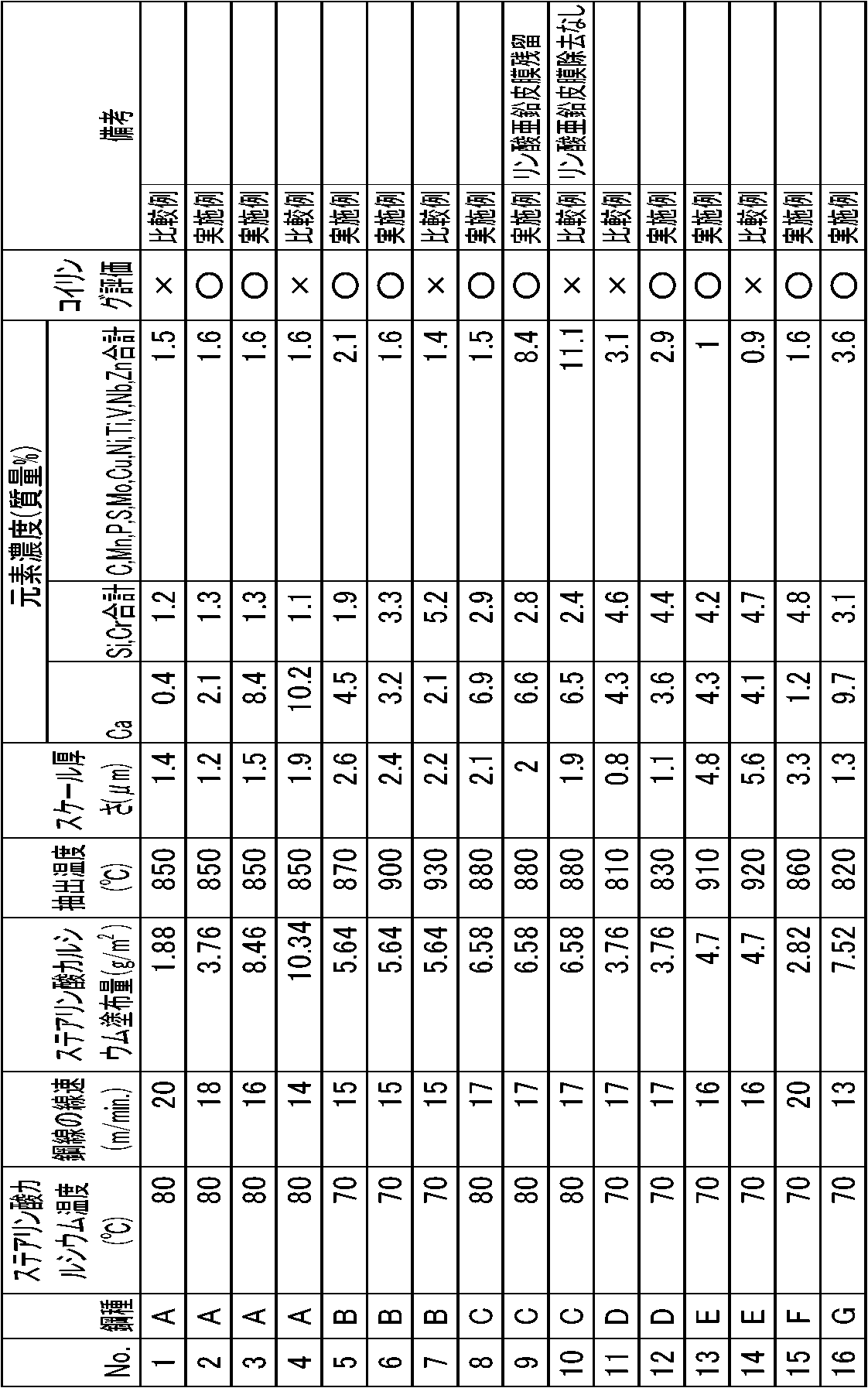
(考察)
表2から明らかなように、サンプルNo.1~4では、ステアリン酸カルシウム量を変化させ、テンパー処理後のスケール中Ca量を振って検討した。これらの結果から、スケール中のCa量が本発明の規定範囲から外れるとばね巻き性が劣化することが確認された。
表2から明らかなように、サンプルNo.1~4では、ステアリン酸カルシウム量を変化させ、テンパー処理後のスケール中Ca量を振って検討した。これらの結果から、スケール中のCa量が本発明の規定範囲から外れるとばね巻き性が劣化することが確認された。
次に、サンプルNo.5~7では、抽出温度を変化することでスケールに濃化するSi、Cr量を制御し、その影響を評価した。これらの結果から、抽出温度が高くなりスケール中のSi、Crが増加するとボイドが徐々に増加し、ばね巻き性が劣化することが確認された。
サンプルNo.8~10では、潤滑皮膜であるリン酸亜鉛皮膜を完全除去したもの、少し残したもの、全く除去しなかったものにステアリン酸カルシウムを塗布し、テンパー処理を行った。その結果、潤滑皮膜を全く除去しないサンプルNo.10では、皮膜中のZnやPが多くなり本発明の規定範囲を超え、スケールが脆くなることがわかった。
サンプルNo.11~14では、抽出温度を変化することでスケール厚さを変化させた。スケール厚さが本発明の規定範囲から外れるとばね巻き性が劣化することが確認された。
サンプルNo.15~16は、Cr含有量の高い鋼種FおよびGを用いた実施例である。本発明によれば、このようにCrを高含有する鋼種を用いても、ばね巻き性に優れることが確認された。
この出願は、2016年5月6日に出願された日本国特許出願特願2016-93090を基礎とするものであり、その内容は、本願に含まれるものである。
本発明を表現するために、前述において具体例等を参照しながら実施形態を通して本発明を適切かつ十分に説明したが、当業者であれば前述の実施形態を変更及び/又は改良することは容易になし得ることであると認識すべきである。したがって、当業者が実施する変更形態又は改良形態が、請求の範囲に記載された請求項の権利範囲を離脱するレベルのものでない限り、当該変更形態又は当該改良形態は、当該請求項の権利範囲に包括されると解釈される。
本発明は、ばね用鋼線やその製造方法に関する技術分野において、広範な産業上の利用可能性を有する。
Claims (3)
- ばね巻き性に優れたばね用鋼線であって、当該鋼線を構成する鋼の化学成分が、質量%で、
C:0.1~1.5%、
Cr:0.01~3%
Si:1.0~2.5%、および
Mn:0.01~2%を含有し、
且つ、残部が鉄および不可避不純物からなり、
前記不可避不純物に含まれるPおよびSの含有量が、それぞれ0%超、0.05%以下に抑制されており、
表面に厚みが1μm以上5μm以下であるスケールを有し、且つ、前記スケールの構成元素が、質量%で、
Ca:0.5%~10%、
SiとCrの合計:5%以下、
CとMnとPとSとMoとCuとNiとTiとVとNbとZnの合計:10%以下であり、且つ残部がFeとOであることを特徴とする、ばね用鋼線。 - 更に、前記化学成分が、質量%で、Mo:0%超1%以下、Cu:0%超0.4%以下、Ni:0%超2%以下、Ti:0%超0.3%以下、V:0%超1%以下およびNb:0%超1%以下よりなる群から選ばれる1種以上を含有する、請求項1に記載のばね用鋼線。
- 請求項1又は2に記載の化学成分を有する鋼を、熱間圧延及び伸線加工後、テンパー処理前に、カルシウムを含む溶液または樹脂を塗布することを特徴とする、請求項1又は2に記載のばね用鋼線の製造方法。
Applications Claiming Priority (2)
| Application Number | Priority Date | Filing Date | Title |
|---|---|---|---|
| JP2016-093090 | 2016-05-06 | ||
| JP2016093090A JP2017201051A (ja) | 2016-05-06 | 2016-05-06 | ばね巻き性に優れるばね用鋼線及びその製造方法 |
Publications (1)
| Publication Number | Publication Date |
|---|---|
| WO2017191792A1 true WO2017191792A1 (ja) | 2017-11-09 |
Family
ID=60203528
Family Applications (1)
| Application Number | Title | Priority Date | Filing Date |
|---|---|---|---|
| PCT/JP2017/016537 Ceased WO2017191792A1 (ja) | 2016-05-06 | 2017-04-26 | ばね巻き性に優れるばね用鋼線及びその製造方法 |
Country Status (2)
| Country | Link |
|---|---|
| JP (1) | JP2017201051A (ja) |
| WO (1) | WO2017191792A1 (ja) |
Families Citing this family (4)
| Publication number | Priority date | Publication date | Assignee | Title |
|---|---|---|---|---|
| CN108728739A (zh) * | 2018-04-21 | 2018-11-02 | 张家港联峰钢铁研究所有限公司 | 一种非淬回火高碳高强度合金弹簧钢90SiMn及其制备方法 |
| CN110548771A (zh) * | 2019-08-14 | 2019-12-10 | 江苏弘亚钨钼科技有限公司 | 一种w型钼丝的制备方法 |
| WO2023013174A1 (ja) * | 2021-08-05 | 2023-02-09 | 住友電気工業株式会社 | ばね用鋼線 |
| JP7211569B1 (ja) * | 2021-08-05 | 2023-01-24 | 住友電気工業株式会社 | ばね用鋼線 |
Citations (3)
| Publication number | Priority date | Publication date | Assignee | Title |
|---|---|---|---|---|
| JP2000065110A (ja) * | 1998-08-25 | 2000-03-03 | Sumitomo Electric Ind Ltd | ばね用オイルテンパー線 |
| JP2009263704A (ja) * | 2008-04-23 | 2009-11-12 | Nippon Steel Corp | 伸線加工性と耐疲労特性に優れた鋼線材 |
| JP2014169470A (ja) * | 2013-03-01 | 2014-09-18 | Kobe Steel Ltd | 伸線性に優れたばね用鋼線材およびその製造方法 |
-
2016
- 2016-05-06 JP JP2016093090A patent/JP2017201051A/ja active Pending
-
2017
- 2017-04-26 WO PCT/JP2017/016537 patent/WO2017191792A1/ja not_active Ceased
Patent Citations (3)
| Publication number | Priority date | Publication date | Assignee | Title |
|---|---|---|---|---|
| JP2000065110A (ja) * | 1998-08-25 | 2000-03-03 | Sumitomo Electric Ind Ltd | ばね用オイルテンパー線 |
| JP2009263704A (ja) * | 2008-04-23 | 2009-11-12 | Nippon Steel Corp | 伸線加工性と耐疲労特性に優れた鋼線材 |
| JP2014169470A (ja) * | 2013-03-01 | 2014-09-18 | Kobe Steel Ltd | 伸線性に優れたばね用鋼線材およびその製造方法 |
Also Published As
| Publication number | Publication date |
|---|---|
| JP2017201051A (ja) | 2017-11-09 |
Similar Documents
| Publication | Publication Date | Title |
|---|---|---|
| KR102416655B1 (ko) | 고강도 강판 및 그 제조 방법 | |
| JP5169839B2 (ja) | 捻回特性に優れるpws用めっき鋼線及びその製造方法 | |
| KR102004077B1 (ko) | 고강도 냉연 강판, 고강도 도금 강판 및 이것들의 제조 방법 | |
| KR101638719B1 (ko) | 용융 아연 도금 강판 및 그 제조 방법 | |
| JP6354919B1 (ja) | 薄鋼板およびその製造方法 | |
| JP6292353B2 (ja) | 薄鋼板及びめっき鋼板、並びに薄鋼板の製造方法及びめっき鋼板の製造方法 | |
| KR101923327B1 (ko) | 고강도 용융 아연 도금 강판 및 그 제조 방법 | |
| JP6452454B2 (ja) | 高強度ばね用圧延材および高強度ばね用ワイヤ | |
| JP7226548B2 (ja) | 線材 | |
| JP5958667B1 (ja) | 高強度溶融亜鉛めっき鋼板およびその製造方法 | |
| JP6212473B2 (ja) | 高強度ばね用圧延材及びこれを用いた高強度ばね用ワイヤ | |
| KR101726090B1 (ko) | 표면품질 및 도금밀착성이 우수한 고강도 용융아연도금강판 및 그 제조방법 | |
| WO2016103535A1 (ja) | 高強度溶融亜鉛めっき鋼板およびその製造方法 | |
| JP5671400B2 (ja) | 伸線加工性および伸線後の疲労特性に優れたばね用鋼線材、ならびに疲労特性およびばね加工性に優れたばね用鋼線 | |
| WO2017191792A1 (ja) | ばね巻き性に優れるばね用鋼線及びその製造方法 | |
| KR100823780B1 (ko) | 산세성(酸洗性)이 우수한 스프링용 강선재(鋼線材) | |
| JP2012132097A (ja) | ばね用鋼、ばね用鋼線及びばね | |
| JP2017082251A (ja) | 熱処理鋼線の製造方法 | |
| KR20110023911A (ko) | 외관이 우수한 고강도 용융 아연 도금 강판 및 그 제조 방법 | |
| JP5796781B2 (ja) | ばね加工性に優れた高強度ばね用鋼線材およびその製造方法、並びに高強度ばね | |
| JP2005206919A (ja) | 延性と伸びフランジ性に優れた複合組織型高張力溶融亜鉛めっき熱延鋼板及びその製造方法 | |
| WO2016158563A1 (ja) | 曲げ加工性に優れた熱処理鋼線 | |
| JPH04180524A (ja) | 加工性の優れた制振鋼板の製造方法 |
Legal Events
| Date | Code | Title | Description |
|---|---|---|---|
| NENP | Non-entry into the national phase |
Ref country code: DE |
|
| 121 | Ep: the epo has been informed by wipo that ep was designated in this application |
Ref document number: 17792725 Country of ref document: EP Kind code of ref document: A1 |
|
| 122 | Ep: pct application non-entry in european phase |
Ref document number: 17792725 Country of ref document: EP Kind code of ref document: A1 |