WO2017170505A1 - 高耐熱性付与用乳化安定剤及びその製造方法 - Google Patents
高耐熱性付与用乳化安定剤及びその製造方法 Download PDFInfo
- Publication number
- WO2017170505A1 WO2017170505A1 PCT/JP2017/012568 JP2017012568W WO2017170505A1 WO 2017170505 A1 WO2017170505 A1 WO 2017170505A1 JP 2017012568 W JP2017012568 W JP 2017012568W WO 2017170505 A1 WO2017170505 A1 WO 2017170505A1
- Authority
- WO
- WIPO (PCT)
- Prior art keywords
- water
- protein
- oil
- soluble polysaccharide
- heat resistance
- Prior art date
- Legal status (The legal status is an assumption and is not a legal conclusion. Google has not performed a legal analysis and makes no representation as to the accuracy of the status listed.)
- Ceased
Links
Classifications
-
- A—HUMAN NECESSITIES
- A23—FOODS OR FOODSTUFFS; TREATMENT THEREOF, NOT COVERED BY OTHER CLASSES
- A23L—FOODS, FOODSTUFFS OR NON-ALCOHOLIC BEVERAGES, NOT OTHERWISE PROVIDED FOR; PREPARATION OR TREATMENT THEREOF
- A23L29/00—Foods or foodstuffs containing additives; Preparation or treatment thereof
- A23L29/10—Foods or foodstuffs containing additives; Preparation or treatment thereof containing emulsifiers
Definitions
- the present invention relates to an emulsion stabilizer and a method for producing the same.
- Emulsifiers include natural products such as fatty acids, egg yolk, lecithin, and saponin, and synthetic products such as glycerin fatty acid esters and sucrose fatty acid esters. Synthetic products are superior to natural products in emulsifying power, but their effects on living bodies may be regarded as problems. Therefore, with the recent refusal of consumers to use synthetic additives, there is a demand for the development of natural materials to replace synthetic additives.
- Egg yolk is a natural emulsifier widely used in the food processing field.
- Egg yolk is characterized by the ability to prepare emulsions with an oil content of 70% by weight or more in the low pH range where emulsification activity is likely to fall with other natural emulsifiers, but in general acidic oil-in-water emulsification such as mayonnaise, tartar sauce, emulsified dressing etc.
- acidic oil-in-water emulsification such as mayonnaise, tartar sauce, emulsified dressing etc.
- Non-Patent Document 1 a method of blending egg yolks treated with enzymes such as lipase and protease is known (Patent Documents 1 and 2).
- a method of using a thickening stabilizer such as starch with a relatively small amount of oil of less than 50% by weight is also known (Non-Patent Document 1).
- a technique using water-soluble soybean polysaccharide or soybean protein as a natural emulsifier replacing egg yolk is disclosed.
- a method using a water-soluble soybean polysaccharide produced under specific extraction conditions (Patent Document 3) and a method using a water-soluble soybean polysaccharide together (Patent Document 4) to reinforce the emulsifiability of soybean protein.
- Patent Document 3 a method using a water-soluble soybean polysaccharide produced under specific extraction conditions
- Patent Document 4 a method using a water-soluble soybean polysaccharide together
- Patent Documents 1 and 2 there is no oil separation after heating, but there is also a problem that the properties are completely different from those before heating, for example, the whole is solidified in a tofu-like shape due to heat coagulation of the protein.
- a smooth emulsified food can be obtained even after heating.
- the oil content is low, there is no richness and the viscosity before heating and after heating is low.
- the shape retention is poor and dripping occurs.
- egg yolk as an emulsifier, there is currently no method for sufficiently solving these problems.
- An object of the present invention is to provide an emulsion stabilizer capable of preparing an oil-in-water emulsion that is stable even when the oil content is high in an acidic to neutral range and excellent in heat resistance, and a method for producing the same.
- the present inventors have intensively studied to solve the above problems.
- a heated mixture of the water-soluble polysaccharide and protein obtained by heating the water-soluble polysaccharide and protein under acid functions as an emulsion stabilizer that can impart high heat resistance to the oil-in-water emulsion.
- the inventors have found that an oil-in-water emulsion having a high oil content and excellent heat resistance can be prepared by using the heated mixture, and the present invention has been completed.
- the present invention (1) An emulsion stabilizer for imparting high heat resistance, comprising as an active ingredient a heated mixture of a water-soluble polysaccharide and protein,
- the heated mixture of the water-soluble polysaccharide and protein is obtained by heating a water-soluble polysaccharide containing uronic acid as a constituent sugar at a pH of 2 to 5 and at a temperature of 80 ° C. to 180 ° C. in the presence of the protein. is there,
- the heated mixture of the water-soluble polysaccharide and protein comprises a water-soluble polysaccharide containing uronic acid as a constituent saccharide in the presence of protein at a pH of 2.5 to 3.5 and 110 ° C. to 140 ° C.
- the emulsion stabilizer for imparting high heat resistance according to (1), which is heated (3) The high heat resistance-imparting according to (1), wherein a ratio of the water-soluble polysaccharide and the protein in the heated mixture of the water-soluble polysaccharide and the protein is 10: 1 to 1: 100 on a mass basis.
- Emulsion stabilizers (4) The high heat resistance imparting composition according to (2), wherein the ratio of the water-soluble polysaccharide and the protein in the heated mixture of the water-soluble polysaccharide and the protein is 10: 1 to 1: 100 on a mass basis.
- Emulsion stabilizers (5) The emulsion stabilizer for imparting high heat resistance according to any one of (1) to (4), wherein the water-soluble polysaccharide is derived from pea seed or soybean. (6) An oil-in-water emulsion containing the emulsion stabilizer for imparting high heat resistance according to any one of (1) to (5), (7) The oil-in-water emulsion according to (6), wherein the oil-in-water emulsion contains a heated mixture of the water-soluble polysaccharide and protein in an amount of 0.01 to 15% by weight and fats and oils in an amount of 1 to 80% by weight.
- An emulsion stabilizer for imparting high heat resistance comprising a heated mixture of a water-soluble polysaccharide and protein as an active ingredient, However, the heated mixture of the water-soluble polysaccharide and protein is obtained by heating a water-soluble polysaccharide containing uronic acid as a constituent sugar at a pH of 2 to 5 and at a temperature of 80 ° C. to 180 ° C. in the presence of the protein.
- Emulsion stabilizers (13) The emulsion stabilizer for imparting high heat resistance according to (1) or (2), wherein the water-soluble polysaccharide is derived from pea seeds or soybeans, (14) An oil-in-water emulsion containing the emulsion stabilizer for imparting high heat resistance according to any one of (11) to (13), (15) The oil-in-water emulsion according to (14), wherein the oil-in-water emulsion contains a heated mixture of the water-soluble polysaccharide and protein in an amount of 0.01 to 15% by weight and fats and oils in an amount of 1 to 80% by weight.
- An emulsion stabilizer for imparting high heat resistance characterized in that a water-soluble polysaccharide containing uronic acid as a constituent saccharide is heated at a pH of 2 to 5 and from 80 ° C. to 180 ° C. in the presence of protein. Production method, It is.
- an oil-in-water emulsion that is stable at a high oil content and excellent in heat resistance can be prepared.
- the emulsion stabilizer for imparting high heat resistance comprises a heated mixture of a water-soluble polysaccharide and protein as an active ingredient.
- the heated mixture is a heated water-soluble polysaccharide and protein.
- “heated” means that it has undergone a heat treatment, and includes the case where it has been cooled. If the emulsion stabilizer for imparting high heat resistance of the present invention is used, an oil-in-water emulsion having high heat resistance can be prepared.
- the water-soluble polysaccharide used in the present embodiment may be any one that contains uronic acid as a constituent sugar.
- the water-soluble polysaccharide is preferably a plant-derived polysaccharide obtained by extraction from a plant raw material, or a microorganism-derived polysaccharide produced by a microorganism by fermentation or the like.
- the amount of uronic acid in the water-soluble polysaccharide may be, for example, 0.01 to 50% by mass.
- Examples of uronic acid include D-glucuronic acid, D-galacturonic acid, D-mannuronic acid, and L-guluronic acid.
- plant-derived polysaccharides for example, water-soluble pea polysaccharides derived from pea seeds and water-soluble soybean polysaccharides derived from soybean, which will be described in detail below, can be used. These water-soluble polysaccharides are known to contain uronic acid as a constituent sugar.
- the plant-derived polysaccharide source containing uronic acid as a constituent sugar may be, for example, pectin, tragacanth gum, gum arabic, gati gum, karaya gum, psyllium seed gum, agar, alginic acids, etc. It may be. Pectin may be derived from, for example, citrus fruits, or may be derived from potato, beet or the like.
- alginic acid means alginic acid or its derivative (s). Examples of the microorganism-derived polysaccharide source containing uronic acid as a constituent sugar include xanthan gum and gellan gum.
- the above polysaccharides or polysaccharide sources may be used alone or in combination of two or more.
- the water-soluble polysaccharide containing uronic acid as a constituent sugar it is preferable to use a water-soluble pea polysaccharide or a water-soluble soybean polysaccharide, and it is more preferable to use a water-soluble pea polysaccharide.
- a polysaccharide isolated or extracted in advance may be used, or a polysaccharide source containing components other than the polysaccharide may be used.
- the water-soluble pea polysaccharide is a water-soluble polysaccharide obtained by extraction from pea seeds.
- the water-soluble pea polysaccharide may be obtained by extraction from a processed pea seed such as a fiber fraction obtained by removing the protein fraction and starch fraction contained in the pea seed.
- Water can be used as a solvent for extraction of water-soluble pea polysaccharides from pea seeds.
- the water may be hot water.
- the pH at the time of extraction is preferably 3-12. When the pH is 3 or more, hydrolysis of the water-soluble polysaccharide can be suppressed, and when the pH is 12 or less, elimination and decomposition of the water-soluble polysaccharide can be suppressed.
- the pH during extraction is more preferably 4-10.
- the water-soluble pea polysaccharide is, for example, adjusted to pH 3 to 12 after adding 5 to 20 times the amount of water to pea seed as a raw material or a processed product thereof, and is 60 ° C. or higher and 180 ° C. or lower, preferably 60 ° C.
- the extraction can be performed at a temperature of 150 ° C. or lower or 80 ° C. or higher and 180 ° C. or lower, more preferably 80 ° C. or higher and 150 ° C. or lower, and still more preferably 80 ° C. or higher and 130 ° C. or lower.
- the extraction time can be, for example, 0.5 to 3 hours, and can be arbitrarily adjusted depending on the state of the raw material, temperature, and the like.
- the obtained extract can be used as a water-soluble pea polysaccharide source after the insoluble fiber content in the liquid is separated by a centrifuge, etc., and further, protein removal, starch removal, desalting, pigment component
- a water-soluble pea polysaccharide source a product that has been subjected to refining treatment such as removal, high temperature sterilization, retort sterilization, electromagnetic wave sterilization, high temperature vacuum sterilization, ozone sterilization, electrolytic water sterilization, indirect heat sterilization, etc. Good.
- Starch can be removed by, for example, decomposition with amylase.
- the water-soluble pea polysaccharide source may be used in a liquid state or may be used after being dried by freeze drying, spray drying or the like.
- the water-soluble soybean polysaccharide is a water-soluble polysaccharide obtained by extraction from soybean.
- the water-soluble soybean polysaccharide is preferably derived from soybean cotyledons.
- okara produced as a by-product when producing tofu, isolated soybean protein, and the like can be used.
- Okara is preferably an okara obtained from defatted soybean, and is preferably an okara produced as a by-product in the process of producing isolated soybean protein.
- the water-soluble soybean polysaccharide is prepared by adding 5 to 20 times the amount of water to raw materials such as okara and then adjusting the pH to 3 to 7 to 60 to 180 ° C., preferably 60 to 150 ° C.
- the extraction can be performed at a temperature of preferably 80 ° C. or higher and 130 ° C. or lower, more preferably 100 ° C. or higher and 130 ° C. or lower.
- extraction temperature is the said range, extraction efficiency can be improved and hydrolysis of water-soluble soybean polysaccharide can be suppressed.
- separation of insoluble fibers in the resulting extract, purification treatment, sterilization treatment and drying the same mode as extraction of water-soluble pea polysaccharide can be applied.
- the protein used in the production of the heated mixture of the water-soluble polysaccharide and protein according to this embodiment may be any protein species, for example, soy protein, pea protein, ovalbumin, wheat gluten, casein, oats. It may be protein, mung bean protein, peanut protein, lentil protein, and the like. A protein may be used individually by 1 type and may use 2 or more types together.
- the protein is preferably soy protein, casein, pea protein or egg white in that the effect of the present invention can be enhanced.
- the heated mixture of the water-soluble polysaccharide and protein according to this embodiment can be obtained by heat-treating the water-soluble polysaccharide in the presence of protein.
- the heating mixture is prepared by simultaneously performing a heating extraction step of a water-soluble polysaccharide from a polysaccharide source and a heating step for obtaining a heating mixture of the water-soluble polysaccharide and protein, that is, water-solubility from the polysaccharide source. Extraction of the polysaccharide may be performed by heating in the presence of protein, or may be performed by mixing the water-soluble polysaccharide and protein extracted from the raw material in advance and heating.
- the method for obtaining the heated mixture is preferably performed in the presence of water, more preferably in an aqueous solution.
- concentration of the polysaccharide in the aqueous solution during heating is preferably 0.1 to 10% by mass, and preferably 1 to 5% by mass.
- the protein concentration in the aqueous solution during heating is preferably 0.1 to 10% by mass, and preferably 1 to 5% by mass.
- the heated mixture of the water-soluble polysaccharide and protein can be obtained by the following method, for example.
- the polysaccharide and protein are suspended in an aqueous system, and the suspension is adjusted to pH 2 to 5, preferably pH 2.5 to 3.5.
- Acids that can be used in the food industry such as hydrochloric acid, phosphoric acid, sulfuric acid, lactic acid, citric acid, acetic acid, and oxalic acid, can be used without particular limitation.
- heat treatment is performed at a temperature of 80 ° C. or higher and 180 ° C. or lower. Thereby, the liquid containing the heating mixture of water-soluble polysaccharide and protein can be obtained.
- the heating temperature is preferably 100 to 160 ° C, more preferably 110 to 140 ° C.
- the heating temperature is 80 ° C. or higher, the heated mixture can be efficiently obtained in a shorter time.
- disassembly of water-soluble polysaccharide and protein can be suppressed because it is 180 degrees C or less.
- the heating time is approximately 1 to 180 minutes, but can be arbitrarily adjusted depending on the state of the raw material, temperature, and the like.
- the solid content in the suspension may be separated and removed by a conventional method such as filtration or centrifugation. Even if the solid content is not removed, the emulsifying power is not affected. However, it is more preferable to separate and remove the solid content because the roughness of the texture when the emulsion is prepared can be reduced.
- the liquid containing the heated mixture of the water-soluble polysaccharide and protein thus obtained may be subjected to purification treatment such as neutralization / desalting, removal of hydrophobic substances or low-molecular substances, if necessary.
- purification methods activated carbon treatment, resin adsorption treatment, reprecipitation method using a polar solvent such as methanol, ethanol, isopropanol, and acetone, ultrafiltration method, reverse osmosis method, gel filtration method, dialysis method, ion exchange Examples thereof include a resin method, an electrodialysis method, and an ion exchange membrane method, and one of these methods may be used alone, or two or more thereof may be used in combination.
- a reprecipitation method an ultrafiltration method, a reverse osmosis method, a gel filtration method, or a dialysis method using a polar solvent because various low molecules can be removed.
- a desalting purification process it is preferable to process so that the ash in the liquid after a process may be 10 mass% or less.
- the obtained liquid containing a heated mixture of water-soluble polysaccharide and protein may be used as it is for the production of an oil-in-water emulsion or may be dried by a conventional method.
- the ratio of water-soluble polysaccharide to protein in the heated mixture of water-soluble polysaccharide and protein is preferably 10: 1 to 1: 100 on a mass basis. When the ratio is within the above range, a stable high oil emulsion can be prepared.
- the ratio of the water-soluble polysaccharide to the protein is more preferably 5: 1 to 1:10, and even more preferably 3: 1 to 1: 4 on a mass basis.
- the polysaccharide source and the protein amount should be adjusted so that the ratio of the polysaccharide to the protein in the obtained heated mixture is within the above range. Good.
- the molecular weight of the heated mixture of the water-soluble polysaccharide and protein according to the present embodiment is such that the fraction having a molecular weight of 12,000 or more is 30% by mass or less, and the fraction having a molecular weight of 500 to less than 12000 is 30% by mass or more. Is a fraction having a molecular weight of 12,000 or more and 25% by mass or less, and a fraction having a molecular weight of 500 to less than 12000 is 40% by mass or more.
- the fraction having a molecular weight of 500 or more and less than 12000 in the heated mixture may be 100% by mass, 80% by mass or less, 60% by mass or less, or 50% by mass or less.
- the fraction having a molecular weight of 12000 or more in the heated mixture may be 0% by mass, 5% by mass or more, 10% by mass or more, 15% by mass or more, or 20% by mass or more.
- the fraction with a molecular weight of less than 500 in the heated mixture is 0% by mass or more and less than 70% by mass, preferably 0% by mass or more and less than 60% by mass, and more preferably 0% by mass or more and less than 40% by mass. preferable.
- the fraction having a molecular weight of less than 500 may be 20% by mass or more and less than 40% by mass, or 30% by mass or more and less than 40% by mass.
- the molecular weight distribution of the heated mixture can be measured using a gel filtration HPLC method. More specifically, for example, a heated mixture is dissolved in 20 mM phosphate buffer to form an aqueous solution, and a sample filtered through a 0.2 ⁇ m filter is passed through a gel filtration chromatography column and eluted using the phosphate buffer. The elution time of the complex is determined by measuring the absorbance at 214 nm.
- a molecular weight calibration curve is prepared using, for example, cytochrome C (molecular weight 12384), aprotinin (molecular weight 6512), gastrin I (molecular weight 2098), angiotensin II (molecular weight 1046), triglutamic acid (molecular weight 405), Based on the calibration curve, the molecular weight distribution of the heated mixture can be determined.
- the oil-in-water emulsion of the present invention contains an emulsion stabilizer for imparting high heat resistance and is excellent in heat resistance. Moreover, even if the oil content of the oil-in-water emulsion is high, it has heat resistance. For example, even if the oil content is 70% by weight, it is stable without separation.
- the oil-in-water emulsion of the present invention is stable without separation even when heated at a high temperature of 100 ° C. or higher. For example, it is stable even when heated at 120 ° C. under the F value corresponding to 20 minutes. It has the characteristics.
- the pH range in which the oil-in-water emulsion of the present invention can be stabilized is wide from acidic to neutral, and is stable in the range of pH 4 to 7, for example.
- an oil-in-water emulsion prepared simply by adding a water-soluble polysaccharide and protein does not have sufficient stability because it is separated particularly at a high oil content, and heat resistance is also insufficient.
- the fat content in the oil-in-water emulsion is 1 to 80% by weight. Even an oil-in-water emulsion having a high oil content does not have oil separation, and a stable emulsion having a small particle size can be obtained. In view of obtaining a heat-resistant and stable oil-in-water emulsion even with a high oil content, it is preferably 10 to 80% by mass, more preferably 20 to 80% by mass, still more preferably 30 to 80% by mass, most preferably. Is 30 to 70% by weight. The content of the heated mixture of the water-soluble polysaccharide and protein in the oil-in-water emulsion is approximately 0.01 to 15% by mass.
- a more stable oil-in-water emulsion can be prepared by setting the content to preferably 0.1 to 10% by mass, and more preferably 0.01 to 15% by mass. Further, the weight ratio of the heated mixture of the water-soluble polysaccharide and protein in the oil-in-water emulsion to the fat is preferably 1: 2 to 1:32, more preferably 1: 5 to 1:32. The ratio is preferably 1: 6 to 1:32.
- oils and fats that make up the oil phase of oil-in-water emulsions include soybean oil, rapeseed oil, corn oil, cottonseed oil, coconut oil, palm oil, palm kernel oil, peanut oil, rice bran oil, cacao butter, milk fat, beef tallow, lard And animal and vegetable oils and fats such as butter, and processed oils and fats obtained by subjecting them to treatments such as hardening, transesterification and fractionation.
- polysaccharides, starches, saccharides, processed starches, proteins, emulsifiers and the like can be blended in the oil-in-water emulsion as necessary.
- the oil-in-water emulsion can be produced by a conventionally known general emulsion production method. That is, it can be prepared by emulsifying an oil phase and an aqueous phase using an apparatus such as a colloid mill, a high-pressure homogenizer, or a mixer.
- oil-in-water emulsion for example, widely used in food industry such as emulsified fragrances, mayonnaise, dressings, creams, cosmetics such as hand creams, pharmaceuticals such as paints, agricultural chemicals such as insecticides, etc. it can.
- Example 1 After peeling 50 kg of pea seeds, 5 times the amount of water was added to the cotyledon part and immersed for 24 hours. The cotyledon part was crushed using a homomixer (5,000 rpm, 30 minutes), and protein and starch were extracted while maintaining pH 9 using a 30% sodium hydroxide solution. Components such as protein and starch dispersed in water were removed using a centrifugal filter (1,000 rpm, 5 minutes), and the fiber was recovered. Further, 5 times the amount of water was added to the fiber, and the mixture was stirred with a homomixer (3,000 rpm, 30 minutes), and the fiber was collected with a centrifugal filter (1,000 rpm, 5 minutes).
- the fraction having a molecular weight of 12000 or more was 22.1%, the fraction having a molecular weight of 500 or more but less than 12000 was 43.0%, and the fraction having a molecular weight of less than 500 was 34.9%.
- the fraction of the composition having a molecular weight of 12000 or more was 36.3%, the fraction having a molecular weight of 500 or more but less than 12000 was 23.0%, and the fraction having a molecular weight of less than 500 was 40.8%.
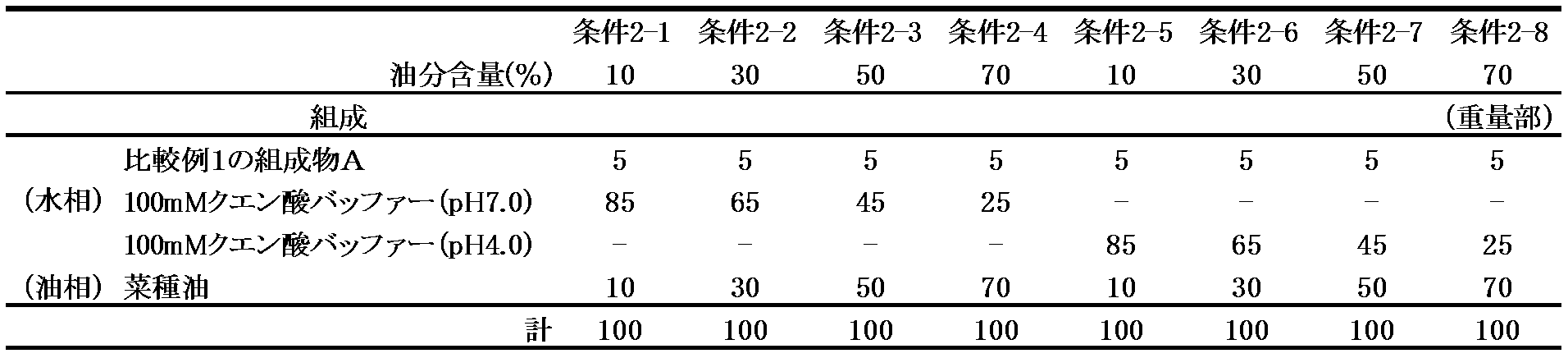
- Example 2 Comparative Example 2 Evaluation of emulsification ability 100 mM citrate buffer (pH 7.0 or pH 4.0) in which heated mixture A of water-soluble polysaccharide and protein or composition A was dissolved as an aqueous phase
- rapeseed oil produced by Fuji Oil Co., Ltd.
- Table 1 Example 2
- Table 2 Comparative Example 2
- a household mixer is used for emulsification, and for oil content of 30% or more, in order to prevent phase transition, a stirring time of 30 seconds is provided every time 10 parts by weight of oil is added.
- An oil-in-water emulsion was prepared.
- the heated mixture A prepared in Example 1 was able to prepare an oil-in-water emulsion stable at pH 7.0 and 4.0.
- the evaluation was good even when the oil content was as high as 50% or 70%.
- the composition A prepared in Comparative Example 1 exhibited emulsion stability only at a very low oil content.
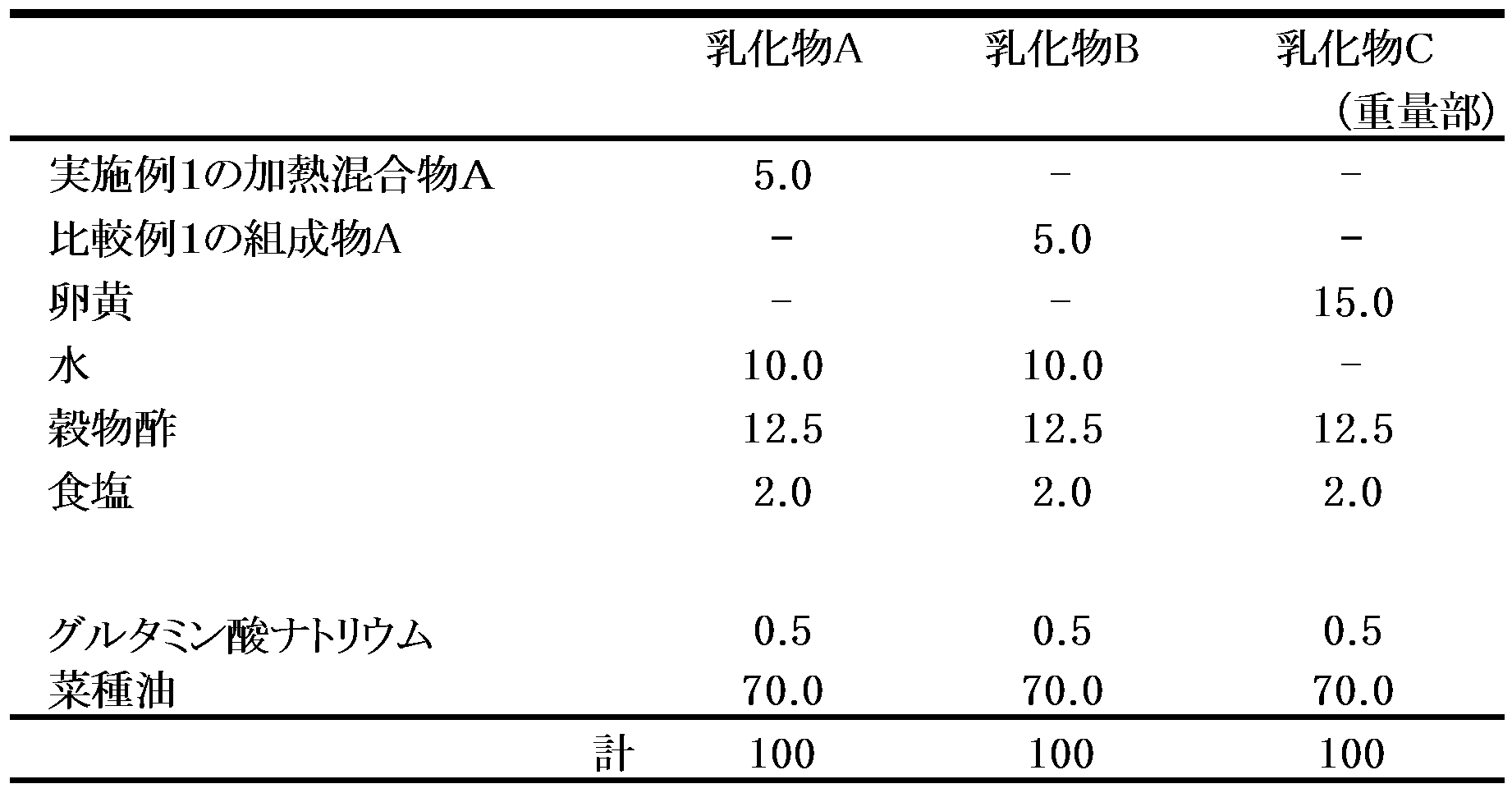
- Example 3 Comparative Examples 3 to 4 Evaluation of heat resistance of emulsion Emulsified mixture A prepared in Example 1 as water phase, cereal vinegar, salt, sodium glutamate was dissolved in water as a water phase. Thereafter, rapeseed oil (Fuji Oil Co., Ltd.) was used as the oil phase to prepare an oil-in-water emulsion A having an oil content of 70% (Example 3).
- oil-in-water emulsions B (Comparative Example 3) and C (Comparative Example 4) were prepared as comparative objects using the composition A or egg yolk prepared in Comparative Example 1 with the formulation shown in Table 4.
- oil-in-water emulsion B an increase in particle diameter and significant oil separation due to thermal coagulation of the protein were confirmed after the heat treatment.
- oil-in-water emulsion C increased the oil separation after the heat treatment.
- no increase in the particle diameter was confirmed even after the heat treatment, and protein aggregation and coalescence of oil droplets were not observed. Furthermore, the smoothness as an emulsion was not lost, and a good emulsified state was maintained.
Landscapes
- Health & Medical Sciences (AREA)
- Nutrition Science (AREA)
- Life Sciences & Earth Sciences (AREA)
- Chemical & Material Sciences (AREA)
- Engineering & Computer Science (AREA)
- Food Science & Technology (AREA)
- Polymers & Plastics (AREA)
- Emulsifying, Dispersing, Foam-Producing Or Wetting Agents (AREA)
- General Preparation And Processing Of Foods (AREA)
- Seasonings (AREA)
- Medicinal Preparation (AREA)
- Cosmetics (AREA)
Abstract
本発明は、酸性~中性域において油分含量が高い場合でも安定で、耐熱性の優れた水中油型乳化物を調製し得る乳化安定剤及びその製造方法を提供することを目的とする。 水溶性多糖類とタンパク質を酸性下で加熱することにより得られる、水溶性多糖類とタンパク質との加熱混合物が水中油型乳化物に高耐熱性を付与し得る乳化安定剤として機能し、該加熱混合物を用いることで高油分で、耐熱性の優れた水中油型乳化物を調製できる。
Description
本発明は、乳化安定剤及びその製造方法に関する。
乳化剤には脂肪酸や卵黄、レシチン、サポニンなどに代表される天然物と、グリセリン脂肪酸エステルやショ糖脂肪酸エステルなどに代表される合成物がある。合成物は天然物よりも乳化力で優れるが、生体への作用が問題視される場合がある。そのため、近年の消費者の合成添加物使用の敬遠に伴い、合成添加物に代わる天然素材の開発が要望されている。
食品加工分野で広く用いられている天然の乳化剤として卵黄がある。卵黄はその他の天然乳化剤では乳化活性の落ちやすい低pH域で油分含量70重量%以上の乳化物を調製できるという特徴をもつが、一般にマヨネーズ、タルタルソース、乳化型ドレッシング等の酸性水中油型乳化物に卵黄を使用した場合、オーブンで焼成する、電子レンジで加熱する、油で揚げる、煮る、焼く、蒸す等の加熱処理をすると、卵黄に含まれるタンパク質の熱凝固により乳化が破壊され、油が分離し、食品の外観、食感、風味等が著しく損なわれるという問題がある。
そこで、これらの乳化食品への耐熱性付与には、リパーゼ、プロテアーゼといった酵素処理した卵黄を配合する方法が知られている(特許文献1~2)。また、このような方法の他に、油の配合量を50重量%未満と比較的少なくして、澱粉などの増粘安定剤を用いる方法も知られている(非特許文献1)。
また、卵黄に代わる天然の乳化剤として、水溶性大豆多糖類や大豆タンパクを用いる技術が開示されている。例えば、特定の抽出条件で製造された水溶性大豆多糖類を用いる方法(特許文献3)や、大豆タンパクの乳化性を補強するために水溶性大豆多糖類を併用する方法(特許文献4)が知られている。
New Food Industry(1995) Vol.37,No.10, p57-63
特許文献1~2の技術では加熱後に油分離はないものの、タンパクの熱凝固により、全体が豆腐状に固まるなど、加熱前とは全く違った物性となってしまうという問題も生じる。また、非特許文献1に記載している技術では加熱後も滑らかな性状の乳化食品が得られるが、油分が低いためにコク味がないことや、加熱前及び加熱後の粘度が低いために保形性が悪く液ダレが生じるといった問題が生じる。乳化剤としての卵黄の使用においては、現状としてこれらの課題を充分に解決する方法が無いというのが現状である。
また、特許文献3~4の技術では、酸性下で高油分の乳化物を調製することはできても、卵黄と同様に、充分な耐熱性を付与できているとはいえず、さらに改良する余地があった。
本発明は、酸性~中性域において油分含量が高い場合でも安定で、耐熱性の優れた水中油型乳化物を調製し得る乳化安定剤及びその製造方法を提供することを目的とする。
また、特許文献3~4の技術では、酸性下で高油分の乳化物を調製することはできても、卵黄と同様に、充分な耐熱性を付与できているとはいえず、さらに改良する余地があった。
本発明は、酸性~中性域において油分含量が高い場合でも安定で、耐熱性の優れた水中油型乳化物を調製し得る乳化安定剤及びその製造方法を提供することを目的とする。
本発明者らは、上記課題を解決するため鋭意検討を行った。その結果、水溶性多糖類とタンパク質を酸性下で加熱することにより得られる、水溶性多糖類とタンパク質との加熱混合物が水中油型乳化物に高耐熱性を付与し得る乳化安定剤として機能し、該加熱混合物を用いることで高油分で、耐熱性の優れた水中油型乳化物を調製できることを見出し本発明を完成するに至った。
すなわち本発明は、
(1)水溶性多糖類とタンパク質との加熱混合物を有効成分とする、高耐熱性付与用乳化安定剤、
但し、該水溶性多糖類とタンパク質との加熱混合物は、構成糖としてウロン酸を含む水溶性多糖類を、タンパク質の存在下において、pH2~5かつ80℃以上180℃以下で加熱されたものである、
(2)前記水溶性多糖類とタンパク質との加熱混合物は、構成糖としてウロン酸を含む水溶性多糖類を、タンパク質の存在下において、pH2.5~3.5かつ110℃以上140℃以下で加熱されたものである、(1)記載の高耐熱性付与用乳化安定剤、
(3)前記水溶性多糖類とタンパク質との加熱混合物中の水溶性多糖類とタンパク質との比率が質量基準で10:1~1:100である、(1)に記載の高耐熱性付与用乳化安定剤、
(4)前記水溶性多糖類とタンパク質との加熱混合物中の水溶性多糖類とタンパク質との比率が質量基準で10:1~1:100である、(2)に記載の高耐熱性付与用乳化安定剤、
(5)前記水溶性多糖類がエンドウ種子または大豆由来である、(1)~(4)何れか1つに記載の高耐熱性付与用乳化安定剤、
(6)(1)~(5)何れか1つに記載の高耐熱性付与用乳化安定剤を含有する水中油型乳化物、
(7)水中油型乳化物中、前記水溶性多糖類とタンパク質との加熱混合物を0.01~15重量%、油脂を1~80重量%含む、(6)記載の水中油型乳化物、
(8)前記水溶性多糖類とタンパク質との加熱混合物と油脂の重量比が、1:2~1:32である、(6)記載の水中油型乳化物、
(9)構成糖としてウロン酸を含む水溶性多糖類を、タンパク質の存在下において、pH2~5かつ80℃以上180℃以下で加熱することを特徴とする、高耐熱性付与用乳化安定剤の製造方法、
(10)構成糖としてウロン酸を含む水溶性多糖類を、タンパク質の存在下において、pH2.5~3.5かつ110℃以上140℃以下で加熱する、(9)記載の高耐熱性付与用乳化安定剤の製造方法、
である。
また、換言すれば、
(11)水溶性多糖類とタンパク質との加熱混合物を有効成分とする、高耐熱性付与用乳化安定剤、
但し、該水溶性多糖類とタンパク質との加熱混合物は、構成糖としてウロン酸を含む水溶性多糖類を、タンパク質の存在下において、pH2~5かつ80℃以上180℃以下で加熱されたものである、
(12)前記水溶性多糖類とタンパク質との加熱混合物中の水溶性多糖類とタンパク質との比率が質量基準で10:1~1:100である、(11)に記載の高耐熱性付与用乳化安定剤、
(13)前記水溶性多糖類がエンドウ種子または大豆由来である、(1)または(2)に記載の高耐熱性付与用乳化安定剤、
(14)(11)~(13)何れか1つに記載の高耐熱性付与用乳化安定剤を含有する水中油型乳化物、
(15)水中油型乳化物中、前記水溶性多糖類とタンパク質との加熱混合物を0.01~15重量%、油脂を1~80重量%含む、(14)記載の水中油型乳化物、
(16)構成糖としてウロン酸を含む水溶性多糖類を、タンパク質の存在下において、pH2~5かつ80℃以上180℃以下で加熱することを特徴とする、高耐熱性付与用乳化安定剤の製造方法、
である。
(1)水溶性多糖類とタンパク質との加熱混合物を有効成分とする、高耐熱性付与用乳化安定剤、
但し、該水溶性多糖類とタンパク質との加熱混合物は、構成糖としてウロン酸を含む水溶性多糖類を、タンパク質の存在下において、pH2~5かつ80℃以上180℃以下で加熱されたものである、
(2)前記水溶性多糖類とタンパク質との加熱混合物は、構成糖としてウロン酸を含む水溶性多糖類を、タンパク質の存在下において、pH2.5~3.5かつ110℃以上140℃以下で加熱されたものである、(1)記載の高耐熱性付与用乳化安定剤、
(3)前記水溶性多糖類とタンパク質との加熱混合物中の水溶性多糖類とタンパク質との比率が質量基準で10:1~1:100である、(1)に記載の高耐熱性付与用乳化安定剤、
(4)前記水溶性多糖類とタンパク質との加熱混合物中の水溶性多糖類とタンパク質との比率が質量基準で10:1~1:100である、(2)に記載の高耐熱性付与用乳化安定剤、
(5)前記水溶性多糖類がエンドウ種子または大豆由来である、(1)~(4)何れか1つに記載の高耐熱性付与用乳化安定剤、
(6)(1)~(5)何れか1つに記載の高耐熱性付与用乳化安定剤を含有する水中油型乳化物、
(7)水中油型乳化物中、前記水溶性多糖類とタンパク質との加熱混合物を0.01~15重量%、油脂を1~80重量%含む、(6)記載の水中油型乳化物、
(8)前記水溶性多糖類とタンパク質との加熱混合物と油脂の重量比が、1:2~1:32である、(6)記載の水中油型乳化物、
(9)構成糖としてウロン酸を含む水溶性多糖類を、タンパク質の存在下において、pH2~5かつ80℃以上180℃以下で加熱することを特徴とする、高耐熱性付与用乳化安定剤の製造方法、
(10)構成糖としてウロン酸を含む水溶性多糖類を、タンパク質の存在下において、pH2.5~3.5かつ110℃以上140℃以下で加熱する、(9)記載の高耐熱性付与用乳化安定剤の製造方法、
である。
また、換言すれば、
(11)水溶性多糖類とタンパク質との加熱混合物を有効成分とする、高耐熱性付与用乳化安定剤、
但し、該水溶性多糖類とタンパク質との加熱混合物は、構成糖としてウロン酸を含む水溶性多糖類を、タンパク質の存在下において、pH2~5かつ80℃以上180℃以下で加熱されたものである、
(12)前記水溶性多糖類とタンパク質との加熱混合物中の水溶性多糖類とタンパク質との比率が質量基準で10:1~1:100である、(11)に記載の高耐熱性付与用乳化安定剤、
(13)前記水溶性多糖類がエンドウ種子または大豆由来である、(1)または(2)に記載の高耐熱性付与用乳化安定剤、
(14)(11)~(13)何れか1つに記載の高耐熱性付与用乳化安定剤を含有する水中油型乳化物、
(15)水中油型乳化物中、前記水溶性多糖類とタンパク質との加熱混合物を0.01~15重量%、油脂を1~80重量%含む、(14)記載の水中油型乳化物、
(16)構成糖としてウロン酸を含む水溶性多糖類を、タンパク質の存在下において、pH2~5かつ80℃以上180℃以下で加熱することを特徴とする、高耐熱性付与用乳化安定剤の製造方法、
である。
本発明の高耐熱性付与用乳化安定剤を用いることにより、高油分含量で安定で、耐熱性の優れた水中油型乳化物を調製できる。
以下、本発明を実施するための形態について詳細に説明する。
(高耐熱性付与用乳化安定剤)
本実施形態に係る高耐熱性付与用乳化安定剤は、水溶性多糖類とタンパク質との加熱混合物を有効成分とするものである。該加熱混合物は水溶性多糖類及びタンパク質が加熱されたものである。なお、「加熱された」とは、加熱処理を経たことを意味し、その後冷却された場合を含む。
本発明の高耐熱性付与用乳化安定剤を用いれば、耐熱性の高い水中油型乳化物を調製することができる。
本実施形態に係る高耐熱性付与用乳化安定剤は、水溶性多糖類とタンパク質との加熱混合物を有効成分とするものである。該加熱混合物は水溶性多糖類及びタンパク質が加熱されたものである。なお、「加熱された」とは、加熱処理を経たことを意味し、その後冷却された場合を含む。
本発明の高耐熱性付与用乳化安定剤を用いれば、耐熱性の高い水中油型乳化物を調製することができる。
本実施形態において用いられる水溶性多糖類は、構成糖としてウロン酸を含むものであればよい。水溶性多糖類は、好ましくは植物原料から抽出して得られる植物由来多糖類、又は微生物が発酵等により産生する微生物由来多糖類である。水溶性多糖類におけるウロン酸の量は、例えば0.01~50質量%であってもよい。ウロン酸は、例えば、D-グルクロン酸、D-ガラクツロン酸、D-マンヌロン酸、L-グルロン酸等である。
植物由来多糖類としては、例えば、下記に詳述する、エンドウ種子由来の水溶性エンドウ多糖類、大豆由来の水溶性大豆多糖類を用いることができる。これらの水溶性多糖類は構成糖としてウロン酸を含むことが知られている。また、構成糖としてウロン酸を含む植物由来多糖類源は、例えば、ペクチン、トラガントガム、アラビアガム、ガッティガム、カラヤガム、サイリウムシードガム、寒天、アルギン酸類等であってもよく、その他の植物由来のものであってもよい。ペクチンは、例えば、柑橘類由来のものであってもよく、ポテト由来、ビート由来等のものであってもよい。なお、アルギン酸類とは、アルギン酸又はその誘導体を意味する。構成糖としてウロン酸を含む微生物由来多糖類源としては、例えば、キサンタンガム、ジェランガム等が挙げられる。
上記多糖類又は多糖類源は、1種を単独で用いてもよく、2種以上を併用してもよい。構成糖としてウロン酸を含む水溶性多糖類としては、水溶性エンドウ多糖類又は水溶性大豆多糖類を用いることが好ましく、水溶性エンドウ多糖類を用いることがより好ましい。後述する水溶性多糖類及びタンパク質の加熱処理には、予め単離又は抽出された多糖類を用いてもよく、多糖類以外の成分を含む多糖類源を用いてもよい。また、水溶性多糖類とタンパク質の加熱処理と、多糖類源からの多糖類の加熱抽出とを同時に行ってもよい。
水溶性エンドウ多糖類とは、エンドウ種子から抽出して得られる水溶性の多糖類である。水溶性エンドウ多糖類は、エンドウ種子に含まれるタンパク質画分及び澱粉画分を除去して得られる繊維画分等のエンドウ種子処理物から抽出して得たものであってもよい。
エンドウ種子からの水溶性エンドウ多糖類の抽出には、水を溶媒として用いることができる。水は熱水であってもよい。抽出時のpHは3~12であることが好ましい。pH3以上であると水溶性多糖類の加水分解を抑制することができ、pH12以下であると水溶性多糖類の脱離分解を抑制することができるため好ましい。抽出時のpHは4~10であることがより好ましい。
水溶性エンドウ多糖類は、例えば、原料としてのエンドウ種子又はその処理物にその5~20倍量の水を加えた後、pH3~12に調整し、60℃以上180℃以下、好ましくは60℃以上150℃以下又は80℃以上180℃以下、より好ましくは80℃以上150℃以下、更に好ましくは80℃以上130℃以下の温度で抽出することができる。抽出温度は高いほど抽出効率が向上するため好ましく、また180℃以下であると水溶性多糖類の加水分解を抑制することができる。抽出時間は、例えば0.5~3時間とすることができ、原料の状態、温度等により、任意に調整することができる。
得られた抽出液は、液中の不溶性繊維分を遠心分離機等により分離した後、水溶性エンドウ多糖類源として用いることができ、さらに、タンパク質の除去、澱粉の除去、脱塩、色素成分の除去等の精製処理、高温殺菌、レトルト殺菌、電磁波殺菌、高温真空殺菌、オゾン殺菌、電解水殺菌、間接加熱殺菌等の殺菌処理などを行ったものを水溶性エンドウ多糖類源として用いてもよい。澱粉の除去は、例えばアミラーゼによる分解により行うことができる。水溶性エンドウ多糖類源は、液状のまま用いてもよく、凍結乾燥、噴霧乾燥等により乾燥させて用いてもよい。
水溶性大豆多糖類とは、大豆から抽出して得られる水溶性の多糖類である。水溶性大豆多糖類は、大豆子葉由来であることが好ましい。多糖類を抽出する原料としては、豆腐、分離大豆タンパク質等を産生する場合に副生されるおからを用いることもできる。おからは脱脂大豆から得られたおからであることが好ましく、分離大豆タンパク質を製造する工程で副生するおからであることが好ましい。
水溶性大豆多糖類は、おから等の原料にその5~20倍量の水を加えた後、pH3~7に調整し、60℃以上180℃以下、好ましくは60℃以上150℃以下、より好ましくは80℃以上130℃以下、更に好ましくは100℃以上130℃以下の温度で抽出することができる。抽出温度が上記範囲であることにより、抽出効率を向上させ、かつ水溶性大豆多糖類の加水分解を抑制することができる。抽出時間、得られる抽出液における不溶性繊維分の分離、精製処理、殺菌処理及び乾燥は、水溶性エンドウ多糖類の抽出と同様の態様を適用することができる。
(タンパク質)
本実施形態に係る水溶性多糖類とタンパク質との加熱混合物の製造に用いられるタンパク質は、任意のタンパク質種であってよく、例えば、大豆タンパク質、エンドウタンパク質、卵白アルブミン、小麦グルテン、カゼイン、オーツ麦タンパク質、緑豆タンパク質、落花生タンパク質、レンズ豆タンパク質等であってよい。タンパク質は、1種を単独で用いてもよく、2種以上を併用してもよい。タンパク質は、本発明の効果を高めることができる点で、大豆タンパク質、カゼイン、エンドウタンパク質又は卵白であることが好ましい。
本実施形態に係る水溶性多糖類とタンパク質との加熱混合物の製造に用いられるタンパク質は、任意のタンパク質種であってよく、例えば、大豆タンパク質、エンドウタンパク質、卵白アルブミン、小麦グルテン、カゼイン、オーツ麦タンパク質、緑豆タンパク質、落花生タンパク質、レンズ豆タンパク質等であってよい。タンパク質は、1種を単独で用いてもよく、2種以上を併用してもよい。タンパク質は、本発明の効果を高めることができる点で、大豆タンパク質、カゼイン、エンドウタンパク質又は卵白であることが好ましい。
本実施形態に係る水溶性多糖類とタンパク質との加熱混合物は、水溶性多糖類をタンパク質の存在下で加熱処理することにより、得ることができる。該加熱混合物の製造は、多糖類源からの水溶性多糖類の加熱抽出工程と、水溶性多糖類とタンパク質との加熱混合物を得るための加熱工程を同時に行う、すなわち多糖類源からの水溶性多糖類の抽出を、タンパク質の存在下で加熱することによって実施してもよく、予め原料から抽出された水溶性多糖類及びタンパク質を混合し、加熱処理することによって実施してもよい。
加熱混合物を得る方法は水の存在下で行うことが好ましく、水溶液中で行うことがより好ましい。加熱時の水溶液中の多糖類の濃度は、0.1~10質量%であることが好ましく、1~5質量%であることが好ましい。また、加熱時の水溶液中のタンパク質の濃度は、0.1~10質量%であることが好ましく、1~5質量%であることが好ましい。
水溶性多糖類とタンパク質の加熱混合物は、具体的には例えば以下の方法により得ることができる。水系下に多糖類及びタンパク質を懸濁し、懸濁液をpH2~5、好ましくはpH2.5~3.5に調整する。pH調整の際に使用する酸は、塩酸、リン酸、硫酸、乳酸、クエン酸、酢酸、シュウ酸等、食品工業で使用可能な酸が特に制限なく使用できる。pH調整後、80℃以上180℃以下の温度で、加熱処理を行う。これにより、水溶性多糖類とタンパク質との加熱混合物を含む液を得ることができる。加熱温度は好ましくは100~160℃、より好ましくは110~140℃である。加熱温度が80℃以上であることにより、該加熱混合物をより短時間で効率よく得ることができる。また180℃以下であることにより、水溶性多糖類及びタンパク質の過剰な分解を抑制することができる。加熱時間は概ね1~180分間であるが、原料の状態や温度等により、任意に調整することができる。
加熱処理後、ろ過・遠心分離等の常法により、懸濁液中の固形分を分離除去してもよい。固形分の除去を行わなくとも、乳化力への影響はないが、固形分を分離して除去すると、乳化物を調製した際の食感のざらつきを低減できるため、より好ましい。
得られた水溶性多糖類とタンパク質との加熱混合物を含む液に対し、必要に応じて、中和・脱塩、疎水性物質又は低分子物質の除去等の精製処理を行ってもよい。精製処理の方法として、活性炭処理、樹脂吸着処理、メタノール、エタノール、イソプロパノール、アセトン等の極性溶媒を用いて行う再沈殿法、限外ろ過法、逆浸透法、ゲルろ過法、透析法、イオン交換樹脂法、電気透析法、イオン交換膜法等が例示でき、これらの方法の1種を単独で用いてもよく、2種以上を併用してもよい。特に、極性溶媒を用いる再沈殿法、限外ろ過、逆浸透法、ゲルろ過法又は透析法を用いると、種々の低分子をも取り除くことができるため好ましい。脱塩精製処理を行う場合には、処理後の液中の灰分が10質量%以下となるように処理することが好ましい。
得られた水溶性多糖類とタンパク質との加熱混合物を含む液は、そのまま水中油型乳化物の製造に用いてもよく、常法により乾燥させたものを用いてもよい。
水溶性多糖類とタンパク質との加熱混合物における水溶性多糖類とタンパク質との比率は、質量基準で10:1~1:100であることが好ましい。比率が上記範囲内であることにより、安定した高油分の乳化物を調製することができる。水溶性多糖類とタンパク質との比率は、質量基準で5:1~1:10であることがより好ましく、3:1~1:4であることが更に好ましい。また、多糖類源として抽出前の原料を直接加熱処理に用いる場合には、得られる加熱混合物における多糖類とタンパク質との比率が上記範囲内となるように多糖類源及びタンパク質量を調整すればよい。
本実施形態に係る水溶性多糖類とタンパク質との加熱混合物の分子量は、分子量12000以上の画分が30質量%以下、かつ分子量500以上12000未満の画分が30質量%以上であり、より好ましくは分子量12000以上の画分が25質量%以下、かつ分子量500以上12000未満の画分が40質量%以上である。
加熱混合物中の分子量500以上12000未満の画分は、100質量%であってもよく、80質量%以下、60質量%以下又は50質量%以下であってもよい。加熱混合物中の分子量12000以上の画分は、0質量%であってもよく、5質量%以上、10質量%以上、15質量%以上又は20質量%以上であってもよい。加熱混合物中の分子量500未満の画分は、0質量%以上70質量未満%であり、0質量%以上60質量%未満であることが好ましく、0質量%以上40質量%未満であることがより好ましい。分子量500未満の画分は、20質量%以上40質量%未満であってもよく、30質量%以上40質量%未満であってもよい。
加熱混合物の分子量分布は、ゲルろ過HPLC法を用いて測定することができる。より詳細には、例えば、加熱混合物を20mMリン酸緩衝液に溶解して水溶液とし、0.2μmフィルターでろ過したサンプルを、ゲルろ過クロマトグラフィーカラムに通し、上記リン酸緩衝液を用いて溶出し、214nmの吸光度を測定することにより、複合体の溶出時間を特定する。分子量検量線は、例えば、シトクロムC(分子量12384)、アプロチニン(分子量6512)、ガストリンI(分子量2098)、アンジオテンシンII(分子量1046)、トリグルタミン酸(分子量405)を分子マーカーとして用いて作製し、当該検量線に基づいて加熱混合物の分子量分布を求めることができる。
(水中油型乳化物)
本発明の水中油型乳化物は、高耐熱性付与用乳化安定剤を含有し、耐熱性に優れていることを特徴とする。また、水中油型乳化物の油分含量が高くても耐熱性があり、例えば、油分含量が70重量%であっても分離することなく安定である。
本発明の水中油型乳化物は、100℃以上という高温で加熱しても分離が起こらず安定であり、例えば、120℃、20分間に相当するF値の条件で加熱しても安定であるという特徴を有する。
また、本発明の水中油型乳化物の安定化できるpH域は酸性~中性域まで広く、例えばpH4~7の範囲で安定である。
本発明においては、水溶性多糖類とタンパク質との加熱混合物を用いることが重要である。例えば、単に水溶性多糖類とタンパク質を添加して調製した水中油型乳化物では、特に高油分含量で分離し安定性が十分に得られないし、耐熱性も不十分となる。
本発明の水中油型乳化物は、高耐熱性付与用乳化安定剤を含有し、耐熱性に優れていることを特徴とする。また、水中油型乳化物の油分含量が高くても耐熱性があり、例えば、油分含量が70重量%であっても分離することなく安定である。
本発明の水中油型乳化物は、100℃以上という高温で加熱しても分離が起こらず安定であり、例えば、120℃、20分間に相当するF値の条件で加熱しても安定であるという特徴を有する。
また、本発明の水中油型乳化物の安定化できるpH域は酸性~中性域まで広く、例えばpH4~7の範囲で安定である。
本発明においては、水溶性多糖類とタンパク質との加熱混合物を用いることが重要である。例えば、単に水溶性多糖類とタンパク質を添加して調製した水中油型乳化物では、特に高油分含量で分離し安定性が十分に得られないし、耐熱性も不十分となる。
本発明において、水中油型乳化物中の油脂含量は1~80重量%である。高油分含量の水中油型乳化物でも離油がなく乳化物の粒子径が小さく安定なものが得られる。高油分含量でも、耐熱性があり安定した水中油型乳化物が得られる点で、好ましくは10~80質量%、より好ましくは20~80質量%、さらに好ましくは30~80重量%、最も好ましくは30~70重量%である。
水中油型乳化物中の水溶性多糖類とタンパク質との加熱混合物の含有量は、概ね0.01~15質量%である。好ましくは0.1~10質量%、より好ましくは、0.01~15質量%とすることにより、より安定な水中油型乳化物を調製することができる。
また、水中油型乳化物中の水溶性多糖類とタンパク質との加熱混合物と油脂の重量比は、好ましくは、1:2~1:32、より好ましくは、1:5~1:32、さらに好ましくは1:6~1:32である。
水中油型乳化物中の水溶性多糖類とタンパク質との加熱混合物の含有量は、概ね0.01~15質量%である。好ましくは0.1~10質量%、より好ましくは、0.01~15質量%とすることにより、より安定な水中油型乳化物を調製することができる。
また、水中油型乳化物中の水溶性多糖類とタンパク質との加熱混合物と油脂の重量比は、好ましくは、1:2~1:32、より好ましくは、1:5~1:32、さらに好ましくは1:6~1:32である。
水中油型乳化物の油相を構成する油脂としては、大豆油、菜種油、コーン油、綿実油、ヤシ油、パーム油、パーム核油、落花生油、米糠油、カカオ脂、乳脂肪、牛脂、ラード、バター等の動植物性油脂及びそれらの硬化、エステル交換、分別等の処理を施して得られる加工油脂等が挙げられる。
また、必要に応じて多糖類、澱粉、糖類、加工澱粉、蛋白質、乳化剤等を水中油型乳化物に配合することができる。
水中油型乳化物は、従来公知の一般的な乳化物の製造方法で製造することができる。すなわち、油相と水相を、例えば、コロイドミル、高圧ホモジナイザー、ミキサー等の装置を用いて乳化することにより調製することができる。
水中油型乳化物として、例えば、乳化香料、マヨネーズ、ドレッシング、クリーム類等の食品や、ハンドクリーム等の化粧品、塗り薬等の医薬品、殺虫剤等の農薬等に代表される生活産業全般に広く利用できる。
以下に実施例を記載する。尚、例中の部及び%は特に断らない限り重量基準を意味するものとする。
(実施例1)
エンドウの種子50kgを脱皮した後、5倍量の水を子葉部に加えて24時間浸漬した。ホモミキサー(5,000rpm、30分間)を用いて子葉部を砕き、30%水酸化ナトリウム溶液を用いてpH9を保持しながらタンパク質及び澱粉を抽出した。遠心ろ過機(1,000rpm、5分間)を用いて水に分散しているタンパク質、澱粉等の成分を除
去し、繊維質を回収した。さらに、繊維質に5倍量の水を加えてホモミキサー(3,000rpm、30分間)で攪拌し、遠心ろ過機(1,000rpm、5分間)により繊維質を回収した。この操作を繰り返して計2回行い、得られた繊維質を凍結乾燥して10kgのエンドウ種子処理物を得た。
上記エンドウ種子処理物40部及び大豆タンパク質(フジプロ-R:不二製油社製)20部を940部の水に分散し、塩酸を用いてpH3に調整した後、120℃にて90分間加熱し、水溶性多糖類の抽出及び水溶性多糖類とタンパク質との加熱処理を行った。液中の不溶性繊維を遠心分離(5,000rpm、30分間)にて除去して上清を回収し、水酸化ナトリウム水溶液にて上清をpH6に調整した後、固形分の0.1質量%に相当するアミラーゼ(Fungamyl800L:ノボザイム社製)を添加して1時間澱粉を分解した。得られた溶液を沸騰水中で15分間加熱しアミラーゼを失活させた後、凍結乾燥して、本発明の高耐熱性付与用乳化安定剤である粉末状の水溶性多糖類とタンパク質との加熱混合物Aを得た。なお、該加熱混合物の分子量12000以上の画分は22.1%、分子量500以上12000未満の画分は43.0%、分子量500未満の画分は34.9%であった。
エンドウの種子50kgを脱皮した後、5倍量の水を子葉部に加えて24時間浸漬した。ホモミキサー(5,000rpm、30分間)を用いて子葉部を砕き、30%水酸化ナトリウム溶液を用いてpH9を保持しながらタンパク質及び澱粉を抽出した。遠心ろ過機(1,000rpm、5分間)を用いて水に分散しているタンパク質、澱粉等の成分を除
去し、繊維質を回収した。さらに、繊維質に5倍量の水を加えてホモミキサー(3,000rpm、30分間)で攪拌し、遠心ろ過機(1,000rpm、5分間)により繊維質を回収した。この操作を繰り返して計2回行い、得られた繊維質を凍結乾燥して10kgのエンドウ種子処理物を得た。
上記エンドウ種子処理物40部及び大豆タンパク質(フジプロ-R:不二製油社製)20部を940部の水に分散し、塩酸を用いてpH3に調整した後、120℃にて90分間加熱し、水溶性多糖類の抽出及び水溶性多糖類とタンパク質との加熱処理を行った。液中の不溶性繊維を遠心分離(5,000rpm、30分間)にて除去して上清を回収し、水酸化ナトリウム水溶液にて上清をpH6に調整した後、固形分の0.1質量%に相当するアミラーゼ(Fungamyl800L:ノボザイム社製)を添加して1時間澱粉を分解した。得られた溶液を沸騰水中で15分間加熱しアミラーゼを失活させた後、凍結乾燥して、本発明の高耐熱性付与用乳化安定剤である粉末状の水溶性多糖類とタンパク質との加熱混合物Aを得た。なお、該加熱混合物の分子量12000以上の画分は22.1%、分子量500以上12000未満の画分は43.0%、分子量500未満の画分は34.9%であった。
(比較例1)
上記エンドウ種子処理物60部を940部の水に分散し、塩酸を用いてpH6に調整した後、120℃にて90分間加熱して多糖類を抽出した。液中の不溶性繊維を遠心分離(5,000rpm、30分間)にて除去して上清を回収した。上清を60℃に加温した後、pH6にて固形分の0.1質量%に相当するアミラーゼ(Fungamyl800L:ノボザイム社製)を添加して1時間澱粉を分解した。沸騰水中で15分間加熱しアミラーゼを失活させた後、凍結乾燥して粉末状の水溶性エンドウ多糖類Aを得た。
上記水溶性エンドウ多糖類A 30部と大豆タンパク質(フジプロ-R:不二製油社製)30部を水に溶解又は分散し、塩酸を用いてpH3に調整した後、未加熱のまま、不溶物を遠心分離(5,000rpm、30分間)にて除去して上清を回収し、アルカリにて上清をpH4.5に調整した後、凍結乾燥して粉末状の水溶性多糖類及びタンパク質を含む組成物Aを得た。該組成物Aの分子量分布の割合を表1に示した。なお、該組成物の分子量12000以上の画分は36.3%、分子量500以上12000未満の画分は23.0%、分子量500未満の画分は40.8%であった。
上記エンドウ種子処理物60部を940部の水に分散し、塩酸を用いてpH6に調整した後、120℃にて90分間加熱して多糖類を抽出した。液中の不溶性繊維を遠心分離(5,000rpm、30分間)にて除去して上清を回収した。上清を60℃に加温した後、pH6にて固形分の0.1質量%に相当するアミラーゼ(Fungamyl800L:ノボザイム社製)を添加して1時間澱粉を分解した。沸騰水中で15分間加熱しアミラーゼを失活させた後、凍結乾燥して粉末状の水溶性エンドウ多糖類Aを得た。
上記水溶性エンドウ多糖類A 30部と大豆タンパク質(フジプロ-R:不二製油社製)30部を水に溶解又は分散し、塩酸を用いてpH3に調整した後、未加熱のまま、不溶物を遠心分離(5,000rpm、30分間)にて除去して上清を回収し、アルカリにて上清をpH4.5に調整した後、凍結乾燥して粉末状の水溶性多糖類及びタンパク質を含む組成物Aを得た。該組成物Aの分子量分布の割合を表1に示した。なお、該組成物の分子量12000以上の画分は36.3%、分子量500以上12000未満の画分は23.0%、分子量500未満の画分は40.8%であった。
(実施例2、比較例2) 乳化能の評価
水相として、水溶性多糖類とタンパク質との加熱混合物A、または組成物Aを溶解させた100mMクエン酸バッファー(pH7.0またはpH4.0)、油相として菜種油(不二製油社製)を表1(実施例2)または表2(比較例2)に示す配合で乳化させた。尚、乳化には家庭用のミキサーを用い、また油分含量が30%以上となるものについては、相転移を防ぐため油を10重量部添加する毎に30秒の撹拌時間を設け、各油分含量の水中油型乳化物を調製した。
水相として、水溶性多糖類とタンパク質との加熱混合物A、または組成物Aを溶解させた100mMクエン酸バッファー(pH7.0またはpH4.0)、油相として菜種油(不二製油社製)を表1(実施例2)または表2(比較例2)に示す配合で乳化させた。尚、乳化には家庭用のミキサーを用い、また油分含量が30%以上となるものについては、相転移を防ぐため油を10重量部添加する毎に30秒の撹拌時間を設け、各油分含量の水中油型乳化物を調製した。
(表1)
 (表2)
(表2)
(評価)
調製した各水中油型乳化物を静置し、1時間後の離油の有無及び水中油型乳化物の粒子径を測定した。粒子径はレーザー回折式粒度分布測定装置(SALD-2000A:島津製作所(株)製)を用いて、メディアン粒子径を測定した。離油の有無及び粒子径を総合し、下記の評価基準にて乳化の状態を評価し、評価が「○」のものを合格とした。
(評価基準)
○:離油が認められず、乳化物の粒子径が4.0μm未満
△:離油は認められないが、乳化物の粒子径が4.0μm以上
×:離油が認められ、且つ乳化物の粒子径が4.0μm以上
なお、離油は、「-」:離油無し、「+」:離油あり、「++」:離油多い、で評価した。
調製した各水中油型乳化物を静置し、1時間後の離油の有無及び水中油型乳化物の粒子径を測定した。粒子径はレーザー回折式粒度分布測定装置(SALD-2000A:島津製作所(株)製)を用いて、メディアン粒子径を測定した。離油の有無及び粒子径を総合し、下記の評価基準にて乳化の状態を評価し、評価が「○」のものを合格とした。
(評価基準)
○:離油が認められず、乳化物の粒子径が4.0μm未満
△:離油は認められないが、乳化物の粒子径が4.0μm以上
×:離油が認められ、且つ乳化物の粒子径が4.0μm以上
なお、離油は、「-」:離油無し、「+」:離油あり、「++」:離油多い、で評価した。
(表3)
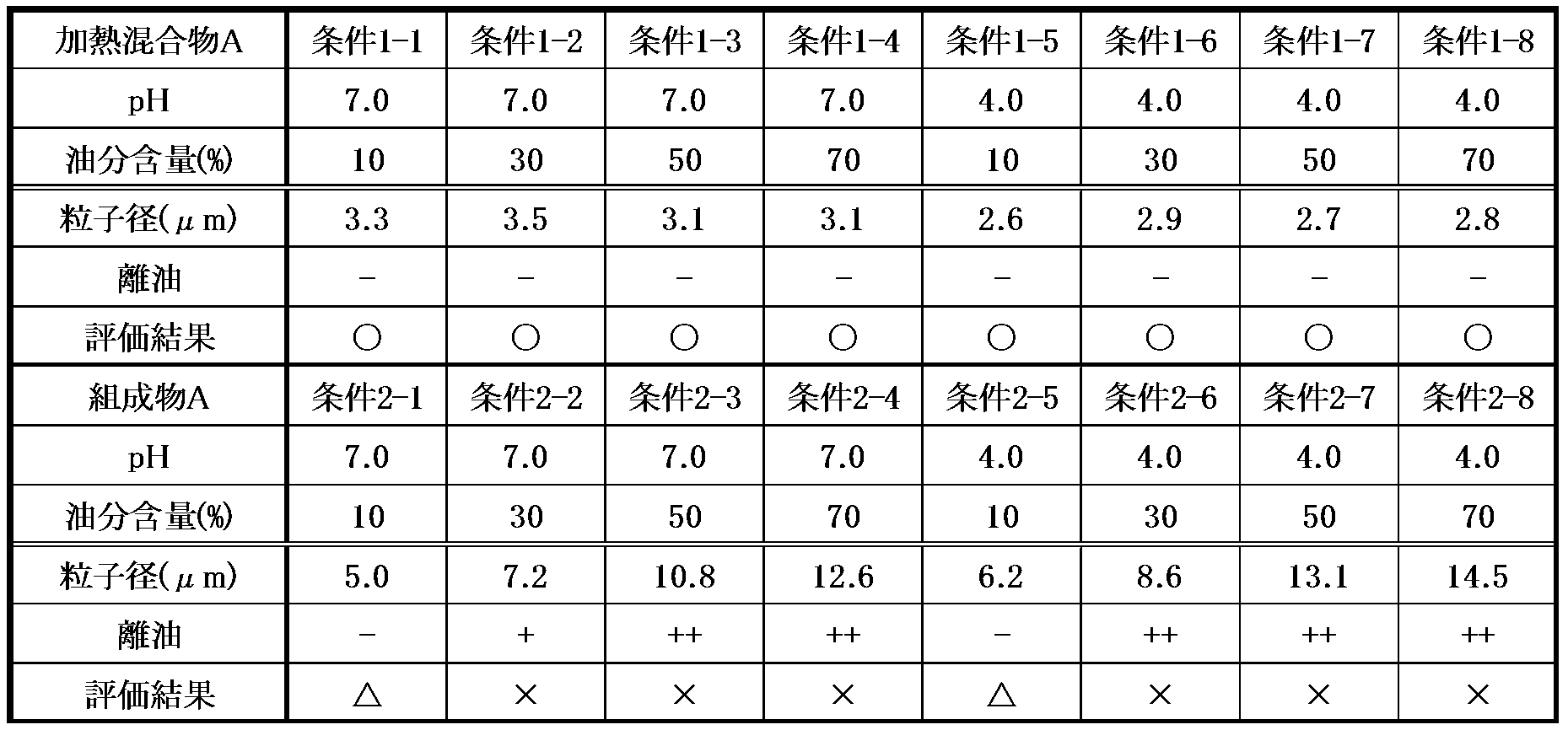
表3の結果が示すように、実施例1で調製した加熱混合物AではpH7.0及び4.0で安定した水中油型乳化物を調製できた。油分含量が50%や70%という高油分含量の場合でも評価が良好だった。一方、比較例1で調製した組成物Aでは極めて低い油分含量でしか、乳化安定性を示さなかった。
(実施例3、比較例3~4) 乳化物の耐熱性評価
表4に示す配合で水相として、水に実施例1で調製した加熱混合物A、穀物酢、食塩、グルタミン酸ナトリウムを溶解させた後、油相として菜種油(不二製油社製)を用い、油分含量70%の水中油型乳化物Aを調製した(実施例3)。また比較対象として、表4に示す配合で、比較例1で調製した組成物Aまたは卵黄を用いて、水中油型乳化物B(比較例3)並びにC(比較例4)をそれぞれ調製した。
表4に示す配合で水相として、水に実施例1で調製した加熱混合物A、穀物酢、食塩、グルタミン酸ナトリウムを溶解させた後、油相として菜種油(不二製油社製)を用い、油分含量70%の水中油型乳化物Aを調製した(実施例3)。また比較対象として、表4に示す配合で、比較例1で調製した組成物Aまたは卵黄を用いて、水中油型乳化物B(比較例3)並びにC(比較例4)をそれぞれ調製した。
(評価)
調製した乳化物A~Cに対して耐熱容器に充填し、120℃, 20分間で加熱処理した。その後、4℃で一晩冷蔵保存し、加熱前後での粒子径及び離油について評価した。結果を表5に示した。
調製した乳化物A~Cに対して耐熱容器に充填し、120℃, 20分間で加熱処理した。その後、4℃で一晩冷蔵保存し、加熱前後での粒子径及び離油について評価した。結果を表5に示した。
(表4)
(表5)

水中油型乳化物Bでは加熱処理後に蛋白の熱凝固に起因する粒子径の増大と著しい離油が確認された。また、水中油型乳化物Cは加熱処理後の離油が多くなった。一方、水中油型乳化物Aは加熱処理後も粒子径の増大は確認されず、蛋白の凝集や油滴の合一は認められなかった。さらに、乳化物としての滑らかさも失っておらず、良好な乳化状態を維持した。
Claims (10)
- 水溶性多糖類とタンパク質との加熱混合物を有効成分とする、高耐熱性付与用乳化安定剤。
但し、該水溶性多糖類とタンパク質との加熱混合物は、構成糖としてウロン酸を含む水溶性多糖類を、タンパク質の存在下において、pH2~5かつ80℃以上180℃以下で加熱されたものである。 - 前記水溶性多糖類とタンパク質との加熱混合物は、構成糖としてウロン酸を含む水溶性多糖類を、タンパク質の存在下において、pH2.5~3.5かつ110℃以上140℃以下で加熱されたものである、請求項1記載の高耐熱性付与用乳化安定剤。
- 前記水溶性多糖類とタンパク質との加熱混合物中の水溶性多糖類とタンパク質との比率が質量基準で10:1~1:100である、請求項1に記載の高耐熱性付与用乳化安定剤。
- 前記水溶性多糖類とタンパク質との加熱混合物中の水溶性多糖類とタンパク質との比率が質量基準で10:1~1:100である、請求項2に記載の高耐熱性付与用乳化安定剤。
- 前記水溶性多糖類がエンドウ種子または大豆由来である、請求項1~4何れか1項に記載の高耐熱性付与用乳化安定剤。
- 請求項1記載の高耐熱性付与用乳化安定剤を含有する水中油型乳化物。
- 水中油型乳化物中、前記水溶性多糖類とタンパク質との加熱混合物を0.01~15重量%、油脂を1~80重量%含む、請求項6記載の水中油型乳化物。
- 前記水溶性多糖類とタンパク質との加熱混合物と油脂の重量比が、1:2~1:32である、請求項6記載の水中油型乳化物。
- 構成糖としてウロン酸を含む水溶性多糖類を、タンパク質の存在下において、pH2~5かつ80℃以上180℃以下で加熱することを特徴とする、高耐熱性付与用乳化安定剤の製造方法。
- 構成糖としてウロン酸を含む水溶性多糖類を、タンパク質の存在下において、pH2.5~3.5かつ110℃以上140℃以下で加熱する、請求項9記載の高耐熱性付与用乳化安定剤の製造方法。
Priority Applications (1)
| Application Number | Priority Date | Filing Date | Title |
|---|---|---|---|
| JP2017551355A JPWO2017170505A1 (ja) | 2016-03-30 | 2017-03-28 | 高耐熱性付与用乳化安定剤及びその製造方法 |
Applications Claiming Priority (2)
| Application Number | Priority Date | Filing Date | Title |
|---|---|---|---|
| JP2016069072 | 2016-03-30 | ||
| JP2016-069072 | 2016-03-30 |
Publications (1)
| Publication Number | Publication Date |
|---|---|
| WO2017170505A1 true WO2017170505A1 (ja) | 2017-10-05 |
Family
ID=59965755
Family Applications (1)
| Application Number | Title | Priority Date | Filing Date |
|---|---|---|---|
| PCT/JP2017/012568 Ceased WO2017170505A1 (ja) | 2016-03-30 | 2017-03-28 | 高耐熱性付与用乳化安定剤及びその製造方法 |
Country Status (2)
| Country | Link |
|---|---|
| JP (1) | JPWO2017170505A1 (ja) |
| WO (1) | WO2017170505A1 (ja) |
Cited By (5)
| Publication number | Priority date | Publication date | Assignee | Title |
|---|---|---|---|---|
| CN108013475A (zh) * | 2017-12-26 | 2018-05-11 | 华中农业大学 | 一种多肽-多糖复合乳液及其制备方法 |
| WO2019087666A1 (ja) * | 2017-11-02 | 2019-05-09 | 三栄源エフ・エフ・アイ株式会社 | 水溶性又は水分散性微粒子の製造方法、乳化機能代替物としての使用又は使用方法、乳化物の製造方法、食品の製造方法及び乳化物を含む食品 |
| CN112956682A (zh) * | 2021-03-30 | 2021-06-15 | 江南大学 | 一种花生来源的乳液稳定剂的制备方法 |
| JP2022063856A (ja) * | 2020-10-12 | 2022-04-22 | ポーラ化成工業株式会社 | 家庭用撹拌機を使用した乳化組成物の製造方法及び乳化組成物の作製キット |
| WO2026023693A1 (ja) * | 2024-07-26 | 2026-01-29 | 三菱ケミカル株式会社 | 乳化組成物、その製造方法、並びに乳化組成物を含む食品、乳代替物、医薬品、化粧品及びパーソナルケア製品 |
Citations (6)
| Publication number | Priority date | Publication date | Assignee | Title |
|---|---|---|---|---|
| JPH10168097A (ja) * | 1996-12-05 | 1998-06-23 | Fuji Oil Co Ltd | 糖質−蛋白質複合体およびその製造法 |
| WO1999062935A1 (en) * | 1998-06-01 | 1999-12-09 | Fuji Oil Co., Ltd. | Reaction products between carboxylic acid and amino acid or amino acid condensate and process for producing the same |
| JP2000139344A (ja) * | 1998-11-16 | 2000-05-23 | Kanegafuchi Chem Ind Co Ltd | 耐酸、耐熱性を有する水中油型エマルション |
| WO2004078334A1 (ja) * | 2003-03-04 | 2004-09-16 | Fuji Oil Company, Limited | 多糖と蛋白質との複合体を有効成分とする乳化剤およびその製造方法ならびに乳化組成物 |
| JP2014025049A (ja) * | 2012-06-21 | 2014-02-06 | Fuji Oil Co Ltd | マメ科種子多糖類コハク酸誘導体エステル及びその製造方法 |
| JP2014506126A (ja) * | 2010-12-23 | 2014-03-13 | ディーエスエム アイピー アセッツ ビー.ブイ. | 植物タンパク質−ダイズ多糖類複合体を含有する脂溶性活性成分組成物 |
-
2017
- 2017-03-28 WO PCT/JP2017/012568 patent/WO2017170505A1/ja not_active Ceased
- 2017-03-28 JP JP2017551355A patent/JPWO2017170505A1/ja active Pending
Patent Citations (6)
| Publication number | Priority date | Publication date | Assignee | Title |
|---|---|---|---|---|
| JPH10168097A (ja) * | 1996-12-05 | 1998-06-23 | Fuji Oil Co Ltd | 糖質−蛋白質複合体およびその製造法 |
| WO1999062935A1 (en) * | 1998-06-01 | 1999-12-09 | Fuji Oil Co., Ltd. | Reaction products between carboxylic acid and amino acid or amino acid condensate and process for producing the same |
| JP2000139344A (ja) * | 1998-11-16 | 2000-05-23 | Kanegafuchi Chem Ind Co Ltd | 耐酸、耐熱性を有する水中油型エマルション |
| WO2004078334A1 (ja) * | 2003-03-04 | 2004-09-16 | Fuji Oil Company, Limited | 多糖と蛋白質との複合体を有効成分とする乳化剤およびその製造方法ならびに乳化組成物 |
| JP2014506126A (ja) * | 2010-12-23 | 2014-03-13 | ディーエスエム アイピー アセッツ ビー.ブイ. | 植物タンパク質−ダイズ多糖類複合体を含有する脂溶性活性成分組成物 |
| JP2014025049A (ja) * | 2012-06-21 | 2014-02-06 | Fuji Oil Co Ltd | マメ科種子多糖類コハク酸誘導体エステル及びその製造方法 |
Cited By (11)
| Publication number | Priority date | Publication date | Assignee | Title |
|---|---|---|---|---|
| WO2019087666A1 (ja) * | 2017-11-02 | 2019-05-09 | 三栄源エフ・エフ・アイ株式会社 | 水溶性又は水分散性微粒子の製造方法、乳化機能代替物としての使用又は使用方法、乳化物の製造方法、食品の製造方法及び乳化物を含む食品 |
| JPWO2019087666A1 (ja) * | 2017-11-02 | 2020-12-24 | 三栄源エフ・エフ・アイ株式会社 | 水溶性又は水分散性微粒子の製造方法、乳化機能代替物としての使用又は使用方法、乳化物の製造方法、食品の製造方法及び乳化物を含む食品 |
| JP7213189B2 (ja) | 2017-11-02 | 2023-01-26 | 三栄源エフ・エフ・アイ株式会社 | 水溶性又は水分散性微粒子の製造方法、乳化機能代替物としての使用又は使用方法、乳化物の製造方法、食品の製造方法及び乳化物を含む食品 |
| US12376613B2 (en) | 2017-11-02 | 2025-08-05 | San-Ei Gen F.F.I., Inc. | Method for producing water-soluble or water-dispersible microparticles, use or method for use as substitute having emulsifying function, method for producing emulsion, method for producing food and food containing emulsion |
| CN108013475A (zh) * | 2017-12-26 | 2018-05-11 | 华中农业大学 | 一种多肽-多糖复合乳液及其制备方法 |
| CN108013475B (zh) * | 2017-12-26 | 2021-06-08 | 华中农业大学 | 一种多肽-多糖复合乳液及其制备方法 |
| JP2022063856A (ja) * | 2020-10-12 | 2022-04-22 | ポーラ化成工業株式会社 | 家庭用撹拌機を使用した乳化組成物の製造方法及び乳化組成物の作製キット |
| JP7837695B2 (ja) | 2020-10-12 | 2026-03-31 | ポーラ化成工業株式会社 | 家庭用撹拌機を使用した乳化組成物の製造方法及び乳化組成物の作製キット |
| CN112956682A (zh) * | 2021-03-30 | 2021-06-15 | 江南大学 | 一种花生来源的乳液稳定剂的制备方法 |
| CN112956682B (zh) * | 2021-03-30 | 2023-04-28 | 江南大学 | 一种花生来源的乳液稳定剂的制备方法 |
| WO2026023693A1 (ja) * | 2024-07-26 | 2026-01-29 | 三菱ケミカル株式会社 | 乳化組成物、その製造方法、並びに乳化組成物を含む食品、乳代替物、医薬品、化粧品及びパーソナルケア製品 |
Also Published As
| Publication number | Publication date |
|---|---|
| JPWO2017170505A1 (ja) | 2019-02-07 |
Similar Documents
| Publication | Publication Date | Title |
|---|---|---|
| KR102898689B1 (ko) | 수중유형 피커링 에멀션 | |
| Cornelia et al. | The utilization of extract durian (Durio zibethinus L.) seed gum as an emulsifier in vegan mayonnaise | |
| WO2017170505A1 (ja) | 高耐熱性付与用乳化安定剤及びその製造方法 | |
| JP2011041512A (ja) | 改質アラビアガムを含有する乳化組成物 | |
| Akcicek et al. | Egg yolk-free vegan mayonnaise preparation from pickering emulsion stabilized by gum nanoparticles with or without loading olive pomace extracts | |
| Miceli-Garcia | Pectin from apple pomace: extraction, characterization, and utilization in encapsulating alpha-tocopherol acetate | |
| JP5879756B2 (ja) | 卵白代替組成物及びこれを使用した卵白代替食品 | |
| WO2014095180A1 (en) | A method of preparing an edible oil-in-water emulsion and emulsion so obtained | |
| Strieder et al. | Impact of thermosonication pretreatment on the production of plant protein-based natural blue colorants | |
| JP4861385B2 (ja) | 酸性水中油型乳化食品およびその用途 | |
| JP5878793B2 (ja) | 処理卵白およびその製造方法 | |
| EP1679007B1 (en) | Oil-in-water type emulsion food | |
| JP2012200190A (ja) | 清澄性の高い水溶性大豆多糖類及びそれを用いた乳化組成物 | |
| JP4994330B2 (ja) | 酸性水中油型乳化食品およびその用途 | |
| WO2020218402A1 (ja) | 種子貯蔵タンパク質を用いた乳化組成物及びその製造方法 | |
| Rojas et al. | Cholesterol removal in liquid egg yolk using high methoxyl pectins | |
| EP4238425A1 (de) | Ei-ersatzprodukt, verfahren zur herstellung eines derartigen ei-ersatzproduktes und verwendung eines solchen ei-ersatzproduktes | |
| Lindriati et al. | Use of crude extract water–soluble polysaccharides of durian (Durio zibethinus Murr) seeds as stabilizer for pineapple juice production | |
| US20250107548A1 (en) | High oil content oil-in-water type emulsified oil-and-fat composition | |
| JP4725333B2 (ja) | 米糠由来の水溶性多糖類からなる食品機能剤 | |
| US20250143356A1 (en) | Hydrophilic powdered oil and fat and method for producing same | |
| JP2009131159A (ja) | 酸性水中油型乳化食品 | |
| JP2019033735A (ja) | 食品粉末の製造方法 | |
| CN118973402A (zh) | 蛋替代物和蛋替代物的制造方法 | |
| JP4527016B2 (ja) | 酸性水中油型乳化食品の製造方法 |
Legal Events
| Date | Code | Title | Description |
|---|---|---|---|
| ENP | Entry into the national phase |
Ref document number: 2017551355 Country of ref document: JP Kind code of ref document: A |
|
| NENP | Non-entry into the national phase |
Ref country code: DE |
|
| 121 | Ep: the epo has been informed by wipo that ep was designated in this application |
Ref document number: 17775042 Country of ref document: EP Kind code of ref document: A1 |
|
| 122 | Ep: pct application non-entry in european phase |
Ref document number: 17775042 Country of ref document: EP Kind code of ref document: A1 |