WO2017169699A1 - 青系花色を有する植物及びその作出方法 - Google Patents
青系花色を有する植物及びその作出方法 Download PDFInfo
- Publication number
- WO2017169699A1 WO2017169699A1 PCT/JP2017/010036 JP2017010036W WO2017169699A1 WO 2017169699 A1 WO2017169699 A1 WO 2017169699A1 JP 2017010036 W JP2017010036 W JP 2017010036W WO 2017169699 A1 WO2017169699 A1 WO 2017169699A1
- Authority
- WO
- WIPO (PCT)
- Prior art keywords
- glycoside
- glucoside
- plant
- blue
- anthocyanin
- Prior art date
- Legal status (The legal status is an assumption and is not a legal conclusion. Google has not performed a legal analysis and makes no representation as to the accuracy of the status listed.)
- Ceased
Links
Images


Classifications
-
- C—CHEMISTRY; METALLURGY
- C12—BIOCHEMISTRY; BEER; SPIRITS; WINE; VINEGAR; MICROBIOLOGY; ENZYMOLOGY; MUTATION OR GENETIC ENGINEERING
- C12N—MICROORGANISMS OR ENZYMES; COMPOSITIONS THEREOF; PROPAGATING, PRESERVING, OR MAINTAINING MICROORGANISMS; MUTATION OR GENETIC ENGINEERING; CULTURE MEDIA
- C12N15/00—Mutation or genetic engineering; DNA or RNA concerning genetic engineering, vectors, e.g. plasmids, or their isolation, preparation or purification; Use of hosts therefor
- C12N15/09—Recombinant DNA-technology
- C12N15/63—Introduction of foreign genetic material using vectors; Vectors; Use of hosts therefor; Regulation of expression
- C12N15/79—Vectors or expression systems specially adapted for eukaryotic hosts
- C12N15/82—Vectors or expression systems specially adapted for eukaryotic hosts for plant cells, e.g. plant artificial chromosomes (PACs)
- C12N15/8241—Phenotypically and genetically modified plants via recombinant DNA technology
- C12N15/8242—Phenotypically and genetically modified plants via recombinant DNA technology with non-agronomic quality (output) traits, e.g. for industrial processing; Value added, non-agronomic traits
- C12N15/8243—Phenotypically and genetically modified plants via recombinant DNA technology with non-agronomic quality (output) traits, e.g. for industrial processing; Value added, non-agronomic traits involving biosynthetic or metabolic pathways, i.e. metabolic engineering, e.g. nicotine, caffeine
- C12N15/825—Phenotypically and genetically modified plants via recombinant DNA technology with non-agronomic quality (output) traits, e.g. for industrial processing; Value added, non-agronomic traits involving biosynthetic or metabolic pathways, i.e. metabolic engineering, e.g. nicotine, caffeine involving pigment biosynthesis
-
- A—HUMAN NECESSITIES
- A01—AGRICULTURE; FORESTRY; ANIMAL HUSBANDRY; HUNTING; TRAPPING; FISHING
- A01H—NEW PLANTS OR NON-TRANSGENIC PROCESSES FOR OBTAINING THEM; PLANT REPRODUCTION BY TISSUE CULTURE TECHNIQUES
- A01H3/00—Processes for modifying phenotypes, e.g. symbiosis with bacteria
-
- A—HUMAN NECESSITIES
- A01—AGRICULTURE; FORESTRY; ANIMAL HUSBANDRY; HUNTING; TRAPPING; FISHING
- A01H—NEW PLANTS OR NON-TRANSGENIC PROCESSES FOR OBTAINING THEM; PLANT REPRODUCTION BY TISSUE CULTURE TECHNIQUES
- A01H5/00—Angiosperms, i.e. flowering plants, characterised by their plant parts; Angiosperms characterised otherwise than by their botanic taxonomy
- A01H5/02—Flowers
-
- A—HUMAN NECESSITIES
- A01—AGRICULTURE; FORESTRY; ANIMAL HUSBANDRY; HUNTING; TRAPPING; FISHING
- A01H—NEW PLANTS OR NON-TRANSGENIC PROCESSES FOR OBTAINING THEM; PLANT REPRODUCTION BY TISSUE CULTURE TECHNIQUES
- A01H6/00—Angiosperms, i.e. flowering plants, characterised by their botanic taxonomy
- A01H6/14—Asteraceae or Compositae, e.g. safflower, sunflower, artichoke or lettuce
- A01H6/1424—Chrysanthemum
-
- A—HUMAN NECESSITIES
- A01—AGRICULTURE; FORESTRY; ANIMAL HUSBANDRY; HUNTING; TRAPPING; FISHING
- A01H—NEW PLANTS OR NON-TRANSGENIC PROCESSES FOR OBTAINING THEM; PLANT REPRODUCTION BY TISSUE CULTURE TECHNIQUES
- A01H6/00—Angiosperms, i.e. flowering plants, characterised by their botanic taxonomy
- A01H6/30—Caryophyllaceae
- A01H6/305—Dianthus carnations
-
- A—HUMAN NECESSITIES
- A01—AGRICULTURE; FORESTRY; ANIMAL HUSBANDRY; HUNTING; TRAPPING; FISHING
- A01H—NEW PLANTS OR NON-TRANSGENIC PROCESSES FOR OBTAINING THEM; PLANT REPRODUCTION BY TISSUE CULTURE TECHNIQUES
- A01H6/00—Angiosperms, i.e. flowering plants, characterised by their botanic taxonomy
- A01H6/74—Rosaceae, e.g. strawberry, apple, almonds, pear, rose, blackberries or raspberries
- A01H6/749—Rosa, i.e. roses
-
- C—CHEMISTRY; METALLURGY
- C12—BIOCHEMISTRY; BEER; SPIRITS; WINE; VINEGAR; MICROBIOLOGY; ENZYMOLOGY; MUTATION OR GENETIC ENGINEERING
- C12N—MICROORGANISMS OR ENZYMES; COMPOSITIONS THEREOF; PROPAGATING, PRESERVING, OR MAINTAINING MICROORGANISMS; MUTATION OR GENETIC ENGINEERING; CULTURE MEDIA
- C12N5/00—Undifferentiated human, animal or plant cells, e.g. cell lines; Tissues; Cultivation or maintenance thereof; Culture media therefor
- C12N5/04—Plant cells or tissues
-
- C—CHEMISTRY; METALLURGY
- C12—BIOCHEMISTRY; BEER; SPIRITS; WINE; VINEGAR; MICROBIOLOGY; ENZYMOLOGY; MUTATION OR GENETIC ENGINEERING
- C12N—MICROORGANISMS OR ENZYMES; COMPOSITIONS THEREOF; PROPAGATING, PRESERVING, OR MAINTAINING MICROORGANISMS; MUTATION OR GENETIC ENGINEERING; CULTURE MEDIA
- C12N5/00—Undifferentiated human, animal or plant cells, e.g. cell lines; Tissues; Cultivation or maintenance thereof; Culture media therefor
- C12N5/10—Cells modified by introduction of foreign genetic material
Definitions
- the present invention relates to a method for producing a plant having a blue flower color, comprising a delphinidin-type anthocyanin and a pigment (flavone glycoside or flavonol glycoside) in which 3 ′ and 5 ′ positions of anthocyanin B ring are glycosylated.
- the genes to be introduced in the flower color modification by genetic recombination aimed at flower blueening are selected based on the knowledge of the blue expression mechanism of blue flowers existing in nature. Since the basic skeleton of anthocyanin accumulated in many blue flowers is delphinidin type, the gene of flavonoid 3 ', 5'-hydroxylase responsible for its biosynthesis is introduced for the production of blue flowers and the color of the flowers is altered. (Patent Document 3). On the other hand, even in the case of delphinidin-type anthocyanins, there are many flowers that express pink, magenta, purple and blue-violet in nature.
- the flower blue expression mechanism includes intramolecular association (intramolecular copigmentation), intermolecular association (intermolecular copigmentation), interaction with metal ions, and metal complex formation. It has been reported that the increase in pH in the vacuole is necessary (Non-patent Document 1).
- Non-patent Document 3 enzyme genes involved in the biosynthesis of C-glycosyl flavone (Non-patent Document 3) and rose flavones as copiments effective for blue expression when coexisting with anthocyanins.
- Patent Document 8 A gene that enables synthesis (Patent Document 8) has also been reported.
- Patent Document 4 In the interaction with metal ions, the participation of iron ions in tulips and the participation of aluminum ions in hydrangea has been reported, and a gene that transports metal ions to the vacuole where anthocyanins accumulate has been reported (Non-patent Document 4).
- 7-glycosylation gene for controlling the glycosylation pattern of flavone which is considered necessary for forming a complex with metal ions, has been obtained from Coganebana or Arabidopsis (Non-patent Document 5), 4 ' , 7-glycosylation gene has been reported from Nemophila (Patent Document 9) and the like.
- glycosyltransferase genes that modify sugars that bind to the hydroxyl group at the 3-position of anthocyanins, which are involved in intramolecular associations, intermolecular associations, or formation of metal complexes, and acyls of organic acids on sugars bound to anthocyanins
- transfer groups Acyltransferase genes that transfer groups have been reported.
- promoters and terminators effective for expressing transgenes in petals have been clarified. Therefore, it is theoretically possible to introduce and function these genes involved in the blue expression mechanism.
- Non-patent Document 1 Non-patent Document 1
- the object of the present invention is based on a blue expression control technique that is completely different from conventional theories and techniques, and has not been obtained in the past (RHS color chart 5th edition: Violet-Blue group / Blue group and / or hue angle) : 230 ° to 290 °).
- the present inventors diligently studied to solve the above problems, and as a result of repeated experiments, the delphinidin type in which the 3 ′ and 5 ′ positions of the anthocyanin B ring are glycosylated without modification with an aromatic organic acid.
- anthocyanins and pigments flavone glycosides or flavonol glycosides
- the present invention is as follows.
- a method for producing a plant having a blue flower color wherein a delphinidin-type anthocyanin and a pigment (flavone glycoside or flavonol glycoside) in which the 3 ′ and 5 ′ positions of the anthocyanin B ring are glycosylated are planted.
- the flavone glycoside is selected from the group consisting of a luteolin glycoside, a tricetin glycoside, an apigenin glycoside, an acetetine glycoside, and a combination thereof.
- the luteolin glycoside is luteolin 7-malonyl glucoside, luteolin 7-glucoside, luteolin 7,3′-diglucoside, luteolin 8-C-glucoside, luteolin 6-C-glucoside, or a derivative thereof.
- the method according to 2. [4] The method according to 2, wherein the tricetin glycoside is tricetin 7-malonyl glucoside or a derivative thereof.
- the apigenin glycoside is apigenin 7-glucoside, apigenin 7-lutinoside, apigenin 8-C-glucoside, apigenin 6-C-glucoside, or a derivative thereof.
- acacetin glycoside is acacetin 7-rutinoside or a derivative thereof.
- flavonol glycoside is selected from the group consisting of kaempferol glycoside, quercetin glycoside and combinations thereof.
- the kaempferol glycoside is kaempferol 3-glucoside or a derivative thereof.
- quercetin glycoside is quercetin 3-glucoside, quercetin 3- (6 ′′ -malonyl) glucoside, quercetin 3-rutinoside, or a derivative thereof.
- Delphinidin-type anthocyanins glycosylated at the 3 'and 5' positions of the anthocyanin B ring are delphinidin 3- (6 "-malonyl) glucoside-3 ', 5'-diglucoside (ternatine C5), delphinidin 3
- the delphinidin-type anthocyanin glycosylated at the 3 ′ and 5 ′ positions of the anthocyanin B ring and the flavone glycoside coexist in a quantity ratio of 1: 1 to 1:10, The method according to any one of 1 to 10.
- the method according to any one of 1 to 11 wherein the pH in the vacuole of the plant is 5.2 to 6.4.
- the method according to any one of 1 to 12 wherein the plant is rose, lily, carnation, dahlia, moth orchid or chrysanthemum.
- a plant having a blue flower color wherein a delphinidin-type anthocyanin in which 3 'and 5' positions of the anthocyanin B ring are glycosylated and a flavone glycoside or a flavonol glycoside coexist in the plant cell.
- the flavone glycoside is selected from the group consisting of a luteolin glycoside, a tricetin glycoside, an apigenin glycoside, an acetetine glycoside, and a combination thereof. Self breeding or other breeding progeny.
- the luteolin glycoside is luteolin 7-malonyl glucoside, luteolin 7-glucoside, luteolin 7,3′-diglucoside, luteolin 8-C-glucoside, luteolin 6-C-glucoside, or a derivative thereof.
- apigenin glycoside is apigenin 7-glucoside, apigenin 7-rutinoside, apigenin 8-C-glucoside, apigenin 6-C-glucoside, or a derivative thereof. Breeding or other breeding progeny.
- acacetin glycoside is acacetin 7-rutinoside or a derivative thereof, or a progeny or other breeding progeny thereof.
- the flavonol glycoside is selected from the group consisting of kaempferol glycoside, quercetin glycoside, and combinations thereof.
- Delphinidin-type anthocyanins glycosylated at the 3 ′ and 5 ′ positions of the anthocyanin B ring are delphinidin 3- (6 ′′ ′-malonyl) glucoside-3 ′, 5′-diglucoside (ternatine C5), delphinidin 3 , 3 ′, 5′-triglucoside (preternatin C5), and a plant according to any one of 14 to 22 selected from the group consisting of combinations thereof, or a self-propagating or other progeny thereof.
- chrysanthemum not only chrysanthemum but also other main flowers such as roses, lilies, carnations, dahlia, moth orchids, etc.
- blue flower color RHS color chart 5th edition: Violet-Blue group / Blue group and (Or hue angle: 230 ° to 290 °)
- the “blue flowers” can be converted by simple methods by simply glycosylating the 3 ′ and 5 ′ positions of the B ring of anthocyanins. It becomes possible to create.
- Anthocyanins contained in petals of host chrysanthemum and genetically modified chrysanthemum of blue flower color a) cyanidin-type anthocyanins (A1-A4); b) delphinidin-type anthocyanins (A5-A10).
- A) The result of developing a blue chrysanthemum petal extract by the cross-TLC method (under fluorescent light) is shown.
- Band A contains anthocyanins (Ternatin C5 and Preternatin C5) in which the B ring is glycosylated.
- a portion of the band A that develops blue is indicated by a gray arrow.
- a band C1 showing yellow fluorescence under UV light intersects with the gray arrow portion.
- a dark band C2 (dashed line) crosses under UV light at the part of band A that is colored purple.
- C1 and C2 contain pigment substances that make A blue and purple, respectively.
- c) and d) shows the structures of identified C1 and C2. Arrow indicates HMBC. a) Absorption spectrum of blue visible light.
- Absorption spectra of a mixture of B-ring glycosylated anthocyanins (TC5) and various flavone glycosides (Lt7MG, Lt7G, 3Lt3′7G, Tr7MG, Ap7G, Ap7RG, Aca7RG) are shown.
- Absorption spectra of a mixture of anthocyanins (Pg3MG, Cy3MG, Dp3MG3′G, TC5) and flavone glycosides (Lt7MG) having various B ring modification patterns are shown (left figure).
- the present invention relates to a method for producing a plant having a blue flower color, comprising a delphinidin-type anthocyanin and a pigment (flavone glycoside or flavonol glycoside) in which 3 ′ and 5 ′ positions of anthocyanin B ring are glycosylated.
- the present invention relates to a method characterized by coexisting in a plant cell.
- Anthocyanins are a group of pigments widely present in plants and are known to exhibit red, purple and blue flower colors. Depending on the number of hydroxyl groups in the B ring at the anthocyanidin site, which is an aglycon, it is classified into three systems: pelargodidin, cyanidin and delphinidin.
- the chromophore is an aglycon moiety, pelargonidin is orange-red, cyanidin is red, and delphinidin is purple-red.
- Patent Document 2 a blue chrysanthemum produced by expressing a butterfly A3'5'GT gene together with a campanula F3'5'H gene in chrysanthemum petals, and delphinidin 3- ( 6'-malonyl) glucoside-3 ', 5'-diglucoside (Ternatine C5, TC5), delphinidin 3,3', 5'-triglucoside (Preternatin C5 pTC5), delphinidin 3- (3 ′′, 6 ′′ -dimalonyl) glucoside-3 ′, 5′-diglucoside, delphinidin 3- (6 ′′ -malonyl) glucoside-3′-glucoside (Dp3MG3′G), and It was found to contain cyanidin 3- (6 ′′ -malonyl) glucoside-3′-glucoside (Cy3MG3′G).
- the blue chrysanthemum major anthocyanin, ternatin C5 has a maximum visible absorption wavelength of 511 nm in HPLC analysis under acidic conditions, and cyanidin 3- (6 ′ ′-malonyl), the original red and pink major anthocyanin. )
- the absorption maximum wavelength of glucoside (Cy3MG) was shifted to a shorter wavelength side than 518 nm. This means that although Ternatine C5 is redr than the original cyanidin-type anthocyanin pigment, it produces a blue color in the petals of chrysanthemum.
- red anthocyanins, such as ternatine C5 which are glycosylated at the 3'-position and 5'-position of the anthocyanin B ring in blue color in flower petals.
- Anthocyanin dyes may coexist with substances such as flavones, flavonols, organic acid esters, and tannins, and may interact with them to develop a bluish color. This phenomenon is called copigmentation (copigment action, intermolecular copigmentation, intermolecular association), and the substance causing the phenomenon is called copigment (auxiliary dye).
- copigmentation copigment action, intermolecular copigmentation, intermolecular association
- copigment (auxiliary dye) copigment (auxiliary dye).
- the copying has a dark color effect and an effect of improving color stability.
- delphinidin-type anthocyanins in which the 3 ′ and 5 ′ positions of the anthocyanin B ring are glycosylated are particularly limited as long as they can coexist with flavone glycosides or flavonol glycosides and exhibit a blue color.
- ternatine C5 preternatine C5 and the like can be mentioned.
- Delphinidin 3- (3 ′′, 6 ′ ′-dimalonyl) glucoside-3 ′, 5′-diglucoside, which accumulates in blue transgenic chrysanthemum petals, is also present in the presence of flavone glycosides or flavonol glycosides. It is considered to be blue.
- Flavon is a kind of organic compound and is a cyclic ketone of a flavan derivative and exists mainly as a glycoside in plants.
- a flavone refers to a compound of the chemical formula C 15 H 10 O 2 and a molecular weight of 222.24, 2,3-didehydroflavan-4-one in a narrow sense, but flavones (flavones) in a broad sense are one of the flavonoid categories.
- flavonoids those having a flavone structure as the basic skeleton and having no hydroxyl group at the 3-position are classified as “flavones”.
- flavone glycoside means a flavone in a broad sense, that is, a glycoside of a derivative belonging to flavones.
- flavone glycosides include, but are not limited to, luteolin glycosides, tricetin glycosides, apigenin glycosides, and acacetin glycosides.
- Luteolin glycosides, tricetin glycosides, apigenin glycosides, and acacetin glycosides also include glycosides of luteolin, tricetin, apigenin, and acacetin derivatives.
- luteolin glycosides examples include luteolin 7- (6 ′ ′-malonyl) glucoside (Lt7MG), luteolin 7-glucoside (sinaloside), luteolin 7,3′-diglucoside, luteolin 8-C-glucoside (orientin), luteolin Examples include 6-C-glucoside (isoorientin) or derivatives thereof.
- tricetin glycosides examples include tricetin 7- (6′-malonyl) glucoside (Tr7MG) or derivatives thereof, and apigenin coordination.
- saccharide examples include apigenin 7-glucoside (cosmosin), apigenin 7-rutinoside (isoleuphorin), apigenin 8-C-glucoside (vitexin), apigenin 6-C-glucoside (isovitexin), or derivatives thereof.
- Acacetin glycosides include, for example, acacetin 7-rutinoside (linalin) or derivatives thereof.
- Flavonols are one of the flavonoid categories and have a 3-hydroxyflavone (3-hydroxy-2-phenylchromen-4-one) skeleton. In plants, it exists mainly as glycosides.
- flavonol glycoside means a glycoside of a derivative belonging to flavonols. Flavonol glycosides include, but are not limited to, kaempferol glycosides, quercetin glycosides, and myricetin glycosides. Kaempferol glycosides, quercetin glycosides and myricetin glycosides also include glycosides of kaempferol, quercetin and myricetin derivatives. Examples of kaempferol glycosides include kaempferol 3-glucoside, kaempferol 3-rutinoside or derivatives thereof, and examples of quercetin glycosides include quercetin 3-glucoside and quercetin 3- (6 ′ ′). -Malonyl) glucoside, quercetin 3-rutinoside or derivatives thereof.
- Flavones are synthesized in petals of many plants such as chrysanthemums, carnations, gerberas, etc., and are accumulated as glycosides. However, flavones such as roses, lilies and eustoma are not detected from petals or only trace amounts are accumulated. Plants also exist. In order to synthesize flavones with the petals of such plants and accumulate the glycosides, flavone synthase genes can be used.
- FNSI flavone synthase I
- FNSII flavone synthase II
- NADPH-dependent cytochrome P450 a gene encoding flavone synthase II
- Flavones can be synthesized even in plants where flavone glycosides such as roses are not detected from petals, and the glycosides can be accumulated in petals (Patent Document 8).
- flavonols are synthesized in the petals of many plants such as roses, lilies and eustoma, and are accumulated as glycosides.
- flavonols such as chrysanthemum, carnation and gerbera are not detected from petals, or only a very small amount is accumulated. Some plants do not.
- the flavonol synthase gene FLS can be used to synthesize flavonols with such plant petals and accumulate the glycosides.
- FLS flavonol synthase gene
- flavonol glycosides such as chrysanthemum can be synthesized even in plants where the flavonol glycosides are not detected from petals, and the glycosides can be accumulated in petals.
- the plant used in the present invention is not particularly limited, and examples thereof include roses, lilies, carnations, dahlia, moth orchids, etc., but eustoma, cyclamen, starches, cymbidium, for which a method for introducing a gene has been reported.
- Various plants such as gerbera, dendrobium, tulip, pelargonium, petunia and cattleya can be used.
- anthocyanin 3 ', 5'-position glycosyltransferase gene from a plant organ or tissue containing anthocyanins glycosylated at the 3', 5'-position.
- CtA3′5′GT a campanula-derived flavonoid 3 ′, 5′-hydroxylase gene (CamF3′5′H) (Patent Document 13) may be co-expressed (Patent Document 2).
- Delphinidin-type anthocyanins and flavone glycosides that are glycosylated at the 3 'and 5' positions of the anthocyanin B ring are typically 1: 1 to 1:10, preferably 1: 5 to 1:10, optimally Can coexist in a quantity ratio of about 1:10 and can exhibit a blue color.
- the color development of anthocyanin dyes and intermolecular pigmentation of anthocyanin dyes and pigments depends on pH.
- the pH in intracellular organelles such as vacuoles where the pigment responsible for color development accumulates can be measured directly with the electrode, or a rough value can be measured by measuring the pH of the juice of tissues such as petals. I can do it. Even if the pH of the vacuole where anthocyanin and copiment accumulate and coexist in a flower of a plant that wants to express the blue color of tissues such as petals, even if the pH of the vacuole is not suitable for blue expression by copigmentation, the gene that regulates the pH works Can optimize the vacuolar pH.
- the pH of the vacuole is acidified by the vacuolar proton pumps of vacuolar H + -ATPase (V-ATPase) and vacuolar H + -pyrophosphatases (V-PPase) present in the vacuolar membrane. It is possible to regulate pH by promoting or suppressing the function of these genes (Patent Document 14). Also, in sky blue morning glory, which increases from pH 6.6 to 7.7 during flowering and the flower color changes from purple to blue, it raises the pH by discharging proton ions along with the transport of potassium ions into the vacuole.
- V-ATPase vacuolar H + -ATPase
- V-PPase vacuolar H + -pyrophosphatases
- Non-patent Document 1 A gene encoding a sodium ion-hydrogen ion counter transporter (NHX) has been reported (Non-patent Document 1), and it is possible to adjust the pH to the vacuole, which is more likely to develop blue.
- the pH in the vacuole that exhibits a blue color is typically about 5.2 to 6.4, preferably about 5.4 to 6.2, and most preferably about 5.6 to 6.0. However, if it can exhibit a blue color, it is limited to these ranges. Not.
- the present invention also relates to a plant having a blue flower color obtained by the above-described method, a cut flower of its own breed or another breed, or a processed product (particularly a cut flower processed product) created from the cut flower.
- the cut flower processed product includes, but is not limited to, a pressed flower using the cut flower, a preserved flower, a dried flower, a resin sealed product, and the like.
- Example 1 Identification of a delphinidin glycoside in which sugars are bonded to hydroxyl groups at 3 'and 5' positions of B ring accumulated in petals of blue chrysanthemum] Campanula-derived F3'5'H (CamF3'5'H; Patent Document 13; GenBank accession number: FW570877) and CtA3'5'GT encoding an anthocyanin 3 ', 5'-glycosylase derived from sturgeon (Patent Document) 2; major anthocyanins of 'Ohira' transformants showing blue color obtained by transforming with Agrobacterium introduced with binary vector pB423 co-expressing GenBank accession number: AB115560) were analyzed by LC-MS .
- the flower color of the chrysanthemum-like petals used was measured by comparing the colors under fluorescent light with the Royal Horticultural Society Color Chart (RHSCC) 5th edition, and there was a blue flower color equivalent to Violet-Blue 97 and Blue 100.
- RHSCC Royal Horticultural Society Color Chart
- L * value (lightness), a * value (red / green), b * value (yellow / blue) in the CIEL * a * b * color system
- the average value of the values measured three times or more was calculated, and the hue angle was calculated based on the calculated value. As a result, the hue angle value representing 230-290 ° blue was shown.
- the mobile phase flow rate is 0.1 ml / min and gradient elution is performed at 0-5% B (0-5 min), 5-35% B (5-20 min), and 35% B (20-25 min). It was. 200-800 nm was detected by PDA, and chromatograms of flavonoids and acylquinic acids were obtained at 360 nm and anthocyanin chromatograms at 530 nm.
- the analysis conditions of the mass spectrometer were as follows: ESI positive ion mode, capillary voltage, 3.5 kV; cone voltage, 45 V; source temperature 150 ° C; solvent removal temperature, 350 ° C; solvent removal gas flow rate , 500 L / h; cone gas flow rate, 50 L / h; collision energy, 6 V, 20 V; measured mass range, 180-1080 m / z.
- the main anthocyanin dyes were A7 and A8.
- eight anthocyanin components (A1-6, A9-10, Fig. 1) including A3 were detected as trace pigments.
- Example 2 Relationship between the ratio of delphinidin glycosides with sugars bonded to the hydroxyl groups at the 3 'and 5' positions of the B ring contained in the petals and the blue color development.
- Example 3 Difference in absorption spectra of delphinidin glycosides with sugars bound to hydroxyl groups at 3 'and 5' positions of ring B and chrysanthemum petals
- the absorption spectrum of chrysanthemum petals was measured using a spectrophotometer UV-2450 (Shimadzu Corporation) equipped with an integrating sphere accessory ISR-2200.
- the absorption maximum ( ⁇ vismax) in the visible light region of the pink petal of the host variety 'Seirabella' was 556 nm, and the ⁇ vismax of the purple recombinant was 561 nm in the longer wavelength region.
- the blue recombinant had a ⁇ vismax of 573 nm in the longer wavelength region and a characteristic shoulder region around 615 nm.
- ⁇ vismax of the main pigments A1 and A2 of the pink flower host was 518 nm
- ⁇ vismax of the main pigment A5 of the purple recombinant was 527 nm
- ⁇ vismax of A8 which is the main anthocyanin of the blue recombinant, was 511 nm in a shorter wavelength region than A1 and A2.
- Example 4 Search for a pigment substance that develops a blue color by coexisting with a delphinidin glycoside in which sugars are bonded to hydroxyl groups at the 3 'and 5' positions of the B ring]
- the cross TLC method (Non-patent Document 8) was used to search for a pigment substance that interacts with the major anthocyanins in the transformant of chrysanthemum 'Ohira' with blue petals. About 200 mg of blue petals of genetically modified chrysanthemum were frozen and crushed, and 500 ⁇ l of 10% acetic acid aqueous solution was added to extract the components contained in the petals.
- Non-patent Document 8 Cellulose TLC glass plates (100 ⁇ 100 mm, Merck) were used, and the extract was spread in an oblique manner according to a previous report (Non-patent Document 8).
- the developed plate was air-dried and observed under fluorescent light (light box NEW5000 inverter, Fujicolor) and UV light (254 / 360nm, CSN-15AC, Cosmo Bio) and photographed with a digital camera.
- the Rf values of the anthocyanins were ternatin C5 (A8): 0.15; preternatin C5 (A7): 0.11; Cy3MG3′G (A3): 0.30.
- the C1 and C2 peaks with molecular weights of 535 and 551 were purified from the blue chrysanthemum petal extract.
- Anthocyanins A7, A8 and A3 were also purified and isolated.
- Example 5 Purification and structure determination of anthocyanin glycosides in which sugars are bonded to the hydroxyl groups at the 3'-position and the 3'-position and the 5'-position of the copigment and B ring]
- Blue chrysanthemum petals were collected and stored at -80 ° C. About 2.5 kg of frozen petals were pulverized in liquid nitrogen and immersed in about 5.9 L of 10% aqueous formic acid to extract the components. The extracted petals were extracted again with 6 L of 10% aqueous formic acid. The extract was filtered using a mesh filter (100 mesh) and then centrifuged at 3,000 rpm for 10 minutes to obtain a supernatant.
- the supernatant was injected into a column packed with 3 L of Diaion HP-20 resin (Mitsubishi Kasei).
- the column was washed with 9 L of 0.1% formic acid aqueous solution, and then the pigment and anthocyanin adsorbed on the resin were re-eluted with methanol containing 0.1% formic acid. After concentrating the eluate, 14.2 g of the residue obtained by lyophilization was dissolved in 20% acetonitrile aqueous solution containing 0.1% formic acid.
- the dissolved sample was detected on a YMC-Pack ODS A (S-15 ⁇ m, 50mm id x 250mm) column at a flow rate of 30 ml / min using 0.1% formic acid-containing 20% acetonitrile aqueous solution as a solvent, and further fractionation was performed at 360 nm. went. Contains fraction 1, which contains anthocyanin A7 (preternatin C5), A8 (ternatine C5), and A3 (Cy3MG3'G), fraction 2, which contains pigment 2 (C2; Tr7MG), and pigment 1 (C1; Lt7MG) Fractions 3 were concentrated and freeze-dried, and then redissolved in 10% acetonitrile aqueous solution containing 0.1% formic acid.
- Fraction 1 was fractionated by preparative HPLC (flow rate 30 ml / min, detection wavelength 530 nm) using 0.1% formic acid-containing 35% methanol as a solvent for fractions containing A3, A7 and A8, respectively.
- A3, A7 and A8 were isolated by further fractionation by preparative HPLC (flow rate 28 ml / min, detection wavelength 530 nm) using 20% methanol containing 0.5% formic acid as a solvent.
- C1 and C2 were isolated by fractionation by preparative HPLC (flow rate: 30 ml / min, detection wavelength: 280 nm) using 35% methanol containing 0.1% formic acid as a solvent.
- the isolated pigments and anthocyanins are concentrated and lyophilized to give a yellow powder (C1, Lt7MG: 201.5 mg; C2, Tr7MG: 52 mg) and a deep red color (A8, Ternatine C5: 52 mg; A7, Preternatin C5: 7 mg; A3, Cy3MG3′G: 9.8 mg).
- the pigments C1 and C2 were dissolved in DMSO-d6.
- Anthocyanins A8 and A3 were dissolved in 10% (v / v) trifluoroacetic acid (TFA) -deuterium methanol mixture and TFA-dimethylsulfoxide-d6 (DMSO-d6) mixture, respectively.
- TFA trifluoroacetic acid
- 1 H- NMR co pigment, 13 C-NMR, HMBC, HMQC, COSY measuring the spectrum
- 1 H-NMR and NOESY spectra anthocyanins nuclear magnetic resonance apparatus JNM-ECZ600R / S1 (JEOL Ltd. , Japan) in did.
- the resonant frequencies of 1 H and 13 C were 600.17 MHz and 150.91 MHz, respectively.
- High-resolution mass spectrometry (HR-MS) of the purified pigment and anthocyanin was performed by linking ESI-TOF-MS (JMS-T100LP, Jeol) to Agilent 1200 LC.
- the sample was dissolved in methanol at a concentration of 0.01 mg / ml and 10-20 ⁇ l was injected.
- Analysis conditions are as follows: solvent, methanol; needle voltage, 2.2 kV; orifice 1 voltage, 85V; orifice 2 voltage, 10V; ring lens voltage, 25 V; peak tube voltage, 2kV; Vdry gas flow rate, 1 L / min Nebulizer gas flow, 0.5 L / min; desolvation temperature, 250 ° C; orifice 1 temperature, 80 ° C.
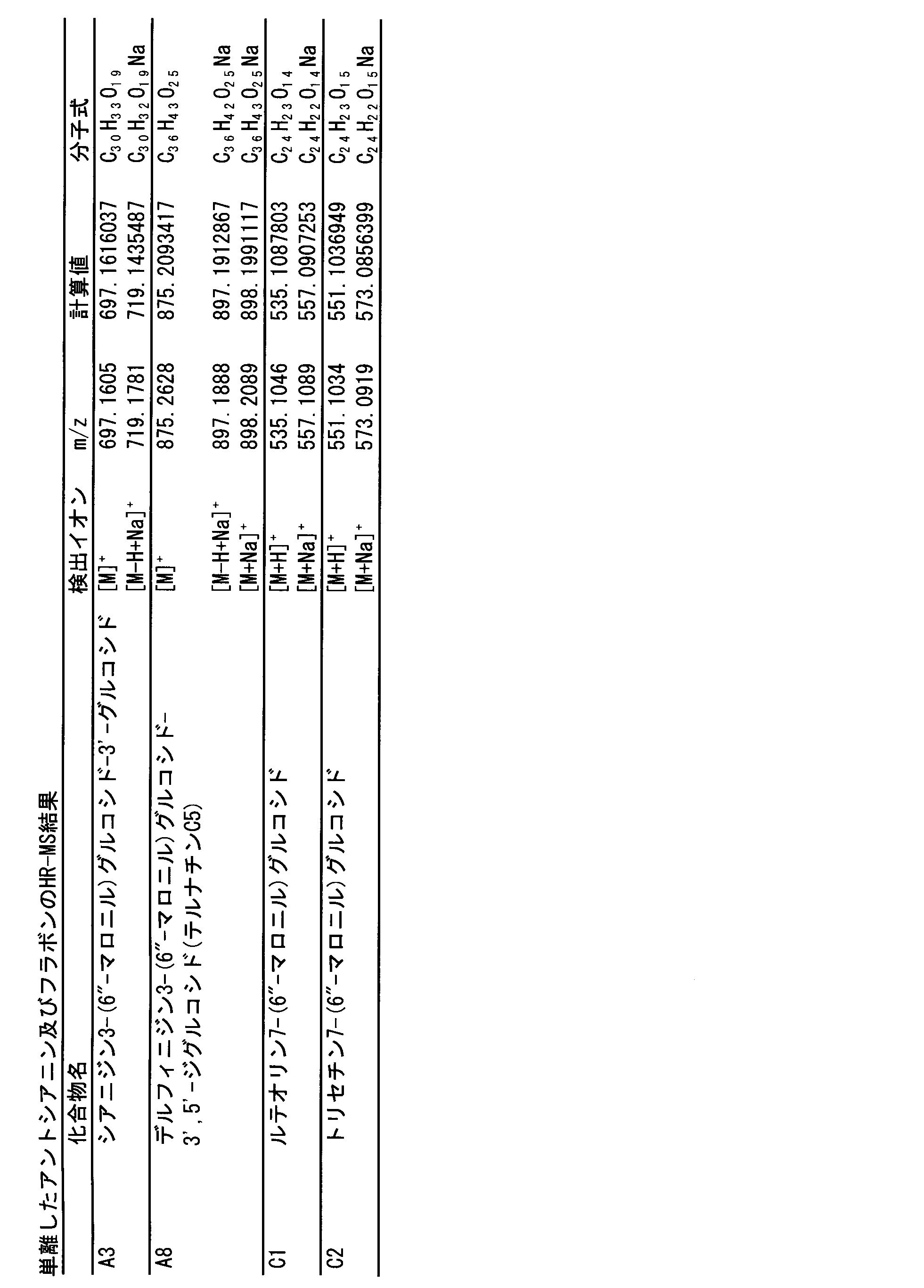
- the high-resolution mass spectrum of pigment 1 shows m / z values of 535.10457 (M + H) + , 557.10887 (M + Na) + and the molecular formula of Lt7MG C 24 H 23 O 14 (535.10878), C It was consistent with the mass calculated from 24 H 22 O 14 Na (557.09725).
- the high-resolution mass spectrum of pigment 2 (C2) showed m / z values of 551.10341 (M + H) + and 573.09189 (M + Na) + , and the molecular formula of Tr7MG (C 24 H 23 O 15 (551.10369), It was consistent with the mass calculated from C 24 H 22 O 15 Na (573.08564)).
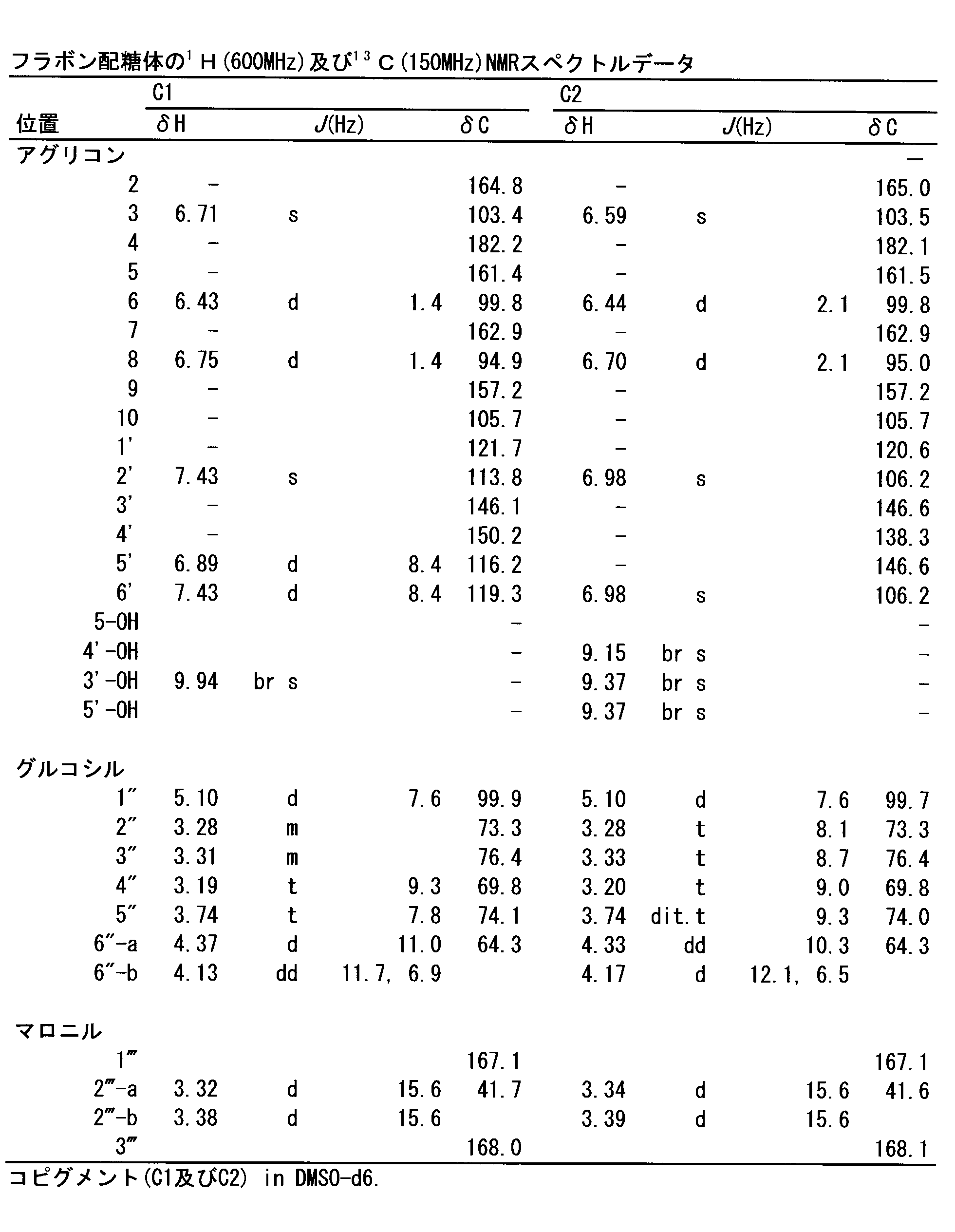
- C1 was determined to be Lt7MG and the structure of C2 was determined to be Tr7MG by analysis of the HR-MS spectrum, 1 H-NMR and 13 C-NMR one-dimensional NMR spectra, and the two-dimensional NMR spectra of HMBC and HMQC (Fig. 2c and d, Tables 2 and 3).
- Example 6 Reconstruction of absorption spectrum of blue petal by mixing delphinidin glycoside in which sugars are bonded to hydroxyl groups at 3 'and 5' positions of ring B and a pigment in a test tube.
- anthocyanins and flavones contained in blue chrysanthemum petals were analyzed and quantified by HPLC. From the HPLC peak area values of chromatograms obtained at a detection wavelength of 530 nm for anthocyanins and a detection wavelength of 360 nm for flavones, the amount of compounds per petal (nmol / nm) using a calibration curve for delphinidin 3-glucoside (anthocyanin) and luteolin (flavone) mg).
- the total molar ratio of the pigments C1 (Lt7MG) and C2 (Tr7MG) of the anthocyanins A7-A9 in which both the 3'- and 5'-positions of the blue petals were glucosylated was 1.0: 1.7: 0.4 there were.
- the molar ratio of the total amount of anthocyanins and the total amount of flavones was 1: 5 on average. Based on these ratios, a mixed solution was prepared so that the ratio of flavone to anthocyanin was 1: 1 to 1:10.
- the anthocyanins ternatine C5 (A8), Cy3MG3′G (A3), delphinidin 3- (6 ′′ -malonyl) glucoside (Dp3MG) (A5), and Cy3MG (A1) were dissolved in distilled water.
- Dp3MG was purified from the mauve petal petals.
- Cy3MG was synthesized and purified using a crude enzyme obtained by extracting cyanidin 3-glucoside (Funakoshi) and malonyl-CoA (Sigma-Aldrich) from butterfly petals.
- magnesium ions and iron ions were dissolved in distilled water at a concentration of 10 mM.
- anthocyanin was added, and the absorption spectrum of the reaction solution having a final amount of 100 ⁇ l was measured.
- Example 7 Effects of various pH conditions on color development in the co-pigmentation of delphinidin glycosides and flavone glycosides in which sugars are bonded to hydroxyl groups at the 3 'and 5' positions of the B ring]
- the values ranged from about 5.6 to 6.1.
- B-ring glycosylated anthocyanins and flavone glycosides were prepared using a McIlvaine buffer solution in which a 0.2M aqueous solution of disodium hydrogen phosphate and a 0.1M aqueous solution of citric acid were mixed to a pH of 5.6, 5.8, or 6.0.
- A8 Tenatine C5
- C1 Lt7MG
- McKilbain buffer (88 ⁇ l) adjusted to each pH was placed in a 1.5 ml microtube, and 10 mM C1 DMSO solution (10 ⁇ l) was added to dissolve uniformly.
- 100 ⁇ l of the reaction solution, which was uniformly dissolved by adding 10 mM A8 aqueous solution (2 ⁇ l) was injected into the ultra-micro black cell (optical path length 10 mm, Shimadzu Corporation), and UV-2450 spectrophotometer (Shimadzu) was used. The absorption spectrum was measured. As a result, the absorption maximum wavelength shifted to a longer wavelength side (about 600 nm) at pH 5.8 than at pH 5.6, and the absorbance near 600 nm increased at pH 6.0 (FIG. 4).
- the absorption maximum wavelength at pH 5.6 is around 577 nm
- the shoulder is 590-596 nm
- the absorption spectrum pattern is the same as that of a blue chrysanthemum petal with absorption in the shoulder region of 600-620 nm. It became a bluish blue.
- the absorption maximum wavelength was 593 to 596 nm, and blue was developed.
- the absorption maximum wavelength shifted further to the longer wavelength side (597-598 nm), but the absorbance at 400-500 nm increased and greenish blue to blue-green color were developed.
- Example 8 Effect of difference in structure of flavone glycoside causing copigmentation with ring B glycosylated delphinidin type anthocyanin on color development
- the cross-TLC method revealed that it was a pigment that developed blue color by coexisting with 3 ', 5'-glycated delphinidin-type anthocyanins in petals of blue chrysanthemum, and flavone conformation different from Lt7MG and Tr7MG.
- Ternatine C5 dissolved in distilled water with anthocyanin was used.
- the absorption maximum wavelength when only ternatine C5 was dissolved was 559 nm, but all of the flavone glycosides tested for pigmentation with ternatine C5 had an absorption maximum wavelength of 572-574 nm and a shoulder of 595 nm. A spectral pattern of -597 nm was exhibited, and a blue color was developed (FIG. 5).
- blue can be expressed by accumulating 3 ', 5'-glycated delphinidin-type anthocyanins. It is shown that.
- Example 9 Effect of difference in modification pattern of B ring of anthocyanin on color development by copigmentation
- anthocyanins that express blue color by copigmentation in the presence of Lt7MG were investigated.
- anthocyanins pelargonidin 3- (6 ′′ -malonyl) glucoside (Pg3MG), Cy3MG, Dp3MG3′G, and ternatine C5 (TC5) were used.
- Pg3MG pelargonidin 3- (6 ′′ -malonyl) glucoside
- Cy3MG Cy3MG
- Dp3MG3′G Dp3MG3′G
- ternatine C5 ternatine C5
- Example 10 Effect of presence or absence of malonyl group of 3-position glucose of 3 ', 5'-glycated delphinidin-type anthocyanin on color development by copigmentation
- TC5 Trigger C5
- pTC5 preternatin C5
- Lt7MG and Tr7MG were used as flavone glycosides of the pigment.
- Preternatin C5 was used after purification from chrysanthemum blue petals and confirmation of the structure by LC-MS / MS. Anthocyanins and flavones were mixed in a quantity ratio of 1: 5. After adding 10 ⁇ L of 10 mM flavone DMSO solution to 88 ⁇ L of pH 5.6 acetate buffer and mixing, 2 ⁇ L of 10 mM anthocyanin aqueous solution was added and mixed. The reaction solution was put into a super micro black cell (Shimadzu Corporation), and an absorption spectrum at 400 to 700 nm was measured with UV2450 (Shimadzu Corporation). As a result, as shown in the right of Fig.
- the spectral pattern around the absorption maximum wavelength of 572 nm and the shoulder of 595 nm is the same as when there is no malonyl group (Lt7MG + pTC5) in 3-position glucose of anthocyanin (Lt7MG + TC5).
- a blue color was developed.
- the pH was changed from 5.6 to 5.8, the absorption maximum wavelength shifted from 572 nm to 594 nm, and blue was developed.
- TC5 having a malonyl group fading was remarkably faster in a mixed solution of pTC5, and it was considered that modification with malonyl group at anthocyanin 3-position glucose was necessary for more stable blue color development.
- Example 11 Color development by co-pigmentation of 3 ', 5'-glycated delphinidin-type anthocyanin and C-glucosylated flavone]
- the effect of sugar binding in the flavone glycosides of pigments on blue expression was investigated using C-glycosylated flavones (Funakoshi).
- Example 12 Color development by co-pigmentation of 3 ', 5'-glycated delphinidin-type anthocyanins and flavonol glycosides. Similar to flavone glycosides, flavonol glycosides, which have been reported to accumulate together with anthocyanins in petals, were used for pigmentation, and the effect of copigmentation on blue color development was investigated.
- anthocyanin is ternatine C5, and copiment is flavonol glycoside kaempferol 3-glucoside (Km3G), quercetin 3-glucoside (Qu3G), quercetin 3-malonyl glucoside (Qu3MG) And quercetin 3-rutinoside (rutin, Qu3RG) and flavone Lt7MG.
- Anthocyanins and flavonols or flavones were mixed in a quantity ratio of 1: 5.
- the flavone Lt7MG After adding 10 ⁇ L of 10 mM flavonol DMSO solution or flavone DMSO solution to 88 ⁇ L of pH 5.6 acetate buffer, 2 ⁇ L of 10 mM anthocyanin aqueous solution was added and mixed. The reaction solution was put into a super micro black cell (Shimadzu Corporation), and an absorption spectrum at 400 to 700 nm was measured with UV2450 (Shimadzu Corporation). As a result, as shown in FIG. 8, the flavone Lt7MG showed an absorption spectrum pattern having an absorption maximum wavelength of 572 nm and a shoulder near ⁇ 595 nm, and developed blue.
Landscapes
- Life Sciences & Earth Sciences (AREA)
- Health & Medical Sciences (AREA)
- Genetics & Genomics (AREA)
- Engineering & Computer Science (AREA)
- Botany (AREA)
- Biotechnology (AREA)
- Developmental Biology & Embryology (AREA)
- Environmental Sciences (AREA)
- Wood Science & Technology (AREA)
- Organic Chemistry (AREA)
- Bioinformatics & Cheminformatics (AREA)
- Biomedical Technology (AREA)
- Zoology (AREA)
- Chemical & Material Sciences (AREA)
- Physiology (AREA)
- Natural Medicines & Medicinal Plants (AREA)
- General Engineering & Computer Science (AREA)
- General Health & Medical Sciences (AREA)
- Biochemistry (AREA)
- Microbiology (AREA)
- Cell Biology (AREA)
- Molecular Biology (AREA)
- Nutrition Science (AREA)
- Physics & Mathematics (AREA)
- Biophysics (AREA)
- Plant Pathology (AREA)
- Breeding Of Plants And Reproduction By Means Of Culturing (AREA)
- Micro-Organisms Or Cultivation Processes Thereof (AREA)
- Cultivation Of Plants (AREA)
- Agricultural Chemicals And Associated Chemicals (AREA)
Abstract
Description
[1] 青系花色を有する植物の作出方法であって、アントシアニンB環の3′及び5′位が配糖化されたデルフィニジン型アントシアニンとコピグメント(フラボン配糖体もしくはフラボノール配糖体)を植物の細胞内で共存させることを特徴とする方法。
[2] 前記フラボン配糖体が、ルテオリン配糖体、トリセチン配糖体、アピゲニン配糖体、アカセチン配糖体及びそれらの組み合せから成る群から選択される、1に記載の方法。
[3] 前記ルテオリン配糖体が、ルテオリン7-マロニルグルコシド、ルテオリン7-グルコシド、ルテオリン7,3′-ジグルコシド、ルテオリン8-C-グルコシド、ルテオリン6-C-グルコシド、又はそれらの誘導体である、2に記載の方法。
[4] 前記トリセチン配糖体が、トリセチン7-マロニルグルコシド又はその誘導体である、2に記載の方法。
[5]前記アピゲニン配糖体が、アピゲニン7-グルコシド、アピゲニン7-ルチノシド、アピゲニン8-C-グルコシド、アピゲニン6-C-グルコシド、又はそれらの誘導体である、2に記載の方法。
[6]前記アカセチン配糖体が、アカセチン7-ルチノシド又はその誘導体である、2に記載の方法。
[7]前記フラボノール配糖体が、ケンフェロール配糖体、ケルセチン配糖体及びそれらの組み合せから成る群から選択される、1に記載の方法。
[8]前記ケンフェロール配糖体が、ケンフェロール3-グルコシド又はその誘導体である,7に記載の方法。
[9]前記ケルセチン配糖体が、ケルセチン3-グルコシド、ケルセチン3-(6′′-マロニル)グルコシド、ケルセチン3-ルチノシド、又はそれらの誘導体である、7に記載の方法。
[10] 前記アントシアニンB環の3′及び5′位が配糖化されたデルフィニジン型アントシアニンが、デルフィニジン3-(6′′-マロニル)グルコシド-3′,5′-ジグルコシド(テルナチンC5)、デルフィニジン3,3′,5′-トリグルコシド(プレテルナチンC5)、及びそれらの組み合せから成る群から選択される、1~9のいずれかに記載の方法。
[11] 前記アントシアニンB環の3′及び5′位が配糖化されたデルフィニジン型アントシアニンと前記フラボン配糖体とが、1:1~1:10の量比で共存することを特徴とする、1~10のいずれかに記載の方法。
[12] 前記植物の液胞内のpHが5.2~6.4であることを特徴とする、1~11のいずれかに記載の方法。
[13] 前記植物がバラ、ユリ、カーネーション、ダリア、コチョウラン又はキクである、1~12のいずれかに記載の方法。
[14] 青系花色を有する植物であって、植物の細胞内でアントシアニンB環の3′及び5′位が配糖化されたデルフィニジン型アントシアニンとフラボン配糖体もしくはフラボノール配糖体が共存していることを特徴とする植物、又はその自殖もしくは他殖後代。
[15] 前記フラボン配糖体が、ルテオリン配糖体、トリセチン配糖体、アピゲニン配糖体、アカセチン配糖体、及びそれらの組み合せから成る群から選択される、14に記載の植物、又はその自殖もしくは他殖後代。
[16] 前記ルテオリン配糖体が、ルテオリン7-マロニルグルコシド、ルテオリン7-グルコシド、ルテオリン7,3′-ジグルコシド、ルテオリン8-C-グルコシド、ルテオリン6-C-グルコシド、又はそれらの誘導体である、15に記載の植物、又はその自殖もしくは他殖後代。
[17] 前記トリセチン配糖体が、トリセチン7-マロニルグルコシド又はその誘導体である、15に記載の植物、又はその自殖もしくは他殖後代。
[18]前記アピゲニン配糖体が、アピゲニン7-グルコシド、アピゲニン7-ルチノシド、アピゲニン8-C-グルコシド、アピゲニン6-C-グルコシド、又はそれらの誘導体である、15に記載の植物、又はその自殖もしくは他殖後代。
[19]前記アカセチン配糖体が、アカセチン7-ルチノシド又はその誘導体である、15に記載の植物、又はその自殖もしくは他殖後代。
[20]前記フラボノール配糖体が、ケンフェロール配糖体、ケルセチン配糖体及びそれらの組み合せから成る群から選択される、14に記載の方法。
[21]前記ケンフェロール配糖体が、ケンフェロール3-グルコシド又はその誘導体である,20に記載の方法。
[22]前記ケルセチン配糖体が、ケルセチン3-グルコシド、ケルセチン3-(6′′-マロニル)グルコシド、ケルセチン3-ルチノシド、又はそれらの誘導体である,20に記載の方法。
[23] 前記アントシアニンB環の3′及び5′位が配糖化されたデルフィニジン型アントシアニンが、デルフィニジン3-(6′′-マロニル)グルコシド-3′,5′-ジグルコシド(テルナチンC5)、デルフィニジン3,3′,5′-トリグルコシド(プレテルナチンC5)、及びそれらの組み合せから成る群から選択される、14~22のいずれかに記載の植物、又はその自殖もしくは他殖後代。
[24] 前記アントシアニンB環の3′及び5′位が配糖化されたデルフィニジン型アントシアニンと前記フラボン配糖体もしくはフラボノール配糖体とが、1:1~1:10の量比で共存する特徴とする、14~23のいずれかに記載の植物、又はその自殖もしくは他殖後代。
[25] 前記植物の液胞内のpHが5.2~6.4であることを特徴とする、14~24のいずれかに記載の植物、又はその自殖もしくは他殖後代。
[26] 前記植物がバラ、ユリ、カーネーション、ダリア、コチョウラン又はキクである、14~25のいずれかに記載の植物、又はその自殖もしくは他殖後代。
[27] 14~26のいずれかに記載の植物、又はその自殖もしくは他殖後代の栄養繁殖体、植物体の一部、組織、又は細胞。
[28] 14~27のいずれかに記載の植物、又はその自殖もしくは他殖後代の切り花、又は該切り花から作成された加工品。
フラボノール類はフラボノイドのカテゴリーの1つであり、3-ヒドロキシフラボン(3-ヒドロキシ-2-フェニルクロメン-4-オン)骨格をもつ。植物内では、主に配糖体として存在する。本願明細書中、「フラボノール配糖体」は、フラボノール類に属する誘導体の配糖体を意味する。フラボノール配糖体としては、ケンフェロール配糖体、ケルセチン配糖体、ミリセチン配糖体が挙げられるがこれらに限定されない。ケンフェロール配糖体、ケルセチン配糖体、ミリセチン配糖体もまた、ケンフェロール、ケルセチン、ミリセチンの誘導体の配糖体を含む。ケンフェロール配糖体としては、例えばケンフェロール3-グルコシド、ケンフェロール3-ルチノシド又はそれらの誘導体があげられ、また、ケルセチン配糖体としては、例えばケルセチン3-グルコシド、ケルセチン3-(6′′-マロニル)グルコシド、ケルセチン3-ルチノシド又はそれらの誘導体があげられる。
カンパニュラ由来のF3′5′H(CamF3′5′H;特許文献13;GenBank accession number: FW570877)とチョウマメ由来のアントシアニン3′,5′-配糖化酵素をコードするCtA3′5′GT (特許文献2;GenBank accession number: AB115560)を共発現させるバイナリーベクターpB423を導入したアグロバクテリウムを用いて形質転換して得られた青色を示す‘大平’形質転換体の主要アントシアニンをLC-MSで分析した。用いたキク舌状花弁の花色は英国王立園芸協会カラーチャート(RHSCC)第5版を用いて、蛍光灯下で比較して測色したところViolet-Blue 97やBlue 100に相当する青色花色を有していた。CIEL*a*b*表色系における L*値(明度)、a*値(赤/緑)、b*値(黄/青)を、CD100測色計 (横河メータ&インスツルメンツ) を用いて3回以上測定した値の平均値を算出し、その値を基に色相角(Hue angle)を算出したところ、230-290°の青色を表す色相角の値を示した。LC-MS分析は、ACQUITY UPLC BEH C18カラム (1.7μm, 2.1 i.d. x 100 mm; ウォーターズ) を用いて35℃でACQUITY UPLCで分画し、ACQUITY UPLCフォトダイオードアレイ(PDA)検出器とACQITY タンデム四重極質量分析計(TQD)(ウォーターズ)で検出した。UPLCの移動相には、1%ギ酸水溶液(溶媒A)と1%ギ酸含有アセトニトリル(溶媒B)を用いた。移動相の流速は、0.1ml/分で、0-5%B (0-5分), 5-35%B (5-20分), 35%B (20-25分)のグラジエント溶出をおこなった。PDAで200-800nmを検出し、フラボノイドとアシルキナ酸類のクロマトグラムを360nmで、アントシアニンのクロマトグラムを530nmで得た。質量分析計の分析条件は以下の通りとした:ESIポジティブイオンモード、キャピラリ電圧, 3.5 kV; コーン電圧, 45 V; ソース温度 150 °C; 脱溶媒温度, 350 °C; 脱溶媒ガス流速 flow rate, 500 L/h; コーンガス流速, 50 L/h; コリジョンエナジー, 6 V, 20 V; 測定質量範囲, 180-1080 m/z。検出波長530nmのクロマトグラムを解析した結果、主要アントシアニン色素はA7とA8だった。また、微量色素としてA3をはじめ8つのアントシアニン成分(A1-6, A9-10, 図1)を検出した。

デコラ咲きのピンク色品種である‘セイアラベラ’にCamF3′5′H及びCtA3′5′GTを導入することで得られた形質転換体系統の花色とアントシアニンの組成、導入遺伝子の発現を解析した。シアニジン型アントシアニンが主要アントシアニンである花は、3′位の配糖化に関わらず、紫がかってはいるが宿主の花色に近いピンク色を示した。デルフィニジン型アントシアニンが主要アントシアニンである花は、宿主に比べて青色の色調が強くなり紫色あるいは青色を呈し、3′位及び5′位が配糖化されたアントシアニンの割合が高いほど青の色調が強くなった。デルフィニジン型アントシアニンの割合とCamF3′5′Hの発現量、及び3′位及び5′位が配糖化されたアントシアニンの割合とCtA3′5′GTの発現量には相関が認められた。以上の結果からも、3′,5′位のグルコシル化されたデルフィニジン型アントシアニンであるA7とA8が青色の発色を担っていることが明らかになった。
キク舌状花弁の吸光スペクトルを、積分球付属装置ISR-2200を装着した分光光度計UV-2450 (島津製作所)を用いて測定した。宿主品種‘セイアラベラ’のピンク色の花弁の可視光領域の吸収極大(λvismax)は556 nmであり、紫色の組換え体のλvismaxはより長波長域の561nmであった。青色の組換え体のλvismaxはさらに長波長域の573 nmであり、615 nm付近に特徴的なショルダー領域を有していた。HPLCの酸性条件における測定では、ピンク花色の宿主の主要色素A1, A2のλvismaxは518 nmであるのに対し、紫色の組換え体の主要色素A5のλvismaxは527 nmであった。一方、青色の組換え体の主要アントシアニンであるA8のλvismaxはA1やA2よりも短波長域の511 nmであった。それぞれの主要アントシアニンを花弁の搾汁液のpHであるpH5.6の酢酸バッファーに溶解した場合、A1のλvismaxは533 nmにあった。A5のλvismaxは535 nmにあり570 nm付近にショルダー領域が認められた。A8のλvismaxは561 nmにあり590 nm付近にショルダー領域が観察された。A8は、酸性条件では他のアントシアニンよりも短波長にλmaxを持つにも関わらず、弱酸性条件では、λvismaxが長波長側に大きくシフトして青紫色を発色する特徴があった。いずれの花弁のλvismaxも、それぞれの主要アントシアニンのλvismaxより長波長域にあったことから、キクの花色、特に青色の発色には深色効果を示すコピグメント物質の関与を推定した。
クロスTLC法 (非特許文献8)を用いて青色の花弁をもつキク‘大平’の形質転換体の主要アントシアニンと相互作用するコピグメント物質の探索を行なった。遺伝子組換えキクの青色花弁約200mgを凍結したまま破砕し、10%酢酸水溶液500μlを添加して花弁に含まれる成分を抽出した。セルロースTLCガラスプレート (100 x 100 mm, メルク社)を用い、抽出液を既報(非特許文献8)に従って、斜めに交差して展着した。展着したTLCプレートを展開溶媒BAW (n-ブチルアルコール:酢酸:水=4:1:2 (v/v/v)) を用い室温で展開した。展開したプレートは風乾し、蛍光灯下(ライトボックスNEW5000 インバーター, フジカラー)とUV光下 (254/360nm, CSN-15AC, コスモバイオ)で観察するとともに,デジタルカメラで撮影した。アントシアニン類のRf値 は、テルナチンC5 (A8): 0.15; プレテルナチンC5(A7): 0.11; Cy3MG3′G(A3): 0.30であった。
青色キク舌状花弁を採集して-80℃で保存した。約2.5kgの凍結花弁を液体窒素中で粉砕し、約5.9Lの10%ギ酸水溶液に浸漬して、成分の抽出を行った。抽出後の花弁に対して6Lの10%ギ酸水溶液を用いた抽出を再度行った。抽出液をメッシュフィルター(100メッシュ)を用いて濾過した後、3,000 rpmで10 分間、遠心して上清を得た。上清をDiaion HP-20樹脂(三菱化成)3Lを充填したカラムに注入した。カラムを9Lの0.1%ギ酸水溶液で洗浄した後、0.1%ギ酸含有メタノールを用いて、樹脂に吸着していたコピグメントとアントシアニンを再溶出した。溶出液を濃縮後、凍結乾燥して得られた14.2gの残渣を0.1%ギ酸含有20%アセトニトリル水溶液に溶解した。溶解した試料をYMC-Pack ODS A(S-15μm, 50mm i.d. × 250mm)カラムで、流速30 ml/分で0.1%ギ酸含有20%アセトニトリル水溶液を溶媒に用い、360nmで検出してさらに分画を行った。アントシアニンA7(プレテルナチンC5)、 A8(テルナチンC5)、及びA3(Cy3MG3′G)を含む画分1、コピグメント2(C2; Tr7MG) を含む画分2、コピグメント1(C1; Lt7MG) を含む画分3、それぞれを濃縮、凍結乾燥後、0.1%ギ酸含有10%アセトニトリル水溶液に再溶解した。画分1は、A3とA7およびA8それぞれを含む画分に0.1 %ギ酸含有35 %メタノールを溶媒に用いた分取HPLC(流速30 ml/分、検出波長530nm)で分画した。A3, A7とA8は0.5 % ギ酸含有20 %メタノールを溶媒に用いた分取HPLC(流速28 ml/分、検出波長530nm)でさらに分画して単離した。
HR-MSスペクトル、1H-NMRと13C-NMRの一次元NMRスペクトル、及びHMBC,HMQCの二次元NMRスペクトルの解析によりC1の構造をLt7MG、C2の構造をTr7MGと決定した(図2c及びd, 表2及び3)。
まず、青いキク花弁に含まれるアントシアニンとフラボンをHPLCで分析して定量した。アントシアニンでは検出波長530nm、フラボンでは検出波長360nmで得られるクロマトグラムのHPLCピークエリアの値から、デルフィニジン 3-グルコシド(アントシアニン)及びルテオリン(フラボン)の検量線を用いて花弁当たりの化合物量(nmol/mg)を算出した。その結果、青色花弁の3′-及び5′-位がともにグルコシル化されたアントシアニンA7-A9の合計とコピグメントC1(Lt7MG)及びC2(Tr7MG)のモル比率は平均で1.0:1.7:0.4であった。また、アントシアニン総量とフラボン総量のモル比率は平均で1:5であった。これらの比率を基にアントシアニンに対するフラボンの比率を1:1から1:10になるように混合液を作製した。
様々なキクの育成系統や品種、および形質転換体の花弁搾汁液のpHを測定した結果、その値は5.6~6.1程度と幅があった。そこでまず、0.2Mリン酸水素二ナトリウム水溶液と0.1Mクエン酸水溶液をpH5.6、5.8、6.0になるように混合したマッキルベイン(McIlvaine)緩衝液を用い、B環配糖化アントシアニンとフラボン配糖体とのコピグメンテーション反応による青色発現へのpHの影響を調査した。B環配糖化アントシアニンにはA8(テルナチンC5)、フラボン配糖体にはC1(Lt7MG)を用いた。1.5mlマイクロチューブに各pHに調整したマッキルベイン緩衝液(88μl)を入れ、10mM C1のDMSO溶液(10μl)を添加して均一に溶解した。次に10mMのA8水溶液(2μl)を添加して均一に溶解させた反応液100μlを超ミクロブラックセル(光路長10 mm, 島津製作所)に注入し、UV-2450分光光度計(島津)を用いて吸光スペクトルを測定した。その結果、pH5.6よりもpH5.8の方が吸収極大波長が長波長側(約600nm)にシフトし、さらにpH6.0では600nm付近の吸光度が上昇した(図4)。この事は花弁の液胞内pHが5.6や、より高い5.8や6.0などになる品種・系統・植物種において、また液胞内pHが5.8や6.0になる栽培・保管・輸送条件において、B環配糖化アントシアニンとフラボン配糖体を共存させることで、より鮮やかな青色発現を可能にすることを示している。
植物の花でアントシアニンが蓄積している液胞内pHは、アジサイなどの4程度からアサガオなどの7程度など様々である。そこで次に、様々なpH条件がコピグメンテーションによる発色に及ぼす影響を調査した。3′,5′-配糖化アントシアニンにテルナチンC5、コピグメントのフラボン配糖体にC1(Lt7MG)を用い、1:5の量比で混合した。バッファーには、pH4.0、pH4.6、pH5.0、pH5.6、pH5.8、pH6.0、pH6.6、pH7.0のマッキルベイン緩衝液(リン酸・クエン酸緩衝液)を用いた。緩衝液88μLに、10mMフラボンDMSO溶液を10μL添加して混合した後に、10mMアントシアニン水溶液を2μL添加して混合した。反応液をスーパーミクロブラックセル(島津製作所)に入れ、UV2450(島津製作所)で400-700nmの吸収スペクトルを測定した。その結果、pH5.6で吸収極大波長が577nm付近、ショルダーが590-596nmとなり、また600-620nmのショルダー領域の吸収が認められる青いキクの生花弁と同等の吸収スペクトルパターンを示し、わずかに紫がかった青色となった。pH5.8~6.0では吸収極大波長は593nm~596nmとなり、青色を発色した。pH6.6~7.0でさらに吸収極大波長は長波長側へシフト(597-598nm)したが、400-500nmの吸光度が高くなり、緑青~青緑色を発色した。pH5.6からpH4.0へ酸性度が高くなるに従って、吸収極大波長は577nmから568nmの短波長側へとシフトするとともに、吸光度が著しく低下した。また反応液の色は、青色から赤紫色へと変化した。以上の結果より、B環配糖化デルフィニジン型アントシアニンとフラボン配糖体のコピグメンテーションによる青色の発色に適したpH条件は5.6~6.0程度で、青いキクの花弁搾汁液で測定されうるpHの範囲と同程度であることが明らかになった。
クロスTLC法により、青いキクの花弁において3′,5′-配糖化デルフィニジン型アントシアニンと共存することによって青色を発現するコピグメントであることを明らかにした、Lt7MGおよびTr7MGと異なる構造を持つフラボン配糖体を用い、それらがB環配糖化デルフィニジン型アントシアニンの発色に及ぼす影響を調査した。アントシアニンに蒸留水に溶解したテルナチンC5を用いた。フラボン配糖体にB環4′位のみ水酸化されているアピゲニンの7-グルコシドと7-ルチノシド、B環4′位が水酸化、3′位がメトキシル化されているアカセチン7-ルチノシド、B環3′位および4′位が水酸化されているルテオリンの7-グルコシド、7-(6′′-マロニル)グルコシド(Lt7MG)、および3′,7-ジグルコシド、B環3′位,4′位,5′位が水酸化されているTr7MGをDMSOに溶解して用いた。pH5.6の酢酸バッファー88μLに、10mMフラボンDMSO溶液を10μL添加して混合した後に、10mMアントシアニン水溶液を2μL添加して、アントシアニンとフラボンを1:5の量比で混合した。反応液をスーパーミクロブラックセル(島津製作所)に入れ、UV2450(島津製作所)で400-700nmの吸収スペクトルを測定した。その結果、テルナチンC5だけを溶解した時の吸収極大波長は559nmであったが、テルナチンC5とのコピグメンテーションを試験したフラボン配糖体の全てで、吸収極大波長が572-574nm、ショルダーが595-597nmのスペクトルパターンを示し、青色を発現した(図5)。この結果から、フラボンB環3′位および5′位の水酸基とメトキシル基による修飾パターンの違い、7位水酸基における糖残基の違い、7位グルコシル基のマロニル基による修飾の有無は、コピグメンテーションによる青色発現に大きな差を与えていないことが明らかになった。従って、青いキクの花弁では3′,5′-配糖化デルフィニジン型アントシアニン類全てとフラボン配糖体全てがコピグメンテーションして、青色を発現していると考えられる。 また、キクのフラボン配糖体とは異なる構造のフラボン配糖体を花で合成する他の植物種においても、3′,5′-配糖化デルフィニジン型アントシアニンを蓄積させることで青色を発現させられることを示している。
Lt7MGが共存するとコピグメンテーションによって青色を発現するアントシアニンの構造的特徴を調査した。アントシアニンにはペラルゴニジン3-(6′′-マロニル)グルコシド(Pg3MG)、Cy3MG、Dp3MG3′G、テルナチンC5(TC5)を用いた。図6左に示されるとおり、アントシアニンのB環3′位および5′位が修飾されていないPg3MGや、3′位が水酸化されているCy3MGでは青色を発色するスペクトルが得られなかった。青色を発現するTC5の5′位グルコシル基がないDp3MG3′Gでは吸収極大値はほぼ同じであったが、600nmのショルダーから620nmくらいまでの吸光度が低く、逆に短波長側の530nm付近にショルダー領域が観察されるスペクトルを示し、青色の発色は起きなかった。この事からフラボン配糖体をコピグメントとするアントシアニンの構造として、3′位及び5′位の水酸基がともに配糖化されていることが重要であることが示された。
フラボン配糖体とコピグメンテ-ションする際、3′,5′-配糖化デルフィニジン型アントシアニンの3位グルコースのマロニル基の有無が、青色の発色に影響するかを調査した。アントシアニンに、テルナチンC5(TC5)およびプレテルナチンC5(pTC5)、コピグメントのフラボン配糖体に、Lt7MG、Tr7MGを用いた。プレテルナチンC5は、キクの青色花弁から精製し、LC-MS/MSで構造を確認してから用いた。アントシアニンとフラボンは1:5の量比で混合した。pH5.6の酢酸バッファー88μLに、10mMフラボンDMSO溶液を10μL添加して混合した後に、10mMアントシアニン水溶液を2μL添加して混合した。反応液をスーパーミクロブラックセル(島津製作所)に入れ、UV2450(島津製作所)で400-700nmの吸収スペクトルを測定した。その結果、図6右に示されるとおり、アントシアニンの3位グルコースにマロニル基がない場合(Lt7MG + pTC5)でも、ある場合(Lt7MG + TC5)と同様に吸収極大波長572nm,ショルダー595nm付近のスペクトルパターンを示し、青色を発色した。また、pHを5.6から5.8にすると、吸収極大波長が572nmから594nmへとシフトし、青色を発色した。一方で、マロニル基のあるTC5と比べ、pTC5の混合溶液では退色が著しく早く、より安定した青色の発色のためにはアントシアニン3位グルコースにおけるマロニル基による修飾が必要であると考えられた。
コピグメントのフラボン配糖体における糖の結合様式が青色発現に及ぼす影響を、C-グリコシル化フラボン(フナコシ)を用いて調査した。3′,5′-配糖化アントシアニンにテルナチンC5、コピグメントには、O-結合で糖がフラボンのアグリコンに結合しているLt7MG、C-結合で糖がフラボンのアグリコンに結合しているルテオリン8-C-グルコシド(オリエンチン,Lt8CG)、ルテオリン6-C-グルコシド(ホモオリエンチン,イソオリエンチン,Lt6CG)、アピゲニン8-C-グルコシド(ビテキシン,Ap8CG)、アピゲニン6-C-グルコシド(イソビテキシン,Ap6CG)の5種類を用いた。アントシアニンとフラボンは1:5の量比で混合した。 pH5.6の酢酸バッファー88μLに、10mMフラボンDMSO溶液を10μL添加して混合した後に、10mMアントシアニン水溶液を2μL添加して混合した。反応液をスーパーミクロブラックセル(島津製作所)に入れ、UV2450(島津製作所)で400-700nmの吸収スペクトルを測定した。その結果、図7に示されるとおり、8位に糖がC-結合しているLt8CGおよびAp8CGでは、Lt7OMGと比べて、吸収極大とショルダーがともに数nm短波長側にシフトし、紫青色になった。一方、6位に糖がC-結合しているLt6CGおよびAp6CGでは、Lt7OMGと比べ、吸収極大が3nm程度長波長側へシフトし、さらに595nm付近のショルダーの吸光度も上昇した。とくにAp6CG(イソビテキシン)では595nmにピークが現れており、Lt7OMGや他のC-グリコシルフラボンと比べて安定的できれいな青色を発現した。この結果は、6位にグルコースがC結合しているフラボン配糖体を共存させることが、 3′,5′-配糖化デルフィニジン型アントシアニンの青色の発現に有効であることを示している。
フラボン配糖体と同様に花弁でアントシアニンともに蓄積することが数多く報告されているフラボノール配糖体をコピグメントに用い、コピグメンテーションによる青色の発現に及ぼす影響を調査した。3′,5′-配糖化アントシアニンにテルナチンC5、コピグメントにはフラボノ-ル配糖体であるケンフェロール3-グルコシド(Km3G)、ケルセチン3-グルコシド(Qu3G)、ケルセチン3-マロニルグルコシド(Qu3MG)、およびケルセチン3-ルチノシド(ルチン,Qu3RG)およびフラボンのLt7MGを用いた。アントシアニンとフラボノールまたはフラボンを1:5の量比で混合した。 pH5.6の酢酸バッファー88μLに、10mMフラボノールDMSO溶液またはフラボンDMSO溶液を10μL添加して混合した後に、10mMアントシアニン水溶液を2μL添加して混合した。反応液をスーパーミクロブラックセル(島津製作所)に入れ、UV2450(島津製作所)で400-700nmの吸収スペクトルを測定した。その結果、図8に示されるとおり、フラボンのLt7MGでは吸収極大波長は572nm,ショルダーを-595nm付近に持つ吸収スペクトルパターンを示し、青色を発現した。一方、フラボノ-ルのKm3G、Qu3MG、Qu3RGでは吸収極大が568-569nmの短波長側へシフトし、ショルダーも592mm付近となりLt7MGと比べて紫がかった青色となった。Qu3Gは、調査したフラボノ-ル4種の中で最もフラボンのLt7MGをコピグメントとした吸収スペクトルに近く、吸収極大波長とショルダーの位置はほぼ同じであった。以上の結果より、フラボン類だけでなくフラボノール類も、3′,5′-配糖化デルフィニジン型アントシアニンとコピグメンテーションすることで青色や紫青色を発色することが可能であることが示唆された。
Claims (28)
- 青系花色を有する植物の作出方法であって、アントシアニンB環の3′及び5′位が配糖化されたデルフィニジン型アントシアニンとフラボン配糖体もしくはフラボノール配糖体を植物の細胞内で共存させることを特徴とする方法。
- 前記フラボン配糖体が、ルテオリン配糖体、トリセチン配糖体、アピゲニン配糖体、アカセチン配糖体及びそれらの組み合せから成る群から選択される、請求項1に記載の方法。
- 前記ルテオリン配糖体が、ルテオリン7-マロニルグルコシド、ルテオリン7-グルコシド、ルテオリン7,3′-ジグルコシド、ルテオリン8-C-グルコシド、ルテオリン6-C-グルコシド、又はそれらの誘導体である、請求項2に記載の方法。
- 前記トリセチン配糖体が、トリセチン7-マロニルグルコシド又はその誘導体である、請求項2に記載の方法。
- 前記アピゲニン配糖体が、アピゲニン7-グルコシド、アピゲニン7-ルチノシド、アピゲニン8-C-グルコシド、アピゲニン6-C-グルコシド、又はそれらの誘導体である、請求項2に記載の方法。
- 前記アカセチン配糖体が、アカセチン7-ルチノシド又はその誘導体である、請求項2に記載の方法。
- 前記フラボノール配糖体が、ケンフェロール配糖体、ケルセチン配糖体及びそれらの組み合せから成る群から選択される、請求項1に記載の方法。
- 前記ケンフェロール配糖体が、ケンフェロール3-グルコシド又はその誘導体である、請求項7に記載の方法。
- 前記ケルセチン配糖体が、ケルセチン3-グルコシド、ケルセチン3-(6′′-マロニル)グルコシド、ケルセチン3-ルチノシド、又はそれらの誘導体である、請求項7に記載の方法。
- 前記アントシアニンB環の3′及び5′位が配糖化されたデルフィニジン型アントシアニンが、デルフィニジン3-(6′′-マロニル)グルコシド-3′,5′-ジグルコシド(テルナチンC5)、デルフィニジン3,3′,5′-トリグルコシド(プレテルナチンC5)、及びそれらの組み合せから成る群から選択される、請求項1~9のいずれか1項に記載の方法。
- 前記アントシアニンB環の3′及び5′位が配糖化されたデルフィニジン型アントシアニンと前記フラボン配糖体とが、1:1~1:10の量比で共存することを特徴とする、請求項1~10のいずれか1項に記載の方法。
- 前記植物の液胞内のpHが5.2~6.4であることを特徴とする、請求項1~11のいずれか1項に記載の方法。
- 前記植物がバラ、ユリ、カーネーション、ダリア、コチョウラン又はキクである、請求項1~12のいずれか1項に記載の方法。
- 青系花色を有する植物であって、植物の細胞内でアントシアニンB環の3′及び5′位が配糖化されたデルフィニジン型アントシアニンとフラボン配糖体もしくはフラボノール配糖体が共存していることを特徴とする植物、又はその自殖もしくは他殖後代。
- 前記フラボン配糖体が、ルテオリン配糖体、トリセチン配糖体、アピゲニン配糖体、アカセチン配糖体、及びそれらの組み合せから成る群から選択される、請求項14に記載の植物、又はその自殖もしくは他殖後代。
- 前記ルテオリン配糖体が、ルテオリン7-マロニルグルコシド、ルテオリン7-グルコシド、ルテオリン7,3′-ジグルコシド、ルテオリン8-C-グルコシド、ルテオリン6-C-グルコシド、又はそれらの誘導体である、請求項15に記載の植物、又はその自殖もしくは他殖後代。
- 前記トリセチン配糖体が、トリセチン7-マロニルグルコシド又はその誘導体である、請求項15に記載の植物、又はその自殖もしくは他殖後代。
- 前記アピゲニン配糖体が、アピゲニン7-グルコシド、アピゲニン7-ルチノシド、アピゲニン8-C-グルコシド、アピゲニン6-C-グルコシド、又はそれらの誘導体である、請求項15に記載の植物、又はその自殖もしくは他殖後代。
- 前記アカセチン配糖体が、アカセチン7-ルチノシド又はその誘導体である、請求項15に記載の植物、又はその自殖もしくは他殖後代。
- 前記フラボノール配糖体が、ケンフェロール配糖体、ケルセチン配糖体及びそれらの組み合せから成る群から選択される、請求項14に記載の方法。
- 前記ケンフェロール配糖体が、ケンフェロール3-グルコシド又はその誘導体である、請求項20に記載の方法。
- 前記ケルセチン配糖体が、ケルセチン3-グルコシド、ケルセチン3-(6′′-マロニル)グルコシド、ケルセチン3-ルチノシド、又はそれらの誘導体である、請求項20に記載の方法。
- 前記アントシアニンB環の3′及び5′位が配糖化されたデルフィニジン型アントシアニンが、デルフィニジン3-(6′′-マロニル)グルコシド-3′,5′-ジグルコシド(テルナチンC5)、デルフィニジン3,3′,5′-トリグルコシド(プレテルナチンC5)、及びそれらの組み合せから成る群から選択される、請求項14~22のいずれか1項に記載の植物、又はその自殖もしくは他殖後代。
- 前記アントシアニンB環の3′及び5′位が配糖化されたデルフィニジン型アントシアニンと前記フラボン配糖体もしくはフラボノール配糖体とが、1:1~1:10の量比で共存する特徴とする、請求項14~23のいずれか1項に記載の植物、又はその自殖もしくは他殖後代。
- 前記植物の液胞内のpHが5.2~6.4であることを特徴とする、請求項14~24のいずれか1項に記載の植物、又はその自殖もしくは他殖後代。
- 前記植物がバラ、ユリ、カーネーション、ダリア、コチョウラン又はキクである、請求項14~25のいずれか1項に記載の植物、又はその自殖もしくは他殖後代。
- 請求項14~26のいずれか1項に記載の植物、又はその自殖もしくは他殖後代の栄養繁殖体、植物体の一部、組織、又は細胞。
- 請求項14~27のいずれか1項に記載の植物、又はその自殖もしくは他殖後代の切り花、又は該切り花から作成された加工品。
Priority Applications (5)
| Application Number | Priority Date | Filing Date | Title |
|---|---|---|---|
| US16/088,943 US11299742B2 (en) | 2016-03-31 | 2017-03-13 | Plant having blue flower color and breeding method therefor |
| CA3018690A CA3018690A1 (en) | 2016-03-31 | 2017-03-13 | Plant having blue flower color and breeding method therefor |
| JP2018508946A JP6758622B2 (ja) | 2016-03-31 | 2017-03-13 | 青系花色を有する植物及びその作出方法 |
| CN201780018398.3A CN108777947B (zh) | 2016-03-31 | 2017-03-13 | 具有蓝色系花色的植物及其制作方法 |
| CONC2018/0011157A CO2018011157A2 (es) | 2016-03-31 | 2018-10-18 | Planta con color de flor azul y método de fitomejoramiento de la misma campo de la invención |
Applications Claiming Priority (2)
| Application Number | Priority Date | Filing Date | Title |
|---|---|---|---|
| JP2016072865 | 2016-03-31 | ||
| JP2016-072865 | 2016-03-31 |
Publications (1)
| Publication Number | Publication Date |
|---|---|
| WO2017169699A1 true WO2017169699A1 (ja) | 2017-10-05 |
Family
ID=59964225
Family Applications (1)
| Application Number | Title | Priority Date | Filing Date |
|---|---|---|---|
| PCT/JP2017/010036 Ceased WO2017169699A1 (ja) | 2016-03-31 | 2017-03-13 | 青系花色を有する植物及びその作出方法 |
Country Status (6)
| Country | Link |
|---|---|
| US (1) | US11299742B2 (ja) |
| JP (1) | JP6758622B2 (ja) |
| CN (1) | CN108777947B (ja) |
| CA (1) | CA3018690A1 (ja) |
| CO (1) | CO2018011157A2 (ja) |
| WO (1) | WO2017169699A1 (ja) |
Cited By (4)
| Publication number | Priority date | Publication date | Assignee | Title |
|---|---|---|---|---|
| WO2019069946A1 (ja) * | 2017-10-03 | 2019-04-11 | サントリーホールディングス株式会社 | 青系花色を有する形質転換植物及びその作出方法 |
| WO2020203940A1 (ja) * | 2019-03-29 | 2020-10-08 | サントリーホールディングス株式会社 | フラボン7-o-メチル基転移酵素遺伝子及びその使用 |
| JPWO2021065749A1 (ja) * | 2019-10-01 | 2021-04-08 | ||
| WO2025070755A1 (ja) | 2023-09-29 | 2025-04-03 | サントリーフラワーズ株式会社 | 花色が変化している植物及びその作出方法 |
Families Citing this family (3)
| Publication number | Priority date | Publication date | Assignee | Title |
|---|---|---|---|---|
| CA3201507A1 (en) * | 2020-11-18 | 2022-05-27 | Suntory Holdings Limited | Flavone 4'-o-methyltransferase gene and use for same |
| CN114410647B (zh) * | 2021-12-22 | 2023-11-14 | 上海师范大学 | 一种调控蝴蝶兰花瓣颜色的基因PeNHX1及其应用 |
| CN116097997A (zh) * | 2022-12-16 | 2023-05-12 | 北京林业大学 | 一种筛选在铁离子作用下能变蓝的菊花品种的方法 |
Citations (7)
| Publication number | Priority date | Publication date | Assignee | Title |
|---|---|---|---|---|
| JP2005095005A (ja) * | 2003-09-22 | 2005-04-14 | Aomori Prefecture | 新規グルコシル基転移酵素遺伝子 |
| WO2008156214A1 (ja) * | 2007-06-20 | 2008-12-24 | International Flower Developments Proprietary Limited | フラボン及びデルフィニジンを含むバラ及びその生産方法 |
| WO2008156206A1 (ja) * | 2007-06-20 | 2008-12-24 | International Flower Developments Proprietary Limited | フラボン及びマルビジンを含むバラ及びその生産方法 |
| WO2010026666A1 (ja) * | 2008-09-04 | 2010-03-11 | サントリーホールディングス株式会社 | グルクロン酸転移酵素およびそれをコードするポリヌクレオチド |
| WO2012096307A1 (ja) * | 2011-01-14 | 2012-07-19 | サントリーホールディングス株式会社 | 新規糖転移酵素遺伝子及びその使用 |
| WO2015167016A1 (ja) * | 2014-05-02 | 2015-11-05 | サントリーホールディングス株式会社 | 新規糖転移酵素遺伝子及びその使用 |
| WO2017002945A1 (ja) * | 2015-07-01 | 2017-01-05 | 国立研究開発法人農業・食品産業技術総合研究機構 | 青系花色を有するキクの作出方法 |
Family Cites Families (12)
| Publication number | Priority date | Publication date | Assignee | Title |
|---|---|---|---|---|
| DE69333996T2 (de) | 1992-08-05 | 2006-11-02 | International Flower Developments Pty. Ltd., Collingwood | Für flavonol-synthaseenzyme kodierende, genetische sequenzen und ihre verwendung |
| JPH0970290A (ja) | 1995-02-17 | 1997-03-18 | Suntory Ltd | アシル基転移活性を有する蛋白質をコードする遺伝子 |
| JP4368005B2 (ja) | 1999-01-29 | 2009-11-18 | インターナショナル フラワー ディベロプメンツ プロプライアタリー リミティド | フラボン合成酵素をコードする遺伝子 |
| AU2002302551A1 (en) | 2001-04-20 | 2002-11-05 | Technische Universitat Munchen | Flavone synthase i enzymes and the use thereof |
| EP1811030B1 (en) | 2004-10-29 | 2012-05-23 | Suntory Holdings Limited | Method of stabilizing, and bluing, of anthocyanin pigment using gene coding for transferase of aromatic acyl to 3'-position of anthocyanin |
| WO2006105598A1 (en) | 2005-04-04 | 2006-10-12 | Vereniging Voor Christelijk Hoger Onderwijs, Wetenschappelijk Onderzoek En Patiëntenzorg | Plant genetic sequences associated with vacuolar ph and uses thereof |
| EP1947179B1 (en) | 2005-10-20 | 2011-09-21 | Local Independent Administrative Institution Aomori Prefectural Industrial Technology Research Center | Novel aromatic acyl group transferase genes |
| KR20100025555A (ko) | 2007-06-20 | 2010-03-09 | 인터내쇼날 플라워 디벨럽먼트 피티와이. 리미티드 | 플라본을 함유하는 장미 및 그 생산 방법 |
| USPP21595P3 (en) | 2008-12-19 | 2010-12-28 | International Flower Developments Pty Ltd. | Dianthus plant named ‘Floriagate’ |
| US9074215B2 (en) | 2009-04-24 | 2015-07-07 | Incorporated Adminstrative Agency, National Agriculture and Food Research Organization | Method for production of chrysanthemum plant having delphinidin-containing petals |
| EP2463366B1 (en) | 2009-08-07 | 2015-08-12 | National University Corporation Tokyo University Of Agriculture and Technology | Novel glycosyltransferase, novel glycosyltransferase gene, and novel glycosyl donor compound |
| RU2640248C2 (ru) * | 2012-04-16 | 2017-12-27 | Сантори Холдингз Лимитед | Новый ген флавоноид 3,5-гидроксилазы колокольчика и его применение |
-
2017
- 2017-03-13 WO PCT/JP2017/010036 patent/WO2017169699A1/ja not_active Ceased
- 2017-03-13 CA CA3018690A patent/CA3018690A1/en active Pending
- 2017-03-13 US US16/088,943 patent/US11299742B2/en active Active
- 2017-03-13 CN CN201780018398.3A patent/CN108777947B/zh active Active
- 2017-03-13 JP JP2018508946A patent/JP6758622B2/ja active Active
-
2018
- 2018-10-18 CO CONC2018/0011157A patent/CO2018011157A2/es unknown
Patent Citations (7)
| Publication number | Priority date | Publication date | Assignee | Title |
|---|---|---|---|---|
| JP2005095005A (ja) * | 2003-09-22 | 2005-04-14 | Aomori Prefecture | 新規グルコシル基転移酵素遺伝子 |
| WO2008156214A1 (ja) * | 2007-06-20 | 2008-12-24 | International Flower Developments Proprietary Limited | フラボン及びデルフィニジンを含むバラ及びその生産方法 |
| WO2008156206A1 (ja) * | 2007-06-20 | 2008-12-24 | International Flower Developments Proprietary Limited | フラボン及びマルビジンを含むバラ及びその生産方法 |
| WO2010026666A1 (ja) * | 2008-09-04 | 2010-03-11 | サントリーホールディングス株式会社 | グルクロン酸転移酵素およびそれをコードするポリヌクレオチド |
| WO2012096307A1 (ja) * | 2011-01-14 | 2012-07-19 | サントリーホールディングス株式会社 | 新規糖転移酵素遺伝子及びその使用 |
| WO2015167016A1 (ja) * | 2014-05-02 | 2015-11-05 | サントリーホールディングス株式会社 | 新規糖転移酵素遺伝子及びその使用 |
| WO2017002945A1 (ja) * | 2015-07-01 | 2017-01-05 | 国立研究開発法人農業・食品産業技術総合研究機構 | 青系花色を有するキクの作出方法 |
Non-Patent Citations (2)
| Title |
|---|
| SAITO N. ET AL.: "Covalent anthocyanin-flavonol complexes from the violet-blue flowers of Allium 'Blue Perfume", PHYTOCHEMISTRY, vol. 80, 27 April 2012 (2012-04-27), pages 99 - 108, XP028400534 * |
| YOSHIAKI KANNO ET AL.: "Chomame Yurai Anthocyanin 3',5'-O-Glucosyl-ki Ten'i Koso Idenshi o Donyu shita Keishitsu Tenkan Lobelia no Kaiseki", DAI 24 KAI JAPANESE SOCIETY FOR PLANT CELL AND MOLECULAR BIOLOGY TSUKUBA TAIKAI SYMPOSIUM KOEN YOSHISHU, 2006, pages 40 * |
Cited By (11)
| Publication number | Priority date | Publication date | Assignee | Title |
|---|---|---|---|---|
| WO2019069946A1 (ja) * | 2017-10-03 | 2019-04-11 | サントリーホールディングス株式会社 | 青系花色を有する形質転換植物及びその作出方法 |
| WO2020203940A1 (ja) * | 2019-03-29 | 2020-10-08 | サントリーホールディングス株式会社 | フラボン7-o-メチル基転移酵素遺伝子及びその使用 |
| JPWO2020203940A1 (ja) * | 2019-03-29 | 2020-10-08 | ||
| JP7405836B2 (ja) | 2019-03-29 | 2023-12-26 | サントリーホールディングス株式会社 | フラボン7-o-メチル基転移酵素遺伝子及びその使用 |
| US12516338B2 (en) | 2019-03-29 | 2026-01-06 | Suntory Holdings Limited | Flavone 7-o-methyltransferase gene and use for same |
| JPWO2021065749A1 (ja) * | 2019-10-01 | 2021-04-08 | ||
| WO2021065749A1 (ja) * | 2019-10-01 | 2021-04-08 | サントリーホールディングス株式会社 | ソバ由来c-配糖化酵素遺伝子及びその使用 |
| JP7531507B2 (ja) | 2019-10-01 | 2024-08-09 | サントリーホールディングス株式会社 | ソバ由来c-配糖化酵素遺伝子及びその使用 |
| WO2025070755A1 (ja) | 2023-09-29 | 2025-04-03 | サントリーフラワーズ株式会社 | 花色が変化している植物及びその作出方法 |
| JP2025059858A (ja) * | 2023-09-29 | 2025-04-10 | サントリーフラワーズ株式会社 | 花色が変化している植物及びその作出方法 |
| JP7749630B2 (ja) | 2023-09-29 | 2025-10-06 | サントリーフラワーズ株式会社 | 花色が変化している植物及びその作出方法 |
Also Published As
| Publication number | Publication date |
|---|---|
| CN108777947B (zh) | 2022-11-11 |
| US11299742B2 (en) | 2022-04-12 |
| JP6758622B2 (ja) | 2020-09-23 |
| CO2018011157A2 (es) | 2019-02-08 |
| CA3018690A1 (en) | 2017-10-05 |
| JPWO2017169699A1 (ja) | 2018-10-25 |
| US20200325486A1 (en) | 2020-10-15 |
| CN108777947A (zh) | 2018-11-09 |
Similar Documents
| Publication | Publication Date | Title |
|---|---|---|
| JP6758622B2 (ja) | 青系花色を有する植物及びその作出方法 | |
| Fukui et al. | A rationale for the shift in colour towards blue in transgenic carnation flowers expressing the flavonoid 3′, 5′-hydroxylase gene | |
| Noda et al. | Generation of blue chrysanthemums by anthocyanin B-ring hydroxylation and glucosylation and its coloration mechanism | |
| Sunil et al. | Biosynthesis and regulation of anthocyanin pathway genes | |
| Brouillard et al. | Flavonoids and flower colour | |
| Honda et al. | Recent progress in the chemistry of polyacylated anthocyanins as flower color pigments | |
| Welch et al. | Recent advances in anthocyanin analysis and characterization | |
| Sendri et al. | Anthocyanins: A comprehensive review on biosynthesis, structural diversity, and industrial applications | |
| Han et al. | Analysis of flavonoids and anthocyanin biosynthesis-related genes expression reveals the mechanism of petal color fading of Malus hupehensis (Rosaceae) | |
| RU2463348C2 (ru) | Роза, содержащая флавон и мальдивин, и способ ее получения | |
| Zuk et al. | Temporal biosynthesis of flavone constituents in flax growth stages | |
| Martens et al. | Impact of biochemical pre-studies on specific metabolic engineering strategies of flavonoid biosynthesis in plant tissues | |
| JP6782450B2 (ja) | 青系花色を有するキクの作出方法 | |
| Tatsuzawa et al. | Flower colors and their anthocyanins in Matthiola incana cultivars (Brassicaceae) | |
| Andersen et al. | 10 Techniques of pigment identification | |
| Kuehnle et al. | Floral flavonoids and pH in Dendrobium orchid species and hybrids | |
| KR20100029104A (ko) | 플라본 및 델피니딘을 함유하는 장미 및 그 생산 방법 | |
| Qian et al. | Association between differential gene expression and anthocyanin biosynthesis underlying the diverse array of petal colors in Zinnia elegans | |
| Li et al. | Flavonoid extracts from chrysanthemum with appropriate anthocyanins turn blue when exposed to iron ions | |
| Hashimoto et al. | Changes in flower coloration and sepal anthocyanins of cyanic Delphinium cultivars during flowering | |
| Aizza et al. | Identification of anthocyanins in the corona of two species of Passiflora and their hybrid by ultra-high performance chromatography with electrospray ionization tandem mass spectrometry (UHPLC-ESI-MS/MS) | |
| Lewis et al. | Flavonoid and carotenoid pigments in flower tissue of Sandersonia aurantiaca (Hook.) | |
| Veluru et al. | Anthocyanin profile diversity in China aster (Callistephus chinensis (L.) Nees) genotypes | |
| Tatsuzawa et al. | Copigmentation with acylated anthocyanin and kaempferol glycosides in violet and purple flower cultivars of Aubrieta× cultorum (Brassicaceae) | |
| Liu et al. | Identification and quantification of flavonoids in 207 cultivated lotus (Nelumbo nucifera) and their contribution to different colors |
Legal Events
| Date | Code | Title | Description |
|---|---|---|---|
| WWE | Wipo information: entry into national phase |
Ref document number: 2018508946 Country of ref document: JP |
|
| ENP | Entry into the national phase |
Ref document number: 3018690 Country of ref document: CA |
|
| NENP | Non-entry into the national phase |
Ref country code: DE |
|
| 121 | Ep: the epo has been informed by wipo that ep was designated in this application |
Ref document number: 17774243 Country of ref document: EP Kind code of ref document: A1 |
|
| 122 | Ep: pct application non-entry in european phase |
Ref document number: 17774243 Country of ref document: EP Kind code of ref document: A1 |