WO2017163461A1 - 紙加工剤の防腐方法 - Google Patents
紙加工剤の防腐方法 Download PDFInfo
- Publication number
- WO2017163461A1 WO2017163461A1 PCT/JP2016/077326 JP2016077326W WO2017163461A1 WO 2017163461 A1 WO2017163461 A1 WO 2017163461A1 JP 2016077326 W JP2016077326 W JP 2016077326W WO 2017163461 A1 WO2017163461 A1 WO 2017163461A1
- Authority
- WO
- WIPO (PCT)
- Prior art keywords
- paper processing
- component
- paper
- preserving
- processing agent
- Prior art date
- Legal status (The legal status is an assumption and is not a legal conclusion. Google has not performed a legal analysis and makes no representation as to the accuracy of the status listed.)
- Ceased
Links
Classifications
-
- A—HUMAN NECESSITIES
- A01—AGRICULTURE; FORESTRY; ANIMAL HUSBANDRY; HUNTING; TRAPPING; FISHING
- A01N—PRESERVATION OF BODIES OF HUMANS OR ANIMALS OR PLANTS OR PARTS THEREOF; BIOCIDES, e.g. AS DISINFECTANTS, AS PESTICIDES OR AS HERBICIDES; PEST REPELLANTS OR ATTRACTANTS; PLANT GROWTH REGULATORS
- A01N25/00—Biocides, pest repellants or attractants, or plant growth regulators, characterised by their forms, or by their non-active ingredients or by their methods of application, e.g. seed treatment or sequential application; Substances for reducing the noxious effect of the active ingredients to organisms other than pests
-
- A—HUMAN NECESSITIES
- A01—AGRICULTURE; FORESTRY; ANIMAL HUSBANDRY; HUNTING; TRAPPING; FISHING
- A01N—PRESERVATION OF BODIES OF HUMANS OR ANIMALS OR PLANTS OR PARTS THEREOF; BIOCIDES, e.g. AS DISINFECTANTS, AS PESTICIDES OR AS HERBICIDES; PEST REPELLANTS OR ATTRACTANTS; PLANT GROWTH REGULATORS
- A01N37/00—Biocides, pest repellants or attractants, or plant growth regulators containing organic compounds containing a carbon atom having three bonds to hetero atoms with at the most two bonds to halogen, e.g. carboxylic acids
- A01N37/34—Nitriles
-
- A—HUMAN NECESSITIES
- A01—AGRICULTURE; FORESTRY; ANIMAL HUSBANDRY; HUNTING; TRAPPING; FISHING
- A01N—PRESERVATION OF BODIES OF HUMANS OR ANIMALS OR PLANTS OR PARTS THEREOF; BIOCIDES, e.g. AS DISINFECTANTS, AS PESTICIDES OR AS HERBICIDES; PEST REPELLANTS OR ATTRACTANTS; PLANT GROWTH REGULATORS
- A01N41/00—Biocides, pest repellants or attractants, or plant growth regulators containing organic compounds containing a sulfur atom bound to a hetero atom
- A01N41/02—Biocides, pest repellants or attractants, or plant growth regulators containing organic compounds containing a sulfur atom bound to a hetero atom containing a sulfur-to-oxygen double bond
- A01N41/04—Sulfonic acids; Derivatives thereof
- A01N41/08—Sulfonic acid halides; alpha-Hydroxy-sulfonic acids; Amino-sulfonic acids; Thiosulfonic acids; Derivatives thereof
-
- A—HUMAN NECESSITIES
- A01—AGRICULTURE; FORESTRY; ANIMAL HUSBANDRY; HUNTING; TRAPPING; FISHING
- A01N—PRESERVATION OF BODIES OF HUMANS OR ANIMALS OR PLANTS OR PARTS THEREOF; BIOCIDES, e.g. AS DISINFECTANTS, AS PESTICIDES OR AS HERBICIDES; PEST REPELLANTS OR ATTRACTANTS; PLANT GROWTH REGULATORS
- A01N43/00—Biocides, pest repellants or attractants, or plant growth regulators containing heterocyclic compounds
- A01N43/64—Biocides, pest repellants or attractants, or plant growth regulators containing heterocyclic compounds having rings with three nitrogen atoms as the only ring hetero atoms
-
- A—HUMAN NECESSITIES
- A01—AGRICULTURE; FORESTRY; ANIMAL HUSBANDRY; HUNTING; TRAPPING; FISHING
- A01N—PRESERVATION OF BODIES OF HUMANS OR ANIMALS OR PLANTS OR PARTS THEREOF; BIOCIDES, e.g. AS DISINFECTANTS, AS PESTICIDES OR AS HERBICIDES; PEST REPELLANTS OR ATTRACTANTS; PLANT GROWTH REGULATORS
- A01N43/00—Biocides, pest repellants or attractants, or plant growth regulators containing heterocyclic compounds
- A01N43/72—Biocides, pest repellants or attractants, or plant growth regulators containing heterocyclic compounds having rings with nitrogen atoms and oxygen or sulfur atoms as ring hetero atoms
- A01N43/80—Biocides, pest repellants or attractants, or plant growth regulators containing heterocyclic compounds having rings with nitrogen atoms and oxygen or sulfur atoms as ring hetero atoms five-membered rings with one nitrogen atom and either one oxygen atom or one sulfur atom in positions 1,2
-
- D—TEXTILES; PAPER
- D21—PAPER-MAKING; PRODUCTION OF CELLULOSE
- D21H—PULP COMPOSITIONS; PREPARATION THEREOF NOT COVERED BY SUBCLASSES D21C OR D21D; IMPREGNATING OR COATING OF PAPER; TREATMENT OF FINISHED PAPER NOT COVERED BY CLASS B31 OR SUBCLASS D21G; PAPER NOT OTHERWISE PROVIDED FOR
- D21H19/00—Coated paper; Coating material
- D21H19/36—Coatings with pigments
-
- D—TEXTILES; PAPER
- D21—PAPER-MAKING; PRODUCTION OF CELLULOSE
- D21H—PULP COMPOSITIONS; PREPARATION THEREOF NOT COVERED BY SUBCLASSES D21C OR D21D; IMPREGNATING OR COATING OF PAPER; TREATMENT OF FINISHED PAPER NOT COVERED BY CLASS B31 OR SUBCLASS D21G; PAPER NOT OTHERWISE PROVIDED FOR
- D21H21/00—Non-fibrous material added to the pulp, characterised by its function, form or properties; Paper-impregnating or coating material, characterised by its function, form or properties
- D21H21/14—Non-fibrous material added to the pulp, characterised by its function, form or properties; Paper-impregnating or coating material, characterised by its function, form or properties characterised by function or properties in or on the paper
- D21H21/36—Biocidal agents, e.g. fungicidal, bactericidal, insecticidal agents
Definitions
- the present invention relates to a method for preserving paper processing agents such as paints used in paper manufacture or paper processing.
- Paper is classified into various types. Among them, coated paper and white paperboard are papers having improved whiteness, smoothness, and glossiness, and a coating process is applied to the surface of the base paper.
- paints used in paper processing are mainly composed of pigments such as calcium carbonate and kaolin.
- latex and starch are added as an adhesive, and dyes and dispersants are added as other auxiliary agents, and the pH is 9 A high pH (alkaline) dispersion of ⁇ 12.
- the quality of the paint has a great influence on the quality of the paper product.
- the paint rots, foaming and odor are generated, and calcium ions and latex produced by dissolution of calcium carbonate combine to form agglomerates, which adversely affects the operation of the coating process. It will also lead to quality degradation. Therefore, the antiseptic of the paint is essential, and for this purpose, a preservative is usually added to the paint.
- Patent Document 1 by using 2-methyl-4-isothiazolin-3-one (hereinafter abbreviated as “MIT”) as a preservative with respect to a paper coating solution, it can be used for 2 to 4 weeks. It is described that it exhibits an antiseptic effect over a long period of time during the month.
- MIT 2-methyl-4-isothiazolin-3-one
- Patent Document 2 describes that conventional bactericides such as MIT cannot be expected to have a long-term bactericidal and antiseptic effect in an alkaline region such as paint.
- Patent Document 2 bactericidal activity is maintained for a long time by using MIT and 2,2-dibromo-2-nitroethanol (hereinafter abbreviated as “DBNE”) at a predetermined blending ratio. It can be maintained over time.
- DBNE 2,2-dibromo-2-nitroethanol
- Patent Document 3 discloses chlorosulfamic acid (hereinafter sometimes abbreviated as “CSA”) and 2-bromo-2-nitro in an aqueous system of a papermaking facility. It is described that an antiseptic effect can be efficiently obtained by using in combination with a slime control agent such as 1,3-propanediol (hereinafter sometimes abbreviated as “BNP”).
- CSA chlorosulfamic acid
- BNP 1,3-propanediol
- Patent Document 4 describes that a synergistic action of a fungicide can be obtained by a combination of a stabilized hypochlorite and bromide composition and a fungicide such as MIT.
- MIT and DBNE are used in combination as a bactericidal and antiseptic agent.
- DBNE has been evaluated as having a possibility of carcinogenicity in the European Union (EU). From the viewpoint, there is a tendency to refrain from use in recent years, and it is not preferable to use such a compound.
- EU European Union
- MIT is expensive, and increasing the amount added has a problem in terms of cost.
- the paint has a high pH, and besides the paint, a part of the calcium carbonate slurry or latex used as a raw material thereof, a bonded starch used for bonding papers during paper processing, and the like. These starches are also alkaline at pH 9.0 or higher, but these high pH aqueous systems have not been studied.
- Patent Document 4 as a stabilized hypochlorite and bromide composition used in combination with a disinfectant, specifically, sodium hypochlorite, sodium bromide and sulfamine are used. Only a composition comprising an acid, ie, sodium bromosulfamate (salt) (hereinafter abbreviated as “BSAS”) is described. Although bromosulfamate has a high bactericidal power, it is considered that its structure has a high oxidizing power. For this reason, there is a concern that the dye may be discolored in the paint or the viscosity may be lowered by oxidative decomposition of a polymer such as polyacrylamide used as a dispersant such as starch or calcium carbonate in the paint. That is, the disinfectant does not always work properly depending on the application target, and may have an adverse effect depending on the case. In Patent Document 4, no specific study has been made on disinfecting a paint having a high pH with bromosulfamate.
- BSAS sodium bromosulf
- preservatives that can be used are becoming stricter from the viewpoints of safety and environmental conservation during paper manufacture and use of paper products. Also, there is a need for a bactericidal preservative that exhibits a sufficient bactericidal and antiseptic effect on paper processing agents such as paints that have a high pH and does not degrade the properties of the paper processing agent such as color and viscosity. It has been.
- the present invention has been made under such circumstances, can exhibit an excellent bactericidal and antiseptic effect on paper processing agents such as paint having a high pH, and can process paper such as color and viscosity. It is an object of the present invention to provide a method for preserving a paper processing agent that does not adversely affect the properties of the agent.
- the present invention is such that CSA or a salt thereof exhibits a higher bactericidal and antiseptic effect as compared with other general bactericidal and preservatives with respect to paper processing agents such as paints having a high pH. This is based on the finding that a synergistic effect of the combination can be obtained with respect to the bactericidal and antiseptic effect without adversely affecting the properties of the paper processing agent by combining with the above compound.
- the present invention provides the following [1] to [5].
- [1] A method for preserving a paper processing agent by adding a bactericidal preservative to a paper processing agent used at the time of paper manufacture or paper processing, wherein the paper processing agent has a pH of 9.0 or more, paint, carbonic acid
- a method for preserving a paper processing agent comprising a component (A) which is a calcium slurry, latex or starch, and wherein the bactericidal preservative is at least one of chlorosulfamic acid and a salt thereof.
- Component (B) wherein the bactericidal / preservative is at least one compound selected from triazine compounds, isothiazolone compounds, and 2-bromo-2-nitro-1,3-propanediol
- the isothiazolone-based compound is 5-chloro-2-methyl-4-isothiazolin-3-one, 2-methyl-4-isothiazolin-3-one, and dichloro-3-n-octyl-4-isothiazoline-
- the preservative method of the paper processing agent of the present invention exhibits an excellent bactericidal and antiseptic effect on paper processing agents such as paints having a high pH without adversely affecting the properties of the paper processing agent such as color and viscosity. obtain. Therefore, according to the method for preserving a paper processing agent of the present invention, even a paper processing agent having a high pH can be effectively sterilized and preserved, and the production and processing of paper due to the deterioration of the quality and properties of the paper processing agent. This can contribute to the suppression of efficiency degradation and quality degradation.
- the method for preserving a paper processing agent of the present invention is a method for preserving a paper processing agent by adding a bactericidal preservative to the paper processing agent used during paper manufacture or paper processing.
- the paper processing agent is a paint, calcium carbonate slurry, latex or starch having a pH of 9.0 or more
- the sterilizing and preserving agent is at least one of CSA and a salt thereof (A ).
- the paper processing agent said by this invention is a chemical
- the paper stock preparation step refers to a step of preparing a paper stock for blending various paper processing agents into a pulp slurry and supplying it to the paper making step.
- a coating process refers to the process of apply
- the paper processing step refers to a step of bonding a cardboard sheet or the like and adjusting the shape.
- paints, calcium carbonate slurry and pasted starch are particularly susceptible to spoilage, and the addition of a bactericidal preservative is often essential.
- these high-pH paper processing agents having a pH of 9.0 or more are targeted for sterilization and preservation.
- the paint is used for the purpose of imparting characteristics such as whiteness, smoothness, and glossiness to the paper surface, and is usually applied using a special machine called a coater in the coating process.
- the components of paint are mostly calcium carbonate and kaolin, which are pigments, and latex and starch are added as adhesives, and dyes and dispersants are added as auxiliary agents, and these are dispersed and diluted with water.
- the paint may be about 1 hour from preparation until it is applied to the coating process, may stay for a longer time, and may stay for about 5 days in some cases.
- the paint is usually brought into an alkaline state with a pH of 9.0 or more by adding an alkali such as sodium hydroxide.
- the sterilizing and antiseptic effect can be easily maintained, and an effect of suppressing or reducing the growth of microorganisms for 5 days or more can be obtained without adversely affecting the properties of the paint such as color and viscosity.
- Calcium carbonate is blended as a filler that increases the opacity of the paper or as a pigment that increases the whiteness of the paint.
- Calcium carbonate may be produced inside a paper mill or may be produced outside a paper mill. In some cases, it is stored in a tank as an aqueous slurry, and an ionic polymer is added as a dispersant.
- the calcium carbonate may be either heavy calcium carbonate or light calcium carbonate, or both.
- the calcium carbonate slurry may stay for about 5 days until it is subjected to the stock preparation process or the coating process, and is not as starchy, but is likely to rot.
- the pH is lowered due to the growth of acid-producing bacteria in water, so that the calcium carbonate is dissolved or the ionicity of the ionic polymer is changed to lower the functionality as a dispersant.
- the antiseptic method of the present invention the effect of suppressing or reducing the growth of microorganisms for 5 days or more is obtained, and the decomposition of calcium carbonate is also suppressed.
- Latex is blended in a paint as an adhesive that fixes a pigment such as calcium carbonate to paper. Since latex is generally produced outside a paper mill, a bactericidal preservative is added during the production of the latex, but a bactericidal preservative may be added inside the paper mill. When the latex rots, an odor is generated, and when the rotted latex is blended in the paint, the paint also rots. According to the preservative method of the present invention, even if it is alkaline, the sterilizing and preserving effect can be easily maintained, and an excellent sterilizing and preserving effect can be obtained for latex.
- starch is used as a coating adhesive, a paper strength agent that improves the strength of paper, a sizing agent that increases the water repellency of paper, an interlayer starch that increases the strength between wet papers in multilayer papermaking, etc. .
- it is used from acidic to neutral, but may be alkaline starch having a pH of 9.0 or more.
- the pasting starch used in the paper processing step is usually alkaline with a pH of 9.0 or more. All of them are used in a slurry dispersed in water or in a paste-like state by heating, and are stored for several hours or, in the case of a long time, for 5 days or more, and the rot easily proceeds.
- the antiseptic method of the present invention an excellent sterilizing and antiseptic effect can be obtained even for such easily perishable starch.
- the bactericidal / preservative in the present invention contains the component (A) which is at least one of CSA and a salt thereof.
- the component (A) exhibits a higher sterilizing and antiseptic effect than other general sterilizing and preserving agents with respect to paper processing agents such as paint having a high pH.
- the sterilizing and preserving agent preferably further contains a component (B) that is at least one compound selected from triazine compounds, isothiazolone compounds, and BNP.
- Component (A) is at least one of CSA and a salt thereof. These may be used alone or in combination of two or more. CSA (salt) can exhibit excellent bactericidal and antiseptic effects even when used alone, and also has properties of paper processing agents such as paint color and viscosity of starch paste compared to bromosulfamic acid (salt). There is little influence on. Furthermore, the combined use with the component (B) further improves the bactericidal and antiseptic effect.
- CSA is chlorine gas; chlorine dioxide; hypochlorite, chlorous acid, chloric acid, perchloric acid, chlorinated isocyanuric acid, or a salt thereof, and sulfamic acid or its salt It is a kind of the stabilized chlorine compound obtained.
- chlorosulfamate sodium chlorosulfamate (hereinafter abbreviated as “CSAS”), potassium chlorosulfamate, calcium chlorosulfamate, strontium chlorosulfamate, barium chlorosulfamate, iron chlorosulfamate, chlorosulfamine Zinc acid, ammonium chlorosulfamate, etc. are mentioned.
- CSA or CSAS is preferably used from the viewpoint of availability.
- hypochlorous acid or a salt thereof or chlorinated isocyanuric acid is preferable, and hypochlorite is more preferably used.
- the hypochlorite is not particularly limited, and examples thereof include sodium hypochlorite, potassium hypochlorite, calcium hypochlorite, and barium hypochlorite. These may be used alone or in combination of two or more. Of these, sodium hypochlorite is preferably used from the viewpoint of availability.
- Examples of the sulfamate used to obtain CSA include sodium sulfamate, potassium sulfamate, calcium sulfamate, strontium sulfamate, barium sulfamate, iron sulfamate, zinc sulfamate, and ammonium sulfamate. . These may be used alone or in combination of two or more. Of these, sodium sulfamate is preferably used from the viewpoint of availability.
- the mixing ratio of sulfamic acid or a salt thereof with respect to the chlorinated oxidant when obtaining CSA is preferably 1 to 5 moles, more preferably 1 to 5 moles from the viewpoint of sufficiently stabilizing the chlorinated oxidant.
- the amount is 4 times mol, more preferably 1.2 to 3 times mol.
- Component (B) used in combination with the component (A) is a triazine compound, an isothiazolone compound, BNP, DBNE, and 2,2-dibromo-2-cyanoacetamide (hereinafter abbreviated as “DBNPA”). , Tetrakis (hydroxymethyl) phosphonium sulfate and the like. These may be used alone or in combination of two or more. Of these, triazine compounds, isothiazolone compounds, or BNP are preferred.
- triazine compound examples include hexahydro-1,3,5-tris (2-hydroxyethyl) -s-triazine (hereinafter abbreviated as HTT), hexahydro-1,3,5-triethyl-s- Examples include triazine.
- isothiazolone compounds include 5-chloro-2-methyl-4-isothiazolin-3-one (hereinafter abbreviated as Cl-MIT), MIT, dichloro-3-n-octyl-4-isothiazoline- 3-one etc. are mentioned.
- Cl-MIT 5-chloro-2-methyl-4-isothiazolin-3-one
- MIT dichloro-3-n-octyl-4-isothiazoline- 3-one etc.
- additive components such as an alkali and a deoxidizer, as needed, other components, May be included.
- an alkali such as sodium hydroxide or potassium hydroxide is preferably added.
- the addition concentration of the sterilizing and preserving agent is preferably increased as the residence time of the paper processing agent is increased.
- the component (A) is effective chlorine as a standard addition concentration. It is preferable to add 2 to 200 mg / L in concentration (Cl 2 equivalent concentration).
- the concentration in terms of Cl 2 is 2 to 80 mg / L, and when it is 1 day or more, it is more preferably 5 to 200 mg / L.
- the effective chlorine concentration of component (A) (Cl 2 in terms of concentration), in a weight ratio of 0. It is preferably 01-20.
- isothiazolone compounds such as Cl-MIT and MIT
- other triazine compounds such as HTT are more preferably 0.3 to 15.
- the sterilizing and preserving agent may be added to each component individually, even if it is a pre-mixed formulation including other components. It may be done.
- the sterilizing / preserving agent may be a solid agent or an aqueous preparation adjusted to an arbitrary concentration.
- the bactericidal preservative contains the component (A) and the component (B) and each component is added individually, it may be added at the same time, but the distance is such that the solid solution or the stock solution of the aqueous preparation is not in contact with each other. Or it is preferable to add at intervals. When either one is added first, either may be the first. Moreover, you may add continuously or intermittently.
- the concentration of the component (A) in the preparation is preferably 1 to 10% (mass / volume) as the effective chlorine concentration (Cl 2 equivalent concentration) from the viewpoint of handleability and the like. Further, the concentration of the component (B) is preferably 0.5% by mass or more for the triazine compound, and in the case of a liquid, it may be added directly (100%).
- the isothiazolone-based compound is preferably 0.5 to 20% by mass.
- BNP is preferably 5 to 50% by mass.
- the sterilizing / preservative is added to a charging tank for producing a paint by mixing the above-described compositional components of the paint and dilution water, or a circulation system for applying the paint to paper.
- a charging tank for producing a paint by mixing the above-described compositional components of the paint and dilution water, or a circulation system for applying the paint to paper.
- the paint is stored for a long time, it is added to a collection tank for collecting and storing the paint from a preparation tank.
- the addition to the charging tank and the recovery tank is preferably batch addition or intermittent addition depending on the residence time, and the addition to the circulation system is preferably continuous addition or intermittent addition.
- the sterilizing and preserving agent of the present invention exerts a sterilizing and preserving effect in a relatively short time as compared with other general sterilizing and preserving agents even in a high pH environment, and is excellent in sustainability of the effect. Therefore, even intermittent addition can work effectively.
- ⁇ Calcium carbonate slurry, latex and starch> It is preferable to continuously add or intermittently add to the calcium carbonate slurry, latex or starch storage tank according to the storage period (retention time) so that the preservative component always remains. For example, if the residence time is 1 day, it is preferable to add a preservative to the storage tank at least every other day in the case of intermittent addition.
- bactericidal and preservative used in the following tests are as follows. ⁇ Bactericidal preservative> CASS: Cl 2 equivalent concentration 6% (mass / volume) aqueous solution Cl-MIT: 10% by mass aqueous solution (contains 2% by mass of magnesium nitrate as a stabilizer) BNP: 30% by mass aqueous solution HTT: 100% liquid DBNPA: 30% by mass diethylene glycol solution BSAS: Cl 2 equivalent concentration 6% (mass / volume) aqueous solution
- Test 1 Each sterilizing preservative shown in Table 1 below was added to each of the paints, heavy calcium carbonate slurry, and white water in the wire part of the papermaking process obtained from the paper mill X at predetermined addition concentrations. The mixture was allowed to stand at 35 ° C. for 2 hours and 2 days, then mixed with a standard agar medium, left to stand at 35 ° C. for 48 hours, and the number of bacterial colonies was counted to determine the bactericidal rate of each.
- test results are shown in Table 1 below.
- the case where a bactericidal preservative is not added is also shown in Table 1 as a blank.
- CSAS is sufficient in a high pH environment even in the case of long-term contact by batch addition or continuous addition, as well as in the case of intermittent addition resulting in short-time contact. It can be said that a bactericidal and antiseptic effect can be exhibited.
- CSAS was used as the component (A) of the bactericidal preservative, and Cl-MIT, BNP or HTT was used as a representative example of each component as the component (B). Paint obtained from paper mill Y with a solid content of 65% (mass / volume) and the initial bacterial count of 3.5 ⁇ 10 3 CFU / mL (as ingredients, heavy calcium carbonate, light calcium carbonate, kaolin, latex, Ingredients (A) and (B) were added to a starch, a dye, a lubricant, an antifoaming agent, and sodium hydroxide. Component (B) was added 10 minutes after component (A) was added. After standing at 35 ° C. for 5 days, the mixture was mixed with a standard agar medium and incubated at 35 ° C. for 48 hours, and the number of bacterial colonies was counted to determine the minimum inhibitory concentration (MIC). .
- MIC minimum inhibitory concentration
- SI a / a ′ + b / b ′
- a MIC of component (A) in bactericidal preservative
- B MIC of component (B) in bactericidal preservative
- a ′ MIC when component (A) is added alone
- b ′ MIC when component (B) is added alone
- SI ⁇ 1 there is a synergistic effect on the bactericidal and antiseptic effect, and it can be said that the smaller the value, the greater the synergistic effect.
- component (A) is an effective chlorine concentration (Cl 2 equivalent concentration)
- component (B) is an active component concentration (the same applies to Tables 3 and 4).
- Test 3 Add CTAS as component (A) of bactericidal preservative or BSAS as component (A ′) and HTT as component (B) to the same paint used in Test 1 immediately after addition at a predetermined concentration Added at 2 mg / L and stirred. After about 2 hours, this paint was applied to PPC paper by 5% (mass / mass). After leaving it to stand at room temperature (25 ° C.) for 1 day to dry naturally, the whiteness of the coated surface was measured using a spectrophotometer type colorimeter “COLOR TOUCH” (Technidyne).
- Table 3 shows the case where no bactericidal preservative was added as a blank, and the case where only component (A) was not added and only HTT was added as component (B). .
- CSAS as a component (A) of a bactericidal preservative or BSAS as a component (A ′) is added to a pasted starch (5% (mass / volume) paste solution, pH 9.0) obtained from a paper mill X.
- Cl-MIT was added as an ingredient (B) at an addition concentration of 2 mg / L and stirred.
- the oxidation-reduction potential was measured using an oxidation-reduction potential measuring device (TRX999, manufactured by Toko Chemical Laboratory Co., Ltd., electrode: platinum electrode and silver / silver chloride electrode). After an additional 5 minutes, the viscosity was measured using a B-type viscometer.
- Table 4 shows the case where no bactericidal preservative was added as a blank, and the case where only component Cl-MIT was added as component (B) without adding component (A). Indicated.
Landscapes
- Life Sciences & Earth Sciences (AREA)
- Health & Medical Sciences (AREA)
- General Health & Medical Sciences (AREA)
- Pest Control & Pesticides (AREA)
- Dentistry (AREA)
- Engineering & Computer Science (AREA)
- Plant Pathology (AREA)
- Agronomy & Crop Science (AREA)
- Wood Science & Technology (AREA)
- Zoology (AREA)
- Environmental Sciences (AREA)
- Toxicology (AREA)
- Paper (AREA)
- Agricultural Chemicals And Associated Chemicals (AREA)
Abstract
高pHである塗料等の紙加工剤に対して優れた殺菌防腐効果を発揮することができ、かつ、色や粘度等の紙加工剤の各特性に悪影響を及ぼしたりすることのない、紙加工剤の防腐方法を提供する。 紙製造又は紙加工時に用いられる紙加工剤に殺菌防腐剤を添加して、紙加工剤を防腐する方法であって、前記紙加工剤が、pH9.0以上である、塗料、炭酸カルシウムスラリー、ラテックス又は澱粉であり、前記殺菌防腐剤が、クロロスルファミン酸及びその塩のうちの少なくともいずれか1種である成分(A)を含む、紙加工剤の防腐方法。
Description
本発明は、紙製造又は紙加工時に用いられる塗料等の紙加工剤の防腐方法に関する。
紙は、様々な種類に分類される。その中でも、塗工紙や白板紙は、紙の白色度や平滑性、光沢性を高めたものであり、原紙の表面に塗料の塗布加工が施されている。紙加工に用いられる塗料は、一般に、顔料である炭酸カルシウムやカオリンが成分のほとんどであり、これに接着剤としてラテックスや澱粉、その他の助剤として染料や分散剤等が添加されており、pH9~12の高pH(アルカリ性)のディスパージョンである。
前記塗料は、紙製造の最終段階でほぼ完成した状態の紙の表面に塗布されるため、その品質が紙製品の品質に及ぼす影響は大きい。塗料が腐敗すると、発泡や臭気の発生、また、炭酸カルシウムが溶解して生じるカルシウムイオンとラテックスが結合して凝集物を生成する等により、塗工工程の操業に悪影響を及ぼし、さらには紙製品の品質低下を招くことにもなる。
したがって、塗料の防腐は必須であり、そのために、塗料には、通常、防腐剤が添加される。
したがって、塗料の防腐は必須であり、そのために、塗料には、通常、防腐剤が添加される。
例えば、特許文献1に、紙塗工液に対して、防腐剤として2-メチル-4-イソチアゾリン-3-オン(以下、「MIT」と略称する。)を用いることにより、2週間~4か月間の長時間にわたって防腐効果を示すことが記載されている。
しかしながら、特許文献1では、初発細菌数が明らかでなく、数時間及び数日間程度での防腐効果は開示されておらず、通常の高pHの塗工液において、ほぼ100%の殺菌率となることは考え難い。この点については、特許文献2において、MIT等の従来の殺菌剤は、塗料等のアルカリ性域では、分解して長期の殺菌防腐効果が望めないことが記載されている。
しかしながら、特許文献1では、初発細菌数が明らかでなく、数時間及び数日間程度での防腐効果は開示されておらず、通常の高pHの塗工液において、ほぼ100%の殺菌率となることは考え難い。この点については、特許文献2において、MIT等の従来の殺菌剤は、塗料等のアルカリ性域では、分解して長期の殺菌防腐効果が望めないことが記載されている。
これに対して、特許文献2には、MIT及び2,2-ジブロモ-2-ニトロエタノール(以下、「DBNE」と略称する。)を所定の配合比で使用することにより、殺菌活性を長期間にわたって維持することができることが記載されている。
また、複数種の化合物を組み合わせた防腐剤としては、特許文献3に、製紙設備の水系において、クロロスルファミン酸(以下、「CSA」と略称する場合がある。)と2-ブロモ-2-ニトロ-1,3-プロパンジオール(以下、「BNP」と略称する場合がある。)等のスライムコントロール剤とを併用することにより、効率的に防腐効果が得られることが記載されている。
さらに、特許文献4には、安定化された次亜塩素酸塩と臭化物の組成物と、MIT等の殺菌剤との組み合わせにより、殺菌剤の相乗作用が得られることが記載されている。
上記特許文献2においては、殺菌防腐剤としてMITとDBNEを組み合わせて使用することとしているが、DBNEは、欧州連合(EU)における発がん性の可能性があるとの評価により、安全性や環境の観点から、近年、使用を控える傾向にあり、また、このような化合物を使用することは好ましくない。また、MITは高価であり、添加量を多くすることは、コスト面でも問題がある。
一方、上記特許文献3では、CSA単独では、殺菌防腐効果は十分でないとされている。また、上述したように、塗料は高pHであり、さらに、塗料以外にも、その原料となる炭酸カルシウムスラリーやラテックス、紙加工時に紙同士を貼り合わせるために用いられる貼合澱粉等の一部の澱粉も、pH9.0以上のアルカリ性であるが、これらの高pHの水系に対する検討はなされていない。
また、上記特許文献4には、殺菌剤と組み合わせて用いられる、安定化された次亜塩素酸塩と臭化物の組成物としては、具体的には、次亜塩素酸ナトリウムと臭化ナトリウムとスルファミン酸からなる組成物、すなわち、ブロモスルファミン酸ナトリウム(塩)(以下、「BSAS」と略称する。)が記載されているにすぎない。ブロモスルファミン酸塩は、殺菌力が高いものの、その構造から酸化力が高いと考えられる。そのため、塗料中の染料の退色や、塗料中の澱粉や炭酸カルシウム等の分散剤として用いられるポリアクリルアミド等のポリマーを酸化分解して粘度を低下させることも懸念される。
すなわち、殺菌剤は、その適用対象によっては必ずしも適正に作用するとは言えず、場合によっては悪影響を及ぼすことがある。特許文献4では、高pHである塗料等に対して、ブロモスルファミン酸塩を用いて殺菌することについての具体的な検討はなされていない。
すなわち、殺菌剤は、その適用対象によっては必ずしも適正に作用するとは言えず、場合によっては悪影響を及ぼすことがある。特許文献4では、高pHである塗料等に対して、ブロモスルファミン酸塩を用いて殺菌することについての具体的な検討はなされていない。
上記のように、紙製造時や紙製品の使用時における安全性や環境保全性の観点から、使用可能な防腐剤の種類は、その制限が厳しくなってきている。
また、高pHである塗料等の紙加工剤に対しても、十分な殺菌防腐効果を発揮し、かつ、色や粘度等の紙加工剤の各特性を低下させることのない殺菌防腐剤が求められている。
また、高pHである塗料等の紙加工剤に対しても、十分な殺菌防腐効果を発揮し、かつ、色や粘度等の紙加工剤の各特性を低下させることのない殺菌防腐剤が求められている。
本発明は、このような状況下でなされたものであり、高pHである塗料等の紙加工剤に対して優れた殺菌防腐効果を発揮することができ、かつ、色や粘度等の紙加工剤の各特性に悪影響を及ぼしたりすることのない、紙加工剤の防腐方法を提供することを目的とするものである。
本発明は、CSA又はその塩が、高pHである塗料等の紙加工剤に対して、他の一般的な殺菌防腐剤と比較して、より高い殺菌防腐効果を発揮すること、さらに、所定の化合物と組み合わせることにより、紙加工剤の特性に悪影響を及ぼすことなく、殺菌防腐効果について、組み合わせによる相乗効果が得られることを見出したことに基づくものである。
すなわち、本発明は、以下の[1]~[5]を提供するものである。
[1]紙製造又は紙加工時に用いられる紙加工剤に殺菌防腐剤を添加して、紙加工剤を防腐する方法であって、前記紙加工剤が、pH9.0以上である、塗料、炭酸カルシウムスラリー、ラテックス又は澱粉であり、前記殺菌防腐剤が、クロロスルファミン酸及びその塩のうちの少なくともいずれか1種である成分(A)を含む、紙加工剤の防腐方法。
[2]前記殺菌防腐剤が、トリアジン系化合物、イソチアゾロン系化合物、及び2-ブロモ-2-ニトロ-1,3-プロパンジオールのうちから選ばれる少なくともいずれか1種の化合物である成分(B)を含む、上記[1]に記載の紙加工剤の防腐方法。
[3]前記トリアジン系化合物が、ヘキサヒドロ-1,3,5-トリス(2-ヒドロキシエチル)-s-トリアジン、及びヘキサヒドロ-1,3,5-トリエチル-s-トリアジンのうちから選ばれる少なくともいずれかである、上記[2]に記載の紙加工剤の防腐方法。
[4]前記イソチアゾロン系化合物が、5-クロロ-2-メチル-4-イソチアゾリン-3-オン、2-メチル-4-イソチアゾリン-3-オン、及びジクロロ-3-n-オクチル-4-イソチアゾリン-3-オンのうちから選ばれる少なくともいずれかである、上記[2]又は[3]に記載の紙加工剤の防腐方法。
[5]前記成分(A)を間欠添加する、上記[1]~[4]のいずれか1項に記載の紙加工剤の防腐方法。
[1]紙製造又は紙加工時に用いられる紙加工剤に殺菌防腐剤を添加して、紙加工剤を防腐する方法であって、前記紙加工剤が、pH9.0以上である、塗料、炭酸カルシウムスラリー、ラテックス又は澱粉であり、前記殺菌防腐剤が、クロロスルファミン酸及びその塩のうちの少なくともいずれか1種である成分(A)を含む、紙加工剤の防腐方法。
[2]前記殺菌防腐剤が、トリアジン系化合物、イソチアゾロン系化合物、及び2-ブロモ-2-ニトロ-1,3-プロパンジオールのうちから選ばれる少なくともいずれか1種の化合物である成分(B)を含む、上記[1]に記載の紙加工剤の防腐方法。
[3]前記トリアジン系化合物が、ヘキサヒドロ-1,3,5-トリス(2-ヒドロキシエチル)-s-トリアジン、及びヘキサヒドロ-1,3,5-トリエチル-s-トリアジンのうちから選ばれる少なくともいずれかである、上記[2]に記載の紙加工剤の防腐方法。
[4]前記イソチアゾロン系化合物が、5-クロロ-2-メチル-4-イソチアゾリン-3-オン、2-メチル-4-イソチアゾリン-3-オン、及びジクロロ-3-n-オクチル-4-イソチアゾリン-3-オンのうちから選ばれる少なくともいずれかである、上記[2]又は[3]に記載の紙加工剤の防腐方法。
[5]前記成分(A)を間欠添加する、上記[1]~[4]のいずれか1項に記載の紙加工剤の防腐方法。
本発明の紙加工剤の防腐方法は、色や粘度等の紙加工剤の各特性に悪影響を及ぼすことなく、高pHである塗料等の紙加工剤に対して優れた殺菌防腐効果を発揮し得る。
したがって、本発明の紙加工剤の防腐方法によれば、高pHの紙加工剤であっても、効果的に殺菌防腐することでき、紙加工剤の品質及び特性の低下による紙の生産及び加工効率の低下や品質低下を抑制することに寄与し得る。
したがって、本発明の紙加工剤の防腐方法によれば、高pHの紙加工剤であっても、効果的に殺菌防腐することでき、紙加工剤の品質及び特性の低下による紙の生産及び加工効率の低下や品質低下を抑制することに寄与し得る。
以下、本発明について詳細に説明する。
本発明の紙加工剤の防腐方法は、紙製造又は紙加工時に用いられる紙加工剤に殺菌防腐剤を添加して、紙加工剤を防腐する方法である。そして、前記紙加工剤が、pH9.0以上である、塗料、炭酸カルシウムスラリー、ラテックス又は澱粉であり、前記殺菌防腐剤が、CSA及びその塩のうちの少なくともいずれか1種である成分(A)を含むことを特徴とするものである。
殺菌防腐剤としてCSA又はその塩を用いることにより、高pHである塗料等の紙加工剤に対して、優れた殺菌防腐効果が得られる。
本発明の紙加工剤の防腐方法は、紙製造又は紙加工時に用いられる紙加工剤に殺菌防腐剤を添加して、紙加工剤を防腐する方法である。そして、前記紙加工剤が、pH9.0以上である、塗料、炭酸カルシウムスラリー、ラテックス又は澱粉であり、前記殺菌防腐剤が、CSA及びその塩のうちの少なくともいずれか1種である成分(A)を含むことを特徴とするものである。
殺菌防腐剤としてCSA又はその塩を用いることにより、高pHである塗料等の紙加工剤に対して、優れた殺菌防腐効果が得られる。
[紙加工剤]
本発明で言う紙加工剤は、紙製造において、パルプ製造工程後の各工程のうちの紙料調成工程又は塗工工程で用いられる薬剤、及び段ボール加工等の紙加工工程で用いられる薬剤である。
ここで、紙料調成工程とは、パルプスラリーに各種紙加工剤を調合し、抄紙工程に供するための紙料を調成する工程を指す。塗工工程とは、抄紙工程及び前乾燥工程を経た後、紙の表面に特定の性能を付与するための塗料を塗布する工程を指す。また、紙加工工程とは、段ボールのシート等を貼り合わせ、形を整える工程を指す。
本発明で言う紙加工剤は、紙製造において、パルプ製造工程後の各工程のうちの紙料調成工程又は塗工工程で用いられる薬剤、及び段ボール加工等の紙加工工程で用いられる薬剤である。
ここで、紙料調成工程とは、パルプスラリーに各種紙加工剤を調合し、抄紙工程に供するための紙料を調成する工程を指す。塗工工程とは、抄紙工程及び前乾燥工程を経た後、紙の表面に特定の性能を付与するための塗料を塗布する工程を指す。また、紙加工工程とは、段ボールのシート等を貼り合わせ、形を整える工程を指す。
紙製造においては、紙の主原料であるパルプスラリー、及びその脱水後の白水等の殺菌防腐処理も重要であるが、紙製品の品質向上の観点から、それとともに、塗料、その原料である澱粉や炭酸カルシウムスラリー、カオリンスラリー、ラテックス、染料等、また、塗料以外の用途で用いられる、澱粉や炭酸カルシウムスラリー、ポリマー等の紙加工剤についても殺菌防腐処理が必要である。また、紙加工工程においては、特に、段ボールのシートを貼り合わせるために用いられる澱粉の殺菌防腐処理が必要である。
これらの紙加工剤の中でも、塗料、炭酸カルシウムスラリー、ラテックス及び貼合澱粉は、pH9.0以上のアルカリ性である。また、これらの中でも、塗料、炭酸カルシウムスラリー及び貼合澱粉は、特に腐敗しやすく、殺菌防腐剤の添加は必須とされる場合が多い。本発明では、これらのpH9.0以上の高pHの紙加工剤を殺菌防腐対象とする。
これらの紙加工剤の中でも、塗料、炭酸カルシウムスラリー、ラテックス及び貼合澱粉は、pH9.0以上のアルカリ性である。また、これらの中でも、塗料、炭酸カルシウムスラリー及び貼合澱粉は、特に腐敗しやすく、殺菌防腐剤の添加は必須とされる場合が多い。本発明では、これらのpH9.0以上の高pHの紙加工剤を殺菌防腐対象とする。
<塗料>
塗料は、白色度や平滑性、光沢性等の特性を紙表面に付与する目的で使用され、塗工工程において、通常、コーターと呼ばれる専用の機械を用いて塗布される。塗料の成分は、一般に、顔料である炭酸カルシウムやカオリンがほとんどであり、これに接着剤としてラテックスや澱粉、その他の助剤として染料や分散剤等が添加されており、これらが水で分散希釈されている。
塗料は、調合されてから塗工工程に供されるまで、1時間程度である場合もあれば、より長時間滞留する場合もあり、場合によっては、5日間程度滞留することもある。
塗料は、通常、水酸化ナトリウム等のアルカリを添加して、pH9.0以上のアルカリ性の状態とする。
本発明の防腐方法によれば、アルカリ性でも殺菌防腐効果が持続しやすく、5日間以上の微生物の増殖抑制又は低減効果が得られ、色や粘性等の塗料の特性に悪影響を及ぼすことがない。
塗料は、白色度や平滑性、光沢性等の特性を紙表面に付与する目的で使用され、塗工工程において、通常、コーターと呼ばれる専用の機械を用いて塗布される。塗料の成分は、一般に、顔料である炭酸カルシウムやカオリンがほとんどであり、これに接着剤としてラテックスや澱粉、その他の助剤として染料や分散剤等が添加されており、これらが水で分散希釈されている。
塗料は、調合されてから塗工工程に供されるまで、1時間程度である場合もあれば、より長時間滞留する場合もあり、場合によっては、5日間程度滞留することもある。
塗料は、通常、水酸化ナトリウム等のアルカリを添加して、pH9.0以上のアルカリ性の状態とする。
本発明の防腐方法によれば、アルカリ性でも殺菌防腐効果が持続しやすく、5日間以上の微生物の増殖抑制又は低減効果が得られ、色や粘性等の塗料の特性に悪影響を及ぼすことがない。
<炭酸カルシウムスラリー>
炭酸カルシウムは、紙の不透明度を高める填料として、あるいはまた、塗料の白色度を高める顔料として配合される。炭酸カルシウムは、製紙工場内で製造される場合もあれば、製紙工場外で製造されたものを用いる場合もある。水系スラリーとしてタンクに貯留され、分散剤としてイオン性ポリマーが添加される場合もある。なお、炭酸カルシウムは、重質炭酸カルシウム又は軽質炭酸カルシウムのいずれか一方でも、両方であってもよい。
炭酸カルシウムスラリーは、紙料調成工程又は塗工工程に供されるまで、5日間程度滞留することもあり、澱粉ほどではないが腐敗が進行しやすい。
炭酸カルシウムスラリーが腐敗すると、水中の酸生成菌の増殖によってpHが低下し、炭酸カルシウムが溶解したり、イオン性ポリマーのイオン性が変化して分散剤としての機能性が低下することとなる。
これに対して、本発明の防腐方法によれば、5日間以上の微生物の増殖抑制又は低減効果が得られ、炭酸カルシウムの分解も抑制される。
炭酸カルシウムは、紙の不透明度を高める填料として、あるいはまた、塗料の白色度を高める顔料として配合される。炭酸カルシウムは、製紙工場内で製造される場合もあれば、製紙工場外で製造されたものを用いる場合もある。水系スラリーとしてタンクに貯留され、分散剤としてイオン性ポリマーが添加される場合もある。なお、炭酸カルシウムは、重質炭酸カルシウム又は軽質炭酸カルシウムのいずれか一方でも、両方であってもよい。
炭酸カルシウムスラリーは、紙料調成工程又は塗工工程に供されるまで、5日間程度滞留することもあり、澱粉ほどではないが腐敗が進行しやすい。
炭酸カルシウムスラリーが腐敗すると、水中の酸生成菌の増殖によってpHが低下し、炭酸カルシウムが溶解したり、イオン性ポリマーのイオン性が変化して分散剤としての機能性が低下することとなる。
これに対して、本発明の防腐方法によれば、5日間以上の微生物の増殖抑制又は低減効果が得られ、炭酸カルシウムの分解も抑制される。
<ラテックス>
ラテックスは、炭酸カルシウム等の顔料を紙に定着させる接着剤として、塗料に配合される。ラテックスは、一般に、製紙工場外で製造されるため、ラテックス製造の際に殺菌防腐剤が添加されるが、製紙工場内で殺菌防腐剤を追添することもある。ラテックスが腐敗をすると、臭気が発生し、また、腐敗したラテックスが塗料に配合されると、塗料まで腐敗することとなる。
本発明の防腐方法によれば、アルカリ性でも殺菌防腐効果が持続しやすく、ラテックスに対しても、優れた殺菌防腐効果が得られる。
ラテックスは、炭酸カルシウム等の顔料を紙に定着させる接着剤として、塗料に配合される。ラテックスは、一般に、製紙工場外で製造されるため、ラテックス製造の際に殺菌防腐剤が添加されるが、製紙工場内で殺菌防腐剤を追添することもある。ラテックスが腐敗をすると、臭気が発生し、また、腐敗したラテックスが塗料に配合されると、塗料まで腐敗することとなる。
本発明の防腐方法によれば、アルカリ性でも殺菌防腐効果が持続しやすく、ラテックスに対しても、優れた殺菌防腐効果が得られる。
<澱粉>
澱粉は、紙製造においては、塗料の接着剤や、紙の強度を向上させる紙力剤、紙の撥水性を高めるサイズ剤、多層抄きの湿紙間の強度を高める層間澱粉等として用いられる。多くの場合は酸性から中性で用いられるが、pH9.0以上のアルカリ性澱粉の場合もある。また、紙加工工程で用いられる貼合澱粉は、通常pH9.0以上のアルカリ性である。いずれも、水に分散させたスラリー又は加熱して糊状にした状態で使用され、数時間、長い場合には5日間以上、保管され、腐敗が進行しやすい。
本発明の防腐方法によれば、このような腐敗しやすい澱粉に対しても、優れた殺菌防腐効果が得られる。
澱粉は、紙製造においては、塗料の接着剤や、紙の強度を向上させる紙力剤、紙の撥水性を高めるサイズ剤、多層抄きの湿紙間の強度を高める層間澱粉等として用いられる。多くの場合は酸性から中性で用いられるが、pH9.0以上のアルカリ性澱粉の場合もある。また、紙加工工程で用いられる貼合澱粉は、通常pH9.0以上のアルカリ性である。いずれも、水に分散させたスラリー又は加熱して糊状にした状態で使用され、数時間、長い場合には5日間以上、保管され、腐敗が進行しやすい。
本発明の防腐方法によれば、このような腐敗しやすい澱粉に対しても、優れた殺菌防腐効果が得られる。
[殺菌防腐剤]
本発明における殺菌防腐剤は、CSA及びその塩のうちの少なくともいずれか1種である成分(A)を含むものである。成分(A)は、高pHである塗料等の紙加工剤に対して、他の一般的な殺菌防腐剤と比較して、より高い殺菌防腐効果を発揮する。
前記殺菌防腐剤は、さらに、トリアジン系化合物、イソチアゾロン系化合物、及びBNPのうちから選ばれる少なくともいずれか1種の化合物である成分(B)を含むものであることが好ましい。成分(A)及び成分(B)を組み合わせた殺菌防腐剤を用いることにより、紙加工剤の特性に悪影響を及ぼすことなく、殺菌防腐効果について、組み合わせによる相乗効果が得られる。
本発明における殺菌防腐剤は、CSA及びその塩のうちの少なくともいずれか1種である成分(A)を含むものである。成分(A)は、高pHである塗料等の紙加工剤に対して、他の一般的な殺菌防腐剤と比較して、より高い殺菌防腐効果を発揮する。
前記殺菌防腐剤は、さらに、トリアジン系化合物、イソチアゾロン系化合物、及びBNPのうちから選ばれる少なくともいずれか1種の化合物である成分(B)を含むものであることが好ましい。成分(A)及び成分(B)を組み合わせた殺菌防腐剤を用いることにより、紙加工剤の特性に悪影響を及ぼすことなく、殺菌防腐効果について、組み合わせによる相乗効果が得られる。
<成分(A)>
成分(A)は、CSA及びその塩のうちの少なくともいずれか1種である。これらは、1種単独で用いても、2種以上を併用してもよい。
CSA(塩)は、単独でも優れた殺菌防腐効果を発揮し得るものであり、しかも、ブロモスルファミン酸(塩)に比べて、塗料の色や澱粉糊液等の粘度等、紙加工剤の特性に対する影響が少ない。さらに、成分(B)との併用により、殺菌防腐効果がより向上する。
成分(A)は、CSA及びその塩のうちの少なくともいずれか1種である。これらは、1種単独で用いても、2種以上を併用してもよい。
CSA(塩)は、単独でも優れた殺菌防腐効果を発揮し得るものであり、しかも、ブロモスルファミン酸(塩)に比べて、塗料の色や澱粉糊液等の粘度等、紙加工剤の特性に対する影響が少ない。さらに、成分(B)との併用により、殺菌防腐効果がより向上する。
CSAは、塩素ガス;二酸化塩素;次亜塩素酸、亜塩素酸、塩素酸、過塩素酸、塩素化イソシアヌル酸、又はこれらの塩等の塩素系酸化剤と、スルファミン酸又はその塩とを混合して得られる安定化された塩素化合物の一種である。
クロロスルファミン酸塩としては、クロロスルファミン酸ナトリウム(以下、「CSAS」と略称する。)、クロロスルファミン酸カリウム、クロロスルファミン酸カルシウム、クロロスルファミン酸ストロンチウム、クロロスルファミン酸バリウム、クロロスルファミン酸鉄、クロロスルファミン酸亜鉛、クロロスルファミン酸アンモニウム等が挙げられる。
これらのうち、入手容易性等の観点から、CSA又はCSASが好適に用いられる。
クロロスルファミン酸塩としては、クロロスルファミン酸ナトリウム(以下、「CSAS」と略称する。)、クロロスルファミン酸カリウム、クロロスルファミン酸カルシウム、クロロスルファミン酸ストロンチウム、クロロスルファミン酸バリウム、クロロスルファミン酸鉄、クロロスルファミン酸亜鉛、クロロスルファミン酸アンモニウム等が挙げられる。
これらのうち、入手容易性等の観点から、CSA又はCSASが好適に用いられる。
CSAを得るために用いられる塩素系酸化剤としては、次亜塩素酸もしくはその塩又は塩素化イソシアヌル酸が好ましく、より好ましくは次亜塩素酸塩が用いられる。次亜塩素酸塩としては、特に限定されるものではないが、例えば、次亜塩素酸ナトリウム、次亜塩素酸カリウム、次亜塩素酸カルシウム及び次亜塩素酸バリウム等が挙げられる。これらは、1種単独で用いても、2種以上を併用してもよい。これらのうち、入手容易性等の観点から、次亜塩素酸ナトリウムが好適に用いられる。
また、CSAを得るために用いられるスルファミン酸塩としては、スルファミン酸ナトリウム、スルファミン酸カリウム、スルファミン酸カルシウム、スルファミン酸ストロンチウム、スルファミン酸バリウム、スルファミン酸鉄、スルファミン酸亜鉛、スルファミン酸アンモニウム等が挙げられる。これらは、1種単独で用いても、2種以上を併用してもよい。これらのうち、入手容易性等の観点から、スルファミン酸ナトリウムが好適に用いられる。
CSAを得る際の前記塩素系酸化剤に対するスルファミン酸又はその塩の混合割合は、塩素系酸化剤を十分に安定化させる観点から、1~5倍モルであることが好ましく、より好ましくは1~4倍モル、さらに好ましくは1.2~3倍モルである。
<成分(B)>
成分(A)と組み合わせて用いられる成分(B)としては、トリアジン系化合物、イソチアゾロン系化合物、BNP、DBNE、及び2,2-ジブロモ-2-シアノアセトアミド(以下、「DBNPA」と略称する。)、テトラキス(ヒドロキシメチル)ホスホニウムサルフェート等が挙げられる。これらは、1種単独で用いても、2種以上を併用してもよい。これらのうち、トリアジン系化合物、イソチアゾロン系化合物、又はBNPが好ましい。
成分(A)と組み合わせて用いられる成分(B)としては、トリアジン系化合物、イソチアゾロン系化合物、BNP、DBNE、及び2,2-ジブロモ-2-シアノアセトアミド(以下、「DBNPA」と略称する。)、テトラキス(ヒドロキシメチル)ホスホニウムサルフェート等が挙げられる。これらは、1種単独で用いても、2種以上を併用してもよい。これらのうち、トリアジン系化合物、イソチアゾロン系化合物、又はBNPが好ましい。
トリアジン系化合物の具体例としては、ヘキサヒドロ-1,3,5-トリス(2-ヒドロキシエチル)-s-トリアジン(以下、HTTと略称する。)、ヘキサヒドロ-1,3,5-トリエチル-s-トリアジン等が挙げられる。
イソチアゾロン系化合物の具体例としては、5-クロロ-2-メチル-4-イソチアゾリン-3-オン(以下、Cl-MITと略称する。)、MIT、ジクロロ-3-n-オクチル-4-イソチアゾリン-3-オン等が挙げられる。
殺菌防腐対象の紙加工剤が塗料又は炭酸カルシウムスラリーである場合には、HTT及びBNPの併用がより効果的である。
イソチアゾロン系化合物の具体例としては、5-クロロ-2-メチル-4-イソチアゾリン-3-オン(以下、Cl-MITと略称する。)、MIT、ジクロロ-3-n-オクチル-4-イソチアゾリン-3-オン等が挙げられる。
殺菌防腐対象の紙加工剤が塗料又は炭酸カルシウムスラリーである場合には、HTT及びBNPの併用がより効果的である。
<他の成分>
前記殺菌防腐剤は、本発明の効果を損なわない範囲であれば、成分(A)及び成分(B)以外に、他の成分として、アルカリや脱酸素剤等の添加剤成分を、必要に応じて含んでいてもよい。
成分(A)をより安定化させる観点から、水酸化ナトリウム又は水酸化カリウム等のアルカリが添加されていることが好ましい。
前記殺菌防腐剤は、本発明の効果を損なわない範囲であれば、成分(A)及び成分(B)以外に、他の成分として、アルカリや脱酸素剤等の添加剤成分を、必要に応じて含んでいてもよい。
成分(A)をより安定化させる観点から、水酸化ナトリウム又は水酸化カリウム等のアルカリが添加されていることが好ましい。
<添加濃度・態様>
前記殺菌防腐剤の添加濃度は、前記紙加工剤の滞留時間が長いほど多く添加することが好ましいが、十分な殺菌防腐効果を得る観点から、成分(A)は、標準添加濃度として、有効塩素濃度(Cl2換算濃度)で2~200mg/L添加することが好ましい。滞留時間が1日間未満の場合はCl2換算濃度で2~80mg/L、1日間以上の場合は5~200mg/Lであることがより好ましい。
また、成分(B)を併用する場合は、十分な殺菌防腐効果を得る観点から、標準添加濃度として、成分(A)の有効塩素濃度(Cl2換算濃度)に対して、質量比で0.01~20であることが好ましい。Cl-MITやMIT等のイソチアゾロン系化合物の場合は0.02~0.5、それ以外のHTT等のトリアジン系化合物等は、0.3~15であることがより好ましい。
前記殺菌防腐剤の添加濃度は、前記紙加工剤の滞留時間が長いほど多く添加することが好ましいが、十分な殺菌防腐効果を得る観点から、成分(A)は、標準添加濃度として、有効塩素濃度(Cl2換算濃度)で2~200mg/L添加することが好ましい。滞留時間が1日間未満の場合はCl2換算濃度で2~80mg/L、1日間以上の場合は5~200mg/Lであることがより好ましい。
また、成分(B)を併用する場合は、十分な殺菌防腐効果を得る観点から、標準添加濃度として、成分(A)の有効塩素濃度(Cl2換算濃度)に対して、質量比で0.01~20であることが好ましい。Cl-MITやMIT等のイソチアゾロン系化合物の場合は0.02~0.5、それ以外のHTT等のトリアジン系化合物等は、0.3~15であることがより好ましい。
前記殺菌防腐剤は、成分(A)及び成分(B)以外に、さらに他の成分を含む場合には該成分も含めて、予め配合された配合製剤であっても、各成分が個別に添加されるものであってもよい。また、前記殺菌防腐剤は、固形剤であっても、あるいはまた、任意の濃度に調整した水系製剤であってもよい。
殺菌防腐剤が、成分(A)及び成分(B)を含み、各成分を個別に添加する場合には、同時に添加してもよいが、固形剤又は水系製剤の原液同士が接触しない程度の距離又は時間をあけて添加することが好ましい。いずれか一方を先に添加する場合は、いずれが先であってもよい。また、連続的に添加しても、間欠的に添加してもよい。
殺菌防腐剤が、成分(A)及び成分(B)を含み、各成分を個別に添加する場合には、同時に添加してもよいが、固形剤又は水系製剤の原液同士が接触しない程度の距離又は時間をあけて添加することが好ましい。いずれか一方を先に添加する場合は、いずれが先であってもよい。また、連続的に添加しても、間欠的に添加してもよい。
なお、水系製剤の場合、取り扱い性等の観点から、製剤中の成分(A)の濃度は、有効塩素濃度(Cl2換算濃度)が1~10%(質量/体積)であることが好ましい。
また、成分(B)の濃度は、トリアジン系化合物は、0.5質量%以上であることが好ましく、液体の場合は直接(100%)添加でもよい。イソチアゾロン系化合物は、0.5~20質量%であることが好ましい。BNPは、5~50質量%であることが好ましい。
また、成分(B)の濃度は、トリアジン系化合物は、0.5質量%以上であることが好ましく、液体の場合は直接(100%)添加でもよい。イソチアゾロン系化合物は、0.5~20質量%であることが好ましい。BNPは、5~50質量%であることが好ましい。
[適用箇所・方法]
本発明の防腐方法の適用箇所は、紙加工剤の種類によって異なる。また、製紙設備やその運転条件等によっても異なるが、以下に、各製紙用製剤についての一般的な適用箇所及び方法を示す。
本発明の防腐方法の適用箇所は、紙加工剤の種類によって異なる。また、製紙設備やその運転条件等によっても異なるが、以下に、各製紙用製剤についての一般的な適用箇所及び方法を示す。
<塗料>
塗料の場合は、上述したような塗料の配合成分と希釈水とを混合して塗料を製造する仕込みタンク、又は、塗料を紙に塗布する循環系に、前記殺菌防腐剤を添加する。また、塗料を長期間保管する場合は、仕込みタンクから塗料を回収して保管するための回収タンクに添加する。仕込みタンク及び回収タンクへの添加は、バッチ添加、又は滞留時間に応じて間欠添加とすることが好ましく、また、循環系への添加は、連続添加又は間欠添加とすることが好ましい。
本発明の殺菌防腐剤は、高pH環境下であっても、他の一般的な殺菌防腐剤と比べて、比較的短時間で殺菌防腐効果を発揮し、かつ、その効果の持続性に優れていることから、間欠添加であっても効果的に作用し得る。
塗料の場合は、上述したような塗料の配合成分と希釈水とを混合して塗料を製造する仕込みタンク、又は、塗料を紙に塗布する循環系に、前記殺菌防腐剤を添加する。また、塗料を長期間保管する場合は、仕込みタンクから塗料を回収して保管するための回収タンクに添加する。仕込みタンク及び回収タンクへの添加は、バッチ添加、又は滞留時間に応じて間欠添加とすることが好ましく、また、循環系への添加は、連続添加又は間欠添加とすることが好ましい。
本発明の殺菌防腐剤は、高pH環境下であっても、他の一般的な殺菌防腐剤と比べて、比較的短時間で殺菌防腐効果を発揮し、かつ、その効果の持続性に優れていることから、間欠添加であっても効果的に作用し得る。
<炭酸カルシウムスラリー、ラテックス及び澱粉>
炭酸カルシウムスラリー、ラテックス又は澱粉の貯留タンクに、貯留期間(滞留時間)に応じて、連続添加又は間欠添加し、常時、防腐剤成分が残留するようにすることが好ましい。例えば、滞留時間が1日間であれば、間欠添加の場合は少なくとも1日おきに、貯留タンクに防腐剤を添加することが好ましい。
炭酸カルシウムスラリー、ラテックス又は澱粉の貯留タンクに、貯留期間(滞留時間)に応じて、連続添加又は間欠添加し、常時、防腐剤成分が残留するようにすることが好ましい。例えば、滞留時間が1日間であれば、間欠添加の場合は少なくとも1日おきに、貯留タンクに防腐剤を添加することが好ましい。
以下、本発明をより詳細に説明するが、本発明は下記実施例により限定されるものではない。
下記の各試験で用いた殺菌防腐剤の各成分は、以下のとおりである。
<殺菌防腐剤>
・CSAS:Cl2換算濃度6%(質量/体積)水溶液
・Cl-MIT:10質量%水溶液(安定剤として硝酸マグネシウム2質量%を含む。)
・BNP:30質量%水溶液
・HTT:100%液体
・DBNPA:30質量%ジエチレングリコール溶液
・BSAS:Cl2換算濃度6%(質量/体積)水溶液
<殺菌防腐剤>
・CSAS:Cl2換算濃度6%(質量/体積)水溶液
・Cl-MIT:10質量%水溶液(安定剤として硝酸マグネシウム2質量%を含む。)
・BNP:30質量%水溶液
・HTT:100%液体
・DBNPA:30質量%ジエチレングリコール溶液
・BSAS:Cl2換算濃度6%(質量/体積)水溶液
[試験1]
製紙工場Xから入手した、下記に示す塗料、重質炭酸カルシウムスラリー、及び抄紙工程のワイヤーパートにおける白水のそれぞれに対して、下記表1に示す各殺菌防腐剤を所定の添加濃度で添加した。
35℃で2時間及び2日間静置した後、標準寒天培地に混釈して、35℃で48時間静置培養し、細菌コロニー数を計測して、それぞれの殺菌率を求めた。
・塗料:固形分濃度65%(質量/体積)、pH10.5、初発細菌数4.5×105CFU/mL;配合成分として、重質炭酸カルシウム、軽質炭酸カルシウム、カオリン、ラテックス、澱粉、染料、潤滑剤、消泡剤及び水酸化ナトリウムを含む。
・炭酸カルシウムスラリー:固形分濃度139%(質量/体積)、pH10.3、初発細菌数3.6×106CFU/mL
・白水:不溶性懸濁物質(SS)濃度0.2%(質量/体積)、pH7.8、初発細菌数2.5×107CFU/mL
製紙工場Xから入手した、下記に示す塗料、重質炭酸カルシウムスラリー、及び抄紙工程のワイヤーパートにおける白水のそれぞれに対して、下記表1に示す各殺菌防腐剤を所定の添加濃度で添加した。
35℃で2時間及び2日間静置した後、標準寒天培地に混釈して、35℃で48時間静置培養し、細菌コロニー数を計測して、それぞれの殺菌率を求めた。
・塗料:固形分濃度65%(質量/体積)、pH10.5、初発細菌数4.5×105CFU/mL;配合成分として、重質炭酸カルシウム、軽質炭酸カルシウム、カオリン、ラテックス、澱粉、染料、潤滑剤、消泡剤及び水酸化ナトリウムを含む。
・炭酸カルシウムスラリー:固形分濃度139%(質量/体積)、pH10.3、初発細菌数3.6×106CFU/mL
・白水:不溶性懸濁物質(SS)濃度0.2%(質量/体積)、pH7.8、初発細菌数2.5×107CFU/mL
これらの試験結果を下記表1に示す。
なお、殺菌防腐剤を未添加の場合についても、ブランクとして、表1に併せて示した。
なお、殺菌防腐剤を未添加の場合についても、ブランクとして、表1に併せて示した。

CSASは、高pHである塗料及び炭酸カルシウムスラリーに対しても、短時間(2時間)でも長時間(2日間)の接触でも高い殺菌防腐効果を発揮することが認められた。
Cl-MIT、BNP及びHTTは、長時間(2日間)経過により殺菌率が向上するものの、短時間(2時間)では、殺菌防腐効果は低く、いずれも、CSASには劣るものであった。
DBNPAは高pHである塗料及び炭酸カルシウムスラリーに対して、長時間(2日間)経過時の殺菌防腐効果はほとんど認められなかった。
以上から、CSASは、他の殺菌防腐剤とは異なり、バッチ添加や連続添加による長時間接触の場合はもちろん、短時間接触となる間欠添加の場合であっても、高pH環境下において十分な殺菌防腐効果を発揮できると言える。
Cl-MIT、BNP及びHTTは、長時間(2日間)経過により殺菌率が向上するものの、短時間(2時間)では、殺菌防腐効果は低く、いずれも、CSASには劣るものであった。
DBNPAは高pHである塗料及び炭酸カルシウムスラリーに対して、長時間(2日間)経過時の殺菌防腐効果はほとんど認められなかった。
以上から、CSASは、他の殺菌防腐剤とは異なり、バッチ添加や連続添加による長時間接触の場合はもちろん、短時間接触となる間欠添加の場合であっても、高pH環境下において十分な殺菌防腐効果を発揮できると言える。
[試験2]
殺菌防腐剤の成分(A)としてはCSAS、成分(B)としてはCl-MIT、BNP又はHTTを、各成分の代表例として用いた。
製紙工場Yから入手した、固形分濃度65%(質量/体積)、初発細菌数3.5×103CFU/mLの塗料(配合成分として、重質炭酸カルシウム、軽質炭酸カルシウム、カオリン、ラテックス、澱粉、染料、潤滑剤、消泡剤及び水酸化ナトリウムを含む。)に、成分(A)及び成分(B)を所定の添加濃度で添加して撹拌した。なお、成分(B)は、成分(A)を添加してから10分後に添加した。
35℃で5日間静置した後、標準寒天培地に混釈して35℃で48時間静置培養し、細菌コロニー数を計測して、最小発育阻止濃度(MIC:Minimum Inhibitory Concentration)を求めた。
殺菌防腐剤の成分(A)としてはCSAS、成分(B)としてはCl-MIT、BNP又はHTTを、各成分の代表例として用いた。
製紙工場Yから入手した、固形分濃度65%(質量/体積)、初発細菌数3.5×103CFU/mLの塗料(配合成分として、重質炭酸カルシウム、軽質炭酸カルシウム、カオリン、ラテックス、澱粉、染料、潤滑剤、消泡剤及び水酸化ナトリウムを含む。)に、成分(A)及び成分(B)を所定の添加濃度で添加して撹拌した。なお、成分(B)は、成分(A)を添加してから10分後に添加した。
35℃で5日間静置した後、標準寒天培地に混釈して35℃で48時間静置培養し、細菌コロニー数を計測して、最小発育阻止濃度(MIC:Minimum Inhibitory Concentration)を求めた。
各MICの値から、下記式(1)により相乗指数SIを算出した。
SI=a/a’+b/b’ …(1)
ここで、a:殺菌防腐剤における成分(A)のMIC
b:殺菌防腐剤における成分(B)のMIC
a’:成分(A)を単独で添加した場合のMIC
b’:成分(B)を単独で添加した場合のMIC
とする。
SI<1の場合、殺菌防腐効果についての相乗効果があり、値が小さいほど、相乗効果が大きいと言える。
SI=a/a’+b/b’ …(1)
ここで、a:殺菌防腐剤における成分(A)のMIC
b:殺菌防腐剤における成分(B)のMIC
a’:成分(A)を単独で添加した場合のMIC
b’:成分(B)を単独で添加した場合のMIC
とする。
SI<1の場合、殺菌防腐効果についての相乗効果があり、値が小さいほど、相乗効果が大きいと言える。
これらの試験結果を下記表2に示す。
なお、表2におけるMICは、成分(A)は有効塩素濃度(Cl2換算濃度)であり、成分(B)は活性成分濃度である(表3,4についても同様)。
なお、表2におけるMICは、成分(A)は有効塩素濃度(Cl2換算濃度)であり、成分(B)は活性成分濃度である(表3,4についても同様)。
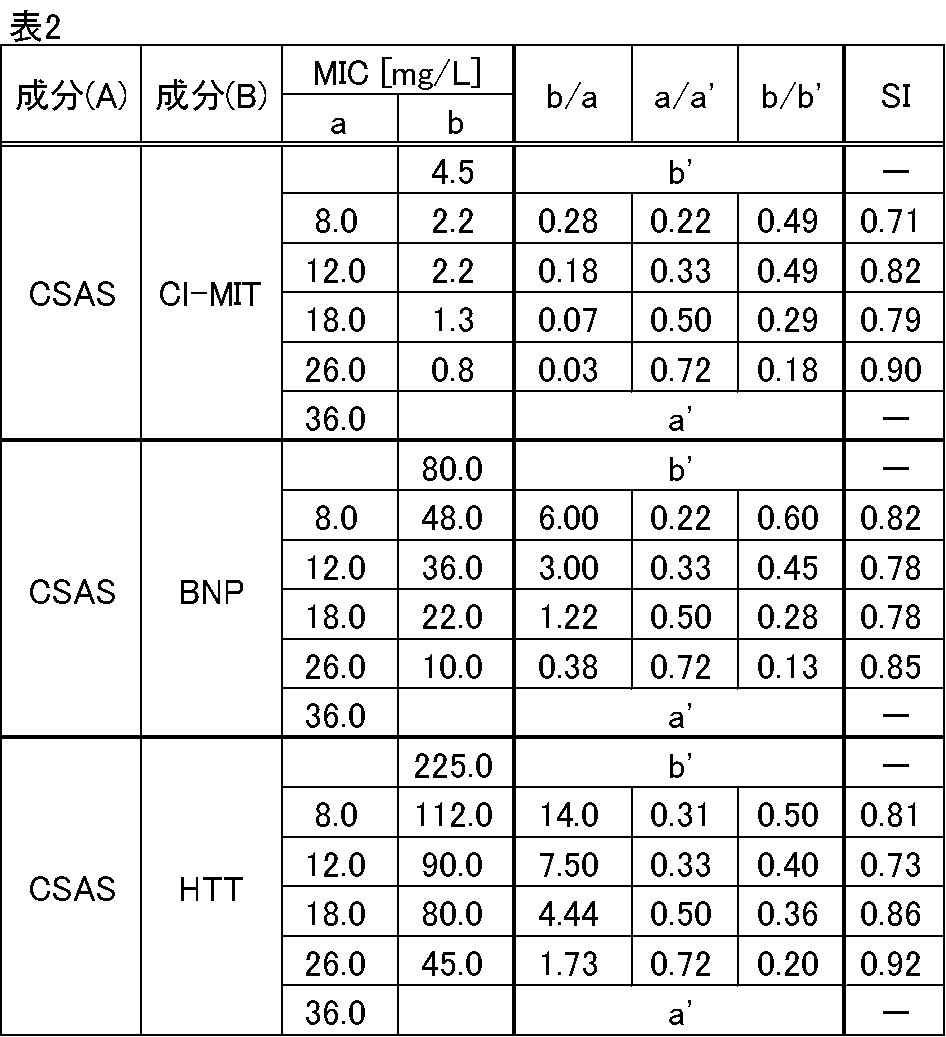
表2に示した結果から分かるように、いずれの防腐剤も、SI<1となり、殺菌防腐効果について相乗効果を示すことが確認された。特に、成分(B)としてCl-MITを用いた場合は、成分(A)に対する質量濃度比が0.28以下であり、BNP又はHTTを用いた場合よりも低濃度で殺菌防腐効果が得られることが認められた。
[試験3]
試験1で用いたものと同じ塗料に、殺菌防腐剤の成分(A)としてCSAS、又は、成分(A’)としてBSASを、所定濃度で添加後すぐに、成分(B)としてHTTを添加濃度2mg/Lで添加して撹拌した。
約2時間後、この塗料をPPC用紙に5%(質量/質量)塗布した。1日間室温(25℃)で放置して自然乾燥させた後、塗布面の白色度を分光光度計型測色計「COLOR TOUCH」(テクニダイン社製)を用いて測定した。
試験1で用いたものと同じ塗料に、殺菌防腐剤の成分(A)としてCSAS、又は、成分(A’)としてBSASを、所定濃度で添加後すぐに、成分(B)としてHTTを添加濃度2mg/Lで添加して撹拌した。
約2時間後、この塗料をPPC用紙に5%(質量/質量)塗布した。1日間室温(25℃)で放置して自然乾燥させた後、塗布面の白色度を分光光度計型測色計「COLOR TOUCH」(テクニダイン社製)を用いて測定した。
これらの試験結果を下記表3にまとめて示す。
なお、比較対照のため、ブランクとして殺菌防腐剤を未添加の場合、また、成分(A)を添加せず、成分(B)としてHTTのみを添加した場合についても、表3に併せて示した。
なお、比較対照のため、ブランクとして殺菌防腐剤を未添加の場合、また、成分(A)を添加せず、成分(B)としてHTTのみを添加した場合についても、表3に併せて示した。
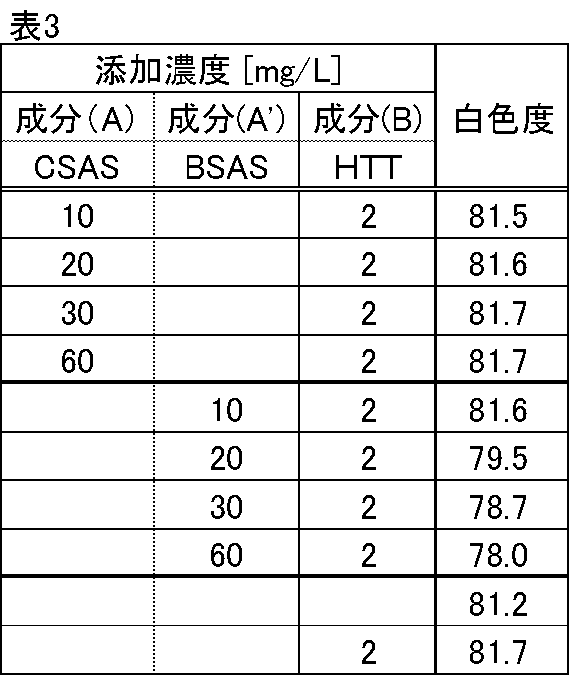
表3に示した結果から分かるように、成分(A)の添加濃度を高くしても、白色度の低下はほとんど認められなかった。一方、成分(A’)としてBSASを添加した場合は、添加濃度が高くなるにつれて白色度が低下した。
このことから、成分(A)と成分(B)との併用により、塗料の重要な特性である白色度の低下を招くことはないと言える。
このことから、成分(A)と成分(B)との併用により、塗料の重要な特性である白色度の低下を招くことはないと言える。
[試験4]
製紙工場Xから入手した、貼合澱粉(5%(質量/体積)糊液、pH9.0)に、殺菌防腐剤の成分(A)としてCSAS、又は、成分(A’)としてBSASを、所定濃度で添加後すぐに、成分(B)としてCl-MITを添加濃度2mg/Lで添加して撹拌した。
5分後、酸化還元電位測定装置(TRX999、株式会社東興化学研究所製、電極:白金電極及び銀/塩化銀電極)を用いて酸化還元電位を測定した。さらに5分後、B型粘度計を用いて粘度を測定した。
製紙工場Xから入手した、貼合澱粉(5%(質量/体積)糊液、pH9.0)に、殺菌防腐剤の成分(A)としてCSAS、又は、成分(A’)としてBSASを、所定濃度で添加後すぐに、成分(B)としてCl-MITを添加濃度2mg/Lで添加して撹拌した。
5分後、酸化還元電位測定装置(TRX999、株式会社東興化学研究所製、電極:白金電極及び銀/塩化銀電極)を用いて酸化還元電位を測定した。さらに5分後、B型粘度計を用いて粘度を測定した。
これらの試験結果を下記表4にまとめて示す。
なお、比較対照のため、ブランクとして殺菌防腐剤を未添加の場合、また、成分(A)を添加せず、成分(B)としてCl-MITのみを添加した場合についても、表4に併せて示した。
なお、比較対照のため、ブランクとして殺菌防腐剤を未添加の場合、また、成分(A)を添加せず、成分(B)としてCl-MITのみを添加した場合についても、表4に併せて示した。
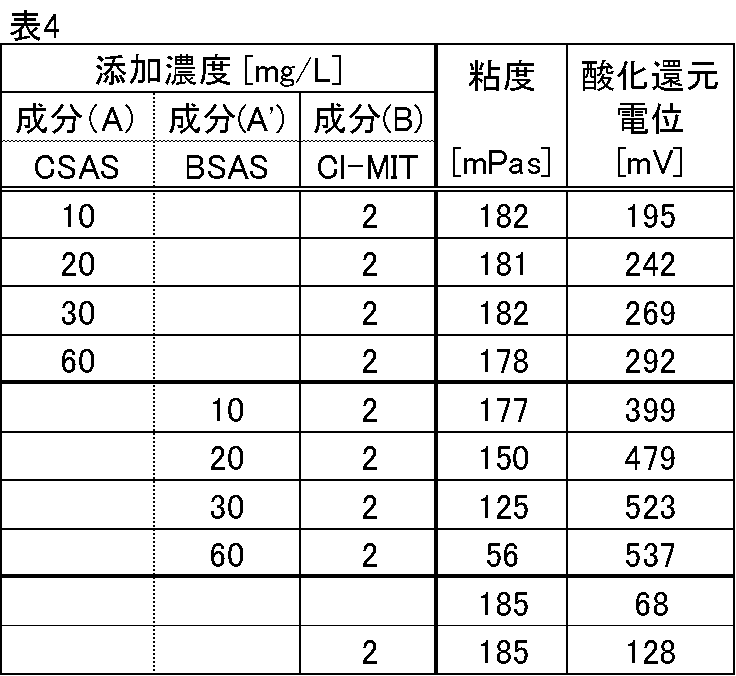
表4に示した結果から分かるように、成分(A)の添加濃度を高くしても、粘度の低下はほとんど認められなかった。一方、成分(A’)としてBSASを添加した場合は、添加濃度が高くなるにつれて粘度が低下した。
このことから、成分(A)と成分(B)との併用により、貼合澱粉糊液の粘度低下による紙加工工程での紙製品の品質の低下を招くことはないと言える。CSASは、BSASに比べて酸化還元電位が低いため、澱粉等に対する酸化分解力が低いためであると考えられる。
このことから、成分(A)と成分(B)との併用により、貼合澱粉糊液の粘度低下による紙加工工程での紙製品の品質の低下を招くことはないと言える。CSASは、BSASに比べて酸化還元電位が低いため、澱粉等に対する酸化分解力が低いためであると考えられる。
Claims (5)
- 紙製造又は紙加工時に用いられる紙加工剤に殺菌防腐剤を添加して、紙加工剤を防腐する方法であって、前記紙加工剤が、pH9.0以上である、塗料、炭酸カルシウムスラリー、ラテックス又は澱粉であり、前記殺菌防腐剤が、クロロスルファミン酸及びその塩のうちの少なくともいずれか1種である成分(A)を含む、紙加工剤の防腐方法。
- 前記殺菌防腐剤が、トリアジン系化合物、イソチアゾロン系化合物、及び2-ブロモ-2-ニトロ-1,3-プロパンジオールのうちから選ばれる少なくともいずれか1種の化合物である成分(B)を含む、請求項1に記載の紙加工剤の防腐方法。
- 前記トリアジン系化合物が、ヘキサヒドロ-1,3,5-トリス(2-ヒドロキシエチル)-s-トリアジン、及びヘキサヒドロ-1,3,5-トリエチル-s-トリアジンのうちから選ばれる少なくともいずれかである、請求項2に記載の紙加工剤の防腐方法。
- 前記イソチアゾロン系化合物が、5-クロロ-2-メチル-4-イソチアゾリン-3-オン、2-メチル-4-イソチアゾリン-3-オン、及びジクロロ-3-n-オクチル-4-イソチアゾリン-3-オンのうちから選ばれる少なくともいずれかである、請求項2又は3に記載の紙加工剤の防腐方法。
- 前記成分(A)を間欠添加する、請求項1~4のいずれか1項に記載の紙加工剤の防腐方法。
Priority Applications (1)
| Application Number | Priority Date | Filing Date | Title |
|---|---|---|---|
| CN201680067071.0A CN108289441B (zh) | 2016-03-25 | 2016-09-15 | 纸加工剂的防腐方法 |
Applications Claiming Priority (2)
| Application Number | Priority Date | Filing Date | Title |
|---|---|---|---|
| JP2016062583A JP6288137B2 (ja) | 2016-03-25 | 2016-03-25 | 紙加工剤の防腐方法 |
| JP2016-062583 | 2016-03-25 |
Publications (1)
| Publication Number | Publication Date |
|---|---|
| WO2017163461A1 true WO2017163461A1 (ja) | 2017-09-28 |
Family
ID=59899920
Family Applications (1)
| Application Number | Title | Priority Date | Filing Date |
|---|---|---|---|
| PCT/JP2016/077326 Ceased WO2017163461A1 (ja) | 2016-03-25 | 2016-09-15 | 紙加工剤の防腐方法 |
Country Status (3)
| Country | Link |
|---|---|
| JP (1) | JP6288137B2 (ja) |
| CN (1) | CN108289441B (ja) |
| WO (1) | WO2017163461A1 (ja) |
Cited By (1)
| Publication number | Priority date | Publication date | Assignee | Title |
|---|---|---|---|---|
| JP2023057960A (ja) * | 2021-10-12 | 2023-04-24 | 王子ホールディングス株式会社 | 段ボールおよび抗菌・抗ウイルス段ボール加工方法 |
Citations (5)
| Publication number | Priority date | Publication date | Assignee | Title |
|---|---|---|---|---|
| US5922745A (en) * | 1997-11-03 | 1999-07-13 | Nalco Chemical Company | Composition and method for inhibiting the growth of microorganisms including stabilized sodium hypobromite and isothiazolones |
| JP2003146817A (ja) * | 2001-08-28 | 2003-05-21 | Kurita Water Ind Ltd | 殺菌殺藻剤組成物、水系の殺菌殺藻方法及び殺菌殺藻剤組成物の製造方法 |
| JP2006022097A (ja) * | 2004-07-02 | 2006-01-26 | Rohm & Haas Co | 殺菌組成物 |
| JP2012115720A (ja) * | 2010-11-29 | 2012-06-21 | Hakuto Co Ltd | 開放型冷水塔循環水系の殺生物方法 |
| JP2015226905A (ja) * | 2015-06-29 | 2015-12-17 | 栗田工業株式会社 | 水系の微生物抑制方法 |
Family Cites Families (3)
| Publication number | Priority date | Publication date | Assignee | Title |
|---|---|---|---|---|
| US6319356B1 (en) * | 1998-05-12 | 2001-11-20 | Great Lakes Chemical Corporation | Process for controlling odor in paper and paperboard using a halohydantoin |
| CN101007664A (zh) * | 2006-01-25 | 2007-08-01 | 肖贤明 | 一种饮用水的消毒方法 |
| JP2013198869A (ja) * | 2012-03-26 | 2013-10-03 | Kurita Water Ind Ltd | 水系の微生物抑制方法 |
-
2016
- 2016-03-25 JP JP2016062583A patent/JP6288137B2/ja active Active
- 2016-09-15 CN CN201680067071.0A patent/CN108289441B/zh active Active
- 2016-09-15 WO PCT/JP2016/077326 patent/WO2017163461A1/ja not_active Ceased
Patent Citations (5)
| Publication number | Priority date | Publication date | Assignee | Title |
|---|---|---|---|---|
| US5922745A (en) * | 1997-11-03 | 1999-07-13 | Nalco Chemical Company | Composition and method for inhibiting the growth of microorganisms including stabilized sodium hypobromite and isothiazolones |
| JP2003146817A (ja) * | 2001-08-28 | 2003-05-21 | Kurita Water Ind Ltd | 殺菌殺藻剤組成物、水系の殺菌殺藻方法及び殺菌殺藻剤組成物の製造方法 |
| JP2006022097A (ja) * | 2004-07-02 | 2006-01-26 | Rohm & Haas Co | 殺菌組成物 |
| JP2012115720A (ja) * | 2010-11-29 | 2012-06-21 | Hakuto Co Ltd | 開放型冷水塔循環水系の殺生物方法 |
| JP2015226905A (ja) * | 2015-06-29 | 2015-12-17 | 栗田工業株式会社 | 水系の微生物抑制方法 |
Cited By (2)
| Publication number | Priority date | Publication date | Assignee | Title |
|---|---|---|---|---|
| JP2023057960A (ja) * | 2021-10-12 | 2023-04-24 | 王子ホールディングス株式会社 | 段ボールおよび抗菌・抗ウイルス段ボール加工方法 |
| JP7722117B2 (ja) | 2021-10-12 | 2025-08-13 | 王子ホールディングス株式会社 | 評価方法 |
Also Published As
| Publication number | Publication date |
|---|---|
| JP6288137B2 (ja) | 2018-03-07 |
| JP2017171639A (ja) | 2017-09-28 |
| CN108289441A (zh) | 2018-07-17 |
| CN108289441B (zh) | 2019-10-18 |
Similar Documents
| Publication | Publication Date | Title |
|---|---|---|
| US9278874B2 (en) | Prevention of starch degradation in pulp, paper or board making processes using zinc ions and an oxidizing biocide | |
| CN103930619B (zh) | 增加强度助剂在制造纸和纸板中的优势的方法 | |
| ES2594978T3 (es) | Método para aumentar las ventajas del almidón en material celulósico convertido en pulpa en la producción de papel y cartón | |
| JP5339921B2 (ja) | パルプおよび製紙加工における微生物の増殖抑制 | |
| US5910503A (en) | Stable microbicide formulation | |
| TWI546262B (zh) | 經由使用氯穩定劑摻合物之改良的生物控制 | |
| DE60133725T2 (de) | Teilhalogenierte hydantoine für schleimkontrolle | |
| WO2000038522A1 (en) | Synergistic antimicrobial combination of 4,5-dichloro-2-n-octyl-4-isothiazolin-3-one and a mixture of a chlorinated isocyanurate and a bromide compound and methods of using same | |
| RU2414432C2 (ru) | Синергическая композиция и способ ингибирования роста микроорганизмов | |
| JP6288137B2 (ja) | 紙加工剤の防腐方法 | |
| JP2014534968A (ja) | 製紙分野における漂白剤または他のハロゲン含有殺生物剤のための、特にアンモニウム塩および/またはアミンと組み合わせた安定剤としてのスルファミン酸またはその塩の使用 | |
| JP7478445B2 (ja) | 安定な殺微生物剤組成物 | |
| JP5357440B2 (ja) | 有害微生物撲滅剤及びそれを用いた有害微生物撲滅方法 | |
| JP2008043836A (ja) | 製紙工程水の殺菌方法 | |
| EP1244358B1 (en) | A stabilized isothiazolone composition and a method of stabilization of isothiazolone | |
| JP4439786B2 (ja) | 還元性雰囲気下の水系殺微生物方法 | |
| JP2006273801A (ja) | 工業用抗菌組成物及び抗菌方法 | |
| JP2003137712A (ja) | デンプン配合組成物の腐敗抑制方法 | |
| JP6325416B2 (ja) | 工業用防腐、殺菌剤 | |
| JP2023163855A (ja) | 殺菌剤及び水系の殺菌方法 | |
| JP2020125266A (ja) | 防腐剤 | |
| NZ620422B2 (en) | Method for increasing the advantages of strength aids in the production of paper and paperboard |
Legal Events
| Date | Code | Title | Description |
|---|---|---|---|
| NENP | Non-entry into the national phase |
Ref country code: DE |
|
| 121 | Ep: the epo has been informed by wipo that ep was designated in this application |
Ref document number: 16895484 Country of ref document: EP Kind code of ref document: A1 |
|
| 122 | Ep: pct application non-entry in european phase |
Ref document number: 16895484 Country of ref document: EP Kind code of ref document: A1 |