WO2017154452A1 - 医療機器用エラストマー材料および医療機器用エラストマー成形体 - Google Patents
医療機器用エラストマー材料および医療機器用エラストマー成形体 Download PDFInfo
- Publication number
- WO2017154452A1 WO2017154452A1 PCT/JP2017/004737 JP2017004737W WO2017154452A1 WO 2017154452 A1 WO2017154452 A1 WO 2017154452A1 JP 2017004737 W JP2017004737 W JP 2017004737W WO 2017154452 A1 WO2017154452 A1 WO 2017154452A1
- Authority
- WO
- WIPO (PCT)
- Prior art keywords
- elastomer
- fluorine
- based elastomer
- weight
- parts
- Prior art date
- Legal status (The legal status is an assumption and is not a legal conclusion. Google has not performed a legal analysis and makes no representation as to the accuracy of the status listed.)
- Ceased
Links
Classifications
-
- C—CHEMISTRY; METALLURGY
- C08—ORGANIC MACROMOLECULAR COMPOUNDS; THEIR PREPARATION OR CHEMICAL WORKING-UP; COMPOSITIONS BASED THEREON
- C08L—COMPOSITIONS OF MACROMOLECULAR COMPOUNDS
- C08L27/00—Compositions of homopolymers or copolymers of compounds having one or more unsaturated aliphatic radicals, each having only one carbon-to-carbon double bond, and at least one being terminated by a halogen; Compositions of derivatives of such polymers
- C08L27/02—Compositions of homopolymers or copolymers of compounds having one or more unsaturated aliphatic radicals, each having only one carbon-to-carbon double bond, and at least one being terminated by a halogen; Compositions of derivatives of such polymers not modified by chemical after-treatment
- C08L27/12—Compositions of homopolymers or copolymers of compounds having one or more unsaturated aliphatic radicals, each having only one carbon-to-carbon double bond, and at least one being terminated by a halogen; Compositions of derivatives of such polymers not modified by chemical after-treatment containing fluorine atoms
- C08L27/16—Homopolymers or copolymers or vinylidene fluoride
-
- C—CHEMISTRY; METALLURGY
- C08—ORGANIC MACROMOLECULAR COMPOUNDS; THEIR PREPARATION OR CHEMICAL WORKING-UP; COMPOSITIONS BASED THEREON
- C08L—COMPOSITIONS OF MACROMOLECULAR COMPOUNDS
- C08L27/00—Compositions of homopolymers or copolymers of compounds having one or more unsaturated aliphatic radicals, each having only one carbon-to-carbon double bond, and at least one being terminated by a halogen; Compositions of derivatives of such polymers
- C08L27/02—Compositions of homopolymers or copolymers of compounds having one or more unsaturated aliphatic radicals, each having only one carbon-to-carbon double bond, and at least one being terminated by a halogen; Compositions of derivatives of such polymers not modified by chemical after-treatment
- C08L27/12—Compositions of homopolymers or copolymers of compounds having one or more unsaturated aliphatic radicals, each having only one carbon-to-carbon double bond, and at least one being terminated by a halogen; Compositions of derivatives of such polymers not modified by chemical after-treatment containing fluorine atoms
-
- A—HUMAN NECESSITIES
- A61—MEDICAL OR VETERINARY SCIENCE; HYGIENE
- A61L—METHODS OR APPARATUS FOR STERILISING MATERIALS OR OBJECTS IN GENERAL; DISINFECTION, STERILISATION OR DEODORISATION OF AIR; CHEMICAL ASPECTS OF BANDAGES, DRESSINGS, ABSORBENT PADS OR SURGICAL ARTICLES; MATERIALS FOR BANDAGES, DRESSINGS, ABSORBENT PADS OR SURGICAL ARTICLES
- A61L29/00—Materials for catheters, medical tubing, cannulae, or endoscopes or for coating catheters
- A61L29/04—Macromolecular materials
- A61L29/049—Mixtures of macromolecular compounds
-
- A—HUMAN NECESSITIES
- A61—MEDICAL OR VETERINARY SCIENCE; HYGIENE
- A61L—METHODS OR APPARATUS FOR STERILISING MATERIALS OR OBJECTS IN GENERAL; DISINFECTION, STERILISATION OR DEODORISATION OF AIR; CHEMICAL ASPECTS OF BANDAGES, DRESSINGS, ABSORBENT PADS OR SURGICAL ARTICLES; MATERIALS FOR BANDAGES, DRESSINGS, ABSORBENT PADS OR SURGICAL ARTICLES
- A61L31/00—Materials for other surgical articles, e.g. stents, stent-grafts, shunts, surgical drapes, guide wires, materials for adhesion prevention, occluding devices, surgical gloves, tissue fixation devices
- A61L31/04—Macromolecular materials
- A61L31/06—Macromolecular materials obtained otherwise than by reactions only involving carbon-to-carbon unsaturated bonds
-
- C—CHEMISTRY; METALLURGY
- C08—ORGANIC MACROMOLECULAR COMPOUNDS; THEIR PREPARATION OR CHEMICAL WORKING-UP; COMPOSITIONS BASED THEREON
- C08F—MACROMOLECULAR COMPOUNDS OBTAINED BY REACTIONS ONLY INVOLVING CARBON-TO-CARBON UNSATURATED BONDS
- C08F14/00—Homopolymers and copolymers of compounds having one or more unsaturated aliphatic radicals, each having only one carbon-to-carbon double bond, and at least one being terminated by a halogen
- C08F14/18—Monomers containing fluorine
- C08F14/22—Vinylidene fluoride
-
- C—CHEMISTRY; METALLURGY
- C08—ORGANIC MACROMOLECULAR COMPOUNDS; THEIR PREPARATION OR CHEMICAL WORKING-UP; COMPOSITIONS BASED THEREON
- C08F—MACROMOLECULAR COMPOUNDS OBTAINED BY REACTIONS ONLY INVOLVING CARBON-TO-CARBON UNSATURATED BONDS
- C08F14/00—Homopolymers and copolymers of compounds having one or more unsaturated aliphatic radicals, each having only one carbon-to-carbon double bond, and at least one being terminated by a halogen
- C08F14/18—Monomers containing fluorine
- C08F14/26—Tetrafluoroethene
-
- C—CHEMISTRY; METALLURGY
- C08—ORGANIC MACROMOLECULAR COMPOUNDS; THEIR PREPARATION OR CHEMICAL WORKING-UP; COMPOSITIONS BASED THEREON
- C08F—MACROMOLECULAR COMPOUNDS OBTAINED BY REACTIONS ONLY INVOLVING CARBON-TO-CARBON UNSATURATED BONDS
- C08F14/00—Homopolymers and copolymers of compounds having one or more unsaturated aliphatic radicals, each having only one carbon-to-carbon double bond, and at least one being terminated by a halogen
- C08F14/18—Monomers containing fluorine
- C08F14/28—Hexafluoropropene
-
- C—CHEMISTRY; METALLURGY
- C08—ORGANIC MACROMOLECULAR COMPOUNDS; THEIR PREPARATION OR CHEMICAL WORKING-UP; COMPOSITIONS BASED THEREON
- C08F—MACROMOLECULAR COMPOUNDS OBTAINED BY REACTIONS ONLY INVOLVING CARBON-TO-CARBON UNSATURATED BONDS
- C08F16/00—Homopolymers and copolymers of compounds having one or more unsaturated aliphatic radicals, each having only one carbon-to-carbon double bond, and at least one being terminated by an alcohol, ether, aldehydo, ketonic, acetal or ketal radical
- C08F16/12—Homopolymers and copolymers of compounds having one or more unsaturated aliphatic radicals, each having only one carbon-to-carbon double bond, and at least one being terminated by an alcohol, ether, aldehydo, ketonic, acetal or ketal radical by an ether radical
- C08F16/14—Monomers containing only one unsaturated aliphatic radical
- C08F16/24—Monomers containing halogen
-
- C—CHEMISTRY; METALLURGY
- C08—ORGANIC MACROMOLECULAR COMPOUNDS; THEIR PREPARATION OR CHEMICAL WORKING-UP; COMPOSITIONS BASED THEREON
- C08F—MACROMOLECULAR COMPOUNDS OBTAINED BY REACTIONS ONLY INVOLVING CARBON-TO-CARBON UNSATURATED BONDS
- C08F2500/00—Characteristics or properties of obtained polyolefins; Use thereof
- C08F2500/02—Low molecular weight, e.g. <100,000 Da.
-
- C—CHEMISTRY; METALLURGY
- C08—ORGANIC MACROMOLECULAR COMPOUNDS; THEIR PREPARATION OR CHEMICAL WORKING-UP; COMPOSITIONS BASED THEREON
- C08F—MACROMOLECULAR COMPOUNDS OBTAINED BY REACTIONS ONLY INVOLVING CARBON-TO-CARBON UNSATURATED BONDS
- C08F2500/00—Characteristics or properties of obtained polyolefins; Use thereof
- C08F2500/21—Rubbery or elastomeric properties
-
- C—CHEMISTRY; METALLURGY
- C08—ORGANIC MACROMOLECULAR COMPOUNDS; THEIR PREPARATION OR CHEMICAL WORKING-UP; COMPOSITIONS BASED THEREON
- C08F—MACROMOLECULAR COMPOUNDS OBTAINED BY REACTIONS ONLY INVOLVING CARBON-TO-CARBON UNSATURATED BONDS
- C08F2800/00—Copolymer characterised by the proportions of the comonomers expressed
- C08F2800/20—Copolymer characterised by the proportions of the comonomers expressed as weight or mass percentages
-
- C—CHEMISTRY; METALLURGY
- C08—ORGANIC MACROMOLECULAR COMPOUNDS; THEIR PREPARATION OR CHEMICAL WORKING-UP; COMPOSITIONS BASED THEREON
- C08L—COMPOSITIONS OF MACROMOLECULAR COMPOUNDS
- C08L2203/00—Applications
- C08L2203/02—Applications for biomedical use
Definitions
- the present invention relates to elastomeric materials for medical devices and elastomeric moldings for medical devices.
- Priority is claimed on Japanese Patent Application No. 2016-048672, filed on March 11, 2016, the content of which is incorporated herein by reference.
- an elastomer molded body having resistance in a disinfecting / sterilizing environment is used as a covering member for a medical device which covers the surface of a medical device such as an endoscope.
- Fluororubber is known as a material of such an elastomer molded body.
- 10 to 30 parts of liquid fluororubber and 0 parts of Perhexa (registered trademark) 25B are contained in 100 parts by weight of vinylidene fluoride-hexafluoropropylene-tetrafluoroethylene terpolymer.
- Curved endoscope formed by vulcanizing a compounded kneaded product containing 1 to 1.5 parts, 0.3 to 4 parts of triallyl isocyanate, and 1 to 10 parts of reinforcing carbon having an average particle diameter of 150 m ⁇ or less A part rubber tube is disclosed.
- Patent Document 2 discloses an elastomer molded article for an endoscope, which contains two or more kinds of fluorine-based elastomers having crosslinkable crosslinking reactive groups. In Patent Document 2, it is proposed to form an elastomer molded article having good resistance under severe sterilization and sterilization environment by using a molding raw material in which two or more different fluoroelastomers are mixed.
- Patent Documents 1 and 2 are intended to improve the chemical resistance, the vapor resistance, and the weather resistance of a molded body by using a fluororubber or a fluoroelastomer as a forming raw material.
- the materials described in Patent Documents 1 and 2 have a problem that the cold resistance can not be improved. At low temperatures, the flexibility of the elastomeric molded body is reduced due to the embrittlement of the elastomeric molded body.
- the present invention has been made in view of the problems as described above, and it is an object of the present invention to provide an elastomer material for medical devices and an elastomer molding for medical devices which can improve the cold resistance of the elastomer molding for medical devices. To aim.
- the first fluorine-based elastomer which is a ternary copolymer having three types of monomers A, B and C, and the monomer A And B
- a second fluoroelastomer which is a ternary copolymer having a monomer D different from any of the monomers A, B and C, and the monomer C and the above
- the monomer D has side chains having different structures.
- the total content of the first fluorine-based elastomer and the second fluorine-based elastomer is 100 parts by weight. And 15 parts by weight or less of a coagent may be contained.
- the elastomer material for medical devices in the third aspect of the present invention in the first or second aspect, 100 parts by weight of the total content of the first fluoroelastomer and the second fluoroelastomer
- the filler may be contained in an amount of 50 parts by weight or less.
- the total content of the first fluorine-based elastomer and the second fluorine-based elastomer in any one of the first to third aspects may be contained.
- 100 parts by weight or less, 50 parts by weight or less of a third fluorine-based elastomer having a number average molecular weight of 5000 or less and having no crosslinking reaction group may be contained.
- a first fluoroelastomer which is a ternary copolymer having three kinds of monomers A, B and C, and the above-mentioned monomer
- a second fluoroelastomer which is a ternary copolymer having A and B and a monomer D different from any of the monomers A, B and C, and the monomer C and The monomer D has side chains having different structures.
- the total content of the first fluorine-based elastomer and the second fluorine-based elastomer is 100 parts by weight. Sometimes, 15 parts by weight or less of a coagent may be included.
- the total content of the first fluoroelastomer and the second fluoroelastomer is 100% by weight.
- the filler may be contained in an amount of 50 parts by weight or less.
- the total content of the first fluoroelastomer and the second fluoroelastomer in any one of the fifth to seventh aspects may be contained.
- the amount is 100 parts by weight, 50 parts by weight or less of the third fluorine-based elastomer having a number average molecular weight of 5000 or less and having no crosslinking reactive group may be contained.
- the elastomer material for medical devices in the first to fourth aspects and the elastomer molding for medical devices in the fifth to eighth aspects it is possible to improve the cold resistance of the elastomer molding for medical devices.
- the elastomer material for medical devices of the present embodiment includes a first fluorine-based elastomer and a second fluorine-based elastomer.
- monomers A, B, C, D Four kinds of different monomers (monomers) are denoted as monomers A, B, C, D.
- the first fluorine-based elastomer is a terpolymer having three types of monomers A, B and C.
- the second fluoroelastomer is a terpolymer having three monomers A, B and D.
- the monomers C and D have side chains having different structures.
- the monomers A and B may have a side chain structure. At least one of the monomers A, B, C and at least one of the monomers A, B, D contain fluorine.
- the first fluorine-based elastomer is a terpolymer having a sequence represented by A i -B j -C k .
- subscripts i, j, k respectively indicate the number of monomers A, B, C in the first fluorine-based elastomer molecule.
- the monomer C may be bonded to any of the monomers A and B.
- the second fluorine-based elastomer is a ternary copolymer having the sequence represented by A i ′ -B j ′ -D k ′ .
- subscripts i ′, j ′ and k ′ represent the number of monomers A, B and D in the second fluorine-based elastomer molecule, respectively.
- i ', j' and k ' may be the same number as i, j and k, respectively, or may be different numbers.
- the monomer D may be bonded to any of the monomers A and B.
- Monomers which can be used for the monomers A and B include, for example, ethylene, propylene, isoprene, vinylidene fluoride, monofluoroethylene, trifluoroethylene, tetrafluoroethylene, chlorotrifluoroethylene, dichlorodifluoroethylene, Trifluorostyrene, pentafluoropropylene, hexafluoropropylene, perfluoroalkyl vinyl ether, perfluoro unsaturated nitrile compound, dialkyl siloxane and the like can be mentioned.
- monomers that can be used for the monomers C and D for example, propylene, isoprene, pentafluoropropylene, hexafluoropropylene, perfluoroalkyl vinyl ether, perfluoro unsaturated nitrile compound, dialkyl siloxane and the like are selected.
- the monomer from which a side chain structure mutually differs is mentioned.
- the elastomeric material for medical devices of the present embodiment may contain appropriate additives as needed.
- the additive include, for example, a crosslinking agent, a crosslinking aid, a filler, a plasticizer, a tackifier, a processing aid, a curing agent, an antiaging agent, an acid acceptor and the like.
- an organic peroxide may be used as a crosslinking agent.
- organic peroxides that can be used as the crosslinking agent include ketone peroxides, diacyl peroxides, dialkyl peroxides, peroxy ketals, peroxy esters, percarbonates and the like.
- ketone peroxides include methyl ethyl ketone peroxide and dimethyl ketone peroxide.
- diacyl peroxides include dibenzoyl peroxide, benzoyl m-methyl benzoyl peroxide and the like.
- dialkyl peroxides examples include 2,5-dimethyl-2,5-bis (tert-butylperoxy) hexane and 2,5-dimethyl-2,5-bis (tert-butylperoxy) 3-hexyne.
- peroxyketals examples include 1,1-bis (tert-hexylperoxy) cyclohexane, 1,1-bis (tert-butylperoxy) cyclohexane and the like.
- peroxy esters examples include 2,5-dimethyl-2,5-bis (benzoylperoxy) 3-hexyne, tert-hexylperoxybenzoate and the like.
- percarbonates examples include diisopropyl peroxy dicarbonate, bis (4-tert-butylcyclohexyl) peroxy carbonate and the like.
- organic peroxides exemplified above, the diacyl peroxides 2,5-dimethyl-2,5-di (t-butylperoxy) hexane is particularly preferable.
- an organic compound having co-crosslinking reactivity may be used.
- the organic compound having co-crosslinking reactivity include allyl compounds and acrylic compounds.
- allyl compounds include triallyl isocyanurate, trimethallyl isocyanurate, triallyl cyanurate and the like.
- acrylic compound include trimethylolpropane trimethacrylate, 1,9-nonanediol dimethacrylate, tricyclodecanedimethanol dimethacrylate, polyethylene glycol dimethacrylate and the like.
- triallyl isocyanurate is particularly preferred.
- the coagent accelerates the crosslinking reaction.
- the content of the coagent in the elastomeric material for medical devices is set to such an amount that the flexibility required for the elastomeric molding for medical devices is not impaired.
- the content of the crosslinking aid is more preferably 15 parts by weight or less, for example, when the total content of the first fluorine-based elastomer and the second fluorine-based elastomer is 100 parts by weight.
- the content of the coagent is more than 15 parts by weight, the crosslink density may be excessive, which may result in the flexibility of the elastomer molded article being excessively lowered.
- carbon black As a filler, carbon black, an inorganic filler, etc. may be used, for example.
- the carbon black include, for example, SAF (Super Abrasion Furnace), HAF (High Abrasion Furnace), SRF (Semi- Reinforcing Furnace), MT (Medium Thermal), and FEF (Fast Extruding Furnace). Among them, MT and FEF are particularly preferable.
- the carbon black plural types of carbon black may be used.
- the inorganic filler include, for example, silica, barium sulfate, titanium oxide, aluminum oxide, calcium carbonate, calcium silicate, magnesium silicate, aluminum silicate and the like.
- the inorganic filler plural types of inorganic fillers may be used.
- carbon black and an inorganic filler may be used together and used.
- the filler improves the strength, hardness and the like of the molded product, but when the filler is increased, the flexibility of the molded product tends to decrease.
- the content of the filler in the medical device elastomeric material is set to an amount that does not impair the flexibility required for the medical device elastomer molding.
- the content of the filler in the medical device elastomeric material is, for example, 50 parts by weight or less, when the total content of the first fluorine-based elastomer and the second fluorine-based elastomer is 100 parts by weight. preferable. When the content of the filler exceeds 50 parts by weight, the flexibility of the medical device elastomer molding may be too low.
- a third fluorine-based elastomer having a number average molecular weight of 5000 or less and having no crosslinking reactive group may be used.
- the content of the third fluorine-based elastomer in the medical device elastomer material is 50 parts by weight or less, when the total content of the first fluorine-based elastomer and the second fluorine-based elastomer is 100 parts by weight. Is more preferred.
- the content of the third fluoroelastomer exceeds 50 parts by weight, the crosslink density is lowered because the third fluoroelastomer having no crosslinking reactive group inhibits the crosslinking reaction. For this reason, the chemical resistance of the elastomer molded body may be reduced.
- the elastomer molded article for a medical device of the present embodiment can be manufactured by performing various known moldings using the elastomer material for a medical device of the present embodiment as a molding material.
- the first fluorine-based elastomer and the second fluorine-based elastomer are masticated together with an additive such as a filler which is optionally blended.
- the first fluorine-based elastomer and the second fluorine-based elastomer are main components in the medical device elastomer material.
- a kneader such as a biaxial roll, a kneader, or a Banbury mixer may be used.
- crosslinking of the main agent when crosslinking of the main agent is performed using a crosslinking agent, kneading may be performed while adding the crosslinking agent and, if necessary, other additives such as a crosslinking aid and a filler.
- a plasticizer When a plasticizer is added to the main agent, the plasticizer may be added after all other additives have been added.
- a medical device elastomeric material which is a molding material, is prepared.
- a known elastomer molding method such as injection molding, extrusion molding, transfer molding or the like may be used.
- a molding material is filled in a molding die for molding in the shape of a medical device elastomer molding and heated and pressed, for example, radiation or the like may be applied to the molding material in order to crosslink the molding material.
- secondary crosslinking may be performed on the forming raw material, for example, in a hot air stream.
- crosslinking molding may be performed by heating after the molding material is filled in the same mold. After this, the forming material may be subjected to secondary crosslinking by being held in a higher temperature oven.
- the shape of the elastomer molding for medical devices is not particularly limited.
- the shape of the elastomer molded article for a medical device may be appropriately selected according to the application, such as sheet-like, rod-like, ring-like and various complex block shapes.
- the use in particular of the elastomer molding for medical devices of this embodiment is not restricted.
- the elastomer molding for a medical device according to the present embodiment includes, for example, an outer cover of a bending portion of an endoscope, a folding member for an endoscope, an outer cover covering a switch button or switch button of an endoscope, and the inside of an endoscope. You may be used for the O-ring etc. which are used.
- the medical device in which the elastomer molded body for a medical device is used is not limited to an endoscope.
- the elastomer molded body for medical device may be used, for example, in a medical device such as a surgical treatment device.
- the first fluorine-based elastomer and the second fluorine-based elastomer which are main components of the medical device elastomeric material, are both terpolymers.
- the site of A i, B j is, A i consists of respectively the same monomer ', B j' compatible with.
- the first fluorine-based elastomer and the second fluorine-based elastomer are generally highly compatible. It becomes easy to blend the first fluoroelastomer and the second fluoroelastomer homogeneously.
- the first fluorine-based elastomer and the second fluorine-based elastomer have the sites of monomers C k and D k ′ .
- the monomers C k and D k ′ have a side chain structure.
- the side chain structure of the monomers C k and D k ′ is steric hindrance.
- Such steric hindrance has an effect of suppressing crystallization after molding.
- the elastomer molded product having the first fluorine-based elastomer (the second fluorine-based elastomer) as a main component is superior in cold resistance to the copolymer elastomer molded product having no side chain structure.
- the monomers C and D have different side chain structures, so the C k and D k ′ sites have steric hindrances of different sizes.
- the elastomer molded article for medical devices containing the first fluorine-based elastomer and the second fluorine-based elastomer is an elastomer molded article containing only the first fluorine-based elastomer or only the second fluorine-based elastomer as a main agent. Crystallization is less likely to occur compared to the body. For this reason, cold resistance is further improved in the elastomer molded article for a medical device of the present embodiment.
- the crosslinking aid promotes crosslinking. For this reason, the mechanical properties of the medical device elastomer molding are further improved as compared with the case where the medical device elastomeric material does not contain a crosslinking aid.
- the crosslinking assistant is triallyl isocyanurate
- the trifunctional allyl group of triallyl isocyanurate improves the crosslinking efficiency. For this reason, the tear strength of the elastomer molding for medical devices is further improved.
- the triazine ring is introduced by triallyl isocyanurate, the heat resistance, hydrolysis resistance and weather resistance of the elastomer molded article for medical devices are further improved.
- the filler serves as a reinforcement, thereby further improving the mechanical properties of the medical device elastomer molding.
- the third fluorine-based elastomer When the above-mentioned third fluorine-based elastomer is included in the medical device elastomer material of the present embodiment, the third fluorine-based elastomer imparts flexibility to the medical device elastomer molded body, so that the medical device elastomer molded body The cold resistance of is further improved.
- the cold resistance of the elastomer molding for medical devices can be improved.
- compositions of the medical device elastomeric materials of Examples 1 to 5 and Comparative Examples 1 to 5 are shown in Table 1 below.
- the “main agent 1” column in the above [Table 1] describes the first fluoroelastomer material, the composition of the monomer, and the content (parts by weight).
- the “main agent 2” column in the above [Table 1] describes the material of the second fluoroelastomer, the configuration of the monomer, and the content (parts by weight).
- the main agents 1 and 2 in Comparative Examples 1 to 7 also include materials different from the first fluoroelastomer and the second fluoroelastomer in the medical device elastomeric material of the above embodiment.
- the trade names and manufacturers of the materials # 1 to # 5 used for the main agents 1 and 2 are shown in the following [Table 2].
- the types of crosslinking agents, crosslinking aids, fillers, plasticizers, specific trade names, etc. used are described below.
- Material # 1 Daiel (registered trademark) G-912 (trade name; manufactured by Daikin Industries, Ltd.) was used.
- Material # 1 is a fluororubber composed of a terpolymer having vinylidene fluoride (VDF), tetrafluoroethylene (TFE), and hexafluoropropylene (HFP) as monomers.
- VDF vinylidene fluoride
- TFE tetrafluoroethylene
- HFP hexafluoropropylene
- HFP has a —CF 3 group as a side chain.
- Material # 2 Technoflon (registered trademark) FKM PL 455 (trade name; manufactured by Solvay) was used.
- Material # 2 is a fluororubber made of a terpolymer having VDF, TFE, and perfluoroalkyl vinyl ether (PAVE) as monomers.
- PAVE has a perfluoroalkyl ether group as a side chain.
- Viton (registered trademark) GFLT200S (trade name; manufactured by DuPont) was used.
- Material # 3 is a fluororubber made of a terpolymer having VDF, TFE, and perfluoromethyl vinyl ether (PMVE) as monomers.
- PMVE has an —O—CF 3 group as a side chain.
- Material # 4 is a fluororubber made of a terpolymer having VDF, TFE, and HFP as monomers.
- Material # 5 Daiel (registered trademark) G-912 (trade name; manufactured by Daikin Industries, Ltd.) was used.
- Material # 5 is a fluororubber made of a binary copolymer containing vinylidene fluoride (VDF) and hexafluoropropylene (HFP) as monomers.
- VDF vinylidene fluoride
- HFP hexafluoropropylene
- Example 1 As shown in the above [Table 1], the elastomer material for medical devices of Example 1 is Main agent 1 (# 1) 50 parts by weight Main agent 2 (# 2) 50 parts by weight Crosslinking agent 2.0 parts by weight
- a crosslinking agent 2,5-dimethyl-2,5-bis (tert-butylperoxy) hexane was used as an organic peroxide.
- Perhexa registered trademark 25B (trade name; manufactured by NOF Corporation) was used.
- Example 1 does not contain a coagent, a filler and a plasticizer.
- Example 2 The elastomeric material for medical devices of Example 2 is different from Example 1 in that Material # 3 of the same part by weight is used instead of Material # 2 as the main agent 2.
- Example 3 The medical device elastomeric material of Example 3 differs from that of Example 1 in that it contains 6.0 parts by weight of a coagent.
- Triallyl isocyanurate was used as a coagent.
- TAIC registered trademark
- TAIC trade name; manufactured by Nippon Kasei Co., Ltd.
- Example 4 The elastomeric material for medical devices of Example 4 is different from Example 1 in that 30 parts by weight of a filler is contained in addition to 6.0 parts by weight of the crosslinking aid as in Example 3. Silica was used as a filler. As a specific material of silica, Mini-Seal # 5 (trade name; manufactured by U.S. Silica Corporation) was used.
- the elastomeric material for medical device of Example 5 comprises 30 parts by weight of a plasticizer, in addition to 6.0 parts by weight of the crosslinking aid as in Example 3 and 30 parts by weight of the filler as in Example 4.
- the contained point is different from Example 1.
- a plasticizer the number average molecular weight was 5000 or less, and the 3rd fluorine-type elastomer which does not have a crosslinking reaction group was used.
- liquid rubber DAILE registered trademark
- G-101 trade name; manufactured by Daikin Industries, Ltd.
- the number average molecular weight of Daiel (registered trademark) G-101 is 3,000.
- Comparative Examples 1 to 4 are examples in which the main agent of Example 1 was changed.
- Material # 4 was used as the main agent 2 in place of Material # 2.
- the materials # 1 and # 4 since the monomers C and D are both HFP, the monomers C and D do not have side chain structures different from each other.
- the main agent 2 was replaced with the material # 2, and the material # 5 which is a binary copolymer was used.
- 100 parts by weight of the material # 1 used as the main agent 1 in Example 1 was used as the main agent.
- Comparative Example 3 is an example in which the main agent is one kind of fluoroelastomer.
- 100 parts by weight of the material # 2 used as the main agent 2 in Example 1 was used as the main agent.
- Comparative Example 4 is an example in which the main agent is one kind of fluorine-based elastomer.
- Comparative Example 5 As shown in the above [Table 1], Comparative Example 5 is an example in which the content of the plasticizer of Example 5 is changed. Comparative Example 5 differs from Example 5 in that the content of the plasticizer was changed from 30 parts by weight to 51 parts by weight.
- the medical device elastomeric material of Example 1 was compounded by weighing each of the above-described materials so as to have the above-described amount and kneading with an open roll. The compound was used as a molding material of the elastomer molded article for medical devices of Example 1.
- the compound of the medical device elastomeric material of Example 1 was transfer molded. Thereby, the elastomer molded product for medical device of Example 1 was obtained.
- a forming die a forming die for forming a tube-like formed body having an outer diameter of 12 mm, a wall thickness of 0.5 mm and a length of 15 mm was used. Specifically, the compound was filled into a mold and cross-linking was carried out at 160 ° C. for 10 minutes. This was followed by secondary crosslinking in an oven at 180 ° C. for 4 hours.
- a tube-like elastomer molded article for a medical device having an outer diameter of 12 mm, a thickness of 0.5 mm and a length of 15 mm was obtained.
- the elastomer molded article for medical devices was used for the evaluation described later.
- the medical device elastomeric materials of Examples 2 to 5 and Comparative Examples 1 to 5 were also molded in the same manner as Example 1. As a result, elastomeric molded articles for medical devices of Examples 2 to 5 and Comparative Examples 1 to 5 were obtained.
- composition of the elastomer molding for medical devices is for medical devices when the total content of the main agents is 100 parts by weight with respect to the main agent, the cross-linking aid, the filler, and the plasticizer remaining in the elastomer molding for medical devices. It is the same as the content in the elastomeric material.
- Tg glass transition temperature
- the evaluation of cold resistance is very good when Tg is less than -40 ° C (represented by " ⁇ " (very good) in [Table 3]), good when Tg is more than -40 ° C and less than -20 ° C ( In [Table 3], it was considered as poor (represented by "x" (no good) in [Table 3]) when Tg is -20 ° C. or more.
- the chemical resistance is evaluated by visually observing the degree of cracking of the elastomer molded article for medical devices after being immersed in a 3.7% aqueous solution of peracetic acid heated to 53 ° C. for 30 days. It was done by. It is good if there is no crack (represented by " ⁇ " (good) in [Table 3]), and if there is a crack, it is considered defective (represented by "x" (no good) in [Table 3]) .
- the overall evaluation is bad when the evaluation of at least one of cold resistance and chemical resistance is “x” (“No” in [Table 3], good in other (“[Table 3]”, “ ⁇ “(Good)”.
- the breaking strength was measured by a tensile test in accordance with JIS K6251. In order to be used for the tensile test, a tensile test piece conforming to JIS K6251 was formed of the medical device elastomeric material. If the breaking strength of the elastomer molding for medical devices is 13 MPa or more, it can be said that there is no particular problem.
- Example 5 In Comparative Example 5 in which the content of the plasticizer is 51 parts by weight, as in Example 5, the cold resistance was determined to be very good, but the chemical resistance was poor, so the overall evaluation was poor. . This is considered to be because the crosslinking reaction was inhibited by containing 50 parts by weight or more of the added plasticizer because it does not have a crosslinking reaction group. The inhibition of the crosslinking reaction is considered to reduce the crosslink density of the molded article and reduce the chemical resistance.
- the elastomer material for medical devices which can improve the cold resistance of the elastomer molding for medical devices, and the elastomer molding for medical devices can be provided.
Landscapes
- Chemical & Material Sciences (AREA)
- Health & Medical Sciences (AREA)
- Chemical Kinetics & Catalysis (AREA)
- Organic Chemistry (AREA)
- Polymers & Plastics (AREA)
- Medicinal Chemistry (AREA)
- Animal Behavior & Ethology (AREA)
- Life Sciences & Earth Sciences (AREA)
- Epidemiology (AREA)
- General Health & Medical Sciences (AREA)
- Public Health (AREA)
- Veterinary Medicine (AREA)
- Vascular Medicine (AREA)
- Surgery (AREA)
- Heart & Thoracic Surgery (AREA)
- Materials For Medical Uses (AREA)
- Compositions Of Macromolecular Compounds (AREA)
Abstract
医療機器用エラストマー材料は、三種類の単量体A、B、Cを有する三元共重合体である第1のフッ素系エラストマーと、単量体A、Bと、単量体A、B、Cのいずれとも異なる単量体Dと、を有する三元共重合体である第2のフッ素系エラストマーと、を含み、単量体Cと単量体Dとは、互いに異なる構造の側鎖を有している。
Description
本発明は、医療機器用エラストマー材料および医療機器用エラストマー成形体に関する。
本願は、2016年3月11日に日本に出願された特願2016-048672号に基づき優先権を主張し、その内容をここに援用する。
本願は、2016年3月11日に日本に出願された特願2016-048672号に基づき優先権を主張し、その内容をここに援用する。
例えば、内視鏡等の医療機器の表面を被覆する医療機器用被覆部材には、消毒・滅菌環境下での耐性を有するエラストマー成形体が使用されている。このようなエラストマー成形体の材料としては、フッ素ゴムが知られている。
例えば、特許文献1には、重量割合でビニリデンフロライド-ヘキサフロロプロピレン-テトラフロロエチレンの三元共重合体100部に対して、液状フッ素ゴム10~30部、パーヘキサ(登録商標)25Bを0.1~1.5部、トリアリルイソシアネート0.3~4部、平均粒子径が150mμ以下の補強性カーボン1~10部を含有する配合混練物を加硫成型して成る内視鏡の湾曲部用ゴムチューブが開示されている。
例えば、特許文献2には、架橋可能な架橋反応基を有する2種類以上のフッ素系エラストマーを含む内視鏡用エラストマー成形体が開示されている。
特許文献2では、異なる2種類以上のフッ素系エラストマーを混ぜ合せた成形原料を用いることによって、過酷な消毒・滅菌環境下での耐性が良好なエラストマー成形体を形成することが提案されている。
例えば、特許文献1には、重量割合でビニリデンフロライド-ヘキサフロロプロピレン-テトラフロロエチレンの三元共重合体100部に対して、液状フッ素ゴム10~30部、パーヘキサ(登録商標)25Bを0.1~1.5部、トリアリルイソシアネート0.3~4部、平均粒子径が150mμ以下の補強性カーボン1~10部を含有する配合混練物を加硫成型して成る内視鏡の湾曲部用ゴムチューブが開示されている。
例えば、特許文献2には、架橋可能な架橋反応基を有する2種類以上のフッ素系エラストマーを含む内視鏡用エラストマー成形体が開示されている。
特許文献2では、異なる2種類以上のフッ素系エラストマーを混ぜ合せた成形原料を用いることによって、過酷な消毒・滅菌環境下での耐性が良好なエラストマー成形体を形成することが提案されている。
しかしながら、上記のような従来技術には、以下のような問題がある。
特許文献1、2に記載の医療機器用エラストマー材料は、フッ素ゴム、フッ素系エラストマーを成形原料として用いることによって、成形体の耐薬品性、耐蒸気性、耐候性の向上を図っている。
ところが、特許文献1、2に記載の材料は、耐寒性までは向上できないという問題がある。
低温下では、エラストマー成形体が脆化するためにエラストマー成形体の柔軟性が低下する。例えば、寒冷な環境下で、エラストマー成形体が用いられた内視鏡が繰返し使用される場合、エラストマー成形体が用いられた湾曲部被覆材に亀裂が入ることが知られている。この場合、湾曲部被覆材が水密を保つことができなくなることがある。
特許文献1、2に記載の医療機器用エラストマー材料は、フッ素ゴム、フッ素系エラストマーを成形原料として用いることによって、成形体の耐薬品性、耐蒸気性、耐候性の向上を図っている。
ところが、特許文献1、2に記載の材料は、耐寒性までは向上できないという問題がある。
低温下では、エラストマー成形体が脆化するためにエラストマー成形体の柔軟性が低下する。例えば、寒冷な環境下で、エラストマー成形体が用いられた内視鏡が繰返し使用される場合、エラストマー成形体が用いられた湾曲部被覆材に亀裂が入ることが知られている。この場合、湾曲部被覆材が水密を保つことができなくなることがある。
本発明は、上記のような問題に鑑みてなされたものであり、医療機器用エラストマー成形体の耐寒性を向上することができる医療機器用エラストマー材料および医療機器用エラストマー成形体を提供することを目的とする。
本発明の第1の態様における医療機器用エラストマー材料によれば、三種類の単量体A、B、Cを有する三元共重合体である第1のフッ素系エラストマーと、前記単量体A、Bと、前記単量体A、B、Cのいずれとも異なる単量体Dと、を有する三元共重合体である第2のフッ素系エラストマーと、を含み、前記単量体Cと前記単量体Dとは、互いに異なる構造の側鎖を有している。
本発明の第2の態様における医療機器用エラストマー材料によれば、上記第1の態様において、前記第1のフッ素系エラストマーおよび前記第2のフッ素系エラストマーの合計含有量を100重量部としたとき、架橋助剤が15重量部以下含まれてもよい。
本発明の第3の態様における医療機器用エラストマー材料によれば、上記第1または第2の態様において、前記第1のフッ素系エラストマーおよび前記第2のフッ素系エラストマーの合計含有量を100重量部としたとき、充填剤が50重量部以下含まれてもよい。
本発明の第4の態様における医療機器用エラストマー材料によれば、上記第1~第3のいずれか一つの態様において、前記第1のフッ素系エラストマーおよび前記第2のフッ素系エラストマーの合計含有量を100重量部としたとき、数平均分子量が5000以下であって、架橋反応基を有しない第3のフッ素系エラストマーが50重量部以下含まれてもよい。
本発明の第5の態様における医療機器用エラストマー成形体によれば、三種類の単量体A、B、Cを有する三元共重合体である第1のフッ素系エラストマーと、前記単量体A、Bと、前記単量体A、B、Cのいずれとも異なる単量体Dと、を有する三元共重合体である第2のフッ素系エラストマーと、を含み、前記単量体Cと前記単量体Dとは、互いに異なる構造の側鎖を有している。
本発明の第6の態様における医療機器用エラストマー成形体によれば、上記第5の態様において、前記第1のフッ素系エラストマーおよび前記第2のフッ素系エラストマーの合計含有量を100重量部としたとき、架橋助剤が15重量部以下含まれてもよい。
本発明の第7の態様における医療機器用エラストマー成形体によれば、上記第5または第6の態様において、前記第1のフッ素系エラストマーおよび前記第2のフッ素系エラストマーの合計含有量を100重量部としたとき、充填剤が50重量部以下含まれてもよい。
本発明の第8の態様における医療機器用エラストマー成形体によれば、上記第5~第7のいずれか1つの態様において、前記第1のフッ素系エラストマーおよび前記第2のフッ素系エラストマーの合計含有量を100重量部としたとき、数平均分子量が5000以下であって、架橋反応基を有しない第3のフッ素系エラストマーが50重量部以下含まれてもよい。
上記第1~4の態様における医療機器用エラストマー材料および上記第5~第8の態様における医療機器用エラストマー成形体によれば、医療機器用エラストマー成形体の耐寒性を向上することができる。
以下では、本発明の実施形態の医療機器用エラストマー材料および医療機器用エラストマー成形体について説明する。
本実施形態の医療機器用エラストマー材料は、第1のフッ素系エラストマーと、第2のフッ素系エラストマーとを含んでいる。
互いに異なる四種類の単量体(モノマー)を単量体A、B、C、Dと表す。
第1のフッ素系エラストマーは、三種類の単量体A、B、Cを有する三元共重合体である。
第2のフッ素系エラストマーは、三種類の単量体A、B、Dを有する三元共重合体である。
単量体C、Dは、互いに異なる構造の側鎖を有している。単量体A、Bは、側鎖構造を有してもよい。単量体A、B、Cの少なくとも1つ、および単量体A、B、Dの少なくとも1つは、フッ素を含んでいる。
本実施形態の医療機器用エラストマー材料は、第1のフッ素系エラストマーと、第2のフッ素系エラストマーとを含んでいる。
互いに異なる四種類の単量体(モノマー)を単量体A、B、C、Dと表す。
第1のフッ素系エラストマーは、三種類の単量体A、B、Cを有する三元共重合体である。
第2のフッ素系エラストマーは、三種類の単量体A、B、Dを有する三元共重合体である。
単量体C、Dは、互いに異なる構造の側鎖を有している。単量体A、Bは、側鎖構造を有してもよい。単量体A、B、Cの少なくとも1つ、および単量体A、B、Dの少なくとも1つは、フッ素を含んでいる。
例えば、第1のフッ素系エラストマーは、Ai-Bj-Ckで表される配列を有する三元共重合体である。ここで、下付き添字i、j、kは、それぞれ、第1のフッ素系エラストマー分子における単量体A、B、Cの個数を表す。
単量体Cは、単量体A、Bのいずれに結合していてもよい。
第2のフッ素系エラストマーは、Ai’-Bj’-Dk’で表される配列を有する三元共重合体である。ここで、下付き添字i’、j’、k’は、それぞれ、第2のフッ素系エラストマー分子における単量体A、B、Dの個数を表す。ただし、i’、j’、k’は、それぞれi、j、kと同じ数でもよいし、異なる数でもよい。
単量体Dは、単量体A、Bのいずれに結合していてもよい。
単量体Cは、単量体A、Bのいずれに結合していてもよい。
第2のフッ素系エラストマーは、Ai’-Bj’-Dk’で表される配列を有する三元共重合体である。ここで、下付き添字i’、j’、k’は、それぞれ、第2のフッ素系エラストマー分子における単量体A、B、Dの個数を表す。ただし、i’、j’、k’は、それぞれi、j、kと同じ数でもよいし、異なる数でもよい。
単量体Dは、単量体A、Bのいずれに結合していてもよい。
単量体A、Bに用いることができる単量体としては、例えば、エチレン、プロピレン、イソプレン、ビニリデンフルオライド、モノフルオロエチレン、トリフルオロエチレン、テトラフルオロエチレン、クロロトリフルオロエチレン、ジクロロジフルオロエチレン、トリフルオロスチレン、ペンタフルオロプロピレン、ヘキサフルオロプロピレン、パーフルオロアルキルビニルエーテル、パーフルオロ不飽和ニトリル化合物、ジアルキルシロキサンなどが挙げられる。
単量体C、Dに用いることができる単量体としては、例えば、プロピレン、イソプレン、ペンタフルオロプロピレン、ヘキサフルオロプロピレン、パーフルオロアルキルビニルエーテル、パーフルオロ不飽和ニトリル化合物、ジアルキルシロキサンなどから選ばれた互いに側鎖構造が異なる単量体が挙げられる。
本実施形態の医療機器用エラストマー材料は、必要に応じて適宜の添加物を含んでもよい。添加物の例としては、例えば、架橋剤、架橋助剤、充填剤、可塑剤、粘着付与剤、加工助剤、硬化剤、老化防止剤、受酸剤などが挙げられる。
架橋剤としては、例えば、有機過酸化物が用いられてもよい。
架橋剤と使用可能な有機過酸化物の例としては、例えば、ケトンパーオキサイド類、ジアシルパーオキサイド類、ジアルキルパーオキサイド類、パーオキシケタール類、パーオキシエステル類、パーカーボネート類などが挙げられる。
ケトンパーオキサイド類としては、例えば、メチルエチルケトンパーオキサイド、ジメチルケトンパーオキサイドなどが挙げられる。
ジアシルパーオキサイド類としては、例えば、ジベンゾイルパーオキサイド、ベンゾイルm-メチルベンゾイルパーオキサイドなどが挙げられる。
ジアルキルパーオキサイド類としては、例えば、2,5-ジメチル-2,5-ビス(tert-ブチルパーオキシ)ヘキサン、2,5-ジメチル-2,5-ビス(tert-ブチルパーオキシ)3-ヘキシンなどが挙げられる。
パーオキシケタール類としては、例えば、1,1-ビス(tert-ヘキシルパーオキシ)シクロヘキサン、1,1-ビス(tert-ブチルパーオキシ)シクロヘキサンなどが挙げられる。
パーオキシエステル類としては、例えば、2,5-ジメチル-2,5-ビス(ベンゾイルパーオキシ)3-ヘキシン、tert-ヘキシルパーオキシベンゾエートなどが挙げられる。
パーカーボネート類としては、例えば、ジイソプロピルパーオキシジカーボネート、ビス(4-tert-ブチルシクロヘキシル)パーオキシカーボネートなどが挙げられる。
以上に例示した有機過酸化物のうちでは、ジアシルパーオキサイド類の2,5-ジメチル-2,5-ジ(t-ブチルパーオキシ)ヘキサンが特に好ましい。
架橋剤と使用可能な有機過酸化物の例としては、例えば、ケトンパーオキサイド類、ジアシルパーオキサイド類、ジアルキルパーオキサイド類、パーオキシケタール類、パーオキシエステル類、パーカーボネート類などが挙げられる。
ケトンパーオキサイド類としては、例えば、メチルエチルケトンパーオキサイド、ジメチルケトンパーオキサイドなどが挙げられる。
ジアシルパーオキサイド類としては、例えば、ジベンゾイルパーオキサイド、ベンゾイルm-メチルベンゾイルパーオキサイドなどが挙げられる。
ジアルキルパーオキサイド類としては、例えば、2,5-ジメチル-2,5-ビス(tert-ブチルパーオキシ)ヘキサン、2,5-ジメチル-2,5-ビス(tert-ブチルパーオキシ)3-ヘキシンなどが挙げられる。
パーオキシケタール類としては、例えば、1,1-ビス(tert-ヘキシルパーオキシ)シクロヘキサン、1,1-ビス(tert-ブチルパーオキシ)シクロヘキサンなどが挙げられる。
パーオキシエステル類としては、例えば、2,5-ジメチル-2,5-ビス(ベンゾイルパーオキシ)3-ヘキシン、tert-ヘキシルパーオキシベンゾエートなどが挙げられる。
パーカーボネート類としては、例えば、ジイソプロピルパーオキシジカーボネート、ビス(4-tert-ブチルシクロヘキシル)パーオキシカーボネートなどが挙げられる。
以上に例示した有機過酸化物のうちでは、ジアシルパーオキサイド類の2,5-ジメチル-2,5-ジ(t-ブチルパーオキシ)ヘキサンが特に好ましい。
架橋助剤としては、共架橋反応性を持つ有機化合物が用いられてもよい。
共架橋反応性を持つ有機化合物として、例えば、アリル系化合物、アクリル系化合物などが挙げられる。
アリル系化合物としては、例えば、トリアリルイソシアヌレート、トリメタリルイソシアヌレート、トリアリルシアヌレート等が挙げられる。
アクリル系化合物としては、例えば、トリメチロールプロパントリメタクリレート、1,9-ノナンジオールジメタクリレート、トリシクロデカンジメタノールジメタクリレート、ポリエチレングリコールジメタクリレート等が挙げられる。
以上に例示した架橋助剤のうちでは、トリアリルイソシアヌレートが特に好ましい。
共架橋反応性を持つ有機化合物として、例えば、アリル系化合物、アクリル系化合物などが挙げられる。
アリル系化合物としては、例えば、トリアリルイソシアヌレート、トリメタリルイソシアヌレート、トリアリルシアヌレート等が挙げられる。
アクリル系化合物としては、例えば、トリメチロールプロパントリメタクリレート、1,9-ノナンジオールジメタクリレート、トリシクロデカンジメタノールジメタクリレート、ポリエチレングリコールジメタクリレート等が挙げられる。
以上に例示した架橋助剤のうちでは、トリアリルイソシアヌレートが特に好ましい。
架橋助剤は架橋反応を促進する。医療機器用エラストマー材料における架橋助剤の含有量は、医療機器用エラストマー成形体に求められる柔軟性が損なわれないような量に設定される。
架橋助剤の含有量は、例えば、第1のフッ素系エラストマーおよび第2のフッ素系エラストマーの合計含有量を100重量部としたときに、15重量部以下であることがより好ましい。
架橋助剤の含有量が15重量部を超えると、架橋密度が過大となるためにエラストマー成形体の柔軟性が低下しすぎる可能性がある。
架橋助剤の含有量は、例えば、第1のフッ素系エラストマーおよび第2のフッ素系エラストマーの合計含有量を100重量部としたときに、15重量部以下であることがより好ましい。
架橋助剤の含有量が15重量部を超えると、架橋密度が過大となるためにエラストマー成形体の柔軟性が低下しすぎる可能性がある。
充填剤としては、例えば、カーボンブラック、無機充填剤などが用いられてもよい。
カーボンブラックの例としては、例えば、SAF(Super Abrasion Furnace)、HAF(High Abrasion Furnace)、SRF(Semi-Reinforcing Furnace)、MT(Medium Thermal)、およびFEF(Fast Extruding Furnace)などが挙げられる。なかでも、MTおよびFEFが特に好ましい。カーボンブラックは、複数種類のカーボンブラックが用いられてもよい。
無機充填剤の例としては、例えば、シリカ、硫酸バリウム、酸化チタン、酸化アルミニウム、炭酸カルシウム、ケイ酸カルシウム、ケイ酸マグネシウム、ケイ酸アルミニウム等が挙げられる。無機充填剤は、複数種類の無機充填剤が用いられてもよい。
本実施形態の医療機器用エラストマー材料に用いる充填剤としては、カーボンブラックと無機充填剤とが併用して用いられてもよい。
カーボンブラックの例としては、例えば、SAF(Super Abrasion Furnace)、HAF(High Abrasion Furnace)、SRF(Semi-Reinforcing Furnace)、MT(Medium Thermal)、およびFEF(Fast Extruding Furnace)などが挙げられる。なかでも、MTおよびFEFが特に好ましい。カーボンブラックは、複数種類のカーボンブラックが用いられてもよい。
無機充填剤の例としては、例えば、シリカ、硫酸バリウム、酸化チタン、酸化アルミニウム、炭酸カルシウム、ケイ酸カルシウム、ケイ酸マグネシウム、ケイ酸アルミニウム等が挙げられる。無機充填剤は、複数種類の無機充填剤が用いられてもよい。
本実施形態の医療機器用エラストマー材料に用いる充填剤としては、カーボンブラックと無機充填剤とが併用して用いられてもよい。
充填剤は成形体の強度、硬度などを向上させるが、充填剤が増えると成形体の柔軟性は低下する傾向がある。医療機器用エラストマー材料における充填剤の含有量は、医療機器用エラストマー成形体に求められる柔軟性が損なわれないような量に設定される。
医療機器用エラストマー材料における充填剤の含有量は、例えば、第1のフッ素系エラストマーおよび第2のフッ素系エラストマーの合計含有量を100重量部としたときに、50重量部以下であることがより好ましい。
充填剤の含有量が50重量部を超えると、医療機器用エラストマー成形体の柔軟性が低下しすぎる可能性がある。
医療機器用エラストマー材料における充填剤の含有量は、例えば、第1のフッ素系エラストマーおよび第2のフッ素系エラストマーの合計含有量を100重量部としたときに、50重量部以下であることがより好ましい。
充填剤の含有量が50重量部を超えると、医療機器用エラストマー成形体の柔軟性が低下しすぎる可能性がある。
可塑剤としては、例えば、数平均分子量が5000以下であって、架橋反応基を有しない第3のフッ素系エラストマーが用いられてもよい。
医療機器用エラストマー材料における第3のフッ素系エラストマーの含有量は、第1のフッ素系エラストマーおよび第2のフッ素系エラストマーの合計含有量を100重量部としたときに、50重量部以下であることがより好ましい。
第3のフッ素系エラストマーの含有量が50重量部を超えると、架橋反応基を有しない第3のフッ素系エラストマーが架橋反応を阻害するために架橋密度が低下する。このため、エラストマー成形体の耐薬品性が低下するおそれがある。
医療機器用エラストマー材料における第3のフッ素系エラストマーの含有量は、第1のフッ素系エラストマーおよび第2のフッ素系エラストマーの合計含有量を100重量部としたときに、50重量部以下であることがより好ましい。
第3のフッ素系エラストマーの含有量が50重量部を超えると、架橋反応基を有しない第3のフッ素系エラストマーが架橋反応を阻害するために架橋密度が低下する。このため、エラストマー成形体の耐薬品性が低下するおそれがある。
本実施形態の医療機器用エラストマー成形体は、本実施形態の医療機器用エラストマー材料を成形原料として周知の種々の成形を行うことによって、製造されることができる。
例えば、第1のフッ素系エラストマーおよび第2のフッ素系エラストマーが、必要に応じて配合される充填剤等の添加物とともに素練りされる。ここで、第1のフッ素系エラストマーおよび第2のフッ素系エラストマーは、医療機器用エラストマー材料における主剤である。素練りには、例えば二軸ロール、ニーダー、バンバリーミキサー等の混練機が用いられてもよい。
例えば、架橋剤を用いて主剤の架橋を行う場合には、架橋剤と、必要に応じて架橋助剤、充填剤等の他の添加物と、を添加しながら混練が行われてもよい。主剤に可塑剤が添加される場合には、可塑剤の添加はその他の添加物がすべて添加された後に行われてもよい。
素練りが終了すると、成形原料である医療機器用エラストマー材料が調製される。
例えば、第1のフッ素系エラストマーおよび第2のフッ素系エラストマーが、必要に応じて配合される充填剤等の添加物とともに素練りされる。ここで、第1のフッ素系エラストマーおよび第2のフッ素系エラストマーは、医療機器用エラストマー材料における主剤である。素練りには、例えば二軸ロール、ニーダー、バンバリーミキサー等の混練機が用いられてもよい。
例えば、架橋剤を用いて主剤の架橋を行う場合には、架橋剤と、必要に応じて架橋助剤、充填剤等の他の添加物と、を添加しながら混練が行われてもよい。主剤に可塑剤が添加される場合には、可塑剤の添加はその他の添加物がすべて添加された後に行われてもよい。
素練りが終了すると、成形原料である医療機器用エラストマー材料が調製される。
このような成形原料を成形するには、例えば、射出成形、押し出し成形、トランスファー成形等の公知のエラストマー成形方法が用いられてもよい。
例えば、医療機器用エラストマー成形体の形状に成形する成形型に成形原料が充填されて加熱プレスされた後、成形原料を架橋するために、例えば放射線等が成形原料に照射されてもよい。さらに必要に応じて、成形原料に対して、例えば、熱気流中で二次架橋が施されてもよい。
例えば、医療機器用エラストマー材料に含有される架橋剤によって架橋が行われる場合には、成形原料が同様の成形型に充填された後、加熱されることによって架橋成形が行われてもよい。この後、成形原料がより高温のオーブンの中に保持されることによって、成形原料に対して二次架橋が施されてもよい。
例えば、医療機器用エラストマー成形体の形状に成形する成形型に成形原料が充填されて加熱プレスされた後、成形原料を架橋するために、例えば放射線等が成形原料に照射されてもよい。さらに必要に応じて、成形原料に対して、例えば、熱気流中で二次架橋が施されてもよい。
例えば、医療機器用エラストマー材料に含有される架橋剤によって架橋が行われる場合には、成形原料が同様の成形型に充填された後、加熱されることによって架橋成形が行われてもよい。この後、成形原料がより高温のオーブンの中に保持されることによって、成形原料に対して二次架橋が施されてもよい。
医療機器用エラストマー成形体の形状は特に制限されない。医療機器用エラストマー成形体の形状は、例えば、シート状、棒状、リング状、各種の複雑なブロック形状等、その用途に応じて適宜選択されてもよい。
本実施形態の医療機器用エラストマー成形体の用途は、特に制限されない。本実施形態の医療機器用エラストマー成形体は、例えば、内視鏡の湾曲部外皮、内視鏡の折れ止め部材、内視鏡のスイッチボタンまたはスイッチボタンを覆う外皮、および内視鏡の内部に使用されるOリングなどに用いられてもよい。
さらに、医療機器用エラストマー成形体が用いられる医療機器としては、内視鏡には限定されない。医療機器用エラストマー成形体は、例えば、外科治療機器などの医療機器に用いられてもよい。
本実施形態の医療機器用エラストマー成形体の用途は、特に制限されない。本実施形態の医療機器用エラストマー成形体は、例えば、内視鏡の湾曲部外皮、内視鏡の折れ止め部材、内視鏡のスイッチボタンまたはスイッチボタンを覆う外皮、および内視鏡の内部に使用されるOリングなどに用いられてもよい。
さらに、医療機器用エラストマー成形体が用いられる医療機器としては、内視鏡には限定されない。医療機器用エラストマー成形体は、例えば、外科治療機器などの医療機器に用いられてもよい。
次に、上述した本実施形態の医療機器用エラストマー材料および医療機器用エラストマー成形体の作用について説明する。
医療機器用エラストマー材料の主剤である、第1のフッ素系エラストマーおよび第2のフッ素系エラストマーは、いずれも三元共重合体である。各三元共重合体は、それぞれ、Ai-Bj-Ck、Ai’-Bj’-Dk’で表される配列を有している。
第1のフッ素系エラストマーおよび第2のフッ素系エラストマーが混合されると、Ai、Bjの部位は、それぞれ同じ単量体で構成されるAi’、Bj’と相溶する。このため、第1のフッ素系エラストマーおよび第2のフッ素系エラストマーは全体として相溶性に富んでいる。第1のフッ素系エラストマーおよび第2のフッ素系エラストマーを均質にブレンドすることが容易となる。
医療機器用エラストマー材料の主剤である、第1のフッ素系エラストマーおよび第2のフッ素系エラストマーは、いずれも三元共重合体である。各三元共重合体は、それぞれ、Ai-Bj-Ck、Ai’-Bj’-Dk’で表される配列を有している。
第1のフッ素系エラストマーおよび第2のフッ素系エラストマーが混合されると、Ai、Bjの部位は、それぞれ同じ単量体で構成されるAi’、Bj’と相溶する。このため、第1のフッ素系エラストマーおよび第2のフッ素系エラストマーは全体として相溶性に富んでいる。第1のフッ素系エラストマーおよび第2のフッ素系エラストマーを均質にブレンドすることが容易となる。
しかし、第1のフッ素系エラストマーおよび第2のフッ素系エラストマーは単量体Ck、Dk’の部位を有している。単量体Ck、Dk’は側鎖構造を有している。単量体Ck、Dk’の側鎖構造は立体障害となる。このような立体障害は、成形後に結晶化を抑制する作用がある。このため、第1のフッ素系エラストマー(第2のフッ素系エラストマー)を主剤とするエラストマー成形体は、側鎖構造を有しない共重合体エラストマー成形体に比べて、それぞれが耐寒性に優れる。
特に、本実施形態では、単量体C、Dは、互いに異なる側鎖構造を有するため、CkおよびDk’の部位は互いに異なる大きさの立体障害を有している。このため、第1のフッ素系エラストマーおよび第2のフッ素系エラストマーを含有する医療機器用エラストマー成形体は、第1のフッ素系エラストマーのみ、あるいは第2のフッ素系エラストマーのみを主剤として含有するエラストマー成形体に比べて、より結晶化が起こりにくくなる。このため、本実施形態の医療機器用エラストマー成形体では耐寒性がさらに向上する。
特に、本実施形態では、単量体C、Dは、互いに異なる側鎖構造を有するため、CkおよびDk’の部位は互いに異なる大きさの立体障害を有している。このため、第1のフッ素系エラストマーおよび第2のフッ素系エラストマーを含有する医療機器用エラストマー成形体は、第1のフッ素系エラストマーのみ、あるいは第2のフッ素系エラストマーのみを主剤として含有するエラストマー成形体に比べて、より結晶化が起こりにくくなる。このため、本実施形態の医療機器用エラストマー成形体では耐寒性がさらに向上する。
本実施形態の医療機器用エラストマー材料に架橋助剤が含まれる場合、架橋助剤が架橋を促進する。このため、医療機器用エラストマー材料に架橋助剤が含まれない場合に比べて、医療機器用エラストマー成形体の機械的特性がさらに向上する。
特に、架橋助剤がトリアリルイソシアヌレートであると、トリアリルイソシアヌレートの三官能アリル基によって架橋効率が向上する。このため、医療機器用エラストマー成形体の引き裂き強度がさらに向上する。
加えて、トリアリルイソシアヌレートによってトリアジン環が導入されるため、医療機器用エラストマー成形体の耐熱性、耐加水分解性、耐候性がさらに向上する。
特に、架橋助剤がトリアリルイソシアヌレートであると、トリアリルイソシアヌレートの三官能アリル基によって架橋効率が向上する。このため、医療機器用エラストマー成形体の引き裂き強度がさらに向上する。
加えて、トリアリルイソシアヌレートによってトリアジン環が導入されるため、医療機器用エラストマー成形体の耐熱性、耐加水分解性、耐候性がさらに向上する。
本実施形態の医療機器用エラストマー材料に充填剤が含まれる場合、充填剤が補強になるため、医療機器用エラストマー成形体の機械的特性がさらに向上する。
本実施形態の医療機器用エラストマー材料に上述の第3のフッ素系エラストマーが含まれる場合、第3のフッ素系エラストマーが医療機器用エラストマー成形体に柔軟性を付与するため、医療機器用エラストマー成形体の耐寒性がさらに向上する。
以上、説明したように、本実施形態の医療機器用エラストマー材料および医療機器用エラストマー成形体によれば、医療機器用エラストマー成形体の耐寒性を向上することができる。
以下、上記実施形態の実施例について、比較例とともに説明する。下記[表1]に、実施例1~5、および比較例1~5の医療機器用エラストマー材料の組成を示す。

上記[表1]中の「主剤1」欄には、第1のフッ素系エラストマーの材料、単量体の構成、および含有量(重量部)が記載されている。上記[表1]中の「主剤2」欄には、第2のフッ素系エラストマーの材料、単量体の構成、および含有量(重量部)が記載されている。
ただし、後述するように、比較例1~7における主剤1、2は、上記実施形態の医療機器用エラストマー材料における第1のフッ素系エラストマーおよび第2のフッ素系エラストマーとは異なる材料も含まれる。
主剤1、2に用いられた材料#1~#5の商品名および製造元について、下記[表2]に示す。使用された架橋剤、架橋助剤、充填剤、可塑剤の種類、具体的な商品名等は、以下に説明される。
ただし、後述するように、比較例1~7における主剤1、2は、上記実施形態の医療機器用エラストマー材料における第1のフッ素系エラストマーおよび第2のフッ素系エラストマーとは異なる材料も含まれる。
主剤1、2に用いられた材料#1~#5の商品名および製造元について、下記[表2]に示す。使用された架橋剤、架橋助剤、充填剤、可塑剤の種類、具体的な商品名等は、以下に説明される。
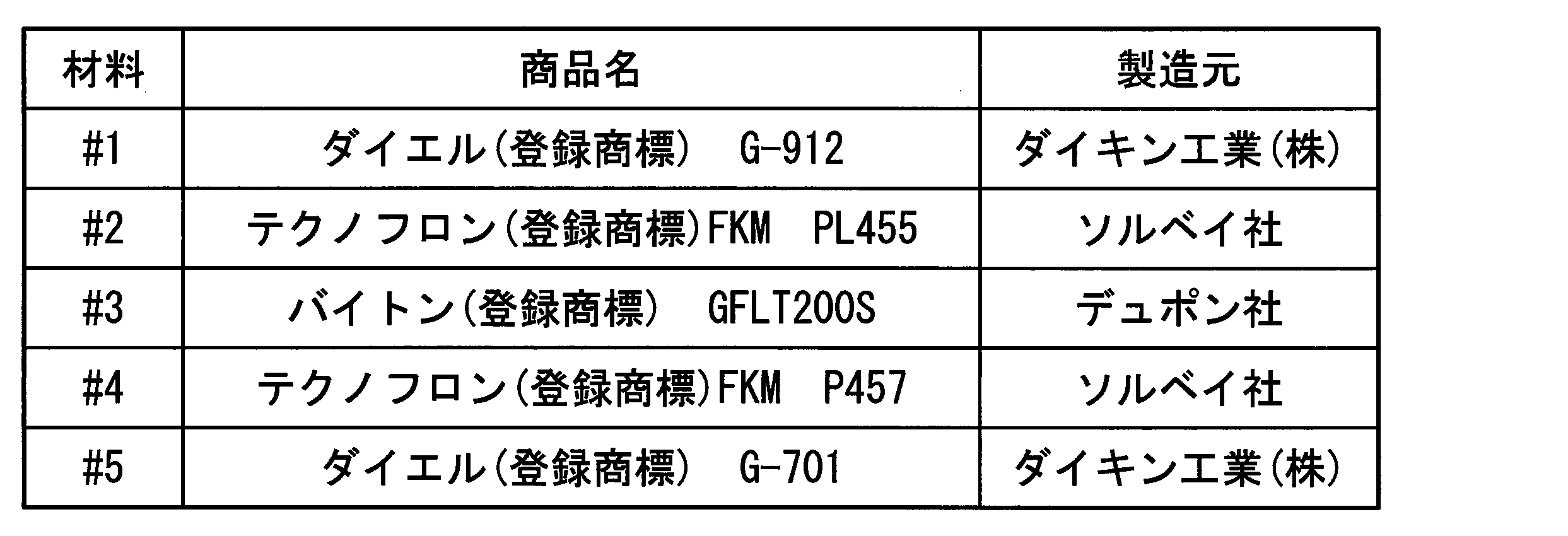
[表2]に示すように、材料#1としては、ダイエル(登録商標)G-912(商品名;ダイキン工業(株)製)が使用された。
材料#1は、ビニリデンフルオロライド(VDF)、テトラフルオロエチレン(TFE)、ヘキサフルオロプロピレン(HFP)を単量体とする三元共重合体からなるフッ素ゴムである。HFPは、側鎖として、-CF3基を有している。
材料#1は、ビニリデンフルオロライド(VDF)、テトラフルオロエチレン(TFE)、ヘキサフルオロプロピレン(HFP)を単量体とする三元共重合体からなるフッ素ゴムである。HFPは、側鎖として、-CF3基を有している。
材料#2としては、テクノフロン(登録商標)FKM PL455(商品名;ソルベイ社製)が使用された。
材料#2は、VDF、TFE、パーフルオロアルキルビニルエーテル(PAVE)を単量体とする三元共重合体からなるフッ素ゴムである。PAVEは、側鎖として、パーフルオロアルキルエーテル基を有している。
材料#2は、VDF、TFE、パーフルオロアルキルビニルエーテル(PAVE)を単量体とする三元共重合体からなるフッ素ゴムである。PAVEは、側鎖として、パーフルオロアルキルエーテル基を有している。
材料#3には、バイトン(登録商標) GFLT200S(商品名;デュポン社製)が使用された。
材料#3は、VDF、TFE、パーフルオロメチルビニルエーテル(PMVE)を単量体とする三元共重合体からなるフッ素ゴムである。PMVEは、側鎖として、-O-CF3基を有している。
材料#3は、VDF、TFE、パーフルオロメチルビニルエーテル(PMVE)を単量体とする三元共重合体からなるフッ素ゴムである。PMVEは、側鎖として、-O-CF3基を有している。
材料#4としては、テクノフロン(登録商標)FKM P457(商品名;ソルベイ社製)が使用された。
材料#4は、VDF、TFE、HFPを単量体とする三元共重合体からなるフッ素ゴムである。
材料#4は、VDF、TFE、HFPを単量体とする三元共重合体からなるフッ素ゴムである。
材料#5としては、ダイエル(登録商標)G-912(商品名;ダイキン工業(株)製)が使用された。
材料#5は、ビニリデンフルオロライド(VDF)、ヘキサフルオロプロピレン(HFP)を単量体とする二元共重合体からなるフッ素ゴムである。
材料#5は、ビニリデンフルオロライド(VDF)、ヘキサフルオロプロピレン(HFP)を単量体とする二元共重合体からなるフッ素ゴムである。
[実施例1]
上記[表1]に示すように、実施例1の医療機器用エラストマー材料は、
主剤1(#1) 50重量部
主剤2(#2) 50重量部
架橋剤 2.0重量部
からなる。
架橋剤としては、有機過酸化物として、2,5-ジメチル-2,5-ビス(tert-ブチルパーオキシ)ヘキサンが用いられた。具体的には、パーヘキサ(登録商標)25B(商品名;日油(株)製)が使用された。
実施例1には、架橋助剤、充填剤、可塑剤は含有されていない。
上記[表1]に示すように、実施例1の医療機器用エラストマー材料は、
主剤1(#1) 50重量部
主剤2(#2) 50重量部
架橋剤 2.0重量部
からなる。
架橋剤としては、有機過酸化物として、2,5-ジメチル-2,5-ビス(tert-ブチルパーオキシ)ヘキサンが用いられた。具体的には、パーヘキサ(登録商標)25B(商品名;日油(株)製)が使用された。
実施例1には、架橋助剤、充填剤、可塑剤は含有されていない。
[実施例2]
実施例2の医療機器用エラストマー材料は、主剤2として材料#2に代えて、同重量部の材料#3が用いられた点が実施例1と異なる。
実施例2の医療機器用エラストマー材料は、主剤2として材料#2に代えて、同重量部の材料#3が用いられた点が実施例1と異なる。
[実施例3]
実施例3の医療機器用エラストマー材料は、6.0重量部の架橋助剤が含有された点が実施例1と異なる。
架橋助剤としては、トリアリルイソシアヌレートが用いられた。トリアリルイソシアヌレートの具体的な材料としては、TAIC(登録商標)(商品名;日本化成(株)製)が使用された。
実施例3の医療機器用エラストマー材料は、6.0重量部の架橋助剤が含有された点が実施例1と異なる。
架橋助剤としては、トリアリルイソシアヌレートが用いられた。トリアリルイソシアヌレートの具体的な材料としては、TAIC(登録商標)(商品名;日本化成(株)製)が使用された。
[実施例4]
実施例4の医療機器用エラストマー材料は、実施例3と同様の6.0重量部の架橋助剤の他に、30重量部の充填剤が含有された点が実施例1と異なる。
充填剤としては、シリカが用いられた。シリカの具体的な材料としては、ミニシール#5(商品名;U.S.シリカ社製)が使用された。
実施例4の医療機器用エラストマー材料は、実施例3と同様の6.0重量部の架橋助剤の他に、30重量部の充填剤が含有された点が実施例1と異なる。
充填剤としては、シリカが用いられた。シリカの具体的な材料としては、ミニシール#5(商品名;U.S.シリカ社製)が使用された。
[実施例5]
実施例5の医療機器用エラストマー材料は、実施例3と同様の6.0重量部の架橋助剤および実施例4と同様の30重量部の充填剤の他に、30重量部の可塑剤が含有された点が実施例1と異なる。
可塑剤としては、数平均分子量が5000以下であって、架橋反応基を有しない第3のフッ素系エラストマーが用いられた。
第3のフッ素系エラストマーの具体的な材料としては、液状ゴムであるダイエル(登録商標)G-101(商品名;ダイキン工業(株)製)が使用された。
ダイエル(登録商標)G-101の数平均分子量は3000である。
実施例5の医療機器用エラストマー材料は、実施例3と同様の6.0重量部の架橋助剤および実施例4と同様の30重量部の充填剤の他に、30重量部の可塑剤が含有された点が実施例1と異なる。
可塑剤としては、数平均分子量が5000以下であって、架橋反応基を有しない第3のフッ素系エラストマーが用いられた。
第3のフッ素系エラストマーの具体的な材料としては、液状ゴムであるダイエル(登録商標)G-101(商品名;ダイキン工業(株)製)が使用された。
ダイエル(登録商標)G-101の数平均分子量は3000である。
[比較例1~4]
上記[表1]に示すように、比較例1~4は、実施例1の主剤が変更された例である。
比較例1では、主剤2として、材料#2に代えて、材料#4が用いられた。材料#1、#4は、単量体C、DがいずれもHFPであるため、単量体C、Dが互いに異なる側鎖構造を有しない例になっている。
比較例2では、主剤2として、材料#2に代えて、二元共重合体である材料#5が用いられた。
比較例3では、主剤として、実施例1で主剤1として用いられた材料#1が100重量部用いられた。比較例3は、主剤が一種類のフッ素系エラストマーの場合の例になっている。
比較例4では、主剤として、実施例1で主剤2として用いられた材料#2が100重量部用いられた。比較例4は、主剤が一種類のフッ素系エラストマーの場合の例になっている。
上記[表1]に示すように、比較例1~4は、実施例1の主剤が変更された例である。
比較例1では、主剤2として、材料#2に代えて、材料#4が用いられた。材料#1、#4は、単量体C、DがいずれもHFPであるため、単量体C、Dが互いに異なる側鎖構造を有しない例になっている。
比較例2では、主剤2として、材料#2に代えて、二元共重合体である材料#5が用いられた。
比較例3では、主剤として、実施例1で主剤1として用いられた材料#1が100重量部用いられた。比較例3は、主剤が一種類のフッ素系エラストマーの場合の例になっている。
比較例4では、主剤として、実施例1で主剤2として用いられた材料#2が100重量部用いられた。比較例4は、主剤が一種類のフッ素系エラストマーの場合の例になっている。
[比較例5]
上記[表1]に示すように、比較例5は、実施例5の可塑剤の含有量が変更された例である。
比較例5は、可塑剤の含有量を30重量部から51重量部に変更した点が実施例5と異なる。
上記[表1]に示すように、比較例5は、実施例5の可塑剤の含有量が変更された例である。
比較例5は、可塑剤の含有量を30重量部から51重量部に変更した点が実施例5と異なる。
実施例1の医療機器用エラストマー材料は、上述の各材料が上述の配合量となるように計量されてからオープンロールで混練されて、コンパウンドとされた。コンパウンドは、実施例1の医療機器用エラストマー成形体の成形原料として用いられた。
実施例1の医療機器用エラストマー材料の評価を行うため、実施例1の医療機器用エラストマー材料のコンパウンドがトランスファー成形された。これにより実施例1の医療機器用エラストマー成形体が得られた。
成形型としては、外径が12mm、肉厚が0.5mm、長さ15mmのチューブ状の成形体を形成するための成形型が用いられた。
具体的には、コンパウンドが成形型に充填され、160℃で10分間の架橋成形が実施された。この後、180℃のオーブン中で4時間の二次架橋が行われた。
これにより、外径が12mm、肉厚が0.5mm、長さ15mmのチューブ状の医療機器用エラストマー成形体が得られた。医療機器用エラストマー成形体は、後述する評価に用いられた。
実施例2~5、比較例1~5の医療機器用エラストマー材料も、実施例1と同様にして成形された。これにより、実施例2~5、比較例1~5の医療機器用エラストマー成形体が得られた。
医療機器用エラストマー成形体における組成は、医療機器用エラストマー成形体に残存する主剤、架橋助剤、充填剤、および可塑剤に関しては、主剤の合計含有量を100重量部としたとき、医療機器用エラストマー材料における含有量と同じになる。
成形型としては、外径が12mm、肉厚が0.5mm、長さ15mmのチューブ状の成形体を形成するための成形型が用いられた。
具体的には、コンパウンドが成形型に充填され、160℃で10分間の架橋成形が実施された。この後、180℃のオーブン中で4時間の二次架橋が行われた。
これにより、外径が12mm、肉厚が0.5mm、長さ15mmのチューブ状の医療機器用エラストマー成形体が得られた。医療機器用エラストマー成形体は、後述する評価に用いられた。
実施例2~5、比較例1~5の医療機器用エラストマー材料も、実施例1と同様にして成形された。これにより、実施例2~5、比較例1~5の医療機器用エラストマー成形体が得られた。
医療機器用エラストマー成形体における組成は、医療機器用エラストマー成形体に残存する主剤、架橋助剤、充填剤、および可塑剤に関しては、主剤の合計含有量を100重量部としたとき、医療機器用エラストマー材料における含有量と同じになる。
[評価]
上記各実施例、各比較例の医療機器用エラストマー材料の評価は、上記のチューブ形状の医療機器用エラストマー成形体を用いて行われた。
下記[表3]に、評価項目と、評価結果を示す。
上記各実施例、各比較例の医療機器用エラストマー材料の評価は、上記のチューブ形状の医療機器用エラストマー成形体を用いて行われた。
下記[表3]に、評価項目と、評価結果を示す。
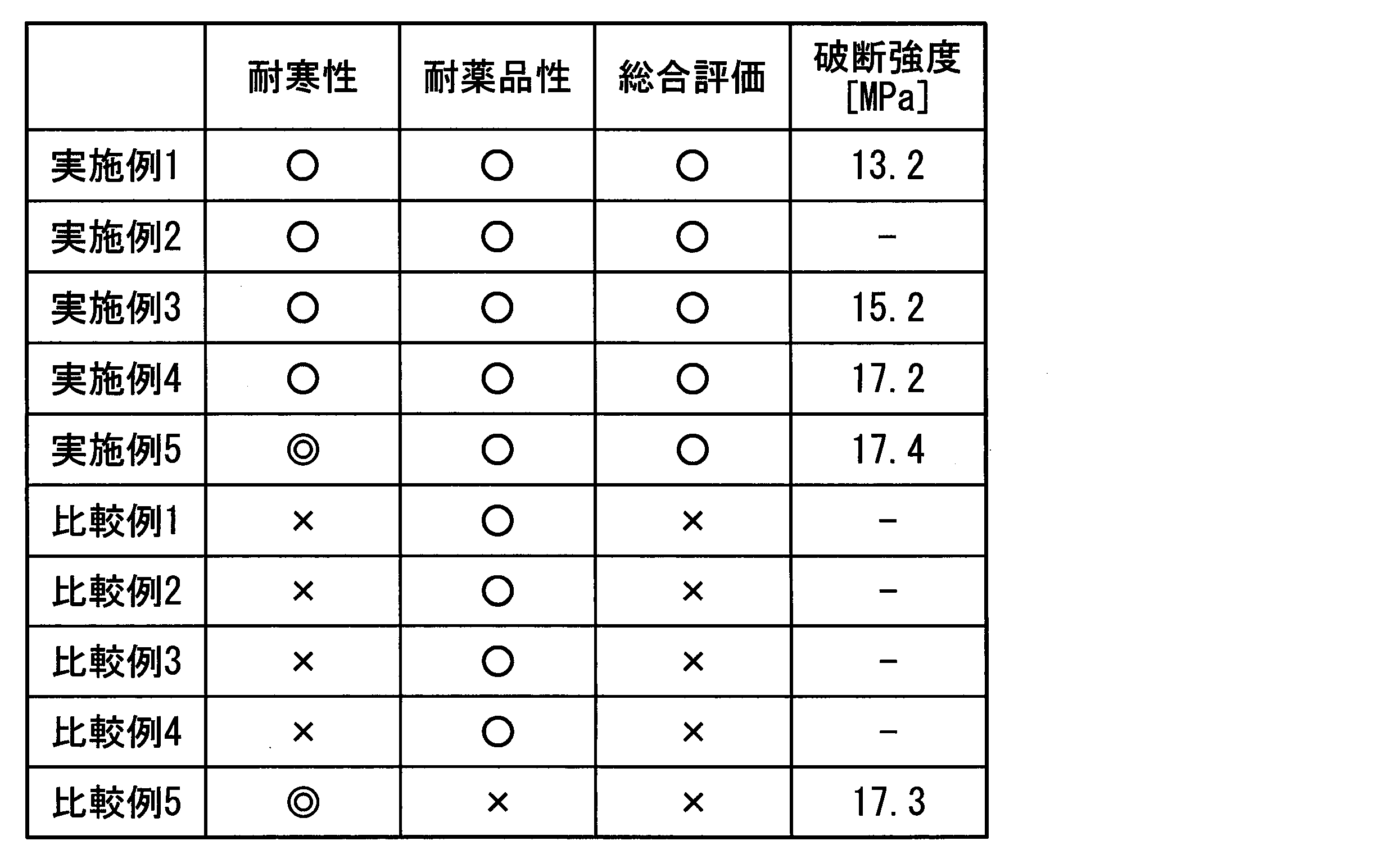
[表3]に示すように、実施例1~5、比較例1~5に関して、耐寒性および耐薬品性の評価が行われた。
さらに、各添加物の影響を調べるため、[表3]に示すように、主剤1、2が共通である実施例1、3~5、比較例5における破断強度が測定された。
さらに、各添加物の影響を調べるため、[表3]に示すように、主剤1、2が共通である実施例1、3~5、比較例5における破断強度が測定された。
[評価方法]
耐寒性の評価は、ガラス転移温度(Tg)を指標として行われた。Tgが低いほど、ゴム状態である温度領域が低温側に広がるため、エラストマー材料として耐寒性に優れる。
耐寒性の評価は、Tgが-40℃未満の場合は非常に良い([表3]では「◎」(very good)で表す)、Tgが-40℃以上-20℃未満の場合は良い([表3]では「○」(good)で表す)、Tgが-20℃以上の場合は不良([表3]では「×」(no good)で表す)とした。
耐薬品性の評価は、医療機器用エラストマー成形体が53℃に加温された3.7%過酢酸水溶液に30日間浸漬された後、医療機器用エラストマー成形体の亀裂の発生度合いを目視することにより行われた。亀裂の発生が無い場合は良い([表3]では「○」(good)で表す)、亀裂の発生が有る場合は不良([表3]では「×」(no good)で表す)とした。
総合評価は、耐寒性および耐薬品性の少なくとも一方の評価が「×」の場合に不良([表3]では「×」(no good)、それ以外は、良い([表3]では「○」(good)で表す)とした。
耐寒性の評価は、ガラス転移温度(Tg)を指標として行われた。Tgが低いほど、ゴム状態である温度領域が低温側に広がるため、エラストマー材料として耐寒性に優れる。
耐寒性の評価は、Tgが-40℃未満の場合は非常に良い([表3]では「◎」(very good)で表す)、Tgが-40℃以上-20℃未満の場合は良い([表3]では「○」(good)で表す)、Tgが-20℃以上の場合は不良([表3]では「×」(no good)で表す)とした。
耐薬品性の評価は、医療機器用エラストマー成形体が53℃に加温された3.7%過酢酸水溶液に30日間浸漬された後、医療機器用エラストマー成形体の亀裂の発生度合いを目視することにより行われた。亀裂の発生が無い場合は良い([表3]では「○」(good)で表す)、亀裂の発生が有る場合は不良([表3]では「×」(no good)で表す)とした。
総合評価は、耐寒性および耐薬品性の少なくとも一方の評価が「×」の場合に不良([表3]では「×」(no good)、それ以外は、良い([表3]では「○」(good)で表す)とした。
破断強度は、JIS K6251に準拠した引張試験によって測定された。引張試験に用いるために、医療機器用エラストマー材料によって、JIS K6251に準拠した引張試験片が成形された。
医療機器用エラストマー成形体の破断強度は、13MPa以上であれば特に問題はないと言える。
医療機器用エラストマー成形体の破断強度は、13MPa以上であれば特に問題はないと言える。
[評価結果]
上記[表3]に記載の評価結果から分かるように、実施例1~4は、耐寒性および耐薬品性が良いと判定された。特に実施例5は、耐寒性が非常に良い、耐薬品性が良いと判定された。このため、実施例1~5の総合評価は良いと判定された。
これに対して、主剤1、2の側鎖構造が同一の比較例1と、主剤2が二元共重合体からなる比較例2とは、耐寒性が不良と判定されため、総合評価も不良であった。
主剤が側鎖構造を有していても、1種類の主剤からなる比較例3、4は、耐寒性が不良であったため、総合評価は不良であった。
可塑剤の含有量が51重量部の比較例5は、実施例5と同様、耐寒性は、非常に良いと判定されたが、耐薬品性が不良であったため、総合評価は不良であった。これは、添加された可塑剤が架橋反応基を有しないため、50重量部以上含有されたことで架橋反応が阻害されたからであると考えられる。架橋反応が阻害されことにより、成形体の架橋密度が低下して耐薬品性が低下したと考えられる。
上記[表3]に記載の評価結果から分かるように、実施例1~4は、耐寒性および耐薬品性が良いと判定された。特に実施例5は、耐寒性が非常に良い、耐薬品性が良いと判定された。このため、実施例1~5の総合評価は良いと判定された。
これに対して、主剤1、2の側鎖構造が同一の比較例1と、主剤2が二元共重合体からなる比較例2とは、耐寒性が不良と判定されため、総合評価も不良であった。
主剤が側鎖構造を有していても、1種類の主剤からなる比較例3、4は、耐寒性が不良であったため、総合評価は不良であった。
可塑剤の含有量が51重量部の比較例5は、実施例5と同様、耐寒性は、非常に良いと判定されたが、耐薬品性が不良であったため、総合評価は不良であった。これは、添加された可塑剤が架橋反応基を有しないため、50重量部以上含有されたことで架橋反応が阻害されたからであると考えられる。架橋反応が阻害されことにより、成形体の架橋密度が低下して耐薬品性が低下したと考えられる。
以上、本発明の好ましい実施形態、各実施例を説明したが、本発明はこのような実施形態、各実施例に限定されることはない。本発明の趣旨を逸脱しない範囲で、構成の付加、省略、置換、およびその他の変更が可能である。
また、本発明は前述した説明によって限定されることはなく、添付の特許請求の範囲によってのみ限定される。
また、本発明は前述した説明によって限定されることはなく、添付の特許請求の範囲によってのみ限定される。
上記実施形態によれば、医療機器用エラストマー成形体の耐寒性を向上することができる医療機器用エラストマー材料および医療機器用エラストマー成形体を提供できる。
Claims (8)
- 三種類の単量体A、B、Cを有する三元共重合体である第1のフッ素系エラストマーと、
前記単量体A、Bと、前記単量体A、B、Cのいずれとも異なる単量体Dと、を有する三元共重合体である第2のフッ素系エラストマーと、
を含み、
前記単量体Cと前記単量体Dとは、互いに異なる構造の側鎖を有している、
医療機器用エラストマー材料。 - 前記第1のフッ素系エラストマーおよび前記第2のフッ素系エラストマーの合計含有量を100重量部としたとき、
架橋助剤が15重量部以下含まれる、
請求項1に記載の医療機器用エラストマー材料。 - 前記第1のフッ素系エラストマーおよび前記第2のフッ素系エラストマーの合計含有量を100重量部としたとき、
充填剤が50重量部以下含まれる、
請求項1または2に記載の医療機器用エラストマー材料。 - 前記第1のフッ素系エラストマーおよび前記第2のフッ素系エラストマーの合計含有量を100重量部としたとき、
数平均分子量が5000以下であって、架橋反応基を有しない第3のフッ素系エラストマーが50重量部以下含まれる、
請求項1~3のいずれか1項に記載の医療機器用エラストマー材料。 - 三種類の単量体A、B、Cを有する三元共重合体である第1のフッ素系エラストマーと、
前記単量体A、Bと、前記単量体A、B、Cのいずれとも異なる単量体Dと、を有する三元共重合体である第2のフッ素系エラストマーと、
を含み、
前記単量体Cと前記単量体Dとは、互いに異なる構造の側鎖を有している、
医療機器用エラストマー成形体。 - 前記第1のフッ素系エラストマーおよび前記第2のフッ素系エラストマーの合計含有量を100重量部としたとき、
架橋助剤が15重量部以下含まれる、
請求項5に記載の医療機器用エラストマー成形体。 - 前記第1のフッ素系エラストマーおよび前記第2のフッ素系エラストマーの合計含有量を100重量部としたとき、
充填剤が50重量部以下含まれる、
請求項5または6に記載の医療機器用エラストマー成形体。 - 前記第1のフッ素系エラストマーおよび前記第2のフッ素系エラストマーの合計含有量を100重量部としたとき、
数平均分子量が5000以下であって、架橋反応基を有しない第3のフッ素系エラストマーが50重量部以下含まれる、
請求項5~7のいずれか1項に記載の医療機器用エラストマー成形体。
Priority Applications (3)
| Application Number | Priority Date | Filing Date | Title |
|---|---|---|---|
| DE112017001271.6T DE112017001271T5 (de) | 2016-03-11 | 2017-02-09 | Elastomermaterial für medizinische Vorrichtungen und gegossener Elastomerkörper für medizinische Vorrichtungen |
| CN201780015403.5A CN108779311A (zh) | 2016-03-11 | 2017-02-09 | 医疗设备用弹性体材料和医疗设备用弹性体成型体 |
| US16/124,087 US20190002682A1 (en) | 2016-03-11 | 2018-09-06 | Elastomer material for medical devices and elastomer molded body for medical devices |
Applications Claiming Priority (2)
| Application Number | Priority Date | Filing Date | Title |
|---|---|---|---|
| JP2016-048672 | 2016-03-11 | ||
| JP2016048672A JP2017160394A (ja) | 2016-03-11 | 2016-03-11 | 医療機器用エラストマー材料および医療機器用エラストマー成形体 |
Related Child Applications (1)
| Application Number | Title | Priority Date | Filing Date |
|---|---|---|---|
| US16/124,087 Continuation US20190002682A1 (en) | 2016-03-11 | 2018-09-06 | Elastomer material for medical devices and elastomer molded body for medical devices |
Publications (1)
| Publication Number | Publication Date |
|---|---|
| WO2017154452A1 true WO2017154452A1 (ja) | 2017-09-14 |
Family
ID=59789352
Family Applications (1)
| Application Number | Title | Priority Date | Filing Date |
|---|---|---|---|
| PCT/JP2017/004737 Ceased WO2017154452A1 (ja) | 2016-03-11 | 2017-02-09 | 医療機器用エラストマー材料および医療機器用エラストマー成形体 |
Country Status (5)
| Country | Link |
|---|---|
| US (1) | US20190002682A1 (ja) |
| JP (1) | JP2017160394A (ja) |
| CN (1) | CN108779311A (ja) |
| DE (1) | DE112017001271T5 (ja) |
| WO (1) | WO2017154452A1 (ja) |
Families Citing this family (1)
| Publication number | Priority date | Publication date | Assignee | Title |
|---|---|---|---|---|
| WO2020116394A1 (ja) * | 2018-12-04 | 2020-06-11 | 株式会社バルカー | エラストマー組成物及びシール材 |
Citations (4)
| Publication number | Priority date | Publication date | Assignee | Title |
|---|---|---|---|---|
| JPS6389138A (ja) * | 1986-10-03 | 1988-04-20 | オリンパス光学工業株式会社 | 内視鏡用弯曲管外皮 |
| JP2002138181A (ja) * | 2000-11-06 | 2002-05-14 | Nok Corp | フッ素ゴムブレンド物 |
| JP2005245517A (ja) * | 2004-03-01 | 2005-09-15 | Olympus Corp | 内視鏡用エラストマー成形体 |
| WO2009116451A1 (ja) * | 2008-03-18 | 2009-09-24 | 日本バルカー工業株式会社 | 耐クラック性シール材を形成可能なフッ素ゴム組成物および該組成物から得られる耐クラック性シール材 |
Family Cites Families (4)
| Publication number | Priority date | Publication date | Assignee | Title |
|---|---|---|---|---|
| JPH05300938A (ja) | 1992-04-24 | 1993-11-16 | Kyoritsu Sangyo Kk | 内視鏡の湾曲部用ゴムチューブ |
| JP4950361B2 (ja) * | 2010-04-08 | 2012-06-13 | オリンパスメディカルシステムズ株式会社 | 内視鏡および内視鏡用エラストマー成形体 |
| CN103739766B (zh) * | 2013-12-30 | 2016-01-13 | 山东华夏神舟新材料有限公司 | 具有良好加工性能和高拉伸强度的挤出用氟橡胶的生产方法 |
| JP6436306B2 (ja) | 2014-08-25 | 2018-12-12 | パナソニックIpマネジメント株式会社 | 塗膜物の製造装置、及びこれを用いた塗膜物の製造方法 |
-
2016
- 2016-03-11 JP JP2016048672A patent/JP2017160394A/ja active Pending
-
2017
- 2017-02-09 WO PCT/JP2017/004737 patent/WO2017154452A1/ja not_active Ceased
- 2017-02-09 CN CN201780015403.5A patent/CN108779311A/zh active Pending
- 2017-02-09 DE DE112017001271.6T patent/DE112017001271T5/de not_active Withdrawn
-
2018
- 2018-09-06 US US16/124,087 patent/US20190002682A1/en not_active Abandoned
Patent Citations (4)
| Publication number | Priority date | Publication date | Assignee | Title |
|---|---|---|---|---|
| JPS6389138A (ja) * | 1986-10-03 | 1988-04-20 | オリンパス光学工業株式会社 | 内視鏡用弯曲管外皮 |
| JP2002138181A (ja) * | 2000-11-06 | 2002-05-14 | Nok Corp | フッ素ゴムブレンド物 |
| JP2005245517A (ja) * | 2004-03-01 | 2005-09-15 | Olympus Corp | 内視鏡用エラストマー成形体 |
| WO2009116451A1 (ja) * | 2008-03-18 | 2009-09-24 | 日本バルカー工業株式会社 | 耐クラック性シール材を形成可能なフッ素ゴム組成物および該組成物から得られる耐クラック性シール材 |
Also Published As
| Publication number | Publication date |
|---|---|
| JP2017160394A (ja) | 2017-09-14 |
| US20190002682A1 (en) | 2019-01-03 |
| CN108779311A (zh) | 2018-11-09 |
| DE112017001271T5 (de) | 2018-11-29 |
Similar Documents
| Publication | Publication Date | Title |
|---|---|---|
| JP6134391B2 (ja) | シール材及びその製造方法 | |
| JP6620132B2 (ja) | シール材及びその製造方法 | |
| TWI718147B (zh) | 熱塑性氟樹脂組合物、及交聯體之製造方法 | |
| TWI731978B (zh) | 全氟彈性體組合物及密封材 | |
| CN107001751B (zh) | 氟橡胶组合物及氟橡胶交联物品 | |
| US11274199B2 (en) | Perfluoroelastomer composition and sealing material | |
| JP7562465B2 (ja) | ゴム製品及びその製造方法 | |
| JP2004250520A (ja) | フッ素ゴム組成物 | |
| WO2015098339A1 (ja) | 架橋ゴム成形体の製造方法 | |
| JP2005239835A (ja) | 架橋性フッ素ゴム組成物 | |
| WO2017154452A1 (ja) | 医療機器用エラストマー材料および医療機器用エラストマー成形体 | |
| TWI731977B (zh) | 全氟彈性體組合物及密封材 | |
| JP4381087B2 (ja) | フッ素ゴムシール材の製造方法 | |
| JP2019065307A (ja) | シール材及びその製造方法 | |
| US11452799B2 (en) | Elastomer molded body for medical device, method of manufacturing of elastomer molded body for medical device, and medical device | |
| JP2017165841A (ja) | 医療機器用部材の材料および医療機器用部材の製造方法 | |
| JPH04255746A (ja) | 加硫性ゴム組成物 | |
| JP7144415B2 (ja) | フッ素ゴム組成物およびフッ素ゴム成形品 | |
| EP3172252B1 (en) | Perfluoroelastomer composition |
Legal Events
| Date | Code | Title | Description |
|---|---|---|---|
| 121 | Ep: the epo has been informed by wipo that ep was designated in this application |
Ref document number: 17762796 Country of ref document: EP Kind code of ref document: A1 |
|
| 122 | Ep: pct application non-entry in european phase |
Ref document number: 17762796 Country of ref document: EP Kind code of ref document: A1 |