WO2017150506A1 - リチウム二次電池用正極活物質 - Google Patents
リチウム二次電池用正極活物質 Download PDFInfo
- Publication number
- WO2017150506A1 WO2017150506A1 PCT/JP2017/007701 JP2017007701W WO2017150506A1 WO 2017150506 A1 WO2017150506 A1 WO 2017150506A1 JP 2017007701 W JP2017007701 W JP 2017007701W WO 2017150506 A1 WO2017150506 A1 WO 2017150506A1
- Authority
- WO
- WIPO (PCT)
- Prior art keywords
- lithium
- positive electrode
- electrode active
- composite oxide
- active material
- Prior art date
- Legal status (The legal status is an assumption and is not a legal conclusion. Google has not performed a legal analysis and makes no representation as to the accuracy of the status listed.)
- Ceased
Links
Classifications
-
- C—CHEMISTRY; METALLURGY
- C01—INORGANIC CHEMISTRY
- C01G—COMPOUNDS CONTAINING METALS NOT COVERED BY SUBCLASSES C01D OR C01F
- C01G53/00—Compounds of nickel
-
- H—ELECTRICITY
- H01—ELECTRIC ELEMENTS
- H01M—PROCESSES OR MEANS, e.g. BATTERIES, FOR THE DIRECT CONVERSION OF CHEMICAL ENERGY INTO ELECTRICAL ENERGY
- H01M4/00—Electrodes
- H01M4/02—Electrodes composed of, or comprising, active material
- H01M4/36—Selection of substances as active materials, active masses, active liquids
-
- H—ELECTRICITY
- H01—ELECTRIC ELEMENTS
- H01M—PROCESSES OR MEANS, e.g. BATTERIES, FOR THE DIRECT CONVERSION OF CHEMICAL ENERGY INTO ELECTRICAL ENERGY
- H01M4/00—Electrodes
- H01M4/02—Electrodes composed of, or comprising, active material
- H01M4/36—Selection of substances as active materials, active masses, active liquids
- H01M4/48—Selection of substances as active materials, active masses, active liquids of inorganic oxides or hydroxides
- H01M4/50—Selection of substances as active materials, active masses, active liquids of inorganic oxides or hydroxides of manganese
- H01M4/505—Selection of substances as active materials, active masses, active liquids of inorganic oxides or hydroxides of manganese of mixed oxides or hydroxides containing manganese for inserting or intercalating light metals, e.g. LiMn2O4 or LiMn2OxFy
-
- H—ELECTRICITY
- H01—ELECTRIC ELEMENTS
- H01M—PROCESSES OR MEANS, e.g. BATTERIES, FOR THE DIRECT CONVERSION OF CHEMICAL ENERGY INTO ELECTRICAL ENERGY
- H01M4/00—Electrodes
- H01M4/02—Electrodes composed of, or comprising, active material
- H01M4/36—Selection of substances as active materials, active masses, active liquids
- H01M4/48—Selection of substances as active materials, active masses, active liquids of inorganic oxides or hydroxides
- H01M4/52—Selection of substances as active materials, active masses, active liquids of inorganic oxides or hydroxides of nickel, cobalt or iron
- H01M4/525—Selection of substances as active materials, active masses, active liquids of inorganic oxides or hydroxides of nickel, cobalt or iron of mixed oxides or hydroxides containing iron, cobalt or nickel for inserting or intercalating light metals, e.g. LiNiO2, LiCoO2 or LiCoOxFy
-
- Y—GENERAL TAGGING OF NEW TECHNOLOGICAL DEVELOPMENTS; GENERAL TAGGING OF CROSS-SECTIONAL TECHNOLOGIES SPANNING OVER SEVERAL SECTIONS OF THE IPC; TECHNICAL SUBJECTS COVERED BY FORMER USPC CROSS-REFERENCE ART COLLECTIONS [XRACs] AND DIGESTS
- Y02—TECHNOLOGIES OR APPLICATIONS FOR MITIGATION OR ADAPTATION AGAINST CLIMATE CHANGE
- Y02E—REDUCTION OF GREENHOUSE GAS [GHG] EMISSIONS, RELATED TO ENERGY GENERATION, TRANSMISSION OR DISTRIBUTION
- Y02E60/00—Enabling technologies; Technologies with a potential or indirect contribution to GHG emissions mitigation
- Y02E60/10—Energy storage using batteries
Definitions
- the present invention relates to a positive electrode active material for a lithium secondary battery that can be used as a positive electrode active material for a lithium secondary battery.
- Lithium batteries especially lithium secondary batteries, have features such as high energy density and long life, so they can be used for home appliances such as video cameras, portable electronic devices such as notebook computers and mobile phones. Used as a power source. Recently, the lithium secondary battery is also applied to a large battery mounted on an electric vehicle (EV), a hybrid electric vehicle (HEV), or the like.
- EV electric vehicle
- HEV hybrid electric vehicle
- a lithium secondary battery is a secondary battery with a structure in which lithium is melted as ions from the positive electrode during charging, moves to the negative electrode and is stored, and reversely, lithium ions return from the negative electrode to the positive electrode during discharging. It is known to be caused by the potential of the positive electrode material.
- lithium manganese oxide (LiMn 2 O 4 ) having a spinel structure and lithium metal composite oxides such as LiCoO 2 , LiNiO 2 and LiMnO 2 having a layered crystal structure are known. It has been.
- LiCoO 2 has a layered crystal structure in which lithium atom layers and cobalt atom layers are alternately stacked via oxygen atom layers, has a large charge / discharge capacity, and is excellent in diffusibility of lithium ion storage / desorption. Therefore, many of the commercially available lithium secondary batteries employ a lithium metal composite oxide having a layered crystal structure such as LiCoO 2 as a positive electrode active material.
- lithium metal composite oxide having such a layered crystal structure When a lithium metal composite oxide having such a layered crystal structure is used as a positive electrode active material for a lithium secondary battery, the lithium metal composite oxide and the electrolyte solution chemically react, particularly when charged and discharged at high temperatures. However, since the reactants change on the surface of the positive electrode active material, the battery capacity and life characteristics are deteriorated.
- Patent Document 1 Japanese Patent Laid-Open No. 2001-291518
- the surface of a lithium metal composite oxide having a layered crystal structure is composed of Mg, Al, Co, K, Na, Ca, Si, Ti, and V.
- a positive electrode active material for a lithium secondary battery comprising a metal oxide or composite metal oxide layer selected from the group is disclosed.
- Patent Document 2 Japanese Patent Laid-Open No. 2005-310744
- a lithium metal composite oxide particle powder having a layered crystal structure is dispersed in an isopropyl alcohol solution and stirred, followed by heat treatment at 600 ° C.
- a positive electrode active material having a particle surface coated with aluminum is disclosed.
- Patent Document 3 Japanese Patent Laid-Open No. 2005-322616
- a lithium metal composite oxide having a layered crystal structure and powdered metal aluminum are added to water to form a slurry, and further stirred to dissolve the metal aluminum.
- a lithium-containing composite oxide in which the surface of the composite oxide obtained by drying at 80 ° C. is covered with a layer containing aluminum hydroxide, aluminum oxide and lithium carbonate is disclosed.
- Patent Document 4 Japanese Patent Application Laid-Open No. 2005-346955 is obtained by adding aluminum stearate to a lithium metal composite oxide having a layered crystal structure, mixing and crushing with a ball mill, and heat-treating at 600 ° C. A lithium-containing composite oxide in which an aluminum compound is modified on the particle surface is disclosed.
- Patent Document 5 discloses a positive electrode active in which lithium metal composite oxide particles having a layered crystal structure are subjected to surface modification in which a specific surface region contains a relatively high specific concentration of aluminum. Lithium metal composite oxide particles having a layered crystal structure as a substance, the surface layer containing aluminum, and the aluminum content within 5 nm of the surface layer is atomic ratio relative to the total of Ni and element M A positive electrode active material for a non-aqueous electrolyte secondary battery, characterized by comprising surface-modified lithium-containing composite oxide particles of 0.8 or more is disclosed.
- Patent Document 6 Japanese Patent Application Laid-Open No. 2008-153017 discloses a layered crystal from the viewpoint of using as a positive electrode active material coated with a lithium composite oxide surface having a specific composition and a specific particle size and particle size distribution.
- a lithium metal composite oxide having a structure having an average particle size D50 of 3 to 15 ⁇ m, a minimum particle size of 0.5 ⁇ m or more, a maximum particle size of 50 ⁇ m or less, and D10 / D50 of 0
- a substance (A is Ti, Sn, Mg, A) on the surface of the lithium composite oxide for a non-aqueous electrolyte secondary battery composed of particles having a particle diameter of .60 to 0.90 and D10 / D90 of 0.30 to 0.70.
- a positive electrode active material for a non-aqueous electrolyte secondary battery characterized by having a structure coated with a compound comprising at least one element selected from the group consisting of Zr, Al, Nb and Zn) That.
- Patent Document 7 (WO2012 / 057289) includes Li element and at least one transition metal element selected from the group consisting of Ni, Co, and Mn (provided that the molar amount of Li element is the transition metal). More than 1.2 times the total molar amount of the elements.) Particles in which oxide (I) of at least one metal element selected from Zr, Ti, and Al is unevenly distributed on the surface of the lithium-containing composite oxide A positive electrode active material for a lithium ion secondary battery comprising (II) is disclosed.
- Non-Patent Document 1 LiMO 2 (M: transition metal) having a layered crystal structure and Li 2 MnO 3
- Patent Document 8 Japanese Patent Laid-Open No. 2008-270201
- a positive electrode material for a lithium ion battery characterized in that an oxidation treatment is applied to the positive electrode material for a lithium ion battery, is disclosed.
- Patent Document 9 Japanese Patent Laid-Open No. 2010-108873
- the main active material is represented by the general formula: xLi 2 MO 3.
- X is a number satisfying 0.4 ⁇ x ⁇ 1.0
- M is one or more elements selected from the group consisting of Mn, Ti and Zr
- A is B, Al, Ga and 1 or more elements selected from the group consisting of In, and 0 ⁇ y ⁇ 0.3 and 0 ⁇ z ⁇ 0.1.
- the lithium manganese metal composite oxide having a layered crystal structure is particularly promising in that it has a high operating potential and can be expected to have a high energy density, and since it is based on Mn, the raw material cost can be reduced. Has been. However, since it operates at a high potential, it has a problem that gas is generated during high temperature storage. In order to solve such a problem, in order to suppress the reaction between the electrolytic solution and the lithium metal composite oxide, a method of coating the particle surface of the lithium manganese metal composite oxide with a metal or metal oxide can be considered. However, when the particle surface of the lithium manganese metal composite oxide is coated with a metal or metal oxide, a new problem arises that the rate characteristics of the battery deteriorate. In addition, the lithium manganese metal composite oxide having a layered crystal structure has a problem that the capacity retention rate during the cycle is low.
- the present invention relates to a positive electrode active material containing a lithium manganese metal composite oxide having a layered crystal structure, and when used as a positive electrode active material of a lithium secondary battery, the reaction with the electrolyte is suppressed and the battery is stored at high temperature.
- a new cathode active material for lithium secondary batteries that can reduce the amount of gas generated at the time, yet achieve the same or better rate characteristics, and further improve cycle characteristics It is something to be done.
- the present invention has the general formula Li 1 + x Mn y M 1-xy O 2 (wherein x> 0.10, y ⁇ 0.40, 1-xy> 0.10, M is Co, Ni , Na, Mg, Al, Si, P, K, Ca, Ti, V, Cr, Fe, Cu, Zn, Ga, Y, Zr, Nb, Mo, In, Ta, W, Re, and Ce
- constitutituent element M a lithium manganese metal composite oxide having a layered crystal structure represented by any one or a combination of two or more thereof
- a positive electrode active material for a lithium secondary battery comprising particles having a surface portion in which any one or a combination of two or more of the group consisting of Zr (referred to as “surface element A”) is present.
- the atomic ratio of Mn and the atomic ratio of M (constituent element M is 2) measured by X-ray photoelectron spectroscopy (XPS) (hereinafter also referred to as “XPS”).
- XPS X-ray photoelectron spectroscopy
- the ratio (A / (Mn + M)) of the atomic ratio (A / (Mn + M)) of the surface element A to the total of the total of the atomic ratio in the case of two or more types is greater than 0.
- the amount of surface lithium impurities is less than 0.80 wt%, and
- XRD powder X-ray diffractometer
- XRD X-Ray Diffractometer
- a (003) plane with respect to an integrated intensity of a peak derived from the (104) plane Proposed is a positive electrode active material for a lithium secondary battery, wherein the ratio (003) / (104) of the integrated intensity of the peak derived from is greater than 0.90.
- the positive electrode active material proposed by the present invention when used as a positive electrode active material for a lithium secondary battery, when used as a positive electrode active material for a lithium secondary battery, the reaction with the electrolyte is suppressed.
- the amount of gas generated during high-temperature storage can be reduced, yet the rate characteristics can be made equal to or higher than that of the conventional positive electrode active material subjected to the surface treatment. Can be improved. Therefore, the positive electrode active material proposed by the present invention is particularly excellent as a positive electrode active material for batteries mounted on a vehicle, in particular, an electric vehicle (EV: Electric Vehicle) or a hybrid electric vehicle (HEV: Hybrid Electric Vehicle). It will be a thing.
- EV Electric Vehicle
- HEV Hybrid Electric Vehicle
- Cathode active material for a lithium secondary battery have the general formula (1): Li 1 + x Mn y M 1-x-y O 2 (wherein, x> 0.10, y ⁇ 0 .40, 1-xy> 0.10, M is Co, Ni, Na, Mg, Al, Si, P, K, Ca, Ti, V, Cr, Fe, Cu, Zn, Ga, Y, Zr, Nb, Mo, In, Ta, W, Re and Ce, any one type or a combination of two or more types (referred to as “constituent element M”))
- On the surface of particles made of lithium manganese metal composite oxide having a crystal structure referred to as “present lithium manganese metal composite oxide particles”
- one or more of the group consisting of Al, Ti and Zr (Hereinafter referred to as “surface element A”) having a surface portion (“
- a positive electrode active material for a lithium secondary battery referred to as “present positive electrode active material”.
- the present positive electrode active material may contain other components in addition to the present particles.
- the present particles preferably occupy 80 wt% or more, particularly 90 wt% or more, and more preferably 95 wt% or more (including 100 wt%).
- the present particle is a particle having a surface portion containing the surface element A on the surface of the present lithium manganese metal composite oxide particle. As long as this particle
- the present lithium manganese metal composite oxide particles have the general formula (1): Li 1 + x Mn y M 1-xy O 2 (wherein x> 0.10, y ⁇ 0.40, 1-xy> 0.10, M is Co, Ni, Na, Mg, Al, Si, P, K, Ca, Ti, V, Cr, Fe, Cu, Zn, Ga, Y, Zr, Nb, Mo, In, Ta Lithium manganese metal composite oxidation having a layered crystal structure represented by any one or a combination of two or more of the group consisting of W, Re, and Ce (referred to as “constituent element M”) It is a particle consisting of things.
- Li 1 + x Mn y M 1-xy O 2 “1 + x” is greater than 1.10 and not greater than 1.40, particularly not less than 1.14 or not greater than 1.30, and among these, 1 .15 or more or 1.25 or less is preferable.
- M in the above formula (1) is Co, Ni, Na, Mg, Al, Si, P, K, Ca, Ti, V, Cr, Fe, Cu, Zn, Ga, Y, Zr, Nb, Any one or a combination of two or more of Mo, In, Ta, W, Re, and Ce may be used.
- “y” indicating the molar ratio of Mn may be y ⁇ 0.40, especially y ⁇ 0.41 or 0.70> y, and especially y ⁇ 0.42 or 0. .65> y, more preferably y ⁇ 0.43 or 0.60 ⁇ y.
- “1-xy” indicating the molar ratio of M may be 1-xy> 0.10, and in particular, 1-xy> 0.15 or 0.50> 1-x- y, more preferably 1-xy ⁇ 0.20 or 0.45> 1-xy.
- the atomic ratio of the oxygen amount is described as “2” for convenience, but may have some non-stoichiometry.
- the present lithium manganese metal composite oxide particles may contain inevitable impurities.
- each element of inevitable impurities may be contained if it is 0.17 wt% or less. This is because an amount of this level is considered to hardly affect the characteristics of the present lithium manganese metal composite oxide particles.
- any one or a combination of two or more of the group consisting of Al, Ti and Zr exists on the surface of the lithium manganese metal composite oxide particles. It is preferable to do this.
- the surface portion described here is characterized in that a portion having a higher concentration of the surface element A than the inside of the particle is provided on the particle surface.
- the thickness of this surface portion is 0.1 nm to 300 nm from the viewpoint of suppressing the reaction with the electrolytic solution to reduce the amount of gas generated during high temperature storage, improving the cycle characteristics, and maintaining or improving the rate characteristics. It is preferably 0.2 nm or more or 220 nm or less, more preferably 0.3 nm or more or 150 nm or less, particularly 100 nm or less, especially 50 nm or less, and more preferably 25 nm or less.
- the present lithium manganese metal composite oxide is suitable for use as a positive electrode active material of a lithium secondary battery, and in particular, an in-vehicle battery, particularly an electric vehicle (EV) or a hybrid electric vehicle (HEV: HEV). It is particularly excellent as a positive electrode active material for batteries mounted on Hybrid Electric Vehicle.
- Whether or not the surface portion where the surface element A exists is present on the surface of the lithium manganese metal composite oxide particle is determined by whether or not the concentration of the surface element A is higher on the particle surface than inside the particle. can do. Specifically, for example, when the particle is observed with a scanning transmission electron microscope (STEM), the determination can be made based on whether or not the peak of the surface element A is observed on the surface of the particle.
- STEM scanning transmission electron microscope
- the atomic ratio of Mn which is a constituent element of the general formula (1)
- the atomic ratio of M measured by X-ray photoelectron spectroscopy (XPS)
- the ratio (A / (Mn + M)) of the atomic ratio of the surface element A to the sum of the sum (A / (Mn + M)) when the surface element A is two or more is smaller than 0.8. If the surface element A is present to such an extent that the ratio (A / (Mn + M)) is smaller than 0.8, it is possible to suppress the reaction with the electrolytic solution and improve the life characteristics.
- the rate characteristics can be made equal to or higher than those of conventionally proposed positive electrode active materials subjected to surface treatment.
- the ratio (A / (Mn + M)) is preferably larger than 0 and smaller than 0.8, particularly larger than 0.01 or 0.6 or less, more preferably 0.03 or more or 0.4 or less. Of these, 0.04 or more or 0.3 or less, among them, less than 0.2, and more preferably less than 0.15.
- the ratio (A / (Mn + M)) may be adjusted and the subsequent heat treatment temperature may be adjusted.
- the ratio (A / (Mn + M)) may be adjusted and the subsequent heat treatment temperature may be adjusted.
- the intensity ratio (003) / (104) is preferably greater than 0.90. It means that the smaller the ratio (003) / (104), the larger the proportion occupied by the rock salt structure. It was found that if the ratio (003) / (104) is greater than 0.90, the proportion occupied by the rock salt structure is reduced, and the rate characteristics can be improved.
- the ratio (003) / (104) is preferably larger than 0.90, and more preferably larger than 1.00.
- this positive electrode active material in order to make the said ratio (003) / (104) larger than 0.90, what is necessary is just to adjust baking conditions or the quantity of the solvent or water in surface treatment. However, it is not limited to such a method.
- the positive electrode active material preferably has a surface lithium impurity amount of less than 0.80 wt%. If the amount of surface lithium impurities is 0.80 wt% or less, it is preferable because unreacted residual lithium reacts with the electrolytic solution to suppress a reaction that causes deterioration of life characteristics. From this point of view, the amount of surface lithium impurities of the present positive electrode active material is preferably less than 0.80 wt%, more preferably greater than 0 wt% or less than 0.70 wt%, particularly less than 0.60 wt%, and particularly preferably less than 0.8 wt%. More preferably, it is less than 30 wt%.
- the above surface lithium impurities are derived from Li that remains without reacting when fired. Therefore, in order to adjust the surface lithium impurity amount to the above range, the raw material mixing conditions and the firing conditions are adjusted and reacted sufficiently, and the unreacted components are further reacted by adjusting the surface treatment conditions and the heat treatment conditions. You may adjust to.
- the present invention is not limited to this.
- the positive electrode active material preferably has a specific surface area (SSA) of 0.2 to 6.0 m 2 / g. If the specific surface area (SSA) of the positive electrode active material is 0.2 to 6.0 m 2 / g, a reaction field for inserting and desorbing Li can be sufficiently secured, so that the rate characteristics can be maintained. It is preferable because it is possible. From such a viewpoint, the specific surface area (SSA) of the present positive electrode active material is preferably 0.2 to 6.0 m 2 / g, more preferably 5.5 m 2 / g or less, and most preferably 5.0 m 2 / g or less. Of these, 4.7 m 2 / g or less is even more preferable. In order to set the specific surface area of the present lithium manganese metal composite oxide powder in the above range, it is preferable to adjust the firing conditions and the pulverization conditions. However, it is not limited to these adjustment methods.
- the amount of LiOH measured by the following measuring method is preferably less than 0.40 wt% from the viewpoint of improving the rate characteristics, and more preferably less than 0.35 wt%, particularly 0.20 wt%. More preferably, it is less than.
- this positive electrode active material in order to make the surface LiOH amount less than 0.40 wt%, it is preferable to react the unreacted components sufficiently by adjusting the surface treatment conditions and heat treatment conditions. However, it is not limited to these adjustment methods.
- the amount of Li 2 CO 3 measured by the following measurement method is preferably less than 0.40 wt% from the viewpoint of improving the rate characteristics, and less than 0.38 wt%. More preferably, it is less than 30 wt%.
- the present positive electrode active material in order to make the amount of Li 2 CO 3 less than 0.40 wt%, it is preferable to react the unreacted components sufficiently by adjusting the surface treatment conditions and heat treatment conditions. However, it is not limited to these adjustment methods.
- the positive electrode active material can be produced, for example, by mixing a conductive material made of carbon black or the like and a binder made of Teflon (registered trademark) binder or the like. At this time, the present positive electrode active material and another positive electrode active material may be used in combination as necessary.
- a positive electrode mixture is used for the positive electrode, for example, a material that can occlude / desorb lithium such as lithium or carbon is used for the negative electrode, and lithium hexafluorophosphate (LiPF 6 ) or the like is used for the non-aqueous electrolyte.
- a lithium secondary battery can be constructed using a lithium salt dissolved in a mixed solvent such as ethylene carbonate-dimethyl carbonate.
- the present invention is not limited to the battery having such a configuration.
- Lithium batteries equipped with this positive electrode active material as at least one of the positive electrode active materials exhibit excellent life characteristics (cycle characteristics) when repeatedly used for charge and discharge, and are particularly suitable for electric vehicles (EV: Electric Vehicle). ) And a hybrid electric vehicle (HEV: Hybrid Electric Vehicle), it is particularly excellent for use as a positive electrode active material of a lithium battery used as a power source for driving a motor.
- EV Electric Vehicle
- HEV Hybrid Electric Vehicle
- a “hybrid vehicle” is a vehicle that uses two power sources, an electric motor and an internal combustion engine.
- the term “lithium battery” is intended to encompass all batteries containing lithium or lithium ions in the battery, such as lithium primary batteries, lithium secondary batteries, lithium ion secondary batteries, and lithium polymer batteries.
- a particle powder of the lithium manganese metal composite oxide having a layered crystal structure (“ After the surface treatment (referred to as “the surface treatment step”) of the present lithium manganese metal composite oxide particle powder ”, the lithium manganese metal composite oxide particle powder after the surface treatment is subjected to a heat treatment (“ heat treatment step ”).
- heat treatment step a heat treatment
- the surface treatment step and the heat treatment step only have to be provided, other steps may be further provided.
- a crushing step may be inserted after the heat treatment step, or a crushing step or a classification step may be inserted before the surface treatment step.
- the present lithium manganese metal composite oxide particle powder can be obtained by mixing raw materials, granulating and drying as necessary, firing, heat treatment as necessary, and further pulverizing as necessary.
- the lithium manganese metal composite oxide powder obtained by purchasing or the like can be used as the present lithium manganese metal composite oxide particle powder after being subjected to a predetermined treatment.
- lithium compound used as a raw material for the lithium manganese metal composite oxide particle powder examples include lithium hydroxide (including LiOH and LiOH.H 2 O), lithium carbonate (Li 2 CO 3 ), lithium nitrate (LiNO 3 ), Examples thereof include lithium oxide (Li 2 O), other fatty acid lithium, lithium halide, and the like.
- the type of manganese compound used as a raw material for the lithium manganese metal composite oxide particle powder is not particularly limited.
- manganese carbonate, manganese nitrate, manganese chloride, manganese dioxide, manganese oxide (iii), trimanganese tetraoxide, and the like can be used, and among these, manganese carbonate and manganese dioxide are preferable.
- electrolytic manganese dioxide obtained by an electrolytic method is particularly preferable.
- the type of nickel compound used as a raw material for the lithium manganese metal composite oxide particle powder is not particularly limited.
- nickel carbonate, nickel nitrate, nickel chloride, nickel oxyhydroxide, nickel hydroxide, nickel oxide can be used. Of these, nickel carbonate, nickel hydroxide, and nickel oxide are preferred.
- cobalt compound used as the raw material for the lithium manganese metal composite oxide particle powder For example, basic cobalt carbonate, cobalt nitrate, cobalt chloride, cobalt oxyhydroxide, cobalt hydroxide, cobalt oxide, etc. should be used. Among these, basic cobalt carbonate, cobalt hydroxide, cobalt oxide, and cobalt oxyhydroxide are preferable.
- the type of aluminum compound used for the raw material of the lithium manganese metal composite oxide particle powder is not particularly limited, and for example, aluminum carbonate, aluminum nitrate, aluminum chloride, aluminum oxyhydroxide, aluminum hydroxide, aluminum oxide can be used. Of these, aluminum carbonate, aluminum hydroxide, and aluminum oxide are preferable.
- the type of magnesium compound used as a raw material for the lithium manganese metal composite oxide particle powder is not particularly limited, and for example, magnesium carbonate, magnesium nitrate, magnesium chloride, magnesium hydroxide, magnesium oxide, and the like can be used. Magnesium hydroxide and magnesium oxide are preferred.
- hydroxides, carbonates, nitrates, and the like of other M elements in the above formula (1) can be used as raw materials for the present lithium manganese metal composite oxide particles.
- the maximum particle size (Dmax) of the raw material is 10 ⁇ m or less, especially 5 ⁇ m or less, In particular, it is preferable to adjust to 4 ⁇ m or less.
- the granulation method may be either wet or dry as long as various raw materials are dispersed in the granulated particles without being separated. Extrusion granulation method, rolling granulation method, fluidized granulation method, mixed granulation method, spraying method A dry granulation method, a pressure molding granulation method, or a flake granulation method using a roll or the like may be used. At this time, when wet granulation is performed, it is necessary to sufficiently dry before firing.
- a drying method at this time it may be dried by a known drying method such as a spray heat drying method, a hot air drying method, a vacuum drying method, a freeze drying method, etc., among which the spray heat drying method is preferable.
- the spray heat drying method is preferably carried out using a heat spray dryer (spray dryer) (referred to herein as “spray drying method”).
- a coprecipitated powder to be fired by, for example, a so-called coprecipitation method (referred to herein as “coprecipitation method”).
- coprecipitation method after the raw material is dissolved in a solution, the coprecipitation powder can be obtained by adjusting the conditions such as pH and causing precipitation.
- the powder strength is relatively low, and voids tend to occur between the particles. Therefore, when the spray drying method is adopted, the crushing strength after the crushing step after the firing step, which will be described later, is higher than that of a conventional crushing method, for example, a crushing method using a coarse crusher having a rotation speed of about 1000 rpm. It is preferable to employ a high grinding method.
- the firing step for obtaining the present lithium manganese metal composite oxide particle powder it is preferable to perform preliminary firing at 500 to 870 ° C. and then to 700 to 1000 ° C. if necessary. It is also possible to perform the main baking at 700 to 1000 ° C. without performing the preliminary baking.
- a gas for example, CO 2
- a carbonate such as lithium carbonate (Li 2 CO 3 ), manganese carbonate, nickel carbonate, basic cobalt carbonate or the like is used as a raw material, it is preferably calcined.
- grains can be raised or it can adjust to the desired particle size by baking at high temperature rather than temporary baking.
- the pre-baking is performed at a temperature of 500 to 870 ° C. in a baking furnace in an air atmosphere, an oxygen gas atmosphere, an atmosphere in which an oxygen partial pressure is adjusted, a carbon dioxide gas-containing atmosphere, or other atmosphere ( : Means the temperature when a thermocouple is brought into contact with the fired product in the firing furnace.)
- Baking is preferably performed so as to hold.
- the kind of baking furnace is not specifically limited. For example, it can be fired using a rotary kiln, a stationary furnace, or other firing furnace.
- the main firing is performed in a firing furnace in an air atmosphere, an oxygen gas atmosphere, an atmosphere in which an oxygen partial pressure is adjusted, a nitrogen gas-containing atmosphere, an argon gas-containing atmosphere, or a carbon dioxide gas-containing atmosphere.
- a temperature of 700 to 1100 ° C. means a temperature when a thermocouple is brought into contact with a fired product in a firing furnace
- preferably 750 ° C. or higher or 1050 ° C. or lower, more preferably 800 Calcination is preferably carried out at a temperature of from °C to 1000 ° C., more preferably from 860 ° C. to 970 ° C. for 0.5 to 30 hours.
- a fired product containing a plurality of metal elements can be regarded as a single phase of a lithium manganese metal composite oxide having a target composition.
- the kind of baking furnace is not specifically limited. For example, it can be fired using a rotary kiln, a stationary furnace, or other firing furnace.
- the temperature is 700 to 1100 ° C., particularly 750 ° C. or higher or 1050 ° C. or lower, particularly 800 ° C. or higher or 1000 ° C. or lower, more preferably 860 ° C. or higher or 970 ° C. or lower.
- the main calcination is preferably performed so as to hold for 5 to 30 hours.
- the heat treatment after firing for obtaining the present lithium manganese metal composite oxide particle powder is preferably performed when the crystal structure needs to be adjusted.
- As the heat treatment atmosphere at that time it is preferable to perform the heat treatment under the conditions of an oxidizing atmosphere such as an air atmosphere, an oxygen gas atmosphere, or an atmosphere with an adjusted oxygen partial pressure.
- the pulverization after the firing or the heat treatment is preferably performed using a high-speed rotary pulverizer or the like. If pulverization is performed by a high-speed rotary pulverizer, it is possible to pulverize a portion where the particles are aggregated or weakly sintered, and to suppress distortion of the particles. However, the present invention is not limited to a high-speed rotary pulverizer.
- the pin mill is known as a rotary disk crusher, and is a type of crusher that draws in powder from a raw material supply port by rotating a rotating disk with pins to make the inside negative pressure. Therefore, since the fine particles have a light mass, they easily get on the air current and pass through the clearance in the pin mill, while the coarse particles are reliably crushed. Therefore, when pulverizing with a pin mill, aggregation between particles and weakly sintered portions can be surely solved, and distortion can be suppressed from entering into the particles.
- the rotational speed of the high-speed rotary pulverizer is preferably 4000 rpm or more, more preferably 5000 rpm or more or 12000 rpm or less, and particularly preferably 7000 rpm or more or 10000 rpm or less.
- the classification after firing has the technical significance of adjusting the particle size distribution of the agglomerated powder and removing foreign matter, it is preferable to classify by selecting a sieve having a preferred size.
- the lithium manganese metal composite oxide particles thus produced preferably have a moisture content of 50 to 1000 ppm measured at 110 to 300 ° C. by the Karl Fischer method. If the moisture content is 50 ppm or more, the reaction with the coupling agent among the surface treatment agents can be enhanced, and the surface treatment effect can be enhanced. On the other hand, if the water content is 1000 ppm or less, it is preferable in that the battery characteristics can be made equal or more. From this point of view, the water content of the present lithium manganese metal composite oxide particle powder is preferably 50 to 1000 ppm, more preferably 50 ppm or more and 700 ppm or less, especially 50 ppm or more and 500 ppm or less, and more preferably 400 ppm or less. Is more preferable.
- the water content measured at 110 to 300 ° C. by the Karl Fischer method is measured in a device at 110 ° C. in a nitrogen atmosphere using a Karl Fischer moisture meter (for example, CA-100 manufactured by Mitsubishi Chemical Corporation). This is the amount of water released when a sample is heated for 45 minutes, then heated to 300 ° C. and heated at 300 ° C. for 45 minutes.
- the water measured at 110 to 300 ° C. by the Karl Fischer method is considered to be mainly water chemically bonded to the inside of the lithium manganese metal composite oxide particle powder.
- the present lithium manganese metal composite oxide particle powder produced as described above is mainly dried or dehumidified. And a method for controlling the humidity in storage. However, it is not limited to such a method.
- the surface treatment of the present lithium manganese metal composite oxide particle powder produced as described above includes a surface treatment agent containing at least one of aluminum, titanium and zirconium, and is obtained as described above.
- the lithium manganese metal composite oxide powder may be contacted.
- an organometallic compound containing at least one of aluminum, titanium, and zirconium such as a titanium coupling agent, an aluminum coupling agent, a zirconium coupling agent, a titanium-aluminum coupling agent, a titanium-zirconium coupling agent, or an aluminum.
- a surface treatment agent such as zirconium coupling agent or titanium / aluminum / zirconium coupling agent is dispersed in an organic solvent to form a dispersion, and the dispersion and the present lithium manganese metal composite oxide obtained as described above
- a method of performing surface treatment by bringing particle powder into contact with each other can be mentioned.
- Examples of the surface treatment agent include compounds having an organic functional group and a hydrolyzable group in the molecule. Among these, those having phosphorus (P) in the side chain are preferable.
- the coupling agent having phosphorus (P) in the side chain is particularly excellent in binding property with the binder because of better compatibility with the binder.
- a surface treatment agent equivalent to 0.1 to 20 wt% is brought into contact with 100 wt% of the lithium manganese metal composite oxide powder, and more preferably 0.5 wt% or more or 10 wt% or less, of which 1 wt% % Or more, or 5 wt% or less, more preferably 1 wt% or more or 3 wt% or less of the surface treatment agent is more preferably brought into contact with the lithium manganese metal composite oxide powder.
- the ratio of the total number of moles of aluminum, titanium and zirconium in the surface treatment agent to the number of moles of the present lithium manganese metal composite oxide powder ⁇ (M / lithium manganese metal composite oxide powder) ⁇ 100 (M: Al, Ti, Zr) ⁇ is 0.005 to 4%, especially 0.04% or more or 2% or less, and more preferably 0.08% or more or 1% or less.
- the lithium manganese metal composite oxide powder and the surface treatment agent are brought into contact with each other so that the content is 0.08% or more or 0.6% or less.
- the amount of the dispersion in which the surface treatment agent is dispersed in an organic solvent or water is 0.2 to 20 wt%, particularly 1 wt% or more or 15 wt% or less with respect to 100 wt% of the present lithium manganese metal composite oxide powder. It is preferable that the amount is adjusted to 2 wt% or more or 10 wt% or less, more preferably 2 wt% or more or 7 wt% or less, and this amount of dispersion is brought into contact with the lithium manganese metal composite oxide powder.
- the amount of the organic solvent or water to be contacted is large, lithium in the layered crystal structure will be eluted.
- the amount of dispersion dispersed in a solvent or water is preferably limited as described above.
- the surface treatment agent is mixed with the atmosphere or oxygen by bringing a small amount of the surface treatment agent or a dispersion in which the surface treatment agent is dispersed in an organic solvent or water into contact with the lithium manganese metal composite oxide powder. Can be brought into contact with the lithium manganese metal composite oxide powder.
- the dispersion in which the above amount of the surface treatment agent or the surface treatment agent is dispersed in an organic solvent is not brought into contact with the lithium manganese metal composite oxide powder at one time and mixed, but divided into several times. It is preferable to repeat the process of contacting and mixing.
- inorganic compound powder As a surface treatment agent, it is also possible to dry-process using inorganic compound powder as a surface treatment agent.
- the atomic ratio of Mn which is a constituent element
- the atomic ratio of M measured by X-ray photoelectron spectroscopy (XPS) (when the constituent element M has two or more types)
- the lithium manganese metal composite oxide powder after the surface treatment is higher than 650 ° C. and lower than 900 ° C. (in a fired product in the furnace) in an atmosphere having an oxygen concentration of 20 to 100%. It is preferable to perform heat treatment so that the temperature when the thermocouple is brought into contact, that is, the product temperature, is maintained for a predetermined time.
- the organic solvent or water can be volatilized or the side chain of the surface treatment agent can be decomposed, and aluminum, titanium, or zirconium in the surface treatment agent can be diffused deeper from the surface.
- the reaction with the electrolyte can be suppressed, the amount of gas generated during high-temperature storage can be reduced, and the cycle characteristics can be improved.
- the characteristics can be equal or better.
- the treatment atmosphere in the heat treatment step is preferably an oxygen-containing atmosphere.
- an oxygen-containing atmosphere having an oxygen concentration of 20 to 100% is preferable, and 30% or more or 100% or less, especially 50% or more or 100% or less, more preferably 60% or more or 100% or less, Of these, an oxygen-containing atmosphere of 80% or more or 100% or less is more preferable.
- the treatment temperature in the heat treatment step is preferably higher than 650 ° C. and lower than 900 ° C. (: means a temperature when a thermocouple is brought into contact with the fired product in the firing furnace). Higher or 880 ° C. or lower, more preferably 850 ° C. or lower, more preferably 720 ° C. or higher or lower than 800 ° C.
- the treatment time in the heat treatment step is preferably 0.5 to 20 hours, depending on the treatment temperature, and is preferably 1 hour or more or 10 hours or less, more preferably 3 hours or more or 10 hours or less. Is more preferable.
- the type of furnace is not particularly limited. For example, it can be fired using a rotary kiln, a stationary furnace, or other firing furnace.
- a crushing device for example, a pin mill
- a pin mill that crushes with a pin attached to a crushing plate that rotates at high speed in a relative direction
- classification may be performed as necessary.
- the classification at this time has the technical significance of adjusting the particle size distribution of the agglomerated powder and removing foreign matter, and therefore, it is preferable to classify by selecting a sieve having a preferred size.
- An aqueous polycarboxylic acid ammonium salt solution (SN Dispersant 5468 manufactured by San Nopco Co., Ltd.) was added as a dispersant to ion-exchanged water.
- the amount of dispersant added was 6 wt% with respect to the total amount of raw materials.
- Lithium carbonate, nickel hydroxide, electrolytic manganese dioxide, and lithium tetraborate were added to the above ion-exchanged water, and mixed and stirred to prepare a slurry having a solid content concentration of 40 wt%.
- This slurry was wet pulverized for 45 minutes at 1300 rpm using a wet pulverizer (SC220 / 70A-VB-ZZ manufactured by Nippon Coke), the average particle diameter (D50) was 0.60 ⁇ m, and the maximum particle diameter (Dmax) was 2.
- a mixed ground slurry of 3 ⁇ m was obtained.
- the obtained mixed and pulverized slurry was granulated and dried using a thermal spray dryer (spray dryer, RL-10 manufactured by Okawara Chemical Co., Ltd.).
- a twin jet nozzle was used for spraying, and granulation drying was performed by adjusting the temperature so that the spray pressure was 0.5 MPa, the slurry supply amount was 322 ml / min, and the outlet temperature of the drying tower was 100 to 110 ° C. .
- the obtained granulated powder was calcined at 700 ° C. for 10 hours in an air atmosphere using a stationary electric furnace, and then main-fired at 950 ° C. for 22 hours in the air.
- the fired mass obtained by firing was placed in a mortar and crushed with a pestle. Thereafter, the mixture was classified with a sieve having an opening of 53 ⁇ m, and the lithium transition metal oxide powder under the sieve was recovered.
- the obtained lithium manganese metal composite oxide powder had a water content of 288 ppm measured at 110 to 300 ° C. by the Karl Fischer method.
- the results were Li: 9.8%, Ni: 13.4%, and Mn: 38.8%.
- Example 2 A lithium manganese metal composite oxide powder (sample) was obtained in the same manner as in Example 1 except that lithium carbonate was mixed with aluminum hydroxide as the surface treatment agent. In addition, lithium carbonate was added so that it might become the amount of Li of the same mole number as the amount of Al in aluminum hydroxide.
- aqueous polycarboxylic acid ammonium salt solution (SN Dispersant 5468 manufactured by San Nopco Co., Ltd.) was added as a dispersant to ion-exchanged water. It added so that the amount of dispersing agents might be 6 wt% with respect to the total amount of the Li raw material, Ni raw material, Mn raw material, etc. which are mentioned later. The dispersant was sufficiently dissolved and mixed in ion exchange water.
- lithium tetraborate was weighed so as to be 0.15 wt% with respect to the lithium manganese metal composite oxide obtained from the above.
- the weighed raw materials were mixed and stirred in the above-described ion-exchanged water in which the dispersant was dissolved in advance to prepare a slurry having a solid content concentration of 40 wt%.
- D50 was 0.62 ⁇ m by pulverization with a wet pulverizer at 1300 rpm for 45 minutes.
- the obtained pulverized slurry was granulated and dried using a thermal spray dryer (spray dryer, RL-10 manufactured by Okawara Kako Co., Ltd.). At this time, a twin jet nozzle was used for spraying, and granulation drying was performed by adjusting the temperature so that the spray pressure was 0.5 MPa, the slurry supply amount was 322 ml / min, and the outlet temperature of the drying tower was 100 to 110 ° C.
- the obtained granulated powder was calcined at 700 ° C. in the atmosphere for 10 hours using a stationary electric furnace. Subsequently, the obtained calcined powder was fired at 940 ° C. for 20 hours using a stationary electric furnace.
- the fired lump obtained by firing was put in a mortar and crushed with a pestle and classified with a sieve having an opening of 53 ⁇ m, and the lithium manganese metal composite oxide (sample) under the sieve was collected.
- the lithium manganese metal composite oxide (sample) was Li: 9.9%, Ni: 13.5%, and Mn: 38.1%.
- An aqueous polycarboxylic acid ammonium salt solution (SN Dispersant 5468 manufactured by San Nopco Co., Ltd.) was added as a dispersant to the ion-exchanged water.
- the amount of dispersant added was 6 wt% with respect to the total amount of raw materials.
- Lithium carbonate, nickel hydroxide, cobalt oxyhydroxide, and electrolytic manganese dioxide were added to the above ion-exchanged water, and mixed and stirred to prepare a slurry having a solid content concentration of 40 wt%.
- This slurry was wet pulverized using a wet pulverizer (SC220 / 70A-VB-ZZ manufactured by Nippon Coke) for 45 minutes, and the average particle size (D50) was 0.56 ⁇ m and the maximum particle size (Dmax) was 2.
- D50 wet pulverizer
- Dmax maximum particle size
- a mixed ground slurry of 3 ⁇ m was obtained.
- the obtained mixed and pulverized slurry was granulated and dried using a thermal spray dryer (spray dryer, RL-10 manufactured by Okawara Chemical Co., Ltd.).
- a twin jet nozzle was used for spraying, and granulation drying was performed by adjusting the temperature so that the spray pressure was 0.50 MPa, the slurry supply amount was 336 ml / min, and the outlet temperature of the drying tower was 100 to 110 ° C. .
- the obtained granulated powder was temporarily fired at 700 ° C. for 10 hours in an air atmosphere using a stationary electric furnace, and then main-fired at 940 ° C. for 22 hours in the air.
- the fired mass obtained by firing was placed in a mortar and crushed with a pestle. Thereafter, the mixture was classified with a sieve having an opening of 53 ⁇ m, and the lithium transition metal oxide powder under the sieve was recovered.
- the obtained lithium manganese metal composite oxide powder had a water content of 463 ppm measured at 110 to 300 ° C. by the Karl Fischer method.
- lithium carbonate was added so that it might become the amount of Li of the same mole number as the amount of Al in an aluminum coupling agent.
- the lithium manganese metal composite oxide obtained by the heat treatment was classified with a sieve having an opening of 53 ⁇ m to obtain a lithium manganese metal composite oxide (sample) under the sieve.
- An aqueous polycarboxylic acid ammonium salt solution (SN Dispersant 5468 manufactured by San Nopco Co., Ltd.) was added as a dispersant to the ion-exchanged water.
- the amount of dispersant added was 6 wt% with respect to the total amount of raw materials.
- Lithium carbonate, nickel hydroxide, cobalt oxyhydroxide, and electrolytic manganese dioxide were added to the above ion-exchanged water, and mixed and stirred to prepare a slurry having a solid content concentration of 40 wt%.
- This slurry was wet pulverized using a wet pulverizer (SC220 / 70A-VB-ZZ, manufactured by Nippon Coke) for 45 minutes, and the average particle diameter (D50) was 0.58 ⁇ m and the maximum particle diameter (Dmax) was 2.
- D50 wet pulverizer
- Dmax maximum particle diameter
- a mixed ground slurry of 3 ⁇ m was obtained.
- the obtained mixed and pulverized slurry was granulated and dried using a thermal spray dryer (spray dryer, RL-10 manufactured by Okawara Chemical Co., Ltd.).
- a twin jet nozzle was used for spraying, and granulation drying was performed by adjusting the temperature so that the spray pressure was 0.52 MPa, the slurry supply amount was 330 ml / min, and the outlet temperature of the drying tower was 100 to 110 ° C. .
- the obtained granulated powder was temporarily fired at 700 ° C. for 10 hours in an air atmosphere using a stationary electric furnace, and then main-fired at 940 ° C. for 22 hours in the air.
- the fired mass obtained by firing was placed in a mortar and crushed with a pestle. Thereafter, the mixture was classified with a sieve having an opening of 53 ⁇ m, and the lithium transition metal oxide powder under the sieve was recovered.
- lithium manganese metal composite oxide 3 parts by mass of a titanium coupling agent (Ajinomoto Fine Techno Co., Ltd. Preneact (registered trademark) KR-46B) as a surface treatment agent and isopropyl alcohol as a solvent are used. 8 parts by mass were mixed using a cutter mill (Milcer 720G manufactured by Iwatani Corporation). Next, the mixed lithium manganese metal composite oxide powder was dried by placing it in a drier at 100 ° C. for 1 hour in the air. Further, lithium carbonate was mixed with the dried powder, and then placed in a mortar, placed in a stationary furnace, and heat-treated at 730 ° C. for 5 hours in an oxygen atmosphere.
- a titanium coupling agent Align (registered trademark) KR-46B)
- KR-46B isopropyl alcohol as a solvent
- An aqueous polycarboxylic acid ammonium salt solution (SN Dispersant 5468 manufactured by San Nopco Co., Ltd.) was added as a dispersant to the ion-exchanged water.
- the amount of dispersant added was 6 wt% with respect to the total amount of raw materials.
- Lithium carbonate, nickel hydroxide, and electrolytic manganese dioxide were added to the above-described ion-exchanged water, and mixed and stirred to prepare a slurry having a solid content concentration of 40 wt%.
- This slurry was wet pulverized at 1300 rpm for 45 minutes using a wet pulverizer (Nippon Coke SC220 / 70A-VB-ZZ), the average particle diameter (D50) was 0.64 ⁇ m, and the maximum particle diameter (Dmax) was 2.
- a mixed ground slurry of 3 ⁇ m was obtained.
- the obtained mixed and pulverized slurry was granulated and dried using a thermal spray dryer (spray dryer, RL-10 manufactured by Okawara Chemical Co., Ltd.).
- a twin jet nozzle was used for spraying, and granulation drying was performed by adjusting the temperature so that the spray pressure was 0.51 MPa, the slurry supply amount was 340 ml / min, and the drying tower outlet temperature was 100 to 110 ° C. .
- the obtained granulated powder was temporarily fired at 700 ° C. for 10 hours in an air atmosphere using a stationary electric furnace, and then main-fired at 940 ° C. for 22 hours in the air.
- the fired mass obtained by firing was placed in a mortar and crushed with a pestle. Thereafter, the mixture was classified with a sieve having an opening of 53 ⁇ m, and the lithium transition metal oxide powder under the sieve was recovered.
- the obtained lithium manganese metal composite oxide powder had a water content of 458 ppm measured at 110 to 300 ° C. by the Karl Fischer method.
- the results were Li: 9.4%, Ni: 16.6%, and Mn: 36.5%.
- a zirconium coupling agent (Kenrich Petrochemicals Ken-React (registered trademark) NZ12) as a surface treatment agent and isopropyl as a solvent are obtained with respect to the obtained lithium manganese metal composite oxide.
- 8 parts by mass of alcohol was mixed using a cutter mill (Milcer 720G manufactured by Iwatani Corporation).
- the mixed lithium manganese metal composite oxide powder was dried by placing it in a drier at 100 ° C. for 1 hour in the air. Furthermore, after mixing lithium carbonate with the dried powder, it put into the mortar, set
- lithium carbonate was added so that it might become the amount of Li of the same mole number as the amount of Zr in a zirconium coupling agent.
- the lithium manganese metal composite oxide obtained by the heat treatment was classified with a sieve having an opening of 53 ⁇ m to obtain a lithium manganese metal composite oxide (sample) under the sieve.
- An aqueous polycarboxylic acid ammonium salt solution (SN Dispersant 5468 manufactured by San Nopco Co., Ltd.) was added as a dispersant to the ion-exchanged water.
- the amount of dispersant added was 6 wt% with respect to the total amount of raw materials.
- Lithium carbonate, nickel hydroxide, electrolytic manganese dioxide, and aluminum hydroxide were added to the above ion-exchanged water, and mixed and stirred to prepare a slurry with a solid content concentration of 40 wt%.
- This slurry was wet pulverized for 45 minutes at 1300 rpm using a wet pulverizer (SC220 / 70A-VB-ZZ manufactured by Nippon Coke), the average particle diameter (D50) was 0.60 ⁇ m, and the maximum particle diameter (Dmax) was 2.
- a mixed ground slurry of 3 ⁇ m was obtained.
- the obtained mixed and pulverized slurry was granulated and dried using a thermal spray dryer (spray dryer, RL-10 manufactured by Okawara Chemical Co., Ltd.).
- the obtained lithium manganese metal composite oxide powder had a water content of 464 ppm measured at 110 to 300 ° C. by the Karl Fischer method.
- Li 9.4%, Ni: 16.6%, Mn: 36.4%, Al: 0.03%. It was.
- lithium manganese metal composite oxide 3 parts by mass of a titanium coupling agent (Ajinomoto Fine Techno Co., Ltd. Preneact (registered trademark) KR-46B) as a surface treatment agent and isopropyl alcohol as a solvent are used. 8 parts by mass were mixed using a cutter mill (Milcer 720G manufactured by Iwatani Corporation). Next, the mixed lithium manganese metal composite oxide powder was dried by placing it in a drier at 100 ° C. for 1 hour in the air. The dried powder was put in a mortar, placed in a static oven, and heat-treated at 720 ° C. for 5 hours in an oxygen atmosphere. The lithium manganese metal composite oxide obtained by the heat treatment was classified with a sieve having an opening of 53 ⁇ m to obtain a lithium manganese metal composite oxide (sample) under the sieve.
- a titanium coupling agent Align (registered trademark) KR-46B)
- KR-46B isopropyl alcohol as a solvent
- An aqueous polycarboxylic acid ammonium salt solution (SN Dispersant 5468 manufactured by San Nopco Co., Ltd.) was added as a dispersant to the ion-exchanged water.
- the amount of dispersant added was 6 wt% with respect to the total amount of raw materials.
- Lithium carbonate, nickel hydroxide, cobalt oxyhydroxide, electrolytic manganese dioxide, and titanium oxide were added to the ion-exchanged water described above, mixed and stirred to prepare a slurry having a solid content concentration of 40 wt%.
- This slurry was wet pulverized using a wet pulverizer (SC220 / 70A-VB-ZZ, manufactured by Nippon Coke) for 45 minutes, and the average particle diameter (D50) was 0.58 ⁇ m and the maximum particle diameter (Dmax) was 2.
- D50 wet pulverizer
- Dmax maximum particle diameter
- a mixed ground slurry of 3 ⁇ m was obtained.
- the obtained mixed and pulverized slurry was granulated and dried using a thermal spray dryer (spray dryer, RL-10 manufactured by Okawara Chemical Co., Ltd.).
- a twin jet nozzle was used for spraying, and granulation drying was performed by adjusting the temperature so that the spray pressure was 0.50 MPa, the slurry supply amount was 330 ml / min, and the outlet temperature of the drying tower was 100 to 110 ° C. .
- the obtained granulated powder was temporarily fired at 700 ° C. for 10 hours in an air atmosphere using a stationary electric furnace, and then main-fired at 940 ° C. for 22 hours in the air.
- the fired mass obtained by firing was placed in a mortar and crushed with a pestle. Thereafter, the mixture was classified with a sieve having an opening of 53 ⁇ m, and the lithium transition metal oxide powder under the sieve was recovered.
- the obtained lithium manganese metal composite oxide powder had a water content of 484 ppm measured at 110 to 300 ° C. by the Karl Fischer method.
- An aqueous polycarboxylic acid ammonium salt solution (SN Dispersant 5468 manufactured by San Nopco Co., Ltd.) was added as a dispersant to the ion-exchanged water.
- the amount of dispersant added was 6 wt% with respect to the total amount of raw materials.
- Lithium carbonate, nickel hydroxide, and electrolytic manganese dioxide were added to the above-described ion-exchanged water, and mixed and stirred to prepare a slurry having a solid content concentration of 40 wt%.
- This slurry was wet pulverized at 1300 rpm for 45 minutes using a wet pulverizer (SC220 / 70A-VB-ZZ manufactured by Nippon Coke), the average particle diameter (D50) was 0.66 ⁇ m, and the maximum particle diameter (Dmax) was 2.
- a mixed ground slurry of 3 ⁇ m was obtained.
- the obtained mixed and pulverized slurry was granulated and dried using a thermal spray dryer (spray dryer, RL-10 manufactured by Okawara Chemical Co., Ltd.).
- a twin jet nozzle was used for spraying, and granulation drying was performed by adjusting the temperature so that the spray pressure was 0.51 MPa, the slurry supply amount was 340 ml / min, and the drying tower outlet temperature was 100 to 110 ° C. .
- the obtained granulated powder was temporarily fired at 700 ° C. for 10 hours in an air atmosphere using a stationary electric furnace, and then main-fired at 940 ° C. for 22 hours in the air.
- the fired mass obtained by firing was placed in a mortar and crushed with a pestle. Thereafter, the mixture was classified with a sieve having an opening of 53 ⁇ m, and the lithium transition metal oxide powder under the sieve was recovered.
- Li 9.2%, Ni: 17.0%, and Mn: 37.2%.
- XPS Quantam 2000 manufactured by ULVAC-PHI.
- the equipment specifications and conditions used for the measurement are as follows.
- X-ray source AlK ⁇ 1 (1486.8 eV)
- Tube voltage 15 kV
- Tube current 3mA
- X-ray irradiation area 200 ⁇ m ⁇
- Measurement conditions Narrow measurement for state / semi-quantitative path energy: 23.5 eV
- Measurement interval 0.1 eV Sputter rate: 1-10 nm / min (SiO2 equivalent)
- the XPS data was analyzed using data analysis software ("Multipack Ver6.1A" manufactured by ULVAC-PHI). The trajectory used for the calculation was determined for each element, and the analysis was performed considering the sensitivity coefficient.
- the atomic ratio calculated above was confirmed by considering the interference of the NiLMM peak and comparing with the composition ratio of the chemical analysis result described above.
- the atomic ratio of Mn and the atomic ratio of M are measured by X-ray photoelectron spectroscopy (XPS). It was confirmed that the ratio of the atomic ratio of the surface element A to the total of (A / (Mn + M)) was larger than 0 and smaller than 0.8.
- the surface lithium impurity amount was obtained by adding the amount of lithium hydroxide and the amount of lithium carbonate calculated from the above titration.
- the water-soluble solvent used in the measurement was passed through a 60 ⁇ m filter, the solvent refractive index was 1.33, the particle permeability was transmissive, the particle refractive index was 2.46, the shape was non-spherical, and the measurement range was 0.133. ⁇ 704.0 ⁇ m, the measurement time was 30 seconds, and the average value measured twice was D50.
- the specific surface areas of the lithium manganese metal composite oxide powders (samples) obtained in the examples and comparative examples were measured as follows. First, 2.0 g of a sample (powder) was weighed into a glass cell (standard cell) for a fully automatic specific surface area measuring device Macsorb (manufactured by Mountec Co., Ltd.), and set in an autosampler. After replacing the inside of the glass cell with nitrogen gas, heat treatment was performed at 250 ° C. for 15 minutes in the nitrogen gas atmosphere. Thereafter, cooling was performed for 4 minutes while flowing a mixed gas of nitrogen and helium. After cooling, the sample (powder) was measured by the BET single point method. Note that a mixed gas of 30% nitrogen and 70% helium was used as the adsorption gas during cooling and measurement.
- X-ray diffraction measurement was performed on the lithium manganese metal composite oxides (samples) obtained in Examples and Comparative Examples, and peak search was performed using the integrated powder X-ray analysis software PDXL2 manufactured by Rigaku Corporation in the obtained X-ray diffraction patterns. Went. Data processing is performed automatically for background removal and K ⁇ 2 removal, and the ratio of the integrated intensity of the peak derived from the (003) plane to the integrated intensity of the peak derived from the (104) plane belonging to the crystal structure of the space group R-3m (003) / (104) was calculated.
- XRD measurement conditions Radiation source: CuK ⁇ (line focal point), wavelength: 1.541836 ⁇ Operation axis: 2 ⁇ / ⁇ , Measurement method: Continuous, Count unit: cps Start angle: 15.0 °, end angle: 120.0 °, integration count: 1 sampling width: 0.01 °, scan speed: 1.0 ° / min Voltage: 40 kV, current: 40 mA Divergence slit: 0.2 mm, Divergence length restriction slit: 2 mm Scattering slit: 2 °, light receiving slit: 0.15 mm Offset angle: 0 ° Goniometer radius: 285 mm, optical system: concentrated method attachment: ASC-48 Slit: D / teX Ultra slit detector: D / teX
- PVDF was dissolved in NMP in advance, and the positive electrode active material and acetylene black were added and kneaded to prepare a positive electrode mixture slurry (solid content concentration 50 mass%).
- the coating machine After coating this positive electrode mixture slurry on an aluminum foil as a current collector at a conveying speed of 20 cm / min using a coating machine, the coating machine is used to hold 70 ° C. for 2 minutes. After heating as described above, drying was performed so as to hold 120 ° C. for 2 minutes to form a positive electrode mixture layer to obtain an aluminum foil with a positive electrode mixture layer.
- the aluminum foil with the positive electrode mixture layer was punched out to 13 mm ⁇ after punching the electrode into a size of 50 mm ⁇ 100 mm and using a roll press machine to press and dense with a press linear pressure of 3 t / cm.
- the mixture was heated from room temperature to 200 ° C. and dried by heating so as to be held at 200 ° C. for 6 hours to obtain a positive electrode.
- the negative electrode was made of metallic Li of ⁇ 14 mm ⁇ thickness 0.6 mm, and a separator in which an electrolytic solution in which LiPF 6 was dissolved to 1 mol / L was placed in a carbonate-based mixed solvent was placed to prepare a 2032 type coin battery. .
- PVDF was dissolved in NMP in advance, and the positive electrode active material and acetylene black were added and kneaded to prepare a positive electrode mixture slurry (solid content concentration 50 mass%).
- the coating machine After coating this positive electrode mixture slurry on an aluminum foil as a current collector at a conveying speed of 20 cm / min using a coating machine, the coating machine is used to hold 70 ° C. for 2 minutes. After heating as described above, drying was performed so as to hold 120 ° C. for 2 minutes to form a positive electrode mixture layer to obtain an aluminum foil with a positive electrode mixture layer.
- the aluminum foil with the positive electrode mixture layer is punched into a size of 50 mm ⁇ 100 mm, and then pressed and dense at a press line pressure of 3 t / cm using a roll press machine, and then punched into a 40 mm ⁇ 29 mm square. It was.
- the mixture was heated from room temperature to 200 ° C. and dried by heating so as to be held at 200 ° C. for 6 hours to obtain a positive electrode.
- the positive electrode sheet obtained above and the negative electrode sheet coated with graphite were cut into a size of 3.1 cm ⁇ 4.2 cm to form a negative electrode. Between the positive electrode and the negative electrode, 1 mol of LiPF 6 was added to a carbonate-based mixed solvent. A separator (porous polyethylene film) impregnated with an electrolytic solution dissolved so as to be / L was placed, and a laminate type battery was produced.
- a laminate type battery was prepared by the above-described method, and allowed to stand for 12 hours, and then charged at a constant current and a constant potential at 0.05C to 4.55 V at 25 ° C., and then discharged at a constant current to 2.5 V. Thereafter, the measurement environment temperature was set at 45 ° C. and left for 4 hours, and the battery was charged at 0.1 C until it reached 4.55 V. After maintaining the voltage for 7 days, the battery was discharged to 2.5 V. The gas generation amount (mL) generated so far was measured by the immersion volume method (solvent replacement method based on Archimedes' principle).
- the amount of gas generated per positive electrode active material amount (mL / g) was calculated.
- the numerical value of Comparative Example 1 is set to 100, and an index is used.
- the numerical value of Comparative Example 2 is set as 100, and the values are described as indexes.
- any of the group consisting of Al, Ti and Zr is formed on the surface of the particles made of lithium manganese metal composite oxide having a layered crystal structure.
- Mn which is a constituent element measured by X-ray photoelectron spectroscopy (XPS) with respect to a positive electrode active material for a lithium secondary battery including active particles having a surface portion in which one kind or a combination of two or more kinds is present
- XPS X-ray photoelectron spectroscopy
- the ratio of the integrated intensity of the peak derived from the (003) plane to the integrated intensity of the peak derived from the (104) plane (003 ) / (104) is greater than 0.90, it has been found that rate characteristics can be improved.
- Example is an Example about lithium manganese metal complex oxide which has a layered crystal structure of a specific composition
- general formula Li 1 + x Mn y M 1-xy O 2 (wherein x> 0.10, y ⁇ 0.40, 1-xy> 0.10, M represents Co, Ni, Na, Mg, Al, Any one of the group consisting of Si, P, K, Ca, Ti, V, Cr, Fe, Cu, Zn, Ga, Y, Zr, Nb, Mo, In, Ta, W, Re, and Ce or Particles made of a lithium manganese metal composite oxide having a layered crystal structure represented by a combination of two or more kinds (referred to as “constituent element M”) are used as a core material, and Al, Ti and Zr are formed on the surface thereof.
- the ratio of the atomic ratio of the surface element A to the sum of the ratio and the atomic ratio of M (A / (Mn + M)) is greater than 0 and less than 0.8, and the surface lithium impurity amount is less than 0.80 wt%;
- the ratio (003) / (104) of the integrated intensity of the peak derived from the (003) plane to the integrated intensity of the peak derived from the (104) plane is greater than 0.90, any of the constituent elements M listed above Elements also have common problems and properties, for example, since all the constituent elements M have the common property of contributing to the stabilization of the crystal structure, similar effects can be obtained.
- Co, Ni, Al, and Ti are used as the constituent element M.
- the number of moles of constituent elements to be used is designed so that Na, Mg, Si, P, K, Ca, V, Cr, Fe When Cu, Zn, Ga, Y, Zr, Nb, Mo, In, Ta, W, Re, and Ce are used in place of or in combination with Co, Ni, Al, and Ti, the same as in the above embodiment It can be considered that the effect of can be obtained.
Landscapes
- Chemical & Material Sciences (AREA)
- Chemical Kinetics & Catalysis (AREA)
- Electrochemistry (AREA)
- General Chemical & Material Sciences (AREA)
- Inorganic Chemistry (AREA)
- Organic Chemistry (AREA)
- Battery Electrode And Active Subsutance (AREA)
- Inorganic Compounds Of Heavy Metals (AREA)
Abstract
一般式Li1+xMnyM1-x-yO2(式中、x>0.10、y≧0.40、1-x-y>0.10、Mは、Co、Ni、Na、Mg、Al、Si、P、K、Ca、Ti、V、Cr、Fe、Cu、Zn、Ga、Y、Zr、Nb、Mo、In、Ta、W、Re及びCeからなる群のうちの何れか1 種或いは2種以上の組合せ)で表される、層状結晶構造を有する粒子の表面に、Al、Ti及びZrからなる群のうちの何れか1 種或いは2種以上の組合せ(「表面元素A」と称する)が存在する表面部を備えた活性粒子を含むリチウム二次電池用正極活物質であって、 XPSにより測定されるMnとMの原子比率の合計に対する、表面元素Aの原子比率の比(A/(Mn+M))が0より大きく0.8より小さく、表面リチウム不純物量が0.80wt%未満であり、XRDにより測定されるピークの積分強度の比率(003)/(104)が0.90より大きいことを特徴とする。
Description
本発明は、リチウム二次電池の正極活物質として用いることができるリチウム二次電池用正極活物質に関する。
リチウム電池、中でもリチウム二次電池は、エネルギー密度が大きく、寿命が長いなどの特徴を有しているため、ビデオカメラ等の家電製品や、ノート型パソコン、携帯電話機等の携帯型電子機器などの電源として用いられている。最近では、該リチウム二次電池は、電気自動車(EV)やハイブリッド電気自動車(HEV)などに搭載される大型電池にも応用されている。
リチウム二次電池は、充電時には正極からリチウムがイオンとして溶け出して負極へ移動して吸蔵され、放電時には逆に負極から正極へリチウムイオンが戻る構造の二次電池であり、その高いエネルギー密度は正極材料の電位に起因することが知られている。
リチウム二次電池の正極活物質としては、スピネル構造をもつリチウムマンガン酸化物(LiMn2O4)のほか、層状結晶構造をもつLiCoO2、LiNiO2、LiMnO2などのリチウム金属複合酸化物が知られている。例えばLiCoO2は、リチウム原子層とコバルト原子層が酸素原子層を介して交互に積み重なった層状結晶構造を有しており、充放電容量が大きく、リチウムイオン吸蔵脱蔵の拡散性に優れているため、現在、市販されているリチウム二次電池の多くが、LiCoO2などの層状結晶構造を有するリチウム金属複合酸化物を正極活物質として採用している。
LiCoO2やLiNiO2など、層状結晶構造を有するリチウム金属複合酸化物は、一般式LiMO2(M:遷移金属)で示される。これら層状結晶構造を有するリチウム金属複合酸化物の結晶構造は、空間群R-3m(「-」は通常「3」の上部に付され、回反を示す。以下、同様。)に帰属し、そのLiイオン、Meイオン及び酸化物イオンは、それぞれ3aサイト、3bサイト及び6cサイトを占有する。そして、Liイオンからなる層(Li層)とMeイオンからなる層(Me層)とが、酸化物イオンからなるO層を介して交互に積み重なった層状結晶構造を呈することが知られている。
このような層状結晶構造を有するリチウム金属複合酸化物をリチウム二次電池の正極活物質として使用した場合、特に高温下で充放電すると、該リチウム金属複合酸化物と電解液とが化学反応して、正極活物質の表面に反応物が付着するなど変化するため、電池の容量や寿命特性が低下するという課題を抱えていた。
かかる課題を解決するための手段の一例として、層状結晶構造を有するリチウム金属複合酸化物の粒子表面を金属や金属酸化物で被覆することが考えられる。
例えば、特許文献1(特開2001-291518号公報)には、層状結晶構造を有するリチウム金属複合酸化物の表面に、Mg、Al、Co、K、Na、Ca、Si、Ti及びVからなる群より選択される金属の酸化物または複合金属酸化物層を含むリチウム二次電池用正極活物質が開示されている。
例えば、特許文献1(特開2001-291518号公報)には、層状結晶構造を有するリチウム金属複合酸化物の表面に、Mg、Al、Co、K、Na、Ca、Si、Ti及びVからなる群より選択される金属の酸化物または複合金属酸化物層を含むリチウム二次電池用正極活物質が開示されている。
特許文献2(特開2005-310744号公報)には、層状結晶構造を有するリチウム金属複合酸化物の粒子粉末を、イソプロピルアルコール溶液に分散して撹拌した後、600℃で熱処理することで得られる粒子表面にアルミニウムをコーティングした正極活物質が開示されている。
特許文献3(特開2005-322616号公報)には、層状結晶構造を有するリチウム金属複合酸化物と粉末状金属アルミニウムを水に加えてスラリーにして、さらに撹拌して金属アルミニウムを溶解させた後、80℃で乾燥させることにより、得られる該複合酸化物の表面が水酸化アルミニウム、酸化アルミニウム及び炭酸リチウムを含む層で覆われたリチウム含有複合酸化物が開示されている。
特許文献4(特開2005-346956号公報)には、層状結晶構造を有するリチウム金属複合酸化物にステアリン酸アルミニウムを添加し、ボールミルで混合及び解砕して、600℃で熱処理することにより得られる、アルミニウム化合物が粒子表面に修飾されたリチウム含有複合酸化物が開示されている。
特許文献5(WO2007/142275号公報)には、層状結晶構造を有するリチウム金属複合酸化物粒子において、特定の表面領域に比較的高い特定の濃度のアルミニウムを含有せしめた表面修飾を施した正極活物質として、層状結晶構造を有するリチウム金属複合酸化物粒子であり、その表面層にアルミニウムが含有され、かつ該表面層5nm以内におけるアルミニウム含有量が、Niと元素Mの合計に対して、原子比率で0.8以上である表面修飾リチウム含有複合酸化物粒子からなることを特徴とする非水電解質二次電池用正極活物質が開示されている。
特許文献6(特開2008-153017号公報)には、特定の組成を有しかつ特定の粒径と粒度分布を有するリチウム複合酸化物の表面をコーティングした正極活物質に用いる観点から、層状結晶構造を有するリチウム金属複合酸化物であって、平均粒径D50が3~15μmで、最小粒径が0.5μm以上、最大粒径が50μm以下の粒度分布を有し、かつD10/D50が0.60~0.90、D10/D90が0.30~0.70である粒子からなる非水電解液二次電池用リチウム複合酸化物の表面にAなる物質(AはTi、Sn、Mg、Zr、Al、Nb及びZnからなる群より選ばれた少なくとも1種類の元素からなる化合物)がコーティングされた構造を有することを特徴とする非水電解液二次電池用正極活物質が開示されている。
特許文献7(WO2012/057289号公報)には、Li元素と、Ni、Co、およびMnからなる群から選ばれる少なくとも一種の遷移金属元素とを含む(ただし、Li元素のモル量が該遷移金属元素の総モル量に対して1.2倍超である。)リチウム含有複合酸化物の表面に、Zr、Ti、およびAlから選ばれる少なくとも一種の金属元素の酸化物(I)が偏在する粒子(II)からなることを特徴とするリチウムイオン二次電池用の正極活物質が開示されている。
近年、層状結晶構造を有するLiMO2 (M:遷移金属)と、Li2MnO3との固溶体を正極活物質として使用すると、4.5V以上で充電した場合に、LiCoO2 の2倍近くの高容量を示すことが報告されており(非特許文献1)、いわゆる固溶体正極材料として注目されている。
このような固溶体正極材料に関しては、例えば特許文献8(特開2008-270201号公報)において、一般式:xLiMO2・(1-x)Li2NO3(ここで、xは、0<x<1を満たす数であり、Mは、平均酸化状態が3+である1つ以上の遷移金属であり、Nは、平均酸化状態が4+である1つ以上の遷移金属である。)で表されるリチウムイオン電池用正極材料において、酸化処理が施されていることを特徴とするリチウムイオン電池用正極材料が開示されている。
また、特許文献9(特開2010-108873号公報)には、主要活物質が、一般式:xLi2MO3・(1-x)Li[Ni1-y-zCoyAz]O2(xは、0.4<x<1.0を満たす数であり、Mは、Mn、TiおよびZrよりなる群から選ばれる一つ以上の元素であり、Aは、B、Al、GaおよびInよりなる群から選ばれる一つ以上の元素であり、0<y≦0.3、0<z≦0.1である。)で表されることを特徴とするリチウムイオン電池用正極が開示されている。
A.Ito,D.Li,Y.Ohsawa,Y.Sato,J Power Sources,183,344(2008)
前述のように、層状結晶構造を有するリチウムマンガン金属複合酸化物は、作動電位が高く、高エネルギー密度が期待できるばかりか、Mnをベースとするため、原料コストを低減できるという点で特に有望視されている。しかし、高電位で作動するため、高温保存時にガスが発生するという問題を抱えていた。
かかる問題解決のため、電解液とリチウム金属複合酸化物との反応を抑制するために、該リチウムマンガン金属複合酸化物の粒子表面を、金属や金属酸化物で被覆する方法が考えられる。しかし、リチウムマンガン金属複合酸化物の粒子表面を、金属や金属酸化物で被覆すると、電池のレート特性が低下してしまうという新たな課題が生じることになる。
また、層状結晶構造を有するリチウムマンガン金属複合酸化物は、サイクル時の容量維持率が低いという問題も抱えていた。
かかる問題解決のため、電解液とリチウム金属複合酸化物との反応を抑制するために、該リチウムマンガン金属複合酸化物の粒子表面を、金属や金属酸化物で被覆する方法が考えられる。しかし、リチウムマンガン金属複合酸化物の粒子表面を、金属や金属酸化物で被覆すると、電池のレート特性が低下してしまうという新たな課題が生じることになる。
また、層状結晶構造を有するリチウムマンガン金属複合酸化物は、サイクル時の容量維持率が低いという問題も抱えていた。
そこで本発明は、層状結晶構造を有するリチウムマンガン金属複合酸化物を含有する正極活物質に関し、リチウム二次電池の正極活物質として使用した場合に、電解液との反応を抑えて電池の高温保存時のガス発生量を低減することができ、それでいてレート特性を同等若しくはそれ以上とすることができ、さらには、サイクル特性を向上させることができる、新たなリチウム二次電池用正極活物質を提供せんとするものである。
本発明は、一般式Li1+xMnyM1-x-yO2(式中、x>0.10、y≧0.40、1-x-y>0.10、Mは、Co、Ni、Na、Mg、Al、Si、P、K、Ca、Ti、V、Cr、Fe、Cu、Zn、Ga、Y、Zr、Nb、Mo、In、Ta、W、Re及びCeからなる群のうちの何れか1種或いは2種以上の組合せ(これを「構成元素M」と称する))で表される層状結晶構造を有するリチウムマンガン金属複合酸化物からなる粒子の表面に、Al、Ti及びZrからなる群のうちの何れか1種或いは2種以上の組合せ(これを「表面元素A」と称する)が存在する表面部を備えた粒子を含むリチウム二次電池用正極活物質であって、
X線光電子分光分析法(XPS:X-ray Photoelectron Spectroscopy、以下「XPS」とも称する)により測定される、前記一般式の構成元素であるMnの原子比率とMの原子比率(構成元素Mが2種類以上の場合は原子比率の合計)の合計に対する、表面元素Aの原子比率(表面元素Aが2種類以上の場合は強度の合計)の比(A/(Mn+M))が0より大きく0.8より小さく、且つ、
表面リチウム不純物量が0.80wt%未満であり、且つ、
CuKα1線を用いた粉末X線回折装置(XRD:X-Ray Diffractometer、以下「XRD」とも称する)により測定されるX線回折パターンにおいて、(104)面由来のピークの積分強度に対する(003)面由来のピークの積分強度の比率(003)/(104)が0.90より大きい、ことを特徴とするリチウム二次電池用正極活物質を提案する。
X線光電子分光分析法(XPS:X-ray Photoelectron Spectroscopy、以下「XPS」とも称する)により測定される、前記一般式の構成元素であるMnの原子比率とMの原子比率(構成元素Mが2種類以上の場合は原子比率の合計)の合計に対する、表面元素Aの原子比率(表面元素Aが2種類以上の場合は強度の合計)の比(A/(Mn+M))が0より大きく0.8より小さく、且つ、
表面リチウム不純物量が0.80wt%未満であり、且つ、
CuKα1線を用いた粉末X線回折装置(XRD:X-Ray Diffractometer、以下「XRD」とも称する)により測定されるX線回折パターンにおいて、(104)面由来のピークの積分強度に対する(003)面由来のピークの積分強度の比率(003)/(104)が0.90より大きい、ことを特徴とするリチウム二次電池用正極活物質を提案する。
本発明が提案する正極活物質によれば、リチウム二次電池の正極活物質として使用した場合に、リチウム二次電池の正極活物質として使用した場合に、電解液との反応を抑えて電池の高温保存時のガス発生量を低減することができ、それでいて、表面処理が施された従来の正極活物質に比べて、レート特性を同等若しくはそれ以上とすることができ、さらには、サイクル特性を向上させることができる。よって、本発明が提案する正極活物質は、特に車載用の電池、特に電気自動車(EV:Electric Vehicle)やハイブリッド電気自動車(HEV:Hybrid Electric Vehicle)に搭載する電池の正極活物質として特に優れたものとなる。
以下、本発明の実施形態について説明する。但し、本発明が下記実施形態に限定されるものではない。
<本正極活物質>
本発明の実施形態の一例に係るリチウム二次電池用正極活物質は、一般式(1):Li1+xMnyM1-x-yO2(式中、x>0.10、y≧0.40、1-x-y>0.10、Mは、Co、Ni、Na、Mg、Al、Si、P、K、Ca、Ti、V、Cr、Fe、Cu、Zn、Ga、Y、Zr、Nb、Mo、In、Ta、W、Re及びCeからなる群のうちの何れか1種或いは2種以上の組合せ(これを「構成元素M」と称する)。)で表される、層状結晶構造を有するリチウムマンガン金属複合酸化物からなる粒子(「本リチウムマンガン金属複合酸化物粒子」と称する)の表面に、Al、Ti及びZrからなる群のうちの何れか1種或いは2種以上の組合せ(これを「表面元素A」と称する)が存在する表面部を備えた粒子(「本粒子」と称する)を含有するリチウム二次電池用正極活物質(「本正極活物質」と称する)である。
本発明の実施形態の一例に係るリチウム二次電池用正極活物質は、一般式(1):Li1+xMnyM1-x-yO2(式中、x>0.10、y≧0.40、1-x-y>0.10、Mは、Co、Ni、Na、Mg、Al、Si、P、K、Ca、Ti、V、Cr、Fe、Cu、Zn、Ga、Y、Zr、Nb、Mo、In、Ta、W、Re及びCeからなる群のうちの何れか1種或いは2種以上の組合せ(これを「構成元素M」と称する)。)で表される、層状結晶構造を有するリチウムマンガン金属複合酸化物からなる粒子(「本リチウムマンガン金属複合酸化物粒子」と称する)の表面に、Al、Ti及びZrからなる群のうちの何れか1種或いは2種以上の組合せ(これを「表面元素A」と称する)が存在する表面部を備えた粒子(「本粒子」と称する)を含有するリチウム二次電池用正極活物質(「本正極活物質」と称する)である。
本正極活物質は、本粒子の他に、他の成分を含んでいてもよい。但し、本粒子の特性を効果的に得ることができる観点から、本粒子が80wt%以上、中でも90wt%以上、その中でも95wt%以上(100wt%を含む)を占めるのが好ましい。
<本粒子>
本粒子は、本リチウムマンガン金属複合酸化物粒子の表面に、表面元素Aを含む表面部を備えた粒子である。
本粒子は、当該表面部を備えていれば、他の層や他の部分を備えていてもよい。
本粒子は、本リチウムマンガン金属複合酸化物粒子の表面に、表面元素Aを含む表面部を備えた粒子である。
本粒子は、当該表面部を備えていれば、他の層や他の部分を備えていてもよい。
(本リチウムマンガン金属複合酸化物粒子)
本リチウムマンガン金属複合酸化物粒子は、一般式(1):Li1+xMnyM1-x-yO2(式中、x>0.10、y≧0.40、1-x-y>0.10、Mは、Co、Ni、Na、Mg、Al、Si、P、K、Ca、Ti、V、Cr、Fe、Cu、Zn、Ga、Y、Zr、Nb、Mo、In、Ta、W、Re及びCeからなる群のうちの何れか1種或いは2種以上の組合せ(これを「構成元素M」と称する)。)で表される、層状結晶構造を有するリチウムマンガン金属複合酸化物からなる粒子である。
本リチウムマンガン金属複合酸化物粒子は、一般式(1):Li1+xMnyM1-x-yO2(式中、x>0.10、y≧0.40、1-x-y>0.10、Mは、Co、Ni、Na、Mg、Al、Si、P、K、Ca、Ti、V、Cr、Fe、Cu、Zn、Ga、Y、Zr、Nb、Mo、In、Ta、W、Re及びCeからなる群のうちの何れか1種或いは2種以上の組合せ(これを「構成元素M」と称する)。)で表される、層状結晶構造を有するリチウムマンガン金属複合酸化物からなる粒子である。
一般式(1):Li1+xMnyM1-x-yO2において、「1+x」は、1.10より大きく、1.40以下、中でも1.14以上或いは1.30以下、その中でも1.15以上或いは1.25以下であるのが好ましい。
上記式(1)中の「M」は、Co、Ni、Na、Mg、Al、Si、P、K、Ca、Ti、V、Cr、Fe、Cu、Zn、Ga、Y、Zr、Nb、Mo、In、Ta、W、Re及びCeのうちの何れか1種或いは2種以上の組合せであればよい。
上記式(1)において、Mnのモル比を示す「y」は、y≧0.40であればよく、中でもy≧0.41或いは0.70>y、その中でもy≧0.42或いは0.65>y、さらにその中でもy≧0.43或いは0.60≧yであることが望ましい。
また、Mのモル比を示す「1-x-y」は、1-x-y>0.10であればよく、中でも1-x-y>0.15或いは0.50>1-x-y、その中でも1-x-y≧0.20或いは0.45>1-x-yであるのがより好ましい。
また、Mのモル比を示す「1-x-y」は、1-x-y>0.10であればよく、中でも1-x-y>0.15或いは0.50>1-x-y、その中でも1-x-y≧0.20或いは0.45>1-x-yであるのがより好ましい。
なお、上記一般式(1)において、酸素量の原子比は、便宜上「2」と記載しているが、多少の不定比性を有してもよい。
本リチウムマンガン金属複合酸化物粒子は、不可避不純物を含んでいてもよい。例えば不可避不純物の元素をそれぞれ0.17wt%以下であれば含んでいてもよい。この程度の量であれば、本リチウムマンガン金属複合酸化物粒子の特性にほとんど影響しないと考えられるからである。
(表面部)
表面部は、本リチウムマンガン金属複合酸化物粒子の表面に、Al、Ti及びZrからなる群のうちの何れか1種或いは2種以上の組合せ(これを「表面元素A」と称する)が存在するのが好ましい。
ここで述べる表面部は、粒子内部よりも表面元素Aの濃度の濃い部分が粒子表面に存在する部分を備えていることを特徴とする。
表面部は、本リチウムマンガン金属複合酸化物粒子の表面に、Al、Ti及びZrからなる群のうちの何れか1種或いは2種以上の組合せ(これを「表面元素A」と称する)が存在するのが好ましい。
ここで述べる表面部は、粒子内部よりも表面元素Aの濃度の濃い部分が粒子表面に存在する部分を備えていることを特徴とする。
この表面部の厚さは、電解液との反応を抑えて高温保存時のガス発生量を低減し、サイクル特性を向上させると共に、レート特性を維持乃至向上させる観点から、0.1nm~300nmであるのが好ましく、中でも0.2nm以上或いは220nm以下、さらにその中でも0.3nm以上或いは150nm以下、中でも100nm以下、その中でも50nm以下、その中でもさらに25nm以下であるのがさらに好ましい。
本リチウムマンガン金属複合酸化物粒子の表面に上記表面部が存在していれば、リチウム二次電池の正極活物質として使用した場合に、電解液との反応を抑えて高温保存時のガス発生量を低減し、サイクル特性が向上すると共に、従来提案されている表面処理が施された正極活物質に比べて、レート特性を同等若しくはそれ以上にすることができる。よって、本リチウムマンガン金属複合酸化物は、リチウム二次電池の正極活物質として使用するのに好適であり、特に車載用の電池、特に電気自動車(EV:Electric Vehicle)やハイブリッド電気自動車(HEV:Hybrid Electric Vehicle)に搭載する電池の正極活物質として特に優れている。
本リチウムマンガン金属複合酸化物粒子の表面に、表面元素Aが存在する表面部が存在するか否かは、表面元素Aの濃度が、粒子内部よりも粒子表面の方が高いか否かで判断することができる。具体的には、例えば走査透過電子顕微鏡(STEM:Scanning Transmission Electron Microscope)で当該粒子を観察した際、当該粒子の表面部に表面元素Aのピークが認められるか否かによって判断することができる。
中でも、X線光電子分光分析法(XPS)により測定される、前記一般式(1)の構成元素であるMnの原子比率とMの原子比率(構成元素Mが2種類以上の場合は原子比率の合計)の合計に対する、表面元素Aの原子比率(表面元素Aが2種類以上の場合は強度の合計)の比(A/(Mn+M))が0より大きく0.8より小さいことが好ましい。
当該比(A/(Mn+M))が0.8より小さくなる程度に表面元素Aが存在すれば、電解液との反応を抑えて寿命特性を向上させることができる。また、従来提案されている表面処理をした正極活物質と比べて、レート特性を同等または若しくはそれ以上にすることができる。
かかる観点から、当該比(A/(Mn+M))は、0より大きく0.8より小さいことが好ましく、中でも0.01より大きく或いは0.6以下、その中でも0.03以上或いは0.4以下、その中でも0.04以上或いは0.3以下、その中でも0.2未満、その中でも0.15未満であるのがさらに好ましい。
当該比(A/(Mn+M))が0.8より小さくなる程度に表面元素Aが存在すれば、電解液との反応を抑えて寿命特性を向上させることができる。また、従来提案されている表面処理をした正極活物質と比べて、レート特性を同等または若しくはそれ以上にすることができる。
かかる観点から、当該比(A/(Mn+M))は、0より大きく0.8より小さいことが好ましく、中でも0.01より大きく或いは0.6以下、その中でも0.03以上或いは0.4以下、その中でも0.04以上或いは0.3以下、その中でも0.2未満、その中でも0.15未満であるのがさらに好ましい。
このように当該比(A/(Mn+M))が0より大きく0.8より小さくなるように調整するためには、例えば、本リチウムマンガン金属複合酸化物粒子を表面処理する際、表面処理剤における表面元素Aの量を調整すると共に、その後の熱処理温度を調整するようにすればよい。但し、これらの方法に限定するものではない。
<結晶構造>
本リチウムマンガン金属複合酸化物粒子の結晶構造に関しては、CuKα1線を用いたXRDにより測定されるX線回折パターンにおいて、(104)面由来のピークの積分強度に対する(003)面由来のピークの積分強度の比率(003)/(104)が0.90より大きいことが好ましい。
当該比率(003)/(104)が小さいほど、岩塩構造が占める割合が大きいことを意味している。当該比率(003)/(104)が0.90より大きければ、岩塩構造が占める割合が小さくなり、レート特性を良好にすることができることが分かった。
本正極活物質に関しては、当該比率(003)/(104)が0.90より大きいのが好ましく、中でも1.00より大きいことがさらに好ましい。
本リチウムマンガン金属複合酸化物粒子の結晶構造に関しては、CuKα1線を用いたXRDにより測定されるX線回折パターンにおいて、(104)面由来のピークの積分強度に対する(003)面由来のピークの積分強度の比率(003)/(104)が0.90より大きいことが好ましい。
当該比率(003)/(104)が小さいほど、岩塩構造が占める割合が大きいことを意味している。当該比率(003)/(104)が0.90より大きければ、岩塩構造が占める割合が小さくなり、レート特性を良好にすることができることが分かった。
本正極活物質に関しては、当該比率(003)/(104)が0.90より大きいのが好ましく、中でも1.00より大きいことがさらに好ましい。
なお、本正極活物質に関して、当該比率(003)/(104)を0.90より大きくするには、焼成条件を調整したり、表面処理における溶媒または水の量を調整したりすればよい。但し、このような方法に限定するものではない。
<表面リチウム不純物量>
本正極活物質は、表面リチウム不純物量が0.80wt%未満であるのが好ましい。
表面リチウム不純物量が0.80wt%以下であれば、未反応分の残存リチウムが電解液と反応して寿命特性の劣化を招く反応を抑制することができるので好ましい。
かかる観点から、本正極活物質の表面リチウム不純物量は0.80wt%未満であるのが好ましく、中でも0wt%より大きい或いは0.70wt%以下、その中でも0.60wt%未満、その中でも特に0.30wt%未満であるのがさらに好ましい。
ここで、上記の表面リチウム不純物は、焼成した際に反応しないで残存するLiに由来するものと考えられる。よって、表面リチウム不純物量を上記範囲に調整するには、原料混合条件、焼成条件を調整して十分に反応させるとともに、表面処理条件、熱処理条件を調整することによって未反応分をさらに反応させるように調整すればよい。但し、それに限定するものではない。
本正極活物質は、表面リチウム不純物量が0.80wt%未満であるのが好ましい。
表面リチウム不純物量が0.80wt%以下であれば、未反応分の残存リチウムが電解液と反応して寿命特性の劣化を招く反応を抑制することができるので好ましい。
かかる観点から、本正極活物質の表面リチウム不純物量は0.80wt%未満であるのが好ましく、中でも0wt%より大きい或いは0.70wt%以下、その中でも0.60wt%未満、その中でも特に0.30wt%未満であるのがさらに好ましい。
ここで、上記の表面リチウム不純物は、焼成した際に反応しないで残存するLiに由来するものと考えられる。よって、表面リチウム不純物量を上記範囲に調整するには、原料混合条件、焼成条件を調整して十分に反応させるとともに、表面処理条件、熱処理条件を調整することによって未反応分をさらに反応させるように調整すればよい。但し、それに限定するものではない。
<比表面積>
本正極活物質は、比表面積(SSA)が0.2~6.0m2/gであるのが好ましい。
本正極活物質の比表面積(SSA)が0.2~6.0m2/gであれば、Liの挿入脱離する反応場を十分に確保することができるため、レート特性を維持することができるので好ましい。
かかる観点から、本正極活物質の比表面積(SSA)は、0.2~6.0m2/gであるのが好ましく、中でも5.5m2/g以下、その中でも5.0m2/g以下、その中でもさらに4.7m2/g以下であるのがさらに好ましい。
本リチウムマンガン金属複合酸化物粉末の比表面積を上記範囲とするには、焼成条件や解砕条件を調整するのが好ましい。但し、これらの調整方法に限定されるものではない。
本正極活物質は、比表面積(SSA)が0.2~6.0m2/gであるのが好ましい。
本正極活物質の比表面積(SSA)が0.2~6.0m2/gであれば、Liの挿入脱離する反応場を十分に確保することができるため、レート特性を維持することができるので好ましい。
かかる観点から、本正極活物質の比表面積(SSA)は、0.2~6.0m2/gであるのが好ましく、中でも5.5m2/g以下、その中でも5.0m2/g以下、その中でもさらに4.7m2/g以下であるのがさらに好ましい。
本リチウムマンガン金属複合酸化物粉末の比表面積を上記範囲とするには、焼成条件や解砕条件を調整するのが好ましい。但し、これらの調整方法に限定されるものではない。
<表面LiOH量>
本正極活物質は、下記測定方法で測定されるLiOH量は、レート特性向上の観点から、0.40wt%未満であるのが好ましく、その中でも0.35wt%未満、その中でも特に0.20wt%未満であるのがさらに好ましい。
本正極活物質は、下記測定方法で測定されるLiOH量は、レート特性向上の観点から、0.40wt%未満であるのが好ましく、その中でも0.35wt%未満、その中でも特に0.20wt%未満であるのがさらに好ましい。
本正極活物質において、上記表面LiOH量を0.40wt%未満とするためには、表面処理条件、熱処理条件を調整することによって、未反応分を十分に反応させるのが好ましい。但し、これらの調整方法に限定されるものではない。
<表面Li2CO3量>
本正極活物質において、下記測定方法で測定されるLi2CO3量は、レート特性向上の観点から、0.40wt%未満であるのが好ましく、その中でも0.38wt%未満、その中でも特に0.30wt%未満であるのがさらに好ましい。
本正極活物質において、下記測定方法で測定されるLi2CO3量は、レート特性向上の観点から、0.40wt%未満であるのが好ましく、その中でも0.38wt%未満、その中でも特に0.30wt%未満であるのがさらに好ましい。
本正極活物質において、上記Li2CO3量を0.40wt%未満とするためには、表面処理条件、熱処理条件を調整することによって、未反応分を十分に反応させるのが好ましい。但し、これらの調整方法に限定されるものではない。
(表面LiOH量、表面Li2CO3量の測定方法)
Winkler法を参考にして次の手順のとおり滴定を行う。試料10.0gをイオン交換水50mlに分散させ、15min浸漬させた後、ろ過し、ろ液を塩酸で滴定する。その際、滴定は自動滴定装置(京都電子工業製「AT-700」)を用いて行った。pHを測定しながら、pH8.5までの滴定量とpH4.25までの滴定量をもとにして表面LiOH量と表面Li2CO3量を算出する。
Winkler法を参考にして次の手順のとおり滴定を行う。試料10.0gをイオン交換水50mlに分散させ、15min浸漬させた後、ろ過し、ろ液を塩酸で滴定する。その際、滴定は自動滴定装置(京都電子工業製「AT-700」)を用いて行った。pHを測定しながら、pH8.5までの滴定量とpH4.25までの滴定量をもとにして表面LiOH量と表面Li2CO3量を算出する。
<用途>
本正極活物質は、例えば、カーボンブラック等からなる導電材と、テフロン(登録商標)バインダー等からなる結着剤と、を混合して正極合剤を製造することができる。この際、必要に応じて本正極活物質と他の正極活物質とを組み合わせて使用してもよい。
そして、このような正極合剤を正極に用い、例えば負極にはリチウムまたはカーボン等のリチウムを吸蔵・脱蔵できる材料を用い、非水系電解質には六フッ化リン酸リチウム(LiPF6)等のリチウム塩をエチレンカーボネート-ジメチルカーボネート等の混合溶媒に溶解したものを用いて、リチウム2次電池を構成することができる。但し、このような構成の電池に限定する意味ではない。
本正極活物質は、例えば、カーボンブラック等からなる導電材と、テフロン(登録商標)バインダー等からなる結着剤と、を混合して正極合剤を製造することができる。この際、必要に応じて本正極活物質と他の正極活物質とを組み合わせて使用してもよい。
そして、このような正極合剤を正極に用い、例えば負極にはリチウムまたはカーボン等のリチウムを吸蔵・脱蔵できる材料を用い、非水系電解質には六フッ化リン酸リチウム(LiPF6)等のリチウム塩をエチレンカーボネート-ジメチルカーボネート等の混合溶媒に溶解したものを用いて、リチウム2次電池を構成することができる。但し、このような構成の電池に限定する意味ではない。
本正極活物質を正極活物質の少なくとも一つとして備えたリチウム電池は、充放電を繰り返して使用した場合に優れた寿命特性(サイクル特性)を発揮することから、特に電気自動車(EV:Electric Vehicle)やハイブリッド電気自動車(HEV:Hybrid Electric Vehicle)に搭載するモータ駆動用電源として用いるリチウム電池の正極活物質の用途に特に優れている。
なお、「ハイブリッド自動車」とは、電気モータと内燃エンジンという2つの動力源を併用した自動車である。
また、「リチウム電池」とは、リチウム一次電池、リチウム二次電池、リチウムイオン二次電池、リチウムポリマー電池など、電池内にリチウム又はリチウムイオンを含有する電池を全て包含する意である。
また、「リチウム電池」とは、リチウム一次電池、リチウム二次電池、リチウムイオン二次電池、リチウムポリマー電池など、電池内にリチウム又はリチウムイオンを含有する電池を全て包含する意である。
<製造方法>
本正極活物質の製造方法の一例として、例えば、アルミニウム、チタン及びジルコニウムのうちの少なくとも一種を含有する表面処理剤を用いて、層状結晶構造を有する上記リチウムマンガン金属複合酸化物の粒子粉末(「本リチウムマンガン金属複合酸化物粒子粉末」と称する)の表面処理(「表面処理工程」と称する)を行った後、該表面処理後の本リチウムマンガン金属複合酸化物粒子粉末を熱処理(「熱処理工程」と称する)する方法を挙げることができる。但し、このような方法に限定されるものではない。
但し、前記表面処理工程及び前記熱処理工程を備えていればよいから、他の工程をさらに備えていても構わない。例えば、前記熱処理工程後に解砕工程を挿入してもよいし、表面処理工程前に解砕工程や分級工程を挿入してもよい。また、その他の工程を追加してもよい。
また、本正極活物質の製造方法をこの方法に限定する意図ではない。
本正極活物質の製造方法の一例として、例えば、アルミニウム、チタン及びジルコニウムのうちの少なくとも一種を含有する表面処理剤を用いて、層状結晶構造を有する上記リチウムマンガン金属複合酸化物の粒子粉末(「本リチウムマンガン金属複合酸化物粒子粉末」と称する)の表面処理(「表面処理工程」と称する)を行った後、該表面処理後の本リチウムマンガン金属複合酸化物粒子粉末を熱処理(「熱処理工程」と称する)する方法を挙げることができる。但し、このような方法に限定されるものではない。
但し、前記表面処理工程及び前記熱処理工程を備えていればよいから、他の工程をさらに備えていても構わない。例えば、前記熱処理工程後に解砕工程を挿入してもよいし、表面処理工程前に解砕工程や分級工程を挿入してもよい。また、その他の工程を追加してもよい。
また、本正極活物質の製造方法をこの方法に限定する意図ではない。
(本リチウムマンガン金属複合酸化物粒子粉末の製造方法)
本リチウムマンガン金属複合酸化物粒子粉末は、原料を混合し、必要に応じて造粒、乾燥させた後、焼成、必要に応じて熱処理、さらに必要に応じて解砕して得ることができる。
但し、購入するなどして入手したリチウムマンガン金属複合酸化物粉末を所定の処理を施して、本リチウムマンガン金属複合酸化物粒子粉末として用いることもできる。
本リチウムマンガン金属複合酸化物粒子粉末は、原料を混合し、必要に応じて造粒、乾燥させた後、焼成、必要に応じて熱処理、さらに必要に応じて解砕して得ることができる。
但し、購入するなどして入手したリチウムマンガン金属複合酸化物粉末を所定の処理を施して、本リチウムマンガン金属複合酸化物粒子粉末として用いることもできる。
本リチウムマンガン金属複合酸化物粒子粉末の原料に用いるリチウム化合物としては、例えば水酸化リチウム(LiOH及びLiOH・H2Oを含む)、炭酸リチウム(Li2CO3)、硝酸リチウム(LiNO3)、酸化リチウム(Li2O)、その他脂肪酸リチウムやリチウムハロゲン化物等を挙げることができる。
本リチウムマンガン金属複合酸化物粒子粉末の原料に用いるマンガン化合物の種類は、特に限定するものではない。例えば炭酸マンガン、硝酸マンガン、塩化マンガン、二酸化マンガン、酸化マンガン(iii)、四三酸化マンガンなどを用いることができ、中でも炭酸マンガン、二酸化マンガンが好ましい。その中でも、電解法によって得られる電解二酸化マンガンが特に好ましい。
本リチウムマンガン金属複合酸化物粒子粉末の原料に用いるニッケル化合物の種類も特に制限はなく、例えば炭酸ニッケル、硝酸ニッケル、塩化ニッケル、オキシ水酸化ニッケル、水酸化ニッケル、酸化ニッケルなどを用いることができ、中でも炭酸ニッケル、水酸化ニッケル、酸化ニッケルが好ましい。
本リチウムマンガン金属複合酸化物粒子粉末の原料に用いるコバルト化合物の種類も特に制限はなく、例えば塩基性炭酸コバルト、硝酸コバルト、塩化コバルト、オキシ水酸化コバルト、水酸化コバルト、酸化コバルトなどを用いることができ、中でも、塩基性炭酸コバルト、水酸化コバルト、酸化コバルト、オキシ水酸化コバルトが好ましい。
本リチウムマンガン金属複合酸化物粒子粉末の原料に用いるコバルト化合物の種類も特に制限はなく、例えば塩基性炭酸コバルト、硝酸コバルト、塩化コバルト、オキシ水酸化コバルト、水酸化コバルト、酸化コバルトなどを用いることができ、中でも、塩基性炭酸コバルト、水酸化コバルト、酸化コバルト、オキシ水酸化コバルトが好ましい。
本リチウムマンガン金属複合酸化物粒子粉末の原料に用いるアルミニウム化合物の種類も特に制限はなく、例えば炭酸アルミニウム、硝酸アルミニウム、塩化アルミニウム、オキシ水酸化アルミニウム、水酸化アルミニウム、酸化アルミニウムなどを用いることができ、中でも炭酸アルミニウム、水酸化アルミニウム、酸化アルミニウムが好ましい。
本リチウムマンガン金属複合酸化物粒子粉末の原料に用いるマグネシウム化合物の種類も特に制限はなく、例えば炭酸マグネシウム、硝酸マグネシウム、塩化マグネシウム、水酸化マグネシウム、酸化マグネシウムなどを用いることができ、中でも炭酸マグネシウム、水酸化マグネシウム、酸化マグネシウムが好ましい。
本リチウムマンガン金属複合酸化物粒子粉末の原料に用いるマグネシウム化合物の種類も特に制限はなく、例えば炭酸マグネシウム、硝酸マグネシウム、塩化マグネシウム、水酸化マグネシウム、酸化マグネシウムなどを用いることができ、中でも炭酸マグネシウム、水酸化マグネシウム、酸化マグネシウムが好ましい。
その他、上記式(1)中のその他のM元素の水酸化物塩、炭酸塩、硝酸塩などを、本リチウムマンガン金属複合酸化物粒子粉末の原料として用いることができる。
原料の混合方法としては、水や分散剤などの液媒体を加えて湿式混合してスラリー化させるのが好ましい。そして、後述するスプレードライ法を採用する場合には、前述の得られたスラリーを湿式粉砕機で粉砕するのが好ましい。但し、乾式粉砕してもよい。
このような原料の混合では、原料の粗粉を除いて原料混合時の均質性を高めるため、原料を混合する前に予め、原料の最大粒径(Dmax)が10μm以下、中でも5μm以下、その中でも4μm以下になるように調整するのが好ましい。
このような原料の混合では、原料の粗粉を除いて原料混合時の均質性を高めるため、原料を混合する前に予め、原料の最大粒径(Dmax)が10μm以下、中でも5μm以下、その中でも4μm以下になるように調整するのが好ましい。
原料を混合した後、必要に応じて造粒するのが好ましい。
造粒方法は、各種原料が分離せずに造粒粒子内で分散していれば湿式でも乾式でもよく、押し出し造粒法、転動造粒法、流動造粒法、混合造粒法、噴霧乾燥造粒法、加圧成型造粒法、或いはロール等を用いたフレーク造粒法でもよい。
この際、湿式造粒した場合には、焼成前に充分に乾燥させることが必要である。この際の乾燥方法としては、噴霧熱乾燥法、熱風乾燥法、真空乾燥法、フリーズドライ法などの公知の乾燥方法によって乾燥させればよく、中でも噴霧熱乾燥法が好ましい。
噴霧熱乾燥法は、熱噴霧乾燥機(スプレードライヤー)を用いて行うのが好ましい(本明細書では「スプレードライ法」と称する)。
但し、例えば所謂共沈法によって焼成に供する共沈粉を作製することも可能である(本明細書では「共沈法」と称する)。共沈法では、原料を溶液に溶解した後、pHなどの条件を調整して沈殿させることにより、共沈粉を得ることができる。
造粒方法は、各種原料が分離せずに造粒粒子内で分散していれば湿式でも乾式でもよく、押し出し造粒法、転動造粒法、流動造粒法、混合造粒法、噴霧乾燥造粒法、加圧成型造粒法、或いはロール等を用いたフレーク造粒法でもよい。
この際、湿式造粒した場合には、焼成前に充分に乾燥させることが必要である。この際の乾燥方法としては、噴霧熱乾燥法、熱風乾燥法、真空乾燥法、フリーズドライ法などの公知の乾燥方法によって乾燥させればよく、中でも噴霧熱乾燥法が好ましい。
噴霧熱乾燥法は、熱噴霧乾燥機(スプレードライヤー)を用いて行うのが好ましい(本明細書では「スプレードライ法」と称する)。
但し、例えば所謂共沈法によって焼成に供する共沈粉を作製することも可能である(本明細書では「共沈法」と称する)。共沈法では、原料を溶液に溶解した後、pHなどの条件を調整して沈殿させることにより、共沈粉を得ることができる。
なお、スプレードライ法では、粉体強度が相対的に低く、粒子間に空隙(ボイド)が生じる傾向がある。そこで、スプレードライ法を採用する場合には、後述する焼成工程後の解砕工程において、従来の粉砕方法、例えば回転数1000rpm程度の粗粉砕機による解砕方法に比べて、解砕強度がより高い粉砕方法を採用するのが好ましい。
本リチウムマンガン金属複合酸化物粒子粉末を得るための焼成工程では、必要に応じて500~870℃で仮焼成した後、700~1000℃で本焼成するのが好ましい。当該仮焼成をせずに、700~1000℃で本焼成することも可能である。
仮焼成によって、原料に含まれる成分から発生するガス(例えばCO2)を抜くことができる。よって、例えば炭酸リチウム(Li2CO3)や炭酸マンガン、炭酸ニッケル、塩基性炭酸コバルトなどの炭酸塩を原料に用いた場合には、仮焼成することが好ましい。
そして、本焼成では、仮焼成よりも高温で焼成することにより、粒子の結晶性を上げたり、所望する粒径に調整したりすることができる。
仮焼成によって、原料に含まれる成分から発生するガス(例えばCO2)を抜くことができる。よって、例えば炭酸リチウム(Li2CO3)や炭酸マンガン、炭酸ニッケル、塩基性炭酸コバルトなどの炭酸塩を原料に用いた場合には、仮焼成することが好ましい。
そして、本焼成では、仮焼成よりも高温で焼成することにより、粒子の結晶性を上げたり、所望する粒径に調整したりすることができる。
前記仮焼成は、焼成炉にて、大気雰囲気下、酸素ガス雰囲気下、酸素分圧を調整した雰囲気下、或いは二酸化炭素ガス含有雰囲気下、或いはその他の雰囲気下において、500~870℃の温度(:焼成炉内の焼成物に熱電対を接触させた場合の温度を意味する。)、中でも600℃以上或いは870℃以下、その中でも650℃以上或いは770℃以下で、0.5時間~30時間保持するように焼成するのが好ましい。
焼成炉の種類は特に限定するものではない。例えばロータリーキルン、静置炉、その他の焼成炉を用いて焼成することができる。
焼成炉の種類は特に限定するものではない。例えばロータリーキルン、静置炉、その他の焼成炉を用いて焼成することができる。
前記本焼成は、焼成炉にて、大気雰囲気下、酸素ガス雰囲気下、酸素分圧を調整した雰囲気下、或いは窒素ガス含有雰囲気下、或いはアルゴンガス含有雰囲気下、或いは二酸化炭素ガス含有雰囲気下、或いはその他の雰囲気下において、700~1100℃温度(:焼成炉内の焼成物に熱電対を接触させた場合の温度を意味する。)、好ましくは750℃以上或いは1050℃以下、より好ましくは800℃以上或いは1000℃以下、その中でもさらに好ましくは860℃以上或いは970℃以下で0.5時間~30時間保持するように焼成するのが好ましい。この際、複数の金属元素を含む焼成物が、目的組成のリチウムマンガン金属複合酸化物の単一相とみなせる焼成条件を選択するのが好ましい。
焼成炉の種類は特に限定するものではない。例えばロータリーキルン、静置炉、その他の焼成炉を用いて焼成することができる。
焼成炉の種類は特に限定するものではない。例えばロータリーキルン、静置炉、その他の焼成炉を用いて焼成することができる。
なお、仮焼成せずに本焼成する場合には、700~1100℃、中でも750℃以上或いは1050℃以下、その中でも800℃以上或いは1000℃以下、その中でもさらに860℃以上或いは970℃以下で0.5時間~30時間保持するように本焼成するのが好ましい。
本リチウムマンガン金属複合酸化物粒子粉末を得るための焼成後の熱処理は、結晶構造の調整が必要な場合に行うのが好ましい。その際の熱処理雰囲気としては、大気雰囲気下、酸素ガス雰囲気下、酸素分圧を調整した雰囲気下などの酸化雰囲気の条件で熱処理を行うのが好ましい。
前記焼成後、若しくは前記熱処理後の解砕は、高速回転粉砕機などを用いて解砕するのが好ましい。高速回転粉砕機によって解砕すれば、粒子どうしが凝集していたり、焼結が弱かったりする部分を解砕することができ、しかも粒子に歪みが入るのを抑えることができる。但し、高速回転粉砕機に限定する訳ではない。
当該高速回転粉砕機の一例としてピンミルを挙げることができる。ピンミルは、円盤回転型粉砕機として知られており、ピンの付いた回転盤が回転することで、内部を負圧にして原料供給口より粉を吸い込む方式の解砕機である。そのため、微細粒子は、質量が軽いため気流に乗りやすく、ピンミル内のクリアランスを通過する一方、粗大粒子は確実に解砕される。そのため、ピンミルで解砕すれば、粒子間の凝集や、弱い焼結部分を確実に解すことができると共に、粒子内に歪みが入るのを抑制することができる。
高速回転粉砕機の回転数は4000rpm以上にするのが好ましく、中でも5000rpm以上或いは12000rpm以下、その中でも7000rpm以上或いは10000rpm以下にするのがさらに好ましい。
高速回転粉砕機の回転数は4000rpm以上にするのが好ましく、中でも5000rpm以上或いは12000rpm以下、その中でも7000rpm以上或いは10000rpm以下にするのがさらに好ましい。
焼成後の分級は、凝集粉の粒度分布調整とともに異物除去という技術的意義があるため、好ましい大きさの目開きの篩を選択して分級するのが好ましい。
このようにして製造される本リチウムマンガン金属複合酸化物粒子粉末は、カールフィッシャー法により110~300℃で測定される水分量が50~1000ppmであるのが好ましい。当該水分量が50ppm以上であれば、表面処理剤の中でも特にカップリング剤との反応を高め、表面処理効果を高めることができる。他方、水分量が1000ppm以下であれば、電池特性を同等若しくはそれ以上とすることができる点で好ましい。
かかる観点から、本リチウムマンガン金属複合酸化物粒子粉末の当該水分量は50~1000ppmであるのが好ましく、中でも50ppm以上或いは700ppm以下、その中でも50ppm以上或いは500ppm以下、その中でもさらに400ppm以下であるのがさらに好ましい。
なお、カールフィッシャー法により110~300℃で測定される水分量とは、カールフィッシャー水分計(例えば三菱化学株式会社製CA-100)を用いて、窒素雰囲気中で110℃にした装置内で測定サンプル(試料)を45分間加熱した後に、300℃に昇温して300℃で45分間加熱した際に放出される水分量のことである。
カールフィッシャー法により110~300℃で測定される水分は、本リチウムマンガン金属複合酸化物粒子粉末内部に化学的に結合している水分が主であると考えられる。
かかる観点から、本リチウムマンガン金属複合酸化物粒子粉末の当該水分量は50~1000ppmであるのが好ましく、中でも50ppm以上或いは700ppm以下、その中でも50ppm以上或いは500ppm以下、その中でもさらに400ppm以下であるのがさらに好ましい。
なお、カールフィッシャー法により110~300℃で測定される水分量とは、カールフィッシャー水分計(例えば三菱化学株式会社製CA-100)を用いて、窒素雰囲気中で110℃にした装置内で測定サンプル(試料)を45分間加熱した後に、300℃に昇温して300℃で45分間加熱した際に放出される水分量のことである。
カールフィッシャー法により110~300℃で測定される水分は、本リチウムマンガン金属複合酸化物粒子粉末内部に化学的に結合している水分が主であると考えられる。
本リチウムマンガン金属複合酸化物粒子粉末の水分量を上記範囲に調整する手段としては、主として、上記のようにして製造された本リチウムマンガン金属複合酸化物粒子粉末を、乾燥させたり、除湿させたり、保管での湿度を制御したりする方法などを挙げることができる。但し、このような方法に限定するものではない。
(表面処理工程)
上記のようにして製造された本リチウムマンガン金属複合酸化物粒子粉末を表面処理する方法としては、アルミニウム、チタン及びジルコニウムのうちの少なくとも一種を含有する表面処理剤と、上記のようにして得られた本リチウムマンガン金属複合酸化物粉末とを接触させればよい。
例えば、アルミニウム、チタン及びジルコニウムのうちの少なくとも一種を含む有機金属化合物、例えばチタンカップリング剤又はアルミニウムカップリング剤又はジルコニウムカップリング剤又はチタン・アルミニウムカップリング剤又はチタン・ジルコニウムカップリング剤又はアルミニウム・ジルコニウムカップリング剤又はチタン・アルミニウム・ジルコニウムカップリング剤などの表面処理剤を、有機溶媒に分散させてディスパージョンを作り、該ディスパージョンと、上記のようにして得た本リチウムマンガン金属複合酸化物粒子粉末と、を接触させて表面処理を行う方法を挙げることができる。
上記のようにして製造された本リチウムマンガン金属複合酸化物粒子粉末を表面処理する方法としては、アルミニウム、チタン及びジルコニウムのうちの少なくとも一種を含有する表面処理剤と、上記のようにして得られた本リチウムマンガン金属複合酸化物粉末とを接触させればよい。
例えば、アルミニウム、チタン及びジルコニウムのうちの少なくとも一種を含む有機金属化合物、例えばチタンカップリング剤又はアルミニウムカップリング剤又はジルコニウムカップリング剤又はチタン・アルミニウムカップリング剤又はチタン・ジルコニウムカップリング剤又はアルミニウム・ジルコニウムカップリング剤又はチタン・アルミニウム・ジルコニウムカップリング剤などの表面処理剤を、有機溶媒に分散させてディスパージョンを作り、該ディスパージョンと、上記のようにして得た本リチウムマンガン金属複合酸化物粒子粉末と、を接触させて表面処理を行う方法を挙げることができる。
前記の表面処理剤としては、有機官能基と加水分解性基を分子中に有する化合物を例示することができる。中でも、側鎖にリン(P)を有するものが好ましい。側鎖にリン(P)を有するカップリング剤は、バインダーとのなじみがより良いため、バインダーとの結着性に特に優れている。
前記表面処理工程では、リチウムマンガン金属複合酸化物粉末100wt%に対し、0.1~20wt%相当の表面処理剤を接触させるのが好ましく、中でも0.5wt%以上或いは10wt%以下、その中でも1wt%以上或いは5wt%以下、その中でもさらに1wt%以上或いは3wt%以下の表面処理剤を、本リチウムマンガン金属複合酸化物粉末に接触させるのがさらに好ましい。
より具体的には、例えば、本リチウムマンガン金属複合酸化物粉末のモル数に対する、表面処理剤中のアルミニウム、チタン及びジルコニウムの合計モル数の割合{(M/リチウムマンガン金属複合酸化物粉末)×100(M:Al、Ti、Zr)}が0.005~4%となるように、中でも0.04%以上或いは2%以下となるように、その中でも0.08%以上或いは1%以下となるように、その中でも特に0.08%以上或いは0.6%以下となるように、本リチウムマンガン金属複合酸化物粉末と表面処理剤とを接触させることが好ましい。
表面処理剤を有機溶媒又は水に分散させたディスパージョンの量については、本リチウムマンガン金属複合酸化物粉末100wt%に対し、0.2~20wt%、中でも1wt%以上或いは15wt%以下、その中でも2wt%以上或いは10wt%以下の量、さらにその中でも2wt%以上或いは7wt%以下の量に調整し、この量のディスパージョンを本リチウムマンガン金属複合酸化物粉末に接触させるのが好ましい。
層状結晶構造を有するリチウムマンガン金属複合酸化物の場合、接触させる有機溶媒又は水の量が多いと、層状結晶構造中のリチウムが溶出してしまうため、表面処理剤の量あるいは表面処理剤を有機溶媒又は水に分散させたディスパージョンの量を、上記のように制限するのが好ましい。
また、このように少量の表面処理剤あるいは表面処理剤を、有機溶媒又は水に分散させたディスパージョンを、リチウムマンガン金属複合酸化物粉末に接触させることにより、大気又は酸素と混ざりながら表面処理剤をリチウムマンガン金属複合酸化物粉末に接触させることができる。これにより、粒子表面に酸素を残存させることができるため、後の熱処理時の有機物の酸化反応で消費される酸素の供給に寄与するものと推察することができる。
この際、上記の量の表面処理剤あるいは表面処理剤を、有機溶媒に分散させたディスパージョンは一度にリチウムマンガン金属複合酸化物粉末に接触させて混合するのではなく、何回かに分けて接触させて混合する処理を繰り返すのが好ましい。
また、このように少量の表面処理剤あるいは表面処理剤を、有機溶媒又は水に分散させたディスパージョンを、リチウムマンガン金属複合酸化物粉末に接触させることにより、大気又は酸素と混ざりながら表面処理剤をリチウムマンガン金属複合酸化物粉末に接触させることができる。これにより、粒子表面に酸素を残存させることができるため、後の熱処理時の有機物の酸化反応で消費される酸素の供給に寄与するものと推察することができる。
この際、上記の量の表面処理剤あるいは表面処理剤を、有機溶媒に分散させたディスパージョンは一度にリチウムマンガン金属複合酸化物粉末に接触させて混合するのではなく、何回かに分けて接触させて混合する処理を繰り返すのが好ましい。
その他、表面処理剤として、無機化合物粉体を利用して乾式処理することも可能である。ただし、無機化合物粉体を使用する場合は、X線光電子分光分析法(XPS)により測定される、構成元素であるMnの原子比率とMの原子比率(構成元素Mが2種類以上の場合は原子比率の合計)の合計に対する、表面元素Aの原子比率(表面元素Aが2種類以上の場合は強度の合計)の比(A/(Mn+M))や、表面部の厚みなどを制御し、抵抗成分が増加しないように条件を調整するのが好ましい。
(表面部の付着処理)
上記のような表面処理剤を用いて表面処理を行う場合、有機溶媒又は水を揮発させるために、例えば40~120℃に加熱して乾燥させた後、次工程の熱処理を施すのが好ましい。表面処理剤の種類によっては、120℃以上900℃未満で付着処理を行うのが好ましい。表面処理剤の種類によっては、付着処理と熱処理工程を同時に行うことができる。
上記のような表面処理剤を用いて表面処理を行う場合、有機溶媒又は水を揮発させるために、例えば40~120℃に加熱して乾燥させた後、次工程の熱処理を施すのが好ましい。表面処理剤の種類によっては、120℃以上900℃未満で付着処理を行うのが好ましい。表面処理剤の種類によっては、付着処理と熱処理工程を同時に行うことができる。
(熱処理工程)
上記表面処理工程後の熱処理工程では、表面処理後のリチウムマンガン金属複合酸化物粉末を、酸素濃度20~100%の雰囲気下において、650℃より高く、900℃未満(:炉内の焼成物に熱電対を接触させた場合の温度、すなわち品温を意味する。)を所定時間保持するように熱処理するのが好ましい。
このような熱処理により、有機溶媒又は水を揮発させたり、表面処理剤の側鎖を分解させたりすることができると共に、表面処理剤中のアルミニウム又はチタン又はジルコニウムを、表面からより深層方向に拡散させることができ、電解液との反応を抑えて高温保存時のガス発生量を低減し、サイクル特性を向上させることができると共に、表面処理が施された従来の正極活物質に比べて、レート特性を同等若しくはそれ以上にすることができる。
さらに、熱処理温度は本焼成温度以下とすることで、熱処理後の解砕負荷を低減できるため、好ましい。
上記表面処理工程後の熱処理工程では、表面処理後のリチウムマンガン金属複合酸化物粉末を、酸素濃度20~100%の雰囲気下において、650℃より高く、900℃未満(:炉内の焼成物に熱電対を接触させた場合の温度、すなわち品温を意味する。)を所定時間保持するように熱処理するのが好ましい。
このような熱処理により、有機溶媒又は水を揮発させたり、表面処理剤の側鎖を分解させたりすることができると共に、表面処理剤中のアルミニウム又はチタン又はジルコニウムを、表面からより深層方向に拡散させることができ、電解液との反応を抑えて高温保存時のガス発生量を低減し、サイクル特性を向上させることができると共に、表面処理が施された従来の正極活物質に比べて、レート特性を同等若しくはそれ以上にすることができる。
さらに、熱処理温度は本焼成温度以下とすることで、熱処理後の解砕負荷を低減できるため、好ましい。
このような熱処理による効果をさらに高める観点から、熱処理工程における処理雰囲気は、酸素含有雰囲気とするのが好ましい。中でも、酸素濃度20~100%の酸素含有雰囲気であるのが好ましく、中でも30%以上或いは100%以下、その中でも50%以上或いは100%以下、さらにその中でも60%以上或いは100%以下、さらにその中でも80%以上或いは100%以下である酸素含有雰囲気であるのがさらに好ましい。
また、熱処理工程における処理温度は、650℃より高く、900℃未満(:焼成炉内の焼成物に熱電対を接触させた場合の温度を意味する。)であるのが好ましく、中でも700℃より高く、或いは880℃以下、その中でも850℃以下、さらにその中でも720℃以上、或いは800℃未満であるのがさらに好ましい。
さらにまた、熱処理工程における処理時間は、処理温度にもよるが、0.5~20時間であるのが好ましく、中でも1時間以上或いは10時間以下、その中でも3時間以上或いは10時間以下であるのがさらに好ましい。
炉の種類は特に限定するものではない。例えばロータリーキルン、静置炉、その他の焼成炉を用いて焼成することができる。
さらにまた、熱処理工程における処理時間は、処理温度にもよるが、0.5~20時間であるのが好ましく、中でも1時間以上或いは10時間以下、その中でも3時間以上或いは10時間以下であるのがさらに好ましい。
炉の種類は特に限定するものではない。例えばロータリーキルン、静置炉、その他の焼成炉を用いて焼成することができる。
(解砕)
上記熱処理工程後、リチウムマンガン金属複合酸化物粉末を解砕してもよい。
この際、解砕前後の比表面積(SSA)の変化率が100~250%となる解砕強度で、リチウムマンガン金属複合酸化物粉末を解砕するのが好ましい。
熱処理後の解砕は、表面処理の効果を保持するように、表面処理層の下の新生面が露出し過ぎないように行うのが良いから、解砕前後の比表面積(SSA)の変化率が100~200%であるのが好ましく、中でも175%以下、その中でも150%以下、その中でもさらに125%以下となるように解砕するのが好ましい。
上記熱処理工程後、リチウムマンガン金属複合酸化物粉末を解砕してもよい。
この際、解砕前後の比表面積(SSA)の変化率が100~250%となる解砕強度で、リチウムマンガン金属複合酸化物粉末を解砕するのが好ましい。
熱処理後の解砕は、表面処理の効果を保持するように、表面処理層の下の新生面が露出し過ぎないように行うのが良いから、解砕前後の比表面積(SSA)の変化率が100~200%であるのが好ましく、中でも175%以下、その中でも150%以下、その中でもさらに125%以下となるように解砕するのが好ましい。
このような解砕方法の好ましい一例として、相対方向に高速回転する粉砕板に取り付けられたピンにより粉砕する解砕装置(例えばピンミル)を使用することができる。
表面処理後の工程で解砕を行う場合は、表面部を削りとらないように、4000~7000rpm、中でも6500rpm以下、その中でも6000rpm以下で解砕することが好ましい。
表面処理後の工程で解砕を行う場合は、表面部を削りとらないように、4000~7000rpm、中でも6500rpm以下、その中でも6000rpm以下で解砕することが好ましい。
上記のようにした解砕後は必要に応じて分級してもよい。この際の分級は、凝集粉の粒度分布調整とともに異物除去という技術的意義があるため、好ましい大きさの目開きの篩を選択して分級するのが好ましい。
<語句の説明>
本明細書において「X~Y」(X、Yは任意の数字)と表現する場合、特にことわらない限り「X以上Y以下」の意と共に、「好ましくはXより大きい」或いは「好ましくはYより小さい」の意も包含する。
また、「X以上」(Xは任意の数字)或いは「Y以下」(Yは任意の数字)と表現した場合、「Xより大きいことが好ましい」或いは「Y未満であることが好ましい」旨の意図も包含する。
本明細書において「X~Y」(X、Yは任意の数字)と表現する場合、特にことわらない限り「X以上Y以下」の意と共に、「好ましくはXより大きい」或いは「好ましくはYより小さい」の意も包含する。
また、「X以上」(Xは任意の数字)或いは「Y以下」(Yは任意の数字)と表現した場合、「Xより大きいことが好ましい」或いは「Y未満であることが好ましい」旨の意図も包含する。
次に、実施例及び比較例に基づいて、本発明について更に説明する。但し、本発明が以下に示す実施例に限定されるものではない。
<実施例1>
平均粒径(D50)7μmの炭酸リチウムと、平均粒径(D50)22μmの水酸化ニッケルと、平均粒径(D50)23μmで比表面積が40m2/gの電解二酸化マンガンとを、モル比でLi:Ni:Mn=1.20:0.20:0.60となるように秤量した。さらに上記から得られるリチウムマンガン金属複合酸化物に対して、0.15wt%になるように四ほう酸リチウムを秤量した。
平均粒径(D50)7μmの炭酸リチウムと、平均粒径(D50)22μmの水酸化ニッケルと、平均粒径(D50)23μmで比表面積が40m2/gの電解二酸化マンガンとを、モル比でLi:Ni:Mn=1.20:0.20:0.60となるように秤量した。さらに上記から得られるリチウムマンガン金属複合酸化物に対して、0.15wt%になるように四ほう酸リチウムを秤量した。
イオン交換水中へ、分散剤としてポリカルボン酸アンモニウム塩水溶液(サンノプコ(株)製SNディスパーサント5468)を添加した。分散剤の添加量は原料の合計量に対して、6wt%になるようにした。
炭酸リチウムと水酸化ニッケルと電解二酸化マンガンと四ほう酸リチウムを、前述のイオン交換水中に加えて、混合攪拌して固形分濃度40wt%のスラリーを調製した。このスラリーを、湿式粉砕機(日本コークス製SC220/70A-VB-ZZ)を用いて1300rpm、45分間湿式粉砕し、平均粒径(D50)が0.60μm、最大粒径(Dmax)が2.3μmである混合粉砕スラリーを得た。
得られた混合粉砕スラリーを、熱噴霧乾燥機(スプレードライヤー、大川原化工機(株)製RL-10)を用いて造粒乾燥させた。この際、噴霧にはツインジェットノズルを用い、噴霧圧0.5MPa、スラリー供給量322ml/min、乾燥塔の出口温度100~110℃となるように、温度を調節して造粒乾燥を行った。
得られた造粒粉を、静置式電気炉を用いて、大気雰囲気下700℃で10時間仮焼成した後、大気中950℃で22時間本焼成した。焼成して得られた焼成塊を乳鉢に入れて乳棒で解砕した。その後、目開き53μmの篩で分級し、篩下のリチウム遷移金属酸化物粉末を回収した。
炭酸リチウムと水酸化ニッケルと電解二酸化マンガンと四ほう酸リチウムを、前述のイオン交換水中に加えて、混合攪拌して固形分濃度40wt%のスラリーを調製した。このスラリーを、湿式粉砕機(日本コークス製SC220/70A-VB-ZZ)を用いて1300rpm、45分間湿式粉砕し、平均粒径(D50)が0.60μm、最大粒径(Dmax)が2.3μmである混合粉砕スラリーを得た。
得られた混合粉砕スラリーを、熱噴霧乾燥機(スプレードライヤー、大川原化工機(株)製RL-10)を用いて造粒乾燥させた。この際、噴霧にはツインジェットノズルを用い、噴霧圧0.5MPa、スラリー供給量322ml/min、乾燥塔の出口温度100~110℃となるように、温度を調節して造粒乾燥を行った。
得られた造粒粉を、静置式電気炉を用いて、大気雰囲気下700℃で10時間仮焼成した後、大気中950℃で22時間本焼成した。焼成して得られた焼成塊を乳鉢に入れて乳棒で解砕した。その後、目開き53μmの篩で分級し、篩下のリチウム遷移金属酸化物粉末を回収した。
得られたリチウムマンガン金属複合酸化物粉末の、カールフィッシャー法により110~300℃で測定される水分量は288ppmであった。
焼成して得られたリチウムマンガン金属複合酸化物粉末の化学分析を行った結果、Li:9.8%、Ni:13.4%、Mn:38.8%であった。
焼成して得られたリチウムマンガン金属複合酸化物粉末の化学分析を行った結果、Li:9.8%、Ni:13.4%、Mn:38.8%であった。
次に、得られたリチウムマンガン金属複合酸化物に対して、表面処理剤として水酸化アルミニウムをAlとして1500ppmになるように混合した。その後、酸素濃度98%の雰囲気下で品温730℃で5時間維持するように熱処理してリチウムマンガン金属複合酸化物粉末を得た。
熱処理して得られたリチウムマンガン金属複合酸化物を目開き53μmの篩で分級して、篩下のリチウムマンガン金属複合酸化物粉末(サンプル)を得た。
熱処理して得られたリチウムマンガン金属複合酸化物を目開き53μmの篩で分級して、篩下のリチウムマンガン金属複合酸化物粉末(サンプル)を得た。
<実施例2>
表面処理剤として水酸化アルミニウムとともに炭酸リチウムを混合した以外、実施例1と同様にして、リチウムマンガン金属複合酸化物粉末(サンプル)を得た。
なお、炭酸リチウムは、水酸化アルミニウム中のAl量と同じモル数のLi量となるように加えた。
表面処理剤として水酸化アルミニウムとともに炭酸リチウムを混合した以外、実施例1と同様にして、リチウムマンガン金属複合酸化物粉末(サンプル)を得た。
なお、炭酸リチウムは、水酸化アルミニウム中のAl量と同じモル数のLi量となるように加えた。
<比較例1>
イオン交換水へ分散剤としてポリカルボン酸アンモニウム塩水溶液(サンノプコ(株)製SNディスパーサント5468)を添加した。後述するLi原料、Ni原料、Mn原料などの合計量に対して、分散剤量が6wt%になるように添加した。分散剤をイオン交換水中へ十分に溶解混合させた。
イオン交換水へ分散剤としてポリカルボン酸アンモニウム塩水溶液(サンノプコ(株)製SNディスパーサント5468)を添加した。後述するLi原料、Ni原料、Mn原料などの合計量に対して、分散剤量が6wt%になるように添加した。分散剤をイオン交換水中へ十分に溶解混合させた。
平均粒径(D50)7μmの炭酸リチウムと、平均粒径(D50)22μmの水酸化ニッケルと、平均粒径(D50)23μmで比表面積が40m2/gの電解二酸化マンガンとを、モル比でLi:Ni:Mn=1.20:0.20:0.60となるように秤量した。さらに上記から得られるリチウムマンガン金属複合酸化物に対して、0.15wt%になるように四ほう酸リチウムを秤量した。
秤量した原料を、予め分散剤を溶解させた前述のイオン交換水中へ、混合攪拌して固形分濃度40wt%のスラリーを調製した。湿式粉砕機で1300rpm、45分間粉砕してD50を0.62μmとした。
秤量した原料を、予め分散剤を溶解させた前述のイオン交換水中へ、混合攪拌して固形分濃度40wt%のスラリーを調製した。湿式粉砕機で1300rpm、45分間粉砕してD50を0.62μmとした。
得られた粉砕スラリーを熱噴霧乾燥機(スプレードライヤー、大川原化工機(株)製RL-10)を用いて造粒乾燥させた。この際、噴霧にはツインジェットノズルを用い、噴霧圧0.5MPa、スラリー供給量322ml/min、乾燥塔の出口温度100~110℃になるように温度を調節して造粒乾燥を行なった。
得られた造粒粉を、静置式電気炉を用いて、大気中700℃で10時間仮焼を行った。
続いて、得られた仮焼粉を、静置式電気炉を用いて、940℃で20時間焼成した。
焼成して得られた焼成塊を乳鉢に入れて乳棒で解砕し、目開き53μmの篩で分級し、篩下のリチウムマンガン金属複合酸化物(サンプル)を回収した。
得られたリチウムマンガン金属複合酸化物(サンプル)の化学分析を行った結果、Li:9.9%、Ni:13.5%、Mn:38.1%であった。
得られた造粒粉を、静置式電気炉を用いて、大気中700℃で10時間仮焼を行った。
続いて、得られた仮焼粉を、静置式電気炉を用いて、940℃で20時間焼成した。
焼成して得られた焼成塊を乳鉢に入れて乳棒で解砕し、目開き53μmの篩で分級し、篩下のリチウムマンガン金属複合酸化物(サンプル)を回収した。
得られたリチウムマンガン金属複合酸化物(サンプル)の化学分析を行った結果、Li:9.9%、Ni:13.5%、Mn:38.1%であった。
<実施例3>
平均粒径(D50)7μmの炭酸リチウムと、平均粒径(D50)22μmの水酸化ニッケルと、平均粒径(D50)12μmのオキシ水酸化コバルトと、平均粒径(D50)23μmで比表面積が40m2/gの電解二酸化マンガンとを、モル比でLi:Ni:Co:Mn=1.20:0.20:0.04:0.56となるように秤量した。
平均粒径(D50)7μmの炭酸リチウムと、平均粒径(D50)22μmの水酸化ニッケルと、平均粒径(D50)12μmのオキシ水酸化コバルトと、平均粒径(D50)23μmで比表面積が40m2/gの電解二酸化マンガンとを、モル比でLi:Ni:Co:Mn=1.20:0.20:0.04:0.56となるように秤量した。
イオン交換水中へ、分散剤としてポリカルボン酸アンモニウム塩水溶液(サンノプコ(株)製 SNディスパーサント5468)を添加した。分散剤の添加量は原料の合計量に対して、6wt%になるようにした。
炭酸リチウムと水酸化ニッケルとオキシ水酸化コバルトと電解二酸化マンガンを、前述のイオン交換水中に加えて、混合攪拌して固形分濃度40wt%のスラリーを調製した。このスラリーを、湿式粉砕機(日本コークス製SC220/70A-VB-ZZ)を用いて1300rpm、45分間湿式粉砕し、平均粒径(D50)が0.56μm、最大粒径(Dmax)が2.3μmである混合粉砕スラリーを得た。
得られた混合粉砕スラリーを、熱噴霧乾燥機(スプレードライヤー、大川原化工機(株)製RL-10)を用いて造粒乾燥させた。この際、噴霧にはツインジェットノズルを用い、噴霧圧0.50MPa、スラリー供給量336ml/min、乾燥塔の出口温度100~110℃となるように、温度を調節して造粒乾燥を行った。
得られた造粒粉を、静置式電気炉を用いて、大気雰囲気下700℃で10時間仮焼成した後、大気中940℃で22時間本焼成した。焼成して得られた焼成塊を乳鉢に入れて乳棒で解砕した。その後、目開き53μmの篩で分級し、篩下のリチウム遷移金属酸化物粉末を回収した。
炭酸リチウムと水酸化ニッケルとオキシ水酸化コバルトと電解二酸化マンガンを、前述のイオン交換水中に加えて、混合攪拌して固形分濃度40wt%のスラリーを調製した。このスラリーを、湿式粉砕機(日本コークス製SC220/70A-VB-ZZ)を用いて1300rpm、45分間湿式粉砕し、平均粒径(D50)が0.56μm、最大粒径(Dmax)が2.3μmである混合粉砕スラリーを得た。
得られた混合粉砕スラリーを、熱噴霧乾燥機(スプレードライヤー、大川原化工機(株)製RL-10)を用いて造粒乾燥させた。この際、噴霧にはツインジェットノズルを用い、噴霧圧0.50MPa、スラリー供給量336ml/min、乾燥塔の出口温度100~110℃となるように、温度を調節して造粒乾燥を行った。
得られた造粒粉を、静置式電気炉を用いて、大気雰囲気下700℃で10時間仮焼成した後、大気中940℃で22時間本焼成した。焼成して得られた焼成塊を乳鉢に入れて乳棒で解砕した。その後、目開き53μmの篩で分級し、篩下のリチウム遷移金属酸化物粉末を回収した。
得られたリチウムマンガン金属複合酸化物粉末の、カールフィッシャー法により110~300℃で測定される水分量は463ppmであった。
焼成して得られたリチウムマンガン金属複合酸化物粉末の化学分析を行った結果、Li:9.8%、Ni:13.5%、Co:2.8%、Mn:35.6%であった。
焼成して得られたリチウムマンガン金属複合酸化物粉末の化学分析を行った結果、Li:9.8%、Ni:13.5%、Co:2.8%、Mn:35.6%であった。
次に、得られたリチウムマンガン金属複合酸化物に対して、表面処理剤としてアルミニウムカップリング剤(味の素ファインテクノ株式会社 プレンアクト(登録商標)AL-M)を3質量部と、溶媒としてイソプロピルアルコールを8質量部とをカッターミル(岩谷産業株式会社製ミルサー720G)を用いて混合した。次いで、混合したリチウムマンガン金属複合酸化物粉末を大気下で100℃、1時間の条件で乾燥機内に置いて乾燥を行った。さらに乾燥した粉末に対して炭酸リチウムを混合した後、匣鉢に入れ、静置炉に置き、酸素雰囲気下、740℃で5時間、熱処理した。
なお、炭酸リチウムは、アルミニウムカップリング剤中のAl量と同じモル数のLi量となるように加えた。
熱処理して得られたリチウムマンガン金属複合酸化物を目開き53μmの篩で分級して、篩下のリチウムマンガン金属複合酸化物(サンプル)を得た。
なお、炭酸リチウムは、アルミニウムカップリング剤中のAl量と同じモル数のLi量となるように加えた。
熱処理して得られたリチウムマンガン金属複合酸化物を目開き53μmの篩で分級して、篩下のリチウムマンガン金属複合酸化物(サンプル)を得た。
<実施例4>
平均粒径(D50)7μmの炭酸リチウムと、平均粒径(D50)22μmの水酸化ニッケルと、平均粒径(D50)12μmのオキシ水酸化コバルトと、平均粒径(D50)23μmで比表面積が40m2/gの電解二酸化マンガンとを、モル比でLi:Ni:Co:Mn=1.20:0.13:0.13:0.54となるように秤量した。
平均粒径(D50)7μmの炭酸リチウムと、平均粒径(D50)22μmの水酸化ニッケルと、平均粒径(D50)12μmのオキシ水酸化コバルトと、平均粒径(D50)23μmで比表面積が40m2/gの電解二酸化マンガンとを、モル比でLi:Ni:Co:Mn=1.20:0.13:0.13:0.54となるように秤量した。
イオン交換水中へ、分散剤としてポリカルボン酸アンモニウム塩水溶液(サンノプコ(株)製 SNディスパーサント5468)を添加した。分散剤の添加量は原料の合計量に対して、6wt%になるようにした。
炭酸リチウムと水酸化ニッケルとオキシ水酸化コバルトと電解二酸化マンガンを、前述のイオン交換水中に加えて、混合攪拌して固形分濃度40wt%のスラリーを調製した。このスラリーを、湿式粉砕機(日本コークス製SC220/70A-VB-ZZ)を用いて1300rpm、45分間湿式粉砕し、平均粒径(D50)が0.58μm、最大粒径(Dmax)が2.3μmである混合粉砕スラリーを得た。
得られた混合粉砕スラリーを、熱噴霧乾燥機(スプレードライヤー、大川原化工機(株)製RL-10)を用いて造粒乾燥させた。この際、噴霧にはツインジェットノズルを用い、噴霧圧0.52MPa、スラリー供給量330ml/min、乾燥塔の出口温度100~110℃となるように、温度を調節して造粒乾燥を行った。
得られた造粒粉を、静置式電気炉を用いて、大気雰囲気下700℃で10時間仮焼成した後、大気中940℃で22時間本焼成した。焼成して得られた焼成塊を乳鉢に入れて乳棒で解砕した。その後、目開き53μmの篩で分級し、篩下のリチウム遷移金属酸化物粉末を回収した。
炭酸リチウムと水酸化ニッケルとオキシ水酸化コバルトと電解二酸化マンガンを、前述のイオン交換水中に加えて、混合攪拌して固形分濃度40wt%のスラリーを調製した。このスラリーを、湿式粉砕機(日本コークス製SC220/70A-VB-ZZ)を用いて1300rpm、45分間湿式粉砕し、平均粒径(D50)が0.58μm、最大粒径(Dmax)が2.3μmである混合粉砕スラリーを得た。
得られた混合粉砕スラリーを、熱噴霧乾燥機(スプレードライヤー、大川原化工機(株)製RL-10)を用いて造粒乾燥させた。この際、噴霧にはツインジェットノズルを用い、噴霧圧0.52MPa、スラリー供給量330ml/min、乾燥塔の出口温度100~110℃となるように、温度を調節して造粒乾燥を行った。
得られた造粒粉を、静置式電気炉を用いて、大気雰囲気下700℃で10時間仮焼成した後、大気中940℃で22時間本焼成した。焼成して得られた焼成塊を乳鉢に入れて乳棒で解砕した。その後、目開き53μmの篩で分級し、篩下のリチウム遷移金属酸化物粉末を回収した。
得られたリチウムマンガン金属複合酸化物粉末の、カールフィッシャー法により110~300℃で測定される水分量は451ppmであった。
焼成して得られたリチウムマンガン金属複合酸化物粉末の化学分析を行った結果、Li:9.8%、Ni:9.1%、Co:9.1%、Mn:34.2%であった。
焼成して得られたリチウムマンガン金属複合酸化物粉末の化学分析を行った結果、Li:9.8%、Ni:9.1%、Co:9.1%、Mn:34.2%であった。
次に、得られたリチウムマンガン金属複合酸化物に対して、表面処理剤としてチタニウムカップリング剤(味の素ファインテクノ株式会社 プレンアクト(登録商標)KR-46B)を3質量部と、溶媒としてイソプロピルアルコールを8質量部とをカッターミル(岩谷産業株式会社製ミルサー720G)を用いて混合した。次いで、混合したリチウムマンガン金属複合酸化物粉末を大気下で100℃、1時間の条件で乾燥機内に置いて乾燥を行った。さらに乾燥した粉末に対して炭酸リチウムを混合した後、匣鉢に入れ、静置炉に置き、酸素雰囲気下、730℃で5時間、熱処理した。
なお、炭酸リチウムは、チタニウムカップリング剤中のTi量と同じモル数のLi量となるように加えた。
熱処理して得られたリチウムマンガン金属複合酸化物を目開き53μmの篩で分級して、篩下のリチウムマンガン金属複合酸化物(サンプル)を得た。
なお、炭酸リチウムは、チタニウムカップリング剤中のTi量と同じモル数のLi量となるように加えた。
熱処理して得られたリチウムマンガン金属複合酸化物を目開き53μmの篩で分級して、篩下のリチウムマンガン金属複合酸化物(サンプル)を得た。
<実施例5>
平均粒径(D50)7μmの炭酸リチウムと、平均粒径(D50)22μmの水酸化ニッケルと、平均粒径(D50)23μmで比表面積が40m2/gの電解二酸化マンガンとを、モル比でLi:Ni:Mn=1.17:0.25:0.58となるように秤量した。
平均粒径(D50)7μmの炭酸リチウムと、平均粒径(D50)22μmの水酸化ニッケルと、平均粒径(D50)23μmで比表面積が40m2/gの電解二酸化マンガンとを、モル比でLi:Ni:Mn=1.17:0.25:0.58となるように秤量した。
イオン交換水中へ、分散剤としてポリカルボン酸アンモニウム塩水溶液(サンノプコ(株)製 SNディスパーサント5468)を添加した。分散剤の添加量は原料の合計量に対して、6wt%になるようにした。
炭酸リチウムと水酸化ニッケルと電解二酸化マンガンを、前述のイオン交換水中に加えて、混合攪拌して固形分濃度40wt%のスラリーを調製した。このスラリーを、湿式粉砕機(日本コークス製SC220/70A-VB-ZZ)を用いて1300rpm、45分間湿式粉砕し、平均粒径(D50)が0.64μm、最大粒径(Dmax)が2.3μmである混合粉砕スラリーを得た。
得られた混合粉砕スラリーを、熱噴霧乾燥機(スプレードライヤー、大川原化工機(株)製RL-10)を用いて造粒乾燥させた。この際、噴霧にはツインジェットノズルを用い、噴霧圧0.51MPa、スラリー供給量340ml/min、乾燥塔の出口温度100~110℃となるように、温度を調節して造粒乾燥を行った。
得られた造粒粉を、静置式電気炉を用いて、大気雰囲気下700℃で10時間仮焼成した後、大気中940℃で22時間本焼成した。焼成して得られた焼成塊を乳鉢に入れて乳棒で解砕した。その後、目開き53μmの篩で分級し、篩下のリチウム遷移金属酸化物粉末を回収した。
炭酸リチウムと水酸化ニッケルと電解二酸化マンガンを、前述のイオン交換水中に加えて、混合攪拌して固形分濃度40wt%のスラリーを調製した。このスラリーを、湿式粉砕機(日本コークス製SC220/70A-VB-ZZ)を用いて1300rpm、45分間湿式粉砕し、平均粒径(D50)が0.64μm、最大粒径(Dmax)が2.3μmである混合粉砕スラリーを得た。
得られた混合粉砕スラリーを、熱噴霧乾燥機(スプレードライヤー、大川原化工機(株)製RL-10)を用いて造粒乾燥させた。この際、噴霧にはツインジェットノズルを用い、噴霧圧0.51MPa、スラリー供給量340ml/min、乾燥塔の出口温度100~110℃となるように、温度を調節して造粒乾燥を行った。
得られた造粒粉を、静置式電気炉を用いて、大気雰囲気下700℃で10時間仮焼成した後、大気中940℃で22時間本焼成した。焼成して得られた焼成塊を乳鉢に入れて乳棒で解砕した。その後、目開き53μmの篩で分級し、篩下のリチウム遷移金属酸化物粉末を回収した。
得られたリチウムマンガン金属複合酸化物粉末の、カールフィッシャー法により110~300℃で測定される水分量は458ppmであった。
焼成して得られたリチウムマンガン金属複合酸化物粉末の化学分析を行った結果、Li:9.4%、Ni:16.6%、Mn:36.5%であった。
焼成して得られたリチウムマンガン金属複合酸化物粉末の化学分析を行った結果、Li:9.4%、Ni:16.6%、Mn:36.5%であった。
次に、得られたリチウムマンガン金属複合酸化物に対して、表面処理剤としてジルコニウムカップリング剤(ケンリッチ・ペトロケミカルズ社製のKen-React(登録商標)NZ12)を3質量部と、溶媒としてイソプロピルアルコールを8質量部とをカッターミル(岩谷産業株式会社製ミルサー720G)を用いて混合した。次いで、混合したリチウムマンガン金属複合酸化物粉末を大気下で100℃、1時間の条件で乾燥機内に置いて乾燥を行った。さらに乾燥した粉末に対して炭酸リチウムを混合した後、匣鉢に入れ、静置炉に置き、酸素雰囲気下、720℃で5時間、熱処理した。
なお、炭酸リチウムは、ジルコニウムカップリング剤中のZr量と同じモル数のLi量となるように加えた。
熱処理して得られたリチウムマンガン金属複合酸化物を目開き53μmの篩で分級して、篩下のリチウムマンガン金属複合酸化物(サンプル)を得た。
なお、炭酸リチウムは、ジルコニウムカップリング剤中のZr量と同じモル数のLi量となるように加えた。
熱処理して得られたリチウムマンガン金属複合酸化物を目開き53μmの篩で分級して、篩下のリチウムマンガン金属複合酸化物(サンプル)を得た。
<実施例6>
平均粒径(D50)7μmの炭酸リチウムと、平均粒径(D50)22μmの水酸化ニッケルと、平均粒径(D50)23μmで比表面積が40m2/gの電解二酸化マンガンと、平均粒径(D50)2μmの水酸化アルミニウムとを、モル比でLi:Ni:Mn:Al=1.170:0.250:0.579:0.001となるように秤量した。
平均粒径(D50)7μmの炭酸リチウムと、平均粒径(D50)22μmの水酸化ニッケルと、平均粒径(D50)23μmで比表面積が40m2/gの電解二酸化マンガンと、平均粒径(D50)2μmの水酸化アルミニウムとを、モル比でLi:Ni:Mn:Al=1.170:0.250:0.579:0.001となるように秤量した。
イオン交換水中へ、分散剤としてポリカルボン酸アンモニウム塩水溶液(サンノプコ(株)製 SNディスパーサント5468)を添加した。分散剤の添加量は原料の合計量に対して、6wt%になるようにした。
炭酸リチウムと水酸化ニッケルと電解二酸化マンガンと水酸化アルミニウムを、前述のイオン交換水中に加えて、混合攪拌して固形分濃度40wt%のスラリーを調製した。このスラリーを、湿式粉砕機(日本コークス製SC220/70A-VB-ZZ)を用いて1300rpm、45分間湿式粉砕し、平均粒径(D50)が0.60μm、最大粒径(Dmax)が2.3μmである混合粉砕スラリーを得た。
得られた混合粉砕スラリーを、熱噴霧乾燥機(スプレードライヤー、大川原化工機(株)製RL-10)を用いて造粒乾燥させた。この際、噴霧にはツインジェットノズルを用い、噴霧圧0.50MPa、スラリー供給量335ml/min、乾燥塔の出口温度100~110℃となるように、温度を調節して造粒乾燥を行った。
得られた造粒粉を、静置式電気炉を用いて、大気雰囲気下700℃で10時間仮焼成した後、大気中940℃で22時間本焼成した。焼成して得られた焼成塊を乳鉢に入れて乳棒で解砕した。その後、目開き53μmの篩で分級し、篩下のリチウム遷移金属酸化物粉末を回収した。
炭酸リチウムと水酸化ニッケルと電解二酸化マンガンと水酸化アルミニウムを、前述のイオン交換水中に加えて、混合攪拌して固形分濃度40wt%のスラリーを調製した。このスラリーを、湿式粉砕機(日本コークス製SC220/70A-VB-ZZ)を用いて1300rpm、45分間湿式粉砕し、平均粒径(D50)が0.60μm、最大粒径(Dmax)が2.3μmである混合粉砕スラリーを得た。
得られた混合粉砕スラリーを、熱噴霧乾燥機(スプレードライヤー、大川原化工機(株)製RL-10)を用いて造粒乾燥させた。この際、噴霧にはツインジェットノズルを用い、噴霧圧0.50MPa、スラリー供給量335ml/min、乾燥塔の出口温度100~110℃となるように、温度を調節して造粒乾燥を行った。
得られた造粒粉を、静置式電気炉を用いて、大気雰囲気下700℃で10時間仮焼成した後、大気中940℃で22時間本焼成した。焼成して得られた焼成塊を乳鉢に入れて乳棒で解砕した。その後、目開き53μmの篩で分級し、篩下のリチウム遷移金属酸化物粉末を回収した。
得られたリチウムマンガン金属複合酸化物粉末の、カールフィッシャー法により110~300℃で測定される水分量は464ppmであった。
焼成して得られたリチウムマンガン金属複合酸化物粉末の化学分析を行った結果、Li:9.4%、Ni:16.6%、Mn:36.4%、Al:0.03%であった。
焼成して得られたリチウムマンガン金属複合酸化物粉末の化学分析を行った結果、Li:9.4%、Ni:16.6%、Mn:36.4%、Al:0.03%であった。
次に、得られたリチウムマンガン金属複合酸化物に対して、表面処理剤としてチタニウムカップリング剤(味の素ファインテクノ株式会社 プレンアクト(登録商標)KR-46B)を3質量部と、溶媒としてイソプロピルアルコールを8質量部とをカッターミル(岩谷産業株式会社製ミルサー720G)を用いて混合した。次いで、混合したリチウムマンガン金属複合酸化物粉末を大気下で100℃、1時間の条件で乾燥機内に置いて乾燥を行った。乾燥した粉末を匣鉢に入れ、静置炉に置き、酸素雰囲気下、720℃で5時間、熱処理した。
熱処理して得られたリチウムマンガン金属複合酸化物を目開き53μmの篩で分級して、篩下のリチウムマンガン金属複合酸化物(サンプル)を得た。
熱処理して得られたリチウムマンガン金属複合酸化物を目開き53μmの篩で分級して、篩下のリチウムマンガン金属複合酸化物(サンプル)を得た。
<実施例7>
平均粒径(D50)7μmの炭酸リチウムと、平均粒径(D50)22μmの水酸化ニッケルと、平均粒径(D50)12μmのオキシ水酸化コバルトと、平均粒径(D50)23μmで比表面積が40m2/gの電解二酸化マンガンと、平均粒径(D50)1μmの酸化チタンを、モル比でLi:Ni:Co:Mn:Ti=1.20:0.17:0.07:0.559:0.001となるように秤量した。
平均粒径(D50)7μmの炭酸リチウムと、平均粒径(D50)22μmの水酸化ニッケルと、平均粒径(D50)12μmのオキシ水酸化コバルトと、平均粒径(D50)23μmで比表面積が40m2/gの電解二酸化マンガンと、平均粒径(D50)1μmの酸化チタンを、モル比でLi:Ni:Co:Mn:Ti=1.20:0.17:0.07:0.559:0.001となるように秤量した。
イオン交換水中へ、分散剤としてポリカルボン酸アンモニウム塩水溶液(サンノプコ(株)製 SNディスパーサント5468)を添加した。分散剤の添加量は原料の合計量に対して、6wt%になるようにした。
炭酸リチウムと水酸化ニッケルとオキシ水酸化コバルトと電解二酸化マンガンと酸化チタンとを、前述のイオン交換水中に加えて、混合攪拌して固形分濃度40wt%のスラリーを調製した。このスラリーを、湿式粉砕機(日本コークス製SC220/70A-VB-ZZ)を用いて1300rpm、45分間湿式粉砕し、平均粒径(D50)が0.58μm、最大粒径(Dmax)が2.3μmである混合粉砕スラリーを得た。
得られた混合粉砕スラリーを、熱噴霧乾燥機(スプレードライヤー、大川原化工機(株)製RL-10)を用いて造粒乾燥させた。この際、噴霧にはツインジェットノズルを用い、噴霧圧0.50MPa、スラリー供給量330ml/min、乾燥塔の出口温度100~110℃となるように、温度を調節して造粒乾燥を行った。
得られた造粒粉を、静置式電気炉を用いて、大気雰囲気下700℃で10時間仮焼成した後、大気中940℃で22時間本焼成した。焼成して得られた焼成塊を乳鉢に入れて乳棒で解砕した。その後、目開き53μmの篩で分級し、篩下のリチウム遷移金属酸化物粉末を回収した。
炭酸リチウムと水酸化ニッケルとオキシ水酸化コバルトと電解二酸化マンガンと酸化チタンとを、前述のイオン交換水中に加えて、混合攪拌して固形分濃度40wt%のスラリーを調製した。このスラリーを、湿式粉砕機(日本コークス製SC220/70A-VB-ZZ)を用いて1300rpm、45分間湿式粉砕し、平均粒径(D50)が0.58μm、最大粒径(Dmax)が2.3μmである混合粉砕スラリーを得た。
得られた混合粉砕スラリーを、熱噴霧乾燥機(スプレードライヤー、大川原化工機(株)製RL-10)を用いて造粒乾燥させた。この際、噴霧にはツインジェットノズルを用い、噴霧圧0.50MPa、スラリー供給量330ml/min、乾燥塔の出口温度100~110℃となるように、温度を調節して造粒乾燥を行った。
得られた造粒粉を、静置式電気炉を用いて、大気雰囲気下700℃で10時間仮焼成した後、大気中940℃で22時間本焼成した。焼成して得られた焼成塊を乳鉢に入れて乳棒で解砕した。その後、目開き53μmの篩で分級し、篩下のリチウム遷移金属酸化物粉末を回収した。
得られたリチウムマンガン金属複合酸化物粉末の、カールフィッシャー法により110~300℃で測定される水分量は484ppmであった。
焼成して得られたリチウムマンガン金属複合酸化物粉末の化学分析を行った結果、Li:9.8%、Ni:11.0%、Co:4.5%、Mn:34.4%、Ti:0.05%であった。
焼成して得られたリチウムマンガン金属複合酸化物粉末の化学分析を行った結果、Li:9.8%、Ni:11.0%、Co:4.5%、Mn:34.4%、Ti:0.05%であった。
次に、得られたリチウムマンガン金属複合酸化物に対して、表面処理剤としてジルコニウムカップリング剤(ケンリッチ・ペトロケミカルズ社製のKen-React(登録商標)NZ12)を3質量部と、溶媒としてイソプロピルアルコールを8質量部とをカッターミル(岩谷産業株式会社製ミルサー720G)を用いて混合した。次いで、混合したリチウムマンガン金属複合酸化物粉末を大気下で100℃、1時間の条件で乾燥機内に置いて乾燥を行った。乾燥した粉末を匣鉢に入れ、静置炉に置き、酸素雰囲気下、730℃で5時間、熱処理した。
熱処理して得られたリチウムマンガン金属複合酸化物を目開き53μmの篩で分級して、篩下のリチウムマンガン金属複合酸化物(サンプル)を得た。
熱処理して得られたリチウムマンガン金属複合酸化物を目開き53μmの篩で分級して、篩下のリチウムマンガン金属複合酸化物(サンプル)を得た。
<比較例2>
平均粒径(D50)7μmの炭酸リチウムと、平均粒径(D50)22μmの水酸化ニッケルと、平均粒径(D50)23μmで比表面積が40m2/gの電解二酸化マンガンとを、モル比でLi:Ni:Mn=1.16:0.25:0.59となるように秤量した。
平均粒径(D50)7μmの炭酸リチウムと、平均粒径(D50)22μmの水酸化ニッケルと、平均粒径(D50)23μmで比表面積が40m2/gの電解二酸化マンガンとを、モル比でLi:Ni:Mn=1.16:0.25:0.59となるように秤量した。
イオン交換水中へ、分散剤としてポリカルボン酸アンモニウム塩水溶液(サンノプコ(株)製 SNディスパーサント5468)を添加した。分散剤の添加量は原料の合計量に対して、6wt%になるようにした。
炭酸リチウムと水酸化ニッケルと電解二酸化マンガンを、前述のイオン交換水中に加えて、混合攪拌して固形分濃度40wt%のスラリーを調製した。このスラリーを、湿式粉砕機(日本コークス製SC220/70A-VB-ZZ)を用いて1300rpm、45分間湿式粉砕し、平均粒径(D50)が0.66μm、最大粒径(Dmax)が2.3μmである混合粉砕スラリーを得た。
得られた混合粉砕スラリーを、熱噴霧乾燥機(スプレードライヤー、大川原化工機(株)製RL-10)を用いて造粒乾燥させた。この際、噴霧にはツインジェットノズルを用い、噴霧圧0.51MPa、スラリー供給量340ml/min、乾燥塔の出口温度100~110℃となるように、温度を調節して造粒乾燥を行った。
得られた造粒粉を、静置式電気炉を用いて、大気雰囲気下700℃で10時間仮焼成した後、大気中940℃で22時間本焼成した。焼成して得られた焼成塊を乳鉢に入れて乳棒で解砕した。その後、目開き53μmの篩で分級し、篩下のリチウム遷移金属酸化物粉末を回収した。
炭酸リチウムと水酸化ニッケルと電解二酸化マンガンを、前述のイオン交換水中に加えて、混合攪拌して固形分濃度40wt%のスラリーを調製した。このスラリーを、湿式粉砕機(日本コークス製SC220/70A-VB-ZZ)を用いて1300rpm、45分間湿式粉砕し、平均粒径(D50)が0.66μm、最大粒径(Dmax)が2.3μmである混合粉砕スラリーを得た。
得られた混合粉砕スラリーを、熱噴霧乾燥機(スプレードライヤー、大川原化工機(株)製RL-10)を用いて造粒乾燥させた。この際、噴霧にはツインジェットノズルを用い、噴霧圧0.51MPa、スラリー供給量340ml/min、乾燥塔の出口温度100~110℃となるように、温度を調節して造粒乾燥を行った。
得られた造粒粉を、静置式電気炉を用いて、大気雰囲気下700℃で10時間仮焼成した後、大気中940℃で22時間本焼成した。焼成して得られた焼成塊を乳鉢に入れて乳棒で解砕した。その後、目開き53μmの篩で分級し、篩下のリチウム遷移金属酸化物粉末を回収した。
焼成して得られたリチウムマンガン金属複合酸化物粉末の化学分析を行った結果、Li:9.2%、Ni:17.0%、Mn:37.2%であった。
<表面部の分析および表面部の厚みの測定方法>
リチウムマンガン金属複合酸化物(サンプル)の粒子表面付近の断面を、透過型電子顕微鏡(日本電子株式会社製「JEM-ARM200F」)で観察すると共に、エネルギー分散型X線分析(EDS:Energy dispersive X-ray spectrometry)で分析した。
この結果、上記実施例で得られた各実施例で得られたリチウムマンガン金属複合酸化物(サンプル)については、各粒子の表面にAl元素、又はTi元素、又はZr元素を多く含む層が存在していることを確認することができた。
表面部の厚みは、粒子表面部でライン分析を行い、Al元素、又はTi元素、又はZr元素のピークの両端の長さを表面部の厚みとして計測した。
リチウムマンガン金属複合酸化物(サンプル)の粒子表面付近の断面を、透過型電子顕微鏡(日本電子株式会社製「JEM-ARM200F」)で観察すると共に、エネルギー分散型X線分析(EDS:Energy dispersive X-ray spectrometry)で分析した。
この結果、上記実施例で得られた各実施例で得られたリチウムマンガン金属複合酸化物(サンプル)については、各粒子の表面にAl元素、又はTi元素、又はZr元素を多く含む層が存在していることを確認することができた。
表面部の厚みは、粒子表面部でライン分析を行い、Al元素、又はTi元素、又はZr元素のピークの両端の長さを表面部の厚みとして計測した。
<XPSによる分析>
リチウムマンガン金属複合酸化物(サンプル)をXPS(アルバック・ファイ社製「XPS Quantam2000」)により、スパッタリングしながら深さ方向の存在元素の割合を分析した。測定に使用した機器仕様・条件等は以下の通りである。
X線源:AlKα1(1486.8eV)
管電圧:15kV
管電流:3mA
X線照射面積:200μmφ
測定条件:状態・半定量用ナロー測定
パスエネルギー:23.5eV
測定間隔:0.1eV
スパッタレート:1-10nm/min(SiO2換算)
リチウムマンガン金属複合酸化物(サンプル)をXPS(アルバック・ファイ社製「XPS Quantam2000」)により、スパッタリングしながら深さ方向の存在元素の割合を分析した。測定に使用した機器仕様・条件等は以下の通りである。
X線源:AlKα1(1486.8eV)
管電圧:15kV
管電流:3mA
X線照射面積:200μmφ
測定条件:状態・半定量用ナロー測定
パスエネルギー:23.5eV
測定間隔:0.1eV
スパッタレート:1-10nm/min(SiO2換算)
データ解析ソフト(アルバック・ファイ社製「マルチパックVer6.1A」)を用いてXPSデータの解析を行った。元素ごとに計算に用いる軌道を決定し、感度係数を考慮して解析を実施した。
Ni:2p1 感度係数1.154
Co:2p1 感度係数1.056
Mn:2p1 感度係数0.923
Al:2p 感度係数0.256
Ti:2p 感度係数2.077
Zr:3d 感度係数2.767
上記にて計算される原子比率はNiLMMピークの干渉を考慮し、前述の化学分析結果の組成比率と照らし合わせて、確認を実施した。
Ni:2p1 感度係数1.154
Co:2p1 感度係数1.056
Mn:2p1 感度係数0.923
Al:2p 感度係数0.256
Ti:2p 感度係数2.077
Zr:3d 感度係数2.767
上記にて計算される原子比率はNiLMMピークの干渉を考慮し、前述の化学分析結果の組成比率と照らし合わせて、確認を実施した。
この結果、上記実施例で得られた各リチウムマンガン金属複合酸化物(サンプル)については、X線光電子分光分析法(XPS)により測定される、構成元素であるMnの原子比率とMの原子比率の合計に対する、表面元素Aの原子比率の比(A/(Mn+M))が0より大きく0.8より小さいことを確認できた。
<表面LiOH量・表面Li2CO3量>
Winkler法に参考にして次の手順のとおり滴定を行った。試料10.0gをイオン交換水50mlに分散させ、15min浸漬させた後、ろ過し、ろ液を塩酸で滴定する。滴定は自動滴定装置(京都電子工業製「AT-700」)を用いて行った。pHを測定しながら、pH8.5までの滴定量とpH4.25までの滴定量をもとにして表面LiOH量と表面Li2CO3量を算出した。
Winkler法に参考にして次の手順のとおり滴定を行った。試料10.0gをイオン交換水50mlに分散させ、15min浸漬させた後、ろ過し、ろ液を塩酸で滴定する。滴定は自動滴定装置(京都電子工業製「AT-700」)を用いて行った。pHを測定しながら、pH8.5までの滴定量とpH4.25までの滴定量をもとにして表面LiOH量と表面Li2CO3量を算出した。
<表面リチウム不純物量の算出>
前述の滴定から計算される水酸化リチウムの量と炭酸リチウムの量を足したものを表面リチウム不純物量とした。
前述の滴定から計算される水酸化リチウムの量と炭酸リチウムの量を足したものを表面リチウム不純物量とした。
<D50の測定>
実施例及び比較例で得られたリチウムマンガン金属複合酸化物粉末(サンプル)について、レーザー回折粒子径分布測定装置用自動試料供給機(日機装株式会社製「Microtorac SDC」)を用い、リチウムマンガン金属複合酸化物粉末(サンプル)を水溶性溶媒に投入し、40%の流速中、40Wの超音波を360秒間照射した後、日機装株式会社製レーザー回折粒度分布測定機「MT3000II」を用いて粒度分布を測定し、得られた体積基準粒度分布のチャートからD50を求めた。
なお、測定の際の水溶性溶媒は60μmのフィルターを通し、溶媒屈折率を1.33、粒子透過性条件を透過、粒子屈折率2.46、形状を非球形とし、測定レンジを0.133~704.0μm、測定時間を30秒とし、2回測定した平均値をD50とした。
実施例及び比較例で得られたリチウムマンガン金属複合酸化物粉末(サンプル)について、レーザー回折粒子径分布測定装置用自動試料供給機(日機装株式会社製「Microtorac SDC」)を用い、リチウムマンガン金属複合酸化物粉末(サンプル)を水溶性溶媒に投入し、40%の流速中、40Wの超音波を360秒間照射した後、日機装株式会社製レーザー回折粒度分布測定機「MT3000II」を用いて粒度分布を測定し、得られた体積基準粒度分布のチャートからD50を求めた。
なお、測定の際の水溶性溶媒は60μmのフィルターを通し、溶媒屈折率を1.33、粒子透過性条件を透過、粒子屈折率2.46、形状を非球形とし、測定レンジを0.133~704.0μm、測定時間を30秒とし、2回測定した平均値をD50とした。
<比表面積の測定>
実施例及び比較例で得られたリチウムマンガン金属複合酸化物粉末(サンプル)の比表面積を次のようにして測定した。
先ず、サンプル(粉体)2.0gを全自動比表面積測定装置Macsorb(株式会社マウンテック製)用のガラスセル(標準セル)に秤量し、オートサンプラーにセットした。窒素ガスでガラスセル内を置換した後、前記窒素ガス雰囲気中で250℃15分間、熱処理した。その後、窒素・ヘリウム混合ガスを流しながら4分間冷却を行った。冷却後後、サンプル(粉体)をBET一点法にて測定した。
なお、冷却時及び測定時の吸着ガスは、窒素30%:ヘリウム70%の混合ガスを用いた。
実施例及び比較例で得られたリチウムマンガン金属複合酸化物粉末(サンプル)の比表面積を次のようにして測定した。
先ず、サンプル(粉体)2.0gを全自動比表面積測定装置Macsorb(株式会社マウンテック製)用のガラスセル(標準セル)に秤量し、オートサンプラーにセットした。窒素ガスでガラスセル内を置換した後、前記窒素ガス雰囲気中で250℃15分間、熱処理した。その後、窒素・ヘリウム混合ガスを流しながら4分間冷却を行った。冷却後後、サンプル(粉体)をBET一点法にて測定した。
なお、冷却時及び測定時の吸着ガスは、窒素30%:ヘリウム70%の混合ガスを用いた。
<X線回折>
実施例および比較例で得られたリチウムマンガン金属複合酸化物(サンプル)についてX線回折測定を行い、得られたX線回折パターンにおいて、リガク社製統合粉末X線解析ソフトウェアPDXL2を用いてピーク検索を行った。データ処理は自動でバックグラウンド除去とKα2除去が行われ、空間群R-3mの結晶構造に帰属する(104)面由来のピークの積分強度に対する、(003)面由来のピークの積分強度の比率(003)/(104)を算出した。
実施例および比較例で得られたリチウムマンガン金属複合酸化物(サンプル)についてX線回折測定を行い、得られたX線回折パターンにおいて、リガク社製統合粉末X線解析ソフトウェアPDXL2を用いてピーク検索を行った。データ処理は自動でバックグラウンド除去とKα2除去が行われ、空間群R-3mの結晶構造に帰属する(104)面由来のピークの積分強度に対する、(003)面由来のピークの積分強度の比率(003)/(104)を算出した。
XRD測定は、装置名「UltimaIV、(株)リガク製」を用い、下記測定条件1で測定を行って、XRDパターンを得た。測定に使用した機器仕様・条件は以下の通りである。
=XRD測定条件=
線源:CuKα(線焦点)、波長:1.541836Å
操作軸:2θ/θ、測定方法:連続、計数単位:cps
開始角度:15.0°、終了角度:120.0°、積算回数:1回
サンプリング幅:0.01°、スキャンスピード:1.0°/min
電圧:40kV、電流:40mA
発散スリット:0.2mm、発散縦制限スリット:2mm
散乱スリット:2°、受光スリット:0.15mm
オフセット角度:0°
ゴニオメーター半径:285mm、光学系:集中法
アタッチメント:ASC-48
スリット:D/teX Ultra用スリット
検出器:D/teX Ultra
インシデントモノクロ:CBO
Ni-Kβフィルター:無
回転速度:50rpm
=XRD測定条件=
線源:CuKα(線焦点)、波長:1.541836Å
操作軸:2θ/θ、測定方法:連続、計数単位:cps
開始角度:15.0°、終了角度:120.0°、積算回数:1回
サンプリング幅:0.01°、スキャンスピード:1.0°/min
電圧:40kV、電流:40mA
発散スリット:0.2mm、発散縦制限スリット:2mm
散乱スリット:2°、受光スリット:0.15mm
オフセット角度:0°
ゴニオメーター半径:285mm、光学系:集中法
アタッチメント:ASC-48
スリット:D/teX Ultra用スリット
検出器:D/teX Ultra
インシデントモノクロ:CBO
Ni-Kβフィルター:無
回転速度:50rpm
<電池特性評価>
実施例・比較例で作製したリチウムマンガン金属複合酸化物粉末を正極活物質として用いて、2032型コイン電池、およびラミネート型電池を作製し、これを用いて以下に示す電池性能評価試験、レート特性評価試験、サイクル特性評価試験、ガス発生評価試験を行った。
実施例・比較例で作製したリチウムマンガン金属複合酸化物粉末を正極活物質として用いて、2032型コイン電池、およびラミネート型電池を作製し、これを用いて以下に示す電池性能評価試験、レート特性評価試験、サイクル特性評価試験、ガス発生評価試験を行った。
(コイン電池の作製)
正極活物質として実施例及び比較例で作製したリチウムマンガン金属複合酸化物粉末(サンプル)を89質量部と、アセチレンブラック5質量部と、ポリフッ化ビニリデン(PVDF)6質量部とを秤量して混合し、これに1-メチル-2-ピロリドン(NMP)100質量部を加えて、遊星式撹拌・脱泡装置(クラボウ製 マゼルスターKK‐50S)を用いて正極合剤スラリー(固形分濃度50質量%)を調整した。
このとき、予めPVDFをNMPに溶解させておき、正極活物質及びアセチレンブラックを加えて固練りして、正極合剤スラリー(固形分濃度50質量%)を調製した。
この正極合剤スラリーを、集電体であるアルミ箔上に、塗工機を用いて搬送速度20cm/minにて塗工した後、該塗工機を使用して70℃を2分間保持するように加熱した後、120℃を2分間保持するように乾燥させて、正極合剤層を形成して正極合剤層付きアルミ箔を得た。次に、この正極合剤層付きアルミ箔を、50mm×100mmのサイズに電極を打ち抜いてからロールプレス機を使用してプレス線圧3t/cmでプレス厚密した後、13mmφに打ち抜いた。次に、真空状態において、室温から200℃まで加熱し、200℃で6時間保持するように加熱乾燥し、正極とした。
負極はφ14mm×厚み0.6mmの金属Liとし、カーボネート系の混合溶媒に、LiPF6を1mol/Lになるように溶解させた電解液を含浸させたセパレータを置き、2032型コイン電池を作製した。
正極活物質として実施例及び比較例で作製したリチウムマンガン金属複合酸化物粉末(サンプル)を89質量部と、アセチレンブラック5質量部と、ポリフッ化ビニリデン(PVDF)6質量部とを秤量して混合し、これに1-メチル-2-ピロリドン(NMP)100質量部を加えて、遊星式撹拌・脱泡装置(クラボウ製 マゼルスターKK‐50S)を用いて正極合剤スラリー(固形分濃度50質量%)を調整した。
このとき、予めPVDFをNMPに溶解させておき、正極活物質及びアセチレンブラックを加えて固練りして、正極合剤スラリー(固形分濃度50質量%)を調製した。
この正極合剤スラリーを、集電体であるアルミ箔上に、塗工機を用いて搬送速度20cm/minにて塗工した後、該塗工機を使用して70℃を2分間保持するように加熱した後、120℃を2分間保持するように乾燥させて、正極合剤層を形成して正極合剤層付きアルミ箔を得た。次に、この正極合剤層付きアルミ箔を、50mm×100mmのサイズに電極を打ち抜いてからロールプレス機を使用してプレス線圧3t/cmでプレス厚密した後、13mmφに打ち抜いた。次に、真空状態において、室温から200℃まで加熱し、200℃で6時間保持するように加熱乾燥し、正極とした。
負極はφ14mm×厚み0.6mmの金属Liとし、カーボネート系の混合溶媒に、LiPF6を1mol/Lになるように溶解させた電解液を含浸させたセパレータを置き、2032型コイン電池を作製した。
(電池性能評価試験)
上記のようにして準備した2032型コイン電池を12時間静置した後、次に記述する方法で初期活性を行った。25℃にて0.1Cで4.65Vまで定電流定電位充電した後、0.1Cで2.5Vまで定電流放電した。これを3サイクル繰り返した。なお、実際に設定した電流値は正極中の正極活物質の含有量から算出した。上記評価にて、4.65-2.5Vまでの0.1Cの放電容量を求めた。
上記のようにして準備した2032型コイン電池を12時間静置した後、次に記述する方法で初期活性を行った。25℃にて0.1Cで4.65Vまで定電流定電位充電した後、0.1Cで2.5Vまで定電流放電した。これを3サイクル繰り返した。なお、実際に設定した電流値は正極中の正極活物質の含有量から算出した。上記評価にて、4.65-2.5Vまでの0.1Cの放電容量を求めた。
(レート特性評価試験)
上記のように、放電容量を評価した後の、コイン電池を使用してレート特性評価試験を行った。25℃にて0.1Cで4.65Vまで定電流定電位充電した後、1Cで2.5Vまで定電流放電した。上記評価にて、4.65-2.5Vまでの1Cの放電容量を求めた。1Cの放電容量/0.1Cの放電容量×100を計算して、レート特性の指数とした。なお、表1には、比較例1を100として相対値すなわち指数を記載した。また、表2に示した実施例3~7及び比較例2のリチウムマンガン金属複合酸化物(サンプル)は、240mAh/g以上の高容量タイプであるため、表2では比較例2の数値を100として指数を記載した(以下の評価でも同様)。
上記のように、放電容量を評価した後の、コイン電池を使用してレート特性評価試験を行った。25℃にて0.1Cで4.65Vまで定電流定電位充電した後、1Cで2.5Vまで定電流放電した。上記評価にて、4.65-2.5Vまでの1Cの放電容量を求めた。1Cの放電容量/0.1Cの放電容量×100を計算して、レート特性の指数とした。なお、表1には、比較例1を100として相対値すなわち指数を記載した。また、表2に示した実施例3~7及び比較例2のリチウムマンガン金属複合酸化物(サンプル)は、240mAh/g以上の高容量タイプであるため、表2では比較例2の数値を100として指数を記載した(以下の評価でも同様)。
(ラミネート型電池の作製)
正極活物質として実施例及び比較例で作製したリチウムマンガン金属複合酸化物粉末(サンプル)を89質量部と、アセチレンブラック5質量部と、ポリフッ化ビニリデン(PVDF)6質量部とを秤量して混合し、これに1-メチル-2-ピロリドン(NMP)100質量部を加えて、遊星式撹拌・脱泡装置(クラボウ製 マゼルスターKK‐50S)を用いて正極合剤スラリー(固形分濃度50質量%)を調整した。
このとき、予めPVDFをNMPに溶解させておき、正極活物質及びアセチレンブラックを加えて固練りして、正極合剤スラリー(固形分濃度50質量%)を調製した。
この正極合剤スラリーを、集電体であるアルミ箔上に、塗工機を用いて搬送速度20cm/minにて塗工した後、該塗工機を使用して70℃を2分間保持するように加熱した後、120℃を2分間保持するように乾燥させて、正極合剤層を形成して正極合剤層付きアルミ箔を得た。次に、この正極合剤層付きアルミ箔を、50mm×100mmのサイズに電極を打ち抜いてからロールプレス機を使用してプレス線圧3t/cmでプレス厚密した後、40mm×29mm角に打ち抜いた。次に、真空状態において、室温から200℃まで加熱し、200℃で6時間保持するように加熱乾燥し、正極とした。
正極活物質として実施例及び比較例で作製したリチウムマンガン金属複合酸化物粉末(サンプル)を89質量部と、アセチレンブラック5質量部と、ポリフッ化ビニリデン(PVDF)6質量部とを秤量して混合し、これに1-メチル-2-ピロリドン(NMP)100質量部を加えて、遊星式撹拌・脱泡装置(クラボウ製 マゼルスターKK‐50S)を用いて正極合剤スラリー(固形分濃度50質量%)を調整した。
このとき、予めPVDFをNMPに溶解させておき、正極活物質及びアセチレンブラックを加えて固練りして、正極合剤スラリー(固形分濃度50質量%)を調製した。
この正極合剤スラリーを、集電体であるアルミ箔上に、塗工機を用いて搬送速度20cm/minにて塗工した後、該塗工機を使用して70℃を2分間保持するように加熱した後、120℃を2分間保持するように乾燥させて、正極合剤層を形成して正極合剤層付きアルミ箔を得た。次に、この正極合剤層付きアルミ箔を、50mm×100mmのサイズに電極を打ち抜いてからロールプレス機を使用してプレス線圧3t/cmでプレス厚密した後、40mm×29mm角に打ち抜いた。次に、真空状態において、室温から200℃まで加熱し、200℃で6時間保持するように加熱乾燥し、正極とした。
上記で得られた正極シートとグラファイトを塗布した負極電極シートを3.1cm×4.2cmの大きさに切り出して負極とし、正極と負極の間に、カーボネート系の混合溶媒に、LiPF6を1mol/Lになるように溶解させた電解液を含浸させたセパレータ(多孔性ポリエチレンフィルム)を置き、ラミネート型電池を作製した。
(45℃サイクル特性評価)
上記した方法で作製したラミネート型電池を12時間静置した後、25℃にて0.05Cで4.55Vまで定電流定電位充電した後、2.5Vまで定電流放電した。
次に、0.1Cで4.55Vまで定電流定電位充電した後、2.5Vまで定電流放電した。0.1Cの充放電は2サイクル繰り返した。
その後、測定環境温度を45℃にして4時間放置し、充放電範囲を4.55V~2.5Vとし、充電は0.1C定電流定電位、放電は0.1C定電流で1サイクル充放電行った後に、1Cにて充放電サイクルを98回、0.1C充放電サイクルを1回、1C充放電サイクルを99回、0.1C充放電サイクルを1回行った。合計のサイクル数を200サイクルとした。Cレートは初期活性時の25℃、3サイクル目の放電容量を元に計算した。
サイクル特性は2サイクル目1C放電容量に対する199サイクル目の1C放電容量の比率として求めた。なお、表1には、比較例1を100として相対値を記載した。また、表2には、比較例2の数値を100として指数で記載を行なった。
上記した方法で作製したラミネート型電池を12時間静置した後、25℃にて0.05Cで4.55Vまで定電流定電位充電した後、2.5Vまで定電流放電した。
次に、0.1Cで4.55Vまで定電流定電位充電した後、2.5Vまで定電流放電した。0.1Cの充放電は2サイクル繰り返した。
その後、測定環境温度を45℃にして4時間放置し、充放電範囲を4.55V~2.5Vとし、充電は0.1C定電流定電位、放電は0.1C定電流で1サイクル充放電行った後に、1Cにて充放電サイクルを98回、0.1C充放電サイクルを1回、1C充放電サイクルを99回、0.1C充放電サイクルを1回行った。合計のサイクル数を200サイクルとした。Cレートは初期活性時の25℃、3サイクル目の放電容量を元に計算した。
サイクル特性は2サイクル目1C放電容量に対する199サイクル目の1C放電容量の比率として求めた。なお、表1には、比較例1を100として相対値を記載した。また、表2には、比較例2の数値を100として指数で記載を行なった。
(ガス発生評価試験)
前述の方法でラミネート型電池を作製し、12時間静置した後、25℃にて0.05Cで4.55Vまで定電流定電位充電した後、2.5Vまで定電流放電した。その後、測定環境温度を45℃にして4時間放置し、0.1Cにて4.55Vになるまで充電を行い、その電圧を7日間維持した後、2.5Vまで放電を行った。ここまでに発生するガス発生量(mL)は、浸漬容積法(アルキメデスの原理に基づく溶媒置換法)により計測した。得られたガス発生量と正極シート中の正極活物質量から、正極活物質量当たりのガス発生量(mL/g)を算出した。なお、表1には、比較例1の数値を100として指数で記載を行なった。また、表2には、比較例2の数値を100として指数で記載を行なった。
前述の方法でラミネート型電池を作製し、12時間静置した後、25℃にて0.05Cで4.55Vまで定電流定電位充電した後、2.5Vまで定電流放電した。その後、測定環境温度を45℃にして4時間放置し、0.1Cにて4.55Vになるまで充電を行い、その電圧を7日間維持した後、2.5Vまで放電を行った。ここまでに発生するガス発生量(mL)は、浸漬容積法(アルキメデスの原理に基づく溶媒置換法)により計測した。得られたガス発生量と正極シート中の正極活物質量から、正極活物質量当たりのガス発生量(mL/g)を算出した。なお、表1には、比較例1の数値を100として指数で記載を行なった。また、表2には、比較例2の数値を100として指数で記載を行なった。

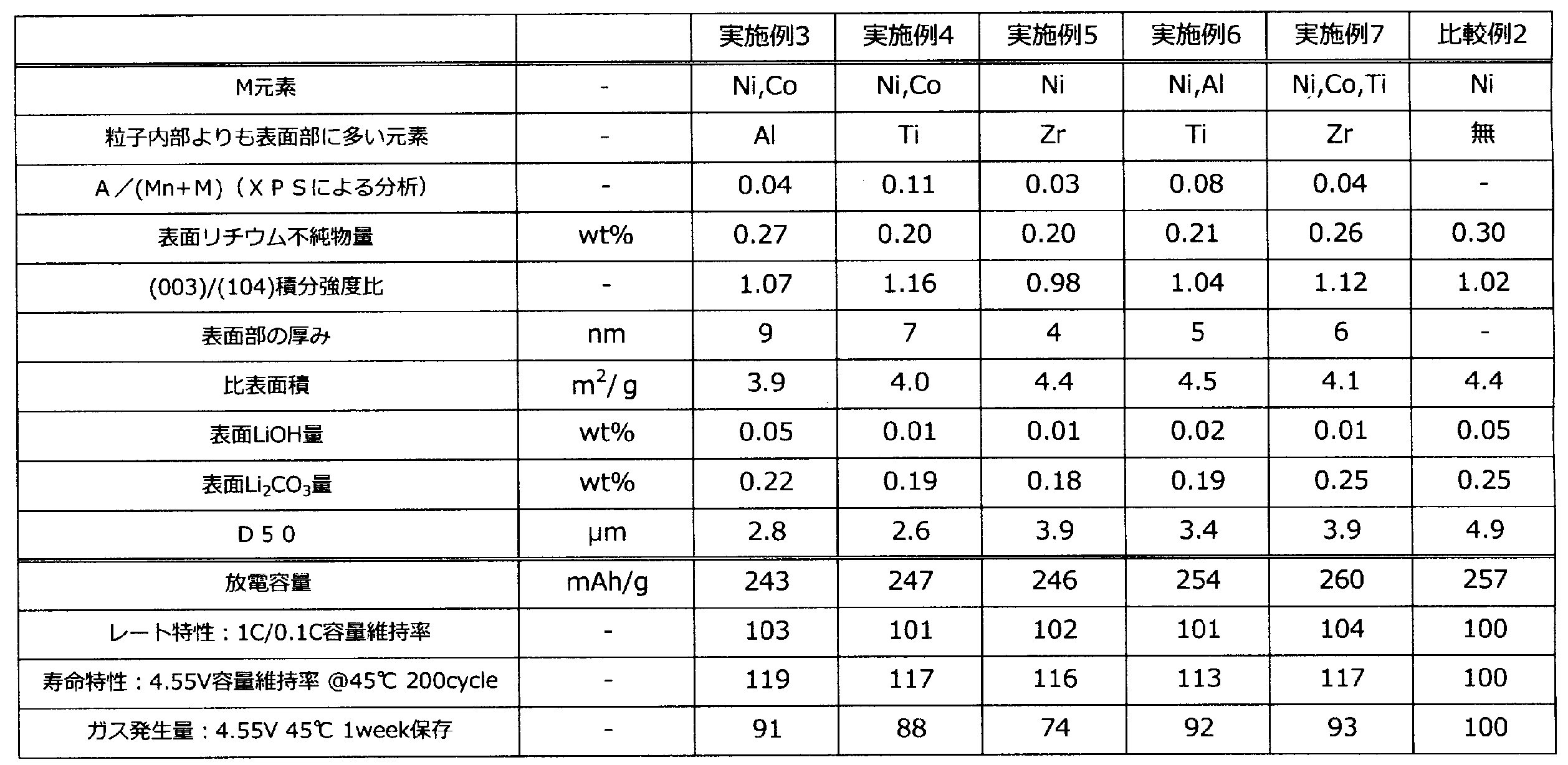
(考察)
上記の実施例・比較例並びにこれまで発明者が行ってきた試験結果から、層状結晶構造を有するリチウムマンガン金属複合酸化物からなる粒子の表面に、Al、Ti及びZrからなる群のうちの何れか1種或いは2種以上の組合せが存在する表面部を備えた活性粒子を含むリチウム二次電池用正極活物質に関し、X線光電子分光分析法(XPS)により測定される、構成元素であるMnの原子比率とMの原子比率(構成元素Mが2種類以上の場合は原子比率の合計)の合計に対する、表面元素Aの原子比率(表面元素Aが2種類以上の場合は強度の合計)の比(A/(Mn+M))が0より大きく0.8より小さければ、電解液との反応を抑えて寿命特性を向上できるとともに、従来提案されている表面処理をした正極活物質に比べて、レート特性を同等若しくはそれ以上にできることが分かった。
上記の実施例・比較例並びにこれまで発明者が行ってきた試験結果から、層状結晶構造を有するリチウムマンガン金属複合酸化物からなる粒子の表面に、Al、Ti及びZrからなる群のうちの何れか1種或いは2種以上の組合せが存在する表面部を備えた活性粒子を含むリチウム二次電池用正極活物質に関し、X線光電子分光分析法(XPS)により測定される、構成元素であるMnの原子比率とMの原子比率(構成元素Mが2種類以上の場合は原子比率の合計)の合計に対する、表面元素Aの原子比率(表面元素Aが2種類以上の場合は強度の合計)の比(A/(Mn+M))が0より大きく0.8より小さければ、電解液との反応を抑えて寿命特性を向上できるとともに、従来提案されている表面処理をした正極活物質に比べて、レート特性を同等若しくはそれ以上にできることが分かった。
さらに、CuKα1線を用いた粉末X線回折装置(XRD)により測定されるX線回折パターンにおいて、(104)面由来のピークの積分強度に対する(003)面由来のピークの積分強度の比率(003)/(104)が0.90より大きければ、レート特性を良好にすることができることが分かった。
なお、上記の実施例は特定組成の層状結晶構造を有するリチウムマンガン金属複合酸化物についての実施例であるが、これまで本発明者が行ってきた試験結果や技術常識からすれば、一般式Li1+xMnyM1-x-yO2(式中、x>0.10、y≧0.40、1-x-y>0.10、Mは、Co、Ni、Na、Mg、Al、Si、P、K、Ca、Ti、V、Cr、Fe、Cu、Zn、Ga、Y、Zr、Nb、Mo、In、Ta、W、Re及びCeからなる群のうちの何れか1種或いは2種以上の組合せ(これを「構成元素M」と称する。)で表される、層状結晶構造を有するリチウムマンガン金属複合酸化物からなる粒子を芯材とし、その表面に、Al、Ti及びZrからなる群のうちの何れか1種或いは2種以上の組合せ(これを「表面元素A」と称する)が存在する表面部を備えた粒子を含むリチウム二次電池用正極活物質においては、少なくとも、X線光電子分光分析法(XPS)により測定される構成元素Mnの原子比率とMの原子比率の合計に対する、表面元素Aの原子比率の比(A/(Mn+M))が0より大きく0.8より小さく、且つ、表面リチウム不純物量が0.80wt%未満であり、且つ、(104)面由来のピークの積分強度に対する(003)面由来のピークの積分強度の比率(003)/(104)が0.90より大きい場合には、構成元素Mとして挙げたいずれの元素も共通した課題と性質を有している。例えば、いずれの構成元素Mも結晶構造の安定化に寄与するという性質を共通して有していることから、同様の効果を得ることができるものと考えることができる。
例えば、上記実施例は、構成元素MとしてCo、Ni、Al、Tiを用いたものである。これらCo、Ni、Al及びTiのイオン半径との差を考慮して、使用する構成元素のモル数などを設計することで、Na、Mg、Si、P、K、Ca、V、Cr、Fe、Cu、Zn、Ga、Y、Zr、Nb、Mo、In、Ta、W、Re及びCeを、Co、Ni、Al及びTiの代わりに、或いは組み合わせて用いた場合も、上記実施例と同様の効果を得ることができるものと考えることができる。
例えば、上記実施例は、構成元素MとしてCo、Ni、Al、Tiを用いたものである。これらCo、Ni、Al及びTiのイオン半径との差を考慮して、使用する構成元素のモル数などを設計することで、Na、Mg、Si、P、K、Ca、V、Cr、Fe、Cu、Zn、Ga、Y、Zr、Nb、Mo、In、Ta、W、Re及びCeを、Co、Ni、Al及びTiの代わりに、或いは組み合わせて用いた場合も、上記実施例と同様の効果を得ることができるものと考えることができる。
Claims (4)
- 一般式Li1+xMnyM1-x-yO2(式中、x>0.10、y≧0.40、1-x-y>0.10、Mは、Co、Ni、Na、Mg、Al、Si、P、K、Ca、Ti、V、Cr、Fe、Cu、Zn、Ga、Y、Zr、Nb、Mo、In、Ta、W、Re及びCeからなる群のうちの何れか1種或いは2種以上の組合せ(これを「構成元素M」と称する))で表される層状結晶構造を有するリチウムマンガン金属複合酸化物からなる粒子の表面に、Al、Ti及びZrからなる群のうちの何れか1種或いは2種以上の組合せ(これを「表面元素A」と称する)が存在する表面部を備えた粒子を含むリチウム二次電池用正極活物質であって、
X線光電子分光分析法(XPS)により測定される、前記一般式の構成元素であるMnの原子比率とMの原子比率(構成元素Mが2種類以上の場合は原子比率の合計)の合計に対する、表面元素Aの原子比率(表面元素Aが2種類以上の場合は強度の合計)の比(A/(Mn+M))が0より大きく0.8より小さく、且つ、
表面リチウム不純物量が0.80wt%未満であり、且つ、
CuKα1線を用いた粉末X線回折装置(XRD)により測定されるX線回折パターンにおいて、(104)面由来のピークの積分強度に対する(003)面由来のピークの積分強度の比率(003)/(104)が0.90より大きい、ことを特徴とするリチウム二次電池用正極活物質。 - 表面リチウム不純物量が0.30wt%未満であることを特徴とする請求項1に記載のリチウム二次電池用正極活物質。
- 請求項1又は2に記載のリチウム二次電池用正極活物質を正極活物質として備えたリチウム二次電池。
- 請求項1又は2に記載のリチウム二次電池用正極活物質を正極活物質として備えたハイブリット電気自動車用または電気自動車用のリチウム二次電池。
Priority Applications (1)
| Application Number | Priority Date | Filing Date | Title |
|---|---|---|---|
| JP2018503318A JP6516919B2 (ja) | 2016-02-29 | 2017-02-28 | リチウム二次電池用正極活物質 |
Applications Claiming Priority (2)
| Application Number | Priority Date | Filing Date | Title |
|---|---|---|---|
| JP2016038061 | 2016-02-29 | ||
| JP2016-038061 | 2016-02-29 |
Publications (1)
| Publication Number | Publication Date |
|---|---|
| WO2017150506A1 true WO2017150506A1 (ja) | 2017-09-08 |
Family
ID=59743008
Family Applications (1)
| Application Number | Title | Priority Date | Filing Date |
|---|---|---|---|
| PCT/JP2017/007701 Ceased WO2017150506A1 (ja) | 2016-02-29 | 2017-02-28 | リチウム二次電池用正極活物質 |
Country Status (2)
| Country | Link |
|---|---|
| JP (1) | JP6516919B2 (ja) |
| WO (1) | WO2017150506A1 (ja) |
Cited By (5)
| Publication number | Priority date | Publication date | Assignee | Title |
|---|---|---|---|---|
| WO2020208872A1 (ja) * | 2019-04-12 | 2020-10-15 | 住友化学株式会社 | リチウム金属複合酸化物粉末及びリチウム二次電池用正極活物質 |
| CN113169333A (zh) * | 2018-11-30 | 2021-07-23 | 株式会社Posco | 锂二次电池正极活性物质及包括该物质的锂二次电池 |
| EP3846260A4 (en) * | 2018-08-31 | 2021-11-10 | Panasonic Intellectual Property Management Co., Ltd. | POSITIVE ELECTRODE ACTIVE MATERIAL AND BATTERY INCLUDING THE LATTER |
| CN114709413A (zh) * | 2022-04-14 | 2022-07-05 | 远景动力技术(江苏)有限公司 | 三元材料及其应用 |
| US12136732B2 (en) | 2018-11-30 | 2024-11-05 | Posco Holdings Inc. | Cathode active material for lithium secondary battery, and lithium secondary battery comprising same |
Citations (4)
| Publication number | Priority date | Publication date | Assignee | Title |
|---|---|---|---|---|
| JP2007503102A (ja) * | 2003-05-28 | 2007-02-15 | ナショナル・リサーチ・カウンシル・オブ・カナダ | リチウムセルおよびバッテリー用の酸化リチウム電極 |
| JP2014049309A (ja) * | 2012-08-31 | 2014-03-17 | Toyota Motor Corp | 活物質材料、全固体電池、および活物質材料の製造方法 |
| WO2014136760A1 (ja) * | 2013-03-04 | 2014-09-12 | 三井金属鉱業株式会社 | リチウム金属複合酸化物粉体 |
| JP2015536558A (ja) * | 2013-10-29 | 2015-12-21 | エルジー・ケム・リミテッド | 正極活物質の製造方法、及びこれによって製造されたリチウム二次電池用正極活物質 |
-
2017
- 2017-02-28 WO PCT/JP2017/007701 patent/WO2017150506A1/ja not_active Ceased
- 2017-02-28 JP JP2018503318A patent/JP6516919B2/ja active Active
Patent Citations (4)
| Publication number | Priority date | Publication date | Assignee | Title |
|---|---|---|---|---|
| JP2007503102A (ja) * | 2003-05-28 | 2007-02-15 | ナショナル・リサーチ・カウンシル・オブ・カナダ | リチウムセルおよびバッテリー用の酸化リチウム電極 |
| JP2014049309A (ja) * | 2012-08-31 | 2014-03-17 | Toyota Motor Corp | 活物質材料、全固体電池、および活物質材料の製造方法 |
| WO2014136760A1 (ja) * | 2013-03-04 | 2014-09-12 | 三井金属鉱業株式会社 | リチウム金属複合酸化物粉体 |
| JP2015536558A (ja) * | 2013-10-29 | 2015-12-21 | エルジー・ケム・リミテッド | 正極活物質の製造方法、及びこれによって製造されたリチウム二次電池用正極活物質 |
Cited By (6)
| Publication number | Priority date | Publication date | Assignee | Title |
|---|---|---|---|---|
| EP3846260A4 (en) * | 2018-08-31 | 2021-11-10 | Panasonic Intellectual Property Management Co., Ltd. | POSITIVE ELECTRODE ACTIVE MATERIAL AND BATTERY INCLUDING THE LATTER |
| CN113169333A (zh) * | 2018-11-30 | 2021-07-23 | 株式会社Posco | 锂二次电池正极活性物质及包括该物质的锂二次电池 |
| US12136732B2 (en) | 2018-11-30 | 2024-11-05 | Posco Holdings Inc. | Cathode active material for lithium secondary battery, and lithium secondary battery comprising same |
| WO2020208872A1 (ja) * | 2019-04-12 | 2020-10-15 | 住友化学株式会社 | リチウム金属複合酸化物粉末及びリチウム二次電池用正極活物質 |
| CN113661146A (zh) * | 2019-04-12 | 2021-11-16 | 住友化学株式会社 | 锂金属复合氧化物粉末以及锂二次电池用正极活性物质 |
| CN114709413A (zh) * | 2022-04-14 | 2022-07-05 | 远景动力技术(江苏)有限公司 | 三元材料及其应用 |
Also Published As
| Publication number | Publication date |
|---|---|
| JPWO2017150506A1 (ja) | 2018-05-31 |
| JP6516919B2 (ja) | 2019-05-22 |
Similar Documents
| Publication | Publication Date | Title |
|---|---|---|
| JP6335276B2 (ja) | リチウム二次電池用正極活物質 | |
| US10312508B2 (en) | Lithium metal composite oxide powder | |
| KR101637412B1 (ko) | 리튬 금속 복합 산화물 분체 | |
| JP6391857B2 (ja) | スピネル型リチウムマンガン含有複合酸化物 | |
| JP6586220B2 (ja) | 層構造を有するリチウム金属複合酸化物 | |
| JP5572268B1 (ja) | スピネル型リチウムマンガンニッケル含有複合酸化物 | |
| JP6251843B2 (ja) | 層構造を有するリチウム金属複合酸化物の製造方法 | |
| JP5828989B2 (ja) | リチウム二次電池用正極活物質 | |
| JP6754891B2 (ja) | スピネル型リチウムニッケルマンガン含有複合酸化物 | |
| JP6516919B2 (ja) | リチウム二次電池用正極活物質 | |
| JP6343411B2 (ja) | リチウム二次電池用正極活物質 | |
| JP5898373B2 (ja) | リチウム二次電池用正極活物質 | |
| JP6546582B2 (ja) | 層状結晶構造を有するリチウム金属複合酸化物の製造方法 |
Legal Events
| Date | Code | Title | Description |
|---|---|---|---|
| ENP | Entry into the national phase |
Ref document number: 2018503318 Country of ref document: JP Kind code of ref document: A |
|
| NENP | Non-entry into the national phase |
Ref country code: DE |
|
| 121 | Ep: the epo has been informed by wipo that ep was designated in this application |
Ref document number: 17759972 Country of ref document: EP Kind code of ref document: A1 |
|
| 122 | Ep: pct application non-entry in european phase |
Ref document number: 17759972 Country of ref document: EP Kind code of ref document: A1 |