WO2017146098A1 - ハンダペースト用水溶性フラックス及びハンダペースト - Google Patents
ハンダペースト用水溶性フラックス及びハンダペースト Download PDFInfo
- Publication number
- WO2017146098A1 WO2017146098A1 PCT/JP2017/006597 JP2017006597W WO2017146098A1 WO 2017146098 A1 WO2017146098 A1 WO 2017146098A1 JP 2017006597 W JP2017006597 W JP 2017006597W WO 2017146098 A1 WO2017146098 A1 WO 2017146098A1
- Authority
- WO
- WIPO (PCT)
- Prior art keywords
- acid
- solder paste
- water
- polyglycerol ester
- solder
- Prior art date
- Legal status (The legal status is an assumption and is not a legal conclusion. Google has not performed a legal analysis and makes no representation as to the accuracy of the status listed.)
- Ceased
Links
Definitions
- the present invention relates to a water-soluble flux used for preparing a solder paste and a solder paste prepared using the flux. More specifically, the present invention relates to a water-soluble flux for solder paste that is excellent in printability and meltability and can be prepared with water only after reflow and a solder paste containing the flux.
- solder paste is widely used for mounting electronic parts and joining other parts when manufacturing information electronic equipment such as mobile phones and personal computers and in-vehicle equipment.
- the properties required for solder paste vary depending on the application of the equipment to be manufactured, the usage environment, and the like. For example, information and electronic devices such as mobile phones are required to be thinner and lighter with an emphasis on portability. Therefore, in addition to miniaturization of mounting components, solder paste used for mounting also has a fine pitch of bonding components. Characteristics suitable for (narrow pitch) and high density mounting are required.
- in-vehicle applications in-vehicle devices
- the mounted components are exposed to a relatively high temperature.
- the solder paste to be used is required to have a characteristic of imparting high heat resistance to the solder after reflow (melting).
- solder paste used for mounting such electronic components is prepared in a paste form by mixing solder powder and flux.
- the flux generally contains an activator and other components together with a resin component and a solvent component, and the resin component is generally a rosin excellent in electrical insulation, moisture resistance, soldering performance at the time of melting, etc. Widely used.
- cleaning is usually performed to remove active components adhering to the solder surface after reflow, but in the case of a solder paste prepared using a flux containing rosin as a main component, Cleaning cannot be performed with water alone, and cleaning with an organic solvent is required. However, cleaning with an organic solvent may cause a fire due to volatilization of the organic solvent in the atmosphere or contaminate the air or wastewater. There was a problem.
- a circuit board soldering flux containing a water-washable resin that can be produced is disclosed (for example, see Patent Document 1).
- a nonionic resin is used instead of rosin as a resin component, and as the nonionic resin, a polyglycerin ester compound and a block in which at least one of polyethylene glycol and polypropylene glycol is alternately repeated.
- the polymer at least one kind of acetylated EO / PO block polymer having an acetyl group at at least one end of the molecule is used.
- the remaining film after reflow can be washed with water, and the insulation between the conductors of the circuit pattern of the circuit board after the washing is not impaired, and the long-term reliability of the circuit board soldered with electronic components is improved. It is supposed to be possible.
- the flux shown in the above-mentioned conventional patent document 1 is mainly used for solder paste in which electronic components are mounted on a circuit board or the like by so-called SMT (Surface mounting technology). For this reason, when bump formation or narrow pitch printing is performed with solder paste using this flux, bumps or printed patterns may sag after printing, resulting in problems such as so-called bridges where adjacent bumps are connected to each other. .
- the flux shown in Patent Document 1 is very excellent in terms of use in SMT applications, environmental aspects, and the like, but requires bump formation, narrow pitch printing, etc. as in the FC (Flip-Chip) bonding technology, for example. It cannot be said that it is sufficiently suitable for solder paste used in packaging technology. Therefore, there has been a demand for the development of a solder paste flux that can prepare a paste that can be washed only with water after reflow without deteriorating the printability or meltability suitable for bump formation or narrow pitch printing.
- JP 2004-158728 A (Claims 1-3, paragraph [0037], etc.)
- An object of the present invention is to provide a water-soluble flux for solder paste that is excellent in printability and meltability, and can prepare a paste that can be washed only with water after reflow, and a solder paste prepared using the flux. .
- a first aspect of the present invention includes an organic acid polyglycerol ester that is a solid surfactant at room temperature, a thixotropic agent, and a solvent, wherein the thixotropic agent is benzylidene sorbitol or a benzylidene sorbitol derivative,
- a water-soluble flux for solder paste which contains a surfactant in an amount of 0.1 to 20.0 mass% at room temperature in 100 mass% of the flux.
- the second aspect of the present invention is the invention based on the first aspect, characterized in that the organic acid polyglycerol ester has an HLB value of 10 to 19.
- a third aspect of the present invention is the invention based on the first or second aspect, wherein the organic acid polyglycerol ester is lauric acid polyglycerol ester, stearic acid polyglycerol ester, isostearic acid polyglycerol ester, 1 selected from the group consisting of stearic acid polyglycerol ester, diisostearic acid polyglycerol ester, myristic acid polyglycerol ester, palmitic acid polyglycerol ester, oleic acid polyglycerol ester, behenic acid polyglycerol ester, and caprylic acid polyglycerol ester It is a seed or two or more kinds.
- the fourth aspect of the present invention is an invention based on any one of the first to third aspects, characterized in that the SP value of the solvent is 10-20.
- a fifth aspect of the present invention is a solder paste including the water-soluble flux for solder paste according to any one of the first to fourth aspects and a solder powder.
- the water-soluble flux for solder paste according to the first aspect of the present invention includes an organic acid polyglycerol ester which is a solid surfactant at room temperature, a thixotropic agent, and a solvent, and the thixotropic agent is benzylidene sorbitol or a benzylidene sorbitol derivative. is there.
- water including warm water, hereinafter, the description “water” that similarly represents water for cleaning is “ It is possible to prepare a solder paste that can be washed only with hot water) and that is excellent in terms of safety and hygiene and environmental aspects during mounting.
- the water-soluble flux for solder paste in addition to the organic acid polyglycerol ester which is a solid surfactant at normal temperature, it contains 0.1 to 20.0% by mass of a surfactant which is liquid at normal temperature.
- the fluidity of the paste can be increased moderately when the solder paste is used, and thereby the printability can be further improved.
- the organic acid polyglycerol ester has an HLB value of 10 to 19. Thereby, the washability by the water after reflow can be improved more.
- the organic acid polyglycerol ester contains lauric acid polyglycerol ester, stearic acid polyglycerol ester, isostearic acid polyglycerol ester, sesquistearic acid polyglycerol ester, diisostearic acid poly One or more selected from the group consisting of glycerol ester, myristic acid polyglycerol ester, palmitic acid polyglycerol ester, oleic acid polyglycerol ester, behenic acid polyglycerol ester, and caprylic acid polyglycerol ester.
- the SP value of the solvent is 10-20.
- solder paste according to the fifth aspect of the present invention contains the water-soluble flux for solder paste according to any one of the first to fourth aspects of the present invention, the solder paste after reflow is maintained while maintaining excellent printability and meltability. Cleaning can be performed only with water, which is excellent in terms of safety and health during mounting and environmental aspects.
- the water-soluble flux for solder paste of the present embodiment is an improvement of the water-soluble flux for solder paste containing an organic acid polyglycerol ester which is a solid surfactant at normal temperature, a thixotropic agent, and a solvent, and its characteristic constituent features
- the thixotropic agent is benzylidene sorbitol or a benzylidene sorbitol derivative, and a surfactant (hereinafter simply referred to as “surfactant”) that is liquid at room temperature in 100% by mass of a water-soluble flux is 0.1 to 20.0. Including mass%.
- the organic acid polyglycerol ester is included as an alternative to rosins such as gum rosin, hydrogenated rosin, polymerized rosin, and ester rosin that are generally used as the main component of the flux. That is, this flux does not contain rosin or other resin components.
- organic acid polyglycerol ester is included as a substitute for rosin (resin component) used in general solder paste, so it is added to cream solder flux as a minor component such as a viscosity modifier. Not a thing.
- Organic acid polyglycerol ester can be obtained by esterifying polyglycerol obtained by dehydration condensation of glycerol and organic acid. Specifically, lauric acid polyglycerol ester, stearic acid polyglycerol ester, isostearic acid polyglycerol ester, sesquistearic acid polyglycerol ester, diisostearic acid polyglycerol ester, myristic acid polyglycerol ester, palmitic acid polyglycerol ester, oleic acid Examples thereof include polyglycerol ester, behenic acid polyglycerol ester, caprylic acid polyglycerol ester and the like, and one or more of these may be used in combination. In addition, as the organic acid polyglycerol ester, coconut oil fatty acid obtained from natural oils and fats can also be used.
- the organic acid polyglycerol ester used in this embodiment preferably has an HLB (Hydrophile-Lipophile Balance) value of 10 to 19.
- the HLB value is an index indicating water solubility, and varies depending on the type of organic acid, the number of polymerizations of polyglycerin, and the like. The larger the value, the higher the water solubility. If the HLB value of the organic acid polyglycerol ester is less than the lower limit of 10, sufficient water solubility may not be imparted to the flux or paste, and a residue may be generated when washing after reflow is performed only with water.
- the HLB value of the organic acid polyglycerol ester exceeds the upper limit value of 19, the affinity of the organic acid polyglycerol ester with water becomes too high, and there is no suitable organic solvent to sufficiently dissolve it. It becomes difficult to manufacture. Alternatively, even an organic solvent that can be dissolved is not suitable as a flux solvent because it becomes an organic solvent having a very high polarity.
- the HLB value is more preferably in the range of 11 to 18, and particularly preferably in the range of 11 to 16.5.
- benzylidene sorbitol or a benzylidene sorbitol derivative is used as the thixotropic agent.
- thixotropic agents used for solder paste such as hardened castor oil, fatty acid amide, natural fats and oils, synthetic fats and oils, 12-hydroxystearic acid, etc. Limited to its derivatives.
- an organic acid polyglycerol ester is used as an alternative to rosin (resin component).
- benzylidene sorbitol or derivatives thereof include 1,3: 2,4-bis-O- (benzylidene) sorbitol, 1,3: 2,4-bis-O- (4-methylbenzylidene) sorbitol, and 1: 3: 2. , 4-bis-O- (3,4-dimethylbenzylidene) sorbitol and the like.
- Solvents include diethylene glycol monohexyl ether, diethylene glycol monobutyl ether, diethylene glycol monobutyl ether acetate, triethylene glycol monomethyl ether, diethylene glycol, triethylene glycol, tetraethylene glycol, diglycerin, 2-ethyl-1,3-hexanediol, ⁇ - Examples include organic solvents having a boiling point of 180 ° C. or higher, such as terpineol, and one or more of these may be used in combination.
- organic acid polyglycerol ester instead of rosin
- a solvent with low solubility of organic acid polyglycerol ester once dissolved, the organic acid polyglycerol ester that has been dissolved will gradually precipitate from the solvent.
- the viscosity of the flux tends to increase with time.
- the organic acid polyglycerol ester that gradually precipitates is redissolved in the solvent when kneaded with the solder powder.
- the solvent exhibits excellent solubility in a highly water-soluble organic acid polyglycerol ester, that is, SP value. It is desirable to use those that satisfy the desired range.
- SP value is a solubility parameter (SP) proposed by Hildebrand as an index representing the solubility of a solvent and defined by regular solution theory.
- SP value shown in this specification is an SP value (unit: (cal / cm 3 ) 1/2 ) calculated based on the Fedors equation.
- a solvent having an SP value in the range of 10 to 20 it is preferable to use a solvent having an SP value in the range of 10 to 20. If the SP value of the solvent used is less than the lower limit of 10, the organic acid polyglycerol ester is not sufficiently dissolved, the stability of the flux viscosity and paste viscosity with time deteriorates, and the viscosity increases with time (increased viscosity). May become noticeable. On the other hand, when the SP value of the solvent exceeds the upper limit of 20, the reactivity of an activator described later contained as one component in the flux increases, and by reacting with the solder powder contained in the paste, In some cases, the thickening over time (increase in viscosity) becomes significant, and the meltability of the paste may decrease. Of these, the SP value of the solvent used is particularly preferably in the range of 10-17.
- the surfactant used in this embodiment is a nonionic surfactant, a cationic surfactant, an anionic surfactant, or an amphoteric surfactant.
- Nonionic surfactants include ether type nonionic surfactants such as polyoxyalkylene alkyl ethers such as polyoxyethylene lauryl ether, polyalkylene glycols, polyoxyalkylene alkenyl ethers and polyoxyalkylene derivatives; bis (2-hydroxy (2-hydroxyethyl) alkylamines such as ethyl) laurylamine, alcohol amines such as triethanol, polyoxyethylene alkylamine, N, N ′, N′-tris (2-hydroxyethyl) -N-alkyl-1, Alkylamine ether type nonionic surfactants such as 3-diaminoalkane, N, N ′, N′-polyoxyethylene-N-alkyl-1,3-diaminoalkane, polyoxypropylene polyoxyethylene alkylamine; Ester-type nonionic surfactants such as fatty acid esters, glycol fatty acid esters, sorbitan fatty acid esters; polyoxyethylene
- cationic surfactant examples include surfactants such as alkylamine salts such as quaternary ammonium salts such as lauryltrimethylammonium chloride.
- anionic surfactant examples include polyoxyethylene alkyl ether sulfates such as sodium polyoxyethylene lauryl ether sulfate, aliphatic phosphates such as aromatic phosphates, dioctyl sulfosuccinate Na salt, alcohol sulfate Na
- surfactant examples include salts, alkyl sulfate esters, alkylbenzene sulfonates, fatty acid salts, and naphthalene sulfonate formalin condensates.
- amphoteric surfactants include surfactants such as alkylbetaines such as laurylbetaine, fatty acid amide alkylacetic acid betaines, fatty acid aminoacetic acid betaines, and alkylamine oxides.
- the flux may contain an activator, an antioxidant and the like together with the above-mentioned organic acid polyglycerol ester, thixotropic agent, solvent, and surfactant.
- an activator amine, organic acid, amine hydrohalide, organic acid ammonium salt, organic acid amine salt, ammonium halide, organic halogen compound and the like can be used.
- amines include ethanolamine, diethanolamine, triethanolamine, 3,4-dihydroxybenzylamine, methyldiethanolamine, diphenylguanidine, aminopropanol, polyoxyethylene oleylamine, polyoxyethylene laurylamine, polyoxyethylene stearylamine, methylamine, Dimethylamine, ethylamine, diethylamine, triethylamine, propylamine, dipropylamine, triisopropylamine, isopropylamine, diisopropylamine, tri-n-propylamine, n-butylamine, isobutylamine, tert-butylamine, di-n-butylamine, Tri-n-butylamine, n-hexylamine, tri-n-hexylamine, octylamine, dodecyl Min, stearylamine, methoxypropylamine, dimethylhexylamine, allylamine, diallylamine,
- organic acids include formic acid, acetic acid, propionic acid, butyric acid, isobutyric acid, valeric acid, isovaleric acid, caproic acid, enanthic acid, caprylic acid, pelargonic acid, capric acid, lauric acid, myristic acid, pentadecylic acid, Palmitic acid, margaric acid, stearic acid, oleic acid, linoleic acid, linolenic acid, tuberculostearic acid, arachidic acid, arachidonic acid, eicosapentaenoic acid, behenic acid, docosahexaenoic acid, lignoceric acid, azelaic acid, suberic acid, sebacic acid , Phthalic acid, serotic acid, montanic acid, mellic acid, salicylic acid, gallic acid, benzoic acid, phthalic acid, cinnamic acid, melittic acid, ox
- examples of the hydrohalic acid amine salt include the above-mentioned amine hydrochloride and hydrobromide.
- examples of the organic acid ammonium salt include salts of ammonia and the above organic acid.
- examples of the organic acid amine salt include salts of the amine and the organic acid.
- Examples of the organic halogen compound include alkyl halides, halogenated alcohols, halogenated esters, halogenated carboxylic acids, halogenated ketones, halogenated amides, and halogenated ethers.
- Specific examples of the alkyl halide include 1-bromo-3-methyl-1-butene, 1,4-dibromobutene, 1-bromo-1-propene, 2,3-dibromopropene, 1,1-dibromotetrachloroethane 1,2-dibromo-1-phenylethane, 1,2-dibromostyrene, 1,2,5,6,9,10-hexabromocyclododecane, 2,2-bis [4- (2,3-dibromo Propyl) -3,5-dibromoferni] propane, ⁇ , ⁇ -dibromoethylbenzene and the like.
- halogenated alcohol examples include 1-bromo-2-propanol, 3-bromo-1-propanol, 3-bromo-1,2-propanediol, 1,3-dibromo-2-propanol, 1,4- Dibromo-2,3-butanediol, 2,3-dibromo-1-propanol, 1-bromo-2-butanol, 1,4-dibromo-2-butanol, 2,3-dibromo-2-propanol, 1,4 -Dibromo-2-butanediol, 2,3-dibromo-2-butene-1,4-diol, 9,10,12,13,15,16-hexabromostearyl alcohol, 9,10,12,13- Examples thereof include tetrabromostearyl alcohol.
- halogenated ester examples include ethyl bromoacetate, ethyl ⁇ -bromocaprylate, ethyl ⁇ -bromopropionate, ethyl ⁇ -bromopropionate, ⁇ -bromo-ethyl acetate, 9,10,12,13,15.
- 16-hexabromostearic acid methyl ester 9,10,12,13,15,16-hexabromostearic acid ethyl ester, 9,10,12,13-tetrabromostearic acid, 9,10,12
- Examples include 13-tetrabromostearic acid methyl ester, 9,10,12,13-tetrabromostearic acid ethyl ester, and the like.
- halogenated carboxylic acid examples include 2,3-dibromosuccinic acid, 2-bromosuccinic acid, 2,2-dibromoadipic acid, 9,10,12,13,15,16-hexabromostearic acid, bis (2,3-dibromopropyl) succinate, bis (2,3-dibromopropyl) o-phthalate, bis (2,3-dibromopropyl) p-phthalate, bis (2,3-dibromopropyl) p-phthalamide, tris (2,3-dibromopropyl) trimellitate, 4-bromomethylbenzyl stearate, 2,4-bisbromomethylbenzyl stearate, tetra (2,3-dibromopropyl) pyromellitate and the like.
- halogenated ketones include 2,4-dibromoacetophenone.
- halogenated amide include bis (2,3-dibromopropyl) o-phthalamide, tris (2,3-dibromopropyl) trimellitic amide, tetra (2,3-dibromopropyl) pyromellitamide, bis (2, 3-dibromopropyl) tertamide, N, N′-bis (2,3-dibromopropyl) succinamide, N, N, N ′, N′-tetra (2,3-dibromopropyl) succinamide and the like.
- halogenated ethers include trimethylolpropane bis (2,3-dibromopropyl) ether, 4-palmitoyloxybenzyl bromide, 4-myristoyloxybenzyl bromide, 4-lauroyloxybenzyl bromide, 4-undecanoyl. And oxybenzyl bromide.
- antioxidants examples include phenol-based antioxidants, phosphorus-based antioxidants, sulfur-based antioxidants, and amine-based antioxidants.
- the proportion of the organic acid polyglycerol ester in 100% by mass of the water-soluble flux is preferably 10% by mass or more and less than 50% by mass, and particularly preferably 15 to 45% by mass.
- the proportion of the solvent is 30 to 60% by mass
- the proportion of the thixotropic agent is 1 to 10% by mass
- the proportion of the activator is 0.1 to 10% by mass
- the proportion of the antioxidant is 1 to 10% by mass. Is preferred.
- the ratio of the surfactant in 100% by mass of the water-soluble flux is 0.1 to 20.0% by mass, and preferably 1.0 to 10.0% by mass.
- the ratio of the organic acid polyglycerol ester is less than the lower limit of 10% by mass, the fluidity of the paste, the tackiness to the substrate, and the like are deteriorated, so that defects such as shape defects may occur in the bumps after printing.
- the ratio of the organic acid polyglycerol ester exceeds the upper limit (when it is 50% by mass or more), the viscosity of the flux becomes too high, and the paste viscosity increases accordingly, so that the shape of the bump after printing is increased. There may be a problem such as a so-called missing, in which a defect occurs or a paste is not ejected from the mask opening and a bump is not formed.
- the solvent ratio is less than the lower limit of 30% by mass, the viscosity of the flux becomes high, and the paste viscosity becomes too high accordingly, which may cause problems such as the above-mentioned bump shape failure and missing. is there.
- the proportion of the solvent exceeds the upper limit of 60% by mass, the viscosity of the flux becomes low, and the viscosity of the paste becomes too low accordingly. May occur.
- the ratio of the thixotropic agent when the ratio of the thixotropic agent is less than the lower limit of 1% by mass, the shape retention as a solder paste is lowered, and there may be a problem such as a so-called bridge in which adjacent bumps are connected.
- the ratio of the thixotropic agent exceeds the upper limit of 10% by mass, the viscosity of the flux becomes high, and the paste viscosity becomes excessively high accordingly, resulting in defects such as the above-described bump shape failure and missing. There is a case.
- the ratio of the activator when the ratio of the activator is less than the lower limit of 0.1% by mass, the solder powder does not melt and sufficient bonding strength may not be obtained.
- the ratio of the activator exceeds the upper limit of 10% by mass, the activator tends to react with the solder powder during storage, and the storage stability of the solder paste may be reduced.
- the proportion of the antioxidant is less than the lower limit of 1% by mass, the solder powder and the flux component easily react with each other, so that the storage stability of the solder paste may be lowered.
- the proportion of the antioxidant exceeds the upper limit of 10% by mass, the meltability of the solder powder may be lowered.
- the paste does not easily flow when used as a solder paste, and a missing bump that does not form a bump when a large number of solder bumps are formed on the substrate. appear.
- the ratio of the surfactant exceeds the upper limit of 20.0% by mass, the paste easily flows when the solder paste is formed, and so-called bridges are formed in which adjacent bumps are connected when forming the solder bumps. appear.
- the solder powder to be used is not particularly limited, and general solder powder mainly composed of tin can be used.
- the average particle diameter of the solder powder is not particularly limited as long as it is within the range used for general solder paste, but for example, a solder powder having a range of 0.1 ⁇ m to 1 mm can be suitably used.
- the average particle size of the solder powder is preferably in the range of 0.1 ⁇ m to 50 ⁇ m. In consideration of the formation of fine bumps and the like, it is more preferably in the range of 1 ⁇ m to 20 ⁇ m.
- the average particle diameter means a volume-based average particle diameter D 50 measured using a laser diffraction / scattering particle diameter distribution measuring apparatus (manufactured by Horiba, Ltd., model name: Partica LA-950). .
- the mixing amount of the flux when preparing the solder paste is preferably adjusted so that the proportion of the flux of the present embodiment in 100% by mass of the prepared paste is 3 to 60% by mass.
- the ratio of the flux is less than the lower limit of 3% by mass, the amount of the flux is small, so that it may be difficult to make a paste or the solder powder may not be melted.
- the proportion of the flux exceeds the upper limit of 60% by mass, the amount of solder powder contained in the paste decreases, and the necessary amount of solder after melting may not be obtained.
- the amount of flux mixed when preparing the solder paste is preferably adjusted so that the proportion of the flux of the present embodiment in the prepared paste of 100% by volume is 19 to 95% by volume.
- the ratio of the flux in this embodiment is more preferably 31 to 91% by volume, and most preferably 40 to 83% by volume.
- solder paste prepared in this way uses the water-soluble flux for solder paste of the present embodiment, after maintaining the good printability or meltability suitable for bump formation and narrow pitch printing, Can be washed with water alone, which is excellent in terms of safety and health during mounting and environmental aspects. Therefore, this solder paste can be suitably used particularly in mounting technology such as FC bonding technology.
- the surfactants represented by classifications A to E are polyoxyethylene lauryl ether (class A), which is an ether type nonionic surfactant, and bis (which is also an ether type nonionic surfactant).
- class A polyoxyethylene lauryl ether
- category B 2-hydroxyethyl) laurylamine
- Category C cationic surfactant lauryltrimethylammonium chloride
- Category D anionic surfactant polyoxyethylene lauryl ether sodium sulfate
- Table 1 the number described at the end of the name of the organic acid polyglycerol ester indicates the polymerization number of polyglycerol.
- Comparative Example 2 Comparative Examples 11 to 14, Comparative Example 21, Comparative Example 23 and Comparative Example 24, no surfactant was blended.
- ⁇ Comparative Example 1> Use rosin (polymerized rosin) instead of organic acid polyglycerol esters, and mix rosin, thixotropic agent, solvent, activator, antioxidant, and surfactant in the proportions shown in Table 4 and Table 7 below. A flux was obtained in the same manner as in Example 1 except that. The flux obtained in Comparative Example 1 does not contain polyglycerol esters.
- Bump printability (substrate) Two kinds of solder powders were prepared, and two kinds of solder pastes were prepared. First, Sn—Ag—Cu solder powder (composition: Sn 96.5 mass%, Ag 3.0 mass%, Cu 0.5 mass%) having an average particle diameter of 8 ⁇ m was prepared. A solder paste was prepared by stirring and mixing 89.0 parts by mass of this solder powder and 11.0 parts by mass of the flux obtained in each of Examples 1 to 49, 52 and Comparative Examples 1 to 22 at room temperature. did. When the solder paste was 100% by volume, the proportion of Sn—Ag—Cu-based solder powder was 52.3% by volume and the proportion of flux was 47.7% by volume.
- this solder powder is described as “SAC305”.
- Au—Sn solder powder composition: Au 78.0 mass%, Sn 22.0 mass%) having an average particle diameter of 8 ⁇ m was prepared.
- solder paste was obtained.
- the solder paste was taken as 100% by volume, the proportion of Au—Sn solder powder was 52.5% by volume and the proportion of flux was 47.5% by volume.
- this solder powder is described as “Au22Sn”.
- the average particle size of the solder powder is a volume-based average particle size D 50 measured using a laser diffraction / scattering particle size distribution measuring apparatus (manufactured by Horiba, Ltd., model name: Partica LA-950).
- a small semi-automatic screen printing machine equipped with a Ni-plated metal mask plate provided with a plurality of openings (external dimensions: length 300 mm ⁇ width 3000 mm ⁇ thickness 20 ⁇ m, opening diameter ⁇ : 75 ⁇ m, opening pitch: 100 ⁇ m)
- a solder bump was formed on the substrate by printing the above-described solder paste on the substrate (dimensions: 60 mm long ⁇ 60 mm wide ⁇ 0.8 mm thick).
- the substrate is a resist film (thickness: 15 ⁇ m having a copper foil having a thickness of about 50 ⁇ m provided on one surface of the substrate and a plurality of openings provided on the copper foil and penetrating to the copper foil. , Opening diameter ⁇ 65 ⁇ m, opening pitch 100 ⁇ m).
- the number of missing bumps where no bumps were formed and the number of bridges where adjacent bumps were connected were measured. The number of missing bumps and the number of bridges were 5 or less, respectively.
- Bump meltability (substrate): The board
- the substrate was placed in a nitrogen atmosphere at a temperature of 1.5 ° C./s from room temperature to 150 ° C. The temperature was raised at a temperature raising rate of 150 ° C. and pre-dried at 150 ° C. for 2 minutes. Next, the temperature was raised from 150 ° C. to 230 ° C.
- solder bumps formed from solder paste using the Au—Sn solder powders of Examples 50, 51, 53, and 54 and Comparative Examples 23 to 25 the temperature was raised from room temperature to 220 ° C. at a rate of 1.5 ° C./s. The temperature was increased at a rate and pre-dried at 220 ° C. for 2 minutes. Next, the temperature was raised from 220 ° C. to 300 ° C. at a rate of 1.5 ° C./s and heated at a temperature of 300 ° C. for 5 seconds. This melted the solder bumps on the substrate. The appearance after reflow is visually observed, and the case where unaggregated solder is not confirmed around the bump is evaluated as “good” (good), and the case where unaggregated solder is confirmed is determined as “bad” (bad ).
- the bump part after reflow and washing was observed with a reflection electron image of a scanning electron microscope (SEM; manufactured by JEOL Ltd., model name: JSM-6510LV) to confirm the presence or absence of organic component residues. Based on the presence / absence of the organic component residue or the degree thereof, the following three stages were evaluated. The case of almost no residue was evaluated as “excellent”. A case where a residue of less than 5% was confirmed with respect to 100% of the bump surface area was evaluated as “good”. A case where a residue of 5% or more with respect to 100% of the bump surface area was confirmed was evaluated as “bad”.
- Comparative Example 1 using rosin as a flux component is “good” in the evaluation of bump printability. there were. However, sufficient cleaning was not possible with water alone, and the flux cleaning performance was evaluated as “bad”.
- Comparative Examples 15 to 20, 22, and 25 using hardened castor oil the organic acid polyglycerol ester was used as the resin component, and therefore, in the evaluation of the flux detergency, either “good” or “excellent” was obtained. Results were obtained, and the number of missing bumps among the bump printability met the acceptance criteria. However, the number of bridges did not meet the acceptance criteria.
- Comparative Examples 2, 11 to 14, 21, 23, 24 and 0.05% by mass of surfactants each containing an organic acid polyglycerol ester and a specific thixotropic agent but not containing a surfactant as components of the flux.
- the acceptance criteria were satisfied for the bump melting property and the flux cleaning property, respectively.
- the solder paste was used, the paste was difficult to flow and no bridge was generated, but the number of missing bumps was 8 to 57 and the acceptance criteria were not reached.
- the components of the flux contain organic acid polyglycerol ester and a specific thixotropic agent.
- the bump melting property and the flux cleaning property are respectively shown. Meet the acceptance criteria. However, when solder paste was used, the paste easily flowed, and the number of bridges between bumps did not reach the acceptance standard.
- Example 1 in which the content of the nonionic surfactant was 0.1% by mass, the number of missing bumps was “2”. In Examples 9 and 22 in which the content of the anionic surfactant was 0.2% by mass, the number of missing bumps was “4” or “3”. In Examples 11 and 24 in which the content of the surfactant including the nonionic and cationic systems was 0.2% by mass, the number of missing bumps was “2” or “1”. In other Examples 2 to 8, 10, 12 to 21, 23, and 25 to 54, the number of missing bumps was “0”. Thus, all of Examples 1 to 54 passed with respect to the number of missing bumps.
- Example 3 where the content of the nonionic surfactant was 20.0% by mass, the number of bridges was “4”. In Examples 7 and 20 in which the content of another type of nonionic surfactant was 20.0% by mass, the number of bridges was “2”. In Examples 10 and 23 in which the content of the amphoteric surfactant was 15.0% by mass, the number of bridges was “4” or “2”. In Examples 12 and 25, in which the content of the nonionic and anionic surfactants was 15.0% by mass, the number of bridges was “2”. In Examples 14 and 27 in which the content of the surfactant including the cationic and anionic surfactants was 20.0% by mass, the bridge number was “4”. In the other Examples 1, 2, 4 to 6, 8, 9, 11, 13, 15 to 19, 21, 22, 24, 26, and 28 to 54, the number of bridges was “0”. Thus, all Examples 1 to 54 passed with respect to the number of bridges.
- the water-soluble flux for solder paste of the present invention can be widely used for mounting electronic components (particularly, mounting technology that requires bump formation or narrow pitch printing such as FC bonding technology), joining of other components, and the like.
Landscapes
- Electric Connection Of Electric Components To Printed Circuits (AREA)
- Compositions Of Macromolecular Compounds (AREA)
Abstract
このハンダペースト用水溶性フラックスは、常温で固体の界面活性剤である有機酸ポリグリセロールエステルと、チキソ剤と、溶剤とを含み、チキソ剤がベンジリデンソルビトール又はベンジリデンソルビトール誘導体であって、水溶性フラックス100質量%中、常温で液体の界面活性剤を0.1~20.0質量%の量で更に含む。有機酸ポリグリセロールエステルのHLB値は10~19であることが好ましい。
Description
本発明は、ハンダペーストの調製に用いられる水溶性フラックス及び前記フラックスを用いて調製されたハンダペーストに関する。更に詳しくは、印刷性及び溶融性に優れるとともに、リフロー後、水のみで洗浄可能なペーストを調製できるハンダペースト用水溶性フラックス及び前記フラックスを含むハンダペーストに関するものである。
本願は、2016年2月25日に日本に出願された特願2016-33714及び2017年2月6日に日本に出願された特願2017-19316に基づき優先権を主張し、その内容をここに援用する。
本願は、2016年2月25日に日本に出願された特願2016-33714及び2017年2月6日に日本に出願された特願2017-19316に基づき優先権を主張し、その内容をここに援用する。
ハンダペーストは、携帯電話やパソコン等の情報電子機器や車載機器等の製造に際し、電子部品の実装、その他の部品の接合等に広く使用されている。ハンダペーストに求められる特性は、製造する機器の用途、使用環境等に応じて様々である。例えば、携帯電話等の情報電子機器では、携帯性を重視させた薄型化、軽量化が要求されることから、実装部品の小型化とともに、実装に用いられるハンダペーストについても、接合部品のファインピッチ(狭ピッチ)化や高密度実装に適した特性等が求められる。一方、車載用途(車載機器)等では、実装部品が比較的高温下に晒されることから、実装後のハンダが高温雰囲気で再溶融し、接合強度が低下するのを防止する必要がある。そのため、使用されるハンダペーストには、リフロー(溶融)後のハンダに対して高い耐熱性等を付与する特性が求められる。
このような電子部品の実装等に用いられるハンダペーストは、ハンダ粉末とフラックスを混合することによってペースト状に調製される。フラックスには、一般に樹脂成分や溶剤成分と共に、活性剤やその他の成分が含まれ、樹脂成分には、電気絶縁性、耐湿性、及び溶融時のハンダ付け性能等に優れたロジンが一般的に広く使用されている。ハンダペーストを用いた実装では、通常、リフロー後のハンダ表面に付着する活性成分等を除去するために洗浄を行うが、ロジンを主成分として含むフラックスを用いて調製されたハンダペーストの場合、この洗浄を水だけで行うことはできず、有機溶剤による洗浄が必要となる。しかし、有機溶剤を用いて洗浄を行うと、有機溶剤が大気中に揮発することで火災を引き起こしたり、大気や排水を汚染する原因となることから、実装中の安全衛生面や環境面等で問題があった。
このような問題を解消するため、回路基板に電子部品をハンダ付けするのに用いられるフラックスであって、樹脂成分と溶剤成分を少なくとも含有し、樹脂成分として、前記フラックスの残さ膜を水により洗浄できる水洗浄性樹脂を含有する回路基板ハンダ付け用フラックスが開示されている(例えば、特許文献1参照。)。このフラックスでは、樹脂成分としてロジンの代わりに非イオン性の樹脂が用いられており、非イオン性の樹脂として、ポリグリセリンエステル化合物、及びポリエチレングリコールとポリプロピレングリコールとをそれぞれ交互に少なくとも1つ繰り返すブロックポリマーであってその分子の少なくとも一方の末端にアセチル基を有するアセチル化EO・POブロックポリマーの少なくとも1種が使用される。これにより、リフロー後の残さ膜を水で洗浄でき、その洗浄をした後の回路基板の回路パターンの導電体間の絶縁性を損なわず、電子部品をハンダ付けした回路基板の長期信頼性を高めることができるとされている。
しかしながら、上記従来の特許文献1に示されるフラックスは、主として、電子部品の回路基板等への実装を、いわゆるSMT(Surface mount technology、表面実装技術)により行うハンダペースト向けに利用されている。そのため、このフラックスを用いたハンダペーストでバンプ形成や狭ピッチ印刷等を行うと、バンプや印刷パターンが印刷後にダレて、隣り合うバンプ同士が繋がってしまう、いわゆるブリッジ等の不具合が生じることがある。このため、上記特許文献1に示されるフラックスは、SMT用途での使用や環境面等では非常に優れるものの、例えばFC(Flip-Chip)ボンディング技術のようにバンプ形成や狭ピッチ印刷等が必要な実装技術で用いられるハンダペースト向けには十分に適しているとはいえない。そこで、バンプ形成や狭ピッチ印刷に適した印刷性或いは溶融性を悪化させることなく、リフロー後、水のみで洗浄可能なペーストを調製できるハンダペースト用フラックスの開発が求められていた。
本発明の目的は、印刷性及び溶融性に優れるとともに、リフロー後、水のみで洗浄可能なペーストを調製できるハンダペースト用水溶性フラックス及び前記フラックスを用いて調製されたハンダペーストを提供することにある。
本発明の第1の態様は、常温で固体の界面活性剤である有機酸ポリグリセロールエステルと、チキソ剤と、溶剤とを含み、前記チキソ剤がベンジリデンソルビトール又はベンジリデンソルビトール誘導体であって、水溶性フラックス100質量%中、常温で液体の界面活性剤を0.1~20.0質量%の量で含むことを特徴とするハンダペースト用水溶性フラックスである。
本発明の第2の態様は、第1の態様に基づく発明であって、前記有機酸ポリグリセロールエステルのHLB値が10~19であることを特徴とする。
本発明の第3の態様は、第1又は第2の態様に基づく発明であって、前記有機酸ポリグリセロールエステルが、ラウリン酸ポリグリセロールエステル、ステアリン酸ポリグリセロールエステル、イソステアリン酸ポリグリセロールエステル、セスキステアリン酸ポリグリセロールエステル、ジイソステアリン酸ポリグリセロールエステル、ミリスチン酸ポリグリセロールエステル、パルミチン酸ポリグリセロールエステル、オレイン酸ポリグリセロールエステル、ベヘニン酸ポリグリセロールエステル、及びカプリル酸ポリグリセロールエステルからなる群より選ばれた1種又は2種以上であることを特徴とする。
本発明の第4の態様は、第1乃至3の態様のいずれかに基づく発明であって、前記溶剤のSP値が10~20であることを特徴とする。
本発明の第5の態様は、第1乃至4の態様のいずれかのハンダペースト用水溶性フラックスと、ハンダ粉末とを含むハンダペーストである。
本発明の第1の態様のハンダペースト用水溶性フラックスは、常温で固体の界面活性剤である有機酸ポリグリセロールエステルと、チキソ剤と、溶剤とを含み、チキソ剤がベンジリデンソルビトール又はベンジリデンソルビトール誘導体である。これにより、優れた印刷性及び溶融性は維持しつつも、リフロー後、有機溶剤等を使用せずに、水(温水も含む、以下、同様に、洗浄用の水を表す記載“水”は温水も含む)のみで洗浄可能な、実装中の安全衛生面及び環境面等に優れたハンダペーストを調製できる。またハンダペースト用水溶性フラックス100質量%中、常温で固体の界面活性剤である有機酸ポリグリセロールエステルに加えて常温で液体の界面活性剤を0.1~20.0質量%の量で含むことにより、ハンダペーストにしたときにペーストの流動性を適度に高めることができ、これにより印刷性をより一層向上させることができる。
本発明の第2の態様のハンダペースト用水溶性フラックスでは、有機酸ポリグリセロールエステルのHLB値が10~19である。これにより、リフロー後の水による洗浄性をより高めることができる。
本発明の第3の態様のハンダペースト用水溶性フラックスでは、有機酸ポリグリセロールエステルが、ラウリン酸ポリグリセロールエステル、ステアリン酸ポリグリセロールエステル、イソステアリン酸ポリグリセロールエステル、セスキステアリン酸ポリグリセロールエステル、ジイソステアリン酸ポリグリセロールエステル、ミリスチン酸ポリグリセロールエステル、パルミチン酸ポリグリセロールエステル、オレイン酸ポリグリセロールエステル、ベヘニン酸ポリグリセロールエステル、及びカプリル酸ポリグリセロールエステルからなる群より選ばれた1種又は2種以上である。これにより、バンプ等を形成するときの印刷性、或いはリフロー後の水による洗浄性をより高めることができる。
本発明の第4の態様のハンダペースト用水溶性フラックスでは、溶剤のSP値が10~20である。これにより、調製後のフラックス或いはこれを用いて調製されたハンダペーストを取り扱う際、或いは保管する際に、粘度の経時安定性をより向上させることができる。
本発明の第5の態様のハンダペーストは、本発明の第1乃至4の態様のいずれかのハンダペースト用水溶性フラックスを含むため、優れた印刷性及び溶融性を維持しつつも、リフロー後の洗浄を水のみで行うことができ、実装中の安全衛生面や環境面等で優れる。
次に本発明を実施するための形態を説明する。
本実施形態のハンダペースト用水溶性フラックスは、常温で固体の界面活性剤である有機酸ポリグリセロールエステルと、チキソ剤と、溶剤とを含むハンダペースト用水溶性フラックスの改良であり、その特徴ある構成要件は、チキソ剤がベンジリデンソルビトール又はベンジリデンソルビトール誘導体であって、水溶性フラックス100質量%中、常温で液体の界面活性剤(以下、単に「界面活性剤」という。)を0.1~20.0質量%含むことにある。
本実施形態のハンダペースト用水溶性フラックスにおいて、有機酸ポリグリセロールエステルは、フラックスの主成分として一般的に使用されているガムロジン、水添ロジン、重合ロジン、エステルロジン等のロジンの代替として含まれる。即ち、このフラックスは、ロジンや他の樹脂成分を含まない。また、有機酸ポリグリセロールエステルは、一般的なハンダペーストに用いられていたロジン(樹脂成分)の代替として含まれるため、クリームハンダのフラックスに、粘度調整剤等の副成分として極少量添加されるものではない。
有機酸ポリグリセロールエステルは、グリセリンを脱水縮合して得られるポリグリセリンと有機酸とをエステル化反応させることにより得られる。具体的には、ラウリン酸ポリグリセロールエステル、ステアリン酸ポリグリセロールエステル、イソステアリン酸ポリグリセロールエステル、セスキステアリン酸ポリグリセロールエステル、ジイソステアリン酸ポリグリセロールエステル、ミリスチン酸ポリグリセロールエステル、パルミチン酸ポリグリセロールエステル、オレイン酸ポリグリセロールエステル、ベヘニン酸ポリグリセロールエステル、カプリル酸ポリグリセロールエステル等が挙げられ、これらの1種又は2種以上を併用してもよい。この他、有機酸ポリグリセロールエステルとしては、天然物油脂から得られたヤシ油脂肪酸等も使用することができる。
また、本実施形態で使用する有機酸ポリグリセロールエステルは、HLB(Hydrophile-Lipophile Balance)値が10~19であることが好ましい。HLB値とは、水溶性を示す指標であり、有機酸の種類やポリグリセリンの重合の数等により変動し、数値が大きい程、水溶性が高いことを示す。
有機酸ポリグリセロールエステルのHLB値が下限値の10未満では、フラックス又はペーストに十分な水溶性が付与されず、リフロー後の洗浄を水のみで行った際に残渣が生じる場合がある。一方、有機酸ポリグリセロールエステルのHLB値が上限値の19を超えると、有機酸ポリグリセロールエステルの水への親和性が高くなりすぎて、これを十分に溶解させる適切な有機溶剤が無くなり、フラックスの作製が困難になる。或いは溶解できる有機溶剤であっても、非常に極性が高い有機溶剤になるため、フラックスの溶剤としては適さない。
このうち、HLB値は11~18の範囲であることがより好ましく、11~16.5の範囲であることが特に好ましい。
有機酸ポリグリセロールエステルのHLB値が下限値の10未満では、フラックス又はペーストに十分な水溶性が付与されず、リフロー後の洗浄を水のみで行った際に残渣が生じる場合がある。一方、有機酸ポリグリセロールエステルのHLB値が上限値の19を超えると、有機酸ポリグリセロールエステルの水への親和性が高くなりすぎて、これを十分に溶解させる適切な有機溶剤が無くなり、フラックスの作製が困難になる。或いは溶解できる有機溶剤であっても、非常に極性が高い有機溶剤になるため、フラックスの溶剤としては適さない。
このうち、HLB値は11~18の範囲であることがより好ましく、11~16.5の範囲であることが特に好ましい。
チキソ剤として、ベンジリデンソルビトール又はベンジリデンソルビトール誘導体を使用する。ハンダペーストに用いられる一般的なチキソ剤には、硬化ひまし油、脂肪酸アマイド、天然油脂、合成油脂、12-ヒドロキシステアリン酸等、数多く存在するが、本実施形態では、チキソ剤を上記のベンジリデンソルビトール又はその誘導体に限定する。これは、本発明者が鋭意研究した結果、バンプ形成や狭ピッチ印刷等が必要な実装方法で使用されるハンダペーストにおいて、ロジン(樹脂成分)の代替として有機酸ポリグリセロールエステルを使用したときに、チキソ剤をこれら化合物に限定すると、良好な印刷性や印刷後の形状保持性等が得られたという理由に基づいている。
ベンジリデンソルビトール又はその誘導体としては、1,3:2,4-ビス-O-(ベンジリデン)ソルビトール、1,3:2,4-ビス-O-(4-メチルベンジリデン)ソルビトール、1,3:2,4-ビス-O-(3,4-ジメチルベンジリデン)ソルビトール等が挙げられる。
ベンジリデンソルビトール又はその誘導体としては、1,3:2,4-ビス-O-(ベンジリデン)ソルビトール、1,3:2,4-ビス-O-(4-メチルベンジリデン)ソルビトール、1,3:2,4-ビス-O-(3,4-ジメチルベンジリデン)ソルビトール等が挙げられる。
溶剤としては、ジエチレングリコールモノヘキシルエーテル、ジエチレングリコールモノブチルエーテル、ジエチレングリコールモノブチルエーテルアセテート、トリエチレングリコールモノメチルエーテル、ジエチレングリコール、トリエチレングリコール、テトラエチレングリコール、ジグリセリン、2-エチル-1,3-ヘキサンジオール、α-テルピネオール等の沸点が180℃以上である有機溶剤が挙げられ、これらの1種又は2種以上を併用してもよい。
また、ロジンの代わりに有機酸ポリグリセロールエステルを使用する際に、有機酸ポリグリセロールエステルの溶解性が低い溶剤を用いると、フラックス作製後に、一旦溶解した有機酸ポリグリセロールエステルが溶剤から徐々に析出し、フラックスの粘度が経時的に増加しやすくなる傾向がみられる。更に、ペーストを調製する際、有機酸ポリグリセロールエステルの溶解性が低い溶剤を用いたフラックスを使用すると、ハンダ粉末との混練時に、徐々に析出する有機酸ポリグリセロールエステルが溶剤に再溶解する。そして、再溶解した有機酸ポリグリセロールエステルが溶剤から再び析出することによって、ペースト粘度が経時的に増加するという不具合が生じる場合がある。
そのため、本実施形態において、フラックスの粘度やペースト粘度の経時的な安定性の面から、溶剤としては、水溶性の高い有機酸ポリグリセロールエステルに対して優れた溶解性を示すもの、即ちSP値が所望の範囲を満たすものを使用するのが望ましい。SP値とは、溶剤の溶解性を表す指標としてHildebrandにより提唱され、正則溶液論で定義された溶解度パラメーター(Solubility Parameter;SP)である。なお、本明細書に示すSP値は、Fedorsの式に基づいて算出するSP値(単位:(cal/cm3)1/2)である。
具体的には、SP値が10~20の範囲を満たす溶剤を使用するのが好ましい。使用する溶剤のSP値が下限値の10未満では、有機酸ポリグリセロールエステルが十分に溶解されず、フラックスの粘度やペースト粘度の経時安定性が悪くなり、経時的な増粘(粘性の増加)が著しくなる場合がある。一方、溶剤のSP値が上限値の20を超えると、フラックス中の一成分として含まれる後述の活性剤の反応性が高くなり、ペースト中に含まれるハンダ粉末と反応を起こすことによって、ペーストの経時的な増粘(粘性の増加)が著しくなったり、ペーストの溶融性が低下する場合がある。
このうち、使用する溶剤のSP値は10~17の範囲であることが特に好ましい。
そのため、本実施形態において、フラックスの粘度やペースト粘度の経時的な安定性の面から、溶剤としては、水溶性の高い有機酸ポリグリセロールエステルに対して優れた溶解性を示すもの、即ちSP値が所望の範囲を満たすものを使用するのが望ましい。SP値とは、溶剤の溶解性を表す指標としてHildebrandにより提唱され、正則溶液論で定義された溶解度パラメーター(Solubility Parameter;SP)である。なお、本明細書に示すSP値は、Fedorsの式に基づいて算出するSP値(単位:(cal/cm3)1/2)である。
具体的には、SP値が10~20の範囲を満たす溶剤を使用するのが好ましい。使用する溶剤のSP値が下限値の10未満では、有機酸ポリグリセロールエステルが十分に溶解されず、フラックスの粘度やペースト粘度の経時安定性が悪くなり、経時的な増粘(粘性の増加)が著しくなる場合がある。一方、溶剤のSP値が上限値の20を超えると、フラックス中の一成分として含まれる後述の活性剤の反応性が高くなり、ペースト中に含まれるハンダ粉末と反応を起こすことによって、ペーストの経時的な増粘(粘性の増加)が著しくなったり、ペーストの溶融性が低下する場合がある。
このうち、使用する溶剤のSP値は10~17の範囲であることが特に好ましい。
本実施形態で使用する界面活性剤は、ノニオン系界面活性剤、カチオン系界面活性剤、アニオン系界面活性剤又は両性界面活性剤である。
ノニオン系界面活性剤としては、ポリオキシエチレンラウリルエーテルなどのポリオキシアルキレンアルキルエーテル、ポリアルキレングリコール、ポリオキシアルキレンアルケニルエーテル、ポリオキシアルキレン誘導体などのエーテル型ノニオン系界面活性剤;ビス(2-ヒドロキシエチル)ラウリルアミンなどの(2-ヒドロキシエチル)アルキルアミン、トリエタノールなどのアルコールアミン、ポリオキシエチレンアルキルアミン、N,N’,N’-トリス(2-ヒドロキシエチル)-N-アルキル-1,3-ジアミノアルカン、N,N’,N’-ポリオキシエチレン-N-アルキル-1,3-ジアミノアルカン、ポリオキシプロピレンポリオキシエチレンアルキルアミンなどのアルキルアミンエーテル型ノニオン系界面活性剤;脂肪酸エステル、グリコール脂肪酸エステル、ソルビタン脂肪酸エステルなどのエステル型ノニオン系界面活性剤;ポリオキシエチレンソルビタン脂肪酸エステル、ポリオキシエチレンソルビトール脂肪酸エステル、グリセリン脂肪酸エステル、ポリオキシエチレン脂肪酸エステル、ポリオキシエチレン硬化ヒマシ油、アルキルアルカノールアミドなどのエーテルエステル型ノニオン系界面活性剤;N-アシルアミノ酸エステル、N-アシルグルタミン酸エステル、ピログルタミン酸エステルなどのアミノ酸誘導体型ノニオン系界面活性剤が例示される。その他にも、フェノールエトキシレート、シリコーン系界面活性剤、フッ素系界面活性剤がノニオン系界面活性剤として挙げられる。
またカチオン系界面活性剤としては、ラウリルトリメチルアンモニウムクロライドなどの4級アンモニウム塩などのアルキルアミン塩などの界面活性剤が例示される。
またアニオン系界面活性剤としては、ポリオキシエチレンラウリルエーテル硫酸ナトリウムなどのポリオキシエチレンアルキルエーテル硫酸エステル塩、芳香族リン酸エステルなどの脂肪族リン酸エステル、ジオクチルスルホコハク酸エステルNa塩、アルコールサルフェートNa塩、アルキル硫酸エステル塩、アルキルベンゼンスルホン酸塩、脂肪酸塩、ナフタレンスルホン酸ホルマリン縮合物などの界面活性剤が例示される。
更に両性界面活性剤としては、ラウリルベタインなどのアルキルベタイン、脂肪酸アミドアルキル酢酸ベタイン、脂肪酸アミノ酢酸ベタイン、アルキルアミンオキサイドなどの界面活性剤が例示される。
また、フラックスは、上述の有機酸ポリグリセロールエステル、チキソ剤、溶剤、界面活性剤と共に、活性剤や酸化防止剤等を含んでもよい。
活性剤としては、アミン、有機酸、ハロゲン化水素酸アミン塩、有機酸アンモニウム塩、有機酸アミン塩、ハロゲン化アンモニウム、有機ハロゲン化合物等を使用することができる。
活性剤としては、アミン、有機酸、ハロゲン化水素酸アミン塩、有機酸アンモニウム塩、有機酸アミン塩、ハロゲン化アンモニウム、有機ハロゲン化合物等を使用することができる。
アミンとしては、エタノールアミン、ジエタノールアミン、トリエタノールアミン、3,4-ジヒドロキシベンジルアミン、メチルジエタノールアミン、ジフェニルグアニジン、アミノプロパノール、ポリオキシエチレンオレイルアミン、ポリオキシエチレンラウレルアミン、ポリオキシエチレンステアリルアミン、メチルアミン、ジメチルアミン、エチルアミン、ジエチルアミン、トリエチルアミン、プロピルアミン、ジプロピルアミン、トリイソプロピルアミン、イソプロピルアミン、ジイソプロピルアミン、トリ-n-プロピルアミン、n-ブチルアミン、イソブチルアミン、tert-ブチルアミン、ジ-n-ブチルアミン、トリ-n-ブチルアミン、n-ヘキシルアミン、トリ-n-ヘキシルアミン、オクチルアミン、ドデシルアミン、ステアリルアミン、メトキシプロピルアミン、ジメチルヘキシルアミン、アリルアミン、ジアリルアミン、2-ブロモエチルアミン、1,3-ジ-o-トリグアニジン、ジメチルアミノプロピルアミン、ジブチルアミノプロピルアミン、エチルヘキシルアミン、エトキシプロピルアミン、エチルヘキシルオキシプロピルアミン、ピリジン、4-ブロモピリジン、ピペリジン、2,6-ジメチルピペリジン、ピペコリン、アニリン、ジメチルアミン、エチルアニリン、2,4,6-トリメチルアニリン、モルホリン、メチルモルホリン、エチルモルホリン、エチルナフチルアミン、3-アミノ-1-プロペン、シクロヘキシルアミン、ジシロヘキシルアミン、シクロヘキシルジメチルアミン、シクロヘキシルジエチレンアミン、シクロヘキシルメチルエチルアミン、シクロヘキシルジ-n-プロピルアミン、シクロヘキシルジイソプロピルアミン、シクロヘキシルジ-n-ブチルアミン、シクロヘキシルジイソブチルアミン、シクロヘキシルジペンチルアミン、シクロヘキシルジヘキシルアミン、ジシクロヘキシルメチルアミン等が挙げられる。
また、有機酸としては、蟻酸、酢酸、プロピオン酸、酪酸、イソ酪酸、吉草酸、イソ吉草酸、カプロン酸、エナント酸、カプリル酸、ペラルゴン酸、カプリン酸、ラウリン酸、ミリスチン酸、ペンタデシル酸、パルミチン酸、マルガリン酸、ステアリン酸、オレイン酸、リノール酸、リノレン酸、ツベルクロステアリン酸、アラキジン酸、アラキドン酸、エイコサペンタエン酸、ベヘン酸、ドコサヘキサエン酸、リグノセリン酸、アゼライン酸、スベリン酸、セバシン酸、フタル酸、セロチン酸、モンタン酸、メリシン酸、サリチル酸、没食子酸、安息香酸、フタル酸、桂皮(ケイ皮)酸、メリト酸、シュウ酸、乳酸、酒石酸、マレイン酸、フマル酸、マロン酸、コハク酸、リンゴ酸、クエン酸、アコニット酸、グルタル酸、アジピン酸、テレフタル酸、イソフタル酸、2,6-ナフタレンジカルボン酸等が挙げられる。
また、ハロゲン化水素酸アミン塩としては、上記アミンの塩化水素酸塩又は臭化水素酸塩が挙げられる。有機酸アンモニウム塩としては、アンモニアと上記有機酸との塩が挙げられる。有機酸アミン塩としては、上記アミンと上記有機酸との塩が挙げられる。
また、有機ハロゲン化合物としては、ハロゲン化アルキル、ハロゲン化アルコール、ハロゲン化エステル、ハロゲン化カルボン酸、ハロゲン化ケトン、ハロゲン化アミド、ハロゲン化エーテル等が挙げられる。
ハロゲン化アルキルの具体例としては、1-ブロモ-3-メチル-1-ブテン、1,4-ジブロモブテン、1-ブロモ-1-プロペン、2,3-ジブロモプロペン、1,1-ジブロモテトラクロロエタン、1,2-ジブロモ-1-フェニルエタン、1,2-ジブロモスチレン、1,2,5,6,9,10-ヘキサブロモシクロドデカン、2,2-ビス[4-(2,3-ジブロモプロピル)-3,5-ジブロモフェルニ]プロパン、α,β-ジブロモエチルベンゼン等が挙げられる。
ハロゲン化アルコールの具体例としては、1-ブロモ-2-プロパノール、3-ブロモ-1-プロパノール、3-ブロモ-1,2-プロパンジオール、1,3-ジブロモ-2-プロパノール、1,4-ジブロモ-2,3-ブタンジオール、2,3-ジブロモ-1-プロパノール、1-ブロモ-2-ブタノール、1,4-ジブロモ-2-ブタノール、2,3-ジブロモ-2-プロパノール、1,4-ジブロモ-2-ブタンジオール、2,3-ジブロモ-2-ブテン-1,4-ジオール、9,10,12,13,15,16-へキサブロモステアリルアルコール、9,10,12,13-テトラブロモステアリルアルコール等が挙げられる。
ハロゲン化エステルの具体例としては、ブロモ酢酸エチル、α-ブロモカプリル酸エチル、α-ブロモプロピオン酸エチル、β-ブロモプロピオン酸エチル、α-ブロモ-酢酸エチル、9,10,12,13,15,16-へキサブロモステアリン酸メチルエステル、9,10,12,13,15,16-へキサブロモステアリン酸エチルエステル、9,10,12,13-テトラブロモステアリン酸、9,10,12,13-テトラブロモステアリン酸メチルエステル、9,10,12,13-テトラブロモステアリン酸エチルエステル等が挙げられる。
またハロゲン化カルボン酸の具体例としては、2,3-ジブロモコハク酸、2-ブロモコハク酸、2,2-ジブロモアジピン酸、9,10,12,13,15,16-ヘキサブロモステアリン酸、ビス(2,3-ジブロモプロピル)スクシネート、ビス(2,3-ジブロモプロピル)o-フタレート、ビス(2,3-ジブロモプロピル)p-フタレート、ビス(2,3-ジブロモプロピル)p-フタルアミド、トリス(2,3-ジブロモプロピル)トリメリテート、4-ブロモメチルベンジルステアレート、2,4-ビスブロモメチルベンジルステアレート、テトラ(2,3-ジブロモプロピル)ピロメリテート等が挙げられる。
ハロゲン化ケトンの具体例としては、2,4-ジブロモアセトフェノン等が挙げられる。
ハロゲン化アミドの具体例としては、ビス(2,3-ジブロモプロピル)o-フタルアミド、トリス(2,3-ジブロモプロピル)トリメリトアミド、テトラ(2,3-ジブロモプロピル)ピロメリトアミド、ビス(2,3-ジブロモプロピル)タータミド、N,N’-ビス(2,3-ジブロモプロピル)スクシアミド、N,N,N’,N’-テトラ(2,3-ジブロモプロピル)スクシアミド等が挙げられる。
更にハロゲン化エーテルの具体例としては、トリメチロールプロパンビス(2,3-ジブロモプロピル)エーテル、4-パルミトイルオキシベンジルブロマイド、4-ミリストイルオキシベンジルブロマイド、4-ラウロイルオキシベンジルブロマイド、4-ウンデカノイルオキシベンジルブロマイド等が挙げられる。
ハロゲン化アルキルの具体例としては、1-ブロモ-3-メチル-1-ブテン、1,4-ジブロモブテン、1-ブロモ-1-プロペン、2,3-ジブロモプロペン、1,1-ジブロモテトラクロロエタン、1,2-ジブロモ-1-フェニルエタン、1,2-ジブロモスチレン、1,2,5,6,9,10-ヘキサブロモシクロドデカン、2,2-ビス[4-(2,3-ジブロモプロピル)-3,5-ジブロモフェルニ]プロパン、α,β-ジブロモエチルベンゼン等が挙げられる。
ハロゲン化アルコールの具体例としては、1-ブロモ-2-プロパノール、3-ブロモ-1-プロパノール、3-ブロモ-1,2-プロパンジオール、1,3-ジブロモ-2-プロパノール、1,4-ジブロモ-2,3-ブタンジオール、2,3-ジブロモ-1-プロパノール、1-ブロモ-2-ブタノール、1,4-ジブロモ-2-ブタノール、2,3-ジブロモ-2-プロパノール、1,4-ジブロモ-2-ブタンジオール、2,3-ジブロモ-2-ブテン-1,4-ジオール、9,10,12,13,15,16-へキサブロモステアリルアルコール、9,10,12,13-テトラブロモステアリルアルコール等が挙げられる。
ハロゲン化エステルの具体例としては、ブロモ酢酸エチル、α-ブロモカプリル酸エチル、α-ブロモプロピオン酸エチル、β-ブロモプロピオン酸エチル、α-ブロモ-酢酸エチル、9,10,12,13,15,16-へキサブロモステアリン酸メチルエステル、9,10,12,13,15,16-へキサブロモステアリン酸エチルエステル、9,10,12,13-テトラブロモステアリン酸、9,10,12,13-テトラブロモステアリン酸メチルエステル、9,10,12,13-テトラブロモステアリン酸エチルエステル等が挙げられる。
またハロゲン化カルボン酸の具体例としては、2,3-ジブロモコハク酸、2-ブロモコハク酸、2,2-ジブロモアジピン酸、9,10,12,13,15,16-ヘキサブロモステアリン酸、ビス(2,3-ジブロモプロピル)スクシネート、ビス(2,3-ジブロモプロピル)o-フタレート、ビス(2,3-ジブロモプロピル)p-フタレート、ビス(2,3-ジブロモプロピル)p-フタルアミド、トリス(2,3-ジブロモプロピル)トリメリテート、4-ブロモメチルベンジルステアレート、2,4-ビスブロモメチルベンジルステアレート、テトラ(2,3-ジブロモプロピル)ピロメリテート等が挙げられる。
ハロゲン化ケトンの具体例としては、2,4-ジブロモアセトフェノン等が挙げられる。
ハロゲン化アミドの具体例としては、ビス(2,3-ジブロモプロピル)o-フタルアミド、トリス(2,3-ジブロモプロピル)トリメリトアミド、テトラ(2,3-ジブロモプロピル)ピロメリトアミド、ビス(2,3-ジブロモプロピル)タータミド、N,N’-ビス(2,3-ジブロモプロピル)スクシアミド、N,N,N’,N’-テトラ(2,3-ジブロモプロピル)スクシアミド等が挙げられる。
更にハロゲン化エーテルの具体例としては、トリメチロールプロパンビス(2,3-ジブロモプロピル)エーテル、4-パルミトイルオキシベンジルブロマイド、4-ミリストイルオキシベンジルブロマイド、4-ラウロイルオキシベンジルブロマイド、4-ウンデカノイルオキシベンジルブロマイド等が挙げられる。
酸化防止剤としては、フェノール系酸化防止剤、リン系酸化防止剤、硫黄系酸化防止剤又はアミン系酸化防止剤等が挙げられる。
水溶性フラックス100質量%中に占める有機酸ポリグリセロールエステルの割合は10質量%以上50質量%未満とするのが好ましく、15~45質量%とするのが特に好ましい。また、溶剤の割合は30~60質量%、チキソ剤の割合は1~10質量%、活性剤の割合は0.1~10質量%、酸化防止剤の割合は1~10質量%とするのが好ましい。
更に、水溶性フラックス100質量%中に占める界面活性剤の割合は、上述したように、0.1~20.0質量%であり、1.0~10.0質量%とするのが好ましい。
更に、水溶性フラックス100質量%中に占める界面活性剤の割合は、上述したように、0.1~20.0質量%であり、1.0~10.0質量%とするのが好ましい。
有機酸ポリグリセロールエステルの割合が下限値の10質量%未満では、ペーストの流動性、基板へのタッキング性等が低下するため、印刷後のバンプに形状不良等の不具合が生じる場合がある。一方、有機酸ポリグリセロールエステルの割合が上限値を越えると(50質量%以上の場合)、フラックスの粘度が高くなり過ぎ、これに応じてペースト粘度も高くなることで、印刷後のバンプに形状不良が生じたり、ペーストがマスク開口部から吐出されずにバンプが形成されない、いわゆるミッシング等の不具合が生じる場合がある。
また、溶剤の割合が下限値の30質量%未満では、フラックスの粘度が高くなり、これに応じてペースト粘度が高くなりすぎることで、上述のバンプの形状不良やミッシング等の不具合が生じる場合がある。一方、溶剤の割合が上限値の60質量%を越えると、フラックスの粘度が低くなり、これに応じてペーストの粘度が低くなり過ぎることで、ペースト中のハンダ粉末が沈降分離する等の不具合が生じる場合がある。
また、溶剤の割合が下限値の30質量%未満では、フラックスの粘度が高くなり、これに応じてペースト粘度が高くなりすぎることで、上述のバンプの形状不良やミッシング等の不具合が生じる場合がある。一方、溶剤の割合が上限値の60質量%を越えると、フラックスの粘度が低くなり、これに応じてペーストの粘度が低くなり過ぎることで、ペースト中のハンダ粉末が沈降分離する等の不具合が生じる場合がある。
また、チキソ剤の割合が下限値の1質量%未満では、ハンダペーストとしての形状保持性が低下し、隣り合うバンプ同士が繋がってしまう、いわゆるブリッジ等の不具合が生じる場合がある。一方、チキソ剤の割合が上限値の10質量%を越えると、フラックスの粘度が高くなり、これに応じてペースト粘度が高くなりすぎることで、上述のバンプの形状不良やミッシング等の不具合が生じる場合がある。
また、活性剤の割合が下限値の0.1質量%未満では、ハンダ粉末が溶融せず、十分な接合強度が得られない場合がある。一方、活性剤の割合が上限値の10質量%を越えると、保管中に活性剤がハンダ粉末と反応しやすくなるため、ハンダペーストの保存安定性が低下する場合がある。
また、酸化防止剤の割合が下限値の1質量%未満では、ハンダ粉末とフラックス成分が反応しやすくなるため、ハンダペーストの保存安定性が低下する場合がある。一方、酸化防止剤の割合が上限値の10質量%を越えると、ハンダ粉末の溶融性が低下する場合がある。
また、活性剤の割合が下限値の0.1質量%未満では、ハンダ粉末が溶融せず、十分な接合強度が得られない場合がある。一方、活性剤の割合が上限値の10質量%を越えると、保管中に活性剤がハンダ粉末と反応しやすくなるため、ハンダペーストの保存安定性が低下する場合がある。
また、酸化防止剤の割合が下限値の1質量%未満では、ハンダ粉末とフラックス成分が反応しやすくなるため、ハンダペーストの保存安定性が低下する場合がある。一方、酸化防止剤の割合が上限値の10質量%を越えると、ハンダ粉末の溶融性が低下する場合がある。
更に、界面活性剤の割合が下限値の0.1質量%未満では、ハンダペーストにしたときにペーストが流動しにくくなり、基板上に多数のハンダバンプを形成する際にバンプが形成されないミッシングバンプが発生する。また界面活性剤の割合が上限値の20.0質量%を超えると、ハンダペーストにしたときにペーストが流動し易くなり、ハンダバンプを形成する際に隣り合うバンプ同士が繋がってしまう、いわゆるブリッジが発生する。
このようにして得られたフラックスを用いてハンダペーストを調製するには、フラックスとハンダ粉末を所望の割合で混合する。
使用するハンダ粉末については、特に限定されず、一般的な錫を主成分とするハンダ粉末等を使用することができる。例えば、Sn-Pb系ハンダ(組成Sn:Pb=63:37質量%等)、Sn-Pb-Ag系ハンダ(組成Sn:Pb:Ag=62:36:2質量%等)、Sn-Pb-Bi系ハンダ(組成Sn:Pb:Bi=57:40:3質量%等)、Sn-Pb-Sb系ハンダ(組成Sn:Pb:Sb=8:86:6質量%等)、Sn-Ag系ハンダ(組成Sn:Ag=97.7:2.3質量%等)、Sn-Cu系ハンダ(組成Sn:Cu=98.3:0.7質量%等)、Sn-Ag-Cu系ハンダ(組成Sn:Ag:Cu=96.5:3:0.5質量%等)、Au-Sn系の高温ハンダ(組成Au:Sn=75~85:25~15質量%、及び組成Au:Sn=5~15:95~85質量%、特に組成Au:Sn=78~80:22~20質量%、及び組成Au:Sn=10:90質量%等)、Au-Si系の高温ハンダ(組成Au:Si=81.4:18.6質量%等)、Au-Ge系の高温ハンダ(組成Au:Ge=92.6:7.4質量%等)、Sn-Pb系の高温ハンダ(組成 Sn:Pb=5:95質量%等)、その他、Zn-Sn系ハンダ(組成Zn:Sn=9:91質量%等)、In-Sn系ハンダ(組成In:Sn=52:48質量%等)、Bi-Sn系ハンダ(組成Bi:Sn=58:42質量%等)、Sb-Sn系ハンダ(組成Sb:Sn=5:95質量%等)、Al-Zn系ハンダ(組成Al:Zn=5:95質量%等)等が挙げられる。
また、ハンダ粉末の平均粒径については、一般的なハンダペーストに用いられる範囲内のものであれば特に限定されないが、例えば0.1μm~1mmの範囲のものを好適に使用できる。なお、狭ピッチ印刷等を考慮すると、ハンダ粉末の平均粒径は0.1μm~50μmの範囲内であることが好ましい。更に微細なバンプ形成等を考慮すると、1μm~20μmの範囲内であることがより好ましい。
本明細書において、平均粒径とは、レーザ回折散乱式粒子径分布測定装置(堀場製作所社製、型式名:Partica LA-950)を用いて測定された体積基準の平均粒径D50をいう。
使用するハンダ粉末については、特に限定されず、一般的な錫を主成分とするハンダ粉末等を使用することができる。例えば、Sn-Pb系ハンダ(組成Sn:Pb=63:37質量%等)、Sn-Pb-Ag系ハンダ(組成Sn:Pb:Ag=62:36:2質量%等)、Sn-Pb-Bi系ハンダ(組成Sn:Pb:Bi=57:40:3質量%等)、Sn-Pb-Sb系ハンダ(組成Sn:Pb:Sb=8:86:6質量%等)、Sn-Ag系ハンダ(組成Sn:Ag=97.7:2.3質量%等)、Sn-Cu系ハンダ(組成Sn:Cu=98.3:0.7質量%等)、Sn-Ag-Cu系ハンダ(組成Sn:Ag:Cu=96.5:3:0.5質量%等)、Au-Sn系の高温ハンダ(組成Au:Sn=75~85:25~15質量%、及び組成Au:Sn=5~15:95~85質量%、特に組成Au:Sn=78~80:22~20質量%、及び組成Au:Sn=10:90質量%等)、Au-Si系の高温ハンダ(組成Au:Si=81.4:18.6質量%等)、Au-Ge系の高温ハンダ(組成Au:Ge=92.6:7.4質量%等)、Sn-Pb系の高温ハンダ(組成 Sn:Pb=5:95質量%等)、その他、Zn-Sn系ハンダ(組成Zn:Sn=9:91質量%等)、In-Sn系ハンダ(組成In:Sn=52:48質量%等)、Bi-Sn系ハンダ(組成Bi:Sn=58:42質量%等)、Sb-Sn系ハンダ(組成Sb:Sn=5:95質量%等)、Al-Zn系ハンダ(組成Al:Zn=5:95質量%等)等が挙げられる。
また、ハンダ粉末の平均粒径については、一般的なハンダペーストに用いられる範囲内のものであれば特に限定されないが、例えば0.1μm~1mmの範囲のものを好適に使用できる。なお、狭ピッチ印刷等を考慮すると、ハンダ粉末の平均粒径は0.1μm~50μmの範囲内であることが好ましい。更に微細なバンプ形成等を考慮すると、1μm~20μmの範囲内であることがより好ましい。
本明細書において、平均粒径とは、レーザ回折散乱式粒子径分布測定装置(堀場製作所社製、型式名:Partica LA-950)を用いて測定された体積基準の平均粒径D50をいう。
ハンダペーストを調製する際のフラックスの混合量は、調製後のペースト100質量%中に占める本実施形態のフラックスの割合が3~60質量%となる量に調整するのが好ましい。フラックスの割合が下限値の3質量%未満では、フラックスの量が少ないため、ペースト化が困難になる、或いはハンダ粉末が溶融しない等の不具合が生じる場合がある。一方、フラックスの割合が上限値の60質量%を越えると、ペースト中に含まれるハンダ粉末の量が少なくなり、溶融後に必要なハンダ量が得られない場合がある。
なお、ハンダペーストを調製する際のフラックスの混合量は、調製後のペースト100体積%中に占める本実施形態のフラックスの割合が19~95体積%となる量に調整することが好ましい。本実施形態のフラックスの割合は、より好ましくは31~91体積%であり、最も好ましくは40~83体積%である。
なお、ハンダペーストを調製する際のフラックスの混合量は、調製後のペースト100体積%中に占める本実施形態のフラックスの割合が19~95体積%となる量に調整することが好ましい。本実施形態のフラックスの割合は、より好ましくは31~91体積%であり、最も好ましくは40~83体積%である。
このように調製されたハンダペーストでは、本実施形態のハンダペースト用水溶性フラックスを使用しているため、バンプ形成や狭ピッチ印刷に適した良好な印刷性或いは溶融性を維持しつつも、リフロー後の洗浄を水だけで行うことができ、実装中の安全衛生面や環境面等で優れる。そのため、このハンダペーストは、特に、FCボンディング技術等の実装技術において好適に用いることができる。
次に本発明の実施例を比較例とともに詳しく説明する。
<実施例1~54、比較例2~25>
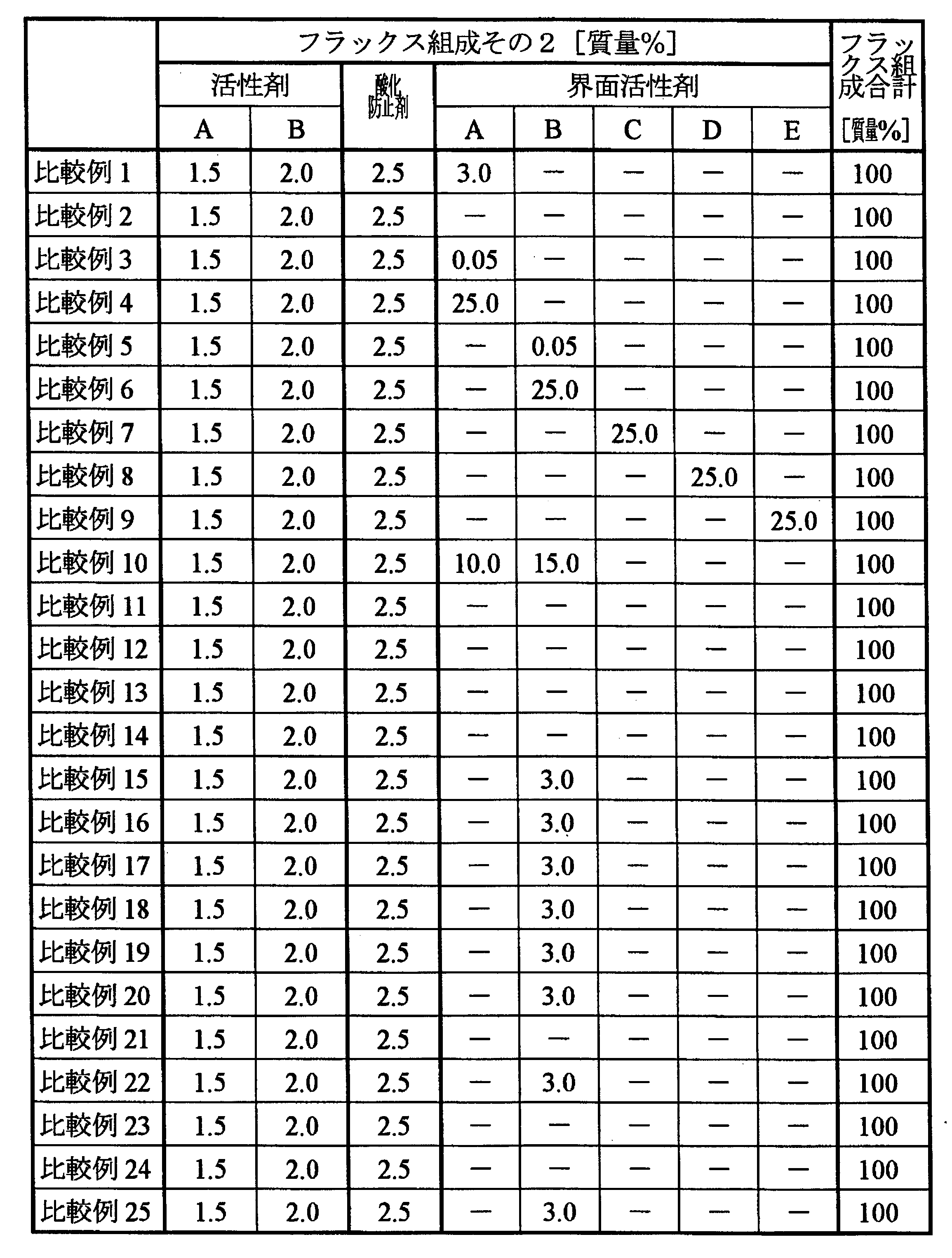
有機酸ポリグリセロールエステルと、チキソ剤と、溶剤と、活性剤と、酸化防止剤としてフェノール系酸化防止剤と、界面活性剤をそれぞれ用意した。これらを、以下の表2~表7に示す割合で配合し、混合、撹拌することによりフラックスを得た。
なお、表2~表7中、分類A~Fで示される有機酸ポリグリセロールエステル、分類A、Bで示されるチキソ剤、分類A~Dで示される溶剤、分類A、Bで示される活性剤は、以下の表1に示す。
表5~表7中、分類A~Eで示される界面活性剤は、エーテル型ノニオン系界面活性剤であるポリオキシエチレンラウリルエーテル(分類A)、同じくエーテル型ノニオン系界面活性剤であるビス(2-ヒドロキシエチル)ラウリルアミン(分類B)、カチオン系界面活性剤であるラウリルトリメチルアンモニウムクロライド(分類C)、アニオン系界面活性剤であるポリオキシエチレンラウリルエーテル硫酸ナトリウム(分類D)、両性界面活性剤であるラウリルベタイン(分類E)であり、表1にも示す。
表1中、有機酸ポリグリセロールエステルの名称の末尾に記載された数字はポリグリセロールの重合数を示す。
なお、比較例2、比較例11~14、比較例21、比較例23及び比較例24では界面活性剤を配合しなかった。
有機酸ポリグリセロールエステルと、チキソ剤と、溶剤と、活性剤と、酸化防止剤としてフェノール系酸化防止剤と、界面活性剤をそれぞれ用意した。これらを、以下の表2~表7に示す割合で配合し、混合、撹拌することによりフラックスを得た。
なお、表2~表7中、分類A~Fで示される有機酸ポリグリセロールエステル、分類A、Bで示されるチキソ剤、分類A~Dで示される溶剤、分類A、Bで示される活性剤は、以下の表1に示す。
表5~表7中、分類A~Eで示される界面活性剤は、エーテル型ノニオン系界面活性剤であるポリオキシエチレンラウリルエーテル(分類A)、同じくエーテル型ノニオン系界面活性剤であるビス(2-ヒドロキシエチル)ラウリルアミン(分類B)、カチオン系界面活性剤であるラウリルトリメチルアンモニウムクロライド(分類C)、アニオン系界面活性剤であるポリオキシエチレンラウリルエーテル硫酸ナトリウム(分類D)、両性界面活性剤であるラウリルベタイン(分類E)であり、表1にも示す。
表1中、有機酸ポリグリセロールエステルの名称の末尾に記載された数字はポリグリセロールの重合数を示す。
なお、比較例2、比較例11~14、比較例21、比較例23及び比較例24では界面活性剤を配合しなかった。
<比較例1>
有機酸ポリグリセロールエステル類の代わりにロジン(重合ロジン)を使用し、ロジン、チキソ剤、溶剤、活性剤、酸化防止剤、及び界面活性剤を、以下の表4及び表7に示す割合で配合したこと以外は、実施例1と同様にしてフラックスを得た。この比較例1で得られたフラックスはポリグリセロールエステル類を含まない。
有機酸ポリグリセロールエステル類の代わりにロジン(重合ロジン)を使用し、ロジン、チキソ剤、溶剤、活性剤、酸化防止剤、及び界面活性剤を、以下の表4及び表7に示す割合で配合したこと以外は、実施例1と同様にしてフラックスを得た。この比較例1で得られたフラックスはポリグリセロールエステル類を含まない。

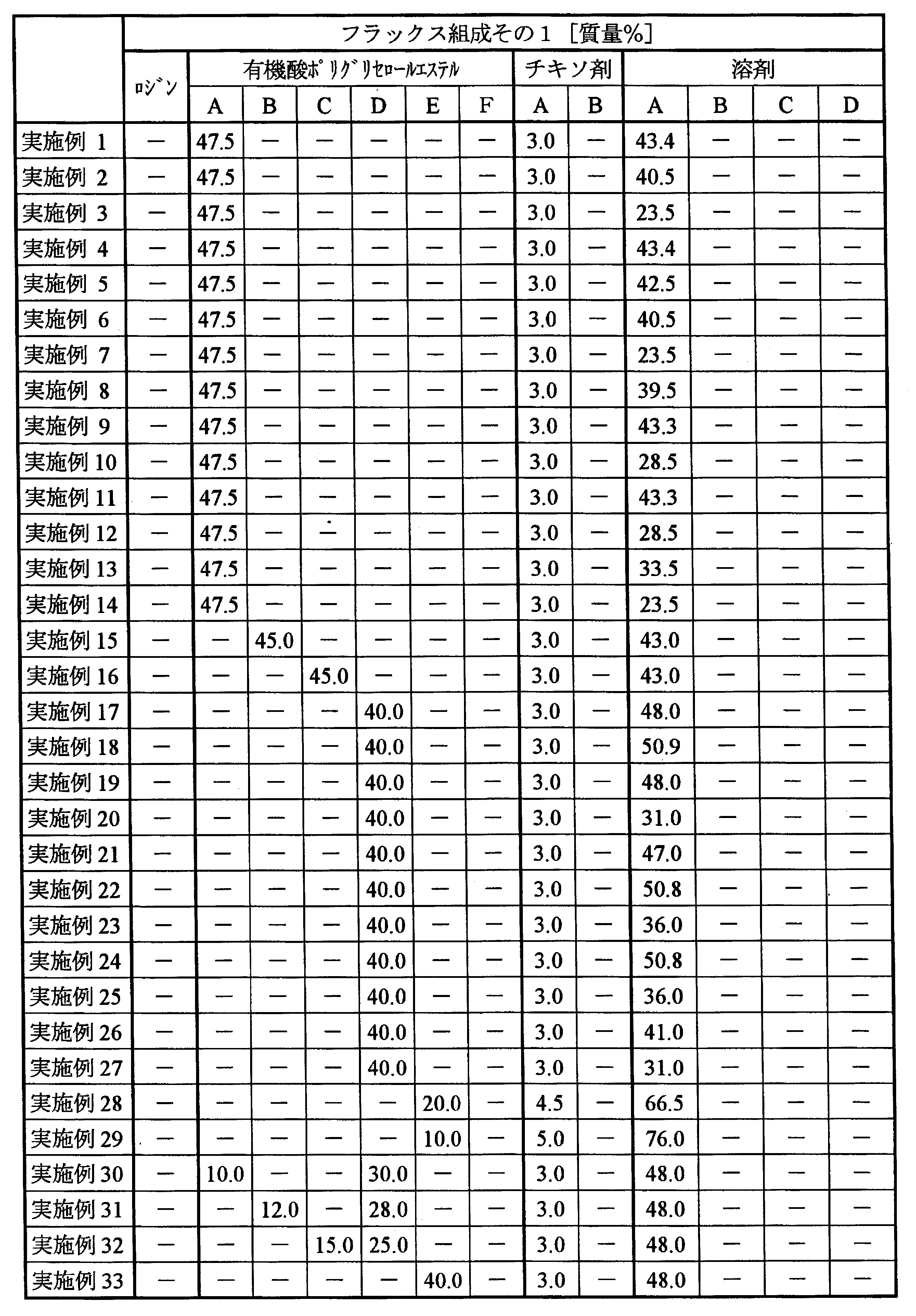
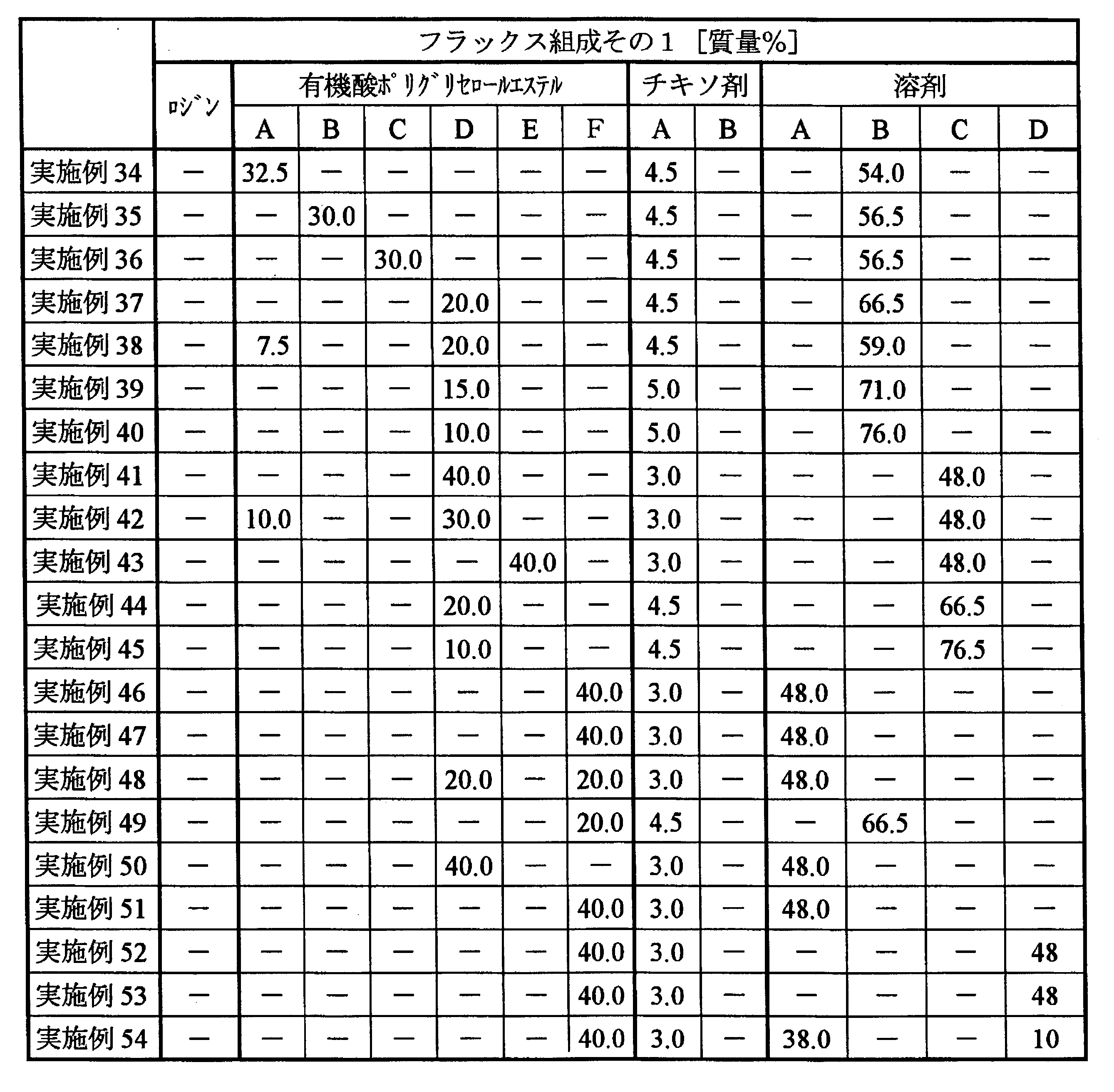

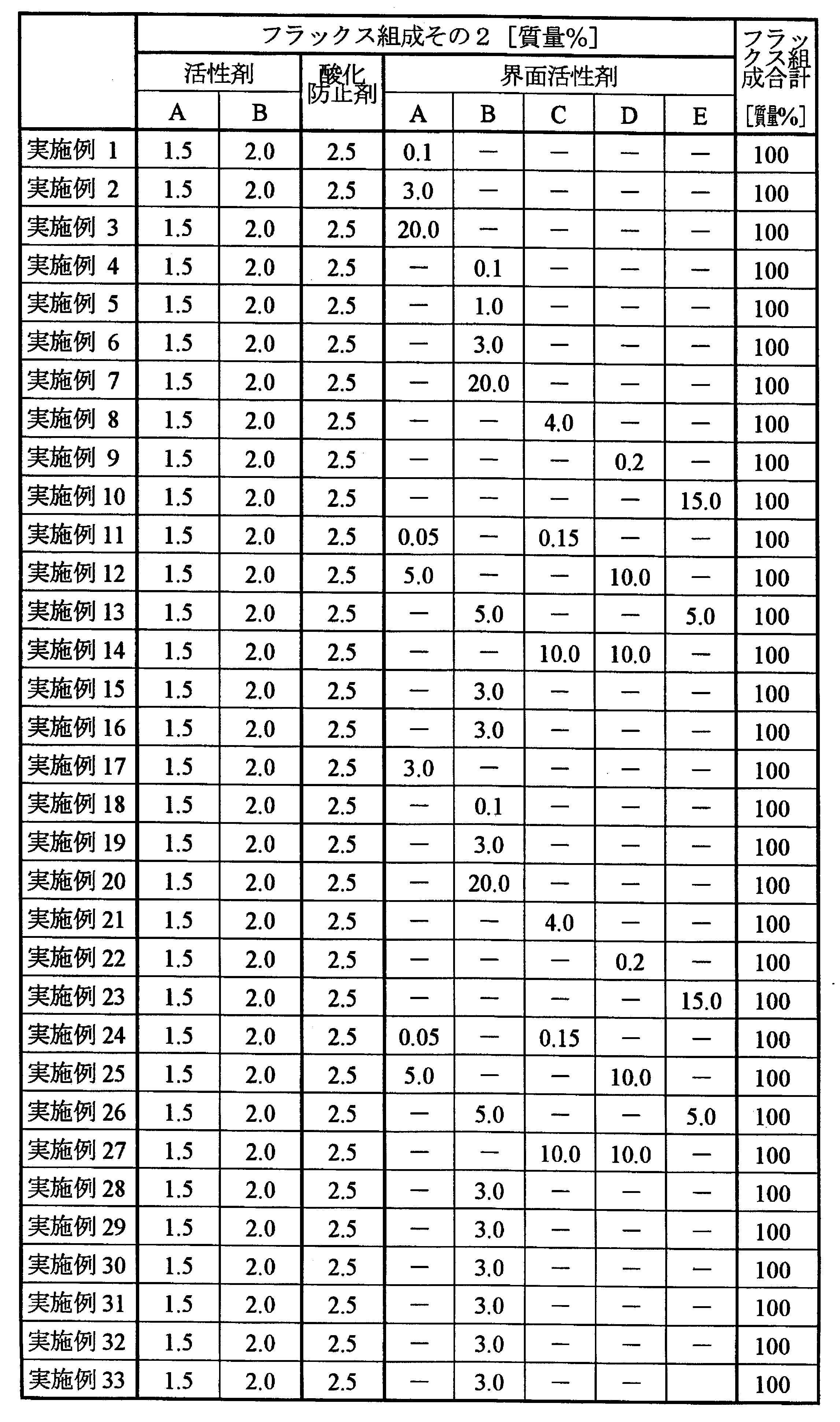
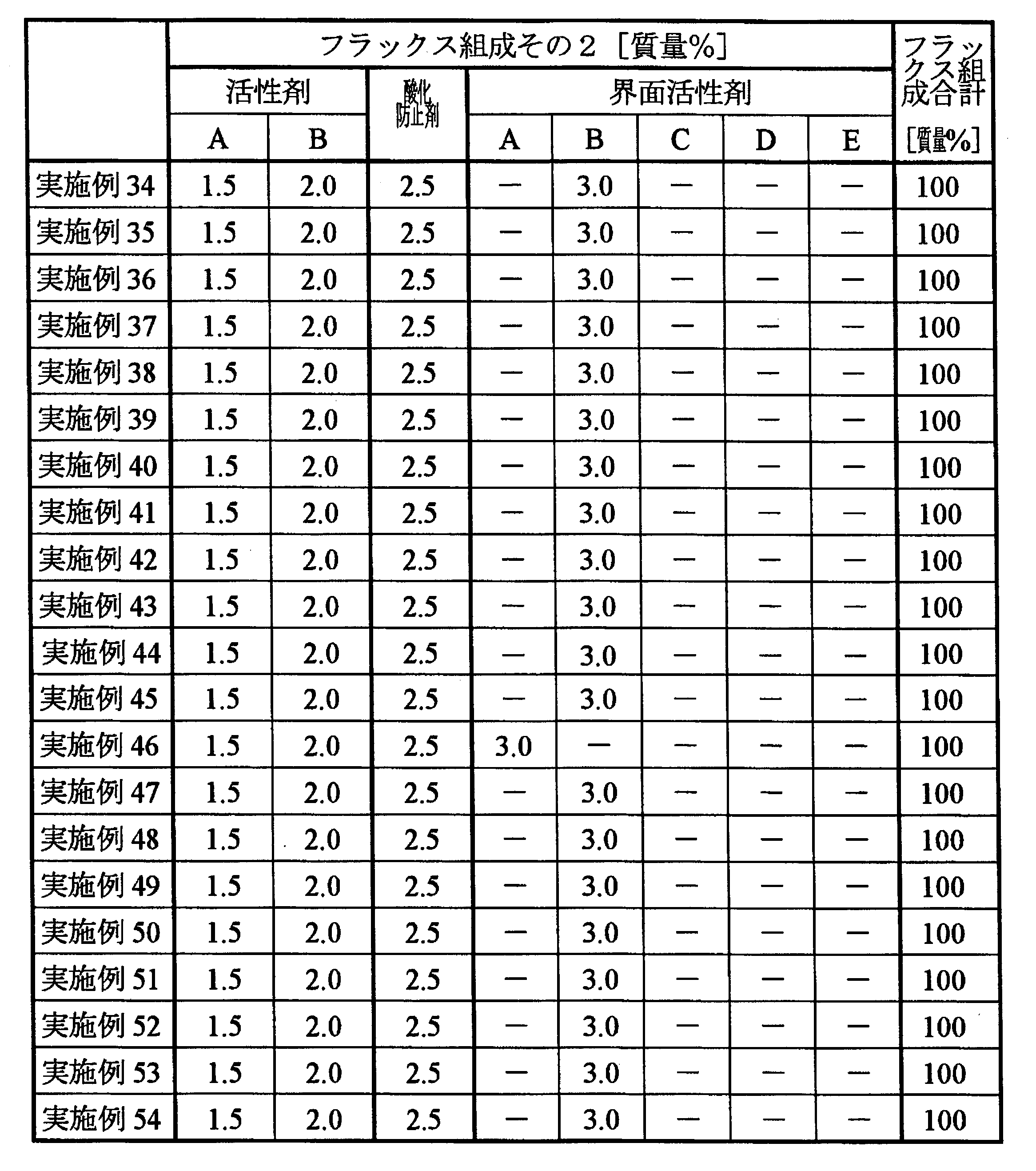
<比較試験及び評価>
実施例1~54及び比較例1~25で得られたフラックスを用いて、以下の(i)~(iii)の評価を行った。これらの結果を表8~表10に示す。表8~表10には、用いたハンダ粉末の種類も示した。
実施例1~54及び比較例1~25で得られたフラックスを用いて、以下の(i)~(iii)の評価を行った。これらの結果を表8~表10に示す。表8~表10には、用いたハンダ粉末の種類も示した。
(i)バンプ印刷性(基板):
二種類のハンダ粉末を用意し、二種類のハンダペーストを調製した。
先ず、平均粒径が8μmのSn-Ag-Cu系ハンダ粉末(組成:Sn96.5質量%、Ag3.0質量%、Cu0.5質量%)を用意した。このハンダ粉末89.0質量部と、実施例1~49、52、比較例1~22でそれぞれ得られたフラックス11.0質量部とを室温にて攪拌、混合することにより、ハンダペーストを調製した。ハンダペーストを100体積%とすると、Sn-Ag-Cu系ハンダ粉末の割合は52.3体積%であり、フラックスの割合は47.7体積%であった。表8~表10において、このハンダ粉末を「SAC305」と記載した。
次に、平均粒径が8μmのAu-Sn系ハンダ粉末(組成:Au78.0質量%、Sn22.0質量%)を用意した。このハンダ粉末94.0質量部と、実施例50、51、53、54、比較例23~25でそれぞれ得られたフラックス6.0質量部とを室温にて攪拌、混合することにより、ハンダペーストを調製した。ハンダペーストを100体積%とすると、Au-Sn系ハンダ粉末の割合は52.5体積%であり、フラックスの割合は47.5体積%であった。表9及び表10においてこのハンダ粉末を「Au22Sn」と記載した。
なお、ハンダ粉末の平均粒径は、レーザー回折散乱式粒子径分布測定装置(堀場製作所製、型式名:Partica LA-950)を用いて測定した体積基準の平均粒径D50である。
複数の開口部が設けられたNiメッキ製のメタルマスク版(外形寸法:縦300mm×横3000mm×厚さ20μm、開口径φ:75μm、開口部ピッチ:100μm)を備える小型半自動スクリーン印刷機を用い、上述のハンダペーストを基板(寸法:縦60mm×横60mm×厚さ0.8mm)上に印刷することにより、基板上にハンダバンプを形成した。なお、上記基板は、基板の一方の面に設けられ厚さが約50μmの銅箔と、この銅箔上に設けられ銅箔まで貫通する複数の開口部が形成されたレジスト膜(膜厚15μm、開口径φ65μm、開口部ピッチ100μm)を備える。
上記基板上に形成されたハンダバンプ20,000個中、バンプが形成されないミッシングバンプの数と、隣り合うバンプ同士が繋がったブリッジの数を計測した。ミッシングバンプの数及びブリッジの数がそれぞれ5以下のものを合格(pass)とした。
二種類のハンダ粉末を用意し、二種類のハンダペーストを調製した。
先ず、平均粒径が8μmのSn-Ag-Cu系ハンダ粉末(組成:Sn96.5質量%、Ag3.0質量%、Cu0.5質量%)を用意した。このハンダ粉末89.0質量部と、実施例1~49、52、比較例1~22でそれぞれ得られたフラックス11.0質量部とを室温にて攪拌、混合することにより、ハンダペーストを調製した。ハンダペーストを100体積%とすると、Sn-Ag-Cu系ハンダ粉末の割合は52.3体積%であり、フラックスの割合は47.7体積%であった。表8~表10において、このハンダ粉末を「SAC305」と記載した。
次に、平均粒径が8μmのAu-Sn系ハンダ粉末(組成:Au78.0質量%、Sn22.0質量%)を用意した。このハンダ粉末94.0質量部と、実施例50、51、53、54、比較例23~25でそれぞれ得られたフラックス6.0質量部とを室温にて攪拌、混合することにより、ハンダペーストを調製した。ハンダペーストを100体積%とすると、Au-Sn系ハンダ粉末の割合は52.5体積%であり、フラックスの割合は47.5体積%であった。表9及び表10においてこのハンダ粉末を「Au22Sn」と記載した。
なお、ハンダ粉末の平均粒径は、レーザー回折散乱式粒子径分布測定装置(堀場製作所製、型式名:Partica LA-950)を用いて測定した体積基準の平均粒径D50である。
複数の開口部が設けられたNiメッキ製のメタルマスク版(外形寸法:縦300mm×横3000mm×厚さ20μm、開口径φ:75μm、開口部ピッチ:100μm)を備える小型半自動スクリーン印刷機を用い、上述のハンダペーストを基板(寸法:縦60mm×横60mm×厚さ0.8mm)上に印刷することにより、基板上にハンダバンプを形成した。なお、上記基板は、基板の一方の面に設けられ厚さが約50μmの銅箔と、この銅箔上に設けられ銅箔まで貫通する複数の開口部が形成されたレジスト膜(膜厚15μm、開口径φ65μm、開口部ピッチ100μm)を備える。
上記基板上に形成されたハンダバンプ20,000個中、バンプが形成されないミッシングバンプの数と、隣り合うバンプ同士が繋がったブリッジの数を計測した。ミッシングバンプの数及びブリッジの数がそれぞれ5以下のものを合格(pass)とした。
(ii)バンプ溶融性(基板):
上述のバンプ印刷性試験でハンダバンプが形成された基板を、リフロー炉(マルコム社製、型式名:SRS-1C)を用いて、次の条件で加熱し、ハンダバンプを溶融させた。
実施例1~49、比較例1~22のSn-Ag-Cu系ハンダ粉末を用いたハンダペーストにより形成されたハンダバンプについては、基板を窒素雰囲気中、室温から150℃まで1.5℃/sの昇温速度で昇温し、150℃で2分間予備乾燥した。次いで、150℃から230℃の温度まで1.5℃/sの昇温速度で昇温し、230℃の温度で5秒間加熱した。これにより、基板上のハンダバンプを溶融させた。
また実施例50、51、53、54、比較例23~25のAu-Sn系ハンダ粉末を用いたハンダペーストにより形成されたハンダバンプについては、室温から220℃まで1.5℃/sの昇温速度で昇温し、220℃で2分間予備乾燥した。次いで、220℃から300℃の温度まで1.5℃/sの昇温速度で昇温し、300℃の温度で5秒間加熱した。これにより、基板上のハンダバンプを溶融させた。
リフロー後の外観を目視にて観察し、バンプ周辺に未凝集のハンダが確認されなかった場合を「良好」(good)と評価し、未凝集のハンダが確認された場合を「不良」(bad)と評価した。
上述のバンプ印刷性試験でハンダバンプが形成された基板を、リフロー炉(マルコム社製、型式名:SRS-1C)を用いて、次の条件で加熱し、ハンダバンプを溶融させた。
実施例1~49、比較例1~22のSn-Ag-Cu系ハンダ粉末を用いたハンダペーストにより形成されたハンダバンプについては、基板を窒素雰囲気中、室温から150℃まで1.5℃/sの昇温速度で昇温し、150℃で2分間予備乾燥した。次いで、150℃から230℃の温度まで1.5℃/sの昇温速度で昇温し、230℃の温度で5秒間加熱した。これにより、基板上のハンダバンプを溶融させた。
また実施例50、51、53、54、比較例23~25のAu-Sn系ハンダ粉末を用いたハンダペーストにより形成されたハンダバンプについては、室温から220℃まで1.5℃/sの昇温速度で昇温し、220℃で2分間予備乾燥した。次いで、220℃から300℃の温度まで1.5℃/sの昇温速度で昇温し、300℃の温度で5秒間加熱した。これにより、基板上のハンダバンプを溶融させた。
リフロー後の外観を目視にて観察し、バンプ周辺に未凝集のハンダが確認されなかった場合を「良好」(good)と評価し、未凝集のハンダが確認された場合を「不良」(bad)と評価した。
(iii)フラックス洗浄性(基板):
100mlのガラス製ビーカーに入れた50mlのイオン交換水を、ホットプレートを用いて60℃になるまで加熱した。この60℃のイオン交換水が入ったビーカーに、上述の溶融性試験を行った後の基板を投入し、更に超音波洗浄器内にビーカーごと投入して5分間超音波をかけた。その後、基板をビーカーから取り出し、エアブローにて水を除去した。次いで、乾燥器を用いて、50℃の温度で5分間乾燥させた。
リフロー及び洗浄後のバンプ部分を、走査型電子顕微鏡(SEM;日本電子社製、型式名:JSM-6510LV)の反射電子像にて観察し、有機成分の残渣の有無を確認した。このときの有機成分の残渣の有無又はその程度に基づいて、以下の3段階にて評価した。
残渣がほぼ皆無の場合を「優良」(excellent)と評価した。バンプ表面積100%に対して5%未満の残渣が確認された場合を「良好」(good)と評価した。バンプ表面積100%に対して5%以上の残渣が確認された場合を「不良」(bad)と評価した。
100mlのガラス製ビーカーに入れた50mlのイオン交換水を、ホットプレートを用いて60℃になるまで加熱した。この60℃のイオン交換水が入ったビーカーに、上述の溶融性試験を行った後の基板を投入し、更に超音波洗浄器内にビーカーごと投入して5分間超音波をかけた。その後、基板をビーカーから取り出し、エアブローにて水を除去した。次いで、乾燥器を用いて、50℃の温度で5分間乾燥させた。
リフロー及び洗浄後のバンプ部分を、走査型電子顕微鏡(SEM;日本電子社製、型式名:JSM-6510LV)の反射電子像にて観察し、有機成分の残渣の有無を確認した。このときの有機成分の残渣の有無又はその程度に基づいて、以下の3段階にて評価した。
残渣がほぼ皆無の場合を「優良」(excellent)と評価した。バンプ表面積100%に対して5%未満の残渣が確認された場合を「良好」(good)と評価した。バンプ表面積100%に対して5%以上の残渣が確認された場合を「不良」(bad)と評価した。
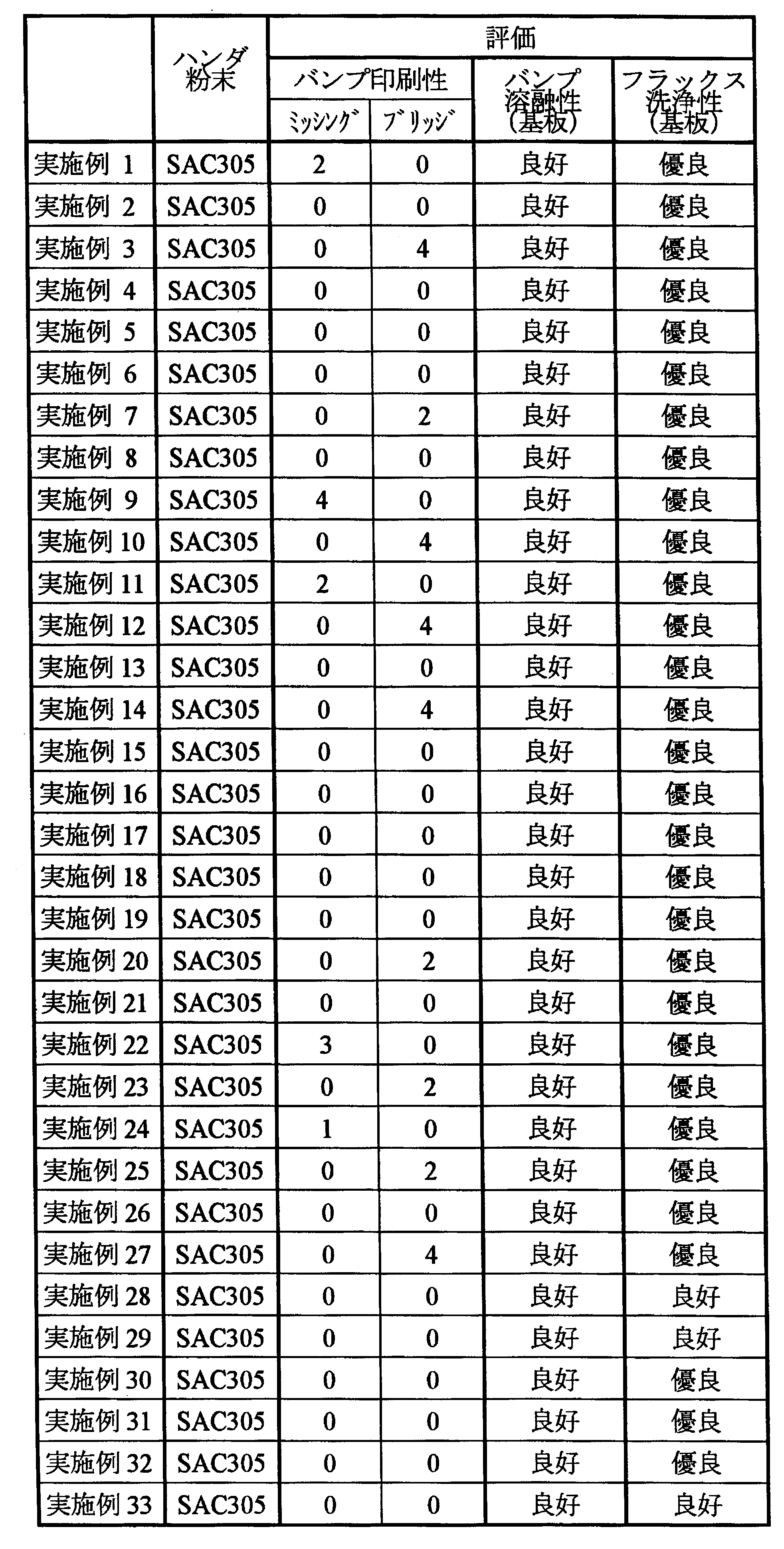
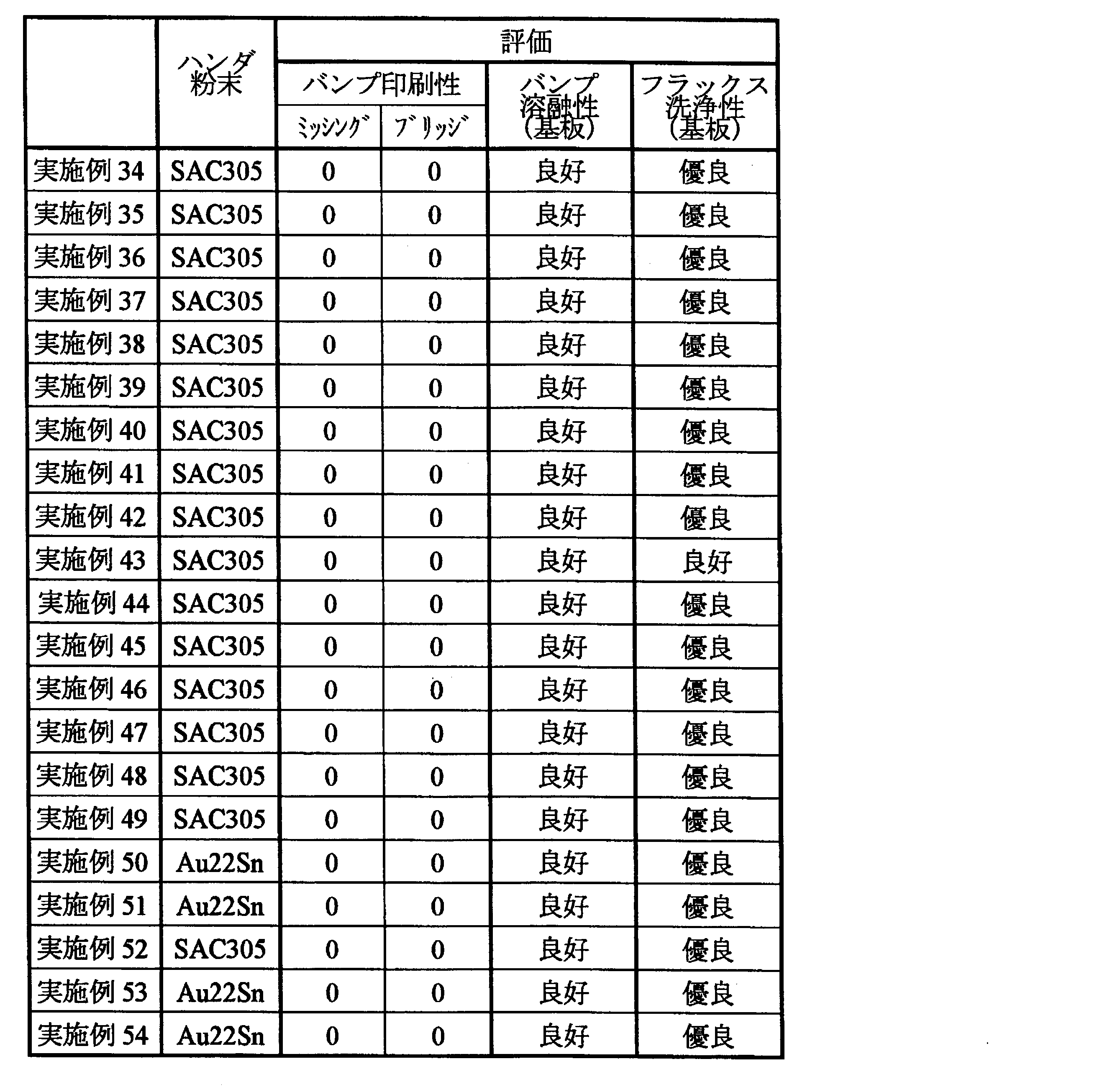
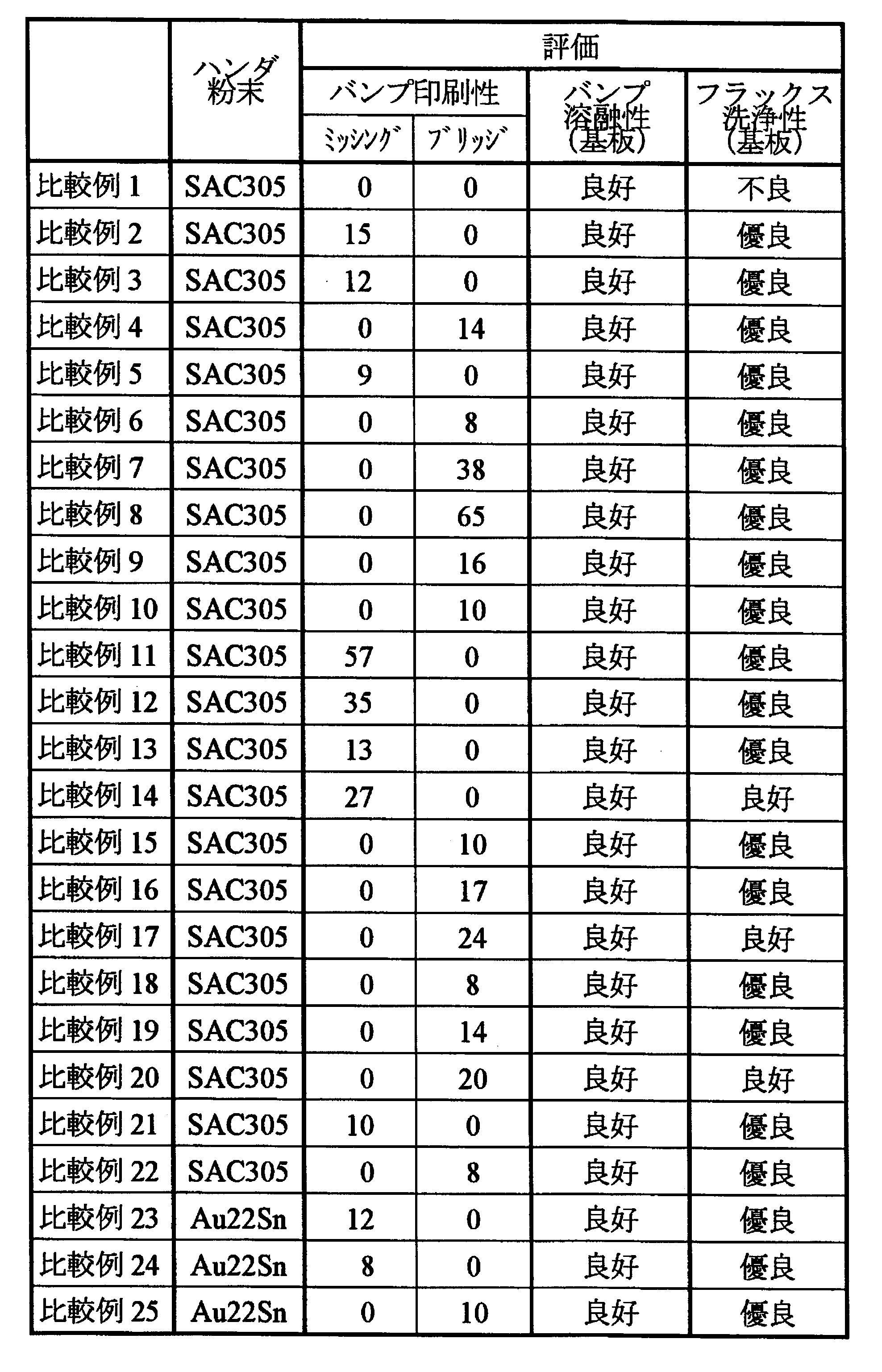
表8~表10から明らかなように、実施例1~54と比較例1~25とを比較すると、フラックスの成分にロジンを用いた比較例1では、バンプ印刷性の評価では「良好」であった。しかし、水だけでは十分な洗浄ができず、フラックス洗浄性の評価が「不良」の結果となった。
また、硬化ひまし油を使用した比較例15~20、22,25では、樹脂成分として有機酸ポリグリセロールエステルを使用したことにより、フラックス洗浄性の評価では、いずれにおいても「良好」又は「優良」の結果が得られ、またバンプ印刷性のうちミッシングバンプ数は合格基準を満たした。しかし、ブリッジ数が合格基準を満たさなかった。
また、硬化ひまし油を使用した比較例15~20、22,25では、樹脂成分として有機酸ポリグリセロールエステルを使用したことにより、フラックス洗浄性の評価では、いずれにおいても「良好」又は「優良」の結果が得られ、またバンプ印刷性のうちミッシングバンプ数は合格基準を満たした。しかし、ブリッジ数が合格基準を満たさなかった。
またフラックスの成分に有機酸ポリグリセロールエステルと特定のチキソ剤を含むが界面活性剤を含有させなかった比較例2、11~14、21、23,24及び界面活性剤をそれぞれ0.05質量%含んだ比較例3、5では、バンプ溶融性とフラックス洗浄性について、それぞれ合格基準を満たした。しかし、ハンダペーストにしたときにペーストが流動しにくく、ブリッジは発生しないが、ミッシングバンプ数が8~57であって合格基準に達しなかった。
またフラックスの成分に有機酸ポリグリセロールエステルと特定のチキソ剤を含むが、界面活性剤をそれぞれ25.0質量%含んだ比較例4、6~10では、バンプ溶融性とフラックス洗浄性について、それぞれ合格基準を満たした。しかし、ハンダペーストにしたときにペーストが流動し易くなり、バンプ間のブリッジ数が合格基準に達しなかった。
これに対し、樹脂成分として有機酸ポリグリセロールエステルを使用し、特定のチキソ剤を使用し、界面活性剤を特定の量で含んだ実施例1~54では、バンプ溶融性とフラックス洗浄性に高い評価が得られた。ノニオン系界面活性剤の含有量が0.1質量%の実施例1ではミッシングバンプ数が「2」であった。アニオン系界面活性剤の含有量が0.2質量%の実施例9、22ではミッシングバンプ数が「4」又は「3」であった。ノニオン系とカチオン系を合わせた界面活性剤の含有量が0.2質量%の実施例11、24ではミッシングバンプ数が「2」又は「1」であった。それ以外の実施例2~8、10、12~21、23、25~54では、ミッシングバンプ数が「0」であった。このようにすべての実施例1~54がミッシングバンプ数に関して合格していた。
またノニオン系界面活性剤の含有量が20.0質量%の実施例3ではブリッジ数が「4」であった。別の種類のノニオン系界面活性剤の含有量が20.0質量%の実施例7、20ではブリッジ数が「2」であった。両性界面活性剤の含有量が15.0質量%の実施例10、23ではブリッジ数が「4」又は「2」であった。ノニオン系とアニオン系を合わせた界面活性剤の含有量が15.0質量%の実施例12、25ではブリッジ数が「2」であった。カチオン系とアニオン系を合わせた界面活性剤の含有量が20.0質量%の実施例14、27ではブリッジ数が「4」であった。それ以外の実施例1、2、4~6、8、9、11、13、15~19、21、22、24、26、28~54では、ブリッジ数が「0」であった。このようにすべての実施例1~54がブリッジ数に関して合格していた。
本発明のハンダペースト用水溶性フラックスは、電子部品の実装(特に、FCボンディング技術のようなバンプ形成や狭ピッチ印刷等が必要な実装技術)、その他部品の接合等に広く利用することができる。
Claims (5)
- 常温で固体の界面活性剤である有機酸ポリグリセロールエステルと、チキソ剤と、溶剤とを含み、
前記チキソ剤がベンジリデンソルビトール又はベンジリデンソルビトール誘導体であって、水溶性フラックス100質量%中、常温で液体の界面活性剤を0.1~20.0質量%の量で含むことを特徴とするハンダペースト用水溶性フラックス。 - 前記有機酸ポリグリセロールエステルのHLB値が10~19であることを特徴とする請求項1に記載のハンダペースト用水溶性フラックス。
- 前記有機酸ポリグリセロールエステルが、ラウリン酸ポリグリセロールエステル、ステアリン酸ポリグリセロールエステル、イソステアリン酸ポリグリセロールエステル、セスキステアリン酸ポリグリセロールエステル、ジイソステアリン酸ポリグリセロールエステル、ミリスチン酸ポリグリセロールエステル、パルミチン酸ポリグリセロールエステル、オレイン酸ポリグリセロールエステル、ベヘニン酸ポリグリセロールエステル、及びカプリル酸ポリグリセロールエステルからなる群より選ばれた1種又は2種以上であることを特徴とする請求項1又は2に記載のハンダペースト用水溶性フラックス。
- 前記溶剤のSP値が10~20であることを特徴とする請求項1~3のいずれか一項に記載のハンダペースト用水溶性フラックス。
- 請求項1~4のいずれか一項に記載のハンダペースト用水溶性フラックスと、ハンダ粉末とを含むハンダペースト。
Priority Applications (2)
| Application Number | Priority Date | Filing Date | Title |
|---|---|---|---|
| MYPI2018702451A MY198498A (en) | 2016-02-25 | 2017-02-22 | Water-soluble flux for solder paste and solder paste |
| CN201780003977.0A CN108349049A (zh) | 2016-02-25 | 2017-02-22 | 焊膏用水溶性助焊剂及焊膏 |
Applications Claiming Priority (4)
| Application Number | Priority Date | Filing Date | Title |
|---|---|---|---|
| JP2016033714 | 2016-02-25 | ||
| JP2016-033714 | 2016-02-25 | ||
| JP2017-019316 | 2017-02-06 | ||
| JP2017019316A JP6794857B2 (ja) | 2016-02-25 | 2017-02-06 | ハンダペースト用水溶性フラックス及びハンダペースト |
Publications (1)
| Publication Number | Publication Date |
|---|---|
| WO2017146098A1 true WO2017146098A1 (ja) | 2017-08-31 |
Family
ID=59686310
Family Applications (1)
| Application Number | Title | Priority Date | Filing Date |
|---|---|---|---|
| PCT/JP2017/006597 Ceased WO2017146098A1 (ja) | 2016-02-25 | 2017-02-22 | ハンダペースト用水溶性フラックス及びハンダペースト |
Country Status (2)
| Country | Link |
|---|---|
| MY (1) | MY198498A (ja) |
| WO (1) | WO2017146098A1 (ja) |
Citations (5)
| Publication number | Priority date | Publication date | Assignee | Title |
|---|---|---|---|---|
| JPH02284793A (ja) * | 1989-04-27 | 1990-11-22 | Senju Metal Ind Co Ltd | 水溶性クリームはんだ |
| JPH1085985A (ja) * | 1996-09-19 | 1998-04-07 | Uchihashi Estec Co Ltd | クリ−ムはんだ |
| JP2014024116A (ja) * | 2012-07-30 | 2014-02-06 | Tamura Seisakusho Co Ltd | はんだ付け用フラックス |
| JP2014195825A (ja) * | 2013-03-29 | 2014-10-16 | 株式会社タムラ製作所 | はんだ付け用フラックス組成物およびそれを用いた電子基板 |
| JP2016043397A (ja) * | 2014-08-26 | 2016-04-04 | 三菱マテリアル株式会社 | ハンダペースト用水溶性フラックス及びハンダペースト |
-
2017
- 2017-02-22 WO PCT/JP2017/006597 patent/WO2017146098A1/ja not_active Ceased
- 2017-02-22 MY MYPI2018702451A patent/MY198498A/en unknown
Patent Citations (5)
| Publication number | Priority date | Publication date | Assignee | Title |
|---|---|---|---|---|
| JPH02284793A (ja) * | 1989-04-27 | 1990-11-22 | Senju Metal Ind Co Ltd | 水溶性クリームはんだ |
| JPH1085985A (ja) * | 1996-09-19 | 1998-04-07 | Uchihashi Estec Co Ltd | クリ−ムはんだ |
| JP2014024116A (ja) * | 2012-07-30 | 2014-02-06 | Tamura Seisakusho Co Ltd | はんだ付け用フラックス |
| JP2014195825A (ja) * | 2013-03-29 | 2014-10-16 | 株式会社タムラ製作所 | はんだ付け用フラックス組成物およびそれを用いた電子基板 |
| JP2016043397A (ja) * | 2014-08-26 | 2016-04-04 | 三菱マテリアル株式会社 | ハンダペースト用水溶性フラックス及びハンダペースト |
Also Published As
| Publication number | Publication date |
|---|---|
| MY198498A (en) | 2023-09-01 |
Similar Documents
| Publication | Publication Date | Title |
|---|---|---|
| JP6794857B2 (ja) | ハンダペースト用水溶性フラックス及びハンダペースト | |
| JP2016150344A (ja) | ハンダペースト用水溶性フラックス及びハンダペースト | |
| CN100528461C (zh) | 一种用于锡铅焊膏的无松香免清洗助焊剂及其制备方法 | |
| JP5887330B2 (ja) | はんだ組成物およびそれを用いたプリント配線基板 | |
| TWI517929B (zh) | Solder paste | |
| JP6668664B2 (ja) | ハンダペースト用水溶性フラックス及びハンダペースト | |
| CN104070308A (zh) | 无卤素免清洗光亮型焊锡丝用松香基助焊剂及其制备方法 | |
| JP6398464B2 (ja) | ハンダペースト用水溶性フラックス及びハンダペースト | |
| CN102166689A (zh) | 一种无卤素无铅焊锡膏及其所用助焊剂 | |
| US10836000B2 (en) | Flux, solder paste, and method for forming solder bump | |
| JP2020040120A (ja) | ジェットディスペンサー用はんだ組成物、および電子基板の製造方法 | |
| WO2015022719A1 (ja) | フラックス、ソルダペースト及びはんだ継手 | |
| JP6460473B2 (ja) | はんだ付け用フラックスおよびはんだペースト組成物 | |
| CN105531076B (zh) | 清洗用助焊剂以及清洗用焊膏 | |
| JP2016043397A (ja) | ハンダペースト用水溶性フラックス及びハンダペースト | |
| JP6184817B2 (ja) | フラックス組成物、はんだ組成物、および、プリント配線基板の製造方法 | |
| JP2011104638A (ja) | 水溶性フラックス、導電性ペーストおよび接合部品 | |
| JP7663006B2 (ja) | ハンダペースト用水溶性フラックス及びハンダペースト | |
| TWI714910B (zh) | 助焊劑、包芯焊料及塗覆助焊劑的團塊 | |
| WO2017146098A1 (ja) | ハンダペースト用水溶性フラックス及びハンダペースト | |
| CN116748734B (zh) | 水溶性激光焊锡膏及其制备方法 | |
| JP3273961B2 (ja) | クリームはんだ | |
| JP2011083809A (ja) | フラックス、はんだペースト及び接合部品 | |
| TWI755863B (zh) | 助熔劑、焊錫膏 | |
| JP5635561B2 (ja) | はんだ組成物 |
Legal Events
| Date | Code | Title | Description |
|---|---|---|---|
| NENP | Non-entry into the national phase |
Ref country code: DE |
|
| 121 | Ep: the epo has been informed by wipo that ep was designated in this application |
Ref document number: 17756536 Country of ref document: EP Kind code of ref document: A1 |
|
| 122 | Ep: pct application non-entry in european phase |
Ref document number: 17756536 Country of ref document: EP Kind code of ref document: A1 |