WO2017131691A1 - Anti-adherent composition against dna viruses and method of inhibiting the adherence of dna viruses to a surface - Google Patents
Anti-adherent composition against dna viruses and method of inhibiting the adherence of dna viruses to a surface Download PDFInfo
- Publication number
- WO2017131691A1 WO2017131691A1 PCT/US2016/015292 US2016015292W WO2017131691A1 WO 2017131691 A1 WO2017131691 A1 WO 2017131691A1 US 2016015292 W US2016015292 W US 2016015292W WO 2017131691 A1 WO2017131691 A1 WO 2017131691A1
- Authority
- WO
- WIPO (PCT)
- Prior art keywords
- composition
- peg
- glycerin
- humectant
- adherent
- Prior art date
- Legal status (The legal status is an assumption and is not a legal conclusion. Google has not performed a legal analysis and makes no representation as to the accuracy of the status listed.)
- Ceased
Links
Classifications
-
- C—CHEMISTRY; METALLURGY
- C11—ANIMAL OR VEGETABLE OILS, FATS, FATTY SUBSTANCES OR WAXES; FATTY ACIDS THEREFROM; DETERGENTS; CANDLES
- C11D—DETERGENT COMPOSITIONS; USE OF SINGLE SUBSTANCES AS DETERGENTS; SOAP OR SOAP-MAKING; RESIN SOAPS; RECOVERY OF GLYCEROL
- C11D3/00—Other compounding ingredients of detergent compositions covered in group C11D1/00
- C11D3/0005—Other compounding ingredients characterised by their effect
-
- C—CHEMISTRY; METALLURGY
- C11—ANIMAL OR VEGETABLE OILS, FATS, FATTY SUBSTANCES OR WAXES; FATTY ACIDS THEREFROM; DETERGENTS; CANDLES
- C11D—DETERGENT COMPOSITIONS; USE OF SINGLE SUBSTANCES AS DETERGENTS; SOAP OR SOAP-MAKING; RESIN SOAPS; RECOVERY OF GLYCEROL
- C11D17/00—Detergent materials or soaps characterised by their shape or physical properties
- C11D17/04—Detergent materials or soaps characterised by their shape or physical properties combined with or containing other objects
- C11D17/049—Cleaning or scouring pads; Wipes
-
- C—CHEMISTRY; METALLURGY
- C09—DYES; PAINTS; POLISHES; NATURAL RESINS; ADHESIVES; COMPOSITIONS NOT OTHERWISE PROVIDED FOR; APPLICATIONS OF MATERIALS NOT OTHERWISE PROVIDED FOR
- C09D—COATING COMPOSITIONS, e.g. PAINTS, VARNISHES OR LACQUERS; FILLING PASTES; CHEMICAL PAINT OR INK REMOVERS; INKS; CORRECTING FLUIDS; WOODSTAINS; PASTES OR SOLIDS FOR COLOURING OR PRINTING; USE OF MATERIALS THEREFOR
- C09D101/00—Coating compositions based on cellulose, modified cellulose, or cellulose derivatives
- C09D101/08—Cellulose derivatives
- C09D101/26—Cellulose ethers
- C09D101/28—Alkyl ethers
- C09D101/284—Alkyl ethers with hydroxylated hydrocarbon radicals
-
- A—HUMAN NECESSITIES
- A47—FURNITURE; DOMESTIC ARTICLES OR APPLIANCES; COFFEE MILLS; SPICE MILLS; SUCTION CLEANERS IN GENERAL
- A47L—DOMESTIC WASHING OR CLEANING; SUCTION CLEANERS IN GENERAL
- A47L13/00—Implements for cleaning floors, carpets, furniture, walls, or wall coverings
- A47L13/10—Scrubbing; Scouring; Cleaning; Polishing
- A47L13/16—Cloths; Pads; Sponges
- A47L13/17—Cloths; Pads; Sponges containing cleaning agents
-
- B—PERFORMING OPERATIONS; TRANSPORTING
- B08—CLEANING
- B08B—CLEANING IN GENERAL; PREVENTION OF FOULING IN GENERAL
- B08B1/00—Cleaning by methods involving the use of tools
- B08B1/10—Cleaning by methods involving the use of tools characterised by the type of cleaning tool
- B08B1/14—Wipes; Absorbent members, e.g. swabs or sponges
- B08B1/143—Wipes
-
- B—PERFORMING OPERATIONS; TRANSPORTING
- B08—CLEANING
- B08B—CLEANING IN GENERAL; PREVENTION OF FOULING IN GENERAL
- B08B17/00—Methods preventing fouling
- B08B17/02—Preventing deposition of fouling or of dust
-
- C—CHEMISTRY; METALLURGY
- C09—DYES; PAINTS; POLISHES; NATURAL RESINS; ADHESIVES; COMPOSITIONS NOT OTHERWISE PROVIDED FOR; APPLICATIONS OF MATERIALS NOT OTHERWISE PROVIDED FOR
- C09D—COATING COMPOSITIONS, e.g. PAINTS, VARNISHES OR LACQUERS; FILLING PASTES; CHEMICAL PAINT OR INK REMOVERS; INKS; CORRECTING FLUIDS; WOODSTAINS; PASTES OR SOLIDS FOR COLOURING OR PRINTING; USE OF MATERIALS THEREFOR
- C09D5/00—Coating compositions, e.g. paints, varnishes or lacquers, characterised by their physical nature or the effects produced; Filling pastes
-
- C—CHEMISTRY; METALLURGY
- C09—DYES; PAINTS; POLISHES; NATURAL RESINS; ADHESIVES; COMPOSITIONS NOT OTHERWISE PROVIDED FOR; APPLICATIONS OF MATERIALS NOT OTHERWISE PROVIDED FOR
- C09D—COATING COMPOSITIONS, e.g. PAINTS, VARNISHES OR LACQUERS; FILLING PASTES; CHEMICAL PAINT OR INK REMOVERS; INKS; CORRECTING FLUIDS; WOODSTAINS; PASTES OR SOLIDS FOR COLOURING OR PRINTING; USE OF MATERIALS THEREFOR
- C09D7/00—Features of coating compositions, not provided for in group C09D5/00; Processes for incorporating ingredients in coating compositions
- C09D7/40—Additives
- C09D7/60—Additives non-macromolecular
- C09D7/63—Additives non-macromolecular organic
-
- C—CHEMISTRY; METALLURGY
- C11—ANIMAL OR VEGETABLE OILS, FATS, FATTY SUBSTANCES OR WAXES; FATTY ACIDS THEREFROM; DETERGENTS; CANDLES
- C11D—DETERGENT COMPOSITIONS; USE OF SINGLE SUBSTANCES AS DETERGENTS; SOAP OR SOAP-MAKING; RESIN SOAPS; RECOVERY OF GLYCEROL
- C11D17/00—Detergent materials or soaps characterised by their shape or physical properties
- C11D17/06—Powder; Flakes; Free-flowing mixtures; Sheets
-
- C—CHEMISTRY; METALLURGY
- C11—ANIMAL OR VEGETABLE OILS, FATS, FATTY SUBSTANCES OR WAXES; FATTY ACIDS THEREFROM; DETERGENTS; CANDLES
- C11D—DETERGENT COMPOSITIONS; USE OF SINGLE SUBSTANCES AS DETERGENTS; SOAP OR SOAP-MAKING; RESIN SOAPS; RECOVERY OF GLYCEROL
- C11D3/00—Other compounding ingredients of detergent compositions covered in group C11D1/00
- C11D3/0005—Other compounding ingredients characterised by their effect
- C11D3/001—Softening compositions
-
- C—CHEMISTRY; METALLURGY
- C11—ANIMAL OR VEGETABLE OILS, FATS, FATTY SUBSTANCES OR WAXES; FATTY ACIDS THEREFROM; DETERGENTS; CANDLES
- C11D—DETERGENT COMPOSITIONS; USE OF SINGLE SUBSTANCES AS DETERGENTS; SOAP OR SOAP-MAKING; RESIN SOAPS; RECOVERY OF GLYCEROL
- C11D3/00—Other compounding ingredients of detergent compositions covered in group C11D1/00
- C11D3/16—Organic compounds
- C11D3/20—Organic compounds containing oxygen
- C11D3/22—Carbohydrates or derivatives thereof
- C11D3/222—Natural or synthetic polysaccharides, e.g. cellulose, starch, gum, alginic acid or cyclodextrin
-
- C—CHEMISTRY; METALLURGY
- C11—ANIMAL OR VEGETABLE OILS, FATS, FATTY SUBSTANCES OR WAXES; FATTY ACIDS THEREFROM; DETERGENTS; CANDLES
- C11D—DETERGENT COMPOSITIONS; USE OF SINGLE SUBSTANCES AS DETERGENTS; SOAP OR SOAP-MAKING; RESIN SOAPS; RECOVERY OF GLYCEROL
- C11D3/00—Other compounding ingredients of detergent compositions covered in group C11D1/00
- C11D3/16—Organic compounds
- C11D3/20—Organic compounds containing oxygen
- C11D3/22—Carbohydrates or derivatives thereof
- C11D3/222—Natural or synthetic polysaccharides, e.g. cellulose, starch, gum, alginic acid or cyclodextrin
- C11D3/225—Natural or synthetic polysaccharides, e.g. cellulose, starch, gum, alginic acid or cyclodextrin etherified, e.g. CMC
-
- C—CHEMISTRY; METALLURGY
- C11—ANIMAL OR VEGETABLE OILS, FATS, FATTY SUBSTANCES OR WAXES; FATTY ACIDS THEREFROM; DETERGENTS; CANDLES
- C11D—DETERGENT COMPOSITIONS; USE OF SINGLE SUBSTANCES AS DETERGENTS; SOAP OR SOAP-MAKING; RESIN SOAPS; RECOVERY OF GLYCEROL
- C11D3/00—Other compounding ingredients of detergent compositions covered in group C11D1/00
- C11D3/48—Medical, disinfecting agents, disinfecting, antibacterial, germicidal or antimicrobial compositions
-
- C—CHEMISTRY; METALLURGY
- C11—ANIMAL OR VEGETABLE OILS, FATS, FATTY SUBSTANCES OR WAXES; FATTY ACIDS THEREFROM; DETERGENTS; CANDLES
- C11D—DETERGENT COMPOSITIONS; USE OF SINGLE SUBSTANCES AS DETERGENTS; SOAP OR SOAP-MAKING; RESIN SOAPS; RECOVERY OF GLYCEROL
- C11D7/00—Compositions of detergents based essentially on non-surface-active compounds
- C11D7/22—Organic compounds
- C11D7/26—Organic compounds containing oxygen
Definitions
- compositions with anti-adherent properties More specifically, disclosed is a composition that includes an anti-adherent agent that inhibits the adherence of DNA viruses to a surface.
- the composition may be applied to or incorporated into articles such as wipes, or into ointments, lotions, creams, salves, aerosols, gels, suspensions, sprays, foams, washes, or the like.
- Communicable human infections pass from person to person through various means such as food, aerosols, surfaces and hands.
- foodborne pathogens alone cause an estimated 76 million cases of illness, 325,000 hospitalizations and 5,000 deaths per year. This results in the spending or loss of several billion dollars due to absenteeism, cost of medication, and hospitalization.
- Foodborne pathogens are typically a result of poor cleaning of hands and surfaces on which food is prepared. In fact, the kitchen is one of the most contaminated sites in the home. High fecal and coliform concentrations can be found in sponges, dishcloths, and the kitchen sink. Of course, there are other pathogens lurking elsewhere in the home, at the office, and in public places such as public bathrooms, restaurants, malls, theaters, health-care facilities, etc. Such pathogens include bacteria, protein, active enzymes, viruses, and many other microbes that can lead to health problems. DNA viruses, including the adenovirus, are among these pathogens that can be spread and lead to health problems, such as the common cold, sore throats, pneumonia, and diarrhea.
- DNA viruses include herpes viruses, such as HSV-1 , HSV-2, cytomegalovirus, and Epstein-Barr. Other DNA viruses can lead to diseases such as smallpox and chickenpox. DNA viruses, like other pathogens, can be commonly spread by shaking hands with infected people or touching a surface or object with DNA viruses on it.
- compositions that can be applied to surfaces or incorporated into articles, wherein the compositions inhibit the adherence of DNA viruses.
- the compositions are skin friendly, cost effective, and convenient to use.
- a composition for inhibiting the attachment of DNA viruses to a surface can include a liquid carrier, an anti-adherent agent, and a humectant.
- the anti-adherent agent can include C12-16 Alkyl PEG-2 Hydroxypropyl Hydroxyethyl Ethylcellulose.
- a method for inhibiting the adherence of DNA viruses to a surface can include providing a composition.
- the composition can include an anti-adherent agent.
- the anti-adherent agent can include C12-16 Alkyl PEG-2 Hydroxypropyl Hydroxyethyl Ethylcellulose.
- the method can further include applying the composition to the surface to inhibit the adherence of DNA viruses to the surface.
- a wipe for inhibiting the attachment of DNA viruses to a surface can include a nonwoven substrate and a composition.
- the composition can include a composition including a liquid carrier and an anti-adherent agent.
- the anti-adherent agent can include C12-16 Alkyl PEG-2 Hydroxypropyl Hydroxyethyl Ethylcellulose.
- the present disclosure is directed to an anti-adherent composition containing an anti-adherent agent and a carrier that inhibits the adherence of DNA viruses to a surface and a method of inhibiting the adherence of DNA viruses to a surface.
- the composition may be applied to a surface in the form of a liquid, gel, or foam; or incorporated into a wash.
- the composition may be applied to a surface with a vehicle such as a wipe.
- the anti-adherent composition may be used on biotic surfaces such as skin or plants; or abiotic surfaces such as food prep surfaces; hospital and clinic surfaces; household surfaces; automotive, train, ship and aircraft surfaces; and the like; as long as the surface is compatible with the ingredients of the composition. Applying the anti-adherent composition to such surfaces can help prevent the amount or the likelihood that DNA viruses will adhere to those surfaces, thus, lessening the likelihood of further transferring of the virus.
- the anti-adherent composition of the present disclosure are not antimicrobial.
- the anti-adherent composition does not include any antimicrobial agents.
- the anti-adherent composition seeks to prevent attachment of DNA viruses to a surface, not eradicate the DNA viruses and any other microbes. This distinction can provide a benefit for the effectiveness for preventing the further spreading of DNA viruses as concerns grow about the increasing microbial resistance to common antimicrobial treatments.
- the anti-adherent composition can include antimicrobial agents.
- the anti-adherent composition reduces adherence of DNA viruses to a surface by at least 0.25 Log, or by at least 0.29 Log.
- Anti-adherent agents suitable for use in the composition can include C12-16 Alkyl PEG-2
- C12-16 Alkyl PEG-2 Hydroxypropyl Hydroxyethyl Ethylcellulose is a hydrophobically modified ethyl hydroxyethyl cellulose (HM-EHEC) commercially available under the name STRUCTURE CEL 500 HM from AkzoNobel. As shown in the High Throughput Test to Quantify the Attachment of Phage to a Surface (as discussed further below), C12-16 Alkyl PEG-2 Hydroxypropyl Hydroxyethyl Ethylcellulose was the only agent of many different agents tested that provided the unique result of inhibiting the attachment of DNA viruses to a surface but providing an increase in adherence of bacteria to a surface.
- HM-EHEC hydrophobically modified ethyl hydroxyethyl cellulose
- the anti-adherent compositions of the present disclosure can be suitably made with an anti-adherent agent in an amount of from about 0.01 % (by the total weight of the composition), to about 20% (by total weight of the composition), or preferably from about 0.05% (by total weight of the composition) to about 15% (by total weight of the composition), or more preferably from about 0.1 % (by total weight of the composition) to about 10% (by total weight of the composition).
- the anti-adherent composition included 1 .5% of an anti-adherent agent by total weight of the composition.
- the anti-adherent compositions of the present disclosure may be formulated with one or more conventional and compatible carrier materials.
- the anti-adherent composition may take a variety of forms including, without limitation, aqueous solutions, gels, balms, lotions, suspensions, creams, milks, salves, ointments, sprays, emulsions, oils, resins, foams, solid sticks, aerosols, and the like.
- Liquid carrier materials suitable for use in the instant disclosure include those well-known for use in the cosmetic and medical arts as a basis for ointments, lotions, creams, salves, aerosols, gels, suspensions, sprays, foams, washes, and the like, and may be used in their established levels.
- Non-limiting examples of suitable carrier materials include water, emollients, humectants, polyols, surfactants, esters, perflurocarbons, silicones, and other pharmaceutically acceptable carrier materials.
- the carrier is volatile, allowing for immediate deposition of the anti-adherent ingredient to the desired surface while improving overall usage experience of the product by reducing drying time.
- Non- limiting examples of these volatile carriers include 5 est Dimethicone, Cyclomethicone, Methyl
- the anti-adherent compositions can optionally include one or more emollients, which typically act to soften, soothe, and otherwise lubricate and/or moisturize the skin.
- emollients that can be incorporated into the compositions include oils such as alkyl dimethicones, alkyl methicones, alkyldimethicone copolyols, phenyl silicones, alkyl trimethylsilanes, dimethicone, dimethicone crosspolymers, cyclomethicone, lanolin and its derivatives, fatty esters, glycerol esters and derivatives, propylene glycol esters and derivatives, alkoxylated carboxylic acids, alkoxylated alcohols, fatty alcohols, and combinations thereof.
- Some embodiments of the anti-adherent compositions may include one or more emollients in an amount of from about 0.01 % (by total weight of the composition) to about 20% (by total weight of the composition), or from about 0.05% (by total weight of the composition) to about 10% (by total weight of the composition), or from about 0.10% (by total weight of the composition) to about 5% (by total weight of the composition).
- the anti-adherent compositions include one or more esters.
- the esters may be selected from cetyl palmitate, stearyl palmitate, cetyl stearate, isopropyl laurate, isopropyl myristate, isopropyl palmitate, and combinations thereof.
- the fatty alcohols include octyldodecanol, lauryl, myristyl, cetyl , stearyl, behenyl alcohol, and combinations thereof.
- Ethers such as eucalyptol, ceteraryl glucoside, dimethyl isosorbic polyglyceryl-3 cetyl ether, polyglyceryl-3 decyltetradecanol, propylene glycol myristyl ether, and combinations thereof can also suitably be used as emollients.
- Other suitable ester compounds for use in the anti-adherent compositions or the present disclosure are listed in the
- Humectants that are suitable as carriers in the anti-adherent compositions of the present disclosure include, for example, glycerin, glycerin derivatives, hyaluronic acid, hyaluronic acid derivatives, betaine, betaine derivatives amino acids, amino acid derivatives, glycosaminoglycans, glycols, polyols, sugars, sugar alcohols, hydrogenated starch hydrolysates, hydroxy acids, hydroxy acid derivatives, salts of PCA and the like, and combinations thereof.
- humectants include honey, sorbitol, hyaluronic acid, sodium hyaluronate, betaine, lactic acid, citric acid, sodium citrate, glycolic acid, sodium glycolate .sodium lactate, urea, propylene glycol, butylene glycol, pentylene glycol, ethoxydiglycol, methyl gluceth-10, methyl gluceth-20, polyethylene glycols (as listed in the International Cosmetic Ingredient Dictionary and Handbook such as PEG-2 through PEG 10), propanediol, xylitol, maltitol, or combinations thereof.
- Humectants are beneficial in that they prevent or reduce the chance that the anti- adherent film, formed after the anti-adherent agent is applied to a surface, will crack.
- the anti-adherent compositions of the disclosure may include one or more humectants in an amount of about 0.01 % (by total weight of the composition) to about 20% (by total weight of the composition), or about 0.05% (by total weight of the composition) to about 10% by total weight of the composition), or about 0.1 % (by total weight of the composition) to about 5.0% (by total weight of the composition).
- the anti-adherent compositions may include water.
- the anti-adherent composition is a wetting composition, such as described below for use with a wet wipe
- the composition will typically include water.
- the anti-adherent compositions can suitably comprise water in an amount of from about 0.01 % (by total weight of the composition) to about 99.98% (by total weight of the composition), or from about 1 .00% (by total weight of the composition) to about 99.98% (by total weight of the composition), or from about 50.00% (by total weight of the composition) to about 99.98% (by total weight of the composition), or from about 75.00% (by total weight of the composition) to about 99.98% (by total weight of the composition).
- the anti-adherent composition serves as a wash (e.g. shampoo; surface cleaner; or hand, face, or body wash)
- the anti-adherent composition will include one or more surfactants. These may be selected from anionic, cationic, nonionic, zwitterionic, and amphoteric surfactants. Amounts may range from 0.1 to 30%, or from 1 to 20%, or from 3 to 15% by total weight of the composition.
- Suitable anionic surfactants include, but are not limited to, Cs to C22 alkane sulfates, ether sulfates and sulfonates.
- suitable sulfonates are primary Cs to C22 alkane sulfonate, primary Cs to C22 alkane disulfonate, Cs to C22 alkene sulfonate, Cs to C22 hydroxyalkane sulfonate or alkyl glyceryl ether sulfonate.
- anionic surfactants include ammonium lauryl sulfate, ammonium laureth sulfate, triethylamine lauryl sulfate, triethylamine laureth sulfate, triethanolamine lauryl sulfate, triethanolamine laureth sulfate, monoethanolamine lauryl sulfate, monoethanolamine laureth sulfate, diethanolamine lauryl sulfate, diethanolamine laureth sulfate, lauric monoglyceride sodium sulfate, sodium lauryl sulfate, sodium laureth sulfate, potassium laureth sulfate, sodium lauryl sarcosinate, sodium lauroyi sarcosinate, potassium lauryl sulfate, sodium trideceth sulfate, sodium methyl lauroyi taurate, sodium lauroyi isethionate, sodium laureth sulfos
- Suitable anionic surfactants include the Cs to C22 acyl glycinate salts.
- Suitable glycinate salts include sodium cocoylglycinate, potassium cocoylglycinate, sodium lauroylglycinate, potassium lauroylglycinate, sodium myristoylglycinate, potassium myristoylglycinate, sodium palmitoylglycinate, potassium palmitoylglycinate, sodium stearoylglycinate, potassium stearoylglycinate, ammonium cocoylglycinate and mixtures thereof.
- Cationic counter-ions to form the salt of the glycinate may be selected from sodium, potassium, ammonium, alkanolammonium and mixtures of these cations.
- Suitable cationic surfactants include, but are not limited to alkyl dimethylamines, alkyl amidopropylamines, alkyl imidazoline derivatives, quaternised amine ethoxylates, and quaternary ammonium compounds.
- Suitable nonionic surfactants include, but are not limited to, alcohols, acids, amides or alkyl phenols reacted with alkylene oxides, especially ethylene oxide either alone or with propylene oxide.
- Specific nonionics are C6 to C22 alkyl phenols-ethylene oxide condensates, the condensation products of Cs to Ci3 aliphatic primary or secondary linear or branched alcohols with ethylene oxide, and products made by condensation of ethylene oxide with the reaction products of propylene oxide and
- nonionics include long chain tertiary amine oxides, long chain tertiary phosphine oxides and dialkyl sulphoxides, alkyl polysaccharides, amine oxides, block copolymers, castor oil ethoxylates, ceto-oleyl alcohol ethoxylates, ceto-stearyl alcohol ethoxylates, decyl alcohol ethoxylates, dinonyl phenol ethoxylates, dodecyl phenol ethoxylates, end-capped ethoxylates, ether amine derivatives, ethoxylated alkanolamides, ethylene glycol esters, fatty acid alkanolamides, fatty alcohol alkoxylates, lauryl alcohol ethoxylates, mono-branched alcohol ethoxylates, natural alcohol ethoxylates, nonyl phenol ethoxylates, octyl phenol
- Suitable zwitterionic surfactants include, for example, alkyl amine oxides, silicone amine oxides, and combinations thereof.
- Specific examples of suitable zwitterionic surfactants include, for example, 4- [N,N-di(2-hydroxyethyl)-N-octadecylammonio]-butane-1-carboxylate, S-[S-3-hydroxypropyl-S- hexadecylsulfonio]-3-hydroxypentane-1 -sulfate, 3-[P,P-diethyl-P-3,6,9-trioxatetradexopcylphosphonio]-2- hydroxypropane-1 -phosphate, 3-[N,N-dipropyl-N-3-dodecoxy-2-hydroxypropylammonio]-propane-1- phosphonate, 3-(N,N-dimethyl-N-hexadecylammonio)propane-1-sul
- Suitable amphoteric surfactants include, but are not limited to, derivatives of aliphatic quaternary ammonium, phosphonium, and sulfonium compounds, in which the aliphatic radicals can be straight or branched chain, and wherein one of the aliphatic substituents contains from about 8 to about 18 carbon atoms and one substituent contains an anionic group, e.g., carboxy, sulfonate, sulfate, phosphate, or phosphonate.
- Illustrative amnphoterics are coco dimethyl carboxymethyl betaine, cocoamidopropyl betaine, cocobetaine, oleyl betaine, cetyl dimethyl carboxymethyl betaine, lauryl bis-(2-hydroxyethyl) carboxymethyl betaine, stearyl bis-(2-hydroxypropyl) carboxymethyl betaine, oleyl dimethyl gamma- carboxypropyl betaine, lauryl bis-(2-hydroxypropyl)alpha-carboxyethyl betaine, cocoamphoacetates, and combinations thereof.
- the sulfobetaines may include stearyl dimethyl sulfopropyl betaine, lauryl dimethyl sulfoethyl betaine, lauryl bis-(2-hydroxyethyl) sulfopropyl betaine and combinations thereof.
- one or more rheology modifiers such as thickeners, may be added to the anti-adherent compositions.
- Suitable rheology modifiers are compatible with the anti-adherent agent.
- compatible refers to a compound that, when mixed with the anti-adherent agent, does not adversely affect the anti-adherent properties of same.
- a thickening system is used in the anti-adherent compositions to adjust the viscosity and stability of the compositions. Specifically, thickening systems prevent the composition from running off of the hands or body during dispensing and use of the composition. When the anti-adherent composition is used with a wipe product, a thicker formulation can be used to prevent the composition from migrating from the wipe substrate.
- the thickening system should be compatible with the compounds used in the present disclosure; that is, the thickening system, when used in combination with the anti-adherent compounds, should not precipitate out, form a coacervate, or prevent a user from perceiving the conditioning benefit (or other desired benefit) to be gained from the composition.
- the thickening system may include a thickener which can provide both the thickening effect desired from the thickening system and a conditioning effect to the user's skin.
- Thickeners may include, cellulosics, gums, acrylates, starches and various polymers. Suitable examples include are not limited to hydroxethyl cellulose, xanthan gum, guar gum, potato starch, and corn starch.
- PEG-150 stearate, PEG-150 distearate, PEG-175 diisostearate, polyglyceryl-10 behenate/eicosadioate, disteareth-100 IPDI, polyacrylamidomethylpropane sulfonic acid, butylated PVP, and combinations thereof may be suitable.
- the thickeners of the compositions suitably provide for a composition having a viscosity in the range of greater than 10 cP to about 30,000 cP or more.
- the thickeners provide compositions having a viscosity of from about 100 cP to about 20,000 cP.
- thickeners provide compositions having a viscosity of from about 200 cP to about 15,000 cP.
- the anti-adherent compositions of the present disclosure include the thickening system in an amount of no more than about 20% (by total weight of the composition), or from about 0.01 % (by total weight of the composition) to about 20% (by total weight of the composition).
- the thickening system is present in the anti-adherent composition in an amount of from about 0.10% (by total weight of the composition) to about 10% (by total weight of the composition), or from about 0.25% (by total weight of the composition) to about 5% (by total weight of the composition), or from about 0.5% (by total weight of the composition) to about 2% (by total weight of the composition).
- the anti-adherent compositions can be delivered as a foam.
- the composition in order to make the composition foamable, the composition is combined with a foaming agent such as at least one derivatized dimethicone.
- the foaming agent is capable of causing the compositions to foam when the compositions are combined with air using, for instance, a manual pump dispenser.
- a manual pump dispenser for instance, a manual pump dispenser.
- the anti-adherent compositions may be dispensed from an aerosol container, an aerosol is not needed in order to cause the compositions to foam.
- the compositions are foamable without having to include fluorinated surfactants.
- the derivatized dimethicone may comprise a dimethicone copolyol, such as an ethoxylated dimethicone.
- the derivatized dimethicone is linear, although branched dimethicones may be used.
- the amount of foaming agent present in the foaming compositions can depend upon various factors and the desired result.
- the foaming agent can be present in an amount from about 0.01 % to about 10% (by total weight of the composition), or from about 0.1 % to about 5% (by total weight of the composition), or from about 0.1 % to about 2% (by total weight of the composition).
- an anti-adherent composition When an anti-adherent composition is made foamable, it may be contained in an aerosol container. In an aerosol container, the composition is maintained under pressure sufficient to cause foam formation when dispensed.
- the anti-adherent compositions may include hydrophobic and hydrophilic ingredients, such as a lotion or cream.
- these emulsions have a dispersed phase and a continuous phase, and are generally formed with the addition of a surfactant or a combination of surfactants with varying hydrophilic/lipopiliclipophilic balances (HLB).
- HLB hydrophilic/lipopiliclipophilic balances
- Suitable emulsifiers include surfactants having HLB values from 0 to 20, or from 2 to 18.
- Suitable non-limiting examples include Ceteareth-20, Cetearyl Glucoside, Ceteth-10, Ceteth-2, Ceteth-20, Cocamide MEA, Glyceryl Laurate, Glyceryl Stearate, PEG-100 Stearate, Glyceryl Stearate, Glyceryl Stearate SE, Glycol Distearate, Glycol Stearate, lsosteareth-20, Laureth-23, Laureth-4, Lecithin, , Methyl Glucose Sesquistearate, Oleth-10, Oleth-2, Oleth-20, PEG-100 Stearate, PEG-20 Almond Glycerides, PEG-20 Methyl Glucose Sesquistearate, PEG-25 Hydrogenated Castor Oil, PEG-30 Dipolyhydroxystearate, PEG-4 Dilaurate, PEG-40 Sorbitan Peroleate, PEG-60 Almond Glycerides, PEG-7 Olivate, PEG
- compositions can further include surfactants or combinations of surfactants that create liquid crystalline networks or liposomal networks.
- surfactants or combinations of surfactants that create liquid crystalline networks or liposomal networks.
- Suitable non-limiting examples include OLIVEM 1000 (I NCI : Cetearyl Olivate (and) Sorbitan Olivate (available from HallStar Company (Chicago, IL)); ARLACEL LC (INCI: Sorbitan Stearate (and) Sorbityl Laurate, commercially available from Croda (Edison, NJ)); CRYSTALCAST MM (INCI: Beta Sitosterol (and) Sucrose Stearate (and) Sucrose Distearate (and) Cetyl Alcohol (and) Stearyl Alcohol, commercially available from MMP Inc.
- Suitable emulsifiers include lecithin, hydrogenated lecithin, lysolecithin, phosphatidylcholine, phospholipids, and combinations thereof.
- the anti-adherent compositions of the present disclosure may additionally include adjunct ingredients conventionally found in pharmaceutical compositions in an established fashion and at established levels.
- the anti-adherent compositions may comprise additional compatible pharmaceutically active and compatible materials for combination therapy, such as antioxidants, antiparasitic agents, antipruritics, antifungals, antiseptic actives, biological actives, astringents, keratolytic actives, local anaesthetics, anti-stinging agents, anti-reddening agents, skin soothing agents, external analgesics, film formers, skin exfoliating agents, sunscreens, and combinations thereof.
- suitable additives include compatible colorants, deodorants, emulsifiers, anti-foaming agents (when foam is not desired), lubricants, skin conditioning agents, skin protectants and skin benefit agents (e.g., aloe vera and tocopheryl acetate), solvents, solubilizing agents, suspending agents, wetting agents, pH adjusting ingredients (a suitable pH range of the compositions can be from about 3.5 to about 8), chelators, propellants, dyes and/or pigments, and combinations thereof.
- fragrance Another component that may be suitable for addition to the anti-adherent compositions is a fragrance.
- Any compatible fragrance may be used.
- the fragrance is present in an amount from about 0% (by weight of the composition) to about 5% (by weight of the composition), and more typically from about 0.01 % (by weight of the composition) to about 3% (by weight of the composition).
- the fragrance will have a clean, fresh and/or neutral scent to create an appealing delivery vehicle for the end consumer.
- Organic sunscreens that may be present in the anti-adherent compositions include ethylhexyl methoxycinnamate, avobenzone, octocrylene, benzophenone-4, phenylbenzimidazole sulfonic acid, homosalate, oxybenzone, benzophenone-3, ethylhexyl salicylate, and mixtures thereof.
- antimicrobial agents can be added to the anti- adherent compositions.
- suitable antimicrobials include biocides such as a short-chain alcohol, benzoalkonium chloride (“BAC”), didecyl dimethyl ammonium chloride (“DDAC”), and zeolite (“CWT-A”).
- antimicrobial agents include: isothiazolone, alkyl dimethyl ammonium chloride, a triazine, 2-thiocyanomethylthio benzothiazol, methylene bis thiocyanate, acrolein, dodecylguanidine hydrochloride, a chlorophenol, a quaternary ammonium salt, gluteraldehyde, a dithiocarbamate, 2- mercatobenzothiazole, para-chloro-meta-xylenol, silver, chlorohexidine, polyhexamthylene biguanide, a n- halamine, triclosan, a phospholipid, an alpha hydroxyl acid, 2,2-dibromo-3-nitrilopropionamide, 2-bromo-2- nitro-1 ,3-propanediol, farnesol, iodine, bromine, hydrogen peroxide, chlorine dioxide, a botanical oil, a botanical extract
- the amount of the antimicrobial agent in the anti-adherent compositions can be in an amount between about 0.01 % to about 5% (by total weight of the composition), or in some
- embodiments between about 0.05% to about 3% (by total weight of the composition).
- the anti-adherent compositions may include various preservatives to increase shelf life.
- suitable preservatives include, but are not limited to phenoxyethanol, capryl glycol, glyceryl caprylate, sorbic acid, gallic acid, KATHON CG.RTM., which is a mixture of methylchloroisothiazolinone and methylisothiazolinone, (available from Rohm & Haas Company, Philadelphia, PA); DMDM hydantoin (e.g., GLYDANT, available from Lonza, Inc., Fair Lawn, N .J.); EDTA and salts thereof; iodopropynyl butylcarbamate; benzoic esters (parabens), such as methylparaben, propylparaben, butylparaben, ethylparaben, isopropylparaben, isobutylparaben, benzylparab
- GERMALL 115 imidazolidinyl urea
- GERMALL II diazolidinyl urea
- GERMALL PLUS diazolidinyl urea and iodopropynyl butylcarbonate
- the amount of the preservative in the anti-adherent compositions is dependent on the relative amounts of other components present within the composition.
- the preservative is present in the compositions in an amount between about 0.001 % to about 5% (by total weight of the composition), in some embodiments between about 0.01 to about 3% (by total weight of the composition), and in some embodiments, between about 0.05% to about 1.0% (by total weight of the composition).
- the anti-adherent compositions of the present disclosure may be prepared by combining ingredients at room temperature and mixing.
- the composition when the anti-adherent composition is to be applied to the skin of an individual, the composition includes the anti-adherent agent, a hydrophilic carrier and a hydrophilic thickener.
- Suitable hydrophilic carriers can be, for example, water, glycerin, glycerin derivatives, glycols, water-soluble emollients, and combinations thereof.
- Suitable examples of glycerin derivatives could include, but are not to be limited to, PEG-7 glyceryl cocoate.
- Suitable glycols could include, but are not to be limited to, propylene glycol, butylene glycol, pentylene glycol, ethoxydiglycol, dipropylene glycol, propanediol, and PEG-8.
- Suitable examples of water-soluble emollients could include, but are not to be limited to, PEG-6 Caprylic Capric Glycerides, Hydrolyzed Jojoba Esters, and PEG-10 Sunflower
- the anti-adherent compositions of the present disclosure may be used in combination with a product.
- the composition may be incorporated into or onto a substrate, such as a wipe substrate, an absorbent substrate, a fabric or cloth substrate, a tissue or paper towel substrate, or the like.
- the anti-adherent composition may be used in combination with a wipe substrate to form a wet wipe or may be a wetting composition for use in combination with a wipe which may be dispersible.
- the anti-adherent composition may be incorporated into wipes such as wet wipes, hand wipes, face wipes, cosmetic wipes, cloths and the like.
- the anti-adherent compositions described herein can be used in combination with numerous personal care products, such as absorbent articles.
- Absorbent articles of interest are diapers, training pants, adult incontinence products, feminine hygiene products, and the like; bath or facial tissue; and paper towels.
- Personal protective equipment articles of interest include but are not limited to masks, gowns, gloves, caps, and the like.
- the wet wipe may comprise a nonwoven material that is wetted with an aqueous solution termed the "wetting composition," which may include or be composed entirely of the anti- adherent compositions disclosed herein.
- the nonwoven material comprises a fibrous material or substrate, where the fibrous material or substrate comprises a sheet that has a structure of individual fibers or filaments randomly arranged in a mat-like fashion.
- Nonwoven materials may be made from a variety of processes including, but not limited to, airlaid processes, wet-laid processes such as with cellulosic-based tissues or towels, hydroentangling processes, staple fiber carding and bonding, melt blown, and solution spinning.
- the fibers forming the fibrous material may be made from a variety of materials including natural fibers, synthetic fibers, and combinations thereof.
- the choice of fibers may depend upon, for example, the intended end use of the finished substrate and the fiber cost.
- suitable fibers may include, but are not limited to, natural fibers such as cotton, linen, jute, hemp, wool, wood pulp, etc.
- suitable fibers may also include: regenerated cellulosic fibers, such as viscose rayon and cuprammonium rayon; modified cellulosic fibers, such as cellulose acetate; or synthetic fibers, such as those derived from polypropylenes, polyethylenes, polyolefins, polyesters, polyamides, polyacrylics, etc.
- Regenerated cellulose fibers include rayon in all its varieties as well as other fibers derived from viscose or chemically modified cellulose, including regenerated cellulose and solvent-spun cellulose, such as Lyocell.
- wood pulp fibers any known papermaking fibers may be used, including softwood and hardwood fibers. Fibers, for example, may be chemically pulped or mechanically pulped, bleached or unbleached, virgin or recycled, high yield or low yield, and the like.
- Chemically treated natural cellulosic fibers may be used, such as mercerized pulps, chemically stiffened or crosslinked fibers, or sulfonated fibers.
- cellulose produced by microbes and other cellulosic derivatives may be used.
- the term "cellulosic” is meant to include any material having cellulose as a major constituent, and, specifically, comprising at least 50 percent by weight cellulose or a cellulose derivative.
- the term includes cotton, typical wood pulps, non-woody cellulosic fibers, cellulose acetate, cellulose triacetate, rayon, thermomechanical wood pulp, chemical wood pulp, debonded chemical wood pulp, milkweed, or bacterial cellulose. Blends of one or more of any of the previously described fibers may also be used, if so desired.
- the fibrous material may be formed from a single layer or multiple layers.
- the layers are generally positioned in a juxtaposed or surface-to-surface relationship and all or a portion of the layers may be bound to adjacent layers.
- the fibrous material may also be formed from a plurality of separate fibrous materials wherein each of the separate fibrous materials may be formed from a different type of fiber.
- Airlaid nonwoven fabrics are particularly well suited for use as wet wipes.
- the basis weights for airlaid nonwoven fabrics may range from about 20 to about 200 grams per square meter (gsm) with staple fibers having a denier of about 0.5 to about 10 and a length of about 6 to about 15 millimeters.
- Wet wipes may generally have a fiber density of about 0.025 g/cc to about 0.2 g/cc.
- Wet wipes may generally have a basis weight of about 20 gsm to about 150 gsm. More desirably the basis weight may be from about 30 to about 90 gsm. Even more desirably the basis weight may be from about 50 gsm to about 75 gsm.
- an anti-adherent composition including an anti-adherent agent can be employed to inhibit the adherence of DNA viruses to a surface.
- the anti-adherent composition can be applied to a surface (e.g., countertop, wall, table, skin, etc.) to reduce the amount of DNA viruses that will adhere to that surface.
- the anti-adherent composition can be used to reduce the likelihood that individuals come into contact with the DNA viruses, and thereby reduce the spreading of the DNA viruses.
- the anti-adherent composition was provided in the form of a liquid, gel, or foam; or incorporated into a wash, or is provided on or in a delivery vehicle such as a fibrous substrate (e.g., a wipe).
- the use of the anti-adherent agent of C12-16 Alkyl PEG-2 Hydroxypropyl Hydroxyethyl Ethylcellulose provided a reduction of the attachment of DNA viruses to a polystyrene surface by at least 0.20 Log of viruses, or at least 0.25 Log of viruses, or at least 0.29 Log of viruses, according to the High Throughput Test to Quantify the Attachment of Phage to a Surface, discussed below. As will be discussed further below, this result is surprising from the standpoint that the composition including the agent of C12-16 Alkyl PEG-2
- Hydroxypropyl Hydroxyethyl Ethylcellulose when tested against Gram negative bacteria ⁇ Escherichia col! provided an increase in adherence of the Gram negative bacteria to a polystyrene surface, as noted in Table 5, as well as an increase in adherence of RNA viruses to a polystyrene surface, as noted in Table 2. Additionally, this composition provided an unexpected result from the standpoint that various other compositions including agents that led to anti-adherent properties to DNA viruses exhibited anti-adherent properties against bacteria, and not adherent properties against bacteria as did C12-16 AlkyI PEG-2 Hydroxypropyl Hydroxyethyl Ethylcellulose.
- compositions including the agent of C12-16 AlkyI PEG-2 Hydroxypropyl Hydroxyethyl Ethylcellulose are applied to a surface and then at least some of agent is removed from the surface, for example with a substrate.
- compositions including the agent of C12-16 AlkyI PEG-2 Hydroxypropyl Hydroxyethyl Ethylcellulose can be applied to the surface by spraying a liquid or foam composition and then wiped off with a fibrous substrate.
- compositions including the agent of C12-16 AlkyI PEG-2 Hydroxypropyl Hydroxyethyl Ethylcellulose could be incorporated into a wipe and the agent could be applied to the surface by contacting the surface with the wipe.
- the agent of C12-16 AlkyI PEG-2 Hydroxypropyl Hydroxyethyl Ethylcellulose can remain on the surface, in which the anti-adherent properties of C12-16 AlkyI PEG-2 Hydroxypropyl Hydroxyethyl Ethylcellulose can provide a reduction of adherence of DNA viruses to that surface.
- compositions including the agent of C12-16 AlkyI PEG-2 Hydroxypropyl Hydroxyethyl Ethylcellulose provides the additional benefit in these examples that can help to remove Gram negative bacteria (e.g., Escherichia coli).
- Gram negative bacteria e.g., Escherichia coli
- compositions including the agent of C12-16 AlkyI PEG-2 Hydroxypropyl Hydroxyethyl Ethylcellulose can help prevent DNA viruses from adhering and collecting on the surface, but at the same time help remove potentially harmful Gram negative bacteria from that same surface, which can then be disposed by the fibrous substrate. This is true whether the compositions including the agent of C12-16 AlkyI PEG-2 Hydroxypropyl Hydroxyethyl Ethylcellulose are applied to the surface as a liquid, gel, foam, etc.
- compositions including the agent of C12-16 AlkyI PEG-2 Hydroxypropyl Hydroxyethyl Ethylcellulose are incorporated into a substrate (e.g., a wetting composition in a wipe) and then applied to the surface.
- the anti-adherent composition that inhibits the attachment of DNA viruses to a surface including the anti-adherent agent of C12-16 AlkyI PEG-2 Hydroxypropyl Hydroxyethyl Ethylcellulose, was discovered through testing a variety of compounds as anti-adherent agents against DNA viruses via the High Throughput Test to Quantify the Attachment of Phage to a Surface.
- Table 1 below shows the variety of compounds that were tested as agents in a composition, as well as the results that related to the percent reduction in viruses, the Logarithmic Reduction compared to growth controls, the T-Test Value, and whether the Logarithmic Reduction was statistically significant (S for significant, NS for not significant).
- a positive logarithmic reduction in viruses equates to anti-adherent properties against DNA viruses (e.g., inhibits attachment), and a negative logarithmic reduction in viruses equates to adherent properties against DNA viruses (e.g., increases attachment).
- Phi X 174 The DNA virus that the compositions were tested against for attachment behaviors was Phi X 174.
- Bacteriophage are commonly utilized as surrogates of mammalian viruses in both medical and virology applications.
- Phi X174 is commonly utilized as a viral surrogate because of its size, morphology, environmental stability, and non-human infectivity, and the ability for use in high throughput assays.
- Phi X174 has been previously been used to study barrier efficacy, making it an ideal surrogate to study attachment to a surface (See, Hamann and Nelson, Am J Infect Control, 1993, 21 :289-96, O'Connell, et al, Clin Microb Infect, 2004, 10:322-6, ASTM F1671 / F1671 M - 13, Standard Test Method for Resistance of Materials Used in Protective Clothing to Penetration by Blood-Borne Pathogens Using Phi X174
- Phi X 174 serves as a surrogate for other DNA viruses, and the compositions including the adherent agents noted above would act in a substantially similar behavior to other DNA viruses as they did against Phi X 174.
- compositions against RNA viruses were also conducted of various compositions against RNA viruses using the High Throughput Test to Quantify the Attachment of Phage to a Surface Test Method as described herein.
- the composition including C12-16 AlkyI PEG-2 Hydroxypropyl Hydroxyethyl Ethylcellulose provided adherent properties to RNA viruses, as shown in Composition No. 6 in Table 2 below.
- RNA virus that the compositions were tested against for attachment behaviors was MS2.
- Bacteriophage are commonly utilized as surrogates of mammalian viruses in both medical and virology applications.
- MS2 phage is commonly utilized as a viral surrogate because of its size, morphology, environmental stability, non-human infectivity, and the ability for use in high throughput assays.
- MS2 is commonly used as a surrogate to study the spread of human Norovirus (See, Tung- Thompson, et al, PLoS One, 2015, 10(8): e0134277, Dawson DJ, et al, J ADD Micro, 2005, 98: 203-209, Jones, et al, J Hosp Infect, 1991 , 17:279-85).
- MS2 phage in hand sanitizer studies makes it an ideal surrogate to study the interaction of personal care products and viral attachment. It is believed that compositions including the adherent agents noted above would act in a substantially similar behavior to other RNA viruses as they did against MS2.
- Methylcellulose -438.40% -0.73 0.01 S cellulose (Ashland Inc.)
- Tables 5 and 6 provide additional attachment testing against bacteria.
- Table 5 provides the results of the attachment of Gram negative Escherichia coli to a polystyrene surface treated with various compositions including different compounds according to the High Throughput Attachment Test.
- Table 6 provides the results of the attachment of Gram positive Staphylococcus aureus to a polystyrene surface treated with various compositions including different compounds according to the High Throughput Attachment Test.
- TABLE 5 Compounds and corresponding Log Reduction of £ coli using the High Throughput Attachment Test
- the plate is incubated at 36 ⁇ 2°C for 24 hours and store the plate is wrapped in parafilm at 4 °C.
- a second sub-culture is streaked out on appropriate media. It is incubated at 36 ⁇ 2°C for 24 hours. The second sub-culture is used within 24 hours starting from the time it is first removed from incubation.
- Organism(s) from the second sub-culture are inoculated into 30-200 ml_ OSB and incubated at 36 ⁇ 2°C on a rotary shaker (at approximately 150 rpm) for 16-18 hours. This is to achieve an inoculum density of approximately 10 9 CFU/ml.
- Top Agar is prepared by preparing 200 mL of OSB according to manufacturer's directions and adding 0.7% agar. After sterilization, the sterilized mix is stored in a water bath set at 49°C.
- the overnight broth culture is centrifuged at 4000 x g for 5 minutes.
- the supernatant is decanted and the cells were re-suspended in the same volume (40 mL for example) of BPB.
- Steps 4.2.2 to 4.2.3 are repeated one more time.
- the OSA plates to be used are warmed to room temperature.
- top agar tubes are inoculated with 200 ul_ of concentrated phage stock from either an ATCC or a previously stored concentrated stock. For frozen stock 500 ⁇ of TSB warmed to 49°C is added before adding to the Top Agar.
- Each inoculated top agar tube is poured onto one prepared OSA plate. The plate is tilted to ensure that the top agar was spread across the entire surface.
- top agar is allowed to solidify, was inverted and placed in an incubator at 37°C for overnight growth.
- the SM Buffer solution is warmed to 49°C.
- SM Buffer 2 mL of warmed SM Buffer is added to each plate and the top agar is scraped using sterile white Teflon policeman.
- a pipette is used to transfer all the SM buffer and top agar to a sterile tube. This is done for every plate.
- the collected top agar tubes are vortexed for 10-15 seconds.
- the vortexed tubes are centrifuged at 1000 x g for 25 minutes.
- a sterile 0.20 filter is prepared by flushing 2-3 mL of 3% w/v cold (4C) beef extract through the filter and discarded.
- the prepared filter is used to filter the pooled recovered top agar into a fresh sterile tube.
- the collected filtrate is the purified phage.
- Plaque Forming Units PFU are checked by serially diluting and spot plating using the method described in section 4.5.
- Phage is prepared for use from the stock by diluting 1 :1 in BPB.
- columns 1-12 are filled with 180 ⁇ _ of the 10 6 CFU/ml E. coli suspension in BPB
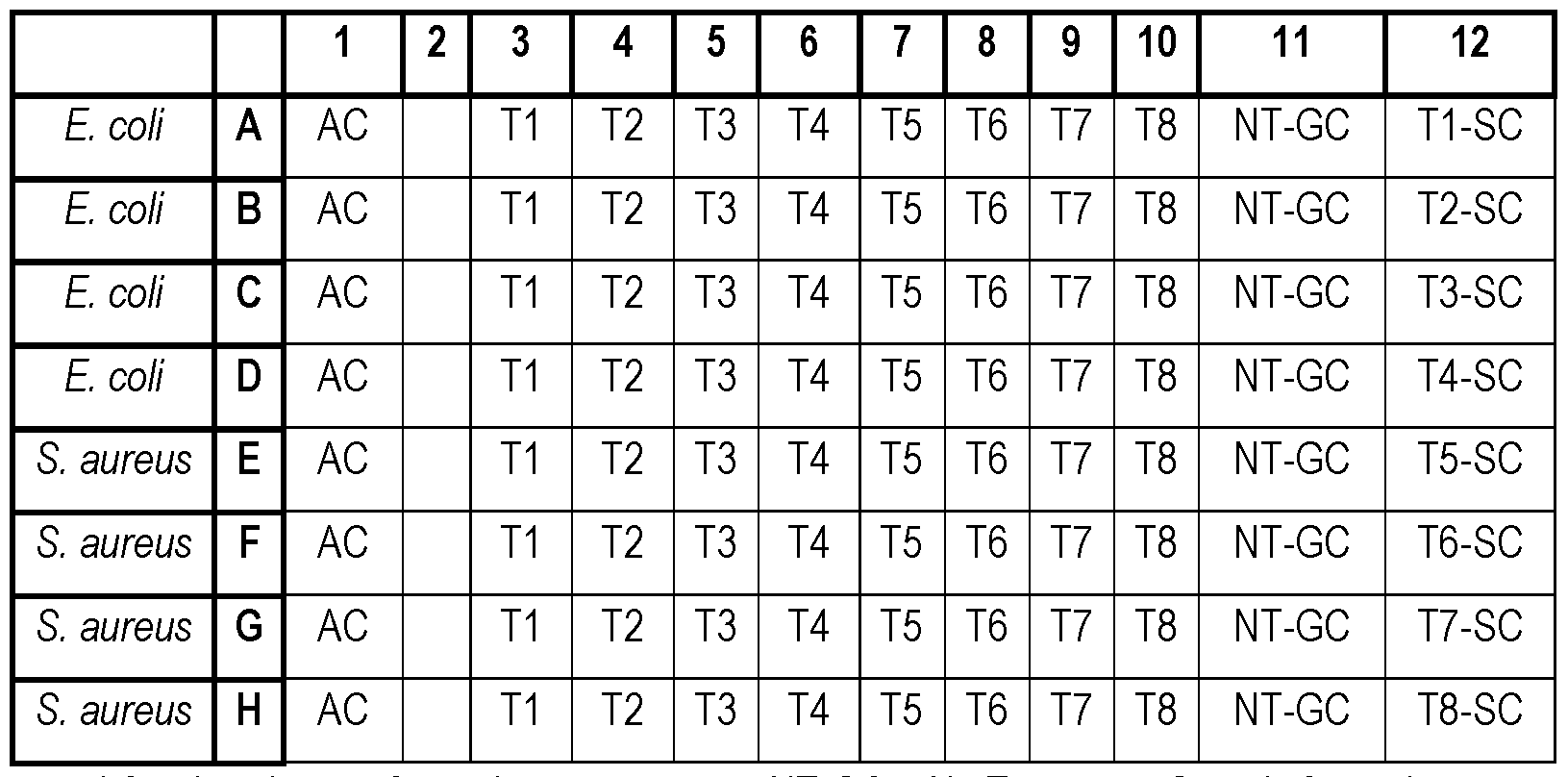
- Table 7 The challenge will be tested using the specified contact time (Total of 6 challenge plates). SC wells are sterility controls for each experiment.
- columns 1-12 are filled with 180 ⁇ _ of the 10E6 CFU/ml of the appropriate E. coli suspension in BPB
- the assay device consists of a plastic lid with ninety-six (96) pegs and a corresponding receiver plate with ninety-six (96) individual wells that have a maximum 200 ⁇ _ working volume. Biofilm is established on the pegs under static batch conditions (i.e., no flow of nutrients into or out of an individual well).
- n biofilm sample surface (base: 5.0 mm, height: 13.1 mm).
- n an 86 x 128 mm plastic surface consisting of ninety-six (96) identical pegs.
- n an 86 x 128 mm standard plate consisting of ninety-six (96) identical wells.
- n small reservoir with a 50 to 200 ⁇ _ working volume capacity.
- TSA tryptic soy agar
- GC growth control Inoculating loop— nichrome wire or disposable plastic.
- Petri dish large labelled (100 x 150 x 15 mm, plastic, sterile) for plating.
- Microcentrifuge tubes sterile, any with a 1 .5 ml_ volume capacity.
- 96-well microtiter plate sterile, 86 x 128 mm standard plate consisting of ninety- six (96) identical flat bottom wells with a 200 ⁇ _ working volume
- Vortex any vortex that will ensure proper agitation and mixing of microfuge tubes.
- Pipette continuously adjustable pipette with volume capability of 1 ml_.
- Micropipette continuously adjustable pipette with working volume of 10 ⁇ _ - 200 M L
- Sterile reagent reservoir 50 ml_ polystyrene.
- Sterilizer any steam sterilizer capable of producing the conditions of sterilization.
- Colony counter any one of several types may be used. A hand tally for the recording of the bacterial count is recommended if manual counting is done.
- Environmental incubator capable of maintaining a temperature of 35 ⁇ 2°C and relative humidity between 35 and 85%.
- Reactor components the MBEC Assay device available from Innovotech, Edmonton, AB, Canada.
- Culture media 4.4 Bacterial growth broth— Tryptic soy broth (TSB) prepared according to manufacturer's directions.
- TSA Tryptic soy agar
- E. coli ATCC 1 1229 and S. aureus ATCC 6538 are the organisms used in this test.
- Viable bacterial density should be 10 9 CFU/mL and should be checked by serial dilution and plating.
- 6.1.7 Perform 10-fold serial dilutions of the inoculum in triplicate. 6.1.8 Plate appropriate dilutions on appropriately labelled TSA plates. Incubate the plates at 35 ⁇ 2 °C for 22 ⁇ 2 hours depending on the isolates growth rate and enumerate.
- Table 8 Sample layout of 96-well MBEC plate.
- ALAMARBLUE reagent prepared according to manufacturer's directions, Life Technologies, Carlsbad, CA) in each well to be tested.
- the final plate is transferred to a SPECTRAMAX GEM IN I EM microplate reader (Molecular Devices, Inc. Sunnyvale, CA USA) for a 20 hour kinetic, bottom read with an excitation of 560 nm and emission of 590 nm.
- the rate of fluorescence development (relative fluorescence units (RFU)/minute) is determined for each well.
- fluorescence development as a function of bacterial concentration, as determined via viable plate counts. This standard curve provided the ability to relate rate of fluorescence development (RFU/minute) to the Log CFU/mL number of bacteria present in a given sample Day 1 :
- the assay device consists of a plastic lid with ninety-six (96) pegs and a corresponding receiver plate with ninety-six (96) individual wells that have a maximum 200 ⁇ _ working volume. Biofilm is established on the pegs under static batch conditions (i.e., no flow of nutrients into or out of an individual well).
- A.1 Add 100 ⁇ _ of diluted bacteria to the appropriate wells in a sterile 96-well microplate as indicated in the plate layout in Table 4.
- B.3.1 Transfer the MBECTM lid to a plate containing 200 ⁇ _ PBS.
- B.3.2 Transfer the plate to the sonicator and sonicate on high for 10 minutes to dislodge surviving attached bacteria.
- the plates are placed in a dry stainless steel insert tray which sits in the water of the sonicator. The vibrations created in the water by the sonicator transfer through the insert tray to actively sonicate the contents of the 96 well recovery plate(s).
- Logio (CFU/peg) Logio [(X/B) (D)] where:
- C.9 Calculate the overall attached bacteria accumulation by calculating the mean of the log densities calculated.
- compositions of the present disclosure exhibit a decrease of DNA viruses on surfaces.
- Log decrease for example, may be determined from the decrease of DNA viruses adhered to a surface according to the following correlations: Fold Decrease of Viruses LOG Decrease
- surface exhibiting a decrease of viruses of 1 Log means the number of viruses on the fibrous substrate has decreased 10-fold
- a decrease of 2 Log means the number of viruses has decreased 100-fold
- a decrease of 3 Log means the number of viruses has decreased 1000-fold
- a larger Log decrease thus corresponds with a composition that is able to more effectively repel viruses.
- Embodiment 1 A composition for inhibiting the attachment of DNA viruses to a surface, the composition comprising: a liquid carrier; an anti-adherent agent comprising C12-16 Alkyl PEG-2 Hydroxypropyl Hydroxyethyl Ethylcellulose; and a humectant.
- Embodiment 2 The composition of embodiment 1 , wherein the humectant is selected from the group consisting of: glycerin, glycerin derivatives, hyaluronic acid derivatives, betaine derivatives amino acids, amino acid derivatives, glycosaminoglycans, glycols, polyols, sugars, sugar alcohols, hydrogenated starch hydrolysates, hydroxy acids, hydroxy acid derivatives, salts of PCA, and any combination thereof.
- the humectant is selected from the group consisting of: glycerin, glycerin derivatives, hyaluronic acid derivatives, betaine derivatives amino acids, amino acid derivatives, glycosaminoglycans, glycols, polyols, sugars, sugar alcohols, hydrogenated starch hydrolysates, hydroxy acids, hydroxy acid derivatives, salts of PCA, and any combination thereof.
- Embodiment 3 The composition of embodiment 1 , wherein the humectant is selected from the group consisting of: honey, sorbitol, hyaluronic acid, sodium hyaluronate, betaine, lactic acid, citric acid, sodium citrate, glycolic acid, sodium glycolate .sodium lactate, urea, propylene glycol, butylene glycol, pentylene glycol, ethoxydiglycol, methyl gluceth-10, methyl gluceth-20, PEG-2, PEG-3, PEG-4, PEG-5, PEG-6, PEG- 7, PEG-8, PEG-9, PEG-10, xylitol, maltitol, and any combination thereof.
- the humectant is selected from the group consisting of: honey, sorbitol, hyaluronic acid, sodium hyaluronate, betaine, lactic acid, citric acid, sodium citrate, glycolic acid, sodium glycolate .sodium
- Embodiment 4 The composition of embodiment 1 , wherein the humectant is selected from the group consisting of: glycerin, a glycerin derivative, and combinations thereof.
- Embodiment 5 The composition of any one of the preceding embodiments, further comprising an ingredient selected from the group consisting of an emollient, a surfactant, an antimicrobial agent, and any combination thereof.
- Embodiment 6 The composition of any one of the preceding embodiments, wherein the anti-adherent agent reduces the attachment of DNA viruses to a polystyrene surface by at least 0.25 Log of viruses according to the High Throughput Test to Quantify the Attachment of Phage to a Surface as described herein.
- Embodiment 7 The composition of any one of the preceding embodiments, wherein the anti-adherent agent reduces the attachment of DNA viruses to a polystyrene Surface by at least 0.29 log of bacteria according to the High Throughput Test to Quantify the Attachment of Phage to a Surface as described herein.
- Embodiment 8 The composition of any one of the preceding embodiments, wherein the liquid carrier is hydrophilic.
- Embodiment 9 The composition of any one of the preceding embodiments, wherein the anti-adherent agent is present in the amount of about 0.01 % to about 20.0% by weight of the composition, and wherein the humectant is present in the amount of about 0.01 % to about 20.0% by weight of the composition.
- Embodiment 10 A method for inhibiting the adherence of DNA viruses to a surface, the method comprising: providing a composition, the composition comprising: an anti-adherent agent comprising C12- 16 AlkyI PEG-2 Hydroxypropyl Hydroxyethyl Ethylcellulose; and applying the composition to the surface to inhibit the adherence of DNA viruses to the surface.
- Embodiment 1 1 The method of embodiment 10, wherein the composition further comprises a liquid carrier and a humectant.
- Embodiment 12 The method of embodiment 1 1 , wherein the humectant is selected from the group consisting of: glycerin, glycerin derivatives, hyaluronic acid derivatives, betaine derivatives amino acids, amino acid derivatives, glycosaminoglycans, glycols, polyols, sugars, sugar alcohols, hydrogenated starch hydrolysates, hydroxy acids, hydroxy acid derivatives, salts of PCA, and any combination thereof.
- the humectant is selected from the group consisting of: glycerin, glycerin derivatives, hyaluronic acid derivatives, betaine derivatives amino acids, amino acid derivatives, glycosaminoglycans, glycols, polyols, sugars, sugar alcohols, hydrogenated starch hydrolysates, hydroxy acids, hydroxy acid derivatives, salts of PCA, and any combination thereof.
- Embodiment 13 The method of embodiment 1 1 , wherein the humectant is selected from the group consisting of: honey, sorbitol, hyaluronic acid, sodium hyaluronate, betaine, lactic acid, citric acid, sodium citrate, glycolic acid, sodium glycolate .sodium lactate, urea, propylene glycol, butylene glycol, pentylene glycol, ethoxydiglycol, methyl gluceth-10, methyl gluceth-20, PEG-2, PEG-3, PEG-4, PEG-5, PEG-6, PEG- 7, PEG-8, PEG-9, PEG-10, xylitol, maltitol, and any combination thereof.
- the humectant is selected from the group consisting of: honey, sorbitol, hyaluronic acid, sodium hyaluronate, betaine, lactic acid, citric acid, sodium citrate, glycolic acid, sodium glycolate .so
- Embodiment 14 The method of embodiment 1 1 , wherein the humectant is selected from the group consisting of: glycerin, a glycerin derivative, and combinations thereof.
- Embodiment 15 The method of any one of embodiments 10-14, further comprising an ingredient selected from the group consisting of an emollient, a surfactant, an antimicrobial agent, and any combination thereof.
- Embodiment 16 The method of any one of embodiments 10-15, further comprising: removing at least some of the composition from the surface while allowing at least some of the composition to remain on the surface.
- Embodiment 17 A wipe for inhibiting the attachment of DNA viruses to a surface, the wipe comprising: a nonwoven substrate; and a composition comprising: a liquid carrier; and an anti-adherent agent comprising C12-16 Alkyl PEG-2 Hydroxypropyl Hydroxyethyl Ethylcellulose.
- Embodiment 18 The wipe of embodiment 17, wherein the composition further comprises a humectant.
- Embodiment 19 The wipe of embodiment 18, wherein the humectant is selected from the group consisting of: glycerin, glycerin derivatives, hyaluronic acid derivatives, betaine derivatives amino acids, amino acid derivatives, glycosaminoglycans, glycols, polyols, sugars, sugar alcohols, hydrogenated starch hydrolysates, hydroxy acids, hydroxy acid derivatives, salts of PCA, and any combination thereof.
- the humectant is selected from the group consisting of: glycerin, glycerin derivatives, hyaluronic acid derivatives, betaine derivatives amino acids, amino acid derivatives, glycosaminoglycans, glycols, polyols, sugars, sugar alcohols, hydrogenated starch hydrolysates, hydroxy acids, hydroxy acid derivatives, salts of PCA, and any combination thereof.
- Embodiment 20 The wipe of embodiment 18, wherein the humectant is selected from the group consisting of: glycerin, a glycerin derivative, and combinations thereof.
Landscapes
- Chemical & Material Sciences (AREA)
- Life Sciences & Earth Sciences (AREA)
- Engineering & Computer Science (AREA)
- Organic Chemistry (AREA)
- Wood Science & Technology (AREA)
- Chemical Kinetics & Catalysis (AREA)
- Oil, Petroleum & Natural Gas (AREA)
- Health & Medical Sciences (AREA)
- Emergency Medicine (AREA)
- Molecular Biology (AREA)
- Materials Engineering (AREA)
- Cosmetics (AREA)
- Materials For Medical Uses (AREA)
- Medicinal Preparation (AREA)
- Agricultural Chemicals And Associated Chemicals (AREA)
Abstract
Description


Claims
Priority Applications (7)
| Application Number | Priority Date | Filing Date | Title |
|---|---|---|---|
| BR112018014040A BR112018014040A2 (en) | 2016-01-28 | 2016-01-28 | "composition and handkerchief for inhibiting DNA virus binding to a surface, and method for inhibiting DNA virus adherence to a surface." |
| US16/071,328 US12037497B2 (en) | 2016-01-28 | 2016-01-28 | Anti-adherent composition against DNA viruses and method of inhibiting the adherence of DNA viruses to a surface |
| AU2016389266A AU2016389266B2 (en) | 2016-01-28 | 2016-01-28 | Anti-adherent composition against DNA viruses and method of inhibiting the adherence of DNA viruses to a surface |
| MX2018008569A MX2018008569A (en) | 2016-01-28 | 2016-01-28 | Anti-adherent composition against dna viruses and method of inhibiting the adherence of dna viruses to a surface. |
| GB1813268.8A GB2562437B (en) | 2016-01-28 | 2016-01-28 | Anti-adherent composition against DNA viruses and method of inhibiting the adherence of DNA viruses to a surface |
| PCT/US2016/015292 WO2017131691A1 (en) | 2016-01-28 | 2016-01-28 | Anti-adherent composition against dna viruses and method of inhibiting the adherence of dna viruses to a surface |
| KR1020187022947A KR102511421B1 (en) | 2016-01-28 | 2016-01-28 | Composition for preventing adhesion of DNA virus and method for inhibiting adhesion of DNA virus to a surface |
Applications Claiming Priority (1)
| Application Number | Priority Date | Filing Date | Title |
|---|---|---|---|
| PCT/US2016/015292 WO2017131691A1 (en) | 2016-01-28 | 2016-01-28 | Anti-adherent composition against dna viruses and method of inhibiting the adherence of dna viruses to a surface |
Publications (1)
| Publication Number | Publication Date |
|---|---|
| WO2017131691A1 true WO2017131691A1 (en) | 2017-08-03 |
Family
ID=59398951
Family Applications (1)
| Application Number | Title | Priority Date | Filing Date |
|---|---|---|---|
| PCT/US2016/015292 Ceased WO2017131691A1 (en) | 2016-01-28 | 2016-01-28 | Anti-adherent composition against dna viruses and method of inhibiting the adherence of dna viruses to a surface |
Country Status (7)
| Country | Link |
|---|---|
| US (1) | US12037497B2 (en) |
| KR (1) | KR102511421B1 (en) |
| AU (1) | AU2016389266B2 (en) |
| BR (1) | BR112018014040A2 (en) |
| GB (1) | GB2562437B (en) |
| MX (1) | MX2018008569A (en) |
| WO (1) | WO2017131691A1 (en) |
Cited By (2)
| Publication number | Priority date | Publication date | Assignee | Title |
|---|---|---|---|---|
| US11168287B2 (en) | 2016-05-26 | 2021-11-09 | Kimberly-Clark Worldwide, Inc. | Anti-adherent compositions and methods of inhibiting the adherence of microbes to a surface |
| US12037497B2 (en) | 2016-01-28 | 2024-07-16 | Kimberly-Clark Worldwide, Inc. | Anti-adherent composition against DNA viruses and method of inhibiting the adherence of DNA viruses to a surface |
Citations (5)
| Publication number | Priority date | Publication date | Assignee | Title |
|---|---|---|---|---|
| WO2001032132A2 (en) * | 1999-11-03 | 2001-05-10 | Hercules Incorporated | Process for making toothpaste using agglomerated dispersible polymers |
| WO2013016029A1 (en) * | 2011-07-27 | 2013-01-31 | The Procter & Gamble Company | Process for the production of a rheology modifier containing composition |
| WO2013052545A1 (en) * | 2011-10-03 | 2013-04-11 | The Procter & Gamble Company | Hair care compositions and methods of use |
| WO2014139904A1 (en) * | 2013-03-13 | 2014-09-18 | Akzo Nobel Chemicals International B.V. | Rheology modifiers |
| US20150059795A1 (en) * | 2013-09-05 | 2015-03-05 | The Procter & Gamble Company | Hair care composition comprising viscoelastic particles |
Family Cites Families (313)
| Publication number | Priority date | Publication date | Assignee | Title |
|---|---|---|---|---|
| US1680584A (en) | 1927-03-03 | 1928-08-14 | Angell Andrew | Distributor for condiments and the like |
| US3338992A (en) | 1959-12-15 | 1967-08-29 | Du Pont | Process for forming non-woven filamentary structures from fiber-forming synthetic organic polymers |
| US3502763A (en) | 1962-02-03 | 1970-03-24 | Freudenberg Carl Kg | Process of producing non-woven fabric fleece |
| GB1060077A (en) | 1962-12-14 | 1967-02-22 | Midland Silicones Ltd | Improvements in or relating to the treating of porous and fibrous materials |
| US3241898A (en) | 1963-07-01 | 1966-03-22 | Miller Herman Inc | Hospital furniture |
| US3502538A (en) | 1964-08-17 | 1970-03-24 | Du Pont | Bonded nonwoven sheets with a defined distribution of bond strengths |
| US3341394A (en) | 1966-12-21 | 1967-09-12 | Du Pont | Sheets of randomly distributed continuous filaments |
| US3494821A (en) | 1967-01-06 | 1970-02-10 | Du Pont | Patterned nonwoven fabric of hydraulically entangled textile fibers and reinforcing fibers |
| US3542615A (en) | 1967-06-16 | 1970-11-24 | Monsanto Co | Process for producing a nylon non-woven fabric |
| US3849241A (en) | 1968-12-23 | 1974-11-19 | Exxon Research Engineering Co | Non-woven mats by melt blowing |
| DE2048006B2 (en) | 1969-10-01 | 1980-10-30 | Asahi Kasei Kogyo K.K., Osaka (Japan) | Method and device for producing a wide nonwoven web |
| DE1950669C3 (en) | 1969-10-08 | 1982-05-13 | Metallgesellschaft Ag, 6000 Frankfurt | Process for the manufacture of nonwovens |
| CA1044537A (en) | 1973-05-09 | 1978-12-19 | Amf Incorporated | Filter medium and process |
| US4100324A (en) | 1974-03-26 | 1978-07-11 | Kimberly-Clark Corporation | Nonwoven fabric and method of producing same |
| US3954962A (en) | 1974-04-01 | 1976-05-04 | Alan R. Tripp | Oral hygiene product |
| GB1550955A (en) | 1975-12-29 | 1979-08-22 | Johnson & Johnson | Textile fabric and method of manufacturing the same |
| US4078568A (en) | 1976-10-12 | 1978-03-14 | Northern Illinois Research, Inc. | Plastic composition and method |
| US4340563A (en) | 1980-05-05 | 1982-07-20 | Kimberly-Clark Corporation | Method for forming nonwoven webs |
| US4361486A (en) | 1981-04-28 | 1982-11-30 | Amf Incorporated | Filter media, method for oxidizing and removing soluble iron, method for removing and inactivating microorganisms, and particulate filter aid |
| DK201081A (en) | 1981-05-06 | 1982-11-07 | Kongelige Porcelainsfabrik A S | PAINTING AND PRINTING MEDIUM AND OVERLASSUR COLOR AND PRINTING COLOR BASED ON THIS MEDIUM |
| US4795668A (en) | 1983-10-11 | 1989-01-03 | Minnesota Mining And Manufacturing Company | Bicomponent fibers and webs made therefrom |
| GB8404000D0 (en) | 1984-02-15 | 1984-03-21 | Unilever Plc | Wiping surfaces |
| US5162074A (en) | 1987-10-02 | 1992-11-10 | Basf Corporation | Method of making plural component fibers |
| US5069970A (en) | 1989-01-23 | 1991-12-03 | Allied-Signal Inc. | Fibers and filters containing said fibers |
| JP2682130B2 (en) | 1989-04-25 | 1997-11-26 | 三井石油化学工業株式会社 | Flexible long-fiber non-woven fabric |
| US5057361A (en) | 1989-11-17 | 1991-10-15 | Kimberly-Clark Corporation | Wettable polymeric fabrics |
| US5057368A (en) | 1989-12-21 | 1991-10-15 | Allied-Signal | Filaments having trilobal or quadrilobal cross-sections |
| JPH0639368B2 (en) | 1990-02-28 | 1994-05-25 | 株式会社萩原技研 | Antibacterial organism based on silica gel |
| CA2048905C (en) | 1990-12-21 | 1998-08-11 | Cherie H. Everhart | High pulp content nonwoven composite fabric |
| US5277976A (en) | 1991-10-07 | 1994-01-11 | Minnesota Mining And Manufacturing Company | Oriented profile fibers |
| CH682541A5 (en) | 1992-06-23 | 1993-10-15 | Urs Viktor Dr Wirth | Biochemical Inactivation of RNA viruses. |
| US5382400A (en) | 1992-08-21 | 1995-01-17 | Kimberly-Clark Corporation | Nonwoven multicomponent polymeric fabric and method for making same |
| US5336552A (en) | 1992-08-26 | 1994-08-09 | Kimberly-Clark Corporation | Nonwoven fabric made with multicomponent polymeric strands including a blend of polyolefin and ethylene alkyl acrylate copolymer |
| US5350624A (en) | 1992-10-05 | 1994-09-27 | Kimberly-Clark Corporation | Abrasion resistant fibrous nonwoven composite structure |
| US5512186A (en) | 1995-04-28 | 1996-04-30 | Betz Laboratories, Inc. | Method for inhibiting microbial adhesion on surfaces |
| US5762948A (en) | 1995-06-07 | 1998-06-09 | Ambi Inc. | Moist bacteriocin disinfectant wipes and methods of using the same |
| WO1997016585A1 (en) | 1995-10-30 | 1997-05-09 | Kimberly-Clark Worldwide, Inc. | Fiber spin pack |
| WO1997021862A2 (en) | 1995-11-30 | 1997-06-19 | Kimberly-Clark Worldwide, Inc. | Superfine microfiber nonwoven web |
| US5855788A (en) | 1996-02-07 | 1999-01-05 | Kimberly-Clark Worldwide, Inc. | Chemically charged-modified filter for removing particles from a liquid and method thereof |
| US5964351A (en) | 1996-03-15 | 1999-10-12 | Kimberly-Clark Worldwide, Inc. | Stack of folded wet wipes having improved dispensability and a method of making the same |
| US6241898B1 (en) | 1996-04-19 | 2001-06-05 | Betzdearborn Inc. | Method for inhibiting microbial adhesion on surfaces |
| US6110381A (en) | 1996-04-19 | 2000-08-29 | Betzdearborn Inc. | Method and composition for inhibiting microbial adhesion on surfaces |
| SE506674C2 (en) | 1996-06-05 | 1998-01-26 | Akzo Nobel Surface Chem | Composition, use of a cellulose ether as a thickener and preparation of a coated cellulose-based surface product |
| US5742943A (en) | 1996-06-28 | 1998-04-28 | Johnson & Johnson Medical, Inc. | Slip-coated elastomeric flexible articles and their method of manufacture |
| US6267996B1 (en) | 1996-10-17 | 2001-07-31 | Indena S.P.A | Pharmaceutical and cosmetic formulations with antimicrobial activity |
| US6200669B1 (en) | 1996-11-26 | 2001-03-13 | Kimberly-Clark Worldwide, Inc. | Entangled nonwoven fabrics and methods for forming the same |
| US5908707A (en) | 1996-12-05 | 1999-06-01 | The Procter & Gamble Company | Cleaning articles comprising a high internal phase inverse emulsion and a carrier with controlled absorbency |
| US6306514B1 (en) | 1996-12-31 | 2001-10-23 | Ansell Healthcare Products Inc. | Slip-coated elastomeric flexible articles and their method of manufacture |
| US6231719B1 (en) | 1996-12-31 | 2001-05-15 | Kimberly-Clark Worldwide, Inc. | Uncreped throughdried tissue with controlled coverage additive |
| US5785179A (en) | 1997-06-04 | 1998-07-28 | Kimberly-Clark Worldwide, Inc. | Container for wet wipes having an improved closure mechanism |
| KR20010013377A (en) * | 1997-06-04 | 2001-02-26 | 데이비드 엠 모이어 | Mild, leave-on antimicrobial compositions |
| US6158614A (en) | 1997-07-30 | 2000-12-12 | Kimberly-Clark Worldwide, Inc. | Wet wipe dispenser with refill cartridge |
| US6315864B2 (en) | 1997-10-30 | 2001-11-13 | Kimberly-Clark Worldwide, Inc. | Cloth-like base sheet and method for making the same |
| US5942219A (en) | 1997-12-09 | 1999-08-24 | Betzdearborn Inc. | Composition for inhibiting microbial adhesion on surfaces |
| US5989527A (en) | 1998-01-26 | 1999-11-23 | Inolex Investment Corporation | Compositions and methods for improving the performance of chemical exfoliating agents, sunless tanning agents, skin lightening agents and insect repellents |
| AU2599499A (en) | 1998-02-12 | 1999-08-30 | Surfacine Development Company, Llc | Disinfectant compositions providing sustained biocidal action |
| US6228385B1 (en) | 1999-03-15 | 2001-05-08 | Kimberly-Clark Worldwide Inc. | Liquid antimicrobial, skin moisturizing formulation |
| JP3902336B2 (en) | 1998-07-27 | 2007-04-04 | 株式会社ノエビア | Antibacterial plant extract and antibacterial skin external preparation containing the same |
| US6248880B1 (en) | 1998-08-06 | 2001-06-19 | Akzo Nobel Nv | Nonionic cellulose ether with improve thickening properties |
| US5951965A (en) | 1998-08-28 | 1999-09-14 | Colgate Palmolive Company | Method for visually demonstrating the effectiveness of an anti-bacteria attachment composition |
| US20020050016A1 (en) | 2000-02-24 | 2002-05-02 | Willman Kenneth William | Cleaning sheets comprising a polymeric additive to improve particulate pick-up and minimize residue left on surfaces and cleaning implements for use with cleaning sheets |
| US6274041B1 (en) | 1998-12-18 | 2001-08-14 | Kimberly-Clark Worldwide, Inc. | Integrated filter combining physical adsorption and electrokinetic adsorption |
| KR100727345B1 (en) | 1999-04-20 | 2007-06-13 | 칼곤 코포레이션 | Compositions and methods for washing and removing contaminants from hair |
| US6273359B1 (en) | 1999-04-30 | 2001-08-14 | Kimberly-Clark Worldwide, Inc. | Dispensing system and method for premoistened wipes |
| US6723428B1 (en) | 1999-05-27 | 2004-04-20 | Foss Manufacturing Co., Inc. | Anti-microbial fiber and fibrous products |
| TW538096B (en) | 1999-06-25 | 2003-06-21 | Shinetsu Chemical Co | Nitrogen atom-containing polysiloxanes, their preparation, and fiber and fabric finishing agent compositions |
| CA2379565A1 (en) | 1999-07-21 | 2001-02-01 | Kenneth C. Hou | Microorganism filter and method for removing microorganism from water |
| JP3965006B2 (en) | 1999-09-27 | 2007-08-22 | 株式会社バイオセル | Foam carrier for microbial immobilization treatment, and waste water such as organic waste water and eutrophication water using the same |
| WO2001028340A2 (en) | 1999-10-19 | 2001-04-26 | The Procter & Gamble Company | Antimicrobial compositions comprising a dicarboxylic acid and a metal salt |
| US6340663B1 (en) | 1999-11-24 | 2002-01-22 | The Clorox Company | Cleaning wipes |
| US6269970B1 (en) | 2000-05-05 | 2001-08-07 | Kimberly-Clark Worldwide, Inc. | Wet wipes container having a tear resistant lid |
| US6269969B1 (en) | 2000-05-05 | 2001-08-07 | Kimberly-Clark Worldwide, Inc. | Wet wipes container with improved closure |
| US20010040136A1 (en) | 1999-12-22 | 2001-11-15 | Kimberly-Clark Worldwide, Inc. | Cationically charged coating on glass and nonwoven fibers |
| BR0016354B1 (en) | 1999-12-28 | 2012-09-18 | Method of forming an antimicrobial cleaning cloth and cleaning cloth. | |
| MXPA02006540A (en) | 1999-12-30 | 2002-12-09 | Kimberly Clark Co | ABSORBENT ARTICLE ANITMICROBIAL AND METHODS TO MAKE AND USE THE SAME. |
| AU2001253048A1 (en) | 2000-04-03 | 2001-10-15 | Audrey L. HAASE | Potable water purification process including biofiltration |
| US7795199B2 (en) | 2000-06-29 | 2010-09-14 | Ecolab Inc. | Stable antimicrobial compositions including spore, bacteria, fungi, and/or enzyme |
| CA2422199A1 (en) | 2000-09-08 | 2002-03-14 | Johnson & Johnson Consumer Companies Inc. | Stable emulsions useful for skin care wipes |
| ATE290066T1 (en) | 2000-11-24 | 2005-03-15 | Chemunex S A | METHOD FOR CATCHING AIR-BOUND MICROORGANISMS USING WATER-SOLUBLE POLYMERS |
| US7232794B2 (en) | 2000-11-27 | 2007-06-19 | The Procter & Gamble Company | Dishwashing wipe |
| SE520428C2 (en) | 2000-12-15 | 2003-07-08 | Akzo Nobel Nv | Aqueous suspension of a cellulose ether, process for its preparation and a dry mixture |
| DE10063739B4 (en) | 2000-12-21 | 2009-04-02 | Ferro Gmbh | Substrates with self-cleaning surface, process for their preparation and their use |
| US6977082B2 (en) | 2001-03-29 | 2005-12-20 | The Dial Corporation | High efficacy antibacterial compositions having enhanced esthetic and skin care properties |
| US20030008791A1 (en) | 2001-06-06 | 2003-01-09 | Lonza Inc. | Non-alcoholic hand sanitizer |
| EP1401571B1 (en) | 2001-06-22 | 2006-05-10 | Argonide Corporation | Sub-micron filter |
| US6585997B2 (en) | 2001-08-16 | 2003-07-01 | Access Pharmaceuticals, Inc. | Mucoadhesive erodible drug delivery device for controlled administration of pharmaceuticals and other active compounds |
| US20030091540A1 (en) | 2001-10-16 | 2003-05-15 | Nawaz Ahmad | Compositions and methods for delivering antibacterial, antifungal and antiviral ointments to the oral, nasal or vaginal cavity |
| US6569828B1 (en) | 2001-11-13 | 2003-05-27 | Colgate-Palmolive Company | Cleaning wipe |
| US7192601B2 (en) | 2002-01-18 | 2007-03-20 | Walker Edward B | Antimicrobial and sporicidal composition |
| US6630016B2 (en) | 2002-01-31 | 2003-10-07 | Koslow Technologies Corp. | Microporous filter media, filtration systems containing same, and methods of making and using |
| US7287650B2 (en) | 2002-01-31 | 2007-10-30 | Kx Technologies Llc | Structures that inhibit microbial growth |
| AU2003207181A1 (en) | 2002-02-07 | 2003-09-02 | Asahi Kasei Kabushiki Kaisha | Microorganism-trapping agent |
| US6887270B2 (en) | 2002-02-08 | 2005-05-03 | Boston Scientific Scimed, Inc. | Implantable or insertable medical device resistant to microbial growth and biofilm formation |
| WO2003092382A1 (en) | 2002-04-30 | 2003-11-13 | Danish Institute For Fisheries Research | Composition and method for controlling microbial adhesion and biofilm formation of surfaces |
| US7578997B2 (en) | 2002-04-30 | 2009-08-25 | Kimberly-Clark Worldwide, Inc. | Metal ion modified high surface area materials for odor removal and control |
| US8053626B2 (en) | 2002-06-12 | 2011-11-08 | Sca Hygiene Products Ab | Absorbent article containing a skincare composition and method of making and using same |
| US7569530B1 (en) | 2003-06-20 | 2009-08-04 | The Procter & Gamble Company | Antimicrobial compositions, products and methods employing same |
| US20040009141A1 (en) | 2002-07-09 | 2004-01-15 | Kimberly-Clark Worldwide, Inc. | Skin cleansing products incorporating cationic compounds |
| AU2002950436A0 (en) | 2002-07-29 | 2002-09-12 | George John Orban | Insect repellant |
| US7169304B2 (en) | 2002-08-12 | 2007-01-30 | 3M Innovative Properties Company | Porous polymer water filter and methods of use in refrigeration |
| US20060193789A1 (en) | 2002-10-25 | 2006-08-31 | Foamix Ltd. | Film forming foamable composition |
| US9114156B2 (en) | 2002-12-30 | 2015-08-25 | Aplicare, Inc. | Enhanced antimicrobial skin preparation |
| WO2004062703A1 (en) | 2003-01-15 | 2004-07-29 | Sca Hygiene Products Ab | Bacteria trapping fibrous material |
| US6770204B1 (en) | 2003-03-15 | 2004-08-03 | Koslow Technologies Corporation | Filter media with enhanced microbiological interception capability |
| US7071152B2 (en) * | 2003-05-30 | 2006-07-04 | Steris Inc. | Cleaning and decontamination formula for surfaces contaminated with prion-infected material |
| MXPA05013694A (en) | 2003-06-17 | 2006-03-13 | Henkel Kgaa | Agents against microorganisms, containing patchouli oil, patchouli alcohol and/or the derivatives thereof. |
| US7285520B2 (en) | 2003-12-01 | 2007-10-23 | Kimberly-Clark Worldwide, Inc. | Water disintegratable cleansing wipes |
| US7048806B2 (en) | 2003-12-16 | 2006-05-23 | The Clorox Company | Cleaning substrates having low soil redeposition |
| EP1543823A1 (en) | 2003-12-19 | 2005-06-22 | Johnson & Johnson Consumer France SAS | Gingko containing formulations for the improvement of skin radiance |
| WO2005063308A1 (en) | 2003-12-22 | 2005-07-14 | Institute For Environmental Health, Inc. | Adherent antimicrobial barrier and sanitizing agent |
| US20050137540A1 (en) | 2003-12-23 | 2005-06-23 | Kimberly-Clark Worldwide, Inc. | Bacteria removing wipe |
| WO2005067878A1 (en) | 2004-01-13 | 2005-07-28 | Vanson Halosource, Inc. | Polysaccharide alcohol antiseptic gel |
| US7872051B2 (en) | 2004-03-12 | 2011-01-18 | Paul Douglas Clarke | Antiviral composition comprising p-menthane-3,8-diol |
| US20050244480A1 (en) | 2004-04-30 | 2005-11-03 | Kimberly-Clark Worldwide, Inc. | Pre-wipes for improving anal cleansing |
| US20050242041A1 (en) | 2004-04-30 | 2005-11-03 | Cumberland Scott L | Silver Impregnated, Alumina Coated Materials and Filtration Systems Implementing Same |
| GB2452189B (en) | 2004-06-03 | 2009-07-15 | James Steven Brown | Sanitizing composition to Facilitate enforcement of Hand Hygiene Conditions |
| WO2006085975A2 (en) | 2004-07-02 | 2006-08-17 | Nanoscale Materials, Inc. | Organic biocidal decontamination compositions |
| US20060008621A1 (en) | 2004-07-08 | 2006-01-12 | Gusky Robert I | Textured air laid substrate |
| US7576256B2 (en) | 2004-12-10 | 2009-08-18 | Abigo Medical Ab | Wound dressing with a bacterial adsorbing composition |
| US20060140899A1 (en) | 2004-12-28 | 2006-06-29 | Kimberly-Clark Worldwide, Inc. | Skin cleansing system comprising an anti-adherent formulation and a cationic compound |
| US7642395B2 (en) | 2004-12-28 | 2010-01-05 | Kimberly-Clark Worldwide, Inc. | Composition and wipe for reducing viscosity of viscoelastic bodily fluids |
| US20060204466A1 (en) | 2005-03-08 | 2006-09-14 | Ecolab Inc. | Hydroalcoholic antimicrobial composition with skin health benefits |
| US20070020649A1 (en) | 2005-03-11 | 2007-01-25 | E.I. Du Pont De Nemours And Company | Chitosan capture of microorganisms for detection |
| US7112559B1 (en) | 2005-03-14 | 2006-09-26 | Ecolab Inc. | Thickened quaternary ammonium compound sanitizer |
| EP1865919A1 (en) | 2005-04-07 | 2007-12-19 | Dow Corning Corporation | Water in silicone emulsions containing elastomers |
| US7288513B2 (en) | 2005-04-14 | 2007-10-30 | Illinois Tool Works, Inc. | Disinfecting and sanitizing article for hands and skin and hard surfaces |
| US7754770B2 (en) | 2005-06-27 | 2010-07-13 | Mason Chemical Company | Antimicrobial composition |
| US8343523B2 (en) | 2005-08-22 | 2013-01-01 | Quick-Med Technologies, Inc. | Disinfectant with durable activity based on alcohol-soluble quaternary ammonium polymers and copolymers |
| US20070048344A1 (en) | 2005-08-31 | 2007-03-01 | Ali Yahiaoui | Antimicrobial composition |
| US8119162B2 (en) | 2005-11-10 | 2012-02-21 | Colgate-Palmolive Company | Particles that disrupt or impede bacterial adhesion, related compositions and methods |
| US8871722B2 (en) | 2005-12-06 | 2014-10-28 | Danisco Us Inc. | Perhydrolase epitopes |
| US20070141934A1 (en) | 2005-12-15 | 2007-06-21 | Kimberly-Clark Worldwide, Inc. | Nonwoven webs containing bacteriostatic compositions and methods of making the same |
| US7985209B2 (en) | 2005-12-15 | 2011-07-26 | Kimberly-Clark Worldwide, Inc. | Wound or surgical dressing |
| EP1798279A1 (en) | 2005-12-16 | 2007-06-20 | Cognis IP Management GmbH | Pre-mixes for personal and home care compositions |
| CN101394942B (en) | 2006-02-28 | 2012-04-04 | 细胞生物工程有限公司 | Polymer compositions and methods for removing contaminating materials from substrates |
| WO2007103441A2 (en) | 2006-03-06 | 2007-09-13 | Borish Edward T | Antimicrobial esters |
| US7625844B1 (en) | 2006-04-17 | 2009-12-01 | Biopath Laboratory Incorporated (Delaware) | Method for screening anti-adherent compounds on polymers for preventing biofilm formation |
| US20070253926A1 (en) | 2006-04-28 | 2007-11-01 | Tadrowski Tami J | Packaged cleaning composition concentrate and method and system for forming a cleaning composition |
| US7993675B2 (en) | 2006-05-10 | 2011-08-09 | Medtronic Xomed, Inc. | Solvating system and sealant for medical use in the sinuses and nasal passages |
| RU2008152402A (en) | 2006-05-30 | 2010-07-10 | Дзе Дайл Корпорейшн (Us) | STRONG ANTI-VIRUS COMPOSITIONS |
| US8221774B2 (en) | 2006-06-12 | 2012-07-17 | The Procter & Gamble Company | Lotioned wipe product to reduce adhesion of soils or exudates to the skin |
| US9119779B2 (en) | 2006-06-12 | 2015-09-01 | The Procter & Gamble Company | Lotioned wipe product comprising an anti-stick agent and a performance enhancing agent |
| WO2007149310A2 (en) | 2006-06-16 | 2007-12-27 | The Regents Of The University Of Michigan | Multiphasic biofunctional nano-components and methods for use thereof |
| CA2677394C (en) | 2006-10-23 | 2013-06-25 | Ecolab Inc. | Skin-compatible virucidal composition |
| DE102006053360A1 (en) | 2006-11-10 | 2008-05-15 | Evonik Stockhausen Gmbh | Skin cleansing preparations, in particular cold protection cream |
| US8093199B2 (en) | 2006-11-17 | 2012-01-10 | Basf Se | Premoistened cleaning disposable substrate and method of incorporation of a cleaning composition into said substrate |
| US8318654B2 (en) | 2006-11-30 | 2012-11-27 | Kimberly-Clark Worldwide, Inc. | Cleansing composition incorporating a biocide, heating agent and thermochromic substance |
| CN101652122A (en) | 2007-03-30 | 2010-02-17 | 尤妮佳股份有限公司 | Liquid medicine for cleaning wet tissue and cleaning wet tissue containing same |
| MX2009011938A (en) | 2007-05-04 | 2009-11-13 | Procter & Gamble | ANTIMICROBIAL COMPOSITIONS, PRODUCTS AND METHODS OF USE. |
| US20080293826A1 (en) | 2007-05-21 | 2008-11-27 | Conopco, Inc., D/B/A Unilever | Cosmetic compositions with ethoxylated urethane |
| WO2008154617A2 (en) | 2007-06-12 | 2008-12-18 | Rhodia Inc. | Hard surface cleaning composition with hydrophilizing agent and method for cleaning hard surfaces |
| US9511040B2 (en) | 2007-06-20 | 2016-12-06 | The Trustees Of Columbia University In The City Of New York | Skin and surface disinfectant compositions containing botanicals |
| JP2010535775A (en) | 2007-08-10 | 2010-11-25 | リトル ビジー ボディーズ, インコーポレイテッド | Saline nose wipes and methods for making and using the same |
| WO2009036030A1 (en) | 2007-09-10 | 2009-03-19 | Isp Investmenst Inc. | Water-resistant sprayable sunscreen compositions |
| US20090082472A1 (en) | 2007-09-25 | 2009-03-26 | Peters Marlin W | Hand sanitizer and method of preparation |
| CN101156830B (en) | 2007-10-10 | 2010-05-19 | 叶芳 | sunscreen |
| WO2009061779A1 (en) | 2007-11-06 | 2009-05-14 | Dow Global Technologies Inc. | Personal care cleansing compositions comprising hydroxypropyl methyl cellulose and alkyl polyglycosides |
| WO2009065023A1 (en) | 2007-11-14 | 2009-05-22 | Quos, Inc. | Multifunctional filtration and water purification systems |
| US8871232B2 (en) | 2007-12-13 | 2014-10-28 | Kimberly-Clark Worldwide, Inc. | Self-indicating wipe for removing bacteria from a surface |
| US20090155325A1 (en) | 2007-12-14 | 2009-06-18 | Kimberly-Clark Worldwide, Inc. | Formulation and products for promoting skin cleanliness and health |
| US10589134B2 (en) | 2008-01-30 | 2020-03-17 | Kimberly-Clark Worldwide, Inc. | Hand health and hygiene system for hand health and infection control |
| US8840911B2 (en) | 2008-03-07 | 2014-09-23 | Kimberly-Clark Worldwide, Inc. | Moisturizing hand sanitizer |
| CN101633781B (en) | 2008-07-22 | 2012-11-14 | 道康宁(上海)有限公司 | Emulsion composition, method for softening fiber structure and fiber containing base material |
| US7842725B2 (en) | 2008-07-24 | 2010-11-30 | Ecolab USA, Inc. | Foaming alcohol compositions with selected dimethicone surfactants |
| EP2352528B1 (en) | 2008-11-14 | 2019-08-14 | The Procter and Gamble Company | Substrate with adherence for feces and menses |
| RU2488378C2 (en) | 2008-12-03 | 2013-07-27 | Шисейдо Компани, Лтд. | Cosmetic preparation in oil-in-water form |
| US8685178B2 (en) | 2008-12-15 | 2014-04-01 | Kimberly-Clark Worldwide, Inc. | Methods of preparing metal-modified silica nanoparticles |
| CN102613214A (en) | 2008-12-31 | 2012-08-01 | 浙江世佳科技有限公司 | Microemulsion of propylene glycol alginate and emamectin benzoate |
| US9028878B2 (en) | 2009-02-03 | 2015-05-12 | Microbion Corporation | Bismuth-thiols as antiseptics for biomedical uses, including treatment of bacterial biofilms and other uses |
| EP2408770B1 (en) | 2009-03-20 | 2014-11-05 | University Of Virginia Patent Foundation | Broad spectrum benzothiophene-nitrothiazolide and other antimicrobials |
| CN101856389A (en) | 2009-04-09 | 2010-10-13 | 刘湖 | Chinese medicinal preparation for treating cardiovascular and cerebrovascular diseases and application thereof |
| US8030226B2 (en) | 2009-04-10 | 2011-10-04 | Kimberly-Clark Worldwide, Inc. | Wet wipes having a liquid wipe composition with anti-adhesion component |
| CN102395269B (en) | 2009-04-17 | 2013-11-20 | 香波玉石碱株式会社 | Antiviral agent and cleaning agent |
| EP2272942B1 (en) | 2009-07-08 | 2014-06-04 | The Procter and Gamble Company | Hard surface cleaning composition |
| IE20090662A1 (en) | 2009-08-31 | 2011-08-31 | Patrick T Prendergast | Cariogenesis, halitosis, gingivitis and periodontitis treatment and preventive compositions. |
| DE102009041753A1 (en) | 2009-09-16 | 2011-03-24 | Bionorica Se | Detergents, cleaners or disinfectants containing hydrolysates from plant extracts |
| US20110081528A1 (en) | 2009-10-01 | 2011-04-07 | Thomas Gerard Shannon | Dry Wipe for Hard Surface Germ Control |
| US8609156B2 (en) | 2009-10-05 | 2013-12-17 | Protanza Corporation | Compositions and methods of treatment that include plant extracts |
| US20130079733A1 (en) | 2009-11-18 | 2013-03-28 | Reckitt Benckiser Llc | Surface Treatment Device and Method |
| KR20120112641A (en) | 2009-12-23 | 2012-10-11 | 콜게이트-파아므올리브캄파니 | Cleansing bar |
| WO2011083401A2 (en) | 2010-01-10 | 2011-07-14 | Bclean Projects Ltd. | A composition and dispenser for personal hygiene |
| IL203403A (en) | 2010-01-19 | 2016-08-31 | Cupron Inc | Biofilm resistant materials |
| JP5458911B2 (en) | 2010-01-28 | 2014-04-02 | 日油株式会社 | Microbial adhesion inhibitor for oral cavity |
| US20110293681A1 (en) | 2010-02-26 | 2011-12-01 | Lectec Corporation | Hand sanitizing patch having an integrally bonded antimicrobial |
| DK2549994T3 (en) | 2010-03-25 | 2015-11-09 | Bioglane S L N E | Use of D-phagomin as an inhibitor of bacterial adhesion to epithelial cells |
| US20140014584A1 (en) | 2010-04-22 | 2014-01-16 | Steven Wayne Cone | Wastewater purification system and method |
| EP2574174B1 (en) | 2010-05-17 | 2018-02-28 | Mary Kay, Inc. | Topical skin formulation |
| CN102293802B (en) | 2010-06-25 | 2014-06-18 | 吉林省集安益盛药业股份有限公司 | Medicinal composition for treating cardiovascular diseases and preparation method thereof |
| GB201011152D0 (en) | 2010-07-02 | 2010-08-18 | Microsens Medtech Ltd | Capture of micro-organisms |
| MX2013001095A (en) | 2010-07-27 | 2013-03-12 | Clariant Finance Bvi Ltd | Compositions comprising hydrogen peroxide or hydrogen peroxide donor substances. |
| CN102450972A (en) | 2010-10-21 | 2012-05-16 | 董根荣 | Biodegradable long-acting bromhidrosis-removing wet tissue and preparation method thereof |
| US8980232B2 (en) | 2010-11-23 | 2015-03-17 | Chung Yuan Christian University | Dental care product |
| CN103237538B (en) | 2010-11-30 | 2016-01-20 | 狮王株式会社 | Flank of tooth attachment inhibitor, the oral biological film of periodontal pathogen form inhibitor and composition for oral cavity |
| GB201021186D0 (en) | 2010-12-14 | 2011-01-26 | Novabiotics Ltd | Composition |
| US9339031B2 (en) | 2010-12-16 | 2016-05-17 | Akzo Nobel Chemicals International B.V. | Hydrophobically modified polysaccharide ethers as deposition enhancers for agricultural active ingredients |
| US8506978B2 (en) | 2010-12-28 | 2013-08-13 | Kimberly-Clark Worldwide, Inc. | Bacteriostatic tissue product |
| RU2452463C1 (en) | 2011-02-04 | 2012-06-10 | Татьяна Валентиновна Пучкова | Skin care cream |
| US8486427B2 (en) | 2011-02-11 | 2013-07-16 | Kimberly-Clark Worldwide, Inc. | Wipe for use with a germicidal solution |
| KR20110058754A (en) | 2011-04-15 | 2011-06-01 | (주)아모레퍼시픽 | Composition for soothing scalp and improving hair conditioning containing herbal extract |
| CA2834035C (en) | 2011-04-27 | 2018-12-18 | Isp Investments Inc. | Clear wet sprays and gels |
| EP3409112B1 (en) | 2011-05-04 | 2022-07-27 | The University of Nottingham | Novel polymers which resist bacterial attachment |
| US8431142B2 (en) | 2011-05-18 | 2013-04-30 | The Idea Folder, Llc | Topical sanitizing gel containing avenanthramides |
| WO2012174466A2 (en) | 2011-06-17 | 2012-12-20 | Annuary Healthcare, Inc. | Nanoscale particle formulations and methods |
| EP2742510A1 (en) | 2011-08-11 | 2014-06-18 | Cellular Bioengineering, Inc. | Polymer composition |
| WO2013049718A1 (en) | 2011-09-28 | 2013-04-04 | Burmeister William Edgar | Water purification compositions and applications for same |
| CA2890395C (en) | 2011-11-03 | 2021-03-16 | The Trustees Of Columbia University In The City Of New York | Botanical antimicrobial compositions |
| WO2013074655A1 (en) | 2011-11-14 | 2013-05-23 | Inolex Investment Corporation | Natural silicone replacements for silicone fluids in personal care formulations |
| RU2014128792A (en) | 2011-12-15 | 2016-02-10 | Колгейт-Палмолив Компани | CLEANING COMPOSITIONS WITH POLYURETHANE-34 |
| MX390974B (en) | 2011-12-20 | 2025-03-13 | Oriflame Cosmetics Ag | COSMETIC OR DERMATOLOGICAL USE OF NARINGENIN TO COMBAT SKIN AGING EFFECTS. |
| KR101330652B1 (en) | 2012-02-28 | 2013-11-18 | (주)시지바이오 | Anti―adhesion polymer composition able to load growth factors |
| US20130287724A1 (en) | 2012-04-30 | 2013-10-31 | Douglas R. Hoffman | Anti-adherent formulation including an anionic or nonionic polymer |
| US8481480B1 (en) | 2012-04-30 | 2013-07-09 | Uyen T. Lam | Anti-adherent formulation including a quaternary ammonium compound and a fatty alcohol |
| CN102784079A (en) | 2012-07-09 | 2012-11-21 | 南通帝星化工有限公司 | Natural bacteriostatic hand washing solution and preparation method thereof |
| FR2992862B1 (en) | 2012-07-09 | 2014-10-03 | Fabre Pierre Dermo Cosmetique | USE OF A MYRT EXTRACT AS ANTI-BIOFILM AGENT AGAINST P. ACNES |
| CA3126679C (en) | 2012-07-23 | 2025-05-13 | Innovative Biodefense, Inc. | Topical sanitizing formulations and uses thereof |
| WO2014032696A1 (en) | 2012-08-28 | 2014-03-06 | Ecolab Inc. | Virucidal composition |
| CN104013682B (en) | 2012-09-28 | 2015-11-25 | 南昌大学 | A kind of Traditional Chinese medicine bacteriostatic composition suppressing micrococcus luteus |
| CN102940590A (en) | 2012-11-22 | 2013-02-27 | 金红叶纸业集团有限公司 | Skin care composition and tissue using same |
| DE102012221573A1 (en) | 2012-11-26 | 2014-05-28 | Henkel Ag & Co. Kgaa | The primary detergency-improving polyalkoxylated polyamines |
| CN103830226A (en) | 2012-11-27 | 2014-06-04 | 青岛百草汇中草药研究所 | New medicinal application of silymarin |
| CN103013307A (en) | 2012-11-29 | 2013-04-03 | 益阳祥瑞科技有限公司 | Antifouling topping paint for boat |
| CN103845244A (en) | 2012-12-04 | 2014-06-11 | 青岛叁鼎卫生制品有限公司 | Antibacterial and disinfectant liquid soap |
| CN103865692A (en) | 2012-12-13 | 2014-06-18 | 张希顺 | Bacteriostatic soap capable of dispelling cold |
| US20140170089A1 (en) | 2012-12-17 | 2014-06-19 | Taylor James, LLC | Photoprotective eye cream and methods |
| EP2934444B1 (en) | 2012-12-19 | 2016-11-30 | Colgate-Palmolive Company | Oral care products comprising tetrabasic zinc chloride and trimethylglycine |
| RU2648513C2 (en) | 2012-12-19 | 2018-03-26 | Колгейт-Палмолив Компани | Zinc amino acid halide mouthwash |
| US9901523B2 (en) | 2012-12-19 | 2018-02-27 | Colgate-Palmolive Company | Oral care products comprising zinc oxide and trimethylglycine |
| AU2012397265B2 (en) | 2012-12-19 | 2016-02-25 | Colgate-Palmolive Company | Oral gel comprising zinc - amino acid complex |
| CA2896646A1 (en) | 2012-12-27 | 2014-07-03 | Hayashibara Co., Ltd. | Skin-exterior anti-ageing composition and production method therefor |
| US20150359945A1 (en) | 2013-01-15 | 2015-12-17 | Board Of Regents, The University Of Texas System | Antimicrobial coatings |
| CN105073173B (en) | 2013-01-18 | 2017-05-10 | 斯坦福国际研究院 | Anchoring nerve block catheter |
| WO2014140925A2 (en) | 2013-03-10 | 2014-09-18 | Peritech Pharma Ltd. | Topical compositions and methods of treatment of topical disorders |
| US9808435B2 (en) | 2013-03-12 | 2017-11-07 | Ecolab Usa Inc. | Antiviral compositions and methods for inactivating non-enveloped viruses using alkyl 2-hydroxycarboxylic acids |
| WO2014140890A2 (en) | 2013-03-13 | 2014-09-18 | Neocutis Sa | Peptides for skin rejuvenation and methods of using the same |
| US11083750B2 (en) | 2013-03-15 | 2021-08-10 | Cda Research Group, Inc. | Methods of treatment using topical copper ion formulations |
| JP5946487B2 (en) | 2013-04-01 | 2016-07-06 | 花王株式会社 | Hair cosmetics, hair treatment method using the same, and scalp wiping method |
| CN103387894B (en) | 2013-05-22 | 2014-11-19 | 上海巴方精细化工有限公司 | Gynostemma beauty compound soap |
| US9675717B2 (en) | 2013-05-31 | 2017-06-13 | The University Of Toledo | Electromagnetic polymer composite material for anti-fouling effect |
| CN103341204B (en) | 2013-06-04 | 2015-08-05 | 青岛中腾生物技术有限公司 | A kind of antibacterial repair materials and preparation method thereof |
| GB201313609D0 (en) | 2013-07-30 | 2013-09-11 | Colepccl Uk Ltd | Improved sunscreen compositions |
| US8877882B1 (en) | 2013-10-04 | 2014-11-04 | Rochal Industries Llp | Non-self-adherent coating materials |
| EP3076921B1 (en) | 2013-12-02 | 2020-03-04 | Colgate-Palmolive Company | Oral care zinc compositions |
| CN103788812B (en) | 2013-12-11 | 2016-04-20 | 青岛海洋新材料科技有限公司 | A kind of nano marine anti-fouling coating |
| US10132029B2 (en) | 2013-12-20 | 2018-11-20 | Sanitized Ag | Method for reducing adhesion of microorganisms to fabrics |
| BR112016014530B1 (en) | 2013-12-20 | 2020-03-10 | Colgate-Palmolive Company | COMPOSITION FOR ORAL CARE AND USE OF A PHOSPHATE / ACRYLATE COPOLYMER, A Tartar CONTROL AGENT AND ORALLY ACCEPTABLE VEHICLE |
| DE202015009237U1 (en) | 2014-03-19 | 2016-12-27 | Mary Kay, Inc. | Mascaraformulierung |
| US20150272847A1 (en) | 2014-03-26 | 2015-10-01 | The Gillette Company | Skin Engaging Shaving Aid Comprising A Thermally Resilient Sensate And A TRPA1 Receptor Inhibitor |
| ES2699838T3 (en) | 2014-05-02 | 2019-02-13 | Novozymes As | Detergent composition |
| CN105199602A (en) | 2014-06-30 | 2015-12-30 | 天津市三合顺工贸有限公司 | Red antibacterial coating for buggy |
| AU2015297024A1 (en) | 2014-07-31 | 2017-03-02 | Kimberly-Clark Worldwide, Inc. | Anti-adherent alcohol-based composition |
| AU2015297022A1 (en) | 2014-07-31 | 2017-03-02 | Kimberly-Clark Worldwide, Inc. | Anti-adherent composition |
| WO2016018475A1 (en) | 2014-07-31 | 2016-02-04 | Kimberly-Clark Worldwide, Inc. | Anti-adherent composition |
| AU2015297021A1 (en) | 2014-07-31 | 2017-03-02 | Kimberly-Clark Worldwide, Inc. | Anti-adherent composition |
| CN106572954B (en) | 2014-08-18 | 2020-06-05 | 高露洁-棕榄公司 | Mouthwash composition comprising peroxide source and N-acetyl-L-arginine alkyl ester salt |
| CN104177970B (en) | 2014-08-20 | 2016-08-17 | 海南大学 | Nonpolluting coating material and preparation method thereof |
| US20160095876A1 (en) | 2014-10-01 | 2016-04-07 | Rochal Industries, Llp | Composition and kits for inhibition of pathogenic microbial infection and methods of using the same |
| WO2016065609A1 (en) | 2014-10-31 | 2016-05-06 | Kimberly-Clark Worldwide, Inc. | Anti-adherent botanical compositions |
| CN107847527A (en) | 2014-11-24 | 2018-03-27 | 玛托克控股有限公司 | The prevention and treatment of microorganism infection |
| US9744119B2 (en) | 2014-12-16 | 2017-08-29 | Momentive Performance Materials Inc. | Cosmetic composition and method of preparation |
| CN104559580B (en) | 2014-12-25 | 2017-02-01 | 上海海隆石油化工研究所 | High-solid copper acrylate polymer type long-lasting antifouling paint |
| WO2016104602A1 (en) | 2014-12-26 | 2016-06-30 | ダイキン工業株式会社 | Marine antifouling material, marine antifouling coating, marine antifouling panel, underwater structure and method for preventing adherence of marine microorganisms to underwater structure |
| US9326925B1 (en) | 2015-02-26 | 2016-05-03 | Johnson & Johnson Consumer Inc. | Compositions comprising combinations of organic acids |
| US9326924B1 (en) | 2015-02-26 | 2016-05-03 | Johnson & Johnson Consumer Inc. | Compositions comprising combinations of organic acids |
| KR101515865B1 (en) | 2015-03-02 | 2015-05-04 | 박성율 | A step 6 method for improving skin condition using composition comprising red-wilfordi root and black-ginseng fermentation extract haved skin whitening function |
| MX384467B (en) | 2015-04-01 | 2025-03-14 | Kimberly Clark Co | FIBROUS SUBSTRATE FOR THE CAPTURE OF GRAM-NEGATIVE BACTERIA. |
| CN106147306A (en) | 2015-04-18 | 2016-11-23 | 青岛中天智诚科技服务平台有限公司 | A kind of environment-friendly bionic antirusting paint of resistance to ocean |
| CN106147539A (en) | 2015-04-18 | 2016-11-23 | 青岛中天智诚科技服务平台有限公司 | A kind of nanometer priming paint of resistance to marine anticorrosion |
| WO2016186896A1 (en) | 2015-05-18 | 2016-11-24 | Thrower Angelo Perry | Hair regrowth treatment and growth stimulant |
| EP3118300A1 (en) | 2015-07-13 | 2017-01-18 | The Procter and Gamble Company | Acidic hard surface cleaners comprising a solvent |
| EP3322487B2 (en) | 2015-07-14 | 2025-11-05 | WM. Wrigley Jr. Company | Magnolia bark extract as a hydrophobic ligand for preferential removal of gram negative bacteria from the oral cavity |
| AU2016294611B2 (en) | 2015-07-14 | 2022-08-11 | Evolved By Nature, Inc. | Silk performance apparel and products and methods of preparing the same |
| US10130578B2 (en) | 2015-07-23 | 2018-11-20 | Johnson & Johnson Consumer Inc. | Topical delivery of skin compositions having low pH |
| CN105086747A (en) | 2015-08-05 | 2015-11-25 | 安徽岍汧漆业有限公司 | Multi-color epoxy boat topping paint and preparing method thereof |
| AU2016321396B2 (en) | 2015-09-11 | 2021-12-23 | Wm. Wrigley Jr. Company | Synergistic antibacterial effects of magnolia bark extract and L-arginine, N-alpha-lauroyl ethyl ester on plaque biofilm |
| MX2018008569A (en) | 2016-01-28 | 2018-08-16 | Kimberly Clark Co | Anti-adherent composition against dna viruses and method of inhibiting the adherence of dna viruses to a surface. |
| CN105816345A (en) | 2016-04-20 | 2016-08-03 | 青岛大学附属医院 | Functional toothpaste preparation for preventing and treating periodontitis |
| EP3243861A1 (en) | 2016-05-13 | 2017-11-15 | Centre National De La Recherche Scientifique | Method for preparing polyurethane and/or polycarbonate surface-modified substrates |
| US20190133126A1 (en) | 2016-05-16 | 2019-05-09 | The Trustees Of Columbia University In The City Of New York | Coatings and methods for infection-resistant medical devices |
| CN105924604B (en) | 2016-05-18 | 2018-09-25 | 湖南科技大学 | A kind of preparation method and product of degradable aqueous polyurethane coating |
| US11168287B2 (en) | 2016-05-26 | 2021-11-09 | Kimberly-Clark Worldwide, Inc. | Anti-adherent compositions and methods of inhibiting the adherence of microbes to a surface |
| CN107550826A (en) | 2016-06-30 | 2018-01-09 | 吴明辉 | A kind of bright radix polygonati officinalis spot-eliminating face mask cream and preparation method thereof |
| WO2018078340A1 (en) | 2016-10-26 | 2018-05-03 | Oxy Solutions As | Formulations |
| WO2018161899A1 (en) | 2017-03-06 | 2018-09-13 | Novozymes A/S | Use of one or more enzymes in preventing, inhibiting or reducing microbe growth on a surface |
| AU2018263859B2 (en) | 2017-05-01 | 2022-11-17 | Gojo Industries, Inc. | Alcohol containing non-antimicrobial cleansing composition |
| US20180333349A1 (en) | 2017-05-17 | 2018-11-22 | Colgate-Palmolive Company | Oral Care Compositions and Methods of Use |
| CN107158485A (en) | 2017-05-25 | 2017-09-15 | 苏州睿研纳米医学科技有限公司 | Antibiont, extracellular matrix stick coating and preparation method and application |
| WO2018231994A1 (en) | 2017-06-13 | 2018-12-20 | Aobiome Llc | Ammonia oxidizing microorganisms for dispersing biofilms |
| EP3418368A1 (en) | 2017-06-21 | 2018-12-26 | The Procter & Gamble Company | Solvent containing hard surface cleaning compositions |
| US10744079B2 (en) | 2017-08-23 | 2020-08-18 | Colgate-Palmolive Company | Oral care compositions and uses thereof |
| US10485742B2 (en) | 2017-12-01 | 2019-11-26 | Colgate-Palmolive Company | Rheological stabilization through mixed humectant systems in a zinc toothpaste |
| CA3081668A1 (en) | 2017-12-01 | 2019-06-06 | Colgate-Palmolive Company | Rheological stabilization systems in a zinc toothpaste |
| US20200338139A1 (en) | 2017-12-04 | 2020-10-29 | Sami Labs Limited | Compositions for microbial anti-adhesion |
| CN111432780B (en) | 2017-12-13 | 2023-08-29 | 高露洁-棕榄公司 | Oral care compositions |
| EP3498384A1 (en) | 2017-12-15 | 2019-06-19 | Max-Planck-Gesellschaft zur Förderung der Wissenschaften e.V. | Nanofilament coatings on surfaces of non-planar, in particular tubular substrates, and methods for preparing the same |
| CN108148474B (en) | 2017-12-15 | 2020-12-29 | 广州前延新材料发展有限公司 | Composite coating for marine equipment and preparation method and application thereof |
| US20190185683A1 (en) | 2017-12-20 | 2019-06-20 | Industry-Academic Cooperation Foundation, Yonsei University | Structure for preventing adhesion of microorganisms and method of manufacturing the same |
| JP2019119725A (en) | 2018-01-11 | 2019-07-22 | スリーエム イノベイティブ プロパティズ カンパニー | Bacteria repellent composition, bacteria repellent coating and method for forming the same, and article having bacteria repellent coating |
| CN108299667B (en) | 2018-01-17 | 2020-07-07 | 长沙理工大学 | A kind of antibacterial and anti-protein adhesion coating and preparation method thereof |
| CN108610892A (en) | 2018-05-05 | 2018-10-02 | 海南大学 | A kind of ocean steel construction anticorrosion and antifouling water paint and preparation method thereof |
| CN108785119A (en) | 2018-08-16 | 2018-11-13 | 江苏雪豹日化有限公司 | A kind of amino acid bio complex enzyme toothpaste |
| CN109010090A (en) | 2018-09-20 | 2018-12-18 | 江苏雪豹日化有限公司 | A kind of sodium bicarbonate biological complex enzyme toothpaste |
| CN109077946A (en) | 2018-09-21 | 2018-12-25 | 佛山市普达美生物医药科技有限公司 | The purposes of astaxanthin |
| CN109350556A (en) | 2018-09-21 | 2019-02-19 | 广州市玖贰零生物科技有限公司 | A kind of anti-caries toothpaste and preparation method thereof |
| CN109321054A (en) | 2018-09-25 | 2019-02-12 | 海南大学 | A kind of preparation method of environment-friendly marine anti-fouling and anti-corrosion coating |
| CN109337508A (en) | 2018-09-25 | 2019-02-15 | 海南大学 | A kind of preparation method of marine anti-fouling and anti-corrosion coating |
| JP2022505611A (en) | 2018-10-24 | 2022-01-14 | ゴジョ・インダストリーズ・インコーポレイテッド | Alcohol containing biofilm-inhibiting non-antibacterial cleaning composition |
| CN109651907A (en) | 2018-11-07 | 2019-04-19 | 成都普瑞斯特新材料有限公司 | Novel tin-free self-polishing type antifouling paint |
| CN110003703A (en) | 2019-04-25 | 2019-07-12 | 海南大学 | A kind of antifouling microcapsules, preparation method and application |
| CN110354296A (en) | 2019-06-11 | 2019-10-22 | 安徽舒源妇幼用品有限公司 | A kind of super water absorbent quick-drying paper diaper |
| CN110876715A (en) | 2019-11-26 | 2020-03-13 | 杭州飞羊生物科技有限公司 | Nasal cavity flushing fluid |
| CN111072098A (en) | 2019-12-12 | 2020-04-28 | 中国科学院海洋研究所 | Antifouling method for surface of optical window of ocean key equipment |
| CN111593434A (en) | 2020-06-01 | 2020-08-28 | 新沂市源茂纺织有限公司 | Preparation process of antibacterial breathable fabric |
| CN112386559A (en) | 2020-11-27 | 2021-02-23 | 汕头市锋睿生物科技有限公司 | Plant moisturizing facial cleanser and preparation method thereof |
-
2016
- 2016-01-28 MX MX2018008569A patent/MX2018008569A/en unknown
- 2016-01-28 GB GB1813268.8A patent/GB2562437B/en active Active
- 2016-01-28 AU AU2016389266A patent/AU2016389266B2/en active Active
- 2016-01-28 KR KR1020187022947A patent/KR102511421B1/en active Active
- 2016-01-28 WO PCT/US2016/015292 patent/WO2017131691A1/en not_active Ceased
- 2016-01-28 US US16/071,328 patent/US12037497B2/en active Active
- 2016-01-28 BR BR112018014040A patent/BR112018014040A2/en not_active Application Discontinuation
Patent Citations (5)
| Publication number | Priority date | Publication date | Assignee | Title |
|---|---|---|---|---|
| WO2001032132A2 (en) * | 1999-11-03 | 2001-05-10 | Hercules Incorporated | Process for making toothpaste using agglomerated dispersible polymers |
| WO2013016029A1 (en) * | 2011-07-27 | 2013-01-31 | The Procter & Gamble Company | Process for the production of a rheology modifier containing composition |
| WO2013052545A1 (en) * | 2011-10-03 | 2013-04-11 | The Procter & Gamble Company | Hair care compositions and methods of use |
| WO2014139904A1 (en) * | 2013-03-13 | 2014-09-18 | Akzo Nobel Chemicals International B.V. | Rheology modifiers |
| US20150059795A1 (en) * | 2013-09-05 | 2015-03-05 | The Procter & Gamble Company | Hair care composition comprising viscoelastic particles |
Cited By (2)
| Publication number | Priority date | Publication date | Assignee | Title |
|---|---|---|---|---|
| US12037497B2 (en) | 2016-01-28 | 2024-07-16 | Kimberly-Clark Worldwide, Inc. | Anti-adherent composition against DNA viruses and method of inhibiting the adherence of DNA viruses to a surface |
| US11168287B2 (en) | 2016-05-26 | 2021-11-09 | Kimberly-Clark Worldwide, Inc. | Anti-adherent compositions and methods of inhibiting the adherence of microbes to a surface |
Also Published As
| Publication number | Publication date |
|---|---|
| AU2016389266B2 (en) | 2021-07-01 |
| KR102511421B1 (en) | 2023-03-17 |
| GB2562437A (en) | 2018-11-14 |
| US20210189167A1 (en) | 2021-06-24 |
| GB2562437B (en) | 2022-05-25 |
| MX2018008569A (en) | 2018-08-16 |
| AU2016389266A1 (en) | 2018-08-02 |
| GB201813268D0 (en) | 2018-09-26 |
| US12037497B2 (en) | 2024-07-16 |
| BR112018014040A2 (en) | 2018-12-11 |
| KR20180105669A (en) | 2018-09-28 |
Similar Documents
| Publication | Publication Date | Title |
|---|---|---|
| AU2019204521B2 (en) | Anti-adherent composition | |
| AU2019204543B2 (en) | Anti-adherent composition | |
| US9969885B2 (en) | Anti-adherent composition | |
| US20220010240A1 (en) | Anti-adherent compositions and methods of inhibiting the adherence of microbes to a surface | |
| US20200345013A1 (en) | Anti-adherent botanical compositions | |
| US12037497B2 (en) | Anti-adherent composition against DNA viruses and method of inhibiting the adherence of DNA viruses to a surface | |
| US20220259527A1 (en) | Adherent composition for rna viruses and method of removing rna viruses from a surface | |
| GB2593653A (en) | Anti-adherent compositions and methods of inhibiting the adherence of microbes to a surface | |
| GB2582119A (en) | Anti-adherent botanical compositions |
Legal Events
| Date | Code | Title | Description |
|---|---|---|---|
| 121 | Ep: the epo has been informed by wipo that ep was designated in this application |
Ref document number: 16888422 Country of ref document: EP Kind code of ref document: A1 |
|
| DPE1 | Request for preliminary examination filed after expiration of 19th month from priority date (pct application filed from 20040101) | ||
| WWE | Wipo information: entry into national phase |
Ref document number: MX/A/2018/008569 Country of ref document: MX |
|
| REG | Reference to national code |
Ref country code: BR Ref legal event code: B01A Ref document number: 112018014040 Country of ref document: BR |
|
| NENP | Non-entry into the national phase |
Ref country code: DE |
|
| ENP | Entry into the national phase |
Ref document number: 2016389266 Country of ref document: AU Date of ref document: 20160128 Kind code of ref document: A |
|
| ENP | Entry into the national phase |
Ref document number: 20187022947 Country of ref document: KR Kind code of ref document: A |
|
| WWE | Wipo information: entry into national phase |
Ref document number: 1020187022947 Country of ref document: KR |
|
| ENP | Entry into the national phase |
Ref document number: 201813268 Country of ref document: GB Kind code of ref document: A Free format text: PCT FILING DATE = 20160128 |
|
| WWE | Wipo information: entry into national phase |
Ref document number: 1813268.8 Country of ref document: GB |
|
| ENP | Entry into the national phase |
Ref document number: 112018014040 Country of ref document: BR Kind code of ref document: A2 Effective date: 20180710 |
|
| 122 | Ep: pct application non-entry in european phase |
Ref document number: 16888422 Country of ref document: EP Kind code of ref document: A1 |