WO2017115673A1 - 吸収性物品 - Google Patents
吸収性物品 Download PDFInfo
- Publication number
- WO2017115673A1 WO2017115673A1 PCT/JP2016/087655 JP2016087655W WO2017115673A1 WO 2017115673 A1 WO2017115673 A1 WO 2017115673A1 JP 2016087655 W JP2016087655 W JP 2016087655W WO 2017115673 A1 WO2017115673 A1 WO 2017115673A1
- Authority
- WO
- WIPO (PCT)
- Prior art keywords
- area
- low weight
- region
- absorbent article
- absorbent
- Prior art date
- Legal status (The legal status is an assumption and is not a legal conclusion. Google has not performed a legal analysis and makes no representation as to the accuracy of the status listed.)
- Ceased
Links
Images


Classifications
-
- A—HUMAN NECESSITIES
- A61—MEDICAL OR VETERINARY SCIENCE; HYGIENE
- A61F—FILTERS IMPLANTABLE INTO BLOOD VESSELS; PROSTHESES; DEVICES PROVIDING PATENCY TO, OR PREVENTING COLLAPSING OF, TUBULAR STRUCTURES OF THE BODY, e.g. STENTS; ORTHOPAEDIC, NURSING OR CONTRACEPTIVE DEVICES; FOMENTATION; TREATMENT OR PROTECTION OF EYES OR EARS; BANDAGES, DRESSINGS OR ABSORBENT PADS; FIRST-AID KITS
- A61F13/00—Bandages or dressings; Absorbent pads
- A61F13/15—Absorbent pads, e.g. sanitary towels, swabs or tampons for external or internal application to the body; Supporting or fastening means therefor; Tampon applicators
- A61F13/45—Absorbent pads, e.g. sanitary towels, swabs or tampons for external or internal application to the body; Supporting or fastening means therefor; Tampon applicators characterised by the shape
- A61F13/47—Sanitary towels, incontinence pads or napkins
-
- A—HUMAN NECESSITIES
- A61—MEDICAL OR VETERINARY SCIENCE; HYGIENE
- A61F—FILTERS IMPLANTABLE INTO BLOOD VESSELS; PROSTHESES; DEVICES PROVIDING PATENCY TO, OR PREVENTING COLLAPSING OF, TUBULAR STRUCTURES OF THE BODY, e.g. STENTS; ORTHOPAEDIC, NURSING OR CONTRACEPTIVE DEVICES; FOMENTATION; TREATMENT OR PROTECTION OF EYES OR EARS; BANDAGES, DRESSINGS OR ABSORBENT PADS; FIRST-AID KITS
- A61F13/00—Bandages or dressings; Absorbent pads
- A61F13/15—Absorbent pads, e.g. sanitary towels, swabs or tampons for external or internal application to the body; Supporting or fastening means therefor; Tampon applicators
- A61F13/53—Absorbent pads, e.g. sanitary towels, swabs or tampons for external or internal application to the body; Supporting or fastening means therefor; Tampon applicators characterised by the absorbing medium
- A61F13/531—Absorbent pads, e.g. sanitary towels, swabs or tampons for external or internal application to the body; Supporting or fastening means therefor; Tampon applicators characterised by the absorbing medium having a homogeneous composition through the thickness of the pad
- A61F13/532—Absorbent pads, e.g. sanitary towels, swabs or tampons for external or internal application to the body; Supporting or fastening means therefor; Tampon applicators characterised by the absorbing medium having a homogeneous composition through the thickness of the pad inhomogeneous in the plane of the pad
-
- A—HUMAN NECESSITIES
- A61—MEDICAL OR VETERINARY SCIENCE; HYGIENE
- A61F—FILTERS IMPLANTABLE INTO BLOOD VESSELS; PROSTHESES; DEVICES PROVIDING PATENCY TO, OR PREVENTING COLLAPSING OF, TUBULAR STRUCTURES OF THE BODY, e.g. STENTS; ORTHOPAEDIC, NURSING OR CONTRACEPTIVE DEVICES; FOMENTATION; TREATMENT OR PROTECTION OF EYES OR EARS; BANDAGES, DRESSINGS OR ABSORBENT PADS; FIRST-AID KITS
- A61F13/00—Bandages or dressings; Absorbent pads
- A61F13/15—Absorbent pads, e.g. sanitary towels, swabs or tampons for external or internal application to the body; Supporting or fastening means therefor; Tampon applicators
- A61F13/45—Absorbent pads, e.g. sanitary towels, swabs or tampons for external or internal application to the body; Supporting or fastening means therefor; Tampon applicators characterised by the shape
- A61F13/47—Sanitary towels, incontinence pads or napkins
- A61F13/4704—Sanitary towels, incontinence pads or napkins having preferential bending zones, e.g. fold lines or grooves
-
- A—HUMAN NECESSITIES
- A61—MEDICAL OR VETERINARY SCIENCE; HYGIENE
- A61F—FILTERS IMPLANTABLE INTO BLOOD VESSELS; PROSTHESES; DEVICES PROVIDING PATENCY TO, OR PREVENTING COLLAPSING OF, TUBULAR STRUCTURES OF THE BODY, e.g. STENTS; ORTHOPAEDIC, NURSING OR CONTRACEPTIVE DEVICES; FOMENTATION; TREATMENT OR PROTECTION OF EYES OR EARS; BANDAGES, DRESSINGS OR ABSORBENT PADS; FIRST-AID KITS
- A61F13/00—Bandages or dressings; Absorbent pads
- A61F13/15—Absorbent pads, e.g. sanitary towels, swabs or tampons for external or internal application to the body; Supporting or fastening means therefor; Tampon applicators
- A61F13/45—Absorbent pads, e.g. sanitary towels, swabs or tampons for external or internal application to the body; Supporting or fastening means therefor; Tampon applicators characterised by the shape
- A61F13/47—Sanitary towels, incontinence pads or napkins
- A61F13/472—Sanitary towels, incontinence pads or napkins specially adapted for female use
-
- A—HUMAN NECESSITIES
- A61—MEDICAL OR VETERINARY SCIENCE; HYGIENE
- A61F—FILTERS IMPLANTABLE INTO BLOOD VESSELS; PROSTHESES; DEVICES PROVIDING PATENCY TO, OR PREVENTING COLLAPSING OF, TUBULAR STRUCTURES OF THE BODY, e.g. STENTS; ORTHOPAEDIC, NURSING OR CONTRACEPTIVE DEVICES; FOMENTATION; TREATMENT OR PROTECTION OF EYES OR EARS; BANDAGES, DRESSINGS OR ABSORBENT PADS; FIRST-AID KITS
- A61F13/00—Bandages or dressings; Absorbent pads
- A61F13/15—Absorbent pads, e.g. sanitary towels, swabs or tampons for external or internal application to the body; Supporting or fastening means therefor; Tampon applicators
- A61F13/53—Absorbent pads, e.g. sanitary towels, swabs or tampons for external or internal application to the body; Supporting or fastening means therefor; Tampon applicators characterised by the absorbing medium
- A61F13/531—Absorbent pads, e.g. sanitary towels, swabs or tampons for external or internal application to the body; Supporting or fastening means therefor; Tampon applicators characterised by the absorbing medium having a homogeneous composition through the thickness of the pad
- A61F13/532—Absorbent pads, e.g. sanitary towels, swabs or tampons for external or internal application to the body; Supporting or fastening means therefor; Tampon applicators characterised by the absorbing medium having a homogeneous composition through the thickness of the pad inhomogeneous in the plane of the pad
- A61F13/533—Absorbent pads, e.g. sanitary towels, swabs or tampons for external or internal application to the body; Supporting or fastening means therefor; Tampon applicators characterised by the absorbing medium having a homogeneous composition through the thickness of the pad inhomogeneous in the plane of the pad having discontinuous areas of compression
-
- A—HUMAN NECESSITIES
- A61—MEDICAL OR VETERINARY SCIENCE; HYGIENE
- A61F—FILTERS IMPLANTABLE INTO BLOOD VESSELS; PROSTHESES; DEVICES PROVIDING PATENCY TO, OR PREVENTING COLLAPSING OF, TUBULAR STRUCTURES OF THE BODY, e.g. STENTS; ORTHOPAEDIC, NURSING OR CONTRACEPTIVE DEVICES; FOMENTATION; TREATMENT OR PROTECTION OF EYES OR EARS; BANDAGES, DRESSINGS OR ABSORBENT PADS; FIRST-AID KITS
- A61F13/00—Bandages or dressings; Absorbent pads
- A61F13/15—Absorbent pads, e.g. sanitary towels, swabs or tampons for external or internal application to the body; Supporting or fastening means therefor; Tampon applicators
- A61F13/53—Absorbent pads, e.g. sanitary towels, swabs or tampons for external or internal application to the body; Supporting or fastening means therefor; Tampon applicators characterised by the absorbing medium
- A61F13/534—Absorbent pads, e.g. sanitary towels, swabs or tampons for external or internal application to the body; Supporting or fastening means therefor; Tampon applicators characterised by the absorbing medium having an inhomogeneous composition through the thickness of the pad
- A61F13/537—Absorbent pads, e.g. sanitary towels, swabs or tampons for external or internal application to the body; Supporting or fastening means therefor; Tampon applicators characterised by the absorbing medium having an inhomogeneous composition through the thickness of the pad characterised by a layer facilitating or inhibiting flow in one direction or plane, e.g. a wicking layer
- A61F13/53708—Absorbent pads, e.g. sanitary towels, swabs or tampons for external or internal application to the body; Supporting or fastening means therefor; Tampon applicators characterised by the absorbing medium having an inhomogeneous composition through the thickness of the pad characterised by a layer facilitating or inhibiting flow in one direction or plane, e.g. a wicking layer the layer having a promotional function on liquid propagation in at least one direction
- A61F13/53717—Absorbent pads, e.g. sanitary towels, swabs or tampons for external or internal application to the body; Supporting or fastening means therefor; Tampon applicators characterised by the absorbing medium having an inhomogeneous composition through the thickness of the pad characterised by a layer facilitating or inhibiting flow in one direction or plane, e.g. a wicking layer the layer having a promotional function on liquid propagation in at least one direction the layer having a promotional function on liquid propagation in the horizontal direction
-
- A—HUMAN NECESSITIES
- A61—MEDICAL OR VETERINARY SCIENCE; HYGIENE
- A61F—FILTERS IMPLANTABLE INTO BLOOD VESSELS; PROSTHESES; DEVICES PROVIDING PATENCY TO, OR PREVENTING COLLAPSING OF, TUBULAR STRUCTURES OF THE BODY, e.g. STENTS; ORTHOPAEDIC, NURSING OR CONTRACEPTIVE DEVICES; FOMENTATION; TREATMENT OR PROTECTION OF EYES OR EARS; BANDAGES, DRESSINGS OR ABSORBENT PADS; FIRST-AID KITS
- A61F13/00—Bandages or dressings; Absorbent pads
- A61F13/15—Absorbent pads, e.g. sanitary towels, swabs or tampons for external or internal application to the body; Supporting or fastening means therefor; Tampon applicators
- A61F13/53—Absorbent pads, e.g. sanitary towels, swabs or tampons for external or internal application to the body; Supporting or fastening means therefor; Tampon applicators characterised by the absorbing medium
- A61F13/534—Absorbent pads, e.g. sanitary towels, swabs or tampons for external or internal application to the body; Supporting or fastening means therefor; Tampon applicators characterised by the absorbing medium having an inhomogeneous composition through the thickness of the pad
- A61F13/537—Absorbent pads, e.g. sanitary towels, swabs or tampons for external or internal application to the body; Supporting or fastening means therefor; Tampon applicators characterised by the absorbing medium having an inhomogeneous composition through the thickness of the pad characterised by a layer facilitating or inhibiting flow in one direction or plane, e.g. a wicking layer
- A61F13/53708—Absorbent pads, e.g. sanitary towels, swabs or tampons for external or internal application to the body; Supporting or fastening means therefor; Tampon applicators characterised by the absorbing medium having an inhomogeneous composition through the thickness of the pad characterised by a layer facilitating or inhibiting flow in one direction or plane, e.g. a wicking layer the layer having a promotional function on liquid propagation in at least one direction
- A61F2013/53721—Absorbent pads, e.g. sanitary towels, swabs or tampons for external or internal application to the body; Supporting or fastening means therefor; Tampon applicators characterised by the absorbing medium having an inhomogeneous composition through the thickness of the pad characterised by a layer facilitating or inhibiting flow in one direction or plane, e.g. a wicking layer the layer having a promotional function on liquid propagation in at least one direction with capillary means
- A61F2013/53734—Absorbent pads, e.g. sanitary towels, swabs or tampons for external or internal application to the body; Supporting or fastening means therefor; Tampon applicators characterised by the absorbing medium having an inhomogeneous composition through the thickness of the pad characterised by a layer facilitating or inhibiting flow in one direction or plane, e.g. a wicking layer the layer having a promotional function on liquid propagation in at least one direction with capillary means with compressed lines
Definitions
- the present invention relates to an absorbent article to be attached to underwear such as a sanitary napkin.
- Absorbent articles such as sanitary napkins, panty liners, and incontinence pads for absorbing menstrual blood and vaginal discharge are known.
- sanitary napkins are particularly pressed against the wearer's body by underwear and fit to the wearer's body (Patent Document 1 below).
- An absorbent article such as a sanitary napkin has a top sheet, a back sheet, and an absorbent body.
- the absorber is provided between the top sheet and the back sheet.
- the absorber has a middle and high portion protruding in a convex shape on the skin contact surface side.
- the middle-high portion is a part of the absorber that is thicker than the region other than the middle-high portion.
- the middle and high portions are separately provided in front and rear of the absorbent article.
- a bending start point is provided between the front middle-high part and the rear middle-high part.
- the bending starting point is a recess for joining the top sheet and the absorbent body to each other by embossing.
- the middle part of the front is disposed in the crotch of the wearer, that is, the area facing the vaginal opening, and the middle part of the rear is disposed in a crack in the upper buttocks behind the crotch of the wearer. Is done. Thereby, the absorber is fitted along the crack of the buttocks.
- the rear middle high section is arranged directly below the wearer's buttocks, that is, between the buttocks and the floor.
- the mid-high portion constitutes a particularly rigid region. Therefore, the wearer tends to feel uncomfortable in the sleeping posture.
- An absorbent article (absorbent article) includes a front-rear direction (front-rear direction L) and a width direction (width direction W) orthogonal to each other, and an excretory opening contact area (excretion opening) that faces the excretion opening of the wearer.
- a first low-weight area (first low-weight area) extending in the width direction between the excretory opening contact area and the rear side area.
- a second low weight area (second low weight area 42) extending in the front-rear direction along a center line (center line CL) connecting the centers in the width direction in the rear area, and the rear area
- a front / rear pressing part front / rear pressing part 88 extending in the front / rear direction along the center line.
- the absorption core of the excretory opening contact area has a basis weight higher than the basis weights of the first low weight area and the second low weight area, and the second low weight area is the first low weight area.
- the gist is that at least a part of the front / rear pressing part is arranged in the second low weight area.
- FIG. 2 is a cross-sectional view of the absorbent article along the line AA in FIG. 1.
- FIG. 2 is a cross-sectional view of the absorbent article along the line BB in FIG. 1. It is sectional drawing of the state with which the wearer of the absorbent article shown in FIG. 1 was mounted
- the absorbent core includes a first low weight area extending in the width direction between the excretory opening contact area and the rear side area, and a center line connecting the centers in the width direction in the rear side area.
- a second low weight area extending in the front-rear direction, and a front-rear pressing portion extending in the front-rear direction along the center line in the rear side area
- the absorption core of the excretory opening contact area has a basis weight higher than the basis weights of the first low weight area and the second low weight area
- the second low weight area is connected to the first low weight area
- At least one part of the said front-back pressing part is an absorbent article arrange
- the rear side region of the absorbent article in a posture in which the wearer is sleeping, the rear side region of the absorbent article is arranged directly below the wearer's buttocks, that is, between the buttocks and the floor. Since the second low weight area formed in the rear side region has relatively low rigidity, the feeling of discomfort given to the wearer is small. Further, the absorbent material constituting the absorbent core moves between the excretory opening contact area, the right side part of the rear side area, and the left side part of the rear side area by the first low weight area and the second low weight area. It becomes difficult to do. Thereby, it can suppress that the absorption material which comprises an absorption core concentrates locally by the operation
- the center of the rear side area in the width direction is likely to protrude toward the wearer's body due to the force from the outside to the inside of the absorbent article.
- the front-back compression part extended in the front-back direction is arrange
- the first low weight area suppresses the influence of the deformation of the absorbent body in the excretory opening contact area on the deformation of the absorbent body in the rear side area, and the absorbent article is formed in the excretory opening contact area and the rear side area. It is easy to deform independently. Therefore, the excretion opening
- region of an absorbent article can be arrange
- the absorbent core is disposed on both sides of the excretory opening contact area, and is disposed on both sides of the pair of first side pressing parts extending in the front-rear direction and the second low weight area in the rear side area.
- a pair of second side pressing parts extending in the front-rear direction, The first side pressing part and the second side pressing part are preferably separated in the front-rear direction.
- the deformation of the absorber in the excretory opening contact region S1 The influence on deformation can be more effectively suppressed.
- a pair of 2nd side pressing part extended in the front-back direction is provided in the both sides of the 2nd low weight area. Since the 2nd side pressing part has comparatively high rigidity, it serves as a modification base point of an absorption core.
- the second low weight area sandwiched between the pair of second side pressing parts is more likely to be raised on the wearer's body side. Thereby, it can be more familiar to the wearer's body and give a comfortable fit to the wearer.
- the absorbent core has a third low weight area extending from the second low weight area to the outside in the width direction and having a lower weight than the weight of the absorbent core in the excretory opening contact area, It is desirable that the second side pressing portion has a divided portion that is divided in the front-rear direction in the third low weight area.
- the absorbent core in the rear side region can be deformed from the third low weight area portion as a base point, so that the absorbent article can be more easily fitted along the roundness along the front-rear direction of the body. .
- the parting part of a 2nd side pressing part is provided in the 3rd low weight area, an absorption core is easy to deform
- the second side pressing portion includes a first region extending rearward from the dividing portion and a second region continuing to the rear end edge of the first region and turning back toward the front.
- the absorbent article it is possible to increase the rigidity of the absorbent core and prevent the absorbent core from being deformed in the region behind the divided portion.
- the vicinity of the rear end portion of the absorbent core often hits the body with a surface and is easily deformed.
- the rigidity in the vicinity of the rear end portion of the absorbent core is increased and the deformation of the core is suppressed. , Can keep along the body.
- the absorbent core extends from the second low weight area outward in the width direction, and has a third low weight area having a lower weight than the weight of the absorbent core in the excretory opening contact area, and the third low weight area. It is desirable to have a width pressing part extending in the width direction within the region.
- the absorbent article since the absorbent core in the rear side region can be deformed from the third low weight area and the width squeezed portion as a base point, the absorbent article is more along the roundness along the front-rear direction L of the body. It becomes easy to fit. Moreover, the rigidity in the width direction of a 3rd low weight area may be improved by having a width pressing part.
- the absorbent article may be used for a long time, the absorbent article may be swayed, and body fluid may leak. The leakage of the bodily fluid is particularly likely to occur in the rear side region that is likely to be deformed when walking or sleeping. Since the width squeezing part has relatively high rigidity, it can suppress unintended deformation of the absorption core in the rear side region, and can effectively prevent deformation when walking or sleeping. *
- the non-skin surface sheet located on the non-skin surface side of the absorbent core is provided with an adhesive region for stopping the absorbent article in underwear,
- the adhesive area has a first adhesive area located in front of the first low weight area, and a second adhesive area located in the rear of the first low weight area, The first adhesive region and the second adhesive region are preferably separated in the front-rear direction.
- the excretory opening contact area has a middle-high part having a thickness greater than the thickness of the outer edge of the absorbent core, In the cross section in the front-rear direction of the absorbent article, the rear surface of the middle-high portion absorber extending in the thickness direction from the rear edge of the middle-high portion absorber, the non-skin facing surface of the middle-high portion absorber, Is larger than the angle formed by the front surface of the middle-high absorber that extends in the thickness direction from the front edge of the middle-high absorber and the non-skin facing surface of the middle-high absorber. desirable.
- the thickness of the front side of the mid-high part changes gradually, with respect to the front than the wearer's excretion opening. Can fit.
- the angle formed by the rear surface of the mid-high portion and the non-skin facing surface is relatively large, a folding start point is easily formed on the rear surface of the mid-high portion.
- a deformation base point by the rear edge of the middle and high part can be provided between the excretory opening contact area and the rear side area, and the excretion opening contact area and the rear side area have different shapes according to the shape of the wearer's body. In addition, it can be deformed more easily.
- the absorbent core has a central squeezing portion extending in the front-rear direction along the center line in the rear side region, It is desirable that at least a part of the central pressing portion is disposed so as to overlap the front and rear pressing portions.
- the width direction center in the rear side region becomes thinner, and when deformed with the center of the rear side region in the width direction as a vertex, It can be fitted by the gaps in the body.
- the absorber of both sides can be parted on both sides of a center pressing part and a front-and-back pressing part.
- the absorbent article may be any absorbent article, such as a panty liner (corimono sheet), a sanitary napkin, or an incontinence pad.
- a disposable sanitary napkin will be described as an example of an absorbent article.
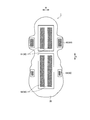
- FIG. 1 is a plan view of the absorbent article in one embodiment.
- FIG. 2 is a plan view of the absorbent article as seen from the side opposite to FIG.
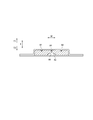
- FIG. 3 is a cross-sectional view of the absorbent article taken along line AA in FIG.
- FIG. 4 is a cross-sectional view of the absorbent article taken along line BB in FIG.
- the absorbent article 1 has a front-rear direction L, a width direction W, and a thickness direction T.
- the front-rear direction L is a direction extending from the front side (abdomen side) of the wearer to the rear side (back side), or a direction extending from the rear side of the wearer to the front side.
- the width direction W is a direction orthogonal to the front-rear direction L.
- the thickness direction T is a direction extending from the wearer's skin side T1 to the non-skin side T2, and is a direction orthogonal to the front-rear direction L and the width direction W.
- the skin side T1 corresponds to the side facing the wearer's skin during use.
- the non-skin surface side T2 corresponds to the side opposite to the skin surface side T1, that is, the side facing away from the wearer's skin during use.
- the absorbent article 1 has an excretion opening contact area S1, a front side area S2, and a rear side area S3.
- the excretion opening contact area S1 is an area facing the excretion opening (for example, vaginal opening) of the wearer.
- the excretion opening contact area S1 is located in the crotch part of the underwear. That is, the excretion opening contact area is an area disposed between the wearer's crotch, that is, between the wearer's legs.
- the front side area S2 is located in front of the excretory opening contact area S1.
- the front edge of the front region S2 defines the front edge of the absorbent article 1.
- the rear side region S3 is located behind the excretory opening contact region S1.
- the rear edge of the rear side region S3 defines the rear edge of the absorbent article 1.
- the length in the front-rear direction L of the rear side region S3 may be longer than the length in the front-rear direction L of the excretory opening contact region S1.
- the wing 3 may be provided in the excretion opening contact area S1. Further, a hip flap 4 swelled outward in the width direction W may be provided in the rear side region S3.
- the front edge of the wing 3 is defined by the root of the wing 3 and corresponds to a portion located on the front side of the two portions recessed most inside in the width direction W.
- the front edge of the wing 3 may define a boundary between the excretory opening contact area S1 and the front side area S2.
- the rear edge of the wing 3 is defined by the root of the wing 3, and corresponds to a portion located on the rear side of the two portions that are recessed most in the width direction W.
- the rear edge of the wing 3 may be located between the excretory opening contact area S1 and the rear side area S3.
- the front end edge of the 1st low weight area 41 mentioned later may prescribe
- the rear end edge of the 1st low weight area 41 is the front edge of the rear side area S3. May be specified.
- the absorbent article 1 has a skin sheet 10, a non-skin sheet 20, and an absorber 30.
- the skin surface sheet 10 is provided on the skin surface side T ⁇ b> 1 from the absorbent body 30.
- the non-skin surface sheet 20 is provided on the non-skin surface side T2 with respect to the absorber 30.
- the absorber 30 is provided between the skin sheet 10 and the non-skin sheet 20.
- the skin sheet 10 may have a surface sheet 11 and a side sheet 12.
- the top sheet 11 is a liquid-permeable sheet that transmits liquid such as body fluid.
- the top sheet 11 covers the central portion of the absorber 30 in the width direction W.
- the topsheet 11 may extend in the front-rear direction L from the front side region S2 to the rear side region S3.
- the side sheet 12 covers the outer edge of the top sheet 11 in the width direction W, and extends outward in the width direction W from the top sheet 11.
- the side sheet 12 can be made of the same material as the top sheet 11.
- the side seat 12 may be disposed on the outer edge of the absorbent body 30 in the width direction W, the wing 3 and the hip flap 4.
- the non-skin surface sheet 20 is a liquid-impermeable sheet.
- the absorber 30 is disposed at least in the excretory opening contact area S1 and the rear side area S3. Moreover, the absorber 30 may extend from the excretory opening contact area S1 to the front side area S2.
- the absorber 30 includes an absorbent core 31 including an absorbent material that absorbs liquid, and a core wrap (not shown) that wraps the absorbent core 31.
- the core wrap should just cover the absorption core 31 at least on the skin surface side than the absorption core 31.
- the absorbent material constituting the absorbent core 31 can be formed from, for example, hydrophilic fibers, pulp, and superabsorbent polymer (SAP).
- SAP superabsorbent polymer
- the core wrap can be composed of, for example, a nonwoven fabric or a tissue sheet.
- the absorbent article 1 has the wing 3 and the hip flap 4.
- the wing 3 and the hip flap 4 extend outward in the width direction W from the outer edge of the absorbent core 31 in the excretory opening contact region S1.
- the wing 3 and the hip flap 4 may be configured by stacking the side sheet 12 and the non-skin sheet 20.
- the wing 3 is configured to be folded back to the non-skin surface sheet 20 side.
- the wing 3 is folded back to the non-skin surface side of the crotch portion of the underwear during use.
- the hip flap 4 is located on the rear side of the wing 3 and is provided in the rear side region S3.
- the hip flap 4 is not folded back during use, and is disposed between the underwear and the wearer's buttocks.
- the hip flap 4 is not provided with an absorbent material.
- the hip flap 4 may be provided with an absorbent material.
- Measurement of“ absorbing core thickness ”in this specification is performed by the following measurement method.
- the measurement position is the center of the absorbent core in the product width direction.
- it is measured not in a state where the absorbent article is contracted but in a state where the elastic member of the absorbent article is extended. Further, parts other than the absorbent core, such as a skin sheet and a non-skin sheet other than the absorbent core, are removed.
- a dial gauge PEACOCK manufactured by Ozaki Seisakusho Co., Ltd. is used, a measuring element having a diameter of 10 mm is employed, a specimen having a size of 30 mm ⁇ 30 mm is prepared, and the thickness of the specimen is measured.
- the measuring device is adjusted so that the measurement pressure on the specimen is 3 g / cm 2.
- the above-described measurement was performed in each state, and the average value was defined as the length.
- weight and density of the absorbent core in the present specification is measured by the following measurement method.
- the packaging body In the absorbent article packaged by the packaging body, the packaging body is opened, the folded absorbent article is developed, and the thickness and area of the portion where the basis weight and density are measured are measured. Subsequently, the part which measures a fabric weight and a density is cut out from an absorbent article, and the weight of the cut-out part is measured. Subsequently, parts other than an absorption core, such as a surface sheet and a back surface sheet, are removed from the cut out part, and the weight of the absorber is measured. The basis weight is calculated based on the weight of the absorbent body and the area of the portion where the basis weight and density are measured. The density is calculated based on the basis weight and thickness.
- the “length” in this specification is measured by the following measurement method.
- the absorbent article 1 When the absorbent article 1 is enclosed in a package or the like, use a sample that is removed from the package and left in that state for 12 hours in an atmosphere of 20 ° C. ⁇ 2 ° C. and a relative humidity of 60% ⁇ 5% RH. Next, using a spring measure (tape: glass fiber-containing polyvinyl chloride coating) manufactured by Shinwa Measurement Co., Ltd., the length of this state of the measurement target part is measured so as to be along the measurement target part.
- a spring measure tape: glass fiber-containing polyvinyl chloride coating
- the “angle of the middle and high parts of the absorber” in this specification is measured by the following measurement method.
- the package is opened, the folded absorbent article is unfolded, a photograph is taken from the side of the absorbent article, and the angles ⁇ and ⁇ shown in FIG. Measure with a protractor.
- the absorption core 31 has the middle-high part 33 at least in the excretion opening contact area S1.
- the middle / high part 33 may extend from the excretory opening contact area S1 to the front side area S2.
- the middle / high portion 33 is disposed across the center line CL in the excretion opening contact region S1.
- the center line is a line connecting the centers in the width direction of the absorbent article, and is a line along the front-rear direction.
- the middle-high portion 33 means a region where the thickness is thicker than the thickness of the outer edge of the absorbent core.
- the basis weight of the absorbent material of the middle-high portion 33 may be higher than the basis weight of the absorbent core 31 in a region other than the middle-high portion 33 in the excretory opening contact region S1.
- the absorption core 31 on the rear side of the first low weight area 41 is thinner than the thickness of the middle-high portion 33. More preferably, the absorption core 31 of the entire rear side region S3 is thinner than the thickness of the middle-high portion 33. Since the thickness of the middle-high part 33 is relatively thick, it is easy to fit the wearer's excretion opening.
- the rear end edge of the middle-high portion 33 is the front end edge of the first low weight area 41.
- a front end edge of the middle-high portion 33 is adjacent to a first side pressing portion 81 described later.
- the rear surface 33RS of the middle-high portion 33 extending in the thickness direction T from the rear end edge 33R of the middle-high portion 33, the non-skin facing surface of the middle-high portion 33, Is greater than the angle ⁇ formed by the front surface 33FS of the middle-high portion 33 extending in the thickness direction T from the front edge 33F of the middle-high portion 33 and the non-skin facing surface of the middle-high portion 33.
- the angle ⁇ is an angle formed by the rear surface 33RS of the middle-high portion 33 and the skin facing surface of the middle-high portion 33 extending forward from the rear end edge 33R of the middle-high portion 33.
- the angle ⁇ is an angle formed by the front surface 33FS of the middle-high portion 33 and the skin facing surface of the middle-high portion 33 extending rearward from the front end edge 33F of the middle-high portion 33. Since the angle formed by the front surface of the mid-high portion and the skin-facing surface is relatively small, the thickness of the front end edge of the mid-high portion changes gradually, and the front can be fitted more forward than the wearer's excretion opening. On the other hand, since the angle on the rear end edge side of the mid-high part is relatively large, the rear end edge of the mid-high part tends to be a bending base point, and the deformation base point by the rear end edge of the mid-high part is between the excretory opening contact area and the rear side area.
- the absorbent body can be provided and can be transformed into different shapes according to the shape of the wearer's body in the excretory opening contact area and the rear side area.
- the absorbent body is deformed by the bending base point in a lying posture and can be deformed so as to be more adapted to the body.
- the absorber 30 has a first low weight area 41, a second low weight area 42, and a third low weight area 43.
- the “low weight area” means a region composed of the absorbent core 31 having a lower basis weight than the surrounding absorbent core 31 or a region not having the absorbent core 31.
- the “low weight area” is a concept including an area where the weight of the absorbent core 31 is zero.
- the rear side area of the absorbent article is disposed directly below the wearer's buttocks, that is, between the buttocks and the floor. Since the second low weight area formed in the rear side region has relatively low rigidity, the feeling of discomfort given to the wearer is small.
- the absorbent material constituting the absorbent core by the first low weight area and the second low weight area is the excretory opening contact area (or wing area), the right side part of the rear side area, and the left side part of the rear side area. It becomes difficult to move between. Thereby, it can suppress that the absorption material which comprises an absorption core concentrates locally by the operation
- the weight of the absorbent core 31 in the low weight areas 41 to 43 is preferably 60% or less, and preferably 50% or less of the weight of the absorbent cores around the low weight areas 41 to 43 (excluding the middle and high portions). More preferred.
- the core wrap wraps the entire absorbent core 31 across the low weight area. In this case, even if the absorption core 31 is divided into a plurality of regions, the absorber 30 is integrally formed by the core wrap.
- the first low-weight area 41, the second low-weight area 42, and the third low-weight area 43 are boundaries where the rigidity of the absorber 30 changes. Therefore, the first low weight area 41, the second low weight area 42, and the third low weight area 43 correspond to areas where the absorber 30 is easily deformed.
- the first low weight area 41 extends in the width direction W between the excretory opening contact area S1 and the rear side area S3.
- the first low weight area suppresses the influence of the deformation of the absorbent body in the excretory opening contact area on the deformation of the absorbent body in the rear area, and the absorbent article becomes independent in the excretion opening contact area and the rear area. It is easy to deform. Therefore, the excretion opening
- the first low weight area 41 is provided on the rear side of the center of the wing 3 in the front-rear direction L and on the front side of the rear edge of the absorber 30.
- the first low weight area 41 is provided across the rear end edge of the wing 3 in the front-rear direction L.
- the first low weight area 41 has a curved shape in which the center in the width direction W of the first low weight area 41 protrudes rearward. More specifically, the center of the first low weight area 41 in the width direction W is located behind the outer edge of the first low weight area 41. Thereby, the first low weight area is swollen in a convex shape toward the rear together with the underwear when lying on its back, and is pushed out in a direction away from the body. When lying on its back, the bulge of the wearer's buttocks is crushed, and the crushed portion moves to the crotch side. When the first low weight area is separated from the body, it is possible to absorb the deformation of the buttocks when lying on the back.
- positioned on both sides of the 1st low weight area are maintained in the shape which follows the roundness of a body, and the whole absorbent article is arrange
- the length of the first low weight area 41 in the width direction W is 25 mm or more.
- the first low weight area 41 may extend from one end of the absorber 30 to the other end in the width direction W. Thereby, it can suppress effectively that the motion of the absorber 30 in the excretion opening
- region S1 is transmitted to back side area
- the outer edge of the first low weight area 41 may be located inside the outer edge of the absorbent core 31. Thereby, since the area
- the length of the first low weight area 41 in the front-rear direction L is preferably 10 mm or more and 50 mm or less, more preferably 10 mm or more and 30 mm or less, at the position of the center line CL of the absorbent article 1. Since the length in the front-rear direction of the first low weight area is 10 mm or more, the deformation of the excretory opening contact area and the deformation of the rear side area can be effectively divided. Further, since the length in the front-rear direction of the first low weight area is 50 mm or less, the body fluid that has flowed to the buttocks side by the rear side area can be absorbed while the body deformation is absorbed by the first low weight area. The wearer can hardly feel the anxiety that menstrual blood flows on the buttock side, and can obtain a sense of security at the time of wearing.
- the second low weight area 42 extends in the front-rear direction L along the center line CL of the absorbent article in the rear side area S3.
- the second low weight area 42 may extend linearly in the front-rear direction L. Since the second low weight area is formed in the rear side area, the center of the rear side area in the width direction protrudes toward the wearer's body due to the force from the outer side in the width direction toward the inner side in the width direction of the absorbent article. easy. Thereby, in a back side region, an absorptive article can change according to a wearer's crack shape in a sleeping posture. As a result, the wearer can obtain a comfortable fit with the absorbent article in the buttocks.
- the second low weight area 42 is preferably connected to the first low weight area 41.
- the deformation base point extending in the width direction by the first low weight area and the deformation base point extending in the front-rear direction by the second low weight area can be interlocked and can be deformed so as to reach a deeper crack position.
- the middle and high portions and the convex shape formed by the second low weight area are pseudo-connected along the front-rear direction of the body, and the region capable of absorbing bodily fluids continues in the front-rear direction. Therefore, the bodily fluid adhering to a wearer's skin can be absorbed rapidly, it can suppress that a bodily fluid propagates the surface of skin, and can reduce the leak of bodily fluid.
- the rear end edge of the second low weight area 42 is located on the front side of the rear end edge of the absorbent core and on the rear side of the center of the rear side region S3 in the front-rear direction.
- a groove (crack) between the heels exists in a region from the back to the caudal bone from the back of the perineum.
- the second low weight area 42 is located in the area of the wearer's rupture. The second low weight area is applied to the area.
- On both sides of the second low weight area 42 areas where the weight of the absorbent core is higher than that of the second low weight area 42 and the cushioning property is high are arranged. Both sides of the second low weight area 42 are soft against the tailbone and can prevent irritation to the wearer's skin.
- the third low weight area 43 extends outward in the width direction W from the second low weight area 42 in the rear side area S3.
- a deformation base point extending in the width direction is formed in the absorption core in the rear side area. Since the absorbent core can be deformed with the third low weight area as a base point, the absorbent article can be more easily fitted along the roundness along the front-rear direction of the body.
- the third low weight area 43 may be connected to the second low weight area 42. Accordingly, the deformation base point extending in the width direction by the third low weight area and the deformation base point extending in the front-rear direction by the second low weight area can be linked, and can be arranged along the roundness of the buttock. *
- the outer edge of the third low weight area 43 in the width direction W is located inside the outer edge of the absorbent core 31 in the rear area S3.
- An absorbent material having a higher basis weight than the third low basis weight area is disposed on the outer side in the width direction than the third low basis weight area 43, and body fluid can be absorbed by the absorbent material, thereby preventing side leakage.
- a plurality of third low weight areas 43 are provided at intervals in the front-rear direction L. Therefore, a plurality of deformation base points by the third low weight area 43 are provided at intervals in the front-rear direction L, and the absorbent core can be arranged along the roundness of the buttock.
- Pressing part Absorbent article 1 has a pressing part formed by compressing at least absorption core 31 in thickness direction T.
- region where the pressing part was formed is a part with a high density compared with the area
- the pressing part has the 1st side pressing part 81, the 2nd side pressing part 82, the width pressing part 83, the center pressing part 84, and the front-back pressing part 88 (refer FIG. 1).
- the first side pressing part 81 is provided at least in the excretion opening contact area S1.
- the first side compressed portion 81 is formed by compressing the topsheet 11 and the absorbent body 30 in the thickness direction T.
- the 1st side pressing part 81 is arrange
- the first side pressing part 81 defines the outer edge of the middle-high part 33.
- the 1st side pressing part 81 is bent toward the width direction W in the vicinity of the front end edge of the absorption core 31, and is continuously connected to the U-shape.
- the first side pressing part 81 may be provided separately on both sides in the width direction W of the middle-high part 33. That is, a pair of 1st side pressing part 81 may be provided separately with the form parted mutually.
- the second side pressing part 82 is provided on both sides of the second low weight area 42 in the rear side area S3.
- the 2nd side pressing part 82 is spaced apart from the 2nd low weight area 42, and does not inhibit convex deformation by the 2nd low weight area.
- the second side pressing part 82 extends along the front-rear direction L.
- the 1st side pressing part 81 and the 2nd side pressing part 82 are spaced apart in the front-back direction. Between the 1st side pressing part and the 2nd side pressing part, the 1st low weight area
- the influence of the deformation of the absorbent body in the excretory opening contact area S1 on the deformation of the absorbent body in the rear side area is more effectively suppressed. it can.
- the 2nd side pressing part is provided in both sides on both sides of the 2nd low weight area
- the absorbent core is more familiar with the wearer's body and can give a comfortable fit to the wearer.
- the 2nd side pressing part 82 has the part 82a parted in the front-back direction.
- the divided portion is a portion where the absorber 30 and the top sheet 11 are not compressed in the thickness direction.
- the dividing portion 82a is provided in the third low weight area. Since the dividing part of the second side pressing part is provided in the third low weight area, the absorbent core is easily deformed due to the difference in rigidity of the dividing part. Therefore, since the absorption core of the rear side region can be deformed with the third low weight area and the divided portion as the base points, the absorbent article can be more easily fitted along the roundness along the front-rear direction of the body.
- the rear side area can be easily deformed in accordance with the roundness along the front-rear direction L of the body by the third low weight area and the dividing portion which are the deformation base points. Thereby, it can be more familiar to the wearer's body and give a more comfortable fit to the wearer.
- the 2nd side pressing part 82 has the 1st field 82b extended back from division part 82a, and the 2nd field 82c which continues to the rear end edge of the 1st field 82b, and turns up toward the front.
- the first region 82b has a curved shape extending rearward from the dividing portion 82a located rearward and extending inward in the width direction toward the rear.
- the second region 82c has an arc shape that folds forward.
- the first region extends from the outer side in the width direction to the inner side in the width direction from the front to the rear. Between the inner edge of the first region 82b and the rear edge of the first region, the first region extends from the inner side in the width direction toward the inner side in the width direction from the front side toward the rear side.
- the area behind the third low weight area is configured to contact the tailbone.
- the shape of the body near the coccyx is flat compared to the rupture, but is gently rounded.
- the first region has a curved shape that gently extends inward in the width direction from the front toward the rear, and thus is sandwiched between the second side pressing portions.
- the absorbent core is gently convex with respect to the body. Therefore, the gap between the body and the absorbent article is reduced in the vicinity of the coccyx bone, and the wearer can obtain a comfortable feeling and a sense of security that is wrapped by the absorbent article.
- At least a part of the second region 82c is arranged along the rear edge of the absorbent core 31. In the vicinity of the rear end edge of the absorbent core, it is easy for pressure to be received by the buttocks in a lying position, and twisting and rubbing are likely to occur.
- the rigidity in the vicinity of the rear end portion of the absorbent core is increased, and even when the absorbent article is used for a long time, The absorption core can be prevented from being deformed or divided.
- one end (rear end edge) of the second region 82c is connected to the first region 82b, and the other end (front end edge) is not connected to the first region 82b.
- the rear end portion of the absorbent core does not become too hard, and the wearer can continue to wear it without feeling uncomfortable. Further, in the configuration in which the left and right first areas are connected to each other, the area behind the third low weight area tends to be kept flat, which may hinder the convex deformation due to the second low weight area. is there. However, since the left and right first areas are separated from each other, the area behind the third low weight area is gently deformed into a convex shape, and the convex deformation due to the second low weight area is not hindered.
- the shape of the second region is not limited to the embodiment, and may be a shape extending in the front-rear direction along the outer edge of the absorbent core. Thereby, the rigidity of the outer edge can be increased in the vicinity of the rear edge and the rear edge of the absorbent core.
- the area behind the third low weight area 43 (the third low weight area located most rearward in the configuration having the plurality of third low weight areas 43) is the central compressed portion 84 and the second side compressed area.
- the section 82 is divided into four sections. More specifically, two of the four sections are sections surrounded by the central pressing portion 84, the third low weight area 43 located on the rear side, and the second side pressing portion, and the center. It is provided on both sides of the pressing part 84. The other two sections are provided between the second side pressing portion, the outer edge of the absorbent core, and the rear end edge of the third low weight area 43 located on the rear side.
- the absorber By being divided into a plurality of sections in this manner, the absorber is less likely to be squeezed compared to a configuration that cannot be divided into sections, and the collapse of the absorber when used for a long time can be suppressed.
- the area behind the third low weight area 43 is likely to be subjected to pressure by the buttocks, and the absorbent body is liable to sway.
- the width pressing part 83 is formed in the third low weight area 43 in the rear side area S3.
- the width squeezed portion 83 having relatively high rigidity is provided, so that a portion having high rigidity and a portion having low rigidity are alternately formed, and a plurality of bending base points are formed. Can be provided. Therefore, the absorption core can be deformed through more base points, and can be fitted to the body more.
- the width pressing part 83 is comprised by the aggregate
- the dividing part 82a is arrange
- a deformation base point extending in the width direction is formed by the width pressing portion 83 and the dividing portion 82a.
- the absorbent core is divided into a plurality of sections through a pressing part or the like in the width direction.
- the absorption core is divided into a plurality of sections on a virtual line that passes through the second side pressing portion and extends in the width direction.
- the region between the outer edge of the front / rear pressing part and the region between the front / rear pressing part is partitioned by a difference in rigidity.
- the central pressing part 84 extends in the front-rear direction along the center line CL in the rear side region.
- the center pressing part 84 is formed in the area
- the absorbers on both sides can be divided across the central pressing part. By dividing the absorbent body into a plurality of parts, it is difficult to squeeze as compared with a configuration in which the absorbent body is not divided, and the absorbent body can be prevented from collapsing when used for a long time.
- the center pressing part 84 is comprised by the aggregate
- the center pressing part 84 is arrange
- the extension line extended from the width pressing part 83 is located in the area
- a deformation base point extending in the width direction is formed by the width pressing portion 83 and the region between the central pressing portions 84.
- the area between the central pressing parts is relatively low in rigidity and can be easily deformed with respect to the wearer's movement. By providing the deformation base point including the region with low rigidity, it becomes easier to deform following the movement of the wearer. Moreover, the irritation
- At least a part of the central pressing part 84 is arranged so as to overlap the front-rear pressing part 88.
- a part of the central pressing part 84 is located behind the front / rear pressing part 88 and does not overlap the front / rear pressing part 88.
- the front-rear pressing part 88 and the central pressing part overlap, the center in the width direction in the rear side area becomes thinner, and when the center of the rear side area in the width direction is deformed as the apex, it can be fitted by the gap of the body. .
- the front-rear pressing part 88 extends in the front-rear direction along the center line in the rear side region.
- the front-rear pressing part 88 is formed in the second low weight area.
- region where both the center pressing parts 84 are not formed is provided.
- the front edge of the front-rear pressing part 88 may be located in the first low weight area.
- the front end edge of the front / rear squeezing portion 88 is disposed in the first low weight area having a relatively low basis weight, the front end edge of the front / rear squeezing portion is prevented from becoming too hard and softly contacts the vicinity of the delicate vaginal opening. be able to.
- the front end edge of the front-rear pressing part 88 may correspond to the front end edge of the second low weight area.
- the second low weight area is aligned with the starting position (front edge) of the fracture, and the second low weight area and the front / rear squeezing portion 88 fit the absorbent core to the starting position of the tear, and the body fluid to the rear Can be prevented.
- the rear end edge of the front / rear compressed part 88 is located in front of the rear end edge of the third low weight area.
- the inner edge of the width pressing part 83 is arrange
- FIG. A difference in rigidity occurs at the rear end edge of the third low weight area behind the rear end edge of the front and rear compressed portion 88, and the inner edge of the width compressed portion is bounded on the side of the front and rear compressed portion 88. The difference in rigidity occurs.
- a difference in rigidity occurs between the rear end edge of the front-rear compressed portion 88 and the surrounding area, and it becomes easier to function as a deformation base point of the absorbent body.
- the region in front of the rear edge of the third low weight area is in contact with the rupture, and the region behind the third low weight area is in contact with the tail bone located behind the rupture. It is configured.
- the front / rear pressing part 88 is not disposed in the absorption core behind the rear end edge of the third low weight area 43 and is not configured to be easily deformed by the front / rear pressing part. Therefore, the durability of the area behind the third low weight area 43 is improved, and it becomes easy to continue to fit the tailbone in a flat state.
- the surface sheet 11 and the absorber 30 are compressed by the non-skin opposing surface from the skin opposing surface side. Is formed.
- the front-rear pressing part is formed by the absorption core 31 being compressed from the non-skin facing surface side to the skin facing surface.
- the absorbent article 1 has an adhesive area 60 provided with an adhesive for fastening the absorbent article 1 to the underwear S.
- the adhesive region 60 includes a first main body adhesive region 61 as a first adhesive region, a second main body adhesive region 62 as a second adhesive region, a wing adhesive region 63, and a hip flap adhesive region 64. These adhesive regions 61 to 64 are provided on the non-skin surface side of the non-skin sheet 20.
- the first main body adhesive region 61 is disposed in front of the second main body adhesive region 62.
- the first main body adhesive region 61 and the second main body adhesive region 62 extend in the front-rear direction L.
- the first main body adhesive region 61 is disposed away from the second main body adhesive region 62 in the front-rear direction L.
- the first main body adhesive region 61 is located in front of the first low weight area 41.
- the second main body adhesive region 62 is located behind the first low weight area 41.
- the wing adhesive region 63 is provided in the wing 3.
- the hip flap adhesive region 64 is provided in the hip flap 4.
- the first low weight area 41 is preferably arranged in a region that does not overlap with the adhesive regions 61 to 64 in the thickness direction T. More specifically, the first low weight area 41 is provided in a region between the first main body adhesive region 61 and the second main body adhesive region 62.
- the second low weight area 42 is preferably arranged in an area that does not overlap the adhesive areas 61 to 64 in the thickness direction T. More specifically, the second low weight area 42 is provided between the plurality of second main body adhesive areas 62.
- the first low weight area 41 and the second low weight area 42 can function as deformation base points. That is, the absorbent cores 31 adjacent to each other with the first low weight area 41 and the second low weight area 42 interposed therebetween can easily move independently of each other.
- the 2nd side pressing part 82 is provided in the area
- FIG. The area where the second side pressing part 82 is provided is fastened to the underwear. Thereby, when the absorption core 31 deform
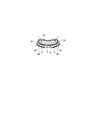
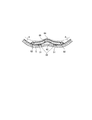
- FIG. 5 is a schematic cross-sectional view of the absorbent article in use along the line CC in FIG. 6 is a schematic cross-sectional view of the absorbent article in use along the line BB in FIG. 5 and 6, a line indicating the shape of the wearer's body is indicated by a two-dot chain line.
- the absorbent article 1 When the absorbent article 1 as a sanitary napkin is worn, the absorbent article 1 is fixed to the underwear S.
- the excretion opening contact area S1 of the absorbent article 1 is sandwiched between both legs of the wearer and receives a force from the outside in the width direction W toward the inside in the width direction W.
- the cross-sectional shape of the wearer's body along the width direction W of the absorbent article 1 is different between the crotch vicinity and the buttocks vicinity. Specifically, in the cross-sectional shape of the body near the wearer's crotch cleft (around the vaginal opening where menstrual blood appears), the large labia protrudes from the base of the large labia and protrudes toward the absorbent article 1 side. Convex shape. In the inseam area of the wearer, the excretion opening contact area S1 of the absorbent article is arranged to face. In the crotch of the wearer, the absorption core 31 of the excretory opening contact area S1, particularly the middle-high part 33, is arranged along the body, and body fluid leakage at the crotch can be suppressed (see FIG. 5).
- the anus and rupture are located behind the perineum located behind the wearer's large labia.
- the cross-sectional shape of the body near the rear of the perineum is a shape in which the center in the width direction is recessed.
- the rear side area S3 of the absorbent article is disposed to face the wearer's buttocks.
- the second low weight area 42 and the front / rear compressed portion 88 extending in the front / rear direction L along the center line CL are formed. Therefore, the center of the rear region S3 in the width direction W easily protrudes toward the wearer's body due to the force from the outside to the inside of the absorbent article (see FIG. 6). Thereby, in back side region S3, the absorbent article 1 can deform
- the absorbent article 1 tends to change into different shapes according to the shape of the wearer's body in the excretory opening contact area S1 and the rear side area S3.
- the first low weight area 41 suppresses the influence of the deformation of the absorbent body 30 in the excretory opening contact area S1 on the deformation of the absorbent body 30 in the rear side area S3. That is, the first low weight area 41 makes it easy for the absorbent article to be independently deformed in the excretory opening contact area S1 and the rear area S3.
- Absorbent article 10 Skin sheet 20: Non-skin sheet 31: Absorbing core 33: Middle and high part 41: First low weight area 42: Second low weight area 43: Third low weight area 61: First main body Adhesion area 62: second main body adhesion area 81: first side pressing part 82: second side pressing part 83: central pressing part 84: width pressing part 88: front / rear pressing part L: front / rear direction W: width direction T: thickness direction S1: excretory opening contact area S2: front side area S3: rear side area CL: center line
Landscapes
- Health & Medical Sciences (AREA)
- Epidemiology (AREA)
- Engineering & Computer Science (AREA)
- Biomedical Technology (AREA)
- Heart & Thoracic Surgery (AREA)
- Vascular Medicine (AREA)
- Life Sciences & Earth Sciences (AREA)
- Animal Behavior & Ethology (AREA)
- General Health & Medical Sciences (AREA)
- Public Health (AREA)
- Veterinary Medicine (AREA)
- Absorbent Articles And Supports Therefor (AREA)
Abstract
Description
着用者の排泄口と対向する排泄口当接域と、
前記排泄口当接域の後側に位置する後側域と、
少なくとも前記排泄口当接域及び前記後側域に配置される吸収コアと、を有する吸収性物品であって、
前記吸収コアは、前記排泄口当接域と前記後側域との間において前記幅方向に延びる第1低目付領域と、前記後側域において前記幅方向の中心を結ぶ中心線に沿って前記前後方向に延びる第2低目付領域と、前記後側域において前記中心線に沿って前記前後方向に延びる前後圧搾部と、を有しており、
前記排泄口当接域の前記吸収コアは、前記第1低目付領域及び前記第2低目付領域の目付よりも高い目付からなり、
前記第2低目付領域は、前記第1低目付領域と繋がっており、
前記前後圧搾部の少なくとも一部は、前記第2低目付領域内に配置される、吸収性物品。
前記吸収コアは、前記排泄口当接域を挟んで両側に配置され、前記前後方向に延びる一対の第1サイド圧搾部と、前記後側域において前記第2低目付領域を挟んで両側に配置され、前記前後方向に延びる一対の第2サイド圧搾部と、を有し、
前記第1サイド圧搾部と前記第2サイド圧搾部は、前記前後方向において離間することが望ましい。
前記吸収コアは、前記第2低目付領域から前記幅方向の外側に延び、前記排泄口当接域の前記吸収コアの目付よりも低い目付からなる第3低目付領域を有し、
前記第2サイド圧搾部は、前記第3低目付領域内において前記前後方向に分断された分断部を有することが望ましい。
前記第2サイド圧搾部は、前記分断部から後方に延びる第1領域と、前記第1領域の後端縁に連なり、前方に向かって折り返す第2領域と、を有することが望ましい。
前記吸収コアは、前記第2低目付領域から前記幅方向の外側に延び、前記排泄口当接域の前記吸収コアの目付よりも低い目付からなる第3低目付領域と、前記第3低目付領域内において幅方向に延びる幅圧搾部と、を有することが望ましい。
前記吸収コアの非肌面側に位置する非肌面シートには、前記吸収性物品を下着に止めるための粘着領域が設けられており、
前記粘着領域は、前記第1低目付領域よりも前方に位置する第1粘着領域と、前記第1低目付領域よりも後方に位置する第2粘着領域と、を有し、
前記第1粘着領域と前記第2粘着領域は、前記前後方向において離間することが望ましい。
前記排泄口当接域は、前記吸収コアの外側縁の厚みよりも厚みが厚い中高部を有し、
前記吸収性物品の前記前後方向の断面において、前記中高部の吸収体の後端縁から前記厚み方向に延びる中高部の吸収体の後面と、前記中高部の吸収体の非肌対向面と、が成す角度は、前記中高部の吸収体の前端縁から前記厚み方向に延びる中高部の吸収体の前面と、前記中高部の吸収体の非肌対向面と、が成す角度よりも大きいことが望ましい。
前記吸収コアは、前記後側域において前記中心線に沿って前記前後方向に延びる中央圧搾部を有し、
前記中央圧搾部の少なくとも一部は、前記前後圧搾部に重なって配置されることが望ましい。
以下、図面を参照して、実施形態に係る吸収性物品ついて説明する。吸収性物品は、パンティーライナー(おりものシート)や生理用ナプキンや失禁パッド等の任意の吸収性物品であってよい。以下の実施形態では、吸収性物品の一例として使い捨ての生理用ナプキンについて説明する。
図1は、一実施形態における吸収性物品の平面図である。図2は、図1とは反対側から見た吸収性物品の平面図である。図3は、図1のA-A線に沿った吸収性物品の断面図である。図4は、図1のB-B線に沿った吸収性物品の断面図である。
次に、吸収体30の構成についてより具体的に説明する。吸収コア31は、少なくとも排泄口当接域S1に、中高部33を有する。中高部33は、排泄口当接域S1から前側域S2へ延びていてもよい。中高部33は、排泄口当接域S1において、中心線CLを跨いで配置されている。中心線は、吸収性物品の幅方向の中心を結ぶ線であり、前後方向に沿う線である。中高部33は、吸収コアの外側縁の厚みよりも厚みが厚い領域を意味する。中高部33の吸収材料の目付は、排泄口当接域S1内の中高部33以外の領域における吸収コア31の目付よりも高くてもよい。好ましくは、第1低目付領域41よりも後側の吸収コア31は、中高部33の厚みよりも薄い。より好ましくは、後側域S3全体の吸収コア31は、中高部33の厚みよりも薄い。中高部33の厚みが比較的厚いため、着用者の排泄口にフィットさせ易い。一方、後側域の吸収コアの厚みが比較的薄く、後側域の剛性が比較的低いため、着用者の脚の動きに追従し易くなり、脚を動かした際の違和感を低減できる。中高部33の後端縁は、第1低目付領域41の前端縁である。中高部33の前端縁は、後述する第1サイド圧搾部81に隣接している。
吸収性物品1は、少なくとも吸収コア31が厚み方向Tに圧縮されることによって形成された圧搾部を有する。圧搾部が形成された領域は、圧搾部が形成されてない領域と比較して密度が高い部分である。圧搾部は、第1サイド圧搾部81と、第2サイド圧搾部82と、幅圧搾部83と、中央圧搾部84と、前後圧搾部88と、を有している(図1参照)。
図2に示すように、吸収性物品1は、吸収性物品1を下着Sに止めるための粘着剤が設けられた粘着領域60を有する。粘着領域60は、第1粘着領域としての第1本体粘着領域61、第2粘着領域としての第2本体粘着領域62、ウイング粘着領域63及びヒップフラップ粘着領域64を有する。これらの粘着領域61~64は、非肌面シート20の非肌面側に設けられている。
次に、図5及び図6を参照し、着用中の吸収性物品の形状について説明する。図5は、使用中の吸収性物品の、図1のC-C線に沿った模式的断面図である。図6は、使用中の吸収性物品の、図1のB-B線に沿った模式的断面図である。なお、図5及び6では、着用者の体の形状を示すラインを二点鎖線で示している。
10 :肌面シート
20 :非肌面シート
31 :吸収コア
33 :中高部
41 :第1低目付領域
42 :第2低目付領域
43 :第3低目付領域
61 :第1本体粘着領域
62 :第2本体粘着領域
81 :第1サイド圧搾部
82 :第2サイド圧搾部
83 :中央圧搾部
84 :幅圧搾部
88 :前後圧搾部
L :前後方向
W :幅方向
T :厚み方向
S1 :排泄口当接域
S2 :前側域
S3 :後側域
CL :中心線
Claims (8)
- 互いに直交する前後方向及び幅方向と、
着用者の排泄口と対向する排泄口当接域と、
前記排泄口当接域の後側に位置する後側域と、
少なくとも前記排泄口当接域及び前記後側域に配置される吸収コアと、を有する吸収性物品であって、
前記吸収コアは、前記排泄口当接域と前記後側域との間において前記幅方向に延びる第1低目付領域と、前記後側域において前記幅方向の中心を結ぶ中心線に沿って前記前後方向に延びる第2低目付領域と、前記後側域において前記中心線に沿って前記前後方向に延びる前後圧搾部と、を有しており、
前記排泄口当接域の前記吸収コアは、前記第1低目付領域及び前記第2低目付領域の目付よりも高い目付からなり、
前記第2低目付領域は、前記第1低目付領域と繋がっており、
前記前後圧搾部の少なくとも一部は、前記第2低目付領域内に配置される、吸収性物品。 - 前記吸収コアは、前記排泄口当接域を挟んで両側に配置され、前記前後方向に延びる第1サイド圧搾部と、前記後側域において前記第2低目付領域を挟んで両側に配置され、前記前後方向に延びる第2サイド圧搾部と、を有し、
前記第1サイド圧搾部と前記第2サイド圧搾部は、前記前後方向において離間する、請求項1に記載の吸収性物品。 - 前記吸収コアは、前記第2低目付領域から前記幅方向の外側に延び、前記排泄口当接域の前記吸収コアの目付よりも低い目付からなる第3低目付領域を有し、
前記第2サイド圧搾部は、前記第3低目付領域内において前記前後方向に分断された分断部を有する、請求項2に記載の吸収性物品。 - 前記第2サイド圧搾部は、前記分断部から後方に延びる第1領域と、前記第1領域の後端縁に連なり、前方に向かって折り返す第2領域と、を有する、請求項3に記載の吸収性物品。
- 前記吸収コアは、前記第2低目付領域から前記幅方向の外側に延び、前記排泄口当接域の前記吸収コアの目付よりも低い目付からなる第3低目付領域と、前記第3低目付領域内において幅方向に延びる幅圧搾部と、を有する、請求項1から請求項4のいずれかに記載の吸収性物品。
- 前記吸収コアの非肌面側に位置する非肌面シートには、前記吸収性物品を下着に止めるための粘着領域が設けられており、
前記粘着領域は、前記第1低目付領域よりも前方に位置する第1粘着領域と、前記第1低目付領域よりも後方に位置する第2粘着領域と、を有し、
前記第1粘着領域と前記第2粘着領域は、前記前後方向において離間する、請求項1から請求項5のいずれかに記載の吸収性物品。 - 前記排泄口当接域は、前記吸収コアの外側縁の厚みよりも厚みが厚い中高部を有し、
前記吸収性物品の前記前後方向の断面において、前記中高部の吸収体の後端縁から厚み方向に延びる中高部の吸収体の後面と、前記中高部の吸収体の非肌対向面と、が成す角度は、前記中高部の吸収体の前端縁から厚み方向に延びる中高部の吸収体の前面と、前記中高部の吸収体の非肌対向面と、が成す角度よりも大きい、請求項1から請求項6のいずれかに記載の吸収性物品。 - 前記吸収コアは、前記後側域において前記中心線に沿って前記前後方向に延びる中央圧搾部を有し、
前記中央圧搾部の少なくとも一部は、前記前後圧搾部に重なって配置される、請求項1から請求項7のいずれかに記載の吸収性物品。
Priority Applications (2)
| Application Number | Priority Date | Filing Date | Title |
|---|---|---|---|
| KR1020187021657A KR101935224B1 (ko) | 2015-12-28 | 2016-12-16 | 흡수성 물품 |
| CN201680076490.0A CN108472166B (zh) | 2015-12-28 | 2016-12-16 | 吸收性物品 |
Applications Claiming Priority (2)
| Application Number | Priority Date | Filing Date | Title |
|---|---|---|---|
| JP2015257070A JP6147842B1 (ja) | 2015-12-28 | 2015-12-28 | 吸収性物品 |
| JP2015-257070 | 2015-12-28 |
Publications (1)
| Publication Number | Publication Date |
|---|---|
| WO2017115673A1 true WO2017115673A1 (ja) | 2017-07-06 |
Family
ID=59061256
Family Applications (1)
| Application Number | Title | Priority Date | Filing Date |
|---|---|---|---|
| PCT/JP2016/087655 Ceased WO2017115673A1 (ja) | 2015-12-28 | 2016-12-16 | 吸収性物品 |
Country Status (6)
| Country | Link |
|---|---|
| JP (1) | JP6147842B1 (ja) |
| KR (1) | KR101935224B1 (ja) |
| CN (1) | CN108472166B (ja) |
| MY (1) | MY179827A (ja) |
| TW (1) | TWI620553B (ja) |
| WO (1) | WO2017115673A1 (ja) |
Cited By (3)
| Publication number | Priority date | Publication date | Assignee | Title |
|---|---|---|---|---|
| CN110913817A (zh) * | 2017-07-14 | 2020-03-24 | 大王制纸株式会社 | 吸收性物品 |
| JP2022035728A (ja) * | 2020-08-21 | 2022-03-04 | 大王製紙株式会社 | 吸収性物品 |
| JP7735605B1 (ja) * | 2025-05-20 | 2025-09-08 | ユニ・チャーム株式会社 | 吸収性物品 |
Families Citing this family (3)
| Publication number | Priority date | Publication date | Assignee | Title |
|---|---|---|---|---|
| CN109475441B (zh) * | 2016-07-29 | 2021-07-27 | 尤妮佳股份有限公司 | 吸收性物品 |
| JP6884541B2 (ja) * | 2016-09-30 | 2021-06-09 | 大王製紙株式会社 | 吸収性物品 |
| JP7291668B2 (ja) * | 2020-06-12 | 2023-06-15 | ユニ・チャーム株式会社 | 吸収性物品 |
Citations (6)
| Publication number | Priority date | Publication date | Assignee | Title |
|---|---|---|---|---|
| JP2000189456A (ja) * | 1998-12-25 | 2000-07-11 | Kao Corp | 吸収性物品 |
| JP2005527298A (ja) * | 2002-05-28 | 2005-09-15 | タイコ ヘルスケアー リテイル サーヴィシス アクチェンゲゼルシャフト | 複数のコアを有する吸収性物品 |
| JP2008183160A (ja) * | 2007-01-29 | 2008-08-14 | Daio Paper Corp | 吸収性物品 |
| JP2012050497A (ja) * | 2010-08-31 | 2012-03-15 | Daio Paper Corp | 吸収性物品 |
| JP2014128551A (ja) * | 2012-11-29 | 2014-07-10 | Kao Corp | 吸収性パッド |
| JP2014226458A (ja) * | 2013-05-27 | 2014-12-08 | ユニ・チャーム株式会社 | 吸収性物品 |
Family Cites Families (6)
| Publication number | Priority date | Publication date | Assignee | Title |
|---|---|---|---|---|
| JP4870365B2 (ja) | 2005-02-23 | 2012-02-08 | ユニ・チャーム株式会社 | 生理用ナプキン |
| JP4401309B2 (ja) | 2005-03-03 | 2010-01-20 | 花王株式会社 | 吸収性物品 |
| JP5328591B2 (ja) * | 2009-09-30 | 2013-10-30 | ユニ・チャーム株式会社 | 吸収性物品及び吸収性物品の製造装置 |
| JP5827036B2 (ja) | 2010-08-31 | 2015-12-02 | 大王製紙株式会社 | 吸収性物品 |
| JP5839685B2 (ja) * | 2012-01-19 | 2016-01-06 | ユニ・チャーム株式会社 | 使い捨て吸収性物品 |
| JP6219573B2 (ja) * | 2013-01-31 | 2017-10-25 | ユニ・チャーム株式会社 | 吸収性物品 |
-
2015
- 2015-12-28 JP JP2015257070A patent/JP6147842B1/ja active Active
-
2016
- 2016-12-16 WO PCT/JP2016/087655 patent/WO2017115673A1/ja not_active Ceased
- 2016-12-16 MY MYPI2018001108A patent/MY179827A/en unknown
- 2016-12-16 CN CN201680076490.0A patent/CN108472166B/zh not_active Expired - Fee Related
- 2016-12-16 KR KR1020187021657A patent/KR101935224B1/ko active Active
- 2016-12-23 TW TW105143043A patent/TWI620553B/zh active
Patent Citations (6)
| Publication number | Priority date | Publication date | Assignee | Title |
|---|---|---|---|---|
| JP2000189456A (ja) * | 1998-12-25 | 2000-07-11 | Kao Corp | 吸収性物品 |
| JP2005527298A (ja) * | 2002-05-28 | 2005-09-15 | タイコ ヘルスケアー リテイル サーヴィシス アクチェンゲゼルシャフト | 複数のコアを有する吸収性物品 |
| JP2008183160A (ja) * | 2007-01-29 | 2008-08-14 | Daio Paper Corp | 吸収性物品 |
| JP2012050497A (ja) * | 2010-08-31 | 2012-03-15 | Daio Paper Corp | 吸収性物品 |
| JP2014128551A (ja) * | 2012-11-29 | 2014-07-10 | Kao Corp | 吸収性パッド |
| JP2014226458A (ja) * | 2013-05-27 | 2014-12-08 | ユニ・チャーム株式会社 | 吸収性物品 |
Cited By (6)
| Publication number | Priority date | Publication date | Assignee | Title |
|---|---|---|---|---|
| CN110913817A (zh) * | 2017-07-14 | 2020-03-24 | 大王制纸株式会社 | 吸收性物品 |
| EP3653186A4 (en) * | 2017-07-14 | 2021-04-14 | Daio Paper Corporation | ABSORBENT ITEM |
| CN110913817B (zh) * | 2017-07-14 | 2022-03-22 | 大王制纸株式会社 | 吸收性物品 |
| JP2022035728A (ja) * | 2020-08-21 | 2022-03-04 | 大王製紙株式会社 | 吸収性物品 |
| JP7431700B2 (ja) | 2020-08-21 | 2024-02-15 | 大王製紙株式会社 | 吸収性物品 |
| JP7735605B1 (ja) * | 2025-05-20 | 2025-09-08 | ユニ・チャーム株式会社 | 吸収性物品 |
Also Published As
| Publication number | Publication date |
|---|---|
| MY179827A (en) | 2020-11-17 |
| JP2017118984A (ja) | 2017-07-06 |
| TWI620553B (zh) | 2018-04-11 |
| KR20180090381A (ko) | 2018-08-10 |
| KR101935224B1 (ko) | 2019-01-03 |
| JP6147842B1 (ja) | 2017-06-14 |
| CN108472166B (zh) | 2019-06-28 |
| CN108472166A (zh) | 2018-08-31 |
| TW201735887A (zh) | 2017-10-16 |
Similar Documents
| Publication | Publication Date | Title |
|---|---|---|
| JP6080263B2 (ja) | 吸収性物品 | |
| JP6147842B1 (ja) | 吸収性物品 | |
| JP6420779B2 (ja) | 吸収性物品 | |
| JP6453207B2 (ja) | 吸収性物品 | |
| JP6456137B2 (ja) | 吸収性物品 | |
| JP5827770B1 (ja) | 吸収性物品 | |
| JP6749349B2 (ja) | 吸収性物品 | |
| WO2017082056A1 (ja) | 吸収性物品 | |
| JP6034452B1 (ja) | 吸収性物品 | |
| KR20180081059A (ko) | 흡수성 물품 | |
| JP6705839B2 (ja) | 吸収性物品 | |
| JP6080935B1 (ja) | 吸収性物品 | |
| JP6018168B2 (ja) | 吸収性物品 | |
| JP2017060781A (ja) | 吸収性物品 | |
| JP6725451B2 (ja) | 吸収性物品 | |
| JP2021074071A (ja) | 吸収性物品 | |
| WO2016103774A1 (ja) | 吸収性物品 | |
| WO2024090437A1 (ja) | 吸収性物品 | |
| JP6456136B2 (ja) | 吸収性物品 | |
| JP2020025792A (ja) | 使い捨ておむつ | |
| JP2017012720A (ja) | 吸収性物品 |
Legal Events
| Date | Code | Title | Description |
|---|---|---|---|
| 121 | Ep: the epo has been informed by wipo that ep was designated in this application |
Ref document number: 16881649 Country of ref document: EP Kind code of ref document: A1 |
|
| NENP | Non-entry into the national phase |
Ref country code: DE |
|
| ENP | Entry into the national phase |
Ref document number: 20187021657 Country of ref document: KR Kind code of ref document: A |
|
| WWE | Wipo information: entry into national phase |
Ref document number: 1020187021657 Country of ref document: KR |
|
| 122 | Ep: pct application non-entry in european phase |
Ref document number: 16881649 Country of ref document: EP Kind code of ref document: A1 |