WO2017094467A1 - 中空構造体 - Google Patents
中空構造体 Download PDFInfo
- Publication number
- WO2017094467A1 WO2017094467A1 PCT/JP2016/083315 JP2016083315W WO2017094467A1 WO 2017094467 A1 WO2017094467 A1 WO 2017094467A1 JP 2016083315 W JP2016083315 W JP 2016083315W WO 2017094467 A1 WO2017094467 A1 WO 2017094467A1
- Authority
- WO
- WIPO (PCT)
- Prior art keywords
- hollow structure
- polyvinyl alcohol
- structure according
- rubber
- mass
- Prior art date
- Legal status (The legal status is an assumption and is not a legal conclusion. Google has not performed a legal analysis and makes no representation as to the accuracy of the status listed.)
- Ceased
Links
Images


Classifications
-
- A—HUMAN NECESSITIES
- A63—SPORTS; GAMES; AMUSEMENTS
- A63B—APPARATUS FOR PHYSICAL TRAINING, GYMNASTICS, SWIMMING, CLIMBING, OR FENCING; BALL GAMES; TRAINING EQUIPMENT
- A63B41/00—Hollow inflatable balls
-
- B—PERFORMING OPERATIONS; TRANSPORTING
- B32—LAYERED PRODUCTS
- B32B—LAYERED PRODUCTS, i.e. PRODUCTS BUILT-UP OF STRATA OF FLAT OR NON-FLAT, e.g. CELLULAR OR HONEYCOMB, FORM
- B32B1/00—Layered products having a non-planar shape
-
- B—PERFORMING OPERATIONS; TRANSPORTING
- B60—VEHICLES IN GENERAL
- B60C—VEHICLE TYRES; TYRE INFLATION; TYRE CHANGING; CONNECTING VALVES TO INFLATABLE ELASTIC BODIES IN GENERAL; DEVICES OR ARRANGEMENTS RELATED TO TYRES
- B60C5/00—Inflatable pneumatic tyres or inner tubes
- B60C5/12—Inflatable pneumatic tyres or inner tubes without separate inflatable inserts, e.g. tubeless tyres with transverse section open to the rim
- B60C5/14—Inflatable pneumatic tyres or inner tubes without separate inflatable inserts, e.g. tubeless tyres with transverse section open to the rim with impervious liner or coating on the inner wall of the tyre
-
- C—CHEMISTRY; METALLURGY
- C08—ORGANIC MACROMOLECULAR COMPOUNDS; THEIR PREPARATION OR CHEMICAL WORKING-UP; COMPOSITIONS BASED THEREON
- C08J—WORKING-UP; GENERAL PROCESSES OF COMPOUNDING; AFTER-TREATMENT NOT COVERED BY SUBCLASSES C08B, C08C, C08F, C08G or C08H
- C08J7/00—Chemical treatment or coating of shaped articles made of macromolecular substances
- C08J7/04—Coating
- C08J7/043—Improving the adhesiveness of the coatings per se, e.g. forming primers
-
- C—CHEMISTRY; METALLURGY
- C08—ORGANIC MACROMOLECULAR COMPOUNDS; THEIR PREPARATION OR CHEMICAL WORKING-UP; COMPOSITIONS BASED THEREON
- C08J—WORKING-UP; GENERAL PROCESSES OF COMPOUNDING; AFTER-TREATMENT NOT COVERED BY SUBCLASSES C08B, C08C, C08F, C08G or C08H
- C08J7/00—Chemical treatment or coating of shaped articles made of macromolecular substances
- C08J7/04—Coating
- C08J7/046—Forming abrasion-resistant coatings; Forming surface-hardening coatings
-
- C—CHEMISTRY; METALLURGY
- C08—ORGANIC MACROMOLECULAR COMPOUNDS; THEIR PREPARATION OR CHEMICAL WORKING-UP; COMPOSITIONS BASED THEREON
- C08J—WORKING-UP; GENERAL PROCESSES OF COMPOUNDING; AFTER-TREATMENT NOT COVERED BY SUBCLASSES C08B, C08C, C08F, C08G or C08H
- C08J7/00—Chemical treatment or coating of shaped articles made of macromolecular substances
- C08J7/04—Coating
- C08J7/048—Forming gas barrier coatings
Definitions
- the present invention relates to a pneumatic tire, or a sports ball such as a tennis ball or a soccer ball, and relates to a product having a hollow structure for maintaining an internal pressure. More specifically, the present invention maintains an internal pressure for a long period of time. It relates to a hollow structure that can be used.
- butyl rubber having a relatively high order of polymer aggregates and excellent gas barrier properties among rubber polymers is used as an inner liner.
- a decrease in air pressure is inevitable after long-term use. Yes, maintenance such as periodic inspections is required.
- JP 2012-250368 A discloses an ethylene-vinyl alcohol copolymer (EVOH resin) and urethane excellent in gas barrier property.
- EVOH resin ethylene-vinyl alcohol copolymer
- a film-like barrier material in which layers are alternately laminated at a thickness of a submicron level has been proposed.
- the barrier material is in the form of a film
- the processed surface such as wrinkling at the time of lamination.
- Japanese Laid-Open Patent Publication No. 60-126176 proposes a hard tennis ball that employs ethylene / vinyl alcohol copolymer (EVOH) as a gas high barrier resin on the inner wall of a natural rubber hemisphere (shell). Yes.
- EVOH ethylene / vinyl alcohol copolymer
- the above tennis balls may have insufficient barrier properties, and it is necessary to form a hydrophobic layer inside the gas barrier layer.
- the present invention has been made in view of the above circumstances, and an object thereof is to provide a hollow structure capable of maintaining the internal pressure of the hollow portion of the rubber core for a long period of time.
- the present inventors have found that in a hollow structure having a rubber core that is hollow inside, polyvinyl alcohol is added to the inner or outer surface of the rubber core. It has been found that the internal pressure of the hollow portion of the rubber core can be maintained over a long period of time by covering the containing layer, and the present invention has been made.
- polyvinyl alcohol is known to have an effect of suppressing the thermal movement of the polymer due to intermolecular hydrogen bonding at the vinyl alcohol site and suppressing the diffusion of gas molecules such as oxygen and nitrogen.
- air barrier property air impermeability
- EVOH ethylene vinyl alcohol
- the melting point is close to the decomposition point, so processing at high temperatures such as extrusion molding Therefore, ethylene / vinyl alcohol copolymer has been mainly used as a barrier material.
- the present invention has been made by applying the advantage that processing by coating is possible.
- polyvinyl alcohol since polyvinyl alcohol is water-soluble, it can be softened by a water-soluble plasticizer such as glycerin, and it can be suitably used for an inner surface portion where a structure such as a tire or a ball is deformed. It was.
- the present invention provides the following hollow structures [1] to [14].
- a layer containing polyvinyl alcohol having a thickness in the range of 0.5 to 2000 ⁇ m is coated on the inner or outer surface of the rubber core.
- a hollow structure characterized by: [2] The hollow structure according to [1], wherein the polyvinyl alcohol has a saponification degree of 20 to 100 mol%.
- the layer containing polyvinyl alcohol contains a filler selected from the group consisting of silica, alumina, clay mineral, mica, calcium carbonate, resin, wood powder and cork powder [1] to [10 ] The hollow structure of any one of the above.
- the internal pressure of the hollow portion of the rubber core can be maintained for a long time.
- the hollow structure of the present invention has a rubber core that is hollow inside.
- a layer containing polyvinyl alcohol is formed on the inner or outer surface of the rubber core.
- Examples of the material for the rubber core include natural rubber (NR) and various synthetic rubbers.
- Examples of the synthetic rubber include butyl rubber (IIR) (including halogenated butyl rubber), butadiene rubber (BR), and isoprene. Rubber (IR), styrene butadiene rubber (SBR), chloroprene rubber (CR), nitrile rubber (NBR), ethylene propylene rubber (EPM, EPDM), silicone rubber (Q), chlorosulfonated polyethylene rubber (CSM), acrylic rubber (ACM), Urethane rubber (U), Fluoro rubber (FKM), Polysulfide rubber (T) alone or a combination of two or more of the above rubbers are used and selected as appropriate for various uses of the hollow structure. Is done.
- the layer containing polyvinyl alcohol (hereinafter referred to as “PVA-containing layer”) will be described.
- the proportion of the polyvinyl alcohol contained in the PVA-containing layer sufficiently exhibits the stretchability and gas barrier performance of the resin material. Therefore, it is preferably 50% by mass or more, more preferably 80% by mass or more.
- the PVA-containing layer can be obtained by applying or dipping a polyvinyl alcohol (PVA) resin solution and drying it under predetermined conditions.
- PVA polyvinyl alcohol
- water is preferable as the solvent used.
- concentration of the PVA resin in the resin solution to be used is not particularly limited, but is preferably 1% by mass or more and 10% by mass or less in consideration of thickening and the like.
- coating of a resin solution it is preferable to dry at 50 to 100 degreeC with a hot air dryer etc.
- polyvinyl alcohol in the PVA-containing layer a commercially available product can be used, and examples thereof include a trade name “Poval PVA117” manufactured by Kuraray Co., Ltd.
- the saponification degree of the polyvinyl alcohol is not particularly limited, but is preferably 20 to 100 mol%, more preferably 50 to 100 mol%.
- the degree of saponification is performed based on the measurement method described in JIS K 6726 (1994 version).
- the polyvinyl alcohol is not particularly limited, and may be a homopolymer composed only of vinyl alcohol units, or a copolymer composed of vinyl alcohol and a monomer copolymerizable therewith (hereinafter referred to as “PVA copolymer”). May be.) These polyvinyl alcohol resins may be used alone or in combination of two or more.
- the polyvinyl alcohol resin is not particularly limited depending on the production method thereof, and for example, those obtained by saponifying a vinyl ester polymer such as polyvinyl acetate can be used.
- vinyl ester monomers for forming vinyl ester units include vinyl formate, vinyl acetate, vinyl propionate, vinyl valerate, vinyl caprate, vinyl laurate, vinyl stearate, vinyl benzoate, pivalin. And vinyl acid, vinyl versatate and the like.
- Examples of the copolymerizable monomer constituting the PVA copolymer include ⁇ -olefins such as ethylene, propylene, 1-butene, isobutene, and 1-hexene, acrylic acid and salts thereof, methyl acrylate, ethyl acrylate, and acrylic.
- Acrylic acid esters such as n-propyl acid and i-propyl acrylate, methacrylic acid and salts thereof, methacrylic acid esters such as methyl methacrylate, ethyl methacrylate, n-propyl methacrylate and i-propyl methacrylate, acrylamide Acrylamide derivatives such as N-methylacrylamide and N-ethylacrylamide, methacrylamide derivatives such as methacrylamide, N-methylmethacrylamide and N-ethylmethacrylamide, methyl vinyl ether, ethyl vinyl ether, n-propyl Hydroxyl-containing vinyl ethers such as nyl ether, i-propyl vinyl ether, n-butyl vinyl ether, etc., ethylene glycol vinyl ether, 1,3-propanediol vinyl ether, 1,4-butanediol vinyl ether, allyl acetate, propyl allyl ether ,
- the organic functional group is preferably 0.1 to 70 mol%, more preferably 20 mol% or less, and still more preferably 10 mol%, as the upper limit, with respect to the vinyl alcohol unit as the main chain. Can be denatured. When this value increases, the decrease in the internal pressure of the core hollow portion may increase, and when the value decreases, the hollow structure hardness increases and the bounce may decrease.
- the polyvinyl alcohol those having a crosslinked structure in the polymer can be employed.
- the cross-linked site in the polyvinyl alcohol having a cross-linked structure is preferably formed from an ester bond, an acetal bond, or an ether bond from the viewpoint of easily reacting with a hydroxyl group in the polyvinyl alcohol.
- adipic acid is used as a crosslinking agent, and a predetermined amount of this adipic acid is blended in a dimethyl sulfoxide (DMSO) solution of polyvinyl alcohol, under the presence of a carbodiimide condensing agent, A desired cross-linked structure can be formed.
- DMSO dimethyl sulfoxide
- various plasticizers can be contained in order to impart flexibility to the polyvinyl alcohol resin.
- the plasticizer for example, one or a combination of two or more selected from the group of ethylene glycol, propylene glycol, glycerin, trioxyethylene, tetraoxyethylene, and pentaoxyethylene can be used.
- the blending amount of the plasticizer is preferably in the range of 1 to 150 parts by mass with respect to 100 parts by mass of the polyvinyl alcohol in the PVA-containing layer. As an upper limit, More preferably, it is 100 mass parts or less, More preferably, it is 60 mass parts or less, Most preferably, it is 40 mass parts or less.
- the lower limit More preferably, it is 5 mass parts or more, More preferably, it is 10 mass parts or more, Most preferably, it is 20 mass parts or more.
- this numerical value increases, the decrease in the internal pressure of the core hollow portion increases, and the hardness of the hollow structure may be softened. Moreover, when the said numerical value becomes small, hardness is hard and a bounce may fall.
- Various water-soluble polymers can be contained in the PVA-containing layer.
- the purpose of adding the water-soluble polymer to the PVA-containing layer is to make the polyvinyl alcohol resin flexible.
- the water-soluble polymer for example, one kind or two or more kinds selected from the group of polyacrylic acid, polymethacrylic acid, polyethylene glycol, polypropylene glycol, amylose, starch and the like can be used in combination.
- the blending amount of the water-soluble polymer is preferably in the range of 1 to 100 parts by mass, more preferably 1 to 20 parts by mass with respect to 100 parts by mass of the polyvinyl alcohol in the PVA-containing layer. When this value increases, the bounce decreases and the internal pressure may decrease further.
- various fillers can be appropriately blended in the PVA-containing layer for the purpose of reinforcing and improving barrier properties.
- these fillers include silica, alumina, and clay minerals.
- Mica, calcium carbonate, resin, wood powder and cork powder can be used alone or in combination of two or more.
- the PVA-containing layer can contain a surface conditioner, a leveling agent, an antifoaming agent, or a mixture thereof as necessary.
- the above additives are acrylic block copolymer, polysiloxane (silicone resin), alkylol ammonium salt, polyether-modified polydimethylsiloxane, polyether-modified polysiloxane, silicone-modified acrylic resin, hydroxyl-containing silicone-modified. It is preferable that it consists of a substance chosen from the group of an acrylic resin and these mixtures.
- the PVA-containing layer is in close contact with the inner surface or outer surface of the core via an adhesive or a pressure-sensitive adhesive.
- the adhesive or pressure-sensitive adhesive is made of an organic polymer material selected from the group of rubber adhesives, urethane adhesives, and acrylic adhesives.
- the storage elastic modulus (E ′) of the cured product that becomes the adhesive or the pressure-sensitive adhesive is 1.0 ⁇ 10 4 or more. If this storage elastic modulus (E ′) is smaller than the above numerical range, the adhesive or pressure-sensitive adhesive may become too liquid and sag.
- the thickness of the adhesive layer (adhesive layer) is preferably 1 to 100 ⁇ m.
- the thickness of the PVA-containing layer is not particularly limited, but is preferably 0.5 to 2000 ⁇ m, and is appropriately selected according to the purpose and use of the structure.
- the hollow structure is an automobile tire, it is preferably 1 to 500 ⁇ m, particularly 300 to 500 ⁇ m.
- the hollow structure is a tennis ball, it is preferably 1 to 100 ⁇ m, particularly 20 to 50 ⁇ m.
- the PVA-containing layer can be formed in a plurality of layers of two or more layers in addition to a single layer.
- the PVA-containing layer provided in two or more layers can be formed with polyvinyl alcohol having a high degree of saponification for the purpose of maintaining the internal pressure, but in order to further improve the durability, the PVA-containing layer on the rubber side
- the layer is preferably formed of polyvinyl alcohol having a low degree of saponification.
- Polyvinyl alcohol having a low degree of saponification is relatively flexible and has a high followability of the rubber material.
- polyvinyl alcohol having a high degree of saponification tends to be relatively fragile with a hard feel even if it is thin.
- the PVA-containing layer on the rubber side uses polyvinyl alcohol having a low saponification degree as a main material to improve the adhesion to rubber, and the PVA-containing layer on the air side contains polyvinyl alcohol having a high saponification degree.
- the main material By using the main material, a high gas barrier property can be obtained. Therefore, durability and gas barrier properties can be further improved by forming the PVA-containing layer used in the present invention in a plurality of layers of two or more layers as described above.
- the saponification degree of the polyvinyl alcohol of the PVA-containing layer on the rubber side is in the range of 10 to 90 mol%
- the saponification degree of the polyvinyl alcohol of the PVA-containing layer on the air side is in the range of 80 to 100 mol%. It is preferable that the polyvinyl alcohol of the PVA-containing layer on the air side has a higher degree of saponification than the polyvinyl alcohol of the PVA-containing layer on the rubber side.
- the hollow structure of the present invention is a pneumatic tire or a sports ball such as a tennis ball or a soccer ball, and can be suitably used for a product having a hollow structure in order to maintain internal pressure.
- FIG. 1 shows a schematic cross-sectional view showing a tennis ball as an example of the hollow structure of the present invention.
- the tennis ball 10 in FIG. 1 has a core 1 as a rubber base layer and a felt 4 covering the core.
- the core 1 is formed into a sphere having a hollow portion 1a by compression-molding a pair of half-shell vulcanized rubber under a pressurized atmosphere. And the tennis ball 10 with which the pressure (internal pressure) of the core hollow part 1a is maintained high is manufactured.
- a PVA-containing layer 2 is formed on the inner surface of the core 1 with an adhesive layer 3 interposed therebetween.
- the PVA-containing layer 2 is formed by applying and drying a PVA resin solution under predetermined conditions.
- coating method It can apply
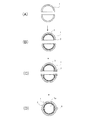
- FIGS. 2A to 2D Specifically, in the order of FIGS. 2A to 2D, first, as shown in FIG. 2A, a pair of half shells 1 and 1 made of vulcanized rubber are prepared. Next, the adhesive 3 is applied to the inner surface of the half shell 1, and then the PVA resin solution is applied to form the PVA-containing layer 2 (see FIG. 2B). Next, a material 5 in which a rubber material of the same kind as the above vulcanized rubber is dissolved in a solvent is prepared, and this is applied along the seam of the half shell 1 as shown in FIG. . Then, heat compression molding (vulcanization) is performed under a constant pressure environment to form a sphere having a hollow portion 1a as shown in FIG. Although not specifically shown, a felt having latex coated on the back of the felt is attached to the outer surface of the sphere, and the entire sphere is vulcanized in this state to complete a desired tennis ball.
- vulcanization heat compression molding
- the PVA-containing layer 2 can be applied to the inner surface of the tire 11 under predetermined conditions and dried. .
- Examples 1 to 17 and Comparative Examples 1 and 2 The polyvinyl alcohol resin composition shown in Table 1 was prepared, and the resin composition was applied to the inner or outer surface of the half shell serving as the core of the tennis ball with a brush, and the PVA of each of the examples and comparative examples having a predetermined thickness A containing layer was formed. At this time, tackfire (trade name “AM-1000T” manufactured by Arakawa Chemical Co., Ltd.) was used as an adhesive. Specifically, the following examples and comparative examples will be described.
- Example 1 As the polyvinyl alcohol resin particles (PVA resin particles), Kuraray's trade name “Poval PVA117” is used, 100 g of pure water is added to 10 g of PVA resin particles, and the mixture is stirred at 95 ° C. for 1 hour. A resin solution was obtained. 2 g of glycerin (manufactured by Kanto Chemical Co., Inc.) was added to this solution and stirred and dissolved. A 10% by mass aqueous solution of tackfire (trade name “AM-1000T” manufactured by Arakawa Chemical Co., Ltd.) was impregnated into the waste cloth, thereby treating the inner surface of the half shell serving as the core for the tennis ball.
- tackfire trade name “AM-1000T” manufactured by Arakawa Chemical Co., Ltd.
- the polyvinyl alcohol solution was applied with a brush, immediately followed by hot air drying at 80 ° C., and a series of operations were performed twice to form a uniform coating film having a thickness of 50 ⁇ m ⁇ 5 ⁇ m.
- a material obtained by dissolving a compounded rubber similar to the core rubber with a solvent was applied as an adhesive to the joint portion of the half shell.
- the obtained pair of half shells were charged into a mold pressure vessel, joined in a pressurized environment of +100 kPa compared to normal pressure, and vulcanized at 140 ° C. for 10 minutes to produce a desired tennis ball core. .
- Example 2 As PVA resin particles, 10 g of Kuraray's trade name “Poval PVA117” was heated and dissolved in 300 mL of dimethyl sulfoxide (DMSO), 3 g of caproic acid was added, and 0.1 g of tris (pentafluorophenyl) boron was added. And stirring at 80 ° C. for 6 hours. The reaction solution was reprecipitated with 5000 mL of methanol, filtration was repeated twice, and the solid matter was collected and dried to obtain a modified polyvinyl alcohol resin solution (modified PVA resin solution). The functional group introduction rate with respect to the vinyl alcohol unit in the main chain of the modified PVA was 10 mol%. 2 g of glycerin (manufactured by Kanto Chemical Co., Inc.) was added to this solution and stirred and dissolved. The subsequent procedure is the same as in the first embodiment.
- DMSO dimethyl sulfoxide
- caproic acid was added
- Example 3 is the same as Example 2 except that 15 g of caproic acid is added in the procedure for preparing the modified PVA described in Example 2.
- the functional group introduction rate with respect to the vinyl alcohol unit in the main chain of the modified PVA was 50 mol%.
- Example 4 is the same as Example 2 except that 20 g of caproic acid is added in the procedure for producing the modified PVA described in Example 2.
- the functional group introduction rate with respect to the vinyl alcohol unit in the main chain of the modified PVA was 70 mol%.
- Example 5 instead of glycerin, the same as Example 2 except that 2 g of propylene glycol (manufactured by Tokyo Chemical Industry Co., Ltd.) was stirred and dissolved in a PVA resin solution obtained by adding 100 g of pure water to 10 g of PVA resin particles.
- 2 g of propylene glycol manufactured by Tokyo Chemical Industry Co., Ltd.
- Examples 6 to 8 The same as Example 2 except that the blending amount of glycerol with respect to 100 parts by mass of PVA resin particles in the PVA resin solution was changed from 20 parts by mass to “5 parts by mass”, “40 parts by mass”, and “150 parts by mass”, respectively. It is.
- Example 2 is the same as Example 2 except that polyacrylic acid (manufactured by Tokyo Chemical Industry Co., Ltd.) is mixed according to the blending amounts shown in Table 1 with respect to 100 parts by mass of the PVA resin particles in the PVA resin solution.
- polyacrylic acid manufactured by Tokyo Chemical Industry Co., Ltd.
- Example 12 10 g of modified PVA obtained by the same procedure as in Example 2 was added to 100 g of pure water and dissolved by stirring at 95 ° C. for 1 hour to obtain a modified PVA resin solution. To this solution, 1 g of silica (trade name “Nippil VN3” manufactured by Tosoh Silica Co., Ltd.) and 2 g of glycerin (manufactured by Kanto Chemical Co., Inc.) were added and stirred and dissolved. The subsequent procedure is the same as in the second embodiment.
- silica trade name “Nippil VN3” manufactured by Tosoh Silica Co., Ltd.
- glycerin manufactured by Kanto Chemical Co., Inc.
- Example 13 10 g of modified PVA obtained by the same procedure as in Example 2 was added to 100 g of pure water and dissolved by stirring at 95 ° C. for 1 hour. To this solution, 1 g of kaolinite (average particle size 1 ⁇ m, aspect ratio 500, interlayer distance 0.7 nm) and 2 g of glycerin (manufactured by Kanto Chemical Co., Inc.) were added as clay and stirred and dissolved. The subsequent procedure is the same as in the second embodiment.
- kaolinite average particle size 1 ⁇ m, aspect ratio 500, interlayer distance 0.7 nm
- glycerin manufactured by Kanto Chemical Co., Inc.
- Example 14 is the same as Example 2 except that the film thickness formed by applying the modified PVA resin solution to the inner surface of the half shell is adjusted to 100 ⁇ m.
- Example 15 The same as Example 2 except that the film thickness formed by applying the modified PVA resin solution to the inner surface of the half shell was adjusted to 1 ⁇ m.
- Example 16 As described in Example 2, a modified PVA resin solution was applied to the inner surface of the half shell to produce a core having a coating film with a predetermined thickness. Thereafter, a 10% by mass aqueous solution of tackfire (trade name “AM-1000T” manufactured by Arakawa Chemical Co., Ltd.) was impregnated into the waste cloth on the outer surface of the core, thereby treating the outer surface of the half shell. Next, the modified PVA resin solution described in Example 2 was applied with a brush to form a coating film having a predetermined film thickness shown in Table 1.
- tackfire trade name “AM-1000T” manufactured by Arakawa Chemical Co., Ltd.
- Example 17 A spherical core is formed without applying anything to the inner surface of the half shell, and a 10% by weight aqueous solution of tack fire (trade name “AM-1000T” manufactured by Arakawa Chemical Co., Ltd.) is soaked in the outer surface of the core.
- the outer surface of the half shell was treated by Next, the modified PVA resin solution described in Example 2 was applied with a brush, and a coating film having a predetermined film thickness shown in Table 1 was formed on the outer surface of the core.
- a spherical core was formed without applying anything to the inner and outer surfaces of the half shell. That is, a pair of half shells were prepared, and a material in which a compounded rubber similar to the core rubber was dissolved in a solvent as an adhesive was applied to the joints of the half shells. Thereafter, a pair of the above half shells were charged into a mold pressure vessel, joined in a pressurized environment of +100 kPa compared to normal pressure, and vulcanized at 140 ° C. for 10 minutes to produce a desired tennis ball core. .
- Example 2 is the same as Example 2 except that the film thickness formed by applying the modified PVA resin solution to the inner surface of the half shell is adjusted to 0.1 ⁇ m.
- a tennis ball was manufactured by pasting felt on the surface of the cores of the obtained examples and comparative examples and vulcanizing and bonding them. Then, the initial ball internal pressure (pressure amount) was measured using a pressure gauge for measuring internal pressure. The results are shown in Tables 2 and 3. Further, the hardness, return hardness and bounce of the ball were also measured by the following methods. The results are also shown in Tables 2 and 3.
- Ball internal pressure and rate of decrease in internal pressure After the tennis ball is left at room temperature 20-25 ° C for 1 month, the ball internal pressure (difference in the amount of pressure from atmospheric pressure) is measured in an environment of 20 ° C. Calculated. The results are shown in Tables 2 and 3.
- the above measurement method is measured according to ITF (International Tennis Federation) rulebook (Part A: The Ball of ITF APPROVED TENNIS BALLS, CLASSIFIED SURFACES & RECOGNISED COURTS 2015 a guide to products and test methods). .
Landscapes
- Chemical & Material Sciences (AREA)
- Health & Medical Sciences (AREA)
- Polymers & Plastics (AREA)
- Chemical Kinetics & Catalysis (AREA)
- Medicinal Chemistry (AREA)
- Organic Chemistry (AREA)
- Physical Education & Sports Medicine (AREA)
- General Health & Medical Sciences (AREA)
- Engineering & Computer Science (AREA)
- Mechanical Engineering (AREA)
- Laminated Bodies (AREA)
- Tires In General (AREA)
- Coating Of Shaped Articles Made Of Macromolecular Substances (AREA)
Abstract
本発明は、特に、空気入りタイヤ、或いはテニスボールやサッカーボールなどのスポーツ用ボールであって、内圧を保持するために中空構造を有する製品に関するものであり、内部が中空であるゴム製のコアを有する中空構造体において、上記ゴム製コアの内側面または外側面に、厚みが0.5~2000μmの範囲内であるポリビニルアルコールを含む層を被覆することを特徴とする。 本発明の中空構造体によれば、ゴム製コアの中空部の内圧を長期に亘り保持することができる。
Description
本発明は、空気入りタイヤ、或いはテニスボールやサッカーボールなどスポーツ用ボールであって、内圧を保持するために中空構造を有する製品に関するものであり、更に詳述すると、長期に亘り内圧を保持することができる中空構造体に関する。
タイヤやスポーツ用のボール等の中空構造を有し、且つ伸縮性を示す製品、即ち、内部に空気を充填して形状を保持する製品においては、内部の空気等のガスが長期に亘って抜け出し、内圧が低下する問題がしばしば発生する。これは、上記構造体が主にゴムを主成分として構成されることが理由であり、ゴムは他の有機高分子材料と比べてポリマー熱運動が活発であり、ポリマー間の自由体積が大きいために、伸縮性を追求するためトレードオフの結果としてガスバリア性が低くなっている。
例えば、タイヤにおいては、ゴムの高分子の中でも比較的ポリマー集合体の秩序が高く、ガスバリア性の優れたブチルゴムがインナーライナーとして用いられているが、長期間使用後では、空気圧の低下が不可避であり、定期的な点検などのメンテナンスが求められている。
また、テニスボールにおいては、缶で密閉した新品を開封したと同時に、内圧低下が始まり、およそ2週間足らずで、多くのプレーヤーが打感の悪化を感じるものである。テニスボールの内圧低下率は、1ヶ月で概ね15%~20%低下することが多い。
このようなガス充填且つ伸縮性の構造体に対するガスバリア性を改善する先行技術としては、特開2012-250368号公報には、ガスバリア性に優れたエチレン-ビニルアルコール共重合体(EVOH樹脂)とウレタン層とをサブミクロンレベルの厚さで交互積層したフィルム状のバリア材料が提案されている。
しかしながら、上記技術においては、バリア材料がフィルム状であるため、ゴムとの積層物を形成するためには、接着力確保の観点から未加硫のゴムに対してフィルムを積層させる必要があった。また、加硫済みで且つ球形等の平面上ではない構造においては積層時にシワが寄るなどの加工面での一定の制限があった。
また、特開昭60-126176号公報には、天然ゴムの半球(シェル)内壁に、ガス高バリア性樹脂として、エチレン・ビニルアルコール共重合体(EVOH)を採用した硬式テニスボールが提案されている。
しかしながら、上記のテニスボールについては、バリア性が不足する場合があり、また、ガスバリア層の内側に疎水性の層を形成する必要があった。
本発明は、上記事情に鑑みなされたものであり、ゴム製コアの中空部の内圧を長期に亘り保持することができる中空構造体を提供することを目的とする。
本発明者らは、上記目的を達成するため鋭意検討を行った結果、内部が中空であるゴム製のコアを有する中空構造体において、上記ゴム製コアの内側面または外側面に、ポリビニルアルコールを含む層を被覆することにより、ゴム製コアの中空部の内圧を長期に亘り保持し得ることを知見し、本発明をなすに至ったものである。
即ち、ポリビニルアルコールは、ビニルアルコール部位の分子間水素結合によってポリマーの熱運動が抑えられ、酸素や窒素と言った気体分子の拡散を抑制する効果が知られている。ポリマー単独の空気バリア性(空気不透過性)は、先行技術として使用されるエチレン・ビニルアルコール(EVOH)よりも優れているものの、融点と分解点が近いために、押出し成型など高温での加工が難しく、従って、バリア材料としてはエチレン・ビニルアルコール共重合体が主に普及してきた。しかしながら、前述したように球形等の、平面上ではない構造への膜形成という点では、エチレン・ビニルアルコール共重合体には形状追従性に課題があるのに対し、ポリビニルアルコールは水溶性であるため塗布による加工が可能であるという利点を応用して、本発明をなすに至ったものである。また、ポリビニルアルコールは水溶性であるために、水溶性の可塑剤、例えばグリセリン等によっても、柔軟化が可能となり、タイヤやボールといった構造体に変形がかかる内面部位に好適に用いられることが分かった。
従って、本発明は、下記[1]~[14]の中空構造体を提供する。
[1]内部が中空であるゴム製のコアを有する中空構造体において、上記ゴム製コアの内側面または外側面に、厚みが0.5~2000μmの範囲内であるポリビニルアルコールを含む層を被覆することを特徴とする中空構造体。
[2]上記ポリビニルアルコールのけん化度が20~100モル%である[1]記載の中空構造体。
[3]上記ポリビニルアルコールが、主鎖であるビニルアルコール単位に対して、0.1~70モル%の有機系官能基で変性されたものである[1]又は[2]記載の中空構造体。
[4]上記ポリビニルアルコール100質量部に対して、可塑剤を1~150質量部の範囲で配合する[1]、[2]又は[3]記載の中空構造体。
[5]上記可塑剤が、エチレングリコール,プロピレングリコール,グリセリン,トリオキシエチレン,テトラオキシエチレン及びペンタオキシエチレンの群から選ばれる1種又は2種以上組み合わせたものである[4]記載の中空構造体。
[6]上記ポリビニルアルコール100質量部に対して、水溶性高分子を1~100質量部の範囲で混合する[4]又は[5]記載の中空構造体。
[7]上記水溶性高分子が、ポリアクリル酸,ポリメタクリル酸,ポリエチレングリコール,ポリプロピレングリコール,アミロース及びでんぷんの群から選ばれる1種又は2種以上組み合わせたものである[6]記載の中空構造体。
[8]上記のポリビニルアルコールを含む層が、コアの内表面又は外表面に、接着剤または粘着剤を介して密着してなる[1]~[7]のいずれか1項記載の中空構造体。
[9]上記の接着剤または粘着剤が、ゴム系,ウレタン系及びアクリル系の群から選ばれる有機高分子からなる[1]~[8]のいずれか1項記載の中空構造体。
[10]上記のポリビニルアルコールを含む層の厚みが1~500μmである[1]~[9]のいずれか1項記載の中空構造体。
[11]上記のポリビニルアルコールを含む層には、シリカ,アルミナ,クレー状鉱物,マイカ、炭酸カルシウム,樹脂,木粉及びコルク粉の群から選ばれるフィラー類が含有される[1]~[10]のいずれか1項記載の中空構造体。
[12]中空構造体が空気入りタイヤである[1]~[11]のいずれか1項記載の中空構造体。
[13]中空構造体が、コア内部に空気を充填してなるスポーツ用ボールである[1]~[11]のいずれか1項記載の中空構造体。
[14]上記スポーツ用ボールが、テニスボールまたはサッカーボールである[13]記載の中空構造体。
[1]内部が中空であるゴム製のコアを有する中空構造体において、上記ゴム製コアの内側面または外側面に、厚みが0.5~2000μmの範囲内であるポリビニルアルコールを含む層を被覆することを特徴とする中空構造体。
[2]上記ポリビニルアルコールのけん化度が20~100モル%である[1]記載の中空構造体。
[3]上記ポリビニルアルコールが、主鎖であるビニルアルコール単位に対して、0.1~70モル%の有機系官能基で変性されたものである[1]又は[2]記載の中空構造体。
[4]上記ポリビニルアルコール100質量部に対して、可塑剤を1~150質量部の範囲で配合する[1]、[2]又は[3]記載の中空構造体。
[5]上記可塑剤が、エチレングリコール,プロピレングリコール,グリセリン,トリオキシエチレン,テトラオキシエチレン及びペンタオキシエチレンの群から選ばれる1種又は2種以上組み合わせたものである[4]記載の中空構造体。
[6]上記ポリビニルアルコール100質量部に対して、水溶性高分子を1~100質量部の範囲で混合する[4]又は[5]記載の中空構造体。
[7]上記水溶性高分子が、ポリアクリル酸,ポリメタクリル酸,ポリエチレングリコール,ポリプロピレングリコール,アミロース及びでんぷんの群から選ばれる1種又は2種以上組み合わせたものである[6]記載の中空構造体。
[8]上記のポリビニルアルコールを含む層が、コアの内表面又は外表面に、接着剤または粘着剤を介して密着してなる[1]~[7]のいずれか1項記載の中空構造体。
[9]上記の接着剤または粘着剤が、ゴム系,ウレタン系及びアクリル系の群から選ばれる有機高分子からなる[1]~[8]のいずれか1項記載の中空構造体。
[10]上記のポリビニルアルコールを含む層の厚みが1~500μmである[1]~[9]のいずれか1項記載の中空構造体。
[11]上記のポリビニルアルコールを含む層には、シリカ,アルミナ,クレー状鉱物,マイカ、炭酸カルシウム,樹脂,木粉及びコルク粉の群から選ばれるフィラー類が含有される[1]~[10]のいずれか1項記載の中空構造体。
[12]中空構造体が空気入りタイヤである[1]~[11]のいずれか1項記載の中空構造体。
[13]中空構造体が、コア内部に空気を充填してなるスポーツ用ボールである[1]~[11]のいずれか1項記載の中空構造体。
[14]上記スポーツ用ボールが、テニスボールまたはサッカーボールである[13]記載の中空構造体。
本発明の中空構造体によれば、ゴム製コアの中空部の内圧を長期に亘り保持することができる。
以下、本発明につき、更に詳しく説明する。
本発明の中空構造体は、内部が中空であるゴム製のコアを有する。そして、このゴム製コアの内側面または外側面には、ポリビニルアルコールを含む層が形成される。
本発明の中空構造体は、内部が中空であるゴム製のコアを有する。そして、このゴム製コアの内側面または外側面には、ポリビニルアルコールを含む層が形成される。
上記のゴム製コアの材質としては、例えば、天然ゴム(NR)及び各種の合成ゴムが挙げられ、合成ゴムとしては、ブチルゴム(IIR)(ハロゲン化ブチルゴムを含む)、ブタジエンゴム(BR)、イソプレンゴム(IR)、スチレンブタジエンゴム(SBR)、クロロプレンゴム(CR)、ニトリルゴム(NBR)、エチレンプロピレンゴム(EPM,EPDM)、シリコーンゴム(Q)、クロロスルホン化ポリエチレンゴム(CSM),アクリルゴム(ACM)、ウレタンゴム(U)、フッ素ゴム(FKM)、多硫化ゴム(T)を単独で、または上記のゴムを2種以上組み合わせた材質が採用され、中空構造体の各種用途により適宜選定される。
ここで、ポリビニルアルコールを含む層(以下、「PVA含有層」と言う。)について説明すると、PVA含有層に含まれるポリビニルアルコールの割合は、樹脂材料の伸縮性且つガスバリア性能を十分に発揮させる点から、好ましくは50質量%以上、より好ましくは80質量%以上である。
PVA含有層は、ポリビニルアルコール(PVA)樹脂溶液を塗布またはディッピングし、所定条件下で乾燥することにより得ることができる。この際の条件として、使用される溶媒としては水が好ましい。使用される樹脂溶液中のPVA樹脂の濃度は、特に制限はないが、増粘等を勘案すると、1質量%以上10質量%以下であることが好適である。また、樹脂溶液の塗布後は、熱風乾燥器等により、50℃以上100℃以下で乾燥することが好ましい。
PVA含有層中のポリビニルアルコールは、市販品を用いることができ、例えば、クラレ社製の商品名「ポバール PVA117」等が例示される。
上記ポリビニルアルコールのけん化度については、特に制限はないが、20~100モル%であることが好適であり、より好ましくは50~100モル%である。けん化度は、JIS K 6726(1994年度版)に記載された測定方法に基づいて行われる。
上記ポリビニルアルコールについては、特に限定はなく、ビニルアルコール単位のみからなるホモポリマーであってもよいし、ビニルアルコールとこれに共重合可能なモノマーとからなるコポリマー(以下、「PVAコポリマー」と表記することがある。)であってもよい。これらポリビニルアルコール樹脂は、1種単独で又は2種以上を組み合わせて用いてもよい。前記ポリビニルアルコール樹脂は、その製法によっては特に限定されず、例えば、ポリ酢酸ビニル等のビニルエステル系重合体をけん化することにより得られるものを用いることができる。この場合、ビニルエステル単位を形成するためのビニルエステル単量体としては、ギ酸ビニル,酢酸ビニル,プロピオン酸ビニル,バレリン酸ビニル,カプリン酸ビニル,ラウリン酸ビニル,ステアリン酸ビニル,安息香酸ビニル,ピバリン酸ビニル,バーサティック酸ビニル等が挙げられる。これらの中では、良好な生産性でPVAを得る点から、酢酸ビニルを採用することが好ましい。
PVAコポリマーを構成する共重合可能なモノマーとしては、例えば、エチレン,プロピレン,1-ブテン,イソブテン,1-ヘキセン等のα-オレフィン類、アクリル酸及びその塩、アクリル酸メチル,アクリル酸エチル,アクリル酸n-プロピル,アクリル酸i-プロピル等のアクリル酸エステル類、メタクリル酸及びその塩、メタクリル酸メチル,メタクリル酸エチル,メタクリル酸n-プロピル,メタクリル酸i-プロピル等のメタクリル酸エステル類、アクリルアミド,N-メチルアクリルアミド,N-エチルアクリルアミド等のアクリルアミド誘導体、メタクリルアミド,N-メチルメタクリルアミド,N-エチルメタクリルアミド等のメタクリルアミド誘導体、メチルビニルエーテル,エチルビニルエーテル,n-プロピルビニルエーテル,i-プロピルビニルエーテル,n-ブチルビニルエーテル等のビニルエーテル類、エチレングリコールビニルエーテル,1,3-プロパンジオールビニルエーテル,1,4-ブタンジオールビニルエーテル等のヒドロキシ基含有のビニルエーテル類、アリルアセテート,プロピルアリルエーテル,ブチルアリルエーテル,ヘキシルアリルエーテル等のアリルエーテル類、ポリオキシエチレン基,ポリオキシプロピレン基,ポリオキシブチレン基等のオキシアルキレン基を有する単量体、ビニルトリメトキシシラン等のビニルシラン類、酢酸イソプロペニル,3-ブテン-1-オール,4-ペンテン-1-オール,5-ヘキセン-1-オール,7-オクテン-1-オール,9-デセン-1-オール,3-メチル-3-ブテン-1-オール等のヒドロキシ基含有のα-オレフィン類またはそのエステル化物、N-ビニルホルムアミド,N-ビニルアセトアミド,N-ビニルピロリドン等のN-ビニルアミド類、フマル酸,マレイン酸,イタコン酸,無水マレイン酸,無水フタル酸,無水トリメリット酸または無水イタコン酸等に由来するカルボキシル基を有する単量体、エチレンスルホン酸,アリルスルホン酸,メタアリルスルホン酸,2-アクリルアミド-2-メチルプロパンスルホン酸等に由来するスルホン酸基を有する単量体、ビニロキシエチルトリメチルアンモニウムクロライド,ビニロキシブチルトリメチルアンモニウムクロライド,ビニロキシエチルジメチルアミン,ビニロキシメチルジエチルアミン,N-アクリルアミドメチルトリメチルアンモニウムクロライド,N-アクリルアミドエチルトリメチルアンモニウムクロライド,N-アクリルアミドジメチルアミン,アリルトリメチルアンモニウムクロライド,メタアリルトリメチルアンモニウムクロライド,ジメチルアリルアミン,アリルエチルアミン等に由来するカチオン基を有する単量体が挙げられる。
上記ポリビニルアルコールについては、主鎖であるビニルアルコール単位に対して、好ましくは0.1~70モル%、上限値として、より好ましくは20モル%以下、さらに好ましくは10モル%の有機系官能基で変性することができる。この数値が大きくなると、コア中空部の内圧の低下が大きくなる場合があり、また、上記数値が小さくなると、中空構造体硬度が硬くなり、バウンドが下がる場合がある。
上記ポリビニルアルコールについては、ポリマー中に架橋構造を有するものを採用することができる。この場合、架橋構造を有するポリビニルアルコール中の架橋部位は、ポリビニルアルコール中の水酸基と容易に反応させる点から、エステル結合,アセタール結合,或いはエーテル結合から形成されることが好適である。また、ポリビニルアルコールに架橋構造を形成させる一例としては、架橋剤としてアジピン酸を用い、このアジピン酸をポリビニルアルコールのジメチルスルホキシド(DMSO)溶液に所定量配合し、カルボジイミド系縮合剤存在条件下で、所望の架橋構造を形成することができる。
PVA含有層には、ポリビニルアルコール樹脂に柔軟性を付与するべく、各種の可塑剤を含有させることができる。この可塑剤としては、例えば、エチレングリコール,プロピレングリコール,グリセリン,トリオキシエチレン,テトラオキシエチレン及びペンタオキシエチレンの群から選ばれる1種又は2種以上組み合わせて使用することができる。可塑剤の配合量は、PVA含有層中のポリビニルアルコール100質量部に対して、1~150質量部の範囲とすることが好適である。上限値として、より好ましくは100質量部以下、さらに好ましくは60質量部以下、最も好ましくは40質量部以下である。下限値としては、より好ましくは5質量部以上、さらに好ましくは10質量部以上、最も好ましくは20質量部以上である。この数値が大きくなると、コア中空部の内圧の低下が大きくなり、中空構造体の硬度が軟化する場合がある。また、上記数値が小さくなると、硬度が硬く、バウンドが下がる場合がある。
PVA含有層には、各種の水溶性高分子を含有させることができる。PVA含有層に水溶性高分子を添加する目的は、ポリビニルアルコール樹脂に柔軟性を持たせるためである。水溶性高分子としては、例えば、ポリアクリル酸、ポリメタクリル酸,ポリエチレングリコール,ポリプロピレングリコール,アミロース,でんぷん等の群から選ばれる1種又は2種以上を組み合わせて使用することができる。水溶性高分子の配合量は、PVA含有層中のポリビニルアルコール100質量部に対して、1~100質量部の範囲で混合することが好適であり、より好ましくは1~20質量部である。この数値が大きくなると、バウンドが下がり、更に内圧の低下が大きくなる場合がある。
更には、上記PVA含有層には、補強の目的及びバリア性を向上させる目的で、各種のフィラー類を適宜配合することができ、これらのフィラー類としては、例えば、シリカ,アルミナ,クレー状鉱物,マイカ,炭酸カルシウム,樹脂,木粉及びコルク粉の群から選択し、1種単独で或いは2種以上組み合わせて採用することができる。
なお、上記PVA含有層には、必要に応じて、表面調整剤,レベリング剤,消泡剤,或いは、これらの混合物を含有することが可能である。この場合、上記の添加剤が、アクリル系ブロック共重合体,ポリシロキサン(シリコーン樹脂),アルキロールアンモニウム塩,ポリエーテル変性ポリジメチルシロキサン,ポリエーテル変性ポリシロキサン,シリコーン変性アクリル樹脂,水酸基含有シリコーン変性アクリル樹脂、及び、これらの混合物の群から選ばれる物質からなることが好適である。
また、上記のPVA含有層が、コアの内表面又は外表面に、接着剤または粘着剤を介して密着してなることが好適である。この場合、上記の接着剤または粘着剤は、ゴム系接着剤,ウレタン系接着剤及びアクリル系接着剤の群から選ばれる有機高分子材料からなる。この場合、接着剤または粘着剤の選定に際しては、コア材料である基材ゴムの伸縮性や中空構造体の形状や大きさに適宜追従し、且つ、内圧低下を防止する機能を十分に付与するため、接着剤または粘着剤となる硬化物の貯蔵弾性率(E')が1.0×10⁴以上であることが好適である。この貯蔵弾性率(E')が上記数値範囲よりも小さいと、接着剤または粘着剤が液状になりすぎて垂れてしまうおそれがある。そして、接着剤層(粘着剤層)の厚さは、1~100μmとすることが好適である。
上記のPVA含有層の厚みについては、特に制限はないが、0.5~2000μmであることが好適であり、その構造体の目的や用途に応じて適宜選定される。例えば、中空構造体が自動車用タイヤであれば、好ましくは1~500μm、特に300~500μmであることが好適である。また、中空構造体がテニスボールであれば、好ましくは1~100μm、特に20~50μmであることが好適である。
上記PVA含有層は、単層のほか、2層以上の複数層に形成することもできる。この場合、2層以上に設けられたPVA含有層は、内圧保持の目的のため、けん化度の高いポリビニルアルコールにより形成することができるが、耐久性をより向上させるために、ゴム側のPVA含有層については、けん化度の低いポリビニルアルコールにより形成することが好適である。けん化度の低いポリビニルアルコールは比較的柔軟性があり、ゴム材料の追従性が高いものである。一方、けん化度の高いポリビニルアルコールは、薄くても硬い感触があって比較的割れやすいという傾向がある。このため、ゴム側のPVA含有層は、けん化度の低いポリビニルアルコールを主材料とすることにより、ゴムとの密着性を向上させると共に、エアー側のPVA含有層は、けん化度の高いポリビニルアルコールを主材料とすることにより、高いガスバリア性を得ることができる。従って、本発明で用いるPVA含有層を上記のように2層以上の複数層に形成することにより、耐久性とガスバリア性とをより向上させることができる。この場合、ゴム側のPVA含有層のポリビニルアルコールのけん化度が10~90モル%の範囲であり、エアー側のPVA含有層のポリビニルアルコールのけん化度が80~100モル%の範囲とすることが好適であり、且つ、ゴム側のPVA含有層のポリビニルアルコールよりもエアー側のPVA含有層のポリビニルアルコールの方が、けん化度が高いことが望ましい。
本発明の中空構造体は、空気入りタイヤ、或いはテニスボールやサッカーボールなどスポーツ用ボールであって、内圧を保持するために中空構造を有する製品に好適に使用することができる。
例えば、図1には、本発明の中空構造体の一例として、テニスボールを示した概略断面図が示される。図1のテニスボール10は、ゴム基材層としてのコア1と該コアを被覆するフェルト4を有する。このコア1は、一対のハーフシェル状の加硫ゴムを加圧雰囲気下で圧縮成形することにより、中空部1aを有する球体に形成される。そして、コア中空部1aの圧力(内圧)が高く維持されたテニスボール10を製造するものである。また、上記コア1の内側面には、接着剤層3を介してPVA含有層2が形成されている。このPVA含有層2は、PVA樹脂溶液を、所定条件下で、塗布・乾燥させてなるものである。この塗布方法には、特に制限はなく、スプレー、刷毛、或いはディッピングにより塗布することができる。
具体的には、図2(A)~(D)の順により説明すると、先ず、図2(A)に示すように、加硫済みのゴムからなる一対のハーフシェル1,1を用意する。次に、ハーフシェル1の内面に接着剤3を塗布し、その後に、PVA樹脂溶液を塗布してPVA含有層2を形成する(図2(B)参照)。次に、上記の加硫済みのゴムと同種のゴム材料を溶剤に溶解させた材料5を用意し、これを図2(C)に示すように、ハーフシェル1の合わせ目に沿って塗布する。そして、一定の圧力環境下で加熱圧縮成形(加硫)を行い、図2(D)に示すように、中空部1aを有する球体を形成する。なお、特に図示してはいないが、その後に、フェルト裏にラテックスが塗布されたフェルトを球体の外表面に貼り付け、この状態で球体全体を加硫し、所望のテニスボールが完成する。
また、自動車用の空気入りタイヤの場合には、例えば、図3に示すように、タイヤ11の内側表面に、PVA含有層2を所定条件下で、塗布し、乾燥させて形成させることができる。
以下、実施例と比較例を示し、本発明を具体的に説明するが、本発明は下記の実施例に制限されるものではない。
〔実施例1~17及び比較例1,2〕
表1に示すポリビニルアルコール樹脂組成物を調製し、該樹脂組成物をテニスボールのコアとなるハーフシェル内面又は外面に刷毛により塗布し、所定厚さを有する実施例及び比較例の各例のPVA含有層を形成した。この際、接着剤として、タッキファイヤー(荒川化学社製の商品名「AM-1000T」)を使用した。具体的には、下記の各実施例及び比較例で説明する。
表1に示すポリビニルアルコール樹脂組成物を調製し、該樹脂組成物をテニスボールのコアとなるハーフシェル内面又は外面に刷毛により塗布し、所定厚さを有する実施例及び比較例の各例のPVA含有層を形成した。この際、接着剤として、タッキファイヤー(荒川化学社製の商品名「AM-1000T」)を使用した。具体的には、下記の各実施例及び比較例で説明する。
〔実施例1〕
ポリビニルアルコール樹脂粒子(PVA樹脂粒子)として、クラレ製の商品名「ポバールPVA117」を使用し、PVA樹脂粒子10gに100gの純水を加えて、95℃、1時間の条件で撹拌することによりPVA樹脂溶液を得た。この溶液にグリセリン(関東化学社製)を2g加えて撹拌・溶解させた。
タッキファイヤー(荒川化学社製の商品名「AM-1000T」)の10質量%水溶液をウェスにしみこませ、これによりテニスボール用コアとなるハーフシェル内面を処理した。その後、上記ポリビニルアルコール溶液を刷毛により塗布し、その直後に80℃で熱風乾燥を行い、これらの一連の操作を2回行うことにより、膜厚50μm±5μmの均一な塗膜を形成した。次いで、ハーフシェルの接合部に、接着剤として、コア用ゴムと同類の配合ゴムを溶剤で溶かした材料を塗布した。得られた1対のハーフシェルを金型圧力容器に仕込み、常圧対比+100kPaの加圧環境下で接合し、140℃、10分間の条件で加硫して所望のテニスボール用コアを作製した。
ポリビニルアルコール樹脂粒子(PVA樹脂粒子)として、クラレ製の商品名「ポバールPVA117」を使用し、PVA樹脂粒子10gに100gの純水を加えて、95℃、1時間の条件で撹拌することによりPVA樹脂溶液を得た。この溶液にグリセリン(関東化学社製)を2g加えて撹拌・溶解させた。
タッキファイヤー(荒川化学社製の商品名「AM-1000T」)の10質量%水溶液をウェスにしみこませ、これによりテニスボール用コアとなるハーフシェル内面を処理した。その後、上記ポリビニルアルコール溶液を刷毛により塗布し、その直後に80℃で熱風乾燥を行い、これらの一連の操作を2回行うことにより、膜厚50μm±5μmの均一な塗膜を形成した。次いで、ハーフシェルの接合部に、接着剤として、コア用ゴムと同類の配合ゴムを溶剤で溶かした材料を塗布した。得られた1対のハーフシェルを金型圧力容器に仕込み、常圧対比+100kPaの加圧環境下で接合し、140℃、10分間の条件で加硫して所望のテニスボール用コアを作製した。
〔実施例2〕
PVA樹脂粒子として、クラレ製の商品名「ポバールPVA117」10gを、ジメチルスルホキシド(DMSO)300mLに加熱・溶解させた後、カプロン酸を3g加え、トリス(ペンタフルオロフェニル)ボロン0.1gを加えて、80℃、6時間の条件で撹拌した。反応溶液を5000mLのメタノールで再沈殿させ、ろ過を2回繰り返し行い、固形物を回収して乾燥させることにより、変性ポリビニルアルコール樹脂溶液(変性PVA樹脂溶液)を得た。この変性PVAの主鎖のビニルアルコール単位に対する官能基導入率は、10モル%であった。この溶液にグリセリン(関東化学社製)を2g加えて撹拌・溶解させた。その後の手順は、上記の実施例1と同様である。
PVA樹脂粒子として、クラレ製の商品名「ポバールPVA117」10gを、ジメチルスルホキシド(DMSO)300mLに加熱・溶解させた後、カプロン酸を3g加え、トリス(ペンタフルオロフェニル)ボロン0.1gを加えて、80℃、6時間の条件で撹拌した。反応溶液を5000mLのメタノールで再沈殿させ、ろ過を2回繰り返し行い、固形物を回収して乾燥させることにより、変性ポリビニルアルコール樹脂溶液(変性PVA樹脂溶液)を得た。この変性PVAの主鎖のビニルアルコール単位に対する官能基導入率は、10モル%であった。この溶液にグリセリン(関東化学社製)を2g加えて撹拌・溶解させた。その後の手順は、上記の実施例1と同様である。
〔実施例3〕
実施例2に記載の変性PVAを作製する手順でカプロン酸を15g加える工程以外は実施例2と同じである。この変性PVAの主鎖のビニルアルコール単位に対する官能基導入率は、50モル%であった。
実施例2に記載の変性PVAを作製する手順でカプロン酸を15g加える工程以外は実施例2と同じである。この変性PVAの主鎖のビニルアルコール単位に対する官能基導入率は、50モル%であった。
〔実施例4〕
実施例2に記載の変性PVAを作製する手順でカプロン酸を20g加える工程以外は実施例2と同じである。この変性PVAの主鎖のビニルアルコール単位に対する官能基導入率は、70モル%であった。
実施例2に記載の変性PVAを作製する手順でカプロン酸を20g加える工程以外は実施例2と同じである。この変性PVAの主鎖のビニルアルコール単位に対する官能基導入率は、70モル%であった。
〔実施例5〕
グリセリンに代えて、プロピレングリコール2g(東京化成社製)を、PVA樹脂粒子10gに100gの純水を加えたPVA樹脂溶液に対して撹拌・溶解させた以外は、実施例2と同じである。
グリセリンに代えて、プロピレングリコール2g(東京化成社製)を、PVA樹脂粒子10gに100gの純水を加えたPVA樹脂溶液に対して撹拌・溶解させた以外は、実施例2と同じである。
〔実施例6~8〕
PVA樹脂溶液中のPVA樹脂粒子100質量部に対するグリセリンの配合量を20質量部から、それぞれ「5質量部」「40質量部」及び「150質量部」に代えた以外は、実施例2と同じである。
PVA樹脂溶液中のPVA樹脂粒子100質量部に対するグリセリンの配合量を20質量部から、それぞれ「5質量部」「40質量部」及び「150質量部」に代えた以外は、実施例2と同じである。
〔実施例9~11〕
PVA樹脂溶液中のPVA樹脂粒子100質量部に対して、ポリアクリル酸(東京化成社製)を、それぞれ表1に示す配合量により、混合した以外は、実施例2と同じである。
PVA樹脂溶液中のPVA樹脂粒子100質量部に対して、ポリアクリル酸(東京化成社製)を、それぞれ表1に示す配合量により、混合した以外は、実施例2と同じである。
〔実施例12〕
実施例2と同様の手順で得られた変性PVA10gを、100gの純水に加えて95℃、1時間の条件で撹拌することで溶解させ、変性PVA樹脂溶液を得た。この溶液に、シリカ(東ソー・シリカ社製の商品名「Nipsil VN3」)1gと、グリセリン(関東化学社製)2gを加えて撹拌・溶解させた。その後の手順は、実施例2と同様である。
実施例2と同様の手順で得られた変性PVA10gを、100gの純水に加えて95℃、1時間の条件で撹拌することで溶解させ、変性PVA樹脂溶液を得た。この溶液に、シリカ(東ソー・シリカ社製の商品名「Nipsil VN3」)1gと、グリセリン(関東化学社製)2gを加えて撹拌・溶解させた。その後の手順は、実施例2と同様である。
〔実施例13〕
実施例2と同様の手順で得られた変性PVA10gを、100gの純水に加えて95℃、1時間の条件で撹拌することで溶解させた。この溶液に、クレーとしてカオリナイト(平均粒径1μm、アスペクト比500、層間距離0.7nm)1gとグリセリン(関東化学社製)を2g加えて撹拌・溶解させた。その後の手順は、実施例2と同様である。
実施例2と同様の手順で得られた変性PVA10gを、100gの純水に加えて95℃、1時間の条件で撹拌することで溶解させた。この溶液に、クレーとしてカオリナイト(平均粒径1μm、アスペクト比500、層間距離0.7nm)1gとグリセリン(関東化学社製)を2g加えて撹拌・溶解させた。その後の手順は、実施例2と同様である。
〔実施例14〕
変性PVA樹脂溶液をハーフシェル内面に塗布して形成される膜厚を100μmに調整した以外は、実施例2と同様である。
変性PVA樹脂溶液をハーフシェル内面に塗布して形成される膜厚を100μmに調整した以外は、実施例2と同様である。
〔実施例15〕
変性PVA樹脂溶液をハーフシェル内面に塗布して形成される膜厚を1μmに調整した以外は、実施例2と同様である。
変性PVA樹脂溶液をハーフシェル内面に塗布して形成される膜厚を1μmに調整した以外は、実施例2と同様である。
〔実施例16〕
実施例2で記載したように、ハーフシェルの内面に変性PVA樹脂溶液を塗布して所定厚の塗膜を有するコアを作製した。その後、コアの外表面にタッキファイヤー(荒川化学社製の商品名「AM-1000T」)の10質量%水溶液をウェスにしみこませ、これによりハーフシェルの外表面を処理した。次いで、実施例2記載の変性PVA樹脂溶液を刷毛により塗布し、表1に示す所定の膜厚を有する塗膜を形成した。
実施例2で記載したように、ハーフシェルの内面に変性PVA樹脂溶液を塗布して所定厚の塗膜を有するコアを作製した。その後、コアの外表面にタッキファイヤー(荒川化学社製の商品名「AM-1000T」)の10質量%水溶液をウェスにしみこませ、これによりハーフシェルの外表面を処理した。次いで、実施例2記載の変性PVA樹脂溶液を刷毛により塗布し、表1に示す所定の膜厚を有する塗膜を形成した。
〔実施例17〕
ハーフシェル内面には何も施さずに球状コアを成形し、該コアの外表面にタッキファイヤー(荒川化学社製の商品名「AM-1000T」)の10質量%水溶液をウェスにしみこませ、これによりハーフシェルの外表面を処理した。次いで、実施例2記載の変性PVA樹脂溶液を刷毛により塗布し、コアの外表面に、表1に示す所定の膜厚を有する塗膜を形成した。
ハーフシェル内面には何も施さずに球状コアを成形し、該コアの外表面にタッキファイヤー(荒川化学社製の商品名「AM-1000T」)の10質量%水溶液をウェスにしみこませ、これによりハーフシェルの外表面を処理した。次いで、実施例2記載の変性PVA樹脂溶液を刷毛により塗布し、コアの外表面に、表1に示す所定の膜厚を有する塗膜を形成した。
〔比較例1〕
ハーフシェル内面及び外面には何も施さずに球状コアを成形した。即ち、一対のハーフシェルを用意し、該ハーフシェルの接合部に、接着剤として、コア用ゴムと同類の配合ゴムを溶剤で溶かした材料を塗布した。その後、1対の上記ハーフシェルを金型圧力容器に仕込み、常圧対比+100kPaの加圧環境下で接合し、140℃、10分間の条件で加硫して所望のテニスボール用コアを作製した。
ハーフシェル内面及び外面には何も施さずに球状コアを成形した。即ち、一対のハーフシェルを用意し、該ハーフシェルの接合部に、接着剤として、コア用ゴムと同類の配合ゴムを溶剤で溶かした材料を塗布した。その後、1対の上記ハーフシェルを金型圧力容器に仕込み、常圧対比+100kPaの加圧環境下で接合し、140℃、10分間の条件で加硫して所望のテニスボール用コアを作製した。
〔比較例2〕
変性PVA樹脂溶液をハーフシェル内面に塗布して形成される膜厚を0.1μmに調整した以外は、実施例2と同様である。
変性PVA樹脂溶液をハーフシェル内面に塗布して形成される膜厚を0.1μmに調整した以外は、実施例2と同様である。

得られた各実施例及び比較例のコアの表面にフェルトを貼り付け、加硫接着してテニスボールを作製した。そして、内圧測定用の圧力計を用いて、初期のボール内圧(圧力量)を測定した。その結果を表2及び表3に示す。また、ボールの硬度、戻り硬度及びバウンドも下記の方法により測定した。その結果を表2及び表3に併記する。
ボール内圧及び内圧低下率
テニスボールを室温20~25℃で1ヶ月放置した後のボール内圧(大気圧との圧力量の差)を20℃の環境下で測定し、初期のボール内圧低下率を算出した。その結果を表2及び表3に示す。
テニスボールを室温20~25℃で1ヶ月放置した後のボール内圧(大気圧との圧力量の差)を20℃の環境下で測定し、初期のボール内圧低下率を算出した。その結果を表2及び表3に示す。
ボールの硬度、戻り硬度及びバウンド
ボールの硬度については、ボールに一定荷重(18ポンド=8.165kg)をかけた時のボールの変形量を測定した。
戻り硬度については、ボールに一定荷重(18ポンド=8.165kg)をかけて硬度を測定した後、変形量1inch(2.54cm)まで圧縮し、その後圧縮を解除していった時の18ポンド荷重時の変形量を測定した。
バウンドについては、床上100inch(254cm)の高さからコンクリート床上にボールを落下させた時のバウンド量を測定した。
なお、上記の測定方法は、ITF(国際テニス連盟)規定のルールブック(ITF APPROVED TENNIS BALLS, CLASSIFIED SURFACES & RECOGNISED COURTS 2015 a guide to products and test methods のPartA:The Ball)に準じて測定している。
ボールの硬度については、ボールに一定荷重(18ポンド=8.165kg)をかけた時のボールの変形量を測定した。
戻り硬度については、ボールに一定荷重(18ポンド=8.165kg)をかけて硬度を測定した後、変形量1inch(2.54cm)まで圧縮し、その後圧縮を解除していった時の18ポンド荷重時の変形量を測定した。
バウンドについては、床上100inch(254cm)の高さからコンクリート床上にボールを落下させた時のバウンド量を測定した。
なお、上記の測定方法は、ITF(国際テニス連盟)規定のルールブック(ITF APPROVED TENNIS BALLS, CLASSIFIED SURFACES & RECOGNISED COURTS 2015 a guide to products and test methods のPartA:The Ball)に準じて測定している。
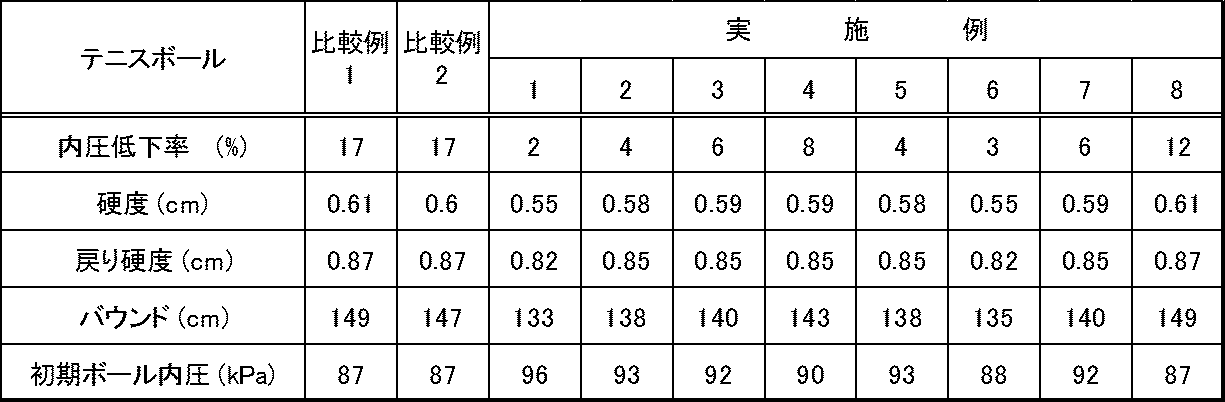
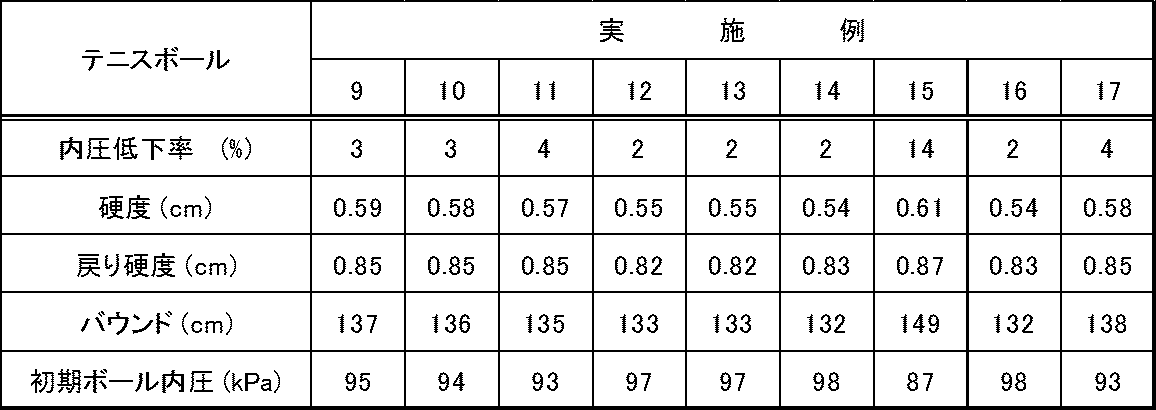
表2の内圧低下率の結果より、以下のことが考察される。
比較例に示すように、従来1ヶ月で内圧が15%以上低下していたが、各実施例では、内圧低下を抑制し、長期に亘り、内圧を85%以上保持することができた。従って、いずれの実施例においても、内圧低下に対する改善が見られた。
比較例に示すように、従来1ヶ月で内圧が15%以上低下していたが、各実施例では、内圧低下を抑制し、長期に亘り、内圧を85%以上保持することができた。従って、いずれの実施例においても、内圧低下に対する改善が見られた。
1 コア(ゴム基材層)
1a 中空部
2 PVA含有層
3 接着剤層
4 フェルト
5 ハーフシェル接着剤
10 テニスボール
11 タイヤ
1a 中空部
2 PVA含有層
3 接着剤層
4 フェルト
5 ハーフシェル接着剤
10 テニスボール
11 タイヤ
Claims (14)
- 内部が中空であるゴム製のコアを有する中空構造体において、上記ゴム製コアの内側面または外側面に、厚みが0.5~2000μmの範囲内であるポリビニルアルコールを含む層を被覆することを特徴とする中空構造体。
- 上記ポリビニルアルコールのけん化度が20~100モル%である請求項1記載の中空構造体。
- 上記ポリビニルアルコールが、主鎖であるビニルアルコール単位に対して、0.1~70モル%の有機系官能基で変性されたものである請求項1又は2記載の中空構造体。
- 上記ポリビニルアルコール100質量部に対して、可塑剤を1~150質量部の範囲で配合する請求項1、2又は3記載の中空構造体。
- 上記可塑剤が、エチレングリコール,プロピレングリコール,グリセリン,トリオキシエチレン,テトラオキシエチレン及びペンタオキシエチレンの群から選ばれる1種又は2種以上組み合わせたものである請求項4記載の中空構造体。
- 上記ポリビニルアルコール100質量部に対して、水溶性高分子を1~100質量部の範囲で混合する請求項4又は5記載の中空構造体。
- 上記水溶性高分子が、ポリアクリル酸,ポリメタクリル酸,ポリエチレングリコール,ポリプロピレングリコール,アミロース及びでんぷんの群から選ばれる1種又は2種以上組み合わせたものである請求項6記載の中空構造体。
- 上記のポリビニルアルコールを含む層が、コアの内表面又は外表面に、接着剤または粘着剤を介して密着してなる請求項1~7のいずれか1項記載の中空構造体。
- 上記の接着剤または粘着剤が、ゴム系,ウレタン系及びアクリル系の群から選ばれる有機高分子からなる請求項1~8のいずれか1項記載の中空構造体。
- 上記のポリビニルアルコールを含む層の厚みが1~500μmである請求項1~9のいずれか1項記載の中空構造体。
- 上記のポリビニルアルコールを含む層には、シリカ,アルミナ,クレー状鉱物,マイカ、炭酸カルシウム,樹脂,木粉及びコルク粉の群から選ばれるフィラー類が含有される請求項1~10のいずれか1項記載の中空構造体。
- 中空構造体が空気入りタイヤである請求項1~11のいずれか1項記載の中空構造体。
- 中空構造体が、コア内部に空気を充填してなるスポーツ用ボールである請求項1~11のいずれか1項記載の中空構造体。
- 上記スポーツ用ボールが、テニスボールまたはサッカーボールである請求項13記載の中空構造体。
Priority Applications (1)
| Application Number | Priority Date | Filing Date | Title |
|---|---|---|---|
| JP2017553739A JPWO2017094467A1 (ja) | 2015-12-02 | 2016-11-10 | 中空構造体 |
Applications Claiming Priority (2)
| Application Number | Priority Date | Filing Date | Title |
|---|---|---|---|
| JP2015235399 | 2015-12-02 | ||
| JP2015-235399 | 2015-12-02 |
Publications (1)
| Publication Number | Publication Date |
|---|---|
| WO2017094467A1 true WO2017094467A1 (ja) | 2017-06-08 |
Family
ID=58797084
Family Applications (1)
| Application Number | Title | Priority Date | Filing Date |
|---|---|---|---|
| PCT/JP2016/083315 Ceased WO2017094467A1 (ja) | 2015-12-02 | 2016-11-10 | 中空構造体 |
Country Status (2)
| Country | Link |
|---|---|
| JP (1) | JPWO2017094467A1 (ja) |
| WO (1) | WO2017094467A1 (ja) |
Citations (6)
| Publication number | Priority date | Publication date | Assignee | Title |
|---|---|---|---|---|
| JPH05229064A (ja) * | 1992-02-21 | 1993-09-07 | Kuraray Co Ltd | 多層構造体 |
| JPH06220287A (ja) * | 1993-01-22 | 1994-08-09 | Kuraray Co Ltd | ポリビニルアルコール系樹脂組成物 |
| JP2004196254A (ja) * | 2002-12-20 | 2004-07-15 | Sumitomo Rubber Ind Ltd | 空気入りタイヤ |
| JP2008093992A (ja) * | 2006-10-12 | 2008-04-24 | Tokai Rubber Ind Ltd | 冷媒輸送用ホース |
| JP2012501759A (ja) * | 2008-09-05 | 2012-01-26 | プリモ スポーツ ホールディングス、エルエルシー | 膨張式ラテックスネオプレンブラダー |
| JP2016222826A (ja) * | 2015-06-01 | 2016-12-28 | 株式会社ブリヂストン | 樹脂組成物、樹脂フィルム、ゴム積層体及びタイヤ |
-
2016
- 2016-11-10 WO PCT/JP2016/083315 patent/WO2017094467A1/ja not_active Ceased
- 2016-11-10 JP JP2017553739A patent/JPWO2017094467A1/ja active Pending
Patent Citations (6)
| Publication number | Priority date | Publication date | Assignee | Title |
|---|---|---|---|---|
| JPH05229064A (ja) * | 1992-02-21 | 1993-09-07 | Kuraray Co Ltd | 多層構造体 |
| JPH06220287A (ja) * | 1993-01-22 | 1994-08-09 | Kuraray Co Ltd | ポリビニルアルコール系樹脂組成物 |
| JP2004196254A (ja) * | 2002-12-20 | 2004-07-15 | Sumitomo Rubber Ind Ltd | 空気入りタイヤ |
| JP2008093992A (ja) * | 2006-10-12 | 2008-04-24 | Tokai Rubber Ind Ltd | 冷媒輸送用ホース |
| JP2012501759A (ja) * | 2008-09-05 | 2012-01-26 | プリモ スポーツ ホールディングス、エルエルシー | 膨張式ラテックスネオプレンブラダー |
| JP2016222826A (ja) * | 2015-06-01 | 2016-12-28 | 株式会社ブリヂストン | 樹脂組成物、樹脂フィルム、ゴム積層体及びタイヤ |
Also Published As
| Publication number | Publication date |
|---|---|
| JPWO2017094467A1 (ja) | 2018-09-20 |
Similar Documents
| Publication | Publication Date | Title |
|---|---|---|
| CN1204167C (zh) | 透气薄膜及其制造方法 | |
| CN109414873B (zh) | 由橡胶材料产生3d结构的方法及其产品 | |
| RU2401743C2 (ru) | Конструкция, включающая соединительный слой | |
| CA2667254A1 (en) | Low moisture permeability laminate construction | |
| JP5591225B2 (ja) | 空気入りタイヤ | |
| JP5273560B2 (ja) | インナーライナー用ポリマー組成物およびそれを用いた空気入りタイヤ | |
| JP5829516B2 (ja) | 粘接着剤組成物及び接着方法、並びに、積層体及びタイヤ | |
| JP3814664B2 (ja) | フルオロポリマー層を有する多層構造体 | |
| JP6532532B2 (ja) | 膨張性バリアフィルムアセンブリ | |
| CN101370652A (zh) | 低透气性橡胶叠层体和使用它的充气轮胎 | |
| JP4769800B2 (ja) | 空気入りタイヤ用多層空気浸透防止層 | |
| JP2010527700A5 (ja) | ||
| EP1683848A1 (en) | Foamable sealant composition | |
| CN101272902A (zh) | 低透气性树脂/橡胶组合物的低透气性橡胶叠层体及其制造方法 | |
| CN105566732A (zh) | 一种车用高发泡隔音材料及其制备方法 | |
| WO2013048207A2 (ko) | 타이어 이너라이너용 필름 및 이의 제조 방법 | |
| JP6565398B2 (ja) | 熱可塑性樹脂組成物、インナーライナーおよび空気入りタイヤ | |
| CN102458881B (zh) | 充气轮胎及其制造方法 | |
| WO2017094467A1 (ja) | 中空構造体 | |
| JP5707031B2 (ja) | 空気入りタイヤおよびその製造方法 | |
| WO2009116308A1 (ja) | 積層体およびそれを用いた空気入りタイヤ | |
| JP4450497B2 (ja) | 空気入りタイヤ | |
| KR20160119547A (ko) | 기계적 강도와 영구압축변형률 및 프라이머 리스 상태에서의 접착 강도가 우수한 발포체 조성물의 제조 방법 | |
| KR101963414B1 (ko) | 반발탄성 및 프라이머 리스 상태에서의 접착 강도가 우수한 발포체 조성물 및 이의 제조 방법 | |
| KR101819674B1 (ko) | 기계적 강도와 영구압축변형률 및 프라이머 리스 상태에서의 접착 강도가 우수한 발포체 조성물 |
Legal Events
| Date | Code | Title | Description |
|---|---|---|---|
| 121 | Ep: the epo has been informed by wipo that ep was designated in this application |
Ref document number: 16870407 Country of ref document: EP Kind code of ref document: A1 |
|
| ENP | Entry into the national phase |
Ref document number: 2017553739 Country of ref document: JP Kind code of ref document: A |
|
| NENP | Non-entry into the national phase |
Ref country code: DE |
|
| 122 | Ep: pct application non-entry in european phase |
Ref document number: 16870407 Country of ref document: EP Kind code of ref document: A1 |