WO2017090724A1 - Dnaメチル化編集用キットおよびdnaメチル化編集方法 - Google Patents
Dnaメチル化編集用キットおよびdnaメチル化編集方法 Download PDFInfo
- Publication number
- WO2017090724A1 WO2017090724A1 PCT/JP2016/084958 JP2016084958W WO2017090724A1 WO 2017090724 A1 WO2017090724 A1 WO 2017090724A1 JP 2016084958 W JP2016084958 W JP 2016084958W WO 2017090724 A1 WO2017090724 A1 WO 2017090724A1
- Authority
- WO
- WIPO (PCT)
- Prior art keywords
- dna
- tag
- dna methylation
- peptide
- methylation
- Prior art date
- Legal status (The legal status is an assumption and is not a legal conclusion. Google has not performed a legal analysis and makes no representation as to the accuracy of the status listed.)
- Ceased
Links
Images




Classifications
-
- C—CHEMISTRY; METALLURGY
- C07—ORGANIC CHEMISTRY
- C07K—PEPTIDES
- C07K16/00—Immunoglobulins [IG], e.g. monoclonal or polyclonal antibodies
- C07K16/44—Immunoglobulins [IG], e.g. monoclonal or polyclonal antibodies against material not provided for elsewhere, e.g. haptens, metals, DNA, RNA, amino acids
-
- C—CHEMISTRY; METALLURGY
- C12—BIOCHEMISTRY; BEER; SPIRITS; WINE; VINEGAR; MICROBIOLOGY; ENZYMOLOGY; MUTATION OR GENETIC ENGINEERING
- C12N—MICROORGANISMS OR ENZYMES; COMPOSITIONS THEREOF; PROPAGATING, PRESERVING, OR MAINTAINING MICROORGANISMS; MUTATION OR GENETIC ENGINEERING; CULTURE MEDIA
- C12N15/00—Mutation or genetic engineering; DNA or RNA concerning genetic engineering, vectors, e.g. plasmids, or their isolation, preparation or purification; Use of hosts therefor
- C12N15/09—Recombinant DNA-technology
- C12N15/87—Introduction of foreign genetic material using processes not otherwise provided for, e.g. co-transformation
- C12N15/90—Stable introduction of foreign DNA into chromosome
- C12N15/902—Stable introduction of foreign DNA into chromosome using homologous recombination
- C12N15/907—Stable introduction of foreign DNA into chromosome using homologous recombination in mammalian cells
-
- C—CHEMISTRY; METALLURGY
- C07—ORGANIC CHEMISTRY
- C07K—PEPTIDES
- C07K16/00—Immunoglobulins [IG], e.g. monoclonal or polyclonal antibodies
- C07K16/18—Immunoglobulins [IG], e.g. monoclonal or polyclonal antibodies against material from animals or humans
-
- C—CHEMISTRY; METALLURGY
- C12—BIOCHEMISTRY; BEER; SPIRITS; WINE; VINEGAR; MICROBIOLOGY; ENZYMOLOGY; MUTATION OR GENETIC ENGINEERING
- C12N—MICROORGANISMS OR ENZYMES; COMPOSITIONS THEREOF; PROPAGATING, PRESERVING, OR MAINTAINING MICROORGANISMS; MUTATION OR GENETIC ENGINEERING; CULTURE MEDIA
- C12N1/00—Microorganisms; Compositions thereof; Processes of propagating, maintaining or preserving microorganisms or compositions thereof; Processes of preparing or isolating a composition containing a microorganism; Culture media therefor
-
- C—CHEMISTRY; METALLURGY
- C12—BIOCHEMISTRY; BEER; SPIRITS; WINE; VINEGAR; MICROBIOLOGY; ENZYMOLOGY; MUTATION OR GENETIC ENGINEERING
- C12N—MICROORGANISMS OR ENZYMES; COMPOSITIONS THEREOF; PROPAGATING, PRESERVING, OR MAINTAINING MICROORGANISMS; MUTATION OR GENETIC ENGINEERING; CULTURE MEDIA
- C12N15/00—Mutation or genetic engineering; DNA or RNA concerning genetic engineering, vectors, e.g. plasmids, or their isolation, preparation or purification; Use of hosts therefor
- C12N15/09—Recombinant DNA-technology
-
- C—CHEMISTRY; METALLURGY
- C12—BIOCHEMISTRY; BEER; SPIRITS; WINE; VINEGAR; MICROBIOLOGY; ENZYMOLOGY; MUTATION OR GENETIC ENGINEERING
- C12N—MICROORGANISMS OR ENZYMES; COMPOSITIONS THEREOF; PROPAGATING, PRESERVING, OR MAINTAINING MICROORGANISMS; MUTATION OR GENETIC ENGINEERING; CULTURE MEDIA
- C12N15/00—Mutation or genetic engineering; DNA or RNA concerning genetic engineering, vectors, e.g. plasmids, or their isolation, preparation or purification; Use of hosts therefor
- C12N15/09—Recombinant DNA-technology
- C12N15/11—DNA or RNA fragments; Modified forms thereof; Non-coding nucleic acids having a biological activity
- C12N15/111—General methods applicable to biologically active non-coding nucleic acids
-
- C—CHEMISTRY; METALLURGY
- C12—BIOCHEMISTRY; BEER; SPIRITS; WINE; VINEGAR; MICROBIOLOGY; ENZYMOLOGY; MUTATION OR GENETIC ENGINEERING
- C12N—MICROORGANISMS OR ENZYMES; COMPOSITIONS THEREOF; PROPAGATING, PRESERVING, OR MAINTAINING MICROORGANISMS; MUTATION OR GENETIC ENGINEERING; CULTURE MEDIA
- C12N5/00—Undifferentiated human, animal or plant cells, e.g. cell lines; Tissues; Cultivation or maintenance thereof; Culture media therefor
- C12N5/10—Cells modified by introduction of foreign genetic material
-
- C—CHEMISTRY; METALLURGY
- C12—BIOCHEMISTRY; BEER; SPIRITS; WINE; VINEGAR; MICROBIOLOGY; ENZYMOLOGY; MUTATION OR GENETIC ENGINEERING
- C12N—MICROORGANISMS OR ENZYMES; COMPOSITIONS THEREOF; PROPAGATING, PRESERVING, OR MAINTAINING MICROORGANISMS; MUTATION OR GENETIC ENGINEERING; CULTURE MEDIA
- C12N9/00—Enzymes; Proenzymes; Compositions thereof; Processes for preparing, activating, inhibiting, separating or purifying enzymes
- C12N9/10—Transferases (2.)
-
- C—CHEMISTRY; METALLURGY
- C07—ORGANIC CHEMISTRY
- C07K—PEPTIDES
- C07K2317/00—Immunoglobulins specific features
- C07K2317/60—Immunoglobulins specific features characterized by non-natural combinations of immunoglobulin fragments
- C07K2317/62—Immunoglobulins specific features characterized by non-natural combinations of immunoglobulin fragments comprising only variable region components
- C07K2317/622—Single chain antibody (scFv)
-
- C—CHEMISTRY; METALLURGY
- C07—ORGANIC CHEMISTRY
- C07K—PEPTIDES
- C07K2319/00—Fusion polypeptide
- C07K2319/01—Fusion polypeptide containing a localisation/targetting motif
-
- C—CHEMISTRY; METALLURGY
- C07—ORGANIC CHEMISTRY
- C07K—PEPTIDES
- C07K2319/00—Fusion polypeptide
- C07K2319/20—Fusion polypeptide containing a tag with affinity for a non-protein ligand
- C07K2319/21—Fusion polypeptide containing a tag with affinity for a non-protein ligand containing a His-tag
-
- C—CHEMISTRY; METALLURGY
- C07—ORGANIC CHEMISTRY
- C07K—PEPTIDES
- C07K2319/00—Fusion polypeptide
- C07K2319/60—Fusion polypeptide containing spectroscopic/fluorescent detection, e.g. green fluorescent protein [GFP]
-
- C—CHEMISTRY; METALLURGY
- C07—ORGANIC CHEMISTRY
- C07K—PEPTIDES
- C07K2319/00—Fusion polypeptide
- C07K2319/80—Fusion polypeptide containing a DNA binding domain, e.g. Lacl or Tet-repressor
-
- C—CHEMISTRY; METALLURGY
- C12—BIOCHEMISTRY; BEER; SPIRITS; WINE; VINEGAR; MICROBIOLOGY; ENZYMOLOGY; MUTATION OR GENETIC ENGINEERING
- C12N—MICROORGANISMS OR ENZYMES; COMPOSITIONS THEREOF; PROPAGATING, PRESERVING, OR MAINTAINING MICROORGANISMS; MUTATION OR GENETIC ENGINEERING; CULTURE MEDIA
- C12N2310/00—Structure or type of the nucleic acid
- C12N2310/10—Type of nucleic acid
- C12N2310/20—Type of nucleic acid involving clustered regularly interspaced short palindromic repeats [CRISPR]
-
- C—CHEMISTRY; METALLURGY
- C12—BIOCHEMISTRY; BEER; SPIRITS; WINE; VINEGAR; MICROBIOLOGY; ENZYMOLOGY; MUTATION OR GENETIC ENGINEERING
- C12Y—ENZYMES
- C12Y201/00—Transferases transferring one-carbon groups (2.1)
- C12Y201/01—Methyltransferases (2.1.1)
- C12Y201/01037—DNA (cytosine-5-)-methyltransferase (2.1.1.37)
Definitions
- the present invention relates to a DNA methylation editing kit and a DNA methylation editing method.
- cytosine in gene DNA is a typical modification of epigenetics (epigenome) that controls gene expression. If the methylation of a specific gene can be controlled, it is possible to elucidate epigenetic diseases such as cancer, create models, and further apply to epigenomic therapy.
- epigenetics epigenome
- treatment of cancer using genome-wide demethylation such as 5-azacytosine has been put to practical use, but since it affects all genes, there are still questions regarding safety. Therefore, development of a technique for controlling methylation at a specific site has been desired.
- Non-Patent Document 1 As a technology for controlling methylation at a specific site, there have been reports on demethylation technology for a specific gene using a protein in which the catalytic site of TET1, an enzyme involved in demethylation, and TALEN are fused. Yes (Non-Patent Document 1). However, using the old generation genome editing technology TALEN, it was very time-consuming and the degree of demethylation was not so high.
- Non-patent Document 2 As a new generation genome editing method, there is a method using CRISPR / Cas (Non-patent Document 2). Although the CRISPR / Cas genome editing method has been reported to be applied to signal amplification using an array in which a plurality of peptide epitopes are connected and scFv which is a single chain antibody (Non-patent Document 3), the method Is not known to apply to the control of DNA methylation.
- an object of the present invention is to provide a DNA methylation editing kit and a DNA methylation editing method.
- the gist of the present invention is as follows. [1] (1) a fusion protein of an inactivated CRISPR-associated endonuclease Cas9 (dCas9) having no nuclease activity and a tag peptide array in which a plurality of tag peptides are linked via a linker, or an RNA encoding the same or DNA, (2) Fusion protein of tag peptide binding portion and methylase or demethylase, or RNA or DNA encoding the same, and (3) Methylation or demethylation is desired Guide RNA (gRNA) containing a sequence complementary to the DNA sequence within 1 kb from the site, or DNA expressing it A kit for editing DNA methylation.
- gRNA Guide RNA
- a DNA methylation editing method comprising a step of transfecting cells with the following (1) to (3): (1) a fusion protein of an inactivated CRISPR-associated endonuclease Cas9 (dCas9) having no nuclease activity and a tag peptide array in which a plurality of tag peptides are linked via a linker, or RNA or DNA encoding the same, (2) Fusion protein of tag peptide binding site and methylase or demethylase, or RNA or DNA encoding it, and (3) DNA within 1 kb from the site where methylation or demethylation is desired Guide RNA (gRNA) containing a sequence complementary to the sequence, or DNA expressing it.
- gRNA Guide RNA
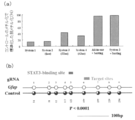
- FIG. 1 The figure which shows the component of the transfected vector (Example 1).
- A Diagram showing STAT3 binding site and mouse Gfap site. The STAT3 binding site has a methylation sensitive CpG site (CG in TTCCGAGAA)). Targets 1 to 3 used as gRNA (Gfap1-3) are indicated by black thick horizontal bars.
- B A graph showing the demethylation activity of dCas9 (system 1) directly bound to the TET1 catalytic domain (TET1CD) using gRNA targeting Gfap1-3. The vertical axis represents the value calculated by the mathematical formula in the table (same as the following mathematical formula 1) as the standardized demethylation%.
- (A) The figure which shows the scheme of the demethylation amplification based on dCas9 and a repetition peptide array.
- Inactivated Cas9 dCas9
- dCas9 that does not have nuclease activity fused to a repetitive peptide array can recruit multiple scFv antibody-fused TET1CDs. Therefore, the plurality of TET1CDs can demethylate the target more effectively.
- (B) The figure which shows the case where the length of the linker which isolate
- shaft represents the value calculated by following Numerical formula 1 as normalized demethylation%.
- the horizontal axis shows the configuration of the vector used and the presence or absence of sorting.
- Gfap Target 2 was used.
- B A diagram showing methylation around a target site. ESCs transfected with gRNA targeting System 3 and Gfap2 or control gRNA were sorted by GFP and analyzed for methylation by bisulfite sequencing.
- a black-and-white style circle represents the percentage of methylation, with black indicating methylation and white indicating unmethylation. The numbers below the circle represent each position.
- the portion of the sequence indicated by the underline indicates a portion where the base sequence matches the Gfap2 target.
- A shows CTCF binding site and mouse H19 site.
- the CTCF binding site has a methylation sensitive CpG site (m1-m4). Sites 1-4 used for gRNA targeting are shown below the vertical bars indicating m1-m4.
- B Demethylation of m2 at the CTCF binding site using System 1, 3 and System 3+ sorting.
- the vertical axis represents the value calculated by Equation 1 below as standardized demethylation%.
- the horizontal axis shows the configuration of the vector used and the presence or absence of sorting.
- C Graph showing demethylation of CTCF binding sites (m1-m4) when using System 3 + sorting.
- the left bar in each of m1 to m4 shows demethylation when target site 2 is used as gRNA, and the right bar shows demethylation when all gRNAs of target sites 1 to 4 are used together. Shows methylation.
- the vertical axis represents the value calculated by Equation 1 below as standardized demethylation%.
- the figure which shows the component of the transfected vector (Example 2).
- (A) shows CTCF binding site and mouse H19 site.
- the CTCF binding site has a methylation sensitive CpG site (m1-m4), but in Example 2, m2 was used as a target.
- (B) Shows methylation of m2 at the CTCF binding site using System 3+ sorting.
- the vertical axis represents the value calculated by Equation 2 below as standardized% methylation.
- the DNA-cleaving enzyme Cas9 forms a complex with a short RNA (guide RNA (gRNA)) containing a sequence of about 20 bases complementary to the target, and cleaves the target DNA (Non-patent literature) 2).
- gRNA guide RNA
- dCas9 having no DNA cleavage activity only binding to the target can be performed without cleaving the target. Therefore, by binding various components to dCas9 and recruiting factors that perform methylation and demethylation, it is possible to control methylation of specific genes.
- a tag peptide array in which dCas9 and a plurality of tag peptides fused with it are connected, and a tag peptide binding site, for example, a tag peptide binding site such as a single chain antibody (scFv) against the tag peptide is methylated or demethylated.
- a tag peptide binding site for example, a tag peptide binding site such as a single chain antibody (scFv) against the tag peptide
- scFv single chain antibody
- a sequence (target sequence) complementary to a DNA sequence within 1 kb from a site where methylation or demethylation is desired is prepared, and then a gRNA containing the target sequence is prepared.
- gRNA has a property of forming a complex with dCas9 having no nuclease activity.
- a fusion protein of dCas9 and a tag peptide array is prepared, gRNA forms a complex with the fusion protein via dCas9, so that a gRNA-dCas9-tag peptide array complex is formed.
- the gRNA-dCas9-tag peptide array complex is converted into a DNA sequence within 1 kb from the site where methylation or demethylation is desired. Will be combined.
- a fusion protein of a tag peptide binding site and a methylase or demethylase is recruited within 1 kb from the site desired to be methylated or demethylated by binding the tag peptide binding site to the tag peptide array. Is done.
- the recruited methylase or demethylase methylates or demethylates sites within 1 kb from itself (FIG. 3a).
- the present invention includes (1) a fusion protein of an inactivated CRISPR-associated endonuclease Cas9 (dCas9) having no nuclease activity and a tag peptide array in which a plurality of tag peptides such as GCN4 are linked via a linker, RNA or DNA encoding, (2) a fusion protein of a tag peptide binding site such as an anti-tag peptide antibody and a methylase or demethylase, or RNA or DNA encoding them, and (3) demethylation
- the present invention relates to a DNA methylation editing kit containing a guide RNA (gRNA) containing a sequence complementary to a DNA sequence within 1 kb from the desired site, or a DNA that expresses it.
- the present invention also relates to a DNA methylation editing method comprising the step of transfecting cells with the above (1) to (3).
- DNA methylation editing includes both methylating unmethylated sites of DNA and demethylating DNA methylated sites.
- CRISPR-associated endonuclease Cas9 (Cas9) consists of two lobes, a REC lobe (REC: recognition, recognition) and a NUC lobe (NUC: nuclease, nuclease), and the NUC lobe is responsible for nuclease activity (non-patent literature) 2). Therefore, the inactivated Cas9 (dCas9) having no nuclease activity in the present invention may be one in which a mutation is introduced into the NUC lobe of Cas9. Thereby, the nuclease activity of Cas9 can be inactivated while retaining the ability to bind to the target site.
- the mutation may be one type or a combination of two or more types.
- DNA encoding dCas9 can be produced by introducing mutations into DNA encoding Cas9 available from GenBank or the like.
- a commercially available plasmid containing dCas9 may be obtained from Addgene or the like, or DNA encoding dCas9 may be obtained by PCR using the plasmid as a template, or artificial gene synthesis known to those skilled in the art. It may be produced artificially using a technique, and the method for obtaining it is not limited.
- RNA encoding dCas9 can be obtained by a known molecular biological technique, and any method may be used. For example, it can be obtained by using the DNA encoding the dCas9 as a template and reacting with RNA polymerase.
- the tag peptide array in the present invention is a plurality of tag peptides connected via a linker.
- the tag peptide can be arbitrarily selected in combination with a tag peptide binding portion described later.
- a combination of a tag peptide and a tag peptide binding portion a combination of a peptide epitope and an antibody that recognizes the peptide epitope, a combination of a small fragment and a large fragment of a split protein, and the like are exemplified.
- the peptide epitope and the antibody that recognizes it include GCN4 and anti-GCN4 antibody, His tag and anti-His tag antibody, EE hexapeptide and anti-EE hexapeptide antibody, c-Myc tag and anti-c-Myc tag antibody, HA Examples include tags and anti-HA tag antibodies, S tags and anti-S tag antibodies, FLAG tags and anti-FLAG tag antibodies (Protein Engineering, Design & Selection vol. 24 no. 5 pp. 419-428, 2011). Among these, peptides contained in GCN4 are preferably used.
- the amino acid sequence of GCN4 can be obtained from, for example, PDB, and the DNA sequence can be obtained from GenBank or the like.
- GCN4 peptide epitope any epitope in GCN4 can be used without limitation, but the amino acid sequence represented by SEQ ID NO: 1 is preferable. Information on amino acid sequences of other tag peptides and base sequences encoding them can also be obtained from known databases.
- a split protein is a pair of proteins that can be reassembled to form the same structure as the original when the protein is divided into two.
- one side can be used as a tag peptide as a short peptide (small fragment), and the longer one (large fragment) can be used as a tag peptide binding site (Current Opinion in Chemical Biology 2011 , 15: 789-797).
- known proteins can be used, and examples thereof include GFP (Green Fluorescent Protein).
- binding of peptides and protein domains has been databased, for example by referring to PeptideeptBinding Proteins Database (http://pepbind.bicpu.edu.in/home.php) A combination of binding parts can be found.
- PeptideeptBinding Proteins Database http://pepbind.bicpu.edu.in/home.php
- a combination of binding parts can be found.
- PDZAlpha-Syntrophin PDZ protein interaction domain can bind to GVKESLV (SEQ ID NO: 44)
- GVKESLV can be used as a tag peptide
- PDZ domain can be used as a tag peptide binding moiety.
- binding force of a pair of peptide and peptide binding site can be strengthened by connecting another inactive domain using a linker and improving it by evolutionary engineering. By using such a pair, methylation can be controlled more efficiently (Proc. Natl. Acad. Sci. USA, 2008, vol. 105 no. 18, 6578-6583).
- the linker sandwiched between the tag peptide arrays including a plurality of tag peptides as described above may be of any sequence as long as it does not interfere with the binding between the peptide and the peptide binding site and does not interfere with the desired effect of the present invention.
- a repeating sequence of glycine and serine may be mentioned.
- the length of the linker can be appropriately set according to the type of methylase or demethylase, etc., preferably 5 to 100 amino acids, more preferably 5 to 50 amino acids, and more preferably 10 to 50 amino acids. Even more preferred. In the case of TET and DNMT described below, 15 to 40 amino acids are more preferred, 17 to 30 amino acids are even more preferred, and 22 amino acids are most preferred.
- the linker sequence is GSGSG (SEQ ID NO: 45), GSGSGGSGSGSGGSGSGGSGSG (SEQ ID NO: 46) or GSGSGGSGSGGSGSGGSGSGGSGGSGSGGSGSGGSGSGGSGSGGSGSGGSGSGSG (SEQ ID NO: 47).
- the tag peptide array refers to a unit in which a combination of a tag peptide and a linker is one unit, and these units are connected one or more times.
- Plural is a number of 2 or more, and the number of repetitions can be appropriately increased or decreased depending on the distance from the target site to the methylation or demethylation site, the type of methylase or demethylase, etc. For example, it may be repeated 3 to 5 times.
- a DNA encoding a tag peptide array can be prepared by adding a DNA sequence encoding a desired linker to a DNA encoding a tag peptide available from GenBank or the like.
- the DNA is known by a molecular biological method based on the sequence information of the DNA, and can be artificially produced using, for example, an artificial gene synthesis technique known to those skilled in the art. There are no restrictions on how to obtain it.
- a person skilled in the art can also obtain a corresponding RNA sequence based on the DNA sequence information using base sequence conversion software or the like.
- the DNA encoding the fusion protein of dCas9 and the tag peptide array can be combined with the DNA encoding the dCas9 defined above and the DNA encoding the tag peptide array using any method including well-known genetic manipulation methods. There is no particular limitation. Further, a DNA sequence encoding a selectable marker may be inserted into the DNA encoding the fusion protein. With this selection marker, cells into which DNA encoding the fusion protein has been introduced can be selected by cell sorting or the like.
- the selection marker examples include genes encoding fluorescent proteins such as GFP, Ds-Red, and mCherry, and drug resistance genes such as puromycin resistance gene and neomycin resistance gene, but are not limited thereto.
- the fusion protein or the RNA encoding the same can be obtained by a known molecular biological technique using the DNA encoding the fusion protein.
- the DNA encoding the fusion protein can be appropriately obtained. It can be obtained by inserting it into an expression vector and expressing it.
- the tag peptide binding site may be an anti-tag peptide (peptide epitope) antibody, a large fragment of a split protein, or the like depending on the type of tag peptide.
- the anti-tag peptide antibody means an antibody that specifically recognizes the tag peptide.
- Anti-tag peptide antibodies can include polyclonal antibodies and monoclonal antibodies. Such monoclonal antibodies include monoclonal antibodies, monoclonal antibody fragments, F (ab ′) 2 antibodies, F (ab ′) antibodies, short chain antibodies (scFv), diabodies and minibodies. Shall be.
- DNA encoding the anti-tag peptide antibody can be obtained by a known molecular biological technique, and can be obtained by, for example, amplifying by PCR from a commercially available plasmid such as Addgene plasmid 60904, or known to those skilled in the art. These may be artificially produced using the artificial gene synthesis technique, and the method for obtaining them is not limited.
- RNA encoding the anti-tag peptide antibody can be obtained by inserting the DNA encoding the anti-tag peptide antibody into an appropriate expression vector for expression.
- methylase As the methylating enzyme in the present invention, any enzyme that catalyzes the methylation of an unmethylated site can be used without limitation.
- a methylase that is an enzyme that methylates a specific base on a DNA base sequence a specific enzyme Examples include methyltransferase, which is an enzyme that transfers a methyl group to a base, and more specifically, DNA Methyltransferase 3 beta (DNMT3B), DNA Methyltransferase 3 alpha (DNMT3A), and DNA Methyltransferase 1 (DNMT1).
- DNMT3B DNA Methyltransferase 3 beta
- DNMT3A DNA Methyltransferase 3 alpha
- DNMT1 DNA Methyltransferase 1
- any enzyme that catalyzes a series of reactions leading to demethylation of a methylation site can be used without limitation.
- Ten-eleven translocation 1 (TET1)
- Ten-eleven translocation 2 (TET2)
- Ten-eleven translocation 3 (TET3)
- Thymine-DNA glycosylase (TDG).
- These enzymes may be part of the enzyme protein or the whole.
- an enzyme catalytic site is preferably exemplified.
- DNA encoding these enzymes can obtain sequence information from GenBank or the like, and can be prepared by PCR from cDNA of a subject animal such as a human.
- DNAs encoding these enzymes may be artificially produced using artificial gene synthesis techniques known to those skilled in the art, and the method for obtaining them is not limited. These enzymes or RNA encoding them can be obtained by inserting the above DNA into an appropriate expression vector for expression.
- the DNA encoding a fusion protein of a tag peptide binding site such as an anti-peptide epitope antibody and a methylase or demethylase is defined as described above using any method including well-known genetic manipulation methods.
- the DNA can be produced by binding a DNA encoding a binding site and a DNA encoding a methylase or a demethylase, and is not particularly limited. Further, a DNA sequence encoding a selectable marker may be inserted into the DNA encoding the fusion protein.
- the selection marker cells into which DNA encoding the fusion protein has been introduced can be selected and recovered by cell sorting or the like.
- the selection marker include genes encoding fluorescent proteins such as GFP, Ds-Red, and mCherry, and drug resistance genes such as puromycin resistance gene and neomycin resistance gene, but are not limited thereto.
- the selectable marker different from the selectable marker is selected from the tag peptide binding site and the methylase.
- it may be inserted into DNA encoding a fusion protein with demethylase.
- the fusion protein or the RNA encoding the same can be obtained by a known molecular biological technique using the DNA encoding the fusion protein.
- the DNA encoding the fusion protein can be appropriately obtained. It can be obtained by inserting it into an expression vector and expressing it.
- the guide RNA (gRNA) in the present invention is obtained by artificially linking tracrRNA and crRNA in the CRISPER / Cas method. Based on the RNA sequence described in Non-Patent Document 2 (page 1698), DNA corresponding to tracrRNA can be obtained by a known technique.
- the DNA may be artificially produced using an artificial gene synthesis technique known to those skilled in the art, and the method for obtaining the DNA is not limited.
- a plasmid capable of expressing a desired gRNA by inserting a DNA sequence corresponding to an arbitrary crRNA is commercially available (such as Addgene plasmid 41824), it may be used.
- crRNA a sequence complementary to a DNA sequence within 1 kb from the site where methylation or demethylation is desired is used.
- One type of gRNA may be used, or a plurality of gRNAs containing different crRNAs may be used.
- DNAs encoding the two fusion proteins described above are further ligated, and dCas9, tag peptide array, tag peptide binding site, and DNA encoding the fusion protein of methylase or demethylase are incorporated into the vector May be used.
- a vector containing the DNA is referred to as an all-in-one vector.
- a linker may be appropriately inserted into the DNA encoding the fusion protein. For example, as a linker between a fusion protein of dCas9 and a tag peptide array (referred to as component 1) and a tag peptide binding site and a fusion protein of methylase or demethylase (referred to as component 2).
- the all-in-one vector may include gRNA.
- Examples of the vector containing the target gene in the present invention include a vector capable of replicating in a eukaryotic cell, a vector that maintains an episome, or a vector that is integrated into the host cell genome.
- a viral vector is preferred, and an adenoviral vector, lenti More preferred are viral vectors and adeno-associated virus vectors.
- the vector may contain a selectable marker.
- Selectable marker refers to a genetic element that provides a selectable phenotype to a cell into which the selectable marker has been introduced, and generally the resistance of the gene product to an agent that inhibits or kills the cell. It is a gene to be given. Specific examples include Neo gene, Hyg gene, hisD gene, Gpt gene, and Ble gene. Drugs useful for selecting the presence of a selectable marker include, for example, G418 for Neo, hygromycin for Hyg, histidinol for hisD, xanthine for Gpt, and Ble Examples include bleomycin.
- Transfection into cells Transfection of cells with DNA, RNA, and protein is possible by using any known means, and commercially available transfection reagents may be used.
- electroporation Lipofectamine 2000 (Invitrogen), jetPRIME Kit (Polyplus Transfection), DreamFect (Oz Bioscience), GenePorter 3000 (Oz Bioscience), Calcium Phosphate Transfection Kit (Oz Bioscience) Etc.
- RNA transfection electroporation, Lipofectamine 3000 (Invitrogen), RNAi Max (Invitrogen), MessengerMAX (Invitrogen), or the like can be used.
- a complex may be formed in advance with a fusion protein of dCas9 and a tag peptide array and gRNA, and the complex may be transfected into the cell. It is also possible to introduce DNA, RNA, or protein into fertilized eggs by microinjection or electroporation.
- GCN4 was used as a tag peptide in the present Example, it is natural that this can be replaced with another tag peptide.
- the dCas9-TET1 catalytic site (CD) fusion protein expression vector (pCAG-dCas9TET1CD) is a codon-optimized S. cerevisiae that is a catalytically inactive nuclease. It was generated by fusing a cDNA encoding pyogenes Cas9 (dCas9) to the catalytic domain at the N-terminus of human TET1CD (System 1). The dCas9 fragment was amplified from Addgene plasmid 48240 by PCR. The TET1CD fragment was amplified from human cDNA by PCR.
- the dCas9 fragment of system 1-4 in FIG. 1 was amplified by PCR from Addgene plasmid 60903.
- the amino acid sequence of GCN4 used is EELLSKNYHLENEVARLKK (SEQ ID NO: 1).
- the linker sequences between GCN4 are GSGSG (SEQ ID NO: 2: System 2), GSGSGGSGSGSGGSGSGGSGSG (SEQ ID NO: 3: System 3), and GSGSGGSGSGGSGSGGSGSGGSGGSGSGGSGSGGSGSGGSGSGGSGSGGSGSGSGGSGSGGSGSGSGSGSGSGSGSGSGSGSGSGSGSGSGSGSGSGSGSGSGSGSGSGSGSGSGSGSGSGSGSGSG (SEQ ID NO: 4).
- the GFP fragment was amplified from Addgene plasmid 60904.
- the ScFv fragment was also amplified from Addgene plasmid 60904.
- All fusion proteins were expressed under the control of the CAG promoter.
- the all-in-one vector was prepared by fusing components 1 and 2 of system 3 with a 2A peptide (SEQ ID NO: 5: GSGATNFSLLKQAGDVEENPGP) in between.
- the vector sequences are SEQ ID NOS: 6 to 11 (system 1 (pCAG-dCas9TET1CD), system 2 dCas9-GCN4 fusion protein (pCAG-dCas9-10xGCN4_v4), system 2 to 4 scFv-TET1CD fusion protein (pCAG-scFvGCN4sfGFPTET1CD, respectively).
- DCas9-GCN4 fusion protein of system 3 (pCAG-dCas9-5xPlat2AflD), dCas9-GCN4 fusion protein of system 4 (pCAG-dCas9-3.5xSuper), and all-in-one vector (pPlatTET-gRNA2)).
- gRNA construction> The gRNA vectors for Gfap and H19 were generated by inserting the target sequence into Addgene plasmid 41824. Cloning was performed by a Gibson assembly system that mediates linearization of the AflII site and insertion of the gRNA fragment. The target sequence is shown in Table 1.
- Embryonic stem cells are 1% FBS, 17.5% KSR100 (10828028, Gibco), 0.2% 2-mercaptoethanol (21985-023, Gibco) at 37 ° C. and 5% CO 2 .
- ESGRO mLIF were cultured in Dulbecco's modified Eagle medium-high glucose (D6429-500ML, Sigma) supplemented with 1 ⁇ 10 3 units / mL (ESG1107, Millipore).
- ESCs were transfected using Lipofectamine 2000 (Invitrogen) according to the attached protocol and cells were harvested 48 hours after transfection and used directly for assays and sorting by FACSAria II (BD Biosciences) did.
- Genomic DNA was treated using Epitect Plus DNA Bisulfite Kit (QIAGEN) according to the attached instructions.
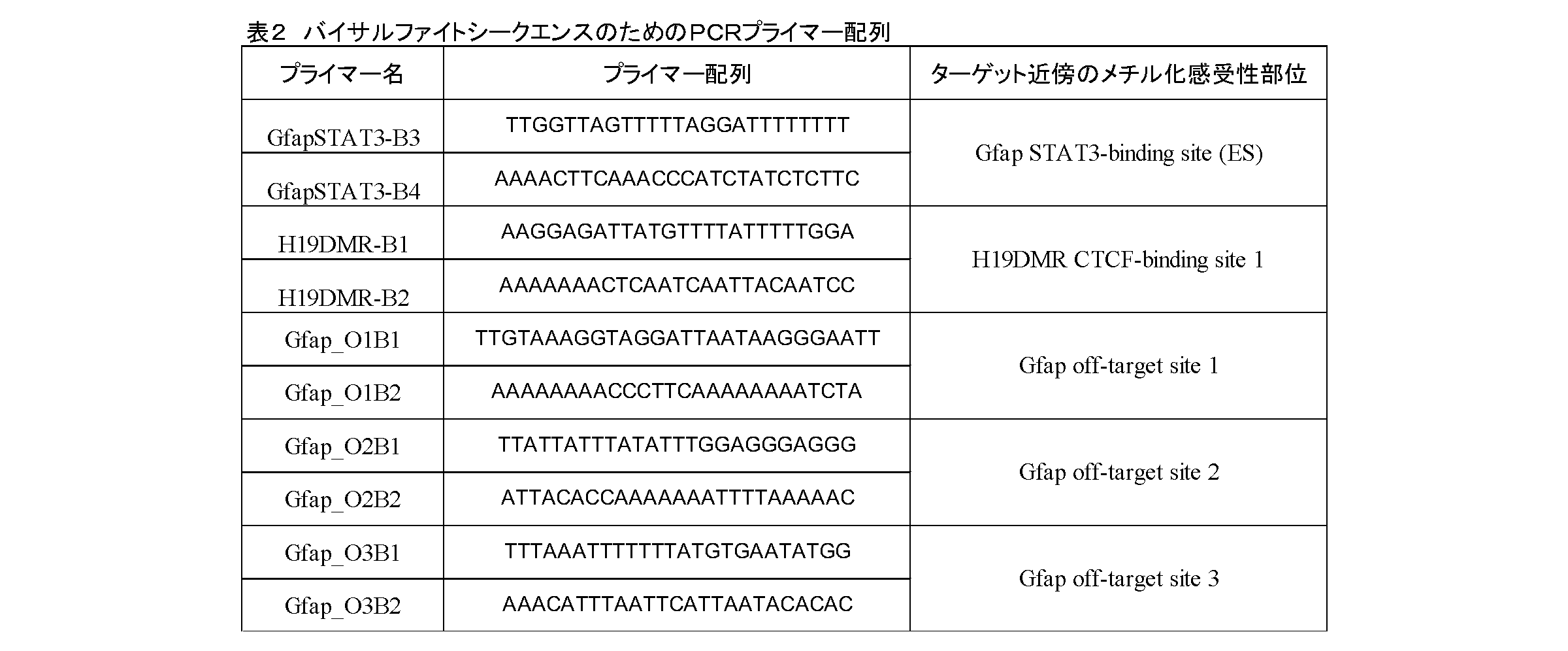
- the modified DNA was amplified using the PCR primers in Table 2 below.
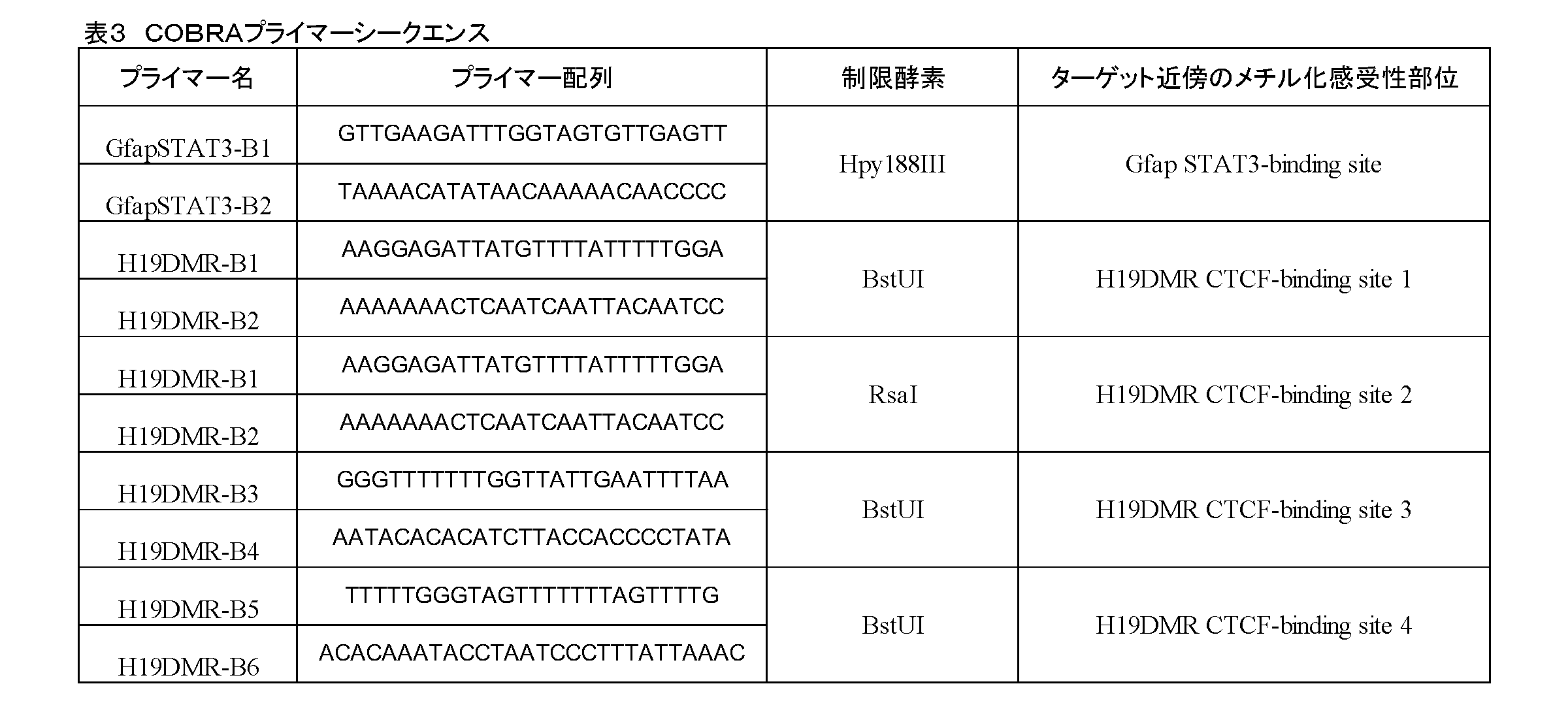
- the percent demethylation at the STAT3 site of Gfap and the m1-m4 site of H19 was determined by Combined Bisulfite Restriction Analysis (COBRA). Fragments amplified using the primers shown in Table 3 below were cleaved with the restriction enzymes shown in Table 3 below having a recognition site in the above site, and subjected to polyacrylamide gel electrophoresis.
- COBRA Combined Bisulfite Restriction Analysis
- Methylation was calculated as the ratio of cleaved DNA by densitometric analysis of gels stained with ethidium bromide.
- methylation of cells transfected with a control vector empty gRNA vector
- 100% methylation 0% demethylation
- the demethylation of each sample is Normalized by controls using Equation 1.
- Sample demethylation (%) (Control methylation-Sample methylation) / Control methylation ⁇ 100 Equation 1
- a bisulfite sequence was performed for methylation analysis and off-target analysis of the surrounding region.
- the amplified fragment was ligated to a TOPO vector (Invitrogen), and at least 14 clones were sequenced.
- the sequence was analyzed by a methylation analysis tool called QUantification tool for Methylation Analysis (QUMA).
- QUMA QUantification tool for Methylation Analysis
- TET1 inactivated Cas9 nuclease
- TET1CD this TET1 catalytic domain
- the site is methylated in many cell types except astrocytes, and demethylation of the site has an important role in the differentiation of neural progenitor cells (NPCs) into astrocytes.
- NPCs neural progenitor cells
- Three targets around the STAT3-binding site were designed (FIG. 2a), gRNA vectors for them were generated and the gRNA vector was transiently combined with the dCAS9-TET1CD fusion protein expression vector (pCAG-dCas9TET1CD).
- ESCs embryonic stem cells
- methylation of the STAT3-binding site was analyzed by the Combined Bisulfite Restriction Analysis (COBRA).
- COBRA Combined Bisulfite Restriction Analysis
- An antibody-TET1CD fusion protein having a 22 amino acid long linker (system 3 in FIG. 1) and a TET1CD fusion protein having a 43 amino acid long linker (system 4 in FIG. 1) were prepared, and their demethylation activities were compared. Due to technical limitations in synthetic gene technology, the copy number of GCN4 peptide with a 22 amino acid long linker and a 43 amino acid long linker was reduced to 5 and 4, respectively. Despite a decrease in the copy number of the GCN4 peptide, the 22 amino acid long linker showed the best demethylation at 43%. The 44 amino acid long linker was the second most active and the prototype 5 amino acid long was the lowest ( Figure 4a).
- GFP expression vector-introduced cells were selected using fluorescence-activated cell sorting (FACS).
- FACS fluorescence-activated cell sorting
- a similar experiment was conducted using a methylation variable region (DMR) of H19, which is a paternal methylated imprinting gene.
- the DMR of H19 has four methylation sensitive CTCF binding sites (m1-m4) and is important for the regulation of H19 imprinting (FIG. 6a).
- a gRNA (H19DMR2) targeting m2 was introduced into ESCs together with dCas9-TET1CD or System 3, and System 3 introduced cells were also prepared by cell sorting after introduction.
- Example 2 Methylation of target using Dnmt3b
- the m2 site of H19 was methylated using System 3 (linker 22aa).
- the plasmids used are as follows. (1) Dnmt3b: pCAG-scFvGCN4sfGFPDnmt3bF (SEQ ID NO: 41) (2) Dnmt3bNLS: pCAG-scFvGCN4sfGFPDnmt3bFNLS (SEQ ID NO: 42) (3) Dnmt3bNLS_N662R: pCAG-scFvGCN4sfGFPDnmt3bS1 (SEQ ID NO: 43) Introduce these systems (1) to (3) into ES cells, and isolate only those cells that emit fluorescence when the gene is introduced with a cell sorter by fluorescence of GFP on the second day, as in the case of demethylation.
- methylation of a specific gene can be controlled by the present invention. This makes it possible to produce model cells and animals for diseases (epigenomic diseases) that develop due to abnormal DNA methylation, such as cancer and imprinting diseases. If a viral vector or other delivery system is used, it can be used to treat these diseases. Moreover, in iPS cell production, iPS cells can be effectively produced by demethylating and activating universal genes such as Oct-4 according to the present invention.
Landscapes
- Health & Medical Sciences (AREA)
- Life Sciences & Earth Sciences (AREA)
- Chemical & Material Sciences (AREA)
- Genetics & Genomics (AREA)
- Engineering & Computer Science (AREA)
- Organic Chemistry (AREA)
- Zoology (AREA)
- Bioinformatics & Cheminformatics (AREA)
- Wood Science & Technology (AREA)
- Biomedical Technology (AREA)
- Biotechnology (AREA)
- General Engineering & Computer Science (AREA)
- Biochemistry (AREA)
- General Health & Medical Sciences (AREA)
- Molecular Biology (AREA)
- Microbiology (AREA)
- Biophysics (AREA)
- Medicinal Chemistry (AREA)
- Plant Pathology (AREA)
- Physics & Mathematics (AREA)
- Proteomics, Peptides & Aminoacids (AREA)
- Immunology (AREA)
- Cell Biology (AREA)
- Mycology (AREA)
- Tropical Medicine & Parasitology (AREA)
- Virology (AREA)
- Micro-Organisms Or Cultivation Processes Thereof (AREA)
- Peptides Or Proteins (AREA)
- Enzymes And Modification Thereof (AREA)
Abstract
Description
[1](1)ヌクレアーゼ活性を有しない不活性化型CRISPR-associated endonuclease Cas9(dCas9)と、タグペプチドがリンカーを挟んで複数つながったタグペプチドアレイとの融合蛋白質、またはそれをコードするRNAもしくはDNA、
(2)タグペプチド結合部位(tag peptide binding portion)と、メチル化酵素もしくは脱メチル化酵素との融合蛋白質、またはそれをコードするRNAもしくはDNA、および
(3)メチル化または脱メチル化を所望する部位から1kb以内のDNA配列と相補的な配列を含むガイドRNA(gRNA)、またはそれを発現するDNA
を含む、DNAメチル化編集用キット。
[2]前記脱メチル化酵素が、Ten-eleven translocation 1の触媒部位(TET1CD)である、[1]に記載のDNAメチル化編集用キット。
[3]前記メチル化酵素が、DNA Methyltransferase 3 beta (DNMT3B)である、[1]に記載のDNAメチル化編集用キット。
[4]前記タグペプチドがペプチドエピトープであり、前記タグペプチド結合部位が抗ペプチドエピトープ抗体である、[1]~[3]のいずれかに記載のDNAメチル化編集用キット。
[5]前記ペプチドエピトープがGeneral Control Non-derepressible 4(GCN4)ペプチドエピトープであり、前記抗ペプチドエピトープ抗体が抗GCN4ペプチドエピトープ抗体である、[4]に記載のDNAメチル化編集用キット。
[6]前記ペプチドエピトープがHisタグまたはEEタグであり、前記抗ペプチドエピトープ抗体が抗Hisタグ抗体または抗EEタグ抗体である、[4]に記載のDNAメチル化編集用キット。
[7]前記抗体が一本鎖抗体(scFv)である、[4]~[6]のいずれかに記載のDNAメチル化編集用キット。
[8]前記タグペプチドがスプリットタンパク質のスモールフラグメントであり、前記タグペプチド結合部位がスプリットタンパク質のラージフラグメントである、[1]~[3]のいずれかに記載のDNAメチル化編集用キット。
[9]前記スプリットタンパク質がGFPである、[8]に記載のDNAメチル化編集用キット。
[10]前記タグペプチドがGVKESLVであり、前記タグペプチド結合部位がPDZ proteinである、[1]~[3]のいずれかに記載のDNAメチル化編集用キット。
[11]前記リンカーが5~100アミノ酸である、[1]~[10]のいずれかに記載のDNAメチル化編集用キット。
[12]前記リンカーが5~50アミノ酸である、[1]~[11]のいずれかに記載のDNAメチル化編集用キット。
[13]前記リンカーが10~50アミノ酸である、[1]~[12]のいずれかに記載のDNAメチル化編集用キット。
[14]前記(1)および/または(2)の融合蛋白質が、さらに選択マーカーを含む、[1]~[13]のいずれかに記載のDNAメチル化編集用キット。
[15]前記gRNAが複数である、[1]~[14]のいずれかに記載のDNAメチル化編集用キット。
[16]前記(1)~(3)のDNAが全て一つのベクターに含まれている、[1]~[15]のいずれかに記載のDNAメチル化編集用キット。
[17]下記(1)~(3)を細胞にトランスフェクションする工程を含む、DNAメチル化編集方法。
(1)ヌクレアーゼ活性を有しない不活性化型CRISPR-associated endonuclease Cas9(dCas9)と、タグペプチドがリンカーを挟んで複数つながったタグペプチドアレイとの融合蛋白質、またはそれをコードするRNAもしくはDNA、
(2)タグペプチド結合部位と、メチル化酵素もしくは脱メチル化酵素との融合蛋白質、またはそれをコードするRNAもしくはDNA、および
(3)メチル化または脱メチル化を所望する部位から1kb以内のDNA配列と相補的な配列を含むガイドRNA(gRNA)、またはそれを発現するDNA。
[18]前記(1)および/または(2)の融合蛋白質が、さらに選択マーカーを含む、[17]に記載のDNAメチル化編集方法。
[19]前記選択マーカーを発現する細胞を選択して回収する工程をさらに含む、[18]に記載のDNAメチル化編集方法。
CRISPR/Casでは、DNA切断酵素のCas9が、ターゲットと相補的な約20塩基の配列を含む短いRNA(ガイドRNA(gRNA))と複合体を形成し、ターゲットのDNAを切断する(非特許文献2)。ここで、dCas9というDNA切断活性のない変異体酵素を用いると、ターゲットを切断せずにターゲットへの結合のみを行うことができる。そこで、dCas9に様々な構成要素を結合させることで、メチル化や脱メチル化を行う因子をリクルートすると、特定の遺伝子のメチル化制御を行うことが可能である。またdCas9と、それと融合させたタグペプチドが複数つながったタグペプチドアレイと、タグペプチド結合部位、例えば、タグペプチドに対する一本鎖抗体(scFv)などのタグペプチド結合部位にメチル化や脱メチル化をおこなう因子を融合させたシステムを用いると、1つのdCas9に対して複数のメチル化因子や脱メチル化因子をリクルートでき、そのメチル化あるいは脱メチル化の能力を増強することができる(図3a)。
本発明は、(1)ヌクレアーゼ活性を有しない不活性化型CRISPR-associated endonuclease Cas9(dCas9)と、GCN4などのタグペプチドがリンカーを挟んで複数つながったタグペプチドアレイとの融合蛋白質、またはそれをコードするRNAもしくはDNA、(2)抗タグペプチド抗体などのタグペプチド結合部位と、メチル化酵素もしくは脱メチル化酵素との融合蛋白質、またはそれらをコードするRNAもしくはDNA、および(3)脱メチル化を所望する部位から1kb以内のDNA配列と相補的な配列を含むガイドRNA(gRNA)、またはそれを発現するDNAを含む、DNAメチル化編集用キットに関する。また、本発明は、上記(1)~(3)を細胞にトランスフェクションする工程を含む、DNAメチル化編集方法に関する。
CRISPR-associated endonuclease Cas9(Cas9)は、RECローブ(REC: recognition、認識)とNUCローブ(NUC: nuclease、ヌクレアーゼ)の2つのローブからなり、NUCローブがヌクレアーゼ活性を担う部位である(非特許文献2)。よって、本発明におけるヌクレアーゼ活性を有しない不活性化型Cas9(dCas9)は、Cas9のNUCローブに変異を導入したものであり得る。これにより、ターゲット部位への結合能を保持したまま、Cas9のヌクレアーゼ活性を不活化させることができる。NUCローブへの変異導入部位は、ヌクレアーゼ活性のみを不活化させることができる限りにおいて制限はないが、たとえば、Cas9(UniProtKB/Swiss-Prot: Q99ZW2)におけるAsp10のアラニンへの変異(D10A)、His840のアラニンへの変異(H840A)、およびAsn863のアラニンへの変異(N863A)が好ましい。当該変異は、1種であっても、2種以上を組み合わせたものであってもよい。
本発明におけるタグペプチドアレイとは、タグペプチドがリンカーを挟んで複数つながったものである。
タグペプチドは後述するタグペプチド結合部分との組み合わせで任意に選択できる。例えば、タグペプチドとタグペプチド結合部分の組み合わせとして、ペプチドエピトープとそれを認識する抗体の組み合わせ、スプリットタンパク質のスモールフラグメントとラージフラグメントの組み合わせなどが例示される。
ペプチドエピトープとそれを認識する抗体の組み合わせとしては、GCN4と抗GCN4抗体、Hisタグと抗Hisタグ抗体、EEヘキサペプチドと抗EEヘキサペプチド抗体、c-Mycタグと抗c-Mycタグ抗体、HAタグと抗HAタグ抗体、Sタグと抗Sタグ抗体、FLAGタグと抗FLAGタグ抗体などが例示される(Protein Engineering, Design & Selection vol. 24 no. 5 pp. 419-428, 2011)。この中ではGCN4に含まれるペプチドが好適に使用され、GCN4のアミノ酸配列は、たとえば、PDBから入手することができ、DNA配列は、GenBank等から入手可能である。また、当業者であれば、塩基配列変換ソフト等を用い、当該DNA配列情報に基づいて、それに対応するRNA配列も入手可能である。GCN4ペプチドエピトープとしては、GCN4におけるエピトープであれば制限なく使用できるが、配列番号1で表されるアミノ酸配列が好ましい。その他のタグペプチドのアミノ酸配列及びそれをコードする塩基配列も公知のデータベース等から情報を入手することができる。
dCas9とタグペプチドアレイとの融合蛋白質をコードするDNAは、周知の遺伝子操作法を含む任意の方法を用いて、上記において定義したdCas9をコードするDNAとタグペプチドアレイをコードするDNAとを結合させることにより作製することができ、特に限定されない。また、当該融合蛋白質をコードするDNAには、選択マーカーをコードするDNA配列を挿入してもよい。当該選択マーカーにより、融合蛋白質をコードするDNAが導入された細胞を、セルソーティング等により選択することが可能となる。当該選択マーカーとしては、GFP、Ds-RedおよびmCherry等の蛍光蛋白質をコードする遺伝子や、ピューロマイシン耐性遺伝子およびネオマイシン耐性遺伝子等の薬剤耐性遺伝子が例示されるが、これらに限定されない。また、上記融合蛋白質またはそれをコードするRNAは、上記融合蛋白質をコードするDNAを使用して公知の分子生物学的手法により入手することができ、たとえば、上記融合蛋白質をコードするDNAを適切な発現ベクターに挿入して発現させることにより、得ることができる。
上記の通り、タグペプチド結合部位はタグペプチドの種類に応じて抗タグペプチド(ペプチドエピトープ)抗体、スプリットタンパク質のラージフラグメントなどを使用することができる。ここで、抗タグペプチド抗体は、タグペプチドを特異的に認識する抗体を意味する。抗タグペプチド抗体には、ポリクローナル抗体およびモノクローナル抗体が含まれ得る。当該モノクローナル抗体は、モノクローナル抗体、モノクローナル抗体のフラグメント、F(ab')2化抗体、F(ab')化抗体、短鎖抗体(scFv)、ダイアボディ(Diabodies)およびミニボディ(Minibodies)を含むものとする。抗タグペプチド抗体をコードするDNAは、公知の分子生物学的手法により入手可能であり、たとえば、Addgeneプラスミド60904等の市販のプラスミドからPCRにより増幅して得ることができ、または、当業者に公知の人工遺伝子合成技術を用いて人工的に作製してもよく、その入手方法に制限はない。抗タグペプチド抗体をコードするRNAは、上記抗タグペプチド抗体をコードするDNAを適切な発現ベクターに挿入して発現させることにより、得ることができる。
本発明におけるメチル化酵素としては、非メチル化部位のメチル化を触媒する酵素であれば制限なく使用することができ、DNA塩基配列上の特定の塩基をメチル化する酵素であるメチラーゼ、特定の塩基にメチル基を転移する酵素であるメチルトランスフェラーゼが含まれ、より具体的にはDNA Methyltransferase 3 beta(DNMT3B)、DNA Methyltransferase 3 alpha(DNMT3A)、DNA Methyltransferase 1(DNMT1)が挙げられる。本発明における脱メチル化酵素としては、メチル化部位の脱メチル化にいたる一連の反応を触媒する酵素であれば制限なく使用することができ、Ten-eleven translocation 1(TET1)、Ten-eleven translocation 2(TET2)、Ten-eleven translocation 3(TET3)、Thymine-DNA glycosylase(TDG)が含まれる。それら酵素は、酵素蛋白質の一部分であってもよいし、全体であってもよい。酵素蛋白質の一部分としては、酵素触媒部位が好ましく例示される。それら酵素をコードするDNAは、GenBank等から配列情報を入手可能であり、ヒト等の対象動物のcDNAからPCRにより作製可能である。または、それら酵素をコードするDNAは、当業者に公知の人工遺伝子合成技術を用いて人工的に作製してもよく、その入手方法に制限はない。それら酵素またはそれらをコードするRNAは、上記DNAを適切な発現ベクターに挿入して発現させることにより、得ることができる。
抗ペプチドエピトープ抗体などのタグペプチド結合部位と、メチル化酵素もしくは脱メチル化酵素との融合蛋白質をコードするDNAは、周知の遺伝子操作法を含む任意の方法を用いて、上記において定義したタグペプチド結合部位をコードするDNAと、メチル化酵素または脱メチル化酵素をコードするDNAとを結合させることにより作製することができ、特に限定されない。また、当該融合蛋白質をコードするDNAには、選択マーカーをコードするDNA配列を挿入してもよい。当該選択マーカーにより、融合蛋白質をコードするDNAが導入された細胞を、セルソーティング等により選択して回収することが可能となる。当該選択マーカーとしては、GFP、Ds-RedおよびmCherry等の蛍光蛋白質をコードする遺伝子や、ピューロマイシン耐性遺伝子およびネオマイシン耐性遺伝子等の薬剤耐性遺伝子が例示されるが、これらに限定されない。なお、選択マーカーをコードするDNA配列が、上記dCas9とタグペプチドアレイとの融合蛋白質をコードするDNAに挿入されている場合、当該選択マーカーとは異なる選択マーカーを、タグペプチド結合部位とメチル化酵素もしくは脱メチル化酵素との融合蛋白質をコードするDNAに挿入してもよい。また、上記融合蛋白質またはそれをコードするRNAは、上記融合蛋白質をコードするDNAを使用して公知の分子生物学的手法により入手することができ、たとえば、上記融合蛋白質をコードするDNAを適切な発現ベクターに挿入して発現させることにより、得ることができる。
本発明におけるガイドRNA(gRNA)は、CRISPER/Cas法におけるtracrRNAとcrRNAを人工的に連結させたものである。tracrRNAを発現するDNAは、非特許文献2(第1698頁)に記載されているRNA配列を基に、公知の手法によりそれに対応するDNAを得ることが可能である。たとえば、当業者に公知の人工遺伝子合成技術を用いて、当該DNAを人工的に作製してもよく、その入手方法に制限はない。または、任意のcrRNAに対応するDNA配列を挿入することにより所望のgRNAを発現させることができるプラスミドが市販されている(Addgeneプラスミド41824等)ので、それを使用してもよい。crRNAとしては、メチル化または脱メチル化を所望する部位から1kb以内のDNA配列と相補的な配列を使用する。gRNAは、1種類であってもよいし、それぞれ異なるcrRNAを含むgRNAを複数使用してもよい。
上記で述べた2つの融合蛋白質をコードするDNAを、さらに連結させて、dCas9、タグペプチドアレイ、タグペプチド結合部位、およびメチル化酵素もしくは脱メチル化酵素の融合蛋白質をコードするDNAをベクターに組み込み、使用してもよい。当該DNAを含むベクターを、オールインワンベクターと称する。当該融合蛋白質をコードするDNAには、適宜リンカーを挿入してもよい。たとえば、dCas9とタグペプチドアレイとの融合蛋白質(構成要素1とする)と、タグペプチド結合部位とメチル化酵素もしくは脱メチル化酵素の融合蛋白質(構成要素2とする)との間に、リンカーとして、ウイルス由来の2Aペプチドを挿入すると、当該2Aペプチドが細胞内で2Aペプチターゼにより切断されるため、構成要素1と2は連結されておらず、分離した2つの蛋白質として発現することになる。また、当該オールインワンベクターには、gRNAを含めても良い。
細胞へのDNA、RNA、および蛋白質のトランスフェクションは、公知の任意の手段を使用することにより可能であり、市販のトランスフェクション用試薬を使用してもよい。たとえば、DNAのトランスフェクションには、エレクトロポレーション、Lipofectamine2000(Invitrogen)、jetPRIME Kit(ポリプラストランスフェクション)、DreamFect(オズバイオサイエンス)、GenePorter3000(オズバイオサイエンス)、Calcium Phosphate Transfection Kit(オズバイオサイエンス)等を使用可能である。RNAのトランスフェクションには、エレクトロポレーション、Lipofectamine 3000(Invitrogen)、RNAi Max(Invitrogen)、MessengerMAX(Invitrogen)等を使用可能である。蛋白質のトランスフェクションには、エレクトロポレーション、Lipofectamine CRISPRMAX(Invitrogen)、PULSin(ポリプラストランスフェクション)、Pro-DeliverIN(オズバイオサイエンス)、BioPORTER Protein Delivery Reagent(Genlantis)等を使用可能である。細胞へのトランスフェクションは、dCas9とタグペプチドアレイとの融合蛋白質とgRNAとで予め複合体を形成させ、当該複合体を細胞にトランスフェクションしてもよい。また受精卵にマイクロインジェクション、エレクトロポレーションによりDNA、RNA、蛋白質を導入することも可能である。
<標的脱メチル基のためのプラスミド構築>
dCas9-TET1触媒部位(CD)融合蛋白質発現ベクター(pCAG-dCas9TET1CD)は、触媒として不活性なヌクレアーゼであるコドン最適化S.pyogenes Cas9(dCas9)をコードするcDNAを、ヒトTET1CDのN末端にある触媒ドメインに融合することにより作製された(システム1)。dCas9フラグメントは、PCRによりAddgeneプラスミド48240から増幅された。TET1CDフラグメントはヒトcDNAからPCRにより増幅された。
GfapおよびH19のためのgRNAベクターは、Addgeneプラスミド41824の中にターゲットシークエンスを挿入することにより作製した。クローニングは、AflII部位の直線化と、gRNAフラグメントの挿入を媒介するギブソンアセンブリーシステムにより行った。
ターゲットシークエンスを表1に示す。

胚性幹細胞(ESCs)は、37℃、5%CO2下で、1%FBS、17.5%KSR100(10828028, Gibco)、0.2%の2-メルカプトエタノール(21985-023, Gibco)、およびESGRO mLIF,を1x10³ ユニット/mL (ESG1107, Millipore)添加したダルベッコ改変イーグル培地-高濃度グルコース(D6429-500ML, Sigma)にて培養した。ESCsは、リポフェクトアミン2000(Invitrogen)を添付のプロトコールに従って使用してトランスフェクションを行い、トランスフェクションから48時間後に細胞を回収し、それらを、アッセイやFACSAriaII (BD Biosciences)によるソートに、直接使用した。
ゲノムDNAは、Epitect Plus DNA Bisulfite Kit (QIAGEN)を添付の指示書に従って使用して処置された。修飾DNAは、下記表2のPCRプライマーを使用して増幅された。
サンプル脱メチル化(%)=(コントロールのメチル化-サンプルのメチル化)/コントロールのメチル化×100・・・数式1
まず、メチル化処置のために、不活性化Cas9ヌクレアーゼ(dCas9)とTET1との直接融合タンパクというシンプルな設計を作製した。TET1は、C末端に保存された触媒ドメインを有しており、このドメインはフルレングスのタンパク質よりも高い触媒活性を有する。そのため、このTET1触媒ドメイン(TET1CD)を、触媒作用が不活性であるdCas9に融合させた(図1のシステム1)。
ターゲットにメチル化を導入するためシステム3(リンカー22aa)を用いてH19のm2部位のメチル化をおこなった。TET1CDの代わりに(1)Dnmt3b、(2)Dnmt3bNLS、(3)Dnmt3bNLS_N662Rを用いて実験を行った(図7)。(1)はDe novoメチル化酵素Dnmt3bで、(2)は(1)のDnmt3bのC末にNLS(核移行シグナル)をつけたもの、(3)は(2)の662番目のアミノ酸をアスパラギン(N)からアルギニン (R)に変えたものである。このアミノ酸置換はメチル化活性を向上させることが報告されている(下記のShen L et al.)。用いたプラスミドは以下の通り。
(1)Dnmt3b: pCAG-scFvGCN4sfGFPDnmt3bF(配列番号41)
(2)Dnmt3bNLS: pCAG-scFvGCN4sfGFPDnmt3bFNLS(配列番号42)
(3)Dnmt3bNLS_N662R: pCAG-scFvGCN4sfGFPDnmt3bS1(配列番号43)
これらの(1)~(3)の系をES細胞に導入して2日目にGFPの蛍光によりセルソーターで遺伝子が導入されて蛍光を発する細胞のみを単離し、脱メチル化のときと同様にH19のm2のメチル化を調べた。メチル化は数式2のようにコントロールで標準化したメチル化(%)として計算した。その結果、ターゲットのメチル化は(1)54%、(2)74%、(3)84%となり、メチル化効率はDnmt3bだけよりはNLSをつけた方がよく、さらにN662Rのアミノ酸置換をいれたものの方がよいことがわかった(図8)。
コントロールで標準化したメチル化(%)=(サンプルのメチル化-コントロールのメチル化)/コントロールのメチル化×100・・・数式2
参考文献
Shen L, Gao G, Zhang Y, Zhang H, Ye Z, Huang S, Huang J, Kang J. A single amino acid substitution confers enhanced methylation activity of mammalian Dnmt3b on chromatin DNA. Nucleic Acids Res. 38:6054-6064, 2010. doi: 10.1093/nar/gkq456.
配列番号2:リンカー5
配列番号3:リンカー22
配列番号4:リンカー43
配列番号5:2Aペプチド
配列番号6:pCAG-dCas9TET1CD
配列番号7:pCAG-dCas9-10xGCN4_v4
配列番号8:pCAG-scFvGCN4sfGFPTET1CD
配列番号9:pCAG-dCas9-5xPlat2AflD
配列番号10:pCAG-dCas9-3.5xSuper
配列番号11:pPlatTET-gRNA2
配列番号12:Gfap_1
配列番号13:Gfap_2
配列番号14:Gfap_3
配列番号15:H19DMR_1
配列番号16:H19DMR_2
配列番号17:H19DMR_3
配列番号18:H19DMR_4
配列番号19:UR_1
配列番号20:UR_2
配列番号21:UR_3
配列番号22:GfapSTAT3-B3
配列番号23:GfapSTAT3-B4
配列番号24:H19DMR-B1
配列番号25:H19DMR-B2
配列番号26:Gfap_O1B1
配列番号27:Gfap_O1B2
配列番号28:Gfap_O2B1
配列番号29:Gfap_O2B2
配列番号30:Gfap_O3B1
配列番号31:Gfap_O3B2
配列番号32:GfapSTAT3-B1
配列番号33:GfapSTAT3-B2
配列番号34:H19DMR-B3
配列番号35:H19DMR-B4
配列番号36:H19DMR-B5
配列番号37:H19DMR-B6
配列番号38:off target 1
配列番号39:off target 2
配列番号40:off target 3
配列番号41:pCAG-scFvGCN4sfGFPDnmt3bF
配列番号42:pCAG-scFvGCN4sfGFPDnmt3bFNLS
配列番号43:pCAG-scFvGCN4sfGFPDnmt3bS1
配列番号44:タグペプチドGVKESLV
配列番号45:GSリンカー
配列番号46:GSリンカー
配列番号47:GSリンカー
Claims (19)
- (1)ヌクレアーゼ活性を有しない不活性化型CRISPR-associated endonuclease Cas9(dCas9)と、タグペプチドがリンカーを挟んで複数つながったタグペプチドアレイとの融合蛋白質、またはそれをコードするRNAもしくはDNA、
(2)タグペプチド結合部位と、メチル化酵素もしくは脱メチル化酵素との融合蛋白質、またはそれをコードするRNAもしくはDNA、および
(3)メチル化または脱メチル化を所望する部位から1kb以内のDNA配列と相補的な配列を含むガイドRNA(gRNA)、またはそれを発現するDNA
を含む、DNAメチル化編集用キット。 - 前記脱メチル化酵素が、Ten-eleven translocation 1の触媒部位(TET1CD)である、請求項1に記載のDNAメチル化編集用キット。
- 前記メチル化酵素が、DNA Methyltransferase 3 beta (DNMT3B)である、請求項1に記載のDNAメチル化編集用キット。
- 前記タグペプチドがペプチドエピトープであり、前記タグペプチド結合部位が抗ペプチドエピトープ抗体である、請求項1~3のいずれか一項に記載のDNAメチル化編集用キット。
- 前記ペプチドエピトープがGeneral Control Non-derepressible 4(GCN4)ペプチドエピトープであり、前記抗ペプチドエピトープ抗体が抗GCN4ペプチドエピトープ抗体である、請求項4に記載のDNAメチル化編集用キット。
- 前記ペプチドエピトープがHisタグまたはEEタグであり、前記抗ペプチドエピトープ抗体が抗Hisタグ抗体または抗EEタグ抗体である、請求項4に記載のDNAメチル化編集用キット。
- 前記抗体が一本鎖抗体(scFv)である、請求項4~6のいずれか一項に記載のDNAメチル化編集用キット。
- 前記タグペプチドがスプリットタンパク質のスモールフラグメントであり、前記タグペプチド結合部位がスプリットタンパク質のラージフラグメントである、請求項1~3のいずれか一項に記載のDNAメチル化編集用キット。
- 前記スプリットタンパク質がGFPである、請求項8に記載のDNAメチル化編集用キット。
- 前記タグペプチドがGVKESLV(配列番号44)であり、前記タグペプチド結合部位がPDZ proteinである、請求項1~3のいずれか一項に記載のDNAメチル化編集用キット。
- 前記リンカーが5~100アミノ酸である、請求項1~10のいずれか一項に記載のDNAメチル化編集用キット。
- 前記リンカーが5~50アミノ酸である、請求項1~11のいずれか一項に記載のDNAメチル化編集用キット。
- 前記リンカーが10~50アミノ酸である、請求項1~12のいずれか一項に記載のDNAメチル化編集用キット。
- 前記(1)および/または(2)の融合蛋白質が、さらに選択マーカーを含む、請求項1~13のいずれか一項に記載のDNAメチル化編集用キット。
- 前記gRNAが複数である、請求項1~14のいずれか一項に記載のDNAメチル化編集用キット。
- 前記(1)~(3)のDNAが全て一つのベクターに含まれている、請求項1~15のいずれか一項に記載のDNAメチル化編集用キット。
- 下記(1)~(3)を細胞にトランスフェクションする工程を含む、DNAメチル化編集方法。
(1)ヌクレアーゼ活性を有しない不活性化型CRISPR-associated endonuclease Cas9(dCas9)と、タグペプチドがリンカーを挟んで複数つながったタグペプチドアレイとの融合蛋白質、またはそれをコードするRNAもしくはDNA、
(2)タグペプチド結合部位と、メチル化酵素もしくは脱メチル化酵素との融合蛋白質、またはそれをコードするRNAもしくはDNA、および
(3)メチル化または脱メチル化を所望する部位から1kb以内のDNA配列と相補的な配列を含むガイドRNA(gRNA)、またはそれを発現するDNA。 - 前記(1)および/または(2)の融合蛋白質が、さらに選択マーカーを含む、請求項17に記載のDNAメチル化編集方法。
- 前記選択マーカーを発現する細胞を選択して回収する工程をさらに含む、請求項18に記載のDNAメチル化編集方法。
Priority Applications (4)
| Application Number | Priority Date | Filing Date | Title |
|---|---|---|---|
| EP16868667.3A EP3382018B1 (en) | 2015-11-25 | 2016-11-25 | Dna methylation editing kit and dna methylation editing method |
| US15/779,227 US10612044B2 (en) | 2015-11-25 | 2016-11-25 | DNA methylation editing kit and DNA methylation editing method |
| JP2017552723A JP6500293B2 (ja) | 2015-11-25 | 2016-11-25 | Dnaメチル化編集用キットおよびdnaメチル化編集方法 |
| US16/801,969 US11591623B2 (en) | 2015-11-25 | 2020-02-26 | DNA methylation editing kit and DNA methylation editing method |
Applications Claiming Priority (2)
| Application Number | Priority Date | Filing Date | Title |
|---|---|---|---|
| JP2015229896 | 2015-11-25 | ||
| JP2015-229896 | 2015-11-25 |
Related Child Applications (2)
| Application Number | Title | Priority Date | Filing Date |
|---|---|---|---|
| US15/779,227 A-371-Of-International US10612044B2 (en) | 2015-11-25 | 2016-11-25 | DNA methylation editing kit and DNA methylation editing method |
| US16/801,969 Division US11591623B2 (en) | 2015-11-25 | 2020-02-26 | DNA methylation editing kit and DNA methylation editing method |
Publications (1)
| Publication Number | Publication Date |
|---|---|
| WO2017090724A1 true WO2017090724A1 (ja) | 2017-06-01 |
Family
ID=58763546
Family Applications (1)
| Application Number | Title | Priority Date | Filing Date |
|---|---|---|---|
| PCT/JP2016/084958 Ceased WO2017090724A1 (ja) | 2015-11-25 | 2016-11-25 | Dnaメチル化編集用キットおよびdnaメチル化編集方法 |
Country Status (4)
| Country | Link |
|---|---|
| US (2) | US10612044B2 (ja) |
| EP (1) | EP3382018B1 (ja) |
| JP (1) | JP6500293B2 (ja) |
| WO (1) | WO2017090724A1 (ja) |
Cited By (40)
| Publication number | Priority date | Publication date | Assignee | Title |
|---|---|---|---|---|
| US9999671B2 (en) | 2013-09-06 | 2018-06-19 | President And Fellows Of Harvard College | Delivery of negatively charged proteins using cationic lipids |
| US10113163B2 (en) | 2016-08-03 | 2018-10-30 | President And Fellows Of Harvard College | Adenosine nucleobase editors and uses thereof |
| CN108715861A (zh) * | 2018-04-26 | 2018-10-30 | 上海科技大学 | 一种碱基编辑工具及其应用 |
| US10167457B2 (en) | 2015-10-23 | 2019-01-01 | President And Fellows Of Harvard College | Nucleobase editors and uses thereof |
| US10323236B2 (en) | 2011-07-22 | 2019-06-18 | President And Fellows Of Harvard College | Evaluation and improvement of nuclease cleavage specificity |
| US10465176B2 (en) | 2013-12-12 | 2019-11-05 | President And Fellows Of Harvard College | Cas variants for gene editing |
| US10508298B2 (en) | 2013-08-09 | 2019-12-17 | President And Fellows Of Harvard College | Methods for identifying a target site of a CAS9 nuclease |
| US10597679B2 (en) | 2013-09-06 | 2020-03-24 | President And Fellows Of Harvard College | Switchable Cas9 nucleases and uses thereof |
| US10704062B2 (en) | 2014-07-30 | 2020-07-07 | President And Fellows Of Harvard College | CAS9 proteins including ligand-dependent inteins |
| US10745677B2 (en) | 2016-12-23 | 2020-08-18 | President And Fellows Of Harvard College | Editing of CCR5 receptor gene to protect against HIV infection |
| US10858639B2 (en) | 2013-09-06 | 2020-12-08 | President And Fellows Of Harvard College | CAS9 variants and uses thereof |
| EP3622091A4 (en) * | 2017-05-12 | 2021-02-17 | President and Fellows of Harvard College | UNIVERSAL EARLY CANCER DIAGNOSIS |
| US11046948B2 (en) | 2013-08-22 | 2021-06-29 | President And Fellows Of Harvard College | Engineered transcription activator-like effector (TALE) domains and uses thereof |
| JPWO2021167101A1 (ja) * | 2020-02-21 | 2021-08-26 | ||
| WO2021171688A1 (ja) | 2020-02-26 | 2021-09-02 | イムラ・ジャパン株式会社 | 遺伝子ノックイン方法、遺伝子ノックイン細胞作製方法、遺伝子ノックイン細胞、がん化リスク評価方法、がん細胞製造方法、及びこれらに用いるためのキット |
| WO2021246165A1 (ja) * | 2020-06-03 | 2021-12-09 | 国立大学法人広島大学 | Oasis遺伝子の脱メチル化のための核酸及びそれを用いた脱メチル化方法 |
| US11268082B2 (en) | 2017-03-23 | 2022-03-08 | President And Fellows Of Harvard College | Nucleobase editors comprising nucleic acid programmable DNA binding proteins |
| CN114195902A (zh) * | 2021-10-18 | 2022-03-18 | 翌圣生物科技(上海)股份有限公司 | 重组蛋白结构域增强tet酶及全基因组dna甲基化检测方法 |
| CN114292830A (zh) * | 2021-12-31 | 2022-04-08 | 复旦大学 | 蛋白SaCas9的抗原表位及其在基因编辑中的应用 |
| US11306324B2 (en) | 2016-10-14 | 2022-04-19 | President And Fellows Of Harvard College | AAV delivery of nucleobase editors |
| US11319532B2 (en) | 2017-08-30 | 2022-05-03 | President And Fellows Of Harvard College | High efficiency base editors comprising Gam |
| US11447770B1 (en) | 2019-03-19 | 2022-09-20 | The Broad Institute, Inc. | Methods and compositions for prime editing nucleotide sequences |
| JPWO2022244544A1 (ja) * | 2021-05-20 | 2022-11-24 | ||
| US11542496B2 (en) | 2017-03-10 | 2023-01-03 | President And Fellows Of Harvard College | Cytosine to guanine base editor |
| US11542509B2 (en) | 2016-08-24 | 2023-01-03 | President And Fellows Of Harvard College | Incorporation of unnatural amino acids into proteins using base editing |
| US11560566B2 (en) | 2017-05-12 | 2023-01-24 | President And Fellows Of Harvard College | Aptazyme-embedded guide RNAs for use with CRISPR-Cas9 in genome editing and transcriptional activation |
| US11661590B2 (en) | 2016-08-09 | 2023-05-30 | President And Fellows Of Harvard College | Programmable CAS9-recombinase fusion proteins and uses thereof |
| US11732274B2 (en) | 2017-07-28 | 2023-08-22 | President And Fellows Of Harvard College | Methods and compositions for evolving base editors using phage-assisted continuous evolution (PACE) |
| US11795443B2 (en) | 2017-10-16 | 2023-10-24 | The Broad Institute, Inc. | Uses of adenosine base editors |
| US11898179B2 (en) | 2017-03-09 | 2024-02-13 | President And Fellows Of Harvard College | Suppression of pain by gene editing |
| US11912985B2 (en) | 2020-05-08 | 2024-02-27 | The Broad Institute, Inc. | Methods and compositions for simultaneous editing of both strands of a target double-stranded nucleotide sequence |
| US12157760B2 (en) | 2018-05-23 | 2024-12-03 | The Broad Institute, Inc. | Base editors and uses thereof |
| US12281338B2 (en) | 2018-10-29 | 2025-04-22 | The Broad Institute, Inc. | Nucleobase editors comprising GeoCas9 and uses thereof |
| WO2025117544A1 (en) | 2023-11-29 | 2025-06-05 | The Broad Institute, Inc. | Engineered omega guide molecule and iscb compositions, systems, and methods of use thereof |
| US12351837B2 (en) | 2019-01-23 | 2025-07-08 | The Broad Institute, Inc. | Supernegatively charged proteins and uses thereof |
| US12390514B2 (en) | 2017-03-09 | 2025-08-19 | President And Fellows Of Harvard College | Cancer vaccine |
| US12406749B2 (en) | 2017-12-15 | 2025-09-02 | The Broad Institute, Inc. | Systems and methods for predicting repair outcomes in genetic engineering |
| US12435330B2 (en) | 2019-10-10 | 2025-10-07 | The Broad Institute, Inc. | Methods and compositions for prime editing RNA |
| US12473543B2 (en) | 2019-04-17 | 2025-11-18 | The Broad Institute, Inc. | Adenine base editors with reduced off-target effects |
| US12522807B2 (en) | 2018-07-09 | 2026-01-13 | The Broad Institute, Inc. | RNA programmable epigenetic RNA modifiers and uses thereof |
Families Citing this family (11)
| Publication number | Priority date | Publication date | Assignee | Title |
|---|---|---|---|---|
| GB201418965D0 (ja) | 2014-10-24 | 2014-12-10 | Ospedale San Raffaele And Fond Telethon | |
| CN109863246A (zh) | 2016-08-19 | 2019-06-07 | 怀特黑德生物医学研究所 | 编辑dna甲基化的方法 |
| WO2018111944A1 (en) | 2016-12-12 | 2018-06-21 | Whitehead Institute For Biomedical Research | Regulation of transcription through ctcf loop anchors |
| FI3565891T3 (fi) | 2017-01-09 | 2023-07-04 | Whitehead Inst Biomedical Res | Menetelmiä geeniekspression muuttamiseksi häiritsemällä säätelysilmukoita muodostavia transkriptiotekijämultimeerejä |
| GB2587970B (en) | 2018-04-19 | 2023-02-08 | Univ California | Compositions and methods for gene editing |
| CN108707635B (zh) * | 2018-05-29 | 2022-02-15 | 华东师范大学 | 用于核苷酸序列修饰的组合物、方法与应用 |
| US20220389393A1 (en) * | 2019-10-21 | 2022-12-08 | The Regents Of The University Of California | Compositions and methods for editing of the cdkl5 gene |
| CN111748583A (zh) * | 2020-07-17 | 2020-10-09 | 池嘉栋 | 一种基于CRISPR/dCas9的诱导型DNA甲基化编辑系统 |
| AU2021409729A1 (en) | 2020-12-22 | 2023-07-13 | Nchroma Bio, Inc. | Compositions and methods for epigenetic editing |
| JP2025521581A (ja) | 2022-06-23 | 2025-07-10 | エヌクロマ・バイオ,インコーポレーテッド | エピジェネティック編集用の組成物および方法 |
| IL324634A (en) | 2023-05-15 | 2026-01-01 | Nchroma Bio Inc | Compositions and methods for epigenetic regulation of hbv gene expression |
Citations (1)
| Publication number | Priority date | Publication date | Assignee | Title |
|---|---|---|---|---|
| WO2014152432A2 (en) * | 2013-03-15 | 2014-09-25 | The General Hospital Corporation | Rna-guided targeting of genetic and epigenomic regulatory proteins to specific genomic loci |
Family Cites Families (1)
| Publication number | Priority date | Publication date | Assignee | Title |
|---|---|---|---|---|
| EP3169702A4 (en) * | 2014-07-14 | 2018-04-18 | The Regents of The University of California | A protein tagging system for in vivo single molecule imaging and control of gene transcription |
-
2016
- 2016-11-25 US US15/779,227 patent/US10612044B2/en active Active
- 2016-11-25 EP EP16868667.3A patent/EP3382018B1/en active Active
- 2016-11-25 JP JP2017552723A patent/JP6500293B2/ja active Active
- 2016-11-25 WO PCT/JP2016/084958 patent/WO2017090724A1/ja not_active Ceased
-
2020
- 2020-02-26 US US16/801,969 patent/US11591623B2/en active Active
Patent Citations (1)
| Publication number | Priority date | Publication date | Assignee | Title |
|---|---|---|---|---|
| WO2014152432A2 (en) * | 2013-03-15 | 2014-09-25 | The General Hospital Corporation | Rna-guided targeting of genetic and epigenomic regulatory proteins to specific genomic loci |
Non-Patent Citations (16)
| Title |
|---|
| "JIKKEN IGAKU", July 2014, YODOSHA CO., LTD., pages: 1690 - 1714 |
| CABANTOUS S. ET AL.: "A new protein-protein interaction sensor based on tripartite split- GFP association", SCIENTIFIC REPORTS, vol. 3, pages 2854/1 - 2854/9, XP055260864 * |
| CURRENT OPINION IN CHEMICAL BIOLOGY, vol. 15, 2011, pages 789 - 797 |
| MAEDER M. L. ET AL.: "Targeted DNA demethylation and activation of endogenous genes using programmable TALE-TET1 fusion proteins", NATURE BIOTECHNOLOGY, vol. 31, no. 12, 2013, pages 1137 - 1142, XP055402828 * |
| MAEDER ML ET AL., NAT BIOTECHNOL, vol. 31, 2013, pages 1137 - 1142 |
| MALI P. ET AL.: "Cas9 as a versatile tool for engineering biology", NATURE METHODS, vol. 10, no. 10, 2013, pages 957 - 963, XP002718606 * |
| MORITA S. ET AL.: "Targeted DNA demethylation in vivo using dCas9-peptide repeat and scFv-TET1 catalytic domain fusions", NATURE BIOTECHNOLOGY, vol. 34, no. 10, October 2016 (2016-10-01), pages 1060 - 1065, XP055459761 * |
| PROC. NATL. ACAD. SCI. USA, vol. 105, no. 18, 2008, pages 6578 - 6583 |
| PROTEIN ENGINEERING, DESIGN & SELECTION, vol. 24, no. 5, 2011, pages 419 - 428 |
| See also references of EP3382018A4 |
| SHEN L. ET AL.: "A single amino acid substitution confers enhanced methylation activity of mammalian Dnmt3b on chromatin DNA", NUCLEIC ACIDS RESEARCH, vol. 38, no. 18, 2010, pages 6054 - 6064, XP055496863 * |
| SHEN L; GAO G; ZHANG Y; ZHANG H; YE Z; HUANG S; HUANG J; KANG J: "A single amino acid substitution confers enhanced methylation activity of mammalian Dnmt3b on chromatin DNA", NUCLEIC ACIDS RES., vol. 38, 2010, pages 6054 - 6064 |
| SKELTON N. J. ET AL.: "Origins of PDZ domain ligand specificity", THE JOURNAL OF BIOLOGICAL CHEMISTRY, vol. 278, no. 9, 2003, pages 7645 - 7654, XP002454235 * |
| TAIGA YAMAZAKI ET AL.: "Genome Henshu Gijutsu o Oyo shita Pericentromere eno Jin'iteki -Hairetsu Tokuteki DNA Methyl-ka Yudo", BMB2015 KOEN YOSHISHU, vol. 2015, 6 November 2015 (2015-11-06), XP9510609 * |
| TANENBAUM E. M. ET AL.: "A Protein-Tagging System for Signal Amplification in Gene Expression and Fluorescence Imaging", CELL, vol. 159, 2014, pages 635 - 646, XP029084861 * |
| TANENBAUM ME ET AL., CELL, vol. 159, 2014, pages 635 - 646 |
Cited By (80)
| Publication number | Priority date | Publication date | Assignee | Title |
|---|---|---|---|---|
| US12006520B2 (en) | 2011-07-22 | 2024-06-11 | President And Fellows Of Harvard College | Evaluation and improvement of nuclease cleavage specificity |
| US10323236B2 (en) | 2011-07-22 | 2019-06-18 | President And Fellows Of Harvard College | Evaluation and improvement of nuclease cleavage specificity |
| US10508298B2 (en) | 2013-08-09 | 2019-12-17 | President And Fellows Of Harvard College | Methods for identifying a target site of a CAS9 nuclease |
| US11920181B2 (en) | 2013-08-09 | 2024-03-05 | President And Fellows Of Harvard College | Nuclease profiling system |
| US10954548B2 (en) | 2013-08-09 | 2021-03-23 | President And Fellows Of Harvard College | Nuclease profiling system |
| US11046948B2 (en) | 2013-08-22 | 2021-06-29 | President And Fellows Of Harvard College | Engineered transcription activator-like effector (TALE) domains and uses thereof |
| US12584118B2 (en) | 2013-09-06 | 2026-03-24 | President And Fellows Of Harvard College | Cas9 variants and uses thereof |
| US12559737B2 (en) | 2013-09-06 | 2026-02-24 | President And Fellows Of Harvard College | Cas9 variants and uses thereof |
| US10682410B2 (en) | 2013-09-06 | 2020-06-16 | President And Fellows Of Harvard College | Delivery system for functional nucleases |
| US12473573B2 (en) | 2013-09-06 | 2025-11-18 | President And Fellows Of Harvard College | Switchable Cas9 nucleases and uses thereof |
| US10597679B2 (en) | 2013-09-06 | 2020-03-24 | President And Fellows Of Harvard College | Switchable Cas9 nucleases and uses thereof |
| US10858639B2 (en) | 2013-09-06 | 2020-12-08 | President And Fellows Of Harvard College | CAS9 variants and uses thereof |
| US10912833B2 (en) | 2013-09-06 | 2021-02-09 | President And Fellows Of Harvard College | Delivery of negatively charged proteins using cationic lipids |
| US11299755B2 (en) | 2013-09-06 | 2022-04-12 | President And Fellows Of Harvard College | Switchable CAS9 nucleases and uses thereof |
| US9999671B2 (en) | 2013-09-06 | 2018-06-19 | President And Fellows Of Harvard College | Delivery of negatively charged proteins using cationic lipids |
| US12215365B2 (en) | 2013-12-12 | 2025-02-04 | President And Fellows Of Harvard College | Cas variants for gene editing |
| US10465176B2 (en) | 2013-12-12 | 2019-11-05 | President And Fellows Of Harvard College | Cas variants for gene editing |
| US11053481B2 (en) | 2013-12-12 | 2021-07-06 | President And Fellows Of Harvard College | Fusions of Cas9 domains and nucleic acid-editing domains |
| US11124782B2 (en) | 2013-12-12 | 2021-09-21 | President And Fellows Of Harvard College | Cas variants for gene editing |
| US11578343B2 (en) | 2014-07-30 | 2023-02-14 | President And Fellows Of Harvard College | CAS9 proteins including ligand-dependent inteins |
| US12398406B2 (en) | 2014-07-30 | 2025-08-26 | President And Fellows Of Harvard College | CAS9 proteins including ligand-dependent inteins |
| US10704062B2 (en) | 2014-07-30 | 2020-07-07 | President And Fellows Of Harvard College | CAS9 proteins including ligand-dependent inteins |
| US10167457B2 (en) | 2015-10-23 | 2019-01-01 | President And Fellows Of Harvard College | Nucleobase editors and uses thereof |
| US11214780B2 (en) | 2015-10-23 | 2022-01-04 | President And Fellows Of Harvard College | Nucleobase editors and uses thereof |
| US12344869B2 (en) | 2015-10-23 | 2025-07-01 | President And Fellows Of Harvard College | Nucleobase editors and uses thereof |
| US12043852B2 (en) | 2015-10-23 | 2024-07-23 | President And Fellows Of Harvard College | Evolved Cas9 proteins for gene editing |
| US10113163B2 (en) | 2016-08-03 | 2018-10-30 | President And Fellows Of Harvard College | Adenosine nucleobase editors and uses thereof |
| US11999947B2 (en) | 2016-08-03 | 2024-06-04 | President And Fellows Of Harvard College | Adenosine nucleobase editors and uses thereof |
| US11702651B2 (en) | 2016-08-03 | 2023-07-18 | President And Fellows Of Harvard College | Adenosine nucleobase editors and uses thereof |
| US10947530B2 (en) | 2016-08-03 | 2021-03-16 | President And Fellows Of Harvard College | Adenosine nucleobase editors and uses thereof |
| US11661590B2 (en) | 2016-08-09 | 2023-05-30 | President And Fellows Of Harvard College | Programmable CAS9-recombinase fusion proteins and uses thereof |
| US11542509B2 (en) | 2016-08-24 | 2023-01-03 | President And Fellows Of Harvard College | Incorporation of unnatural amino acids into proteins using base editing |
| US12084663B2 (en) | 2016-08-24 | 2024-09-10 | President And Fellows Of Harvard College | Incorporation of unnatural amino acids into proteins using base editing |
| US11306324B2 (en) | 2016-10-14 | 2022-04-19 | President And Fellows Of Harvard College | AAV delivery of nucleobase editors |
| US11820969B2 (en) | 2016-12-23 | 2023-11-21 | President And Fellows Of Harvard College | Editing of CCR2 receptor gene to protect against HIV infection |
| US10745677B2 (en) | 2016-12-23 | 2020-08-18 | President And Fellows Of Harvard College | Editing of CCR5 receptor gene to protect against HIV infection |
| US12516308B2 (en) | 2017-03-09 | 2026-01-06 | President And Fellows Of Harvard College | Suppression of pain by gene editing |
| US12390514B2 (en) | 2017-03-09 | 2025-08-19 | President And Fellows Of Harvard College | Cancer vaccine |
| US11898179B2 (en) | 2017-03-09 | 2024-02-13 | President And Fellows Of Harvard College | Suppression of pain by gene editing |
| US11542496B2 (en) | 2017-03-10 | 2023-01-03 | President And Fellows Of Harvard College | Cytosine to guanine base editor |
| US12435331B2 (en) | 2017-03-10 | 2025-10-07 | President And Fellows Of Harvard College | Cytosine to guanine base editor |
| US11268082B2 (en) | 2017-03-23 | 2022-03-08 | President And Fellows Of Harvard College | Nucleobase editors comprising nucleic acid programmable DNA binding proteins |
| US12195802B2 (en) | 2017-05-12 | 2025-01-14 | President And Fellows Of Harvard College | Universal early cancer diagnostics |
| EP3622091A4 (en) * | 2017-05-12 | 2021-02-17 | President and Fellows of Harvard College | UNIVERSAL EARLY CANCER DIAGNOSIS |
| US11560566B2 (en) | 2017-05-12 | 2023-01-24 | President And Fellows Of Harvard College | Aptazyme-embedded guide RNAs for use with CRISPR-Cas9 in genome editing and transcriptional activation |
| US12359218B2 (en) | 2017-07-28 | 2025-07-15 | President And Fellows Of Harvard College | Methods and compositions for evolving base editors using phage-assisted continuous evolution (PACE) |
| US11732274B2 (en) | 2017-07-28 | 2023-08-22 | President And Fellows Of Harvard College | Methods and compositions for evolving base editors using phage-assisted continuous evolution (PACE) |
| US11319532B2 (en) | 2017-08-30 | 2022-05-03 | President And Fellows Of Harvard College | High efficiency base editors comprising Gam |
| US11932884B2 (en) | 2017-08-30 | 2024-03-19 | President And Fellows Of Harvard College | High efficiency base editors comprising Gam |
| US11795443B2 (en) | 2017-10-16 | 2023-10-24 | The Broad Institute, Inc. | Uses of adenosine base editors |
| US12406749B2 (en) | 2017-12-15 | 2025-09-02 | The Broad Institute, Inc. | Systems and methods for predicting repair outcomes in genetic engineering |
| CN108715861A (zh) * | 2018-04-26 | 2018-10-30 | 上海科技大学 | 一种碱基编辑工具及其应用 |
| CN108715861B (zh) * | 2018-04-26 | 2022-06-24 | 上海科技大学 | 一种碱基编辑工具及其应用 |
| US12157760B2 (en) | 2018-05-23 | 2024-12-03 | The Broad Institute, Inc. | Base editors and uses thereof |
| US12522807B2 (en) | 2018-07-09 | 2026-01-13 | The Broad Institute, Inc. | RNA programmable epigenetic RNA modifiers and uses thereof |
| US12281338B2 (en) | 2018-10-29 | 2025-04-22 | The Broad Institute, Inc. | Nucleobase editors comprising GeoCas9 and uses thereof |
| US12351837B2 (en) | 2019-01-23 | 2025-07-08 | The Broad Institute, Inc. | Supernegatively charged proteins and uses thereof |
| US12281303B2 (en) | 2019-03-19 | 2025-04-22 | The Broad Institute, Inc. | Methods and compositions for prime editing nucleotide sequences |
| US11447770B1 (en) | 2019-03-19 | 2022-09-20 | The Broad Institute, Inc. | Methods and compositions for prime editing nucleotide sequences |
| US12624353B2 (en) | 2019-03-19 | 2026-05-12 | The Broad Institute, Inc. | Methods and compositions for prime editing nucleotide sequences |
| US12624354B2 (en) | 2019-03-19 | 2026-05-12 | The Broad Institute, Inc. | Methods and compositions for prime editing nucleotide sequences |
| US12570972B2 (en) | 2019-03-19 | 2026-03-10 | The Broad Institute, Inc. | Methods and compositions for prime editing nucleotide sequences |
| US11795452B2 (en) | 2019-03-19 | 2023-10-24 | The Broad Institute, Inc. | Methods and compositions for prime editing nucleotide sequences |
| US11643652B2 (en) | 2019-03-19 | 2023-05-09 | The Broad Institute, Inc. | Methods and compositions for prime editing nucleotide sequences |
| US12509680B2 (en) | 2019-03-19 | 2025-12-30 | The Broad Institute, Inc. | Methods and compositions for prime editing nucleotide sequences |
| US12473543B2 (en) | 2019-04-17 | 2025-11-18 | The Broad Institute, Inc. | Adenine base editors with reduced off-target effects |
| US12435330B2 (en) | 2019-10-10 | 2025-10-07 | The Broad Institute, Inc. | Methods and compositions for prime editing RNA |
| JPWO2021167101A1 (ja) * | 2020-02-21 | 2021-08-26 | ||
| WO2021167101A1 (ja) * | 2020-02-21 | 2021-08-26 | 国立大学法人群馬大学 | 脱メチル化酵素と転写関連因子またはクロマチン関連因子を用いた特定遺伝子の相乗的発現誘導法 |
| WO2021171688A1 (ja) | 2020-02-26 | 2021-09-02 | イムラ・ジャパン株式会社 | 遺伝子ノックイン方法、遺伝子ノックイン細胞作製方法、遺伝子ノックイン細胞、がん化リスク評価方法、がん細胞製造方法、及びこれらに用いるためのキット |
| US11912985B2 (en) | 2020-05-08 | 2024-02-27 | The Broad Institute, Inc. | Methods and compositions for simultaneous editing of both strands of a target double-stranded nucleotide sequence |
| US12031126B2 (en) | 2020-05-08 | 2024-07-09 | The Broad Institute, Inc. | Methods and compositions for simultaneous editing of both strands of a target double-stranded nucleotide sequence |
| WO2021246165A1 (ja) * | 2020-06-03 | 2021-12-09 | 国立大学法人広島大学 | Oasis遺伝子の脱メチル化のための核酸及びそれを用いた脱メチル化方法 |
| WO2022244544A1 (ja) * | 2021-05-20 | 2022-11-24 | 国立大学法人群馬大学 | エピゲノムが改変された動植物の親系統の製造に用いるための組成物およびその用途 |
| JPWO2022244544A1 (ja) * | 2021-05-20 | 2022-11-24 | ||
| JP7823919B2 (ja) | 2021-05-20 | 2026-03-04 | 国立大学法人群馬大学 | エピゲノムが改変された動植物の親系統の製造に用いるための組成物およびその用途 |
| CN114195902A (zh) * | 2021-10-18 | 2022-03-18 | 翌圣生物科技(上海)股份有限公司 | 重组蛋白结构域增强tet酶及全基因组dna甲基化检测方法 |
| CN114292830A (zh) * | 2021-12-31 | 2022-04-08 | 复旦大学 | 蛋白SaCas9的抗原表位及其在基因编辑中的应用 |
| CN114292830B (zh) * | 2021-12-31 | 2024-05-03 | 复旦大学 | 蛋白SaCas9的抗原表位及其在基因编辑中的应用 |
| WO2025117544A1 (en) | 2023-11-29 | 2025-06-05 | The Broad Institute, Inc. | Engineered omega guide molecule and iscb compositions, systems, and methods of use thereof |
Also Published As
| Publication number | Publication date |
|---|---|
| EP3382018A1 (en) | 2018-10-03 |
| JPWO2017090724A1 (ja) | 2018-10-18 |
| US11591623B2 (en) | 2023-02-28 |
| EP3382018B1 (en) | 2022-03-30 |
| JP6500293B2 (ja) | 2019-04-17 |
| US20180346932A1 (en) | 2018-12-06 |
| US20200190543A1 (en) | 2020-06-18 |
| EP3382018A4 (en) | 2019-05-08 |
| US10612044B2 (en) | 2020-04-07 |
Similar Documents
| Publication | Publication Date | Title |
|---|---|---|
| JP6500293B2 (ja) | Dnaメチル化編集用キットおよびdnaメチル化編集方法 | |
| US11572556B2 (en) | Systems, methods, and compositions for site-specific genetic engineering using programmable addition via site-specific targeting elements (paste) | |
| JP7094323B2 (ja) | 最適化機能CRISPR-Cas系による配列操作のための系、方法および組成物 | |
| US12116619B2 (en) | CRISPR mediated in vivo modeling and genetic screening of tumor growth and metastasis | |
| US11643669B2 (en) | CRISPR mediated recording of cellular events | |
| JP7469433B2 (ja) | 変異cas9タンパク質 | |
| US11124796B2 (en) | Delivery, use and therapeutic applications of the CRISPR-Cas systems and compositions for modeling competition of multiple cancer mutations in vivo | |
| CN108351350B (zh) | 使用rna指导型内切核酸酶改善基因组工程特异性的组合物和方法 | |
| EP3222728B1 (en) | Method for regulating gene expression using cas9 protein expressed from two vectors | |
| DK2931898T3 (en) | CONSTRUCTION AND OPTIMIZATION OF SYSTEMS, PROCEDURES AND COMPOSITIONS FOR SEQUENCE MANIPULATION WITH FUNCTIONAL DOMAINS | |
| CN110959040A (zh) | 具有改进的精度和特异性的碱基编辑器 | |
| WO2018053053A1 (en) | Proximity-dependent biotinylation and uses thereof | |
| JP2023522788A (ja) | 標的化されたゲノム組込みによってデュシェンヌ型筋ジストロフィーを矯正するためのcrispr/cas9療法 | |
| US20240309348A1 (en) | Systems, methods, and compositions comprising miniature crispr nucleases for gene editing and programmable gene activation and inhibition | |
| CN114144519B (zh) | 单碱基置换蛋白以及包含其的组合物 | |
| US12385024B2 (en) | Applications of engineered streptococcus canis Cas9 variants on single-base PAM targets | |
| EP4726035A1 (en) | Cas enzyme and system and use thereof | |
| WO2026061506A1 (zh) | 核酸内切酶Gs12-7MAX及其介导的基因编辑系统 | |
| KR102667508B1 (ko) | 프라임 에디팅 시스템을 이용한 게놈 편집의 과정에서 발생 가능한 오프 타겟을 예측하는 방법 | |
| JP2026510339A (ja) | Pcsk9発現のエピジェネティック調節のための組成物及び方法 | |
| CN118475691B (zh) | 用于碱基编辑的脱氨酶 | |
| US20250101498A1 (en) | Effector proteins, compositions, systems, devices, kits and methods of use thereof | |
| WO2024042168A1 (en) | Novel rna-guided nucleases and nucleic acid targeting systems comprising such rna-guided nucleases | |
| WO2025003358A2 (en) | Novel nucleic acid targeting systems comprising rna-guided nucleases | |
| WO2025193915A1 (en) | High efficiency integrases for gene editing |
Legal Events
| Date | Code | Title | Description |
|---|---|---|---|
| 121 | Ep: the epo has been informed by wipo that ep was designated in this application |
Ref document number: 16868667 Country of ref document: EP Kind code of ref document: A1 |
|
| ENP | Entry into the national phase |
Ref document number: 2017552723 Country of ref document: JP Kind code of ref document: A |
|
| NENP | Non-entry into the national phase |
Ref country code: DE |
|
| WWE | Wipo information: entry into national phase |
Ref document number: 2016868667 Country of ref document: EP |
|
| ENP | Entry into the national phase |
Ref document number: 2016868667 Country of ref document: EP Effective date: 20180625 |