WO2017082295A1 - 軟骨組織塊及びその製造方法、並びに幹細胞から軟骨組織塊を誘導するための培地 - Google Patents
軟骨組織塊及びその製造方法、並びに幹細胞から軟骨組織塊を誘導するための培地 Download PDFInfo
- Publication number
- WO2017082295A1 WO2017082295A1 PCT/JP2016/083233 JP2016083233W WO2017082295A1 WO 2017082295 A1 WO2017082295 A1 WO 2017082295A1 JP 2016083233 W JP2016083233 W JP 2016083233W WO 2017082295 A1 WO2017082295 A1 WO 2017082295A1
- Authority
- WO
- WIPO (PCT)
- Prior art keywords
- tissue mass
- stem cells
- cartilage tissue
- seq
- medium
- Prior art date
- Legal status (The legal status is an assumption and is not a legal conclusion. Google has not performed a legal analysis and makes no representation as to the accuracy of the status listed.)
- Ceased
Links
Images

Classifications
-
- A—HUMAN NECESSITIES
- A61—MEDICAL OR VETERINARY SCIENCE; HYGIENE
- A61L—METHODS OR APPARATUS FOR STERILISING MATERIALS OR OBJECTS IN GENERAL; DISINFECTION, STERILISATION OR DEODORISATION OF AIR; CHEMICAL ASPECTS OF BANDAGES, DRESSINGS, ABSORBENT PADS OR SURGICAL ARTICLES; MATERIALS FOR BANDAGES, DRESSINGS, ABSORBENT PADS OR SURGICAL ARTICLES
- A61L27/00—Materials for grafts or prostheses or for coating grafts or prostheses
-
- C—CHEMISTRY; METALLURGY
- C12—BIOCHEMISTRY; BEER; SPIRITS; WINE; VINEGAR; MICROBIOLOGY; ENZYMOLOGY; MUTATION OR GENETIC ENGINEERING
- C12N—MICROORGANISMS OR ENZYMES; COMPOSITIONS THEREOF; PROPAGATING, PRESERVING, OR MAINTAINING MICROORGANISMS; MUTATION OR GENETIC ENGINEERING; CULTURE MEDIA
- C12N15/00—Mutation or genetic engineering; DNA or RNA concerning genetic engineering, vectors, e.g. plasmids, or their isolation, preparation or purification; Use of hosts therefor
- C12N15/09—Recombinant DNA-technology
Definitions
- the present invention relates to a cartilage tissue mass, a method for producing the same, and a medium for inducing a cartilage tissue mass from stem cells. More specifically, the present invention relates to a cartilage tissue mass formed from chondrocytes differentiated from stem cells in a medium containing Frizzled8 (FZD8) protein or a fragment thereof.
- FZD8 Frizzled8
- Non-patent Document 1 a method for treating traumatic cartilage deficiency in the knee joint or transected osteochondritis using autologous cultured cartilage has been developed (Non-patent Document 1).
- this treatment method in order to prepare autologous cultured cartilage used for treatment, it is necessary to collect cartilage tissue from a site where no load is applied before surgery.
- the number of chondrocyte divisions is also limited. For this reason, it has been difficult to prepare a large amount of a good quality cartilage tissue mass.
- Non-Patent Document 2 discloses a cartilage tissue mass from mesenchymal stem cells and use it for treatment.
- Mesenchymal stem cells are obtained from various tissues such as umbilical cord blood, umbilical cord, placenta, bone marrow, synovium, dental pulp, adipose tissue, and are easier to obtain than cartilage tissue.
- mesenchymal stem cells have a higher ability to divide and proliferate than chondrocytes.
- the cartilage tissue mass obtained by differentiation from mesenchymal stem cells is confirmed to be qualitatively inferior to the original cartilage tissue, necrosis, ossification, and cell depletion and nodules have been confirmed. Application to is not made (Non-Patent Document 2).
- Frizzled members of the Frizzled (FZD) gene family encode a seven-transmembrane domain protein that is a receptor for Wnt signaling proteins.
- FZD1 to 10 are known as the human FZD gene family.
- the extracellular cysteine-rich domain (CRD) of the Frizzled protein contains a Wnt binding determinant, and the FZD solubilized receptor binds to the Frizzled protein competitively with Wnt protein and inhibits Wnt signaling. It has been reported (Non-Patent Documents 3 and 4). So far, it has not been reported to add FZD8 protein or a fragment thereof to the culture medium of animal cells or to culture stem cells in the presence of FZD8 protein or a fragment thereof.
- the main object of the present invention is to provide a useful technique for easily preparing a high-quality cartilage tissue mass required for the treatment of joint diseases.
- the present invention provides the following [1] to [20].
- [1] A cartilage tissue mass formed from chondrocytes differentiated from stem cells in a medium containing Frizzled8 (FZD8) protein or a fragment thereof.
- [2] A cartilage tissue mass comprising FZD8 protein or a fragment thereof and chondrocytes.
- [3] The cartilage tissue mass according to [1] or [2], wherein the fragment is a polypeptide of the following (A) or (B).
- (A) A polypeptide comprising the amino acid sequence represented by SEQ ID NO: 2 or SEQ ID NO: 3.
- the cartilage tissue mass according to any one of [1] to [6], wherein the medium is a serum-free medium.
- a method for producing a cartilage tissue mass comprising a step of inducing differentiation of a chondrocyte from a stem cell in a medium containing FZD8 protein or a fragment thereof.
- the production method of [8], wherein the fragment is a polypeptide of the following (A) or (B).
- a polypeptide comprising the amino acid sequence represented by SEQ ID NO: 2 or SEQ ID NO: 3.
- a “cartilage tissue mass” refers to a structure in which a three-dimensional cartilage tissue is formed by cell accumulation of chondrocytes cultured in a sheet shape.
- “Activity to promote formation of cartilage tissue mass from stem cells (cartilage tissue mass formation promoting activity)” means activity to induce accumulation of chondrocytes differentiated from stem cells and formation of three-dimensional cartilage tissue mass To do.
- the “activity for promoting the formation of a cartilage tissue mass from stem cells” includes the formation of a cartilage tissue mass from a stem cell in culture in the presence of the substance, in the absence of the substance. It also means that it is promoted compared to the formation of cartilage tissue mass in culture.
- the size or number of cartilage tissue mass obtained after culturing for a certain period in the presence of the substance is compared with the size or number of cartilage tissue mass obtained after synchronous culture in the absence of the substance.
- the present invention provides a useful technique for easily preparing a high-quality cartilage tissue mass required for the treatment of joint diseases.
- Example 1 which is a figure which shows the cartilage tissue mass formed by differentiation induction from a mesenchymal stem cell in presence of FZD8 polypeptide.
- the medium according to the present invention is used for differentiating and inducing chondrocytes from stem cells to form a cartilage tissue mass, and includes FZD8 protein or a fragment thereof.
- the composition of the medium according to the present invention may be the same as that conventionally used for inducing chondrocytes from stem cells, except that it contains FZD8 or a fragment thereof. That is, the medium according to the present invention can be prepared by adding FZD8 or a fragment thereof to a conventional chondrocyte induction medium.
- FZD8 and fragments thereof are not limited to the species as long as they have an activity to promote the formation of cartilage tissue mass from stem cells (cartilage tissue mass formation promoting activity).
- stem cells cartilage tissue mass formation promoting activity
- humans such as rat, mouse, hamster or guinea pig They may be rodents, rabbits such as rabbits, ungulates such as pigs, cows, goats or sheep, cats such as dogs or cats, primates such as monkeys, rhesus monkeys, marmosets, orangutans or chimpanzees.
- the amino acid sequence of human FZD8 is shown in SEQ ID NO: 1 (GenBank Accession No. AB043703).
- the origin species of FZD8 and its fragments can be appropriately selected according to the origin species of the stem cells to be cultured, and preferably the same origin species as the stem cells to be cultured. For example, when culturing human-derived cells, it is preferable to use human-derived FZD8 or the like.
- an arbitrary length polypeptide having a partial amino acid sequence of the full-length amino acid sequence of FZD8 It may be.
- a polypeptide (148 amino acid residues) consisting of the 25th to 172nd amino acid sequence of the amino acid sequence of human FZD8 (SEQ ID NO: 1) can be mentioned.
- the length of the polypeptide is, for example, 120 to 240, more preferably 120 to 150, in terms of the number of amino acid residues.
- FZD8 and fragments thereof are modified proteins composed of amino acid sequences in which one or several amino acids are deleted, substituted, inserted or added in the amino acid sequence of wild-type FZD8 or the like as long as it has cartilage tissue mass formation promoting activity. There may be.
- amino acid sequence in which one or several amino acids are deleted, substituted, inserted or added can be deleted, substituted, inserted or added by a known mutant polypeptide production method such as site-directed mutagenesis. Means an amino acid sequence in which a certain number of amino acids are deleted, substituted, inserted or added (preferably 10 or less, more preferably 7 or less, even more preferably 5 or less, most preferably 1 or 2) .
- amino acids in an amino acid sequence of a protein can be easily modified without significantly affecting the structure or function of the protein.
- polymorphisms polymorphism
- proteins that do not significantly change the structure or function of the protein. Therefore, in addition to the modified sequence obtained by artificially introducing mutations by a known mutant polypeptide production method, the “amino acid sequence in which one or several amino acids are deleted, substituted, inserted or added” Naturally occurring polymorphic sequences are also included.
- FZD8 fragment include the following polypeptides (A) or (B).
- B Including the amino acid sequence in which one or several amino acids are deleted, substituted, inserted or added in the amino acid sequence shown in SEQ ID NO: 2, and has an activity of promoting differentiation and formation of cartilage tissue mass from stem cells
- the amino acid sequence represented by SEQ ID NO: 2 is located in the extracellular domain of human FZD8, and is a polypeptide consisting of the 25th to 172nd amino acid sequences of the amino acid sequence of human FZD8 (SEQ ID NO: 1) ( 148 amino acid residues).
- FZD8 fragments include the amino acid sequence of human FZD8 (SEQ ID NO: 1) located in the extracellular domain of human FZD8, amino acids 30 to 151 (122 amino acid residues), and the like. It is done.
- FZD8 and fragments thereof may be recombinant proteins or fusion proteins in addition to proteins isolated and purified from nature, as long as they have cartilage tissue mass formation promoting activity, and have been chemically modified. May be. Isolation of natural proteins, expression of recombinant proteins, protein synthesis, or purification of these proteins can be performed by a conventionally known technique.
- Examples of the fusion protein include a protein in which FcD and His tag are fused to the C-terminal side of FZD8 and a fragment thereof.
- Examples of preferred recombinant proteins include the amino acid sequence of the Fc protein at the C-terminus of the amino acid sequence shown in SEQ ID NO: 2 (Human IgG 1, Pro100- Lys330) fused recombinant protein (see Example 1) It is done.
- polypeptide shall be used interchangeably with “peptide” or “protein”.
- FZD8 and fragments thereof are also simply referred to as “FZD8 polypeptide”.
- chondrocyte induction medium examples include a medium having a composition of 90% ⁇ MEM medium, 10% fetal bovine serum (FBS), 2 mM L-glutamine, and 0.1 ⁇ M dexamethasone.
- FBS fetal bovine serum
- dexamethasone examples include a commercially available kit (Human Messenical Stem Cell Chronogenetic Differentiation) In the case of using Medium Bullet Kit, Takara), the content component (dexamethasoneb, ascorbate, ITS + supplement, GA-1000, sodium pyruvate, proline, L-glutamine, TGF-b3) is added as a differentiation agent.
- a culture medium can be used.
- the composition of the medium for culturing stem cells according to the present invention may be the same as the medium conventionally used for culturing stem cells, except that it contains the above FZD8 polypeptide. That is, the medium according to the present invention can be prepared by adding the FZD8 polypeptide to a basal medium conventionally used for culturing cells derived from animal tissues. Specific examples of the basal medium include the following.
- Hybridoma Serum free medium Chemically Defined Hybrids' medium Medium F-12, Ham's Medium F-10, Ham's Medium F12K, ATCC-CRCM30, DM-160, DM-201, BME, Fischer, McCoy's 5A, Leibovitz's L-15, RITC80-7 MCDB105, MCDB107, MCDB131, MCDB153, MCDB201, NCTC109, NCTC135, Waymout 's MB752 / 1, CMRL-1066, William's medium E, Brinster's BMOC-3 Medium, Essential8 Medium (above Thermo Fisher Scientific), mTeSR1 (Stem Cell Technologies), TeSR-E8 Medium ), StemSure (Wako Pure Chemical Industries, Ltd.
- the medium according to the present invention can also be prepared by previously adding a differentiation inducing agent such as a BMP inhibitor, Wnt inhibitor, Nodal inhibitor or retinoic acid and FZD8 polypeptide to these basal media, or adding them during cell culture. .
- a differentiation inducing agent such as a BMP inhibitor, Wnt inhibitor, Nodal inhibitor or retinoic acid and FZD8 polypeptide
- the addition concentration of the FZD8 polypeptide in the medium according to the present invention is not particularly limited as long as it exhibits cartilage tissue mass formation promoting activity.
- the culture medium according to the present invention may contain physiologically active substances and nutrient factors necessary for cell survival or growth as necessary. These additives may be added in advance to the medium, or may be added during cell culture.
- the method to be added during the culture may be in any form such as one solution or a mixed solution of two or more kinds, and may be continuous or intermittent addition.
- Nutritional factors include sugars, amino acids, vitamins, hydrolysates or lipids.
- examples of the sugar include neutral sugars such as glucose, mannose, and fructose, acidic sugars such as sialic acid, amino sugars, sugar alcohols, and the like, and one kind or a combination of two or more kinds is used.
- vitamins examples include d-biotin, D-pantothenic acid, choline, folic acid, myo-inositol, niacinamide, pyrodoxal, riboflavin, thiamine, cyanocobalamin or DL- ⁇ -tocopherol, and one or a combination of two or more Used.
- the hydrolyzate examples include hydrolyzed soybeans, wheat, rice, peas, corn, cotton seeds or yeast extracts.
- lipids include cholesterol, linoleic acid, and linolenic acid.
- an antibiotic such as kanamycin, streptomycin, penicillin or hygromycin may be added to the medium as necessary.
- an acidic substance such as sialic acid is added to the medium, it is desirable to adjust the pH of the medium to pH 5 to 9, preferably 6 to 8, which is a neutral range suitable for cell growth.
- the medium according to the present invention may be a serum-containing medium or a serum-free medium. From the viewpoint of preventing contamination with heterogeneous animal-derived components, it is preferable not to contain serum or to use serum derived from the same species as the cultured stem cells.
- Serum-free medium means medium that does not contain unconditioned or unpurified serum.
- the serum-free medium may contain animal tissue-derived components such as purified blood-derived components and growth factors.
- the medium according to the present invention may or may not contain a serum substitute, like serum.
- Serum substitutes include, for example, albumin substitutes such as albumin, lipid-rich albumin and recombinant albumin, plant starch, dextran, protein hydrolysates, transferrin or other iron transporters, fatty acids, insulin, collagen precursors, trace amounts Examples thereof include elements, 2-mercaptoethanol, 3′-thioglycerol, and equivalents thereof.
- serum substitutes include, for example, those prepared by the method described in International Publication No. 98/30679, commercially available knockout Serum Replacement (KSR), Chemically-defined Lipid concentrated (Life Technologies max) and Gluten. (Life Technologies).
- KSR knockout Serum Replacement
- Chemically-defined Lipid concentrated Life Technologies max
- Gluten (Life Technologies).
- the “stem cell” targeted by the present invention refers to an immature cell having self-replication ability and differentiation / proliferation ability, and depending on the differentiation ability, a pluripotent stem cell, a multipotent stem cell (multipotent stem cell). cell) or a unipotent stem cell.
- a “stem cell” is generally defined as an undifferentiated cell having “self-renewal ability” capable of proliferating while maintaining an undifferentiated state and “differentiation pluripotency” capable of differentiating into all three germ layers.
- a pluripotent stem cell means a cell having an ability to differentiate into all tissues and cells constituting a living body.
- a multipotent stem cell means a cell having the ability to differentiate into multiple types of tissues and cells, although not all types.
- a unipotent stem cell means a cell having the ability to differentiate into a specific tissue or cell.
- the stem cell origin species is also not particularly limited, for example, rodents such as rats, mice, hamsters or guinea pigs, rabbit eyes such as rabbits, ungulates such as pigs, cows, goats or sheep, dogs, pigs or cats, etc. It may be a cell of a primate such as a cat, human, monkey, rhesus monkey, marmoset, orangutan or chimpanzee. In addition, the stem cells used in the present invention may be either autologous or other.
- stem cells mesenchymal stem cells, embryonic stem cells that are known to proceed from the spheroid state to the differentiation / induction steps into various tissues through the formation of pseudo embryos called embryoid bodies (EB bodies) (Embryonic stem cells: ES cells), inducible pluripotent stem cells (induced pluripotent cells: iPS cells), embryonic reproductive (EG) cells derived from primordial germ cells, and GS cells from testicular tissues.
- ES cells embryoid bodies
- iPS cells inducible pluripotent stem cells
- EG embryonic reproductive
- Examples include multipotent germline stem (mGS) cells that are released or multipotent stem cells such as multipotent progenitor cells (MPC) that are isolated from bone marrow, but cells that retain the ability to differentiate into functional osteoblasts or chondrocytes If it is, it will not specifically limit.
- MPC multipotent progenitor cells
- pluripotent stem cells examples include the aforementioned ES cells or iPS cells.
- Stem cells established by culturing early embryos produced by nuclear transfer of somatic cell nuclei are also preferred as pluripotent stem cells (Nature, 1997, 385, p. 810, Science, 1998, 280, p. 1256, Nature Biotechnology, 1999, 17, p.456, Nature, 1998, 394, p.369, Nature Genetics, 1999, 22, p.127, Proc. Natl. Acad. Sci. USA, 1999, 96, p. 14984, Nature Genetics, 2000, 24, p. 109).
- Human ES cell lines are obtained from, for example, WA01 (H1) and WA09 (H9) from the WiCell Research Institute, and KhES-1, KhES-2 and KhES-3 from the Institute of Regenerative Medicine, Kyoto University (Kyoto, Japan). Is possible.
- iPS cells include cells that have acquired multipotency similar to ES cells obtained by introducing a plurality of genes (reprogramming factors) into somatic cells such as skin cells.
- iPS cells obtained by introducing Oct3 / 4 gene, Klf4 gene, C-Myc gene and Sox2 gene iPS cells obtained by introducing Oct3 / 4 gene, Klf4 gene and Sox2 gene (Nature Biotechnology, 2008) 26, p.101-106).
- genes included in the reprogramming factor include Oct3 / 4, Sox2, Sox1, Sox3, Sox15, Sox17, Klf4, Klf2, c-Myc, N-Myc, L-Myc, Nanog, Lin28, Fbx15, Eras, and ECAT15.
- -2, Tcl1, beta-catenin, Lin28b, Sall1, Sall4, Esrrb, Nr5a2, Tbx3, Glis1, etc. are exemplified, and these initialization factors may be used alone or in combination.
- Combinations of reprogramming factors include WO2007 / 069666, WO2008 / 118820, WO2009 / 007852, WO2009 / 032194, WO2009 / 058413, WO2009 / 057831, WO2009 / 0775119, WO2009 / 079007, WO2009 / 091659, WO2009 / 101084, WO2009 / 101407, WO2009 / 102983, WO2009 / 114949, WO2009 / 117439, WO2009 / 126250, WO2009 / 126251, WO2009 / 126655, WO2009 / 157593, WO2010 / 009015, WO2010 / 033906, WO2010 / 033920, WO2010 / 042800, WO2010 / 045 626, WO2010 / 056831, WO2010 / 068955, WO2010 / 098419, WO2010 / 10
- iPS cells can be obtained from predetermined institutions (RIKEN BioResource Center, Kyoto University, etc.).
- human iPS cells 253G1 strain (RIKEN Cell Bank No. HPS0002), 201B7 strain (RIKEN Cell Bank No. HPS0063), 409B2 strain (RIKEN Cell Bank No. HPS0076), 454E2 strain (RIKEN Cell Bank No. HPS0077), HiPS -RIKEN-1A strain (RIKEN Cell Bank No. HPS0003), HiPS-RIKEN-2A strain (RIKEN Cell Bank No. HPS0009), HiPS-RIKEN-12A strain (RIKEN Cell Bank No. HPS0029) or Nips-B2 strain (RIKEN Cell Bank No. HPS0223).
- multipotent stem cells examples include somatic stem cells such as mesenchymal stem cells, hematopoietic stem cells, neural stem cells, bone marrow stem cells, and reproductive stem cells.
- the multipotent stem cell is preferably a mesenchymal stem cell, more preferably a bone marrow mesenchymal stem cell.
- the mesenchymal stem cell broadly means a group of stem cells or progenitor cells that can differentiate into all or some mesenchymal cells such as osteoblasts, chondroblasts, and lipoblasts.
- mesenchymal stem cells include human mesenchymal stem cells (PT034, Takara), human bone marrow-derived mesenchymal stem cells (hMSC-BM, Takara), human umbilical cord matrix-derived mesenchymal stem cells (hMSC-UC, Takara) and human adipose tissue-derived mesenchymal stem cells (hMSC-AT, Takara).
- the method for producing a cartilage tissue mass according to the present invention includes a step of inducing differentiation of chondrocytes from stem cells in a medium containing FZD8 polypeptide.
- the method for producing a cartilage tissue mass according to the present invention may include a culture step of culturing and proliferating stem cells as the preceding step.
- the stem cell culturing step according to the present invention may be carried out by conventionally known batch culture (Bac Culture), fed-batch culture, continuous culture (Continuation Culture), perfusion culture (Perfusion Culture), or the like.
- the incubator is not particularly limited, and examples thereof include flasks, dishes, petri dishes, microwell plates, microslides, chamber slides, tubes, trays, culture vessels such as culture bags or tanks.
- the substrate of these incubators is not particularly limited, and examples thereof include glass, various plastics such as polypropylene or polystyrene, metals such as stainless steel, and combinations thereof.
- collagen, gelatin, poly-L-lysine, poly-D-lysine, and the like are used on the substrate surface in order to induce adhesion of anchorage-dependent cells to the substrate surface of the incubator.
- Adhesive cultures coating scaffolds such as laminin, partial structures of laminin, fibronectin and mixtures thereof (eg, Matrigel) and lysed cell membrane preparations (Lancet, 2005, 365, p. 1636-1641), polymers such as methylcellulose Examples include suspension culture using a polymer (Stem Cell Reports, 2014, 2, 5, p. 734-745), MFG-E8 (Milk fat globule-EGF factor 8) or the above-mentioned scaffolds using the protein fragment.
- the stem cells to be cultured can be dispersed cells or non-dispersed cells.
- Dispersed cells refer to cells that have been treated to promote cell dispersion. Examples of the dispersed cells include cells forming a small cell mass composed of 2 to 50 cells, 2 to 20 cells, or 2 to 10 cells.
- the dispersed cells can be floating (suspension) cells or adherent cells.
- the culture density of the stem cells in the culturing process is not particularly limited as long as the density can achieve the effect of promoting cell survival and proliferation.
- the culture density is, for example, 1.0 ⁇ 10 1 to 1.0 ⁇ 10 7 cells / ml, preferably 1.0 ⁇ 10 2 to 1.0 ⁇ 10 7 cells / ml, more preferably 1.0 ⁇ 10 3. ⁇ 1.0 ⁇ 10 7 cells / ml, more preferably 3.0 ⁇ 10 4 to 1.0 ⁇ 10 7 cells / ml.
- Temperature, dissolved CO 2 concentration, culture conditions, such as dissolved oxygen concentration and pH can be appropriately set on the basis of the techniques conventionally used for the cultivation of cells derived from animal tissue.
- the culture temperature is not particularly limited, but may be 30 to 39 ° C., preferably 37 ° C.
- the dissolved CO 2 concentration can be 1-10%, preferably 2-5%.
- the oxygen partial pressure can be between 1 and 22%.
- the cells may be cultured in the presence of feeder cells.
- feeder cells stromal cells such as fetal fibroblasts can be used (for example, Manipulating the Mouse Embryo A, Laboratory Manual, Secondary IR, Cold Spring Harbor, Pt. Oxford University Press, 1993, Proc. Natl. Acad. Sci. USA, 1981, 78, 12, p.7634-7638, Nature, 1981, 292, 5819, p.154-156, J. Virol., 1969, 4 , 5, p. 49-553, Science, 1996, 272, 5262, p. 722-724, J. Cell. Physiol., 1982, 112, 1, p. 89-95, International Publication No. 01/088100, 2005/080554. Issue).
- suspension culture suspension culture on a carrier (J. Biotechnology, 2007, 132, 2, p. 227-236) or suspension culture using a polymer such as methylcellulose (Stem Cell Reports) , 2014, 2, 5, p. 734-745).
- Stem cell suspension culture refers to culturing stem cells in a medium under non-adherent conditions as compared with the case of using an incubator or feeder cells.
- Stem cell suspension culture includes stem cell dispersion culture and stem cell aggregation suspension culture.
- Stem cell dispersion culture refers to culturing suspended stem cells, and includes, for example, dispersion culture of small cell clusters composed of 2 to 20 stem cells. When the dispersion culture is continued, the cultured dispersion cells form a larger stem cell mass, and then aggregated suspension culture can be performed.
- Aggregation suspension culture includes embryoid body culture method (see Curr. Opin. Cell Biol., 1995, 7, 6, p. 862-869), SFEB method (Nature Neuroscience, 2005, 8, 3, p. 288-). 296, International Publication No. 2005/123902), and a sphere culture method (Stem Cell Reports, 2014, 2, 5, p. 734-745) in which cell lines are passaged by mechanical treatment using a mesh
- the step of inducing differentiation of a chondrocyte from a stem cell can be performed by culturing the stem cell in a medium containing the above-described FZD8 polypeptide according to the present invention.
- a cartilage tissue mass according to the present invention a high-quality cartilage tissue mass is produced in plate culture with a simple petri dish or the like by adding FZD8 polypeptide to a differentiation induction medium from stem cells to chondrocytes and culturing. It is possible.
- the quality of the cartilage tissue mass means that chondrocytes that are uniformly densely observed are observed inside the cartilage tissue mass, and that cell necrosis, ossification, cell-sparse sites and nodules are not confirmed.
- cartilage is formed, and hyaline cartilage is contained inside the tissue.
- Non-Patent Document 2 So far, it has not been reported that a good quality cartilage tissue mass can be prepared by plate culture.
- the cartilage tissue mass formation promoting action of the FZD8 polypeptide can form a good quality cartilage tissue mass even in plate culture.
- a scaffold is not required, and a high-quality cartilage tissue mass can be easily produced.
- the incubator used for the plate culture is not particularly limited, and may include a flask, a dish, a petri dish, a microwell plate, a microslide, a chamber slide, or a tray.
- the substrate of these incubators is not particularly limited, and examples thereof include glass, various plastics such as polypropylene and polystyrene, metals such as stainless steel, or combinations thereof.
- the seeding density of stem cells in the differentiation-inducing step is not particularly limited as long as it is a density that does not inhibit the formation of a cartilage tissue mass and the formation of a good quality cartilage tissue mass, but is preferably confluent or subconfluent (80% or more Cell density).
- the formed cartilage tissue mass can be confirmed by staining cells with Alcian blue, for example.
- cartilage tissue mass obtained by the above-described production method can be used for regenerative medical treatment of joint disease.
- joint diseases include osteoarthritis, meniscus injury, rheumatoid arthritis, or traumatic arthritis.
- a cartilage tissue mass derived from a non-human animal can be used for the same animal, but preferably a human-derived cartilage tissue mass can be used for the purpose of substituting the human cartilage tissue or supplementing the function of human cartilage.
- cartilage tissue mass can be produced by enlarging the incubator or collecting the obtained cartilage tissue mass.
- the cartilage tissue mass can be provided in a shape suitable for the affected area.
- a plurality of cartilage tissue masses can be administered and embedded in the affected area according to symptoms.
- the cartilage tissue mass according to the present invention may contain an FZD8 polypeptide resulting from the production process.
- Example 1 Promotion of cartilage tissue mass formation from mesenchymal stem cells by FZD8 polypeptide
- Human mesenchymal stem cells (Takara, PT034) were cultured until confluent on a 24-well plastic dish using a fully synthetic medium kit for human mesenchymal stem cells (MSCGM-CD TM , Takara, B0632).
- Human FZD8 extracellular domain set forth in SEQ ID NO: 2 (Ala25-Pro172, GenBank accession number: Q9H461) and, Fc protein (Human IgG 1, Pro100-Lys330 ) is fused to human FZD8 solubilized receptor (Frizzled-8 / Fc Chimera, Human Recombinant, R & D, 6129-FZ-050) supplemented with 10 ng / ml, 100 ng / ml or 1000 ng / ml human mesenchymal stem cell chondrocyte differentiation medium (hMSC Differentiation BulletKit TM , Chondrogenic 300, The culture medium was replaced every 20 days and cultured for 20 days.
- the amino acid sequence of the human FZD8 solubilized receptor is shown in SEQ ID NO: 3.
- the cells were stained with Alcian blue, and the diameter of the staining positive cartilage tissue mass was measured. The results are shown in “FIG. 1” and “Table 1”.
- the experimental group to which the human FZD8 solubilized receptor was added formation of cartilage tissue mass was confirmed.
- the control group to which the human FZD8 solubilized receptor was not added chondrocytes positive for cyan blue staining were observed, but no formation of cartilage tissue mass was observed.
- SEQ ID NO: 1 amino acid sequence of human FZD8
- SEQ ID NO: 2 amino acid sequence of human FZD8 fragment
- SEQ ID NO: 3 amino acid sequence of human FZD8 solubilized receptor
Landscapes
- Health & Medical Sciences (AREA)
- Life Sciences & Earth Sciences (AREA)
- Chemical & Material Sciences (AREA)
- Genetics & Genomics (AREA)
- Engineering & Computer Science (AREA)
- Biomedical Technology (AREA)
- Biotechnology (AREA)
- Organic Chemistry (AREA)
- Zoology (AREA)
- General Health & Medical Sciences (AREA)
- Wood Science & Technology (AREA)
- Bioinformatics & Cheminformatics (AREA)
- General Engineering & Computer Science (AREA)
- Physics & Mathematics (AREA)
- Microbiology (AREA)
- Biophysics (AREA)
- Oral & Maxillofacial Surgery (AREA)
- Epidemiology (AREA)
- Dermatology (AREA)
- Molecular Biology (AREA)
- Plant Pathology (AREA)
- Veterinary Medicine (AREA)
- Medicinal Chemistry (AREA)
- Public Health (AREA)
- Animal Behavior & Ethology (AREA)
- Biochemistry (AREA)
- Transplantation (AREA)
- Micro-Organisms Or Cultivation Processes Thereof (AREA)
- Peptides Or Proteins (AREA)
- Medicines Containing Material From Animals Or Micro-Organisms (AREA)
- Materials For Medical Uses (AREA)
Abstract
関節疾患の治療に必要とされる良質な軟骨組織塊を簡便に調製するために有用な技術として、Frizzled8(FZD8)タンパク質又はその断片を含む培地中で幹細胞から分化させた軟骨細胞から形成されてなる軟骨組織塊等を提供する。前記断片は、(A)配列番号2または配列番号3で示されるアミノ酸配列を含むポリペプチド、又は(B)配列番号2または配列番号3で示されるアミノ酸配列において1もしくは数個のアミノ酸が欠失、置換、挿入又は付加されたアミノ酸配列を含み、幹細胞からの軟骨組織隗の分化、形成を促進する活性を有するポリペプチドであってよい。
Description
本発明は、軟骨組織塊及びその製造方法、並びに幹細胞から軟骨組織塊を誘導するための培地に関する。より詳しくは、Frizzled8(FZD8)タンパク質又はその断片を含む培地中で幹細胞から分化させた軟骨細胞から形成されてなる軟骨組織塊等に関する。
関節の軟骨組織は加齢、疾患、過度の運動や事故により劣化、破損ないし欠損すると、変形性膝関節症、関節リウマチ、離断性骨軟骨炎や軟骨欠損症を発症し生活の質を低下させる。これら関節疾患に対する治療法として、ヒアルロン酸投与、マイクロフラクチャー、自家骨軟骨移植法、骨切り手術又は人工関節などが開発されている。
また、膝関節における外傷性軟骨欠損症又は離断性骨軟骨炎を自家培養軟骨を用いて治療する方法も開発されている(非特許文献1)。この治療方法では、治療に用いる自家培養軟骨を調製するため、手術前に、荷重がかからない部位から軟骨組織を採取する必要がある。また、軟骨細胞の分裂回数にも制限がある。このため、良質な軟骨組織塊を多量に調製することは困難であった。
そこで、間葉系幹細胞から軟骨組織塊を分化、形成させ、治療に用いる試みがなされてきている。間葉系幹細胞は、臍帯血、さい帯、胎盤、骨髄、滑膜、歯髄、脂肪組織などの種々の組織から得られ、軟骨組織に比べ入手が容易である。また、間葉系幹細胞は、軟骨細胞に比べ高い分裂増殖能を持っている。しかし、間葉系幹細胞から分化させて得られた軟骨組織塊は、本来の軟骨組織に比べて質的に劣る細胞壊死、骨化、細胞希薄な部位や結節が確認されるため、関節疾患治療への応用はされていない(非特許文献2)。
Frizzled(FZD)遺伝子ファミリーのメンバーは、Wntシグナル伝達タンパク質の受容体である7回膜貫通ドメインタンパク質をコードする。ヒトFZD遺伝子ファミリーとしてFZD1~10が知られている。Frizzledタンパク質の細胞外にあるシステインリッチドメイン(CRD)がWnt結合決定因子を含んでいること、FZD可溶化受容体がFrizzledタンパク質と競合的にWntタンパク質と結合し、Wntシグナル伝達を阻害することが報告されている(非特許文献3,4)。これまで、動物細胞の培地にFZD8タンパク質又はその断片を添加することや、FZD8タンパク質又はその断片存在下で幹細胞を培養することは報告されていない。
Journal of Orthopaedic Science,2012,17,4,p.413-424
Expert Opinion on Biological Therapy,2012,12,10,p.1361-1382
Science,2002,298,5593,p.601-604
Cell,2012,15,2,p.351-365
本発明は、関節疾患の治療に必要とされる良質な軟骨組織塊を簡便に調製するために有用な技術を提供することを主な目的とする。
上記課題解決のため、本発明は、以下の[1]~[20]を提供する。
[1] Frizzled8(FZD8)タンパク質又はその断片を含む培地中で幹細胞から分化させた軟骨細胞から形成されてなる軟骨組織塊。
[2] FZD8タンパク質又はその断片と、軟骨細胞と、を含んでなる軟骨組織塊。
[3] 前記断片が、以下の(A)又は(B)のポリペプチドである、[1]又は[2]の軟骨組織塊。
(A)配列番号2または配列番号3で示されるアミノ酸配列を含むポリペプチド。
(B)配列番号2または配列番号3で示されるアミノ酸配列において1もしくは数個のアミノ酸が欠失、置換、挿入又は付加されたアミノ酸配列を含み、幹細胞からの軟骨組織塊の形成を促進する活性を有するポリペプチド。
[4] 前記断片が、配列番号3のポリペプチドである、[1]~[3]のいずれかの軟骨組織塊。
[5] 前記幹細胞が間葉系幹細胞又は多能性幹細胞である、[1]~[4]のいずれかの軟骨組織塊。
[6] 前記幹細胞がヒト由来である、[1]~[5]のいずれかの軟骨組織塊。
[7] 前記培地が無血清培地である、[1]~[6]のいずれかの軟骨組織塊。
[8] FZD8タンパク質又はその断片を含む培地中で幹細胞から軟骨細胞の分化を誘導する工程を含む、軟骨組織塊の製造方法。
[9] 前記断片が、以下の(A)又は(B)のポリペプチドである、[8]の製造方法。
(A)配列番号2または配列番号3で示されるアミノ酸配列を含むポリペプチド。
(B)配列番号2または配列番号3で示されるアミノ酸配列において1もしくは数個のアミノ酸が欠失、置換、挿入又は付加されたアミノ酸配列を含み、幹細胞からの軟骨組織塊の形成を促進する活性を有するポリペプチド。
[10] 前記断片が、配列番号3のポリペプチドである、[8]又は[9]の軟骨組織塊の製造方法。
[11] 前記幹細胞が間葉系幹細胞又は多能性幹細胞である、[8]~[10]のいずれかの製造方法。
[12] 前記幹細胞がヒト由来である、[8]~[11]のいずれかの製造方法。
[13] 前記培地が無血清培地である、[8]~[12]のいずれかの製造方法。
[14] FZD8タンパク質又はその断片を含む、幹細胞から軟骨組織塊を分化、形成するための培地。
[15] 前記断片が、以下の(A)又は(B)のポリペプチドである、[14]の培地。
(A)配列番号2または配列番号3で示されるアミノ酸配列を含むポリペプチド。
(B)配列番号2または配列番号3で示されるアミノ酸配列において1もしくは数個のアミノ酸が欠失、置換、挿入又は付加されたアミノ酸配列を含み、幹細胞からの軟骨組織塊の形成を促進する活性を有するポリペプチド。
[16] 前記断片が、配列番号3のポリペプチドである、[14]又は[15]の培地。
[17] 前記幹細胞が間葉系幹細胞又は多能性幹細胞である、[14]~[16]のいずれかの培地。
[18] 前記幹細胞がヒト由来である、[14]~[17]のいずれかの培地。
[19] 前記培地が無血清培地である、[14]~[18]のいずれかの培地。
[20] [1]~[7]のいずれかの軟骨組織塊又は[8]~[13]のいずれかの製造方法により得られた軟骨組織塊を用いる、関節疾患の治療方法。
[1] Frizzled8(FZD8)タンパク質又はその断片を含む培地中で幹細胞から分化させた軟骨細胞から形成されてなる軟骨組織塊。
[2] FZD8タンパク質又はその断片と、軟骨細胞と、を含んでなる軟骨組織塊。
[3] 前記断片が、以下の(A)又は(B)のポリペプチドである、[1]又は[2]の軟骨組織塊。
(A)配列番号2または配列番号3で示されるアミノ酸配列を含むポリペプチド。
(B)配列番号2または配列番号3で示されるアミノ酸配列において1もしくは数個のアミノ酸が欠失、置換、挿入又は付加されたアミノ酸配列を含み、幹細胞からの軟骨組織塊の形成を促進する活性を有するポリペプチド。
[4] 前記断片が、配列番号3のポリペプチドである、[1]~[3]のいずれかの軟骨組織塊。
[5] 前記幹細胞が間葉系幹細胞又は多能性幹細胞である、[1]~[4]のいずれかの軟骨組織塊。
[6] 前記幹細胞がヒト由来である、[1]~[5]のいずれかの軟骨組織塊。
[7] 前記培地が無血清培地である、[1]~[6]のいずれかの軟骨組織塊。
[8] FZD8タンパク質又はその断片を含む培地中で幹細胞から軟骨細胞の分化を誘導する工程を含む、軟骨組織塊の製造方法。
[9] 前記断片が、以下の(A)又は(B)のポリペプチドである、[8]の製造方法。
(A)配列番号2または配列番号3で示されるアミノ酸配列を含むポリペプチド。
(B)配列番号2または配列番号3で示されるアミノ酸配列において1もしくは数個のアミノ酸が欠失、置換、挿入又は付加されたアミノ酸配列を含み、幹細胞からの軟骨組織塊の形成を促進する活性を有するポリペプチド。
[10] 前記断片が、配列番号3のポリペプチドである、[8]又は[9]の軟骨組織塊の製造方法。
[11] 前記幹細胞が間葉系幹細胞又は多能性幹細胞である、[8]~[10]のいずれかの製造方法。
[12] 前記幹細胞がヒト由来である、[8]~[11]のいずれかの製造方法。
[13] 前記培地が無血清培地である、[8]~[12]のいずれかの製造方法。
[14] FZD8タンパク質又はその断片を含む、幹細胞から軟骨組織塊を分化、形成するための培地。
[15] 前記断片が、以下の(A)又は(B)のポリペプチドである、[14]の培地。
(A)配列番号2または配列番号3で示されるアミノ酸配列を含むポリペプチド。
(B)配列番号2または配列番号3で示されるアミノ酸配列において1もしくは数個のアミノ酸が欠失、置換、挿入又は付加されたアミノ酸配列を含み、幹細胞からの軟骨組織塊の形成を促進する活性を有するポリペプチド。
[16] 前記断片が、配列番号3のポリペプチドである、[14]又は[15]の培地。
[17] 前記幹細胞が間葉系幹細胞又は多能性幹細胞である、[14]~[16]のいずれかの培地。
[18] 前記幹細胞がヒト由来である、[14]~[17]のいずれかの培地。
[19] 前記培地が無血清培地である、[14]~[18]のいずれかの培地。
[20] [1]~[7]のいずれかの軟骨組織塊又は[8]~[13]のいずれかの製造方法により得られた軟骨組織塊を用いる、関節疾患の治療方法。
本発明において、「軟骨組織塊」とは、シート状に培養された軟骨細胞が細胞集積を起こして、立体的な軟骨組織を形成したものをいう。「幹細胞からの軟骨組織塊の形成を促進する活性(軟骨組織塊形成促進活性)」とは、幹細胞から分化誘導された軟骨細胞の集積と立体的な軟骨組織塊の形成を誘導する活性を意味する。また、「幹細胞からの軟骨組織塊の形成を促進する活性」には、ある物質について、当該物質の存在下での培養における幹細胞からの軟骨組織塊の形成が、当該物質の非存在下での培養における軟骨組織塊の形成に比して促進されることも意味する。具体的には、当該物質の存在下で一定期間培養した後に得られる軟骨組織塊のサイズあるいは数が、当該物質の非存在下で同期間培養した後に得られる軟骨組織塊のサイズあるいは数に比べて、5%以上、10%以上又は20%以上、好ましくは30%以上、40%以上、50%以上、より好ましくは60%以上、70%以上又は80%以上、さらに好ましくは90%以上、100%以上又はそれ以上増大することを意味する。
本発明により、関節疾患の治療に必要とされる良質な軟骨組織塊を簡便に調製するために有用な技術が提供される。
以下、本発明を実施するための好適な形態について図面を参照しながら説明する。なお、以下に説明する実施形態は、本発明の代表的な実施形態の一例を示したものであり、これにより本発明の範囲が狭く解釈されることはない。
1.幹細胞から軟骨組織塊を分化、形成するための培地
[FZD8]
本発明に係る培地は、幹細胞から軟骨細胞を分化、誘導し、軟骨組織塊を形成させるために用いられるものであって、FZD8タンパク質又はその断片を含むことを特徴とする。本発明に係る培地の組成は、FZD8又はその断片を含有する点を除いて、従来、幹細胞から軟骨細胞を誘導するために用いられている培地と同様であってよい。すなわち、本発明に係る培地は、従来の軟骨細胞誘導用培地に、FZD8又はその断片を添加することにより調製できる。
[FZD8]
本発明に係る培地は、幹細胞から軟骨細胞を分化、誘導し、軟骨組織塊を形成させるために用いられるものであって、FZD8タンパク質又はその断片を含むことを特徴とする。本発明に係る培地の組成は、FZD8又はその断片を含有する点を除いて、従来、幹細胞から軟骨細胞を誘導するために用いられている培地と同様であってよい。すなわち、本発明に係る培地は、従来の軟骨細胞誘導用培地に、FZD8又はその断片を添加することにより調製できる。
FZD8及びその断片は、幹細胞からの軟骨組織塊の形成を促進する活性(軟骨組織塊形成促進活性)を有する限りにおいて由来種は限定されず、ヒトの他、ラット、マウス、ハムスター又はモルモット等のげっ歯類、ウサギ等のウサギ目、ブタ、ウシ、ヤギ又はヒツジ等の有蹄目、イヌ又はネコ等のネコ目、サル、アカゲザル、マーモセット、オランウータン又はチンパンジー等の霊長類であってよい。ヒトFZD8のアミノ酸配列を配列番号1(GenBank Accession No.AB043703)に示す。
FZD8及びその断片の由来種は、培養する幹細胞の由来種に応じて適宜選択することができ、好ましくは培養する幹細胞と同じ由来種とされる。例えば、ヒト由来の細胞を培養する場合は、ヒト由来のFZD8等を用いるのが好ましい。
FZD8の断片は、幹細胞からの軟骨組織塊の形成を促進する活性(軟骨組織塊形成促進活性)を有する限りにおいて、FZD8の全長アミノ酸配列のうちの一部のアミノ酸配列を有する任意長のポリペプチドであってよい。具体的には、ヒトFZD8のアミノ酸配列(配列番号1)の25番目~172番目のアミノ酸配列からなるポリペプチド(148アミノ酸残基)が挙げられる。ポリペプチドの長さとしては、アミノ酸残基数で、例えば、120~240、より好ましくは120~150とされる。
FZD8及びその断片は、軟骨組織塊形成促進活性を有する限りにおいて、野生型FZD8等のアミノ酸配列において1または数個のアミノ酸が欠失、置換、挿入又は付加されたアミノ酸配列からなる改変タンパク質等であってもよい。
「1もしくは数個のアミノ酸が欠失、置換、挿入又は付加されたアミノ酸配列」とは、部位特異的突然変異誘発法等の公知の変異ポリペプチド作製法により欠失、置換、挿入もしくは付加できる程度の数(好ましくは10個以下、より好ましくは7個以下、さらに好ましくは5個以下、最も好ましくは1又は2個)のアミノ酸が欠失、置換、挿入又は付加されたアミノ酸配列を意味する。
タンパク質のアミノ酸配列中のいくつかのアミノ酸が、当該タンパク質の構造又は機能に有意に影響することなく容易に改変され得ることは、当該分野において周知である。さらに、天然に存在するタンパク質において、当該タンパク質の構造又は機能を有意に変化させない多型(ポリモルフィズム)が存在することもまた周知である。従って、「1または数個のアミノ酸が欠失、置換、挿入又は付加されたアミノ酸配列」には、公知の変異ポリペプチド作製法により人為的に変異を導入して得られる改変配列に加えて、天然に存在する多型配列も含まれる。
FZD8の断片の具体例としては、例えば、以下の(A)又は(B)のポリペプチドが挙げられる。
(A)配列番号2で示されるアミノ酸配列を含むポリペプチド、好ましくは配列番号2で示されるアミノ酸配列からなるポリペプチド。
(B)配列番号2で示されるアミノ酸配列において1もしくは数個のアミノ酸が欠失、置換、挿入又は付加されたアミノ酸配列を含み、幹細胞からの軟骨組織塊の分化、形成を促進する活性を有するポリペプチド、好ましくは配列番号2で示されるアミノ酸配列において1もしくは数個のアミノ酸が欠失、置換、挿入又は付加されたアミノ酸配列からなり、幹細胞からの軟骨組織塊の分化、形成を促進する活性を有するポリペプチド。
(A)配列番号2で示されるアミノ酸配列を含むポリペプチド、好ましくは配列番号2で示されるアミノ酸配列からなるポリペプチド。
(B)配列番号2で示されるアミノ酸配列において1もしくは数個のアミノ酸が欠失、置換、挿入又は付加されたアミノ酸配列を含み、幹細胞からの軟骨組織塊の分化、形成を促進する活性を有するポリペプチド、好ましくは配列番号2で示されるアミノ酸配列において1もしくは数個のアミノ酸が欠失、置換、挿入又は付加されたアミノ酸配列からなり、幹細胞からの軟骨組織塊の分化、形成を促進する活性を有するポリペプチド。
上記(A)に関し、配列番号2で示されるアミノ酸配列は、ヒトFZD8の細胞外ドメインに位置し、ヒトFZD8のアミノ酸配列(配列番号1)の25番目~172番目のアミノ酸配列からなるポリペプチド(148アミノ酸残基)に相当する。FZD8の断片の他の好適な具体例としては、ヒトFZD8の細胞外ドメインに位置し、ヒトFZD8のアミノ酸配列(配列番号1)の30番目~151番目のアミノ酸(122アミノ酸残基)等も挙げられる。
さらに、FZD8及びその断片は、軟骨組織塊形成促進活性を有する限りにおいて、天然から単離・精製されたタンパク質に加えて、組換えタンパク質又は融合タンパク質であってよく、化学修飾されたものであってもよい。天然タンパク質の単離、組換えタンパク質の発現、タンパク質の合成あるいはこれらのタンパク質の精製は、従来公知の手法によって行うことができる。
融合タンパク質としては、FZD8及びその断片のC末側にFcタンパク質やHis tagを融合させたタンパク質等が挙げられる。好ましい組換えタンパク質の具体例としては、配列番号2に示されるアミノ酸配列のC末端にFcタンパク質のアミノ酸配列(Human IgG1、Pro100-Lys330)を融合した組換えタンパク質(実施例1参照)が挙げられる。
本明細書中で使用される場合、「ポリペプチド」は、「ペプチド」または「タンパク質」と交換可能に使用されるものとする。以下、FZD8及びその断片を、単に「FZD8ポリペプチド」とも称する。
[軟骨細胞誘導用培地]
FZD8ポリペプチドが添加される軟骨細胞誘導用培地としては、例えば、90% αMEM培地、10%牛胎児血清(FBS)、2mM Lーグルタミン、0.1μMデキサメタゾンの組成の培地がある。また、市販のキット(Human Mesenchymal Stem Cell Chondrogenic Differentiation
Medium BulletKit、Takara社)を用いた場合には、その内容成分(dexamethasoneb、ascorbate、ITS + supplement、GA-1000、sodium pyruvate、proline、L-glutamine、TGF-b3)を分化誘導剤として添加した基礎培地を用いることができる。本発明に係る幹細胞培養用の培地の組成は、上記のFZD8ポリペプチドを含有する点を除いて、従来幹細胞培養に用いられている培地と同様であってよい。すなわち、本発明に係る培地は、動物組織に由来する細胞の培養に従来用いられている基礎培地にFZD8ポリペプチドを添加することにより調製できる。基礎培地として具体的には以下を挙げることができる。
FZD8ポリペプチドが添加される軟骨細胞誘導用培地としては、例えば、90% αMEM培地、10%牛胎児血清(FBS)、2mM Lーグルタミン、0.1μMデキサメタゾンの組成の培地がある。また、市販のキット(Human Mesenchymal Stem Cell Chondrogenic Differentiation
Medium BulletKit、Takara社)を用いた場合には、その内容成分(dexamethasoneb、ascorbate、ITS + supplement、GA-1000、sodium pyruvate、proline、L-glutamine、TGF-b3)を分化誘導剤として添加した基礎培地を用いることができる。本発明に係る幹細胞培養用の培地の組成は、上記のFZD8ポリペプチドを含有する点を除いて、従来幹細胞培養に用いられている培地と同様であってよい。すなわち、本発明に係る培地は、動物組織に由来する細胞の培養に従来用いられている基礎培地にFZD8ポリペプチドを添加することにより調製できる。基礎培地として具体的には以下を挙げることができる。
RPMI-1640培地、EagleのMEM培地、ダルベッコ改変MEM培地、Glasgow’s MEM培地、α-MEM培地、199培地、IMDM培地、DMEM培地、Hybridoma Serum free培地、Chemically Defined Hybridoma Serum Free培地、Ham’s Medium F-12、Ham’s Medium F-10、Ham’s Medium F12K、ATCC-CRCM30、DM-160、DM-201、BME、Fischer、McCoy’s 5A、Leibovitz’s L-15、RITC80-7、MCDB105、MCDB107、MCDB131、MCDB153、MCDB201、NCTC109、NCTC135、Waymouth’s MB752/1、CMRL-1066、William’s medium E、Brinster’s BMOC-3 Medium、Essential8 Medium(以上サーモフィッシャーサイエンティフィック社)、mTeSR1(ステムセルテクノロジーズ社)、TeSR-E8 medium(ステムセルテクノロジーズ社)、StemSure(和光純薬社)、mESF培地(和光純薬社)、StemFit(味の素社)、S-medium(DSファーマ社)、ReproXF(リプロセル社)、PSGro-free Human iPSC/ESC Growth Medium(StemRD社)、hPSC Growth Medium(タカラバイオ社)、ReproFF2(リプロセル社)、EX-CELL 302培地(SAFC社)、EX-CELL-CD-CHO(SAFC社)又はSTEMdiff APEL Medium(ステムセルテクノロジーズ社)など及びこれらの混合物。
本発明に係る培地は、これらの基礎培地にBMP阻害剤、Wnt阻害剤、Nodal阻害剤又はレチノイン酸などの分化誘導剤とFZD8ポリペプチドを予め添加あるいは細胞培養中に添加することによっても調製できる。
本発明に係る培地におけるFZD8ポリペプチドの添加濃度は、軟骨組織塊形成促進活性を示す限りにおいて特に限定されないが、例えば、1.0pg/ml~100.0μg/ml、好ましくは1.0ng/ml~10.0μg/ml、より好ましくは10.0ng/ml~1000ng/mlである。
[添加物]
本発明に係る培地には、必要に応じて細胞の生存又は増殖に必要な生理活性物質及び栄養因子などを添加できる。これらの添加物は、培地に予め添加されていてもよく、細胞培養中に添加されてもよい。培養中に添加する方法は、1溶液または2種以上の混合溶液などいかなる形態によってもよく、連続的又は断続的な添加であってもよい。
本発明に係る培地には、必要に応じて細胞の生存又は増殖に必要な生理活性物質及び栄養因子などを添加できる。これらの添加物は、培地に予め添加されていてもよく、細胞培養中に添加されてもよい。培養中に添加する方法は、1溶液または2種以上の混合溶液などいかなる形態によってもよく、連続的又は断続的な添加であってもよい。
生理活性物質としては、インシュリン、IGF-1、トランスフェリン、アルブミンまたは補酵素Q10などが挙げられる。
栄養因子としては、糖、アミノ酸、ビタミン、加水分解物または脂質などが挙げられる。
糖としては、グルコース、マンノースまたはフルクトースなどの中性糖、シアル酸などの酸性糖、アミノ糖、糖アルコールなどが挙げられ、1種または2種以上を組み合わせて用いられる。
アミノ酸としては、L-アラニン、L-アルギニン、L-アスパラギン、L-アスパラギン酸、L-システイン、L-グルタミン酸、L-グルタミン、グリシン、L-ヒスチジン、L-イソロイシン、L-ロイシン、L-リジン、L-メチオニン、L-フェニルアラニン、L-プロリン、L-セリン、L-スレオニン、L-トリプトファン、L-チロシンまたはL-バリンなどが挙げられ、1種または2種以上を組み合わせて用いられる。
ビタミンとしては、d-ビオチン、D-パントテン酸、コリン、葉酸、myo-イノシトール、ナイアシンアミド、ピロドキサール、リボフラビン、チアミン、シアノコバラミンまたはDL-α―トコフェロールなどが挙げられ、1種または2種以上を組み合わせて用いられる。
加水分解物としては、大豆、小麦、米、えんどう豆、とうもろこし、綿実または酵母抽出物などを加水分解したものが挙げられる。
脂質としては、コレステロール、リノール酸またはリノレイン酸などが挙げられる。
さらに、培地には、カナマイシン、ストレプトマイシン、ペニシリンまたはハイグロマイシンなどの抗生物質を必要に応じて添加してもよい。シアル酸等の酸性物質を培地に添加する場合には、培地のpHを細胞の成育に適した中性域であるpH5~9、好ましくはpH6~8に調整することが望ましい。
栄養因子としては、糖、アミノ酸、ビタミン、加水分解物または脂質などが挙げられる。
糖としては、グルコース、マンノースまたはフルクトースなどの中性糖、シアル酸などの酸性糖、アミノ糖、糖アルコールなどが挙げられ、1種または2種以上を組み合わせて用いられる。
アミノ酸としては、L-アラニン、L-アルギニン、L-アスパラギン、L-アスパラギン酸、L-システイン、L-グルタミン酸、L-グルタミン、グリシン、L-ヒスチジン、L-イソロイシン、L-ロイシン、L-リジン、L-メチオニン、L-フェニルアラニン、L-プロリン、L-セリン、L-スレオニン、L-トリプトファン、L-チロシンまたはL-バリンなどが挙げられ、1種または2種以上を組み合わせて用いられる。
ビタミンとしては、d-ビオチン、D-パントテン酸、コリン、葉酸、myo-イノシトール、ナイアシンアミド、ピロドキサール、リボフラビン、チアミン、シアノコバラミンまたはDL-α―トコフェロールなどが挙げられ、1種または2種以上を組み合わせて用いられる。
加水分解物としては、大豆、小麦、米、えんどう豆、とうもろこし、綿実または酵母抽出物などを加水分解したものが挙げられる。
脂質としては、コレステロール、リノール酸またはリノレイン酸などが挙げられる。
さらに、培地には、カナマイシン、ストレプトマイシン、ペニシリンまたはハイグロマイシンなどの抗生物質を必要に応じて添加してもよい。シアル酸等の酸性物質を培地に添加する場合には、培地のpHを細胞の成育に適した中性域であるpH5~9、好ましくはpH6~8に調整することが望ましい。
本発明に係る培地は、血清含培地であっても無血清培地であってもよい。異種動物由来成分の混入防止の観点からは血清を含有しないか、培養される幹細胞と同種動物由来の血清が用いられることが好ましい。
無血清培地とは、無調整又は未精製の血清を含まない培地を意味する。無血清培地は、精製された血液由来成分や増殖因子などの動物組織由来成分を含有していてもよい。
本発明に係る培地は、血清と同様に、血清代替物を含んでいても含んでいなくともよい。血清代替物としては、例えば、アルブミン、脂質リッチアルブミン及び組換えアルブミン等のアルブミン代替物、植物デンプン、デキストラン、タンパク質加水分解物、トランスフェリン又は他の鉄輸送体、脂肪酸、インスリン、コラーゲン前駆体、微量元素、2-メルカプトエタノール、3’-チオグリセロールあるいはこれらの均等物などが挙げられる。
血清代替物の具体例としては、例えば、国際公開第98/30679号記載の方法により調製されるものや、市販のknockout Serum Replacement(KSR社)、Chemically-defined Lipid concentrated(Life Technologies社)及びGlutamax(Life Technologies社)などが挙げられる。
2.軟骨組織塊の製造方法
[幹細胞]
本発明が対象とする「幹細胞」は、自己複成能及び分化増殖能を有する未熟な細胞をいい、分化能力に応じて、多能性幹細胞(pluripotent stem cell)、複能性幹細胞(multipotent stem cell)又は単能性幹細胞(unipotent stem cell)等が含まれる。「幹細胞」は、一般に、未分化状態を保持したまま増殖できる「自己再生能」と、三胚葉系列すべてに分化できる「分化多能性」とを有する未分化細胞と定義されている。
[幹細胞]
本発明が対象とする「幹細胞」は、自己複成能及び分化増殖能を有する未熟な細胞をいい、分化能力に応じて、多能性幹細胞(pluripotent stem cell)、複能性幹細胞(multipotent stem cell)又は単能性幹細胞(unipotent stem cell)等が含まれる。「幹細胞」は、一般に、未分化状態を保持したまま増殖できる「自己再生能」と、三胚葉系列すべてに分化できる「分化多能性」とを有する未分化細胞と定義されている。
多能性幹細胞とは、生体を構成する全ての組織や細胞へ分化し得る能力を有する細胞を意味する。
複能性幹細胞とは、全ての種類ではないが、複数種の組織や細胞へ分化し得る能力を有する細胞を意味する。
単能性幹細胞とは、特定の組織や細胞へ分化し得る能力を有する細胞を意味する。
複能性幹細胞とは、全ての種類ではないが、複数種の組織や細胞へ分化し得る能力を有する細胞を意味する。
単能性幹細胞とは、特定の組織や細胞へ分化し得る能力を有する細胞を意味する。
幹細胞の由来種も特に限定されず、例えば、ラット、マウス、ハムスター又はモルモット等のげっ歯類、ウサギ等のウサギ目、ブタ、ウシ、ヤギ又はヒツジ等の有蹄目、イヌ、ブタ又はネコ等のネコ目、ヒト、サル、アカゲザル、マーモセット、オランウータン又はチンパンジー等の霊長類などの細胞であってもよい。また、本発明に用いられる幹細胞は、自家、他家のいずれであってもよい。
幹細胞としては、間葉系幹細胞、スフェロイド状態から胚様体(EB体)と呼ばれる擬似的な胚の形成を経て様々な組織への分化・誘導のステップに進むことが知られている胚性幹細胞(Embryonic stem cell:ES細胞)や誘導性多能性幹細胞(induced pluripotent cell:iPS細胞)、始原生殖細胞に由来する胚性生殖(EG)細胞、精巣組織からのGS細胞の樹立培養過程で単離されるmultipotent germline stem(mGS)細胞又は骨髄から単離されるmultipotent progenitor cell(MPC)等の多能性幹細胞などが挙げられるが、機能を有する骨芽細胞又は軟骨細胞等へ分化能を保持する細胞であれば特に限定されない。
多能性幹細胞としては、特に、上述のES細胞またはiPS細胞を挙げることができる。体細胞の核を核移植することによって作製された初期胚を培養することによって樹立した幹細胞も、多能性幹細胞としてまた好ましい(Nature,1997,385,p.810、Science,1998,280,p.1256、Nature Biotechnology,1999,17,p.456、Nature,1998,394,p.369、Nature Genetics,1999,22,p.127、Proc.Natl.Acad.Sci.USA,1999,96,p.14984、Nature Genetics,2000,24,p.109)。
ヒトES細胞株は、例えばWA01(H1)およびWA09(H9)は、WiCell Reserch Instituteから、KhES-1、KhES-2及びKhES-3は、京都大学再生医科学研究所(京都、日本)から入手可能である。
iPS細胞としては、例えば、皮膚細胞等の体細胞に複数の遺伝子(初期化因子)を導入して得られる、ES細胞同様の多分化能を獲得した細胞が挙げられる。例えばOct3/4遺伝子、Klf4遺伝子、C-Myc遺伝子及びSox2遺伝子を導入することによって得られるiPS細胞、Oct3/4遺伝子、Klf4遺伝子及びSox2遺伝子を導入することによって得られるiPS細胞(Nature Biotechnology,2008,26,p.101-106)等が挙げられる。初期化因子に含まれる遺伝子として、例えば、Oct3/4、Sox2、Sox1、Sox3、Sox15、Sox17、Klf4、Klf2、c-Myc、N-Myc、L-Myc、Nanog、Lin28、Fbx15、ERas、ECAT15-2、Tcl1、beta-catenin、Lin28b、Sall1、Sall4、Esrrb、Nr5a2、Tbx3またはGlis1等が例示され、これらの初期化因子は、単独で用いても良く、組み合わせて用いても良い。初期化因子の組み合わせとしては、WO2007/069666、WO2008/118820、WO2009/007852、WO2009/032194、WO2009/058413、WO2009/057831、WO2009/075119、WO2009/079007、WO2009/091659、WO2009/101084、WO2009/101407、WO2009/102983、WO2009/114949、WO2009/117439、WO2009/126250、WO2009/126251、WO2009/126655、WO2009/157593、WO2010/009015、WO2010/033906、WO2010/033920、WO2010/042800、WO2010/050626、WO2010/056831、WO2010/068955、WO2010/098419、WO2010/102267、WO2010/111409、WO2010/111422、WO2010/115050、WO2010/124290、WO2010/147395、WO2010/147612、Nat. Biotechnol., 2008,26,p.795-797、Cell Stem Cell, 2008,2,p.525-528、Stem Cells. 2008,26,p.2467-2474、Nat Biotechnol. 2008,26,p.1269-1275、Cell Stem Cell, 2008,3, p.568-574、Cell Stem Cell, 2008,3,p.475-479、Cell Stem Cell, 2008,3, p.132-135、Nat Cell Biol.,2009,11,p.197-203、Nat. Biotech., 2009,27,p.459-461、Proc Natl Acad Sci U S A.,2009,106,p.8912-8917、Nature,2009,461,p.643-649、Cell Stem Cell,2009, 5,p.491-503、Cell Stem Cell,2010,6,p.167-74、Nature,2010,463,p.1096-100、Stem Cells,2010,28,p.713-720、Nature,2011,474,p.225-9に記載の組み合わせが例示される。iPS細胞は、所定の機関(理研バイオリソースセンター、京都大学など)より入手可能である。
ヒトiPS細胞としてより具体的には253G1株(理研セルバンクNo. HPS0002)、201B7株(理研セルバンクNo. HPS0063)、409B2株(理研セルバンクNo. HPS0076)、454E2株(理研セルバンクNo. HPS0077)、HiPS-RIKEN-1A株(理研セルバンクNo. HPS0003)、HiPS-RIKEN-2A株(理研セルバンク No. HPS0009)、HiPS-RIKEN-12A株(理研セルバンク No. HPS0029)又はNips-B2株(理研セルバンクNo. HPS0223)などを挙げることができる。
複能性幹細胞としては、特に、間葉系幹細胞、造血系幹細胞、神経系幹細胞、骨髄幹細胞及び生殖幹細胞等の体性幹細胞等が挙げられる。複能性幹細胞は、好ましくは間葉系幹細胞、より好ましくは骨髄間葉系幹細胞である。なお、間葉系幹細胞とは、骨芽細胞、軟骨芽細胞及び脂肪芽細胞等の間葉系の細胞全て又はいくつかへの分化が可能な幹細胞又はその前駆細胞の集団を広義に意味する。間葉系幹細胞としてより具体例には、ヒト間葉系幹細胞(PT034,Takara)、ヒト骨髄由来間葉系幹細胞(hMSC-BM,Takara)、ヒト臍帯マトリックス由来間葉系幹細胞(hMSC-UC,Takara)、ヒト脂肪組織由来間葉系幹細胞(hMSC-AT,Takara)などを挙げることができる。
[軟骨組織塊の製造方法]
本発明に係る軟骨組織塊の製造方法は、FZD8ポリペプチドを含む培地中で幹細胞から軟骨細胞の分化を誘導する工程を含むことを特徴とする。また、本発明に係る軟骨組織塊の製造方法は、前段工程として、幹細胞を培養し増殖させる培養工程を含んでいてもよい。
本発明に係る軟骨組織塊の製造方法は、FZD8ポリペプチドを含む培地中で幹細胞から軟骨細胞の分化を誘導する工程を含むことを特徴とする。また、本発明に係る軟骨組織塊の製造方法は、前段工程として、幹細胞を培養し増殖させる培養工程を含んでいてもよい。
本発明に係る幹細胞の培養工程は、従来公知のバッチ培養(Bach Culture)、流加培養(Fed-Bach Culture)、連続培養(Continuous Culture)又は灌流培養(Perfusion Culture)等により行えばよい。
培養器は、特に限定されないが、フラスコ、ディッシュ、シャーレ、マイクロウエルプレート、マイクロスライド、チャンバースライド、チューブ、トレイ、培養バック又はタンクなどの培養槽などが挙げられる。これらの培養器の基材も、特に限定されず、ガラスや、ポリプロピレン又はポリスチレンなどの各種プラスチック、ステンレスなどの金属並びにそれらの組み合わせが挙げられる。
本発明に係る幹細胞の培養方法としては、培養器の基材表面への足場依存性細胞の接着を誘導するため、基材表面にコラーゲン、ゼラチン、ポリ-L-リジン、ポリ-D-リジン、ラミニン、ラミニンの一部構造体、フィブロネクチン及びこれら混合物(例えばマトリゲル)並びに溶解細胞膜調製物(Lancet,2005,365,p.1636-1641)などの足場をコーティングする接着培養や、メチルセルロースなどの高分子ポリマー(Stem Cell Reports,2014,2,5,p.734-745)、MFG-E8(Milk fat globule-EGF factor 8)又は該タンパク質の断片を用いた上記足場が不要な浮遊培養が挙げられる。
培養される幹細胞は、分散細胞又は非分散細胞であり得る。分散細胞とは、細胞分散を促進するために処理された細胞をいう。分散細胞としては、例えば、2~50個、2~20個、又は2~10個の細胞からなる小さな細胞塊を形成している細胞が挙げられる。分散細胞は、浮遊(懸濁)細胞又は接着細胞であり得る。
培養工程における幹細胞の培養密度は、細胞の生存及び増殖を促進する効果を達成し得るような密度である限り特に限定されない。培養密度は、例えば1.0×101~1.0×10⁷細胞/ml、好ましくは1.0×102~1.0×107細胞/ml、より好ましくは1.0×103~1.0×107細胞/ml、さらに好ましくは3.0×104~1.0×107細胞/mlである。
温度、溶存CO2濃度、溶存酸素濃度及びpHなどの培養条件は、動物組織に由来する細胞の培養に従来用いられている技術に基づいて適宜設定できる。例えば、培養温度は、特に限定されるものではないが30~39℃、好ましくは37℃であり得る。溶存CO2濃度は、1~10%、好ましくは2~5%であり得る。酸素分圧は、1~22%であり得る。
幹細胞の培養工程を接着培養で行う場合、フィーダー細胞の存在下で培養してもよい。フィーダー細胞には、胎児線維芽細胞等のストローマ細胞を用いることができる(例えば、Manipulating the Mouse Embryo A Laboratory Manual, Second Edition, Cold Spring Harbor Laboratory Press, 1994、Gene Targeting, A Practical Approach, IRL Press at Oxford University Press, 1993、Proc. Natl. Acad. Sci. USA,1981,78,12,p.7634-7638、Nature,1981,292,5819,p.154-156、J. Virol.,1969,4,5,p.549-553、Science,1996,272,5262,p.722-724、J. Cell. Physiol.,1982,112,1,p.89-95、国際公開第01/088100号、同第2005/080554号参照)。
幹細胞の培養工程を浮遊培養で行う場合、担体上での浮遊培養(J. Biotechnology,2007,132,2,p.227-236)またはメチルセルロースなどの高分子ポリマーを用いた浮遊培養(Stem Cell Reports,2014,2,5,p.734-745)などが挙げられる。
幹細胞の浮遊培養とは、培地中において、培養器又はフィーダー細胞を用いる場合に対して非接着性の条件下で幹細胞を培養することをいう。幹細胞の浮遊培養としては、幹細胞の分散培養及び幹細胞の凝集浮遊培養が挙げられる。
幹細胞の分散培養とは、懸濁された幹細胞を培養することをいい、例えば、2~20個の幹細胞からなる小さな細胞塊の分散培養が挙げられる。分散培養を継続した場合、培養された分散細胞がより大きな幹細胞塊を形成し、その後凝集浮遊培養が実行され得る。
凝集浮遊培養としては、胚様体培養法(Curr. Opin. Cell Biol.,1995,7,6,p.862-869参照)、SFEB法(Nature Neuroscience,2005,8,3,p.288-296、国際公開第2005/123902号)、メッシュフィルターを用いて機械的処理により細胞株を継代させるスフェア培養法(Stem Cell Reports,2014,2,5,p.734-745)が挙げられる。
幹細胞の分散培養とは、懸濁された幹細胞を培養することをいい、例えば、2~20個の幹細胞からなる小さな細胞塊の分散培養が挙げられる。分散培養を継続した場合、培養された分散細胞がより大きな幹細胞塊を形成し、その後凝集浮遊培養が実行され得る。
凝集浮遊培養としては、胚様体培養法(Curr. Opin. Cell Biol.,1995,7,6,p.862-869参照)、SFEB法(Nature Neuroscience,2005,8,3,p.288-296、国際公開第2005/123902号)、メッシュフィルターを用いて機械的処理により細胞株を継代させるスフェア培養法(Stem Cell Reports,2014,2,5,p.734-745)が挙げられる。
幹細胞からの軟骨細胞の分化誘導工程は、上述の本発明に係るFZD8ポリペプチドを含む培地中で幹細胞を培養することによって行うことができる。本発明に係る軟骨組織塊の製造方法では、幹細胞から軟骨細胞への分化誘導培地にFZD8ポリペプチドを添加して培養することで、簡便なシャーレ等で平板培養において良質な軟骨組織塊を製造することが可能である。
ここで、軟骨組織塊が良質であるとは、軟骨組織塊内部に、均一に密集した軟骨細胞が観察され、細胞壊死、骨化、細胞希薄な部位や結節が確認されないことを意味する。良質な軟骨組織塊では、軟骨が形成され、組織の内部に硝子軟骨が含まれる。
従来、平板培養法によって良質な軟骨組織塊を得ることは難しいとされている。遠心機などを用いた物理的処理により細胞の積層を行ったり、足場を用いて培養を行ったりすることで三次元的な培養を行い、これによって良質な軟骨組織塊を形成する試みがなされてきた(非特許文献2)。これまで、平板培養によって良質な軟骨組織塊を調製できたことは報告されていない。
本発明に係る軟骨組織塊の製造方法では、FZD8ポリペプチドの軟骨組織塊形成促進作用により、平板培養であっても良質な軟骨組織塊を形成させることができるので、細胞に対する何らかの物理的処理や足場が不要となり、簡便に良質な軟骨組織塊を製造することが可能である。
平板培養に用いられる培養器は、特に限定されないが、フラスコ、ディッシュ、シャーレ、マイクロウエルプレート、マイクロスライド、チャンバースライド又はトレイなどが挙げられ得る。これらの培養器の基材も、特に限定されず、ガラスや、ポリプロピレン及びポリスチレンなどの各種プラスチック、ステンレスなどの金属又はそれらの組み合わせが挙げられる。
分化誘導工程における幹細胞の播種密度は、軟骨組織塊への組織化及び良質な軟骨組織塊の形成を阻害しない密度であればよく、特に限定されないが、好ましくはコンフルエントまたはサブコンフルエント(80%以上の細胞密度)である。
形成された軟骨組織塊は、例えば、アルシアンブルーを用いて細胞を染色することにより確認できる。
3.軟骨組織塊を用いる関節疾患の治療
上述の製造方法によって得られた軟骨組織塊は、関節疾患の再生医療治療のために利用できる。関節疾患としては、変形性関節症、半月板損傷、関節リウマチ又は外傷性関節炎等が挙げられる。ヒト以外の動物由来の軟骨組織塊を同じ動物に利用することもできるが、好ましくはヒト由来の軟骨組織塊をヒト軟骨組織を代替する目的又はヒト軟骨の機能を補完する目的で利用され得る。
上述の製造方法によって得られた軟骨組織塊は、関節疾患の再生医療治療のために利用できる。関節疾患としては、変形性関節症、半月板損傷、関節リウマチ又は外傷性関節炎等が挙げられる。ヒト以外の動物由来の軟骨組織塊を同じ動物に利用することもできるが、好ましくはヒト由来の軟骨組織塊をヒト軟骨組織を代替する目的又はヒト軟骨の機能を補完する目的で利用され得る。
培養器を大きくしたり、得られた軟骨組織塊を寄せ集めたりすることで、より大きな軟骨組織塊を製造することも可能である。軟骨組織塊は、患部に適した大きさに成形して提供され得る。また、軟骨組織塊は、症状に応じて複数を患部へ投与、埋設することができる。
本発明に係る軟骨組織塊は、製造工程に起因するFZD8ポリペプチドを含有していてもよい。
[実施例1:FZD8ポリペプチドによる間葉系幹細胞からの軟骨組織塊形成の促進]
ヒト間葉系幹細胞(Takara、PT034)を、ヒト間葉系幹細胞専用完全合成培地キット(MSCGM-CDTM、Takara、B0632)を用いて24ウェルプラスチックディッシュ上でコンフルエントになるまで培養した。配列番号2に示されるヒトFZD8細胞外ドメイン(Ala25-Pro172、GenBank アクセッションナンバー:Q9H461)と、Fcタンパク質(Human IgG1、Pro100-Lys330)が融合したヒトFZD8可溶化受容体(Frizzled-8/Fc Chimera,Human Recombinant、R&D、6129-FZ-050)を10ng/ml、100ng/ml又は1000ng/ml添加したヒト間葉系幹細胞軟骨細胞分化培地(hMSC Differentiation BulletKitTM、 Chondrogenic,Takara、B3003、血清不含)に交換し、2日毎に該培地を交換しながら20日間培養した。ヒトFZD8可溶化受容体のアミノ酸配列を配列番号3に示す。
ヒト間葉系幹細胞(Takara、PT034)を、ヒト間葉系幹細胞専用完全合成培地キット(MSCGM-CDTM、Takara、B0632)を用いて24ウェルプラスチックディッシュ上でコンフルエントになるまで培養した。配列番号2に示されるヒトFZD8細胞外ドメイン(Ala25-Pro172、GenBank アクセッションナンバー:Q9H461)と、Fcタンパク質(Human IgG1、Pro100-Lys330)が融合したヒトFZD8可溶化受容体(Frizzled-8/Fc Chimera,Human Recombinant、R&D、6129-FZ-050)を10ng/ml、100ng/ml又は1000ng/ml添加したヒト間葉系幹細胞軟骨細胞分化培地(hMSC Differentiation BulletKitTM、 Chondrogenic,Takara、B3003、血清不含)に交換し、2日毎に該培地を交換しながら20日間培養した。ヒトFZD8可溶化受容体のアミノ酸配列を配列番号3に示す。
軟骨組織塊を識別するために細胞をアルシアンブルー染色し、染色陽性の軟骨組織塊の直径を測定した。結果を「図1」及び「表1」に示す。ヒトFZD8可溶化受容体を添加した実験群では、軟骨組織塊の形成が確認された。一方、ヒトFZD8可溶化受容体を添加していないコントロール群では、アシアンブルー染色陽性の軟骨細胞が観察されるものの、軟骨組織塊の形成は認められなかった。

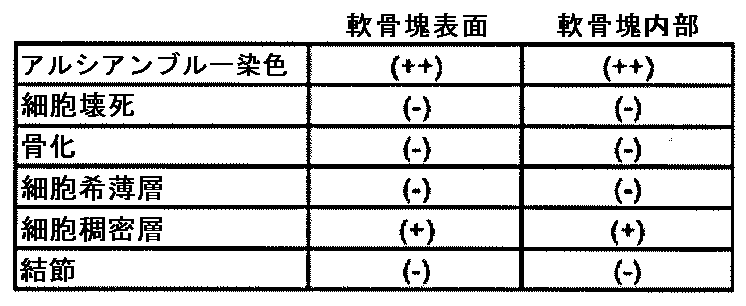
さらに、形成された軟骨組織塊から切片を作成し、アルシアンブルー染色を行って、軟骨組織塊内部における染色陽性の細胞を観察した(n=3)。組織所見の結果を「表2」に示す。(+)は良好に観察されたこと、(++)はより良好に観察されたことを示し、(-)は観察されなかったことを示す。軟骨組織塊内部には均一に密集した軟骨細胞が観察され、細胞壊死、骨化、細胞希薄な部位や結節も確認されず、良質な軟骨組織塊が形成されていることが確認できた。
配列番号1:ヒトFZD8のアミノ酸配列
配列番号2:ヒトFZD8断片のアミノ酸配列
配列番号3:ヒトFZD8可溶化受容体のアミノ酸配列
配列番号2:ヒトFZD8断片のアミノ酸配列
配列番号3:ヒトFZD8可溶化受容体のアミノ酸配列
Claims (20)
- Frizzled8(FZD8)タンパク質又はその断片を含む培地中で幹細胞から分化させた軟骨細胞から形成されてなる軟骨組織塊。
- FZD8タンパク質又はその断片と、軟骨細胞と、を含んでなる軟骨組織塊。
- 前記断片が、以下の(A)又は(B)のポリペプチドである、請求項1又は2記載の軟骨組織塊。
(A)配列番号2または配列番号3で示されるアミノ酸配列を含むポリペプチド。
(B)配列番号2または配列番号3で示されるアミノ酸配列において1もしくは数個のアミノ酸が欠失、置換、挿入又は付加されたアミノ酸配列を含み、幹細胞からの軟骨組織塊の形成を促進する活性を有するポリペプチド。 - 前記断片が、配列番号3のポリペプチドである、請求項1~3のいずれか一項に記載の軟骨組織塊。
- 前記幹細胞が間葉系幹細胞又は多能性幹細胞である、請求項1~4のいずれか一項に記載の軟骨組織塊。
- 前記幹細胞がヒト由来である、請求項1~5のいずれか一項に記載の軟骨組織塊。
- 前記培地が無血清培地である、請求項1~6のいずれか一項に記載の軟骨組織塊。
- FZD8タンパク質又はその断片を含む培地中で幹細胞から軟骨細胞の分化を誘導する工程を含む、軟骨組織塊の製造方法。
- 前記断片が、以下の(A)又は(B)のポリペプチドである、請求項8記載の製造方法。
(A)配列番号2または配列番号3で示されるアミノ酸配列を含むポリペプチド。
(B)配列番号2または配列番号3で示されるアミノ酸配列において1もしくは数個のアミノ酸が欠失、置換、挿入又は付加されたアミノ酸配列を含み、幹細胞からの軟骨組織塊の形成を促進する活性を有するポリペプチド。 - 前記断片が、配列番号3のポリペプチドである、請求項8又は9記載の軟骨組織塊の製造方法。
- 前記幹細胞が間葉系幹細胞又は多能性幹細胞である、請求項8~10のいずれか一項に記載の製造方法。
- 前記幹細胞がヒト由来である、請求項8~11のいずれか一項に記載の製造方法。
- 前記培地が無血清培地である、請求項8~12のいずれか一項に記載の製造方法。
- FZD8タンパク質又はその断片を含む、幹細胞から軟骨組織塊を分化、形成するための培地。
- 前記断片が、以下の(A)又は(B)のポリペプチドである、請求項14記載の培地。
(A)配列番号2または配列番号3で示されるアミノ酸配列を含むポリペプチド。
(B)配列番号2または配列番号3で示されるアミノ酸配列において1もしくは数個のアミノ酸が欠失、置換、挿入又は付加されたアミノ酸配列を含み、幹細胞からの軟骨組織塊の形成を促進する活性を有するポリペプチド。 - 前記断片が、配列番号3のポリペプチドである、請求項14又は15記載の培地。
- 前記幹細胞が間葉系幹細胞又は多能性幹細胞である、請求項14~16のいずれか一項に記載の培地。
- 前記幹細胞がヒト由来である、請求項14~17のいずれか一項に記載の培地。
- 前記培地が無血清培地である、請求項14~18のいずれか一項に記載の培地。
- 請求項1~7のいずれか一項に記載の軟骨組織塊又は請求項8~13のいずれかの製造方法により得られた軟骨組織塊を用いる、関節疾患の治療方法。
Applications Claiming Priority (2)
| Application Number | Priority Date | Filing Date | Title |
|---|---|---|---|
| JP2015-222846 | 2015-11-13 | ||
| JP2015222846A JP2019010002A (ja) | 2015-11-13 | 2015-11-13 | 軟骨組織塊及びその製造方法、並びに幹細胞から軟骨組織塊を誘導するための培地 |
Publications (1)
| Publication Number | Publication Date |
|---|---|
| WO2017082295A1 true WO2017082295A1 (ja) | 2017-05-18 |
Family
ID=58695624
Family Applications (1)
| Application Number | Title | Priority Date | Filing Date |
|---|---|---|---|
| PCT/JP2016/083233 Ceased WO2017082295A1 (ja) | 2015-11-13 | 2016-11-09 | 軟骨組織塊及びその製造方法、並びに幹細胞から軟骨組織塊を誘導するための培地 |
Country Status (2)
| Country | Link |
|---|---|
| JP (1) | JP2019010002A (ja) |
| WO (1) | WO2017082295A1 (ja) |
Cited By (1)
| Publication number | Priority date | Publication date | Assignee | Title |
|---|---|---|---|---|
| JP2020115771A (ja) * | 2019-01-22 | 2020-08-06 | 国立大学法人京都大学 | 多能性幹細胞から軟骨組織を製造する方法 |
Citations (4)
| Publication number | Priority date | Publication date | Assignee | Title |
|---|---|---|---|---|
| JP2008542366A (ja) * | 2005-05-30 | 2008-11-27 | アストラゼネカ・アクチエボラーグ | Fzd8モジュレーターを同定する方法および変形性関節症を処置するためのそのようなモジュレーターの使用 |
| JP2010136674A (ja) * | 2008-12-11 | 2010-06-24 | National Institute Of Advanced Industrial Science & Technology | コラーゲンコーティングした多孔性ポリマー材料を細胞足場材料として用いる軟骨組織作製方法 |
| WO2014148592A1 (ja) * | 2013-03-21 | 2014-09-25 | 公立大学法人横浜市立大学 | 軟骨細胞の調製方法 |
| JP2015070854A (ja) * | 2008-09-30 | 2015-04-16 | 協和発酵キリン株式会社 | Frizzled1、Frizzled2又はFrizzled7細胞外システインリッチドメインを含む蛋白質を含有する骨疾患治療用医薬組成物の製造方法 |
-
2015
- 2015-11-13 JP JP2015222846A patent/JP2019010002A/ja active Pending
-
2016
- 2016-11-09 WO PCT/JP2016/083233 patent/WO2017082295A1/ja not_active Ceased
Patent Citations (4)
| Publication number | Priority date | Publication date | Assignee | Title |
|---|---|---|---|---|
| JP2008542366A (ja) * | 2005-05-30 | 2008-11-27 | アストラゼネカ・アクチエボラーグ | Fzd8モジュレーターを同定する方法および変形性関節症を処置するためのそのようなモジュレーターの使用 |
| JP2015070854A (ja) * | 2008-09-30 | 2015-04-16 | 協和発酵キリン株式会社 | Frizzled1、Frizzled2又はFrizzled7細胞外システインリッチドメインを含む蛋白質を含有する骨疾患治療用医薬組成物の製造方法 |
| JP2010136674A (ja) * | 2008-12-11 | 2010-06-24 | National Institute Of Advanced Industrial Science & Technology | コラーゲンコーティングした多孔性ポリマー材料を細胞足場材料として用いる軟骨組織作製方法 |
| WO2014148592A1 (ja) * | 2013-03-21 | 2014-09-25 | 公立大学法人横浜市立大学 | 軟骨細胞の調製方法 |
Non-Patent Citations (1)
| Title |
|---|
| KIRTON, J.P . ET AL.: "Wnt/beta-Catenin Signaling Stimulates Chondrogenic and Inhibits Adipogenic Differentiation of Pericytes Potential Relevance to Vascular Disease?", CIRCULATION RESEARCH, vol. 101, 2007, pages 581 - 589, XP055381399 * |
Cited By (2)
| Publication number | Priority date | Publication date | Assignee | Title |
|---|---|---|---|---|
| JP2020115771A (ja) * | 2019-01-22 | 2020-08-06 | 国立大学法人京都大学 | 多能性幹細胞から軟骨組織を製造する方法 |
| JP7269620B2 (ja) | 2019-01-22 | 2023-05-09 | 国立大学法人京都大学 | 多能性幹細胞から軟骨組織を製造する方法 |
Also Published As
| Publication number | Publication date |
|---|---|
| JP2019010002A (ja) | 2019-01-24 |
Similar Documents
| Publication | Publication Date | Title |
|---|---|---|
| JP6662777B2 (ja) | 人工心筋(ehm)を産生するための方法 | |
| JP6635505B2 (ja) | 新規軟骨細胞誘導方法 | |
| JP6694215B2 (ja) | 新規軟骨細胞誘導方法 | |
| EP2828380B1 (en) | Methods and media for differentiating eye cells | |
| JP6744084B2 (ja) | 幹細胞由来の分化細胞用培地、幹細胞からの分化細胞の製造及び該分化細胞を含む細胞医薬組成物の製造のための方法 | |
| JP2024056901A (ja) | 未分化維持培地添加剤 | |
| WO2023127824A1 (ja) | 神経堤細胞の培養方法及び製造方法 | |
| JP2025160339A (ja) | 多能性幹細胞の製造方法 | |
| WO2017082296A1 (ja) | 軟骨組織塊及びその製造方法、並びに幹細胞から軟骨組織塊を誘導するための培地 | |
| JP7328688B2 (ja) | 副甲状腺細胞の作製方法 | |
| WO2017082295A1 (ja) | 軟骨組織塊及びその製造方法、並びに幹細胞から軟骨組織塊を誘導するための培地 | |
| JP2014143954A (ja) | 多能性幹細胞を効率的に作製する方法 | |
| WO2017082294A1 (ja) | 幹細胞の培養用培地、増殖促進剤及び培養方法、並びに幹細胞を含む細胞組成物及びその製造方法 | |
| EP3150700A1 (en) | Culture medium and culturing method for anchorage-dependent cells, cell composition including stem cells and/or differentiated cells derived from stem cells, and production method for cell composition | |
| US20210284966A1 (en) | Method of differentiation into mesenchymal stem cells through continuous subculture of dedifferentiated stem cells | |
| JP7829851B2 (ja) | 組織の製造方法 | |
| KR20190031459A (ko) | 역분화 줄기세포의 지속적인 계대배양을 통한 중간엽 줄기세포로의 분화방법 | |
| JP2020129970A (ja) | 多能性幹細胞を培養するための組成物及び方法 | |
| JPWO2019187918A1 (ja) | 分化コントロール化合物を用いて造腫瘍性をもつおそれのある未分化iPS細胞等の混入を除去する方法 | |
| WO2026014382A1 (ja) | 人工骨軟骨複合体およびその製造方法 | |
| JP2018110531A (ja) | 幹細胞の培地、増殖促進剤及び培養方法 | |
| Bergman | Differentiation of human pluripotent stem cell-derived mesenchymal progenitors into osteogenic, chondrogenic and adipogenic lineages | |
| HK1226443B (zh) | 用於产生工程化心肌(ehm)的方法 | |
| HK1226443A1 (en) | Method for producing engineered heart muscle (ehm) |
Legal Events
| Date | Code | Title | Description |
|---|---|---|---|
| 121 | Ep: the epo has been informed by wipo that ep was designated in this application |
Ref document number: 16864256 Country of ref document: EP Kind code of ref document: A1 |
|
| NENP | Non-entry into the national phase |
Ref country code: DE |
|
| 122 | Ep: pct application non-entry in european phase |
Ref document number: 16864256 Country of ref document: EP Kind code of ref document: A1 |
|
| NENP | Non-entry into the national phase |
Ref country code: JP |