WO2017073748A1 - 潤滑油組成物 - Google Patents
潤滑油組成物 Download PDFInfo
- Publication number
- WO2017073748A1 WO2017073748A1 PCT/JP2016/082112 JP2016082112W WO2017073748A1 WO 2017073748 A1 WO2017073748 A1 WO 2017073748A1 JP 2016082112 W JP2016082112 W JP 2016082112W WO 2017073748 A1 WO2017073748 A1 WO 2017073748A1
- Authority
- WO
- WIPO (PCT)
- Prior art keywords
- mass
- less
- lubricating oil
- oil composition
- group
- Prior art date
- Legal status (The legal status is an assumption and is not a legal conclusion. Google has not performed a legal analysis and makes no representation as to the accuracy of the status listed.)
- Ceased
Links
Classifications
-
- C—CHEMISTRY; METALLURGY
- C10—PETROLEUM, GAS OR COKE INDUSTRIES; TECHNICAL GASES CONTAINING CARBON MONOXIDE; FUELS; LUBRICANTS; PEAT
- C10M—LUBRICATING COMPOSITIONS; USE OF CHEMICAL SUBSTANCES EITHER ALONE OR AS LUBRICATING INGREDIENTS IN A LUBRICATING COMPOSITION
- C10M161/00—Lubricating compositions characterised by the additive being a mixture of a macromolecular compound and a non-macromolecular compound, each of these compounds being essential
-
- C—CHEMISTRY; METALLURGY
- C10—PETROLEUM, GAS OR COKE INDUSTRIES; TECHNICAL GASES CONTAINING CARBON MONOXIDE; FUELS; LUBRICANTS; PEAT
- C10M—LUBRICATING COMPOSITIONS; USE OF CHEMICAL SUBSTANCES EITHER ALONE OR AS LUBRICATING INGREDIENTS IN A LUBRICATING COMPOSITION
- C10M133/00—Lubricating compositions characterised by the additive being an organic non-macromolecular compound containing nitrogen
- C10M133/02—Lubricating compositions characterised by the additive being an organic non-macromolecular compound containing nitrogen having a carbon chain of less than 30 atoms
- C10M133/04—Amines, e.g. polyalkylene polyamines; Quaternary amines
-
- C—CHEMISTRY; METALLURGY
- C10—PETROLEUM, GAS OR COKE INDUSTRIES; TECHNICAL GASES CONTAINING CARBON MONOXIDE; FUELS; LUBRICANTS; PEAT
- C10M—LUBRICATING COMPOSITIONS; USE OF CHEMICAL SUBSTANCES EITHER ALONE OR AS LUBRICATING INGREDIENTS IN A LUBRICATING COMPOSITION
- C10M133/00—Lubricating compositions characterised by the additive being an organic non-macromolecular compound containing nitrogen
- C10M133/02—Lubricating compositions characterised by the additive being an organic non-macromolecular compound containing nitrogen having a carbon chain of less than 30 atoms
- C10M133/16—Amides; Imides
-
- C—CHEMISTRY; METALLURGY
- C10—PETROLEUM, GAS OR COKE INDUSTRIES; TECHNICAL GASES CONTAINING CARBON MONOXIDE; FUELS; LUBRICANTS; PEAT
- C10M—LUBRICATING COMPOSITIONS; USE OF CHEMICAL SUBSTANCES EITHER ALONE OR AS LUBRICATING INGREDIENTS IN A LUBRICATING COMPOSITION
- C10M135/00—Lubricating compositions characterised by the additive being an organic non-macromolecular compound containing sulfur, selenium or tellurium
- C10M135/20—Thiols; Sulfides; Polysulfides
-
- C—CHEMISTRY; METALLURGY
- C10—PETROLEUM, GAS OR COKE INDUSTRIES; TECHNICAL GASES CONTAINING CARBON MONOXIDE; FUELS; LUBRICANTS; PEAT
- C10M—LUBRICATING COMPOSITIONS; USE OF CHEMICAL SUBSTANCES EITHER ALONE OR AS LUBRICATING INGREDIENTS IN A LUBRICATING COMPOSITION
- C10M135/00—Lubricating compositions characterised by the additive being an organic non-macromolecular compound containing sulfur, selenium or tellurium
- C10M135/32—Heterocyclic sulfur, selenium or tellurium compounds
- C10M135/36—Heterocyclic sulfur, selenium or tellurium compounds the ring containing sulfur and carbon with nitrogen or oxygen
-
- C—CHEMISTRY; METALLURGY
- C10—PETROLEUM, GAS OR COKE INDUSTRIES; TECHNICAL GASES CONTAINING CARBON MONOXIDE; FUELS; LUBRICANTS; PEAT
- C10M—LUBRICATING COMPOSITIONS; USE OF CHEMICAL SUBSTANCES EITHER ALONE OR AS LUBRICATING INGREDIENTS IN A LUBRICATING COMPOSITION
- C10M145/00—Lubricating compositions characterised by the additive being a macromolecular compound containing oxygen
- C10M145/02—Macromolecular compounds obtained by reactions only involving carbon-to-carbon unsaturated bonds
- C10M145/10—Macromolecular compounds obtained by reactions only involving carbon-to-carbon unsaturated bonds containing monomers having an unsaturated radical bound to a carboxyl radical, e.g. acrylate
- C10M145/12—Macromolecular compounds obtained by reactions only involving carbon-to-carbon unsaturated bonds containing monomers having an unsaturated radical bound to a carboxyl radical, e.g. acrylate monocarboxylic
- C10M145/14—Acrylate; Methacrylate
-
- C—CHEMISTRY; METALLURGY
- C10—PETROLEUM, GAS OR COKE INDUSTRIES; TECHNICAL GASES CONTAINING CARBON MONOXIDE; FUELS; LUBRICANTS; PEAT
- C10M—LUBRICATING COMPOSITIONS; USE OF CHEMICAL SUBSTANCES EITHER ALONE OR AS LUBRICATING INGREDIENTS IN A LUBRICATING COMPOSITION
- C10M2203/00—Organic non-macromolecular hydrocarbon compounds and hydrocarbon fractions as ingredients in lubricant compositions
- C10M2203/10—Petroleum or coal fractions, e.g. tars, solvents, bitumen
- C10M2203/1006—Petroleum or coal fractions, e.g. tars, solvents, bitumen used as base material
-
- C—CHEMISTRY; METALLURGY
- C10—PETROLEUM, GAS OR COKE INDUSTRIES; TECHNICAL GASES CONTAINING CARBON MONOXIDE; FUELS; LUBRICANTS; PEAT
- C10M—LUBRICATING COMPOSITIONS; USE OF CHEMICAL SUBSTANCES EITHER ALONE OR AS LUBRICATING INGREDIENTS IN A LUBRICATING COMPOSITION
- C10M2203/00—Organic non-macromolecular hydrocarbon compounds and hydrocarbon fractions as ingredients in lubricant compositions
- C10M2203/10—Petroleum or coal fractions, e.g. tars, solvents, bitumen
- C10M2203/102—Aliphatic fractions
- C10M2203/1025—Aliphatic fractions used as base material
-
- C—CHEMISTRY; METALLURGY
- C10—PETROLEUM, GAS OR COKE INDUSTRIES; TECHNICAL GASES CONTAINING CARBON MONOXIDE; FUELS; LUBRICANTS; PEAT
- C10M—LUBRICATING COMPOSITIONS; USE OF CHEMICAL SUBSTANCES EITHER ALONE OR AS LUBRICATING INGREDIENTS IN A LUBRICATING COMPOSITION
- C10M2205/00—Organic macromolecular hydrocarbon compounds or fractions, whether or not modified by oxidation as ingredients in lubricant compositions
- C10M2205/02—Organic macromolecular hydrocarbon compounds or fractions, whether or not modified by oxidation as ingredients in lubricant compositions containing acyclic monomers
- C10M2205/028—Organic macromolecular hydrocarbon compounds or fractions, whether or not modified by oxidation as ingredients in lubricant compositions containing acyclic monomers containing aliphatic monomers having more than four carbon atoms
- C10M2205/0285—Organic macromolecular hydrocarbon compounds or fractions, whether or not modified by oxidation as ingredients in lubricant compositions containing acyclic monomers containing aliphatic monomers having more than four carbon atoms used as base material
-
- C—CHEMISTRY; METALLURGY
- C10—PETROLEUM, GAS OR COKE INDUSTRIES; TECHNICAL GASES CONTAINING CARBON MONOXIDE; FUELS; LUBRICANTS; PEAT
- C10M—LUBRICATING COMPOSITIONS; USE OF CHEMICAL SUBSTANCES EITHER ALONE OR AS LUBRICATING INGREDIENTS IN A LUBRICATING COMPOSITION
- C10M2209/00—Organic macromolecular compounds containing oxygen as ingredients in lubricant compositions
- C10M2209/02—Macromolecular compounds obtained by reactions only involving carbon-to-carbon unsaturated bonds
- C10M2209/08—Macromolecular compounds obtained by reactions only involving carbon-to-carbon unsaturated bonds containing monomers having an unsaturated radical bound to a carboxyl radical, e.g. acrylate type
- C10M2209/084—Acrylate; Methacrylate
-
- C—CHEMISTRY; METALLURGY
- C10—PETROLEUM, GAS OR COKE INDUSTRIES; TECHNICAL GASES CONTAINING CARBON MONOXIDE; FUELS; LUBRICANTS; PEAT
- C10M—LUBRICATING COMPOSITIONS; USE OF CHEMICAL SUBSTANCES EITHER ALONE OR AS LUBRICATING INGREDIENTS IN A LUBRICATING COMPOSITION
- C10M2215/00—Organic non-macromolecular compounds containing nitrogen as ingredients in lubricant Compositions
- C10M2215/02—Amines, e.g. polyalkylene polyamines; Quaternary amines
-
- C—CHEMISTRY; METALLURGY
- C10—PETROLEUM, GAS OR COKE INDUSTRIES; TECHNICAL GASES CONTAINING CARBON MONOXIDE; FUELS; LUBRICANTS; PEAT
- C10M—LUBRICATING COMPOSITIONS; USE OF CHEMICAL SUBSTANCES EITHER ALONE OR AS LUBRICATING INGREDIENTS IN A LUBRICATING COMPOSITION
- C10M2215/00—Organic non-macromolecular compounds containing nitrogen as ingredients in lubricant Compositions
- C10M2215/02—Amines, e.g. polyalkylene polyamines; Quaternary amines
- C10M2215/04—Amines, e.g. polyalkylene polyamines; Quaternary amines having amino groups bound to acyclic or cycloaliphatic carbon atoms
-
- C—CHEMISTRY; METALLURGY
- C10—PETROLEUM, GAS OR COKE INDUSTRIES; TECHNICAL GASES CONTAINING CARBON MONOXIDE; FUELS; LUBRICANTS; PEAT
- C10M—LUBRICATING COMPOSITIONS; USE OF CHEMICAL SUBSTANCES EITHER ALONE OR AS LUBRICATING INGREDIENTS IN A LUBRICATING COMPOSITION
- C10M2215/00—Organic non-macromolecular compounds containing nitrogen as ingredients in lubricant Compositions
- C10M2215/08—Amides [having hydrocarbon substituents containing less than thirty carbon atoms]
-
- C—CHEMISTRY; METALLURGY
- C10—PETROLEUM, GAS OR COKE INDUSTRIES; TECHNICAL GASES CONTAINING CARBON MONOXIDE; FUELS; LUBRICANTS; PEAT
- C10M—LUBRICATING COMPOSITIONS; USE OF CHEMICAL SUBSTANCES EITHER ALONE OR AS LUBRICATING INGREDIENTS IN A LUBRICATING COMPOSITION
- C10M2219/00—Organic non-macromolecular compounds containing sulfur, selenium or tellurium as ingredients in lubricant compositions
- C10M2219/08—Thiols; Sulfides; Polysulfides; Mercaptals
-
- C—CHEMISTRY; METALLURGY
- C10—PETROLEUM, GAS OR COKE INDUSTRIES; TECHNICAL GASES CONTAINING CARBON MONOXIDE; FUELS; LUBRICANTS; PEAT
- C10M—LUBRICATING COMPOSITIONS; USE OF CHEMICAL SUBSTANCES EITHER ALONE OR AS LUBRICATING INGREDIENTS IN A LUBRICATING COMPOSITION
- C10M2219/00—Organic non-macromolecular compounds containing sulfur, selenium or tellurium as ingredients in lubricant compositions
- C10M2219/10—Heterocyclic compounds containing sulfur, selenium or tellurium compounds in the ring
- C10M2219/104—Heterocyclic compounds containing sulfur, selenium or tellurium compounds in the ring containing sulfur and carbon with nitrogen or oxygen in the ring
- C10M2219/106—Thiadiazoles
-
- C—CHEMISTRY; METALLURGY
- C10—PETROLEUM, GAS OR COKE INDUSTRIES; TECHNICAL GASES CONTAINING CARBON MONOXIDE; FUELS; LUBRICANTS; PEAT
- C10M—LUBRICATING COMPOSITIONS; USE OF CHEMICAL SUBSTANCES EITHER ALONE OR AS LUBRICATING INGREDIENTS IN A LUBRICATING COMPOSITION
- C10M2223/00—Organic non-macromolecular compounds containing phosphorus as ingredients in lubricant compositions
- C10M2223/02—Organic non-macromolecular compounds containing phosphorus as ingredients in lubricant compositions having no phosphorus-to-carbon bonds
- C10M2223/04—Phosphate esters
-
- C—CHEMISTRY; METALLURGY
- C10—PETROLEUM, GAS OR COKE INDUSTRIES; TECHNICAL GASES CONTAINING CARBON MONOXIDE; FUELS; LUBRICANTS; PEAT
- C10M—LUBRICATING COMPOSITIONS; USE OF CHEMICAL SUBSTANCES EITHER ALONE OR AS LUBRICATING INGREDIENTS IN A LUBRICATING COMPOSITION
- C10M2223/00—Organic non-macromolecular compounds containing phosphorus as ingredients in lubricant compositions
- C10M2223/02—Organic non-macromolecular compounds containing phosphorus as ingredients in lubricant compositions having no phosphorus-to-carbon bonds
- C10M2223/049—Phosphite
-
- C—CHEMISTRY; METALLURGY
- C10—PETROLEUM, GAS OR COKE INDUSTRIES; TECHNICAL GASES CONTAINING CARBON MONOXIDE; FUELS; LUBRICANTS; PEAT
- C10N—INDEXING SCHEME ASSOCIATED WITH SUBCLASS C10M RELATING TO LUBRICATING COMPOSITIONS
- C10N2030/00—Specified physical or chemical properties which is improved by the additive characterising the lubricating composition, e.g. multifunctional additives
- C10N2030/02—Pour-point; Viscosity index
-
- C—CHEMISTRY; METALLURGY
- C10—PETROLEUM, GAS OR COKE INDUSTRIES; TECHNICAL GASES CONTAINING CARBON MONOXIDE; FUELS; LUBRICANTS; PEAT
- C10N—INDEXING SCHEME ASSOCIATED WITH SUBCLASS C10M RELATING TO LUBRICATING COMPOSITIONS
- C10N2030/00—Specified physical or chemical properties which is improved by the additive characterising the lubricating composition, e.g. multifunctional additives
- C10N2030/06—Oiliness; Film-strength; Anti-wear; Resistance to extreme pressure
-
- C—CHEMISTRY; METALLURGY
- C10—PETROLEUM, GAS OR COKE INDUSTRIES; TECHNICAL GASES CONTAINING CARBON MONOXIDE; FUELS; LUBRICANTS; PEAT
- C10N—INDEXING SCHEME ASSOCIATED WITH SUBCLASS C10M RELATING TO LUBRICATING COMPOSITIONS
- C10N2030/00—Specified physical or chemical properties which is improved by the additive characterising the lubricating composition, e.g. multifunctional additives
- C10N2030/68—Shear stability
-
- C—CHEMISTRY; METALLURGY
- C10—PETROLEUM, GAS OR COKE INDUSTRIES; TECHNICAL GASES CONTAINING CARBON MONOXIDE; FUELS; LUBRICANTS; PEAT
- C10N—INDEXING SCHEME ASSOCIATED WITH SUBCLASS C10M RELATING TO LUBRICATING COMPOSITIONS
- C10N2040/00—Specified use or application for which the lubricating composition is intended
- C10N2040/04—Oil-bath; Gear-boxes; Automatic transmissions; Traction drives
Definitions
- the present invention relates to a lubricating oil composition.
- lubricating oil compositions have been used in mechanical devices such as internal combustion engines and transmissions in order to make their operations smooth.
- various additives such as an antiwear agent, a metallic detergent, an ashless dispersant, and an antioxidant are blended in the lubricating base oil according to the required performance (for example, Patent Documents 1 to 4). 3).
- An object of the present invention is to provide a lubricating oil composition that is excellent in load resistance, fatigue life, shear stability, and friction characteristics.
- the present invention relates to a dispersed poly (meth) having a weight base molecular weight of 1.0 to 15.0% by weight and a weight average molecular weight of 20,000 to 200,000 based on the total amount of the lubricating base oil and the lubricating oil composition.
- a mass ratio of the content of the polysulfide compound to the content of the thiadiazole compound (polysulfide compound / thiadiazole compound) is 0.4 or more and 50 or less, and the lubricating oil composition moves at 100 ° C. the viscosity is less than 7.0 mm 2 / s or more 35.0 mm 2 / s, to provide a lubricating oil composition.
- the friction modifier preferably contains at least one selected from the group consisting of primary or secondary amide friction modifiers and primary or secondary amine friction modifiers.
- Lubricating oil composition is suitably used as a lubricating oil composition for gear oil.
- Lubricating oil composition is suitably used as a lubricating oil composition for final reducer oil.
- a lubricating oil composition that is excellent in load resistance, fatigue life, shear stability, and friction characteristics.
- the lubricating oil composition comprises (A) a lubricating base oil, (B) a dispersed poly (meth) acrylate compound, (C) a thiadiazole compound, (D) a polysulfide compound, and (E) And a friction modifier.
- Lubricating oil base oil (hereinafter also referred to as “component (A)”) may be a known base oil used for lubricating oil, for example, mineral oil base oil, synthetic base oil, or both It may be a mixture.
- mineral base oils lubricating oil fractions obtained by subjecting crude oil to atmospheric distillation and reduced pressure distillation are subjected to solvent deburring, solvent extraction, hydrocracking, solvent dewaxing, catalytic dewaxing, hydrorefining, sulfuric acid
- mineral oil base oils include paraffinic and naphthenic mineral oil base oils, normal paraffins, isoparaffins, and the like, which are purified by combining purification treatments such as washing and clay treatment alone or in combination of two or more.
- These mineral oil base oils may be used singly or in combination of two or more at any ratio.
- Preferred mineral base oils include the following base oils.
- Distilled oil obtained by atmospheric distillation of paraffin-based crude oil and / or mixed-base crude oil (2) Vacuum-distilled distilled oil (WVGO) of atmospheric distillation residue oil of paraffin-based crude oil and / or mixed-base crude oil ) (3) Wax obtained by lubricating oil dewaxing step and / or Fischer-Tropsch wax produced by GTL process or the like (4)
- One or more mixed oils selected from the above (1) to (3) Mild hydrocracking oil (MHC) Mixed oil of two or more oils selected from the above (1) to (4) (6) Detachment of (1), (2), (3), (4) or (5) Oil (DAO) (7) Mild hydrocracking treatment oil (MHC) of (6) above (8)
- a mixed oil of two or more kinds of oils selected from the above (1) to (7) is used as a raw oil, and this raw oil and / or a lubricating oil fraction recovered from this raw oil is usually used.
- the normal refining method is not particularly limited, and may be any refining method used in base oil production.
- normal purification methods include the following purification methods.
- Purification e) Chemical (acid or alkali) purification such as sulfuric acid washing and caustic soda washing These purification methods can be used singly or in combination of two or more and in any order.
- Synthetic base oils include poly ⁇ -olefins or hydrides thereof, isobutene oligomers or hydrides thereof, isoparaffins, alkylbenzenes, alkylnaphthalenes, diesters (ditridecylglutarate, di-2-ethylhexyl adipate, di-2-ethylhexyl azease).
- polyol ester trimethylolpropane caprylate, trimethylolpropane pelargonate, pentaerythritol 2-ethylhexanoate, pentaerythritol pelargonate, etc.
- examples thereof include polyoxyalkylene glycol, dialkyl diphenyl ether, polyphenyl ether and the like. Among them, poly ⁇ -olefin is preferable.
- poly ⁇ -olefin examples include oligomers or co-oligomers (1-octene oligomers, decene oligomers, ethylene-propylene co-oligomers, etc.) of ⁇ -olefins having 2 to 32 carbon atoms, preferably 6 to 16 carbon atoms, and their A hydride is mentioned.
- These synthetic base oils may be used individually by 1 type, and may be used combining 2 or more types by arbitrary ratios.
- the kinematic viscosity at 40 ° C. of the lubricating base oil is preferably 20 mm 2 / s or more, more preferably 50 mm 2 / s or more, and still more preferably 90 mm 2 / s or more. If the kinematic viscosity at 40 ° C. of the lubricating base oil is 20 mm 2 / s or more, the formation of an oil film is sufficient, the lubricating oil composition is more excellent, and a lubricating oil composition with lower evaporation loss under high temperature conditions is easily obtained. .
- the kinematic viscosity at 40 ° C. of the lubricating base oil is 180 mm 2 / s or less, more preferably 140 mm 2 / s or less, and still more preferably 130 mm 2 / s or less.
- the kinematic viscosity at 40 ° C. of the lubricating base oil is 180 mm 2 / s or less, the fluid resistance becomes small, so that it becomes easy to obtain a lubricating oil composition having a smaller rotational resistance.
- the kinematic viscosity at 100 ° C. of the lubricating base oil is preferably 3.0 mm 2 / s or more, more preferably 5.0 mm 2 / s or more, and still more preferably 10.0 mm 2 / s or more.
- the kinematic viscosity at 100 ° C. of the lubricating base oil is 3.0 mm 2 / s or higher, the formation of an oil film is sufficient, the lubricating oil composition is excellent, and the lubricating oil composition having a lower evaporation loss under high temperature conditions is obtained. It becomes easy.
- the lubricating base oil is preferably 25 mm 2 / s or less, more preferably 18 mm 2 / s or less, and still more preferably 15 mm 2 / s or less.
- the kinematic viscosity at 100 ° C. of the lubricating base oil is 25 mm 2 / s or less, the fluid resistance becomes small, so that it becomes easy to obtain a lubricating oil composition having a smaller rotational resistance.
- the viscosity index of the lubricating base oil is preferably 60 or more, more preferably 80 or more, and still more preferably 90 or more.
- the viscosity index is 60 or more, it becomes easy to obtain a lubricating oil composition exhibiting better viscosity characteristics from a low temperature to a high temperature.
- the kinematic viscosity and the viscosity index in the present invention mean the kinematic viscosity and the viscosity index measured according to JIS K2283: 2000, respectively.
- the sulfur content in the lubricant base oil may be 5000 mass ppm or less, 4500 mass ppm or less, or 4000 mass ppm or less based on the total amount of the lubricant base oil.
- the sulfur content in the lubricating base oil can be measured by ICP elemental analysis.
- the content of the component (A) may be, for example, 70% by mass or more, 80% by mass or more, or 85% by mass or more based on the total amount of the lubricating oil composition.
- the content of the component (A) may be, for example, 95% by mass or less, 93% by mass or less, or 90% by mass or less, based on the total amount of the lubricating oil composition.
- (B) Dispersion-type poly (meth) acrylate compound (hereinafter also referred to as “(B) component”) includes a poly (meth) acrylate compound having a dispersion group.
- the dispersing group is preferably a nitrogen-containing dispersing group, more preferably a dimethylamino group.
- the component (B) is preferably a poly (meth) acrylate compound having at least one structural unit selected from a structural unit represented by the following formula (1) and a structural unit represented by the following formula (2). Including.
- R 1 represents a hydrogen atom or a methyl group
- R 2 represents an alkylene group having 1 to 18 carbon atoms
- E 1 represents 1 to 2 nitrogen atoms and 0 to 2 oxygen atoms.
- m represents 0 or 1.
- R 3 represents a hydrogen atom or a hydrocarbon group
- E 2 represents an amine residue or a heterocyclic residue having 1 to 2 nitrogen atoms and 0 to 2 oxygen atoms.
- Examples of the alkylene group having 1 to 18 carbon atoms represented by R 2 include an ethylene group, a propylene group, a butylene group, a pentylene group, a hexylene group, a heptylene group, an octylene group, a nonylene group, a decylene group, an undecylene group, and a dodecylene group. , Tridecylene group, tetradecylene group, pentadecylene group, hexadecylene group, heptadecylene group, and octadecylene group. These alkylene groups may be linear or branched.
- the hydrocarbon group represented by R 3 may be, for example, a linear or branched hydrocarbon group having 1 to 12 carbon atoms.
- Examples of the groups represented by E 1 and E 2 include a dimethylamino group, a diethylamino group, a dipropylamino group, a dibutylamino group, an anilino group, a toluidino group, a xylidino group, an acetylamino group, a benzoylamino group, and a morpholino group, respectively.
- Pyrrolyl group pyrrolino group, pyridyl group, methylpyridyl group, pyrrolidinyl group, piperidinyl group, quinonyl group, pyrrolidonyl group, pyrrolidono group, imidazolino group, and pyrazino group.
- the weight average molecular weight of the dispersed poly (meth) acrylate is preferably 20,000 or more, more preferably 30,000 or more, and further preferably 40,000 or more, from the viewpoint of excellent fatigue life.
- the weight average molecular weight of the dispersed poly (meth) acrylate is preferably 200,000 or less, more preferably 170,000 or less, still more preferably 110,000 or less, and particularly preferably 50,000 or less, from the viewpoint of excellent shear stability.
- the weight average molecular weight of the dispersed poly (meth) acrylate is 20,000 or more and 200,000 or less, preferably 20,000 or more and 170,000 or less, and 20,000 or more and 110,000 from the viewpoint of achieving both fatigue life and shear stability.
- the weight average molecular weight in this invention means the weight average molecular weight (polystyrene (standard sample) conversion value) measured by GPC analysis.
- the content of the component (B) is preferably 1.0% by mass or more, more preferably 2.0% by mass or more, and further preferably 2.5% by mass based on the total amount of the lubricating oil composition from the viewpoint of excellent fatigue life. % Or more.
- the content of the component (B) is preferably 15.0% by mass or less, more preferably 9.0% by mass or less, preferably 5.0% by mass based on the total amount of the lubricating oil composition from the viewpoint of excellent shear stability. % Or less.
- the content of the component (B) is 1.0% by mass or more and 15.0% by mass or less based on the total amount of the lubricating oil composition from the viewpoint of achieving both fatigue life and shear stability.
- the (C) thiadiazole compound (hereinafter also referred to as “component (C)”) may be a known thiadiazole compound, for example, a 1,3,4-thiadiazole compound represented by the following formula (3), It may be a 1,2,4-thiadiazole compound represented by 4) or a 1,2,3-thiadiazole compound represented by the following formula (5).
- R 4 , R 5 , R 6 , R 7 , R 8 and R 9 each independently represent a hydrogen atom or a hydrocarbon group having 1 to 20 carbon atoms, and a, b, c, d, e and f independently represents an integer of 0 to 8.
- thiadiazole compounds include 2,5-bis (n-hexyldithio) -1,3,4-thiadiazole, 2,5-bis (n-octyldithio) -1,3,4-thiadiazole 2,5-bis (n-nonyldithio) -1,3,4-thiadiazole, 2,5-bis (1,1,3,3-tetramethylbutyldithio) -1,3,4-thiadiazole, 3, 5-bis (n-hexyldithio) -1,2,4-thiadiazole, 3,5-bis (n-octyldithio) -1,2,4-thiadiazole, 3,5-bis (n-nonyldithio) -1 , 2,4-thiadiazole, 3,5-bis (1,1,3,3-tetramethylbutyldithio) -1,2,4-thiadiazole, 4,5-bis (n-hexyldithio) -1
- the content of the component (C) is preferably 0.05% by mass or more, more preferably 0.2% by mass or more, and further preferably 1.0% by mass based on the total amount of the lubricating oil composition from the viewpoint of excellent load resistance. It is at least 1.5% by mass, particularly preferably at least 1.5% by mass.
- the content of the component (C) is preferably 6.0% by mass or less, more preferably 4.5% by mass or less, and still more preferably 3.0% by mass based on the total amount of the lubricating oil composition from the viewpoint of excellent fatigue life. % Or less.
- the content of the component (C) is 0.05% by mass or more and 6.0% by mass or less on the basis of the total amount of the lubricating oil composition from the viewpoint of achieving both load resistance and fatigue life.
- 05% to 4.5% by mass 0.05% to 3.0% by mass, 0.2% to 6.0% by mass, 0.2% to 4.5% by mass, 0.2% by mass to 3.0% by mass, 1.0% by mass to 6.0% by mass, 1.0% by mass to 4.5% by mass, 1.0% by mass to 3.0% by mass
- they are 1.5 mass% or more and 6.0 mass% or less, 1.5 mass% or more and 4.5 mass% or less, or 1.5 mass% or more and 3.0 mass% or less.
- the polysulfide compound (hereinafter also referred to as “component (D)”) may be a known polysulfide compound, for example, a compound represented by the following formula (6).
- component (D) may be a known polysulfide compound, for example, a compound represented by the following formula (6).
- R 10 and R 11 are each independently a linear or branched alkyl group having 3 to 20 carbon atoms, an aryl group having 6 to 20 carbon atoms, or an alkenyl having 6 to 20 carbon atoms.
- the content of the component (D) is preferably 1.5% by mass or more, more preferably 1.8% by mass or more, and further preferably 2.0% by mass, based on the total amount of the lubricating oil composition, from the viewpoint of excellent extreme pressure properties. % Or more.
- the content of the component (D) is preferably 4.0% by mass or less, more preferably 3.0% by mass or less, and still more preferably 2.5% by mass based on the total amount of the lubricating oil composition from the viewpoint of excellent fatigue life. % Or less, particularly preferably 2.2% by mass or less.
- the content of the component (D) is 1.5% by mass or more and 4.0% by mass or less, preferably 1.5% by mass based on the total amount of the lubricating oil composition from the viewpoint of achieving both extreme pressure properties and fatigue life.
- % By mass to 3.0% by mass, 1.5% by mass to 2.5% by mass, 1.8% by mass to 4.0% by mass, 1.8% by mass to 2.5% by mass, 0.8 mass% to 2.2 mass%, 2.0 mass% to 4.0 mass%, 2.0 mass% to 2.5 mass%, 2.0 mass% to 2.2 mass% It is.
- the friction modifier (hereinafter also referred to as “component (E)”) may be a known friction modifier, such as an amine, amide, imide, fatty acid ester, fatty acid, aliphatic alcohol. Or an aliphatic ether friction modifier.
- the component (E) preferably contains at least one friction modifier selected from the group consisting of primary or secondary amine friction modifiers and primary or secondary amide friction modifiers.
- the alkyl group may be linear or branched); alkenyl groups having 2 to 30 carbon atoms such as ethenylamine, propenylamine, butenylamine, octenylamine, oleylamine (these alkenyl groups may be linear or branched).
- An alicyclic amine such as cyclohexylamine; an alkylene having an alkylene group of 1 to 30 carbon atoms such as methylenediamine, ethylenediamine, propylenediamine, or butylenediamine; Amines are exemplified. Among these, alkylamine and alkenylamine are preferable.
- the carbon number of the alkyl group of the alkylamine is preferably 4 to 28, more preferably 6 to 25.
- the carbon number of the alkenyl group of alkenylamine is preferably 4 to 28, more preferably 6 to 25.
- Examples of primary or secondary amide friction modifiers include ethanoic acid amide, propanoic acid amide, butanoic acid amide, octanoic acid amide, decanoic acid amide, dodecanoic acid amide, hexadecanoic acid amide, octadecanoic acid amide, docosanoic acid amide, etc.
- the carbon number of the alkyl group of the saturated fatty acid amide is preferably 4 to 28, more preferably 6 to 25.
- the alkenyl group of the unsaturated fatty acid amide preferably has 4 to 28, more preferably 6 to 25 carbon atoms.
- the content of the component (E) is preferably 0.2% by mass or more, more preferably 0.5% by mass or more, and still more preferably 0.7% by mass based on the total amount of the lubricating oil composition from the viewpoint of excellent friction characteristics. % Or more.
- the content of the component (E) is preferably 1.5% by mass or less, more preferably 1.2% by mass or less, and still more preferably 0.9% by mass based on the total amount of the lubricating oil composition from the viewpoint of excellent oxidation stability. It is below mass%.
- the content of the component (E) is 0.2% by mass or more and 1.5% by mass or less on the basis of the total amount of the lubricating oil composition from the viewpoint of achieving both frictional characteristics and oxidation stability, and preferably 2% by mass to 1.2% by mass, 0.2% by mass to 0.9% by mass, 0.5% by mass to 1.5% by mass, 0.5% by mass to 1.2% by mass, 0.5% to 0.9% by mass, 0.7% to 1.5% by mass, 0.7% to 1.2% by mass, or 0.7% to 0.9% by mass % Or less.
- the mass ratio of the content of the (D) polysulfide compound to the content of the (C) thiadiazole compound is 0. 4 or more and 50 or less, more preferably 0.5 or more and 30 or less, still more preferably 1.0 or more and 15 or less, and particularly preferably 1.0 or more and 10 or less.
- the mass ratio (component (D) / component (C)) may be 0.4 or more, 0.5 or more, or 1.0 or more, and is 50 or less, 30 or less, 15 or less, or 10 or less. It's okay.
- the lubricating oil composition may further contain other additives as required in addition to the above components (A) to (E).
- Other additives include, for example, extreme pressure agents, viscosity modifiers, metal detergents, ashless dispersants, antioxidants, corrosion inhibitors, rust inhibitors, antiemulsifiers, metal deactivators, and antifoaming agents. Etc.
- extreme pressure agents phosphorous esters (phosphites), phosphate esters, phosphorus extreme pressure agents such as amine salts, metal salts and derivatives thereof, dithiocarbamates, zinc dithiocarbamates, molybdenum dithiocarbamates ( MoDTC), sulfur-based extreme pressure agents such as sulfurized olefins, sulfurized fats and oils, and the like.
- the viscosity modifier examples include, for example, a non-dispersed poly (meth) acrylate viscosity modifier, a styrene-maleic anhydride copolymer viscosity modifier, a non-dispersed or dispersed ethylene- ⁇ -olefin copolymer or its Examples thereof include hydrides, polyisobutylene or hydrides thereof, styrene-diene hydrogenated copolymers, and polyalkylstyrenes.
- metal detergents examples include salicylate detergents, phenate detergents, sulfonate detergents, and the like. These metal detergents may be any of normal salt, basic normal salt, and overbased salt with alkali metal or alkaline earth metal.
- Ashless dispersants include nitrogen-containing compounds such as succinimides, benzylamines, polyamines, Mannich bases having alkenyl groups or alkyl groups derived from polyolefins, and boron compounds such as boric acid and borates. Examples thereof include boron-modified nitrogen-containing compounds (boron-based ashless dispersant) such as boron-modified succinimide modified with a compound.
- antioxidants examples include ashless antioxidants such as phenols and amines, and metal antioxidants such as copper and molybdenum.
- phenol-based ashless antioxidants include 4,4′-methylenebis (2,6-di-tert-butylphenol), 4,4′-bis (2,6-di-tert-
- amine-based ashless antioxidants include phenyl- ⁇ -naphthylamine, alkylphenyl- ⁇ -naphthylamine, dialkyldiphenylamine, and diphenylamine.
- corrosion inhibitor examples include benzotriazole, tolyltriazole, and imidazole compounds.
- rust preventive examples include alkenyl succinate, polyhydric alcohol ester, petroleum sulfonate, alkylbenzene sulfonate, dinonylnaphthalene sulfonate, and the like.
- demulsifier examples include polyalkylene glycol nonionic surfactants such as polyoxyethylene alkyl ether, polyoxyethylene alkyl phenyl ether, and polyoxyethylene alkyl naphthyl ether.
- metal deactivator examples include imidazoline, pyrimidine derivatives, benzotriazole or derivatives thereof.
- 100,000 mm kinematic viscosity at 25 ° C. is 1000 mm 2 / s or more 2 / s or less silicone oil, alkenylsuccinic acid derivatives, esters of polyhydroxy aliphatic alcohols and long-chain fatty acids, methyl salicylate And esters of o-hydroxybenzyl alcohol and the like.
- the content of other additives may be 0.01 to 20% by mass based on the total amount of the lubricating oil composition.
- the kinematic viscosity at 40 ° C. of the lubricating oil composition is preferably 70 mm 2 / s or more, more preferably 100 mm 2 / s or more, and still more preferably 120 mm 2 / s or more.
- the kinematic viscosity at 40 ° C. of the lubricating oil composition is preferably 250 mm 2 / s or less, more preferably 230 mm 2 / s or less, and still more preferably 210 mm 2 / s or less.
- the kinematic viscosity at 40 ° C. is 260 mm 2 / s or less, it tends to be excellent in low-temperature fluidity and fuel economy.
- Kinematic viscosity at 100 ° C. of the lubricating oil composition is preferably 7.0 mm 2 / s or more, more preferably 10.0 mm 2 / s or more, further preferably 13.0 mm 2 / s or more.
- Kinematic viscosity at 100 ° C. of the lubricating oil composition is preferably 35.0 mm 2 / s or less, more preferably 25.0 mm 2 / s, more preferably not more than 20.0 mm 2 / s.
- the elemental sulfur content (C S ) in the lubricating oil composition may be, for example, 10000 mass ppm or more and 31000 mass ppm or less, based on the total amount of the lubricating oil composition.
- the elemental sulfur in the lubricating oil composition is derived from the elemental sulfur contained in the lubricating oil base oil and additives such as the components (C) and (D).
- the phosphorus element content (C P ) in the lubricating oil composition may be, for example, 700 mass ppm or more and 2000 mass ppm or less based on the total amount of the lubricating oil composition.
- the phosphorus element in the lubricating oil composition is derived from the phosphorus element contained in an additive such as a phosphorus extreme pressure agent.
- the boron element content (C B ) in the lubricating oil composition may be, for example, 30 mass ppm or more and 200 mass ppm or less, based on the total amount of the lubricating oil composition.
- the boron element in the lubricating oil composition is derived from the boron element contained in an additive such as a boron-based ashless dispersant.
- the contents of elemental sulfur, phosphorus element and boron element are preferably expressed by the following formula (from the viewpoint of further improved load resistance and fatigue life): 7) is satisfied.
- C S / (C P ⁇ C B ) is preferably 0.05 or more, more preferably 0.07 or more, still more preferably 0.12 or more, and particularly preferably, from the viewpoint of further excellent load resistance. It is 0.25 or more.
- C S / (C P ⁇ C B ) is preferably 0.50 or less, more preferably 0.45 or less, still more preferably 0.40 or less, and particularly preferably 0.8, from the viewpoint of further improving fatigue life. 35 or less.
- Each content of sulfur element, phosphorus element, and boron element can be measured by ICP elemental analysis.
- the lubricating oil composition according to the present embodiment can be used for a normal use of lubricating oil, but is preferably used as a lubricating oil composition for gear oil. More specifically, the lubricating oil composition is preferably applied to a manual transmission for an automobile, an automatic transmission, a continuously variable transmission or a final reduction gear, or an industrial gear system. The lubricating oil composition is particularly preferably used as a final reduction gear oil lubricating oil composition.
- a lubricating oil composition was prepared using the following lubricating base oil and additives.
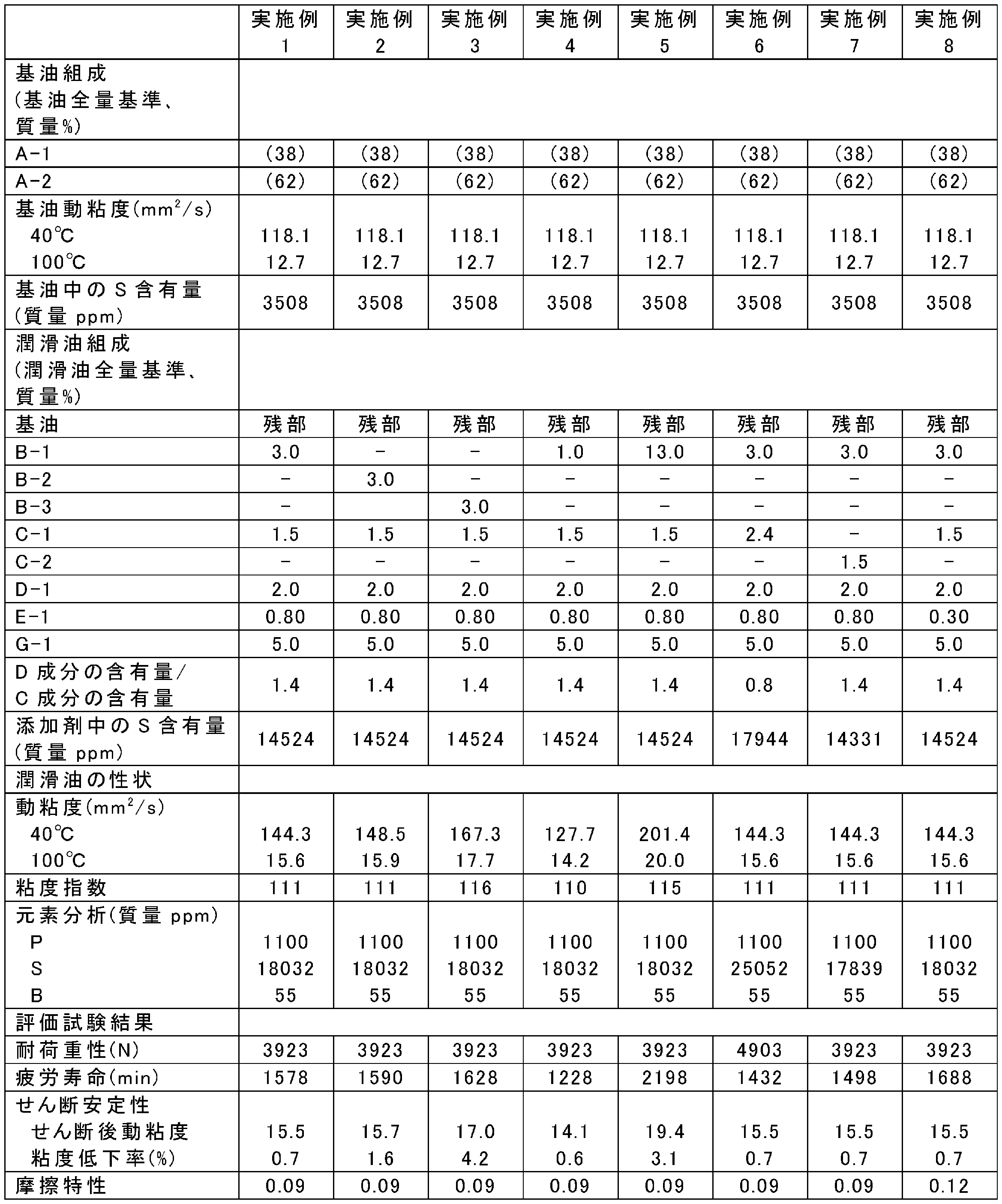
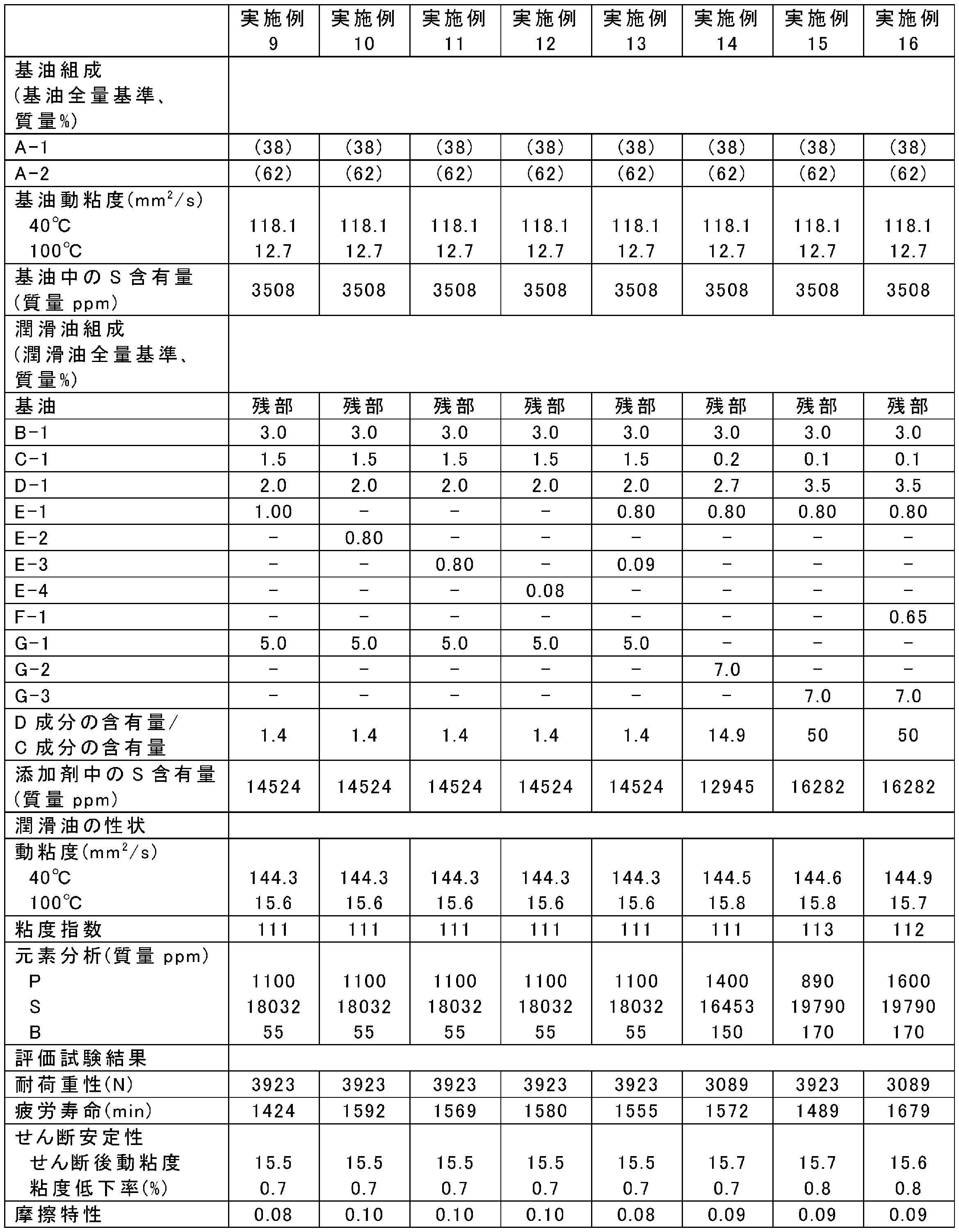
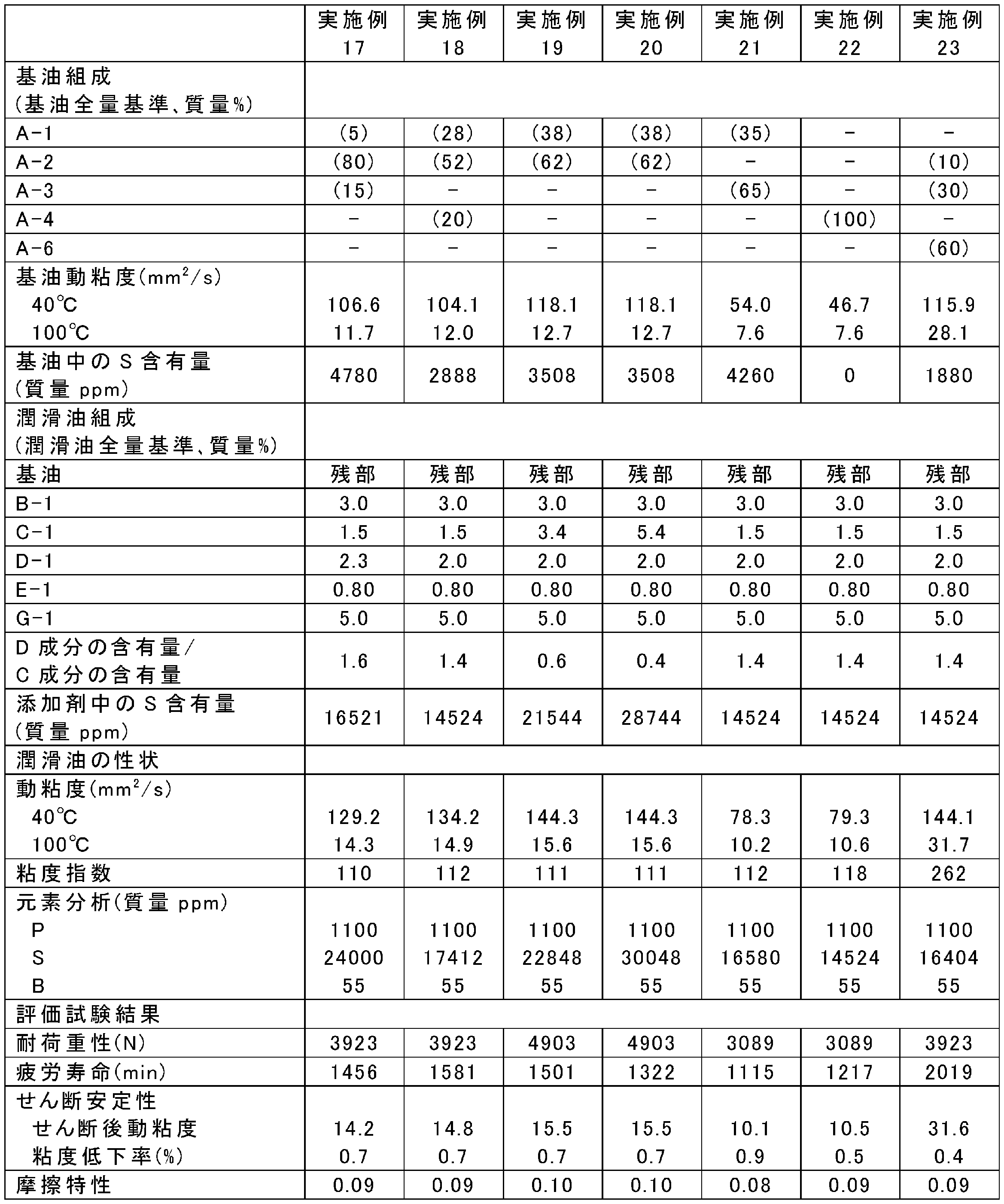
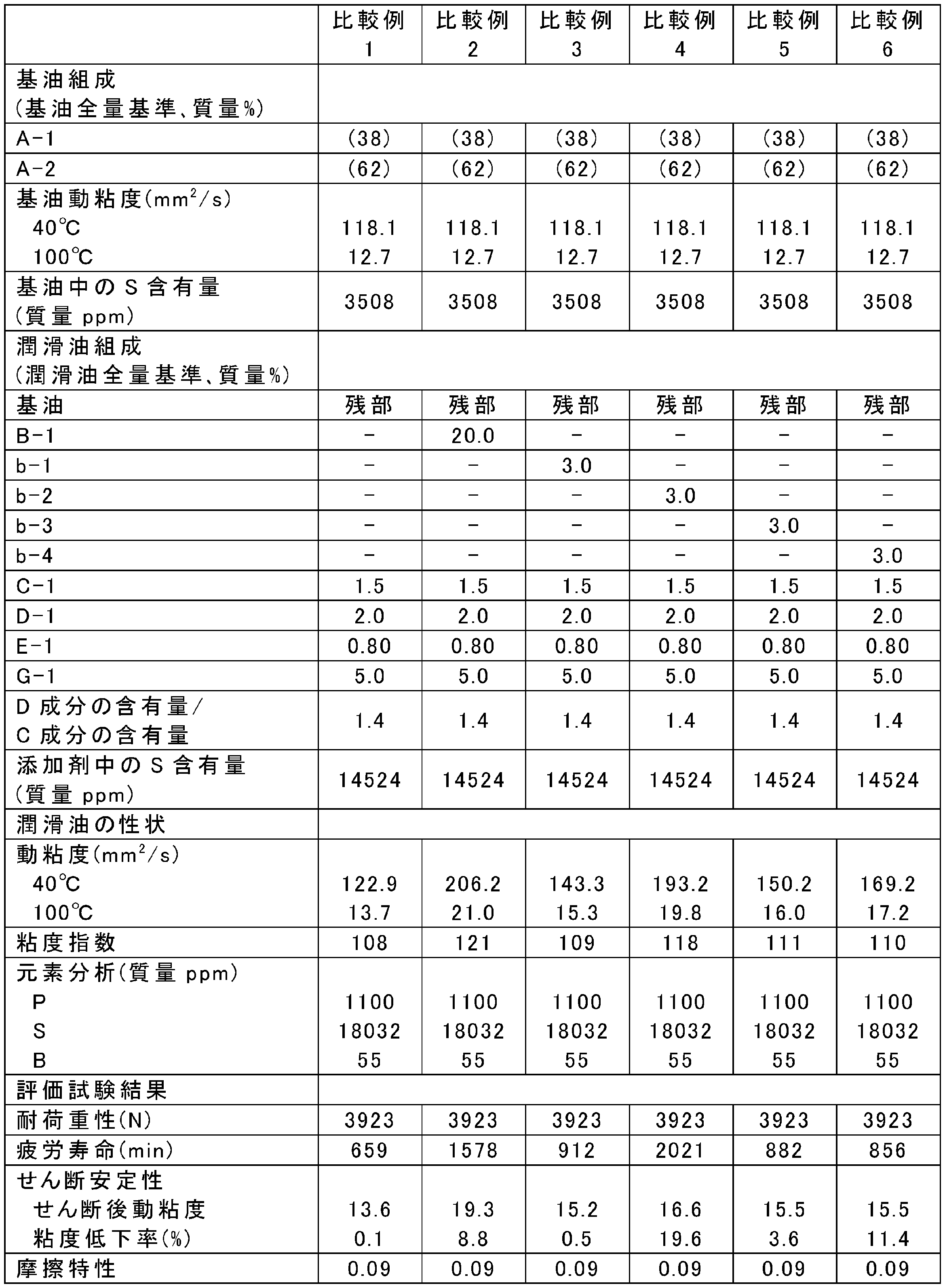
- the compositions of the lubricating oil composition are shown in Tables 1-5.
- A-1 Solvent refined mineral oil (GrI, 40 ° C. kinematic viscosity: 22.7 mm 2 / s, 100 ° C. kinematic viscosity: 4.4 mm 2 / s, viscosity index: 102, sulfur content: 0.14% by mass)
- A-2 Solvent refined mineral oil (GrI, 40 ° C. kinematic viscosity: 478.3 mm 2 / s, 100 ° C. kinematic viscosity: 31.6 mm 2 / s, viscosity index: 97, sulfur content: 0.48% by mass)
- A-3 Solvent refined mineral oil (GrI, 40 ° C.
- A-4 Hydrorefined mineral oil (GrIII, 40 ° C. kinematic viscosity: 46.71 mm 2 / s, 100 ° C. kinematic viscosity: 7.595 mm 2 / s, viscosity index: 129, sulfur content: ⁇ 10 mass ppm)
- A-5 Hydrorefined mineral oil (GrIII, 40 ° C. kinematic viscosity: 8.73 mm 2 / s, 100 ° C.
- kinematic viscosity 2.435 mm 2 / s, viscosity index: 98, sulfur content: ⁇ 10 mass ppm)
- A-6 Poly ⁇ -olefin (GrIV, 40 ° C. kinematic viscosity: 405 mm 2 / s, 100 ° C.
- B-1 Dispersed poly (meth) acrylate (weight average molecular weight: 40000)
- B-2 Dispersed poly (meth) acrylate (weight average molecular weight: 60000)
- B-3 Dispersed poly (meth) acrylate (weight average molecular weight: 150,000)
- b-1 Dispersed poly (meth) acrylate (weight average molecular weight: 10,000)
- b-2 Dispersed poly (meth) acrylate (weight average molecular weight: 250,000)
- b-3 Non-dispersed poly (meth) acrylate (weight average molecular weight: 40000)
- b-4 Non-dispersed poly (meth) acrylate (weight average molecular weight: 150,000)
- C-1 2,5-bis (alkyldithio) -1,3,4-thiadiazole (sulfur
Landscapes
- Chemical & Material Sciences (AREA)
- Chemical Kinetics & Catalysis (AREA)
- General Chemical & Material Sciences (AREA)
- Oil, Petroleum & Natural Gas (AREA)
- Organic Chemistry (AREA)
- Lubricants (AREA)
Abstract
Description
(1)パラフィン基系原油及び/又は混合基系原油の常圧蒸留による留出油
(2)パラフィン基系原油及び/又は混合基系原油の常圧蒸留残渣油の減圧蒸留留出油(WVGO)
(3)潤滑油脱ろう工程により得られるワックス及び/又はGTLプロセス等により製造されるフィッシャートロプシュワックス
(4)上記(1)~(3)の中から選ばれる1種又は2種以上の混合油のマイルドハイドロクラッキング処理油(MHC)
(5)上記(1)~(4)の中から選ばれる2種以上の油の混合油
(6)上記(1)、(2)、(3)、(4)又は(5)の脱れき油(DAO)
(7)上記(6)のマイルドハイドロクラッキング処理油(MHC)
(8)上記(1)~(7)の中から選ばれる2種以上の油の混合油等を原料油とし、この原料油及び/又はこの原料油から回収された潤滑油留分を、通常の精製方法によって精製し、潤滑油留分を回収することによって得られる潤滑油
(a)水素化分解、水素化仕上げ等の水素化精製
(b)フルフラール溶剤抽出等の溶剤精製
(c)溶剤脱ろう、接触脱ろう等の脱ろう
(d)酸性白土、活性白土等による白土精製
(e)硫酸洗浄、苛性ソーダ洗浄等の薬品(酸又はアルカリ)精製
これらの精製方法は、1種単独で、又は2種以上を任意の組み合わせ及び任意の順序で採用することができる。





R10-Sx-R11 (6)
0.05≦CS/(CP×CB)≦0.50 (7)
A-1:溶剤精製鉱油(GrI、40℃動粘度:22.7mm2/s、100℃動粘度:4.4mm2/s、粘度指数:102、硫黄分:0.14質量%)
A-2:溶剤精製鉱油(GrI、40℃動粘度:478.3mm2/s、100℃動粘度:31.6mm2/s、粘度指数:97、硫黄分:0.48質量%)
A-3:溶剤精製鉱油(GrI、40℃動粘度:95.1mm2/s、100℃動粘度:10.9mm2/s、粘度指数:98、硫黄分:0.58質量%)
A-4:水素化精製鉱油(GrIII、40℃動粘度:46.71mm2/s、100℃動粘度:7.595mm2/s、粘度指数:129、硫黄分:<10質量ppm)
A-5:水素化精製鉱油(GrIII、40℃動粘度:8.73mm2/s、100℃動粘度:2.435mm2/s、粘度指数:98、硫黄分:<10質量ppm)
A-6:ポリαオレフィン(GrIV、40℃動粘度:405mm2/s、100℃動粘度:50mm2/s、粘度指数:187、硫黄分:<10質量ppm)
[添加剤]
B-1:分散型ポリ(メタ)アクリレート(重量平均分子量:40000)
B-2:分散型ポリ(メタ)アクリレート(重量平均分子量:60000)
B-3:分散型ポリ(メタ)アクリレート(重量平均分子量:150000)
b-1:分散型ポリ(メタ)アクリレート(重量平均分子量:10000)
b-2:分散型ポリ(メタ)アクリレート(重量平均分子量:250000)
b-3:非分散型ポリ(メタ)アクリレート(重量平均分子量:40000)
b-4:非分散型ポリ(メタ)アクリレート(重量平均分子量:150000)
C-1:2,5-ビス(アルキルジチオ)-1,3,4-チアジアゾール(硫黄元素含有量:36.0質量%)
C-2:2,5-ビス(アルキルジチオ)-1,3,4-チアジアゾール(硫黄元素含有量:34.7質量%)
D-1:ポリサルファイド(硫黄元素含有量:45.8質量%)
E-1:オレイルアミン
E-2:2-エチルヘキシルアミン
E-3:ジステアリルアミン
E-4:オレイン酸アミド
F-1:ジ(n-ブチル)フォスファイト(リン元素含有量:15.5質量%)
G-1:ホウ素系分散剤10質量%、アミン系酸化防止剤0.1質量%、リン酸エステル15質量%、消泡剤0.5質量%、及び希釈油10質量%を含有する添加剤パッケージ
G-2:ホウ素系分散剤15質量%、アミン系酸化防止剤0.1質量%、リン酸エステル17質量%、消泡剤0.5質量%、及び希釈油10質量%を含有する添加剤パッケージ
G-3:ホウ素系分散剤0.1質量%、アミン系酸化防止剤0.1質量%、リン酸エステル10質量%、消泡剤0.5質量%、及び希釈油5質量%を含有する添加剤パッケージ
ASTM D2596に準拠し、高速四球試験機を用いて、各潤滑油組成物の1800rpmにおける融着荷重(WL)を測定した。本試験においては、融着荷重が大きい(例えば、3089N以上)ほど、耐荷重性に優れていることを意味する。
ユニスチール転がり疲労試験機を用いて、以下の条件でピッチングが発生するまでのギヤの疲労寿命を評価した。本試験においては、疲労寿命が長い(例えば、1000分以上)ほど、疲労寿命に優れていることを意味する。
試験片:スラストニードル
面圧:2GPa
油温:120℃
回転数:1410rpm
JPI-5S-29-88に準拠し、以下の条件でソニックテストを行い、ソニックテスト前後の100℃動粘度から粘度低下率を測定した。本試験においては、粘度低下率が小さい(例えば8%以下)ほど、せん断安定性に優れていることを意味する。
振動数:10kHz
振幅:28μm
照射時間:1時間
LFW-1試験機を用いて、以下の条件で金属間摩擦係数を評価した。本試験においては、金属間摩擦係数が小さい(例えば、0.15以下)ほど、摩擦特性に優れていることを意味する。
試験片:ブロックH60、リングS10
荷重:3113N
すべり速度:0.5m/s
油温:90℃
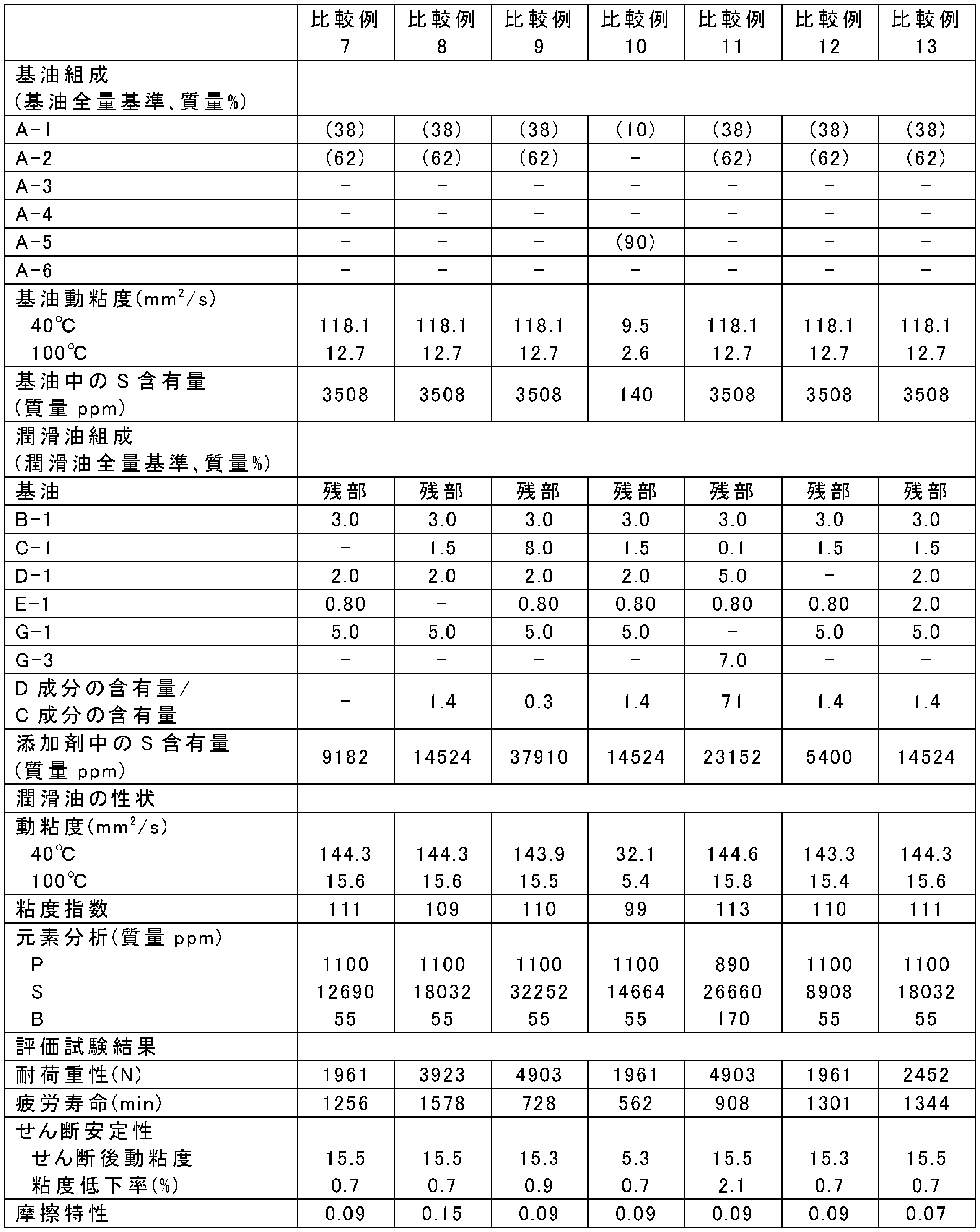
Claims (4)
- 潤滑油基油と、
潤滑油組成物全量基準で、
1.0質量%以上15.0質量%以下の、重量平均分子量が2万以上20万以下である分散型ポリ(メタ)アクリレート化合物と、
0.05質量%以上6.0質量%以下のチアジアゾール化合物と、
1.5質量%以上4.0質量%以下のポリサルファイド化合物と、
0.2質量%以上1.5質量%以下の摩擦調整剤と、
を含有し、
前記チアジアゾール化合物の含有量に対する前記ポリサルファイド化合物の含有量の質量比(ポリサルファイド化合物/チアジアゾール化合物)が0.4以上50以下であり、
潤滑油組成物の100℃における動粘度が7.0mm2/s以上35.0mm2/s以下である、潤滑油組成物。 - 前記摩擦調整剤が、1級又は2級のアミド系摩擦調整剤、及び1級又は2級のアミン系摩擦調整剤からなる群より選ばれる少なくとも1種を含む、請求項1に記載の潤滑油組成物。
- ギヤ油用である、請求項1又は2に記載の潤滑油組成物。
- 最終減速機油用である、請求項1又は2に記載の潤滑油組成物。
Priority Applications (3)
| Application Number | Priority Date | Filing Date | Title |
|---|---|---|---|
| US15/770,661 US20180312776A1 (en) | 2015-10-29 | 2016-10-28 | Lubricant composition |
| CN201680061732.9A CN108138071B (zh) | 2015-10-29 | 2016-10-28 | 润滑油组合物 |
| JP2017547901A JP6657248B2 (ja) | 2015-10-29 | 2016-10-28 | 潤滑油組成物 |
Applications Claiming Priority (2)
| Application Number | Priority Date | Filing Date | Title |
|---|---|---|---|
| JP2015-212595 | 2015-10-29 | ||
| JP2015212595 | 2015-10-29 |
Publications (1)
| Publication Number | Publication Date |
|---|---|
| WO2017073748A1 true WO2017073748A1 (ja) | 2017-05-04 |
Family
ID=58630360
Family Applications (1)
| Application Number | Title | Priority Date | Filing Date |
|---|---|---|---|
| PCT/JP2016/082112 Ceased WO2017073748A1 (ja) | 2015-10-29 | 2016-10-28 | 潤滑油組成物 |
Country Status (4)
| Country | Link |
|---|---|
| US (1) | US20180312776A1 (ja) |
| JP (1) | JP6657248B2 (ja) |
| CN (1) | CN108138071B (ja) |
| WO (1) | WO2017073748A1 (ja) |
Cited By (2)
| Publication number | Priority date | Publication date | Assignee | Title |
|---|---|---|---|---|
| KR20200041899A (ko) * | 2017-08-17 | 2020-04-22 | 더루브리졸코오퍼레이션 | 드라이브 라인 윤활제용 질소-작용화된 올레핀 중합체 |
| WO2024019027A1 (ja) | 2022-07-20 | 2024-01-25 | Eneos株式会社 | 潤滑油組成物 |
Families Citing this family (1)
| Publication number | Priority date | Publication date | Assignee | Title |
|---|---|---|---|---|
| WO2025201962A1 (en) | 2024-03-27 | 2025-10-02 | Shell Internationale Research Maatschappij B.V. | Lubricating oil composition |
Citations (4)
| Publication number | Priority date | Publication date | Assignee | Title |
|---|---|---|---|---|
| JP2000063870A (ja) * | 1998-07-31 | 2000-02-29 | Chevron Chem Sa | 加水分解に対して安定で高いシンクロメッシュ耐久性を与える手動変速機潤滑剤用ホウ酸塩含有添加剤 |
| JP2004323850A (ja) * | 2003-04-25 | 2004-11-18 | Chevron Oronite Co Llc | 低銅腐食性のギヤ油 |
| JP2013203947A (ja) * | 2012-03-29 | 2013-10-07 | Jx Nippon Oil & Energy Corp | 潤滑油組成物 |
| JP2013203948A (ja) * | 2012-03-29 | 2013-10-07 | Jx Nippon Oil & Energy Corp | 潤滑油組成物 |
Family Cites Families (6)
| Publication number | Priority date | Publication date | Assignee | Title |
|---|---|---|---|---|
| JP4142060B2 (ja) * | 2006-04-17 | 2008-08-27 | 新日本石油株式会社 | 自動変速機用潤滑油組成物 |
| JP5213310B2 (ja) * | 2006-04-20 | 2013-06-19 | Jx日鉱日石エネルギー株式会社 | 潤滑油組成物 |
| JP5393192B2 (ja) * | 2009-02-24 | 2014-01-22 | Jx日鉱日石エネルギー株式会社 | ギヤ用潤滑油組成物 |
| EP2439258A4 (en) * | 2009-06-04 | 2013-03-13 | Jx Nippon Oil & Energy Corp | OIL COMPOSITION |
| JP5809582B2 (ja) * | 2012-02-21 | 2015-11-11 | Jx日鉱日石エネルギー株式会社 | 潤滑油組成物 |
| US9410106B2 (en) * | 2012-03-12 | 2016-08-09 | Idemitsu Kosan Co., Ltd. | Lubricating oil composition |
-
2016
- 2016-10-28 US US15/770,661 patent/US20180312776A1/en not_active Abandoned
- 2016-10-28 JP JP2017547901A patent/JP6657248B2/ja active Active
- 2016-10-28 CN CN201680061732.9A patent/CN108138071B/zh active Active
- 2016-10-28 WO PCT/JP2016/082112 patent/WO2017073748A1/ja not_active Ceased
Patent Citations (4)
| Publication number | Priority date | Publication date | Assignee | Title |
|---|---|---|---|---|
| JP2000063870A (ja) * | 1998-07-31 | 2000-02-29 | Chevron Chem Sa | 加水分解に対して安定で高いシンクロメッシュ耐久性を与える手動変速機潤滑剤用ホウ酸塩含有添加剤 |
| JP2004323850A (ja) * | 2003-04-25 | 2004-11-18 | Chevron Oronite Co Llc | 低銅腐食性のギヤ油 |
| JP2013203947A (ja) * | 2012-03-29 | 2013-10-07 | Jx Nippon Oil & Energy Corp | 潤滑油組成物 |
| JP2013203948A (ja) * | 2012-03-29 | 2013-10-07 | Jx Nippon Oil & Energy Corp | 潤滑油組成物 |
Cited By (5)
| Publication number | Priority date | Publication date | Assignee | Title |
|---|---|---|---|---|
| KR20200041899A (ko) * | 2017-08-17 | 2020-04-22 | 더루브리졸코오퍼레이션 | 드라이브 라인 윤활제용 질소-작용화된 올레핀 중합체 |
| JP2020531622A (ja) * | 2017-08-17 | 2020-11-05 | ザ ルブリゾル コーポレイションThe Lubrizol Corporation | 駆動系潤滑剤用窒素官能化オレフィンポリマー |
| JP7182609B2 (ja) | 2017-08-17 | 2022-12-02 | ザ ルブリゾル コーポレイション | 駆動系潤滑剤用窒素官能化オレフィンポリマー |
| KR102647296B1 (ko) | 2017-08-17 | 2024-03-13 | 더루브리졸코오퍼레이션 | 드라이브 라인 윤활제용 질소-작용화된 올레핀 중합체 |
| WO2024019027A1 (ja) | 2022-07-20 | 2024-01-25 | Eneos株式会社 | 潤滑油組成物 |
Also Published As
| Publication number | Publication date |
|---|---|
| JP6657248B2 (ja) | 2020-03-04 |
| CN108138071A (zh) | 2018-06-08 |
| JPWO2017073748A1 (ja) | 2018-08-16 |
| CN108138071B (zh) | 2022-01-04 |
| US20180312776A1 (en) | 2018-11-01 |
Similar Documents
| Publication | Publication Date | Title |
|---|---|---|
| JP5800931B2 (ja) | 潤滑油組成物 | |
| JP5829374B2 (ja) | 潤滑油組成物 | |
| WO2010140446A1 (ja) | 潤滑油組成物 | |
| JPWO2018212340A1 (ja) | 内燃機関用潤滑油組成物 | |
| WO2010010807A1 (ja) | 潤滑油組成物 | |
| WO2010041692A1 (ja) | 潤滑油組成物及びその製造方法 | |
| JP2012207083A (ja) | 潤滑油組成物 | |
| WO2011083601A1 (ja) | 潤滑油組成物 | |
| JP2011140572A (ja) | 潤滑油組成物 | |
| JP5756337B2 (ja) | 潤滑油組成物 | |
| JP2016020498A (ja) | 潤滑油組成物 | |
| JP6730123B2 (ja) | 潤滑油組成物 | |
| JP6736037B2 (ja) | 内燃機関用潤滑油組成物 | |
| JP6657248B2 (ja) | 潤滑油組成物 | |
| JP2011021056A (ja) | 潤滑油組成物 | |
| JP6310798B2 (ja) | 潤滑油組成物 | |
| JP5564204B2 (ja) | 潤滑油組成物 | |
| JP5931250B2 (ja) | 潤滑油組成物 | |
| JP2024034683A (ja) | 潤滑油組成物 | |
| JP2012111820A (ja) | 潤滑油組成物 | |
| JP2016190919A (ja) | 潤滑油組成物 | |
| JP5815809B2 (ja) | 潤滑油組成物 | |
| JP2024115171A (ja) | 潤滑油組成物 | |
| JP5750218B2 (ja) | 潤滑油組成物 | |
| JP6591907B2 (ja) | 内燃機関用潤滑油組成物 |
Legal Events
| Date | Code | Title | Description |
|---|---|---|---|
| 121 | Ep: the epo has been informed by wipo that ep was designated in this application |
Ref document number: 16859976 Country of ref document: EP Kind code of ref document: A1 |
|
| ENP | Entry into the national phase |
Ref document number: 2017547901 Country of ref document: JP Kind code of ref document: A |
|
| WWE | Wipo information: entry into national phase |
Ref document number: 15770661 Country of ref document: US |
|
| NENP | Non-entry into the national phase |
Ref country code: DE |
|
| 122 | Ep: pct application non-entry in european phase |
Ref document number: 16859976 Country of ref document: EP Kind code of ref document: A1 |