WO2017073405A1 - エラストマー部材、及び、工作機械用シール部材 - Google Patents
エラストマー部材、及び、工作機械用シール部材 Download PDFInfo
- Publication number
- WO2017073405A1 WO2017073405A1 PCT/JP2016/080840 JP2016080840W WO2017073405A1 WO 2017073405 A1 WO2017073405 A1 WO 2017073405A1 JP 2016080840 W JP2016080840 W JP 2016080840W WO 2017073405 A1 WO2017073405 A1 WO 2017073405A1
- Authority
- WO
- WIPO (PCT)
- Prior art keywords
- weight
- sheet
- machine tool
- urethane
- coolant
- Prior art date
- Legal status (The legal status is an assumption and is not a legal conclusion. Google has not performed a legal analysis and makes no representation as to the accuracy of the status listed.)
- Ceased
Links
Images


Classifications
-
- B—PERFORMING OPERATIONS; TRANSPORTING
- B23—MACHINE TOOLS; METAL-WORKING NOT OTHERWISE PROVIDED FOR
- B23Q—DETAILS, COMPONENTS, OR ACCESSORIES FOR MACHINE TOOLS, e.g. ARRANGEMENTS FOR COPYING OR CONTROLLING; MACHINE TOOLS IN GENERAL CHARACTERISED BY THE CONSTRUCTION OF PARTICULAR DETAILS OR COMPONENTS; COMBINATIONS OR ASSOCIATIONS OF METAL-WORKING MACHINES, NOT DIRECTED TO A PARTICULAR RESULT
- B23Q11/00—Accessories fitted to machine tools for keeping tools or parts of the machine in good working condition or for cooling work; Safety devices specially combined with or arranged in, or specially adapted for use in connection with, machine tools
- B23Q11/08—Protective coverings for parts of machine tools; Splash guards
- B23Q11/0875—Wipers for clearing foreign matter from slideways or slidable coverings
-
- C—CHEMISTRY; METALLURGY
- C08—ORGANIC MACROMOLECULAR COMPOUNDS; THEIR PREPARATION OR CHEMICAL WORKING-UP; COMPOSITIONS BASED THEREON
- C08G—MACROMOLECULAR COMPOUNDS OBTAINED OTHERWISE THAN BY REACTIONS ONLY INVOLVING UNSATURATED CARBON-TO-CARBON BONDS
- C08G18/00—Polymeric products of isocyanates or isothiocyanates
- C08G18/06—Polymeric products of isocyanates or isothiocyanates with compounds having active hydrogen
- C08G18/28—Polymeric products of isocyanates or isothiocyanates with compounds having active hydrogen characterised by the compounds used containing active hydrogen
- C08G18/40—High-molecular-weight compounds
- C08G18/42—Polycondensates having carboxylic or carbonic ester groups in the main chain
Definitions
- the present invention relates to an elastomer member and a machine tool seal member.
- Machine tools such as lathes and machining centers are the most basic mechanical devices widely used in the manufacturing industry.
- seal members such as a lip seal, a slide seal, a telescopic seal, and a cover seal are used to protect the drive mechanism and the like from chips and coolant (cutting oil).
- a sealing member for machine tools a sealing member having a supporting member and an elastic member integrated with the supporting member is known.
- Such seal members are made of chloroprene rubber (CR), acrylonitrile rubber (NBR), hydrogenated nitrile rubber (H-NBR), styrene butadiene rubber (SBR), ethylene / propylene diene monomer (EPDM) It has been proposed to use a rubber material such as polyurethane or an elastic material such as polyurethane (for example, see Patent Document 1).
- CR chloroprene rubber
- NBR acrylonitrile rubber
- H-NBR hydrogenated nitrile rubber
- SBR styrene butadiene rubber
- EPDM ethylene / propylene diene monomer
- the machine tool seal member is a member for protecting the drive mechanism from coolant or the like. Therefore, the elastic member of the sealing member for machine tools is exposed to the coolant during use. The elastic member exposed to the coolant is gradually swollen by the coolant. As a result, the sealing member for machine tools cannot perform its function and needs to be replaced. Moreover, when the elastic member containing an additive is exposed to a coolant, the said additive may elute. As a result, the physical properties of the elastic member may change, and the function of the machine tool seal member may not be achieved.
- the coolant is roughly classified into a water-insoluble cutting oil and a water-soluble cutting oil, and both have different characteristics.
- the elastic member of the conventional sealing member for machine tools is (a) one that swells or elutes easily with water-soluble cutting oil even if it is difficult to swell and dissolve with water-insoluble cutting oil, or ( b) Even if it is difficult to swell and dissolve with water-soluble cutting oil, only water-soluble cutting oil easily swells or dissolves. That is, an elastic member that hardly swells and dissolves in both water-insoluble cutting oil and water-soluble cutting oil has not been known so far.
- the present inventors have intensively studied to solve such a problem, it is difficult to swell to any coolant of water-insoluble cutting oil and water-soluble cutting oil, or the additive is difficult to elute,
- the present invention has been completed by finding an elastomer member that can be suitably used for a machine tool using a coolant.
- the elastomer member of the present invention comprises a cured product of a thermosetting polyurethane composition
- the thermosetting polyurethane composition contains a polyol component, an isocyanate component and a crosslinking agent, and the polyol component is a polyethylene adipate ester polyol.
- PEA polyethylene adipate ester polyol
- the elastomer member is made of a cured product of a thermosetting urethane composition having a JIS-A hardness of 67 ° or more, it swells and dissolves in any water-insoluble cutting water or water-soluble cutting oil. It ’s hard. Therefore, it can be suitably used for a machine tool that uses coolant.
- the sealing member for machine tools of the present invention is a sealing member for machine tools comprising a supporting member and an elastic member integrated with the supporting member, wherein the elastic member is composed of the elastomer member of the present invention.
- the elastic member is made of the elastomer member of the present invention which is difficult to swell or elute by the coolant. Therefore, the sealing member for machine tools is not easily deteriorated even when exposed to the coolant, and can maintain excellent sealing performance for a long period of time.
- the elastomer member of the present invention has excellent durability against cutting oil (coolant) regardless of water-insoluble cutting oil or water-soluble cutting oil. Since the sealing member for machine tools of this invention consists of the elastomer member of this invention, it can maintain the outstanding sealing performance over a long period of time.
- FIG.1 (a) is a top view which shows an example of the sealing member for machine tools which concerns on embodiment of this invention
- FIG.1 (b) is a side view of Fig.1 (a).
- Fig.2 (a) is a reverse view which shows another example of the sealing member for machine tools which concerns on embodiment of this invention
- FIG.2 (b) is a side view of Fig.2 (a).
- FIG. 4A is a graph showing the immersion time and the weight increase rate when the sheet prepared in the example is immersed in the coolant A (50 ° C.), and
- FIG. 4B is the sheet prepared in the comparative example.
- FIG. 5A is a graph showing the immersion time and the weight increase rate when the sheet prepared in the example is immersed in the coolant B (50 ° C.)
- FIG. 5B is the sheet manufactured in the comparative example.
- FIG. 6A is a graph showing the immersion time and the rate of weight increase when the sheet prepared in the example is immersed in the coolant C (50 ° C.)
- FIG. 6B is the sheet manufactured in the comparative example.
- the elastomer member which concerns on embodiment of this invention consists of hardened
- the said thermosetting urethane composition contains a polyol component, an isocyanate component, and a crosslinking agent, and the said polyol component is a polyethylene adipate ester polyol (PEA). Since the said elastomer member is a hardened
- PEA polyethylene adipate ester polyol
- the PEA preferably has a number average molecular weight of 1000 to 3000.
- An elastomer member using PEA having a number average molecular weight within the above range can more reliably prevent intrusion of chips, coolant, and the like at the time of contact with the counterpart material.
- the number average molecular weight is a measured value in terms of polystyrene by GPC (gel permeation chromatograph) measurement.
- thermosetting urethane composition contains an isocyanate component and a crosslinking agent other than PEA (polyol component). It does not specifically limit as said isocyanate component, For example, aliphatic isocyanate, alicyclic isocyanate, aromatic isocyanate etc. are mentioned. Of these, aromatic isocyanates are preferred from the viewpoint of good wear resistance.
- aliphatic isocyanate examples include 1,6-hexamethylene diisocyanate (HDI), 2,2,4-trimethylhexamethylene diisocyanate, and lysine diisocyanate.
- HDI 1,6-hexamethylene diisocyanate
- 2,2,4-trimethylhexamethylene diisocyanate examples include 1,6-hexamethylene diisocyanate (HDI), 2,2,4-trimethylhexamethylene diisocyanate, and lysine diisocyanate.
- isocyanurate body, biuret body, adduct body, etc. of hexamethylene diisocyanate and isophorone diisocyanate are also mentioned.
- alicyclic isocyanate examples include alicyclic diisocyanates such as isophorone diisocyanate (IPDI), 4,4′-dicyclohexylmethane diisocyanate, 1,4-cyclohexane diisocyanate, norbornane diisocyanate (NBDI), and the like.
- IPDI isophorone diisocyanate
- NBDI norbornane diisocyanate
- aromatic isocyanate examples include tolylene diisocyanate (TDI), phenylene diisocyanate, 4,4'-diphenylmethane diisocyanate, polymethylene polyphenylene polyisocyanate, and a mixture of diphenylmethane diisocyanate and polymethylene polyphenylene polyisocyanate (hereinafter collectively referred to as generic names).
- TDI tolylene diisocyanate
- phenylene diisocyanate 4,4'-diphenylmethane diisocyanate
- polymethylene polyphenylene polyisocyanate examples of the aromatic isocyanate
- NDI 1,5-naphthalene diisocyanate
- XDI xylylene diisocyanate
- carbodiimide-modified MDI urethane-modified MDI, and the like.
- MDI and NDI are preferable as the isocyanate component. This is because, among aromatic isocyanates, particularly excellent wear resistance is exhibited.
- crosslinking agent examples include 1,4-butanediol (1,4-BD), 1,4-bis ( ⁇ -hydroxyethoxy) benzene (BHEB), ethylene glycol, propylene glycol, hexanediol, diethylene glycol, triethylene glycol, and the like.
- Methylolpropane (TMP) glycerin, 4,4′-methylenebis (2-chloroaniline), hydrazine, ethylenediamine, diethylenetriamine, 4,4′-diaminodiphenylmethane, 4,4′-diaminodicyclohexylmethane, N, N-bis ( 2-hydroxypropyl) aniline, water and the like.
- 1,4-butanediol, TMP, and BHEB are preferable because appropriate rubber hardness and rubber rigidity are easily exhibited.
- a thermosetting urethane composition containing 1,4-butanediol, TMP, or BHEB has a relatively long pot life and can be molded by hand casting.
- the said crosslinking agent may be used independently and may be used together 2 or more types.
- thermosetting urethane composition further includes chain extenders, reaction aids such as crosslinking accelerators and crosslinking retarders, hydrolysis inhibitors, reinforcing materials such as inorganic fibers and inorganic fillers, colorants, light stabilizers, Various additives such as a heat stabilizer, an antioxidant, an antifungal agent, a flame retardant, and a filler (a bulking agent) may be contained as necessary.
- reaction aids such as crosslinking accelerators and crosslinking retarders, hydrolysis inhibitors, reinforcing materials such as inorganic fibers and inorganic fillers, colorants, light stabilizers,
- Various additives such as a heat stabilizer, an antioxidant, an antifungal agent, a flame retardant, and a filler (a bulking agent) may be contained as necessary.
- the isocyanate group concentration in the thermosetting urethane composition is preferably 5.50 to 10.0% by weight.
- concentration means the weight ratio of the isocyanate group contained in the total amount of an isocyanate component, a polyol component, and a crosslinking agent.
- the cured product of the thermosetting urethane composition has a JIS-A hardness (value measured by a spring type A hardness tester in accordance with JIS K 7312) of 67 ° or more.
- JIS-A hardness of the cured product is less than 67 °, the cured product has few crosslinking points, and swelling due to exposure to coolant cannot be sufficiently avoided.
- the upper limit of the JIS-A hardness of the cured product is not particularly limited, and may be appropriately selected in consideration of the use location of the elastomer member.
- the JIS-A hardness of the cured product is preferably 67 to 90 ° when the elastomer member is used as an elastic member of a sealing member for a machine tool to be described later.
- the JIS-A hardness of the cured product is less than 67 °, as described above, resistance to the coolant may not be exhibited.
- the JIS-A hardness of the cured product exceeds 90 °, the stress (pressure contact force) of the seal portion becomes too large, and as a result, the sliding resistance may become too large.
- the JIS-A hardness is more preferably 70 to 85 °.
- the elastomer member is obtained by curing the thermosetting urethane composition under predetermined conditions.
- the curing conditions for the thermosetting urethane composition are not particularly limited, and may be set as appropriate according to the composition of the thermosetting urethane composition.
- As the curing conditions it is usually possible to employ conditions of heating at 100 to 160 ° C. for 30 to 90 minutes. Further, after the curing treatment is performed under the above conditions and the mold is removed from the mold, post-curing may be performed at 100 to 160 ° C. for 3 to 48 hours.
- the isocyanate component and the polyol component contained in the thermosetting urethane composition may be pre-reacted to form a prepolymer before the thermosetting urethane composition is cured under predetermined conditions.
- the molding method of the thermosetting urethane composition for obtaining the elastomer member is not particularly limited.
- the molding method include normal pressure casting, reduced pressure casting, centrifugal molding, continuous rotational molding, extrusion molding, injection molding, reaction injection molding (RIM), spin coating, and the like. Among these, centrifugal molding and continuous rotational molding are preferable.
- Such an elastomer member can be suitably used for a machine tool using a coolant.
- Fig.1 (a) is a top view which shows an example of the sealing member for machine tools which concerns on embodiment of this invention
- FIG.1 (b) is a side view of Fig.1 (a).
- the machine tool seal member 10 includes a support member 11 and an elastic member 12.
- the support member 11 is made of a processed metal plate bent along the longitudinal direction of a substantially rectangular metal plate.
- the elastic member 12 is a plate-like member 12 fixed via an adhesive layer 13 along the longitudinal direction of the support member 11.
- the elastic member 12 is made of the elastomer member.
- the edge portion 12 a of the elastic member 12 is slidably in contact with the mating member, whereby a predetermined portion of the machine tool can be reliably sealed.
- the support member 11 is usually made of a metal material such as steel or aluminum from the viewpoint of durability or strength.
- the support member 11 may be made of ceramic, rigid plastic, or the like.
- a non-surface treated steel plate a steel plate subjected to surface treatment such as zinc phosphate treatment, chromate treatment, rust prevention resin treatment, or an elastic metal plate such as phosphor bronze or spring steel is used. You can also.
- the support member 11 may be surface-treated in advance with a urethane-based primer, a silane-based primer, or the like in order to improve compatibility with the adhesive layer 13. Further, the surface of the support member 11 (particularly the region in contact with the elastic member 12 via the adhesive layer 13) may be subjected to a roughening treatment. Thereby, the adhesiveness of the supporting member 11 and the adhesive bond layer 13 can be improved by an anchor effect.
- the elastic member 12 is composed of the elastomer member formed into a plate shape.
- the elastic member 12 is fixed to the support member 11 via the adhesive layer 13.
- the elastomer member is as described above.
- the JIS-A hardness of the elastic member 12 is preferably 67 to 90 °.
- the rebound resilience of the elastic member 12 is preferably 10 to 50%.
- the elastic member 12 is, for example, a member that slides on the contact surface on the machine tool side. In this case, the elastic member 12 is required to have a quick response for following the surface irregularities of the contact surface and a performance that does not generate an abnormal sound (buzzing sound) when sliding. These two performances are in a trade-off relationship. However, by setting the rebound resilience of the elastic member 12 in the above range, the above two performances can be achieved at the same time.
- the rebound resilience is more preferably 20 to 40%.
- the rebound resilience is a value measured according to JIS K 7312.
- the adhesive layer 13 has a role of joining the support member 11 and the elastic member 12.
- the adhesive layer 13 is not particularly limited as long as the elastic member 12 can be bonded to the support member 11 with sufficient adhesive force.
- Examples of the adhesive layer 13 include EVA, polyamide, or polyurethane hot melt adhesives, those formed with a curable adhesive, and those formed with a double-sided tape.
- the adhesive layer 13 is preferably formed of a urethane hot melt adhesive from the viewpoint of excellent bonding strength between the support member 11 and the elastic member 12.
- the adhesive layer 13 is particularly preferably formed of a moisture curable urethane hot melt adhesive.
- the adhesive layer 13 formed of the moisture-curing urethane hot melt adhesive does not melt or soften even when the machine tool seal member 10 becomes hot during use, and has stable adhesiveness. Can be maintained.
- the moisture-curable urethane-based hot melt adhesive is applied and bonded in a molten state, and then reacts with moisture adhering to the surface of the elastic member and / or the support member, or moisture in the atmosphere, and gradually undergoes a crosslinking reaction.
- An advancing adhesive that contains a urethane prepolymer includes a moisture-curing type comprising, for example, 30 to 50% by weight of a urethane prepolymer (for example, a polycarbonate-based urethane prepolymer), 0 to 70% by weight of a thermoplastic resin, and 0 to 50% by weight of a tackifier. Examples thereof include a urethane-based hot melt adhesive.
- the urethane prepolymer has two or more isocyanate groups in the molecule and cures by reacting with moisture in the atmosphere.
- the thermoplastic resin include saturated polyester.
- the thermoplastic resin has the role of increasing the adhesive force by imparting crystallinity to the moisture-curable urethane hot melt adhesive and the plasticizer that can be applied at a temperature of about 120 to 140 ° C. Have a role.
- the thermoplastic resin can impart excellent low temperature workability to the moisture curable urethane hot melt adhesive.
- a commercial item can also be used as said moisture hardening type urethane type hot-melt-adhesive.
- Examples of the commercially available products include Tyforce H-810, Tyforce H-850, Tyforce PUR-1S, Tyforce H-910, Tyforce FH-445, Tyforce FH-315SB, Tyforce FH-430, Examples include Tyforce FH-00SB (all manufactured by DIC), RHC-101, 5921 (manufactured by No-Tape Kogyo), Hibon 4836M, Hibon 4836S, Hibon 4836W (manufactured by Hitachi Chemical). Of these, tie force H-810 and tie force H-850 are preferred.
- the thickness of the adhesive layer 13 is not particularly limited, but is preferably 50 to 500 ⁇ m.
- the thickness is preferably 50 to 200 ⁇ m. If it is less than 50 ⁇ m, sufficient adhesive strength may not be ensured. On the other hand, if it exceeds 200 ⁇ m, the temperature and time may be excessively required for melting the hot melt adhesive.
- the machine tool seal member 10 can be manufactured, for example, by the following method. (1) A steel plate or the like is used as a starting material, and after cutting into a predetermined size, bending processing or the like is performed as necessary to produce the support member 11. (2) Separately from the production of the support member 11 in (1) above, a sheet-like elastomer member made of a cured product of a thermosetting urethane composition is produced. Thereafter, the obtained elastomer member is cut into a predetermined size using an ultrasonic cutter or the like to produce the elastic member 12. The method for molding the elastomer member is as described above.
- the shape of the elastic member 12 is a plate having a rectangular cross section, but in the machine tool seal member according to the embodiment of the present invention, The shape of the elastic member is not limited to such a shape.
- the shape of the elastic member may be, for example, a shape in which the edge portion is subjected to C chamfering or R chamfering.
- the elastic member may have a shape in which a cross-sectional shape (a shape of a surface perpendicular to the longitudinal direction) tapers continuously or intermittently toward the edge portion.
- the machine tool seal member according to the embodiment of the present invention may be a machine tool seal member as shown in FIGS. Fig.2 (a) is a reverse view which shows another example of the sealing member for machine tools which concerns on embodiment of this invention, FIG.2 (b) is a side view of Fig.2 (a).
- the machine tool seal member 20 includes a support member 21 made of a plate-like metal plate and an elastic member 22 integrally formed with the support member 21.
- the elastic member 22 includes a main body portion 22A joined to the support member, and a lip portion 22B extending from the main body portion 22A and having an edge portion 22a that contacts the mating member.
- the elastic member 22 is made of the elastomer member.
- the sealing member 20 for machine tools can seal the predetermined part of a machine tool reliably, the edge part 22a of the elastic member 22 slidably contacts with an other party material.
- the support member and the elastic member may be integrated without an adhesive layer.
- the material of the support member 21 may be metal, ceramic, rigid plastic, or the like, similar to the support member 11 in the machine tool seal member 10 described above.
- the elastic member 22 is the above-mentioned elastomer member, and its preferable physical properties are the same as those of the elastic member 12 in the machine tool seal member 10 described above.
- a primer layer may be interposed between the support member 21 and the elastic member 22. Thereby, the adhesiveness of the support member 21 and the elastic member 22 can be improved more.
- the machine tool seal member 20 is produced by placing the support member 21 at a predetermined position in the mold, and then casting an uncured thermosetting urethane composition and curing it under predetermined curing conditions. be able to.
- the curing conditions of the thermosetting urethane composition are as described above.
- the shape of the machine tool seal member according to the embodiment of the present invention is not limited to the shapes shown in FIGS. 1 (a), 1 (b), 2 (a), and 2 (b).
- the said machine tool seal member should just have the same shape as the conventional machine tool seal members, such as a lip seal, a slide seal, a telescopic seal, and a cover seal.
- a sealing member for a machine tool is used to protect a sliding portion or a sliding mechanism of a machine tool from cutting powder or coolant (cutting oil) in various machine tools such as a lathe or a machining center. It can be used as a seal member (wiper member). Specifically, for example, it can be used as a slide seal, a telescopic seal, a cover seal, a lip seal or the like.
- FIG. 3 is a cross-sectional view schematically showing a part of the telescopic cover 100 to which the machine tool seal member 10 according to the embodiment of the present invention is attached.
- the machine tool seal member 10 is fixed by bolting (not shown) the support member 11 to the lower surface of the outer front end portion of each cover member 15 constituting the telescopic cover 100.
- the machine tool seal member 10 is attached to a position where the outer surface 15a of the cover member 15 located on the lower side and the end of the elastic member 12 are in sliding contact with each other.
- the support member 11 is previously formed with a through hole for bolts (not shown).
- the telescopic cover 100 in which the machine tool seal member 10 is attached to the outer front end portion of each cover member 15 prevents the chips and the like existing outside the telescopic cover 100 from entering the cover when the telescopic cover 100 is expanded or contracted. Can be prevented.
- the use of the machine tool seal member according to the embodiment of the present invention is not limited to the telescopic seal.
- the elastomer member according to the embodiment of the present invention can be used in addition to the elastic member of the machine tool seal member. Specifically, for example, it can be used for a transmission belt provided in a machine tool. In a machine tool, various members are configured to be driven using a transmission belt. Among the transmission belts used in the above machine tools, there is also a transmission belt arranged at a position exposed to the coolant. Such a transmission belt may be deteriorated (swelled or the additive is eluted) by being exposed to the coolant, or may be broken in some cases. On the other hand, if it is a transmission belt using the said elastomer member, degradation by the coolant mentioned above can be suppressed.
- Example 1 100.00 parts by weight of MDI-PEA prepolymer (trade name “Samprene P-6814” manufactured by Sanyo Chemical Industries, Ltd.) heated to 110 ° C., 5.60 parts by weight of 1,4-BD (manufactured by Mitsubishi Chemical Corporation) And 0.76 parts by weight of TMP (Mitsubishi Gas Co., Ltd.) were added and mixed by stirring to prepare a urethane composition. Immediately after, the urethane composition obtained was put into a centrifugal molding machine, crosslinked under conditions of a mold temperature of 150 ° C. and a crosslinking time of 60 minutes, a cylindrical cured product having a thickness of 1.5 mm was molded, and then demolded did.
- MDI-PEA prepolymer trade name “Samprene P-6814” manufactured by Sanyo Chemical Industries, Ltd.
- 1,4-BD manufactured by Mitsubishi Chemical Corporation
- TMP Mitsubishi Gas Co., Ltd.
- one portion of the cylindrical cured product was cut and developed into a plate shape, followed by post-crosslinking in a blast oven at 110 ° C. for 24 hours to obtain a polyurethane raw sheet.
- the original fabric sheet was cut into a length of 12 mm and a width of 49 mm to obtain a strip-shaped urethane sheet.
- the urethane sheet had a JIS-A hardness of 70 °.
- the JIS-A hardness of the urethane sheet was measured in accordance with JIS K 7312, with 10 urethane sheets having a thickness of 1.5 mm stacked.
- Example 2 A strip-shaped urethane sheet was obtained in the same manner as in Example 1 except that the amount of 1,4-BD was changed to 6.36 parts by weight and the amount of TMP was changed to 0.20 parts by weight.
- the urethane sheet had a JIS-A hardness of 80 °.
- Example 3 MDI-PEA prepolymer heated to 110 ° C. (trade name “Samprene P-6814”, manufactured by Sanyo Chemical Industries, Ltd.) 100.00 parts by weight, 10.50 parts by weight of BHEB (Mitsubishi Chemical Fine), 1 , 4-BD (Mitsubishi Chemical Co., Ltd.) 1.59 parts by weight was added and mixed by stirring to prepare a urethane composition. Immediately after, the urethane composition obtained was put into a centrifugal molding machine, crosslinked under conditions of a mold temperature of 150 ° C. and a crosslinking time of 60 minutes, a cylindrical cured product having a thickness of 1.5 mm was molded, and then demolded did.
- BHEB Mitsubishi Chemical Fine
- 4-BD Mitsubishi Chemical Co., Ltd.
- one portion of the cylindrical cured product was cut and developed into a plate shape, followed by post-crosslinking in a blast oven at 110 ° C. for 24 hours to obtain a polyurethane raw sheet.
- the original fabric sheet was cut into a length of 12 mm and a width of 49 mm to obtain a strip-shaped urethane sheet.
- the urethane sheet had a JIS-A hardness of 90 °.
- Example 4 100.00 parts by weight of PEA (manufactured by Sumitomo Bayer Urethane Co., Ltd., trade name “Bulcolan 2000MM”) and 19.00 parts by weight of NDI (manufactured by Sumitomo Bayer Urethane Co., Ltd., trade name “Desmodur 15”) in a vacuum reactor at 125 ° C. The mixture was reacted for 15 minutes with stirring to obtain a prepolymer. Next, to the obtained prepolymer, 2.50 parts by weight of 1,4-BD (Mitsubishi Chemical Co., Ltd.) was added and stirred and mixed, and then charged into a centrifugal molding machine.
- PEA manufactured by Sumitomo Bayer Urethane Co., Ltd., trade name “Bulcolan 2000MM”
- NDI manufactured by Sumitomo Bayer Urethane Co., Ltd., trade name “Desmodur 15”
- the mold temperature was 130 ° C.
- the crosslinking time was 60
- Crosslinking was performed under the condition of minutes
- a cylindrical cured product having a thickness of 1.5 mm was molded, and then demolded.
- one portion of the cylindrical cured product was cut and developed into a plate shape, followed by post-crosslinking in a blast oven at 110 ° C. for 24 hours to obtain a polyurethane raw sheet.
- the original fabric sheet was cut into a length of 12 mm and a width of 49 mm to obtain a strip-shaped urethane sheet.
- the urethane sheet had a JIS-A hardness of 80 °.
- Example 5 A strip-like urethane sheet was obtained in the same manner as in Example 4 except that the amount of NDI was changed to 25.00 parts by weight and the amount of 1,4-BD was changed to 5.00 parts by weight.
- the urethane sheet had a JIS-A hardness of 90 °.
- Example 6 A strip-like urethane sheet was obtained in the same manner as in Example 4 except that the amount of NDI was changed to 40.00 parts by weight and the amount of 1,4-BD was changed to 11.00 parts by weight.
- the urethane sheet had a JIS-A hardness of 96 °.
- Example 7 A strip-like urethane sheet was obtained in the same manner as in Example 1 except that the amount of 1,4-BD was changed to 4.58 parts by weight and the amount of TMP was changed to 1.79 parts by weight.
- the urethane sheet had a JIS-A hardness of 67 °.
- Table 1 shows the composition and JIS-A hardness of the urethane sheets prepared in Examples 1 to 7.
- the obtained mixture was molded by the following method, and then cut to obtain a strip-shaped rubber sheet having the same size as in Example 1.
- the rubber sheet had a JIS-A hardness of 80 °.
- the raw rubber after kneading was processed into a raw rubber sheet having a thickness of 1.6 mm by a calender rolling machine, and the raw rubber sheet was set in a press mold having an area of 1.5 mm thickness ⁇ 400 mm ⁇ 100 mm. Thereafter, a method of obtaining a rubber cross-linked sheet by press cross-linking at 130 ° C. for 30 minutes was adopted.
- the rubber sheet had a JIS-A hardness of 80 °.
- the molding method is that after the kneaded raw rubber is processed into a 1.6 mm thick raw rubber sheet by a calender rolling machine, and the raw rubber sheet is set in a press mold having a 1.5 mm thickness ⁇ 400 mm ⁇ 100 mm area. The method of press-crosslinking for 30 minutes at 130 ° C. to obtain a rubber crosslinked sheet was adopted.
- EPDM Mitsubishi Chemicals, trade name “EPT4045M” 100.00 parts by weight, diethylene glycol (Mitsubishi Chemical Co., Ltd.) 3.00 parts by weight, ethylene glycol (Kyoeisha Chemicals Co., Ltd., “Light Ester EG”) 3.00 parts by weight Parts, paraffin oil (made by Idemitsu Kosan Co., Ltd., trade name “Paraffin Oil H”) 5.00 parts by weight, silica (made by Tosoh Corporation, trade name “Nip Seal VN3”) 50.00 parts by weight, zinc oxide (Nippon Chemical Industry Co., Ltd.) 5.00 parts by weight) and 5.00 parts by weight of titanium oxide (manufactured by Sakai Chemical Industry Co., Ltd.) were kneaded in a rubber kneader for about 180 seconds until the temperature reached 155 ° C.
- the mixture was molded by the following method and then cut to obtain a strip-shaped rubber sheet having the same size as that of Example 1.
- the rubber sheet had a JIS-A hardness of 70 °.
- the molding method is that after the kneaded raw rubber is processed into a 1.6 mm thick raw rubber sheet by a calender rolling machine, and the raw rubber sheet is set in a press mold having a 1.5 mm thickness x 600 mm x 100 mm area The method of press-crosslinking at 160 ° C. for 30 minutes to obtain a rubber crosslinked sheet was adopted.
- Example 4 An MDI-PCL thermoplastic polyurethane (trade name “E595PNAT” manufactured by Nippon Milactolan Co., Ltd.) was molded by the following method and then cut to obtain a rectangular urethane sheet having the same size as in Example 1.
- the urethane sheet had a JIS-A hardness of 93 °. Molding was carried out by extruding a sheet having a thickness of 1.5 mm and a width of 200 mm using an extruder using a T die having an injection width of 200 mm. At this time, the temperature of the die was 190 ° C.
- one portion of the cylindrical cured product was cut and developed into a plate shape, followed by post-crosslinking in a blast oven at 110 ° C. for 24 hours to obtain a polyurethane raw sheet.
- the original fabric sheet was cut into a length of 12 mm and a width of 49 mm to obtain a strip-shaped urethane sheet.
- the urethane sheet had a JIS-A hardness of 70 °.
- one portion of the cylindrical cured product was cut and developed into a plate shape, followed by post-crosslinking in a blast oven at 110 ° C. for 24 hours to obtain a polyurethane raw sheet.
- the original fabric sheet was cut into a length of 12 mm and a width of 49 mm to obtain a strip-shaped urethane sheet.
- the urethane sheet had a JIS-A hardness of 77 °.
- the obtained urethane composition was put into a centrifugal molding machine and crosslinked under the conditions of a mold temperature of 150 ° C. and a crosslinking time of 60 minutes to form a cylindrical cured product with a thickness of 1.5 mm, and then removed. Typed. Thereafter, one portion of the cylindrical cured product was cut and developed into a plate shape, followed by post-crosslinking in a blast oven at 110 ° C. for 24 hours to obtain a polyurethane raw sheet. Next, the original fabric sheet was cut into a length of 12 mm and a width of 49 mm to obtain a strip-shaped urethane sheet. The urethane sheet had a JIS-A hardness of 67 °.
- Comparative Example 8 A strip-like urethane sheet was obtained in the same manner as in Comparative Example 7 except that the amount of carbodiimide-modified MDI was changed to 32.20 parts by weight and the amount of BHEB was changed to 13.00 parts by weight.
- the urethane sheet had a JIS-A hardness of 85 °.
- Example 9 A strip-shaped urethane sheet was obtained in the same manner as in Example 1 except that the amount of 1,4-BD was changed to 3.82 parts by weight and the amount of TMP was changed to 2.54 parts by weight.
- the urethane sheet had a JIS-A hardness of 65 °.
- Table 2 shows the blends and JIS-A hardness of the rubber sheets and urethane sheets prepared in Comparative Examples 1 to 9.
- Coolant A oil-based: Trade name “Daphne Marg Plus MP10” (made by Idemitsu Kosan Co., Ltd.)
- Coolant B water-based: 10-fold diluted product of trade name “Clear Cut RH-1K” (manufactured by Neos)
- Coolant C water-based: 10-fold diluted product name of “Neocool Bio-60E” (manufactured by Moresco) Goods
- FIG. 4 (a) and 4 (b) are graphs showing the immersion time and the weight increase rate when the sheet is immersed in the coolant A (50 ° C.).
- FIG. 4A shows the evaluation results of Examples 1 to 7.
- FIG. 4B shows the evaluation results of Comparative Examples 1 to 9.
- FIG. 5A and FIG. 5B are graphs showing the immersion time and the weight increase rate when the sheet is immersed in the coolant B (50 ° C.).
- FIG. 5 (a) shows the evaluation results of Examples 1-7.
- FIG. 5B shows the evaluation results of Comparative Examples 1 to 9.
- 6 (a) and 6 (b) are graphs showing the immersion time and the weight increase rate when the sheet is immersed in the coolant C (50 ° C.).
- FIG. 6 (a) shows the evaluation results of Examples 1-7.
- FIG. 6B shows the evaluation results of Comparative Examples 1 and 2.
- Weight increase rate is -5 to + 5%. Swelling: the weight increase rate is greater than 5%. Elution: the weight loss rate is greater than 5% (weight increase rate ⁇ -5%).
- the elastomer members (or rubber members) of Comparative Examples 1 to 9 were swollen or eluted by any coolant.
- a sealing member for a machine tool using an elastomer member (rubber member) having the same composition as that of each of the urethane sheet of Example 2 and the rubber sheet of Comparative Example 1 was produced. Specifically, for the urethane sheet of Example 2, first, the crosslinked sheet was cut into 20 mm ⁇ 600 mm and adhered to a metal support having a thickness of 1.2 mm and a length of 900 mm. Then, the edge part was cut into required length and angle, the hole for attachment was opened, and it was set as the sealing member.
- FIGS. 7A and 7B are a photograph (left side) and a schematic view (right side) of the state of the edge part when using a machine tool seal member provided with the urethane sheet of Example 2 as an elastic member.
- the lower part is after operation.
- FIGS. 8A and 8B are a photograph (left side) and a schematic view (right side) of the state of the edge portion when using a machine tool seal member provided with the rubber sheet of Comparative Example 1 as an elastic member.
- the lower part is after operation.
- the sealing member for a machine tool using an elastomer member having the same composition as that of the urethane sheet of Example 2 as an elastic member was only slightly worn as shown in FIG.
- the seal member for a machine tool having a rubber member having the same composition as that of the rubber sheet of Comparative Example 1 was significantly worn (about 1 mm). From these things, it became clear that the elastomer member (elastic member) using PEA as a polyol component is excellent in durability.
Landscapes
- Chemical & Material Sciences (AREA)
- Engineering & Computer Science (AREA)
- Mechanical Engineering (AREA)
- Health & Medical Sciences (AREA)
- Chemical Kinetics & Catalysis (AREA)
- Medicinal Chemistry (AREA)
- Polymers & Plastics (AREA)
- Organic Chemistry (AREA)
- Polyurethanes Or Polyureas (AREA)
- Sealing Material Composition (AREA)
Abstract
工作機械に好適に使用することができるエラストマー部材、及び、このエラストマー部材を用いた工作機械用シール部材を提供する。 上記エラストマー部材は、熱硬化性ポリウレタン組成物の硬化物からなり、前記熱硬化性ポリウレタン組成物は、ポリオール成分、イソシアネート成分及び架橋剤を含有し、かつ、前記ポリオール成分がポリエチレンアジペートエステルポリオール(PEA)であり、JIS-A硬さが67°以上であり、工作機械に用いられること特徴とする。
Description
本発明は、エラストマー部材、及び、工作機械用シール部材に関する。
旋盤やマシニングセンターなどの工作機械は、製造産業で汎用されている最も基本的な機械装置である。これらの工作機械では、駆動機構等を切屑やクーラント(切削油)から保護するために、例えば、リップシール、スライドシール、テレスコシール、カバーシール等のシール部材が使用されている。
工作機械用シール部材としては、支持部材と支持部材に一体化された弾性部材とを有するシール部材が知られている。
工作機械用シール部材としては、支持部材と支持部材に一体化された弾性部材とを有するシール部材が知られている。
このようなシール部材は、弾性部材の材料として、クロロプレンゴム(CR)、アクリロニトリルゴム(NBR)、水素化ニトリルゴム(H-NBR)、スチレンブタジエンゴム(SBR)、エチレン・プロピレンジエンモノマー(EPDM)等のゴム材料、ポリウレタン等の弾性材料などを用いることが提案されている(例えば、特許文献1参照)。
工作機械用シール部材は、上述したように、駆動機構をクーラント等から保護するための部材である。そのため、工作機械用シール部材は、使用時に、弾性部材がクーラントに晒される。
クーラントに晒された弾性部材は、クーラントによって徐々に膨潤する。その結果、工作機械用シール部材はその機能を果たせなくなり、交換する必要が生じる。また、添加剤を含有する弾性部材がクーラントに晒された場合、上記添加剤が溶出することがある。その結果、弾性部材の物性が変化し、工作機械用シール部材の機能を果たせなくなることがある。
上記クーラントは、大きく分けて不水溶性切削油と水溶性切削油とがあり、両者は特性が異なる。これに対して、従来の工作機械用シール部材の弾性部材は、(a)不水溶性切削油では膨潤、溶出しにくくても水溶性切削油では容易に膨潤又は溶出するものか、又は、(b)水溶性切削油では膨潤、溶出しにくくても不水溶性切削油では容易に膨潤又は溶出するものばかりであった。即ち、不水溶性切削油及び水溶性切削油のいずれに対しても膨潤、溶出しにくい弾性部材は、これまで知られていなかった。
クーラントに晒された弾性部材は、クーラントによって徐々に膨潤する。その結果、工作機械用シール部材はその機能を果たせなくなり、交換する必要が生じる。また、添加剤を含有する弾性部材がクーラントに晒された場合、上記添加剤が溶出することがある。その結果、弾性部材の物性が変化し、工作機械用シール部材の機能を果たせなくなることがある。
上記クーラントは、大きく分けて不水溶性切削油と水溶性切削油とがあり、両者は特性が異なる。これに対して、従来の工作機械用シール部材の弾性部材は、(a)不水溶性切削油では膨潤、溶出しにくくても水溶性切削油では容易に膨潤又は溶出するものか、又は、(b)水溶性切削油では膨潤、溶出しにくくても不水溶性切削油では容易に膨潤又は溶出するものばかりであった。即ち、不水溶性切削油及び水溶性切削油のいずれに対しても膨潤、溶出しにくい弾性部材は、これまで知られていなかった。
本発明者らは、このような課題を解決すべく鋭意検討を行い、不水溶性切削油及び水溶性切削油のいずれのクーラントに対しても膨潤したり、添加剤が溶出したりしにくく、クーラントを使用する工作機械に好適に使用することができるエラストマー部材を見出し、本発明を完成した。
本発明のエラストマー部材は、熱硬化性ポリウレタン組成物の硬化物からなり、上記熱硬化性ポリウレタン組成物は、ポリオール成分、イソシアネート成分及び架橋剤を含有し、かつ、上記ポリオール成分がポリエチレンアジペートエステルポリオール(PEA)であり、JIS-A硬さが67°以上であり、工作機械に用いられること特徴とする。
上記エラストマー部材は、67°以上のJIS-A硬さを有する熱硬化性ウレタン組成物の硬化物からなるため、不水溶性切削油及び水溶性切削油のいずれのクーラントに対しても膨潤も溶出もしにくい。
そのため、クーラントを使用する工作機械に好適に使用することができる。
そのため、クーラントを使用する工作機械に好適に使用することができる。
本発明の工作機械用シール部材は、支持部材と、上記支持部材に一体化された弾性部材とからなる工作機械用シール部材であって、上記弾性部材が、本発明のエラストマー部材からなることを特徴とする。
上記工作機械用シール部材によれば、弾性部材がクーラントによって膨潤も溶出もしにくい本発明のエラストマー部材からなる。そのため、上記工作機械用シール部材は、クーラントに晒されても劣化しにくく、長期間に渡って優れたシール性能を維持することができる。
上記工作機械用シール部材によれば、弾性部材がクーラントによって膨潤も溶出もしにくい本発明のエラストマー部材からなる。そのため、上記工作機械用シール部材は、クーラントに晒されても劣化しにくく、長期間に渡って優れたシール性能を維持することができる。
本発明のエラストマー部材は、不水溶性切削油、水溶性切削油を問わず切削油(クーラント)に対して優れた耐久性を有する。
本発明の工作機械用シール部材は、本発明のエラストマー部材からなるため、長期間に渡って優れたシール性能を維持することができる。
本発明の工作機械用シール部材は、本発明のエラストマー部材からなるため、長期間に渡って優れたシール性能を維持することができる。
以下、本発明の実施形態について説明する。
<エラストマー部材>
本発明の実施形態に係るエラストマー部材は、熱硬化性ウレタン組成物の硬化物からなる。
上記熱硬化性ウレタン組成物は、ポリオール成分、イソシアネート成分及び架橋剤を含有し、かつ、上記ポリオール成分がポリエチレンアジペートエステルポリオール(PEA)である。
上記エラストマー部材は、ポリオール成分がPEAである熱硬化性ウレタン組成物の硬化物であるため、クーラントによる膨潤や溶出が発生しにくい。そのため、クーラントを使用する工作機械に使用した際に、クーラントに晒されたとしても長期間に渡って、その要求特性を満足することができる。
<エラストマー部材>
本発明の実施形態に係るエラストマー部材は、熱硬化性ウレタン組成物の硬化物からなる。
上記熱硬化性ウレタン組成物は、ポリオール成分、イソシアネート成分及び架橋剤を含有し、かつ、上記ポリオール成分がポリエチレンアジペートエステルポリオール(PEA)である。
上記エラストマー部材は、ポリオール成分がPEAである熱硬化性ウレタン組成物の硬化物であるため、クーラントによる膨潤や溶出が発生しにくい。そのため、クーラントを使用する工作機械に使用した際に、クーラントに晒されたとしても長期間に渡って、その要求特性を満足することができる。
上記PEAは、数平均分子量が1000~3000であることが好ましい。数平均分子量が上記範囲内のPEAを用いたエラストマー部材は、相手材との接触時に切り粉やクーラント等の侵入をより確実に防止することができる。
上記数平均分子量は、GPC(ゲルパーミエーションクロマトグラフ)測定によるポリスチレン換算の測定値である。
上記数平均分子量は、GPC(ゲルパーミエーションクロマトグラフ)測定によるポリスチレン換算の測定値である。
上記熱硬化性ウレタン組成物は、PEA(ポリオール成分)以外に、イソシアネート成分及び架橋剤を含有する。
上記イソシアネート成分としては特に限定されず、例えば、脂肪族イソシアネート、脂環族イソシアネート、芳香族イソシアネート等が挙げられる。これらのなかでは、耐摩耗性が良好な点から、芳香族イソシアネートが好ましい。
上記イソシアネート成分としては特に限定されず、例えば、脂肪族イソシアネート、脂環族イソシアネート、芳香族イソシアネート等が挙げられる。これらのなかでは、耐摩耗性が良好な点から、芳香族イソシアネートが好ましい。
上記脂肪族イソシアネートとしては、例えば、1,6-ヘキサメチレンジイソシアネート(HDI)、2,2,4-トリメチルヘキサメチレンジイソシアネート、リジンジイソシアネート等が挙げられる。また、ヘキサメチレンジイソシアネートやイソホロンジイソシアネートのイソシアヌレート体、ビウレット体、アダクト体等も挙げられる。
上記脂環族イソシアネートとしては、例えば、イソホロンジイソシアネート(IPDI)、4,4′-ジシクロヘキシルメタンジイソシアネート、1,4-シクロヘキサンジイソシアネート、ノルボルナンジイソシアネート(NBDI)等の脂環族ジイソシアネート等が挙げられる。
上記芳香族イソシアネートとしては、例えば、トリレンジイソシアネート(TDI)、フェニレンジイソシアネート、4,4′-ジフェニルメタンジイソシアネート,ポリメチレンポリフェニレンポリイソシアネート,ジフェニルメタンジイソシアネートとポリメチレンポリフェニレンポリイソシアネートとの混合物(以下、これらを総称してMDIともいう)、1,5-ナフタレンジイソシアネート(NDI)、キシリレンジイソシアネート(XDI)、カルボジイミド変性MDI、ウレタン変性MDI等が挙げられる。
これらのイソシアネート成分は、単独で用いてもよく、2種以上を併用してもよい。
上記脂環族イソシアネートとしては、例えば、イソホロンジイソシアネート(IPDI)、4,4′-ジシクロヘキシルメタンジイソシアネート、1,4-シクロヘキサンジイソシアネート、ノルボルナンジイソシアネート(NBDI)等の脂環族ジイソシアネート等が挙げられる。
上記芳香族イソシアネートとしては、例えば、トリレンジイソシアネート(TDI)、フェニレンジイソシアネート、4,4′-ジフェニルメタンジイソシアネート,ポリメチレンポリフェニレンポリイソシアネート,ジフェニルメタンジイソシアネートとポリメチレンポリフェニレンポリイソシアネートとの混合物(以下、これらを総称してMDIともいう)、1,5-ナフタレンジイソシアネート(NDI)、キシリレンジイソシアネート(XDI)、カルボジイミド変性MDI、ウレタン変性MDI等が挙げられる。
これらのイソシアネート成分は、単独で用いてもよく、2種以上を併用してもよい。
上記イソシアネート成分としては、MDIやNDIが好ましい。芳香族イソシアネートの中でも特に良好な耐摩耗性を発現するからである。
上記架橋剤としては、例えば、1,4-ブタンジオール(1,4-BD)、1,4-ビス(β-ヒドロキシエトキシ)ベンゼン(BHEB)、エチレングリコール、プロピレングリコール、ヘキサンジオール、ジエチレングリコール、トリメチロールプロパン(TMP)、グリセリン、4,4’-メチレンビス(2-クロロアニリン)、ヒドラジン、エチレンジアミン、ジエチレントリアミン、4,4’-ジアミノジフェニルメタン、4,4’-ジアミノジシクロヘキシルメタン、N,N-ビス(2-ヒドロキシプロピル)アニリン、水等が挙げられる。
これらのなかでは、適切なゴム硬度、ゴム剛性を発現させやすいことから、1,4-ブタンジオール、TMP、BHEBが好ましい。また、1,4-ブタンジオール、TMP、又は、BHEBを含む熱硬化性ウレタン組成物は、ポットライフが比較的長く、手注型でも成形することができる。
上記架橋剤は、単独で用いてもよいし、2種以上併用してもよい。
これらのなかでは、適切なゴム硬度、ゴム剛性を発現させやすいことから、1,4-ブタンジオール、TMP、BHEBが好ましい。また、1,4-ブタンジオール、TMP、又は、BHEBを含む熱硬化性ウレタン組成物は、ポットライフが比較的長く、手注型でも成形することができる。
上記架橋剤は、単独で用いてもよいし、2種以上併用してもよい。
上記熱硬化性ウレタン組成物は、更に、鎖延長剤、架橋促進剤や架橋遅延剤等の反応助剤、加水分解防止剤、無機繊維や無機フィラー等の補強材、着色剤、光安定剤、熱安定剤、酸化防止剤、防黴剤、難燃剤、充填剤(増量剤)等の各種添加剤などを必要に応じて含有していてもよい。
上記熱硬化性ウレタン組成物におけるイソシアネート基濃度は、5.50~10.0重量%が好ましい。
上記イソシアネート基濃度が、5.50重量%未満では、上記エラストマー部材を後述する工作機械用シール部材の弾性部材として使用する際に、上記弾性部材の耐摩耗性が不充分となることがある。一方、上記イソシアネート基濃度が10.0重量%を超えると、上記硬化物が硬度の高すぎるものとなり、摺動抵抗が大きくなってしまうことがある。
上記イソシアネート基濃度(重量%)とは、イソシアネート成分、ポリオール成分、及び、架橋剤の合計量中に含まれるイソシアネート基の重量割合をいう。
上記イソシアネート基濃度が、5.50重量%未満では、上記エラストマー部材を後述する工作機械用シール部材の弾性部材として使用する際に、上記弾性部材の耐摩耗性が不充分となることがある。一方、上記イソシアネート基濃度が10.0重量%を超えると、上記硬化物が硬度の高すぎるものとなり、摺動抵抗が大きくなってしまうことがある。
上記イソシアネート基濃度(重量%)とは、イソシアネート成分、ポリオール成分、及び、架橋剤の合計量中に含まれるイソシアネート基の重量割合をいう。
上記熱硬化性ウレタン組成物の硬化物は、JIS-A硬さ(JIS K 7312に準じて、スプリング式タイプA硬さ試験機により測定される値)が67°以上である。
上記硬化物のJIS-A硬さが67°未満の場合、上記硬化物の架橋点が少なく、クーラントに晒されることによる膨潤を充分に回避することができない。
一方、上記硬化物のJIS-A硬さの上限は特に限定されず、上記エラストマー部材の使用箇所を考慮して適宜選択すればよい。
上記硬化物のJIS-A硬さが67°未満の場合、上記硬化物の架橋点が少なく、クーラントに晒されることによる膨潤を充分に回避することができない。
一方、上記硬化物のJIS-A硬さの上限は特に限定されず、上記エラストマー部材の使用箇所を考慮して適宜選択すればよい。
上記硬化物のJIS-A硬さは、上記エラストマー部材を後述する工作機械用シール部材の弾性部材として使用する場合、67~90゜が好ましい。上記硬化物のJIS-A硬さが67°未満では、上述した通り、クーラントに対する耐性が発現しないことがある。一方、上記硬化物のJIS-A硬さが90°を超えると、シール部の応力(圧接力)が大きくなり過ぎ、その結果、摺動抵抗が大きくなりすぎることがある。
上記JIS-A硬さは、70~85°がより好ましい。
上記JIS-A硬さは、70~85°がより好ましい。
上記エラストマー部材は、上記熱硬化性ウレタン組成物を所定の条件で硬化させたものである。
上記熱硬化性ウレタン組成物の硬化条件は特に限定されず、上記熱硬化性ウレタン組成物の組成に応じて適宜設定すればよい。上記硬化条件としては、通常、100~160℃で30~90分間加熱する条件を採用することができる。
また、上記条件で硬化処理を行い、金型等から脱型した後、100~160℃で3~48時間の条件で後硬化を行ってもよい。
上記熱硬化性ウレタン組成物の硬化条件は特に限定されず、上記熱硬化性ウレタン組成物の組成に応じて適宜設定すればよい。上記硬化条件としては、通常、100~160℃で30~90分間加熱する条件を採用することができる。
また、上記条件で硬化処理を行い、金型等から脱型した後、100~160℃で3~48時間の条件で後硬化を行ってもよい。
上記熱硬化性ウレタン組成物に含まれるイソシアネート成分及びポリオール成分は、上記熱硬化性ウレタン組成物を所定の条件で硬化させる前に、予め反応させてプレポリマーとしておいてもよい。
上記エラストマー部材を得るための上記熱硬化性ウレタン組成物の成形方法は、特に限定されない。上記成形方法としては、例えば、常圧注型成形、減圧注型成形、遠心成形、連続回転成形、押出成形、射出成形、反応射出成形(RIM)、スピンコーティング等が挙げられる。
これらのなかでは、遠心成形、連続回転成形が好ましい。
このようなエラストマー部材は、クーラントを使用する工作機械に好適に使用することができる。
これらのなかでは、遠心成形、連続回転成形が好ましい。
このようなエラストマー部材は、クーラントを使用する工作機械に好適に使用することができる。
<工作機械用シール部材>
本発明の実施形態に係るエラストマー部材は、支持部材と上記支持部材に一体化された弾性部材とからなる工作機械用シール部材において、上記弾性部材として好適に使用することができる。
図1(a)は、本発明の実施形態に係る工作機械用シール部材の一例を示す平面図であり、図1(b)は、図1(a)の側面図である。
本発明の実施形態に係るエラストマー部材は、支持部材と上記支持部材に一体化された弾性部材とからなる工作機械用シール部材において、上記弾性部材として好適に使用することができる。
図1(a)は、本発明の実施形態に係る工作機械用シール部材の一例を示す平面図であり、図1(b)は、図1(a)の側面図である。
図1(a)及び(b)に示すように、工作機械用シール部材10は、支持部材11と弾性部材12とを備える。
支持部材11は、略矩形状の金属板の長手方向に沿って屈曲させた加工金属板からなる。
弾性部材12は、支持部材11の長手方向に沿って接着剤層13を介して固定された板状の部材12である。弾性部材12は、上記エラストマー部材からなる。
工作機械用シール部材10は、弾性部材12のエッジ部12aが相手材に摺動可能に接触し、それにより、工作機械の所定の箇所を確実にシールすることができる。
支持部材11は、略矩形状の金属板の長手方向に沿って屈曲させた加工金属板からなる。
弾性部材12は、支持部材11の長手方向に沿って接着剤層13を介して固定された板状の部材12である。弾性部材12は、上記エラストマー部材からなる。
工作機械用シール部材10は、弾性部材12のエッジ部12aが相手材に摺動可能に接触し、それにより、工作機械の所定の箇所を確実にシールすることができる。
支持部材11は、通常、耐久性や強度の点からスチールやアルミニウム等の金属材料からなる。支持部材11は、セラミックや剛性プラスチック等からなるものであってもよい。
支持部材11としては、表面無処理の鋼板、リン酸亜鉛処理やクロメート処理、錆止め樹脂処理等の表面処理の施された鋼板、りん青銅やばね鋼などの弾性金属板を加工したものを使用することもできる。
支持部材11は、接着剤層13とのなじみ性を向上させるために、ウレタン系プライマー、シラン系プライマー等により予め表面処理が施されていてもよい。
また、支持部材11の表面(特に接着剤層13を介して弾性部材12と接する領域)は、粗面化処理が施されていてもよい。これにより、支持部材11と接着剤層13との密着性をアンカー効果により向上させることができる。
支持部材11としては、表面無処理の鋼板、リン酸亜鉛処理やクロメート処理、錆止め樹脂処理等の表面処理の施された鋼板、りん青銅やばね鋼などの弾性金属板を加工したものを使用することもできる。
支持部材11は、接着剤層13とのなじみ性を向上させるために、ウレタン系プライマー、シラン系プライマー等により予め表面処理が施されていてもよい。
また、支持部材11の表面(特に接着剤層13を介して弾性部材12と接する領域)は、粗面化処理が施されていてもよい。これにより、支持部材11と接着剤層13との密着性をアンカー効果により向上させることができる。
弾性部材12は、板状に成形された上記エラストマー部材からなる。弾性部材12は、接着剤層13を介して支持部材11に固定されている。上記エラストマー部材については、既に説明した通りである。
弾性部材12のJIS-A硬さは、上述した通り、67~90゜が好ましい。
弾性部材12のJIS-A硬さは、上述した通り、67~90゜が好ましい。
弾性部材12の反発弾性は、10~50%が好ましい。
弾性部材12は、例えば、工作機械側の接触面上を摺動する部材である。この場合、弾性部材12は、上記接触面の表面凹凸に追随するための即応性と、摺動時に異音(ビビり音)を発生させない性能とが求められる。これら2つの性能は、トレードオフの関係にある性能であるが、弾性部材12の反発弾性を上記範囲とすることにより、上記の2つの性能を両立することができる。上記反発弾性は、20~40%がより好ましい。
上記反発弾性は、JIS K 7312に準拠して測定された値である。
弾性部材12は、例えば、工作機械側の接触面上を摺動する部材である。この場合、弾性部材12は、上記接触面の表面凹凸に追随するための即応性と、摺動時に異音(ビビり音)を発生させない性能とが求められる。これら2つの性能は、トレードオフの関係にある性能であるが、弾性部材12の反発弾性を上記範囲とすることにより、上記の2つの性能を両立することができる。上記反発弾性は、20~40%がより好ましい。
上記反発弾性は、JIS K 7312に準拠して測定された値である。
接着剤層13は、支持部材11と弾性部材12とを接合させる役割を有する。接着剤層13は、弾性部材12を支持部材11に充分な接着力で接合させることができるものであれば特に限定されない。
接着剤層13としては、例えば、EVA系、ポリアミド系又はポリウレタン系のホットメルト接着剤や、硬化型接着剤等により形成されたもの、更には両面テープにより形成されたものなどが挙げられる。
接着剤層13としては、例えば、EVA系、ポリアミド系又はポリウレタン系のホットメルト接着剤や、硬化型接着剤等により形成されたもの、更には両面テープにより形成されたものなどが挙げられる。
接着剤層13は、支持部材11と弾性部材12との接合強度に優れる点からウレタン系ホットメルト接着剤により形成されたものが好ましい。接着剤層13は、特に、湿気硬化型ウレタン系ホットメルト接着剤により形成されたものが好ましい。
上記湿気硬化型ウレタン系ホットメルト接着剤により形成された接着剤層13は、使用時に工作機械用シール部材10が高温になった場合でも、溶融したり、軟化したりせず、安定した接着性を維持することができる。
上記湿気硬化型ウレタン系ホットメルト接着剤により形成された接着剤層13は、使用時に工作機械用シール部材10が高温になった場合でも、溶融したり、軟化したりせず、安定した接着性を維持することができる。
上記湿気硬化型ウレタン系ホットメルト接着剤とは、溶融した状態で塗布、接着した後、弾性部材及び/又は支持部材の表面に付着する水分や、雰囲気の水分と反応して徐々に架橋反応が進行する接着剤であり、ウレタンプレポリマーを含むものである。
具体例としては、例えば、ウレタンプレポリマー(例えば、ポリカーボネート系ウレタンプレポリマー)30~50重量%、熱可塑性樹脂0~70重量%、及び、粘着性付与剤0~50重量%からなる湿気硬化型ウレタン系ホットメルト接着剤等が挙げられる。
上記ウレタンプレポリマーは、分子中に2個以上のイソシアネート基を有し、雰囲気中の水分等と反応して硬化するものである。
上記熱可塑性樹脂としては、例えば、飽和ポリエステル等が挙げられる。上記熱可塑性樹脂は、上記湿気硬化型ウレタン系ホットメルト接着剤において、結晶性を与えることにより接着力を上げる役割と、120~140℃程度の温度で塗布することができるようにする可塑剤の役割とを有する。上記熱可塑性樹脂は、上記湿気硬化型ウレタン系ホットメルト接着剤に優れた低温作業性を付与することができる。
具体例としては、例えば、ウレタンプレポリマー(例えば、ポリカーボネート系ウレタンプレポリマー)30~50重量%、熱可塑性樹脂0~70重量%、及び、粘着性付与剤0~50重量%からなる湿気硬化型ウレタン系ホットメルト接着剤等が挙げられる。
上記ウレタンプレポリマーは、分子中に2個以上のイソシアネート基を有し、雰囲気中の水分等と反応して硬化するものである。
上記熱可塑性樹脂としては、例えば、飽和ポリエステル等が挙げられる。上記熱可塑性樹脂は、上記湿気硬化型ウレタン系ホットメルト接着剤において、結晶性を与えることにより接着力を上げる役割と、120~140℃程度の温度で塗布することができるようにする可塑剤の役割とを有する。上記熱可塑性樹脂は、上記湿気硬化型ウレタン系ホットメルト接着剤に優れた低温作業性を付与することができる。
上記湿気硬化型ウレタン系ホットメルト接着剤としては、市販品を使用することもできる。上記市販品としては、例えば、タイフォースH-810、タイフォースH-850、タイフォースPUR-1S、タイフォースH-910、タイフォースFH-445、タイフォースFH-315SB、タイフォースFH-430、タイフォースFH-00SB(いずれもDIC社製)、RHC-101、5921(ノーテープ工業社製)、ハイボン4836M、ハイボン4836S、ハイボン4836W(日立化成ポリマー社製)等が挙げられる。
これらのなかでは、タイフォースH-810、タイフォースH-850が好ましい。
これらのなかでは、タイフォースH-810、タイフォースH-850が好ましい。
接着剤層13の厚さは特に限定されないが、50~500μmが好ましい。
接着剤層13がホットメルト接着剤からなる場合、その厚さは50~200μmが好ましい。50μm未満では、充分な接着強度を確保することができないことがある。一方、200μmを超えると、ホットメルト接着剤の溶融に、温度と時間を過剰に要することがある。
接着剤層13がホットメルト接着剤からなる場合、その厚さは50~200μmが好ましい。50μm未満では、充分な接着強度を確保することができないことがある。一方、200μmを超えると、ホットメルト接着剤の溶融に、温度と時間を過剰に要することがある。
工作機械用シール部材10は、例えば、以下の方法により製造することができる。
(1)鋼板等を出発材料とし、所定のサイズに裁断した後、必要に応じて折り曲げ加工等を施し、支持部材11を作製する。
(2)上記(1)における支持部材11の作製とは別に、熱硬化性ウレタン組成物の硬化物からなるシート状のエラストマー部材を作製する。その後、得られたエラストマー部材を超音波カッター等を用いて所定のサイズに裁断し、弾性部材12を作製する。
なお、エラストマー部材の成形方法は上述した通りである。
(3)支持部材11及び弾性部材12の少なくとも一方にアプリケータ等を用いて接着剤を塗布した後、両者を所定の位置で貼り合わせる。その後、必要に応じて加圧及び/又は養生する。
このような工程を経ることにより、工作機械用シール部材10を製造することができる。
(1)鋼板等を出発材料とし、所定のサイズに裁断した後、必要に応じて折り曲げ加工等を施し、支持部材11を作製する。
(2)上記(1)における支持部材11の作製とは別に、熱硬化性ウレタン組成物の硬化物からなるシート状のエラストマー部材を作製する。その後、得られたエラストマー部材を超音波カッター等を用いて所定のサイズに裁断し、弾性部材12を作製する。
なお、エラストマー部材の成形方法は上述した通りである。
(3)支持部材11及び弾性部材12の少なくとも一方にアプリケータ等を用いて接着剤を塗布した後、両者を所定の位置で貼り合わせる。その後、必要に応じて加圧及び/又は養生する。
このような工程を経ることにより、工作機械用シール部材10を製造することができる。
図1(a)及び(b)に示す工作機械用シール部材10において、弾性部材12の形状は、断面が長方形の板状であるが、本発明の実施形態に係る工作機械用シール部材において、上記弾性部材の形状はこのような形状に限定されない。上記弾性部材の形状は、例えば、上記エッジ部にC面取り又はR面取りが施された形状であってもよい。更に、上記弾性部材は、断面形状(長手方向に垂直な面の形状)がエッジ部に向かって連続的に又は断続的に先細りしていくような形状であってもよい。
本発明の実施形態に係る工作機械用シール部材は、図2(a)及び(b)に示したような工作機械用シール部材であってもよい。
図2(a)は、本発明の実施形態に係る工作機械用シール部材の別の一例を示す裏面図であり、図2(b)は、図2(a)の側面図である。
図2(a)は、本発明の実施形態に係る工作機械用シール部材の別の一例を示す裏面図であり、図2(b)は、図2(a)の側面図である。
図2(a)及び(b)に示すように、工作機械用シール部材20は、板状の金属板からなる支持部材21と、支持部材21に一体成形された弾性部材22とを備える。
弾性部材22は、支持部材と接合される本体部22Aと、本体部22Aから延設され、相手材に接触するエッジ部22aを有するリップ部22Bとからなる。
弾性部材22は、上記エラストマー部材からなる。
工作機械用シール部材20は、弾性部材22のエッジ部22aが相手材と摺動可能に接触し、確実に工作機械の所定の箇所をシールすることができる。
このように、本発明の実施形態に係る工作機械用シール部材は、支持部材と弾性部材とが接着剤層を介さずに一体化されていてもよい。
弾性部材22は、支持部材と接合される本体部22Aと、本体部22Aから延設され、相手材に接触するエッジ部22aを有するリップ部22Bとからなる。
弾性部材22は、上記エラストマー部材からなる。
工作機械用シール部材20は、弾性部材22のエッジ部22aが相手材と摺動可能に接触し、確実に工作機械の所定の箇所をシールすることができる。
このように、本発明の実施形態に係る工作機械用シール部材は、支持部材と弾性部材とが接着剤層を介さずに一体化されていてもよい。
工作機械用シール部材20において、支持部材21の材質としては、上述した工作機械用シール部材10における支持部材11と同様、金属やセラミック、剛性プラスチック等を用いることができる。
工作機械用シール部材20において、弾性部材22は上記エラストマー部材であり、その好ましい物性は、上述した工作機械用シール部材10における弾性部材12と同様である。
なお、工作機械用シール部材20において、支持部材21と弾性部材22との間には、プライマー層を介在させてもよい。これにより、支持部材21と弾性部材22との密着性をより向上させることができる。
工作機械用シール部材20において、弾性部材22は上記エラストマー部材であり、その好ましい物性は、上述した工作機械用シール部材10における弾性部材12と同様である。
なお、工作機械用シール部材20において、支持部材21と弾性部材22との間には、プライマー層を介在させてもよい。これにより、支持部材21と弾性部材22との密着性をより向上させることができる。
工作機械用シール部材20の作製は、金型内の所定の位置に支持部材21を配置した後、未硬化の熱硬化性ウレタン組成物を注型し、所定の硬化条件で硬化させることにより行うことができる。
ここで、熱硬化性ウレタン組成物の硬化条件は上述した通りである。
ここで、熱硬化性ウレタン組成物の硬化条件は上述した通りである。
本発明の実施形態に係る工作機械用シール部材の形状は、図1(a)、(b)及び図2(a)、(b)に示した形状に限定されない。上記工作機械用シール部材は、リップシール、スライドシール、テレスコシール、カバーシール等の従来の工作機械用シール部材と同様の形状を有するものであればよい。
本発明の実施形態に係る工作機械用シール部材は、旋盤やマシニングセンター等の種々の工作機械において、工作機械の摺動個所や摺動機構等を切り粉やクーラント(切削油)から保護するためのシール部材(ワイパー部材)として使用することができる。具体的には、例えば、スライドシール、テレスコシール、カバーシール、リップシール等として使用することができる。
以下、本発明の実施形態に係る工作機械用シール部材をテレスコシールとして使用する場合を例に、その使用例を説明する。図3は、本発明の実施形態に係る工作機械用シール部材10を取り付けたテレスコカバー100の一部を模式的に示す断面図である。
図3に示すように、工作機械用シール部材10は、テレスコカバー100を構成する各カバー部材15の外側先端部の下面に支持部材11をボルト締め(図示せず)することで固定する。このとき、工作機械用シール部材10は、下側に位置するカバー部材15の外面15aと、弾性部材12の端部とが確実に摺接する位置に取り付けられる。
なお、支持部材11には、ボルト用の貫通孔(図示せず)を予め形成しておく。
このように各カバー部材15の外側先端部に工作機械用シール部材10を取り付けたテレスコカバー100は、テレスコカバー100の伸縮時にテレスコカバー100の外側に存在する切り粉等がカバー内へ入り込むことを防止することができる。
勿論、本発明の実施形態に係る工作機械用シール部材の用途は、テレスコシールに限定されない。
図3に示すように、工作機械用シール部材10は、テレスコカバー100を構成する各カバー部材15の外側先端部の下面に支持部材11をボルト締め(図示せず)することで固定する。このとき、工作機械用シール部材10は、下側に位置するカバー部材15の外面15aと、弾性部材12の端部とが確実に摺接する位置に取り付けられる。
なお、支持部材11には、ボルト用の貫通孔(図示せず)を予め形成しておく。
このように各カバー部材15の外側先端部に工作機械用シール部材10を取り付けたテレスコカバー100は、テレスコカバー100の伸縮時にテレスコカバー100の外側に存在する切り粉等がカバー内へ入り込むことを防止することができる。
勿論、本発明の実施形態に係る工作機械用シール部材の用途は、テレスコシールに限定されない。
本発明の実施形態に係るエラストマー部材は、工作機械用シール部材の弾性部材以外にも使用することができる。具体的には、例えば、工作機械が備える伝動ベルト等にも使用することができる。
工作機械では、種々の部材が伝動ベルトを用いて駆動するように構成されている。上記工作機械に用いられる伝動ベルトのなかには、クーラントに晒される位置に配置された伝動ベルトもある。このような伝動ベルトは、クーラントに晒されることによって劣化(膨潤する、又は、添加剤が溶出する)したり、場合によっては破断したりすることがある。これに対して、上記エラストマー部材を用いた伝動ベルトであれば、上述したクーラントによる劣化を抑制することができる。
工作機械では、種々の部材が伝動ベルトを用いて駆動するように構成されている。上記工作機械に用いられる伝動ベルトのなかには、クーラントに晒される位置に配置された伝動ベルトもある。このような伝動ベルトは、クーラントに晒されることによって劣化(膨潤する、又は、添加剤が溶出する)したり、場合によっては破断したりすることがある。これに対して、上記エラストマー部材を用いた伝動ベルトであれば、上述したクーラントによる劣化を抑制することができる。
以下、実施例によって本発明の実施形態をさらに具体的に説明するが、本発明は以下の実施例に限定されるものではない。
(実施例1)
110℃に加温したMDI-PEAプレポリマー(三洋化成工業社製、商品名「サンプレンP-6814」)100.00重量部に、1,4-BD(三菱化学社製)5.60重量部と、TMP(三菱ガス社製)0.76重量部とを加えて撹拌混合してウレタン組成物を調製した。直後に得られたウレタン組成物を遠心成形機に投入し、金型温度150℃、架橋時間60分間の条件で架橋させ、厚さ1.5mmで円筒状の硬化物を成型した後、脱型した。その後、円筒状の硬化物の一か所を切断して板形に展開し、送風オーブン内にて110℃、24時間の条件で後架橋を行い、ポリウレタン製原反シートを得た。
次に、上記原反シートを縦12mm×横49mmにカットし、短冊状のウレタンシートとした。上記ウレタンシートのJIS-A硬さは、70°であった。
なお、上記ウレタンシートのJIS-A硬さは、JIS K 7312に準拠し、厚さ1.5mmのウレタンシートを10枚重ねて測定した。
110℃に加温したMDI-PEAプレポリマー(三洋化成工業社製、商品名「サンプレンP-6814」)100.00重量部に、1,4-BD(三菱化学社製)5.60重量部と、TMP(三菱ガス社製)0.76重量部とを加えて撹拌混合してウレタン組成物を調製した。直後に得られたウレタン組成物を遠心成形機に投入し、金型温度150℃、架橋時間60分間の条件で架橋させ、厚さ1.5mmで円筒状の硬化物を成型した後、脱型した。その後、円筒状の硬化物の一か所を切断して板形に展開し、送風オーブン内にて110℃、24時間の条件で後架橋を行い、ポリウレタン製原反シートを得た。
次に、上記原反シートを縦12mm×横49mmにカットし、短冊状のウレタンシートとした。上記ウレタンシートのJIS-A硬さは、70°であった。
なお、上記ウレタンシートのJIS-A硬さは、JIS K 7312に準拠し、厚さ1.5mmのウレタンシートを10枚重ねて測定した。
(実施例2)
1,4-BDの配合量を6.36重量部に変更し、TMPの配合量を0.20重量部に変更した以外は、実施例1と同様にして短冊状のウレタンシートを得た。上記ウレタンシートのJIS-A硬さは、80°であった。
1,4-BDの配合量を6.36重量部に変更し、TMPの配合量を0.20重量部に変更した以外は、実施例1と同様にして短冊状のウレタンシートを得た。上記ウレタンシートのJIS-A硬さは、80°であった。
(実施例3)
110℃に加温したMDI-PEAプレポリマー(三洋化成工業社製、商品名「サンプレンP-6814」)100.00重量部に、BHEB(三菱化学ファイン社製)10.50重量部と、1,4-BD(三菱化学社製)1.59重量部とを加えて撹拌混合してウレタン組成物を調製した。直後に得られたウレタン組成物を遠心成形機に投入し、金型温度150℃、架橋時間60分間の条件で架橋させ、厚さ1.5mmで円筒状の硬化物を成型した後、脱型した。その後、円筒状の硬化物の一か所を切断して板形に展開し、送風オーブン内にて110℃、24時間の条件で後架橋を行い、ポリウレタン製原反シートを得た。
次に、上記原反シートを縦12mm×横49mmにカットし、短冊状のウレタンシートとした。上記ウレタンシートのJIS-A硬さは、90°であった。
110℃に加温したMDI-PEAプレポリマー(三洋化成工業社製、商品名「サンプレンP-6814」)100.00重量部に、BHEB(三菱化学ファイン社製)10.50重量部と、1,4-BD(三菱化学社製)1.59重量部とを加えて撹拌混合してウレタン組成物を調製した。直後に得られたウレタン組成物を遠心成形機に投入し、金型温度150℃、架橋時間60分間の条件で架橋させ、厚さ1.5mmで円筒状の硬化物を成型した後、脱型した。その後、円筒状の硬化物の一か所を切断して板形に展開し、送風オーブン内にて110℃、24時間の条件で後架橋を行い、ポリウレタン製原反シートを得た。
次に、上記原反シートを縦12mm×横49mmにカットし、短冊状のウレタンシートとした。上記ウレタンシートのJIS-A硬さは、90°であった。
(実施例4)
PEA(住友バイエルウレタン社製、商品名「ブルコラン2000MM」)100.00重量部及びNDI(住友バイエルウレタン社製、商品名「デスモジュール15」)19.00重量部を125℃の真空反応槽で撹拌しつつ15分間反応させてプレポリマーを得た。次に、得られたプレポリマーに、1,4-BD(三菱化学社製)2.50重量部を加えて撹拌混合した後、遠心成形機に投入し、金型温度130℃、架橋時間60分間の条件で架橋させ、厚さ1.5mmで円筒状の硬化物を成型した後、脱型した。その後、円筒状の硬化物の一か所を切断して板形に展開し、送風オーブン内にて110℃、24時間の条件で後架橋を行い、ポリウレタン製原反シートを得た。
次に、上記原反シートを縦12mm×横49mmにカットし、短冊状のウレタンシートとした。上記ウレタンシートのJIS-A硬さは、80°であった。
PEA(住友バイエルウレタン社製、商品名「ブルコラン2000MM」)100.00重量部及びNDI(住友バイエルウレタン社製、商品名「デスモジュール15」)19.00重量部を125℃の真空反応槽で撹拌しつつ15分間反応させてプレポリマーを得た。次に、得られたプレポリマーに、1,4-BD(三菱化学社製)2.50重量部を加えて撹拌混合した後、遠心成形機に投入し、金型温度130℃、架橋時間60分間の条件で架橋させ、厚さ1.5mmで円筒状の硬化物を成型した後、脱型した。その後、円筒状の硬化物の一か所を切断して板形に展開し、送風オーブン内にて110℃、24時間の条件で後架橋を行い、ポリウレタン製原反シートを得た。
次に、上記原反シートを縦12mm×横49mmにカットし、短冊状のウレタンシートとした。上記ウレタンシートのJIS-A硬さは、80°であった。
(実施例5)
NDIの配合量を25.00重量部に変更し、1,4-BDの配合量を5.00重量部に変更した以外は、実施例4と同様にして短冊状のウレタンシートを得た。上記ウレタンシートのJIS-A硬さは、90°であった。
NDIの配合量を25.00重量部に変更し、1,4-BDの配合量を5.00重量部に変更した以外は、実施例4と同様にして短冊状のウレタンシートを得た。上記ウレタンシートのJIS-A硬さは、90°であった。
(実施例6)
NDIの配合量を40.00重量部に変更し、1,4-BDの配合量を11.00重量部に変更した以外は、実施例4と同様にして短冊状のウレタンシートを得た。上記ウレタンシートのJIS-A硬さは、96°であった。
NDIの配合量を40.00重量部に変更し、1,4-BDの配合量を11.00重量部に変更した以外は、実施例4と同様にして短冊状のウレタンシートを得た。上記ウレタンシートのJIS-A硬さは、96°であった。
(実施例7)
1,4-BDの配合量を4.58重量部に変更し、TMPの配合量を1.79重量部に変更した以外は、実施例1と同様にして短冊状のウレタンシートを得た。上記ウレタンシートのJIS-A硬さは、67°であった。
1,4-BDの配合量を4.58重量部に変更し、TMPの配合量を1.79重量部に変更した以外は、実施例1と同様にして短冊状のウレタンシートを得た。上記ウレタンシートのJIS-A硬さは、67°であった。
実施例1~7で作製したウレタンシートについて、配合物及びJIS-A硬さを表1に示した。

(比較例1)
NBR(日本ゼオン社製、商品名「ニッポール1031」)100.00重量部、フタル酸ビス(2-エチルへキシル)(三菱化学社製)5.00重量部、カーボンブラック(東海カーボン社製、商品名「ISAF」)84.00重量部、酸化亜鉛(日本化学工業社製、商品名「酸化亜鉛」)5.00重量部、酸化亜鉛(井上石灰工業社製、商品名「メタZL-50」)5.00重量部、及び、硫黄(細井化学工業社製、商品名「オイルサルファー」)0.40重量部をゴム混練機にて混練時の到達温度135℃になるまで約120秒間混練した後、得られた混合物を下記の方法で成形し、その後、裁断して実施例1と同サイズの短冊状のゴムシートを得た。上記ゴムシートのJIS-A硬さは、80°であった。
成形方法としては、混錬後の生ゴムをカレンダー圧延機にて1.6mm厚さの生ゴムシートに加工し、1.5mm厚さ×400mm×100mm面積のプレス金型内に上記生ゴムシートをセットした後、130℃にて30分間プレス架橋し、ゴム架橋シートを得る方法を採用した。
NBR(日本ゼオン社製、商品名「ニッポール1031」)100.00重量部、フタル酸ビス(2-エチルへキシル)(三菱化学社製)5.00重量部、カーボンブラック(東海カーボン社製、商品名「ISAF」)84.00重量部、酸化亜鉛(日本化学工業社製、商品名「酸化亜鉛」)5.00重量部、酸化亜鉛(井上石灰工業社製、商品名「メタZL-50」)5.00重量部、及び、硫黄(細井化学工業社製、商品名「オイルサルファー」)0.40重量部をゴム混練機にて混練時の到達温度135℃になるまで約120秒間混練した後、得られた混合物を下記の方法で成形し、その後、裁断して実施例1と同サイズの短冊状のゴムシートを得た。上記ゴムシートのJIS-A硬さは、80°であった。
成形方法としては、混錬後の生ゴムをカレンダー圧延機にて1.6mm厚さの生ゴムシートに加工し、1.5mm厚さ×400mm×100mm面積のプレス金型内に上記生ゴムシートをセットした後、130℃にて30分間プレス架橋し、ゴム架橋シートを得る方法を採用した。
(比較例2)
水素化NBR(日本ゼオン社製、商品名「ゼットポール2021」)100.00重量部、有機過酸化物(日油社製、商品名「ペロキシモンF40」)6.00重量部、トリメチロールプロパントリメタクリレート(精工化学社製、商品名「ハイクロスM」)3.00重量部、ステアリン酸亜鉛(川村化成工業社製、商品名「ステアリン酸」)1.00重量部、カーボンブラック(昭和キャボット社製、商品名「IP200」)60.00重量部、及び、酸化亜鉛(日本化学工業社製、商品名「酸化亜鉛」)10.00重量部をゴム混練機にて混練時の到達温度135℃になるまで約120秒間混練した後、得られた混合物を下記の方法で成形し、その後、裁断して実施例1と同サイズの短冊状のゴムシートを得た。上記ゴムシートのJIS-A硬さは80°であった。
成形方法は、混錬後の生ゴムをカレンダー圧延機にて1.6mm厚さの生ゴムシートに加工し、1.5mm厚さ×400mm×100mm面積のプレス金型内に上記生ゴムシートをセットした後、130℃にて30分間プレス架橋し、ゴム架橋シートを得る方法を採用した。
水素化NBR(日本ゼオン社製、商品名「ゼットポール2021」)100.00重量部、有機過酸化物(日油社製、商品名「ペロキシモンF40」)6.00重量部、トリメチロールプロパントリメタクリレート(精工化学社製、商品名「ハイクロスM」)3.00重量部、ステアリン酸亜鉛(川村化成工業社製、商品名「ステアリン酸」)1.00重量部、カーボンブラック(昭和キャボット社製、商品名「IP200」)60.00重量部、及び、酸化亜鉛(日本化学工業社製、商品名「酸化亜鉛」)10.00重量部をゴム混練機にて混練時の到達温度135℃になるまで約120秒間混練した後、得られた混合物を下記の方法で成形し、その後、裁断して実施例1と同サイズの短冊状のゴムシートを得た。上記ゴムシートのJIS-A硬さは80°であった。
成形方法は、混錬後の生ゴムをカレンダー圧延機にて1.6mm厚さの生ゴムシートに加工し、1.5mm厚さ×400mm×100mm面積のプレス金型内に上記生ゴムシートをセットした後、130℃にて30分間プレス架橋し、ゴム架橋シートを得る方法を採用した。
(比較例3)
EPDM(三井化学社製、商品名「EPT4045M」)100.00重量部、ジエチレングリコール(三菱化学社製)3.00重量部、エチレングリコール(共栄社化学社製、「ライトエステルEG」)3.00重量部、パラフィンオイル(出光興産社製、商品名「パラフィンオイルH」)5.00重量部、シリカ(東ソー社製、商品名「ニップシールVN3」)50.00重量部、酸化亜鉛(日本化学工業社製)5.00重量部、及び、酸化チタン(堺化学工業社製)5.00重量部をゴム混練機にて混練時の到達温度155℃になるまで約180秒間混練した後、得られた混合物を下記の方法で成形し、その後、裁断して実施例1と同サイズの短冊状のゴムシートを得た。上記ゴムシートのJIS-A硬さは70°であった。
成形方法は、混錬後の生ゴムをカレンダー圧延機にて1.6mm厚さの生ゴムシートに加工し、1.5mm厚さ×600mm×100mm面積のプレス金型内に上記生ゴムシートをセットした後、160℃にて30分間プレス架橋し、ゴム架橋シートを得る方法を採用した。
EPDM(三井化学社製、商品名「EPT4045M」)100.00重量部、ジエチレングリコール(三菱化学社製)3.00重量部、エチレングリコール(共栄社化学社製、「ライトエステルEG」)3.00重量部、パラフィンオイル(出光興産社製、商品名「パラフィンオイルH」)5.00重量部、シリカ(東ソー社製、商品名「ニップシールVN3」)50.00重量部、酸化亜鉛(日本化学工業社製)5.00重量部、及び、酸化チタン(堺化学工業社製)5.00重量部をゴム混練機にて混練時の到達温度155℃になるまで約180秒間混練した後、得られた混合物を下記の方法で成形し、その後、裁断して実施例1と同サイズの短冊状のゴムシートを得た。上記ゴムシートのJIS-A硬さは70°であった。
成形方法は、混錬後の生ゴムをカレンダー圧延機にて1.6mm厚さの生ゴムシートに加工し、1.5mm厚さ×600mm×100mm面積のプレス金型内に上記生ゴムシートをセットした後、160℃にて30分間プレス架橋し、ゴム架橋シートを得る方法を採用した。
(比較例4)
MDI-PCL系熱可塑性ポリウレタン(日本ミラクトラン社製、商品名「E595PNAT」)を下記の方法で成形した後、裁断し、実施例1と同サイズの短冊状のウレタンシートを得た。上記ウレタンシートのJIS-A硬さは、93°であった。
成形は、射出幅200mmのTダイを使用した押し出し機を使用し、厚さ1.5mm、幅200mmのシートを押出成形することにより行った。このとき、ダイの温度は190℃とした。
MDI-PCL系熱可塑性ポリウレタン(日本ミラクトラン社製、商品名「E595PNAT」)を下記の方法で成形した後、裁断し、実施例1と同サイズの短冊状のウレタンシートを得た。上記ウレタンシートのJIS-A硬さは、93°であった。
成形は、射出幅200mmのTダイを使用した押し出し機を使用し、厚さ1.5mm、幅200mmのシートを押出成形することにより行った。このとき、ダイの温度は190℃とした。
(比較例5)
110℃に加温したMDI-PTMGプレポリマー(東ソー社製、商品名「コロネート4362」)100.00重量部に、1,4-BD(三菱化学社製)4.41重量部と、TMP(三菱ガス社製)1.10重量部とを加えて撹拌混合してウレタン組成物を調製した。直後に得られたウレタン組成物を遠心成形機に投入し、金型温度150℃、架橋時間60分間の条件で架橋させ、厚さ1.5mmで円筒状の硬化物を成型した後、脱型した。その後、円筒状の硬化物の一か所を切断して板形に展開し、送風オーブン内にて110℃、24時間の条件で後架橋を行い、ポリウレタン製原反シートを得た。
次に、上記原反シートを縦12mm×横49mmにカットし、短冊状のウレタンシートとした。上記ウレタンシートのJIS-A硬さは、70°であった。
110℃に加温したMDI-PTMGプレポリマー(東ソー社製、商品名「コロネート4362」)100.00重量部に、1,4-BD(三菱化学社製)4.41重量部と、TMP(三菱ガス社製)1.10重量部とを加えて撹拌混合してウレタン組成物を調製した。直後に得られたウレタン組成物を遠心成形機に投入し、金型温度150℃、架橋時間60分間の条件で架橋させ、厚さ1.5mmで円筒状の硬化物を成型した後、脱型した。その後、円筒状の硬化物の一か所を切断して板形に展開し、送風オーブン内にて110℃、24時間の条件で後架橋を行い、ポリウレタン製原反シートを得た。
次に、上記原反シートを縦12mm×横49mmにカットし、短冊状のウレタンシートとした。上記ウレタンシートのJIS-A硬さは、70°であった。
(比較例6)
110℃に加温したMDI-PCLプレポリマー(三洋化成工業社製、商品名「サンプレンP-6903」)100.00重量部に、1,4-BD(三菱化学社製)6.17重量部と、TMP(三菱ガス社製)1.54重量部とを加えて撹拌混合してウレタン組成物を調製した。直後に得られたウレタン組成物を遠心成形機に投入し、金型温度150℃、架橋時間60分間の条件で架橋させ、厚さ1.5mmで円筒状の硬化物を成型した後、脱型した。その後、円筒状の硬化物の一か所を切断して板形に展開し、送風オーブン内にて110℃、24時間の条件で後架橋を行い、ポリウレタン製原反シートを得た。
次に、上記原反シートを縦12mm×横49mmにカットし、短冊状のウレタンシートとした。上記ウレタンシートのJIS-A硬さは、77°であった。
110℃に加温したMDI-PCLプレポリマー(三洋化成工業社製、商品名「サンプレンP-6903」)100.00重量部に、1,4-BD(三菱化学社製)6.17重量部と、TMP(三菱ガス社製)1.54重量部とを加えて撹拌混合してウレタン組成物を調製した。直後に得られたウレタン組成物を遠心成形機に投入し、金型温度150℃、架橋時間60分間の条件で架橋させ、厚さ1.5mmで円筒状の硬化物を成型した後、脱型した。その後、円筒状の硬化物の一か所を切断して板形に展開し、送風オーブン内にて110℃、24時間の条件で後架橋を行い、ポリウレタン製原反シートを得た。
次に、上記原反シートを縦12mm×横49mmにカットし、短冊状のウレタンシートとした。上記ウレタンシートのJIS-A硬さは、77°であった。
(比較例7)
DEG-PES(東ソー社製、商品名「ニッポラン4706」)100.00重量部及びカルボジイミド変性MDI(三井化学社製、商品名「タケネートLSI-14P」)22.20重量部をアジテータにて混合した。次に、得られた混合物に、BHEB(三菱化学ファイン社製)6.70重量部と、及びTMP(三菱ガス化学社製)0.50重量部とを加えて撹拌混合してウレタン組成物を調製した。続いて、得られたウレタン組成物を遠心成形機に投入し、金型温度150℃、架橋時間60分間の条件で架橋させ、厚さ1.5mmで円筒状の硬化物を成型した後、脱型した。その後、円筒状の硬化物の一か所を切断して板形に展開し、送風オーブン内にて110℃、24時間の条件で後架橋を行い、ポリウレタン製原反シートを得た。
次に、上記原反シートを縦12mm×横49mmにカットし、短冊状のウレタンシートとした。上記ウレタンシートのJIS-A硬さは、67°であった。
DEG-PES(東ソー社製、商品名「ニッポラン4706」)100.00重量部及びカルボジイミド変性MDI(三井化学社製、商品名「タケネートLSI-14P」)22.20重量部をアジテータにて混合した。次に、得られた混合物に、BHEB(三菱化学ファイン社製)6.70重量部と、及びTMP(三菱ガス化学社製)0.50重量部とを加えて撹拌混合してウレタン組成物を調製した。続いて、得られたウレタン組成物を遠心成形機に投入し、金型温度150℃、架橋時間60分間の条件で架橋させ、厚さ1.5mmで円筒状の硬化物を成型した後、脱型した。その後、円筒状の硬化物の一か所を切断して板形に展開し、送風オーブン内にて110℃、24時間の条件で後架橋を行い、ポリウレタン製原反シートを得た。
次に、上記原反シートを縦12mm×横49mmにカットし、短冊状のウレタンシートとした。上記ウレタンシートのJIS-A硬さは、67°であった。
(比較例8)
カルボジイミド変性MDIの配合量を32.20重量部に変更し、BHEBの配合量を13.00重量部に変更した以外は比較例7と同様にして短冊状のウレタンシートを得た。上記ウレタンシートのJIS-A硬さは、85°であった。
カルボジイミド変性MDIの配合量を32.20重量部に変更し、BHEBの配合量を13.00重量部に変更した以外は比較例7と同様にして短冊状のウレタンシートを得た。上記ウレタンシートのJIS-A硬さは、85°であった。
(比較例9)
1,4-BDの配合量を3.82重量部に変更し、TMPの配合量を2.54重量部に変更した以外は、実施例1と同様にして短冊状のウレタンシートを得た。上記ウレタンシートのJIS-A硬さは、65°であった。
1,4-BDの配合量を3.82重量部に変更し、TMPの配合量を2.54重量部に変更した以外は、実施例1と同様にして短冊状のウレタンシートを得た。上記ウレタンシートのJIS-A硬さは、65°であった。
比較例1~9で作製したゴムシート及びウレタンシートについて、配合物及びJIS-A硬さを表2に示した。

[耐クーラント性の評価]
実施例及び比較例で作製したシート(ウレタンシート又はゴムシート)について、クーラントに対する耐久性を評価した。
ここでは、下記の3種類のクーラントを使用し、これらに対する耐久性を評価した。
クーラントA(油系):商品名「ダフニーマーグプラスMP10」(出光興産社製)
クーラントB(水系):商品名「クリアカット R-H-1K」(ネオス社製)の10倍希釈品
クーラントC(水系):商品名「ネオクール Bio-60E」(モレスコ社製)の10倍希釈品
実施例及び比較例で作製したシート(ウレタンシート又はゴムシート)について、クーラントに対する耐久性を評価した。
ここでは、下記の3種類のクーラントを使用し、これらに対する耐久性を評価した。
クーラントA(油系):商品名「ダフニーマーグプラスMP10」(出光興産社製)
クーラントB(水系):商品名「クリアカット R-H-1K」(ネオス社製)の10倍希釈品
クーラントC(水系):商品名「ネオクール Bio-60E」(モレスコ社製)の10倍希釈品
(評価方法)
実施例及び比較例で作製したシートを上記クーラントA~Cのそれぞれに所定時間(0時間、72時間、520時間)浸漬し、浸漬時におけるシートの重量増加率(%)を算出した。
ここで、0時間の浸漬では、シートをクーラントに浸漬し、その直後にシートを引き上げた。また、クーラントA~Cは、それぞれ室温及び50℃のクーラントと使用した。また、重量の測定は、クーラントからシートを引き上げて素早くクーラントを紙ウェスにて拭き取った後に行った。
結果を表3、4及び図4(a)~図6(b)に示した。
実施例及び比較例で作製したシートを上記クーラントA~Cのそれぞれに所定時間(0時間、72時間、520時間)浸漬し、浸漬時におけるシートの重量増加率(%)を算出した。
ここで、0時間の浸漬では、シートをクーラントに浸漬し、その直後にシートを引き上げた。また、クーラントA~Cは、それぞれ室温及び50℃のクーラントと使用した。また、重量の測定は、クーラントからシートを引き上げて素早くクーラントを紙ウェスにて拭き取った後に行った。
結果を表3、4及び図4(a)~図6(b)に示した。
図4(a)及び図4(b)は、いずれも上記シートをクーラントA(50℃)に浸漬した際の浸漬時間と重量増加率を示すグラフである。図4(a)には実施例1~7の評価結果を示した。図4(b)には比較例1~9の評価結果を示した。
図5(a)及び図5(b)は、いずれも上記シートをクーラントB(50℃)に浸漬した際の浸漬時間と重量増加率を示すグラフである。図5(a)には実施例1~7の評価結果を示した。図5(b)には比較例1~9の評価結果を示した。
図6(a)及び図6(b)は、いずれも上記シートをクーラントC(50℃)に浸漬した際の浸漬時間と重量増加率を示すグラフである。図6(a)には実施例1~7の評価結果を示した。図6(b)には比較例1、2の評価結果を示した。
図5(a)及び図5(b)は、いずれも上記シートをクーラントB(50℃)に浸漬した際の浸漬時間と重量増加率を示すグラフである。図5(a)には実施例1~7の評価結果を示した。図5(b)には比較例1~9の評価結果を示した。
図6(a)及び図6(b)は、いずれも上記シートをクーラントC(50℃)に浸漬した際の浸漬時間と重量増加率を示すグラフである。図6(a)には実施例1~7の評価結果を示した。図6(b)には比較例1、2の評価結果を示した。
次に、上記重量増加率に基づいて、実施例及び比較例で作製したシートを、下記の基準で「良好」、「膨潤」及び「溶出」に区分けした。結果を表3、4に示した。
良好:重量増加率が-5~+5%である。
膨潤:重量増加率が5%より大きい。
溶出:重量減少率が5%より大きい(重量増加率<-5%)。
膨潤:重量増加率が5%より大きい。
溶出:重量減少率が5%より大きい(重量増加率<-5%)。
また、耐クーラント性の1つの指標として、「520hにおける重量増加率(%)/72hにおける重量増加率(%)」を算出した。結果を表3、4に示した。この指標によっても上記シートの耐クーラントを評価することができる。この指標では、算出値が1.0に近いほど耐クーラント性が良好であることを意味する。
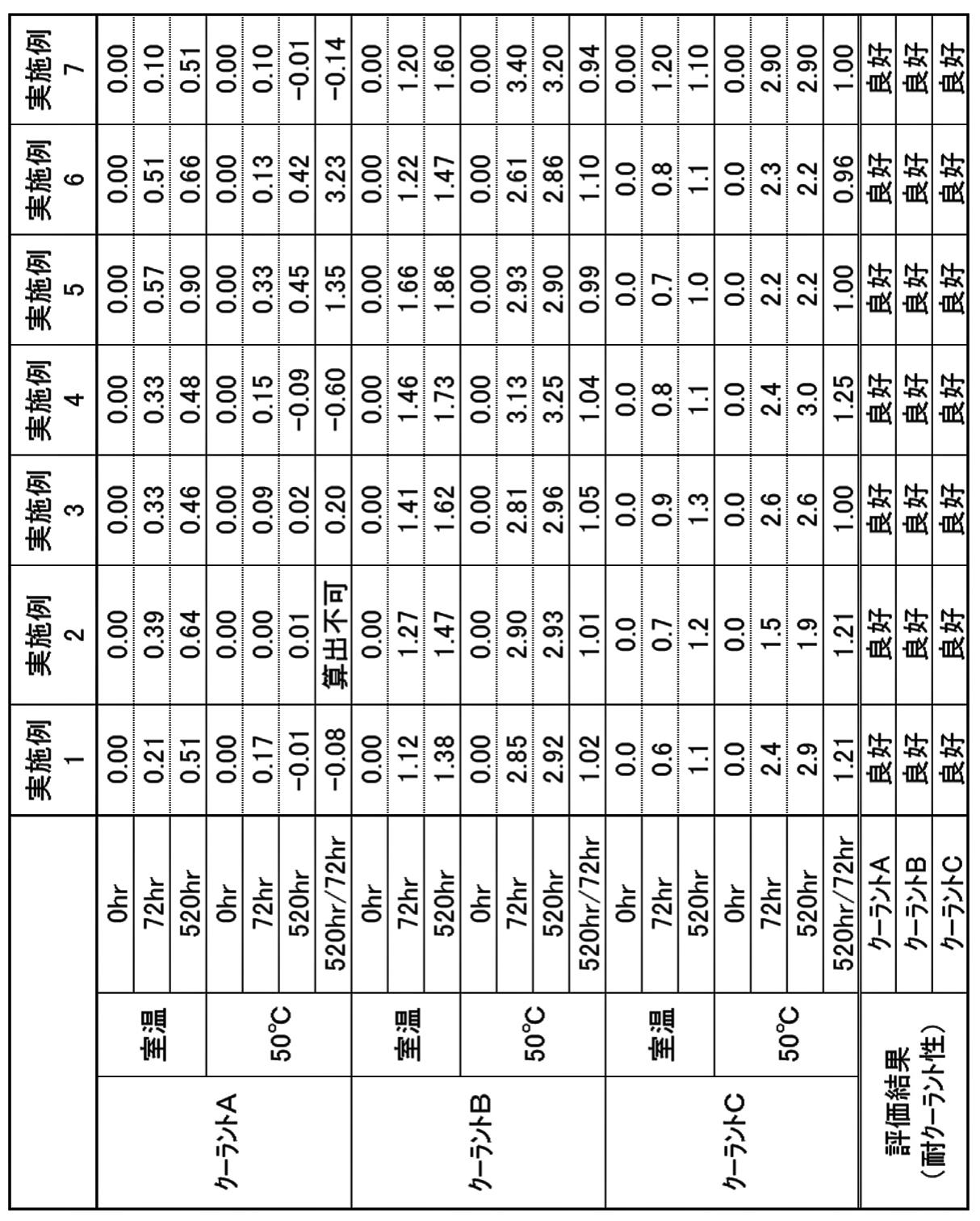
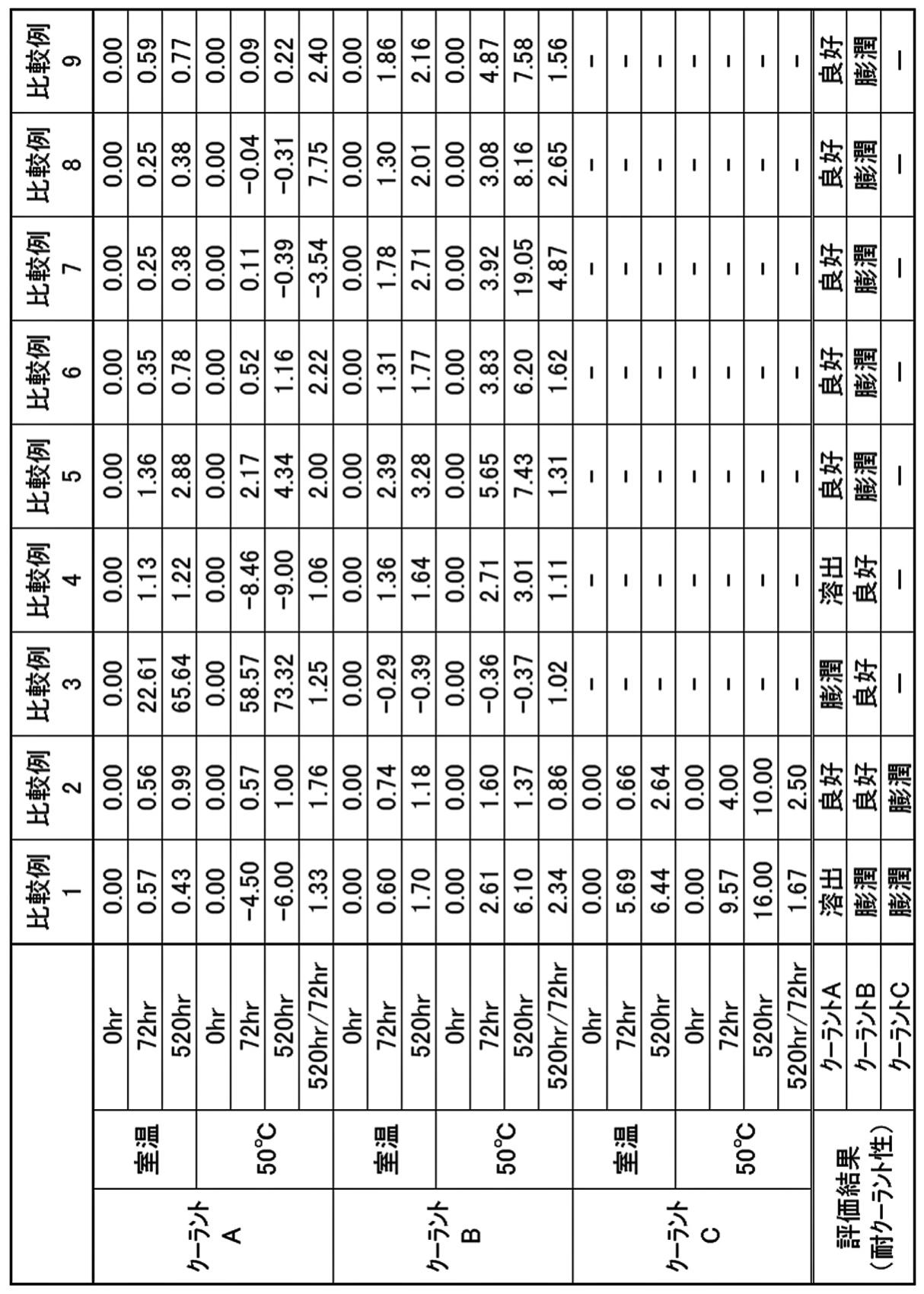
表3、4及び図4(a)~図6(b)に示したように、ポリオール成分がポリエチレンアジペートエステルポリオール(PEA)であり、JIS-A硬さが67°以上である実施例1~7のエラストマー部材は、不水溶性切削油及び水溶性切削油のいずれのクーラントに対しても耐クーラント性が良好であった。これに対して、比較例1~9のエラストマー部材(又はゴム部材)は、いずれかのクーラントにより、膨潤又は溶出が認められた。
[実機評価]
実施例2のウレタンシート、及び、比較例1のゴムシートのそれぞれと同様の組成のエラストマー部材(ゴム部材)を弾性部材とする工作機械用シール部材を作製した。
具体的には、実施例2のウレタンシートについては、まず、架橋後のシートを20mm×600mmに裁断し、厚さ1.2mm、長さ900mmの金属製支持体と接着させた。その後、必要な長さ及び角度に端部をカットし、取付け用穴を開けて、シール部材とした。
一方、比較例1のゴムシートについては、まず、150℃に加熱したリップシール形状の金型(約2mm厚さ×32mm幅×1200mm長さ)内に生ゴムシートと金属製支持体をセットし、30分間加圧加温することによりプレス架橋させ、ゴムと支持体の一体成型物を得た。その後、必要な長さ及び角度に端部をカットし、取付け穴を開けてシール部材とした。
実施例2のウレタンシート、及び、比較例1のゴムシートのそれぞれと同様の組成のエラストマー部材(ゴム部材)を弾性部材とする工作機械用シール部材を作製した。
具体的には、実施例2のウレタンシートについては、まず、架橋後のシートを20mm×600mmに裁断し、厚さ1.2mm、長さ900mmの金属製支持体と接着させた。その後、必要な長さ及び角度に端部をカットし、取付け用穴を開けて、シール部材とした。
一方、比較例1のゴムシートについては、まず、150℃に加熱したリップシール形状の金型(約2mm厚さ×32mm幅×1200mm長さ)内に生ゴムシートと金属製支持体をセットし、30分間加圧加温することによりプレス架橋させ、ゴムと支持体の一体成型物を得た。その後、必要な長さ及び角度に端部をカットし、取付け穴を開けてシール部材とした。
得られた工作機械用シール部材をCNC旋盤(DMG森精機社製 NLX3000)にリップシールとして取り付け(取り付け時の先端押し込み量:3mm)、800時間稼働させた。稼働前後に工作機械用シール部材のエッジ部を観察した。結果を図7、8に示した。
図7は、実施例2のウレタンシートを弾性部材として備えた工作機械用シール部材を使用した際のエッジ部の状態を撮影した写真(左側)及び模式図(右側)であり、上段が稼働前、下段が稼働後である。
図8は、比較例1のゴムシートを弾性部材として備えた工作機械用シール部材を使用した際のエッジ部の状態を撮影した写真(左側)及び模式図(右側)であり、上段が稼働前、下段が稼働後である。
図7は、実施例2のウレタンシートを弾性部材として備えた工作機械用シール部材を使用した際のエッジ部の状態を撮影した写真(左側)及び模式図(右側)であり、上段が稼働前、下段が稼働後である。
図8は、比較例1のゴムシートを弾性部材として備えた工作機械用シール部材を使用した際のエッジ部の状態を撮影した写真(左側)及び模式図(右側)であり、上段が稼働前、下段が稼働後である。
実施例2のウレタンシートと同様の組成のエラストマー部材を弾性部材とする工作機械用シール部材は、図8に示したように、わずかに摩耗しているだけであった。これに対して、比較例1のゴムシートと同様の組成のゴム部材を弾性部材とする工作機械用シール部材は、図9に示したように、大きく摩耗(約1mm)していた。これらのことから、ポリオール成分としてPEAを用いたエラストマー部材(弾性部材)は、耐久性に優れることが明らかとなった。
10、20 工作機械用シール部材
11、21 支持部材
12、22 弾性部材
12a、22a エッジ部
13 接着剤層
15 カバー部材
22A 本体部
22B リップ部
100 テレスコカバー
11、21 支持部材
12、22 弾性部材
12a、22a エッジ部
13 接着剤層
15 カバー部材
22A 本体部
22B リップ部
100 テレスコカバー
Claims (2)
- 熱硬化性ポリウレタン組成物の硬化物からなり、
前記熱硬化性ポリウレタン組成物は、ポリオール成分、イソシアネート成分及び架橋剤を含有し、かつ、前記ポリオール成分がポリエチレンアジペートエステルポリオール(PEA)であり、
JIS-A硬さが67°以上であり、
工作機械に用いられること特徴とするエラストマー部材。 - 支持部材と、前記支持部材に一体化された弾性部材とからなる工作機械用シール部材であって、
前記弾性部材が、請求項1に記載のエラストマー部材からなることを特徴とする工作機械用シール部材。
Priority Applications (2)
| Application Number | Priority Date | Filing Date | Title |
|---|---|---|---|
| CN201680061044.2A CN108137770B (zh) | 2015-10-29 | 2016-10-18 | 工作机械用密封构件 |
| JP2016564279A JP6197128B1 (ja) | 2015-10-29 | 2016-10-18 | エラストマー部材、及び、工作機械用シール部材 |
Applications Claiming Priority (2)
| Application Number | Priority Date | Filing Date | Title |
|---|---|---|---|
| JP2015212672 | 2015-10-29 | ||
| JP2015-212672 | 2015-10-29 |
Publications (1)
| Publication Number | Publication Date |
|---|---|
| WO2017073405A1 true WO2017073405A1 (ja) | 2017-05-04 |
Family
ID=58630143
Family Applications (1)
| Application Number | Title | Priority Date | Filing Date |
|---|---|---|---|
| PCT/JP2016/080840 Ceased WO2017073405A1 (ja) | 2015-10-29 | 2016-10-18 | エラストマー部材、及び、工作機械用シール部材 |
Country Status (4)
| Country | Link |
|---|---|
| JP (1) | JP6197128B1 (ja) |
| CN (1) | CN108137770B (ja) |
| TW (1) | TWI719071B (ja) |
| WO (1) | WO2017073405A1 (ja) |
Cited By (1)
| Publication number | Priority date | Publication date | Assignee | Title |
|---|---|---|---|---|
| TWI763899B (zh) * | 2017-08-08 | 2022-05-11 | 日商阪東化學股份有限公司 | 工作機械用密封部材 |
Citations (4)
| Publication number | Priority date | Publication date | Assignee | Title |
|---|---|---|---|---|
| JP2005225949A (ja) * | 2004-02-12 | 2005-08-25 | Dainippon Ink & Chem Inc | 熱硬化性ポリウレタンエラストマー用組成物及び熱硬化性ポリウレタンエラストマー |
| WO2009123228A1 (ja) * | 2008-04-01 | 2009-10-08 | 三井化学株式会社 | 架橋型熱可塑性エラストマー組成物および該組成物の製造方法 |
| US20100130632A1 (en) * | 2006-12-29 | 2010-05-27 | Speas Eric Scott Rick | Closed Cell Foams Comprising Urethane Elastomers |
| WO2015119030A1 (ja) * | 2014-02-06 | 2015-08-13 | バンドー化学株式会社 | 工作機械用シール部材 |
Family Cites Families (3)
| Publication number | Priority date | Publication date | Assignee | Title |
|---|---|---|---|---|
| JP4775751B2 (ja) * | 2001-07-31 | 2011-09-21 | 日本ポリウレタン工業株式会社 | 熱硬化ウレタンエラストマー成型物 |
| JP5707522B1 (ja) * | 2014-04-16 | 2015-04-30 | バンドー化学株式会社 | 籾摺りロール |
| JP2017048319A (ja) * | 2015-09-02 | 2017-03-09 | 東ソー株式会社 | ポリウレタンエラストマー形成性組成物、およびそれを用いた産業機械部品 |
-
2016
- 2016-10-18 JP JP2016564279A patent/JP6197128B1/ja active Active
- 2016-10-18 CN CN201680061044.2A patent/CN108137770B/zh active Active
- 2016-10-18 WO PCT/JP2016/080840 patent/WO2017073405A1/ja not_active Ceased
- 2016-10-27 TW TW105134643A patent/TWI719071B/zh active
Patent Citations (4)
| Publication number | Priority date | Publication date | Assignee | Title |
|---|---|---|---|---|
| JP2005225949A (ja) * | 2004-02-12 | 2005-08-25 | Dainippon Ink & Chem Inc | 熱硬化性ポリウレタンエラストマー用組成物及び熱硬化性ポリウレタンエラストマー |
| US20100130632A1 (en) * | 2006-12-29 | 2010-05-27 | Speas Eric Scott Rick | Closed Cell Foams Comprising Urethane Elastomers |
| WO2009123228A1 (ja) * | 2008-04-01 | 2009-10-08 | 三井化学株式会社 | 架橋型熱可塑性エラストマー組成物および該組成物の製造方法 |
| WO2015119030A1 (ja) * | 2014-02-06 | 2015-08-13 | バンドー化学株式会社 | 工作機械用シール部材 |
Cited By (1)
| Publication number | Priority date | Publication date | Assignee | Title |
|---|---|---|---|---|
| TWI763899B (zh) * | 2017-08-08 | 2022-05-11 | 日商阪東化學股份有限公司 | 工作機械用密封部材 |
Also Published As
| Publication number | Publication date |
|---|---|
| CN108137770B (zh) | 2022-03-01 |
| CN108137770A (zh) | 2018-06-08 |
| TW201734075A (zh) | 2017-10-01 |
| JP6197128B1 (ja) | 2017-09-13 |
| TWI719071B (zh) | 2021-02-21 |
| JPWO2017073405A1 (ja) | 2017-10-26 |
Similar Documents
| Publication | Publication Date | Title |
|---|---|---|
| JP6074572B1 (ja) | クリーニングブレード | |
| JP7231658B2 (ja) | ウレタン系接着剤組成物 | |
| KR102156248B1 (ko) | 공작 기계용 실 부재 | |
| KR101841186B1 (ko) | 공작 기계용 실 부재 | |
| EP3396460B1 (en) | Cleaning blade | |
| JP6197128B1 (ja) | エラストマー部材、及び、工作機械用シール部材 | |
| TWI763899B (zh) | 工作機械用密封部材 | |
| WO2017111061A1 (ja) | クリーニングブレード | |
| JP6822779B2 (ja) | 工作機械用シール部材 | |
| JP7758926B2 (ja) | ウレタン系接着剤組成物、加硫ゴム接着方法、コンベヤベルト | |
| JPS6150115B2 (ja) | ||
| JP2023013080A (ja) | 工作機械用シール部材 | |
| CN108472782A (zh) | 工作机械用密封部材 | |
| KR20090028664A (ko) | 페놀수지계 접착제에 사용되는 엔비알 고무 조성물 | |
| JP2009160839A (ja) | ゴム基質複合体 | |
| JP2006335952A (ja) | 耐摩耗性を有するポリウレタン樹脂組成物および成形用樹脂セット | |
| JP2011039127A (ja) | 電子写真式画像形成装置用ウレタンブレード部材 |
Legal Events
| Date | Code | Title | Description |
|---|---|---|---|
| ENP | Entry into the national phase |
Ref document number: 2016564279 Country of ref document: JP Kind code of ref document: A |
|
| 121 | Ep: the epo has been informed by wipo that ep was designated in this application |
Ref document number: 16859635 Country of ref document: EP Kind code of ref document: A1 |
|
| NENP | Non-entry into the national phase |
Ref country code: DE |
|
| 122 | Ep: pct application non-entry in european phase |
Ref document number: 16859635 Country of ref document: EP Kind code of ref document: A1 |