WO2017051927A1 - 複合体、スキンケアシート、創傷被覆材、再生医療用材料 - Google Patents
複合体、スキンケアシート、創傷被覆材、再生医療用材料 Download PDFInfo
- Publication number
- WO2017051927A1 WO2017051927A1 PCT/JP2016/078309 JP2016078309W WO2017051927A1 WO 2017051927 A1 WO2017051927 A1 WO 2017051927A1 JP 2016078309 W JP2016078309 W JP 2016078309W WO 2017051927 A1 WO2017051927 A1 WO 2017051927A1
- Authority
- WO
- WIPO (PCT)
- Prior art keywords
- fiber
- fibroin
- water
- dope
- composite
- Prior art date
- Legal status (The legal status is an assumption and is not a legal conclusion. Google has not performed a legal analysis and makes no representation as to the accuracy of the status listed.)
- Ceased
Links
Images

Classifications
-
- A—HUMAN NECESSITIES
- A61—MEDICAL OR VETERINARY SCIENCE; HYGIENE
- A61K—PREPARATIONS FOR MEDICAL, DENTAL OR TOILETRY PURPOSES
- A61K8/00—Cosmetics or similar toiletry preparations
- A61K8/02—Cosmetics or similar toiletry preparations characterised by special physical form
-
- A—HUMAN NECESSITIES
- A61—MEDICAL OR VETERINARY SCIENCE; HYGIENE
- A61K—PREPARATIONS FOR MEDICAL, DENTAL OR TOILETRY PURPOSES
- A61K8/00—Cosmetics or similar toiletry preparations
- A61K8/18—Cosmetics or similar toiletry preparations characterised by the composition
- A61K8/30—Cosmetics or similar toiletry preparations characterised by the composition containing organic compounds
- A61K8/33—Cosmetics or similar toiletry preparations characterised by the composition containing organic compounds containing oxygen
- A61K8/34—Alcohols
-
- A—HUMAN NECESSITIES
- A61—MEDICAL OR VETERINARY SCIENCE; HYGIENE
- A61K—PREPARATIONS FOR MEDICAL, DENTAL OR TOILETRY PURPOSES
- A61K8/00—Cosmetics or similar toiletry preparations
- A61K8/18—Cosmetics or similar toiletry preparations characterised by the composition
- A61K8/30—Cosmetics or similar toiletry preparations characterised by the composition containing organic compounds
- A61K8/64—Proteins; Peptides; Derivatives or degradation products thereof
-
- A—HUMAN NECESSITIES
- A61—MEDICAL OR VETERINARY SCIENCE; HYGIENE
- A61L—METHODS OR APPARATUS FOR STERILISING MATERIALS OR OBJECTS IN GENERAL; DISINFECTION, STERILISATION OR DEODORISATION OF AIR; CHEMICAL ASPECTS OF BANDAGES, DRESSINGS, ABSORBENT PADS OR SURGICAL ARTICLES; MATERIALS FOR BANDAGES, DRESSINGS, ABSORBENT PADS OR SURGICAL ARTICLES
- A61L15/00—Chemical aspects of, or use of materials for, bandages, dressings or absorbent pads
- A61L15/16—Bandages, dressings or absorbent pads for physiological fluids such as urine or blood, e.g. sanitary towels, tampons
- A61L15/22—Bandages, dressings or absorbent pads for physiological fluids such as urine or blood, e.g. sanitary towels, tampons containing macromolecular materials
-
- A—HUMAN NECESSITIES
- A61—MEDICAL OR VETERINARY SCIENCE; HYGIENE
- A61L—METHODS OR APPARATUS FOR STERILISING MATERIALS OR OBJECTS IN GENERAL; DISINFECTION, STERILISATION OR DEODORISATION OF AIR; CHEMICAL ASPECTS OF BANDAGES, DRESSINGS, ABSORBENT PADS OR SURGICAL ARTICLES; MATERIALS FOR BANDAGES, DRESSINGS, ABSORBENT PADS OR SURGICAL ARTICLES
- A61L15/00—Chemical aspects of, or use of materials for, bandages, dressings or absorbent pads
- A61L15/16—Bandages, dressings or absorbent pads for physiological fluids such as urine or blood, e.g. sanitary towels, tampons
- A61L15/22—Bandages, dressings or absorbent pads for physiological fluids such as urine or blood, e.g. sanitary towels, tampons containing macromolecular materials
- A61L15/32—Proteins, polypeptides; Degradation products or derivatives thereof, e.g. albumin, collagen, fibrin, gelatin
-
- A—HUMAN NECESSITIES
- A61—MEDICAL OR VETERINARY SCIENCE; HYGIENE
- A61L—METHODS OR APPARATUS FOR STERILISING MATERIALS OR OBJECTS IN GENERAL; DISINFECTION, STERILISATION OR DEODORISATION OF AIR; CHEMICAL ASPECTS OF BANDAGES, DRESSINGS, ABSORBENT PADS OR SURGICAL ARTICLES; MATERIALS FOR BANDAGES, DRESSINGS, ABSORBENT PADS OR SURGICAL ARTICLES
- A61L27/00—Materials for grafts or prostheses or for coating grafts or prostheses
-
- B—PERFORMING OPERATIONS; TRANSPORTING
- B32—LAYERED PRODUCTS
- B32B—LAYERED PRODUCTS, i.e. PRODUCTS BUILT-UP OF STRATA OF FLAT OR NON-FLAT, e.g. CELLULAR OR HONEYCOMB, FORM
- B32B5/00—Layered products characterised by the non- homogeneity or physical structure, i.e. comprising a fibrous, filamentary, particulate or foam layer; Layered products characterised by having a layer differing constitutionally or physically in different parts
- B32B5/22—Layered products characterised by the non- homogeneity or physical structure, i.e. comprising a fibrous, filamentary, particulate or foam layer; Layered products characterised by having a layer differing constitutionally or physically in different parts characterised by the presence of two or more layers which are next to each other and are fibrous, filamentary, formed of particles or foamed
- B32B5/24—Layered products characterised by the non- homogeneity or physical structure, i.e. comprising a fibrous, filamentary, particulate or foam layer; Layered products characterised by having a layer differing constitutionally or physically in different parts characterised by the presence of two or more layers which are next to each other and are fibrous, filamentary, formed of particles or foamed one layer being a fibrous or filamentary layer
-
- B—PERFORMING OPERATIONS; TRANSPORTING
- B32—LAYERED PRODUCTS
- B32B—LAYERED PRODUCTS, i.e. PRODUCTS BUILT-UP OF STRATA OF FLAT OR NON-FLAT, e.g. CELLULAR OR HONEYCOMB, FORM
- B32B5/00—Layered products characterised by the non- homogeneity or physical structure, i.e. comprising a fibrous, filamentary, particulate or foam layer; Layered products characterised by having a layer differing constitutionally or physically in different parts
- B32B5/22—Layered products characterised by the non- homogeneity or physical structure, i.e. comprising a fibrous, filamentary, particulate or foam layer; Layered products characterised by having a layer differing constitutionally or physically in different parts characterised by the presence of two or more layers which are next to each other and are fibrous, filamentary, formed of particles or foamed
- B32B5/24—Layered products characterised by the non- homogeneity or physical structure, i.e. comprising a fibrous, filamentary, particulate or foam layer; Layered products characterised by having a layer differing constitutionally or physically in different parts characterised by the presence of two or more layers which are next to each other and are fibrous, filamentary, formed of particles or foamed one layer being a fibrous or filamentary layer
- B32B5/26—Layered products characterised by the non- homogeneity or physical structure, i.e. comprising a fibrous, filamentary, particulate or foam layer; Layered products characterised by having a layer differing constitutionally or physically in different parts characterised by the presence of two or more layers which are next to each other and are fibrous, filamentary, formed of particles or foamed one layer being a fibrous or filamentary layer another layer next to it also being fibrous or filamentary
Definitions
- the present invention relates to a composite, a skin care sheet, a wound dressing and a regenerative medical material.
- nanofibers which are ultrafine fibers with a fiber diameter of the order of nanometers
- fibers are used in a wide range of industries, including medical applications, battery applications including battery separators, filter applications, and separation membrane applications. This material is expected to be used.
- Known techniques for obtaining nanofibers include self-assembly methods, phase separation methods, and electrospinning methods.
- the electrospinning method produces a nanofiber from a dope using electrostatic repulsion by discharging a solution such as a polymer (sometimes referred to as a dope) from a nozzle while applying a high voltage. Is the method.
- Examples of materials that can be used in the electrospinning method include synthetic polymers such as polyvinyl alcohol and polylactic acid, proteins such as collagen and fibroin, and the like. Nanofibers formed from proteins have a large surface area and excellent biocompatibility, and are expected to be applied to medical applications.
- fibroin nanofiber a method for producing nanofibers using fibroin as a raw material (hereinafter also referred to as “fibroin nanofiber”) by electrospinning.
- a method of electrospinning using a solution (dope) of fibroin dissolved in hexafluoroisopropanol (hereinafter also referred to as “HFIP”), hexafluoroacetone (hereinafter also referred to as “HFA”) or the like Patent Document 1
- the lyophilized product of the aqueous solution of fibroin obtained by desalting is dissolved in formic acid.
- Patent Document 2 fibroin is dissolved in a neutral salt solution such as LiBr and CaCl 2 and then desalted, and a nonionic surfactant and a water-soluble polymer are added to the fibroin aqueous solution obtained by desalting.
- a neutral salt solution such as LiBr and CaCl 2
- a nonionic surfactant and a water-soluble polymer are added to the fibroin aqueous solution obtained by desalting.
- Examples include a method of electrospinning using the added solution (dope) (Patent Document 3).
- silk composite nanofibers having excellent biocompatibility can be obtained by electrospinning using a solution (dope) to which a biocompatible polymer such as polyethylene oxide is added in addition to fibroin ( Patent Document 3).
- the nanofibers obtained by these methods are easily dissolved by water, moisture, etc., their use has been restricted in many applications. Then, examination which insolubilizes fibroin nanofiber with respect to water is made.
- the nanofibers produced by the above method are immersed in lower alcohol or lower ether selected from the group consisting of methanol, ethanol, propanol, methyl ether, ethyl ether and propyl ether.
- lower alcohol or lower ether selected from the group consisting of methanol, ethanol, propanol, methyl ether, ethyl ether and propyl ether.
- the nanofibers produced by the electrospinning method do not include a drawing step, many of them are generally low in strength, and when trying to obtain nanofibers with a thickness that can be handled independently, the production is Problems such as long time and high costs arise.
- nanofibers themselves are generally not rigid and difficult to use alone, it is necessary to spin nanofibers on a substrate such as a nonwoven fabric. However, both of them were not bonded to each other and spun easily. Therefore, in applications such as air conditioning filters, a composite nonwoven fabric C in which a nanofiber nonwoven fabric B layer is laminated on a nonwoven fabric A and a nonwoven fabric D are laminated using a hot melt powder adhesive, and lightly pressed with a cold pressure roll. Then, this problem is addressed by a method (see Patent Document 4) in which the adhesive oozes up to the nonwoven fabric A facing.
- Patent Document 1 has a problem that the solvent to be used (HFIP, HFA, etc.) is harmful to the human body and is very expensive.
- the method described in Patent Document 2 requires complicated steps such as dissolution, desalting, lyophilization, and re-dissolution, requires an expensive lyophilization step, and uses skin-corrosive formic acid as a solvent. Since it was used, there were problems in the working environment and the safety of the resulting nanofibers.
- the method described in Patent Document 3 has a simple process, and there is no problem in the working environment and the safety of the obtained nanofibers.
- the obtained nanometer is similar to the methods described in Patent Documents 1 and 2. The problem was that the fiber dissolved in water.
- Non-Patent Document 1 requires drying of the solvent used after the insolubilization treatment, and particularly when the manufactured nanofiber is used for medical purposes, if the solvent remains, there is a problem in safety. was there.
- the method described in Non-Patent Document 2 has a problem in safety because there is a risk of ignition, explosion, and the like because a high voltage needs to be applied in an environment filled with ethanol.
- an object of the present invention is to provide a composite having a fibroin fiber that is insoluble in water without performing an insolubilization treatment, and a skin care sheet, a wound dressing, and a regenerative medical material containing the composite. There is.
- the present invention relates to the following [1] to [10].
- a composite having (A) at least one substrate selected from the group consisting of a fiber substrate and a sponge, and (B) a fiber comprising fibroin and a polyhydric alcohol having 2 to 8 carbon atoms.
- the fiber base material is at least one nonwoven fabric selected from the group consisting of a cotton nonwoven fabric, a rayon nonwoven fabric, and a silk nonwoven fabric.
- the sponge is at least one selected from the group consisting of fibroin sponge, collagen sponge, gelatin sponge, urethane sponge, and cellulose sponge.
- the fiber further contains at least one selected from the group consisting of a water-soluble polymer, an inorganic salt, and a nonionic surfactant.
- the complex according to any one of the above.
- the fibroin fiber, particularly the fibroin nanofiber, possessed by the composite of the present invention is insoluble in water without being insolubilized. In other words, since it is insoluble in water without lower alcohol treatment or the like, it is not necessary to carry out the heating necessary for lower alcohol treatment and drying of the lower alcohol during the production of the composite. There are few restrictions.
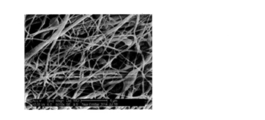
- FIG. 10 is a scanning electron microscope image of nanofibers manufactured in Manufacturing Example 11.
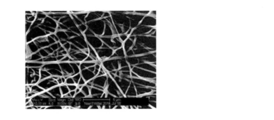
- FIG. 10 is a scanning electron microscope image of the nanofiber obtained by immersing the nanofiber manufactured in Production Example 11 in water and then freeze-drying. It is a scanning electron microscope image of the interface of the base material of the composite_body
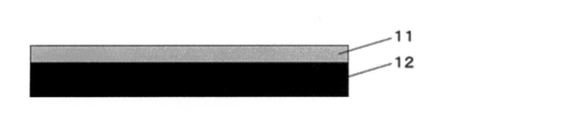
- FIG. 1 shows a composite having a fiber (B) 11 on one surface of a substrate (A) 12.
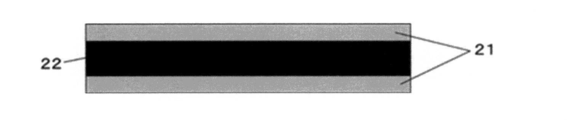
- FIG. 2 shows a composite having fibers (B) 21 on both sides of the substrate (A) 22.
- complex of this invention can have a fiber (B) in the arbitrary surfaces of a base material (A).
- a composite having the fiber (B) on an arbitrary surface can be obtained by spinning the fiber (B) on a necessary surface by a method described later.
- a base material (A) is a sheet form
- the fiber (B) is usually produced on the base material (A) in the state of an overlapped deposit.
- the state of the deposit does not need to be a single layer whose surface is apparently flat, and the surface may be uneven. There is no particular limitation on the density of the deposit.
- the base material (A) and fiber (B) of the composite of the present invention are bonded with sufficient strength without using an adhesive, a pressure-sensitive adhesive, etc., and are advantageous from the viewpoint of manufacturing ease and manufacturing cost.
- the adhesion mechanism between the substrate (A) and the fiber (B) is assumed as follows.
- the fiber (B) is provided on the base material (A) by, for example, electrospinning, a part of the fiber immediately after spinning containing fibroin is in a state in which the solvent water is not completely dried.
- sufficient adhesive force is developed between the base material (A) and the fiber (B).
- the base material (A) and the fiber (B) included in the composite of the present invention will be described in order.
- the substrate (A) is preferably at least one substrate selected from the group consisting of a fiber substrate and a sponge.
- a fiber base material a nonwoven fabric is preferable.
- the material for the nonwoven fabric is not particularly limited as long as the fiber (B) is adhered thereto, and an appropriate material may be used depending on the application.
- at least one nonwoven fabric selected from the group consisting of cotton nonwoven fabric, rayon nonwoven fabric and silk nonwoven fabric is preferred. These nonwoven fabrics are excellent in safety, and the nonwoven fabric itself has water absorption.
- At least one nonwoven fabric selected from the group consisting of cotton nonwoven fabrics, rayon nonwoven fabrics, and silk nonwoven fabrics is preferred.
- the material of the sponge is not particularly limited as long as the fiber (B) can be bonded thereto, and an appropriate material may be used depending on the application.
- the sponge generally refers to a porous body having innumerable pores inside, and the same applies to the present invention.
- a natural sponge or a synthetic sponge may be used.
- at least one selected from the group consisting of silk sponge, collagen sponge, gelatin sponge, cellulose sponge, and urethane sponge is particularly preferred in applications such as wound dressings, regenerative medical materials, and skin care materials that require safety.
- silk sponge is a material similar to fibroin contained in nanofibers, it is preferable because the characteristics can be maximized.
- the average pore diameter of the sponge is not particularly limited, but from the viewpoint of adhesion to the fiber (B), it is preferably 1 ⁇ m to 1,000 ⁇ m, more preferably 1 ⁇ m to 500 ⁇ m, and preferably 1 ⁇ m to 300 ⁇ m. Further preferred. There is no restriction
- the thickness of the substrate (A) is usually preferably 5 cm or less, more preferably 3 cm or less, and more preferably 1 cm or less. More preferably.
- the thickness of a base material (A) is usually preferably 5 cm or less, more preferably 3 cm or less, and more preferably 1 cm or less. More preferably.
- the thickness of a base material (A) From a viewpoint of giving a certain amount of strength, 50 micrometers or more are preferable, 100 micrometers or more are more preferable, and 500 micrometers or more are more preferable.
- the fiber (B) is a fiber containing fibroin and a polyhydric alcohol having 2 to 8 carbon atoms.
- the fiber (B) may be a nanofiber containing fibroin and a polyhydric alcohol having 2 to 8 carbon atoms.
- the term “fiber” includes nanofibers.
- the fiber (B) is insoluble in water without performing the insolubilization treatment soaked in lower alcohol or the like.
- water-insoluble nano fiber refers to a 4 cm square fiber deposit spun by electrospinning according to the method described in the Examples for 1 hour in ultrapure water.
- the present invention also provides a skin care sheet containing the fiber of the present invention and a wound dressing containing the fiber of the present invention.
- a highly safe fiber can be used as a substance blended in a solution (sometimes referred to as a dope) used in the manufacturing method of the fiber (B).
- a solution sometimes referred to as a dope
- fibroin which is an essential component, is a highly safe material that can be used as a suture in surgical operations, and polyhydric alcohols having 2 to 8 carbon atoms are also used in foods, pharmaceuticals, cosmetics, and the like.
- a highly safe material can be selected. Therefore, the fiber of the present invention is suitable for regenerative medical materials and the like. Therefore, the present invention also provides a regenerative medical material containing the fiber of the present invention.
- the fiber (B) can be produced using a dope containing fibroin, a polyhydric alcohol having 2 to 8 carbon atoms and water.
- a dope containing fibroin, a polyhydric alcohol having 2 to 8 carbon atoms and water a dope containing fibroin, a polyhydric alcohol having 2 to 8 carbon atoms and water.
- fibroin examples include silk fibroin produced from natural silkworms such as rabbits, wild silkworms, and tengu, transgenic silkworms, etc., and the production method is not particularly limited. Among these, since it is possible to procure in large quantities, those produced from rabbit cocoons are preferable. Fibroin is obtained by scouring the aforementioned koji and removing sericin.
- Fibroin is preferably used in the form of an aqueous fibroin solution. Any known method may be used as a method for obtaining an aqueous fibroin solution. For example, fibroin is dissolved in a neutral salt solution such as lithium bromide aqueous solution, calcium nitrate aqueous solution, calcium chloride ethanol / water mixed solution and put into a dialysis membrane. And a method of using an aqueous fibroin solution accumulated in silk glands of silkworms as it is.
- a neutral salt solution such as lithium bromide aqueous solution, calcium nitrate aqueous solution, calcium chloride ethanol / water mixed solution
- the former method that is, a method in which a solution obtained by dissolving fibroin in a neutral salt solution is placed in a dialysis membrane and desalted by dialysis in water is preferable because a large amount of fibroin aqueous solution can be produced.
- a method for dissolving fibroin in a neutral salt solution for example, a temperature of 50 to 95 ° C. (preferably 60 to 90 ° C., more preferably 70 to 90 ° C.) using a water / ethanol mixed solution of calcium chloride.
- the method of dissolving by heating with is more preferable from the viewpoint of safety when the neutral salt remains.
- the molecular weight of fibroin is not particularly limited as long as it is a condition that the dope becomes a good jet and water-insoluble fiber (B) is obtained.
- a dope containing fibroin having a protein-equivalent molecular weight of 100,000 to 1,000,000, preferably 200,000 to 700,000, more preferably 300,000 to 500,000 good spinning Sex is obtained.
- protein-converted molecular weight refers to glutamic acid dehydrogenase (molecular weight: 290,000), porcine myocardium using the peak top in the chromatogram of an evaluation sample obtained using high performance liquid chromatography (HPLC) as a molecular weight marker.
- Concentration of fibroin in the dope meaning percent concentration calculated by ⁇ mass of fibroin in the dope / volume of the dope ⁇ ⁇ 100, and the unit is expressed as “% (m / v)”] Is preferably 3 to 30% (m / v), more preferably 5 to 20% (m / v), and even more preferably 7 to 15% (m / v).
- the concentration of fibroin in the dope is preferably 3 to 20% (m / v), more preferably 4 to 20% (m / v), and 5 to 15 % (M / v) is more preferable.
- the dope contains a water-soluble polymer, by setting the concentration of fibroin in the dope within this range, it is possible to suppress the gelation of the dope in a short time, and the effect of the water-soluble polymer described later is sufficient.
- a certain amount of productivity (amount of fiber (B) that can be produced per unit time) can also be secured.
- it may be concentrated by air drying or diluted by adding water.
- the dope contains a polyhydric alcohol having 2 to 8 carbon atoms (hereinafter also simply referred to as “polyhydric alcohol”).
- the carbon number of the polyhydric alcohol is 2 to 8, preferably 2 to 5, more preferably 2 to 4, more preferably 3 from the viewpoints of economy, productivity, safety, and texture of the resulting fiber (B). Further preferred.
- the polyhydric alcohol having 2 to 8 carbon atoms include ethylene glycol, diethylene glycol, triethylene glycol, tetraethylene glycol, propylene glycol, dipropylene glycol, butylene glycol, 1,4-butanediol, and 1,5-pentanediol.
- Diols such as 1,6-hexanediol, 1,8-octanediol, 3-methyl-1,5-pentanediol, cyclohexanediol; glycerin, pentaerythritol, trimethylolethane, trimethylolpropane, sorbitol, mannitol, etc.
- Examples include trihydric or higher polyhydric alcohols. As the trihydric or higher polyhydric alcohol, trihydric alcohol is particularly preferable.
- trihydric alcohol is preferable as the polyhydric alcohol, and it is a highly safe material used in foods, pharmaceuticals, cosmetics, etc., and glycerin is more preferable from the viewpoint of excellent texture of the obtained fiber (B). preferable.
- glycerol For example, vegetable glycerol, animal glycerol, etc. can be used.
- the boiling point of a polyhydric alcohol From a viewpoint of economical efficiency, productivity, and safety, it is preferable that it is 150 degreeC or more, It is more preferable that it is 200 degreeC or more, It is that it is 250 degreeC or more. Further preferred. Although there is no restriction
- the flash point of the polyhydric alcohol is not particularly limited, but is preferably 100 ° C. or higher, more preferably 130 ° C.
- the upper limit of the flash point of the polyhydric alcohol is preferably as high as possible, but is preferably 250 ° C. or less, more preferably 220 ° C. or less, and further preferably 200 ° C. or less from the viewpoint of availability. preferable.
- the content of the polyhydric alcohol is such that the volume (mL) of polyhydric alcohol (polyhydric alcohol (mL) / fibroin (g)) is from 0.25 to 1 when the mass (g) of fibroin in the dope is 1.
- the amount is preferably 1.0, more preferably 0.3 to 0.8, and even more preferably 0.3 to 0.6.
- it can be sufficiently insoluble in water.
- the polyhydric alcohol (mL) / fibroin (g) is 0.25 or more, a fiber sufficiently insolubilized in water tends to be obtained.
- polyhydric alcohol (mL) / fibroin (g) is 1.0 or less, it is easy to obtain a good jet in the electrospinning method, and it tends to form a fiber.
- the dope may further contain at least one selected from the group consisting of a water-soluble polymer, an inorganic salt, and a nonionic surfactant.
- the fiber (B) may further contain at least one selected from the group consisting of a water-soluble polymer, an inorganic salt, and a nonionic surfactant.
- the dope preferably contains at least one selected from the group consisting of water-soluble polymers and inorganic salts.
- the fiber (B) preferably further contains at least one selected from the group consisting of a water-soluble polymer and an inorganic salt.
- the water-soluble polymer is not particularly limited.
- polyethylene oxide hereinafter also referred to as “PEO”
- PVA polyvinyl alcohol
- hydroxypropyl cellulose polyethylene
- Preferred is at least one selected from the group consisting of glycol and gelatin.
- one or more selected from the group consisting of polyethylene oxide and polyvinyl alcohol is more preferable, and polyethylene oxide is more preferable.
- productivity can be improved without impairing the safety of the fiber (B), and the shape and fiber diameter of the fiber (B) can be easily adjusted.
- the water-soluble polymer refers to a polymer having an insoluble content of less than 0.5 mass% when 0.5 g of the polymer is dissolved in 100 g of water at 25 ° C.
- the molecular weight and content of the water-soluble polymer in the dope are not particularly limited as long as the dope becomes a good jet and water-insoluble fiber (B) can be obtained.
- Electrospinning method nozzle type, cylinder
- Preferred dope characteristics depend on the shape of the electrode, the applied voltage, the shape of the target fiber (B) and the fiber diameter, etc. That's fine.
- the molecular weight of the water-soluble polymer may be appropriately selected according to the purpose as described above, but the viewpoint of improving the productivity of the fiber (B) and the viewpoint of easily adjusting the shape and fiber diameter of the fiber (B).
- the number average molecular weight is preferably 10,000 to 800,000, more preferably 20,000 to 800,000, still more preferably 30,000 to 800,000, 000 to 600,000 is particularly preferable.
- the molecular weight of polyethylene oxide is, for example, from the viewpoint of minimizing the content of polyethylene oxide, the number average molecular weight being 100,000 to 700,000. It is preferably 200,000 to 600,000, more preferably 300,000 to 600,000.
- the productivity of the fiber (B) can be increased with a smaller content.
- the molecular weight of the polyvinyl alcohol is the number average molecular weight from the viewpoint of improving the productivity of the fiber (B) and easily adjusting the shape and fiber diameter of the fiber (B). Is preferably 10,000 to 500,000, more preferably 30,000 to 100,000.
- a number average molecular weight can be calculated
- GFC gel filtration chromatography
- the content of the water-soluble polymer may be appropriately selected according to the purpose as described above, but the viewpoint of improving the productivity of the fiber (B) and the fiber (B ),
- the mass ratio of the water-soluble polymer and fibroin in the dope is preferably 0.05 to 1; It is more preferably 0.06 to 0.5, and further preferably 0.07 to 0.3.
- the mass ratio of the water-soluble polymer to fibroin in the dope is within the above range, the characteristics of the safety of fibroin, induction of differentiation during cell culture, etc. are exhibited to the maximum.
- a fiber (B) suitable for the required application can be obtained.
- the water-soluble polymer may be added directly to the dope or may be added as an aqueous solution.
- the dope needs to be vigorously stirred.
- the water-soluble polymer is preferably added as an aqueous solution to the dope.
- the kind of the inorganic salt is not particularly limited, but from the viewpoint of safety and price, at least one selected from the group consisting of alkali metal salts and alkaline earth metal salts is preferable, and the group consisting of sodium salts and calcium salts More preferably, it is at least one selected from the group consisting of sodium chloride and calcium chloride, more preferably at least one selected from the group consisting of sodium chloride and calcium chloride, and particularly preferably sodium chloride used also as food and pharmaceuticals. .
- the productivity of the fiber (B) is improved and the shape and fiber diameter of the fiber (B) can be easily adjusted without impairing the safety of the fiber (B). .
- the content of the inorganic salt is not particularly limited as long as the dope becomes a jet that is good and the fiber (B) insoluble in water is obtained.
- preferable dope characteristics vary depending on the electrospinning conditions, the shape of the target fiber (B), the fiber diameter, and the like, and may be appropriately selected according to the purpose.
- the mass ratio of the inorganic salt to fibroin in the dope (inorganic salt / fibroin) is 0.001 to 0.00.
- 05 is preferred, 0.002 to 0.03 is more preferred, and 0.003 to 0.01 is even more preferred.
- Nonionic surfactant examples include polyoxyethylene alkyl aryl ethers, polyoxyethylene alkyl ethers, polyoxyethylene alkenyl ethers, polyoxyethylene fatty acid esters and the like.
- nonionic surfactant examples include polyoxyethylene (50) oleyl ether, polyoxyethylene (20) sorbitan monoisostearate, polyoxyethylene (20) sorbitan monolaurate, polyoxy Ethylene (20) sorbitan monooleate, polyoxyethylene (7.5) nonylphenyl ether, polyoxyethylene (120) nonylphenyl ether, polyoxyethylene (15) nonylphenyl ether, polyoxyethylene (18) nonylphenyl ether , Polyoxyethylene (20) nonylphenyl ether, polyoxyethylene (8) octylphenyl ether, polyoxyethylene (10) octylphenyl ether, and the like.
- the numerical value in the parenthesis represents the number of repeating units of ethylene oxide.
- the composite of the present invention can be produced by spinning the fiber (B) on the substrate (A) by the electrospinning method using the dope.
- the electrospinning method is a well-known method for forming fibers using the force of electricity. By applying a high voltage to the dope, the dope is ejected toward the electrode, and the solvent is evaporated by the ejection. It is a method which can obtain the fiber (especially nanofiber).
- the electrospinning method can apply a wide variety of materials and can easily control the shape and diameter of the fiber. There is no particular limitation on the electrospinning apparatus that can be used for producing the fiber (B), and a known apparatus can be used.
- the electrospinning apparatus has a nozzle type, wire type, cylinder type, etc., which have different structures such as electrodes, but any type of fiber is insoluble in water by using the dope. (B) is obtained.
- the dope does not contain a water-soluble polymer and a nonionic surfactant, it is preferable to use a nozzle-type electrospinning device from the viewpoint of widening the range of spinning conditions.
- the nozzle-type electrospinning apparatus discharges the dope filled in the syringe at a constant speed, and at the same time applies a high voltage between the dope filled in the syringe and a grounded cathode plate (collector), thereby
- the dope solution is jetted from the tip of the nozzle and sprayed to deposit fibers (B), particularly nanofibers (B), on the cathode plate.
- the viscosity of the dope is not particularly limited and may be appropriately adjusted according to the fiber diameter of the target fiber (B), but is preferably 10 to 1,000 mPa ⁇ s, for example.
- the viscosity of the dope is 10 mPa ⁇ s or more, it becomes easy to control the flow rate of the dope, and when it is 1,000 mPa ⁇ s or less, the productivity of the fiber (B) is excellent and thin fibers are easily obtained.
- the shape and fiber diameter of the fiber (B) to be obtained, and factors affecting the availability of spinning include the distance between electrodes of the electrospinning device, the humidity in the device, and the application There are voltage etc.
- the distance between the electrodes of the electrospinning device is not particularly limited as long as the discharged dope becomes a good jet and the fiber (B) insoluble in water is obtained, but it is, for example, 10 to 25 cm.
- the internal humidity of the electrospinning apparatus is not particularly limited as long as the discharged dope becomes a good jet and the fiber (B) insoluble in water is obtained, but it is preferably, for example, 40% or less, It is more preferably 35% or less, and further preferably 30% or less.
- the applied voltage of the electrospinning device is not particularly limited as long as the discharged dope becomes a good jet and water-insoluble fiber (B) is obtained, and may be appropriately selected according to the device, electrode shape, and the like. However, it can be selected in the range of 10 to 30 kV, for example.
- the composite of the present invention can be obtained by placing a (nano) fiber on a substrate (A) by placing the substrate (A) on the collector or closer to the anode than the collector. It is obtained by spinning and depositing to produce the fiber (B) on the substrate (A).
- the base material (A) is installed perpendicular to the straight line with the shortest distance connecting the anode and the cathode. In general, it is preferable to install the base material (A) in a state of being firmly stretched (wrinkled).
- nozzle-type electrospinning there is a method in which a nanofiber is spun while a flat metal plate grounded as a cathode is used and a base material (A) is stretched and placed thereon.
- a base material (A) By installing the base material (A) in this way, it is easy to obtain a composite in which the fibers (B) are deposited in layers on the base material (A).
- the position which installs a base material (A) will not have a restriction
- the distance between the base material (A) and the anode is usually preferably 10 cm or more, and preferably 15 cm or more, from the viewpoint of suppressing contact with the base material before moisture in the dope volatilizes and no fiber being obtained. It is more preferable that Although there is no restriction
- a flat metal plate grounded as a cathode is used, and the substrate (A) is stretched and placed on the substrate, and nanofibers are spun.
- (B) is manufactured, and then the substrate (A) is turned over so that the fiber (B) is turned down and placed on a grounded flat metal plate as a cathode, and the fiber (B) is similarly spun.
- the fibers (B) By laminating the fibers (B), a composite in which both surfaces of the substrate (A) are covered with the fibers (B) is obtained.
- the fiber (B) manufactured on the base material (A) by the electrospinning method contains a substance contained in the dope used in the electrospinning method. That is, when a dope containing fibroin and a polyhydric alcohol is used, a fiber (B) containing fibroin and a polyhydric alcohol is obtained. Similarly, when using a dope containing fibroin and a polyhydric alcohol and at least one selected from the group consisting of a water-soluble polymer, an inorganic salt and a nonionic surfactant, fibroin and the polyhydric alcohol And a fiber (B) containing at least one selected from the group consisting of a water-soluble polymer, an inorganic salt and a nonionic surfactant.
- the composite is It can be removed as appropriate by washing with water.
- the average fiber diameter of the fiber (B) produced on the substrate (A) is not particularly limited, and may be appropriately adjusted according to the use of the fiber (B).
- the average fiber diameter may be 10 to 900 nm. It may be 50 to 700 nm or 200 to 600 nm.
- the fiber (B) having an average fiber diameter of nano order is generally referred to as nanofiber.
- the average fiber diameter of the fiber (B) is obtained by measuring the width (diameter) of 20 fibers (B) existing at an arbitrary position using an electron microscope (5,000 times). It can be measured by averaging the resulting values.
- the composite of the present invention is characterized by having a base material (A) and fibers (B) that are insoluble in water without being insolubilized.
- the composite can be suitably used in various applications by taking advantage of the characteristics of fibroin, which is a component of the fiber (B).
- fibroin which is a component of the fiber (B).
- wound dressings that make use of the effect of promoting wound healing
- regenerative medical materials that make use of the effect of promoting cell differentiation
- skin care materials that make use of silk's high-quality image and smooth touch
- fiber (B) It can be suitably used for applications such as a filter utilizing the fine pores possessed and the ability to adsorb fibroin.
- the fiber (B) contains a polyhydric alcohol having 2 to 8 carbon atoms, it is possible to impart moisture retention to the skin for use in a skin care sheet.
- the fiber (B) alone has poor handling properties due to its low strength, but the composite of the present invention has excellent handling properties because it is supplemented with the base material (A) and can be used in a wider range of applications. Is possible.
- the composite of the present invention has a highly safe base material (A) and highly safe fiber (B), it is a highly safe composite. For this reason, it can be used suitably for uses such as medical equipment and cosmetics that are close to the human body. Further, the composite of the present invention can be produced by a simpler method because the fiber (B) is bonded to the base material (A) without using an adhesive, a pressure-sensitive adhesive, etc. It can be suitably used for applications such as medical devices and cosmetics with restrictions on the use of adhesives and the like.
- Adhesive strength evaluation between base material and nanofiber The adhesive strength between the base material (base material (A)) and nanofiber (fiber (B)) of the composite obtained in each example was determined by the following method. Whether or not the substrate and nanofibers in the composite were bonded was determined according to the following criteria by observing the appearance after picking up the portion where the nanofibers at the end of the substrate were not picked up with a finger and lifting for 30 seconds. a: No separation of nanofibers was observed. c: The nanofiber completely peeled off and dropped.
- Nanofibers were extracted with chloroform to obtain an extract and an extraction residue.
- double shot pyrolysis gas chromatograph mass spectrometry (GC / MS analysis) was performed using the obtained extract under the following configuration and conditions.
- a glycerin peak was confirmed from a heat extraction gas chromatogram at 280 ° C., it was determined that “glycerin was contained”, and otherwise, it was determined that “glycerin was not contained”.
- a PEO peak was confirmed from a pyrolysis GC / MS chromatogram at 590 ° C., it was determined that “PEO was included”, and otherwise, it was determined that “PEO was not included”.
- a dialysis tube (Spectra / Por® 1 Dialysis Membrane, MWCO 6,000-8, 000, manufactured by Spectrum Laboratories, Inc.) for 12 hours with respect to 5 L of ultrapure water collected from an ultrapure water production apparatus (PRO-0500 and FPC-0500 (model number), manufactured by Organo Corporation). Dialysis was repeated 5 times to obtain an aqueous fibroin solution.
- HPLC high-performance liquid chromatograph
- a high-performance liquid chromatograph (HPLC) main body manufactured by Hitachi High-Technologies Corporation, trade name: Chromaster (registered trademark)
- an optional UV detector manufactured by Hitachi High-Technologies Corporation, model number: 5410
- pump Manufactured by Hitachi High-Technologies Corporation, model number: 5110)
- autosampler manufactured by Hitachi High-Technologies Corporation, model number: 5210)
- column oven manufactured by Hitachi High-Technologies Corporation, model number: 5310
- An HPLC apparatus combined with a product name: SHODEX (registered trademark) PROTEIN KW-804 was used, and the measurement conditions were a mobile phase flow rate of 0.5 mL / sec, a column temperature of 30 ° C., and a detection wavelength of UV of 220 nm.
- a yeast-derived glutamate dehydrogenase (molecular weight: 290,000, Oriental Yeast Co., Ltd., a molecular weight marker protein for HPLC) was used as a molecular weight marker.
- MW-Marker HPLC
- porcine myocardial lactate dehydrogenase (molecular weight: 142,000, manufactured by Oriental Yeast Co., Ltd., trade name: MW-Marker (HPLC)
- yeast-derived enolase Molecular weight: 67,000, manufactured by Oriental Yeast Co., Ltd., trade name: MW-Marker (HPLC)
- the mobile phase was passed through the HPLC apparatus for 1 hour and waited for the baseline to stabilize. After stabilization of the baseline, 22 ⁇ L of a molecular weight marker solution dissolved so that each molecular weight marker is 0.05% by mass in the aqueous solution is injected, and a calibration curve is created from the peak top of the obtained chromatogram and the molecular weight of the molecular weight marker. did. Subsequently, the protein equivalent molecular weight of fibroin was measured using the calibration curve from the position of the peak top of the chromatogram obtained by injecting 22 ⁇ L of the chromatographic evaluation sample. As a result, the protein equivalent molecular weight of the fibroin aqueous solution was 386,000.
- the syringe with the nozzle attached is set in an electrospinning device, an aluminum foil as a base sheet is attached to the cathode plate (earthed metal plate), and spinning is performed by the electrospinning method under the following conditions. Nanofibers were manufactured.
- the electrospinning apparatus and its use conditions are as follows. Electrospinning device: MECC Co. Ltd ..
- NANON-3 Nozzle: Terumo Corporation non-bevel needle 18G ⁇
- Dope discharge speed 1mL / h ⁇ Distance between electrodes: 18cm ⁇
- Applied voltage 20 kV
- the electrospinning device used in Production Example 3 applies a high voltage between the dope in the nozzle and the grounded cathode plate at the same time that the device pushes the plunger portion of the syringe to discharge the dope at a constant speed.
- the dope is jetted as a jet and nanofibers are deposited on the cathode plate.
- the nanofibers obtained above were peeled from the aluminum foil, and whether or not nanofibers were spun and insolubilized was evaluated by the method described above. The results are shown in Table 2.
- Production Examples 4-17 nanofibers were produced in the same manner as in Example 1 except that the composition of the dope and the electrospinning conditions were as shown in Table 2. Table 2 shows the evaluation results of the obtained nanofibers.
- ELMARCO s. r. o. “Nano Spider Production Line NS 1WS500U” manufactured by the company was used.
- the wire-type electrospinning device has an operating part called a carriage equipped with a tank filled with a dope that applies a high voltage to the anode wire installed at the bottom of the spinning chamber and simultaneously applies a high voltage to the lower part of the spinning chamber.
- the dope jet is ejected from the anode wire installed on the cathode toward the cathode wire installed on the upper part of the spinning chamber.
- the nanofibers can be deposited on the aluminum foil.
- nanofibers were produced in the same manner as in Production Example 3 except that the composition of the dope and the electrospinning conditions were as shown in Table 2. Table 2 shows the evaluation results of the obtained nanofibers.
- nanofibers can be obtained safely and easily in any dope composition. It was found to be insoluble in water. On the other hand, from Comparative Production Examples 1 to 3, it was found that the nanofibers were not insolubilized when no polyhydric alcohol having 2 to 8 carbon atoms such as glycerin was added.
- the nanofibers produced in Production Example 11 were observed with a scanning electron microscope (SEM).
- SEM scanning electron microscope
- the scanning electron microscope used was “Neo Scope JCM-5000” (manufactured by JEOL Ltd.), and was observed under the conditions of high vacuum Pt deposition mode and acceleration voltage of 10 kV.
- FIG. From FIG. 3 it was found that in Production Example 11, nanofibers having a fiber diameter of 150 to 800 nm (average fiber diameter: 294 nm) were obtained.
- the nanofibers produced in Production Example 11 were immersed in ultrapure water at 24 ° C. for 1 hour, and then freeze-dried nanofibers were observed by SEM under the same conditions as described above. The results are shown in FIG. From FIG.
- the nanofibers produced in Production Example 11 maintained the same structure as in FIG. 3 even after being immersed in water and were insoluble in water. From the results of FIGS. 3 and 4, the nanofiber containing fibroin and a polyhydric alcohol having 2 to 8 carbon atoms such as glycerin is a fiber having a nano-order fiber diameter and is insoluble in water. I understood.
- nanofibers as fibers (B) are spun on the base material (A) using the same conditions, and composites are produced.
- the body was manufactured.
- base material (A) As a base material (A), the nonwoven fabric or sponge of Table 3 was used.
- the silk sponge was produced by the following method.
- the frozen sample was naturally thawed at room temperature and then removed from the container to obtain a silk sponge.
- the silk sponge taken out from the container was left in 5 liters of ultrapure water every 12 hours with the water changed, and allowed to stand for 5 days to remove acetic acid.
- the silk sponge from which acetic acid had been removed was immersed in 10 L of a 3% by volume glycerin aqueous solution for 3 days and then frozen in a freezer maintained at ⁇ 25 ° C. for 6 hours.
- the obtained frozen product was placed in a freeze dryer “FD-550P” (manufactured by Tokyo Rika Kikai Co., Ltd.) and freeze-dried over 2 days.
- the obtained dried product was used as a silk sponge in the following examples.
- Example 1 (Production of composite) A composite was produced by spinning nanofibers on the silk sponge by electrospinning in the same manner as in Production Example 3 except that a silk sponge was installed as the substrate (A) on the cathode plate. The electrospinning treatment time was 15 minutes. Subsequently, whether or not the nanofiber (fiber (B)) of the obtained composite was spun and insolubilized, and the adhesive force between the substrate and the nanofiber were evaluated by the above methods. The results are shown in Tables 4 and 5.
- Example 2 In Example 1, a composite was produced in the same manner as in Example 1 except that the composition of the dope and the conditions of the electrospinning method were those described in Table 4 or Table 5. Nanofibers were evaluated for spinning, insolubilization, and adhesive strength. The results are shown in Tables 4 and 5.
- the interface between the base material of the composite produced in Example 13 and the nanofibers was observed with a scanning electron microscope.
- the scanning electron microscope used was Neo Scope JCM-5000 manufactured by JEOL Ltd., and was observed under conditions of a high vacuum Pt deposition mode and an acceleration voltage of 10 kV.
- the results are shown in FIG. From FIG. 5, it was found that the composite of the present invention has a structure in which nanofibers 51 made of fine fibers are in close contact with the base material 52.
- Example 23 The composite obtained in Example 9 was placed on a collector with the nanofiber side facing down, and nanofibers were spun again under the same conditions as in Example 9, and the composite having nanofibers on both sides of the substrate Manufactured. As a result, the nanofibers on both sides of the obtained composite were observed with a scanning electron microscope. As the scanning electron microscope, Neo Scope JCM-5000 manufactured by JEOL Ltd. was used, and observation was performed under conditions of a high vacuum Pt deposition mode and an acceleration voltage of 10 kV. As a result, it was found that both sides of the composite were covered with nanofibers.
- the fiber of the composite of the present invention is insoluble in water, has excellent biocompatibility, has a fine structure and a large surface area.
- the composite of the present invention can be suitably used as a wound dressing, a nonwoven fabric, a scaffold material for regenerative medicine (cell culture carrier) and the like.
- adsorbents that make use of the surface area of nanofibers and the specific adsorption ability of fibroin, filters and separation membranes that make use of fine pores between nanofiber fibers, and skin care sheets that make use of good texture. Applications are also expected.
Landscapes
- Health & Medical Sciences (AREA)
- Life Sciences & Earth Sciences (AREA)
- Public Health (AREA)
- Veterinary Medicine (AREA)
- Epidemiology (AREA)
- Animal Behavior & Ethology (AREA)
- General Health & Medical Sciences (AREA)
- Birds (AREA)
- Chemical & Material Sciences (AREA)
- Materials Engineering (AREA)
- Engineering & Computer Science (AREA)
- Hematology (AREA)
- Emergency Medicine (AREA)
- Dermatology (AREA)
- Medicinal Chemistry (AREA)
- Oral & Maxillofacial Surgery (AREA)
- Transplantation (AREA)
- Nonwoven Fabrics (AREA)
- Spinning Methods And Devices For Manufacturing Artificial Fibers (AREA)
Abstract
不溶化処理を行わずとも水に不溶であるフィブロインファイバーを有する複合体、並びに該複合体を含有してなる、スキンケアシート、創傷被覆材及び再生医療用材料を提供する。より具体的には、(A)繊維基材及びスポンジからなる群から選ばれる少なくとも1種の基材、及び(B)フィブロイン及び炭素数2~8の多価アルコールを含有してなるファイバーを有する複合体、並びに該複合体を含有してなる、スキンケアシート、創傷被覆材及び細胞培養担体を提供する。
Description
本発明は、複合体、スキンケアシート、創傷被覆材及び再生医療用材料に関する。
ファイバー(繊維)のうち、繊維径がナノメートルオーダーの極細の繊維であるナノファイバーは、医療用途、バッテリー用セパレーターをはじめとする電池用途、フィルター用途、分離膜用途等、幅広い分野の産業への利用が期待される材料である。
ナノファイバーを得る手法としては、セルフアッセンブリー法、フェイズセパレーション法、エレクトロスピニング法等が知られている。
これらのうち、エレクトロスピニング法は、高分子等の溶液(ドープと称することがある)を高電圧印加しながらノズル等から吐出することで、静電反発を利用してドープからナノファイバーを製造する方法である。
エレクトロスピニング法に利用可能な素材としては、ポリビニルアルコール、ポリ乳酸等の合成高分子、コラーゲン、フィブロイン等のたんぱく質などが挙げられる。
たんぱく質から形成されるナノファイバーは、表面積が大きく、生体親和性に優れるため、医療用途への応用が期待されている。
ナノファイバーを得る手法としては、セルフアッセンブリー法、フェイズセパレーション法、エレクトロスピニング法等が知られている。
これらのうち、エレクトロスピニング法は、高分子等の溶液(ドープと称することがある)を高電圧印加しながらノズル等から吐出することで、静電反発を利用してドープからナノファイバーを製造する方法である。
エレクトロスピニング法に利用可能な素材としては、ポリビニルアルコール、ポリ乳酸等の合成高分子、コラーゲン、フィブロイン等のたんぱく質などが挙げられる。
たんぱく質から形成されるナノファイバーは、表面積が大きく、生体親和性に優れるため、医療用途への応用が期待されている。
エレクトロスピニング法でフィブロインを原料とするナノファイバー(以下、「フィブロインナノファイバー」ともいう)を製造する方法に関してはいくつか報告がある。
具体的には、フィブロインをヘキサフルオロイソプロパノール(以下、「HFIP」ともいう)、ヘキサフルオロアセトン(以下「HFA」ともいう)等に溶解した溶液(ドープ)を用いてエレクトロスピニングする方法(特許文献1)、フィブロインを臭化リチウム(LiBr)、塩化カルシウム(CaCl2)等の中性塩溶液に溶解した後、脱塩して得たフィブロイン水溶液の凍結乾燥物を蟻酸に溶解した溶液(ドープ)を用いてエレクトロスピニングする方法(特許文献2)、フィブロインをLiBr、CaCl2等の中性塩溶液に溶解した後、脱塩して得たフィブロイン水溶液に非イオン性界面活性剤及び水溶性高分子を加えた溶液(ドープ)を用いてエレクトロスピニングする方法(特許文献3)などが挙げられる。
また、フィブロインに加え、ポリエチレンオキサイド等の生体適合性高分子を添加した溶液(ドープ)を用いてエレクトロスピニングすることにより、生体親和性に優れるシルク複合ナノファイバーが得られることが報告されている(特許文献3)。
具体的には、フィブロインをヘキサフルオロイソプロパノール(以下、「HFIP」ともいう)、ヘキサフルオロアセトン(以下「HFA」ともいう)等に溶解した溶液(ドープ)を用いてエレクトロスピニングする方法(特許文献1)、フィブロインを臭化リチウム(LiBr)、塩化カルシウム(CaCl2)等の中性塩溶液に溶解した後、脱塩して得たフィブロイン水溶液の凍結乾燥物を蟻酸に溶解した溶液(ドープ)を用いてエレクトロスピニングする方法(特許文献2)、フィブロインをLiBr、CaCl2等の中性塩溶液に溶解した後、脱塩して得たフィブロイン水溶液に非イオン性界面活性剤及び水溶性高分子を加えた溶液(ドープ)を用いてエレクトロスピニングする方法(特許文献3)などが挙げられる。
また、フィブロインに加え、ポリエチレンオキサイド等の生体適合性高分子を添加した溶液(ドープ)を用いてエレクトロスピニングすることにより、生体親和性に優れるシルク複合ナノファイバーが得られることが報告されている(特許文献3)。
しかしながら、これらの方法で得られるナノファイバーは、水、湿気等で容易に溶解してしまうため、多くの用途で、その利用に制約が生じていた。そこで、フィブロインナノファイバーを水に対して不溶化する検討がなされている。
水に不溶なフィブロインナノファイバーを得る方法としては、上記の方法で製造したナノファイバーを、メタノール、エタノール、プロパノール、メチルエーテル、エチルエーテル及びプロピルエーテルからなる群から選ばれる低級アルコール又は低級エーテルに浸漬する方法(特許文献3及び非特許文献1)、及びエタノール雰囲気下で紡糸する方法(非特許文献2)などが知られている。
水に不溶なフィブロインナノファイバーを得る方法としては、上記の方法で製造したナノファイバーを、メタノール、エタノール、プロパノール、メチルエーテル、エチルエーテル及びプロピルエーテルからなる群から選ばれる低級アルコール又は低級エーテルに浸漬する方法(特許文献3及び非特許文献1)、及びエタノール雰囲気下で紡糸する方法(非特許文献2)などが知られている。
また、エレクトロスピニング法で製造されるナノファイバーは延伸する工程が含まれないため、一般的に強度が低いものが多いうえ、単独でハンドリング可能な厚さのナノファイバーを得ようとすると、製造に長時間を要する、コストが高くなる等の問題が生じる。また、ナノファイバー自体は一般的に剛性がなく、単独では使用が困難であるため、不織布等の基材上にナノファイバーを紡出する必要があるが、ナノファイバーを単にこのような基材上に紡出しても両者は接着しておらず、容易に剥離するという問題があった。そこで、空調フィルター等の用途では、不織布A上にナノファイバー不織布B層を積層した複合不織布Cと、不織布Dとを、ホットメルトパウダー接着剤を用いて積層し、冷間加圧ロールで軽く圧接して接着剤を対面の不織布Aにまで滲み出させるという方法(特許文献4)でこの問題に対応している。
繊維と工業,Vol. 71, No.3 (2015),P. 117-122
日本シルク学会誌,Vol. 16 (2007),P. 150-151
J Biomater Sci Polym Ed., 2013, 24(2), P. 158-169
しかしながら、特許文献1に記載の方法は、使用する溶媒(HFIP、HFA等)が人体に有害な上に、非常に高価であることが問題であった。
また、特許文献2に記載の方法は、溶解、脱塩、凍結乾燥、再溶解等の工程が煩雑であること、高コストの凍結乾燥工程が必須であること、皮膚腐食性の蟻酸を溶媒に用いるため、作業環境及び得られるナノファイバーの安全性に問題があることなどが問題であった。
特許文献3に記載の方法は、工程が簡便であり、作業環境及び得られるナノファイバーの安全性にも問題はないが、前述したとおり特許文献1及び2に記載の方法と同様、得られるナノファイバーが水に溶解してしまうことが問題であった。
また、特許文献2に記載の方法は、溶解、脱塩、凍結乾燥、再溶解等の工程が煩雑であること、高コストの凍結乾燥工程が必須であること、皮膚腐食性の蟻酸を溶媒に用いるため、作業環境及び得られるナノファイバーの安全性に問題があることなどが問題であった。
特許文献3に記載の方法は、工程が簡便であり、作業環境及び得られるナノファイバーの安全性にも問題はないが、前述したとおり特許文献1及び2に記載の方法と同様、得られるナノファイバーが水に溶解してしまうことが問題であった。
また、非特許文献1に記載の方法は、不溶化処理後に、使用した溶媒の乾燥が必要である上、特に製造したナノファイバーを医療用途に用いる場合には、溶媒が残留すると、安全上に問題があった。また、ナノファイバーの形状を保ったまま不溶化するためには、高純度の低級アルコールをさらに十分に脱水して純度を高めてから用いる必要があるため、工業的には低級アルコールをこの純度に常時保つことは困難であった。
非特許文献2に記載の方法は、エタノールが充満した環境で高電圧を印加する必要があるため、発火、爆発等の危険があり、安全性に問題があった。また、前述の通り、ナノファイバーの形状を保ったまま不溶化するためには、水分を厳密に除去した環境下でエタノールに暴露する必要があるため、紡糸チャンバー内のエタノールの濃度及び湿度を厳密に制御する必要があり、工業的な応用は困難であった。
さらに、特許文献3及び非特許文献1に記載の不溶化方法では、低級アルコールに浸漬した後、加熱してアルコールを除去する必要があるため、例えば不織布とナノファイバーとを有する複合体の場合には、耐アルコール性及び耐熱性の高い不織布しか使用することができないという制限が生じる。また、そもそも、不織布とナノファイバーの複合体において、ナノファイバーとしてフィブロインナノファイバーを用いた例は報告がない。
非特許文献2に記載の方法は、エタノールが充満した環境で高電圧を印加する必要があるため、発火、爆発等の危険があり、安全性に問題があった。また、前述の通り、ナノファイバーの形状を保ったまま不溶化するためには、水分を厳密に除去した環境下でエタノールに暴露する必要があるため、紡糸チャンバー内のエタノールの濃度及び湿度を厳密に制御する必要があり、工業的な応用は困難であった。
さらに、特許文献3及び非特許文献1に記載の不溶化方法では、低級アルコールに浸漬した後、加熱してアルコールを除去する必要があるため、例えば不織布とナノファイバーとを有する複合体の場合には、耐アルコール性及び耐熱性の高い不織布しか使用することができないという制限が生じる。また、そもそも、不織布とナノファイバーの複合体において、ナノファイバーとしてフィブロインナノファイバーを用いた例は報告がない。
ところで、特に、スキンケアシート、創傷被覆材及び再生医療用材料等の用途では、付加価値を付与できるフィブロインナノファイバーを用いた複合体の開発が期待されている。具体的には、フィブロイン上で細胞を培養すると、コラーゲン上及びフィブロネクチン上で培養する場合と比べて組織再生関連因子の発現量が多いことから、創傷治癒促進効果が期待できる創傷被覆材、細胞の分化促進効果が期待できる再生医療用材料等では他素材にはない付加価値が期待される(非特許文献3)。この他にもスキンケア用途では、シルクの持つ高級なイメージと滑らかな肌触り等の付加価値が期待される。
そこで、本発明の課題は、不溶化処理を行わずとも水に不溶であるフィブロインファイバーを有する複合体、並びに該複合体を含有してなる、スキンケアシート、創傷被覆材及び再生医療用材料を提供することにある。
本発明者らは鋭意検討を行った結果、フィブロイン及び炭素数2~8の多価アルコールを含有してなるファイバーであれば、不溶化処理を行わずとも水に不溶であり、前記課題を解決する複合体が得られることを見出した。
本発明は、以下の[1]~[10]に関する。
[1](A)繊維基材及びスポンジからなる群から選ばれる少なくとも1種の基材、及び
(B)フィブロイン及び炭素数2~8の多価アルコールを含有してなるファイバー
を有する複合体。
[2]前記繊維基材が、コットン不織布、レーヨン不織布及びシルク不織布からなる群から選ばれる少なくとも1種の不織布である、上記[1]に記載の複合体。
[3]前記スポンジが、フィブロインスポンジ、コラーゲンスポンジ、ゼラチンスポンジ、ウレタンスポンジ及びセルローススポンジからなる群から選ばれる少なくとも1種である、上記[1]又は[2]に記載の複合体。
[4]前記ファイバーが、さらに、水溶性高分子、無機塩及び非イオン性界面活性剤からなる群から選ばれる少なくとも1種を含有してなるものである、上記[1]~[3]のいずれかに記載の複合体。
[5]前記水溶性高分子が、ポリエチレンオキサイド、ポリビニルアルコール、ヒドロキシプロピルセルロース、ポリエチレングリコール及びゼラチンからなる群から選ばれる少なくとも1種である、上記[4]に記載の複合体。
[6]前記無機塩が、アルカリ金属塩及びアルカリ土類金属塩からなる群から選ばれる少なくとも1種である、上記[4]又は[5]に記載の複合体。
[7]前記ファイバーの平均繊維径が10~900nmである、上記[1]~[6]のいずれかに記載の複合体。
[8]上記[1]~[7]のいずれかに記載の複合体を含有してなるスキンケアシート。
[9]上記[1]~[7]のいずれかに記載の複合体を含有してなる創傷被覆材。
[10]上記[1]~[7]のいずれかに記載の複合体を含有してなる再生医療用材料。
本発明は、以下の[1]~[10]に関する。
[1](A)繊維基材及びスポンジからなる群から選ばれる少なくとも1種の基材、及び
(B)フィブロイン及び炭素数2~8の多価アルコールを含有してなるファイバー
を有する複合体。
[2]前記繊維基材が、コットン不織布、レーヨン不織布及びシルク不織布からなる群から選ばれる少なくとも1種の不織布である、上記[1]に記載の複合体。
[3]前記スポンジが、フィブロインスポンジ、コラーゲンスポンジ、ゼラチンスポンジ、ウレタンスポンジ及びセルローススポンジからなる群から選ばれる少なくとも1種である、上記[1]又は[2]に記載の複合体。
[4]前記ファイバーが、さらに、水溶性高分子、無機塩及び非イオン性界面活性剤からなる群から選ばれる少なくとも1種を含有してなるものである、上記[1]~[3]のいずれかに記載の複合体。
[5]前記水溶性高分子が、ポリエチレンオキサイド、ポリビニルアルコール、ヒドロキシプロピルセルロース、ポリエチレングリコール及びゼラチンからなる群から選ばれる少なくとも1種である、上記[4]に記載の複合体。
[6]前記無機塩が、アルカリ金属塩及びアルカリ土類金属塩からなる群から選ばれる少なくとも1種である、上記[4]又は[5]に記載の複合体。
[7]前記ファイバーの平均繊維径が10~900nmである、上記[1]~[6]のいずれかに記載の複合体。
[8]上記[1]~[7]のいずれかに記載の複合体を含有してなるスキンケアシート。
[9]上記[1]~[7]のいずれかに記載の複合体を含有してなる創傷被覆材。
[10]上記[1]~[7]のいずれかに記載の複合体を含有してなる再生医療用材料。
本発明の複合体が有するフィブロインファイバー、特にフィブロインナノファイバーは、不溶化処理を行わずとも水に不溶である。つまり、低級アルコール処理等をせずとも水に不溶であるため、複合体の製造時に低級アルコール処理及び低級アルコールの乾燥に必要な加熱を行う必要がなく、それゆえに複合体の基材の素材に制約が少ない。
<複合体>
本発明の複合体は、
(A)繊維基材及びスポンジからなる群から選ばれる少なくとも1種の基材[以下、基材(A)と称することがある]、及び
(B)フィブロイン及び炭素数2~8の多価アルコールを含有してなるファイバー[以下、ファイバー(B)と称することがある]
を有する複合体であり、不溶化処理を行わずとも水に不溶なファイバーを有する複合体である。
本発明の複合体は、
(A)繊維基材及びスポンジからなる群から選ばれる少なくとも1種の基材[以下、基材(A)と称することがある]、及び
(B)フィブロイン及び炭素数2~8の多価アルコールを含有してなるファイバー[以下、ファイバー(B)と称することがある]
を有する複合体であり、不溶化処理を行わずとも水に不溶なファイバーを有する複合体である。
複合体は、前記基材(A)と前記ファイバー(B)とを有していれば、構造、大きさ、厚さ等に特に制限はなく、用途に応じて適切な構造、大きさ、厚さのものを用いればよい。
図1及び図2に、本発明の複合体の一態様を表す模式図を示す。図1は、基材(A)12の一面にファイバー(B)11を有する複合体である。図2は、基材(A)22の両面にファイバー(B)21を有する複合体である。このように、本発明の複合体は、基材(A)の任意の面にファイバー(B)を有することができる。必要な面にファイバー(B)を後述する方法によって紡糸すること等によって、任意の面にファイバー(B)を有する複合体が得られる。基材(A)がシート状であれば、基材(A)の一方の面にファイバー(B)を有していてもよいし、基材(A)の両面にファイバー(B)を有していてもよい。
ファイバー(B)は、通常、重なり合った堆積物の状態で基材(A)に製造されていることが好ましい。該堆積物の状態は、表面が見かけ上平坦な1つの層になっている必要はなく、表面に凹凸があってもよい。堆積物の密度についても特に制限はない。なお、基材(A)上に万遍なくファイバー(B)を製造する場合には、ファイバー(B)は層状に堆積されていると見なせる。
図1及び図2に、本発明の複合体の一態様を表す模式図を示す。図1は、基材(A)12の一面にファイバー(B)11を有する複合体である。図2は、基材(A)22の両面にファイバー(B)21を有する複合体である。このように、本発明の複合体は、基材(A)の任意の面にファイバー(B)を有することができる。必要な面にファイバー(B)を後述する方法によって紡糸すること等によって、任意の面にファイバー(B)を有する複合体が得られる。基材(A)がシート状であれば、基材(A)の一方の面にファイバー(B)を有していてもよいし、基材(A)の両面にファイバー(B)を有していてもよい。
ファイバー(B)は、通常、重なり合った堆積物の状態で基材(A)に製造されていることが好ましい。該堆積物の状態は、表面が見かけ上平坦な1つの層になっている必要はなく、表面に凹凸があってもよい。堆積物の密度についても特に制限はない。なお、基材(A)上に万遍なくファイバー(B)を製造する場合には、ファイバー(B)は層状に堆積されていると見なせる。
本発明の複合体の基材(A)とファイバー(B)とは、接着剤及び粘着剤等を用いずとも十分な強度で接着されており、製造容易性及び製造コストの観点から優位である。この基材(A)とファイバー(B)との接着メカニズムは次のようなものと推測する。基材(A)上に例えばエレクトロスピニング法によりファイバー(B)が設けられる際に、フィブロインを含有する紡糸直後のファイバーの一部が、溶媒である水が乾燥しきっていない状態で基材(A)が有する隙間に侵入して、基材(A)と密接に接触し、その後に乾燥するために、基材(A)とファイバー(B)との間に十分な接着力が発現する。
以下、本発明の複合体が有する上記基材(A)及びファイバー(B)について順に説明する。
以下、本発明の複合体が有する上記基材(A)及びファイバー(B)について順に説明する。
[基材(A)]
基材(A)としては、繊維基材及びスポンジからなる群から選ばれる少なくとも1種の基材が好ましい。
繊維基材としては、不織布が好ましい。不織布の素材は、ファイバー(B)が接着するものであれば特に制限はなく、用途に応じて適切なものを用いればよい。中でも、コットン不織布、レーヨン不織布及びシルク不織布からなる群から選ばれる少なくとも1種の不織布が好ましい。これらの不織布は安全性に優れると共に、不織布自体が吸水性を有する。例えば、安全性、吸水性が求められる創傷被覆材、再生医療用材料、スキンケア材料等の用途においては特に、コットン不織布、レーヨン不織布及びシルク不織布からなる群から選ばれる少なくとも1種の不織布が好ましい。
なお、不織布を構成する繊維の繊維長、繊維径に特に制限はなく、用途に応じて適切なものを用いればよい。
基材(A)としては、繊維基材及びスポンジからなる群から選ばれる少なくとも1種の基材が好ましい。
繊維基材としては、不織布が好ましい。不織布の素材は、ファイバー(B)が接着するものであれば特に制限はなく、用途に応じて適切なものを用いればよい。中でも、コットン不織布、レーヨン不織布及びシルク不織布からなる群から選ばれる少なくとも1種の不織布が好ましい。これらの不織布は安全性に優れると共に、不織布自体が吸水性を有する。例えば、安全性、吸水性が求められる創傷被覆材、再生医療用材料、スキンケア材料等の用途においては特に、コットン不織布、レーヨン不織布及びシルク不織布からなる群から選ばれる少なくとも1種の不織布が好ましい。
なお、不織布を構成する繊維の繊維長、繊維径に特に制限はなく、用途に応じて適切なものを用いればよい。
スポンジの素材としては、ファイバー(B)が接着するものであれば特に制限はなく、用途に応じて適切なものを用いればよい。ここで、スポンジとは、一般的に、内部に無数に孔を有する多孔質体のことをいい、本発明においても同様である。天然スポンジであってもよいし、合成スポンジであってもよい。
例えば、安全性が求められる創傷被覆材、再生医療用材料、スキンケア材料等の用途においては特に、シルクスポンジ、コラーゲンスポンジ、ゼラチンスポンジ、セルローススポンジ及びウレタンスポンジからなる群から選ばれる少なくとも1種が好ましい。特にシルクスポンジは、ナノファイバーに含まれるフィブロインと同様の素材であることから、特徴を最大限発揮できるために好ましい。
スポンジの平均孔径に特に制限はないが、ファイバー(B)との接着の観点から、1μm~1,000μmであることが好ましく、1μm~500μmであることがより好ましく、1μm~300μmであることがさらに好ましい。スポンジの空孔率に特に制限はなく、用途に応じて適切な空孔率のものを用いればよい。
例えば、安全性が求められる創傷被覆材、再生医療用材料、スキンケア材料等の用途においては特に、シルクスポンジ、コラーゲンスポンジ、ゼラチンスポンジ、セルローススポンジ及びウレタンスポンジからなる群から選ばれる少なくとも1種が好ましい。特にシルクスポンジは、ナノファイバーに含まれるフィブロインと同様の素材であることから、特徴を最大限発揮できるために好ましい。
スポンジの平均孔径に特に制限はないが、ファイバー(B)との接着の観点から、1μm~1,000μmであることが好ましく、1μm~500μmであることがより好ましく、1μm~300μmであることがさらに好ましい。スポンジの空孔率に特に制限はなく、用途に応じて適切な空孔率のものを用いればよい。
基材(A)の大きさ、厚さに特に制限はなく、用途に応じて適切な大きさ、厚さのものを用いればよい。但し、均一な厚さのファイバー(B)を形成する観点からは、通常、基材(A)の厚さは5cm以下であることが好ましく、3cm以下であることがより好ましく、1cm以下であることがさらに好ましい。基材(A)の厚さの下限値に特に制限はないが、ある程度の強度を持たせる観点から、50μm以上が好ましく、100μm以上がより好ましく、500μm以上がさらに好ましい。この厚さの基材(A)を用いることでジェットのゆがみが生じにくく、均一な厚さのファイバー(B)を得やすい。
[ファイバー(B)]
ファイバー(B)は、フィブロイン及び炭素数2~8の多価アルコールを含有してなるファイバーである。特に、本発明においては、ファイバー(B)は、フィブロイン及び炭素数2~8の多価アルコールを含有してなるナノファイバーであってもよい。本明細書において、「ファイバー」と表記した場合、ナノファイバーも含む。
ファイバー(B)は、低級アルコール等に浸漬する不溶化処理を行わずとも水に不溶である。ここで、本発明において、「水に不溶」な(ナノ)ファイバーとは、実施例に記載の方法に従ってエレクトロスピニング法によって紡糸した4cm角に切削したファイバーの堆積物を超純水中に1時間浸漬した後、目視観察によって溶解した様子が確認できない(ナノ)ファイバーのことをいう。
また、ファイバー(B)に含まれる炭素数2~8の多価アルコールは、沸点が180℃以上、引火点が90℃以上と高いため、作業工程上で引火、爆発等の危険が、上記したエタノール雰囲気下で紡糸する方法よりも格段に低く、安全性に優れている。
また、ファイバー(B)は、炭素数2~8の多価アルコールを含むことで、保湿性及び質感が良好となる傾向があり、例えば、スキンケアシート、創傷被覆材等に好適である。そこで、本発明は、本発明のファイバーを含有するスキンケアシート、及び本発明のファイバーを含有する創傷被覆材をも提供する。
さらに、後述するように、ファイバー(B)の製造方法に用いる溶液(ドープと称することもある)に配合される物質は、安全性の高いものを用いることができるため、安全性の高いファイバーを得ることができる。具体的には、必須成分であるフィブロインは、外科手術において縫合糸としても使用される安全性の高い素材であり、炭素数2~8の多価アルコールも食品、医薬品、化粧品等に使用される安全性の高い素材を選択することができる。ゆえに、本発明のファイバーは、再生医療用材料等に好適である。そこで、本発明は、本発明のファイバーを含有する再生医療用材料をも提供する。
ファイバー(B)は、フィブロイン及び炭素数2~8の多価アルコールを含有してなるファイバーである。特に、本発明においては、ファイバー(B)は、フィブロイン及び炭素数2~8の多価アルコールを含有してなるナノファイバーであってもよい。本明細書において、「ファイバー」と表記した場合、ナノファイバーも含む。
ファイバー(B)は、低級アルコール等に浸漬する不溶化処理を行わずとも水に不溶である。ここで、本発明において、「水に不溶」な(ナノ)ファイバーとは、実施例に記載の方法に従ってエレクトロスピニング法によって紡糸した4cm角に切削したファイバーの堆積物を超純水中に1時間浸漬した後、目視観察によって溶解した様子が確認できない(ナノ)ファイバーのことをいう。
また、ファイバー(B)に含まれる炭素数2~8の多価アルコールは、沸点が180℃以上、引火点が90℃以上と高いため、作業工程上で引火、爆発等の危険が、上記したエタノール雰囲気下で紡糸する方法よりも格段に低く、安全性に優れている。
また、ファイバー(B)は、炭素数2~8の多価アルコールを含むことで、保湿性及び質感が良好となる傾向があり、例えば、スキンケアシート、創傷被覆材等に好適である。そこで、本発明は、本発明のファイバーを含有するスキンケアシート、及び本発明のファイバーを含有する創傷被覆材をも提供する。
さらに、後述するように、ファイバー(B)の製造方法に用いる溶液(ドープと称することもある)に配合される物質は、安全性の高いものを用いることができるため、安全性の高いファイバーを得ることができる。具体的には、必須成分であるフィブロインは、外科手術において縫合糸としても使用される安全性の高い素材であり、炭素数2~8の多価アルコールも食品、医薬品、化粧品等に使用される安全性の高い素材を選択することができる。ゆえに、本発明のファイバーは、再生医療用材料等に好適である。そこで、本発明は、本発明のファイバーを含有する再生医療用材料をも提供する。
ファイバー(B)は、フィブロイン、炭素数2~8の多価アルコール及び水を含有するドープを用いて製造することができる。
以下、該ドープが含有する各成分について説明する。
以下、該ドープが含有する各成分について説明する。
(フィブロイン)
フィブロインとしては、例えば、家蚕、野蚕、天蚕等の天然蚕、トランスジェニック蚕等から産生されるシルクフィブロインなどが挙げられ、その製造方法に特に制限はない。これらの中でも、大量調達が可能であることから、家蚕の繭から産生されたものが好ましい。
フィブロインは、前述の繭を精練し、セリシンを除去することで得られる。
フィブロインとしては、例えば、家蚕、野蚕、天蚕等の天然蚕、トランスジェニック蚕等から産生されるシルクフィブロインなどが挙げられ、その製造方法に特に制限はない。これらの中でも、大量調達が可能であることから、家蚕の繭から産生されたものが好ましい。
フィブロインは、前述の繭を精練し、セリシンを除去することで得られる。
フィブロインとしては、フィブロイン水溶液の形態で用いることが好ましい。
フィブロイン水溶液を得る方法としては、公知のいかなる方法を用いてもよい。例えば、フィブロインを、臭化リチウム水溶液、硝酸カルシウム水溶液、塩化カルシウムのエタノール/水混合溶液等の中性塩溶液に溶解した溶液を透析膜に入れ、水中で透析により脱塩することでフィブロイン水溶液を得る方法、及び蚕の絹糸腺に蓄積されたフィブロイン水溶液をそのまま使用する方法等が挙げられる。これらの中でも、前者の方法、つまりフィブロインを中性塩溶液に溶解した溶液を透析膜に入れ、水中で透析により脱塩する方法が、大量のフィブロイン水溶液を製造可能であるため好ましい。また、フィブロインを中性塩溶液に溶解する方法としては、例えば、塩化カルシウムの水/エタノール混合溶液を用いて50~95℃(好ましくは60~90℃、より好ましくは70~90℃)の温度で加熱溶解する方法が、中性塩残留時の安全性の観点からより好ましい。
フィブロイン水溶液を得る方法としては、公知のいかなる方法を用いてもよい。例えば、フィブロインを、臭化リチウム水溶液、硝酸カルシウム水溶液、塩化カルシウムのエタノール/水混合溶液等の中性塩溶液に溶解した溶液を透析膜に入れ、水中で透析により脱塩することでフィブロイン水溶液を得る方法、及び蚕の絹糸腺に蓄積されたフィブロイン水溶液をそのまま使用する方法等が挙げられる。これらの中でも、前者の方法、つまりフィブロインを中性塩溶液に溶解した溶液を透析膜に入れ、水中で透析により脱塩する方法が、大量のフィブロイン水溶液を製造可能であるため好ましい。また、フィブロインを中性塩溶液に溶解する方法としては、例えば、塩化カルシウムの水/エタノール混合溶液を用いて50~95℃(好ましくは60~90℃、より好ましくは70~90℃)の温度で加熱溶解する方法が、中性塩残留時の安全性の観点からより好ましい。
フィブロインの分子量は、ドープが良好なジェットとなり、水に不溶なファイバー(B)が得られる条件であれば特に制限はない。例えば、タンパク質換算分子量が、100,000~1,000,000、好ましくは200,000~700,000、より好ましくは300,000~500,000のフィブロインを含むドープを用いることにより、良好な紡糸性が得られる。
本明細書において、タンパク質換算分子量とは、高速液体クロマトグラフ(HPLC)を用いて得られる評価試料のクロマトグラムにおけるピークトップを、分子量マーカーとしてグルタミン酸脱水素酵素(分子量:290,000)、豚心筋乳酸脱水素酵素(分子量:142,000)、酵母エノラーゼ(分子量:67,000)を使用して作成した較正曲線を用いて、タンパク質の分子量に換算した分子量を意味し、実施例に記載の方法により測定することができる。
本明細書において、タンパク質換算分子量とは、高速液体クロマトグラフ(HPLC)を用いて得られる評価試料のクロマトグラムにおけるピークトップを、分子量マーカーとしてグルタミン酸脱水素酵素(分子量:290,000)、豚心筋乳酸脱水素酵素(分子量:142,000)、酵母エノラーゼ(分子量:67,000)を使用して作成した較正曲線を用いて、タンパク質の分子量に換算した分子量を意味し、実施例に記載の方法により測定することができる。
ドープ中におけるフィブロインの濃度[{ドープ中のフィブロインの質量(mass)/ドープの体積(volume)}×100により算出されるパーセント濃度を意味し、単位を「%(m/v)」と表す]は、3~30%(m/v)であることが好ましく、5~20%(m/v)であることがより好ましく、7~15%(m/v)であることがさらに好ましい。ドープ中におけるフィブロインの濃度をこの範囲に設定することで、ドープが短時間でゲル化することを抑制できる。また、ドープ中におけるフィブロインの濃度がこの範囲であると、ドープの粘度及び表面張力がエレクトロスピニング法により一層適した値となり、エレクトロスピニング法によってナノファイバーを得ることが容易となる。
特に、ドープが水溶性高分子を含有する場合は、ドープ中におけるフィブロインの濃度は、3~20%(m/v)が好ましく、4~20%(m/v)がより好ましく、5~15%(m/v)がさらに好ましい。ドープが水溶性高分子を含有する場合に、ドープ中のフィブロインの濃度をこの範囲に設定することで、ドープが短時間でゲル化することを抑制でき、後述する水溶性高分子の効果を十分に発現させながら、生産性(単位時間あたりに製造可能なファイバー(B)の量)も一定量確保できる。ドープ中におけるフィブロインの濃度調整が必要な場合には、風乾により濃縮してもよく、水を加えて希釈してもよい。
特に、ドープが水溶性高分子を含有する場合は、ドープ中におけるフィブロインの濃度は、3~20%(m/v)が好ましく、4~20%(m/v)がより好ましく、5~15%(m/v)がさらに好ましい。ドープが水溶性高分子を含有する場合に、ドープ中のフィブロインの濃度をこの範囲に設定することで、ドープが短時間でゲル化することを抑制でき、後述する水溶性高分子の効果を十分に発現させながら、生産性(単位時間あたりに製造可能なファイバー(B)の量)も一定量確保できる。ドープ中におけるフィブロインの濃度調整が必要な場合には、風乾により濃縮してもよく、水を加えて希釈してもよい。
(炭素数2~8の多価アルコール)
前述のとおり、ドープは、炭素数2~8の多価アルコール(以下、単に「多価アルコール」ともいう)を含有する。
多価アルコールの炭素数は、経済性、生産性、安全性及び得られるファイバー(B)の質感の観点から、2~8であり、2~5が好ましく、2~4がより好ましく、3がさらに好ましい。
炭素数2~8の多価アルコールとしては、例えば、エチレングリコール、ジエチレングリコール、トリエチレングリコール、テトラエチレングリコール、プロピレングリコール、ジプロピレングリコール、ブチレングリコール、1,4-ブタンジオール、1,5-ペンタンジオール、1,6-ヘキサンジオール、1,8-オクタンジオール、3-メチル-1,5-ペンタンジオール、シクロヘキサンジオール等のジオール;グリセリン、ペンタエリスリトール、トリメチロールエタン、トリメチロールプロパン、ソルビトール、マンニトール等の3価以上の多価アルコールなどが挙げられる。3価以上の多価アルコールとしては、特に、3価のアルコールが好ましい。
これらの中でも、多価アルコールとしては3価のアルコールが好ましく、食品、医薬品、化粧品等に使用される安全性の高い素材であり、得られるファイバー(B)の質感が優れる観点から、グリセリンがより好ましい。
グリセリンの種類に特に制限はなく、例えば、植物性のグリセリン、動物性のグリセリン等が使用可能である。
前述のとおり、ドープは、炭素数2~8の多価アルコール(以下、単に「多価アルコール」ともいう)を含有する。
多価アルコールの炭素数は、経済性、生産性、安全性及び得られるファイバー(B)の質感の観点から、2~8であり、2~5が好ましく、2~4がより好ましく、3がさらに好ましい。
炭素数2~8の多価アルコールとしては、例えば、エチレングリコール、ジエチレングリコール、トリエチレングリコール、テトラエチレングリコール、プロピレングリコール、ジプロピレングリコール、ブチレングリコール、1,4-ブタンジオール、1,5-ペンタンジオール、1,6-ヘキサンジオール、1,8-オクタンジオール、3-メチル-1,5-ペンタンジオール、シクロヘキサンジオール等のジオール;グリセリン、ペンタエリスリトール、トリメチロールエタン、トリメチロールプロパン、ソルビトール、マンニトール等の3価以上の多価アルコールなどが挙げられる。3価以上の多価アルコールとしては、特に、3価のアルコールが好ましい。
これらの中でも、多価アルコールとしては3価のアルコールが好ましく、食品、医薬品、化粧品等に使用される安全性の高い素材であり、得られるファイバー(B)の質感が優れる観点から、グリセリンがより好ましい。
グリセリンの種類に特に制限はなく、例えば、植物性のグリセリン、動物性のグリセリン等が使用可能である。
多価アルコールの沸点に特に制限はないが、経済性、生産性及び安全性の観点から、150℃以上であることが好ましく、200℃以上であることがより好ましく、250℃以上であることがさらに好ましい。多価アルコールの沸点の上限に特に制限はないが、入手容易性の観点からは、400℃以下であることが好ましく、350℃以下であることがより好ましく、300℃以下であることがさらに好ましい。
また、多価アルコールの引火点に特に制限はないが、経済性、生産性及び安全性の観点から、100℃以上であることが好ましく、130℃以上であることがより好ましく、150℃以上であることがさらに好ましい。多価アルコールの引火点の上限は、高いほど好ましいが、入手容易性の観点からは、250℃以下であることが好ましく、220℃以下であることがより好ましく、200℃以下であることがさらに好ましい。
また、多価アルコールの引火点に特に制限はないが、経済性、生産性及び安全性の観点から、100℃以上であることが好ましく、130℃以上であることがより好ましく、150℃以上であることがさらに好ましい。多価アルコールの引火点の上限は、高いほど好ましいが、入手容易性の観点からは、250℃以下であることが好ましく、220℃以下であることがより好ましく、200℃以下であることがさらに好ましい。
多価アルコールの含有量は、ドープ中のフィブロインの質量(g)を1とした場合における多価アルコールの体積(mL)(多価アルコール(mL)/フィブロイン(g))が、0.25~1.0となる量であることが好ましく、0.3~0.8となる量であることがより好ましく、0.3~0.6となる量であることがさらに好ましい。多価アルコールの含有量を、この範囲に調節することで、水に対して十分に不溶化することができる。
特に、多価アルコール(mL)/フィブロイン(g)が0.25以上であることにより、水に対して十分に不溶化されたファイバーが得られる傾向にある。また、多価アルコール(mL)/フィブロイン(g)が1.0以下であることにより、エレクトロスピニング法において良好なジェットが得られ易く、ファイバーを形成し易い傾向にある。
特に、多価アルコール(mL)/フィブロイン(g)が0.25以上であることにより、水に対して十分に不溶化されたファイバーが得られる傾向にある。また、多価アルコール(mL)/フィブロイン(g)が1.0以下であることにより、エレクトロスピニング法において良好なジェットが得られ易く、ファイバーを形成し易い傾向にある。
ドープは、さらに水溶性高分子、無機塩及び非イオン性界面活性剤からなる群から選ばれる少なくとも1種を含有してもよい。換言すると、ファイバー(B)は、さらに水溶性高分子、無機塩及び非イオン性界面活性剤からなる群から選ばれる少なくとも1種を含有してなるものであってもよい。水溶性高分子、無機塩及び非イオン性界面活性剤からなる群から選ばれる少なくとも1種を加えることで、ドープの導電性、表面張力及び粘度等を調整し易くなるため、ファイバー(B)の生産性が向上すると共に、ファイバー(B)の形状及び繊維径の調節を容易にすることができる。
また、同様の観点から、ドープは、水溶性高分子及び無機塩からなる群から選ばれる少なくとも1種を含有していることが好ましい。換言すると、ファイバー(B)は、さらに水溶性高分子及び無機塩からなる群から選ばれる少なくとも1種を含有してなるものであることが好ましい。
また、同様の観点から、ドープは、水溶性高分子及び無機塩からなる群から選ばれる少なくとも1種を含有していることが好ましい。換言すると、ファイバー(B)は、さらに水溶性高分子及び無機塩からなる群から選ばれる少なくとも1種を含有してなるものであることが好ましい。
(水溶性高分子)
水溶性高分子としては、特に限定されないが、例えば、医薬品にも使用される、ポリエチレンオキサイド(以下、「PEO」ともいう)、ポリビニルアルコール(以下、「PVA」ともいう)、ヒドロキシプロピルセルロース、ポリエチレングリコール及びゼラチンからなる群から選ばれる少なくとも1種が好ましく挙げられる。これらの中でも、ポリエチレンオキサイド及びポリビニルアルコールからなる群から選ばれる1種以上であることがより好ましく、ポリエチレンオキサイドであることがさらに好ましい。これらの水溶性高分子を用いることにより、ファイバー(B)の安全性を損なうことなく生産性を向上させることができる共に、ファイバー(B)の形状及び繊維径を容易に調節することができる。
ここで、水溶性高分子とは、25℃において、高分子0.5gを100gの水に溶解した際に、不溶分が0.5質量%未満の高分子をいう。
水溶性高分子としては、特に限定されないが、例えば、医薬品にも使用される、ポリエチレンオキサイド(以下、「PEO」ともいう)、ポリビニルアルコール(以下、「PVA」ともいう)、ヒドロキシプロピルセルロース、ポリエチレングリコール及びゼラチンからなる群から選ばれる少なくとも1種が好ましく挙げられる。これらの中でも、ポリエチレンオキサイド及びポリビニルアルコールからなる群から選ばれる1種以上であることがより好ましく、ポリエチレンオキサイドであることがさらに好ましい。これらの水溶性高分子を用いることにより、ファイバー(B)の安全性を損なうことなく生産性を向上させることができる共に、ファイバー(B)の形状及び繊維径を容易に調節することができる。
ここで、水溶性高分子とは、25℃において、高分子0.5gを100gの水に溶解した際に、不溶分が0.5質量%未満の高分子をいう。
ドープ中の水溶性高分子の分子量及び含有量は、ドープが良好なジェットとなり、水に不溶なファイバー(B)が得られる条件であれば特に制限はなく、エレクトロスピニングの方式(ノズル式、シリンダー式、ワイヤー式等)、電極の形状、印加電圧、目的とするファイバー(B)の形状及び繊維径等によって好ましいドープの特性(粘度、導電性など)が異なるため、目的に応じて適宜選択すればよい。
水溶性高分子の分子量は、上記のとおり目的に応じて適宜選択すればよいが、ファイバー(B)の生産性を向上する観点、並びにファイバー(B)の形状及び繊維径を容易に調節する観点からは、数平均分子量が、10,000~800,000であることが好ましく、20,000~800,000であることがより好ましく、30,000~800,000であることがさらに好ましく、50,000~600,000であることが特に好ましい。
特に、水溶性高分子としてポリエチレンオキサイドを用いる場合、ポリエチレンオキサイドの分子量は、例えば、ポリエチレンオキサイドの含有量を最小化する観点からは、数平均分子量が、100,000~700,000であることが好ましく、200,000~600,000であることがより好ましく、300,000~600,000であることがさらに好ましい。この範囲の分子量のポリエチレンオキサイドを使用することで、より少ない含有量でファイバー(B)の生産性を高めることができる。
水溶性高分子としてポリビニルアルコールを用いる場合、ポリビニルアルコールの分子量は、ファイバー(B)の生産性を向上する観点、並びにファイバー(B)の形状及び繊維径を容易に調節する観点から、数平均分子量が、10,000~500,000であることが好ましく、30,000~100,000であることがより好ましい。
なお、数平均分子量は、水系移動層を用いたゲルろ過クロマトグラフィー(GFC)を用いて標準ポリエチレンオキサイドの検量線を使用して換算することによって求めることができる。
特に、水溶性高分子としてポリエチレンオキサイドを用いる場合、ポリエチレンオキサイドの分子量は、例えば、ポリエチレンオキサイドの含有量を最小化する観点からは、数平均分子量が、100,000~700,000であることが好ましく、200,000~600,000であることがより好ましく、300,000~600,000であることがさらに好ましい。この範囲の分子量のポリエチレンオキサイドを使用することで、より少ない含有量でファイバー(B)の生産性を高めることができる。
水溶性高分子としてポリビニルアルコールを用いる場合、ポリビニルアルコールの分子量は、ファイバー(B)の生産性を向上する観点、並びにファイバー(B)の形状及び繊維径を容易に調節する観点から、数平均分子量が、10,000~500,000であることが好ましく、30,000~100,000であることがより好ましい。
なお、数平均分子量は、水系移動層を用いたゲルろ過クロマトグラフィー(GFC)を用いて標準ポリエチレンオキサイドの検量線を使用して換算することによって求めることができる。
ドープが水溶性高分子を含有する場合、水溶性高分子の含有量は、上記のとおり目的に応じて適宜選択すればよいが、ファイバー(B)の生産性を向上する観点、並びにファイバー(B)の形状及び繊維径を容易に調節する観点からは、ドープ中の水溶性高分子とフィブロインとの質量比(水溶性高分子/フィブロイン)が、0.05~1であることが好ましく、0.06~0.5であることがより好ましく、0.07~0.3であることがさらに好ましい。ドープ中の水溶性高分子とフィブロインとの質量比(水溶性高分子/フィブロイン)が前記範囲内であると、フィブロインの有する安全性、細胞培養時の分化の誘導等の特徴を最大限発揮する必要のある用途に好適なファイバー(B)を得ることができる。
水溶性高分子は、ドープに直接添加してもよく、水溶液としてから添加してもよい。ここで、固形の水溶性高分子を水に溶解する際、ドープを激しく攪拌する必要がある。その際にフィブロインが析出することを抑制する観点から、水溶性高分子は、水溶液としてからドープに添加することが好ましい。
(無機塩)
無機塩の種類としては、特に制限はないが、安全性及び価格の観点から、アルカリ金属塩及びアルカリ土類金属塩からなる群から選ばれる少なくとも1種が好ましく、ナトリウム塩及びカルシウム塩からなる群から選ばれる少なくとも1種であることがより好ましく、塩化ナトリウム及び塩化カルシウムからなる群から選ばれる少なくとも1種であることがさらに好ましく、食品及び医薬品としても使用される塩化ナトリウムであることが特に好ましい。
これらの無機塩を用いることにより、ファイバー(B)の安全性を損なうことなく、ファイバー(B)の生産性が向上すると共に、ファイバー(B)の形状及び繊維径を容易に調節することができる。
無機塩の種類としては、特に制限はないが、安全性及び価格の観点から、アルカリ金属塩及びアルカリ土類金属塩からなる群から選ばれる少なくとも1種が好ましく、ナトリウム塩及びカルシウム塩からなる群から選ばれる少なくとも1種であることがより好ましく、塩化ナトリウム及び塩化カルシウムからなる群から選ばれる少なくとも1種であることがさらに好ましく、食品及び医薬品としても使用される塩化ナトリウムであることが特に好ましい。
これらの無機塩を用いることにより、ファイバー(B)の安全性を損なうことなく、ファイバー(B)の生産性が向上すると共に、ファイバー(B)の形状及び繊維径を容易に調節することができる。
ドープが無機塩を含有する場合、無機塩の含有量は、ドープが良好なジェットとなり、水に不溶なファイバー(B)が得られる条件であれば、特に制限はない。前述のとおり、好ましいドープの特性は、エレクトロスピニングの条件、目的とするファイバー(B)の形状及び繊維径等によって異なるため、目的に応じて適宜選択すればよい。
例えば、ドープが良好なジェットとなり、水に不溶なファイバー(B)が得られやすい観点からは、ドープ中の無機塩とフィブロインとの質量比(無機塩/フィブロイン)が、0.001~0.05であることが好ましく、0.002~0.03であることがより好ましく、0.003~0.01であることがさらに好ましい。
例えば、ドープが良好なジェットとなり、水に不溶なファイバー(B)が得られやすい観点からは、ドープ中の無機塩とフィブロインとの質量比(無機塩/フィブロイン)が、0.001~0.05であることが好ましく、0.002~0.03であることがより好ましく、0.003~0.01であることがさらに好ましい。
(非イオン性界面活性剤)
非イオン性界面活性剤としては、例えば、ポリオキシエチレンアルキルアリールエーテル類、ポリオキシエチレンアルキルエーテル類、ポリオキシエチレンアルケニルエーテル類、ポリオキシエチレン脂肪酸エステル類等が挙げられる。
非イオン性界面活性剤としては、具体的には、例えば、ポリオキシエチレン(50)オレイルエーテル、ポリオキシエチレン(20)ソルビタンモノイソステアレート、ポリオキシエチレン(20)ソルビタンモノラウレート、ポリオキシエチレン(20)ソルビタンモノオレエート、ポリオキシエチレン(7.5)ノニルフェニルエーテル、ポリオキシエチレン(120)ノニルフェニルエーテル、ポリオキシエチレン(15)ノニルフェニルエーテル、ポリオキシエチレン(18)ノニルフェニルエーテル、ポリオキシエチレン(20)ノニルフェニルエーテル、ポリオキシエチレン(8)オクチルフェニルエーテル、ポリオキシエチレン(10)オクチルフェニルエーテル等が挙げられる。ここで、括弧内の数値は、エチレンオキサイドの繰り返し単位数を表す。
非イオン性界面活性剤としては、例えば、ポリオキシエチレンアルキルアリールエーテル類、ポリオキシエチレンアルキルエーテル類、ポリオキシエチレンアルケニルエーテル類、ポリオキシエチレン脂肪酸エステル類等が挙げられる。
非イオン性界面活性剤としては、具体的には、例えば、ポリオキシエチレン(50)オレイルエーテル、ポリオキシエチレン(20)ソルビタンモノイソステアレート、ポリオキシエチレン(20)ソルビタンモノラウレート、ポリオキシエチレン(20)ソルビタンモノオレエート、ポリオキシエチレン(7.5)ノニルフェニルエーテル、ポリオキシエチレン(120)ノニルフェニルエーテル、ポリオキシエチレン(15)ノニルフェニルエーテル、ポリオキシエチレン(18)ノニルフェニルエーテル、ポリオキシエチレン(20)ノニルフェニルエーテル、ポリオキシエチレン(8)オクチルフェニルエーテル、ポリオキシエチレン(10)オクチルフェニルエーテル等が挙げられる。ここで、括弧内の数値は、エチレンオキサイドの繰り返し単位数を表す。
<エレクトロスピニング法を用いた複合体の製造方法>
前記ドープを用いて、エレクトロスピニング法により基材(A)上にファイバー(B)を紡出することによって、本発明の複合体を製造することができる。
エレクトロスピニング法は、電気の力を利用した繊維化方法として公知の方法であり、ドープに高電圧を印加することにより、ドープを電極に向かって噴出させ、噴出によって溶媒が蒸発し、簡便に極細のファイバー(特にナノファイバー)を得ることができる方法である。エレクトロスピニング法は、多種多様な材料が適用でき、繊維の形状及び繊維径のコントロールも容易である。
ファイバー(B)の製造に使用し得るエレクトロスピニング装置に特に制限はなく、公知の装置を利用することができる。例えば、エレクトロスピニング装置の方式としては、電極等の構造が異なる、ノズル式、ワイヤー式、シリンダー式等があるが、いずれの方式を用いても、前記ドープを用いることにより、水に不溶なファイバー(B)が得られる。但し、ドープが水溶性高分子及び非イオン性界面活性剤を含有しない場合は、紡糸可能な条件の幅を広くする観点から、ノズル式のエレクトロスピニング装置を用いることが好ましい。
ノズル式のエレクトロスピニング装置は、シリンジに充填したドープを一定速度で吐出させると同時に、シリンジに充填したドープとアースされた陰極板(コレクター)との間に高電圧を印加することで、シリンジのノズル先端からドープ溶液がジェットとなり噴射され、陰極板上にファイバー(B)、特にナノファイバー(B)を堆積させる装置である。
前記ドープを用いて、エレクトロスピニング法により基材(A)上にファイバー(B)を紡出することによって、本発明の複合体を製造することができる。
エレクトロスピニング法は、電気の力を利用した繊維化方法として公知の方法であり、ドープに高電圧を印加することにより、ドープを電極に向かって噴出させ、噴出によって溶媒が蒸発し、簡便に極細のファイバー(特にナノファイバー)を得ることができる方法である。エレクトロスピニング法は、多種多様な材料が適用でき、繊維の形状及び繊維径のコントロールも容易である。
ファイバー(B)の製造に使用し得るエレクトロスピニング装置に特に制限はなく、公知の装置を利用することができる。例えば、エレクトロスピニング装置の方式としては、電極等の構造が異なる、ノズル式、ワイヤー式、シリンダー式等があるが、いずれの方式を用いても、前記ドープを用いることにより、水に不溶なファイバー(B)が得られる。但し、ドープが水溶性高分子及び非イオン性界面活性剤を含有しない場合は、紡糸可能な条件の幅を広くする観点から、ノズル式のエレクトロスピニング装置を用いることが好ましい。
ノズル式のエレクトロスピニング装置は、シリンジに充填したドープを一定速度で吐出させると同時に、シリンジに充填したドープとアースされた陰極板(コレクター)との間に高電圧を印加することで、シリンジのノズル先端からドープ溶液がジェットとなり噴射され、陰極板上にファイバー(B)、特にナノファイバー(B)を堆積させる装置である。
ドープの組成は、前記各方式に適した、粘度、濃度、導電性、表面張力等になるように適宜調整すればよい。
ドープの粘度としては、特に制限はなく、目的とするファイバー(B)の繊維径等に応じて適宜調整すればよいが、例えば、10~1,000mPa・sが好ましい。ドープの粘度が10mPa・s以上であると、ドープの流量制御が容易となり、1,000mPa・s以下であると、ファイバー(B)の生産性に優れると共に、細い繊維が得られやすくなる。
ドープの表面張力としては、特に制限はなく、目的とするファイバーの繊維径等に応じて適宜調整すればよい。
ドープの粘度としては、特に制限はなく、目的とするファイバー(B)の繊維径等に応じて適宜調整すればよいが、例えば、10~1,000mPa・sが好ましい。ドープの粘度が10mPa・s以上であると、ドープの流量制御が容易となり、1,000mPa・s以下であると、ファイバー(B)の生産性に優れると共に、細い繊維が得られやすくなる。
ドープの表面張力としては、特に制限はなく、目的とするファイバーの繊維径等に応じて適宜調整すればよい。
ファイバー(B)の製造において、ドープの組成以外にも得られるファイバー(B)の形状及び繊維径、並びに紡糸の可否に影響するファクターとしては、エレクトロスピニング装置の電極間距離、装置内湿度、印加電圧等がある。
エレクトロスピニング装置の電極間距離は、吐出したドープが良好なジェットとなり、水に不溶なファイバー(B)が得られる条件であれば特に制限はないが、例えば、10~25cmである。
エレクトロスピニング装置の装置内湿度は、吐出したドープが良好なジェットとなり、水に不溶なファイバー(B)が得られる条件であれば特に制限はないが、例えば、40%以下であることが好ましく、35%以下であることがより好ましく、30%以下であることがさらに好ましい。装置内湿度を、前記範囲内に調節することにより、ドープがコレクターに到達するまでの間に乾燥が十分に進み、コレクター上の堆積物がフィルム状になったり、液状になったりすることを抑制することができる。
エレクトロスピニング装置の印加電圧は、吐出したドープが良好なジェットとなり、水に不溶なファイバー(B)が得られる条件であれば特に制限はなく、装置、電極形状等に応じて適宜選択すればよいが、例えば、10~30kVの範囲で選択することができる。
エレクトロスピニング装置の電極間距離は、吐出したドープが良好なジェットとなり、水に不溶なファイバー(B)が得られる条件であれば特に制限はないが、例えば、10~25cmである。
エレクトロスピニング装置の装置内湿度は、吐出したドープが良好なジェットとなり、水に不溶なファイバー(B)が得られる条件であれば特に制限はないが、例えば、40%以下であることが好ましく、35%以下であることがより好ましく、30%以下であることがさらに好ましい。装置内湿度を、前記範囲内に調節することにより、ドープがコレクターに到達するまでの間に乾燥が十分に進み、コレクター上の堆積物がフィルム状になったり、液状になったりすることを抑制することができる。
エレクトロスピニング装置の印加電圧は、吐出したドープが良好なジェットとなり、水に不溶なファイバー(B)が得られる条件であれば特に制限はなく、装置、電極形状等に応じて適宜選択すればよいが、例えば、10~30kVの範囲で選択することができる。
本発明の複合体は、例えば、前記ドープを用いたエレクトロスピニング法において、コレクター上又はコレクターよりも陽極寄りに基材(A)を設置することで基材(A)上に(ナノ)ファイバーを紡出し、堆積させ、基材(A)上でファイバー(B)を製造することにより得られる。
ここで、通常、基材(A)は、陽極と陰極を結ぶ最短距離の直線に対して垂直に設置することが好ましい。また、通常、基材(A)は、しっかりと伸ばした(しわ折れ)状態で設置することが好ましい。例えば、ノズル式エレクトロスピニングの場合、陰極としてアースされた平らな金属板を用い、その上に基材(A)を伸ばして置いた状態でナノファイバーを紡出する等の方法がある。この様に基材(A)を設置することで、基材(A)上にファイバー(B)が層状に堆積された複合体を得やすい。また、基材(A)を設置する位置は、基材(A)上に水に不溶なファイバー(B)が形成できる条件であれば特に制限はない。基材(A)と陽極の距離は、ドープ中の水分が揮発する前に基材と接触し、ファイバーが得られなくなることを抑制する観点から、通常、10cm以上であることが好ましく、15cm以上であることがより好ましい。基材(A)と陽極との距離の上限に特に制限はないが、陰極と陽極の距離を考慮とすると、通常、25cm以下であることが好ましい。
基材(A)の複数面をナノファイバーで覆う場合には、基材(A)を設置する向きを変えて、複数回ナノファイバーを基材(A)上に製造する必要がある。例えば、ノズル式エレクトロスピニングの場合、陰極としてアースされた平らな金属板を用い、その上に基材(A)を伸ばして置き、ナノファイバーを紡糸することで、基材(A)上にファイバー(B)を製造し、次いで基材(A)をファイバー(B)が下になるように裏返して陰極であるアースされた平らな金属板の上に置き、同様にファイバー(B)を紡糸し、ファイバー(B)を積層することで、基材(A)の両面がファイバー(B)で覆われた複合体が得られる。
ここで、通常、基材(A)は、陽極と陰極を結ぶ最短距離の直線に対して垂直に設置することが好ましい。また、通常、基材(A)は、しっかりと伸ばした(しわ折れ)状態で設置することが好ましい。例えば、ノズル式エレクトロスピニングの場合、陰極としてアースされた平らな金属板を用い、その上に基材(A)を伸ばして置いた状態でナノファイバーを紡出する等の方法がある。この様に基材(A)を設置することで、基材(A)上にファイバー(B)が層状に堆積された複合体を得やすい。また、基材(A)を設置する位置は、基材(A)上に水に不溶なファイバー(B)が形成できる条件であれば特に制限はない。基材(A)と陽極の距離は、ドープ中の水分が揮発する前に基材と接触し、ファイバーが得られなくなることを抑制する観点から、通常、10cm以上であることが好ましく、15cm以上であることがより好ましい。基材(A)と陽極との距離の上限に特に制限はないが、陰極と陽極の距離を考慮とすると、通常、25cm以下であることが好ましい。
基材(A)の複数面をナノファイバーで覆う場合には、基材(A)を設置する向きを変えて、複数回ナノファイバーを基材(A)上に製造する必要がある。例えば、ノズル式エレクトロスピニングの場合、陰極としてアースされた平らな金属板を用い、その上に基材(A)を伸ばして置き、ナノファイバーを紡糸することで、基材(A)上にファイバー(B)を製造し、次いで基材(A)をファイバー(B)が下になるように裏返して陰極であるアースされた平らな金属板の上に置き、同様にファイバー(B)を紡糸し、ファイバー(B)を積層することで、基材(A)の両面がファイバー(B)で覆われた複合体が得られる。
ここで、前記エレクトロスピニング法によって基材(A)上に製造されるファイバー(B)は、エレクトロスピニング法で用いたドープが含有する物質を含有してなるものである。
すなわち、フィブロインと多価アルコールとを含有するドープを用いる場合には、フィブロインと多価アルコールとを含有してなるファイバー(B)が得られる。
同様に、フィブロインと多価アルコールと、さらに水溶性高分子、無機塩及び非イオン性界面活性剤からなる群から選ばれる少なくとも1種とを含有するドープを用いる場合には、フィブロインと多価アルコールと、さらに水溶性高分子、無機塩及び非イオン性界面活性剤からなる群から選ばれる少なくとも1種とを含有してなるファイバー(B)が得られる。
すなわち、フィブロインと多価アルコールとを含有するドープを用いる場合には、フィブロインと多価アルコールとを含有してなるファイバー(B)が得られる。
同様に、フィブロインと多価アルコールと、さらに水溶性高分子、無機塩及び非イオン性界面活性剤からなる群から選ばれる少なくとも1種とを含有するドープを用いる場合には、フィブロインと多価アルコールと、さらに水溶性高分子、無機塩及び非イオン性界面活性剤からなる群から選ばれる少なくとも1種とを含有してなるファイバー(B)が得られる。
基材(A)上に製造されたファイバー(B)中に含まれる、多価アルコール、水溶性高分子、無機塩、非イオン性界面活性剤等の除去が必要な場合には、複合体を水洗することで適宜除去することができる。
基材(A)上に製造されたファイバー(B)の平均繊維径は、特に制限はなく、ファイバー(B)の用途に応じて適宜調整すればよいが、例えば、10~900nmであってもよく、50~700nmであってもよく、200~600nmであってもよい。このように、ナノオーダーの平均繊維径を有するファイバー(B)を、通常、ナノファイバーと称する。
ファイバー(B)の平均繊維径は、電子顕微鏡(5,000倍)を用いて、任意の箇所に存在するファイバー(B)20本の繊維の幅(直径)を測定し、得られた各測定結果の値を平均することで測定することができる。
ファイバー(B)の平均繊維径は、電子顕微鏡(5,000倍)を用いて、任意の箇所に存在するファイバー(B)20本の繊維の幅(直径)を測定し、得られた各測定結果の値を平均することで測定することができる。
本発明の複合体は、基材(A)と、不溶化処理を行わずとも水に不溶なファイバー(B)とを有することを特徴とする。該複合体は、ファイバー(B)の成分であるフィブロインの特徴を活かし、様々な用途で好適に使用することができる。具体的には、創傷治癒促進効果を活かした創傷被覆材、細胞の分化促進効果を活かした再生医療用材料、シルクの持つ高級なイメージと滑らかな肌触りを活かしたスキンケア材料、ファイバー(B)が有する微細な空孔とフィブロインの吸着能を活かしたフィルター等の用途で好適に使用することができる。さらに、ファイバー(B)が炭素数2~8の多価アルコールを含むことで、スキンケアシート用途では肌に対する保湿性も付与することができる。また、ファイバー(B)単独では強度が低いためにハンドリング性に乏しいが、本発明の複合体は基材(A)を有することで強度が補われるためにハンドリング性に優れ、より幅広い用途で使用可能である。
本発明の複合体は、安全性の高い基材(A)と安全性の高いファイバー(B)とを有するため、安全性の高い複合体である。このため人体に近い、医療機器、化粧品などの用途に好適に使用することができる。
また、本発明の複合体は接着剤、粘着剤等を使用せずとも基材(A)にファイバー(B)が接着されているため、より簡便な方法で製造可能であると共に、接着剤及び粘着剤等の使用に制約のある医療機器及び化粧品等の用途に好適に使用することができる。
また、本発明の複合体は接着剤、粘着剤等を使用せずとも基材(A)にファイバー(B)が接着されているため、より簡便な方法で製造可能であると共に、接着剤及び粘着剤等の使用に制約のある医療機器及び化粧品等の用途に好適に使用することができる。
以上、本明細書に記載された事項は、いずれをも任意に組み合わせることができる。
以下に、本発明を実施例によりさらに具体的に説明するが、本発明は、これらの実施例によってなんら限定されるものではない。
[評価方法及び分析方法]
(1)紡糸可否
製造例及び比較製造例で得られたナノファイバー並びに実施例で得られた複合体中のナノファイバーについて、走査型電子顕微鏡(SEM)による観察を行い、下記の基準で判定した。
a:繊維径1,000nm以下の繊維が観察された。
c:繊維は見られなかった。
(1)紡糸可否
製造例及び比較製造例で得られたナノファイバー並びに実施例で得られた複合体中のナノファイバーについて、走査型電子顕微鏡(SEM)による観察を行い、下記の基準で判定した。
a:繊維径1,000nm以下の繊維が観察された。
c:繊維は見られなかった。
(2)不溶化可否
4cm角に切削したナノファイバーの堆積物を超純水中に1時間浸漬した後、目視観察し、下記の基準で判定を行った。
a:溶解は見られなかった。
c:完全に溶解した。
4cm角に切削したナノファイバーの堆積物を超純水中に1時間浸漬した後、目視観察し、下記の基準で判定を行った。
a:溶解は見られなかった。
c:完全に溶解した。
(3)基材とナノファイバーとの接着力評価
各例で得た複合体の基材(基材(A))とナノファイバー(ファイバー(B))との接着力を下記手法で判定した。複合体中の基材とナノファイバーとの接着可否は、基材の端部のナノファイバーがない部分を指でつまんで30秒間持ち上げた後の外観を観測し、下記基準に従って判定した。
a:ナノファイバーの剥離は見られなかった。
c:ナノファイバーが完全に剥離し、落下した。
各例で得た複合体の基材(基材(A))とナノファイバー(ファイバー(B))との接着力を下記手法で判定した。複合体中の基材とナノファイバーとの接着可否は、基材の端部のナノファイバーがない部分を指でつまんで30秒間持ち上げた後の外観を観測し、下記基準に従って判定した。
a:ナノファイバーの剥離は見られなかった。
c:ナノファイバーが完全に剥離し、落下した。
(4)ナノファイバーの定性分析
実施例で得られた複合体から剥がし取ったナノファイバーについて、以下の方法により定性分析を行った。
<フィブロインの分析>
ナノファイバーをクロロホルムで抽出し、抽出液と抽出残渣を得た。次に、得られた抽出残渣をフーリエ変換型赤外分光光度計「3100FT-IR」(バリアン・テクノロジーズ・ジャパン・リミテッド製)を用いてATR法で分析した。抽出残渣のIRスペクトルが高圧精練済み切繭(ながすな繭株式会社製)のIRスペクトルと同様のパターンを示した場合をフィブロインが含まれていると判定し、そうでない場合をフィブロインが含まれないと判定した。
実施例で得られた複合体から剥がし取ったナノファイバーについて、以下の方法により定性分析を行った。
<フィブロインの分析>
ナノファイバーをクロロホルムで抽出し、抽出液と抽出残渣を得た。次に、得られた抽出残渣をフーリエ変換型赤外分光光度計「3100FT-IR」(バリアン・テクノロジーズ・ジャパン・リミテッド製)を用いてATR法で分析した。抽出残渣のIRスペクトルが高圧精練済み切繭(ながすな繭株式会社製)のIRスペクトルと同様のパターンを示した場合をフィブロインが含まれていると判定し、そうでない場合をフィブロインが含まれないと判定した。
<グリセリン及びPEOの分析>
ナノファイバーをクロロホルムで抽出し、抽出液と抽出残渣を得た。次に、得られた抽出液を用いて下記構成及び条件でダブルショット熱分解ガスクロマトグラフ質量分析(GC/MS分析)を行った。280℃の熱抽出ガスクロマトグラムからグリセリンのピークが確認された場合に「グリセリンが含まれている」と判定し、そうでない場合に「グリセリンが含まれていない」と判定した。590℃の熱分解GC/MSのクロマトグラムからPEOのピークが確認された場合に「PEOが含まれている」と判定し、そうでない場合に「PEOが含まれていない」と判定した。グリセリン及びPEOのピーク位置は、それぞれドープに添加したグリセリン及びPEOのクロロホルム溶液を用いて行った。
・熱分解装置:EGA/PY-3030D(フロンティア・ラボ株式会社製)
・熱抽出条件:280℃
・熱分解条件:590℃
・分析装置:GC/MS 5973N MSD
(Agilent Technologies社製)
・カラム:HP-5ms 5%Phenyl-95%Metylpolysiloxane(内径0.25mm×長さ30m、膜厚0.25μm)
・オーブン温度:40℃で5min保持した後、15℃/minで320℃に昇温
・イオン化法:EI法
・質量範囲:m/z=29~800
・カラム流量:He 1.0mL/min
ナノファイバーをクロロホルムで抽出し、抽出液と抽出残渣を得た。次に、得られた抽出液を用いて下記構成及び条件でダブルショット熱分解ガスクロマトグラフ質量分析(GC/MS分析)を行った。280℃の熱抽出ガスクロマトグラムからグリセリンのピークが確認された場合に「グリセリンが含まれている」と判定し、そうでない場合に「グリセリンが含まれていない」と判定した。590℃の熱分解GC/MSのクロマトグラムからPEOのピークが確認された場合に「PEOが含まれている」と判定し、そうでない場合に「PEOが含まれていない」と判定した。グリセリン及びPEOのピーク位置は、それぞれドープに添加したグリセリン及びPEOのクロロホルム溶液を用いて行った。
・熱分解装置:EGA/PY-3030D(フロンティア・ラボ株式会社製)
・熱抽出条件:280℃
・熱分解条件:590℃
・分析装置:GC/MS 5973N MSD
(Agilent Technologies社製)
・カラム:HP-5ms 5%Phenyl-95%Metylpolysiloxane(内径0.25mm×長さ30m、膜厚0.25μm)
・オーブン温度:40℃で5min保持した後、15℃/minで320℃に昇温
・イオン化法:EI法
・質量範囲:m/z=29~800
・カラム流量:He 1.0mL/min
<塩化ナトリウムの分析>
ナノファイバーをエネルギー分散型X線装置「INCA Energy350」(オックスフォード・インスツルメンツ株式会社製)を用いて分析した。ナトリウムイオン、塩化物イオンが検出され、他のカウンターイオンが検出されなかった場合に塩化ナトリウムが含まれていると判定した。反対に、ナトリウムイオン及び塩化物イオンが未検出だった場合に塩化ナトリウムが含まれないと判定した。
ナノファイバーをエネルギー分散型X線装置「INCA Energy350」(オックスフォード・インスツルメンツ株式会社製)を用いて分析した。ナトリウムイオン、塩化物イオンが検出され、他のカウンターイオンが検出されなかった場合に塩化ナトリウムが含まれていると判定した。反対に、ナトリウムイオン及び塩化物イオンが未検出だった場合に塩化ナトリウムが含まれないと判定した。
なお、製造例及び実施例で使用した試薬等は、表1に記載の通りである。
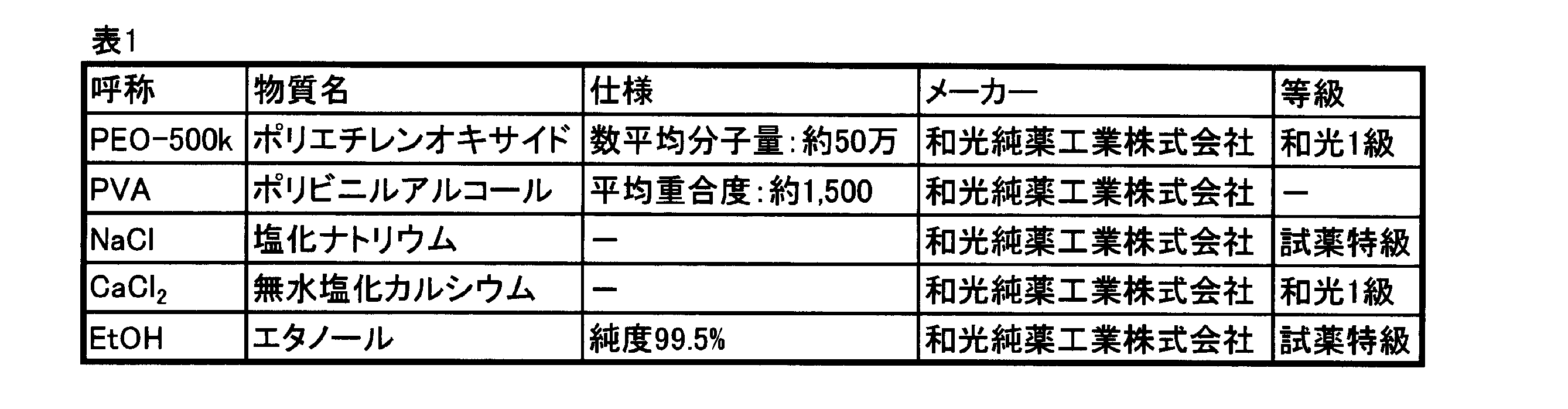
[フィブロイン水溶液の調製]
製造例1
フィブロイン水溶液を調製するために、まず、高圧精練済み切繭(ながすな繭株式会社製)60gを塩化カルシウムの水/エタノール混合溶液(塩化カルシウム:水:エタノール=1:8:2(モル比))400mLに投入し、80℃で加熱しながら1時間攪拌して溶解した。次いで、遠心分離(回転速度:12,000min-1、5分間)して、デカンテーションで沈殿物を除去した後、透析チューブ(Spectra/Por(登録商標)1 Dialysis Membrane、MWCO6,000-8,000、Spectrum Laboratories,Inc.社製)に注入し、超純水製造装置(PRO-0500及びFPC-0500(型番)、オルガノ株式会社製)から採水した超純水5Lに対して12時間の透析を5回繰り返し、フィブロイン水溶液を得た。
得られたフィブロイン水溶液2mLをポリスチレン製容器に分取し、秤量した後、庫内温度をあらかじめ-20℃程度に調整しておいたノンフロン冷蔵冷凍庫(「R-Y370(型番)」、株式会社日立製作所製)の冷凍室で12時間かけて凍結し、凍結乾燥機(「FDU-1200(型番)」、東京理化器械株式会社製)中で7時間凍結乾燥した。得られた乾燥物を凍結乾燥機から取り出して30秒以内に秤量し、質量減少からフィブロイン水溶液中のフィブロイン濃度(%(m/v))を定量した。また、以下の方法で調製した移動層を用いてHPLCでフィブロイン水溶液中のフィブロインのタンパク質換算分子量を測定した。
製造例1
フィブロイン水溶液を調製するために、まず、高圧精練済み切繭(ながすな繭株式会社製)60gを塩化カルシウムの水/エタノール混合溶液(塩化カルシウム:水:エタノール=1:8:2(モル比))400mLに投入し、80℃で加熱しながら1時間攪拌して溶解した。次いで、遠心分離(回転速度:12,000min-1、5分間)して、デカンテーションで沈殿物を除去した後、透析チューブ(Spectra/Por(登録商標)1 Dialysis Membrane、MWCO6,000-8,000、Spectrum Laboratories,Inc.社製)に注入し、超純水製造装置(PRO-0500及びFPC-0500(型番)、オルガノ株式会社製)から採水した超純水5Lに対して12時間の透析を5回繰り返し、フィブロイン水溶液を得た。
得られたフィブロイン水溶液2mLをポリスチレン製容器に分取し、秤量した後、庫内温度をあらかじめ-20℃程度に調整しておいたノンフロン冷蔵冷凍庫(「R-Y370(型番)」、株式会社日立製作所製)の冷凍室で12時間かけて凍結し、凍結乾燥機(「FDU-1200(型番)」、東京理化器械株式会社製)中で7時間凍結乾燥した。得られた乾燥物を凍結乾燥機から取り出して30秒以内に秤量し、質量減少からフィブロイン水溶液中のフィブロイン濃度(%(m/v))を定量した。また、以下の方法で調製した移動層を用いてHPLCでフィブロイン水溶液中のフィブロインのタンパク質換算分子量を測定した。
(移動相の調製)
ガラスビーカーに超純水を700mL入れ、そこに硫酸ナトリウム(無水物、和光純薬工業株式会社製、試薬特級)14.2gと尿素(和光純薬工業株式会社製、試薬特級)120.1gを加えて得た溶液をビーカーごと超音波洗浄機に漬けて超音波処理し、実質的に完全に溶解させた。この溶液に、さらにリン酸緩衝剤粉末(1.15mol/L、pH7.0、和光純薬工業株式会社製、生化学用)20gを加え、再度超音波処理をして溶解した。次いで、溶解後の溶液をメスフラスコに移し、1Lにメスアップした後に攪拌して均一な溶液とした。この溶液を分子量測定に使用する移動相とした。
ガラスビーカーに超純水を700mL入れ、そこに硫酸ナトリウム(無水物、和光純薬工業株式会社製、試薬特級)14.2gと尿素(和光純薬工業株式会社製、試薬特級)120.1gを加えて得た溶液をビーカーごと超音波洗浄機に漬けて超音波処理し、実質的に完全に溶解させた。この溶液に、さらにリン酸緩衝剤粉末(1.15mol/L、pH7.0、和光純薬工業株式会社製、生化学用)20gを加え、再度超音波処理をして溶解した。次いで、溶解後の溶液をメスフラスコに移し、1Lにメスアップした後に攪拌して均一な溶液とした。この溶液を分子量測定に使用する移動相とした。
(フィブロインのタンパク質換算分子量の測定)
フィブロイン水溶液にフィブロイン濃度が10g/Lになるよう超純水を加えて混合し、続いてそこに移動相を加えて5倍に希釈し、得られた溶液を0.45μmのフィルター(東洋濾紙株式会社製、商品名:25HP045AN)に通してろ過し、クロマトグラフ評価試料とした。
測定には高速液体クロマトグラフ(HPLC)本体(株式会社日立ハイテクノロジーズ製、商品名:Chromaster(登録商標)、とそのオプションであるUV検出器(株式会社日立ハイテクノロジーズ製、型番:5410)、ポンプ(株式会社日立ハイテクノロジーズ製、型番:5110)、オートサンプラ(株式会社日立ハイテクノロジーズ製、型番:5210)、カラムオーブン(株式会社日立ハイテクノロジーズ製、型番:5310)に加え、カラム(昭和電工株式会社製、商品名:SHODEX(登録商標) PROTEIN KW-804を組み合わせたHPLC装置を使用した。測定条件は移動相流量0.5mL/sec、カラム温度30℃、検出波長UV220nmとした。
得られたクロマトグラムをタンパク質分子量に換算するための較正曲線の作成には、分子量マーカーとしてHPLC用分子量マーカータンパク質である酵母由来グルタミン酸脱水素酵素(分子量:290,000、Oriental Yeast Co., Ltd.製、商品名:MW-Marker(HPLC))、豚心筋由来乳酸脱水素酵素(分子量:142,000、Oriental Yeast Co., Ltd.製、商品名:MW-Marker(HPLC))、酵母由来エノラーゼ(分子量:67,000、Oriental Yeast Co., Ltd.製、商品名:MW-Marker(HPLC))を使用した。
HPLC装置に移動相を1時間流し、ベースラインが安定するのを待った。ベースラインの安定後に、各分子量マーカーが水溶液中でそれぞれ0.05質量%となるように溶解した分子量マーカー水溶液を22μL注入し、得られるクロマトグラムのピークトップと分子量マーカーの分子量から較正曲線を作成した。次いで、クロマトグラフ評価試料を22μL注入して得られるクロマトグラムのピークトップの位置から較正曲線を使用してフィブロインのタンパク質換算分子量を測定した。
その結果、フィブロイン水溶液のタンパク質換算分子量は386,000であった。
フィブロイン水溶液にフィブロイン濃度が10g/Lになるよう超純水を加えて混合し、続いてそこに移動相を加えて5倍に希釈し、得られた溶液を0.45μmのフィルター(東洋濾紙株式会社製、商品名:25HP045AN)に通してろ過し、クロマトグラフ評価試料とした。
測定には高速液体クロマトグラフ(HPLC)本体(株式会社日立ハイテクノロジーズ製、商品名:Chromaster(登録商標)、とそのオプションであるUV検出器(株式会社日立ハイテクノロジーズ製、型番:5410)、ポンプ(株式会社日立ハイテクノロジーズ製、型番:5110)、オートサンプラ(株式会社日立ハイテクノロジーズ製、型番:5210)、カラムオーブン(株式会社日立ハイテクノロジーズ製、型番:5310)に加え、カラム(昭和電工株式会社製、商品名:SHODEX(登録商標) PROTEIN KW-804を組み合わせたHPLC装置を使用した。測定条件は移動相流量0.5mL/sec、カラム温度30℃、検出波長UV220nmとした。
得られたクロマトグラムをタンパク質分子量に換算するための較正曲線の作成には、分子量マーカーとしてHPLC用分子量マーカータンパク質である酵母由来グルタミン酸脱水素酵素(分子量:290,000、Oriental Yeast Co., Ltd.製、商品名:MW-Marker(HPLC))、豚心筋由来乳酸脱水素酵素(分子量:142,000、Oriental Yeast Co., Ltd.製、商品名:MW-Marker(HPLC))、酵母由来エノラーゼ(分子量:67,000、Oriental Yeast Co., Ltd.製、商品名:MW-Marker(HPLC))を使用した。
HPLC装置に移動相を1時間流し、ベースラインが安定するのを待った。ベースラインの安定後に、各分子量マーカーが水溶液中でそれぞれ0.05質量%となるように溶解した分子量マーカー水溶液を22μL注入し、得られるクロマトグラムのピークトップと分子量マーカーの分子量から較正曲線を作成した。次いで、クロマトグラフ評価試料を22μL注入して得られるクロマトグラムのピークトップの位置から較正曲線を使用してフィブロインのタンパク質換算分子量を測定した。
その結果、フィブロイン水溶液のタンパク質換算分子量は386,000であった。
[水溶性高分子水溶液の調製]
製造例2
表2に示す水溶性高分子100gを、超純水1Lに激しく攪拌しながら加え、実質的に完全に溶解させて、各水溶性高分子水溶液を調製した。
製造例2
表2に示す水溶性高分子100gを、超純水1Lに激しく攪拌しながら加え、実質的に完全に溶解させて、各水溶性高分子水溶液を調製した。
[ファイバー(B)の製造]
製造例3
(i)ドープの調製
製造例1で得たフィブロイン水溶液に、水及びグリセリンを加え、22℃で3分間、マグネチックスターラーにより撹拌し、ドープの調製を行った。ここで、ドープ中のフィブロイン濃度は10%(m/v)、グリセリン濃度は4%(v/v)[グリセリン(mL)/フィブロイン(g)比=0.4]とした。
(ii)エレクトロスピニング法による紡糸
上記で得たドープをプラスチックシリンジに充填し、プラスチックシリンジの先端にノズルを取り付けた。次に、ノズルを取り付けたシリンジをエレクトロスピニング装置にセットし、陰極板(アースされた金属板)には基材シートであるアルミホイルを貼付し、以下に示す条件でエレクトロスピニング法により紡糸を行い、ナノファイバーを製造した。エレクトロスピニング装置及びその使用条件は以下のとおりである。
・エレクトロスピニング装置:MECC Co. Ltd.製「NANON-3」
・ノズル:テルモ株式会社製、ノンベベル針18G
・ドープ吐出速度:1mL/h
・電極間距離:18cm
・印加電圧:20kV
なお、製造例3で使用したエレクトロスピニング装置は、装置がシリンジのプランジャー部を押してドープを一定速度で吐出させると同時にノズル内のドープとアースされた陰極板の間に高電圧を印加することで、ドープがジェットとして噴射され、陰極板上にナノファイバーが堆積するという仕組みを有するものである。
上記で得られたナノファイバーをアルミホイルから剥離し、ナノファイバーの紡糸可否と不溶化可否を前述の方法で評価した。結果を表2に示す。
製造例3
(i)ドープの調製
製造例1で得たフィブロイン水溶液に、水及びグリセリンを加え、22℃で3分間、マグネチックスターラーにより撹拌し、ドープの調製を行った。ここで、ドープ中のフィブロイン濃度は10%(m/v)、グリセリン濃度は4%(v/v)[グリセリン(mL)/フィブロイン(g)比=0.4]とした。
(ii)エレクトロスピニング法による紡糸
上記で得たドープをプラスチックシリンジに充填し、プラスチックシリンジの先端にノズルを取り付けた。次に、ノズルを取り付けたシリンジをエレクトロスピニング装置にセットし、陰極板(アースされた金属板)には基材シートであるアルミホイルを貼付し、以下に示す条件でエレクトロスピニング法により紡糸を行い、ナノファイバーを製造した。エレクトロスピニング装置及びその使用条件は以下のとおりである。
・エレクトロスピニング装置:MECC Co. Ltd.製「NANON-3」
・ノズル:テルモ株式会社製、ノンベベル針18G
・ドープ吐出速度:1mL/h
・電極間距離:18cm
・印加電圧:20kV
なお、製造例3で使用したエレクトロスピニング装置は、装置がシリンジのプランジャー部を押してドープを一定速度で吐出させると同時にノズル内のドープとアースされた陰極板の間に高電圧を印加することで、ドープがジェットとして噴射され、陰極板上にナノファイバーが堆積するという仕組みを有するものである。
上記で得られたナノファイバーをアルミホイルから剥離し、ナノファイバーの紡糸可否と不溶化可否を前述の方法で評価した。結果を表2に示す。
製造例4~17
製造例3において、ドープの組成及びエレクトロスピニングの条件を表2に記載のものとした以外は実施例1と同様にしてナノファイバーの製造を行った。得られたナノファイバーの評価結果を表2に示す。
なお、製造例17では、ワイヤー式のエレクトロスピニング装置として、ELMARCO s.r.o.社製「ナノスパイダー プロダクションライン NS 1WS500U」を使用した。
ワイヤー式のエレクトロスピニング装置は、ドープを充填したタンクを装着したキャリッジと呼ばれる稼動部が、紡糸チャンバー下部に設置された陽極ワイヤーにドープを塗りつけると同時に、高電圧を印加することで、紡糸チャンバー下部に設置された陽極ワイヤーから紡糸チャンバー上部に設置された陰極ワイヤーに向けてドープのジェットが噴出されるという仕組みである。基材シートであるアルミホイルを陰極ワイヤーの下部に設置することで、アルミホイル上にナノファイバーを堆積させることができる。
製造例3において、ドープの組成及びエレクトロスピニングの条件を表2に記載のものとした以外は実施例1と同様にしてナノファイバーの製造を行った。得られたナノファイバーの評価結果を表2に示す。
なお、製造例17では、ワイヤー式のエレクトロスピニング装置として、ELMARCO s.r.o.社製「ナノスパイダー プロダクションライン NS 1WS500U」を使用した。
ワイヤー式のエレクトロスピニング装置は、ドープを充填したタンクを装着したキャリッジと呼ばれる稼動部が、紡糸チャンバー下部に設置された陽極ワイヤーにドープを塗りつけると同時に、高電圧を印加することで、紡糸チャンバー下部に設置された陽極ワイヤーから紡糸チャンバー上部に設置された陰極ワイヤーに向けてドープのジェットが噴出されるという仕組みである。基材シートであるアルミホイルを陰極ワイヤーの下部に設置することで、アルミホイル上にナノファイバーを堆積させることができる。
比較製造例1~3
製造例3において、ドープの組成及びエレクトロスピニングの条件を表2に記載のものとした以外は、製造例3と同様にしてナノファイバーの製造を行った。得られたナノファイバーの評価結果を表2に示す。
製造例3において、ドープの組成及びエレクトロスピニングの条件を表2に記載のものとした以外は、製造例3と同様にしてナノファイバーの製造を行った。得られたナノファイバーの評価結果を表2に示す。
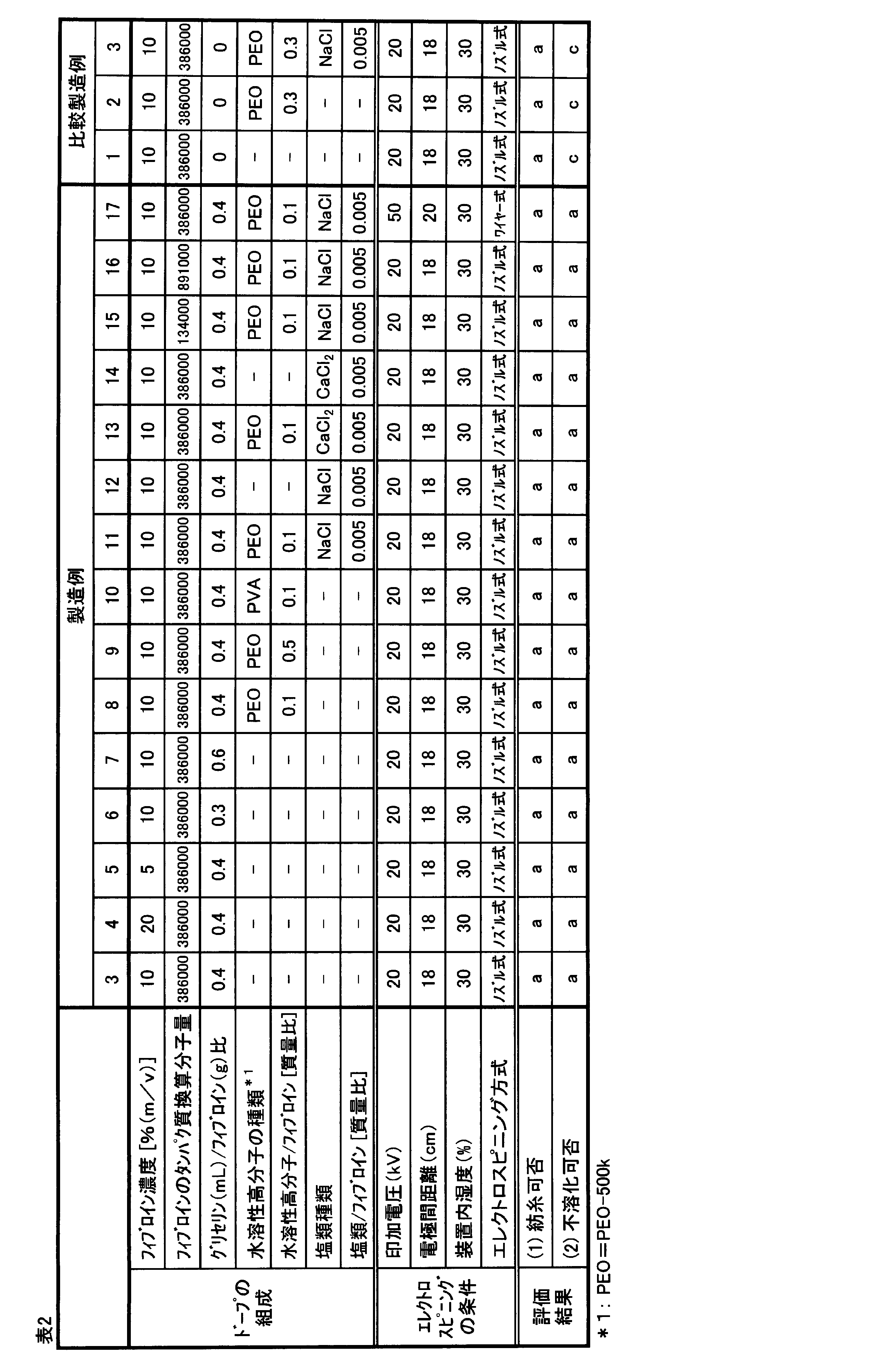
製造例3~17より、ドープがグリセリン等の炭素数2~8の多価アルコールを含有することで、いずれのドープ組成においても、安全かつ簡易にナノファイバーが得られ、得られたナノファイバーは水に不溶であることが分かった。
一方、比較製造例1~3から、グリセリン等の炭素数2~8の多価アルコールを添加しない場合にはナノファイバーが不溶化しないことが分かった。
一方、比較製造例1~3から、グリセリン等の炭素数2~8の多価アルコールを添加しない場合にはナノファイバーが不溶化しないことが分かった。
[ナノファイバーの観察]
製造例11で製造したナノファイバーを走査型電子顕微鏡(SEM)で観察した。走査型電子顕微鏡は、「Neo Scope JCM-5000」(日本電子株式会社製)を使用し、高真空Pt蒸着モード、加速電圧10kVの条件で観察した。結果を図3に示す。
図3から、製造例11では繊維径150~800nm(平均繊維径:294nm)のナノファイバーが得られることが分かった。
次いで、製造例11で製造したナノファイバーを24℃の超純水中に1時間浸漬した後に、凍結乾燥したナノファイバーについて、上記と同様の条件でSEMによる観察を行った。結果を図4に示す。
図4から、製造例11で製造したナノファイバーは水に浸漬後も図3と同様の構造を保っており、水に不溶であることが分かった。
図3及び図4の結果から、フィブロインと、グリセリン等の炭素数2~8の多価アルコールとを含むナノファイバーは、ナノオーダーの繊維径を有する繊維であり、かつ水に不溶であることが分かった。
製造例11で製造したナノファイバーを走査型電子顕微鏡(SEM)で観察した。走査型電子顕微鏡は、「Neo Scope JCM-5000」(日本電子株式会社製)を使用し、高真空Pt蒸着モード、加速電圧10kVの条件で観察した。結果を図3に示す。
図3から、製造例11では繊維径150~800nm(平均繊維径:294nm)のナノファイバーが得られることが分かった。
次いで、製造例11で製造したナノファイバーを24℃の超純水中に1時間浸漬した後に、凍結乾燥したナノファイバーについて、上記と同様の条件でSEMによる観察を行った。結果を図4に示す。
図4から、製造例11で製造したナノファイバーは水に浸漬後も図3と同様の構造を保っており、水に不溶であることが分かった。
図3及び図4の結果から、フィブロインと、グリセリン等の炭素数2~8の多価アルコールとを含むナノファイバーは、ナノオーダーの繊維径を有する繊維であり、かつ水に不溶であることが分かった。
製造例3~17によって水に不溶なナノファイバーを製造できることが判明したため、以下では、同様の条件を利用して、基材(A)上にファイバー(B)としてのナノファイバーを紡出し、複合体を製造した。
(基材(A)の準備)
基材(A)として、表3に記載の不織布又はスポンジを用いた。なお、シルクスポンジは下記の方法で製造した。
(基材(A)の準備)
基材(A)として、表3に記載の不織布又はスポンジを用いた。なお、シルクスポンジは下記の方法で製造した。
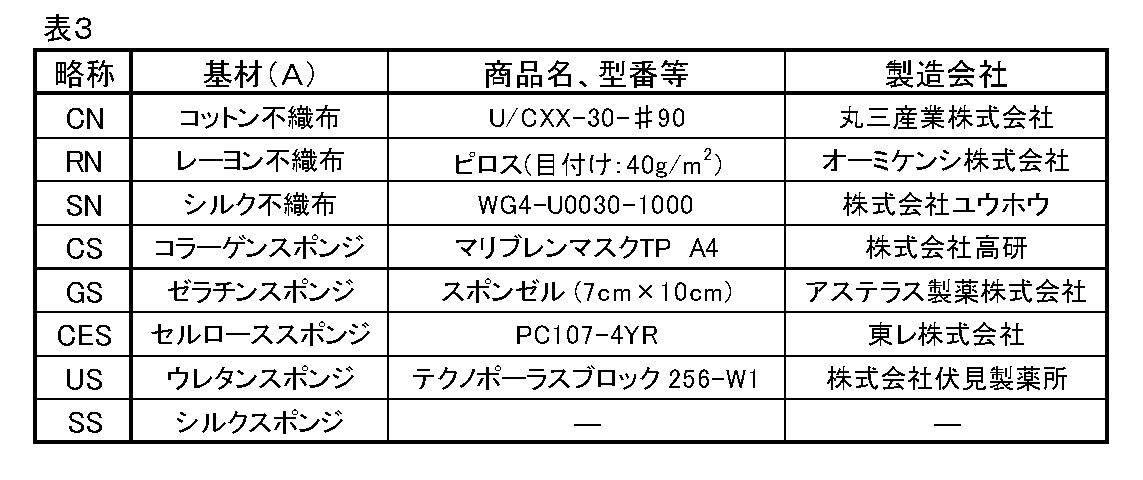
(シルクスポンジの製造)
前述の方法で製造した濃度を測定したフィブロイン水溶液に酢酸および超純水を加え、フィブロイン濃度40mg/mL、酢酸濃度2体積%の水溶液を調製した。得られたフィブロインの酢酸水溶液を60mm×80mm×0.8mmのアルミ製容器に封入し、-5℃の低温恒温槽「NCB-3300」(東京理化器械株式会社製)に入れて2時間保持し、その後、低温恒温槽の温度を5時間かけて-20℃まで下げて、-20℃で5時間保持した。凍結した試料を室温で自然解凍してから、容器から取り出し、シルクスポンジを得た。
容器から取り出したシルクスポンジを、10Lの超純水中で12時間ごとに水を換えて5日間静置し、酢酸を除去した。酢酸除去後のシルクスポンジを3体積%のグリセリン水溶液10Lに3日間浸漬した後、-25℃に維持した冷凍庫中で6時間かけて凍結した。得られた凍結物を凍結乾燥機「FD-550P」(東京理化器械株式会社製)に入れ2日間かけて凍結乾燥した。得られた乾燥物を以下の実施例中でシルクスポンジとして使用した。
前述の方法で製造した濃度を測定したフィブロイン水溶液に酢酸および超純水を加え、フィブロイン濃度40mg/mL、酢酸濃度2体積%の水溶液を調製した。得られたフィブロインの酢酸水溶液を60mm×80mm×0.8mmのアルミ製容器に封入し、-5℃の低温恒温槽「NCB-3300」(東京理化器械株式会社製)に入れて2時間保持し、その後、低温恒温槽の温度を5時間かけて-20℃まで下げて、-20℃で5時間保持した。凍結した試料を室温で自然解凍してから、容器から取り出し、シルクスポンジを得た。
容器から取り出したシルクスポンジを、10Lの超純水中で12時間ごとに水を換えて5日間静置し、酢酸を除去した。酢酸除去後のシルクスポンジを3体積%のグリセリン水溶液10Lに3日間浸漬した後、-25℃に維持した冷凍庫中で6時間かけて凍結した。得られた凍結物を凍結乾燥機「FD-550P」(東京理化器械株式会社製)に入れ2日間かけて凍結乾燥した。得られた乾燥物を以下の実施例中でシルクスポンジとして使用した。
実施例1(複合体の製造)
陰極板上に基材(A)としてシルクスポンジを設置した以外は製造例3と同様にしてエレクトロスピニングによりシルクスポンジ上にナノファイバーを紡糸し、複合体を製造した。なお、エレクトロスピニング処理時間は15分とした。
次いで、得られた複合体のナノファイバー(ファイバー(B))の紡糸可否及び不溶化可否、並びに、基材とナノファイバーとの接着力を前記方法で評価した。結果を表4及び表5に示す。
陰極板上に基材(A)としてシルクスポンジを設置した以外は製造例3と同様にしてエレクトロスピニングによりシルクスポンジ上にナノファイバーを紡糸し、複合体を製造した。なお、エレクトロスピニング処理時間は15分とした。
次いで、得られた複合体のナノファイバー(ファイバー(B))の紡糸可否及び不溶化可否、並びに、基材とナノファイバーとの接着力を前記方法で評価した。結果を表4及び表5に示す。
実施例2~22
実施例1において、ドープの組成及びエレクトロスピニング法の条件を表4又は表5に記載のものとした以外は、実施例1と同様の方法で複合体を製造した。ナノファイバーの紡糸可否、不溶化可否、接着力の評価を行った。結果を表4及び表5に示す。
実施例1において、ドープの組成及びエレクトロスピニング法の条件を表4又は表5に記載のものとした以外は、実施例1と同様の方法で複合体を製造した。ナノファイバーの紡糸可否、不溶化可否、接着力の評価を行った。結果を表4及び表5に示す。
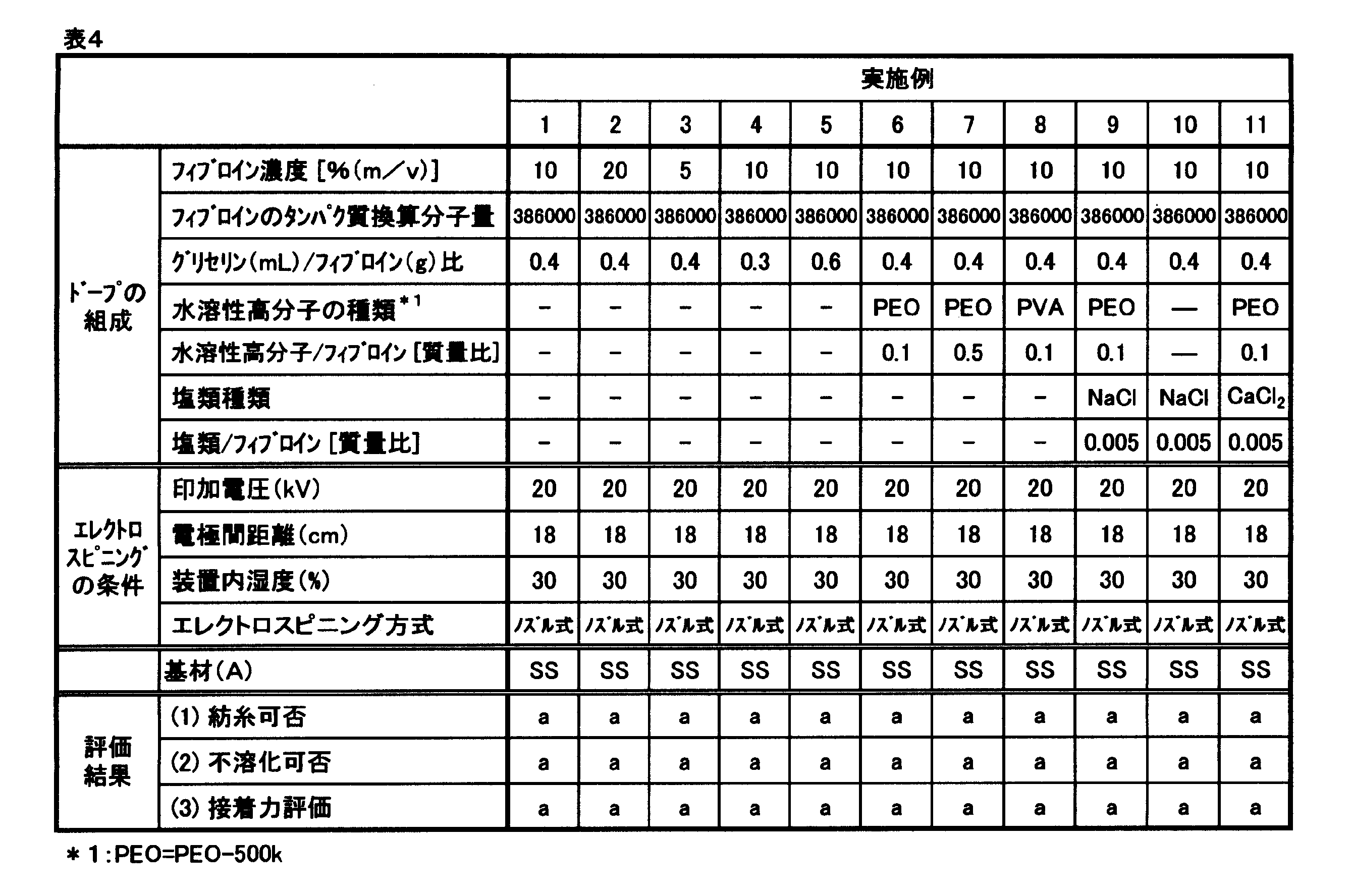
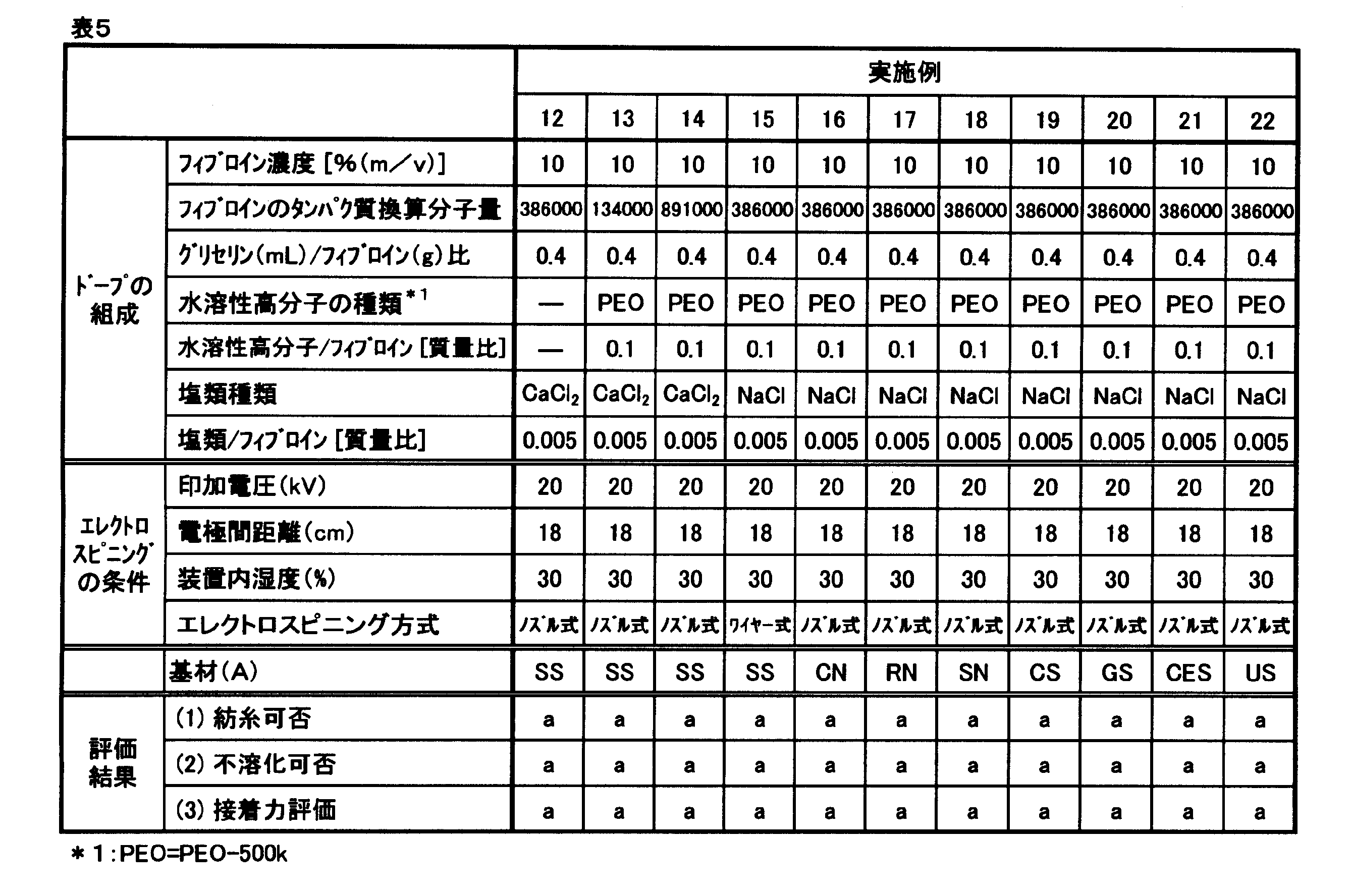
実施例1~22から、製造例3~17で得られたナノファイバーと同様、水に不溶なナノファイバーが基材上に形成されており、基材とナノファイバーとが接着していることが分かった。
ここで、実施例13で製造した複合体の基材とナノファイバーとの界面を走査型電子顕微鏡で観察した。走査型電子顕微鏡は、日本電子株式会社製 Neo Scope JCM-5000を使用し、高真空Pt蒸着モード、加速電圧10kVの条件で観察した。結果を図5に示す。
図5から、本発明の複合体は微細な繊維からなるナノファイバー51が基材52に密着して存在する構造であることが分かった。
図5から、本発明の複合体は微細な繊維からなるナノファイバー51が基材52に密着して存在する構造であることが分かった。
実施例23
実施例9で得られた複合体をナノファイバー側が下になるようにコレクター上に設置し、実施例9と同様の条件で再度ナノファイバーを紡糸し、基材の両面にナノファイバーを有する複合体を製造した。
その結果、得られた複合体の両面のナノファイバーを走査型電子顕微鏡で観察した。走査型電子顕微鏡は、日本電子株式会社製のNeo Scope JCM-5000を使用し、高真空Pt蒸着モード、加速電圧10kVの条件で観察した。その結果、複合体の両面が共にナノファイバーで覆われていることが分かった。
実施例9で得られた複合体をナノファイバー側が下になるようにコレクター上に設置し、実施例9と同様の条件で再度ナノファイバーを紡糸し、基材の両面にナノファイバーを有する複合体を製造した。
その結果、得られた複合体の両面のナノファイバーを走査型電子顕微鏡で観察した。走査型電子顕微鏡は、日本電子株式会社製のNeo Scope JCM-5000を使用し、高真空Pt蒸着モード、加速電圧10kVの条件で観察した。その結果、複合体の両面が共にナノファイバーで覆われていることが分かった。
[ナノファイバーの定性分析]
次に、実施例1、6、9及び10で複合体から剥がし取ったナノファイバーについて、前述の方法により、定性分析を行った。結果を表6に示す。
なお、表6において、各実施例で用いたドープ中に含まれる成分及び各実施例で得られたナノファイバー中に含まれる成分をa、含まれない成分をcとして記入した。但し、ドープに添加しなかった成分については、定性分析を行わず、ナノファイバーにも含まれない(つまり、c)という表記をした。
次に、実施例1、6、9及び10で複合体から剥がし取ったナノファイバーについて、前述の方法により、定性分析を行った。結果を表6に示す。
なお、表6において、各実施例で用いたドープ中に含まれる成分及び各実施例で得られたナノファイバー中に含まれる成分をa、含まれない成分をcとして記入した。但し、ドープに添加しなかった成分については、定性分析を行わず、ナノファイバーにも含まれない(つまり、c)という表記をした。

表6の結果から、複合体が有していた(ナノ)ファイバーは、エレクトロスピニングで用いたドープに添加した物質を含むことが分かった。
本発明の複合体が有するファイバーは、水に不溶であり、生体親和性に優れ、微細な構造で表面積が大きいなどの特徴を有する。当該特徴を活かし、本発明の複合体は、創傷被覆材、不織布、再生医療用足場材料(細胞培養担体)等として好適に使用することができる。特に、ナノファイバーの表面積の大きさとフィブロインの特異な吸着能を活かした吸着材、ナノファイバーのファイバー間の微細な空孔を活かしたフィルター及び分離膜、質感の良さを活かしたスキンケアシート等への応用も期待される。
11、21 ファイバー(B)
12、22 基材(A)
51 ナノファイバー
52 基材
12、22 基材(A)
51 ナノファイバー
52 基材
Claims (10)
- (A)繊維基材及びスポンジからなる群から選ばれる少なくとも1種の基材、及び
(B)フィブロイン及び炭素数2~8の多価アルコールを含有してなるファイバー
を有する複合体。 - 前記繊維基材が、コットン不織布、レーヨン不織布及びシルク不織布からなる群から選ばれる少なくとも1種の不織布である、請求項1に記載の複合体。
- 前記スポンジが、フィブロインスポンジ、コラーゲンスポンジ、ゼラチンスポンジ、ウレタンスポンジ及びセルローススポンジからなる群から選ばれる少なくとも1種である、請求項1又は2に記載の複合体。
- 前記ファイバーが、さらに、水溶性高分子、無機塩及び非イオン性界面活性剤からなる群から選ばれる少なくとも1種を含有してなるものである、請求項1~3のいずれか1項に記載の複合体。
- 前記水溶性高分子が、ポリエチレンオキサイド、ポリビニルアルコール、ヒドロキシプロピルセルロース、ポリエチレングリコール及びゼラチンからなる群から選ばれる少なくとも1種である、請求項4に記載の複合体。
- 前記無機塩が、アルカリ金属塩及びアルカリ土類金属塩からなる群から選ばれる少なくとも1種である、請求項4又は5に記載の複合体。
- 前記ファイバーの平均繊維径が10~900nmである、請求項1~6のいずれか1項に記載の複合体。
- 請求項1~7のいずれか1項に記載の複合体を含有してなるスキンケアシート。
- 請求項1~7のいずれか1項に記載の複合体を含有してなる創傷被覆材。
- 請求項1~7のいずれか1項に記載の複合体を含有してなる再生医療用材料。
Applications Claiming Priority (2)
| Application Number | Priority Date | Filing Date | Title |
|---|---|---|---|
| JP2015-187185 | 2015-09-24 | ||
| JP2015187185 | 2015-09-24 |
Publications (1)
| Publication Number | Publication Date |
|---|---|
| WO2017051927A1 true WO2017051927A1 (ja) | 2017-03-30 |
Family
ID=58386040
Family Applications (1)
| Application Number | Title | Priority Date | Filing Date |
|---|---|---|---|
| PCT/JP2016/078309 Ceased WO2017051927A1 (ja) | 2015-09-24 | 2016-09-26 | 複合体、スキンケアシート、創傷被覆材、再生医療用材料 |
Country Status (1)
| Country | Link |
|---|---|
| WO (1) | WO2017051927A1 (ja) |
Cited By (1)
| Publication number | Priority date | Publication date | Assignee | Title |
|---|---|---|---|---|
| CN116115813A (zh) * | 2023-02-01 | 2023-05-16 | 西南大学 | 一种具有持续单向导湿能力的复合敷料及制备方法 |
Citations (4)
| Publication number | Priority date | Publication date | Assignee | Title |
|---|---|---|---|---|
| JP2010150712A (ja) * | 2008-12-25 | 2010-07-08 | Shinshu Univ | 絹タンパク質ナノファイバー及びその製造方法、並びに絹タンパク質複合体ナノファイバー及びその製造方法 |
| CN102936794A (zh) * | 2012-11-20 | 2013-02-20 | 东华大学 | 基于天然材料丝素蛋白和壳聚糖复合纳米纤维膜的制备 |
| JP2013119676A (ja) * | 2011-12-07 | 2013-06-17 | Shinwa Co Ltd | 化粧用シート |
| JP2015093857A (ja) * | 2013-11-13 | 2015-05-18 | 国立大学法人信州大学 | 水不溶性シルクタンパク質 |
-
2016
- 2016-09-26 WO PCT/JP2016/078309 patent/WO2017051927A1/ja not_active Ceased
Patent Citations (4)
| Publication number | Priority date | Publication date | Assignee | Title |
|---|---|---|---|---|
| JP2010150712A (ja) * | 2008-12-25 | 2010-07-08 | Shinshu Univ | 絹タンパク質ナノファイバー及びその製造方法、並びに絹タンパク質複合体ナノファイバー及びその製造方法 |
| JP2013119676A (ja) * | 2011-12-07 | 2013-06-17 | Shinwa Co Ltd | 化粧用シート |
| CN102936794A (zh) * | 2012-11-20 | 2013-02-20 | 东华大学 | 基于天然材料丝素蛋白和壳聚糖复合纳米纤维膜的制备 |
| JP2015093857A (ja) * | 2013-11-13 | 2015-05-18 | 国立大学法人信州大学 | 水不溶性シルクタンパク質 |
Cited By (1)
| Publication number | Priority date | Publication date | Assignee | Title |
|---|---|---|---|---|
| CN116115813A (zh) * | 2023-02-01 | 2023-05-16 | 西南大学 | 一种具有持续单向导湿能力的复合敷料及制备方法 |
Similar Documents
| Publication | Publication Date | Title |
|---|---|---|
| CN104511045B (zh) | 一种含纳米银的聚乙烯醇/壳聚糖纳米纤维膜敷料的制备方法 | |
| CN105012991B (zh) | 具有无纺布纤维织物结构的抗菌‑止血材料及其制备方法 | |
| CN105396563B (zh) | 高吸附性二醋酸纤维素复合静电纺纳米纤维有序多孔薄膜的制备方法 | |
| CN110772661A (zh) | 一种无毒环保溶剂型双层纳米纤维皮肤敷料及其制备方法 | |
| Wu et al. | Nanofibrous asymmetric membranes self-organized from chemically heterogeneous electrospun mats for skin tissue engineering | |
| Fujita et al. | Geometrically customizable alginate hydrogel nanofibers for cell culture platforms | |
| CN105437667A (zh) | 一种面膜用复合基材的制备方法 | |
| CN104436281A (zh) | 一种多孔海藻酸钠纳米纤维创面敷料的制备方法 | |
| CN103483606B (zh) | 一种细菌纤维素复合聚合物超细纤维材料的制备方法 | |
| CN102691176A (zh) | 利用绝缘接收模板静电纺制备图案化纳米纤维膜的方法 | |
| Yadav et al. | Electrospinning: an efficient biopolymer-based micro-and nanofibers fabrication technique | |
| CN104043148B (zh) | 一种韧带支架及其制备方法 | |
| CN106267339A (zh) | 一种高模量超亲水生物支架制备方法 | |
| CN105355818A (zh) | 复合型纳米纤维锂电池隔膜及其制备方法 | |
| CN105497969A (zh) | 一种多层复合膜敷料及其制备方法 | |
| CN107496972B (zh) | 一种促烧伤创面愈合的防粘连湿性敷料及其制备方法 | |
| JP6528278B2 (ja) | ナノファイバーの製造方法及びエレクトロスピニング用ドープ | |
| CN107670115A (zh) | 丝素蛋白/羟基磷灰石/聚(消旋乳酸‑co‑己内酯)复合纳米纤维膜的制备方法 | |
| Ma et al. | Fabrication of bioactive glass-introduced nanofibrous membranes with multifunctions for potential wound dressing | |
| CN105839407B (zh) | 一种医用高分子材料纳米纤维的表面生物功能化方法 | |
| CN101775704B (zh) | 一种制备纯透明质酸纳米纤维无纺布的方法 | |
| Reis et al. | Three-dimensional multilayered fibrous constructs for wound healing applications | |
| Yu et al. | Repair of skin defects with electrospun collagen/chitosan and fibroin/chitosan compound nanofiber scaffolds compared with gauze dressing | |
| Abdelhakeem et al. | State-of-the-art review of advanced electrospun nanofiber composites for enhanced wound healing | |
| CN105696099A (zh) | 一种遇水能产生形变的材料及其制备方法 |
Legal Events
| Date | Code | Title | Description |
|---|---|---|---|
| 121 | Ep: the epo has been informed by wipo that ep was designated in this application |
Ref document number: 16848715 Country of ref document: EP Kind code of ref document: A1 |
|
| NENP | Non-entry into the national phase |
Ref country code: DE |
|
| 122 | Ep: pct application non-entry in european phase |
Ref document number: 16848715 Country of ref document: EP Kind code of ref document: A1 |
|
| NENP | Non-entry into the national phase |
Ref country code: JP |