WO2017038515A1 - 無線通信装置 - Google Patents
無線通信装置 Download PDFInfo
- Publication number
- WO2017038515A1 WO2017038515A1 PCT/JP2016/074309 JP2016074309W WO2017038515A1 WO 2017038515 A1 WO2017038515 A1 WO 2017038515A1 JP 2016074309 W JP2016074309 W JP 2016074309W WO 2017038515 A1 WO2017038515 A1 WO 2017038515A1
- Authority
- WO
- WIPO (PCT)
- Prior art keywords
- service
- channel
- unit
- start information
- execution
- Prior art date
- Legal status (The legal status is an assumption and is not a legal conclusion. Google has not performed a legal analysis and makes no representation as to the accuracy of the status listed.)
- Ceased
Links
Images









Classifications
-
- H—ELECTRICITY
- H04—ELECTRIC COMMUNICATION TECHNIQUE
- H04W—WIRELESS COMMUNICATION NETWORKS
- H04W4/00—Services specially adapted for wireless communication networks; Facilities therefor
- H04W4/80—Services using short range communication, e.g. near-field communication [NFC], radio-frequency identification [RFID] or low energy communication
-
- H—ELECTRICITY
- H04—ELECTRIC COMMUNICATION TECHNIQUE
- H04W—WIRELESS COMMUNICATION NETWORKS
- H04W72/00—Local resource management
- H04W72/50—Allocation or scheduling criteria for wireless resources
- H04W72/51—Allocation or scheduling criteria for wireless resources based on terminal or device properties
-
- G—PHYSICS
- G08—SIGNALLING
- G08G—TRAFFIC CONTROL SYSTEMS
- G08G1/00—Traffic control systems for road vehicles
- G08G1/09—Arrangements for giving variable traffic instructions
- G08G1/0962—Arrangements for giving variable traffic instructions having an indicator mounted inside the vehicle, e.g. giving voice messages
- G08G1/0967—Systems involving transmission of highway information, e.g. weather, speed limits
- G08G1/096766—Systems involving transmission of highway information, e.g. weather, speed limits where the system is characterised by the origin of the information transmission
- G08G1/096783—Systems involving transmission of highway information, e.g. weather, speed limits where the system is characterised by the origin of the information transmission where the origin of the information is a roadside individual element
-
- H—ELECTRICITY
- H04—ELECTRIC COMMUNICATION TECHNIQUE
- H04W—WIRELESS COMMUNICATION NETWORKS
- H04W4/00—Services specially adapted for wireless communication networks; Facilities therefor
- H04W4/30—Services specially adapted for particular environments, situations or purposes
- H04W4/40—Services specially adapted for particular environments, situations or purposes for vehicles, e.g. vehicle-to-pedestrians [V2P]
-
- H—ELECTRICITY
- H04—ELECTRIC COMMUNICATION TECHNIQUE
- H04W—WIRELESS COMMUNICATION NETWORKS
- H04W64/00—Locating users or terminals or network equipment for network management purposes, e.g. mobility management
Definitions
- the present disclosure relates to a wireless communication device, and more particularly, to a wireless communication device that performs communication using two types of channels, a control channel and a service channel.
- WAVE Wireless Access in Vehicular Environments
- a vehicle wireless communication apparatus and a roadside device communicate using two types of channels, a control channel and a service channel.
- the service channel is a channel used for transmission / reception of information for executing a service (hereinafter referred to as service execution information).
- service execution information There are a plurality of types of services, and service channels include a plurality of channels having different frequencies. Each service is associated with one of a plurality of service channels.
- the control channel is a channel used for the roadside device to transmit various information (hereinafter referred to as service start information) that needs to be notified in order to start communication with the vehicle wireless communication device using the service channel. .
- service start information includes information that determines the service channel to be set as the reception channel.
- the time zone is divided into a control channel time frame and a service channel time frame.
- the control channel time frame is a time frame in which the vehicle radio communication apparatus uses the reception channel as the control channel unless a command to change the service channel time frame is notified by the service start information.
- the service channel time frame is a time frame for periodically setting the reception channel as the service channel when communication using the service channel is performed.
- the vehicle wireless communication apparatus uses the reception channel as a control channel not only for the control channel time frame but also for the service channel time frame until the service start information is received.
- the reception channel is set as the service channel from the first service channel time frame. Thereafter, until the communication for executing the service is completed, normally, in the service channel time frame, the communication channel is the service channel specified by the service start information, and in the control channel time frame, the communication channel is the control channel. .
- the service start information includes information indicating the priority of the service.
- the priority is high. Run the service.
- This disclosure is intended to provide a wireless communication apparatus that can prevent communication for executing a service with high priority from being disabled.
- the wireless communication apparatus includes a narrow area reception unit, a channel control unit, and an execution service determination unit.
- the narrow band reception unit sets a channel selected from a control channel and a plurality of service channels, which are different frequency channels, as a reception channel, and when the reception channel is set as a control channel, information and services that determine the type of service Service priority information, which is information for determining the priority of the service, and service start information including information for determining the service channel are received from the service providing station, and the service is executed when the reception channel is set to the service channel.
- the service execution information is received from the service providing station.
- the channel control unit controls whether the reception channel is a control channel or a service channel.
- the channel control unit alternately sets a control channel time frame that is a time frame in which the reception channel can be a control channel and a service channel time frame that is a time frame in which the reception channel can be set as a service channel. At least in the control channel time frame of the reference time segment, the reception channel is set as the control channel, the narrow area reception unit receives the service start information, and the received service start information is received from the beginning of the service channel time frame.
- service start information for a standard start type service that is a service channel
- the execution service determination unit uses part or all of the service start information received by the narrow band reception unit while the channel control unit sets the reception channel as a control channel as service start information for comparing priorities, and compares the priorities.
- the service having the highest priority among the services represented by the service start information is determined based on the service priority information included in the service start information, and an execution service determination process using the determined service as an execution service is performed.
- the channel control unit determines the reception channel as the execution service from the beginning of the next service channel time frame after the extended time frame has elapsed.
- the service execution information is received by setting the service channel determined from the service start information corresponding to the service.
- the reception channel is set as the service channel from the first service channel time frame thereafter.
- the channel control unit maintains the reception channel as the control channel for a preset number of service channel time frames even after receiving the service start information. Therefore, when the service start information is transmitted from the service providing station during the preset number of service channel time frames, there is a possibility that the service start information can be received by the narrow area receiving unit.
- the execution service determination unit uses part or all of the service start information received while the narrow area reception unit uses the reception channel as a control channel as service start information for comparing priorities, and compares the priorities. Of the services indicated by the service start information, the service with the highest priority is determined as the execution service. Then, the channel control unit sets a service channel corresponding to the execution service as a reception channel. Therefore, it is possible to prevent communication for executing a service with a high priority from being disabled.
- FIG. 1 is a diagram illustrating an overall configuration of a wireless communication system according to the first embodiment of the present disclosure
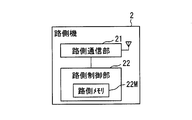
- FIG. 2 is a block diagram showing the configuration of the roadside machine of FIG.
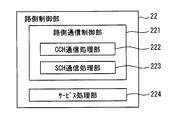
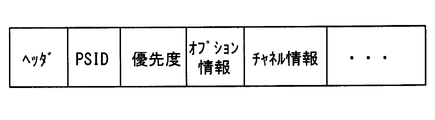
- FIG. 3 is a block diagram showing functions of the roadside control unit of FIG. 4 is a diagram illustrating the configuration of WSA generated by the CCH communication processing unit of FIG.
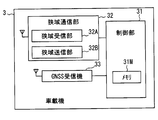
- FIG. 5 is a block diagram showing the configuration of the in-vehicle device in FIG.
- FIG. 6 is a block diagram showing functions of the control unit of FIG.
- FIG. 7 is a diagram illustrating the time change of the communication channel of the narrow area communication unit, FIG.
- FIG. 8 is a flowchart showing processing executed by the channel control unit of FIG.
- FIG. 9 is a flowchart showing processing executed by the execution service determination unit in FIG.
- FIG. 10 is a diagram showing a plurality of WSAs stored in the memory of FIG. 5 as a list.
- FIG. 11 is a diagram illustrating a time change of the reception channel of the narrow band reception unit
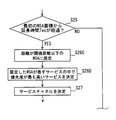
- FIG. 12 is a flowchart illustrating processing executed by the execution service determination unit in place of FIG. 9 in the second embodiment of the present disclosure.
- FIG. 13 is a diagram illustrating WSA generated by the CCH communication processing unit of the roadside control unit in the third embodiment of the present disclosure.
- FIG. 14 is a block diagram illustrating functions provided in the control unit in the third embodiment.
- FIG. 15 is a flowchart illustrating processing executed by the execution service determination unit of the control unit in the third embodiment.
- FIG. 16 is a block diagram illustrating functions included in the control unit in the fourth embodiment of the present disclosure.
- FIG. 17 is a flowchart showing processing executed by the execution service determination unit of the control unit in the fourth embodiment.
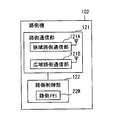
- FIG. 18 is a block diagram illustrating a configuration of a roadside machine according to the fifth embodiment of the present disclosure.
- FIG. 19 is a block diagram illustrating functions of the roadside control unit in the fifth embodiment.
- FIG. 20 is a diagram illustrating WSA generated by the CCH communication processing unit of FIG.
- FIG. 21 is a block diagram showing the configuration of the in-vehicle device of the fifth embodiment.
- FIG. 22 is a block diagram illustrating functions of the control unit of the fifth embodiment.
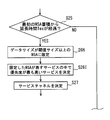
- FIG. 23 is a flowchart illustrating processing executed by the execution service determination unit according to the fifth embodiment.
- the reception channel is set as the control channel, multiple service start information can be received.
- the service start information cannot be received while the service to be executed is determined and the reception channel is the service channel. Therefore, even if the service start information for a service having a higher priority than the service using the service channel is transmitted from the roadside device while the reception channel is set as the service channel, the vehicular wireless communication apparatus starts the service start. Information cannot be received.
- a wireless communication device having the same function as the vehicle wireless communication device is used in a mobile body other than a vehicle, and a device (hereinafter referred to as a service providing station) that communicates with the wireless communication device is a roadside device.
- a service providing station a device that communicates with the wireless communication device.
- the present disclosure has been made based on this situation, and an object of the present disclosure is to provide a wireless communication device that can prevent communication for executing a service having a high priority from being disabled. It is in.
- the wireless communication system 1 includes a roadside device 2 and an in-vehicle device 3.
- the in-vehicle device 3 corresponds to a wireless communication device.
- FIG. 1 shows only one in-vehicle device 3, but there may be a plurality of in-vehicle devices 3.
- the roadside device 2 and the vehicle-mounted device 3 communicate with each other in accordance with the WAVE standard.
- the wireless communication system 1 sets one control channel and a plurality of service channels as communication channels.
- the control channel and the plurality of service channels are set to different predetermined frequency channels. Both of these control channels and service channels belong to the 5.8 GHz band and the 5.9 GHz band.
- the roadside device 2 corresponds to a service providing station, and notifies WSA (Wave Service Advertisement) through a control channel.
- This WSA corresponds to service start information, and includes various information that the in-vehicle device 3 needs to acquire in order to start the service.
- the WSA includes channel information that specifies a service channel.
- the roadside device 2 transmits service execution information through the service channel specified by the WSA.
- the roadside machine 2 may be fixed to the roadside or may be a mobile type.
- the service execution information is information that needs to be communicated between the roadside device 2 and the vehicle-mounted device 3 in order to execute the service, and includes information transmitted by the roadside device 2 and information transmitted by the vehicle-mounted device 3. Yes.
- the service execution information is only information transmitted by the roadside device 2.
- the in-vehicle device 3 is mounted on the vehicle 4 and receives WSA and service execution information. In addition, inter-vehicle communication with other in-vehicle devices 3 can also be performed.
- the vehicle 4 includes various vehicles that travel on the road, such as passenger cars, buses, and trucks. Moreover, although the four-wheeled vehicle is illustrated as the vehicle 4 in FIG. 1, the vehicle 4 may be a two-wheeled vehicle. Two-wheeled vehicles include bicycles.
- the roadside device 2 performs road-to-vehicle communication with the in-vehicle device 3 existing in the wireless communication area formed by the roadside device 2, and transmits various information to the in-vehicle device 3 and obtains various information from the in-vehicle device 3. To execute a predetermined service.
- the roadside machine 2 is provided at a position suitable for the service provided by the roadside machine 2.
- the roadside machine 2 is provided at an intersection, a middle of a road connecting the intersection and the intersection, an entrance to a specific facility (for example, a parking lot, a store, a toll road), or the like.
- the wireless communication area of the roadside device 2 can be set according to the service provided by the roadside device 2.
- the output of the radio wave transmitted by the roadside device 2 can be set according to the service provided by the roadside device 2.
- the set wireless communication area is wide, it may overlap with the wireless communication areas of other roadside devices 2.
- FIG. 1 also shows the wireless communication area 6A of the roadside device 2A and the wireless communication area 6B of the roadside device 2B. These two wireless communication areas 6A and 6B partially overlap as shown in FIG.
- the roadside machine 2 includes a roadside communication unit 21 and a roadside control unit 22 as shown in FIG.
- the roadside communication unit 21 and the roadside control unit 22 are connected to be able to communicate with each other.
- the roadside communication unit 21 performs road-to-vehicle communication with the in-vehicle device 3 existing in the wireless communication area formed by the roadside device 2 by narrow area communication.
- Narrow-area communication is a communication method in which direct communication is performed without using a relay device.
- the radio communication area formed by the roadside device 2 is often several hundred meters in radius, but depends on the service provided by the roadside device 2 and may have a radius of about 10 meters or may have a radius of about 1 km. .
- the roadside communication unit 21 demodulates the signal received from the in-vehicle device 3 and outputs the demodulated signal to the roadside control unit 22, modulates the data input from the roadside control unit 22, further converts it into a radio wave, and transmits it.
- the roadside communication unit 21 has two operation modes: a mode in which communication is performed using a control channel and a mode in which communication is performed using a service channel. That is, both communication using the control channel with the vehicle-mounted device 3 and communication using the service channel are performed via the roadside communication unit 21.
- the roadside control unit 22 is configured as a normal computer, and includes a well-known CPU, a nonvolatile memory such as a ROM and a flash memory, a volatile memory such as a RAM, an I / O, and a bus line that connects these configurations. It has.
- the roadside memory 22M provided in the roadside control unit 22 is a non-volatile storage medium and is realized by, for example, a flash memory.
- the roadside memory 22M stores program modules and data for executing various processes, a terminal ID assigned to the roadside device 2, and the like.
- Information for generating WSA and information for generating service execution information are also stored in the roadside memory 22M.
- the roadside control unit 22 includes a roadside communication control unit 221 and a service processing unit 224 as functional blocks realized by executing the above-described program modules, as shown in FIG.
- a part or all of the functions executed by the roadside control unit 22 may be configured by hardware using one or a plurality of ICs.
- the roadside communication control unit 221 controls the operation of the roadside communication unit 21 and switches between communication using the control channel and communication using the service channel.
- the roadside communication control unit 221 generates information to be transmitted from the roadside communication unit 21 according to the operation mode of the roadside communication unit 21 and causes the roadside communication unit 21 to transmit the information.
- the data received by the roadside communication unit 21 is acquired and provided to the service processing unit 224.
- the roadside communication control unit 221 includes a CCH communication processing unit 222 and an SCH communication processing unit 223 as finer functional blocks.
- CCH in the name of each part means a control channel (Control Channel)
- SCH means a service channel (Service Channel).
- the CCH communication processing unit 222 is responsible for communication control using the control channel.
- the CCH communication processing unit 222 generates WSA, sets the transmission channel of the roadside communication unit 21 as a control channel, and causes the roadside communication unit 21 to transmit the generated WSA by the broadcast method.
- the CCH communication processing unit 222 acquires data received by the roadside communication unit 21 through communication using the control channel and provides the data to the service processing unit 224.
- the SCH communication processing unit 223 is responsible for control of communication using a predetermined service channel.
- the SCH communication processing unit 223 generates service execution information, sets the transmission channel of the roadside communication unit 21 to a service channel determined according to the type of service, and causes the roadside communication unit 21 to transmit the generated service execution information.
- the transmission method may be any of broadcast, unicast, and multicast, and it is determined depending on the type of service whether the communication method is used. Further, the SCH communication processing unit 223 acquires data received by the roadside communication unit 21 through communication using the service channel, and provides the data to the service processing unit 224.
- the service processing unit 224 provides a predetermined service to the in-vehicle device 3 based on the data provided from the roadside communication control unit 221.
- Services to be provided are, for example, an automatic fee collection service when traveling on a toll road, an automatic parking fee collection service when parking, a traffic information distribution service, a location information notification service, an advertisement distribution service, and the like.
- FIG. 4 illustrates the configuration of the WSA generated by the CCH communication processing unit 222.
- the WSA includes a header, a PSID, priority, option information, and channel information.
- the header is information for recognizing that the received data is WSA in the in-vehicle device 3 which is a device on the receiving side.
- the header includes, for example, information indicating the version of the WAVE standard, information for distinguishing the WSA from other information such as service execution information, and the like.
- PSID is information that determines the type of service provided by the service provider through the roadside device 2.
- the priority corresponds to service priority information, and is information that determines the priority of the service specified by the PSID among the various services provided by the various roadside devices 2.
- the option information is information added when prompting the in-vehicle device 3 to promptly set the reception channel as the service channel, or instructing the in-vehicle device 3 to extend the time of the service channel.
- Option information in the former case is immediate, and option information in the latter case is extended. Immediately is an immediate start instruction. If it is neither of these, option information is not added.
- the service channel time length which is the time when the reception channel is the service channel, is also included in the WSA. This service channel time length is longer than the time length of the service channel time frame in the reference time segment.
- the channel information is a channel number of a service channel that the roadside unit 2 uses to provide a service among a plurality of service channels.
- the service channel may be determined according to the service to be provided, and a plurality of services may be associated with the same service channel.
- the in-vehicle device 3 includes a control unit 31, a narrow area communication unit 32, and a GNSS receiver 33.
- the control unit 31 is connected to the narrow area communication unit 32 and the GNSS receiver 33 so that they can communicate with each other.
- the narrow-area communication unit 32 performs narrow-area communication with the road-side communication unit 21 of the road-side device 2 and the narrow-area communication unit 32 included in the other in-vehicle device 3.
- the communication distance of the narrow area communication unit 32 is about several hundred meters, for example.
- the narrow channel communication of this embodiment uses the control channel or the service channel described above.
- the narrow area communication unit 32 demodulates the signal received by the antenna and outputs it to the control unit 31, modulates the data input from the control unit 31, further converts it into a radio wave, and transmits it to the surroundings
- the narrow area transmission unit 32B is provided.
- the narrow-area receiving unit 32A selects and sets a reception channel, which is a frequency channel for receiving radio waves, from a control channel and a plurality of service channels, and is transmitted from the roadside device 2 using the set reception channel. Receive radio waves. Then, the received radio wave is demodulated to extract a signal, and the signal is output to the roadside control unit 22.
- a reception channel which is a frequency channel for receiving radio waves, from a control channel and a plurality of service channels
- the narrow area transmission unit 32B can select one channel from the control channel and a plurality of service channels and set a transmission channel which is a frequency channel for transmitting radio waves.
- the narrow area transmission unit 32B modulates the data input from the roadside control unit 22, further converts the data into a radio wave having the frequency of the transmission channel, and transmits it.
- the GNSS receiver 33 is an example of a position detection unit, and calculates the current position of the GNSS receiver 33 by receiving radio waves from satellites used in GNSS (Global Navigation Satellite System).
- the current position calculated by the GNSS receiver 33 is expressed by latitude and longitude, for example.
- Information indicating the current position calculated by the GNSS receiver 33 is sequentially provided to the control unit 31 (for example, every 100 milliseconds).
- the control unit 31 is configured as a normal computer, and includes a well-known CPU, a non-volatile memory such as a ROM and a flash memory, a volatile memory such as a RAM, an I / O, and a bus line connecting these configurations (whichever Are also not shown).
- the memory 31M included in the control unit 31 is a non-volatile storage medium, and is realized by, for example, a flash memory or a ROM.
- the memory 31M stores program modules and data for executing various processes, and a terminal ID assigned to the in-vehicle device 3. Further, the WSA received by the narrow area communication unit 32 is temporarily stored in the memory 31M.
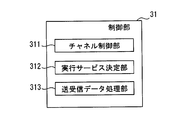
- the control unit 31 includes a channel control unit 311, an execution service determination unit 312, and a transmission / reception data processing unit 313 as functional blocks realized by executing the above program modules, as shown in FIG. 6. Note that some or all of the functions executed by the control unit 31 may be configured in hardware by one or a plurality of ICs.
- the channel control unit 311 sets the communication channel of the narrow area communication unit 32 to either the control channel or the service channel. Therefore, when the communication channel of the narrow area communication unit 32 is not set as a service channel, the communication channel is set as a control channel. Then, communication is performed using the set channel.
- the processing executed by the channel control unit 311 will be described in detail later using the flowchart shown in FIG.
- the execution service determination unit 312 determines a service to be executed (hereinafter referred to as an execution service) based on the WSA when the narrow area reception unit 32A receives the WSA while the channel control unit 311 uses the communication channel as a control channel. To do. Processing for determining an execution service is called execution service determination processing. Details of the execution service determination process will be described with reference to FIG.
- the transmission / reception data processing unit 313 acquires the data demodulated by the narrow area reception unit 32A and executes various processes according to the data. For example, it is determined whether the data acquired from the narrow area receiving unit 32A is data conforming to the WAVE protocol. Further, the data requested by the roadside device 2 is determined based on the data acquired from the narrow area receiving unit 32A, and the data requested by the roadside device 2 is generated as transmission data.
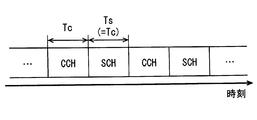
- FIG. 7 is an example of a time change of the communication channel of the narrow area communication unit 32.
- the communication channel of the narrow area communication unit 32 means a reception channel of the narrow area reception unit 32A and a transmission channel of the narrow area transmission unit 32B.
- control channel and the service channel are alternately set every certain time (for example, 50 milliseconds).
- the time frame serving as a control channel (hereinafter referred to as control channel time frame) and the time frame serving as a service channel (hereinafter referred to as service channel time frame) start from a time determined by a reference time system such as UTC, for example.
- UTC reference time system
- the control channel time frame and the service channel time frame are alternately switched at fixed intervals, and the control channel time frame and the service channel time frame are set to the start time and end time determined by the reference time system. In the form, it is called a reference time segment.
- the time in the reference time system is determined from the time data included in the radio wave received by the GNSS receiver 33.
- the reference time division uses the time determined by the reference time system as the channel switching time. Therefore, the roadside communication unit 21 of the roadside device 2 and the narrow area communication unit 32 of the in-vehicle device 3 can switch communication channels in synchronization with each other.
- the channel control unit 311 changes the communication channel of the narrow area communication unit 32 according to the reference time interval when the narrow area reception unit 32A receives the WSA and the received WSA does not include option information. It is.
- the reception channel is maintained as the control channel even if the WSA is received until the service channel time frame in the reference time segment is reached. To do. In the reference time segment, the reception channel is set as the service channel in accordance with the service channel time frame.
- the time for switching the reception channel to the service channel is the same as when the WSA does not include the option information.
- “extend” is included as option information in the WSA, the length of time for which the reception channel is maintained in the service channel is longer than when the option information is not included in the WSA.
- the reception channel is set as a service channel specified by the WSA channel information as soon as the WSA is received.
- the channel control unit 311 receives the reception channel of the narrow area reception unit 32A while the WSA is not yet received and until the WSA is received after communication related to a certain service is completed. Remain in the control channel.
- the service that switches the reception channel to the service channel at the start time of the service time frame in the reference time segment is called a standard start type service. Therefore, a service to which option information is not added to WSA and a service to which extend is added as option information to WSA are standard start type services. On the other hand, a service in which immediate is added as option information to the WSA is not a standard start type service.
- step S9 is a process executed by the transmission / reception data processing unit 313.
- the other steps are executed by the channel controller 311.
- step S1 it is determined whether there is a channel open request.
- This channel open request is input to the channel control unit 311 when the execution service determination unit 312 executes step S28 of FIG.
- step S2 it is determined whether or not the service is being executed. After the vehicle-mounted device 3 starts communication with the roadside device 2 in order to execute some service, the determination in step S2 is YES until the communication is completed and the connection state is disconnected. . If it is determined that the service is being executed, the process proceeds to step S3. If it is determined that the service is not being executed, the process proceeds to step S5.
- step S3 it is determined whether the channel switching time has come.
- the channel switching time means the channel switching time in the reference time segment when a service to which option information is not added is being executed.
- this is the time when the service channel time length specified by the WSA has elapsed since the time when the reception channel was set as the service channel.
- step S4 a channel switching process is executed. Specifically, when the determination in step S1 is YES and this step S4 is executed, the service channel indicated by the channel open request is set as the reception channel. If the determination in step S3 is YES and this step S4 is executed, and the reception channel is currently the service channel, the reception channel is switched to the control channel. In the case where the determination in step S3 is YES and this step S4 is executed, and the reception channel is currently set as the control channel, the service channel set as the reception channel immediately before is changed to the reception channel again. Set to.
- step S5 it is determined whether there is transmission data.
- the transmission data is generated by the transmission / reception data processing unit 313 as described above.
- the transmission / reception data processing unit 313 When the transmission / reception data processing unit 313 generates the transmission data and supplies the transmission data to the channel control unit 311, the determination in step S ⁇ b> 5 is YES. If judgment of step S5 is YES, it will progress to step S6.
- step S6 the transmission data is transmitted as radio waves from the narrow area transmission unit 32B to the outside. If step S6 is executed or if the determination in step S5 is NO, the process proceeds to step S7.
- step S7 it is determined whether there is received data. If this determination is NO, the process of FIG. 8 is terminated. In this case, step S1 is executed again after a predetermined time has elapsed. If judgment of step S7 is YES, it will progress to step S8.
- step S8 it is determined whether or not the received data is WSA. Whether or not the received data is WSA is determined from information stored in the header of the received data, for example. If the reception channel is a service channel, WSA is not received. Therefore, if the reception channel is a service channel, the determination in step S8 is NO. If judgment of step S8 is NO, it will progress to step S9.
- step S9 received data processing determined by the type of received data is executed.
- the received data processing includes, for example, processing for determining whether the received data is data complying with the WAVE protocol, processing for generating and transmitting data requested by the received data as transmission data, and the like.
- step S8 determines whether the determination in step S8 is YES. If the determination in step S8 is YES, the process proceeds to step S10.
- the received data is WSA.
- the narrow area receiving unit 32A notifies the execution service determining unit 312 that the WSA has been received.
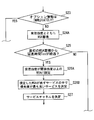
- the execution service determination unit 312 periodically executes the processing illustrated in FIG. 9 when the reception channel of the narrow area reception unit 32A is a control channel.
- step S21 it is determined whether or not the narrow area receiving unit 32A has received WSA.
- the channel control unit 311 executes step S10 of FIG. 8 described above, the execution service determination unit 312 is notified that the narrow area reception unit 32A has received the WSA. If there is this notification, the determination in step S21 is YES. If there is no notification, the determination in step S21 is NO. If judgment of step S21 is NO, it will progress to step S22.
- step S22 it is determined whether WSA is stored in the memory 31M. If this determination is NO, the process of FIG. 9 is terminated. On the other hand, if determination of step S22 is YES, it will progress to step S25 mentioned later.
- step S21 determines whether or not the WSA option information received by the narrow area reception unit 32A is immediate. If this determination is YES, the process proceeds to step S28, and if NO, the process proceeds to step S24.
- step S24 the narrow area receiver 32A stores the WSA received this time in the memory 31M together with the reception time. If step S24 is executed or if the determination in step S22 is YES, the process proceeds to step S25. When the process proceeds to step S25, WSA is accumulated in the memory 31M.
- step S25 it is determined whether or not the extension time Tex has elapsed since the WSA was first stored in the memory 31M in a state where the service is not executed, that is, in a state where the reception channel is fixed to the control channel. To do. If this determination is NO, the process of FIG. 9 is terminated without issuing a channel open request in step S28.
- the extension time Tex is set to a time longer than the time length obtained by combining one control channel time frame and one service channel time frame in the reference time segment. Accordingly, the presence of the determination step in step S25 allows the reception channel to be maintained as the control channel without changing the reception channel to the service channel for at least one service channel time frame after first accumulating the WSA. Will do.
- the extension time Tex in the present embodiment is a time length obtained by combining two control channel time frames and two service channel time frames in the reference time segment.
- the two service channel time frames after first accumulating the WSA keep the receiving channel in the control channel.
- the two service channel time frames after first accumulating WSA correspond to the extended time frames.
- step S26 the process proceeds to step S26.
- the WSA whose option information is not immediate is acquired while the reception channel is maintained as the control channel, the WSA is stored in the memory 31M. Therefore, when step S26 is executed, a plurality of WSAs may be stored in the memory 31M.
- FIG. 10 shows a list of a plurality of WSAs stored in the memory 31M.
- the process of step S26 is an execution service determination process. Note that information that determines a service provider that provides a service from the PSID is stored in a predetermined storage unit such as the memory 31M.
- step S27 the service channel corresponding to the execution service is determined with reference to the channel information of the WSA representing the service determined as the execution service.
- step S27 the WSA representing the execution service is deleted from the memory 31M.
- step S28 a channel open request is issued.
- This channel open request is a signal for requesting the channel control unit 311 to designate a service channel and set the service channel as a communication channel.
- Step S28 is executed when the service channel is determined in step S27, or when the determination in step S23 is YES.
- step S28 is executed after step S27, a channel open request specifying the service channel determined in step S27 is issued.
- step S28 is executed when the determination in step S23 is YES, a channel open request designating a service channel determined from the WSA received this time is issued.
- the execution service determining unit 312 does not indicate that the WSA option information is immediate (S23: NO) until the extended time Tex elapses. Does not issue a channel open request (S25 to S28). Further, the extension time Tex is set to a time longer than the time length obtained by combining one control channel time frame and one service channel time frame in the reference time segment.
- the channel control unit 311 maintains the reception channel as the control channel for at least one service channel time frame even after the narrow area reception unit 32A receives the WSA. Accordingly, when the WSA is transmitted from the roadside device 2 while the reception channel is set as the control channel in the service channel time frame, there is a possibility that the narrow area reception unit 32A can receive the WSA.
- the execution service determination unit 312 determines the service having the highest priority among the services represented by all the WSA received while the narrow area reception unit 32A uses the reception channel as a control channel (S26). A channel open request for executing the determined execution service is issued to the channel control unit 311 (S28). Thereby, the channel control part 311 sets the service channel corresponding to this execution service to a reception channel (S4). Therefore, it is possible to prevent communication for executing a service with a high priority from being disabled.
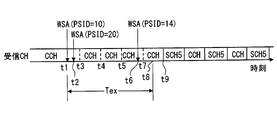
- FIG. 11 shows the time when the WSA illustrated in FIG. 10 is received on the time axis.
- Time t3 is the start time of the first service channel time frame after time t1.
- a service channel determined by a higher-priority WSA among the two WSAs received at times t1 and t2, which are times until time t3, is opened from time t3.
- the reception channel is also maintained as the control channel from time t3 to time t4, which are service channel time frames.
- the reception channel is maintained as the control channel from time t4 to time t5, which is the control channel time frame thereafter.
- time t5 to time t7 is a service channel time frame
- the control channel is maintained from time t5 to time t7.
- time t6 which is between time t5 and time t7
- the WSA list illustrated in FIG. 10 is generated.
- Time t8 is the time when the extension time Tex has elapsed since the first WSA was accumulated. Therefore, the determination result of step S25 executed after time t8 is YES.
- SCH5 is determined as the service channel to be opened.
- step S28 since a channel open request specifying SCH5 is issued, the reception channel becomes SCH5 from time t9 which is the start time of the service channel time frame. As described above, in the present embodiment, it is possible to prevent communication for executing a service with a high priority from being disabled.
- the reception channel is set to SCH 5 in the service channel time frame, and the reception channel is set to the control channel in the control channel time frame.
- the execution service determination unit 312 of the control unit 31 of the in-vehicle device 3 executes the process shown in FIG. 12 instead of FIG.
- the process shown in FIG. 12 executes step S24A in place of step S24 in FIG. 9, and executes steps S26A and S26B in place of step S26 in FIG.
- steps S26A and S26B correspond to execution service determination processing.
- step S24A the narrow area receiving unit 32A determines the reception strength of the WSA received this time. Then, the WSA is stored in the memory 31M together with the reception intensity and the reception time.
- This step S24A is an example of a reception strength determination unit.
- step S26A the WSA stored in the memory 31M is limited to WSA whose reception strength is equal to or higher than the threshold strength.
- the threshold strength is set in advance to a strength at which communication can be performed with a certain or higher communication quality.
- step S26B the service having the highest priority of the service represented by the WSA is determined among the WSAs limited in step S26A. Then, the service determined as the service with the highest priority is determined as the execution service.
- the service for which the service with the highest priority is determined is represented by the WSA whose reception strength is equal to or higher than the threshold strength among the WSAs stored in the memory 31M. Limited to.
- the priority is high, the reception strength is not sufficient, so that it is possible to suppress starting a service that may cause a signal that is necessary to execute the service to not be transmitted or received.
- the CCH communication processing unit 222 of the roadside control unit 22 generates the WSA shown in FIG.
- the WSA shown in FIG. 13 has a data configuration in which roadside machine position information is added to the WSA of the first embodiment shown in FIG.
- the roadside machine position information is information indicating the position of the roadside machine 2 that has transmitted the WSA.
- FIG. 14 shows functions provided in the control unit 31A of the in-vehicle device 3 in the third embodiment.
- the control unit 31A includes a distance calculation unit 314 in addition to the channel control unit 311, the execution service determination unit 312, and the transmission / reception data processing unit 313 provided in the control unit 31 of the first embodiment.
- the distance calculation unit 314 calculates the distance between the roadside device 2 that transmitted the WSA and the in-vehicle device 3 from the current position calculated by the GNSS and the position of the roadside device 2 represented by the roadside device position information included in the WSA. . This distance is calculated for each roadside device 2 when WSA is received from a plurality of roadside devices 2.
- the execution service determination unit 312 of the control unit 31A of the in-vehicle device 3 executes the process shown in FIG. 15 instead of FIG.
- steps S26C and S26D are executed instead of step S26 in FIG.
- steps S26C and S26D correspond to execution service determination processing.
- the WSA stored in the memory 31M is limited to WSA whose distance calculated by the distance calculation unit 314 is equal to or less than the threshold distance.
- the threshold distance is set in advance. For example, the threshold distance is set to a distance obtained by multiplying the communicable distance of the narrow area transmission unit 32B by a coefficient smaller than 1. This is because the communication using the service channel is usually unicast or multicast, and thus the roadside unit 2 needs to reliably receive a signal transmitted by the narrow area transmission unit 32B.
- step S26D the service with the highest priority of the service represented by the WSA is determined among the WSAs limited in step S26C. Then, the service determined as the service with the highest priority is determined as the execution service.
- the service for which the service having the highest priority is determined is represented by the WSA whose distance is equal to or smaller than the threshold distance among the WSAs stored in the memory 31M. Limited to. Thereby, since the communication distance is long although the priority is high, it is possible to suppress the start of a service that may not be able to perform transmission / reception of a signal necessary for executing the service with sufficient signal strength.
- control unit 31B of the in-vehicle device 3 includes a channel control unit 311, an execution service determination unit 312, and a transmission / reception data processing unit 313 provided in the control unit 31 of the third embodiment.
- an orientation difference calculation unit 315 is provided in addition to the distance calculation unit 314.
- the azimuth difference calculation unit 315 uses the current position calculated by the GNSS receiver 33 and the position of the roadside machine 2 indicated by the roadside machine position information included in the WSA to transmit the WSA from the in-vehicle device 3. Calculate the direction to 2. Further, the traveling direction of the in-vehicle device 3 is determined from the movement trajectory of the in-vehicle device 3 determined by the current position of the in-vehicle device 3 sequentially calculated by the GNSS receiver 33. And the azimuth
- the execution service determination part 312 of the control part 31B of the vehicle equipment 3 performs the process shown in FIG.
- the process shown in FIG. 17 executes steps S26E, S26F, and S26G instead of step S26 in FIG.
- steps S26E, S26F, and S26G correspond to the execution service determination process.
- Step S26E is the same as step S26C of the third embodiment, and the WSA stored in the memory 31M is limited to the WSA whose distance calculated by the distance calculation unit 314 is equal to or less than the threshold distance.
- the azimuth difference calculated by the azimuth difference calculation unit 315 is limited to WSA having a threshold azimuth difference or less.
- the threshold azimuth difference is a threshold for limiting the roadside device 2 that has transmitted WSA to the roadside devices 2 existing in the traveling direction of the in-vehicle device 3 and is set in advance.
- the threshold azimuth difference is, for example, about 20 to 30 degrees.
- step S26G the service having the highest priority of the service represented by the WSA is determined among the WSAs limited in step S26F. Then, the service determined as the service with the highest priority is determined as the execution service.
- the service whose highest priority is determined is the service represented by the WSA whose distance is equal to or less than the threshold distance among the WSAs stored in the memory 31M. Limited to. Thereby, since the communication distance is long, it can suppress starting the service which may not be able to perform transmission / reception of the signal required in order to perform service with sufficient signal strength.
- the service provided by the roadside device 2 that is not in the traveling direction is often unimportant even if the priority included in the WSA is high.
- the service whose highest priority is determined is the service represented by the WSA whose azimuth difference is equal to or smaller than the threshold azimuth difference among the WSAs stored in the memory 31M. Limited to.
- the roadside machine 102 has the configuration shown in FIG.
- the roadside communication unit 121 includes a narrow area roadside communication part 121A and a wide area roadside communication part 121B.
- the narrow roadside communication unit 121A has the same configuration as the roadside communication unit 21 of the first embodiment.
- the wide area roadside communication unit 121B is a communication unit that performs communication using a wide area communication network.
- the wide area communication network includes a plurality of relay stations, and is a communication network used for wireless communication.
- the frequency channel used by the wide-area roadside communication unit 121B is a frequency channel in a frequency band different from the frequency channel used by the narrow-area roadside communication unit 121A.
- the road-side control unit 122 can transmit and receive service execution information by selecting and using the narrow-area road-side communication unit 121A or the wide-area road-side communication unit 121B constituting the road-side communication unit 121.
- the roadside communication control unit 221 ⁇ / b> A included in the roadside control unit 122 includes a wide area communication processing unit 225 in addition to the CCH communication processing unit 222 and the SCH communication processing unit 223.
- the CCH communication processing unit 222 generates the WSA shown in FIG.
- the WSA shown in FIG. 20 has a data configuration in which a data size is added to the WSA of the first embodiment shown in FIG.
- the data size indicates the data size that needs to be transmitted and received by the in-vehicle device 3 when a service determined by WSA is executed, and this data size is an approximate data size.
- the approximate data size transmitted from the roadside device 2 to the in-vehicle device 3 is determined.
- the approximate data size requested by the roadside device 2 to the in-vehicle device 3 is determined. Therefore, the data size can be included in the WSA.
- the wide area communication processing unit 225 complements the SCH communication processing unit 223. Specifically, the wide area communication processing unit 225 needs to communicate with the roadside device 2 in order to execute the execution service determined by the execution service determination unit 312, but the in-vehicle device 3 is connected to the narrow area roadside communication unit 121A. When it is located outside the communication area, service execution information is transmitted to and received from the in-vehicle device 3 using the wide-area roadside communication unit 121B.
- the in-vehicle device 103 of the fifth embodiment includes a wide area communication unit 34 as shown in FIG.
- the wide area communication unit 34 is a communication unit that performs communication using a wide area communication network.
- Other hardware configurations of the in-vehicle device 103 are the same as those in the first embodiment. Further, the function executed by the control unit 31C is different from that of the first embodiment.
- control unit 31C of the fifth embodiment includes a communication in addition to the channel control unit 311, the execution service determination unit 312 and the transmission / reception data processing unit 313 provided in the control unit 31 of the first embodiment.
- a switching unit 316 is provided.
- the communication switching unit 316 switches whether the communication unit that transmits and receives service execution information is the narrow area communication unit 32 or the wide area communication unit 34. Specifically, when the narrow area communication unit 32 can communicate with the narrow area road side communication unit 121 ⁇ / b> A of the roadside machine 2, service execution information is transmitted to and received from the roadside machine 2 using the narrow area communication unit 32. When the narrow area communication unit 32 cannot communicate with the narrow area road side communication unit 121 ⁇ / b> A of the roadside machine 2, service execution information is transmitted to and received from the roadside machine 2 using the wide area communication unit 34.
- the communication switching unit 316 starts not only the case where the vehicle-mounted device 3 goes out of the communication area of the narrow-area roadside communication unit 121A of the roadside machine 102 while executing one service, but also starts a certain service.
- the service is executed using the wide area communication unit 34. Information is transmitted to and received from the roadside device 2.
- the execution service determination unit 312 of the control unit 31C executes the process shown in FIG. In the process shown in FIG. 23, steps S26H and S26I are executed instead of step S26 in FIG. Other processes are the same as those in FIG. In the fifth embodiment, steps S26H and S261 correspond to execution service determination processing.
- step S26H the WSA stored in the memory 31M is limited to a WSA having a data size equal to or larger than a preset threshold size.
- step S261 the service with the highest priority of the service represented by the WSA is determined among the WSAs limited in step S26H. Then, the service determined as the service with the highest priority is determined as the execution service.
- the target for determining the service with the highest priority is represented by the WSA whose data size is equal to or larger than the threshold size among the WSAs stored in the memory 31M. Limited to services. Accordingly, priority is given to a service whose data size is equal to or larger than the threshold size, and communication is performed using the service channel, that is, communication using the narrow area communication unit 32.
- communication using the narrow area communication unit 32 does not incur communication charges, while communication using the wide area communication unit 34 generally incurs communication charges. Therefore, if priority is given to a service whose data size is equal to or larger than the threshold size as in the fifth embodiment and communication is performed using the narrow area communication unit 32, data transmission / reception using the wide area communication unit 34 is performed. Even if there is a communication fee, the communication fee can be kept low.
- Modification 1 In the above-described embodiment, only the WSA representing the execution service is deleted from the memory 31M in step S27, and the execution service determination process includes step S22 shown in FIG. Therefore, when a plurality of WSAs are received while the reception channel of the narrow area receiving unit 32A is used as a control channel, an execution service determination process such as step S26 is executed, and the received plurality of WSAs are executed in order. To decide.
- the present invention is not limited to this, and when one execution service is determined, all the WSAs stored in the memory 31M may be deleted.
- reception intensity may be used instead of distance.
- step S24A of the second embodiment is executed instead of step S24
- step S26A is executed instead of step S26E.
- the in-vehicle device 3 is shown as an example of the wireless communication device, but the wireless communication device is not necessarily used in the vehicle.
- the wireless communication device may be used in a moving body other than a vehicle. For example, it may be a wireless communication device of the type used by pedestrians.
- the roadside units 2 and 102 are shown as examples of the service providing station, but the service providing station is not limited to these.
- the service providing station may be a terminal carried by a pedestrian.
- the roadside units 2 and 102 may be mobile.
- the mobile type may be a mobile type mounted on a moving body such as a car, and the position at the time of service provision is It may be a movable type, that is, a portable type that is fixed and can be carried and changed in position.
Landscapes
- Engineering & Computer Science (AREA)
- Computer Networks & Wireless Communication (AREA)
- Signal Processing (AREA)
- Life Sciences & Earth Sciences (AREA)
- Atmospheric Sciences (AREA)
- Physics & Mathematics (AREA)
- General Physics & Mathematics (AREA)
- Mobile Radio Communication Systems (AREA)
- Traffic Control Systems (AREA)
Abstract
Description
以下、本開示の実施形態を図面に基づいて説明する。図1に示すように、第1実施形態に係る無線通信システム1は、路側機2と、車載機3とを備える。車載機3は無線通信装置に相当する。
次に、第2実施形態を説明する。この第2実施形態以下の説明において、それまでに使用した符号と同一番号の符号を有する要素は、特に言及する場合を除き、それ以前の実施形態における同一符号の要素と同一である。また、構成の一部のみを説明している場合、構成の他の部分については先に説明した実施形態を適用できる。
第3実施形態では、路側制御部22のCCH通信処理部222は、図13に示すWSAを生成する。図13に示すWSAは、図4に示した第1実施形態のWSAに、路側機位置情報が追加されたデータ構成である。路側機位置情報は、WSAを送信した路側機2の位置を示している情報である。
第4実施形態では、図16に示すように、車載機3の制御部31Bは、第3実施形態の制御部31が備えているチャネル制御部311、実行サービス決定部312、送受信データ処理部313、距離算出部314に加えて、方位差算出部315を備えている。
第5実施形態の路側機102は、図18に示す構成を備える。路側通信部121は、狭域路側通信部121Aと広域路側通信部121Bを備える。狭域路側通信部121Aは、第1実施形態の路側通信部21と同じ構成である。
前述した実施形態では、ステップS27で、実行サービスを表しているWSAのみをメモリ31Mから消去しており、また、実行サービス決定処理は図9に示すステップS22を備えていた。したがって、狭域受信部32Aの受信チャネルをコントロールチャネルとしている間に複数のWSAを受信した場合には、ステップS26などの実行サービス決定処理を実行して、受信した複数のWSAを順番に実行サービスに決定する。しかし、これに限られず、1つの実行サービスを決定した場合に、メモリ31Mに記憶されている全部のWSAを消去してもよい。
第4実施形態において、距離に代えて受信強度を用いてもよい。この場合、第4実施形態の実行サービス決定処理において、ステップS24に代えて第2実施形態のステップS24Aを実行し、ステップS26Eに代えてステップS26Aを実行する。
第4実施形態において距離算出部314およびステップS26Eを備えない態様としてもよい。この場合、距離による限定は行わず、方位差が閾値方位差以下であるWSAが表すサービスのうちで最も優先度が高いサービスを実行サービスに決定することになる。
前述の実施形態では、無線通信装置の一例として車載機3を示したが、無線通信装置は車両で用いられる必要はない。無線通信装置は、車両以外の移動体で用いられてもよい。たとえば、歩行者が携帯して用いる形式の無線通信装置でもよい。
前述の実施形態では、サービス提供局の一例として路側機2、102を示したが、サービス提供局は、これらに限られない。サービス提供局が、歩行者が携帯する端末であってもよい。また、路側機2、102は移動型でもよいことは前述の実施形態で示したが、移動形式は、車等の移動体に搭載される形式の移動型でもよいし、サービス提供時の位置は固定されており、持ち運んで設置位置を変更できる移動型すなわち可搬型でもよい。
Claims (9)
- 互いに異なる周波数チャネルであるコントロールチャネルおよび複数のサービスチャネルから選択されたチャネルを受信チャネルに設定し、前記受信チャネルを前記コントロールチャネルに設定したときは、サービスの種類が定まる情報、前記サービスの優先度が定まる情報であるサービス優先度情報、および前記サービスチャネルが定まる情報を含んでいるサービス開始情報をサービス提供局から受信し、前記受信チャネルを前記サービスチャネルに設定したときは、前記サービスを実行するためのサービス実行情報を前記サービス提供局から受信する狭域受信部(32A)と、
前記受信チャネルを前記コントロールチャネルとするか前記サービスチャネルとするかを制御するチャネル制御部(311)とを備え、
前記チャネル制御部は、前記受信チャネルを前記コントロールチャネルとすることができる時間枠であるコントロールチャネル時間枠と前記受信チャネルを前記サービスチャネルに設定することができる時間枠であるサービスチャネル時間枠とが交互に設定されている基準時間区分のうち少なくとも前記コントロールチャネル時間枠において、前記受信チャネルを前記コントロールチャネルに設定し、前記狭域受信部が前記サービス開始情報を受信し、受信した前記サービス開始情報が、前記サービスチャネル時間枠の最初から前記受信チャネルを前記サービスチャネルにする前記サービスである標準開始型サービスについての前記サービス開始情報である場合、前記サービス開始情報を受信した後も、予め定められた数の前記サービスチャネル時間枠に設定された延長時間枠の間は前記受信チャネルを前記コントロールチャネルに維持し、
前記チャネル制御部が前記受信チャネルを前記コントロールチャネルとしている間に前記狭域受信部が受信した前記サービス開始情報の一部または全部を優先度を比較するサービス開始情報とし、前記優先度を比較するサービス開始情報が表す前記サービスのうちで最も優先度が高い前記サービスを、前記サービス開始情報に含まれている前記サービス優先度情報に基づいて決定し、決定した前記サービスを実行サービスとする実行サービス決定処理を行う実行サービス決定部(312)を備え、
前記チャネル制御部は、前記実行サービス決定部が、前記標準開始型サービスを前記実行サービスに決定した場合、前記延長時間枠が経過した後の次の前記サービスチャネル時間枠の最初から、前記受信チャネルを、前記実行サービスに決定された前記サービスに対応する前記サービス開始情報から定まる前記サービスチャネルに設定して、前記サービス実行情報を受信する無線通信装置。 - 請求項1において、
前記無線通信装置が受信する前記サービス開始情報の受信強度を、前記サービス開始情報別に決定する受信強度決定部(S24A)をさらに備え、
前記実行サービス決定部が行う前記実行サービス決定処理は、前記チャネル制御部が前記受信チャネルを前記コントロールチャネルとしている間に前記狭域受信部が受信した前記サービス開始情報であって、前記受信強度が閾値強度以上である前記サービス開始情報が表す前記サービスのうちで最も優先度が高い前記サービスを前記実行サービスに決定する処理である無線通信装置。 - 請求項1において、
前記サービス開始情報には、前記サービス開始情報を送信した前記サービス提供局の位置情報が含まれており、
前記無線通信装置の現在位置を逐次検出する位置検出部(33)と、
前記位置検出部が検出した前記現在位置と、前記サービス開始情報に含まれている前記サービス提供局の位置情報とに基づいて、前記サービス開始情報を送信した前記サービス提供局と前記無線通信装置との距離を前記サービス開始情報別に算出する距離算出部(314)をさらに備え、
前記実行サービス決定部が行う前記実行サービス決定処理は、前記チャネル制御部が前記受信チャネルを前記コントロールチャネルとしている間に前記狭域受信部が受信した前記サービス開始情報であって、前記距離算出部が算出した前記距離が閾値距離以下である前記サービス開始情報が表す前記サービスのうちで最も優先度が高い前記サービスを前記実行サービスに決定する処理である無線通信装置。 - 請求項1において、
前記サービス開始情報には、前記サービス開始情報を送信した前記サービス提供局の位置情報が含まれており、
前記無線通信装置の現在位置を逐次検出する位置検出部(33)と、
前記位置検出部が検出した前記現在位置と、前記サービス開始情報に含まれている前記サービス提供局の位置情報とに基づいて、前記無線通信装置から前記サービス開始情報を送信した前記サービス提供局への方位と前記無線通信装置の進行方位との方位差を算出する方位差算出部(315)をさらに備え、
前記実行サービス決定部が行う前記実行サービス決定処理は、前記チャネル制御部が前記受信チャネルを前記コントロールチャネルとしている間に前記狭域受信部が受信した前記サービス開始情報であって、前記方位差が閾値方位差以下である前記サービス開始情報が表す前記サービスのうちで最も優先度が高い前記サービスを前記実行サービスに決定する処理である無線通信装置。 - 請求項2において、
前記サービス開始情報には、前記サービス開始情報を送信した前記サービス提供局の位置情報が含まれており、
前記無線通信装置の現在位置を逐次検出する位置検出部(33)と、
前記位置検出部が検出した前記現在位置と、前記サービス開始情報に含まれている前記サービス提供局の位置情報とに基づいて、前記無線通信装置から前記サービス開始情報を送信した前記サービス提供局への方位と前記無線通信装置の進行方位との方位差を算出する方位差算出部(315)をさらに備え、
前記実行サービス決定部が行う前記実行サービス決定処理は、前記チャネル制御部が前記受信チャネルを前記コントロールチャネルとしている間に前記狭域受信部が受信した前記サービス開始情報であって、前記受信強度が前記閾値強度以上であり、かつ、前記方位差が閾値方位差以下である前記サービス開始情報が表す前記サービスのうちで最も優先度が高い前記サービスを前記実行サービスに決定する処理である無線通信装置。 - 請求項3において、
前記位置検出部が検出した前記現在位置と、前記サービス開始情報に含まれている前記サービス提供局の位置情報とに基づいて、前記無線通信装置から前記サービス開始情報を送信した前記サービス提供局への方位と前記無線通信装置の進行方位との方位差を算出する方位差算出部(315)をさらに備え、
前記実行サービス決定部が行う前記実行サービス決定処理は、前記チャネル制御部が前記受信チャネルを前記コントロールチャネルとしている間に前記狭域受信部が受信した前記サービス開始情報であって、前記距離算出部が算出した前記距離が前記閾値距離以下であり、かつ、前記方位差が閾値方位差以下である前記サービス開始情報が表す前記サービスのうちで最も優先度が高い前記サービスを前記実行サービスに決定する処理である無線通信装置。 - 請求項1において、
前記サービス実行情報は、前記サービス提供局が送信する情報と、前記無線通信装置が送信する情報とを含んでおり、
前記サービス提供局は、狭域通信により前記サービス実行情報を送受信できるとともに、広域通信網を用いて前記サービス実行情報を送受信することもでき、
前記サービス開始情報には、前記サービスを実行することにより、前記無線通信装置が送信および受信する必要があるデータサイズを示す情報が含まれており、
前記実行サービス決定部が行う前記実行サービス決定処理は、前記チャネル制御部が前記受信チャネルを前記コントロールチャネルとしている間に前記狭域受信部が受信した前記サービス開始情報であって、前記データサイズが閾値サイズ以上である前記サービス開始情報が表す前記サービスのうちで最も優先度が高い前記サービスを前記実行サービスに決定する処理であり、
狭域送信を行う狭域送信部(32B)と、
広域通信網を用いて通信を行う広域通信部(34)と、
前記狭域受信部および前記狭域送信部が前記サービス提供局と通信できる場合には、前記狭域受信部および前記狭域送信部を用いて、前記サービス実行情報を前記サービス提供局との間で送受信し、前記狭域受信部および前記狭域送信部が前記サービス提供局と通信できない場合には、前記広域通信部を用いて、前記サービス実行情報を前記サービス提供局との間で送受信する通信切替部(316)をさらに備える無線通信装置。 - 請求項1~7のいずれか1項において、
前記狭域受信部が前記受信チャネルを前記コントロールチャネルとしている間に受信した前記サービス開始情報を蓄積しておく記憶部(31M)をさらに備え、
前記実行サービス決定部は、前記記憶部に記憶されている前記サービス開始情報であって、まだ実行していないサービスについての前記サービス開始情報を対象として前記実行サービス決定処理を行なって、前記実行サービスを決定する無線通信装置。 - 請求項1~8のいずれか1項において、
前記サービス開始情報には、前記サービス開始情報を受信次第、前記受信チャネルを前記サービスチャネルとすることを指示する即時開始指示が含まれることがあり、
前記実行サービス決定部は、前記受信チャネルが前記コントロールチャネルとなっている間、逐次、前記サービス開始情報に前記即時開始指示が含まれているか否かを判断し、前記サービス開始情報に前記即時開始指示が含まれていると判断した場合、前記実行サービスを、前記即時開始指示が含まれている前記サービス開始情報により定まる前記サービスとし、
前記チャネル制御部は、前記実行サービス決定部が、前記即時開始指示が含まれている前記サービス開始情報により定まる前記サービスを前記実行サービスに決定した場合、前記実行サービス決定部が前記実行サービスを決定後、速やかに前記受信チャネルを前記サービスチャネルに設定する無線通信装置。
Priority Applications (3)
| Application Number | Priority Date | Filing Date | Title |
|---|---|---|---|
| CN201680050295.0A CN107950068B (zh) | 2015-09-04 | 2016-08-22 | 无线通信装置 |
| US15/756,992 US10104678B2 (en) | 2015-09-04 | 2016-08-22 | Wireless communication device |
| SG11201800905SA SG11201800905SA (en) | 2015-09-04 | 2016-08-22 | Wireless communication device |
Applications Claiming Priority (2)
| Application Number | Priority Date | Filing Date | Title |
|---|---|---|---|
| JP2015175078A JP6358204B2 (ja) | 2015-09-04 | 2015-09-04 | 無線通信装置 |
| JP2015-175078 | 2015-09-04 |
Publications (1)
| Publication Number | Publication Date |
|---|---|
| WO2017038515A1 true WO2017038515A1 (ja) | 2017-03-09 |
Family
ID=58188350
Family Applications (1)
| Application Number | Title | Priority Date | Filing Date |
|---|---|---|---|
| PCT/JP2016/074309 Ceased WO2017038515A1 (ja) | 2015-09-04 | 2016-08-22 | 無線通信装置 |
Country Status (5)
| Country | Link |
|---|---|
| US (1) | US10104678B2 (ja) |
| JP (1) | JP6358204B2 (ja) |
| CN (1) | CN107950068B (ja) |
| SG (1) | SG11201800905SA (ja) |
| WO (1) | WO2017038515A1 (ja) |
Cited By (2)
| Publication number | Priority date | Publication date | Assignee | Title |
|---|---|---|---|---|
| WO2022019214A1 (ja) * | 2020-07-21 | 2022-01-27 | パナソニックIpマネジメント株式会社 | 車載装置、路側装置、及び通信方法 |
| JP7660281B2 (ja) | 2020-07-21 | 2025-04-11 | パナソニックIpマネジメント株式会社 | 車載装置、路側装置、及び通信方法 |
Families Citing this family (3)
| Publication number | Priority date | Publication date | Assignee | Title |
|---|---|---|---|---|
| JP6354709B2 (ja) * | 2015-09-01 | 2018-07-11 | 株式会社デンソー | 移動体通信システム、移動体側装置 |
| JP6961004B2 (ja) * | 2017-09-19 | 2021-11-05 | 三菱電機株式会社 | 車両用無線通信装置 |
| US11445362B2 (en) * | 2019-03-01 | 2022-09-13 | Intel Corporation | Security certificate management and misbehavior vehicle reporting in vehicle-to-everything (V2X) communication |
Citations (1)
| Publication number | Priority date | Publication date | Assignee | Title |
|---|---|---|---|---|
| US20110306353A1 (en) * | 2010-06-11 | 2011-12-15 | Electronics And Telecommunications Research Institute | Channel allocation device and method using wireless access in vehicular enviroments |
Family Cites Families (11)
| Publication number | Priority date | Publication date | Assignee | Title |
|---|---|---|---|---|
| KR100544481B1 (ko) * | 2003-05-13 | 2006-01-24 | 삼성전자주식회사 | 고속 무선 개인영역 네트워크에서 채널시간 할당방법 |
| JP2011029952A (ja) * | 2009-07-27 | 2011-02-10 | Renesas Electronics Corp | 無線通信装置及び無線通信装置の通信方法 |
| EP2474194B1 (en) * | 2009-09-02 | 2015-11-11 | Nec Corporation | Method for enabling mutli-channel signaling in a communication network |
| US8462704B2 (en) | 2009-10-19 | 2013-06-11 | Stmicroelectronics, Inc. | Enabling interoperability of dual-radio and single-radio devices for vehicular multi-channel operations |
| US8761676B2 (en) | 2010-03-09 | 2014-06-24 | Stmicroelectronics, Inc. | Channel switching for interoperable safety and non-safety communications in wireless environments |
| KR101075021B1 (ko) * | 2010-03-26 | 2011-10-20 | 전자부품연구원 | Wave 통신 시스템의 적응적 채널 조정 방법 및 시스템 |
| US8400987B2 (en) * | 2010-04-19 | 2013-03-19 | GM Global Technology Operations LLC | Systems and methods for multi-channel medium access control |
| US20120093091A1 (en) * | 2010-10-17 | 2012-04-19 | Industrial Technology Research Institute | Method and system for extended service channel access on demand in an alternating wireless channel access environment |
| TWI458378B (zh) * | 2010-12-08 | 2014-10-21 | Ind Tech Res Inst | 提供車載通訊服務頻道之方法及系統、以及切換車載通訊服務頻道之方法及系統與電腦可讀取媒體 |
| CN103702362B (zh) * | 2013-12-20 | 2017-02-01 | 华南理工大学 | 一种wave系统中的多信道操作方法 |
| US9641964B2 (en) * | 2014-09-03 | 2017-05-02 | CloudLeaf, Inc. | Systems, methods and devices for asset status determination |
-
2015
- 2015-09-04 JP JP2015175078A patent/JP6358204B2/ja not_active Expired - Fee Related
-
2016
- 2016-08-22 WO PCT/JP2016/074309 patent/WO2017038515A1/ja not_active Ceased
- 2016-08-22 SG SG11201800905SA patent/SG11201800905SA/en unknown
- 2016-08-22 CN CN201680050295.0A patent/CN107950068B/zh not_active Expired - Fee Related
- 2016-08-22 US US15/756,992 patent/US10104678B2/en active Active
Patent Citations (1)
| Publication number | Priority date | Publication date | Assignee | Title |
|---|---|---|---|---|
| US20110306353A1 (en) * | 2010-06-11 | 2011-12-15 | Electronics And Telecommunications Research Institute | Channel allocation device and method using wireless access in vehicular enviroments |
Non-Patent Citations (1)
| Title |
|---|
| "IEEE Standard for Wirelss Access in Vehicular Environments(WAVE)-Networking Services;IEEE Std 1609.3-2010", IEEE STANDARD, 30 December 2010 (2010-12-30), pages 1 - 144, XP017604433 * |
Cited By (2)
| Publication number | Priority date | Publication date | Assignee | Title |
|---|---|---|---|---|
| WO2022019214A1 (ja) * | 2020-07-21 | 2022-01-27 | パナソニックIpマネジメント株式会社 | 車載装置、路側装置、及び通信方法 |
| JP7660281B2 (ja) | 2020-07-21 | 2025-04-11 | パナソニックIpマネジメント株式会社 | 車載装置、路側装置、及び通信方法 |
Also Published As
| Publication number | Publication date |
|---|---|
| SG11201800905SA (en) | 2018-03-28 |
| US10104678B2 (en) | 2018-10-16 |
| CN107950068A (zh) | 2018-04-20 |
| US20180249478A1 (en) | 2018-08-30 |
| JP2017050831A (ja) | 2017-03-09 |
| JP6358204B2 (ja) | 2018-07-18 |
| CN107950068B (zh) | 2021-10-26 |
Similar Documents
| Publication | Publication Date | Title |
|---|---|---|
| US10542379B2 (en) | On-vehicle communication device, communication control method and vehicle | |
| US10019898B2 (en) | Systems and methods to detect vehicle queue lengths of vehicles stopped at a traffic light signal | |
| US11218853B2 (en) | External communication system for vehicle | |
| US11006258B2 (en) | External communication system for vehicle | |
| JP6540594B2 (ja) | 車両制御システムおよび車両制御装置 | |
| JP6358204B2 (ja) | 無線通信装置 | |
| CN107005811B (zh) | 车辆用通信终端 | |
| US10419873B2 (en) | Mobile communication system and onboard terminal | |
| JP2008283580A (ja) | 通信システム及び路側通信システム並びにこれらに用いられる路側通信装置、光ビーコン及び車載通信装置 | |
| US10834551B2 (en) | Mobile object communication system and mobile object side device | |
| WO2020075839A1 (ja) | 交通通信システム、路側機、及び方法 | |
| JP2009232065A (ja) | 通信システム及び車載通信装置 | |
| JP6375931B2 (ja) | 無線通信装置 | |
| US10512090B2 (en) | Wireless communication apparatus | |
| JP6493045B2 (ja) | 車両用無線通信装置および無線通信システム | |
| WO2017033875A1 (ja) | 移動体通信システムおよびサービス提供装置 | |
| JP6099796B2 (ja) | 歩行者端末装置、車載端末装置、歩車間通信システム、ならびに歩車間通信方法 | |
| JP2017072938A (ja) | 車載通信装置、車両、情報提供システム及び情報提供方法 |
Legal Events
| Date | Code | Title | Description |
|---|---|---|---|
| 121 | Ep: the epo has been informed by wipo that ep was designated in this application |
Ref document number: 16841547 Country of ref document: EP Kind code of ref document: A1 |
|
| WWE | Wipo information: entry into national phase |
Ref document number: 11201800905S Country of ref document: SG |
|
| WWE | Wipo information: entry into national phase |
Ref document number: 15756992 Country of ref document: US |
|
| NENP | Non-entry into the national phase |
Ref country code: DE |
|
| 122 | Ep: pct application non-entry in european phase |
Ref document number: 16841547 Country of ref document: EP Kind code of ref document: A1 |