WO2017002963A1 - 油脂組成物 - Google Patents
油脂組成物 Download PDFInfo
- Publication number
- WO2017002963A1 WO2017002963A1 PCT/JP2016/069651 JP2016069651W WO2017002963A1 WO 2017002963 A1 WO2017002963 A1 WO 2017002963A1 JP 2016069651 W JP2016069651 W JP 2016069651W WO 2017002963 A1 WO2017002963 A1 WO 2017002963A1
- Authority
- WO
- WIPO (PCT)
- Prior art keywords
- oil
- fat
- mass
- composition
- content
- Prior art date
- Legal status (The legal status is an assumption and is not a legal conclusion. Google has not performed a legal analysis and makes no representation as to the accuracy of the status listed.)
- Ceased
Links
Classifications
-
- A—HUMAN NECESSITIES
- A23—FOODS OR FOODSTUFFS; TREATMENT THEREOF, NOT COVERED BY OTHER CLASSES
- A23D—EDIBLE OILS OR FATS, e.g. MARGARINES, SHORTENINGS OR COOKING OILS
- A23D7/00—Edible oil or fat compositions containing an aqueous phase, e.g. margarines
-
- A—HUMAN NECESSITIES
- A23—FOODS OR FOODSTUFFS; TREATMENT THEREOF, NOT COVERED BY OTHER CLASSES
- A23D—EDIBLE OILS OR FATS, e.g. MARGARINES, SHORTENINGS OR COOKING OILS
- A23D9/00—Other edible oils or fats, e.g. shortenings or cooking oils
-
- A—HUMAN NECESSITIES
- A23—FOODS OR FOODSTUFFS; TREATMENT THEREOF, NOT COVERED BY OTHER CLASSES
- A23L—FOODS, FOODSTUFFS OR NON-ALCOHOLIC BEVERAGES, NOT OTHERWISE PROVIDED FOR; PREPARATION OR TREATMENT THEREOF
- A23L7/00—Cereal-derived products; Malt products; Preparation or treatment thereof
- A23L7/10—Cereal-derived products
-
- A—HUMAN NECESSITIES
- A23—FOODS OR FOODSTUFFS; TREATMENT THEREOF, NOT COVERED BY OTHER CLASSES
- A23L—FOODS, FOODSTUFFS OR NON-ALCOHOLIC BEVERAGES, NOT OTHERWISE PROVIDED FOR; PREPARATION OR TREATMENT THEREOF
- A23L7/00—Cereal-derived products; Malt products; Preparation or treatment thereof
- A23L7/10—Cereal-derived products
- A23L7/109—Types of pasta, e.g. macaroni or noodles
Definitions
- the present invention relates to a fat composition suitable as a food modifier.
- Instant noodles are usually a process of mixing and kneading raw materials (mixing and kneading process), a process of rolling the kneaded dough to obtain a noodle band (rolling process), a process of cutting out the noodle band and obtaining a noodle string (cutting process) ), A process of steaming the noodle strings (steaming process), a process of molding the steamed noodles into a shape suitable for packaging (molding process), and a process of drying the molded noodles (drying process).
- the steaming step starch on the surface of the noodle strings is gelatinized ( ⁇ -ized) and the outer layer of the noodle strands is strengthened, so that cracks of the noodle strings in the subsequent drying step can be prevented. Moreover, since starch swells by the said steaming process, the hot water return time of instant noodles which are final products can be shortened. Therefore, the steaming process is an essential process in the production of instant noodles.
- the phenomenon that noodle strings are bound to each other also occurs due to gelatinization of the surface of the noodle strings by the steaming step. If noodle strings are bound together, molding defects are likely to occur in the subsequent molding process. Moreover, the instant noodles obtained have a binding portion that is difficult to return to hot water, and the texture becomes uneven. Thus, the steaming process greatly affects the quality of instant noodles.
- Patent Document 1 describes an oil and fat composition for boiled and steamed noodles containing a polyglycerin fatty acid ester having an esterification rate of 20% or less and an HLB of 8 to 12 and soybean lecithin, and this oil and fat composition It is described that the unraveling property of noodle strings is improved by spraying boiled Chinese noodles and udon.
- Oils and fats and oil compositions are also used for the purpose of suppressing the binding of cooked rice (improving loosening properties).
- edible fats and oils include at least one polyglycerol monooleate, monolaurate and monomyristate having a degree of polymerization of glycerin of 2 or more, enzyme-decomposed lecithin and / or lecithin, and ethanol.
- a specific water-soluble oil / fat preparation is described, and by adding this water-soluble oil / fat preparation during cooking, the looseness of the resulting cooked rice can be improved, and tea is poured into the cooked rice. However, it is described that no oil float occurred.
- the present invention contains 70.0-96.5% by mass of edible fats and oils, 0.5-10.0% by mass of diglycerin monolaurate, and 3.0-20.0% by mass of diglycerin monooleate.
- the oil and fat composition in which the content of the diglycerin monolaurate and the content of the diglycerin monooleate satisfy the following mathematical formula is provided. [Content of diglycerol monooleate] ⁇ 2 ⁇ [Content of diglycerol monolaurate]
- this invention provides the oil-in-water type emulsion composition which has the fats and oils of the said oil-fat composition as an oil phase. Moreover, this invention provides the foodstuff using the said oil-fat composition or emulsion composition.
- the present invention also provides a method for producing instant noodles, comprising bringing the edible fats and oils into contact with the surface of the noodle strings by bringing the fat composition or emulsion composition into contact with the noodle strings after the steaming step. To do.
- this invention provides the manufacturing method of cooked rice including cooking rice in presence of the said oil-fat composition or an emulsion composition. In the present invention, the component content is based on mass unless otherwise specified.
- a desired seasoning such as salty taste is applied to the noodle strings after the steaming process.
- This seasoning can be performed by spraying the surface of the noodle strings with an aqueous liquid (hereinafter referred to as “seasoning liquid”) in which a seasoning component such as salt is dissolved. Therefore, by spraying on the noodle strings an emulsion obtained by mixing oil and fat and the seasoning liquid and emulsifying and dispersing them, seasoning of the noodle strings by the water phase component and adhesion of the oil phase component to the surface of the noodle strings are performed. This can be done efficiently in one step.
- requirement is useful also in the looseness improvement of cooked rice.
- it can be easily emulsified and dispersed to form a homogeneous emulsified state, and if the emulsified dispersion state can be maintained stably even when exposed to high temperatures during rice cooking, the whole cooked rice Moreover, fats and oils can be made to adhere uniformly, and high quality cooked rice can be obtained.
- soy sauce and dashi are added to the water at the time of cooking. Therefore, an oil and fat composition that can be easily emulsified and dispersed in the seasoning liquid and that is stable even under high temperature in this emulsified dispersion state has high versatility and excellent practicality in applications for improving the looseness of cooked rice.
- the present invention is an oil and fat composition suitable as a food modifier formed by stably dissolving an emulsifier in an oil and fat, and not only when mixed with water but also when mixed with a seasoning liquid containing salt etc.
- the present invention relates to the provision of an oil / fat composition that can be easily emulsified and dispersed with gentle stirring to form an oil-in-water emulsion and that the emulsion exhibits excellent emulsion stability even at high temperatures.
- this invention relates to provision of the oil-in-water type emulsion composition which has the fats and oils of the said oil-fat composition as an oil phase.
- this invention relates to provision of the foodstuff using the said oil-fat composition or emulsion composition. Furthermore, this invention relates to provision of the manufacturing method of the instant noodle thru
- the inventors of the present invention have an oil composition obtained by dissolving a specific amount of diglycerin monolaurate and diglycerin monooleate in a specific amount of edible oil and fat, which has excellent dissolution stability and prevents precipitation during storage. It has been found that it is excellent in stability. Furthermore, the present inventors easily form an oil-in-water emulsion simply by gently stirring not only when the oil composition is mixed with water but also with a seasoning liquid containing salt. It has been found that the emulsion can exhibit excellent emulsion stability even at high temperatures. The present invention has been further studied based on these findings and has been completed.
- the oil / fat composition of the present invention contains at least a specific amount of edible oil / fat, diglycerin monolaurate (hereinafter referred to as “DGML”), and diglycerin monooleate (hereinafter referred to as “DGMO”). Each component which comprises the oil-fat composition of this invention is demonstrated in order.
- DGML diglycerin monolaurate
- DGMO diglycerin monooleate
- the edible fat / oil used in the present invention is a liquid fat / oil at 20 ° C., preferably a liquid fat / oil at 5 ° C.
- liquid oil / fat at 20 ° C.” means oil / fat having a solid fat content of 1% by mass or less at 20 ° C.
- liquid oil / fat at 5 ° C.” means oil / fat having a solid fat content of 1% by mass or less at 5 ° C.
- the solid fat content of the fat is measured according to the method described in 2.2.9 Solid fat content NMR method of the standard fat analysis method established by the Japan Oil Chemical Association.
- the edible oil / fat used in the present invention is preferably a vegetable oil / fat.
- Examples of the vegetable oil include one selected from soybean oil, rapeseed oil, corn oil, cottonseed oil, safflower oil, olive oil, palm oil, rice oil, sunflower oil, sesame oil, and transesterified oil or fractionated oil thereof. Or 2 or more types of fats and oils are mentioned, The fats and oils chosen from soybean oil, rapeseed oil, and corn oil are preferable.
- the content of edible oil and fat is 70.0 to 96.5% by mass.
- the content of the edible oil / fat in the oil / fat composition of the present invention is preferably 75.0% by mass or more, more preferably 80.0% by mass or more, and more preferably 85.0% by mass or more.
- 87.0 mass% or more is more preferable, and 90.0 mass% or more is more preferable.
- the content of edible fats and oils in the oil and fat composition of the present invention is preferably less than 96.0% by mass, more preferably 95.5% by mass or less, and 95.0% by mass. % Or less is more preferable, and 94.5% by mass or less is more preferable.
- the content of DGML is 0.5 to 10.0% by mass.
- the oil-and-fat composition of the present invention contains the above-mentioned specific amount of DGML together with DGMO
- the heat resistance of the emulsion composition not only the emulsion stability at high temperature
- the salt resistance and heat resistance heat resistance when the water phase contains salt
- the content of DGML is preferably 0.8% by mass or more, and more preferably 1.0% by mass or more in the oil and fat composition of the present invention.
- the content of DGML in the oil and fat composition of the present invention is preferably 8.0% by mass or less, more preferably 6.0% by mass or less, and 5.0% by mass.
- % Or less is more preferable, 4.0 mass% or less is more preferable, 3.0 mass% or less is more preferable, and 2.0 mass% or less is further more preferable.
- the content of DGMO is 3.0 to 20.0% by mass.
- the oil and fat composition of the present invention contains the above-mentioned specific amount of DGMO, when the oil and fat composition of the present invention is mixed with water or an aqueous liquid, the oil and oil composition is easily emulsified and dispersed even with gentler stirring. Things can be formed.
- the content of DGMO in the oil and fat composition of the present invention is preferably 15.0 mass% or less, more preferably 10.0 mass% or less, and even more preferably 8.0 mass% or less. 6.0 mass% or less is more preferable.
- the oil and fat composition of the present invention may further contain lecithin.
- the emulsification stability can be further improved when the oil and fat composition of the present invention is emulsified and dispersed in a seasoning liquid containing salt.
- the content of lecithin in the oil / fat composition of the present invention is preferably 0.5 to 3.0% by mass, more preferably 1.0 to 2.0% by mass. .
- the oil and fat composition of the present invention is used in various foods as it is or in the state of being emulsified and dispersed in an aqueous phase in which a desired seasoning component is dissolved as necessary, so that the looseness of food, texture, flavor, taste, The appearance and the like can be modified.
- a desired seasoning component is dissolved as necessary, so that the looseness of food, texture, flavor, taste, The appearance and the like can be modified.
- instant noodles by attaching them to the surface of the noodle strings after the steaming step, it is possible to suppress the binding between the noodle strings and obtain instant noodles with excellent looseness.
- the oil and fat composition of the present invention is emulsified and dispersed in a seasoning liquid to prepare an emulsion, and the emulsion is sprayed on the surface of the noodle strings, thereby effectively improving the looseness of the noodle strings. Can be seasoned as desired. And if the oil-fat composition of this invention is used, spraying of the emulsified liquid on the surface of the above-mentioned noodle strings can be carried out stably even at high temperatures. That is, the oil and fat composition of the present invention can be preferably applied to industrial production such as instant noodles.
- the oil and fat composition of the present invention can be easily emulsified and dispersed in water, for example, by adding it to water during cooking, and this emulsified state is stably maintained even at high temperatures during cooking. Therefore, fats and oils can adhere more uniformly to the cooked cooked rice surface. That is, the looseness of cooked rice can be effectively improved. Furthermore, even if seasoning ingredients such as salt are included in the water during cooking, the oil and fat composition of the present invention can be easily emulsified and dispersed, and this emulsified state is stably maintained even at high temperatures. Even when cooked rice or the like is cooked, the oil and fat composition of the present invention can be more uniformly adhered to the surface of the cooked rice.
- the oil and fat composition of the present invention can be used, for example, for maintaining the texture of fried confectionery.
- the surface of the fried confectionery can be uniformly coated with the oil / fat composition by applying or spraying the oil / fat composition onto the confectionery surface or immersing the confectionery in the oil / fat composition. .
- the deterioration of the texture due to moisture absorption during storage can be suppressed, and the crunchy texture can be maintained even after the day passes.
- the emulsified liquid obtained by emulsifying and dispersing the oil and fat composition in the seasoning liquid is used, a desired seasoning can be imparted to the fried confectionery while maintaining the texture of the fried confectionery.
- the emulsifier is stably dissolved in the edible oil and fat, precipitation does not easily occur, and the storage stability as a preparation is high.
- the oil and fat composition of the present invention is easily emulsified and dispersed to form an oil-in-water emulsion by mixing gently with water as well as when mixed with seasoning liquid. And the emulsion exhibits excellent emulsion stability even at high temperatures. Therefore, the oil and fat composition of the present invention is highly versatile as a modifier for various foods.
- the oil and fat composition of the present invention is preferably used as a binding inhibitor for foods.
- Instant noodles noodle string
- cooked rice is preferable.
- instant noodles and examples include Chinese noodles, udon, soba, pasta, and pho.
- the cooked rice may be cooked rice with water, such as white rice, brown rice, germ rice, etc., or even cooked with a seasoning liquid containing salt or soy sauce such as soy sauce, such as so-called cooked rice. Good.
- the method for preparing the oil / fat composition of the present invention is not particularly limited, and the oil / fat composition of the present invention can be obtained by mixing the components of the oil / fat composition until they are homogeneous.
- the mixing is preferably carried out by applying heat. Usually, the mixing is performed while heating to about 60 to 90 ° C. until homogeneous.
- the emulsified composition of the present invention has the oil and fat of the oil and fat composition of the present invention as an oil phase (dispersed phase).
- the aqueous phase (continuous phase) constituting the emulsified composition of the present invention is water or an aqueous liquid.
- the aqueous phase may be a seasoning liquid containing salt (salt) or the like.
- the emulsified composition of the present invention exhibits excellent emulsion stability even when the aqueous phase contains salt.
- the emulsified composition of the present invention by attaching the emulsified composition of the present invention to food, it is possible to give the food a desired seasoning with seasoning ingredients such as salt contained in the aqueous phase, and the looseness of the food, the food The feeling, flavor, appearance, etc. can be modified.
- the amount ratio of the oil phase to the water phase is not particularly limited and can be appropriately adjusted according to the purpose.
- the seasoning liquid may be a saline solution.
- soy sauce, miso, fish sauce, sugar, sucrose, liquid Sugar, fructose, mirin, sweetener, livestock meat extract, seafood extract, vegetable extract, sodium glutamate, sodium inosinate, sodium succinate, sodium guanylate, amino acid, acetic acid, citric acid, malic acid, lactic acid, tartaric acid, pigment, spice Etc. may be contained.
- the solid content in the seasoning liquid is not particularly limited, and is appropriately adjusted according to the purpose.
- the content of sodium chloride in the seasoning liquid is usually 0.2 to 20% by mass, and preferably 1 to 10% by mass.
- the emulsified composition of the present invention is in a form having a seasoning liquid as an aqueous phase, and the emulsified composition is effectively sprayed on the surface of the noodle strings to effectively improve the looseness of the noodle strings, and A desired seasoning can be applied to the noodle strings.
- the emulsion composition can be stably sprayed on the surface of the noodle strings even at a high temperature by using the emulsion composition
- the emulsion composition of the present invention is preferably used in industrial production of instant noodles and the like. it can.
- the emulsified composition of the present invention becomes, for example, an oil-in-water emulsified state that is homogeneously mixed with the water when added to water during cooking, and this emulsified state is stable even at high temperatures.
- the oil phase component can be uniformly adhered to the surface of the cooked rice, and the looseness of the cooked rice can be effectively improved.
- the oil-in-water emulsion composition of the present invention is in an oil-in-water emulsified state uniformly mixed with the seasoning liquid, and Since this emulsified state is stable even at high temperatures, even when cooked rice is cooked, the oil phase component of the emulsified composition can be uniformly attached to the cooked rice surface.
- the emulsified composition of the present invention can be used in place of water during cooking by appropriately adjusting the amount of the aqueous phase of the emulsified composition of the present invention and the concentration of the seasoning component in the aqueous phase. .
- the emulsion composition of the present invention can be applied, for example, by spraying the noodles after the heat treatment and washing with water, or by immersing the noodles in the emulsion composition, so that the oil phase component is uniformly applied to the surface of the noodle strings. It can be made to adhere, and the binding of noodles when cooled and stored can be effectively suppressed. That is, by using the emulsified composition of the present invention, it is possible to obtain chilled noodles that are easy to cook and have excellent looseness when reheated.
- the emulsified composition of the present invention can be made into a crispy snack confectionery by spraying on the surface of the dough when producing a non-fry type snack confectionery. Furthermore, since the emulsion composition of the present invention takes a stable emulsified state even when a seasoning liquid is used as an aqueous phase component, the emulsion composition of the present invention using the seasoning liquid as an aqueous phase component is sprayed on the surface of the dough. By this, the snack confectionery surface can be uniformly seasoned while giving a crisp texture to the snack confectionery.
- the emulsified composition of the present invention can maintain the crispy texture of fried confectionery even after days by spraying on the surface of fried confectionery, and can also be used for seasoning fried confectionery. Can do.
- the emulsified composition of the present invention is excellent in emulsification stability even at high temperatures, and is excellent in emulsification stability even when the aqueous phase component is a seasoning liquid. Therefore, the oil-in-water emulsion composition of the present invention is highly versatile as a modifier for various foods.
- the emulsion composition of the present invention is preferably used as a binding inhibitor for foods.
- Instant noodles noodle string
- cooked rice is preferable.
- instant noodles and examples include Chinese noodles, udon, soba, pasta, and pho.
- the cooked rice may be cooked rice with water, such as white rice, brown rice, or germinated rice, or may be cooked with a seasoning solution containing salt such as soy sauce, such as so-called cooked rice.
- the emulsion composition of the present invention can be obtained by mixing the oil and fat composition of the present invention with water or an aqueous liquid.
- the oil and fat composition of the present invention is easily emulsified and dispersed in an oil-in-water type by simply mixing with water or an aqueous liquid and gently stirring to obtain the emulsified composition of the present invention.
- the food of the present invention comprises the oil or fat composition or emulsion composition of the present invention (that is, a food in which the oil or fat composition or emulsion composition of the present invention is blended in the food production process).
- the food of the present invention is modified in terms of looseness, texture, flavor, taste, appearance, etc. by the oil or fat composition or emulsion composition of the present invention. Examples of such foods include instant noodles, cooked rice, and chilled noodles. , Cooked noodles, snack confectionery, noodle snack confectionery, fried confectionery and the like.
- the foodstuff of this invention can be obtained by mix
- the food of the present invention is a form in which the oil or fat composition or the emulsified composition of the present invention is adhered to the surface of the food and the adhering liquid is permeated into the food or is familiarized with the food surface in the production process of the food. Is preferred. Taking a case where the food of the present invention is instant noodles or cooked rice as an example, an example of the production method will be described.
- the oil or fat composition of the present invention or the emulsion composition is brought into contact with the noodle strings after the steaming step (noodle strings in which at least the starch on the surface has been gelatinized).
- Instant noodles which are an embodiment of the food of the present invention, can be obtained by incorporating a process for attaching edible fats and oils.
- “attaching edible oils and fats to the surface of the noodle strings” means not only the state of the edible oils and fats existing on the surface of the noodle strings, but also part of the edible oils and fats soaked in the dough of the noodle strings. May exist.
- the contact method between the oil or fat composition or the emulsion composition of the present invention and the noodle strings after the steaming step and the noodle strings are immersed in the oil or fat composition or the emulsion composition of the present invention.
- the oil / fat composition or emulsion composition of the present invention and the noodle strings can be brought into contact with each other by spraying the oil / fat composition or emulsion composition on the surface of the noodle strings.
- the oil composition or emulsion composition of the present invention By bringing the oil composition or emulsion composition of the present invention into contact with the noodle strings, the fats and oils can be adhered to the surface of the noodle strings while loosening the binding of the noodle strings that have been pregelatinized in the steaming step.
- the emulsified composition of the present invention it is possible to more efficiently loosen the binding of the gelatinized noodle strings with moisture.
- the aqueous phase of the emulsified composition is used as a seasoning liquid, the noodle strings can be seasoned as desired. Moisture adhering to the surface of the noodle strings is removed by drying as desired.
- edible oils and fats adhere to 0.01 to 0.8 parts by mass with respect to 100 parts by mass of the noodle strings. It is preferable to make contact, and it is more preferable to make contact so that 0.05 to 0.5 parts by mass adheres.
- instant noodles are dry noodles that have undergone a drying process as described above, and are eaten after reconstitution with hot water.
- the instant noodles obtained by the above method have a good unwinding of the binding of the noodle strings generated in the steaming process, and the subsequent rebinding is also highly suppressed, so that the moldability is excellent and the yield is good, and , Reconstitutes the water more evenly and has an excellent texture when eaten.
- Rice is produced by cooking raw rice.
- cooked rice raw rice after washing
- water or seasoning liquid are allowed to coexist and heated to obtain cooked rice.
- the cooked rice is preferably obtained by adding the oil or fat composition or the emulsified composition of the present invention so that the edible fat becomes 0.1 to 5 parts by mass with respect to 100 parts by mass of raw rice. .
- limiting in particular in the time which adds the oil-fat composition or emulsion composition of this invention Although it may be after cooking rice during cooking rice even before the start of cooking rice, It is preferable to add before the start of cooking rice.
- the oil can be more uniformly attached to the whole cooked rice, the binding between the rice grains can be effectively suppressed, the looseness is excellent, and the flavor and appearance are also good. Obtainable.
- the edible oil is preferably vegetable oil, more preferably soybean oil, rapeseed oil, corn oil, cottonseed oil, safflower oil, olive oil, palm oil, rice oil, sunflower oil, sesame oil, and these transesterified oils or ⁇ 1> or ⁇ 2>, which is one or more oils and fats selected from fractionated oils, and more preferably one or more oils and fats selected from soybean oil, rapeseed oil, and corn oil
- the oil-and-fat composition as described.
- the content of edible fat is preferably 75.0% by mass or more, more preferably 80.0% by mass or more, further preferably 85.0% by mass or more, and further preferably. Is 87.0% by mass or more, and more preferably 90.0% by mass or more, according to any one of the above ⁇ 1> to ⁇ 3>.
- the content of edible oil and fat is preferably less than 96.0% by mass, more preferably 95.5% by mass or less, further preferably 95.0% by mass or less, and further preferably.
- the oil / fat composition according to any one of ⁇ 1> to ⁇ 4>, wherein is 94.5% by mass or less.
- the content of edible oil / fat is preferably 75.0 to 96.5% by mass, more preferably 80.0 to 96.5% by mass, and still more preferably 80.0% by mass. It is more than 96.0% by mass, more preferably 85.0 to 95.5% by mass, further preferably 85.0 to 95.0% by mass, and further preferably 87.0 to 94.5%.
- the content of DGML is preferably 0.8% by mass or more, more preferably 1.0% by mass or more, according to any one of ⁇ 1> to ⁇ 6>.
- the content of DGML is preferably 0.5 to 8.0% by mass, more preferably 0.5 to 6.0% by mass, and still more preferably 0.5 to 5.%. 0% by mass, more preferably 0.8-4.0% by mass, still more preferably 0.8-3.0% by mass, still more preferably 1.0-2.0% by mass.
- the content of DGMO is preferably 15.0% by mass or less, more preferably 10.0% by mass or less, still more preferably 8.0% by mass or less, and still more preferably.
- the content of DGMO is preferably 3.0 to 15.0% by mass, more preferably 3.0 to 10.0% by mass, and further preferably 3.0 to 8.%.
- the fat and oil composition according to any one of ⁇ 1> to ⁇ 10> which is 0% by mass, and more preferably 3.0 to 6.0% by mass.
- the fat and oil according to any one of ⁇ 1> to ⁇ 11>, wherein the content (mass%) of DGML and the content (mass%) of DGMO in the oil and fat composition preferably satisfy the following formula: Composition. [Content of DGMO] ⁇ [Content of DGML] ⁇ 2
- ⁇ 13> The oil and fat composition according to any one of ⁇ 1> to ⁇ 12>, wherein the oil and fat composition preferably contains lecithin.
- ⁇ 14> The fat composition according to ⁇ 13>, wherein the lecithin content in the fat composition is preferably 0.5% by mass or more, and more preferably 1.0% by mass or more.
- ⁇ 15> The fat composition according to ⁇ 13> or ⁇ 14>, wherein the lecithin content in the fat composition is preferably 3.0% by mass or less, more preferably 2.0% by mass or less.
- the content of lecithin is preferably 0.5 to 3.0% by mass, more preferably 1.0 to 2.0% by mass, according to the above ⁇ 13> to ⁇ 15>
- the oil-and-fat composition as described in any one.
- ⁇ 17> The oil / fat composition according to any one of ⁇ 1> to ⁇ 16>, wherein the oil / fat composition is preferably a food modifier, more preferably a food binding inhibitor.
- the instant noodles, chilled noodles and cooked noodles are preferably Chinese noodles, udon, soba, pasta or pho.
- an oil-in-water emulsified composition having the oil or fat of the oil or fat composition according to any one of ⁇ 1> to ⁇ 19> as an oil phase.
- the oil-in-water emulsion composition according to ⁇ 20>, wherein / oil phase 99/1 to 95/5.
- the seasoning liquid is preferably soy sauce, miso, fish soy, sugar, sucrose, liquid sugar, fructose, mirin, sweetener, meat extract, seafood extract, vegetable extract, sodium glutamate, sodium inosinate, sodium succinate, guanyl
- the oil-in-water emulsion composition according to ⁇ 23> comprising a component selected from sodium acid, amino acid, acetic acid, citric acid, malic acid, lactic acid, tartaric acid, a dye and a spice.
- oil-in-water emulsion according to any one of ⁇ 20> to ⁇ 25>, wherein the oil-in-water emulsion composition is preferably a food modifier, more preferably a food binding inhibitor. Emulsified composition.
- the food is preferably instant noodles, cooked rice, chilled noodles, cooked noodles, snack confectionery, noodle snack confectionery, or fried confectionery.
- the oil-in-water emulsion composition according to ⁇ 27>, wherein the instant noodles, chilled noodles and cooked noodles are preferably Chinese noodles, udon, soba, pasta or pho.
- ⁇ 29> A food using the oil / fat composition according to any one of ⁇ 1> to ⁇ 19> or the oil-in-water emulsion composition according to any one of ⁇ 20> to ⁇ 28>.
- the food according to ⁇ 30>, wherein the instant noodles, chilled noodles and cooked noodles are preferably Chinese noodles, udon, soba, pasta or pho.
- ⁇ 32> The oil / fat composition according to any one of ⁇ 1> to ⁇ 19> or the oil-in-water emulsion composition according to any one of ⁇ 20> to ⁇ 28>, and a steaming step A method for producing instant noodles, comprising bringing the edible fats and oils onto the surface of the noodle strings by bringing them into contact with the noodle strings.
- ⁇ 33> The contact between the oil composition or the oil-in-water emulsion composition and the noodle strings after the steaming step immerses the noodle strings in the oil composition or the emulsion composition, or the oil composition
- ⁇ 35> Cooked in the presence of the oil / fat composition according to any one of ⁇ 1> to ⁇ 19> or the oil-in-water emulsion composition according to any one of ⁇ 20> to ⁇ 28>.
- the manufacturing method of cooked rice including this.
- ⁇ 36> Add the oil or fat composition or the oil-in-water emulsion composition to the water or seasoning during cooking so that the edible fat is 0.1 to 5 parts by weight per 100 parts by weight of raw rice and cook.
- DGMO trade name: Sunsoft Q-17D, Taiyo Kagaku, HLB7.5
- DGML trade name: Sunsoft Q-12D, Taiyo Kagaku, HLB8.5
- Diglycerin sesquiolate trade name: Sunsoft Q-17B, Taiyo Kagaku Co., Ltd., HLB6.5
- Triglycerin monostearate trade name: SY Glister MS-3S, Sakamoto Yakuhin Kogyo Co., Ltd., HLB 8.4
- Tetraglycerin monooleate trade name: SY Glister MO-3S, Sakamoto Yakuhin Kogyo Co., Ltd., HLB 8.8
- Pentaglycerin trioleate trade name: Sunsoft A173E, Taiyo Kagaku, HLB7.0
- Pentaglycerin trimyristate trade name: Sunsoft A143E, Taiyo Kagaku, HLB8.0
- Hexaglycerin tristearate trade name: SY Glist
- Yelkin-TS (trade name, manufactured by Archer Daniels Midland Company) Was used.
- an oil / fat composition having the component composition (unit: mass%) shown in the table below was prepared.
- the edible oil and fat and the emulsifier were mixed and stirred at 80 ° C. for 30 minutes to obtain an oil and fat composition (Examples 1 to 15, Comparative Examples 1 to 15, Comparative Examples 19 to 24).
- lecithin edible fats and emulsifiers were mixed and stirred at 80 ° C. for 30 minutes, then lecithin was blended, and further stirred at 80 ° C. for 10 minutes to obtain an oil and fat composition (implementation) Examples 16 to 26, Comparative Examples 16 to 18, and Comparative Examples 25 to 42).
- (Evaluation criteria) 4 The whole is uniformly cloudy and is in a uniform emulsified dispersion state.
- 3 A creaming layer is formed on the surface. The portions other than the creaming layer are uniformly clouded and light is not transmitted therethrough.
- 2 A creaming layer is formed on the surface. The portions other than the creaming layer are uniformly clouded, but the degree of cloudiness is slightly thin and light is transmitted.
- 1 Oil and water are separated and the whole is transparent.
- an oil and fat composition in which the contents of DGMO and DGML are both within the range defined by the present invention, and the content of DGMO and the content of DGML satisfy the relationship defined by the present invention is a formulation.
- the oil-in-water emulsion composition having the oil composition as an oil phase is prepared, the emulsion exhibits excellent emulsion stability even at high temperatures, and the aqueous phase has a high concentration. It was found that even when a salt content was contained, constant emulsification stability was exhibited at high temperatures (Examples 1 to 26).
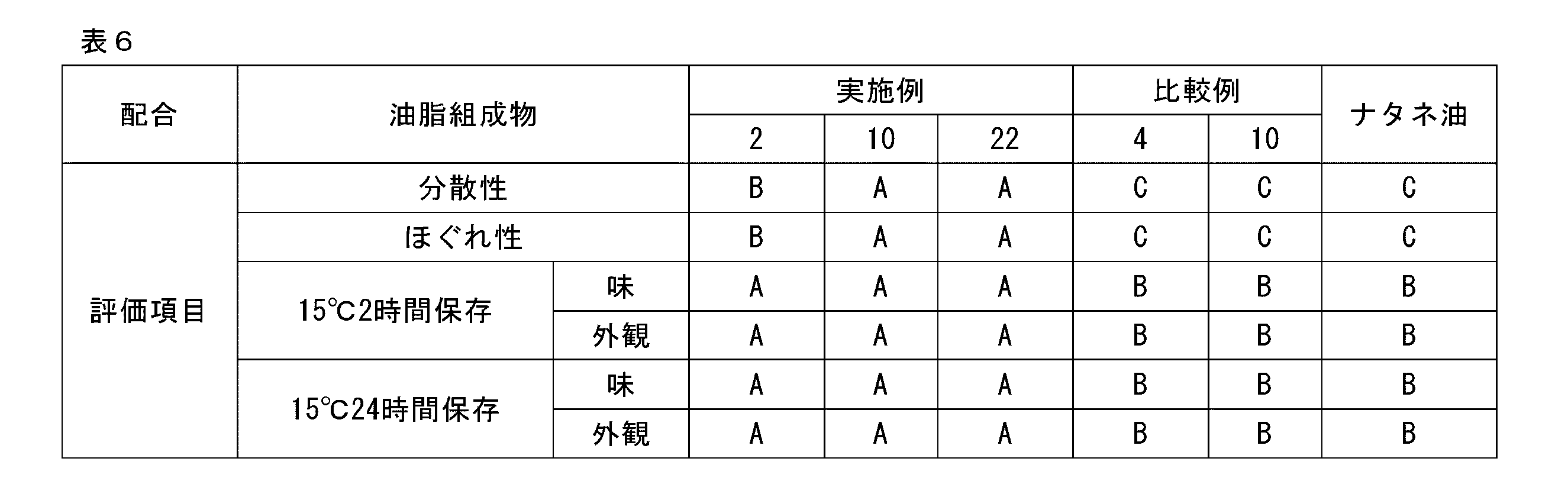
- Preparation Example 2 Preparation of cooked rice 600 g of fresh rice (Koshihikari from Niigata, produced in 2014) was washed, immersed in water at 20 ° C. for 1.5 hours, and then dried and drained. After 700 g of water was added to 700 g of the soaked rice, 6 g of rapeseed oil, or 6 g of the oil / fat composition of Example 2, Example 10, Example 22, Comparative Example 4 or Comparative Example 10 was added and lightly stirred. Cooked with an electric rice cooker. The cooked cooked rice was spread on a bat, loosened with a rice paddle for about 1 minute, and allowed to stand at room temperature for 30 minutes to obtain a rough heat to prepare a cooked cooked rice.
- Test Example 6 Evaluation of looseness The looseness of the test cooked rice obtained in Preparation Example 2 was evaluated according to the following evaluation criteria. The results are shown in the table below. (Evaluation criteria for looseness) A: The binding between rice grains is generally suppressed and it is easy to loosen. B: Although it is easy to loosen as a whole, there are some lumps. C: The binding of rice grains as a whole is strong and difficult to loosen.
- Test Example 8 Appearance Evaluation The test rice obtained in Preparation Example 2 above was stored at 15 ° C for 2 hours and stored at 15 ° C for 24 hours. evaluated. The results are shown in the table below. (Evaluation criteria for appearance) A: The whole cooked rice is glossy. B: The whole cooked rice is not glossy.
- the oil / fat composition of the present invention As shown in Table 6, by adding the oil / fat composition of the present invention to the water during cooking, the oil / fat composition is uniformly emulsified and dispersed in water, and the whole cooked rice is uniformly blended (dispersed) and loosened. Excellent rice was obtained. Furthermore, the cooked rice did not feel the taste derived from the oil / fat composition and had a good gloss.
- Loose rate (%) 100 x [number of A evaluations] / [total number of A evaluations and B evaluations (i.e., 100)]
- Preparation Example 3 Preparation of instant Chinese noodles 1.5 parts by mass of sodium chloride and 0.4 parts by mass of powdered brine (produced by Oriental Yeast Co., Ltd.) were dissolved in 35 parts by mass of water to prepare brine. This brackish water was added to 100 parts by weight of flour and mixed for 15 minutes to give a soft noodle dough. Using a noodle roll, rolling was performed in the order of roll gaps of 4.5 mm, 3.0 mm, and 2.0 mm, and then the noodle strip was further rolled with a noodle roll to obtain a noodle strip having a thickness of about 1.25 mm.
- cutting blade # 18 was used to cut into noodle strings (width 1.25 mm), and the noodle strings were further cut to a length of about 30 cm to obtain raw Chinese noodles.
- the obtained raw Chinese noodles were steamed for 3 minutes using a steamer to obtain steamed Chinese noodles.
- 80 g of steamed Chinese noodles were immersed in 100 mL of a loosening solution using the emulsified composition of Example 22 among the above-mentioned loosening solutions and molded into a columnar shape having a diameter of 10 cm on a wire mesh.
- the prepared instant Chinese noodles were reconstituted with boiling water for 4 minutes.
- the noodles that had been reconstituted with hot water were unraveled quickly and easily just by unraveling the noodles 2-3 times with chopsticks.
Landscapes
- Chemical & Material Sciences (AREA)
- Life Sciences & Earth Sciences (AREA)
- Engineering & Computer Science (AREA)
- Food Science & Technology (AREA)
- Polymers & Plastics (AREA)
- Health & Medical Sciences (AREA)
- Nutrition Science (AREA)
- Oil, Petroleum & Natural Gas (AREA)
- Noodles (AREA)
- Edible Oils And Fats (AREA)
- Cereal-Derived Products (AREA)
Abstract
Description
上記蒸し工程により、麺線表面の澱粉が糊化(α化)し、麺線外層が強化されるため、その後の乾燥工程における麺線のひび割れ等を防止することができる。また、上記蒸し工程により澱粉が膨潤するため、最終製品である即席麺の湯戻り時間を短縮することができる。したがって、上記蒸し工程は即席麺の製造において必須の工程とされている。
一方、上記蒸し工程による麺線表面の糊化により、麺線同士が結着する現象も生じる。麺線同士が結着するとその後の成形工程において成形不良が生じやすくなる。また、得られる即席麺は結着部分が湯戻りしにくく、食感が不均一となる。
このように、上記蒸し工程は即席麺の品質に大きく影響する。
例えば特許文献1には、エステル化率が20%以下で、かつ、HLBが8~12のポリグリセリン脂肪酸エステルと大豆レシチンを含有する茹で・蒸し麺類用油脂組成物が記載され、この油脂組成物を茹でた中華麺やうどんに噴霧等することにより、麺線のほぐれ性を向上させたことが記載されている。
[ジグリセリンモノオレートの含有量]×2≧[ジグリセリンモノラウレートの含有量]
また本発明は、上記油脂組成物又は乳化組成物を用いた食品を提供するものである。
また本発明は、上記油脂組成物又は乳化組成物と、蒸し工程後の麺線とを接触させることにより、前記麺線表面に前記食用油脂を付着させることを含む、即席麺の製造方法を提供するものである。
さらに本発明は、上記油脂組成物又は乳化組成物の存在下で炊飯することを含む、米飯の製造方法を提供するものである。
本発明において、成分含有量は、特に断りのない限り質量基準である。
また、いわゆる炊き込みご飯等を作る際には、炊飯時の水に醤油やダシが加えられる。したがって、調味液中に容易に乳化分散でき、且つこの乳化分散状態が高温下においても安定な油脂組成物は、米飯のほぐれ性改善用途において汎用性が高く、実用性に優れたものとなる。
また本発明は、上記油脂組成物の油脂を油相として有する水中油型乳化組成物の提供に関する。
また本発明は、上記油脂組成物又は乳化組成物を用いた食品の提供に関する。
さらに本発明は、上記油脂組成物又は乳化組成物を用いた即席麺ないし米飯の製造方法の提供に関する。
本発明はこれらの知見に基づきさらに検討を重ね、完成されるに至ったものである。
本発明に用いる食用油脂は、植物性油脂であることが好ましい。当該植物性油脂としては、例えば、大豆油、菜種油、コーン油、綿実油、サフラワー油、オリーブ油、パーム油、米油、ひまわり油、胡麻油、及びこれらのエステル交換油もしくは分別油から選ばれる1種又は2種以上の油脂が挙げられ、大豆油、菜種油、及びコーン油から選ばれる油脂が好ましい。
[DGMOの含有量]×2≧[DGMLの含有量] (I)
本発明の油脂組成物中、DGMLの含有量とDGMOの含有量とが上記数式(I)を満たすことにより、DGMOが、DGMLを油脂中に溶解するための可溶化剤として効果的に機能することができ、食用油脂中へのDGMLの溶解安定性をより高めることができる。乳化組成物の耐塩・耐熱性を高める観点から、DGMLの含有量(質量%)とDGMOの含有量(質量%)は下記数式(II)を満たすことが好ましい。
[DGMOの含有量]≧[DGMLの含有量]×2 (II)
本発明の油脂組成物がレシチンを含有する場合、本発明の油脂組成物中のレシチンの含有量は0.5~3.0質量%が好ましく、1.0~2.0質量%がより好ましい。
例えば、即席麺の製造において、蒸し工程後の麺線表面に付着させることにより、麺線同士の結着を抑制し、ほぐれ性に優れた即席麺を得ることができる。また、本発明の油脂組成物を調味液中に乳化分散させて乳化液を調製し、当該乳化液を麺線表面に噴霧することにより、麺線のほぐれ性を効果的に改善しながら麺線に所望の味付けをすることができる。しかも、本発明の油脂組成物を用いれば、上記の麺線表面への乳化液の噴霧を、高温下においても安定して実施できる。すなわち本発明の油脂組成物は即席麺等の工業的生産に好ましく適用できる。
本発明の乳化組成物は、本発明の油脂組成物の油脂を油相(分散相)として有する。本発明の乳化組成物を構成する水相(連続相)は、水又は水性液である。当該水相は塩分(食塩)等を含有する調味液であってもよい。本発明の乳化組成物は、水相が塩分を含む場合であっても優れた乳化安定性を示す。そのため、本発明の乳化組成物を食品に付着させることにより、水相が有する塩分等の調味成分により食品に所望の味付けをすることができ、且つ、油相の作用によって食品のほぐれ性、食感、風味、外観等を改質することができる。
本発明の食品は、各種食品の通常の製造工程において、本発明の油脂組成物ないし乳化組成物を配合することで得ることができる。なかでも、本発明の食品は、当該食品の製造工程において、食品表面に本発明の油脂組成物ないし乳化組成物を付着させ、当該付着液を食品に浸透させ、あるいは食品表面になじませた形態が好ましい。本発明の食品が即席麺あるいは米飯である場合を例にとって、その生産方法の一例を説明する。
蒸し工程後の麺線と本発明の油脂組成物又は乳化組成物とを接触させる際には、当該麺線100質量部に対し、食用油脂が0.01~0.8質量部付着するように接触させることが好ましく、0.05~0.5質量部付着するように接触させることがさらに好ましい。
食用油脂を70.0~96.5質量%、DGMLを0.5~10.0質量%、及びDGMOを3.0~20.0質量%含有し、該DGMLの含有量と該DGMOの含有量が下記数式を満たす、油脂組成物。
[DGMOの含有量]×2≧[DGMLの含有量]
前記食用油脂が、好ましくは20℃において液状の油脂であり、より好ましくは5℃において液状の油脂である、前記<1>に記載の油脂組成物。
<3>
前記食用油脂が、好ましくは植物性油脂であり、より好ましくは大豆油、菜種油、コーン油、綿実油、サフラワー油、オリーブ油、パーム油、米油、ひまわり油、胡麻油、及びこれらのエステル交換油もしくは分別油から選ばれる1種又は2種以上の油脂であり、さらに好ましくは大豆油、菜種油、及びコーン油から選ばれる1種又は2種以上の油脂である、前記<1>又は<2>に記載の油脂組成物。
<4>
前記油脂組成物中、食用油脂の含有量が、好ましくは75.0質量%以上であり、より好ましくは80.0質量%以上であり、さらに好ましくは85.0質量%以上であり、さらに好ましくは87.0質量%以上であり、さらに好ましくは90.0質量%以上である、前記<1>~<3>のいずれか1つに記載の油脂組成物。
<5>
前記油脂組成物中、食用油脂の含有量が、好ましくは96.0質量%未満であり、より好ましくは95.5質量%以下であり、さらに好ましくは95.0質量%以下であり、さらに好ましくは94.5質量%以下である、前記<1>~<4>のいずれか1つに記載の油脂組成物。
<6>
前記油脂組成物中、食用油脂の含有量が、好ましくは75.0~96.5質量%であり、より好ましくは80.0~96.5質量%であり、さらに好ましくは80.0質量%以上96.0質量%未満であり、さらに好ましくは85.0~95.5質量%であり、さらに好ましくは85.0~95.0質量%であり、さらに好ましくは87.0~94.5質量%であり、さらに好ましくは90.0~94.5質量%である、前記<1>~<5>のいずれか1つに記載の油脂組成物。
前記油脂組成物中、DGMLの含有量が、好ましくは0.8質量%以上であり、より好ましくは1.0質量%以上である、前記<1>~<6>のいずれか1つに記載の油脂組成物。
<8>
前記油脂組成物中、DGMLの含有量が、好ましくは8.0質量%以下であり、より好ましくは6.0質量%以下であり、さらに好ましくは5.0質量%以下であり、さらに好ましくは4.0質量%以下であり、さらに好ましくは3.0質量%以下であり、さらに好ましくは2.0質量%以下である、前記<1>~<7>のいずれか1つに記載の油脂組成物。
<9>
前記油脂組成物中、DGMLの含有量が、好ましくは0.5~8.0質量%であり、より好ましくは0.5~6.0質量%であり、さらに好ましくは0.5~5.0質量%であり、さらに好ましくは0.8~4.0質量%であり、さらに好ましくは0.8~3.0質量%であり、さらに好ましくは1.0~2.0質量%である、前記<1>~<8>のいずれか1つに記載の油脂組成物。
前記油脂組成物中、DGMOの含有量が、好ましくは15.0質量%以下であり、より好ましくは10.0質量%以下であり、さらに好ましくは8.0質量%以下であり、さらに好ましくは6.0質量%以下である、前記<1>~<9>のいずれか1つに記載の油脂組成物。
<11>
前記油脂組成物中、DGMOの含有量が、好ましくは3.0~15.0質量%であり、より好ましくは3.0~10.0質量%であり、さらに好ましくは3.0~8.0質量%であり、さらに好ましくは3.0~6.0質量%である、前記<1>~<10>のいずれか1つに記載の油脂組成物。
前記油脂組成物中の、DGMLの含有量(質量%)とDGMOの含有量(質量%)が、好ましくは下記数式を満たす、前記<1>~<11>のいずれか1つに記載の油脂組成物。
[DGMOの含有量]≧[DGMLの含有量]×2
前記油脂組成物が、好ましくはレシチンを含有する、前記<1>~<12>のいずれか1つに記載の油脂組成物。
<14>
前記油脂組成物中、レシチンの含有量が、好ましくは0.5質量%以上であり、より好ましくは1.0質量%以上である、前記<13>に記載の油脂組成物。
<15>
前記油脂組成物中、レシチンの含有量が、好ましくは3.0質量%以下であり、より好ましくは2.0質量%以下である、前記<13>又は<14>に記載の油脂組成物。
<16>
前記油脂組成物中、レシチンの含有量が、好ましくは0.5~3.0質量%であり、より好ましくは1.0~2.0質量%である、前記<13>~<15>のいずれか1つに記載の油脂組成物。
前記油脂組成物が、好ましくは食品の改質剤であり、より好ましくは食品の結着抑制剤である、前記<1>~<16>のいずれか1つに記載の油脂組成物。
<18>
前記食品が、好ましくは即席麺、米飯、チルド麺、調理麺、スナック菓子、麺スナック菓子又は揚げ菓子である、前記<17>に記載の油脂組成物。
<19>
前記即席麺、チルド麺及び調理麺が、好ましくは中華麺、うどん、そば、パスタ又はフォーである、前記<18>に記載の油脂組成物。
前記<1>~<19>のいずれか1つに記載の油脂組成物の油脂を油相として有する水中油型乳化組成物。
<21>
前記水中油型乳化組成物中、水相に対する油相の量比が、質量比で、好ましくは水相/油相=99.5/0.5~90/10であり、より好ましくは水相/油相=99/1~95/5である、前記<20>に記載の水中油型乳化組成物。
<22>
前記水中油型乳化組成物の水相が、好ましくは調味液である、前記<20>又は<21>に記載の水中油型乳化組成物。
<23>
前記調味液が、好ましくは食塩を含む、前記<22>に記載の水中油型乳化組成物。
<24>
前記調味液が、好ましくは醤油、味噌、魚醤、砂糖、ショ糖、液糖、果糖、みりん、甘味料、畜肉エキス、魚介エキス、野菜エキス、グルタミン酸ナトリウム、イノシン酸ナトリウム、コハク酸ナトリウム、グアニル酸ナトリウム、アミノ酸、酢酸、クエン酸、リンゴ酸、乳酸、酒石酸、色素及び香辛料から選ばれる成分を含む、前記<23>に記載の水中油型乳化組成物。
<25>
前記調味液中の食塩の含有量が、好ましくは0.2~20質量%であり、より好ましくは1~10質量%である、<23>又は<24>に記載の水中油型乳化組成物。
前記水中油型乳化組成物が、好ましくは食品の改質剤であり、より好ましくは食品の結着抑制剤である、前記<20>~<25>のいずれか1つに記載の水中油型乳化組成物。
<27>
前記食品が、好ましくは即席麺、米飯、チルド麺、調理麺、スナック菓子、麺スナック菓子又は揚げ菓子である、<26>に記載の水中油型乳化組成物。
<28>
前記即席麺、チルド麺及び調理麺が、好ましくは中華麺、うどん、そば、パスタ又はフォーである、前記<27>に記載の水中油型乳化組成物。
前記<1>~<19>のいずれか1つに記載の油脂組成物、又は、前記<20>~<28>のいずれか1つに記載の水中油型乳化組成物を用いた食品。
<30>
前記食品が、好ましくは即席麺、米飯、チルド麺、調理麺、スナック菓子、麺スナック菓子又は揚げ菓子である、前記<29>に記載の食品。
<31>
前記即席麺、チルド麺及び調理麺が、好ましくは中華麺、うどん、そば、パスタ又はフォーである、前記<30>に記載の食品。
前記<1>~<19>のいずれか1つに記載の油脂組成物、又は、前記<20>~<28>のいずれか1つに記載の水中油型乳化組成物と、蒸し工程後の麺線とを接触させることにより、前記麺線表面に前記食用油脂を付着させることを含む、即席麺の製造方法。
<33>
前記油脂組成物又は前記水中油型乳化組成物と、前記蒸し工程後の麺線との接触が、前記油脂組成物中又は前記乳化組成物中に麺線を浸漬するか、又は、前記油脂組成物又は前記乳化組成物を麺線表面に噴霧することにより行われる、前記<32>に記載の即席麺の製造方法。
<34>
前記油脂組成物又は前記水中油型乳化組成物と、前記蒸し工程後の麺線との接触を、前記麺線100質量部に対し、前記食用油脂が0.01~0.8質量部付着するように行う、前記<32>又は<33>に記載の即席麺の製造方法。
前記<1>~<19>のいずれか1つに記載の油脂組成物、又は、前記<20>~<28>のいずれか1つに記載の水中油型乳化組成物の存在下で炊飯することを含む、米飯の製造方法。
<36>
生米100質量部に対し、食用油脂が0.1~5質量部となるように、炊飯時の水あるいは調味液中に前記油脂組成物又は前記水中油型乳化組成物を添加し、炊飯することを含む、前記<35>に記載の米飯の製造方法。
食用油脂としては、
ナタネ油(商品名:菜種サラダ油(S)、日清オイリオ社製)、
コーン油(商品名:コーン油(S)、日清オイリオ社製)
を用いた。
DGMO(商品名:サンソフトQ-17D、太陽化学社製、HLB7.5)、
DGML(商品名:サンソフトQ-12D、太陽化学社製、HLB8.5)、
ジグリセリンセスキオレート(商品名:サンソフトQ-17B、太陽化学社製、HLB6.5)、
トリグリセリンモノステアレート(商品名:SYグリスターMS-3S、阪本薬品工業社製、HLB8.4)、
テトラグリセリンモノオレート(商品名:SYグリスターMO-3S、阪本薬品工業社製、HLB8.8)、
ペンタグリセリントリオレート(商品名:サンソフトA173E、太陽化学社製、HLB7.0)、
ペンタグリセリントリミリステート(商品名:サンソフトA143E、太陽化学社製、HLB8.0)、
ヘキサグリセリントリステアレート(商品名:SYグリスターTS-5S、阪本薬品工業社製、HLB7.4)、
テトラグリセリンモノラウレート(商品名:SYグリスターMS-310、阪本薬品工業社製、HLB10.3)、
ペンタグリセリンモノラウレート(商品名:サンソフトA-121E、太陽化学社製、HLB14.0)、
ペンタグリセリンモノステアレート(商品名:サンソフトA-181E、太陽化学社製、HLB13.0)、
ヘキサグリセリンモノラウレート(商品名:SYグリスターML-500、阪本薬品工業社製、HLB13.5)、
ヘキサグリセリンモノオレート(商品名:SYグリスターMO-5S、阪本薬品工業社製、HLB11.6)、
ヘキサグリセリンモノステアレート(商品名:SYグリスターMS-5S、阪本薬品工業社製、HLB12.0)、
デカグリセリンモノラウレート(商品名:リョートーポリグリエステルL-7D、三菱化学フーズ社製、HLB15.5)、
デカグリセリンモノオレート(商品名:SYグリスターMO-7S、阪本薬品工業社製、HLB12.9)、
デカグリセリンモノステアレート(商品名:サンソフトQ-18S、太陽化学社製、HLB11.6)
を用いた。
Yelkin-TS(商品名、Archer Daniels Midland Company社製)
を用いた。
上記調製例1で調製した各油脂組成物を室温まで冷却し、油脂組成物の風味について5名の専門パネルの各々が、後述の評価基準に従って風味を評価した。風味の評価基準を以下に示す。5名の専門パネルの評価結果はすべて同じとなった。
(風味の評価基準)
A:乳化剤の異味を感じない。
B:乳化剤の異味を感じる。
上記調製例1で調製した各油脂組成物を室温まで冷却し、各油脂組成物につき、50mLずつ、5本の瓶(底面φ4.0cm、高さ7.5cm)に分注して密封した。20℃で1週間静置した後、外観を目視観察し、下記評価基準により評価した。結果を下表に示す。
(乳化剤の溶解安定性評価基準)
A:5つの瓶すべてにおいて沈殿が生じなかった。
B:1つ以上の瓶で沈殿が生じた。
上記調製例1で調製した各油脂組成物1gに対し、純水49.0gを混合して5分間、緩やかに撹拌し、水中油型に乳化分散させた。次いで80℃のウォーターバス中で1時間、緩やかに撹拌を続けた。その後、室温に戻して20分間静置し、乳化状態を目視観察し、下記評価基準により評価した。結果を下表に示す。なお、各油脂組成物について、同じ試験を5回実施したが、いずれも同じ評価結果となった。この試験では評価4を合格とした。
(評価基準)
4:全体が均質に白濁しており、均一な乳化分散状態である。
3:表面にクリーミング層が生じている。クリーミング層以外の部分は均質に白濁しており、光が透過しない状態である。
2:表面にクリーミング層が生じている。クリーミング層以外の部分は均質に白濁しているが、白濁の度合がやや薄く、光が透過する状態である。
1:油水が分離しており、全体が透明である。
上記調製例1で調製した各油脂組成物1gに対し、10質量%食塩水49.0gを混合して5分間、緩やかに撹拌し、水中油型に乳化分散させた。次いで60℃のウォーターバス中で1時間、緩やかに撹拌を続けた。その後、室温に戻して20分間静置し、乳化状態を目視観察し、上記試験例3と同じ評価基準により評価した。結果を下表に示す。なお、各油脂組成物について、同じ試験を5回実施したが、いずれも同じ評価結果となった。この試験では評価2以上を合格とした。

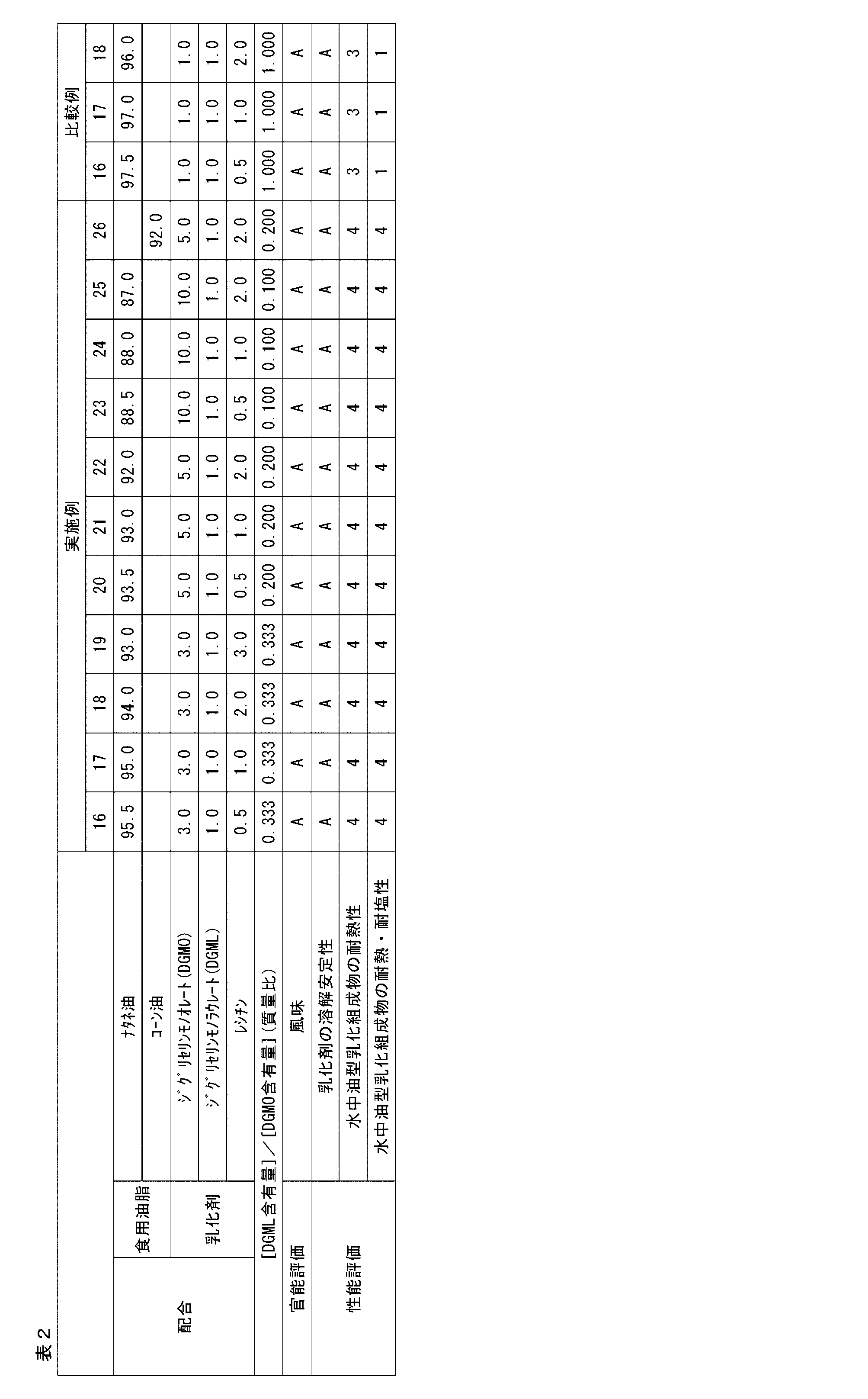
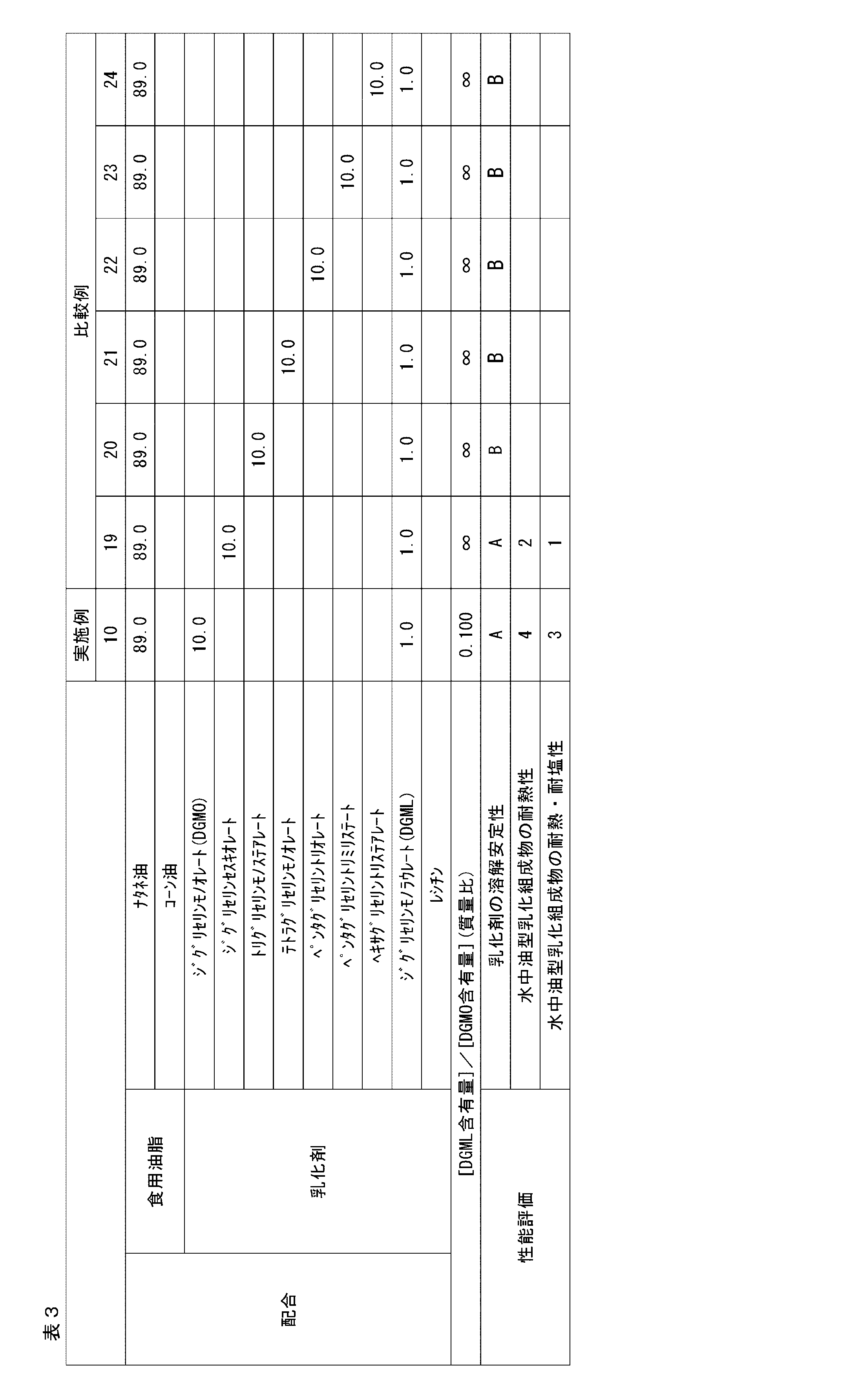
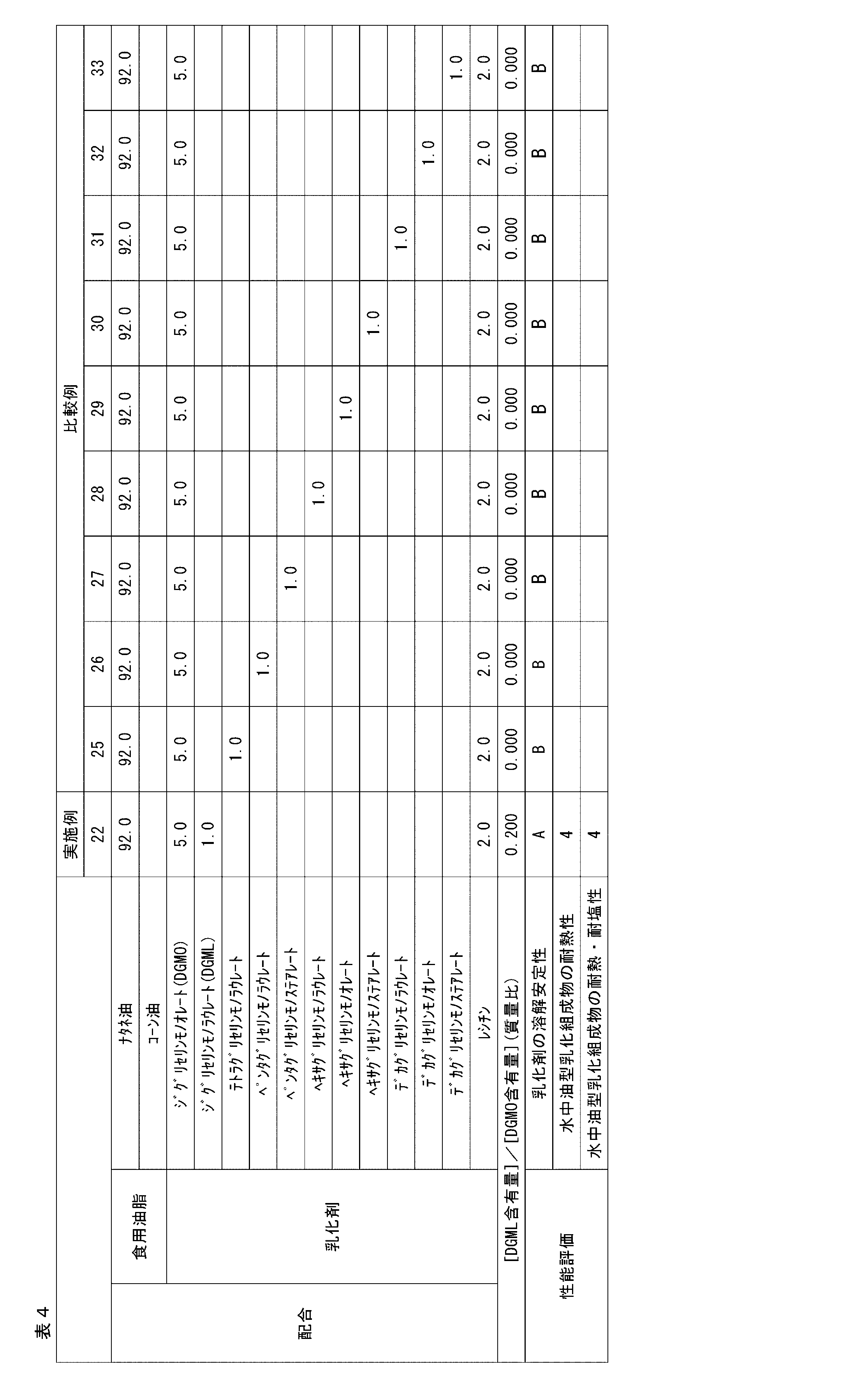
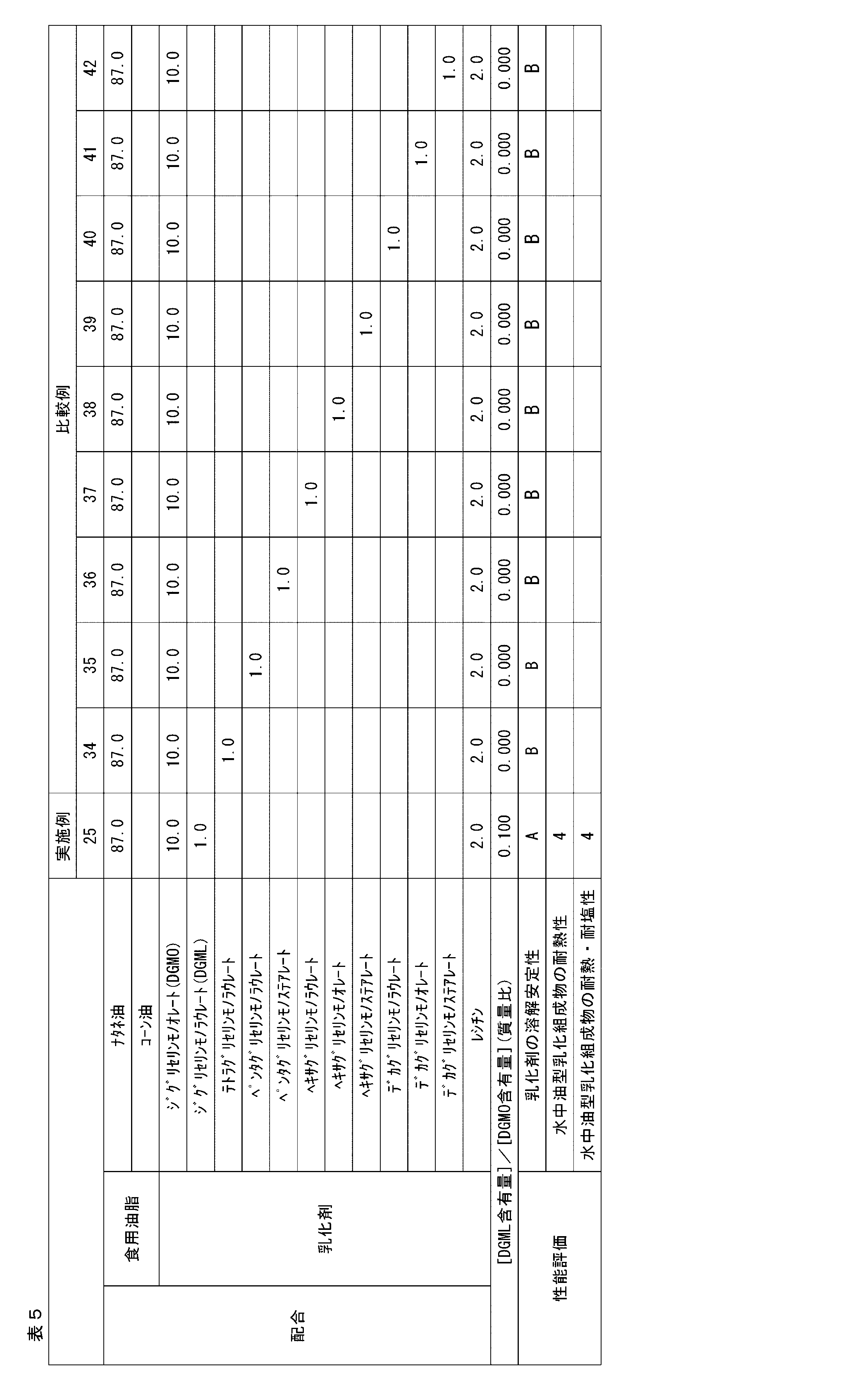
また、油脂組成物が乳化剤としてDGMLのみを含有する場合には、油脂組成物の保存中に沈殿が生じ、実用性に劣るものであった(比較例7及び8)。ここで、油脂組成物がDGMOを含有しない場合であっても、DGMLの含有量を所定のレベルまで減らすことにより、油脂組成物の保存安定性は高まるが、この場合には、水中油型乳化組成物を形成した際の乳化安定性に劣る結果となった(比較例6)。
また、油脂組成物がDGMOとDGMLの両乳化剤を含有する場合でも、DGMOの含有量が本発明で規定するよりも少ないと、塩分を含む水性液中に乳化分散させた際に、高温下において乳化形態を安定的に維持することができず(比較例9、10、16~18)、逆にDGMOの含有量が本発明で規定するよりも多い場合にも、水中に乳化分散させた際に、高温下において乳化形態を安定的に維持することができなかった(比較例14)。
また、油脂組成物中のDGMOの含有量とDGMLの含有量が、本発明で規定する関係を満たさない場合には、油脂組成物の保存中に沈殿が生じ、実用性に劣る結果となった(比較例11及び12)。
また、油脂組成物がDGMOとDGMLの両乳化剤を含有する場合でも、DGMLの含有量が本発明で規定するよりも少なかったり多かったりすると、水中に乳化分散させた際に、高温下において乳化形態を安定的に維持することができなかった(比較例13、15)。
また、DGMLの含有量を本発明で規定する範囲内とした上で、DGMOに代えて他の乳化剤を配合した油脂組成物は、油脂組成物の保存中に沈殿が生じて実用性に劣る結果となったり(比較例20~24)、乳化安定性に劣る結果となったりした(比較例19)。
また、DGMOの含有量を本発明で規定する範囲内とした上で、DGMLに代えて他の乳化剤を配合した油脂組成物は、油脂組成物の保存中に沈殿が生じ、実用性に劣る結果となった(比較例25~42)。
生米(新潟産コシヒカリ、平成26年産)600gを洗米後、20℃の水に1.5時間浸漬し、ざるに上げて水切りした。この浸漬米700gに水700gを加え、更に、ナタネ油6g、又は、実施例2、実施例10、実施例22、比較例4もしくは比較例10の油脂組成物6gを加えて軽くかき混ぜた後、電気炊飯器により炊飯した。
炊き上がった米飯をバットに広げてしゃもじで約1分間ほぐし、室温で30分間静置することで粗熱をとって試験用米飯とした。
上記調製例2において、ナタネ油6g又は油脂組成物6gに代えて、ナタネ油6g又は油脂組成物6gにβカロテン(DSMニュートリションジャパン社製)を0.1質量%濃度となるように混合したものを使用し、βカロテンの色の広がり度合に基づき、ナタネ油及び油脂組成物の米飯に対する分散性を、下記評価基準により評価した。
(米飯に対する分散性評価基準)
A:米飯全体が均質に着色している(米飯全体に油脂がなじんでいる)。
B:米飯がほぼ均一に着色している。
C:着色が偏っている(米飯のところどころに油脂が偏在している)。
上記調製例2で得られた試験用米飯について、ほぐれ性を下記評価基準により評価した。結果を下表に示す。
(ほぐれ性の評価基準)
A:全体的に米粒同士の結着が抑えられてほぐし易い。
B:全体的にほぐし易いがやや塊がある。
C:全体として米粒同士の結着が強くほぐし難い。
上記調製例2で得られた試験用米飯を15℃で2時間保存したもの、及び15℃で24時間保存したものを食し、下記評価基準により味を評価した。結果を下表に示す。
(味の評価基準)
A:油脂由来の油っぽさを感じない。
B:油っぽさを感じる。
上記調製例2で得られた試験用米飯を15℃で2時間保存したもの、及び15℃で24時間保存したものについて、外観を目視観察し、下記評価基準により評価した。結果を下表に示す。
(外観の評価基準)
A:米飯全体にツヤがある。
B:米飯全体にツヤがない。
生めん(商品名:細麺、麺心屋社製)を沸騰水中で1分間茹でた後、湯切りし、イオン交換水で麺の表面のぬめりを除去した。得られた麺の20gを、実施例2、実施例8、実施例10、実施例14、実施例22、比較例4又は比較例10の油脂組成物の含有量が2.0質量%になるように水で希釈して得た、水中油型の乳化液である希釈液(ほぐし液)30mL中に、30秒間浸漬した。次いで麺を取り出し、麺に付着した過剰の希釈液をエアーブローで除去し、カップに入れた。同様にして、希釈液に浸漬後、過剰の希釈液を除去した麺の入ったカップを9個用意した(合計10カップ)。各カップに入った麺について、当該カップに入れてから10分間静置後に、麺線10本を1本ずつ引き上げた。引き上げた合計100本(10本×10カップ)の麺線について、各々の麺線のほぐれ性を下記評価基準により評価した。この評価結果に基づき下記式からほぐれ率を算出した。結果を表7に示す。
A:麺線が切断されずに一本ずつ引き上げられる
B:麺線を引き上げた際に、麺線が切断されてしまう、又は、麺線に結着してからまった麺塊が浮上する

水35質量部に食塩1.5質量部、粉末かん水(オリエンタル酵母工業社製)0.4質量部を溶解し、かんすい水を調製した。このかん水を小麦粉100質量部に加え、15分間混合してそぼろ状の麺生地とした。
製麺ロールを用い、ロール間隙4.5mm、3.0mm、2.0mmの順に圧延し、次いで麺帯をさらに製麺ロールで圧延し、約1.25mm厚の麺帯とした。その後、切刃♯18角を用いて麺線(幅1.25mm)に切り出し、さらにこの麺線を長さ約30cmに切り、生中華麺を得た。得られた生中華麺を、蒸し器を用いて3分間蒸し、蒸し中華麺を得た。蒸し中華めん80gを、上述したほぐし液のうち、実施例22の乳化組成物を用いたほぐし液100mLに浸漬し、金網上で直径10cmの円柱状に成型した。次いで余分なほぐし液をエアブローにて除去した後、熱風乾燥器を用いて水分が10%程度になるように乾燥し、即席中華麺を調製した。
調製した即席中華麺を沸騰水で4分間湯戻しした。湯戻した麺は、箸を用いて麺を2~3回ほぐすだけで、麺全体が素早く簡単にほぐれた。
Claims (11)
- 食用油脂を70.0~96.5質量%、ジグリセリンモノラウレートを0.5~10.0質量%、及びジグリセリンモノオレートを3.0~20.0質量%含有し、該ジグリセリンモノラウレートの含有量と該ジグリセリンモノオレートの含有量が下記数式を満たす、油脂組成物。
[ジグリセリンモノオレートの含有量]×2≧[ジグリセリンモノラウレートの含有量] - 前記油脂組成物中、前記食用油脂の含有量が85.0~96.5質量%、前記ジグリセリンモノラウレートの含有量が0.5~5.0質量%、前記ジグリセリンモノオレートの含有量が3.0~10.0質量%であり、該ジグリセリンモノラウレートの含有量と該ジグリセリンモノオレートの含有量が下記数式を満たす、請求項1に記載の油脂組成物。
[ジグリセリンモノオレートの含有量]≧[ジグリセリンモノラウレートの含有量]×2 - 前記油脂組成物がレシチンを0.5~3.0質量%含有する、請求項1又は2に記載の油脂組成物。
- 食品の結着抑制剤である、請求項1~3のいずれか1項に記載の油脂組成物。
- 請求項1~4のいずれか1項に記載の油脂組成物の油脂を油相として有する水中油型乳化組成物。
- 前記水中油型乳化組成物を構成する水相が塩分を含有する、請求項5に記載の水中油型乳化組成物。
- 食品の結着抑制剤である、請求項5又は6に記載の水中油型乳化組成物。
- 請求項1~4のいずれか1項に記載の油脂組成物又は請求項5~7のいずれか1項に記載の水中油型乳化組成物を用いた食品。
- 前記食品が即席麺又は米飯である、請求項8に記載の食品。
- 請求項1~4のいずれか1項に記載の油脂組成物又は請求項5~7のいずれか1項に記載の水中油型乳化組成物と、蒸し工程後の麺線とを接触させることにより、前記麺線表面に前記食用油脂を付着させることを含む、即席麺の製造方法。
- 請求項1~4のいずれか1項に記載の油脂組成物又は請求項5~7のいずれか1項に記載の水中油型乳化組成物の存在下で炊飯することを含む、米飯の製造方法。
Priority Applications (1)
| Application Number | Priority Date | Filing Date | Title |
|---|---|---|---|
| CN201680031271.0A CN107613777B (zh) | 2015-07-02 | 2016-07-01 | 油脂组合物 |
Applications Claiming Priority (2)
| Application Number | Priority Date | Filing Date | Title |
|---|---|---|---|
| JP2015-133831 | 2015-07-02 | ||
| JP2015133831 | 2015-07-02 |
Publications (1)
| Publication Number | Publication Date |
|---|---|
| WO2017002963A1 true WO2017002963A1 (ja) | 2017-01-05 |
Family
ID=57609465
Family Applications (1)
| Application Number | Title | Priority Date | Filing Date |
|---|---|---|---|
| PCT/JP2016/069651 Ceased WO2017002963A1 (ja) | 2015-07-02 | 2016-07-01 | 油脂組成物 |
Country Status (3)
| Country | Link |
|---|---|
| JP (1) | JP6755731B2 (ja) |
| CN (1) | CN107613777B (ja) |
| WO (1) | WO2017002963A1 (ja) |
Families Citing this family (5)
| Publication number | Priority date | Publication date | Assignee | Title |
|---|---|---|---|---|
| JP7144254B2 (ja) * | 2018-09-18 | 2022-09-29 | 理研ビタミン株式会社 | フライ用油脂組成物 |
| JP7660339B2 (ja) * | 2019-12-25 | 2025-04-11 | 日清オイリオグループ株式会社 | 油脂組成物、食品の衛生性を高める方法、及び食品の製造方法 |
| JP7500126B2 (ja) * | 2020-03-31 | 2024-06-17 | 日清オイリオグループ株式会社 | 可塑性油脂組成物 |
| KR102272154B1 (ko) * | 2020-12-22 | 2021-07-05 | 주식회사농심 | 유화성 유지 조성물 및 면질 개량제 |
| CN113826821B (zh) * | 2021-09-24 | 2023-04-25 | 青岛农业大学 | 一种高拉伸性低脂非油炸方便米线及其制备方法 |
Citations (4)
| Publication number | Priority date | Publication date | Assignee | Title |
|---|---|---|---|---|
| JPH0739325A (ja) * | 1993-07-27 | 1995-02-10 | Riken Vitamin Co Ltd | 米飯類の品質改良剤 |
| JPH10215802A (ja) * | 1997-02-07 | 1998-08-18 | Taiyo Kagaku Co Ltd | 麺類品質改良剤及び麺類の製造法 |
| JP2005323537A (ja) * | 2004-05-14 | 2005-11-24 | Tsuji Seiyu Kk | 水溶性油脂調製物、その製造方法および利用 |
| JP2007166929A (ja) * | 2005-12-20 | 2007-07-05 | Sanei Gen Ffi Inc | 澱粉麺類の品質改良剤 |
Family Cites Families (2)
| Publication number | Priority date | Publication date | Assignee | Title |
|---|---|---|---|---|
| CN103445975B (zh) * | 2012-05-30 | 2017-08-22 | 花王株式会社 | 乳化化妆品组合物 |
| JP5654695B2 (ja) * | 2013-01-23 | 2015-01-14 | 花王株式会社 | 麺帯用水中油型乳化組成物 |
-
2016
- 2016-07-01 CN CN201680031271.0A patent/CN107613777B/zh active Active
- 2016-07-01 JP JP2016131502A patent/JP6755731B2/ja active Active
- 2016-07-01 WO PCT/JP2016/069651 patent/WO2017002963A1/ja not_active Ceased
Patent Citations (4)
| Publication number | Priority date | Publication date | Assignee | Title |
|---|---|---|---|---|
| JPH0739325A (ja) * | 1993-07-27 | 1995-02-10 | Riken Vitamin Co Ltd | 米飯類の品質改良剤 |
| JPH10215802A (ja) * | 1997-02-07 | 1998-08-18 | Taiyo Kagaku Co Ltd | 麺類品質改良剤及び麺類の製造法 |
| JP2005323537A (ja) * | 2004-05-14 | 2005-11-24 | Tsuji Seiyu Kk | 水溶性油脂調製物、その製造方法および利用 |
| JP2007166929A (ja) * | 2005-12-20 | 2007-07-05 | Sanei Gen Ffi Inc | 澱粉麺類の品質改良剤 |
Also Published As
| Publication number | Publication date |
|---|---|
| CN107613777A (zh) | 2018-01-19 |
| CN107613777B (zh) | 2025-08-29 |
| JP6755731B2 (ja) | 2020-09-16 |
| JP2017012167A (ja) | 2017-01-19 |
Similar Documents
| Publication | Publication Date | Title |
|---|---|---|
| AU2013260836B2 (en) | Production method for frozen noodles and composition for preventing freezer burn | |
| KR20100080504A (ko) | 냉동 면류, 이의 냉동 면류의 제조 방법, 및 냉동소 방지용 코팅액 | |
| JP7293300B2 (ja) | 冷凍焼け防止剤及び冷凍食品の製造方法 | |
| JP6755731B2 (ja) | 油脂組成物 | |
| JP2018033335A (ja) | 油脂組成物 | |
| JP6369733B1 (ja) | 油脂組成物 | |
| CA2870119C (en) | Coated frozen noodles comprising xanthan gum and production method therefor | |
| JP6960033B2 (ja) | 油脂組成物 | |
| JP6487292B2 (ja) | 乾麺の製造方法 | |
| JP6744112B2 (ja) | 水中油型乳化組成物 | |
| JPH10201440A (ja) | 麺類の製造法 | |
| JP4201489B2 (ja) | 即席麺の製造方法 | |
| JP5794857B2 (ja) | 冷凍麺の冷凍焼け防止剤 | |
| JP2706834B2 (ja) | 袋入りレトルト麺の製造方法 | |
| JP4200670B2 (ja) | 茹で・蒸し麺類用油脂組成物及び麺類の製造方法 | |
| JP6321994B2 (ja) | 調味済みパンの製造方法およびその方法により製造した調味済みパン | |
| JP4793391B2 (ja) | 調味材 | |
| JP2023167032A (ja) | ソースのツヤ維持方法及びソース、並びにうどんの製造方法 | |
| WO2020203748A1 (ja) | 春巻用具材、加熱調理用春巻およびその製造方法 | |
| JP2009189315A (ja) | 固形食品用着色材 |
Legal Events
| Date | Code | Title | Description |
|---|---|---|---|
| 121 | Ep: the epo has been informed by wipo that ep was designated in this application |
Ref document number: 16818071 Country of ref document: EP Kind code of ref document: A1 |
|
| WWE | Wipo information: entry into national phase |
Ref document number: 201680031271.0 Country of ref document: CN |
|
| NENP | Non-entry into the national phase |
Ref country code: DE |
|
| 122 | Ep: pct application non-entry in european phase |
Ref document number: 16818071 Country of ref document: EP Kind code of ref document: A1 |
|
| WWG | Wipo information: grant in national office |
Ref document number: 201680031271.0 Country of ref document: CN |