WO2016166998A1 - ゴム用組成物及びその用途 - Google Patents
ゴム用組成物及びその用途 Download PDFInfo
- Publication number
- WO2016166998A1 WO2016166998A1 PCT/JP2016/051257 JP2016051257W WO2016166998A1 WO 2016166998 A1 WO2016166998 A1 WO 2016166998A1 JP 2016051257 W JP2016051257 W JP 2016051257W WO 2016166998 A1 WO2016166998 A1 WO 2016166998A1
- Authority
- WO
- WIPO (PCT)
- Prior art keywords
- mass
- butadiene
- chloroprene
- parts
- polymer latex
- Prior art date
- Legal status (The legal status is an assumption and is not a legal conclusion. Google has not performed a legal analysis and makes no representation as to the accuracy of the status listed.)
- Ceased
Links
Classifications
-
- C—CHEMISTRY; METALLURGY
- C08—ORGANIC MACROMOLECULAR COMPOUNDS; THEIR PREPARATION OR CHEMICAL WORKING-UP; COMPOSITIONS BASED THEREON
- C08K—Use of inorganic or non-macromolecular organic substances as compounding ingredients
- C08K3/00—Use of inorganic substances as compounding ingredients
- C08K3/18—Oxygen-containing compounds, e.g. metal carbonyls
- C08K3/20—Oxides; Hydroxides
- C08K3/22—Oxides; Hydroxides of metals
-
- A—HUMAN NECESSITIES
- A41—WEARING APPAREL
- A41D—OUTERWEAR; PROTECTIVE GARMENTS; ACCESSORIES
- A41D19/00—Gloves
- A41D19/0055—Plastic or rubber gloves
- A41D19/0058—Three-dimensional gloves
-
- A—HUMAN NECESSITIES
- A61—MEDICAL OR VETERINARY SCIENCE; HYGIENE
- A61B—DIAGNOSIS; SURGERY; IDENTIFICATION
- A61B42/00—Surgical gloves; Finger-stalls specially adapted for surgery; Devices for handling or treatment thereof
- A61B42/10—Surgical gloves
-
- B—PERFORMING OPERATIONS; TRANSPORTING
- B29—WORKING OF PLASTICS; WORKING OF SUBSTANCES IN A PLASTIC STATE IN GENERAL
- B29C—SHAPING OR JOINING OF PLASTICS; SHAPING OF MATERIAL IN A PLASTIC STATE, NOT OTHERWISE PROVIDED FOR; AFTER-TREATMENT OF THE SHAPED PRODUCTS, e.g. REPAIRING
- B29C41/00—Shaping by coating a mould, core or other substrate, i.e. by depositing material and stripping-off the shaped article; Apparatus therefor
- B29C41/02—Shaping by coating a mould, core or other substrate, i.e. by depositing material and stripping-off the shaped article; Apparatus therefor for making articles of definite length, i.e. discrete articles
- B29C41/14—Dipping a core
-
- C—CHEMISTRY; METALLURGY
- C08—ORGANIC MACROMOLECULAR COMPOUNDS; THEIR PREPARATION OR CHEMICAL WORKING-UP; COMPOSITIONS BASED THEREON
- C08J—WORKING-UP; GENERAL PROCESSES OF COMPOUNDING; AFTER-TREATMENT NOT COVERED BY SUBCLASSES C08B, C08C, C08F, C08G or C08H
- C08J5/00—Manufacture of articles or shaped materials containing macromolecular substances
- C08J5/02—Direct processing of dispersions, e.g. latex, to articles
-
- C—CHEMISTRY; METALLURGY
- C08—ORGANIC MACROMOLECULAR COMPOUNDS; THEIR PREPARATION OR CHEMICAL WORKING-UP; COMPOSITIONS BASED THEREON
- C08K—Use of inorganic or non-macromolecular organic substances as compounding ingredients
- C08K5/00—Use of organic ingredients
-
- C—CHEMISTRY; METALLURGY
- C08—ORGANIC MACROMOLECULAR COMPOUNDS; THEIR PREPARATION OR CHEMICAL WORKING-UP; COMPOSITIONS BASED THEREON
- C08K—Use of inorganic or non-macromolecular organic substances as compounding ingredients
- C08K5/00—Use of organic ingredients
- C08K5/0008—Organic ingredients according to more than one of the "one dot" groups of C08K5/01 - C08K5/59
-
- C—CHEMISTRY; METALLURGY
- C08—ORGANIC MACROMOLECULAR COMPOUNDS; THEIR PREPARATION OR CHEMICAL WORKING-UP; COMPOSITIONS BASED THEREON
- C08K—Use of inorganic or non-macromolecular organic substances as compounding ingredients
- C08K5/00—Use of organic ingredients
- C08K5/04—Oxygen-containing compounds
- C08K5/13—Phenols; Phenolates
-
- C—CHEMISTRY; METALLURGY
- C08—ORGANIC MACROMOLECULAR COMPOUNDS; THEIR PREPARATION OR CHEMICAL WORKING-UP; COMPOSITIONS BASED THEREON
- C08K—Use of inorganic or non-macromolecular organic substances as compounding ingredients
- C08K9/00—Use of pretreated ingredients
-
- C—CHEMISTRY; METALLURGY
- C08—ORGANIC MACROMOLECULAR COMPOUNDS; THEIR PREPARATION OR CHEMICAL WORKING-UP; COMPOSITIONS BASED THEREON
- C08L—COMPOSITIONS OF MACROMOLECULAR COMPOUNDS
- C08L11/00—Compositions of homopolymers or copolymers of chloroprene
- C08L11/02—Latex
-
- A—HUMAN NECESSITIES
- A41—WEARING APPAREL
- A41D—OUTERWEAR; PROTECTIVE GARMENTS; ACCESSORIES
- A41D19/00—Gloves
- A41D19/0055—Plastic or rubber gloves
-
- B—PERFORMING OPERATIONS; TRANSPORTING
- B29—WORKING OF PLASTICS; WORKING OF SUBSTANCES IN A PLASTIC STATE IN GENERAL
- B29C—SHAPING OR JOINING OF PLASTICS; SHAPING OF MATERIAL IN A PLASTIC STATE, NOT OTHERWISE PROVIDED FOR; AFTER-TREATMENT OF THE SHAPED PRODUCTS, e.g. REPAIRING
- B29C41/00—Shaping by coating a mould, core or other substrate, i.e. by depositing material and stripping-off the shaped article; Apparatus therefor
- B29C41/003—Shaping by coating a mould, core or other substrate, i.e. by depositing material and stripping-off the shaped article; Apparatus therefor characterised by the choice of material
-
- B—PERFORMING OPERATIONS; TRANSPORTING
- B29—WORKING OF PLASTICS; WORKING OF SUBSTANCES IN A PLASTIC STATE IN GENERAL
- B29K—INDEXING SCHEME ASSOCIATED WITH SUBCLASSES B29B, B29C OR B29D, RELATING TO MOULDING MATERIALS OR TO MATERIALS FOR MOULDS, REINFORCEMENTS, FILLERS OR PREFORMED PARTS, e.g. INSERTS
- B29K2011/00—Use of rubber derived from chloroprene as moulding material
-
- B—PERFORMING OPERATIONS; TRANSPORTING
- B29—WORKING OF PLASTICS; WORKING OF SUBSTANCES IN A PLASTIC STATE IN GENERAL
- B29K—INDEXING SCHEME ASSOCIATED WITH SUBCLASSES B29B, B29C OR B29D, RELATING TO MOULDING MATERIALS OR TO MATERIALS FOR MOULDS, REINFORCEMENTS, FILLERS OR PREFORMED PARTS, e.g. INSERTS
- B29K2105/00—Condition, form or state of moulded material or of the material to be shaped
- B29K2105/0058—Liquid or visquous
- B29K2105/0064—Latex, emulsion or dispersion
-
- B—PERFORMING OPERATIONS; TRANSPORTING
- B29—WORKING OF PLASTICS; WORKING OF SUBSTANCES IN A PLASTIC STATE IN GENERAL
- B29K—INDEXING SCHEME ASSOCIATED WITH SUBCLASSES B29B, B29C OR B29D, RELATING TO MOULDING MATERIALS OR TO MATERIALS FOR MOULDS, REINFORCEMENTS, FILLERS OR PREFORMED PARTS, e.g. INSERTS
- B29K2509/00—Use of inorganic materials not provided for in groups B29K2503/00 - B29K2507/00, as filler
- B29K2509/02—Ceramics
-
- B—PERFORMING OPERATIONS; TRANSPORTING
- B29—WORKING OF PLASTICS; WORKING OF SUBSTANCES IN A PLASTIC STATE IN GENERAL
- B29L—INDEXING SCHEME ASSOCIATED WITH SUBCLASS B29C, RELATING TO PARTICULAR ARTICLES
- B29L2031/00—Other particular articles
- B29L2031/48—Wearing apparel
- B29L2031/4842—Outerwear
- B29L2031/4864—Gloves
-
- C—CHEMISTRY; METALLURGY
- C08—ORGANIC MACROMOLECULAR COMPOUNDS; THEIR PREPARATION OR CHEMICAL WORKING-UP; COMPOSITIONS BASED THEREON
- C08J—WORKING-UP; GENERAL PROCESSES OF COMPOUNDING; AFTER-TREATMENT NOT COVERED BY SUBCLASSES C08B, C08C, C08F, C08G or C08H
- C08J2311/00—Characterised by the use of homopolymers or copolymers of chloroprene
- C08J2311/02—Latex
-
- C—CHEMISTRY; METALLURGY
- C08—ORGANIC MACROMOLECULAR COMPOUNDS; THEIR PREPARATION OR CHEMICAL WORKING-UP; COMPOSITIONS BASED THEREON
- C08K—Use of inorganic or non-macromolecular organic substances as compounding ingredients
- C08K3/00—Use of inorganic substances as compounding ingredients
- C08K3/18—Oxygen-containing compounds, e.g. metal carbonyls
- C08K3/20—Oxides; Hydroxides
- C08K3/22—Oxides; Hydroxides of metals
- C08K2003/2296—Oxides; Hydroxides of metals of zinc
-
- C—CHEMISTRY; METALLURGY
- C08—ORGANIC MACROMOLECULAR COMPOUNDS; THEIR PREPARATION OR CHEMICAL WORKING-UP; COMPOSITIONS BASED THEREON
- C08K—Use of inorganic or non-macromolecular organic substances as compounding ingredients
- C08K2201/00—Specific properties of additives
- C08K2201/019—Specific properties of additives the composition being defined by the absence of a certain additive
Definitions
- the present invention relates to a rubber composition containing a chloroprene polymer latex and a molded product obtained using the same. More specifically, the present invention relates to a rubber composition containing a chloroprene polymer latex having a specific structure, a metal oxide, an antioxidant, a surfactant and a pH adjuster, and no vulcanization accelerator. Molded articles obtained from the rubber composition of the present invention containing chloroprene polymer latex are suitably used for immersion products such as gloves, sphygmomanometer bladders, thread rubbers, and particularly medical gloves.
- chloroprene-based polymer latex have good properties such as general rubber properties, weather resistance, heat resistance, and chemical resistance, and are used for immersion in gloves, adhesives, adhesives, elastic asphalt (modified Asphalt) and elastic cement, etc.
- shock symptoms due to natural rubber allergies are a serious health and life preservation issue for patients and medical technicians.
- chloroprene rubber hereinafter sometimes abbreviated as “CR”
- CR chloroprene rubber
- chloroprene rubber is characterized by excellent fit (comfort) close to natural rubber and excellent response (followability) to fine fingertip movements.
- Patent Document 2 A method of improving flexibility by using chloroprene-based polymer latex for surgical gloves has been proposed (for example, Japanese Patent Application Laid-Open No. 2007-106994; Patent Document 1, Special Table 2009-501833 (European Patent No. 1904569). ); Patent Document 2).
- Patent Document 1 the use of a vulcanization accelerator is essential, and the problem of type IV allergy has not been solved.
- Patent Document 2 if the solid content is low, it is difficult to form a film, and if the solid content is high, the storage stability of the compound deteriorates and tends to aggregate, which impairs the appearance of the product. Therefore, a chloroprene polymer latex capable of obtaining a vulcanized rubber having excellent mechanical properties and a composition containing the same are desired.
- JP 2007-106994 A JP-T 2009-501833 (European Patent No. 1904569)
- An object of the present invention includes a chloroprene polymer latex that can be cross-linked to chloroprene rubber (CR) suitable for use in surgical gloves without using a vulcanization accelerator that is a causative substance (allergen) of type IV allergy.
- the object is to provide a rubber composition.
- the present inventors have determined that a rubber composition containing a chloroprene-based polymer latex that gives a polymer having a specific structure, a metal oxide, an antioxidant, a surfactant, and a pH adjuster. It has been found that the above problems can be solved with a molded product obtained from the product.
- the tetrahydrofuran-insoluble content in the chloroprene polymer contained in (A) is 50 to 85% by mass, and (B) is added to 100 parts by mass of the solid content in (A).
- a rubber composition comprising 1 to 10 parts by mass, 0.1 to 5 parts by mass of (C), 0.1 to 10 parts by mass of (D), and 0.01 to 5 parts by mass of (E).
- the item described in item 1 above which is a composition comprising a chloroprene polymer latex (A), a metal oxide (B), an antioxidant (C), a surfactant (D) and a pH adjuster (E). Rubber composition.
- the polymers contained in the chloroprene polymer latex (A) are 2-chloro-1,3-butadiene (chloroprene) (A-1) and 2,3-dichloro-1,3-butadiene (A).
- the polymers contained in the chloroprene polymer latex (A) are 2-chloro-1,3-butadiene (chloroprene) (A-1) and 2,3-dichloro-1,3-butadiene (A). -2) in addition to a monomer (A-3) copolymerizable therewith, wherein the content of the monomer (A-3) is 2-chloro-1 3,3-butadiene (chloroprene) (A-1) and 2,3-dichloro-1,3-butadiene (A-2) in a total amount of 100 to 10 parts by mass, A rubber composition as described in 1. above.
- the rubber composition according to the present invention comprises a chloroprene polymer latex (A) having a specific structure, a metal oxide (B), an antioxidant (C), a surfactant (D), and a pH adjuster (E ) And does not contain a vulcanization accelerator that is an allergen of type IV allergy.
- the rubber composition according to the present invention comprises a chloroprene polymer latex (A), a metal oxide (B), an antioxidant (C), a surfactant (D) and a pH adjuster (E). Is preferred.
- the chloroprene polymer latex constituting the rubber composition of the present invention contains 2-chloro-1,3-butadiene (chloroprene) (A-1) and 2,3-dichloro-1,3 as a comonomer.
- emulsion polymerization In the preparation of the chloroprene polymer latex (A) having a specific structure constituting the rubber composition of the present invention, emulsion polymerization can be employed. Industrially, aqueous emulsion polymerization is preferred. As an emulsifier for emulsion polymerization, a normal rosin acid soap can be used because of the simplicity of the coagulation operation. In particular, sodium and / or potassium salt of disproportionated rosin acid is preferable from the viewpoint of coloring stability. The amount of rosin acid soap used is preferably 3 to 8% by mass with respect to 100% by mass of the monomer.
- the amount is less than 3% by mass, emulsification is poor, and problems such as deterioration of polymerization heat generation control, formation of aggregates, and poor product appearance tend to occur.
- the content is more than 8% by mass, the polymer tends to stick due to residual rosin acid, and the processing and operability deteriorates, such as sticking to the mold (former) when molding parts, sticking when using parts, etc. This is not preferable because the color tone is deteriorated.
- chloroprene polymer latex (A) having a specific structure
- the copolymerization with 2-chloro-1,3-butadiene (chloroprene) (A-1) is good
- the crystal resistance and the flexibility 2,3-dichloro-1,3-butadiene (A-2) is used as a monomer because it is easy to adjust characteristics such as the above.
- the fraction of 2,3-dichloro-1,3-butadiene (A-2) consists of 2-chloro-1,3-butadiene (chloroprene) (A-1) and 2,3-dichloro-1,3-butadiene It is preferably 7 to 24%, more preferably 10 to 15%, based on 100% by mass of the total of (A-2).
- A-2 fraction is 7% or more, the improvement in the stability of flexibility with time is good, and when it is 24% or less, the crystallization of the polymer is suppressed and the flexibility becomes good.
- A-3 copolymerizable with 2-chloro-1,3-butadiene (chloroprene) (A-1) and 2,3-dichloro-1,3-butadiene (A-2),
- chloroprene 2-chloro-1,3-butadiene
- A-2 2,3-dichloro-1,3-butadiene
- 1-chloro-1,3-butadiene, butadiene, isoprene, styrene, acrylonitrile, acrylic acid and its esters, methacrylic acid and its esters, and the like can be used as long as the object of the present invention is not impaired.
- 3-butadiene (chloroprene) (A-1) and 2,3-dichloro-1,3-butadiene (A-2) can be used in the range of 0.1 to 10 parts by mass with respect to 100 parts by mass in total. . Two or more types may be used as necessary. By setting it to 10 parts by mass or less, in addition to the tensile strength and elongation, the aging stability of flexibility can be kept good.
- the polymerization temperature T is in the range of 25 to 45 ° C., and the total of 2-chloro-1,3-butadiene (chloroprene) (A-1) and 2,3-dichloro-1,3-butadiene (A-2)
- the mass% (M) of 2,3-dichloro-1,3-butadiene (A-2) with respect to 100 mass% is represented by the following formula (I)
- the polymerization rate of each comonomer can be balanced by polymerizing such that the amount of tetrahydrofuran insoluble in the polymer is 50 to 85% by mass.
- the chain transfer agent is not particularly limited, but xanthogen disulfide and alkyl mercaptan can be used, and specific examples include n-dodecyl mercaptan.
- the polymerization conversion rate of the chloroprene polymer latex (A) having a specific structure is preferably 80 to 95%.
- a polymerization conversion rate of less than 80% is not preferable because the solid content of the polymer latex is lowered, and a load is applied to the drying process, and film formation becomes difficult and pinholes and cracks are likely to occur. If it is more than 95%, the polymerization time becomes long and the productivity is deteriorated, and the mechanical strength of the film is deteriorated and the film becomes brittle.
- the amount of tetrahydrofuran insoluble matter in the polymer contained in the chloroprene polymer latex having a specific structure is 50 to 85% by mass, and more preferably 60 to 85% by mass. If it is less than 50% by mass, the tensile strength becomes low, or adhesion to the hand mold becomes intense at the time of molding, which makes it difficult to peel off. On the other hand, when the content is larger than 85% by mass, the polymer becomes brittle and flexibility, tensile strength and tensile elongation deteriorate.
- the amount of the chain transfer agent in the range where the polymerization conversion rate of the chloroprene polymer latex (A) is 80 to 95%, the amount of tetrahydrofuran insoluble matter can be easily controlled to 50 to 85%. it can.
- a normal radical polymerization initiator can be used.
- usual organic or inorganic peroxides such as benzoyl peroxide, potassium persulfate and ammonium persulfate, and azo compounds such as azobisisobutyronitrile are used.
- a cocatalyst such as anthraquinone sulfonate, potassium sulfite, or sodium sulfite can be used as appropriate.
- a polymerization terminator is added to stop the reaction when a predetermined polymerization rate is reached.
- the polymerization terminator is not particularly limited, and commonly used terminators such as phenothiazine, para-t-butylcatechol, hydroquinone, hydroquinone monomethyl ether, diethylhydroxylamine and the like can be used.
- a chloroprene polymer is generally susceptible to deterioration by oxygen.
- a stabilizer such as an acid acceptor and an antioxidant as long as the effects of the invention are not impaired.
- the metal oxide (B) is not particularly limited, and specific examples include zinc oxide, lead oxide, trilead tetraoxide, and zinc oxide is particularly preferable. These may be used in combination of two or more.
- the addition amount of these metal oxides is preferably 1 to 10 parts by mass with respect to 100 parts by mass of the solid content of the chloroprene polymer latex. If the addition amount of the metal oxide is less than 1 part by mass, the crosslinking rate is not sufficient. Conversely, if it exceeds 10 parts by mass, the crosslinking becomes too fast and scorching becomes easy. In addition, the colloidal stability of the polymer latex composition is deteriorated, and problems such as sedimentation are likely to occur.
- antioxidant when extreme heat resistance is required, it is necessary to use an antioxidant (heat resistant anti-aging) and an ozone anti-oxidant (ozone anti-aging) for the purpose of imparting heat resistance.
- diphenylamines such as octylated diphenylamine, p- (p-toluene-sulfonylamido) diphenylamine and 4,4'-bis ( ⁇ , ⁇ -dimethylbenzyl) diphenylamine are not only heat resistant but also resistant to contamination. It is preferred to be used because it has less nature (transfer such as discoloration).
- N, N′-diphenyl-p-phenylenediamine (DPPD) and N-isopropyl-N′-phenyl-p-phenylenediamine (IPPD) are used.
- hindered phenolic antioxidants are usually used when appearance such as medical gloves, especially color tone and hygiene, are important.
- the addition amount of the antioxidant (C) is preferably 0.1 to 5 parts by mass with respect to 100 parts by mass of the solid content of the chloroprene polymer latex (A). When the addition amount of the antioxidant (C) is less than 0.1 part by mass, the antioxidant effect is not sufficient, and when it exceeds 5 parts by mass, the crosslinking is inhibited or the color tone is deteriorated.
- the surfactant (D) sodium alkyl sulfate, sodium alkylbenzene sulfonate, sodium naphthalene sulfonate formaldehyde condensate, rosin acid soap, fatty acid soap and the like are used.
- the addition amount of the surfactant is preferably 0.1 to 10 parts by mass with respect to 100 parts by mass of the solid content of the chloroprene polymer latex. If the addition amount is less than 0.1 parts by mass, the colloid stabilization is insufficient, and if it exceeds 10 parts by mass, defects such as foaming and pinholes are likely to occur in the product appearance.
- the pH adjuster (E) weak acids such as alkalis, amino acids and acetic acid are used for the purpose of imparting colloidal stability and adjusting the film thickness.
- the alkali include potassium hydroxide and ammonia
- the weak acid include glycine.
- the addition amount of the pH adjuster is preferably 0.01 to 5 parts by mass with respect to 100 parts by mass of the solid content of the chloroprene polymer latex.
- the added amount of the pH adjuster is less than 0.01 parts by mass, colloidal stabilization and film thickness adjustment will be insufficient, and conversely if it exceeds 5 parts by mass, coagulation will be insufficient or aggregates will be generated in the compound To do.
- a vulcanization accelerator that causes type IV allergy is not used. Therefore, it can be used safely without worrying about allergies when used as a medical glove.
- vulcanization accelerators generally used for vulcanization of chloroprene polymer latex are thiuram, dithiocarbamate, thiourea, and guanidine vulcanization accelerators.
- thiuram-based vulcanization accelerators include tetraethylthiuram disulfide and tetrabutylthiuram disulfide.
- dithiocarbamate vulcanization accelerator include sodium dibutylthiodicarbamate, zinc dibutylthiodicarbamate, and zinc diethylthiodicarbamate.
- Examples of the thiourea vulcanization accelerator include ethylenethiourea, diethylthiourea, trimethylthiourea, N, N′-diphenylthiourea and the like.
- Examples of guanidine vulcanization accelerators include diphenyl guanidine and diortoluyl guanidine. Two or more of the vulcanization accelerators mentioned above may be used in combination, but these vulcanization accelerators are not used at all in the present invention.
- the chloroprene-based polymer having a specific structure obtained by the above method is such that the fraction of each monomer is 2-chloro-1,3-butadiene (when the total amount of all monomers is 100% by mass).
- Chloroprene) (A-1) 76-93% by mass, 2,3-dichloro-1,3-butadiene (A-2) 24-7% by mass, or 2-chloro-1,3-butadiene
- the content of the monomer (A-3) copolymerizable therewith is 2 -0.1 to 10 parts by mass with respect to 100 parts by mass in total of chloro-1,3-butadiene (chloroprene) (A-1) and 2,3-dichloro-1,3-butadiene (A-2)
- a copolymer consisting of tetrahydrofuran in the polymer. Content is 50 to 85 mass%.
- composition of the monomer in the chloroprene polymer having this specific structure is different from the composition of each monomer charged because the consumption of each monomer during polymerization varies depending on the type of monomer. It will not be the same. Therefore, the polymerization conversion affects the composition of the monomer in the polymer produced.
- the rubber composition of the present invention comprising a chloroprene polymer latex having a specific structure and a metal oxide, an antioxidant, a surfactant, and a pH adjuster, is leached (water-soluble) by dipping and coagulation by an ordinary method.
- the film-like rubber composition is obtained by proceeding in the order of removal of the ionic impurities, drying, and then crosslinking. In this step, it is necessary to pay particular attention to the crosslinking temperature because a higher temperature than that of natural rubber is required to obtain a desired degree of crosslinking. In order to avoid problems in product appearance, such as blisters and pinholes, rough drying at a relatively low temperature in the range of 70 to 100 ° C. may be required before crosslinking.
- the crosslinking temperature is 120 to 140 ° C., and the crosslinking time is 30 minutes to 2 hours.
- Deformation is often used as an index of the degree of crosslinking. If the crosslinking is insufficient, the elasticity of the film will be insufficient, and the deformation rate when the glove is fully stretched will be large and will not fit in the hand sufficiently. Therefore, it is preferable that the deformation rate is as small as possible. The higher the degree of crosslinking (the more complete the crosslinking), the smaller the deformation rate. It is preferable to perform the crosslinking sufficiently in a range where other physical properties such as tensile strength and elongation at break do not deteriorate. In this case, the deformation rate is preferably 20% or less, and more preferably 15% or less.
- the elastic modulus (modulus), tensile strength, and elongation at tensile break can be measured.
- a crosslinked film obtained from a composition comprising a chloroprene-based polymer latex having this specific structure and a metal oxide, an antioxidant, a surfactant, and a pH adjuster can achieve a desired degree of crosslinking, i.e., deformation.
- the modulus is 20% or less
- the 300% elastic modulus (modulus) is 0.3 to 1.2 MPa
- the tensile strength is 17 MPa or more, more preferably 20 MPa or more
- the elongation at break is 800% or more. it can.
- the rubber produced by crosslinking under the above conditions maintains the basic properties inherent in chloroprene polymers and gives excellent flexibility while avoiding type IV allergy due to vulcanization accelerators.
- Polymerization conversion rate The emulsion after polymerization was collected, and the polymerization conversion was calculated from the solid content after drying at 100 ° C. for 2 hours. In addition, solid content and the polymerization conversion rate were calculated
- 2,3-dichloro-1,3-butadiene copolymerization fraction The residual 2-chloro-1,3-butadiene (chloroprene) monomer and 2,3-dichloro-1,3-butadiene monomer in the emulsion after polymerization are analyzed by gas chromatography and the amount of each monomer charged The copolymer composition in the polymer was calculated by subtracting from.
- a chloroprene polymer latex blend was prepared according to the blending shown in Table 1 below.
- Evaluation of physical properties after crosslinking The cross-linked sheet was appropriately cut according to the evaluation item to obtain a test piece. Using this test piece, the following physical properties were evaluated.
- Tensile test The tensile test after normal state and heat aging (100 ° C., 22 hours) was performed by a method according to JIS-K6301. By this test, the modulus, tensile strength, elongation at break and surface hardness (JIS-A) at 300% / 500% elongation at room temperature were measured.
- Deformation rate At room temperature, a strip-shaped test piece having a width of 6 mm and a length of 100 mm is extracted from the crosslinked film, pulled between 300 mm marked lines to stretch to 300%, held for 10 minutes, released, and after 10 minutes, The elongation between the lines was measured, and the deformation rate was calculated as the displacement ratio from the initial marked line position. Flexibility over time: As an accelerated test, the elastic modulus (modulus) after storage at low temperature ( ⁇ 10 ° C., 50 days) and high temperature (70 ° C., 7 days) of the crosslinked film was evaluated.
- Example 1 The chloroprene polymer latex obtained by the method of the above production example was blended with the formulation described in Table 1 to prepare an immersion crosslinked film.
- Examples 2-5 and Comparative Examples 1-2 In the above production examples, polymerization was carried out by changing the amount of 2,3-dichloro-1,3-butadiene, the amount of n-dodecyl mercaptan, and the polymerization conversion rate, and used in Examples 2 to 5 and Comparative Examples 1 and 2 A chloroprene polymer latex was obtained. The obtained chloroprene-based polymer latex was blended with the formulation described in Table 1 to prepare an immersion crosslinked film.
- Comparative Examples 3 to 5 In the above production examples, polymerization was carried out by changing the amount of 2,3-dichloro-1,3-butadiene, the amount of n-dodecyl mercaptan, and the polymerization conversion rate to obtain a polymer latex used in Comparative Examples 3 to 5. It was. The obtained chloroprene-based polymer latex was blended with the formulation described in Table 2 below to prepare an immersion crosslinked film.
- the composition of the present invention is molded into a glove, if the modulus at 300% elongation is high, the force to return when the finger is bent is strong and the feeling of use is hard. Moreover, when the numerical value of the modulus at 300% elongation is low, the feeling of use is soft, and even when used for a long time, it is difficult to get tired. Therefore, from the results in Table 3, the glove obtained by the blending ratio of Comparative Example 3 has a hard feeling. Further, from the results in Table 3, the tensile strengths of the molded products obtained by the blending ratios of Comparative Examples 1 and 2 are insufficient as surgical gloves.
Landscapes
- Chemical & Material Sciences (AREA)
- Health & Medical Sciences (AREA)
- Chemical Kinetics & Catalysis (AREA)
- Medicinal Chemistry (AREA)
- Polymers & Plastics (AREA)
- Organic Chemistry (AREA)
- Engineering & Computer Science (AREA)
- Mechanical Engineering (AREA)
- Textile Engineering (AREA)
- Surgery (AREA)
- Life Sciences & Earth Sciences (AREA)
- Materials Engineering (AREA)
- Manufacturing & Machinery (AREA)
- Dispersion Chemistry (AREA)
- Molecular Biology (AREA)
- General Health & Medical Sciences (AREA)
- Public Health (AREA)
- Veterinary Medicine (AREA)
- Animal Behavior & Ethology (AREA)
- Medical Informatics (AREA)
- Heart & Thoracic Surgery (AREA)
- Biomedical Technology (AREA)
- Compositions Of Macromolecular Compounds (AREA)
- Gloves (AREA)
- Addition Polymer Or Copolymer, Post-Treatments, Or Chemical Modifications (AREA)
Abstract
Description
外科手術用手袋に、クロロプレン系重合体ラテックスを使用して柔軟性を改良する方法が提案されている(例えば、特開2007-106994;特許文献1、特表2009-501833(欧州特許第1904569号);特許文献2)。
[1] クロロプレン系重合体ラテックス(A)、金属酸化物(B)、酸化防止剤(C)、界面活性剤(D)及びpH調整剤(E)を含み、加硫促進剤を含まない組成物であって、前記(A)に含まれるクロロプレン系重合体中のテトラハイドロフラン不溶分量が50~85質量%であり、前記(A)の固形分100質量部に対して、(B)を1~10質量部、(C)を0.1~5質量部、(D)を0.1~10質量部、(E)を0.01~5質量部の割合で含むゴム用組成物。
[2] クロロプレン系重合体ラテックス(A)、金属酸化物(B)、酸化防止剤(C)、界面活性剤(D)及びpH調整剤(E)からなる組成物である前項1に記載のゴム用組成物。
[3] 前記クロロプレン系重合体ラテックス(A)に含まれる重合体が、2-クロロ-1,3-ブタジエン(クロロプレン)(A-1)と2,3-ジクロロ-1,3-ブタジエン(A-2)とを含む単量体からなる共重合体であって、単量体の割合が前記2-クロロ-1,3-ブタジエン(クロロプレン)(A-1)と前記2,3-ジクロロ-1,3-ブタジエン(A-2)との合計100質量%に対して、2-クロロ-1,3-ブタジエン(クロロプレン)(A-1)76~93質量%及び2,3-ジクロロ-1,3-ブタジエン(A-2)24~7質量%である前項1または2に記載のゴム用組成物。
[4] 前記クロロプレン系重合体ラテックス(A)に含まれる重合体が、2-クロロ-1,3-ブタジエン(クロロプレン)(A-1)及び2,3-ジクロロ-1,3-ブタジエン(A-2)に加えてさらにこれらと共重合可能な単量体(A-3)からなる共重合体であって、前記単量体(A-3)の含有量が、前記2-クロロ-1,3-ブタジエン(クロロプレン)(A-1)と前記2,3-ジクロロ-1,3-ブタジエン(A-2)との合計100質量部に対して0.1~10質量部である前項3に記載のゴム用組成物。
[5] 前項1~4のいずれかに記載のゴム用組成物を用いて得られる成形物。
[6] 300%弾性率(モデュラス)が0.5~1.2MPa、引張強度が17MPa以上、引張破断伸びが800%以上、変形率が20%以下である前項5に記載の成形物。
[7] 前項1~4のいずれかに記載のゴム用組成物を用いて得られるゴム製浸漬製品。
[8] 前記ゴム製浸漬製品が手袋である前項7に記載のゴム製浸漬製品。
[9] 前記手袋が医療用使い捨て手袋である前項8に記載のゴム製浸漬製品。
本発明に係るゴム用組成物としては、クロロプレン系重合体ラテックス(A)、金属酸化物(B)、酸化防止剤(C)、界面活性剤(D)及びpH調整剤(E)からなるものが好ましい。
テトラハイドロフラン不溶解分量を上記の範囲にすることにより、加硫促進剤が含まれないことに伴う引張強さ等の機械物性不足を十分改善することができる。

クロロプレン系重合体ラテックス(A)の重合転化率が80~95%となる範囲で、連鎖移動剤の量を調整することによって、テトラハイドロフラン不溶分量を50~85%に容易にコントロールすることができる。
従来からクロロプレン系重合体ラテックスの加硫に一般に用いられている加硫促進剤は、チウラム系、ジチオカーバメート系、チオウレア系、グアニジン系の加硫促進剤である。チウラム系の加硫促進剤としては、テトラエチルチウラムジスルフィド、テトラブチルチウラムジスルフィドなどが挙げられる。ジチオカーバメート系の加硫促進剤としては、ジブチルチオジカルバミン酸ナトリウム、ジブチルチオジカルバミン酸亜鉛、ジエチルチオジカルバミン酸亜鉛などが挙げられる。チオウレア系の加硫促進剤としては、エチレンチオウレア、ジエチルチオウレア、トリメチルチオウレア、N,N’-ジフェニルチオウレアなどが挙げられる。グアニジン系の加硫促進剤としては、ジフェニルグアニジン、ジオルトトルイルグアニジンなどが挙げられる。また加硫促進剤は上記に挙げたものの2種以上を併用することもあるが、本発明ではこれらの加硫促進剤は一切使用しない。
重合後のエマルジョンを採集し、100℃、2時間乾燥後の固形分から、重合転化率を計算した。
なお、固形分及び重合転化率は下記式にて求めた。
固形分[質量%]
=[(100℃、2時間乾燥後の重量)/(乾燥前のラテックス重量)]×100
重合転化率[%]=[(ポリマー生成量/モノマー仕込み量)]×100」
ここで、ポリマー生成量は、重合後固形分からポリマー以外の固形分を差し引いて求めた。
下記方法にてクロロプレン系重合体ラテックスの物性を評価した。
[測定法]
テトラハイドロフラン不溶分量:
ラテックス1gをTHF(テトラハイドロフラン)溶剤100mlに滴下して、1晩振とうした後、遠心分離機にて上澄みの溶解相を分離し、100℃、1時間かけて溶剤を蒸発・乾固させて、溶解分量を計算し、差引き、テトラハイドロフラン不溶分量を評価した。
重合後のエマルジョン中の残留2-クロロ-1,3-ブタジエン(クロロプレン)単量体及び2,3-ジクロロ-1,3-ブタジエン単量体をガスクロマトグラフによって分析し、仕込み各単量体量から差し引くことによって、ポリマー中の共重合組成を計算した。
下記表1の配合にて、クロロプレン系重合体ラテックス配合物を作製した。
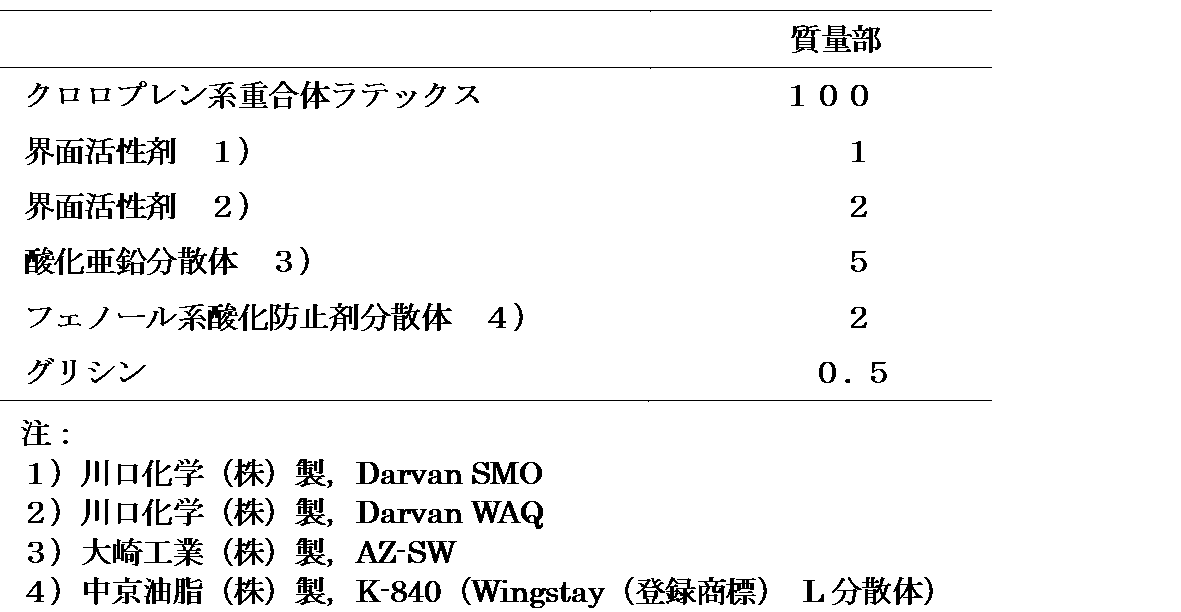
スリーワンモーター付きの撹拌槽に上記配合物を仕込み、30分撹拌した。
重合体フィルムの作製:
下記方法にてクロロプレン系重合体ラテックスなどを配合したゴム用組成物から浸漬フィルムを作製した。
凝固、リーチング、乾燥:
25%硝酸カルシウム水溶液を凝固液として、浸漬フィルムを得た後、70℃温水中で、2分間リーチング(浸出)を行い、水溶性成分を除去した。次いで70℃、30分乾燥した。
架橋:
常法のオーブンにて、130℃で、60分加熱し、架橋を行った。
架橋後のシートを評価項目に応じて適宜、切断し、試験片を得た。この試験片を用いて、以下の物性評価を行った。
引張試験:
常態及び熱老化(100℃、22時間)後の引張試験はJIS-K6301に準じた方法で行った。本試験により、室温における300%・500%伸張時のモデュラス、引張強さ、破断伸び及び表面硬度(JIS-A)を測定した。
変形率:
室温において、架橋フィルムから、幅6mm、長さ100mmの短冊状の試験片を抜き出し、10mm幅の標線間を伸び300%まで、引張り、10分間保持した後、解放し、10分後に、標線間の伸びを測定して、初期標線位置からの変位比率として変形率を計算した。
柔軟性の経時安定性:
促進試験として、架橋後のフィルムの低温(-10℃、50日)及び高温(70℃、7日)での貯蔵後の弾性率(モデュラス)をそれぞれ評価した。
内容積60リットルの反応器を使用して、2-クロロ-1,3-ブタジエン(クロロプレン)18.2kg、2,3-ジクロロ-1,3-ブタジエン1.8kg及び純水18kg、不均化ロジン酸(荒川化学工業(株)製、R-300)860g、n-ドデシルメルカプタン2.0g、水酸化カリウム240g、β-ナフタレンスルホン酸ホルマリン縮合物のナトリウム塩160gを仕込み、乳化させ、不均化ロジン酸をロジン石鹸にした後、過硫酸カリウムを開始剤として用い、窒素雰囲気下、40℃で重合を行った。重合転化率が88.1%に達したところで、直ちにフェノチアジンの乳濁液を添加して重合を停止した。次いでその後、未反応の単量体を水蒸気蒸留にて除去し、クロロプレン重合体のポリマーラテックスを得た。
上記の製造例の方法で得られたクロロプレン系重合体ラテックスを、表1に記載する配合にて配合物とし、浸漬架橋フィルムを作製した。
上記の製造例において、2,3-ジクロロ-1,3-ブタジエン量、n-ドデシルメルカプタン量、重合転化率を変更して、重合を行い、実施例2~5及び比較例1~2で使用するクロロプレン系重合体ラテックスを得た。得られたクロロプレン系重合体ラテックスを、表1に記載する配合にて配合物とし、浸漬架橋フィルムを作製した。
上記の製造例において、2,3-ジクロロ-1,3-ブタジエン量、n-ドデシルメルカプタン量、重合転化率を変更して、重合を行い、比較例3~5で使用する重合体ラテックスを得た。得られたクロロプレン系重合体ラテックスを、下記表2に記載する配合にて配合物とし、浸漬架橋フィルムを作製した。
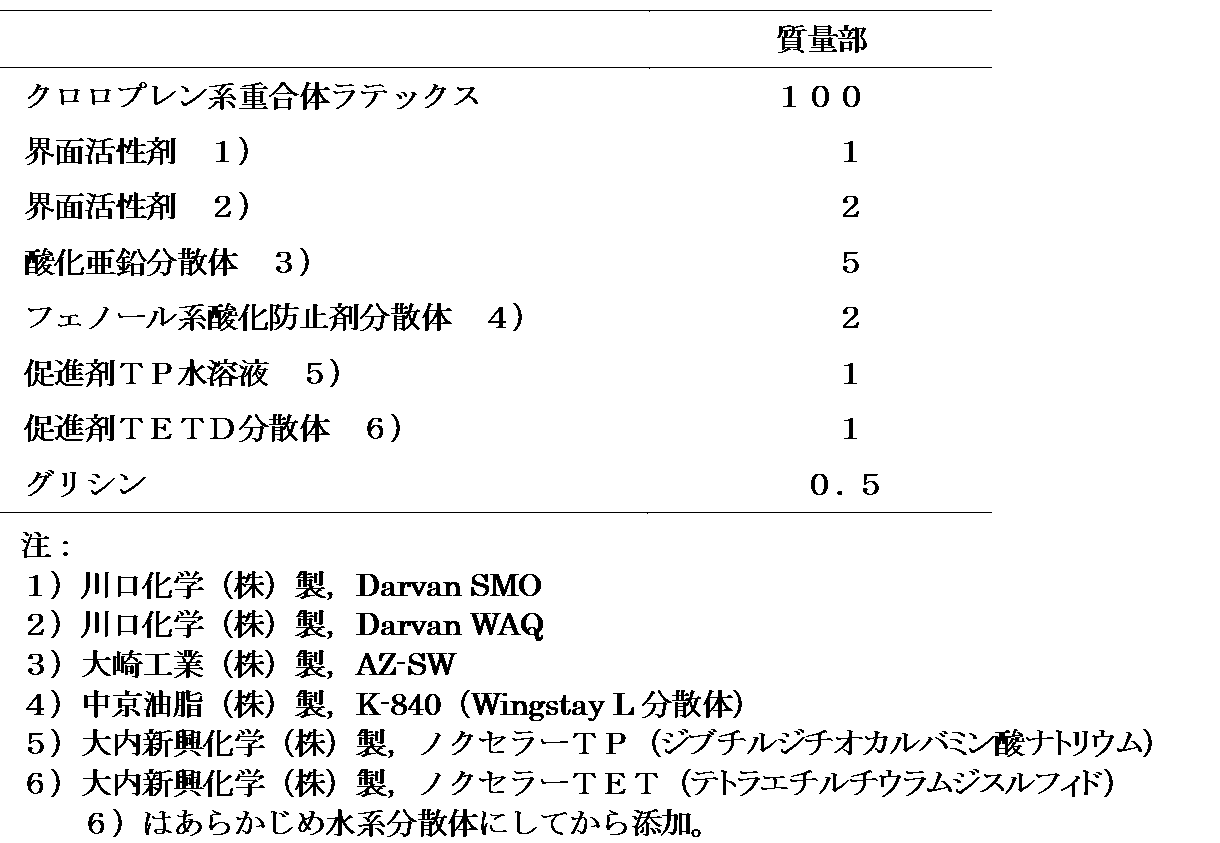

また、表3の結果から、比較例1~2の配合比によって得られた成形物の引張強度は、手術用手袋としては不十分である。
Claims (9)
- クロロプレン系重合体ラテックス(A)、金属酸化物(B)、酸化防止剤(C)、界面活性剤(D)及びpH調整剤(E)を含み、加硫促進剤を含まない組成物であって、前記(A)に含まれる固形分中のテトラハイドロフラン不溶分量が50~85質量%であり、前記(A)の固形分100質量部に対して、(B)を1~10質量部、(C)を0.1~5質量部、(D)を0.1~10質量部、(E)を0.01~5質量部の割合で含むゴム用組成物。
- クロロプレン系重合体ラテックス(A)、金属酸化物(B)、酸化防止剤(C)、界面活性剤(D)及びpH調整剤(E)からなる組成物である請求項1に記載のゴム用組成物。
- 前記クロロプレン系重合体ラテックス(A)に含まれる重合体が、2-クロロ-1,3-ブタジエン(クロロプレン)(A-1)と2,3-ジクロロ-1,3-ブタジエン(A-2)とを含む単量体からなる共重合体であって、単量体の割合が前記2-クロロ-1,3-ブタジエン(クロロプレン)(A-1)と前記2,3-ジクロロ-1,3-ブタジエン(A-2)との合計100質量%に対して、2-クロロ-1,3-ブタジエン(クロロプレン)(A-1)76~93質量%及び2,3-ジクロロ-1,3-ブタジエン(A-2)24~7質量%である請求項1または2に記載のゴム用組成物。
- 前記クロロプレン系重合体ラテックス(A)に含まれる重合体が、2-クロロ-1,3-ブタジエン(クロロプレン)(A-1)及び2,3-ジクロロ-1,3-ブタジエン(A-2)に加えてさらにこれらと共重合可能な単量体(A-3)からなる共重合体であって、前記単量体(A-3)の含有量が、前記2-クロロ-1,3-ブタジエン(クロロプレン)(A-1)と前記2,3-ジクロロ-1,3-ブタジエン(A-2)との合計100質量部に対して0.1~10質量部である請求項3に記載のゴム用組成物。
- 請求項1~4のいずれかに記載のゴム用組成物を用いて得られる成形物。
- 300%弾性率(モデュラス)が0.5~1.2MPa、引張強度が17MPa以上、引張破断伸びが800%以上、変形率が20%以下である請求項5に記載の成形物。
- 請求項1~4のいずれかに記載のゴム用組成物を用いて得られるゴム製浸漬製品。
- 前記ゴム製浸漬製品が手袋である請求項7に記載のゴム製浸漬製品。
- 前記手袋が医療用使い捨て手袋である請求項8に記載のゴム製浸漬製品。
Priority Applications (6)
| Application Number | Priority Date | Filing Date | Title |
|---|---|---|---|
| US15/564,846 US20180112055A1 (en) | 2015-04-16 | 2016-01-18 | Composition for rubber and use thereof |
| JP2017512207A JP6833675B2 (ja) | 2015-04-16 | 2016-01-18 | ゴム用組成物及びその用途 |
| CN201680021630.4A CN107429001B (zh) | 2015-04-16 | 2016-01-18 | 橡胶用组合物及其用途 |
| AU2016248518A AU2016248518B2 (en) | 2015-04-16 | 2016-01-18 | Composition for rubber and use thereof |
| EP16779790.1A EP3284781B1 (en) | 2015-04-16 | 2016-01-18 | Composition for rubber and use thereof |
| KR1020177028078A KR101911303B1 (ko) | 2015-04-16 | 2016-01-18 | 고무용 조성물 및 그 용도 |
Applications Claiming Priority (2)
| Application Number | Priority Date | Filing Date | Title |
|---|---|---|---|
| JP2015-084274 | 2015-04-16 | ||
| JP2015084274 | 2015-04-16 |
Publications (1)
| Publication Number | Publication Date |
|---|---|
| WO2016166998A1 true WO2016166998A1 (ja) | 2016-10-20 |
Family
ID=57126731
Family Applications (1)
| Application Number | Title | Priority Date | Filing Date |
|---|---|---|---|
| PCT/JP2016/051257 Ceased WO2016166998A1 (ja) | 2015-04-16 | 2016-01-18 | ゴム用組成物及びその用途 |
Country Status (8)
| Country | Link |
|---|---|
| US (1) | US20180112055A1 (ja) |
| EP (1) | EP3284781B1 (ja) |
| JP (3) | JP6833675B2 (ja) |
| KR (1) | KR101911303B1 (ja) |
| CN (1) | CN107429001B (ja) |
| AU (1) | AU2016248518B2 (ja) |
| TW (1) | TWI682952B (ja) |
| WO (1) | WO2016166998A1 (ja) |
Cited By (8)
| Publication number | Priority date | Publication date | Assignee | Title |
|---|---|---|---|---|
| WO2019009038A1 (ja) | 2017-07-04 | 2019-01-10 | デンカ株式会社 | メルカプタン変性ポリクロロプレンラテックス及びその製造方法 |
| JPWO2021006118A1 (ja) * | 2019-07-05 | 2021-01-14 | ||
| JP2021091821A (ja) * | 2019-12-12 | 2021-06-17 | 昭和電工株式会社 | 成形物およびスクリーニング方法 |
| WO2021193561A1 (ja) | 2020-03-26 | 2021-09-30 | デンカ株式会社 | クロロプレン系ブロック共重合体ラテックス |
| WO2021193562A1 (ja) | 2020-03-26 | 2021-09-30 | デンカ株式会社 | 浸漬成形体 |
| US20220073657A1 (en) * | 2019-01-10 | 2022-03-10 | Showa Denko K.K. | Isoprene-based polymer latex composition |
| WO2025053245A1 (ja) | 2023-09-08 | 2025-03-13 | 株式会社レゾナック | クロロプレンシード重合体組成物の製造方法、およびゴム製浸漬製品の製造方法 |
| US12492279B2 (en) | 2020-03-26 | 2025-12-09 | Denka Company Limited | Chloroprene-based block copolymer, latex, latex composition, and rubber composition |
Families Citing this family (5)
| Publication number | Priority date | Publication date | Assignee | Title |
|---|---|---|---|---|
| JP6237822B2 (ja) * | 2016-05-19 | 2017-11-29 | 横浜ゴム株式会社 | タイヤ用ゴム組成物 |
| EP3904441B1 (en) * | 2018-12-27 | 2025-01-08 | Resonac Corporation | Chloroprene polymer latex and method for producing same |
| WO2021132460A1 (ja) * | 2019-12-24 | 2021-07-01 | 昭和電工株式会社 | クロロプレン共重合体ラテックス組成物及びその成形物 |
| JP7661894B2 (ja) * | 2020-01-06 | 2025-04-15 | 株式会社レゾナック | クロロプレン重合体を含む組成物、成形体、および、成形体の製造方法 |
| CN113715385A (zh) * | 2021-08-31 | 2021-11-30 | 江苏凯瑞斯安全防护用品有限公司 | 一种医用防辐射手套的生产工艺 |
Citations (7)
| Publication number | Priority date | Publication date | Assignee | Title |
|---|---|---|---|---|
| JP2006219546A (ja) * | 2005-02-09 | 2006-08-24 | Denki Kagaku Kogyo Kk | ポリクロロプレンラテックス及びその製造方法並びに用途 |
| JP2007106994A (ja) * | 2005-09-15 | 2007-04-26 | Showa Denko Kk | クロロプレン系重合体ラテックス及びその製造方法 |
| JP2011122141A (ja) * | 2009-11-10 | 2011-06-23 | Showa Denko Kk | クロロプレン系重合体ラテックス及びその製造方法 |
| WO2012137663A1 (ja) * | 2011-04-06 | 2012-10-11 | 電気化学工業株式会社 | ポリクロロプレンラテックス、ゴム組成物及び浸漬成形品 |
| WO2013015043A1 (ja) * | 2011-07-25 | 2013-01-31 | 電気化学工業株式会社 | ポリクロロプレンラテックス組成物及び浸漬成形品 |
| JP2013508528A (ja) * | 2009-12-01 | 2013-03-07 | コッサン エスディーエヌ ビーエイチディー | 架橋促進剤及び硫黄を用いないエラストマーゴム及びゴム製品 |
| WO2013129676A1 (ja) * | 2012-03-02 | 2013-09-06 | 電気化学工業株式会社 | ポリクロロプレンラテックス、ポリクロロプレンラテックス組成物及び成形品 |
Family Cites Families (5)
| Publication number | Priority date | Publication date | Assignee | Title |
|---|---|---|---|---|
| GB1388547A (en) * | 1971-07-21 | 1975-03-26 | Bp Chem Int Ltd | Copolymers |
| JP4860252B2 (ja) | 2005-12-01 | 2012-01-25 | 日本エイアンドエル株式会社 | ディップ成形用組成物およびディップ成形品 |
| EP2585289B1 (en) * | 2010-06-25 | 2023-06-07 | Allegiance Corporation | Vulcanization composition having reduced allergenic potential |
| EP2960293B1 (en) | 2013-02-22 | 2018-12-05 | Zeon Corporation | Latex for dip molding use, composition for dip molding use, and dip-molded article |
| WO2016160774A1 (en) * | 2015-03-30 | 2016-10-06 | Kraton Polymers U.S. Llc | Diene rubber composition configured to be vulcanized at lower temperature; and manufacturing process of rubber article |
-
2016
- 2016-01-18 CN CN201680021630.4A patent/CN107429001B/zh active Active
- 2016-01-18 WO PCT/JP2016/051257 patent/WO2016166998A1/ja not_active Ceased
- 2016-01-18 AU AU2016248518A patent/AU2016248518B2/en active Active
- 2016-01-18 KR KR1020177028078A patent/KR101911303B1/ko active Active
- 2016-01-18 US US15/564,846 patent/US20180112055A1/en not_active Abandoned
- 2016-01-18 JP JP2017512207A patent/JP6833675B2/ja active Active
- 2016-01-18 EP EP16779790.1A patent/EP3284781B1/en active Active
- 2016-04-15 TW TW105111850A patent/TWI682952B/zh active
-
2020
- 2020-11-06 JP JP2020185836A patent/JP7128876B2/ja active Active
-
2022
- 2022-06-21 JP JP2022099886A patent/JP7363975B2/ja active Active
Patent Citations (7)
| Publication number | Priority date | Publication date | Assignee | Title |
|---|---|---|---|---|
| JP2006219546A (ja) * | 2005-02-09 | 2006-08-24 | Denki Kagaku Kogyo Kk | ポリクロロプレンラテックス及びその製造方法並びに用途 |
| JP2007106994A (ja) * | 2005-09-15 | 2007-04-26 | Showa Denko Kk | クロロプレン系重合体ラテックス及びその製造方法 |
| JP2011122141A (ja) * | 2009-11-10 | 2011-06-23 | Showa Denko Kk | クロロプレン系重合体ラテックス及びその製造方法 |
| JP2013508528A (ja) * | 2009-12-01 | 2013-03-07 | コッサン エスディーエヌ ビーエイチディー | 架橋促進剤及び硫黄を用いないエラストマーゴム及びゴム製品 |
| WO2012137663A1 (ja) * | 2011-04-06 | 2012-10-11 | 電気化学工業株式会社 | ポリクロロプレンラテックス、ゴム組成物及び浸漬成形品 |
| WO2013015043A1 (ja) * | 2011-07-25 | 2013-01-31 | 電気化学工業株式会社 | ポリクロロプレンラテックス組成物及び浸漬成形品 |
| WO2013129676A1 (ja) * | 2012-03-02 | 2013-09-06 | 電気化学工業株式会社 | ポリクロロプレンラテックス、ポリクロロプレンラテックス組成物及び成形品 |
Cited By (15)
| Publication number | Priority date | Publication date | Assignee | Title |
|---|---|---|---|---|
| WO2019009038A1 (ja) | 2017-07-04 | 2019-01-10 | デンカ株式会社 | メルカプタン変性ポリクロロプレンラテックス及びその製造方法 |
| US20220073657A1 (en) * | 2019-01-10 | 2022-03-10 | Showa Denko K.K. | Isoprene-based polymer latex composition |
| US12139563B2 (en) * | 2019-01-10 | 2024-11-12 | Resonac Corporation | Isoprene-based polymer latex composition |
| JP7496354B2 (ja) | 2019-07-05 | 2024-06-06 | デンカ株式会社 | クロロプレン共重合体ラテックス及びその製造方法、加硫物、並びに、浸漬成形体及びその製造方法 |
| DE112020001928T5 (de) | 2019-07-05 | 2022-01-13 | Denka Company Limited | Chloropren-Copolymerlatex, Verfahren zur Herstellung desselben, vulkanisiertes Produkt, tauchgeformter Gegenstand und Verfahren zur Herstellung desselben |
| JPWO2021006118A1 (ja) * | 2019-07-05 | 2021-01-14 | ||
| US12359044B2 (en) | 2019-07-05 | 2025-07-15 | Denka Company Limited | Chloroprene copolymer latex, method for producing same, vulcanized product, dip molded article and method for producing same |
| JP7396011B2 (ja) | 2019-12-12 | 2023-12-12 | 株式会社レゾナック | スクリーニング方法 |
| JP2021091821A (ja) * | 2019-12-12 | 2021-06-17 | 昭和電工株式会社 | 成形物およびスクリーニング方法 |
| WO2021193562A1 (ja) | 2020-03-26 | 2021-09-30 | デンカ株式会社 | 浸漬成形体 |
| JPWO2021193561A1 (ja) * | 2020-03-26 | 2021-09-30 | ||
| WO2021193561A1 (ja) | 2020-03-26 | 2021-09-30 | デンカ株式会社 | クロロプレン系ブロック共重合体ラテックス |
| JP7539460B2 (ja) | 2020-03-26 | 2024-08-23 | デンカ株式会社 | クロロプレン系ブロック共重合体ラテックス |
| US12492279B2 (en) | 2020-03-26 | 2025-12-09 | Denka Company Limited | Chloroprene-based block copolymer, latex, latex composition, and rubber composition |
| WO2025053245A1 (ja) | 2023-09-08 | 2025-03-13 | 株式会社レゾナック | クロロプレンシード重合体組成物の製造方法、およびゴム製浸漬製品の製造方法 |
Also Published As
| Publication number | Publication date |
|---|---|
| JP2022137086A (ja) | 2022-09-21 |
| AU2016248518A1 (en) | 2017-11-09 |
| EP3284781B1 (en) | 2020-10-28 |
| CN107429001A (zh) | 2017-12-01 |
| EP3284781A4 (en) | 2018-12-05 |
| JP7363975B2 (ja) | 2023-10-18 |
| KR101911303B1 (ko) | 2018-10-24 |
| JP7128876B2 (ja) | 2022-08-31 |
| US20180112055A1 (en) | 2018-04-26 |
| EP3284781A1 (en) | 2018-02-21 |
| KR20170123686A (ko) | 2017-11-08 |
| CN107429001B (zh) | 2021-05-28 |
| JP2021008640A (ja) | 2021-01-28 |
| JPWO2016166998A1 (ja) | 2018-02-08 |
| TW201638180A (zh) | 2016-11-01 |
| TWI682952B (zh) | 2020-01-21 |
| AU2016248518B2 (en) | 2018-08-30 |
| JP6833675B2 (ja) | 2021-02-24 |
Similar Documents
| Publication | Publication Date | Title |
|---|---|---|
| JP7363975B2 (ja) | ゴム用組成物及びその用途 | |
| JP2011122141A (ja) | クロロプレン系重合体ラテックス及びその製造方法 | |
| JP2007106994A (ja) | クロロプレン系重合体ラテックス及びその製造方法 | |
| JP5969985B2 (ja) | ポリクロロプレンラテックス、ゴム組成物及び浸漬成形品 | |
| CN113840850B (zh) | 氯丁二烯共聚物胶乳及其制造方法、硫化物、以及浸渍成型体及其制造方法 | |
| CN113924337A (zh) | 氯丁二烯共聚物胶乳组合物及其成型物 | |
| JP2019044116A (ja) | クロロプレン共重合体ラテックス組成物及びその成形物 | |
| EP4050046B1 (en) | Chloroprene copolymer latex and production method therefor | |
| EP3904441B1 (en) | Chloroprene polymer latex and method for producing same | |
| EP4245778A1 (en) | Chloroprene copolymer latex and method for producing same | |
| CN118974159A (zh) | 浸渍成型物、氯丁二烯系聚合物以及浸渍成型物的制造方法 | |
| CN113260666B (zh) | 异戊二烯系聚合物胶乳组合物 | |
| US11427701B2 (en) | Chloroprene copolymer latex composition and molded product thereof | |
| CN121773145A (zh) | 氯丁二烯种子聚合物组合物的制造方法、和橡胶制浸渍产品的制造方法 | |
| EP4378969A1 (en) | Polymer latex composition, immersion molded body, and method for producing polymer latex composition |
Legal Events
| Date | Code | Title | Description |
|---|---|---|---|
| 121 | Ep: the epo has been informed by wipo that ep was designated in this application |
Ref document number: 16779790 Country of ref document: EP Kind code of ref document: A1 |
|
| ENP | Entry into the national phase |
Ref document number: 2017512207 Country of ref document: JP Kind code of ref document: A |
|
| ENP | Entry into the national phase |
Ref document number: 20177028078 Country of ref document: KR Kind code of ref document: A |
|
| REEP | Request for entry into the european phase |
Ref document number: 2016779790 Country of ref document: EP |
|
| WWE | Wipo information: entry into national phase |
Ref document number: 15564846 Country of ref document: US |
|
| NENP | Non-entry into the national phase |
Ref country code: DE |
|
| ENP | Entry into the national phase |
Ref document number: 2016248518 Country of ref document: AU Date of ref document: 20160118 Kind code of ref document: A |