WO2016158534A1 - 切削・研削加工油組成物 - Google Patents
切削・研削加工油組成物 Download PDFInfo
- Publication number
- WO2016158534A1 WO2016158534A1 PCT/JP2016/058865 JP2016058865W WO2016158534A1 WO 2016158534 A1 WO2016158534 A1 WO 2016158534A1 JP 2016058865 W JP2016058865 W JP 2016058865W WO 2016158534 A1 WO2016158534 A1 WO 2016158534A1
- Authority
- WO
- WIPO (PCT)
- Prior art keywords
- grinding
- cutting
- oil
- mass
- oil composition
- Prior art date
- Legal status (The legal status is an assumption and is not a legal conclusion. Google has not performed a legal analysis and makes no representation as to the accuracy of the status listed.)
- Ceased
Links
Images
Classifications
-
- B—PERFORMING OPERATIONS; TRANSPORTING
- B24—GRINDING; POLISHING
- B24B—MACHINES, DEVICES, OR PROCESSES FOR GRINDING OR POLISHING; DRESSING OR CONDITIONING OF ABRADING SURFACES; FEEDING OF GRINDING, POLISHING, OR LAPPING AGENTS
- B24B21/00—Machines or devices using grinding or polishing belts; Accessories therefor
- B24B21/04—Machines or devices using grinding or polishing belts; Accessories therefor for grinding plane surfaces
- B24B21/12—Machines or devices using grinding or polishing belts; Accessories therefor for grinding plane surfaces involving a contact wheel or roller pressing the belt against the work
- B24B21/14—Contact wheels; Contact rollers; Belt supporting rolls
-
- C—CHEMISTRY; METALLURGY
- C10—PETROLEUM, GAS OR COKE INDUSTRIES; TECHNICAL GASES CONTAINING CARBON MONOXIDE; FUELS; LUBRICANTS; PEAT
- C10M—LUBRICATING COMPOSITIONS; USE OF CHEMICAL SUBSTANCES EITHER ALONE OR AS LUBRICATING INGREDIENTS IN A LUBRICATING COMPOSITION
- C10M101/00—Lubricating compositions characterised by the base-material being a mineral or fatty oil
- C10M101/02—Petroleum fractions
-
- C—CHEMISTRY; METALLURGY
- C10—PETROLEUM, GAS OR COKE INDUSTRIES; TECHNICAL GASES CONTAINING CARBON MONOXIDE; FUELS; LUBRICANTS; PEAT
- C10M—LUBRICATING COMPOSITIONS; USE OF CHEMICAL SUBSTANCES EITHER ALONE OR AS LUBRICATING INGREDIENTS IN A LUBRICATING COMPOSITION
- C10M125/00—Lubricating compositions characterised by the additive being an inorganic material
- C10M125/22—Compounds containing sulfur, selenium or tellurium
-
- C—CHEMISTRY; METALLURGY
- C10—PETROLEUM, GAS OR COKE INDUSTRIES; TECHNICAL GASES CONTAINING CARBON MONOXIDE; FUELS; LUBRICANTS; PEAT
- C10M—LUBRICATING COMPOSITIONS; USE OF CHEMICAL SUBSTANCES EITHER ALONE OR AS LUBRICATING INGREDIENTS IN A LUBRICATING COMPOSITION
- C10M135/00—Lubricating compositions characterised by the additive being an organic non-macromolecular compound containing sulfur, selenium or tellurium
- C10M135/02—Sulfurised compounds
- C10M135/06—Esters, e.g. fats
-
- C—CHEMISTRY; METALLURGY
- C10—PETROLEUM, GAS OR COKE INDUSTRIES; TECHNICAL GASES CONTAINING CARBON MONOXIDE; FUELS; LUBRICANTS; PEAT
- C10M—LUBRICATING COMPOSITIONS; USE OF CHEMICAL SUBSTANCES EITHER ALONE OR AS LUBRICATING INGREDIENTS IN A LUBRICATING COMPOSITION
- C10M135/00—Lubricating compositions characterised by the additive being an organic non-macromolecular compound containing sulfur, selenium or tellurium
- C10M135/20—Thiols; Sulfides; Polysulfides
-
- C—CHEMISTRY; METALLURGY
- C10—PETROLEUM, GAS OR COKE INDUSTRIES; TECHNICAL GASES CONTAINING CARBON MONOXIDE; FUELS; LUBRICANTS; PEAT
- C10M—LUBRICATING COMPOSITIONS; USE OF CHEMICAL SUBSTANCES EITHER ALONE OR AS LUBRICATING INGREDIENTS IN A LUBRICATING COMPOSITION
- C10M135/00—Lubricating compositions characterised by the additive being an organic non-macromolecular compound containing sulfur, selenium or tellurium
- C10M135/20—Thiols; Sulfides; Polysulfides
- C10M135/22—Thiols; Sulfides; Polysulfides containing sulfur atoms bound to acyclic or cycloaliphatic carbon atoms
-
- C—CHEMISTRY; METALLURGY
- C10—PETROLEUM, GAS OR COKE INDUSTRIES; TECHNICAL GASES CONTAINING CARBON MONOXIDE; FUELS; LUBRICANTS; PEAT
- C10M—LUBRICATING COMPOSITIONS; USE OF CHEMICAL SUBSTANCES EITHER ALONE OR AS LUBRICATING INGREDIENTS IN A LUBRICATING COMPOSITION
- C10M169/00—Lubricating compositions characterised by containing as components a mixture of at least two types of ingredient selected from base-materials, thickeners or additives, covered by the preceding groups, each of these compounds being essential
- C10M169/04—Mixtures of base-materials and additives
Definitions
- the present invention relates to a cutting / grinding oil composition and a cutting / grinding method using the cutting / grinding oil composition.
- Cutting or grinding oil is required to improve cutting and grinding performance in order to efficiently grind a lot and improve productivity.
- the production of special stainless steel with high corrosion resistance has increased, but since they are hard and difficult to grind, further improvement in cutting or grinding performance is required.
- grinding of stainless steel or the like is generally performed by a grinding belt to which abrasive grains are bonded.
- the grinding amount of the grinding belt decreases, and replacement is performed at that time. Therefore, cutting or grinding oil is also required to make a cutting or grinding tool such as a belt difficult to wear and to prolong the tool life.
- Patent Documents 1 and 2 disclose a grinding oil composition in which ultrafine sodium carbonate or metal borate hydrate is blended in addition to elemental sulfur.
- Patent Document 3 discloses a grinding oil composition in which a surfactant is blended with simple sulfur in order to increase the blending amount of simple sulfur.
- the ultrafine particle sodium carbonate described in Patent Document 1 is usually mixed with sodium sulfonate at a high concentration and is commercially available as an overbased sodium sulfonate.
- cutting or grinding oils are generally blended with an active organic sulfur compound in order to improve cutting or grinding performance.
- the active organic sulfur compound is generally a sulfurized compound prepared by reacting an unsaturated hydrocarbon compound with a mixture of sulfur and hydrogen sulfide, etc. in the presence of a catalyst at a pressure higher than atmospheric pressure. Since the sulfurized compound thus adjusted has oil solubility, it can be blended in a relatively large amount with the base oil.
- the processing oils described in Patent Documents 1 to 3 contain a metal salt such as overbased sodium sulfonate or a surfactant, emulsification or gelation easily occurs when water is mixed, and water separation is ensured. It can be difficult to do.
- the processing oil containing the active organic sulfur compound can improve the cutting or grinding performance and the service life of the processing tool by adding a large amount of the active organic sulfur compound without deteriorating the water separability.
- the problem of odor is likely to occur when blended in a large amount.
- the present invention has been made in view of the above problems, and an object of the present invention is to provide cutting or grinding performance of a tool such as a grinding belt while properly dissolving the blended components in the base oil.
- An object of the present invention is to provide a cutting / grinding oil composition capable of improving the life, low odor, and water separation, and a cutting / grinding method using the cutting / grinding oil composition.
- the present invention provides the following cutting and grinding oil compositions. Based on the total amount of the composition, (A) lubricating base oil 60 to 97% by mass, (B) elemental sulfur 0.1 to 0.7% by mass, (C) sulfurized fat and oil 0.05 to 20% by mass, and (D ) A cutting / grinding oil composition comprising 0.1 to 7% by mass of a polysulfide compound.
- the present invention also provides the following cutting / grinding method and method for producing the cutting / grinding oil composition.
- a cutting / grinding method of cutting or grinding a metal using the above-described cutting / grinding oil composition Based on the total amount of the composition, (A) 60 to 97% by mass of the lubricating base oil, (B) 0.1 to 0.7% by mass of simple sulfur, (C) 0.05 to 20% by mass of sulfurized fat and oil, and ( D) A method for producing a cutting / grinding oil composition, comprising 0.1 to 7% by mass of a polysulfide compound to obtain a cutting / grinding oil composition.
- a cutting / grinding processing oil in which all of the blended components are appropriately dissolved in the base oil, and the cutting or grinding performance, tool life, low odor, and water separation properties are all good.
- a composition and a cutting / grinding method using the cutting / grinding oil composition can be provided.
- the cutting / grinding oil composition according to an embodiment of the present invention is based on the total amount of the composition (A) lubricating base oil 60 to 97% by mass, (B) simple sulfur 0.1 to 0.7% by mass. (C) 0.05 to 20% by mass of sulfurized oil and fat, and (D) 0.1 to 7% by mass of a polysulfide compound.
- a cutting / grinding method according to an embodiment of the present invention is a method for cutting or grinding a metal using the above-described cutting / grinding oil composition.
- the “cutting / grinding oil composition” means a processing oil composition used as a cutting oil or a grinding oil.
- the cutting / grinding oil composition of the present embodiment by using a small amount of simple sulfur and a predetermined amount of sulfurized fat and polysulfide compound, sulfur is precipitated at a low temperature, or the working environment is odor at a high temperature.
- sulfur is precipitated at a low temperature, or the working environment is odor at a high temperature.
- the tool life of a grinding belt or the like can be extended.
- processing oil composition each component used in the cutting / grinding processing oil composition (hereinafter also referred to as “processing oil composition”) will be described in more detail.
- (A) Lubricating base oil In the cutting / grinding oil composition of the present embodiment, (A) the lubricating base oil is not particularly limited, but those usually used for cutting or grinding oil can be appropriately selected and used. Specific examples include mineral oil and synthetic oil. As mineral oil, for example, a distillate obtained by subjecting paraffin-based crude oil, intermediate-based crude oil or naphthenic-based crude oil to atmospheric distillation, or distilling atmospheric residue oil under reduced pressure, or a conventional method Examples thereof include refined oils obtained by refining according to the above, for example, solvent refined oil, hydrogenated refined oil, dewaxed oil, and clay-treated oil.
- mineral oil for example, a distillate obtained by subjecting paraffin-based crude oil, intermediate-based crude oil or naphthenic-based crude oil to atmospheric distillation, or distilling atmospheric residue oil under reduced pressure, or a conventional method
- refined oils obtained by refining according to the above for example, solvent refined oil, hydrogenated refined oil, dewaxed oil, and clay-treated oil.
- Synthetic oils include, for example, polybutene, polypropylene, ⁇ -olefin oligomers having 8 to 14 carbon atoms and their hydrides, as well as polyol esters (trimethylolpropane fatty acid ester, pentaerythritol fatty acid ester, etc.) and dibasic acid esters. , Ester compounds such as aromatic polycarboxylic acid esters and phosphate esters, alkylaromatic compounds such as alkylbenzene and alkylnaphthalene, polyglycol oils such as polyalkylene glycol, and silicone oils. Among these, alkylbenzenes Is preferred.
- base oils may be used, or two or more types may be used in appropriate combination.
- mineral oil is preferably used from the viewpoint of sufficiently dissolving the components (B), (C) and (D), particularly the component (B).
- lubricating base oil those having a kinematic viscosity of 1 to 1000 mm 2 / s at 40 ° C., preferably 2 to 500 mm 2 / s are generally used. In addition, in this specification, kinematic viscosity is measured based on JISK2283: 2000.
- the lubricating base oil is contained in the processing oil composition in an amount of 60 to 97% by mass based on the total amount of the composition.
- the content of the base oil equal to or higher than the above lower limit value, it becomes possible to dissolve the elemental sulfur of the component (B).
- various performances such as grindability and machinability of the processing oil composition can be appropriately exhibited.
- the lubricating base oil is preferably contained in the processing oil composition in an amount of 70 to 96% by mass, more preferably 80 to 95% by mass, based on the total amount of the composition.
- the elemental sulfur of the component (B) may be in any form such as a lump, powder, or molten liquid, but is preferably in the form of powder from the viewpoint of solubility and handling.
- the elemental sulfur is contained in the processing oil composition in an amount of 0.1 to 0.7% by mass based on the total amount of the composition. When the content is 0.1% by mass or more, grinding and cutting amount are sufficient, and grinding performance and cutting performance are improved. Moreover, by setting it as 0.7 mass% or less, it is prevented that single-piece
- the (C) component sulfurized fats and oils refer to sulfides of animal and vegetable oils, such as sulfurized lard, sulfurized rapeseed oil, sulfurized castor oil, and sulfurized soybean oil.
- the sulfurized fats and oils also include disulfide fatty acids such as sulfurized oleic acid and sulfurized esters such as methyl sulfurized oleate.
- disulfide fatty acids such as sulfurized oleic acid and sulfurized esters such as methyl sulfurized oleate.
- those having a sulfur content of 5 to 25% by mass and preferably 8 to 19% by mass are preferably used in order to extend the tool life.
- the sulfurized fats and oils those having a kinematic viscosity at 40 ° C.
- the sulfurized fat / oil (C) is contained in the processing oil composition in an amount of 0.05 to 20% by mass based on the total amount of the composition. By making the content 0.05% by mass or more, it is possible to extend the life of a tool such as a grinding belt.
- the content of sulfurized fat is preferably 0.1 to 18% by mass, more preferably 0.5 to 16% by mass, based on the total amount of the composition.
- R 1 -S x -R 2 are each independently an alkyl group having 3 to 20 carbon atoms, an aryl group having 6 to 20 carbon atoms, an alkylaryl group having 7 to 20 carbon atoms, or an arylalkyl group having 7 to 20 carbon atoms.
- a hydrocarbon group selected from alkenyl groups having 3 to 20 carbon atoms which may be the same as or different from each other, and x represents an integer of 2 to 10.
- the alkyl group and alkenyl group in R 1 and R 2 may be either linear or branched.
- R 1 and R 2 each preferably have 6 to 18 carbon atoms, and x is preferably 2 to 8, more preferably 3 to 7.
- dihydrocarbyl polysulfide examples include dialkyl polysulfide, olefin polysulfide, dibenzyl polysulfide and the like.
- olefin polysulfide examples include those obtained by reacting an olefin having 3 to 20 carbon atoms or a dimer to tetramer thereof with a sulfurizing agent such as sulfur or sulfur halide.
- a sulfurizing agent such as sulfur or sulfur halide.
- the olefin for example, propylene, isobutene, diisobutene and the like are preferable.
- the olefin polysulfide examples include those in which one of R 1 and R 2 is an alkenyl group and the other is an alkenyl group or an alkyl group in the general formula (1).
- dialkyl polysulfide in which both R 1 and R 2 in the general formula (1) are alkyl groups is preferable, and in the general formula (1), R 1 and R 2 are alkyl groups having 6 to 18 carbon atoms. Dialkyl polysulfide is more preferred.
- dialkyl polysulfide examples include dihexyl polysulfide, dioctyl polysulfide, dinonyl polysulfide, didecyl polysulfide, didodecyl polysulfide, diundecyl polysulfide, ditetradecyl polysulfide, dihexadecyl polysulfide, dioctadecyl polysulfide.
- any alkyl group may be linear or branched.
- Polysulfide may be used alone or in combination of two or more.
- polysulfide having a sulfur content of 20 to 50% by mass is usually used, and from the viewpoint of improving grindability, a polysulfide having a content of 25 to 45% by mass is preferably used.
- polysulfide diluted to 5% by mass with mineral oil (ISOVG 100) is “3” or “3” in the copper plate corrosion test (JISK-2513; 100 ° C., 1 hour).
- the active form showing 4 ", that is, active polysulfide is more preferable.
- the polysulfide compound (D) is contained in the processing oil composition in an amount of 0.1 to 7% by mass based on the total amount of the composition.
- the content of the polysulfide compound is preferably 0.5 to 6% by mass, more preferably 1 to 5% by mass, based on the total amount of the composition.
- the total amount of sulfur derived from the components (B), (C), and (D) is not particularly limited based on the total amount of the composition, but is usually 1.0 to 6.0 mass. %, Preferably 1.4 to 5.0% by mass. By making the total amount of sulfur in such a range, it becomes easy to improve all of cutting or grinding performance, tool life, odor, and water separation.
- the cutting / grinding oil composition of the present embodiment is an additive other than the above components (A), (B), (C), and (D) as long as it does not inhibit the effects of the present invention. It may contain.
- the additive include extreme pressure agents other than the above components (B), (C), and (D), oiliness agents, antiwear agents, antioxidants, rust inhibitors, dispersants, antifoaming agents.
- known additives such as a mist inhibitor.
- the total content of these additives is usually in the range of 0.01 to 10% by mass and 0.1 to 5% by mass with respect to the total amount of the processing oil composition.
- extreme pressure agents for example, chlorinated paraffins, chlorinated oils and fats, chlorinated fatty acid esters, chlorinated fatty acid and other chlorinated extreme pressure agents, phosphate esters, (di) thiophosphate esters, phosphate esters Examples thereof include phosphorus extreme pressure agents such as amine salts, (di) thiophosphoric acid ester amine salts, phosphorous acid esters, and (di) thiophosphorous acid esters.
- oily agent examples include maleic acid, alkyl or alkenyl maleic acid, oxalic acid, succinic acid, dibasic acid and esters represented by alkyl or alkenyl succinic acid, tribasic acid and esters thereof, rapeseed oil, soybean white extract
- fatty acids such as oil, fatty acid esters, and fats.
- antiwear agent examples include zinc dithiophosphate (ZnDTP), zinc dithiocarbamate (ZnDTC), molybdenum sulfide oxydithiophosphate (MoDTP), and molybdenum sulfide oxydithiocarbamate (MoDTC).
- ZnDTP zinc dithiophosphate
- ZnDTC zinc dithiocarbamate
- MoDTP molybdenum sulfide oxydithiophosphate
- MoDTC molybdenum sulfide oxydithiocarbamate
- antioxidants examples include amines such as diphenylamine, alkyldiphenylamine, phenyl- ⁇ -naphthylamine, alkylphenyl- ⁇ -naphthylamine, 4,4′-methylene-bis-2,6-di-t-butylphenol, 2, Phenol-based or sulfur-based compounds such as 6-di-t-butyl-p-cresol (DBPC) are used.
- amines such as diphenylamine, alkyldiphenylamine, phenyl- ⁇ -naphthylamine, alkylphenyl- ⁇ -naphthylamine, 4,4′-methylene-bis-2,6-di-t-butylphenol, 2, Phenol-based or sulfur-based compounds such as 6-di-t-butyl-p-cresol (DBPC) are used.
- DBPC 6-di-t-butyl-p-cresol
- rust preventives examples include sorbitan esters.
- dispersant for example, an ashless or metallic dispersant such as an alkyl or alkenyl succinimide, an alkyl or alkenyl succinate, or an acid amide is used.
- antifoaming agent examples include dimethylpolysiloxane and fluoroether.
- mist inhibitor hydrocarbon polymer compounds such as polyisobutylene and ethylene-propylene copolymer can be used, and polyisobutylene is preferably used.
- the number average molecular weight of the polymer compound is preferably 100,000 to 3,000,000, more preferably 200,000 to 2,000,000.
- the kinematic viscosity of the cutting / grinding oil composition of the present embodiment is not particularly limited, but is preferably in the range of 5 to 2000 mm 2 / s at 40 ° C. When the kinematic viscosity is in the above range, workability is good, and safety is ensured from the viewpoint of flammability and the like, which is preferable. From this point, the kinematic viscosity is more preferably 10 to 1000 mm 2 / s.
- the cutting / grinding oil composition of the present embodiment can be obtained by blending the component (B), the component (C), and the component (D) in the (A) lubricating oil base oil. There is no restriction
- the cutting / grinding oil composition of the present embodiment is used for metal cutting or grinding, and is preferably used for metal grinding.
- the metal used as a workpiece material is not specifically limited, Preferably, stainless steel, alloy steel, carbon steel, an aluminum alloy etc. are mentioned, However, A more preferable effect can be acquired about stainless steel.
- the cutting / grinding method of the present embodiment is a method of cutting or grinding a metal using the above-described cutting / grinding oil composition, but is preferably performed by grinding.
- the grinding process is performed by, for example, a grinding belt.
- a grinding belt is an abrasive tool consisting of an endless belt in which an abrasive (abrasive grain) is bonded to the surface of a substrate made of cloth, paper, plastic, rubber, etc., and is usually used in grinding. It is possible to select and use one appropriately.
- the metal to be processed by this method is as described above.
- the cutting / grinding oil composition of the present embodiment can be suitably used for so-called rough grinding because it has good grindability and can increase the amount of grinding.
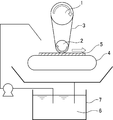
- Grinding using a grinding belt is performed, for example, by pressing the surface of a grinding belt that rotates between two or more rollers onto a workpiece material conveyed by a conveyance belt or the like.
- the cutting / grinding oil composition is supplied to a portion (grinding portion) to which the belt of the work material is pressed.
- the cutting / grinding oil composition is supplied to the grinding unit from an oil tank provided below the conveyor belt, and the oil falling from the grinding unit is returned to the tank and circulated. Is done.
- the method for producing a cutting / grinding oil composition comprises (A) a lubricant base oil in an amount of 60 to 97% by mass and (B) a simple sulfur in an amount of 0.1 to 0, based on the total amount of the composition.
- a cutting / grinding oil composition is obtained by blending 0.7 mass%, (C) 0.05 to 20 mass% of sulfurized oil and fat, and (D) 0.1 to 7 mass% of a polysulfide compound.
- additives other than these components (B) to (D) may also be added to the (A) lubricating base oil.
- the blending amounts of the components (A) to (D) and other additives, and other details are the same as the contents of the respective components described above and other details, and the obtained cutting / grinding processing oil composition
- the properties and the like are as described above.
- the 1-20 pass average grinding amount is a test for evaluating the initial grinding performance of the processing oil composition. Further, the 181-200 pass average grinding amount is an index indicating how much the grindability of the belt is maintained when the belt is used, and is an index for evaluating the belt life.
- the blending materials in Tables 1 and 2 are as follows. ⁇ Combination material> (1) Lubricating base oil / mineral oil: Paraffinic base oil (40 ° C. kinematic viscosity: 8.5 mm 2 / s, 100 ° C. kinematic viscosity: 2.3 mm 2 / s) (2) Elemental sulfur (powder sulfur, sulfur content: 100% by mass) (3) Sulfurized oil and fat / sulfurized oil and fat 1: 40 ° C. Kinematic viscosity: 900 mm 2 / s, sulfur content: 11% by mass -Sulfurized oil and fat 2: 40 ° C.
- kinematic viscosity 500 mm 2 / s, sulfur content: 15% by mass (4)
- Polysulfide compound / polysulfide 1 dioctyl polysulfide (40 ° C. kinematic viscosity: 45 mm 2 / s, sulfur content: 40% by mass, copper plate corrosion test (conforms to JIS K2513): 4B)
- Polysulfide 2 didodecyl polysulfide (40 ° C.
- kinematic viscosity 60 mm 2 / s, sulfur content: 30% by mass, copper plate corrosion test (conforming to JIS K2513): 4B)
- Anti-mist agent polyisobutylene (Mw: 4,400,000, Mn: 320,000)
- Antioxidant 4,4'-methylene-bis-2,6-di-t-butylphenol (DBPC)
- a cutting / grinding oil composition that has good cutting or grinding performance, tool life, low odor, water separation, and solubility.
- the processing oil composition can be suitably used for cutting or grinding, particularly for grinding using a grinding belt.
Landscapes
- Chemical & Material Sciences (AREA)
- Oil, Petroleum & Natural Gas (AREA)
- Chemical Kinetics & Catalysis (AREA)
- General Chemical & Material Sciences (AREA)
- Organic Chemistry (AREA)
- Engineering & Computer Science (AREA)
- Inorganic Chemistry (AREA)
- Mechanical Engineering (AREA)
- Lubricants (AREA)
Abstract
Description
そのため、従来、単体硫黄は、加工性能を向上させるために、他の添加剤とともに使用することが知られている。例えば、特許文献1、2には、単体硫黄に加えて、超微粒子炭酸ナトリウムや、金属硼酸塩水和物が配合された研削油組成物が開示されている。また、例えば、特許文献3には、単体硫黄の配合量を多くできるようにするために、単体硫黄とともに界面活性剤が配合された研削油組成物も開示されている。なお、特許文献1に記載される超微粒子炭酸ナトリウムは、通常、ナトリウムスルホネートなどに高濃度に混合され、過塩基性ナトリウムスルホネートとして市販されている。
すなわち、切削又は研削加工油には、切削又は研削性能及び工具寿命以外にも、低臭気性や水分離性が求められている。
一方で、活性有機硫黄化合物を配合した加工油は、活性有機硫黄化合物を多量に配合することで、水分離性を悪化させることなく、切削又は研削性能や加工具の使用寿命を良好にすることが可能であるが、多量に配合することで臭気の問題が発生しやすくなる。
組成物全量基準で、(A)潤滑油基油60~97質量%、(B)単体硫黄0.1~0.7質量%、(C)硫化油脂0.05~20質量%、及び(D)ポリサルファイド化合物0.1~7質量%を含む切削・研削加工油組成物。
さらに、本発明は、以下の切削・研削加工方法及び切削・研削加工油組成物の製造方法も提供する。
上記の切削・研削加工油組成物を用いて、金属を切削又は研削加工する切削・研削加工方法。
組成物全量基準で、(A)潤滑油基油60~97質量%に、(B)単体硫黄0.1~0.7質量%、(C)硫化油脂0.05~20質量%、及び(D)ポリサルファイド化合物0.1~7質量%を配合して切削・研削加工油組成物を得る、切削・研削加工油組成物の製造方法。
[切削・研削加工油組成物]
また、本発明の一実施形態に係る切削・研削加工方法は、上記切削・研削加工油組成物を用いて、金属を切削又は研削加工する方法である。
なお、本明細書において、「切削・研削加工油組成物」とは、切削加工油又は研削加工油として使用される加工油組成物を意味する。
本実施形態の切削・研削加工油組成物によれば、少量の単体硫黄と、所定量の硫化油脂及びポリサルファイド化合物とを併用することにより、低温において硫黄が析出したり、高温において臭気で作業環境を悪化させたりすることなく、水分離性、切削及び研削性能を向上させるとともに、研削ベルト等の工具寿命を長くすることができる。
以下、切削・研削加工油組成物(以下、「加工油組成物」ともいう。)に使用される各成分についてさらに詳細に説明する。
本実施形態の切削・研削加工油組成物において、(A)潤滑油基油としては、特に制限はないが、通常、切削又は研削加工油に使用されるものを適宜選択して使用することができ、具体的には、鉱油、合成油が挙げられる。
鉱油としては、例えば、パラフィン基系原油、中間基系原油あるいはナフテン基系原油を常圧蒸留するか、あるいは常圧蒸留の残渣油を減圧蒸留して得られる留出油、またはこれを常法にしたがって精製することによって得られる精製油、例えば、溶剤精製油、水添精製油、脱ロウ処理油、白土処理油等を挙げることができる。
これらの基油は、一種を用いてもよく、二種以上を適宜組み合せて用いてもよい。また、上記基油のうち、(B)、(C)及び(D)成分、特に、(B)成分を十分に溶解できる観点から、鉱油が好ましく用いられる。
潤滑油基油としては、一般に40℃における動粘度が1~1000mm2/s、好ましくは、2~500mm2/sのものが用いられる。
なお、本明細書において動粘度とは、JIS K 2283:2000に準拠して測定したものである。
上記観点から、潤滑油基油は、加工油組成物に組成物全量基準で、好ましくは70~96質量%、より好ましくは80~95質量%含有される。
(B)成分の単体硫黄としては、塊状、粉末状、溶融液体状等いずれの形態でもよいが、溶解性や取り扱いなどの点から、粉末状のものが好ましく用いられる。単体硫黄は、加工油組成物に、組成物全量基準で0.1~0.7質量%の量で含有される。含有量を0.1質量%以上とすることで研削、切削量が十分となり、研削性能や切削性能が良好となる。また、0.7質量%以下とすることで、単体硫黄が析出することが防止される。以上の観点から、上記単体硫黄の含有量は、好ましくは0.2~0.6質量%、より好ましくは0.3~0.5質量%である。
本実施形態では、単体硫黄の含有量が、このように基油に安定して溶解する程度に少量であっても、後述するように(C)及び(D)成分を臭気が殆ど発生しない程度配合することで、(B)成分の溶解性及び低臭気性を確保しつつ、切削及び研削性能、工具寿命、及び水分離性のいずれも良好にすることが可能である。
(C)成分の硫化油脂とは、動植物油の硫化物を指し、例えば硫化ラード、硫化なたね油、硫化ひまし油、硫化大豆油などがある。また、この硫化油脂は、硫化オレイン酸などの二硫化脂肪酸、硫化オレイン酸メチルなどの硫化エステルも包含する。硫化油脂としては、通常、硫黄含有量が5~25質量%、工具寿命をより長くするために、好ましくは8~19質量%のものが使用される。
また、特に限定されないが、硫化油脂としては、一般的に40℃における動粘度が200~1500mm2/sのものが使用され、好ましくは40℃における動粘度が300~1100mm2/sのものが使用される。動粘度を上記下限値以上とすることで、低臭気性を確保しやすくなり、上記上限値以下とすることで潤滑油基油に対する溶解性を良好にしやすくなる。
(C)成分の硫化油脂は、加工油組成物に組成物全量基準で0.05~20質量%含有される。上記含有量を0.05質量%以上とすることで、研削ベルト等の工具の寿命を長くすることが可能である。また、20質量%以下とすることで硫化油脂に起因する臭気を発生させにくくし、作業環境の悪化を防止する。これら観点から、硫化油脂の含有量は、組成物全量基準で、好ましくは0.1~18質量%、より好ましくは0.5~16質量%である。
(D)成分のポリサルファイド化合物としては、通常、ジハイドロカルビルポリサルファイドが用いられる。ジハイドロカルビルポリサルファイドとしては、下記一般式(1)で表される化合物が用いられる。
R1-Sx-R2 ・・・(1)
式中、R1及びR2は、それぞれ独立に炭素数3~20のアルキル基、炭素数6~20のアリール基、炭素数7~20のアルキルアリール基、炭素数7~20のアリールアルキル基、又は炭素数3~20のアルケニル基から選択される炭化水素基であって、それらは互いに同一でも異なっていてもよく、xは2~10の整数を示す。また、R1、R2におけるアルキル基及びアルケニル基は、直鎖状又は分岐状のいずれでもよい。
一般式(1)において、R1及びR2はそれぞれ好ましくは炭素数6~18であり、xは好ましくは2~8、より好ましくは3~7である。
ジアルキルポリサルファイドの具体例としては、ジヘキシルポリサルファイド、ジオクチルポリサルファイド、ジノニルポリサルファイド、ジデシルポリサルファイド、ジドデシルポリサルファイド、ジウンデシルポリサルファイド、ジテトラデシルポリサルファイド、ジヘキサデシルポリサルファイド、ジオクタデシルポリサルファイドが挙げられる。なお、これら化合物は、いずれのアルキル基も直鎖状のものであってもよいし、分岐状のものであってもよい。
なお、ポリサルファイドは単独で使用してもよいし、2種類以上を併用してもよい。
さらに、研削性をより良好にする観点から、ポリサルファイドは、鉱油(ISOVG 100)で5質量%に希釈したものが、銅板腐食試験(JISK―2513;100℃、1時間)で「3」又は「4」を示す活性型のもの、すなわち、活性ポリサルファイドがより好適である。
本実施形態の切削・研削加工油組成物は、必要に応じて、本発明の効果を阻害しない範囲で、上記(A)、(B)、(C)、及び(D)成分以外の添加剤を含有してもよい。その添加剤としては、例えば、上記(B)、(C)、(D)成分以外の他の極圧剤、油性剤、耐摩耗剤、酸化防止剤、防錆剤、分散剤、消泡剤、ミスト防止剤等の公知の添加剤を挙げることができる。これらの添加剤の全含有量は、加工油組成物全量に対して、通常0.01~10質量%、0.1~5質量%の範囲にあることが好ましい。
油性剤としては、例えばマレイン酸、アルキル若しくはアルケニルマレイン酸、シュウ酸、コハク酸、アルキル若しくはアルケニルコハク酸で代表される二塩基酸及びそのエステル、三塩基酸及びそのエステル、ナタネ油、大豆白絞油などの脂肪酸、脂肪酸エステル、油脂などが挙げられる。
酸化防止剤としては、例えばジフェニルアミン、アルキルジフェニルアミン、フェニル-α-ナフチルアミン、アルキルフェニル-α-ナフチルアミンなどのアミン系、4,4’-メチレン-ビス-2,6-ジ-t-ブチルフェノール、2,6-ジ-t-ブチル-p-クレゾール(DBPC)などのフェノール系、又は硫黄系が用いられる。
ミスト防止剤としては、ポリイソブチレン、エチレン-プロピレンコポリマー等の炭化水素系高分子化合物を用いることができ、ポリイソブチレンを用いることが好ましい。上記高分子化合物の数平均分子量は100,000~3,000,000が好ましく、200,000~2,000,000がより好ましい。
本実施形態の切削・研削加工油組成物は、(B)成分、(C)成分、及び(D)成分を(A)潤滑油基油に配合して得ることができるが、配合する順序や温度等の配合条件については、特に制限はなく、適宜選択して配合することができる。
本実施形態の切削・研削加工方法は、上述の切削・研削加工油組成物を用いて、金属を切削又は研削加工する方法であるが、研削加工により行うことが好ましい。研削加工は、例えば、研削ベルトにより行うものである。なお、研削ベルトとは、布、紙、プラスチック、ゴム等で形成された基体表面に、研磨材(砥粒)が接着されたエンドレス状のベルトからなる研磨工具であり、研削加工において通常使用されるものを適宜選択して使用可能である。本方法で被加工材料となる金属は、上記したとおりである。
なお、本実施形態の切削・研削加工油組成物は、研削性が良好で研削量を多くすることが可能であることから、いわゆる粗研削に好適に使用可能である。
研削ベルトを用いた研削加工は、例えば搬送ベルト等で搬送される被加工材料に、2以上のローラ間で回転走行する研削ベルト表面を押し付けて行う。この際、被加工材料のベルトが押し付けられる部分(研削部)には、切削・研削加工油組成物が供給される。切削・研削加工油組成物は、例えば、搬送ベルトの下方に設けられた油タンクから研削部に供給されるとともに、研削部から落下したものがタンクに戻されることで循環しながら研削部に供給される。
本発明の一実施形態に係る切削・研削加工油組成物の製造方法は、組成物全量基準で、(A)潤滑油基油60~97質量%に、(B)単体硫黄0.1~0.7質量%、(C)硫化油脂0.05~20質量%、及び(D)ポリサルファイド化合物0.1~7質量%を配合して切削・研削加工油組成物を得るものである。
本製造方法では、これら(B)~(D)成分以外の添加剤も(A)潤滑油基油に配合してもよい。なお、成分(A)~(D)、及びその他添加剤の配合量、及びその他詳細は、上記した各成分の含有量、及びその他詳細と同様であり、得られる切削・研削加工油組成物の性状等も上記した通りである。
(1)研削性能、ベルト寿命評価
図1に概略図で示す研削試験用装置を用いて研削性、ベルト寿命評価を行った。すなわち、図1において、アイドルロール1とコンタクトロール2との間で回転走行する研削ベルト3に、搬送ベルト4上に載置された被削材5を押し付け、一方で、研削部に研削加工油(加工油組成物)6を油タンク7から循環供給しながら研削を行う。1試験につき5枚の被削材板を使用し、間隔を空けずに連続して通板する。評価項目及び試験条件は、以下の通りである。
(評価項目)
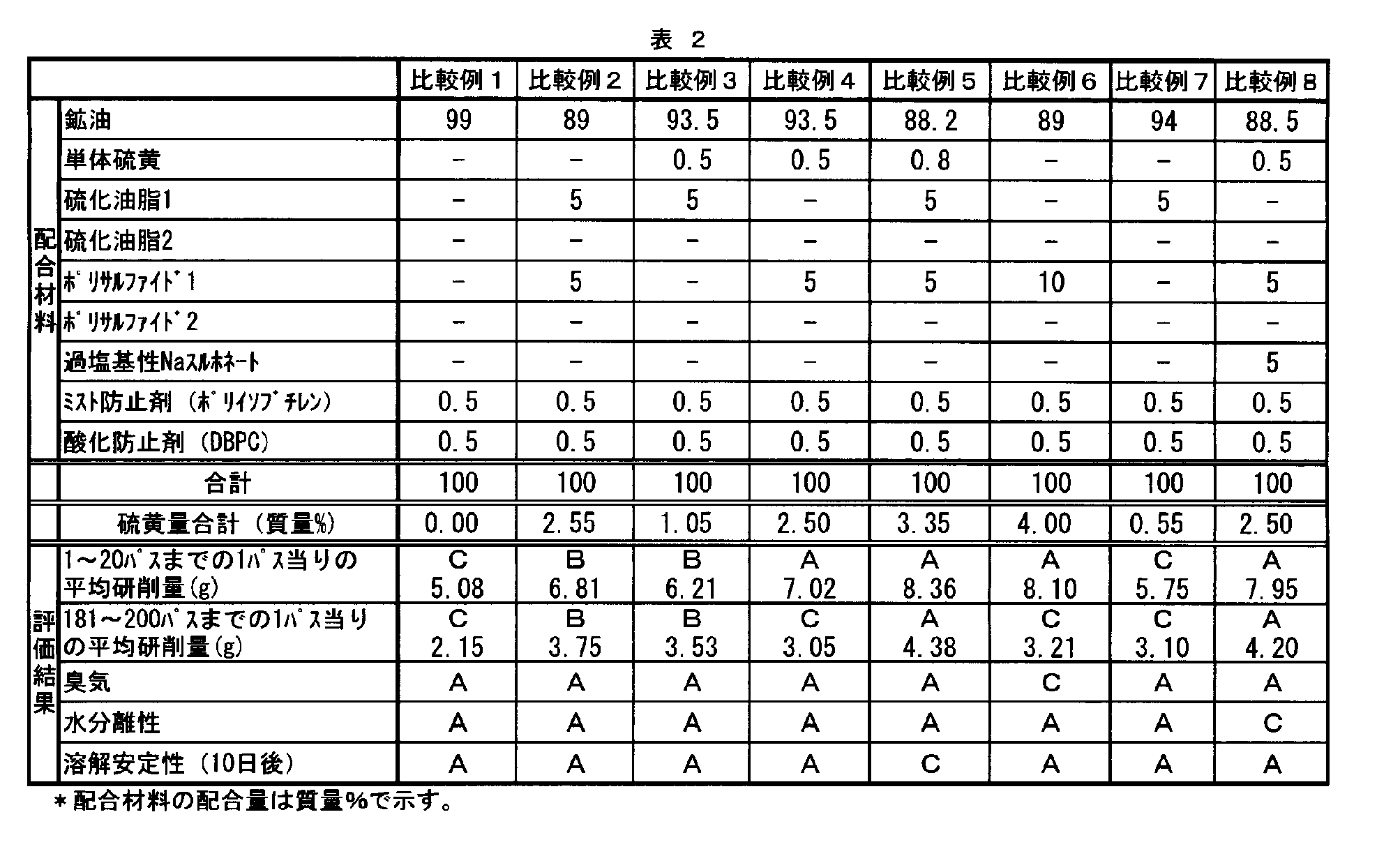
前記試験を、合計200パス行い、20パス毎の板重量変化を測定し、初期の20パスの平均研削量、及び181パスから200パスまでの平均研削量を以下の通り評価した。なお、1-20パス平均研削量は、加工油組成物の初期の研削性能を評価するための試験である。また、181-200パス平均研削量は、ベルトを使い込んだ際に、ベルトの研削性がどの程度維持されているかを示す指標であり、ベルト寿命を評価する指標となる。
・1-20パス平均研削量
A:7.00以上、B:6.99以下6.00以上、C:5.99以下
・181-200パス平均研削量
A:4.00以上、B:3.99以下3.50以上、C:3.49以下
・研削ベルト:アルミナ80番
・被研削材:SUS304、幅90mm×長さ1,000mm×厚さ約3mm、1試験毎に5枚通板
・速度:ベルト速度;1400m/min、 板送り速度;10m/min
・研磨方法:ダウンカット
・油温:40℃
・負荷:1.5hp/inch (ベルト押付け力を一定で評価)
各加工油組成物を100℃のホットスターラ―に垂らし、その臭気を以下の評価基準で評価した。
A:僅かな臭気、C:強い臭気
(3)水分離性
50mlシリンダーに各加工油組成物20gと水20gを量りとり、30秒間激しく振とうし、3時間後の状態を観察し、以下の評価基準で評価した。
A:乳化相無し、C:乳化相あり
各加工油組成物を100ml瓶に入れ,-5℃の低温槽で240時間静置し、その状態を観察し、以下の評価基準で評価した。
A:析出物なし、C:析出物あり
表1及び表2の各々に示す配合材料及び割合で加工油組成物を調製し、上述の通り、各種性能(研削性能、ベルト寿命、臭気、水分離性、溶解安定性)評価を行なった。結果を表1及び表2に示す。

<配合材料>
(1)潤滑油基油
・鉱油:パラフィン系基油(40℃動粘度:8.5mm2/s、100℃動粘度:2.3mm2/s)
(2)単体硫黄(粉末硫黄、硫黄含有量:100質量%)
(3)硫化油脂
・硫化油脂1:40℃動粘度:900mm2/s、硫黄分:11質量%
・硫化油脂2:40℃動粘度:500mm2/s、硫黄分:15質量%
(4)ポリサルファイド化合物
・ポリサルファイド1:ジオクチルポリサルファイド(40℃動粘度:45mm2/s、硫黄分:40質量% 、銅板腐食試験(JIS K2513に準拠):4B)
・ポリサルファイド2:ジドデシルポリサルファイド(40℃動粘度:60mm2/s、硫黄分:30質量%、銅板腐食試験(JIS K2513に準拠):4B)
(5)ミスト防止剤:ポリイソブチレン(Mw:4,400,000、Mn:320,000)
(6)酸化防止剤:4,4’-メチレン-ビス-2,6-ジ-t-ブチルフェノール (DBPC)
2:コンタクトロール
3:研削ベルト
4:搬送ベルト
5:被削材
6:研削加工油
7:油タンク
Claims (9)
- 組成物全量基準で、(A)潤滑油基油60~97質量%、(B)単体硫黄0.1~0.7質量%、(C)硫化油脂0.05~20質量%、及び(D)ポリサルファイド化合物0.1~7質量%を含む切削・研削加工油組成物。
- (D)ポリサルファイド化合物が、ジハイドロカルビルポリサルファイドである請求項1に記載の切削・研削加工油組成物。
- (C)硫化油脂の40℃における動粘度が、200~1500mm2/sである請求項1又は2に記載の切削・研削加工油組成物。
- 組成物全量基準で、(A)潤滑油基油80~95質量%、(B)単体硫黄0.3~0.5質量%、(C)硫化油脂0.5~16質量%、及び(D)ポリサルファイド化合物1~5質量%を含む請求項1~3のいずれか1項に記載の切削・研削加工油組成物。
- ステンレス鋼の加工に用いる、請求項1~4のいずれか1項に記載の切削・研削加工油組成物。
- 金属の研削加工に用いる研削加工油である請求項1~5のいずれか1項に記載の切削・研削加工油組成物。
- 請求項1~6のいずれか1項に記載の切削・研削加工油組成物を用いて、金属を切削又は研削加工する切削・研削加工方法。
- 研削ベルトにより金属を研削加工する請求項7に記載の切削・研削加工方法。
- 組成物全量基準で、(A)潤滑油基油60~97質量%に、(B)単体硫黄0.1~0.7質量%、(C)硫化油脂0.05~20質量%、及び(D)ポリサルファイド化合物0.1~7質量%を配合して切削・研削加工油組成物を得る、切削・研削加工油組成物の製造方法。
Priority Applications (3)
| Application Number | Priority Date | Filing Date | Title |
|---|---|---|---|
| CN201680018882.1A CN107406797A (zh) | 2015-03-30 | 2016-03-18 | 切削·研削加工油组合物 |
| JP2017509808A JPWO2016158534A1 (ja) | 2015-03-30 | 2016-03-18 | 切削・研削加工油組成物 |
| KR1020177026240A KR20170132744A (ko) | 2015-03-30 | 2016-03-18 | 절삭·연삭 가공유 조성물 |
Applications Claiming Priority (2)
| Application Number | Priority Date | Filing Date | Title |
|---|---|---|---|
| JP2015070134 | 2015-03-30 | ||
| JP2015-070134 | 2015-03-30 |
Publications (1)
| Publication Number | Publication Date |
|---|---|
| WO2016158534A1 true WO2016158534A1 (ja) | 2016-10-06 |
Family
ID=57006172
Family Applications (1)
| Application Number | Title | Priority Date | Filing Date |
|---|---|---|---|
| PCT/JP2016/058865 Ceased WO2016158534A1 (ja) | 2015-03-30 | 2016-03-18 | 切削・研削加工油組成物 |
Country Status (5)
| Country | Link |
|---|---|
| JP (1) | JPWO2016158534A1 (ja) |
| KR (1) | KR20170132744A (ja) |
| CN (1) | CN107406797A (ja) |
| TW (1) | TWI687513B (ja) |
| WO (1) | WO2016158534A1 (ja) |
Cited By (3)
| Publication number | Priority date | Publication date | Assignee | Title |
|---|---|---|---|---|
| WO2020158205A1 (ja) * | 2019-01-29 | 2020-08-06 | Dic株式会社 | 硫黄系極圧剤および金属加工油 |
| KR20210143184A (ko) | 2019-03-26 | 2021-11-26 | 이데미쓰 고산 가부시키가이샤 | 수용성 금속 가공유 조성물, 수용성 금속 가공유 조성물의 제조 방법, 금속 가공액 및 금속 가공 방법 |
| JP2022143236A (ja) * | 2021-03-17 | 2022-10-03 | シチズン時計株式会社 | 工業油組成物 |
Citations (10)
| Publication number | Priority date | Publication date | Assignee | Title |
|---|---|---|---|---|
| JPH01121389A (ja) * | 1987-11-04 | 1989-05-15 | Nippon Stainless Steel Co Ltd | 耐銹性に優れたステンレス鋼研磨仕様材の製造方法 |
| JPH07233388A (ja) * | 1994-02-24 | 1995-09-05 | Yushiro Chem Ind Co Ltd | 切削加工用油剤組成物 |
| WO1995032267A1 (en) * | 1994-05-24 | 1995-11-30 | Idemitsu Kosan Co., Ltd. | Cutting or grinding fluid composition |
| JP2000160181A (ja) * | 1998-12-01 | 2000-06-13 | Kyodo Yushi Co Ltd | ステンレス鋼用熱間圧延油及び熱間圧延方法 |
| JP2002146378A (ja) * | 2000-11-07 | 2002-05-22 | Yushiro Chem Ind Co Ltd | 歯切り加工用切削油剤組成物 |
| US20040242440A1 (en) * | 2001-08-17 | 2004-12-02 | Ryoichi Okuda | Metal working fluid composition for use as spray in mist form |
| WO2008038601A1 (en) * | 2006-09-27 | 2008-04-03 | Yushiro Chemical Industry Co., Ltd. | Water-soluble metal-processing agent, coolant, method for preparation of the coolant, method for prevention of microbial deterioration of water-soluble metal-processing agent, and metal processing |
| JP2009197183A (ja) * | 2008-02-25 | 2009-09-03 | Idemitsu Kosan Co Ltd | 金属加工油組成物 |
| JP2009275137A (ja) * | 2008-05-15 | 2009-11-26 | Jfe Steel Corp | 熱間圧延油組成物、および、フェライト系ステンレス鋼の熱間圧延方法 |
| JP2012197329A (ja) * | 2011-03-18 | 2012-10-18 | Jx Nippon Oil & Energy Corp | 金属加工用潤滑油組成物 |
Family Cites Families (4)
| Publication number | Priority date | Publication date | Assignee | Title |
|---|---|---|---|---|
| JP3109541B2 (ja) * | 1991-08-30 | 2000-11-20 | スターカット工業株式会社 | 金属加工用潤滑油剤 |
| JP3949206B2 (ja) * | 1997-01-21 | 2007-07-25 | 出光興産株式会社 | 金属加工用潤滑油組成物 |
| JP4687845B2 (ja) * | 2001-03-22 | 2011-05-25 | Jx日鉱日石エネルギー株式会社 | 塑性加工用潤滑油組成物 |
| JP5544068B2 (ja) * | 2008-03-06 | 2014-07-09 | 出光興産株式会社 | ファインブランキング加工用潤滑油組成物 |
-
2016
- 2016-03-18 CN CN201680018882.1A patent/CN107406797A/zh active Pending
- 2016-03-18 KR KR1020177026240A patent/KR20170132744A/ko not_active Withdrawn
- 2016-03-18 JP JP2017509808A patent/JPWO2016158534A1/ja active Pending
- 2016-03-18 WO PCT/JP2016/058865 patent/WO2016158534A1/ja not_active Ceased
- 2016-03-24 TW TW105109195A patent/TWI687513B/zh not_active IP Right Cessation
Patent Citations (10)
| Publication number | Priority date | Publication date | Assignee | Title |
|---|---|---|---|---|
| JPH01121389A (ja) * | 1987-11-04 | 1989-05-15 | Nippon Stainless Steel Co Ltd | 耐銹性に優れたステンレス鋼研磨仕様材の製造方法 |
| JPH07233388A (ja) * | 1994-02-24 | 1995-09-05 | Yushiro Chem Ind Co Ltd | 切削加工用油剤組成物 |
| WO1995032267A1 (en) * | 1994-05-24 | 1995-11-30 | Idemitsu Kosan Co., Ltd. | Cutting or grinding fluid composition |
| JP2000160181A (ja) * | 1998-12-01 | 2000-06-13 | Kyodo Yushi Co Ltd | ステンレス鋼用熱間圧延油及び熱間圧延方法 |
| JP2002146378A (ja) * | 2000-11-07 | 2002-05-22 | Yushiro Chem Ind Co Ltd | 歯切り加工用切削油剤組成物 |
| US20040242440A1 (en) * | 2001-08-17 | 2004-12-02 | Ryoichi Okuda | Metal working fluid composition for use as spray in mist form |
| WO2008038601A1 (en) * | 2006-09-27 | 2008-04-03 | Yushiro Chemical Industry Co., Ltd. | Water-soluble metal-processing agent, coolant, method for preparation of the coolant, method for prevention of microbial deterioration of water-soluble metal-processing agent, and metal processing |
| JP2009197183A (ja) * | 2008-02-25 | 2009-09-03 | Idemitsu Kosan Co Ltd | 金属加工油組成物 |
| JP2009275137A (ja) * | 2008-05-15 | 2009-11-26 | Jfe Steel Corp | 熱間圧延油組成物、および、フェライト系ステンレス鋼の熱間圧延方法 |
| JP2012197329A (ja) * | 2011-03-18 | 2012-10-18 | Jx Nippon Oil & Energy Corp | 金属加工用潤滑油組成物 |
Non-Patent Citations (1)
| Title |
|---|
| HIROSHI HORIGUCHI, JUNKATSUYU TO GREASE, 25 April 1968 (1968-04-25), pages 228 - 231 * |
Cited By (6)
| Publication number | Priority date | Publication date | Assignee | Title |
|---|---|---|---|---|
| WO2020158205A1 (ja) * | 2019-01-29 | 2020-08-06 | Dic株式会社 | 硫黄系極圧剤および金属加工油 |
| JP6797355B1 (ja) * | 2019-01-29 | 2020-12-09 | Dic株式会社 | 硫黄系極圧剤および金属加工油 |
| US11767486B2 (en) | 2019-01-29 | 2023-09-26 | Dic Corporation | Sulfur-based extreme-pressure agent and metalworking fluid |
| KR20210143184A (ko) | 2019-03-26 | 2021-11-26 | 이데미쓰 고산 가부시키가이샤 | 수용성 금속 가공유 조성물, 수용성 금속 가공유 조성물의 제조 방법, 금속 가공액 및 금속 가공 방법 |
| JP2022143236A (ja) * | 2021-03-17 | 2022-10-03 | シチズン時計株式会社 | 工業油組成物 |
| JP7456962B2 (ja) | 2021-03-17 | 2024-03-27 | シチズン時計株式会社 | 工業油組成物 |
Also Published As
| Publication number | Publication date |
|---|---|
| JPWO2016158534A1 (ja) | 2018-01-25 |
| TWI687513B (zh) | 2020-03-11 |
| CN107406797A (zh) | 2017-11-28 |
| KR20170132744A (ko) | 2017-12-04 |
| TW201700722A (zh) | 2017-01-01 |
Similar Documents
| Publication | Publication Date | Title |
|---|---|---|
| JP5646859B2 (ja) | 無段変速機用潤滑油組成物 | |
| JP6280826B2 (ja) | シールドマシン用生分解性グリース組成物 | |
| EP3409751B1 (en) | Lubricant composition | |
| JP2017145426A (ja) | 改善された摩耗性能を有する流体組成物 | |
| JP5638256B2 (ja) | 潤滑油組成物 | |
| US11118130B2 (en) | Metalworking oil composition | |
| SG173314A1 (en) | Lubricating oil compositions comprising a molybdenum compound and a zinc dialkyldithiophosphate | |
| EP2944682A1 (en) | System lubricant composition for crosshead diesel engines | |
| JP4769426B2 (ja) | 金属加工油組成物 | |
| JP6569150B2 (ja) | 金属加工油組成物 | |
| JP2015227454A (ja) | 潤滑油組成物 | |
| WO2016158534A1 (ja) | 切削・研削加工油組成物 | |
| TW408173B (en) | Metal working oil composition | |
| JP7342085B2 (ja) | 不水溶性金属加工油組成物 | |
| JP3326337B2 (ja) | 摺動面用潤滑油組成物 | |
| JP5171317B2 (ja) | 塑性加工用潤滑油組成物 | |
| JP4012292B2 (ja) | 金属加工油組成物 | |
| JP2019123855A (ja) | 潤滑油組成物 | |
| JP2019123818A (ja) | 潤滑油組成物 | |
| CN116529345A (zh) | 润滑脂组合物和使用所述润滑脂组合物润滑滑动部分的方法 | |
| JP2018095814A (ja) | 摺動面用潤滑油組成物 | |
| JP3949206B2 (ja) | 金属加工用潤滑油組成物 | |
| JP6236359B2 (ja) | 滑り案内面用潤滑油組成物 | |
| JPH10158675A (ja) | 金属加工油組成物 | |
| JP2002105479A (ja) | 潤滑油組成物 |
Legal Events
| Date | Code | Title | Description |
|---|---|---|---|
| 121 | Ep: the epo has been informed by wipo that ep was designated in this application |
Ref document number: 16772416 Country of ref document: EP Kind code of ref document: A1 |
|
| ENP | Entry into the national phase |
Ref document number: 2017509808 Country of ref document: JP Kind code of ref document: A |
|
| ENP | Entry into the national phase |
Ref document number: 20177026240 Country of ref document: KR Kind code of ref document: A |
|
| NENP | Non-entry into the national phase |
Ref country code: DE |
|
| 122 | Ep: pct application non-entry in european phase |
Ref document number: 16772416 Country of ref document: EP Kind code of ref document: A1 |