WO2016152869A1 - 活物質-薄片化黒鉛複合体、リチウムイオン二次電池用負極材及びリチウムイオン二次電池 - Google Patents
活物質-薄片化黒鉛複合体、リチウムイオン二次電池用負極材及びリチウムイオン二次電池 Download PDFInfo
- Publication number
- WO2016152869A1 WO2016152869A1 PCT/JP2016/059024 JP2016059024W WO2016152869A1 WO 2016152869 A1 WO2016152869 A1 WO 2016152869A1 JP 2016059024 W JP2016059024 W JP 2016059024W WO 2016152869 A1 WO2016152869 A1 WO 2016152869A1
- Authority
- WO
- WIPO (PCT)
- Prior art keywords
- graphite
- exfoliated graphite
- active material
- ion secondary
- resin
- Prior art date
- Legal status (The legal status is an assumption and is not a legal conclusion. Google has not performed a legal analysis and makes no representation as to the accuracy of the status listed.)
- Ceased
Links
Images







Classifications
-
- H—ELECTRICITY
- H01—ELECTRIC ELEMENTS
- H01M—PROCESSES OR MEANS, e.g. BATTERIES, FOR THE DIRECT CONVERSION OF CHEMICAL ENERGY INTO ELECTRICAL ENERGY
- H01M4/00—Electrodes
- H01M4/02—Electrodes composed of, or comprising, active material
- H01M4/36—Selection of substances as active materials, active masses, active liquids
- H01M4/362—Composites
- H01M4/364—Composites as mixtures
-
- H—ELECTRICITY
- H01—ELECTRIC ELEMENTS
- H01M—PROCESSES OR MEANS, e.g. BATTERIES, FOR THE DIRECT CONVERSION OF CHEMICAL ENERGY INTO ELECTRICAL ENERGY
- H01M10/00—Secondary cells; Manufacture thereof
- H01M10/05—Accumulators with non-aqueous electrolyte
- H01M10/052—Li-accumulators
- H01M10/0525—Rocking-chair batteries, i.e. batteries with lithium insertion or intercalation in both electrodes; Lithium-ion batteries
-
- H—ELECTRICITY
- H01—ELECTRIC ELEMENTS
- H01M—PROCESSES OR MEANS, e.g. BATTERIES, FOR THE DIRECT CONVERSION OF CHEMICAL ENERGY INTO ELECTRICAL ENERGY
- H01M4/00—Electrodes
- H01M4/02—Electrodes composed of, or comprising, active material
- H01M4/13—Electrodes for accumulators with non-aqueous electrolyte, e.g. for lithium-accumulators; Processes of manufacture thereof
- H01M4/133—Electrodes based on carbonaceous material, e.g. graphite-intercalation compounds or CFx
-
- H—ELECTRICITY
- H01—ELECTRIC ELEMENTS
- H01M—PROCESSES OR MEANS, e.g. BATTERIES, FOR THE DIRECT CONVERSION OF CHEMICAL ENERGY INTO ELECTRICAL ENERGY
- H01M4/00—Electrodes
- H01M4/02—Electrodes composed of, or comprising, active material
- H01M4/36—Selection of substances as active materials, active masses, active liquids
- H01M4/38—Selection of substances as active materials, active masses, active liquids of elements or alloys
- H01M4/386—Silicon or alloys based on silicon
-
- H—ELECTRICITY
- H01—ELECTRIC ELEMENTS
- H01M—PROCESSES OR MEANS, e.g. BATTERIES, FOR THE DIRECT CONVERSION OF CHEMICAL ENERGY INTO ELECTRICAL ENERGY
- H01M4/00—Electrodes
- H01M4/02—Electrodes composed of, or comprising, active material
- H01M4/36—Selection of substances as active materials, active masses, active liquids
- H01M4/58—Selection of substances as active materials, active masses, active liquids of inorganic compounds other than oxides or hydroxides, e.g. sulfides, selenides, tellurides, halogenides or LiCoFy; of polyanionic structures, e.g. phosphates, silicates or borates
- H01M4/583—Carbonaceous material, e.g. graphite-intercalation compounds or CFx
- H01M4/587—Carbonaceous material, e.g. graphite-intercalation compounds or CFx for inserting or intercalating light metals
-
- H—ELECTRICITY
- H01—ELECTRIC ELEMENTS
- H01M—PROCESSES OR MEANS, e.g. BATTERIES, FOR THE DIRECT CONVERSION OF CHEMICAL ENERGY INTO ELECTRICAL ENERGY
- H01M4/00—Electrodes
- H01M4/02—Electrodes composed of, or comprising, active material
- H01M4/62—Selection of inactive substances as ingredients for active masses, e.g. binders, fillers
- H01M4/621—Binders
- H01M4/622—Binders being polymers
-
- H—ELECTRICITY
- H01—ELECTRIC ELEMENTS
- H01M—PROCESSES OR MEANS, e.g. BATTERIES, FOR THE DIRECT CONVERSION OF CHEMICAL ENERGY INTO ELECTRICAL ENERGY
- H01M50/00—Constructional details or processes of manufacture of the non-active parts of electrochemical cells other than fuel cells, e.g. hybrid cells
- H01M50/40—Separators; Membranes; Diaphragms; Spacing elements inside cells
- H01M50/46—Separators, membranes or diaphragms characterised by their combination with electrodes
-
- H—ELECTRICITY
- H01—ELECTRIC ELEMENTS
- H01M—PROCESSES OR MEANS, e.g. BATTERIES, FOR THE DIRECT CONVERSION OF CHEMICAL ENERGY INTO ELECTRICAL ENERGY
- H01M4/00—Electrodes
- H01M4/02—Electrodes composed of, or comprising, active material
- H01M2004/026—Electrodes composed of, or comprising, active material characterised by the polarity
- H01M2004/027—Negative electrodes
-
- H—ELECTRICITY
- H01—ELECTRIC ELEMENTS
- H01M—PROCESSES OR MEANS, e.g. BATTERIES, FOR THE DIRECT CONVERSION OF CHEMICAL ENERGY INTO ELECTRICAL ENERGY
- H01M4/00—Electrodes
- H01M4/02—Electrodes composed of, or comprising, active material
- H01M4/13—Electrodes for accumulators with non-aqueous electrolyte, e.g. for lithium-accumulators; Processes of manufacture thereof
- H01M4/134—Electrodes based on metals, Si or alloys
-
- Y—GENERAL TAGGING OF NEW TECHNOLOGICAL DEVELOPMENTS; GENERAL TAGGING OF CROSS-SECTIONAL TECHNOLOGIES SPANNING OVER SEVERAL SECTIONS OF THE IPC; TECHNICAL SUBJECTS COVERED BY FORMER USPC CROSS-REFERENCE ART COLLECTIONS [XRACs] AND DIGESTS
- Y02—TECHNOLOGIES OR APPLICATIONS FOR MITIGATION OR ADAPTATION AGAINST CLIMATE CHANGE
- Y02E—REDUCTION OF GREENHOUSE GAS [GHG] EMISSIONS, RELATED TO ENERGY GENERATION, TRANSMISSION OR DISTRIBUTION
- Y02E60/00—Enabling technologies; Technologies with a potential or indirect contribution to GHG emissions mitigation
- Y02E60/10—Energy storage using batteries
Definitions
- the present invention relates to an active material-exfoliated graphite composite, a negative electrode material for a lithium ion secondary battery using the active material-exfoliated graphite composite, and a lithium ion secondary using the negative electrode material for the lithium ion secondary battery. It relates to batteries.
- lithium ion secondary batteries have been widely used in order to reduce the size and increase the capacity.
- lithium is intercalated and deintercalated at the positive electrode and the negative electrode. Therefore, a material capable of intercalating and deintercalating Li is used as a material constituting the positive electrode and the negative electrode, that is, an active material.
- Patent Document 1 is a spherical assembly formed by combining plate-like Si-based materials, and pores are formed inside the assembly.
- a negative electrode material is disclosed.
- An object of the present invention is to provide an active lithium ion secondary battery that has a large initial capacity and hardly deteriorates charge / discharge cycle characteristics when used in a negative electrode material for a lithium ion secondary battery.
- An object of the present invention is to provide a material-exfoliated graphite composite, and a negative electrode material for a lithium ion secondary battery comprising the active material-exfoliated graphite composite.
- Another object of the present invention is to provide a lithium ion secondary battery using the above negative electrode material for lithium ion secondary batteries.
- the active material-exfoliated graphite composite according to the present invention includes a partially exfoliated exfoliated graphite having a structure in which graphite is partially exfoliated, and a composite of the partially exfoliated graphite exfoliated graphite.
- the particle diameter is 1 ⁇ m or more and 100 ⁇ m or less.
- the active material is included in the partially exfoliated exfoliated graphite.
- the active material is Co, Mn, Ni, P, Sn, Ge, Si, Ti, Zr, V, Al and a compound thereof, and polyacene. At least one particle selected from the group consisting of compounds having a skeleton. More preferably, the active material is particles made of Si or a Si compound.
- the content of the active material is preferably 5% by weight or more and 90% by weight or less.
- the negative electrode material for a lithium ion secondary battery according to the present invention includes an active material-exfoliated graphite composite configured according to the present invention and a binder resin.
- the binder resin is selected from the group consisting of styrene butadiene rubber, carboxymethyl cellulose, polyvinylidene fluoride, polyimide resin, (meth) acrylic resin, and acetal resin. At least one kind.
- the lithium ion secondary battery according to the present invention includes a negative electrode material for a lithium ion secondary battery configured according to the present invention as a negative electrode.
- the lithium ion secondary battery according to the present invention preferably includes the negative electrode made of the negative electrode material for a lithium ion secondary battery, a positive electrode, and a separator disposed between the negative electrode and the positive electrode.
- the negative electrode does not have a metal foil and is made of the negative electrode material for a lithium ion secondary battery.
- the negative electrode is configured as a coating film in which the negative electrode material for a lithium ion secondary battery is provided on one side of the separator.
- an active capacity capable of obtaining a lithium ion secondary battery having a large initial capacity and hardly causing deterioration in charge / discharge cycle characteristics when used as a negative electrode material for a lithium ion secondary battery, an active capacity capable of obtaining a lithium ion secondary battery having a large initial capacity and hardly causing deterioration in charge / discharge cycle characteristics.
- a substance-exfoliated graphite composite can be provided.
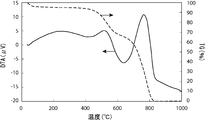
- FIG. 1 is a diagram showing a TG / DTA measurement result of the resin residual partially exfoliated graphite obtained in Example 1.
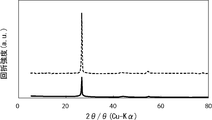
- FIG. 2 is a diagram showing an XRD spectrum of the resin residual partially exfoliated exfoliated graphite obtained in Example 1.
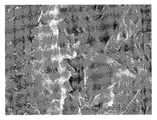
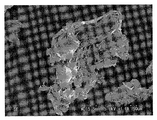
- FIG. 3 is a scanning electron micrograph of the resin residual partially exfoliated exfoliated graphite obtained in Example 1 at a magnification of 1000 times.
- FIG. 4 is a scanning electron micrograph of the resin residual partially exfoliated exfoliated graphite obtained in Example 1 at a magnification of 5000 times.
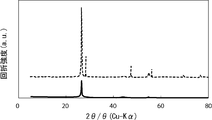
- FIG. 5 is a diagram showing an XRD spectrum of the active material-exfoliated graphite composite obtained in Example 1.
- FIG. 6 is a scanning electron micrograph of the active material-exfoliated graphite composite obtained in Example 1 at a magnification of 5000 times.
- 7 is a scanning electron micrograph of the cross section of the negative electrode material for a lithium ion secondary battery obtained in Example 1 at a magnification of 10000 times.
- FIG. 8 is an exploded perspective view showing a schematic configuration of a half cell manufactured for evaluating electrical characteristics.
- FIG. 9 is a diagram showing a TG / DTA measurement result of the resin residual partially exfoliated exfoliated graphite obtained in Example 2.
- 10 is a view showing an XRD spectrum of the resin residual partially exfoliated exfoliated graphite obtained in Example 2.
- FIG. 11 is a view showing a scanning electron micrograph at a magnification of 1000 times that of the resin residual partially exfoliated exfoliated graphite obtained in Example 2.
- 12 is a scanning electron micrograph of the resin residual partially exfoliated exfoliated graphite obtained in Example 2 at a magnification of 5000 times.
- FIG. FIG. 13 is a view showing an XRD spectrum of the active material-exfoliated graphite composite obtained in Example 2.
- FIG. 14 is a diagram showing a TG / DTA measurement result of the active material-exfoliated graphite composite obtained in Example 3.
- FIG. 15 is a view showing an XRD spectrum of the active material-exfoliated graphite composite obtained in Example 3.
- FIG. 16 is a diagram showing a TG / DTA measurement result of the active material-exfoliated graphite composite obtained in Example 4.
- the active material-exfoliated graphite composite according to the present invention includes partially exfoliated exfoliated graphite and an active material.
- the partially exfoliated exfoliated graphite has a structure in which graphite is partially exfoliated.
- the active material is a particle that can occlude and release lithium ions when combined with partially exfoliated exfoliated graphite.
- the active material is particles that can adsorb and desorb lithium ions by being combined with partially exfoliated graphite.
- the active material-exfoliated graphite composite according to the present invention is a partially exfoliated graphite and a particle that can occlude and release lithium ions by being combined with the partially exfoliated graphite, or It is a composite in which an active material, which is a particle that can adsorb and desorb lithium ions by being combined with partially exfoliated graphite, is combined.
- the active material-exfoliated graphite composite according to the present invention is used for a negative electrode material for a lithium ion secondary battery as will be described later, deterioration of charge / discharge cycle characteristics hardly occurs.
- the active material is preferably included in the partially exfoliated graphite. In that case, the charge / discharge cycle characteristics are more unlikely to deteriorate. In addition, when the active material is included in the partially exfoliated graphite, the conductivity in the thickness direction can be further enhanced as compared with conventional graphite.
- the average particle diameter of the active material is as large as 1 ⁇ m or more and 100 ⁇ m or less. Therefore, when the active material-exfoliated graphite composite according to the present invention is used for a negative electrode material for a lithium ion secondary battery, the initial capacity can be increased. In addition, it is easier to handle and safer than nano-sized fine particles.
- an average particle diameter means the value computed by the volume reference distribution by the laser diffraction method.
- An example of the average particle diameter measurement used in the present example described below is given below.
- LA950 manufactured by Horiba, Ltd.
- the refractive index the refractive index (1.49) of methyl methacrylate resin was used.
- water an active material suspension is added so that the transmittance is 80% or more, 7 in 15 stages of circulation speed, 7 in 15 stages of stirring speed, 7 in 7 stages of ultrasonic intensity, The measurement was performed at a sonication time of 1 to 3 minutes.
- the solvent can be appropriately changed such as water and ethanol, and the stirring method can be appropriately adjusted.
- the average particle diameter can be calculated as the average value of the particle diameters determined from the average value.
- Partially exfoliated graphite In partially exfoliated graphite, the graphene layer in graphite or primary exfoliated graphite is expanded by thermal decomposition of a resin, which will be described in an example of a manufacturing method to be described later, whereby the graphite is partially exfoliated. More specifically, in partially exfoliated exfoliated graphite, the graphite is partially exfoliated from the edge to some extent inside.
- the partially exfoliated exfoliated graphite has many portions where graphite is exfoliated. More specifically, the portion where the graphite is exfoliated refers to a portion of the graphite or primary exfoliated graphite where a part of the graphene laminate or graphene is partially exfoliated.
- the partially exfoliated exfoliated graphite has a structure in which graphene sheets are laminated in the central part, like the original graphite or primary exfoliated graphite.
- the central portion there may be a portion that is expanded between the graphene layers as compared with the original graphite or primary exfoliated graphite due to thermal decomposition of a part of the resin.
- the graphite is a laminate of a plurality of graphene sheets.
- As graphite natural graphite, artificial graphite, expanded graphite, or the like can be used. Expanded graphite has a larger graphene layer than normal graphite. Therefore, it peels easily. Therefore, exfoliated graphite can be obtained more easily when expanded graphite is used.
- the interlayer distance between the graphene layers is widened, and the number of graphene layers in the edge portion, that is, the exfoliated portion is small, so that the BET specific surface area is large.
- primary exfoliated graphite may be used instead of graphite as a raw material.
- the primary exfoliated graphite contains a large amount of exfoliated graphite obtained by exfoliating graphite. Since primary exfoliated graphite is obtained by exfoliating graphite, the specific surface area may be larger than that of graphite.
- the partially exfoliated exfoliated graphite has a large specific surface area with an increased interlayer distance between graphene layers. Furthermore, the partially exfoliated exfoliated graphite according to the present invention has a structure in which the central portion has a graphite structure and the edge portion is exfoliated. For this reason, handling is easier than conventional exfoliated graphite.
- the partially exfoliated graphite exfoliated graphite can be obtained by removing the resin by firing after the resin residual partially exfoliated exfoliated graphite is combined with the active material, as shown in an example of the production method described later. A part of the resin used for the thermal decomposition may remain. However, all of the resin may be removed.
- the resin used for thermal decomposition examples include polypropylene glycol, polyglycidyl methacrylate, polyvinyl acetate, polytetramethylene ether glycol, polystyrene, polyethylene glycol, polybutyral, or polyacrylic acid.
- polypropylene glycol, polyethyl acetate, or polyglycidyl methacrylate is used.
- polypropylene glycol, polyethyl acetate or polyglycidyl methacrylate is used, the specific surface area of partially exfoliated exfoliated graphite can be further increased.
- the amount of the remaining resin is preferably 20 parts by weight or less, more preferably 10 parts by weight or less, still more preferably 5 parts by weight, particularly preferably 100 parts by weight of partially exfoliated graphite. Is 1 part by weight or less.
- the specific surface area further increases as compared with the specific surface area of the original graphite. Moreover, since resin remains, dispersibility with binder resin improves and workability improves.
- the active material is a particle that can occlude and release lithium ions when combined with partially exfoliated exfoliated graphite. Alternatively, it is a particle that can adsorb and desorb lithium ions by being combined with partially exfoliated graphite.
- the active material is preferably included in partially exfoliated exfoliated graphite. In this case, deterioration of charge / discharge cycle characteristics can be further suppressed.
- the material constituting the active material is not particularly limited as long as the material can occlude, release, adsorb, and desorb lithium ions.
- a lithium transition metal oxide Co-based, Mn-based, Ni-based, P-based, or a composite system thereof
- Sn Si
- Ge Si
- Ti Ti
- Zr vanadium
- V vanadium
- Al aluminum
- Ti titanium
- TiO 2 titanium oxide
- the compound having a polyacene skeleton preferably has a structure in which a plurality of aromatic rings are condensed linearly or planarly.
- JP-B-1-44212, JP-B-3-24024, WO95 / 08852 examples thereof include insoluble and infusible substrates having a boriacene-based skeleton structure described in Japanese Patent Publication No. Gazette.
- the average particle diameter of the active material is 1 ⁇ m or more and 100 ⁇ m or less. From the viewpoint of further increasing the initial capacity, the average particle diameter of the active material is preferably 1 ⁇ m or more and 50 ⁇ m or less, and more preferably 5 ⁇ m or more and 25 ⁇ m or less.
- the content of particles having an average particle diameter of 1 ⁇ m or less is preferably 50% or less, more preferably 30% or less, and further preferably 20% or less.
- the content of the active material in the active material-exfoliated graphite composite is 5 wt% or more and 90 wt% or less. It is preferably 15% by weight or more and 80% by weight or less, more preferably 20% by weight or more and 70% by weight or less.
- the shape of the active material is not limited to a spherical shape, but may be a shape obtained by crushing a lump.
- the active material-exfoliated graphite composite according to the present invention may be manufactured by other methods.
- Such resin-residual partially exfoliated graphite includes graphite or primary exfoliated graphite and a resin, and a step of preparing a raw material composition in which the resin is fixed to the graphite or primary exfoliated graphite; By thermally decomposing the resin contained in the raw material composition, it can be obtained by a production method comprising a step of exfoliating graphite or primary exfoliated graphite while leaving a part of the resin. For example, it can be produced by the same method as the method for producing exfoliated graphite / resin composite material described in International Publication No. 2014/34156.
- Graphite is a laminate of a plurality of graphene layers, and examples thereof include natural graphite, artificial graphite, and expanded graphite.
- expanded graphite As graphite used as a raw material, expanded graphite is preferable. Expanded graphite can be easily peeled off because the interlayer of the graphene layer is larger than that of normal graphite. Therefore, resin expanded partially exfoliated graphite can be easily produced by using expanded graphite as raw material graphite.
- the number of graphene layers in the graphite is about 100,000 to 1,000,000, and the specific surface area (BET specific surface area) by BET is 35 m 2 / g or less.
- the number of laminated graphenes in the exfoliated portion is small.
- the number of laminated graphenes in the exfoliated portion is preferably 3000 layers or less, more preferably 1000 layers or less, further preferably 300 layers or less, and particularly preferably 100 layers or less. preferable.
- the active material can be more easily included, and battery characteristics can be improved.
- the interlayer distance between the graphene layers is widened, and the number of graphene layers in the edge portion, that is, the exfoliated portion is small, so that the BET specific surface area is large.
- the BET specific surface area of the resin residual partially exfoliated graphite is preferably 40 m 2 / g or more, more preferably 60 m 2 / g or more, and still more preferably 100 m 2 / g or more.
- the BET specific surface area of the resin residual partially exfoliated graphite is preferably 2500 m 2 / g or less. When the BET specific surface area is within the above range, the active material can be more easily included, and the battery characteristics can be further improved.
- primary exfoliated graphite may be used instead of graphite.
- the primary exfoliated graphite widely includes exfoliated graphite conventionally known in addition to exfoliated graphite obtained by exfoliating graphite and resin residual exfoliated graphite. Since primary exfoliated graphite is obtained by exfoliating graphite, the specific surface area may be larger than that of graphite.
- the resin contained in the resin residual partially exfoliated graphite is not particularly limited, but is preferably a polymer of a radical polymerizable monomer. In this case, it may be a homopolymer of one kind of radically polymerizable monomer or a copolymer of plural kinds of radically polymerizable monomers.
- the radical polymerizable monomer is not particularly limited as long as it is a monomer having a radical polymerizable functional group.
- radical polymerizable monomer examples include styrene, methyl ⁇ -ethyl acrylate, methyl ⁇ -benzyl acrylate, methyl ⁇ - [2,2-bis (carbomethoxy) ethyl] acrylate, dibutyl itaconate, and itaconic acid.
- ⁇ -substituted acrylic acid ester consisting of dimethyl, dicyclohexyl itaconate, ⁇ -methylene- ⁇ -valerolactone, ⁇ -methylstyrene, ⁇ -acetoxystyrene, glycidyl methacrylate, 3,4-epoxycyclohexylmethyl methacrylate, hydroxyethyl methacrylate, Vinyl monomers having a glycidyl group or hydroxyl group such as hydroxyethyl acrylate, hydroxypropyl acrylate, 4-hydroxybutyl methacrylate; allylamine, diethylaminoethyl (meth) acrylate, dimethyl Vinyl monomers having an amino group such as tilaminoethyl (meth) acrylate; methacrylic acid, maleic anhydride, maleic acid, itaconic acid, acrylic acid, crotonic acid, 2-acryloyloxyethyl succinate, 2-meth
- the resin contained in the resin residual partially exfoliated graphite it is more preferable to use polypropylene glycol, styrene polymer, vinyl acetate polymer, polytetramethylene ether glycol, polystyrene, polyethylene glycol, polyglycidyl methacrylate, or butyral resin.
- the resin content in the resin residual partially exfoliated graphite is preferably 5% by mass to 75% by mass. More preferably, it is 10 mass% to 70 mass%, and still more preferably 10 mass% to 40 mass%.
- the handleability may be lowered, or the active material may not be sufficiently inserted between the graphene layers. If the resin content is too high, a sufficient amount of active material may not be inserted between the graphene layers.
- the thermal decomposition start temperature and the thermal decomposition end temperature of the resin in the resin residual partially exfoliated exfoliated graphite are higher than the thermal decomposition start temperature and the thermal decomposition end temperature of the resin before compounding, respectively.
- the pyrolysis start temperature and the pyrolysis end temperature refer to a TGA measurement-dependent decomposition start temperature and a decomposition end point temperature, respectively.
- the interlayer distance between the graphene layers is widened, and the specific surface area is large.
- the resin-retained partially exfoliated graphite has a graphite structure at the center and a flaky edge. For this reason, handling is easier than conventional exfoliated graphite.
- the resin residual partially exfoliated graphite exfoliated graphite contains a resin, it has a high dispersibility in other resins.
- the other resin is a resin having high affinity with the resin contained in the resin residual partially exfoliated graphite, the dispersibility of the resin residual partially exfoliated graphite in another resin is higher.
- a composition containing graphite or primary exfoliated graphite and the resin is prepared, and the resin is fixed to the graphite or primary exfoliated graphite. To do.
- the steps of preparing this composition include, for example, the following first and second methods for fixing a polymer to graphite or primary exfoliated graphite by grafting the polymer to graphite or primary exfoliated graphite, By adsorbing graphite or primary exfoliated graphite, the following third method for fixing the polymer to graphite or primary exfoliated graphite can be used.
- First method In the first method, first, as a raw material, a mixture containing the above graphite or primary exfoliated graphite and the above radical polymerizable monomer is prepared. Next, the radical polymerizable monomer contained in the mixture is polymerized to produce a polymer in which the radical polymerizable monomer is polymerized in the mixture, and the polymer is grafted to graphite or primary exfoliated graphite.
- a composition containing graphite or primary exfoliated graphite and a radical polymerizable monomer is prepared.
- the blending ratio of graphite and radical polymerizable monomer is not particularly limited, but is preferably 1: 1 to 1: 100 by mass ratio. By setting the blending ratio within the above range, it is possible to effectively exfoliate graphite or primary exfoliated graphite, and more effectively obtain resin residual partially exfoliated graphite.
- a composition further including a thermally decomposable foaming agent that generates a gas upon thermal decomposition is prepared.
- the graphite or primary exfoliated graphite can be more effectively exfoliated by heating described later.
- the thermal decomposable foaming agent is not particularly limited as long as it is a compound that spontaneously decomposes by heating and generates a gas upon decomposition.
- the thermally decomposable foaming agent include foaming agents such as azocarboxylic acid-based, diazoacetamide-based, azonitrile compound-based, benzenesulfohydrazine-based or nitroso compound-based which generate nitrogen gas during decomposition, carbon monoxide during decomposition, A foaming agent that generates carbon dioxide, methane, aldehyde, or the like can be used.
- the above pyrolyzable foaming agents may be used alone or in combination of a plurality of types of foaming agents.
- thermally decomposable foaming agent azodicarbonamide (ADCA) having a structure represented by the following formula (1), or a foaming agent having a structure represented by the following formulas (2) to (4): Can be used.
- ADCA azodicarbonamide
- foaming agents decompose spontaneously by heating, and generate nitrogen gas during decomposition.
- the thermal decomposition temperature of the thermally decomposable foaming agent is not particularly limited, and may be lower or higher than the temperature at which the radical polymerizable monomer spontaneously starts polymerization.
- the thermal decomposition temperature of ADCA having the structure represented by the above formula (1) is 210 ° C.
- the temperature at which styrene spontaneously starts polymerization is higher than 150 ° C. High temperature.
- the thermal decomposition start temperatures of the thermally decomposable foaming agents having the structures represented by the above formulas (2) to (4) are 88 ° C., 96 ° C., and 110 ° C. in order, and these are the temperatures at which styrene spontaneously starts polymerization.
- the temperature is lower than 150 ° C.
- the mixing ratio of the graphite or primary exfoliated graphite and the thermally decomposable foaming agent is not particularly limited, but the pyrolyzable foaming agent is 100 parts by weight to 300 parts by weight with respect to 100 parts by weight of the graphite or primary exfoliated graphite. It is preferable to blend partly.
- the compounding quantity of the said thermally decomposable foaming agent into the said range, the said graphite or primary exfoliated graphite can be peeled off more effectively, and resin residual partially exfoliated graphite can be obtained effectively.
- the method for preparing the composition is not particularly limited, and examples thereof include a method in which the radical polymerizable monomer is used as a dispersion medium and the graphite or primary exfoliated graphite is dispersed in the radical polymerizable monomer.
- the composition further containing the thermally decomposable foaming agent can be prepared by dissolving or dispersing the thermally decomposable foaming agent in the radical polymerizable monomer.
- the radical polymerizable monomer generates free radicals, whereby the radical polymerizable monomer undergoes radical polymerization, thereby generating a polymer in which the radical polymerizable monomer is polymerized.
- the graphite contained in the composition has a radical trapping property because it is a laminate of a plurality of graphene layers. Therefore, when the radically polymerizable monomer is co-polymerized in the composition containing the graphite or primary exfoliated graphite, the free radicals are adsorbed on the end and surface of the graphene layer of the graphite or primary exfoliated graphite. .
- the polymer having the free radicals or the radical polymerizable monomer generated at the time of polymerization is grafted to the end portion and the surface of the graphene layer of the graphite or primary exfoliated graphite.
- Examples of a method for polymerizing the radical polymerizable monomer contained in the composition include a method in which the composition is heated to a temperature higher than the temperature at which the radical polymerizable monomer spontaneously starts polymerization. By heating the composition to the temperature or higher, free radicals can be generated in the radical polymerizable monomer contained in the composition. Thereby, the polymerization and grafting described above can be carried out.
- both the polymerization of the radical polymerizable monomer and the thermal decomposition of the polymer described later can be performed only by heating the composition. . Accordingly, the graphite or primary exfoliated graphite can be more easily separated.
- the heating method is not particularly limited as long as the composition can be heated to the temperature or higher, and the composition can be heated by an appropriate method and apparatus. Moreover, in the case of the said heating, you may heat without sealing, ie, a normal pressure.
- the temperature may be further maintained for a certain period of time after heating to a temperature equal to or higher than the temperature at which the radical polymerizable monomer spontaneously starts polymerization.
- the time for maintaining the temperature near the above temperature is preferably in the range of 0.5 to 5 hours, although it depends on the kind and amount of the radical polymerizable monomer to be used.
- the step of thermally decomposing the polymer is performed while the composition is heated to the thermal decomposition temperature of the polymer to leave a part of the polymer.
- the thermal decomposition temperature of the polymer means a decomposition end point temperature dependent on TGA measurement.
- the thermal decomposition temperature of the polymer is about 350 ° C.
- thermal decomposition start temperature and thermal decomposition end temperature of the resin in the resin residual partially exfoliated exfoliated graphite obtained by thermal decomposition are higher than the thermal decomposition start temperature and thermal decomposition end temperature of the resin before compounding, respectively.
- exfoliated graphite is a graphene laminate after exfoliation obtained by exfoliating original graphite or primary exfoliated graphite, and has a specific surface area larger than that of original graphite or primary exfoliated graphite.
- the heating method is not particularly limited as long as it can be heated to the thermal decomposition temperature of the polymer, and the composition can be heated by an appropriate method and apparatus. Moreover, in the case of the said heating, you may heat without sealing, ie, a normal pressure. Therefore, exfoliated graphite can be produced inexpensively and easily.
- Thermal decomposition so that the resin remains can be achieved by adjusting the heating time. That is, the amount of residual resin can be increased by shortening the heating time. Also, the amount of residual resin can be increased by lowering the heating temperature.
- the heating temperature and the heating time may be adjusted in the step of heating so that a part of the polymer remains.
- the temperature is increased after heating to a temperature equal to or higher than the thermal decomposition temperature of the polymer. Furthermore, you may maintain for a fixed time.
- the time for maintaining the temperature near the above temperature is preferably in the range of 0.2 to 5 hours, although it depends on the kind and amount of the radical polymerizable monomer to be used.
- the heat treatment in the step of producing the polymer and the heat treatment in the step of thermally decomposing the polymer described later are the same.
- the method and apparatus may be used continuously.
- the composition further includes a thermally decomposable foaming agent during the heating
- the thermally decomposable foaming agent is contained in the composition when the composition is heated to the thermal decomposition temperature of the thermally decomposable foaming agent. Pyrolysis with On the other hand, the thermally decomposable foaming agent generates gas and foams during thermal decomposition.
- the thermally decomposable foaming agent when thermally decomposed in the vicinity of the graphene layer of the graphite or primary exfoliated graphite, the gas generated by the thermal decomposition enters between the graphene layers, and the interval of the graphene layers is widened. Thereby, a peeling force is generated between the graphene layers, so that the graphite or primary exfoliated graphite can be further peeled. Therefore, the specific surface area of the exfoliated graphite obtained can be further increased by using the above pyrolyzable foaming agent.
- the graphite or primary exfoliated graphite can be more effectively exfoliated by using the radically polymerizable monomer and / or the polymer and the thermally decomposable foaming agent in combination. Although the reason why graphite or primary exfoliated graphite can be more effectively exfoliated by such a method is not clear, the following reasons are conceivable.
- the radical polymerizable monomer when the radical polymerizable monomer generates a free radical, the polymer having the free radical generated during polymerization or the radical polymerizable monomer is an end of the graphene layer of the graphite or primary exfoliated graphite. And graft onto the surface. Therefore, the free radical is trapped in the graphene layer of the graphite or primary exfoliated graphite.
- the thermally decomposable foaming agent since the thermally decomposable foaming agent has a property of having high affinity with radicals, it is attracted to free radicals trapped in the graphene layer of the graphite or primary exfoliated graphite in the composition.
- the thermally decomposable foaming agent is easily thermally decomposed in the vicinity of the graphene sheet laminated surface of graphite or primary exfoliated graphite. Therefore, by the thermal decomposition of the thermally decomposable foaming agent, a peeling force can be effectively applied between the graphene layers of the graphite or primary exfoliated graphite.
- the thermal decomposition of the thermally decomposable foaming agent is not necessarily performed in the process of thermally decomposing the polymer.
- the thermal decomposition temperature of the thermally decomposable foaming agent is lower than the temperature at which the radical polymerizable monomer spontaneously starts polymerization, the radical polymerizable monomer is heated by heating in the step of producing the polymer.
- the thermally decomposable foaming agent may be thermally decomposed.
- the thermal decomposition of the thermally decomposable foaming agent may be performed before the polymerization of the radical polymerizable monomer, after the polymerization, or simultaneously with the polymerization.
- the temperature may be maintained for a certain time after heating to a temperature equal to or higher than the thermal decomposition temperature of the thermally decomposable foaming agent.
- the time for maintaining the temperature near the above temperature is preferably in the range of 0.5 to 5 hours, although it depends on the kind and amount of the thermally decomposable foaming agent used.
- Second method in the second method, in the step of preparing a composition containing graphite or primary exfoliated graphite and a polymer in which a radical polymerizable monomer is polymerized, and the polymer is grafted to graphite or primary exfoliated graphite, In the presence of graphite or primary exfoliated graphite, the polymer is grafted to graphite or primary exfoliated graphite by heating to a temperature in the temperature range of 50 ° C. or higher and 400 ° C. or lower.
- a radical polymerizable monomer is polymerized in the presence of graphite or primary exfoliated graphite to produce a polymer, and grafting of the polymer to graphite or primary exfoliated graphite has been attempted.
- a polymer radical generated by thermally decomposing a polymer is obtained by heating the polymer obtained in advance to the specific temperature range in the presence of graphite or primary exfoliated graphite. It can be grafted directly to graphite or primary exfoliated graphite.
- an appropriate pyrolytic radical generating polymer can be used as the polymer of the second method.
- the blending ratio of the graphite or primary exfoliated graphite and the polymer is not particularly limited, but it is desirable that the weight ratio is 1: 5 to 1:20. By setting the blending ratio within this range, it is possible to more effectively exfoliate graphite or primary exfoliated graphite, and to effectively obtain resin residual partially exfoliated graphite.
- the step of preparing the composition in the step of preparing the composition, it is preferable to further include a thermally decomposable foaming agent in the composition.
- the graphite or primary exfoliated graphite can be more effectively exfoliated by heating that causes thermal decomposition of the polymer described later.
- the thermally decomposable foaming agent that can be used is the same as in the first method. Therefore, it is preferable to use a foaming agent having a structure represented by the above formulas (1) to (4).
- the blending ratio of graphite or primary exfoliated graphite and the pyrolyzable foaming agent is not particularly limited, but the pyrolyzable foaming agent is 100 to 300 per 100 parts by weight of graphite or primary exfoliated graphite. It is preferable to mix
- a specific method for preparing the composition is not limited. For example, a method in which the polymer and graphite or primary exfoliated graphite are put in an appropriate solvent or dispersion medium and heated is mentioned. It is done.
- the polymer is grafted to graphite or primary exfoliated graphite by the above heating.
- this heating temperature it is desirable to set it as the range of 50 degreeC or more and 400 degrees C or less. By setting it within this temperature range, the polymer can be effectively grafted onto the graphite. Thereby, graphite or primary exfoliated graphite can be more effectively exfoliated. The reason for this is considered as follows.
- Third method a method of dissolving or dispersing the graphite and the polymer in an appropriate solvent can be mentioned.
- a solvent tetrahydrofuran, methyl ethyl ketone, toluene, ethyl acetate or the like can be used.
- a thermally decomposable foaming agent may be further added and dispersed or dissolved in the solvent.
- a composition in which a polymer is adsorbed on graphite or primary exfoliated graphite in a solvent is prepared as the above composition.
- the method for adsorbing the polymer to graphite or primary exfoliated graphite is not particularly limited. Since the polymer has adsorptivity to graphite, a method of mixing graphite or primary exfoliated graphite with the polymer in the above-described solvent can be used.
- ultrasonic treatment is performed in order to effectively adsorb the polymer by graphite or primary exfoliated graphite.
- the ultrasonic processing method is not particularly limited. For example, a method of irradiating an ultrasonic wave having an oscillation frequency of about 100 W and an oscillation frequency of about 28 kHz using an appropriate ultrasonic processing apparatus can be used.
- the sonication time is not particularly limited as long as it is longer than the time required for the polymer to be adsorbed on graphite.
- the sonication time is not particularly limited as long as it is longer than the time required for the polymer to be adsorbed on graphite.
- it is preferably maintained for about 30 minutes to 300 minutes.
- the polymer adsorption is considered to be due to the interaction between the surface energy of graphite and the polymer.
- Exfoliation process of graphite by thermal decomposition of resin In any of the first method, the second method, and the third method, after preparing the composition as described above, the polymer contained in the composition is pyrolyzed. Thereby, graphite or primary exfoliated graphite is exfoliated while a part of the polymer remains, so that a resin residual partially exfoliated graphite can be obtained.
- the composition may be heated to a temperature higher than the thermal decomposition temperature of the polymer.
- the thermal decomposition temperature of polystyrene is about 380 ° C. to 450 ° C.
- the thermal decomposition temperature of polyglycidyl methacrylate is about 400 ° C. to 500 ° C.
- the thermal decomposition temperature of polybutyral is about 550 ° C. to 600 ° C. in the atmosphere. It is.
- the reason why the resin-retained partially exfoliated exfoliated graphite can be obtained by thermal decomposition of the polymer is considered to be due to the reason described above. That is, it is considered that when the polymer grafted on the graphite is baked, a large stress acts on the graft point, thereby increasing the distance between the graphenes.
- the heating for polymerizing the radical polymerizable monomer and the thermal decomposition of the polymer may be carried out continuously in the same heating step, but in the second method, Alternatively, a heating step for grafting the polymer onto graphite or primary exfoliated graphite and a heating step for pyrolyzing the polymer may be performed continuously.
- Step of obtaining active material-exfoliated graphite composite a raw material composition containing the resin remaining partially exfoliated exfoliated graphite prepared as described above and an active material is heated to obtain a resin.
- the active material-exfoliated graphite composite is obtained by firing and removing and combining the partially exfoliated exfoliated graphite and the active material.
- the resin of the partially exfoliated graphite exfoliated graphite is removed by heat treatment of the raw material composition or chemical treatment such as acid / alkali hydrolysis. As described above, a part of the resin may remain by heat treatment or chemical treatment of the raw material composition.
- the thermal decomposition temperature of the active material is preferably higher than the thermal decomposition temperature of the resin.
- the raw material composition is preferably heated at a temperature higher than the thermal decomposition temperature of the resin and lower than the thermal decomposition temperature of the active material. This is because by heating within this range, the active material can be combined with the partially exfoliated exfoliated graphite more efficiently. More specifically, the heating temperature is preferably 200 ° C. or higher, more preferably 350 ° C. or higher, preferably 600 ° C. or lower, more preferably 550 ° C. or lower.
- the above active material is not particularly limited, but a powdery active material powder can be used.
- the average particle diameter of the active material is 1 ⁇ m to 100 ⁇ m.
- the mixing ratio of the active material is not particularly limited, but is preferably in the range of 5.2 to 900 parts by weight with respect to 100 parts by weight of partially exfoliated graphite.
- a material such as an inorganic compound or metal can be used.
- a material such as an inorganic compound or metal
- the raw material composition containing the resin residual partially exfoliated graphite and Si particles is heated, whereby the Si particles are doped into the partially exfoliated graphite. It is preferable to contact.
- this heating temperature Preferably it is 200 degreeC or more, More preferably, it is 400 degreeC or more, Preferably it is 600 degrees C or less, More preferably, it is 550 degrees C or less.
- the Si particles are more surely penetrated between the graphene layers of the partially exfoliated graphite. That is, Si particles enter the part of the partially exfoliated exfoliated graphite where graphene is open, and the Si particles are doped. Thereby, a Si composite carbonaceous material can be obtained.
- the Si particles are not particularly limited, and various commercially available Si powders can be used.
- the average particle diameter of the Si particles is preferably about 1 ⁇ m to 30 ⁇ m. Within such a range of average particle diameter, Si particles can be more easily introduced between the graphene layers of partially exfoliated exfoliated graphite.
- the mixing ratio of the Si particles is not particularly limited, but is preferably in the range of 10 to 900 parts by weight with respect to 100 parts by weight of the partially exfoliated exfoliated graphite.
- Si particles By heating a raw material composition containing Si particles and partially exfoliated exfoliated graphite to the above temperature by an appropriate method, Si particles can be doped into partially exfoliated exfoliated graphite as described above. Thereby, an active material-exfoliated graphite composite can be obtained.
- a compound having a polyacene skeleton can be used.
- the compound having a polyacene skeleton preferably has a structure in which a plurality of aromatic rings are condensed linearly or planarly.
- JP-B-1-44212, JP-B-3-24024, WO95 / 08852 examples thereof include insoluble and infusible substrates having a boriacene-based skeleton structure described in Japanese Patent Publication No. Gazette.
- the negative electrode material for a lithium ion secondary battery according to the present invention includes the active material-exfoliated graphite composite of the present invention and a binder resin.
- the binder resin is not particularly limited, and for example, styrene butadiene rubber, carboxymethyl cellulose, polyvinylidene fluoride, polyimide resin, (meth) acrylic resin, or acetal resin can be used. These may be used alone or in combination.
- the active material-exfoliated graphite composite of the present invention partially exfoliated exfoliated graphite and an active material that is a particle capable of occluding, releasing, adsorbing, and desorbing lithium ions are combined.
- the average particle diameter of the said active material is 1 micrometer or more and 100 micrometers or less, and an average particle diameter is comparatively large. Therefore, the lithium ion secondary battery using the negative electrode material for a lithium ion secondary battery of the present invention has a large initial capacity and is unlikely to deteriorate in charge / discharge characteristics.
- Si particles when Si particles are used as the active material, the Si particles can be combined with more lithium than carbon. That is, when Si particles are used, the theoretical capacity is much higher than when a carbon material is used.
- Si particles when Si particles are used, the volume change due to charge / discharge is large, and the life characteristics, that is, the charge / discharge cycle characteristics may be deteriorated.
- the Si particles are doped, that is, included between the graphene layers of partially exfoliated exfoliated graphite.
- Si particles inserted in close contact with highly conductive graphene layers are protected by graphene with a stable structure against volume changes when lithium ion intercalation and deintercalation occur. Therefore, it is considered that the deterioration of the charge / discharge cycle characteristics is further reduced. Therefore, when an active material such as Si particles having a high theoretical capacity is used, it is possible to provide a lithium ion secondary battery that is more excellent in charge / discharge characteristics and also excellent in life characteristics.
- the negative electrode material for a lithium ion secondary battery may contain a conductive aid.
- Examples of conductive aids include ketjen black and acetylene black. Preferably, at least one selected from the group consisting of ketjen black and acetylene black is used. In this case, the conductivity as the electrode material can be further improved.
- the addition ratio of the conductive auxiliary agent is not particularly limited, and is preferably about 1 to 20 parts by weight with respect to 100 parts by weight of the active material. If it is in this range, it will be hard to cause the characteristic deterioration as a negative electrode of a lithium ion secondary battery, and the electroconductivity as an electrode material can be improved further.
- the method for producing a negative electrode material for a lithium ion secondary battery according to the present invention includes a step of obtaining an active material-exfoliated graphite composite according to the production method described above, and (3) a step of preparing a composition for shaping; (4) A step of shaping the prepared composition for shaping.
- a composition for shaping containing the active material-exfoliated graphite composite of the present invention, a binder resin, and a solvent is prepared.
- the binder resin is not particularly limited.
- a binder resin preferably, at least one selected from the group consisting of styrene butadiene rubber, carboxymethyl cellulose, polyvinylidene fluoride, polyimide resin, (meth) acrylic resin, and acetal resin is used. That is, an aqueous binder resin may be used, or a non-aqueous binder resin may be used.
- the aqueous binder resin the styrene butadiene rubber (SBR) or carboxymethyl cellulose (CMC) is preferably used.
- the non-aqueous binder resin at least one of the polyvinylidene fluoride (PVDF), polyimide resin, (meth) acrylic resin, and acetal resin is preferably used.
- the (meth) acrylic resin represents a methacrylic resin and an acrylic resin, and among them, an acrylic resin is preferable.
- the acetal resins a butyral resin is preferable.
- an appropriate solvent is added to facilitate shaping of the composition and to facilitate kneading.
- a solvent is not particularly limited, and an organic solvent such as tetrahydrofuran (THF), ethanol, N-methylpyrrolidone (NMP), or water can be used.
- the blending ratio of the active material-exfoliated graphite composite and the binder resin in the composition is not particularly limited, but the binder resin is 2 to 20 parts by weight with respect to 100 parts by weight of the active material-exfoliated graphite composite. It is desirable to blend in a proportion of about parts. Within this range, a negative electrode material for a lithium ion secondary battery that exhibits a sufficient effect as a negative electrode can be provided. If the blending ratio of the binder resin is too low, molding may be difficult.
- a negative electrode material for a lithium ion secondary battery is obtained by shaping the shaping composition prepared as described above.
- This shaping may be performed by using various molding methods, or by applying the composition and drying.
- the negative electrode material for a lithium ion secondary battery according to the present invention can be used alone as a negative electrode material for a lithium ion secondary battery without using a metal foil such as a Cu foil. Therefore, for example, the negative electrode for a lithium ion secondary battery can be easily formed by applying the composition to one side of the separator and drying the composition.
- a conductive auxiliary may be further mixed in the step of combining the resin residual partially exfoliated graphite exfoliated graphite and the active material. In that case, the conductivity of the produced negative electrode can be further improved.
- the lithium ion secondary battery which concerns on this invention is equipped with the said negative electrode material for lithium ion secondary batteries as a negative electrode. Therefore, the initial capacity is large, and the charge / discharge cycle characteristics are unlikely to deteriorate.
- a lithium ion secondary battery includes a negative electrode, a positive electrode, and a separator disposed between the negative electrode and the positive electrode.
- the negative electrode material for a lithium ion secondary battery according to the present invention is suitably used.
- the negative electrode material for a lithium ion secondary battery expresses a scale that constitutes the negative electrode alone. Therefore, it is also possible to constitute a negative electrode that does not have a metal foil and consists only of the negative electrode material for a lithium ion secondary battery. In that case, the manufacturing process can be simplified and the cost can be reduced. In particular, in the structure in which the negative electrode material for a lithium ion secondary battery is formed as a coating on one side of the separator, the manufacturing process can be further simplified and the cost can be reduced.
- PF Powder 8 manufactured by Toyo Tanso Co., Ltd.
- the mixture was irradiated with ultrasonic waves at 100 W and an oscillation frequency of 28 kHz for 120 minutes using an ultrasonic treatment device (manufactured by Honda Electronics Co., Ltd.).
- an ultrasonic treatment device manufactured by Honda Electronics Co., Ltd.
- This composition was formed into a sheet having a thickness of 100 to 1000 ⁇ m by a casting method.
- the obtained sheet was heat-dried at a temperature of 110 ° C. for 2 hours.
- FIG. 1 shows the TG / DTA measurement results when this combustion test was performed.
- TG indicates a broken line
- DTA indicates a solid line.
- the peak height of the solid line is lower than the broken line.
- the polyglycidyl methacrylate when the polyglycidyl methacrylate is thermally decomposed, a part of the graphite layer is exfoliated. I was able to confirm.
- FIG. 3 is a scanning electron micrograph of the resin residual partially exfoliated exfoliated graphite obtained as described above at a magnification of 1000 times.
- FIG. 4 is a scanning electron micrograph of the resin residual partially exfoliated exfoliated graphite obtained as described above at a magnification of 5000 times.
- the graphite layers are partially open.
- the BET specific surface area of the obtained resin residual partially exfoliated exfoliated graphite was 270 m 2 / g.
- the XRD spectrum of the active material-exfoliated graphite composite obtained as described above was measured. The result is shown by a broken line in FIG.
- the XRD spectrum of the resin residual partially exfoliated graphite is shown by a solid line in FIG.
- the obtained active material-exfoliated graphite composite has a vicinity of 28 degrees derived from the Si particles as the raw material powder. It can be seen that a peak appears.
- FIG. 6 is a scanning electron micrograph of the active material-exfoliated graphite composite obtained in this example at a magnification of 5000 times.
- Si particles are inserted between the graphene layers. That is, it can be seen that Si particles are included in partially exfoliated exfoliated graphite.
- the electrode sheet thus obtained that is, the negative electrode material for a lithium ion secondary battery was dried under reduced pressure at 80 ° C. for 15 hours, then heated to 110 ° C. and dried under reduced pressure for 1 hour.
- FIG. 7 shows a scanning electron micrograph of the cross section of the obtained negative electrode material for a lithium ion secondary battery at a magnification of 10,000 times.
- a sheet containing partially exfoliated exfoliated graphite in which Si particles are included between graphene layers is obtained.
- the obtained negative electrode material for a lithium ion secondary battery was punched into a circular sheet having a diameter of 10 mm.
- FIG. 8 schematically shows an exploded perspective view of a schematic configuration of a half cell manufactured for electrical property evaluation.
- the spring 3 As shown in FIG. 8, between the working electrode 1 and the counter electrode 2, in order from the working electrode 1 side, the spring 3, the current collector 4, a jig 5 made of resin, and a negative electrode material for a lithium ion secondary battery are formed.
- a sheet 6, a separator 7, and a metal lithium piece 8 are provided.
- a Li foil having a thickness of 0.2 mm and a diameter of 14 mm was used.
- a separator manufactured by Sekisui Chemical Co., Ltd., trade name “Esfino (25 ⁇ m)” with a diameter of 24 mm was used.
- electrolytic solution 1 mol / L of LiBF4 / EC: DEC (1: 1 v / v%) electrolytic solution (manufactured by Kishida Chemical Co., Ltd.) was used.
- the battery after resting for 12 hours, the battery is charged by CCCV control at a current of 0.2 C and a target voltage of 0.002 V, and after reaching 0.002 V, 0.002 V is maintained for 10 minutes. Retained. After resting for 10 seconds, the battery was discharged by CV control at a current of 0.2 C to 3 V, and then rested for 1 minute.
- the initial charge capacity, the initial discharge capacity, and the initial coulomb efficiency are large, and the charge / discharge characteristics are hardly deteriorated even after repeated charge / discharge.
- a raw material composition was prepared by mixing 400 g of hydrafuran.
- the raw material composition was irradiated with ultrasonic waves for 5 hours at 100 W and an oscillation frequency of 28 kHz using an ultrasonic treatment apparatus (manufactured by Honda Electronics Co., Ltd.).
- Polypropylene glycol (PPG) was adsorbed on expanded graphite by ultrasonic treatment. In this way, a composition in which polypropylene glycol was adsorbed on expanded graphite was prepared.
- the composition was molded by a solution casting method, maintained at a drying temperature of 80 ° C. for 2 hours, and then maintained at a temperature of 110 ° C. for 1 hour. Thereafter, the temperature was maintained at 150 ° C. for 1 hour, and further maintained at 230 ° C. for 2 hours. Thereby, the ADCA was thermally decomposed and foamed in the composition.
- FIG. 9 shows the TG / DTA measurement results when this combustion test was performed. TG indicates a broken line and DTA indicates a solid line.
- the XRD spectrum of the obtained resin residual partially exfoliated graphite is shown by a solid line in FIG.
- an XRD spectrum of expanded graphite PF powder, which is raw graphite is shown by a broken line in FIG. From FIG. 10, in the resin residual partially exfoliated graphite, it was confirmed that a part of the graphite layer was exfoliated when the polypropylene glycol was thermally decomposed.
- FIG. 11 is a scanning electron micrograph of the resin residual partially exfoliated exfoliated graphite obtained as described above at a magnification of 1000 times.
- FIG. 12 is a scanning electron micrograph of the resin residual partially exfoliated exfoliated graphite obtained as described above at a magnification of 5000 times. As is apparent from FIGS. 11 and 12, it can be seen that the graphite layer is partially open. In addition, the specific surface area by BET of the obtained resin remaining partially exfoliated exfoliated graphite was 150 m 2 / g.
- a solution obtained by adding 1.5 g of ethanol to 0.2 g was prepared, and the ultrasonic wave treatment apparatus (manufactured by Hyundai Electronics Co., Ltd.) was used to obtain 5 at 100 W and an oscillation frequency of 28 kHz. Each solution was irradiated with ultrasound for time.
- the XRD spectrum of the active material-exfoliated graphite composite obtained as described above was measured. The result is shown by a broken line in FIG.
- the XRD spectrum of the resin residual partially exfoliated graphite is shown by a solid line in FIG.
- the electrode sheet obtained as described above, that is, the negative electrode material for a lithium ion secondary battery was dried under reduced pressure at 80 ° C. for 15 hours, then heated to 110 ° C. and dried under reduced pressure for 1 hour.
- the negative electrode material for a lithium ion secondary battery obtained as described above was punched into a circular sheet having a diameter of 10 mm.
- a half cell was prepared using UFO type battery cells (battery cells for flat cell lithium ion secondary battery experiments). All subsequent experiments were performed in a glove box under an argon gas atmosphere.
- the circular sheet made of the negative electrode material for a lithium ion secondary battery was vacuum-dried at 110 ° C. for 14 hours and carried into the glove box while maintaining the vacuum as it was.
- UFO type battery cells flat cell lithium ion secondary battery experimental battery cells
- charge / discharge evaluation was performed. The results are shown in Table 1 below.
- the initial charge capacity, the initial discharge capacity, and the initial coulomb efficiency are large, and the charge / discharge characteristics are hardly deteriorated even after repeated charge / discharge.
- Example 3 A solution obtained by adding 27 g of ethanol to 0.675 g of resin-exfoliated partially exfoliated graphite obtained in Example 2, and Si particles having an average particle size of 10.4 ⁇ m (trade name “Silicon powder -325 mesh” manufactured by ALDRICH, A particle content of 1 ⁇ m or less: 16.3%) A solution in which 50 g of ethanol was added to 0.5 g was prepared, and using an ultrasonic treatment device (manufactured by Honda Electronics Co., Ltd.), 100 W, oscillation frequency 28 kHz, 5 hours, Each solution was irradiated with ultrasonic waves.
- an ultrasonic treatment device manufactured by Nissan Electronics Co., Ltd.
- FIG. 14 shows the TG / DTA measurement results when this combustion test was performed. TG indicates a broken line and DTA indicates a solid line.
- FIG. 14 shows that the polypropylene glycol peak existing in FIG. 9 has disappeared, so that the polypropylene glycol remaining by heating at 500 ° C. for 2 hours has disappeared. Moreover, it turns out that it is the composite_body
- the XRD spectrum of the active material-exfoliated graphite composite obtained as described above was measured. The result is shown by the broken line in FIG.
- the XRD spectrum of the resin residual partially exfoliated graphite is shown by the solid line in FIG.
- a negative electrode material for a lithium ion secondary battery was produced and evaluated for charge and discharge in the same manner as in Example 2 except that the active material-exfoliated graphite composite thus obtained was used. The results are shown in Table 1 below.
- the initial charge capacity, the initial discharge capacity, and the initial coulomb efficiency are further increased, and it is found that the charge / discharge characteristics are hardly deteriorated even when charge / discharge is repeated.
- Example 4 A solution obtained by adding 27 g of ethanol to 0.675 g of the resin-removed partially exfoliated graphite obtained in Example 2 and a polyacene compound “PAHs” (particle content of 1 ⁇ m or less having an average particle diameter of 4.5 ⁇ m, manufactured by KRI) : 0%)
- the resin residual partially exfoliated graphite exfoliated graphite solution was added dropwise and stirred for 2.5 hours to adsorb the PAHs particles to the resin residual partially exfoliated graphite.
- FIG. 16 shows the TG / DTA measurement results when this combustion test was performed. TG indicates a broken line and DTA indicates a solid line.
- FIG. 16 shows that the polypropylene glycol peak existing in FIG. 9 has disappeared, so that the polypropylene glycol remaining by heating at 500 ° C. for 2 hours has disappeared. Moreover, it turns out that it is the composite_body
- a negative electrode material for a lithium ion secondary battery was produced in the same manner as in Example 2, except that the active material-exfoliated graphite composite thus obtained was used.
- the battery was charged by CCCV control at a current of 0.1 C and a target voltage of 0.002 V after a 12-hour pause, and after reaching 0.002 V, 0.002 V was held for 10 hours. After resting for 10 seconds, the battery was discharged to 3 V at a current of 0.2 C by CV control, and then rested for 1 minute. The results are shown in Table 1 below.
- the initial charge capacity, the initial discharge capacity, and the initial coulomb efficiency are further increased, and it is found that the charge / discharge characteristics are hardly deteriorated even when charge / discharge is repeated.
- Comparative Example 1 instead of Si particles having an average particle size of 10.4 ⁇ m (ALDRICH, trade name “Silicon powder-325 mesh”, particle content of 1 ⁇ m or less: 16.3%), Si particles having an average particle size of 616 nm (manufactured by ALDRICH)
- a negative electrode material for a lithium ion secondary battery was prepared and evaluated for charge and discharge in the same manner as in Example 1 except that the product name “Silicon nanopowder” and a particle content of 1 ⁇ m or less: 94.9% were used. It was. The results are shown in Table 1 below.
- Comparative Example 2 In the same manner as in Example 2, except that Si particles having an average particle diameter of 616 nm (trade name “Silicon nanopowder”, 1 ⁇ m or less particle content: 94.9%) were used as Si particles.
- a negative electrode material for an ion secondary battery was prepared and evaluated for charge and discharge. The results are shown in Table 1 below.
- Example 3 In the same manner as in Example 2, except that expanded graphite (trade name “PF Powder 8” manufactured by Toyo Tanso Co., Ltd.) was used instead of the resin residual partially exfoliated graphite used in Example 2, An active material-expanded graphite composite was prepared. 540 mg of the obtained active material-expanded graphite composite, 3 g of an ethanol solution containing 2% by weight of butyral resin (trade name “LB-1”, manufactured by Sekisui Chemical Co., Ltd.) as a binder resin, and a small amount of ethanol on a menor mortar Kneaded to prepare a coating solution. Using the obtained coating liquid, it applied to Cu foil with the applicator and produced the electrode sheet.
- PF Powder 8 manufactured by Toyo Tanso Co., Ltd.
- the electrode sheet thus obtained that is, the negative electrode material for a lithium ion secondary battery, was dried under reduced pressure at 80 ° C. for 15 hours, then heated to 110 ° C. and dried under reduced pressure for 1 hour.
- a UFO type battery cell was prepared in the same manner as in Example 1, and charge / discharge evaluation was performed. The results are shown in Table 1 below.
- Example 4 In the same manner as in Example 3, except that Si particles having an average particle diameter of 616 nm (trade name “Silicon nanopowder”, 1 ⁇ m or less particle content: 94.9%) were used as the Si particles.
- a negative electrode material for an ion secondary battery was prepared and evaluated for charge and discharge. The results are shown in Table 1 below.
Landscapes
- Chemical & Material Sciences (AREA)
- Chemical Kinetics & Catalysis (AREA)
- Electrochemistry (AREA)
- General Chemical & Material Sciences (AREA)
- Engineering & Computer Science (AREA)
- Composite Materials (AREA)
- Materials Engineering (AREA)
- Manufacturing & Machinery (AREA)
- Inorganic Chemistry (AREA)
- Battery Electrode And Active Subsutance (AREA)
- Carbon And Carbon Compounds (AREA)
Abstract
Description
本発明に係る活物質-薄片化黒鉛複合体は、部分剥離型薄片化黒鉛と、活物質とを含む。上記部分剥離型薄片化黒鉛は、部分的にグラファイトが剥離されている構造を有する。上記活物質は、部分剥離型薄片化黒鉛と複合化されることにより、リチウムイオンを吸蔵し、放出できる粒子である。あるいは、上記活物質は、部分剥離型薄片化黒鉛と複合化されることにより、リチウムイオンを吸着し、脱離できる粒子である。
ここで、溶媒は、水やエタノールなど適宜変更することができ、攪拌方法は適宜調整することができる。また、リチウムイオン二次電池負極材などの材料から上記平均粒子径を測定する場合は、SEMなどの電子顕微鏡を用いて材料中に確認される任意の粒子20個を選出し、長径と短径の平均値から求められる粒子径の平均値として平均粒子径を算出することができる。
部分剥離型薄片化黒鉛においては、後述する製造方法の一例で説明する樹脂の熱分解により、黒鉛または一次薄片化黒鉛におけるグラフェン層間が拡げられ、それによって、部分的にグラファイトが剥離されている。より具体的に、部分剥離型薄片化黒鉛では、端縁からある程度内側まで部分的にグラファイトが剥離されている。
上記活物質は、部分剥離型薄片化黒鉛と複合化されることによって、リチウムイオンを吸蔵し、放出できる粒子である。あるいは、部分剥離型薄片化黒鉛と複合化されることにより、リチウムイオンを吸着し、脱離できる粒子である。上記活物質は、部分剥離型薄片化黒鉛内に包摂されていることが好ましい。この場合、充放電サイクル特性の劣化をより一層抑制することができる。
以下、本発明に係る活物質-薄片化黒鉛複合体の製造方法の一例について説明する。なお、本発明に係る活物質-薄片化黒鉛複合体は、他の方法によって製造されてもよい。
樹脂残存部分剥離型薄片化黒鉛とは、グラフェン層間の層間距離が広げられている部分と、グラフェン層間が残存している樹脂により結合されている部分とを含む、複合材料である。
第1の方法では、まず、原料として、上記の黒鉛または一次薄片化黒鉛と、上記のラジカル重合性モノマーとを含む混合物を用意する。次に、混合物に含まれているラジカル重合性モノマーを重合することにより、混合物中に上記ラジカル重合性モノマーが重合しているポリマーを生成させるとともに、該ポリマーを黒鉛または一次薄片化黒鉛にグラフト化させる。




第2の方法では、黒鉛または一次薄片化黒鉛と、ラジカル重合性モノマーが重合しているポリマーとを含み、ポリマーが黒鉛または一次薄片化黒鉛にグラフト化している組成物を用意する工程において、ポリマーを黒鉛または一次薄片化黒鉛の存在下で、50℃以上かつ400℃以下の温度範囲の温度に加熱することにより、ポリマーを黒鉛または一次薄片化黒鉛にグラフト化させる。すなわち、第1の方法では、黒鉛または一次薄片化黒鉛の存在下でラジカル重合性モノマーを重合してポリマーを生成するとともにポリマーの黒鉛または一次薄片化黒鉛へのグラフト化が図られていたが、これに対して、第2の方法では、予め得られたポリマーを黒鉛または一次薄片化黒鉛の存在下で上記特定の温度範囲に加熱することにより、ポリマーを熱分解することにより生成したポリマーラジカルを直接黒鉛または一次薄片化黒鉛にグラフトさせることができる。
第3の方法としては、上記黒鉛と、上記ポリマーとを適宜の溶媒に溶解もしくは分散させる方法を挙げることができる。このような溶媒としては、テトラヒドロフラン、メチルエチルケトン、トルエン、酢酸エチルなどを用いることができる。
上記第1の方法、第2の方法、及び第3の方法のいずれにおいても、上記のようにして組成物を用意したのち、組成物中に含まれるポリマーを熱分解する。それによって、ポリマーの一部を残存させながら、黒鉛または一次薄片化黒鉛が剥離され、樹脂残存部分剥離型薄片化黒鉛を得ることができる。この場合のポリマーの熱分解を果たすために、上記組成物をポリマーの熱分解温度以上に加熱すればよい。
本発明では、上記のようにして用意された樹脂残存部分剥離型薄片化黒鉛と、活物質とを含む原料組成物を加熱し、樹脂を焼成し除去するとともに部分剥離型薄片化黒鉛と、活物質とを複合化させることにより、活物質-薄片化黒鉛複合体を得る。
本発明に係るリチウムイオン二次電池用負極材は、本発明の活物質-薄片化黒鉛複合体と、バインダー樹脂とを含む。
本発明に係るリチウムイオン二次電池用負極材の製造方法は、上述した製造方法に従い活物質-薄片化黒鉛複合体を得る工程と、(3)賦形用の組成物を用意する工程と、(4)用意した賦形用の組成物を賦形する工程とを備える。
本工程では、上記本発明の活物質-薄片化黒鉛複合体と、バインダー樹脂と、溶剤とを含む賦形用の組成物を用意する。ここで、バインダー樹脂としては、特に限定されない。このようなバインダー樹脂としては、好ましくは、スチレンブタジエンゴム、カルボキシメチルセルロース、ポリフッ化ビニリデン、ポリイミド樹脂、(メタ)アクリル樹脂及びアセタール樹脂からなる群から選択された少なくとも1種が用いられる。すなわち、水系バインダー樹脂を用いてもよく、非水系バインダー樹脂を用いてもよい。水系バインダー樹脂としては、上記スチレンブタジエンゴム(SBR)または、カルボキシメチルセルロース(CMC)が好適に用いられる。非水系バインダー樹脂としては、上記ポリフッ化ビニリデン(PVDF)、ポリイミド樹脂、(メタ)アクリル樹脂、及びアセタール樹脂のうち少なくとも1種が好適に用いられる。上記(メタ)アクリル樹脂はメタクリル樹脂及びアクリル樹脂を表し、中でもアクリル樹脂が好ましい。上記アセタール樹脂の中でも、ブチラール樹脂が好ましい。
本工程では、上記のようにして用意した賦形用の組成物を賦形することにより、リチウムイオン二次電池用負極材を得る。この賦形は、様々な成形方法を用いてもよく、あるいは上記組成物を塗工し、乾燥することにより行ってもよい。
本発明に係るリチウムイオン二次電池は、上記リチウムイオン二次電池用負極材を負極として備える。従って、初期の容量が大きく、充放電サイクル特性の劣化が生じ難い。
(樹脂残存部分剥離型薄片化黒鉛の調製)
ポリグリシジルメタクリレート(日本油脂社製、品番「G2050M」、重量平均分子量=25万、熱分解温度=350℃)10gをテトラヒドロフランに溶解し、ポリグリシジルメタクリレートの10重量%溶液を得た。このポリグリシジルメタクリレート溶液に、膨張化黒鉛(東洋炭素社製、商品名「PFパウダー8」)1000mgを添加し混合物とした。
(樹脂残存部分剥離型薄片化黒鉛の調製)
膨張化黒鉛(東洋炭素社製、商品名「PFパウダー8」、BET表面積=22m2/g)20gと、熱分解性発泡剤として、式(1)に示した構造を有するADCA(永和化成社製、商品名「AC♯R-K3」、熱分解温度210℃)40gと、ポリプロピレングリコール(三洋化成社製、品番:サンニックスGP-3000、数平均分子量=3000)400gと、溶媒としてのテトラヒドラフラン400gとを混合し、原料組成物を用意した。原料組成物に、超音波処理装置(本多電子社製)を用い、100W、発振周波数:28kHzで5時間超音波を照射した。超音波処理により、ポロプロピレングリコール(PPG)を膨張化黒鉛に吸着させた。このようにして、ポリプロピレングリコールが膨張化黒鉛に吸着されている組成物を用意した。
実施例2において得られた樹脂残存部分剥離型薄片化黒鉛0.675gにエタノール27gを加えた液と、平均粒子径10.4μmのSi粒子(ALDRICH社製、商品名「Silicon powder -325mesh」、1μm以下の粒子含有量:16.3%)0.5gにエタノール50g加えた溶液とを作製し、超音波処理装置(本多電子社製)を用いて、100W、発振周波数28kHzで5時間、各溶液にそれぞれ超音波を照射した。
実施例2において得られた樹脂残存部分剥離型薄片化黒鉛0.675gにエタノール27gを加えた液と、平均粒子径4.5μmのKRI社製、ポリアセン化合物「PAHs」(1μm以下の粒子含有量:0%)0.5gにエタノール50g加えた溶液とを作製し、超音波処理装置(本多電子社製)を用いて、100W、発振周波数28kHzで5時間、各溶液にそれぞれ超音波を照射した。その後、PAHsの溶液をスターラーで撹拌しながら、樹脂残存部分剥離型薄片化黒鉛の溶液を滴下し、2.5時間撹拌して樹脂残存部分剥離型薄片化黒鉛にPAHs粒子を吸着させた。
平均粒子径10.4μmのSi粒子(ALDRICH社製、商品名「Silicon powder -325mesh」、1μm以下の粒子含有量:16.3%)の代わりに、平均粒子径616nmのSi粒子(ALDRICH社製、商品名「Silicon nanopowder」、1μm以下の粒子含有量:94.9%)を用いたこと以外は実施例1と同様にして、リチウムイオン二次電池用負極材を作製し充放電評価を行った。結果を下記の表1に示す。
Si粒子として、平均粒子径616nmのSi粒子(ALDRICH社製、商品名「Silicon nanopowder」、1μm以下の粒子含有量:94.9%)を用いたこと以外は実施例2と同様にして、リチウムイオン二次電池用負極材を作製し充放電評価を行った。結果を下記の表1に示す。
実施例2で使用した樹脂残存部分剥離薄片化黒鉛の代わりに膨張化黒鉛(東洋炭素社製、商品名「PFパウダー8」)を使用したこと以外は、実施例2と同様に処理して、活物質-膨張黒鉛複合体を作製した。得られた活物質-膨張黒鉛複合体540mgと、バインダー樹脂としてブチラール樹脂(積水化学工業社製、商品名「LB-1」)を2重量%含有したエタノール溶液3gと少量のエタノールをメノー乳鉢上で混練し塗液を作製した。得られた塗液を用いて、アプリケータでCu箔に塗工して電極シートを作製した。
Si粒子として、平均粒子径616nmのSi粒子(ALDRICH社製、商品名「Silicon nanopowder」、1μm以下の粒子含有量:94.9%)を用いたこと以外は実施例3と同様にして、リチウムイオン二次電池用負極材を作製し充放電評価を行った。結果を下記の表1に示す。

2…対極
3…バネ
4…集電体
5…治具
6…シート
7…セパレータ
8…金属リチウム片
Claims (11)
- 部分的にグラファイトが剥離されている構造を有する部分剥離型薄片化黒鉛と、
前記部分剥離型薄片化黒鉛と複合化されることにより、リチウムイオンを吸蔵し、放出できる粒子、又は、前記部分剥離型薄片化黒鉛と複合化されることにより、リチウムイオンを吸着し、脱離できる粒子である、活物質とを含み、
前記活物質の平均粒子径が、1μm以上、100μm以下である、活物質-薄片化黒鉛複合体。 - 前記活物質が、前記部分剥離型薄片化黒鉛内に包摂されている、請求項1に記載の活物質-薄片化黒鉛複合体。
- 前記活物質が、Co、Mn、Ni、P、Sn、Ge、Si、Ti、Zr、V、Al及びこれらの化合物、並びにポリアセン骨格を有する化合物からなる群から選択された少なくとも1種の粒子である、請求項1または2に記載の活物質-薄片化黒鉛複合体。
- 前記活物質が、Si又はSiの化合物からなる粒子である、請求項1~3のいずれか1項に記載の活物質-薄片化黒鉛複合体。
- 前記活物質の含有量が、5重量%以上、90重量%以下である、請求項1~4のいずれか1項に記載の活物質-薄片化黒鉛複合体。
- 請求項1~5のいずれか1項に記載の活物質-薄片化黒鉛複合体と、バインダー樹脂とを含む、リチウムイオン二次電池用負極材。
- 前記バインダー樹脂が、スチレンブタジエンゴム、カルボキシメチルセルロース、ポリフッ化ビニリデン、ポリイミド樹脂、(メタ)アクリル樹脂及びアセタール樹脂からなる群から選択された少なくとも1種である、請求項6に記載のリチウムイオン二次電池用負極材。
- 請求項6又は7に記載のリチウムイオン二次電池用負極材を負極として備える、リチウムイオン二次電池。
- 前記リチウムイオン二次電池用負極材からなる前記負極と、正極と、前記負極と前記正極との間に配置されたセパレータとを備える、請求項8に記載のリチウムイオン二次電池。
- 前記負極が金属箔を有さず、前記リチウムイオン二次電池用負極材からなる、請求項8または9に記載のリチウムイオン二次電池。
- 前記負極が、前記セパレータの片面に前記リチウムイオン二次電池用負極材を片面に設けられた塗膜として構成されている、請求項9または10に記載のリチウムイオン二次電池。
Priority Applications (2)
| Application Number | Priority Date | Filing Date | Title |
|---|---|---|---|
| US15/528,493 US10680237B2 (en) | 2015-03-24 | 2016-03-22 | Active material-exfoliated graphite composite, negative electrode material for lithium ion secondary battery, and lithium ion secondary battery |
| JP2016518778A JPWO2016152869A1 (ja) | 2015-03-24 | 2016-03-22 | 活物質−薄片化黒鉛複合体、リチウムイオン二次電池用負極材及びリチウムイオン二次電池 |
Applications Claiming Priority (2)
| Application Number | Priority Date | Filing Date | Title |
|---|---|---|---|
| JP2015060870 | 2015-03-24 | ||
| JP2015-060870 | 2015-03-24 |
Publications (1)
| Publication Number | Publication Date |
|---|---|
| WO2016152869A1 true WO2016152869A1 (ja) | 2016-09-29 |
Family
ID=56978518
Family Applications (1)
| Application Number | Title | Priority Date | Filing Date |
|---|---|---|---|
| PCT/JP2016/059024 Ceased WO2016152869A1 (ja) | 2015-03-24 | 2016-03-22 | 活物質-薄片化黒鉛複合体、リチウムイオン二次電池用負極材及びリチウムイオン二次電池 |
Country Status (4)
| Country | Link |
|---|---|
| US (1) | US10680237B2 (ja) |
| JP (1) | JPWO2016152869A1 (ja) |
| TW (1) | TWI682577B (ja) |
| WO (1) | WO2016152869A1 (ja) |
Cited By (5)
| Publication number | Priority date | Publication date | Assignee | Title |
|---|---|---|---|---|
| JP2018163756A (ja) * | 2017-03-24 | 2018-10-18 | 積水化学工業株式会社 | 活物質−炭素材料複合体、非水電解質二次電池用負極、非水電解質二次電池及び炭素材料 |
| JP2018163755A (ja) * | 2017-03-24 | 2018-10-18 | 積水化学工業株式会社 | 活物質−炭素材料複合体、非水電解質二次電池用負極、非水電解質二次電池及び炭素材料 |
| WO2018225670A1 (ja) * | 2017-06-05 | 2018-12-13 | 積水化学工業株式会社 | 炭素材料含有分散液、電極形成用スラリー、及び非水電解質二次電池用電極の製造方法 |
| WO2019240021A1 (ja) * | 2018-06-15 | 2019-12-19 | 積水化学工業株式会社 | 二次電池用負極材、二次電池用負極、及び二次電池 |
| JPWO2019155881A1 (ja) * | 2018-02-09 | 2020-12-03 | 積水化学工業株式会社 | 炭素材料、蓄電デバイス用電極、蓄電デバイス、及び非水電解質二次電池 |
Families Citing this family (5)
| Publication number | Priority date | Publication date | Assignee | Title |
|---|---|---|---|---|
| CN110520382B (zh) * | 2017-06-15 | 2023-06-30 | 积水化学工业株式会社 | 碳材料及其制造方法、蓄电器件用电极材料以及蓄电器件 |
| US20200176816A1 (en) * | 2017-08-04 | 2020-06-04 | Sekisui Chemical Co., Ltd. | Carbon material, positive electrode for all-solid-state batteries, negative electrode for all-solid-state batteries, and all-solid-state battery |
| US10873075B2 (en) * | 2017-09-01 | 2020-12-22 | Nanograf Corporation | Composite anode material including particles having buffered silicon-containing core and graphene-containing shell |
| CN110429249B (zh) * | 2019-07-16 | 2022-01-28 | 河北工业大学 | 一种橡胶剥离石墨烯复合电极材料的制备方法 |
| CN111048765B (zh) * | 2019-12-27 | 2021-09-28 | 中国地质大学(北京) | 一种电池复合电极材料的制备方法 |
Citations (5)
| Publication number | Priority date | Publication date | Assignee | Title |
|---|---|---|---|---|
| US20090208844A1 (en) * | 2007-12-04 | 2009-08-20 | Kepler Keith D | Secondary battery material |
| JP2009535776A (ja) * | 2006-05-23 | 2009-10-01 | ケイエヌユー‐インダストリー・コオペレイション・ファウンデイション | リチウム二次電池用負極活物質、その製造方法、それを含む負極、及びそれを含むリチウム二次電池 |
| WO2013027686A1 (ja) * | 2011-08-22 | 2013-02-28 | Kachi Naoyoshi | リチウム二次電池用複合活物質およびその製造方法 |
| WO2014136609A1 (ja) * | 2013-03-04 | 2014-09-12 | 積水化学工業株式会社 | 微粒子-薄片化黒鉛複合体、リチウムイオン二次電池用負極材及びそれらの製造方法並びにリチウムイオン二次電池 |
| WO2015146864A1 (ja) * | 2014-03-25 | 2015-10-01 | 東ソー株式会社 | リチウムイオン2次電池用負極活物質およびその製造方法 |
Family Cites Families (4)
| Publication number | Priority date | Publication date | Assignee | Title |
|---|---|---|---|---|
| KR101009622B1 (ko) | 2007-11-27 | 2011-01-21 | 쓰리엠 이노베이티브 프로퍼티즈 캄파니 | 리튬 이차 전지용 음극 활물질, 이의 제조 방법, 및 이를포함하는 리튬 이차 전지 |
| WO2010138177A1 (en) * | 2009-05-26 | 2010-12-02 | Steven Allen Carlson | Lithium batteries utilizing nanoporous separator layers |
| US10418629B2 (en) | 2014-03-25 | 2019-09-17 | Tosoh Corporation | Composite active material for lithium ion secondary batteries and method for producing same |
| JP6759527B2 (ja) * | 2014-05-07 | 2020-09-23 | 東ソー株式会社 | リチウムイオン2次電池用負極活物質およびその製造方法 |
-
2016
- 2016-03-22 JP JP2016518778A patent/JPWO2016152869A1/ja active Pending
- 2016-03-22 WO PCT/JP2016/059024 patent/WO2016152869A1/ja not_active Ceased
- 2016-03-22 US US15/528,493 patent/US10680237B2/en active Active
- 2016-03-24 TW TW105109275A patent/TWI682577B/zh not_active IP Right Cessation
Patent Citations (5)
| Publication number | Priority date | Publication date | Assignee | Title |
|---|---|---|---|---|
| JP2009535776A (ja) * | 2006-05-23 | 2009-10-01 | ケイエヌユー‐インダストリー・コオペレイション・ファウンデイション | リチウム二次電池用負極活物質、その製造方法、それを含む負極、及びそれを含むリチウム二次電池 |
| US20090208844A1 (en) * | 2007-12-04 | 2009-08-20 | Kepler Keith D | Secondary battery material |
| WO2013027686A1 (ja) * | 2011-08-22 | 2013-02-28 | Kachi Naoyoshi | リチウム二次電池用複合活物質およびその製造方法 |
| WO2014136609A1 (ja) * | 2013-03-04 | 2014-09-12 | 積水化学工業株式会社 | 微粒子-薄片化黒鉛複合体、リチウムイオン二次電池用負極材及びそれらの製造方法並びにリチウムイオン二次電池 |
| WO2015146864A1 (ja) * | 2014-03-25 | 2015-10-01 | 東ソー株式会社 | リチウムイオン2次電池用負極活物質およびその製造方法 |
Cited By (8)
| Publication number | Priority date | Publication date | Assignee | Title |
|---|---|---|---|---|
| JP2018163756A (ja) * | 2017-03-24 | 2018-10-18 | 積水化学工業株式会社 | 活物質−炭素材料複合体、非水電解質二次電池用負極、非水電解質二次電池及び炭素材料 |
| JP2018163755A (ja) * | 2017-03-24 | 2018-10-18 | 積水化学工業株式会社 | 活物質−炭素材料複合体、非水電解質二次電池用負極、非水電解質二次電池及び炭素材料 |
| WO2018225670A1 (ja) * | 2017-06-05 | 2018-12-13 | 積水化学工業株式会社 | 炭素材料含有分散液、電極形成用スラリー、及び非水電解質二次電池用電極の製造方法 |
| JPWO2018225670A1 (ja) * | 2017-06-05 | 2020-04-02 | 積水化学工業株式会社 | 炭素材料含有分散液、電極形成用スラリー、及び非水電解質二次電池用電極の製造方法 |
| EP3636593A4 (en) * | 2017-06-05 | 2021-03-03 | Sekisui Chemical Co., Ltd. | CARBON DISPERSION LIQUID, SUSPENSION FOR ELECTRODE FORMATION AND METHOD FOR MANUFACTURING AN ELECTRODE FOR SECONDARY BATTERIES WITH NON-Aqueous ELECTROLYTES |
| JPWO2019155881A1 (ja) * | 2018-02-09 | 2020-12-03 | 積水化学工業株式会社 | 炭素材料、蓄電デバイス用電極、蓄電デバイス、及び非水電解質二次電池 |
| JP7164517B2 (ja) | 2018-02-09 | 2022-11-01 | 積水化学工業株式会社 | 炭素材料、蓄電デバイス用電極、蓄電デバイス、及び非水電解質二次電池 |
| WO2019240021A1 (ja) * | 2018-06-15 | 2019-12-19 | 積水化学工業株式会社 | 二次電池用負極材、二次電池用負極、及び二次電池 |
Also Published As
| Publication number | Publication date |
|---|---|
| US20170263922A1 (en) | 2017-09-14 |
| TW201701518A (zh) | 2017-01-01 |
| TWI682577B (zh) | 2020-01-11 |
| US10680237B2 (en) | 2020-06-09 |
| JPWO2016152869A1 (ja) | 2018-01-11 |
Similar Documents
| Publication | Publication Date | Title |
|---|---|---|
| JP5636135B1 (ja) | 微粒子−薄片化黒鉛複合体、リチウムイオン二次電池用負極材及びそれらの製造方法並びにリチウムイオン二次電池 | |
| US10680237B2 (en) | Active material-exfoliated graphite composite, negative electrode material for lithium ion secondary battery, and lithium ion secondary battery | |
| JP6294271B2 (ja) | 炭素‐Si複合体及びその製造方法 | |
| JP6285643B2 (ja) | リチウムイオン二次電池用負極材及びその製造方法、並びにリチウムイオン二次電池 | |
| JP5475934B1 (ja) | リチウムイオン二次電池用負極材料、リチウムイオン二次電池用複合負極材料、リチウムイオン二次電池負極用樹脂組成物、リチウムイオン二次電池用負極およびリチウムイオン二次電池 | |
| JP5779681B2 (ja) | 体積変化を緩和できるSi―ブロック共重合体コア―シェルナノ粒子及びこれを用いたリチウム二次電池用負極活物質 | |
| JPWO2018230080A1 (ja) | 炭素材料及びその製造方法、蓄電デバイス用電極材料、並びに蓄電デバイス | |
| WO2006038652A1 (ja) | 電極組成物、電極および電池 | |
| US20220109155A1 (en) | Carbon material-resin composite material, composite body and method for producing same, and electrode material for electricity storage devices | |
| EP3699940B1 (en) | Composite body, electrode material for electricity storage devices, and electricity storage device | |
| WO2022102693A1 (ja) | 非水電解質二次電池用導電助剤、非水電解質二次電池用正極、及び非水電解質二次電池 | |
| JP2019091586A (ja) | 非水電解質二次電池用正極及び非水電解質二次電池 | |
| JP6981854B2 (ja) | 蓄電デバイス用炭素材料、蓄電デバイス用電極、蓄電デバイス、および蓄電デバイス用炭素材料の製造方法 | |
| WO2020189662A1 (ja) | 複合材料、蓄電デバイス用電極材料、及び蓄電デバイス | |
| JP2017182913A (ja) | 複合体及びその製造方法、リチウムイオン二次電池用正極材、並びにリチウムイオン二次電池 | |
| JP2023027672A (ja) | 全固体電池用電極及び全固体電池 | |
| WO2022102692A1 (ja) | 非水電解質二次電池用正極材料、非水電解質二次電池用正極、及び非水電解質二次電池 |
Legal Events
| Date | Code | Title | Description |
|---|---|---|---|
| ENP | Entry into the national phase |
Ref document number: 2016518778 Country of ref document: JP Kind code of ref document: A |
|
| 121 | Ep: the epo has been informed by wipo that ep was designated in this application |
Ref document number: 16768772 Country of ref document: EP Kind code of ref document: A1 |
|
| WWE | Wipo information: entry into national phase |
Ref document number: 15528493 Country of ref document: US |
|
| NENP | Non-entry into the national phase |
Ref country code: DE |
|
| 122 | Ep: pct application non-entry in european phase |
Ref document number: 16768772 Country of ref document: EP Kind code of ref document: A1 |