WO2016152831A1 - ピラゾール誘導体の製造方法 - Google Patents
ピラゾール誘導体の製造方法 Download PDFInfo
- Publication number
- WO2016152831A1 WO2016152831A1 PCT/JP2016/058919 JP2016058919W WO2016152831A1 WO 2016152831 A1 WO2016152831 A1 WO 2016152831A1 JP 2016058919 W JP2016058919 W JP 2016058919W WO 2016152831 A1 WO2016152831 A1 WO 2016152831A1
- Authority
- WO
- WIPO (PCT)
- Prior art keywords
- group
- substituent
- aryl group
- bonded
- alkyl group
- Prior art date
- Legal status (The legal status is an assumption and is not a legal conclusion. Google has not performed a legal analysis and makes no representation as to the accuracy of the status listed.)
- Ceased
Links
Classifications
-
- C—CHEMISTRY; METALLURGY
- C07—ORGANIC CHEMISTRY
- C07D—HETEROCYCLIC COMPOUNDS
- C07D231/00—Heterocyclic compounds containing 1,2-diazole or hydrogenated 1,2-diazole rings
- C07D231/02—Heterocyclic compounds containing 1,2-diazole or hydrogenated 1,2-diazole rings not condensed with other rings
- C07D231/10—Heterocyclic compounds containing 1,2-diazole or hydrogenated 1,2-diazole rings not condensed with other rings having two or three double bonds between ring members or between ring members and non-ring members
- C07D231/12—Heterocyclic compounds containing 1,2-diazole or hydrogenated 1,2-diazole rings not condensed with other rings having two or three double bonds between ring members or between ring members and non-ring members with only hydrogen atoms, hydrocarbon or substituted hydrocarbon radicals, directly attached to ring carbon atoms
-
- C—CHEMISTRY; METALLURGY
- C07—ORGANIC CHEMISTRY
- C07D—HETEROCYCLIC COMPOUNDS
- C07D231/00—Heterocyclic compounds containing 1,2-diazole or hydrogenated 1,2-diazole rings
- C07D231/02—Heterocyclic compounds containing 1,2-diazole or hydrogenated 1,2-diazole rings not condensed with other rings
- C07D231/10—Heterocyclic compounds containing 1,2-diazole or hydrogenated 1,2-diazole rings not condensed with other rings having two or three double bonds between ring members or between ring members and non-ring members
- C07D231/14—Heterocyclic compounds containing 1,2-diazole or hydrogenated 1,2-diazole rings not condensed with other rings having two or three double bonds between ring members or between ring members and non-ring members with hetero atoms or with carbon atoms having three bonds to hetero atoms with at the most one bond to halogen, e.g. ester or nitrile radicals, directly attached to ring carbon atoms
-
- C—CHEMISTRY; METALLURGY
- C07—ORGANIC CHEMISTRY
- C07D—HETEROCYCLIC COMPOUNDS
- C07D295/00—Heterocyclic compounds containing polymethylene-imine rings with at least five ring members, 3-azabicyclo [3.2.2] nonane, piperazine, morpholine or thiomorpholine rings, having only hydrogen atoms directly attached to the ring carbon atoms
- C07D295/04—Heterocyclic compounds containing polymethylene-imine rings with at least five ring members, 3-azabicyclo [3.2.2] nonane, piperazine, morpholine or thiomorpholine rings, having only hydrogen atoms directly attached to the ring carbon atoms with substituted hydrocarbon radicals attached to ring nitrogen atoms
- C07D295/10—Heterocyclic compounds containing polymethylene-imine rings with at least five ring members, 3-azabicyclo [3.2.2] nonane, piperazine, morpholine or thiomorpholine rings, having only hydrogen atoms directly attached to the ring carbon atoms with substituted hydrocarbon radicals attached to ring nitrogen atoms substituted by doubly bound oxygen or sulphur atoms
- C07D295/104—Heterocyclic compounds containing polymethylene-imine rings with at least five ring members, 3-azabicyclo [3.2.2] nonane, piperazine, morpholine or thiomorpholine rings, having only hydrogen atoms directly attached to the ring carbon atoms with substituted hydrocarbon radicals attached to ring nitrogen atoms substituted by doubly bound oxygen or sulphur atoms with the ring nitrogen atoms and the doubly bound oxygen or sulfur atoms attached to the same carbon chain, which is not interrupted by carbocyclic rings
-
- C—CHEMISTRY; METALLURGY
- C07—ORGANIC CHEMISTRY
- C07D—HETEROCYCLIC COMPOUNDS
- C07D295/00—Heterocyclic compounds containing polymethylene-imine rings with at least five ring members, 3-azabicyclo [3.2.2] nonane, piperazine, morpholine or thiomorpholine rings, having only hydrogen atoms directly attached to the ring carbon atoms
- C07D295/04—Heterocyclic compounds containing polymethylene-imine rings with at least five ring members, 3-azabicyclo [3.2.2] nonane, piperazine, morpholine or thiomorpholine rings, having only hydrogen atoms directly attached to the ring carbon atoms with substituted hydrocarbon radicals attached to ring nitrogen atoms
- C07D295/12—Heterocyclic compounds containing polymethylene-imine rings with at least five ring members, 3-azabicyclo [3.2.2] nonane, piperazine, morpholine or thiomorpholine rings, having only hydrogen atoms directly attached to the ring carbon atoms with substituted hydrocarbon radicals attached to ring nitrogen atoms substituted by singly or doubly bound nitrogen atoms
Definitions
- the present invention relates to a novel process for producing 3-substituted-4-trifluoromethylpyrazole derivatives and 3-substituted-pyrazole-4-carboxylic acid derivatives useful as intermediates for pharmaceuticals and agricultural chemicals, and novel intermediates in the above-mentioned methods It relates to compounds.
- 3-Substituted-4-trifluoromethylpyrazole derivatives and 3-substituted-pyrazole-4-carboxylic acid derivatives are useful as intermediates for pharmaceuticals and agricultural chemicals, and several production methods have been reported so far.
- a pyrazole compound useful for the treatment of inflammation ethyl 4,4,4-trifluoro-butyrate and trimethylsilyldiazomethane are reacted to give ethyl 4-trifluoromethylpyrazole-3-carboxylate
- Patent Document 1 A production method has been reported (for example, see Patent Document 1).
- An object of the present invention is to provide an easier, more economical and practical production method for producing 3-substituted-4-trifluoromethylpyrazole derivatives and 3-substituted-pyrazole-4-carboxylic acid derivatives. It is.
- a compound represented by the following formula (3) is reacted with a compound represented by the following formula (1) to obtain a compound represented by the following formula (3).
- a method for producing a pyrazole derivative comprising: reacting a compound represented by the following formula (4a) or a compound represented by the following formula (4b) to obtain a pyrazole derivative represented by the following formula (5): .
- R 1 is a C1-8 alkyl group, a C1-8 haloalkyl group, a C3-8 cycloalkyl group, a C3-8 cycloalkyl group having a substituent, an aryl group, an aryl group having a substituent, heteroaryl A group, a heteroaryl group having a substituent, or an esterified carboxy group
- R 2 represents a hydrogen atom or a C1-8 alkyl group
- R A represents OR 3 or NR 4 R 5 (wherein R 3 represents a C1-8 alkyl group, aryl group or aryl group having a substituent, and R 4 and R 5 independently of each other; Represents a hydrogen atom, a C1-8 alkyl group, an aryl group or an aryl group having a substituent, or R 4 and R 5 are bonded together and together with the nitrogen atom to which they are bonded, 5 A 6-membered heterocycle may be formed.
- X represents a
- R 6 and R 7 may be bonded to each other to form a 5- to 6-membered heterocycle together with the nitrogen atom to which they are bonded, and A ⁇ represents a counter anion.
- R 8 and R 9 are each independently a hydrogen atom, a C1-12 alkyl group, a C1-12 alkyl group having a substituent, a C3-8 cycloalkyl group, or a C3-8 cycloalkyl having a substituent.
- the wavy line in Formula (3) indicates that the binding position of RA may be E or Z.
- a compound represented by the following formula (3) and a compound represented by the following formula (4a) or the following formula (4b) are reacted to obtain a pyrazole derivative represented by the following formula (5).
- a process for producing a pyrazole derivative characterized in that
- R 1 is a C1-8 alkyl group, a C1-8 haloalkyl group, a C3-8 cycloalkyl group, a C3-8 cycloalkyl group having a substituent, an aryl group, an aryl group having a substituent, heteroaryl A group, a heteroaryl group having a substituent, or an esterified carboxy group
- R 2 represents a hydrogen atom or a C1-8 alkyl group
- R A represents OR 3 or NR 4 R 5 (wherein R 3 represents a C1-8 alkyl group, aryl group or aryl group having a substituent, and R 4 and R 5 independently of each other; Represents a hydrogen atom, a C1-8 alkyl group, an aryl group or an aryl group having a substituent, or R 4 and R 5 are bonded together and together with the nitrogen atom to which they are bonded, 5 A 6-membered heterocycle may be formed.
- Y 1 represents an
- R 6 and R 7 may be bonded to each other to form a 5- to 6-membered heterocycle together with the nitrogen atom to which they are bonded, and A ⁇ represents a counter anion.
- R 8 and R 9 are each independently a hydrogen atom, a C1-12 alkyl group, a C1-12 alkyl group having a substituent, a C3-8 cycloalkyl group, or a C3-8 cycloalkyl having a substituent.
- the wavy line in Formula (3) indicates that the binding position of RA may be E or Z.
- R 11 is a C1-8 alkyl group, a C1-8 haloalkyl group (excluding a trihalomethyl group), a C3-8 cycloalkyl group, a C3-8 cycloalkyl group having a substituent, an aryl group, Represents an aryl group having a substituent, a heteroaryl group or a heteroaryl group having a substituent; R 12 represents a hydrogen atom or a C1-8 alkyl group.
- [6] The process for producing a pyrazole-4-carboxylic acid derivative according to [5], wherein the hydrolysis is performed in the presence of an acid.
- [7] The process for producing a pyrazole-4-carboxylic acid derivative according to [6], wherein the acid is fuming sulfuric acid.
- [8] Production of the pyrazole-4-carboxylic acid derivative according to any one of [5] to [7], wherein the compound represented by the formula (5a) is obtained by the production method according to [1] or [2] Method.
- [9] The method for producing a pyrazole-4-carboxylic acid derivative according to any one of [5] to [8], wherein R 11 is a difluoromethyl group.
- a method for producing a compound represented by the following formula (3) comprising reacting a compound represented by the following formula (1) and a compound represented by the following formula (2):
- R 1 is a C1-8 alkyl group, a C1-8 haloalkyl group, a C3-8 cycloalkyl group, a C3-8 cycloalkyl group having a substituent, an aryl group, an aryl group having a substituent, heteroaryl A group, a heteroaryl group having a substituent, or an esterified carboxy group;
- R A represents OR 3 or NR 4 R 5 (wherein R 3 represents a C1-8 alkyl group, aryl group or aryl group having a substituent, and R 4 and R 5 independently of each other; Represents a hydrogen atom, a C1-8 alkyl group, an aryl group or an aryl group having a substituent, or R 4 and R 5 are bonded together and together with the nitrogen atom to which they are bonded, 5 A 6-membered heterocycle may be formed.)
- X represents a halogen atom
- Y 1 represents an oxygen atom or N +
- R 6 and R 7 may be bonded to each other to form a 5- to 6-membered heterocycle together with the nitrogen atom to which they are bonded, and A ⁇ represents a counter anion. .)
- the wavy line in Formula (3) indicates that the binding position of RA may be E or Z. ]
- R A1 represents OR 13 or NR 14 R 15 (wherein R 13 represents a C1-8 alkyl group, aryl group or aryl group having a substituent, and R 14 and R 15 independently of each other; Represents a hydrogen atom, a C1-8 alkyl group, an aryl group or an aryl group having a substituent, or R 14 and R 15 are bonded together, and together with the nitrogen atom to which they are bonded, 5 A 6-membered heterocycle may be formed.
- Y 11 represents an oxygen atom or N + R 16 R 17 ⁇ A ⁇ (wherein R 16 and R 17 each independently represent a C1-8 alkyl group, an aryl group or an aryl group having a substituent).
- R 16 and R 17 may be bonded together to form a 5- to 6-membered heterocycle together with the nitrogen atom to which they are bonded, and A ⁇ represents a counter anion. .)
- the wavy line in formula (3c) indicates that the binding position of R A1 may be E or Z. ]
- R 12 represents a hydrogen atom or a C1-8 alkyl group
- 3-substituted-4-trifluoromethylpyrazole derivatives and 3-substituted-pyrazole-4-carboxylic acid derivatives useful as intermediates for pharmaceuticals and agricultural chemicals can be easily produced. Also provided are novel compounds useful in the production. Further, the production method of the present invention is an industrially and economically excellent method because it does not use expensive raw materials and has high selectivity and yield.
- the “C1-8 alkyl group” means a linear or branched alkyl group having 1 to 8 carbon atoms, and includes a methyl group, an ethyl group, a propyl group, an isopropyl group, a butyl group, Examples include isobutyl group, s-butyl group, t-butyl group, pentyl group, hexyl group, heptyl group, octyl group and the like.
- the “C1-12 alkyl group” means a linear or branched alkyl group having 1 to 12 carbon atoms, and includes a methyl group, an ethyl group, a propyl group, an isopropyl group, a butyl group, Examples include isobutyl group, s-butyl group, t-butyl group, pentyl group, hexyl group, heptyl group, octyl group, nonyl group, decyl group, undecyl group, dodecyl group and the like.
- the “C1-8 haloalkyl group” means a group in which one or more hydrogen atoms of the alkyl group are substituted with a halogen atom.
- the halogen atom include a bromine atom, an iodine atom, a fluorine atom, and a chlorine atom.
- Examples of the C1-8 haloalkyl group include bromomethyl group, 2-bromoethyl group, 3-bromopropyl group, 4-bromobutyl group, 5-bromopentyl group, 6-bromohexyl group, iodomethyl group, 2-iodoethyl group, 3 -Iodopropyl group, 4-iodobutyl group, 5-iodopentyl group, 6-iodohexyl group, fluoromethyl group, 2-fluoroethyl group, 3-fluoropropyl group, 4-fluorobutyl group, 5-fluoropentyl group, Examples include 6-fluorohexyl group, tribromomethyl group, trichloromethyl group, trifluoromethyl group and the like.
- C3-8 cycloalkyl group means a cycloalkyl group having 3 to 8 carbon atoms, and examples thereof include a cyclopropyl group, a cyclobutyl group, a cyclopentyl group, a cyclohexyl group, and a cyclooctyl group.
- the “substituent” is a known substituent and is selected from groups that do not participate in the reaction in the production method of the present invention.
- “C3-C8 cycloalkyl group having a substituent” means a group in which one or more hydrogen atoms of the cycloalkyl group are substituted with a substituent.
- the substituent is selected from groups not involved in the reaction in the production method of the present invention, and includes a C1-8 alkyl group, a C1-8 alkoxy group, an aryl group, and the like.
- the carbon number of the C3-8 cycloalkyl group having a substituent is 3-8 including the carbon number of the substituent. Examples of the C3-8 cycloalkyl group having a substituent include 2-methylcyclopropyl group, 1-methylcyclopentyl group, 4-methylcyclohexyl group and the like.
- C1-8 alkoxy group means a group RO— (wherein R is a C1-8 alkyl group), and includes a methoxy group, an ethoxy group, a propyloxy group, an isopropyloxy group, a butoxy group, an isobutyloxy group. Group, s-butyloxy group, t-butyloxy group, hexyloxy group and the like.
- C3-8 cycloalkoxy group means a group R′O— (where R ′ is a C3-8 cycloalkyl group), and includes a cyclopropyloxy group, a cyclobutyloxy group, a cyclopentyloxy group, A cyclohexyloxy group etc. can be illustrated.
- Aryl group means an aromatic hydrocarbon group having 6 to 18 carbon atoms, and examples thereof include a phenyl group, a naphthyl group, and an anthryl group.
- the “aryl group having a substituent” means a group in which one or more hydrogen atoms of the aryl group are substituted with a substituent.
- the substituent is selected from groups not involved in the reaction in the production method of the present invention, and is a C1-8 alkyl group, a C1-8 alkoxy group, a C3-8 cycloalkyl group, a C3-8 cycloalkoxy group. And halogen atoms.
- Examples of the aryl group having a substituent include 2-methylphenyl group (o-tolyl group), 3-methylphenyl group (m-tolyl group), 4-methylphenyl group (p-tolyl group), 2,4- Examples thereof include a di-t-butylphenyl group, a 4-methoxyphenyl group, and a 4-chlorophenyl group.
- Heteroaryl group means a 3- to 10-membered monovalent aromatic heterocyclic group containing at least one heteroatom selected from the group consisting of a nitrogen atom, an oxygen atom and a sulfur atom.
- the heteroaryl group having a substituent means a group in which one or more hydrogen atoms of the heteroaryl group are substituted with a substituent.
- the substituent is selected from groups not involved in the reaction in the production method of the present invention, and is a C1-8 alkyl group, a C1-8 alkoxy group, a C3-8 cycloalkyl group, a C3-8 cycloalkoxy group. , Halogen atom, aryl group and the like.
- “Esterified carboxy group” means a group —COOR ′′ (where R ′′ is a C1-8 alkyl group, a C1-8 haloalkyl group, a C3-8 cycloalkyl group or an aryl group). Examples thereof include a methoxycarbonyl group, an ethoxycarbonyl group, a tert-butoxycarbonyl group, a trifluoromethoxycarbonyl group, a cyclohexyloxycarbonyl group, and a phenyloxycarbonyl group.
- the substituent in the “C1-12 alkyl group having a substituent” is selected from groups that do not participate in the reaction in the production method of the present invention, and is —X A , —OR B , —SR B , —N (R B ) (R C ), —Si (R B ) (R C ) (R D ), —COOR B , — (C ⁇ O) R B , —CN and —CON (R B ) (R C ) (Wherein, R B , R C and R D each independently represents a hydrogen atom or a C1-8 alkyl group, and X A represents a fluorine atom or a chlorine atom). .
- R 4 and R 5 , and R 6 and R 7 may be bonded together to form a “5- to 6-membered heterocycle” together with the nitrogen atom to which they are bonded.
- 5- to 6-membered monovalent saturated or unsaturated containing at least one nitrogen atom and optionally containing at least one additional heteroatom selected from the group consisting of nitrogen, oxygen and sulfur atoms Means heterocycle.
- Examples of 5- to 6-membered heterocycles include pyrrole, pyrroline, pyrrolidine, imidazole, imidazoline, imidazolidine, pyrazole, pyrazoline, pyrazolidine, pyridine, piperidine, pyrazine, piperazine, pyrimidine, pyridazine, thiazole, thiazoline, thiazolidine, iso Examples include thiazole, isothiazoline, isothiazolidine, oxazole, oxazoline, oxazolidine, isoxazole, isoxazoline, isoxazolidine, morpholine and the like.
- C3-8 cycloalkane which may be formed by combining R 8 and R 9 together with the carbon atom to which they are bonded, means a cycloalkane having 3 to 8 carbon atoms. , Cyclopropane, cyclobutane, cyclopentane, cyclohexane, cyclooctane and the like.
- the “C3-C8 cycloalkane having a substituent” which may be formed by combining R 8 and R 9 together with the carbon atom to which they are bonded is the hydrogen atom of the cycloalkane.
- One or more means a group substituted with a substituent.
- the substituent is selected from groups not involved in the reaction in the production method of the present invention, and includes a C1-8 alkyl group, a C1-8 alkoxy group, an aryl group, and the like.
- the carbon number of the C3-8 cycloalkane having a substituent is 3-8 including the carbon number of the substituent. Examples of the C3-8 cycloalkane having a substituent include 2-methylcyclopropane, 1-methylcyclopentane, 4-methylcyclohexane and the like.
- a “3- to 8-membered heterocycle” that R 8 and R 9 may combine with each other and form together with the carbon atom to which they are attached includes at least one nitrogen atom, Means a 3-8 membered monovalent saturated or unsaturated heterocycle optionally containing at least one additional heteroatom selected from the group consisting of nitrogen, oxygen and sulfur atoms;
- member heterocycles include aziridine, azetidine, pyrrole, pyrroline, pyrrolidine, imidazole, imidazoline, imidazolidine, pyrazole, pyrazoline, pyrazolidine, pyridine, piperidine, pyrazine, piperazine, pyrimidine, pyridazine, thiazole, thiazoline, thiazolidine, Isothiazole, isothiazoline, isothiazolidine, oxazole, oxazoline, oxazolid , Isoxazole, isoxazoline, iso
- the “3- to 8-membered heterocycle having a substituent” that R 8 and R 9 may be bonded to each other and formed together with the carbon atom to which they are bonded is the above-mentioned 3 to 8 member Means a group in which one or more of the hydrogen atoms of the heterocyclic ring are substituted with a substituent.
- the substituent is selected from groups not involved in the reaction in the production method of the present invention, and is a C1-8 alkyl group, a C1-8 alkoxy group, a C3-8 cycloalkyl group, a C3-8 cycloalkoxy group. , Halogen atom, aryl group and the like.
- Halogen atom means iodine atom, bromine atom, chlorine atom or fluorine atom.
- Counter anion includes a group consisting of halide ion, fluorohydrogen anion ((HF) n F ⁇ , where n represents an integer), halogen oxoacid ion, inorganic acid ion and organic acid ion.
- An anion selected from is preferred.
- halide ions include fluoride ions (F ⁇ ), chloride ions (Cl ⁇ ), bromide ions (Br ⁇ ), and iodide ions (I ⁇ ).
- halogen oxoacid ions examples include hypochlorite ion (ClO ⁇ ), chlorite ion (ClO 2 ⁇ ), chlorate ion (ClO 3 ⁇ ), perchlorate ion (ClO 4 ⁇ ), hypobromite Acid ion (BrO ⁇ ), bromate ion (BrO 2 ⁇ ), bromate ion (BrO 3 ⁇ ), perbromate ion (BrO 4 ⁇ ), hypoiodite ion (IO ⁇ ), iodate ion (IO 2 ⁇ ), iodate ion (IO 3 ⁇ ), periodate ion (IO 4 ⁇ ) and the like can be mentioned.
- inorganic acid ions include hydroxide ion, carbonate ion, hydrogen carbonate ion, sulfate ion, hydrogen sulfate ion, phosphate ion, hydrogen phosphate ion, dihydrogen phosphate ion, nitrate ion, borate ion, tetrafluoro A borate ion etc. can be mentioned.
- organic acid ions include acetate ions, trifluoroacetate ions, trifluoromethanesulfonate ions, tetraphenylborate ions, and the like.
- R 1 is a C1-8 alkyl group, a C1-8 haloalkyl group, a C3-8 cycloalkyl group, a C3-8 cycloalkyl group having a substituent, an aryl group, an aryl group having a substituent, heteroaryl Represents a group, a heteroaryl group having a substituent, or an esterified carboxy group.
- R 2 represents a hydrogen atom or a C1-8 alkyl group.
- R A represents OR 3 or NR 4 R 5 (wherein R 3 represents a C1-8 alkyl group, aryl group or aryl group having a substituent, and R 4 and R 5 independently of each other; Represents a hydrogen atom, a C1-8 alkyl group, an aryl group or an aryl group having a substituent, or R 4 and R 5 are bonded together and together with the nitrogen atom to which they are bonded, 5 To 6-membered heterocycles).
- X represents a halogen atom.
- Y 1 represents an oxygen atom or N + R 6 R 7 ⁇ A ⁇ (wherein R 6 and R 7 each independently represent a C1-8 alkyl group, an aryl group or an aryl group having a substituent).
- R 6 and R 7 may be bonded to each other to form a 5- to 6-membered heterocycle together with the nitrogen atom to which they are bonded, and A ⁇ represents a counter anion.
- R 8 and R 9 are each independently a hydrogen atom, a C1-12 alkyl group, a C1-12 alkyl group having a substituent, a C3-8 cycloalkyl group, or a C3-8 cycloalkyl having a substituent.
- R 11 is a C1-8 alkyl group, a C1-8 haloalkyl group (excluding a trihalomethyl group), a C3-8 cycloalkyl group, a C3-8 cycloalkyl group having a substituent, an aryl group, It represents an aryl group having a substituent, a heteroaryl group, or a heteroaryl group having a substituent.
- R 12 represents a hydrogen atom or a C1-8 alkyl group.
- the wavy line in Formula (3) indicates that the binding position of RA may be E or Z.
- Step 1 [Production Process of Compound (3) (Process 1)]
- Compound (3) can be produced by reacting compound (1) with compound (2).
- step 1 the step of producing compound (3) from compound (1) is referred to as step 1.
- R A is OR 3 or NR 4 R 5 .
- the compound (1) in which R A is OR 3 is a compound represented by the following formula (1a).
- the compound (1) in which R A is NR 4 R 5 is a compound represented by the following formula (1b).
- R 3 is as defined above, preferably a C1-8 alkyl group or aryl group, more preferably a methyl group, an ethyl group, or a phenyl group.
- R 4 and R 5 are as defined above.
- R 4 and R 5 are preferably, independently of each other, a C1-8 alkyl group or aryl group, or R 4 and R 5 are preferably bonded to each other so that they are bonded. Together with the nitrogen atom forms pyrrolidine, piperidine or morpholine.
- R 4 and R 5 are more preferably, independently of each other, a methyl group, an ethyl group or a phenyl group, or R 4 and R 5 are more preferably bonded to each other, Together with the nitrogen atom, pyrrolidine, piperidine or morpholine is formed.
- Compound (1) is a commercially available product such as 1-chloro-3,3,3-trifluoro-1-propene and the corresponding alcohol (R 3 OH) or amine (NHR 4 R 5 ). It can be produced according to a known method (alcohol is, for example, Journal of Fluorine Chemistry 129 (2008) 35-39, and amine is, for example, JP-A-2006-124283).
- Y 1 of the compound (2) is an oxygen atom or N + R 6 R 7 ⁇ A ⁇ .
- the compound (2) in which Y 1 is an oxygen atom is an acyl halide compound represented by the following formula (2a).
- the compound (2) in which Y 1 is N + R 6 R 7 ⁇ A ⁇ is an iminium salt compound represented by the following formula (2b).
- R 1 has the same meaning as described above, preferably a C1-8 haloalkyl group, and more preferably a difluoromethyl group.
- X is as defined above, preferably a fluorine atom or a chlorine atom.
- R 6 and R 7 are as defined above. R 6 and R 7 are preferably, independently of one another, a C1-8 alkyl or aryl group, or R 6 and R 7 are preferably bonded to each other and are bonded to each other. Together with the nitrogen atom, it forms pyrrolidine, piperidine or morpholine.
- R 6 and R 7 are more preferably, independently of each other, a methyl group, an ethyl group or a phenyl group, or R 6 and R 7 are more preferably bonded to each other, Together with the nitrogen atom it forms pyrrolidine, piperidine or morpholine.
- a ⁇ has the same meaning as described above, and is preferably a halide ion such as fluoride ion or chloride ion, or tetrafluoroborate ion (BF 4 ⁇ ).
- Compound (2a) is commercially available.
- 2,2-difluoroacetic acid chloride can be easily obtained as a commercial product.
- the known methods from the corresponding carboxylic acid (R 1 COOH) and the like are commercially available (e.g., Journal of Fluorine Chemistry 23 (1983 ) 383-388) can be produced according to.
- Compound (2b) is produced from the corresponding amine (R 1 CX 2 NR 6 R 7 ), which is a commercial product, and an acid that can serve as a counter anion source according to a known method (for example, International Publication No. 2008-022777). it can.
- the reaction in Step 1 is a reaction of the compound (2) having a group —C ( ⁇ Y 1 ) X with respect to the compound (1) in which CF 3 is bonded to a double bond.
- the R 1 —C ( ⁇ Y 1 ) — structure is introduced into the double bond using various compounds (2) having different structures of the R 1 —C ( ⁇ Y 1 ) — moiety.
- the desired R 1 group can be introduced into the pyrazole ring by obtaining the compound (3) obtained and cyclizing the compound (3).
- the amount of compound (2) to be used is not particularly limited, and is preferably from 0.8 to 3.0 mol, more preferably from 0.9 to 2.0 mol, based on 1 mol of compound (1), from the viewpoint of economy. More preferred is 1.0 to 1.8 mol.
- the reaction of compound (1) and compound (2) may be performed in the presence of a solvent.
- the solvent is preferably selected from solvents that are inert to the reaction, and is appropriately selected according to the reaction temperature, the solubility of the substrate, and the like.
- the solvent include ether solvents such as diethyl ether, tetrahydrofuran and dioxane, ketone solvents such as acetone, methyl ethyl ketone and methyl isobutyl ketone, carboxylic acid solvents such as acetic acid and propionic acid, methyl acetate, ethyl acetate and butyl acetate.
- Ester solvents such as ethyl propionate, aromatic hydrocarbon solvents such as benzene, toluene, xylene and mesitylene, aromatic halogen solvents such as monochlorobenzene and dichlorobenzene, aliphatic such as hexane, heptane, octane and cyclohexane Examples thereof include hydrocarbon solvents, aliphatic halogen solvents such as methylene chloride, chloroform and 1,2-dichloroethane, and nitrile solvents such as acetonitrile, propionitrile and benzonitrile. Only one type of solvent may be used, or two or more types of mixed solvents may be used. From the viewpoint of the reaction rate, the solvent is preferably an aromatic hydrocarbon solvent or a nitrile solvent, more preferably toluene or acetonitrile.
- the amount of the solvent used is not particularly limited and is preferably 1 to 50 times (weight basis), more preferably 2 to 10 times (weight basis) with respect to compound (1).
- Bases include metal hydrides such as sodium hydride, potassium hydride, calcium hydride; imidazole, pyridine, 2,6-lutidine, s-collidine, N-methylpyrrolidine, N-methylpiperidine, ethyldiisopropylamine, triethylamine And organic amines such as tri (C1-4 alkyl) amine including tributylamine; inorganic salts such as sodium hydroxide, potassium hydroxide and potassium carbonate.
- an organic amine is preferable because the yield is improved, and pyridine or triethylamine is more preferable.
- the amount of the base to be used is preferably 0.8 to 3.0 mol, more preferably 0.9 to 2.0 mol, and 1.0 to 1.8 mol with respect to 1 mol of compound (1). Is more preferable.
- the lower limit of the reaction temperature in Step 1 is preferably about ⁇ 70 ° C., and the upper limit is suitably adjusted as the boiling point of the solvent. From the viewpoint of reaction rate and reaction efficiency, ⁇ 40 ° C. to 150 ° C. is preferable, and ⁇ 20 ° C. to 100 ° C is more preferable, and -20 ° C to 60 ° C is still more preferable.
- the reaction time is appropriately set according to the amount and type of the substrate and the solvent, the reaction temperature, etc., and from the viewpoint of reaction rate and reaction efficiency, 5 minutes to 24 hours are preferable, 10 minutes to 6 hours are more preferable, 30 More preferably, min to 2 hours.
- the reaction pressure is appropriately set as necessary, and may be any of pressurization, reduced pressure, and atmospheric pressure, and atmospheric pressure is preferable.
- the reaction atmosphere is preferably in air or an inert gas atmosphere of nitrogen or argon acid.
- reaction crude product produced by the reaction of compound (1) and compound (2) may be used as it is in the next reaction, but in the usual case, compound (3) is isolated from the reaction crude product. It is preferable to purify.
- isolation / purification method methods known or well known to those skilled in the art can be employed, and examples thereof include solvent extraction, distillation, silica gel column chromatography, preparative thin layer chromatography, preparative liquid chromatography and the like.
- Step 2 [Production Process of Compound (5) (Process 2)]
- Compound (5) can be produced by reacting compound (3) with compound (4a) or compound (4b).
- step 2 the step of producing compound (5) from compound (3) is referred to as step 2.
- R 1 , R A and Y 1 are the same as in Step 1.
- R 2 has the same meaning as described above, and examples thereof include a hydrogen atom, a methyl group, an ethyl group, an n-propyl group, and an isopropyl group.
- R 2 is preferably a hydrogen atom, a methyl group or an ethyl group.
- Specific examples of the compound (4a) include hydrazine (a compound in which R 2 is a hydrogen atom), methyl hydrazine (a compound in which R 2 is a methyl group), ethyl hydrazine (a compound in which R 2 is an ethyl group), and the like. it can. These are easily available as commercial products.
- a hydrate or an aqueous solution may be used.
- hydrazine monohydrate or methylhydrazine 40% aqueous solution may be used.
- R 2 has the same meaning as described above, and examples thereof include a hydrogen atom, a methyl group, an ethyl group, an n-propyl group, and an isopropyl group.
- R 3 is preferably a hydrogen atom, a methyl group or an ethyl group.
- R 8 and R 9 are as defined above.
- R 8 and R 9 are preferably independently of each other a hydrogen atom, a C1-12 alkyl group or an aryl group, or R 8 and R 9 are preferably bonded to each other so that they are bonded Together with the carbon atom, it forms a 3-8 membered cycloalkane.
- R 8 and R 9 are more preferably independently of each other a hydrogen atom, a methyl group, an ethyl group, a t-butyl group or a phenyl group, or R 8 and R 9 are more preferably bonded to each other. Together with the carbon atom to which they are attached, forms cyclopentane or cyclohexane.
- R 8 and R 9 are more preferably independently of each other a hydrogen atom, a methyl group or an ethyl group, or R 8 and R 9 are more preferably bonded to each other, Together with the carbon atoms present, cyclopentane or cyclohexane is formed.
- Specific examples of the compound (4b) include compounds in which R 2 is a methyl group, and R 8 and R 9 are both methyl groups, R 2 is a methyl group, and R 8 and R 9 are bonded to each other.
- a compound in which cyclohexane is formed with bonded carbon atoms a compound in which R 2 is a methyl group, R 8 is a methyl group, and R 9 is an ethyl group, R 2 is a methyl group, and R 8 is a hydrogen atom
- R 9 is a phenyl group
- Compound (4b) can be synthesized by a known method, for example, by the method described in JP-T-2011-513446.
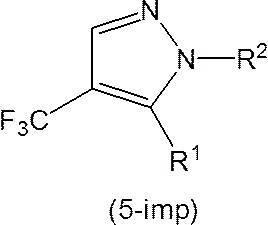
- a cyclization reaction occurs by reacting compound (3) with compound (4a) or compound (4b). It is represented by the following formula (5-imp) which is a positional isomer in which the substitution position of the substituent (R 1 , R 2 , CF 3 ) of the pyrazole ring is different from the target compound (5) by the cyclization reaction.
- 5-imp is a positional isomer in which the substitution position of the substituent (R 1 , R 2 , CF 3 ) of the pyrazole ring is different from the target compound (5) by the cyclization reaction.
- step 1 there is no particular limitation on the order of addition of compound (3) and compound (4a) or compound (4b).
- the amount of compound (4a) or compound (4b) to be used is not particularly limited, and is preferably from 0.8 to 3.0 mol based on 1 mol of compound (3), preferably from 0.9 to 2.0 mol is more preferable, 1.0 to 1.8 mol is more preferable, and 1.1 to 1.5 mol is particularly preferable.
- the total amount when the compound (4a) and the compound (4b) are used in combination is preferably 0.8 to 3.0 mol, more preferably 0.9 to 2.0 mol, relative to 1 mol of the compound (3). 1.0 to 1.8 mol is more preferable, and 1.1 to 1.5 mol is particularly preferable.
- the reaction between compound (3) and compound (4a) or compound (4b) may be carried out in the presence of a solvent.
- the solvent is preferably selected from solvents that are inert to the reaction, and is appropriately selected according to the reaction temperature, the solubility of the substrate, and the like.
- the solvent include ether solvents such as diethyl ether, tetrahydrofuran and dioxane, carboxylic acid solvents such as acetic acid and propionic acid, ester solvents such as methyl acetate, ethyl acetate, butyl acetate and ethyl propionate, benzene and toluene.
- Aromatic hydrocarbon solvents such as xylene and mesitylene, aromatic halogen solvents such as monochlorobenzene and dichlorobenzene, aliphatic hydrocarbon solvents such as hexane, heptane, octane and cyclohexane, methylene chloride, chloroform, 1, 2 -An aliphatic halogen solvent such as dichloroethane, a nitrile solvent such as acetonitrile, propionitrile, benzonitrile, or a mixed solvent thereof with water can be used, but is not limited thereto. These solvents may be used alone or in combination of two or more. From the viewpoint of reaction rate, the solvent is preferably an aliphatic halogen solvent or a nitrile solvent, and more preferably methylene chloride or acetonitrile.
- the amount of the solvent to be used is not particularly limited and is preferably 1 to 50 times (weight basis), more preferably 2 to 10 times (weight basis) with respect to compound (3).
- the reaction temperature in step 2 is preferably adjusted as appropriate so that the lower limit is about ⁇ 50 ° C. and the upper limit is the boiling point of the solvent. From the viewpoint of reaction rate and reaction efficiency, ⁇ 40 ° C. to 100 ° C. is preferable, and ⁇ 20 ° C. to More preferred is room temperature (about 25 ° C.).
- the reaction time is appropriately set according to conditions such as the amount and type of the substrate and solvent, and the reaction temperature, and is preferably 5 minutes to 24 hours, more preferably 10 minutes to 8 hours, from the viewpoint of reaction rate and reaction efficiency. 30 minutes to 4 hours is more preferable.
- the reaction pressure is appropriately set as necessary, and may be any of pressurization, reduced pressure, and atmospheric pressure, and atmospheric pressure is preferable.
- the reaction atmosphere is preferably in air or an inert gas atmosphere such as nitrogen or argon.
- the reaction crude product produced by the reaction of the compound (3) and the compound (4a) or the compound (4b) may be used for the next reaction as it is, but in the usual case, from the reaction crude product, the compound (5 ) Is preferably isolated and purified.
- the isolation / purification method methods known or well known to those skilled in the art can be employed, and examples include solvent extraction, distillation, silica gel column chromatography, preparative thin layer chromatography, preparative liquid chromatography and the like.
- Step 3 [Production Process of Compound (6) (Process 3)]
- Compound (6) can be produced by hydrolyzing compound (5a).
- step 3 the step of producing compound (6) from compound (5a) is referred to as step 3.
- R 11 and R 12 are as defined above, and preferred embodiments thereof are the same as those of R 1 and R 2 .
- a known or well-known method can be applied, a method of reacting compound (5a) in the presence of an acid or base and water, or a reaction of compound (5a) in the presence of an acid or base. It is preferable to carry out by a method of bringing the compound (5a) into contact with water after reacting in the presence of an acid.
- the acid include sulfuric acid, phosphoric acid, trifluoromethanesulfonic acid, fuming sulfuric acid and the like, and fuming sulfuric acid is preferable.
- the amount of the acid is preferably 1 equivalent or more, more preferably 1 to 150 equivalents relative to the compound (5a).
- the amount of water is preferably 2 equivalents or more, particularly preferably 10 to 50 equivalents, relative to compound (5a).
- the reaction between the compound (5a) and the acid can be performed in the presence or absence of a solvent.
- the solvent is preferably selected from solvents that are inert to the reaction, and is appropriately selected according to the reaction temperature, the solubility of the substrate, and the like. Step 3 is preferably performed in the absence of a solvent.
- the lower limit is preferably adjusted to about 0 ° C.
- the upper limit is preferably appropriately adjusted as the boiling point of the solvent or the acid. ° C is preferred, and room temperature to 100 ° C is more preferred.
- the reaction time is appropriately set according to conditions such as the amount and type of the substrate and acid, and the reaction temperature, and is preferably 5 minutes to 24 hours, more preferably 10 minutes to 8 hours from the viewpoint of reaction rate and reaction efficiency. 30 minutes to 4 hours is more preferable.
- the reaction pressure is appropriately set as necessary, and may be any of pressurization, reduced pressure, and atmospheric pressure, and atmospheric pressure is preferable.
- the reaction atmosphere is preferably in air or an inert gas atmosphere such as nitrogen or argon.
- the compound (6) is preferable to isolate and purify the compound (6) from the reaction crude product containing the compound (6) obtained by reacting the compound (5a) with an acid.
- an isolation / purification method methods known or well known to those skilled in the art can be employed, and examples thereof include solvent extraction, distillation, silica gel column chromatography, preparative thin layer chromatography, preparative liquid chromatography and the like.
- R A1 is OR 13 or NR 14 R 15 .
- R 13 is a C1-8 alkyl group, aryl group or aryl group having a substituent, preferably a C1-8 alkyl group or aryl group, more preferably a methyl group, an ethyl group or a phenyl group. It is.
- R 14 and R 15 are each independently a hydrogen atom, a C1-8 alkyl group, an aryl group or an aryl group having a substituent, or R 14 and R 15 are bonded to each other, and A 5- to 6-membered heterocycle may be formed together with the nitrogen atom to which it is bonded.
- R 14 and R 15 are preferably, independently of one another, a C1-8 alkyl group or aryl group, or R 14 and R 15 are preferably bonded to each other and are bonded to each other. Together with the nitrogen atom, it forms pyrrolidine, piperidine or morpholine.
- R 14 and R 15 are more preferably, independently of each other, a methyl group, an ethyl group or a phenyl group, or R 14 and R 15 are more preferably bonded to each other, Together with the nitrogen atom it forms pyrrolidine, piperidine or morpholine.
- Y 11 is an oxygen atom or N + R 16 R 17 ⁇ A ⁇ .
- R 16 and R 17 are each independently a C1-8 alkyl group, aryl group or aryl group having a substituent, or R 16 and R 17 are bonded to each other, and It may form a 5- to 6-membered heterocycle together with the nitrogen atom.
- R 16 and R 17 are preferably, independently of each other, a C1-8 alkyl group or aryl group, or R 16 and R 17 are preferably bonded to each other and are bonded to each other. Together with the nitrogen atom forms pyrrolidine, piperidine or morpholine.
- R 16 and R 17 are more preferably, independently of each other, a methyl group, an ethyl group, or a phenyl group, or R 16 and R 17 are more preferably bonded to each other so that they are bonded to each other. Together with the nitrogen atom, pyrrolidine, piperidine or morpholine is formed.
- a ⁇ is a counter anion.
- a ⁇ is preferably a halide ion such as fluoride ion or chloride ion, or tetrafluoroborate ion (BF 4 ⁇ ).
- the wavy line in formula (3c) indicates that the binding position of R A1 may be E or Z.
- the compound represented by the following formula (5b) is a novel compound. That is, the present invention provides a novel compound represented by the following formula (5b).
- R 12 is a hydrogen atom or a C1-8 alkyl group, preferably a hydrogen atom, a methyl group or an ethyl group.
- Specific examples of the compound represented by the compound (5b) include the following compounds.
- Compound (3c) and compound (5b) are intermediate compounds useful in the production method of the present invention.
- Compound (5) and compound (6) produced via these intermediates are useful as intermediates for pharmaceuticals and agricultural chemicals.
- compound (3c) and compound (5b) which are novel and useful intermediates, can be produced from inexpensive raw materials under reaction conditions advantageous for industrial implementation. Since the compound (3) and the compound (5) used in the production method of the present invention are chemically stable and easy to handle, the production method of the present invention via these intermediates and the production of the present invention A method for producing a pharmaceutical or an agricultural chemical using these compounds obtained by the method as starting materials is a method more suitable for industrial implementation than the conventional methods.
- compound n means a compound represented by the formula (n).
- the structure of the product obtained in each example was determined by NMR (JNM-ECP400 manufactured by JEOL Ltd.). The unit of yield obtained from NMR is mol%.
- reaction solution was cooled to ⁇ 40 ° C., 0.3 g (6.7 mmol) of 98% methyl hydrazine was slowly added, stirred at ⁇ 40 ° C. for 1 hour, and then warmed to room temperature. After concentrating acetonitrile with an evaporator, the solution was separated with water and methylene chloride, and the organic layer was dried over sodium sulfate. Concentration with an evaporator gave 1-methyl-3-difluoromethyl-4-trifluoromethylpyrazole in a yield of 32%.
- 3-substituted-4-trifluoromethylpyrazole derivatives and 3-substituted-pyrazole-4-carboxylic acid derivatives useful as intermediates for pharmaceuticals and agricultural chemicals can be easily produced. Further, the production method of the present invention is an industrially and economically excellent method because it does not use expensive raw materials and has high selectivity and yield.
Landscapes
- Chemical & Material Sciences (AREA)
- Organic Chemistry (AREA)
- Plural Heterocyclic Compounds (AREA)
Abstract
本発明は、医薬や農薬の中間体として有用なピラゾール誘導体とその製造方法および該製造方法における有用かつ新規な中間体化合物を提供する。 本発明は、化合物(1)と化合物(2)を反応させて化合物(3)を得て、つぎに化合物(3)と化合物(4a)又は下式(4b)とを反応させる、ピラゾール誘導体(5)の製造方法に関する。(式中、R1、R2、RA、X、Y1、R8及びR9は、請求の範囲及び明細書と同義である。)
Description
本発明は、医薬や農薬の中間体として有用な3-置換-4-トリフルオロメチルピラゾール誘導体及び3-置換-ピラゾール-4-カルボン酸誘導体の新規な製造方法、並びに前記方法における新規な中間体化合物に関するものである。
3-置換-4-トリフルオロメチルピラゾール誘導体及び3-置換-ピラゾール-4-カルボン酸誘導体は医薬や農薬の中間体として有用であり、これまでその製法が幾つか報告されている。例えば、炎症の治療に有用なピラゾール化合物の中間体として、4,4,4-トリフルオロ-ブチン酸エチルとトリメチルシリルジアゾメタンとを反応させて、4-トリフルオロメチルピラゾール-3-カルボン酸エチルを得る製法が報告されている(例えば、特許文献1参照)。また、4,4,4-トリフルオロ-ブチン酸エチルと3-メチルシドノンを反応させて、1-メチル-4-トリフルオロメチル-1H-ピラゾール-3-カルボン酸エチルを得る製法が報告されている(例えば、特許文献2参照)。
しかし、これらの製法の一方の原料である、4,4,4-トリフルオロ-ブチン酸エチルは高価であり、また他方の原料であるトリメチルシリルジアゾメタンや3-メチルシドノンは不安定で取扱いが難しく、これらの製法は、工業的に適した製法ではない。
本発明の目的は、3-置換-4-トリフルオロメチルピラゾール誘導体及び3-置換-ピラゾール-4-カルボン酸誘導体を製造するためのより容易でより経済的に実用的な製造方法を提供することである。
本発明の目的は、3-置換-4-トリフルオロメチルピラゾール誘導体及び3-置換-ピラゾール-4-カルボン酸誘導体を製造するためのより容易でより経済的に実用的な製造方法を提供することである。
本発明者らは、上記課題を鑑み鋭意検討を重ねた結果、本発明を完成するに至った。
本発明は、以下のとおりである:
[1] 下式(1)で表される化合物と下式(2)で表される化合物とを反応させて下式(3)で表される化合物を得て、つぎに式(3)で表される化合物と下式(4a)又は下式(4b)で表される化合物とを反応させて下式(5)で表されるピラゾール誘導体を得ることを特徴とする、ピラゾール誘導体の製造方法。
本発明は、以下のとおりである:
[1] 下式(1)で表される化合物と下式(2)で表される化合物とを反応させて下式(3)で表される化合物を得て、つぎに式(3)で表される化合物と下式(4a)又は下式(4b)で表される化合物とを反応させて下式(5)で表されるピラゾール誘導体を得ることを特徴とする、ピラゾール誘導体の製造方法。
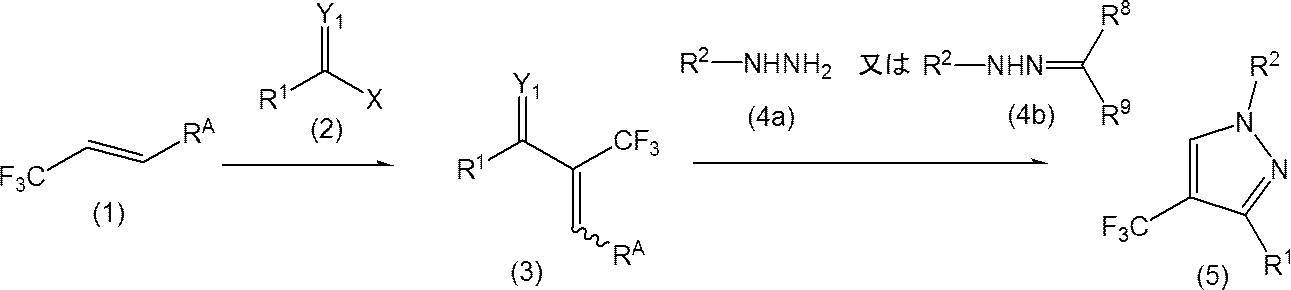
[式中、
R1は、C1~8のアルキル基、C1~8のハロアルキル基、C3~8のシクロアルキル基、置換基を有するC3~8のシクロアルキル基、アリール基、置換基を有するアリール基、ヘテロアリール基、置換基を有するヘテロアリール基又はエステル化されたカルボキシ基を表し、
R2は、水素原子又はC1~8のアルキル基を表し、
RAは、OR3又はNR4R5(式中、R3は、C1~8のアルキル基、アリール基又は置換基を有するアリール基を表し、R4及びR5は、互いに独立して、水素原子、C1~8のアルキル基、アリール基もしくは置換基を有するアリール基を表すか、又はR4及びR5は、互いに結合して、それらが結合している窒素原子と一緒になって5~6員のヘテロ環を形成してもよい。)を表し、
Xは、ハロゲン原子を表し、
Y1は、酸素原子又はN+R6R7・A-(式中、R6及びR7は、互いに独立して、C1~8のアルキル基、アリール基もしくは置換基を有するアリール基を表すか、又はR6及びR7は、互いに結合して、それらが結合している窒素原子と一緒になって5~6員のヘテロ環を形成してもよく、A-は、カウンターアニオンを表す。)を表し、
R8及びR9は、互いに独立して、水素原子、C1~12のアルキル基、置換基を有するC1~12のアルキル基、C3~8のシクロアルキル基、置換基を有するC3~8のシクロアルキル基、アリール基、置換基を有するアリール基、ヘテロアリール基もしくは置換基を有するヘテロアリール基を表すか、又はR8及びR9は、互いに結合して、それらが結合している炭素原子と一緒になって3~8員のシクロアルカン、置換基を有する3~8員のシクロアルカン、3~8員のヘテロ環もしくは置換基を有する3~8員のヘテロ環を形成してもよく、
式(3)における波線は、RAの結合位置がEであってもZであってもよいことを示す。]
R1は、C1~8のアルキル基、C1~8のハロアルキル基、C3~8のシクロアルキル基、置換基を有するC3~8のシクロアルキル基、アリール基、置換基を有するアリール基、ヘテロアリール基、置換基を有するヘテロアリール基又はエステル化されたカルボキシ基を表し、
R2は、水素原子又はC1~8のアルキル基を表し、
RAは、OR3又はNR4R5(式中、R3は、C1~8のアルキル基、アリール基又は置換基を有するアリール基を表し、R4及びR5は、互いに独立して、水素原子、C1~8のアルキル基、アリール基もしくは置換基を有するアリール基を表すか、又はR4及びR5は、互いに結合して、それらが結合している窒素原子と一緒になって5~6員のヘテロ環を形成してもよい。)を表し、
Xは、ハロゲン原子を表し、
Y1は、酸素原子又はN+R6R7・A-(式中、R6及びR7は、互いに独立して、C1~8のアルキル基、アリール基もしくは置換基を有するアリール基を表すか、又はR6及びR7は、互いに結合して、それらが結合している窒素原子と一緒になって5~6員のヘテロ環を形成してもよく、A-は、カウンターアニオンを表す。)を表し、
R8及びR9は、互いに独立して、水素原子、C1~12のアルキル基、置換基を有するC1~12のアルキル基、C3~8のシクロアルキル基、置換基を有するC3~8のシクロアルキル基、アリール基、置換基を有するアリール基、ヘテロアリール基もしくは置換基を有するヘテロアリール基を表すか、又はR8及びR9は、互いに結合して、それらが結合している炭素原子と一緒になって3~8員のシクロアルカン、置換基を有する3~8員のシクロアルカン、3~8員のヘテロ環もしくは置換基を有する3~8員のヘテロ環を形成してもよく、
式(3)における波線は、RAの結合位置がEであってもZであってもよいことを示す。]
[2] 下式(3)で表される化合物と下式(4a)又は下式(4b)で表される化合物とを反応させて、下式(5)で表されるピラゾール誘導体を得ることを特徴とする、ピラゾール誘導体の製造方法。
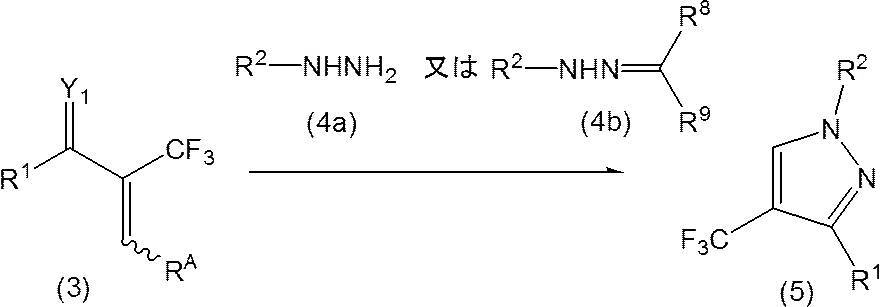
[式中、
R1は、C1~8のアルキル基、C1~8のハロアルキル基、C3~8のシクロアルキル基、置換基を有するC3~8のシクロアルキル基、アリール基、置換基を有するアリール基、ヘテロアリール基、置換基を有するヘテロアリール基又はエステル化されたカルボキシ基を表し、
R2は、水素原子又はC1~8のアルキル基を表し、
RAは、OR3又はNR4R5(式中、R3は、C1~8のアルキル基、アリール基又は置換基を有するアリール基を表し、R4及びR5は、互いに独立して、水素原子、C1~8のアルキル基、アリール基もしくは置換基を有するアリール基を表すか、又はR4及びR5は、互いに結合して、それらが結合している窒素原子と一緒になって5~6員のヘテロ環を形成してもよい。)を表し、
Y1は、酸素原子又はN+R6R7・A-(式中、R6及びR7は、互いに独立して、C1~8のアルキル基、アリール基もしくは置換基を有するアリール基を表すか、又はR6及びR7は、互いに結合して、それらが結合している窒素原子と一緒になって5~6員のヘテロ環を形成してもよく、A-は、カウンターアニオンを表す。)を表し、
R8及びR9は、互いに独立して、水素原子、C1~12のアルキル基、置換基を有するC1~12のアルキル基、C3~8のシクロアルキル基、置換基を有するC3~8のシクロアルキル基、アリール基、置換基を有するアリール基、ヘテロアリール基もしくは置換基を有するヘテロアリール基を表すか、又はR8及びR9は、互いに結合して、それらが結合している炭素原子と一緒になって3~8員のシクロアルカン、置換基を有する3~8員のシクロアルカン、3~8員のヘテロ環もしくは置換基を有する3~8員のヘテロ環を形成してもよく、
式(3)における波線は、RAの結合位置がEであってもZであってもよいことを示す。]
R1は、C1~8のアルキル基、C1~8のハロアルキル基、C3~8のシクロアルキル基、置換基を有するC3~8のシクロアルキル基、アリール基、置換基を有するアリール基、ヘテロアリール基、置換基を有するヘテロアリール基又はエステル化されたカルボキシ基を表し、
R2は、水素原子又はC1~8のアルキル基を表し、
RAは、OR3又はNR4R5(式中、R3は、C1~8のアルキル基、アリール基又は置換基を有するアリール基を表し、R4及びR5は、互いに独立して、水素原子、C1~8のアルキル基、アリール基もしくは置換基を有するアリール基を表すか、又はR4及びR5は、互いに結合して、それらが結合している窒素原子と一緒になって5~6員のヘテロ環を形成してもよい。)を表し、
Y1は、酸素原子又はN+R6R7・A-(式中、R6及びR7は、互いに独立して、C1~8のアルキル基、アリール基もしくは置換基を有するアリール基を表すか、又はR6及びR7は、互いに結合して、それらが結合している窒素原子と一緒になって5~6員のヘテロ環を形成してもよく、A-は、カウンターアニオンを表す。)を表し、
R8及びR9は、互いに独立して、水素原子、C1~12のアルキル基、置換基を有するC1~12のアルキル基、C3~8のシクロアルキル基、置換基を有するC3~8のシクロアルキル基、アリール基、置換基を有するアリール基、ヘテロアリール基もしくは置換基を有するヘテロアリール基を表すか、又はR8及びR9は、互いに結合して、それらが結合している炭素原子と一緒になって3~8員のシクロアルカン、置換基を有する3~8員のシクロアルカン、3~8員のヘテロ環もしくは置換基を有する3~8員のヘテロ環を形成してもよく、
式(3)における波線は、RAの結合位置がEであってもZであってもよいことを示す。]
[3] R1がジフルオロメチル基である、[1]又は[2]に記載のピラゾール誘導体の製造方法。
[4] R8及びR9における置換基を有するC1~12のアルキル基の置換基が、互いに独立して、-XA、-ORB、-SRB、-N(RB)(RC)、-Si(RB)(RC)(RD)、-COORB、-(C=O)RB、-CN及び-CON(RB)(RC)からなる群から選択される(式中、RB、RC、RDは、それぞれ独立に、水素原子又はC1~8のアルキル基を表し、XAはフッ素原子または塩素原子を表す)、[1]又は[2]に記載の製造方法。
[4] R8及びR9における置換基を有するC1~12のアルキル基の置換基が、互いに独立して、-XA、-ORB、-SRB、-N(RB)(RC)、-Si(RB)(RC)(RD)、-COORB、-(C=O)RB、-CN及び-CON(RB)(RC)からなる群から選択される(式中、RB、RC、RDは、それぞれ独立に、水素原子又はC1~8のアルキル基を表し、XAはフッ素原子または塩素原子を表す)、[1]又は[2]に記載の製造方法。
[5] 下式(5a)で表される化合物を加水分解することを特徴とする、下式(6)で表されるピラゾール-4-カルボン酸誘導体の製造方法。
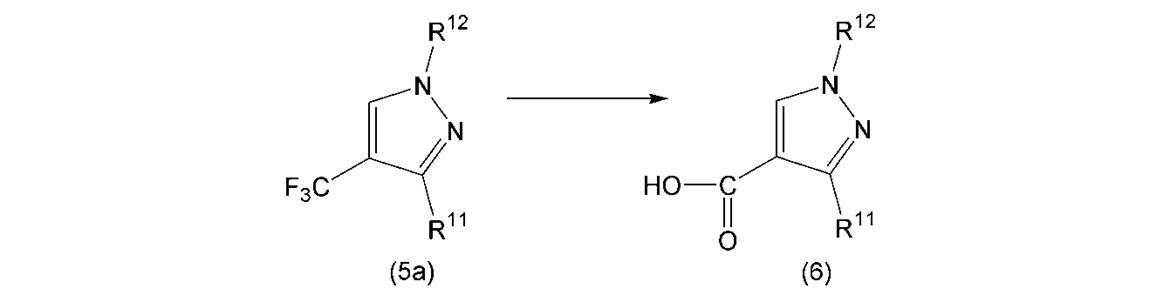
(式中、
R11は、C1~8のアルキル基、C1~8のハロアルキル基(ただし、トリハロメチル基を除く)、C3~8のシクロアルキル基、置換基を有するC3~8のシクロアルキル基、アリール基、置換基を有するアリール基、ヘテロアリール基又は置換基を有するヘテロアリール基を表し、
R12は、水素原子又はC1~8のアルキル基を表す。)
R11は、C1~8のアルキル基、C1~8のハロアルキル基(ただし、トリハロメチル基を除く)、C3~8のシクロアルキル基、置換基を有するC3~8のシクロアルキル基、アリール基、置換基を有するアリール基、ヘテロアリール基又は置換基を有するヘテロアリール基を表し、
R12は、水素原子又はC1~8のアルキル基を表す。)
[6] 加水分解を酸の存在下に行う、[5]に記載のピラゾール-4-カルボン酸誘導体の製造方法。
[7] 酸が発煙硫酸である、[6]に記載のピラゾール-4-カルボン酸誘導体の製造方法。
[8] 式(5a)で表される化合物を[1]又は[2]に記載の製造方法により得る、[5]~[7]のいずれかに記載のピラゾール-4-カルボン酸誘導体の製造方法。
[9] R11がジフルオロメチル基である、[5]~[8]のいずれかに記載のピラゾール-4-カルボン酸誘導体の製造方法。
[7] 酸が発煙硫酸である、[6]に記載のピラゾール-4-カルボン酸誘導体の製造方法。
[8] 式(5a)で表される化合物を[1]又は[2]に記載の製造方法により得る、[5]~[7]のいずれかに記載のピラゾール-4-カルボン酸誘導体の製造方法。
[9] R11がジフルオロメチル基である、[5]~[8]のいずれかに記載のピラゾール-4-カルボン酸誘導体の製造方法。
[10] 下式(1)で表される化合物と下式(2)で表される化合物とを反応させることを特徴とする、下式(3)で表される化合物の製造方法。

[式中、
R1は、C1~8のアルキル基、C1~8のハロアルキル基、C3~8のシクロアルキル基、置換基を有するC3~8のシクロアルキル基、アリール基、置換基を有するアリール基、ヘテロアリール基、置換基を有するヘテロアリール基又はエステル化されたカルボキシ基を表し、
RAは、OR3又はNR4R5(式中、R3は、C1~8のアルキル基、アリール基又は置換基を有するアリール基を表し、R4及びR5は、互いに独立して、水素原子、C1~8のアルキル基、アリール基もしくは置換基を有するアリール基を表すか、又はR4及びR5は、互いに結合して、それらが結合している窒素原子と一緒になって5~6員のヘテロ環を形成してもよい。)を表し、
Xは、ハロゲン原子を表し、
Y1は、酸素原子又はN+R6R7・A-(式中、R6及びR7は、互いに独立して、C1~8のアルキル基、アリール基もしくは置換基を有するアリール基を表すか、又はR6及びR7は、互いに結合して、それらが結合している窒素原子と一緒になって5~6員のヘテロ環を形成してもよく、A-は、カウンターアニオンを表す。)を表し、
式(3)における波線は、RAの結合位置がEであってもZであってもよいことを示す。]
R1は、C1~8のアルキル基、C1~8のハロアルキル基、C3~8のシクロアルキル基、置換基を有するC3~8のシクロアルキル基、アリール基、置換基を有するアリール基、ヘテロアリール基、置換基を有するヘテロアリール基又はエステル化されたカルボキシ基を表し、
RAは、OR3又はNR4R5(式中、R3は、C1~8のアルキル基、アリール基又は置換基を有するアリール基を表し、R4及びR5は、互いに独立して、水素原子、C1~8のアルキル基、アリール基もしくは置換基を有するアリール基を表すか、又はR4及びR5は、互いに結合して、それらが結合している窒素原子と一緒になって5~6員のヘテロ環を形成してもよい。)を表し、
Xは、ハロゲン原子を表し、
Y1は、酸素原子又はN+R6R7・A-(式中、R6及びR7は、互いに独立して、C1~8のアルキル基、アリール基もしくは置換基を有するアリール基を表すか、又はR6及びR7は、互いに結合して、それらが結合している窒素原子と一緒になって5~6員のヘテロ環を形成してもよく、A-は、カウンターアニオンを表す。)を表し、
式(3)における波線は、RAの結合位置がEであってもZであってもよいことを示す。]
[11] 下式(3c)で表される化合物。

[式中、
RA1は、OR13又はNR14R15(式中、R13は、C1~8のアルキル基、アリール基又は置換基を有するアリール基を表し、R14及びR15は、互いに独立して、水素原子、C1~8のアルキル基、アリール基もしくは置換基を有するアリール基を表すか、又はR14及びR15は、互いに結合して、それらが結合している窒素原子と一緒になって5~6員のヘテロ環を形成してもよい。)を表し、
Y11は、酸素原子又はN+R16R17・A-(式中、R16及びR17は、互いに独立して、C1~8のアルキル基、アリール基もしくは置換基を有するアリール基を表すか、又はR16及びR17は、互いに結合して、それらが結合している窒素原子と一緒になって5~6員のヘテロ環を形成してもよく、A-は、カウンターアニオンを表す。)を表し、
式(3c)における波線は、RA1の結合位置がEであってもZであってもよいことを示す。]
RA1は、OR13又はNR14R15(式中、R13は、C1~8のアルキル基、アリール基又は置換基を有するアリール基を表し、R14及びR15は、互いに独立して、水素原子、C1~8のアルキル基、アリール基もしくは置換基を有するアリール基を表すか、又はR14及びR15は、互いに結合して、それらが結合している窒素原子と一緒になって5~6員のヘテロ環を形成してもよい。)を表し、
Y11は、酸素原子又はN+R16R17・A-(式中、R16及びR17は、互いに独立して、C1~8のアルキル基、アリール基もしくは置換基を有するアリール基を表すか、又はR16及びR17は、互いに結合して、それらが結合している窒素原子と一緒になって5~6員のヘテロ環を形成してもよく、A-は、カウンターアニオンを表す。)を表し、
式(3c)における波線は、RA1の結合位置がEであってもZであってもよいことを示す。]
[12] 下式(5b)で表される化合物。

(式中、R12は、水素原子又はC1~8のアルキル基を表す。)
本発明の製造方法によれば、医薬や農薬の中間体として有用な3-置換-4-トリフルオロメチルピラゾール誘導体及び3-置換-ピラゾール-4-カルボン酸誘導体を、容易に製造できる。また該製造に有用な新規な化合物を提供する。また本発明の製造方法は、高価な原料を用いることなく、また選択性や収率も高いことから、工業的及び経済的においても優れた方法である。
以下に本発明の実施の形態について詳細に説明する。
[用語の定義]
本明細書において「~」を用いて示された数値範囲は、「~」の前後に記載される数値をそれぞれ最小値及び最大値として含む範囲を示す。C1とは炭素数が1であることを示し、他の表現においても同様である。
[用語の定義]
本明細書において「~」を用いて示された数値範囲は、「~」の前後に記載される数値をそれぞれ最小値及び最大値として含む範囲を示す。C1とは炭素数が1であることを示し、他の表現においても同様である。
本発明において、「C1~8のアルキル基」は、炭素数1~8の、直鎖状又は分岐鎖状のアルキル基を意味し、メチル基、エチル基、プロピル基、イソプロピル基、ブチル基、イソブチル基、s-ブチル基、t-ブチル基、ペンチル基、ヘキシル基、ヘプチル基、オクチル基等を例示できる。
本発明において、「C1~12のアルキル基」は、炭素数1~12の、直鎖状又は分岐鎖状のアルキル基を意味し、メチル基、エチル基、プロピル基、イソプロピル基、ブチル基、イソブチル基、s-ブチル基、t-ブチル基、ペンチル基、ヘキシル基、ヘプチル基、オクチル基、ノニル基、デシル基、ウンデシル基、ドデシル基等を例示できる。
本発明において、「C1~12のアルキル基」は、炭素数1~12の、直鎖状又は分岐鎖状のアルキル基を意味し、メチル基、エチル基、プロピル基、イソプロピル基、ブチル基、イソブチル基、s-ブチル基、t-ブチル基、ペンチル基、ヘキシル基、ヘプチル基、オクチル基、ノニル基、デシル基、ウンデシル基、ドデシル基等を例示できる。
「C1~8のハロアルキル基」は、前記アルキル基の水素原子の1個以上が、ハロゲン原子で置換された基を意味する。ハロゲン原子としては、臭素原子、ヨウ素原子、フッ素原子、および塩素原子が挙げられる。該C1~8のハロアルキル基としては、ブロモメチル基、2-ブロモエチル基、3-ブロモプロピル基、4-ブロモブチル基、5-ブロモペンチル基、6-ブロモヘキシル基、ヨードメチル基、2-ヨードエチル基、3-ヨードプロピル基、4-ヨードブチル基、5-ヨードペンチル基、6-ヨードヘキシル基、フルオロメチル基、2-フルオロエチル基、3-フルオロプロピル基、4-フルオロブチル基、5-フルオロペンチル基、6-フルオロヘキシル基、トリブロモメチル基、トリクロロメチル基、トリフルオロメチル基等を例示できる。
「C3~8のシクロアルキル基」は、炭素数3~8のシクロアルキル基を意味し、シクロプロピル基、シクロブチル基、シクロペンチル基、シクロヘキシル基、シクロオクチル基等を例示できる。
「置換基」は、公知の置換基であり、本発明の製造方法における反応に関与しない基から選択される。
「置換基を有するC3~8のシクロアルキル基」は、前記シクロアルキル基の水素原子の1個以上が、置換基で置換された基を意味する。該置換基としては、本発明の製造方法における反応に関与しない基から選択され、C1~8のアルキル基、C1~8のアルコキシ基、アリール基等が挙げられる。置換基を有するC3~8のシクロアルキル基の炭素数は、置換基の炭素数を含めて3~8である。置換基を有するC3~8のシクロアルキル基の例としては、2-メチルシクロプロピル基、1-メチルシクロペンチル基、4-メチルシクロヘキシル基等を挙げることができる。
「置換基を有するC3~8のシクロアルキル基」は、前記シクロアルキル基の水素原子の1個以上が、置換基で置換された基を意味する。該置換基としては、本発明の製造方法における反応に関与しない基から選択され、C1~8のアルキル基、C1~8のアルコキシ基、アリール基等が挙げられる。置換基を有するC3~8のシクロアルキル基の炭素数は、置換基の炭素数を含めて3~8である。置換基を有するC3~8のシクロアルキル基の例としては、2-メチルシクロプロピル基、1-メチルシクロペンチル基、4-メチルシクロヘキシル基等を挙げることができる。
「C1~8のアルコキシ基」は、基RO-(ここで、Rは、C1~8のアルキル基)を意味し、メトキシ基、エトキシ基、プロピルオキシ基、イソプロピルオキシ基、ブトキシ基、イソブチルオキシ基、s-ブチルオキシ基、t-ブチルオキシ基、ヘキシルオキシ基等を例示できる。
「C3~8のシクロアルコキシ基」は、基R’O-(ここで、R’は、C3~8のシクロアルキル基)を意味し、シクロプロピルオキシ基、シクロブチルオキシ基、シクロペンチルオキシ基、シクロヘキシルオキシ基等を例示できる。
「アリール基」は、炭素数6~18の芳香族炭化水素基を意味し、フェニル基、ナフチル基、アントリル基等を例示できる。
「置換基を有するアリール基」は、前記アリール基の水素原子の1個以上が、置換基で置換された基を意味する。該置換基としては、本発明の製造方法における反応に関与しない基から選択され、C1~8のアルキル基、C1~8のアルコキシ基、C3~8のシクロアルキル基、C3~8のシクロアルコキシ基、ハロゲン原子等が挙げられる。置換基を有するアリール基の例として、2-メチルフェニル基(o-トリル基)、3-メチルフェニル基(m-トリル基)、4-メチルフェニル基(p-トリル基)、2,4-ジ-t-ブチルフェニル基、4-メトキシフェニル基、4-クロロフェニル基等を例示できる。
「ヘテロアリール基」は、窒素原子、酸素原子及び硫黄原子からなる群より選択される少なくとも1個のヘテロ原子を含む、3~10員の1価の芳香族複素環基を意味し、例としては、フリル、ベンゾフラニル、ジベンゾフラニル、チエニル、ベンゾチエニル、ジベンゾチエニル、ピロリル、インドリル、カルバゾリル、イミダゾリル、ベンゾイミダゾリル、ピラゾリル、オキサゾリル、ベンゾオキサゾリル、チアゾリル、ベンゾチアゾリル、フラザニル、ピリジル、ピラニル、ピラジニル、ピリミジニル、ピリダジニル、トリアジニル、キノリル、インドリジニル、シンノリニル、プリニル、カルボニリル、フェナントロリニル、イミダゾピリミジニル等が挙げられる。
「置換基を有するヘテロアリール基」は、前記ヘテロアリール基の水素原子の1個以上が置換基で置換された基を意味する。該置換基としては、本発明の製造方法における反応に関与しない基から選択され、C1~8のアルキル基、C1~8のアルコキシ基、C3~8のシクロアルキル基、C3~8のシクロアルコキシ基、ハロゲン原子、アリール基等が挙げられる。
「エステル化されたカルボキシ基」とは、基-COOR”(ここで、R”は、C1~8のアルキル基、C1~8のハロアルキル基、C3~8のシクロアルキル基又はアリール基)を意味し、メトキシカルボニル基、エトキシカルボニル基、tert-ブトキシカルボニル基、トリフルオロメトキシカルボニル基、シクロヘキシルオキシカルボニル基、フェニルオキシカルボニル基等を例示できる。
「置換基を有するC1~12のアルキル基」における置換基としては、本発明の製造方法における反応に関与しない基から選択され、-XA、-ORB、-SRB、-N(RB)(RC)、-Si(RB)(RC)(RD)、-COORB、-(C=O)RB、-CN及び-CON(RB)(RC)からなる群から選択される基(式中、RB、RC、RDは、それぞれ独立に、水素原子又はC1~8のアルキル基を表し、XAはフッ素原子または塩素原子を表す。)が挙げられる。
R4及びR5、並びに、R6及びR7が、互いに結合して、それらが結合している窒素原子と一緒になって形成してもよい「5~6員のヘテロ環」とは、少なくとも1個の窒素原子を含み、場合により窒素原子、酸素原子及び硫黄原子からなる群より選択される少なくとも1個の追加のヘテロ原子を含む、5~6員の1価の飽和又は不飽和の複素環を意味する。5~6員のヘテロ環の例としては、ピロール、ピロリン、ピロリジン、イミダゾール、イミダゾリン、イミダゾリジン、ピラゾール、ピラゾリン、ピラゾリジン、ピリジン、ピペリジン、ピラジン、ピペラジン、ピリミジン、ピリダジン、チアゾール、チアゾリン、チアゾリジン、イソチアゾール、イソチアゾリン、イソチアゾリジン、オキサゾール、オキサゾリン、オキサゾリジン、イソオキサゾール、イソオキサゾリン、イソオキサゾリジン、モルホリン等が挙げられる。
R8及びR9が互いに結合して、それらが結合している炭素原子と一緒になって形成してもよい「C3~8のシクロアルカン」は、炭素数3~8のシクロアルカンを意味し、シクロプロパン、シクロブタン、シクロペンタン、シクロヘキサン、シクロオクタン等を例示できる。
R8及びR9が互いに結合して、それらが結合している炭素原子と一緒になって形成してもよい「置換基を有するC3~8のシクロアルカン」は、前記シクロアルカンの水素原子の1個以上が、置換基で置換された基を意味する。該置換基としては、本発明の製造方法における反応に関与しない基から選択され、C1~8のアルキル基、C1~8のアルコキシ基、アリール基等が挙げられる。置換基を有するC3~8のシクロアルカンの炭素数は、置換基の炭素数を含めて3~8である。置換基を有するC3~8のシクロアルカンの例として、2-メチルシクロプロパン、1-メチルシクロペンタン、4-メチルシクロヘキサン等を挙げることができる。
R8及びR9が互いに結合して、それらが結合している炭素原子と一緒になって形成してもよい「3~8員のヘテロ環」とは、少なくとも1個の窒素原子を含み、場合により窒素原子、酸素原子及び硫黄原子からなる群より選択される少なくとも1個の追加のヘテロ原子を含む、3~8員の1価の飽和又は不飽和の複素環を意味し、3~8員のヘテロ環の例としては、アジリジン、アゼチジン、ピロール、ピロリン、ピロリジン、イミダゾール、イミダゾリン、イミダゾリジン、ピラゾール、ピラゾリン、ピラゾリジン、ピリジン、ピペリジン、ピラジン、ピペラジン、ピリミジン、ピリダジン、チアゾール、チアゾリン、チアゾリジン、イソチアゾール、イソチアゾリン、イソチアゾリジン、オキサゾール、オキサゾリン、オキサゾリジン、イソオキサゾール、イソオキサゾリン、イソオキサゾリジン、モルホリン、アゼパン、アゼピン等が挙げられる。
R8及びR9が互いに結合して、それらが結合している炭素原子と一緒になって形成してもよい「置換基を有する3~8員のヘテロ環」とは、前記3~8員のヘテロ環の水素原子の1個以上が置換基で置換された基を意味する。該置換基としては、本発明の製造方法における反応に関与しない基から選択され、C1~8のアルキル基、C1~8のアルコキシ基、C3~8のシクロアルキル基、C3~8のシクロアルコキシ基、ハロゲン原子、アリール基等が挙げられる。
ハロゲン原子は、ヨウ素原子、臭素原子、塩素原子又はフッ素原子を意味する。
「カウンターアニオン」としては、ハロゲン化物イオン、フルオロハイドロジェネートアニオン((HF)nF-、式中、nは整数を表す。)、ハロゲンオキソ酸イオン、無機酸イオン及び有機酸イオンからなる群から選ばれる陰イオンが好ましい。ハロゲン化物イオンの例として、フッ化物イオン(F-)、塩化物イオン(Cl-)、臭化物イオン(Br-)及びヨウ化物イオン(I-)を挙げることができる。ハロゲンオキソ酸イオンの例として、次亜塩素酸イオン(ClO-)、亜塩素酸イオン(ClO2
-)、塩素酸イオン(ClO3
-)、過塩素酸イオン(ClO4
-)、次亜臭素酸イオン(BrO-)、亜臭素酸イオン(BrO2
-)、臭素酸イオン(BrO3
-)、過臭素酸イオン(BrO4
-)、次亜ヨウ素酸イオン(IO-)、亜ヨウ素酸イオン(IO2
-)、ヨウ素酸イオン(IO3
-)、過ヨウ素酸イオン(IO4
-)等を挙げることができる。無機酸イオンの例として、水酸化物イオン、炭酸イオン、炭酸水素イオン、硫酸イオン、硫酸水素イオン、リン酸イオン、リン酸水素イオン、リン酸二水素イオン、硝酸イオン、ホウ酸イオン、テトラフルオロホウ酸イオン等を挙げることができる。有機酸イオンの例として、酢酸イオン、トリフルオロ酢酸イオン、トリフルオロメタンスルホン酸イオン、テトラフェニルホウ酸イオン等を挙げることができる。
[本発明の製造ルート]
以下のスキーム1に、本発明の製造ルートの概要を示す。以下、本発明の実施態様について、スキーム1の工程毎に詳細に説明するが、本発明の実施態様では、各工程はそれぞれ独立に実施してもよく、また一部又は全部を連続的に実施してもよい。「化合物(n)」は、式(n)で表される化合物を意味する。
以下のスキーム1に、本発明の製造ルートの概要を示す。以下、本発明の実施態様について、スキーム1の工程毎に詳細に説明するが、本発明の実施態様では、各工程はそれぞれ独立に実施してもよく、また一部又は全部を連続的に実施してもよい。「化合物(n)」は、式(n)で表される化合物を意味する。

式中の記号は以下の意味を示す。
R1は、C1~8のアルキル基、C1~8のハロアルキル基、C3~8のシクロアルキル基、置換基を有するC3~8のシクロアルキル基、アリール基、置換基を有するアリール基、ヘテロアリール基、置換基を有するヘテロアリール基又はエステル化されたカルボキシ基を表す。
R2は、水素原子又はC1~8のアルキル基を表す。
RAは、OR3又はNR4R5(式中、R3は、C1~8のアルキル基、アリール基又は置換基を有するアリール基を表し、R4及びR5は、互いに独立して、水素原子、C1~8のアルキル基、アリール基もしくは置換基を有するアリール基を表すか、又はR4及びR5は、互いに結合して、それらが結合している窒素原子と一緒になって5~6員のヘテロ環を形成してもよい。)を表す。
Xは、ハロゲン原子を表す。
Y1は、酸素原子又はN+R6R7・A-(式中、R6及びR7は、互いに独立して、C1~8のアルキル基、アリール基もしくは置換基を有するアリール基を表すか、又はR6及びR7は、互いに結合して、それらが結合している窒素原子と一緒になって5~6員のヘテロ環を形成してもよく、A-は、カウンターアニオンを表す。)を表す。
R8及びR9は、互いに独立して、水素原子、C1~12のアルキル基、置換基を有するC1~12のアルキル基、C3~8のシクロアルキル基、置換基を有するC3~8のシクロアルキル基、アリール基、置換基を有するアリール基、ヘテロアリール基もしくは置換基を有するヘテロアリール基を表すか、又はR8及びR9は、互いに結合して、それらが結合している炭素原子と一緒になって3~8員のシクロアルカン、置換基を有する3~8員のシクロアルカン、3~8員のヘテロ環もしくは置換基を有する3~8員のヘテロ環を形成してもよい。
R11は、C1~8のアルキル基、C1~8のハロアルキル基(ただし、トリハロメチル基を除く)、C3~8のシクロアルキル基、置換基を有するC3~8のシクロアルキル基、アリール基、置換基を有するアリール基、ヘテロアリール基又は置換基を有するヘテロアリール基を表す。
R12は、水素原子又はC1~8のアルキル基を表す。
式(3)における波線は、RAの結合位置がEであってもZであってもよいことを示す。
R1は、C1~8のアルキル基、C1~8のハロアルキル基、C3~8のシクロアルキル基、置換基を有するC3~8のシクロアルキル基、アリール基、置換基を有するアリール基、ヘテロアリール基、置換基を有するヘテロアリール基又はエステル化されたカルボキシ基を表す。
R2は、水素原子又はC1~8のアルキル基を表す。
RAは、OR3又はNR4R5(式中、R3は、C1~8のアルキル基、アリール基又は置換基を有するアリール基を表し、R4及びR5は、互いに独立して、水素原子、C1~8のアルキル基、アリール基もしくは置換基を有するアリール基を表すか、又はR4及びR5は、互いに結合して、それらが結合している窒素原子と一緒になって5~6員のヘテロ環を形成してもよい。)を表す。
Xは、ハロゲン原子を表す。
Y1は、酸素原子又はN+R6R7・A-(式中、R6及びR7は、互いに独立して、C1~8のアルキル基、アリール基もしくは置換基を有するアリール基を表すか、又はR6及びR7は、互いに結合して、それらが結合している窒素原子と一緒になって5~6員のヘテロ環を形成してもよく、A-は、カウンターアニオンを表す。)を表す。
R8及びR9は、互いに独立して、水素原子、C1~12のアルキル基、置換基を有するC1~12のアルキル基、C3~8のシクロアルキル基、置換基を有するC3~8のシクロアルキル基、アリール基、置換基を有するアリール基、ヘテロアリール基もしくは置換基を有するヘテロアリール基を表すか、又はR8及びR9は、互いに結合して、それらが結合している炭素原子と一緒になって3~8員のシクロアルカン、置換基を有する3~8員のシクロアルカン、3~8員のヘテロ環もしくは置換基を有する3~8員のヘテロ環を形成してもよい。
R11は、C1~8のアルキル基、C1~8のハロアルキル基(ただし、トリハロメチル基を除く)、C3~8のシクロアルキル基、置換基を有するC3~8のシクロアルキル基、アリール基、置換基を有するアリール基、ヘテロアリール基又は置換基を有するヘテロアリール基を表す。
R12は、水素原子又はC1~8のアルキル基を表す。
式(3)における波線は、RAの結合位置がEであってもZであってもよいことを示す。
[化合物(3)の製造工程(工程1)]
化合物(3)は、化合物(1)を化合物(2)と反応させて製造できる。以下、化合物(1)から化合物(3)を製造する工程を工程1という。
化合物(3)は、化合物(1)を化合物(2)と反応させて製造できる。以下、化合物(1)から化合物(3)を製造する工程を工程1という。
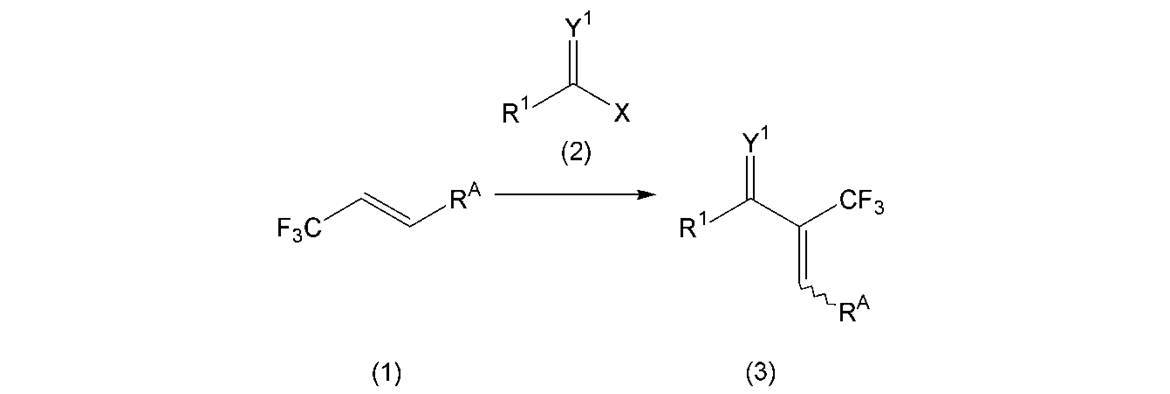
化合物(1)において、RAは、OR3又はNR4R5である。RAがOR3である化合物(1)は、下式(1a)で表される化合物である。RAがNR4R5である化合物(1)は、下式(1b)で表される化合物である。

R3は、前記と同義であり、好ましくはC1~8のアルキル基又はアリール基であり、より好ましくはメチル基、エチル基又はフェニル基である。
R4及びR5は、前記と同義である。R4及びR5は、好ましくは、互いに独立して、C1~8のアルキル基又はアリール基であるか、又はR4及びR5は、好ましくは、互いに結合して、それらが結合している窒素原子と一緒になってピロリジン、ピペリジン又はモルホリンを形成する。R4及びR5は、より好ましくは、互いに独立して、メチル基、エチル基もしくはフェニル基であるか、又はR4及びR5は、より好ましくは、互いに結合して、それらが結合している窒素原子と一緒になってピロリジン、ピペリジン又はモルホリンを形成する。
化合物(1)は、市販品として容易に入手できる1-クロロ-3,3,3-トリフルオロ-1-プロペンと対応するアルコール(R3OH)又はアミン(NHR4R5)等の化合物から公知の方法(アルコールは、例えばJournal of Fluorine Chemistry 129 (2008) 35-39、アミンは、例えば特開2006-124283号公報)に準じて製造できる。
R4及びR5は、前記と同義である。R4及びR5は、好ましくは、互いに独立して、C1~8のアルキル基又はアリール基であるか、又はR4及びR5は、好ましくは、互いに結合して、それらが結合している窒素原子と一緒になってピロリジン、ピペリジン又はモルホリンを形成する。R4及びR5は、より好ましくは、互いに独立して、メチル基、エチル基もしくはフェニル基であるか、又はR4及びR5は、より好ましくは、互いに結合して、それらが結合している窒素原子と一緒になってピロリジン、ピペリジン又はモルホリンを形成する。
化合物(1)は、市販品として容易に入手できる1-クロロ-3,3,3-トリフルオロ-1-プロペンと対応するアルコール(R3OH)又はアミン(NHR4R5)等の化合物から公知の方法(アルコールは、例えばJournal of Fluorine Chemistry 129 (2008) 35-39、アミンは、例えば特開2006-124283号公報)に準じて製造できる。
化合物(2)のY1は、酸素原子又はN+R6R7・A-である。Y1が酸素原子である化合物(2)は、下式(2a)で表されるアシルハライド化合物である。Y1がN+R6R7・A-である化合物(2)は、下式(2b)で表されるイミニウム塩化合物である。

R1は、前記と同義であり、好ましくは、C1~8のハロアルキル基であり、より好ましくはジフルオロメチル基である。
Xは、前記と同義であり、好ましくは、フッ素原子又は塩素原子である。
R6及びR7は、前記と同義である。R6及びR7は、好ましくは、互いに独立して、C1~8のアルキル基もしくはアリール基であるか、又はR6及びR7は、好ましくは、互いに結合して、それらが結合している窒素原子と一緒になってピロリジン、ピペリジンもしくはモルホリンを形成する。R6及びR7は、より好ましくは、互いに独立して、メチル基、エチル基もしくはフェニル基であるか、又はR6及びR7は、より好ましくは、互いに結合して、それらが結合している窒素原子と一緒になってピロリジン、ピペリジンもしくはモルホリンを形成する。
A-は、前記と同義であり、好ましくはフッ化物イオン、塩化物イオン等のハロゲン化物イオン又はテトラフルオロホウ酸イオン(BF4 -)である。
Xは、前記と同義であり、好ましくは、フッ素原子又は塩素原子である。
R6及びR7は、前記と同義である。R6及びR7は、好ましくは、互いに独立して、C1~8のアルキル基もしくはアリール基であるか、又はR6及びR7は、好ましくは、互いに結合して、それらが結合している窒素原子と一緒になってピロリジン、ピペリジンもしくはモルホリンを形成する。R6及びR7は、より好ましくは、互いに独立して、メチル基、エチル基もしくはフェニル基であるか、又はR6及びR7は、より好ましくは、互いに結合して、それらが結合している窒素原子と一緒になってピロリジン、ピペリジンもしくはモルホリンを形成する。
A-は、前記と同義であり、好ましくはフッ化物イオン、塩化物イオン等のハロゲン化物イオン又はテトラフルオロホウ酸イオン(BF4 -)である。
化合物(2a)は市販されており、例えば2,2-ジフルオロ酢酸クロリドは容易に市販品を入手できる。また市販品である対応するカルボン酸(R1COOH)等から公知の方法(例えば、Journal of Fluorine Chemistry 23 (1983) 383-388)に準じて製造できる。
化合物(2b)は、市販品である対応するアミン(R1CX2NR6R7)とカウンターアニオン源となりうる酸から公知の方法(例えば、国際公開第2008-022777号公報)に準じて製造できる。
化合物(2b)は、市販品である対応するアミン(R1CX2NR6R7)とカウンターアニオン源となりうる酸から公知の方法(例えば、国際公開第2008-022777号公報)に準じて製造できる。
工程1における反応は、二重結合にCF3が結合した化合物(1)に対する、基-C(=Y1)Xを有する化合物(2)の反応であるが、このような反応例はこれまで報告がない。本発明の反応によれば、R1-C(=Y1)-部分の構造が異なる様々な化合物(2)を用いて、二重結合にR1-C(=Y1)-構造が導入された化合物(3)を得て、該化合物(3)を環化することにより、ピラゾール環に所望のR1基を導入できる。
工程1における化合物(1)と化合物(2)の添加順序に特に制限はない。化合物(2)の使用量は、特に限定されず、経済性の観点から、化合物(1)1モルに対して、0.8~3.0モルが好ましく、0.9~2.0モルがより好ましく、1.0~1.8モルが更に好ましい。
工程1における化合物(1)と化合物(2)の添加順序に特に制限はない。化合物(2)の使用量は、特に限定されず、経済性の観点から、化合物(1)1モルに対して、0.8~3.0モルが好ましく、0.9~2.0モルがより好ましく、1.0~1.8モルが更に好ましい。
化合物(1)と化合物(2)の反応は、溶媒の存在下に行ってもよい。溶媒としては、反応に不活性な溶媒から選択するのが好ましく、反応温度や基質の溶解性等に応じて適宜選択される。溶媒としては、例えば、ジエチルエーテル、テトラヒドロフラン、ジオキサン等のエーテル系溶媒、アセトン、メチルエチルケトン、メチルイソブチルケトン等のケトン系溶媒、酢酸、プロピオン酸等のカルボン酸系溶媒、酢酸メチル、酢酸エチル、酢酸ブチル、プロピオン酸エチル等のエステル系溶媒、ベンゼン、トルエン、キシレン、メシチレン等の芳香族炭化水素系溶媒、モノクロロベンゼン、ジクロロベンゼン等の芳香族ハロゲン系溶媒、ヘキサン、ヘプタン、オクタン、シクロヘキサン等の脂肪族炭化水素系溶媒、塩化メチレン、クロロホルム、1,2-ジクロロエタン等の脂肪族ハロゲン系溶媒、アセトニトリル、プロピオニトリル、ベンゾニトリル等のニトリル系溶媒などが挙げられる。溶媒は1種のみであっても、2種類以上の混合溶媒であってもよい。溶媒は、反応率の観点から、芳香族炭化水素系溶媒及びニトリル系溶媒が好ましく、トルエン及びアセトニトリルが更に好ましい。
溶媒の使用量は、特に制限はなく、化合物(1)に対して、1~50倍量(重量基準)が好ましく、2~10倍量(重量基準)がより好ましい。
化合物(1)と化合物(2)の反応は、塩基の存在下に実施してもよい。塩基としては、水素化ナトリウム、水素化カリウム、水素化カルシウム等の金属水素化物;イミダゾール、ピリジン、2,6-ルチジン、s-コリジン、N-メチルピロリジン、N-メチルピペリジン、エチルジイソプロピルアミン、トリエチルアミン、トリブチルアミンを含むトリ(C1~4アルキル)アミン等の有機アミン;水酸化ナトリウム、水酸化カリウム、炭酸カリウム等の無機塩等を例示できる。塩基としては、収率が向上することから、有機アミンが好ましく、さらにピリジン又は及びトリエチルアミンが好ましい。
塩基の使用量は、化合物(1)に対して1モルに対して、0.8~3.0モルが好ましく、0.9~2.0モルがより好ましく、1.0~1.8モルが更に好ましい。
塩基の使用量は、化合物(1)に対して1モルに対して、0.8~3.0モルが好ましく、0.9~2.0モルがより好ましく、1.0~1.8モルが更に好ましい。
工程1における反応温度は、下限を-70℃程度とし、上限は溶媒の沸点として適宜調節するのが好ましく、反応速度と反応効率の観点から、-40℃~150℃が好ましく、-20℃~100℃がより好ましく、-20℃~60℃が更に好ましい。反応時間は、基質や溶媒の量、種類、及び反応温度等に応じて適宜設定され、反応速度と反応効率の観点から、5分~24時間が好ましく、10分~6時間がより好ましく、30分~2時間が更に好ましい。反応圧力は、必要に応じて適宜設定され、加圧、減圧、大気圧のいずれでもよく、大気圧が好ましい。反応雰囲気は、空気中、又は窒素もしくはアルゴン酸の不活性ガス雰囲気下が好ましい。
化合物(1)と化合物(2)の反応により生成する反応粗生成物は、そのまま次の反応に用いてもよいが、通常の場合は反応粗生成物中から、化合物(3)を単離・精製するのが好ましい。単離・精製方法としては、当業者に公知ないしは周知の方法が採用でき、溶媒抽出、蒸留、シリカゲルカラムクロマトグラフィー、分取薄層クロマトグラフィー、分取液体クロマトグラフィー等の方法が挙げられる。
[化合物(5)の製造工程(工程2)]
化合物(5)は、化合物(3)を化合物(4a)又は化合物(4b)と反応させて製造できる。以下、化合物(3)から化合物(5)を製造する工程を工程2という。
化合物(5)は、化合物(3)を化合物(4a)又は化合物(4b)と反応させて製造できる。以下、化合物(3)から化合物(5)を製造する工程を工程2という。
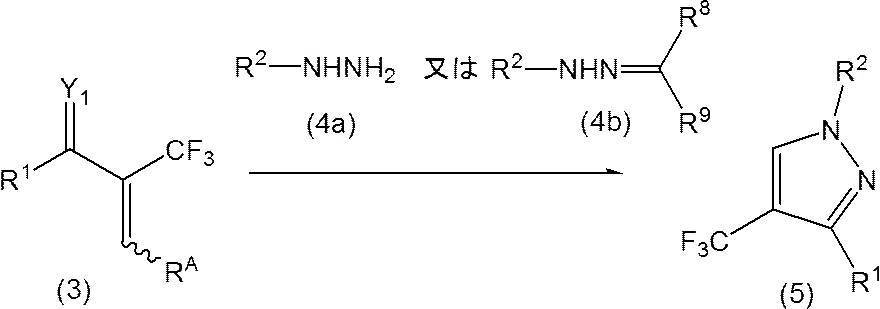
R1、RA及びY1の定義及び好ましい態様は、工程1と同じである。
化合物(4a)において、R2は、前記と同義であり、水素原子、メチル基、エチル基、n-プロピル基、イソプロピル基などが挙げられる。R2は、好ましくは水素原子、メチル基又はエチル基である。化合物(4a)の具体例としては、ヒドラジン(R2が水素原子である化合物)、メチルヒドラジン(R2がメチル基である化合物)、エチルヒドラジン(R2がエチル基である化合物)等を例示できる。これらは市販品が容易に入手できる。化合物(4a)は水和物や水溶液を用いてもよい。たとえばヒドラジン一水和物やメチルヒドラジン40%水溶液を用いることもできる。
化合物(4b)において、R2は、前記と同義であり、水素原子、メチル基、エチル基、n-プロピル基、イソプロピル基などが挙げられる。R3は、好ましくは水素原子、メチル基又はエチル基である。
R8及びR9は、前記と同義である。R8及びR9は、好ましくは、互いに独立して、水素原子、C1~12のアルキル基もしくはアリール基であるか、又はR8及びR9は、好ましくは、互いに結合して、それらが結合している炭素原子と一緒になって3~8員のシクロアルカンを形成する。R8及びR9は、より好ましくは、互いに独立して、水素原子、メチル基、エチル基、t-ブチル基もしくはフェニル基であるか、又はR8及びR9は、より好ましくは、互いに結合して、それらが結合している炭素原子と一緒になってシクロペンタン又はシクロヘキサンを形成する。R8及びR9は、さらに好ましくは、互いに独立して、水素原子、メチル基もしくはエチル基であるか、又はR8及びR9は、さらに好ましくは、互いに結合して、それらが結合している炭素原子と一緒になってシクロペンタンまたはシクロヘキサンを形成する。
化合物(4b)の具体例としては、R2がメチル基、かつR8及びR9が共にメチル基である化合物、R2がメチル基、かつR8及びR9が互いに結合して、それらが結合している炭素原子と一緒になってシクロヘキサンを形成した化合物、R2がメチル基、R8がメチル基、かつR9がエチル基である化合物、R2がメチル基、R8が水素原子、かつR9がフェニル基である化合物、R2がメチル基、R8がメチル基、かつR9がt-ブチル基である化合物等が挙げられる。
化合物(4b)は公知の方法で合成でき、例えば特表2011-513446号公報に記載の方法で合成できる。
化合物(4b)において、R2は、前記と同義であり、水素原子、メチル基、エチル基、n-プロピル基、イソプロピル基などが挙げられる。R3は、好ましくは水素原子、メチル基又はエチル基である。
R8及びR9は、前記と同義である。R8及びR9は、好ましくは、互いに独立して、水素原子、C1~12のアルキル基もしくはアリール基であるか、又はR8及びR9は、好ましくは、互いに結合して、それらが結合している炭素原子と一緒になって3~8員のシクロアルカンを形成する。R8及びR9は、より好ましくは、互いに独立して、水素原子、メチル基、エチル基、t-ブチル基もしくはフェニル基であるか、又はR8及びR9は、より好ましくは、互いに結合して、それらが結合している炭素原子と一緒になってシクロペンタン又はシクロヘキサンを形成する。R8及びR9は、さらに好ましくは、互いに独立して、水素原子、メチル基もしくはエチル基であるか、又はR8及びR9は、さらに好ましくは、互いに結合して、それらが結合している炭素原子と一緒になってシクロペンタンまたはシクロヘキサンを形成する。
化合物(4b)の具体例としては、R2がメチル基、かつR8及びR9が共にメチル基である化合物、R2がメチル基、かつR8及びR9が互いに結合して、それらが結合している炭素原子と一緒になってシクロヘキサンを形成した化合物、R2がメチル基、R8がメチル基、かつR9がエチル基である化合物、R2がメチル基、R8が水素原子、かつR9がフェニル基である化合物、R2がメチル基、R8がメチル基、かつR9がt-ブチル基である化合物等が挙げられる。
化合物(4b)は公知の方法で合成でき、例えば特表2011-513446号公報に記載の方法で合成できる。
化合物(3)と化合物(4a)又は化合物(4b)とを反応させることにより、環化反応が起こる。環化反応により、目的とする化合物(5)とともに、ピラゾール環の置換基(R1、R2、CF3)の置換位置が異なる位置異性体である下式(5-imp)で表される化合物が生成しうるが、本発明においては、化合物(5-imp)の生成が極めて少なく、化合物(5)を高収率で得ることができる。また化合物(5)と化学的な性質が類似する化合物(5-imp)との分離が容易である点は、工業的実施において極めて有利である。
工程1において、化合物(3)と化合物(4a)又は化合物(4b)の添加順序に特に制限はない。化合物(4a)又は化合物(4b)の使用量は、特に限定されず、経済性の観点から、化合物(3)1モルに対して、0.8~3.0モルが好ましく、0.9~2.0モルがより好ましく、1.0~1.8モルが更に好ましく、1.1~1.5モルが特に好ましい。化合物(4a)と化合物(4b)を併用する場合の総量は、化合物(3)に1モルに対して、0.8~3.0モルが好ましく、0.9~2.0モルがより好ましく、1.0~1.8モルが更に好ましく、1.1~1.5モルが特に好ましい。
化合物(3)と化合物(4a)又は化合物(4b)の反応は、溶媒の存在下に行ってもよい。溶媒としては、反応に不活性な溶媒から選択するのが好ましく、反応温度や基質の溶解性等に応じて適宜選択される。溶媒としては、例えば、ジエチルエーテル、テトラヒドロフラン、ジオキサン等のエーテル系溶媒、酢酸、プロピオン酸等のカルボン酸系溶媒、酢酸メチル、酢酸エチル、酢酸ブチル、プロピオン酸エチル等のエステル系溶媒、ベンゼン、トルエン、キシレン、メシチレン等の芳香族炭化水素系溶媒、モノクロロベンゼン、ジクロロベンゼン等の芳香族ハロゲン系溶媒、ヘキサン、ヘプタン、オクタン、シクロヘキサン等の脂肪族炭化水素系溶媒、塩化メチレン、クロロホルム、1,2-ジクロロエタン等の脂肪族ハロゲン系溶媒、アセトニトリル、プロピオニトリル、ベンゾニトリル等のニトリル系溶媒、又はそれらと水の混合溶媒等を使用できるが、これに限定されるものではない。これらの溶媒は1種を用いても2種類以上を混合して使用してもよい。溶媒は、反応率の観点から、脂肪族ハロゲン系溶媒又はニトリル系溶媒を用いることが好ましく、塩化メチレン又はアセトニトリルを用いることが更に好ましい。
溶媒の使用量は、特に制限はなく、化合物(3)に対して、1~50倍量(重量基準)が好ましく、2~10倍量(重量基準)がより好ましい。
工程2における反応温度は、下限を-50℃程度とし、上限は溶媒の沸点として適宜調節するのが好ましく、反応速度と反応効率の観点から、-40℃~100℃が好ましく、-20℃~室温(約25℃)が更に好ましい。反応時間は、基質や溶媒の量、種類、及び反応温度等の条件に応じて適宜設定され、反応速度と反応効率の観点から、5分~24時間が好ましく、10分~8時間がより好ましく、30分~4時間が更に好ましい。反応圧力は、必要に応じて適宜設定され、加圧、減圧、大気圧のいずれでもよく、大気圧が好ましい。反応雰囲気は、空気中、又は窒素もしくはアルゴン等の不活性ガス雰囲気下が好ましい。
化合物(3)と化合物(4a)又は化合物(4b)の反応により生成する反応粗生成物は、そのまま次の反応に用いてもよいが、通常の場合は反応粗生成物中から、化合物(5)を単離・精製するのが好ましい。単離・精製方法としては、当業者に公知ないし周知の方法が採用でき、溶媒抽出、蒸留、シリカゲルカラムクロマトグラフィー、分取薄層クロマトグラフィー、分取液体クロマトグラフィー等の方法が挙げられる。
[化合物(6)の製造工程(工程3)]
化合物(6)は、化合物(5a)を加水分解することにより製造できる。以下、化合物(5a)から化合物(6)を製造する工程を工程3という。
化合物(6)は、化合物(5a)を加水分解することにより製造できる。以下、化合物(5a)から化合物(6)を製造する工程を工程3という。

R11及びR12の定義は前記と同義であり、その好ましい態様はR1及びR2と同じである。
工程3における加水分解反応は、公知ないしは周知の手法が適用でき、化合物(5a)を酸又は塩基と水との存在下に反応させる方法、あるいは化合物(5a)を酸又は塩基の存在下に反応させた後に水と接触させる方法により実施するのが好ましく、化合物(5a)を酸の存在下に反応させた後に水と接触させる方法により実施するのがより好ましい。酸としては、硫酸、リン酸、トリフルオロメタンスルホン酸、発煙硫酸等が挙げられ、発煙硫酸が好ましい。酸の量は、化合物(5a)に対して1当量以上が好ましく、1~150当量がさらに好ましい。水の量は、化合物(5a)に対して2当量以上が好ましく、10~50当量が特に好ましい。
工程3における加水分解反応は、公知ないしは周知の手法が適用でき、化合物(5a)を酸又は塩基と水との存在下に反応させる方法、あるいは化合物(5a)を酸又は塩基の存在下に反応させた後に水と接触させる方法により実施するのが好ましく、化合物(5a)を酸の存在下に反応させた後に水と接触させる方法により実施するのがより好ましい。酸としては、硫酸、リン酸、トリフルオロメタンスルホン酸、発煙硫酸等が挙げられ、発煙硫酸が好ましい。酸の量は、化合物(5a)に対して1当量以上が好ましく、1~150当量がさらに好ましい。水の量は、化合物(5a)に対して2当量以上が好ましく、10~50当量が特に好ましい。
工程3は、化合物(5a)と酸との反応は、溶媒の存在下又は不存在下で行うことができる。溶媒としては、反応に不活性な溶媒から選択するのが好ましく、反応温度や基質の溶解性等に応じて適宜選択される。工程3は、溶媒の不存在下で行うことが好ましい。
化合物(5a)と酸との反応は、下限を0℃程度とし、上限は溶媒又は酸の沸点として適宜調節するのが好ましく、反応速度と反応効率の観点から、室温(約25℃)~160℃が好ましく、室温~100℃が更に好ましい。反応時間は、基質や酸の量、種類、及び反応温度等の条件に応じて適宜設定され、反応速度と反応効率の観点から、5分~24時間が好ましく、10分~8時間がより好ましく、30分~4時間が更に好ましい。反応圧力は、必要に応じて適宜設定され、加圧、減圧、大気圧のいずれでもよく、大気圧が好ましい。反応雰囲気は、空気中、又は窒素もしくはアルゴン等の不活性ガス雰囲気下が好ましい。
化合物(5a)と酸との反応により得られる化合物(6)を含む反応粗生成物からは、化合物(6)を単離・精製するのが好ましい。単離・精製方法としては、当業者に公知ないしは周知の方法が採用でき、溶媒抽出、蒸留、シリカゲルカラムクロマトグラフィー、分取薄層クロマトグラフィー、分取液体クロマトグラフィー等の方法が挙げられる。
[中間体化合物]
化合物(1)と化合物(2)との反応で生成する化合物(3)のうち、下式(3c)で表される化合物は、新規で有用な化合物である。すなわち、本発明は、新規な下式(3c)で表される化合物を提供する。
化合物(1)と化合物(2)との反応で生成する化合物(3)のうち、下式(3c)で表される化合物は、新規で有用な化合物である。すなわち、本発明は、新規な下式(3c)で表される化合物を提供する。

RA1は、OR13又はNR14R15である。
R13は、C1~8のアルキル基、アリール基又は置換基を有するアリール基であり、好ましくは、C1~8のアルキル基又はアリール基であり、より好ましくは、メチル基、エチル基又はフェニル基である。
R14及びR15は、互いに独立して、水素原子、C1~8のアルキル基、アリール基もしくは置換基を有するアリール基であるか、又はR14及びR15は、互いに結合して、それらが結合している窒素原子と一緒になって5~6員のヘテロ環を形成してもよい。R14及びR15は、好ましくは、互いに独立して、C1~8のアルキル基又はアリール基であるか、又はR14及びR15は、好ましくは、互いに結合して、それらが結合している窒素原子と一緒になってピロリジン、ピペリジンもしくはモルホリンを形成する。R14及びR15は、より好ましくは、互いに独立して、メチル基、エチル基もしくはフェニル基であるか、又はR14及びR15は、より好ましくは、互いに結合して、それらが結合している窒素原子と一緒になってピロリジン、ピペリジンもしくはモルホリンを形成する。
Y11は、酸素原子又はN+R16R17・A-である。
R16及びR17は、互いに独立して、C1~8のアルキル基、アリール基もしくは置換基を有するアリール基であるか、又はR16及びR17は、互いに結合して、それらが結合している窒素原子と一緒になって5~6員のヘテロ環を形成してもよい。R16及びR17は、好ましくは、互いに独立して、C1~8のアルキル基又はアリール基であるか、又はR16及びR17は、好ましくは、互いに結合して、それらが結合している窒素原子と一緒になってピロリジン、ピペリジンまたはモルホリンを形成する。R16及びR17は、より好ましくは、互いに独立して、メチル基、エチル基もしくはフェニル基であるか、又はR16及びR17は、より好ましくは、互いに結合して、それらが結合している窒素原子と一緒になってピロリジン、ピペリジンまたはモルホリンを形成する。
A-は、カウンターアニオンである。A-は、好ましくはフッ化物イオン、塩化物イオン等のハロゲン化物イオン又はテトラフルオロホウ酸イオン(BF4 -)である。
式(3c)における波線は、RA1の結合位置がEであってもZであってもよいことを示す。
R13は、C1~8のアルキル基、アリール基又は置換基を有するアリール基であり、好ましくは、C1~8のアルキル基又はアリール基であり、より好ましくは、メチル基、エチル基又はフェニル基である。
R14及びR15は、互いに独立して、水素原子、C1~8のアルキル基、アリール基もしくは置換基を有するアリール基であるか、又はR14及びR15は、互いに結合して、それらが結合している窒素原子と一緒になって5~6員のヘテロ環を形成してもよい。R14及びR15は、好ましくは、互いに独立して、C1~8のアルキル基又はアリール基であるか、又はR14及びR15は、好ましくは、互いに結合して、それらが結合している窒素原子と一緒になってピロリジン、ピペリジンもしくはモルホリンを形成する。R14及びR15は、より好ましくは、互いに独立して、メチル基、エチル基もしくはフェニル基であるか、又はR14及びR15は、より好ましくは、互いに結合して、それらが結合している窒素原子と一緒になってピロリジン、ピペリジンもしくはモルホリンを形成する。
Y11は、酸素原子又はN+R16R17・A-である。
R16及びR17は、互いに独立して、C1~8のアルキル基、アリール基もしくは置換基を有するアリール基であるか、又はR16及びR17は、互いに結合して、それらが結合している窒素原子と一緒になって5~6員のヘテロ環を形成してもよい。R16及びR17は、好ましくは、互いに独立して、C1~8のアルキル基又はアリール基であるか、又はR16及びR17は、好ましくは、互いに結合して、それらが結合している窒素原子と一緒になってピロリジン、ピペリジンまたはモルホリンを形成する。R16及びR17は、より好ましくは、互いに独立して、メチル基、エチル基もしくはフェニル基であるか、又はR16及びR17は、より好ましくは、互いに結合して、それらが結合している窒素原子と一緒になってピロリジン、ピペリジンまたはモルホリンを形成する。
A-は、カウンターアニオンである。A-は、好ましくはフッ化物イオン、塩化物イオン等のハロゲン化物イオン又はテトラフルオロホウ酸イオン(BF4 -)である。
式(3c)における波線は、RA1の結合位置がEであってもZであってもよいことを示す。
化合物(3c)の具体例は、下記化合物が挙げられる。

化合物(3)と化合物(4a)又は化合物(4b)の反応で生成する化合物(5)のうち、下式(5b)で表される化合物は新規な化合物である。すなわち、本発明は、新規な下式(5b)で表される化合物を提供する。

R12は、水素原子又はC1~8のアルキル基であり、好ましくは、水素原子、メチル基又はエチル基である。
化合物(5b)で表される化合物の具体例としては、下記化合物が挙げられる。
化合物(5b)で表される化合物の具体例としては、下記化合物が挙げられる。

化合物(3c)及び化合物(5b)は、本発明の製造方法において有用な中間体化合物である。これらの中間体を経由して製造される化合物(5)及び化合物(6)は、医薬や農薬の中間体として有用である。
本発明によれば、新規で有用な中間体である化合物(3c)及び化合物(5b)を、安価な原料から、工業的な実施に有利な反応条件で製造できる。
本発明の製造方法に用いられる化合物(3)及び化合物(5)は化学的に安定であり、取扱いが容易であることから、これらの中間体を経由する本発明の製造方法および本発明の製造方法により得られたこれらの化合物を出発物質として医薬や農薬を製造する方法は、従来の方法よりも工業的な実施に適した方法である。
本発明によれば、新規で有用な中間体である化合物(3c)及び化合物(5b)を、安価な原料から、工業的な実施に有利な反応条件で製造できる。
本発明の製造方法に用いられる化合物(3)及び化合物(5)は化学的に安定であり、取扱いが容易であることから、これらの中間体を経由する本発明の製造方法および本発明の製造方法により得られたこれらの化合物を出発物質として医薬や農薬を製造する方法は、従来の方法よりも工業的な実施に適した方法である。
以下、本発明を実施例により説明するが、本発明はこれらの例に限定されない。以下において「化合物n」は、式(n)で表される化合物を意味する。各実施例で得た生成物をNMR(日本電子製JNM-ECP400)で構造決定した。NMRから求まる収率の単位はモル%である。
[実施例1]
N-(2-ジフルオロアセチル-3,3,3-トリフルオロプロペン-1-イル)ピペリジンの合成
N-(2-ジフルオロアセチル-3,3,3-トリフルオロプロペン-1-イル)ピペリジンの合成

窒素雰囲気下、トリエチルアミン1.9g(18.6mmol)とN-(3,3,3-トリフルオロプロペン-1-イル)ピペリジン2.6g(14.3mmol)をトルエン20mlに溶解し、-20℃に冷却した。そこに、ジフルオロ酢酸クロリド2.1g(18.6mmol)をゆっくり加えた後、室温まで昇温して1時間撹拌した。水とトルエンを加えて分液し、有機層を飽和NaHCO3水、飽和NaCl水で洗浄した後、エバポレーターで濃縮してN-(2-ジフルオロアセチル-3,3,3-トリフルオロプロペン-1-イル)ピペリジンを94%の収率で得た。
1H NMR(CDCl3) δ= 1.75(m, 6H), 3.50(m, 4H), 6.14(t, 1H), 7.66(br, 1H)
19F NMR(CDCl3) δ= -124.5(br, 2F), -51.7(br, 3F)
19F NMR(CDCl3) δ= -124.5(br, 2F), -51.7(br, 3F)
[実施例2]
1-メチル-3-ジフルオロメチル-4-トリフルオロメチルピラゾールの合成
1-メチル-3-ジフルオロメチル-4-トリフルオロメチルピラゾールの合成

窒素雰囲気下、塩化メチレン5mlに40%メチルヒドラジン水溶液(40%MMH)0.6g(5.0mmol)を加えて-20℃に冷却した。次いで、N-(2-ジフルオロアセチル-3,3,3-トリフルオロプロペン-1-イル)ピペリジン1.1g(4.2mmol)を塩化メチレン3mlに溶解させてゆっくりと加えた。-20℃で1時間撹拌後、室温に昇温して1時間撹拌した。水を加えて分液し、有機層をNa2SO4で乾燥させた後にエバポレーターで濃縮して1-メチル-3-ジフルオロメチル-4-トリフルオロメチルピラゾールを80%の収率で得た。
1H NMR(CDCl3) δ= 3.94(s, 3H), 6.72(t, 1H), 7.72(s, 1H)
19F NMR(CDCl3) δ= -113.3(d, 2F), -56.2(t, 3F)
19F NMR(CDCl3) δ= -113.3(d, 2F), -56.2(t, 3F)
[実施例3]
1H-3-ジフルオロメチル-4-トリフルオロメチルピラゾールの合成
1H-3-ジフルオロメチル-4-トリフルオロメチルピラゾールの合成

窒素雰囲気下、塩化メチレン5mlにヒドラジン一水和物0.4g(7.5mmol)を加えて氷冷した。次いで、N-(2-ジフルオロアセチル-3,3,3-トリフルオロプロペン-1-イル)ピペリジン1.6g(6.2mmol)を塩化メチレン3mlに溶解させてゆっくりと加えた。0℃で1時間撹拌後、室温に昇温して1時間撹拌した。水を加えて分液し、有機層をNa2SO4で乾燥させた後にエバポレーターで濃縮して1H-3-ジフルオロメチル-4-トリフルオロメチルピラゾールを44%の収率で得た。
1H NMR(CDCl3) δ= 6.82(t, 1H), 7.95(s, 1H)
19F NMR(CDCl3) δ= -113.9(d, 2F), -56.2(s, 3F)
19F NMR(CDCl3) δ= -113.9(d, 2F), -56.2(s, 3F)
[実施例4]
N-(1,1-ジフルオロ-4-ピペリジル-3-(トリフルオロメチル)-ブト-3-エン-2-イリデン)-N-メチルメタンアミニウムテトラフルオロボレートの合成
N-(1,1-ジフルオロ-4-ピペリジル-3-(トリフルオロメチル)-ブト-3-エン-2-イリデン)-N-メチルメタンアミニウムテトラフルオロボレートの合成
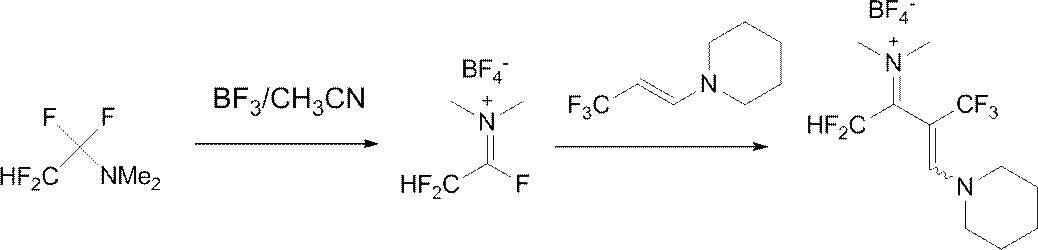
窒素雰囲気下、19%BF3-アセトニトリル溶液9.5g(30.7mmol)とアセトニトリル10mlを氷冷した後、N-1,1,2,2-テトラフルオロエチルジメチルアミン4.5g(30.7mmol)をゆっくり加えた。氷冷下30分撹拌した後、N-(3,3,3-トリフルオロプロペン-1-イル)ピペリジン3.2g(17.7mmol)をゆっくり加えた。その後、60℃に昇温して2時間撹拌した。エバポレーターでアセトニトリルを濃縮してN-(1,1-ジフルオロ-4-(ピペリジン-1-イル)-3-(トリフルオロメチル)-ブト-3-エン-2-イリデン)-N-メチルメタンアミニウムテトラフルオロボレートを82%の収率で得た。
19F NMR(アセトニトリル) δ= -122.2(d, 2F), -51.9(s, 3F)
[実施例5]
1-メチル-3-ジフルオロメチル-4-トリフルオロメチルピラゾールの合成
1-メチル-3-ジフルオロメチル-4-トリフルオロメチルピラゾールの合成

窒素雰囲気下、19%BF3-アセトニトリル溶液1.9g(6.1mmol)とアセトニトリル5mlを氷冷した後、N-1,1,2,2-テトラフルオロエチルジメチルアミン0.9g(6.1mmol)をゆっくり加えた。氷冷下30分撹拌した後、N-(3,3,3-トリフルオロプロペン-1-イル)ピペリジン1.0g(5.5mmol)をゆっくり加え、60℃に昇温して2時間撹拌した。その後反応液を-40℃に冷却し、98%メチルヒドラジン0.3g(6.7mmol)をゆっくり加え、-40℃で1時間撹拌した後、室温まで昇温した。エバポレーターでアセトニトリルを濃縮した後、水と塩化メチレンで分液し、有機層を硫酸ナトリウムで乾燥した。エバポレーターで濃縮して1-メチル-3-ジフルオロメチル-4-トリフルオロメチルピラゾールを32%の収率で得た。
[実施例6]
1-メチル-3-ジフルオロメチルピラゾール-4-カルボン酸の合成
1-メチル-3-ジフルオロメチルピラゾール-4-カルボン酸の合成

窒素雰囲気下、1-メチル-3-ジフルオロメチル-4-トリフルオロメチルピラゾール0.5g(2.5mmol)を60%発煙硫酸10mlに加え150℃で5時間加熱した。その後反応液を氷水に加えて、酢酸イソプロピルで抽出した。有機層をエバポレーターで濃縮して、1-メチル-3-ジフルオロメチルピラゾール-4-カルボン酸を60%の収率で得た。
1H NMR(アセトン-d6) δ= 4.00(s, 3H), 7.18(t, 1H), 8.23(s, 1H)
19F NMR(アセトン-d6) δ= -113.6(d, 2F)
19F NMR(アセトン-d6) δ= -113.6(d, 2F)
[実施例7]
1H-3-ジフルオロメチルピラゾール-4-カルボン酸の合成
1H-3-ジフルオロメチルピラゾール-4-カルボン酸の合成

窒素雰囲気下、1H-3-ジフルオロメチル-4-トリフルオロメチルピラゾール0.1g(0.5mmol)を60%発煙硫酸5mlに加え50℃で3時間加熱した。その後反応液を氷水に加えて、酢酸イソプロピルで抽出した。有機層をエバポレーターで濃縮して、1H-3-ジフルオロメチルピラゾール-4-カルボン酸を19%の収率で得た。
1H NMR(アセトン-d6) δ= 7.19(t, 1H), 8.23(s, 1H)
19F NMR(アセトン-d6) δ= -113.6(d, 2F)
19F NMR(アセトン-d6) δ= -113.6(d, 2F)
本発明の製造方法によれば、医薬や農薬の中間体として有用な3-置換-4-トリフルオロメチルピラゾール誘導体及び3-置換-ピラゾール-4-カルボン酸誘導体を、容易に製造できる。また本発明の製造方法は、高価な原料を用いることなく、また選択性や収率も高いことから、工業的及び経済的においても優れた方法である。
本出願は、日本で2015年3月25日に出願された特願2015-63359号を基礎としており、その内容は本明細書にすべて包含される。
Claims (12)
- 下式(1)で表される化合物と下式(2)で表される化合物とを反応させて下式(3)で表される化合物を得て、つぎに式(3)で表される化合物と下式(4a)又は下式(4b)で表される化合物とを反応させて下式(5)で表されるピラゾール誘導体を得ることを特徴とする、ピラゾール誘導体の製造方法。

R1は、C1~8のアルキル基、C1~8のハロアルキル基、C3~8のシクロアルキル基、置換基を有するC3~8のシクロアルキル基、アリール基、置換基を有するアリール基、ヘテロアリール基、置換基を有するヘテロアリール基又はエステル化されたカルボキシ基を表し、
R2は、水素原子又はC1~8のアルキル基を表し、
RAは、OR3又はNR4R5(式中、R3は、C1~8のアルキル基、アリール基又は置換基を有するアリール基を表し、R4及びR5は、互いに独立して、水素原子、C1~8のアルキル基、アリール基もしくは置換基を有するアリール基を表すか、又はR4及びR5は、互いに結合して、それらが結合している窒素原子と一緒になって5~6員のヘテロ環を形成してもよい。)を表し、
Xは、ハロゲン原子を表し、
Y1は、酸素原子又はN+R6R7・A-(式中、R6及びR7は、互いに独立して、C1~8のアルキル基、アリール基もしくは置換基を有するアリール基を表すか、又はR6及びR7は、互いに結合して、それらが結合している窒素原子と一緒になって5~6員のヘテロ環を形成してもよく、A-は、カウンターアニオンを表す。)を表し、
R8及びR9は、互いに独立して、水素原子、C1~12のアルキル基、置換基を有するC1~12のアルキル基、C3~8のシクロアルキル基、置換基を有するC3~8のシクロアルキル基、アリール基、置換基を有するアリール基、ヘテロアリール基もしくは置換基を有するヘテロアリール基を表すか、又はR8及びR9は、互いに結合して、それらが結合している炭素原子と一緒になって3~8員のシクロアルカン、置換基を有する3~8員のシクロアルカン、3~8員のヘテロ環もしくは置換基を有する3~8員のヘテロ環を形成してもよく、
式(3)における波線は、RAの結合位置がEであってもZであってもよいことを示す。] - 下式(3)で表される化合物と下式(4a)又は下式(4b)で表される化合物とを反応させて、下式(5)で表されるピラゾール誘導体を得ることを特徴とする、ピラゾール誘導体の製造方法。
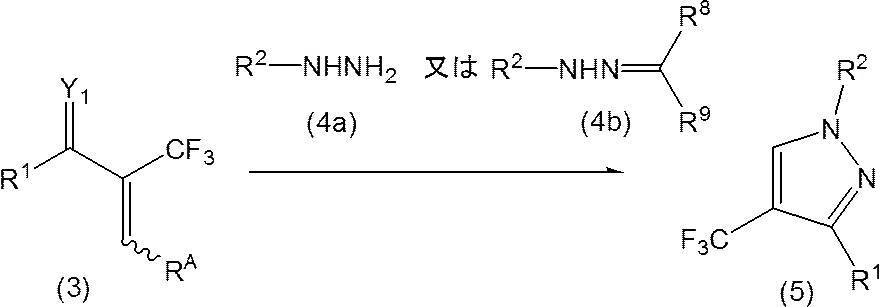
R1は、C1~8のアルキル基、C1~8のハロアルキル基、C3~8のシクロアルキル基、置換基を有するC3~8のシクロアルキル基、アリール基、置換基を有するアリール基、ヘテロアリール基、置換基を有するヘテロアリール基又はエステル化されたカルボキシ基を表し、
R2は、水素原子又はC1~8のアルキル基を表し、
RAは、OR3又はNR4R5(式中、R3は、C1~8のアルキル基、アリール基又は置換基を有するアリール基を表し、R4及びR5は、互いに独立して、水素原子、C1~8のアルキル基、アリール基もしくは置換基を有するアリール基を表すか、又はR4及びR5は、互いに結合して、それらが結合している窒素原子と一緒になって5~6員のヘテロ環を形成してもよい。)を表し、
Y1は、酸素原子又はN+R6R7・A-(式中、R6及びR7は、互いに独立して、C1~8のアルキル基、アリール基もしくは置換基を有するアリール基を表すか、又はR6及びR7は、互いに結合して、それらが結合している窒素原子と一緒になって5~6員のヘテロ環を形成してもよく、A-は、カウンターアニオンを表す。)を表し、
R8及びR9は、互いに独立して、水素原子、C1~12のアルキル基、置換基を有するC1~12のアルキル基、C3~8のシクロアルキル基、置換基を有するC3~8のシクロアルキル基、アリール基、置換基を有するアリール基、ヘテロアリール基もしくは置換基を有するヘテロアリール基を表すか、又はR8及びR9は、互いに結合して、それらが結合している炭素原子と一緒になって3~8員のシクロアルカン、置換基を有する3~8員のシクロアルカン、3~8員のヘテロ環もしくは置換基を有する3~8員のヘテロ環を形成してもよく、
式(3)における波線は、RAの結合位置がEであってもZであってもよいことを示す。] - R1がジフルオロメチル基である、請求項1又は2に記載のピラゾール誘導体の製造方法。
- R8及びR9における置換基を有するC1~12のアルキル基の置換基が、互いに独立して、-XA、-ORB、-SRB、-N(RB)(RC)、-Si(RB)(RC)(RD)、-COORB、-(C=O)RB、-CN及び-CON(RB)(RC)からなる群から選択される(式中、RB、RC、RDは、それぞれ独立に、水素原子又はC1~8のアルキル基を表し、XAはフッ素原子または塩素原子を表す)、請求項1又は2に記載の製造方法。
- 下式(5a)で表される化合物を加水分解することを特徴とする、下式(6)で表されるピラゾール-4-カルボン酸誘導体の製造方法。

R11は、C1~8のアルキル基、C1~8のハロアルキル基(ただし、トリハロメチル基を除く)、C3~8のシクロアルキル基、置換基を有するC3~8のシクロアルキル基、アリール基、置換基を有するアリール基、ヘテロアリール基又は置換基を有するヘテロアリール基を表し、
R12は、水素原子又はC1~8のアルキル基を表す。) - 加水分解を酸の存在下に行う、請求項5に記載のピラゾール-4-カルボン酸誘導体の製造方法。
- 酸が発煙硫酸である、請求項6に記載のピラゾール-4-カルボン酸誘導体の製造方法。
- 式(5a)で表される化合物を請求項1又は2に記載の製造方法により得る、請求項5~7のいずれかに記載のピラゾール-4-カルボン酸誘導体の製造方法。
- R11がジフルオロメチル基である、請求項5~8のいずれかに記載のピラゾール-4-カルボン酸誘導体の製造方法。
- 下式(1)で表される化合物と下式(2)で表される化合物とを反応させることを特徴とする、下式(3)で表される化合物の製造方法。
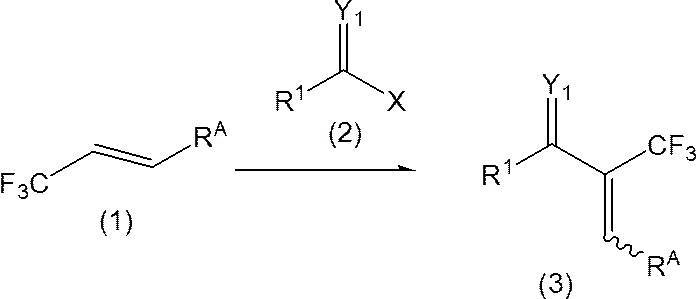
R1は、C1~8のアルキル基、C1~8のハロアルキル基、C3~8のシクロアルキル基、置換基を有するC3~8のシクロアルキル基、アリール基、置換基を有するアリール基、ヘテロアリール基、置換基を有するヘテロアリール基又はエステル化されたカルボキシ基を表し、
RAは、OR3又はNR4R5(式中、R3は、C1~8のアルキル基、アリール基又は置換基を有するアリール基を表し、R4及びR5は、互いに独立して、水素原子、C1~8のアルキル基、アリール基もしくは置換基を有するアリール基を表すか、又はR4及びR5は、互いに結合して、それらが結合している窒素原子と一緒になって5~6員のヘテロ環を形成してもよい。)を表し、
Xは、ハロゲン原子を表し、
Y1は、酸素原子又はN+R6R7・A-(式中、R6及びR7は、互いに独立して、C1~8のアルキル基、アリール基もしくは置換基を有するアリール基を表すか、又はR6及びR7は、互いに結合して、それらが結合している窒素原子と一緒になって5~6員のヘテロ環を形成してもよく、A-は、カウンターアニオンを表す。)を表し、
式(3)における波線は、RAの結合位置がEであってもZであってもよいことを示す。] - 下式(3c)で表される化合物。

RA1は、OR13又はNR14R15(式中、R13は、C1~8のアルキル基、アリール基又は置換基を有するアリール基を表し、R14及びR15は、互いに独立して、水素原子、C1~8のアルキル基、アリール基もしくは置換基を有するアリール基を表すか、又はR14及びR15は、互いに結合して、それらが結合している窒素原子と一緒になって5~6員のヘテロ環を形成してもよい。)を表し、
Y11は、酸素原子又はN+R16R17・A-(式中、R16及びR17は、互いに独立して、C1~8のアルキル基、アリール基もしくは置換基を有するアリール基を表すか、又はR16及びR17は、互いに結合して、それらが結合している窒素原子と一緒になって5~6員のヘテロ環を形成してもよく、A-は、カウンターアニオンを表す。)を表し、
式(3c)における波線は、RA1の結合位置がEであってもZであってもよいことを示す。] - 下式(5b)で表される化合物。

Applications Claiming Priority (2)
| Application Number | Priority Date | Filing Date | Title |
|---|---|---|---|
| JP2015063359A JP2018083758A (ja) | 2015-03-25 | 2015-03-25 | ピラゾール誘導体の製造方法 |
| JP2015-063359 | 2015-03-25 |
Publications (1)
| Publication Number | Publication Date |
|---|---|
| WO2016152831A1 true WO2016152831A1 (ja) | 2016-09-29 |
Family
ID=56979055
Family Applications (1)
| Application Number | Title | Priority Date | Filing Date |
|---|---|---|---|
| PCT/JP2016/058919 Ceased WO2016152831A1 (ja) | 2015-03-25 | 2016-03-22 | ピラゾール誘導体の製造方法 |
Country Status (2)
| Country | Link |
|---|---|
| JP (1) | JP2018083758A (ja) |
| WO (1) | WO2016152831A1 (ja) |
Cited By (3)
| Publication number | Priority date | Publication date | Assignee | Title |
|---|---|---|---|---|
| WO2019224677A1 (en) | 2018-05-21 | 2019-11-28 | Pi Industries Ltd. | Method for preparing substituted heterocyclic compounds |
| CN114988975A (zh) * | 2022-06-28 | 2022-09-02 | 江苏科技大学 | 一种基于有机染料催化的β-三氟甲基烯胺化合物的制备方法 |
| CN117700363A (zh) * | 2019-02-05 | 2024-03-15 | 先正达农作物保护股份公司 | 吡唑衍生物 |
Citations (3)
| Publication number | Priority date | Publication date | Assignee | Title |
|---|---|---|---|---|
| WO2007065567A1 (de) * | 2005-12-07 | 2007-06-14 | Bayer Cropscience Ag | Verfahren zur herstellung von haloalkyl(thio)vinimidiniumsalzen und 4- (haloalkyl(thio))-pyrazolen und deren umsetzung zu pflanzenschutzmitteln |
| WO2014008197A1 (en) * | 2012-07-03 | 2014-01-09 | 3-V Biosciences, Inc. | Heterocyclic modulators of lipid synthesis |
| CN104418769A (zh) * | 2013-09-03 | 2015-03-18 | 苏州安尼康药物研发有限公司 | 一种化合物及其制备方法 |
-
2015
- 2015-03-25 JP JP2015063359A patent/JP2018083758A/ja active Pending
-
2016
- 2016-03-22 WO PCT/JP2016/058919 patent/WO2016152831A1/ja not_active Ceased
Patent Citations (3)
| Publication number | Priority date | Publication date | Assignee | Title |
|---|---|---|---|---|
| WO2007065567A1 (de) * | 2005-12-07 | 2007-06-14 | Bayer Cropscience Ag | Verfahren zur herstellung von haloalkyl(thio)vinimidiniumsalzen und 4- (haloalkyl(thio))-pyrazolen und deren umsetzung zu pflanzenschutzmitteln |
| WO2014008197A1 (en) * | 2012-07-03 | 2014-01-09 | 3-V Biosciences, Inc. | Heterocyclic modulators of lipid synthesis |
| CN104418769A (zh) * | 2013-09-03 | 2015-03-18 | 苏州安尼康药物研发有限公司 | 一种化合物及其制备方法 |
Non-Patent Citations (2)
| Title |
|---|
| ALMANSA CARMEN ET AL.: "Synthesis and SAR of a New Series of COX-2-Selective Inhibitors: Pyrazolo[1,5-a]pyrimidines", JOURNAL OF MEDICINAL CHEMISTRY, vol. 44, no. 3, pages 350 - 361, XP002330232, ISSN: 0022-2623 * |
| MAO ZHIFENG ET AL.: "Copper-Catalyzed Trifluoromethylation of Internal Olefinic C-H Bonds: Efficient Routes to Trifluoromethylated Tetrasubstituted Olefins and N-Heterocycles", CHEMISTRY A EUROPEAN JOURNAL, vol. 20, no. 12, 13 February 2014 (2014-02-13), pages 3439 - 3445, XP055317310, ISSN: 0947-6539 * |
Cited By (3)
| Publication number | Priority date | Publication date | Assignee | Title |
|---|---|---|---|---|
| WO2019224677A1 (en) | 2018-05-21 | 2019-11-28 | Pi Industries Ltd. | Method for preparing substituted heterocyclic compounds |
| CN117700363A (zh) * | 2019-02-05 | 2024-03-15 | 先正达农作物保护股份公司 | 吡唑衍生物 |
| CN114988975A (zh) * | 2022-06-28 | 2022-09-02 | 江苏科技大学 | 一种基于有机染料催化的β-三氟甲基烯胺化合物的制备方法 |
Also Published As
| Publication number | Publication date |
|---|---|
| JP2018083758A (ja) | 2018-05-31 |
Similar Documents
| Publication | Publication Date | Title |
|---|---|---|
| JP6658736B2 (ja) | ピラゾール誘導体の製造方法 | |
| JP4725977B2 (ja) | 2−ジハロアシル−3−アミノ−アクリル酸エステルおよび3−ジハロメチル−ピラゾール−4−カルボン酸エステルの製造方法 | |
| RU2470015C2 (ru) | Способ получения производных 3-дигалогенметил-пиразол-4-карбоновой кислоты | |
| JPWO2006090778A1 (ja) | 1−置換−3−フルオロアルキルピラゾール−4−カルボン酸エステルの製造方法 | |
| JP2018083758A (ja) | ピラゾール誘導体の製造方法 | |
| ES2663614T3 (es) | Procedimiento de preparación de derivados de 3,5-bis(haloalquil)pirazol a partir de alfa, alfa-dihaloaminas y cetiminas | |
| JP5830957B2 (ja) | ピラゾール化合物の製造方法 | |
| JP5793983B2 (ja) | ピラゾール化合物の製造方法 | |
| JP5140776B1 (ja) | 1−置換−3−フルオロアルキルピラゾール−4−カルボン酸エステルの製造方法 | |
| BR112019009793A2 (pt) | 4-((6-(2-(2,4-difluorofenil)-1,1-difluoro-2-hidróxi-3-(5-mercapto-1h-1,2,4-triazol-1-il)propil)piridin-3-il)óxi)benzonitrila e processos de preparação | |
| JP5232335B1 (ja) | 1−置換−3−フルオロアルキルピラゾール−4−カルボン酸エステルの製造方法 | |
| JP2013006782A (ja) | ピラゾール化合物の製造方法 | |
| JP2021506872A (ja) | イミニウム化合物の製造のための方法、及びピラゾール誘導体の製造におけるそれらの適用 | |
| JP5915004B2 (ja) | ピラゾール化合物の製造方法 | |
| US2655508A (en) | Pyrazole compound | |
| WO2003014067A1 (fr) | Methode de production d'un compose beta-oxonitrile ou d'un sel de metal alcalin dudit compose | |
| TW201321359A (zh) | 用於製備n取代的吡唑化合物的方法 | |
| JP4126944B2 (ja) | 5−アミノ−4−ニトロソピラゾール化合物の製法 | |
| WO2016158716A1 (ja) | 3-ハロゲン化アルキルピラゾール誘導体の製造方法 | |
| JP3855686B2 (ja) | 3,3−ジアルコキシ−2−ヒドロキシイミノ誘導体及びその製造法 | |
| JP5790195B2 (ja) | ピラゾール化合物の製造方法 | |
| JPH0586783B2 (ja) | ||
| BRPI0817747B1 (pt) | Process for the preparation of 2-dihalogenoacyl-3-amino acrylic acid derivatives | |
| KR20040091318A (ko) | 6-클로로벤족사졸-2-온의 새로운 제조방법 |
Legal Events
| Date | Code | Title | Description |
|---|---|---|---|
| 121 | Ep: the epo has been informed by wipo that ep was designated in this application |
Ref document number: 16768734 Country of ref document: EP Kind code of ref document: A1 |
|
| NENP | Non-entry into the national phase |
Ref country code: DE |
|
| 122 | Ep: pct application non-entry in european phase |
Ref document number: 16768734 Country of ref document: EP Kind code of ref document: A1 |
|
| NENP | Non-entry into the national phase |
Ref country code: JP |