WO2016143661A1 - 食品包装体およびその製造方法 - Google Patents
食品包装体およびその製造方法 Download PDFInfo
- Publication number
- WO2016143661A1 WO2016143661A1 PCT/JP2016/056598 JP2016056598W WO2016143661A1 WO 2016143661 A1 WO2016143661 A1 WO 2016143661A1 JP 2016056598 W JP2016056598 W JP 2016056598W WO 2016143661 A1 WO2016143661 A1 WO 2016143661A1
- Authority
- WO
- WIPO (PCT)
- Prior art keywords
- packaging material
- packaging
- film
- meat
- drip
- Prior art date
- Legal status (The legal status is an assumption and is not a legal conclusion. Google has not performed a legal analysis and makes no representation as to the accuracy of the status listed.)
- Ceased
Links
Classifications
-
- A—HUMAN NECESSITIES
- A23—FOODS OR FOODSTUFFS; TREATMENT THEREOF, NOT COVERED BY OTHER CLASSES
- A23B—PRESERVATION OF FOODS, FOODSTUFFS OR NON-ALCOHOLIC BEVERAGES; CHEMICAL RIPENING OF FRUIT OR VEGETABLES
- A23B2/00—Preservation of foods or foodstuffs, in general
-
- A—HUMAN NECESSITIES
- A23—FOODS OR FOODSTUFFS; TREATMENT THEREOF, NOT COVERED BY OTHER CLASSES
- A23B—PRESERVATION OF FOODS, FOODSTUFFS OR NON-ALCOHOLIC BEVERAGES; CHEMICAL RIPENING OF FRUIT OR VEGETABLES
- A23B4/00—Preservation of meat, sausages, fish or fish products
-
- B—PERFORMING OPERATIONS; TRANSPORTING
- B65—CONVEYING; PACKING; STORING; HANDLING THIN OR FILAMENTARY MATERIAL
- B65D—CONTAINERS FOR STORAGE OR TRANSPORT OF ARTICLES OR MATERIALS, e.g. BAGS, BARRELS, BOTTLES, BOXES, CANS, CARTONS, CRATES, DRUMS, JARS, TANKS, HOPPERS, FORWARDING CONTAINERS; ACCESSORIES, CLOSURES, OR FITTINGS THEREFOR; PACKAGING ELEMENTS; PACKAGES
- B65D85/00—Containers, packaging elements or packages, specially adapted for particular articles or materials
- B65D85/50—Containers, packaging elements or packages, specially adapted for particular articles or materials for living organisms, articles or materials sensitive to changes of environment or atmospheric conditions, e.g. land animals, birds, fish, water plants, non-aquatic plants, flower bulbs, cut flowers or foliage
Definitions
- the present invention relates to a food package and a method for producing the same.
- packaging materials such as bags and pouches made of multilayer films have been used for food packaging applications.
- the packaging material made of heat-shrinkable film is filled with the contents, vacuum packaged, and then the vacuum-packed product is passed through a hot water shower or immersed in hot water.
- a method for obtaining a food package by heat-shrinking is performed.
- the inner surface layer in contact with the contents, an intermediate layer adjacent to it, and an outer surface layer.
- the inner surface layer has an inorganic lubricant and an organic lubricant
- the intermediate layer has an organic lubricant.
- a packaging laminate in which the inner surface layer includes a resin selected from single-site catalyst-based polyethylene, LLDPE, and the like and has self-weld properties by heat treatment is known (for example, see Patent Document 1).
- the packaging laminate is proposed for the purpose of preventing the appearance from deteriorating due to drip collecting in the ears of the packaging material (excess portion of the packaging material after shrinkage) that is produced when vacuum packaging is performed. Is a laminated body for packaging. However, a method for reducing the amount of drip generated in a food package in which meat is vacuum packaged as a content has not yet been fully studied.
- An object of the present invention is to provide a food package with a reduced drip amount and a method for producing the same.
- the present inventors have obtained a heat treatment of a packaging material comprising a film having a specific area shrinkage rate and a specific weight of meat at a specific temperature.
- the present invention was completed by finding that the food packaging produced less drip.
- the present invention relates to the following (1) to (4).
- a food packaging body obtained by vacuum-packaging meat using a packaging material comprising a film and then performing a heat treatment to thermally shrink the packaging material, wherein the film is 10 in 80 ° C. hot water.
- a food packaging body which is a film having an area shrinkage ratio of 70 to 90% when immersed in a second, the heat treatment temperature is 75 to 90 ° C., and the meat is 1 kg or more and 15 kg or less.
- the food package according to (1), wherein the area shrinkage rate is 70 to 80%.
- the food packaging body according to (1) or (2), wherein the packaging material is a packaging material having self-weldability when immersed in hot water at 80 ° C. for 10 seconds.
- a process for vacuum packaging meat using a packaging material comprising a film, a food packaging body having a step of heat-shrinking the packaging material by heat-treating the vacuum packaged body after the step.
- the film is a film having an area shrinkage of 70 to 90% when immersed in hot water at 80 ° C. for 10 seconds, the heat treatment temperature is 75 to 90 ° C., and the meat is The manufacturing method of the food packaging body which is 1 kg or more and 15 kg or less.
- the food package of the present invention generates less drip.
- the food packaging body of the present invention is a food packaging body obtained by vacuum-packaging meat using a packaging material made of a film, and then performing a heat treatment for thermally shrinking the packaging material, wherein the film has a temperature of 80 ° C. It is a film having an area shrinkage of 70 to 90% when immersed in hot water for 10 seconds, the temperature of the heat treatment is 75 to 90 ° C., and the meat is 1 kg or more and 15 kg or less.
- meat is packaged.
- the weight of meat to be packaged is 1 kg or more and 15 kg or less, preferably 5 kg or more and 10 kg or less.
- meat such as a cow, a pig, a sheep, and a bird (for example, a chicken, a turkey, a duck), is mentioned.
- Each shape is not particularly limited.
- cuts 5-15 kg meat chunks cut from carcass
- blocks less than 5 kg meat chunks cut from carcass
- the packaging material is a packaging material made of a film, and the film may be a film having an area shrinkage of 70 to 90%, and is not particularly limited.
- the packaging material it is preferable to use a packaging material made of a film having a gas barrier property in order to prevent the meat from being oxidized when the food package is stored and distributed.
- the area shrinkage when the film is immersed in hot water at 80 ° C. for 10 seconds is 70 to 90%, preferably 70 to 80%.
- a packaging material made of such a film By using a packaging material made of such a film, a food package with a small amount of drip can be obtained.
- the amount of drip outflow in the meat package it is necessary to reduce as much as possible the pleats and surplus portions of the film that cause drip propagation and storage so that the film and meat are in close contact.
- the pressure action will promote the outflow of the drip, so it is possible to achieve the above close contact state (ideal close contact state) without pressing the meat as much as possible. This is important in reducing the drip outflow.
- the inventors of the present invention estimated that the ideal close contact state was realized and the drip amount was reduced by using a film having an area shrinkage rate within the above range.
- the area shrinkage rate of the film can be obtained by the method described in Examples described later, the shrinkage rate in the machine direction (MD) of the film and the direction perpendicular to the film direction (TD) is obtained. It can be determined by calculating the area shrinkage rate. For example, when a film with a size of 100 mm (MD) ⁇ 100 mm (TD) is immersed in hot water at a predetermined temperature for 10 seconds, the size becomes 45 mm (MD) ⁇ 48 mm (TD).
- the packaging material made of the film used in the present invention is preferably uniaxially or biaxially stretched during the production process.
- the area shrinkage rate of the film can be within the above range.
- biaxial stretching when biaxial stretching is performed, the molecules are oriented, and therefore biaxial stretching is preferable from the viewpoints of transparency, barrier properties, and strength.
- a stretched film contracts when a heat amount exceeding the temperature applied during stretching is applied.
- the shrinkage rate of the film can be appropriately adjusted not only by the material constituting the film but also by the production conditions such as the draw ratio.
- the packaging material used in the present invention is preferably a packaging material having self-weld property.
- a packaging material having a self-weld property By using a packaging material having a self-weld property, the amount of drip generated can be further reduced.
- the packaging material has self-weldability when the food packaging body is manufactured, the ear portion of the packaging material such as a bag or pouch (the surplus portion after the heat shrinkage is referred to as the “ear portion”). It means having the property of fusing by heating at the time.
- the packaging material having self-weldability means a packaging material having self-weldability when immersed in hot water at 80 ° C. for 10 seconds. Whether or not the packaging material has self-weldability can be determined by the method described in Examples below.
- the innermost layer of the packaging material is a resin having a melting point of 80 ° C. or lower, or a resin whose melting peak measured by DSC rises from a temperature of 80 ° C. or lower even when the melting point is 80 ° C. or higher.
- the film may be a single layer or a multilayer.
- the resin constituting the film examples include polyolefin (for example, ultra-low density polyethylene, low density polyethylene, high density polyethylene, linear low density polyethylene, polypropylene), polyamide (for example, nylon 6, nylon 66, nylon 46, nylon). 6-66, nylon MXD, nylon 6I6T (where I represents isophthalic acid, T represents terephthalic acid), polyester (for example, polyethylene terephthalate, copolymerized polyethylene terephthalate (copolymer of ethylene terephthalate and the like) and ethylene terephthalate )), Ethylene / methyl acrylate copolymer, polyvinylidene chloride, ethylene-vinyl alcohol copolymer film, ethylene-vinyl acetate copolymer, ionomer and the like.
- polyolefin for example, ultra-low density polyethylene, low density polyethylene, high density polyethylene, linear low density polyethylene, polypropylene
- polyamide for example, nylon 6,
- the film is formed in multiple layers from the viewpoint of simultaneously exerting performances such as imparting strength of the packaging material, imparting sealing properties, imparting barrier properties, and imparting self-weld properties.
- the layer structure when the film is formed in multiple layers is not particularly limited, but the layer constituting the outer surface (outer surface layer) and the surface contacting the food (meat) (inner surface layer)
- ultra-low density polyethylene / ethylene-vinyl acetate copolymer / ethylene-methyl acrylate copolymer / polyvinylidene chloride / ethylene-methyl acrylate copolymer / ethylene-vinyl acetate copolymer / ethylene- Film having a layer structure of vinyl acetate copolymer, ultra-low density polyethylene / ethylene-vinyl acetate copolymer / ethylene-methyl acrylate copolymer / polyvinylidene chloride / ethylene-methyl acrylate copolymer / ethylene-vinyl acetate copolymer Film with polymer / ionomer layer structure, ethylene-vinyl acetate copolymer / polychlorinated Film having a layer structure
- components other than resin may be contained in the layer which comprises the said film.
- components other than the resin include various additives, such as lubricants, antifogging agents, antioxidants, ultraviolet absorbers, light stabilizers, antistatic agents, antiblocking agents, dyes, and pigments.
- the thickness of the film varies depending on the type of film, but is usually 5 to 300 ⁇ m, preferably 20 to 150 ⁇ m.
- each layer is usually 0.1 to 200 ⁇ m, preferably 0.5 to 100 ⁇ m.
- the size of the packaging material is not particularly limited, but the packaging material margin is preferably 10 to 40%, and more preferably 15 to 25%.
- the packaging material margin rate means the size of the packaging bag before heat shrinkage with respect to the contents (meat), and can be measured by the following formula.
- the inner dimension of the packaging material is the dimension on the side where the contents are in contact.
- TD packaging material margin ratio (%) [inner dimension of TD of packaging material / (body circumference of TD of contents / 2) ⁇ 1] ⁇ 100
- the MD circumference of the MD of the contents may not be constant.
- the portion where the trunk circumference is maximum is the content.
- the waist circumference of MD is defined as the trunk of the contents.
- the form of the packaging material made of a film may be a cylindrical shape (pillow shape) or a bag shape (for example, a pouch shape such as a bottom seal pouch or a three-side seal pouch), or a film shape (thin film shape). It may be. It is preferable to use a cylindrical (pillow form) packaging material in that the food packaging body can be manufactured using a continuous filling and packaging machine with excellent productivity.
- the food package of the present invention can be obtained by the following method for producing a food package.
- the method for producing a food packaging body of the present invention includes a step of vacuum packaging meat using a packaging material made of a film, and heat-shrinking the packaging material by heat-treating the vacuum-packed packaging body after the step. It is a manufacturing method of the food packaging body which has a process to make.
- a film having an area shrinkage of 70 to 90% when immersed in hot water at 80 ° C. for 10 seconds is used as the film, and the meat is 1 kg or more and 15 kg or less as described above. Yes, the temperature of the heat treatment is 75 to 90 ° C.
- the meat is vacuum-packed using a packaging material made of a film, and the vacuum packaging method includes those conventionally used for vacuum packaging of meat.
- the vacuum packaging method includes those conventionally used for vacuum packaging of meat.
- the drip sheet may be applied to meat and the meat may be vacuum packaged together with the drip sheet.
- An example of the vacuum packaging method includes a method having the following steps (1) to (5).
- Step (1) Place 1 kg or more and 15 kg or less of meat on a film-like packaging material.
- Step (2) Another film-like packaging material is superimposed on the packaging material on which the meat is placed.
- Step (3) Two or three sides of the packaging material are heat-sealed, and the packaging material is formed into a cylindrical shape or a bag shape having two or one opening.
- Step (4) Suction and deaeration are performed from the opening.
- Step (5) The opening of the degassed cylindrical or bag-shaped packaging material is heat-sealed to obtain a vacuum packaged package.
- Another example of the vacuum packaging method includes a method having the following steps (a) to (c).
- Step (a) Placing 1 kg or more and 15 kg or less of meat in a bag-like or cylindrical packaging material.
- Step (b) Suction and deaeration are performed from the opening.
- Step (c) Heat-sealing the opening of the degassed cylindrical or bag-shaped packaging material to obtain a vacuum-packaged package.
- the food package of the present invention can be obtained by performing heat treatment for heat shrinking the packaging material after vacuum packaging.
- the heat treatment method is not particularly limited. For example, a method of immersing the vacuum packaged package in hot water, a method of showering the vacuum packaged package with hot water, or passing through a hot air tunnel. Methods and the like.
- the temperature of the heat treatment is usually 75 to 90 ° C., preferably 75 to 88 ° C., more preferably 75 to 85 ° C.
- it is effective to increase the shrinkage rate.
- a packaging material made of a stretched film is known to have a higher shrinkage rate when the heat treatment temperature is higher. . For this reason, it is preferable to perform heat processing at 75 degreeC or more.
- the heat treatment is preferably performed at 90 ° C. or less.
- the film may be whitened due to the difference in shrinkage of each layer constituting the packaging material during the heat treatment. From this viewpoint, the heat treatment should be performed at 90 ° C or less. Is preferred.
- the time for the heat treatment is usually 2 to 10 seconds, preferably 2 to 5 seconds.
- the food packaging body of the present invention uses a film having a specific area shrinkage rate and uses a specific weight of meat, so that the amount of drip is smaller than that of the conventional one, so that it looks good and is excellent in meat quality. Moreover, the weight reduction of the meat by drip is reduced.
- the temperature during storage and transportation is preferably -1 to 5 ° C.
- packaging materials 1 to 6 having the following layer structure were used. Note that a film-like packaging material was used as the packaging material.
- the layer structure of the following packaging material was described in order from the layer (outer surface layer) constituting the outer surface in the experimental example to the layer (inner surface layer) constituting the surface in contact with food (meat). That is, when the layer structure of the packaging material is represented by A / B / C / D, A is a layer that constitutes the outer surface, and D is a layer that constitutes the surface in contact with food (meat). , B and C are intermediate layers.
- the packaging materials 1 to 6 were produced as a tubular film by the following method, cut out and used.
- Table 1 shows the resin names, brand names, and abbreviations used in the present specification when the packaging materials 1 to 6 were produced.
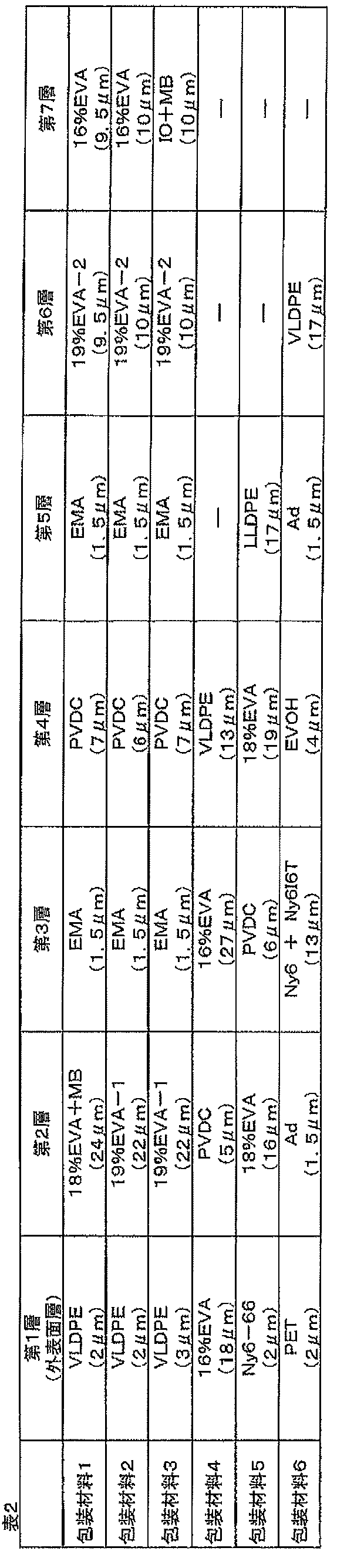
- Table 2 shows the layer structure of the packaging materials 1 to 6 and the thickness of each layer.
- the packaging material 1 was manufactured by the following method. Six types of resins were extruded separately with six extruders, and each molten polymer was introduced into a coextrusion annular die, where the layer structure from the outer surface layer to the inner surface layer was VLDPE / 18% EVA + MB. / EMA / PVDC / EMA / 19% EVA-2 / 16% EVA were melt-bonded in this order and co-extruded as 7 layers in the die.
- the molten annular body obtained by coextrusion was cooled with cold water at 10 to 20 ° C. to obtain a flat annular body.
- the flat annular body was irradiated with an electron beam from the outside of the annular body in an electron beam irradiation apparatus having an acceleration voltage of 300 kiloelectron volts to give an absorbed dose of 80 kilogrey.
- the tube is passed through a 82 ° C. hot water tank and simultaneously biaxially stretched 3.4 times in the vertical direction and 3.1 times in the horizontal direction by an inflation method while cooling with an air ring to obtain a tube having a width of 400 mm. It was.
- the packaging material 2 was manufactured by the following method. Six types of resins were extruded separately with six extruders, and each molten polymer was introduced into a coextrusion annular die, where the layer structure from the outer surface layer to the inner surface layer was VLDPE / 19% EVA. -1 / EMA / PVDC / EMA / 19% EVA-2 / 16% EVA were melt-bonded in this order, and co-extruded as 7 layers in the die.
- the molten annular body obtained by coextrusion was cooled with cold water at 10 to 20 ° C. to obtain a flat annular body.
- the flat annular body was irradiated with an electron beam from the outside of the annular body in an electron beam irradiation apparatus having an acceleration voltage of 300 kiloelectron volts to give an absorbed dose of 80 kilogrey.
- the tube is passed through a 82 ° C. hot water tank and simultaneously biaxially stretched 3.4 times in the vertical direction and 3.1 times in the horizontal direction by an inflation method while cooling with an air ring to obtain a tube having a width of 400 mm. It was.
- the packaging material 3 was manufactured by the following method. Six types of resins were extruded separately with six extruders, and each molten polymer was introduced into a coextrusion annular die, where the layer structure from the outer surface layer to the inner surface layer was VLDPE / 19% EVA. -1 / EMA / PVDC / EMA / 19% EVA-2 / IO + MB were melt bonded together and coextruded as 7 layers in the die.
- the molten annular body obtained by coextrusion was cooled with cold water at 10 to 20 ° C. to obtain a flat annular body.
- the flat annular body was irradiated with an electron beam from the outside of the annular cylindrical body in an electron beam irradiation apparatus with an acceleration voltage of 300 kiloelectron volts to give an absorbed dose of 80 kilogrey.
- the tube is passed through a 82 ° C. hot water tank and simultaneously biaxially stretched 3.4 times in the vertical direction and 3.1 times in the horizontal direction by an inflation method while cooling with an air ring to obtain a tube having a width of 400 mm. It was.
- the packaging material 4 was manufactured by the following method. Four types of resins were separately extruded by four extruders, and each molten polymer was introduced into a coextrusion annular die, where the layer structure from the outer surface layer to the inner surface layer was 16% EVA / PVDC. / 16% EVA / VLDPE were melt bonded together and co-extruded as 4 layers in a die.
- the molten annular body obtained by coextrusion was cooled with cold water at 10 to 20 ° C. to obtain a flat annular body.
- the flat annular body was irradiated with an electron beam from the outside of the annular body in an electron beam irradiation apparatus having an acceleration voltage of 300 kiloelectron volts to give an absorbed dose of 80 kilogrey.
- the tube is passed through a 85 ° C. hot water tank and simultaneously biaxially stretched 3.0 times in the longitudinal direction and 3.0 times in the transverse direction by an inflation method while cooling with an air ring to obtain a tube having a width of 400 mm. It was.
- the packaging material 5 was manufactured by the following method. Four types of resins were separately extruded by four extruders, and each molten polymer was introduced into a coextrusion annular die, where the layer structure from the outer surface layer to the inner surface layer was Ny6-66 / 18. % EVA / PVDC / 18% EVA / LLDPE were melt bonded together and coextruded as 5 layers in the die.
- the molten annular body obtained by coextrusion was cooled with cold water at 10 to 20 ° C. to obtain a flat annular body.
- the flat annular body was irradiated with an electron beam from the outside of the annular body in an electron beam irradiation apparatus having an acceleration voltage of 300 kiloelectron volts to give an absorbed dose of 80 kilogrey.
- the tube is passed through a 85 ° C. hot water tank and simultaneously biaxially stretched 3.0 times in the longitudinal direction and 3.0 times in the transverse direction by an inflation method while cooling with an air ring to obtain a tube having a width of 400 mm. It was.
- the packaging material 6 was manufactured by the following method. Five types of resins were extruded separately with five extruders, and each molten polymer was introduced into a coextrusion annular die, where the layer structure from the outer surface layer to the inner surface layer was PET / Ad / Ny6 + Ny6I6T. / EVOH / Ad / VLDPE were melt-bonded in this order, and coextruded as 6 layers in a die.
- the molten annular body obtained by coextrusion was cooled with cold water at 10 to 20 ° C. to obtain a flat annular body.
- the flat annular body was passed through a hot water tank at 87 ° C. and simultaneously biaxially stretched 2.7 times in the vertical direction and 2.9 times in the horizontal direction by an inflation method while cooling using an air ring.
- the biaxially stretched film obtained by the stretching was introduced into a heat treatment tower having a tube length of 2 m to form a bubble-shaped annular film, heated to 68 ° C. with steam, 7.5% in the vertical direction, and the horizontal direction Then, heat treatment was performed for 2 seconds while relaxing 8.5% to obtain a tube having a width of 400 mm.
- the area shrinkage rate of the packaging material was measured by the following method. A film obtained by cutting packaging materials 1 to 6 into 100 mm (MD) ⁇ 100 mm (TD) was immersed in hot water at 80 ° C. for 10 seconds, and then taken out and cooled in water at room temperature.
- the packaging material 3 it carried out similarly except having changed the hot water of 80 degreeC into the hot water of 70 degreeC, and calculated
- the length of MD and the length of TD are measured with a ruler. From the length of MD before immersion and the length of TD, the shrinkage of MD, the shrinkage of TD, and the area shrinkage was calculated respectively.
- the area shrinkage ratio was determined by [1 ⁇ (length of MD after shrinkage ⁇ length of TD after shrinkage) / (length of MD before shrinkage ⁇ length of TD before shrinkage)] ⁇ 100.
- the packaging body in which the plastic pieces were packaged was taken into consideration so as not to float, immersed in hot water at 80 ° C. for 10 seconds, taken out, and immediately cooled in water at room temperature.
- the packaging film from which the plastic pieces have been removed from the package after immersion and cooling is left in a constant temperature room at 23 ° C. and 50% relative humidity for 24 hours, and then the peeling force (inner surface) of the part where the inner surfaces of the ears are fused together
- the measurement of the fusing force was performed under the following measurement conditions using a tensile tester Tensilon RTM-100 manufactured by Orientec. The measured value was shown by average intensity (unit: g / 15 mm). Sample width: 15 mm Length of fused part: 30mm Distance between grippers: 20mm Grasping tool speed: 200 mm / min Measurement ambient temperature: 23 ° C. Measurement ambient humidity: 50% relative humidity
- Table 3 shows whether or not the packaging material has an MD shrinkage rate, a TD shrinkage rate, an area shrinkage rate, and a self-weld property.
- Example 1 A drip sheet is applied to beef thigh meat (weight is about 5 kg), and vacuum packaging is performed with the packaging materials shown in Table 4 (using the AGW160 vacuum packaging machine made by MULTIVAC). . Then, it preserve
- the vacuum packaging uses two film-shaped packaging materials of about 251 mm ⁇ about 361 mm as packaging materials, heat seals using an impulse sealer (using Fuji Impulse Sealer), and the inner dimensions after vacuum packaging are 250 mm ⁇ A 360 mm bag was used.
- beef thigh was put in the bag, and the vacuum packaging machine was set as a vacuum dial 5 and a seal dial 5. In addition, it tested twice for every packaging material, The average weight of the beef leg meat was set to 5.2 kg.
- the drip amount was calculated as follows. The amount of drip absorbed by the drip sheet was calculated by subtracting the weight of the unused drip sheet from the weight of the drip sheet after absorbing the drip. Next, apply paper that has been weighed in advance (Kim towel: Nippon Paper Crecia Co., Ltd.) to beef thigh meat to absorb the drip, and drip that has come out in the packaging material and drip attached to the packaging material All wiped with Kim towel. The weight was measured, and the amount of drip absorbed by the Kim towel was calculated from the difference in the weight of the Kim towel before and after drip absorption. The drip amount absorbed by the drip sheet and the drip amount absorbed by Kim Towel were added up.
- Drip amount (g) (Weight of Kim Towel after Absorbing Drip (g) ⁇ Weight of Unused Kim Towel (g)) + (Weight of Drip Sheet after Absorbing Drip ⁇ Weight of Unused Drip Sheet (g))
- the reason why the drip was absorbed by Kim Towel was that the meat lump was large and it was difficult to measure the weight of the whole food package.
- Drip rate (%) Drip amount (g) ⁇ Meat weight before vacuum packaging (g) ⁇ 100
- the experiment example which uses the packaging materials 2 and 3 as a packaging material corresponds to the Example of this invention, and each experiment example is set to Example 1, 2, respectively.
- experimental examples using packaging materials 4 to 6 as packaging materials are comparative examples, and each experimental example is referred to as comparative examples 1 to 3, respectively.
- two film-shaped packaging materials of about 260 mm ⁇ about 370 mm are used as packaging materials, heat sealed using an impulse sealer (using a sealer manufactured by Fuji Impulse), and the inner dimension after vacuum packaging is 250 mm ⁇ A 360 mm bag was used.
- the drip amount and drip rate were determined by the same method as in Experimental Example 1.
- the experiment example which uses the packaging materials 1 and 2 as a packaging material is equivalent to the Example of this invention, and each experiment example is set as Example 3 and 4, respectively.
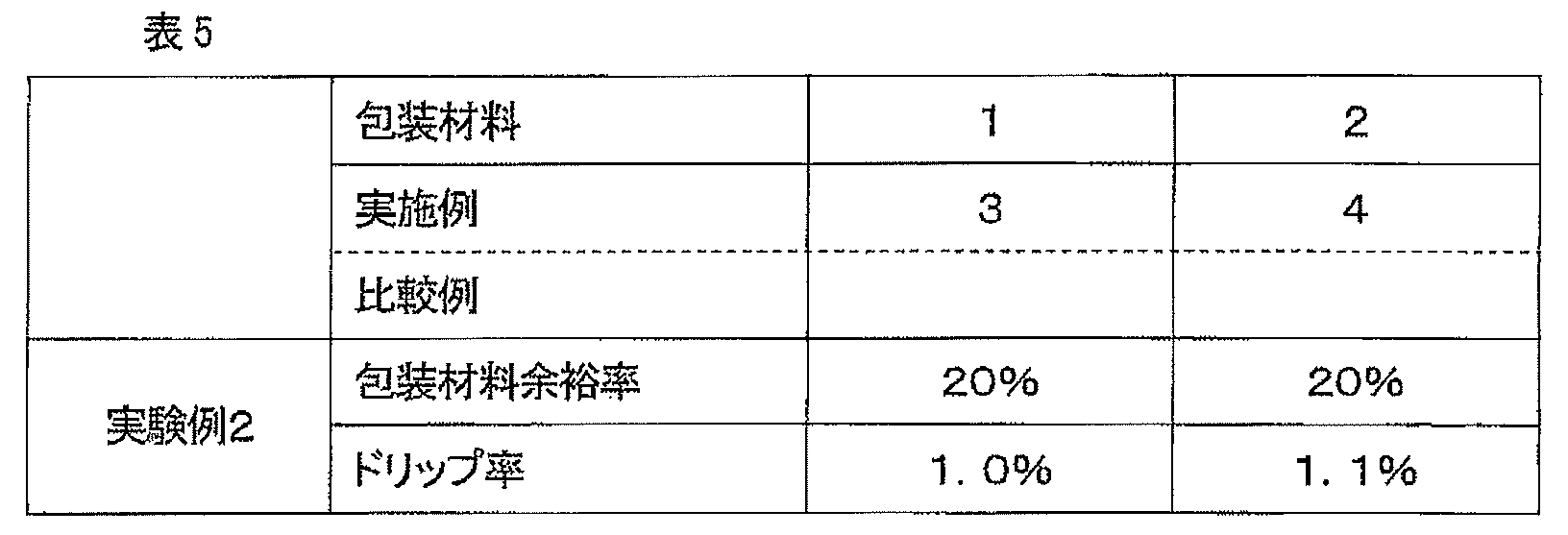
- the results of Experimental Example 2 are shown in Table 5.
- the vacuum packaging uses two film-shaped packaging materials of 250 mm ⁇ 300 mm as packaging materials, heat seals using an impulse sealer (using a sealer manufactured by Fuji Impulse), and the inner dimensions after vacuum packaging are 240 mm ⁇ 290 mm This was done using a bag.
- the packaging material margin ratio was determined by the following method in the case of packaging materials 1 and 2 with the MD circumference of the beef leg meat being 400 mm and the TD circumference being 480 mm.
- the drip amount and drip rate were determined by the same method as in Experimental Example 1.
- the vacuum packaging uses two 280 mm ⁇ 310 mm film-shaped packaging materials as packaging materials, and heat seals using an impulse sealer (using Fuji Impulse Sealer) in the same manner as in Example 1, and after vacuum packaging This was carried out using a bag having an inner size of 270 mm ⁇ 300 mm.
- beef thigh was put in the bag, and the vacuum packaging machine was set as a vacuum dial 5 and a seal dial 5. In addition, it tested 3 times for every packaging material, and it was made for the average weight of beef leg meat to be 2.5 kg.
- Example 7 the experiment example using the packaging material 3 as a packaging material and using 80 degreeC hot water corresponds to the Example of this invention, and this experiment example is set to Example 7.
- FIG. 7 an experimental example using the packaging material 5 using 80 ° C. hot water and an experimental example using the packaging material 3 using 70 ° C. hot water are comparative examples, Experimental examples are referred to as Comparative Examples 4 and 5, respectively.
- the results of Experimental Example 4 are shown in Table 7.
- Experimental Examples 1 to 4 show that when a packaging material made of a film having an area shrinkage of 70 to 90% is used, the amount of drip generated is small. From Experimental Examples 1 to 4, it can be seen that the drip amount can be further reduced by using a film having a self-weld property.
Landscapes
- Engineering & Computer Science (AREA)
- Life Sciences & Earth Sciences (AREA)
- Zoology (AREA)
- Polymers & Plastics (AREA)
- Chemical & Material Sciences (AREA)
- Food Science & Technology (AREA)
- Wood Science & Technology (AREA)
- Health & Medical Sciences (AREA)
- Evolutionary Biology (AREA)
- General Health & Medical Sciences (AREA)
- Marine Sciences & Fisheries (AREA)
- Toxicology (AREA)
- Mechanical Engineering (AREA)
- Packages (AREA)
Abstract
本発明は、発生するドリップ量を低減した食品包装体を提供することを目的とする。本発明の食品包装体は、フィルムからなる包装材料を用いて食肉を真空包装し、その後包装材料を熱収縮させる熱処理を行うことにより得られる食品包装体であって、前記フィルムが、80℃の熱水中に10秒浸漬した際の面積収縮率が70~90%のフィルムであり、前記熱処理の温度が75~90℃であり、前記食肉が1kg以上15kg以下である。
Description
本発明は食品包装体およびその製造方法に関する。
従来より、多層フィルムからなる袋・パウチ等の包装材料は、食品包装用途に用いられている。
例えば、熱収縮性フィルムからなる包装材料中に、内容物を充填し、真空包装を行い、次いで真空包装された製品を熱水シャワー中に通したり、熱水中に浸漬することにより、包装材料を熱収縮させることにより、食品包装体を得る方法が行われている。
例えば、熱収縮性フィルムからなる包装材料中に、内容物を充填し、真空包装を行い、次いで真空包装された製品を熱水シャワー中に通したり、熱水中に浸漬することにより、包装材料を熱収縮させることにより、食品包装体を得る方法が行われている。
食肉を真空包装した場合には、食肉から肉汁(ドリップ)が発生することが知られているが、ドリップが多量に発生すると見栄えが悪くなり、肉質も悪化することから、ドリップ量については、少ないことが望まれている。
例えば、内容物に接する内表面層、それに隣接する中間層、及び外表面層の少なくとも3層からなり、内表面層が無機系滑剤および有機系滑剤を有し、中間層が有機系滑剤を有し、内表面層が、シングルサイト触媒系ポリエチレン、LLDPE等から選択される樹脂を含み、熱処理によりセルフウェルド性を有する包装用積層体が知られている(例えば、特許文献1参照)。
前記包装用積層体は、真空包装を行った際にできる包装材料の耳部(収縮後の包装材料の余剰部分)にドリップが溜まることにより、見栄えが悪くなることを防止することを目的として提案された包装用積層体である。
しかしながら、内容物として食肉を真空包装した食品包装体において発生するドリップの量を少なくする方法は未だ充分に検討されていなかった。
しかしながら、内容物として食肉を真空包装した食品包装体において発生するドリップの量を少なくする方法は未だ充分に検討されていなかった。
本発明は、発生するドリップ量を低減した食品包装体およびその製造方法を提供することを目的とする。
本発明者らは、上記課題を達成するため鋭意研究を重ねた結果、特定の面積収縮率を有するフィルムからなる包装材料および、特定の重量の食肉を特定の温度で熱処理することにより得られた食品包装体は、発生するドリップ量が少ないことを見出し、本発明を完成させた。
すなわち、本発明は、下記(1)~(4)に関する。
(1)フィルムからなる包装材料を用いて食肉を真空包装し、その後包装材料を熱収縮させる熱処理を行うことにより得られる食品包装体であって、前記フィルムが、80℃の熱水中に10秒浸漬した際の面積収縮率が70~90%のフィルムであり、前記熱処理の温度が75~90℃であり、前記食肉が1kg以上15kg以下である食品包装体。
(2)前記面積収縮率が、70~80%である(1)に記載の食品包装体。
(3)前記包装材料が、80℃の熱水に10秒浸漬した際にセルフウェルド性を有する包装材料である(1)または(2)に記載の食品包装体。
(4)フィルムからなる包装材料を用いて食肉を真空包装する工程、前記工程の後に行われる、真空包装された包装体を熱処理することにより、包装材料を熱収縮させる工程を有する食品包装体の製造方法であり、前記フィルムが、80℃の熱水中に10秒浸漬した際の面積収縮率が70~90%のフィルムであり、前記熱処理の温度が75~90℃であり、前記食肉が1kg以上15kg以下である食品包装体の製造方法。
(1)フィルムからなる包装材料を用いて食肉を真空包装し、その後包装材料を熱収縮させる熱処理を行うことにより得られる食品包装体であって、前記フィルムが、80℃の熱水中に10秒浸漬した際の面積収縮率が70~90%のフィルムであり、前記熱処理の温度が75~90℃であり、前記食肉が1kg以上15kg以下である食品包装体。
(2)前記面積収縮率が、70~80%である(1)に記載の食品包装体。
(3)前記包装材料が、80℃の熱水に10秒浸漬した際にセルフウェルド性を有する包装材料である(1)または(2)に記載の食品包装体。
(4)フィルムからなる包装材料を用いて食肉を真空包装する工程、前記工程の後に行われる、真空包装された包装体を熱処理することにより、包装材料を熱収縮させる工程を有する食品包装体の製造方法であり、前記フィルムが、80℃の熱水中に10秒浸漬した際の面積収縮率が70~90%のフィルムであり、前記熱処理の温度が75~90℃であり、前記食肉が1kg以上15kg以下である食品包装体の製造方法。
本発明の食品包装体は、発生するドリップ量が少ない。
次に本発明について具体的に説明する。
本発明の食品包装体は、フィルムからなる包装材料を用いて食肉を真空包装し、その後包装材料を熱収縮させる熱処理を行うことにより得られる食品包装体であって、前記フィルムが、80℃の熱水中に10秒浸漬した際の面積収縮率が70~90%のフィルムであり、前記熱処理の温度が75~90℃であり、前記食肉が1kg以上15kg以下であることを特徴とする。
本発明の食品包装体は、フィルムからなる包装材料を用いて食肉を真空包装し、その後包装材料を熱収縮させる熱処理を行うことにより得られる食品包装体であって、前記フィルムが、80℃の熱水中に10秒浸漬した際の面積収縮率が70~90%のフィルムであり、前記熱処理の温度が75~90℃であり、前記食肉が1kg以上15kg以下であることを特徴とする。
本発明の食品包装体は、食肉が包装されている。本発明において、包装される食肉の重量は1kg以上15kg以下であり、5kg以上10kg以下が好ましい。
食肉としては、特に限定はないが、例えば畜産肉が挙げられ、具体的には牛、豚、羊、鳥(例えば鶏、七面鳥、鴨)などの肉が挙げられる。
食肉としては、特に限定はないが、例えば畜産肉が挙げられ、具体的には牛、豚、羊、鳥(例えば鶏、七面鳥、鴨)などの肉が挙げられる。
それぞれの形状は特に問わないが、例えば牛肉、豚肉、羊肉の場合、カット(枝肉から切断した5~15kgの肉塊)、ブロック(枝肉から切断した5kg未満の肉塊)、スライス、ミンチなどが挙げられ、鳥肉の場合、ホール(頭部、羽根、内臓を除去したもの)、ブロック、スライス、ミンチなどが挙げられる。
包装材料としては、フィルムからなる包装材料であり、該フィルムが、面積収縮率が70~90%のフィルムであればよく、特に限定はない。包装材料としては、食品包装体を保存・流通している際に食肉が酸化することを防止するために、ガスバリア性を有するフィルムからなる包装材料を用いることが好ましい。
フィルムの80℃の熱水中に10秒浸漬した際の面積収縮率は70~90%であるが、70~80%であることが好ましい。このようなフィルムからなる包装材料を用いることにより、ドリップ量の少ない食品包装体を得ることができる。食肉包装体におけるドリップの流出量を低減するためには、ドリップの伝播や貯留の原因となるフィルムのプリーツや余剰部をできる限り減らし、フィルムと食肉がぴったり密着した状態とする必要がある。しかし、フィルムが過度に収縮して食肉を締めつけると、その圧迫作用によってドリップの流出を促してしまうため、できるだけ食肉を圧迫せずに上記密着状態(理想的な密着状態)を実現することが、ドリップの流出量を低減する上で重要である。本発明者らは、面積収縮率が前記範囲のフィルムを用いることにより、その理想的な密着状態を実現し、ドリップ量が低減されていると推定した。
なお、前記フィルムの面積収縮率は、後述の実施例に記載の方法で求めることができるが、フィルムの機械方向(MD)、それに対して垂直方向(TD)の収縮率を求め、該値から面積収縮率を算出することにより求めることができる。例えばサイズが100mm(MD)×100mm(TD)のフィルムを所定の温度の熱水中に10秒浸漬した際に、サイズが45mm(MD)×48mm(TD)になった場合には、MDの収縮率は、[1-(45/100)]×100=55%であり、TDの収縮率は、[1-(48/100)]×100=52%であり、面積収縮率は、[1-(45×48)/(100×100)]×100=78%である。
本発明に用いるフィルムからなる包装材料は、その製造過程で、一軸または二軸延伸されていることが好ましい。一軸または二軸延伸を適当に行うことにより、フィルムの面積収縮率を上記範囲とすることができる。また、一般的には二軸延伸すると、分子が配向するので、透明性、バリア性、強度付与の観点から二軸延伸されていることが好ましい。
なお、一般に延伸されたフィルムは延伸する際にかけた温度を超える熱量がかかると収縮する。フィルムの収縮率は、フィルムを構成する材料だけではなく、延伸倍率等の製造条件によっても適宜調製することができる。
また、本発明に用いる包装材料としては、セルフウェルド性を有する包装材料であることが好ましい。セルフウェルド性を有する包装材料を用いることにより、発生するドリップ量をさらに低減することができる。
包装材料がセルフウェルド性を有するとは、食品包装体を製造した際に、袋・パウチ等の包装材料の耳部(熱収縮後の余剰部分を「耳部」と呼ぶ)が、該熱収縮時の加熱によって融着する性質を有することを意味する。例えば、食品包装体が多層フィルムからなる場合、該多層フィルムの最内層の融点が熱収縮温度以下であれば、セルフウェルド性を有する包材といえる。なお、本発明において、セルフウェルド性を有する包装材料とは、80℃の熱水に10秒浸漬した際にセルフウェルド性を有する包装材料を意味する。包装材料がセルフウェルド性を有するか否かは後述の実施例に記載の方法で求めることができる。
なお、包装材料の最内層、すなわち、食肉と接触する層を、融点が80℃以下の樹脂、あるいは融点が80℃以上であってもDSCで測定した融解ピークが80℃以下の温度から立ち上がる樹脂から形成される層とすることにより、80℃の熱水に10秒浸漬した際にセルフウェルド性を有する包装材料を得ることができる。
前記フィルムとしては、フィルムが単層で形成されていても、多層で形成されていてもよい。
前記フィルムとしては、フィルムが単層で形成されていても、多層で形成されていてもよい。
フィルムを構成する樹脂としては、例えばポリオレフィン(例えば、超低密度ポリエチレン、低密度ポリエチレン、高密度ポリエチレン、直鎖状低密度ポリエチレン、ポリプロピレン)、ポリアミド(例えば、ナイロン6、ナイロン66、ナイロン46、ナイロン6‐66、ナイロンMXD、ナイロン6I6T(但し、Iはイソフタル酸、Tはテレフタル酸を表す))、ポリエステル(例えば、ポリエチレンテレフタレート、共重合ポリエチレンテレフタレート(イソフタル酸等と、エチレンテレフタレートとの共重合体))、エチレン・アクリル酸メチル共重合体、ポリ塩化ビニリデン、エチレン-ビニルアルコール共重合体フィルム、エチレン-酢酸ビニル共重合体、アイオノマー等が挙げられる。
前記フィルムとしては、多層で形成されていることが、包材の強度の付与や、シール性付与、バリア性付与、セルフウェルド性の付与などの性能を同時に発現させるという観点から好ましい。
フィルムが多層で形成されている場合の層構成としては特に限定はないが、外表面を構成する層(外表面層)から、食品(食肉)と接触する面を構成する層(内表面層)へ順に記載すると、例えば、超低密度ポリエチレン/エチレン-酢酸ビニル共重合体/エチレン-メチルアクリレート共重合体/ポリ塩化ビニリデン/エチレン-メチルアクリレート共重合体/エチレン-酢酸ビニル共重合体/エチレン-酢酸ビニル共重合体の層構成を有するフィルム、超低密度ポリエチレン/エチレン-酢酸ビニル共重合体/エチレン-メチルアクリレート共重合体/ポリ塩化ビニリデン/エチレン-メチルアクリレート共重合体/エチレン-酢酸ビニル共重合体/アイオノマーの層構成を有するフィルム、エチレン-酢酸ビニル共重合体/ポリ塩化ビニリデン/エチレン-酢酸ビニル共重合体/超低密度ポリエチレンの層構成を有するフィルム、ナイロン/エチレン-酢酸ビニル共重合体/ポリ塩化ビニリデン/エチレン-酢酸ビニル共重合体/直鎖状低密度ポリエチレンの層構成を有するフィルム、共重合ポリエチレンテレフタレート/接着剤/ナイロン/エチレン-ビニルアルコール共重合体/接着剤/直鎖状低密度ポリエチレンの層構成を有するフィルム等が挙げられる。
なお、前記フィルムを構成する層には、樹脂以外の成分が含まれていてもよい。樹脂以外の成分としては、各種の添加剤が挙げられ、例えば滑剤、防曇剤、酸化防止剤、紫外線吸収剤、光安定剤、帯電防止剤、アンチブロッキング剤、染料、顔料等が挙げられる。
前記フィルムの厚さとしては、フィルムの種類によっても異なるが、通常は5~300μm、好ましくは20~150μmである。また、フィルムが多層で形成される場合には各層は、通常は0.1~200μm、好ましくは0.5~100μmである。
また、包装材料のサイズとしては、特に限定はないが、包装材料余裕率が10~40%であることが好ましく、15~25%であることがより好ましい。なお、包装材料余裕率とは、内容物(食肉)に対する熱収縮前の包装袋サイズを意味し、下記の式により測定することができる。包装材料の内寸とは、内容物が接する側の寸法である。
包装材料余裕率(%)=(MDの包装材料余裕率(%)+TDの包装材料余裕率(%))/2
MDの包装材料余裕率(%)=[包装材料のMDの内寸/(内容物のMDの胴周/2)-1]×100
TDの包装材料余裕率(%)=[包装材料のTDの内寸/(内容物のTDの胴周/2)-1]×100
包装材料余裕率(%)=(MDの包装材料余裕率(%)+TDの包装材料余裕率(%))/2
MDの包装材料余裕率(%)=[包装材料のMDの内寸/(内容物のMDの胴周/2)-1]×100
TDの包装材料余裕率(%)=[包装材料のTDの内寸/(内容物のTDの胴周/2)-1]×100
なお、内容物の形状によっては、内容物のMDの胴周が一定でない場合があるが、この場合の前記式の内容物のMDの胴周としては、胴周が最大となる部分を内容物のMDの胴周とする。また、同様に内容物のTDの胴周が一定でない場合の、前記式の内容物のTDの胴周としては、胴周が最大となる部分を内容物のTDの胴周とする。
また、フィルムからなる包装材料の形態としては、筒状(ピロー形態)であっても、袋状(例えば底シールパウチ、三方シールパウチ等のパウチ形態)であっても、フィルム状(薄膜状)であってもよい。食品包装体を、生産性に優れる連続式充填包装機を用いて製造できる点では筒状(ピロー形態)の包装材料を用いることが好ましい。
本発明の食品包装体は、以下の食品包装体の製造方法に得ることができる。
本発明の食品包装体の製造方法は、フィルムからなる包装材料を用いて食肉を真空包装する工程、前記工程の後に行われる、真空包装された包装体を熱処理することにより、包装材料を熱収縮させる工程を有する食品包装体の製造方法である。本発明の製造方法では、フィルムとして、前述の80℃の熱水中に10秒浸漬した際の面積収縮率が70~90%のフィルムを用い、食肉が、前述のように1kg以上15kg以下であり、熱処理の温度が75~90℃で行われる。
本発明の食品包装体を得る際には、フィルムからなる包装材料を用いて、食肉を真空包装するが、該真空包装の方法としては、従来から食肉の真空包装に用いられている方法を始め、特に限定はなく行うことができる。真空包装を行う際は、ドリップシートを食肉にあて、食肉がドリップシート共に真空包装されるようにしてもよい。
本発明の食品包装体の製造方法は、フィルムからなる包装材料を用いて食肉を真空包装する工程、前記工程の後に行われる、真空包装された包装体を熱処理することにより、包装材料を熱収縮させる工程を有する食品包装体の製造方法である。本発明の製造方法では、フィルムとして、前述の80℃の熱水中に10秒浸漬した際の面積収縮率が70~90%のフィルムを用い、食肉が、前述のように1kg以上15kg以下であり、熱処理の温度が75~90℃で行われる。
本発明の食品包装体を得る際には、フィルムからなる包装材料を用いて、食肉を真空包装するが、該真空包装の方法としては、従来から食肉の真空包装に用いられている方法を始め、特に限定はなく行うことができる。真空包装を行う際は、ドリップシートを食肉にあて、食肉がドリップシート共に真空包装されるようにしてもよい。
真空包装の方法の一例としては、以下の(1)~(5)の工程を有する方法が挙げられる。
工程(1)フィルム状の包装材料に1kg以上15kg以下の食肉を載置する。
工程(2)別のフィルム状の包装材料を、食肉が載置された包装材料に重ね合わせる。
工程(3)包装材料の二方あるいは三方をヒートシールし、包装材料を開口部が2つまたは1つの筒状または袋状にする。
工程(4)開口部から吸引および脱気を行う。
工程(5)脱気され筒状または袋状の包装材料の開口部をヒートシールし、真空包装された包装体を得る。
工程(1)フィルム状の包装材料に1kg以上15kg以下の食肉を載置する。
工程(2)別のフィルム状の包装材料を、食肉が載置された包装材料に重ね合わせる。
工程(3)包装材料の二方あるいは三方をヒートシールし、包装材料を開口部が2つまたは1つの筒状または袋状にする。
工程(4)開口部から吸引および脱気を行う。
工程(5)脱気され筒状または袋状の包装材料の開口部をヒートシールし、真空包装された包装体を得る。
真空包装の方法の別の例としては、以下の(a)~(c)の工程を有する方法が挙げられる。
工程(a)袋状あるいは筒状の包装材料中に1kg以上15kg以下の食肉を載置する。
工程(b)開口部から吸引および脱気を行う。
工程(c)脱気され筒状または袋状の包装材料の開口部をヒートシールし、真空包装された包装体を得る。
工程(a)袋状あるいは筒状の包装材料中に1kg以上15kg以下の食肉を載置する。
工程(b)開口部から吸引および脱気を行う。
工程(c)脱気され筒状または袋状の包装材料の開口部をヒートシールし、真空包装された包装体を得る。
本発明の食品包装体は、真空包装を行った後に、包装材料を熱収縮させる熱処理を行うことにより得られる。
熱処理の方法としては特に限定はないが、例えば、前記真空包装された包装体を熱水中に浸漬する方法、前記真空包装された包装体に熱水のシャワーを浴びせる方法、熱風トンネルを通過させる方法等が挙げられる。
熱処理の方法としては特に限定はないが、例えば、前記真空包装された包装体を熱水中に浸漬する方法、前記真空包装された包装体に熱水のシャワーを浴びせる方法、熱風トンネルを通過させる方法等が挙げられる。
前記熱処理の温度としては、通常は75~90℃であり、好ましくは75~88℃であり、より好ましくは75~85℃である。
発生するドリップ量を少なくするためには、収縮率を上げることが効果的であり、一般に延伸されたフィルムからなる包装材料は、熱処理温度が高い方が、収縮率が高いことが知られている。このため、熱処理は、75℃以上で行うことが好ましい。
発生するドリップ量を少なくするためには、収縮率を上げることが効果的であり、一般に延伸されたフィルムからなる包装材料は、熱処理温度が高い方が、収縮率が高いことが知られている。このため、熱処理は、75℃以上で行うことが好ましい。
一方、熱処理の温度が90℃を上回ると、食品包装体中の食肉が、「肉焼け」と呼ばれる変色を起こし、商品価値が下がるため、熱処理は90℃以下で行うことが好ましい。また、熱処理の温度が90℃を上回ると、熱処理時に、包装材料を構成する各層の収縮率の違いからフィルムが白化する場合があるため、このような観点からも熱処理は90℃以下で行うことが好ましい。
前記熱処理の時間は通常は2~10秒、好ましくは2~5秒である。
本発明の食品包装体は、特定の面積収縮率を有するフィルムを用い、かつ特定の重量の食肉を用いることにより、従来よりもドリップ量が少ないため、見栄えがよく、肉質にも優れる。また、ドリップによる食肉の重量減少が低減される。
本発明の食品包装体は、内容物(食肉)の品質保持の観点から、貯蔵や輸送する際の温度としては-1~5℃が好ましい。
本発明の食品包装体は、特定の面積収縮率を有するフィルムを用い、かつ特定の重量の食肉を用いることにより、従来よりもドリップ量が少ないため、見栄えがよく、肉質にも優れる。また、ドリップによる食肉の重量減少が低減される。
本発明の食品包装体は、内容物(食肉)の品質保持の観点から、貯蔵や輸送する際の温度としては-1~5℃が好ましい。
次に本発明について実施例を示してさらに詳細に説明するが、本発明はこれらによって限定されるものではない。
以下の実験例では、以下の層構成を有する包装材料1~6を用いた。なお、包装材料としては、フィルム状の包装材料を用いた。
以下の実験例では、以下の層構成を有する包装材料1~6を用いた。なお、包装材料としては、フィルム状の包装材料を用いた。
なお、下記包装材料の層構成は、実験例において外表面を構成する層(外表面層)から、食品(食肉)と接触する面を構成する層(内表面層)へ順に記載した。すなわち、包装材料の層構成がA/B/C/Dで表される場合には、Aが外表面を構成する層であり、Dが食品(食肉)と接触する面を構成する層であり、B、Cは中間層となる。
(包装材料1~6)
包装材料1~6は、以下の方法でチューブ状フィルムとして製造し、切り出して使用した。
表1に包装材料1~6を製造する際に用いた樹脂名、銘柄名、本明細書における略称を示す。
表2に包装材料1~6の層構成および各層の厚さを示す。
包装材料1~6は、以下の方法でチューブ状フィルムとして製造し、切り出して使用した。
表1に包装材料1~6を製造する際に用いた樹脂名、銘柄名、本明細書における略称を示す。
表2に包装材料1~6の層構成および各層の厚さを示す。

(包装材料1)
包装材料1は、以下の方法で製造した。
6種類の樹脂を6台の押出機で別々に押出し、溶融された各重合体を共押出環状ダイに導入し、ここで、外表面層から内表面層への層構成がVLDPE/18%EVA+MB/EMA/PVDC/EMA/19%EVA-2/16%EVAの順になるように溶融接合し、ダイ内で7層として共押出した。
包装材料1は、以下の方法で製造した。
6種類の樹脂を6台の押出機で別々に押出し、溶融された各重合体を共押出環状ダイに導入し、ここで、外表面層から内表面層への層構成がVLDPE/18%EVA+MB/EMA/PVDC/EMA/19%EVA-2/16%EVAの順になるように溶融接合し、ダイ内で7層として共押出した。
共押出で得られた溶融環状体を10~20℃の冷水によって冷却し、扁平環状体とした。該扁平環状体を加速電圧300キロエレクトロンボルトの電子線照射装置中で環状体の外側から電子線照射して80キログレイの吸収線量を与えた。
次に82℃の熱水槽を通過させ、エアリングを用いて冷却しながらインフレーション法で縦方向に3.4倍、横方向に3.1倍に同時二軸延伸し、幅400mmのチューブを得た。
(包装材料2)
包装材料2は、以下の方法で製造した。
6種類の樹脂を6台の押出機で別々に押出し、溶融された各重合体を共押出環状ダイに導入し、ここで、外表面層から内表面層への層構成がVLDPE/19%EVA-1/EMA/PVDC/EMA/19%EVA-2/16%EVAの順になるように溶融接合し、ダイ内で7層として共押出した。
包装材料2は、以下の方法で製造した。
6種類の樹脂を6台の押出機で別々に押出し、溶融された各重合体を共押出環状ダイに導入し、ここで、外表面層から内表面層への層構成がVLDPE/19%EVA-1/EMA/PVDC/EMA/19%EVA-2/16%EVAの順になるように溶融接合し、ダイ内で7層として共押出した。
共押出で得られた溶融環状体を10~20℃の冷水によって冷却し、扁平環状体とした。該扁平環状体を加速電圧300キロエレクトロンボルトの電子線照射装置中で環状体の外側から電子線照射して80キログレイの吸収線量を与えた。
次に82℃の熱水槽を通過させ、エアリングを用いて冷却しながらインフレーション法で縦方向に3.4倍、横方向に3.1倍に同時二軸延伸し、幅400mmのチューブを得た。
(包装材料3)
包装材料3は、以下の方法で製造した。
6種類の樹脂を6台の押出機で別々に押出し、溶融された各重合体を共押出環状ダイに導入し、ここで、外表面層から内表面層への層構成がVLDPE/19%EVA-1/EMA/PVDC/EMA/19%EVA-2/IO+MBの順になるように溶融接合し、ダイ内で7層として共押出した。
包装材料3は、以下の方法で製造した。
6種類の樹脂を6台の押出機で別々に押出し、溶融された各重合体を共押出環状ダイに導入し、ここで、外表面層から内表面層への層構成がVLDPE/19%EVA-1/EMA/PVDC/EMA/19%EVA-2/IO+MBの順になるように溶融接合し、ダイ内で7層として共押出した。
共押出で得られた溶融環状体を10~20℃の冷水によって冷却し、扁平環状体とした。該扁平環状体を加速電圧300キロエレクトロンボルトの電子線照射装置中で環筒状体の外側から電子線照射して80キログレイの吸収線量を与えた。次に82℃の熱水槽を通過させ、エアリングを用いて冷却しながらインフレーション法で縦方向に3.4倍、横方向に3.1倍に同時二軸延伸し、幅400mmのチューブを得た。
(包装材料4)
包装材料4は、以下の方法で製造した。
4種類の樹脂を4台の押出機で別々に押出し、溶融された各重合体を共押出環状ダイに導入し、ここで、外表面層から内表面層への層構成が16%EVA/PVDC/16%EVA/VLDPEの順になるように溶融接合し、ダイ内で4層として共押出した。
包装材料4は、以下の方法で製造した。
4種類の樹脂を4台の押出機で別々に押出し、溶融された各重合体を共押出環状ダイに導入し、ここで、外表面層から内表面層への層構成が16%EVA/PVDC/16%EVA/VLDPEの順になるように溶融接合し、ダイ内で4層として共押出した。
共押出で得られた溶融環状体を10~20℃の冷水によって冷却し、扁平環状体とした。該扁平環状体を加速電圧300キロエレクトロンボルトの電子線照射装置中で環状体の外側から電子線照射して80キログレイの吸収線量を与えた。次に85℃の熱水槽を通過させ、エアリングを用いて冷却しながらインフレーション法で縦方向に3.0倍、横方向に3.0倍に同時二軸延伸し、幅400mmのチューブを得た。
(包装材料5)
包装材料5は、以下の方法で製造した。
4種類の樹脂を4台の押出機で別々に押出し、溶融された各重合体を共押出環状ダイに導入し、ここで、外表面層から内表面層への層構成がNy6-66/18%EVA/PVDC/18%EVA/LLDPEの順になるように溶融接合し、ダイ内で5層として共押出した。
包装材料5は、以下の方法で製造した。
4種類の樹脂を4台の押出機で別々に押出し、溶融された各重合体を共押出環状ダイに導入し、ここで、外表面層から内表面層への層構成がNy6-66/18%EVA/PVDC/18%EVA/LLDPEの順になるように溶融接合し、ダイ内で5層として共押出した。
共押出で得られた溶融環状体を10~20℃の冷水によって冷却し、扁平環状体とした。該扁平環状体を加速電圧300キロエレクトロンボルトの電子線照射装置中で環状体の外側から電子線照射して80キログレイの吸収線量を与えた。次に85℃の熱水槽を通過させ、エアリングを用いて冷却しながらインフレーション法で縦方向に3.0倍、横方向に3.0倍に同時二軸延伸し、幅400mmのチューブを得た。
(包装材料6)
包装材料6は、以下の方法で製造した。
5種類の樹脂を5台の押出機で別々に押出し、溶融された各重合体を共押出環状ダイに導入し、ここで、外表面層から内表面層への層構成がPET/Ad/Ny6+Ny6I6T/EVOH/Ad/VLDPEの順になるように溶融接合し、ダイ内で6層として共押出した。
包装材料6は、以下の方法で製造した。
5種類の樹脂を5台の押出機で別々に押出し、溶融された各重合体を共押出環状ダイに導入し、ここで、外表面層から内表面層への層構成がPET/Ad/Ny6+Ny6I6T/EVOH/Ad/VLDPEの順になるように溶融接合し、ダイ内で6層として共押出した。
共押出で得られた溶融環状体を10~20℃の冷水によって冷却し、扁平環状体とした。次に該扁平環状体を87℃の熱水槽を通過させ、エアリングを用いて冷却しながらインフレーション法で縦方向に2.7倍、横方向に2.9倍に同時二軸延伸した。
次いで該延伸により得られた二軸延伸フィルムを2mの筒長を有する熱処理塔中に導き、バブル形状の環状体フィルムとし、スチームにより68℃に加熱し、縦方向に7.5%、横方向に8.5%弛緩させながら2秒間熱処理し、幅400mmのチューブを得た。
〔面積収縮率〕
前記包装材料の面積収縮率は以下の方法で測定した。
包装材料1~6を100mm(MD)×100mm(TD)に切り出したフィルムを、80℃の熱水中に10秒浸漬した後、取り出し、常温の水中で冷却した。
前記包装材料の面積収縮率は以下の方法で測定した。
包装材料1~6を100mm(MD)×100mm(TD)に切り出したフィルムを、80℃の熱水中に10秒浸漬した後、取り出し、常温の水中で冷却した。
また、包装材料3については、80℃の熱水を、70℃の熱水に変更した以外は、同様に行い、70℃における面積収縮率についても求めた。
浸漬・冷却後のフィルムについて、MDの長さ、TDの長さを定規で測定し、浸漬前のMDの長さ、TDの長さから、MDの収縮率、TDの収縮率、面積収縮率をそれぞれ算出した。
面積収縮率は[1-(収縮後のMDの長さ×収縮後のTDの長さ)/(収縮前のMDの長さ×収縮前のTDの長さ)]×100で求めた。
浸漬・冷却後のフィルムについて、MDの長さ、TDの長さを定規で測定し、浸漬前のMDの長さ、TDの長さから、MDの収縮率、TDの収縮率、面積収縮率をそれぞれ算出した。
面積収縮率は[1-(収縮後のMDの長さ×収縮後のTDの長さ)/(収縮前のMDの長さ×収縮前のTDの長さ)]×100で求めた。
〔セルフウェルド性〕
前記包装材料がセルフウェルド性を有するか否かは以下の方法で評価した。
内寸が12cm×35cmの袋状に加工した包装材料に、10cm×10cm×0.5cmのプラスチック片を詰め、真空包装した。この時、耳部の長さ(真空包装後のシールラインからプラスチック片の端までの距離)を、20cmとし、耳部に皺が生じないように留意した。
前記包装材料がセルフウェルド性を有するか否かは以下の方法で評価した。
内寸が12cm×35cmの袋状に加工した包装材料に、10cm×10cm×0.5cmのプラスチック片を詰め、真空包装した。この時、耳部の長さ(真空包装後のシールラインからプラスチック片の端までの距離)を、20cmとし、耳部に皺が生じないように留意した。
プラスチック片を包装した包装体を、浮かないように留意し、80℃の熱水中に10秒間浸漬した後、取り出し、直ちに常温の水中で冷却した。
前記浸漬・冷却後の包装体からプラスチック片を取り除いた包装フィルムを23℃、50%相対湿度の恒温室中に24時間放置した後、耳部の内面同士が融着した部分の剥離力(内面融着力)の測定を、オリエンテック社製引張試験機テンシロンRTM-100を用いて、以下の測定条件で行った。測定値は平均強度(単位:g/15mm)で示した。
試料幅:15mm
融着部の長さ:30mm
掴み具間距離:20mm
掴み具速度:200mm/分
測定雰囲気温度:23℃
測定雰囲気湿度:50%相対湿度
前記浸漬・冷却後の包装体からプラスチック片を取り除いた包装フィルムを23℃、50%相対湿度の恒温室中に24時間放置した後、耳部の内面同士が融着した部分の剥離力(内面融着力)の測定を、オリエンテック社製引張試験機テンシロンRTM-100を用いて、以下の測定条件で行った。測定値は平均強度(単位:g/15mm)で示した。
試料幅:15mm
融着部の長さ:30mm
掴み具間距離:20mm
掴み具速度:200mm/分
測定雰囲気温度:23℃
測定雰囲気湿度:50%相対湿度
平均強度が30g/15mm以上の包装材料を、80℃の熱水に10秒浸漬した際にセルフウェルド性を有する包装材料であると判断した。
包装材料のMD収縮率、TD収縮率、面積収縮率およびセルフウェルド性を有するか否かを、表3に示す。
包装材料のMD収縮率、TD収縮率、面積収縮率およびセルフウェルド性を有するか否かを、表3に示す。

〔実験例1〕
牛モモ肉(重量約5kg)にドリップシートをあて、表4に示した包装材料で真空包装(MULTIVAC製AGW160真空包装機使用)し、80℃の熱水に3秒間浸漬して氷水で急冷した。その後、0℃の保管庫で1ヶ月間保存した。保存後のドリップ量を測定し、真空包装前の肉重量に対するドリップ量の比率をドリップ率として求めた。
牛モモ肉(重量約5kg)にドリップシートをあて、表4に示した包装材料で真空包装(MULTIVAC製AGW160真空包装機使用)し、80℃の熱水に3秒間浸漬して氷水で急冷した。その後、0℃の保管庫で1ヶ月間保存した。保存後のドリップ量を測定し、真空包装前の肉重量に対するドリップ量の比率をドリップ率として求めた。
前記真空包装は、包装材料として、約251mm×約361mmのフィルム状の包装材料を2枚用い、インパルスシーラー(富士インパルス製シーラー使用)を用いてヒートシールし、真空包装後の内寸が250mm×360mmの袋を用いて行った。
前記真空包装は、前記袋に牛モモ肉を入れ、前記真空包装機の設定を、真空ダイアル5、シールダイアル5として行った。
なお、包装材料毎に、2回試験を行い、牛モモ肉の平均重量は5.2kgとなるようにした。
なお、包装材料毎に、2回試験を行い、牛モモ肉の平均重量は5.2kgとなるようにした。
ドリップ量は、以下のようにして算出した。ドリップを吸収した後のドリップシート重量から未使用のドリップシートの重量を引いて、ドリップシートに吸収されたドリップ量を算出した。次に、あらかじめ重量を測定しておいた紙(キムタオル:日本製紙クレシア株式会社)を牛モモ肉にあててドリップを吸収させ、包装材の中に出たドリップ、および包装材に付着したドリップもすべてキムタオルで拭いた。重量を測定し、ドリップ吸収前後のキムタオルの重量の差から、キムタオルに吸収されたドリップ量を算出した。ドリップシート吸収分のドリップ量とキムタオル吸収分のドリップ量とを合計した。
すなわち、ドリップ量は下記の式に基づいて算出した。
ドリップ量(g)=(ドリップ吸収後のキムタオルの重量(g)-未使用のキムタオルの重量(g))+(ドリップ吸収後のドリップシートの重量-未使用のドリップシートの重量(g))
なお、キムタオルにドリップを吸収させたのは、肉塊が大きく、食品包装体全体の重量を測るのが困難であったためである。
ドリップ量(g)=(ドリップ吸収後のキムタオルの重量(g)-未使用のキムタオルの重量(g))+(ドリップ吸収後のドリップシートの重量-未使用のドリップシートの重量(g))
なお、キムタオルにドリップを吸収させたのは、肉塊が大きく、食品包装体全体の重量を測るのが困難であったためである。
また、得られたドリップ量から下記の式に基づいてドリップ率を算出した。
ドリップ率(%)=ドリップ量(g)÷真空包装前の肉重量(g)×100
なお、包装材料として、包装材料2、3を使用した実験例が、本発明の実施例に相当し、各実験例をそれぞれ実施例1、2とする。また、包装材料として、包装材料4~6を使用した実験例が比較例であり、各実験例をそれぞれ比較例1~3とする。
ドリップ率(%)=ドリップ量(g)÷真空包装前の肉重量(g)×100
なお、包装材料として、包装材料2、3を使用した実験例が、本発明の実施例に相当し、各実験例をそれぞれ実施例1、2とする。また、包装材料として、包装材料4~6を使用した実験例が比較例であり、各実験例をそれぞれ比較例1~3とする。
包装材料3については、ドリップシートを使用しない場合についても、実験を行った。
なお、ドリップシートを使用しない場合には、前記ドリップ量は下記の式に基づいて算出した。
ドリップ量(g)=ドリップ吸収後のキムタオルの重量(g)-未使用のキムタオルの重量(g)
実験例1の結果を表4に示す。
表4中のドリップ率は平均値を示す。
なお、ドリップシートを使用しない場合には、前記ドリップ量は下記の式に基づいて算出した。
ドリップ量(g)=ドリップ吸収後のキムタオルの重量(g)-未使用のキムタオルの重量(g)
実験例1の結果を表4に示す。
表4中のドリップ率は平均値を示す。

〔実験例2〕
牛モモ肉(サイズ:約14cm×約23cm×約7cm、重量約2.7kg)を表5に示した包装材料で真空包装(MULTIVAC製AGW160真空包装機使用)し、80℃の熱水に3秒間浸漬して氷水で急冷した。その後、0℃の保管庫で1ヶ月間保存した。保存後のドリップ量を測定し、真空包装前の肉重量に対するドリップ量の比率をドリップ率として求めた。
牛モモ肉(サイズ:約14cm×約23cm×約7cm、重量約2.7kg)を表5に示した包装材料で真空包装(MULTIVAC製AGW160真空包装機使用)し、80℃の熱水に3秒間浸漬して氷水で急冷した。その後、0℃の保管庫で1ヶ月間保存した。保存後のドリップ量を測定し、真空包装前の肉重量に対するドリップ量の比率をドリップ率として求めた。
前記真空包装は、包装材料として、約260mm×約370mmのフィルム状の包装材料を2枚用い、インパルスシーラー(富士インパルス製シーラー使用)を用いてヒートシールし、真空包装後の内寸が250mm×360mmの袋を用いて行った。
前記真空包装は、前記袋に牛モモ肉を入れ、前記真空包装機の設定を、真空ダイアル5、シールダイアル5として行った。
なお、包装材料毎に、3回試験を行い、牛モモ肉の平均重量は2.7kgとなるようにした。
なお、包装材料毎に、3回試験を行い、牛モモ肉の平均重量は2.7kgとなるようにした。
包装材料余裕率は、牛モモ肉のMDの胴周を420mm、TDの胴周を600mmとして、包装材料1、2の場合には、以下の方法で求めた。
MDの包装材料余裕率=[(250/210)-1]×100=19.0%
TDの包装材料余裕率=[(360/300)-1]×100=20.0%
包装材料余裕率=(19.0+20.0%)/2=20%
MDの包装材料余裕率=[(250/210)-1]×100=19.0%
TDの包装材料余裕率=[(360/300)-1]×100=20.0%
包装材料余裕率=(19.0+20.0%)/2=20%
ドリップ量、ドリップ率は実験例1と同様の方法で求めた。
なお、包装材料として、包装材料1、2を使用した実験例が、本発明の実施例に相当し、各実験例をそれぞれ実施例3、4とする。
実験例2の結果を表5に示す。
なお、包装材料として、包装材料1、2を使用した実験例が、本発明の実施例に相当し、各実験例をそれぞれ実施例3、4とする。
実験例2の結果を表5に示す。
〔実験例3〕
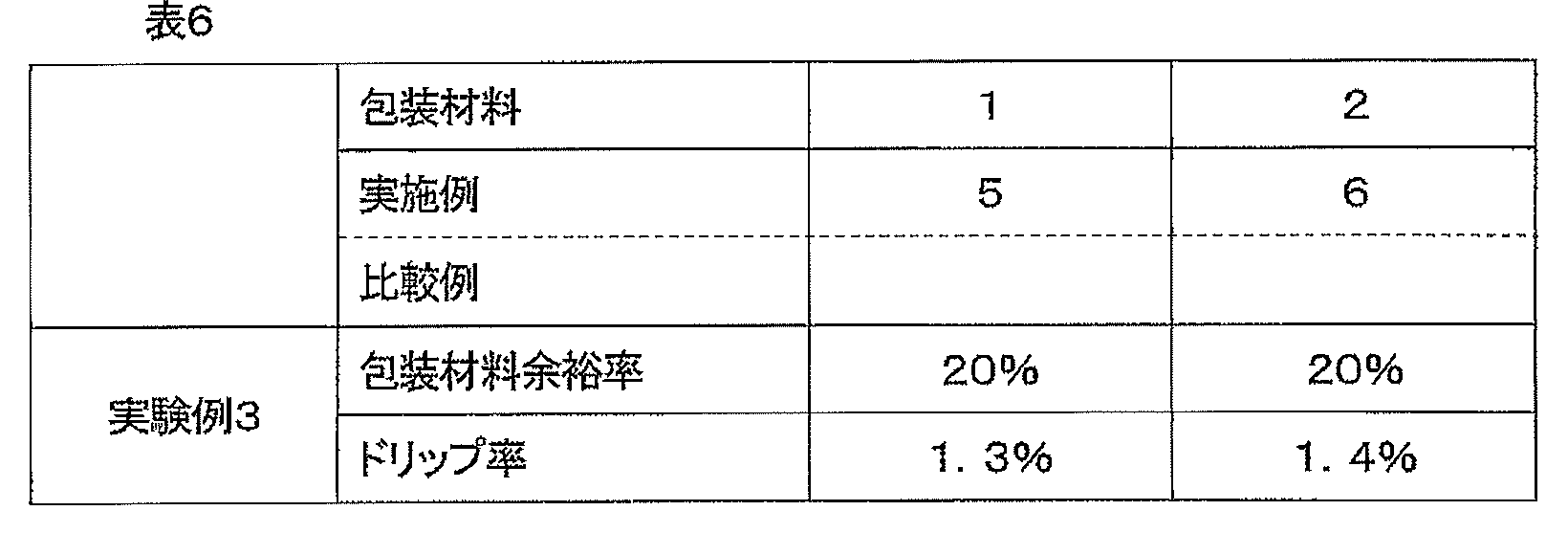
牛モモ肉(サイズ:約13cm×約17cm×約7cm、重量約2.0kg)を表6に示した包装材料で真空包装(MULTIVAC製真空包装機AGW160使用)し、80℃の熱水に約3秒間浸漬後、氷水で急冷した。その後、0℃の保管庫で1ヶ月間保存した。保存後のドリップ量を測定し、真空包装前の肉重量に対するドリップ量の比率をドリップ率として求めた。
牛モモ肉(サイズ:約13cm×約17cm×約7cm、重量約2.0kg)を表6に示した包装材料で真空包装(MULTIVAC製真空包装機AGW160使用)し、80℃の熱水に約3秒間浸漬後、氷水で急冷した。その後、0℃の保管庫で1ヶ月間保存した。保存後のドリップ量を測定し、真空包装前の肉重量に対するドリップ量の比率をドリップ率として求めた。
前記真空包装は、包装材料として、250mm×300mmのフィルム状の包装材料を2枚用い、インパルスシーラー(富士インパルス製シーラー使用)を用いてヒートシールし、真空包装後の内寸が240mm×290mmの袋を用いて行った。
前記真空包装は、前記袋に牛モモ肉を入れ、前記真空包装機の設定を、真空ダイアル5、シールダイアル5として行った。
なお、包装材料毎に、5回試験を行い、牛モモ肉の平均重量は2kgとなるようにした。
なお、包装材料毎に、5回試験を行い、牛モモ肉の平均重量は2kgとなるようにした。
包装材料余裕率は、牛モモ肉のMDの胴周を400mm、TDの胴周を480mmとして、包装材料1、2の場合には、以下の方法で求めた。
MDの包装材料余裕率=[(240/200)-1]×100=20.0%
TDの包装材料余裕率=[(290/240)-1]×100=20.8%
包装材料余裕率=(20.0%+20.8%)/2=20%
ドリップ量、ドリップ率は実験例1と同様の方法で求めた。
MDの包装材料余裕率=[(240/200)-1]×100=20.0%
TDの包装材料余裕率=[(290/240)-1]×100=20.8%
包装材料余裕率=(20.0%+20.8%)/2=20%
ドリップ量、ドリップ率は実験例1と同様の方法で求めた。
なお、包装材料として、包装材料1、2を使用した実験例が、本発明の実施例に相当し、各実験例をそれぞれ実施例5、6とする。
実験例3の結果を表6に示す。
実験例3の結果を表6に示す。
〔実験例4〕
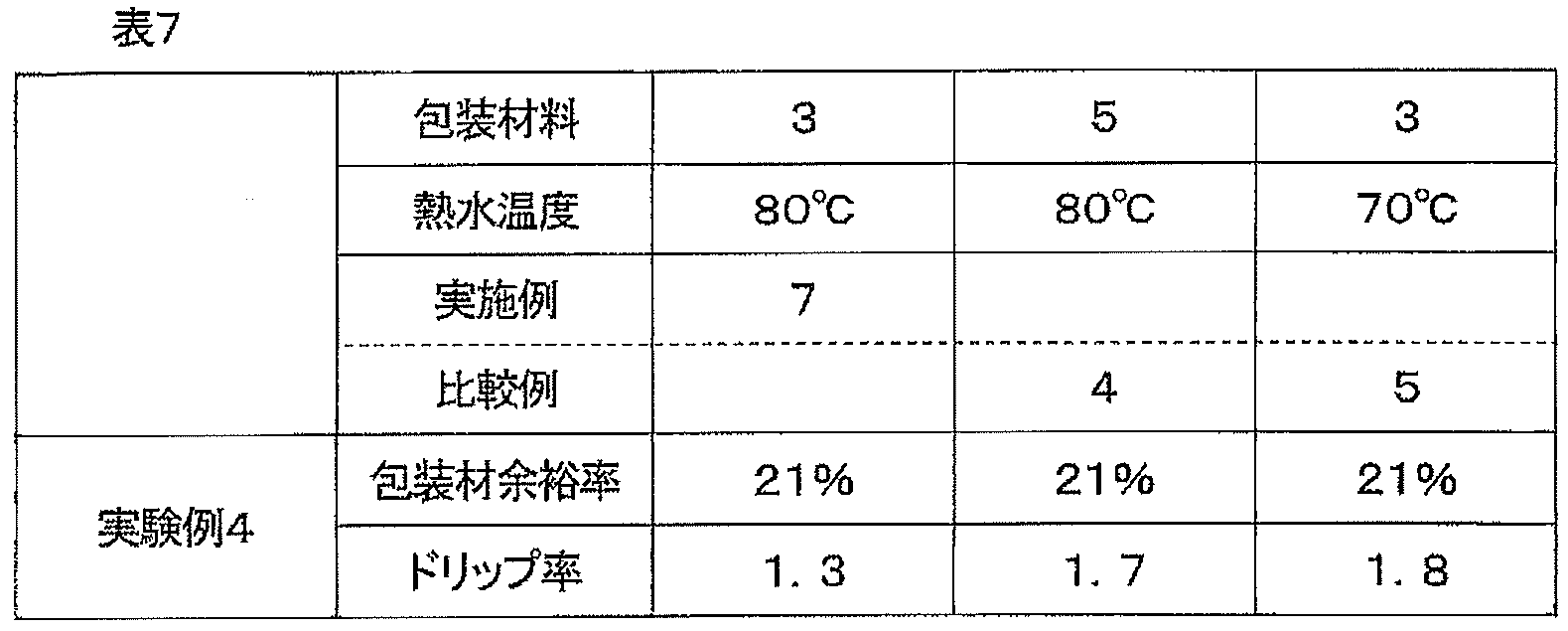
牛モモ肉(サイズ:約15cm×約18cm×約7cm、重量約2.5kg)を表7に示した包装材料で真空包装(MULTIVAC製真空包装機AGW160使用)し、80℃または70℃の熱水に約3秒間浸漬後、氷水で急冷した。その後、0℃の保管庫で1ヶ月間保存した。保存後のドリップ量を測定し、真空包装前の肉重量に対するドリップ量の比率をドリップ率として求めた。
牛モモ肉(サイズ:約15cm×約18cm×約7cm、重量約2.5kg)を表7に示した包装材料で真空包装(MULTIVAC製真空包装機AGW160使用)し、80℃または70℃の熱水に約3秒間浸漬後、氷水で急冷した。その後、0℃の保管庫で1ヶ月間保存した。保存後のドリップ量を測定し、真空包装前の肉重量に対するドリップ量の比率をドリップ率として求めた。
前記前記真空包装は、包装材料として、280mm×310mmのフィルム状の包装材料を2枚用い、実施例1と同様に、インパルスシーラー(富士インパルス製シーラー使用)を用いてヒートシールし、真空包装後の内寸が270mm×300mmの袋を用いて行った。
前記真空包装は、前記袋に牛モモ肉を入れ、前記真空包装機の設定を、真空ダイアル5、シールダイアル5として行った。
なお、包装材料毎に、3回試験を行い、牛モモ肉の平均重量は2.5kgとなるようにした。
なお、包装材料毎に、3回試験を行い、牛モモ肉の平均重量は2.5kgとなるようにした。
包装材料余裕率は、牛モモ肉のMDの胴周を440mm、TDの胴周を500mmとして、包装材料3、5の場合には、以下の方法で求めた。
MDの包装材料余裕率=[(270/220)-1]×100=22.7%
TDの包装材料余裕率=[(300/250)-1]×100=20.0%
包装材料余裕率=(22.7+20.0%)/2=21%
ドリップ量、ドリップ率は実験例1と同様の方法で求めた。
MDの包装材料余裕率=[(270/220)-1]×100=22.7%
TDの包装材料余裕率=[(300/250)-1]×100=20.0%
包装材料余裕率=(22.7+20.0%)/2=21%
ドリップ量、ドリップ率は実験例1と同様の方法で求めた。
なお、包装材料として、包装材料3を使用し、80℃の熱水を用いた実験例が、本発明の実施例に相当し、該実験例を実施例7とする。また、包装材料として、包装材料5を使用し、80℃の熱水を用いた実験例、および包装材料3を使用し、70℃の熱水を用いた実験例が、比較例であり、各実験例をそれぞれ比較例4、5とする。
実験例4の結果を表7に示す。
実験例4の結果を表7に示す。
実験例1~4より、面積収縮率が70~90%のフィルムからなる包装材料を用いた場合には、発生するドリップ量が少ないことがわかる。また、実験例1~4より、セルフウェルド性を有するフィルムを用いると、さらにドリップ量を少なくすることができることがわかる。
Claims (4)
- フィルムからなる包装材料を用いて食肉を真空包装し、その後包装材料を熱収縮させる熱処理を行うことにより得られる食品包装体であって、
前記フィルムが、80℃の熱水中に10秒浸漬した際の面積収縮率が70~90%のフィルムであり、
前記熱処理の温度が75~90℃であり、
前記食肉が1kg以上15kg以下である食品包装体。 - 前記面積収縮率が、70~80%である請求項1に記載の食品包装体。
- 前記包装材料が、80℃の熱水に10秒浸漬した際にセルフウェルド性を有する包装材料である請求項1または2に記載の食品包装体。
- フィルムからなる包装材料を用いて食肉を真空包装する工程、
前記工程の後に行われる、真空包装された包装体を熱処理することにより、包装材料を熱収縮させる工程を有する食品包装体の製造方法であり、
前記フィルムが、80℃の熱水中に10秒浸漬した際の面積収縮率が70~90%のフィルムであり、
前記熱処理の温度が75~90℃であり、
前記食肉が1kg以上15kg以下である食品包装体の製造方法。
Applications Claiming Priority (2)
| Application Number | Priority Date | Filing Date | Title |
|---|---|---|---|
| JP2015046095 | 2015-03-09 | ||
| JP2015-046095 | 2015-03-09 |
Publications (1)
| Publication Number | Publication Date |
|---|---|
| WO2016143661A1 true WO2016143661A1 (ja) | 2016-09-15 |
Family
ID=56879375
Family Applications (1)
| Application Number | Title | Priority Date | Filing Date |
|---|---|---|---|
| PCT/JP2016/056598 Ceased WO2016143661A1 (ja) | 2015-03-09 | 2016-03-03 | 食品包装体およびその製造方法 |
Country Status (1)
| Country | Link |
|---|---|
| WO (1) | WO2016143661A1 (ja) |
Citations (3)
| Publication number | Priority date | Publication date | Assignee | Title |
|---|---|---|---|---|
| JPH01297243A (ja) * | 1988-05-25 | 1989-11-30 | Mitsubishi Plastics Ind Ltd | 熱収縮性複合延伸フイルム |
| JP2006076601A (ja) * | 2004-09-09 | 2006-03-23 | Best Pack Kk | 部分肉の真空個包装体の印字方法 |
| WO2013121874A1 (ja) * | 2012-02-16 | 2013-08-22 | 株式会社クレハ | 熱収縮性多層フィルム |
-
2016
- 2016-03-03 WO PCT/JP2016/056598 patent/WO2016143661A1/ja not_active Ceased
Patent Citations (3)
| Publication number | Priority date | Publication date | Assignee | Title |
|---|---|---|---|---|
| JPH01297243A (ja) * | 1988-05-25 | 1989-11-30 | Mitsubishi Plastics Ind Ltd | 熱収縮性複合延伸フイルム |
| JP2006076601A (ja) * | 2004-09-09 | 2006-03-23 | Best Pack Kk | 部分肉の真空個包装体の印字方法 |
| WO2013121874A1 (ja) * | 2012-02-16 | 2013-08-22 | 株式会社クレハ | 熱収縮性多層フィルム |
Similar Documents
| Publication | Publication Date | Title |
|---|---|---|
| JP4495264B2 (ja) | 熱収縮性多層フィルム | |
| JP4864177B2 (ja) | 延伸多層フィルムケーシング | |
| ES2663514T5 (es) | Películas termocontraíbles de barrera de multicapa PVDC | |
| JPH0358908B2 (ja) | ||
| JP6436719B2 (ja) | スキンパック用熱収縮性延伸多層フィルム、それを用いたスキンパック包装体、及びスキンパック用熱収縮性延伸多層フィルムの製造方法 | |
| CN109195790B (zh) | 阻气可热收缩膜 | |
| WO2007140118A2 (en) | Multilayer film having high oxygen transmission and high modulus | |
| BRPI0707768A2 (pt) | filme de méltiplas camadas termo-contrÁtil, e, materiais de embalagem para bolsa, de embalagem para saco, de embalagem para embalagem de travesseiro, de embalagem para comformaÇço por estampagem profunda e de tampa para embalagem de bandeja | |
| EP1137534B1 (en) | Multilayer heat shrinkable film | |
| US6365248B1 (en) | Easily tearable laminated barrier film and bag product using the same | |
| EP2679518A1 (en) | Multilayer structures, packages, and methods of making multilayer structures | |
| JPWO2017169208A1 (ja) | 熱収縮性フィルム及び熱収縮フィルムの製造方法 | |
| WO2004080803A2 (en) | Thermoplastic multilayer structures | |
| AU2017300427B2 (en) | Heat-shrinkable multilayer film | |
| JP2016128330A (ja) | 食品包装体 | |
| JP7190141B2 (ja) | 熱収縮性ガスバリアフィルム | |
| JPS625061B2 (ja) | ||
| WO2016143661A1 (ja) | 食品包装体およびその製造方法 | |
| JPS625062B2 (ja) | ||
| WO2011149386A2 (en) | Polyamide-based synthetic sausage casing able to be filled without stretching and method of production thereof | |
| JPS588644A (ja) | 熱収縮性多層フィルム及びその包装体 | |
| JPS625063B2 (ja) | ||
| JP4817858B2 (ja) | 蓋材 | |
| CN113352719A (zh) | 一种在线成型收缩底膜和盖膜及其制备方法 | |
| US4925687A (en) | Turkey package |
Legal Events
| Date | Code | Title | Description |
|---|---|---|---|
| 121 | Ep: the epo has been informed by wipo that ep was designated in this application |
Ref document number: 16761631 Country of ref document: EP Kind code of ref document: A1 |
|
| NENP | Non-entry into the national phase |
Ref country code: DE |
|
| 122 | Ep: pct application non-entry in european phase |
Ref document number: 16761631 Country of ref document: EP Kind code of ref document: A1 |
|
| NENP | Non-entry into the national phase |
Ref country code: JP |