WO2016136708A1 - 膜透過性ペプチドを側鎖に有する高分子化合物 - Google Patents
膜透過性ペプチドを側鎖に有する高分子化合物 Download PDFInfo
- Publication number
- WO2016136708A1 WO2016136708A1 PCT/JP2016/055174 JP2016055174W WO2016136708A1 WO 2016136708 A1 WO2016136708 A1 WO 2016136708A1 JP 2016055174 W JP2016055174 W JP 2016055174W WO 2016136708 A1 WO2016136708 A1 WO 2016136708A1
- Authority
- WO
- WIPO (PCT)
- Prior art keywords
- group
- compound
- membrane
- polymer
- polymer compound
- Prior art date
- Legal status (The legal status is an assumption and is not a legal conclusion. Google has not performed a legal analysis and makes no representation as to the accuracy of the status listed.)
- Ceased
Links
Classifications
-
- C—CHEMISTRY; METALLURGY
- C08—ORGANIC MACROMOLECULAR COMPOUNDS; THEIR PREPARATION OR CHEMICAL WORKING-UP; COMPOSITIONS BASED THEREON
- C08F—MACROMOLECULAR COMPOUNDS OBTAINED BY REACTIONS ONLY INVOLVING CARBON-TO-CARBON UNSATURATED BONDS
- C08F8/00—Chemical modification by after-treatment
- C08F8/30—Introducing nitrogen atoms or nitrogen-containing groups
-
- A—HUMAN NECESSITIES
- A61—MEDICAL OR VETERINARY SCIENCE; HYGIENE
- A61K—PREPARATIONS FOR MEDICAL, DENTAL OR TOILETRY PURPOSES
- A61K47/00—Medicinal preparations characterised by the non-active ingredients used, e.g. carriers or inert additives; Targeting or modifying agents chemically bound to the active ingredient
- A61K47/30—Macromolecular organic or inorganic compounds, e.g. inorganic polyphosphates
- A61K47/32—Macromolecular compounds obtained by reactions only involving carbon-to-carbon unsaturated bonds, e.g. carbomers, poly(meth)acrylates, or polyvinyl pyrrolidone
-
- C—CHEMISTRY; METALLURGY
- C07—ORGANIC CHEMISTRY
- C07K—PEPTIDES
- C07K2/00—Peptides of undefined number of amino acids; Derivatives thereof
-
- C—CHEMISTRY; METALLURGY
- C07—ORGANIC CHEMISTRY
- C07K—PEPTIDES
- C07K5/00—Peptides containing up to four amino acids in a fully defined sequence; Derivatives thereof
- C07K5/04—Peptides containing up to four amino acids in a fully defined sequence; Derivatives thereof containing only normal peptide links
- C07K5/06—Dipeptides
- C07K5/06008—Dipeptides with the first amino acid being neutral
- C07K5/06017—Dipeptides with the first amino acid being neutral and aliphatic
- C07K5/06026—Dipeptides with the first amino acid being neutral and aliphatic the side chain containing 0 or 1 carbon atom, i.e. Gly or Ala
-
- C—CHEMISTRY; METALLURGY
- C08—ORGANIC MACROMOLECULAR COMPOUNDS; THEIR PREPARATION OR CHEMICAL WORKING-UP; COMPOSITIONS BASED THEREON
- C08F—MACROMOLECULAR COMPOUNDS OBTAINED BY REACTIONS ONLY INVOLVING CARBON-TO-CARBON UNSATURATED BONDS
- C08F220/00—Copolymers of compounds having one or more unsaturated aliphatic radicals, each having only one carbon-to-carbon double bond, and only one being terminated by only one carboxyl radical or a salt, anhydride ester, amide, imide or nitrile thereof
- C08F220/02—Monocarboxylic acids having less than ten carbon atoms; Derivatives thereof
- C08F220/04—Acids; Metal salts or ammonium salts thereof
- C08F220/06—Acrylic acid; Methacrylic acid; Metal salts or ammonium salts thereof
-
- C—CHEMISTRY; METALLURGY
- C08—ORGANIC MACROMOLECULAR COMPOUNDS; THEIR PREPARATION OR CHEMICAL WORKING-UP; COMPOSITIONS BASED THEREON
- C08F—MACROMOLECULAR COMPOUNDS OBTAINED BY REACTIONS ONLY INVOLVING CARBON-TO-CARBON UNSATURATED BONDS
- C08F220/00—Copolymers of compounds having one or more unsaturated aliphatic radicals, each having only one carbon-to-carbon double bond, and only one being terminated by only one carboxyl radical or a salt, anhydride ester, amide, imide or nitrile thereof
- C08F220/02—Monocarboxylic acids having less than ten carbon atoms; Derivatives thereof
- C08F220/52—Amides or imides
- C08F220/54—Amides, e.g. N,N-dimethylacrylamide or N-isopropylacrylamide
- C08F220/56—Acrylamide; Methacrylamide
-
- C—CHEMISTRY; METALLURGY
- C08—ORGANIC MACROMOLECULAR COMPOUNDS; THEIR PREPARATION OR CHEMICAL WORKING-UP; COMPOSITIONS BASED THEREON
- C08F—MACROMOLECULAR COMPOUNDS OBTAINED BY REACTIONS ONLY INVOLVING CARBON-TO-CARBON UNSATURATED BONDS
- C08F226/00—Copolymers of compounds having one or more unsaturated aliphatic radicals, each having only one carbon-to-carbon double bond, and at least one being terminated by a single or double bond to nitrogen or by a heterocyclic ring containing nitrogen
- C08F226/02—Copolymers of compounds having one or more unsaturated aliphatic radicals, each having only one carbon-to-carbon double bond, and at least one being terminated by a single or double bond to nitrogen or by a heterocyclic ring containing nitrogen by a single or double bond to nitrogen
-
- C—CHEMISTRY; METALLURGY
- C08—ORGANIC MACROMOLECULAR COMPOUNDS; THEIR PREPARATION OR CHEMICAL WORKING-UP; COMPOSITIONS BASED THEREON
- C08G—MACROMOLECULAR COMPOUNDS OBTAINED OTHERWISE THAN BY REACTIONS ONLY INVOLVING UNSATURATED CARBON-TO-CARBON BONDS
- C08G81/00—Macromolecular compounds obtained by interreacting polymers in the absence of monomers, e.g. block polymers
Definitions
- the present invention relates to a polymer compound that is useful when a low membrane permeability compound is introduced into cells or mucous membranes.
- water-soluble high molecular weight substances such as polypeptides, nucleic acids, and sugars have high hydrophilicity and are difficult to pass through cell membranes. Therefore, as a method for introducing them into cells, a microinjection method, an electroporation method, a calcium phosphate method, a lipofection method, a virus vector method, a membrane-permeable peptide method, and the like are known.
- the membrane-permeable peptide method is a method that utilizes the fact that a membrane-permeable peptide induces macropinocytosis of cells.
- Examples of the membrane-permeable peptide method include a method in which a target compound to be introduced into a cell and a membrane-permeable peptide are introduced by covalent bonding (for example, see Patent Documents 1 and 2) or a membrane-permeable peptide in the side chain.
- a method in which a polymer compound and a target compound to be introduced into cells coexist and only the target compound is introduced (see, for example, Patent Documents 3 to 4).
- the method of introducing a target compound and a membrane-permeable peptide by covalently bonding them causes little damage to cells, but requires complicated pretreatment.
- the method of using a polymer compound having a membrane-permeable peptide in the side chain is simple, but a conventionally known polymer compound having a membrane-permeable peptide in the side chain can be introduced with a water-soluble high molecular weight substance. Since the efficiency is insufficient and there is also weak cytotoxicity, the use concentration may be limited, which has been a problem when improving the introduction efficiency of the target compound.
- the present invention has been made in view of the above circumstances, and is a polymer that can introduce water-soluble high molecular weight substances such as nucleic acids and proteins and drugs into cells or mucous membranes in a simple manner with high efficiency. It aims at providing the introduction method using a compound and its high molecular compound.
- the present inventors can easily bring a water-soluble high molecular weight substance such as a nucleic acid or protein or a drug into a cell or mucous membrane.
- the present inventors have found that it can be introduced and have completed the present invention.
- this invention provides the high molecular compound which has group represented by following General formula (1) or following General formula (2) in a side chain.
- X 1 represents a residue obtained by removing a terminal amino group and a terminal carboxyl group from a neutral amino acid or ⁇ -aminoalkanoic acid
- X 2 excludes a terminal amino group and a terminal carboxyl group from a membrane-permeable peptide.
- X 3 represents a hydroxyl group, an amino group, an alkoxyl group having 1 to 4 carbon atoms or a benzyloxy group, and a represents a number of 1 to 50.)
- X 4 represents a residue obtained by removing a terminal amino group and a terminal carboxyl group from a neutral amino acid or ⁇ -aminoalkanoic acid
- X 5 excludes a terminal amino group and a terminal carboxyl group from a membrane-permeable peptide.
- X 6 represents a hydrogen atom, an alkyl group having 1 to 6 carbon atoms, a benzyl group, an acyl group having 1 to 6 carbon atoms, an arylsulfonyl group or an oxycarbonyl group, and b represents 1 to 50 Represents a number.
- the present invention also provides an introduction agent for introducing a low-membrane-permeable compound such as a drug or a water-soluble polymer compound into a mucous membrane or a cell, and comprising the above-mentioned polymer compound. is there.
- the present invention also provides a method for introducing a low membrane permeability compound into cells or mucosa using the above-mentioned introduction agent.
- a polymer compound having a group represented by the general formula (1) or the general formula (2) in the side chain can convert a low membrane permeability compound with high efficiency without performing complicated pretreatment. It can be introduced into cells and mucous membranes.
- the low membrane permeability compound means a compound having low bioavailability, and specifically, a compound having an extent of bioavailability of 50% or less. Means.
- “the amount reached in the blood” is determined as the area surrounded by the blood concentration and the horizontal axis (time axis) (the area under the drug blood concentration-time curve: AUC).
- the polymer compound of the present invention and the introduction agent of the present invention using the same have a membrane-permeable peptide residue and have low membrane permeability.
- Compounds can be efficiently taken up by cells.
- the mechanism by which membrane-permeable peptides are taken up by cells is generally that membrane-permeable peptides are taken up by inducing macropinocytosis of cells, and when there are low membrane-permeable compounds in the surrounding area It is believed that these low membrane-permeable compounds are incorporated along with membrane-permeable peptides.
- the polymer compound of the present invention macropinocytosis is induced in a plurality of locations of the cell by the membrane-permeable peptide residue.
- the polymer compound of the present invention is a macromolecule, It is also difficult for a cell to take in one molecule of a molecular compound from multiple locations. For this reason, when a low membrane permeability compound is present around the polymer compound of the present invention, the low membrane permeability compound is inadvertently caused by cells in which macropinocytosis has been induced by the polymer compound of the present invention. And will be taken in continuously.
- the interaction between the membrane permeable peptide residue and the low membrane permeable compound is not necessarily required, and the mixture of the polymer compound of the present invention and the low membrane permeable compound is applied to the cell or mucous membrane. It is considered that a low membrane permeability compound can be introduced into cells or mucous membranes only by contacting.
- the polymer compound of the present invention is a graft polymer compound having a group represented by the general formula (1) or (2) in the side chain.
- the main chain portion of the polymer compound of the present invention is called a trunk polymer.
- the structure of the polymer compound of the present invention will be described in detail.
- X 1 represents a residue obtained by removing a terminal amino group and a terminal carboxyl group from a neutral amino acid or ⁇ -aminoalkanoic acid, and a represents a number of 1 to 50.
- neutral amino acids examples include alanine, asparagine, cysteine, glutamine, glycine, isoleucine, leucine, methionine, phenylalanine, proline, serine, threonine, tryptophan, tyrosine, valine, hydroxyproline, etc., and ⁇ -aminoalkanoic acid
- 3-aminopropanoic acid 4-aminobutanoic acid, 5-aminopentanoic acid, 6-aminohexanoic acid, 7-aminoheptanoic acid, 8-aminooctanoic acid, 9-aminononanoic acid, 10-aminodecanoic acid, 11- Examples include aminoundecanoic acid.
- glycine, alanine, valine, isoleucine, leucine, serine, threonine, phenylalanine is preferred
- glycine, alanine, serine further Glycine is preferred and most preferred.
- a is preferably a number of 1 to 30, more preferably a number of 1 to 20, and most preferably a number of 1 to 10.
- X 1 may be one neutral amino acid residue or ⁇ -aminoalkanoic acid residue, or a combination of two or more selected from these residues.
- X 2 represents a residue obtained by removing a terminal amino group and a terminal carboxyl group from a membrane-permeable peptide.
- the membrane-permeable peptide residue of the polymer compound of the present invention may be appropriately selected according to cells, mucous membranes, and the low membrane-permeable compound to be introduced, but at least of the amino acids constituting the membrane-permeable peptide residue
- One is preferably a basic amino acid.
- the basic amino acid may be either L-form or D-form, and may be appropriately selected depending on the cells, mucous membranes, and the low membrane permeability compound to be introduced.
- Examples of basic amino acids include arginine, ornithine, lysine, hydroxylysine, histidine, etc. Among them, guanidino group-containing amino acids are preferable, and arginine is more preferable.
- the ratio of basic amino acids in the membrane-permeable peptide residue increases, the introduction efficiency of the low membrane-permeable compound increases, so the ratio of basic amino acids to all amino acids constituting the membrane-permeable peptide is on a molar basis. 50% or more, more preferably 70% or more.
- amino acids other than basic amino acids are preferably neutral amino acids.
- amino acid means an ⁇ -amino acid unless otherwise specified.
- the number of amino acids constituting the membrane-permeable peptide group is preferably 5 to 30, more preferably 6 to 20, and more preferably 7 to 15 because the introduction efficiency of the low membrane permeability compound is increased. Most preferred.
- the membrane-permeable peptide include an arginine oligomer in which 7 to 30 arginines are peptide-bonded, a peptide having an amino acid sequence of GRKKRRQRRPPQ (commonly known as HIV-11Tat: SEQ ID NO: 1), and a peptide having an amino acid sequence of TRQARRRRRRRWRERRQR (Commonly referred to as HIV-1 Rev: SEQ ID NO: 2), peptide having an amino acid sequence of RRRRNRTRRNNRRRVR (commonly known as FHV Coat: SEQ ID NO: 3), peptide having an amino acid sequence of TRRQRTRRRRRNR (commonly referred to as HTLV-II Rex: SEQ ID NO: 4), KLTRAQRRAAARKNKRNTR
- a hydrophilic basic peptide such as a peptide having an amino acid sequence (commonly known as CCMV Gag: SEQ ID NO: 5); RQKIKIWFQNRR
- hydrophilic basic peptides are preferable and arginine oligomers are more preferable because of the excellent introduction efficiency of the low membrane permeability compound.
- the arginine oligomers the arginine repeat number is preferably 7 to 20, more preferably 7 to 15, and most preferably 7 to 10.
- X 3 represents a hydroxyl group, an amino group, an alkoxyl group having 1 to 4 carbon atoms, or a benzyloxy group.
- alkoxyl group having 1 to 4 carbon atoms include methoxy group, ethoxy group, propoxy group, isopropoxy group, butoxy group, isobutoxy group, 1-methylpropoxy group, t-butoxy group and the like.
- X 3 is preferably a hydroxyl group, an amino group, a t-butoxy group or a benzyloxy group, more preferably a hydroxyl group or an amino group, and most preferably an amino group, from the viewpoint of the introduction efficiency of the low membrane permeability compound.
- the group represented by each general formula (1) X 1 , X 2 , X 3 and a may be the same or different.
- X 4 represents a residue obtained by removing a terminal amino group and a terminal carboxyl group from a neutral amino acid or ⁇ -aminoalkanoic acid
- b represents a number of 1 to 50.
- neutral amino acids examples include alanine, asparagine, cysteine, glutamine, glycine, isoleucine, leucine, methionine, phenylalanine, proline, serine, threonine, tryptophan, tyrosine, valine, hydroxyproline, etc., and ⁇ -aminoalkanoic acid
- 3-aminopropanoic acid 4-aminobutanoic acid, 5-aminopentanoic acid, 6-aminohexanoic acid, 7-aminoheptanoic acid, 8-aminooctanoic acid, 9-aminononanoic acid, 10-aminodecanoic acid, 11- Examples include aminoundecanoic acid.
- glycine, alanine, valine, isoleucine, leucine, serine, threonine, and phenylalanine are preferable from the viewpoint of introduction efficiency of a low membrane-permeable compound and ease of synthesis.
- Alanine and serine are more preferable, and glycine is most preferable.
- b is preferably a number of 1 to 30, more preferably a number of 1 to 20, and most preferably a number of 1 to 10.
- X 4 may be one neutral amino acid residue or ⁇ -aminoalkanoic acid residue, or a combination of two or more selected from these residues.
- X 5 represents a residue obtained by removing a terminal amino group and a terminal carboxyl group from a membrane-permeable peptide.
- the membrane-permeable peptide residue of the polymer compound of the present invention may be appropriately selected according to cells, mucous membranes, and the low membrane-permeable compound to be introduced, but at least of the amino acids constituting the membrane-permeable peptide residue
- One is preferably a basic amino acid.
- the basic amino acid may be either L-form or D-form, and may be appropriately selected depending on the cells, mucous membranes, and the low membrane permeability compound to be introduced.
- Examples of basic amino acids include arginine, ornithine, lysine, hydroxylysine, histidine, etc. Among them, guanidino group-containing amino acids are preferable, and arginine is more preferable.
- the ratio of basic amino acids in the membrane-permeable peptide residue increases, the introduction efficiency of the low membrane-permeable compound increases, so the ratio of basic amino acids to all amino acids constituting the membrane-permeable peptide is on a molar basis. 50% or more, more preferably 70% or more.
- amino acids other than basic amino acids are preferably neutral amino acids.
- the number of amino acids constituting the membrane-permeable peptide group is preferably 5 to 30, more preferably 6 to 20, and more preferably 7 to 15 because the introduction efficiency of the low membrane permeability compound is increased. Most preferred.
- the membrane-permeable peptide include an arginine oligomer in which 7 to 30 arginines are peptide-bonded, a peptide having an amino acid sequence of GRKKRRQRRPPQ (commonly known as HIV-11Tat: SEQ ID NO: 1), and a peptide having an amino acid sequence of TRQARRRRRRRWRERRQR (Commonly referred to as HIV-1 Rev: SEQ ID NO: 2), peptide having an amino acid sequence of RRRRNRTRRNNRRRVR (commonly known as FHV Coat: SEQ ID NO: 3), peptide having an amino acid sequence of TRRQRTRRRRRNR (commonly referred to as HTLV-II Rex: SEQ ID NO: 4), KLTRAQRRAAARKNKRNTR
- a hydrophilic basic peptide such as a peptide having an amino acid sequence (commonly known as CCMV Gag: SEQ ID NO: 5); RQKIKIWFQNRR
- hydrophilic basic peptides are preferable and arginine oligomers are more preferable because of the excellent introduction efficiency of the low membrane permeability compound.
- the arginine oligomers the arginine repeat number is preferably 7 to 20, more preferably 7 to 15, and most preferably 7 to 10.
- X 6 represents a hydrogen atom, an alkyl group having 1 to 6 carbon atoms, a benzyl group, an acyl group having 1 to 6 carbon atoms, an arylsulfonyl group, or a carboxyl group.
- alkyl group having 1 to 6 carbon atoms include methyl group, ethyl group, propyl group, isopropyl group, butyl group, isobutyl group, secondary butyl group, t-butyl group, pentyl group, isopentyl group, secondary pentyl group, Examples include t-pentyl group, hexyl group, secondary hexyl group and the like.
- Examples of the acyl group having 1 to 6 carbon atoms include formyl group, acetyl group, propinoyl group, butinoyl group, pentinoyl group, and hexinoyl group.
- Examples of the arylsulfonyl group include p-toluenesulfonyl group, 2-nitrobenzenesulfonyl group, trifluoroacetyl group and the like.
- Examples of the oxycarbonyl group include a t-butoxycarbonyl group, a benzyloxycarbonyl group, a 9-fluorenylmethyloxycarbonyl group, a 2,2,2-trichloroethoxycarbonyl group, and an allyloxycarbonyl group.
- X 6 is preferably an acetyl group, a hydrogen atom, a methyl group or a trifluoroacetyl group, more preferably an acetyl group or a hydrogen atom, and most preferably an acetyl group, from the viewpoint of the introduction efficiency of the low membrane permeability compound.
- the group represented by each general formula (2) X 4 , X 5 , X 6 and b may be the same or different.
- the graft polymer backbone polymer of the present invention is not particularly limited, but is preferably a hydrophilic polymer because of its excellent affinity with water-soluble high molecular weight substances such as cells and proteins.
- the hydrophilic polymer means a water-soluble polymer or a polymer that swells in water.
- the water-soluble polymer means a polymer that is uniformly dissolved in water at 25 ° C. in an amount of 0.1% by mass or more under normal pressure.
- hydrophilic polymers examples include guar gum, agarose, mannan, glucomannan, polydextrose, lignin, chitin, chitosan, carrageenan, pullulan, chondroitin sulfate, cellulose, hemicellulose, methylcellulose, ethylcellulose, hydroxyethylcellulose, hydroxypropylcellulose, starch , Cationic starch, dextrin polysaccharide or modified polysaccharide; water-soluble protein or water-soluble polypeptide such as albumin, casein, gelatin, polyglutamic acid, polylysine; poly (meth) acrylic acid, poly (hydroxyethyl acrylate) , Poly (meth) acrylamide, poly N-vinylacetamide, polyvinylpyrrolidone, polyvinyl alcohol, poly (2-aminoethyl (meth) acrylate) G), (meth) acrylic acid / acrylamide copolymer, (meth
- the trunk polymer is a high molecular compound of the present invention having a group represented by the general formula (1) in the side chain.
- a polymer having a carboxyl group is preferred, a hydrophilic polymer having a carboxyl group is more preferred, and a copolymer of a monomer having a carboxyl group and a monomer having no carboxyl group is more preferred, Most preferred is a (meth) acrylic acid / N-vinylacetamide copolymer.
- a polymer compound having a group represented by the general formula (2) in the side chain a polymer having an amino group is preferable, a hydrophilic polymer having an amino group is more preferable, and chitosan is most preferable.
- a polymer having an amino group or a carboxyl group should just correspond to the trunk polymer before having the group represented by General formula (1) or (2) in a side chain.
- the ratio of the number of monomer units having a carboxyl group to the number of monomer units constituting the backbone polymer is 5 to 5 from the viewpoint of easily obtaining a preferable polymer compound of the present invention. 80% is preferable, and 10 to 60% is more preferable.
- the trunk polymer has an amino group
- the ratio of the number of monomer units having an amino group to the number of monomer units constituting the trunk polymer is 5 to 5 from the viewpoint of easily obtaining a preferable polymer compound of the present invention. 100% is preferable, and 10 to 100% is more preferable.
- the ratio of the unit which has an amino group or a carboxyl group described above corresponds to the trunk polymer before having the group represented by General formula (1) or General formula (2) in a side chain. .
- the polymer compound of the present invention is characterized by having a group represented by the general formula (1) or (2) in the side chain.
- the ratio of the group represented by the general formula (1) or the general formula (2) is too low and too high, the introduction efficiency of the low membrane permeability compound becomes low.
- the number of groups represented by the general formula (1) or the general formula (2) is the same as the monomer unit constituting the trunk polymer (in the case of a polysaccharide or a modified polysaccharide).
- the number is preferably 0.001 to 0.9, more preferably 0.005 to 0.8, Most preferably, it is 0.01 to 0.7.
- the weight average molecular weight of the polymer compound of the present invention is preferably 100,000 to 50 million, more preferably 200,000 to 30 million, and most preferably 300,000 to 10 million.
- the weight average molecular weight is a weight average molecular weight when GPC analysis is performed using an aqueous solvent
- the trunk polymer is a polysaccharide, a modified polysaccharide, or a water-soluble protein.
- the polymer compound of the present invention has higher introduction efficiency of a low membrane-permeable compound than a conventionally known polymer compound having a membrane-permeable peptide in the side chain. This is because a conventionally known polymer compound having a membrane-permeable peptide in its side chain (see, for example, JP-A-2010-10000781) is directly bonded to the trunk polymer. On the other hand, in the polymer compound of the present invention, the membrane-permeable peptide and the trunk polymer are bonded via a group represented by the following general formula (1a) or the following general formula (2a). It is presumed that the degree of freedom of the membrane-permeable peptide residue is improved.
- the production method of the polymer compound of the present invention is not particularly limited, and the polymer compound may be produced by polymerizing a polymerizable monomer having a group represented by the general formula (1) or the general formula (2). May be produced by introducing a group represented by the general formula (1) or (2) into the main polymer from the viewpoint of ease of production. It is preferable to introduce the group represented by When the trunk polymer is a hydrophilic polymer having a carboxyl group, it can be obtained by peptide reaction of the amino group of the peptide compound represented by the following general formula (1b) with the carboxyl group. A known method may be used for the reaction between the carboxyl group and the amino group.
- Examples thereof include a method in which a carboxyl group is converted to a succinimide ester with N-hydroxysuccinimide and then reacted with an amino group.
- the trunk polymer is a hydrophilic polymer having an amino group, it can be obtained by subjecting the amino group to a peptide reaction with a carboxyl group of a peptide compound represented by the following general formula (2b).
- the group represented by the general formula (1) or (2) can be most easily introduced as a side chain of the trunk polymer via an amide bond.
- the method for fixing the group represented by the general formula (1) or (2) is not limited to this method, and it can be fixed using a generally known chemical reaction. (Wherein X 1 , X 2 , X 3 and a have the same meanings as in general formula (1).) (In the formula, X 4 , X 5 , X 6 and b are as defined in the general formula (2).)
- Low membrane permeability compound By using the polymer compound of the present invention as an introduction agent for introducing a low membrane permeability compound into cells or mucous membranes, various low membrane permeability compounds can be introduced.
- low membrane permeability compounds include peptide and protein drugs such as insulin and insulin secretagogues (eg, exendin-4, GLP-1), steroid hormones, non-steroidal analgesic anti-inflammatory agents, Tranquilizer, antihypertensive, ischemic heart disease, antihistamine, antiasthma, antiparkinson, cerebral circulation improving, antiemetic, antidepressant, antiarrhythmic, anticoagulant, antigout , Antifungal, anti-dementia, Sjogren's syndrome treatment, narcotic analgesic, beta blocker, ⁇ 1 agonist, ⁇ 2 agonist, parasympathomimetic, antitumor agent, diuretic, antithrombotic, histamine H1 Receptor antagonists, his
- Nucleic acid compounds such as deoxyribonucleic acid (DNA) or ribonucleic acid (RNA) and analogs or derivatives thereof (for example, peptide nucleic acid (PNA), phosphorothioate DNA, etc.); peptide compounds such as enzymes, antibodies, glycoproteins, transcription factors;
- Examples include polysaccharide derivatives such as pullulan, amylopectin, amylose, glycogen, cyclodextrin, dextran, hydroxyethyl dextran, mannan, cellulose, starch, alginic acid, chitin, chitosan, and hyaluronic acid, and derivatives thereof.
- polysaccharide derivatives such as pullulan, amylopectin, amylose, glycogen, cyclodextrin, dextran, hydroxyethyl dextran, mannan, cellulose, starch, alginic acid, chitin, chitosan, and hyaluronic acid, and derivatives thereof.
- the cells to which the polymer compound of the present invention is applied may be any cells of animals, plants, bacteria, etc., but from the viewpoint of the introduction efficiency of the low membrane permeability compound, cells of mammals such as humans are preferable. .
- the mucosa to which the polymer compound of the present invention is applied is also preferably a cell of a mammal such as a human from the viewpoint of the introduction efficiency of the low membrane permeability compound.
- [cell] By using the polymer compound of the present invention, it is possible to introduce a low membrane permeability compound into various cells, and to cells dispersed in a culture solution (also called a liquid medium), a fixed medium, etc. It is possible to introduce a low membrane permeability compound into any cell such as an adherent cell or a living tissue cell.
- Cells can be broadly classified into adhesive cells that form tissue cells and nerve cells, and floating cells such as blood cells.
- the microinjection method and the electroporation method could not be applied, and the calcium phosphate method, lipofection method, virus vector method, etc. could be applied, but the introduction efficiency was not satisfactory.
- the introduction method of the present invention can introduce a low membrane permeability compound with high introduction efficiency into not only adhesive cells but also floating cells.
- aqueous medium in which the polymer compound of the present invention and the low membrane permeability compound are dissolved or dispersed and an aqueous solution or dispersion containing them is used, distilled water, a culture solution generally used for cell culture, Other examples include isotonic water such as physiological saline and 5% by mass glucose aqueous solution, but culture medium, physiological saline and 5% by mass glucose aqueous solution are preferred because they have little influence on cells.
- the cells When cells are suspended in an aqueous solution or aqueous dispersion, the cells may be suspended in an aqueous solution or aqueous dispersion containing the low membrane permeability compound and the polymer compound of the present invention. Depending on the situation, the suspension containing these three components may be stirred or shaken. In addition, when cells cannot be suspended in an aqueous solution or aqueous dispersion due to the fact that the cells are adhered to a solid medium or the like or the cell tissue is large, the low membrane permeability compound and the polymer of the present invention are used. What is necessary is just to immerse a cell in the aqueous solution or aqueous dispersion containing a compound.
- the use concentration of the polymer compound of the present invention is not particularly limited, but is preferably 0.1 ⁇ g / mL to 10 mg / mL in an aqueous solution or aqueous dispersion. It is.
- the concentration of the low membrane permeability compound to be introduced is not particularly limited, but is preferably 0.5 ⁇ g / mL to 10 mg / mL in the aqueous solution or aqueous dispersion.
- the concentration of cells when cells are suspended in a culture solution or physiological saline is not limited, but it is preferably 10,000 to 2 million cells / mL in an aqueous solution or aqueous dispersion.
- the time during which the polymer compound of the present invention, the low membrane permeability compound to be introduced, and the cell coexist is not particularly limited, but it is preferably 30 minutes to 24 hours.
- the mucosa include nasal mucosa, oral mucosa, vaginal mucosa, rectal mucosa, ocular mucosa, gastric mucosa, intestinal mucosa and the like. Since the conventional polymer compound having a membrane-permeable peptide in the side chain was highly irritating to the mucous membrane, for example, it may cause itchiness when used on the nasal mucosa, but with the polymer compound of the present invention, Such itch is reduced.
- the mixture of the polymer compound of the present invention and the low membrane permeability compound may be brought into close contact with the mucosa.
- the dosage form is not limited as long as the dosage form is difficult to peel from the mucous membrane.
- the preferred dosage form varies depending on the mucous membrane, and examples thereof include pills, tablets, troches, patches, suppositories, and poultices.
- the mixture of the polymer compound of the present invention and the mixture of the low membrane permeability compound may be selected from liquid, milky, suspension, gel, powder, solid and other shapes depending on the dosage form.
- a small protrusion array (a drug delivery member in which fine protrusions are arranged on a sheet.
- a small protrusion array a drug delivery member in which fine protrusions are arranged on a sheet.
- a small protrusion array in which a mixture of a polymer compound of the present invention and a low membrane permeability compound is applied to the surface, or a small protrusion having a small protrusion containing a mixture of the polymer compound of the present invention and a low membrane permeability compound.
- Example 1 10 g of N-vinylacetamide / sodium acrylate copolymer (trade name: GE160-105, Showa Denko) was dissolved in 1 kg of ion-exchanged water, and a strongly acidic cation exchange resin (trade name: Amberlyst 15DRY, Organo) After adding 10 g of the product and stirring for 2 hours, the ion exchange resin was filtered off, and the filtrate was concentrated and freeze-dried to obtain 8.6 g of N-vinylacetamide / acrylic acid copolymer (hereinafter referred to as GE160-105H). Obtained. 500 mg of GE160-105H was dissolved in 15 mL of dimethylformamide (DMF).
- DMF dimethylformamide
- GE160-105OSu 20 mg was dissolved in 0.2 mL of DMF.
- a 4
- X 1 is a residue obtained by removing a terminal amino group and a terminal carboxyl group from glycine
- X 2 is from octaarginine.
- Residue excluding terminal amino group and terminal carboxyl group, compound wherein X 3 is amino group (manufactured by RS Synthesis, trade name: H- (Gly) 4- (D-Arg) 8-NH2 (Purity: 90%) ), TFA Salt) 148 mg was dissolved in 0.8 mL of DMF, mixed, and stirred at 60 ° C. for 24 hours to carry out the reaction.
- X 1 in the general formula (1) is a residue obtained by removing the terminal amino group and the terminal carboxyl group from glycine
- X 2 is a residue obtained by removing the terminal amino group and the terminal carboxyl group from octaarginine.
- a group wherein X 3 is an amino group and a is 4.
- the polymer compound of Example 1 had a weight average molecular weight of 1,600,000 and was found to have the following structure from the integral value of NMR.
- Gly represents a glycine residue
- Arg represents an arginine residue
- x: y: z 70: 1: 29.
- Example 2 The same operation as in Example 1 was carried out except that the amount of H- (Gly) 4- (D-Arg) 8-NH2 used was changed from 148 mg to 50 mg in Example 1, and 54 mg of the polymer of Example 2 was used. A compound was obtained.
- X 1 in the general formula (1) is a residue obtained by removing the terminal amino group and the terminal carboxyl group from glycine
- X 2 is a residue obtained by removing the terminal amino group and the terminal carboxyl group from octaarginine.
- a group wherein X 3 is an amino group and a is 4.
- the polymer compound of Example 2 had a weight average molecular weight of 1,600,000 and was found to have the following structure from the integrated value of NMR.
- Gly represents a glycine residue
- Arg represents an arginine residue
- x: y: z 70: 15: 15.
- X 4 is a residue obtained by removing the terminal amino group and the terminal carboxyl group from glycine
- X 5 is a residue obtained by removing the terminal amino group and the terminal carboxyl group from octaarginine
- X 6 Is an acetyl group (RS Synthesis, trade name: HO- (Gly) 4- (D-Arg) 8-COCH3 (Purity: 90%))
- 150 mg was dissolved in 0.5 mL of DMF.
- 132 mg N-hydroxysuccinimide was added followed by 230 mg DCC dissolved in 0.3 mL DMF.
- a DMF solution 100 mg / mL of chitosan having a weight average molecular weight of about 100,000 was added, and the mixture was stirred at room temperature (25 ° C.) for 24 hours.
- the reaction solution was put into a cellulose dialysis tube (seamless cellulose tube, manufactured by Wako Pure Chemical Industries, Ltd.), both ends of the tube were tied, and dialysis was performed for 2 days using ion-exchanged water. Thereafter, the contents of the tube were lyophilized to obtain 32 mg of the polymer compound of Example 2.
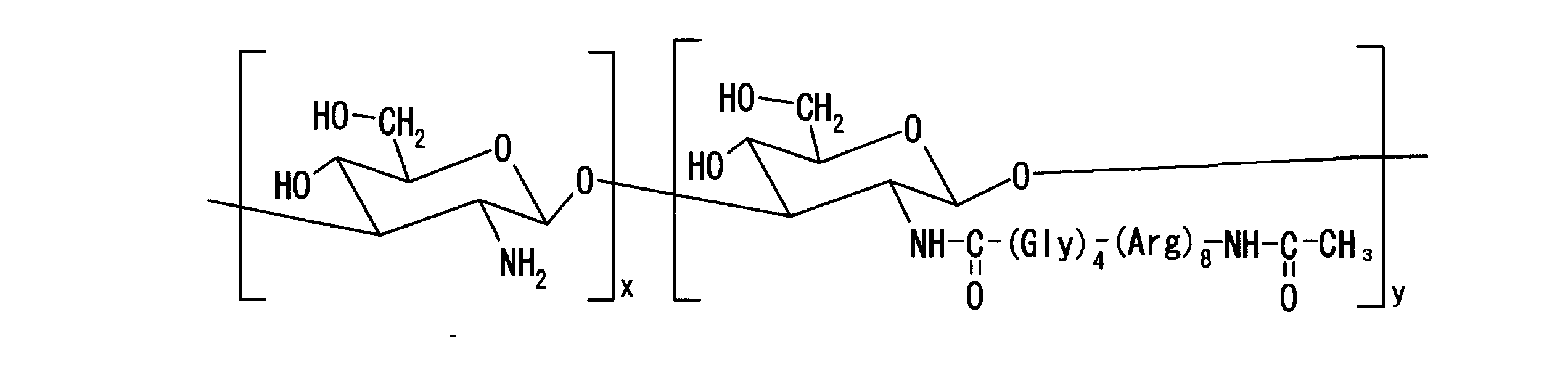
- the weight average molecular weight of the polymer compound of Example 3 was 110,000, and it was found from the integral value of NMR that the following structure was obtained.
- Gly represents a glycine residue
- Arg represents an arginine residue
- x: y 80: 20.
- the polymer compound of Comparative Example 2 was produced using chitosan having a weight average molecular weight of about 100,000 based on the production example of US201013159A1.
- CHO cells Chinese hamster ovary-derived cells ⁇ medium> Ham'sF12 medium (trade name, manufactured by Wako) Opti-MEM medium (trade name, manufactured by Life Technologies) ⁇ Reagent> Trypsin / EDTA solution: 0.25% trypsin, 1 mmol / L EDTA aqueous solution ⁇ low membrane permeability compound> FITC-BSA: fluorescein-labeled bovine serum albumin (manufactured by Sigma-Aldrich) ⁇ Introduction efficiency into cells> Each well of the 24-well plate was inoculated with 500 ⁇ L of Ham's F12 medium suspension (2 ⁇ 10 5 cells / mL) of CHO cells, and precultured in a carbon dioxide incubator for 24 hours.
- FITC-BSA Opti-MEM medium solution 10 ⁇ g / mL was added, and then the polymer compounds of Examples 1 to 3 or the polymer compounds of Comparative Examples 1 to 2 were added.
- 250 ⁇ L of Opti-MEM medium solution 100 ⁇ g / mL was added and cultured in a carbon dioxide incubator for 1 hour. After removing the supernatant medium solution and washing twice with 500 ⁇ L of phosphate buffered saline, 100 ⁇ L of trypsin EDTA solution was added to detach and disperse the cultured CHO cells from the plate.
- Extracellular FITC-BSA is inactivated by trypan blue and does not emit fluorescence, and only FITC-BSA introduced into the cell emits fluorescence. Since MFI shows the average value of fluorescence intensity per cell, the larger the MFI value, the more water-soluble polymer compound FITC-BSA is taken into the cell. From the results in Table 1, it can be seen that the polymer compounds of Examples 1 to 3 have high efficiency of introducing a water-soluble high molecular weight substance into cells.
Landscapes
- Chemical & Material Sciences (AREA)
- Health & Medical Sciences (AREA)
- Organic Chemistry (AREA)
- Medicinal Chemistry (AREA)
- Polymers & Plastics (AREA)
- Chemical Kinetics & Catalysis (AREA)
- Life Sciences & Earth Sciences (AREA)
- General Health & Medical Sciences (AREA)
- Biochemistry (AREA)
- Molecular Biology (AREA)
- Proteomics, Peptides & Aminoacids (AREA)
- Genetics & Genomics (AREA)
- Biophysics (AREA)
- General Chemical & Material Sciences (AREA)
- Pharmacology & Pharmacy (AREA)
- Epidemiology (AREA)
- Animal Behavior & Ethology (AREA)
- Public Health (AREA)
- Veterinary Medicine (AREA)
- Inorganic Chemistry (AREA)
- Peptides Or Proteins (AREA)
- Medicinal Preparation (AREA)
- Micro-Organisms Or Cultivation Processes Thereof (AREA)
Abstract
Description


また本発明は、上記導入剤を使用する、低膜透過性化合物を細胞内又は粘膜内に導入するための方法を提供するものである。
生物学的利用率(%)=100×(経口投与により血液中に到達した量)/(静脈投与により血液中に到達した量)
ここでいう「血液中に到達した量」は、血中濃度と横軸(時間軸)によって囲まれた部分の面積(薬物血中濃度-時間曲線下面積:AUC)として求められる。
一般式(1)において、X1は、中性アミノ酸又はω-アミノアルカン酸から末端アミノ基および末端カルボキシル基を除いた残基を表し、aは1~50の数を表す。中性アミノ酸としては、例えば、アラニン、アスパラギン、システイン、グルタミン、グリシン、イソロイシン、ロイシン、メチオニン、フェニルアラニン、プロリン、セリン、トレオニン、トリプトファン、チロシン、バリン、ヒドロキシプロリン等が挙げられ、ω-アミノアルカン酸としては、3-アミノプロパン酸、4-アミノブタン酸、5-アミノペンタン酸、6-アミノヘキサン酸、7-アミノヘプタン酸、8-アミノオクタン酸、9-アミノノナン酸、10-アミノデカン酸、11-アミノウンデカン酸等が挙げられる。X1に適用される中性アミノ酸としては、低膜透過性化合物の導入効率が上がることから、グリシン、アラニン、バリン、イソロイシン、ロイシン、セリン、トレオニン、フェニルアラニンが好ましく、グリシン、アラニン、セリンが更に好ましく、グリシンが最も好ましい。aは、1~30の数が好ましく、1~20の数が更に好ましく、1~10の数が最も好ましい。aが2~50の数の場合には、X1は、1種の中性アミノ酸残基又はω-アミノアルカン酸残基でもよいし、これら残基から選ばれる2種以上の組合せでもよい。
一般式(2)において、X4は、中性アミノ酸又はω-アミノアルカン酸から末端アミノ基および末端カルボキシル基を除いた残基を表し、bは1~50の数を表す。中性アミノ酸としては、例えば、アラニン、アスパラギン、システイン、グルタミン、グリシン、イソロイシン、ロイシン、メチオニン、フェニルアラニン、プロリン、セリン、トレオニン、トリプトファン、チロシン、バリン、ヒドロキシプロリン等が挙げられ、ω-アミノアルカン酸としては、3-アミノプロパン酸、4-アミノブタン酸、5-アミノペンタン酸、6-アミノヘキサン酸、7-アミノヘプタン酸、8-アミノオクタン酸、9-アミノノナン酸、10-アミノデカン酸、11-アミノウンデカン酸等が挙げられる。X4に適用される中性アミノ酸としては、低膜透過性化合物の導入効率の点や合成の容易さの点から、グリシン、アラニン、バリン、イソロイシン、ロイシン、セリン、トレオニン、フェニルアラニンが好ましく、グリシン、アラニン、セリンが更に好ましく、グリシンが最も好ましい。bは、1~30の数が好ましく、1~20の数が更に好ましく、1~10の数が最も好ましい。bが2~50の数の場合には、X4は、1種の中性アミノ酸残基又はω-アミノアルカン酸残基でもよいし、これら残基から選ばれる2種以上の組合せでもよい。
本発明のグラフト型高分子の幹高分子は、特に限定されないが、細胞やタンパク質等の水溶性高分子量物質との親和性に優れることから親水性高分子であることが好ましい。ここで、親水性高分子とは、水溶性高分子、または水中で膨潤する高分子を意味する。本発明において、水溶性高分子とは、常圧下で25℃の水に0.1質量%以上の量で均一に溶解する高分子をいう。
また、一般式(2)で表される基を側鎖に有する高分子化合物の場合には、アミノ基を有する高分子が好ましく、アミノ基を有する親水性高分子がより好ましく、キトサンが最も好ましい。なお、アミノ基又はカルボキシル基を有するとは、一般式(1)又は(2)で表される基を側鎖に有する前の幹高分子に該当するものであればよい。
幹高分子がアミノ基を有する場合、幹高分子を構成するモノマーユニットの数に対するアミノ基を有するモノマーユニットの数の割合は、本発明の高分子化合物として好ましいものを得やすい観点等から5~100%が好ましく、10~100%がより好ましい。なお、上記で述べたアミノ基又はカルボキシル基を有するユニットの割合は、一般式(1)又は一般式(2)で表される基を側鎖に有する前の幹高分子に該当することが好ましい。
本発明の高分子化合物は、一般式(1)又は一般式(2)で表される基を側鎖に有するところに特徴がある。本発明の高分子化合物における、一般式(1)又は一般式(2)で表される基の割合があまりに低い場合及びあまりに高い場合は、低膜透過性化合物の導入効率が低くなることから、本発明の高分子化合物中の、一般式(1)又は一般式(2)で表される基の数が、幹高分子を構成するモノマーユニット(多糖類又は多糖類の変性物の場合は単糖ユニット、水溶性タンパク質又は水溶性ポリペプチドの場合はアミノ酸ユニット)の数に対して、0.001~0.9であることが好ましく、0.005~0.8であることが更に好ましく、0.01~0.7であることが最も好ましい。


本発明の高分子化合物を製造方法は特に限定されず、一般式(1)又は一般式(2)で表される基を有する重合性モノマーを重合して製造してもよいし、幹高分子に一般式(1)又は一般式(2)で表される基を導入して製造してもよいが、製造の容易さの点から、幹高分子に一般式(1)又は一般式(2)で表される基を導入して製造することが好ましい。幹高分子がカルボキシル基を有する親水性高分子である場合には、カルボキシル基に下記一般式(1b)で表されるペプチド化合物のアミノ基をペプチド反応させることにより得ることができる。カルボキシル基とアミノ基との反応は、公知の方法を用いればよく、例えば、カルボキル基をN-ヒドロキシコハク酸イミドによりスクシイミドエステル化した後、アミノ基を反応させる方法等が挙げられる。また、幹高分子がアミノ基を有する親水性高分子である場合には、アミノ基に下記一般式(2b)で表されるペプチド化合物のカルボキシル基をペプチド反応させることにより得ることができる。この方法によれば、幹高分子の側鎖として、アミド結合を介して一般式(1)又は(2)で表される基を最も簡単に導入できる。ただし、一般式(1)又は(2)で表される基の固定法は、本法に限るものではなく、一般的に知られている化学反応を用いて、固定化できる。


本発明の高分子化合物は、低膜透過性化合物を細胞内や粘膜内に導入するための導入剤として使用することにより、種々の低膜透過性化合物が導入可能になる。このような低膜透過性化合物としては、例えば、インスリン及びインスリン分泌促進剤(例えば、エキセンディン-4、GLP-1)などのペプチド・タンパク性医薬品、ステロイドホルモン、非ステロイド系鎮痛抗炎症剤、精神安定剤、抗高血圧薬、虚血性心疾患治療薬、抗ヒスタミン薬、抗喘息薬、抗パーキンソン薬、脳循環改善薬、制吐剤、抗うつ薬、抗不整脈薬、抗凝固薬、抗痛風薬、抗真菌薬、抗痴呆薬、シェーングレン症候群治療薬、麻薬性鎮痛薬、ベータ遮断薬、β1作動薬、β2作動薬、副交感神経作動薬、抗腫瘍薬、利尿薬、抗血栓薬、ヒスタミンH1レセプター拮抗薬、ヒスタミンH2レセプター拮抗薬、抗アレルギー薬、禁煙補助薬、ビタミン等の医薬品;
本発明の高分子化合物を使用することにより、種々の細胞内に低膜透過性化合物を導入することが可能であり、培養液(液体培地ともいう)等に分散された細胞、固定培地等に接着した細胞、生体組織の細胞等のいずれの細胞にも低膜透過性化合物を導入することが可能である。細胞は、組織細胞や神経細胞等を形成する接着系の細胞と、血球細胞等の浮遊系の細胞に大別できる。浮遊系の細胞に対しては、マイクロインジェクション法やエレクトロポレーション法は適用できず、リン酸カルシウム法、リポフェクション法、ウイルスベクター法等が適用できたが、導入効率は満足できるものではなかった。本発明の導入方法は、接着系の細胞だけでなく、浮遊系の細胞に対しても、低膜透過性化合物を高い導入効率で導入することが可能である。
本発明の高分子化合物を用いて、細胞内に低膜透過性化合物を導入する場合には、本発明の高分子化合物と低膜透過性化合物を含有する水性溶液または水性分散液を、細胞と接触させればよく、ウイルスベクター法や膜透過性ペプチドを用いた従来の導入方法のような煩雑な前処理を必要とせず、また細胞への悪影響をあまり与えることなく、細胞内に低膜透過性化合物を導入できる。
本発明の高分子化合物を粘膜内に使用することにより、種々の粘膜内に低膜透過性化合物を導入することが可能である。粘膜としては、鼻粘膜、口腔粘膜、膣粘膜、直腸粘膜、眼粘膜、胃粘膜、腸管粘膜等が挙げられる。従来の膜透過性ペプチドを側鎖に有する高分子化合物は粘膜への刺激性が大きかったことから、例えば、鼻粘膜に使用すると痒みが発生する場合があったが、本発明の高分子化合物ではこのような痒みが軽減される。
本発明の高分子化合物を用いて、粘膜内に低膜透過性化合物を導入する場合には、本発明の高分子化合物と低膜透過性化合物の混合物を粘膜に密着させればよく、この混合物が粘膜から剥離しにくい剤形であれば、剤形は限定されない。好ましい剤形は、粘膜によって異なるが、例えば、丸剤、錠剤、トローチ剤、貼付剤、坐薬、パップ剤等が挙げられる。本発明の高分子化合物と低膜透過性化合物の混合物との混合物は、剤形により、液状、乳状、懸濁状、ゲル状、粉末状、固形状等の形状を選択すればよい。低膜透過性化合物は目的に応じて、1種のみを導入してもよく、2種以上を組み合わせてもよい。また、必要に応じて、賦形剤、乳化剤、分散剤、ゲル化剤、保湿剤等を併用してもよい。
本発明の高分子化合物は低膜透過性化合物を、皮膚を経由して細胞内に導入することはできないが、小突起アレイ(シート上に微細な突起を配した薬剤送達部材。例えば、US2005025778A1、特開2008-006178等を参照)を利用することにより、皮膚下の細胞内に低膜透過性化合物を導入することが可能になる。例えば、本発明の高分子化合物と低膜透過性化合物との混合物を表面に塗布した小突起アレイ、又は本発明の高分子化合物と低膜透過性化合物との混合物を含有する小突起を有する小突起アレイを、皮膚表面に貼り、微細な突起により皮膚を貫通させて、皮膚下に本発明の高分子化合物と低膜透過性化合物とを浸透させることにより、皮膚下の細胞内に低膜透過性化合物を導入することが可能になる。
イオン交換水1kgにN-ビニルアセトアミド/アクリル酸ナトリウム共重合物(商品名:GE160-105、昭和電工社製)10gを溶解し、強酸性陽イオン交換樹脂(商品名:アンバーリスト15DRY、オルガノ社製)を10g加えて2時間撹拌した後に、イオン交換樹脂を濾別し、濾液を濃縮し、凍結乾燥してN-ビニルアセトアミド/アクリル酸共重合物(以下、GE160-105H)を8.6g得た。
ジメチルホルムアミド(DMF)15mLに500mgのGE160-105Hを溶解した。この溶液を0℃に冷やし、5mLのDMFに溶解した1.1gのN-ヒドロキシコハク酸イミドを添加し、更に5mLのDMFに溶解した1.96gのジシクロヘキシルカルボジイミド(DCC)を添加して室温(25℃)で24時間攪拌し反応を行った。析出する固体をろ過によりろ別し、ろ液を500mLのアセトニトリルへゆっくり滴下し、再沈殿によりスクシンイミドエステル化GE160-105(以下、GE160-105OSu)を620mg得た。
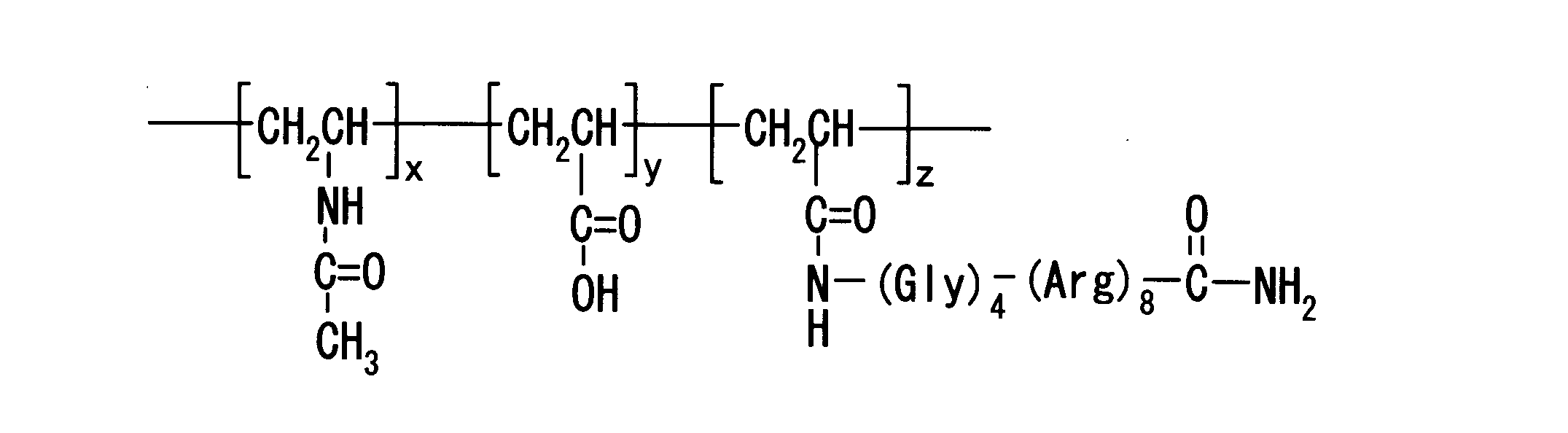
実施例1において、H-(Gly)4-(D-Arg)8-NH2の使用量を148mgから50mgに変更した以外は実施例1と同様の操作を行い、54mgの実施例2の高分子化合物を得た。実施例2の高分子化合物は、一般式(1)のX1がグリシンから末端アミノ基および末端カルボキシル基を除いた残基、X2がオクタアルギニンから末端アミノ基および末端カルボキシル基を除いた残基、X3がアミノ基、aが4である化合物である。実施例2の高分子化合物の重量平均分子量は160万であり、NMRの積分値から下記の構造を有することが分かった。なお、式中、Glyはグリシン残基、Argはアルギニン残基を表し、x:y:z=70:15:15である。

一般式(2b)において、bが4、X4がグリシンから末端アミノ基および末端カルボキシル基を除いた残基、X5がオクタアルギニンから末端アミノ基および末端カルボキシル基を除いた残基、X6がアセチル基である化合物(RS Synthesis社製、商品名:HO-(Gly)4-(D-Arg)8-COCH3(Purity:90%))150mgを0.5mLのDMFに溶解させた。132mgのN-ヒドロキシコハク酸イミドを添加した後、DMF0.3mLに溶解させた230mgのDCCを添加した。更に重量平均分子量約10万のキトサンのDMF溶液(100mg/mL)を添加し、室温(25℃)で24時間攪拌した。反応溶液をセルロース透析チューブ(シームレスセルロースチューブ,和光純薬社製)に入れ、チューブの両口を縛った後、イオン交換水を用いて2日間透析を行った。その後、チューブの内容物を凍結乾燥して、32mgの実施例2の高分子化合物を得た。実施例3の高分子化合物の重量平均分子量は11万であり、NMRの積分値から下記の構造を有することが分かった。なお、式中、Glyはグリシン残基、Argはアルギニン残基を表し、x:y=80:20である。
H-(Gly)4-(D-Arg)8-NH2のDMF溶液の代わりに、オクタアルギニンの末端カルボキシル基がアミド化された化合物(GL Biochem社製、商品名:RRRRRRRR-NH2,[R=D-Arg]TFA Salt)のDMSO溶液(350mg/mL)0.5mLを用いた以外は、実施例1と同様の操作を行い、32mgの比較例1の高分子化合物を得た。比較例1の高分子化合物の重量平均分子量は160万であり、NMRの積分値から下記の構造を有することが分かった。なお、式中、Argはアルギニン残基を表し、x:y:z=70:15:15である。

US2010113559A1の製造例に準拠し、重量平均分子量約10万のキトサンを用いて、比較例2の高分子化合物を製造した。比較例2の高分子化合物は下記の構造を有する化合物である。なお、式中、Argはアルギニン残基を表し、x:y=80:20である。

CHO細胞:チャイニーズハムスター卵巣由来細胞
<培地>
Ham'sF12培地(商品名、和光社製)
Opti-MEM培地(商品名、Life Technologies社製)
<試薬>
トリプシン/EDTA溶液:0.25%のトリプシン、1mmol/LのEDTA水溶液<低膜透過性化合物>
FITC-BSA:フルオレセイン標識-牛血清アルブミン(Sigma-Aldrich社製)
<細胞内への導入効率>
24穴プレートの各ウエルにCHO細胞のHam'sF12培地懸濁液(2×10⁵cells/mL)500μLを播種し、炭酸ガスインキュベーターで24時間、前培養した。上清の培地を除去した後、FITC-BSAのOpti-MEM培地溶液(10μg/mL)250μLを添加し、更に実施例1~3の高分子化合物、又は比較例1~2の高分子化合物のOpti-MEM培地溶液(100μg/mL)250μL添加して、炭酸ガスインキュベーターで1時間培養した。上清の培地溶液を除去し、リン酸緩衝生理食塩水500μLで2回洗浄した後、トリプシンEDTA溶液100μLを添加して、培養したCHO細胞をプレートから剥離、分散させた。次に、0.08%トリパンブルー溶液100μLを添加し細胞を懸濁させ、マイクロチューブに回収した。回収した細胞懸濁液を、セルストレーナーを通過させ、フローサイトメトリーによりMFI(平均蛍光強度)を測定した。また、高分子化合物を使用しなかったものをブランクとした。結果を表1に示す。

Claims (6)
- 下記一般式(1)又は下記一般式(2)で表される基を側鎖に有する高分子化合物。


- 前記一般式(1)のX2又は前記一般式(2)のX5を構成するアミノ酸の少なくとも1つが塩基性アミノ酸である請求項1に記載の高分子化合物。
- 幹高分子がビニル系親水性高分子である請求項1に記載の高分子化合物。
- 低膜透過性化合物を、細胞内又は粘膜内に導入するための導入剤であって、請求項1~3の何れか1項に記載の高分子化合物からなる導入剤。
- 請求項4に記載の導入剤を使用する、低膜透過性化合物を、細胞内に導入するための方法。
- 請求項4に記載の導入剤を使用する、低膜透過性化合物を、粘膜内に導入するための方法。
Priority Applications (5)
| Application Number | Priority Date | Filing Date | Title |
|---|---|---|---|
| US15/547,840 US10501564B2 (en) | 2015-02-27 | 2016-02-23 | Polymer compound which has membrane-permeable peptide in side chain |
| EP16755452.6A EP3263582B1 (en) | 2015-02-27 | 2016-02-23 | Polymer compound which has membrane-permeable peptide in side chain |
| JP2017502369A JP6880526B2 (ja) | 2015-02-27 | 2016-02-23 | 膜透過性ペプチドを側鎖に有する高分子化合物 |
| KR1020177020674A KR102646833B1 (ko) | 2015-02-27 | 2016-02-23 | 막투과성 펩티드를 측쇄에 가지는 고분자 화합물 |
| CN201680007429.0A CN107207565B (zh) | 2015-02-27 | 2016-02-23 | 侧链具有膜透过性肽的高分子化合物 |
Applications Claiming Priority (2)
| Application Number | Priority Date | Filing Date | Title |
|---|---|---|---|
| JP2015038433 | 2015-02-27 | ||
| JP2015-038433 | 2015-02-27 |
Publications (1)
| Publication Number | Publication Date |
|---|---|
| WO2016136708A1 true WO2016136708A1 (ja) | 2016-09-01 |
Family
ID=56788839
Family Applications (1)
| Application Number | Title | Priority Date | Filing Date |
|---|---|---|---|
| PCT/JP2016/055174 Ceased WO2016136708A1 (ja) | 2015-02-27 | 2016-02-23 | 膜透過性ペプチドを側鎖に有する高分子化合物 |
Country Status (7)
| Country | Link |
|---|---|
| US (1) | US10501564B2 (ja) |
| EP (1) | EP3263582B1 (ja) |
| JP (1) | JP6880526B2 (ja) |
| KR (1) | KR102646833B1 (ja) |
| CN (1) | CN107207565B (ja) |
| TW (1) | TWI698449B (ja) |
| WO (1) | WO2016136708A1 (ja) |
Cited By (3)
| Publication number | Priority date | Publication date | Assignee | Title |
|---|---|---|---|---|
| JP2019203086A (ja) * | 2018-05-24 | 2019-11-28 | 東洋インキScホールディングス株式会社 | ブロックポリマー |
| WO2020013265A1 (ja) | 2018-07-11 | 2020-01-16 | 学校法人常翔学園 | 高分子化合物及びそれを用いた細胞内化合物導入促進剤 |
| JPWO2022080294A1 (ja) * | 2020-10-16 | 2022-04-21 |
Families Citing this family (1)
| Publication number | Priority date | Publication date | Assignee | Title |
|---|---|---|---|---|
| WO2024076976A1 (en) * | 2022-10-05 | 2024-04-11 | Grove Biopharma, Inc. | Nrf2-derived polypeptides and protein-like polymer conjugates thereof |
Citations (3)
| Publication number | Priority date | Publication date | Assignee | Title |
|---|---|---|---|---|
| JP2010100781A (ja) * | 2008-10-27 | 2010-05-06 | Josho Gakuen | 高分子、経上皮吸収促進剤、及び医薬用製剤 |
| US20100113559A1 (en) * | 2007-01-05 | 2010-05-06 | Biopolymed Inc. | Chitosan Based Polymer Conjugate and a Method for Producing the Same |
| JP2011229495A (ja) * | 2010-04-30 | 2011-11-17 | Adeka Corp | 細胞への水溶性高分子量物質の導入方法及び導入剤 |
Family Cites Families (7)
| Publication number | Priority date | Publication date | Assignee | Title |
|---|---|---|---|---|
| US20040220100A1 (en) * | 2000-07-21 | 2004-11-04 | Essentia Biosystems, Inc. | Multi-component biological transport systems |
| JP5610659B2 (ja) * | 2000-07-21 | 2014-10-22 | ルバンス セラピュティックス インク.Revance Therapeutics,Inc. | 多成分生物学的輸送システム |
| GB0103110D0 (en) | 2000-08-25 | 2001-03-28 | Aventis Pharma Inc | A membrane penetrating peptide encoded by a nuclear localization sequence from human period 1 |
| JP2005052083A (ja) | 2003-08-05 | 2005-03-03 | Rikogaku Shinkokai | タンパク質の細胞内導入方法 |
| US8834918B2 (en) * | 2007-01-22 | 2014-09-16 | Wisconsin Alumni Research Foundation | Modified multilayered film |
| CN102988295B (zh) * | 2011-09-09 | 2015-07-29 | 复旦大学 | 一种穿膜肽修饰的纳米粒及其制备方法 |
| CN103897032A (zh) * | 2012-12-28 | 2014-07-02 | 浙江日升昌药业有限公司 | 一种新型细胞穿膜肽 |
-
2016
- 2016-02-23 JP JP2017502369A patent/JP6880526B2/ja active Active
- 2016-02-23 EP EP16755452.6A patent/EP3263582B1/en active Active
- 2016-02-23 CN CN201680007429.0A patent/CN107207565B/zh active Active
- 2016-02-23 WO PCT/JP2016/055174 patent/WO2016136708A1/ja not_active Ceased
- 2016-02-23 US US15/547,840 patent/US10501564B2/en active Active
- 2016-02-23 KR KR1020177020674A patent/KR102646833B1/ko active Active
- 2016-02-26 TW TW105105990A patent/TWI698449B/zh active
Patent Citations (3)
| Publication number | Priority date | Publication date | Assignee | Title |
|---|---|---|---|---|
| US20100113559A1 (en) * | 2007-01-05 | 2010-05-06 | Biopolymed Inc. | Chitosan Based Polymer Conjugate and a Method for Producing the Same |
| JP2010100781A (ja) * | 2008-10-27 | 2010-05-06 | Josho Gakuen | 高分子、経上皮吸収促進剤、及び医薬用製剤 |
| JP2011229495A (ja) * | 2010-04-30 | 2011-11-17 | Adeka Corp | 細胞への水溶性高分子量物質の導入方法及び導入剤 |
Non-Patent Citations (2)
| Title |
|---|
| LIU J ET AL.: "A Facile Strategy toward Conjugated Polyelectrolyte with Oligopeptide as Pendants for Biological Applications", ACS APPLIED MATERIALS & INTERFACES, vol. 5, no. 11, 2013, pages 4511 - 4515, XP055475542 * |
| SAKUMA S ET AL.: "Performance of cell - penetrating peptide-linked polymers physically mixed with poorly membrane-permeable molecules on cell membranes", EUROPEAN JOURNAL OF PHARMACEUTICS AND BIOPHARMACEUTICS, vol. 81, 2012, pages 64 - 73, XP028484394, DOI: doi:10.1016/j.ejpb.2012.01.008 * |
Cited By (8)
| Publication number | Priority date | Publication date | Assignee | Title |
|---|---|---|---|---|
| JP2019203086A (ja) * | 2018-05-24 | 2019-11-28 | 東洋インキScホールディングス株式会社 | ブロックポリマー |
| JP7081303B2 (ja) | 2018-05-24 | 2022-06-07 | 東洋インキScホールディングス株式会社 | ブロックポリマー |
| WO2020013265A1 (ja) | 2018-07-11 | 2020-01-16 | 学校法人常翔学園 | 高分子化合物及びそれを用いた細胞内化合物導入促進剤 |
| JPWO2020013265A1 (ja) * | 2018-07-11 | 2021-08-02 | 学校法人常翔学園 | 高分子化合物及びそれを用いた細胞内化合物導入促進剤 |
| JP7432208B2 (ja) | 2018-07-11 | 2024-02-16 | 学校法人常翔学園 | 高分子化合物及びそれを用いた細胞内化合物導入促進剤 |
| JPWO2022080294A1 (ja) * | 2020-10-16 | 2022-04-21 | ||
| WO2022080294A1 (ja) | 2020-10-16 | 2022-04-21 | 学校法人常翔学園 | 組成物 |
| KR20230090333A (ko) | 2020-10-16 | 2023-06-21 | 각코호우징 조쇼 가쿠엔 | 조성물 |
Also Published As
| Publication number | Publication date |
|---|---|
| EP3263582B1 (en) | 2019-08-14 |
| CN107207565A (zh) | 2017-09-26 |
| JPWO2016136708A1 (ja) | 2017-12-07 |
| TWI698449B (zh) | 2020-07-11 |
| KR20170122180A (ko) | 2017-11-03 |
| TW201639872A (zh) | 2016-11-16 |
| KR102646833B1 (ko) | 2024-03-13 |
| US20180016366A1 (en) | 2018-01-18 |
| CN107207565B (zh) | 2021-05-28 |
| US10501564B2 (en) | 2019-12-10 |
| EP3263582A4 (en) | 2018-07-18 |
| JP6880526B2 (ja) | 2021-06-02 |
| EP3263582A1 (en) | 2018-01-03 |
Similar Documents
| Publication | Publication Date | Title |
|---|---|---|
| WO1996006181A1 (en) | Method of modifying protein | |
| RU2012106150A (ru) | Вариантные формы уратоксидазы и их применение | |
| JP6880526B2 (ja) | 膜透過性ペプチドを側鎖に有する高分子化合物 | |
| JP6692051B2 (ja) | 膜透過性ペプチド鎖を有する多糖誘導体 | |
| RU2317997C2 (ru) | КОНЪЮГАТЫ, СОСТОЯЩИЕ ИЗ ПОЛИМЕРА И ПЕПТИДОВ, ПРОИСХОДЯЩИХ ОТ gp41 ВИЧ, И ИХ ПРИМЕНЕНИЕ В ТЕРАПИИ | |
| JP5808082B2 (ja) | 細胞への水溶性高分子量物質の導入方法及び導入剤 | |
| KR100441904B1 (ko) | Tat49-57 펩티드 또는 Tat49-57 펩티드를 포함하는펩티드사슬과 생분해성 지방족 폴리에스테르계 고분자와의공유결합체 및 이를 이용하여 제조된 나노입자 | |
| JP7432208B2 (ja) | 高分子化合物及びそれを用いた細胞内化合物導入促進剤 | |
| CN117752810A (zh) | 一种基于CD16a的靶向脂质纳米粒及其组合物、药物制剂及应用 | |
| US20230383037A1 (en) | Composition | |
| CN111484551B (zh) | 一种聚乙二醇修饰的重组人碱性成纤维细胞生长因子 | |
| JP7808799B2 (ja) | 樹状細胞ワクチンの製造方法 | |
| CN113549128B (zh) | 含氟烷基链连接的多肽及其在多肽胞内递送中的应用 | |
| KR102035696B1 (ko) | 사이티딘 5-삼인산 또는 이의 고분자를 유효성분으로 포함하는 핵 내로의 약물 전달용 조성물 및 면역 증강제 | |
| CN112206325A (zh) | 一种长眼表滞留人工泪液及其制备方法 |
Legal Events
| Date | Code | Title | Description |
|---|---|---|---|
| 121 | Ep: the epo has been informed by wipo that ep was designated in this application |
Ref document number: 16755452 Country of ref document: EP Kind code of ref document: A1 |
|
| ENP | Entry into the national phase |
Ref document number: 2017502369 Country of ref document: JP Kind code of ref document: A |
|
| ENP | Entry into the national phase |
Ref document number: 20177020674 Country of ref document: KR Kind code of ref document: A |
|
| REEP | Request for entry into the european phase |
Ref document number: 2016755452 Country of ref document: EP |
|
| WWE | Wipo information: entry into national phase |
Ref document number: 15547840 Country of ref document: US |
|
| NENP | Non-entry into the national phase |
Ref country code: DE |