WO2016135961A1 - 植物栽培装置、植物、植物栽培方法、及び、培地 - Google Patents
植物栽培装置、植物、植物栽培方法、及び、培地 Download PDFInfo
- Publication number
- WO2016135961A1 WO2016135961A1 PCT/JP2015/055915 JP2015055915W WO2016135961A1 WO 2016135961 A1 WO2016135961 A1 WO 2016135961A1 JP 2015055915 W JP2015055915 W JP 2015055915W WO 2016135961 A1 WO2016135961 A1 WO 2016135961A1
- Authority
- WO
- WIPO (PCT)
- Prior art keywords
- plant
- yeast
- plant cultivation
- medium
- liquid medium
- Prior art date
- Legal status (The legal status is an assumption and is not a legal conclusion. Google has not performed a legal analysis and makes no representation as to the accuracy of the status listed.)
- Ceased
Links
Images

Classifications
-
- A—HUMAN NECESSITIES
- A01—AGRICULTURE; FORESTRY; ANIMAL HUSBANDRY; HUNTING; TRAPPING; FISHING
- A01G—HORTICULTURE; CULTIVATION OF VEGETABLES, FLOWERS, RICE, FRUIT, VINES, HOPS OR SEAWEED; FORESTRY; WATERING
- A01G31/00—Soilless cultivation, e.g. hydroponics
Definitions
- the present invention relates to a plant cultivation apparatus, a plant, a plant cultivation method, and a culture medium.
- folic acid which contains abundant nutrients such as protein, vitamin B group, vitamin D, amino acid, and mineral, which are necessary for maintaining and improving human health, has attracted attention.
- This folic acid is said to have various effects such as prevention of fetal spondylosis prevention dementia, hematopoiesis, and recovery of brain function.
- symptoms such as inflammation of the oral cavity, rough skin, and fatigue may occur, which may cause pernicious anemia and arteriosclerosis.
- it is preferable to take folic acid on a daily basis but in order to take the necessary and sufficient amount of folic acid in daily foods, a large amount of foods containing folic acid such as liver, rice cake, and vegetables must be consumed. Difficult to do.
- Patent Document 1 discloses a method for producing a folic acid-containing edible plant and a folic acid-containing sprout for achieving the object of providing an edible plant containing folic acid at a high concentration and a method for producing the same.
- the method for producing a folic acid-containing edible plant body of Patent Document 1 is “a method for producing an edible plant body containing folic acid, wherein folic acid is added at a temperature of 10 to 25 ° C.
- a part of the edible plant body is constantly or intermittently immersed in an aqueous solution containing a concentration of ⁇ 1% by mass and having a pH of 5.8 to 6.3, and the rest of the edible plant body is It is characterized in that an edible plant containing 200 ⁇ g / 100 g fresh weight (FW) or more of folic acid is obtained continuously or intermittently outside the folic acid-containing aqueous solution so that the plant can transpire. (Refer to claim 1 etc. of patent document 1).
- Patent Document 1 uses a highly concentrated folic acid solution having a folic acid concentration of 0.1 to 1% by mass as the aqueous solution in which the roots of the plant are immersed.
- a highly concentrated folic acid solution having a folic acid concentration of 0.1 to 1% by mass as the aqueous solution in which the roots of the plant are immersed.
- problems such as root rot occurring in a short time and weakening of plants.
- folic acid that requires concentration adjustment as in the method for producing a folic acid-containing edible plant disclosed in Patent Document 1 is generally chemically synthesized using a petroleum-based material (pteroyl). Glutamic acid) is used, but when an aqueous solution prepared by dissolving such artificially produced folic acid is used, the cost of cultivation is reduced considering the cost of folic acid used here. Is difficult.
- the pH of the folic acid solution is set to 5.8 to 6.3.
- folic acid has low solubility in the acidic region, Folic acid is more likely to precipitate as the pH becomes more acidic, and pH control of the folic acid solution becomes very severe when folic acid is contained at a concentration of 0.1 to 1% by mass.
- the plant cultivation apparatus includes a culture container that contains a medium containing yeast for growing a plant.
- the plant according to the present invention is cultivated using a medium containing yeast.
- the plant cultivation method according to the present invention is characterized by including a yeast use growing step of growing a plant using a medium containing yeast.
- the medium according to the present invention is a medium for growing plants, and contains yeast.
- the plant cultivation device plant, plant cultivation method, and medium according to the present invention, it is possible to increase the folic acid content of the plant to be cultivated and to reduce the cultivation cost.
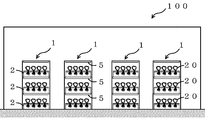
- FIG. 2 is a cross-sectional view illustrating an outline of the plant factory 100 according to the present embodiment.
- the plant factory 100 has a configuration in which a plurality of plant cultivation apparatuses 1 are installed therein.
- the plant cultivation apparatus 1 is shown as performing the multistage cultivation by stacking the culture containers 2 for growing the plants 20 in a multistage, it is not limited to this.
- the plant factory 100 is a fully controlled plant factory in which the artificial lighting 5 is used and the environmental conditions including temperature are artificially controlled
- the plant cultivation apparatus 1 is installed in a fully controlled plant factory, so that plant cultivation can be completely controlled in a closed space separated from the outside, and mass production of plants becomes possible. .
- the place where the artificial lighting is provided in the plant factory 100 is not particularly limited.
- the case where the artificial lighting 5 is provided in the plant cultivation apparatus 1 included in the plant factory 100 will be described as an example.
- the artificial lighting may be provided on the ceiling of the plant factory 100.
- the plant factory 100 is not limited to a fully controlled plant factory, and may be, for example, a solar-powered plant factory including a daylighting unit that irradiates the plant with sunlight.
- a solar-powered plant factory including a daylighting unit that irradiates the plant with sunlight.
- the plant cultivation apparatus 1 is installed in a solar-type plant factory, it is advantageous for cultivation of vegetables (fruit vegetables) that use fruits as food. Moreover, it becomes possible to aim at reduction of the cultivation cost of a plant by utilizing solar energy for cultivation of a plant.
- the plant cultivation apparatus 1 By installing the plant cultivation apparatus 1 in the plant factory 100, it is possible to artificially control environmental conditions including light and temperature, and it is possible to cultivate plants without using pesticides. It becomes possible to provide a plant. In addition, by cultivating plants at the plant factory 100, it is possible to continuously produce plants without being constrained by the season and place, so that there is no need to suffer from bad weather or lack of arable land, and the cultivation process is quantified. Therefore, the cultivation cost can be greatly reduced.
- FIG. 1 is a diagram illustrating a configuration of a plant cultivation apparatus 1 according to the present embodiment.
- the plant cultivation apparatus 1 includes a culture vessel 2, a plant support panel 4, artificial lighting 5, and a liquid medium circuit 10.
- the liquid medium circuit 10 includes a liquid medium tank 6, a pump 7, a heating device 8, a temperature sensor 8 a, a cooling device 9, a temperature sensor 9 a, and an opening / closing valve 11.
- the culture medium 2 contains the liquid culture medium 3, and the plant 20 is grown by the liquid culture medium 3.
- the medium according to the present embodiment is a medium for growing plants and contains yeast.
- the medium is the liquid medium 3
- the medium according to the present invention is not limited to this, for example, a solid medium such as soil. There may be.
- yeast contained in the liquid medium 3 may be any yeast that is generally used for food production or food production, such as sake yeast, brewer's yeast, bakery yeast, baker's yeast, wine yeast, miso soy yeast, and the like. There is no particular restriction.
- yeast contains yeast extract (liquid, powder form, etc.) in addition to dry yeast and liquid yeast.
- yeast contains abundant components such as folic acid, vitamins, and minerals, and can be suitably used as a source of folic acid by being included in the medium.
- the medium contains yeast, so that the folic acid content of the plant to be cultivated is increased, and plants containing folic acid in an amount exceeding the limit of the folic acid content of the plant cultivated in the medium not containing yeast can be cultivated.
- yeast in the medium, it is possible to cultivate plants that contain high concentrations of ingredients effective for the human body such as vitamins and minerals in addition to folic acid.
- the culture medium contains the yeast which is a natural product as a folic acid supply source. According to this, it becomes possible to cultivate a plant containing folic acid at a high concentration while having a lower cultivation cost than using folic acid produced by a conventional chemical synthesis method.
- the plant cultivation apparatus 1 includes a culture container 2 that contains a medium containing yeast for growing plants (in this embodiment, a liquid medium 3).
- a culture container 2 that contains a medium containing yeast for growing plants (in this embodiment, a liquid medium 3).
- a liquid medium 3 a medium containing yeast for growing plants
- the plant cultivation apparatus 1 makes it easier to control the conditions of the medium by performing hydroponics using the liquid medium 3 as a medium than when performing soil cultivation using a solid medium. Moreover, the plant cultivation apparatus 1 uses the liquid culture medium 3, and salt concentration is raised by the fertilizer administered like soil cultivation, and a continuous cropping failure is brought about, or the acid etc. which a fertilizer decomposes
- the plant cultivation apparatus 1 increases the folic acid content of the plant to be cultivated by accommodating the liquid medium 3 containing yeast in the culture container 2 and exceeds the limit of the folic acid content of plants cultivated in the medium not containing yeast. Plants containing a quantity of folic acid can be cultivated. Moreover, the plant cultivation apparatus 1 can control the amount of nutrient components including folic acid to be absorbed by the roots of the plant, and does not cause plant growth inhibition due to excessive supply of these nutrient components to the plant. . Moreover, the plant cultivation apparatus 1 can hold
- the pH of the liquid medium 3 accommodated in the culture vessel 2 is adjusted to 5.5 or more and 6.5 or less.
- the pH is less than 5.5, components such as lime, molybdenum and sulfur are hardly absorbed from the roots, which is not preferable.
- pH exceeds 6.5 since components, such as iron, manganese, boron, copper, zinc, become difficult to be absorbed from a root, it is unpreferable. This value is the same when the medium is a solid medium.
- the yeast concentration in the liquid medium 3 is preferably 0.05 wt% or more and 10 wt% or less.
- the plant cultivation apparatus 1 allows the various nutrients including folic acid contained in the yeast to be contained without inhibiting the growth of the plant because the concentration of the yeast in the liquid medium 3 is 0.05 wt% or more and 10 wt% or less. Can be absorbed sufficiently from the roots.
- concentration of yeast in the liquid medium 3 is 0.05 wt% or more and 10 wt% or less.
- concentration of the yeast in the liquid medium 3 is 0.05 wt% or more and 10 wt% or less.
- concentration of yeast is less than 0.05 wt%, the folic acid content of the plant to be cultivated cannot be sufficiently increased.
- concentration of yeast exceeds 10 wt%, a nutrient is excessively supplied to the plant to grow, and a plant tends to become weak.
- the yeast extract refers to an extract obtained by extracting useful components of yeast by various methods (enzymatic decomposition, hot water extraction, autolysis, etc.).
- the yeast extract contains amino acids, peptides, nucleic acid components, sugars, trace amounts of vitamins and minerals, etc., the folic acid absorbability of plants can be further increased.
- the yeast extract of this invention can use what is available on the market, it can aim at reduction of cultivation cost.
- the plant cultivation apparatus 1 has at least a culture container 2, a heating apparatus 8 that heat sterilizes the liquid medium 3, and a pump 7 that conveys the liquid medium 3 connected in a ring shape. Is provided with a liquid medium circuit 10 for circulating the liquid.
- the plant cultivation apparatus 1 includes a liquid medium circuit 10 and circulates the liquid medium 3 by a pump 7 as a means for conveying the liquid medium provided in the liquid medium circuit 10, thereby Yeast can be sufficiently distributed to the roots of all the plants 20 in 2.
- the liquid medium circuit 10 uses the liquid medium.
- a heating device 8 is provided as means for sterilization. Thereby, it is possible to prevent the growth of various bacteria in the liquid medium 3 and to cultivate the plant healthier. Examples of the heating device 8 include a heater and the like, but are not particularly limited.
- the heating apparatus 8 heat-sterilizes the liquid culture medium 3 so that the number of miscellaneous bacteria contained in the liquid culture medium 3 may be suppressed to 10 4 CFU / g or less. Thereby, the plant cultivation apparatus 1 can grow a plant healthily.
- the heating apparatus 8 heats the liquid medium 3 to 55 ° C. or higher and 70 ° C. or lower.
- the plant cultivation apparatus 1 can suppress the growth of miscellaneous bacteria while maintaining the amount of nutrient components in the liquid medium 3.
- the temperature of the liquid medium 3 after the heat treatment is less than 55 ° C.
- the growth of miscellaneous bacteria cannot be sufficiently suppressed.
- the temperature of the liquid culture medium 3 after heat processing exceeds 70 degreeC, since enormous energy is required for cooling at the time of transferring the liquid culture medium 3 to the culture container 2, it is not realistic. Therefore, it is desirable to perform pasteurization.
- the plant cultivation apparatus 1 automatically controls the heating apparatus 8 by providing a temperature sensor 8 a that measures the temperature of the heated liquid medium 3 in the vicinity of the liquid medium delivery port of the heating apparatus 8.
- the liquid medium 3 can be adjusted to the above temperature range.
- the temperature sensor 8a may be provided so that the temperature of the liquid culture medium 3 in the heating apparatus 8 can be measured, and the installation position is not specifically limited.
- the plant cultivation device 1 includes the heating device 8 as a sterilization device for sterilizing the liquid medium 3 has been described as an example, but the present invention is not limited thereto.
- the heating device 8 instead of the heating device 8, a silver ion sterilization device, an ultraviolet sterilization device, or the like may be provided, or a combination of the heating device 8 and another sterilization device may be used.
- the liquid medium circuit 10 included in the plant cultivation apparatus 1 includes a cooling device 9 as means for cooling the liquid medium 3 after being sterilized by heating with the heating device 8.
- the cooling device 9 cools the heat-sterilized liquid medium 3 to 10 ° C. or more and 25 ° C. or less.
- the distance between the culture vessel 2 and the heating device 8 is increased. Even if it is short, it is possible to prevent the liquid medium 3 that has reached a high temperature from reaching the inside of the culture vessel 2, so that the roots of the plant are not weakened.
- the temperature of the liquid medium 3 after the cooling treatment is less than 10 ° C., the nutrient components contained in the liquid medium 3 cannot be efficiently supplied to the plant.
- the temperature of the liquid culture medium 3 after a cooling process exceeds 25 degreeC, there exists a possibility that a plant root may be weakened and a plant may die.
- the cooling coil etc. can be provided as the cooling device 9. FIG.
- the plant cultivation device 1 automatically controls the cooling device 9 by providing a temperature sensor 9 a that measures the temperature of the cooled liquid medium near the liquid medium delivery port of the cooling device 9.
- the liquid medium 3 can be adjusted to the above temperature range.
- the position where the temperature sensor 9a is provided is not particularly limited as in the temperature sensor 8a.
- the germs in the space where the plant cultivation apparatus 1 is installed are eliminated using an air cleaner or the like. Is also effective.
- the cleanliness in the space in which the plant cultivation apparatus 1 is installed is preferably set to class 4 or higher according to the ISO standard (ISO1464-1: 1999).
- the plant cultivation apparatus 1 fixes the plant 20 to the plant support panel 4 and irradiates the light of artificial lighting (fluorescent lamp, light emitting diode, etc.) 5 with the plant.
- the structure to grow can be employ
- the plant cultivation apparatus 1 also includes an open / close valve 11 that can adjust the amount of the liquid medium 3 introduced upstream of the culture container 2, and the fertilizer concentration and pH of the liquid medium 3 downstream of the culture container 2. It can also be set as the structure provided with the liquid culture medium tank 6 to adjust.
- the positions where the opening / closing valve 11 and the liquid medium tank 6 are provided are not limited thereto.
- the plant cultivated by the plant cultivation apparatus 1 is a leafy vegetable.
- the plant cultivation apparatus 1 can increase the content of folic acid more effectively when the plant to be cultivated is a leafy vegetable.
- the leafy vegetable is at least one of Brassicaceae, Asteraceae, and Akaza subfamily, the content of folic acid can be further increased, which is preferable.
- the plant to grow is mentioned later.
- Plant cultivation method The plant cultivation apparatus 1 mentioned above can be applied to the plant cultivation method which grows a plant using this.
- a method for cultivating a plant in the plant cultivation apparatus 1 according to the present embodiment will be briefly described.
- the plant cultivation method includes a step of growing a plant using a medium (liquid medium 3) containing yeast in the plant cultivation apparatus 1 described above (hereinafter also referred to as a yeast use and growth step). Yes.
- a medium liquid medium 3 containing yeast in the plant cultivation apparatus 1 described above
- this plant cultivation method by growing the plant using the liquid medium 3 containing yeast, nutrient components such as folic acid, protein, vitamin B group, vitamin D, amino acid, mineral, etc. contained in yeast are sufficient. Plants contained in can be cultivated.
- the liquid medium 3 is used during the maturation period of the plant (that is, the yeast use and growth process is performed during the maturation period of the plant). According to this, since the time when the root of the plant to be cultivated is immersed in the liquid medium can be set as the maturity stage of the plant, the plant is not weakened. If the cultivated plant is immersed in the liquid medium 3 containing yeast at a stage where the growth is immature, the plant may be weakened and may hinder growth. Therefore, in the plant cultivation method according to the present embodiment, it is desirable that the plant is grown in a place isolated from the liquid medium 3 when the plant is less than the mature stage.
- the plant cultivation method according to the present invention preferably includes a sterilization step for sterilizing the liquid medium 3, and when performing sterilization by heating in the sterilization step, a cooling step for cooling the heated liquid medium 3 is performed. It is more preferable that it contains. Note that the sterilization and cooling of the liquid medium 3 are as described above, and thus the description thereof is omitted.
- the plant according to this embodiment is cultivated in the plant cultivation apparatus 1 using a medium containing yeast.
- the plant according to the present embodiment is cultivated using the medium containing yeast by the plant cultivation apparatus 1 according to the present invention described above, it can contain a lot of folic acid.
- the plant is rich in nutritional value by sufficiently incorporating nutrient components such as protein, vitamin B group, vitamin D, amino acid and mineral.
- the roots of mature plants were immersed in liquid culture media having different yeast concentrations, and the degree of change in the folic acid content of the plants after a predetermined period was confirmed.
- Plants to be identified in this example were cruciferous, asteraceae, and leafy vegetables from the family Aceraceae, and specifically, cruciferous Mizuna, asteraceae lettuce, and Azazaaceae spinach.
- the measurement of the folic acid contained in these leafy vegetables was performed using high performance liquid chromatography.
- Table 1 shows changes in folic acid content when each leafy vegetable of Mizuna, lettuce, and spinach to be confirmed in this example was immersed in a liquid medium having a different yeast concentration for 24 hours.
- the yeast concentration of the liquid medium used in this example was 0 wt% and 0.1 wt%.
- the folic acid content is indicated by the content per fresh weight (FW).
- each of the leafy vegetables of Mizuna, lettuce, and spinach contains folic acid in comparison with a liquid medium that does not contain yeast (yeast concentration: 0 wt%) by including yeast in the liquid medium. It was confirmed that the amount was remarkably increased.
- the folic acid content is more than doubled by immersing the roots in a liquid medium with a yeast concentration of 0.1 wt% for 24 hours, compared to the liquid medium without yeast (yeast concentration: 0 wt%). It was confirmed that it was increased.
- the folic acid content is about 1.
- spinach also has a folic acid content of about 1. by soaking roots in a liquid medium with a yeast concentration of 0.1 wt% for 24 hours, compared to a liquid medium that does not contain yeast (yeast concentration: 0 wt%). It was confirmed that it was increased about 3 times.
- folic acid contained in plants cultivated in the field is generally less than folic acid contained in plants cultivated in plant factories.
- the present invention is not limited to plants cultivated in plant factories by cultivating plants with a medium containing yeast as described above, but generally contains folic acid rather than folic acid contained in plants cultivated in fields. A large amount of plants can be cultivated.
- folic acid contained in plants generally cultivated in a plant factory is less than folic acid contained in plants cultivated in the field, for example, folic acid produced by photosynthesis by artificial lighting in the plant factory It is known that it is less than folic acid produced by photosynthesis with sunlight (natural light).
- plants cultivated in the field have a so-called “seasonal” period, and the folic acid content of the plant is said to be about three times the difference between the seasonal period and the non-seasonal period.
- a plant with a high folic acid content can be cultivated throughout the year by cultivating a plant using a medium containing folic acid in a plant cultivation apparatus installed in a plant factory as in the present invention.
- the period (it is set as a cultivation period in Table 2) which grows with a liquid medium whose yeast concentration is 0.1 wt% is grown as 0 hours (h), 24 hours (h), and 96 hours (h).
- Table 2 shows the measurement results of the folic acid content in the case where the folic acid was grown and the yeast concentration in the liquid medium was 0 wt%, 0.1 wt%, 0.5 wt% and 1.0 wt%. The results are shown in Table 3.
- the folic acid content shown in Table 2 and Table 3 was shown by the content per fresh weight (FW) similarly to Table 1.
- the folic acid content of the plant can be controlled by adjusting at least one of the period of cultivation with the medium containing yeast and the yeast concentration in the liquid medium.
- the present invention is not limited to this, for example, fruit vegetables (eggaceae (eggplant, tomato, etc.) and Cucurbitaceae (cucumber, pumpkin, etc.)), beans, sprout (sprouts, radish, etc.), germinated vegetables, fruit vegetables (roses (strawberry, etc.) and cucurbitaceae (watermelon, melon), etc.), Vegetables such as stem vegetables (asparagus, green onions, etc.), flower vegetables (broccoli, cauliflower, etc.), root vegetables, etc. may be used.
- fruit vegetables eggaceae (eggplant, tomato, etc.) and Cucurbitaceae (cucumber, pumpkin, etc.)
- beans sprout (sprouts, radish, etc.), germinated vegetables, fruit vegetables (roses (strawberry, etc.) and cucurbitaceae (watermelon, melon), etc.
- Vegetables such as stem vegetables (asparagus, green onions
- the plant cultivated according to the present invention is not limited to vegetables, and may be fruits or the like that can be cultivated by the above-described plant cultivation apparatus (or plant cultivation method). That is, the plant cultivated according to the present invention may be a plant suitable for food.
- a plant with an increased content of folic acid can be cultivated simply by including yeast in the culture medium.
- yeast that is a natural product is used as a folic acid supply source, it is highly safe and does not adversely affect the flavor of the plant. Therefore, the plant according to the present invention is inexpensive and abundant in various nutrients including folic acid, and is suitable as a daily food.
Landscapes
- Life Sciences & Earth Sciences (AREA)
- Environmental Sciences (AREA)
- Hydroponics (AREA)
- Cultivation Of Plants (AREA)
Abstract
栽培する植物の葉酸含有量を高めると共に、栽培コストの低減化を図ることのできる植物栽培装置、植物、植物栽培方法、及び、培地を提供することを目的とする。この目的を達成するため、植物を生育するための酵母を含む培地を収容する培養容器を備えていることを特徴とする植物栽培装置を採用する。
Description
本件発明は、植物栽培装置、植物、植物栽培方法、及び、培地に関する。
近年、人体の健康維持や改善を図る上で必要な、タンパク質、ビタミンB群、ビタミンD、アミノ酸、ミネラル等の栄養素を豊富に含む葉酸が注目されている。この葉酸には、胎児の二分脊椎症予防認知症の予防、造血作用、脳の機能回復等様々な効能があるとされている。そして、葉酸の摂取量が少ないと、口腔の炎症、肌荒れ、疲労感等の症状が起こり、悪性貧血や動脈硬化を引き起こす恐れもある。そのため、葉酸は日常的に摂取することが好ましいが、日常食で必要十分な量の葉酸を摂取するにはレバー、鰻、野菜等の葉酸を含む食品を多量に摂取しなければならず、継続することが困難である。
なお、日常において、葉酸を必要十分な量摂取するに際して最も手軽で簡単な方法としてサプリメントの利用が挙げられるが、人工的に作られたサプリメントの葉酸は、体内への吸収量が大きく、発癌や喘息発症のリスクが高くなることが知られている。よって、葉酸を摂取するにあたっては、サプリメントに依存するよりも普段の食事で摂取することが安全面及び栄養面を考慮すると望ましい。また、野菜等の食材中には、葉酸以外にもビタミンやミネラル等の人体に有効とされる成分が豊富に含まれており、総合的な栄養素の摂取が可能である。以上のことから、近年、食用植物に葉酸を高濃度で含有させる試みがなされている。
例えば、特許文献1には、葉酸を高濃度に含有する食用植物体及びその製造法を提供するという目的を達成するための葉酸含有食用植物体の製造方法および葉酸含有スプラウトについて開示がされている。具体的には、特許文献1の葉酸含有食用植物体の製造方法は、「葉酸を含有する食用植物体を製造する方法であって、10~25℃の範囲の温度において、葉酸を0.1~1質量%の濃度で含有し、pHが5.8~6.3である水溶液に、前記食用植物体の一部を常時または断続的に浸漬し、前記食用植物体の残部は、前記食用植物体が蒸散作用し得るように前記葉酸含有水溶液の外に常時または断続的に維持して、葉酸を200μg/100gフレッシュウェィト(FW)以上含有する食用植物体を得ることを特徴としたもの」である(特許文献1の請求項1等参照のこと。)。
しかしながら、特許文献1に開示の葉酸含有食用植物体の製造方法は、植物の根を浸漬させる水溶液が、葉酸濃度が0.1~1質量%の高濃度な葉酸液を使用するため、作業者の発癌や喘息発症のリスクが高くなることに加え、短時間で根腐れが生じたり植物が弱体化する等の問題がある。
また、特許文献1に開示の葉酸含有食用植物体の製造方法のような濃度調整が必要とされる葉酸は、一般的に石油系等の材料を用いて化学的に合成されたもの(プテロイルグルタミン酸)が使用されるが、このような人工的に製造された葉酸を溶解して作製される水溶液を用いた場合には、ここで用いる葉酸のコスト等を勘案すると栽培コストの低減化を図ることが困難である。
また、特許文献1に開示の葉酸含有食用植物体の製造方法では、葉酸液のpHが5.8~6.3に設定されるが、葉酸は酸性領域では溶解度が小さいため、当該葉酸液のpHが酸性に傾くほど葉酸が析出し易くなり、葉酸を0.1~1質量%の濃度で含有させるに際して当該葉酸液のpH管理が非常にシビアとなる。
そこで本件発明では、上述した問題に鑑み、栽培する植物の葉酸含有量を高めると共に、栽培コストの低減化を図ることのできる植物栽培装置、植物、植物栽培方法、及び、培地を提供することを目的とする。
本件発明に係る植物栽培装置は、植物を生育するための酵母を含む培地を収容する培養容器を備えていることを特徴とする。
本件発明に係る植物は、酵母を含む培地を用いて栽培されていることを特徴とする。
本件発明に係る植物栽培方法は、酵母を含む培地を用いて植物を生育する酵母使用育成工程を含んでいることを特徴とする。
本件発明に係る培地は、植物を生育するための培地であって、酵母を含むことを特徴とする。
本件発明に係る植物栽培装置、植物、植物栽培方法、及び、培地によれば、栽培する植物の葉酸含有量を高めると共に、栽培コストの低減化を図ることが可能である。
以下、本件発明に係る植物栽培装置、植物、植物栽培方法、及び、培地の一実施形態について説明する。
〔植物工場の構成〕
まず、本実施形態に係る植物工場について、図2を参照して説明する。図2は、本実施形態に係る植物工場100の概略を示す断面図である。図2に示すように、植物工場100は、その内部に植物栽培装置1が複数設置された構成となっている。植物栽培装置1は、植物20を育成する培養容器2を多段に積み重ねて多段栽培を行うものとして示されているが、これに限定されるものではない。
まず、本実施形態に係る植物工場について、図2を参照して説明する。図2は、本実施形態に係る植物工場100の概略を示す断面図である。図2に示すように、植物工場100は、その内部に植物栽培装置1が複数設置された構成となっている。植物栽培装置1は、植物20を育成する培養容器2を多段に積み重ねて多段栽培を行うものとして示されているが、これに限定されるものではない。
本実施形態では、植物工場100が、人工照明5が用いられ且つ温度を含めた環境条件を人工的に制御する完全制御型植物工場である場合を例に挙げて説明する。植物栽培装置1は、完全制御型植物工場内に設置されることで、外部と切り離された閉鎖的空間において植物の栽培を完全に制御して行うことができ、植物の大量生産が可能となる。
なお、植物工場100において人工照明の設けられる場所は特に限定されるものではない。本実施形態では人工照明5が植物工場100の備える植物栽培装置1に設けられている場合を例に挙げて説明するが、例えば、人工照明が植物工場100の天井に設けられていてもよい。
本件発明に係る植物工場100は、完全制御型植物工場に限定されるものではなく、例えば、太陽光を前記植物に照射する採光部を備えた太陽光利用型植物工場であってもよい。植物栽培装置1を太陽光型植物工場内に設置した場合には、果実を食用とする野菜(果菜類)の栽培に有利となる。また、植物の栽培に太陽光エネルギーを利用することで、植物の栽培コストの低減化を図ることが可能となる。
植物栽培装置1は、植物工場100内に設置されることにより、光や温度を含めた環境条件を人為的にコントロールすると共に、無農薬で植物を栽培することが可能となり、栄養価が高く美味しい植物を提供することが可能となる。また、植物工場100で植物を栽培することで、季節や場所にあまりとらわれずに植物を連続生産することができるため、悪天候や耕地不足に悩まされることもなくなり、また、栽培工程を定量化することにより栽培コストを大幅に削減することもできる。
〔植物栽培装置の構成〕
次に、本実施形態に係る植物栽培装置1の構成について、図1を参照して説明する。図1は、本実施形態に係る植物栽培装置1の構成を示す図である。図1に示すように、本実施形態に係る植物栽培装置1は、培養容器2、植物支持パネル4、人工照明5、及び、液体培地回路10を備えている。また、液体培地回路10は、液体培地タンク6、ポンプ7、加熱装置8、温度センサ8a、冷却装置9、温度センサ9a、及び、開閉バルブ11を備えている。そして、培養容器2には液体培地3が収容されており、液体培地3により植物20が育成される。
次に、本実施形態に係る植物栽培装置1の構成について、図1を参照して説明する。図1は、本実施形態に係る植物栽培装置1の構成を示す図である。図1に示すように、本実施形態に係る植物栽培装置1は、培養容器2、植物支持パネル4、人工照明5、及び、液体培地回路10を備えている。また、液体培地回路10は、液体培地タンク6、ポンプ7、加熱装置8、温度センサ8a、冷却装置9、温度センサ9a、及び、開閉バルブ11を備えている。そして、培養容器2には液体培地3が収容されており、液体培地3により植物20が育成される。
(培養容器および培地)
本実施形態に係る培地は、植物を生育するための培地であって、酵母を含んでいる。なお、以降では、図1に示すように培地が液体培地3である場合を例に挙げて説明するが、本件発明に係る培地はこれに限定されるものではなく、例えば土壌等の固体培地であってもよい。
本実施形態に係る培地は、植物を生育するための培地であって、酵母を含んでいる。なお、以降では、図1に示すように培地が液体培地3である場合を例に挙げて説明するが、本件発明に係る培地はこれに限定されるものではなく、例えば土壌等の固体培地であってもよい。
また、液体培地3が含んでいる酵母は、清酒酵母やビール酵母等の醸造用酵母、パン酵母、ワイン酵母、味噌醤油酵母等の一般的に食品や食品の製造に用いられる酵母であれば良く、特に制限されない。また、酵母は、その形態として、乾燥酵母や液状酵母の他に、酵母エキス(液状、粉末状等)を含む。酵母には、葉酸、ビタミン、ミネラル等の成分が豊富に含まれており、培地に含ませることで葉酸の供給源として好適に用いることができる。
培地は、酵母を含むことで、栽培する植物の葉酸含有量を高め、酵母を含まない培地で栽培した植物の葉酸含有量の限界を超えた量の葉酸を含む植物を栽培することができる。また、培地に酵母が含まれることで、葉酸以外にもビタミンやミネラル等の人体に有効な成分を高濃度で含んだ植物を栽培することができる。また、培地は、葉酸供給源として自然物である酵母を含んでいることが好ましい。これによれば、従来の化学合成法で製造された葉酸を用いるよりも安い栽培コストでありながらも、高い濃度で葉酸を含む植物を栽培することが可能となる。
本件発明に係る植物栽培装置1は、植物を生育するための酵母を含む培地(本実施形態では液体培地3)を収容した培養容器2を備えている。ここで、当該培養容器に収容される液体培地3に関しては、上述した通りであるため、その説明を省略する。
本実施形態に係る植物栽培装置1は、培地として液体培地3を用いた水耕栽培を行うことで、固体培地を用いた土壌栽培を行う場合よりも培地の条件の制御が容易となる。また、植物栽培装置1は、液体培地3を用いることで、土壌栽培のように投与した肥料によって塩類濃度が高められ連作障害をもたらしたり、肥料が分解して生じる酸等が根に害を与える等の問題が生じない。更に、植物栽培装置1は、液体培地3を用いることで、根が液体培地の中を自由に伸びて当該液体培地3中の栄養成分や水を十分に吸収することができるため、生産性の向上を図ることが可能となり、また、清潔な栽培環境や作業の省力化を得ることが可能となる。
植物栽培装置1は、培養容器2に酵母を含む液体培地3を収容することにより、栽培する植物の葉酸含有量を高め、酵母を含まない培地で栽培した植物の葉酸含有量の限界を超えた量の葉酸を含む植物を栽培することができる。また、植物栽培装置1は、植物の根に吸収させる葉酸をはじめとした栄養成分の量をコントロールすることができ、これら栄養成分を植物に過剰供給してしまうことによる植物の生育阻害を招かない。また、植物栽培装置1は、培養容器2を備えることで、液体培地3のpHを適切な値に保持することができ、植物の生育管理が容易となる。
ちなみに、本実施形態では、培養容器2に収容する液体培地3は、pHが5.5以上6.5以下に調整されることが好ましい。ここで、pHが5.5未満の場合には、石灰、モリブデン、硫黄等の成分が根から吸収され難くなるため好ましくない。また、pHが6.5を超える場合には、鉄、マンガン、ホウ素、銅、亜鉛等の成分が根から吸収され難くなるため好ましくない。なお、この値は培地が固体培地である場合も同様である。
また、本実施形態では、液体培地3における酵母の濃度が0.05wt%以上10wt%以下であることが好ましい。
植物栽培装置1は、液体培地3における酵母の濃度が0.05wt%以上10wt%以下であることで、植物の生育を阻害することなく、酵母に含まれる葉酸をはじめとする様々な栄養成分を十分に根から吸収させることができる。ここで、酵母の濃度が0.05wt%未満の場合には、栽培する植物の葉酸含有量を十分に高めることが出来ない。また、酵母の濃度が10wt%を超える場合には、栽培する植物に過剰に栄養分が供給されて、植物が軟弱となり易い。
なお、本件発明では、培地に含まれる酵母として、酵母を原料として製造された酵母エキスを用いることが好ましい。ここで、酵母エキスとは、酵母の有用な成分を種々の方法(酵素分解、熱水抽出、自己消化等)により抽出したエキスを言う。
酵母エキス中には、アミノ酸、ペプチド、核酸成分、糖類、微量成分のビタミン類やミネラル分等が含まれているため、植物の葉酸吸収性をより高めることができる。なお、本件発明の酵母エキスは、市場で入手可能のものを使用することができるため、栽培コストの低減化を図ることができる。
(液体培地回路)
植物栽培装置1は、図1に示すように、少なくとも培養容器2と、液体培地3を加熱殺菌する加熱装置8と、液体培地3を搬送するポンプ7とを環状に接続して、液体培地3を循環させる液体培地回路10を備えている。
植物栽培装置1は、図1に示すように、少なくとも培養容器2と、液体培地3を加熱殺菌する加熱装置8と、液体培地3を搬送するポンプ7とを環状に接続して、液体培地3を循環させる液体培地回路10を備えている。
図1に示す如く、植物栽培装置1は、液体培地回路10を備え当該液体培地回路10に設けられている液体培地を搬送する手段としてのポンプ7により液体培地3を循環させることで、培養容器2内の全ての植物20の根に酵母を十分に行き渡らせることができる。
なお、酵母は培養容器2内の液体培地3中に含まれる雑菌の増殖を助長させることが考えられるが、本実施形態に係る植物栽培装置1によれば、液体培地回路10は、液体培地を殺菌する手段としての加熱装置8を備えている。これにより、液体培地3中における雑菌の増殖を防ぎ、植物をより健康に栽培することが可能となる。加熱装置8としては、例えば、ヒーター等を例に挙げることができるが、特に限定されるものではない。
また、加熱装置8は、液体培地3に含まれる雑菌の数を、104CFU/g以下に抑えるよう液体培地3を加熱殺菌することが好ましい。これにより、植物栽培装置1は、植物をより健康に栽培することができる。
更に、本実施形態に係る植物栽培装置1において、加熱装置8は、液体培地3を55℃以上70℃以下に加熱処理するものであることが好ましい。これにより、植物栽培装置1は、液体培地3中の栄養成分量を保持したまま、雑菌の増殖を抑えることができる。ここで、加熱処理後の液体培地3の温度が55℃未満の場合には、雑菌の増殖を十分に抑えることが出来ない。また、加熱処理後の液体培地3の温度が70℃を超える場合には、培養容器2に液体培地3を移す際の冷却に多大なエネルギーを要するため現実的でない。よって低温殺菌を行うのが望ましい。
また、図1に示すように、植物栽培装置1は、加熱装置8の液体培地送出口付近に加熱処理された液体培地3の温度を測る温度センサ8aを設けることで、加熱装置8を自動制御して液体培地3を上記温度範囲に調整することができる。なお、温度センサ8aは、加熱装置8内の液体培地3の温度を計測可能に設けられていてもよいし、その設置位置は特に限定されるものではない。
なお、本実施形態では、植物栽培装置1が液体培地3を殺菌する殺菌装置として加熱装置8を備えている場合を例に挙げて説明したが、本件発明はこれに限定されるものではない。例えば、加熱装置8に換えて銀イオンによる殺菌装置、又は、紫外線による殺菌装置等を備えていてもよいし、加熱装置8と他の殺菌装置とを組み合わせた殺菌装置であってもよい。
また、図1に示すように、植物栽培装置1の備える液体培地回路10は、加熱装置8により加熱殺菌された後の液体培地3を冷却する手段として、冷却装置9を備えている。本実施形態では、冷却装置9は、加熱殺菌された液体培地3を、10℃以上25℃以下に冷却する。
冷却装置9を加熱装置8の下流側に接続して、加熱装置8で加熱された液体培地3を10℃以上25℃以下に冷却することで、例え培養容器2と加熱装置8との距離が短くとも、高温となった液体培地3が培養容器2内に到達するのを防ぐことができるため、植物の根を弱らせることがない。ここで、冷却処理後の液体培地3の温度が10℃未満の場合には、液体培地3に含まれる栄養成分を効率良く植物に供給することが出来ない。また、冷却処理後の液体培地3の温度が25℃を超える場合には、植物の根を弱体化させてしまい植物が枯れる恐れがある。なお、本実施形態に係る植物栽培装置1では、冷却装置9として、冷却コイル等を備えることができる。
また、図1に示すように、植物栽培装置1は、冷却装置9の液体培地送出口付近に冷却処理された液体培地の温度を測る温度センサ9aを設けることで、冷却装置9を自動制御して液体培地3を上記温度範囲に調整することができる。もちろん、温度センサ9aが設けられる位置は、温度センサ8aと同様特に限定されるものではない。
なお、液体培地3中の雑菌の繁殖を防ぐためには、当該植物栽培装置1が設置される空間内(本実施形態では、植物工場100内)の雑菌を空気清浄器等を用いて排除することも効果的である。具体的には、当該植物栽培装置1が設置される空間内のクリーン度を、ISO規格(ISO14644-1:1999)でクラス4以上とすることが好ましい。
ちなみに、本実施形態に係る植物栽培装置1は、図1に示すように、植物20を植物支持パネル4に固定し、人工照明(蛍光ランプ、発光ダイオード等)5の光を照射して植物を栽培する構成を採用することができる。また、植物栽培装置1は、培養容器2よりも上流側に液体培地3を導入する量を調整可能な開閉バルブ11を備え、培養容器2よりも下流側に液体培地3の肥料濃度やpHを調整する液体培地タンク6を備える構成とすることもできる。もちろん、開閉バルブ11及び液体培地タンク6の設けられる位置は、これに限定されるものではない。
また、本実施形態に係る植物栽培装置1により栽培される植物は、葉物野菜であることが好ましい。植物栽培装置1は、栽培する植物が葉物野菜である場合、葉酸の含有量をより効果的に高めることができる。ここで、葉物野菜が、アブラナ科、キク科、及び、アカザ亜科の少なくともいずれかであれば、更に葉酸の含有量を高めることができるため好ましい。なお、栽培する植物については、後述する。
〔植物栽培方法〕
上述した植物栽培装置1は、これを用いて植物を栽培する植物栽培方法に適用することができる。ここで、本実施形態に係る植物栽培装置1において植物を栽培する方法について簡単に説明する。
上述した植物栽培装置1は、これを用いて植物を栽培する植物栽培方法に適用することができる。ここで、本実施形態に係る植物栽培装置1において植物を栽培する方法について簡単に説明する。
本実施形態に係る植物栽培方法は、上記で説明した植物栽培装置1において酵母を含む培地(液体培地3)を用いて植物を生育する工程(以降、酵母使用育成工程とも記載する)を含んでいる。ここで、植物を生育するために用いられる液体培地3に関しては、上述した通りであるため、その説明を省略する。
この植物栽培方法によれば、酵母を含む液体培地3を用いて植物を生育することで、酵母に含まれる葉酸をはじめ、タンパク質、ビタミンB群、ビタミンD、アミノ酸、ミネラル等の栄養成分を十分に含んだ植物を栽培することができる。
また、本実施形態に係る植物栽培方法において、液体培地3は、植物の成熟期に用いる(すなわち、酵母使用育成工程を植物の成熟期に行う)ことが好ましい。これによれば、栽培する植物の根を液体培地に浸ける時期を植物の成熟期とすることができるため、植物の弱体化を招かない。仮に、育成植物を成長が未熟な段階で酵母を含む液体培地3に浸けると、植物の弱体化を招き、却って生育の妨げとなる場合がある。従って、本実施形態に係る植物栽培方法では、植物が成熟期に満たない段階では液体培地3と隔離された場所で生育させることが望ましい。
また、本件発明に係る植物栽培方法は、液体培地3を殺菌する殺菌工程を含んでいることが好ましく、殺菌工程において加熱による殺菌を行う場合には加熱された液体培地3を冷却する冷却工程を含んでいることが更に好ましい。なお、液体培地3の殺菌や冷却については、上述した通りであるため、その説明を省略する。
〔植物〕
本実施形態に係る植物は、上述したように、植物栽培装置1において、酵母を含む培地を用いて栽培される。
本実施形態に係る植物は、上述したように、植物栽培装置1において、酵母を含む培地を用いて栽培される。
これによれば、本実施形態に係る植物は、上述した本件発明に係る植物栽培装置1により酵母を含んだ培地を用いて栽培されたものであるため、葉酸を多く含むことができる。また、植物は、酵母に含まれる葉酸以外にもタンパク質、ビタミンB群、ビタミンD、アミノ酸、ミネラル等の栄養成分が十分に取り込まれて栄養価に富んだものとなる。
以上に、本件発明に係る植物栽培装置、植物、植物栽培方法、及び、培地について説明したが、以下に本件発明の実施例を示し、本件発明をより詳細に説明する。なお、本件発明はこれらの例により何ら限定されるものではない。
本実施例では、成熟期の植物の根を酵母濃度の異なる液体培地に浸積させ、所定期間経過後における当該植物の葉酸含有量がどの程度変化するかについて確認を行った。本実施例で確認する植物は、アブラナ科、キク科、及び、アカザ亜科の葉物野菜とし、具体的には、アブラナ科のミズナ、キク科のレタス、アカザ亜科のホウレン草を用いた。なお、これら葉物野菜に含まれる葉酸の測定は、高速液体クロマトグラフィーを用いて行った。
表1には、本実施例で確認するミズナ、レタス、ホウレン草の各葉物野菜について、それぞれ酵母濃度の異なる液体培地に24時間浸積させた場合の、葉酸含量の変化を示した。表1に示すように、本実施例で用いる液体培地の酵母濃度は、0wt%、0.1wt%とした。また、葉酸含有量は、新鮮重量(FW)当たりの含量で示した。

表1に示す結果より、ミズナ、レタス、ホウレン草の各葉物野菜は、液体培地に酵母を含ませることで、液体培地に酵母を含まないもの(酵母濃度:0wt%)と比較して葉酸含有量が著しく高められることが確認できた。特に、レタスに関しては、酵母濃度が0.1wt%の液体培地に根を24時間浸すことで、液体培地に酵母を含まないもの(酵母濃度:0wt%)に比べて葉酸含有量を2倍以上高められることが確認できた。また、ミズナに関しても、酵母濃度が0.1wt%の液体培地に根を24時間浸すことで、液体培地に酵母を含まないもの(酵母濃度:0wt%)に比べて葉酸含有量を約1.2倍以上高められることが確認できた。また、ホウレン草に関しても、酵母濃度が0.1wt%の液体培地に根を24時間浸すことで、液体培地に酵母を含まないもの(酵母濃度:0wt%)に比べて葉酸含有量を約1.3倍程度高められることが確認できた。
ここで、一般的には、畑で栽培される植物に含まれる葉酸が、植物工場で栽培される植物に含まれる葉酸よりも少ないことが一般的である。しかし、本件発明は、上述のように酵母を含む培地により植物を栽培することにより、植物工場で栽培される植物だけでなく、一般的に畑で栽培される植物に含まれる葉酸よりも葉酸含有量の多い植物を栽培することができる。
なお、一般に植物工場で栽培される植物に含まれる葉酸が畑で栽培される植物に含まれる葉酸よりも少なくなる一因としては、例えば植物工場内での人工照明による光合成により生成される葉酸が、太陽光(自然光)による光合成により生成される葉酸よりも少ないことなどが知られている。
しかし、畑で栽培される植物には、いわゆる「旬」の時期があり、植物の葉酸の含有量も、旬の時期とそうでない時期とで、3倍程度の差があるとも言われている。これに対し、本件発明のように、植物工場に設置される植物栽培装置において葉酸の含まれる培地を用いて植物を栽培することにより、年間を通じて葉酸含有量の高い植物を栽培することができる。
また、ミズナについて、酵母濃度が0.1wt%の液体培地により栽培する期間(表2中では、栽培期間とする)を0時間(h)、24時間(h)、96時間(h)として栽培した場合の葉酸含有量の測定結果を表2に、液体培地中の酵母濃度を0wt%、0.1wt%、0.5wt%、1.0wt%として24時間栽培した場合の葉酸含有量の測定結果を表3に示す。なお、表2及び表3に示す葉酸含有量は、表1と同様に新鮮重量(FW)当たりの含量で示した。


表2に示すように、酵母を含む培地により栽培する期間を長くすることにより、植物の葉酸の含有量を増やすことができることが確認できた。また、表3に示すように、液体培地中の酵母濃度を高くすることによっても、植物の葉酸の含有量を増やすことができることが確認できた。
従って、本件発明では、酵母を含む培地により栽培する期間、及び、液体培地中の酵母濃度の少なくとも何れかを調整することにより、植物の葉酸含有量をコントロールすることができる。
なお、本実施例では、植物が葉物野菜である場合を例に挙げて説明したが、本件発明はこれに限定されるものではなく、例えば、果菜類(ナス科(ナス、トマト等)及びウリ科(キュウリ、カボチャなど)等)、豆類、スプラウト(もやし、貝割れ大根等)に代表される発芽野菜、果実的野菜(バラ科(イチゴ等)及びウリ科(スイカ、メロン)等)、茎菜類(アスパラガス、ネギ等)、花菜類(ブロッコリー、カリフラワー等)、根菜類等の野菜であればよい。
また、本件発明により栽培される植物は野菜に限定されず、上述の植物栽培装置(又は植物栽培方法)により栽培することのできる果物等でもあってもよい。すなわち、本件発明により栽培される植物は、食用に適する植物であればよい。
本件発明に係る植物栽培装置、植物栽培方法、及び、培地によれば、培地に酵母を含ませるだけで、簡単に葉酸の含有量を高めた植物を栽培することができる。また、本件発明に係る植物栽培装置、植物栽培方法、及び、培地では、葉酸の供給源として自然物である酵母を用いるため、安全性が高く、また、植物の風味に悪影響を及ぼすこともない。従って、本件発明に係る植物は、安価でありながらも葉酸をはじめとした様々な栄養素を豊富に含み、日常食として適したものである。
1 植物栽培装置
2 培養容器
3 液体培地
4 植物支持パネル
5 人工照明
6 液体培地タンク
7 ポンプ
8 加熱装置
8a 温度センサ
9 冷却装置
9a 温度センサ
10 液体培地回路
11 開閉バルブ
20 植物
2 培養容器
3 液体培地
4 植物支持パネル
5 人工照明
6 液体培地タンク
7 ポンプ
8 加熱装置
8a 温度センサ
9 冷却装置
9a 温度センサ
10 液体培地回路
11 開閉バルブ
20 植物
Claims (17)
- 植物を生育するための酵母を含む培地を収容する培養容器を備えていることを特徴とする植物栽培装置。
- 前記培地は液体培地である請求項1に記載の植物栽培装置。
- 前記液体培地における前記酵母の濃度が0.05wt%以上10wt%以下である請求項2に記載の植物栽培装置。
- 前記液体培地を殺菌する殺菌装置を更に備えていることを特徴とする請求項2又は請求項3に記載の植物栽培装置。
- 前記殺菌装置は、前記液体培地を加熱殺菌するものである請求項4に記載の植物栽培装置。
- 前記殺菌装置は、前記液体培地を55℃以上70℃以下に加熱処理する加熱装置である請求項5に記載の植物栽培装置。
- 前記加熱装置により殺菌された前記液体培地を10℃以上25℃以下に冷却する冷却装置を更に備えている請求項5又は請求項6に記載の植物栽培装置。
- 前記酵母として、当該酵母を原料として製造された酵母エキスを用いている請求項1から請求項7のいずれかに記載の植物栽培装置。
- 植物工場内に設置されるものである請求項1から請求項8のいずれかに記載の植物栽培装置。
- 前記植物工場は、人工照明が用いられ且つ温度を含めた環境条件を人工的に制御する完全制御型植物工場である請求項9に記載の植物栽培装置。
- 前記植物工場は、太陽光を前記植物に照射する採光部を備えた太陽光利用型植物工場である請求項9に記載の植物栽培装置。
- 前記植物は、葉物野菜である請求項1から請求項11のいずれかに記載の植物栽培装置。
- 前記葉物野菜は、アブラナ科、キク科、及び、アカザ亜科からなる群から選択される少なくとも1種の植物である請求項12に記載の植物栽培装置。
- 酵母を含む培地を用いて栽培されていることを特徴とする植物。
- 酵母を含む培地を用いて植物を生育する酵母使用育成工程を含んでいることを特徴とする植物栽培方法。
- 前記酵母使用育成工程を前記植物の成熟期に行う請求項15に記載の植物栽培方法。
- 植物を生育するための培地であって、酵母を含むことを特徴とする培地。
Applications Claiming Priority (2)
| Application Number | Priority Date | Filing Date | Title |
|---|---|---|---|
| JP2015038501A JP5763282B1 (ja) | 2015-02-27 | 2015-02-27 | 植物栽培方法 |
| JP2015-038501 | 2015-02-27 |
Publications (1)
| Publication Number | Publication Date |
|---|---|
| WO2016135961A1 true WO2016135961A1 (ja) | 2016-09-01 |
Family
ID=53887790
Family Applications (1)
| Application Number | Title | Priority Date | Filing Date |
|---|---|---|---|
| PCT/JP2015/055915 Ceased WO2016135961A1 (ja) | 2015-02-27 | 2015-02-27 | 植物栽培装置、植物、植物栽培方法、及び、培地 |
Country Status (2)
| Country | Link |
|---|---|
| JP (1) | JP5763282B1 (ja) |
| WO (1) | WO2016135961A1 (ja) |
Families Citing this family (3)
| Publication number | Priority date | Publication date | Assignee | Title |
|---|---|---|---|---|
| WO2016148193A1 (ja) * | 2015-03-19 | 2016-09-22 | 興人ライフサイエンス株式会社 | 植物の生長促進や根伸長促進効果且つ付加価値向上効果を有する酵母抽出物 |
| JP6698014B2 (ja) * | 2016-12-28 | 2020-05-27 | 株式会社タムロン | 水耕栽培用の養水成分調整器及びそれを用いた水耕栽培方法 |
| JP7153344B2 (ja) * | 2019-05-29 | 2022-10-14 | 株式会社増田採種場 | 非結球性芽キャベツの栽培方法、包装品、及び栽培キット |
Citations (7)
| Publication number | Priority date | Publication date | Assignee | Title |
|---|---|---|---|---|
| JPH0127695B2 (ja) * | 1984-03-02 | 1989-05-30 | Mitsubishi Electric Corp | |
| JPH07177830A (ja) * | 1993-12-22 | 1995-07-18 | Yoshitami Yanohara | 水耕栽培方法 |
| JP2001211769A (ja) * | 2000-02-04 | 2001-08-07 | M Shiki Suiko Kenkyusho:Kk | 養液循環システム |
| JP2002305998A (ja) * | 2001-04-17 | 2002-10-22 | Nippon Paper Industries Co Ltd | 水耕栽培野菜の味質改善方法及び味質の改善された水耕栽培野菜 |
| JP2007159410A (ja) * | 2005-12-09 | 2007-06-28 | Showa Denko Kk | 水耕栽培装置及び水耕栽培方法 |
| JP4324648B2 (ja) * | 2004-06-28 | 2009-09-02 | 関西化工株式会社 | 有機水耕栽培装置 |
| JP2011182672A (ja) * | 2010-03-05 | 2011-09-22 | National Agriculture & Food Research Organization | 葉酸含有食用植物体の製造方法および葉酸含有スプラウト |
-
2015
- 2015-02-27 JP JP2015038501A patent/JP5763282B1/ja active Active
- 2015-02-27 WO PCT/JP2015/055915 patent/WO2016135961A1/ja not_active Ceased
Patent Citations (7)
| Publication number | Priority date | Publication date | Assignee | Title |
|---|---|---|---|---|
| JPH0127695B2 (ja) * | 1984-03-02 | 1989-05-30 | Mitsubishi Electric Corp | |
| JPH07177830A (ja) * | 1993-12-22 | 1995-07-18 | Yoshitami Yanohara | 水耕栽培方法 |
| JP2001211769A (ja) * | 2000-02-04 | 2001-08-07 | M Shiki Suiko Kenkyusho:Kk | 養液循環システム |
| JP2002305998A (ja) * | 2001-04-17 | 2002-10-22 | Nippon Paper Industries Co Ltd | 水耕栽培野菜の味質改善方法及び味質の改善された水耕栽培野菜 |
| JP4324648B2 (ja) * | 2004-06-28 | 2009-09-02 | 関西化工株式会社 | 有機水耕栽培装置 |
| JP2007159410A (ja) * | 2005-12-09 | 2007-06-28 | Showa Denko Kk | 水耕栽培装置及び水耕栽培方法 |
| JP2011182672A (ja) * | 2010-03-05 | 2011-09-22 | National Agriculture & Food Research Organization | 葉酸含有食用植物体の製造方法および葉酸含有スプラウト |
Also Published As
| Publication number | Publication date |
|---|---|
| JP2016158526A (ja) | 2016-09-05 |
| JP5763282B1 (ja) | 2015-08-12 |
Similar Documents
| Publication | Publication Date | Title |
|---|---|---|
| JP2016158623A (ja) | 植物栽培装置、及び、植物工場 | |
| CN104557200A (zh) | 一种微量元素培养液及其提高豌豆芽苗菜微量元素的方法 | |
| JP5763282B1 (ja) | 植物栽培方法 | |
| Conesa et al. | The influence of nitrate/ammonium ratio on yield quality and nitrate, oxalate and vitamin C content of baby leaf spinach and bladder campion plants grown in a floating system | |
| CN103609681B (zh) | 一种对鲜食玉米进行生物保鲜的方法 | |
| JP2017060426A (ja) | 水耕栽培方法、葉菜類、培養液、及び培養液濃縮組成物 | |
| CN103314773A (zh) | 一种秀珍菇的培育方法 | |
| CN106234181A (zh) | 一种壳寡糖水溶液营养豆芽培养方法 | |
| CN104351315A (zh) | 一种草莓果实短波紫外线辐照复合冷风预冷保鲜技术 | |
| CN104012388A (zh) | 一种蒜黄水培方法 | |
| ES2626833T3 (es) | Composición para aumentar el contenido de litio y selenio en vegetales y sus productos procesados y uso de la misma | |
| KR20110098569A (ko) | 유황함유 온천수를 이용한 콩나물 재배방법 및 이를 이용하여 재배된 콩나물 | |
| KR101784291B1 (ko) | 영양성분이 강화된 녹색콩나물 재배방법 | |
| KR20090063395A (ko) | 항산화 기능을 갖는 오이의 재배방법 및 그에 의해 재배된오이 | |
| CN114946527A (zh) | 一种工厂化栽培羊肚菌的方法 | |
| CN104969790A (zh) | 一种延长甜柿果实贮藏保鲜期的方法 | |
| JP2011182672A (ja) | 葉酸含有食用植物体の製造方法および葉酸含有スプラウト | |
| CN105831162A (zh) | 一种芽苗菜浸种菌剂及其应用 | |
| CN108419604A (zh) | 一种人工种殖香菇的方法 | |
| CN109041642A (zh) | 一种小豆芽的制备方法 | |
| KR101057500B1 (ko) | 유황 함유량이 높은 느타리버섯 재배방법 및 그 방법에 의해 재배된 느타리버섯 | |
| JP6698014B2 (ja) | 水耕栽培用の養水成分調整器及びそれを用いた水耕栽培方法 | |
| JP5906085B2 (ja) | 水耕栽培における植物体の有用成分含有量向上方法 | |
| Niu et al. | Roles of indoor vertical farming in sustainable production of horticultural crops | |
| JP2020048456A (ja) | 葉物野菜の水耕栽培方法 |
Legal Events
| Date | Code | Title | Description |
|---|---|---|---|
| 121 | Ep: the epo has been informed by wipo that ep was designated in this application |
Ref document number: 15883255 Country of ref document: EP Kind code of ref document: A1 |
|
| NENP | Non-entry into the national phase |
Ref country code: DE |
|
| 122 | Ep: pct application non-entry in european phase |
Ref document number: 15883255 Country of ref document: EP Kind code of ref document: A1 |