WO2016132736A1 - イリノテカンによる副作用の発生リスクの予測を補助する方法 - Google Patents
イリノテカンによる副作用の発生リスクの予測を補助する方法 Download PDFInfo
- Publication number
- WO2016132736A1 WO2016132736A1 PCT/JP2016/000793 JP2016000793W WO2016132736A1 WO 2016132736 A1 WO2016132736 A1 WO 2016132736A1 JP 2016000793 W JP2016000793 W JP 2016000793W WO 2016132736 A1 WO2016132736 A1 WO 2016132736A1
- Authority
- WO
- WIPO (PCT)
- Prior art keywords
- gene
- single nucleotide
- base
- nucleotide polymorphism
- seq
- Prior art date
- Legal status (The legal status is an assumption and is not a legal conclusion. Google has not performed a legal analysis and makes no representation as to the accuracy of the status listed.)
- Ceased
Links
Images




Classifications
-
- C—CHEMISTRY; METALLURGY
- C12—BIOCHEMISTRY; BEER; SPIRITS; WINE; VINEGAR; MICROBIOLOGY; ENZYMOLOGY; MUTATION OR GENETIC ENGINEERING
- C12Q—MEASURING OR TESTING PROCESSES INVOLVING ENZYMES, NUCLEIC ACIDS OR MICROORGANISMS; COMPOSITIONS OR TEST PAPERS THEREFOR; PROCESSES OF PREPARING SUCH COMPOSITIONS; CONDITION-RESPONSIVE CONTROL IN MICROBIOLOGICAL OR ENZYMOLOGICAL PROCESSES
- C12Q1/00—Measuring or testing processes involving enzymes, nucleic acids or microorganisms; Compositions therefor; Processes of preparing such compositions
- C12Q1/68—Measuring or testing processes involving enzymes, nucleic acids or microorganisms; Compositions therefor; Processes of preparing such compositions involving nucleic acids
- C12Q1/6876—Nucleic acid products used in the analysis of nucleic acids, e.g. primers or probes
- C12Q1/6883—Nucleic acid products used in the analysis of nucleic acids, e.g. primers or probes for diseases caused by alterations of genetic material
- C12Q1/6886—Nucleic acid products used in the analysis of nucleic acids, e.g. primers or probes for diseases caused by alterations of genetic material for cancer
-
- C—CHEMISTRY; METALLURGY
- C12—BIOCHEMISTRY; BEER; SPIRITS; WINE; VINEGAR; MICROBIOLOGY; ENZYMOLOGY; MUTATION OR GENETIC ENGINEERING
- C12Q—MEASURING OR TESTING PROCESSES INVOLVING ENZYMES, NUCLEIC ACIDS OR MICROORGANISMS; COMPOSITIONS OR TEST PAPERS THEREFOR; PROCESSES OF PREPARING SUCH COMPOSITIONS; CONDITION-RESPONSIVE CONTROL IN MICROBIOLOGICAL OR ENZYMOLOGICAL PROCESSES
- C12Q1/00—Measuring or testing processes involving enzymes, nucleic acids or microorganisms; Compositions therefor; Processes of preparing such compositions
- C12Q1/68—Measuring or testing processes involving enzymes, nucleic acids or microorganisms; Compositions therefor; Processes of preparing such compositions involving nucleic acids
- C12Q1/6813—Hybridisation assays
- C12Q1/6827—Hybridisation assays for detection of mutation or polymorphism
-
- C—CHEMISTRY; METALLURGY
- C12—BIOCHEMISTRY; BEER; SPIRITS; WINE; VINEGAR; MICROBIOLOGY; ENZYMOLOGY; MUTATION OR GENETIC ENGINEERING
- C12Q—MEASURING OR TESTING PROCESSES INVOLVING ENZYMES, NUCLEIC ACIDS OR MICROORGANISMS; COMPOSITIONS OR TEST PAPERS THEREFOR; PROCESSES OF PREPARING SUCH COMPOSITIONS; CONDITION-RESPONSIVE CONTROL IN MICROBIOLOGICAL OR ENZYMOLOGICAL PROCESSES
- C12Q1/00—Measuring or testing processes involving enzymes, nucleic acids or microorganisms; Compositions therefor; Processes of preparing such compositions
- C12Q1/68—Measuring or testing processes involving enzymes, nucleic acids or microorganisms; Compositions therefor; Processes of preparing such compositions involving nucleic acids
-
- C—CHEMISTRY; METALLURGY
- C12—BIOCHEMISTRY; BEER; SPIRITS; WINE; VINEGAR; MICROBIOLOGY; ENZYMOLOGY; MUTATION OR GENETIC ENGINEERING
- C12Q—MEASURING OR TESTING PROCESSES INVOLVING ENZYMES, NUCLEIC ACIDS OR MICROORGANISMS; COMPOSITIONS OR TEST PAPERS THEREFOR; PROCESSES OF PREPARING SUCH COMPOSITIONS; CONDITION-RESPONSIVE CONTROL IN MICROBIOLOGICAL OR ENZYMOLOGICAL PROCESSES
- C12Q1/00—Measuring or testing processes involving enzymes, nucleic acids or microorganisms; Compositions therefor; Processes of preparing such compositions
- C12Q1/68—Measuring or testing processes involving enzymes, nucleic acids or microorganisms; Compositions therefor; Processes of preparing such compositions involving nucleic acids
- C12Q1/6809—Methods for determination or identification of nucleic acids involving differential detection
-
- C—CHEMISTRY; METALLURGY
- C12—BIOCHEMISTRY; BEER; SPIRITS; WINE; VINEGAR; MICROBIOLOGY; ENZYMOLOGY; MUTATION OR GENETIC ENGINEERING
- C12Q—MEASURING OR TESTING PROCESSES INVOLVING ENZYMES, NUCLEIC ACIDS OR MICROORGANISMS; COMPOSITIONS OR TEST PAPERS THEREFOR; PROCESSES OF PREPARING SUCH COMPOSITIONS; CONDITION-RESPONSIVE CONTROL IN MICROBIOLOGICAL OR ENZYMOLOGICAL PROCESSES
- C12Q1/00—Measuring or testing processes involving enzymes, nucleic acids or microorganisms; Compositions therefor; Processes of preparing such compositions
- C12Q1/68—Measuring or testing processes involving enzymes, nucleic acids or microorganisms; Compositions therefor; Processes of preparing such compositions involving nucleic acids
- C12Q1/6876—Nucleic acid products used in the analysis of nucleic acids, e.g. primers or probes
-
- G—PHYSICS
- G01—MEASURING; TESTING
- G01N—INVESTIGATING OR ANALYSING MATERIALS BY DETERMINING THEIR CHEMICAL OR PHYSICAL PROPERTIES
- G01N33/00—Investigating or analysing materials by specific methods not covered by groups G01N1/00 - G01N31/00
- G01N33/48—Biological material, e.g. blood, urine; Haemocytometers
- G01N33/50—Chemical analysis of biological material, e.g. blood, urine; Testing involving biospecific ligand binding methods; Immunological testing
- G01N33/5005—Chemical analysis of biological material, e.g. blood, urine; Testing involving biospecific ligand binding methods; Immunological testing involving human or animal cells
- G01N33/5008—Chemical analysis of biological material, e.g. blood, urine; Testing involving biospecific ligand binding methods; Immunological testing involving human or animal cells for testing or evaluating the effect of chemical or biological compounds, e.g. drugs, cosmetics
- G01N33/5014—Chemical analysis of biological material, e.g. blood, urine; Testing involving biospecific ligand binding methods; Immunological testing involving human or animal cells for testing or evaluating the effect of chemical or biological compounds, e.g. drugs, cosmetics for testing toxicity
-
- C—CHEMISTRY; METALLURGY
- C12—BIOCHEMISTRY; BEER; SPIRITS; WINE; VINEGAR; MICROBIOLOGY; ENZYMOLOGY; MUTATION OR GENETIC ENGINEERING
- C12Q—MEASURING OR TESTING PROCESSES INVOLVING ENZYMES, NUCLEIC ACIDS OR MICROORGANISMS; COMPOSITIONS OR TEST PAPERS THEREFOR; PROCESSES OF PREPARING SUCH COMPOSITIONS; CONDITION-RESPONSIVE CONTROL IN MICROBIOLOGICAL OR ENZYMOLOGICAL PROCESSES
- C12Q2600/00—Oligonucleotides characterized by their use
- C12Q2600/106—Pharmacogenomics, i.e. genetic variability in individual responses to drugs and drug metabolism
-
- C—CHEMISTRY; METALLURGY
- C12—BIOCHEMISTRY; BEER; SPIRITS; WINE; VINEGAR; MICROBIOLOGY; ENZYMOLOGY; MUTATION OR GENETIC ENGINEERING
- C12Q—MEASURING OR TESTING PROCESSES INVOLVING ENZYMES, NUCLEIC ACIDS OR MICROORGANISMS; COMPOSITIONS OR TEST PAPERS THEREFOR; PROCESSES OF PREPARING SUCH COMPOSITIONS; CONDITION-RESPONSIVE CONTROL IN MICROBIOLOGICAL OR ENZYMOLOGICAL PROCESSES
- C12Q2600/00—Oligonucleotides characterized by their use
- C12Q2600/118—Prognosis of disease development
-
- C—CHEMISTRY; METALLURGY
- C12—BIOCHEMISTRY; BEER; SPIRITS; WINE; VINEGAR; MICROBIOLOGY; ENZYMOLOGY; MUTATION OR GENETIC ENGINEERING
- C12Q—MEASURING OR TESTING PROCESSES INVOLVING ENZYMES, NUCLEIC ACIDS OR MICROORGANISMS; COMPOSITIONS OR TEST PAPERS THEREFOR; PROCESSES OF PREPARING SUCH COMPOSITIONS; CONDITION-RESPONSIVE CONTROL IN MICROBIOLOGICAL OR ENZYMOLOGICAL PROCESSES
- C12Q2600/00—Oligonucleotides characterized by their use
- C12Q2600/142—Toxicological screening, e.g. expression profiles which identify toxicity
-
- C—CHEMISTRY; METALLURGY
- C12—BIOCHEMISTRY; BEER; SPIRITS; WINE; VINEGAR; MICROBIOLOGY; ENZYMOLOGY; MUTATION OR GENETIC ENGINEERING
- C12Q—MEASURING OR TESTING PROCESSES INVOLVING ENZYMES, NUCLEIC ACIDS OR MICROORGANISMS; COMPOSITIONS OR TEST PAPERS THEREFOR; PROCESSES OF PREPARING SUCH COMPOSITIONS; CONDITION-RESPONSIVE CONTROL IN MICROBIOLOGICAL OR ENZYMOLOGICAL PROCESSES
- C12Q2600/00—Oligonucleotides characterized by their use
- C12Q2600/156—Polymorphic or mutational markers
-
- C—CHEMISTRY; METALLURGY
- C12—BIOCHEMISTRY; BEER; SPIRITS; WINE; VINEGAR; MICROBIOLOGY; ENZYMOLOGY; MUTATION OR GENETIC ENGINEERING
- C12Q—MEASURING OR TESTING PROCESSES INVOLVING ENZYMES, NUCLEIC ACIDS OR MICROORGANISMS; COMPOSITIONS OR TEST PAPERS THEREFOR; PROCESSES OF PREPARING SUCH COMPOSITIONS; CONDITION-RESPONSIVE CONTROL IN MICROBIOLOGICAL OR ENZYMOLOGICAL PROCESSES
- C12Q2600/00—Oligonucleotides characterized by their use
- C12Q2600/158—Expression markers
Definitions
- the present invention relates to a method for assisting in predicting the risk of occurrence of side effects caused by irinotecan, and a probe or primer for use in single nucleotide polymorphism analysis in such a method.
- Irinotecan (CPT-11: 1,4'-bipiperidine-1'-carboxylic acid (S) -4,11-diethyl-3,4,12,14-tetrahydro-4-hydroxy-3,14-dioxo-1H- Pyrano [3 ', 4': 6,7] Indolizino [1,2-b] quinolin-9-yl ester (CAS NO: 97682-44-5)) is derived from camptothecin, an antitumor alkaloid derived from canrenboku. It is a synthesized anticancer agent and is known to be useful for treating cancers such as lung cancer and metastatic colorectal cancer. Irinotecan exhibits an excellent anticancer effect by inhibiting the enzyme topoisomerase that promotes DNA replication. However, serious side effects such as leucopenia, neutropenia and diarrhea have been reported.
- UGT1A1 gene polymorphism (UGT1A1 * 28, UGT1A1 * 6, UGT1A1 * 27, UGT1A1 * 60, etc.), which is one of the genes encoding glucuronosyltransferase (UGT), is detected. Therefore, methods for predicting the side effects of irinotecan have been proposed (see Patent Documents 1 to 4 and Non-Patent Documents 1 and 2), and these methods are used to predict the side effects of irinotecan and use them as indicators for personalized medicine. Has been.
- kits manufactured by Sekisui Medical Co., Ltd.
- UGT1A1 * 28 and UGT1A1 * 6 are sold for the purpose of predicting the presence or absence of irinotecan side effects.
- an object of the present invention is to provide a simple and efficient means for predicting the risk of side effects caused by irinotecan by analyzing single nucleotide polymorphisms in a region encoding a specific gene.
- a single nucleotide polymorphism in the region encoding the APCDD1L gene, R3HCC1 gene, OR51I2 gene, MKKS gene, EDEM3 gene, or ACOX1 gene, or a single nucleotide polymorphism in linkage disequilibrium or genetic linkage with the single nucleotide polymorphism was completed by finding that the type is a factor that assists in predicting the risk of occurrence of side effects caused by irinotecan, and that the single nucleotide polymorphism and UGT1A gene polymorphism do not link (correlate).
- the present invention is as follows. (1) a single nucleotide polymorphism in a region encoding APCDD1L gene, R3HCC1 gene, OR51I2 gene, MKKS gene, EDEM3 gene, or ACOX1 gene present on genomic DNA in a biological sample collected from a subject, or Analyze single nucleotide polymorphisms that are in linkage disequilibrium or genetic linkage with single nucleotide polymorphisms, and determine whether the variant type has homo, wild type homo, or hetero A method to determine and assist in predicting the risk of side effects from irinotecan.
- the single nucleotide polymorphism in the region encoding APCDD1L gene, R3HCC1 gene, OR51I2 gene, MKKS gene, EDEM3 gene, or ACOX1 gene is any of the following (a) to (g) The method according to (1) above.
- A a nucleotide sequence encoding the APCDD1L gene represented by SEQ ID NO: 1, or a single nucleotide polymorphism present at the 186th base of its complementary sequence
- B a single nucleotide polymorphism present at the 358th base of the base sequence encoding the R3HCC1 gene shown in SEQ ID NO: 2 or its complementary sequence
- C a single nucleotide polymorphism present at the 400th base of the base sequence encoding the OR51I2 gene shown in SEQ ID NO: 3 or its complementary sequence
- D a single nucleotide polymorphism present at the 1549th base of the base sequence encoding the MKKS gene shown in SEQ ID NO: 4
- E a single nucleotide polymorphism present at the 2459th base of the nucleotide sequence encoding the EDEM3 gene shown in SEQ ID NO: 5
- F a single nucleotide polymorphis
- a probe for use in single nucleotide polymorphism analysis according to any one of the following (h) to (n) according to any one of (1) to (4) above: (H) a base sequence encoding the APCDD1L gene shown in SEQ ID NO: 1 or a sequence of 5 to 50 bases including a single nucleotide polymorphism site present at the 186th base of its complementary sequence and stringent conditions
- a primer comprising an oligonucleotide capable of amplifying at least 5 consecutive bases including a single nucleotide polymorphic site present at the 186th base of the base sequence encoding the APCDD1L gene represented by SEQ ID NO: 1;
- P a primer comprising an oligonucleotide capable of amplifying at least 5 consecutive bases including a single nucleotide polymorphic site present at the 358th base of the base sequence encoding the R3HCC1 gene represented by SEQ ID NO: 2;
- Q a primer comprising an oligonucleotide capable of amplifying at least 5 consecutive bases including a single nucleotide polymorphism site present at the 400th base of the base sequence encoding the OR51I2 gene shown in SEQ ID NO: 3;
- R a primer comprising an oligonucleotide capable of amplifying at least 5 consecutive bases including a single nucleotide polymorphic site present at the 1549th
- the present invention it is possible to assist in predicting the risk of side effects caused by irinotecan.
- By predicting side effects in individual patients using such a method it becomes possible to perform treatment with an anticancer agent appropriate for individual cancer patients, so-called personalized medicine.
- APCDD1L gene, R3HCC1 gene, OR51I2 gene, MKKS gene, EDEM3 gene present on genomic DNA in a biological sample collected from a subject Or whether a single nucleotide polymorphism in the region encoding the ACOX1 gene, or a single nucleotide polymorphism in linkage disequilibrium or genetic linkage with the single nucleotide polymorphism, is analyzed and has a variant type (minor allele) as a homozygote It is not particularly limited as long as it is a method for determining whether it has a wild type (major allele) as a homozygous or heterozygous and assists in predicting the risk of side effects caused by irinotecan, Also included are their salts and their solvates, especially hydrates (eg CAS NO: 136572-09-3).
- an acid addition salt in which a pharmaceutically acceptable acid is allowed to act is preferably used as an anticancer agent.
- acid addition salts include salts with inorganic acids such as hydrochloric acid, sulfuric acid, phosphoric acid, hydrobromic acid; oxalic acid, maleic acid, fumaric acid, malic acid, tartaric acid, citric acid, benzoic acid, acetic acid And salts with organic acids such as p-toluenesulfonic acid and methanesulfonic acid, and particularly hydrochloride (irinotecan hydrochloride; CAS ; NO: 136572-09-3).
- the biological sample collected from the subject is not particularly limited as long as it contains genomic DNA.
- Blood and blood-related samples blood, serum, plasma, etc.
- lymph, sweat, tears, saliva And body fluids such as urine, stool, ascites and cerebrospinal fluid, and crushed cells and extracts of cells, tissues or organs, and blood-related samples are preferable.
- the extraction means for extracting genomic DNA from a biological sample collected from a subject is not particularly limited, and is preferably a means capable of directly separating, purifying and recovering DNA components from the biological sample.
- the single nucleotide polymorphism in the region encoding the APCDD1L gene is the nucleotide sequence encoding the APCDD1L gene shown in SEQ ID NO: 1, or its complementary sequence It is preferably a single nucleotide polymorphism existing at the 186th or 238th base, and this single nucleotide polymorphism is the reference number of NCBI SNP database (http://www.ncbi.nlm.nih.gov/SNP/).
- the single nucleotide polymorphism in the region encoding the R3HCC1 gene includes the nucleotide sequence encoding the R3HCC1 gene shown in SEQ ID NO: 2 or a complementary sequence thereof.
- a single nucleotide polymorphism present at the 358th base is preferred, and this single nucleotide polymorphism is registered as rs2272761 (SEQ ID NO: 9).
- the single nucleotide polymorphism in the region encoding the OR51I2 gene includes the nucleotide sequence encoding the OR51I2 gene shown in SEQ ID NO: 3 or a complementary sequence thereof.
- a single nucleotide polymorphism present at the 400th base is preferred, and this single nucleotide polymorphism is registered as rs12577167 (SEQ ID NO: 10).
- nucleotide sequence encoding the MKKS gene shown in SEQ ID NO: 4 or its complementary sequence The single nucleotide polymorphism present at the 1549th base is preferred, and such single nucleotide polymorphism is registered as rs1547 (SEQ ID NO: 11).
- the single nucleotide polymorphism in the region encoding the EDEM3 gene is the nucleotide sequence encoding the EDEM3 gene shown in SEQ ID NO: 5 or a complementary sequence thereof.
- a single nucleotide polymorphism present at the 2459th base is preferred, and this single nucleotide polymorphism is registered as rs9425343 (SEQ ID NO: 12).
- nucleotide polymorphism As a single nucleotide polymorphism in the region encoding the ACOX1 gene (NCBI accession number NM_004035.6, updated date, May 5, 2014), the nucleotide sequence encoding the ACOX1 gene shown in SEQ ID NO: 6 or its complementary sequence A single nucleotide polymorphism present at the 936th base is preferred, and this single nucleotide polymorphism is registered as rs1135640 (SEQ ID NO: 13).
- the base sequences of SEQ ID NOs: 7 to 13 are shown in Table 1. Each corresponds to a single nucleotide polymorphism site on the genome and a complementary sequence of 25 bases upstream and downstream thereof.
- the nucleotide sequences of SEQ ID NOs: 7 and 8, 9, 11, and 13 are the single nucleotide polymorphic sites in NM_153360.1, NM_001136108.1, NM_0188488.3, and NM_025191.3, and the complementary sequences of 25 nucleotides upstream and downstream thereof, respectively. It corresponds to.
- SEQ ID NO: 7 overlaps with the 347th to 374th complementary strand of the mRNA sequence shown in SEQ ID NO: 1 (NM — 153360.1), and the remaining 23 bases in which no overlap with SEQ ID NO: 1 is observed ( (Upstream 25 bases to upstream 23 bases of the single nucleotide polymorphism site) correspond to intron sequences and are not found on SEQ ID NO: 1.
- cytosine (C) or thymine (T) ([C / T]) is Y
- adenine (A) or guanine ([A / G]) is R
- a or C ([A / C] ) Is represented by M
- C or G ([C / G]) by S.
- the 186th base of the base sequence encoding the APCDD1L gene shown in SEQ ID NO: 1 is A in the wild type and G in the variant type, and 186 of the complementary sequence of the base sequence encoding the APCDD1L gene shown in SEQ ID NO: 1.
- the second base is T for the wild type and C for the variant type.
- the 358th base of the base sequence encoding the R3HCC1 gene shown in SEQ ID NO: 2 is G in the wild type and A in the variant type, and 358 of the complementary sequence of the base sequence encoding the R3HCC1 gene shown in SEQ ID NO: 2.
- the second base is C for the wild type and T for the variant type.
- the 400th base of the base sequence encoding the OR51I2 gene shown in SEQ ID NO: 3 is A in the wild type and G in the variant type, and is a complementary sequence of the base sequence encoding the OR51I2 gene shown in SEQ ID NO: 3.
- the 400th base is T in the wild type and C in the variant type.
- the 1549th base of the base sequence encoding the MKKS gene shown in SEQ ID NO: 4 is C in the wild type and T in the variant type, and 1549 of the complementary sequence of the base sequence encoding the MKKS gene shown in SEQ ID NO: 4.
- the second base is G for the wild type and A for the variant type.
- the 2459th base of the base sequence encoding the EDEM3 gene shown in SEQ ID NO: 5 is T in the wild type and G in the variant type, and 2459 of the complementary sequence of the base sequence encoding the EDEM3 gene shown in SEQ ID NO: 5
- the second base is A for the wild type and C for the variant type.
- the 238th base of the base sequence encoding the APCDD1L gene shown in SEQ ID NO: 1 is T in the wild type and C in the variant type, and 238 of the complementary sequence of the base sequence encoding the APCDD1L gene shown in SEQ ID NO: 1.
- the second base is A for the wild type and G for the variant type.
- the 936th base of the base sequence encoding the ACOX1 gene shown in SEQ ID NO: 6 is C in the wild type and G in the variant type, and 936 of the complementary sequence of the base sequence encoding the ACOX1 gene shown in SEQ ID NO: 6
- the second base is G for the wild type and C for the variant type.
- linkage disequilibrium means that in a population of organisms, a non-random correlation is found between alleles or genetic markers (polymorphisms) of a plurality of loci, that is, specific combinations thereof (haplotypes). ) Means a genetic phenomenon that is significantly higher in frequency, and “genetic linkage” means that a particular allele combination is inherited from parent to child without following Mendel's independent laws. It means a genetic phenomenon.
- the side effects are not particularly limited, and examples include leukopenia, neutropenia, diarrhea, vomiting, general malaise, loss of appetite, hair loss and the like.
- Preferred examples include leukopenia or neutropenia. be able to.
- a method for analyzing a single nucleotide polymorphism a known method for analyzing a single nucleotide polymorphism can be used.
- a real-time PCR method a direct sequencing method, a Taqman (registered trademark) PCR method, an invader ( (Registered trademark) method, Luminex (registered trademark) method, quenching primer / probe (QP) method, MALDI-TOF method, molecular beacon method and the like.
- a method for detecting hybridization between a nucleic acid fragment obtained by PCR amplification and a pair of probes corresponding to a wild type and a variant type, and in the PCR amplification process By using a probe, a method of detecting a wild type and a variant type can be mentioned.
- the probe of the present invention used in the method for analyzing a single nucleotide polymorphism comprises an oligonucleotide that hybridizes under stringent conditions with a sequence of 5 to 50 bases including the single nucleotide polymorphism site to be analyzed.
- any probe may be used, and the base sequence encoding the APCDD1L gene shown in SEQ ID NO: 1, or the single nucleotide polymorphism site present at the 186th base of its complementary sequence, the base encoding the R3HCC1 gene shown in SEQ ID NO: 2 A single nucleotide polymorphism site present at the 358th base of the sequence or its complementary sequence, a base sequence encoding the OR51I2 gene shown in SEQ ID NO: 3, or a single nucleotide polymorphism present at the 400th base of the complementary sequence Site, base sequence encoding MKKS gene shown in SEQ ID NO: 4 or its complementary sequence No.
- Examples include probes consisting of oligonucleotides that hybridize under stringent conditions with a sequence of 5 to 50 bases, preferably 10 to 40 bases, more preferably 15 to 30 bases including a single nucleotide polymorphic site present. be able to. Further, by using an oligo probe synthesized using an artificial nucleic acid such as Locked Nucleic Acid (LNA) as
- stringent conditions refer to conditions in which so-called specific hybrids are formed and non-specific hybrids are not formed. Specifically, 6 ⁇ SSC (1.5 M NaCl, 0.15 M A solution containing trisodium citrate is 10 ⁇ SSC), a hybrid is formed at 45 ° C. in a solution containing 50% formamide, and then washed with 2 ⁇ SSC at 50 ° C. (Molecular Biology, John Wiley & Sons, N. Y. (1989), 6.3.1-6.3.6) and 3 ⁇ SSC / 0.3 ⁇ SDS in a solution at 54 ° C.
- the conditions (refer the said patent document 2) etc. which wash
- the probe of the present invention may be used by being fixed on a carrier, and examples of the carrier include a planar substrate and a bead-shaped spherical carrier. Can be mentioned. Moreover, the probe for detecting the wild type and the probe for detecting the variant type may be fixed to the same carrier or different carriers.
- an oligonucleotide capable of amplifying as a nucleic acid fragment at least 5 consecutive bases containing a single nucleotide polymorphism site to be analyzed using genomic DNA as a template
- the amplified sequence can be identified by using a pre-labeled primer or using a labeled nucleotide as a substrate for the amplification reaction.
- the labeling substance is not particularly limited, and examples thereof include a radioisotope, a fluorescent dye, or an organic compound such as digoxigenin (DIG) or biotin.
- the probe or primer can be obtained by chemically synthesizing with a nucleic acid synthesizer, for example.
- a nucleic acid synthesizer for example, a DNA synthesizer, a fully automatic nucleic acid synthesizer, or the like can be used.
- the nucleic acid fragment hybridized to each probe can be measured by detecting the label.
- the nucleic acid fragment hybridized to the probe can be measured by measuring the fluorescence intensity derived from the fluorescent dye. Specifically, to calculate the ratio of a nucleic acid fragment hybridized to a wild-type detection probe to a nucleic acid fragment hybridized to a variant-type detection probe, detect the label on the wild-type detection probe. And the output value when the label in the probe for detecting the variant type is detected.
- the intensity value derived from the nucleic acid fragment hybridized to the probe corresponding to the variant type is hybridized to the intensity value derived from the nucleic acid fragment hybridized to the probe corresponding to the variant type and the probe corresponding to the wild type.
- the judgment value can be calculated by dividing by the average value of intensity values derived from the soy nucleic acid fragment. This determination value approximates a value obtained by normalizing the abundance of the variant type contained in the nucleic acid fragment. Therefore, the single nucleotide polymorphism in the subject is analyzed based on the height of the judgment value, and it is determined whether the variant type has homo, wild type has homo, or has hetero can do.
- the single nucleotide polymorphism in the subject is analyzed to determine whether the variant type has homo, wild type homo, or hetero Therefore, it is preferable to set two levels of threshold values (threshold value A and threshold value B) in advance.
- the threshold A and the threshold B have a relationship of (threshold A> threshold B). That is, when the determination value calculated as described above exceeds the threshold A, it is determined that the variant type is homo, and when the determination value is equal to or less than the threshold A and exceeds the threshold B, it is included as hetero. If the determination value is equal to or less than the threshold value B, it can be determined that the wild type is homozygous.
- threshold A and threshold B are set for the single nucleotide polymorphism described above.
- the method for setting the threshold A and the threshold B is not particularly limited, but when the determination value is calculated as described above using a sample whose genotype is determined in advance, and the variant type is homo, A method of calculating the probability density as a normal distribution in the case of having a wild type as a homo or a case of having a wild type as a hetero can be mentioned. At this time, the intersection where the probability density overlaps each other (at the position where the magnitude of the probability density interchanges, between each local maximum value) is obtained, and when the above variant type is homo, the wild type is homo If it is, or if it is hetero, the average value is obtained.
- a threshold when having a variant type as a homo and as a hetero (the average value when having a variant type as a homo and the average value when having a variant type as a hetero ) And the average value of the intersection points.
- the average value when having a heterotype and having a wild type as a homo the average value when having a heterotype and an average value when having a wild type as a homo ) And the average value of the intersection points.
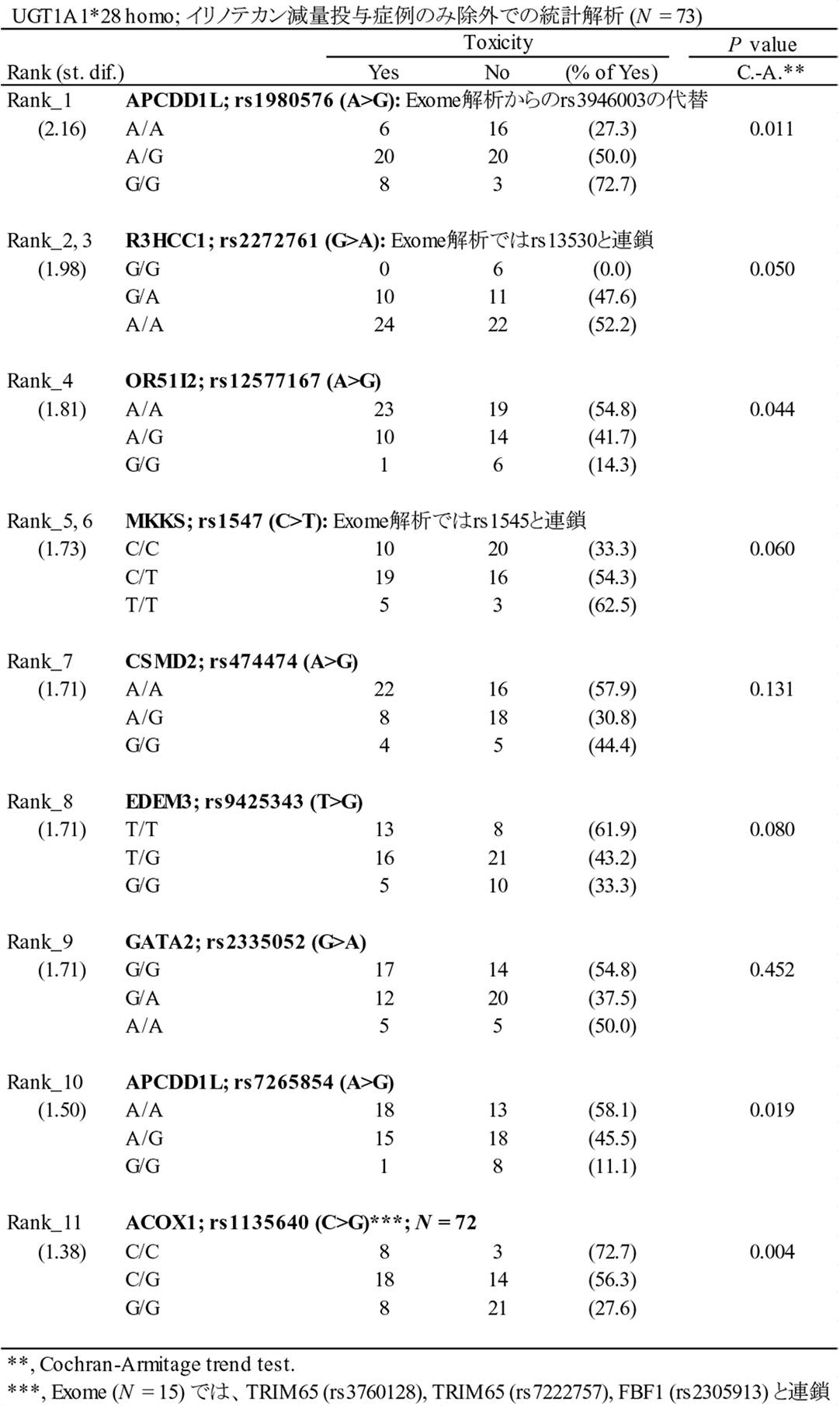
- a single nucleotide polymorphism in the region encoding the APCDD1L gene, R3HCC1 gene, OR51I2 gene, MKKS gene, EDEM3 gene, or ACOX1 gene in patients who have and have not had side effects of irinotecan in advance or the single nucleotide Investigate the relationship between polymorphisms and single nucleotide polymorphisms in linkage disequilibrium or genetic linkage.
- the single nucleotide polymorphism of the target patient is examined and compared with the data of the previously examined patient, thereby assisting in predicting the risk of occurrence of irinotecan side effects in the target patient.
- the kit for assisting in predicting the risk of occurrence of side effects due to irinotecan of the present invention is not particularly limited as long as it contains the probe of the present invention or the primer of the present invention, and a buffer for analyzing a single nucleotide polymorphism. Liquids, enzymes, and other reagents, and instructions for assisting in predicting that the risk of side effects caused by irinotecan is high may be included.
- Genomic DNA was prepared based on the sodium iodide method (Wang et al., Nucleic Acids Res 34: 195-201 (2014)) using the peripheral blood of a subject collected in an EDTA-containing tube.
- the prepared DNA was dissolved in 10 mM Tris-HCl buffer (pH 8.0) containing 1 mM EDTA ⁇ 2Na and stored at 4 ° C. or ⁇ 20 ° C. until use.
- Exome analysis using the next-generation sequencer was performed by the following method. First, the concentration of the prepared genomic DNA was quantified from the absorbance using a spectrophotometer (Nanodrop (registered trademark): manufactured by Scrum), and the quality test was performed by agarose gel electrophoresis. Thereafter, the genomic DNA was fragmented to 150 to 200 bp using an acoustic solver (manufactured by Covalis), and the adapter was ligated. Next, the fragmented genomic DNA was amplified by PCR, hybridized with SureSelect (registered trademark) Oligo Capture library (manufactured by Agilent Technologies), recovered with streptavidin magnetic beads, and concentrated.
- PCR amplification was performed using a primer with an index, and an index was added to obtain a sequence library.
- the quality of the prepared sequence library was measured using an Agilent 2100 Bioanalyzer (manufactured by Agilent Technologies).
- the template DNA base sequence was obtained by analyzing the sequence library using HiSeq 2000 (manufactured by Illumina). Clean reads were extracted from the obtained base sequence and mapped to a reference sequence (UCSC hg19: human reference genome) using Burrows-Wheeler Aligner (BWA) (0.7.12).
- the gene polymorphism is extracted by The Genome Analysis Toolkit (GATK) (3.4-46), and the effect on the amino acid sequence by snpEff (v4.1k)
- the gene polymorphism estimated to affect the amino acid sequence was extracted based on SnpEff, sorts intolerant from tolerant (SIFT), polymorphism Phenotyping (PolyPhen).
- SIFT genotyp intolerant from tolerant
- PolyPhen polymorphism Phenotyping
- the difference between the control group and the case group was ranked using a standardized difference (d) according to the following formula (I).
- P T is the percentage of the gene polymorphism alleles in cases (test) group
- P C is the percentage of the gene polymorphism alleles in the control group.
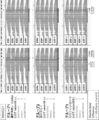
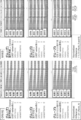
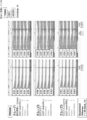
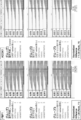
- FIGS. 1 The results of exome analysis of each gene visualized with Integrative Genomics Viewer (IGV, manufactured by Broad Institute) software are shown in FIGS.
- the position of the single nucleotide polymorphism is surrounded by a square, and when the thick line has the wild type as homo, when the dotted line has hetero, the thin line has the variant type as homo Is the case.
- rs19850576 and rs3946003 FIG. 1
- rs2272761 and rs2272762 and rs13530 FIG. 2
- rs1545 and rs1547 FIG. 3
- rs1135640 and rs3760128, rs7222757, rs7227593, and rs2305913 A complete chain was shown.
- Genomic DNA 10 ng using TaqMan SNP Assays_Human (Applied Biosystems), LightCycler (registered trademark) 480 Probe Master (Roche Diagnostics), Universal ProbeLibrary (Roche Diagnostics), LightCycler480 System II (RocheDiagnostics) Typing was done. After incubation at 95 ° C for 10 minutes, PCR was performed for 55 cycles for rs1985576, rs2272761, rs9425343, 45 cycles for rs12577167, rs72626554, 45 cycles for rs1135640, 40 cycles for rs1547 (92 ° C 15 seconds per cycle, 60 ° C 60 seconds) And the fluorescence of the PCR product was measured.
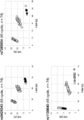
- FIGS. 8 and 9 show the results of analysis by the TaqMan probe method. Since only rs1135640 was analyzed in 74 cases, FIGS. 8 and 9 show the analysis results in 74 cases for all genotyping.
- the horizontal and vertical axes are the fluorescence values from the fluorescently labeled (FAM and VIC) probes for each allele, and the black circle, dark gray circle, and light gray (dot pattern) circle each have a variant type as homo in the exome analysis. Cases that had been wild-type as homozygous, cases that had wild-type as heterozygous, and white circles were cases in which exome analysis was not performed. 8 and 9, it was confirmed that genotypes could be clearly distinguished by TaqMan probe method, and the results of exome analysis were also reproduced by TaqMan probe method.
- rs9425343, rs2272761, rs12577167, rs1135640, rs1547, rs7265854, and rs1985576 did not show linkage (correlation) with the UGT1A gene mutation.
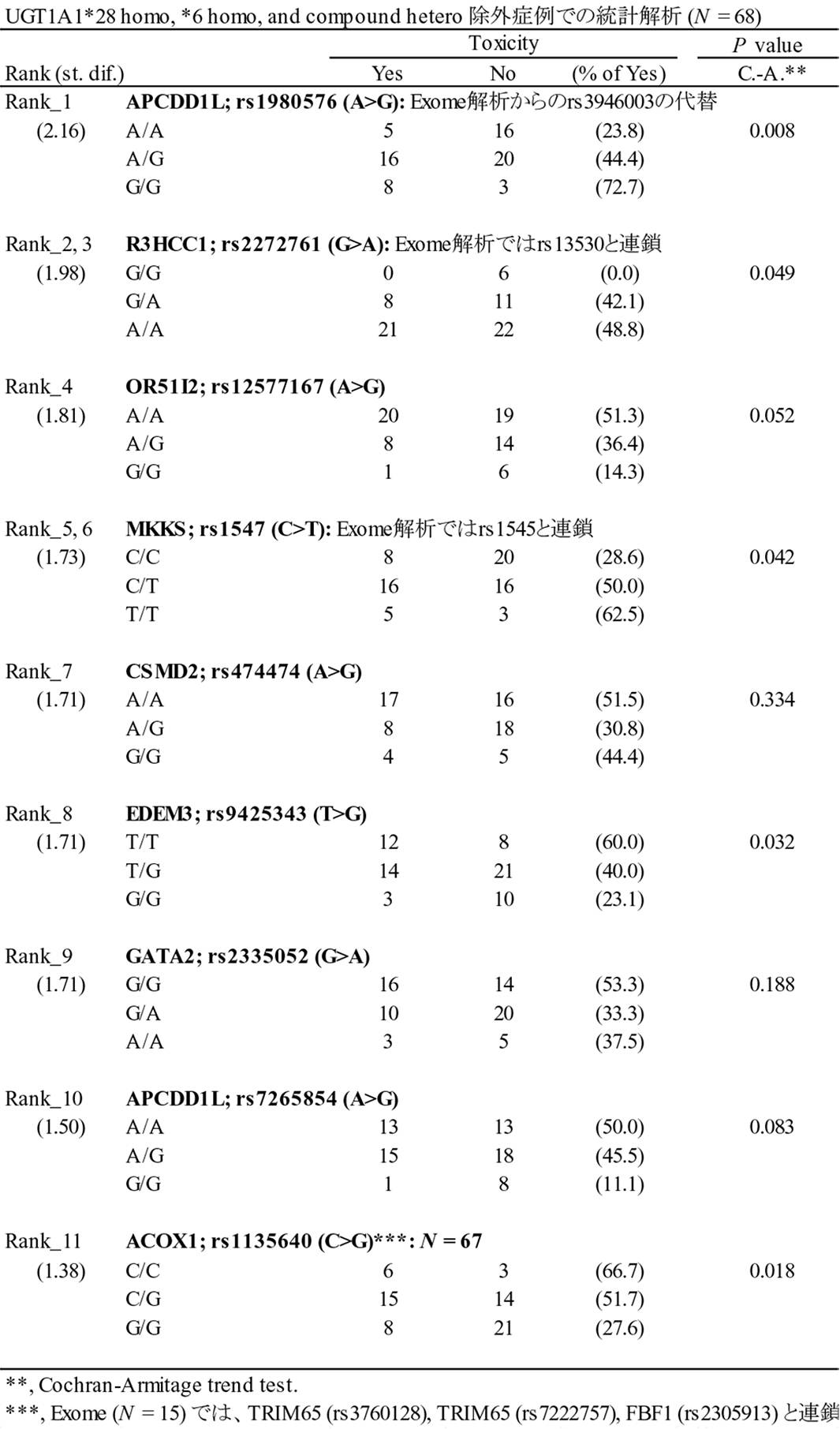
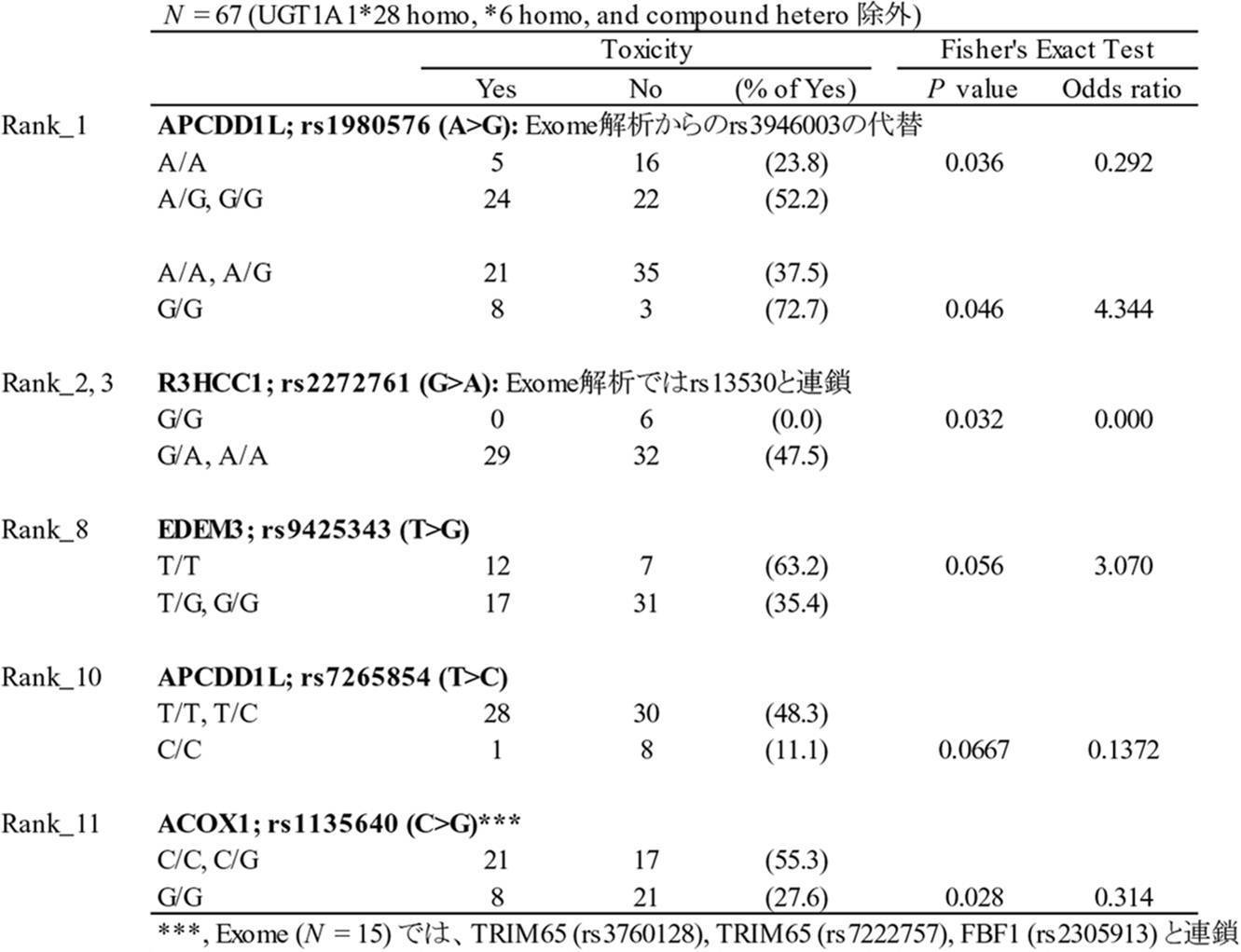
- these single nucleotide polymorphisms complementarily predict the risk of side effects due to irinotecan. It became clear that it can be used in the method of assisting.
- Single nucleotide polymorphism rs1547, single nucleotide polymorphism rs9425343 encoding the region encoding EDEM3 gene, single nucleotide polymorphism rs11353640 encoding the region encoding ACOX1 gene are analyzed, and variant type is homozygous or wild type is homozygous It was clarified that the risk of occurrence of side effects of irinotecan, which could not be predicted from the conventional UGT1A gene polymorphism, can be accurately assisted by
- the present invention it is possible to assist in predicting the risk of occurrence of side effects caused by irinotecan, and thus can be used in the medical field.
Landscapes
- Chemical & Material Sciences (AREA)
- Life Sciences & Earth Sciences (AREA)
- Health & Medical Sciences (AREA)
- Organic Chemistry (AREA)
- Engineering & Computer Science (AREA)
- Proteomics, Peptides & Aminoacids (AREA)
- Zoology (AREA)
- Wood Science & Technology (AREA)
- Analytical Chemistry (AREA)
- Immunology (AREA)
- Molecular Biology (AREA)
- Bioinformatics & Cheminformatics (AREA)
- General Health & Medical Sciences (AREA)
- Biotechnology (AREA)
- Microbiology (AREA)
- Biochemistry (AREA)
- Physics & Mathematics (AREA)
- Genetics & Genomics (AREA)
- General Engineering & Computer Science (AREA)
- Biophysics (AREA)
- Biomedical Technology (AREA)
- Pathology (AREA)
- Urology & Nephrology (AREA)
- Toxicology (AREA)
- Hematology (AREA)
- Tropical Medicine & Parasitology (AREA)
- Food Science & Technology (AREA)
- Medicinal Chemistry (AREA)
- General Physics & Mathematics (AREA)
- Cell Biology (AREA)
- Hospice & Palliative Care (AREA)
- Oncology (AREA)
- Measuring Or Testing Involving Enzymes Or Micro-Organisms (AREA)
Abstract
Description
(1)被検者から採取された生体試料中のゲノムDNA上に存在するAPCDD1L遺伝子、R3HCC1遺伝子、OR51I2遺伝子、MKKS遺伝子、EDEM3遺伝子、又はACOX1遺伝子をコードする領域における一塩基多型、又は該一塩基多型と連鎖不平衡若しくは遺伝的連鎖にある一塩基多型を分析し、バリアント型をホモとして有しているか、野生型をホモとして有しているか、又はヘテロとして有しているかを判定し、イリノテカンによる副作用の発生リスクの予測を補助する方法。
(2)APCDD1L遺伝子、R3HCC1遺伝子、OR51I2遺伝子、MKKS遺伝子、EDEM3遺伝子、又はACOX1遺伝子をコードする領域における一塩基多型が以下の(a)~(g)のいずれかであることを特徴とする上記(1)記載の方法。
(a)配列番号1に示されるAPCDD1L遺伝子をコードする塩基配列、又はその相補配列の186番目の塩基に存在する一塩基多型;
(b)配列番号2に示されるR3HCC1遺伝子をコードする塩基配列、又はその相補配列の358番目の塩基に存在する一塩基多型;
(c)配列番号3に示されるOR51I2遺伝子をコードする塩基配列、又はその相補配列の400番目の塩基に存在する一塩基多型;
(d)配列番号4に示されるMKKS遺伝子をコードする塩基配列、又はその相補配列の1549番目の塩基に存在する一塩基多型;
(e)配列番号5に示されるEDEM3遺伝子をコードする塩基配列、又はその相補配列の2459番目の塩基に存在する一塩基多型;
(f)配列番号1に示されるAPCDD1L遺伝子をコードする塩基配列、又はその相補配列の238番目の塩基に存在する一塩基多型;
(g)配列番号6に示されるACOX1遺伝子をコードする塩基配列、又はその相補配列の936番目の塩基に存在する一塩基多型;
(3)(a)、(b)又は(d)に記載の一塩基多型においてバリアント型をホモとして有している場合、又は(c)、(e)~(g)に記載の一塩基多型において野生型をホモとして有している場合にはイリノテカンによる副作用の発生リスクが高いとの予測を補助することを特徴とする上記(2)記載の方法。
(4)副作用が、白血球減少又は好中球減少であることを特徴とする上記(1)~(3)のいずれか記載の方法。
(5)以下の(h)~(n)のいずれかであって、上記(1)~(4)のいずれかに記載の方法における一塩基多型の分析で用いるためのプローブ。
(h)配列番号1に示されるAPCDD1L遺伝子をコードする塩基配列、又はその相補配列の186番目の塩基に存在する一塩基多型部位を含む連続する5~50塩基の配列とストリンジェントな条件下でハイブリダイズするオリゴヌクレオチドからなるプローブ;
(i)配列番号2に示されるR3HCC1遺伝子をコードする塩基配列、又はその相補配列の358番目の塩基に存在する一塩基多型部位を含む連続する5~50塩基の配列とストリンジェントな条件下でハイブリダイズするオリゴヌクレオチドからなるプローブ;
(j)配列番号3に示されるOR51I2遺伝子をコードする塩基配列、又はその相補配列の400番目の塩基に存在する一塩基多型部位を含む連続する5~50塩基の配列とストリンジェントな条件下でハイブリダイズするオリゴヌクレオチドからなるプローブ;
(k)配列番号4に示されるMKKS遺伝子をコードする塩基配列、又はその相補配列の1549番目の塩基に存在する一塩基多型部位を含む連続する5~50塩基の配列とストリンジェントな条件下でハイブリダイズするオリゴヌクレオチドからなるプローブ;
(l)配列番号5に示されるEDEM3遺伝子をコードする塩基配列、又はその相補配列の2459番目の塩基に存在する一塩基多型部位を含む連続する5~50塩基の配列とストリンジェントな条件下でハイブリダイズするオリゴヌクレオチドからなるプローブ;
(m)配列番号1に示されるAPCDD1L遺伝子をコードする塩基配列、又はその相補配列の238番目の塩基に存在する一塩基多型部位を含む連続する5~50塩基の配列とストリンジェントな条件下でハイブリダイズするオリゴヌクレオチドからなるプローブ;
(n)配列番号6に示されるACOX1遺伝子をコードする塩基配列、又はその相補配列の936番目の塩基に存在する一塩基多型部位を含む連続する5~50塩基の配列とストリンジェントな条件下でハイブリダイズするオリゴヌクレオチドからなるプローブ;
(6)以下の(o)~(u)のいずれかであって、上記(1)~(4)のいずれかに記載の方法における一塩基多型の分析で用いるためのプライマー。
(o)配列番号1に示されるAPCDD1L遺伝子をコードする塩基配列の186番目の塩基に存在する一塩基多型部位を含む連続する少なくとも5塩基を増幅することができるオリゴヌクレオチドからなるプライマー;
(p)配列番号2に示されるR3HCC1遺伝子をコードする塩基配列の358番目の塩基に存在する一塩基多型部位を含む連続する少なくとも5塩基を増幅することができるオリゴヌクレオチドからなるプライマー;
(q)配列番号3に示されるOR51I2遺伝子をコードする塩基配列の400番目の塩基に存在する一塩基多型部位を含む連続する少なくとも5塩基を増幅することができるオリゴヌクレオチドからなるプライマー;
(r)配列番号4に示されるMKKS遺伝子をコードする塩基配列の1549番目の塩基に存在する一塩基多型部位を含む連続する少なくとも5塩基を増幅することができるオリゴヌクレオチドからなるプライマー;
(s)配列番号5に示されるEDEM3遺伝子をコードする塩基配列の2459番目の塩基に存在する一塩基多型部位を含む連続する少なくとも5塩基を増幅することができるオリゴヌクレオチドからなるプライマー;
(t)配列番号1に示されるAPCDD1L遺伝子をコードする塩基配列の238番目の塩基に存在する一塩基多型部位を含む連続する少なくとも5塩基を増幅することができるオリゴヌクレオチドからなるプライマー;
(u)配列番号6に示されるACOX1遺伝子をコードする塩基配列の936番目の塩基に存在する一塩基多型部位を含む連続する少なくとも5塩基を増幅することができるオリゴヌクレオチドからなるプライマー;
(7)上記(5)記載のプローブ、又は上記(6)記載のプライマーを含むことを特徴とするイリノテカンによる副作用の発生リスクの予測を補助するためのキット。

イリノテカンの重篤な副作用は、UGT1A遺伝子に副作用と関連する多型(UGT1A1*6、*27、*28、UGT1A7(387T>G、622T>C)、UGT1A9*1b、UGT1A1*60の7ヶ所)を全く持っていない患者においてさえも散見される。そこで、新たなイリノテカンの副作用関連因子の探索を以下の方法で行った。
コントロール群として上述の7ヶ所の多型が全て副作用リスクの低い遺伝子型であって、副作用がみられなかった症例群(グループ1:n=5)、ケース群として上述のUGT1A遺伝子の7ヶ所の多型が全て副作用リスクの低い遺伝子型であったにもかかわらず副作用(Grade3:白血球減少、好中球減少)がみられた症例群(グループ2:n=5)、上記7ヶ所のいずれかの多型をヘテロに有し、初回投与時から極めて重篤な副作用(Grade4:白血球減少、好中球減少)がみられた症例群(グループ3:n=5)の末梢血より調製したゲノムDNAを用いて次世代シーケンサーによるエクソーム解析を行った。なお、いずれの症例群も日本人である。
ゲノムDNAは、EDTA含有チューブに採取した被検者の末梢血を用い、ヨウ化ナトリウム法(Wang et al., Nucleic Acids Res 34:195-201(2014))に基づいて調製した。調製したDNAは、1mM EDTA・2Naを含む10mM Tris-塩酸緩衝液(pH8.0)に溶解し、使用するまで、4℃又は-20℃で保存した。
次世代シーケンサーによるエクソーム解析は、次の方法で行った。まず、調製したゲノムDNAを分光光度計(Nanodrop(登録商標):スクラム社製)を用いて吸光度から濃度を定量し、アガロースゲル電気泳動により品質検定を行った。その後、ゲノムDNAをアコースティックソルビライザー(コバリス社製)を用いて150~200bpに断片化し、アダプターをライゲートした。次いで、断片化したゲノムDNAをPCRで増幅し、SureSelect(登録商標) Oligo Captureライブラリー(アジレント・テクノロジー社製)とハイブリダイゼーションさせ、ストレプトアビジン磁気ビーズにより回収して濃縮した。回収したDNAライブラリーを鋳型として、Index付きプライマーを使用してPCRによる増幅を行い、Indexを付加し、シーケンスライブラリーとした。作製されたシーケンスライブラリーの品質をAgilent 2100 Bioanalyzer(アジレント・テクノロジー社製)を用いて測定した。シーケンスライブラリーをHiSeq 2000(イルミナ社製)を用いて解析することで、鋳型DNA塩基配列を取得した。得られた塩基配列について、クリーンリードを抽出し、Burrows-Wheeler Aligner(BWA)(0.7.12)を用いて参照配列(UCSC hg19:ヒトリファレンスゲノム)にマッピングした。

(エクソーム解析結果の検証の手法)
実施例1の結果によって得られたイリノテカンの副作用因子の候補のうち、APCDD1L遺伝子をコードする領域の一塩基多型rs1980576、R3HCC1遺伝子をコードする領域の一塩基多型rs2272761、OR51I2遺伝子をコードする領域の一塩基多型rs12577167、MKKS遺伝子をコードする領域の一塩基多型rs1547、EDEM3遺伝子をコードする領域の一塩基多型rs9425343、APCDD1L遺伝子をコードする領域の一塩基多型rs7265854、ACOX1遺伝子をコードする領域の一塩基多型rs1135640について、さらにTaqMan(登録商標)probe法により、日本人のイリノテカン投与大腸癌患者75症例の臨床サンプルにて検証を行った。ゲノムDNA10ngにTaqMan SNP Assays_ Human (Applied Biosystems社製) 及びLightCycler(登録商標)480 Probe Master(Roche Diagnostics社製)、Universal ProbeLibrary(Roche Diagnostics社製)、LightCycler480 System II(RocheDiagnostics社製)を用いてジェノタイピングを行った。95℃10分間のインキュベーションの後、PCRをrs1980576、rs2272761、rs9425343については55サイクル、rs12577167、rs7265854、rs1135640については45サイクル、rs1547については40サイクル(1サイクルあたり92℃15秒、60℃60秒)行い、PCR産物の蛍光を測定した。
図8、9に、上記TaqMan probe法により解析した結果を示す。rs1135640のみ74症例での解析となったことから、図8、9にはすべてのジェノタイピングについて74症例での解析結果を示す。横軸及び縦軸はそれぞれのアレルに対する蛍光標識(FAM及びVIC)プローブからの蛍光値であり、黒丸、濃灰色丸、薄灰色(ドット柄)丸はそれぞれエクソーム解析においてバリアント型をホモとして有していた症例、野生型をホモとして有していた症例、ヘテロとして有していた症例を表し、白丸はエクソーム解析未実施の症例である。図8、9より、TaqMan probe法により明瞭にジェノタイプを区別できることが確認され、また、エクソーム解析の結果がTaqMan probe法によっても再現された。
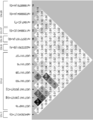
実施例2における74症例について、rs9425343、rs2272761、rs12577167、rs1135640、rs1547、rs7265854、rs1980576や、UGT1A遺伝子変異であるUGT1A9*1b、UGT1A7[387]、UGT1A7[622]、UGT1A1*60、UGT1A1*28、UGT1A1*6又はUGT1A1*27におけるTaqMan probe法及びダイレクトシーケンス法により各UGT遺伝子のジェノタイプを決定し、さらに連鎖不平衡解析及びLD解析をHaploview4.2ソフトウェアで実施した。結果を図10に示す。図10において、数値は相関系数(r2)である。図10に示すように、rs9425343、rs2272761、rs12577167、rs1135640、rs1547、rs7265854、rs1980576はUGT1A遺伝子変異との連鎖(相関)はみられなかった。また、rs9425343、rs2272761、rs12577167、rs1135640、rs1547、rs7265854、rs1980576間においても連鎖は見られなかったことから、これらの一塩基多型(マーカー部位)は相補的にイリノテカンによる副作用の発生リスクの予測を補助する方法に用いることができることが明らかとなった。


Claims (7)
- 被検者から採取された生体試料中のゲノムDNA上に存在するAPCDD1L遺伝子、R3HCC1遺伝子、OR51I2遺伝子、MKKS遺伝子、EDEM3遺伝子、又はACOX1遺伝子をコードする領域における一塩基多型、又は該一塩基多型と連鎖不平衡若しくは遺伝的連鎖にある一塩基多型を分析し、バリアント型をホモとして有しているか、野生型をホモとして有しているか、又はヘテロとして有しているかを判定し、イリノテカンによる副作用の発生リスクの予測を補助する方法。
- APCDD1L遺伝子、R3HCC1遺伝子、OR51I2遺伝子、MKKS遺伝子、EDEM3遺伝子、又はACOX1遺伝子をコードする領域における一塩基多型が以下の(a)~(g)のいずれかであることを特徴とする請求項1記載の方法。
(a)配列番号1に示されるAPCDD1L遺伝子をコードする塩基配列、又はその相補配列の186番目の塩基に存在する一塩基多型;
(b)配列番号2に示されるR3HCC1遺伝子をコードする塩基配列、又はその相補配列の358番目の塩基に存在する一塩基多型;
(c)配列番号3に示されるOR51I2遺伝子をコードする塩基配列、又はその相補配列の400番目の塩基に存在する一塩基多型;
(d)配列番号4に示されるMKKS遺伝子をコードする塩基配列、又はその相補配列の1549番目の塩基に存在する一塩基多型;
(e)配列番号5に示されるEDEM3遺伝子をコードする塩基配列、又はその相補配列の2459番目の塩基に存在する一塩基多型;
(f)配列番号1に示されるAPCDD1L遺伝子をコードする塩基配列、又はその相補配列の238番目の塩基に存在する一塩基多型;
(g)配列番号6に示されるACOX1遺伝子をコードする塩基配列、又はその相補配列の936番目の塩基に存在する一塩基多型; - (a)、(b)又は(d)に記載の一塩基多型においてバリアント型をホモとして有している場合、又は(c)、(e)~(g)に記載の一塩基多型において野生型をホモとして有している場合にはイリノテカンによる副作用の発生リスクが高いとの予測を補助することを特徴とする請求項2記載の方法。
- 副作用が、白血球減少又は好中球減少であることを特徴とする請求項1~3のいずれか記載の方法。
- 以下の(h)~(n)のいずれかであって、請求項1~4のいずれかに記載の方法における一塩基多型の分析で用いるためのプローブ。
(h)配列番号1に示されるAPCDD1L遺伝子をコードする塩基配列、又はその相補配列の186番目の塩基に存在する一塩基多型部位を含む連続する5~50塩基の配列とストリンジェントな条件下でハイブリダイズするオリゴヌクレオチドからなるプローブ;
(i)配列番号2に示されるR3HCC1遺伝子をコードする塩基配列、又はその相補配列の358番目の塩基に存在する一塩基多型部位を含む連続する5~50塩基の配列とストリンジェントな条件下でハイブリダイズするオリゴヌクレオチドからなるプローブ;
(j)配列番号3に示されるOR51I2遺伝子をコードする塩基配列、又はその相補配列の400番目の塩基に存在する一塩基多型部位を含む連続する5~50塩基の配列とストリンジェントな条件下でハイブリダイズするオリゴヌクレオチドからなるプローブ;
(k)配列番号4に示されるMKKS遺伝子をコードする塩基配列、又はその相補配列の1549番目の塩基に存在する一塩基多型部位を含む連続する5~50塩基の配列とストリンジェントな条件下でハイブリダイズするオリゴヌクレオチドからなるプローブ;
(l)配列番号5に示されるEDEM3遺伝子をコードする塩基配列、又はその相補配列の2459番目の塩基に存在する一塩基多型部位を含む連続する5~50塩基の配列とストリンジェントな条件下でハイブリダイズするオリゴヌクレオチドからなるプローブ;
(m)配列番号1に示されるAPCDD1L遺伝子をコードする塩基配列、又はその相補配列の238番目の塩基に存在する一塩基多型部位を含む連続する5~50塩基の配列とストリンジェントな条件下でハイブリダイズするオリゴヌクレオチドからなるプローブ;
(n)配列番号6に示されるACOX1遺伝子をコードする塩基配列、又はその相補配列の936番目の塩基に存在する一塩基多型部位を含む連続する5~50塩基の配列とストリンジェントな条件下でハイブリダイズするオリゴヌクレオチドからなるプローブ; - 以下の(o)~(u)のいずれかであって、請求項1~4のいずれかに記載の方法における一塩基多型の分析で用いるためのプライマー。
(o)配列番号1に示されるAPCDD1L遺伝子をコードする塩基配列の186番目の塩基に存在する一塩基多型部位を含む連続する少なくとも5塩基を増幅することができるオリゴヌクレオチドからなるプライマー;
(p)配列番号2に示されるR3HCC1遺伝子をコードする塩基配列の358番目の塩基に存在する一塩基多型部位を含む連続する少なくとも5塩基を増幅することができるオリゴヌクレオチドからなるプライマー;
(q)配列番号3に示されるOR51I2遺伝子をコードする塩基配列の400番目の塩基に存在する一塩基多型部位を含む連続する少なくとも5塩基を増幅することができるオリゴヌクレオチドからなるプライマー;
(r)配列番号4に示されるMKKS遺伝子をコードする塩基配列の1549番目の塩基に存在する一塩基多型部位を含む連続する少なくとも5塩基を増幅することができるオリゴヌクレオチドからなるプライマー;
(s)配列番号5に示されるEDEM3遺伝子をコードする塩基配列の2459番目の塩基に存在する一塩基多型部位を含む連続する少なくとも5塩基を増幅することができるオリゴヌクレオチドからなるプライマー;
(t)配列番号1に示されるAPCDD1L遺伝子をコードする塩基配列の238番目の塩基に存在する一塩基多型部位を含む連続する少なくとも5塩基を増幅することができるオリゴヌクレオチドからなるプライマー;
(u)配列番号6に示されるACOX1遺伝子をコードする塩基配列の936番目の塩基に存在する一塩基多型部位を含む連続する少なくとも5塩基を増幅することができるオリゴヌクレオチドからなるプライマー; - 請求項5記載のプローブ、又は請求項6記載のプライマーを含むことを特徴とするイリノテカンによる副作用の発生リスクの予測を補助するためのキット。
Priority Applications (4)
| Application Number | Priority Date | Filing Date | Title |
|---|---|---|---|
| CN201680009599.2A CN107208163B (zh) | 2015-02-17 | 2016-02-16 | 辅助对伊立替康副作用的发生风险的预测的方法 |
| JP2017500522A JP6644333B2 (ja) | 2015-02-17 | 2016-02-16 | イリノテカンによる副作用の発生リスクの予測を補助する方法 |
| US15/549,823 US20180237833A1 (en) | 2015-02-17 | 2016-02-16 | Method for assisting prediction of risk of occurrence of side effect of irinotecan |
| US16/788,406 US11692216B2 (en) | 2015-02-17 | 2020-02-12 | Method for assisting prediction of risk of occurrence of side effect of irinotecan |
Applications Claiming Priority (2)
| Application Number | Priority Date | Filing Date | Title |
|---|---|---|---|
| JP2015028813 | 2015-02-17 | ||
| JP2015-028813 | 2015-02-17 |
Related Child Applications (2)
| Application Number | Title | Priority Date | Filing Date |
|---|---|---|---|
| US15/549,823 A-371-Of-International US20180237833A1 (en) | 2015-02-17 | 2016-02-16 | Method for assisting prediction of risk of occurrence of side effect of irinotecan |
| US16/788,406 Division US11692216B2 (en) | 2015-02-17 | 2020-02-12 | Method for assisting prediction of risk of occurrence of side effect of irinotecan |
Publications (1)
| Publication Number | Publication Date |
|---|---|
| WO2016132736A1 true WO2016132736A1 (ja) | 2016-08-25 |
Family
ID=56688980
Family Applications (1)
| Application Number | Title | Priority Date | Filing Date |
|---|---|---|---|
| PCT/JP2016/000793 Ceased WO2016132736A1 (ja) | 2015-02-17 | 2016-02-16 | イリノテカンによる副作用の発生リスクの予測を補助する方法 |
Country Status (4)
| Country | Link |
|---|---|
| US (2) | US20180237833A1 (ja) |
| JP (1) | JP6644333B2 (ja) |
| CN (1) | CN107208163B (ja) |
| WO (1) | WO2016132736A1 (ja) |
Cited By (3)
| Publication number | Priority date | Publication date | Assignee | Title |
|---|---|---|---|---|
| WO2018235937A1 (ja) | 2017-06-22 | 2018-12-27 | 国立大学法人山口大学 | イリノテカンの治療効果予測方法及びそのためのキット |
| JP2022062827A (ja) * | 2020-10-09 | 2022-04-21 | キヤノンメディカルシステムズ株式会社 | 投与計画支援装置および投与計画支援システム |
| JP2022187310A (ja) * | 2021-06-07 | 2022-12-19 | 国立大学法人山口大学 | 膵がん化学療法における副作用発生リスクの予測を補助する方法 |
Families Citing this family (1)
| Publication number | Priority date | Publication date | Assignee | Title |
|---|---|---|---|---|
| CN116004807B (zh) * | 2022-12-28 | 2023-11-03 | 广州凯普医药科技有限公司 | Ugt1a1基因多位点扩增引物组、试剂盒及检测方法 |
Citations (1)
| Publication number | Priority date | Publication date | Assignee | Title |
|---|---|---|---|---|
| JP2005504759A (ja) * | 2001-07-23 | 2005-02-17 | エピダウロス・バイオテクノロジー・アクチェンゲゼルシャフト | Cyp3a5に基づいたがんの改善治療の手段及び方法 |
Family Cites Families (7)
| Publication number | Priority date | Publication date | Assignee | Title |
|---|---|---|---|---|
| CN100374575C (zh) | 2000-12-12 | 2008-03-12 | 第一化学药品株式会社 | 评估施用自身或者其代谢中间物被ugt1a1酶代谢的化合物引起严重毒性的方法 |
| JP4884899B2 (ja) | 2006-09-19 | 2012-02-29 | 東洋鋼鈑株式会社 | イリノテカンの副作用の発生危険度を判定する方法およびそのためのキット |
| JP5376841B2 (ja) | 2008-06-19 | 2013-12-25 | ソニー株式会社 | イリノテカンの副作用の発生危険度を判定する方法、及びこれに用いられるdnaチップとキット |
| CN102146433A (zh) * | 2010-02-04 | 2011-08-10 | 上海宝藤生物医药科技有限公司 | 用于指导伊立替康类药物个体化治疗的基因组合 |
| WO2011133215A1 (en) * | 2010-04-19 | 2011-10-27 | Health Research Inc. | Method of identifying and treating a person having a predisposition to or afflicted with parkinson disease |
| JP2011250726A (ja) * | 2010-06-01 | 2011-12-15 | Toyo Kohan Co Ltd | イリノテカンの副作用の発生危険度を判定する方法及びそのためのキット |
| JP5800180B2 (ja) * | 2011-03-28 | 2015-10-28 | 国立大学法人 長崎大学 | 日焼けの原因遺伝子 |
-
2016
- 2016-02-16 JP JP2017500522A patent/JP6644333B2/ja active Active
- 2016-02-16 WO PCT/JP2016/000793 patent/WO2016132736A1/ja not_active Ceased
- 2016-02-16 US US15/549,823 patent/US20180237833A1/en not_active Abandoned
- 2016-02-16 CN CN201680009599.2A patent/CN107208163B/zh active Active
-
2020
- 2020-02-12 US US16/788,406 patent/US11692216B2/en active Active
Patent Citations (3)
| Publication number | Priority date | Publication date | Assignee | Title |
|---|---|---|---|---|
| JP2005504759A (ja) * | 2001-07-23 | 2005-02-17 | エピダウロス・バイオテクノロジー・アクチェンゲゼルシャフト | Cyp3a5に基づいたがんの改善治療の手段及び方法 |
| JP2005506971A (ja) * | 2001-07-23 | 2005-03-10 | エピダウロス・バイオテクノロジー・アクチェンゲゼルシャフト | Mrp1に基づいたがんの改善治療の手段及び方法 |
| JP2005508312A (ja) * | 2001-07-23 | 2005-03-31 | エピダウロス・バイオテクノロジー・アクチェンゲゼルシャフト | Mdr1に基づいた癌治療の改善のための手段および方法 |
Non-Patent Citations (5)
Cited By (8)
| Publication number | Priority date | Publication date | Assignee | Title |
|---|---|---|---|---|
| WO2018235937A1 (ja) | 2017-06-22 | 2018-12-27 | 国立大学法人山口大学 | イリノテカンの治療効果予測方法及びそのためのキット |
| JP2019004743A (ja) * | 2017-06-22 | 2019-01-17 | 国立大学法人山口大学 | イリノテカンの治療効果予測方法及びそのためのキット |
| CN110997945A (zh) * | 2017-06-22 | 2020-04-10 | 国立大学法人山口大学 | 伊立替康的治疗效果预测方法及应用该方法的试剂盒 |
| EP3643791A4 (en) * | 2017-06-22 | 2021-03-17 | Yamaguchi University | PROCEDURE FOR PREDICTING THE THERAPEUTIC EFFECTS OF IRINOTECAN AND KIT FOR IT |
| US11384385B2 (en) | 2017-06-22 | 2022-07-12 | Yamaguchi University | Method for predicting therapeutic effects of irinotecan, and kit for same |
| JP2022062827A (ja) * | 2020-10-09 | 2022-04-21 | キヤノンメディカルシステムズ株式会社 | 投与計画支援装置および投与計画支援システム |
| JP7526634B2 (ja) | 2020-10-09 | 2024-08-01 | キヤノンメディカルシステムズ株式会社 | 投与計画支援装置および投与計画支援システム |
| JP2022187310A (ja) * | 2021-06-07 | 2022-12-19 | 国立大学法人山口大学 | 膵がん化学療法における副作用発生リスクの予測を補助する方法 |
Also Published As
| Publication number | Publication date |
|---|---|
| CN107208163A (zh) | 2017-09-26 |
| CN107208163B (zh) | 2021-01-08 |
| US11692216B2 (en) | 2023-07-04 |
| US20180237833A1 (en) | 2018-08-23 |
| JP6644333B2 (ja) | 2020-02-12 |
| JPWO2016132736A1 (ja) | 2018-01-11 |
| US20200172966A1 (en) | 2020-06-04 |
Similar Documents
| Publication | Publication Date | Title |
|---|---|---|
| TWI719339B (zh) | 與癌症有關之基因或分子變異之檢測 | |
| US20230074781A1 (en) | Methods and composition for the prediction of the activity of enzastaurin | |
| US20160108476A1 (en) | Colorectal cancer markers | |
| CN101679970A (zh) | 青光眼发病风险的判定方法 | |
| US11692216B2 (en) | Method for assisting prediction of risk of occurrence of side effect of irinotecan | |
| EP3954784A1 (en) | Composition for diagnosis or prognosis prediction of glioma, and method for providing information related thereto | |
| KR101582723B1 (ko) | 대장암 발병 위험도 예측을 위한 유전 마커와 이의 이용 | |
| US11384385B2 (en) | Method for predicting therapeutic effects of irinotecan, and kit for same | |
| EP2393939B1 (en) | A snp marker of breast and ovarian cancer risk | |
| CN109804082A (zh) | 用于检测颅内肿瘤的方法 | |
| KR101323101B1 (ko) | 유방암 또는 난소암의 유전성 소인 예측에 유용한 brca2 유전자 돌연변이 | |
| US20220154259A1 (en) | Method for determining side effects of trastuzumab and kit for same | |
| KR101598296B1 (ko) | Dna 복제수 변이를 이용한 강직성 척추염 발병 고위험도 예측용 조성물 및 이를 이용한 예측 방법 | |
| JP6245796B2 (ja) | 原発性胆汁性肝硬変の発症リスク予測マーカー、プローブ、プライマー及びキット並びに原発性胆汁性肝硬変の発症リスク予測方法 | |
| KR100803258B1 (ko) | 단일염기다형을 포함하는 폴리뉴클레오티드, 그를 포함하는마이크로어레이 및 진단키트, 그를 이용한 b형 간염백신에 대한 항체-무반응 진단방법 | |
| CN104513822B (zh) | Stub1基因突变体及其应用 | |
| Kinnersley | Genetic susceptibility to glioma | |
| HK40011257B (en) | Methods and composition for the prediction of the activity of enzastaurin | |
| HK40011257A (en) | Methods and composition for the prediction of the activity of enzastaurin | |
| KR20120128454A (ko) | 전립선암의 감수성 또는 예후 판단에 유용한 cdh1 유전자내의 단일뉴클레오타이드다형성 마커 |
Legal Events
| Date | Code | Title | Description |
|---|---|---|---|
| 121 | Ep: the epo has been informed by wipo that ep was designated in this application |
Ref document number: 16752125 Country of ref document: EP Kind code of ref document: A1 |
|
| ENP | Entry into the national phase |
Ref document number: 2017500522 Country of ref document: JP Kind code of ref document: A |
|
| WWE | Wipo information: entry into national phase |
Ref document number: 15549823 Country of ref document: US |
|
| NENP | Non-entry into the national phase |
Ref country code: DE |
|
| 122 | Ep: pct application non-entry in european phase |
Ref document number: 16752125 Country of ref document: EP Kind code of ref document: A1 |