WO2016129541A1 - 熱硬化性樹脂組成物 - Google Patents
熱硬化性樹脂組成物 Download PDFInfo
- Publication number
- WO2016129541A1 WO2016129541A1 PCT/JP2016/053609 JP2016053609W WO2016129541A1 WO 2016129541 A1 WO2016129541 A1 WO 2016129541A1 JP 2016053609 W JP2016053609 W JP 2016053609W WO 2016129541 A1 WO2016129541 A1 WO 2016129541A1
- Authority
- WO
- WIPO (PCT)
- Prior art keywords
- thermosetting resin
- resin composition
- composition according
- group
- formula
- Prior art date
- Legal status (The legal status is an assumption and is not a legal conclusion. Google has not performed a legal analysis and makes no representation as to the accuracy of the status listed.)
- Ceased
Links
Classifications
-
- C—CHEMISTRY; METALLURGY
- C08—ORGANIC MACROMOLECULAR COMPOUNDS; THEIR PREPARATION OR CHEMICAL WORKING-UP; COMPOSITIONS BASED THEREON
- C08G—MACROMOLECULAR COMPOUNDS OBTAINED OTHERWISE THAN BY REACTIONS ONLY INVOLVING UNSATURATED CARBON-TO-CARBON BONDS
- C08G18/00—Polymeric products of isocyanates or isothiocyanates
- C08G18/06—Polymeric products of isocyanates or isothiocyanates with compounds having active hydrogen
- C08G18/08—Processes
- C08G18/10—Prepolymer processes involving reaction of isocyanates or isothiocyanates with compounds having active hydrogen in a first reaction step
-
- C—CHEMISTRY; METALLURGY
- C08—ORGANIC MACROMOLECULAR COMPOUNDS; THEIR PREPARATION OR CHEMICAL WORKING-UP; COMPOSITIONS BASED THEREON
- C08G—MACROMOLECULAR COMPOUNDS OBTAINED OTHERWISE THAN BY REACTIONS ONLY INVOLVING UNSATURATED CARBON-TO-CARBON BONDS
- C08G18/00—Polymeric products of isocyanates or isothiocyanates
- C08G18/06—Polymeric products of isocyanates or isothiocyanates with compounds having active hydrogen
- C08G18/28—Polymeric products of isocyanates or isothiocyanates with compounds having active hydrogen characterised by the compounds used containing active hydrogen
- C08G18/65—Low-molecular-weight compounds having active hydrogen with high-molecular-weight compounds having active hydrogen
- C08G18/66—Compounds of groups C08G18/42, C08G18/48, or C08G18/52
-
- C—CHEMISTRY; METALLURGY
- C08—ORGANIC MACROMOLECULAR COMPOUNDS; THEIR PREPARATION OR CHEMICAL WORKING-UP; COMPOSITIONS BASED THEREON
- C08G—MACROMOLECULAR COMPOUNDS OBTAINED OTHERWISE THAN BY REACTIONS ONLY INVOLVING UNSATURATED CARBON-TO-CARBON BONDS
- C08G73/00—Macromolecular compounds obtained by reactions forming a linkage containing nitrogen with or without oxygen or carbon in the main chain of the macromolecule, not provided for in groups C08G12/00 - C08G71/00
- C08G73/06—Polycondensates having nitrogen-containing heterocyclic rings in the main chain of the macromolecule
- C08G73/10—Polyimides; Polyester-imides; Polyamide-imides; Polyamide acids or similar polyimide precursors
-
- C—CHEMISTRY; METALLURGY
- C08—ORGANIC MACROMOLECULAR COMPOUNDS; THEIR PREPARATION OR CHEMICAL WORKING-UP; COMPOSITIONS BASED THEREON
- C08K—Use of inorganic or non-macromolecular organic substances as compounding ingredients
- C08K3/00—Use of inorganic substances as compounding ingredients
- C08K3/34—Silicon-containing compounds
- C08K3/36—Silica
-
- C—CHEMISTRY; METALLURGY
- C08—ORGANIC MACROMOLECULAR COMPOUNDS; THEIR PREPARATION OR CHEMICAL WORKING-UP; COMPOSITIONS BASED THEREON
- C08L—COMPOSITIONS OF MACROMOLECULAR COMPOUNDS
- C08L63/00—Compositions of epoxy resins; Compositions of derivatives of epoxy resins
-
- C—CHEMISTRY; METALLURGY
- C08—ORGANIC MACROMOLECULAR COMPOUNDS; THEIR PREPARATION OR CHEMICAL WORKING-UP; COMPOSITIONS BASED THEREON
- C08L—COMPOSITIONS OF MACROMOLECULAR COMPOUNDS
- C08L79/00—Compositions of macromolecular compounds obtained by reactions forming in the main chain of the macromolecule a linkage containing nitrogen with or without oxygen or carbon only, not provided for in groups C08L61/00 - C08L77/00
- C08L79/04—Polycondensates having nitrogen-containing heterocyclic rings in the main chain; Polyhydrazides; Polyamide acids or similar polyimide precursors
- C08L79/08—Polyimides; Polyester-imides; Polyamide-imides; Polyamide acids or similar polyimide precursors
-
- C—CHEMISTRY; METALLURGY
- C08—ORGANIC MACROMOLECULAR COMPOUNDS; THEIR PREPARATION OR CHEMICAL WORKING-UP; COMPOSITIONS BASED THEREON
- C08L—COMPOSITIONS OF MACROMOLECULAR COMPOUNDS
- C08L87/00—Compositions of unspecified macromolecular compounds, obtained otherwise than by polymerisation reactions only involving unsaturated carbon-to-carbon bonds
-
- C—CHEMISTRY; METALLURGY
- C09—DYES; PAINTS; POLISHES; NATURAL RESINS; ADHESIVES; COMPOSITIONS NOT OTHERWISE PROVIDED FOR; APPLICATIONS OF MATERIALS NOT OTHERWISE PROVIDED FOR
- C09J—ADHESIVES; NON-MECHANICAL ASPECTS OF ADHESIVE PROCESSES IN GENERAL; ADHESIVE PROCESSES NOT PROVIDED FOR ELSEWHERE; USE OF MATERIALS AS ADHESIVES
- C09J11/00—Features of adhesives not provided for in group C09J9/00, e.g. additives
- C09J11/02—Non-macromolecular additives
- C09J11/04—Non-macromolecular additives inorganic
-
- C—CHEMISTRY; METALLURGY
- C09—DYES; PAINTS; POLISHES; NATURAL RESINS; ADHESIVES; COMPOSITIONS NOT OTHERWISE PROVIDED FOR; APPLICATIONS OF MATERIALS NOT OTHERWISE PROVIDED FOR
- C09J—ADHESIVES; NON-MECHANICAL ASPECTS OF ADHESIVE PROCESSES IN GENERAL; ADHESIVE PROCESSES NOT PROVIDED FOR ELSEWHERE; USE OF MATERIALS AS ADHESIVES
- C09J179/00—Adhesives based on macromolecular compounds obtained by reactions forming in the main chain of the macromolecule a linkage containing nitrogen, with or without oxygen, or carbon only, not provided for in groups C09J161/00 - C09J177/00
- C09J179/04—Polycondensates having nitrogen-containing heterocyclic rings in the main chain; Polyhydrazides; Polyamide acids or similar polyimide precursors
- C09J179/08—Polyimides; Polyester-imides; Polyamide-imides; Polyamide acids or similar polyimide precursors
-
- C—CHEMISTRY; METALLURGY
- C09—DYES; PAINTS; POLISHES; NATURAL RESINS; ADHESIVES; COMPOSITIONS NOT OTHERWISE PROVIDED FOR; APPLICATIONS OF MATERIALS NOT OTHERWISE PROVIDED FOR
- C09J—ADHESIVES; NON-MECHANICAL ASPECTS OF ADHESIVE PROCESSES IN GENERAL; ADHESIVE PROCESSES NOT PROVIDED FOR ELSEWHERE; USE OF MATERIALS AS ADHESIVES
- C09J7/00—Adhesives in the form of films or foils
- C09J7/20—Adhesives in the form of films or foils characterised by their carriers
-
- H—ELECTRICITY
- H05—ELECTRIC TECHNIQUES NOT OTHERWISE PROVIDED FOR
- H05K—PRINTED CIRCUITS; CASINGS OR CONSTRUCTIONAL DETAILS OF ELECTRIC APPARATUS; MANUFACTURE OF ASSEMBLAGES OF ELECTRICAL COMPONENTS
- H05K1/00—Printed circuits
- H05K1/02—Details
- H05K1/03—Use of materials for the substrate
-
- H—ELECTRICITY
- H10—SEMICONDUCTOR DEVICES; ELECTRIC SOLID-STATE DEVICES NOT OTHERWISE PROVIDED FOR
- H10W—GENERIC PACKAGES, INTERCONNECTIONS, CONNECTORS OR OTHER CONSTRUCTIONAL DETAILS OF DEVICES COVERED BY CLASS H10
- H10W70/00—Package substrates; Interposers; Redistribution layers [RDL]
- H10W70/60—Insulating or insulated package substrates; Interposers; Redistribution layers
- H10W70/67—Insulating or insulated package substrates; Interposers; Redistribution layers characterised by their insulating layers or insulating parts
- H10W70/69—Insulating materials thereof
Definitions
- the present invention relates to a thermosetting resin composition useful for forming an insulating layer of a circuit board such as a coreless circuit board, a flexible circuit board, or a wafer level chip size package.
- Insulating layers used in circuit boards such as coreless circuit boards, flexible circuit boards, and wafer level chip size packages have low coefficient of thermal expansion (CTE) and low modulus of elasticity in order to suppress board warpage. It is required to have.
- an insulating resin material for forming such an insulating layer for example, Patent Document 1 discloses a resin composition containing an expansion relaxation component made of an acrylic resin that is soluble in an organic solvent.
- an insulating layer formed of a conventional insulating resin material has a problem that it has high water repellency and repels highly hydrophilic ink.
- the present invention has been made paying attention to the above-described circumstances, and an object thereof is to provide a thermosetting resin composition capable of forming an insulating layer having high hydrophilicity.
- thermosetting resin composition that uses a polyimide resin having a specific structure and an epoxy resin or the like in combination. It has been found that it can be formed.
- the present invention based on this finding is as follows.
- R1 represents a residue obtained by removing a hydroxy group of a polycarbonate diol
- R2 represents a residue obtained by removing a carboxy group or an acid anhydride group of a polybasic acid or its anhydride
- R3 represents an isocyanate of a diisocyanate compound. The residue without a group is shown.
- B one or more selected from epoxy resin, bismaleimide resin, cyanate ester resin, bisallyl nadiimide resin, vinyl benzyl ether resin, benzoxazine resin, and a polymer of bismaleimide and diamine
- a thermosetting resin composition containing a thermosetting resin is a thermosetting resin.
- the polyimide resin as component (A) is represented by the formula (abc):
- thermosetting resin composition according to [1] which has a structure represented by:
- R1 is the formula (1-c):
- thermosetting resin composition according to any one of [1] to [4], which is a divalent group represented by:
- k + 1 R4s are each independently an alkylene group having 2 to 18 carbon atoms.
- k + 1 R4s are each independently an alkylene group having 3 to 16 carbon atoms.
- R2 is the following formula:
- thermosetting resin composition according to any one of [1] to [10], which is one or more selected from the group of tetravalent groups represented by any one of:
- R2 is the following formula:
- thermosetting resin composition according to any one of [1] to [10], which is a tetravalent group represented by the formula:
- A represents an oxygen atom, a sulfur atom, CO, SO, SO 2 , CH 2 , CH (CH 3 ), C (CH 3 ) 2 , C (CF 3 ) 2 , or C (CCl 3 )
- R3 is the following formula:
- thermosetting resin composition according to any one of [1] to [14], which is at least one selected from the group of divalent groups represented by any of the above:
- thermosetting resin composition according to any one of [1] to [14], which is at least one selected from the group of divalent groups represented by any of the above:
- thermosetting resin composition according to any one of [15] to [17], wherein the alkyl group having 1 to 8 carbon atoms is an alkyl group having 1 to 6 carbon atoms.
- thermosetting resin composition according to any one of [1] to [14], wherein R3 is a 4-methyl-1,3-phenylene group.
- thermosetting resin composition according to any one of [1] to [20], wherein the polyimide resin as the component (A) has a number average molecular weight of 5,000 to 25,000.
- thermosetting resin composition according to any one of [1] to [22], wherein the polyimide resin as the component (A) has a glass transition temperature of 30 ° C. or lower.
- thermosetting resin composition according to any one of [1] to [25], wherein the thermosetting resin as the component (B) is an epoxy resin.
- thermosetting resin composition according to [26], wherein the epoxy resin has an epoxy equivalent of 90 to 500.
- thermosetting resin composition according to the above [26], wherein the epoxy resin has an epoxy equivalent of 90 to 300.
- thermosetting resin composition according to [26], wherein the epoxy resin has an epoxy equivalent of 110 to 250.
- thermosetting resin composition according to any one of [26] to [29], wherein the epoxy resin is a liquid epoxy resin.
- thermosetting resin composition as described in any one.
- the content of the thermosetting resin as component (B) is 15 to 80 parts by weight with respect to 100 parts by weight of the polyimide resin as component (A).
- the thermosetting resin composition as described in any one.
- the content of the thermosetting resin as the component (B) is 30 to 80 parts by weight with respect to 100 parts by weight of the polyimide resin as the component (A).
- the thermosetting resin composition as described in any one.
- [33] Any of [1] to [30] above, wherein the content of the thermosetting resin as the component (B) is 40 to 70 parts by weight with respect to 100 parts by weight of the polyimide resin as the component (A).
- the thermosetting resin composition as described in any one.
- thermosetting resin composition according to any one of [1] to [33], further including an inorganic filler.
- inorganic filler is silica.
- thermosetting resin composition according to [34] or [35] wherein the content of the inorganic filler is 50 to 95% by weight in the nonvolatile content of the thermosetting resin composition.
- the thermosetting resin composition according to [34] or [35] wherein the content of the inorganic filler is 80 to 85% by weight in the nonvolatile content of the thermosetting resin composition.
- thermosetting resin composition according to any one of [1] to [39], further including a curing accelerator.
- thermosetting resin according to [40] wherein the content of the curing accelerator is preferably 0.5 to 5 parts by weight with respect to 100 parts by weight of the thermosetting resin as the component (B).
- Composition [42] The thermosetting resin composition according to [40], wherein the content of the curing accelerator is preferably 1 to 3 parts by weight with respect to 100 parts by weight of the thermosetting resin as the component (B). .
- thermosetting resin composition having a layer formed from the thermosetting resin composition according to any one of [1] to [42] on a support.
- a printed wiring board having a cured product formed from the thermosetting resin composition according to any one of [1] to [42] as an insulating layer.
- a wafer level chip size package having a cured product formed from the thermosetting resin composition according to any one of [1] to [42] as an insulating layer.
- An insulating layer having high hydrophilicity can be formed from the thermosetting resin composition of the present invention.
- Such a highly hydrophilic insulating layer can uniformly apply a highly hydrophilic ink, and is useful for a circuit board such as a wafer level chip size package.
- thermosetting resin composition of the present invention includes a polyimide resin (component (A)) having a structure derived from a polycarbonate diol, a structure derived from a diisocyanate compound, and a structure derived from a polybasic acid or an anhydride thereof, and an epoxy.
- a polyimide resin component (A)
- component (B) selected from resins, bismaleimide resins, cyanate ester resins, bisallyl nadiimide resins, vinyl benzyl ether resins, benzoxazine resins, and polymers of bismaleimides and diamines
- the component (A) is represented by the structure represented by the formula (1-a) (urethane and carbonate structure, hereinafter sometimes abbreviated as “structure (1-a)”) and the formula (1-b).
- structure (1-a) urethane and carbonate structure
- structure (1-b) urethane and carbonate structure
- R1 represents a residue obtained by removing a hydroxy group of a polycarbonate diol
- R2 represents a residue obtained by removing a carboxy group or an acid anhydride group of a polybasic acid or its anhydride
- R3 represents an isocyanate of a diisocyanate compound.
- the residue without a group is shown.
- the terminal of the above chemical formula indicates a bonding position, not a methyl group. The same applies to other chemical formulas.
- the polyimide resin as component (A) is (A) polycarbonate diol (hereinafter sometimes referred to as “raw material (a)”), (B) a diisocyanate compound (hereinafter sometimes referred to as “raw material (b)”), and (c) a polybasic acid or an anhydride thereof (hereinafter sometimes referred to as “raw material (c)”).
- raw material (a) polycarbonate diol
- raw material (b) diisocyanate compound
- raw material (c) a polybasic acid or an anhydride thereof
- the number average molecular weight of the polycarbonate diol as the raw material (a) is preferably from 500 to 5,000, more preferably from the viewpoint of the flexibility of the cured product of the resin composition and the solvent solubility of the component (A). 1,000 to 3,000.
- the number average molecular weight is a value measured by a gel permeation chromatography (GPC) method (polystyrene conversion).
- GPC gel permeation chromatography
- the number average molecular weight by the GPC method is LC-9A / RID-6A manufactured by Shimadzu Corporation as a measuring device, and Shodex K-800P / K-804L / K- manufactured by Showa Denko KK as a column.
- 804 L can be measured using chloroform as a mobile phase at a column temperature of 40 ° C. and calculated using a standard polystyrene calibration curve.
- the hydroxyl group equivalent of the polycarbonate diol is preferably 250 to 1,250, more preferably 500 to 1,000, from the viewpoints of flexibility of the cured product of the resin composition and chemical resistance.
- polycarbonate diol a commercially available product can be used.
- examples of such commercially available products include C-1015N and C-2015N manufactured by Kuraray Co., Ltd., T-6002, T-4672, T-5562 manufactured by Asahi Kasei Chemicals Corporation, and CD205 manufactured by Daicel Corporation.
- diisocyanate compound as the raw material (b) examples include aromatic diisocyanates such as toluene-2,4-diisocyanate, toluene-2,6-diisocyanate, xylylene diisocyanate, and diphenylmethane diisocyanate; aliphatic diisocyanates such as hexamethylene diisocyanate; And alicyclic diisocyanates such as isophorone diisocyanate. Of these, aromatic diisocyanates are preferred, and toluene-2,4-diisocyanate is more preferred.
- polybasic acid that is the raw material (c) or its anhydride
- examples of the polybasic acid that is the raw material (c) or its anhydride include pyromellitic acid, benzophenone tetracarboxylic acid, biphenyl tetracarboxylic acid, naphthalene tetracarboxylic acid, 5- (2,5-dioxotetrahydrofuryl)- Tetrabasic acids such as 3-methyl-cyclohexene-1,2-dicarboxylic acid and 3,3′-4,4′-diphenylsulfonetetracarboxylic acid and their anhydrides, tribasic acids such as trimellitic acid and cyclohexanetricarboxylic acid Acids and their anhydrides, 1,3,3a, 4,5,9b-hexahydro-5- (tetrahydro-2,5-dioxo-3-furanyl) -naphth (1,2-C) furan-1,
- R1 is preferably of the formula (1-c):
- k + 1 R4s each independently represents an optionally substituted alkylene group having 1 to 20 carbon atoms, and k represents an integer of 5 to 30.
- It is a bivalent group represented by these.
- the alkylene group for R4 may be linear or branched.
- Examples of the substituent that the alkylene group represented by R4 may have include a halogen atom, a cycloalkyl group having 4 to 8 carbon atoms, and an aryl group having 6 to 14 carbon atoms.
- the alkylene group for R4 is preferably unsubstituted.
- halogen atom a fluorine atom, a chlorine atom, a bromine atom, and an iodine atom are mentioned, for example.
- the cycloalkyl group having 4 to 8 carbon atoms include a cyclopentyl group, a cyclohexyl group, and a cycloheptyl group.
- the aryl group having 6 to 14 carbon atoms include a phenyl group, a 1-naphthyl group, a 2-naphthyl group, a 1-anthryl group, a 2-anthryl group, and a 9-anthryl group.
- k + 1 R4s are each independently preferably an alkylene group having 1 to 20 carbon atoms, more preferably an alkylene group having 2 to 18 carbon atoms, and still more preferably an alkylene group having 3 to 16 carbon atoms.
- k is preferably an integer of 5 to 25, more preferably an integer of 5 to 20.
- R2 is preferably the following formula:
- A is an oxygen atom, a sulfur atom, CO, SO, SO 2 , CH 2 , CH (CH 3 ), C (CH 3 ) 2 , C (CF 3 ) 2 , or C (CCl 3 ) 2 Indicates.
- a hydrogen atom bonded to a carbon atom may be substituted with a substituent selected from a halogen atom and an alkyl group having 1 to 8 carbon atoms.
- R2 tetravalent groups represented by the above formula
- a tetravalent group having an aromatic ring is preferable, and a tetravalent group having two or more aromatic rings is more preferable.
- A is an oxygen atom, a sulfur atom, CO, SO, SO 2 , CH 2 , CH (CH 3 ), C (CH 3 ) 2 , C (CF 3 ) 2 , or C (CCl 3 ) 2 Represents.
- a hydrogen atom bonded to a carbon atom may be substituted with a substituent selected from a halogen atom and an alkyl group having 1 to 8 carbon atoms.
- the tetravalent group represented by these is most preferable.
- A is preferably CO.
- the hydrogen atom bonded to the carbon atom in the above formula is a substituent selected from a halogen atom and an alkyl group having 1 to 8 carbon atoms. May be substituted.
- the hydrogen atom is preferably not substituted.
- the alkyl group may be linear or branched.
- Examples of the alkyl group having 1 to 8 carbon atoms include methyl, ethyl, propyl, isopropyl, butyl, isobutyl, sec-butyl, tert-butyl, pentyl, isopentyl, neopentyl, Examples include 1-ethylpropyl group, hexyl group, isohexyl group, 1,1-dimethylbutyl group, 2,2-dimethylbutyl group, 3,3-dimethylbutyl group, 2-ethylbutyl group, heptyl group and octyl group.
- R3 is preferably the following formula:
- the hydrogen atom bonded to the carbon atom may be substituted with a substituent selected from a halogen atom and an alkyl group having 1 to 8 carbon atoms.
- a substituent selected from a halogen atom and an alkyl group having 1 to 8 carbon atoms. It is 1 or more types selected from the group of the bivalent group represented by either.
- the terminal of the said formula shows a bond position instead of a methyl group.
- the last of the above formula represents a hexamethylene group, not octane.
- the hydrogen atom bonded to the carbon atom in the above formula is a substituent selected from a halogen atom and an alkyl group having 1 to 8 carbon atoms.
- an alkyl group having 1 to 8 carbon atoms more preferably an alkyl group having 1 to 6 carbon atoms, and most preferably a methyl group.
- Examples of the halogen atom and the alkyl group having 1 to 8 carbon atoms include those described above.
- Examples of the alkyl group having 1 to 6 carbon atoms include methyl, ethyl, propyl, isopropyl, butyl, isobutyl, sec-butyl, tert-butyl, pentyl, isopentyl, neopentyl, Examples include 1-ethylpropyl group, hexyl group, isohexyl group, 1,1-dimethylbutyl group, 2,2-dimethylbutyl group, 3,3-dimethylbutyl group, and 2-ethylbutyl group.
- R3 divalent groups represented by the above formula
- a divalent group having an aromatic ring or an alicyclic ring is preferable, and a divalent organic group having an alicyclic ring is more preferable.
- a divalent group having an aromatic ring the following formula:
- a hydrogen atom bonded to a carbon atom may be substituted with an alkyl group having 1 to 8 carbon atoms (preferably an alkyl group having 1 to 6 carbon atoms, more preferably a methyl group).
- an alkyl group having 1 to 8 carbon atoms preferably an alkyl group having 1 to 6 carbon atoms, more preferably a methyl group.
- a 4-methyl-1,3-phenylene group that is, a residue excluding an isocyanate group of toluene-2,4-diisocyanate
- the number average molecular weight of the polyimide resin as the component (A) is preferably 5,000 or more, more preferably 7,000 or more, from the viewpoint of the viscosity of the resin composition and the miscibility of the component (A) with the resin composition. More preferably, it is 9,000 or more, preferably 25,000 or less, more preferably 20,000 or less, and further preferably 15,000 or less.
- the glass transition temperature of the polyimide resin as the component (A) is preferably 30 ° C. or lower, more preferably ⁇ 15 ° C. to 29 ° C., and further preferably. Is -10 ° C to 20 ° C.
- the glass transition temperature of the polyimide resin can be read from a tan ⁇ peak temperature obtained by dynamic viscoelasticity measurement or thermomechanical analysis by a tensile load method using a thermomechanical analyzer.
- the polyimide resin as component (A) can be produced, for example, as follows. First, the polycarbonate diol as the raw material (a) and the diisocyanate compound as the raw material (b) are reacted at a ratio in which the amount of the isocyanate group of the diisocyanate compound exceeds 1 mol relative to 1 mol of the hydroxy group of the polycarbonate diol. -B):
- n represents an integer.
- a diisocyanate reaction product represented by the formula (hereinafter sometimes abbreviated as “diisocyanate reaction product (ab)”) is produced.
- n is, for example, an integer of 1 to 100, preferably an integer of 1 to 10.
- the reaction between the polycarbonate diol as the raw material (a) and the diisocyanate compound as the raw material (b) is usually performed in an organic solvent at a temperature of 80 ° C. or lower for 1 to 8 hours.
- a catalyst may be used if necessary.
- organic solvent examples include N, N′-dimethylformamide, N, N′-diethylformamide, N, N′-dimethylacetamide, N, N′-diethylacetamide, dimethyl sulfoxide, diethyl sulfoxide, N-methyl-
- examples include polar solvents such as 2-pyrrolidone, tetramethylurea, ⁇ -butyrolactone, cyclohexanone, diglyme, triglyme, diethylene glycol monoethyl ether acetate, propylene glycol monomethyl ether acetate, and propylene glycol monoethyl ether acetate.
- polar solvents may use only 1 type and may use 2 or more types together. Further, if necessary, nonpolar solvents such as aromatic hydrocarbons may be appropriately mixed and used.
- the catalyst examples include organometallic catalysts such as dibutyltin dilaurate, dimethyltin dichloride, cobalt naphthenate, and zinc naphthenate.
- the resulting diisocyanate reactant (ab) is reacted with the polybasic acid or anhydride thereof as the raw material (c).
- the reaction rate of the polybasic acid or its anhydride is not particularly limited, but in order to prevent the isocyanate group from remaining in the polyimide resin as the component (A) as much as possible, the molar amount of the isocyanate group contained in the raw material (b) is set.
- X the molar amount of hydroxy groups contained in the raw material (a) W, when the molar amount of carboxyl groups contained in the raw material (c) to the molar amount of Y 1 and acid anhydride group and Y 2, 0.5Y 1
- the reaction is preferably carried out in an amount satisfying the relationship of + Y 2 > X ⁇ W ⁇ (0.5Y 1 + Y 2 ) / 5.
- the reaction of the diisocyanate reactant (ab) with the polybasic acid or its anhydride as the raw material (c) is usually carried out at a temperature of 120 to 180 ° C. for 2 to 24 hours.
- a catalyst may be used if necessary. Further, the reaction may be carried out after further adding the above-mentioned organic solvent.
- the catalyst examples include amines such as tetramethylbutanediamine, benzyldimethylamine, triethanolamine, triethylamine, N, N′-dimethylpiperidine, ⁇ -methylbenzyldimethylamine, N-methylmorpholine, and triethylenediamine. It is done. Of these, triethylenediamine is preferred.
- the polyimide resin as the component (A) can be produced.
- R1 to R3 are as defined above, and n and m each represents an integer.
- a polyimide resin having a structure represented by is more preferable.
- n is, for example, an integer from 1 to 100, preferably an integer from 1 to 10
- m is, for example, an integer from 1 to 100, preferably an integer from 1 to 10.
- the component (A) polyimide resin after reacting the diisocyanate reactant (ab) with the polybasic acid or anhydride thereof as the raw material (c), the resulting reactant is further mixed with a diisocyanate compound.
- a higher molecular weight polyimide resin can be produced by reacting with.
- the reaction ratio of the isocyanate compound in this case is not particularly limited, but the molar amount of the isocyanate group contained in the raw material (b) is X, the molar amount of the hydroxy group contained in the raw material (a) is W, and the raw material (c) is contained.
- the molar amount of the carboxy group is Y 1
- the molar amount of the acid anhydride group is Y 2
- the molar amount of the isocyanate group contained in the diisocyanate compound to be reacted is Z, (0.5Y 1 + Y 2 ) ⁇ (X It is preferable to carry out the reaction in an amount satisfying the relationship of ⁇ W)> Z ⁇ 0.
- the above reaction with a further diisocyanate compound is usually carried out at a temperature of 120 to 180 ° C. for 2 to 24 hours.
- the polyimide resin which is a component (A) can be obtained in a varnish form.
- the amount of solvent in the polyimide resin varnish can be appropriately adjusted by adjusting the amount of solvent during the reaction, or adding or removing the solvent after the reaction.
- the acid value of the polyimide resin is preferably 3 to 30 mgKOH / g, more preferably 5 to 20 mKOH / g.
- the viscosity of the polyimide resin is preferably 3 to 15 Pa ⁇ s, more preferably 5 to 10 Pa ⁇ s at a solid content of 50 wt%.
- Component (B) is one or more thermosets selected from epoxy resins, bismaleimide resins, cyanate ester resins, bisallyl nadiimide resins, vinyl benzyl ether resins, benzoxazine resins, and polymers of bismaleimides and diamines. Resin. Only one of these may be used, or two or more may be used in combination.
- the epoxy resin means a thermosetting resin having two or more epoxy groups in one molecule and having an epoxy equivalent of 80 to 8000. Only one type of epoxy resin may be used, or two or more types may be used in combination.
- the phenoxy resin which can have an epoxy group like an epoxy resin means the thermoplastic resin in which an epoxy equivalent exceeds 8000 in this invention, and is distinguished from an epoxy resin.
- the epoxy equivalent of the epoxy resin is preferably 90 to 500, more preferably 90 to 300, and still more preferably 110 to 250.
- epoxy resin examples include bisphenol A type epoxy resin, bisphenol F type epoxy resin, bisphenol S type epoxy resin, bisphenol AF type epoxy resin, phenol novolac type epoxy resin, tert-butyl-catechol type epoxy resin, and naphthalene type epoxy resin.
- Naphthylene ether type epoxy resin glycidylamine type epoxy resin, glycidyl ester type epoxy resin, cresol novolac type epoxy resin, biphenyl type epoxy resin, anthracene type epoxy resin, linear aliphatic epoxy resin, epoxy resin having butadiene structure, Alicyclic epoxy resin, heterocyclic epoxy resin, spiro ring-containing epoxy resin, cyclohexanedimethanol type epoxy resin, trimethylol type epoxy resin, halogenated Epoxy resins.
- an epoxy resin having an aromatic ring is preferable, and at least one selected from the group consisting of bisphenol A type epoxy resin, bisphenol F type epoxy resin and naphthalene type epoxy resin is more preferable, and bisphenol A type epoxy resin and naphthalene type are preferable. More preferred is at least one selected from the group consisting of epoxy resins.
- an epoxy curing agent When using an epoxy resin, an epoxy curing agent may be used.
- the epoxy curing agent include amine-based curing agents, guanidine-based curing agents, imidazole-based curing agents, phenol-based curing agents, acid anhydride-based curing agents, or epoxy adducts or microencapsulated ones thereof. Can do.
- amine-based curing agents and imidazole-based curing agents are preferred from the viewpoint of viscosity stability when the thermosetting resin composition is made into a varnish. Only one type of epoxy curing agent may be used, or two or more types may be used in combination.
- bismaleimide resin examples include “BMI-S” (Mitsui Chemicals), which is 4,4′-phenylmethane bismaleimide, and “BMI-M-20” (Mitsui Chemicals, Inc.), which is polyphenylmethane maleimide. Etc.).
- Bismaleimide resin may use only 1 type and may use 2 or more types together.
- cyanate ester resin Novolac type (phenol novolak type, alkylphenol novolak type, etc.) cyanate ester resin, dicyclopentadiene type cyanate ester resin, bisphenol type (bisphenol A type, bisphenol F type, bisphenol S type) And the like) and cyanate ester resins, and prepolymers in which these are partially triazines.
- cyanate ester resin include bisphenol A dicyanate, polyphenol cyanate (oligo (3-methylene-1,5-phenylene cyanate), 4,4′-methylenebis (2,6-dimethylphenyl cyanate), 4,4 ′.
- cyanate ester resins examples include dicyclopentadiene structure-containing cyanate ester resins (Lonza Japan Co., Ltd., DT-4000, DT-7000), bisphenol type cyanate ester resins such as “Primerset ( “Primaset BA200” (Lonza), “Primaset BA230S” (Lonza), “Primaset LECY” (Lonza), a bisphenol H-type cyanate ester resin.
- bisallylnadiimide resin examples include “BANI-M” (manufactured by Maruzen Petrochemical Co., Ltd.), which is diphenylmethane-4,4′-bisallylnadicimide.
- a bisallyl nadiimide resin may use only 1 type and may use 2 or more types together.
- Examples of the vinyl benzyl ether resin include V-1000X (manufactured by Showa Polymer Co., Ltd.), US Pat. No. 4,116,936, US Pat. No. 4,170,711, US Pat. No. 4,278,708, and JP-A-9-31006. No. 1, JP-A No. 2001-181383, JP-A No. 2001-253992, JP-A No. 2003-277440, JP-A No. 2003-283076, WO 02/083610, etc. . Only 1 type may be used for a vinyl benzyl ether resin, and it may use 2 or more types together.
- benzoxazine resin examples include “Ba type benzoxazine” and “Bm type benzoxazine” manufactured by Shikoku Kasei Co., Ltd. Only one type of benzoxazine resin may be used, or two or more types may be used in combination.
- thermosetting resins examples include “Techmite E2020” manufactured by Printec Co., Ltd.
- the polymer of the bismaleimide compound and the diamine compound only one type may be used, or two or more types may be used in combination.
- the thermosetting resin that is component (B) is preferably an epoxy resin, and more preferably a liquid epoxy resin.
- the liquid epoxy resin means an epoxy resin that is liquid at 25 ° C.
- the liquid epoxy resin is preferably a liquid epoxy resin having an aromatic ring, more preferably at least one selected from the group consisting of a liquid bisphenol A type epoxy resin, a liquid bisphenol F type epoxy resin and a liquid naphthalene type epoxy resin. More preferred is at least one selected from the group consisting of type epoxy resins and liquid naphthalene type epoxy resins.
- thermosetting resin as component (B) is preferably 15 to 100 parts by weight with respect to 100 parts by weight of the polyimide resin as component (A) from the viewpoint of the degree of cure of the resin composition and the flexibility of the cured product. 80 parts by weight, more preferably 30 to 80 parts by weight, still more preferably 40 to 70 parts by weight.
- the total amount of component (A) and component (B) is determined based on the non-volatile content of the thermosetting resin composition in consideration of the chemical resistance of the cured product and the relationship with other components in the thermosetting resin composition. Among them, the content is preferably 5 to 50% by weight, more preferably 10 to 30% by weight.
- the nonvolatile content of the thermosetting resin composition means the total of the remaining components excluding the volatile solvent from the thermosetting resin composition.
- the thermosetting resin composition of the present invention may further contain one or more inorganic fillers.
- an inorganic filler By using an inorganic filler, the linear thermal expansion coefficient of the insulating layer obtained from a thermosetting resin composition can be reduced.
- the inorganic filler include silica, alumina, barium sulfate, talc, clay, mica powder, aluminum hydroxide, magnesium hydroxide, calcium carbonate, magnesium carbonate, magnesium oxide, boron nitride, aluminum borate, barium titanate, Examples include strontium titanate, calcium titanate, magnesium titanate, bismuth titanate, titanium oxide, barium zirconate, and calcium zirconate.
- amorphous silica, pulverized silica, fused silica, crystalline silica, synthetic silica, hollow silica, spherical silica, and the like are preferable, and fused silica and spherical silica are more preferable from the viewpoint of enhancing the filling property, and spherical fused silica is more preferable.
- Examples of commercially available spherical fused silica include “SO-C2” and “SO-C1” manufactured by Admatechs Co., Ltd.
- the average particle diameter of the inorganic filler is not particularly limited, but the viewpoint that it is necessary to reduce the roughness to enable fine wiring formation after the roughening treatment of the insulating layer surface, and the via shape by laser processing is good From the viewpoint of becoming, it is preferably 5 ⁇ m or less, more preferably 3 ⁇ m or less, further preferably 2 ⁇ m or less, still more preferably 1 ⁇ m or less, particularly preferably 0.8 ⁇ m or less, and particularly preferably 0.6 ⁇ m or less.
- the average particle size is preferably 0.01 ⁇ m or more from the viewpoint of preventing the viscosity of the varnish from increasing and handling properties from being lowered.
- the average particle diameter of the inorganic filler can be measured by a laser diffraction / scattering method based on Mie scattering theory. Specifically, the particle size distribution of the inorganic filler can be prepared on a volume basis by a laser diffraction / scattering particle size distribution measuring apparatus, and the median diameter can be measured as the average particle diameter. As the measurement sample, an inorganic filler dispersed in water by ultrasonic waves can be preferably used. As a laser diffraction / scattering type particle size distribution measuring device, for example, Koji LA-950 manufactured by Horiba Ltd. can be used.
- the content of the inorganic filler is preferably 50% by weight or more in the nonvolatile content of the thermosetting resin composition. More preferably, it is 60% by weight or more, more preferably 70% by weight or more, and particularly preferably 80% by weight or more.
- thermosetting resin composition in terms of preventing the insulating layer from becoming brittle, and from the point of reducing the roughness of the insulating layer surface after the roughening treatment, in the nonvolatile content of the thermosetting resin composition, preferably 95% by weight or less, More preferably, it is 93 weight% or less, More preferably, it is 90 weight% or less, Most preferably, it is 85 weight% or less.
- an inorganic filler surface-treated with one or more surface treatment agents is preferable to use as the inorganic filler.
- the surface treatment agent include amino silane coupling agents, epoxy silane coupling agents, mercapto silane coupling agents, styryl silane coupling agents, acrylate silane coupling agents, isocyanate silane coupling agents, and sulfides.
- examples include silane coupling agents, vinyl silane coupling agents, silane coupling agents, organosilazane compounds, and titanate coupling agents.
- Specific surface treatment agents include 3-aminopropyltrimethoxysilane, 3-aminopropyltriethoxysilane, 3-aminopropyldiethoxymethylsilane, N-phenyl-3-aminopropyltrimethoxysilane, N-methylamino.
- Aminosilane coupling agents such as propyltrimethoxysilane, N-2 (-aminoethyl) -3-aminopropyltrimethoxysilane, N- (2-aminoethyl) -3-aminopropyldimethoxymethylsilane; 3-glycidyloxy Propyltrimethoxysilane, 3-glycidyloxypropyltriethoxysilane, 3-glycidyloxypropylmethyldiethoxysilane, 3-glycidyloxypropyl (dimethoxy) methylsilane, glycidylbutyltrimethoxysilane, 2- (3,4-epoxy (Cicyclohexyl) ethyl silane coupling agents such as ethyltrimethoxysilane; 3-mercaptopropyltrimethoxysilane, 3-mercaptopropyltriethoxysilane, 3-mercaptopropylmethyl
- styrylsilane coupling agents such as p-styryltrimethoxysilane; 3-acryloxypropyltrimethoxysilane, 3-methacryloxypropyltrimethoxysilane, 3-methacryloxypropyldimethoxysilane, 3- Acrylate silane coupling agents such as methacryloxypropyltriethoxysilane and 3-methacryloxypropyldiethoxysilane; 3-isocyanatopropyltrimethoxy Isocyanate silane coupling agents such as silane; Bis (triethoxysilylpropyl) disulfide, bis (triethoxysilylpropyl) tetrasulfide and other sulfide silane coupling agents; methyltrimethoxysilane, octadecyltrimethoxysilane, phenyltrimethoxy Silane coupling agents such as silane, methacryloxyprop
- aminosilane coupling agents are preferred, and aminosilane coupling agents are more preferred.
- Commercially available products include “KBM403” (3-glycidoxypropyltrimethoxysilane) manufactured by Shin-Etsu Chemical Co., Ltd., “KBM803” (3-mercaptopropyltrimethoxysilane) manufactured by Shin-Etsu Chemical Co., Ltd., Shin-Etsu Chemical Co., Ltd.
- KBE903 (3-aminopropyltriethoxysilane) manufactured by Shin-Etsu Chemical Co., Ltd.
- KBM573 N-phenyl-3-aminopropyltrimethoxysilane manufactured by Shin-Etsu Chemical Co., Ltd.
- SZ manufactured by Shin-Etsu Chemical Co., Ltd. -31 "(hexamethyldisilazane) and the like.
- the surface treatment method of the inorganic filler with the surface treatment agent is not particularly limited, and examples thereof include a dry method and a wet method.
- a dry method for example, an inorganic filler is charged in a rotary mixer, and an alcohol solution or an aqueous solution of a surface treatment agent is dropped or sprayed while stirring, followed by further stirring, classification with a sieve, and then surface treatment by heating. And a method of dehydrating and condensing the agent and the inorganic filler.
- a surface treatment agent is added while stirring a slurry of an inorganic filler and an organic solvent, and after stirring, classification is performed by filtration, drying and sieving, and then the surface treatment agent and the inorganic solvent are heated.
- the method of dehydrating and condensing with a filler is mentioned.
- the surface treatment of the inorganic filler can also be performed by an integral blend method in which a surface treatment agent is added to the thermosetting resin composition.
- thermosetting resin composition of the present invention may further contain one or more curing accelerators.
- the thermosetting resin that is the component (B) can be efficiently cured by the curing accelerator.
- a hardening accelerator An imidazole type hardening accelerator, an amine type hardening accelerator, a guanidine type hardening accelerator, a phosphonium type hardening accelerator etc. are mentioned.
- imidazole curing accelerator examples include 2-methylimidazole, 2-undecylimidazole, 2-heptadecylimidazole, 1,2-dimethylimidazole, 2-ethyl-4-methylimidazole, 1,2-dimethylimidazole, 2-ethyl-4-methylimidazole, 2-phenylimidazole, 2-phenyl-4-methylimidazole, 1-benzyl-2-methylimidazole, 1-benzyl-2-phenylimidazole, 1-cyanoethyl-2-methylimidazole, 1-cyanoethyl-2-undecylimidazole, 1-cyanoethyl-2-ethyl-4-methylimidazole, 1-cyanoethyl-2-phenylimidazole, 1-cyanoethyl-2-undecylimidazolium trimellitate, 1-cyanoethyl- -Phenylimidazolium trimellitate, 2,4
- amine curing accelerators examples include trialkylamines such as triethylamine and tributylamine, 4-dimethylaminopyridine, benzyldimethylamine, 2,4,6, -tris (dimethylaminomethyl) phenol, and 1,8-diazabicyclo. And amine compounds such as [5.4.0] -undecene (DBU). Only 1 type may be used for an amine hardening accelerator, and 2 or more types may be used together.
- trialkylamines such as triethylamine and tributylamine, 4-dimethylaminopyridine, benzyldimethylamine, 2,4,6, -tris (dimethylaminomethyl) phenol, and 1,8-diazabicyclo.
- amine compounds such as [5.4.0] -undecene (DBU). Only 1 type may be used for an amine hardening accelerator, and 2 or more types may be used together.
- guanidine curing accelerator examples include dicyandiamide, 1-methylguanidine, 1-ethylguanidine, 1-cyclohexylguanidine, 1-phenylguanidine, 1- (o-tolyl) guanidine, dimethylguanidine, diphenylguanidine, trimethylguanidine, Tetramethylguanidine, pentamethylguanidine, 1,5,7-triazabicyclo [4.4.0] dec-5-ene, 7-methyl-1,5,7-triazabicyclo [4.4.0] Deca-5-ene, 1-methyl biguanide, 1-ethyl biguanide, 1-n-butyl biguanide, 1-n-octadecyl biguanide, 1,1-dimethyl biguanide, 1,1-diethyl biguanide, 1-cyclohexyl biguanide, 1 -Allyl biguanide, 1-phenyl biguanide, 1- o- tolyl) biguanide
- Examples of phosphonium curing accelerators include triphenylphosphine, phosphonium borate compounds, tetraphenylphosphonium tetraphenylborate, n-butylphosphonium tetraphenylborate, tetrabutylphosphonium decanoate, and (4-methylphenyl) triphenylphosphonium thiocyanate. , Tetraphenylphosphonium thiocyanate, butyltriphenylphosphonium thiocyanate, and the like. Only one type of phosphonium-based curing accelerator may be used, or two or more types may be used in combination.
- thermosetting resin as component (B) When a curing accelerator is used, its content is preferably 0.5 to 5 parts by weight, more preferably 1 to 3 parts by weight with respect to 100 parts by weight of the thermosetting resin as component (B). .
- thermosetting resin composition of the present invention can contain other components as necessary within a range not inhibiting the effects of the present invention.
- other components include organic fillers such as silicone powder, nylon powder, fluorine powder, and rubber particles; thickeners such as olben and benton; silicone-based, fluorine-based, and polymer-based antifoaming agents or leveling agents.
- Adhesion imparting agents such as thiazole silane coupling agents and triazole silane coupling agents; Colorants such as phthalocyanine blue, phthalocyanine green, iodin green, disazo yellow, carbon black; organic phosphorus flame retardants, organic Flame retardants such as nitrogen-containing phosphorus compounds, nitrogen compounds, silicone flame retardants, metal hydroxides, and the like.
- thermosetting resin composition of the present invention is appropriately mixed with the above components, and if necessary, by kneading means such as a triple roll, ball mill, bead mill, sand mill, or stirring means such as a super mixer or planetary mixer. It can be prepared by kneading or mixing. Further, it can be prepared as a resin varnish by further adding a solvent.
- thermosetting resin composition examples include ketones such as acetone, methyl ethyl ketone, and cyclohexanone; ethyl acetate, butyl acetate, cellosolve acetate, propylene glycol monomethyl ether acetate, diethylene glycol monoethyl ether
- examples thereof include esters such as acetate; ethers such as cellosolve and butyl carbitol; aromatic hydrocarbons such as toluene and xylene; amide solvents such as dimethylformamide, dimethylacetamide and N-methylpyrrolidone. Only 1 type may be used for a solvent and it may use 2 or more types together. Among these, ketones and esters are preferable, and diethylene glycol monoethyl ether acetate and methyl ethyl ketone are preferable.
- the content thereof is preferably 10 to 50% by weight, more preferably 20 to 40% by weight in the thermosetting resin composition from the viewpoint of the viscosity of the thermosetting resin composition (resin varnish). %.
- thermosetting resin composition of the present invention is suitable as an insulating layer of a circuit board.
- the insulating layer may be formed by applying a thermosetting resin composition in the form of a resin varnish to a substrate, and an adhesive film having a layer formed from the thermosetting resin composition on a support is used. May be formed.
- This invention provides the adhesive film which has the layer formed from the above-mentioned thermosetting resin composition on a support body.
- the adhesive film of the present invention is applied to a support using a method known to those skilled in the art, for example, a resin varnish in which a thermosetting resin composition is dissolved in a solvent, using a die coater or the like, and further heated or blown with hot air. It can be produced by removing the solvent by attaching or the like and forming a thermosetting resin composition layer on the support.
- the solvent is removed so that the content of the solvent (residual solvent amount) in the thermosetting resin composition layer is usually 10% by weight or less, preferably 6% by weight or less.
- the conditions for solvent removal (drying) vary depending on the amount of solvent in the resin varnish and the boiling point of the solvent. For example, when a resin varnish containing 30 to 60% by weight of solvent is used, usually 3 to 10 at 50 to 150 ° C. It is about a minute.
- the thickness of the thermosetting resin composition layer formed in the adhesive film is preferably not less than the thickness of the conductor layer. Since the thickness of the conductor layer of the circuit board is usually in the range of 5 to 70 ⁇ m, the thickness of the thermosetting resin composition layer is preferably 10 to 200 ⁇ m, more preferably 15 to 100 ⁇ m from the viewpoint of thinning. More preferably, it is 20-60 ⁇ m.
- the support examples include polyolefin films such as polyethylene, polypropylene, and polyvinyl chloride, polyethylene terephthalate (hereinafter sometimes abbreviated as “PET”), polyester films such as polyethylene naphthalate, polycarbonate films, and polyimide films.
- PET polyethylene terephthalate
- polyester films such as polyethylene naphthalate, polycarbonate films, and polyimide films.
- release paper metal foil such as copper foil and aluminum foil may be used.
- a plastic film is preferable, and a PET film is more preferable.
- the support and the protective film described later may be subjected to surface treatment such as mud treatment and corona treatment, and release agents such as silicone resin release agents, alkyd resin release agents, fluororesin release agents, etc.
- the mold may be released from the mold.
- the thickness of the support is not particularly limited, but is preferably 10 to 150 ⁇ m, more preferably 25 to 50 ⁇ m.
- a protective film according to the support can be further laminated on the surface of the thermosetting resin composition layer on which the support is not in close contact.
- the thickness of the protective film is not particularly limited, but is, for example, 1 to 40 ⁇ m, preferably 5 to 20 ⁇ m. By laminating the protective film, it is possible to prevent dust and the like from being attached to the surface of the thermosetting resin composition layer and scratches.
- the adhesive film can also be stored in a roll.
- This invention provides the printed wiring board which has the hardened
- the printed wiring board of the present invention include a rigid circuit board, a flexible circuit board, a single area layer board, and a thin board. Among these, a flexible circuit board is preferable. An example of a method for producing a printed wiring board using the adhesive film produced as described above will be described.
- an adhesive film is laminated (laminated) on one side or both sides of the inner circuit board using a vacuum laminator.
- the substrate used for the inner circuit board include a glass epoxy substrate, a metal substrate, a polyester substrate, a polyimide substrate, a BT resin substrate, and a thermosetting polyphenylene ether substrate.
- an inner layer circuit board means here that the conductor layer (circuit) by which the pattern process was carried out on the one or both surfaces of the above boards was formed.
- a conductor layer (circuit) in which one or both surfaces of the outermost layer of the multilayer printed wiring board is patterned is used here. It is included in the inner layer circuit board.
- the surface of the conductor layer may be previously roughened by blackening, copper etching, or the like.
- Laminate when the adhesive film has a protective film, after removing the protective film, the adhesive film and the circuit board are preheated as necessary, and the adhesive film is pressurized and heated to the circuit board. Laminate.
- a method of laminating on a circuit board under reduced pressure by a vacuum laminating method is preferably used. Lamination conditions are not particularly limited.
- the pressure bonding temperature is preferably 70 to 140 ° C.
- the pressure bonding pressure is preferably 1 to 11 kgf / cm 2 (9.8 ⁇ 10 4 to 107.9 ⁇ 10 4 N / m 2 )
- the pressure bonding time is preferably 5 to 180 seconds
- the lamination is preferably performed under reduced pressure with an air pressure of 20 mmHg (26.7 hPa) or less.
- the laminating method may be a batch method or a continuous method using a roll.
- the vacuum lamination can be performed using a commercially available vacuum laminator.
- vacuum laminators include, for example, a vacuum applicator manufactured by Nichigo-Morton Co., Ltd., a vacuum pressurizing laminator manufactured by Meiki Seisakusho Co., Ltd., a roll dry coater manufactured by Hitachi Industries, Ltd., and Hitachi AIC Co., Ltd. ) Made vacuum laminator and the like.
- thermosetting resin composition After laminating the adhesive film to the inner layer circuit board, after cooling to near room temperature, if the support is peeled off, it is peeled off, and the thermosetting resin composition is thermoset to form a cured product, thereby forming the inner layer circuit.
- An insulating layer can be formed over the substrate.
- the thermosetting conditions may be appropriately selected according to the type and content of the resin component in the thermosetting resin composition, but preferably at 150 to 220 ° C. for 20 to 180 minutes, more preferably 160 to 210. It is selected in the range of 30 to 120 minutes at ° C. After forming the insulating layer (cured product), if the support is not peeled off before curing, it can be peeled off if necessary.
- the thickness of the insulating layer is preferably 10 to 200 ⁇ m, more preferably 15 to 100 ⁇ m, and further preferably 20 to 60 ⁇ m from the viewpoint of thinning, as is the thickness of the thermosetting resin composition layer formed in the adhesive film. .
- a hole is formed in the insulating layer formed on the inner layer circuit board to form a via hole and a through hole.
- the drilling can be performed by a known method such as drilling, laser, or plasma, or a combination of these methods if necessary, but drilling by a laser such as a carbon dioxide gas laser or a YAG laser is the most common. Is the method. If the support is not peeled off before drilling, it will be peeled off here.
- the surface of the insulating layer is roughened.
- dry-type roughening treatment plasma treatment or the like is mentioned.
- wet-type roughening treatment a method of performing swelling treatment with a swelling liquid, roughening treatment with an oxidizing agent and neutralization treatment with a neutralizing liquid in this order is mentioned. It is done.
- the wet roughening treatment is preferable in that smear in the via hole can be removed while forming an uneven anchor on the surface of the insulating layer.
- the swelling treatment with the swelling liquid is performed by immersing the insulating layer in the swelling liquid at 50 to 80 ° C. for 5 to 20 minutes (preferably at 55 to 70 ° C. for 8 to 15 minutes).
- Examples of the swelling liquid include an alkaline solution and a surfactant solution, and an alkaline solution is preferable.
- Examples of the alkaline solution include a sodium hydroxide solution and a potassium hydroxide solution.
- Examples of commercially available swelling liquids include Swelling Dip Securigans P (Swelling Dip Securiganth P), Swelling Dip Securigans SBU (Swelling Dip Securiganth SBU) manufactured by Atotech Japan Co., Ltd. be able to.
- the roughening treatment with an oxidizing agent is performed by immersing the insulating layer in an oxidizing agent solution at 60 to 80 ° C. for 10 to 30 minutes (preferably at 70 to 80 ° C. for 15 to 25 minutes).
- the oxidizing agent examples include alkaline permanganate solution in which potassium permanganate and sodium permanganate are dissolved in an aqueous solution of sodium hydroxide, dichromate, ozone, hydrogen peroxide / sulfuric acid, nitric acid and the like. it can.
- the concentration of permanganate in the alkaline permanganate solution is preferably 5 to 10% by weight.
- Examples of commercially available oxidizing agents include alkaline permanganate solutions such as Concentrate Compact CP and Dosing Solution Securigans P manufactured by Atotech Japan Co., Ltd.
- the neutralization treatment with the neutralizing solution is performed by immersing in the neutralizing solution at 30 to 50 ° C. for 3 to 10 minutes (preferably at 35 to 45 ° C. for 3 to 8 minutes).
- As the neutralizing solution an acidic aqueous solution is preferable, and as a commercially available product, Reduction Solution / Secligant P manufactured by Atotech Japan Co., Ltd. may be mentioned.
- the arithmetic average roughness (Ra) of the surface of the insulating layer after the roughening treatment is preferably 220 to 1000 nm, more preferably 300 to 800 nm, from the viewpoint of forming fine wiring and stabilizing the peel strength.
- the Ra value can be obtained from a numerical value obtained with a measurement range of 121 ⁇ m ⁇ 92 ⁇ m by a VSI contact mode and a 50 ⁇ lens. .
- a conductor layer is formed on the insulating layer by dry plating or wet plating.
- dry plating a known method such as vapor deposition, sputtering, or ion plating can be used.
- wet plating include a method in which a conductive layer is formed by combining electroless plating and electrolytic plating, a method in which a plating resist having a pattern opposite to that of the conductive layer is formed, and a conductive layer is formed only by electroless plating. It is done.
- the peel strength between the conductor layer and the insulating layer is preferably 0.5 kgf / cm or more, more preferably 0.6 kgf / cm or more, and further preferably 0.7 kgf / cm or more.
- the upper limit of the peel strength is not particularly limited, and is, for example, 1.5 kgf / cm or less, preferably 1.0 kgf / cm or less.
- a subtractive method or a semi-additive method known to those skilled in the art can be used, and a multilayer in which build-up layers are stacked in multiple stages by repeating the above-described series of steps a plurality of times.
- a printed wiring board can also be formed.
- the present invention provides a wafer level chip size package having a cured product formed from the thermosetting resin composition described above as an insulating layer.
- the thermosetting resin composition may be laminated on both sides of the wafer level chip size package, or may be laminated on one side.
- Various structures have been devised for the wafer level chip size package, and can be roughly divided into a fan-in structure and a fan-out structure.
- the thickness of the silicon wafer is preferably 50 to 150 ⁇ m and more preferably 80 to 120 ⁇ m from the viewpoint of thinning.
- a method including the following steps may be mentioned.
- An example of a method for manufacturing a wafer level chip size package having another fan-in structure is the method described in Japanese Patent No. 3618330. Moreover, as an example, a method including the following steps may be mentioned. (1) A step of creating a silicon wafer on which a circuit element having a predetermined function and a plurality of electrode pads electrically connected to the circuit element are formed. (2) A step of forming a columnar electrode on the upper surface of the electrode pad portion on the silicon wafer. (3) A step of bonding the adhesive film of the present invention from the columnar electrode surface side, curing, peeling the support, and forming an insulating layer.
- An example of a method for manufacturing a fan-out wafer level chip size package using the adhesive film manufactured as described above includes a method including the following steps. (1) A step of dicing a silicon wafer to create chip pieces. (2) A step of fixing the chip pieces on the support substrate through a film. (3) A step of laminating the adhesive film of the present invention from the chip piece side. (4) A step of curing the film, peeling off the support, drilling, performing a desmear treatment, and forming a rewiring layer by electroless plating and electrolytic plating. (5) The process of laminating
- a method for manufacturing a wafer level package having another fan-out structure a method described in JP-A-2005-167191 can be cited. Moreover, as an example, a method including the following steps may be mentioned. (1) A step of creating a silicon wafer on which a circuit element having a predetermined function and a plurality of electrode pads electrically connected to the circuit element are formed. (2) A step of creating semiconductor chip pieces through dicing. (3) A process of widely arranging and fixing the semiconductor chips via the film on the support in such a positional relationship that the distance between the semiconductor chips has a sufficient space for forming a fan-out ball array in a later step. .
- the equivalent described in the following synthesis examples and the like means a value obtained by dividing the molecular weight of a compound having a functional group, which is the target of equivalent, by the number of functional groups of the compound, that is, the molecular weight per functional group.
- the acid anhydride equivalent is a value obtained by dividing the molecular weight of a compound having an acid anhydride group (carbonyloxycarbonyl group) by the number of acid anhydride groups of the compound contained in one molecule, ie, acid anhydride. It means the molecular weight per substance group.
- Synthesis Example 1 Production of polyimide resin (A1) Polycarbonate diol (number average molecular weight: about 2,000, hydroxyl group equivalent: 1,000, nonvolatile content: 100%, “C-2015N” manufactured by Kuraray Co., Ltd.) in a reaction vessel 80 g and 0.01 g of dibutyltin dilaurate were uniformly dissolved in 37.6 g of diethylene glycol monoethyl ether acetate (“Ethyl diglycol acetate” manufactured by Daicel Corporation).
- Viscosity of polyimide resin (A1) varnish 6 Pa ⁇ s (25 ° C., E-type viscometer)
- Nonvolatile content of polyimide resin (A1) varnish 50% Number average molecular weight of polyimide resin (A1): 11,500 Glass transition temperature of polyimide resin (A1): -1 ° C
- Synthesis Example 2 Production of polyimide resin (A2) Polycarbonate diol (number average molecular weight: about 1,000, hydroxyl group equivalent: 500, nonvolatile content: 100%, (Kuraray Co., Ltd. “C-1015N”) 80 g in a reaction vessel And 0.01 g of dibutyltin dilaurate were uniformly dissolved in 37.6 g of diethylene glycol monoethyl ether acetate (“Ethyl Diglycol Acetate” manufactured by Daicel Corporation), and the mixture was heated to 50 ° C.
- Viscosity of polyimide resin (A2) varnish 3 Pa ⁇ s (25 ° C., E-type viscometer)
- Nonvolatile content of polyimide resin (A2) varnish 50% Number average molecular weight of polyimide resin (A2): 8,500 Glass transition temperature of polyimide resin (A2): 5 ° C
- Example 1 40 parts of liquid bisphenol A type epoxy resin (epoxy equivalent: 180, “jER828EL” manufactured by Mitsubishi Chemical Corporation), 1 part of curing accelerator (imidazole derivative, “2P4MZ” manufactured by Shikoku Kasei Co., Ltd.), polyimide resin (A1) 260 parts of varnish, 300 parts of methyl ethyl ketone (hereinafter abbreviated as “MEK”), 20 parts of liquid naphthalene type epoxy resin (epoxy equivalent: 151, “HP-4032” manufactured by DIC Corporation), and inorganic filler ⁇ phenylaminosilane type 920 parts of spherical fused silica (“SO-C2” manufactured by Admatechs Co., Ltd., average particle size: 0.5 ⁇ m) ⁇ surface-treated with a coupling agent (“KBM573” manufactured by Shin-Etsu Chemical Co., Ltd.) is mixed.
- the resin varnish was prepared by uniformly dispersing with a high-speed rotary mixer
- Example 2 40 parts of liquid bisphenol A type epoxy resin (epoxy equivalent: 180, “jER828EL” manufactured by Mitsubishi Chemical Corporation), 1 part of curing accelerator (imidazole derivative, “2P4MZ” manufactured by Shikoku Kasei Co., Ltd.), polyimide resin (A2) 260 parts of varnish, 300 parts of MEK, 20 parts of liquid naphthalene type epoxy resin (epoxy equivalent: 151, manufactured by DIC Corporation, HP-4032), and inorganic filler ⁇ phenylaminosilane coupling agent (Shin-Etsu Chemical Co., Ltd.) 920 parts of spherical fused silica surface-treated with “KBM573” (manufactured by Admatechs Co., Ltd., “SO-C2”, average particle size: 0.5 ⁇ m) ⁇ and uniformly dispersed with a high-speed rotary mixer A resin varnish was prepared.
- the composition of the obtained resin varnish (excluding the solvent) is shown in Table 1 below.
- Comparative Example 1 40 parts of liquid bisphenol A type epoxy resin (epoxy equivalent: 180, “jER828EL” manufactured by Mitsubishi Chemical Corporation), 1 part of curing accelerator (imidazole derivative, “2P4MZ” manufactured by Shikoku Kasei Co., Ltd.), acrylic acid ester 866 parts of polymer (“SG-P3” manufactured by Nagase ChemteX), 300 parts of MEK, 20 parts of liquid naphthalene type epoxy resin (epoxy equivalent: 151, “HP-4032” manufactured by DIC Corporation), and inorganic filler ⁇ phenyl 920 parts of spherical fused silica (“SO-C2” manufactured by Admatechs Co., Ltd., average particle size 0.5 ⁇ m) surface-treated with an aminosilane coupling agent (“KBM573” manufactured by Shin-Etsu Chemical Co., Ltd.) ⁇ The mixture was mixed and dispersed uniformly with a high-speed rotary mixer to prepare a resin varnish. The composition of the obtained resin
- Comparative Example 2 40 parts of liquid bisphenol A type epoxy resin (epoxy equivalent: 180, “jER828EL” manufactured by Mitsubishi Chemical Corporation), 22 parts of naphthalene type tetrafunctional epoxy resin (epoxy equivalent: 163, “HP-4710” manufactured by DIC Corporation) , 1 part of curing accelerator (imidazole derivative, “2P4MZ” manufactured by Shikoku Kasei Co., Ltd.), phenoxy resin solution (“YX-6554” manufactured by Mitsubishi Chemical Co., Ltd.), mixed solution of MEK and cyclohexanone, nonvolatile content: 30% ) 20 parts, 30 parts of MEK solution (nonvolatile content: 50%) of naphthol-based curing agent (hydroxyl equivalent: 215, “SN-485” manufactured by Nippon Steel & Sumitomo Metal Corporation), 30 parts of MEK, and inorganic filler ⁇ phenyl Spherical fused silica (Admatech Co., Ltd.) surface-treated with an aminosi
- thermosetting resin composition layer On the support (polyethylene terephthalate film), each resin varnish obtained in Examples 1 and 2 and Comparative Examples 1 and 2 was coated with Daiko so that the thickness of the thermosetting resin composition layer after drying was 80 ⁇ m. was applied at a temperature of 80 to 120 ° C. (average 100 ° C.) for 10 minutes to produce an adhesive film having a thermosetting resin composition layer formed on a support.
- a batch-type vacuum pressure laminator (“CVP-600” manufactured by Nichigo Morton Co., Ltd.
- this adhesive film is bonded to a 6-inch silicon wafer (625 ⁇ m), the support is peeled off, and thermosetting is performed.
- the cured product layer was formed by heating the resin composition layer at 160 ° C. for 60 minutes.
- the water contact angle of the obtained cured product layer was measured with a contact angle meter (“DM-500” manufactured by Kyowa Interface Science Co., Ltd.). Those having a water contact angle of less than 60 degrees were evaluated as “good”, those having 60 to 80 degrees as “slightly poor”, and those having more than 80 degrees as “bad”. The results are shown in Table 1 below.
- thermosetting resin composition layer On the support (polyethylene terephthalate film), each resin varnish obtained in Examples 1 and 2 and Comparative Examples 1 and 2 was coated with Daiko so that the thickness of the thermosetting resin composition layer after drying was 80 ⁇ m. And then dried at 80 to 120 ° C. (average 100 ° C.) for 10 minutes to form a thermosetting resin composition layer on the support to produce an adhesive film. The cured product layer was formed from the thermosetting resin composition layer by thermosetting the film at 180 ° C. for 2 hours.
- the support was peeled from the cured product layer, and a tensile test based on JIS K7127 was performed using a Tensilon universal testing machine (manufactured by A & D Co., Ltd.) to measure the elastic modulus of the cured product layer. Those having an elastic modulus of 10 GPa or less were evaluated as “good”, and those having an elastic modulus exceeding 10 Gpa were evaluated as “bad”. The results are shown in Table 1 below.
- the cured product layer obtained from the resin varnishes of Examples 1 and 2 using the polyimide resin (A1) or (A2) satisfying the requirements of the present invention is Compared to the cured product layers obtained from the resin varnishes of Comparative Examples 1 and 2 that do not use a polyimide resin, the hydrophilicity is excellent.
- the cured product obtained from the resin varnish of Comparative Example 2 using a phenoxy resin and a naphthol-based curing agent without using the polyimide resin has an elastic modulus even though the content of the inorganic filler is small. it was high.
- thermosetting resin composition of the present invention is useful for forming an insulating layer of a circuit board such as a flexible circuit board or a wafer level chip size package.
Landscapes
- Chemical & Material Sciences (AREA)
- Organic Chemistry (AREA)
- Chemical Kinetics & Catalysis (AREA)
- Health & Medical Sciences (AREA)
- Medicinal Chemistry (AREA)
- Polymers & Plastics (AREA)
- Engineering & Computer Science (AREA)
- Microelectronics & Electronic Packaging (AREA)
- Inorganic Chemistry (AREA)
- Compositions Of Macromolecular Compounds (AREA)
- Polyurethanes Or Polyureas (AREA)
Abstract
本発明は、(A)式(1-a)で表される構造および式(1-b)で表される構造を有するポリイミド樹脂、並びに(B)エポキシ樹脂、ビスマレイミド樹脂、シアネートエステル樹脂、ビスアリルナジイミド樹脂、ビニルベンジルエーテル樹脂、ベンゾオキサジン樹脂、およびビスマレイミドとジアミンとの重合物から選ばれる1種以上の熱硬化性樹脂を含有する熱硬化性樹脂組成物を提供する(下記式中の基の定義は明細書に記載した通りである)。
Description
本発明は、コアレス回路基板、フレキシブル回路基板、ウエハレベルチップサイズパッケージ等の回路基板の絶縁層を形成するために有用な熱硬化性樹脂組成物に関する。
コアレス回路基板、フレキシブル回路基板、ウエハレベルチップサイズパッケージ等の回路基板に用いられる絶縁層等は、基板の反りを抑えるために、低い熱膨張率(coefficient of thermal expansion、CTE)および低い弾性率を有することが求められる。そのような絶縁層を形成する絶縁樹脂材料として、例えば特許文献1には、有機溶媒に可溶性を有するアクリル樹脂からなる膨張緩和成分を含有する樹脂組成物が開示されている。しかし、従来の絶縁樹脂材料から形成された絶縁層は、撥水性が高く、親水性の高いインク等をはじくという問題がある。
本発明は上記のような事情に着目してなされたものであって、その目的は、親水性の高い絶縁層を形成することができる熱硬化性樹脂組成物を提供することにある。
上記課題を解決するために本発明者らが鋭意検討を重ねた結果、特定の構造を有するポリイミド樹脂と、エポキシ樹脂等とを併用する熱硬化性樹脂組成物から、親水性の高い絶縁層を形成し得ることを見出した。この知見に基づく本発明は以下の通りである。
[1] (A)式(1-a)で表される構造および式(1-b)で表される構造:

[式中、R1はポリカーボネートジオールのヒドロキシ基を除いた残基を示し、R2は多塩基酸またはその無水物のカルボキシ基または酸無水物基を除いた残基を示し、R3はジイソシアネート化合物のイソシアネート基を除いた残基を示す。]
を有するポリイミド樹脂、並びに
(B)エポキシ樹脂、ビスマレイミド樹脂、シアネートエステル樹脂、ビスアリルナジイミド樹脂、ビニルベンジルエーテル樹脂、ベンゾオキサジン樹脂、およびビスマレイミドとジアミンとの重合物から選ばれる1種以上の熱硬化性樹脂
を含有する熱硬化性樹脂組成物。
を有するポリイミド樹脂、並びに
(B)エポキシ樹脂、ビスマレイミド樹脂、シアネートエステル樹脂、ビスアリルナジイミド樹脂、ビニルベンジルエーテル樹脂、ベンゾオキサジン樹脂、およびビスマレイミドとジアミンとの重合物から選ばれる1種以上の熱硬化性樹脂
を含有する熱硬化性樹脂組成物。
[2] 成分(A)であるポリイミド樹脂が、式(a-b-c):
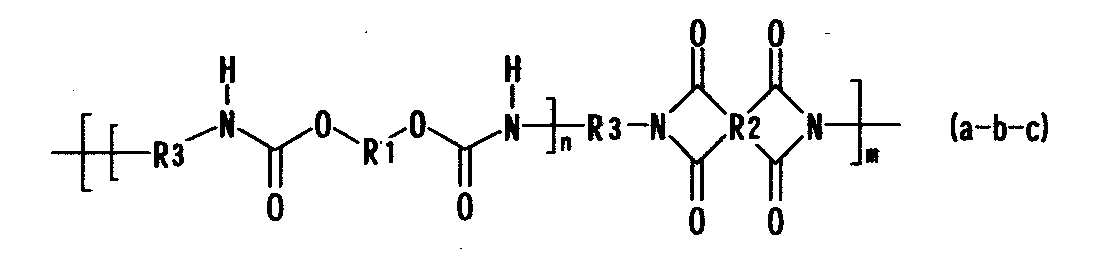
[式中、R1~R3は前記[1]に記載した通りであり、nおよびmは整数を示す。]
で表される構造を有する前記[1]に記載の熱硬化性樹脂組成物。
で表される構造を有する前記[1]に記載の熱硬化性樹脂組成物。
[3] ポリカーボネートジオールの数平均分子量が、500~5,000である前記[1]または[2]に記載の熱硬化性樹脂組成物。
[4] ポリカーボネートジオールの数平均分子量が、1,000~3,000である前記[1]または[2]に記載の熱硬化性樹脂組成物。
[4] ポリカーボネートジオールの数平均分子量が、1,000~3,000である前記[1]または[2]に記載の熱硬化性樹脂組成物。
[5] R1が、式(1-c):

[式中、k+1個のR4は、それぞれ独立に、置換基を有していてもよい炭素数1~20のアルキレン基を示し、kは、5~30の整数を示す。]
で表される2価の基である前記[1]~[4]のいずれか一つに記載の熱硬化性樹脂組成物。
で表される2価の基である前記[1]~[4]のいずれか一つに記載の熱硬化性樹脂組成物。
[6] k+1個のR4が、それぞれ独立に、炭素数1~20のアルキレン基である前記[5]に記載の熱硬化性樹脂組成物。
[7] k+1個のR4が、それぞれ独立に、炭素数2~18のアルキレン基である前記[5]に記載の熱硬化性樹脂組成物。
[8] k+1個のR4が、それぞれ独立に、炭素数3~16のアルキレン基である前記[5]に記載の熱硬化性樹脂組成物。
[7] k+1個のR4が、それぞれ独立に、炭素数2~18のアルキレン基である前記[5]に記載の熱硬化性樹脂組成物。
[8] k+1個のR4が、それぞれ独立に、炭素数3~16のアルキレン基である前記[5]に記載の熱硬化性樹脂組成物。
[9] kが、5~25の整数である前記[5]~[8]のいずれか一つに記載の熱硬化性樹脂組成物。
[10] kが、5~20の整数である前記[5]~[8]のいずれか一つに記載の熱硬化性樹脂組成物。
[10] kが、5~20の整数である前記[5]~[8]のいずれか一つに記載の熱硬化性樹脂組成物。
[11] R2が、下記式:

[式中、Aは、酸素原子、硫黄原子、CO、SO、SO2、CH2、CH(CH3)、C(CH3)2、C(CF3)2、またはC(CCl3)2を示す。式中、炭素原子に結合する水素原子は、ハロゲン原子および炭素数1~8のアルキル基から選択される置換基で置換されていてもよい。]
のいずれかで表される4価の基の群から選択される1種以上である前記[1]~[10]のいずれか一つに記載の熱硬化性樹脂組成物。
のいずれかで表される4価の基の群から選択される1種以上である前記[1]~[10]のいずれか一つに記載の熱硬化性樹脂組成物。
[12] R2が、下記式:

[式中、Aは、酸素原子、硫黄原子、CO、SO、SO2、CH2、CH(CH3)、C(CH3)2、C(CF3)2、またはC(CCl3)2を表す。式中、炭素原子に結合する水素原子は、ハロゲン原子および炭素数1~8のアルキル基から選択される置換基で置換されていてもよい。]
で表される4価の基である前記[1]~[10]のいずれか一つに記載の熱硬化性樹脂組成物。
で表される4価の基である前記[1]~[10]のいずれか一つに記載の熱硬化性樹脂組成物。
[13] 前記式中、Aは、酸素原子、硫黄原子、CO、SO、SO2、CH2、CH(CH3)、C(CH3)2、C(CF3)2、またはC(CCl3)2であり、炭素原子に結合する水素原子は置換されていない前記[11]または[12]に記載の熱硬化性樹脂組成物。
[14] 前記式中、Aは、COであり、炭素原子に結合する水素原子は置換されていない前記[11]または[12]に記載の熱硬化性樹脂組成物。
[14] 前記式中、Aは、COであり、炭素原子に結合する水素原子は置換されていない前記[11]または[12]に記載の熱硬化性樹脂組成物。
[15] R3が、下記式:

[式中、炭素原子に結合する水素原子は、ハロゲン原子および炭素数1~8のアルキル基から選択される置換基で置換されていてもよい。]
のいずれかで表される2価の基の群から選択される1種以上である前記[1]~[14]のいずれか一つに記載の熱硬化性樹脂組成物。
のいずれかで表される2価の基の群から選択される1種以上である前記[1]~[14]のいずれか一つに記載の熱硬化性樹脂組成物。
[16] ハロゲン原子および炭素数1~8のアルキル基から選択される置換基が、炭素数1~8のアルキル基である前記[15]に記載の熱硬化性樹脂組成物。
[17] R3が、

[式中、炭素原子に結合する水素原子は、炭素数1~8のアルキル基で置換されていてもよい。]
のいずれかで表される2価の基の群から選択される1種以上である前記[1]~[14]のいずれか一つに記載の熱硬化性樹脂組成物。
のいずれかで表される2価の基の群から選択される1種以上である前記[1]~[14]のいずれか一つに記載の熱硬化性樹脂組成物。
[18] 炭素数1~8のアルキル基が、炭素数1~6のアルキル基である前記[15]~[17]のいずれか一つに記載の熱硬化性樹脂組成物。
[19] 炭素数1~8のアルキル基が、メチル基である前記[15]~[17]のいずれか一つに記載の熱硬化性樹脂組成物。
[19] 炭素数1~8のアルキル基が、メチル基である前記[15]~[17]のいずれか一つに記載の熱硬化性樹脂組成物。
[20] R3が、4-メチル-1,3-フェニレン基である前記[1]~[14]のいずれか一つに記載の熱硬化性樹脂組成物。
[21] 成分(A)であるポリイミド樹脂の数平均分子量が、5,000~25,000である前記[1]~[20]のいずれか一つに記載の熱硬化性樹脂組成物。
[22] 成分(A)であるポリイミド樹脂の数平均分子量が、5,000~20,000である前記[1]~[20]のいずれか一つに記載の熱硬化性樹脂組成物。
[22] 成分(A)であるポリイミド樹脂の数平均分子量が、5,000~20,000である前記[1]~[20]のいずれか一つに記載の熱硬化性樹脂組成物。
[23] 成分(A)であるポリイミド樹脂のガラス転移温度が、30℃以下である前記[1]~[22]のいずれか一つに記載の熱硬化性樹脂組成物。
[24] 成分(A)であるポリイミド樹脂のガラス転移温度が、-15℃~29℃である前記[1]~[22]のいずれか一つに記載の熱硬化性樹脂組成物。
[25] 成分(A)であるポリイミド樹脂のガラス転移温度が、-10℃~20℃である前記[1]~[22]のいずれか一つに記載の熱硬化性樹脂組成物。
[24] 成分(A)であるポリイミド樹脂のガラス転移温度が、-15℃~29℃である前記[1]~[22]のいずれか一つに記載の熱硬化性樹脂組成物。
[25] 成分(A)であるポリイミド樹脂のガラス転移温度が、-10℃~20℃である前記[1]~[22]のいずれか一つに記載の熱硬化性樹脂組成物。
[26] 成分(B)である熱硬化性樹脂が、エポキシ樹脂である前記[1]~[25]のいずれか一つに記載の熱硬化性樹脂組成物。
[27] エポキシ樹脂のエポキシ当量が、90~500である前記[26]に記載の熱硬化性樹脂組成物。
[28] エポキシ樹脂のエポキシ当量が、90~300である前記[26]に記載の熱硬化性樹脂組成物。
[29] エポキシ樹脂のエポキシ当量が、110~250である前記[26]に記載の熱硬化性樹脂組成物。
[28] エポキシ樹脂のエポキシ当量が、90~300である前記[26]に記載の熱硬化性樹脂組成物。
[29] エポキシ樹脂のエポキシ当量が、110~250である前記[26]に記載の熱硬化性樹脂組成物。
[30] エポキシ樹脂が、液状エポキシ樹脂である前記[26]~[29]のいずれか一つに記載の熱硬化性樹脂組成物。
[31] 成分(B)である熱硬化性樹脂の含有量が、成分(A)であるポリイミド樹脂100重量部に対して、15~80重量部である前記[1]~[30]のいずれか一つに記載の熱硬化性樹脂組成物。
[32] 成分(B)である熱硬化性樹脂の含有量が、成分(A)であるポリイミド樹脂100重量部に対して、30~80重量部である前記[1]~[30]のいずれか一つに記載の熱硬化性樹脂組成物。
[33] 成分(B)である熱硬化性樹脂の含有量が、成分(A)であるポリイミド樹脂100重量部に対して、40~70重量部である前記[1]~[30]のいずれか一つに記載の熱硬化性樹脂組成物。
[32] 成分(B)である熱硬化性樹脂の含有量が、成分(A)であるポリイミド樹脂100重量部に対して、30~80重量部である前記[1]~[30]のいずれか一つに記載の熱硬化性樹脂組成物。
[33] 成分(B)である熱硬化性樹脂の含有量が、成分(A)であるポリイミド樹脂100重量部に対して、40~70重量部である前記[1]~[30]のいずれか一つに記載の熱硬化性樹脂組成物。
[34] さらに無機充填材を含有する前記[1]~[33]のいずれか一つに記載の熱硬化性樹脂組成物。
[35] 無機充填材がシリカである前記[34]に記載の熱硬化性樹脂組成物。
[35] 無機充填材がシリカである前記[34]に記載の熱硬化性樹脂組成物。
[36] 無機充填材の含有量が、熱硬化性樹脂組成物の不揮発分中、50~95重量%である前記[34]または[35]に記載の熱硬化性樹脂組成物。
[37] 無機充填材の含有量が、熱硬化性樹脂組成物の不揮発分中、60~93重量%である前記[34]または[35]に記載の熱硬化性樹脂組成物。
[38] 無機充填材の含有量が、熱硬化性樹脂組成物の不揮発分中、70~90重量%である前記[34]または[35]に記載の熱硬化性樹脂組成物。
[39] 無機充填材の含有量が、熱硬化性樹脂組成物の不揮発分中、80~85重量%である前記[34]または[35]に記載の熱硬化性樹脂組成物。
[37] 無機充填材の含有量が、熱硬化性樹脂組成物の不揮発分中、60~93重量%である前記[34]または[35]に記載の熱硬化性樹脂組成物。
[38] 無機充填材の含有量が、熱硬化性樹脂組成物の不揮発分中、70~90重量%である前記[34]または[35]に記載の熱硬化性樹脂組成物。
[39] 無機充填材の含有量が、熱硬化性樹脂組成物の不揮発分中、80~85重量%である前記[34]または[35]に記載の熱硬化性樹脂組成物。
[40] さらに硬化促進剤を含有する前記[1]~[39]のいずれか一つに記載の熱硬化性樹脂組成物。
[41] 硬化促進剤の含有量が、成分(B)である熱硬化性樹脂100重量部に対して、好ましくは0.5~5重量部である前記[40]に記載の熱硬化性樹脂組成物。
[42] 硬化促進剤の含有量が、成分(B)である熱硬化性樹脂100重量部に対して、好ましくは1~3重量部である前記[40]に記載の熱硬化性樹脂組成物。
[42] 硬化促進剤の含有量が、成分(B)である熱硬化性樹脂100重量部に対して、好ましくは1~3重量部である前記[40]に記載の熱硬化性樹脂組成物。
[43] 前記[1]~[42]のいずれか一つに記載の熱硬化性樹脂組成物から形成された層を支持体上に有する接着フィルム。
[44] 前記[1]~[42]のいずれか一つに記載の熱硬化性樹脂組成物から形成された硬化物を絶縁層として有するプリント配線板。
[45] 前記[1]~[42]のいずれか一つに記載の熱硬化性樹脂組成物から形成された硬化物を絶縁層として有するウエハレベルチップサイズパッケージ。
[44] 前記[1]~[42]のいずれか一つに記載の熱硬化性樹脂組成物から形成された硬化物を絶縁層として有するプリント配線板。
[45] 前記[1]~[42]のいずれか一つに記載の熱硬化性樹脂組成物から形成された硬化物を絶縁層として有するウエハレベルチップサイズパッケージ。
本発明の熱硬化性樹脂組成物から、親水性の高い絶縁層を形成することができる。このような親水性の高い絶縁層は、例えば、親水性の高いインクを均一に塗布することができ、ウエハレベルチップサイズパッケージ等の回路基板に有用である。
本発明の熱硬化性樹脂組成物は、ポリカーボネートジオールに由来する構造、ジイソシアネート化合物に由来する構造、および多塩基酸またはその無水物に由来する構造を有するポリイミド樹脂(成分(A))と、エポキシ樹脂、ビスマレイミド樹脂、シアネートエステル樹脂、ビスアリルナジイミド樹脂、ビニルベンジルエーテル樹脂、ベンゾオキサジン樹脂、およびビスマレイミドとジアミンとの重合物から選ばれる1種以上の熱硬化性樹脂(成分(B))との両方を含有することを特徴とする。以下、これらについて順に説明する。
<(A)ポリイミド樹脂>
成分(A)は、式(1-a)で表される構造(ウレタンおよびカーボネート構造、以下「構造(1-a)」と略称することがある。)および式(1-b)で表される構造(イミド構造、以下「構造(1-b)」と略称することがある。)を有するポリイミド樹脂である。
成分(A)は、式(1-a)で表される構造(ウレタンおよびカーボネート構造、以下「構造(1-a)」と略称することがある。)および式(1-b)で表される構造(イミド構造、以下「構造(1-b)」と略称することがある。)を有するポリイミド樹脂である。

[式中、R1はポリカーボネートジオールのヒドロキシ基を除いた残基を示し、R2は多塩基酸またはその無水物のカルボキシ基または酸無水物基を除いた残基を示し、R3はジイソシアネート化合物のイソシアネート基を除いた残基を示す。]
なお、上記化学式の末端は、メチル基ではなく、結合位置を示す。他の化学式も同様である。
なお、上記化学式の末端は、メチル基ではなく、結合位置を示す。他の化学式も同様である。
成分(A)であるポリイミド樹脂は、
(a)ポリカーボネートジオール(以下「原料(a)」と記載することがある。)、
(b)ジイソシアネート化合物(以下「原料(b)」と記載することがある。)、および
(c)多塩基酸またはその無水物(以下「原料(c)」と記載することがある。)
を原料として用いて製造することができる。成分(A)は、1種のみを使用してもよく、2種以上を併用してもよい。また、原料(a)~(c)のいずれも、1種のみを使用してもよく、2種以上を併用してもよい。
(a)ポリカーボネートジオール(以下「原料(a)」と記載することがある。)、
(b)ジイソシアネート化合物(以下「原料(b)」と記載することがある。)、および
(c)多塩基酸またはその無水物(以下「原料(c)」と記載することがある。)
を原料として用いて製造することができる。成分(A)は、1種のみを使用してもよく、2種以上を併用してもよい。また、原料(a)~(c)のいずれも、1種のみを使用してもよく、2種以上を併用してもよい。
原料(a)であるポリカーボネートジオールの数平均分子量は、樹脂組成物の硬化物の柔軟性の観点、および成分(A)の溶剤溶解性の観点から、好ましくは500~5,000、より好ましくは1,000~3,000である。
なお本発明において、数平均分子量は、ゲルパーミエーションクロマトグラフィー(GPC)法(ポリスチレン換算)で測定した値である。GPC法による数平均分子量は、具体的には、測定装置として(株)島津製作所製LC-9A/RID-6Aを、カラムとして昭和電工(株)製Shodex K-800P/K-804L/K-804Lを、移動相としてクロロホルムを用いて、カラム温度40℃にて測定し、標準ポリスチレンの検量線を用いて算出することができる。
ポリカーボネートジオールの水酸基当量は、樹脂組成物の硬化物の柔軟性の観点、および耐薬品性の観点から好ましくは250~1,250、より好ましくは500~1,000である。
ポリカーボネートジオールとしては、市販品を使用することができる。そのような市販品としては、例えば、クラレ(株)製のC-1015N、C-2015N、旭化成ケミカルズ(株)製のT-6002、T-4672、T-5652、(株)ダイセル製の CD205、CD205PL、CD205HL、CD210、CD210PL、日本ポリウレタン工業(株)製のニッポラン981、980R等が挙げられる。
原料(b)であるジイソシアネート化合物としては、例えば、トルエン-2,4-ジイソシアネート、トルエン-2,6-ジイソシアネート、キシリレンジイソシアネート、ジフェニルメタンジイソシアネート等の芳香族ジイソシアネート;ヘキサメチレンジイソシアネート等の脂肪族ジイソシアネート;イソホロンジイソシアネート等の脂環式ジイソシアネートが挙げられる。これらの中で芳香族ジイソシアネートが好ましく、トルエン-2,4-ジイソシアネートがより好ましい。
原料(c)である多塩基酸またはその無水物としては、例えば、ピロメリット酸、ベンゾフェノンテトラカルボン酸、ビフェニルテトラカルボン酸、ナフタレンテトラカルボン酸、5-(2,5-ジオキソテトラヒドロフリル)-3-メチル-シクロヘキセン-1,2-ジカルボン酸、3,3’-4,4’-ジフェニルスルホンテトラカルボン酸等の四塩基酸およびこれらの無水物、トリメリット酸、シクロヘキサントリカルボン酸等の三塩基酸およびこれらの無水物、1,3,3a,4,5,9b-ヘキサヒドロ-5-(テトラヒドロ-2,5-ジオキソ-3-フラニル)-ナフト(1,2-C)フラン-1,3-ジオン等が挙げられる。これらの中で、四塩基酸無水物が好ましく、四塩基酸二無水物がより好ましく、ベンゾフェノンテトラカルボン酸二無水物がさらに好ましい。
R1は、好ましくは、式(1-c):
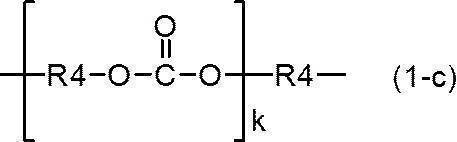
[式中、k+1個のR4は、それぞれ独立に、置換基を有していてもよい炭素数1~20のアルキレン基を示し、kは、5~30の整数を示す。]
で表される2価の基である。
で表される2価の基である。
R4のアルキレン基は、直鎖状でもよく、分枝鎖状でもよい。R4のアルキレン基が有していてもよい置換基としては、例えば、ハロゲン原子、炭素数4~8のシクロアルキル基、炭素数6~14のアリール基が挙げられる。R4のアルキレン基は、無置換であることが好ましい。
ハロゲン原子としては、例えば、フッ素原子、塩素原子、臭素原子、ヨウ素原子が挙げられる。
炭素数4~8のシクロアルキル基としては、例えば、シクロペンチル基、シクロへキシル基、シクロヘプチル基が挙げられる。
炭素数6~14のアリール基としては、例えば、フェニル基、1-ナフチル基、2-ナフチル基、1-アントリル基、2-アントリル基、9-アントリル基が挙げられる。
炭素数4~8のシクロアルキル基としては、例えば、シクロペンチル基、シクロへキシル基、シクロヘプチル基が挙げられる。
炭素数6~14のアリール基としては、例えば、フェニル基、1-ナフチル基、2-ナフチル基、1-アントリル基、2-アントリル基、9-アントリル基が挙げられる。
k+1個のR4は、それぞれ独立に、好ましくは炭素数1~20のアルキレン基であり、より好ましくは炭素数2~18のアルキレン基であり、さらに好ましくは炭素数3~16のアルキレン基である。kは、好ましくは5~25の整数であり、より好ましくは5~20の整数である。
R2は、好ましくは下記式:

[式中、Aは、酸素原子、硫黄原子、CO、SO、SO2、CH2、CH(CH3)、C(CH3)2、C(CF3)2、またはC(CCl3)2を示す。式中、炭素原子に結合する水素原子は、ハロゲン原子および炭素数1~8のアルキル基から選択される置換基で置換されていてもよい。]
のいずれかで表される4価の基の群から選択される1種以上である。
のいずれかで表される4価の基の群から選択される1種以上である。
上記式で表されるR2(4価の基)の中では、芳香環を有する4価の基が好ましく、2個以上の芳香環を有する4価の基がより好ましく、下記式:
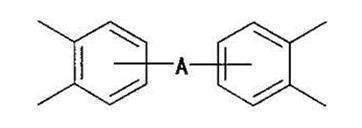
[式中、Aは、酸素原子、硫黄原子、CO、SO、SO2、CH2、CH(CH3)、C(CH3)2、C(CF3)2、またはC(CCl3)2を表す。式中、炭素原子に結合する水素原子は、ハロゲン原子および炭素数1~8のアルキル基から選択される置換基で置換されていてもよい。]
で表される4価の基が最も好ましい。
で表される4価の基が最も好ましい。
Aは、好ましくはCOである。
上記式中の炭素原子に結合する水素原子(即ち、R2である4価の基中の炭素原子に結合する水素原子)は、ハロゲン原子および炭素数1~8のアルキル基から選択される置換基で置換されていてもよい。該水素原子は、置換されていないことが好ましい。
ハロゲン原子としては、上述のものが挙げられる。
アルキル基は、直鎖状でも、分枝鎖でもよい。炭素数1~8のアルキル基としては、例えば、メチル基、エチル基、プロピル基、イソプロピル基、ブチル基、イソブチル基、sec-ブチル基、tert-ブチル基、ペンチル基、イソペンチル基、ネオペンチル基、1-エチルプロピル基、ヘキシル基、イソヘキシル基、1,1-ジメチルブチル基、2,2-ジメチルブチル基、3,3-ジメチルブチル基、2-エチルブチル基、ヘプチル基、オクチル基が挙げられる。
アルキル基は、直鎖状でも、分枝鎖でもよい。炭素数1~8のアルキル基としては、例えば、メチル基、エチル基、プロピル基、イソプロピル基、ブチル基、イソブチル基、sec-ブチル基、tert-ブチル基、ペンチル基、イソペンチル基、ネオペンチル基、1-エチルプロピル基、ヘキシル基、イソヘキシル基、1,1-ジメチルブチル基、2,2-ジメチルブチル基、3,3-ジメチルブチル基、2-エチルブチル基、ヘプチル基、オクチル基が挙げられる。
R3は、好ましくは下記式:
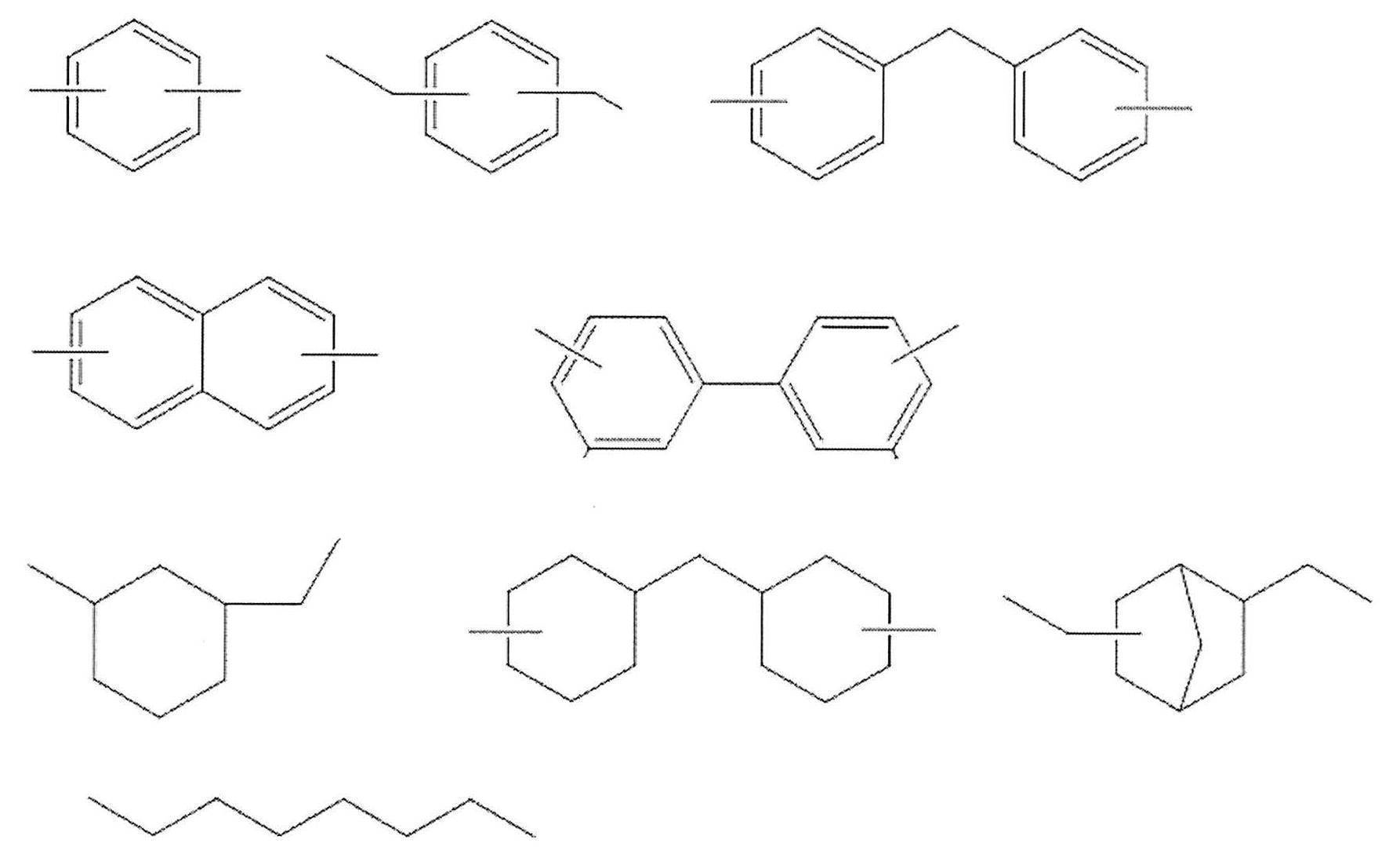
[式中、炭素原子に結合する水素原子は、ハロゲン原子および炭素数1~8のアルキル基から選択される置換基で置換されていてもよい。]
のいずれかで表される2価の基の群から選択される1種以上である。なお、上記式の末端は、メチル基ではなく、結合位置を示す。例えば、上記式の最後は、オクタンではなく、ヘキサメチレン基を表す。
のいずれかで表される2価の基の群から選択される1種以上である。なお、上記式の末端は、メチル基ではなく、結合位置を示す。例えば、上記式の最後は、オクタンではなく、ヘキサメチレン基を表す。
上記式中の炭素原子に結合する水素原子(即ち、R3である2価の基中の炭素原子に結合する水素原子)は、ハロゲン原子および炭素数1~8のアルキル基から選択される置換基(好ましくは炭素数1~8のアルキル基、より好ましくは炭素数1~6のアルキル基、最も好ましくはメチル基)で置換されていてもよい。
ハロゲン原子および炭素数1~8のアルキル基としては、上述のものが挙げられる。炭素数1~6のアルキル基としては、例えば、メチル基、エチル基、プロピル基、イソプロピル基、ブチル基、イソブチル基、sec-ブチル基、tert-ブチル基、ペンチル基、イソペンチル基、ネオペンチル基、1-エチルプロピル基、ヘキシル基、イソヘキシル基、1,1-ジメチルブチル基、2,2-ジメチルブチル基、3,3-ジメチルブチル基、2-エチルブチル基が挙げられる。
上記式で表されるR3(2価の基)の中では、芳香環または脂環式環を有する2価の基が好ましく、脂環式環を有する2価の有機基がより好ましい。芳香環を有する2価の基の場合には、下記式:

[式中、炭素原子に結合する水素原子は、炭素数1~8のアルキル基(好ましくは炭素数1~6のアルキル基、より好ましくはメチル基)で置換されていてもよい。]
のいずれかで表される2価の基が好ましく、4-メチル-1,3-フェニレン基(即ち、トルエン-2,4-ジイソシアネートのイソシアネート基を除いた残基)が特に好ましい。
のいずれかで表される2価の基が好ましく、4-メチル-1,3-フェニレン基(即ち、トルエン-2,4-ジイソシアネートのイソシアネート基を除いた残基)が特に好ましい。
成分(A)であるポリイミド樹脂の数平均分子量は、樹脂組成物の粘度および成分(A)の樹脂組成物への混合性の観点から、好ましくは5,000以上、より好ましくは7,000以上、さらに好ましくは9,000以上であり、好ましくは25,000以下、より好ましくは20,000以下、さらに好ましくは15,000以下である。
樹脂組成物の硬化物に充分な柔軟性を付与するという観点から、成分(A)であるポリイミド樹脂のガラス転移温度は、好ましくは30℃以下、より好ましくは-15℃~29℃、さらに好ましくは-10℃~20℃である。ここで、ポリイミド樹脂のガラス転移温度は、動的粘弾性測定によって得られるtanδのピーク温度、または熱機械分析装置で引張荷重法による熱機械分析から読み取ることができる。
成分(A)であるポリイミド樹脂は、例えば、以下のようにして製造することができる。まず、原料(a)であるポリカーボネートジオールと原料(b)であるジイソシアネート化合物とを、ポリカーボネートジオールのヒドロキシ基1モルに対するジイソシアネート化合物のイソシアネート基の量が1モルを超える比率で反応させ、式(a-b):

[式中、R1およびR3は上記と同義であり、nは整数を示す。]
で表されるジイソシアネート反応物(以下「ジイソシアネート反応物(a-b)」と略称することがある。)を製造する。nは、例えば1~100の整数、好ましくは1~10の整数である。
で表されるジイソシアネート反応物(以下「ジイソシアネート反応物(a-b)」と略称することがある。)を製造する。nは、例えば1~100の整数、好ましくは1~10の整数である。
原料(a)であるポリカーボネートジオールのヒドロキシ基:原料(b)であるジイソシアネート化合物のイソシアネート基のモル比が1:1.5~1:2.5となる量で、これらを反応させるのが好ましい。
原料(a)であるポリカーボネートジオールと、原料(b)であるジイソシアネート化合物との反応は、通常、有機溶媒中、80℃以下の温度で1~8時間行われる。この反応では、必要により、触媒を用いてもよい。
上記有機溶媒としては、例えば、N,N’-ジメチルホルムアミド、N,N’-ジエチルホルムアミド、N,N’-ジメチルアセトアミド、N,N’-ジエチルアセトアミド、ジメチルスルホキシド、ジエチルスルホキシド、N-メチル-2-ピロリドン、テトラメチルウレア、γ-ブチロラクトン、シクロヘキサノン、ジグライム、トリグライム、ジエチレングリコールモノエチルエーテルアセテート、プロピレングリコールモノメチルエーテルアセテート、プロピレングリコールモノエチルエーテルアセテート等の極性溶媒を挙げることができる。これらの極性溶媒は、1種のみを使用してもよく、2種以上を併用してもよい。また、必要により芳香族炭化水素等の非極性溶媒を適宜混合して用いてもよい。
上記触媒としては、例えば、ジブチル錫ジラウレート、ジメチル錫ジクロライド、ナフテン酸コバルト、ナフテン酸亜鉛等の有機金属触媒が挙げられる。
次に、得られたジイソシアネート反応物(a-b)に、原料(c)である多塩基酸またはその無水物を反応させる。多塩基酸またはその無水物の反応割合は特に限定されないが、成分(A)であるポリイミド樹脂中にイソシアネート基を極力残さないようにするため、原料(b)に含まれるイソシアネート基のモル量をX、原料(a)に含まれるヒドロキシ基のモル量をW、原料(c)に含まれるカルボキシ基のモル量をY1および酸無水物基のモル量をY2とすると、0.5Y1+Y2>X-W≧(0.5Y1+Y2)/5の関係を満たす量で、反応を行うことが好ましい。
ジイソシアネート反応物(a-b)と原料(c)である多塩基酸またはその無水物との反応は、通常、120~180℃の温度で、2~24時間行われる。この反応では、必要により触媒を用いてもよい。また、上述した有機溶媒をさらに添加してから、反応を行ってもよい。
上記触媒としては、例えば、テトラメチルブタンジアミン、ベンジルジメチルアミン、トリエタノールアミン、トリエチルアミン、N,N’-ジメチルピペリジン、α-メチルベンジルジメチルアミン、N-メチルモルホリン、トリエチレンジアミン等のアミン類が挙げられる。これらの中で、トリエチレンジアミンが好ましい。
以上のようにして、成分(A)であるポリイミド樹脂を製造することができる。成分(A)としては、式(a-b-c):
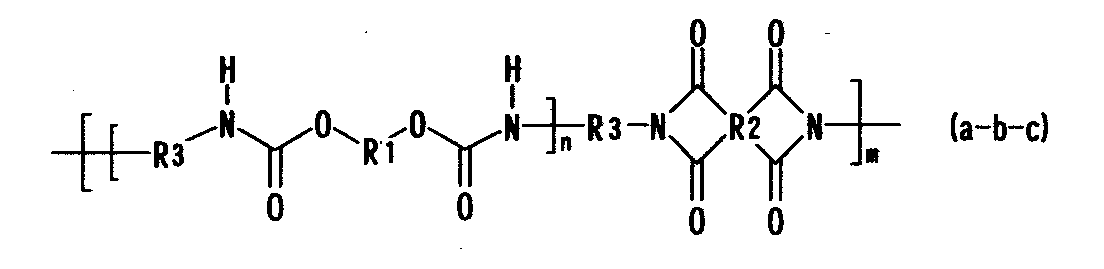
[式中、R1~R3は上記と同義であり、nおよびmは整数を示す。]
で表される構造を有するポリイミド樹脂がより好ましい。nは、例えば1~100の整数、好ましくは1~10の整数であり、mは、例えば1~100の整数、好ましくは1~10の整数である。
で表される構造を有するポリイミド樹脂がより好ましい。nは、例えば1~100の整数、好ましくは1~10の整数であり、mは、例えば1~100の整数、好ましくは1~10の整数である。
成分(A)であるポリイミド樹脂中にイソシアネート基(-NCO)を極力残さないようにするために、上記反応では、FT-IR等でイソシアネート基の消失を確認するのが好ましい。このようにして得られるポリイミド樹脂の末端は式(1-d)または式(1-e):

[各式中、R2は上記と同義である。]
で表すことができる。
で表すことができる。
成分(A)であるポリイミド樹脂の製造において、ジイソシアネート反応物(a-b)と原料(c)である多塩基酸またはその無水物とを反応させた後、得られた反応物にさらにジイソシアネート化合物と反応させることにより、より高分子量のポリイミド樹脂を製造することができる。この場合のイソシアネート化合物の反応割合は特に限定されないが、原料(b)に含まれるイソシアネート基のモル量をX、原料(a)に含まれるヒドロキシ基のモル量をW、原料(c)に含まれるカルボキシ基のモル量をY1および酸無水物基のモル量をY2、さらに反応させるジイソシアネート化合物に含まれるイソシアネート基のモル量をZとすると、(0.5Y1+Y2)-(X-W)>Z≧0の関係を満たす量で、反応を行うことが好ましい。
さらなるジイソイシアネート化合物との上記反応は、通常、120~180℃の温度で2~24時間行われる。
ポリイミド樹脂を含む反応溶液から不溶物を除くために、必要により濾過を行ってもよい。このようにして、成分(A)であるポリイミド樹脂を、ワニス状で得ることができる。ポリイミド樹脂ワニス中の溶媒量は、反応時の溶媒量を調整する、または反応後に溶媒を添加または除去することによって、適宜調整することができる。
ポリイミド樹脂の酸価は3~30mgKOH/gが好ましく、5~20mKOH/gがより好ましい。ポリイミド樹脂の粘度は固形分50wt%で3~15Pa・sが好ましく、5~10Pa・sがより好ましい。
<(B)熱硬化性樹脂>
成分(B)は、エポキシ樹脂、ビスマレイミド樹脂、シアネートエステル樹脂、ビスアリルナジイミド樹脂、ビニルベンジルエーテル樹脂、ベンゾオキサジン樹脂、およびビスマレイミドとジアミンとの重合物から選ばれる1種以上の熱硬化性樹脂である。このうちの1種のみを使用してもよく、2種以上組み合わせて使用することもできる。
成分(B)は、エポキシ樹脂、ビスマレイミド樹脂、シアネートエステル樹脂、ビスアリルナジイミド樹脂、ビニルベンジルエーテル樹脂、ベンゾオキサジン樹脂、およびビスマレイミドとジアミンとの重合物から選ばれる1種以上の熱硬化性樹脂である。このうちの1種のみを使用してもよく、2種以上組み合わせて使用することもできる。
本発明においてエポキシ樹脂とは、1分子中に二つ以上のエポキシ基を有し、エポキシ当量が、80~8000である熱硬化性樹脂を意味する。エポキシ樹脂は、1種のみを使用してもよく、2種以上を併用してもよい。なお、エポキシ樹脂と同様にエポキシ基を有し得るフェノキシ樹脂は、本発明において、エポキシ当量が8000を超える熱可塑性樹脂を意味し、エポキシ樹脂と区別される。エポキシ樹脂のエポキシ当量は、好ましくは90~500、より好ましくは90~300、さらに好ましくは110~250である。
エポキシ樹脂としては、例えば、ビスフェノールA型エポキシ樹脂、ビスフェノールF型エポキシ樹脂、ビスフェノールS型エポキシ樹脂、ビスフェノールAF型エポキシ樹脂、フェノールノボラック型エポキシ樹脂、tert-ブチル-カテコール型エポキシ樹脂、ナフタレン型エポキシ樹脂、ナフチレンエーテル型エポキシ樹脂、グリシジルアミン型エポキシ樹脂、グリシジルエステル型エポキシ樹脂、クレゾールノボラック型エポキシ樹脂、ビフェニル型エポキシ樹脂、アントラセン型エポキシ樹脂、線状脂肪族エポキシ樹脂、ブタジエン構造を有するエポキシ樹脂、脂環式エポキシ樹脂、複素環式エポキシ樹脂、スピロ環含有エポキシ樹脂、シクロヘキサンジメタノール型エポキシ樹脂、トリメチロール型エポキシ樹脂、ハロゲン化エポキシ樹脂等が挙げられる。これらの中で、芳香環を有するエポキシ樹脂が好ましく、ビスフェノールA型エポキシ樹脂、ビスフェノールF型エポキシ樹脂およびナフタレン型エポキシ樹脂からなる群から選ばれる少なくとも一つがより好ましく、ビスフェノールA型エポキシ樹脂およびナフタレン型エポキシ樹脂からなる群から選ばれる少なくとも一つがさらに好ましい。
エポキシ樹脂を使用する場合、エポキシ硬化剤を使用してもよい。エポキシ硬化剤としては、例えば、アミン系硬化剤、グアニジン系硬化剤、イミダゾール系硬化剤、フェノール系硬化剤、酸無水物系硬化剤、またはこれらのエポキシアダクトやマイクロカプセル化したもの等を挙げることができる。特に熱硬化性樹脂組成物をワニスにしたときの粘度安定性等の観点から、アミン系硬化剤およびイミダゾール系硬化剤が好ましい。エポキシ硬化剤は、1種のみを使用してもよく、2種以上を併用してもよい。
ビスマレイミド樹脂としては、例えば、4,4’-フェニルメタンビスマレイミドである「BMI-S」(三井化学(株)製)、ポリフェニルメタンマレイミドである「BMI-M-20」(三井化学(株)製)等が挙げられる。ビスマレイミド樹脂は、1種のみを使用してもよく、2種以上を併用してもよい。
シアネートエステル樹脂としては、特に制限はないが、ノボラック型(フェノールノボラック型、アルキルフェノールノボラック型など)シアネートエステル樹脂、ジシクロペンタジエン型シアネートエステル樹脂、ビスフェノール型(ビスフェノールA型、ビスフェノールF型、ビスフェノールS型など)シアネートエステル樹脂、およびこれらが一部トリアジン化したプレポリマーなどが挙げられる。シアネートエステル樹脂の具体例としては、ビスフェノールAジシアネート、ポリフェノールシアネート(オリゴ(3-メチレン-1,5-フェニレンシアネート)、4,4’-メチレンビス(2,6-ジメチルフェニルシアネート)、4,4’-エチリデンジフェニルジシアネート、ヘキサフルオロビスフェノールAジシアネート、2,2-ビス(4-シアネート)フェニルプロパン、1,1-ビス(4-シアネートフェニルメタン)、ビス(4-シアネート-3,5-ジメチルフェニル)メタン、1,3-ビス(4-シアネートフェニル-1-(メチルエチリデン))ベンゼン、ビス(4-シアネートフェニル)チオエーテル、ビス(4-シアネートフェニル)エーテル等の2官能シアネート樹脂、フェノールノボラック、クレゾールノボラック、ジシクロペンタジエン構造含有フェノール樹脂等から誘導される多官能シアネート樹脂、これらシアネート樹脂が一部トリアジン化したプレポリマー等が挙げられる。これらは1種または2種以上を組み合わせて使用してもよい。市販されているシアネートエステル樹脂としては、例えば、ジシクロペンタジエン構造含有シアネートエステル樹脂(ロンザジャパン(株)製、DT-4000、DT-7000)、ビスフェノール型シアネートエステル樹脂である「プリマセット(Primaset) BA200」(ロンザ(株)製)、「プリマセット(Primaset) BA230S」(ロンザ(株)製)、ビスフェノールH型シアネートエステル樹脂である「プリマセット(Primaset) LECY」(ロンザ(株)製)、「アロシー(Arocy)L10」(バンティコ(株)製)、ノボラック型シアネートエステル樹脂である「プリマセット(Primaset) PT30」(ロンザ(株)製)、「アロシー(Arocy)XU371」(バンティコ(株)製)、ジシクロペンタジエン型シアネートエステル樹脂である「アロシー(Arocy)XP71787.02L」(バンティコ(株)製)等が挙げられる。シアネートエステル樹脂は、1種のみを使用してもよく、2種以上を併用してもよい。
ビスアリルナジイミド樹脂としては、例えば、ジフェニルメタン-4,4’-ビスアリルナジックイミドである「BANI-M」(丸善石油化学(株)製)等が挙げられる。ビスアリルナジイミド樹脂は、1種のみを使用してもよく、2種以上を併用してもよい。
ビニルベンジルエーテル樹脂としては、例えば、V-1000X(昭和高分子(株)製)、米国特許第4116936号明細書、米国特許第4170711号明細書、米国特許4278708号明細書、特開平9-31006号公報、特開2001-181383号公報、特開2001-253992号公報、特開2003-277440号公報、特開2003-283076号公報、国際公開第02/083610号パンフレット記載のもの等が挙げられる。ビニルベンジルエーテル樹脂は、1種のみを使用してもよく、2種以上を併用してもよい。
ベンゾオキサジン樹脂としては、例えば、四国化成(株)製「B-a型ベンゾオキサジン」、「B-m型ベンゾオキサジン」等が挙げられる。ベンゾオキサジン樹脂は、1種のみを使用してもよく、2種以上を併用してもよい。
熱硬化性樹脂であるビスマレイミド化合物とジアミン化合物との重合物としては、例えば、(株)プリンテック製の「テクマイトE2020」等が挙げられる。ビスマレイミド化合物とジアミン化合物との重合物は、1種のみを使用してもよく、2種以上を併用してもよい。
成分(B)である熱硬化性樹脂としては、エポキシ樹脂が好ましく、液状エポキシ樹脂がより好ましい。ここで液状エポキシ樹脂とは、25℃で液状であるエポキシ樹脂を意味する。液状エポキシ樹脂としては、芳香環を有する液状エポキシ樹脂が好ましく、液状ビスフェノールA型エポキシ樹脂、液状ビスフェノールF型エポキシ樹脂および液状ナフタレン型エポキシ樹脂からなる群から選ばれる少なくとも一つがより好ましく、液状ビスフェノールA型エポキシ樹脂および液状ナフタレン型エポキシ樹脂からなる群から選ばれる少なくとも一つがさらに好ましい。
成分(B)である熱硬化性樹脂の含有量は、樹脂組成物の硬化度、硬化物の柔軟性の観点から、成分(A)であるポリイミド樹脂100重量部に対して、好ましくは15~80重量部、より好ましくは30~80重量部、さらに好ましくは40~70重量部である。
成分(A)および成分(B)の合計量は、硬化物の耐薬品性、および熱硬化性樹脂組成物中の他の成分との関係を考慮して、熱硬化性樹脂組成物の不揮発分中、好ましくは5~50重量%、より好ましくは10~30重量%である。ここで、熱硬化性樹脂組成物の不揮発分とは、熱硬化性樹脂組成物から揮発性の溶剤を除いた残りの成分の合計を意味する。
<無機充填材>
本発明の熱硬化性樹脂組成物は、さらに、1種またはそれ以上の無機充填材を含有していてもよい。無機充填材を使用することにより、熱硬化性樹脂組成物から得られる絶縁層の線熱膨張係数を低下させることができる。無機充填材としては、例えば、シリカ、アルミナ、硫酸バリウム、タルク、クレー、雲母粉、水酸化アルミニウム、水酸化マグネシウム、炭酸カルシウム、炭酸マグネシウム、酸化マグネシウム、窒化ホウ素、ホウ酸アルミニウム、チタン酸バリウム、チタン酸ストロンチウム、チタン酸カルシウム、チタン酸マグネシウム、チタン酸ビスマス、酸化チタン、ジルコン酸バリウム、ジルコン酸カルシウム等が挙げられる。なかでも、無定形シリカ、粉砕シリカ、溶融シリカ、結晶シリカ、合成シリカ、中空シリカ、球形シリカ等のシリカが好ましく、充填性を高める点から溶融シリカ、球形シリカがより好ましく、球形溶融シリカがさらに好ましい。市販されている球形溶融シリカとして、(株)アドマテックス製「SO-C2」、「SO-C1」等が挙げられる。
本発明の熱硬化性樹脂組成物は、さらに、1種またはそれ以上の無機充填材を含有していてもよい。無機充填材を使用することにより、熱硬化性樹脂組成物から得られる絶縁層の線熱膨張係数を低下させることができる。無機充填材としては、例えば、シリカ、アルミナ、硫酸バリウム、タルク、クレー、雲母粉、水酸化アルミニウム、水酸化マグネシウム、炭酸カルシウム、炭酸マグネシウム、酸化マグネシウム、窒化ホウ素、ホウ酸アルミニウム、チタン酸バリウム、チタン酸ストロンチウム、チタン酸カルシウム、チタン酸マグネシウム、チタン酸ビスマス、酸化チタン、ジルコン酸バリウム、ジルコン酸カルシウム等が挙げられる。なかでも、無定形シリカ、粉砕シリカ、溶融シリカ、結晶シリカ、合成シリカ、中空シリカ、球形シリカ等のシリカが好ましく、充填性を高める点から溶融シリカ、球形シリカがより好ましく、球形溶融シリカがさらに好ましい。市販されている球形溶融シリカとして、(株)アドマテックス製「SO-C2」、「SO-C1」等が挙げられる。
無機充填材の平均粒径は、特に限定されないが、絶縁層表面の粗化処理後に微細配線形成を可能とするために低粗度にする必要があるという観点、およびレーザー加工によるビア形状が良好になるという観点から、5μm以下が好ましく、3μm以下がより好ましく、2μm以下がさらに好ましく、1μm以下がさらに一層好ましく、0.8μm以下が殊更好ましく、0.6μm以下が特に好ましい。一方、熱硬化性樹脂組成物をワニスとした場合に、ワニスの粘度が上昇し、取り扱い性が低下するのを防止するという観点から、該平均粒径は、0.01μm以上が好ましく、0.03μm以上がより好ましく、0.05μm以上がさらに好ましく、0.07μm以上がさらに一層好ましく、0.1μm以上が殊更好ましい。上記無機充填材の平均粒径はミー(Mie)散乱理論に基づくレーザー回折・散乱法により測定することができる。具体的にはレーザー回折散乱式粒度分布測定装置により、無機充填材の粒度分布を体積基準で作成し、そのメディアン径を平均粒径とすることで測定することができる。測定サンプルは、無機充填材を超音波により水中に分散させたものを好ましく使用することができる。レーザー回折散乱式粒度分布測定装置としては、(株)堀場製作所製 LA-950等を使用することができる。
無機充填材の含有量は、熱硬化性樹脂組成物から得られる絶縁層(硬化物)の線熱膨張係数を低くするため、熱硬化性樹脂組成物の不揮発分中、好ましくは50重量%以上、より好ましくは60重量%以上、さらに好ましくは70重量%以上、特に好ましくは80重量%以上である。一方、絶縁層が脆くなるのを防止する点や、粗化処理後の絶縁層表面を低粗度にするという点から、熱硬化性樹脂組成物の不揮発分中、好ましくは95重量%以下、より好ましくは93重量%以下、さらに好ましくは90重量%以下、特に好ましくは85重量%以下である。
無機充填材として、1種またはそれ以上の表面処理剤で表面処理された無機充填材を使用することが好ましい。表面処理剤としては、例えば、アミノシラン系カップリング剤、エポキシシラン系カップリング剤、メルカプトシラン系カップリング剤、スチリルシラン系カップリング剤、アクリレートシラン系カップリング剤、イソシアネートシラン系カップリング剤、スルフィドシラン系カップリング剤、ビニルシラン系カップリング剤、シラン系カップリング剤、オルガノシラザン化合物およびチタネート系カップリング剤等が挙げられる。表面処理によって、無機充填材の分散性や耐湿性を向上させることができる。
具体的な表面処理剤としては、3-アミノプロピルトリメトキシシラン、3-アミノプロピルトリエトキシシラン、3-アミノプロピルジエトキシメチルシラン、N-フェニル-3-アミノプロピルトリメトキシシラン、N-メチルアミノプロピルトリメトキシシラン、N-2(-アミノエチル)-3-アミノプロピルトリメトキシシラン、N-(2-アミノエチル)-3-アミノプロピルジメトキシメチルシラン等のアミノシラン系カップリング剤;3-グリシジルオキシプロピルトリメトキシシラン、3-グリシジルオキシプロピルトリエトキシシラン、3-グリシジルオキシプロピルメチルジエトキシシラン、3-グリシジルオキシプロピル(ジメトキシ)メチルシラン、グリシジルブチルトリメトキシシラン、2-(3,4-エポキシシクロヘキシル)エチルトリメトキシシラン等のエポキシシラン系カップリング剤;3-メルカプトプロピルトリメトキシシラン、3-メルカプトプロピルトリエトキシシラン、3-メルカプトプロピルメチルジメトキシシラン、11-メルカプトウンデシルトリメトキシシラン等のメルカプトシラン系カップリング剤;p-スチリルトリメトキシシラン等のスチリルシラン系カップリング剤;3-アクリルオキシプロピルトリメトキシシラン、3-メタクリルオキシプロピルトリメトキシシラン、3-メタクリルオキシプロピルジメトキシシラン、3-メタクリルオキシプロピルトリエトキシシラン、3-メタクリルオキシプロピルジエトキシシラン等のアクリレートシラン系カップリング剤;3-イソシアネートプロピルトリメトキシシラン等のイソシアネートシラン系カップリング剤;ビス(トリエトキシシリルプロピル)ジスルフィド、ビス(トリエトキシシリルプロピル)テトラスルフィド等のスルフィドシラン系カップリング剤;メチルトリメトキシシラン、オクタデシルトリメトキシシラン、フェニルトリメトキシシラン、メタクロキシプロピルトリメトキシシラン、イミダゾールシラン、トリアジンシラン、t-ブチルトリメトキシシラン等のシラン系カップリング剤;ヘキサメチルジシラザン、1,3-ジビニル-1,1,3,3-テトラメチルジシラザン、ヘキサフェニルジシラザン、トリシラザン、シクロトリシラザン、オクタメチルシクロテトラシラザン、ヘキサブチルジシラザン、ヘキサオクチルジシラザン、1,3-ジエチルテトラメチルジシラザン、1,3-ジ-n-オクチルテトラメチルジシラザン、1,3-ジフェニルテトラメチルジシラザン、1,3-ジメチルテトラフェニルジシラザン、1,3-ジエチルテトラメチルジシラザン、1,1,3,3-テトラフェニル-1,3-ジメチルジシラザン、1,3-ジプロピルテトラメチルジシラザン、ヘキサメチルシクロトリシラザン、ジメチルアミノトリメチルシラザン、テトラメチルジシラザン等のオルガノシラザン化合物;テトラ-n-ブチルチタネートダイマー、チタニウム-i-プロポキシオクチレングリコレート、テトラ-n-ブチルチタネート、チタンオクチレングリコレート、ジイソプロポキシチタンビス(トリエタノールアミネート)、ジヒドロキシチタンビスラクテート、ジヒドロキシビス(アンモニウムラクテート)チタニウム、ビス(ジオクチルパイロホスフェート)エチレンチタネート、ビス(ジオクチルパイロホスフェート)オキシアセテートチタネート、トリ-n-ブトキシチタンモノステアレート、テトラ-n-ブチルチタネート、テトラ(2-エチルヘキシル)チタネート、テトライソプロピルビス(ジオクチルホスファイト)チタネート、テトラオクチルビス(ジトリデシルホスファイト)チタネート、テトラ(2,2-ジアリルオキシメチル-1-ブチル)ビス(ジトリデシル)ホスファイトチタネート、イソプロピルトリオクタノイルチタネート、イソプロピルトリクミルフェニルチタネート、イソプロピルトリイソステアロイルチタネート、イソプロピルイソステアロイルジアクリルチタネート、イソプロピルジメタクリルイソステアロイルチタネート、イソプロピルトリ(ジオクチルホスフェート)チタネート、イソプロピルトリドデシルベンゼンスルホニルチタネート、イソプロピルトリス(ジオクチルパイロホスフェート)チタネート、イソプロピルトリ(N-アミドエチル・アミノエチル)チタネート等のチタネート系カップリング剤等が挙げられる。これらのなかでもアミノシラン系カップリング剤、エポキシシラン系カップリング剤、メルカプトシラン系カップリング剤、オルガノシラザン化合物が好ましく、アミノシラン系カップリング剤がより好ましい。市販品としては、信越化学工業(株)製「KBM403」(3-グリシドキシプロピルトリメトキシシラン)、信越化学工業(株)製「KBM803」(3-メルカプトプロピルトリメトキシシラン)、信越化学工業(株)製「KBE903」(3-アミノプロピルトリエトキシシラン)、信越化学工業(株)製「KBM573」(N-フェニル-3-アミノプロピルトリメトキシシラン)、信越化学工業(株)製「SZ-31」(ヘキサメチルジシラザン)等が挙げられる。
表面処理剤による無機充填材の表面処理方法は、特に限定されないが、乾式法や湿式法が挙げられる。乾式法としては、例えば、回転ミキサーに無機充填材を仕込んで、撹拌しながら表面処理剤のアルコール溶液または水溶液を滴下または噴霧した後、さらに撹拌し、ふるいにより分級し、その後、加熱により表面処理剤と無機充填材とを脱水縮合させる方法が挙げられる。湿式法としては、例えば、無機充填材と有機溶媒とのスラリーを撹拌しながら表面処理剤を添加し、撹拌した後、濾過、乾燥およびふるいによる分級を行い、その後、加熱により表面処理剤と無機充填材とを脱水縮合させる方法が挙げられる。さらに、熱硬化性樹脂組成物中に表面処理剤を添加するインテグラルブレンド法でも無機充填材の表面処理が可能である。
<硬化促進剤>
本発明の熱硬化性樹脂組成物は、さらに、1種またはそれ以上の硬化促進剤を含有していてもよい。硬化促進剤によって、成分(B)である熱硬化性樹脂を効率よく硬化させることができる。硬化促進剤としては、特に限定されないが、イミダゾール系硬化促進剤、アミン系硬化促進剤、グアニジン系硬化促進剤、ホスホニウム系硬化促進剤等が挙げられる。
本発明の熱硬化性樹脂組成物は、さらに、1種またはそれ以上の硬化促進剤を含有していてもよい。硬化促進剤によって、成分(B)である熱硬化性樹脂を効率よく硬化させることができる。硬化促進剤としては、特に限定されないが、イミダゾール系硬化促進剤、アミン系硬化促進剤、グアニジン系硬化促進剤、ホスホニウム系硬化促進剤等が挙げられる。
イミダゾール系硬化促進剤としては、例えば、2-メチルイミダゾール、2-ウンデシルイミダゾール、2-ヘプタデシルイミダゾール、1,2-ジメチルイミダゾール、2-エチル-4-メチルイミダゾール、1,2-ジメチルイミダゾール、2-エチル-4-メチルイミダゾール、2-フェニルイミダゾール、2-フェニル-4-メチルイミダゾール、1-ベンジル-2-メチルイミダゾール、1-ベンジル-2-フェニルイミダゾール、1-シアノエチル-2-メチルイミダゾール、1-シアノエチル-2-ウンデシルイミダゾール、1-シアノエチル-2-エチル-4-メチルイミダゾール、1-シアノエチル-2-フェニルイミダゾール、1-シアノエチル-2-ウンデシルイミダゾリウムトリメリテイト、1-シアノエチル-2-フェニルイミダゾリウムトリメリテイト、2,4-ジアミノ-6-[2’-メチルイミダゾリル-(1’)]-エチル-s-トリアジン、2,4-ジアミノ-6-[2’-ウンデシルイミダゾリル-(1’)]-エチル-s-トリアジン、2,4-ジアミノ-6-[2’-エチル-4’-メチルイミダゾリル-(1’)]-エチル-s-トリアジン、2,4-ジアミノ-6-[2’-メチルイミダゾリル-(1’)]-エチル-s-トリアジンイソシアヌル酸付加物、2-フェニルイミダゾールイソシアヌル酸付加物、2-フェニル-4,5-ジヒドロキシメチルイミダゾール、2-フェニル-4-メチル-5ヒドロキシメチルイミダゾール、2,3-ジヒドロ-1H-ピロロ[1,2-a]ベンズイミダゾール、1-ドデシル-2-メチル-3-ベンジルイミダゾリウムクロライド、2-メチルイミダゾリン、2-フェニルイミダゾリン等のイミダゾール化合物およびイミダゾール化合物とエポキシ樹脂とのアダクト体等が挙げられる。イミダゾール系硬化促進剤は、1種のみを使用してもよく、2種以上を併用してもよい。
アミン系硬化促進剤としては、例えば、トリエチルアミン、トリブチルアミン等のトリアルキルアミン、4-ジメチルアミノピリジン、ベンジルジメチルアミン、2,4,6,-トリス(ジメチルアミノメチル)フェノール、1,8-ジアザビシクロ[5.4.0]-ウンデセン(DBU)等のアミン化合物等が挙げられる。アミン系硬化促進剤は、1種のみを使用してもよく、2種以上を併用してもよい。
グアニジン系硬化促進剤としては、例えば、ジシアンジアミド、1-メチルグアニジン、1-エチルグアニジン、1-シクロヘキシルグアニジン、1-フェニルグアニジン、1-(o-トリル)グアニジン、ジメチルグアニジン、ジフェニルグアニジン、トリメチルグアニジン、テトラメチルグアニジン、ペンタメチルグアニジン、1,5,7-トリアザビシクロ[4.4.0]デカ-5-エン、7-メチル-1,5,7-トリアザビシクロ[4.4.0]デカ-5-エン、1-メチルビグアニド、1-エチルビグアニド、1-n-ブチルビグアニド、1-n-オクタデシルビグアニド、1,1-ジメチルビグアニド、1,1-ジエチルビグアニド、1-シクロヘキシルビグアニド、1-アリルビグアニド、1-フェニルビグアニド、1-(o-トリル)ビグアニド等が挙げられる。グアニジン系硬化促進剤は、1種のみを使用してもよく、2種以上を併用してもよい。
ホスホニウム系硬化促進剤としては、例えば、トリフェニルホスフィン、ホスホニウムボレート化合物、テトラフェニルホスホニウムテトラフェニルボレート、n-ブチルホスホニウムテトラフェニルボレート、テトラブチルホスホニウムデカン酸塩、(4-メチルフェニル)トリフェニルホスホニウムチオシアネート、テトラフェニルホスホニウムチオシアネート、ブチルトリフェニルホスホニウムチオシアネート等が挙げられる。ホスホニウム系硬化促進剤は、1種のみを使用してもよく、2種以上を併用してもよい。
硬化促進剤を使用する場合、その含有量は、成分(B)である熱硬化性樹脂100重量部に対して、好ましくは0.5~5重量部、より好ましくは1~3重量部である。
<他の成分>
本発明の熱硬化性樹脂組成物は、本発明の効果を阻害しない範囲で、必要に応じて他の成分を含有することができる。他の成分としては、例えば、シリコーンパウダー、ナイロンパウダー、フッ素パウダー、ゴム粒子等の有機充填材;オルベン、ベントン等の増粘剤;シリコーン系、フッ素系、高分子系の消泡剤またはレベリング剤;チアゾール系シランカップリング剤、トリアゾール系シランカップリング剤等の密着性付与剤;フタロシアニン・ブルー、フタロシアニン・グリーン、アイオジン・グリーン、ジスアゾイエロー、カーボンブラック等の着色剤;有機リン系難燃剤、有機系窒素含有リン化合物、窒素化合物、シリコーン系難燃剤、金属水酸化物等の難燃剤;等を挙げることができる。
本発明の熱硬化性樹脂組成物は、本発明の効果を阻害しない範囲で、必要に応じて他の成分を含有することができる。他の成分としては、例えば、シリコーンパウダー、ナイロンパウダー、フッ素パウダー、ゴム粒子等の有機充填材;オルベン、ベントン等の増粘剤;シリコーン系、フッ素系、高分子系の消泡剤またはレベリング剤;チアゾール系シランカップリング剤、トリアゾール系シランカップリング剤等の密着性付与剤;フタロシアニン・ブルー、フタロシアニン・グリーン、アイオジン・グリーン、ジスアゾイエロー、カーボンブラック等の着色剤;有機リン系難燃剤、有機系窒素含有リン化合物、窒素化合物、シリコーン系難燃剤、金属水酸化物等の難燃剤;等を挙げることができる。
本発明の熱硬化性樹脂組成物は、上記成分を適宜混合し、また、必要に応じて三本ロール、ボールミル、ビーズミル、サンドミル等の混練手段、あるいはスーパーミキサー、プラネタリーミキサー等の撹拌手段により混練または混合することにより調製することができる。また、さらに溶剤を加えることで樹脂ワニスとしても調製することができる。
熱硬化性樹脂組成物(樹脂ワニス)中で使用し得る溶剤としては、例えば、アセトン、メチルエチルケトン、シクロヘキサノン等のケトン類;酢酸エチル、酢酸ブチル、セロソルブアセテート、プロピレングリコールモノメチルエーテルアセテート、ジエチレングリコールモノエチルエーテルアセテート等のエステル類;セロソルブ、ブチルカルビトール等のエーテル類;トルエン、キシレン等の芳香族炭化水素類;ジメチルホルムアミド、ジメチルアセトアミド、N-メチルピロリドン等のアミド系溶媒等を挙げることができる。溶剤は、1種のみを使用してもよく、2種以上を併用してもよい。これらの中で、ケトン類、エステル類が好ましく、ジエチレングリコールモノエチルエーテルアセテート、メチルエチルケトンが好ましい。
溶剤を使用する場合、その含有量は、熱硬化性樹脂組成物(樹脂ワニス)の粘度の観点から、熱硬化性樹脂組成物中、好ましくは10~50重量%、より好ましくは20~40重量%である。
本発明の熱硬化性樹脂組成物から形成される硬化物は、回路基板の絶縁層として好適である。該絶縁層は、樹脂ワニスの形態である熱硬化性樹脂組成物を基板に塗布して形成してもよく、熱硬化性樹脂組成物から形成される層を支持体上に有する接着フィルムを用いて形成してもよい。
<接着フィルム>
本発明は、上述の熱硬化性樹脂組成物から形成された層を支持体上に有する接着フィルムを提供する。本発明の接着フィルムは、当業者に公知の方法、例えば、溶剤に熱硬化性樹脂組成物を溶かした樹脂ワニスを、ダイコーター等を用いて、支持体に塗布し、さらに加熱、あるいは熱風吹きつけ等により溶剤を除去して、支持体上に熱硬化性樹脂組成物層を形成させることにより製造することができる。
本発明は、上述の熱硬化性樹脂組成物から形成された層を支持体上に有する接着フィルムを提供する。本発明の接着フィルムは、当業者に公知の方法、例えば、溶剤に熱硬化性樹脂組成物を溶かした樹脂ワニスを、ダイコーター等を用いて、支持体に塗布し、さらに加熱、あるいは熱風吹きつけ等により溶剤を除去して、支持体上に熱硬化性樹脂組成物層を形成させることにより製造することができる。
熱硬化性樹脂組成物層中の溶剤の含有量(残留溶剤量)、通常10重量%以下、好ましくは6重量%以下となるように溶剤を除去する。溶剤除去(乾燥)の条件は、樹脂ワニス中の溶剤量および溶剤の沸点によっても異なるが、例えば30~60重量%の溶剤を含む樹脂ワニスを使用する場合、通常50~150℃で3~10分程度である。
接着フィルムにおいて形成される熱硬化性樹脂組成物層の厚さ(乾燥後の厚さ)は、導体層の厚さ以上とするのが好ましい。回路基板が有する導体層の厚さは通常5~70μmの範囲であるので、熱硬化性樹脂組成物層の厚さは、10~200μmが好ましく、薄膜化の観点から15~100μmがより好ましく、20~60μmがさらに好ましい。
支持体としては、ポリエチレン、ポリプロピレン、ポリ塩化ビニル等のポリオレフィンのフィルム、ポリエチレンテレフタレート(以下「PET」と略称することがある。)、ポリエチレンナフタレート等のポリエステルのフィルム、ポリカーボネートフィルム、ポリイミドフィルム等の各種プラスチックフィルムが挙げられる。また離型紙;銅箔、アルミニウム箔等の金属箔等を使用してもよい。これらの中でも、汎用性の点から、プラスチックフィルムが好ましく、PETフィルムがより好ましい。支持体および後述する保護フィルムには、マッド処理、コロナ処理等の表面処理が施してあってもよく、シリコーン樹脂系離型剤、アルキッド樹脂系離型剤、フッ素樹脂系離型剤等の離型剤で離型処理が施してあってもよい。支持体の厚さは特に限定されないが、10~150μmが好ましく、25~50μmがより好ましい。
熱硬化性樹脂組成物層の支持体が密着していない面には、支持体に準じた保護フィルムをさらに積層することができる。保護フィルムの厚さは、特に限定されるものではないが、例えば、1~40μm、好ましくは5~20μmである。保護フィルムを積層することにより、熱硬化性樹脂組成物層の表面へのゴミ等の付着やキズを防止することができる。接着フィルムは、ロール状に巻きとって貯蔵することもできる。
<プリント配線板>
本発明は、上述の熱硬化性樹脂組成物から形成された硬化物を絶縁層として有するプリント配線板を提供する。本発明のプリント配線板としては、リジッド回路基板、フレキシブル回路基板、片面積層基板、薄物基板等が挙げられる。これらの中で、フレキシブル回路基板が好ましい。上記のようにして製造した接着フィルムを用いてプリント配線板を製造する方法の一例を説明する。
本発明は、上述の熱硬化性樹脂組成物から形成された硬化物を絶縁層として有するプリント配線板を提供する。本発明のプリント配線板としては、リジッド回路基板、フレキシブル回路基板、片面積層基板、薄物基板等が挙げられる。これらの中で、フレキシブル回路基板が好ましい。上記のようにして製造した接着フィルムを用いてプリント配線板を製造する方法の一例を説明する。
まず、真空ラミネーターを用いて内層回路基板の片面または両面に接着フィルムをラミネート(積層)する。内層回路基板に用いられる基板としては、例えば、ガラスエポキシ基板、金属基板、ポリエステル基板、ポリイミド基板、BTレジン基板、熱硬化型ポリフェニレンエーテル基板等が挙げられる。なお、ここで内層回路基板とは、上記のような基板の片面または両面にパターン加工された導体層(回路)が形成されたものをいう。また導体層と絶縁層とを交互に積層してなる多層プリント配線板において、該多層プリント配線板の最外層の片面または両面がパターン加工された導体層(回路)となっているものも、ここでいう内層回路基板に含まれる。なお導体層表面には、黒化処理、銅エッチング等により予め粗化処理が施されていてもよい。
上記ラミネートにおいて、接着フィルムが保護フィルムを有している場合には該保護フィルムを除去した後、必要に応じて接着フィルムおよび回路基板をプレヒートし、接着フィルムを加圧および加熱しながら回路基板にラミネートする。本発明の接着フィルムにおいては、真空ラミネート法により減圧下で回路基板にラミネートする方法が好適に用いられる。ラミネートの条件は、特に限定されるものではないが、例えば、圧着温度(ラミネート温度)を好ましくは70~140℃、圧着圧力(ラミネート圧力)を好ましくは1~11kgf/cm2(9.8×104~107.9×104N/m2)とし、圧着時間(ラミネート時間)を好ましくは5~180秒とし、空気圧20mmHg(26.7hPa)以下の減圧下でラミネートするのが好ましい。また、ラミネートの方法は、バッチ式であってもロールでの連続式であってもよい。真空ラミネートは、市販の真空ラミネーターを使用して行うことができる。市販の真空ラミネーターとしては、例えば、ニチゴー・モートン(株)製バキュームアップリケーター、(株)名機製作所製真空加圧式ラミネーター、(株)日立インダストリイズ製ロール式ドライコータ、日立エーアイーシー(株)製真空ラミネーター等を挙げることができる。
接着フィルムを内層回路基板にラミネートした後、室温付近に冷却してから、支持体を剥離する場合は剥離し、熱硬化性樹脂組成物を熱硬化して硬化物を形成することで、内層回路基板上に絶縁層を形成することができる。熱硬化の条件は、熱硬化性樹脂組成物中の樹脂成分の種類および含有量等に応じて適宜選択すればよいが、好ましくは150~220℃で20~180分、より好ましくは160~210℃で30~120分の範囲で選択される。絶縁層(硬化物)を形成した後、硬化前に支持体を剥離しなかった場合は、必要によりここで剥離することもできる。絶縁層の厚さは、接着フィルムにおいて形成される熱硬化性樹脂組成物層の厚さと同様に、10~200μmが好ましく、薄膜化の観点から15~100μmがより好ましく、20~60μmがさらに好ましい。
次いで、内層回路基板上に形成された絶縁層に穴開け加工を行ってビアホール、スルーホールを形成する。穴あけ加工は、例えば、ドリル、レーザー、プラズマ等の公知の方法により、また必要によりこれらの方法を組み合わせて行うことができるが、炭酸ガスレーザー、YAGレーザー等のレーザーによる穴あけ加工が最も一般的な方法である。穴あけ加工前に支持体を剥離しなかった場合は、ここで剥離することになる。
次いで、絶縁層表面に粗化処理を行う。乾式の粗化処理の場合はプラズマ処理等が挙げられ、湿式の粗化処理の場合は膨潤液による膨潤処理、酸化剤による粗化処理および中和液による中和処理をこの順に行う方法が挙げられる。湿式の粗化処理の方が、絶縁層表面に凸凹のアンカーを形成しながら、ビアホール内のスミアを除去することができる点で好ましい。膨潤液による膨潤処理は、絶縁層を50~80℃で5~20分間(好ましくは55~70℃で8~15分間)、膨潤液に浸漬させることで行われる。膨潤液としてはアルカリ溶液、界面活性剤溶液等が挙げられ、好ましくはアルカリ溶液であり、該アルカリ溶液としては、例えば、水酸化ナトリウム溶液、水酸化カリウム溶液等が挙げられる。市販されている膨潤液としては、例えば、アトテックジャパン(株)製のスウェリング・ディップ・セキュリガンスP(Swelling Dip Securiganth P)、スウェリング・ディップ・セキュリガンスSBU(Swelling Dip Securiganth SBU)等を挙げることができる。酸化剤による粗化処理は、絶縁層を60~80℃で10~30分間(好ましくは70~80℃で15~25分間)、酸化剤溶液に浸漬させることで行われる。酸化剤としては、例えば、水酸化ナトリウムの水溶液に過マンガン酸カリウムや過マンガン酸ナトリウムを溶解したアルカリ性過マンガン酸溶液、重クロム酸塩、オゾン、過酸化水素/硫酸、硝酸等を挙げることができる。また、アルカリ性過マンガン酸溶液における過マンガン酸塩の濃度は5~10重量%とするのが好ましい。市販されている酸化剤としては、例えば、アトテックジャパン(株)製のコンセントレート・コンパクト CP、ドージングソリューション セキュリガンスP等のアルカリ性過マンガン酸溶液が挙げられる。中和液による中和処理は、30~50℃で3~10分間(好ましくは35~45℃で3~8分間)、中和液に浸漬させることで行われる。中和液としては、酸性の水溶液が好ましく、市販品としては、アトテックジャパン(株)製のリダクションソリューシン・セキュリガントPが挙げられる。
粗化処理後の絶縁層表面の算術平均粗さ(Ra)は、微細配線形成の点とピール強度の安定化の点から、220~1000nmが好ましく、300~800nmがより好ましい。具体的には、非接触型表面粗さ計(ビーコインスツルメンツ社製WYKO NT3300)を用いて、VSIコンタクトモード、50倍レンズにより測定範囲を121μm×92μmとして得られる数値によりRa値を求めることができる。
次いで、乾式メッキまたは湿式メッキにより絶縁層上に導体層を形成する。乾式メッキとしては、蒸着、スパッタリング、イオンプレーティング等の公知の方法を使用することができる。湿式メッキとしては、無電解メッキと電解メッキとを組み合わせて導体層を形成する方法、導体層とは逆パターンのメッキレジストを形成し、無電解メッキのみで導体層を形成する方法、等が挙げられる。
導体層と絶縁層とのピール強度は、0.5kgf/cm以上が好ましく、0.6kgf/cm以上がより好ましく、0.7kgf/cm以上がさらに好ましい。ピール強度の上限値は特に制限はなく、例えば1.5kgf/cm以下、好ましくは1.0kgf/cm以下である。
その後のパターン形成の方法として、例えば、当業者に公知のサブトラクティブ法、セミアディティブ法等を用いることができ、上述の一連の工程を複数回繰り返すことで、ビルドアップ層を多段に積層した多層プリント配線板を形成することもできる。
<ウエハレベルチップサイズパッケージ>
本発明は、上述の熱硬化性樹脂組成物から形成された硬化物を絶縁層として有するウエハレベルチップサイズパッケージを提供する。熱硬化性樹脂組成物はウエハレベルチップサイズパッケージの両面に積層してもよいし、片面に積層してもよい。ウエハレベルチップサイズパッケージには種々の構造が考案されているが、ファンイン構造とファンアウト構造に大別することができる。シリコンウエハの厚さは、薄膜化の観点から50~150μmが好ましく、80~120μmがより好ましい。
本発明は、上述の熱硬化性樹脂組成物から形成された硬化物を絶縁層として有するウエハレベルチップサイズパッケージを提供する。熱硬化性樹脂組成物はウエハレベルチップサイズパッケージの両面に積層してもよいし、片面に積層してもよい。ウエハレベルチップサイズパッケージには種々の構造が考案されているが、ファンイン構造とファンアウト構造に大別することができる。シリコンウエハの厚さは、薄膜化の観点から50~150μmが好ましく、80~120μmがより好ましい。
上記のようにして製造した接着フィルムを用いて、ファンイン構造のウエハレベルチップサイズパッケージを製造する方法の一例としては、以下の工程を含む方法が挙げられる。
(1)シリコンウエハ上に回路や電極パッドを形成する工程。
(2)シリコンウエハ上に本発明の接着フィルムを積層する工程。
(3)接着フィルムを硬化、支持体を剥離し、穴あけを行い、デスミア処理を行い、無電解メッキおよび電解メッキにより再配線層を形成する工程。
(4)必要に応じて、この再配線層の上からさらに、(2)および(3)を繰り返す工程。
(5)再配線層上に半田ボールを形成する工程。
(6)ダイシングを行う工程。
(1)シリコンウエハ上に回路や電極パッドを形成する工程。
(2)シリコンウエハ上に本発明の接着フィルムを積層する工程。
(3)接着フィルムを硬化、支持体を剥離し、穴あけを行い、デスミア処理を行い、無電解メッキおよび電解メッキにより再配線層を形成する工程。
(4)必要に応じて、この再配線層の上からさらに、(2)および(3)を繰り返す工程。
(5)再配線層上に半田ボールを形成する工程。
(6)ダイシングを行う工程。
他のファンイン構造のウエハレベルチップサイズパッケージの製造方法の一例としては、特許第3618330号に記載された方法が挙げられる。また、一例としては、以下の工程を含む方法が挙げられる。
(1)所定の機能を有する回路素子およびこの回路素子上に電気的に接続されている複数の電極パッドを形成したシリコンウエハを作成する工程。
(2)シリコンウエハ上の電極パッド部の上面に柱状電極を形成する工程。
(3)柱状電極面側から本発明の接着フィルムを貼り合わせて硬化、支持体を剥離し、絶縁層を形成する工程。
(4)絶縁層と柱状電極の上面部を適宜に研磨除去して柱状電極の上面を露出させる工程。
(5)露出した柱状電極の上面にハンダボールを形成する工程。
(6)ダイシングを行う工程。
(1)所定の機能を有する回路素子およびこの回路素子上に電気的に接続されている複数の電極パッドを形成したシリコンウエハを作成する工程。
(2)シリコンウエハ上の電極パッド部の上面に柱状電極を形成する工程。
(3)柱状電極面側から本発明の接着フィルムを貼り合わせて硬化、支持体を剥離し、絶縁層を形成する工程。
(4)絶縁層と柱状電極の上面部を適宜に研磨除去して柱状電極の上面を露出させる工程。
(5)露出した柱状電極の上面にハンダボールを形成する工程。
(6)ダイシングを行う工程。
上記のようにして製造した接着フィルムを用いて、ファンアウト構造のウエハレベルチップサイズパッケージを製造する方法の一例としては、以下の工程を含む方法が挙げられる。
(1)シリコンウエハをダイシングし、チップ個片を作成する工程。
(2)チップ個片を支持基板上にフィルムを介して固定する工程。
(3)本発明の接着フィルムをチップ個片側から積層する工程。
(4)フィルムを硬化、支持体を剥離し、穴あけを行い、デスミア処理を行い、無電解メッキおよび電解メッキにより再配線層を形成する工程。
(5)必要に応じて、さらにフィルムを積層する工程。
(6)再配線層上に半田ボールを形成する工程。
(1)シリコンウエハをダイシングし、チップ個片を作成する工程。
(2)チップ個片を支持基板上にフィルムを介して固定する工程。
(3)本発明の接着フィルムをチップ個片側から積層する工程。
(4)フィルムを硬化、支持体を剥離し、穴あけを行い、デスミア処理を行い、無電解メッキおよび電解メッキにより再配線層を形成する工程。
(5)必要に応じて、さらにフィルムを積層する工程。
(6)再配線層上に半田ボールを形成する工程。
他のファンアウト構造のウエハレベルパッケージの製造方法の一例としては、特開2005-167191に記載された方法が挙げられる。また、一例としては、以下の工程を含む方法が挙げられる。
(1)所定の機能を有する回路素子およびこの回路素子上に電気的に接続されている複数の電極パッドを形成したシリコンウエハを作成する工程。
(2)ダイシングを経て半導体チップ個片を作成する工程。
(3)半導体チップを半導体チップ間の距離が後のステップでファンアウトボールアレイを形成するために充分な空間を有するような位置関係で、支持体上のフィルムを介して広く配置し固定する工程。
(4)半導体チップが固定されている面側から半導体チップ間を充填するように本発明の接着フィルムを積層する工程。
(5)接着フィルムを硬化、支持体を剥離し、半導体チップのパッド上の絶縁層をエッチングし、開口を形成し、導電層を開口部内に形成する工程。
(6)フォトレジストを用いて絶縁層の上にファンアウトパターンと電極を形成し、電極パッドの上にハンダボールを形成する工程。
(1)所定の機能を有する回路素子およびこの回路素子上に電気的に接続されている複数の電極パッドを形成したシリコンウエハを作成する工程。
(2)ダイシングを経て半導体チップ個片を作成する工程。
(3)半導体チップを半導体チップ間の距離が後のステップでファンアウトボールアレイを形成するために充分な空間を有するような位置関係で、支持体上のフィルムを介して広く配置し固定する工程。
(4)半導体チップが固定されている面側から半導体チップ間を充填するように本発明の接着フィルムを積層する工程。
(5)接着フィルムを硬化、支持体を剥離し、半導体チップのパッド上の絶縁層をエッチングし、開口を形成し、導電層を開口部内に形成する工程。
(6)フォトレジストを用いて絶縁層の上にファンアウトパターンと電極を形成し、電極パッドの上にハンダボールを形成する工程。
以下、合成例、実施例および比較例を挙げて本発明をより具体的に説明するが、本発明は以下の合成例等によって制限を受けるものではなく、上記・下記の趣旨に適合し得る範囲で適当に変更を加えて実施することも勿論可能であり、それらはいずれも本発明の技術的範囲に包含される。なお、以下に記載の「%」および「部」は、特段の記載が無い限り、「重量%」および「重量部」を意味する。
以下の合成例等に記載の当量とは、当量の対象である官能基を有する化合物の分子量を該化合物が有する官能基の数で除した値、即ち、官能基1個当たりの分子量を意味する。例えば、酸無水物当量とは、酸無水物基(カルボニルオキシカルボニル基)を有する化合物の分子量を1分子中に含まれる該化合物が有する酸無水物基の数で除した値、即ち、酸無水物基1個当たりの分子量を意味する。
合成例1:ポリイミド樹脂(A1)の製造
反応容器にポリカーボネートジオール(数平均分子量:約2,000、水酸基当量:1,000、不揮発分:100%、クラレ(株)製「C-2015N」)80gおよびジブチル錫ジラウレート0.01gを、ジエチレングリコールモノエチルエーテルアセテート((株)ダイセル製「エチルジグリコールアセテート」)37.6g中に均一に溶解させた。次いで、該混合物を50℃に昇温し、さらに撹拌しながら、トルエン-2,4-ジイソシアネート(イソシアネート基当量:87.08)13.9gを添加し、約3時間反応を行った。次いで、この反応物を室温まで冷却してから、これにベンゾフェノンテトラカルボン酸二無水物(酸無水物当量:161.1)14.3g、トリエチレンジアミン0.11g、およびジエチレングリコールモノエチルエーテルアセテート((株)ダイセル製「エチルジグリコールアセテート」)70.5gを添加し、撹拌しながら130℃まで昇温し、約4時間反応を行った。FT-IRより2250cm-1のNCOピークの消失の確認を行った。NCOピーク消失の確認をもって反応の終点とみなし、反応物を室温まで降温してから目開きが100μmである濾布で濾過して、イミド構造、並びにウレタンおよびカーボネート構造を有するポリイミド樹脂(A1)ワニスを得た。
反応容器にポリカーボネートジオール(数平均分子量:約2,000、水酸基当量:1,000、不揮発分:100%、クラレ(株)製「C-2015N」)80gおよびジブチル錫ジラウレート0.01gを、ジエチレングリコールモノエチルエーテルアセテート((株)ダイセル製「エチルジグリコールアセテート」)37.6g中に均一に溶解させた。次いで、該混合物を50℃に昇温し、さらに撹拌しながら、トルエン-2,4-ジイソシアネート(イソシアネート基当量:87.08)13.9gを添加し、約3時間反応を行った。次いで、この反応物を室温まで冷却してから、これにベンゾフェノンテトラカルボン酸二無水物(酸無水物当量:161.1)14.3g、トリエチレンジアミン0.11g、およびジエチレングリコールモノエチルエーテルアセテート((株)ダイセル製「エチルジグリコールアセテート」)70.5gを添加し、撹拌しながら130℃まで昇温し、約4時間反応を行った。FT-IRより2250cm-1のNCOピークの消失の確認を行った。NCOピーク消失の確認をもって反応の終点とみなし、反応物を室温まで降温してから目開きが100μmである濾布で濾過して、イミド構造、並びにウレタンおよびカーボネート構造を有するポリイミド樹脂(A1)ワニスを得た。
得られたポリイミド樹脂(A1)ワニスの粘度および不揮発分、並びにポリイミド樹脂(A1)の数平均分子量およびガラス転移温度を以下に記載する。
ポリイミド樹脂(A1)ワニスの粘度:6Pa・s(25℃、E型粘度計)
ポリイミド樹脂(A1)ワニスの不揮発分:50%
ポリイミド樹脂(A1)の数平均分子量:11,500
ポリイミド樹脂(A1)のガラス転移温度:-1℃
ポリイミド樹脂(A1)ワニスの粘度:6Pa・s(25℃、E型粘度計)
ポリイミド樹脂(A1)ワニスの不揮発分:50%
ポリイミド樹脂(A1)の数平均分子量:11,500
ポリイミド樹脂(A1)のガラス転移温度:-1℃
合成例2:ポリイミド樹脂(A2)の製造
反応容器にポリカーボネートジオール(数平均分子量:約1,000、水酸基当量:500、不揮発分:100%、(クラレ(株)製「C-1015N」)80gおよびジブチル錫ジラウレート0.01gを、ジエチレングリコールモノエチルエーテルアセテート((株)ダイセル製「エチルジグリコールアセテート」)37.6g中に均一に溶解させた。次いで、該混合物を50℃に昇温し、さらに撹拌しながら、トルエン-2,4-ジイソシアネート(イソシアネート基当量:87.08)27.8gを添加し、約3時間反応を行った。次いで、この反応物を室温まで冷却してから、これにベンゾフェノンテトラカルボン酸二無水物(酸無水物当量:161.1)14.3g、トリエチレンジアミン0.12g、およびジエチレングリコールモノエチルエーテルアセテート((株)ダイセル製「エチルジグリコールアセテート」)84.0gを添加し、撹拌しながら130℃まで昇温し、約4時間反応を行った。FT-IRより2250cm-1のNCOピークの消失の確認を行った。NCOピーク消失の確認をもって反応の終点とみなし、反応物を室温まで降温してから目開きが100μmである濾布で濾過して、イミド構造、並びにウレタン骨格およびカーボネート構造を有するポリイミド樹脂(A2)ワニスを得た。
反応容器にポリカーボネートジオール(数平均分子量:約1,000、水酸基当量:500、不揮発分:100%、(クラレ(株)製「C-1015N」)80gおよびジブチル錫ジラウレート0.01gを、ジエチレングリコールモノエチルエーテルアセテート((株)ダイセル製「エチルジグリコールアセテート」)37.6g中に均一に溶解させた。次いで、該混合物を50℃に昇温し、さらに撹拌しながら、トルエン-2,4-ジイソシアネート(イソシアネート基当量:87.08)27.8gを添加し、約3時間反応を行った。次いで、この反応物を室温まで冷却してから、これにベンゾフェノンテトラカルボン酸二無水物(酸無水物当量:161.1)14.3g、トリエチレンジアミン0.12g、およびジエチレングリコールモノエチルエーテルアセテート((株)ダイセル製「エチルジグリコールアセテート」)84.0gを添加し、撹拌しながら130℃まで昇温し、約4時間反応を行った。FT-IRより2250cm-1のNCOピークの消失の確認を行った。NCOピーク消失の確認をもって反応の終点とみなし、反応物を室温まで降温してから目開きが100μmである濾布で濾過して、イミド構造、並びにウレタン骨格およびカーボネート構造を有するポリイミド樹脂(A2)ワニスを得た。
得られたポリイミド樹脂(A2)ワニスの粘度および不揮発分、並びにポリイミド樹脂(A2)の数平均分子量およびガラス転移温度を以下に記載する。
ポリイミド樹脂(A2)ワニスの粘度:3Pa・s(25℃、E型粘度計)
ポリイミド樹脂(A2)ワニスの不揮発分:50%
ポリイミド樹脂(A2)の数平均分子量:8,500
ポリイミド樹脂(A2)のガラス転移温度:5℃
ポリイミド樹脂(A2)ワニスの粘度:3Pa・s(25℃、E型粘度計)
ポリイミド樹脂(A2)ワニスの不揮発分:50%
ポリイミド樹脂(A2)の数平均分子量:8,500
ポリイミド樹脂(A2)のガラス転移温度:5℃
実施例1
液状ビスフェノールA型エポキシ樹脂(エポキシ当量:180、三菱化学(株)製「jER828EL」)40部、硬化促進剤(イミダゾール誘導体、四国化成(株)製「2P4MZ」)1部、ポリイミド樹脂(A1)ワニス260部、メチルエチルケトン(以下「MEK」と略称する)300部、液状ナフタレン型エポキシ樹脂(エポキシ当量:151、DIC(株)製「HP-4032」)20部、および無機充填材{フェニルアミノシラン系カップリング剤(信越化学工業(株)製「KBM573」)で表面処理された球形溶融シリカ((株)アドマテックス製「SO-C2」、平均粒径:0.5μm)}920部を混合し、高速回転ミキサーで均一に分散して、樹脂ワニスを作製した。得られた樹脂ワニスの組成(溶剤を除く)を下記表1に示す。
液状ビスフェノールA型エポキシ樹脂(エポキシ当量:180、三菱化学(株)製「jER828EL」)40部、硬化促進剤(イミダゾール誘導体、四国化成(株)製「2P4MZ」)1部、ポリイミド樹脂(A1)ワニス260部、メチルエチルケトン(以下「MEK」と略称する)300部、液状ナフタレン型エポキシ樹脂(エポキシ当量:151、DIC(株)製「HP-4032」)20部、および無機充填材{フェニルアミノシラン系カップリング剤(信越化学工業(株)製「KBM573」)で表面処理された球形溶融シリカ((株)アドマテックス製「SO-C2」、平均粒径:0.5μm)}920部を混合し、高速回転ミキサーで均一に分散して、樹脂ワニスを作製した。得られた樹脂ワニスの組成(溶剤を除く)を下記表1に示す。
実施例2
液状ビスフェノールA型エポキシ樹脂(エポキシ当量:180、三菱化学(株)製「jER828EL」)40部、硬化促進剤(イミダゾール誘導体、四国化成(株)製「2P4MZ」)1部、ポリイミド樹脂(A2)ワニス260部、MEK300部、液状ナフタレン型エポキシ樹脂(エポキシ当量:151、DIC(株)製、HP-4032」)20部、および無機充填材{フェニルアミノシラン系カップリング剤(信越化学工業(株)製「KBM573」)で表面処理された球形溶融シリカ((株)アドマテックス製、「SO-C2」、平均粒径:0.5μm)}920部を混合し、高速回転ミキサーで均一に分散して、樹脂ワニスを作製した。得られた樹脂ワニスの組成(溶剤を除く)を下記表1に示す。
液状ビスフェノールA型エポキシ樹脂(エポキシ当量:180、三菱化学(株)製「jER828EL」)40部、硬化促進剤(イミダゾール誘導体、四国化成(株)製「2P4MZ」)1部、ポリイミド樹脂(A2)ワニス260部、MEK300部、液状ナフタレン型エポキシ樹脂(エポキシ当量:151、DIC(株)製、HP-4032」)20部、および無機充填材{フェニルアミノシラン系カップリング剤(信越化学工業(株)製「KBM573」)で表面処理された球形溶融シリカ((株)アドマテックス製、「SO-C2」、平均粒径:0.5μm)}920部を混合し、高速回転ミキサーで均一に分散して、樹脂ワニスを作製した。得られた樹脂ワニスの組成(溶剤を除く)を下記表1に示す。
比較例1
液状ビスフェノールA型エポキシ樹脂(エポキシ当量:180、三菱化学(株)製「jER828EL」)40部、硬化促進剤(イミダゾール誘導体、四国化成(株)製、「2P4MZ」)1部、アクリル酸エステル共重合体(ナガセケムテックス製「SG-P3」)866部、MEK300部、液状ナフタレン型エポキシ樹脂(エポキシ当量:151、DIC(株)製「HP-4032」)20部、および無機充填材{フェニルアミノシラン系カップリング剤(信越化学工業(株)製、「KBM573」)で表面処理された球形溶融シリカ((株)アドマテックス製「SO-C2」、平均粒径0.5μm)}920部を混合し、高速回転ミキサーで均一に分散して、樹脂ワニスを作製した。得られた樹脂ワニスの組成(溶剤を除く)を下記表1に示す。
液状ビスフェノールA型エポキシ樹脂(エポキシ当量:180、三菱化学(株)製「jER828EL」)40部、硬化促進剤(イミダゾール誘導体、四国化成(株)製、「2P4MZ」)1部、アクリル酸エステル共重合体(ナガセケムテックス製「SG-P3」)866部、MEK300部、液状ナフタレン型エポキシ樹脂(エポキシ当量:151、DIC(株)製「HP-4032」)20部、および無機充填材{フェニルアミノシラン系カップリング剤(信越化学工業(株)製、「KBM573」)で表面処理された球形溶融シリカ((株)アドマテックス製「SO-C2」、平均粒径0.5μm)}920部を混合し、高速回転ミキサーで均一に分散して、樹脂ワニスを作製した。得られた樹脂ワニスの組成(溶剤を除く)を下記表1に示す。
比較例2
液状ビスフェノールA型エポキシ樹脂(エポキシ当量:180、三菱化学(株)製「jER828EL」)40部、ナフタレン型4官能エポキシ樹脂(エポキシ当量:163、DIC(株)製「HP-4710」)22部、硬化促進剤(イミダゾール誘導体、四国化成(株)製「2P4MZ」)1部、フェノキシ樹脂溶液(三菱化学(株)製「YX-6954」、MEKとシクロヘキサノンとの混合溶液、不揮発分:30%)20部、ナフトール系硬化剤(水酸基当量:215、新日鐵住金(株)製「SN-485」)のMEK溶液(不揮発分:50%)30部、MEK30部、および無機充填材{フェニルアミノシラン系カップリング剤(信越化学工業(株)製、「KBM573」)で表面処理された球形溶融シリカ((株)アドマテックス製、「SO-C2」、平均粒径0.5μm)}300部を混合し、高速回転ミキサーで均一に分散して、樹脂ワニスを作製した。得られた樹脂ワニスの組成(溶剤を除く)を下記表1に示す。
液状ビスフェノールA型エポキシ樹脂(エポキシ当量:180、三菱化学(株)製「jER828EL」)40部、ナフタレン型4官能エポキシ樹脂(エポキシ当量:163、DIC(株)製「HP-4710」)22部、硬化促進剤(イミダゾール誘導体、四国化成(株)製「2P4MZ」)1部、フェノキシ樹脂溶液(三菱化学(株)製「YX-6954」、MEKとシクロヘキサノンとの混合溶液、不揮発分:30%)20部、ナフトール系硬化剤(水酸基当量:215、新日鐵住金(株)製「SN-485」)のMEK溶液(不揮発分:50%)30部、MEK30部、および無機充填材{フェニルアミノシラン系カップリング剤(信越化学工業(株)製、「KBM573」)で表面処理された球形溶融シリカ((株)アドマテックス製、「SO-C2」、平均粒径0.5μm)}300部を混合し、高速回転ミキサーで均一に分散して、樹脂ワニスを作製した。得られた樹脂ワニスの組成(溶剤を除く)を下記表1に示す。
<親水性の評価>
支持体(ポリエチレンテレフタレートフィルム)上に、実施例1および2並びに比較例1および2で得られた各樹脂ワニスを、乾燥後の熱硬化性樹脂組成物層の厚さが80μmとなるようにダイコーターにて塗布し、80~120℃(平均100℃)で10分間乾燥して、支持体上に熱硬化性樹脂組成物層を形成した接着フィルムを製造した。バッチ式真空加圧ラミネーター((株)ニチゴーモートン製「CVP-600」)を用いて、この接着フィルムを6インチのシリコンウエハ(625μm)に貼り合わせ、支持体を剥離してから、熱硬化性樹脂組成物層を160℃で60分間加熱することによって、硬化物層を形成した。得られた硬化物層の水の接触角を、接触角計(協和界面科学(株)製「DM-500」)によって測定した。
水の接触角が60度未満であるものを「良好○」と、60~80度であるものを「やや不良△」と、80度を超えるものを「不良×」と評価した。結果を下記表1に示す。
支持体(ポリエチレンテレフタレートフィルム)上に、実施例1および2並びに比較例1および2で得られた各樹脂ワニスを、乾燥後の熱硬化性樹脂組成物層の厚さが80μmとなるようにダイコーターにて塗布し、80~120℃(平均100℃)で10分間乾燥して、支持体上に熱硬化性樹脂組成物層を形成した接着フィルムを製造した。バッチ式真空加圧ラミネーター((株)ニチゴーモートン製「CVP-600」)を用いて、この接着フィルムを6インチのシリコンウエハ(625μm)に貼り合わせ、支持体を剥離してから、熱硬化性樹脂組成物層を160℃で60分間加熱することによって、硬化物層を形成した。得られた硬化物層の水の接触角を、接触角計(協和界面科学(株)製「DM-500」)によって測定した。
水の接触角が60度未満であるものを「良好○」と、60~80度であるものを「やや不良△」と、80度を超えるものを「不良×」と評価した。結果を下記表1に示す。
<弾性率の評価>
支持体(ポリエチレンテレフタレートフィルム)上に、実施例1および2並びに比較例1および2で得られた各樹脂ワニスを、乾燥後の熱硬化性樹脂組成物層の厚さが80μmとなるようにダイコーターにて塗布し、80~120℃(平均100℃)で10分間乾燥して、支持体上に熱硬化性樹脂組成物層を形成し接着フィルムを製造した。該フィルムを180℃2時間熱硬化することで、熱硬化性樹脂組成物層から硬化物層を形成した。硬化物層から支持体を剥離し、テンシロン万能試験機((株)エー・アンド・デイ製)を用いてJIS K7127に準拠した引っ張り試験を行い、硬化物層の弾性率を測定した。
弾性率が10GPa以下であるものを「良好○」と、弾性率が10Gpaを超えるものを「不良×」と評価した。結果を下記表1に示す。
支持体(ポリエチレンテレフタレートフィルム)上に、実施例1および2並びに比較例1および2で得られた各樹脂ワニスを、乾燥後の熱硬化性樹脂組成物層の厚さが80μmとなるようにダイコーターにて塗布し、80~120℃(平均100℃)で10分間乾燥して、支持体上に熱硬化性樹脂組成物層を形成し接着フィルムを製造した。該フィルムを180℃2時間熱硬化することで、熱硬化性樹脂組成物層から硬化物層を形成した。硬化物層から支持体を剥離し、テンシロン万能試験機((株)エー・アンド・デイ製)を用いてJIS K7127に準拠した引っ張り試験を行い、硬化物層の弾性率を測定した。
弾性率が10GPa以下であるものを「良好○」と、弾性率が10Gpaを超えるものを「不良×」と評価した。結果を下記表1に示す。

表1に示す水の接触角から示されるように、本発明の要件を満たすポリイミド樹脂(A1)または(A2)を使用する実施例1および2の樹脂ワニスから得られた硬化物層は、前記ポリイミド樹脂を使用しない比較例1および2の樹脂ワニスから得られた硬化物層に比べて、親水性に優れている。また、前記ポリイミド樹脂を使用せず、フェノキシ樹脂、ナフトール系硬化剤を使用した比較例2の樹脂ワニスから得られた硬化物は、無機充填材の含有量が少ないにもかかわらず、弾性率が高かった。
本発明の熱硬化性樹脂組成物は、フレキシブル回路基板、ウエハレベルチップサイズパッケージ等の回路基板の絶縁層を形成するために有用である。
本願は、日本で出願された特願2015-023364号を基礎としており、その内容は本願明細書に全て包含される。
Claims (20)
- (A)式(1-a)で表される構造および式(1-b)で表される構造:

[式中、R1はポリカーボネートジオールのヒドロキシ基を除いた残基を示し、R2は多塩基酸またはその無水物のカルボキシ基または酸無水物基を除いた残基を示し、R3はジイソシアネート化合物のイソシアネート基を除いた残基を示す。]
を有するポリイミド樹脂、並びに
(B)エポキシ樹脂、ビスマレイミド樹脂、シアネートエステル樹脂、ビスアリルナジイミド樹脂、ビニルベンジルエーテル樹脂、ベンゾオキサジン樹脂、およびビスマレイミドとジアミンとの重合物から選ばれる1種以上の熱硬化性樹脂
を含有する熱硬化性樹脂組成物。 - 成分(A)であるポリイミド樹脂が、式(a-b-c):

[式中、R1~R3は請求項1に記載した通りであり、nおよびmは整数を示す。]
で表される構造を有する請求項1に記載の熱硬化性樹脂組成物。 - ポリカーボネートジオールの数平均分子量が、500~5,000である請求項1または2に記載の熱硬化性樹脂組成物。
- R1が、式(1-c):
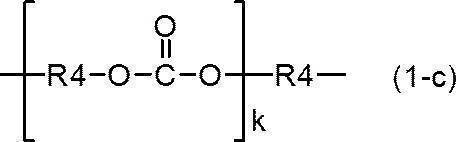
[式中、k+1個のR4は、それぞれ独立に、置換基を有していてもよい炭素数1~20のアルキレン基を示し、kは、5~30の整数を示す。]
で表される2価の基である請求項1~3のいずれか一項に記載の熱硬化性樹脂組成物。 - R2が、下記式:
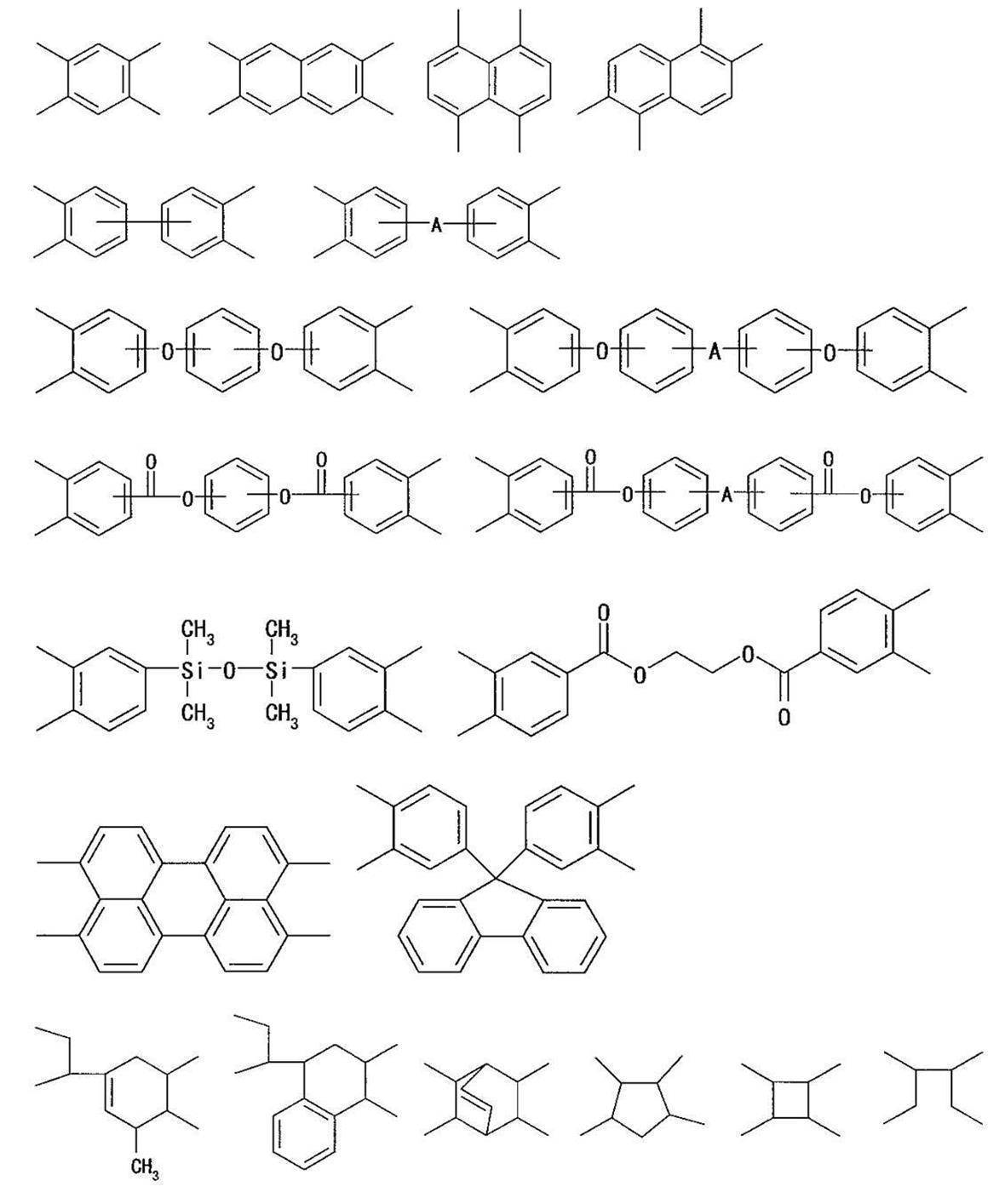
[式中、Aは、酸素原子、硫黄原子、CO、SO、SO2、CH2、CH(CH3)、C(CH3)2、C(CF3)2、またはC(CCl3)2を示す。式中、炭素原子に結合する水素原子は、ハロゲン原子および炭素数1~8のアルキル基から選択される置換基で置換されていてもよい。]
のいずれかで表される4価の基の群から選択される1種以上である請求項1~4のいずれか一項に記載の熱硬化性樹脂組成物。 - R3が、下記式:
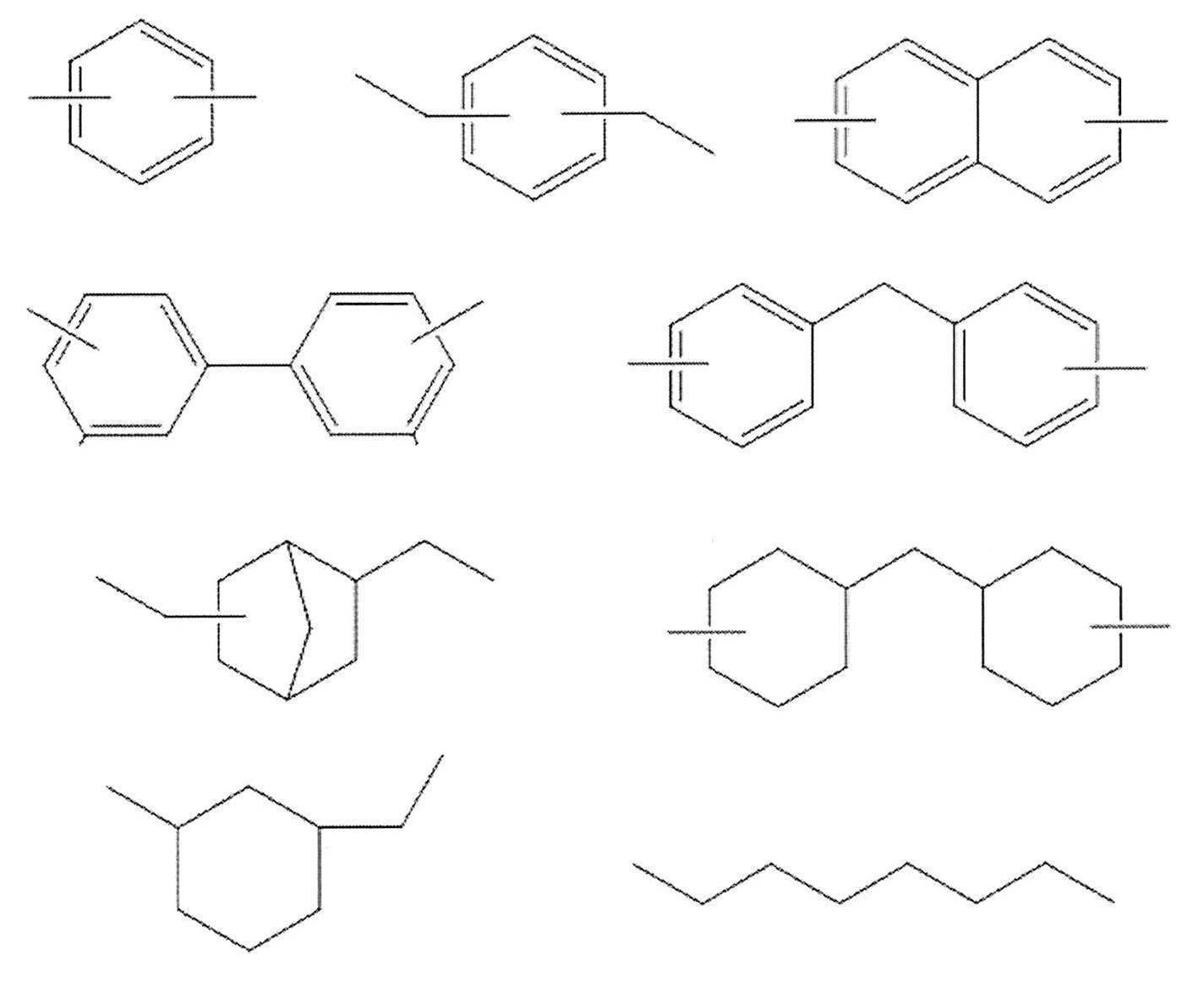
[式中、炭素原子に結合する水素原子は、ハロゲン原子および炭素数1~8のアルキル基から選択される置換基で置換されていてもよい。]
のいずれかで表される2価の基の群から選択される1種以上である請求項1~5のいずれか一項に記載の熱硬化性樹脂組成物。 - 成分(A)であるポリイミド樹脂の数平均分子量が、5,000~25,000である請求項1~6のいずれか一項に記載の熱硬化性樹脂組成物。
- 成分(A)であるポリイミド樹脂の数平均分子量が、5,000~20,000である請求項1~6のいずれか一項に記載の熱硬化性樹脂組成物。
- 成分(A)であるポリイミド樹脂のガラス転移温度が、30℃以下である請求項1~8のいずれか一項に記載の熱硬化性樹脂組成物。
- 成分(B)である熱硬化性樹脂が、エポキシ樹脂である請求項1~9のいずれか一項に記載の熱硬化性樹脂組成物。
- エポキシ樹脂のエポキシ当量が、90~500である請求項10に記載の熱硬化性樹脂組成物。
- エポキシ樹脂が、液状エポキシ樹脂である請求項10または11に記載の熱硬化性樹脂組成物。
- 成分(B)である熱硬化性樹脂の含有量が、成分(A)であるポリイミド樹脂100重量部に対して、15~80重量部である請求項1~12のいずれか一項に記載の熱硬化性樹脂組成物。
- さらに無機充填材を含有する請求項1~13のいずれか一項に記載の熱硬化性樹脂組成物。
- 無機充填材がシリカである請求項14に記載の熱硬化性樹脂組成物。
- 無機充填材の含有量が、熱硬化性樹脂組成物の不揮発分中、50~95重量%である請求項14または15に記載の熱硬化性樹脂組成物。
- さらに硬化促進剤を含有する請求項1~16のいずれか一項に記載の熱硬化性樹脂組成物。
- 請求項1~17のいずれか一項に記載の熱硬化性樹脂組成物から形成された層を支持体上に有する接着フィルム。
- 請求項1~17のいずれか一項に記載の熱硬化性樹脂組成物から形成された硬化物を絶縁層として有するプリント配線板。
- 請求項1~17のいずれか一項に記載の熱硬化性樹脂組成物から形成された硬化物を絶縁層として有するウエハレベルチップサイズパッケージ。
Priority Applications (1)
| Application Number | Priority Date | Filing Date | Title |
|---|---|---|---|
| JP2016574786A JP6961943B2 (ja) | 2015-02-09 | 2016-02-08 | 熱硬化性樹脂組成物 |
Applications Claiming Priority (2)
| Application Number | Priority Date | Filing Date | Title |
|---|---|---|---|
| JP2015-023364 | 2015-02-09 | ||
| JP2015023364 | 2015-02-09 |
Publications (1)
| Publication Number | Publication Date |
|---|---|
| WO2016129541A1 true WO2016129541A1 (ja) | 2016-08-18 |
Family
ID=56615242
Family Applications (1)
| Application Number | Title | Priority Date | Filing Date |
|---|---|---|---|
| PCT/JP2016/053609 Ceased WO2016129541A1 (ja) | 2015-02-09 | 2016-02-08 | 熱硬化性樹脂組成物 |
Country Status (3)
| Country | Link |
|---|---|
| JP (1) | JP6961943B2 (ja) |
| TW (1) | TWI697524B (ja) |
| WO (1) | WO2016129541A1 (ja) |
Cited By (4)
| Publication number | Priority date | Publication date | Assignee | Title |
|---|---|---|---|---|
| KR20200016834A (ko) * | 2017-06-09 | 2020-02-17 | 나가세케무텍쿠스가부시키가이샤 | 에폭시 수지 조성물, 전자 부품 실장 구조체 및 그 제조 방법 |
| CN113861902A (zh) * | 2021-09-15 | 2021-12-31 | 佛山市天禄智能装备科技有限公司 | 一种用于回转窑的防漏胶水及其制备方法 |
| CN115011293A (zh) * | 2022-06-01 | 2022-09-06 | 深圳市纽菲斯新材料科技有限公司 | 一种低介电的fc-bga封装载板用增层胶膜及其制备方法和应用 |
| JP2023010737A (ja) * | 2018-12-03 | 2023-01-20 | 味の素株式会社 | 樹脂組成物 |
Families Citing this family (2)
| Publication number | Priority date | Publication date | Assignee | Title |
|---|---|---|---|---|
| TWI805360B (zh) * | 2022-05-11 | 2023-06-11 | 聯茂電子股份有限公司 | 經增韌改質化合物及其製造方法 |
| TWI805359B (zh) * | 2022-05-11 | 2023-06-11 | 聯茂電子股份有限公司 | 金屬箔積層板、印刷電路板及其製造方法 |
Citations (9)
| Publication number | Priority date | Publication date | Assignee | Title |
|---|---|---|---|---|
| JP2002145981A (ja) * | 2000-11-07 | 2002-05-22 | Hitachi Chem Co Ltd | ポリイミド樹脂組成物及び被膜形成材 |
| JP2005036025A (ja) * | 2003-07-15 | 2005-02-10 | Hitachi Chem Co Ltd | ポリイミド樹脂組成物、それを用いた被膜形成材料、および電子部品 |
| JP2008179751A (ja) * | 2006-12-26 | 2008-08-07 | Kaneka Corp | 新規な熱硬化性樹脂組成物、硬化膜及びプリント配線板 |
| JP2008255337A (ja) * | 2007-03-13 | 2008-10-23 | Dic Corp | 熱硬化性ポリイミド樹脂組成物 |
| WO2010010831A1 (ja) * | 2008-07-22 | 2010-01-28 | 株式会社カネカ | 新規なポリイミド前駆体組成物及びその利用 |
| WO2010058715A1 (ja) * | 2008-11-21 | 2010-05-27 | 昭和電工株式会社 | 放電ギャップ充填用樹脂組成物および静電放電保護体 |
| WO2011004756A1 (ja) * | 2009-07-06 | 2011-01-13 | 昭和電工株式会社 | 配線板の保護膜用熱硬化性組成物 |
| JP2011094037A (ja) * | 2009-10-30 | 2011-05-12 | Toyo Ink Mfg Co Ltd | 難燃性接着剤組成物、難燃性接着剤シート、及びフレキシブルプリント配線板 |
| JP2014078574A (ja) * | 2012-10-10 | 2014-05-01 | Toyo Ink Sc Holdings Co Ltd | 電磁波シールド性カバーレイフィルム、フレキシブルプリント配線板の製造方法、及びフレキシブルプリント配線板 |
Family Cites Families (2)
| Publication number | Priority date | Publication date | Assignee | Title |
|---|---|---|---|---|
| JP2012138484A (ja) * | 2010-12-27 | 2012-07-19 | Sumitomo Bakelite Co Ltd | プリント配線板用樹脂組成物、プリプレグ、積層板、樹脂シート、プリント配線板及び半導体装置 |
| JP6123243B2 (ja) * | 2012-11-12 | 2017-05-10 | 味の素株式会社 | 絶縁樹脂材料 |
-
2016
- 2016-02-08 WO PCT/JP2016/053609 patent/WO2016129541A1/ja not_active Ceased
- 2016-02-08 JP JP2016574786A patent/JP6961943B2/ja active Active
- 2016-02-15 TW TW105104295A patent/TWI697524B/zh active
Patent Citations (9)
| Publication number | Priority date | Publication date | Assignee | Title |
|---|---|---|---|---|
| JP2002145981A (ja) * | 2000-11-07 | 2002-05-22 | Hitachi Chem Co Ltd | ポリイミド樹脂組成物及び被膜形成材 |
| JP2005036025A (ja) * | 2003-07-15 | 2005-02-10 | Hitachi Chem Co Ltd | ポリイミド樹脂組成物、それを用いた被膜形成材料、および電子部品 |
| JP2008179751A (ja) * | 2006-12-26 | 2008-08-07 | Kaneka Corp | 新規な熱硬化性樹脂組成物、硬化膜及びプリント配線板 |
| JP2008255337A (ja) * | 2007-03-13 | 2008-10-23 | Dic Corp | 熱硬化性ポリイミド樹脂組成物 |
| WO2010010831A1 (ja) * | 2008-07-22 | 2010-01-28 | 株式会社カネカ | 新規なポリイミド前駆体組成物及びその利用 |
| WO2010058715A1 (ja) * | 2008-11-21 | 2010-05-27 | 昭和電工株式会社 | 放電ギャップ充填用樹脂組成物および静電放電保護体 |
| WO2011004756A1 (ja) * | 2009-07-06 | 2011-01-13 | 昭和電工株式会社 | 配線板の保護膜用熱硬化性組成物 |
| JP2011094037A (ja) * | 2009-10-30 | 2011-05-12 | Toyo Ink Mfg Co Ltd | 難燃性接着剤組成物、難燃性接着剤シート、及びフレキシブルプリント配線板 |
| JP2014078574A (ja) * | 2012-10-10 | 2014-05-01 | Toyo Ink Sc Holdings Co Ltd | 電磁波シールド性カバーレイフィルム、フレキシブルプリント配線板の製造方法、及びフレキシブルプリント配線板 |
Cited By (9)
| Publication number | Priority date | Publication date | Assignee | Title |
|---|---|---|---|---|
| KR20200016834A (ko) * | 2017-06-09 | 2020-02-17 | 나가세케무텍쿠스가부시키가이샤 | 에폭시 수지 조성물, 전자 부품 실장 구조체 및 그 제조 방법 |
| US11608435B2 (en) | 2017-06-09 | 2023-03-21 | Nagase Chemtex Corporation | Epoxy resin composition, electronic component mounting structure, and method for producing the same |
| KR102582382B1 (ko) * | 2017-06-09 | 2023-09-25 | 나가세케무텍쿠스가부시키가이샤 | 에폭시 수지 조성물, 전자 부품 실장 구조체 및 그 제조 방법 |
| JP2023010737A (ja) * | 2018-12-03 | 2023-01-20 | 味の素株式会社 | 樹脂組成物 |
| JP7533555B2 (ja) | 2018-12-03 | 2024-08-14 | 味の素株式会社 | 樹脂組成物 |
| CN113861902A (zh) * | 2021-09-15 | 2021-12-31 | 佛山市天禄智能装备科技有限公司 | 一种用于回转窑的防漏胶水及其制备方法 |
| CN113861902B (zh) * | 2021-09-15 | 2024-02-13 | 佛山市天禄智能装备科技有限公司 | 一种用于回转窑的防漏胶水及其制备方法 |
| CN115011293A (zh) * | 2022-06-01 | 2022-09-06 | 深圳市纽菲斯新材料科技有限公司 | 一种低介电的fc-bga封装载板用增层胶膜及其制备方法和应用 |
| CN115011293B (zh) * | 2022-06-01 | 2023-08-08 | 深圳市纽菲斯新材料科技有限公司 | 一种低介电的fc-bga封装载板用增层胶膜及其制备方法和应用 |
Also Published As
| Publication number | Publication date |
|---|---|
| JPWO2016129541A1 (ja) | 2017-11-16 |
| TWI697524B (zh) | 2020-07-01 |
| TW201636394A (zh) | 2016-10-16 |
| JP6961943B2 (ja) | 2021-11-05 |
Similar Documents
| Publication | Publication Date | Title |
|---|---|---|
| JP6123243B2 (ja) | 絶縁樹脂材料 | |
| TWI745425B (zh) | 樹脂組成物 | |
| JP6308713B2 (ja) | 樹脂組成物 | |
| JP6750202B2 (ja) | 樹脂組成物、接着フィルムおよびコアレス基板の製造方法 | |
| JP6897014B2 (ja) | モールドアンダーフィル用樹脂組成物 | |
| JP6961943B2 (ja) | 熱硬化性樹脂組成物 | |
| KR20180004013A (ko) | 수지 조성물 | |
| JP6897026B2 (ja) | 樹脂組成物 | |
| JP7067656B2 (ja) | 樹脂組成物 | |
| JP2014136779A (ja) | 樹脂組成物 | |
| JP2023138760A (ja) | 樹脂組成物 | |
| JP7505538B2 (ja) | 絶縁樹脂材料 | |
| JP2022179472A (ja) | 樹脂組成物 | |
| JP6555042B2 (ja) | 粒状樹脂組成物 | |
| JP2021085030A (ja) | 樹脂組成物 | |
| JP6695922B2 (ja) | 絶縁樹脂材料 | |
| WO2022102757A1 (ja) | 樹脂組成物 | |
| JP6319495B2 (ja) | 絶縁樹脂材料 | |
| JP7298466B2 (ja) | 樹脂組成物 |
Legal Events
| Date | Code | Title | Description |
|---|---|---|---|
| 121 | Ep: the epo has been informed by wipo that ep was designated in this application |
Ref document number: 16749185 Country of ref document: EP Kind code of ref document: A1 |
|
| ENP | Entry into the national phase |
Ref document number: 2016574786 Country of ref document: JP Kind code of ref document: A |
|
| NENP | Non-entry into the national phase |
Ref country code: DE |
|
| 122 | Ep: pct application non-entry in european phase |
Ref document number: 16749185 Country of ref document: EP Kind code of ref document: A1 |