WO2016125692A1 - 末端に加水分解性シリル基を有するビニル系重合体、その製造方法、および、硬化性組成物 - Google Patents
末端に加水分解性シリル基を有するビニル系重合体、その製造方法、および、硬化性組成物 Download PDFInfo
- Publication number
- WO2016125692A1 WO2016125692A1 PCT/JP2016/052598 JP2016052598W WO2016125692A1 WO 2016125692 A1 WO2016125692 A1 WO 2016125692A1 JP 2016052598 W JP2016052598 W JP 2016052598W WO 2016125692 A1 WO2016125692 A1 WO 2016125692A1
- Authority
- WO
- WIPO (PCT)
- Prior art keywords
- group
- polymer
- hydrolyzable silyl
- vinyl
- vinyl polymer
- Prior art date
- Legal status (The legal status is an assumption and is not a legal conclusion. Google has not performed a legal analysis and makes no representation as to the accuracy of the status listed.)
- Ceased
Links
Classifications
-
- C—CHEMISTRY; METALLURGY
- C08—ORGANIC MACROMOLECULAR COMPOUNDS; THEIR PREPARATION OR CHEMICAL WORKING-UP; COMPOSITIONS BASED THEREON
- C08F—MACROMOLECULAR COMPOUNDS OBTAINED BY REACTIONS ONLY INVOLVING CARBON-TO-CARBON UNSATURATED BONDS
- C08F4/00—Polymerisation catalysts
- C08F4/40—Redox systems
-
- C—CHEMISTRY; METALLURGY
- C08—ORGANIC MACROMOLECULAR COMPOUNDS; THEIR PREPARATION OR CHEMICAL WORKING-UP; COMPOSITIONS BASED THEREON
- C08F—MACROMOLECULAR COMPOUNDS OBTAINED BY REACTIONS ONLY INVOLVING CARBON-TO-CARBON UNSATURATED BONDS
- C08F20/00—Homopolymers and copolymers of compounds having one or more unsaturated aliphatic radicals, each having only one carbon-to-carbon double bond, and only one being terminated by only one carboxyl radical or a salt, anhydride, ester, amide, imide or nitrile thereof
- C08F20/02—Monocarboxylic acids having less than ten carbon atoms, Derivatives thereof
- C08F20/10—Esters
-
- C—CHEMISTRY; METALLURGY
- C08—ORGANIC MACROMOLECULAR COMPOUNDS; THEIR PREPARATION OR CHEMICAL WORKING-UP; COMPOSITIONS BASED THEREON
- C08F—MACROMOLECULAR COMPOUNDS OBTAINED BY REACTIONS ONLY INVOLVING CARBON-TO-CARBON UNSATURATED BONDS
- C08F8/00—Chemical modification by after-treatment
- C08F8/42—Introducing metal atoms or metal-containing groups
-
- C—CHEMISTRY; METALLURGY
- C08—ORGANIC MACROMOLECULAR COMPOUNDS; THEIR PREPARATION OR CHEMICAL WORKING-UP; COMPOSITIONS BASED THEREON
- C08L—COMPOSITIONS OF MACROMOLECULAR COMPOUNDS
- C08L101/00—Compositions of unspecified macromolecular compounds
- C08L101/02—Compositions of unspecified macromolecular compounds characterised by the presence of specified groups, e.g. terminal or pendant functional groups
- C08L101/10—Compositions of unspecified macromolecular compounds characterised by the presence of specified groups, e.g. terminal or pendant functional groups containing hydrolysable silane groups
Definitions
- the present invention relates to a vinyl polymer having a hydrolyzable silyl group at the terminal obtained by living polymerization of a vinyl monomer using an initiator having a carbon-halogen bond, a method for producing the same, and curability Relates to the composition.
- Atom Transfer Radical Polymerization (Atom Transfer Radical Polymerization: ATRP, Non-Patent Document 1, Non-Patent Document 2), Single Electron Transfer Polymerization: SET-LRP, Non-Patent Document 3, Non-Patent Document 4, and recently Examples include reversible transfer catalyzed polymerization (Reversible Chain Transfer Catalyzed Polymerization; RTCP, Non-Patent Document 5, Patent Document 1) and the like.
- this method can control the structure, molecular weight and molecular weight distribution of the polymer as required.
- a transition metal catalyst as a polymerization catalyst and reversibly activating (bonding / dissociating) the carbon-halogen bond in the initiator, the polymerization of the vinyl monomer proceeds.
- the transition metal catalyst a transition metal and / or a transition metal compound is usually used, and an amine compound or the like is used as a metal ligand.
- Patent Document 2 As an example of industrially utilizing an atom transfer radical polymer, there is a polymer having a hydrolyzable silyl group introduced.
- This polymer can be produced by the technique shown in Patent Document 2, but in Patent Document 2, (1) an adsorption process using a solvent, a multi-stage filtration process, and (2) a high temperature (120 ° C.-250 C.) Dehalogenation method by treatment Further, (3) Hydrosilylation reaction using an expensive platinum catalyst for polymers subjected to these processes is disclosed, which is a low-productivity and uneconomical process.
- Patent Document 3 and Patent Document 4 disclose a method of introducing a hydrolyzable silyl group into an atom transfer radical polymer in one pot and one step. Specifically, monomer polymerization is carried out in two stages, and the hydrolyzable silyl group-containing monomer is polymerized in the second stage.
- halogen removal operation there is no clear method for the halogen removal operation. In order to industrially use the polymer obtained by atom transfer radical polymerization, it is necessary to remove the halogen atom derived from the initiator from the end of the polymer.
- Patent Document 5 relating to NMP polymerization (polymerization with nitroxide-mediated polymerization, nitroxide), monomer polymerization is carried out in two stages, vinyltrimethoxysilane monomer is polymerized in the second stage, and hydrolysis is carried out at the end of the polymer. Sex silyl group is introduced.
- the NMP polymerization method is originally a living polymerization method that does not involve a halogen atom.
- a vinyl polymer having high productivity (for example, one-pot, one-step production method) and having hydrolyzable silyl groups introduced by an economical process is produced by utilizing the dissociation of a carbon-halogen bond. Living polymerization technology has not been developed yet.
- the present invention provides a vinyl polymer having a hydrolyzable silyl group at a terminal, wherein a hydrolyzable silyl group is introduced at a polymer terminal and a halogen derived from an initiator is eliminated from the polymer. It is an object to obtain a vinyl polymer that is superior to conventional processes in terms of productivity and reduction of waste reduction.
- the present invention has a hydrolyzable silyl group at the terminal of the vinyl polymer (P) which is a living polymer of the vinyl monomer (A) using the initiator (B) having a carbon-halogen bond.
- a vinyl polymer having a hydrolyzable silyl group at the terminal having a structure derived from a vinyl monomer (C) and a structure in which a halogen atom derived from an initiator (B) is eliminated from the polymer About.
- the living polymer is preferably an atom transfer radical polymer.
- the vinyl polymer (P) is preferably a (meth) acrylic acid ester polymer.
- the initiator (B) having a carbon-halogen bond is preferably diethyl 2,5-dibromoadipate or ethyl 2-bromoisobutyrate.
- the hydrolyzable silyl group is preferably a hydrolyzable silyl group represented by the following general formula (1). -Si (R 1 ) n (OR 2 ) 3-n (1) Wherein R 1 is an alkyl group having 1 to 8 carbon atoms, an aryl group or an aralkyl group, R 2 is hydrogen or an alkyl group having 1 to 8 carbon atoms, an aryl group or an aralkyl group, and n is an integer of 0 to 2 Show.)
- the vinyl monomer (C) having a hydrolyzable silyl group preferably has a structure represented by the following general formula (3). (Wherein R 1 is an alkyl group having 1 to 8 carbon atoms, an aryl group or an aralkyl group, R 2 is a hydrogen atom or an alkyl group having 1 to 8 carbon atoms, an aryl group or an aralkyl group, and R 4 is a hydrogen atom or carbon.
- R 5 is a direct bond; a phenyl group represented by (C 6 H 4 ); or (CH 2 ) m (m is an integer of 1 to 8) 2 Valent hydrocarbon group, n represents an integer of 0 to 2)
- the vinyl monomer (C) having a hydrolyzable silyl group is preferably vinyltrimethoxysilane or vinyldimethoxymethylsilane.
- the vinyl polymer having a hydrolyzable silyl group at the terminal has a structure selected from the structure represented by the following general formula (2).
- R 1 is an alkyl group having 1 to 8 carbon atoms, an aryl group or an aralkyl group
- R 2 is hydrogen or an alkyl group having 1 to 8 carbon atoms, an aryl group or an aralkyl group
- n is an integer of 0 to 2
- R 3 represents a methyl group, an ethyl group, a butyl group, a 2-methoxyethyl group or a stearyl group
- A is a repeating unit derived from the vinyl monomer (A)
- B) is an initiator residue
- x is Each positive integer is indicated.
- the present invention also relates to a curable composition containing a vinyl polymer having a hydrolyzable silyl group at the terminal described above.
- the present invention also includes a step of living polymerizing a vinyl monomer (A) using an initiator (B) having a carbon-halogen bond to obtain a vinyl polymer (P), and a vinyl polymer (P ) And a vinyl monomer (C) having a hydrolyzable silyl group, and the step of introducing a hydrolyzable silyl group into the terminal of the vinyl polymer (P) includes a hydrolyzable silyl group at the terminal described above.
- the present invention relates to a method for producing a vinyl-based polymer having
- a vinyl-based polymer having a hydrolyzable silyl group at the terminal is characterized in that a hydrolyzable silyl group is introduced at the polymer terminal and the halogen derived from the initiator is eliminated from the polymer. Coalescence can be gained in terms of productivity and waste reduction compared to conventional processes.
- the present invention relates to a vinyl polymer having a hydrolyzable silyl group at the end of a vinyl polymer (P) which is a living polymer of a vinyl monomer (A) using an initiator (B) having a carbon-halogen bond.
- the present invention relates to a vinyl polymer having a hydrolyzable silyl group at the terminal, which has a structure derived from a monomer (C) and a structure in which a halogen atom derived from an initiator (B) is eliminated from the polymer.
- the vinyl monomer (B) is subjected to living polymerization with respect to the initiator (B) having a carbon-halogen bond, and the vinyl monomer (B) having a hydrolyzable silyl group is obtained from the resulting vinyl polymer (P).
- a structure derived from the vinyl monomer (C) is introduced into the terminal of the vinyl polymer (P) and a terminal having a structure in which the halogen atom derived from the initiator is eliminated from the polymer.
- a vinyl polymer having a hydrolyzable silyl group is obtained.
- the vinyl monomer (A), the initiator (B) having a carbon-halogen bond, living radical polymerization conditions, the vinyl monomer (C), and the vinyl polymer will be described in detail with examples.
- Vinyl monomer (A) There is no restriction
- fluorine-containing vinyl monomers such as perfluoroethylene, perfluoropropylene, vinylidene fluoride
- silicon-containing vinyl monomers such as vinyltrimethoxysilane and vinyltriethoxysilane
- Maleimide monomers nitrile group-containing vinyl monomers such as acrylonitrile and methacrylonitrile; amide group-containing vinyl monomers such as acrylamide and methacrylamide; vinyl acetate, vinyl propionate, vinyl pivalate, vinyl benzoate, vinyl cinnamate Vinyl esters such as ethylene; alkenes such as ethylene and propylene; conjugated dienes such as butadiene and isoprene; vinyl chloride Nyl, vinylidene chloride, allyl chloride, allyl alcohol and the like. These may be used singly or plural may be copolymerized.
- (meth) acrylic acid and (meth) acrylic acid ester monomers are preferable in view of the physical properties of the product, and the reactivity of the functional group introduction reaction is low and the glass transition point is low. For this reason, (meth) acrylic acid ester monomers are more preferable.
- (meth) acrylic acid ester monomers include butyl (meth) acrylate ((meth) acrylic acid-n-butyl, (meth) acrylic acid isobutyl, (meth) acrylic acid-tert-butyl), and (meth) acrylic. Ethyl acid, stearyl (meth) acrylate, and 2-methoxyethyl (meth) acrylate are preferred.
- the initiator (B) having a carbon-halogen bond is an organic halide having a highly reactive carbon-halogen bond, and is used as a polymerization initiator.
- living polymerization more specifically living radical polymerization, is carried out utilizing dissociation of the carbon-halogen bond of the initiator (B).
- Examples of the initiator (B) include a carbonyl compound having a halogen at the ⁇ -position, a compound having a halogen at the benzyl-position, a halogenated sulfonyl compound, and the like.
- An organic halide having two or more starting points or a sulfonyl halide compound may be used as an initiator.
- initiator (B) having a carbon-halogen bond examples include diethyl 2,5-dibromoadipate (2,5- Diethyl dibromoadipate) is preferred, and for initiators with one starting point, ethyl 2-bromoisobutyrate is preferred.
- the desired polymer molecular weight can be set by adjusting the ratio of the monomer and the initiator amount.
- the initiator (B) is preferably used in an amount of 0.1 to 30 parts by weight, more preferably 0.2 to 20 parts by weight, based on 100 parts by weight of the vinyl monomer (A).
- the vinyl polymer (P) used in the present invention is a living polymer obtained by living polymerizing the vinyl monomer (A) using the initiator (B) having a carbon-halogen bond.
- the vinyl polymer (P) is preferably a (meth) acrylic acid ester polymer.
- the present invention utilizes living polymerization utilizing dissociation of carbon-halogen bonds. Among them, it is preferable to use living radical polymerization. For example, the following polymerization techniques are applicable.
- transition metal complexes consisting of transition metals or transition metal compounds and ligands as typified by ATRP and SET-LRP, and RTCP not using these transition metals as catalysts Etc.
- Living radical polymerization using a transition metal complex as a catalyst is currently considered in two ways: ATRP and SET-LRP.
- ATRP for example, when a copper complex is used as a catalyst, the monovalent copper complex pulls out the halogen at the end of the polymer to generate radicals to become a divalent copper complex. The divalent copper complex returns a halogen to the radical at the polymerization end to become a monovalent copper complex.
- Living radical polymerization consisting of these equilibrium is ATRP.
- SET-LRP when a copper complex is used as a catalyst, a zero-valent metal copper or copper complex extracts a halogen at the end of the polymer to generate radicals to form a divalent copper complex.
- the divalent copper complex returns a halogen to the radical at the polymerization terminal to become a zero-valent copper complex.
- the monovalent copper complex is disproportionated to become zero-valent and divalent copper complexes.
- Living radical polymerization consisting of these equilibrium is SET-LRP. In the present application, both are not particularly distinguished, and a living radical polymerization system using a transition metal or a transition metal compound and a ligand as a catalyst is treated as a polymerization system that can be used in the present invention.
- ARGET Activators Regenerated by Electron Transfer: (hereinafter referred to as ARGET or ARGET ATRP) (Macromolecules. 2006, 39, 39) has been reported as an improved formulation of ATRP.
- ARGET ATRP Activators Regenerated by Electron Transfer
- the vinyl polymer (P) is preferably an atom transfer radical polymer.
- an atom transfer radical polymerization system uses a metal complex having a group 7 element, 8 group, 9 group, 10 group, or 11 element as a central metal in the periodic table.
- Monovalent copper, divalent copper, divalent ruthenium, and divalent iron are preferred.
- the copper catalyst include cuprous chloride, cupric chloride, cuprous bromide, cupric bromide, cuprous iodide, cupric iodide, cuprous cyanide, cuprous oxide, Examples include cuprous acetate and cuprous perchlorate.
- an amine ligand is added in order to increase the catalytic activity.
- ruthenium catalyst divalent tris triphenylphosphine complex of ruthenium chloride (RuCl 2 (PPh 3) 3 ) is preferable.
- an aluminum compound such as trialkoxyaluminum is added to increase its activity.
- iron catalyst a tristriphenylphosphine complex of divalent iron chloride (FeCl 2 (PPh 3 ) 3 ) is preferable.
- cupric bromide, cupric chloride, and cupric iodide are preferable from the viewpoint of industrial availability.
- the polymerization catalyst is preferably used in an amount of 0.2 to 10 parts by weight, more preferably 0.5 to 7 parts by weight, based on 100 parts by weight of the vinyl monomer (A).
- ⁇ Multidental amine> The higher the catalyst activity, the faster the polymerization rate and the better from the viewpoint of productivity. Therefore, in the present invention, it is preferable to use a polydentate amine that particularly increases the catalyst activity as an amine ligand in combination with a copper catalyst.
- the polydentate amine is exemplified below, but is not limited thereto. Bidentate polydentate amines: 2,2-bipyridine, 4,4′-di- (5-nonyl) -2,2′-bipyridine, N- (n-propyl) pyridylmethanimine, N- (n -Octyl) pyridylmethanimine.
- Tridentate polydentate amines N, N, N ′, N ′′, N ′′ -pentamethyldiethylenetriamine, N-propyl-N, N-di (2-pyridylmethyl) amine.
- Tetradentate polydentate amine hexamethyltris (2-aminoethyl) amine (often abbreviated as Me 6 TREN), N, N-bis (2-dimethylaminoethyl) -N, N′-dimethyl Ethylenediamine, 2,5,9,12-tetramethyl-2,5,9,12-tetraazatetradecane, 2,6,9,13-tetramethyl-2,6,9,13-tetraazatetradecane, 4, 11-dimethyl-1,4,8,11-tetraazabicyclohexadecane, N ′, N ′′ -dimethyl-N ′, N ′′ -bis ((pyridin-2-yl) methyl
- a pentadentate polydentate amine N, N, N ′, N ′′, N ′ ′′, N ′′ ′′, N ′′ ′′-heptamethyltetraethylenetetramine.
- Hexadentate polydentate amine N, N, N ′, N′-tetrakis (2-pyridylmethyl) ethylenediamine.
- Polyamine Polyethyleneimine.
- N, N, N ′, N ′′, N ′′ -pentamethyldiethylenetriamine, hexamethyltris (2-aminoethyl) amine (Me6TREN), and tris [ (2-Pyridyl) methyl] amine is preferred.
- the polydentate amine is preferably used in an amount of 0.15 to 1 part by weight, more preferably 0.13 to 0.5 part by weight, based on 100 parts by weight of the polymerization catalyst.
- a base may be added to neutralize the acid present in the polymerization system or the acid generated and prevent acid accumulation.
- Examples of the base include, but are not limited to, the following.
- Monoamine Monoamine means an amine compound having only one site acting as a base as defined above in one molecule, and is exemplified below, but is not limited thereto.
- Primary amines such as methylamine, aniline and lysine, secondary amines such as dimethylamine and piperidine, tertiary amines such as trimethylamine and triethylamine, aromatics such as pyridine and pyrrole, ammonia and the like.
- Inorganic base means a simple substance of Group 1 or Group 2 element of the periodic table or a compound composed thereof, and is exemplified below, but is not limited thereto.
- a simple substance of a group 1 or group 2 element of the periodic table such as lithium, sodium, calcium and the like.
- Compounds composed of Group 1 or Group 2 elements of the periodic table such as potassium, sodium acetate, potassium acetate, sodium oxalate, potassium oxalate, phenoxy sodium, phenoxy potassium, sodium ascorbate, potassium ascorbate and the like.
- Salts of weak acids and strong bases ammonium hydroxide and the like.
- triethylamine and potassium carbonate are preferable from the viewpoint of industrial availability.
- the base may be added directly to the reaction system or may be generated in the reaction system.
- the base is preferably used in an amount of 0.01 to 0.3 parts by weight, more preferably 0.02 to 0.1 parts by weight, based on 100 parts by weight of the vinyl monomer (A).
- ⁇ Reducing agent> In atom transfer radical polymerization using a transition metal catalyst (for example, copper complex) as a catalyst, it has been found that the activity is improved by using a reducing agent in combination (ARGET ATRP).
- This ARGET ATRP is thought to improve its activity by reducing and reducing highly oxidized transition metal complexes that are caused by coupling of radicals during polymerization and causing reaction delay and termination. It is possible to reduce the necessary transition metal catalyst to several tens of ppm to several tens to several hundred ppm.
- a reducing agent can be used for the same purpose as ARGET ATRP.
- Reducing agents are classified into those that generate an acid during the reduction of the complex and those that do not. Although the reducing agent which can be used by the system which uses a copper catalyst is illustrated below, it is not limited to these reducing agents.
- Metals Alkali metals such as lithium, sodium and potassium; alkaline earth metals such as beryllium, magnesium, calcium and barium; typical metals such as aluminum and zinc; transition metals such as copper, nickel, ruthenium and iron It is done. These metals may be in the state of an alloy (amalgam) with mercury.
- Metal compounds Examples include salts of typical metals or transition metals and salts with typical elements, and complexes in which carbon monoxide, olefins, nitrogen-containing compounds, oxygen-containing compounds, phosphorus-containing compounds, sulfur-containing compounds and the like are coordinated.
- compounds of metal and ammonia / amine titanium trichloride, titanium alkoxide, chromium chloride, chromium sulfate, chromium acetate, iron chloride, copper chloride, copper bromide, tin chloride, zinc acetate, zinc hydroxide, Carbonyl complexes such as Ni (CO) 4 and Co 2 CO 8 , and olefin complexes such as [Ni (cod) 2 ], [RuCl 2 (cod)] and [PtCl 2 (cod)] (where cod is cyclooctadiene) ), [RhCl (P (C 6 H 5 ) 3 ) 3 ], [RuCl 2 (P (C 6 H 5 ) 3 ) 2 ], [PtCl 2 (P (C 6 H 5 ) 3 ) 2 ], etc.
- Tin compounds organotin compounds such as dibutyltin diacetate, dibutyltin dilaurate, dibutyltin mercaptide, dibutyltin thiocarboxylate, dibutyltin dimaleate, dioctyltin thiocarboxylate; tin carboxylates such as tin octylate and tin 2-ethylhexanoate Examples include salts.
- Phosphorus or phosphorus compound phosphorus, trimethylphosphine, triethylphosphine, triphenylphosphine, trimethylphosphite, triethylphosphite, triphenylphosphite, hexamethylphosphorustriamide, hexaethylphosphorustriamide and the like.
- Sulfur or sulfur compounds Sulfur, Rongalite, hydrosulfite, thiourea dioxide, etc.
- Rongalite is a formaldehyde derivative of sulfoxylate, represented by MSO 2 ⁇ CH 2 O (M represents Na or Zn), and specifically, sodium formaldehyde sulfoxylate, zinc formaldehyde sulfoxylate, etc. Is mentioned.
- Hydrosulfite is a general term for sodium hyposulfite and formaldehyde derivatives of sodium hyposulfite.
- Metal hydride sodium hydride; germanium hydride; tungsten hydride; diisobutylaluminum hydride, lithium aluminum hydride, sodium aluminum hydride, sodium triethoxyaluminum hydride, sodium bis (2-methoxyethoxy) aluminum hydride, etc.
- Silicon hydride trichlorosilane, trimethylsilane, triethylsilane, diphenylsilane, phenylsilane, polymethylhydrosiloxane and the like.
- Boron hydride Borane, diborane, sodium borohydride, sodium trimethoxyborate, sodium borohydride, sodium cyanoborohydride, lithium borohydride, lithium borohydride, lithium triethylborohydride, hydrogenated Examples thereof include lithium tri-s-butylborohydride, lithium tri-t-butylborohydride, calcium borohydride, potassium borohydride, zinc borohydride, tetra-n-butylammonium borohydride and the like.
- Nitrogen and hydrogen compounds hydrazine, diimide and the like.
- Phosphorus or phosphorus compound Specific examples include phosphine and diazaphospholene.
- Sulfur or sulfur compounds hydrogen sulfide and the like. hydrogen.
- Organic compounds exhibiting a reducing action alcohols, aldehydes, phenols, organic acid compounds and the like.
- the alcohol include methanol, ethanol, propanol, and isopropanol.
- Examples of the aldehyde include formaldehyde, acetaldehyde, benzaldehyde, formic acid and the like.
- phenols include phenol, hydroquinone, dibutylhydroxytoluene, tocopherol and the like.
- the organic acid compound include citric acid, oxalic acid, ascorbic acid, ascorbate, ascorbate ester and the like.
- reducing agents ascorbic acid and tin 2-ethylhexanoate are preferable in terms of industrial availability and ease of dissolution in organic solvents.
- These reducing agents may be used alone or in combination of two or more. Further, the reducing agent may be added directly to the reaction system or may be generated in the reaction system. The latter includes electrolytic reduction. In electrolytic reduction, it is known that electrons generated at the cathode exhibit a reducing action immediately or once solvated. That is, a reducing agent produced by electrolysis can also be used.
- the reducing agent is preferably used in an amount of 0.001 to 0.2 parts by weight, more preferably 0.005 to 0.1 parts by weight, based on 100 parts by weight of the vinyl monomer (A).
- the atom transfer radical polymerization that can be used in the present invention can be performed without a solvent, but a solvent can also be used.
- the solvent include, but are not limited to, the following.
- High polar aprotic solvents dimethyl sulfoxide (DMSO), dimethylformamide (DMF), N, N-dimethylacetamide (DMAc), N-methylpyrrolidone and the like.
- Carbonate solvents ethylene carbonate, propylene carbonate, etc.
- Alcohol solvents methanol, ethanol, propanol, isopropanol, n-butyl alcohol, tert-butyl alcohol and the like.
- Nitrile solvents acetonitrile, propionitrile, benzonitrile and the like.
- Ketone solvents acetone, methyl ethyl ketone, methyl isobutyl ketone and the like.
- Ether solvents diethyl ether, tetrahydrofuran and the like.
- Halogenated carbon solvents methylene chloride, chloroform and the like.
- Ester solvent ethyl acetate, butyl acetate and the like.
- Hydrocarbon solvents pentane, hexane, cyclohexane, octane, decane, benzene, toluene and the like.
- Ionic liquid water. Supercritical fluid. The said solvent can be used individually or in mixture of 2 or more types.
- the transition metal or transition metal compound, polydentate amine, base, reducing agent, monomer and initiator are mixed uniformly in the reaction system.
- a solvent that can uniformly mix them.
- ethanol, methanol, propanol, and ethyl acetate are preferable.
- the solvent is preferably used in an amount of 0 to 50 parts by weight, more preferably 5 to 20 parts by weight, based on 100 parts by weight of the vinyl monomer (A).
- R 1 is an alkyl group having 1 to 8 carbon atoms, an aryl group or an aralkyl group
- R 2 is a hydrogen atom or an alkyl group having 1 to 8 carbon atoms, an aryl group or an aralkyl group
- n is an integer of 0 to 2 Is shown.
- R 1 is preferably a methyl group or an ethyl group
- R 2 is preferably a hydrogen atom, a methyl group or an ethyl group.
- n is preferably 0 or 1.
- the vinyl monomer (C) preferably has a structure represented by the following general formula (3) including a hydrolyzable silyl group represented by the general formula (1).
- R 1 , R 2 , and n are defined as in the above formula (1).
- R 4 is a hydrogen atom or an alkyl group having 1 to 8 carbon atoms, an aryl group or an aralkyl group
- R 5 is a direct bond
- R 1 is preferably a methyl group or an ethyl group.
- R 2 is preferably a hydrogen atom, a methyl group or an ethyl group.
- n is preferably 0 or 1.
- R 4 is preferably a hydrogen atom.
- R 5 is preferably a direct bond.
- Specific compound names include vinyltrimethoxysilane, vinyltriethoxysilane, vinyldimethoxymethylsilane, vinyldiethoxyethylsilane, vinylmonomethoxydimethylsilane, vinylmonoethoxydiethylsilane, styryltrimethoxysilane, styryltriethoxy.
- Examples thereof include silane, styryl dimethoxymethyl silane, styryl diethoxyethyl silane, styryl monomethoxydimethyl silane, and styryl monoethoxydiethyl silane.
- vinyltrimethoxysilane, vinyldimethoxymethylsilane, vinyltriethoxysilane, and styryltrimethoxysilane are preferable from the viewpoint of availability of raw materials.
- vinyltrimethoxysilane, vinyldimethoxymethylsilane, and vinyltriethoxysilane are more preferable because of their relatively low cost and high reactivity.
- vinyltrimethoxysilane and vinyldimethoxymethylsilane are preferable from the viewpoint of removing the raw material after the reaction under reduced pressure.
- the vinyl monomer (C) is preferably used in an amount of 1 to 30 parts by weight and more preferably 2 to 20 parts by weight with respect to 100 parts by weight of the vinyl monomer (A).
- the vinyl polymer having a hydrolyzable silyl group at the end of the present invention has a structure in which a structure derived from a vinyl monomer (C) having a hydrolyzable silyl group at the end of the vinyl polymer (P) exists. . Moreover, it has a structure in which the halogen atom derived from the initiator (B) is eliminated from the polymer.
- the vinyl polymer having a hydrolyzable silyl group at the terminal is preferably a (meth) acrylic acid ester polymer.
- the hydrolyzable silyl group at the end of the polymer is derived from the vinyl monomer (C). Therefore, the hydrolyzable silyl group is preferably the one represented by the general formula (1).
- the method for producing a vinyl polymer having a hydrolyzable silyl group at the terminal of the present invention comprises subjecting a vinyl monomer (A) to living polymerization using an initiator (B) having a carbon-halogen bond, A step of obtaining a polymer (P), and a reaction between the vinyl polymer (P) and a vinyl monomer (C) having a hydrolyzable silyl group, and a hydrolyzable silyl group at the terminal of the vinyl polymer (P).
- the process of introducing comprises subjecting a vinyl monomer (A) to living polymerization using an initiator (B) having a carbon-halogen bond, A step of obtaining a polymer (P), and a reaction between the vinyl polymer (P) and a vinyl monomer (C) having a hydrolyzable silyl group, and a hydrolyzable silyl group at the terminal of the vinyl polymer (P).
- the vinyl polymer (P) obtained by polymerizing the vinyl monomer (A) is isolated.
- the polymerization may be carried out as it is under the polymerization conditions of the vinyl monomer (A), or it may be isolated without purification or isolated from the vinyl polymer (P) after purification, and the living polymerization conditions again. It may be carried out with the following.
- the polymerization conditions of the vinyl monomer (A) are used as they are.
- the reaction conditions may be changed within a range that does not hinder the reaction of the vinyl monomer (C).
- a polymerization catalyst and a polymerization solvent used in the polymerization of the vinyl monomer (A) may be additionally added, or an additive may be newly added.
- the vinyl monomer (A) may be distilled off under reduced pressure, or the vinyl monomer (C) may be polymerized without distillation under reduced pressure.
- the reaction of the vinyl monomer (C) is carried out without distilling off the vinyl monomer (A)
- the vinyl polymer (P) obtained after the completion of the polymerization of the vinyl monomer (A) is further polymerized with other vinyl monomers (A) under living polymerization conditions to obtain hydrolyzable silyl groups.
- the living polymerization conditions are the same as those for the polymerization of the vinyl monomer (A).
- the conditions may be used as they are, or the reaction conditions may be changed within a range that does not hinder the reaction of the vinyl monomer (C).
- the purification operation is not particularly limited.
- reprecipitation operation using a solvent for example, reprecipitation operation using a solvent, adsorption treatment using an adsorbent, filtration using a filter aid or a filter. Mention may be made of processing and centrifugal filtration using a centrifuge.
- the reaction system After completion of the reaction of the vinyl monomer (C), the reaction system is devolatilized at a temperature of 50 ° C. to 150 ° C., and volatile raw materials and auxiliary raw materials such as a solvent and unreacted vinyl monomers are distilled off.
- the initiator (B) having a carbon-halogen bond is represented as Init-X (X represents a halogen group and Init represents an initiator structure excluding the halogen group)
- the vinyl monomer (A) is represented by an initiator (B )
- X represents a halogen group
- Init represents an initiator structure excluding the halogen group.
- the definitions of R 1 , R 2 , R 4 , R 5 , and n are the same as in the above formula (3).
- the “structure in which the halogen atom derived from the initiator (B) is eliminated from the polymer” means a structure obtained by elimination of at least one halogen atom derived from the initiator (B) from the polymer. To do. Therefore, the structure includes a structure in which a part of the halogen atom derived from the initiator (B) remains and a structure that does not contain any halogen atom derived from the initiator (B).
- a structure in which a halogen atom does not exist and a carbon-carbon double bond (C ⁇ C) exists in at least one polymer terminal can be mentioned. The presence of a carbon-carbon double bond can be confirmed with a nuclear magnetic resonance analyzer ( 1 H-NMR).
- halogen content can be stimulated by ICPMS (inductively coupled plasma mass spectrometry) or a fluorescent X-ray analyzer.
- a purification operation may be carried out to remove auxiliary materials such as a catalyst and various impurities generated in the polymerization step, but this is not restrictive.
- the purification operation include a reprecipitation operation using a solvent, an adsorption treatment using an adsorbent, a filtration treatment using a filter aid and a filter, and centrifugal filtration using a centrifuge.
- the production process used in the present invention has a feature that a vinyl polymer having a hydrolyzable silyl group that has been dehalogenated can be produced in one pot, and is disclosed in Patent Document 2 in several steps. There is no need to go through a refining process, and the amount of secondary raw materials used is small, and it is not necessary to carry out a hydrosilylation reaction using an expensive platinum catalyst. That is, the manufacturing process used in the present invention is economically advantageous, is effective in reducing waste, and has a high productivity.
- the number average molecular weight of the vinyl polymer having a hydrolyzable silyl group at the end of the present invention is not particularly limited.
- the molecular weight distribution that is, the ratio (Mw / Mn) of the weight average molecular weight (Mn) and the number average molecular weight (Mw) measured by gel permeation chromatography (GPC) is preferably 1.1 to 1.8. More preferably, it is 1.1 to 1.7, more preferably 1.1 to 1.5, and particularly preferably 1.1 to 1.3.
- GPC measurement chloroform is usually used as a mobile phase, the measurement is performed with a polystyrene gel column, and the number average molecular weight and the like can be determined in terms of polystyrene.
- the main chain of the vinyl polymer of the present invention may be linear or branched.
- the structure represented by the following general formula (2) is preferable in that it is easy to adjust the physical properties regardless of the application in industrial use.
- R 1 , R 2 and n are defined as in the above formula (1).
- R 3 represents a methyl group, ethyl group, butyl group, 2-methoxyethyl group or stearyl group.
- A is vinyl.
- a repeating unit derived from the monomer (A) (B) is an initiator residue, and x is a positive integer.)
- R 1 is preferably a methyl group or an ethyl group
- R 2 is preferably a hydrogen atom, a methyl group, or an ethyl group
- n is preferably 0 or 1 in view of the availability of raw materials and the high reactivity of the polymer terminal.
- R 3 is preferably ethyl, butyl (n-butyl, isobutyl, tert-butyl), or 2-methoxyethyl.
- CO 2 R 3 is a group derived from the vinyl monomer (A).
- the present invention also relates to a curable composition containing the vinyl polymer having a hydrolyzable silyl group of the present invention.
- a curable composition containing the vinyl polymer having a hydrolyzable silyl group of the present invention.
- other resins / polymers, fillers, plasticizers, stabilizers, curing catalysts / curing agents, compounding agents are added to the vinyl polymer having a hydrolyzable silyl group at the end of the present invention. Etc. can be mixed to obtain the curable composition of the present invention.
- resins and polymers examples include, but are not limited to, the following. Polyether polymers, vinyl polymers other than the present invention, and the like.
- filler examples include, but are not limited to, the following. Calcium carbonate, silica, carbon black, titanium oxide, talc, etc.
- plasticizers include, but are not limited to, the following. Phthalate ester compounds, non-aromatic dibasic acid esters, phosphate esters, polyether polyols, epoxy group-containing plasticizers, polyester plasticizers, vinyl polymers, and the like.
- Stabilizers include, but are not limited to: Anti-light stabilizers such as thioether-based antioxidants, phosphorus-based antioxidants, hindered phenol-based antioxidants, ultraviolet absorbers, hindered amine-based light stabilizers, and benzoate-based light stabilizers.
- Anti-light stabilizers such as thioether-based antioxidants, phosphorus-based antioxidants, hindered phenol-based antioxidants, ultraviolet absorbers, hindered amine-based light stabilizers, and benzoate-based light stabilizers.
- Various curing catalysts / curing agents include, but are not limited to, the following. Intramolecular coordination derivatives of dialkyl tin, tetravalent tin compounds such as oxy derivatives of dialkyl tin compounds, and divalent tin such as tin octylate.
- the compounding agent examples include, but are not limited to, dehydrating agents, adhesion imparting agents such as silane coupling agents, and thixotropic properties.
- Specific applications of the curable composition of the present invention include sealing materials, adhesives, adhesives, elastic adhesives, paints, powder paints, foams, potting materials for electric and electronic materials, films, molding materials, artificial marble, etc. Can be mentioned.
- “parts” and “ppm” represent “parts by weight” and “parts by weight”, respectively.
- “Number average molecular weight” and “molecular weight distribution (ratio of weight average molecular weight to number average molecular weight)” were calculated by a standard polystyrene conversion method using gel permeation chromatography (GPC). However, a GPC column packed with polystyrene cross-linked gel (shodex GPC K-804; manufactured by Showa Denko KK) was used as the GPC solvent with chloroform.
- ICPMS Inductively Coupled Plasma Mass Spectrometry
- X-ray fluorescence analyzer X-ray fluorescence analyzer
- Another stirring vessel (2) was prepared, and in that vessel, cupric bromide (CuBr 2 ) 28 mg, hexamethyltris (2-aminoethyl) amine (Me 6 TREN) 29 mg, triethylamine 13 mg, denatured ethanol (AS -1) 0.97 g was charged and stirred under a nitrogen stream until a uniform solution was obtained.
- cupric bromide CuBr 2
- Me 6 TREN hexamethyltris (2-aminoethyl) amine
- AS -1) denatured ethanol
- stirring vessel (3) was prepared, and 100 g of denatured ethanol (AS-1), 15 g of ascorbic acid, and 17.2 g of triethylamine were stirred for 30 minutes in a nitrogen stream to obtain a uniform solution.
- AS-1 denatured ethanol
- ascorbic acid 15 g
- ascorbic acid 17.2 g
- triethylamine 17.2 g
- the solution in the stirring vessel (2) is put into the jacketed stirring reactor (1) and stirred for 10 minutes, the jacket temperature of the jacketed stirring reactor (1) is set to 70 ° C, and the internal temperature becomes 65 ° C or higher.
- the polymerization reaction was started by starting dropping the solution in the stirring vessel (3).
- the ascorbic acid solution prepared in the stirring vessel (3) was dropped intermittently so that 28 mg of ascorbic acid was added to the stirring reactor with jacket (1) in 1 hour.
- dropwise addition of 800 g of butyl acrylate that had been subjected to nitrogen bubbling for 30 minutes was started.
- the dropping speed was adjusted so that the total amount of n-butyl acrylate (800 g) was dropped into the jacketed stirred reactor (1) in 90 minutes.
- the polymer [1] had a number average molecular weight of 23,000 and a molecular weight distribution of 1.25.
- the number of bromine terminals per molecule of polymer [1] determined by 1 H-NMR analysis was 1.7.
- Example 1 50 g of the purified polymer [1] obtained in (Production Example 1), 50 g of modified ethanol (AS-1), and 8 g of vinyltrimethoxysilane (A171; manufactured by Momentive Performance Materials) are mixed to obtain a homogeneous solution. The mixture was placed in a jacketed stirring device (4) and stirred for 30 minutes while bubbling nitrogen.
- AS-1 modified ethanol
- A171 vinyltrimethoxysilane
- this polymer [2] was dissolved in 30 g of methanol, and reprecipitation purification was performed. Reprecipitation purification was performed three times in total by adding methanol of the same weight as the methanol solution fractionated by the reprecipitation operation to the polymer solution. Finally, methanol was removed under reduced pressure, and the second-stage polymer [2] Purification was completed and purification of the polymer [2] was completed.
- the polymer [2] had a number average molecular weight of 33,000 and a molecular weight distribution of 1.38.
- the number of trimethoxysilyl ends per molecule of polymer [2] determined by 1 H-NMR analysis was 1.9.
- the amount of bromine was analyzed with a fluorescent X-ray analyzer, it was found that 1800 ppm was contained in the polymer [2].
- Example 2 100 g of the purified polymer [1] obtained in (Production Example 1), 100 g of modified ethanol (AS-1), and 24.3 g of vinyltrimethoxysilane (A171; manufactured by Momentive Performance Materials) were mixed and homogeneous The resulting solution was placed in a jacketed stirring device (5) and stirred for 30 minutes while nitrogen was bubbled. 1.2 g of a copper solution having the same composition as the copper solution prepared by the stirring device (2) of (Production Example 1) was placed in the stirring device (5) and stirred for 10 minutes.
- Example 3 200 g of n-butyl acrylate, 89.9 g of denatured ethanol (AS-1 manufactured by Nippon Alcohol Sales Co., Ltd.), 0.19 g of triethylamine, and 19.0 g of ethyl 2-bromoisobutyrate are placed in a jacketed stirring reactor (6), and nitrogen is added. Stirring was performed for 30 minutes while bubbling to obtain a uniform solution.
- the polymer [4] had a number average molecular weight of 11909 and a molecular weight distribution of 1.21.
- the number of bromine terminals per molecule of the polymer [4] determined by 1 H-NMR analysis was 0.8.
- Polymer [5] (100 parts) was dissolved in 100 parts of butyl acetate and placed in a jacketed stirrer together with Kyoward 500SH (1 part) and Kyoward 500SEN-S (1 part). The temperature was adjusted to 100 ° C. and the mixture was stirred for 30 minutes under a nitrogen atmosphere. Then, filter filtration was performed with filter aid R100S (1 part; manufactured by Showa Chemical Industry Co., Ltd.) to separate the solid and liquid. Volatile components of the obtained polymer solution were removed under reduced pressure with an evaporator to obtain a purified polymer [5].
- the number average molecular weight of the polymer [5] was 11870, and the molecular weight distribution was 1.17.
- the number of trimethoxysilyl ends per molecule of polymer [5] determined by 1 H-NMR analysis was 2.0.
- the number of steps required to obtain the polymer [5] having a hydrolyzable silyl group was one step.
- Example 4 The same procedure as in Example 3 except that 100 parts of methanol was used instead of butyl acetate for the unpurified polymer [5], and the temperature of the polymer solution was adjusted to 55 ° C. Purification was performed at
- the number average molecular weight of the polymer [5] at this time was 11465, and the molecular weight distribution was 1.13.
- the number of trimethoxysilyl ends per molecule of polymer [5] determined by 1 H-NMR analysis was 2.0.
- the number of steps required to obtain the polymer [5] having a hydrolyzable silyl group was one step.
- 1,7-octadiene (144 mL, 107 g, 975 mmol), which is an ethylenically unsaturated group-containing compound, is added, acetonitrile (264.1 g) is further added, and 3.38 g of triamine is added. Subsequently, the mixture was heated and stirred at 70 ° C. In this reaction, an ethylenically unsaturated group is introduced at the end of the polymer [6].
- the reaction mixture was devolatilized by heating, diluted to 100 parts of toluene, and the polymerization catalyst was removed by passing the mixture through a column of activated alumina.
- the polymer solution is concentrated, dissolved in 100 parts of methylcyclohexane with respect to the polymer, 4 parts of adsorbent (2 parts of Kyoward 500SH / 2 parts of Kyoward 700SL: both manufactured by Kyowa Chemical Co., Ltd.) are added, and oxygen is added.
- the mixture was heated and stirred under a nitrogen mixed gas atmosphere. The insoluble matter was removed, and the polymer solution [7] was obtained by concentrating the polymer solution.
- the number average molecular weight of the polymer [7] was 23800, and the molecular weight distribution was 1.23.
- the amount of bromine contained in the polymer [7] was 4900 ppm.
- the number of ethylenically unsaturated groups introduced per molecule of the polymer [6] was 2.0.
- the polymer [7] was heated and devolatilized at 180 ° C. for 6 hours (decompression degree: 10 torr or less) to obtain n-butyl ethylenically unsaturated group-containing polyacrylate having a reduced bromine content.
- the amount of bromine contained in the polymer was 370 ppm.
- the number average molecular weight was 24100, and the molecular weight distribution was 1.25.
- the number of steps required to obtain the polymer [8] having a hydrolyzable silyl group is one step of polymerization and ethylenically unsaturated group introduction reaction, one step of purification using an adsorbent and filtration performed before hydrosilylation.
- the process and the debromination process by heating are counted as one process and the hydrosilylation process is counted as one process, the total number of processes is four.
- the purification step by adsorbent and filtration and the debromination step are indispensable and counted as the number of steps necessary to obtain the polymer [8] having a hydrolyzable silyl group. is doing.
- Example 5 200 g of n-butyl acrylate, 81.6 g of denatured ethanol (AS-1 manufactured by Nippon Alcohol Sales Co., Ltd.), 35.1 g of diethyl 2,5-dibromoadipate are placed in a jacketed stirring reactor (1), and nitrogen bubbling is performed. However, stirring was carried out for 30 minutes to obtain a uniform solution.
- AS-1 denatured ethanol
- a stirring vessel (2) was prepared, and in the vessel, cupric bromide (CuBr 2 ) 53 mg, hexamethyltris (2-aminoethyl) amine (Me 6 TREN) 54 mg, triethylamine 24 mg, denatured ethanol (AS-1) ) 1.82 g was charged and stirred under a nitrogen stream until a uniform solution was obtained.
- cupric bromide CuBr 2
- Me 6 TREN hexamethyltris (2-aminoethyl) amine
- AS-1) denatured ethanol
- a stirring vessel (3) was prepared, and 100 g of denatured ethanol (AS-1), 15 g of ascorbic acid, and 17.2 g of triethylamine were stirred in the vessel for 30 minutes under a nitrogen stream to obtain a uniform solution.
- AS-1 denatured ethanol
- ascorbic acid 15 g
- ascorbic acid 17.2 g
- triethylamine 17.2 g
- the polymerization reaction was started by starting the dropping of the solution in the stirring vessel (3).
- the ascorbic acid solution prepared in the stirring vessel (3) was dropped intermittently so that 29 mg of ascorbic acid entered the jacketed stirring reactor (1) in 1 hour.
- dropwise addition of 800 g of butyl acrylate that had been subjected to nitrogen bubbling for 30 minutes was started.
- the polymer [9] had a number average molecular weight of 15,130 and a molecular weight distribution of 1.45.
- the number of terminals of methyldimethoxysilyl per molecule of the polymer [9] determined by 1 H-NMR analysis was 0.7.
- 1,7-octadiene (288 mL, 215 g, 1950 mmol), which is an ethylenically unsaturated group-containing compound, is added, further acetonitrile (351.7 g) is added, and 6.76 g of triamine is added. Subsequently, the mixture was heated and stirred at 70 ° C. In this reaction, an ethylenically unsaturated group is introduced at the terminal of the polymer [10].
- the reaction mixture was heated and stirred at 80 ° C. for 4 hours under a 6 vol% oxygen / nitrogen mixed gas atmosphere. Then, it volatilizes at 80 degreeC, It dilutes to 100 parts of butyl acetate, The polymerization catalyst was removed by letting a solvent mixture pass to the column of 1 part of filter aids (radiolite).
- Polymer [11] was heat-desorbed at 190 ° C. for 2 hours together with 1.1 parts (11 g) of an adsorbent (Kyoward 500SH, 1 part; 10 g / Kyoward 700SL, 0.1 part; 1 g, both manufactured by Kyowa Chemical Co., Ltd.). Volatile (the degree of vacuum is 10 torr or less), followed by 100 parts of butyl acetate (1000 g), 1.1 parts of adsorbent (11 g) (1 part of Kyoward 500SH; 0.1 part of 10 g / Kyoward 700SL; 1 g: Kyowa both together (Mixed by Chemical Co., Ltd.), heated and stirred at 185 ° C. for 6 hours, cooled to room temperature, and filtered to obtain n-butyl polyethyl acrylate containing ethylenically unsaturated groups with reduced bromine content. It was.
- the number of steps necessary to obtain a polymer [12] having a hydrolyzable silyl group is one step of polymerization, ethylenically unsaturated group introduction reaction, and heating and stirring in a 6 vol% oxygen / nitrogen mixed gas atmosphere. Heating and stirring with an auxiliary agent, filtering, followed by heating and stirring with an adsorbent and filtering, 1 step, debromination step by heating at 185 ° C and 190 ° C, 1 step, hydrosilylation step as 1 step, total 4 steps.
- a filtration step with a filter aid and an adsorbent, and a debromination step at high temperatures are essential, and a polymer having a hydrolyzable silyl group It is counted as the number of steps necessary to obtain [12].
- Example 1 when the bromine content in the polymer which did not pass through a refinement
- comparison between Example 2 and Comparative Example 1 measured by ICPMS revealed that initiator-derived bromine can be eliminated from the vinyl polymer without special debromination and purification.
- the devolatilized vinyl polymer polymers [2], [3], [5], [9]
- Example 5 requires significantly less than Comparative Example 2, and the vinyl type of the present invention
- the process for producing a polymer is an effective production process in terms of reducing waste reduction.
Landscapes
- Chemical & Material Sciences (AREA)
- Health & Medical Sciences (AREA)
- Chemical Kinetics & Catalysis (AREA)
- Medicinal Chemistry (AREA)
- Polymers & Plastics (AREA)
- Organic Chemistry (AREA)
- Engineering & Computer Science (AREA)
- Materials Engineering (AREA)
- General Chemical & Material Sciences (AREA)
- Addition Polymer Or Copolymer, Post-Treatments, Or Chemical Modifications (AREA)
- Polymerization Catalysts (AREA)
Abstract
重合末端に加水分解性シリル基が導入され、開始剤由来のハロゲンが重合体から脱離した構造を有することを特徴とする末端に加水分解性シリル基を有するビニル系重合体を得るにあたって、生産性、廃棄物減量の削減の点において従来のプロセスに比べ優位となる方法でビニル系重合体を得ることを目的とする。 本発明は炭素-ハロゲン結合を有する開始剤(B)を用いたビニル系モノマー(A)のリビング重合体であるビニル系重合体(P)の末端に、加水分解性シリル基を有するビニル系モノマー(C)由来の構造を有するとともに、開始剤(B)由来のハロゲン原子が重合体から脱離した構造を有することを特徴とする末端に加水分解性シリル基を有するビニル系重合体に関する。
Description
本発明は、炭素-ハロゲン結合を有する開始剤を利用して、ビニル系モノマーをリビング重合することにより得られる末端に加水分解性シリル基を有するビニル系重合体、その製造方法、および、硬化性組成物に関する。
炭素-ハロゲン結合の解離を利用してビニル系モノマーをリビング重合する技術はいくつか知られている。原子移動ラジカル重合(Atom Transfer Radical Polymerization:ATRP、非特許文献1、非特許文献2)、一電子移動重合(Single Electron Transfer Polymerization:SET-LRP、非特許文献3、非特許文献4)、および近年開発が著しい可逆移動触媒重合(Reversible Chain Transfer Catalyzed Polymerization;RTCP、非特許文献5、特許文献1)などが挙げられる。
中でも原子移動ラジカル重合に注目すると、この方法では必要に応じて、重合体の構造、分子量および分子量分布をコントロールすることができる。重合触媒として遷移金属触媒を使用し、開始剤中の炭素-ハロゲン結合を可逆的に活性化(結合/解離)することでビニル系単量体の重合が進行する。遷移金属触媒は通常、遷移金属および/または遷移金属化合物が使用され、金属配位子としてアミン化合物等が使用される。
原子移動ラジカル重合体を工業的に利用している例として、加水分解性シリル基が導入された重合体がある。本重合体は特許文献2に示される技術によって製造することができるが、特許文献2では、(1)溶剤を使用した吸着工程、多段階の濾過工程、ならびに(2)高温(120℃-250℃)処理による脱ハロゲン化方法さらには、(3)それらのプロセスを経た重合体に対する高価な白金触媒を使用したヒドロシリル化反応が開示されており、低生産性、非経済的プロセスである。
上記特許文献2に対し、特許文献3、特許文献4にはワンポット、ワンステップで原子移動ラジカル重合体に加水分解性シリル基を導入する方法が開示されている。具体的には、モノマー重合を2段に分けて実施し、2段階目で加水分解性シリル基含有モノマーを重合する。しかしながら、ハロゲン除去操作について明確な方法が示されていない。原子移動ラジカル重合で得られた重合体を工業的に利用するためには開始剤由来のハロゲン原子を重合体末端から除去することが必要である。なぜなら、ハロゲン原子が重合体中に残存していると、例えば(1)ハロゲンに由来する遊離酸による製品の品質、製造設備への悪影響、(2)炭素-ハロゲン結合の熱的な解離によるラジカル発生を起因とする分子量・分子量分布の増大、等が起こるからである。
一方、NMP重合(Nitroxide-mediated polymerization,ニトロキシドによる重合)に関する特許文献5では、モノマー重合を2段階に分けて実施し、2段階目にビニルトリメトキシシランモノマーを重合し、重合体末端に加水分解性シリル基を導入している。しかし、元来、NMP重合法はハロゲン原子を介さないリビング重合法である。高い生産性(例えば、ワンポット、ワンステップ製造法)を有し、かつ、経済的なプロセスで加水分解性シリル基が導入されたビニル系重合体を炭素-ハロゲン結合の解離を利用して製造するリビング重合技術は未だに開発されていない。
J.Am.Chem.Soc. 1995,117,5614
Macromolecules 1995,28,1721
J.Am.Chem.Soc. 2006,128,14156
J.Polym.Sci.: Part A: Polym. Chem. 2007,45,1607
有機触媒で制御するリビングラジカル重合 高分子論文集 68,223-231(2011)
本発明は、重合末端に加水分解性シリル基が導入され、開始剤由来のハロゲンが重合体から脱離した構造を有することを特徴とする末端に加水分解性シリル基を有するビニル系重合体を得るにあたって、生産性、廃棄物減量の削減の点において従来のプロセスに比べ優位となるビニル系重合体を得ることを目的とする。
上記事情に鑑み、本発明者が鋭意検討した結果、前記課題を解決できる事を見出し、本発明を得るに至った。
すなわち、本発明は、炭素-ハロゲン結合を有する開始剤(B)を用いたビニル系モノマー(A)のリビング重合体であるビニル系重合体(P)の末端に、加水分解性シリル基を有するビニル系モノマー(C)由来の構造を有するとともに、開始剤(B)由来のハロゲン原子が重合体から脱離した構造を有することを特徴とする末端に加水分解性シリル基を有するビニル系重合体に関する。
リビング重合体が、原子移動ラジカル重合体であることが好ましい。
ビニル系重合体(P)が、(メタ)アクリル酸エステル系重合体であることが好ましい。
炭素-ハロゲン結合を有する開始剤(B)が、ジエチル2,5-ジブロモアジペートまたは2-ブロモイソ酪酸エチルであることが好ましい。
加水分解性シリル基が、下記一般式(1)で示される加水分解性シリル基であることが好ましい。
―Si(R1)n(OR2)3-n (1)
(式中、R1は炭素数1~8のアルキル基、アリール基またはアラルキル基、R2は水素または炭素数1~8のアルキル基、アリール基もしくはアラルキル基、nは0~2の整数を示す。)
―Si(R1)n(OR2)3-n (1)
(式中、R1は炭素数1~8のアルキル基、アリール基またはアラルキル基、R2は水素または炭素数1~8のアルキル基、アリール基もしくはアラルキル基、nは0~2の整数を示す。)
加水分解性シリル基を有するビニル系モノマー(C)が、下記一般式(3)で示される構造を有することが好ましい。

(式中、R1は炭素数1~8のアルキル基、アリール基またはアラルキル基、R2は水素原子または炭素数1~8のアルキル基、アリール基もしくはアラルキル基、R4は水素原子または炭素数1~8のアルキル基、アリール基もしくはアラルキル基、R5は直接結合、(C6H4)で示されるフェニル基または(CH2)m(mは1~8の整数)で示される2価の炭化水素基、nは0~2の整数を示す。)
加水分解性シリル基を有するビニル系モノマー(C)が、ビニルトリメトキシシラン、または、ビニルジメトキシメチルシランであることが好ましい。
末端に加水分解性シリル基を有するビニル系重合体が、下記一般式(2)で示される構造から選択される構造を有することが好ましい。

(式中、R1は炭素数1~8のアルキル基、アリール基またはアラルキル基、R2は水素または炭素数1~8のアルキル基、アリール基もしくはアラルキル基、nは0~2の整数、R3はメチル基、エチル基、ブチル基、2-メトキシエチル基またはステアリル基をそれぞれ示す。(A)はビニル系モノマー(A)由来の繰り返し単位、(B)は開始剤残基、xは正の整数をそれぞれ示す。)
また本発明は、上記記載の末端に加水分解性シリル基を有するビニル系重合体を含む硬化性組成物に関する。
また本発明は、炭素-ハロゲン結合を有する開始剤(B)を利用してビニル系モノマー(A)をリビング重合し、ビニル系重合体(P)を得る工程、および、ビニル系重合体(P)と加水分解性シリル基を有するビニル系モノマー(C)を反応させ、ビニル系重合体(P)の末端に加水分解性シリル基を導入する工程を含む上記記載の末端に加水分解性シリル基を有するビニル系重合体の製造方法に関する。
本発明によれば、重合末端に加水分解性シリル基が導入され、開始剤由来のハロゲンが重合体から脱離した構造を有することを特徴とする末端に加水分解性シリル基を有するビニル系重合体を、従来プロセスに比べて生産性、廃棄物減量の削減の点において優位に得ることができる。
本発明を実施するための形態を以下に説明する。
本発明は、炭素-ハロゲン結合を有する開始剤(B)を用いたビニル系モノマー(A)のリビング重合体であるビニル系重合体(P)の末端に、加水分解性シリル基を有するビニル系モノマー(C)由来の構造を有するとともに、開始剤(B)由来のハロゲン原子が重合体から脱離した構造を有することを特徴とする末端に加水分解性シリル基を有するビニル系重合体に関する。
炭素-ハロゲン結合を有する開始剤(B)に対して、ビニル系モノマー(B)をリビング重合し、得られたビニル系重合体(P)に対し、加水分解性シリル基を有するビニル系モノマー(C)を反応させることにより、ビニル系重合体(P)の末端にビニル系モノマー(C)由来の構造が導入されるとともに、開始剤由来のハロゲン原子が重合体から脱離した構造を有する末端に加水分解性シリル基を有するビニル系重合体が得られる。
炭素-ハロゲン結合を有する開始剤(B)に対して、ビニル系モノマー(B)をリビング重合し、得られたビニル系重合体(P)に対し、加水分解性シリル基を有するビニル系モノマー(C)を反応させることにより、ビニル系重合体(P)の末端にビニル系モノマー(C)由来の構造が導入されるとともに、開始剤由来のハロゲン原子が重合体から脱離した構造を有する末端に加水分解性シリル基を有するビニル系重合体が得られる。
以下にビニル系モノマー(A)、炭素-ハロゲン結合を有する開始剤(B)、リビングラジカル重合条件、ビニル系モノマー(C)、ビニル系重合体について例を挙げて詳しく説明する。
(ビニル系モノマー(A))
本発明で用いるビニル系モノマー(A)としては特に制約はなく、リビング重合で使用される各種のものを用いることができる。例示するならば、(メタ)アクリル酸;(メタ)アクリル酸メチル、(メタ)アクリル酸エチル、(メタ)アクリル酸-n-プロピル、(メタ)アクリル酸イソプロピル、(メタ)アクリル酸-n-ブチル、(メタ)アクリル酸イソブチル、(メタ)アクリル酸-tert-ブチル、(メタ)アクリル酸-n-ペンチル、(メタ)アクリル酸-n-ヘキシル、(メタ)アクリル酸シクロヘキシル、(メタ)アクリル酸-n-ヘプチル、(メタ)アクリル酸-n-オクチル、(メタ)アクリル酸-2-エチルヘキシル、(メタ)アクリル酸ノニル、(メタ)アクリル酸デシル、(メタ)アクリル酸ドデシル、(メタ)アクリル酸ステアリル、(メタ)アクリル酸イソボルニル、(メタ)アクリル酸フェニル、(メタ)アクリル酸トルイル、(メタ)アクリル酸ベンジル、(メタ)アクリル酸-2-メトキシエチル、(メタ)アクリル酸-2-エトキシエチル、(メタ)アクリル酸-3-メトキシブチル、(メタ)アクリル酸-2-ヒドロキシエチル、(メタ)アクリル酸-2-ヒドロキシプロピル、(メタ)アクリル酸グリシジル、(メタ)アクリル酸2-アミノエチル、γ-(メタクリロイルオキシプロピル)トリメトキシシラン、(メタ)アクリル酸のエチレンオキサイド付加物、(メタ)アクリル酸トリフルオロメチルメチル、(メタ)アクリル酸2-トリフルオロメチルエチル、(メタ)アクリル酸2-パーフルオロエチルエチル、(メタ)アクリル酸2-パーフルオロエチル-2-パーフルオロブチルエチル、(メタ)アクリル酸2-パーフルオロエチル、(メタ)アクリル酸パーフルオロメチル、(メタ)アクリル酸ジパーフルオロメチルメチル、(メタ)アクリル酸2-パーフルオロメチル-2-パーフルオロエチルメチル、(メタ)アクリル酸2-パーフルオロヘキシルエチル、(メタ)アクリル酸2-パーフルオロデシルエチル、(メタ)アクリル酸2-パーフルオロヘキサデシルエチル等の(メタ)アクリル酸エステル系モノマー;スチレン、ビニルトルエン、α-メチルスチレン、クロルスチレン、スチレンスルホン酸および塩等のスチレン系モノマー;パーフルオロエチレン、パーフルオロプロピレン、フッ化ビニリデン等のフッ素含有ビニルモノマー;ビニルトリメトキシシラン、ビニルトリエトキシシラン等のケイ素含有ビニル系モノマー;無水マレイン酸、マレイン酸、マレイン酸のモノアルキルエステルおよびジアルキルエステル;フマル酸、フマル酸のモノアルキルエステルおよびジアルキルエステル;マレイミド、メチルマレイミド、エチルマレイミド、プロピルマレイミド、ブチルマレイミド、ヘキシルマレイミド、オクチルマレイミド、ドデシルマレイミド、ステアリルマレイミド、フェニルマレイミド、シクロヘキシルマレイミド等のマレイミド系モノマー;アクリロニトリル、メタクリロニトリル等のニトリル基含有ビニル系モノマー;アクリルアミド、メタクリルアミド等のアミド基含有ビニル系モノマー;酢酸ビニル、プロピオン酸ビニル、ピバリン酸ビニル、安息香酸ビニル、桂皮酸ビニルなどのビニルエステル類;エチレン、プロピレンなどのアルケン類;ブタジエン、イソプレンなどの共役ジエン類;塩化ビニル、塩化ビニリデン、塩化アリル、アリルアルコールなどが挙げられる。
これらは単独で用いても良いし、複数を共重合させても構わない。これらの内では、生成物の物性等から、スチレン系モノマー、(メタ)アクリル酸および(メタ)アクリル酸エステル系モノマーが好ましく、さらに、官能基導入反応の反応性の高さやガラス転移点の低さなどから(メタ)アクリル酸エステル系モノマーがより好ましい。(メタ)アクリル酸エステル系モノマーとしては、(メタ)アクリル酸ブチル((メタ)アクリル酸-n-ブチル、(メタ)アクリル酸イソブチル、(メタ)アクリル酸-tert-ブチル)、(メタ)アクリル酸エチル、(メタ)アクリル酸ステアリル、および、(メタ)アクリル酸-2-メトキシエチルが好ましい。
本発明で用いるビニル系モノマー(A)としては特に制約はなく、リビング重合で使用される各種のものを用いることができる。例示するならば、(メタ)アクリル酸;(メタ)アクリル酸メチル、(メタ)アクリル酸エチル、(メタ)アクリル酸-n-プロピル、(メタ)アクリル酸イソプロピル、(メタ)アクリル酸-n-ブチル、(メタ)アクリル酸イソブチル、(メタ)アクリル酸-tert-ブチル、(メタ)アクリル酸-n-ペンチル、(メタ)アクリル酸-n-ヘキシル、(メタ)アクリル酸シクロヘキシル、(メタ)アクリル酸-n-ヘプチル、(メタ)アクリル酸-n-オクチル、(メタ)アクリル酸-2-エチルヘキシル、(メタ)アクリル酸ノニル、(メタ)アクリル酸デシル、(メタ)アクリル酸ドデシル、(メタ)アクリル酸ステアリル、(メタ)アクリル酸イソボルニル、(メタ)アクリル酸フェニル、(メタ)アクリル酸トルイル、(メタ)アクリル酸ベンジル、(メタ)アクリル酸-2-メトキシエチル、(メタ)アクリル酸-2-エトキシエチル、(メタ)アクリル酸-3-メトキシブチル、(メタ)アクリル酸-2-ヒドロキシエチル、(メタ)アクリル酸-2-ヒドロキシプロピル、(メタ)アクリル酸グリシジル、(メタ)アクリル酸2-アミノエチル、γ-(メタクリロイルオキシプロピル)トリメトキシシラン、(メタ)アクリル酸のエチレンオキサイド付加物、(メタ)アクリル酸トリフルオロメチルメチル、(メタ)アクリル酸2-トリフルオロメチルエチル、(メタ)アクリル酸2-パーフルオロエチルエチル、(メタ)アクリル酸2-パーフルオロエチル-2-パーフルオロブチルエチル、(メタ)アクリル酸2-パーフルオロエチル、(メタ)アクリル酸パーフルオロメチル、(メタ)アクリル酸ジパーフルオロメチルメチル、(メタ)アクリル酸2-パーフルオロメチル-2-パーフルオロエチルメチル、(メタ)アクリル酸2-パーフルオロヘキシルエチル、(メタ)アクリル酸2-パーフルオロデシルエチル、(メタ)アクリル酸2-パーフルオロヘキサデシルエチル等の(メタ)アクリル酸エステル系モノマー;スチレン、ビニルトルエン、α-メチルスチレン、クロルスチレン、スチレンスルホン酸および塩等のスチレン系モノマー;パーフルオロエチレン、パーフルオロプロピレン、フッ化ビニリデン等のフッ素含有ビニルモノマー;ビニルトリメトキシシラン、ビニルトリエトキシシラン等のケイ素含有ビニル系モノマー;無水マレイン酸、マレイン酸、マレイン酸のモノアルキルエステルおよびジアルキルエステル;フマル酸、フマル酸のモノアルキルエステルおよびジアルキルエステル;マレイミド、メチルマレイミド、エチルマレイミド、プロピルマレイミド、ブチルマレイミド、ヘキシルマレイミド、オクチルマレイミド、ドデシルマレイミド、ステアリルマレイミド、フェニルマレイミド、シクロヘキシルマレイミド等のマレイミド系モノマー;アクリロニトリル、メタクリロニトリル等のニトリル基含有ビニル系モノマー;アクリルアミド、メタクリルアミド等のアミド基含有ビニル系モノマー;酢酸ビニル、プロピオン酸ビニル、ピバリン酸ビニル、安息香酸ビニル、桂皮酸ビニルなどのビニルエステル類;エチレン、プロピレンなどのアルケン類;ブタジエン、イソプレンなどの共役ジエン類;塩化ビニル、塩化ビニリデン、塩化アリル、アリルアルコールなどが挙げられる。
これらは単独で用いても良いし、複数を共重合させても構わない。これらの内では、生成物の物性等から、スチレン系モノマー、(メタ)アクリル酸および(メタ)アクリル酸エステル系モノマーが好ましく、さらに、官能基導入反応の反応性の高さやガラス転移点の低さなどから(メタ)アクリル酸エステル系モノマーがより好ましい。(メタ)アクリル酸エステル系モノマーとしては、(メタ)アクリル酸ブチル((メタ)アクリル酸-n-ブチル、(メタ)アクリル酸イソブチル、(メタ)アクリル酸-tert-ブチル)、(メタ)アクリル酸エチル、(メタ)アクリル酸ステアリル、および、(メタ)アクリル酸-2-メトキシエチルが好ましい。
(炭素-ハロゲン結合を有する開始剤(B))
炭素-ハロゲン結合を有する開始剤(B)は、反応性の高い炭素-ハロゲン結合を有する有機ハロゲン化物であり、重合開始剤として使用される。本発明では開始剤(B)の炭素-ハロゲン結合の解離を利用してリビング重合、より具体的にはリビングラジカル重合を実施する。
炭素-ハロゲン結合を有する開始剤(B)は、反応性の高い炭素-ハロゲン結合を有する有機ハロゲン化物であり、重合開始剤として使用される。本発明では開始剤(B)の炭素-ハロゲン結合の解離を利用してリビング重合、より具体的にはリビングラジカル重合を実施する。
開始剤(B)としては、例えば、α位にハロゲンを有するカルボニル化合物や、ベンジル位にハロゲンを有する化合物、あるいはハロゲン化スルホニル化合物等が例示され、具体的には、
C6H5-CH2X、
C6H5-C(H)(X)CH3、
C6H5-C(X)(CH3)2
(上記各化学式中、C6H5はフェニル基、Xはハロゲン基)、
R6-C(H)(X)-CO2R7、
R6-C(CH3)(X)-CO2R7、
R6-C(H)(X)-C(O)R7、
R6-C(CH3)(X)-C(O)R7
(上記各式中、R6、R7は水素原子または炭素数1~20のアルキル基、アリール基、もしくはアラルキル基、Xは塩素、臭素、またはヨウ素)、
R8-C6H4-SO2X
(上記式中、R8は水素原子または炭素数1~20のアルキル基、アリール基、もしくはアラルキル基、Xはハロゲン基)等が挙げられる。
C6H5-CH2X、
C6H5-C(H)(X)CH3、
C6H5-C(X)(CH3)2
(上記各化学式中、C6H5はフェニル基、Xはハロゲン基)、
R6-C(H)(X)-CO2R7、
R6-C(CH3)(X)-CO2R7、
R6-C(H)(X)-C(O)R7、
R6-C(CH3)(X)-C(O)R7
(上記各式中、R6、R7は水素原子または炭素数1~20のアルキル基、アリール基、もしくはアラルキル基、Xは塩素、臭素、またはヨウ素)、
R8-C6H4-SO2X
(上記式中、R8は水素原子または炭素数1~20のアルキル基、アリール基、もしくはアラルキル基、Xはハロゲン基)等が挙げられる。
また、2つ以上の開始点を持つ有機ハロゲン化物、またはハロゲン化スルホニル化合物を開始剤として使用してもよい。
炭素-ハロゲン結合を有する開始剤(B)の具体例としては、特に、工業的な入手性の点で、2つの開始点を持つ開始剤では、ジエチル2,5-ジブロモアジペート(2,5-ジブロモアジピン酸ジエチル)が好ましく、1つの開始点を持つ開始剤では2-ブロモイソ酪酸エチルが好ましい。
単量体と開始剤量の比を調整することにより、所望の重合体分子量に設定することができることがリビングラジカル重合の特徴である。
開始剤(B)は、ビニル系モノマー(A)100重量部に対し、0.1~30重量部使用することが好ましく、0.2~20重量部使用することがより好ましい。
開始剤(B)は、ビニル系モノマー(A)100重量部に対し、0.1~30重量部使用することが好ましく、0.2~20重量部使用することがより好ましい。
(ビニル系重合体(P))
本発明で用いられるビニル系重合体(P)は、炭素-ハロゲン結合を有する開始剤(B)を利用して、ビニル系モノマー(A)をリビング重合することにより得られるリビング重合体である。
ビニル系重合体(P)は、(メタ)アクリル酸エステル系重合体であることが好ましい。
本発明で用いられるビニル系重合体(P)は、炭素-ハロゲン結合を有する開始剤(B)を利用して、ビニル系モノマー(A)をリビング重合することにより得られるリビング重合体である。
ビニル系重合体(P)は、(メタ)アクリル酸エステル系重合体であることが好ましい。
(リビングラジカル重合条件)
本発明は、炭素-ハロゲン結合の解離を利用したリビング重合を利用する。中でも、リビングラジカル重合を利用することが好ましい。例えば、下記に示される重合技術が該当する。
本発明は、炭素-ハロゲン結合の解離を利用したリビング重合を利用する。中でも、リビングラジカル重合を利用することが好ましい。例えば、下記に示される重合技術が該当する。
ATRPやSET-LRPに代表される、遷移金属もしくは遷移金属化合物ならびに配位子から成る遷移金属錯体を触媒とするビニル系モノマーのリビングラジカル重合方法、ならびに、これらの遷移金属類を触媒としないRTCPなどが挙げられる。
遷移金属錯体を触媒とするリビングラジカル重合は現在、ATRPとSET-LRPの二通りの解釈が考えられている。
ATRPでは、例えば銅錯体を触媒とする場合、1価銅錯体が重合体末端のハロゲンを引き抜いてラジカルを発生させて2価銅錯体になる。2価銅錯体は重合末端のラジカルに対してハロゲンを戻して1価銅錯体になる。これらの平衡からなるリビングラジカル重合がATRPである。
一方、SET-LRPでは、銅錯体を触媒とする場合、0価の金属銅あるいは銅錯体が重合体末端のハロゲンを引き抜いてラジカルを発生させて2価銅錯体になる。2価銅錯体は重合末端のラジカルに対してハロゲンを戻して0価銅錯体になる。1価銅錯体は不均化して0価と2価の銅錯体になる。これらの平衡からなるリビングラジカル重合がSET-LRPである。
本願では両者を特に区別せず、触媒に遷移金属または遷移金属化合物と配位子を用いたリビングラジカル重合系を本発明で用いることができる重合系として取り扱う。
ATRPでは、例えば銅錯体を触媒とする場合、1価銅錯体が重合体末端のハロゲンを引き抜いてラジカルを発生させて2価銅錯体になる。2価銅錯体は重合末端のラジカルに対してハロゲンを戻して1価銅錯体になる。これらの平衡からなるリビングラジカル重合がATRPである。
一方、SET-LRPでは、銅錯体を触媒とする場合、0価の金属銅あるいは銅錯体が重合体末端のハロゲンを引き抜いてラジカルを発生させて2価銅錯体になる。2価銅錯体は重合末端のラジカルに対してハロゲンを戻して0価銅錯体になる。1価銅錯体は不均化して0価と2価の銅錯体になる。これらの平衡からなるリビングラジカル重合がSET-LRPである。
本願では両者を特に区別せず、触媒に遷移金属または遷移金属化合物と配位子を用いたリビングラジカル重合系を本発明で用いることができる重合系として取り扱う。
また、還元剤を用いて重合遅延、停止の原因となる高酸化遷移金属錯体を減らすことで、遷移金属錯体が少ない低触媒条件であっても速やかに、高反応率まで重合反応を進行させることができるActivators Regenerated by Electron Transfer:(以下、ARGET又はARGET ATRPと表す)(Macromolecules.2006,39,39)はATRPの改良処方として報告されている。上記のように本願では、触媒に遷移金属または遷移金属化合物と配位子を用いたリビングラジカル重合系を本発明で用いることができる重合系として取り扱い、ARGETもこれに含まれる。
本発明では、原子移動ラジカル重合(ATRP、SET-LRP、ARGET)を利用することが好ましい。よって、ビニル系重合体(P)は、原子移動ラジカル重合体であることが好ましい。
<重合触媒>
還元剤を使用する、使用しないに関わらず、原子移動ラジカル重合系では周期律表第7族、8族、9族、10族、または11族元素を中心金属とする金属錯体が用いられ、特に1価の銅、2価の銅、2価のルテニウム、2価の鉄が好適である。銅触媒としては、塩化第一銅、塩化第二銅、臭化第一銅、臭化第二銅、ヨウ化第一銅、ヨウ化第二銅、シアン化第一銅、酸化第一銅、酢酸第一銅、過塩素酸第一銅等が挙げられる。銅化合物を用いる場合、触媒活性を高めるためにアミン配位子が添加される。また、ルテニウム触媒としては、二価の塩化ルテニウムのトリストリフェニルホスフィン錯体(RuCl2(PPh3)3)が好ましい。この触媒を使用するときは、その活性を高めるためにトリアルコキシアルミニウム等のアルミニウム化合物が添加される。鉄触媒としては、二価の塩化鉄のトリストリフェニルホスフィン錯体(FeCl2(PPh3)3)が好ましい。
還元剤を使用する、使用しないに関わらず、原子移動ラジカル重合系では周期律表第7族、8族、9族、10族、または11族元素を中心金属とする金属錯体が用いられ、特に1価の銅、2価の銅、2価のルテニウム、2価の鉄が好適である。銅触媒としては、塩化第一銅、塩化第二銅、臭化第一銅、臭化第二銅、ヨウ化第一銅、ヨウ化第二銅、シアン化第一銅、酸化第一銅、酢酸第一銅、過塩素酸第一銅等が挙げられる。銅化合物を用いる場合、触媒活性を高めるためにアミン配位子が添加される。また、ルテニウム触媒としては、二価の塩化ルテニウムのトリストリフェニルホスフィン錯体(RuCl2(PPh3)3)が好ましい。この触媒を使用するときは、その活性を高めるためにトリアルコキシアルミニウム等のアルミニウム化合物が添加される。鉄触媒としては、二価の塩化鉄のトリストリフェニルホスフィン錯体(FeCl2(PPh3)3)が好ましい。
これらの中でも、経済的に優位であることから、安価な金属触媒である銅触媒が好ましい。
中でも、工業的入手性の点で臭化第二銅、塩化第二銅、および、ヨウ化第二銅が好ましい。
中でも、工業的入手性の点で臭化第二銅、塩化第二銅、および、ヨウ化第二銅が好ましい。
重合触媒は、ビニル系モノマー(A)100重量部に対し、0.2~10重量部使用することが好ましく、0.5~7重量部使用することがより好ましい。
<多座アミン>
触媒活性が高い方が、重合速度が速くなり生産性の点で好ましいので、本発明では、アミン配位子として触媒活性を特に高める多座アミンを銅触媒と組み合わせて使用することが好ましい。多座アミンを以下に例示するが、これらに限られるものではない。
二座配位の多座アミン:2,2-ビピリジン、4,4’-ジ-(5-ノニル)-2,2’-ビピリジン、N-(n-プロピル)ピリジルメタンイミン、N-(n-オクチル)ピリジルメタンイミン。
三座配位の多座アミン:N,N,N’,N’’,N’’-ペンタメチルジエチレントリアミン、N-プロピル-N,N-ジ(2-ピリジルメチル)アミン。
四座配位の多座アミン:ヘキサメチルトリス(2-アミノエチル)アミン(Me6TRENと略されることが多い)、N,N-ビス(2-ジメチルアミノエチル)-N,N’-ジメチルエチレンジアミン、2,5,9,12-テトラメチル-2,5,9,12-テトラアザテトラデカン、2,6,9,13-テトラメチル-2,6,9,13-テトラアザテトラデカン、4,11-ジメチル-1,4,8,11-テトラアザビシクロヘキサデカン、N’,N’’-ジメチル-N’,N’’-ビス((ピリジン-2-イル)メチル)エタン-1,2-ジアミン、トリス[(2-ピリジル)メチル]アミン、2,5,8,12-テトラメチル-2,5,8,12-テトラアザテトラデカン。
五座配位の多座アミン:N,N,N’,N’’,N’’’,N’’’’,N’’’’-ヘプタメチルテトラエチレンテトラミン。
六座配位の多座アミン:N,N,N’,N’-テトラキス(2-ピリジルメチル)エチレンジアミン。
ポリアミン:ポリエチレンイミン。
これらの中でも、反応制御性、重合活性の点でN,N,N’,N’’,N’’-ペンタメチルジエチレントリアミン、ヘキサメチルトリス(2-アミノエチル)アミン(Me6TREN)、および、トリス[(2-ピリジル)メチル]アミンが好ましい。
触媒活性が高い方が、重合速度が速くなり生産性の点で好ましいので、本発明では、アミン配位子として触媒活性を特に高める多座アミンを銅触媒と組み合わせて使用することが好ましい。多座アミンを以下に例示するが、これらに限られるものではない。
二座配位の多座アミン:2,2-ビピリジン、4,4’-ジ-(5-ノニル)-2,2’-ビピリジン、N-(n-プロピル)ピリジルメタンイミン、N-(n-オクチル)ピリジルメタンイミン。
三座配位の多座アミン:N,N,N’,N’’,N’’-ペンタメチルジエチレントリアミン、N-プロピル-N,N-ジ(2-ピリジルメチル)アミン。
四座配位の多座アミン:ヘキサメチルトリス(2-アミノエチル)アミン(Me6TRENと略されることが多い)、N,N-ビス(2-ジメチルアミノエチル)-N,N’-ジメチルエチレンジアミン、2,5,9,12-テトラメチル-2,5,9,12-テトラアザテトラデカン、2,6,9,13-テトラメチル-2,6,9,13-テトラアザテトラデカン、4,11-ジメチル-1,4,8,11-テトラアザビシクロヘキサデカン、N’,N’’-ジメチル-N’,N’’-ビス((ピリジン-2-イル)メチル)エタン-1,2-ジアミン、トリス[(2-ピリジル)メチル]アミン、2,5,8,12-テトラメチル-2,5,8,12-テトラアザテトラデカン。
五座配位の多座アミン:N,N,N’,N’’,N’’’,N’’’’,N’’’’-ヘプタメチルテトラエチレンテトラミン。
六座配位の多座アミン:N,N,N’,N’-テトラキス(2-ピリジルメチル)エチレンジアミン。
ポリアミン:ポリエチレンイミン。
これらの中でも、反応制御性、重合活性の点でN,N,N’,N’’,N’’-ペンタメチルジエチレントリアミン、ヘキサメチルトリス(2-アミノエチル)アミン(Me6TREN)、および、トリス[(2-ピリジル)メチル]アミンが好ましい。
多座アミンは、重合触媒100重量部に対し、0.15~1重量部使用することが好ましく、0.13~0.5重量部使用することがより好ましい。
<塩基>
重合系中に存在する酸あるいは発生する酸を中和し、酸の蓄積を防ぐために塩基を添加してもよい。塩基としては以下のものが挙げられるが、この限りではない。
モノアミン系:モノアミンとは1分子中に上記で定義される塩基として作用する部位が1つしかないアミン化合物を意味し、以下に例示するがそれに限定されるものではない。メチルアミン、アニリン、リシン等の一級アミン、ジメチルアミン、ピペリジン等の二級アミン、トリメチルアミン、トリエチルアミン等の三級アミン、ピリジン、ピロール等の芳香族系、アンモニア等。
ポリアミン系:エチレンジアミン、テトラメチルエチレンジアミン等のジアミン、ジエチレントリアミン、ペンタメチルジエチレントリアミン等のトリアミン、トリエチレンテトラミン、ヘキサメチルトリエチレンテトラミン、ヘキサメチレンテトラミン等のテトラミン、ポリエチレンイミン等。
無機塩基:無機塩基とは周期表の第1族または第2族元素の単体あるいはそれからなる化合物を意味し、下記に例示するがそれに限定されるものではない。リチウム、ナトリウム、カルシウム等の周期表の第1族または第2族元素の単体。ナトリウムメトキシド、カリウムエトキシド、メチルリチウム、水酸化ナトリウム、水酸化カリウム、炭酸カリウム、炭酸水素ナトリウム、炭酸水素アンモニウム、リン酸三ナトリウム、リン酸水素二ナトリウム、リン酸三カリウム、リン酸水素二カリウム、酢酸ナトリウム、酢酸カリウム、シュウ酸ナトリウム、シュウ酸カリウム、フェノキシナトリウム、フェノキシカリウム、アスコルビン酸ナトリウム、アスコルビン酸カリウム等の周期表の第1族または第2族元素からなる化合物。
弱酸と強塩基の塩:水酸化アンモニウム等。
これらの中でも、工業的入手性の点で、トリエチルアミンおよび炭酸カリウムが好ましい。
重合系中に存在する酸あるいは発生する酸を中和し、酸の蓄積を防ぐために塩基を添加してもよい。塩基としては以下のものが挙げられるが、この限りではない。
モノアミン系:モノアミンとは1分子中に上記で定義される塩基として作用する部位が1つしかないアミン化合物を意味し、以下に例示するがそれに限定されるものではない。メチルアミン、アニリン、リシン等の一級アミン、ジメチルアミン、ピペリジン等の二級アミン、トリメチルアミン、トリエチルアミン等の三級アミン、ピリジン、ピロール等の芳香族系、アンモニア等。
ポリアミン系:エチレンジアミン、テトラメチルエチレンジアミン等のジアミン、ジエチレントリアミン、ペンタメチルジエチレントリアミン等のトリアミン、トリエチレンテトラミン、ヘキサメチルトリエチレンテトラミン、ヘキサメチレンテトラミン等のテトラミン、ポリエチレンイミン等。
無機塩基:無機塩基とは周期表の第1族または第2族元素の単体あるいはそれからなる化合物を意味し、下記に例示するがそれに限定されるものではない。リチウム、ナトリウム、カルシウム等の周期表の第1族または第2族元素の単体。ナトリウムメトキシド、カリウムエトキシド、メチルリチウム、水酸化ナトリウム、水酸化カリウム、炭酸カリウム、炭酸水素ナトリウム、炭酸水素アンモニウム、リン酸三ナトリウム、リン酸水素二ナトリウム、リン酸三カリウム、リン酸水素二カリウム、酢酸ナトリウム、酢酸カリウム、シュウ酸ナトリウム、シュウ酸カリウム、フェノキシナトリウム、フェノキシカリウム、アスコルビン酸ナトリウム、アスコルビン酸カリウム等の周期表の第1族または第2族元素からなる化合物。
弱酸と強塩基の塩:水酸化アンモニウム等。
これらの中でも、工業的入手性の点で、トリエチルアミンおよび炭酸カリウムが好ましい。
これらは、単独で用いても良いし、複数を併用しても構わない。
また、塩基は、直接反応系に添加してもよいし、反応系中で発生させてもよい。
また、塩基は、直接反応系に添加してもよいし、反応系中で発生させてもよい。
塩基は、ビニル系モノマー(A)100重量部に対し、0.01~0.3重量部使用することが好ましく、0.02~0.1重量部使用することがより好ましい。
<還元剤>
遷移金属触媒(例えば銅錯体)を触媒とする原子移動ラジカル重合において、還元剤を併用することで、活性が向上することが見出されている(ARGET ATRP)。このARGET ATRPは重合中にラジカル同士のカップリング等で生じた、反応遅延・停止の原因となる高酸化遷移金属錯体を還元して減少させることで活性が向上すると考えられており、通常数百~数千ppm必要な遷移金属触媒を数十~数百ppmまで減らすことを可能にしている。
本発明においても、ARGET ATRPと同様の作用をさせる目的で還元剤を使用することができる。
遷移金属触媒(例えば銅錯体)を触媒とする原子移動ラジカル重合において、還元剤を併用することで、活性が向上することが見出されている(ARGET ATRP)。このARGET ATRPは重合中にラジカル同士のカップリング等で生じた、反応遅延・停止の原因となる高酸化遷移金属錯体を還元して減少させることで活性が向上すると考えられており、通常数百~数千ppm必要な遷移金属触媒を数十~数百ppmまで減らすことを可能にしている。
本発明においても、ARGET ATRPと同様の作用をさせる目的で還元剤を使用することができる。
還元剤としては、錯体の還元時に酸を発生させるものと発生させないものに分類される。銅触媒を使用する系で用いることができる還元剤を以下に例示するが、これらの還元剤に限定されるものではない。
<銅錯体を還元する際に酸を発生させない還元剤>
金属:リチウム、ナトリウム、カリウム等のアルカリ金属類;ベリリウム、マグネシウム、カルシウム、バリウム等のアルカリ土類金属類;アルミニウム、亜鉛等の典型金属;銅、ニッケル、ルテニウム、鉄等の遷移金属等が挙げられる。またこれらの金属は水銀との合金(アマルガム)の状態であってもよい。
金属化合物:典型金属または遷移金属の塩や典型元素との塩、さらに一酸化炭素、オレフィン、含窒素化合物、含酸素化合物、含リン化合物、含硫黄化合物等が配位した錯体等が挙げられる。具体的には、金属とアンモニア/アミンとの化合物、三塩化チタン、チタンアルコキシド、塩化クロム、硫酸クロム、酢酸クロム、塩化鉄、塩化銅、臭化銅、塩化スズ、酢酸亜鉛、水酸化亜鉛、Ni(CO)4、Co2CO8等のカルボニル錯体、[Ni(cod)2]、[RuCl2(cod)]、[PtCl2(cod)]等のオレフィン錯体(ただしcodはシクロオクタジエンを表す)、[RhCl(P(C6H5)3)3]、[RuCl2(P(C6H5)3)2]、[PtCl2(P(C6H5)3)2]等のホスフィン錯体等が挙げられる。
スズ化合物:ジブチルスズジアセテート、ジブチルスズジラウレート、ジブチルスズメルカプチド、ジブチルスズチオカルボキシレート、ジブチルスズジマレエート、ジオクチルスズチオカルボキシレート等の有機スズ化合物;オクチル酸スズ、2-エチルヘキサン酸スズ等のカルボン酸スズ塩等が挙げられる。
リンまたはリン化合物:リン、トリメチルホスフィン、トリエチルホスフィン、トリフェニルホスフィン、トリメチルホスファイト、トリエチルホスファイト、トリフェニルホスファイト、ヘキサメチルホスフォラストリアミド、ヘキサエチルホスフォラストリアミド等が挙げられる。
硫黄または硫黄化合物:硫黄、ロンガリット類、ハイドロサルファイト類、二酸化チオ尿素等が挙げられる。ロンガリットとは、スルホキシル酸塩のホルムアルデヒド誘導体であり、MSO2・CH2O(MはNaまたはZnを示す)で表され、具体的には、ソジウムホルムアルデヒドスルホキシレート、亜鉛ホルムアルデヒドスルホキシレート等が挙げられる。ハイドロサルファイトとは、次亜硫酸ナトリウムおよび次亜硫酸ナトリウムのホルムアルデヒド誘導体の総称である。
金属:リチウム、ナトリウム、カリウム等のアルカリ金属類;ベリリウム、マグネシウム、カルシウム、バリウム等のアルカリ土類金属類;アルミニウム、亜鉛等の典型金属;銅、ニッケル、ルテニウム、鉄等の遷移金属等が挙げられる。またこれらの金属は水銀との合金(アマルガム)の状態であってもよい。
金属化合物:典型金属または遷移金属の塩や典型元素との塩、さらに一酸化炭素、オレフィン、含窒素化合物、含酸素化合物、含リン化合物、含硫黄化合物等が配位した錯体等が挙げられる。具体的には、金属とアンモニア/アミンとの化合物、三塩化チタン、チタンアルコキシド、塩化クロム、硫酸クロム、酢酸クロム、塩化鉄、塩化銅、臭化銅、塩化スズ、酢酸亜鉛、水酸化亜鉛、Ni(CO)4、Co2CO8等のカルボニル錯体、[Ni(cod)2]、[RuCl2(cod)]、[PtCl2(cod)]等のオレフィン錯体(ただしcodはシクロオクタジエンを表す)、[RhCl(P(C6H5)3)3]、[RuCl2(P(C6H5)3)2]、[PtCl2(P(C6H5)3)2]等のホスフィン錯体等が挙げられる。
スズ化合物:ジブチルスズジアセテート、ジブチルスズジラウレート、ジブチルスズメルカプチド、ジブチルスズチオカルボキシレート、ジブチルスズジマレエート、ジオクチルスズチオカルボキシレート等の有機スズ化合物;オクチル酸スズ、2-エチルヘキサン酸スズ等のカルボン酸スズ塩等が挙げられる。
リンまたはリン化合物:リン、トリメチルホスフィン、トリエチルホスフィン、トリフェニルホスフィン、トリメチルホスファイト、トリエチルホスファイト、トリフェニルホスファイト、ヘキサメチルホスフォラストリアミド、ヘキサエチルホスフォラストリアミド等が挙げられる。
硫黄または硫黄化合物:硫黄、ロンガリット類、ハイドロサルファイト類、二酸化チオ尿素等が挙げられる。ロンガリットとは、スルホキシル酸塩のホルムアルデヒド誘導体であり、MSO2・CH2O(MはNaまたはZnを示す)で表され、具体的には、ソジウムホルムアルデヒドスルホキシレート、亜鉛ホルムアルデヒドスルホキシレート等が挙げられる。ハイドロサルファイトとは、次亜硫酸ナトリウムおよび次亜硫酸ナトリウムのホルムアルデヒド誘導体の総称である。
<銅錯体を還元する際に酸を発生させる還元剤(水素化物還元剤)>
金属水素化物:水素化ナトリウム;水素化ゲルマニウム;水素化タングステン;水素化ジイソブチルアルミニウム、水素化アルミニウムリチウム、水素アルミニウムナトリウム、水素化トリエトキシアルミニウムナトリウム、水素化ビス(2-メトキシエトキシ)アルミニウムナトリウム等のアルミニウム水素化物;水素化トリフェニルスズ、水素化トリ-n-ブチルスズ、水素化ジフェニルスズ、水素化ジ-n-ブチルスズ、水素化トリエチルスズ、水素化トリメチルスズ等の有機スズ水素化物等が挙げられる。
ケイ素水素化物:トリクロロシラン、トリメチルシラン、トリエチルシラン、ジフェニルシラン、フェニルシラン、ポリメチルヒドロシロキサン等が挙げられる。
ホウ素水素化物:ボラン、ジボラン、水素化ホウ素ナトリウム、水素化トリメトキシホウ酸ナトリウム、硫化水素化ホウ素ナトリウム、シアン化水素化ホウ素ナトリウム、シアン化水素化ホウ素リチウム、水素化ホウ素リチウム、水素化トリエチルホウ素リチウム、水素化トリ-s-ブチルホウ素リチウム、水素化トリ-t-ブチルホウ素リチウム、水素化ホウ素カルシウム、水素化ホウ素カリウム、水素化ホウ素亜鉛、水素化ホウ素テトラ-n-ブチルアンモニウム等が挙げられる。
窒素水素化合物:ヒドラジン、ジイミド等が挙げられる。
リンまたはリン化合物:具体的には、ホスフィン、ジアザホスホレン等が挙げられる。
硫黄または硫黄化合物:硫化水素等が挙げられる。
水素。
還元作用を示す有機化合物:アルコール、アルデヒド、フェノール類および有機酸化合物等が挙げられる。アルコールとしては、メタノール、エタノール、プロパノール、イソプロパノール等が挙げられる。アルデヒドとしては、ホルムアルデヒド、アセトアルデヒド、ベンズアルデヒド、ギ酸等が挙げられる。フェノール類としては、フェノール、ハイドロキノン、ジブチルヒドロキシトルエン、トコフェロール等が挙げられる。有機酸化合物としては、クエン酸、シュウ酸、アスコルビン酸、アスコルビン酸塩、アスコルビン酸エステル等が挙げられる。
金属水素化物:水素化ナトリウム;水素化ゲルマニウム;水素化タングステン;水素化ジイソブチルアルミニウム、水素化アルミニウムリチウム、水素アルミニウムナトリウム、水素化トリエトキシアルミニウムナトリウム、水素化ビス(2-メトキシエトキシ)アルミニウムナトリウム等のアルミニウム水素化物;水素化トリフェニルスズ、水素化トリ-n-ブチルスズ、水素化ジフェニルスズ、水素化ジ-n-ブチルスズ、水素化トリエチルスズ、水素化トリメチルスズ等の有機スズ水素化物等が挙げられる。
ケイ素水素化物:トリクロロシラン、トリメチルシラン、トリエチルシラン、ジフェニルシラン、フェニルシラン、ポリメチルヒドロシロキサン等が挙げられる。
ホウ素水素化物:ボラン、ジボラン、水素化ホウ素ナトリウム、水素化トリメトキシホウ酸ナトリウム、硫化水素化ホウ素ナトリウム、シアン化水素化ホウ素ナトリウム、シアン化水素化ホウ素リチウム、水素化ホウ素リチウム、水素化トリエチルホウ素リチウム、水素化トリ-s-ブチルホウ素リチウム、水素化トリ-t-ブチルホウ素リチウム、水素化ホウ素カルシウム、水素化ホウ素カリウム、水素化ホウ素亜鉛、水素化ホウ素テトラ-n-ブチルアンモニウム等が挙げられる。
窒素水素化合物:ヒドラジン、ジイミド等が挙げられる。
リンまたはリン化合物:具体的には、ホスフィン、ジアザホスホレン等が挙げられる。
硫黄または硫黄化合物:硫化水素等が挙げられる。
水素。
還元作用を示す有機化合物:アルコール、アルデヒド、フェノール類および有機酸化合物等が挙げられる。アルコールとしては、メタノール、エタノール、プロパノール、イソプロパノール等が挙げられる。アルデヒドとしては、ホルムアルデヒド、アセトアルデヒド、ベンズアルデヒド、ギ酸等が挙げられる。フェノール類としては、フェノール、ハイドロキノン、ジブチルヒドロキシトルエン、トコフェロール等が挙げられる。有機酸化合物としては、クエン酸、シュウ酸、アスコルビン酸、アスコルビン酸塩、アスコルビン酸エステル等が挙げられる。
これらの還元剤の中でも、工業的入手性や有機溶剤への溶け易さの点でアスコルビン酸および2-エチルヘキサン酸錫が好ましい。
これら還元剤は単独で用いてもよいし、2種以上を併用してもかまわない。
また、還元剤は、直接反応系に添加してもよいし、反応系中で発生させてもよい。後者には、電解還元も含まれる。電解還元では陰極で生じた電子が直ちに、あるいは一度溶媒和した後、還元作用を示すことが知られている。つまり、還元剤が電気分解により生じるものも用いることができる。
これら還元剤は単独で用いてもよいし、2種以上を併用してもかまわない。
また、還元剤は、直接反応系に添加してもよいし、反応系中で発生させてもよい。後者には、電解還元も含まれる。電解還元では陰極で生じた電子が直ちに、あるいは一度溶媒和した後、還元作用を示すことが知られている。つまり、還元剤が電気分解により生じるものも用いることができる。
還元剤は、ビニル系モノマー(A)100重量部に対し、0.001~0.2重量部使用することが好ましく、0.005~0.1重量部使用することがより好ましい。
<溶媒>
本発明で用いることができる原子移動ラジカル重合は無溶媒でも可能であるが、溶媒も使用可能である。溶媒としては例えば以下に示すものが挙げられるが、この限りではない。
高極性非プロトン性溶媒:ジメチルスルホキシド(DMSO)、ジメチルホルムアミド(DMF)、N,N-ジメチルアセトアミド(DMAc)、N-メチルピロリドン等。
カーボネート系溶媒:エチレンカーボネート、プロピレンカーボネート等。
アルコール系溶媒:メタノール、エタノール、プロパノール、イソプロパノール、n-ブチルアルコール、tert-ブチルアルコール等。
ニトリル系溶媒:アセトニトリル、プロピオニトリル、ベンゾニトリル等。
ケトン系溶媒:アセトン、メチルエチルケトン、メチルイソブチルケトン等。
エーテル系溶媒:ジエチルエーテル、テトラヒドロフラン等。
ハロゲン化炭化系溶媒:塩化メチレン、クロロホルム等。
エステル系溶媒:酢酸エチル、酢酸ブチル等。
炭化水素系溶媒:ペンタン、ヘキサン、シクロヘキサン、オクタン、デカン、ベンゼン、トルエン等。
イオン性液体。
水。
超臨界流体。
上記溶媒は単独または2種以上を混合して用いることができる。
本発明で用いることができる原子移動ラジカル重合は無溶媒でも可能であるが、溶媒も使用可能である。溶媒としては例えば以下に示すものが挙げられるが、この限りではない。
高極性非プロトン性溶媒:ジメチルスルホキシド(DMSO)、ジメチルホルムアミド(DMF)、N,N-ジメチルアセトアミド(DMAc)、N-メチルピロリドン等。
カーボネート系溶媒:エチレンカーボネート、プロピレンカーボネート等。
アルコール系溶媒:メタノール、エタノール、プロパノール、イソプロパノール、n-ブチルアルコール、tert-ブチルアルコール等。
ニトリル系溶媒:アセトニトリル、プロピオニトリル、ベンゾニトリル等。
ケトン系溶媒:アセトン、メチルエチルケトン、メチルイソブチルケトン等。
エーテル系溶媒:ジエチルエーテル、テトラヒドロフラン等。
ハロゲン化炭化系溶媒:塩化メチレン、クロロホルム等。
エステル系溶媒:酢酸エチル、酢酸ブチル等。
炭化水素系溶媒:ペンタン、ヘキサン、シクロヘキサン、オクタン、デカン、ベンゼン、トルエン等。
イオン性液体。
水。
超臨界流体。
上記溶媒は単独または2種以上を混合して用いることができる。
還元剤を用いる原子移動ラジカル重合(ARGET)系では、遷移金属あるいは遷移金属化合物、多座アミン、塩基、還元剤、モノマーならびに開始剤が反応系中で均一に混合されていることが、反応制御、重合反応速度、仕込みやすさおよびスケールアップリスクの点でより好ましい。そのため、これらを均一に混合させることができる溶媒を選択することが好ましい。例えば、エタノール、メタノール、プロパノール、および、酢酸エチルが好ましい。
溶媒は、ビニル系モノマー(A)100重量部に対し、0~50重量部使用することが好ましく、5~20重量部使用することがより好ましい。
(加水分解性シリル基を有するビニル系モノマー(C))
本発明で用いるビニル系モノマー(C)の加水分解性シリル基としては、一般式(1)で示されるものが好ましい。
―Si(R1)n(OR2)3-n (1)
(式中、R1は炭素数1~8のアルキル基、アリール基またはアラルキル基、R2は水素原子または炭素数1~8のアルキル基、アリール基もしくはアラルキル基、nは0~2の整数を示す。)
R1としてはメチル基またはエチル基が好ましく、R2としては水素原子、メチル基またはエチル基が好ましい。nとしては0または1が好ましい。
本発明で用いるビニル系モノマー(C)の加水分解性シリル基としては、一般式(1)で示されるものが好ましい。
―Si(R1)n(OR2)3-n (1)
(式中、R1は炭素数1~8のアルキル基、アリール基またはアラルキル基、R2は水素原子または炭素数1~8のアルキル基、アリール基もしくはアラルキル基、nは0~2の整数を示す。)
R1としてはメチル基またはエチル基が好ましく、R2としては水素原子、メチル基またはエチル基が好ましい。nとしては0または1が好ましい。
より具体的には、ビニル系モノマー(C)は、一般式(1)で示される加水分解性シリル基を含んだ下記一般式(3)で示す構造を有することが好ましい。

(R1、R2、nの定義は上記式(1)と同じ。R4は水素原子または炭素数1~8のアルキル基、アリール基もしくはアラルキル基、R5は直接結合、(C6H4)で示されるフェニル基または(CH2)m(mは1~8の整数)で示される2価の炭化水素基を示す。)
原料の入手性や、得られるビニル系重合体の末端の反応性の高さの観点から、R1としてはメチル基またはエチル基が好ましい。R2としては水素原子、メチル基またはエチル基が好ましい。nとしては0または1が好ましい。R4としては水素原子が好ましい。R5としては直接結合が好ましい。
原料の入手性や、得られるビニル系重合体の末端の反応性の高さの観点から、R1としてはメチル基またはエチル基が好ましい。R2としては水素原子、メチル基またはエチル基が好ましい。nとしては0または1が好ましい。R4としては水素原子が好ましい。R5としては直接結合が好ましい。
具体的に化合物名を挙げると、ビニルトリメトキシシラン、ビニルトリエトキシシラン、ビニルジメトキシメチルシラン、ビニルジエトキシエチルシラン、ビニルモノメトキシジメチルシラン、ビニルモノエトキシジエチルシラン、スチリルトリメトキシシラン、スチリルトリエトキシシラン、スチリルジメトキシメチルシラン、スチリルジエトキシエチルシラン、スチリルモノメトキシジメチルシラン、スチリルモノエトキシジエチルシランなどが挙げられる。
中でも、原料の入手性の観点から、ビニルトリメトキシシラン、ビニルジメトキシメチルシラン、ビニルトリエトキシシラン、および、スチリルトリメトキシシランが好ましい。中でも、比較的安価であることや反応性の高さからビニルトリメトキシシラン、ビニルジメトキシメチルシラン、および、ビニルトリエトキシシランがさらに好ましい。特に、反応後の原料の減圧除去の点からビニルトリメトキシシランおよびビニルジメトキシメチルシランが好ましい。
ビニル系モノマー(C)は、ビニル系モノマー(A)100重量部に対し、1~30重量部使用することが好ましく、2~20重量部使用することがより好ましい。
(末端に加水分解性シリル基を有するビニル系重合体)
本発明の末端に加水分解性シリル基を有するビニル系重合体は、ビニル系重合体(P)の末端に加水分解性シリル基を有するビニル系モノマー(C)由来の構造が存在する構造を有する。また、開始剤(B)由来のハロゲン原子が重合体から脱離した構造を有する。
末端に加水分解性シリル基を有するビニル系重合体は、(メタ)アクリル酸エステル系重合体であることが好ましい。
本発明の末端に加水分解性シリル基を有するビニル系重合体は、ビニル系重合体(P)の末端に加水分解性シリル基を有するビニル系モノマー(C)由来の構造が存在する構造を有する。また、開始剤(B)由来のハロゲン原子が重合体から脱離した構造を有する。
末端に加水分解性シリル基を有するビニル系重合体は、(メタ)アクリル酸エステル系重合体であることが好ましい。
重合体末端の加水分解性シリル基は、ビニル系モノマー(C)に由来する。従って、加水分解性シリル基は、上記一般式(1)で示されるものが好ましい。
本発明の末端に加水分解性シリル基を有するビニル系重合体の製造方法は、炭素-ハロゲン結合を有する開始剤(B)を利用してビニル系モノマー(A)をリビング重合し、ビニル系重合体(P)を得る工程、および、ビニル系重合体(P)と加水分解性シリル基を有するビニル系モノマー(C)を反応させ、ビニル系重合体(P)の末端に加水分解性シリル基を導入する工程を含む。
ビニル系重合体(P)に加水分解性シリル基を有するビニル系モノマー(C)を反応させる工程は、ビニル系モノマー(A)を重合して得られたビニル系重合体(P)を単離せずに、ビニル系モノマー(A)の重合条件下で、そのまま実施してもよいし、精製せずに単離、または精製後に単離したビニル系重合体(P)に対し、再度リビング重合条件下とした上で、実施してもよい。
生産性、廃棄物減量の削減を考慮すると、ビニル系モノマー(A)の重合終了後に得られたビニル系重合体(P)を単離せずにそのままビニル系モノマー(C)の反応を行う方がよい。
ビニル系モノマー(A)の重合終了後に得られたビニル系重合体(P)を単離せずにそのままビニル系モノマー(C)の反応を行う場合、ビニル系モノマー(A)の重合条件をそのまま利用してもよいし、ビニル系モノマー(C)の反応の妨げにならない範囲で反応条件を変化させてもよい。
たとえば、ビニル系モノマー(A)の重合で使用した重合触媒、重合溶媒を追加添加したり、新たに添加剤を添加してもよい。ビニル系モノマー(A)が反応系に残存する場合には減圧留去してもよいし、減圧留去せずにビニル系モノマー(C)を重合してもよい。
ビニル系モノマー(A)を減圧留去しないで、ビニル系モノマー(C)の反応を実施する場合、特に限定はされないが、ビニル系モノマー(A)の総重量の80%以上が消費されていることが生産性の点において望ましい。好ましくは90%以上であり、より好ましくは95%以上が望ましい。
またビニル系モノマー(A)の重合終了後に得られたビニル系重合体(P)に対して、リビング重合条件下で、他のビニル系モノマー(A)をさらに追加重合し、加水分解性シリル基を有するビニル系モノマー(C)を反応させてもよい。
ビニル系モノマー(A)の重合終了後に得られたビニル系重合体(P)を単離後にビニル系モノマー(C)の反応を行う場合も、リビング重合条件は、ビニル系モノマー(A)の重合条件をそのまま利用してもよいし、ビニル系モノマー(C)の反応の妨げにならない範囲で反応条件を変化させてもよい。
ビニル系重合体(P)を精製後に単離する場合、精製操作としては特に限定されず、例えば溶媒を使用した再沈操作、吸着剤を使用した吸着処理、濾過助剤やフィルターを使用した濾過処理、および、遠心分離機を使用した遠心濾過を挙げることができる。
ビニル系モノマー(C)の反応終了後は反応系を50℃から150℃の温度条件下で脱揮し、溶媒や未反応のビニル系モノマーなどの揮発性原料、副原料を留去する。
炭素-ハロゲン結合を有する開始剤(B)をInit-X(Xはハロゲン基を示し、Initはハロゲン基を除く開始剤構造を示す)として示す場合、ビニル系モノマー(A)が開始剤(B)に重合したビニル系重合体(P)と、一般式(3)で示す構造を有する加水分解性シリル基を有するビニル系モノマー(C)との反応は下記反応式で示されるように進むと考えられる。

(式中、Xはハロゲン基を示し、Initはハロゲン基を除く開始剤構造を示す。R1、R2、R4、R5、nの定義は上記式(3)と同じ。)
なお、「開始剤(B)由来のハロゲン原子が重合体から脱離した構造」とは、開始剤(B)由来の少なくとも1つのハロゲン原子が重合体から脱離することで得られる構造を意味する。よって、該構造には、開始剤(B)由来のハロゲン原子の一部が残留した構造も、開始剤(B)由来のハロゲン原子を全く含まない構造も包含される。
具体的には、上記反応式に示すように、少なくとも1つの重合体末端において、ハロゲン原子が存在せず、炭素-炭素二重結合(C=C)が存在する構造が挙げられる。炭素-炭素二重結合の存在は、核磁気共鳴分析装置(1H-NMR)で確認することができる。
また、本発明のビニル系重合体が含有するハロゲン含有量は、4000ppm以下が好ましく、3000ppm以下がより好ましい。ハロゲン含有量はICPMS(誘導結合プラズマ質量分析)や蛍光X線分析装置で促成することができる。
具体的には、上記反応式に示すように、少なくとも1つの重合体末端において、ハロゲン原子が存在せず、炭素-炭素二重結合(C=C)が存在する構造が挙げられる。炭素-炭素二重結合の存在は、核磁気共鳴分析装置(1H-NMR)で確認することができる。
また、本発明のビニル系重合体が含有するハロゲン含有量は、4000ppm以下が好ましく、3000ppm以下がより好ましい。ハロゲン含有量はICPMS(誘導結合プラズマ質量分析)や蛍光X線分析装置で促成することができる。
本発明のビニル系重合体を製造する過程において、触媒などの副原料や、重合工程で発生した種々の不純物を除去するために精製操作を実施してもよいが、この限りではない。精製操作としては、溶媒を使用した再沈操作、吸着剤を使用した吸着処理、濾過助剤やフィルターを使用した濾過処理、遠心分離機を使用した遠心濾過などが挙げられる。
本発明で用いられる製造プロセスではワンポットで、脱ハロゲン化された加水分解性シリル基を有するビニル系重合体を製造できる特徴を有しており、特許文献2に開示される、数ステップの製造、精製プロセスを経る必要が無く、また使用する副原料量も少なく、高価な白金触媒を使用したヒドロシリル化反応を実施しなくてもよい。すなわち、本発明で用いられる製造プロセスは、経済的に優位で、廃棄物の減量にも有効で、かつ高い生産性を兼ね備えた製造プロセスになる。
本発明の末端に加水分解性シリル基を有するビニル系重合体の数平均分子量は特に制限はない。
分子量分布、すなわち、ゲルパーミエーションクロマトグラフィー(GPC)で測定した重量平均分子量(Mn)と数平均分子量(Mw)の比(Mw/Mn)は、1.1~1.8であることが好ましく、より好ましくは1.1~1.7であり、さらに好ましくは1.1~1.5であり、特に好ましくは1.1~1.3である。GPC測定においては、通常、移動相としてクロロホルムを用い、測定はポリスチレンゲルカラムにて行い、数平均分子量等はポリスチレン換算で求めることができる。
分子量分布、すなわち、ゲルパーミエーションクロマトグラフィー(GPC)で測定した重量平均分子量(Mn)と数平均分子量(Mw)の比(Mw/Mn)は、1.1~1.8であることが好ましく、より好ましくは1.1~1.7であり、さらに好ましくは1.1~1.5であり、特に好ましくは1.1~1.3である。GPC測定においては、通常、移動相としてクロロホルムを用い、測定はポリスチレンゲルカラムにて行い、数平均分子量等はポリスチレン換算で求めることができる。
本発明のビニル系重合体の主鎖は直鎖状でもよいし、枝分かれがあってもよい。
加水分解性シリル基を有するビニル系重合体の構造としては、下記一般式(2)で示される構造が、工業的な利用に際し、用途に関わらず物性調整が行い易い点で好ましい。
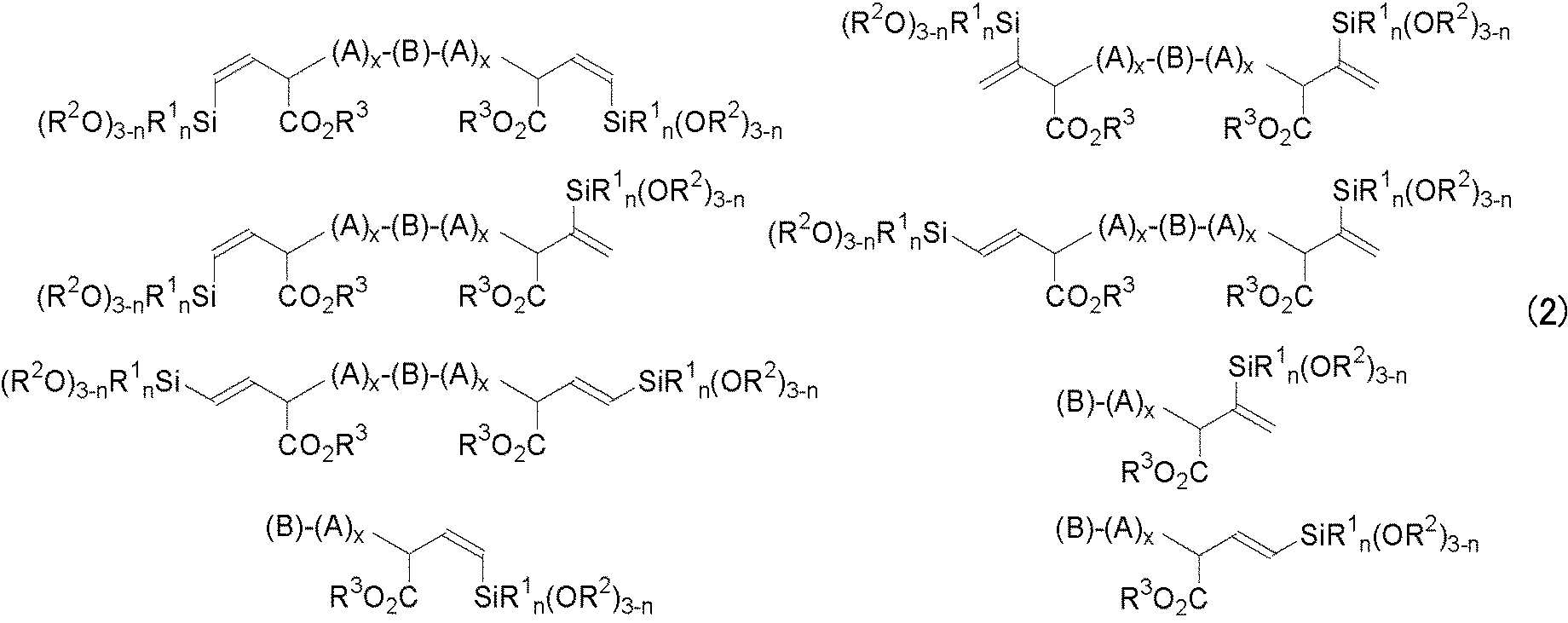
(式中、R1、R2、nの定義は上記式(1)と同じ。R3はメチル基、エチル基、ブチル基、2-メトキシエチル基またはステアリル基を示す。(A)はビニル系モノマー(A)由来の繰り返し単位、(B)は開始剤残基、xは正の整数をそれぞれ示す。)
原料の入手性、重合体末端の反応性の高さから、R1はメチル基、またはエチル基が好ましく、R2は水素原子、メチル基、またはエチル基が好ましく、nは0または1が好ましい。R3はエチル、ブチル(n-ブチル、イソブチル、tert-ブチル)、または2-メトキシエチルが好ましい。
なお、CO2R3は、ビニル系モノマー(A)由来の基である。
なお、CO2R3は、ビニル系モノマー(A)由来の基である。
(硬化性組成物)
本発明はまた、本発明の加水分解性シリル基を有するビニル系重合体を含む硬化性組成物に関する。
本発明の末端に加水分解性シリル基を有するビニル系重合体に、目的の用途物性に応じて、その他の樹脂・重合体、充填材、可塑剤、安定剤、硬化触媒・硬化剤、配合剤等を混合し、本発明の硬化性組成物を得ることができる。
本発明はまた、本発明の加水分解性シリル基を有するビニル系重合体を含む硬化性組成物に関する。
本発明の末端に加水分解性シリル基を有するビニル系重合体に、目的の用途物性に応じて、その他の樹脂・重合体、充填材、可塑剤、安定剤、硬化触媒・硬化剤、配合剤等を混合し、本発明の硬化性組成物を得ることができる。
その他の樹脂、重合体としては、この限りではないが以下に挙げるものがある。ポリエーテル系重合体、本発明以外のビニル系重合体など。
充填材としてはこの限りではないが以下に挙げるものがある。炭酸カルシウム、シリカ、カーボンブラック、酸化チタン、タルクなど。
可塑剤としてはこの限りではないが以下に挙げるものがある。フタレート酸エステル系化合物、非芳香族二塩基酸エステル類、燐酸エステル類、ポリエーテルポリオール、エポキシ基含有可塑剤、ポリエステル系可塑剤、ビニル系重合体など。
安定剤としてはこの限りではないが以下に挙げるものがある。チオエーテル系酸化防止剤、リン系酸化防止剤、ヒンダードフェノール系酸化防止剤などの酸化防止剤や、紫外線吸収剤やヒンダードアミン系光安定剤、ベンゾエート系光安定剤などの耐光安定剤。
各種硬化触媒・硬化剤としてはこの限りではないが以下に挙げるものがある。ジアルキル錫の分子内配位性誘導体類、ジアルキル錫化合物のオキシ誘導体などの4価の錫化合物類、オクチル酸錫などの2価錫。
配合剤としてはこの限りではないが脱水剤、シランカップリング剤などの接着性付与剤、チクソ性付与剤が挙げられる。
本発明の硬化性組成物の具体的な用途として、シーリング材、接着剤、粘着材、弾性接着剤、塗料、粉体塗料、発泡体、電気電子用ポッティング材、フィルム、成形材料、人工大理石等を挙げることができる。
本発明の硬化性組成物の具体的な用途として、シーリング材、接着剤、粘着材、弾性接着剤、塗料、粉体塗料、発泡体、電気電子用ポッティング材、フィルム、成形材料、人工大理石等を挙げることができる。
以下に、本発明の具体的な実施例を示すが、本発明は、下記実施例に限定されるものではない。
下記実施例および比較例中、「部」および「ppm」は、それぞれ「重量部」、および「重量百万分率」を表す。
「数平均分子量」および「分子量分布(重量平均分子量と数平均分子量の比)」は、ゲルパーミエーションクロマトグラフィー(GPC)を用いた標準ポリスチレン換算法により算出した。ただし、GPCカラムとしてポリスチレン架橋ゲルを充填したもの(shodex GPC K-804;昭和電工(株)製)を、GPC溶媒としてクロロホルムを用いた。
下記実施例および比較例中、「部」および「ppm」は、それぞれ「重量部」、および「重量百万分率」を表す。
「数平均分子量」および「分子量分布(重量平均分子量と数平均分子量の比)」は、ゲルパーミエーションクロマトグラフィー(GPC)を用いた標準ポリスチレン換算法により算出した。ただし、GPCカラムとしてポリスチレン架橋ゲルを充填したもの(shodex GPC K-804;昭和電工(株)製)を、GPC溶媒としてクロロホルムを用いた。
重合体中の臭素含有量分析にはICPMS(誘導結合プラズマ質量分析)または蛍光X線分析装置を使用した。
また、試薬は、工業化を意識して、大量生産されているものを入手後、精製等の処理を一切行なわずに反応に用いた。
(製造例1)
アクリル酸n-ブチル200g、変性エタノール81.6g(日本アルコール販売株式会社製AS-1(エタノール85.5重量%、酢酸エチル13.4重量%、2-プロパノール1.1重量%からなる混合溶剤))、2,5-ジブロモアジピン酸ジエチル17.6gをジャケット付攪拌反応装置(1)に入れ、窒素バブリングをしつつ、30分間攪拌を実施し均一溶液とした。
アクリル酸n-ブチル200g、変性エタノール81.6g(日本アルコール販売株式会社製AS-1(エタノール85.5重量%、酢酸エチル13.4重量%、2-プロパノール1.1重量%からなる混合溶剤))、2,5-ジブロモアジピン酸ジエチル17.6gをジャケット付攪拌反応装置(1)に入れ、窒素バブリングをしつつ、30分間攪拌を実施し均一溶液とした。
別の攪拌容器(2)を用意し、その容器内で第二臭化銅(CuBr2)28mg、ヘキサメチルトリス(2-アミノエチル)アミン(Me6TREN)29mg、トリエチルアミン13mg、変性エタノール(AS-1)0.97gを仕込み、窒素気流下で均一溶液になるまで攪拌を行った。
さらに別の攪拌容器(3)を用意し、その容器内で変性エタノール(AS-1)100g、アスコルビン酸15g、トリエチルアミン17.2gを窒素気流下で30分間攪拌し、均一溶液とした。
ジャケット付攪拌反応装置(1)に攪拌容器(2)の溶液を入れ10分間攪拌を行い、ジャケット付攪拌反応装置(1)のジャケット温度を70℃に設定し、内温が65℃以上になったところで攪拌容器(3)の溶液を滴下開始することで、重合反応を開始した。
1時間にアスコルビン酸28mgがジャケット付攪拌反応装置(1)に添加されるように攪拌容器(3)で調製したアスコルビン酸溶液を断続的に滴下した。重合反応が開始し、重合熱によってジャケット付攪拌反応装置(1)の内温が75℃に到達した時点で、別途、30分間窒素バブリングを実施していたアクリル酸ブチル800gの滴下を開始した。滴下速度は、90分間でアクリル酸n-ブチル全量(800g)が丁度、ジャケット付攪拌反応装置(1)に滴下されるように調整した。このとき添加した全モノマーモル量(M)は開始剤(この場合2,5-ジブロモアジピン酸ジエチル)モル量(I)の160等量に相当する(以後、M/I=160と記載する)。
1時間にアスコルビン酸28mgがジャケット付攪拌反応装置(1)に添加されるように攪拌容器(3)で調製したアスコルビン酸溶液を断続的に滴下した。重合反応が開始し、重合熱によってジャケット付攪拌反応装置(1)の内温が75℃に到達した時点で、別途、30分間窒素バブリングを実施していたアクリル酸ブチル800gの滴下を開始した。滴下速度は、90分間でアクリル酸n-ブチル全量(800g)が丁度、ジャケット付攪拌反応装置(1)に滴下されるように調整した。このとき添加した全モノマーモル量(M)は開始剤(この場合2,5-ジブロモアジピン酸ジエチル)モル量(I)の160等量に相当する(以後、M/I=160と記載する)。
アスコルビン酸溶液を断続的に滴下しつつも、適宜ジャケット操作により、80℃以下になるように内温調整をし、アクリル酸n-ブチルの反応率が98モル%に達したところで、反応容器内を減圧にし、揮発分を除去して重合体[1]を得た。
この重合体[1]300g、酢酸ブチル300gを混合し、均一ドープ溶液とした。この溶液にキョーワード500SH(協和化学工業株式会社製)3g、キョーワード700SEN-S(協和化学工業株式会社製)3gを添加し、ジャケット付攪拌装置に入れて、窒素雰囲気下100℃条件下で攪拌を実施した。室温まで溶液温度を降下させてから、フィルター濾過を実施し、溶剤を減圧除去し、重合体[1]の精製を終了した。
このときの重合体[1]の数平均分子量は23000で、分子量分布は1.25であった。1H-NMR分析より求めた重合体[1]1分子あたりの臭素末端の個数は1.7個であった。
(実施例1)
(製造例1)で得た精製済み重合体[1]50g、変性エタノール(AS-1)50g、ビニルトリメトキシシラン(A171;モメンティブ・パフォーマンス・マテリアルズ社製)8gを混合し、均一溶液とし、ジャケット付攪拌装置(4)に入れ、30分間窒素バブリングをしながら攪拌した。
(製造例1)で得た精製済み重合体[1]50g、変性エタノール(AS-1)50g、ビニルトリメトキシシラン(A171;モメンティブ・パフォーマンス・マテリアルズ社製)8gを混合し、均一溶液とし、ジャケット付攪拌装置(4)に入れ、30分間窒素バブリングをしながら攪拌した。
(製造例1)の攪拌装置(2)で調製した銅溶液と同じ組成比の銅溶液1.95gを攪拌装置(4)に入れて10分間攪拌した。窒素雰囲気下、攪拌装置(4)の内温が65℃から70℃になるようにジャケット温調を調整しつつ、(製造例1)の攪拌装置(3)で調製したアスコルビン酸溶液と同じ組成比の溶液を再度用意し、1時間にアスコルビン酸245mgが攪拌装置(4)に入るようにアスコルビン酸溶液を断続的に滴下した。アスコルビン酸溶液の滴下は2時間で終了し、その30分後に攪拌装置を減圧にし、溶剤、未反応のビニルトリメトキシシランを留去し、重合体[2]を得た。
加水分解性シリル基を有する重合体[2]を得るまでに必要な工程数は(製造例1)での1工程を含めて2工程であった。
加水分解性シリル基を有する重合体[2]を得るまでに必要な工程数は(製造例1)での1工程を含めて2工程であった。
この重合体[2]50g、酢酸ブチル50gを混合し、均一ドープ溶液とした。この溶液にキョーワード500SH(KW500SH;協和化学工業株式会社製)0.5g、キョーワード700SEN-S(KW700SEN-S;協和化学工業株式会社製)0.5gを添加し、ジャケット付攪拌装置に入れて、窒素雰囲気下100℃条件下で攪拌を実施した。室温まで溶液温度を降下させてから、フィルター濾過を実施し、溶剤を減圧除去し、第1段目の重合体[2]の精製を完了した。
さらにメタノール30gにこの重合体[2]を溶解させ、再沈殿精製を実施した。再沈操作により分別したメタノール溶液と同重量のメタノールを新たに重合体溶液に加える再沈殿精製を合計3回実施し、最後にメタノールを減圧除去し、第2段目の重合体[2]の精製を完了し、重合体[2]の精製を終了した。
このときの重合体[2]の数平均分子量は33000で、分子量分布は1.38であった。1H-NMR分析より求めた重合体[2]1分子あたりのトリメトキシシリル末端の個数は1.9個であった。蛍光X線分析装置で臭素量を分析したところ、重合体[2]中に1800ppm含まれていることが判明した。
(実施例2)
(製造例1)で得た精製済み重合体[1]100g、変性エタノール(AS-1)100g、ビニルトリメトキシシラン(A171;モメンティブ・パフォーマンス・マテリアルズ社製)24.3gを混合し、均一溶液とし、ジャケット付攪拌装置(5)に入れ、30分間窒素バブリングをしながら攪拌した。
(製造例1)の攪拌装置(2)で調製した銅溶液と同じ組成の銅溶液1.2gを攪拌装置(5)に入れて10分間攪拌した。窒素雰囲気下、攪拌装置(5)の内温が65℃から70℃になるようにジャケット温調を調整しつつ、(製造例1)の攪拌装置(3)で調製したアスコルビン酸溶液と同じ溶液を再度用意し、1時間にアスコルビン酸100mgが攪拌装置(5)に入るようにアスコルビン酸溶液を断続的に滴下した。アスコルビン酸溶液の滴下は6時間で終了し、その3時間後に攪拌装置を減圧にし、溶剤、未反応のビニルトリメトキシシランを留去し、重合体[3]を得た。
加水分解性シリル基を有する重合体[3]を得るまでに必要な工程数は(製造例1)での1工程を含めて2工程であった。
(製造例1)で得た精製済み重合体[1]100g、変性エタノール(AS-1)100g、ビニルトリメトキシシラン(A171;モメンティブ・パフォーマンス・マテリアルズ社製)24.3gを混合し、均一溶液とし、ジャケット付攪拌装置(5)に入れ、30分間窒素バブリングをしながら攪拌した。
(製造例1)の攪拌装置(2)で調製した銅溶液と同じ組成の銅溶液1.2gを攪拌装置(5)に入れて10分間攪拌した。窒素雰囲気下、攪拌装置(5)の内温が65℃から70℃になるようにジャケット温調を調整しつつ、(製造例1)の攪拌装置(3)で調製したアスコルビン酸溶液と同じ溶液を再度用意し、1時間にアスコルビン酸100mgが攪拌装置(5)に入るようにアスコルビン酸溶液を断続的に滴下した。アスコルビン酸溶液の滴下は6時間で終了し、その3時間後に攪拌装置を減圧にし、溶剤、未反応のビニルトリメトキシシランを留去し、重合体[3]を得た。
加水分解性シリル基を有する重合体[3]を得るまでに必要な工程数は(製造例1)での1工程を含めて2工程であった。
この重合体[3]100gをメタノール60gに溶解させ、再沈殿精製を実施した。再沈操作により分別したメタノール溶液と同重量のメタノールを新たに重合体溶液に加える再沈殿精製を合計3回実施し、最後にメタノールを減圧除去し、第2段目の重合体[3]の精製を完了し、重合体[3]の精製を終了した。
このときの重合体[3]の数平均分子量は30000で、分子量分布は1.40であった。1H-NMR分析より求めた重合体[3]1分子あたりのトリメトキシシリル末端の個数は3.0個であった。ICPMSで重合体中の臭素量を分析したところ、2749ppmであった。
このときの重合体[3]の数平均分子量は30000で、分子量分布は1.40であった。1H-NMR分析より求めた重合体[3]1分子あたりのトリメトキシシリル末端の個数は3.0個であった。ICPMSで重合体中の臭素量を分析したところ、2749ppmであった。
(実施例3)
アクリル酸n-ブチル200g、変性エタノール89.9g(日本アルコール販売株式会社製AS-1)、トリエチルアミン0.19g、2-ブロモイソ酪酸エチル19.0gをジャケット付攪拌反応装置(6)に入れ、窒素バブリングをしながら30分間攪拌を実施し均一溶液とした。
アクリル酸n-ブチル200g、変性エタノール89.9g(日本アルコール販売株式会社製AS-1)、トリエチルアミン0.19g、2-ブロモイソ酪酸エチル19.0gをジャケット付攪拌反応装置(6)に入れ、窒素バブリングをしながら30分間攪拌を実施し均一溶液とした。
(製造例1)の攪拌装置(2)で調製した銅溶液と同じ組成比の銅溶液1.95gを攪拌装置(6)に入れて10分間攪拌した。窒素雰囲気下、攪拌装置(6)のジャケット温度を70℃に設定し、(製造例1)の攪拌装置(3)で調製したアスコルビン酸溶液と同じ組成比の溶液を再度用意し、アスコルビン酸溶液を滴下することで重合反応を開始した。1時間にアスコルビン酸32mgが攪拌装置(6)に入るようにアスコルビン酸溶液を断続的に滴下していくことで重合を進行させ、重合熱によって攪拌装置(6)の内温が75℃に到達した時点で、別途、30分間窒素バブリングを実施していたアクリル酸n-ブチル800gの滴下を開始した。滴下速度は、90分間でアクリル酸n-ブチル全量(800g)が丁度、攪拌装置(6)に滴下されるように調整した。
アスコルビン酸溶液を断続的に滴下しつつも、適宜ジャケット操作により、80℃以下になるように内温調整をし、アクリル酸n-ブチルの反応率が98モル%に達したところで、反応容器内を減圧にし、揮発分を除去し、重合体[4]を得た。重合体[4]を得るまでに添加したアスコルビン酸量は全モノマー仕込み重量に対して154ppmであった(M/I=160)。
このときの重合体[4]の数平均分子量は11909で、分子量分布は1.21であった。1H-NMR分析より求めた重合体[4]1分子あたりの臭素末端の個数は0.8個であった。
次に攪拌反応装置(6)に別途、30分間窒素バブリングしていた変性エタノール250g、ビニルトリメトキシシラン217g、トリエチルアミン0.15g、(製造例1)の攪拌装置(2)で調製した銅溶液と同じ組成比の銅溶液を10.4g入れ、均一溶液になるまで十分に窒素気流下で混合した。攪拌装置内のポリマー溶液の温度が65℃~70℃になるようにジャケットの温調を調節し、1時間にアスコルビン酸1000mgが攪拌反応装置(6)に入るように(製造例1)の攪拌装置(3)で調製したアスコルビン酸溶液を断続的に滴下した。5.5時間後にアスコルビン酸溶液の滴下を終了し、反応容器内を減圧にし、揮発分を除去し重合体[5]を得た。5.5時間の間に添加したアスコルビン酸量の総量は全モノマー仕込み量に対して5637ppmであった。
重合体[5](100部)を100部の酢酸ブチルに溶解させ、キョーワード500SH(1部)、キョーワード500SEN-S(1部)と共にジャケット付攪拌装置に入れ、重合体溶液の温度が100℃になるように温調して窒素雰囲気下で30分間攪拌した。その後、濾過助剤R100S(1部;昭和化学工業株式会社製)と共にフィルター濾過を行い、固液を分離した。得られたポリマー溶液の揮発分をエバポレーターで減圧除去して、精製した重合体[5]を得た。
このときの重合体[5]の数平均分子量は11870で、分子量分布は1.17であった。1H-NMR分析より求めた重合体[5]1分子あたりのトリメトキシシリル末端の個数は2.0個であった。加水分解性シリル基を有する重合体[5]を得るまでに必要な工程数は1工程であった。
(実施例4)
未精製の重合体[5]に対し、酢酸ブチルの代わりにメタノール100部を使用し、重合体溶液の温度が55℃になるように温調した以外は、(実施例3)と同様の手順で精製を実施した。
未精製の重合体[5]に対し、酢酸ブチルの代わりにメタノール100部を使用し、重合体溶液の温度が55℃になるように温調した以外は、(実施例3)と同様の手順で精製を実施した。
このときの重合体[5]の数平均分子量は11465で、分子量分布は1.13であった。1H-NMR分析より求めた重合体[5]1分子あたりのトリメトキシシリル末端の個数は2.0個であった。加水分解性シリル基を有する重合体[5]を得るまでに必要な工程数は1工程であった。
(比較例1)
還流管および攪拌機付きの2Lのセパラブルフラスコに、CuBr(8.4g、58.5mmol)を仕込み、反応容器内を窒素置換した。アセトニトリル(88g)を加え、オイルバス中70℃で30分間攪拌した。これにアクリル酸n-ブチル(200g)、2、5-ジブロモアジピン酸ジエチル(17.6g、48.8mmol)、ペンタメチルジエチレントリアミン(0.407mL、0.338g、2.0mmol)(これ以降トリアミンと表す)を加え、反応を開始した。70℃で加熱攪拌しながら、アクリル酸n-ブチル(800g)を連続的に滴下した。アクリル酸n-ブチルの滴下途中にトリアミンを追加した。
還流管および攪拌機付きの2Lのセパラブルフラスコに、CuBr(8.4g、58.5mmol)を仕込み、反応容器内を窒素置換した。アセトニトリル(88g)を加え、オイルバス中70℃で30分間攪拌した。これにアクリル酸n-ブチル(200g)、2、5-ジブロモアジピン酸ジエチル(17.6g、48.8mmol)、ペンタメチルジエチレントリアミン(0.407mL、0.338g、2.0mmol)(これ以降トリアミンと表す)を加え、反応を開始した。70℃で加熱攪拌しながら、アクリル酸n-ブチル(800g)を連続的に滴下した。アクリル酸n-ブチルの滴下途中にトリアミンを追加した。
モノマー反応率が96%に達した時点で残モノマー、アセトニトリルを70℃で脱揮し、重合体[6]を得た(M/I=160)。重合体[6]の数平均分子量は23800、分子量分布は1.23であった。1H-NMR分析より求めた重合体[6]1分子あたりの臭素末端の個数は1.7個であった。重合体[6]中に含まれる臭素量は元素分析の結果、重合体1kgに対し4900mgであった。重合中に滴下したトリアミン量は合計で1.52gであった。
重合体[6]に対して、エチレン性不飽和基含有化合物である1,7-オクタジエン(144mL、107g、975mmol)を添加し、更にアセトニトリル(264.1g)を加え、トリアミン3.38gを追加し、引き続き70℃で加熱攪拌した。本反応で重合体[6]の末端にエチレン性不飽和基が導入される。
反応混合物を加熱脱揮し、トルエン100部に希釈し、混合物を活性アルミナのカラムに通すことで重合触媒を除去した。重合体溶液を濃縮し、重合体に対して100部のメチルシクロヘキサンに溶解させ、吸着剤4部(キョーワード500SH 2部/キョーワード700SL 2部:共に協和化学(株)製)を加え、酸素・窒素混合ガス雰囲気下で加熱攪拌した。不溶分を除去し、重合体溶液を濃縮することで精製した重合体[7]を得た。重合体[7]の数平均分子量は23800、分子量分布は1.23であった。重合体[7]中に含まれる臭素量はICPMS分析の結果、4900ppmであった。1H-NMR分析より、重合体[6]1分子あたりに導入されたエチレン性不飽和基の個数は2.0個であった。
重合体[7]を180℃で6時間加熱脱揮(減圧度10torr以下)することにより臭素量が低減されたエチレン性不飽和基含有ポリアクリル酸n-ブチルを得た。重合体中に含まれる臭素量はICPMS分析の結果、370ppmであった。数平均分子量は24100、分子量分布は1.25であった。
このエチレン性不飽和基含有ポリアクリル酸n-ブチルに、ジメトキシメチルシラン2.6g(エチレン性不飽和基に対して3モル当量)、オルトギ酸メチル0.85g(エチレン性不飽和基に対して3モル当量)、白金触媒[ビス(1,3-ジビニル-1,1,3,3-テトラメチルジシロキサン)白金錯体触媒のキシレン溶液0.04g:以下白金触媒という](白金として重合体1kgに対して10mg)を混合し、窒素雰囲気下、80℃で1時間加熱攪拌した。エチレン性不飽和基が消失したことを1H-NMR分析により確認し、反応混合物を濃縮して加水分解性シリル基であるジメトキシシリル基を含有する重合体[8]を得た。数平均分子量は26600、分子量分布は1.41であった。
加水分解性シリル基を有する重合体[8]を得るまでに必要な工程数は、重合とエチレン性不飽和基導入反応を1工程、ヒドロシリル化前に実施する吸着剤と濾過による精製工程を1工程、加熱による脱臭素工程を1工程、ヒドロシリル化工程を1工程と数えると合計で4工程となる。なお、ヒドロシリル化反応を完結させるためには、吸着剤と濾過による精製工程、脱臭素工程は必須であり、加水分解性シリル基を有する重合体[8]を得るまでに必要な工程数としてカウントしている。
(実施例5)
アクリル酸n-ブチル200g、変性エタノール81.6g(日本アルコール販売株式会社製AS-1)、2,5-ジブロモアジピン酸ジエチル35.1gをジャケット付攪拌反応装置(1)に入れ、窒素バブリングをしつつ、30分間攪拌を実施し均一溶液とした。
アクリル酸n-ブチル200g、変性エタノール81.6g(日本アルコール販売株式会社製AS-1)、2,5-ジブロモアジピン酸ジエチル35.1gをジャケット付攪拌反応装置(1)に入れ、窒素バブリングをしつつ、30分間攪拌を実施し均一溶液とした。
攪拌容器(2)を用意し、その容器内で第二臭化銅(CuBr2)53mg、ヘキサメチルトリス(2-アミノエチル)アミン(Me6TREN)54mg、トリエチルアミン24mg、変性エタノール(AS-1)1.82gを仕込み、窒素気流下で均一溶液になるまで攪拌を行った。
さらに攪拌容器(3)を用意し、その容器内で変性エタノール(AS-1)100g、アスコルビン酸15g、トリエチルアミン17.2gを窒素気流下で30分間攪拌し、均一溶液とした。
ジャケット付攪拌反応装置(1)に攪拌容器(2)の内容物を入れ、10分間攪拌を行い、ジャケット付攪拌反応装置(1)のジャケット温度を70℃に設定し、内温が65℃以上になったところで攪拌容器(3)の溶液を滴下開始することで、重合反応を開始した。
1時間にアスコルビン酸29mgがジャケット付攪拌反応装置(1)に入るように攪拌容器(3)で調製したアスコルビン酸溶液を断続的に滴下した。重合反応が開始し、重合熱によってジャケット付攪拌反応装置(1)の内温が75℃に到達した時点で、別途、30分間窒素バブリングを実施していたアクリル酸ブチル800gの滴下を開始した。滴下速度は、90分間でアクリル酸n-ブチル全量(800g)が丁度、ジャケット付攪拌反応装置(1)に滴下されるように調整した(M/I=80)。
1時間にアスコルビン酸29mgがジャケット付攪拌反応装置(1)に入るように攪拌容器(3)で調製したアスコルビン酸溶液を断続的に滴下した。重合反応が開始し、重合熱によってジャケット付攪拌反応装置(1)の内温が75℃に到達した時点で、別途、30分間窒素バブリングを実施していたアクリル酸ブチル800gの滴下を開始した。滴下速度は、90分間でアクリル酸n-ブチル全量(800g)が丁度、ジャケット付攪拌反応装置(1)に滴下されるように調整した(M/I=80)。
アスコルビン酸溶液を断続的に滴下しつつも、適宜ジャケット操作により、80℃以下になるように内温調整をし、アクリル酸n-ブチルの反応率が97モル%に達したところで、アスコルビン酸滴下を一旦終了した。それまでに添加したアスコルビン酸量は全モノマー仕込み重量に対して182ppmであった。
次に30分間窒素バブリングを行ったビニルジメトキメチルシシラン193.4g、銅触媒溶液13.65g(攪拌容器(2)で調製した銅触媒溶液と同組成)、トリエチルアミン0.24gを10分間混合攪拌し、均一溶液とした。窒素雰囲気下、ジャケット付攪拌反応装置(1)の内温が60℃~80℃になるようにジャケット温調を調整しつつ、(製造例1)の攪拌装置(3)で調製したアスコルビン酸溶液と同じ組成比の溶液を再度用意し、1時間にアスコルビン酸1000mgがジャケット付攪拌反応装置(1)に入るようにアスコルビン酸溶液を断続的に滴下した。アスコルビン酸溶液の滴下は7時間で終了し、その30分後に6vol%酸素を含む窒素ガスを反応溶液に封入し、20分間、60℃~80℃で加熱攪拌し、銅触媒を完全に失活させた。エタノール溶液として重合体[9]を得た。
加水分解性シリル基を有する重合体[9]を得るまでに必要な工程数は1工程であった。
加水分解性シリル基を有する重合体[9]を得るまでに必要な工程数は1工程であった。
このエタノール溶液に変性エタノール(AS-1)918.4gを追加混合し、均一エタノール溶液とした。この溶液にキョーワード500SH(KW500SH;協和化学工業株式会社製)20g、キョーワード700SEN-S(KW700SEN-S;協和化学工業株式会社製)20gを添加し、ジャケット付攪拌装置に入れて、窒素雰囲気下80℃条件下で1時間加熱攪拌した。その後、室温まで溶液温度を降下させてから、フィルター濾過を実施し、溶剤を減圧除去し、重合体[9]の精製を完了した。
このときの重合体[9]の数平均分子量は15130で、分子量分布は1.45であった。1H-NMR分析より求めた重合体[9]1分子あたりのメチルジメトキシシリル末端の個数は0.7個であった。
(比較例2)
還流管および攪拌機付きの2Lのセパラブルフラスコに、CuBr(8.4g、58.5mmol)を仕込み、反応容器内を窒素置換した。アセトニトリル(88g)を加え、オイルバス中70℃で30分間攪拌した。これにアクリル酸n-ブチル(200g)、2、5-ジブロモアジピン酸ジエチル(35.1g、97.5mmol)、ペンタメチルジエチレントリアミン(1.63mL、1.35g、8.0mmol)(これ以降トリアミンと表す)を加え、反応を開始した。70℃で加熱攪拌しながら、アクリル酸n-ブチル(800g)を連続的に滴下した。アクリル酸n-ブチルの滴下途中にトリアミンを追加した。
還流管および攪拌機付きの2Lのセパラブルフラスコに、CuBr(8.4g、58.5mmol)を仕込み、反応容器内を窒素置換した。アセトニトリル(88g)を加え、オイルバス中70℃で30分間攪拌した。これにアクリル酸n-ブチル(200g)、2、5-ジブロモアジピン酸ジエチル(35.1g、97.5mmol)、ペンタメチルジエチレントリアミン(1.63mL、1.35g、8.0mmol)(これ以降トリアミンと表す)を加え、反応を開始した。70℃で加熱攪拌しながら、アクリル酸n-ブチル(800g)を連続的に滴下した。アクリル酸n-ブチルの滴下途中にトリアミンを追加した。
モノマー反応率が95%に達した時点で残モノマー、アセトニトリルを70℃で脱揮し、重合体[10]を得た(M/I=80)。重合体[10]の数平均分子量は11790、分子量分布は1.08であった。1H-NMR分析より求めた重合体[10]1分子あたりの臭素末端の個数は2.0個であった。
重合体[10]に対して、エチレン性不飽和基含有化合物である1,7-オクタジエン(288mL、215g、1950mmol)を添加し、更にアセトニトリル(351.7g)を加え、トリアミン6.76gを追加し、引き続き70℃で加熱攪拌した。本反応で重合体[10]の末端にエチレン性不飽和基が導入される。
反応混合物を6vol%酸素・窒素混合ガス雰囲気下で4時間、80℃で加熱攪拌した。その後、80℃で脱揮し、酢酸ブチル100部に希釈し、溶剤混合物を濾過助剤(ラジオライト)1部のカラムに通すことで重合触媒を除去した。
次に、吸着剤2部(20g)(キョーワード500SH 1部;10g/キョーワード700SL 1部;10g:共に協和化学(株)製)を加え、80℃で1時間攪拌し、フィルター濾過することで、不溶固形分を除去した。本吸着処理操作をもう一度繰返した後、得られた重合体溶液を減圧濃縮し、重合体[11]を得た。このときの重合体[11]の数平均分子量は12620、分子量分布は1.15であった。
重合体[11]を吸着剤1.1部(11g)(キョーワード500SH 1部;10g/キョーワード700SL 0.1部;1g:共に協和化学(株)製)と共に190℃で2時間加熱脱揮(減圧度10torr以下)し、続いて、酢酸ブチル100部(1000g)、吸着剤1.1部(11g)(キョーワード500SH 1部;10g/キョーワード700SL 0.1部;1g:共に協和化学(株)製)を混合攪拌し、185℃で6時間加熱攪拌し、室温まで冷却し、フィルター濾過することにより臭素量が低減されたエチレン性不飽和基含有ポリアクリル酸n-ブチルを得た。
このエチレン性不飽和基含有ポリアクリル酸n-ブチルに、ジメトキシメチルシラン3.5g(エチレン性不飽和基に対して2モル当量)、オルトギ酸メチル0.88g(エチレン性不飽和基に対して0.5モル当量)、白金触媒[ビス(1,3-ジビニル-1,1,3,3-テトラメチルジシロキサン)白金錯体触媒のキシレン溶液0.04g:以下白金触媒という](白金として重合体1kgに対して10mg)を混合し、窒素雰囲気下、115℃で1時間加熱攪拌した。エチレン性不飽和基が消失したことを1H-NMR分析により確認し、反応混合物を濃縮して加水分解性シリル基であるジメトキシシリル基を含有する重合体[12]を得た。数平均分子量は12700、分子量分布は1.17であった。
加水分解性シリル基を有する重合体[12]を得るまでに必要な工程数は、重合とエチレン性不飽和基導入反応、6vol%酸素・窒素混合ガス雰囲気下での加熱攪拌を1工程、濾過助剤と共に加熱攪拌し、濾過し、続いて吸着剤と共に加熱攪拌し、濾過する工程を1工程、185℃、190℃加熱による脱臭素工程を1工程、ヒドロシリル化工程を1工程と数えると合計で4工程となる。なお、ヒドロシリル化反応を完結させるためには、濾過助剤、吸着剤と共に濾過する工程、高温(185℃、190℃)での脱臭素工程は必須であり、加水分解性シリル基を有する重合体[12]を得るまでに必要な工程数としてカウントしている。


表1に示すように、加水分解性シリル基を有する重合体(M/I=160)を得るまでに必要な工程数は、実施例1、2、3、4は比較例1よりも少なく、本発明のビニル系重合体を製造するプロセスは生産性に優れる製造工程であるといえる。
また精製、脱臭素プロセスを経ていない重合体中の臭素含有量を比較すると、実施例1、2は1800ppm、2749ppmであり、比較例1は4900ppmである。中でも、ICPMSで測定した実施例2と比較例1との比較から、特別な脱臭素、精製を実施しなくても、開始剤由来の臭素をビニル系重合体から脱離できることが分かった。
また、脱揮後のビニル系重合体(重合体[2]、[3]、[5]、[9])を1H-NMRで分析したところ、末端構造に不飽和二重結合(C=C)が存在していることを確認した。
これらの結果から、モノマー(C)がビニル系重合体(P)の末端と反応した後、開始剤由来の末端臭素がHX又はR4Xとしてビニル系重合体より脱離していると推定される。
また、脱揮後のビニル系重合体(重合体[2]、[3]、[5]、[9])を1H-NMRで分析したところ、末端構造に不飽和二重結合(C=C)が存在していることを確認した。
これらの結果から、モノマー(C)がビニル系重合体(P)の末端と反応した後、開始剤由来の末端臭素がHX又はR4Xとしてビニル系重合体より脱離していると推定される。
表1、表2に示すように1kgあたりのモノマー仕込み量に対して、使用する副原料量を比較すると、実施例3,4の方が比較例1よりも大幅に少なくて済み、本発明のビニル系重合体を製造するプロセスは廃棄物減量削減の点において有効な製造プロセスである。
(M/I=80の場合)
表1に示すように加水分解性シリル基を有する重合体(M/I=80)を得るまでに必要な工程数は、実施例5は比較例2よりも少なく、本発明のビニル系重合体を製造するプロセスは生産性に優れる製造工程であるといえる。
表1に示すように加水分解性シリル基を有する重合体(M/I=80)を得るまでに必要な工程数は、実施例5は比較例2よりも少なく、本発明のビニル系重合体を製造するプロセスは生産性に優れる製造工程であるといえる。
表1、表2に示すように1kgあたりのモノマー仕込み量に対して、使用する副原料量を比較すると、実施例5の方が比較例2よりも大幅に少なくて済み、本発明のビニル系重合体を製造するプロセスは廃棄物減量削減の点において有効な製造プロセスである。
Claims (10)
- 炭素-ハロゲン結合を有する開始剤(B)を用いたビニル系モノマー(A)のリビング重合体であるビニル系重合体(P)の末端に、加水分解性シリル基を有するビニル系モノマー(C)由来の構造を有するとともに、
開始剤(B)由来のハロゲン原子が重合体から脱離した構造を有することを特徴とする末端に加水分解性シリル基を有するビニル系重合体。 - リビング重合体が、原子移動ラジカル重合体であることを特徴とする請求項1に記載の末端に加水分解性シリル基を有するビニル系重合体。
- ビニル系重合体(P)が、(メタ)アクリル酸エステル系重合体であることを特徴とする請求項1または2に記載の末端に加水分解性シリル基を有するビニル系重合体。
- 炭素-ハロゲン結合を有する開始剤(B)が、ジエチル2,5-ジブロモアジペートまたは2-ブロモイソ酪酸エチルであることを特徴とする請求項1~3のいずれかに記載の末端に加水分解性シリル基を有するビニル系重合体。
- 加水分解性シリル基が、下記一般式(1)で示される加水分解性シリル基である請求項1~4のいずれかに記載の末端に加水分解性シリル基を有するビニル系重合体。
―Si(R1)n(OR2)3-n (1)
(式中、R1は炭素数1~8のアルキル基、アリール基またはアラルキル基、R2は水素または炭素数1~8のアルキル基、アリール基もしくはアラルキル基、nは0~2の整数を示す。) - 加水分解性シリル基を有するビニル系モノマー(C)が、下記一般式(3)で示される構造を有することを特徴とする請求項1~5のいずれかに記載の末端に加水分解性シリル基を有するビニル系重合体。

- 加水分解性シリル基を有するビニル系モノマー(C)が、ビニルトリメトキシシラン、または、ビニルジメトキシメチルシランであることを特徴とする請求項1~6のいずれかに記載の末端に加水分解性シリル基を有するビニル系重合体。
- 下記一般式(2)で示される構造から選択される構造を有することを特徴とする請求項1~7のいずれかに記載の末端に加水分解性シリル基を有するビニル系重合体。

- 請求項1~8のいずれかに記載の末端に加水分解性シリル基を有するビニル系重合体を含む硬化性組成物。
- 炭素-ハロゲン結合を有する開始剤(B)を利用してビニル系モノマー(A)をリビング重合し、ビニル系重合体(P)を得る工程、および、
ビニル系重合体(P)と加水分解性シリル基を有するビニル系モノマー(C)を反応させ、ビニル系重合体(P)の末端に加水分解性シリル基を導入する工程を含む
請求項1~8のいずれかに記載の末端に加水分解性シリル基を有するビニル系重合体の製造方法。
Priority Applications (1)
| Application Number | Priority Date | Filing Date | Title |
|---|---|---|---|
| JP2016573324A JP6659593B2 (ja) | 2015-02-04 | 2016-01-29 | 末端に加水分解性シリル基を有するビニル系重合体、その製造方法、および、硬化性組成物 |
Applications Claiming Priority (2)
| Application Number | Priority Date | Filing Date | Title |
|---|---|---|---|
| JP2015-020196 | 2015-02-04 | ||
| JP2015020196 | 2015-02-04 |
Publications (1)
| Publication Number | Publication Date |
|---|---|
| WO2016125692A1 true WO2016125692A1 (ja) | 2016-08-11 |
Family
ID=56564039
Family Applications (1)
| Application Number | Title | Priority Date | Filing Date |
|---|---|---|---|
| PCT/JP2016/052598 Ceased WO2016125692A1 (ja) | 2015-02-04 | 2016-01-29 | 末端に加水分解性シリル基を有するビニル系重合体、その製造方法、および、硬化性組成物 |
Country Status (2)
| Country | Link |
|---|---|
| JP (1) | JP6659593B2 (ja) |
| WO (1) | WO2016125692A1 (ja) |
Cited By (1)
| Publication number | Priority date | Publication date | Assignee | Title |
|---|---|---|---|---|
| US11034870B2 (en) * | 2016-06-24 | 2021-06-15 | Delo Industrie Klebstoffe Gmbh & Co. Kgaa | One-component composition based on alkoxysilanes and method of joining or encapsulating components using the composition |
Citations (3)
| Publication number | Priority date | Publication date | Assignee | Title |
|---|---|---|---|---|
| JPH11130931A (ja) * | 1997-07-28 | 1999-05-18 | Kanegafuchi Chem Ind Co Ltd | 接着性硬化性組成物 |
| JP2008201881A (ja) * | 2007-02-20 | 2008-09-04 | Jsr Corp | アルカリ可溶性重合体、着色層形成用感放射線性組成物、カラーフィルタおよび液晶表示素子 |
| JP2013241541A (ja) * | 2012-05-22 | 2013-12-05 | Kaneka Corp | ビニル系重合体の製造方法 |
Family Cites Families (2)
| Publication number | Priority date | Publication date | Assignee | Title |
|---|---|---|---|---|
| JP4174330B2 (ja) * | 2002-01-21 | 2008-10-29 | 株式会社カネカ | ビニル系重合体の製造方法、ビニル系重合体及び硬化性組成物 |
| JP2011236363A (ja) * | 2010-05-12 | 2011-11-24 | Kaneka Corp | (メタ)アクリル系重合体を含む硬化性組成物 |
-
2016
- 2016-01-29 WO PCT/JP2016/052598 patent/WO2016125692A1/ja not_active Ceased
- 2016-01-29 JP JP2016573324A patent/JP6659593B2/ja active Active
Patent Citations (3)
| Publication number | Priority date | Publication date | Assignee | Title |
|---|---|---|---|---|
| JPH11130931A (ja) * | 1997-07-28 | 1999-05-18 | Kanegafuchi Chem Ind Co Ltd | 接着性硬化性組成物 |
| JP2008201881A (ja) * | 2007-02-20 | 2008-09-04 | Jsr Corp | アルカリ可溶性重合体、着色層形成用感放射線性組成物、カラーフィルタおよび液晶表示素子 |
| JP2013241541A (ja) * | 2012-05-22 | 2013-12-05 | Kaneka Corp | ビニル系重合体の製造方法 |
Cited By (1)
| Publication number | Priority date | Publication date | Assignee | Title |
|---|---|---|---|---|
| US11034870B2 (en) * | 2016-06-24 | 2021-06-15 | Delo Industrie Klebstoffe Gmbh & Co. Kgaa | One-component composition based on alkoxysilanes and method of joining or encapsulating components using the composition |
Also Published As
| Publication number | Publication date |
|---|---|
| JP6659593B2 (ja) | 2020-03-04 |
| JPWO2016125692A1 (ja) | 2017-11-16 |
Similar Documents
| Publication | Publication Date | Title |
|---|---|---|
| US7999066B2 (en) | Copper removal from ATRP products by means of addition of sulfur compounds | |
| JP5841054B2 (ja) | (メタ)アクリル系重合体の製造方法 | |
| US20090275707A1 (en) | Process for preparing halogen-free atrp products | |
| KR20110042287A (ko) | 조절된 라디칼 중합을 위한 장치 및 방법 | |
| US20100041852A1 (en) | Method for producing silyl telechelic polymers | |
| EP0976766B1 (en) | Polymers, processes for producing the same, and curable compositions produced therefrom | |
| JP6787824B2 (ja) | 加水分解性シリル基を含有するポリ(メタ)アクリレートの製造方法 | |
| KR20130139233A (ko) | 사슬 말단 부근에 수분-경화성 관능기 클러스터를 갖는 경화성 조성물 | |
| JP4857539B2 (ja) | 重合体およびその製造方法 | |
| JP6659593B2 (ja) | 末端に加水分解性シリル基を有するビニル系重合体、その製造方法、および、硬化性組成物 | |
| JP5918628B2 (ja) | ビニル系重合体の製造方法 | |
| JP4237483B2 (ja) | ビニル系重合体の製造方法 | |
| JP7516347B2 (ja) | ビニル系重合体の製造方法 | |
| JP4215121B2 (ja) | アクリル系重合体の精製方法 | |
| JP2000344831A (ja) | 重合体の処理方法 | |
| JP5231012B2 (ja) | ビニル系重合体の製造方法 | |
| JP2011231235A (ja) | ビニル系重合体の製造方法 | |
| JP2011208047A (ja) | 重合体の製造方法 | |
| JP2020164602A (ja) | 硬化性組成物および(メタ)アクリル系重合体 | |
| JP5932142B2 (ja) | ビニル系重合体の製造方法 | |
| JP5448968B2 (ja) | 重合体の製造方法 | |
| JP3957591B2 (ja) | ビニル系重合体の製造方法、官能基導入ビニル系重合体の製造方法および該製造方法により得られた官能基導入ビニル系重合体 | |
| JP5731266B2 (ja) | ビニル系重合体の製造方法 | |
| JP2013147529A (ja) | ビニル系重合体の製造方法 | |
| JP2011231236A (ja) | ビニル系重合体の製造方法 |
Legal Events
| Date | Code | Title | Description |
|---|---|---|---|
| 121 | Ep: the epo has been informed by wipo that ep was designated in this application |
Ref document number: 16746523 Country of ref document: EP Kind code of ref document: A1 |
|
| ENP | Entry into the national phase |
Ref document number: 2016573324 Country of ref document: JP Kind code of ref document: A |
|
| NENP | Non-entry into the national phase |
Ref country code: DE |
|
| 122 | Ep: pct application non-entry in european phase |
Ref document number: 16746523 Country of ref document: EP Kind code of ref document: A1 |