WO2016125570A1 - サブマージアーク溶接用フラックス - Google Patents
サブマージアーク溶接用フラックス Download PDFInfo
- Publication number
- WO2016125570A1 WO2016125570A1 PCT/JP2016/051240 JP2016051240W WO2016125570A1 WO 2016125570 A1 WO2016125570 A1 WO 2016125570A1 JP 2016051240 W JP2016051240 W JP 2016051240W WO 2016125570 A1 WO2016125570 A1 WO 2016125570A1
- Authority
- WO
- WIPO (PCT)
- Prior art keywords
- mass
- content
- flux
- amount
- less
- Prior art date
- Legal status (The legal status is an assumption and is not a legal conclusion. Google has not performed a legal analysis and makes no representation as to the accuracy of the status listed.)
- Ceased
Links
Images

Classifications
-
- B—PERFORMING OPERATIONS; TRANSPORTING
- B23—MACHINE TOOLS; METAL-WORKING NOT OTHERWISE PROVIDED FOR
- B23K—SOLDERING OR UNSOLDERING; WELDING; CLADDING OR PLATING BY SOLDERING OR WELDING; CUTTING BY APPLYING HEAT LOCALLY, e.g. FLAME CUTTING; WORKING BY LASER BEAM
- B23K35/00—Rods, electrodes, materials, or media, for use in soldering, welding, or cutting
- B23K35/22—Rods, electrodes, materials, or media, for use in soldering, welding, or cutting characterised by the composition or nature of the material
- B23K35/36—Selection of non-metallic compositions, e.g. coatings or fluxes; Selection of soldering or welding materials, conjoint with selection of non-metallic compositions, both selections being of interest
- B23K35/362—Selection of compositions of fluxes
-
- B—PERFORMING OPERATIONS; TRANSPORTING
- B23—MACHINE TOOLS; METAL-WORKING NOT OTHERWISE PROVIDED FOR
- B23K—SOLDERING OR UNSOLDERING; WELDING; CLADDING OR PLATING BY SOLDERING OR WELDING; CUTTING BY APPLYING HEAT LOCALLY, e.g. FLAME CUTTING; WORKING BY LASER BEAM
- B23K35/00—Rods, electrodes, materials, or media, for use in soldering, welding, or cutting
- B23K35/22—Rods, electrodes, materials, or media, for use in soldering, welding, or cutting characterised by the composition or nature of the material
- B23K35/36—Selection of non-metallic compositions, e.g. coatings or fluxes; Selection of soldering or welding materials, conjoint with selection of non-metallic compositions, both selections being of interest
- B23K35/3601—Selection of non-metallic compositions, e.g. coatings or fluxes; Selection of soldering or welding materials, conjoint with selection of non-metallic compositions, both selections being of interest with inorganic compounds as principal constituents
-
- B—PERFORMING OPERATIONS; TRANSPORTING
- B23—MACHINE TOOLS; METAL-WORKING NOT OTHERWISE PROVIDED FOR
- B23K—SOLDERING OR UNSOLDERING; WELDING; CLADDING OR PLATING BY SOLDERING OR WELDING; CUTTING BY APPLYING HEAT LOCALLY, e.g. FLAME CUTTING; WORKING BY LASER BEAM
- B23K9/00—Arc welding or cutting
- B23K9/18—Submerged-arc welding
-
- B—PERFORMING OPERATIONS; TRANSPORTING
- B23—MACHINE TOOLS; METAL-WORKING NOT OTHERWISE PROVIDED FOR
- B23K—SOLDERING OR UNSOLDERING; WELDING; CLADDING OR PLATING BY SOLDERING OR WELDING; CUTTING BY APPLYING HEAT LOCALLY, e.g. FLAME CUTTING; WORKING BY LASER BEAM
- B23K35/00—Rods, electrodes, materials, or media, for use in soldering, welding, or cutting
- B23K35/22—Rods, electrodes, materials, or media, for use in soldering, welding, or cutting characterised by the composition or nature of the material
- B23K35/24—Selection of soldering or welding materials proper
- B23K35/30—Selection of soldering or welding materials proper with the principal constituent melting at less than 1550°C
-
- C—CHEMISTRY; METALLURGY
- C22—METALLURGY; FERROUS OR NON-FERROUS ALLOYS; TREATMENT OF ALLOYS OR NON-FERROUS METALS
- C22C—ALLOYS
- C22C38/00—Ferrous alloys, e.g. steel alloys
-
- C—CHEMISTRY; METALLURGY
- C22—METALLURGY; FERROUS OR NON-FERROUS ALLOYS; TREATMENT OF ALLOYS OR NON-FERROUS METALS
- C22C—ALLOYS
- C22C38/00—Ferrous alloys, e.g. steel alloys
- C22C38/04—Ferrous alloys, e.g. steel alloys containing manganese
Definitions
- the present invention relates to a flux for submerged arc welding.
- Flux used for submerged arc welding is roughly classified into molten flux and fired flux according to its form.
- the melt-type flux is produced by melting and pulverizing various raw materials in an electric furnace or the like.
- the calcining flux is produced by combining various raw materials with a binder such as alkali silicate, granulating, and then calcining.
- the calcining type flux is classified according to the calcining temperature, and generally, the calcined one at 400 ° C. or more and less than 600 ° C. is called the low temperature calcining flux, and the one calcined at 600 to 1200 ° C. is called the high temperature calcining flux.
- the low temperature calcining flux the calcined one at 400 ° C. or more and less than 600 ° C.
- the high temperature calcining flux is called the high temperature calcining flux.
- Patent Documents 1 to 3 disclose techniques for reducing the H 2 partial pressure by generating CO 2 gas during welding by setting the ratio of carbonate in the flux within a specific range.
- the technology for improving the moisture absorption characteristics and the technology for reducing the amount of diffused hydrogen in the calcined flux described above have the following problems.
- the low-temperature calcined flux added with carbonate described in Patent Documents 1 to 3 uses a DC welding power source and increases the amount of flux consumed, compared to the case where an AC welding power source is used. Further decomposition of carbonate is promoted, and a large amount of CO gas or CO 2 gas may be generated during welding. Therefore, there is room for improvement with respect to the roughness of the bead surface, generation of pock marks, bead appearance, and bead shape due to generation of CO gas or CO 2 gas.
- MnO is regarded as a hydratable component in the A value that is an index indicating hydration, but MnO is non-hydratable in combination with other flux components. Can also be an ingredient.
- the specific surface area is reduced, but the specific surface area of the flux greatly affects the shielding performance of the slag during welding. Specifically, when the specific surface area of the flux is reduced, the shielding property of the slag is impaired, the amount of nitrogen in the weld metal is increased, and the toughness of the weld metal is deteriorated.
- Patent Document 5 relating to the high-temperature firing type flux is designed with a flux component mainly intended for use with an AC welding power source, and welding workability that is most concerned when a DC welding power source is used. Deterioration of is not considered. That is, the flux described in Patent Document 5 cannot obtain the same effect as when the AC type is used when the DC type is used for the welding power source.
- the present invention has good welding workability regardless of whether the welding power source is an AC type or a DC type, and can reduce the moisture absorption amount of flux and the amount of diffusible hydrogen in the weld metal. It is an object to provide a flux for submerged arc welding.
- the flux for submerged arc welding according to the present invention includes MgO: 25 to 35% by mass, F converted to CaF 2 : 15 to 35% by mass, Al 2 O 3 : 10 to 25% by mass, SiO 2 : 10 to 20% by mass. %, Na 2 O equivalent value, K K 2 O equivalent value and Li Li 2 O equivalent value of at least one total: 0.5 to 6.5 mass%, Fe FeO equivalent value: 0.5 to 5% by mass, TiO 2 : 1 to 5% by mass, CaO: 6% by mass or less (including 0% by mass), Mn converted to MnO: less than 2.0% by mass (including 0% by mass) Water-soluble SiO 2 : 1.0 mass% or less (including 0 mass%), Water-soluble Na 2 O: 1.0 mass% or less (including 0 mass%), Water-soluble K 2 O: 0.8 mass % Or less (including 0% by mass), and the C content is 0.2% by mass or less (including 0% by mass).
- the flux contains a predetermined amount of a predetermined component and satisfies the mathematical formula (I), so that welding workability is good regardless of whether the welding power source is an AC type or a DC type. Become. Further, the moisture absorption amount of the flux and the amount of diffusible hydrogen in the weld metal are reduced.
- operativity in this application means the quality of a bead external appearance and a bead shape, slag peelability, arc stability, the defect resistance of a weld metal, and the impact resistance (toughness) of a weld metal.
- the flux for submerged arc welding preferably further contains water-soluble Li 2 O: 0.3% by mass or less (including 0% by mass). According to such a configuration, the moisture absorption characteristics of the flux are improved.
- the submerged arc welding flux of the present invention is, for example, fired at 800 ° C. or higher.
- the content of each component is specified, and the ratio of the MgO content and the total content of Al 2 O 3 , F, and TiO 2 is in a specific range, so the welding power source is AC Regardless of the type and the direct current type, the welding workability is good, and the moisture absorption amount of the flux and the amount of diffusible hydrogen in the weld metal can be reduced.
- the present inventor has conducted extensive experiments and has obtained the following knowledge.
- the amount of SiO 2 in the flux should be reduced as much as possible in order to maintain good slag removability.
- the addition amount is increased compared with the flux described in Patent Document 5, the slag peelability cannot be improved.
- the SiO 2 content is 10 to 20% by mass
- the MgO content is 25 to 35% by mass
- SiO 2 is 1.0% by mass or less.
- the MgO content is [MgO]
- the Al 2 O 3 content is [Al 2 O 3 ]
- the F content in terms of CaF 2 is [CaF 2 ]
- TiO 2 content is included.
- each component is adjusted so as to satisfy the following formula (I).
- the content of F in terms of CaF 2 the content of Al 2 O 3 , the Na 2 O equivalent value, the K K 2 O equivalent value, and the Li Li 2 O equivalent value
- Fe content in terms of FeO TiO 2 content, CaO content, Mn content in terms of MnO, water-soluble Na 2 O content and water-soluble K 2 O content
- the amount is prescribed.
- content of each component in the flux of this embodiment is the conversion value which converted into the oxide or fluoride the value quantified by the method prescribed
- content of each component is content about the whole flux.
- MgO 25 to 35% by mass
- MgO is a component that greatly contributes to the improvement of slag peelability, and is an essential component for ensuring good slag peelability regardless of the method of the welding power source.
- the MgO content is less than 25% by mass, the effect of improving the slag releasability cannot be sufficiently obtained.
- the MgO content exceeds 35% by mass, the bead shape deteriorates, and the slag depends on the type of the welding power source. Defects such as entanglement, poor fusion, and undercut are likely to occur.
- the occurrence of welding defects such as slag entrainment and poor melting described above becomes significant. Therefore, the MgO content is 25 to 35% by mass.
- the MgO content is preferably 27% by mass or more, more preferably 29% by mass or more, from the viewpoint of improving slag peelability. Moreover, from a viewpoint of suppression of defect generation, the content is preferably 33% by mass or less, and more preferably 31% by mass or less.
- MgO content here is the value which converted the total Mg amount of the flux obtained by analyzing by the method (for example, JIS M8222: 1997 etc.) prescribed
- the total Mg amount measured by this method may include components other than MgO, such as MgF 2 , but since these components are in minute amounts, the MgO content (the MgO equivalent value of the total Mg amount) is as described above. If it is within the range, the effect of MgO described above is not affected.
- Fluoride such as CaF 2 has an effect of increasing the electrical conductivity and fluidity of the molten slag, and is one of the components that affects the high-temperature viscosity of the molten slag. This effect is proportional to the content, as is the case with CaO described later. Specifically, when the F content (CaF 2 equivalent value) is less than 15% by mass, the above-described effects cannot be obtained sufficiently, and the discharge of CO gas from the molten slag is promoted, and the pock mark resistance is improved. The improvement effect cannot be expected.
- the F content (CaF 2 conversion value) exceeds 35 wt%, too high fluidity of the molten slag, bead shape is deteriorated. Therefore, the F content (CaF 2 equivalent value) is 15 to 35% by mass.
- the F content (CaF 2 equivalent value) is preferably 20% by mass or more, more preferably 23% by mass or more, from the viewpoint of improving the pock mark resistance. From the viewpoint of improving the bead shape, the F content (CaF 2 equivalent value) is preferably 33% by mass or less, and more preferably 30% by mass or less.
- the F content referred to here is a value obtained by converting the total F amount of the flux obtained by analysis by a method defined in JIS Z 3352: 2010 (for example, JIS K 1468-2: 1999) into CaF 2. It is. Further, the fluoride component in the flux of the present embodiment is mainly a CaF 2, but may be included, such as AlF 3 or MgF 2 other, F content (CaF 2 converted value of the total F content) is If it is in the above-mentioned range, it does not affect the effect of the above-mentioned fluoride.
- Al 2 O 3 is a component that adjusts the viscosity and melting point of the molten slag, and has the effect of improving the bead shape during welding.
- the Al 2 O 3 content is less than 10% by mass, the above-described effects cannot be obtained sufficiently, and when the Al 2 O 3 content exceeds 25% by mass, the melting point of the molten slag increases. It is too much and causes bead shape deterioration at the time of welding. Therefore, the Al 2 O 3 content is 10 to 25% by mass.
- the content of Al 2 O 3 is preferably 15% by mass or more, more preferably 17% by mass or more, from the viewpoint of adjusting the viscosity and melting point of the molten slag. Moreover, from the viewpoint of the melting point of the molten slag, the Al 2 O 3 content is preferably 22% by mass or less, more preferably 20% by mass or less. Thereby, the bead shape can be further improved.
- Al 2 O 3 content as referred to herein, JIS Z 3352: the method specified in 2010 (e.g., JIS M 8220: 1995, etc.)
- the total Al content of the flux obtained by analyzing, in Al 2 O 3 It is a converted value.
- the total Al amount is measured by this method, but may be included other than Al 2 O 3 component, such as AlF 3, since these components is very small, Al 2 O 3 content (total amount of Al If the Al 2 O 3 conversion value) is within the above-described range, the above-described effect of Al 2 O 3 is not affected.
- SiO 2 has an effect of mainly improving the bead appearance and bead shape by imparting an appropriate viscosity to the molten slag.
- SiO 2 content is less than 10% by mass, the above-described effects cannot be obtained sufficiently, and the bead appearance and the bead shape deteriorate.
- SiO 2 content exceeds 20 mass%, slag viscosity becomes excessive, with the slag removability is deteriorated, with the slag burn becomes severe. Therefore, the SiO 2 content is 10 to 20% by mass.
- the SiO 2 content is preferably 13% by mass or more, and more preferably 15% by mass or more. Moreover, from the viewpoint of optimizing the viscosity of the molten slag, the SiO 2 content is preferably 18% by mass or less.
- SiO 2 content herein is, JIS Z 3352: the method specified in 2010 (e.g., JIS M 8214: 1995, etc.) the total amount of Si of the flux obtained by analyzing, in value converted by SiO 2 is there.
- the total Si amount measured by this method includes components other than SiO 2 such as Si added as an alloy such as Fe—Si, but the SiO 2 content (SiO 2 conversion value of the total Si amount) is If it is within the above-mentioned range, the above-mentioned effect of SiO 2 is not affected.
- Na, K and Li are components that mainly affect the arc stability during welding and the moisture absorption characteristics of the flux, and are mainly added in the form of oxides such as Na 2 O, K 2 O and Li 2 O. Is done.
- the Na content (Na 2 O conversion value), K content (K 2 O conversion value) and Li (Li 2 O conversion value) exceed 6.5 mass% in total, the moisture absorption characteristics of the flux deteriorate. In addition, the arc becomes too strong and unstable, and the bead appearance and bead shape deteriorate. Therefore, the Na content (Na 2 O conversion value), the K content (K 2 O conversion value), and Li (Li 2 O conversion value) are set to 0.5 to 6.5 mass% in total.
- the flux of this embodiment should just add at least 1 type among Na, K, and Li.
- Na content (Na 2 O conversion value), K content (K 2 O conversion value) and Li (Li 2 O conversion value) are 1.5% by mass or more in total from the viewpoint of stabilization of the arc voltage. It is preferable that there is more preferably 2.0% by mass or more. Further, from the viewpoint of the moisture absorption characteristics of the flux and the arc stability, the Na content (Na 2 O equivalent), the K content (K 2 O equivalent) and Li (Li 2 O equivalent) are 5. It is preferable that it is 5 mass% or less, More preferably, it is 4.5 mass% or less.
- the Na content, the K content, and the Li content mentioned here are the total Na content of the flux obtained by analysis by the method defined in JIS Z 3352: 2010 (for example, JIS M 8852: 1998).
- the K amount and the total amount of Li respectively NaO, value converted by the K 2 O and Li 2 O.
- the Na component, K component, and Li component in the flux of the present embodiment are mainly Na 2 O, K 2 O, and Li 2 O.
- NaAlSi 3 O 8 , KAlSi 3 O 8, or LiAlSi 3 O 8 may be included.
- Na, K, and Li here originate in an ore raw material and water glass.
- Fe has the effect of promoting the deoxidation phenomenon and enhancing the resistance to pock marks, and is added mainly in the form of a metal powder such as Fe—Si.
- the above-described effect is proportional to the abundance thereof, and when the Fe content (FeO equivalent value) is less than 0.5 mass%, particularly when the welding power source is a direct current type, a sufficient effect cannot be obtained.
- the Fe content (FeO equivalent) exceeds 5% by mass, the solidification temperature of the slag is affected, and the bead appearance, bead shape and slag peeling are deteriorated. Therefore, the Fe content (FeO equivalent value) is 0.5 to 5% by mass.
- the Fe content (FeO equivalent value) is preferably 1% by mass or more, more preferably 1.5% by mass or more, from the viewpoint of pock mark resistance. In consideration of the influence of the slag on the solidification temperature, the Fe content (FeO equivalent value) is preferably 4% by mass or less, more preferably 3% by mass or less.
- Fe content here is the value which converted the total Fe amount of the flux obtained by analyzing by the method (for example, JIS M8202: 2000 etc.) prescribed
- FeO, Fe 2 O 3 and Fe 3 O 4 added as inevitable impurities may be included.
- TiO 2 is an effective component for improving slag removability, and has an effect of adjusting the bead shape well.
- Part of the TiO 2 Ti next by a reduction reaction at the time of welding, the Ti is added in the weld metal, which contributes to improving toughness.
- the above-described action is proportional to its abundance (TiO 2 content).
- the upper limit of the TiO 2 content exceeds 5% by mass, the bead shape deteriorates.
- the content of TiO 2 is less than 1 wt%, slag removability and bead shape is deteriorated. Further, the effect of improving toughness is small. Therefore, the TiO 2 content is 1 to 5% by mass.
- the TiO 2 content is preferably 1.5% by mass or more, more preferably 2.0% by mass or more, from the viewpoints of slag peelability, bead shape, and toughness.
- the TiO 2 content is preferably 4.0% by mass or less, more preferably 3.0% by mass or less from the viewpoint of the bead shape.
- the TiO 2 content referred to here is the total Ti content of the flux obtained by analysis by a method defined in JIS Z 3352: 2010 (for example, JIS M 8219-1: 2012) and converted to TiO 2 . Value.
- CaO is a component that increases the cleanliness of the weld metal by increasing the basicity of the slag, and also affects the fluidity of the molten slag, and the effects described above are exhibited in proportion to the amount of the CaO.
- the CaO content is regulated to 6% by mass or less (including 0% by mass).
- the CaO content is preferably 4% by mass or less, more preferably 2% by mass or less, from the viewpoint of molten slag fluidity.
- it is 0.5 mass% or more.
- the flux of the present embodiment in addition to CaO as Ca components include CaF 2 described above.
- CaO content here is a conversion value calculated
- MnO converted value of Mn affects the viscosity of the molten slag and the solidification temperature, and is an effective component for improving the pock mark resistance.
- MnO converted value of Mn affects the viscosity of the molten slag and the solidification temperature, and is an effective component for improving the pock mark resistance.
- the oxygen content in the weld metal tends to increase as the amount of Mn added increases. Since the increase in the amount of oxygen in the weld metal is one of the causes for the deterioration of toughness, the toughness of the weld metal deteriorates when the Mn content (MnO conversion value) is 2.0 mass% or more.
- Mn is used as a regulating component, and the content thereof is regulated to 2.0% by mass or less (including 0% by mass) in terms of MnO.
- the Mn content (MnO equivalent) is preferably 1.8% by mass or less, more preferably 1.5% by mass or less, from the viewpoint of improving the toughness of the weld metal.
- Mn contained in the flux of the present embodiment is mixed from the raw material as an inevitable impurity.
- Mn content is the value which converted the total Mn amount of the flux obtained by analyzing by the method (for example, JIS M 8232: 2005 etc.) prescribed
- Water-soluble SiO 2 is 1.0% by mass or less (including 0% by mass) after performing the sintering operation in order to prevent the moisture absorption resistance of the flux from being deteriorated and to suppress an increase in the amount of diffusible hydrogen in the weld metal. Regulate to become.
- the content of the water-soluble SiO 2 exceeds 1.0% by mass, the moisture absorption resistance of the flux deteriorates and the diffusion hydrogen amount of the weld metal increases. Therefore, the water-soluble SiO 2 content is 1.0% by mass or less.
- the water-soluble SiO 2 content is preferably 0.01% by mass or more, more preferably 0.1% by mass or more, from the viewpoint of welding workability. Further, from the viewpoint of improving moisture absorption resistance and reducing the amount of diffused hydrogen, the content is preferably 0.8% by mass or less, and more preferably 0.6% by mass or less.
- This water-soluble SiO 2 is mainly derived from a binder such as water glass, and in order to reduce the amount, it is effective to sinter the flux at a temperature higher than the temperature at which the binder hardly absorbs moisture.
- the firing temperature is particularly preferably 800 ° C. or higher.
- the content of the water-soluble SiO 2 can be controlled mainly by adjusting the components and content of the water glass and the firing temperature.
- the amount of water-soluble SiO2 in the flux can be measured by the following method. First, the flux is pulverized to a particle size of 300 ⁇ m or less by a vibration mill, and about 0.2 g of a measurement sample is collected therefrom (step 1). Next, the sample mentioned above and 100 ml of distilled water were put into a quartz Erlenmeyer flask, and a soluble component was extracted for 4 hours under boiling (step 2). Thereafter, the extract was allowed to stand for 12 hours or more, and then precipitates and suspended matters in the extract were removed, and Si was quantified by absorptiometry (step 3).
- the water-soluble SiO 2 referred to herein is the total amount of Si of the flux obtained was analyzed by the method described above, a value obtained by converting at SiO 2, separately from the total SiO 2 described above, the content thereof I have identified.
- Water-soluble Na 2 O 1.0% by mass or less (including 0% by mass)
- Water-soluble Na 2 O is 1.0% by mass or less (including 0% by mass) after performing the sintering operation in order to prevent the moisture absorption resistance of the flux from being deteriorated and to suppress an increase in the amount of diffusible hydrogen in the weld metal. ).
- the content of the water-soluble Na 2 O exceeds 1.0% by mass, the moisture absorption resistance of the flux deteriorates and the diffusion hydrogen amount of the weld metal increases. Therefore, the water-soluble Na 2 O content is 1.0% by mass or less.
- the water-soluble Na 2 O content is preferably 0.01% by mass or more, more preferably 0.1% by mass or more from the viewpoint of welding workability. Further, from the viewpoint of improving moisture absorption resistance and reducing the amount of diffused hydrogen, the content is preferably 0.8% by mass or less, and more preferably 0.5% by mass or less.
- This water-soluble Na 2 O is mainly derived from a binder such as water glass, and in order to reduce the amount, it is effective to sinter the flux at a temperature higher than the temperature at which the binder hardly absorbs moisture.
- the firing temperature is particularly preferably 800 ° C. or higher.
- the content of water-soluble Na 2 O can be controlled mainly by adjusting the components and content of water glass and the firing temperature.
- the amount of water-soluble Na 2 O in the flux can be quantified by absorptiometry as in the measurement of the amount of water-soluble SiO 2 described above.
- water-soluble Na 2 O is the total amount of Na of the flux obtained was analyzed by the method described above, a value obtained by converting at Na 2 O, and distinguished from the total Na 2 O as described above, the The content is specified.
- Water-soluble K 2 O 0.8% by mass or less (including 0% by mass)
- the present inventor has found that addition of an appropriate amount of water-soluble K 2 O to water glass has an effect of lowering the moisture absorption temperature of water glass. That is, in a flux that was sintered at 800 ° C. or higher using water glass to which an appropriate amount of water-soluble K 2 O was added, the amount of water-soluble K 2 O was 0.8% by mass or less (0% by mass). In other words, the moisture absorption resistance of the flux is greatly improved as compared with the conventional case.
- Water-soluble K 2 O is regulated to be 0.8% by mass or less after performing the sintering operation in order to prevent the moisture absorption resistance of the flux from being deteriorated and to suppress an increase in the amount of diffusible hydrogen in the weld metal. .
- the content of water-soluble K 2 O exceeds 0.8% by mass, the moisture absorption resistance of the flux deteriorates and the diffusion hydrogen amount of the weld metal increases. Therefore, the water-soluble K 2 O content is 0.8% by mass or less.
- the water-soluble K 2 O content is preferably 0.01% by mass or more, more preferably 0.1% by mass or more, from the viewpoint of welding workability. Moreover, it is preferable that it is 0.6 mass% or less from a viewpoint of a moisture absorption improvement and the amount of diffusion hydrogen reduction, More preferably, it is 0.4 mass% or less.
- This water-soluble K 2 O is mainly derived from a binder such as water glass, and in order to reduce the amount, it is effective to sinter the flux at a temperature higher than the temperature at which the binder hardly absorbs moisture.
- the firing temperature is particularly preferably 800 ° C. or higher.
- the content of water-soluble K 2 O can be controlled mainly by adjusting the components and content of water glass and the firing temperature.
- the amount of water-soluble K 2 O in the flux can be quantified by absorptiometry as in the measurement of the amount of water-soluble SiO 2 described above.
- water-soluble K 2 O is, the total amount of K of the flux obtained was analyzed by the method described above, a value obtained by converting at K 2 O, and distinguished from all K 2 O as described above, the The content is specified.
- the flux of this embodiment may contain water-soluble Li 2 O in addition to the components described above.
- Water-soluble Li 2 O 0.3% by mass or less (including 0% by mass)
- Water-soluble Li 2 O has the effect of further improving the hygroscopic properties depending on the amount added.
- the water-soluble Li 2 O content exceeds 0.3% by mass after performing the sintering operation, the arc stability is deteriorated and the bead appearance and bead shape are deteriorated. Accordingly, when adding water-soluble Li 2 O is, 0.3 wt% or less (including 0 mass%).
- the water-soluble Li 2 O content is preferably 0.2% by mass or less, and more preferably 0.15% by mass or less, from the viewpoints of improving arc stability, bead appearance, and bead shape. Moreover, from a viewpoint of a hygroscopic characteristic, More preferably, it is 0.05 mass% or more.
- This water-soluble Li 2 O is mainly derived from a binder such as water glass, and in order to reduce the amount, it is effective to sinter the flux at a temperature higher than the temperature at which the binder hardly absorbs moisture.
- the firing temperature is particularly preferably 800 ° C. or higher.
- the content of water-soluble Li 2 O can be controlled mainly by adjusting the components and content of water glass and the firing temperature.
- the amount of water-soluble Li 2 O in the flux can be quantified by absorptiometry as in the above-described measurement of the amount of water-soluble SiO 2 .
- water-soluble Li 2 O is a total Li content of the flux obtained was analyzed by the method described above, a value obtained by converting at Li 2 O, and distinguished from the total Li 2 O as described above, the The content is specified.
- [MgO] / ([Al 2 O 3 ] + [CaF 2 ] + [TiO 2 ]) is preferably 0.55 or more, more preferably 0.60 or more, from the viewpoint of improving slag removability. is there. Moreover, it is preferable that it is 1.0 or less from a viewpoint of a moisture absorption improvement and the amount of diffusion hydrogen reduction, More preferably, it is 0.9 or less.
- C 0.2% by mass or less (including 0% by mass)
- C originates from carbonates contained as impurities in each raw material of the flux, and is unavoidably introduced.
- a DC welding power source is used as described above, the flux consumption is increased, and the decomposition of carbonate is further promoted as compared with the case where an AC welding power source is used. For this reason, even if the C content is very small, a large amount of CO or CO 2 gas is generated during welding, leading to deterioration of the pock mark resistance and the appearance and shape of the bead. Therefore, in order to prevent deterioration in welding workability, the C content in the flux is preferably reduced to 0.2% by mass or less (including 0% by mass).
- the C content is preferably regulated to 0.1% by mass or less, more preferably 0.05% by mass or less, particularly from the viewpoint of improving the pock mark resistance.
- the C content is preferably as low as possible.
- 0.01% by mass may be set as the lower limit.
- C content here is the value obtained by analyzing by the method prescribed
- Components other than the above in the flux of the present embodiment are inevitable impurities such as Zr, Ba, P, and S.
- Zr and Ba are preferably regulated to 1.0% by mass or less, respectively, and in particular, P and S affecting the welding quality are preferably regulated to 0.05% by mass or less.
- P and S affecting the welding quality are preferably regulated to 0.05% by mass or less.
- Zr, Ba, P, and S are 0.1 mass% or less in total.
- the raw material powder is blended so as to have the composition described above, kneaded with a binder, granulated, and fired.
- a binder polyvinyl alcohol or water glass
- the granulation method is not particularly limited, but a method using a rolling granulator or an extrusion granulator is preferable.
- the granulated flux is preferably subjected to a sizing treatment such as dust removal and coarse particle crushing so that the particle diameter is 2.5 mm or less.
- firing after granulation can be performed in a rotary kiln, a stationary batch furnace, a belt-type firing furnace, or the like.
- the firing temperature at that time can be set to, for example, 600 to 1200 ° C., but is preferably set to 800 ° C. or higher from the viewpoint of making the binder difficult to absorb moisture as described above. More preferably, it is 830 degreeC or more. Moreover, Preferably it is 850 degrees C or less.
- a high-temperature fired flux is fired at 600 to 1200 ° C.
- the flux of the present embodiment makes the content of each component in a specific range, and the ratio between the MgO content and the total content of Al 2 O 3 , F and TiO 2 is specified.
- the amount of these components is adjusted so as to be in the range. Therefore, regardless of whether the welding power source is an AC type or a DC type, welding workability is good, and it is possible to reduce the amount of flux absorbed and the amount of diffusible hydrogen in the weld metal.
- the component composition of the flux of the present embodiment is suitable as a high-temperature fired flux, but even when applied as a melt-type flux, the same effect as the high-temperature fired flux can be obtained.
- the remainder of the steel plate composition shown in the said Table 1 and the wire composition shown in the said Table 2 is Fe and an unavoidable impurity.
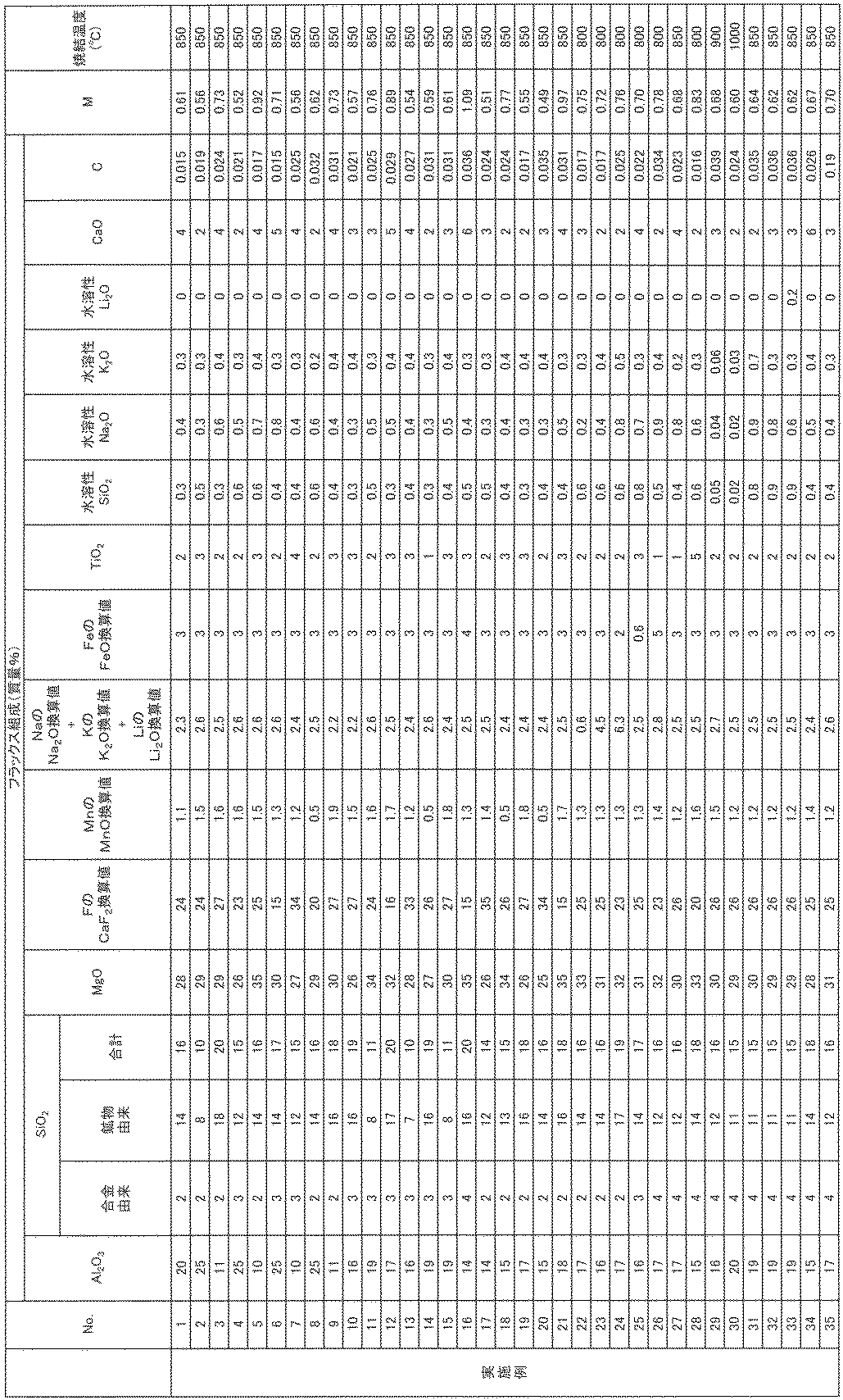
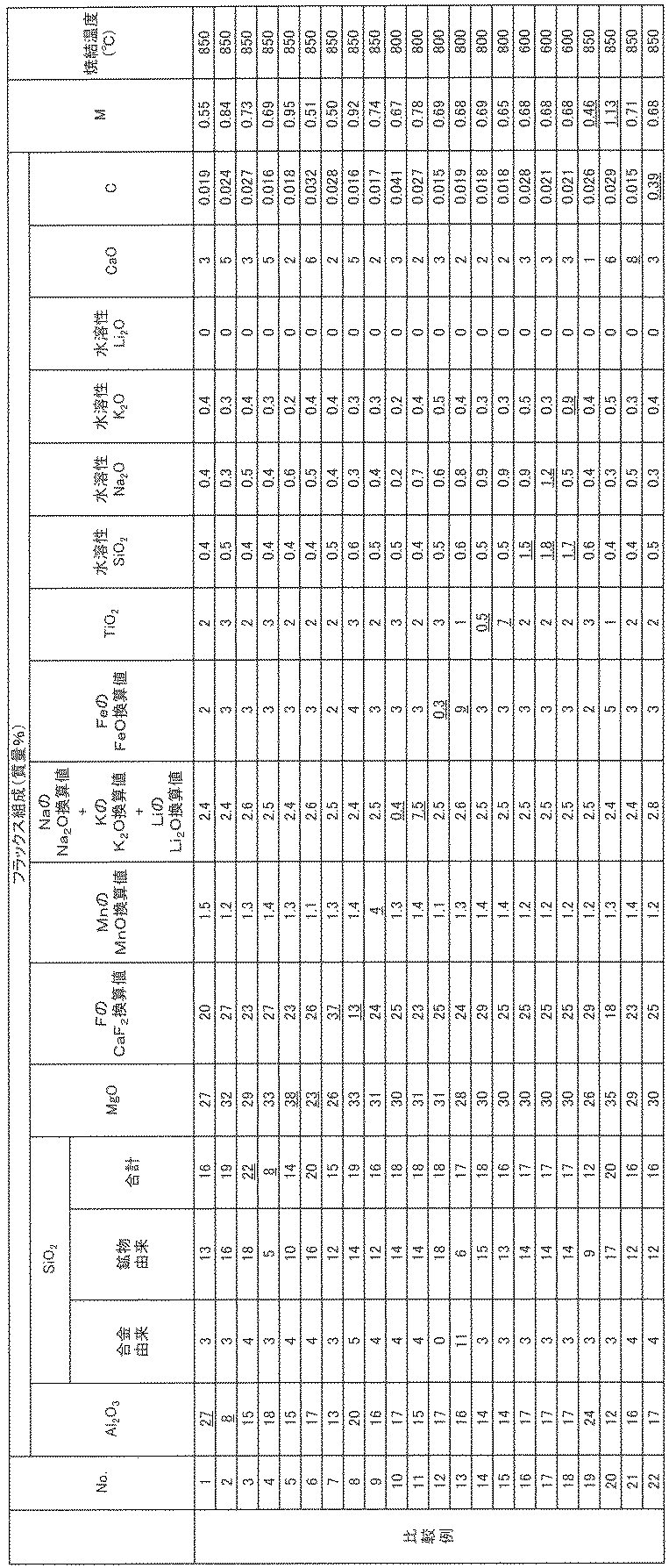
- “M” shown in Table 4 and Table 5 is a value of [MgO] / ([Al 2 O 3 ] + [CaF 2 ] + [TiO 2 ]).
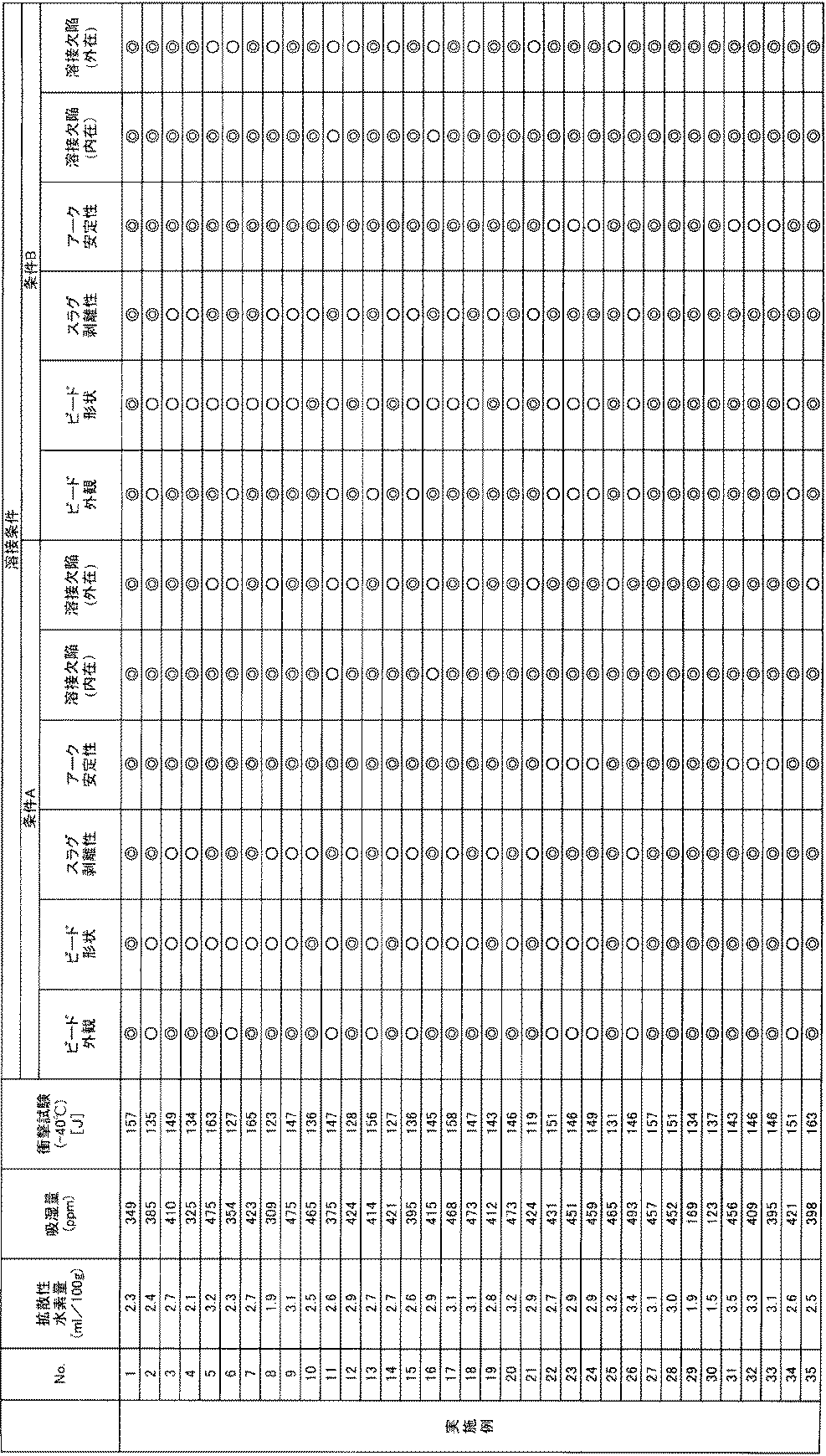
- each flux in the examples and comparative examples is based on the diffusion hydrogen amount in the weld metal, the moisture absorption amount of the flux, the impact test, the bead appearance, the bead shape, the slag peelability, the arc stability, and the weld defect (internal / external). Went about.
- ⁇ Diffusion hydrogen amount> In principle, the amount of diffused hydrogen in the weld metal was measured based on the method defined in JIS Z 3118: 2007. However, welding conditions A in Table 3 were adopted. In this example, the case where the diffusion hydrogen amount was 3.5 ml / 100 g or less was regarded as acceptable.
- the amount of moisture absorption was evaluated based on the amount of moisture absorption after 2 hours of forced moisture absorption. Specifically, the flux having a particle diameter of 500 to 850 ⁇ m is re-dried at 250 ° C. for 1 hour, and then subjected to forced moisture absorption for 2 hours at 30 ° C. and a relative humidity of 80%. The water content was measured using the KF (Karl Fischer) method. Hygroscopic resistance was good when the KF moisture content after moisture absorption for 2 hours was 500 ppm or less.
- ⁇ Impact test> The impact test was carried out based on the method defined in JIS Z 2242: 2005, and evaluated by the value of Charpy absorbed energy at ⁇ 40 ° C. And in the present Example, what passed Charpy absorbed energy was 100J or more was set as the pass.
- the appearance of the bead is mainly an evaluation relating to the wave and gloss of the bead, and was performed by visually observing the weld. As a result, the bead wave is not disturbed and the bead has a metallic luster ⁇ , the bead wave perturbation per unit weld length (1m) is one place, and the bead has a metallic luster ⁇ , unit welding ⁇
- the bead wave disturbance is 2-4 places per long (1m)
- the bead has no metallic luster, and there are 5 or more bead wave disturbances per unit weld length (1m), and the bead has metallic luster Those that do not have a cross.
- what was evaluated as (double-circle) or (circle) was set as the pass.
- the bead shape is mainly an evaluation regarding the irregularity of the bead and the familiarity with the base material, and was performed by visually observing the welded portion. As a result, ⁇ indicates that the bead shape was very good, ⁇ indicates that the bead shape was good, ⁇ indicates that the bead shape was slightly poor, and ⁇ indicates that the bead shape was poor. And in the present Example, what was evaluated as (double-circle) or (circle) was set as the pass.
- Slag peelability was evaluated by the ease of slag removal and the presence or absence of seizure. Specifically, slag is naturally peeled off and there was no seizure, ⁇ , but naturally peeled off, but when seizure occurred at 3 or less points per unit weld length (1 m), ⁇ , without natural peeling, unit The case where seizure occurred at 4 to 9 locations per weld length (1 m) was evaluated as ⁇ , and the case where seizure occurred at 10 locations or more per unit weld length (1 m) without natural peeling was evaluated as x. And in the present Example, what was evaluated as (double-circle) or (circle) was set as the pass.
- Arc stability was evaluated based on current and voltage fluctuations during welding. Specifically, the welding current is ⁇ 50 A and the arc voltage is ⁇ 2 V, the welding current is ⁇ 100 A and the arc voltage is ⁇ 2 V, the welding current is ⁇ 100 A, and the arc voltage is What was +/- 4V was set to (triangle
- Weld defects are mainly evaluations related to weld defects that occur inside the weld metal, such as pore defects, slag entrainment, and poor fusion, and ⁇ , unit weld length (1 m) where these weld defects did not occur )
- ⁇ unit weld length
- the generation ratio per unit weld length (1 m) in the evaluation of weld defects (internal) is the measurement of the size (length) of individual defects (defects) in accordance with JIS Z 3104: 1995. ) Is calculated and then divided by the effective length of the test part and converted per unit weld length.
- the weld defect is an evaluation mainly related to weld defects generated on the surface of the weld metal such as undercuts and pock marks, and ⁇ , unit weld length (1 m) where these weld defects did not occur.
- the generation ratio per unit weld length (1 m) was 0.5% or less
- the generation ratio per unit weld length (1 m) was over 0.5% and 1.0% or less
- ⁇ unit weld length
- the case where the generation ratio per (1 m) exceeded 1.0% was evaluated as x.
- what was evaluated as (double-circle) or (circle) was set as the pass.
- the detection of the welding defect (external) was performed visually.
- the rate of occurrence per unit weld length (1m) in the evaluation of weld defects (external) is to measure the length of each undercut, pock mark, etc., and calculate the total length of weld defects (external). Then, it is divided by the effective length of the same test part as the weld defect (internal) and converted per unit weld length.
- Comparative Example No. 1 had an inferior bead shape because the Al 2 O 3 content exceeded 25% by mass. Comparative Example No. Since the flux of No. 2 had an Al 2 O 3 content of less than 10% by mass, the bead shape was inferior. Comparative Example No. The flux of No. 3 was inferior in slag removability because the SiO 2 content exceeded 20% by mass. Comparative Example No. Since the flux of No. 4 had a SiO 2 content of less than 10% by mass, the bead appearance and bead shape were inferior.
- Comparative Example No. 5 had an MgO content exceeding 35% by mass, so that the bead shape was inferior, and further, weld defects were generated inside and on the surface of the weld metal. Comparative Example No. Since the flux of No. 6 had an MgO content of less than 25% by mass, seizure occurred and the slag peelability was inferior. Comparative Example No. The flux of No. 7 had an inferior bead shape because the F content exceeded 35% by mass. Since the flux of Comparative Example 8 had an F content of less than 15% by mass, welding defects such as undercuts and pock marks occurred.
- Comparative Example No. 9 had a Mn content (MnO equivalent value) of 2.0% by mass or more, so the Charpy absorbed energy value was low and the toughness was inferior.
- Comparative Example No. 10 has a Na content (Na 2 O conversion value), a K content (K 2 O conversion value), and a Li (Li 2 O conversion value) total amount of less than 0.5% by mass. The arc stability was significantly reduced, and the bead appearance and bead shape were also deteriorated. As a result, welding was difficult. Comparative Example No. In the flux No.
- the total amount of Na content (Na 2 O conversion value), K content (K 2 O conversion value) and Li (Li 2 O conversion value) exceeds 6.5 mass%.
- the arc stability was significantly deteriorated, and the bead appearance and bead shape were inferior.
- the moisture absorption amount of the flux increased.
- Comparative Example No. 1 In the flux No. 12, the Fe content (FeO equivalent value) was less than 0.5% by mass, so that welding defects such as undercuts and pock marks occurred on the surface of the weld metal. Comparative Example No. The flux No. 13 had an Fe content (FeO equivalent value) exceeding 5% by mass, so the bead appearance and bead shape were inferior, and the slag peelability was also inferior. Comparative Example No. No. 14 flux was inferior in bead shape and slag peelability because the TiO 2 content was less than 1% by mass. Moreover, the value of Charpy absorbed energy was low and the toughness was inferior. Comparative Example No. 15 flux is because it contains TiO 2 exceeds 5 mass%, had poor bead shape.
- Comparative Example No. 16 Since the flux of No. 16 has a water-soluble SiO 2 content exceeding 1.0 mass%, the amount of diffusion hydrogen in the weld metal and the moisture absorption amount of the flux increased. Comparative Example No. Since the flux of No. 17 had a water-soluble SiO 2 content and a water-soluble Na 2 O content exceeding 1.0 mass%, the amount of diffusion hydrogen in the weld metal and the moisture absorption amount of the flux increased. Comparative Example No. 18 flux has a water-soluble SiO 2 content exceeding 1.0 mass%, and since the water-soluble K 2 O content exceeds 0.8 mass%, diffusion hydrogen in the weld metal The amount and the moisture absorption amount of the flux increased.
- the welding workability is improved, and the moisture absorption amount of the flux and the amount of diffusible hydrogen in the weld metal are reduced regardless of whether the welding is an AC type or a DC type. It was confirmed that it was possible to do.
- the present invention includes the following aspects.
- Aspect 1 MgO: 25-35% by mass, F converted to CaF 2 : 15 to 35% by mass, Al 2 O 3 : 10 to 25% by mass, SiO 2 : 10 to 20% by mass, A total of at least one of Na converted to Na 2 O, K converted to K 2 O and Li converted to Li 2 O: 0.5 to 6.5% by mass, Fe converted to FeO: 0.5 to 5% by mass, TiO 2 : 1 to 5% by mass, CaO: 6 mass% or less, Mn converted to MnO: less than 2.0% by mass, Water-soluble SiO 2 : 1.0% by mass or less Water-soluble Na 2 O: 1.0% by mass or less, Water-soluble K 2 O: 0.8% by mass or less,
- the MgO content is [MgO]
- the Al 2 O 3 content is [Al 2 O 3 ]
- the F content in terms of CaF 2 is [CaF 2 ]
- the TiO 2 content is [TiO 2].
- a flux for submerged arc welding characterized by satisfying the following formula (I).
- Aspect 2 Furthermore, the flux for submerged arc welding according to aspect 1, which contains water-soluble Li 2 O: 0.3% by mass or less.
- Aspect 3 The flux for submerged arc welding according to the aspect 1 or 2, wherein the C content is 0.2% by mass or less.
- Aspect 4 4. The flux for submerged arc welding according to any one of aspects 1 to 3, which is fired at 800 ° C. or higher.
Landscapes
- Engineering & Computer Science (AREA)
- Mechanical Engineering (AREA)
- Chemical & Material Sciences (AREA)
- Inorganic Chemistry (AREA)
- Physics & Mathematics (AREA)
- Plasma & Fusion (AREA)
- Nonmetallic Welding Materials (AREA)
Abstract
Description

なお、本願での溶接作業性とは、ビード外観及びビード形状の良否、スラグ剥離性、アーク安定性、溶接金属の耐欠陥性並びに溶接金属の耐衝撃性(靭性)をいう。
このような構成によれば、フラックスの吸湿特性が向上する。

MgOは、スラグ剥離性の向上に大きく寄与する成分であり、溶接電源の方式によらず、良好なスラグ剥離性を確保するために必須の成分である。しかしながら、MgO含有量が25質量%未満の場合、スラグ剥離性向上の効果が十分に得られず、また、35質量%を超えると、ビード形状が劣化し、溶接電源の種別に依存してスラグ巻込み、融合不良、更にはアンダーカットなどの欠陥が発生しやすくなる。特に、交流式溶接電源においては、前述したスラグ巻き込み及び溶融不良などの溶接欠陥の発生が顕著になる。よって、MgO含有量は25~35質量%とする。
CaF2 などのフッ化物は、溶融スラグの電気伝導性及び流動性を高める効果があり、溶融スラグの高温粘性に影響を与える成分の1つである。この作用は、後述するCaOと同様に、その含有量に比例する。具体的には、F含有量(CaF2 換算値)が15質量%未満の場合、前述した効果が十分に得られず、また、溶融スラグからCOガスの排出を促進し、耐ポックマーク性を改善する効果も期待できない。
Al2 O3 は、溶融スラグの粘性及び融点を調整する成分であり、溶接時のビード形状を良好にする効果がある。しかしながら、Al2 O3 含有量が10質量%未満の場合は、前述した効果が十分に得られず、また、Al2 O3 含有量が25質量%を超えると、溶融スラグの融点が上昇しすぎて、溶接時にビード形状の劣化を招く。よって、Al2 O3 含有量は10~25質量%とする。
SiO2 は、溶融スラグに適度の粘性を与えることによって、主にビード外観及びビード形状を良好にする効果がある。しかしながら、SiO2 含有量が10質量%未満の場合、前述した効果が十分に得られず、ビード外観及びビード形状が劣化する。また、SiO2 含有量が20質量%を超えると、スラグの粘性が過剰となり、スラグ剥離性が劣化すると共に、スラグの焼付きが激しくなる。よって、SiO2 含有量は10~20質量%とする。
(すなわち、NaのNa2 O換算値、KのK2 O換算値及びLiのLi2 O換算値の合計:0.5~6.5質量%(Na、K及びLiのうち少なくとも一つ以上を含む))
Na、K及びLiは、主に溶接時のアーク安定性とフラックスの吸湿特性に影響を与える成分であり、主に、Na2 O、K2 O及びLi2 Oなどの酸化物の形態で添加される。しかしながら、Na含有量(Na2 O換算値)、K含有量(K2 O換算値)及びLi(Li2 O換算値)が合計で0.5質量%未満の場合、溶接時のアーク電圧が不安定となり、ビード外観及びビード形状が劣化する。
また、ここでのNa、K及びLiは、鉱石原料及び水ガラスに由来するものである。
Feは、脱酸現象を促進し、耐ポックマーク性を高める効果があり、主に、Fe-Siなどの金属粉の形態で添加される。前述した効果は、その存在量に比例し、Fe含有量(FeO換算値)が0.5質量%未満の場合、特に溶接電源が直流式の場合に、十分な効果が得られない。一方、Fe含有量(FeO換算値)が5質量%を超えると、スラグの凝固温度に影響を与え、ビード外観、ビード形状及びスラグ剥離が劣化する。よって、Fe含有量(FeO換算値)は0.5~5質量%とする。
TiO2 は、スラグ剥離性向上に有効な成分であり、ビード形状を良好に整える効果もある。また、TiO2 の一部は、溶接時の還元反応によりTiとなり、このTiは溶接金属中に添加されて、靭性向上に寄与する。前述した作用は、その存在量(TiO2 含有量)に比例する。ただし、TiO2 含有量の上限値が5質量%を超えると、ビード形状が劣化する。また、TiO2 含有量が1質量%未満の場合は、スラグ剥離性及びビード形状が劣化する。また、靭性向上の効果が小さい。よってTiO2 含有量は1~5質量%とする。
CaOは、スラグの塩基度を高めて溶接金属の清浄度を高めると共に、溶融スラグの流動性にも影響を与える成分であり、その存在量に比例して、前述した効果が発揮される。しかしながら、CaO含有量が6質量%を超えると、溶融スラグの流動性が過大となり、ビードの外観及び形状が劣化する。よって、CaO含有量は6質量%以下(0質量%を含む)に規制する。CaO含有量は、溶融スラグ流動性の観点から、4質量%以下であることが好ましく、より好ましくは2質量%以下である。また、溶接金属の清浄度向上の観点から、好ましくは0.5質量%以上である。
Mnは、溶融スラグの粘性及び凝固温度に影響を与えると共に、耐ポックマーク性改善に有効な成分である。しかしながら、本発明者が本発明の範囲内で種々の実験検討を行った結果、Mnの添加量が増加するに従い、溶接金属中の酸素量が増加する傾向が確認された。溶接金属中の酸素量増加は靭性を劣化させる原因の1つであるため、Mn含有量(MnO換算値)が2.0質量%以上になると、溶接金属の靭性が劣化する。そこで、本実施形態のフラックスにおいては、Mnを規制成分とし、その含有量を、MnO換算値で、2.0質量%以下(0質量%を含む)に規制する。Mn含有量(MnO換算値)は、溶接金属の靭性向上の観点から、1.8質量%以下であることが好ましく、より好ましくは1.5質量%以下である。
水溶性SiO2 は、フラックスの耐吸湿性の劣化防止と溶接金属の拡散性水素量の増加を抑制するため、焼結作業を実施した後で1.0質量%以下(0質量%を含む)になるように規制する。水溶性SiO2 の含有量が1.0質量%を超えると、フラックスの耐吸湿性が劣化すると共に、溶接金属の拡散水素量が増加する。よって、水溶性SiO2 含有量は1.0質量%以下とする。
水溶性Na2 Oは、フラックスの耐吸湿性の劣化防止と溶接金属の拡散性水素量の増加を抑制するため、焼結作業を実施した後で1.0質量%以下(0質量%を含む)になるように規制する。水溶性Na2 Oの含有量が1.0質量%を超えると、フラックスの耐吸湿性が劣化すると共に、溶接金属の拡散水素量が増加する。よって、水溶性Na2 O含有量は1.0質量%以下とする。
なお、ここでいう水溶性Na2 Oは、前述した方法で分析して得たフラックスの全Na量を、Na2 Oで換算した値であり、前述した全Na2 Oとは区別して、その含有量を特定している。
本発明者は、水ガラスへの水溶性K2 Oの適正量添加は、水ガラスの難吸湿化温度を低下させる効果を有することを見出した。すなわち、水溶性K2 Oが適正量添加された水ガラスを用い、800℃以上で焼結作業を実施したフラックスにおいて、水溶性K2 Oの量が0.8質量%以下(0質量%を含む)の管理範囲を満足する場合には、従来と比べてフラックスの耐吸湿性が大きく向上した。
水溶性K2 Oは、フラックスの耐吸湿性の劣化防止と溶接金属の拡散性水素量の増加を抑制するため、焼結作業を実施した後で0.8質量%以下になるように規制する。水溶性K2 Oの含有量が0.8質量%を超えると、フラックスの耐吸湿性が劣化すると共に、溶接金属の拡散水素量が増加する。よって、水溶性K2 O含有量は0.8質量%以下とする。
なお、ここでいう水溶性K2 Oは、前述した方法で分析して得たフラックスの全K量を、K2 Oで換算した値であり、前述した全K2 Oとは区別して、その含有量を特定している。
[水溶性Li2 O:0.3質量%以下(0質量%を含む)]
水溶性Li2 Oは、添加量に応じて吸湿特性を更に向上させる効果がある。ただし、焼結作業を実施した後で水溶性Li2 O含有量が0.3質量%を超えると、アーク安定性が劣化し、ビード外観及びビード形状が劣化する。よって、水溶性Li2 Oを添加する場合は、0.3質量%以下(0質量%を含む)とする。水溶性Li2 O含有量は、アーク安定性の向上並びにビード外観及びビード形状の向上の観点から、0.2質量%以下であることが好ましく、より好ましくは0.15質量%以下である。また、吸湿特性の観点から、より好ましくは0.05質量%以上である。
なお、ここでいう水溶性Li2 Oは、前述した方法で分析して得たフラックスの全Li量を、Li2 Oで換算した値であり、前述した全Li2 Oとは区別して、その含有量を特定している。
MgO、Al2 O3 、F及びTiO2 は、それぞれ個別にその含有量を規定しているが、本実施形態のフラックスでは、更に、MgO含有量(質量%)と、Al2 O3 含有量(質量%)、F含有量(CaF2 換算値)(質量%)及びTiO2 含有量(質量%)の合計量との比(=[MgO]/([Al2 O3 ]+[CaF2 ]+[TiO2 ]))も規定する。
Cは、フラックスの各原料に不純物として含まれる炭酸塩などに由来し、不可避的に導入される。一方、前述したように直流式の溶接電源を用いた場合、フラックスの消費量が増大し、交流式の溶接電源を用いた場合に比べて、炭酸塩の分解が一層促進される。このため、C含有量が微量であっても、溶接中にCO又はCO2 ガスが大量に発生し、耐ポックマーク性の劣化並びにビードの外観及び形状の劣化を招くこととなる。よって、溶接作業性の劣化を防止するため、フラックス中のC量は、0.2質量%以下(0質量%を含む)に低減することが好ましい。
本実施形態のフラックスにおける上記以外の成分は、Zr、Ba、P及びSなどの不可避的不純物である。これらの不可避的不純物のうち、Zr及びBaはそれぞれ1.0質量%以下に規制することが好ましく、特に溶接品質に影響するP及びSはそれぞれ0.05質量%以下に規制することが好ましい。また、Zr、Ba、P及びSは、合計で0.1質量%以下であることが好ましい。
本実施形態のフラックスを製造する場合は、例えば、前述した組成となるように原料粉を配合し、結合剤と共に混練した後、造粒し、焼成する。その際、結合剤(バインダ)としては、例えば、ポリビニルアルコール又は水ガラスを使用することができる。また、造粒法は、特に限定されるものではないが、転動式造粒機又は押し出し式造粒機などを用いる方法が好ましい。



溶接金属中の拡散水素量は、原則、JIS Z 3118:2007に規定される方法に基づいて測定した。ただし、溶接条件は,表3の溶接条件Aを採用した。本実施例では、拡散水素量が3.5ml/100g以下であったものを合格とした。
吸湿量は、2時間の強制吸湿後の吸湿量により評価した。具体的には、500~850μmの粒子径を有するフラックスの再乾燥を250℃×1hr行った後、30℃かつ相対湿度80%の条件にて、2時間の強制吸湿をさせた際にフラックスが有する水分量をKF(カールフィッシャー)法を用いて測定した。2時間の吸湿後のKF水分量が500ppm以下で耐吸湿性が良好とした。
衝撃試験は、JIS Z 2242:2005に規定される方法に基づいて実施し、-40℃におけるシャルピー吸収エネルギーの値により評価した。そして、本実施例では、シャルピー吸収エネルギーが100J以上であったものを合格とした。
ビード外観は、主にビードの波目及び光沢に関する評価であり、溶接部を目視観察することにより行った。その結果、ビードの波目に乱れがなくビードに金属光沢があるものを◎、単位溶接長(1m)あたりにビード波目の乱れが1箇所でビードに金属光沢があるものを○、単位溶接長(1m)あたりにビード波目の乱れが2~4箇所でビードに金属光沢がないものを△、単位溶接長(1m)あたりにビード波目の乱れが5箇所以上ありビードに金属光沢がないものを×とした。そして、本実施例では、評価が◎又は○であったものを合格とした。
ビード形状は、主にビードの凹凸及び母材へのなじみに関する評価であり、溶接部を目視観察することにより行った。その結果、ビード形状が、非常に良好であったものを◎、良好であったものを○、やや不良であったものを△、不良であったものを×とした。そして、本実施例では、評価が◎又は○であったものを合格とした。
スラグ剥離性は、スラグ除去の容易さ及び焼き付きの有無により評価した。具体的には、スラグが、自然剥離し、焼き付きがなかったものを◎、自然剥離するが、単位溶接長(1m)あたり3箇所以下で焼き付きが発生したものを○、自然剥離せず、単位溶接長(1m)あたり4~9箇所で焼き付きが発生したものを△、自然剥離せず、単位溶接長(1m)あたり10箇所以上で焼き付きが発生したものを×とした。そして、本実施例では、評価が◎又は○であったものを合格とした。
アーク安定性は、溶接時の電流及び電圧の振れにより評価した。具体的には、溶接電流が±50Aかつアーク電圧が±2Vであったものを◎、溶接電流が±100Aかつアーク電圧が±2Vであったものを○、溶接電流が±100Aかつアーク電圧が±4Vであったものを△、溶接困難であったものを×とした。そして、本実施例では、評価が◎又は○であったものを合格とした。
溶接欠陥(内在)は、主に気孔欠陥、スラグ巻き込み及び融合不良などの溶接金属内部で発生する溶接欠陥に関する評価であり、これらの溶接欠陥の発生がなかったものを◎、単位溶接長(1m)あたりの発生比率が0.5%以下であったものを○、単位溶接長(1m)あたりの発生比率が0.5%を超え1.0%以下であったものを△、単位溶接長(1m)あたりの発生比率が1.0%を超えていたものを×とした。そして、本実施例では、評価が◎又は○であったものを合格とした。
なお、溶接欠陥(内在)の検出には、JIS Z 3104:1995に準拠して撮影したX線透過写真を使用した。溶接欠陥(内在)の評価における単位溶接長(1m)あたりの発生比率とは、JIS Z 3104:1995に準拠して個々の欠陥(きず)の寸法(長さ)を測定して、欠陥(きず)の総長さを算出した後、試験部の有効長さで割り返し、単位溶接長あたりに換算したものである。
なお、溶接欠陥(外在)の検出は、目視により行った。溶接欠陥(外在)の評価における単位溶接長(1m)あたりの発生比率とは、個々のアンダーカット及びポックマークなどの長さを目視で測定し、溶接欠陥(外在)の総長さを算出した後、溶接欠陥(内在)と同じ試験部の有効長さで割り返し、単位溶接長あたりに換算したものである。

態様1:
MgO:25~35質量%、
FのCaF2 換算値:15~35質量%、
Al2 O3 :10~25質量%、
SiO2 :10~20質量%、
NaのNa2 O換算値、KのK2 O換算値及びLiのLi2 O換算値のうち少なくとも一つ以上の合計:0.5~6.5質量%、
FeのFeO換算値:0.5~5質量%、
TiO2 :1~5質量%、
CaO:6質量%以下、
MnのMnO換算値:2.0質量%未満、
水溶性SiO2 :1.0質量%以下、
水溶性Na2 O:1.0質量%以下、
水溶性K2 O:0.8質量%以下を含有し、
前記MgO含有量を[MgO]、前記Al2 O3 含有量を[Al2 O3 ]、前記FのCaF2 換算値での含有量を[CaF2 ]、前記TiO2 含有量を[TiO2 ]としたとき、下記数式(I)を満たすことを特徴とするサブマージアーク溶接用フラックス。

更に、水溶性Li2 O:0.3質量%以下を含有することを特徴とする態様1に記載のサブマージアーク溶接用フラックス。
態様3:
C含有量が0.2質量%以下であることを特徴とする態様1又は2に記載のサブマージアーク溶接用フラックス。
態様4:
800℃以上で焼成されたものであることを特徴とする態様1~3のいずれかに記載のサブマージアーク溶接用フラックス。
Claims (3)
- MgO:25~35質量%、
FのCaF2 換算値:15~35質量%、
Al2 O3 :10~25質量%、
SiO2 :10~20質量%、
NaのNa2 O換算値、KのK2 O換算値及びLiのLi2 O換算値のうち少なくとも一つ以上の合計:0.5~6.5質量%、
FeのFeO換算値:0.5~5質量%、
TiO2 :1~5質量%、
CaO:6質量%以下(0質量%を含む)、
MnのMnO換算値:2.0質量%未満(0質量%を含む)、
水溶性SiO2 :1.0質量%以下(0質量%を含む)、
水溶性Na2 O:1.0質量%以下(0質量%を含む)、
水溶性K2 O:0.8質量%以下(0質量%を含む)を含有し、
C含有量が0.2質量%以下(0質量%を含む)であり、
前記MgO含有量を[MgO]、前記Al2 O3 含有量を[Al2 O3 ]、前記FのCaF2 換算値での含有量を[CaF2 ]、前記TiO2 含有量を[TiO2 ]としたとき、下記数式(I)を満たすことを特徴とするサブマージアーク溶接用フラックス。

- 更に、水溶性Li2 O:0.3質量%以下(0質量%を含む)を含有することを特徴とする請求項1に記載のサブマージアーク溶接用フラックス。
- 800℃以上で焼成されたものであることを特徴とする請求項1または2に記載のサブマージアーク溶接用フラックス。
Priority Applications (5)
| Application Number | Priority Date | Filing Date | Title |
|---|---|---|---|
| MYPI2017702813A MY186328A (en) | 2015-02-02 | 2016-01-18 | Flux for use in submerged arc welding |
| SG11201705943QA SG11201705943QA (en) | 2015-02-02 | 2016-01-18 | Flux for use in submerged arc welding |
| CN201680006806.9A CN107206549B (zh) | 2015-02-02 | 2016-01-18 | 埋弧焊用焊剂 |
| KR1020177021146A KR101986926B1 (ko) | 2015-02-02 | 2016-01-18 | 서브머지드 아크 용접용 플럭스 |
| SA517381983A SA517381983B1 (ar) | 2015-02-02 | 2017-07-25 | صهيرة للاستخدام في لحام قوس مغمور |
Applications Claiming Priority (2)
| Application Number | Priority Date | Filing Date | Title |
|---|---|---|---|
| JP2015018804A JP6441100B2 (ja) | 2015-02-02 | 2015-02-02 | サブマージアーク溶接用フラックス |
| JP2015-018804 | 2015-02-02 |
Publications (1)
| Publication Number | Publication Date |
|---|---|
| WO2016125570A1 true WO2016125570A1 (ja) | 2016-08-11 |
Family
ID=56563921
Family Applications (1)
| Application Number | Title | Priority Date | Filing Date |
|---|---|---|---|
| PCT/JP2016/051240 Ceased WO2016125570A1 (ja) | 2015-02-02 | 2016-01-18 | サブマージアーク溶接用フラックス |
Country Status (7)
| Country | Link |
|---|---|
| JP (1) | JP6441100B2 (ja) |
| KR (1) | KR101986926B1 (ja) |
| CN (1) | CN107206549B (ja) |
| MY (1) | MY186328A (ja) |
| SA (1) | SA517381983B1 (ja) |
| SG (1) | SG11201705943QA (ja) |
| WO (1) | WO2016125570A1 (ja) |
Families Citing this family (4)
| Publication number | Priority date | Publication date | Assignee | Title |
|---|---|---|---|---|
| JP6809533B2 (ja) * | 2016-11-08 | 2021-01-06 | 日本製鉄株式会社 | フラックス入りワイヤ、溶接継手の製造方法、及び溶接継手 |
| JP6997025B2 (ja) * | 2018-03-28 | 2022-02-03 | 株式会社神戸製鋼所 | サブマージアーク溶接用フラックス |
| JP7078436B2 (ja) * | 2018-03-29 | 2022-05-31 | 株式会社神戸製鋼所 | サブマージアーク溶接用フラックス及びその製造方法 |
| WO2021049440A1 (ja) | 2019-09-12 | 2021-03-18 | 株式会社神戸製鋼所 | サブマージアーク溶接用フラックス、サブマージアーク溶接方法、及びサブマージアーク溶接用フラックスの製造方法 |
Citations (7)
| Publication number | Priority date | Publication date | Assignee | Title |
|---|---|---|---|---|
| US3959031A (en) * | 1973-12-28 | 1976-05-25 | Wacker-Chemie Gmbh | Molten basic welding fluxes low in manganese and with low moisture sensitivity |
| JPS58135791A (ja) * | 1982-02-05 | 1983-08-12 | Kawasaki Steel Corp | サブマ−ジア−ク溶接用フラツクス |
| JPS62240195A (ja) * | 1986-04-11 | 1987-10-20 | Nippon Steel Corp | 低水素型ボンドフラツクス |
| JPS6313694A (ja) * | 1986-07-02 | 1988-01-20 | Kobe Steel Ltd | サブマ−ジア−ク溶接用焼成型フラツクス |
| JPH0284293A (ja) * | 1988-06-14 | 1990-03-26 | Kobe Steel Ltd | 高強度Cr−Mo鋼のサブマージアーク溶接方法 |
| JPH02280995A (ja) * | 1989-04-19 | 1990-11-16 | Kobe Steel Ltd | サブマージアーク溶接用ボンドフラックス |
| WO2015087843A1 (ja) * | 2013-12-13 | 2015-06-18 | 株式会社神戸製鋼所 | サブマージアーク溶接用フラックス |
Family Cites Families (10)
| Publication number | Priority date | Publication date | Assignee | Title |
|---|---|---|---|---|
| JPS5116172B2 (ja) | 1972-11-09 | 1976-05-22 | ||
| JPS5849356B2 (ja) | 1975-01-31 | 1983-11-04 | 新日本製鐵株式会社 | 潜弧溶接用フラツクス |
| JPS5395144A (en) | 1977-01-31 | 1978-08-19 | Kobe Steel Ltd | Highly basic calcination type flux based on mgo-caf2 |
| JPS6268695A (ja) | 1985-09-19 | 1987-03-28 | Nippon Steel Corp | 潜弧溶接用高温焼成フラツクス |
| JPH02290692A (ja) * | 1989-04-30 | 1990-11-30 | Kobe Steel Ltd | 焼結型フラックス |
| JPH0999392A (ja) | 1995-07-28 | 1997-04-15 | Kawasaki Steel Corp | 耐吸湿性に優れたサブマージアーク溶接用焼成型フラックス |
| JP2978744B2 (ja) * | 1995-10-02 | 1999-11-15 | 株式会社神戸製鋼所 | 鋼板の下向隅肉サブマージアーク溶接方法 |
| JP3392347B2 (ja) * | 1997-10-20 | 2003-03-31 | 川崎製鉄株式会社 | サブマージアーク溶接用焼成型フラックスおよびその製造方法 |
| KR100466205B1 (ko) * | 2002-11-26 | 2005-01-13 | 고려용접봉 주식회사 | 서브머지드 아크 용접용 플럭스 조성물 |
| CN102218623B (zh) * | 2011-05-26 | 2013-05-01 | 四川大西洋焊接材料股份有限公司 | X100管线钢埋弧焊用焊剂及其生产方法 |
-
2015
- 2015-02-02 JP JP2015018804A patent/JP6441100B2/ja not_active Expired - Fee Related
-
2016
- 2016-01-18 MY MYPI2017702813A patent/MY186328A/en unknown
- 2016-01-18 SG SG11201705943QA patent/SG11201705943QA/en unknown
- 2016-01-18 KR KR1020177021146A patent/KR101986926B1/ko not_active Expired - Fee Related
- 2016-01-18 CN CN201680006806.9A patent/CN107206549B/zh not_active Expired - Fee Related
- 2016-01-18 WO PCT/JP2016/051240 patent/WO2016125570A1/ja not_active Ceased
-
2017
- 2017-07-25 SA SA517381983A patent/SA517381983B1/ar unknown
Patent Citations (7)
| Publication number | Priority date | Publication date | Assignee | Title |
|---|---|---|---|---|
| US3959031A (en) * | 1973-12-28 | 1976-05-25 | Wacker-Chemie Gmbh | Molten basic welding fluxes low in manganese and with low moisture sensitivity |
| JPS58135791A (ja) * | 1982-02-05 | 1983-08-12 | Kawasaki Steel Corp | サブマ−ジア−ク溶接用フラツクス |
| JPS62240195A (ja) * | 1986-04-11 | 1987-10-20 | Nippon Steel Corp | 低水素型ボンドフラツクス |
| JPS6313694A (ja) * | 1986-07-02 | 1988-01-20 | Kobe Steel Ltd | サブマ−ジア−ク溶接用焼成型フラツクス |
| JPH0284293A (ja) * | 1988-06-14 | 1990-03-26 | Kobe Steel Ltd | 高強度Cr−Mo鋼のサブマージアーク溶接方法 |
| JPH02280995A (ja) * | 1989-04-19 | 1990-11-16 | Kobe Steel Ltd | サブマージアーク溶接用ボンドフラックス |
| WO2015087843A1 (ja) * | 2013-12-13 | 2015-06-18 | 株式会社神戸製鋼所 | サブマージアーク溶接用フラックス |
Also Published As
| Publication number | Publication date |
|---|---|
| KR20170104504A (ko) | 2017-09-15 |
| SG11201705943QA (en) | 2017-09-28 |
| CN107206549B (zh) | 2019-08-09 |
| MY186328A (en) | 2021-07-09 |
| CN107206549A (zh) | 2017-09-26 |
| SA517381983B1 (ar) | 2021-02-16 |
| KR101986926B1 (ko) | 2019-06-07 |
| JP2016140889A (ja) | 2016-08-08 |
| JP6441100B2 (ja) | 2018-12-19 |
Similar Documents
| Publication | Publication Date | Title |
|---|---|---|
| JP6104146B2 (ja) | サブマージアーク溶接用フラックス及びその製造方法 | |
| JP6104090B2 (ja) | サブマージアーク溶接用フラックス及びその製造方法 | |
| JP6441099B2 (ja) | サブマージアーク溶接用フラックス | |
| JP6441100B2 (ja) | サブマージアーク溶接用フラックス | |
| KR101981414B1 (ko) | 서브머지드 아크 용접용 플럭스 | |
| WO2018182025A1 (ja) | サブマージアーク溶接用フラックス | |
| KR102733213B1 (ko) | 서브머지 아크 용접용 플럭스, 서브머지 아크 용접 방법, 및 서브머지 아크 용접용 플럭스의 제조 방법 | |
| JP7078436B2 (ja) | サブマージアーク溶接用フラックス及びその製造方法 | |
| JP6997025B2 (ja) | サブマージアーク溶接用フラックス | |
| JP7448433B2 (ja) | サブマージアーク溶接用フラックス、サブマージアーク溶接方法、及びサブマージアーク溶接用フラックスの製造方法 |
Legal Events
| Date | Code | Title | Description |
|---|---|---|---|
| 121 | Ep: the epo has been informed by wipo that ep was designated in this application |
Ref document number: 16746401 Country of ref document: EP Kind code of ref document: A1 |
|
| ENP | Entry into the national phase |
Ref document number: 20177021146 Country of ref document: KR Kind code of ref document: A |
|
| NENP | Non-entry into the national phase |
Ref country code: DE |
|
| WWE | Wipo information: entry into national phase |
Ref document number: 11201705943Q Country of ref document: SG |
|
| 122 | Ep: pct application non-entry in european phase |
Ref document number: 16746401 Country of ref document: EP Kind code of ref document: A1 |