WO2016117234A1 - 精製油脂の製造方法及び精製油脂の製造管理方法 - Google Patents
精製油脂の製造方法及び精製油脂の製造管理方法 Download PDFInfo
- Publication number
- WO2016117234A1 WO2016117234A1 PCT/JP2015/084447 JP2015084447W WO2016117234A1 WO 2016117234 A1 WO2016117234 A1 WO 2016117234A1 JP 2015084447 W JP2015084447 W JP 2015084447W WO 2016117234 A1 WO2016117234 A1 WO 2016117234A1
- Authority
- WO
- WIPO (PCT)
- Prior art keywords
- fat
- oils
- fats
- oil
- mcpd
- Prior art date
- Legal status (The legal status is an assumption and is not a legal conclusion. Google has not performed a legal analysis and makes no representation as to the accuracy of the status listed.)
- Ceased
Links
Classifications
-
- A—HUMAN NECESSITIES
- A23—FOODS OR FOODSTUFFS; TREATMENT THEREOF, NOT COVERED BY OTHER CLASSES
- A23D—EDIBLE OILS OR FATS, e.g. MARGARINES, SHORTENINGS OR COOKING OILS
- A23D9/00—Other edible oils or fats, e.g. shortenings or cooking oils
- A23D9/02—Other edible oils or fats, e.g. shortenings or cooking oils characterised by the production or working-up
-
- C—CHEMISTRY; METALLURGY
- C11—ANIMAL OR VEGETABLE OILS, FATS, FATTY SUBSTANCES OR WAXES; FATTY ACIDS THEREFROM; DETERGENTS; CANDLES
- C11B—PRODUCING, e.g. BY PRESSING RAW MATERIALS OR BY EXTRACTION FROM WASTE MATERIALS, REFINING OR PRESERVING FATS, FATTY SUBSTANCES, e.g. LANOLIN, FATTY OILS OR WAXES; ESSENTIAL OILS; PERFUMES
- C11B3/00—Refining fats or fatty oils
-
- C—CHEMISTRY; METALLURGY
- C11—ANIMAL OR VEGETABLE OILS, FATS, FATTY SUBSTANCES OR WAXES; FATTY ACIDS THEREFROM; DETERGENTS; CANDLES
- C11B—PRODUCING, e.g. BY PRESSING RAW MATERIALS OR BY EXTRACTION FROM WASTE MATERIALS, REFINING OR PRESERVING FATS, FATTY SUBSTANCES, e.g. LANOLIN, FATTY OILS OR WAXES; ESSENTIAL OILS; PERFUMES
- C11B3/00—Refining fats or fatty oils
- C11B3/02—Refining fats or fatty oils by chemical reaction
- C11B3/04—Refining fats or fatty oils by chemical reaction with acids
-
- C—CHEMISTRY; METALLURGY
- C11—ANIMAL OR VEGETABLE OILS, FATS, FATTY SUBSTANCES OR WAXES; FATTY ACIDS THEREFROM; DETERGENTS; CANDLES
- C11B—PRODUCING, e.g. BY PRESSING RAW MATERIALS OR BY EXTRACTION FROM WASTE MATERIALS, REFINING OR PRESERVING FATS, FATTY SUBSTANCES, e.g. LANOLIN, FATTY OILS OR WAXES; ESSENTIAL OILS; PERFUMES
- C11B3/00—Refining fats or fatty oils
- C11B3/02—Refining fats or fatty oils by chemical reaction
- C11B3/06—Refining fats or fatty oils by chemical reaction with bases
Definitions
- This invention relates to the manufacturing method of refined fats and oils, and the manufacturing management method of refined fats and oils.
- Oils and fats contain trace components that are considered to be related to physiological activity.
- trace components include 3-chloropropane-1,2-diol and fatty acid esters thereof (hereinafter, 3-chloropropane-1,2-diol is also referred to as “3-MCPD”).
- 3-chloropropane-1,2-diol is also referred to as “3-MCPD”.
- 3-MCPD 3-chloropropane-1,2-diol
- the above ingredients may have nutritional problems, but if they are present in oils and fats such as vegetable oils that have been ingested from meals for many years, they may have an immediate effect on health. Is not considered, nor is the intake standard established. However, since there is a need for safer fats and oils, various methods for reducing the content of the above-described components in the fats and oils have been proposed.
- Examples of methods for reducing the content of 3-MCPD and fatty acid esters thereof in fats and oils include a method for adjusting temperature conditions in the deodorization step (Patent Document 1), and a method for contacting fats and oils with alkaline clay (Patent Document 2).
- a method of bringing oil and fat into contact with water vapor in a tray-type deodorizing apparatus (Patent Document 3) is mentioned.
- the content of 3-MCPD and its fatty acid ester in fats and oils can be reduced by the above method, the content in the purified oil and fat that is the final product obtained is almost never within a certain range, and is contained in each raw material lot. There are variations in quantity.
- the content of 3-MCPD and its fatty acid ester in the refined fat and oil was measured for each lot and obtained from different lots. It is necessary to adjust the content by blending refined fats and the like.
- the content of 3-MCPD and its fatty acid ester in the refined fats and oils is specified based on the American Petroleum Institute Official Method (AOCS Official Methods Cd 29c-13). According to this method, although the content of 3-MCPD and its fatty acid ester can be obtained, it was not useful as a method for predicting the content in the refined fat and oil as the final product before or during the purification.
- the present invention has been made in order to solve the above-mentioned problems, and a method capable of accurately predicting the content of 3-MCPD and its fatty acid ester in the oil after heating in the oil before heating, and the method It is an object of the present invention to provide a method for producing refined fats and oils having a reduced content of 3-MCPD and fatty acid esters based on the above.
- This inventor is obtained by performing 1 or more types selected from the group which consists of an alkali deoxidation process and the degumming process by water or an acid with respect to the raw material fats and oils which have not passed the heat processing of 180 degreeC or more.
- the amount of 3-MCPD and its fatty acid ester contained in the fat and oil can be accurately predicted when the treated fat and oil is heated at 180 ° C. or higher based on the total amount of chlorine.
- the invention has been completed. Specifically, the present invention provides the following.
- One or more types selected from the group consisting of an alkali deoxidation step and a degumming step with water or acid are performed on raw material fats and oils that have not undergone a heat treatment of 180 ° C. or higher to obtain treated fats and oils. Processing steps; The total amount of chlorine in the treated fat and oil is measured, and the predicted value of the amount of 3-chloropropane-1,2-diol and its fatty acid ester contained in the fat and oil when the treated fat and oil is heated at 180 ° C. or higher A prediction step to obtain A sorting step for sorting the treated fats and oils whose predicted value is a predetermined value or less; A method for producing refined fats and oils.
- the method of accurately predicting the content of 3-MCPD and its fatty acid ester in the fat after heating, and the method of 3-MCPD and its fatty acid ester based on this method A method for producing a refined fat with reduced content is provided.
- oil and fat is a substance containing glyceride in which glycerin and 1 to 3 fatty acids are ester-bonded.
- triglyceride triacylglycerol
- diglyceride diacylglycerol
- monoglycerides monoacylglycerol
- the fats and oils in the present invention may contain components other than glycerides derived from raw fats and oils (for example, plant sterols, lecithins, antioxidant components, pigment components, etc.), but 95% of the components constituting the fats and oils. % Or more is preferably glyceride.
- the manufacturing method of refined fats and oils of this invention contains a predetermined process process, a prediction process, and a selection process at least.
- the present invention is characterized by accurately predicting the amount of 3-MCPD and its fatty acid ester contained in fats and oils when the treated fats and oils subjected to the following treatment steps are heat-treated at 180 ° C. or higher. There is.
- the “amount of 3-MCPD and its fatty acid ester contained in the fat and oil when the treated fat and oil is heat-treated at 180 ° C. or higher” is also referred to as “amount of 3-MCPD and the like after heating”.
- each step will be described.
- the treated fats and oils in the present invention perform at least one selected from the group consisting of an alkaline deoxidation step and a degumming step with water or acid, with respect to raw material fats and oils that have not undergone a heat treatment of 180 ° C. or higher, It is fats and oils which passed through the process of obtaining processed fats and oils.
- raw oil and fat refers to the fat and oil provided to the processing process in this invention
- refined fat and oil means the fat and oil which passed through the heating process which heat-processes oil and fat at 180 degreeC or more (for example, Deodorized oil)
- treatment step refers to one or more steps selected from the group consisting of an alkaline deoxidation step and a degumming step with water or acid. According to the present invention, it is possible to predict the content of 3-MCPD and its fatty acid ester in the fat and oil after final purification for raw oil and fat that has not been subjected to heat treatment at 180 ° C. or higher, for example, fat and oil that has not undergone the final purification stage. .
- the “final stage of purification” refers to a stage including a process (such as a deodorizing process) that requires heating of fats and oils. Therefore, the “heat treatment” can be a deodorization step.
- the “heat treatment at 180 ° C. or higher” may be a step of heating at 180 ° C. for a total of 30 minutes or more.
- the raw material fats and oils in the present invention are not particularly limited as long as they are fats and oils that have not been subjected to heat treatment at 180 ° C. or higher.
- oils and fats are exposed to heat treatment at high temperatures (for example, 180 ° C. or higher), 3-MCPD and fatty acid esters thereof start to be produced in the oils and fats. Therefore, the content of 3-MCPD and its fatty acid ester in the oil / fat after the heat treatment can be accurately predicted by using the raw oil / fat not subjected to the heat treatment.
- raw material fats and oils unrefined fats and oils (for example, crude oils such as crude palm oil) that are not subjected to any purification step such as a deoxidation step and a degumming step are preferable.
- Vegetable oil, etc. can be used as the raw oil and fat, and is not particularly limited. Oil, olive oil and combinations thereof can be used.
- the raw material fats and oils may contain additives such as antioxidants and emulsifiers as long as the effects of the present invention are not impaired.
- the conditions for the degumming step are not particularly limited as long as they use water or an acid, and may be conditions used in a normal method for producing refined fats and oils.
- water or an acidic substance phosphoric acid aqueous solution, organic acid aqueous solution such as citric acid or the like
- phosphoric acid aqueous solution organic acid aqueous solution such as citric acid or the like
- the mixture is stirred at a temperature of 70 to 100 ° C. for 1 to 30 minutes, and then left to stand or centrifuged as appropriate to remove impurities (phospholipids, gums, etc.) in the fat and oil.
- impurities phospholipids, gums, etc.
- the degumming step it is preferable to perform the degumming step with water because the amount of 3-MCPD after heating can be predicted more accurately. The reason for this is presumed to be that water can remove water-soluble chlorine, which is not significantly involved in the production of 3-MCPD, from fats and oils.
- the conditions for the alkali deoxidation step are not particularly limited, and conventionally known conditions can be applied.
- an alkali solution sodium hydroxide aqueous solution, sodium carbonate aqueous solution, potassium hydroxide aqueous solution, potassium carbonate aqueous solution, etc.
- the alkali deoxidation step may be performed by stirring for 1 to 30 minutes under a temperature condition of 30 to 95 ° C. after adding the alkali solution, and then removing the alkali phase by centrifugation.
- the fats and oils may be washed with water. After the above step, a treated oil and fat that has undergone an alkali deoxidation step is obtained.
- the concentration of the alkaline substance in the added alkaline solution may be 10 to 30 Baume.
- the treated oil / fat may be obtained by performing only one of the alkali deoxidation step and the degumming step, or may be obtained by performing both.
- the order of the steps is not particularly limited. In general, the degumming step and the alkaline deoxidation step are often performed in this order. However, the alkaline deoxidation step and the degumming step are performed in this order, so that the amount of 3-MCPD and the like after heating can be more accurately determined. This is preferable because it is easy to predict.
- the degumming step is an acid degumming step
- the accuracy of predicting the amount of 3-MCPD and the like after heating is likely to increase if the alkaline deoxidation step and the acid degumming step are performed in this order.
- the reason for this is that if the fats and oils are exposed to acidic conditions at an early stage, 3-MCPD and the like are likely to be formed even in heat treatment at less than 180 ° C.
- the amount of 3-MCPD and the like after heating is predicted and measured. It is inferred that this error can be reduced by performing the alkali deoxidation step before the acid degumming step.
- a step such as washing with water between these steps (however, heating at 180 ° C. or higher is not performed). May be included.
- Treated oils and fats that have undergone one or more processes selected from the group consisting of an alkali deoxidation process and a degumming process with water or acid may be subjected to the prediction process as they are, but may be subjected to another process such as decolorization (however, , It may be subjected to a prediction step after being subjected to a step in which heating at 180 ° C. or higher is not performed.
- the prediction step in the present invention the total chlorine amount of the treated fat and oil obtained by the treatment step is measured, and 3-MCPD and fatty acid ester thereof contained in the fat and oil when the treated fat and oil is heated at 180 ° C. or higher Is a step of predicting the content of.
- the prediction process the content of 3-MCPD and its fatty acid ester in the fat after final purification can be ascertained before the final stage of oil purification.
- total chlorine amount refers to the total amount of free chlorine and combined chlorine (organic chlorine and inorganic chlorine), and can be specified by a commercially available chlorine analyzer.
- the total chlorine amount in the treated oil and fat after the alkali deoxidation step and the degumming step with water or acid correlates with the amount of 3-MCPD after heating. It was done. Therefore, if the total amount of chlorine in the treated oil and fat is large, it can be predicted that the amount of 3-MCPD after heating is large.
- the above correlation was not found in the total chlorine amount in unrefined fats and oils that were not subjected to any treatment step such as an alkali deoxidation step or a degumming step. The reason for this is presumed to be the difference in the ratio of conversion of organic chlorine and inorganic chlorine to 3-MCPD depending on the change in the composition ratio between organic chlorine and inorganic chlorine produced by the treatment process and the presence or absence of the treatment process.
- the correlation between the total amount of chlorine in the treated fat and oil and the amount of 3-MCPD after heating is expressed by, for example, the following equation.
- the molecular weight of 3-MCPD is 110.5, and the atomic weight of chlorine is 35.5.
- alkali deoxidation step and / or desorption a step requiring heating at 180 ° C. or higher performed after the alkali deoxidation step and / or degumming step
- the process that requires heating after the gumming process is also referred to as “heating process.”.
- the temperature conditions, the presence or absence of an alkaline deoxidation process, and the presence or absence of an acid degumming process correlate with the amount of 3-MCPD and the like after heating. It was found to be. By adding these factors, it is possible to predict the amount of 3-MCPD after heating more accurately.
- the “heating process at 180 ° C. or higher” can be, for example, a deodorization process.
- the amount of 3-MCPD after heating increases in proportion to the temperature.
- the amount of 3-MCPD and the like after heating decreases.
- an acid degumming step is performed in the treatment step, the amount of 3-MCPD and the like after heating increases.
- the upper limit temperature of the heating process (deodorization process, etc.) for controlling the content of 3-MCPD and the like in the refined fat and oil that is the final product is obtained by modifying the above calculation formula as follows.
- Can do. t (Amount of 3-MCPD after heating (ppm)) ⁇ (Total chlorine amount (ppm) ⁇ a ⁇ b ⁇ c) t: Temperature of heating process (° C .: 180 ° C.
- the selection step in the present invention is a step of selecting, in the prediction step, processed fats and oils whose predicted value of the amount of 3-MCPD after heating is equal to or less than a predetermined value.
- refined fats and oils having a low content of 3-MCPD and its fatty acid ester can be efficiently produced by selecting treated fats and oils having a low predicted value of the amount of 3-MCPD and the like after heating.
- the sorting of the processed fats and oils in the sorting step can be performed by sorting the fats and oils whose predicted value specified in the prediction step is a predetermined value or less.
- the “predetermined value” is a reference value regarding the content of 3-MCPD and its fatty acid ester in fats and oils for selecting fats and oils, and is a value set as appropriate.
- the “predetermined value” is usually preferably as low as possible, and may be 1 ppm, for example.
- the treated fat and oil whose predicted value is higher than the predetermined value can be subjected to the treatment process again, and then the total amount of chlorine in the fat and oil can be reduced and again subjected to the selection process.
- processed fats and oils whose predicted value is a value higher than a predetermined value it can be adjusted below a predetermined value.
- processed fats and oils whose predicted values are higher than a predetermined value are blended with processed fats and oils with low predicted values, or blended with fats and oils with sufficiently low amounts such as 3-MCPD after final refining. Can be prepared as a fat with a low amount of 3-MCPD or the like.
- a heating step of heat-treating the treated oil and fat at 180 ° C. or higher may be performed.
- the refined fat or oil itself which is the final product or a refined fat or oil close to the final product is obtained. Therefore, when performing this heating process, the processed fats and oils used for the selection process correspond to refined fats and oils.
- the oils and fats selected in the selection process can then be used in various processes such as a decolorization process, a deodorization process, a separation process, and a blending process. Although the order of these various steps is not particularly limited, the deodorization step is usually performed at the final stage of purification.
- the deodorization process is known as a process that easily produces 3-MCPD and its fatty acid ester in fats and oils. According to the present invention, 3-MCPD and its fatty acids in purified fats and oils after the deodorization process are used before the deodorization process. The ester content can be ascertained.
- the conditions for the decolorization step are not particularly limited, and may be conditions used in a normal method for producing refined fats and oils. For example, add 0.2 to 3.0% by mass of fats and oils to the fats and oils (acidic clay, activated clay, alkaline clay, neutral clay, etc.), and heat at 80 to 150 ° C. for 5 to 60 minutes under reduced pressure. You may go by. Moreover, you may make it fill with white clay in a filter or a column, and let oil and fat flow. After the decolorization step, the fats and oils that have undergone the decolorization step can be obtained by removing the white clay from the fats and oils by filtration or the like. Moreover, activated carbon can be used with white clay as needed.
- the conditions for the deodorization step are not particularly limited, and may be conditions used in a normal method for producing refined fats and oils. For example, it may be carried out by bringing oil and fat into contact with water vapor at 180 to 270 ° C. for 30 to 180 minutes under reduced pressure (for example, 150 to 700 Pa).
- the deodorization time may be continuous or discontinuous.
- the separation method for fats and oils in the separation step is not particularly limited, and a separation method usually used for separating fats and oils can be applied.
- Specific examples of the fractionation method include a natural fractionation method, a solvent fractionation method, and a surfactant fractionation method.
- the prediction step in the present invention the content of 3-MCPD and its fatty acid ester in the fat and oil after final purification can be predicted before the final stage of purification (deodorization process and the like). Therefore, the method including the prediction step in the present invention is suitable as a production management method for obtaining refined fats and oils in which the content of 3-MCPD and its fatty acid ester is reduced.
- the alkaline deoxidation step and / or the degumming step and the heating step were performed in this order on the crude palm oil not subjected to the heat treatment at 180 ° C. or higher under the seven conditions shown in Table 1.
- the detailed conditions of each process are as follows.
- alkaline deoxidation process As the alkaline solution, an 11% by mass sodium hydroxide aqueous solution or an 8.0% by mass sodium hydrogen carbonate aqueous solution was used. The addition amount is 10.0 mol% or 110 mol% with respect to the acid value of palm oil. While heating crude palm oil (acid number 7.0) to 80 ° C. when the alkali solution is sodium hydroxide, heating to 60 ° C. when the alkali solution is sodium bicarbonate, was added and stirred for 20 minutes. Subsequently, centrifugation was performed, and the supernatant was washed with hot water until neutral, to obtain palm oil that had undergone an alkali deoxidation step.
- the palm oil that has undergone the alkaline deoxidation step and / or the degumming step is almost proportional to the heating temperature under heating conditions of 180 ° C. or higher. 3- MCPD value increased.
- the total chlorine amount was specified by the following method. That is, using a chlorine analyzer (trade name NSX-2100H: manufactured by Mitsubishi Chemical Analytech Co., Ltd.), the total chlorine content is measured by oxidative decomposition and coulometric measurement of fats and oils.
- the apparatus sends HCl generated by burning oil and fat to the detection unit. HCl enters the silver nitrate solution in the detection section, silver chloride precipitates, and silver ions are eluted from the silver electrode to compensate for the lost silver ions, generating electrons. The amount of electrons is specified as the total chlorine amount.
- the conditions for the alkali deoxidation step and the degumming step are as follows.
- Alkaline deoxidation step 110 mol% of NaOH required to neutralize the acid value of CPO-A was added to CPO-A heated to 80 ° C. and stirred as it was for 20 minutes.
- the aqueous phase was removed by centrifugation, hot water was added, the mixture was stirred at 80 ° C., the aqueous phase was removed again, and this operation was repeated until the aqueous phase showed no alkalinity.
- Degumming step with water The same amount of hot water as palm oil was added to palm oil, stirred at 80 ° C. for 20 minutes, and then centrifuged to obtain an oil phase (degummed oil).
- Degumming step with phosphoric acid 0.05% by mass of phosphoric acid to palm oil was added to palm oil heated to 80 ° C., stirred as it was for 20 minutes, and then degummed oil was obtained by centrifugation.
- the conditions for the alkali deoxidation step and the degumming step are as follows.
- Alkaline deoxidation step 110 mol% of NaOH necessary for neutralizing the acid value of CPO-B was added to CPO-B heated to 80 ° C. and stirred as it was for 20 minutes.
- the aqueous phase was removed by centrifugation, hot water was added, the mixture was stirred at 80 ° C., the aqueous phase was removed again, and this operation was repeated until the aqueous phase showed no alkalinity.
- Degumming step with water The same amount of hot water as palm oil was added to palm oil, stirred at 80 ° C. for 20 minutes, and then centrifuged to obtain an oil phase (degummed oil).
- Degumming step with phosphoric acid 0.05% by mass of phosphoric acid to palm oil was added to palm oil heated to 80 ° C., stirred as it was for 20 minutes, and then degummed oil was obtained by centrifugation.
- alkali deoxidation step-1 refers to an alkali deoxidation step performed before the degumming step
- alkali deoxidation step-2 was performed after the degumming step. Refers to an alkaline deoxidation step.
- the prediction accuracy was particularly high when the degumming step was performed with water instead of phosphoric acid.
- the degumming step is a degumming step with phosphoric acid. The prediction accuracy was also high.
- the total chlorine amount of each obtained palm oil was specified by the above method, and the 3-MCPD predicted value was calculated based on the formula for calculating the predicted value of the amount of 3-MCPD after heating.
- each palm oil was subjected to a heating process at 250 ° C. for 60 minutes, and 3-MCPD actual measurement values were obtained based on the AOCS official method. The results obtained are shown in Table 5.
- the amount of 3-MCPD after heating is calculated based on the calculation formula of the predicted value of the amount of 3-MCPD after heating. was accurately predicted.
Landscapes
- Chemical & Material Sciences (AREA)
- Life Sciences & Earth Sciences (AREA)
- Chemical Kinetics & Catalysis (AREA)
- Oil, Petroleum & Natural Gas (AREA)
- Engineering & Computer Science (AREA)
- Microbiology (AREA)
- Wood Science & Technology (AREA)
- Organic Chemistry (AREA)
- General Chemical & Material Sciences (AREA)
- Food Science & Technology (AREA)
- Polymers & Plastics (AREA)
- Fats And Perfumes (AREA)
- Edible Oils And Fats (AREA)
Abstract
本発明の課題は、加熱前の油脂において、加熱後の該油脂中の3-MCPD及びその脂肪酸エステルの含有量を正確に予測できる方法、及び該方法に基づく、3-MCPD及びその脂肪酸エステルの含有量が低減された精製油脂の製造方法を提供することである。 本発明は、180℃以上の加熱処理を経ていない原料油脂に対して、アルカリ脱酸工程、及び、水又は酸による脱ガム工程からなる群から選択される1種以上を行い、処理済み油脂を得る処理工程と、前記処理済み油脂中の総塩素量を測定し、前記処理済み油脂を180℃以上で加熱処理した場合に油脂中に含まれる3-クロロプロパン-1,2-ジオール及びその脂肪酸エステルの量の予測値を得る予測工程と、前記予測値が所定の値以下である処理済み油脂を選別する選別工程と、を含む精製油脂の製造方法を提供する。
Description
本発明は、精製油脂の製造方法及び精製油脂の製造管理方法に関する。
油脂中には生理活性に関係すると考えられる微量成分が存在する。このような微量成分としては、例えば、3-クロロプロパン-1,2-ジオール及びその脂肪酸エステル(以下、3-クロロプロパン-1,2-ジオールを「3-MCPD」ともいう。)等が挙げられる。上記成分については、栄養学上の問題がある可能性が指摘されているが、長年にわたって食事等から摂取されてきた植物油等の油脂中に存在するレベルであれば、健康に直ちに影響を及ぼすとは考えられず、摂取基準等も定められていない。しかし、より安全性の高い油脂に対するニーズがあるため、油脂中の上記成分の含有量を低減する方法が各種提案されている。
油脂中の3-MCPD及びその脂肪酸エステル等の含有量を低減する方法としては、脱臭工程の温度条件を調整する方法(特許文献1)、油脂とアルカリ白土とを接触させる方法(特許文献2)、トレイ式脱臭装置において油脂と水蒸気とを接触させる方法(特許文献3)が挙げられる。
上記の方法により、油脂中の3-MCPD及びその脂肪酸エステルの含有量は低減できるものの、得られる最終製品である精製油脂中において一定範囲の含有量となることはほぼなく、原料ロットごとに含有量にバラツキがある。精製油脂中の3-MCPD及びその脂肪酸エステルの含有量を一定範囲に揃えるためには、ロットごとに精製油脂中の3-MCPD及びその脂肪酸エステルの含有量を測定し、異なるロットから得られた精製油脂をブレンド等することで含有量を調整する必要がある。
精製された油脂中の3-MCPD及びその脂肪酸エステルの含有量は、アメリカ油化学会公定法(AOCS Official Methods Cd 29c-13)等に基づき特定されるが、この方法によれば、油脂中の3-MCPD及びその脂肪酸エステルの含有量を求めることはできるものの、精製前又は精製途中の段階において、最終製品である精製油脂中の含有量を予測する方法としては有益ではなかった。
精製が完了する前に精製油脂中の3-MCPD及びその脂肪酸エステルの含有量を正確に予測できれば、得られた精製油脂の詳細な分析が不要となるので、異なる原料ロットから得られた精製油脂であっても、3-MCPD及びその脂肪酸エステルの含有量ごとに同一のタンクに導入できる。これにより、タンク数を減少させることができるので、より効率的に精製油脂を製造することが可能となる。また、精製前又は精製途中において、精製油脂中の3-MCPD及びその脂肪酸エステルの含有量を予測できると、その後の精製条件をコントロールし、3-MCPD及びその脂肪酸エステルの含有量が所望の範囲である精製油脂を得やすくなる。
上記の事情を踏まえ、精製前又は精製途中の油脂を分析することで、精製油脂中の3-MCPD及びその脂肪酸エステルの含有量を正確かつ簡便に予測できる方法が求められていた。特に、3-MCPD及びその脂肪酸エステルは、精製の最終段階で行われる、加熱を要する工程(脱臭工程等)において油脂中に生成する可能性が高いため、加熱前の油脂において、加熱後の該油脂中の3-MCPD及びその脂肪酸エステルの含有量を正確に予測できる方法が求められていた。
本発明は、上記課題を解決するためになされたものであり、加熱前の油脂において、加熱後の該油脂中の3-MCPD及びその脂肪酸エステルの含有量を正確に予測できる方法、及び該方法に基づく、3-MCPD及びその脂肪酸エステルの含有量が低減された精製油脂の製造方法を提供することを目的とする。
本発明者は、180℃以上の加熱処理を経ていない原料油脂に対して、アルカリ脱酸工程、及び、水又は酸による脱ガム工程からなる群から選択される1種以上を行うことで得られた処理済み油脂について、その総塩素量に基づき、該処理済み油脂を180℃以上で加熱した場合に該油脂中に含まれる3-MCPD及びその脂肪酸エステルの量を正確に予測できることを見出し、本発明を完成するに至った。具体的には、本発明は下記のものを提供する。
(1) 180℃以上の加熱処理を経ていない原料油脂に対して、アルカリ脱酸工程、及び、水又は酸による脱ガム工程からなる群から選択される1種以上を行い、処理済み油脂を得る処理工程と、
前記処理済み油脂中の総塩素量を測定し、前記処理済み油脂を180℃以上で加熱処理した場合に油脂中に含まれる3-クロロプロパン-1,2-ジオール及びその脂肪酸エステルの量の予測値を得る予測工程と、
前記予測値が所定の値以下である処理済み油脂を選別する選別工程と、
を含む精製油脂の製造方法。
前記処理済み油脂中の総塩素量を測定し、前記処理済み油脂を180℃以上で加熱処理した場合に油脂中に含まれる3-クロロプロパン-1,2-ジオール及びその脂肪酸エステルの量の予測値を得る予測工程と、
前記予測値が所定の値以下である処理済み油脂を選別する選別工程と、
を含む精製油脂の製造方法。
(2) 前記予測工程後かつ前記選別工程の前に、前記処理済み油脂を180℃以上で加熱処理する加熱工程を含む、(1)に記載の精製油脂の製造方法。
(3) 前記脱ガム工程は、水による脱ガム工程である、(1)又は(2)に記載の精製油脂の製造方法。
(4) 前記処理工程において、アルカリ脱酸工程、及び、酸による脱ガム工程をこの順序で行う、(1)から(3)のいずれかに記載の精製油脂の製造方法。
(5) 前記原料油脂は粗パーム油である、(1)から(4)のいずれかに記載の精製油脂の製造方法。
(6) 前記所定の値は、1ppmである、(1)から(5)のいずれかに記載の精製油脂の製造方法。
(7) 前記加熱処理が脱臭工程である、(1)から(6)のいずれかに記載の精製油脂の製造方法。
(8) 180℃以上の加熱処理を経ていない原料油脂に対して、アルカリ脱酸工程、及び、水又は酸による脱ガム工程からなる群から選択される1種以上の工程を行い、得られた処理済み油脂中の総塩素量を測定することで、前記処理済み油脂を180℃以上で加熱処理した場合に油脂中に含まれる3-クロロプロパン-1,2-ジオール及びその脂肪酸エステルの量を予測することを特徴とする精製油脂の製造管理方法。
本発明によれば、加熱前の油脂において、加熱後の該油脂中の3-MCPD及びその脂肪酸エステルの含有量を正確に予測できる方法、及び該方法に基づく、3-MCPD及びその脂肪酸エステルの含有量が低減された精製油脂の製造方法が提供される。
以下、本発明の実施形態について説明するが、本発明は以下の実施形態に限定されるものではない。なお、本発明における「油脂」とは、グリセリンと、1~3個の脂肪酸とがエステル結合したグリセリドを含む物質であり、油脂の主要成分であるトリグリセリド(トリアシルグリセロール)のほか、ジグリセリド(ジアシルグリセロール)及びモノグリセリド(モノアシルグリセロール)を含みうる。また、本発明における油脂には、原料油脂由来のグリセリド以外の成分(例えば、植物ステロール、レシチン、抗酸化成分、色素成分等)が含まれてもよいが、油脂を構成する成分のうち95質量%以上はグリセリドであることが好ましい。
[本発明の精製油脂の製造方法]
本発明の精製油脂の製造方法(以下、「本発明の製造方法」ともいう。)は、所定の処理工程、予測工程、及び選別工程を少なくとも含む。本発明は、下記処理工程を経た処理済み油脂について、該処理済み油脂を180℃以上で加熱処理した場合に油脂中に含まれる3-MCPD及びその脂肪酸エステルの量を正確に予測できる点に特徴がある。なお、「処理済み油脂を180℃以上で加熱処理した場合に油脂中に含まれる3-MCPD及びその脂肪酸エステルの量」を、「加熱後の3-MCPD等の量」ともいう。以下、各工程について説明する。
本発明の精製油脂の製造方法(以下、「本発明の製造方法」ともいう。)は、所定の処理工程、予測工程、及び選別工程を少なくとも含む。本発明は、下記処理工程を経た処理済み油脂について、該処理済み油脂を180℃以上で加熱処理した場合に油脂中に含まれる3-MCPD及びその脂肪酸エステルの量を正確に予測できる点に特徴がある。なお、「処理済み油脂を180℃以上で加熱処理した場合に油脂中に含まれる3-MCPD及びその脂肪酸エステルの量」を、「加熱後の3-MCPD等の量」ともいう。以下、各工程について説明する。
(処理済み油脂)
本発明における処理済み油脂は、180℃以上の加熱処理を経ていない原料油脂に対して、アルカリ脱酸工程、及び、水又は酸による脱ガム工程からなる群から選択される1種以上を行い、処理済み油脂を得る処理工程を経た油脂である。なお、本発明において、「原料油脂」とは、本発明における処理工程に供される油脂を指し、「精製油脂」とは、180℃以上で油脂を加熱処理する加熱工程を経た油脂(例えば、脱臭油)を指し、「処理工程」とは、アルカリ脱酸工程、及び、水又は酸による脱ガム工程からなる群から選択される1種以上の工程を指す。本発明によれば、180℃以上の加熱処理を経ていない原料油脂、例えば、精製の最終段階を経ていない油脂について、最終精製後の油脂中の3-MCPD及びその脂肪酸エステルの含有量を予測できる。なお、「精製の最終段階」とは、油脂の加熱を要する工程(脱臭工程等)を含む段階を指す。したがって、「加熱処理」とは脱臭工程であり得る。また、「180℃以上の加熱処理」とは、180℃で合計30分以上加熱する工程であり得る。
本発明における処理済み油脂は、180℃以上の加熱処理を経ていない原料油脂に対して、アルカリ脱酸工程、及び、水又は酸による脱ガム工程からなる群から選択される1種以上を行い、処理済み油脂を得る処理工程を経た油脂である。なお、本発明において、「原料油脂」とは、本発明における処理工程に供される油脂を指し、「精製油脂」とは、180℃以上で油脂を加熱処理する加熱工程を経た油脂(例えば、脱臭油)を指し、「処理工程」とは、アルカリ脱酸工程、及び、水又は酸による脱ガム工程からなる群から選択される1種以上の工程を指す。本発明によれば、180℃以上の加熱処理を経ていない原料油脂、例えば、精製の最終段階を経ていない油脂について、最終精製後の油脂中の3-MCPD及びその脂肪酸エステルの含有量を予測できる。なお、「精製の最終段階」とは、油脂の加熱を要する工程(脱臭工程等)を含む段階を指す。したがって、「加熱処理」とは脱臭工程であり得る。また、「180℃以上の加熱処理」とは、180℃で合計30分以上加熱する工程であり得る。
〔原料油脂〕
本発明における原料油脂としては、180℃以上の加熱処理を経ていない油脂であれば特に限定されない。通常、油脂が高温下(例えば、180℃以上)の加熱処理にさらされると、油脂中に3-MCPD及びその脂肪酸エステルが生成し始めてしまう。そのため、このような加熱処理に供されていない原料油脂を使用することで、加熱処理後の油脂中の3-MCPD及びその脂肪酸エステルの含有量を正確に予測できる。
本発明における原料油脂としては、180℃以上の加熱処理を経ていない油脂であれば特に限定されない。通常、油脂が高温下(例えば、180℃以上)の加熱処理にさらされると、油脂中に3-MCPD及びその脂肪酸エステルが生成し始めてしまう。そのため、このような加熱処理に供されていない原料油脂を使用することで、加熱処理後の油脂中の3-MCPD及びその脂肪酸エステルの含有量を正確に予測できる。
原料油脂としては、脱酸工程、脱ガム工程等の精製工程に一切供されていない未精製の油脂(例えば、粗パーム油等の粗油)が好ましい。原料油脂としては植物油等を使用でき、特に限定されないが、パーム油、パーム核油、ヤシ油、大豆油、菜種油、亜麻仁油、ひまわり油、綿実油、ベニバナ油、ゴマ油、トウモロコシ油、米油、落花生油、オリーブ油及びこれらの組み合わせ等を使用できる。
原料油脂には、本発明の効果を阻害しない範囲で、抗酸化物質、乳化剤等の添加剤等が含まれていてもよい。
〔脱ガム工程〕
脱ガム工程の条件は、水又は酸を使用するものであれば特に限定されず、通常の精製油脂の製造方法で使用される条件であってもよい。例えば、水又は酸性物質(リン酸水溶液、クエン酸等の有機酸水溶液等)を、原料油脂に、対油脂0.01~0.20質量%加えてもよい。次いで、70~100℃の温度条件下で、1分間~30分間撹拌し、その後、適宜静置又は遠心分離することによって油脂中の不純物(リン脂質、ガム質等)を除去することにより、脱ガム工程を経た処理済み油脂が得られる。また、必要に応じて、不純物を除去した後に、添加した酸性物質を除去するために水洗を行ってもよい。
脱ガム工程の条件は、水又は酸を使用するものであれば特に限定されず、通常の精製油脂の製造方法で使用される条件であってもよい。例えば、水又は酸性物質(リン酸水溶液、クエン酸等の有機酸水溶液等)を、原料油脂に、対油脂0.01~0.20質量%加えてもよい。次いで、70~100℃の温度条件下で、1分間~30分間撹拌し、その後、適宜静置又は遠心分離することによって油脂中の不純物(リン脂質、ガム質等)を除去することにより、脱ガム工程を経た処理済み油脂が得られる。また、必要に応じて、不純物を除去した後に、添加した酸性物質を除去するために水洗を行ってもよい。
脱ガム工程としては、水による脱ガム工程を行うことが、加熱後の3-MCPD等の量をより正確に予測しやすい点で好ましい。その理由は、水によって、3-MCPDの生成にあまり関与しない水溶性の塩素を油脂から除去できるためであると推察される。
〔アルカリ脱酸工程〕
アルカリ脱酸工程の条件としては、特に限定されず、従来公知の条件を適用できる。例えば、アルカリ溶液(水酸化ナトリウム水溶液、炭酸ナトリウム水溶液、水酸化カリウム水溶液、炭酸カリウム水溶液等)を、原料油脂に、油脂の酸価に対して50~150モル%加えてもよく、好ましくは100~150モル%加えてもよい。アルカリ脱酸工程は、アルカリ溶液添加後、30~95℃の温度条件下で、1分間~30分間撹拌し、その後、遠心分離でアルカリ相を除去することによって行ってもよい。アルカリ相を除去した後、油脂を水洗してもよい。上記工程後、アルカリ脱酸工程を経た処理済み油脂が得られる。なお、添加するアルカリ溶液中のアルカリ性物質の濃度は、ボーメ度10~30であってもよい。
アルカリ脱酸工程の条件としては、特に限定されず、従来公知の条件を適用できる。例えば、アルカリ溶液(水酸化ナトリウム水溶液、炭酸ナトリウム水溶液、水酸化カリウム水溶液、炭酸カリウム水溶液等)を、原料油脂に、油脂の酸価に対して50~150モル%加えてもよく、好ましくは100~150モル%加えてもよい。アルカリ脱酸工程は、アルカリ溶液添加後、30~95℃の温度条件下で、1分間~30分間撹拌し、その後、遠心分離でアルカリ相を除去することによって行ってもよい。アルカリ相を除去した後、油脂を水洗してもよい。上記工程後、アルカリ脱酸工程を経た処理済み油脂が得られる。なお、添加するアルカリ溶液中のアルカリ性物質の濃度は、ボーメ度10~30であってもよい。
処理済み油脂は、アルカリ脱酸工程及び脱ガム工程のうちいずれかのみを行って得られたものでもよいが、両方行って得られたものでもよい。処理済み油脂が、アルカリ脱酸工程及び脱ガム工程の両方を行って得られたものである場合、工程の順序は特に限定されない。一般的には、脱ガム工程、アルカリ脱酸工程の順に行われることが多いが、アルカリ脱酸工程、脱ガム工程の順序で行うことが、加熱後の3-MCPD等の量をより正確に予測しやすい点で好ましい。特に、脱ガム工程が酸による脱ガム工程である場合は、アルカリ脱酸工程、及び、酸による脱ガム工程の順序で行うと、加熱後の3-MCPD等の量の予測精度が高まりやすい。その理由は、油脂を早い段階で酸性条件にさらすと、180℃未満での加熱処理においても3-MCPD等が生成しやすくなる結果、加熱後の3-MCPD等の量の予測値と実測値との誤差が若干大きくなるところ、酸による脱ガム工程の前にアルカリ脱酸工程を行うことで、かかる誤差を小さくできるためであると推察される。
処理済み油脂が、アルカリ脱酸工程及び脱ガム工程の両方を行って得られたものである場合、これらの工程の間に、水洗等の工程(ただし、180℃以上の加熱を行わない工程)が含まれていてもよい。
アルカリ脱酸工程、及び、水又は酸による脱ガム工程からなる群から選択される1種以上の工程を経た処理済み油脂は、そのまま予測工程に供してもよいが、脱色等の別工程(ただし、180℃以上の加熱を行わない工程)に供した後に予測工程に供してもよい。
(予測工程)
本発明における予測工程は、処理工程によって得られた処理済み油脂の総塩素量を測定し、該処理済み油脂を180℃以上で加熱処理した場合に油脂中に含まれる3-MCPD及びその脂肪酸エステルの含有量を予測する工程である。予測工程により、油脂の精製の最終段階の前に、最終精製後の油脂中の3-MCPD及びその脂肪酸エステルの含有量を把握することができる。
本発明における予測工程は、処理工程によって得られた処理済み油脂の総塩素量を測定し、該処理済み油脂を180℃以上で加熱処理した場合に油脂中に含まれる3-MCPD及びその脂肪酸エステルの含有量を予測する工程である。予測工程により、油脂の精製の最終段階の前に、最終精製後の油脂中の3-MCPD及びその脂肪酸エステルの含有量を把握することができる。
本発明において、「総塩素量」とは、遊離塩素と結合塩素(有機塩素及び無機塩素)の合計量を指し、市販の塩素分析装置によって特定できる。
本発明者の検討の結果、アルカリ脱酸工程、及び、水又は酸による脱ガム工程を経た処理済み油脂中の総塩素量は、加熱後の3-MCPD等の量と相関することが見出された。したがって、処理済み油脂中の総塩素量が多ければ、加熱後の3-MCPD等の量も多いと予測できる。なお、上記のような相関は、アルカリ脱酸工程や脱ガム工程等の処理工程に一切供されていない未精製の油脂中の総塩素量においては見出されなかった。この理由は、処理工程によって生じる有機塩素と無機塩素との構成比の変化や、処理工程の有無による、有機塩素及び無機塩素が3-MCPDへ変換される割合の違いにあると推察される。
処理済み油脂中の総塩素量と、加熱後の3-MCPD等の量との相関は、例えば、下式によって表される。なお、3-MCPDの分子量は110.5であり、塩素の原子量は35.5である。
(加熱後の3-MCPD等の量)=(総塩素量)×(3-MCPDの分子量)÷(塩素の原子量)×F
=(総塩素量)×3.1×F
F:係数
(加熱後の3-MCPD等の量)=(総塩素量)×(3-MCPDの分子量)÷(塩素の原子量)×F
=(総塩素量)×3.1×F
F:係数
さらに、本発明者の検討の結果、上記総塩素量だけではなく、アルカリ脱酸工程及び/又は脱ガム工程後に行われる180℃以上の加熱を要する工程(以下、アルカリ脱酸工程及び/又は脱ガム工程後に行われる加熱を要する工程を、「加熱工程」ともいう。)の温度条件、アルカリ脱酸工程の有無、酸による脱ガム工程の有無が、加熱後の3-MCPD等の量と相関することが見出された。これらの要素を加味することで、加熱後の3-MCPD等の量をより正確に予測することが可能となる。なお、「180℃以上の加熱工程」は、例えば脱臭工程であり得る。
具体的には、加熱工程の温度条件が180℃以上であると、温度にほぼ比例して加熱後の3-MCPD等の量が増加する。処理工程においてアルカリ脱酸工程を行うと、加熱後の3-MCPD等の量が低下する。処理工程において酸による脱ガム工程を行うと、加熱後の3-MCPD等の量が増加する。これらの知見を踏まえると、加熱後の3-MCPD等の量は、例えば、下記の算出式によって予測できる。
〔加熱後の3-MCPD等の量の予測値の算出式〕
(加熱後の3-MCPD等の量の予測値(ppm))=(総塩素量(ppm))×t×a×b×c
t:加熱工程の温度(℃:ただし、180℃以上)
a:酸係数(酸による脱ガム工程を実施した場合a=1.5(ただし、酸による脱ガム工程を実施する前にアルカリ脱酸を実施した場合はa=3.0とする)、酸による脱ガム工程を実施しない場合a=1.0)
b:アルカリ係数(アルカリ脱酸工程を実施しない場合b=1.0、アルカリ脱酸工程を実施する場合b=0.5)
c:0.0045(複数の実験データに基づいて特定した係数である。)
(加熱後の3-MCPD等の量の予測値(ppm))=(総塩素量(ppm))×t×a×b×c
t:加熱工程の温度(℃:ただし、180℃以上)
a:酸係数(酸による脱ガム工程を実施した場合a=1.5(ただし、酸による脱ガム工程を実施する前にアルカリ脱酸を実施した場合はa=3.0とする)、酸による脱ガム工程を実施しない場合a=1.0)
b:アルカリ係数(アルカリ脱酸工程を実施しない場合b=1.0、アルカリ脱酸工程を実施する場合b=0.5)
c:0.0045(複数の実験データに基づいて特定した係数である。)
また、例えば下記のように上記算出式を変形させることで、最終製品である精製油脂中の3-MCPD等の含有量をコントロールするための、加熱工程(脱臭工程等)の上限温度を求めることができる。
t=(加熱後の3-MCPD等の量(ppm))÷(総塩素量(ppm)×a×b×c)
t:加熱工程の温度(℃:ただし、180℃以上)
a:酸係数(酸による脱ガム工程を実施した場合a=1.5(ただし、酸による脱ガム工程を実施する前にアルカリ脱酸を実施した場合はa=3.0とする)、酸による脱ガム工程を実施しない場合a=1.0)
b:アルカリ係数(アルカリ脱酸工程を実施しない場合b=1.0、アルカリ脱酸工程を実施する場合b=0.5)
c:0.0045(複数の実験データに基づいて特定した係数である。)
t=(加熱後の3-MCPD等の量(ppm))÷(総塩素量(ppm)×a×b×c)
t:加熱工程の温度(℃:ただし、180℃以上)
a:酸係数(酸による脱ガム工程を実施した場合a=1.5(ただし、酸による脱ガム工程を実施する前にアルカリ脱酸を実施した場合はa=3.0とする)、酸による脱ガム工程を実施しない場合a=1.0)
b:アルカリ係数(アルカリ脱酸工程を実施しない場合b=1.0、アルカリ脱酸工程を実施する場合b=0.5)
c:0.0045(複数の実験データに基づいて特定した係数である。)
(選別工程)
本発明における選別工程は、予測工程において、加熱後の3-MCPD等の量の予測値が所定の値以下である処理済み油脂を選別する工程である。本発明においては、加熱後の3-MCPD等の量の予測値が低い処理済み油脂を選別することで、3-MCPD及びその脂肪酸エステルの含有量が低い精製油脂を効率的に製造できる。
本発明における選別工程は、予測工程において、加熱後の3-MCPD等の量の予測値が所定の値以下である処理済み油脂を選別する工程である。本発明においては、加熱後の3-MCPD等の量の予測値が低い処理済み油脂を選別することで、3-MCPD及びその脂肪酸エステルの含有量が低い精製油脂を効率的に製造できる。
選別工程における処理済み油脂の選別は、予測工程において特定した予測値が所定の値以下である油脂を選別することで実施できる。なお、「所定の値」とは、油脂を選別するための、油脂中の3-MCPD及びその脂肪酸エステルの含有量に関する基準値であり、適宜設定される値である。「所定の値」は、通常は低い値であるほど好ましく、例えば、1ppmであってもよい。
予測値が所定の値よりも高い値である処理済み油脂は、再度処理工程に供した後、油脂中の総塩素量を低減させ、再度選別工程に供することができる。このような工程により、予測値が所定の値よりも高い値である処理済み油脂であっても、所定の値以下に調整できる。さらに、予測値が所定の値よりも高い値である処理済み油脂は、予測値が低い値の処理済み油脂とブレンドしたり、最終精製後に、3-MCPD等の量が十分低い油脂とブレンドしたりすることで、3-MCPD等の量が低い油脂として調製できる。
予測工程後かつ選別工程の前に、処理済み油脂を180℃以上で加熱処理する加熱工程を行ってもよい。かかる加熱工程により、最終製品である精製油脂そのものか、又は最終製品に近い精製油脂が得られる。そのため、該加熱工程を行う場合、選別工程に供される処理済み油脂は精製油脂に相当する。
選別工程において選別された油脂は、その後、脱色工程、脱臭工程、分別工程、ブレンド等の各種工程に供することができる。これらの各種工程の順序は特に限定されないが、脱臭工程は、通常、精製の最終段階において行われる。脱臭工程は、油脂中に3-MCPD及びその脂肪酸エステルを生成させやすい工程として知られるが、本発明によれば、脱臭工程の前に、脱臭工程後の精製油脂中の3-MCPD及びその脂肪酸エステルの含有量を把握することができる。
脱色工程の条件は特に限定されず、通常の精製油脂の製造方法で使用される条件であってもよい。例えば、油脂に白土(酸性白土、活性白土、アルカリ白土、中性白土等)を対油脂0.2~3.0質量%加えて、減圧下、80~150℃で5~60分間、加熱させることで行ってもよい。また、ろ過器やカラムの中に白土を充填し、油脂を通液させてもよい。脱色工程の後、ろ過等により白土を油脂から除去することで、脱色工程を経た油脂を得ることができる。また、必要に応じて、白土とともに活性炭を用いることができる。
脱臭工程の条件は特に限定されず、通常の精製油脂の製造方法で使用される条件であってもよい。例えば、減圧下(例えば、150~700Pa)、180~270℃で30~180分間、油脂と水蒸気とを接触させることで行ってもよい。脱臭時間は、連続していてもよく、不連続であってもよい。
分別工程における油脂の分別方法は特に限定されず、油脂を分別するために通常使用される分別方法を適用できる。具体的な分別方法としては、自然分別法、溶剤分別法、界面活性剤分別法等が挙げられる。
[精製油脂中の3-MCPD及びその脂肪酸エステルの含有量の特定]
本発明の製造方法によれば、加熱前の処理済み油脂において、加熱後の3-MCPD等の量を予測できるので、3-MCPD及びその脂肪酸エステルの含有量が低減された精製油脂を効率的に得ることができる。油脂中の3-MCPD及びその脂肪酸エステルの実際の含有量は実施例に記載された方法(AOCS公定法)で特定できる。
本発明の製造方法によれば、加熱前の処理済み油脂において、加熱後の3-MCPD等の量を予測できるので、3-MCPD及びその脂肪酸エステルの含有量が低減された精製油脂を効率的に得ることができる。油脂中の3-MCPD及びその脂肪酸エステルの実際の含有量は実施例に記載された方法(AOCS公定法)で特定できる。
[精製油脂の製造管理方法]
本発明における予測工程によれば、精製の最終段階(脱臭工程等)よりも前に、最終精製後の油脂中の3-MCPD及びその脂肪酸エステルの含有量を予測できる。したがって、本発明における予測工程を含む方法は、3-MCPD及びその脂肪酸エステルの含有量が低減された精製油脂を得るための製造管理方法として好適である。
本発明における予測工程によれば、精製の最終段階(脱臭工程等)よりも前に、最終精製後の油脂中の3-MCPD及びその脂肪酸エステルの含有量を予測できる。したがって、本発明における予測工程を含む方法は、3-MCPD及びその脂肪酸エステルの含有量が低減された精製油脂を得るための製造管理方法として好適である。
以下、実施例を示し、本発明を具体的に説明するが、本発明はこれらの実施例に限定されるものではない。
[アルカリ脱酸工程及び脱ガム工程が加熱後の3-MCPD等の量に及ぼす影響]
本発明者は、加熱工程前に実施するアルカリ脱酸工程及び脱ガム工程が、加熱後の3-MCPD等の量に及ぼす影響を下記のとおり検討した。
本発明者は、加熱工程前に実施するアルカリ脱酸工程及び脱ガム工程が、加熱後の3-MCPD等の量に及ぼす影響を下記のとおり検討した。
180℃以上の加熱処理を経ていない粗パーム油に対して、表1に示す7とおりの条件で、アルカリ脱酸工程及び/又は脱ガム工程、並びに加熱工程をこの順序で行った。各工程の詳細な条件は下記のとおりである。
(アルカリ脱酸工程)
アルカリ溶液として11質量%水酸化ナトリウム水溶液、又は8.0質量%炭酸水素ナトリウム水溶液を使用した。添加量はパーム油の酸価に対して10.0モル%、又は110モル%である。粗パーム油(酸価7.0)を、アルカリ溶液が水酸化ナトリウムである場合は80℃に加熱しながら、アルカリ溶液が炭酸水素ナトリウムである場合は60℃の温度に加熱しながら、アルカリ溶液を添加し、20分間撹拌した。次いで、遠心分離を行い、上清を熱水で中性となるまで洗浄し、アルカリ脱酸工程を経たパーム油を得た。
アルカリ溶液として11質量%水酸化ナトリウム水溶液、又は8.0質量%炭酸水素ナトリウム水溶液を使用した。添加量はパーム油の酸価に対して10.0モル%、又は110モル%である。粗パーム油(酸価7.0)を、アルカリ溶液が水酸化ナトリウムである場合は80℃に加熱しながら、アルカリ溶液が炭酸水素ナトリウムである場合は60℃の温度に加熱しながら、アルカリ溶液を添加し、20分間撹拌した。次いで、遠心分離を行い、上清を熱水で中性となるまで洗浄し、アルカリ脱酸工程を経たパーム油を得た。
(脱ガム工程)
粗パーム油(試験1乃至4)又はアルカリ脱酸工程を経たパーム油(試験5乃至7)を、80℃で加熱しながら、リン酸又は水を添加し、20分間撹拌した。リン酸の添加量は対油脂0.05質量%又は対油脂0.5質量%である。水の添加量は、パーム油と同量である。次いで、遠心分離を行い、脱ガム工程を経たパーム油を得た。
粗パーム油(試験1乃至4)又はアルカリ脱酸工程を経たパーム油(試験5乃至7)を、80℃で加熱しながら、リン酸又は水を添加し、20分間撹拌した。リン酸の添加量は対油脂0.05質量%又は対油脂0.5質量%である。水の添加量は、パーム油と同量である。次いで、遠心分離を行い、脱ガム工程を経たパーム油を得た。
(加熱工程)
粗パーム油(試験1)又は脱ガム工程を経たパーム油(試験2乃至7)を、それぞれ120℃、150℃、180℃、210℃、250℃にて1時間ずつ加熱した。
粗パーム油(試験1)又は脱ガム工程を経たパーム油(試験2乃至7)を、それぞれ120℃、150℃、180℃、210℃、250℃にて1時間ずつ加熱した。
(加熱後の3-MCPD等の量の測定)
加熱工程において、各温度条件にて1時間加熱した後、温度条件ごとにパーム油を回収し、パーム油中の3-MCPD値(加熱後の3-MCPD等の量に相当)を、AOCS公定法Cd29c-13に従い、3-MCPD値として定量した。なお、「3-MCPD値」とは、3-MCPD及びその脂肪酸エステルの総量を3-MCPD遊離体量として定量した値を指す。得られた結果を表2に示す。表2の値の単位は、「ppm」である。
加熱工程において、各温度条件にて1時間加熱した後、温度条件ごとにパーム油を回収し、パーム油中の3-MCPD値(加熱後の3-MCPD等の量に相当)を、AOCS公定法Cd29c-13に従い、3-MCPD値として定量した。なお、「3-MCPD値」とは、3-MCPD及びその脂肪酸エステルの総量を3-MCPD遊離体量として定量した値を指す。得られた結果を表2に示す。表2の値の単位は、「ppm」である。
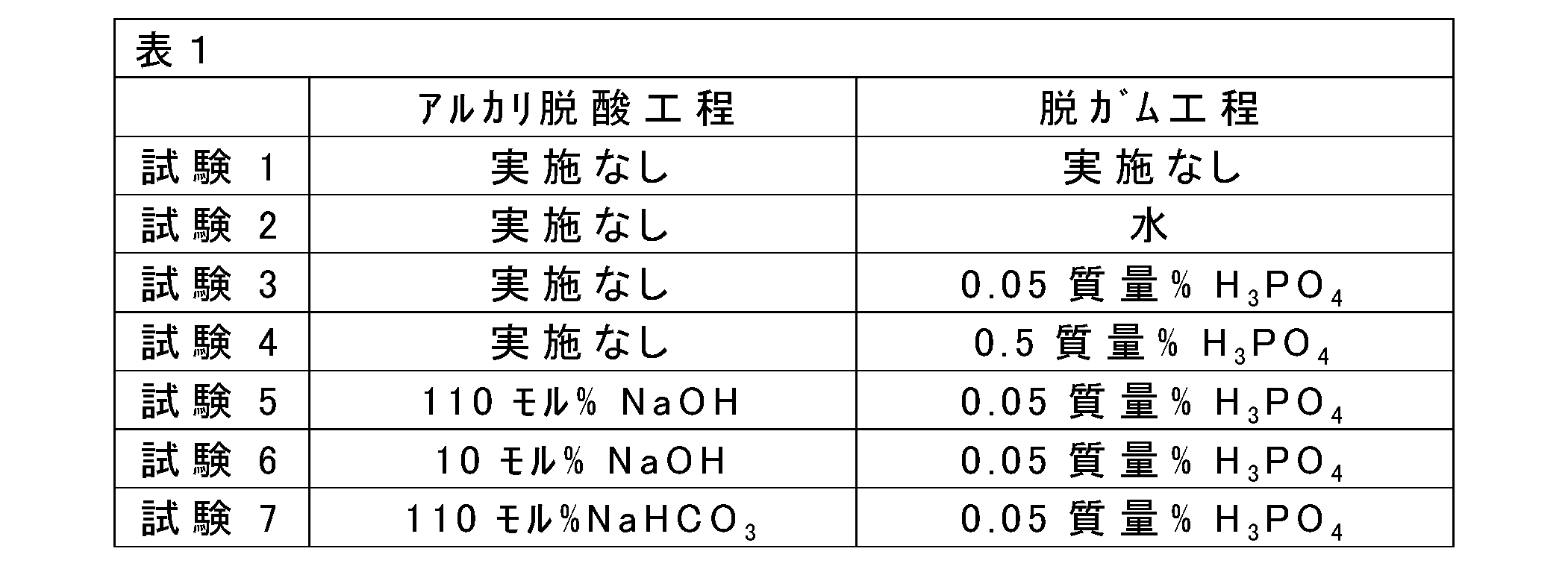

表2の「試験2」乃至「試験7」に示されるとおり、アルカリ脱酸工程及び/又は脱ガム工程を経たパーム油については、180℃以上の加熱条件下では、加熱温度にほぼ比例して3-MCPD値が増加した。
表2「試験3」と「試験5」との比較から理解されるとおり、アルカリ脱酸工程を行うと、3-MCPD値が低下した。
表2「試験2」と、「試験3」及び「試験4」との比較から理解されるとおり、リン酸による脱ガム工程を行うと、3-MCPD値が増加した。
以上の結果から、加熱工程の温度条件、アルカリ脱酸工程の有無、酸による脱ガム工程の有無が、加熱後の3-MCPD等の量と相関することが見出された。本発明者の検討の結果、アルカリ脱酸工程及び/又は脱ガム工程後の処理済み油脂中の総塩素量及び上記の要素を加味した下記「加熱後の3-MCPD等の量の予測値の算出式」に基づけば、加熱後の3-MCPD等の量を簡便かつ正確に予測できることが見出された。
(総塩素量の測定)
なお、本実施例において総塩素量は下記の方法で特定した。すなわち、塩素分析装置(商品名NSX-2100H:株式会社三菱化学アナリテック社製)を使用し、油脂を酸化分解及び電量測定することにより総塩素量を測定する。該装置は、油脂を燃焼させることで発生するHClを検出部に送る。検出部の硝酸銀溶液にHClが入り、塩化銀の沈殿が生じ、失われた銀イオンを補うために銀電極から銀イオンが溶出し、電子が発生する。該電子の量が総塩素量として特定される。
なお、本実施例において総塩素量は下記の方法で特定した。すなわち、塩素分析装置(商品名NSX-2100H:株式会社三菱化学アナリテック社製)を使用し、油脂を酸化分解及び電量測定することにより総塩素量を測定する。該装置は、油脂を燃焼させることで発生するHClを検出部に送る。検出部の硝酸銀溶液にHClが入り、塩化銀の沈殿が生じ、失われた銀イオンを補うために銀電極から銀イオンが溶出し、電子が発生する。該電子の量が総塩素量として特定される。
(加熱後の3-MCPD等の量の予測値の算出式)
(加熱後の3-MCPD等の量の予測値(ppm))=(総塩素量(ppm))×t×a×b×c
t:加熱工程の温度(℃:ただし、180℃以上)
a:酸係数(酸による脱ガム工程を実施した場合a=1.5(ただし、酸による脱ガム工程を実施する前にアルカリ脱酸を実施した場合はa=3.0とする)、酸による脱ガム工程を実施しない場合a=1.0)
b:アルカリ係数(アルカリ脱酸工程を実施しない場合b=1.0、アルカリ脱酸工程を実施する場合b=0.5)
c:0.0045(複数の実験データに基づいて特定した係数である。)
(加熱後の3-MCPD等の量の予測値(ppm))=(総塩素量(ppm))×t×a×b×c
t:加熱工程の温度(℃:ただし、180℃以上)
a:酸係数(酸による脱ガム工程を実施した場合a=1.5(ただし、酸による脱ガム工程を実施する前にアルカリ脱酸を実施した場合はa=3.0とする)、酸による脱ガム工程を実施しない場合a=1.0)
b:アルカリ係数(アルカリ脱酸工程を実施しない場合b=1.0、アルカリ脱酸工程を実施する場合b=0.5)
c:0.0045(複数の実験データに基づいて特定した係数である。)
以下、上記の「加熱後の3-MCPD等の量の予測値の算出式」の妥当性を検討すべく、粗パーム油に対して各種処理を行い、各パーム油における、加熱後の3-MCPD等の量の予測値(以下、「3-MCPD予測値」ともいう。)、及び、加熱後の3-MCPD等の量の実測値(以下、「3-MCPD実測値」ともいう。)を特定し、これらの値の比較を行った。
[加熱後の3-MCPD等の量の予測値の算出式の妥当性の検討-1]
180℃以上の加熱処理を経ていない粗パーム油A(CPO-A)に対し、アルカリ脱酸工程及び/又は脱ガム工程を行い、総塩素量を上記の方法で特定し、加熱後の3-MCPD等の量の予測値の算出式に基づき、3-MCPD予測値を算出した。次いで、各パーム油に対して210℃又は250℃で60分加熱工程を行い、上記AOCS公定法に基づき3-MCPD実測値を求めた。得られた結果を表3に示す。
180℃以上の加熱処理を経ていない粗パーム油A(CPO-A)に対し、アルカリ脱酸工程及び/又は脱ガム工程を行い、総塩素量を上記の方法で特定し、加熱後の3-MCPD等の量の予測値の算出式に基づき、3-MCPD予測値を算出した。次いで、各パーム油に対して210℃又は250℃で60分加熱工程を行い、上記AOCS公定法に基づき3-MCPD実測値を求めた。得られた結果を表3に示す。
アルカリ脱酸工程及び脱ガム工程の条件は下記のとおりである。
アルカリ脱酸工程:CPO-Aの酸価を中和するのに必要なNaOHの110モル%量を、80℃に加熱したCPO-Aに加え、そのまま20分撹拌した。遠心分離によって水相を除去し、湯を加えて80℃で撹拌した後に再度水相を除去し、この操作を水相がアルカリ性を示さなくなるまで繰り返した。
水による脱ガム工程:パーム油に、パーム油と同量の湯を加え、80℃で20分撹拌した後、遠心分離によって油相(脱ガム油)を得た。
リン酸による脱ガム工程:対パーム油0.05質量%のリン酸を、80℃に加熱したパーム油に加え、そのまま20分撹拌後、遠心分離によって脱ガム油を得た。
アルカリ脱酸工程:CPO-Aの酸価を中和するのに必要なNaOHの110モル%量を、80℃に加熱したCPO-Aに加え、そのまま20分撹拌した。遠心分離によって水相を除去し、湯を加えて80℃で撹拌した後に再度水相を除去し、この操作を水相がアルカリ性を示さなくなるまで繰り返した。
水による脱ガム工程:パーム油に、パーム油と同量の湯を加え、80℃で20分撹拌した後、遠心分離によって油相(脱ガム油)を得た。
リン酸による脱ガム工程:対パーム油0.05質量%のリン酸を、80℃に加熱したパーム油に加え、そのまま20分撹拌後、遠心分離によって脱ガム油を得た。
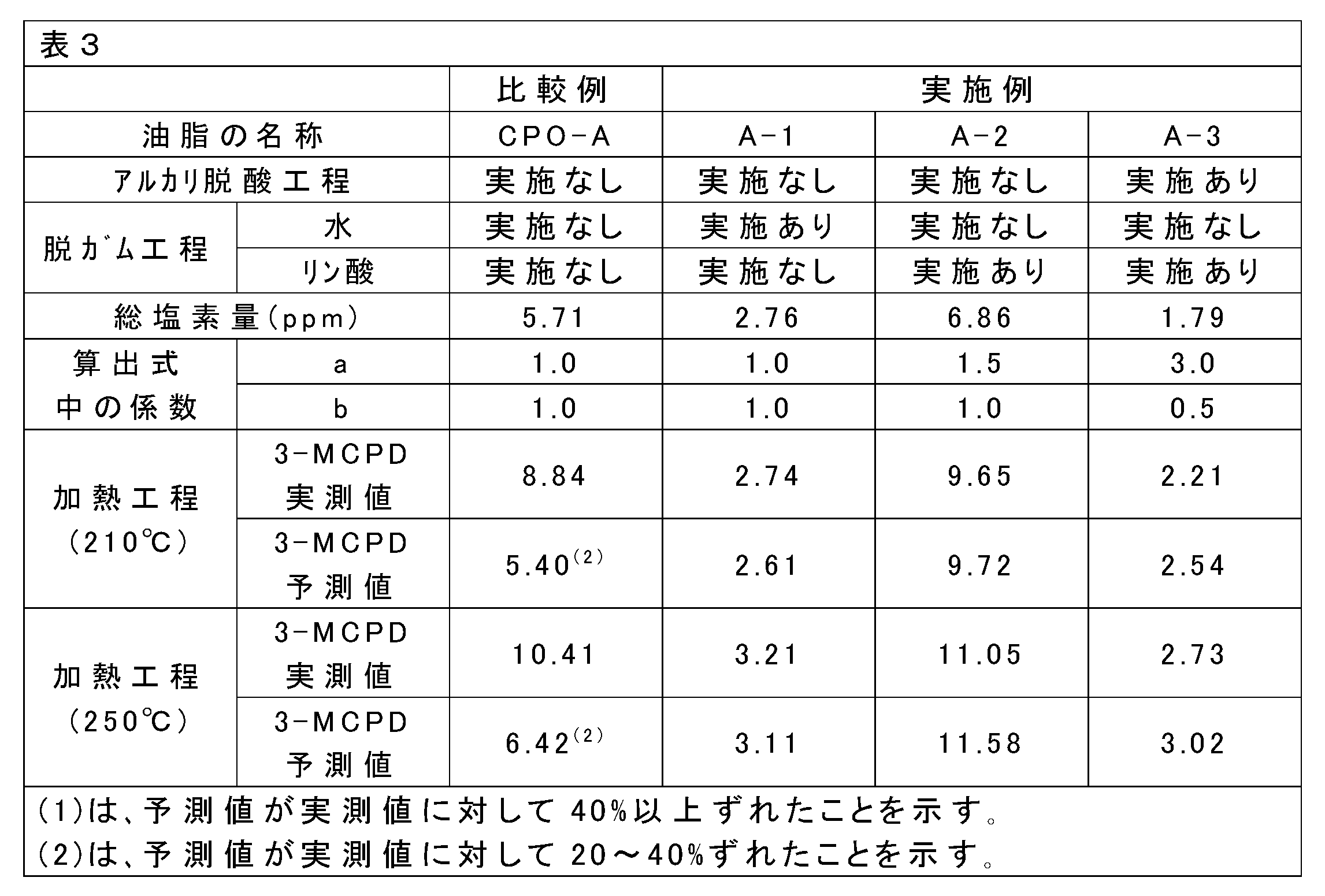
表3の各実施例に示されるとおり、アルカリ脱酸工程及び/又は脱ガム工程後の処理済み油脂においては、加熱工程前における油脂中の総塩素量と、加熱工程後の3-MCPD実測値とが相関していた。
表3の各実施例に示されるとおり、アルカリ脱酸工程及び/又は脱ガム工程後の処理済み油脂においては、加熱後の3-MCPD等の量の予測値の算出式に基づき、加熱後の3-MCPD等の量を正確に予測できた。加熱工程の温度が低い方が、予測精度が高い傾向にあった。脱ガム工程をリン酸ではなく水によって行うと、予測精度が特に高かった。また、該算出式を変形させることで、所望の3-MCPD等の量に調整できる加熱温度を求めることもできた。
[加熱後の3-MCPD等の量の予測値の算出式の妥当性の検討-2]
粗パーム油Aとは異なるロットの、180℃以上の加熱処理を経ていない粗パーム油B(CPO-B)に対し、アルカリ脱酸工程及び/又は脱ガム工程を行い、総塩素量を上記の方法で特定し、加熱後の3-MCPD等の量の予測値の算出式に基づき、3-MCPD予測値を算出した。次いで、各パーム油に対して210℃又は250℃で60分加熱工程を行い、上記AOCS公定法に基づき3-MCPD実測値を求めた。得られた結果を表4に示す。
粗パーム油Aとは異なるロットの、180℃以上の加熱処理を経ていない粗パーム油B(CPO-B)に対し、アルカリ脱酸工程及び/又は脱ガム工程を行い、総塩素量を上記の方法で特定し、加熱後の3-MCPD等の量の予測値の算出式に基づき、3-MCPD予測値を算出した。次いで、各パーム油に対して210℃又は250℃で60分加熱工程を行い、上記AOCS公定法に基づき3-MCPD実測値を求めた。得られた結果を表4に示す。
アルカリ脱酸工程及び脱ガム工程の条件は下記のとおりである。
アルカリ脱酸工程:CPO-Bの酸価を中和するのに必要なNaOHの110モル%量を、80℃に加熱したCPO-Bに加え、そのまま20分撹拌した。遠心分離によって水相を除去し、湯を加えて80℃で撹拌した後に再度水相を除去し、この操作を水相がアルカリ性を示さなくなるまで繰り返した。
水による脱ガム工程:パーム油に、パーム油と同量の湯を加え、80℃で20分撹拌した後、遠心分離によって油相(脱ガム油)を得た。
リン酸による脱ガム工程:対パーム油0.05質量%のリン酸を、80℃に加熱したパーム油に加え、そのまま20分撹拌後、遠心分離によって脱ガム油を得た。
なお、表4中、「アルカリ脱酸工程-1」とは、脱ガム工程の前に実施したアルカリ脱酸工程を指し、「アルカリ脱酸工程-2」とは、脱ガム工程の後に実施したアルカリ脱酸工程を指す。
アルカリ脱酸工程:CPO-Bの酸価を中和するのに必要なNaOHの110モル%量を、80℃に加熱したCPO-Bに加え、そのまま20分撹拌した。遠心分離によって水相を除去し、湯を加えて80℃で撹拌した後に再度水相を除去し、この操作を水相がアルカリ性を示さなくなるまで繰り返した。
水による脱ガム工程:パーム油に、パーム油と同量の湯を加え、80℃で20分撹拌した後、遠心分離によって油相(脱ガム油)を得た。
リン酸による脱ガム工程:対パーム油0.05質量%のリン酸を、80℃に加熱したパーム油に加え、そのまま20分撹拌後、遠心分離によって脱ガム油を得た。
なお、表4中、「アルカリ脱酸工程-1」とは、脱ガム工程の前に実施したアルカリ脱酸工程を指し、「アルカリ脱酸工程-2」とは、脱ガム工程の後に実施したアルカリ脱酸工程を指す。

表4の各実施例に示されるとおり、アルカリ脱酸工程及び/又は脱ガム工程後の処理済み油脂においては、加熱工程前における油脂中の総塩素量と、加熱工程後の3-MCPD実測値とが相関していた。
表4の各実施例に示されるとおり、アルカリ脱酸工程及び/又は脱ガム工程後の処理済み油脂においては、加熱後の3-MCPD等の量の予測値の算出式に基づき、加熱後の3-MCPD等の量を正確に予測できた。加熱工程の温度が低い方が、予測精度が高い傾向にあった。また、該算定式を変形させることで、所望の3-MCPD等の量に調整できる加熱温度を求めることもできた。
「B-1」と「B-2」との比較から理解されるとおり、脱ガム工程をリン酸ではなく水によって行うと、予測精度が特に高かった。ただし、「B-4」と「B-5」との比較から理解されるとおり、アルカリ脱酸工程及び脱ガム工程をこの順序で行うと、脱ガム工程がリン酸による脱ガム工程であっても予測精度が高かった。
[加熱後の3-MCPD等の量の予測値の算出式の妥当性の検討-3]
粗パーム油A及びBとは異なるロットの、180℃以上の加熱処理を経ていない粗パーム油Cを、4回分取し、各パーム油を60℃で0時間(C-1)、24時間(C-2)、48時間(C-3)、96時間(C-4)放置して酸化させた後、AOCS Official Method Cd 8b-90に基づき、各パーム油の過酸化物価(POV、単位:meq/kg)を測定した。さらに、80℃でパーム油と同量の水を加え、20分撹拌後、遠心分離によって脱ガム油を得た。得られた各パーム油の総塩素量を上記の方法で特定し、加熱後の3-MCPD等の量の予測値の算出式に基づき、3-MCPD予測値を算出した。次いで、各パーム油に対して250℃で60分加熱工程を行い、上記AOCS公定法に基づき3-MCPD実測値を求めた。得られた結果を表5に示す。
粗パーム油A及びBとは異なるロットの、180℃以上の加熱処理を経ていない粗パーム油Cを、4回分取し、各パーム油を60℃で0時間(C-1)、24時間(C-2)、48時間(C-3)、96時間(C-4)放置して酸化させた後、AOCS Official Method Cd 8b-90に基づき、各パーム油の過酸化物価(POV、単位:meq/kg)を測定した。さらに、80℃でパーム油と同量の水を加え、20分撹拌後、遠心分離によって脱ガム油を得た。得られた各パーム油の総塩素量を上記の方法で特定し、加熱後の3-MCPD等の量の予測値の算出式に基づき、3-MCPD予測値を算出した。次いで、各パーム油に対して250℃で60分加熱工程を行い、上記AOCS公定法に基づき3-MCPD実測値を求めた。得られた結果を表5に示す。
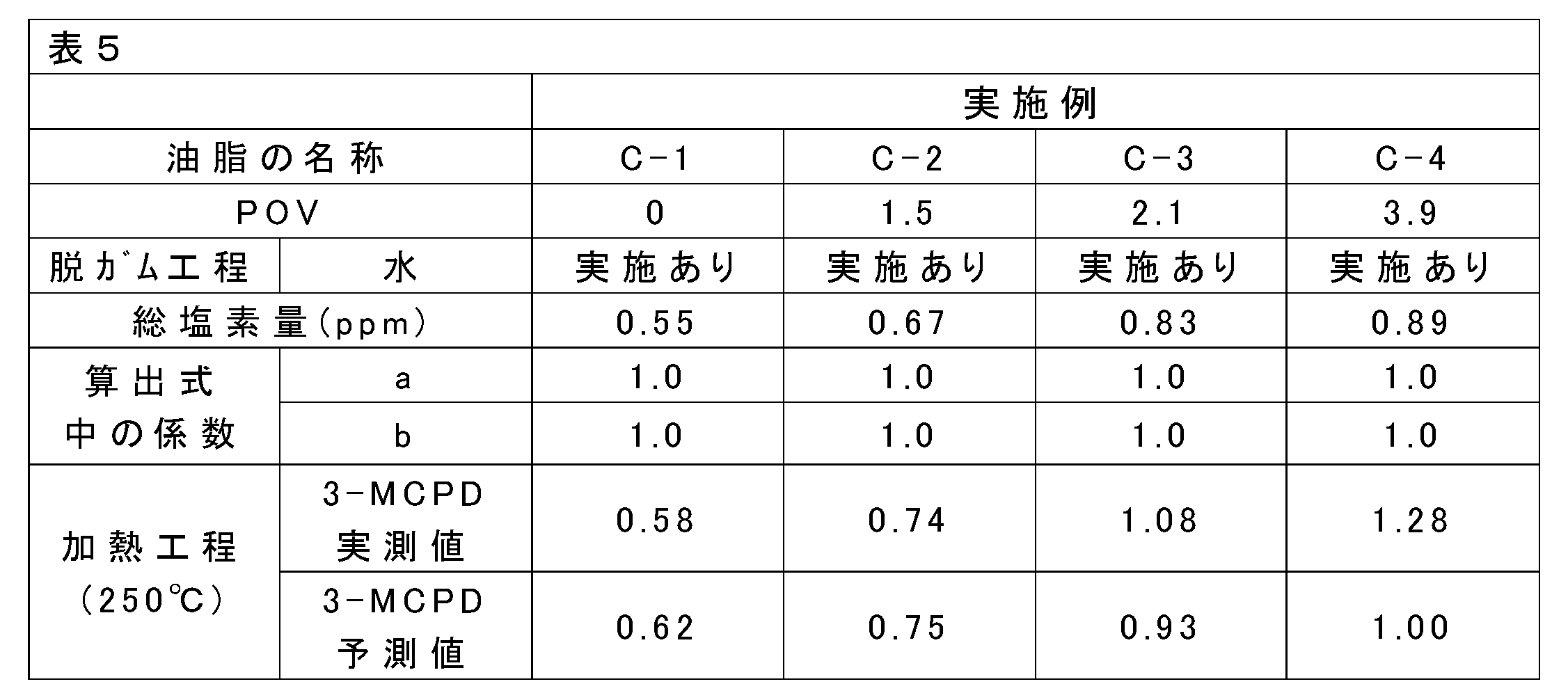
表5の各実施例に示されるとおり、水による脱ガム工程を行った油脂においては、加熱工程前における油脂中の総塩素量と、加熱工程後の3-MCPD実測値とが相関していた。
表5の各実施例に示されるとおり、水による脱ガム工程を行った油脂においては、加熱後の3-MCPD等の量の予測値の算出式に基づき、加熱後の3-MCPD等の量を正確に予測できた。
通常、過酸化物価が高いと、油脂中の3-MCPD及びその脂肪酸エステルの含有量も増加すると考えられているが、本発明によれば、過酸化物価の値に関わらず、油脂中の3-MCPD及びその脂肪酸エステルの含有量を正確に予測できた。
Claims (8)
- 180℃以上の加熱処理を経ていない原料油脂に対して、アルカリ脱酸工程、及び、水又は酸による脱ガム工程からなる群から選択される1種以上を行い、処理済み油脂を得る処理工程と、
前記処理済み油脂中の総塩素量を測定し、前記処理済み油脂を180℃以上で加熱処理した場合に油脂中に含まれる3-クロロプロパン-1,2-ジオール及びその脂肪酸エステルの量の予測値を得る予測工程と、
前記予測値が所定の値以下である処理済み油脂を選別する選別工程と、
を含む精製油脂の製造方法。 - 前記予測工程後かつ前記選別工程の前に、前記処理済み油脂を180℃以上で加熱処理する加熱工程を含む、請求項1に記載の精製油脂の製造方法。
- 前記脱ガム工程は、水による脱ガム工程である、請求項1又は2に記載の精製油脂の製造方法。
- 前記処理工程において、アルカリ脱酸工程、及び、酸による脱ガム工程をこの順序で行う、請求項1から3のいずれかに記載の精製油脂の製造方法。
- 前記原料油脂は粗パーム油である、請求項1から4のいずれかに記載の精製油脂の製造方法。
- 前記所定の値は、1ppmである、請求項1から5のいずれかに記載の精製油脂の製造方法。
- 前記加熱処理が脱臭工程である、請求項1から6のいずれかに記載の精製油脂の製造方法。
- 180℃以上の加熱処理を経ていない原料油脂に対して、アルカリ脱酸工程、及び、水又は酸による脱ガム工程からなる群から選択される1種以上の工程を行い、得られた処理済み油脂中の総塩素量を測定することで、前記処理済み油脂を180℃以上で加熱処理した場合に油脂中に含まれる3-クロロプロパン-1,2-ジオール及びその脂肪酸エステルの量を予測することを特徴とする精製油脂の製造管理方法。
Priority Applications (1)
| Application Number | Priority Date | Filing Date | Title |
|---|---|---|---|
| MYPI2017702311A MY182854A (en) | 2015-01-19 | 2015-12-08 | Method of manufacturing refined fat and/or oil, and manufacturing management method for refined fat and/or oil |
Applications Claiming Priority (2)
| Application Number | Priority Date | Filing Date | Title |
|---|---|---|---|
| JP2015-007614 | 2015-01-19 | ||
| JP2015007614A JP6484040B2 (ja) | 2015-01-19 | 2015-01-19 | 精製油脂の製造方法及び精製油脂の製造管理方法 |
Publications (1)
| Publication Number | Publication Date |
|---|---|
| WO2016117234A1 true WO2016117234A1 (ja) | 2016-07-28 |
Family
ID=56416794
Family Applications (1)
| Application Number | Title | Priority Date | Filing Date |
|---|---|---|---|
| PCT/JP2015/084447 Ceased WO2016117234A1 (ja) | 2015-01-19 | 2015-12-08 | 精製油脂の製造方法及び精製油脂の製造管理方法 |
Country Status (3)
| Country | Link |
|---|---|
| JP (1) | JP6484040B2 (ja) |
| MY (1) | MY182854A (ja) |
| WO (1) | WO2016117234A1 (ja) |
Cited By (2)
| Publication number | Priority date | Publication date | Assignee | Title |
|---|---|---|---|---|
| WO2018043701A1 (ja) * | 2016-09-02 | 2018-03-08 | 太陽油脂株式会社 | 育児用調製粉乳に用いるための油脂組成物 |
| JP2022548033A (ja) * | 2019-09-13 | 2022-11-16 | ソシエテ・デ・プロデュイ・ネスレ・エス・アー | トリアシルグリセリド油中のmcpd形成の予防 |
Families Citing this family (2)
| Publication number | Priority date | Publication date | Assignee | Title |
|---|---|---|---|---|
| FI128345B (en) * | 2016-08-05 | 2020-03-31 | Neste Oyj | Method for cleaning the feed |
| US20230292783A1 (en) * | 2020-08-31 | 2023-09-21 | J-Oil Mills, Inc. | Method for reducing sulfur-containing-compound content of volatile substances from fried food |
Citations (3)
| Publication number | Priority date | Publication date | Assignee | Title |
|---|---|---|---|---|
| WO2010126136A1 (ja) * | 2009-04-30 | 2010-11-04 | 不二製油株式会社 | グリセリド油脂中のクロロプロパノール類及びその形成物質の生成を抑制する方法 |
| JP2014047290A (ja) * | 2012-08-31 | 2014-03-17 | Nisshin Oillio Group Ltd | 精製油脂の製造方法 |
| JP2014515940A (ja) * | 2011-06-09 | 2014-07-07 | シージェイ チェイルジェダン コーポレーション | 3−クロロ−1,2−プロパンジオール形成物質が低減された食用油を製造する方法及びそれによって準備された製品 |
-
2015
- 2015-01-19 JP JP2015007614A patent/JP6484040B2/ja active Active
- 2015-12-08 MY MYPI2017702311A patent/MY182854A/en unknown
- 2015-12-08 WO PCT/JP2015/084447 patent/WO2016117234A1/ja not_active Ceased
Patent Citations (3)
| Publication number | Priority date | Publication date | Assignee | Title |
|---|---|---|---|---|
| WO2010126136A1 (ja) * | 2009-04-30 | 2010-11-04 | 不二製油株式会社 | グリセリド油脂中のクロロプロパノール類及びその形成物質の生成を抑制する方法 |
| JP2014515940A (ja) * | 2011-06-09 | 2014-07-07 | シージェイ チェイルジェダン コーポレーション | 3−クロロ−1,2−プロパンジオール形成物質が低減された食用油を製造する方法及びそれによって準備された製品 |
| JP2014047290A (ja) * | 2012-08-31 | 2014-03-17 | Nisshin Oillio Group Ltd | 精製油脂の製造方法 |
Non-Patent Citations (1)
| Title |
|---|
| J.OUYANG ET AL.: "Effect of oil refining conditions on the formation of 3-MCPD", CHINA OILS AND FATS, vol. 39, no. 7, 2014, pages 58 - 61 * |
Cited By (4)
| Publication number | Priority date | Publication date | Assignee | Title |
|---|---|---|---|---|
| WO2018043701A1 (ja) * | 2016-09-02 | 2018-03-08 | 太陽油脂株式会社 | 育児用調製粉乳に用いるための油脂組成物 |
| JPWO2018043701A1 (ja) * | 2016-09-02 | 2019-06-24 | 太陽油脂株式会社 | 育児用調製粉乳に用いるための油脂組成物 |
| JP2022548033A (ja) * | 2019-09-13 | 2022-11-16 | ソシエテ・デ・プロデュイ・ネスレ・エス・アー | トリアシルグリセリド油中のmcpd形成の予防 |
| JP7689516B2 (ja) | 2019-09-13 | 2025-06-06 | ソシエテ・デ・プロデュイ・ネスレ・エス・アー | トリアシルグリセリド油中のmcpd形成の予防 |
Also Published As
| Publication number | Publication date |
|---|---|
| JP2016132714A (ja) | 2016-07-25 |
| MY182854A (en) | 2021-02-05 |
| JP6484040B2 (ja) | 2019-03-13 |
Similar Documents
| Publication | Publication Date | Title |
|---|---|---|
| Zulkurnain et al. | The effects of physical refining on the formation of 3-monochloropropane-1, 2-diol esters in relation to palm oil minor components | |
| Franke et al. | Influence of chemical refining process and oil type on bound 3-chloro-1, 2-propanediol contents in palm oil and rapeseed oil | |
| US9765281B2 (en) | Removal of unwanted propanol components | |
| Li et al. | Formation and reduction of 3-monochloropropane-1, 2-diol esters in peanut oil during physical refining | |
| EP2793612B1 (en) | Method of treating a vegetable oil | |
| JPWO2010126136A1 (ja) | グリセリド油脂中のクロロプロパノール類及びその形成物質の生成を抑制する方法 | |
| EP2738243B1 (en) | Purified glyceride composition and method for producing purified glyceride composition | |
| US20150166930A1 (en) | Reduction of mcpd-compounds in refined plant oil for food | |
| JP6484040B2 (ja) | 精製油脂の製造方法及び精製油脂の製造管理方法 | |
| EP3428255B2 (en) | Method for producing refined palm-based fat/oil, and method for reducing glycidol, 3-chloropropane-1,2-diol and fatty acid esters thereof and/or diglycerides in refined palm-based fat/oil | |
| CN104471043A (zh) | 精制油脂的制造方法 | |
| CN111818804A (zh) | 三酰基甘油酯油的纯化 | |
| WO2015146248A1 (ja) | 精製パーム系油脂の製造方法 | |
| WO2018156013A1 (en) | Process for producing refined palm fruit oil | |
| JP5873690B2 (ja) | 食用油脂の製造方法及び加工油脂製品の製造方法 | |
| EP3749101A1 (en) | Liquid oils without unwanted contaminants | |
| CN113574153B (zh) | 通过辅助洗涤纯化三酰基甘油酯油 | |
| EP3556833B1 (en) | Method for producing fat/oil composition | |
| JP5917976B2 (ja) | グリセリド組成物の製造方法、及び第1の精製工程後のグリセリド組成物に対する第2の精製工程の必要性を判断する判断方法 | |
| KR20120135161A (ko) | 3-mcpd-fs가 저감화된 식용 유지의 제조방법 | |
| Espinosa | Mitigating 3-MCPD-and glycidyl esters at the refineries | |
| JP2013028752A (ja) | グリセリド組成物の製造方法 | |
| AU2024320695A1 (en) | Removal of unwanted mineral oil hydrocarbons | |
| JP2014508843A (ja) | アルコールの存在下における植物性油の精製 | |
| EP4195950A1 (en) | Removal of unwanted mineral oil hydrocarbons |
Legal Events
| Date | Code | Title | Description |
|---|---|---|---|
| 121 | Ep: the epo has been informed by wipo that ep was designated in this application |
Ref document number: 15878923 Country of ref document: EP Kind code of ref document: A1 |
|
| NENP | Non-entry into the national phase |
Ref country code: DE |
|
| 122 | Ep: pct application non-entry in european phase |
Ref document number: 15878923 Country of ref document: EP Kind code of ref document: A1 |