WO2016111203A1 - 1,3-ブタジエンの製造方法 - Google Patents
1,3-ブタジエンの製造方法 Download PDFInfo
- Publication number
- WO2016111203A1 WO2016111203A1 PCT/JP2015/086235 JP2015086235W WO2016111203A1 WO 2016111203 A1 WO2016111203 A1 WO 2016111203A1 JP 2015086235 W JP2015086235 W JP 2015086235W WO 2016111203 A1 WO2016111203 A1 WO 2016111203A1
- Authority
- WO
- WIPO (PCT)
- Prior art keywords
- ethanol
- stage
- acetaldehyde
- butadiene
- supplied
- Prior art date
- Legal status (The legal status is an assumption and is not a legal conclusion. Google has not performed a legal analysis and makes no representation as to the accuracy of the status listed.)
- Ceased
Links
Images
Classifications
-
- C—CHEMISTRY; METALLURGY
- C07—ORGANIC CHEMISTRY
- C07C—ACYCLIC OR CARBOCYCLIC COMPOUNDS
- C07C1/00—Preparation of hydrocarbons from one or more compounds, none of them being a hydrocarbon
- C07C1/20—Preparation of hydrocarbons from one or more compounds, none of them being a hydrocarbon starting from organic compounds containing only oxygen atoms as heteroatoms
- C07C1/207—Preparation of hydrocarbons from one or more compounds, none of them being a hydrocarbon starting from organic compounds containing only oxygen atoms as heteroatoms from carbonyl compounds
-
- C—CHEMISTRY; METALLURGY
- C07—ORGANIC CHEMISTRY
- C07C—ACYCLIC OR CARBOCYCLIC COMPOUNDS
- C07C11/00—Aliphatic unsaturated hydrocarbons
- C07C11/12—Alkadienes
- C07C11/16—Alkadienes with four carbon atoms
- C07C11/167—1, 3-Butadiene
Definitions
- It relates to a method for producing 1,3-butadiene from ethanol.
- Butadiene production from ethanol is an industrially proven technology in the past, but lost its competitiveness with the completion of butadiene extractive distillation technology for C4 fraction obtained from naphtha crackers.
- ETB ethanol
- C4 fraction obtained from naphtha crackers C4 fraction obtained from naphtha crackers.
- An object of the present invention is to provide a production method for improving 1,3-butadiene selectivity.
- ethanol was dehydrogenated in the first stage to synthesize acetaldehyde, and then in the second stage, 1,3- When synthesizing butadiene, A method for producing 1,3-butadiene, characterized in that, in the total amount of ethanol and acetaldehyde supplied to the second-stage reactor, the ethanol supply ratio is in the range of 60 to 90 mol%.
- [5] Either [1] or [2], wherein the ethanol raw material is supplied to the first and second stage reactors, and the separated ethanol is supplied to the first stage reactor.
- [6] Either [1] or [2], wherein the ethanol raw material is supplied to the first and second stage reactors, and the separated ethanol is supplied to the second stage reactor.
- [7] The method for producing 1,3-butadiene according to any one of [2] to [6], wherein the content of acetaldehyde in ethanol to be recycled is 10 mol% or less.
- [8] The 1,3-butadiene according to any one of [1] to [7], wherein no component separation is performed between the first-stage and second-stage reactors in the process described above. Production method.
- the supply of recycled acetaldehyde to the second-stage reactor avoids the suppression of the conversion rate of the first-stage reactor, and ethanol and acetaldehyde to be supplied to the second-stage reactor.
- the yield of 1,3-butadiene can be improved.
- ethanol and acetaldehyde which are the raw materials, are separated when recycled, and ethanol is supplied to the first stage reactor and acetaldehyde is supplied to the second stage reactor. It is also possible to optimize the ratio of ethanol and acetaldehyde supplied to the second-stage reactor.
- the construction cost is reduced by not separating the components between the reactors. It is also possible to reduce the manufacturing cost.
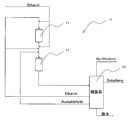
- FIG. 1 is an explanatory diagram showing the flow of the method for producing 1,3-butadiene according to the present invention.
- the 1,3-butadiene production apparatus 10 of this embodiment includes a first-stage reactor 11, a second-stage reactor 12, and a separation and purification apparatus 13.
- the mixture of ethanol and acetaldehyde is sent to the second stage reactor 12 to synthesize 1,3-butadiene from ethanol and acetaldehyde.
- Separation and purification unit 13 separates and purifies the reactor outlet gas containing 1,3-butadiene obtained in the second-stage reactor 12 and purifies the C4 fraction, light gas, heavy component, water, ethanol, acetaldehyde, etc. Isolate. Of these, unreacted ethanol and acetaldehyde are preferably recycled separately, and ethanol is sent to the first-stage reactor 11 or the second-stage reactor 12, and acetaldehyde is sent to the second-stage reactor 12.
- First stage reactor 11 In the first stage reactor, a reaction represented by the following formula is performed, and acetaldehyde is synthesized from ethanol.
- the ethanol raw material is not particularly limited, and examples thereof include biomass-derived ethanol such as sugar cane and corn, petroleum or natural gas, and coal-derived ethanol. In addition, if ethanol derived from biomass is used, it can contribute to greenhouse gas reduction.
- a known copper catalyst or silver catalyst disclosed in JP-A-2005-342675, JP-A-2011-532, or the like is used.
- Cu-based materials, metals of group 8 of the periodic table of elements such as Ni, Pd, and Pt can be suitably used, and those containing Cu are more preferable.
- Cu alone or a material containing a two-component metal obtained by adding a transition metal element such as Cr, Co, Ni, Fe, or Mn to this can be used, and a material containing Cu and Ni is preferably used.
- those containing a metal having three or more components are also preferably used.
- those in which these are further supported on silicon dioxide, aluminum oxide, titanium oxide, zeolite or the like can be used.
- CuO, ZnO, CuO / ZnO, etc. can also be used as a catalyst.
- the reaction conditions are not particularly limited, and the reaction is usually carried out in the range of about 200 to 300 ° C. under the conditions of 0.1 to 1.0 MPa.
- Examples of the method for bringing the raw material into contact with the catalyst include a suspension bed system, a fluidized bed system, and a fixed bed system. Further, the present invention may be either a gas phase method or a liquid phase method, but it is preferable to use the gas phase method.
- the raw material gas for example, ethanol gas
- the raw material gas is diluted. It may be supplied to the reactor without being diluted, or may be appropriately diluted with an inert gas such as nitrogen or water vapor and supplied to the reactor.
- the ethanol raw material can be supplied to one or both of the first stage reactor and the second stage reactor.
- the unreacted ethanol recovered in the first stage reactor is supplied, an embodiment in which the ethanol raw material is not supplied to the first stage reactor is also possible.
- ethanol recovered from the reactor outlet gas containing 1,3-butadiene obtained in the second stage reactor 12 it is preferable to supply ethanol recovered from the reactor outlet gas containing 1,3-butadiene obtained in the second stage reactor 12 to the first stage reactor. You may supply.
- the first-stage reactor a part of ethanol is converted to acetaldehyde, and this reaction has an equilibrium conversion rate. Therefore, when supplying the unreacted ethanol collected in the first stage, the conversion efficiency to acetaldehyde can be increased by separating the contained acetaldehyde and supplying only ethanol.
- the content of acetaldehyde in the ethanol to be recycled is preferably 10 mol% or less from the viewpoint of ethanol conversion.
- Second stage reactor 12 In the second-stage reactor, a reaction represented by the following formula is performed from a mixture of acetaldehyde and ethanol synthesized in the first-stage reactor to synthesize 1,3-butadiene.
- the ratio of ethanol is 60 to 90 mol%, more preferably 70 to 80 mol%, out of the total of ethanol and acetaldehyde (total when added) supplied to the second stage reactor.
- the amount of acetaldehyde necessary for the second-stage reaction can be secured, and the synthesis efficiency of 1,3-butadiene can be increased.
- an ethanol raw material may be added to the second-stage reactor. In this way, it is possible to optimize the ethanol: acetaldehyde mol ratio supplied to the second-stage reactor.
- the second stage reactor for example, ZrO 2 / SiO 2 , HfO 2 / SiO 2 , Ta 2 O 5 disclosed in Non-Patent Document Industrial and Engineering Chemistry, vol. 42, p.359-372 (1950), etc. / SiO 2 , MgO-SiO 2 disclosed in Non-Patent Document Bulletin of the Chemical Society of Japan, vol. 45, p.655-659 (1972), Non-patent Document Industrial and Engineering Chemistry Process Design and Development, ZnO—Al 2 O 3 and the like disclosed in vol.2, p.45-51 (1963) are used as the catalyst, but the type of the catalyst is not particularly limited.
- the shape of the catalyst is not particularly limited, and it can be used even if it is granular, columnar, cylindrical or honeycomb.
- the same method as the first-stage reactor can be adopted, and examples thereof include a suspension bed method, a fluidized bed method, and a fixed bed method.
- the present invention may be either a gas phase method or a liquid phase method, but it is preferable to use a gas phase method.
- the raw material gas for example, ethanol gas, preferably a mixture of ethanol gas and acetaldehyde gas
- the solution may be appropriately diluted by the above and supplied to the reactor.
- the contact time between the raw material and the catalyst can be controlled by adjusting the feed rate of the raw material, and the weight space velocity (WHSV) is 1.0 to 40 g-(EtOH + AcH ) as the total value of the raw material ethanol and the raw material acetaldehyde. ) ⁇ G ⁇ cat ⁇ 1 ⁇ h ⁇ 1 , preferably 1.0 to 5.0 g ⁇ (EtOH + AcH) ⁇ g ⁇ cat ⁇ 1 ⁇ h ⁇ 1 . If WHSV is too low, the 1,3-butadiene selectivity decreases. On the other hand, if WHSV is too high, the butadiene yield decreases.
- WHSV weight space velocity
- the reaction temperature is, for example, about 300 to 400 ° C., preferably 330 to 360 ° C.
- the reaction pressure can be appropriately set within a wide range from normal pressure to high pressure. From the viewpoint of production efficiency and apparatus configuration, it is preferable to set the pressure to 0.1 to 1.0 MPa.
- Separation and purification unit 13 After completion of the reaction, the reaction product is sent to the separation / purification device 13, for example, by a separation means such as distillation, extraction, absorption, etc., or a separation means that combines these, light gas, C4 fraction, heavy fraction, water, It can be separated into ethanol, acetaldehyde and the like.
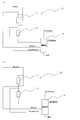
- FIG. 2 is an explanatory diagram showing an ethanol supply mode in the flow of the method for producing 1,3-butadiene of the present invention.
- Various side reaction products are generated depending on the catalyst used in the first stage reactor 11 and the reaction conditions.
- Various side reaction products are generated depending on the catalyst used in the second-stage reactor 12 and the reaction conditions.
- the accompanying side reaction product is converted into acetaldehyde or ethanol in the first-stage reactor 11, as shown in FIG. 2 (a)
- the ethanol raw material is supplied in the first-stage and second-stage reactions. It is preferable to supply the ethanol separated and separated to the first-stage reactor 11.
- the accompanying side reaction product contributes to the decrease in the catalytic activity of the first-stage reactor 11, as shown in FIG.
- the separated ethanol is preferably supplied to the second-stage reactor 12.
- the ethanol: acetaldehyde molar (EtOH: AcH) ratio is 1: 9, 2: 8, 3: 7, 4: 6, 5: 5, 6: 4, 7: 3, 8:
- Example 2 Ethanol / acetaldehyde ratio supplied to the second stage reactor Of the total ethanol and acetaldehyde supplied to the second stage reactor, ZrO 2 / SiO 2 (1.0 wt% ) 0.63 g of catalyst was charged into a fixed bed flow type reactor, and an experiment was conducted under the following reaction conditions.
- the 1,3-butadiene selectivity was high when the ethanol supply ratio was in the range of 60 to 90 mol%. Further, higher results were obtained in the range of 70 to 80 mol%.
- the higher the acetaldehyde ratio the smaller the amount of ethylene and diethyl ether produced, resulting in C5-C8 carbonization. As a result, the amount of hydrogen produced increased.
Landscapes
- Chemical & Material Sciences (AREA)
- Organic Chemistry (AREA)
- Organic Low-Molecular-Weight Compounds And Preparation Thereof (AREA)
Abstract
[課題]本発明は2段法(American法)において1,3-ブタジエン選択率を向上させる製造方法を提供することを課題とする。2段の反応器を用いて、以下の反応式に示されるように1段目でエタノールを脱水素してアセトアルデヒドを合成したのち、2段目でエタノールとアセトアルデヒドとから1,3-ブタジエンを合成するに際し、 2段目の反応器に供給するエタノールとアセトアルデヒドの合計の内、エタノールの供給割合を60~90mol%の範囲とすることを特徴とする1,3-ブタジエンの製造方法。 CH3CH2OH → CH3CHO + H2 (1段目) CH3CH2OH + CH3CHO → CH2=CH-CH=CH2 + 2 H2O (2段目)
Description
エタノールからの1,3-ブタジエンを製造する方法に関する。
エタノールからのブタジエン製造(ETB)法は、過去に工業実績のある技術であるが、ナフサクラッカーより得られたC4留分のブタジエン抽出蒸留技術の完成に伴い競争力を失ったため、一部の地域を除いて現在では使用されていない。しかしながら、近年、アジアを中心とした自動車普及台数の伸びとクラッカー原料の軽質化に伴う世界的なブタジエン需給ギャップの拡大が懸念されており、ブタジエンを単産できるETBプロセスへの関心が高まっている。
ETB製造プロセスには、一段でエタノールからブタジエンを合成する一段法(Lebedev法)と、まずエタノールを脱水素してアセトアルデヒドを合成し、エタノールとアセトアルデヒドからブタジエンを合成する二段法(American法)がある。なお、それぞれのプロセスに使用される触媒は異なる。
・一段法
2 CH3CH2OH → CH2=CH-CH=CH2 + 2 H2O + H2
・二段法
CH3CH2OH → CH3CHO + H2
CH3CH2OH + CH3CHO → CH2=CH-CH=CH2 + 2 H2O
1940年代から現在に至るまで、ETB反応の触媒に関する特許・文献が多数公表されているがプロセスに関する特許は少なく、1940年代のエタノールおよびアセトアルデヒドのリサイクルに関する特許(特許文献1~3)などが知られているのみである。
・一段法
2 CH3CH2OH → CH2=CH-CH=CH2 + 2 H2O + H2
・二段法
CH3CH2OH → CH3CHO + H2
CH3CH2OH + CH3CHO → CH2=CH-CH=CH2 + 2 H2O
1940年代から現在に至るまで、ETB反応の触媒に関する特許・文献が多数公表されているがプロセスに関する特許は少なく、1940年代のエタノールおよびアセトアルデヒドのリサイクルに関する特許(特許文献1~3)などが知られているのみである。
しかしながら、これらの特許は2段法(American法)を対象としているものではないため、各段に供給する原料比率を示唆しているものはない。また、生成物のリサイクル量および供給する反応器を規定するものではなかった。
本発明の課題は、1,3-ブタジエン選択率を向上させる製造方法を提供することである。
このような状況のもと、本発明者らは、上記課題を解決すべく鋭意検討した。その結果、2段法(American法)を採用し、反応過程を複数器で段階的に行うことが有効であることが分かった。
上記の反応式で示されるように、1段目の反応器ではエタノールの一部がアセトアルデヒドに転換するが、この反応には平衡転化率が存在する。これを考慮し、2段の反応器を使用し、それぞれの反応器へ供給する原料組成を最適化することによって、1段目反応の平衡反応阻害を緩和することが重要であることを本発明者らは見出し、本発明を完成するに至った。
[1]2段の反応器を用いて、以下の反応式に示されるように1段目でエタノールを脱水素してアセトアルデヒドを合成したのち、2段目でエタノールとアセトアルデヒドとから1,3-ブタジエンを合成するに際し、
2段目の反応器に供給するエタノールとアセトアルデヒドの合計の内、エタノールの供給割合を60~90mol%の範囲とすることを特徴とする1,3-ブタジエンの製造方法。
[1]2段の反応器を用いて、以下の反応式に示されるように1段目でエタノールを脱水素してアセトアルデヒドを合成したのち、2段目でエタノールとアセトアルデヒドとから1,3-ブタジエンを合成するに際し、
2段目の反応器に供給するエタノールとアセトアルデヒドの合計の内、エタノールの供給割合を60~90mol%の範囲とすることを特徴とする1,3-ブタジエンの製造方法。
CH3CH2OH → CH3CHO + H2 (1段目)
CH3CH2OH + CH3CHO → CH2=CH-CH=CH2 + 2 H2O (2段目)
[2]生成物から、未反応のエタノールとアセトアルデヒドを分離して別々にリサイクルを行うことを特徴とする[1]に記載の1,3-ブタジエンの製造方法。
[3]分離したエタノールは1段目の反応器に供給し、アセトアルデヒドは2段目の反応器に供給することを特徴とする[2]に記載の1,3-ブタジエンの製造方法。
[4]エタノール原料の供給を、2段目の反応器に行うことを特徴とする[1]~[3]のいずれかに記載の1,3-ブタジエンの製造方法。
[5]エタノール原料の供給を1段目および2段目の反応器に行い、分離したエタノールの供給を1段目の反応器に行うことを特徴とする[1]または[2]のいずれかに記載の1,3-ブタジエンの製造方法。
[6]エタノール原料の供給を1段目および2段目の反応器に行い、分離したエタノールの供給を2段目の反応器に行うことを特徴とする[1]または[2]のいずれかに記載の1,3-ブタジエンの製造方法。
[7]リサイクルするエタノール中のアセトアルデヒドの含有率が10mol%以下であることを特徴とする[2]~[6]のいずれかに記載の1,3-ブタジエンの製造方法。
[8]上述したプロセスに関し、1段目、2段目の反応器の間において成分分離を行わないことを特徴とする[1]~[7]のいずれかに記載の1,3-ブタジエンの製造方法。
CH3CH2OH + CH3CHO → CH2=CH-CH=CH2 + 2 H2O (2段目)
[2]生成物から、未反応のエタノールとアセトアルデヒドを分離して別々にリサイクルを行うことを特徴とする[1]に記載の1,3-ブタジエンの製造方法。
[3]分離したエタノールは1段目の反応器に供給し、アセトアルデヒドは2段目の反応器に供給することを特徴とする[2]に記載の1,3-ブタジエンの製造方法。
[4]エタノール原料の供給を、2段目の反応器に行うことを特徴とする[1]~[3]のいずれかに記載の1,3-ブタジエンの製造方法。
[5]エタノール原料の供給を1段目および2段目の反応器に行い、分離したエタノールの供給を1段目の反応器に行うことを特徴とする[1]または[2]のいずれかに記載の1,3-ブタジエンの製造方法。
[6]エタノール原料の供給を1段目および2段目の反応器に行い、分離したエタノールの供給を2段目の反応器に行うことを特徴とする[1]または[2]のいずれかに記載の1,3-ブタジエンの製造方法。
[7]リサイクルするエタノール中のアセトアルデヒドの含有率が10mol%以下であることを特徴とする[2]~[6]のいずれかに記載の1,3-ブタジエンの製造方法。
[8]上述したプロセスに関し、1段目、2段目の反応器の間において成分分離を行わないことを特徴とする[1]~[7]のいずれかに記載の1,3-ブタジエンの製造方法。
本発明によれば、リサイクルされるアセトアルデヒドを2段目の反応器に供給することによって1段目の反応器の転化率の抑制を回避し、さらに2段目の反応器に供給するエタノールとアセトアルデヒドの比率を最適化することによって、1,3-ブタジエン収率を向上させることができる。
また、生成物のうち原料であるエタノールとアセトアルデヒドをリサイクルする際に分離し、エタノールを1段目反応器、アセトアルデヒドを2段目反応器に供給することによって、2段目に必要なアセトアルデヒド量を確保し、2段目の反応器に供給するエタノールとアセトアルデヒドとの比率の最適化を図ることも可能である。
さらに、本来2段法(American法)において2段の反応器の間に分離設備が存在していたが、本発明によれば、反応器間にて成分分離を行わないことによって、建設費・製造コストの削減につなげることも可能となる。
以下、本発明を実施するための形態について説明する。
図1は、本発明の1,3-ブタジエンの製造方法の流れを示す説明図である。
この実施形態の1,3-ブタジエンの製造装置10は、1段目反応器11、2段目反応器12、分離精製器13を備えている。
1段目反応器11でエタノールを脱水素してアセトアルデヒドを合成したのち、エタノールとアセトアルデヒドの混合物は、2段目反応器12に送られ、エタノールとアセトアルデヒドとから1,3-ブタジエンを合成する。
分離精製器13は、2段目反応器12で得られた1,3-ブタジエンを含む反応器出口ガスを分離、精製しC4留分と、軽質ガス、重質分、水、エタノール、アセトアルデヒドなどを分離する。この内、未反応のエタノール、アセトアルデヒドは、好ましくは、別々にリサイクルされ、エタノールは1段目反応器11または2段目反応器12に、アセトアルデヒドは2段目反応器12に送られる。
1段目反応器11
1段目反応器内では下記式で表される反応が行われ、エタノールからアセトアルデヒドが合成される。
1段目反応器11
1段目反応器内では下記式で表される反応が行われ、エタノールからアセトアルデヒドが合成される。
CH3CH2OH → CH3CHO + H2
エタノール原料としては、特に限定されることが無く、例えば、サトウキビやトウモロコシなどのバイオマス由来のエタノールや、石油若しくは天然ガス、石炭由来のエタノールなどを挙げることができる。なお、バイオマス由来のエタノールを使用すれば、温室効果ガス削減に貢献することができる。
エタノール原料としては、特に限定されることが無く、例えば、サトウキビやトウモロコシなどのバイオマス由来のエタノールや、石油若しくは天然ガス、石炭由来のエタノールなどを挙げることができる。なお、バイオマス由来のエタノールを使用すれば、温室効果ガス削減に貢献することができる。
エタノールの脱水素反応では、例えば、特開2005-342675号公報、特開2011-532号公報などに開示された公知の銅触媒や銀触媒が使用される。具体的には、Cu系や、Ni、Pd、Pt等の元素周期表8族の金属等を好適に用いることができ、中でもCuを含有するものが更に好ましい。例えばCu単独あるいはこれにCr、Co、Ni、Fe、Mn等の遷移金属元素を加えた2成分の金属を含むものが挙げられ、CuとNiを含有するものが好ましく用いられる。更に3成分以上の金属を含むものも好ましく用いられる。またこれらをさらに二酸化ケイ素、酸化アルミニウム、酸化チタン、ゼオライト等に担持させたもの等も用いられる。さらに触媒としてCuO、ZnO、CuO/ZnOなどを使用することもできる。
反応条件としては特に制限されるものではなく、通常200~300℃程度の範囲で、0.1~1.0MPaの条件で反応を行う。
原料を上記触媒に接触させる方法としては、例えば、懸濁床方式、流動床方式、固定床方式等を挙げることができる。また、本発明は、気相法、液相法のいずれであってもよいが、気相法を用いることが好ましい
気相で反応を行う場合、原料ガス(例えば、エタノールガス)は、希釈することなく反応器に供給してもよく、窒素、水蒸気、などの不活性ガスにより適宜希釈して反応器に供給してもよい。
気相で反応を行う場合、原料ガス(例えば、エタノールガス)は、希釈することなく反応器に供給してもよく、窒素、水蒸気、などの不活性ガスにより適宜希釈して反応器に供給してもよい。
エタノール原料は1段目反応器および2段目反応器のいずれかまたは両方に供給されることが可能である。1段目反応器に回収した未反応エタノールを供給する場合、1段目反応器にエタノール原料を供給しない態様も可能である。
前記のように、2段目反応器12で得られた1,3-ブタジエンを含む反応器出口ガスから回収したエタノールを1段目反応器に供給することが好ましいが、2段目反応器に供給してもよい。1段目の反応器ではエタノールの一部がアセトアルデヒドに転換するが、この反応には平衡転化率が存在する。したがって1段目に回収した未反応エタノールを供給する場合、含まれるアセトアルデヒドを分離し、エタノールのみを供給すると、アセトアルデヒドへの転換効率を高めることができる。
1段目反応器では、リサイクルするエタノール中のアセトアルデヒドの含有率を10mol%以下にすることが、エタノール転化率の点で好ましい。
本発明では、副生物の水素や水の影響が少なく、1段目と2段目の反応器の間で成分分離を行わなくても、高い1,3-ブタジエン転換率を達成できる。
2段目反応器12
2段目反応器では、1段目反応器で合成されたアセトアルデヒドとエタノールとの混合物から、下記式で表される反応が行われ、1,3-ブタジエンが合成される。
CH3CH2OH + CH3CHO → CH2=CH-CH=CH2 + 2 H2O
本発明では、2段目の反応器に供給するエタノールとアセトアルデヒド(追加した場合はそれぞれ合計)の合計の内、エタノールの割合を60~90mol%、さらに好ましくは70~80mol%の範囲とする。このような所定の範囲で供給することで、2段目の反応に必要なアセトアルデヒド量を確保し、1,3-ブタジエンの合成効率を高めることができる。回収したアセトアルデヒドをリサイクルする場合、アセトアルデヒドを2段目反応器に供給することが好ましい。また、必要に応じて、エタノール原料を、2段目反応器に追加してもよい。このようにすれば、2段目の反応器に供給するエタノール:アセトアルデヒドのmol比を最適化できる。
2段目反応器12
2段目反応器では、1段目反応器で合成されたアセトアルデヒドとエタノールとの混合物から、下記式で表される反応が行われ、1,3-ブタジエンが合成される。
CH3CH2OH + CH3CHO → CH2=CH-CH=CH2 + 2 H2O
本発明では、2段目の反応器に供給するエタノールとアセトアルデヒド(追加した場合はそれぞれ合計)の合計の内、エタノールの割合を60~90mol%、さらに好ましくは70~80mol%の範囲とする。このような所定の範囲で供給することで、2段目の反応に必要なアセトアルデヒド量を確保し、1,3-ブタジエンの合成効率を高めることができる。回収したアセトアルデヒドをリサイクルする場合、アセトアルデヒドを2段目反応器に供給することが好ましい。また、必要に応じて、エタノール原料を、2段目反応器に追加してもよい。このようにすれば、2段目の反応器に供給するエタノール:アセトアルデヒドのmol比を最適化できる。
2段目反応器では、たとえば、非特許文献Industrial and Engineering Chemistry, vol. 42, p.359-372 (1950)などに開示されたZrO2/SiO2, HfO2/SiO2, Ta2O5/SiO2や、非特許文献Bulletin of the Chemical Society of Japan, vol.45, p.655-659 (1972)などに開示されたMgO-SiO2、非特許文献Industrial and Engineering Chemistry Process Design and Development, vol.2, p.45-51 (1963)などに開示されたZnO-Al2O3などが触媒として使用されるが、触媒の種類として特に制限されるものではない。
触媒の形状としては特に制限されるものではなく、粒状、円柱状、円筒状、ハニカム状のものであっても使用できる。
上記触媒に接触させる方法としては、前記1段目反応器同様の方式を採用でき、例えば、懸濁床方式、流動床方式、固定床方式等を挙げることができる。また、本発明は、気相法、液相法のいずれであってもよいが、気相法を用いることが好ましい。 気相で反応を行う場合、原料ガス(例えば、エタノールガス、好ましくはエタノールガスとアセトアルデヒドガスの混合物)は、希釈することなく反応器に供給してもよく、窒素、水蒸気、などの不活性ガスにより適宜希釈して反応器に供給してもよい。
原料と触媒との接触時間は、原料の供給速度を調整することによりコントロールすることができ、重量空間速度(WHSV)は原料エタノールと原料アセトアルデヒドの合計値として1.0~40g-(EtOH + AcH)・g-cat
-1・h-1、好ましくは1.0~5.0g-(EtOH + AcH)・g-cat
-1・h-1の範囲が好ましい。WHSVが低すぎると1,3-ブタジエン選択率が低下する。一方、WHSVが高すぎるとブタジエン収率が低下する。
反応温度としては、例えば300~400℃程度、好ましくは330~360℃の範囲にある。
反応圧力は、常圧から高圧までの広い範囲で適宜設定できる。製造効率や装置構成などの観点から、0.1~1.0MPaに設定することが好ましい。
分離精製器13
反応終了後、反応生成物は、分離精製器13に送られ、例えば蒸留、抽出、吸収等の分離手段や、これらを組み合わせた分離手段により、軽質ガス、C4留分、重質分、水、エタノール、アセトアルデヒド等に分離することができる。
分離精製器13
反応終了後、反応生成物は、分離精製器13に送られ、例えば蒸留、抽出、吸収等の分離手段や、これらを組み合わせた分離手段により、軽質ガス、C4留分、重質分、水、エタノール、アセトアルデヒド等に分離することができる。
本発明では、2段目の反応器に供給するエタノールとアセトアルデヒドの合計の内、エタノールの割合を所定の範囲とすることで1,3-ブタジエン収率を向上させることが可能となる。また、生成物のうち原料であるエタノールとアセトアルデヒドをリサイクルする際に分離し、別々にエタノールを1段目または2段目反応器、アセトアルデヒドを2段目反応器に供給することによって、2段目の反応器に供給するエタノール:アセトアルデヒドのmol比の最適比を達成できるため、1,3-ブタジエンの生産効率が非常に高い。図2は、本発明の1,3-ブタジエンの製造方法の流れにおいてエタノールの供給態様について示す説明図である。1段目反応器11に用いられる触媒と反応条件によって様々な副反応生成物が発生する。また、2段目反応器12に用いられる触媒と反応条件によって様々な副反応生成物が発生する。これらのうち、分離精製器13において分離されたエタノールに同伴する副反応生成物が存在することがある。同伴する副反応生成物が1段目反応器11にてアセトアルデヒドもしくはエタノールに変換される場合は、図2(a)に示されるように、エタノール原料の供給を1段目および2段目の反応器に行い、分離されたエタノールは1段目反応器11に供給することが望ましい。一方、同伴する副反応生成物が1段目反応器11の触媒活性の低下に資する場合は、図2(b)に示されるように、エタノール原料の供給を1段目および2段目の反応器に行い、分離されたエタノールは2段目反応器12に供給することが望ましい。
また、1段目と2段目の反応器の間に成分分離を行う必要がなく、建設費・製造コストの削減につながる。
[実施例]
以下、本発明を実施例によりさらに詳しく説明するが、本発明はこれらの実施例に何ら限定されるものではない。
[実施例1]
1段目反応器における平衡転化率
1段目反応器で起こるエタノールからアセトアルデヒドに転換する反応に関して、平衡転化率の検討を行った。
[実施例]
以下、本発明を実施例によりさらに詳しく説明するが、本発明はこれらの実施例に何ら限定されるものではない。
[実施例1]
1段目反応器における平衡転化率
1段目反応器で起こるエタノールからアセトアルデヒドに転換する反応に関して、平衡転化率の検討を行った。
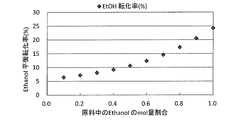
固定床流通型反応器に、エタノール:アセトアルデヒドのモル(EtOH:AcH)比が1:9、2:8、3:7、4:6、5:5、6:4、7:3、8:2、9:1、10:0で仕込んだ原料を装入し、反応温度は260℃、反応圧力は0.25MPaG(0.35MPa)で、CuO/ZnO触媒存在下に、WHSV = 3.0g-(EtOH + AcH)・g-cat
-1・h-1という条件で反応させ、アセトアルデヒド転化率を検討した。
検討結果を図3に示す。
エタノール単独原料に比べて、エタノール:アセトアルデヒド= 9mol:1molの割合で供給した場合、平衡転化率は約5%低下することがわかる。このことからエタノールとアセトアルデヒドを事前に分離し、エタノールのみを1段目反応器に供給することにより、効率的にアセトアルデヒドを得ることができると判明した。また1段目の反応に使用される原料中に含まれるアセトアルデヒドの量を10mol%未満にすれば、高い平衡転化率が達成できることも判明した。
[実施例2]
2段目反応器に供給するエタノール/アセトアルデヒド比
2段目反応器に供給するエタノールとアセトアルデヒドの合計の内、エタノールの供給割合の影響について検討するため、ZrO2/SiO2(1.0重量%) 触媒0.63gを固定床流通型反応器に充填し、以下の反応条件で実験を行った。
[実施例2]
2段目反応器に供給するエタノール/アセトアルデヒド比
2段目反応器に供給するエタノールとアセトアルデヒドの合計の内、エタノールの供給割合の影響について検討するため、ZrO2/SiO2(1.0重量%) 触媒0.63gを固定床流通型反応器に充填し、以下の反応条件で実験を行った。
反応器に窒素を流しながら360℃まで昇温し、原料ガスとして、mol比で100/0、95/5、90/10、80/20、75/25、70/30、60/40、50/50の割合で混合したエタノールとアセトアルデヒド(計15.4Nml/min)および窒素(6.8Nml/min)を混合して反応器に供給し、圧力を0.26MPaG (0.36MPa)まで昇圧した(WHSV = 3g-(EtOH + AcH)・g-cat
-1・h-1)。反応開始6~15分後の反応器出口ガス組成をガスクロマトグラフにより求めた。
結果を表1に示す。

エタノールの供給割合が60~90mol%の範囲で1,3-ブタジエン選択率が高い結果となった。また、70~80mol%の範囲でさらに高い結果となった。一方、生成物のうちリサイクルをしたとしても原料とならないエチレン、ジエチルエーテル、C5-C8炭化水素類に関しては、アセトアルデヒドの割合が増えるほど、エチレン、ジエチルエーテルの生成量が少なくなり、C5-C8炭化水素類の生成量が多くなる結果となった。
この結果から、2段目の反応器に供給するエタノールとアセトアルデヒドの合計の内、エタノールの供給割合は60~90mol%の範囲が最適であることが明らかとなった。
[実施例3]
2段目反応器において供給する原料中に水素が共存している状態で、水素が共存していない状態と比べてブタジエン収率が保たれるかどうか検討するためにZrO2/SiO2(1.0重量%)触媒0.63gを固定床流通型反応器に充填し、以下の反応条件で実験を行った。
[実施例3]
2段目反応器において供給する原料中に水素が共存している状態で、水素が共存していない状態と比べてブタジエン収率が保たれるかどうか検討するためにZrO2/SiO2(1.0重量%)触媒0.63gを固定床流通型反応器に充填し、以下の反応条件で実験を行った。
反応器に窒素を流しながら360℃まで昇温し、原料ガスとしてエタノール(12.3Nml/min)とアセトアルデヒド(3.1Nml/min)および窒素(6.7Nml/min)を混合して反応器に供給し、圧力を0.26MPaGまで昇圧した(WHSV = 3g-(EtOH + AcH)・g-cat
-1・h-1、エタノール/アセトアルデヒド/窒素/水素(mol比) = 56/14/30/0)。
また、原料ガスとしてエタノール(12.3Nml/min)とアセトアルデヒド(3.1Nml/min)および窒素(4.5Nml/min)、水素(2.3Nml/min)を混合して反応器に供給し、圧力を0.26MPaGまで昇圧した(WHSV = 3g-(EtOH + AcH)・g-cat
-1・h-1, エタノール/アセトアルデヒド/窒素/水素(mol比) = 56/14/10/20)。
各実験において反応開始3~4時間後の反応器出口ガス組成をガスクロマトグラフにより求めた。
結果を表2に示す。
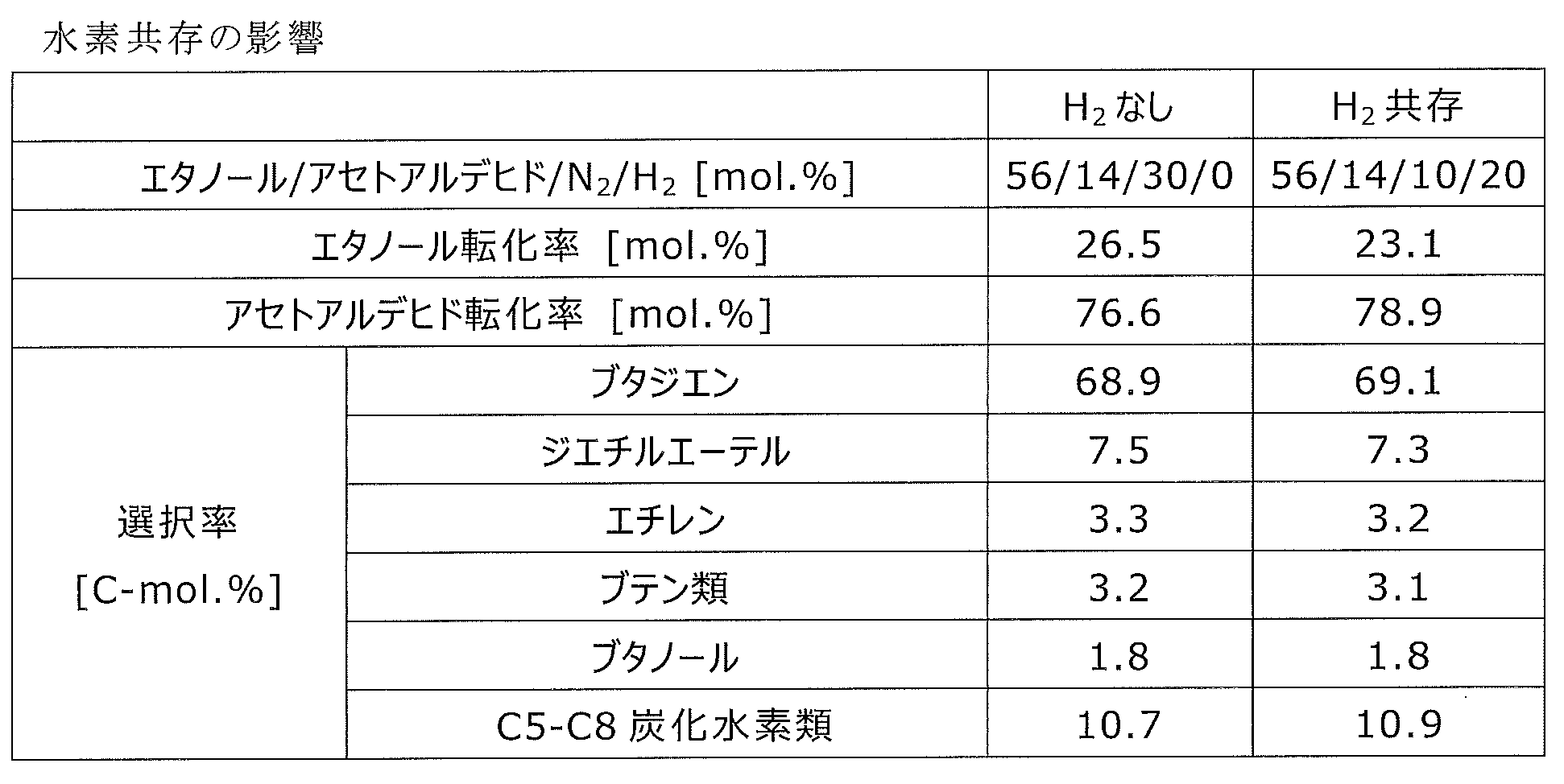
原料中に水素が共存している状態と、水素が共存していない状態とでのブタジエン選択率の差は1.0%以内であり、水素が共存してもブタジエン選択率は変わらないことが明らかとなった。
この結果から、1段目反応器と2段目反応器との間で水素を分離する必要がないことが分かった。
[実施例4]
2段目反応器において供給する原料中に水が共存している状態で、水が共存していない状態と比べてブタジエン収率が保たれるかどうか検討するために、ZrO2/SiO2(1.0重量%) 触媒0.63gを固定床流通型反応器に充填し、以下の反応条件で実験を行った。
[実施例4]
2段目反応器において供給する原料中に水が共存している状態で、水が共存していない状態と比べてブタジエン収率が保たれるかどうか検討するために、ZrO2/SiO2(1.0重量%) 触媒0.63gを固定床流通型反応器に充填し、以下の反応条件で実験を行った。
反応器に窒素を流しながら360℃まで昇温し、原料ガスとしてエタノール(12.3Nml/min)とアセトアルデヒド(3.1Nml/min)および窒素(6.7Nml/min)を混合して反応器に供給し、圧力を0.26MPaGまで昇圧した(WHSV = 3g-(EtOH + AcH)・g-cat
-1・h-1、エタノール/アセトアルデヒド/窒素/水(mol比) = 56/14/30/0)。
また反応器に窒素を流しながら360℃まで昇温し、原料ガスとしてエタノール(12.3Nml/min)とアセトアルデヒド(3.1Nml/min)および窒素(5.7Nml/min)、水(1.1Nml/min)を混合して反応器に供給し、圧力を0.26MPaGまで昇圧した(WHSV = 3g-(EtOH + AcH)・g-cat
-1・h-1、エタノール/アセトアルデヒド/窒素/水(mol比) = 56/14/25/5)。各実験において反応開始3~4時間後の反応器出口ガス組成における生成物の選択率をガスクロマトグラフにより求めた。 結果を表3に示す。
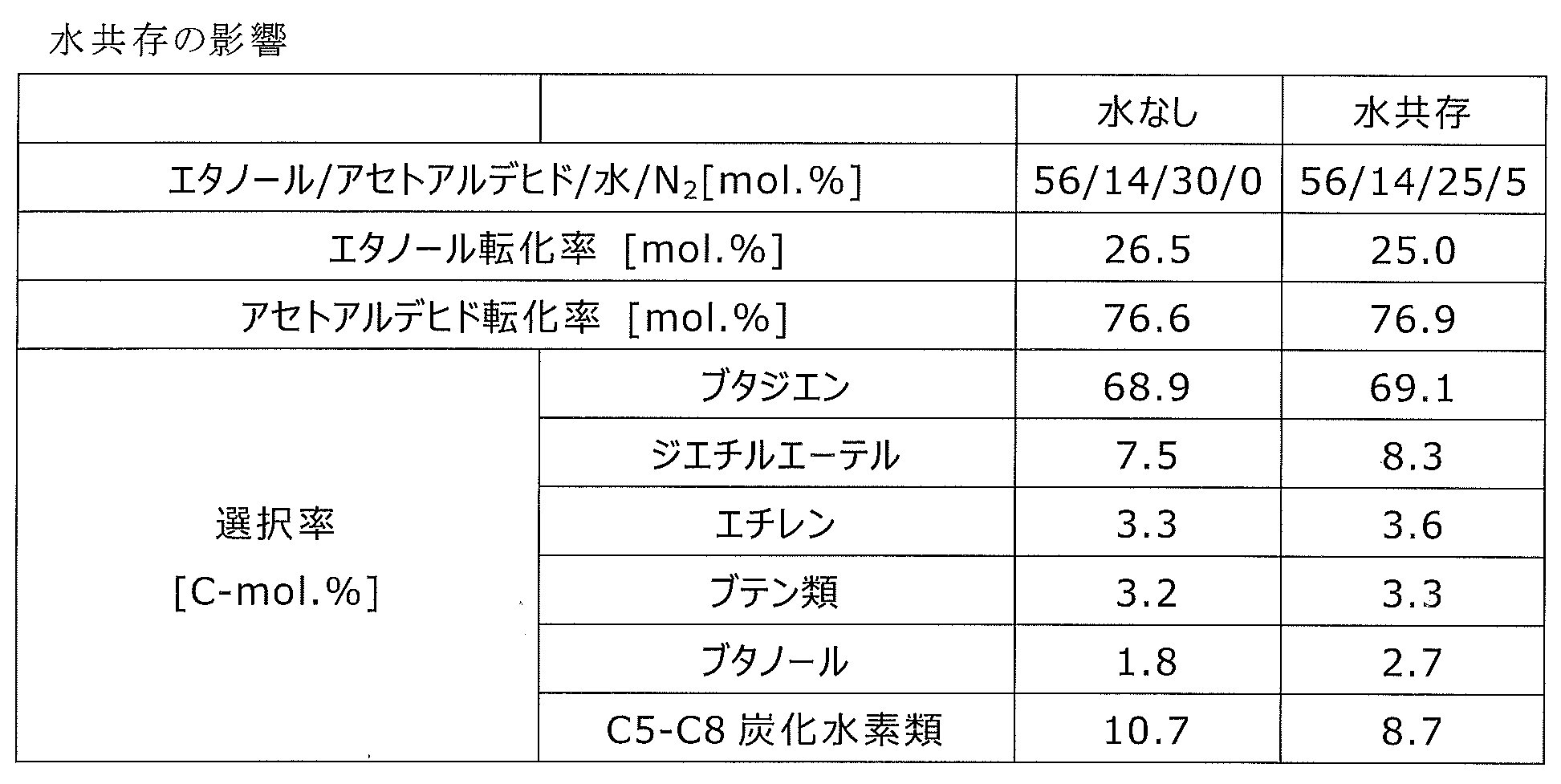
原料中に水が共存している状態と、水が共存していない状態とでのブタジエン収率の差は1.0%以内であり、水が共存してもブタジエン選択率は変わらないことが明らかとなった。
この結果から、1段目反応器と2段目反応器との間で水を分離する必要がなく、リサイクルされる原料に水が含まれていても構わないことが分かった。
10・・・製造装置
11・・・1段目反応器
12・・・2段目反応器
13・・・分離精製器
11・・・1段目反応器
12・・・2段目反応器
13・・・分離精製器
Claims (8)
- 2段の反応器を用いて、以下の反応式に示されるように1段目でエタノールを脱水素してアセトアルデヒドを合成したのち、2段目でエタノールとアセトアルデヒドとから1,3-ブタジエンを合成するに際し、
2段目の反応器に供給するエタノールとアセトアルデヒドの合計の内、エタノールの供給割合を60~90mol%の範囲とすることを特徴とする1,3-ブタジエンの製造方法。
CH3CH2OH → CH3CHO + H2 (1段目)
CH3CH2OH + CH3CHO → CH2=CH-CH=CH2 + 2 H2O (2段目) - 生成物から、未反応のエタノールとアセトアルデヒドを分離して別々にリサイクルを行うことを特徴とする請求項1に記載の1,3-ブタジエンの製造方法。
- 分離したエタノールは1段目の反応器に供給し、アセトアルデヒドは2段目の反応器に供給することを特徴とする請求項2に記載の1,3-ブタジエンの製造方法。
- エタノール原料の供給を、2段目の反応器に行うことを特徴とする請求項1~3のいずれかに記載の1,3-ブタジエンの製造方法。
- エタノール原料の供給を1段目および2段目の反応器に行い、分離したエタノールの供給を1段目の反応器に行うことを特徴とする請求項1に記載の1,3-ブタジエンの製造方法。
- エタノール原料の供給を1段目および2段目の反応器に行い、分離したエタノールの供給を2段目の反応器に行うことを特徴とする請求項1に記載の1,3-ブタジエンの製造方法。
- リサイクルするエタノール中のアセトアルデヒドの含有率が10mol%以下であることを特徴とする請求項2~6のいずれかに記載の1,3-ブタジエンの製造方法。
- 上述したプロセスに関し、1段目、2段目の反応器の間において成分分離を行わないことを特徴とする請求項1~7のいずれかに記載の1,3-ブタジエンの製造方法。
Applications Claiming Priority (2)
| Application Number | Priority Date | Filing Date | Title |
|---|---|---|---|
| JP2015000155 | 2015-01-05 | ||
| JP2015-000155 | 2015-01-05 |
Publications (1)
| Publication Number | Publication Date |
|---|---|
| WO2016111203A1 true WO2016111203A1 (ja) | 2016-07-14 |
Family
ID=56355900
Family Applications (1)
| Application Number | Title | Priority Date | Filing Date |
|---|---|---|---|
| PCT/JP2015/086235 Ceased WO2016111203A1 (ja) | 2015-01-05 | 2015-12-25 | 1,3-ブタジエンの製造方法 |
Country Status (1)
| Country | Link |
|---|---|
| WO (1) | WO2016111203A1 (ja) |
Cited By (8)
| Publication number | Priority date | Publication date | Assignee | Title |
|---|---|---|---|---|
| WO2021006252A1 (ja) * | 2019-07-05 | 2021-01-14 | 積水化学工業株式会社 | 1,3-ブタジエンの製造方法 |
| WO2021006250A1 (ja) * | 2019-07-05 | 2021-01-14 | 積水化学工業株式会社 | 1,3-ブタジエンの製造方法 |
| WO2021193457A1 (ja) * | 2020-03-23 | 2021-09-30 | 積水化学工業株式会社 | 1,3-ブタジエンの製造方法及び1,3-ブタジエンの製造装置 |
| JP2021195304A (ja) * | 2020-06-09 | 2021-12-27 | 横浜ゴム株式会社 | ブタジエンの製造方法およびブタジエンの製造装置 |
| JP2023031584A (ja) * | 2021-08-25 | 2023-03-09 | 積水化学工業株式会社 | 1,3-ブタジエンの製造方法及び1,3-ブタジエンの製造装置 |
| JP2024512679A (ja) * | 2021-04-01 | 2024-03-19 | シントス エス.アー. | 2段階でエタノールからの1,3-ブタジエンの生産における触媒システムの使用 |
| JP2024546685A (ja) * | 2021-12-08 | 2024-12-26 | ブリヂストン アメリカズ タイヤ オペレーションズ、 エルエルシー | 使用済みタイヤからのブタジエン生成 |
| WO2026085015A1 (en) * | 2024-10-14 | 2026-04-23 | Battelle Memorial Institute | Method of using hydrogen to extend catalyst life for ethanol to butadiene conversions |
Citations (4)
| Publication number | Priority date | Publication date | Assignee | Title |
|---|---|---|---|---|
| JP2012153654A (ja) * | 2011-01-26 | 2012-08-16 | Sumitomo Rubber Ind Ltd | 合成システム、タイヤ用ゴム薬品、タイヤ用合成ゴム及び空気入りタイヤ |
| WO2013125389A1 (ja) * | 2012-02-20 | 2013-08-29 | 株式会社ダイセル | 1,3-ブタジエンの製造方法 |
| JP2013535465A (ja) * | 2010-07-29 | 2013-09-12 | オブシュチェスティヴォ エス オグラニチェノイ オトヴェツヴェノスユ “ユニジット” | ブタジエンを製造する1ステップ法 |
| JP2014210755A (ja) * | 2013-04-22 | 2014-11-13 | 昭和電工株式会社 | ブタジエンの製造方法 |
-
2015
- 2015-12-25 WO PCT/JP2015/086235 patent/WO2016111203A1/ja not_active Ceased
Patent Citations (4)
| Publication number | Priority date | Publication date | Assignee | Title |
|---|---|---|---|---|
| JP2013535465A (ja) * | 2010-07-29 | 2013-09-12 | オブシュチェスティヴォ エス オグラニチェノイ オトヴェツヴェノスユ “ユニジット” | ブタジエンを製造する1ステップ法 |
| JP2012153654A (ja) * | 2011-01-26 | 2012-08-16 | Sumitomo Rubber Ind Ltd | 合成システム、タイヤ用ゴム薬品、タイヤ用合成ゴム及び空気入りタイヤ |
| WO2013125389A1 (ja) * | 2012-02-20 | 2013-08-29 | 株式会社ダイセル | 1,3-ブタジエンの製造方法 |
| JP2014210755A (ja) * | 2013-04-22 | 2014-11-13 | 昭和電工株式会社 | ブタジエンの製造方法 |
Cited By (15)
| Publication number | Priority date | Publication date | Assignee | Title |
|---|---|---|---|---|
| CN114364649A (zh) * | 2019-07-05 | 2022-04-15 | 积水化学工业株式会社 | 1,3-丁二烯的制造方法 |
| WO2021006252A1 (ja) * | 2019-07-05 | 2021-01-14 | 積水化学工業株式会社 | 1,3-ブタジエンの製造方法 |
| JPWO2021006252A1 (ja) * | 2019-07-05 | 2021-09-13 | 積水化学工業株式会社 | 1,3−ブタジエンの製造方法 |
| JPWO2021006250A1 (ja) * | 2019-07-05 | 2021-09-13 | 積水化学工業株式会社 | 1,3−ブタジエンの製造方法 |
| US11479518B2 (en) | 2019-07-05 | 2022-10-25 | Sekisui Chemical Co., Ltd. | Method for producing 1,3-butadiene |
| US11472753B2 (en) | 2019-07-05 | 2022-10-18 | Sekisui Chemical Co., Ltd. | Method for producing 1,3-butadiene |
| WO2021006250A1 (ja) * | 2019-07-05 | 2021-01-14 | 積水化学工業株式会社 | 1,3-ブタジエンの製造方法 |
| WO2021193457A1 (ja) * | 2020-03-23 | 2021-09-30 | 積水化学工業株式会社 | 1,3-ブタジエンの製造方法及び1,3-ブタジエンの製造装置 |
| JP2021195304A (ja) * | 2020-06-09 | 2021-12-27 | 横浜ゴム株式会社 | ブタジエンの製造方法およびブタジエンの製造装置 |
| JP7546245B2 (ja) | 2020-06-09 | 2024-09-06 | 横浜ゴム株式会社 | ブタジエンの製造方法およびブタジエンの製造装置 |
| JP2024512679A (ja) * | 2021-04-01 | 2024-03-19 | シントス エス.アー. | 2段階でエタノールからの1,3-ブタジエンの生産における触媒システムの使用 |
| JP2023031584A (ja) * | 2021-08-25 | 2023-03-09 | 積水化学工業株式会社 | 1,3-ブタジエンの製造方法及び1,3-ブタジエンの製造装置 |
| JP2024546685A (ja) * | 2021-12-08 | 2024-12-26 | ブリヂストン アメリカズ タイヤ オペレーションズ、 エルエルシー | 使用済みタイヤからのブタジエン生成 |
| JP7828455B2 (ja) | 2021-12-08 | 2026-03-11 | ブリヂストン アメリカズ タイヤ オペレーションズ、 エルエルシー | 使用済みタイヤからのブタジエン生成 |
| WO2026085015A1 (en) * | 2024-10-14 | 2026-04-23 | Battelle Memorial Institute | Method of using hydrogen to extend catalyst life for ethanol to butadiene conversions |
Similar Documents
| Publication | Publication Date | Title |
|---|---|---|
| WO2016111203A1 (ja) | 1,3-ブタジエンの製造方法 | |
| JP4953817B2 (ja) | エチレン及びプロピレンの製造法 | |
| JP5639595B2 (ja) | 軽質オレフィンを最大化するための、炭化水素流の接触分解法 | |
| US20240409479A1 (en) | Simultaneous dehydration, dimerization, and metathesis of c2-c5 alcohols | |
| EA016088B1 (ru) | Способ получения легких олефинов переработкой диметилового эфира и устройство для его осуществления | |
| EP4326695A2 (en) | Systems and processes for catalytic conversion of c1-c5 alcohols to c2-c5 olefin mixtures | |
| CN112739802B (zh) | 与裂化相结合的选择性氢解 | |
| RU2228922C2 (ru) | Способ получения углеводородов из монооксида углерода и водорода | |
| JP4879574B2 (ja) | エチレン及びプロピレンの製造方法 | |
| CN112739671A (zh) | 与mtbe生产相结合的选择性氢解 | |
| US9682896B2 (en) | Production method for olefin, and dehydration catalyst employed in same | |
| WO2017001284A1 (en) | Process for producing cumene and/or ethylbenzene from a mixed hydrocarbon feedstream | |
| US10384993B2 (en) | Method for producing hydrocarbons and alcohols | |
| CN105121391B (zh) | 用于从含氧物制备烯烃的方法和设备 | |
| EP3303269B1 (en) | Process for the selective hydrogenation of acetylene to ethylene | |
| US20250129303A1 (en) | Process and Plant for Producing One or More Hydrocarbons | |
| WO2015152159A1 (ja) | 不飽和炭化水素の製造方法 | |
| CN107949624B (zh) | 制备链烷烃和蜡的方法 | |
| WO2016125578A1 (ja) | 1,3-ブタジエンの製造方法 | |
| CN101805239A (zh) | 通过对乙炔的选择氢化提纯含有乙炔的芳烃馏分 | |
| JP2016188192A (ja) | ブタジエンを含む生成物の製造方法 | |
| US9120734B2 (en) | Two-step system and method for the production of methyl isobutyl ketone | |
| US20260015303A1 (en) | Methods and systems for making light olefins and ethanol from a carbon source gas | |
| US20170002276A1 (en) | Process for conversion of hydrocarbons integrating reforming and dehydrocyclodimerization | |
| WO2024091452A9 (en) | Processes for catalytic conversion of c1-c5 alcohols to c2-c5 olefin mixtures |
Legal Events
| Date | Code | Title | Description |
|---|---|---|---|
| 121 | Ep: the epo has been informed by wipo that ep was designated in this application |
Ref document number: 15877075 Country of ref document: EP Kind code of ref document: A1 |
|
| NENP | Non-entry into the national phase |
Ref country code: DE |
|
| 122 | Ep: pct application non-entry in european phase |
Ref document number: 15877075 Country of ref document: EP Kind code of ref document: A1 |
|
| NENP | Non-entry into the national phase |
Ref country code: JP |