WO2016104043A1 - 熱硬化性樹脂組成物および該組成物を用いた回転電機 - Google Patents
熱硬化性樹脂組成物および該組成物を用いた回転電機 Download PDFInfo
- Publication number
- WO2016104043A1 WO2016104043A1 PCT/JP2015/083311 JP2015083311W WO2016104043A1 WO 2016104043 A1 WO2016104043 A1 WO 2016104043A1 JP 2015083311 W JP2015083311 W JP 2015083311W WO 2016104043 A1 WO2016104043 A1 WO 2016104043A1
- Authority
- WO
- WIPO (PCT)
- Prior art keywords
- resin composition
- rotating electrical
- electrical machine
- thermosetting resin
- stator
- Prior art date
- Legal status (The legal status is an assumption and is not a legal conclusion. Google has not performed a legal analysis and makes no representation as to the accuracy of the status listed.)
- Ceased
Links
Images

Classifications
-
- C—CHEMISTRY; METALLURGY
- C08—ORGANIC MACROMOLECULAR COMPOUNDS; THEIR PREPARATION OR CHEMICAL WORKING-UP; COMPOSITIONS BASED THEREON
- C08F—MACROMOLECULAR COMPOUNDS OBTAINED BY REACTIONS ONLY INVOLVING CARBON-TO-CARBON UNSATURATED BONDS
- C08F2/00—Processes of polymerisation
- C08F2/44—Polymerisation in the presence of compounding ingredients, e.g. plasticisers, dyestuffs, fillers
-
- C—CHEMISTRY; METALLURGY
- C08—ORGANIC MACROMOLECULAR COMPOUNDS; THEIR PREPARATION OR CHEMICAL WORKING-UP; COMPOSITIONS BASED THEREON
- C08F—MACROMOLECULAR COMPOUNDS OBTAINED BY REACTIONS ONLY INVOLVING CARBON-TO-CARBON UNSATURATED BONDS
- C08F283/00—Macromolecular compounds obtained by polymerising monomers on to polymers provided for in subclass C08G
- C08F283/01—Macromolecular compounds obtained by polymerising monomers on to polymers provided for in subclass C08G on to unsaturated polyesters
-
- C—CHEMISTRY; METALLURGY
- C08—ORGANIC MACROMOLECULAR COMPOUNDS; THEIR PREPARATION OR CHEMICAL WORKING-UP; COMPOSITIONS BASED THEREON
- C08F—MACROMOLECULAR COMPOUNDS OBTAINED BY REACTIONS ONLY INVOLVING CARBON-TO-CARBON UNSATURATED BONDS
- C08F290/00—Macromolecular compounds obtained by polymerising monomers on to polymers modified by introduction of aliphatic unsaturated end or side groups
- C08F290/02—Macromolecular compounds obtained by polymerising monomers on to polymers modified by introduction of aliphatic unsaturated end or side groups on to polymers modified by introduction of unsaturated end groups
- C08F290/06—Polymers provided for in subclass C08G
-
- H—ELECTRICITY
- H01—ELECTRIC ELEMENTS
- H01F—MAGNETS; INDUCTANCES; TRANSFORMERS; SELECTION OF MATERIALS FOR THEIR MAGNETIC PROPERTIES
- H01F5/00—Coils
- H01F5/06—Insulation of windings
-
- H—ELECTRICITY
- H02—GENERATION; CONVERSION OR DISTRIBUTION OF ELECTRIC POWER
- H02K—DYNAMO-ELECTRIC MACHINES
- H02K3/00—Details of windings
- H02K3/30—Windings characterised by the insulating material
-
- H—ELECTRICITY
- H02—GENERATION; CONVERSION OR DISTRIBUTION OF ELECTRIC POWER
- H02K—DYNAMO-ELECTRIC MACHINES
- H02K3/00—Details of windings
- H02K3/32—Windings characterised by the shape, form or construction of the insulation
- H02K3/34—Windings characterised by the shape, form or construction of the insulation between conductors or between conductor and core, e.g. slot insulation
Definitions
- the present invention relates to a thermosetting resin composition, a stator of a rotating electrical machine using the resin composition, or a rotating electrical machine including the same.
- rotating electrical machines are required to have a small size and high output.
- a rotating electrical machine for example, a large number of conductor segments having a square cross section are inserted into the slot, and then a pair of ends of each conductor segment are joined to form a stator winding, thereby reducing the space factor. What improved the output by improving the cooling performance is known.
- the first resin member is thinly attached to the second coil end group in which a plurality of joint portions formed by joining the first coil end group in which the turn portion is formed and the tip portion are disposed.
- the second resin member is thickly attached only in the vicinity of the joint of the second coil end group (see, for example, Patent Document 1).
- Patent Document 1 it is necessary to use two types of resin members, and the second resin member is thickly attached only to the vicinity of the joint portion of the second coil end group.
- the thickness of the resin member at the coil end may be substantially uniform, and there is no necessity to increase the thickness only in the vicinity of the joint.
- Patent Document 2 is an alternative to the second resin member (powder epoxy varnish) used in Patent Document 1 and the like, and dust is prevented by using a liquid resin at the joint. .
- the above-mentioned problem remains because it is intended only for the joint portion and uses two types of resin members.
- the stator coil of the rotating electrical machine according to the present invention is characterized by being coated with a thermosetting resin composition containing a photopolymerization initiator, a thermopolymerization initiator, and an inorganic additive.
- FIG. 1 is a cross-sectional view illustrating an overall configuration of a rotating electrical machine 10 including a stator 20.
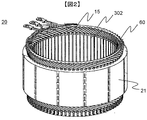
- 3 is a perspective view showing a configuration of a stator 20.
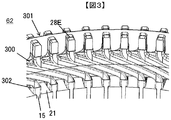
- FIG. It is a perspective view which shows the welding side coil end part of the stator coil before varnish application.
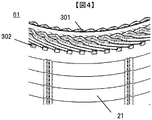
- It is a cross-sectional perspective view which shows the anti-welding side coil end part of the stator coil before varnish application.
- thermosetting resin has (A) a photopolymerization initiator, (B) a thermopolymerization initiator, and (C) an inorganic additive. It was found that a thermosetting resin composition containing Hereinafter, the thermosetting resin composition according to the present invention will be described in detail.
- Photopolymerization initiators include diphenylethanedione, benzyl derivatives such as di (4-methoxyphenyl) ethanedione, 2,2-dimethoxy-2-phenylacetophenone, 2,2-diethoxy-2-phenylacetophenone, benzoin Benzoin derivatives such as benzoin methyl ether, benzoin ethyl ether, benzoin isopropyl ether, benzophenone, benzophenone derivatives such as 4,4′-bis (dimethylamino) benzophenone, 4,4′-dimethoxybenzophenone, 2-hydroxy-2- Propiophenone derivatives such as methylpropiophenone and 2-hydroxy-4 '-(2-hydroxyethoxy) -2-methylpropiophenone, 2,2-diethoxyacetophenone, anthraquinone, 2-ethylanthraquinone, 1 Hydroxycyclohexyl phenone,
- Only one kind of these compounds may be used, or two or more kinds may be appropriately mixed and used.
- these compounds compounds that are decomposed by ultraviolet rays are preferable from the viewpoint of workability. More preferably, a compound that decomposes with light having a wavelength of 365 nm is preferable.
- Thermal polymerization initiators are benzoyl peroxide, lauroyl peroxide, t-butyl peroxide benzoate, t-amyl peroxide benzoate, t-amyl peroxyneodecanoate, t-butyl peroxyneodeca Noate, t-amyl peroxyisobutyrate, di (t-butyl) peroxide, dicumyl peroxide, cumene hydroperoxide, 1,1-di (t-butylperoxy) cyclohexane, 2,2-di ( t-Butylperoxy) butane, t-butyl hydroperoxide, di (s-butyl) peroxycarbonate, methyl ethyl ketone peroxide and the like can be used.
- thermosetting resin are not particularly limited, but preferably contain a vinyl ester resin and a radical polymerization initiator.
- Inorganic compounds include metal oxides such as silicon oxide (silica), aluminum oxide (alumina), zirconium oxide (zirconia), titanium oxide (titania), kaolin, talc, mica, calcium silicate, cytillin, nitriding Boron, sepiolite, calcium carbonate, potassium titanate, aluminum borate, barium sulfate, montmorillonite, hydrotalcite, magnesium hydroxide, aluminum hydroxide and the like can be used. Only one kind of these compounds may be used, or two or more kinds may be appropriately mixed and used. Among these compounds, kaolin, plate-like alumina, citirine, boron nitride, mica and the like having a scaly shape are preferable from the viewpoint of insulating properties.
- metal oxides such as silicon oxide (silica), aluminum oxide (alumina), zirconium oxide (zirconia), titanium oxide (titania), kaolin, talc, mica, calcium silicate, cytillin,
- the resin composition preferably contains (D) a compound having two or more carbon-carbon double bonds capable of radical polymerization as a crosslinking agent.
- (D) As the compound having two or more carbon-carbon double bonds capable of radical polymerization, unsaturated polyester resin, vinyl ester resin, vinyl-modified isocyanate, and the like can be used. Only one kind of these compounds may be used, or two or more kinds may be appropriately mixed and used.
- the unsaturated polyester resin is not particularly limited, and can be obtained, for example, by subjecting a dibasic acid and a polyhydric alcohol to a condensation reaction.
- Dibasic acids used as raw materials for unsaturated polyester resins include ⁇ , ⁇ -unsaturated dibasic acids such as maleic acid, maleic anhydride, fumaric acid, itaconic acid, itaconic anhydride, phthalic acid, and phthalic anhydride , Halogenated phthalic anhydride, isophthalic acid, terephthalic acid, tetrahydrophthalic acid, tetrahydrophthalic anhydride, hexahydrophthalic acid, hexahydroisophthalic acid, hexahydroterephthalic acid, succinic acid, malonic acid, glutaric acid, adipic acid, sebacine Acid, 1,10-decanedicarboxylic acid, 2,6-naphthalenedicarboxylic acid, 2,7-naphthalenedicarboxylic acid, 2,3-naphthalenedicarboxylic acid, 2,3-naphthalenedicarboxylic acid anhydride, 4,4'
- polyhydric alcohols used as raw materials for unsaturated polyester resins include ethylene glycol, diethylene glycol, triethylene glycol, polyethylene glycol, propylene glycol, dipropylene glycol, polypropylene glycol, 2-methyl-1,3-propanediol, 1 , 3-butanediol, adducts of bisphenol A with propylene oxide or ethylene oxide, glycerin, trimethylolpropane, 1,3-propanediol, 1,2-cyclohexane glycol, 1,3-cyclohexane glycol, 1,4-cyclohexane Glycol, para-xylene glycol, bicyclohexyl-4,4'-diol, 2,6-decalin glycol, tris (2-hydroxyethyl) isocyanurate It can be used.
- amino alcohols such as ethanolamine may be used. Only one kind of these polyhydric alcohols may be used, or two or more kinds may be appropriately mixed. If necessary, a dicyclopentadiene compound may be incorporated in the resin skeleton.
- epoxy compound used as a raw material for the vinyl ester resin a compound having at least two epoxy groups in the molecule is used.
- epoxy compounds include epibis type glycidyl ether type epoxy resins obtained by condensation reaction of bisphenols such as bisphenol A, bisphenol F, and bisphenol S with epihalohydrin, and phenols such as phenol, cresol, and bisphenol.
- Novolak type glycidyl ether type epoxy resin obtained by condensation reaction of novolak and epihalohydrin which is a condensate of alcohol and formalin
- glycidyl ester type epoxy resin obtained by condensation reaction of tetrahydrophthalic acid, hexahydrophthalic acid and epihalohydrin 4,4'-biphenol, 2,6-naphthalenediol
- hydrogenated bisphenol and glycidyl ether type educts obtained by condensation reaction of glycols with epihalohydrin
- the unsaturated monobasic acid used as a raw material for the vinyl ester resin examples include acrylic acid, methacrylic acid, and crotonic acid. Moreover, you may use half esters, such as maleic acid and itaconic acid. However, it is not particularly limited to these. These unsaturated monobasic acids may be used alone or in a suitable mixture of two or more. Among these compounds, a vinyl ester resin obtained by reacting an epibis type glycidyl ether type epoxy resin and methacrylic acid is preferable from the viewpoint of heat resistance and curability. Further, from the viewpoint of crack resistance of the cured product, a non-novalac type vinyl ester resin is preferable.
- thermosetting resin composition You may add other arbitrary components to the thermosetting resin composition mentioned above as needed.
- Optional components include, for example, radical polymerizable monomers, curing accelerators, polymerization inhibitors, adhesion improvers, etc.
- Radical polymerizable monomers include styrene, vinyl toluene, vinyl naphthalene, ⁇ -methyl styrene.
- styrene, vinyl toluene, and (meth) acrylic acid ester for example, methacrylate, acrylate
- acrylic acid esters include methyl (meth) acrylate, ethyl (meth) acrylate, propyl (meth) acrylate, butyl (meth) acrylate, 2-ethylhexyl (meth) acrylate, isooctyl (meth) acrylate, and isodecyl.
- curing accelerator examples include metal salts of naphthenic acid or octylic acid (metal salts of cobalt, zinc, zirconium, manganese, calcium, etc.). These may use only 1 type and may mix 2 or more types suitably.
- polymerization inhibitor examples include quinones such as hydroquinone, para tertiary butyl catechol, and pyrogallol. These may use only 1 type and may mix 2 or more types suitably.
- thermosetting resin composition examples include p-styryltrimethoxysilane, 3-methacryloxypropyltrimethoxysilane, and 3-methacryloxypropyltriethoxysilane. These may use only 1 type and may mix 2 or more types suitably.
- thermosetting resin composition includes (A) a photopolymerization initiator, (B) a thermal polymerization initiator, and (C (1) An inorganic additive, (D) a compound having at least two carbon-carbon double bonds capable of radical polymerization, and other optional components are produced by uniformly stirring and mixing in air.
- thermosetting resin composition described above can be used for insulating and fixing applications of stator windings of rotating electrical machines.
- Rotating electric machine using thermosetting resin composition Next, the example of implementation of the rotary electric machine using the thermoplastic resin composition mentioned above is described. Embodiment described below is an example to the last, and is not limited to these Examples.
- an electric motor used in a hybrid vehicle is used as an example of a rotating electric machine.
- the “axial direction” refers to a direction along the rotation axis of the rotating electrical machine.
- the “circumferential direction” refers to a direction along the rotation direction of the rotating electrical machine.
- the “radial direction” refers to a radial direction (radial direction) when the rotation axis of the rotating electrical machine is the center. “Inner circumference side” refers to the radially inner side (inner diameter side), and “outer circumference side” refers to the opposite direction, that is, the radially outer side (outer diameter side).
- FIG. 1 is a cross-sectional view showing a configuration of a rotating electrical machine 10 according to the present embodiment.
- the rotating electrical machine 10 includes a housing 50, a stator 20, a stator core 21, a stator coil 60, and a rotor 11.
- the stator 20 is fixed to the inner peripheral side of the housing 50.
- the rotor 11 is rotatably supported on the inner peripheral side of the stator 20.
- the housing 50 constitutes an outer casing of an electric motor that is formed into a cylindrical shape by cutting an iron-based material such as carbon steel, casting of cast steel or aluminum alloy, or pressing.
- the housing 50 is also referred to as a frame or a frame.
- a liquid cooling jacket 130 is fixed to the outer peripheral side of the housing 50.
- the inner peripheral wall of the liquid cooling jacket 130 and the outer peripheral wall of the housing 50 constitute a refrigerant passage 153 for a liquid refrigerant RF such as oil, and the refrigerant passage 153 is formed so as not to leak.
- the liquid cooling jacket 130 houses the bearings 144 and 145 and is also called a bearing bracket.
- the refrigerant RF flows through the refrigerant passage 153 and flows out of the refrigerant outlets 154 and 155 toward the stator 20 to cool the stator 20.
- the stator 20 is composed of a stator core 21 and a stator coil 60.
- the stator core 21 is made by laminating thin sheets of silicon steel plates.
- the stator coil 60 is wound around a plurality of slots 15 provided in the inner peripheral portion of the stator core 21. Heat generated from the stator coil 60 is transferred to the housing 50 through the stator core 21 and is radiated by the refrigerant RF flowing in the liquid cooling jacket 130.
- the rotor 11 is composed of a rotor core 12 and a rotating shaft 13.
- the rotor core 12 is made by laminating thin sheets of silicon steel plates.
- the rotating shaft 13 is fixed to the center of the rotor core 12.
- the rotating shaft 13 is rotatably held by bearings 144 and 145 attached to the liquid cooling jacket 130 and rotates at a predetermined position in the stator 20 at a position facing the stator 20.
- the rotor 11 is provided with a permanent magnet 18 and an end ring (not shown).
- the stator 20 is inserted into the housing 50 in advance and attached to the inner peripheral wall of the housing 50, and then the rotor 11 is inserted into the stator 20.
- the rotating shaft 13 is assembled to the liquid cooling jacket 130 so that the bearings 144 and 145 are fitted.
- FIG. 2 is a perspective view of the stator 20 used in the rotating electrical machine 10 according to the present embodiment. The structure of the principal part of the stator 20 is demonstrated using FIG.
- the stator 20 includes a stator core 21 and a stator coil 60 wound around a plurality of slots 15 provided in the inner periphery of the stator core.
- the stator coil 60 uses a conductor (copper wire in this embodiment) having a substantially rectangular cross section. By using the coil conductor having a substantially rectangular cross section, the space factor in the slot is improved, and the efficiency of the rotating electrical machine is improved.
- a slot liner 302 is disposed in each slot 15 to ensure electrical insulation between the stator core 21 and the stator coil 60.
- the slot liner 302 is formed in a B shape or an S shape so as to wrap a copper wire.
- FIG. 3 is a perspective view showing the welding-side coil end 62 of the stator coil before application of the resin composition.
- the stator 20 includes a stator core 21 and a stator coil 60 wound around a plurality of slots 15 provided on the inner peripheral portion of the stator core.
- Insulating paper 300 is annularly arranged between the coils for insulation between the coils.
- Insulating paper 301 is annularly arranged between the welded portions for insulation between the welded portions.
- the entire stator coil can be subjected to (A) a photopolymerization initiator, (B) a thermal polymerization initiator, (C) an inorganic additive, and (D) radical polymerization. And a cured product of the resin composition 601 including a compound having two or more carbon-carbon double bonds.
- FIG. 4 is a perspective view showing an anti-welding side coil end 61 of the stator coil before application of the resin composition.
- Insulating paper 301 is annularly arranged between the coils for insulation between the coils.
- the anti-welding side coil end 61 also covers the entire stator coil with the cured product of the resin composition 601 almost uniformly after the insulating paper is disposed.
- the resin composition 601 is the same material ((A) photopolymerization initiator, (B) thermal polymerization initiator, (C) inorganic additive, (D) radical polymerization as that covering the welding side coil end 62).
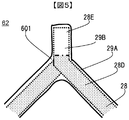
- FIG. 5 is an enlarged view of the vicinity of the conductor end 28 ⁇ / b> E of the welding side coil end 62.
- the segment conductor 28 has an insulating coating portion 29A covered with an insulating coating such as an enamel coating, and a conductor exposed portion 29B from which the insulating coating is peeled and the conductor portion (copper wire) is exposed.
- the conductor exposed portion 29B is provided at the conductor end portion 28E. This exposure of the conductor portion is due to welding.
- the entire segment conductor 28 including the insulating coating portion 29A and the exposed conductor portion 29B is composed of (A) a photopolymerization initiator, (B) a thermal polymerization initiator, (C) an inorganic additive, and (D) a radical. It is almost uniformly covered with a cured product of the resin composition 601 made of a compound having two or more polymerizable carbon-carbon double bonds.
- the second resin member as used in the prior art is not used, and only the resin composition 601 is used.
- the thickness is uniform regardless of whether it is in the vicinity of the joint or not, a double production facility is not required for the adhesion and drying of the resin member, and more material than the resin member necessary for the dielectric strength is not required. effective.
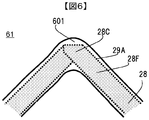
- FIG. 6 is an enlarged view of the vicinity of the anti-welding side coil end apex 28 ⁇ / b> C of the anti-welding side coil end 61.
- an insulation coating portion 29 ⁇ / b> A is formed over the entire circumference of the segment conductor 28.
- the segment conductor 28 is formed of (A) a photopolymerization initiator, (B) a thermal polymerization initiator, (C) an inorganic additive, and (D) a radical polymerizable carbon- It is almost uniformly covered only with a cured product of the resin 601 made of a compound having two or more carbon double bonds. Since the second resin member used in the prior art is not used and the thickness is uniform, a double production facility is not required for adhesion and drying of the resin member, and the resin member necessary for insulation withstand voltage There is an effect that the above materials are unnecessary.
- the entire stator coil is made up of (A) a photopolymerization initiator, (B) a thermal polymerization initiator, (C) an inorganic additive, and (D) a radically polymerizable carbon-carbon two-carbon.
- Insulating properties required for electric vehicles and hybrid electric vehicles can be obtained by substantially uniformly covering only with a resin 601 made of a compound having two or more double bonds and by disposing cyclic insulating resins 300 and 301 for reinforcing insulation. A satisfactory rotating electrical machine can be obtained.
- the resin composition 601 is desirably covered almost uniformly, the boundary surface with the insulating paper 300 and 301 and the complicated shape part of the coil may adhere unevenly.
- substantially uniform as used herein means that the thickness is not intentionally increased as in the prior art (for example, Patent Document 1).
- the rotor is not a permanent magnet type, but an induction type, synchronous reluctance, It can be applied to a claw magnetic pole type.
- the winding method is a wave winding method, but any winding method having similar characteristics can be applied. Further, although the explanation is made with the inner rotation type, the same applies to the outer rotation type.
- thermosetting resin composition (Composition example of thermosetting resin composition) Subsequently, heat comprising (A) a photopolymerization initiator, (B) a thermal polymerization initiator, (C) an inorganic additive, and (D) a compound having two or more carbon-carbon double bonds capable of radical polymerization.
- the composition example of curable resin is illustrated. However, it is not limited to the composition example shown below.
- Composition Example 1 includes 50 parts by weight of styrene (manufactured by Wako Pure Chemical Industries), 50 parts by weight of bisphenol A glycerolate dimethacrylate (manufactured by Aldrich), 1.0 part by weight of 2,2-diethoxyacetophenone (manufactured by Wako Pure Chemical Industries), 1 1,1-di (t-butylperoxy) cyclohexane 1.5 parts by weight (manufactured by NOF Corporation) and 10 parts by weight of mica are added to obtain a thermosetting resin composition.
- Composition Example 2 was made of 50 parts by weight of styrene (manufactured by Wako Pure Chemical Industries), 50 parts by weight of an unsaturated polyester resin containing a bisphenol A skeleton and having a number average molecular weight of 3000, and 1.0 part by weight of 2-hydroxy-2-methylpropiophenone. Parts (manufactured by Tokyo Chemical Industry Co., Ltd.), 1.5 parts by weight of 1,1-di (t-butylperoxy) cyclohexane (manufactured by NOF) and 10 parts by weight of boron nitride are added to obtain a thermosetting resin composition.
- styrene manufactured by Wako Pure Chemical Industries
- an unsaturated polyester resin containing a bisphenol A skeleton and having a number average molecular weight of 3000 and 1.0 part by weight of 2-hydroxy-2-methylpropiophenone. Parts (manufactured by Tokyo Chemical Industry Co., Ltd.), 1.5 parts by weight of 1,1
- Composition Example 3 is composed of 70 parts by weight of dicyclopentenyloxyethyl (meth) acrylate (manufactured by Aldrich), 30 parts by weight of bisphenol A glycerolate dimethacrylate (manufactured by Aldrich), and 1.0 weight of 2-hydroxy-2-methylpropiophenone. Parts (manufactured by Tokyo Chemical Industry Co., Ltd.), 1.5 parts by weight of 1,1-di (t-butylperoxy) cyclohexane (manufactured by NOF) and 10 parts by weight of mica are added to obtain a thermosetting resin composition.
- Composition example 4 is an unsaturated compound containing 70 parts by weight of dicyclopentenyloxyethyl (meth) acrylate (manufactured by Aldrich), 30 parts by weight of bisphenol A glycerolate dimethacrylate (manufactured by Aldrich), and having a number average molecular weight of 3000. 5 parts by weight of polyester resin, 1.0 part by weight of 2-hydroxy-2-methylpropiophenone (manufactured by Tokyo Chemical Industry), 1.5 parts by weight of 1,1-di (t-butylperoxy) cyclohexane (manufactured by NOF Corporation) ), 10 parts by weight of mica is added to obtain a thermosetting resin composition.
- Composition Example 5 is an unsaturated compound containing 70 parts by weight of dicyclopentenyloxyethyl (meth) acrylate (manufactured by Aldrich), 30 parts by weight of bisphenol A glycerolate dimethacrylate (manufactured by Aldrich), and having a number average molecular weight of 3000. 5 parts by weight of polyester resin, 1.0 part by weight of 2-hydroxy-2-methylpropiophenone (manufactured by Tokyo Chemical Industry), 1.5 parts by weight of 1,1-di (t-butylperoxy) cyclohexane (manufactured by NOF Corporation) ), 20 parts by weight of mica is added to obtain a thermosetting resin composition.
- thermosetting resin composition Example 6 was made of 70 parts by weight of dicyclopentenyloxyethyl (meth) acrylate (manufactured by Aldrich), 30 parts by weight of bisphenol A glycerolate dimethacrylate (manufactured by Aldrich), 1.0 weight of 2-hydroxy-2-methylpropiophenone Parts (manufactured by Tokyo Chemical Industry), 1.5 parts by weight of 1,1-di (t-butylperoxy) cyclohexane (manufactured by NOF), 10 parts by weight of mica, 0.05 parts by weight of manganese naphthenate (manufactured by Tokyo Chemical Industry) Then, 5 parts by weight of an unsaturated polyester resin composed of isophthalic acid, maleic acid and ethylene glycol and 0.1 part by weight of 3-methacryloxypropyltrimethoxysilane (manufactured by Shin-Etsu Silicone) are added to obtain a thermosetting resin composition. (Comparative example of thermo
- Comparative Example 1 does not contain (A) a photopolymerization initiator.
- A a photopolymerization initiator.
- 50 parts by weight of styrene (manufactured by Wako Pure Chemical Industries), 50 parts by weight of bisphenol A glycerolate dimethacrylate (manufactured by Aldrich), 1.5 parts by weight of 1,1-di (t-butylperoxy) cyclohexane (day) Oil) and 10 parts by weight of mica were added to obtain a thermosetting resin composition. In this case, it was not possible to form an insulation coating on the welding side coil end.
- Comparative Example 2 does not contain (B) a thermal polymerization initiator.
- Comparative Example 2 includes 50 parts by weight of styrene (manufactured by Wako Pure Chemical Industries), 50 parts by weight of bisphenol A glycerolate dimethacrylate (manufactured by Aldrich), 1.0 part by weight of 2,2-diethoxyacetophenone (manufactured by Wako Pure Chemical Industries), mica 10 parts by weight was added to obtain a thermosetting resin composition. In this case, the coil in the slot could not be fixed.
- Comparative Example 3 does not contain (C) an inorganic additive.
- Comparative Example 3 includes 50 parts by weight of styrene (manufactured by Wako Pure Chemical Industries), 50 parts by weight of bisphenol A glycerolate dimethacrylate (manufactured by Aldrich), 1.0 part by weight of 2,2-diethoxyacetophenone (manufactured by Wako Pure Chemical Industries), 1,1-di (t-butylperoxy) cyclohexane 1.5 parts by weight (manufactured by NOF Corporation) was added to obtain a thermosetting resin composition. In this case, the electrical characteristics did not reach the target.
- the resin composition 601 is impregnated in an electric device such as a motor coil using an immersion method, a drop impregnation method, or the like.
- the impregnation method is a conventional method and is not particularly limited.
- the energy ray is preferably ultraviolet rays generated from a mercury lamp or the like.
- a wavelength can be suitably selected with the (A) photoinitiator to be used.
- the resin composition 601 applied to the stator 20 is completely cured by heating.
- the main heating is performed by a conventional method such as a hot air heating furnace or an IH heating furnace, and there is no particular limitation.
- this invention is not limited to the above-mentioned Example, Various modifications are included.
- the above-described embodiments have been described in detail for easy understanding of the present invention, and are not necessarily limited to those having all the configurations described.
Landscapes
- Chemical & Material Sciences (AREA)
- Engineering & Computer Science (AREA)
- Power Engineering (AREA)
- Health & Medical Sciences (AREA)
- Chemical Kinetics & Catalysis (AREA)
- Medicinal Chemistry (AREA)
- Polymers & Plastics (AREA)
- Organic Chemistry (AREA)
- Insulation, Fastening Of Motor, Generator Windings (AREA)
- Macromonomer-Based Addition Polymer (AREA)
Abstract
絶縁性の優れた回転電機用の熱硬化性樹脂組成物およびこれを備えた回転電機を提供する。 固定子コイル60が固定子鉄心21のスロット15に配置された回転電機の固定子20において、固定子コイルは、複数のセグメント導体から構成され、セグメント導体は、絶縁被覆で覆われた絶縁被覆部と、導体が露出した導体露出部とを有し、かつ、他のセグメント導体と導体露出部を介して接合されており、固定子コイルが、光重合開始剤と、熱重合開始剤と、無機添加物と、を含む熱硬化性樹脂組成物で覆われている回転電機の固定子。
Description
熱硬化性樹脂組成物若しくは該樹脂組成物を用いた回転電機の固定子、またはこれを備えた回転電機に関する。
近年、回転電機は小型高出力が求められている。このような回転電機として、例えば断面角型の多数の導体セグメントをスロットに挿通してから、各導体セグメントの端部を一対ずつ接合して固定子巻線を形成することで、占積率を向上させて冷却性能を向上させることにより高出力化を図ったものが知られている。
そして、絶縁性能向上のため、ターン部が形成された第1コイルエンド群と先端部を接合してなる複数の接合部が配置された第2のコイルエンド群に、薄く第1樹脂部材を付着させ、第2コイルエンド群の接合部近傍のみに厚く第2樹脂部材が付着された車輌用交流発電機の固定子がある(例えば、特許文献1参照)。
また、接合部に用いる第2樹脂部材の材料を規定した電気機器もある(例えば、特許文献2参照)。
特許文献1の技術では、2種類の樹脂部材を用いる必要があり、また、第2コイルエンド群の接合部近傍のみに厚く第2樹脂部材を付着させている。絶縁設計上は、コイルエンドの樹脂部材の厚さはほぼ均一で良く、接合部近傍のみ厚くする必然性は無い。2種類の樹脂部材を用いることで、樹脂部材の付着、硬化のため2重の生産設備が必要となり、また、接合部のみ厚くする事により絶縁耐圧上必要な樹脂部材以上に材料が必要となるといった課題があった。
特許文献2の技術は、特許文献1などで用いられている第2の樹脂部材(粉体エポキシ系ワニス)の代替となるもので、接合部に液状樹脂を用いることで粉塵を防止している。しかし、接合部のみを対象としており、また、2種類の樹脂部材を用いることが前提となっていることから、上記の課題は残されている。
更に、これら樹脂構成で高電圧化に対応するためには、従来の樹脂部材よりも厚くする必要があるといった課題があった。
本発明に係る回転電機の固定子のコイルは、光重合開始剤と、熱重合開始剤と、無機添加物と、を含む熱硬化性樹脂組成物により被覆されることを特徴とする。
本発明によれば、絶縁性の優れた回転電機の固定子、およびこれを備えた回転電機を提供することができる。
本発明者らは、前述の課題を解決するため鋭意研究を重ねた結果、熱硬化性樹脂は、(A)光重合開始剤と、(B)熱重合開始剤と、(C)無機添加物と、を含む熱硬化性樹脂組成物が好ましいことを見出した。以下、本発明に係る熱硬化性樹脂組成物を詳細に説明する。
(熱硬化性樹脂組成物の構成)
(A)光重合開始剤は、ジフェニルエタンジオンや、ジ(4-メトキシフェニル)エタンジオン、2,2-ジメトキシ-2-フェニルアセトフェノン、2,2-ジエトキシ-2-フェニルアセトフェノン等のベンジル誘導体、ベンゾイン、ベンゾインメチルエーテル、ベンゾインエチルエーテル、ベンゾインイソプロピルエーテル等のベンゾイン誘導体、ベンゾフェノンや、4,4’-ビス(ジメチルアミノ)ベンゾフェノン、4,4’-ジメトキシベンゾフェノン等のベンゾフェノン誘導体、2-ヒドロキシ-2-メチルプロピオフェノンや2-ヒドロキシ-4’-(2-ヒドロキシエトキシ)-2-メチルプロピオフェノン等のプロピオフェノン誘導体、2,2-ジエトキシアセトフェノン、アントラキノン、2-エチルアントラキノン、1-ヒドロキシシクロヘキシル フェニル ケトン、2,4-ジエチルチオキサン-9-オン等を用いることができる。これらの化合物は、一種類のみを用いてもよく、適宜二種類以上を混合して用いてもよい。これらの化合物の中でも、作業性の観点から紫外線により分解する化合物が好ましい。より好ましくは、波長365nmの光で分解する化合物が好ましい。
(B)熱重合開始剤は、過酸化ベンゾイル、過酸化ラウロイル、過酸化安息香酸 t-ブチル、過酸化安息香酸 t-アミル、t-アミル パーオキシネオデカノエート、t-ブチル パーオキシネオデカノエート、t-アミル パーオキシイソブチレート、ジ(t-ブチル)パーオキシド、ジクミルパーオキシド、クメンヒドロパーオキシド、1,1-ジ(t-ブチルパーオキシ)シクロヘキサン、2,2-ジ(t-ブチルパーオキシ)ブタン、t-ブチルハイドロパーオキシド、ジ(s-ブチル)パーオキシカーボネート、メチルエチルケトンパーオキシド等を用いることができる。これらの化合物は、一種類のみを用いてもよく、適宜二種類以上を混合して用いてもよい。これらの化合物の中でも、硬化温度の観点から、1,1-ジ(t-ブチルパーオキシ)シクロヘキサン等の、1時間半減温度が100℃から150℃の範囲の化合物が望ましい。
また、熱硬化性樹脂の構成成分は、特に限定されるものではないが、ビニルエステル樹脂、ラジカル重合開始剤を含むことが好ましい。
(C)無機化合物は、酸化ケイ素(シリカ)、酸化アルミニウム(アルミナ)、酸化ジルコニウム(ジルコニア)、酸化チタン(チタニア)等の金属酸化物や、カオリン、タルク、マイカ、ケイ酸カルシウム、シチリン、窒化ホウ素、セピオライト、炭酸カルシウム、チタン酸カリウム、ホウ酸アルミニウム、硫酸バリウム、モンモリロナイト、ハイドロタルサイト、水酸化マグネシウム、水酸化アルミニウム等を用いることができる。これらの化合物は、一種類のみを用いてもよく、適宜二種類以上を混合して用いてもよい。これらの化合物の中でも、絶縁特性の観点から、鱗片状形態を有する、カオリン、板状アルミナ、シチリン、窒化ホウ素やマイカなどが好ましい。
更に、樹脂組成物は、架橋剤として、(D)ラジカル重合可能な炭素‐炭素二重結合を2個以上有する化合物を含むことが好ましい。
(D)ラジカル重合可能な炭素‐炭素二重結合を2個以上有する化合物としては、不飽和ポリエステル樹脂、ビニルエステル樹脂、ビニル変性イソシアネート等を用いることができる。これらの化合物は、一種類のみを用いてもよく、適宜二種類以上を混合して用いてもよい。
不飽和ポリエステル樹脂は、特に限定されるものではなく、例えば、二塩基酸と多価アルコール類とを縮合反応させることによって得ることができる。
不飽和ポリエステル樹脂の原料として用いられる二塩基酸としては、マレイン酸、無水マレイン酸、フマル酸、イタコン酸、無水イタコン酸等のα,β-不飽和二塩基酸や、フタル酸、無水フタル酸、ハロゲン化無水フタル酸、イソフタル酸、テレフタル酸、テトラヒドロフタル酸、テトラヒドロ無水フタル酸、ヘキサヒドロフタル酸、ヘキサヒドロイソフタル酸、ヘキサヒドロテレフタル酸、コハク酸、マロン酸、グルタル酸、アジピン酸、セバシン酸、1,10-デカンジカルボン酸、2,6-ナフタレンジカルボン酸、2,7-ナフタレンジカルボン酸、2,3-ナフタレンジカルボン酸、2,3-ナフタレンジカルボン酸無水物、4,4´-ビフェニルジカルボン酸、およびこれらのジアルキルエステル等の飽和二塩基酸等を用いることができる。しかし、特にこれらの化合物に限定されるものではない。これらの二塩基酸等は、一種類のみを用いてもよいし、適宜、二種類以上を混合して用いてもよい。
不飽和ポリエステル樹脂の原料として用いられる多価アルコール類としては、エチレングリコール、ジエチレングリコール、トリエチレングリコール、ポリエチレングリコール、プロピレングリコール、ジプロピレングリコール、ポリプロピレングリコール、2-メチル-1,3-プロパンジオール、1,3-ブタンジオール、ビスフェノールAとプロピレンオキシドまたはエチレンオキシドとの付加物、グリセリン、トリメチロールプロパン、1,3-プロパンジオール、1,2-シクロヘキサングリコール、1,3-シクロヘキサングリコール、1,4-シクロヘキサングリコール、パラキシレングリコール、ビシクロヘキシル-4,4´-ジオール、2,6-デカリングリコール、トリス(2-ヒドロキシエチル)イソシアヌレート等を用いることができる。しかし、特にこれらの化合物に限定されるものではない。また、エタノールアミン等のアミノアルコール類を用いてもよい。これら多価アルコール類は、一種類のみを用いてもよいし、適宜、二種類以上を混合してもよい。また必要により、ジシクロペンタジエン系化合物を樹脂骨格中に組み入れてもよい。
ビニルエステル樹脂の原料として用いられるエポキシ化合物としては、分子中に少なくとも2個のエポキシ基を有する化合物が用いられる。このようなエポキシ化合物としては、例えば、ビスフェノールA、ビスフェノールF、ビスフェノールS等のビスフェノール類とエピハロヒドリンとの縮合反応により得られるエピビスタイプグリシジルエーテル型エポキシ樹脂や、フェノール、クレゾール、ビスフェノール等のフェノール類とホルマリンとの縮合物であるノボラックとエピハロヒドリンとの縮合反応により得られるノボラックタイプグリシジルエーテル型エポキシ樹脂や、テトラヒドロフタル酸、ヘキサヒドロフタル酸とエピハロヒドリンとの縮合反応により得られるグリシジルエステル型エポキシ樹脂、4,4´-ビフェノール、2,6-ナフタレンジオール、水添ビスフェノールやグリコール類とエピハロヒドリンとの縮合反応により得られるグリシジルエーテル型エポキシ樹脂や、ヒダントインやシアヌール酸とエピハロヒドリンとの縮合反応により得られる含アミングリシジルエーテル型エポキシ樹脂等を用いることができる。しかし、特にこれらの化合物に限定されるものではない。これらエポキシ化合物は、一種類のみを用いてもよく、適宜二種類以上を混合して用いてもよい。
ビニルエステル樹脂の原料として用いられる不飽和一塩基酸としては、例えば、アクリル酸、メタアクリル酸、クロトン酸等を用いることができる。また、マレイン酸、イタコン酸等のハーフエステル等を用いてもよい。しかし、特にこれらに限定されるものではない。これら不飽和一塩基酸は、一種類のみを用いてもよく、適宜二種類以上を混合して用いてもよい。これらの化合物の中でも、耐熱性や硬化性の観点から、エピビスタイプグリシジルエーテル型エポキシ樹脂とメタクリル酸を反応させて得られるビニルエステル樹脂が好ましい。また、硬化物の耐クラック性の観点から、非ノボラック型ビニルエステル樹脂が好ましい。
上述した熱硬化性樹脂組成物には、必要に応じて、その他任意成分を添加してもよい。任意成分としては、例えば、ラジカル重合性単量体や硬化促進剤、重合禁止剤、接着力向上剤等が挙げられる
ラジカル重合性単量体は、スチレン、ビニルトルエン、ビニルナフタレン、α-メチルスチレン、ビニルピロリドン、アクリルアミド、アクリロニトリル、アリルアルコール、アリルフェニルエーテル、(メタ)アクリル酸エステル、酢酸ビニル、ビニルピロリドン、(メタ)アクリルアミド、マレイン酸ジエステル、フマル酸ジエステル等が挙げられる。しかし、特にこれらの化合物に限定されるものではない。好ましくはスチレン、ビニルトルエン、(メタ)アクリル酸エステル(例えば、メタクリレート、アクリレート)を用いる。(メタ)アクリル酸エステルとしては、例えば、メチル(メタ)アクリレート、エチル(メタ)アクリレート、プロピル(メタ)アクリレート、ブチル(メタ)アクリレート、2-エチルヘキシル(メタ)アクリレート、イソオクチル(メタ)アクリレート、イソデシル(メタ)アクリレート、ベンジル(メタ)アクリレート、フェニル(メタ)アクリレート、シクロヘキシル(メタ)アクリレート、ジシクロペンタニル(メタ)アクリレート、ジシクロペンテニル(メタ)アクリレート、イソボルニル(メタ)アクリレート、メトキシ化シクロトリエン(メタ)アクリレート、ジシクロペンテニルオキシエチル(メタ)アクリレート、2-ヒドロキシエチル(メタ)アクリレート、2-ヒドロキシプロピル(メタ)アクリレート、3-ヒドロキシプロピル(メタ)アクリレート、4-ヒドロキシブチル(メタ)アクリレート、ポリエチレングリコール(メタ)アクリレート、アルキルオキシポリプロピレングリコール(メタ)アクリレート、テトラヒドロフルフリル(メタ)アクリレート、2-ヒドロキシ-3-フェノキシプロピル(メタ)アクリレート、グリシジル(メタ)アクリレート、カプロラクトン変成テトラフルフリル(メタ)アクリレート、エトキシカルボニルメチル(メタ)アクリレート、2-エチルヘキシルカルビトールアクリレート、1,4-ブタンジオール(メタ)アクリレート、アクリルニトリルブタジエンメタクリレート、ジシクロペンテニルオキシエチルメタクリレート等が挙げられる。これら化合物は、一種類のみを用いてもよく、適宜二種類以上を混合して用いてもよい。好ましくは、光重合開始剤の分解を阻害せず、反応性が高い、(メタ)アクリレート類が好ましい。
ラジカル重合性単量体は、スチレン、ビニルトルエン、ビニルナフタレン、α-メチルスチレン、ビニルピロリドン、アクリルアミド、アクリロニトリル、アリルアルコール、アリルフェニルエーテル、(メタ)アクリル酸エステル、酢酸ビニル、ビニルピロリドン、(メタ)アクリルアミド、マレイン酸ジエステル、フマル酸ジエステル等が挙げられる。しかし、特にこれらの化合物に限定されるものではない。好ましくはスチレン、ビニルトルエン、(メタ)アクリル酸エステル(例えば、メタクリレート、アクリレート)を用いる。(メタ)アクリル酸エステルとしては、例えば、メチル(メタ)アクリレート、エチル(メタ)アクリレート、プロピル(メタ)アクリレート、ブチル(メタ)アクリレート、2-エチルヘキシル(メタ)アクリレート、イソオクチル(メタ)アクリレート、イソデシル(メタ)アクリレート、ベンジル(メタ)アクリレート、フェニル(メタ)アクリレート、シクロヘキシル(メタ)アクリレート、ジシクロペンタニル(メタ)アクリレート、ジシクロペンテニル(メタ)アクリレート、イソボルニル(メタ)アクリレート、メトキシ化シクロトリエン(メタ)アクリレート、ジシクロペンテニルオキシエチル(メタ)アクリレート、2-ヒドロキシエチル(メタ)アクリレート、2-ヒドロキシプロピル(メタ)アクリレート、3-ヒドロキシプロピル(メタ)アクリレート、4-ヒドロキシブチル(メタ)アクリレート、ポリエチレングリコール(メタ)アクリレート、アルキルオキシポリプロピレングリコール(メタ)アクリレート、テトラヒドロフルフリル(メタ)アクリレート、2-ヒドロキシ-3-フェノキシプロピル(メタ)アクリレート、グリシジル(メタ)アクリレート、カプロラクトン変成テトラフルフリル(メタ)アクリレート、エトキシカルボニルメチル(メタ)アクリレート、2-エチルヘキシルカルビトールアクリレート、1,4-ブタンジオール(メタ)アクリレート、アクリルニトリルブタジエンメタクリレート、ジシクロペンテニルオキシエチルメタクリレート等が挙げられる。これら化合物は、一種類のみを用いてもよく、適宜二種類以上を混合して用いてもよい。好ましくは、光重合開始剤の分解を阻害せず、反応性が高い、(メタ)アクリレート類が好ましい。
硬化促進剤としては、ナフテン酸又はオクチル酸の金属塩(コバルト,亜鉛,ジルコニウム,マンガン,カルシウム等の金属塩)が挙げられる。これらは一種類のみを用いてもよく、適宜二種類以上を混合してもよい。
重合禁止剤としては、ハイドロキノン,パラターシャリーブチルカテコール,ピロガロール等のキノン類が挙げられる。これらは一種類のみを用いてもよく、適宜二種類以上を混合してもよい。
接着力向上剤としては、p-スチリルトリメトキシシラン、3-メタクリロキシプロピルトリメトキシシラン、3-メタクリロキシプロピルトリエトキシシラン等が挙げられる。これらは一種類のみを用いてもよく、適宜二種類以上を混合してもよい。
(熱硬化性樹脂組成物の製造方法)
上述した熱可塑性樹脂組成物は、(A)光重合開始剤と、(B)熱重合開始剤と、(C
)無機添加物、(D)ラジカル重合可能な炭素‐炭素二重結合を2個以上有する化合物と、その他任意成分とを、空気中にて均一に攪拌、混合して製造する。
(熱硬化性樹脂組成物の製造方法)
上述した熱可塑性樹脂組成物は、(A)光重合開始剤と、(B)熱重合開始剤と、(C
)無機添加物、(D)ラジカル重合可能な炭素‐炭素二重結合を2個以上有する化合物と、その他任意成分とを、空気中にて均一に攪拌、混合して製造する。
上述した熱硬化性樹脂組成物は、回転電機の固定子巻線の絶縁および固着用途に用いることができる。
(熱硬化性樹脂組成物を用いた回転電機)
次に、上述した熱可塑性樹脂組成物を用いた回転電機の実施の例を説明する。以下で説明する実施形態は、あくまでも一例であり、これらの実施例に限定されるものではない。なお、以下の説明では、回転電機の一例として、ハイブリット自動車に用いられる電動機を用いる。以下の説明において、「軸方向」は、回転電機の回転軸に沿った方向を指すものとする。また、「周方向」は、回転電機の回転方向に沿った方向を指すものとする。「径方向」は、回転電機の回転軸を中心としたときの動径方向(半径方向)を指すものとする。「内周側」は径方向内側(内径側)を指し、「外周側」はその逆方向、すなわち径方向外側(外径側)を指すものとする。
図1は、本実施形態に係る回転電機10の構成を示す断面図である。回転電機10は、ハウジング50、固定子20、固定子鉄心21と、固定子コイル60と、回転子11とから構成される。
ハウジング50の内周側には、固定子20が固定されている。固定子20の内周側には、回転子11が回転可能に支持されている。ハウジング50は、炭素鋼など鉄系材料の切削により、または、鋳鋼やアルミニウム合金の鋳造により、または、プレス加工によって円筒状に成形した、電動機の外被を構成している。ハウジング50は、枠体或いはフレームとも称されている。
ハウジング50の外周側には、液冷ジャケット130が固定されている。液冷ジャケット130の内周壁とハウジング50の外周壁とで、油などの液状の冷媒RFの冷媒通路153が構成され、この冷媒通路153は液漏れしないように形成されている。液冷ジャケット130は、軸受144,145を収納しており、軸受ブラケットとも称されている。
直接液体冷却の場合、冷媒RFは、冷媒通路153を通り、冷媒出口154,155から固定子20へ向けて流出し、固定子20を冷却する。
固定子20は、固定子鉄心21と、固定子コイル60とによって構成されている。固定子鉄心21は、珪素鋼板の薄板が積層されて作られている。固定子コイル60は、固定子鉄心21の内周部に多数個設けられているスロット15に巻回されている。固定子コイル60からの発熱は、固定子鉄心21を介して、ハウジング50に伝熱され、液冷ジャケット130内を流通する冷媒RFにより、放熱される。
回転子11は、回転子鉄心12と、回転軸13とから構成されている。回転子鉄心12は、珪素鋼板の薄板が積層されて作られている。回転軸13は、回転子鉄心12の中心に固定されている。回転軸13は、液冷ジャケット130に取り付けられた軸受144,145により回転自在に保持されており、固定子20内の所定の位置で、固定子20に対向した位置で回転する。また、回転子11には、永久磁石18と、エンドリング(図示せず)が設けられている。
回転電機の組立は、予め、固定子20をハウジング50の内側に挿入してハウジング50の内周壁に取付けておき、その後、固定子20内に回転子11を挿入する。次に、回転軸13に軸受144,145が嵌合するようにして液冷ジャケット130に組み付ける。
図2は、本実施形態に係る回転電機10に用いる固定子20の斜視図である。図2を用いて、固定子20の要部の構成について説明する。
固定子20は、固定子鉄心21と、前記固定子鉄心の内周部に多数個設けられているスロット15に巻回された固定子コイル60とから構成されている。固定子コイル60は、断面が略矩形形状の導体(本実施例では銅線)を使用している。断面略矩形形状のコイル導体を用いることで、スロット内の占積率を向上させ、回転電機の効率が向上する。
また、スロットライナー302が各スロット15に配設され、固定子鉄心21と固定子コイル60との電気的絶縁を確実にしている。前記スロットライナー302は、銅線を包装するようにB字形状や、S字形状に成形されている。
図3は、樹脂組成物塗布前の固定子コイルの溶接側コイルエンド62を示す斜視図である。固定子20は、固定子鉄心21と、前記固定子鉄心の内周部に多数個設けられているスロット15に巻回された固定子コイル60とから構成されている。コイル間の絶縁のため、コイル間には絶縁紙300が環状に配置される。溶接部間の絶縁のため、溶接部間には絶縁紙301が環状に配置される。
絶縁紙300及び301が配置された後、前記固定子コイルの全体を、(A)光重合開始剤と、(B)熱重合開始剤と、(C)無機添加物、(D)ラジカル重合可能な炭素‐炭素二重結合を2個以上有する化合物と、を含む樹脂組成物601の硬化物でほぼ均一に覆う。
図4は、樹脂組成物塗布前の固定子コイルの反溶接側コイルエンド61を示す斜視図である。コイル間の絶縁のため、コイル間には絶縁紙301が環状に配置される。
溶接側コイルエンド62と同様に、反溶接側コイルエンド61においても、絶縁紙が配置された後、前記固定子コイルの全体を樹脂組成物601の硬化物でほぼ均一に覆う。ここで、樹脂組成物601は溶接側コイルエンド62を覆うものと同じ材質((A)光重合開始剤と、(B)熱重合開始剤と、(C)無機添加物、(D)ラジカル重合可能な炭素‐炭素二重結合を2個以上有する化合物)である。
図5は、溶接側コイルエンド62の、導体端部28E付近を拡大した図である。セグメント導体28は、エナメル被膜などの絶縁被膜で覆われた絶縁被覆部29Aと、絶縁被膜が剥離され、導体部分(銅線)が露出した導体露出部29Bとを有する。導体露出部29Bは、導体端部28Eに設けられる。この導体部分の露出は、溶接のためである。また、絶縁被覆部29Aと導体露出部29Bとを含むセグメント導体28の全体が、(A)光重合開始剤と、(B)熱重合開始剤と、(C)無機添加物、(D)ラジカル重合可能な炭素‐炭素二重結合を2個以上有する化合物からなる樹脂組成物601の硬化物でほぼ均一に覆われている。
本実施形態においては、従来技術で用いられているような第2の樹脂部材は用いておらず、上記の樹脂組成物601のみが用いられている。また、接合部の近傍か否かを問わず厚さも均一なので、樹脂部材の付着、乾燥のため2重の生産設備が不要となり、また、絶縁耐圧上必要な樹脂部材以上の材料が不要となる効果がある。
図6は、反溶接側コイルエンド61の、反溶接側コイルエンド頂点28C付近を拡大した図である。反溶接側コイルエンド61では、セグメント導体28の全周に渡って絶縁被覆部29Aが形成されている。さらに、絶縁被覆部29Aを覆うように、セグメント導体28は、(A)光重合開始剤と、(B)熱重合開始剤と、(C)無機添加物、(D)ラジカル重合可能な炭素‐炭素二重結合を2個以上有する化合物からなる樹脂601の硬化物のみでほぼ均一に覆われている。従来技術で用いられている第2の樹脂部材を用いておらず、また厚さも均一なので、樹脂部材の付着、乾燥のため2重の生産設備が不要となり、また、絶縁耐圧上必要な樹脂部材以上の材料が不要となる効果がある。
上述した本構成においては、固定子コイルの全体を、(A)光重合開始剤と、(B)熱重合開始剤と、(C)無機添加物、(D)ラジカル重合可能な炭素‐炭素二重結合を2個以上有する化合物からなる樹脂601のみでほぼ均一に覆い、かつ、絶縁強化のための環状絶縁樹脂300、301を配置する事により、電気自動車やハイブリッド電気自動車に求められる絶縁性を満足した回転電機を得られるものとなる。
なお、樹脂組成物601はほぼ均一に覆われることが望ましいが、絶縁紙300、301との境界面やコイルの複雑な形状部位は不均一に付着する場合もある。ここで言うほぼ均一とは、従来技術(例えば特許文献1など)の様に意図的に厚くするものでは無いとの意味である。
また、樹脂組成物601のみでほぼ均一に覆われているとの説明における「のみ」は、エナメル被膜などの予め導体に形成されている絶縁被膜の存在を除外するものではない。ここで言う「のみ」とは、セグメント導体28の成形後の絶縁強化のために付与される絶縁樹脂が樹脂組成物601だけであり、従来技術における第2の樹脂部材を用いないという意味である。
以上においては、永久磁石式の回転電機において説明を行ったが、本発明の特徴は固定子のコイル絶縁に関するものであるため、回転子は永久磁石式でなく、インダクション式や、シンクロナスリラクタンス、爪磁極式等にも適用可能である。また、巻線方式においては波巻方式であるが、同様の特徴を持つ巻線方式であれば、適用可能である。また、内転型で説明を行っているが、外転型でも同様に適用可能である。
(熱硬化性樹脂組成物の組成例)
続いて、(A)光重合開始剤と、(B)熱重合開始剤と、(C)無機添加物、(D)ラジカル重合可能な炭素‐炭素二重結合を2個以上有する化合物からなる熱硬化性樹脂の組成例について例示する。ただし、以下に示す組成例に限定されるものではない。
(熱硬化性樹脂組成物の組成例)
続いて、(A)光重合開始剤と、(B)熱重合開始剤と、(C)無機添加物、(D)ラジカル重合可能な炭素‐炭素二重結合を2個以上有する化合物からなる熱硬化性樹脂の組成例について例示する。ただし、以下に示す組成例に限定されるものではない。
組成例1は、スチレン50重量部(和光純薬製)、ビスフェノールAグリセロレートジメタクリレート50重量部(アルドリッチ製)、2,2-ジエトキシアセトフェノン1.0重量部(和光純薬製)、1,1-ジ(t-ブチルパーオキシ)シクロヘキサン1.5重量部(日油製)、マイカ10重量部を加え、熱硬化性樹脂組成物とする。
組成例2は、スチレン50重量部(和光純薬製)、ビスフェノールA骨格を含み数平均分子量が3000である不飽和ポリエステル樹脂50重量部、2-ヒドロキシ‐2-メチルプロピオフェノン1.0重量部(東京化成工業製)、1,1-ジ(t-ブチルパーオキシ)シクロヘキサン1.5重量部(日油製)、窒化ホウ素10重量部を加え、熱硬化性樹脂組成物とする。
組成例3は、ジシクロペンテニルオキシエチル(メタ)アクリレート70重量部(アルドリッチ製)、ビスフェノールAグリセロレートジメタクリレート30重量部(アルドリッチ製)、2-ヒドロキシ-2-メチルプロピオフェノン1.0重量部(東京化成工業製)、1,1-ジ(t-ブチルパーオキシ)シクロヘキサン1.5重量部(日油製)、マイカ10重量部を加え、熱硬化性樹脂組成物とする。
組成例4は、ジシクロペンテニルオキシエチル(メタ)アクリレート70重量部(アルドリッチ製)、ビスフェノールAグリセロレートジメタクリレート30重量部(アルドリッチ製)、ビスフェノールA骨格を含み数平均分子量が3000である不飽和ポリエステル樹脂5重量部、2-ヒドロキシ‐2-メチルプロピオフェノン1.0重量部(東京化成工業製)、1,1-ジ(t-ブチルパーオキシ)シクロヘキサン1.5重量部(日油製)、マイカ10重量部を加え、熱硬化性樹脂組成物とする。
組成例5は、ジシクロペンテニルオキシエチル(メタ)アクリレート70重量部(アルドリッチ製)、ビスフェノールAグリセロレートジメタクリレート30重量部(アルドリッチ製)、ビスフェノールA骨格を含み数平均分子量が3000である不飽和ポリエステル樹脂5重量部、2-ヒドロキシ‐2-メチルプロピオフェノン1.0重量部(東京化成工業製)、1,1-ジ(t-ブチルパーオキシ)シクロヘキサン1.5重量部(日油製)、マイカ20重量部を加え、熱硬化性樹脂組成物とする。
組成例6は、ジシクロペンテニルオキシエチル(メタ)アクリレート70重量部(アルドリッチ製)、ビスフェノールAグリセロレートジメタクリレート30重量部(アルドリッチ製)、2-ヒドロキシ‐2-メチルプロピオフェノン1.0重量部(東京化成工業製)、1,1-ジ(t-ブチルパーオキシ)シクロヘキサン1.5重量部(日油製)、マイカ10重量部、ナフテン酸マンガン0.05重量部(東京化成製)、イソフタル酸、マレイン酸、エチレングリコールからなる不飽和ポリエステル樹脂5重量部、3-メタクリロキシプロピルトリメトキシシラン0.1重量部(信越シリコーン製)を加え、熱硬化性樹脂組成物とする。
(熱硬化性樹脂組成物の比較例)
続いて、熱硬化性樹脂の組成についての比較例を示す。
(熱硬化性樹脂組成物の比較例)
続いて、熱硬化性樹脂の組成についての比較例を示す。
比較例1は、(A)光重合開始剤を含まないものである。比較例1は、スチレン50重量部(和光純薬製)、ビスフェノールAグリセロレートジメタクリレート50重量部(アルドリッチ製)、1,1-ジ(t-ブチルパーオキシ)シクロヘキサン1.5重量部(日油製)、マイカ10重量部を加え、熱硬化性樹脂組成物とした。この場合、溶接側コイルエンドの絶縁被覆形成ができなかった。
比較例2は、(B)熱重合開始剤を含まないものである。比較例2は、スチレン50重量部(和光純薬製)、ビスフェノールAグリセロレートジメタクリレート50重量部(アルドリッチ製)、2,2-ジエトキシアセトフェノン1.0重量部(和光純薬製)、マイカ10重量部を加え、熱硬化性樹脂組成物とした。こ場合、スロット内のコイル固着ができなかった。
比較例3は、(C)無機添加剤を含まないものである。比較例3は、スチレン50重量部(和光純薬製)、ビスフェノールAグリセロレートジメタクリレート50重量部(アルドリッチ製)、2,2-ジエトキシアセトフェノン1.0重量部(和光純薬製)、1,1-ジ(t-ブチルパーオキシ)シクロヘキサン1.5重量部(日油製)を加え、熱硬化性樹脂組成物とした。この場合、電気特性が目標に達しなかった。
(熱硬化性樹脂組成物の被覆方法)
続いて、上記組成の樹脂による、固定子20のコイル部分の被覆方法について説明する。上記樹脂組成物601を、浸漬法,滴下含浸法等を用いて、モーターコイル等の電気機器に含浸させる。含浸方法については常法によるもので、特に制限は無い。樹脂が含浸されたコイルにエネルギー線を照射することにより、照射部を硬化する。エネルギー線は、水銀灯などから生じる紫外線が好ましい。また、用いる(A)光重合開始剤により適宜波長は選択することができる。エネルギー線照射後、固定子20に塗布した樹脂組成物601は、加熱により完全に硬化する。本加熱は、温風式加熱炉やIH加熱炉など常法によるもので、特に制限はない。
以上で説明したように、本発明によれば、絶縁性に優れ、かつ、小型高出力であるにも関わらず、冷却性が優れた回転電機の固定子を提供することができる。
なお、本発明は上記した実施例に限定されるものではなく、様々な変形例が含まれる。例えば、上記した実施例は本発明を分かりやすく説明するために詳細に説明したものであり、必ずしも説明した全ての構成を備えるものに限定されるものではない。また、実施例の構成の一部について、他の構成の追加・削除・置換をすることが可能である。
10 回転電機
11 回転子
12 回転子鉄心
13 回転軸
15 スロット
18 永久磁石
20 固定子
21 固定子鉄心
28C 反溶接側コイルエンド頂点
28D 導体斜行部
28E 導体端部
28F 導体斜行部
50 ハウジング
60 固定子コイル
61 反溶接側コイルエンド
62 溶接側コイルエンド
130 液冷ジャケット
144 軸受
145 軸受
150 冷媒(油)貯蔵空間
153 冷媒通路
154 冷媒出口
155 冷媒出口
300 環状絶縁紙
301 環状絶縁紙
302 スロットライナー
601 樹脂部材
RF 冷媒
11 回転子
12 回転子鉄心
13 回転軸
15 スロット
18 永久磁石
20 固定子
21 固定子鉄心
28C 反溶接側コイルエンド頂点
28D 導体斜行部
28E 導体端部
28F 導体斜行部
50 ハウジング
60 固定子コイル
61 反溶接側コイルエンド
62 溶接側コイルエンド
130 液冷ジャケット
144 軸受
145 軸受
150 冷媒(油)貯蔵空間
153 冷媒通路
154 冷媒出口
155 冷媒出口
300 環状絶縁紙
301 環状絶縁紙
302 スロットライナー
601 樹脂部材
RF 冷媒
Claims (9)
- 光重合開始剤と、熱重合開始剤と、無機添加物と、を含む回転電機用熱硬化性樹脂組成物。
- 請求項1に記載の回転電機用熱硬化性樹脂組成物であって、
鱗片状の前記無機添加物を含む回転電機用熱硬化性樹脂組成物。 - 請求項2に記載の回転電機用熱硬化性樹脂組成物であって、
前記鱗片状の前記無機添加物として、マイカを含む回転電機用熱硬化性樹脂組成物。 - 請求項1乃至3のいずれかに記載の回転電機用熱硬化性樹脂組成物であって、
ラジカル重合可能な炭素‐炭素二重結合を2個以上有する化合物を含む回転電機用熱硬化性樹脂組成物。 - 請求項4に記載の回転電機用熱硬化性樹脂組成物であって、
ラジカル重合可能な炭素‐炭素二重結合を2個以上有する化合物として、不飽和ポリエステル樹脂またはビニルエステル樹脂を含む回転電機用熱硬化性樹脂組成物。 - 請求項5に記載の回転電機用熱硬化性樹脂組成物であって、
ラジカル重合可能な炭素‐炭素二重結合を2個以上有する化合物として、不飽和ポリエステル樹脂または非ノボラック型ビニルエステル樹脂を含む回転電機用熱硬化性樹脂組成物。 - 請求項1乃至6のいずれかに記載の回転電機用熱硬化性樹脂組成物により被覆されたコイルを備える回転電機用固定子。
- 請求項7に記載の回転電機用固定子であって、
前記コイルは、複数のセグメント導体から構成され、
前記セグメント導体は、絶縁被覆で覆われた絶縁被覆部と、導体が露出した導体露出部と、を有し、
前記複数のセグメント導体同士は、それぞれの前記導体露出部で接合され、
前記回転電機用熱硬化性樹脂組成物は、前記絶縁被覆部及び前記導体露出部を被覆する回転電機用固定子。 - 請求項7又は8のいずれかに記載の回転電機用固定子を備える回転電機。
Priority Applications (1)
| Application Number | Priority Date | Filing Date | Title |
|---|---|---|---|
| CN201580061185.XA CN107112841B (zh) | 2014-12-26 | 2015-11-27 | 热固性树脂组合物和使用了该组合物的旋转电机 |
Applications Claiming Priority (2)
| Application Number | Priority Date | Filing Date | Title |
|---|---|---|---|
| JP2014-263812 | 2014-12-26 | ||
| JP2014263812A JP6375224B2 (ja) | 2014-12-26 | 2014-12-26 | 熱硬化性樹脂組成物および該組成物を用いた回転電機 |
Publications (1)
| Publication Number | Publication Date |
|---|---|
| WO2016104043A1 true WO2016104043A1 (ja) | 2016-06-30 |
Family
ID=56150075
Family Applications (1)
| Application Number | Title | Priority Date | Filing Date |
|---|---|---|---|
| PCT/JP2015/083311 Ceased WO2016104043A1 (ja) | 2014-12-26 | 2015-11-27 | 熱硬化性樹脂組成物および該組成物を用いた回転電機 |
Country Status (3)
| Country | Link |
|---|---|
| JP (1) | JP6375224B2 (ja) |
| CN (1) | CN107112841B (ja) |
| WO (1) | WO2016104043A1 (ja) |
Families Citing this family (4)
| Publication number | Priority date | Publication date | Assignee | Title |
|---|---|---|---|---|
| JP6918601B2 (ja) * | 2017-06-27 | 2021-08-11 | 日立Astemo株式会社 | 電機機器用樹脂組成物及びそれを用いた電気機器 |
| JP7092617B2 (ja) * | 2018-08-29 | 2022-06-28 | 日立Astemo株式会社 | 回転電機の固定子の製造方法 |
| JP6914309B2 (ja) * | 2019-10-31 | 2021-08-04 | 三菱電機株式会社 | シート型絶縁ワニス及びその製造方法、電気機器、並びに回転電機 |
| US20260221831A1 (en) | 2025-01-30 | 2026-07-30 | Aisin Corporation | Rotating electrical machine |
Citations (3)
| Publication number | Priority date | Publication date | Assignee | Title |
|---|---|---|---|---|
| JPS60208008A (ja) * | 1984-03-31 | 1985-10-19 | 日本ゼオン株式会社 | 電気絶縁用材料 |
| JP2007314760A (ja) * | 2006-04-26 | 2007-12-06 | Jsr Corp | 硬化性組成物、その硬化膜及び積層体 |
| WO2012029249A1 (ja) * | 2010-09-01 | 2012-03-08 | 株式会社カネカ | 電気、電子部品材料用組成物およびその硬化物 |
Family Cites Families (7)
| Publication number | Priority date | Publication date | Assignee | Title |
|---|---|---|---|---|
| US6521703B2 (en) * | 2000-01-18 | 2003-02-18 | General Electric Company | Curable resin composition, method for the preparation thereof, and articles derived thereform |
| JP2004229460A (ja) * | 2003-01-27 | 2004-08-12 | Mitsubishi Electric Corp | 回転電機の固定子 |
| JP2005108924A (ja) * | 2003-09-29 | 2005-04-21 | Ibiden Co Ltd | 多層プリント配線板およびその製造方法 |
| US20070066698A1 (en) * | 2005-09-20 | 2007-03-22 | Yang Wenliang P | Dual cure compositions, methods of curing thereof and articles therefrom |
| EP2620455B1 (en) * | 2010-09-24 | 2015-05-13 | Nippon Soda Co., Ltd. | Method for producing terminal acrylic-modified polybutadiene or terminal acrylic-modified hydrogenated polybutadiene, and composition containing same |
| JP2012188506A (ja) * | 2011-03-09 | 2012-10-04 | Kaneka Corp | プリプレグ用硬化性組成物、および、これを硬化させてなるプリプレグ |
| JP6116335B2 (ja) * | 2013-04-23 | 2017-04-19 | 三菱電機株式会社 | 回転電機 |
-
2014
- 2014-12-26 JP JP2014263812A patent/JP6375224B2/ja active Active
-
2015
- 2015-11-27 CN CN201580061185.XA patent/CN107112841B/zh active Active
- 2015-11-27 WO PCT/JP2015/083311 patent/WO2016104043A1/ja not_active Ceased
Patent Citations (3)
| Publication number | Priority date | Publication date | Assignee | Title |
|---|---|---|---|---|
| JPS60208008A (ja) * | 1984-03-31 | 1985-10-19 | 日本ゼオン株式会社 | 電気絶縁用材料 |
| JP2007314760A (ja) * | 2006-04-26 | 2007-12-06 | Jsr Corp | 硬化性組成物、その硬化膜及び積層体 |
| WO2012029249A1 (ja) * | 2010-09-01 | 2012-03-08 | 株式会社カネカ | 電気、電子部品材料用組成物およびその硬化物 |
Also Published As
| Publication number | Publication date |
|---|---|
| CN107112841A (zh) | 2017-08-29 |
| CN107112841B (zh) | 2019-05-31 |
| JP6375224B2 (ja) | 2018-08-15 |
| JP2016124878A (ja) | 2016-07-11 |
Similar Documents
| Publication | Publication Date | Title |
|---|---|---|
| WO2021210241A1 (ja) | コイル用絶縁接着部材および電気機器 | |
| JP6375224B2 (ja) | 熱硬化性樹脂組成物および該組成物を用いた回転電機 | |
| CN113228468B (zh) | 定子用粘接层叠铁芯、其制造方法及旋转电机 | |
| JPWO2020129951A1 (ja) | 接着積層コア、その製造方法及び回転電機 | |
| JP6057852B2 (ja) | 回転電機用部材、回転電機、および、樹脂組成物 | |
| CN110892019B (zh) | 不饱和聚酯树脂组合物及使用其的电气设备 | |
| WO2022054381A1 (ja) | 絶縁紙、回転電機用固定子および回転電機 | |
| CN112566968B (zh) | 一种旋转电机的定子的制造方法 | |
| CN115917044A (zh) | 电磁钢板用涂布组合物、电磁钢板、层叠铁芯及旋转电机 | |
| US20260112936A1 (en) | Stator and rotating electric machine | |
| JP2016036192A (ja) | 回転電機の固定子、およびこれを備えた回転電機 | |
| JP7788283B2 (ja) | 回転電機の固定子 | |
| JP2007151243A (ja) | 絶縁ワニス、絶縁ワニス含浸処理方法及びその装置 | |
| JP2012241076A (ja) | 高耐熱性熱硬化性樹脂組成物およびそれを用いた電気機器 | |
| JP2008048555A (ja) | 絶縁ワニス含浸処理方法及び含浸処理装置 | |
| JP2024122527A (ja) | ステータ、回転電機およびステータの製造方法 | |
| JP2009077567A (ja) | 高熱伝導コイルおよびそれに使用される含浸用黒色ワニス | |
| JPS5937285B2 (ja) | 光及び熱硬化性樹脂組成物 | |
| JPS61277107A (ja) | 電気機器絶縁処理用樹脂組成物 | |
| JP7459389B1 (ja) | モータ用ステータ、モータ、およびモータ用ステータの製造方法 | |
| WO2016021036A1 (ja) | 回転電機用固定子及び回転電機 |
Legal Events
| Date | Code | Title | Description |
|---|---|---|---|
| 121 | Ep: the epo has been informed by wipo that ep was designated in this application |
Ref document number: 15872612 Country of ref document: EP Kind code of ref document: A1 |
|
| NENP | Non-entry into the national phase |
Ref country code: DE |
|
| 122 | Ep: pct application non-entry in european phase |
Ref document number: 15872612 Country of ref document: EP Kind code of ref document: A1 |