WO2016060141A1 - 大入熱溶接用鋼材 - Google Patents
大入熱溶接用鋼材 Download PDFInfo
- Publication number
- WO2016060141A1 WO2016060141A1 PCT/JP2015/078974 JP2015078974W WO2016060141A1 WO 2016060141 A1 WO2016060141 A1 WO 2016060141A1 JP 2015078974 W JP2015078974 W JP 2015078974W WO 2016060141 A1 WO2016060141 A1 WO 2016060141A1
- Authority
- WO
- WIPO (PCT)
- Prior art keywords
- mass
- steel
- heat input
- less
- toughness
- Prior art date
- Legal status (The legal status is an assumption and is not a legal conclusion. Google has not performed a legal analysis and makes no representation as to the accuracy of the status listed.)
- Ceased
Links
Classifications
-
- C—CHEMISTRY; METALLURGY
- C22—METALLURGY; FERROUS OR NON-FERROUS ALLOYS; TREATMENT OF ALLOYS OR NON-FERROUS METALS
- C22C—ALLOYS
- C22C38/00—Ferrous alloys, e.g. steel alloys
- C22C38/16—Ferrous alloys, e.g. steel alloys containing copper
-
- B—PERFORMING OPERATIONS; TRANSPORTING
- B23—MACHINE TOOLS; METAL-WORKING NOT OTHERWISE PROVIDED FOR
- B23K—SOLDERING OR UNSOLDERING; WELDING; CLADDING OR PLATING BY SOLDERING OR WELDING; CUTTING BY APPLYING HEAT LOCALLY, e.g. FLAME CUTTING; WORKING BY LASER BEAM
- B23K9/00—Arc welding or cutting
- B23K9/23—Arc welding or cutting taking account of the properties of the materials to be welded
-
- C—CHEMISTRY; METALLURGY
- C22—METALLURGY; FERROUS OR NON-FERROUS ALLOYS; TREATMENT OF ALLOYS OR NON-FERROUS METALS
- C22C—ALLOYS
- C22C38/00—Ferrous alloys, e.g. steel alloys
- C22C38/14—Ferrous alloys, e.g. steel alloys containing titanium or zirconium
-
- C—CHEMISTRY; METALLURGY
- C22—METALLURGY; FERROUS OR NON-FERROUS ALLOYS; TREATMENT OF ALLOYS OR NON-FERROUS METALS
- C22C—ALLOYS
- C22C38/00—Ferrous alloys, e.g. steel alloys
- C22C38/18—Ferrous alloys, e.g. steel alloys containing chromium
- C22C38/40—Ferrous alloys, e.g. steel alloys containing chromium with nickel
- C22C38/58—Ferrous alloys, e.g. steel alloys containing chromium with nickel with more than 1.5% by weight of manganese
Definitions
- the present invention is used for various steel structures in the fields of ships, buildings, civil engineering, etc., and has a strength of yield stress of 460 MPa or more and a large heat input welding with a welding heat input exceeding 200 kJ / cm.
- the present invention relates to a steel material for welding, and particularly to a steel material for high heat input welding which is excellent in the toughness of the welded portion and the strength of the welded joint when the large heat input welding is performed.
- the steel material for high heat input welding according to the present invention refers to a steel material produced by hot rolling from a steel material, and includes shaped steel, bar steel, bar steel, etc. in addition to a thick steel plate.
- the portion (boundary portion) in contact with the weld metal of the heat affected zone is generally referred to as a “bond portion”, but the vicinity of the bond portion of the heat affected zone (hereinafter, also simply referred to as “bond portion vicinity”) Since the region is heated to a temperature closest to the melting point in the heat-affected zone, the crystal grains are coarsened and the toughness is significantly reduced. On the other hand, in the heat affected zone, at a distance from the bond portion, there is a portion where the crystal grains are fine and the hardness is the most reduced (hereinafter also simply referred to as “softest softened portion”). It is known that it becomes the main cause which brings about the fall of joint strength.
- Ti oxide TiOx having a particle size of 5 ⁇ m or less that does not dissolve even when heated to a temperature close to the melting point (x: 0.65 to 1.3) is finely dispersed in the steel, and acicular ferrite in the heat affected zone.
- Patent Document 1 See, for example, Patent Document 1
- Patent Document 2 There has been proposed a technique for improving the toughness of a welded part by adjusting the Al amount to an appropriate range and positively precipitating BN that refines the heat-affected zone (for example, see Patent Document 2).
- Patent Document 3 by appropriately controlling the content of Ca, O, and S, fine dispersion of Ca-based nonmetallic inclusions, which become transformation nuclei and promote ferrite transformation in the heat-affected zone, in steel. And a technique for improving the toughness of the high heat input weld heat-affected zone exceeding 200 kJ / cm is disclosed.
- Patent Document 4 disclose a technique for suppressing the generation of island martensite by further reducing the P content in addition to reducing the C and Si contents.
- Patent Documents 1 to 4 the technology for suppressing the softening of the heat-affected zone with high heat input is not as much studied as the toughness reduction preventing technology for the welded portion, and is not described in Patent Documents 1 to 4 described above.
- the technology has been proposed. Those techniques are roughly classified into a technique using precipitation strengthening elements such as Nb and V, and a technique using the hardenability of B. For example, Patent Document 5 discloses that C and Si and Mn are reduced.
- Patent Document 7 proposes a technique for suppressing the softening of the heat-affected zone by defining the amount of dissolved B.
- the present invention has been made in view of the above-mentioned problems of the prior art, and its purpose is to provide high heat input welding with a yield stress of 460 MPa or more and a welding heat input exceeding 200 kJ / cm.
- An object of the present invention is to provide a steel material for high heat input welding that can provide a welded joint that is excellent in toughness near the bond portion and the strength of the softest portion even when applied.
- the inventors have found that the alloying elements affect the toughness in the vicinity of the bond part and the strength in the softest part when high heat input welding with a heat input exceeding 200 kJ / cm is applied to a high strength steel material with a yield stress of 460 MPa or more. And the effects of tissue factors were investigated. As a result, regarding the toughness in the vicinity of the bond part, the presence of island martensite has an adverse effect even with a small amount, whereas the strength of the softest part is stronger when there is a small amount of island martensite. Has been found to improve.
- the inventors examined a method for increasing the generation amount of island martensite in the softest part after suppressing the generation of island martensite in the vicinity of the bond portion.
- the content of B, Ti and N is controlled within an appropriate range to maximize the effect of improving the hardenability of B.
- the inventors have found that the formation of island martensite in the softest part can be promoted without increasing the island martensite in the vicinity of the bond part, and the present invention has been developed.
- the steel material for high heat input welding according to the present invention is one type selected from V: 0.20 mass% or less, Cr: 0.40 mass% or less, and Mo: 0.40 mass% or less in addition to the above component composition. Or it contains 2 or more types, It is characterized by the above-mentioned.
- the steel material for high heat input welding according to the present invention further includes Mg: 0.0005 to 0.0050 mass%, Zr: 0.0010 to 0.0200 mass%, REM: 0.0010 to It is characterized by containing one or more selected from 0.0200 mass% and Ca: 0.0005 to 0.0050% mass%.
- the present invention it is possible to ensure a welded joint having good toughness and strength even when high heat input welding exceeding 200 kJ / cm is applied to a high strength steel material having a yield stress of 460 MPa or more. It greatly contributes to improving the quality of ships and large structures constructed by high heat input welding such as welding and electroslag welding.
- the alloying elements affect the toughness near the bond part and the strength of the softest part when high heat input welding with a heat input of welding exceeding 200 kJ / cm is applied to a high strength steel material with a yield stress of 460 MPa or more.
- tissue factors were investigated.
- the strength can be increased and the strength can be increased.
- island martensite in the vicinity of the bond part can be suppressed by reducing the content of C, Si, and P, but the reduction of these elements may reduce the strength of the softest part. I found out. Therefore, the inventors studied to generate a small amount of island martensite in the most softened portion of the heat affected zone after suppressing the generation of island martensite near the bond portion of the heat affected zone.
- the softest part of the heat-affected zone that causes a decrease in the strength of the welded joint is located slightly away from the bond part. For example, in the case of butt welding with a base metal plate thickness of 60 mm, it is about 10-15 mm away from the bond part.
- the softest part receives a large heat input by welding, the steel structure is transformed into austenite.
- the generated austenite becomes fine grains. Therefore, the hardenability is lowered as compared with the vicinity of the bond part where the grain size of austenite is large, and a transformation structure such as bainite or martensite is difficult to obtain, resulting in a structure mainly composed of ferrite. This is the reason why the softest part is formed.
- the structure mainly composed of ferrite in the softest part is composed of ferrite and second-phase pearlite. Therefore, in order to increase the hardness of this structure, it is considered effective to improve the hardenability of the second phase and to make pearlite as martensite (island martensite).
- Elements that affect hardenability can be broadly classified into elements that dissolve in the ground structure and affect hardenability, and elements that segregate at grain boundaries and affect hardenability.
- C there are Mn, Cr, Mo, V, Cu, Ni, etc. as elements that contribute to improving the hardenability by solid solution, and among these, Ni is the heat history during welding and other additions. Little precipitation occurs due to elemental effects. Therefore, when comparing the effect of the hardenability in the matrix phase on the hardenability of the second phase structure with an equivalent addition amount, it was found that Ni has the effect of increasing the hardenability of the second phase structure more than other elements. .
- B is cited as an element that segregates at the grain boundary and contributes to the improvement of hardenability.
- excessive addition of B generates coarse carbides or nitrides containing B, and the heat-affected zone.
- each element symbol indicates the content (mass%) of each element.
- a value defined by 3 is in the range of 3 to 25
- B necessary for improving the hardenability of the softest part of the heat-affected zone can be secured, and the island shape in the vicinity of the bond portion can be secured. It was found that the generation of island-like martensite in the softest part can be promoted while suppressing the generation of martensite.
- the present invention has been completed by further studying the above findings.
- the steel material for high heat input welding of the present invention will be described.
- the steel material for large heat input welding that is the subject of the present invention has high strength with a yield stress of 460 MPa or more and is subjected to large heat input welding exceeding 200 kJ / cm. is there.
- This is a high-strength steel having a yield stress of 460 MPa or more, which is a subject of the present invention, and particularly in a steel material having a thickness of 30 to 100 mm, high heat input welding exceeding 200 kJ / cm tends to be performed from the viewpoint of improving the welding efficiency. This is because a steel material that has both strength and toughness under these conditions is eagerly desired.
- the steel materials for high heat input welding of the present invention are each provided with both the toughness near the bond part of the heat affected zone formed by high heat input welding exceeding 200 kJ / cm and the strength of the softest part respectively. It is necessary that the fraction of island martensite formed in this region is in the following range. Insular martensite in the vicinity of the bond part: 1 vol% or less High heat input by suppressing the formation of island martensite in the vicinity of the bond part where the austenite grains are coarsened by being exposed to the highest temperature in the heat affected zone Although the toughness in the welded portion can be improved, in order to obtain such an effect, it is necessary to suppress the fraction of island martensite generated in the vicinity of the bond portion to 1 vol% or less.
- the vicinity of the bond portion refers to a heat-affected zone in which austenite grains within 500 ⁇ m from the bond portion are most coarsened, and the metal structure is composed of acicular ferrite and bainite, which are main phases, and second phase. It is the part which becomes.
- the second phase may contain about 20 vol% at maximum of ferrite and pearlite in addition to 1 vol% or less of island martensite.
- Island-like martensite at the softest part 5 vol% or more
- a joint welded with a steel material having a yield stress of 460 MPa or more needs to have a strength equivalent to that of the base material, that is, a tensile strength of 570 MPa or more.
- Factors affecting the tensile strength of the welded joint include the strength of the weld metal, the base metal plate thickness, and the hardness of the softest part, but the effect of the hardness of the softest part is the largest.
- the structure of the softest part is composed of the main phase ferrite and the second phase, and the island-like martensite is present as the second phase in an amount of 5 vol% or more. It is necessary to be.
- the island-like martensite of a softest part there is no restriction
- the second phase may contain bainite or pearlite at a maximum of about 20 vol%.
- C 0.03-0.10 mass%
- C is an element that increases the strength of steel, and it is necessary to add 0.03 mass% or more in order to ensure a yield stress of 460 MPa or more as a steel material for steel structure.
- the upper limit is made 0.10 mass%.
- it is in the range of 0.05 to 0.08 mass%.
- Si 0.01 to 0.08 mass%
- Si is an element added as a deoxidizer when melting steel, and it is necessary to add 0.01 mass% or more. However, if it exceeds 0.08 mass%, island martensite is generated in the vicinity of the bond portion of the heat-affected zone subjected to high heat input welding, leading to a decrease in toughness. Therefore, Si is set in the range of 0.01 to 0.08 mass%. Preferably, it is in the range of 0.02 to 0.06 mass%.
- Mn 0.8 to 2.0 mass% Mn needs to be added in an amount of 0.8 mass% or more in order to ensure the strength of the base material. On the other hand, if it exceeds 2.0 mass%, the toughness in the vicinity of the bond portion is significantly reduced. Therefore, Mn is in the range of 0.8 mass% to 2.0 mass%. The range is preferably 1.2 to 1.8 mass%.
- P 0.010 mass% or less P is limited to 0.010 mass% or less in order to promote the formation of island martensite in the vicinity of the bond portion and greatly reduce toughness. Preferably, it is 0.008 mass% or less.
- S 0.0005 to 0.0050 mass%
- S is an element necessary for forming MnS and CaS which are nucleation sites of ferrite, and it is necessary to contain 0.0005 mass% or more. However, if excessively contained, the toughness of the base material is lowered, so the upper limit is made 0.0050 mass%.
- Al 0.005 to 0.100 mass%
- Al is an element added for deoxidation of steel, and needs to be contained in an amount of 0.005 mass% or more. However, if added over 0.100 mass%, not only the toughness of the base metal but also the toughness of the weld metal is lowered. Therefore, Al is set in the range of 0.005 to 0.100 mass%. Preferably, it is in the range of 0.010 to 0.080 mass%.
- Nb 0.003 to 0.030 mass%
- Nb is an element effective for securing the strength of the base material.
- the content is less than 0.003 mass%, the above effect is small.
- the content exceeds 0.030 mass%, island-like martensite is generated in the vicinity of the bond portion and the toughness is lowered. Therefore, Nb is set in the range of 0.003 to 0.030 mass%. Preferably, it is in the range of 0.008 to 0.020 mass%.
- Ti becomes TiN during solidification of the molten steel and precipitates in the base metal to suppress coarsening of austenite grains, contributing to improvement of the toughness of the base material, and fixing and reducing N that binds to B. It works effectively to secure the melt B and ensure the strength of the base material. In addition, in the heat affected zone, it becomes the core of ferrite transformation and contributes to increasing the toughness of the weld. In order to obtain such an effect, it is necessary to add 0.005 mass% or more. On the other hand, if added over 0.050 mass%, the precipitated TiN becomes coarse, and the above effect cannot be obtained. Therefore, Ti is set to a range of 0.005 to 0.050 mass%. Preferably, it is in the range of 0.010 to 0.035 mass%.
- B 0.0003 to 0.0030 mass% B generates N and BN at the weld heat affected zone to reduce the solid solution N. Further, the produced BN serves as a transformation nucleus, promotes ferrite transformation, and has an effect of increasing toughness. Therefore, B is contained by 0.0003 mass% or more. However, if added over 0.0030 mass%, the toughness of the base material and the heat-affected zone is reduced. Therefore, B is in the range of 0.0003 to 0.0030 mass%. The range of 0.0008 to 0.0020 mass% is preferable.
- N 0.0040 to 0.0100 mass% N is contained in an amount of 0.0040 mass% or more in order to generate TiN.
- addition exceeding 0.0100 mass% increases the amount of solid solution N in the region where TiN dissolves by heat input during welding in the heat-affected zone, and decreases toughness. Therefore, N is set to a range of 0.0040 to 0.0100 mass%. The range is preferably 0.0045 to 0.0080 mass%, more preferably 0.0050 to 0.0070 mass%.
- Cu 0.20 to 1.00 mass%
- Cu is an element that improves hardenability and is effective in securing the strength of the base material and the welded joint. In order to acquire the said effect, it is necessary to add 0.20 mass% or more. On the other hand, if it exceeds 1.00 mass%, the above effect is saturated. Therefore, Cu is set in the range of 0.20 to 1.00 mass%. Preferably, it is in the range of 0.30 to 0.80 mass%.
- Ni more than 0.20 mass% and 2.00 mass% or less
- Ni is an essential element in the present invention, and has the effect of increasing the strength of the base material and improving the toughness by solid solution.
- Ni has the effect of increasing the toughness of the ground structure by solid solution, it contributes to the improvement of the toughness in the vicinity of the bond part of the heat affected zone.
- addition exceeding 0.20 mass% is required.
- it exceeds 2.0 mass% the above effect is saturated. Therefore, Ni is in the range of more than 0.20 mass% and less than 2.00 mass%. Preferably, it is in the range of 0.60 to 1.50 mass%.
- the steel material for high heat input welding of the present invention needs to satisfy the following relationship.
- Ti / N 2.0 or more and less than 4.0
- Ti / N which is the ratio of the content of Ti and N, greatly affects the fine dispersion state of TiN and the amount of solute N in the vicinity of the bond portion of the heat affected zone. This is one of the important factors in the present invention together with the A value defined by the equation (1) described later.
- Ti / N is less than 2.0, solid solution N increases, and the toughness of the heat affected zone decreases, or it precipitates as BN in the heat affected zone, which is necessary to ensure hardenability. Since B is reduced, it may be difficult to ensure the hardness of the softest part.
- Ti / N is set to 2.0 or more and less than 4.0. Preferably, it is in the range of 2.5 to 3.5.
- each element symbol in the above formula indicates the content (mass%) of each element.
- a value defined by is one of the important factors in the invention together with the Ti / N.
- it means the amount of solute B obtained by subtracting the amount of N which is fixed by forming BN and solute N which is not fixed by Ti from B contained in steel.
- the formation reaction of TiN, BN, etc. does not proceed in equilibrium, it is an index representing the amount of B acting on the transformation as a solid solution element.
- the A value is 3 or more, even when the steel material receives a heat history of high heat input welding exceeding 200 kJ / cm, the effect of improving the hardenability by the solid solution B is sufficiently exhibited, and the hardness of the softest part is increased.
- the thickness can be increased to 160 or more by HV10, which is the hardness necessary for securing the strength required for the welded joint in a steel material having a yield stress of 460 MPa or more.
- HV10 the hardness necessary for securing the strength required for the welded joint in a steel material having a yield stress of 460 MPa or more.
- the A value exceeds 25, coarse precipitates such as carbon borides are generated, and the toughness in the vicinity of the bond portion of the heat-affected zone decreases. Therefore, in the present invention, the A value is in the range of 3 to 25. Preferably it is in the range of 6-15.
- the carbon equivalent C eq defined in the above formula is in the range of 0.38 to 0.43. If the C eq is less than 0.38, the hardenability is insufficient and the hardness of the softest part is remarkably lowered, so that the desired weld joint strength cannot be ensured. On the other hand, when C eq exceeds 0.43, the hardenability becomes excessive, the formation of ferrite in the vicinity of the bond portion is suppressed, and the formation of island martensite is promoted, so that sufficient toughness can be ensured. become unable.
- a preferred C eq is in the range of 0.39 to 0.42.
- the steel material for high heat input welding of the present invention further includes one or more selected from V, Cr and Mo for the purpose of improving the strength within the following ranges.
- V 0.20 mass% or less
- V is an element that precipitates as VN and contributes to the improvement of the strength and toughness of the base material and also acts as a ferrite formation nucleus.
- the upper limit is preferably 0.20 mass%.
- Cr 0.40 mass% or less
- Mo 0.40 mass% or less Cr and Mo are effective elements for increasing the strength of the base material, and in order to obtain the above effects, 0.02 mass% or more is added. Is desirable. However, since the addition of a large amount of any element adversely affects toughness, when it is added, the content is preferably 0.40 mass% or less.
- the steel material for high heat input welding of this invention can add 1 type (s) or 2 or more types chosen from Mg, Zr, and REM in the following range.
- Mg 0.0005 to 0.0050 mass%
- Zr 0.0010 to 0.0200 mass%
- REM 0.0010 to 0.0200 mass%
- Ca 0.0005 to 0.0050 mass%
- Mg, Zr and REM are all elements that have the effect of improving toughness by being dispersed as oxides.
- Mg in an amount of 0.0005 mass% or more and Zr and REM in an amount of 0.0010 mass% or more. Further, even if Mg is added in excess of 0.0050 mass% and Zr and REM are added in excess of 0.0200 mass%, the effect is only saturated. Therefore, when adding these elements, it is preferable to set it as the said range.
- Ca is an element useful for controlling the form of sulfide inclusions. In order to exhibit the effect, it is preferable to add 0.0005 mass% or more. However, if it exceeds 0.0050 mass%, the cleanliness is lowered and the toughness is deteriorated. Therefore, when Ca is contained, the content is preferably in the range of 0.0005 to 0.0050 mass%. In the steel for high heat input welding of the present invention, the balance other than the above components is Fe and inevitable impurities.
- the steel material for high heat input welding of the present invention can be produced by a conventionally known method as long as it is a production method having a yield stress of 460 MPa or more, and the production conditions are not particularly limited.
- steel such as slab after continuous casting or ingot-bundling process The material.
- the steel material is reheated and hot-rolled into a steel material of a desired size, and then allowed to cool, or after the hot-rolling, accelerated cooling, direct quenching-tempering, reheating quenching -It can be manufactured through steps such as tempering, reheating normalization-tempering.
- the distribution of island martensite in the vicinity of the bond portion of the heat affected zone since the rate of 1 vol% or less and the fraction of island-like martensite in the softest part of the heat-affected zone can be 5 vol% or more, not only the strength and toughness of the base metal but also the strength and toughness of the welded joint An excellent steel material for high heat input welding can be obtained.
- the thick steel plate thus obtained was subjected to the following evaluation test.
- ⁇ Measurement of strength of base material> A round bar tensile test piece having a plate width direction of 14 mm ⁇ x 85 mm and a distance between gauge points of 70 mm is taken from the position of the thickness of the steel plate 1 ⁇ 4, and the tensile test is performed. The strength (yield stress YS, tensile strength TS) of the material was measured.
- ⁇ Hardness measurement and structure evaluation of the softest part of the heat affected zone> A small sample of 3 mm ⁇ ⁇ 10 mm was taken from the thick steel plate, heated to 900 ° C.
- ⁇ Toughness and microstructure evaluation near the bond part of the heat affected zone> A sample having a width of 80 mm, a length of 80 mm, and a thickness of 15 mm was taken from the thick steel plate, heated to 1450 ° C., and then subjected to a heat treatment of cooling between 800 and 500 ° C. in 390 seconds.
- the heat treatment corresponds to a heat history that the heat-affected zone receives by electrogas welding with a heat input of 500 kJ / cm.
- a 2 mm V notch Charpy test piece was taken from the above sample so that the longitudinal direction was parallel to the rolling direction, and a Charpy impact test was conducted at a temperature range of ⁇ 100 to 40 ° C., and the ductile fracture surface ratio was 50%.
- the fracture surface transition temperature vTrs was determined, and those below ⁇ 40 ° C. were evaluated as acceptable.
- the cross section of the sample after the heat treatment is etched with nital to reveal the structure, and then a three-view structure photograph is taken at 1000 times using a scanning electron microscope SEM, and the image is analyzed to form an island shape.
- the area fraction of martensite was determined, and the average value was defined as the island-like martensite fraction in the vicinity of the bond portion.
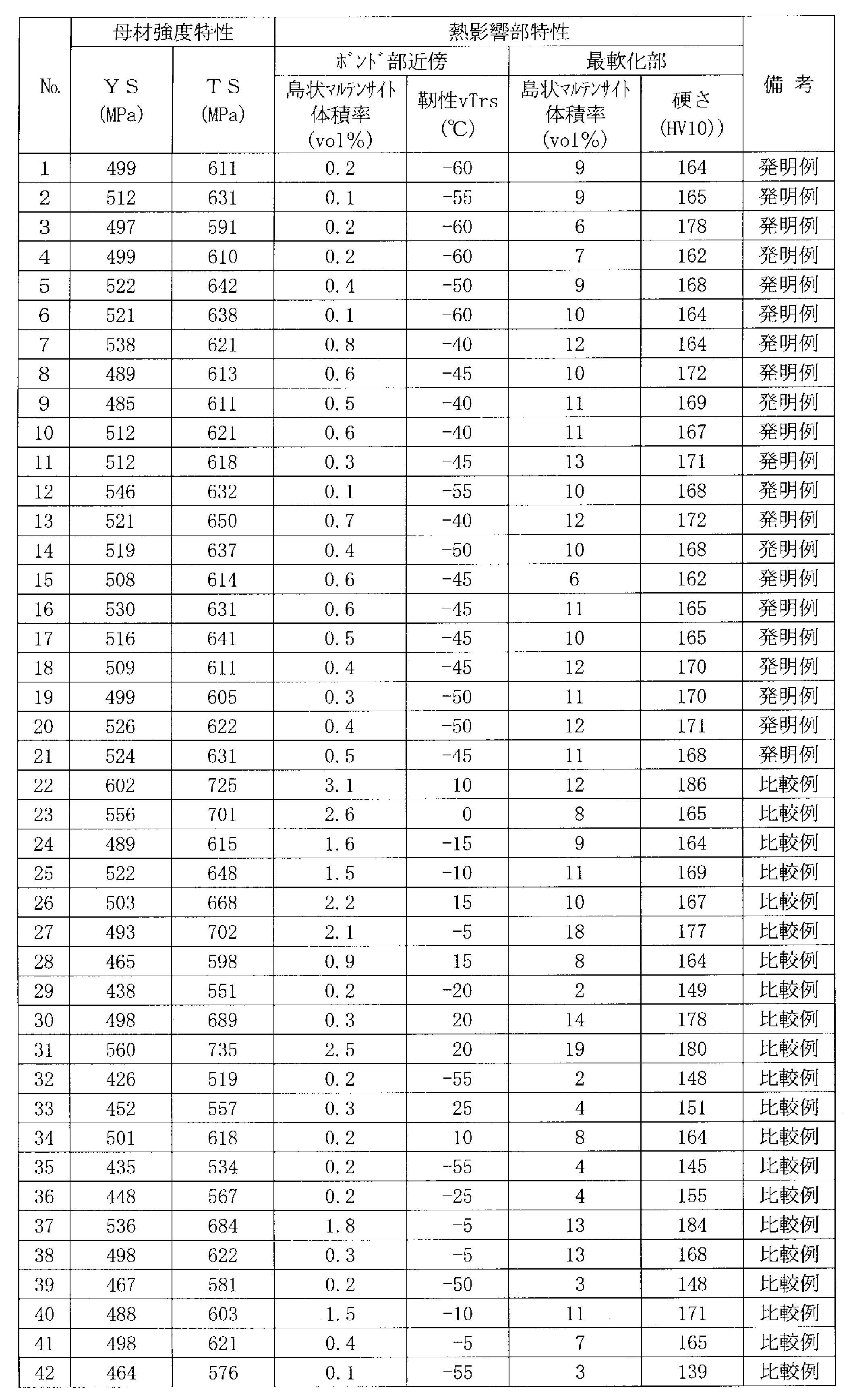
- the measurement results are shown in Table 2. From this result, No. of invention example.
- the thick steel plates 1 to 21 have a yield strength YS of the base material of 460 MPa or more and a tensile strength TS of 570 MPa or more. Since the martensite fraction in the vicinity is less than 1 vol%, the toughness vTrs is ⁇ 40 ° C. or less, the martensite fraction in the softest part of the heat-affected zone is 5 to 15 vol%, and the hardness HV10 is 160 or more. The toughness and strength characteristics of the heat-affected zone after high heat input welding are also excellent.
- No. of the comparative example whose component composition of steel is outside the scope of the present invention. It can be seen that the thick steel plates 22 to 42 have lower characteristics than the thick steel plate of the present invention in any one or more of the yield stress YS, the toughness vTrs near the bond portion, and the hardness of the softest portion. .
Landscapes
- Chemical & Material Sciences (AREA)
- Engineering & Computer Science (AREA)
- Materials Engineering (AREA)
- Mechanical Engineering (AREA)
- Metallurgy (AREA)
- Organic Chemistry (AREA)
- Physics & Mathematics (AREA)
- Plasma & Fusion (AREA)
- Heat Treatment Of Steel (AREA)
- Arc Welding In General (AREA)
Abstract
Description
A=2256×Ti-7716N+10000B ……(1)
で定義されるA値が3~25の範囲、および、下記(2)式;
Ceq=C+Mn/6+(Cr+Mo+V)/5+(Cu+Ni)/15 ……(2)
で定義されるCeqが0.38~0.43の範囲にあり、残部がFeおよび不可避的不純物からなる成分組成を有し、降伏応力が460MPa以上で、溶接入熱量が200kJ/cmを超える大入熱溶接を施したときの熱影響部のボンド部近傍における島状マルテンサイトが1vol%以下、かつ、熱影響部の最軟化部における島状マルテンサイトが5vol%以上であることを特徴とする大入熱溶接用鋼材である。ここで、上記(1)式および(2)式中の各元素記号は、それぞれの元素の含有量(mass%)を示す。
発明者らは、降伏応力が460MPa以上の高強度鋼材に対して溶接入熱量が200kJ/cmを超える大入熱溶接を施したときのボンド部近傍の靭性と最軟化部の強度に及ぼす合金元素と組織因子の影響について調査した。その結果、ボンド部近傍に関しては、島状マルテンサイトの存在は少量でも靭性に悪影響を及ぼすのに対して、最軟化部に関しては、逆に少量の島状マルテンサイトが生成した方が、硬さが上昇し、強度を高めることができることを知見した。また、ボンド部近傍における島状マルテンサイトは、CやSi,Pの含有量を低減することで生成を抑制できるが、それら元素の低減は、最軟化部の強度を却って低下させるおそれがあることを知見した。
そこで、発明者らは、熱影響部のボンド部近傍の島状マルテンサイトの生成を抑制した上で、熱影響部の最軟化部に少量の島状マルテンサイトを生成させることを検討した。
A=2256×Ti-7716N+10000B ……(1)
ただし、各元素記号はそれぞれの元素の含有量(mass%)を示す。
で定義されるA値が3~25の範囲となるように制御することにより、熱影響部の最軟化部の焼入性向上に必要なBを確保することができ、ボンド部近傍の島状マルテンサイトの生成を抑止した上で、最軟化部の島状マルテンサイトの生成を促進させることができることを知見した。
本発明は、上記の知見に、さらに検討を加えて完成したものである。
まず、本発明が対象とする大入熱溶接用鋼材は、先述したように、降伏応力が460MPa以上の高強度を有し、かつ、200kJ/cmを超える大入熱溶接が施されるものである。これは、本発明が対象とする降伏応力460MPa以上の高強度鋼で、特に板厚30~100mmの鋼材では、溶接能率を向上させる観点から200kJ/cmを超える大入熱溶接が実施される傾向にあり、この範囲の条件で強度や靭性を両立した鋼材が熱望されているためである。
ボンド部近傍の島状マルテンサイト:1vol%以下
熱影響部の中で、最も高温に曝され、オーステナイト粒が粗大化するボンド部近傍における島状マルテンサイトの生成を抑制することによって、大入熱溶接部における靭性を向上させることができるが、斯かる効果を得るためには、上記ボンド部近傍に生成する島状マルテンサイトの分率を1vol%以下に抑える必要がある。ここで、上記ボンド部近傍とは、ボンド部から500μm以内のオーステナイト粒が最も粗大化した熱影響部のことをいい、金属組織が、主相であるアシキュラーフェライトやベイナイトと、第二相からなる部分のことである。なお、第二相としては、1vol%以下の島状マルテンサイトの他に、フェライトやパーライトを最大20vol%程度含んでいてもよい。
降伏応力460MPa以上の鋼材を溶接した継手には、母材と同等の強度、すなわち引張強さで570MPa以上が必要である。溶接継手の引張強さに影響する因子としては、溶接金属の強度、母材板厚、最軟化部の硬さなどがあるが、最軟化部の硬さの影響が最も大きい。降伏応力が460MPa以上の鋼材の溶接継手が上記強度を有するためには、最軟化部の組織は主相のフェライトと第二相からなり、第二相として島状マルテンサイトが5vol%以上存在していることが必要である。なお、最軟化部の島状マルテンサイトの上限に特に制限はないが、最大で15vol%程度である。また、第二相としては、島状マルテンサイトの他に、ベイナイトやパーライトを最大20vol%程度含んでいてもよい。
C:0.03~0.10mass%
Cは、鋼の強度を高める元素であり、鋼構造用の鋼材として460MPa以上の降伏応力を確保するためには、0.03mass%以上添加する必要がある。しかし、Cが0.10mass%を超えると、ボンド部近傍で島状マルテンサイトが生成し易くなるため、上限は0.10mass%とする。好ましくは0.05~0.08mass%の範囲である。
Siは、鋼を溶製する際の脱酸剤として添加される元素であり、0.01mass%以上添加する必要がある。しかし、0.08mass%を超えると、大入熱溶接した熱影響部のボンド部近傍に島状マルテンサイトが生成し、靱性低下を招くようになる。よって、Siは0.01~0.08mass%の範囲とする。好ましくは0.02~0.06mass%の範囲である。
Mnは、母材の強度を確保するために0.8mass%以上添加する必要がある。一方、2.0mass%を超えると、ボンド部近傍の靭性を著しく低下させる。よって、Mnは0.8mass%~2.0mass%の範囲とする。好ましくは1.2~1.8mass%の範囲である。
Pは、ボンド部近傍における島状マルテンサイトの生成を促進し、靭性を大きく低下させるため、0.010mass%以下に制限する。好ましくは、0.008mass%以下である。
Sは、フェライトの核生成サイトとなるMnSやCaSを形成するために必要な元素であり、0.0005mass%以上含有させる必要がある。しかし、過度に含有させると、母材の靭性低下を招くため、上限は0.0050mass%とする。
Alは、鋼の脱酸のために添加される元素であり、0.005mass%以上含有させる必要がある。しかし、0.100mass%を超えて添加すると、母材の靱性のみならず、溶接金属の靱性をも低下させる。よって、Alは0.005~0.100mass%の範囲とする。好ましくは0.010~0.080mass%の範囲である。
Nbは、母材の強度を確保するのに有効な元素である。しかし、0.003mass%未満の含有量では、上記効果が小さく、一方、0.030mass%を超えて添加すると、ボンド部近傍に島状マルテンサイトが生成して靱性を低下させる。よって、Nbは0.003~0.030mass%の範囲とする。好ましくは0.008~0.020mass%の範囲である。
Tiは、溶鋼の凝固時にTiNとなって母材中に析出してオーステナイト粒の粗大化を抑制し、母材の靭性向上に寄与するとともに、Bと結合するNを固定し、低減して固溶Bを確保し、母材の強度を確保するために有効に作用する。また、溶接熱影響部で、フェライト変態の核となって、溶接部の高靱性化に寄与する。斯かる効果を得るためには、0.005mass%以上の添加が必要である。一方、0.050mass%を超えて添加すると、析出したTiNが粗大化し、却って上記効果が得られなくなる。よって、Tiは、0.005~0.050mass%の範囲とする。好ましくは0.010~0.035mass%の範囲である。
Bは、溶接熱影響部でNとBNを生成して固溶Nを低減する。また、生成したBNは変態核となってフェライト変態を促進し、靭性を高める効果がある。そのため、Bは0.0003mass%以上含有させる。しかし、0.0030mass%を超えて添加すると、母材および熱影響部の靱性低下を招く。よって、Bは0.0003~0.0030mass%の範囲とする。好ましくは0.0008~0.0020mass%の範囲である。
Nは、TiNを生成させるために0.0040mass%以上含有させる。一方、0.0100mass%を超える添加は、熱影響部で溶接時の入熱でTiNが溶解する領域の固溶N量を増大して靭性を低下させる。よって、Nは0.0040~0.0100mass%の範囲とする。好ましくは0.0045~0.0080mass%、より好ましくは0.0050~0.0070mass%の範囲である。
Cuは、焼き入れ性を向上し、母材および溶接継手の強度確保に有効な元素である。上記効果を得るためには0.20mass%以上添加する必要がある。一方、1.00mass%を超えると、上記効果が飽和する。よって、Cuは0.20~1.00mass%の範囲とする。好ましくは0.30~0.80mass%の範囲である。
Niは、本発明において必須の元素であり、固溶することで母材の強度を高めるとともに、靭性を向上させる効果がある。また、Niは、固溶することで地組織の靭性を高める効果もあるため、熱影響部のボンド部近傍の靭性向上にも寄与する。上記の効果を得るためには0.20mass%超えの添加を必要とする。一方、2.0mass%を超えると、上記効果が飽和する。よって、Niは0.20mass%超え2.00mass%以下の範囲とする。好ましくは0.60~1.50mass%の範囲である。
Ti/N:2.0以上4.0未満
TiとNの含有量の比であるTi/Nは、熱影響部のボンド部近傍におけるTiNの微細分散状況および固溶N量に大きく影響するため、後述する(1)式で定義するA値とともに、本発明において重要な因子の一つである。Ti/Nが2.0を下回ると、固溶Nが増加して、熱影響部の靭性を低下したり、熱影響部にBNとなって析出し、焼入性を確保するのに必要なBを低減するので、最軟化部の硬さを確保することが困難となったりする。一方、4.0以上では、NがTiNとなってほぼ完全に固定され、固溶Nが減少してBNが析出しなくなったり、Tiの硼炭化物が析出したりするため、熱影響部の靭性が大きく低下する。よって、Ti/Nは2.0以上4.0未満とする。好ましくは、2.5~3.5の範囲である。
下記(1)式;
A=2256×Ti-7716N+10000B ……(1)
ここで、上記式中の各元素記号は、各元素の含有量(mass%)を示す。
で定義されるA値は、上記Ti/Nとともに、発明において重要な因子の一つである。
上記A値は、(1)式を書き換えると、
A=10000B-(7716N-2256×Ti)
と表されることからわかるように、鋼中に含まれるBから、Tiによって固定されていない固溶NとBNを形成して固定されるN量を差し引いた固溶B量を意味しており、TiNやBNなどの生成反応が平衡論的に進行しない場合において、固溶元素として変態に作用するB量を表す指標である。
上記A値が3以上であれば、鋼材が200kJ/cmを超える大入熱溶接の熱履歴を受けた際でも、固溶Bによる焼入れ性の向上効果が十分に発現し、最軟化部の硬さを、降伏応力が460MPa以上の鋼材における溶接継手に要求される強度確保に必要な硬さであるHV10で160以上にすることができる。しかし、A値が25を超えると、炭硼化物などの粗大な析出物が生成し、熱影響部のボンド部近傍の靭性が低下する。よって、本発明では、上記A値は3~25の範囲とする。好ましくは6~15の範囲である。
本発明の大入熱溶接用鋼材は、溶接時の入熱により、母材製造時に施されたTMCP等の組織制御の効果が全て無効となってしまう。そのため、溶接時の加熱・冷却によっても溶接継手の強度と靭性を両立させる必要があることから、焼入性の指標である炭素当量Ceqを適正範囲に制御する必要があり、具体的には下記(2)式;
Ceq=C+Mn/6+(Cr+Mo+V)/5+(Cu+Ni)/15 ……(2)
ここで、上記式中の各元素記号は、それぞれの元素の含有量(mass%)を示す。
で定義される炭素当量Ceqが0.38~0.43の範囲となるよう各成分の組成を制御する必要がある。
上記Ceqが0.38未満では、焼入性が不足し、最軟化部の硬さが著しく低下するため、所望の溶接継手の強度を確保することができない。一方、Ceqが0.43を超えると、焼入性が過剰となり、ボンド部近傍におけるフェライトの生成が抑制され、島状マルテンサイトの生成が促進されるため、十分な靭性を確保することができなくなる。好ましいCeqは0.39~0.42の範囲である。
V:0.20mass%以下
Vは、VNとして析出し、母材の強度・靱性の向上に寄与するとともに、フェライト生成核としても作用する元素である。上記効果を発現させるためには、0.005mass%以上添加するのが望ましい。しかし、過剰の添加は、却って靱性の低下を招くので、上限は0.20mass%とするのが好ましい。
CrおよびMoは、母材の高強度化に有効な元素であり、上記の効果を得るためには、それぞれ0.02mass%以上添加するのが望ましい。しかし、いずれの元素も、多量の添加は、靱性に悪影響を及ぼすため、添加する場合には0.40mass%以下とするのが好ましい。
Mg:0.0005~0.0050mass%、Zr:0.0010~0.0200mass%、REM:0.0010~0.0200mass%、Ca:0.0005~0.0050mass%
Mg,ZrおよびREMは、いずれも、酸化物となって分散することで、靱性を改善する効果がある元素である。また、硫化物系介在物の形態制御にも有用な元素である。このような効果を発現させるには、Mgは0.0005mass%以上、ZrおよびREMはそれぞれ0.0010mass%以上含有させることが好ましい。
また、Mgは0.0050mass%超え、ZrおよびREMはそれぞれ0.0200mass%超え添加しても、その効果は飽和するだけである。よって、これらの元素を添加する場合は、上記範囲とするのが好ましい。
また、Caは、硫化物系介在物の形態制御に有用な元素である。その効果を発揮させるためには、0.0005mass%以上添加するのが好ましい。しかし、0.0050mass%を超えると、清浄度の低下を招き、靭性が劣化する。そこで、Caを含有する場合には0.0005~0.0050mass%の範囲とするのが好ましい。
本発明の大入熱溶接用鋼材は、上記の成分以外の残部は、Feおよび不可避的不純物である。
本発明の大入熱溶接用鋼材は、降伏応力を460MPa以上とする製造方法であれば、従来公知の方法で製造することができ、特に、製造条件に制限はない。例えば、転炉や電気炉等で溶製した鋼をRH脱ガス等で二次精錬して鋼成分を上記適正範囲に調整した後、連続鋳造または造塊-分塊工程を経てスラブ等の鋼素材とする。次いで、上記鋼素材を再加熱し、熱間圧延して所望の寸法の鋼材とした後、放冷する工程を経て、あるいは、上記熱間圧延後、加速冷却、直接焼入れ-焼戻し、再加熱焼入れ-焼戻し、再加熱焼準-焼戻しなどの工程を経て製造することができる。


<母材の強度測定>
厚鋼板の板厚1/4位置から、板幅方向を試験片長手方向とし、平行部が14mmφ×85mm、標点間距離が70mmの丸棒引張試験片を採取して引張試験を行い、母材の強度(降伏応力YS、引張強さTS)を測定した。
<熱影響部の最軟化部の硬さ測定および組織評価>
上記厚鋼板から3mmφ×10mmの小型試料を採取し、Ac3変態点直上のオーステナイト域に相当する900℃に加熱後、800~500℃間を390secで冷却する熱処理を施した後、JIS Z 2244(1998)に規定される方法でビッカース硬さHV10を5点測定し、そのうちの最も低い硬さを最軟化部の硬さとし、160以上の硬さのものを合格とした。
次いで、上記硬さ測定後の小型試料の断面をナイタールでエッチングして組織を現出した後、走査型電子顕微鏡SEMを用いて1000倍で3視野の組織写真を撮影し、それらを画像解析してマルテンサイトの面積分率を求め、その平均値を最軟化部のマルテンサイト分率とした。
<熱影響部のボンド部近傍の靭性および組織評価>
上記の厚鋼板から幅80mm×長さ80mm×厚さ15mmのサンプルを採取し、1450℃に加熱した後、800~500℃間を390secで冷却する熱処理を施した。上記熱処理は、入熱量が500kJ/cmのエレクトロガス溶接によって熱影響部が受ける熱履歴に相当する。
次いで、上記サンプルから、長手方向が圧延方向と平行となるようにして2mmVノッチシャルピー試験片を採取し、-100~40℃の温度範囲でシャルピー衝撃試験を行い、延性破面率が50%となる破面遷移温度vTrsを求め、-40℃以下のものを合格と評価した。
また、上記熱処理後のサンプルの断面をナイタールでエッチングして組織を現出した後、走査型電子顕微鏡SEMを用いて1000倍で3視野の組織写真を撮影し、それらを画像解析して島状マルテンサイトの面積分率を求め、その平均値をボンド部近傍の島状マルテンサイト分率とした。
これに対して、鋼の成分組成が本発明の範囲外である比較例のNo.22~42の厚鋼板は、降伏応力YS、ボンド部近傍の靭性vTrsおよび最軟化部の硬さのうちのいずれか1以上の特性が本発明例の厚鋼板より低位となっていることがわかる。
Claims (3)
- C:0.03~0.10mass%、Si:0.01~0.08mass%、Mn:0.8~2.0mass%、P:0.010mass%以下、S:0.0005~0.0050mass%、Al:0.005~0.100mass%、Nb:0.003~0.030mass%、Ti:0.005~0.050mass%、Cu:0.20~1.00mass%以下、Ni:0.20mass%超え2.00mass%以下、N:0.0040~0.0100mass%およびB:0.0003~0.0030mass%を含有し、TiとNの含有量比Ti/Nが2.0以上4.0未満で、下記(1)式で定義されるA値が3~25の範囲、および、下記(2)式で定義されるCeqが0.38~0.43の範囲にあり、残部がFeおよび不可避的不純物からなる成分組成を有し、降伏応力が460MPa以上で、溶接入熱量が200kJ/cmを超える大入熱溶接を施したときの熱影響部のボンド部近傍における島状マルテンサイトが1vol%以下、かつ、熱影響部の最軟化部における島状マルテンサイトが5vol%以上であることを特徴とする大入熱溶接用鋼材。
記
A=2256×Ti-7716N+10000B ……(1)
Ceq=C+Mn/6+(Cr+Mo+V)/5+(Cu+Ni)/15 ……(2)
ここで、上記(1)式および(2)式中の各元素記号は、それぞれの元素の含有量(mass%)を示す。 - 上記成分組成に加えてさらに、V:0.20mass%以下、Cr:0.40mass%以下およびMo:0.40mass%以下のうちから選ばれる1種または2種以上を含有することを特徴とする請求項1に記載の大入熱溶接用鋼材。
- 上記成分組成に加えてさらに、Mg:0.0005~0.0050mass%、Zr:0.0010~0.0200mass%、REM:0.0010~0.0200mass%およびCa:0.0005~0.0050mass%のうちから選ばれる1種または2種以上を含有することを特徴とする請求項1または2に記載の大入熱溶接用鋼材。
Priority Applications (4)
| Application Number | Priority Date | Filing Date | Title |
|---|---|---|---|
| BR112017007462-1A BR112017007462B1 (pt) | 2014-10-17 | 2015-10-14 | material de aço para soldagem de alto aporte de calor |
| CN201580054877.1A CN107109596A (zh) | 2014-10-17 | 2015-10-14 | 大线能量焊接用钢材 |
| KR1020177010375A KR101930181B1 (ko) | 2014-10-17 | 2015-10-14 | 대입열 용접용 강재 |
| JP2016554091A JP6418418B2 (ja) | 2014-10-17 | 2015-10-14 | 大入熱溶接用鋼材 |
Applications Claiming Priority (2)
| Application Number | Priority Date | Filing Date | Title |
|---|---|---|---|
| JP2014212353 | 2014-10-17 | ||
| JP2014-212353 | 2014-10-17 |
Publications (1)
| Publication Number | Publication Date |
|---|---|
| WO2016060141A1 true WO2016060141A1 (ja) | 2016-04-21 |
Family
ID=55746684
Family Applications (1)
| Application Number | Title | Priority Date | Filing Date |
|---|---|---|---|
| PCT/JP2015/078974 Ceased WO2016060141A1 (ja) | 2014-10-17 | 2015-10-14 | 大入熱溶接用鋼材 |
Country Status (5)
| Country | Link |
|---|---|
| JP (1) | JP6418418B2 (ja) |
| KR (1) | KR101930181B1 (ja) |
| CN (1) | CN107109596A (ja) |
| BR (1) | BR112017007462B1 (ja) |
| WO (1) | WO2016060141A1 (ja) |
Cited By (2)
| Publication number | Priority date | Publication date | Assignee | Title |
|---|---|---|---|---|
| JP2019035107A (ja) * | 2017-08-14 | 2019-03-07 | 新日鐵住金株式会社 | 鋼板および鋼板の製造方法 |
| JP7091612B2 (ja) | 2017-06-29 | 2022-06-28 | 日本製鉄株式会社 | 鋼材の溶接方法及び溶接継手の製造方法 |
Families Citing this family (2)
| Publication number | Priority date | Publication date | Assignee | Title |
|---|---|---|---|---|
| KR102110684B1 (ko) * | 2018-10-18 | 2020-05-19 | 현대제철 주식회사 | 대입열 용접열영향부 인성이 우수한 용접구조용 강재 및 그 제조방법 |
| CN111926259B (zh) * | 2020-08-20 | 2021-08-03 | 钢铁研究总院 | 一种大线能量焊接用低合金钢及其制备方法 |
Citations (6)
| Publication number | Priority date | Publication date | Assignee | Title |
|---|---|---|---|---|
| JP2011074403A (ja) * | 2009-09-16 | 2011-04-14 | Jfe Steel Corp | 大入熱溶接用鋼 |
| JP2012162793A (ja) * | 2011-02-09 | 2012-08-30 | Jfe Steel Corp | 大入熱溶接用鋼材 |
| WO2013088715A1 (ja) * | 2011-12-14 | 2013-06-20 | Jfeスチール株式会社 | 大入熱溶接用鋼材 |
| WO2013108419A1 (ja) * | 2012-01-18 | 2013-07-25 | Jfeスチール株式会社 | テーパプレートの製造方法 |
| JP2014031544A (ja) * | 2012-08-03 | 2014-02-20 | Jfe Steel Corp | 大入熱溶接用鋼材 |
| WO2015141203A1 (ja) * | 2014-03-17 | 2015-09-24 | Jfeスチール株式会社 | 溶接用鋼材 |
Family Cites Families (1)
| Publication number | Priority date | Publication date | Assignee | Title |
|---|---|---|---|---|
| DK2434027T3 (en) * | 2009-05-22 | 2015-12-07 | Jfe Steel Corp | Steel materials for welding with high heat input |
-
2015
- 2015-10-14 CN CN201580054877.1A patent/CN107109596A/zh active Pending
- 2015-10-14 WO PCT/JP2015/078974 patent/WO2016060141A1/ja not_active Ceased
- 2015-10-14 JP JP2016554091A patent/JP6418418B2/ja active Active
- 2015-10-14 KR KR1020177010375A patent/KR101930181B1/ko active Active
- 2015-10-14 BR BR112017007462-1A patent/BR112017007462B1/pt not_active IP Right Cessation
Patent Citations (6)
| Publication number | Priority date | Publication date | Assignee | Title |
|---|---|---|---|---|
| JP2011074403A (ja) * | 2009-09-16 | 2011-04-14 | Jfe Steel Corp | 大入熱溶接用鋼 |
| JP2012162793A (ja) * | 2011-02-09 | 2012-08-30 | Jfe Steel Corp | 大入熱溶接用鋼材 |
| WO2013088715A1 (ja) * | 2011-12-14 | 2013-06-20 | Jfeスチール株式会社 | 大入熱溶接用鋼材 |
| WO2013108419A1 (ja) * | 2012-01-18 | 2013-07-25 | Jfeスチール株式会社 | テーパプレートの製造方法 |
| JP2014031544A (ja) * | 2012-08-03 | 2014-02-20 | Jfe Steel Corp | 大入熱溶接用鋼材 |
| WO2015141203A1 (ja) * | 2014-03-17 | 2015-09-24 | Jfeスチール株式会社 | 溶接用鋼材 |
Cited By (2)
| Publication number | Priority date | Publication date | Assignee | Title |
|---|---|---|---|---|
| JP7091612B2 (ja) | 2017-06-29 | 2022-06-28 | 日本製鉄株式会社 | 鋼材の溶接方法及び溶接継手の製造方法 |
| JP2019035107A (ja) * | 2017-08-14 | 2019-03-07 | 新日鐵住金株式会社 | 鋼板および鋼板の製造方法 |
Also Published As
| Publication number | Publication date |
|---|---|
| KR101930181B1 (ko) | 2018-12-17 |
| BR112017007462A2 (pt) | 2017-12-19 |
| CN107109596A (zh) | 2017-08-29 |
| BR112017007462B1 (pt) | 2021-05-25 |
| JP6418418B2 (ja) | 2018-11-07 |
| JPWO2016060141A1 (ja) | 2017-04-27 |
| KR20170054520A (ko) | 2017-05-17 |
Similar Documents
| Publication | Publication Date | Title |
|---|---|---|
| CN104087829B (zh) | 大热输入焊接用钢材 | |
| JP5076658B2 (ja) | 大入熱溶接用鋼材 | |
| JP5950045B2 (ja) | 鋼板およびその製造方法 | |
| JP5846311B2 (ja) | 溶接熱影響部ctod特性に優れた厚肉高張力鋼およびその製造方法 | |
| KR101971772B1 (ko) | 대입열 용접용 강판의 제조 방법 | |
| JP2008255458A (ja) | Haz靭性および母材靭性に優れた厚鋼板 | |
| WO2015022899A1 (ja) | 溶接部品質の優れた電縫鋼管及びその製造方法 | |
| WO2014199488A1 (ja) | 溶接用超高張力鋼板 | |
| JP5796636B2 (ja) | 大入熱溶接用鋼材 | |
| JP6418418B2 (ja) | 大入熱溶接用鋼材 | |
| JP5849892B2 (ja) | 大入熱溶接用鋼材 | |
| JP5233365B2 (ja) | 大入熱溶接用鋼材 | |
| JP5233364B2 (ja) | 大入熱溶接用鋼材 | |
| CN104145038B (zh) | 大线能量焊接用钢材 | |
| JP5493658B2 (ja) | 大入熱溶接熱影響部靱性に優れた非調質厚肉高張力鋼の製造方法。 | |
| JP6226163B2 (ja) | 溶接熱影響部の低温靭性に優れる高張力鋼板とその製造方法 | |
| JP5126375B2 (ja) | 大入熱溶接用鋼材 | |
| JP5857693B2 (ja) | 大入熱用鋼板およびその製造方法 | |
| JP5493557B2 (ja) | 大入熱溶接用鋼材 | |
| JP2013036102A (ja) | 大入熱溶接用鋼材 | |
| JP2013053368A (ja) | 大入熱溶接用鋼材 |
Legal Events
| Date | Code | Title | Description |
|---|---|---|---|
| 121 | Ep: the epo has been informed by wipo that ep was designated in this application |
Ref document number: 15850346 Country of ref document: EP Kind code of ref document: A1 |
|
| ENP | Entry into the national phase |
Ref document number: 2016554091 Country of ref document: JP Kind code of ref document: A |
|
| ENP | Entry into the national phase |
Ref document number: 20177010375 Country of ref document: KR Kind code of ref document: A |
|
| NENP | Non-entry into the national phase |
Ref country code: DE |
|
| REG | Reference to national code |
Ref country code: BR Ref legal event code: B01A Ref document number: 112017007462 Country of ref document: BR |
|
| 122 | Ep: pct application non-entry in european phase |
Ref document number: 15850346 Country of ref document: EP Kind code of ref document: A1 |
|
| ENP | Entry into the national phase |
Ref document number: 112017007462 Country of ref document: BR Kind code of ref document: A2 Effective date: 20170411 |