WO2016009845A1 - 両面粘着テープ、保護部材及び電子機器 - Google Patents
両面粘着テープ、保護部材及び電子機器 Download PDFInfo
- Publication number
- WO2016009845A1 WO2016009845A1 PCT/JP2015/069112 JP2015069112W WO2016009845A1 WO 2016009845 A1 WO2016009845 A1 WO 2016009845A1 JP 2015069112 W JP2015069112 W JP 2015069112W WO 2016009845 A1 WO2016009845 A1 WO 2016009845A1
- Authority
- WO
- WIPO (PCT)
- Prior art keywords
- sensitive adhesive
- pressure
- adhesive layer
- double
- acrylic
- Prior art date
- Legal status (The legal status is an assumption and is not a legal conclusion. Google has not performed a legal analysis and makes no representation as to the accuracy of the status listed.)
- Ceased
Links
Images
Classifications
-
- G—PHYSICS
- G09—EDUCATION; CRYPTOGRAPHY; DISPLAY; ADVERTISING; SEALS
- G09F—DISPLAYING; ADVERTISING; SIGNS; LABELS OR NAME-PLATES; SEALS
- G09F9/00—Indicating arrangements for variable information in which the information is built-up on a support by selection or combination of individual elements
-
- C—CHEMISTRY; METALLURGY
- C09—DYES; PAINTS; POLISHES; NATURAL RESINS; ADHESIVES; COMPOSITIONS NOT OTHERWISE PROVIDED FOR; APPLICATIONS OF MATERIALS NOT OTHERWISE PROVIDED FOR
- C09J—ADHESIVES; NON-MECHANICAL ASPECTS OF ADHESIVE PROCESSES IN GENERAL; ADHESIVE PROCESSES NOT PROVIDED FOR ELSEWHERE; USE OF MATERIALS AS ADHESIVES
- C09J133/00—Adhesives based on homopolymers or copolymers of compounds having one or more unsaturated aliphatic radicals, each having only one carbon-to-carbon double bond, and at least one being terminated by only one carboxyl radical, or of salts, anhydrides, esters, amides, imides, or nitriles thereof; Adhesives based on derivatives of such polymers
-
- C—CHEMISTRY; METALLURGY
- C09—DYES; PAINTS; POLISHES; NATURAL RESINS; ADHESIVES; COMPOSITIONS NOT OTHERWISE PROVIDED FOR; APPLICATIONS OF MATERIALS NOT OTHERWISE PROVIDED FOR
- C09J—ADHESIVES; NON-MECHANICAL ASPECTS OF ADHESIVE PROCESSES IN GENERAL; ADHESIVE PROCESSES NOT PROVIDED FOR ELSEWHERE; USE OF MATERIALS AS ADHESIVES
- C09J183/00—Adhesives based on macromolecular compounds obtained by reactions forming in the main chain of the macromolecule a linkage containing silicon, with or without sulfur, nitrogen, oxygen, or carbon only; Adhesives based on derivatives of such polymers
- C09J183/04—Polysiloxanes
-
- C—CHEMISTRY; METALLURGY
- C09—DYES; PAINTS; POLISHES; NATURAL RESINS; ADHESIVES; COMPOSITIONS NOT OTHERWISE PROVIDED FOR; APPLICATIONS OF MATERIALS NOT OTHERWISE PROVIDED FOR
- C09J—ADHESIVES; NON-MECHANICAL ASPECTS OF ADHESIVE PROCESSES IN GENERAL; ADHESIVE PROCESSES NOT PROVIDED FOR ELSEWHERE; USE OF MATERIALS AS ADHESIVES
- C09J7/00—Adhesives in the form of films or foils
- C09J7/20—Adhesives in the form of films or foils characterised by their carriers
Definitions
- the present invention relates to a double-sided pressure-sensitive adhesive tape suitable for bonding, for example, an information display unit of an information display device and a member made of glass or the like.
- an information display part of a display mounted on an electronic device has a hard coat layer and a pressure-sensitive adhesive layer having a pencil hardness of about 2H on the surface of a resin film for the purpose of preventing scratches on the surface thereof.
- a protective member is often affixed.
- the protective member has a characteristic (reworkability) that can be re-applied after a certain period of time from the initial stage of application and pasting for the purpose of correcting misalignment or the like when it is applied to the surface of the information display part of the display. Desired. Therefore, excellent reworkability is also required for the double-sided pressure-sensitive adhesive tape used for the production.
- the double-sided pressure-sensitive adhesive tape is required to have a level of reworkability that can be re-applied to the tempered glass at the initial application stage in order to improve the production efficiency and yield of the protective member.
- the protective member when the protective member is usually affixed to the surface of the information display portion of the display, it is difficult for air bubbles (air) to be involved in the interface, and even if air bubbles are involved, the air bubbles are promptly introduced.
- the ability to escape (air escape) is required.
- the tempered glass when a protective member made of the tempered glass and a double-sided adhesive tape is affixed to an information display part of a display, the tempered glass is rigid and cannot be affixed using a roller or the like.
- the protective member can be quickly removed.
- the protective member is required.
- the double-sided adhesive tape used for manufacture of a protection member as described above is also required to have excellent air release properties.
- the double-sided pressure-sensitive adhesive tape for example, at least one of the pressure-sensitive adhesive layers on both sides of the support is made of a silicone-based pressure-sensitive adhesive, and the pressure-sensitive adhesive layer is treated with a release agent made of a polymer having a fluorine-containing side chain in the siloxane skeleton.
- a double-sided pressure-sensitive adhesive tape characterized by being temporarily attached (see, for example, Patent Document 1).
- Patent Document 1 does not disclose that it has excellent reworkability or air release property, nor does it disclose that it can be suitably used in applications where such characteristics are required.
- the information display part of the display and the protective member in addition to the reworkability and air detachability, even when a strong impact is applied, the information display part of the display and the protective member
- a level of impact resistance that does not easily cause peeling or a characteristic that prevents the glass from scattering when the glass constituting the protective member breaks may be required.
- the impact resistance may be improved to some extent, for example, by providing a pressure-sensitive adhesive layer with strong adhesion, but the strong adhesion pressure-sensitive adhesive layer is not sufficient in terms of air bleeding and reworkability. was there.
- the problem to be solved by the present invention is to provide a double-sided pressure-sensitive adhesive tape that achieves both excellent reworkability and air detachability, and excellent impact resistance and scattering prevention.
- the present inventors have a silicone-based pressure-sensitive adhesive layer directly on one side of the substrate or via another layer, and acrylic on the other side of the substrate directly or via another layer.
- a double-sided pressure-sensitive adhesive tape having a pressure-sensitive adhesive layer, wherein a polyethylene terephthalate film having a thickness of 25 ⁇ m is stuck on the silicone-based pressure-sensitive adhesive layer, and the polyethylene terephthalate film is oriented in a 180 ° direction with respect to the surface of the silicone-based pressure-sensitive adhesive layer.
- the tensile strength measured by pulling in a 180 ° direction with respect to the surface of the acrylic pressure-sensitive adhesive layer is 5 N / 25
- a double-sided adhesive tape which is a range of m ⁇ 28N / 25mm, and can solve the above problems.
- the double-sided pressure-sensitive adhesive tape of the present invention has both excellent reworkability and air release property, and excellent impact resistance and scattering prevention properties. Therefore, the double-sided pressure-sensitive adhesive tape of the present invention can be suitably used for adhesion between, for example, an information display part of a display and a member made of glass or resin. Moreover, the double-sided adhesive tape of this invention can be used for manufacture of the protection member stuck on the information display part of the said display.
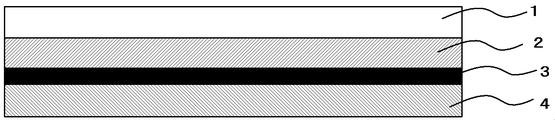
- the double-sided pressure-sensitive adhesive tape of the present invention has a silicone pressure-sensitive adhesive layer directly on one surface side of the substrate or via another layer, and directly or via another layer on the other surface side of the substrate.
- Tensile strength measured by pulling terephthalate film in 180 ° direction with respect to the surface of the acrylic adhesive layer It is characterized in that in the range of 5N / 25mm ⁇ 28N / 25mm.
- the double-sided pressure-sensitive adhesive tape of the present invention preferably has the silicone-based pressure-sensitive adhesive layer directly on one side of the substrate or via another layer, and directly or on the other side of the substrate. And having the acrylic pressure-sensitive adhesive layer.
- the silicone pressure-sensitive adhesive layer constituting the double-sided pressure-sensitive adhesive tape of the present invention a 25 ⁇ m thick polyethylene terephthalate film is attached to the silicone pressure-sensitive adhesive layer, and the polyethylene terephthalate film is attached to the surface of the silicone pressure-sensitive adhesive layer.
- the tensile strength measured by pulling in the 180 ° direction is in the range of 0.01 N / 25 mm to 0.1 N / 25 mm.
- the silicone pressure-sensitive adhesive layer preferably has a tensile strength in the range of 0.02 N / 25 mm to 0.08 N / 25 mm, preferably in the range of 0.04 N / 25 mm to 0.07 N / 25 mm. It is more preferable to use a material that is excellent in reworkability and air release property and excellent impact resistance.
- the said tensile strength points out the value measured with the following method.
- the double-sided pressure-sensitive adhesive tape cut to a width of 50 mm under an environment of 23 ° C. and 50% RH was placed so that the silicone-based pressure-sensitive adhesive layer was the top surface, and was cut to a width of 25 mm on the silicone-based pressure-sensitive adhesive layer.
- "S-25" manufactured by Unitika Co., Ltd., polyester film, thickness 25 ⁇ m
- the upper surface is pressure-applied by reciprocating a 2 kg roller once, then 23 ° C and 50% RH environment Leave under for 1 hour.
- the “S-25” was converted into the silicone-based pressure-sensitive adhesive under the condition of a tensile speed of 300 mm / min.
- the layer is pulled in the direction of 180 ° with respect to the surface of the layer, and the adhesive strength when the layer is peeled is measured.
- the said measurement is performed in the state which stuck the acrylic adhesive layer and aluminum plate which comprise the said double-sided adhesive tape using the double-sided tape "# 8625UJ" by DIC Corporation.
- the silicone pressure-sensitive adhesive layer preferably has a thickness in the range of 5 ⁇ m to 100 ⁇ m, more preferably in the range of 15 ⁇ m to 50 ⁇ m, still more preferably in the range of 20 ⁇ m to 40 ⁇ m, and more preferably 25 ⁇ m.
- a thickness in the range of ⁇ 35 ⁇ m can achieve both excellent reworkability and air bleedability with respect to, for example, an information display unit of an information display device, and the information display unit due to an impact such as dropping It is particularly preferable for imparting excellent impact resistance at a level that does not cause peeling from the silicone-based pressure-sensitive adhesive layer and excellent adhesion to a non-smooth surface.
- an acrylic adhesive layer which comprises the double-sided adhesive tape of this invention, a 25-micrometer-thick polyethylene terephthalate film is stuck on the said acrylic adhesive layer,
- the said polyethylene terephthalate film is the surface of the said acrylic adhesive layer
- the one whose tensile strength measured by pulling in the direction of 180 ° with respect to the range of 5 N / 25 mm to 28 N / 25 mm is used.
- the acrylic pressure-sensitive adhesive layer preferably has a tensile strength in the range of 10 N / 25 mm to 25 N / 25 mm, and preferably has a tensile strength in the range of 13 N / 25 mm to 20 N / 25 mm.
- a member made of glass or a resin such as tempered glass it is more preferable because the reworkability more excellent in the initial stage of application and the excellent antiscattering property can be achieved at a high level.
- the said tensile strength points out the value measured with the following method.
- the double-sided pressure-sensitive adhesive tape cut to a width of 50 mm under an environment of 23 ° C. and 50% RH was placed so that the acrylic pressure-sensitive adhesive layer was the top surface, and was cut to a width of 25 mm on the acrylic pressure-sensitive adhesive layer.
- "S-25" manufactured by Unitika Co., Ltd., polyester film, thickness 25 ⁇ m
- the “S-25” was converted to the acrylic pressure-sensitive adhesive under the conditions of 23 mm and 50% RH using a tensile tester (Tensilon RTA-100, manufactured by A & D) at a tensile speed of 300 mm / min.
- the layer is pulled in the direction of 180 ° with respect to the surface of the layer, and the adhesive strength when the layer is peeled is measured.
- the said measurement is performed in the state which stuck the silicone type adhesive layer and aluminum plate which comprise the said double-sided adhesive tape using the double-sided tape "# 8625HPW" by DIC Corporation.
- the acrylic adhesive layer preferably has a thickness in the range of 5 ⁇ m to 100 ⁇ m, more preferably in the range of 10 ⁇ m to 50 ⁇ m, still more preferably in the range of 15 ⁇ m to 30 ⁇ m, and 20 ⁇ m.
- a thickness in the range of ⁇ 25 ⁇ m is capable of achieving a highly compatible reworkability and anti-scattering property at the initial stage of application for a member made of glass or resin such as tempered glass. Particularly preferred.
- the acrylic pressure-sensitive adhesive layer having the above-mentioned thickness, it is difficult to entrap air bubbles at the interface between the acrylic pressure-sensitive adhesive layer and a member made of glass or resin such as tempered glass when a protective member is manufactured. be able to.
- the silicone pressure-sensitive adhesive layer constituting the double-sided pressure-sensitive adhesive tape of the present invention can be formed by using a silicone pressure-sensitive adhesive.
- silicone-based pressure-sensitive adhesive it is possible to use one containing what is generally called a gum component and a resin component. Moreover, as said silicone type adhesive, what contains a crosslinking agent, a metal catalyst, etc. besides the above-mentioned component can be used.
- the gum component those mainly serving as a binder component of an adhesive can be used, and for example, polyorganosilicone can be used.
- polyorganosilicone a peroxide curable type and an addition curable type are known, and both can be used, but a silicone pressure-sensitive adhesive layer having a tensile strength in the predetermined range is formed, As a result, it is preferable to use a material containing an addition-curable polyorganosilicone in order to express even more excellent reworkability and air release properties and excellent impact resistance.
- addition-curable polyorganosilicone for example, a polyorganosiloxane having a structure in which a polymerizable unsaturated double bond is bonded to a silicon atom (—Si—CH ⁇ CH 2 group) can be used.
- addition-curable polyorganosilicone those having any of the structures (1) to (4) described later can be used, and those having the following structures (1) and (4) are used. It is preferable to do.
- addition-curable polyorganosilicone examples include addition-curable dimethylpolysiloxane, addition-curable dimethylphenylpolysiloxane, addition-curable polyethylphenylsiloxane, and addition-curable polymethylphenylsiloxane. it can.
- addition-curable polyorganosilicone it is possible to form a silicone-based pressure-sensitive adhesive layer having a tensile strength within the predetermined range by using one having a phenyl group, and as a result, reworkability and air release properties. Can be further improved. Further, as the addition-curable polyorganosilicone, the use of addition-curable dimethylpolysiloxane can form a silicone-based pressure-sensitive adhesive layer having the predetermined range of tensile strength. It is preferable because it is easy to satisfy both the air release property and the good followability to the adherend.
- addition-curable polyorganosilicone those having a weight average molecular weight of 50,000 to 1,000,000 are preferably used, and those having a weight average molecular weight of 100,000 to 500,000 are more preferable. It is more preferable to use one having a weight average molecular weight of 200,000 to 350,000 in order to obtain a double-sided pressure-sensitive adhesive tape particularly excellent in air bleeding.
- silicone-based pressure-sensitive adhesive those containing the resin component can be used as necessary in addition to the above-described components.
- the resin component can be appropriately selected and used from conventionally known resins, but it is preferable to use a polyorganosilicone having a relatively low molecular weight, and it is more preferable to use an addition-curable polyorganosilicone.
- the polyorganosilicone usable as the resin component for example, those having at least one selected from the group consisting of the following structures (1) to (4) can be used, and the structures (1) and (2) ) Is preferably used.
- R represents a monovalent hydrocarbon group or a hydroxyl group.
- polyorganosilicone as the resin component among those exemplified as the gum component, those having a weight average molecular weight of 100 to 10,000, more preferably 300 to 8000, and still more preferably 3000 to 6000 are used. Can do.
- the mass ratio of the polyorganosilicone as the gum component and the polyorganosilicone as the resin component is preferably 100: 0 to 65:35, more preferably 95: 5 to 70:30, 93: 7 to 80:20 makes it easy to form a silicone-based pressure-sensitive adhesive layer having a tensile strength in the above-mentioned range, and it is highly compatible with air bleedability, reworkability, and impact resistance. It is particularly preferable because it is easy to do.
- the resin component and the gum component may be premixed.
- the resin, gum component and solvent previously mixed are commercially available as “X-40-3306”, “X-40-3229”, “X-40-3323” (manufactured by Shin-Etsu Chemical Co., Ltd.). Can be used.
- crosslinking agent that may be contained in the silicone-based pressure-sensitive adhesive
- those having a structure capable of reacting with the functional group of the gum component or the resin component can be used, for example, a hydrogen atom in a silicon atom
- a cross-linking agent containing a siloxane having a structure in which is bonded (—Si—H group) can be used.
- a polyorganohydrodienesiloxane having at least two hydrogen atoms bonded to a silicon atom in the molecular weight can be used, and in particular, a structure in which a hydrogen atom is bonded to a silicon atom (—Si—H group). It is preferable to use hydrogen dimethylpolysiloxane having both at the ends of the molecule.
- a metal catalyst that may be contained in the silicone-based pressure-sensitive adhesive it is preferable to use, for example, an organometallic catalyst belonging to Group 10 of the periodic table of elements, and specifically, a platinum-based catalyst may be used. Since it is excellent in the reaction promotion effect, it is more preferable.
- the cross-linking agent and the catalyst may be premixed or may be a complex of them. Specifically, it is more preferable to use a complex of platinum (0) and 1,3-divinyl-1,1,3,3-tetramethyldisiloxane or a xylene solution thereof.
- the silicone-based pressure-sensitive adhesive may contain a solvent such as methyl ethyl ketone and toluene in addition to the above-described components in order to improve application workability.
- the silicone pressure-sensitive adhesive layer formed using the silicone pressure-sensitive adhesive preferably has a gel fraction of 85% by mass to 99% by mass, and 86% by mass to 97% by mass. It is more preferable to use a material having a mass of 87% to 92% by mass, for example, excellent reworkability and air detachability for an information display unit of an information display device, and excellent impact resistance. It is further preferable to obtain a double-sided pressure-sensitive adhesive tape that satisfies both requirements.
- the gel fraction is applied to one side of a polyester film “A4300 # 38” manufactured by Toyobo Co., Ltd., which is a base material, using a lip coater so that the thickness after drying is 30 ⁇ m. Then, after drying at 140 ° C. for 2 minutes, a single-sided adhesive tape is produced by curing at 40 ° C. for 48 hours, and refers to the mass calculated before and after immersing it in toluene and the value calculated by the following equation.
- Gel fraction (% by mass) ⁇ (mass of silicone-based adhesive layer after immersing single-sided adhesive tape in toluene) / (mass of silicone-based adhesive layer before immersing single-sided adhesive tape in toluene) ⁇ ⁇ 100
- the total light transmittance (JIS K7361) in the visible light is 90% or more, and it is 92% or more. More preferably, it is more preferably 93% or more.
- the silicone type adhesive layer it is preferable to use that whose haze (JIS K7136) in the visible light is 2% or less, and it is more preferable to use what is 1% or less. It is more preferable to use one that is 8% or less.
- the acrylic pressure-sensitive adhesive layer constituting the double-sided pressure-sensitive adhesive tape of the present invention can be formed by using an acrylic pressure-sensitive adhesive.
- acrylic pressure-sensitive adhesive for example, one containing an acrylic polymer (A) and, if necessary, a crosslinking agent, a tackifier resin, or the like can be used.
- the acrylic polymer (A) can be produced by polymerizing a monomer containing a (meth) acrylic monomer.
- Examples of the monomer include ethyl acrylate, n-propyl acrylate, isopropyl acrylate, n-butyl acrylate, sec-butyl acrylate, t-butyl acrylate, n-hexyl acrylate, cyclohexyl acrylate, n-octyl acrylate, and isooctyl acrylate.
- (meth) acrylic acid alkyl ester having an alkyl group having 4 to 9 carbon atoms as the monomer
- alkyl acrylate having an alkyl having 4 to 9 carbon atoms it is more preferable to use an ester, and the use of n-butyl acrylate and 2-ethylhexyl acrylate can form an acrylic pressure-sensitive adhesive layer having a tensile strength within the predetermined range, and as a result, is made of glass or resin.
- the member is particularly preferable for the member because it is possible to achieve both excellent reworkability at the initial stage of application and excellent anti-scattering properties.
- the (meth) acrylic acid ester having an alkyl group having 2 to 14 carbon atoms is in the range of 80% by mass to 99% by mass with respect to the total amount of monomers used for the production of the acrylic polymer (A). It is preferable to use in the range of 85% to 96% by weight, so that an acrylic pressure-sensitive adhesive layer having a tensile strength in the predetermined range can be formed. As a result, a member made of glass or resin is used. On the other hand, it is more preferable because the reworkability more excellent in the initial stage of application and the excellent antiscattering property can be achieved at a high level.
- monomers having a functional group such as a hydroxyl group, a carboxyl group, and an amino group can be used as the monomer.
- the monomer having a hydroxyl group for example, 2-hydroxyethyl (meth) acrylate, 2-hydroxypropyl (meth) acrylate, 4-hydroxybutyl (meth) acrylate and the like can be used.
- the monomer having a carboxyl group for example, acrylic acid, methacrylic acid, maleic acid, maleic anhydride, itaconic acid, crotonic acid, fumaric acid, carboxypropyl acrylate maleate and the like can be used.
- the monomer having an amino group for example, dimethylaminoethylacrylamide, N-vinylpyrrolidone, acrylonitrile, N-vinylcaprolactam, acrylamide, styrene, vinyl acetate, N-methylolacrylamide, glycidyl methacrylate, etc. can be used. .
- the monomer having a hydroxyl group or the monomer having a carboxyl group is preferably used for forming an acrylic pressure-sensitive adhesive layer having a tensile strength within a predetermined range.
- 2-hydroxyethyl (meth) acrylate can be preferably used as the monomer having a hydroxyl group, and acrylic acid or methacrylic acid can be preferably used as the monomer having a carboxyl group.
- the monomer having a functional group such as a hydroxyl group, a carboxyl group, or an amino group is in the range of 1% by mass to 20% by mass with respect to the total amount of monomers used for the production of the acrylic polymer (A). It is preferable to use in the range of 4% by mass to 15% by mass.
- the hydroxyl group-containing monomer is preferably used in the range of 0.1% by mass to 15% by mass with respect to the total amount of monomers used for the production of the acrylic polymer (A). More preferably, it is used in the range of 1% by mass to 5% by mass.
- the monomer having a carboxyl group may be used in the range of 0.1% by mass to 15% by mass with respect to the total amount of monomers used for the production of the acrylic polymer (A). It is preferably used in the range of 1% by mass to 10% by mass.
- the acrylic polymer (A) can be produced by polymerizing the monomer by a known method such as a solution polymerization method, a bulk polymerization method, a suspension polymerization method or an emulsion polymerization method. Manufacture by law is good for improving the production efficiency of double-sided adhesive tape and reducing the production cost.
- acrylic polymer (A) obtained by the above method those having a weight average molecular weight in the range of 400,000 to 1,500,000 are preferably used, and the weight average molecular weight in the range of 600,000 to 1,200,000 is used. It is preferable to use one.
- the weight average molecular weight of the acrylic polymer (A) can be measured by gel permeation chromatography (GPC). More specifically, as a GPC measurement device, “SC8020” manufactured by Tosoh Corporation can be used to measure and obtain the following GPC measurement conditions based on polystyrene conversion values. (GPC measurement conditions) Sample concentration: 0.5 parts by mass (tetrahydrofuran solution) Sample injection volume: 100 ⁇ L ⁇ Eluent: Tetrahydrofuran (THF) ⁇ Flow rate: 1.0 mL / min Column temperature (measurement temperature): 40 ° C ⁇ Column: “TSKgel GMHHR-H” manufactured by Tosoh Corporation ⁇ Detector: Differential refraction
- acrylic pressure-sensitive adhesive that can be used for forming the acrylic pressure-sensitive adhesive layer
- a material containing a crosslinking agent may be used for the acrylic pressure-sensitive adhesive layer. It is further preferable in forming an acrylic pressure-sensitive adhesive layer that forms a dimensional cross-linked structure and has both excellent reworkability and anti-scattering properties.
- the acrylic pressure-sensitive adhesive layer preferably has a gel fraction of 10% by mass to 70% by mass, and more preferably 30% by mass to 60% by mass. This is preferable because both reworkability and anti-scattering properties can be achieved.
- the gel fraction is applied to one side of a polyester film “A4300 # 38” manufactured by Toyobo Co., Ltd., which is a base material, using a lip coater so that the thickness after drying is 30 ⁇ m. Then, after drying at 140 ° C. for 2 minutes, a single-sided adhesive tape is produced by curing at 40 ° C. for 48 hours, and refers to the mass calculated before and after immersing it in toluene and the value calculated by the following equation.
- Gel fraction (% by mass) ⁇ (mass of acrylic adhesive layer after immersing single-sided adhesive tape in toluene) / (mass of acrylic adhesive layer before immersing single-sided adhesive tape in toluene) ⁇ ⁇ 100
- crosslinking agent examples include, for example, an isocyanate crosslinking agent, an epoxy crosslinking agent, a chelate crosslinking agent, an aziridine crosslinking agent, and the acrylic polymer (A). It can be selected and used according to the type of crosslinkable functional group that may be present, and the use of an epoxy-based crosslinking agent can prevent discoloration (yellowing) of the double-sided pressure-sensitive adhesive tape over time. preferable.
- the content of the crosslinking agent can be appropriately selected and used so as to form an acrylic pressure-sensitive adhesive layer having the preferred gel fraction.
- the acrylic pressure-sensitive adhesive can be one containing a tackifying resin in order to further improve the adhesive strength of the double-sided pressure-sensitive adhesive tape.
- tackifying resin rosin resin, terpene resin, aliphatic (C5) or aromatic (C9) petroleum resin, styrene resin, phenol resin, xylene resin, methacrylic resin, etc. are used. Among them, it is preferable to use an acrylic tackifying resin because it is possible to achieve further excellent anti-scattering properties, transparency and yellowing resistance.
- acrylic tackifying resin one having a lower molecular weight than the acrylic polymer (A) can be used, and in order to achieve both excellent anti-scattering properties, transparency and yellowing resistance, Those having a weight average molecular weight of preferably 100 to 100,000, more preferably having a weight average molecular weight of 1,000 to 50,000, and still more preferably having a weight average molecular weight of 3,000 to 30,000 can be used.
- acrylic tackifying resin those obtained by polymerizing acrylic monomers can be used.
- acrylic monomer a (meth) acrylic acid ester having an alkyl group having 1 to 4 carbon atoms is preferably used.
- examples of the (meth) acrylic acid ester having an alkyl group having 1 to 4 carbon atoms include methyl (meth) acrylate, ethyl (meth) acrylate, n-propyl (meth) acrylate, isopropyl (meth) acrylate, n -Butyl (meth) acrylate etc. can be used individually or in combination of 2 or more types.
- the (meth) acrylic acid ester having an alkyl group having 1 to 4 carbon atoms it is preferable to use methyl methacrylate because it can give high adhesion to a member made of glass.
- the (meth) acrylic acid ester having an alkyl group having 1 to 4 carbon atoms is in the range of 80% by mass to 99% by mass with respect to the total amount of monomers used for the production of the acrylic tackifying resin. It is preferably used, and more preferably in the range of 85% by mass to 96% by mass because high adhesiveness can be imparted to a member made of glass.
- a monomer having a functional group such as a hydroxyl group, a carboxyl group, or an amino group can be used.
- the monomer include monomers having a hydroxyl group such as 2-hydroxyethyl (meth) acrylate, 2-hydroxypropyl (meth) acrylate, 4-hydroxybutyl (meth) acrylate, acrylic acid, methacrylic acid, maleic acid.
- Monomers having a carboxyl group such as acid, maleic anhydride, itaconic acid, crotonic acid, fumaric acid, carboxypropyl acrylate maleate, dimethylaminoethylacrylamide, N-vinylpyrrolidone, acrylonitrile, N-vinylcaprolactam, acrylamide, Monomers having amino groups such as dimethylaminoethyl (meth) acrylate, styrene, vinyl acetate, N-methylol acrylate, glycidyl methacrylate, etc. can be used alone or in combination of two or more.
- a monomer having an amino group because it can be suitably compatible with the acrylic polymer (A) and can form an acrylic pressure-sensitive adhesive layer having excellent optical properties.
- the monomer having an amino group dimethylaminoethyl (meth) acrylate can be preferably used.
- the monomer having a functional group such as a hydroxyl group, a carboxyl group, or an amino group is in a range of 0.01% by mass to 15% by mass with respect to the total amount of monomers used for the production of the acrylic tackifying resin. Is preferably used.
- the acrylic tackifying resin is preferably used in the range of 5 to 50 parts by weight, and in the range of 7 to 30 parts by weight with respect to 100 parts by weight of the acrylic polymer (A). It is more preferable to use in the range of 9 to 23 parts by mass.
- the acrylic pressure-sensitive adhesive layer formed using the acrylic pressure-sensitive adhesive preferably has a total light transmittance (JIS K7361) in visible light of 90% or more, preferably 92% or more. More preferably, it is more preferably 92.5% or more. Moreover, as said acrylic adhesive layer, it is preferable to use that whose haze (JIS K7136) in the visible light is 2% or less, and it is more preferable to use what is 1% or less. It is more preferable to use one that is 8% or less.
- the base material that can be used for the production of the double-sided pressure-sensitive adhesive tape is not particularly limited. Acetyl cellulose butyrate film, polyvinyl chloride film, polyvinylidene chloride film, polyvinyl alcohol film, ethylene-vinyl acetate copolymer film, polystyrene film, polycarbonate film, polymethylpentene film, polysulfone film, polyether ether ketone film, poly Ethersulfone film, polyetherimide film, polyimide film, fluorine resin fill , Nylon film, it is possible to use an acrylic resin film or the like. Especially, it is preferable to use a polyethylene terephthalate as the said base material, and it is more preferable to use the polyethylene terephthalate by which the easy adhesion process excellent in adhesiveness with the said silicone adhesive layer is used.
- the substrate preferably has a thickness in the range of 2 ⁇ m to 100 ⁇ m, more preferably a thickness in the range of 16 ⁇ m to 75 ⁇ m, and a thickness in the range of 20 ⁇ m to 50 ⁇ m. It is more preferable to use a material having a thickness in the range of 20 ⁇ m to 45 ⁇ m.
- the double-sided pressure-sensitive adhesive tape of the present invention forms, for example, the silicone-based pressure-sensitive adhesive layer by applying the silicone-based pressure-sensitive adhesive on one surface side of the base material and drying it.
- a process for producing a single-sided adhesive tape by affixing a release liner to the pressure-sensitive adhesive layer, forming the acrylic pressure-sensitive adhesive layer by applying the acrylic pressure-sensitive adhesive to a separate release liner and drying It is preferable to manufacture by carrying out the step of transferring the acrylic pressure-sensitive adhesive layer to the other side of the base material constituting the single-sided pressure-sensitive adhesive tape.
- Examples of the method of applying the silicone-based pressure-sensitive adhesive to a substrate include a method of coating using a precision coating machine such as a lip coater. Drying when forming the silicone pressure-sensitive adhesive layer is preferably performed at 110 ° C. to 140 ° C. for 30 seconds to 3 minutes.
- a method for applying the acrylic pressure-sensitive adhesive to a release liner or the like for example, there is a method of coating using a precision coating machine such as a lip coater. Drying for forming the silicone-based pressure-sensitive adhesive layer is preferably performed at 80 ° C. to 120 ° C. for 30 seconds to 3 minutes.
- a release liner is preferably laminated on the pressure-sensitive adhesive layer.
- a resin film such as polyethylene, polypropylene (orientated polypropylene (OPP), cast polypropylene (CPP)), polyethylene terephthalate, or the like can be used as it is.
- a release liner that may be laminated on the acrylic adhesive layer, among resin films such as polyethylene, polypropylene (orientated polypropylene (OPP), cast polypropylene (CPP)), polyethylene terephthalate, silicone resin, etc. What was peel-processed with can be used.
- resin films such as polyethylene, polypropylene (orientated polypropylene (OPP), cast polypropylene (CPP)), polyethylene terephthalate, silicone resin, etc. What was peel-processed with can be used.
- the double-sided pressure-sensitive adhesive tape of the present invention obtained by the above method preferably has a thickness of 50 ⁇ m to 200 ⁇ m, more preferably 60 ⁇ m to 150 ⁇ m.
- the double-sided pressure-sensitive adhesive tape of the present invention can be used exclusively for bonding an information display part constituting an information display device such as a display and a member made of glass or resin.
- the silicone pressure-sensitive adhesive layer constituting the double-sided pressure-sensitive adhesive tape is affixed to the surface of the information display unit, and the acrylic pressure-sensitive adhesive layer is affixed to the surface of the member made of glass or resin.
- the information display unit refers exclusively to a part capable of displaying images, videos, and the like, and examples thereof include the surface of a liquid crystal panel and the surface of an organic EL panel.
- the outermost surface of the information display unit (the surface on which the silicone adhesive layer of the double-sided adhesive tape is affixed) may be a surface made of resin or a surface made of glass. It is preferable because it is excellent in reworkability with the silicone-based pressure-sensitive adhesive layer, air release property, and impact resistance.
- Examples of the member include tempered glass.
- the tempered glass is a glass having a strength higher than that of a normal plate glass in which a compressive stress layer is provided on the glass surface.
- the tempered glass includes physically tempered glass and chemically tempered glass, but it is preferable to use chemically tempered glass.
- chemically strengthened glass is glass in which alkali ions having a large ion radius are introduced into the surface of the glass by ion exchange at a temperature below the melting point of the glass.
- Commercial products include Corning Gorilla Glass.
- the member made of glass such as tempered glass it is preferable to use a member having a thickness of 0.1 mm to 0.6 mm. If it is used for surface protection of a mobile device, 0.2 mm to 0.00 mm. It is more preferable to use a thickness of 5 mm.
- the member made of glass such as the tempered glass
- a member having a surface hardness of 5H or more is preferably used, and a member having 9H or more is more preferably used.
- the member made of resin for example, a film or sheet-like member made of a resin such as polyester such as polyethylene terephthalate or polyurethane can be used.
- a protective member As a protective member, what has the structure by which the member which consists of glass or resin was previously stuck to the surface of the said acrylic adhesive layer which the said double-sided adhesive tape has is mentioned. Bonding of the double-sided pressure-sensitive adhesive tape and a member made of glass or resin such as tempered glass can be usually performed using a roller or the like.
- a material in which a member made of glass or resin is previously applied to the surface of the acrylic pressure-sensitive adhesive layer of the double-sided pressure-sensitive adhesive tape is obtained by autoclaving (for example, 40 ° C. to 60 ° C. and 0.1 MPa to 1 MPa). It is preferable to use a product that has been allowed to stand for about 5 to 60 minutes in this environment because the scattering prevention property can be further improved.
- the protective member can be easily affixed to the surface of the information display part constituting the display by hand without using a roller or the like.
- the protective member of the present invention when the sticking, bubbles on the surface of the silicone pressure-sensitive adhesive layer and the surface of the information display part constituting the display are difficult to enter, and bubbles are included. However, since it escapes quickly (excellent in air removal), it is possible to prevent deterioration in appearance due to the bubbles.
- the protective member is hard to be scratched and highly transparent as compared with a conventional protective resin film with a hard coat having a surface hardness of about 2H, and thus has a good appearance when attached to the display body.
- silicone adhesive A 90 parts by mass of addition-curable dimethylphenylpolysiloxane having a weight average molecular weight of 280,000 as a gum component, 10 parts by mass of dimethylphenylpolysiloxane having a weight average molecular weight of 550 as a resin component, 200 parts by mass of toluene, and 33 parts by mass of methyl ethyl ketone 0.666 parts by mass of the catalyst “CAT-PL-50T” (Shin-Etsu Chemical Co., Ltd., reaction product of chloroplatinic acid and vinyl group-containing siloxane) is added to the product, and stirred for 15 minutes using a stirrer. To obtain a silicone-based pressure-sensitive adhesive A.
- (Silicone adhesive B) A mixture of 85 parts by mass of addition-curable dimethylpolysiloxane having a weight average molecular weight of 280,000 as a gum component, 15 parts by mass of dimethylpolysiloxane having a weight average molecular weight of 4500 as a resin component, 200 parts by mass of toluene, and 33 parts by mass of methyl ethyl ketone
- the catalyst "CAT-PL-50T" Shin-Etsu Chemical Co., Ltd., reaction product of chloroplatinic acid and vinyl group-containing siloxane
- (Silicone adhesive C) 60 parts by mass of addition-curing dimethylpolysiloxane having a weight average molecular weight of 280,000 as a gum component, 40 parts by mass of dimethylpolysiloxane having a weight average molecular weight of 4500 as a resin component, 200 parts by mass of toluene, and 33 parts by mass of methyl ethyl ketone 1.666 parts by mass of the catalyst “CAT-PL-50T” (manufactured by Shin-Etsu Chemical Co., Ltd., reaction product of chloroplatinic acid and vinyl group-containing siloxane) was added, and the mixture was stirred for 15 minutes using a stirrer to form silicone. System adhesive C was obtained.
- ⁇ Preparation of acrylic tackifying resin> In a reaction vessel equipped with a stirrer, reflux condenser, thermometer, dropping funnel and nitrogen gas inlet, 95.0 parts by mass of methyl methacrylate, 5.0 parts by mass of dimethylaminoethyl methacrylate, 2,2′- as a polymerization initiator An acrylic tackifying resin having a weight average molecular weight of 20,000 was obtained by dissolving 1.0 part by mass of azobisisobutylnitrile in 100 parts by mass of ethyl acetate, followed by nitrogen substitution and polymerizing at 80 ° C. for 8 hours.
- the acrylic pressure-sensitive adhesive a was obtained by mixing 0.3 parts by mass of the acrylic pressure-sensitive adhesive and the curing agent “E-2XM” (manufactured by Soken Chemical Co., Ltd., epoxy-based curing agent).
- the acrylic pressure-sensitive adhesive is mixed with 1.3 parts by mass of “Coronate L-45” (manufactured by Nippon Polyurethane Industry Co., Ltd., isocyanate-based crosslinking agent) and stirred for 15 minutes using a stirrer. c was obtained.
- Example 1 Using a lip coater on one side of a polyester film “A4300 # 38” manufactured by Toyobo Co., Ltd. as a base material, the silicone pressure-sensitive adhesive layer after drying has a thickness of 30 ⁇ m. The silicone-based pressure-sensitive adhesive layer was formed by coating at 140 ° C. for 2 minutes.
- a single-sided adhesive tape was obtained by laminating a polyester film “E5000 # 50” manufactured by Toyobo Co., Ltd. as a release liner on the surface of the silicone-based adhesive layer.
- the acrylic pressure-sensitive adhesive a was applied onto a release liner “PET38 ⁇ 1A3” manufactured by Nipper Corporation using a lip coater so that the thickness of the dried acrylic pressure-sensitive adhesive layer was 20 ⁇ m. And an acrylic pressure-sensitive adhesive layer was formed by drying at 100 ° C. for 2 minutes.
- the acrylic pressure-sensitive adhesive layer was attached to the other surface of the base material constituting the single-sided pressure-sensitive adhesive tape, and cured at 40 ° C. for 48 hours to obtain a double-sided pressure-sensitive adhesive tape.
- Example 2 A double-sided pressure-sensitive adhesive tape was obtained in the same manner as in Example 1 except that the silicone-based pressure-sensitive adhesive B was used in place of the silicone-based pressure-sensitive adhesive A.
- Example 3 A double-sided pressure-sensitive adhesive tape was obtained in the same manner as in Example 1 except that the silicone-based pressure-sensitive adhesive B was used in place of the silicone-based pressure-sensitive adhesive A, and the thickness of the silicone-based pressure-sensitive adhesive layer was changed from 30 ⁇ m to 50 ⁇ m.
- Example 4 A double-sided pressure-sensitive adhesive tape was obtained in the same manner as in Example 1 except that the thickness of the silicone-based pressure-sensitive adhesive layer was changed from 30 ⁇ m to 50 ⁇ m.
- Example 5 A double-sided pressure-sensitive adhesive tape was obtained in the same manner as in Example 1 except that the silicone-based pressure-sensitive adhesive B was used in place of the silicone-based pressure-sensitive adhesive A and the thickness of the acrylic pressure-sensitive adhesive layer was changed from 20 ⁇ m to 50 ⁇ m.
- Example 6 A double-sided pressure-sensitive adhesive tape was obtained in the same manner as in Example 1 except that the silicone pressure-sensitive adhesive B was used in place of the silicone pressure-sensitive adhesive A and the thickness of the acrylic pressure-sensitive adhesive layer was changed from 20 ⁇ m to 8 ⁇ m.
- Example 7 A double-sided pressure-sensitive adhesive tape was obtained in the same manner as in Example 1 except that the silicone-based pressure-sensitive adhesive B was used instead of the silicone-based pressure-sensitive adhesive A, and the acrylic pressure-sensitive adhesive b was used instead of the acrylic pressure-sensitive adhesive a. .
- Example 8 In the same manner as in Example 1, except that a polyester film “S-50” (thickness 50 ⁇ m) manufactured by Yuchinika Co., Ltd. was used in place of the polyester film “A4300 # 38” manufactured by Toyobo Co., Ltd. A double-sided adhesive tape was obtained.
- Example 1 A double-sided pressure-sensitive adhesive tape was obtained in the same manner as in Example 1 except that the silicone-based pressure-sensitive adhesive C was used in place of the silicone-based pressure-sensitive adhesive A.
- Example 2 A double-sided pressure-sensitive adhesive tape was obtained in the same manner as in Example 1 except that the thickness of the silicone pressure-sensitive adhesive layer was changed from 30 ⁇ m to 2 ⁇ m.
- Example 3 A double-sided pressure-sensitive adhesive tape was obtained in the same manner as in Example 1 except that the thickness of the acrylic pressure-sensitive adhesive layer was changed from 30 ⁇ m to 2 ⁇ m.
- a 25 mm width polyester film S-25 25 ⁇ m made by Unitika Co., Ltd. was applied to a 50 mm width adhesive tape under an environment of 23 ° C. and 50% RH by one reciprocating pressure with a 2.0 kg roller, and 1 at 23 ° C. and 50% RH. Leave for hours. Thereafter, using a tensile tester (Tensilon RTA-100, manufactured by A & D), S-25 was peeled in the direction of 180 ° at 23 ° C. and 50% RH at a tensile speed of 300 mm / min, and the adhesive strength was measured. The side opposite to the measurement surface was affixed and fixed to an aluminum plate with a DIC double-sided tape “# 8625UJ”.
- the double-sided pressure-sensitive adhesive tapes obtained in Examples and Comparative Examples were cut into a size of 50 mm width and 100 mm length, and the surface composed of the acrylic pressure-sensitive adhesive layer and the aluminum plate were cut.
- a test piece was prepared by backing the acrylic pressure-sensitive adhesive layer with a double-sided pressure-sensitive adhesive tape “# 8625UJ” manufactured by DIC Corporation.
- test piece was placed so that the silicone-based pressure-sensitive adhesive layer was on top, and cut into a width of 25 mm on the silicone-based pressure-sensitive adhesive layer “S-25” (manufactured by Unitika Ltd., polyester film thickness 25 ⁇ m) Were placed on the upper surface by reciprocating a 2 kg roller once, and then left at 23 ° C. and 50% RH for 1 hour.
- the “S-25” was converted into the silicone-based pressure-sensitive adhesive under the condition of a tensile speed of 300 mm / min.
- the layer was pulled in the direction of 180 ° with respect to the surface of the layer, and the adhesive strength when the layer was peeled was measured.
- the double-sided adhesive tape obtained by the Example and the comparative example was cut
- the test piece was placed so that the acrylic pressure-sensitive adhesive layer was on the upper surface, and cut into a width of 25 mm on the acrylic pressure-sensitive adhesive layer (S-25) (manufactured by Unitika Ltd., polyester film thickness 25 ⁇ m) Were placed on the upper surface by reciprocating a 2 kg roller once, and then left at 23 ° C. and 50% RH for 1 hour.
- S-25 acrylic pressure-sensitive adhesive layer
- the “S-25” was converted to the acrylic pressure-sensitive adhesive under the conditions of 23 mm and 50% RH using a tensile tester (Tensilon RTA-100, manufactured by A & D) at a tensile speed of 300 mm / min.
- the layer was pulled in the direction of 180 ° with respect to the surface of the layer, and the adhesive strength when the layer was peeled was measured.
- the total light transmittance of the double-sided pressure-sensitive adhesive tape was measured according to JIS K7361-1: 2000.
- the plate glass and the protective member constituting the test piece are dismantled by hand. did. The adhesive residue at that time and the crack of the tempered glass were evaluated.
- test piece was left in an environment of 23 ° C. and 50% RH for 7 days, and then the tempered glass and the double-sided adhesive tape constituting the test piece were disassembled by hand. The adhesive residue at that time and the crack of the tempered glass were evaluated.
- the tempered glass and the double-sided adhesive tape constituting the test piece are dismantled by hand. did. The adhesive residue at that time and the crack of the tempered glass were evaluated.
- the acrylic adhesive layer of the double-sided pressure-sensitive adhesive tape obtained in Examples and Comparative Examples and a tempered glass having a thickness of 0.4 mm are laminated, and their upper surfaces are bonded together by reciprocating a 2 kg roller,
- the protective member was obtained by performing an autoclave treatment (standing at 60 ° C. and 0.5 MPa for 30 minutes).
- a test piece was prepared by pasting the silicone-based pressure-sensitive adhesive layer constituting the protective member on the information display part (glass) of the Apple 5S (registered trademark) display manufactured by Apple.
- the acrylic adhesive layer of the double-sided pressure-sensitive adhesive tape obtained in Examples and Comparative Examples and a tempered glass having a thickness of 0.4 mm are laminated, and their upper surfaces are bonded together by reciprocating a 2 kg roller,
- the protective member was obtained by performing an autoclave treatment (standing at 60 ° C. and 0.5 MPa for 30 minutes).
- a test piece was prepared by manually attaching the protective member to the surface of a plate glass having a thickness of 1 mm.
- the acrylic adhesive layer of the double-sided pressure-sensitive adhesive tape obtained in Examples and Comparative Examples and a tempered glass having a thickness of 0.4 mm are laminated, and their upper surfaces are bonded together by reciprocating a 2 kg roller,
- the protective member was obtained by performing an autoclave treatment (standing at 60 ° C. and 0.5 MPa for 30 minutes).
- the silicone-based pressure-sensitive adhesive layer constituting the protective member is pasted on the information display part (glass) of an Apple 5S (registered trademark) display manufactured by Apple (Apple), and left in an environment of 23 ° C. for 24 hours. This was used as a test piece.
- the test piece was visually observed to evaluate the presence or absence of cloudiness.
- A The protective member was not clouded at all, and the image displayed on the information display unit could be clearly seen.
Landscapes
- Chemical & Material Sciences (AREA)
- Organic Chemistry (AREA)
- Physics & Mathematics (AREA)
- General Physics & Mathematics (AREA)
- Engineering & Computer Science (AREA)
- Theoretical Computer Science (AREA)
- Chemical Kinetics & Catalysis (AREA)
- Adhesives Or Adhesive Processes (AREA)
- Adhesive Tapes (AREA)
- Devices For Indicating Variable Information By Combining Individual Elements (AREA)
Abstract
本発明が解決しようとする課題は、優れたリワーク性及びエア抜け性と、優れた耐衝撃性及び飛散防止性とを両立した両面粘着テープを提供することである。本発明は、基材の一方の面側にシリコーン系粘着剤層を有し、前記基材の他方の面側にアクリル系粘着剤層を有する両面粘着テープであって、前記シリコーン系粘着剤層に所定のポリエチレンテレフタレートフィルムを貼付し、それを180°方向へ引っ張ることで測定される引張強さが0.01N/25mm~0.1N/25mmの範囲であり、かつ、前記アクリル系粘着剤層に所定のポリエチレンテレフタレートフィルムを貼付し、それを180°方向へ引っ張ることで測定される引張強さが5N/25mm~28N/25mmの範囲であることを特徴とする両面粘着テープに関するものである。
Description
本発明は、例えば情報表示装置の情報表示部と、ガラス等からなる部材との貼り合わせに好適な両面粘着テープに関するものである。
従来、電子機器に搭載されるディスプレイの情報表示部には、その表面の傷つき等を防止することを目的として、樹脂フィルムの表面に、鉛筆硬度2H程度のハードコート層及び粘着剤層を備えた保護部材が貼付されていることが多い。
前記保護部材には、それをディスプレイの情報表示部の表面に貼付する際の位置ずれ等を修正することを目的として、貼付初期及び貼付から一定期間経過した後に貼り直しできる特性(リワーク性)が求められる。そのため、その製造に使用する両面粘着テープにも、優れたリワーク性が求められる。
また、前記両面粘着テープには、前記保護部材の生産効率及び歩留まりを向上させるうえで、前記強化ガラスに対して、貼付初期であれば貼り直し等することができるレベルのリワーク性が求められる場合がある。
また、前記保護部材には、通常、それをディスプレイの情報表示部の表面に貼付する際に、その界面に気泡(エア)を巻き込みにくく、気泡を巻き込んだ場合であっても、気泡が速やかに抜けていく特性(エア抜け性)が求められる。とりわけ、前記強化ガラスと両面粘着テープとからなる保護部材をディスプレイの情報表示部に貼付する場合、前記強化ガラスが剛体であるためローラー等を用いてそれらを貼付することができない。
このように、前記保護部材を前記情報表示部の表面に単に載置する方法であっても、前記気泡を巻き込みにくく、気泡を巻き込んだ場合であっても速やかに抜けていく特性を備えることが、前記保護部材に求められる。そして、前記したような保護部材の製造に使用する両面粘着テープにもまた、優れたエア抜け性が求められる。
以上のように、前記保護部材の製造に使用する両面粘着テープとしては、上記保護部材への要求性能に対応したものを開発または選択し使用することが求められる。
前記両面粘着テープとしては、例えば支持体の両面に有する粘着層の少なくとも一方がシリコーン系粘着剤からなり、その粘着層にシロキサン骨格にフッ素含有側鎖を有するポリマーからなる離型剤で処理したセパレータを仮着してなることを特徴とする両面粘着テープが知られている(例えば特許文献1参照。)。
しかし、特許文献1には、リワーク性やエア抜け性に優れることが開示されておらず、それらの特性が求められる用途で好適に使用できることも開示されていない。
ところで、前記保護部材等の製造に使用可能な両面粘着テープとしては、前記リワーク性やエア抜け性等の他に、強い衝撃が加わった場合であっても、ディスプレイの情報表示部と保護部材との剥がれ等を引き起こしにくいレベルの耐衝撃性や、前記保護部材を構成するガラスが割れた際に前記ガラスの飛散を防止する特性(飛散防止性)が求められる場合がある。前記耐衝撃性は、例えば強接着性を備えた粘着剤層を設けることで、ある程度改善できる場合もあるが、強接着性の粘着剤層は前記エア抜け性やリワーク性の点で十分でない場合があった。
以上のように、前記リワーク性及びエア抜け性と、耐衝撃性及び飛散防止性とを両立した両面粘着テープは、未だ見出されていなかった。
本発明が解決しようとする課題は、優れたリワーク性及びエア抜け性と、優れた耐衝撃性及び飛散防止性とを両立した両面粘着テープを提供することである。
本発明者等は、基材の一方の面側に直接または他の層を介してシリコーン系粘着剤層を有し、前記基材の他方の面側に直接または他の層を介してアクリル系粘着剤層を有する両面粘着テープであって、前記シリコーン系粘着剤層に厚さ25μmのポリエチレンテレフタレートフィルムを貼付し、前記ポリエチレンテレフタレートフィルムを前記シリコーン系粘着剤層の表面に対して180°方向へ引っ張ることで測定される引張強さが0.01N/25mm~0.1N/25mmの範囲であり、かつ、前記アクリル系粘着剤層に厚さ25μmのポリエチレンテレフタレートフィルムを貼付し、前記ポリエチレンテレフタレートフィルムを前記アクリル系粘着剤層の表面に対して180°方向へ引っ張ることで測定される引張強さが5N/25mm~28N/25mmの範囲であることを特徴とする両面粘着テープによって、前記課題を解決できることを見出した。
本発明の両面粘着テープは、優れたリワーク性及びエア抜け性と、優れた耐衝撃性及び飛散防止性とを両立したものである。したがって、本発明の両面粘着テープは、例えばディスプレイの情報表示部と、ガラスまたは樹脂からなる部材との接着に好適に使用することができる。また、本発明の両面粘着テープは、前記ディスプレイの情報表示部に貼付する保護部材の製造等に使用することができる。
本発明の両面粘着テープは、基材の一方の面側に直接または他の層を介してシリコーン系粘着剤層を有し、前記基材の他方の面側に直接または他の層を介してアクリル系粘着剤層を有する両面粘着テープであって、前記シリコーン系粘着剤層に厚さ25μmのポリエチレンテレフタレートフィルムを貼付し、前記ポリエチレンテレフタレートフィルムを前記シリコーン系粘着剤層の表面に対して180°方向へ引っ張ることで測定される引張強さが0.01N/25mm~0.1N/25mmの範囲であり、かつ、前記アクリル系粘着剤層に厚さ25μmのポリエチレンテレフタレートフィルムを貼付し、前記ポリエチレンテレフタレートフィルムを前記アクリル系粘着剤層の表面に対して180°方向へ引っ張ることで測定される引張強さが5N/25mm~28N/25mmの範囲であることを特徴とするものである。
本発明の両面粘着テープは、好ましくは基材の一方の面に、直接または他の層を介して前記シリコーン系粘着剤層を有し、基材の他方の面に、直接または他の層を介して前記アクリル系粘着剤層を有するものである。
本発明の両面粘着テープを構成するシリコーン系粘着剤層としては、前記シリコーン系粘着剤層に厚さ25μmのポリエチレンテレフタレートフィルムを貼付し、前記ポリエチレンテレフタレートフィルムを前記シリコーン系粘着剤層の表面に対して180°方向へ引っ張ることで測定される引張強さが0.01N/25mm~0.1N/25mmの範囲であるものを使用する。前記範囲の引張強さを有するシリコーン系粘着剤層を使用することによって、例えばディスプレイの情報表示部に対する優れたリワーク性とエア抜け性と優れた耐衝撃性とを両立することができる。
前記シリコーン系粘着剤層としては、前記引張強さが0.02N/25mm~0.08N/25mmの範囲であるものを使用することが好ましく、0.04N/25mm~0.07N/25mmの範囲であるものを使用することが、優れたリワーク性及びエア抜け性と、優れた耐衝撃性とを高度に両立することができるためより好ましい。
なお、前記引張強さは、以下の方法で測定された値を指す。23℃及び50%RHの環境下、50mm幅に裁断した前記両面粘着テープを、そのシリコーン系粘着剤層が上面となるように載置し、前記シリコーン系粘着剤層に、25mm幅に裁断した「S-25」(ユニチカ株式会社製、ポリエステルフィルム 厚さ25μm)を載置し、その上面を、2kgのローラーを1往復させることでそれらを加圧貼付した後、23℃及び50%RH環境下に1時間放置する。
その後、23℃及び50%RH環境下、引っ張り試験機(テンシロンRTA-100、エーアンドディー社製)を用い、引張速度300mm/minの条件で、前記「S-25」を前記シリコーン系粘着剤層の表面に対して180°方向に引張り、それを剥離した際の接着強さを測定する。なお、前記測定は、前記両面粘着テープを構成するアクリル系粘着剤層とアルミニウム板とを、DIC株式会社製の両面テープ「#8625UJ」を用いて貼付した状態で行う。
前記シリコーン系粘着剤層は、5μm~100μmの範囲の厚さであることが好ましく、15μm~50μmの範囲の厚さであることがより好ましく、20μm~40μmの範囲であることがさらに好ましく、25μm~35μmの範囲の厚さであることが、例えば情報表示装置の情報表示部等に対する優れたリワーク性とエア抜け性とを両立することができ、かつ、落下等の衝撃による前記情報表示部とシリコーン系粘着剤層との剥離を引き起こさないレベルの優れた耐衝撃性、非平滑面に対する優れた接着性を付与するうえで特に好ましい。
また、本発明の両面粘着テープを構成するアクリル系粘着剤層としては、前記アクリル系粘着剤層に厚さ25μmのポリエチレンテレフタレートフィルムを貼付し、前記ポリエチレンテレフタレートフィルムを前記アクリル系粘着剤層の表面に対して180°方向へ引っ張ることで測定される引張強さが5N/25mm~28N/25mmの範囲であるものを使用する。前記範囲の引張強さを有するアクリル系粘着剤層を使用することによって、例えば強化ガラス等のガラスまたは樹脂からなる部材に対して、貼付初期における優れたリワーク性を付与することができる。
前記アクリル系粘着剤層としては、前記引張強さが10N/25mm~25N/25mmの範囲であるものを使用することが好ましく、13N/25mm~20N/25mmの範囲であるものを使用することが、例えば強化ガラス等のガラスまたは樹脂からなる部材に対して、貼付初期におけるより一層優れたリワーク性と、優れた飛散防止性とを高度に両立することができるためより好ましい。
なお、前記引張強さは、以下の方法で測定された値を指す。23℃及び50%RHの環境下、50mm幅に裁断した前記両面粘着テープを、そのアクリル系粘着剤層が上面となるように載置し、前記アクリル系粘着剤層に、25mm幅に裁断した「S-25」(ユニチカ株式会社製、ポリエステルフィルム 厚さ25μm)を載置し、その上面を、2kgのローラを1往復させることでそれらを加圧貼付した後、23℃及び50%RH環境下に1時間放置する。
その後、23℃及び50%RH環境下、引っ張り試験機(テンシロンRTA-100、エーアンドディー社製)を用い、引張速度300mm/minの条件で、前記「S-25」を前記アクリル系粘着剤層の表面に対して180°方向に引張り、それを剥離した際の接着強さを測定する。なお、前記測定は、前記両面粘着テープを構成するシリコーン系粘着剤層とアルミニウム板とを、DIC株式会社製の両面テープ「#8625HPW」を用いて貼付した状態で行う。
前記アクリル系粘着剤層は、5μm~100μmの範囲の厚さであることが好ましく、10μm~50μmの範囲の厚さであることがより好ましく、15μm~30μmの範囲であることがさらに好ましく、20μm~25μmの範囲の厚さであることが、例えば強化ガラス等のガラスまたは樹脂からなる部材に対して、貼付初期におけるより一層優れたリワーク性と飛散防止性とを高度に両立することができるため特に好ましい。また、前記厚さのアクリル系粘着剤層を採用することによって、保護部材を製造する際に、強化ガラス等のガラスまたは樹脂からなる部材とアクリル系粘着剤層との界面に気泡を巻き込みにくくすることができる。
(シリコーン系粘着剤層)
本発明の両面粘着テープを構成するシリコーン系粘着剤層は、シリコーン系粘着剤を用いることによって形成することができる。
本発明の両面粘着テープを構成するシリコーン系粘着剤層は、シリコーン系粘着剤を用いることによって形成することができる。
前記シリコーン系粘着剤としては、一般にガム成分及びレジン成分といわれるものを含有するものを使用することができる。また、前記シリコーン系粘着剤としては、前記した成分の他に、架橋剤や金属触媒等を含有するものを使用することができる。
前記ガム成分としては、主に粘着剤のバインダー成分となるものを使用することができ、例えばポリオルガノシリコーン等を使用することができる。前記ポリオルガノシリコーンとしては、過酸化物硬化型と付加硬化型が知られており、いずれも使用することができるが、前記所定範囲の引張強さを備えたシリコーン系粘着剤層を形成し、その結果、より一層優れたリワーク性及びエア抜け性と優れた耐衝撃性とを発現するうえで、付加硬化型のポリオルガノシリコーンを含有するものを使用することが好ましい。
前記付加硬化型のポリオルガノシリコーンとしては、例えばケイ素原子に重合性不飽和二重結合が結合した構造(-Si-CH=CH2基)を有するポリオルガノシロキサン等を使用することができる。
また、前記付加硬化型のポリオルガノシリコーンとしては、後述する構造(1)~(4)のいずれかを有するものを使用することができ、下記構造(1)及び(4)を有するものを使用することが好ましい。
付加硬化型のポリオルガノシリコーンとしては、具体的には付加硬化型ジメチルポリシロキサン、付加硬化型ジメチルフェニルポリシロキサン、付加硬化型ポリエチルフェニルシロキサン、付加硬化型ポリメチルフェニルシロキサン等を使用することができる。
前記付加硬化型のポリオルガノシリコーンとしては、フェニル基を有するものを使用することが、前記所定範囲の引張強さを備えたシリコーン系粘着剤層を形成でき、その結果、リワーク性及びエア抜け性をより一層向上できるため好ましい。また、前記付加硬化型のポリオルガノシリコーンとしては、付加硬化型ジメチルポリシロキサンを使用することが、前記所定範囲の引張強さを備えたシリコーン系粘着剤層を形成でき、その結果、より一層優れたエア抜け性と、被着体への良好な追従性とを両立しやすいため好ましい。
前記付加硬化型のポリオルガノシリコーンとしては、5万~100万の重量平均分子量を有するものを使用することが好ましく、10万~50万の重量平均分子量を有するものを使用することがより好ましく、20万~35万の重量平均分子量を有するものを使用することが、エア抜け性の特に優れた両面粘着テープを得るうえでさらに好ましい。
また、前記シリコーン系粘着剤としては、前記した成分の他に、必要に応じて、前記レジン成分を含有するものを使用することができる。
前記レジン成分としては、従来知られるものから適宜選択し使用できるが、比較的低分子量のポリオルガノシリコーンを使用することが好ましく、付加硬化型のポリオルガノシリコーンを使用することがより好ましい。
前記レジン成分として使用可能なポリオルガノシリコーンとしては、例えば下記構造(1)~(4)からなる群より選ばれる少なくとも1種を有するものを使用することができ、前記構造(1)及び(2)を有するものを使用することが好ましい。前記構造(1)と構造(2)との比(モル比)は、構造(1):構造(2)=0.4:1~1.4:1であることが好ましく、0.6:1~1.2:1であるものを使用することがより好ましい。

(上記Rは、一価の炭化水素基または水酸基を示す。)
前記レジン成分としてのポリオルガノシリコーンとしては、前記ガム成分として例示したもののうち、好ましくは重量平均分子量が100~1万、より好ましくは300~8000、さらに好ましくは3000~6000のものを使用することができる。
前記ガム成分であるポリオルガノシリコーンと、レジン成分であるポリオルガノシリコーンとの質量比は、100:0~65:35であることが好ましく、95:5~70:30であることがより好ましく、93:7~80:20であることが、前記所定範囲の引張強さを備えたシリコーン系粘着剤層を形成しやすく、より一層優れたエア抜け性、リワーク性、耐衝撃性を高度に両立しやすいため特に好ましい。
また、前記レジン成分と前記ガム成分とは、予め混合されたものを使用してもよい。前記レジンと前記ガム成分と溶剤を予め混合されたものとしては、「X-40-3306」、「X-40-3229」、「X-40-3323」(信越化学工業株式会社製)として市販されているものを使用することができる。
また、前記シリコーン系粘着剤に含まれていてもよい架橋剤としては、前記ガム成分やレジン成分が有する官能基と反応し得る構造を有するものを使用することができ、例えばケイ素原子に水素原子が結合した構造(-Si-H基)を有するシロキサンを含有する架橋剤を使用することができる。具体的には、ケイ素原子に結合した水素原子を分子量中に少なくとも2個有するポリオルガノハイドロジエンシロキサンを使用することができ、なかでも、ケイ素原子に水素原子が結合した構造(-Si-H基)を分子両末端に有するハイドロジェンジメチルポリシロキサンを使用することが好ましい。
また、前記シリコーン系粘着剤に含まれていてもよい金属触媒としては、例えば元素周期表第10族の有機金属触媒を使用することが好ましく、具体的には白金系触媒を使用することが、反応促進効果に優れるためより好ましい。
前記架橋剤と触媒とは、予め混合されたものを使用してもよく、それらが錯体を形成したものを使用してもよい。具体的には、白金(0)と1,3-ジビニル-1,1,3,3-テトラメチルジシロキサンとの錯体や、そのキシレン溶液を使用することがさらに好ましい。
また、前記シリコーン系粘着剤は、前記した成分の他に、塗布作業性等を向上させるうえで、メチルエチルケトンやトルエン等の溶媒を含有してもよい。
前記シリコーン系粘着剤を用いて形成されるシリコーン系粘着剤層としては、そのゲル分率が85質量%~99質量%であるものを使用することが好ましく、86質量%~97質量%であるものを使用することがより好ましく、87質量%~92質量%であるものを使用することが、例えば情報表示装置の情報表示部等に対する優れたリワーク性とエア抜け性と、優れた耐衝撃性とを両立した両面粘着テープを得るうえでさらに好ましい。
なお、上記ゲル分率は、基材である東洋紡株式会社製ポリエステルフィルム「A4300#38」の片面に、リップコーターを用いてシリコーン系粘着剤を、乾燥後の厚さが30μmになるよう塗工し、140℃で2分乾燥させた後、40℃で48時間養生することによって片面粘着テープを製造し、それをトルエンに浸漬する前後の質量と、以下の式によって算出した値を指す。
ゲル分率(質量%)={(片面粘着テープをトルエンに浸漬した後のシリコーン系粘着剤層の質量)/(片面粘着テープをトルエンに浸漬する前のシリコーン系粘着剤層の質量)}×100
ゲル分率(質量%)={(片面粘着テープをトルエンに浸漬した後のシリコーン系粘着剤層の質量)/(片面粘着テープをトルエンに浸漬する前のシリコーン系粘着剤層の質量)}×100
また、前記シリコーン系粘着剤を用いて形成されるシリコーン系粘着剤層としては、その可視光における全光線透過率(JIS K7361)が90%以上であることが好ましく、92%以上であることがより好ましく、93%以上であるものを使用することがさらに好ましい。また、前記シリコーン系粘着剤層としては、その可視光におけるヘイズ(JIS K7136)が2%以下であるものを使用することが好ましく、1%以下であるものを使用することがより好ましく、0.8%以下であるものを使用することがさらに好ましい。
(アクリル系粘着剤層)
本発明の両面粘着テープを構成するアクリル系粘着剤層は、アクリル系粘着剤を用いることによって形成することができる。
本発明の両面粘着テープを構成するアクリル系粘着剤層は、アクリル系粘着剤を用いることによって形成することができる。
前記アクリル系粘着剤としては、例えばアクリル系重合体(A)と、必要に応じて架橋剤、粘着付与樹脂等を含有するものを使用することができる。
前記アクリル系重合体(A)としては、(メタ)アクリル系単量体を含有する単量体を重合させることによって製造することができる。
前記単量体としては、例えばエチルアクリレート、n-プロピルアクリレート、イソプロピルアクリレート、n-ブチルアクリレート、sec-ブチルアクリレート、t-ブチルアクリレート、n-ヘキシルアクリレート、シクロヘキシルアクリレート、n-オクチルアクリレート、イソオクチルアクリレート、2-エチルヘキシルアクリレート、イソノニルアクリレート、イソデシルアクリレート、ラウリルアクリレート、メチルメタクリレート、エチルメタクリレート、n-プロピルメタクリレート、イソプロピルメタクリレート、n-ブチルメタクリレート、sec-ブチルメタクリレート、t-ブチルメタクリレート、n-ヘキシルメタクリレート、シクロヘキシルメタクリレート、n-オクチルメタクリレート、イソオクチルメタクリレート、2-エチルヘキシルメタクリレート、イソノニルメタクリレート、イソデシルメタクリレート、ラウリルメタクリレート等の炭素原子数2~14のアルキル基を有する(メタ)アクリル酸エステル等を、単独または2種以上組み合わせ使用することができる。
なかでも、前記単量体としては、炭素原子数が4~9のアルキル基を有する(メタ)アクリル酸アルキルエステルを使用することが好ましく、炭素原子数が4~9のアルキルを有するアクリル酸アルキルエステルを使用することがより好ましく、n-ブチルアクリレート、2-エチルヘキシルアクリレートを使用することが、前記所定範囲の引張強さを有するアクリル系粘着剤層を形成でき、その結果、ガラスや樹脂からなる部材に対して、貼付初期におけるより一層優れたリワーク性と、優れた飛散防止性とを高度に両立することができるため特に好ましい。
前記炭素原子数2~14のアルキル基を有する(メタ)アクリル酸エステルは、前記アクリル系重合体(A)の製造に使用する単量体の全量に対して80質量%~99質量%の範囲で使用することが好ましく、85質量%~96質量%の範囲で使用することが、前記所定範囲の引張強さを有するアクリル系粘着剤層を形成でき、その結果、ガラスや樹脂からなる部材に対して、貼付初期におけるより一層優れたリワーク性と、優れた飛散防止性とを高度に両立することができるためより好ましい。
また、前記単量体としては、前記したもののほかに、水酸基、カルボキシル基、アミノ基などの官能基を有する単量体を使用することができる。
前記水酸基を有する単量体としては、例えば、2-ヒドロキシエチル(メタ)アクリレート、2-ヒドロキシプロピル(メタ)アクリレート、4-ヒドロキシブチル(メタ)アクリレート等を使用することができる。カルボキシル基を有する単量体としては、例えばアクリル酸、メタクリル酸、マレイン酸、無水マレイン酸、イタコン酸、クロトン酸、フマル酸、無水マレイン酸カルボキシプロピルアクリレート等を使用することができる。アミノ基を有する単量体としては、例えばジメチルアミノエチルアクリルアミド、N-ビニルピロリドン、アクリロニトリル、N-ビニルカプロラクタム、アクリルアミド、スチレン、酢酸ビニル、N-メチロールアクリルアマイド、グリシジルメタクリレート等を使用することができる。
なかでも、前記水酸基を有する単量体やカルボキシル基を有する単量体は、前記した所定範囲内の引張強さを備えたアクリル系粘着剤層を形成するうえで、使用することが好ましい。
前記水酸基を有する単量体としては、2-ヒドロキシエチル(メタ)アクリレートを好ましく使用でき、前記カルボキシル基を有する単量体としては、アクリル酸やメタクリル酸を好ましく使用することができる。
前記水酸基、カルボキシル基、アミノ基などの官能基を有する単量体は、前記アクリル系重合体(A)の製造に使用する単量体の全量に対して、1質量%~20質量%の範囲で使用することが好ましく、4質量%~15質量%の範囲で使用することがより好ましい。
前記水酸基を有する単量体は、前記アクリル系重合体(A)の製造に使用する単量体の全量に対して、0.1質量%~15質量%の範囲で使用することが好ましく、0.1質量%~5質量%の範囲で使用することがより好ましい。また、前記カルボキシル基を有する単量体は、前記アクリル系重合体(A)の製造に使用する単量体の全量に対して、0.1質量%~15質量%の範囲で使用することが好ましく、1質量%~10質量%の範囲で使用することがより好ましい。
前記アクリル系重合体(A)は、前記単量体を、例えば溶液重合法、塊状重合法、懸濁重合法、乳化重合法など公知の方法で重合させることによって製造することができ、溶液重合法によって製造することが、両面粘着テープの生産効率を向上させることともにその生産コストを低減するうえでこのましい。
前記方法で得られたアクリル系重合体(A)としては、40万~150万の範囲の重量平均分子量を有するものを使用することが好ましく、60万~120万の範囲の重量平均分子量を有するものを使用することが好ましい。
前記アクリル系重合体(A)の重量平均分子量は、ゲルパーミエーションクロマトグラフ(GPC)により測定することができる。より具体的には、GPC測定装置として、東ソー株式会社製「SC8020」を用いて、ポリスチレン換算値により、次のGPC測定条件で測定して求めることができる。
(GPCの測定条件)
・サンプル濃度:0.5質量部(テトラヒドロフラン溶液)
・サンプル注入量:100μL
・溶離液:テトラヒドロフラン(THF)
・流速:1.0mL/min
・カラム温度(測定温度):40℃
・カラム:東ソー株式会社製「TSKgel GMHHR-H」
・検出器:示差屈折
(GPCの測定条件)
・サンプル濃度:0.5質量部(テトラヒドロフラン溶液)
・サンプル注入量:100μL
・溶離液:テトラヒドロフラン(THF)
・流速:1.0mL/min
・カラム温度(測定温度):40℃
・カラム:東ソー株式会社製「TSKgel GMHHR-H」
・検出器:示差屈折
前記アクリル系粘着剤層の形成に使用可能なアクリル系粘着剤としては、前記アクリル系重合体(A)の他に、架橋剤を含有するものを使用することが、アクリル系粘着剤層に3次元架橋構造を形成し、より一層優れたリワーク性と飛散防止性とを両立したアクリル系粘着剤層を形成するうえでさらに好ましい。
前記アクリル系粘着剤層としては、そのゲル分率が10質量%~70質量%であるものを使用することが好ましく、30質量%~60質量%であるものを使用することが、より一層優れたリワーク性と飛散防止性とを両立できるため好ましい。
なお、上記ゲル分率は、基材である東洋紡株式会社製ポリエステルフィルム「A4300#38」の片面に、リップコーターを用いてアクリル系粘着剤を、乾燥後の厚さが30μmになるよう塗工し、140℃で2分乾燥させた後、40℃で48時間養生することによって片面粘着テープを製造し、それをトルエンに浸漬する前後の質量と、以下の式によって算出した値を指す。
ゲル分率(質量%)={(片面粘着テープをトルエンに浸漬した後のアクリル系粘着剤層の質量)/(片面粘着テープをトルエンに浸漬する前のアクリル系粘着剤層の質量)}×100
ゲル分率(質量%)={(片面粘着テープをトルエンに浸漬した後のアクリル系粘着剤層の質量)/(片面粘着テープをトルエンに浸漬する前のアクリル系粘着剤層の質量)}×100
また、前記アクリル系粘着剤に使用可能な前記架橋剤としては、例えば、イソシアネート系架橋剤、エポキシ系架橋剤、キレート系架橋剤、アジリジン系架橋剤等を、前記アクリル系重合体(A)が有していてもよい架橋性官能基の種類に応じて選択し使用することができ、エポキシ系架橋剤を使用することが、両面粘着テープの経時での変色(黄変)を防止するうえで好ましい。
前記架橋剤の含有量は、前記好適なゲル分率を備えたアクリル系粘着剤層を形成できるよう適宜選択し使用することができる。
前記アクリル系粘着剤は、両面粘着テープの粘着力をより一層向上させるため、粘着付与樹脂を含有するものを使用することができる。
前記粘着付与樹脂としては、ロジン系樹脂、テルペン系樹脂、脂肪族(C5系)や芳香族(C9系)などの石油樹脂、スチレン系樹脂フェノール系樹脂、キシレン系樹脂、メタクリル系樹脂等を使用することができ、なかでもアクリル系粘着付与樹脂を用いることが、より一層優れた飛散防止性と透明性と耐黄変性とを両立できるため好ましい。
アクリル系粘着付与樹脂としては、前記アクリル系重合体(A)よりも低分子量のものを使用することができ、より一層優れた飛散防止性と透明性と耐黄変性とを両立するうえで、好ましくは100~10万の重量平均分子量を有するもの、より好ましくは1000~5万の重量平均分子量を有するもの、さらに好ましくは3000~3万の重量平均分子量を有するものを使用することができる。
前記アクリル系粘着付与樹脂としては、アクリル単量体を重合して得られるものを使用することができる。前記アクリル系単量体としては、炭素原子数1~4のアルキル基を有する(メタ)アクリル酸エステルを使用することが好ましい。前記炭素原子数1~4のアルキル基を有する(メタ)アクリル酸エステルとしては、例えば、メチル(メタ)アクリレート、エチル(メタ)アクリレート、n-プロピル(メタ)アクリレート、イソプロピル(メタ)アクリレート、n-ブチル(メタ)アクリレート等を、単独または2種以上組み合わせ使用することができる。
なかでも、前記炭素原子数1~4のアルキル基を有する(メタ)アクリル酸エステルとしては、メチルメタクリレートを使用することが特にガラスからなる部材に対して高い接着性を付与できるため好ましい。
前記炭素原子数1~4のアルキル基を有する(メタ)アクリル酸エステルは、前記アクリル系粘着付与樹脂の製造に使用する単量体の全量に対して、80質量%~99質量%の範囲で使用することが好ましく、85質量%~96質量%の範囲で使用することが、ガラスからなる部材に対して高い接着性を付与できるためより好ましい。
前記アクリル系粘着付与樹脂の製造に使用する単量体としては、水酸基、カルボキシル基、アミノ基などの官能基を有する単量体を使用することができる。前記単量体としては、例えば2-ヒドロキシエチル(メタ)アクリレート、2-ヒドロキシプロピル(メタ)アクリレート、4-ヒドロキシブチル(メタ)アクリレート等の水酸基を有する単量体、アクリル酸、メタクリル酸、マレイン酸、無水マレイン酸、イタコン酸、クロトン酸、フマル酸、無水マレイン酸カルボキシプロピルアクリレートなどのカルボキシル基を有する単量体、ジメチルアミノエチルアクリルアミド、N-ビニルピロリドン、アクリロニトリル、N-ビニルカプロラクタム、アクリルアミド、ジメチルアミノエチル(メタ)アクリレートなどのアミノ基を有する単量体、スチレン、酢酸ビニル、N-メチロールアクリルアマイド、グリシジルメタクリレート等を、単独または2種以上組み合わせ使用することができる。
なかでも、アミノ基を有する単量体を使用することが、前記アクリル系重合体(A)と好適に相溶性でき、優れた光学特性を備えたアクリル系粘着剤層を形成できるため好ましい。アミノ基を有する単量体としては、ジメチルアミノエチル(メタ)アクリレートを好ましく使用できる。
前記水酸基、カルボキシル基、アミノ基などの官能基を有する単量体は、前記アクリル系粘着付与樹脂の製造に使用する単量体の全量に対して、0.01質量%~15質量%の範囲で使用することが好ましい。
前記アクリル系粘着付与樹脂は、前記アクリル系重合体(A)100質量部に対して5質量部~50質量部の範囲で使用することが好ましく、7質量部~30質量部の範囲で使用することがより好ましく、9質量部~23質量部の範囲で使用することが特に好ましい。
また、前記アクリル系粘着剤を用いて形成されるアクリル系粘着剤層としては、その可視光における全光線透過率(JIS K7361)が90%以上であることが好ましく、92%以上であることがより好ましく、92.5%以上であるものを使用することがさらに好ましい。また、前記アクリル系粘着剤層としては、その可視光におけるヘイズ(JIS K7136)が2%以下であるものを使用することが好ましく、1%以下であるものを使用することがより好ましく、0.8%以下であるものを使用することがさらに好ましい。
(基材)
前記両面粘着テープの製造に使用可能な基材としては、特に限定されないが、例えば、ポリエチレンテレフタレート、ポリブチレンテレフタレート、ポリエチレンナフタレート、ポリエチレンフィルム、ポリプロピレンフィルム、セロファン、ジアセチルセルロースフィルム、トリアセチルセルロースフィルム、アセチルセルロースブチレートフィルム、ポリ塩化ビニルフィルム、ポリ塩化ビニリデンフィルム、ポリビニルアルコールフィルム、エチレン-酢酸ビニル共重合体フィルム、ポリスチレンフィルム、ポリカーボネートフィルム、ポリメチルペンテンフィルム、ポリスルホンフィルム、ポリエーテルエーテルケトンフィルム、ポリエーテルスルホンフィルム、ポリエーテルイミドフィルム、ポリイミドフィルム、フッソ樹脂フィルム、ナイロンフィルム、アクリル樹脂フィルム等を使用することができる。なかでも、前記基材としては、ポリエチレンテレフタレートを使用することが好ましく、前記シリコーン粘着剤層との密着性に優れた易接着処理されたポリエチレンテレフタレートを使用することがより好ましい。
前記両面粘着テープの製造に使用可能な基材としては、特に限定されないが、例えば、ポリエチレンテレフタレート、ポリブチレンテレフタレート、ポリエチレンナフタレート、ポリエチレンフィルム、ポリプロピレンフィルム、セロファン、ジアセチルセルロースフィルム、トリアセチルセルロースフィルム、アセチルセルロースブチレートフィルム、ポリ塩化ビニルフィルム、ポリ塩化ビニリデンフィルム、ポリビニルアルコールフィルム、エチレン-酢酸ビニル共重合体フィルム、ポリスチレンフィルム、ポリカーボネートフィルム、ポリメチルペンテンフィルム、ポリスルホンフィルム、ポリエーテルエーテルケトンフィルム、ポリエーテルスルホンフィルム、ポリエーテルイミドフィルム、ポリイミドフィルム、フッソ樹脂フィルム、ナイロンフィルム、アクリル樹脂フィルム等を使用することができる。なかでも、前記基材としては、ポリエチレンテレフタレートを使用することが好ましく、前記シリコーン粘着剤層との密着性に優れた易接着処理されたポリエチレンテレフタレートを使用することがより好ましい。
前記基材としては、2μm~100μmの範囲の厚さのものを使用することが好ましく、16μm~75μmの範囲の厚さのものを使用することがより好ましく、20μm~50μmの範囲の厚さのものを使用することがさらに好ましく、20μm~45μmの範囲の厚さのものを使用することが特に好ましい。
(製造方法)
本発明の両面粘着テープは、例えば前記基材の一方の面側に、前記シリコーン系粘着剤を塗布し、乾燥させることによって、前記シリコーン系粘着剤層を形成し、必要に応じてそのシリコーン系粘着剤層に離型ライナーを貼付することによって片面粘着テープを製造する工程、上記とは別の離型ライナーに前記アクリル系粘着剤を塗布し、乾燥させることによって前記アクリル系粘着剤層を形成する工程、及び、前記片面粘着テープを構成する基材の他方の面側に、前記アクリル系粘着剤層を転写する工程を経ることによって製造することが好適である。
本発明の両面粘着テープは、例えば前記基材の一方の面側に、前記シリコーン系粘着剤を塗布し、乾燥させることによって、前記シリコーン系粘着剤層を形成し、必要に応じてそのシリコーン系粘着剤層に離型ライナーを貼付することによって片面粘着テープを製造する工程、上記とは別の離型ライナーに前記アクリル系粘着剤を塗布し、乾燥させることによって前記アクリル系粘着剤層を形成する工程、及び、前記片面粘着テープを構成する基材の他方の面側に、前記アクリル系粘着剤層を転写する工程を経ることによって製造することが好適である。
前記シリコーン系粘着剤を基材に塗布する方法としては、例えばリップコーター等の精密塗工機を用いて塗工する方法が挙げられる。前記シリコーン系粘着剤層を形成する際の乾燥は、110℃~140℃で30秒~3分間行うことが好ましい。
また、前記アクリル系粘着剤を離型ライナー等に塗布する方法としては、例えばリップコーター等の精密塗工機を用いて塗工する方法が挙げられる。前記シリコーン系粘着剤層を形成する際の乾燥は、80℃~120℃で30秒~3分間行うことが好ましい。
(剥離ライナー)
本発明の両面粘着テープは、前記粘着剤層上に剥離ライナーが積層されていることが好ましい。
本発明の両面粘着テープは、前記粘着剤層上に剥離ライナーが積層されていることが好ましい。
シリコーン系粘着剤層に積層されていてもよい剥離ライナーとしては、例えばポリエチレン、ポリプロピレン(オリエンテッドポリプロピレン(OPP)、キャストポリプロピレン(CPP))、ポリエチレンテレフタレート等の樹脂フィルムをそのまま使用することができる。
一方、アクリル系粘着剤層に積層されていてもよい剥離ライナーとしては、ポリエチレン、ポリプロピレン(オリエンテッドポリプロピレン(OPP)、キャストポリプロピレン(CPP))、ポリエチレンテレフタレート等の樹脂フィルムのうち、シリコーン系樹脂等で剥離処理されたもの等を使用することができる。
前記方法で得られた本発明の両面粘着テープは、50μm~200μmの厚さを有することが好ましく、60μm~150μmの厚さを有することがより好ましい。
本発明の両面粘着テープは、もっぱらディスプレイ等の情報表示装置を構成する情報表示部と、ガラスまたは樹脂からなる部材との接着に使用することができる。その際、前記両面粘着テープを構成する前記シリコーン系粘着剤層が、前記情報表示部の表面に貼付され、前記アクリル系粘着剤層が、前記ガラスまたは樹脂からなる部材の表面に貼付されることが、リワーク性及びエア抜け性に優れた両面粘着テープを得るうえで好ましい。
(前記情報表示装置の情報表示部)
前記情報表示部は、もっぱら画像や映像等を表示可能な部位を指し、例えば液晶パネルの表面、有機ELパネルの表面等が挙げられる。前記情報表示部の最表面(前記両面粘着テープのシリコーン系粘着剤層が貼付される面)は、樹脂からなる面であっても、ガラスからなる面であってもよいが、ガラスからなる面であることが、前記シリコーン系粘着剤層とのリワーク性やエア抜け性や耐衝撃性に優れるため好ましい。
前記情報表示部は、もっぱら画像や映像等を表示可能な部位を指し、例えば液晶パネルの表面、有機ELパネルの表面等が挙げられる。前記情報表示部の最表面(前記両面粘着テープのシリコーン系粘着剤層が貼付される面)は、樹脂からなる面であっても、ガラスからなる面であってもよいが、ガラスからなる面であることが、前記シリコーン系粘着剤層とのリワーク性やエア抜け性や耐衝撃性に優れるため好ましい。
(ガラスまたは樹脂からなる部材)
前記部材としては、例えば強化ガラスが挙げられる。
前記部材としては、例えば強化ガラスが挙げられる。
前記強化ガラスは、ガラス表面に圧縮応力層を設けた、通常の板ガラスより強度が高いガラスである。強化ガラスとしては、物理強化したガラスと化学強化したガラスがあるが、化学強化ガラスを使用することが好ましい。
具体的には、化学強化ガラスはガラスの融点以下の温度でイオン交換によりガラスの表面にイオン半径の大きいアルカリイオンを導入したガラスである。市販品としてはコーニング社のゴリラガラス等があげられる。
前記強化ガラス等のガラスからなる部材としては、0.1mm~0.6mmの厚さのものを使用することが好ましく、モバイル機器の表面保護に用いられる場合であれば、0.2mm~0.5mmの厚さのものを使用することがより好ましい。
前記強化ガラス等のガラスからなる部材としては、その表面硬度が5H以上であるものを使用することが好ましく、9H以上のものを使用することがより好ましい。
また、樹脂からなる部材としては、例えばポリエチレンテレフタレート等のポリエステル、ポリウレタン等の樹脂からなるフィルムまたはシート状のものを使用することができる。
(保護部材)
保護部材としては、前記両面粘着テープが有する前記アクリル系粘着剤層の表面に、予めガラスまたは樹脂からなる部材が貼付された構成を有するものが挙げられる。前記両面粘着テープと、強化ガラス等のガラスまたは樹脂からなる部材との貼り合わせは、通常、ローラー等を用いて行うことができる。前記保護部材としては、前記両面粘着テープが有する前記アクリル系粘着剤層の表面に、予めガラスまたは樹脂からなる部材を貼付したものを、オートクレーブ処理(例えば40℃~60℃及び0.1MPa~1MPaの環境下に5分~60分間程度放置する処理)したものを使用することが、飛散防止性をより一層向上できるため好ましい。
保護部材としては、前記両面粘着テープが有する前記アクリル系粘着剤層の表面に、予めガラスまたは樹脂からなる部材が貼付された構成を有するものが挙げられる。前記両面粘着テープと、強化ガラス等のガラスまたは樹脂からなる部材との貼り合わせは、通常、ローラー等を用いて行うことができる。前記保護部材としては、前記両面粘着テープが有する前記アクリル系粘着剤層の表面に、予めガラスまたは樹脂からなる部材を貼付したものを、オートクレーブ処理(例えば40℃~60℃及び0.1MPa~1MPaの環境下に5分~60分間程度放置する処理)したものを使用することが、飛散防止性をより一層向上できるため好ましい。
前記保護部材は、もっぱら前記ディスプレイを構成する情報表示部の表面に、ローラー等を使用せず、手で容易に貼付することができる。本発明の保護部材であれば、前記貼付の際に、前記シリコーン粘着剤層と、前記ディスプレイを構成する情報表示部の表面との面の気泡が入りにくく、また、気泡が入った場合であっても、速やかに抜ける(エア抜け性に優れる)ため、前記気泡に起因した見栄えの低下などを防止することができる。
前記保護部材は、従来の表面硬度2H程度のハードコート付き樹脂製保護フィルムに比べ、傷がつきにくく、透明性が高いため、ディスプレイ本体に貼り付けた場合に見栄えがよい。
以下に実施例及び比較例について具体的に説明する。
[シリコーン系粘着剤の調製]
(シリコーン系粘着剤A)
ガム成分として重量平均分子量28万の付加硬化型ジメチルフェニルポリシロキサン90質量部と、レジン成分として重量平均分子量550のジメチルフェニルポリシロキサン10質量部と、トルエン200質量部と、メチルエチルケトン33質量部を混合したものに、触媒「CAT-PL-50T」(信越化学工業株式会社製、塩化白金酸とビニル基含有シロキサンとの反応物)0.666質量部を添加し、攪拌機を用い15分撹拌することによってシリコーン系粘着剤Aを得た。
(シリコーン系粘着剤A)
ガム成分として重量平均分子量28万の付加硬化型ジメチルフェニルポリシロキサン90質量部と、レジン成分として重量平均分子量550のジメチルフェニルポリシロキサン10質量部と、トルエン200質量部と、メチルエチルケトン33質量部を混合したものに、触媒「CAT-PL-50T」(信越化学工業株式会社製、塩化白金酸とビニル基含有シロキサンとの反応物)0.666質量部を添加し、攪拌機を用い15分撹拌することによってシリコーン系粘着剤Aを得た。
(シリコーン系粘着剤B)
ガム成分として重量平均分子量28万の付加硬化型ジメチルポリシロキサン85質量部と、レジン成分として重量平均分子量4500のジメチルポリシロキサン15質量部と、トルエン200質量部と、メチルエチルケトン33質量部を混合したものに、触媒「CAT-PL-50T」(信越化学工業株式会社製、塩化白金酸とビニル基含有シロキサンとの反応物)0.833質量部を添加し、攪拌機を用い15分撹拌することによってシリコーン系粘着剤Bを得た。
ガム成分として重量平均分子量28万の付加硬化型ジメチルポリシロキサン85質量部と、レジン成分として重量平均分子量4500のジメチルポリシロキサン15質量部と、トルエン200質量部と、メチルエチルケトン33質量部を混合したものに、触媒「CAT-PL-50T」(信越化学工業株式会社製、塩化白金酸とビニル基含有シロキサンとの反応物)0.833質量部を添加し、攪拌機を用い15分撹拌することによってシリコーン系粘着剤Bを得た。
(シリコーン系粘着剤C)
ガム成分として重量平均分子量28万の付加硬化型ジメチルポリシロキサン60質量部と、レジン成分として重量平均分子量4500のジメチルポリシロキサン40質量部と、トルエン200質量部と、メチルエチルケトン33質量部を混合したものに、触媒「CAT-PL-50T」(信越化学工業株式会社製、塩化白金酸とビニル基含有シロキサンとの反応物)1.666質量部を添加し、攪拌機を用い15分撹拌することによってシリコーン系粘着剤Cを得た。
ガム成分として重量平均分子量28万の付加硬化型ジメチルポリシロキサン60質量部と、レジン成分として重量平均分子量4500のジメチルポリシロキサン40質量部と、トルエン200質量部と、メチルエチルケトン33質量部を混合したものに、触媒「CAT-PL-50T」(信越化学工業株式会社製、塩化白金酸とビニル基含有シロキサンとの反応物)1.666質量部を添加し、攪拌機を用い15分撹拌することによってシリコーン系粘着剤Cを得た。
(アクリル系粘着剤の調製)
(アクリル系粘着剤a)
<アクリル系重合体(1)の調製>
攪拌機、還流冷却器、温度計、滴下漏斗及び窒素ガス導入口を備えた反応容器に、n-ブチルアクリレート95.5質量部、2-ヒドロキシエチルアクリレート0.5質量部、アクリル酸4.0質量部、重合開始剤として2,2’-アゾビスイソブチルニトリル0.2部を酢酸エチル100質量部に溶解し、窒素置換後、80℃で8時間重合させることによって重量平均分子量80万のアクリル系重合体(1)溶液を得た。
(アクリル系粘着剤a)
<アクリル系重合体(1)の調製>
攪拌機、還流冷却器、温度計、滴下漏斗及び窒素ガス導入口を備えた反応容器に、n-ブチルアクリレート95.5質量部、2-ヒドロキシエチルアクリレート0.5質量部、アクリル酸4.0質量部、重合開始剤として2,2’-アゾビスイソブチルニトリル0.2部を酢酸エチル100質量部に溶解し、窒素置換後、80℃で8時間重合させることによって重量平均分子量80万のアクリル系重合体(1)溶液を得た。
<アクリル系粘着付与樹脂の調製>
攪拌機、還流冷却器、温度計、滴下漏斗及び窒素ガス導入口を備えた反応容器に、メチルメタクリレート95.0質量部、ジメチルアミノエチルメタクリレート5.0質量部、重合開始剤として2,2’-アゾビスイソブチルニトリル1.0質量部を酢酸エチル100質量部に溶解し、窒素置換後、80℃で8時間重合させることによって重量平均分子量2万のアクリル系粘着付与樹脂を得た。
攪拌機、還流冷却器、温度計、滴下漏斗及び窒素ガス導入口を備えた反応容器に、メチルメタクリレート95.0質量部、ジメチルアミノエチルメタクリレート5.0質量部、重合開始剤として2,2’-アゾビスイソブチルニトリル1.0質量部を酢酸エチル100質量部に溶解し、窒素置換後、80℃で8時間重合させることによって重量平均分子量2万のアクリル系粘着付与樹脂を得た。
前記アクリル系重合体(1)溶液の固形分100質量部に対し、上記アクリル系粘着付与樹脂5質量部を添加した後、その固形分が30質量%となるように酢酸エチルで調整することによってアクリル系粘着剤を得た。前記アクリル系粘着剤と、硬化剤「E-2XM」(綜研化学株式会社製、エポキシ系硬化剤)を0.3質量部とを混合することによって、アクリル系粘着剤aを得た。
(アクリル系粘着剤b)
攪拌機、還流冷却器、温度計、滴下漏斗及び窒素ガス導入口を備えた反応容器に、メトキシエチルアクリレート75質量部、n-ブチルアクリレート24質量部、ヒドロキシエチルアクリレート1質量部、重合開始剤として2,2’-アゾビスイソブチルニトリル0.2質量部を酢酸エチル100質量部に溶解し、窒素置換後、80℃で8時間重合させることによって重量平均分子量70万のアクリル系重合体(2)の溶液を得た。
攪拌機、還流冷却器、温度計、滴下漏斗及び窒素ガス導入口を備えた反応容器に、メトキシエチルアクリレート75質量部、n-ブチルアクリレート24質量部、ヒドロキシエチルアクリレート1質量部、重合開始剤として2,2’-アゾビスイソブチルニトリル0.2質量部を酢酸エチル100質量部に溶解し、窒素置換後、80℃で8時間重合させることによって重量平均分子量70万のアクリル系重合体(2)の溶液を得た。
上記アクリル共重合体(2)溶液の固形分100質量部に対し、イソシアネート系架橋剤(綜研化学株式会社製、TD-75 固形分75質量%)を0.12質量部添加し、攪拌機を用いて15分間撹拌することによってアクリル系粘着剤bを得た。
(アクリル系粘着剤c)
アクリル共重合体の調製
攪拌機、還流冷却器、温度計、滴下漏斗及び窒素ガス導入口を備えた反応容器に、n-ブチルアクリレート95.5質量部、2-ヒドロキシエチルアクリレート0.5質量部、アクリル酸4.0質量部、重合開始剤として2,2’-アゾビスイソブチルニトリル0.2質量部を酢酸エチル100質量部に溶解し、窒素置換後、80℃で8時間重合して重量平均分子量100万のアクリル共重合体(3)の溶液を得た。
アクリル共重合体の調製
攪拌機、還流冷却器、温度計、滴下漏斗及び窒素ガス導入口を備えた反応容器に、n-ブチルアクリレート95.5質量部、2-ヒドロキシエチルアクリレート0.5質量部、アクリル酸4.0質量部、重合開始剤として2,2’-アゾビスイソブチルニトリル0.2質量部を酢酸エチル100質量部に溶解し、窒素置換後、80℃で8時間重合して重量平均分子量100万のアクリル共重合体(3)の溶液を得た。
上記アクリル系重合体(3)溶液の固形分100質量部に対し、「KE656」(荒川化学工業株式会社製、不均化ロジンエステル)10質量部、「ペンセルD135」(荒川化学工業株式会社製、重合ロジンエステル)5質量部、「FTR6100」(三井化学株式会社製、石油系樹脂)30質量部を混合し、それらの固形分が40質量%となるようトルエンで調整することによってアクリル系粘着剤を得た。前記アクリル系粘着剤と、「コロネートL-45」(日本ポリウレタン工業株式会社製、イソシアネート系架橋剤)1.3質量部とを混合し、攪拌機を用いて15分間撹拌することによってアクリル系粘着剤cを得た。
(実施例1)
基材である東洋紡株式会社製ポリエステルフィルム「A4300#38」の一方の面に、リップコーターを用いて、前記シリコーン系粘着剤Aを、乾燥後のシリコーン系粘着剤層の厚さが30μmになるよう塗工し、140℃で2分乾燥させることによってシリコーン系粘着剤層を形成した。
基材である東洋紡株式会社製ポリエステルフィルム「A4300#38」の一方の面に、リップコーターを用いて、前記シリコーン系粘着剤Aを、乾燥後のシリコーン系粘着剤層の厚さが30μmになるよう塗工し、140℃で2分乾燥させることによってシリコーン系粘着剤層を形成した。
前記シリコーン系粘着剤層の表面に、離型ライナーとして東洋紡株式会社製ポリエステルフィルム「E5000#50」を貼り合せることによって片面粘着テープを得た。
次に、前記アクリル系粘着剤aを、ニッパ株式会社製の剥離ライナー「PET38×1 A3」上に、乾燥後のアクリル系粘着剤層の厚さが20μmとなるようにリップコーターを用いて塗工し、100℃で2分間乾燥させることによってアクリル系粘着剤層を形成した。
次に、前記片面粘着テープを構成する基材の他方の面に、前記アクリル系粘着剤層を貼付し、それを40℃で48時間養生することによって、両面粘着テープを得た。
(実施例2)
シリコーン系粘着剤Aの代わりにシリコーン系粘着剤Bを用いたこと以外は、実施例1と同様の方法で両面粘着テープを得た。
シリコーン系粘着剤Aの代わりにシリコーン系粘着剤Bを用いたこと以外は、実施例1と同様の方法で両面粘着テープを得た。
(実施例3)
シリコーン系粘着剤Aの代わりにシリコーン系粘着剤Bを用い、シリコーン系粘着剤層の厚さを30μmから50μmに変更したこと以外は、実施例1と同様の方法で両面粘着テープを得た。
シリコーン系粘着剤Aの代わりにシリコーン系粘着剤Bを用い、シリコーン系粘着剤層の厚さを30μmから50μmに変更したこと以外は、実施例1と同様の方法で両面粘着テープを得た。
(実施例4)
シリコーン系粘着剤層の厚さを30μmから50μmに変更したこと以外は、実施例1と同様の方法で両面粘着テープを得た。
シリコーン系粘着剤層の厚さを30μmから50μmに変更したこと以外は、実施例1と同様の方法で両面粘着テープを得た。
(実施例5)
シリコーン系粘着剤Aの代わりにシリコーン系粘着剤Bを用い、アクリル系粘着剤層の厚さを20μmから50μmに変更したこと以外は、実施例1と同様の方法で両面粘着テープを得た。
シリコーン系粘着剤Aの代わりにシリコーン系粘着剤Bを用い、アクリル系粘着剤層の厚さを20μmから50μmに変更したこと以外は、実施例1と同様の方法で両面粘着テープを得た。
(実施例6)
シリコーン系粘着剤Aの代わりにシリコーン系粘着剤Bを用い、アクリル系粘着剤層の厚さを20μmから8μmに変更したこと以外は、実施例1と同様の方法で両面粘着テープを得た。
シリコーン系粘着剤Aの代わりにシリコーン系粘着剤Bを用い、アクリル系粘着剤層の厚さを20μmから8μmに変更したこと以外は、実施例1と同様の方法で両面粘着テープを得た。
(実施例7)
シリコーン系粘着剤Aの代わりにシリコーン系粘着剤Bを用い、アクリル系粘着剤aの代わりにアクリル系粘着剤bを用いたこと以外は、実施例1と同様の方法で両面粘着テープを得た。
シリコーン系粘着剤Aの代わりにシリコーン系粘着剤Bを用い、アクリル系粘着剤aの代わりにアクリル系粘着剤bを用いたこと以外は、実施例1と同様の方法で両面粘着テープを得た。
(実施例8)
基材として、東洋紡株式会社製ポリエステルフィルム「A4300#38」の代わりに、ユチニカ株式会社製ポリエステルフィルム「S-50」(厚さ50μm)を用いたこと以外は、実施例1と同様の方法で両面粘着テープを得た。
基材として、東洋紡株式会社製ポリエステルフィルム「A4300#38」の代わりに、ユチニカ株式会社製ポリエステルフィルム「S-50」(厚さ50μm)を用いたこと以外は、実施例1と同様の方法で両面粘着テープを得た。
(比較例1)
シリコーン系粘着剤Aの代わりにシリコーン系粘着剤Cを用いたこと以外は、実施例1と同様の方法で両面粘着テープを得た。
シリコーン系粘着剤Aの代わりにシリコーン系粘着剤Cを用いたこと以外は、実施例1と同様の方法で両面粘着テープを得た。
(比較例2)
シリコーン系粘着剤層の厚さを30μmから2μmに変更したこと以外は、実施例1と同様の方法で両面粘着テープを得た。
シリコーン系粘着剤層の厚さを30μmから2μmに変更したこと以外は、実施例1と同様の方法で両面粘着テープを得た。
(比較例3)
アクリル系粘着剤層の厚さを30μmから2μmに変更したこと以外は、実施例1と同様の方法で両面粘着テープを得た。
アクリル系粘着剤層の厚さを30μmから2μmに変更したこと以外は、実施例1と同様の方法で両面粘着テープを得た。
(比較例4)
アクリル系粘着剤aの代わりにアクリル系粘着剤cを用い、アクリル系粘着剤層の厚さを30μmから50μmに変更し、かつ、東洋紡株式会社製ポリエステルフィルム「A4300#38」の代わりにユチニカ株式会社製ポリエステルフィルム「S-50」(厚さ50μm)を使用したこと以外は、実施例1と同様の方法で両面粘着テープを得た。
アクリル系粘着剤aの代わりにアクリル系粘着剤cを用い、アクリル系粘着剤層の厚さを30μmから50μmに変更し、かつ、東洋紡株式会社製ポリエステルフィルム「A4300#38」の代わりにユチニカ株式会社製ポリエステルフィルム「S-50」(厚さ50μm)を使用したこと以外は、実施例1と同様の方法で両面粘着テープを得た。
(引張強さの測定)
23℃50%RHの環境下で50mm幅の粘着テープに、25mm幅のユニチカ株式会社製ポリエステルフィルムS-25 25μmを、2.0kgローラーで1往復加圧貼付し、23℃50%RHで1時間放置する。その後、引っ張り試験機(テンシロンRTA-100、エーアンドディー社製)にて、23℃50%RHで引張速度300mm/minでS-25を180度方向に剥離し、接着力を測定した。なお、測定面とは反対側はDIC製両面テープ「#8625UJ」でアルミ板に貼付け固定した。
23℃50%RHの環境下で50mm幅の粘着テープに、25mm幅のユニチカ株式会社製ポリエステルフィルムS-25 25μmを、2.0kgローラーで1往復加圧貼付し、23℃50%RHで1時間放置する。その後、引っ張り試験機(テンシロンRTA-100、エーアンドディー社製)にて、23℃50%RHで引張速度300mm/minでS-25を180度方向に剥離し、接着力を測定した。なお、測定面とは反対側はDIC製両面テープ「#8625UJ」でアルミ板に貼付け固定した。
23℃及び50%RHの環境下、実施例及び比較例で得た両面粘着テープを、50mm幅及び100mm長さの大きさに裁断し、そのアクリル系粘着剤層からなる面とアルミニウム板とを、DIC株式会社製の両面粘着テープ「#8625UJ」を用いて貼り合わせることで前記アクリル系粘着剤層を裏打ちしたものを試験片とした。
前記試験片を、シリコーン系粘着剤層が上面となるように載置し、前記シリコーン系粘着剤層に、25mm幅に裁断した「S-25」(ユニチカ株式会社製、ポリエステルフィルム 厚さ25μm)を載置し、その上面を、2kgのローラーを1往復させることでそれらを加圧貼付した後、23℃及び50%RH環境下に1時間放置した。
その後、23℃及び50%RH環境下、引っ張り試験機(テンシロンRTA-100、エーアンドディー社製)を用い、引張速度300mm/minの条件で、前記「S-25」を前記シリコーン系粘着剤層の表面に対して180°方向に引張り、それを剥離した際の接着強さを測定した。
また、23℃及び50%RHの環境下、実施例及び比較例で得た両面粘着テープを、50mm幅及び100mm長さの大きさに裁断し、そのシリコーン系粘着剤層からなる面とアルミニウム板とを、DIC株式会社製の両面粘着テープ「#8625HPW」を用いて貼り合わせることで前記シリコーン系粘着剤層を裏打ちしたものを試験片とした。
前記試験片を、アクリル系粘着剤層が上面となるように載置し、前記アクリル系粘着剤層に、25mm幅に裁断した「S-25」(ユニチカ株式会社製、ポリエステルフィルム 厚さ25μm)を載置し、その上面を、2kgのローラーを1往復させることでそれらを加圧貼付した後、23℃及び50%RH環境下に1時間放置した。
その後、23℃及び50%RH環境下、引っ張り試験機(テンシロンRTA-100、エーアンドディー社製)を用い、引張速度300mm/minの条件で、前記「S-25」を前記アクリル系粘着剤層の表面に対して180°方向に引張り、それを剥離した際の接着強さを測定した。
(透過率)
前記両面粘着テープの全光線透過率をJIS K7361-1:2000に従い、測定した。
前記両面粘着テープの全光線透過率をJIS K7361-1:2000に従い、測定した。
(ヘイズ)
前記両面粘着テープを用いて透明なガラス板2枚を貼付して得た試験片のヘイズを、JIS K7136:2000に従い、測定した。
前記両面粘着テープを用いて透明なガラス板2枚を貼付して得た試験片のヘイズを、JIS K7136:2000に従い、測定した。
(エア抜け性)
実施例及び比較例で得た両面粘着テープのアクリル系粘着剤層と、厚さ0.4mmの強化ガラスとを積層し、それらの上面を、2kgローラーを一往復させることでそれらを貼り合わせ、オートクレーブ処理(60℃及び0.5MPaの環境下に30分間放置)することによって保護部材(図1)を得た。
実施例及び比較例で得た両面粘着テープのアクリル系粘着剤層と、厚さ0.4mmの強化ガラスとを積層し、それらの上面を、2kgローラーを一往復させることでそれらを貼り合わせ、オートクレーブ処理(60℃及び0.5MPaの環境下に30分間放置)することによって保護部材(図1)を得た。
次に、前記保護部材のシリコーン系粘着剤層と、厚さ1mmの板ガラスとを手で貼付して得た試験片を、黒色のポリエチレンテレフタレートの上に置いた。
前記保護部材と前記板ガラスとを貼付した時を起点として、前記シリコーン系粘着剤層と前記板ガラスとの界面に巻き込まれた気泡(エア)がすべて抜けたことを目視で確認できた時までの時間を測定した。
◎:3時間以内に全ての気泡(エア)が抜けた。
○:3時間を超え、24時間以内に全ての気泡(エア)が抜けた。
×:24時間後も気泡(エア)が一部、残った。
◎:3時間以内に全ての気泡(エア)が抜けた。
○:3時間を超え、24時間以内に全ての気泡(エア)が抜けた。
×:24時間後も気泡(エア)が一部、残った。
(リワーク性:シリコーン系粘着剤層)
前記「エア抜け性」を評価した後の試験片を、23℃及び50%RHの環境下に7日間放置した後、前記試験片を構成する前記板ガラスと前記保護部材とを手で解体した。その際の糊残り及び強化ガラスの割れを評価した。
前記「エア抜け性」を評価した後の試験片を、23℃及び50%RHの環境下に7日間放置した後、前記試験片を構成する前記板ガラスと前記保護部材とを手で解体した。その際の糊残り及び強化ガラスの割れを評価した。
また、前記「エア抜け性」を評価した後の試験片を、60℃及び90%RHの環境下に7日間放置した後、前記試験片を構成する前記板ガラスと前記保護部材とを手で解体した。その際の糊残り及び強化ガラスの割れを評価した。
◎:上記いずれの試験においても、目視で確認できるレベルの糊残りはなく、強化ガラスの割れは発生しなかった。
○:23℃及び50%RHの環境下に7日間放置した後の試験片を解体する試験では、目視で確認できるレベルの糊残りはなく、強化ガラスの割れは発生しなかったが、60℃及び90%RHの環境下に7日間放置した後の試験片を解体する試験では、若干の糊残りまたは強化ガラスの割れ等が見られた。
×:23℃及び50%RHの環境下に7日間放置した後の試験片を解体する試験で、明らかな糊残りまたは強化ガラスの割れ等が見られた。
(リワーク性:アクリル系粘着剤層)
実施例及び比較例で得た両面粘着テープのアクリル系粘着剤層の表面と、厚さ0.4mmの強化ガラスとを積層し、それらの上面を、2kgローラーを一往復させることでそれらを貼り合わせたものを試験片とした。
実施例及び比較例で得た両面粘着テープのアクリル系粘着剤層の表面と、厚さ0.4mmの強化ガラスとを積層し、それらの上面を、2kgローラーを一往復させることでそれらを貼り合わせたものを試験片とした。
前記試験片を、23℃及び50%RHの環境下に7日間放置した後、前記試験片を構成する前記強化ガラスと前記両面粘着テープとを手で解体した。その際の糊残り及び強化ガラスの割れを評価した。
また、前記方法で作製した試験片を、オートクレーブ処理(60℃及び0.5MPaの環境下に30分間放置)した後、前記試験片を構成する前記強化ガラスと前記両面粘着テープとを手で解体した。その際の糊残り及び強化ガラスの割れを評価した。
◎:上記いずれの試験においても、目視で確認できるレベルの糊残りはなく、強化ガラスの割れは発生しなかった。
○:23℃及び50%RHの環境下に7日間放置した後の試験片を解体する試験では、目視で確認できるレベルの糊残りはなく、強化ガラスの割れは発生しなかったが、オートクレーブ処理後の試験片を解体する試験では、若干の糊残りまたは強化ガラスの割れ等が見られた。
×:23℃及び50%RHの環境下に7日間放置した後の試験片を解体する試験では、明らかな糊残りまたは強化ガラスの割れが見られた。
(耐衝撃性)
実施例及び比較例で得た両面粘着テープのアクリル系粘着剤層と、厚さ0.4mmの強化ガラスとを積層し、それらの上面を、2kgローラーを一往復させることでそれらを貼り合わせ、オートクレーブ処理(60℃及び0.5MPaの環境下に30分間放置)することによって保護部材を得た。
実施例及び比較例で得た両面粘着テープのアクリル系粘着剤層と、厚さ0.4mmの強化ガラスとを積層し、それらの上面を、2kgローラーを一往復させることでそれらを貼り合わせ、オートクレーブ処理(60℃及び0.5MPaの環境下に30分間放置)することによって保護部材を得た。
前記保護部材を構成するシリコーン系粘着剤層を、アップル社(Apple社)製のiPhone5S(登録商標)のディスプレイの情報表示部(ガラス)に貼付したものを試験片とした。
前記試験片を高さ1mの位置からコンクリート面に落下させた後、その保護部材が、ディスプレイの情報表示面からはがれたか否かを評価した。
◎:まったくはがれなかった。
○:保護部材の端部が、ごくわずかに、情報表示面から剥がれた。
×:保護部材の貼付面積の5%以上の範囲が前記情報表示面からはがれた。
◎:まったくはがれなかった。
○:保護部材の端部が、ごくわずかに、情報表示面から剥がれた。
×:保護部材の貼付面積の5%以上の範囲が前記情報表示面からはがれた。
(飛散防止性)
実施例及び比較例で得た両面粘着テープのアクリル系粘着剤層と、厚さ0.4mmの強化ガラスとを積層し、それらの上面を、2kgローラーを一往復させることでそれらを貼り合わせ、オートクレーブ処理(60℃及び0.5MPaの環境下に30分間放置)することによって保護部材を得た。前記保護部材を、厚さ1mmの板ガラスの表面に手で貼付したものを試験片とした。
実施例及び比較例で得た両面粘着テープのアクリル系粘着剤層と、厚さ0.4mmの強化ガラスとを積層し、それらの上面を、2kgローラーを一往復させることでそれらを貼り合わせ、オートクレーブ処理(60℃及び0.5MPaの環境下に30分間放置)することによって保護部材を得た。前記保護部材を、厚さ1mmの板ガラスの表面に手で貼付したものを試験片とした。
前記試験片を、その保護部材からなる面が上になるように載置し、40gのステンレス球を1.5mの高さから、その保護部材からなる面に落下させた時に、前記強化ガラスが飛び散るか否かを評価した。
○:強化ガラスは割れたが、その破片が周囲に飛び散ることはなかった。
×:強化ガラスは割れ、その破片が周囲に飛び散った。
(見栄え)
実施例及び比較例で得た両面粘着テープのアクリル系粘着剤層と、厚さ0.4mmの強化ガラスとを積層し、それらの上面を、2kgローラーを一往復させることでそれらを貼り合わせ、オートクレーブ処理(60℃及び0.5MPaの環境下に30分間放置)することによって保護部材を得た。
実施例及び比較例で得た両面粘着テープのアクリル系粘着剤層と、厚さ0.4mmの強化ガラスとを積層し、それらの上面を、2kgローラーを一往復させることでそれらを貼り合わせ、オートクレーブ処理(60℃及び0.5MPaの環境下に30分間放置)することによって保護部材を得た。
前記保護部材を構成するシリコーン系粘着剤層を、アップル社(Apple社)製のiPhone5S(登録商標)のディスプレイの情報表示部(ガラス)に貼付したものを、23℃の環境下に24時間放置したものを試験片とした。
前記試験片を目視で観察し、曇りの有無等を評価した。
◎:保護部材の曇りがまったくなく、前記情報表示部に表示される画像等を明確に視認することができた。
○:保護部材のごく一部に、若干の曇りがみられたが、前記情報表示部に表示される画像等を実用上十分に視認することができた。
×:保護部材の一部に曇りが生じたため、前記情報表示部に表示される画像等を実用上十分に視認することができなかった。
×:保護部材の一部に曇りが生じたため、前記情報表示部に表示される画像等を実用上十分に視認することができなかった。
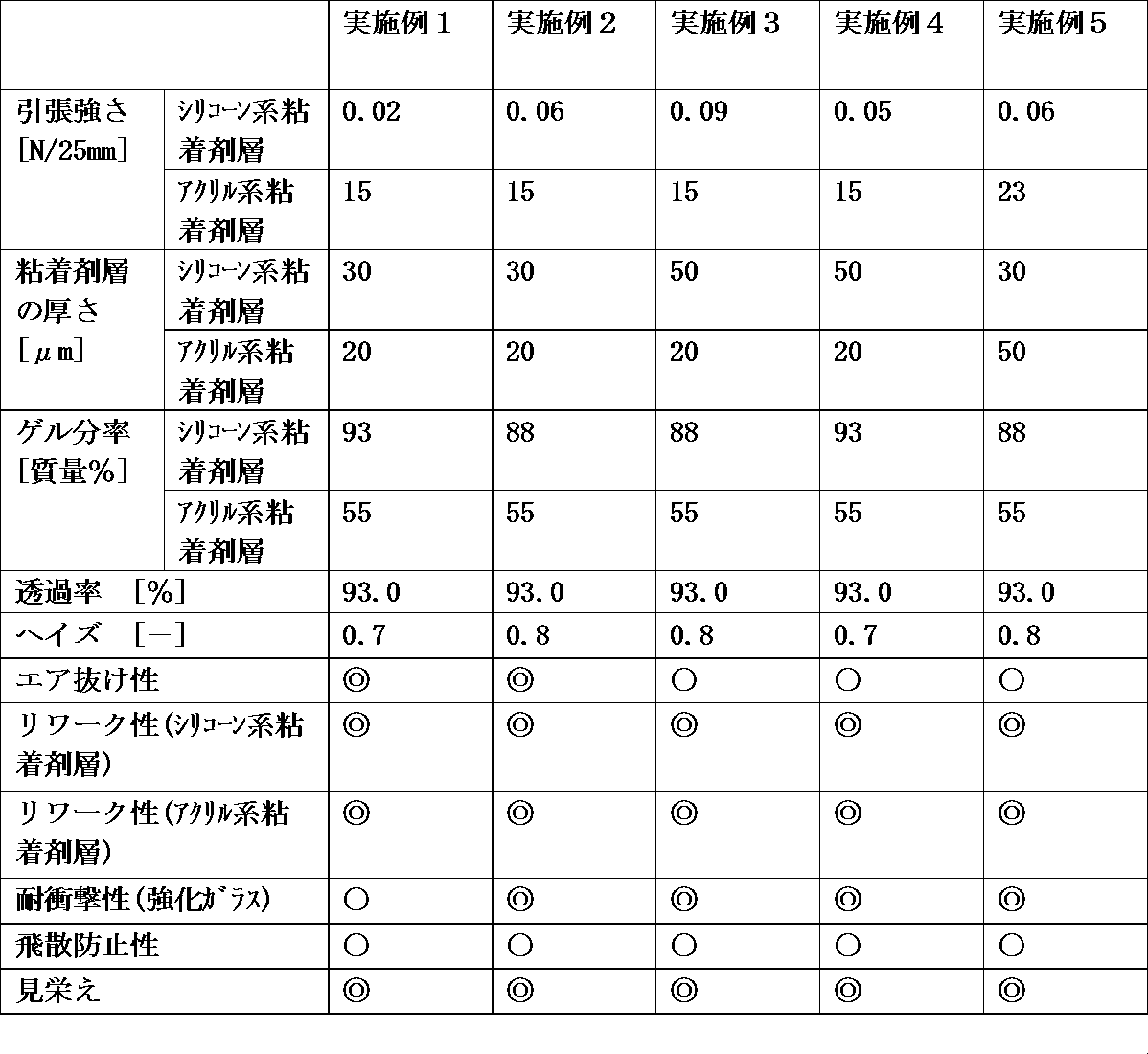
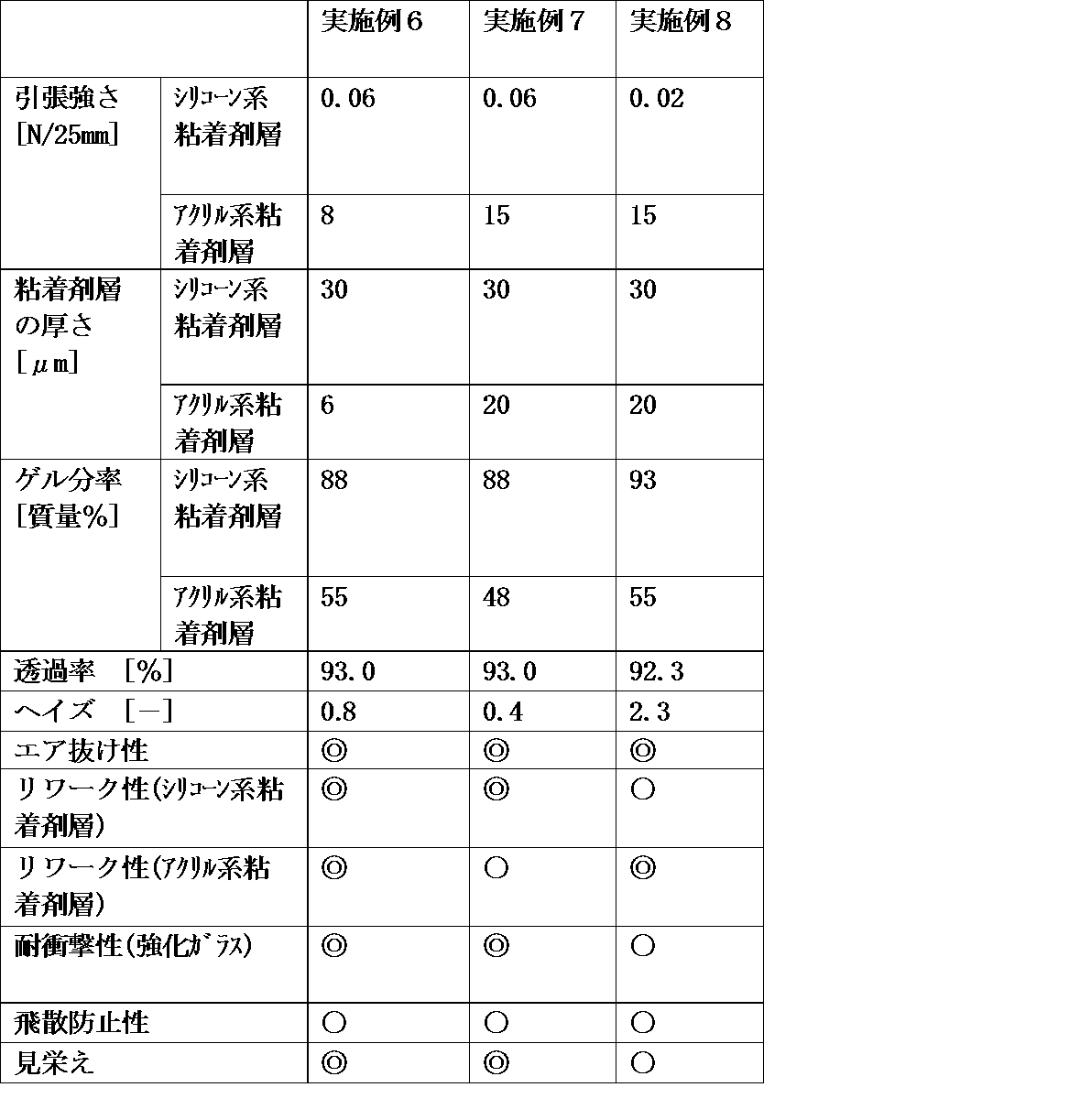

1 強化ガラス
2 アクリル系粘着剤層
3 基材
4 シリコーン系粘着剤層
2 アクリル系粘着剤層
3 基材
4 シリコーン系粘着剤層
Claims (9)
- 基材の一方の面側に直接または他の層を介してシリコーン系粘着剤層を有し、前記基材の他方の面側に直接または他の層を介してアクリル系粘着剤層を有する両面粘着テープであって、前記シリコーン系粘着剤層に厚さ25μmのポリエチレンテレフタレートフィルムを貼付し、前記ポリエチレンテレフタレートフィルムを前記シリコーン系粘着剤層の表面に対して180°方向へ引っ張ることで測定される引張強さが0.01N/25mm~0.1N/25mmの範囲であり、かつ、前記アクリル系粘着剤層に厚さ25μmのポリエチレンテレフタレートフィルムを貼付し、前記ポリエチレンテレフタレートフィルムを前記アクリル系粘着剤層の表面に対して180°方向へ引っ張ることで測定される引張強さが5N/25mm~28N/25mmの範囲であることを特徴とする両面粘着テープ。
- 情報表示装置の情報表示部と、ガラスまたは樹脂からなる部材との接着に使用する両面粘着テープであって、前記両面粘着テープを構成する前記シリコーン系粘着剤層が、前記情報表示部の表面に貼付されるものであり、かつ、前記アクリル系粘着剤層が、前記ガラスまたは樹脂からなる部材の表面に貼付されるものである請求項1に記載の両面粘着テープ。
- 前記シリコーン系粘着剤層の厚さが15μm~50μmの範囲であり、かつ、前記アクリル系粘着剤層の厚さが10μm~50μmの範囲である請求項1または2に記載の両面粘着テープ。
- 前記シリコーン系粘着剤層が、付加硬化型ポリオルガノシリコーンを含有する層であり、そのゲル分率が85質量%~99質量%である請求項1~3のいずれか1項に記載の両面粘着テープ。
- 前記アクリル系粘着剤層のゲル分率が10質量%~70質量%である請求項1~4のいずれか1項に記載の両面粘着テープ。
- 前記基材が易接着処理層を有するポリエチレンテレフタレートフィルムである請求項1~5のいずれか1項に記載の両面粘着テープ。
- 前記ガラスが強化ガラスである請求項2~6のいずれか1項に記載の両面粘着テープ。
- 請求項1~7のいずれか1項に記載の両面粘着テープが有する前記アクリル系粘着剤層の表面に、予めガラスまたは樹脂からなる部材が貼付された構成を有する保護部材。
- 請求項8に記載の保護部材が、前記情報表示装置の情報表示部の表面に貼付された構成を有する電子機器。
Priority Applications (1)
| Application Number | Priority Date | Filing Date | Title |
|---|---|---|---|
| JP2016505352A JP6011901B2 (ja) | 2014-07-14 | 2015-07-02 | 両面粘着テープ、保護部材及び電子機器 |
Applications Claiming Priority (2)
| Application Number | Priority Date | Filing Date | Title |
|---|---|---|---|
| JP2014144084 | 2014-07-14 | ||
| JP2014-144084 | 2014-07-14 |
Publications (1)
| Publication Number | Publication Date |
|---|---|
| WO2016009845A1 true WO2016009845A1 (ja) | 2016-01-21 |
Family
ID=55078343
Family Applications (1)
| Application Number | Title | Priority Date | Filing Date |
|---|---|---|---|
| PCT/JP2015/069112 Ceased WO2016009845A1 (ja) | 2014-07-14 | 2015-07-02 | 両面粘着テープ、保護部材及び電子機器 |
Country Status (2)
| Country | Link |
|---|---|
| JP (1) | JP6011901B2 (ja) |
| WO (1) | WO2016009845A1 (ja) |
Cited By (3)
| Publication number | Priority date | Publication date | Assignee | Title |
|---|---|---|---|---|
| JP2017179242A (ja) * | 2016-03-31 | 2017-10-05 | リンテック株式会社 | 表示画面用粘着シート、積層体、表示体及び画面保護方法 |
| JP2019065085A (ja) * | 2017-09-28 | 2019-04-25 | 王子ホールディングス株式会社 | 粘着シートおよび表面保護フィルム |
| CN112549732A (zh) * | 2019-09-25 | 2021-03-26 | 苏州德佑新材料科技股份有限公司 | 可回收面材连接机构 |
Citations (5)
| Publication number | Priority date | Publication date | Assignee | Title |
|---|---|---|---|---|
| JP2002356663A (ja) * | 2001-05-30 | 2002-12-13 | Nitto Denko Corp | 強接着性粘着剤組成物及び強接着用粘着シート |
| JP2009175266A (ja) * | 2008-01-22 | 2009-08-06 | Toyobo Co Ltd | 画像表示装置の製造方法、及び該製造方法を用いて製造される画像表示装置 |
| JP2010015506A (ja) * | 2008-07-07 | 2010-01-21 | Toyobo Co Ltd | タッチパネル用上部電極 |
| JP2012144701A (ja) * | 2010-12-25 | 2012-08-02 | Nitto Denko Corp | 粘着テープ、粘着テープで被覆された平角電線、およびそれを用いた電気機器 |
| JP2013119564A (ja) * | 2011-12-06 | 2013-06-17 | Nitto Denko Corp | 両面粘着シート |
Family Cites Families (2)
| Publication number | Priority date | Publication date | Assignee | Title |
|---|---|---|---|---|
| JP4809988B2 (ja) * | 2001-03-21 | 2011-11-09 | 日東電工株式会社 | シリコーン系感圧接着剤組成物およびそれを用いた感圧接着テープ |
| JP2012224802A (ja) * | 2011-04-22 | 2012-11-15 | Nitto Denko Corp | 表面保護フィルム |
-
2015
- 2015-07-02 WO PCT/JP2015/069112 patent/WO2016009845A1/ja not_active Ceased
- 2015-07-02 JP JP2016505352A patent/JP6011901B2/ja active Active
Patent Citations (5)
| Publication number | Priority date | Publication date | Assignee | Title |
|---|---|---|---|---|
| JP2002356663A (ja) * | 2001-05-30 | 2002-12-13 | Nitto Denko Corp | 強接着性粘着剤組成物及び強接着用粘着シート |
| JP2009175266A (ja) * | 2008-01-22 | 2009-08-06 | Toyobo Co Ltd | 画像表示装置の製造方法、及び該製造方法を用いて製造される画像表示装置 |
| JP2010015506A (ja) * | 2008-07-07 | 2010-01-21 | Toyobo Co Ltd | タッチパネル用上部電極 |
| JP2012144701A (ja) * | 2010-12-25 | 2012-08-02 | Nitto Denko Corp | 粘着テープ、粘着テープで被覆された平角電線、およびそれを用いた電気機器 |
| JP2013119564A (ja) * | 2011-12-06 | 2013-06-17 | Nitto Denko Corp | 両面粘着シート |
Cited By (4)
| Publication number | Priority date | Publication date | Assignee | Title |
|---|---|---|---|---|
| JP2017179242A (ja) * | 2016-03-31 | 2017-10-05 | リンテック株式会社 | 表示画面用粘着シート、積層体、表示体及び画面保護方法 |
| JP2019065085A (ja) * | 2017-09-28 | 2019-04-25 | 王子ホールディングス株式会社 | 粘着シートおよび表面保護フィルム |
| JP7127262B2 (ja) | 2017-09-28 | 2022-08-30 | 王子ホールディングス株式会社 | 粘着シートおよび表面保護フィルム |
| CN112549732A (zh) * | 2019-09-25 | 2021-03-26 | 苏州德佑新材料科技股份有限公司 | 可回收面材连接机构 |
Also Published As
| Publication number | Publication date |
|---|---|
| JPWO2016009845A1 (ja) | 2017-04-27 |
| JP6011901B2 (ja) | 2016-10-25 |
Similar Documents
| Publication | Publication Date | Title |
|---|---|---|
| CN101531873B (zh) | 光学薄膜用粘合剂组合物、粘合型光学薄膜及图像显示装置 | |
| JP6645045B2 (ja) | 粘着テープ、保護部材及び電子機器 | |
| CN101684394B (zh) | 用于光学部件粘合的压敏粘合片 | |
| JP6307189B2 (ja) | 粘着性組成物、粘着剤および粘着シート | |
| JP3997271B2 (ja) | 光学フィルム用粘着剤組成物および粘着シート、ならびにこれを用いた光学部材 | |
| JP6071224B2 (ja) | 粘着シート | |
| CN102816537B (zh) | 薄层基材用载体材料 | |
| TWI545172B (zh) | 光擴散黏著劑層及光擴散黏著膜 | |
| TWI666289B (zh) | Adhesive sheet and laminate | |
| WO2007058277A1 (ja) | 光学フィルム用粘着剤組成物および粘着シート、ならびにこれを用いた光学部材 | |
| CN104254583A (zh) | 图像显示装置用粘接片、图像显示装置的制造方法及图像显示装置 | |
| CN105992804A (zh) | 粘合剂树脂组合物 | |
| TWI755427B (zh) | 黏著片 | |
| JP5945000B2 (ja) | 再剥離性を備えた両面粘着シート及びその再剥離方法 | |
| JP7282687B2 (ja) | 光学透明粘着シート、これを製造するための組成物およびこれを用いた平板表示装置 | |
| TW201402756A (zh) | 用以形成光學用黏著片之熱或光硬化性樹脂組成物及光學用黏著片 | |
| CN104220550A (zh) | 光学膜用粘合剂组合物、光学膜用粘合剂层、带有粘合剂层的光学膜及图像显示装置 | |
| JP6011901B2 (ja) | 両面粘着テープ、保護部材及び電子機器 | |
| TWI758332B (zh) | 黏著片 | |
| CN115516054A (zh) | 粘着性组合物、粘着剂、粘着片及层叠体 | |
| JP2022131869A (ja) | 積層体の製造方法 | |
| JP7278967B2 (ja) | 光学透明粘着シート | |
| JP2010100857A (ja) | ガラス基板貼り付け用光学機能粘着フィルム | |
| JP2016210930A (ja) | 粘着シート、表面保護部材及び電子機器 | |
| JP6111789B2 (ja) | 両面粘着テープ |
Legal Events
| Date | Code | Title | Description |
|---|---|---|---|
| ENP | Entry into the national phase |
Ref document number: 2016505352 Country of ref document: JP Kind code of ref document: A |
|
| 121 | Ep: the epo has been informed by wipo that ep was designated in this application |
Ref document number: 15821348 Country of ref document: EP Kind code of ref document: A1 |
|
| NENP | Non-entry into the national phase |
Ref country code: DE |
|
| 122 | Ep: pct application non-entry in european phase |
Ref document number: 15821348 Country of ref document: EP Kind code of ref document: A1 |