WO2016002873A1 - ポリカーボネート、ポリウレタン、エラストマー、ポリカーボネートの製造方法およびポリウレタンの製造方法 - Google Patents
ポリカーボネート、ポリウレタン、エラストマー、ポリカーボネートの製造方法およびポリウレタンの製造方法 Download PDFInfo
- Publication number
- WO2016002873A1 WO2016002873A1 PCT/JP2015/069103 JP2015069103W WO2016002873A1 WO 2016002873 A1 WO2016002873 A1 WO 2016002873A1 JP 2015069103 W JP2015069103 W JP 2015069103W WO 2016002873 A1 WO2016002873 A1 WO 2016002873A1
- Authority
- WO
- WIPO (PCT)
- Prior art keywords
- polycarbonate
- formula
- polyurethane
- mol
- group
- Prior art date
- Legal status (The legal status is an assumption and is not a legal conclusion. Google has not performed a legal analysis and makes no representation as to the accuracy of the status listed.)
- Ceased
Links
Classifications
-
- C—CHEMISTRY; METALLURGY
- C08—ORGANIC MACROMOLECULAR COMPOUNDS; THEIR PREPARATION OR CHEMICAL WORKING-UP; COMPOSITIONS BASED THEREON
- C08G—MACROMOLECULAR COMPOUNDS OBTAINED OTHERWISE THAN BY REACTIONS ONLY INVOLVING UNSATURATED CARBON-TO-CARBON BONDS
- C08G64/00—Macromolecular compounds obtained by reactions forming a carbonic ester link in the main chain of the macromolecule
- C08G64/02—Aliphatic polycarbonates
- C08G64/0208—Aliphatic polycarbonates saturated
-
- C—CHEMISTRY; METALLURGY
- C08—ORGANIC MACROMOLECULAR COMPOUNDS; THEIR PREPARATION OR CHEMICAL WORKING-UP; COMPOSITIONS BASED THEREON
- C08G—MACROMOLECULAR COMPOUNDS OBTAINED OTHERWISE THAN BY REACTIONS ONLY INVOLVING UNSATURATED CARBON-TO-CARBON BONDS
- C08G64/00—Macromolecular compounds obtained by reactions forming a carbonic ester link in the main chain of the macromolecule
- C08G64/02—Aliphatic polycarbonates
-
- C—CHEMISTRY; METALLURGY
- C08—ORGANIC MACROMOLECULAR COMPOUNDS; THEIR PREPARATION OR CHEMICAL WORKING-UP; COMPOSITIONS BASED THEREON
- C08G—MACROMOLECULAR COMPOUNDS OBTAINED OTHERWISE THAN BY REACTIONS ONLY INVOLVING UNSATURATED CARBON-TO-CARBON BONDS
- C08G18/00—Polymeric products of isocyanates or isothiocyanates
- C08G18/06—Polymeric products of isocyanates or isothiocyanates with compounds having active hydrogen
- C08G18/08—Processes
- C08G18/10—Prepolymer processes involving reaction of isocyanates or isothiocyanates with compounds having active hydrogen in a first reaction step
-
- C—CHEMISTRY; METALLURGY
- C08—ORGANIC MACROMOLECULAR COMPOUNDS; THEIR PREPARATION OR CHEMICAL WORKING-UP; COMPOSITIONS BASED THEREON
- C08G—MACROMOLECULAR COMPOUNDS OBTAINED OTHERWISE THAN BY REACTIONS ONLY INVOLVING UNSATURATED CARBON-TO-CARBON BONDS
- C08G18/00—Polymeric products of isocyanates or isothiocyanates
- C08G18/06—Polymeric products of isocyanates or isothiocyanates with compounds having active hydrogen
- C08G18/28—Polymeric products of isocyanates or isothiocyanates with compounds having active hydrogen characterised by the compounds used containing active hydrogen
- C08G18/40—High-molecular-weight compounds
- C08G18/42—Polycondensates having carboxylic or carbonic ester groups in the main chain
- C08G18/44—Polycarbonates
-
- C—CHEMISTRY; METALLURGY
- C08—ORGANIC MACROMOLECULAR COMPOUNDS; THEIR PREPARATION OR CHEMICAL WORKING-UP; COMPOSITIONS BASED THEREON
- C08G—MACROMOLECULAR COMPOUNDS OBTAINED OTHERWISE THAN BY REACTIONS ONLY INVOLVING UNSATURATED CARBON-TO-CARBON BONDS
- C08G18/00—Polymeric products of isocyanates or isothiocyanates
- C08G18/06—Polymeric products of isocyanates or isothiocyanates with compounds having active hydrogen
- C08G18/70—Polymeric products of isocyanates or isothiocyanates with compounds having active hydrogen characterised by the isocyanates or isothiocyanates used
- C08G18/72—Polyisocyanates or polyisothiocyanates
- C08G18/74—Polyisocyanates or polyisothiocyanates cyclic
- C08G18/76—Polyisocyanates or polyisothiocyanates cyclic aromatic
- C08G18/7657—Polyisocyanates or polyisothiocyanates cyclic aromatic containing two or more aromatic rings
- C08G18/7664—Polyisocyanates or polyisothiocyanates cyclic aromatic containing two or more aromatic rings containing alkylene polyphenyl groups
- C08G18/7671—Polyisocyanates or polyisothiocyanates cyclic aromatic containing two or more aromatic rings containing alkylene polyphenyl groups containing only one alkylene bisphenyl group
-
- C—CHEMISTRY; METALLURGY
- C08—ORGANIC MACROMOLECULAR COMPOUNDS; THEIR PREPARATION OR CHEMICAL WORKING-UP; COMPOSITIONS BASED THEREON
- C08G—MACROMOLECULAR COMPOUNDS OBTAINED OTHERWISE THAN BY REACTIONS ONLY INVOLVING UNSATURATED CARBON-TO-CARBON BONDS
- C08G64/00—Macromolecular compounds obtained by reactions forming a carbonic ester link in the main chain of the macromolecule
- C08G64/18—Block or graft polymers
-
- C—CHEMISTRY; METALLURGY
- C08—ORGANIC MACROMOLECULAR COMPOUNDS; THEIR PREPARATION OR CHEMICAL WORKING-UP; COMPOSITIONS BASED THEREON
- C08G—MACROMOLECULAR COMPOUNDS OBTAINED OTHERWISE THAN BY REACTIONS ONLY INVOLVING UNSATURATED CARBON-TO-CARBON BONDS
- C08G64/00—Macromolecular compounds obtained by reactions forming a carbonic ester link in the main chain of the macromolecule
- C08G64/20—General preparatory processes
- C08G64/30—General preparatory processes using carbonates
-
- C—CHEMISTRY; METALLURGY
- C08—ORGANIC MACROMOLECULAR COMPOUNDS; THEIR PREPARATION OR CHEMICAL WORKING-UP; COMPOSITIONS BASED THEREON
- C08G—MACROMOLECULAR COMPOUNDS OBTAINED OTHERWISE THAN BY REACTIONS ONLY INVOLVING UNSATURATED CARBON-TO-CARBON BONDS
- C08G64/00—Macromolecular compounds obtained by reactions forming a carbonic ester link in the main chain of the macromolecule
- C08G64/42—Chemical after-treatment
Definitions
- the present invention relates to a novel polycarbonate, and more particularly, a polyurethane having excellent weather resistance, heat resistance (particularly heat aging resistance), hydrolysis resistance, low temperature characteristics, cold resistance, flexibility and mechanical properties.
- raw materials and constituent materials such as paints, adhesives, pressure-sensitive adhesives, inks, coating materials, sealing materials, etc. .
- polyesters and polyethers whose molecular ends are hydroxyl groups are mainly used for soft segments used in polyurethanes such as thermoplastic elastomers.
- polyesters typified by adipate are poor in hydrolysis resistance.
- polyurethanes using them are cracked on the surface in a relatively short time or wrinkled on the surface. Is limited.
- polyurethanes using polyethers have good hydrolysis resistance but have the disadvantage of poor weather resistance and heat resistance (particularly heat aging resistance).
- demands for heat resistance (particularly, heat aging resistance), weather resistance, hydrolysis resistance, weather resistance, oil resistance, etc. have been advanced. Had similar problems.
- Non-patent Document 1 a polycarbonate having a hydroxyl group at the molecular end is used as a soft segment.
- Patent Document 1 discloses a polycarbonate diol represented by the following formula (1), which has a primary terminal OH ratio of 95 to 98.5%.
- Patent Document 2 contains a polycarbonate diol having a number average molecular weight of 250 or more and 5000 or less, and a ratio of hydroxyl groups to all terminal groups of 95 mol% or more, a phosphorus compound, and a hindered phenol compound.
- a polycarbonate diol-containing composition is disclosed.
- JP 2013-209492 A Japanese Patent Laid-Open No. 2014-62202
- Non-Patent Document 1 a polyurethane using a polycarbonate made from 1,6-hexanediol, which is generally used as a polycarbonate, may have weather resistance, heat resistance, In some cases, the heat aging resistance is not always sufficient.
- Patent Document 1 describes that a polycarbonate diol having a specific structure is used as a raw material for polyurethane, but does not describe the polycarbonate disclosed in the present application. Furthermore, Patent Document 1 does not discuss the weather resistance and heat resistance (particularly, heat aging resistance) of polyurethane.
- Patent Document 2 also describes a polycarbonate diol-containing composition having a specific structure, and further describes using such a polycarbonate diol-containing composition as a raw material for polyurethane.
- Example 3 is close to the present invention, but in Example 3, neopentyl glycol is used as one of the diol components of the raw material.
- neopentyl glycol is used as a diol component, as described in paragraph 0095 of Patent Document 2, a carbonate body having a stable cyclic structure is generated and distilled off during polycondensation.
- an object of the present invention is to provide a polycarbonate which is a raw material for polyurethane having excellent weather resistance, heat resistance, and particularly heat aging resistance. Furthermore, it is to provide a polyurethane and an elastomer using the polycarbonate, and in addition to provide a method for producing a polycarbonate and a method for producing a polyurethane.
- the present inventors can obtain a polyurethane having excellent weather resistance, heat resistance, particularly heat aging resistance, by using a polycarbonate having a specific structural unit. And the present invention has been achieved. Specifically, the above problem has been solved by the following means ⁇ 1>, preferably ⁇ 2> to ⁇ 24>.
- ⁇ 1> A polycarbonate having one or more repeating units represented by the following formula [I] and having a hydroxyl group at 90% or more of the terminals.
- R 1 , R 2 , R 3 and R 4 each independently represents an aliphatic hydrocarbon group having 1 to 6 carbon atoms.
- ⁇ 2> The polycarbonate according to ⁇ 1>, wherein the combination of R 1 and R 2 of the repeating unit represented by the formula [I] is different from the combination of R 3 and R 4 .
- ⁇ 3> The polycarbonate according to ⁇ 1> or ⁇ 2>, which contains at least 20 mol% of all the repeating units represented by the formula [I].
- ⁇ 4> The polycarbonate according to any one of ⁇ 1> to ⁇ 3>, which has a number average molecular weight of 400 to 10,000.
- ⁇ 5> The polycarbonate according to ⁇ 4>, wherein the glass transition temperature measured with a differential scanning calorimeter is ⁇ 30 ° C. or lower.
- ⁇ 6> The polycarbonate according to any one of ⁇ 1> to ⁇ 5>, which contains at least 50 mol% of all the repeating units represented by the formula [I].
- ⁇ 7> The polycarbonate according to any one of ⁇ 1> to ⁇ 6>, comprising one or more repeating units represented by the formula [I] and a repeating unit represented by the following formula [II].
- ⁇ 8> One or more types of repeating units represented by the formula [I] are contained in an amount of 20 mol% or more in all repeating units, and the repeating units represented by the formula [II] are contained in an amount of 20 mol% to 80 mol% in all repeating units.
- 7> Polycarbonate described in the above.
- ⁇ 9> The polycarbonate according to ⁇ 7> or ⁇ 8>, wherein the melting exothermic peak temperature measured by a differential scanning calorimeter is 15 ° C. or lower or no melting exothermic peak is observed.
- ⁇ 10> The polycarbonate according to any one of ⁇ 1> to ⁇ 9>, wherein in formula [I], R 1 and R 2 are methyl groups.
- ⁇ 14> The polycarbonate according to ⁇ 13>, wherein the melting exothermic peak temperature measured by a differential scanning calorimeter is 15 ° C. or lower or no melting exothermic peak is observed.
- ⁇ 15> A polyurethane obtained using the polycarbonate according to any one of ⁇ 1> to ⁇ 14> as a raw material.
- ⁇ 16> An elastomer containing the polyurethane described in ⁇ 15>.
- ⁇ 17> A method for producing a polycarbonate, comprising reacting a diol containing at least one diol represented by the following formula [III] with a carbonic acid diester.
- R 1 , R 2 , R 3 and R 4 each independently represents an aliphatic hydrocarbon group having 1 to 6 carbon atoms.
- One or more diols represented by the formula [III] are contained in an amount of 20 mol% or more of the total diols, and a diol containing 1,6-hexanediol in an amount of 20 mol% to 80 mol% in the total diols is reacted with a carbonic acid diester.
- a method for producing a polyurethane, comprising reacting the polycarbonate according to any one of ⁇ 1> to ⁇ 14> with a polyisocyanate.
- ⁇ 20> The method for producing a polyurethane according to ⁇ 19>, wherein the polycarbonate and polyisocyanate are reacted to form a prepolymer, and the prepolymer and a chain extender are reacted.
- ⁇ 22> The polyurethane according to ⁇ 21>, comprising a repeating unit represented by the following formula [X].
- R 5 is a divalent hydrocarbon group, and R 6 includes a repeating unit represented by the formula [I].
- R 7 is a divalent hydrocarbon group
- R 8 includes a repeating unit represented by the formula [I] and a repeating unit represented by the formula [II].
- R 9 is a divalent hydrocarbon group
- R 10 has the same meaning as R 6 in formula [X] or R 8 in formula [XX].
- Polyurethanes excellent in weather resistance and heat resistance can be obtained by the polycarbonate of the present invention, and the industrial significance of the present invention is great.
- the present invention is described in detail below.
- “to” is used to mean that the numerical values described before and after it are included as a lower limit value and an upper limit value.
- “Me” means a methyl group.
- the polycarbonate of the present invention is characterized by containing one or more repeating units represented by the above formula [I], and has excellent weather resistance and heat resistance (particularly heat aging resistance) (thermoplastic polyurethane). Can be obtained.
- the weather resistance is improved by its stability, and further, the quaternary Since the hydrolysis resistance is improved by the hydrophobic property of carbon, it is considered that the weather resistance and heat resistance (particularly, heat aging resistance) when polyurethane was made could be improved.
- R 1 , R 2 , R 3 and R 4 in the above formula [I] are each independently an aliphatic hydrocarbon group having 1 to 6 carbon atoms, such as a methyl group, an ethyl group, an n-propyl group, 1- Methylethyl group (isopropyl group), n-butyl group, 1-methylpropyl group, 2-methylpropyl group, 1,1-dimethylethyl group (tert-butyl group), n-pentyl group, 1-methylbutyl group, 2 -Methylbutyl group, 3-methylbutyl group, 1-ethylpropyl group, 1,1-dimethylpropyl group, 1,2-dimethylpropyl group, 2,2-dimethylpropyl group (neopentyl group), n-hexyl group, 1- Methylpentyl group, 2-methylpentyl group, 3-methylpentyl group, 4-methylpentyl group, 1,1
- methyl group, ethyl group, n-propyl group, 1-methylethyl group (isopropyl group), n-butyl group, 1-methylpropyl group, 2-methylpropyl group, n-pentyl group, 1-methylbutyl group, 2 -Methylbutyl group, 3-methylbutyl group, 1-ethylpropyl group and n-hexyl group are preferable, and methyl group, ethyl group, n-propyl group, n-butyl group, n-pentyl group and n-hexyl group are more preferable. .
- R 1 and R 2 are methyl groups
- R 3 and R 4 are methyl groups, ethyl groups, n-propyl groups, n-butyl groups, n-pentyl groups, or n-hexyl groups.
- a repeating unit which is a group selected from is preferred.
- R 1 and R 2 are methyl groups
- R 3 and R 4 are each independently a methyl group, an ethyl group, an n-propyl group, an n-butyl group, an n-pentyl group
- a repeating unit which is a group selected from n-hexyl groups is preferable.
- a repeating unit in which R 3 is a methyl group or an ethyl group, and R 4 is a group selected from a methyl group, an ethyl group, an n-propyl group, and an n-butyl group is more preferable.
- R 1 to R 4 are all methyl groups.
- R 1 and R 2 are methyl groups, R 3 is an ethyl group, and R 4 is an n-butyl group.
- R 1 and R 2 are methyl groups, and R 3 and R 4 are ethyl groups.
- R 1 to R 3 are all methyl groups, and R 4 is an n-propyl group.
- R 1 and R 2 in formula [I] are methyl groups and R 3 and R 4 are methyl groups, and R 1 and R 2 in formula [I] are methyl groups.
- R 3 and R 4 are methyl groups
- R 1 and R 2 in formula [I] are methyl groups.
- at least one of R 3 and R 4 is a group other than a methyl group.
- a different combination is preferred because the melting point of the polycarbonate can be lowered.
- a combination of liquids at room temperature for example, 25 ° C.
- a polyurethane using such a polycarbonate is preferable because weather resistance and heat aging resistance tend to be further improved.
- the end of the polycarbonate of the present invention needs to have a hydroxyl group at 90% or more.
- a hydroxyl group at 90% or more When used as a raw material for polyurethane, it is necessary to have a hydroxyl group at the terminal which reacts with isocyanate to become urethane.
- the polycarbonate of the present invention comprises a polyurethane having excellent weather resistance and heat resistance (particularly heat aging resistance) by containing at least 20 mol% of all the repeating units represented by the above formula [I]. It is preferable to obtain, and it is more preferable that one or more kinds of repeating units represented by the formula [I] are contained in an amount of 50 mol% or more in all repeating units.
- the range of the average molecular weight of the polycarbonate of the present invention is not limited, but the number average molecular weight is usually in the range of 400 to 100,000. Among these, 400 to 20000 is preferable, 400 to 10,000 is more preferable, and 400 to 8000 is more preferable. More preferably, it is 400 to 5000.
- the number average molecular weight in the present invention is a value measured by a method performed using a nuclear magnetic resonance apparatus described in Examples described later unless otherwise specified.
- the device used in the embodiment is not available due to reasons such as out of print, other devices having equivalent performance can be used.
- the polycarbonate of the present invention preferably has a glass transition temperature measured by a differential scanning calorimeter of ⁇ 20 ° C. or lower, and a temperature of ⁇ 30 ° C. or lower in order to obtain a polyurethane having excellent flexibility and mechanical properties. Is more preferable.
- the lower limit of the glass transition temperature of the polycarbonate of the present invention is not particularly defined, but can be, for example, ⁇ 60 ° C. or higher.
- the polycarbonate of the present invention preferably has a melting exothermic peak temperature (melting point) measured by a differential scanning calorimeter of 80 ° C. or lower, or no melting exothermic peak is observed, and further the melting exothermic peak temperature is 0 ° C. or lower.
- the melting exothermic peak temperature is not particularly defined, but can be set to, for example, ⁇ 60 ° C. or higher.
- Polycarbonate using 1,6-hexanediol as a raw material is generally used as a polyurethane raw material, but the melting point of 1,6-hexanediol is about 46 ° C., which is higher than room temperature (25 ° C.). In some cases, poor handling and poor workability such as non-uniformity during reaction may cause problems. In addition, since the tendency to crystallize is large, the soft segment portion is likely to be crystal-cured when polyurethane is used, and the elasticity is likely to be impaired, and the recoverability may be deteriorated particularly in cold weather.
- the same drawback may be a problem depending on applications. Therefore, depending on the application, among the polycarbonates of the present invention, a liquid polycarbonate at normal temperature (for example, 25 ° C.) is preferable.
- a liquid polycarbonate at room temperature of the present invention include copolymer polycarbonates containing one or more repeating units represented by the formula [I] and a repeating unit represented by the following formula [II].
- a copolymer polycarbonate containing at least 20 mol% of one or more repeating units represented by the formula [I] and including a repeating unit represented by the formula [II] is preferable.
- R 1 , R 2 , R 3, and R 4 are methyl groups
- the copolymer polycarbonate such as a copolymer polycarbonate containing 20 mol% to 80 mol% of all repeating units, or in the formula [I] Examples include polycarbonates in which R 1 and R 2 are methyl groups, and at least one of R 3 and R 4 is a group other than methyl groups.
- the copolymer polycarbonate containing one or more repeating units represented by the formula [I] in an amount of 20 mol% or more of all repeating units and including the repeating units represented by the formula [II] is represented by the formula [II].
- % Copolymer copolymer when used as a polyurethane-based elastomer, it contains 60 mol% to 80 mol% of one or more repeating units represented by the formula [I], and 40 mol% to 20 mol of the repeating units represented by the formula [II]. % Copolymer copolymer is preferred because it has a good balance in performance.
- the glass transition temperature can be lowered and the liquid can be made liquid at room temperature (for example, 25 ° C.).
- room temperature for example, 25 ° C.
- polycarbonate that is liquid at room temperature is useful.
- the polycarbonate portion constitutes a soft segment. If the Tg of the polycarbonate constituting the soft segment portion is low, there is an advantage that it can be used as an elastomer at a wide range of operating temperatures. is there.
- Tg of the polycarbonate is higher than the temperature at which the elastomer is actually used, the polycarbonate portion becomes difficult to function as a soft segment, but the polycarbonate of the present invention is used as an elastomer in a wide temperature range because the Tg is low. be able to.
- Tg can be made ⁇ 38 ° C. or lower, further ⁇ 40 ° C. or lower, and in particular, ⁇ 42 It can be below °C.
- the lower limit value of Tg is not particularly defined, but can be, for example, ⁇ 65 ° C. or higher, further ⁇ 55 ° C.
- the polycarbonate containing the repeating unit represented by the formula [II] can be a polycarbonate having a melting exothermic peak temperature of 15 ° C. or less measured by a differential scanning calorimeter or a melting exothermic peak not being observed, Further, a polycarbonate having a melting exothermic peak temperature of 0 ° C. or lower or a melting exothermic peak not observed can be obtained. That is, the polycarbonate containing one or more kinds of repeating units represented by the formula [I] and the repeating units represented by the formula [II] is a quaternary carbon itself originally possessed by the repeating units represented by the formula [I]. Various performances based on stability can be exhibited, and further desired performance can be exhibited by adjusting the copolymerization ratio of the repeating unit represented by the formula [II].
- repeating unit other than the repeating unit of the above formula [I] used in the polycarbonate of the present invention, and repeating units made from all diols that can be used as a polycarbonate raw material according to the required properties. Can be used.
- raw material diols of repeating units other than the repeating unit of the formula [I] include ethylene glycol, 1,2-propylene glycol, 1,3-propanediol, 1,3-butanediol, 2-methyl-1, 3-propanediol, 1,3-pentanediol, 2,4-pentanediol, 2-methyl-1,3-butanediol, neopentyl glycol, 1,3-hexanediol, 3-methyl-1,3-butane Diol, 1,5-pentanediol, 2-methyl-1,5-pentanediol, 3-methyl-1,5-pentanediol, 1,5-hexanediol, 2-ethyl-1,5-pentanediol, 2 -Propyl-1,5-pentanediol, 2,2-diethyl-1,3-propanediol, 2-
- trifunctional or higher functional polyols include glycerin, trimethylolethane, trimethylolpropane, ditrimethylolpropane, pentaerythritol, and dipentaerythritol.
- the method for producing the polycarbonate of the present invention is not particularly limited, and conventionally known methods can be applied. Generally, it can manufacture by transesterification with a diol compound and carbonate ester.
- a diol compound represented by the following formula [III] is used as a raw material.
- a derivative such as an ester may be used.
- R 1 , R 2 , R 3 and R 4 each independently represents an aliphatic hydrocarbon group having 1 to 6 carbon atoms.
- a method for producing a polycarbonate of the present invention there is exemplified a method for producing a polycarbonate characterized by reacting a diol containing at least one diol represented by the formula [III] with a carbonic acid diester.
- a diol containing at least one diol represented by the formula [III] is contained in an amount of 80 mol% or more, and the diol is reacted with a carbonic acid diester, and the polycarbonate is produced by the method represented by the formula [III].
- An example is a method for producing a polycarbonate, in which a diol containing 20 mol% or more of a diol of at least one species and 20 mol% to 80 mol% of 1,6-hexanediol is reacted with a carbonic acid diester.
- the diol compound represented by the formula [III] has two quaternary carbons in the diol chain. As a result, it becomes more difficult to form a cyclic structure than when polycarbonate is synthesized using 1,3-propanediols such as neopentyl glycol as raw materials.
- the manufacturing method of the diol compound represented by Formula [III] is not limited, For example, it can obtain by carrying out the hydrogenation reduction of the acetal of following formula [IV].
- R 1 , R 2 , R 3 and R 4 each independently represents an aliphatic hydrocarbon group having 1 to 6 carbon atoms.
- the acetal of the formula [IV] is obtained by acetalization of 2,2-disubstituted-3-hydroxypropanal and 2,2-disubstituted-1,3-propanediol as in the following formula [V]. be able to. (However, R 1 , R 2 , R 3 and R 4 each independently represents an aliphatic hydrocarbon group having 1 to 6 carbon atoms.)
- Examples of the carbonic acid ester used when producing the polycarbonate of the present invention include alkylene carbonate, dialkyl carbonate, diaryl carbonate and the like.
- Examples of the alkylene carbonate include ethylene carbonate, trimethylene carbonate, 1,2-propylene carbonate, trimethylene carbonate, 1,2-butylene carbonate, 1,3-butylene carbonate, 1,2-pentylene carbonate, 5,5 -Dimethyl-1,3-dioxane-2-one, 5,5-diethyl-1,3-dioxane-2-one, 5-methyl-5-propyl-1,3-dioxane-2-one and 5-butyl Examples include -5-ethyl-1,3-dioxane-2-one.
- dialkyl carbonate examples include dimethyl carbonate, diethyl carbonate, and di-n-butyl carbonate.
- diaryl carbonate examples include diphenyl carbonate.
- ethylene carbonate, dimethyl carbonate, diethyl carbonate, di-n-butyl carbonate, and diphenyl carbonate are preferably used.
- the reaction temperature for producing the polycarbonate of the present invention is 120 ° C. to 280 ° C. Preferably, it is 140 ° C to 240 ° C.
- a catalyst can be used when it is desired to accelerate the reaction.
- the catalyst examples include titanium compounds such as tetraisopropoxy titanium and tetra-n-butoxy titanium, tin compounds such as di-n-butyltin dilaurate, di-n-butyltin oxide and dibutyltin diacetate, magnesium acetate, calcium acetate, Examples thereof include metal salts of acetic acid such as zinc acetate and lead acetate, metal alkoxides such as sodium methoxide, sodium ethoxide and potassium methoxide.
- titanium compounds such as tetraisopropoxy titanium and tetra-n-butoxy titanium
- tin compounds such as di-n-butyltin dilaurate, di-n-butyltin oxide and dibutyltin diacetate
- magnesium acetate calcium acetate
- metal salts of acetic acid such as zinc acetate and lead acetate
- metal alkoxides such as sodium methoxide, sodium ethoxide and
- the polycarbonate having a hydroxyl group at the terminal of the present invention is useful as a raw material for producing polyurethane. That is, when a polyurethane is produced by reacting a polymer having a terminal hydroxyl group, a polyisocyanate and, if necessary, a chain extender, by using the polycarbonate of the present invention for at least a part of the polymer having a terminal hydroxyl group, A polyurethane containing a structural unit in the form of a structure in which one hydrogen atom in each hydroxyl group located in is removed is produced. Further, it is desirable that the polycarbonate of the present invention is 20% by weight or more, more preferably 50% by weight or more of the polymer having a terminal hydroxyl group.
- polyesters such as polytetramethylene adipate, polyethylene adipate, polyneopentylene adipate, polyhexamethylene adipate, polycaprolactone diol, 1,9-nonanediol or 1,6-hexanediol are used as the polyester having a terminal hydroxyl group.
- polycarbonates such as polyalkylene carbonate as the alkylene glycol component, and known polyethers such as polyethylene glycol and polypropylene glycol can be used.
- a conventionally well-known method is applicable.
- a polycarbonate having a terminal hydroxyl group and, if necessary, a low molecular compound (chain extender) having two or more active hydrogen atoms are uniformly mixed, preheated to about 60 ° C., and then mixed in the mixture.
- Polyisocyanate in an amount such that the molar ratio of the number of active hydrogen atoms to isocyanate groups is 0.95 to 1: 1.05 is added and fed to a continuous polymerization apparatus having a twin screw while stirring with a rotary mixer for a short time.
- Polyurethane can be produced by reacting with.
- polyurethane can be produced by reacting a polycarbonate having a terminal hydroxyl group with a polyisocyanate in advance to produce a prepolymer having a terminal isocyanate group and then reacting with a chain extender.
- polymerization catalysts represented by organic metal salts such as tertiary amines, tin and titanium. These reactions are usually carried out in the absence of a solvent, but may be carried out using a solvent.
- solvents include dimethylformamide, diethylformamide, dimethylacetamide, dimethylsulfoxide, tetrahydrofuran, methyl isobutyl ketone, and dioxane. , Cyclohexanone, benzene, toluene, ethyl cellosolve, and the like.
- a compound containing only one active hydrogen that reacts with an isocyanate group for example, a monohydric alcohol such as ethyl alcohol and propyl alcohol, and a secondary amine such as diethylamine and di-n-propylamine Can be used as end terminators.
- a monohydric alcohol such as ethyl alcohol and propyl alcohol
- a secondary amine such as diethylamine and di-n-propylamine
- a stabilizer such as a heat stabilizer (for example, an antioxidant) or a light stabilizer to the polyurethane.
- a plasticizer an inorganic filler, a lubricant, a colorant, silicon oil, a foaming agent, a flame retardant, and the like may be added.
- polyisocyanates examples include aromatic diisocyanates such as 4,4 ′ ′-diphenylmethane diisocyanate, 2,4-tolylene diisocyanate, 2,6-tolylene diisocyanate, xylylene diisocyanate, 1,5-naphthalene diisocyanate, isophorone diisocyanate, Alicyclic diisocyanates such as dicyclohexylmethane diisocyanate, hydrogenated xylylene diisocyanate, norbornene diisocyanate, aliphatic diisocyanates such as hexamethylene diisocyanate, trimethylhexamethylene diisocyanate, and the like, and these polyisocyanates can be used alone, Or you may use 2 or more types together. Of these, 4,4'-diphenylmethane diisocyanate is preferred.
- Polyisocyanate means a compound having two or more isocyanate groups.
- a low molecular compound such as diol or diamine having two or more active hydrogen atoms can be used.
- the chain extender include diols having 2 to 10 carbon atoms such as ethylene glycol, propylene glycol, 1,4-butanediol and 1,6-hexanediol, and 2 to 2 carbon atoms such as bropyrenediamine and isophoronediamine. 10 diamines may be mentioned, and these may be used alone or in combination of two or more. When a chain extender having two active hydrogen atoms such as diol and diamine is used, polyurethane can be easily produced.
- the amount of chain extender used is not particularly limited, but is preferably 0.1 to 20 times (molar ratio) with respect to polycarbonate. Furthermore, if necessary, monovalent low molecular alcohols such as methanol and ethanol, monovalent low molecular amines such as methylamine and ethylamine, and the like may be used as the modifier.
- the weight average molecular weight of the polyurethane of the present invention is not particularly limited, but is preferably 10,000 to 500,000.
- the number average molecular weight is not particularly limited, but is preferably 10,000 to 100,000.
- the obtained polyurethane can be subjected to a molding process immediately after polymerization.
- aging is carried out at 60 to 80 ° C. for 4 to 30 hours as necessary to complete the reaction, and then molding is performed. Can be attached.
- a poor polyurethane solvent for example, an aliphatic saturated hydrocarbon having 6 to 10 carbon atoms such as hexane, heptane, octane, nonane or decane, or methanol, ethanol or the like is added and mixed. Then, polyurethane can be coagulated and separated, filtered and dried, and then subjected to molding.
- the polyurethane of the present invention includes a repeating unit represented by the formula [I].
- the repeating unit represented by the formula [I] has the same meaning as the repeating unit represented by the formula [I], and the preferred range is also the same.
- the polyurethane of the present invention may further contain a repeating unit represented by the formula [II] and other repeating units.
- diols or diamines having two or more active hydrogen atoms can be used as chain extenders.
- a urea bond is formed by reaction with an isocyanate group, and the molecular weight can be extended. Therefore, the polyurethane of the present invention may have a urea bond.
- each of the repeating unit represented by the formula [I], the repeating unit represented by the formula [II], and other repeating units may be contained alone, or 2 More than one species may be included.
- a polyurethane containing a repeating unit represented by the following formula [X] is exemplified.
- R 5 is a divalent hydrocarbon group, and R 6 includes a repeating unit represented by the formula [I].
- R 5 is a substituted or unsubstituted benzene ring, a substituted or unsubstituted cyclohexane ring, a substituted or unsubstituted straight-chain alkylene group having 1 to 10 carbon atoms, and a group consisting of a combination thereof. Examples of the group include an alkyl group, and a methyl group or an ethyl group is preferable.
- R 5 is preferably a group consisting of the following groups alone or a combination thereof. In the above, Me represents a methyl group, and n represents an integer of 2 to 12.
- R 5 is particularly preferably a group represented by the following.
- R 6 substantially consists only of the repeating unit represented by the formula [I]. “Substantially” means, for example, that 90% by weight or more, and more than 95% by weight of the constituent components of R 6 are the repeating unit represented by the formula [I].
- the repeating unit represented by the formula [X] is 90% by weight or more of all repeating units contained in the polyurethane.
- a polyurethane containing a repeating unit represented by the following formula [XX] is exemplified.
- R 7 is a divalent hydrocarbon group
- R 8 includes a repeating unit represented by the formula [I] and a repeating unit represented by the formula [II].
- R 7 has the same meaning as R 5 above, and the preferred range is also the same.
- R 8 substantially consists of only the repeating unit represented by the formula [I] and the repeating unit represented by the formula [II].
- Substantially, for example, 90% by weight or more, more preferably 95% by weight or more of the constituents of R 8 are the repeating unit represented by the formula [I] or the repeating unit represented by the formula [II]. It means that. In this embodiment, it is preferable that the repeating unit represented by the formula [XX] is 90% by weight or more of all repeating units contained in the polyurethane.
- the repeating unit represented by the formula [I] (repeating unit XX-1) and the repeating unit represented by the formula [II] (repeating unit)
- the ratio of XX-2) is preferably 20 to 80 mol% of the repeating unit XX-1, preferably 80 to 20 mol% of the repeating unit XX-2, and 40 to 80 mol% of the repeating unit XX-1. More preferably, the repeating unit XX-2 is 60 mol% to 20 mol%.
- polyurethane of the present invention includes at least one repeating unit represented by formula [X] and at least one repeating unit represented by formula [XX], and a repeating unit represented by formula [XXX]. And polyurethane.
- R 9 is a divalent hydrocarbon group, and R 10 has the same meaning as R 6 in formula [X] or R 8 in formula [XX].
- R 9 has the same meaning as R 5 in formula [X], and the preferred range is also the same.
- Such a structure is obtained when diamines are used as chain extenders.
- the repeating units represented by the above formulas [X] to [XXX] occupy 90% by weight or more of all repeating units contained in the polyurethane.
- the polyurethane of the present invention can be molded by various methods, and examples of the molding method include an extrusion molding method, an injection molding method, a calendar molding method, and a blow molding method.
- the polycarbonate of the present invention is excellent in weather resistance and heat resistance (particularly heat aging resistance), and has excellent weather resistance and heat resistance (particularly heat aging resistance) when used as a raw material for production of polyurethane and the like. give. Moreover, the polycarbonate obtained by this invention is applicable also to other various uses.
- the polyurethane of the present invention retains excellent properties such as flexibility, hydrolysis resistance and mechanical properties, and is particularly excellent in weather resistance and heat resistance (particularly heat aging resistance). It can be used for agents, coating agents, foams, binders, elastic fibers, synthetic leather, artificial leather, sealing materials, waterproofing materials, flooring materials and the like.
- the polycarbonate of the present invention can also be used as a polymer modifier, a polymer plasticizer and the like.
- the properties of polycarbonate and the like were measured by the following method.
- (1) Hydroxyl value The hydroxyl value of the polycarbonate was measured according to JIS K1557. Further, the average value P of the number of hydroxyl groups per molecule of the polycarbonate was calculated from the measured value of the hydroxyl value and the measured value of the number average molecular weight (Mn) of the polycarbonate described later.
- polyurethane was measured by the following method.
- the molecular weight of polyurethane is N, N′-dimethylformamide using a GPC apparatus (model: pump: Shodex DS-4, column: Shodex GPC KD-806M ⁇ 2 + KD-802 + KD-G) manufactured by Showa Denko KK was measured with a RI detector (model: Shodex RI-101).
- the number average molecular weight (Mn) and the weight average molecular weight (Mw) were determined using polyethylene oxide as a standard substance.
- the polyurethane tensile test (tensile fracture stress and tensile fracture strain) is based on JIS K 7162, using a material test system (model: model 5582) manufactured by Instron, and the specimen is 5A. Measurement was performed at 60 ° C. using a mold.
- Color tone The color tone of polyurethane is measured by a transmission method using a colorimetric color difference meter (model: ZE-2000) manufactured by Nippon Denshoku Industries Co., Ltd. according to JIS K 7105.
- the b * value (CIE 1976) showed a yellow coloring degree.
- a white precipitate was obtained by dropping 15.5 g of 28% aqueous ammonia with stirring into 505 g of an aqueous zirconium oxynitrate solution having a concentration of 25% by mass in terms of zirconium oxide (ZrO 2 ). This was filtered, washed with ion-exchanged water, and then dried at 110 ° C. for 10 hours to obtain hydrous zirconium oxide. This is stored in a magnetic crucible, and subjected to a baking treatment at 400 ° C. for 3 hours in the air using an electric furnace, and then pulverized in an agate mortar and expressed as powdered zirconium oxide (hereinafter referred to as “carrier A”). .) was obtained.
- carrier A powdered zirconium oxide
- the BET specific surface area of the carrier A (measured by the nitrogen adsorption method; the same applies hereinafter) was 102.7 m 2 / g.
- a catalyst 2.0 mass% palladium-supported zirconium oxide catalyst
- Example 1 In a reaction vessel having an internal volume of 1.6 L equipped with a stirring blade, a cold trap, a thermometer, a heating device, and a nitrogen gas introduction pipe, 321.3 g (1.50 mol) of diphenyl carbonate (manufactured by Mitsubishi Chemical Corporation) and Reference Example 1 The obtained 3,3′-oxybis (2,2-dimethylpropan-1-ol) 371.1 g (1.95 mol), magnesium acetate tetrahydrate (reagent manufactured by Wako Pure Chemical Industries, Ltd.) 6.4 mg (0 0.02 mmol), and after substituting with nitrogen, a transesterification reaction was carried out at 190 ° C. for 1 hour while gradually raising the temperature in a nitrogen atmosphere, and then pressure reduction was started.
- Phenol was extracted out of the system at 27 kPa and 190 ° C. to 205 ° C., and reacted for 4 hours. Thereafter, while further extracting phenol and diol components out of the system, the temperature was gradually raised and reduced to 220 ° C. and 1.2 kPa over 2 hours. The molecular weight was judged from the amount of the distillate, and when the target molecular weight was reached, the reaction was terminated to obtain polycarbonate (1). Table 1 shows the properties and physical properties of the obtained polycarbonate.
- Example 2 After performing the same operation as in Example 1, the reaction was further continued. The reaction was carried out at a pressure of 0.1 kPa and 220 to 265 ° C. for 13 hours. When the viscosity increased, the reaction was terminated to obtain a polycarbonate. Table 1 shows the properties and physical properties of the obtained polycarbonate.
- Example 3 In the same manner as in Example 1 except that 2-ethyl-2-((3-hydroxy-2,2-dimethylpropoxy) methyl) hexane-1-ol obtained in Reference Example 2 was used as the starting diol, polycarbonate ( 2) was obtained. Table 1 shows the properties and physical properties of the obtained polycarbonate.
- Example 4 The polycarbonate was prepared in the same manner as in Example 1 except that 2-ethyl-2-((3-hydroxy-2,2-dimethylpropoxy) methyl) butan-1-ol obtained in Reference Example 3 was used as the starting diol. Obtained. Table 1 shows the properties and physical properties of the obtained polycarbonate.
- Example 5 The polycarbonate was prepared in the same manner as in Example 1 except that 2-((3-hydroxy-2,2-dimethylpropoxy) methyl) -2-methylpentan-1-ol obtained in Reference Example 4 was used as the starting diol. Obtained. Table 1 shows the properties and physical properties of the obtained polycarbonate.
- Example 6 In the same manner as in Example 1, except that a mixture of 3,3′-oxybis (2,2-dimethylpropan-1-ol) and 1,6-hexanediol (molar ratio 74/26) was used as the raw material diol. Polycarbonate (3) was obtained. Table 1 shows the properties and physical properties of the obtained polycarbonate.
- Example 7 In the same manner as in Example 1 except that a mixture of 3,3′-oxybis (2,2-dimethylpropan-1-ol) and 1,6-hexanediol (molar ratio 53/47) was used as the raw material diol. Polycarbonate was obtained. Table 1 shows the properties and physical properties of the obtained polycarbonate.
- Example 8 Mixture of 3,3′-oxybis (2,2-dimethylpropan-1-ol) and 2-ethyl-2-((3-hydroxy-2,2-dimethylpropoxy) methyl) hexane-1-ol as raw diol A polycarbonate was obtained in the same manner as in Example 1 except that (molar ratio 78/22) was used. Table 1 shows the properties and physical properties of the obtained polycarbonate.
- Example 9 A mixture of 2-ethyl-2-((3-hydroxy-2,2-dimethylpropoxy) methyl) hexane-1-ol and 1,6-hexanediol (molar ratio 20/80) was used as a raw material diol.
- Polycarbonate was obtained in the same manner as in Example 1. Table 1 shows the properties and physical properties of the obtained polycarbonate.
- Example 1 A polycarbonate (4) was obtained in the same manner as in Example 1 except that 1,6-hexanediol was used as the raw material diol. Table 1 shows the properties and physical properties of the obtained polycarbonate.
- the number P of OH groups per polycarbonate molecule calculated from the hydroxyl value and the measured value of Mn was 1.95 or more. Since the maximum number of theoretical values for the number of terminal OH groups per molecule of polycarbonate is 2, it was found that 97.5% or more of the terminal groups are hydroxyl groups.
- Examples 3 to 5 in which the combination of R 1 and R 2 of the repeating unit represented by the formula [I] is different from the combination of R 3 and R 4 , crystallization was not confirmed.
- the polycarbonates of Examples 3 to 9 are liquid at room temperature (for example, 25 ° C.), and are more preferable examples depending on applications.
- Example 3 A polycarbonate was synthesized in the same manner as in Example 1 except that neopentyl glycol (manufactured by Mitsubishi Gas Chemical Co., Inc.) was used as the raw material diol.
- the obtained carbonate had a number average molecular weight of about 1370 as measured by the method described above (NMR), but was measured by gel permeation chromatography (GPC method, using tetrahydrofuran as a solvent and an RI detector). The molecular weight was measured using a standard polystyrene calibration) and was about 670.
- the cyclic carbonate body was confirmed in the obtained carbonate.
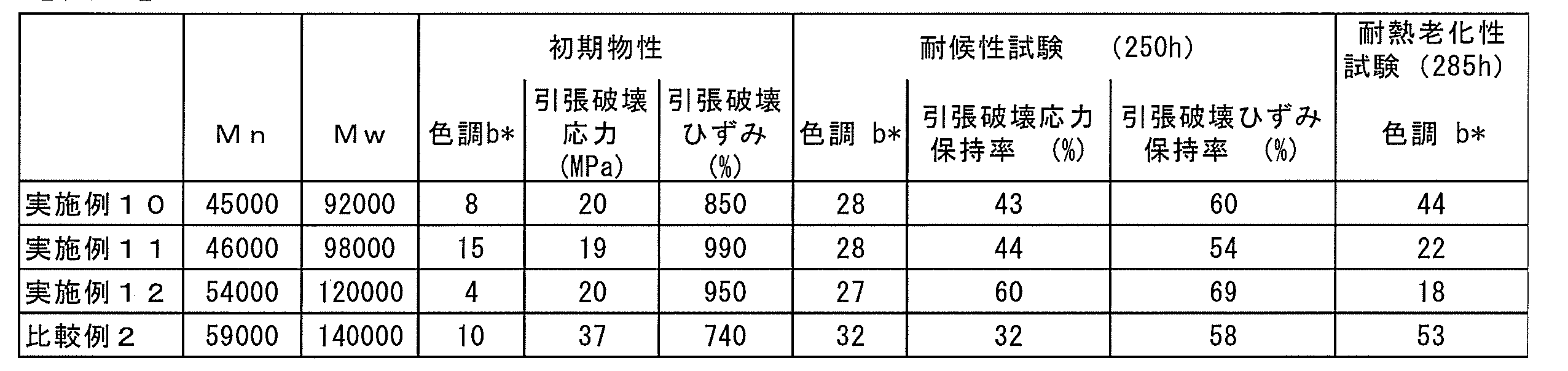
- Example 11 A polyurethane was produced in the same manner as in Example 10 except that the polycarbonate (2) obtained in Example 3 was used instead of the polycarbonate (1). The evaluation results of the obtained polyurethane are shown in Table 2.
- Example 12 A polyurethane was produced in the same manner as in Example 10, except that the polycarbonate (3) obtained in Example 6 was used instead of the polycarbonate (1). The evaluation results of the obtained polyurethane are shown in Table 2.
- the polyurethane obtained from the polycarbonate of the present invention has a high retention rate of tensile fracture stress in the weather resistance test and low coloration, and also has a small coloration in the heat aging resistance test, and has weather resistance and heat aging resistance compared to the comparative example. I found it excellent.
- the combination of R 1 and R 2 of the repeating unit represented by the formula [I] and the combination of R 3 and R 4 are different from each other. It was found that the property (particularly the color tone) and the heat aging resistance can be achieved.
- the polycarbonate of the present invention gives a product having excellent weather resistance, heat resistance and the like when used as a raw material for producing polyurethane.
- it can be used as a polymer modifier, a polymer plasticizer, and the like in addition to constituent materials such as paints, adhesives, pressure-sensitive adhesives, inks, coating materials, and sealing materials.
- the polyurethane of the present invention retains excellent properties such as flexibility, hydrolysis resistance and mechanical properties, and is excellent in weather resistance and heat resistance (particularly heat aging resistance). It can be used for adhesives, coating agents, foams, binders, elastic fibers, synthetic leather, artificial leather, sealing materials, waterproofing materials, flooring materials and the like.
Landscapes
- Chemical & Material Sciences (AREA)
- Health & Medical Sciences (AREA)
- Chemical Kinetics & Catalysis (AREA)
- Medicinal Chemistry (AREA)
- Polymers & Plastics (AREA)
- Organic Chemistry (AREA)
- General Chemical & Material Sciences (AREA)
- Polyurethanes Or Polyureas (AREA)
- Polyesters Or Polycarbonates (AREA)
Abstract
Description
このうち、アジペートに代表されるポリエステルは耐加水分解性に劣るため、例えば、これを用いたポリウレタンは比較的短期間に表面に亀裂などを生じたり、表面に黴が生えたりするなどからその使用が限定されている。一方、ポリエーテルを用いたポリウレタンは、耐加水分解性は良好であるが、耐候性、耐熱性(特に、耐熱老化性)が悪い欠点を有している。さらにポリエステル系の熱可塑性エラストマー等についても、近年、耐熱性(特に、耐熱老化性)、耐候性、耐加水分解性、耐黴性、耐油性などの要求が高度化してきており、ポリウレタンに対する物と同様の問題点を有していた。

また、特許文献1には、特定の構造を有するポリカーボネートジオールをポリウレタンの原料として用いることが記載されているが、本願で開示するポリカーボネートについては記載されていない。さらに、特許文献1には、ポリウレタンの耐候性や耐熱性(特に、耐熱老化性)について何ら検討されていない。
一方、特許文献2にも、特定の構造を有するポリカーボネートジオール含有組成物が記載されており、さらに、かかるポリカーボネートジオール含有組成物をポリウレタンの原料として用いることが記載されている。ここで、特許文献2では、実施例3が本発明に近いが、かかる実施例3では、原料のジオール成分の一つとして、ネオペンチルグリコールを用いている。しかしながら、ネオペンチルグリコールをジオール成分として用いると、特許文献2の段落0095にも記載のとおり、重縮合中に安定な環状構造のカーボネート体が生成・留去してしまう。このような環状構造のカーボネート体の生成は、原料ジオール成分のロスを引き起こし、結果として、所望の分子量および共重合組成のポリカーボネートを得ることが困難となる。また、原料ジオール成分のロスは工業生産的にも不利である。
そこで、本発明の目的は、耐候性、耐熱性、特に、耐熱老化性に優れたポリウレタンの原料となるポリカーボネートを提供することにある。さらに、前記ポリカーボネートを用いた、ポリウレタン、エラストマーを提供することにあり、加えてポリカーボネートの製造方法およびポリウレタンの製造方法を提供することにある。
具体的には、下記手段<1>により、好ましくは<2>~<24>により、上記課題は解決された。
<1>下記式[I]で表される1種以上の繰り返し単位を有し、末端の90%以上に水酸基を有することを特徴とするポリカーボネート。

<2>式[I]で表される繰り返し単位のR1及びR2の組合せとR3及びR4の組合せが異なる組合せである<1>記載のポリカーボネート。
<3>式[I]で表される1種以上の繰り返し単位を全繰り返し単位中20mol%以上含む<1>または<2>記載のポリカーボネート。
<4>数平均分子量が400~10000である、<1>乃至<3>のいずれか1つに記載のポリカーボネート。
<5>示差走査熱量計で測定されるガラス転移温度が-30℃以下である<4>記載のポリカーボネート。
<6>式[I]で表される1種以上の繰り返し単位を全繰り返し単位中50mol%以上含む<1>乃至<5>のいずれか1つに記載のポリカーボネート。
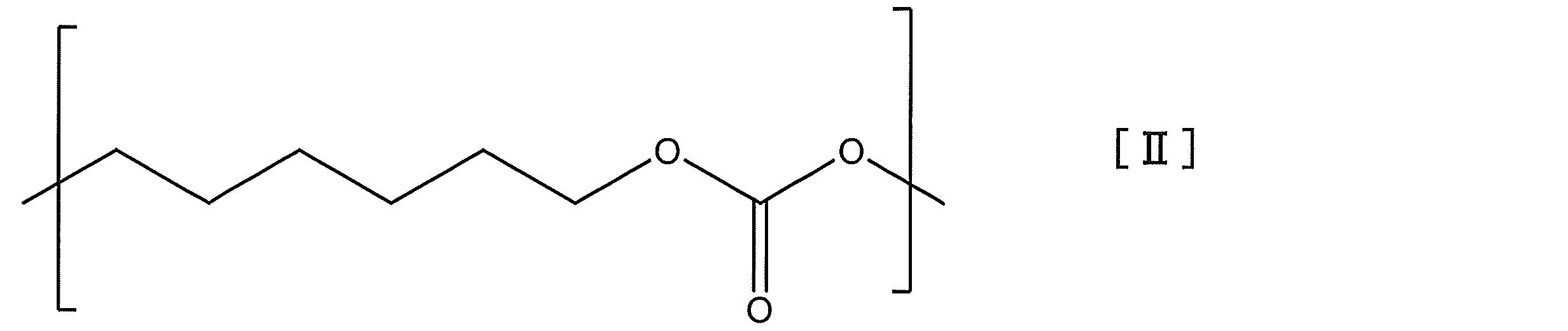
<7>式[I]で表される1種以上の繰り返し単位および下記式[II]で表される繰り返し単位を含む、<1>乃至<6>のいずれか1つに記載のポリカーボネート。

<9>示差走査熱量計で測定される融解発熱ピーク温度が15℃以下であるか或いは融解発熱ピークが観察されないことを特徴とする<7>または<8>記載のポリカーボネート。
<10>式[I]中、R1およびR2がメチル基である<1>乃至<9>のいずれか1つに記載のポリカーボネート。
<11>式[I]中、R3およびR4がメチル基である<10>記載のポリカーボネート。
<12>式[I]中、R3とR4の少なくともいずれかがメチル基以外の基である<10>記載のポリカーボネート。
<13>式[I]中、R1、R2、R3およびR4がメチル基である繰り返し単位を全繰り返し単位中20mol%乃至80mol%含み、式[I]中、R1及びR2の組合せとR3及びR4の組合せが異なる組合せである繰り返し単位を全繰り返し単位中20mol%以上含む、<3>乃至<6>のいずれか1つに記載のポリカーボネート。
<14>示差走査熱量計で測定される融解発熱ピーク温度が15℃以下であるか或いは融解発熱ピークが観察されない、<13>記載のポリカーボネート。
<15><1>乃至<14>のいずれか1つに記載のポリカーボネートを原料として得られるポリウレタン。
<16><15>記載のポリウレタンを含むエラストマー。
<17>下記式[III]で表される1種以上のジオールを含むジオールと炭酸ジエステルを反応させることを特徴とするポリカーボネートの製造方法。

<18>式[III]で表される1種以上のジオールを全ジオールの20mol%以上含み、1,6-ヘキサンジオールを全ジオール中20mol%乃至80mol%含むジオールと炭酸ジエステルとを反応させる、<17>記載のポリカーボネートの製造方法。
<19><1>乃至<14>のいずれか1つに記載のポリカーボネートとポリイソシアネートを反応させることを含む、ポリウレタンの製造方法。
<20>前記ポリカーボネートとポリイソシアネートを反応させてプレポリマーとし、前記プレポリマーと鎖延長剤とを反応させる、<19>記載のポリウレタンの製造方法。
<21>下記式[I]で表される繰り返し単位を含む、ポリウレタン。

<22>下記式[X]で表される繰り返し単位を含む、<21>記載のポリウレタン。

<23>下記式[XX]で表される繰り返し単位を含む、<21>記載のポリウレタン。





尚、本願明細書において「~」とはその前後に記載される数値を下限値及び上限値として含む意味で使用される。本願明細書において、「Me」はメチル基を意味する。
本発明のポリカーボネートは、上記式[I]で表される1種以上の繰り返し単位を含むことに特徴があり、耐候性、耐熱性(特に、耐熱老化性)に優れたポリウレタン(熱可塑性ポリウレタン)を得ることができる。
このメカニズムは推定であるが、式[I]で表される繰り返し単位は、ジオール由来の部分に、2つの4級炭素が存在するため、その安定性によって耐候性が向上し、さらに、4級炭素の疎水性によって耐加水分解性が向上することから、ポリウレタンにした際の耐候性および耐熱性(特に、耐熱老化性)を向上させることができたと考えられる。
中でもメチル基、エチル基、n-プロピル基、1-メチルエチル基(イソプロピル基)、n-ブチル基、1-メチルプロピル基、2-メチルプロピル基、n-ペンチル基、1-メチルブチル基、2-メチルブチル基、3-メチルブチル基、1-エチルプロピル基、n-ヘキシル基が好ましく、メチル基、エチル基、n-プロピル基、n-ブチル基、n-ペンチル基、n-ヘキシル基がより好ましい。
また、R1及びR2がメチル基である繰り返し単位がより好ましく、R3およびR4がメチル基、エチル基、n-プロピル基、n-ブチル基、n-ペンチル基、又はn-ヘキシル基から選ばれた基である繰り返し単位が好ましい。
本発明の式[I]の第1の実施形態は、R1~R4が、いずれもメチル基である。
本発明の式[I]の第2の実施形態は、R1およびR2がメチル基であり、R3がエチル基であり、R4がn-ブチル基である。
本発明の式[I]の第3の実施形態は、R1およびR2がメチル基であり、R3およびR4がエチル基である。
本発明の式[I]の第4の実施形態は、R1~R3がいずれもメチル基であり、R4がn-プロピル基である。
本発明では例えば、式[I]中のR1及びR2がメチル基であり、R3及びR4がメチル基である態様および、式[I]中のR1及びR2がメチル基であり、R3及びR4の少なくともいずれかがメチル基以外の基である態様が挙げられる。
異なる組み合わせとすることにより、ポリカーボネートの融点を低くでき好ましい。特に、常温(例えば、25℃)で液体とする組み合わせは、ポリカーボネートを使用する際の作業性が向上するので好ましい。さらに、かかるポリカーボネートを用いてなるポリウレタンは、耐候性や耐熱老化性がより向上する傾向にあり好ましい。
中でも、400~20000が好ましく、400~10000がより好ましく、さらに好ましくは、400~8000である。一層好ましくは、400~5000である。本発明における数平均分子量は、特に述べない限り、後述する実施例で述べる核磁気共鳴装置を用いて行った方法で測定される値とする。尚、実施例で用いている機器が廃版等の理由により入手不可の場合、他の同等の性能を有する機器を用いることができる。
本発明のポリカーボネートは示差走査熱量計で測定される融解発熱ピーク温度(融点)が80℃以下であるか或いは融解発熱ピークが観察されないことが好ましく、さらには、融解発熱ピーク温度が0℃以下であるか或いは融解発熱ピークが観察されない(結晶化が確認されない)ポリカーボネートであることがより好ましい。融解発熱ピーク温度の下限値は特に定めるものではないが、例えば、-60℃以上とすることができる。

また、本発明のポリカーボネートを用いてポリウレタンエラストマーを製造する場合、ポリカーボネート部分がソフトセグメントを構成するが、かかるソフトセグメント部分を構成するポリカーボネートのTgが低いと、幅広い使用温度でエラストマーとして使用できるメリットがある。すなわち、ポリカーボネートのTgがエラストマーを実際に使用する際の温度よりも高いと、ポリカーボネート部分はソフトセグメントとして機能しにくくなるが、本発明のポリカーボネートは、Tgが低いため、幅広い温度範囲でエラストマーとして用いることができる。
本発明のポリカーボネートは、式[II]で表される繰り返し単位含むポリカーボネートとすることにより、Tgを-38℃以下とでき、さらには、-40℃以下とすることができ、特には、-42℃以下とすることができる。Tgの下限値については、特に定めるものではないが、例えば、-65℃以上とすることができ、さらには、-55℃以上とすることができ、特には、-50℃以上とすることができる。
また、式[II]で表される繰り返し単位含むポリカーボネートは示差走査熱量計で測定される融解発熱ピーク温度が15℃以下であるか或いは融解発熱ピークが観察されないポリカーボネートとすることができ、さらには、融解発熱ピーク温度が0℃以下であるか或いは融解発熱ピークが観察されないポリカーボネートとすることができる。
すなわち、式[I]で表される1種以上の繰り返し単位と式[II]で表される繰り返し単位を含むポリカーボネートは、式[I]で表される繰り返し単位が本来有する4級炭素自体の安定性に基づく各種性能を発揮し、さらに、式[II]で表される繰り返し単位の共重合割合を調整することにより、所望の性能を発揮させることができる。
中でもエチレングリコール、1,2-プロピレングリコール、1,3-プロパンジオール、1,3-ブタンジオール、2-メチル-1,3-プロパンジオール、1,3-ペンタンジオール、2,4-ペンタンジオール、2-メチル-1,3-ブタンジオール、ネオペンチルグリコール、1,3-ヘキサンジオール、3-メチル-1,3-ブタンジオール、1,5-ペンタンジオール、2-メチル-1,5-ペンタンジオール、3-メチル-1,5-ペンタンジオール、1,5-ヘキサンジオール、2-エチル-1,5-ペンタンジオール、2-プロピル-1,5-ペンタンジオール、2,2-ジエチル-1,3-プロパンジオール、2-メチル-2-プロピル-1,3-プロパンジオール、2-ブチル-2-エチル-1,3-プロパンジオール、2-メチル-1,2-プロパンジオール、1,4-ブタンジオール、1,6-ヘキサンジオール、2,5-ヘキサンジオール、1,9-ノナンジオール、2-メチル-1,8-オクタンジオール、ジエチレングリコール、トリエチレングリコール、メタキシリレングリコール、パラキシリレングリコール、ポリエチレングリコール、ポリプロピレングリコールおよびポリブチレングリコールなどの脂肪族ジオール類が好ましく、1,3-プロパンジオール、2-メチル-1,3-プロパンジオール、ネオペンチルグリコール、3-メチル-1,3-ブタンジオール、1,5-ペンタンジオール、2,2-ジエチル-1,3-プロパンジオール、2-メチル-2-プロピル-1,3-プロパンジオール、2-ブチル-2-エチル-1,3-プロパンジオール、2-メチル-1,2-プロパンジオール、1,4-ブタンジオール、1,6-ヘキサンジオール、1,9-ノナンジオールおよび2-メチル-1,8-オクタンジオールがより好ましい。1,6-ヘキサンジオールが最も好ましい。

上述のとおり、式[III]で表されるジオール化合物は、ジオール鎖に2つの4級炭素が存在する。その結果、ネオペンチルグリコールなどの1,3-プロパンジオール類を原料としてポリカーボネートを合成する場合に比べて、環状構造を形成しにくくなる。結果として、式[III]のジオール化合物と、式[III]以外のジオール化合物、例えば、上述の特許文献2に記載のような、1,6-ヘキサンジオールを共重合する場合、原料ロスが少なく、ほぼ仕込み比通りのポリカーボネートを得ることができる。

なお、式[IV]のアセタールは、下記式[V]のように、2,2-ジ置換-3-ヒドロキシプロパナールと2,2-ジ置換-1,3-プロパンジオールのアセタール化により得ることができる。

アルキレンカーボネートとしては、例えば、エチレンカーボネート、トリメチレンカーボネート、1,2-プロピレンカーボネート、トリメチレンカーボネート、1,2-ブチレンカーボネート、1,3-ブチレンカーボネート、1,2-ペンチレンカーボネート、5,5-ジメチル-1,3-ジオキサン-2-オン、5,5-ジエチル-1,3-ジオキサン-2-オン、5-メチル-5-プロピル-1,3-ジオキサン-2-オンおよび5-ブチル-5-エチル-1,3-ジオキサン-2-オンなどが挙げられる。
また、ジアルキルカーボネートとしては、例えば、ジメチルカーボネート、ジエチルカーボネートおよびジ-n-ブチルカーボネートなどが、ジアリールカーボネートとしては、例えば、ジフェニルカーボネートなどが挙げられる。
これらの炭酸エステルのなかでも、エチレンカーボネート、ジメチルカーボネート、ジエチルカーボネート、ジ-n-ブチルカーボネート、ジフェニルカーボネートを用いるのが好ましい。
本発明のポリカーボネートを製造する際に、反応を速めたい場合に触媒を用いることができる。触媒としては、例えば、テトライソプロポキシチタン、テトラ-n-ブトキシチタンなどのチタン化合物、ジ-n-ブチルスズジラウレート、ジ-n-ブチルスズオキサイド、ジブチルスズジアセテートなどのスズ化合物、酢酸マグネシウム、酢酸カルシウム、酢酸亜鉛、酢酸鉛などの酢酸の金属塩、ナトリウムメトキシド、ナトリウムエトキシド、カリウムメトキシドなどの金属アルコキシドなどが挙げられる。
例えば、末端が水酸基のポリカーボネートと必要に応じて2個以上の活性水素原子を有する低分子化合物(鎖延長剤)等とを均一に混合して、約60℃に予熱した後、これら混合物中の活性水素原子数とイソシアネート基のモル比が0.95~1:1.05になる量のポリイソシアネートを加え、回転ミキサーで短時間かき混ぜながら二軸スクリューを有する連続重合装置に供給し、連続的に反応させることによりポリウレタンを製造することができる。また、末端が水酸基のポリカーボネートとポリイソシアネートとを予め反応させ、末端イソシアネート基のプレポリマーを製造し、その後、鎖延長剤を反応させることにより、ポリウレタンを製造することもできる。
さらに、必要により、メタノール、エタノール等の一価の低分子アルコール、メチルアミン、エチルアミン等の一価の低分子アミン等を変性剤として用いてもよい。
尚、本発明のポリウレタンにおいて、式[I]で表される繰り返し単位および式[II]で表される繰り返し単位や他の繰り返し単位は、それぞれ、1種のみ含まれていても良いし、2種以上含まれていても良い。
本発明のポリウレタンの好ましい実施形態として、下記式[X]で表される繰り返し単位を含むポリウレタンが例示される。

R5は、置換または無置換のベンゼン環、置換または無置換のシクロヘキサン環、置換または無置換の炭素数1~10の直鎖アルキレン基、ならびに、これらの組み合わせからなる基が例示される、置換基としては、アルキル基が例示され、メチル基またはエチル基が好ましい。
R5は、さらには、下記で表される基を単独もしくはこれらの組み合わせからなる基が好ましい。

R5は、特に下記で表される基であることが好ましい。

本実施形態では、上記式[X]で表される繰り返し単位がポリウレタンに含まれる全繰り返し単位の90重量%以上であることが好ましい。

R7は、上記R5と同義であり、好ましい範囲も同様である。
本実施形態では、R8は、実質的に、式[I]で表される繰り返し単位および式[II]で表される繰り返し単位のみからなることが好ましい。実質的にとは、例えば、R8の構成成分の90重量%以上が、さらには、95重量%以上が、式[I]で表される繰り返し単位または式[II]で表される繰り返し単位であることをいう。
本実施形態では、上記式[XX]で表される繰り返し単位がポリウレタンに含まれる全繰り返し単位の90重量%以上であることが好ましい。
ここで、式[XX]で表される繰り返し単位のR8における、式[I]で表される繰り返し単位(繰り返し単位XX-1)と、式[II]で表される繰り返し単位(繰り返し単位XX-2)の割合は、繰り返し単位XX-1が20mol%乃至80mol%であり、繰り返し単位XX-2が80mol%乃至20mol%であることが好ましく、繰り返し単位XX-1が40mol%乃至80mol%であり、繰り返し単位XX-2が60mol%乃至20mol%であることがより好ましい。

R9は、それぞれ、式[X]におけるR5と同義であり、好ましい範囲も同義である。
このような構造は、鎖延長剤にジアミン類を用いた場合に得られる。
本実施形態では、上記式[X]~[XXX]で表される繰り返し単位がポリウレタンに含まれる全繰り返し単位の90重量%以上を占めることが好ましい。
(1)水酸基価
ポリカーボネートの水酸基価は、JIS K 1557に準拠して測定した。
また、水酸基価の測定値と、後述するポリカーボネートの数平均分子量(Mn)の測定値から、ポリカーボネート1分子あたりの水酸基の数の平均値Pを計算した。
水酸基価(mgKOH/g)×10-3=[KOHの分子量×ポリカーボネート1分子中のOH基の数の平均値P]/(ポリカーボネートのMn)
P=[水酸基価(mgKOH/g)×Mn]/(56.1×103)
(2)数平均分子量及び共重合ポリカーボネートの共重合モル比
ポリカーボネートの数平均分子量(Mn)及び共重合ポリカーボネートの共重合モル比は日本電子株式会社製核磁気共鳴装置(型式:JNM-ECA500)を使用して、重クロロホルム溶媒中でプロトンの核磁気共鳴を測定して求めた。Mnは、分子末端の隣のメチレンプロトンシグナルとカーボネート結合の隣のメチレンプロトンシグナルの積分値を使用して求めた。共重合比は各モノマーのメチレンプロトンシグナルの積分値より求めた。
(3)ガラス転移温度及び融点
ポリカーボネートのガラス転移温度(Tg)及び融点(Tm)は、株式会社島津製作所製、示差走査熱量計(型式:DSC/TA-60WS)を使用して、試料約10mgをアルミニウム製非密封容器に入れ、窒素ガス(30ml/min)気流中昇温速度10℃/minで測定した。
(1)分子量
ポリウレタンの分子量は昭和電工株式会社製GPC装置(型式:ポンプ:Shodex DS-4,カラム:Shodex GPC KD-806M×2+KD-802+KD-G)を用いて、N,N’-ジメチルホルムアミドを溶媒としてRI検出器(型式:Shodex RI-101)で測定した。ポリエチレンオキシドを標準物質として数平均分子量(Mn)および重量平均分子量(Mw)を求めた。
(2)引張物性
ポリウレタンの引張試験(引張破壊応力および引張破壊ひずみ)は、インストロン社製、材料試験システム(型式:5582型
)を使用して、JIS K 7162に準拠し、試験片は5A型を使用し、60℃で測定した。
(3)色調
ポリウレタンの色調は、日本電色工業株式会社製、測色色差計(型式:ZE-2000)を使用し、JIS K 7105に準拠し、厚さ1mmの板を透過法にて測定し、b*値(CIE 1976)で黄色の着色度を示した。
(4)耐候性
ポリウレタンの試験片をスガ試験機株式会社製デューサイクルサンシャインウエザーメーター(型式:S80DHBBR)を使用して、JIS K 6266に準拠し、250時間処理した後、引張物性、色調を測定した。引張物性については、初期物性に対する保持率(単位:%)として示した。
(5)耐熱老化性
株式会社東洋精機製作所製ギヤー式熱老化試験機(型式:GO-01)を使用して、JIS K 7212に準拠し、120℃、285時間処理した後、色調を測定した。
3,3’-オキシビス(2,2-ジメチルプロパン-1-オール)(式[VI])の合成

2,2-ジメチル-3-ヒドロキシ-プロピオンアルデヒド(ヒドロキシピバルアルデヒド、三菱瓦斯化学株式会社製、純度99.8%)131.3gと、2,2-ジメチル-1,3-プロパンジオール(ネオペンチルグリコール、東京化成工業株式会社製試薬)136.0gと、ベンゼン705gと、粒状ナフィオン(商品名「NR-50」、シグマアルドリッチ社製)3.0gと、を2リットルの丸底フラスコに収容し、常圧下で生成する水をベンゼンと共沸させながらディーン・スターク・トラップを用いて系外へ抜き出して、水の留出が止まるまで反応させた。これを濾過したのちに濃縮及び冷却することにより再結晶させて、2-(5,5-ジメチル-1,3-ジオキサン-2-イル)-2-メチル-プロパン-1-オールの結晶を得た。
(2)触媒担体の調製
金属成分の担体として用いた酸化ジルコニウムを下記の方法で調製した。
酸化ジルコニウム(ZrO2)換算で25質量%の濃度のオキシ硝酸ジルコニウム水溶液505gに、撹拌しながら28%アンモニア水15.5gを滴下することにより白色沈殿物を得た。これを濾過し、イオン交換水で洗浄した後に、110℃、10時間乾燥して含水酸化ジルコニウムを得た。これを磁製坩堝に収容し、電気炉を用いて空気中で400℃、3時間の焼成処理を行った後、メノウ乳鉢で粉砕して粉末状酸化ジルコニウム(以下、「担体A」と表記する。)を得た。担体AのBET比表面積(窒素吸着法により測定。以下同様。)は102.7m2/gであった。
(3)触媒の調製
50gの担体Aに0.66質量%塩化パラジウム-0.44質量%塩化ナトリウム水溶液を添加し、担体上に金属成分を吸着させた。そこにホルムアルデヒド-水酸化ナトリウム水溶液を注加して吸着した金属成分を瞬時に還元した。その後、イオン交換水により触媒を洗浄し、乾燥することにより2.0質量%パラジウム担持酸化ジルコニウム触媒(以下、「A触媒」と表記する。)を調製した。
(4) 2-(5,5-ジメチル-1,3-ジオキサン-2-イル)-2-メチル-プロパン-1-オールの水素化還元
500mLのSUS製反応器内に、A触媒6.00g、2-(5,5-ジメチル-1,3-ジオキサン-2-イル)-2-メチル-プロパン-1-オール24.0g、及び1,4-ジオキサン240gを収容し、反応器内を窒素ガスで置換した。その後、反応器内に水素ガスを8.5MPa充填し、反応温度である230℃へ昇温して、反応器内圧を13MPaに維持しつつ5時間反応させた。その後に冷却して反応器の内容物を回収した。得られた反応液を濾過して触媒を分離した後に再結晶して3,3’-オキシビス(2,2-ジメチルプロパン-1-オール)を得た。得られた生成物をNMR分析することで、構造を確認した。

2-エチル-2-((3-ヒドロキシ-2,2-ジメチルプロポキシ)メチル)ヘキサン-1-オール(式[VII])の合成

500mLのSUS製反応器内に、参考例1のA触媒6.0g、2-(5-ブチル-5-エチル-1,3-ジオキサン-2-イル)-2-メチルプロパン-1-オール24.0g、及び1,4-ジオキサン240gを入れ、反応器内を窒素ガスで置換した。その後、反応器内に水素ガスを8.5MPa充填し、反応温度である230℃へ昇温して、反応器内圧を13MPaに維持しつつ5時間反応させた。その後に冷却して反応器の内容物をろ過して触媒を分離した後に、減圧蒸留精製することにより、目的物を得た。得られた生成物をNMR分析することで、構造を確認した。

2-エチル-2-((3-ヒドロキシ-2,2-ジメチルプロポキシ)メチル)ブタン-1-オール(式[VIII])の合成

2-(5-ブチル-5-エチル-1,3-ジオキサン-2-イル)-2-メチルプロパン-1-オールに代えて2-(5,5-ジエチル-1,3-ジオキサン-2-イル)-2-メチル-プロパン-1-オール用いた以外は参考例2と同様に水素化還元反応、精製を行い、目的物を得た。生成物をNMR分析することで、構造を確認した。

2-((3-ヒドロキシ-2,2-ジメチルプロポキシ)メチル)-2-メチルペンタン-1-オール(式[IX])の合成


攪拌翼、コールドトラップ、温度計、加熱装置および窒素ガス導入管を備えた内容積1.6Lの反応缶に炭酸ジフェニル(三菱化学株式会社製)321.3g(1.50mol)および参考例1で得た3,3’-オキシビス(2,2-ジメチルプロパン-1-オール)371.1g(1.95mol)、酢酸マグネシウム四水和物(和光純薬工業株式会社製試薬)6.4mg(0.02mmol)を仕込み、窒素置換後、窒素雰囲気下で徐々に温度を上げながら190℃で1時間エステル交換反応を行った後、減圧を開始し、徐々に圧力を下げながら温度を上げつつ80~27kPa、190℃~205℃でフェノールを系外に抜き出し、4時間反応を行った。その後、更にフェノールおよびジオール成分を系外に抜き出しつつ、最終的に220℃、1.2kPaまで2時間で昇温と減圧を徐々に行った。留出液量より分子量を判断し、目標分子量となった時点で反応を終了し、ポリカーボネート(1)を得た。得られたポリカーボネートの性状、物性を表1に示す。
実施例1と同様な操作を行った後、更に反応を継続した。圧力0.1kPa、220~265℃で13時間反応を行い、粘度が上昇した時点で反応を終了し、ポリカーボネートを得た。得られたポリカーボネートの性状、物性を表1に示す。
原料ジオールとして参考例2で得た2-エチル-2-((3-ヒドロキシ-2,2-ジメチルプロポキシ)メチル)ヘキサン-1-オールを使用した以外は実施例1 と同様な方法でポリカーボネート(2)を得た。得られたポリカーボネートの性状、物性を表1に示す。
原料ジオールとして参考例3で得た2-エチル-2-((3-ヒドロキシ-2,2-ジメチルプロポキシ)メチル)ブタン-1-オールを使用した以外は実施例1 と同様な方法でポリカーボネートを得た。得られたポリカーボネートの性状、物性を表1に示す。
原料ジオールとして参考例4で得た2-((3-ヒドロキシ-2,2-ジメチルプロポキシ)メチル)-2-メチルペンタン-1-オールを使用した以外は実施例1 と同様な方法でポリカーボネートを得た。得られたポリカーボネートの性状、物性を表1に示す。
原料ジオールとして3,3’-オキシビス(2,2-ジメチルプロパン-1-オール)と1,6-ヘキサンジオールの混合物(モル比74/26)を使用した以外は実施例1 と同様な方法でポリカーボネート(3)を得た。得られたポリカーボネートの性状、物性を表1に示す。
原料ジオールとして3,3’-オキシビス(2,2-ジメチルプロパン-1-オール)と1,6-ヘキサンジオールの混合物(モル比53/47)を使用した以外は実施例1 と同様な方法でポリカーボネートを得た。得られたポリカーボネートの性状、物性を表1に示す。
原料ジオールとして3,3’-オキシビス(2,2-ジメチルプロパン-1-オール)と2-エチル-2-((3-ヒドロキシ-2,2-ジメチルプロポキシ)メチル)ヘキサン-1-オールの混合物(モル比78/22)を使用した以外は実施例1 と同様な方法でポリカーボネートを得た。得られたポリカーボネートの性状、物性を表1に示す。
原料ジオールとして2-エチル-2-((3-ヒドロキシ-2,2-ジメチルプロポキシ)メチル)ヘキサン-1-オールと1,6-ヘキサンジオールの混合物(モル比20/80)を使用した以外は実施例1 と同様な方法でポリカーボネートを得た。得られたポリカーボネートの性状、物性を表1に示す。
原料ジオールとして1,6-ヘキサンジオールを使用した以外は実施例1 と同様な方法でポリカーボネート(4)を得た。得られたポリカーボネートの性状、物性を表1に示す。

また、式[I]で表される繰り返し単位のR1及びR2の組合せとR3及びR4の組合せが異なる組合せである、実施例3~5では、結晶化が確認されず、さらに、実施例3~9のポリカーボネートは常温(例えば、25℃)で液状であり、用途によっては、より好ましい実施例である。
原料ジオールとして、ネオペンチルグリコール(三菱ガス化学株式会社製)を使用した以外は、実施例1と同様な方法でポリカーボネートを合成した。
得られたカーボネートは、上記に記載の方法(NMR)で測定した数平均分子量は約1370であったが、ゲル浸透クロマトグラフィー(GPC法、溶媒にはテトラヒドロフランを使用し、RI検出器にて測定。標準ポリスチレンにて検量)を用いて分子量を測定したところ、約670であった。また、得られたカーボネート中には、環状のカーボネート体が確認された。
この結果について、ネオペンチルグリコールをジオール成分として用いると、重縮合中に安定な環状構造のカーボネート体生成に消費され、生成物中の望む直鎖状ポリカーボネートの割合が減ってしまったことが推測された。
<実施例10>
攪拌翼、窒素ガス導入管を備えた500mlフラスコに実施例1で得られたポリカーボネート(1)142.4gを仕込み、80℃、減圧下で2時間、水分を除いた後、4,4’-ジイソシアン酸メチレンジフェニル57.6gを添加し2時間、反応を行い、プレポリマーを作製した。その後、鎖延長剤として1,4-ブタンジオール10.1gを添加し、粘度が上がったところで数分後に取り出した。得られた生成物約200gをブラベンダー社製ミキサー(商品名:プラスチコーダラボステーション)に仕込み、160℃、30rpmで10分間混練した。得られたポリウレタンを、有限会社東邦プレス製作所製油圧式成形機を使用してプレス成形を行い、シート状とし、その後切削加工を行い、試験片を作製した。得られた試験片の評価結果を表2に示す。
ポリカーボネート(1)の代わりに実施例3で得られたポリカーボネート(2)を用いた以外は実施例10と同様な方法でポリウレタンを作製した。得られたポリウレタンの評価結果を表2に示す。
ポリカーボネート(1)の代わりに実施例6で得られたポリカーボネート(3)を用いた以外は実施例10と同様な方法でポリウレタンを作製した。得られたポリウレタンの評価結果を表2に示す。
ポリカーボネート(1)の代わりに比較例1で得られたポリカーボネート(4)を用いた以外は実施例10と同様な方法でポリウレタンを作製した。得られたポリウレタンの評価結果を表2に示す。
Claims (21)
- 下記式[I]で表される1種以上の繰り返し単位を有し、末端の90%以上に水酸基を有することを特徴とするポリカーボネート。

- 式[I]で表される繰り返し単位のR1及びR2の組合せとR3及びR4の組合せが異なる組合せである請求項1記載のポリカーボネート。
- 式[I]で表される1種以上の繰り返し単位を全繰り返し単位中20mol%以上含む請求項1または2記載のポリカーボネート。
- 数平均分子量が400~10000である、請求項1乃至3のいずれか1項記載のポリカーボネート。
- 示差走査熱量計で測定されるガラス転移温度が-30℃以下である請求項4記載のポリカーボネート。
- 式[I]で表される1種以上の繰り返し単位を全繰り返し単位中50mol%以上含む請求項1乃至5のいずれか1項記載のポリカーボネート。
- 式[I]で表される1種以上の繰り返し単位および下記式[II]で表される繰り返し単位を含む、請求項1乃至6のいずれか1項記載のポリカーボネート。
- 式[I]で表される1種以上の繰り返し単位を全繰り返し単位中20mol%以上含み、式[II]で表される繰り返し単位を全繰り返し単位中20mol%乃至80mol%含む、請求項7記載のポリカーボネート。
- 示差走査熱量計で測定される融解発熱ピーク温度が15℃以下であるか或いは融解発熱ピークが観察されないことを特徴とする請求項7または8記載のポリカーボネート。
- 式[I]中、R1およびR2がメチル基である請求項1乃至9のいずれか1項記載のポリカーボネート。
- 式[I]中、R3およびR4がメチル基である請求項10記載のポリカーボネート。
- 式[I]中、R3とR4の少なくともいずれかがメチル基以外の基である請求項10記載のポリカーボネート。
- 式[I]中、R1、R2、R3およびR4がメチル基である繰り返し単位を全繰り返し単位中20mol%乃至80mol%含み、式[I]中、R1及びR2の組合せとR3及びR4の組合せが異なる組合せである繰り返し単位を全繰り返し単位中20mol%以上含む、請求項3乃至6のいずれか1項記載のポリカーボネート。
- 示差走査熱量計で測定される融解発熱ピーク温度が15℃以下であるか或いは融解発熱ピークが観察されない、請求項13記載のポリカーボネート。
- 請求項1乃至14のいずれか1項記載のポリカーボネートを原料として得られるポリウレタン。
- 請求項15記載のポリウレタンを含むエラストマー。
- 下記式[III]で表される1種以上のジオールを含むジオールと炭酸ジエステルを反応させることを特徴とするポリカーボネートの製造方法。

- 式[III]で表される1種以上のジオールを全ジオールの20mol%以上含み、1,6-ヘキサンジオールを全ジオール中20mol%乃至80mol%含むジオールと炭酸ジエステルとを反応させる、請求項17記載のポリカーボネートの製造方法。
- 請求項1乃至14のいずれか1項記載のポリカーボネートとポリイソシアネートを反応させることを含む、ポリウレタンの製造方法。
- 前記ポリカーボネートとポリイソシアネートを反応させてプレポリマーとし、該プレポリマーと鎖延長剤とを反応させる、請求項19記載のポリウレタンの製造方法。
- 下記式[I]で表される繰り返し単位を含む、ポリウレタン。

Priority Applications (5)
| Application Number | Priority Date | Filing Date | Title |
|---|---|---|---|
| JP2016531439A JP6658521B2 (ja) | 2014-07-02 | 2015-07-02 | ポリカーボネート、ポリウレタン、エラストマー、ポリカーボネートの製造方法およびポリウレタンの製造方法 |
| EP15814548.2A EP3165552B1 (en) | 2014-07-02 | 2015-07-02 | Polycarbonates, polyurethanes, elastomers, processes for manufacturing polycarbonates, and processes for manufacturing polyurethanes |
| KR1020167036413A KR20170024582A (ko) | 2014-07-02 | 2015-07-02 | 폴리카보네이트, 폴리우레탄, 엘라스토머, 폴리카보네이트의 제조 방법 및 폴리우레탄의 제조 방법 |
| US15/321,859 US10155844B2 (en) | 2014-07-02 | 2015-07-02 | Polycarbonates, polyurethanes, elastomers, processes for manufacturing polycarbonates and processes for manufacturing polyurethanes |
| CN201580034620.XA CN106471039B (zh) | 2014-07-02 | 2015-07-02 | 聚碳酸酯、聚氨酯、弹性体、聚碳酸酯的制造方法和聚氨酯的制造方法 |
Applications Claiming Priority (2)
| Application Number | Priority Date | Filing Date | Title |
|---|---|---|---|
| JP2014136691 | 2014-07-02 | ||
| JP2014-136691 | 2014-07-02 |
Publications (1)
| Publication Number | Publication Date |
|---|---|
| WO2016002873A1 true WO2016002873A1 (ja) | 2016-01-07 |
Family
ID=55019400
Family Applications (1)
| Application Number | Title | Priority Date | Filing Date |
|---|---|---|---|
| PCT/JP2015/069103 Ceased WO2016002873A1 (ja) | 2014-07-02 | 2015-07-02 | ポリカーボネート、ポリウレタン、エラストマー、ポリカーボネートの製造方法およびポリウレタンの製造方法 |
Country Status (6)
| Country | Link |
|---|---|
| US (1) | US10155844B2 (ja) |
| EP (1) | EP3165552B1 (ja) |
| JP (1) | JP6658521B2 (ja) |
| KR (1) | KR20170024582A (ja) |
| CN (1) | CN106471039B (ja) |
| WO (1) | WO2016002873A1 (ja) |
Cited By (1)
| Publication number | Priority date | Publication date | Assignee | Title |
|---|---|---|---|---|
| WO2017208959A1 (ja) * | 2016-06-01 | 2017-12-07 | 三菱瓦斯化学株式会社 | ウレタン(メタ)アクリレート、ウレタン(メタ)アクリレートの製造方法、硬化性組成物、硬化物および硬化物の製造方法 |
Families Citing this family (1)
| Publication number | Priority date | Publication date | Assignee | Title |
|---|---|---|---|---|
| EP4056622B1 (en) * | 2021-03-08 | 2023-08-02 | Asahi Kasei Kabushiki Kaisha | Polyester polycarbonate polyol and synthetic leather |
Citations (4)
| Publication number | Priority date | Publication date | Assignee | Title |
|---|---|---|---|---|
| JP2005507970A (ja) * | 2001-11-01 | 2005-03-24 | トランジションズ オプティカル, インコーポレイテッド | フォトクロミック重合可能組成物 |
| JP2013209492A (ja) * | 2012-03-30 | 2013-10-10 | Ube Industries Ltd | ポリカーボネートジオール |
| JP2014062202A (ja) * | 2012-09-21 | 2014-04-10 | Mitsubishi Chemicals Corp | ポリカーボネートジオール含有組成物及びポリカーボネートジオール含有組成物の製造方法 |
| WO2014104341A1 (ja) * | 2012-12-28 | 2014-07-03 | 三菱瓦斯化学株式会社 | ポリエーテルジオール及びその製造方法 |
Family Cites Families (4)
| Publication number | Priority date | Publication date | Assignee | Title |
|---|---|---|---|---|
| US3287419A (en) * | 1962-08-16 | 1966-11-22 | Eastman Kodak Co | 3, 3'-oxybis |
| JPH07224290A (ja) * | 1993-12-15 | 1995-08-22 | Mitsui Petrochem Ind Ltd | 潤滑油および電気絶縁油 |
| US6916537B2 (en) | 2001-11-01 | 2005-07-12 | Transitions Optical Inc. | Articles having a photochromic polymeric coating |
| CN102850539B (zh) * | 2007-11-16 | 2014-07-30 | 旭化成化学株式会社 | 反应的稳定化容易的聚碳酸酯二醇 |
-
2015
- 2015-07-02 KR KR1020167036413A patent/KR20170024582A/ko not_active Ceased
- 2015-07-02 US US15/321,859 patent/US10155844B2/en not_active Expired - Fee Related
- 2015-07-02 WO PCT/JP2015/069103 patent/WO2016002873A1/ja not_active Ceased
- 2015-07-02 CN CN201580034620.XA patent/CN106471039B/zh not_active Expired - Fee Related
- 2015-07-02 EP EP15814548.2A patent/EP3165552B1/en not_active Not-in-force
- 2015-07-02 JP JP2016531439A patent/JP6658521B2/ja not_active Expired - Fee Related
Patent Citations (4)
| Publication number | Priority date | Publication date | Assignee | Title |
|---|---|---|---|---|
| JP2005507970A (ja) * | 2001-11-01 | 2005-03-24 | トランジションズ オプティカル, インコーポレイテッド | フォトクロミック重合可能組成物 |
| JP2013209492A (ja) * | 2012-03-30 | 2013-10-10 | Ube Industries Ltd | ポリカーボネートジオール |
| JP2014062202A (ja) * | 2012-09-21 | 2014-04-10 | Mitsubishi Chemicals Corp | ポリカーボネートジオール含有組成物及びポリカーボネートジオール含有組成物の製造方法 |
| WO2014104341A1 (ja) * | 2012-12-28 | 2014-07-03 | 三菱瓦斯化学株式会社 | ポリエーテルジオール及びその製造方法 |
Cited By (6)
| Publication number | Priority date | Publication date | Assignee | Title |
|---|---|---|---|---|
| WO2017208959A1 (ja) * | 2016-06-01 | 2017-12-07 | 三菱瓦斯化学株式会社 | ウレタン(メタ)アクリレート、ウレタン(メタ)アクリレートの製造方法、硬化性組成物、硬化物および硬化物の製造方法 |
| CN109312046A (zh) * | 2016-06-01 | 2019-02-05 | 三菱瓦斯化学株式会社 | 聚氨酯(甲基)丙烯酸酯、聚氨酯(甲基)丙烯酸酯的制造方法、固化性组合物、固化物和固化物的制造方法 |
| JPWO2017208959A1 (ja) * | 2016-06-01 | 2019-04-04 | 三菱瓦斯化学株式会社 | ウレタン(メタ)アクリレート、ウレタン(メタ)アクリレートの製造方法、硬化性組成物、硬化物および硬化物の製造方法 |
| EP3466999A4 (en) * | 2016-06-01 | 2019-07-10 | Mitsubishi Gas Chemical Company, Inc. | URETHANE (METH) ACRYLATE, METHOD FOR PRODUCING URETHANE (METH) ACRYLATE, CURED COMPOSITION, CURED PRODUCT AND METHOD FOR PRODUCING A HARDENED PRODUCT |
| US10975191B2 (en) | 2016-06-01 | 2021-04-13 | Mitsubishi Gas Chemical Company, Inc. | Urethane (meth)acrylate, method for manufacturing urethane (meth)acrylate, curable composition, cured article, and method for manufacturing cured article |
| CN109312046B (zh) * | 2016-06-01 | 2021-04-30 | 三菱瓦斯化学株式会社 | 聚氨酯(甲基)丙烯酸酯、聚氨酯(甲基)丙烯酸酯的制造方法、固化性组合物、固化物和固化物的制造方法 |
Also Published As
| Publication number | Publication date |
|---|---|
| JP6658521B2 (ja) | 2020-03-04 |
| CN106471039B (zh) | 2018-07-17 |
| US10155844B2 (en) | 2018-12-18 |
| EP3165552A4 (en) | 2018-01-17 |
| KR20170024582A (ko) | 2017-03-07 |
| CN106471039A (zh) | 2017-03-01 |
| US20170145158A1 (en) | 2017-05-25 |
| EP3165552A1 (en) | 2017-05-10 |
| JPWO2016002873A1 (ja) | 2017-04-27 |
| EP3165552B1 (en) | 2018-12-26 |
Similar Documents
| Publication | Publication Date | Title |
|---|---|---|
| KR100568492B1 (ko) | 코폴리카보네이트 디올 및 이로부터 수득한 열가소성폴리우레탄 | |
| KR101950532B1 (ko) | 고유동성 폴리카보네이트 공중합체, 고분자량화된 방향족 폴리카보네이트 수지의 제조 방법, 및 방향족 폴리카보네이트 화합물 | |
| KR101369628B1 (ko) | 반응의 안정화가 용이한 폴리카르보네이트 디올 | |
| CN101155852B (zh) | 具有脂环结构的聚碳酸酯二醇聚合物及其制备方法 | |
| JP2009051887A (ja) | 反応制御が容易なポリカーボネートジオール | |
| JP2018003004A (ja) | ポリカーボネートポリオール、及び水性ポリウレタン樹脂分散体 | |
| JP6658521B2 (ja) | ポリカーボネート、ポリウレタン、エラストマー、ポリカーボネートの製造方法およびポリウレタンの製造方法 | |
| WO2018190280A1 (ja) | ポリカーボネートジオール組成物及びその製造方法 | |
| TW200932782A (en) | Copolymers comprising a trimethylene carbonate and poly (trimethylene ether) glycols | |
| CN107001604A (zh) | 聚碳酸酯多元醇 | |
| JP2017186553A (ja) | ポリカーボネートジオール、ポリウレタン及びその製造方法 | |
| JP6443053B2 (ja) | ポリエーテル | |
| JP2013108074A (ja) | 環状アルキレン基を有するポリアルキレンカーボネートジオール及びその共重合体並びにそれらの製造方法 | |
| CN118791722A (zh) | 聚碳酸酯多元醇共聚物 | |
| JP6665778B2 (ja) | ポリエステル、ポリウレタン、エラストマー、ポリエステルの製造方法およびポリウレタンの製造方法 | |
| JP2024151498A (ja) | ポリカーボネートポリオール共重合体 | |
| CN118660923A (zh) | 聚碳酸酯二醇的制造方法、聚碳酸酯二醇和酯交换催化剂 | |
| JP2019172940A (ja) | ポリカーボネートジオール、ポリウレタンおよびポリウレタンの製造方法 | |
| KR101666171B1 (ko) | 폴리카보네이트 폴리올 및 이의 제조 방법 | |
| JP2014091787A (ja) | 環状アルキレン基を有するポリアルキレンカーボネートジオール及びその製造方法 | |
| CN119053637A (zh) | 聚碳酸酯二醇组合物、聚碳酸酯二醇组合物的制造方法、以及聚氨酯 | |
| JP2024152649A (ja) | ポリカーボネートポリオール共重合体 | |
| WO2025258491A1 (ja) | ポリエーテルポリカーボネートジオール、その用途、及びその製造方法 | |
| JP2025001102A (ja) | ポリウレタン樹脂、ポリウレア樹脂 | |
| JP2023177771A (ja) | ポリカーボネートジオールの製造方法及びポリカーボネートジオール |
Legal Events
| Date | Code | Title | Description |
|---|---|---|---|
| 121 | Ep: the epo has been informed by wipo that ep was designated in this application |
Ref document number: 15814548 Country of ref document: EP Kind code of ref document: A1 |
|
| REEP | Request for entry into the european phase |
Ref document number: 2015814548 Country of ref document: EP |
|
| WWE | Wipo information: entry into national phase |
Ref document number: 2015814548 Country of ref document: EP |
|
| ENP | Entry into the national phase |
Ref document number: 2016531439 Country of ref document: JP Kind code of ref document: A |
|
| WWE | Wipo information: entry into national phase |
Ref document number: 15321859 Country of ref document: US |
|
| ENP | Entry into the national phase |
Ref document number: 20167036413 Country of ref document: KR Kind code of ref document: A |
|
| NENP | Non-entry into the national phase |
Ref country code: DE |