WO2015186376A1 - 吸収性物品 - Google Patents
吸収性物品 Download PDFInfo
- Publication number
- WO2015186376A1 WO2015186376A1 PCT/JP2015/052854 JP2015052854W WO2015186376A1 WO 2015186376 A1 WO2015186376 A1 WO 2015186376A1 JP 2015052854 W JP2015052854 W JP 2015052854W WO 2015186376 A1 WO2015186376 A1 WO 2015186376A1
- Authority
- WO
- WIPO (PCT)
- Prior art keywords
- gel
- lotion
- absorbent article
- region
- acid
- Prior art date
- Legal status (The legal status is an assumption and is not a legal conclusion. Google has not performed a legal analysis and makes no representation as to the accuracy of the status listed.)
- Ceased
Links
Images
Classifications
-
- A—HUMAN NECESSITIES
- A61—MEDICAL OR VETERINARY SCIENCE; HYGIENE
- A61F—FILTERS IMPLANTABLE INTO BLOOD VESSELS; PROSTHESES; DEVICES PROVIDING PATENCY TO, OR PREVENTING COLLAPSING OF, TUBULAR STRUCTURES OF THE BODY, e.g. STENTS; ORTHOPAEDIC, NURSING OR CONTRACEPTIVE DEVICES; FOMENTATION; TREATMENT OR PROTECTION OF EYES OR EARS; BANDAGES, DRESSINGS OR ABSORBENT PADS; FIRST-AID KITS
- A61F13/00—Bandages or dressings; Absorbent pads
- A61F13/15—Absorbent pads, e.g. sanitary towels, swabs or tampons for external or internal application to the body; Supporting or fastening means therefor; Tampon applicators
- A61F13/51—Absorbent pads, e.g. sanitary towels, swabs or tampons for external or internal application to the body; Supporting or fastening means therefor; Tampon applicators characterised by the outer layers of the pads
- A61F13/511—Topsheet, i.e. the permeable cover or layer facing the skin
- A61F13/51113—Topsheet, i.e. the permeable cover or layer facing the skin comprising an additive, e.g. lotion or odour control
-
- A—HUMAN NECESSITIES
- A61—MEDICAL OR VETERINARY SCIENCE; HYGIENE
- A61F—FILTERS IMPLANTABLE INTO BLOOD VESSELS; PROSTHESES; DEVICES PROVIDING PATENCY TO, OR PREVENTING COLLAPSING OF, TUBULAR STRUCTURES OF THE BODY, e.g. STENTS; ORTHOPAEDIC, NURSING OR CONTRACEPTIVE DEVICES; FOMENTATION; TREATMENT OR PROTECTION OF EYES OR EARS; BANDAGES, DRESSINGS OR ABSORBENT PADS; FIRST-AID KITS
- A61F13/00—Bandages or dressings; Absorbent pads
- A61F13/15—Absorbent pads, e.g. sanitary towels, swabs or tampons for external or internal application to the body; Supporting or fastening means therefor; Tampon applicators
- A61F13/45—Absorbent pads, e.g. sanitary towels, swabs or tampons for external or internal application to the body; Supporting or fastening means therefor; Tampon applicators characterised by the shape
- A61F13/47—Sanitary towels, incontinence pads or napkins
- A61F13/472—Sanitary towels, incontinence pads or napkins specially adapted for female use
-
- A—HUMAN NECESSITIES
- A61—MEDICAL OR VETERINARY SCIENCE; HYGIENE
- A61F—FILTERS IMPLANTABLE INTO BLOOD VESSELS; PROSTHESES; DEVICES PROVIDING PATENCY TO, OR PREVENTING COLLAPSING OF, TUBULAR STRUCTURES OF THE BODY, e.g. STENTS; ORTHOPAEDIC, NURSING OR CONTRACEPTIVE DEVICES; FOMENTATION; TREATMENT OR PROTECTION OF EYES OR EARS; BANDAGES, DRESSINGS OR ABSORBENT PADS; FIRST-AID KITS
- A61F13/00—Bandages or dressings; Absorbent pads
- A61F13/15—Absorbent pads, e.g. sanitary towels, swabs or tampons for external or internal application to the body; Supporting or fastening means therefor; Tampon applicators
- A61F13/45—Absorbent pads, e.g. sanitary towels, swabs or tampons for external or internal application to the body; Supporting or fastening means therefor; Tampon applicators characterised by the shape
- A61F13/49—Absorbent pads, e.g. sanitary towels, swabs or tampons for external or internal application to the body; Supporting or fastening means therefor; Tampon applicators characterised by the shape specially adapted to be worn around the waist, e.g. diapers or nappies
-
- A—HUMAN NECESSITIES
- A61—MEDICAL OR VETERINARY SCIENCE; HYGIENE
- A61F—FILTERS IMPLANTABLE INTO BLOOD VESSELS; PROSTHESES; DEVICES PROVIDING PATENCY TO, OR PREVENTING COLLAPSING OF, TUBULAR STRUCTURES OF THE BODY, e.g. STENTS; ORTHOPAEDIC, NURSING OR CONTRACEPTIVE DEVICES; FOMENTATION; TREATMENT OR PROTECTION OF EYES OR EARS; BANDAGES, DRESSINGS OR ABSORBENT PADS; FIRST-AID KITS
- A61F13/00—Bandages or dressings; Absorbent pads
- A61F13/15—Absorbent pads, e.g. sanitary towels, swabs or tampons for external or internal application to the body; Supporting or fastening means therefor; Tampon applicators
- A61F13/51—Absorbent pads, e.g. sanitary towels, swabs or tampons for external or internal application to the body; Supporting or fastening means therefor; Tampon applicators characterised by the outer layers of the pads
- A61F13/511—Topsheet, i.e. the permeable cover or layer facing the skin
- A61F13/51104—Topsheet, i.e. the permeable cover or layer facing the skin the top sheet having a three-dimensional cross-section, e.g. corrugations, embossments, recesses or projections
-
- A—HUMAN NECESSITIES
- A61—MEDICAL OR VETERINARY SCIENCE; HYGIENE
- A61F—FILTERS IMPLANTABLE INTO BLOOD VESSELS; PROSTHESES; DEVICES PROVIDING PATENCY TO, OR PREVENTING COLLAPSING OF, TUBULAR STRUCTURES OF THE BODY, e.g. STENTS; ORTHOPAEDIC, NURSING OR CONTRACEPTIVE DEVICES; FOMENTATION; TREATMENT OR PROTECTION OF EYES OR EARS; BANDAGES, DRESSINGS OR ABSORBENT PADS; FIRST-AID KITS
- A61F13/00—Bandages or dressings; Absorbent pads
- A61F13/15—Absorbent pads, e.g. sanitary towels, swabs or tampons for external or internal application to the body; Supporting or fastening means therefor; Tampon applicators
- A61F13/51—Absorbent pads, e.g. sanitary towels, swabs or tampons for external or internal application to the body; Supporting or fastening means therefor; Tampon applicators characterised by the outer layers of the pads
- A61F13/511—Topsheet, i.e. the permeable cover or layer facing the skin
- A61F13/513—Topsheet, i.e. the permeable cover or layer facing the skin characterised by its function or properties, e.g. stretchability, breathability, rewet, visual effect; having areas of different permeability
-
- A—HUMAN NECESSITIES
- A61—MEDICAL OR VETERINARY SCIENCE; HYGIENE
- A61F—FILTERS IMPLANTABLE INTO BLOOD VESSELS; PROSTHESES; DEVICES PROVIDING PATENCY TO, OR PREVENTING COLLAPSING OF, TUBULAR STRUCTURES OF THE BODY, e.g. STENTS; ORTHOPAEDIC, NURSING OR CONTRACEPTIVE DEVICES; FOMENTATION; TREATMENT OR PROTECTION OF EYES OR EARS; BANDAGES, DRESSINGS OR ABSORBENT PADS; FIRST-AID KITS
- A61F13/00—Bandages or dressings; Absorbent pads
- A61F13/15—Absorbent pads, e.g. sanitary towels, swabs or tampons for external or internal application to the body; Supporting or fastening means therefor; Tampon applicators
- A61F13/51—Absorbent pads, e.g. sanitary towels, swabs or tampons for external or internal application to the body; Supporting or fastening means therefor; Tampon applicators characterised by the outer layers of the pads
- A61F13/511—Topsheet, i.e. the permeable cover or layer facing the skin
- A61F13/51113—Topsheet, i.e. the permeable cover or layer facing the skin comprising an additive, e.g. lotion or odour control
- A61F2013/51117—Topsheet, i.e. the permeable cover or layer facing the skin comprising an additive, e.g. lotion or odour control the lotion having skin care properties
Definitions
- This disclosure relates to absorbent articles.
- Absorbent articles such as sanitary napkins, panty liners, etc. have improved basic performance due to many years of technical development, and leaks etc. after absorbing excretion such as menstrual blood compared to before. It is becoming less common, and at present, there is a demand for further enhancement of functionality, for example, a feeling of wearing close to underwear.
- Patent Document 1 discloses an absorptivity including an effective amount of a lotion coating that is semi-solid or solid at 20 ° C. and partially movable to the wearer's skin on at least a part of the outer surface of the topsheet.
- the article is listed.
- the lotion coating also comprises (i) 10-95% having a plasticity or fluidity consistency at 20 ° C., a petroleum-based emollient, a fatty acid ester emollient, an alkyl ethoxylate emollient, and mixtures thereof
- a substantially moisture-free emollient comprising one selected from: (ii) 5 to 90% of an immobilizing material that allows the emollient to be immobilized on the outer surface of the topsheet.
- the immobilizing material has a melting point of at least 35 ° C., preferably at least 40 ° C., and is polyhydroxy fatty acid ester, polyhydroxy fatty acid amide, C 14 -C 22 fatty alcohol, C 12 -C 22 fatty acid, C 12 -C 22 fatty alcohol ethoxylates, and mixtures thereof.
- an immobilizing substance having a melting point of 35 ° C. or higher is crystallized in a lotion coating at room temperature (25 ° C.) to increase the viscosity of the lotion coating, thereby immobilizing the lotion coating.
- the lotion coating is immobilized (high viscosity) using an immobilizing substance
- the “emollient” which is an active ingredient is hardly released from the lotion coating.
- the lotion coating moves to the inside of the absorbent article (such as the voids in the fibers of the top sheet) under high pressure such as body pressure. Is difficult to continue to act on the wearer's skin.
- an object of the present disclosure is to provide an absorbent article that continuously releases a lotion that protects the wearer's skin and is excellent in rewetting.
- a liquid-permeable layer having a skin contact area and a skin non-contact area
- a liquid-impermeable layer having an absorption layer between the liquid-permeable layer and the liquid-impermeable layer
- a gel An absorbent article having a thickness direction
- the gel lotion comprises a styrenic elastomer as a gelling agent and a hydrocarbon as a lotion
- the liquid permeable layer comprises the above A plurality of gel regions having the gel lotion in the skin contact region and a non-gel region having no gel lotion, and the plurality of gel regions and the non-gel region in the skin non-contact region.
- a plurality of gel region overlapping regions and non-gel region overlapping regions respectively overlapping in the thickness direction, and at least part of two gel regions adjacent to each other among the plurality of gel regions, Two adjacent In the thickness direction of the two adjacent points that are the closest points to each other, the intermediate point that is in the middle of the two adjacent points and exists in the non-gel region, and the two adjacent points.
- Two adjacent point equivalent points that overlap and exist in the gel region overlap region, and an intermediate point equivalent point that overlaps the thickness direction of the intermediate point and exists in the non-gel region overlap region are as follows: i) to iii), i) the water contact angles at two adjacent points are both 85 ° or more, ii) the water contact angle at the intermediate point is greater than the water contact angle at the two adjacent point equivalent points And iii) the difference between the water contact angle at the intermediate point and the water contact angle at the intermediate point equivalent point is greater than ⁇ 3 (°). I found.
- the absorbent article of the present disclosure continuously releases a lotion that protects the wearer's skin and has excellent wettability.
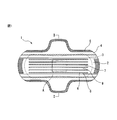
- FIG. 1 is a plan view showing an absorbent article 1 according to one of the embodiments of the present disclosure.
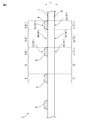
- FIG. 2 is a cross-sectional view of the region A in FIG.
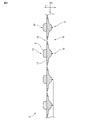
- FIG. 3 is a schematic diagram for explaining the effect of the present disclosure.
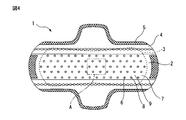
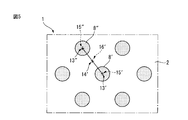
- FIG. 4 is a plan view showing an absorbent article 1 according to another embodiment of the present disclosure.
- FIG. 5 is an enlarged view of region A in FIG.
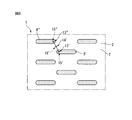
- FIG. 6 is a partial plan view for explaining an absorbent article 1 according to another embodiment of the present disclosure.
- An absorbent article of the present disclosure includes a liquid permeable layer having a skin contact area and a skin non-contact area, a liquid impermeable layer, and an absorbent layer between the liquid permeable layer and the liquid impermeable layer.
- the said gel lotion contains the styrene-type elastomer as a gelatinizer, and the hydrocarbon as a lotion.
- the gelling agent is a component for holding the lotion and includes a styrene elastomer.
- the styrenic elastomer preferably has a hard segment and a soft segment, and the hard segment is preferably a polystyrene block, and the soft segment is preferably a polyolefin block.
- the polystyrene block includes not only a block made of styrene homopolymer (ie, polystyrene block) but also a block made of homopolymer of ⁇ -methylstyrene (ie, poly ⁇ -methylstyrene block), and styrene and ⁇ -methyl. And blocks made of copolymers with styrene.
- polyolefin block examples include a block made of a homopolymer of polyolefin, such as a polyethylene block, a polypropylene block, a polybutylene block, and a polybutadiene block, and a block made of a copolymer of polyolefin, such as ethylene, propylene, butylene, and butadiene.
- a block made of a homopolymer of polyolefin such as a polyethylene block, a polypropylene block, a polybutylene block, and a polybutadiene block
- a block made of a copolymer of polyolefin such as ethylene, propylene, butylene, and butadiene.
- the block which consists of a copolymer of these is mentioned.
- butadiene is also handled as an olefin monomer for convenience.
- the soft segment includes a hydrogen adduct of a polybutadiene block and a hydrogen adduct of a block made of butadiene and a copolymer such as ethylene, propylene, butylene, and butadiene.
- styrene-type elastomer it is preferable to have a hard segment in both ends and to have 1 type or multiple types of soft segment between them.
- specific examples of the styrene-based elastomer include the following.
- SEP Polystyrene-block-poly (ethylene-co-propylene) (Hereafter, it may be abbreviated as “SEP”.)
- SEPS Polystyrene-block-poly (ethylene-co-propylene) -block-polystyrene (hereinafter sometimes abbreviated as “SEPS”)
- SEBS Polystyrene-block-poly (ethylene-co-butylene) -block-polystyrene
- SEEPS Polystyrene-block-polyethylene-block-poly (ethylene-co-propylene) -block-polystyrene
- the styrenic elastomer preferably has a weight average molecular weight of 5,000 to 500,000, more preferably 10,000 to 400,000, and even more preferably 50,000 to 300,000.
- weight average molecular weight is less than 5,000, the styrenic elastomer tends to be difficult to maintain a gel structure, and when the weight average molecular weight exceeds 500,000, the wearing feeling tends to be lowered.
- the measuring method of a weight average molecular weight is mentioned later.
- the styrenic elastomer preferably comprises 10 to 50% by mass of polystyrene blocks and 50 to 90% by mass of polyolefin blocks, more preferably 15 to 40% by mass of polystyrene blocks and 60 to 85% by mass of polyolefin. And more preferably 18-35% by weight polystyrene block and 65-82% by weight polyolefin block.
- the amount of polystyrene block When the amount of polystyrene block is less than 10% by mass, it tends to be difficult for the polystyrene block to form a micro-layer separation structure described later.
- the amount of the polystyrene block exceeds 50% by mass, the amount of the polyolefin block that can hold the lotion decreases, and as a result, the amount of the lotion that can be held tends to decrease.
- the amount of the micro-layer separation structure of the polystyrene block increases, the gel lotion formed becomes hard, and there is a tendency to be inferior in wearing feeling.
- the reason why the styrene-based elastomer generates gel lotion is as follows.
- a soft segment plays the role of the network which connects those bridge
- the styrene elastomer functions as an elastic body.
- the soft segment of the styrenic elastomer retains the lotion while the hard segment remains forming a domain.
- the mixture (gel lotion) of the styrene elastomer and the lotion functions as an elastic body having a compressive stress lower than that of the styrene elastomer alone.
- the said lotion is only hold
- the lotion contains hydrocarbons.
- hydrocarbon means a compound composed of carbon and hydrogen.
- examples of the hydrocarbon include chain hydrocarbons such as paraffinic hydrocarbons (not including double bonds and triple bonds, also called alkanes), olefinic hydrocarbons (including one double bond, alkenes). ), Acetylene hydrocarbons (including one triple bond, also referred to as alkyne), and hydrocarbons including two or more bonds selected from the group consisting of double bonds and triple bonds, and cyclic carbonization Hydrogen, for example, aromatic hydrocarbon and alicyclic hydrocarbon can be mentioned.
- the hydrocarbon is preferably a chain hydrocarbon and an alicyclic hydrocarbon, more preferably a chain hydrocarbon, a paraffinic hydrocarbon, an olefinic hydrocarbon, and two double bonds. More preferred are hydrocarbons (not including triple bonds), and more preferred are paraffinic hydrocarbons.
- the chain hydrocarbon includes a straight chain hydrocarbon and a branched chain hydrocarbon.
- the hydrocarbon preferably has a kinematic viscosity of 0.01 to 80 mm 2 / s at 40 ° C., preferably has a water content of 0.01 to 4.0% by weight, and less than 1,000 It preferably has a weight average molecular weight. This is because the hydrocarbon can act as a body fluid lubricity imparting agent described later.
- lotion for example, hydrocarbon
- body fluid such as menstrual blood and urine
- the lotion preferably contains 50 to 100% by mass of the hydrocarbon, more preferably 60 to 100% by mass, and even more preferably 70 to 100% by mass. This is from the viewpoint of gel formation.
- the said gel lotion can further contain the component known as a lotion in this technical field other than the above-mentioned hydrocarbon as said lotion.
- the gel lotion has an IOB of more than 0.00 and not more than 0.60, a kinematic viscosity of 0.01 to 80 mm 2 / s at 40 ° C., and 0.01 to 4 It is preferable to further contain a fluid lubricity-imparting agent having a water retention of 0.0% by mass and a weight average molecular weight of less than 1,000.
- the body fluid lubricity-imparting agent is a component similar to the “blood modifying agent” described in International Publication No. 2012/133724, which is an application of the present applicant, and also International Publication No. 2013/129236 pamphlet. It is the same component as the “blood slipperiness imparting agent” described in 1.
- the body fluid lubricity-imparting agent is continuously released from the gel lotion, and the body fluid that reaches the liquid-permeable layer over a long period of time is absorbed inside the absorber. Can slide down quickly.
- IOB Inorganic Organic Balance
- IOB is an index indicating a balance between hydrophilicity and lipophilicity.
- Oda et al. IOB value calculated by inorganic value / organic value.
- the inorganic value and the organic value are represented by Fujita Minoru, “Prediction of organic compounds and conceptual diagram of organic compounds”, chemistry area Vol. 11, no. 10 (1957) p. 719-725).
- Table 1 summarizes the organic and inorganic values of the major groups by Mr. Fujita.
- the kinematic viscosity is measured at a test temperature of 40 ° C. using a Cannon-Fenske backflow viscometer according to “5. Kinematic viscosity test method” of JIS K 2283: 2000.
- the “water retention” means the ratio of water retained by a substance, and is measured as follows. (1) Place a test tube, a rubber plug, a substance to be measured, and deionized water in a constant temperature room at 40 ° C. for 24 hours. (2) In the temperature-controlled room, put 5.0 g of the substance to be measured and 5.0 g of deionized water into a 20 mL test tube. (3) In the above-mentioned temperature-controlled room, the mouth of the test tube is plugged with a rubber stopper, rotated once, and allowed to stand for 5 minutes.
- a weight average molecular weight means the value of polystyrene conversion calculated
- GPC measurement conditions include the following. Model: Hitachi High-Technologies Corporation High-Performance Liquid Chromatogram Lachrom Elite Column: SHODEX KF-801, KF-803 and KF-804 manufactured by Showa Denko K.K. Eluent: THF Flow rate: 1.0 mL / min Driving amount: 100 ⁇ L Detection: RI (differential refractometer)
- the body fluid lubricity imparting agent is preferably the following (i) and (ii): (I) from (i-1) a hydrocarbon moiety and (i-2) a carbonyl group (—CO—) and an oxy group (—O—) inserted between CC single bonds of the hydrocarbon moiety.
- the said hydrocarbon part is synonymous with the above-mentioned hydrocarbon.
- each oxy group (—O—) is not adjacent. Accordingly, the compounds (i) and (ii) do not include a compound having a continuous oxy group (so-called peroxide).
- the body fluid lubricity imparting agent is the following (i ′) and (ii ′), (I ′) (i′-1) a hydrocarbon moiety and (i′-2) a carbonyl bond (—CO—), an ester bond (—COO) inserted between the CC single bonds of the hydrocarbon moiety.
- Examples of the body fluid lubricity-imparting agent include (a 1 ) an ester of a chain hydrocarbon tetraol and at least one fatty acid, (a 2 ) an ester of a chain hydrocarbon triol and at least one fatty acid, (a 3 ) An ester of a chain hydrocarbon diol and at least one fatty acid, (b 1 ) an ether of a chain hydrocarbon tetraol and at least one aliphatic monohydric alcohol, (b 2 ) a chain hydrocarbon triol and at least one An ether with an aliphatic monohydric alcohol, (b 3 ) an ether of a chain hydrocarbon diol with at least one aliphatic monohydric alcohol, (c 1 ) a chain hydrocarbon tetracarboxylic acid having four carboxyl groups, hydroxy acid, alkoxy acid or oxo acid, esters of at least one aliphatic monohydric alcohol, like chains having (c 2) 3 carboxyl groups carbide
- the chain hydrocarbon tetraol means a compound in which the hydrogen atoms (total 4) in the above-described chain hydrocarbon are substituted with hydroxyl groups (—OH) (total 4).
- esters of all and at least one fatty acid include the following formula (1): Tetraesters of pentaerythritol and fatty acids of the following formula (2): Triesters of pentaerythritol and fatty acids of the following formula (3): Diester of pentaerythritol and fatty acid of the following formula (4): And monoesters of pentaerythritol and fatty acids. (In the formula, each of R 1 to R 4 is a chain hydrocarbon)
- fatty acid (R 1 COOH, R 2 COOH, R 3 COOH, and R 4 COOH) constituting the ester of pentaerythritol and a fatty acid include saturated fatty acids such as C 2 to C 30 saturated fatty acids such as Acetic acid (C 2 ) (C 2 represents the number of carbon atoms and corresponds to the carbon number of R 1 C, R 2 C, R 3 C or R 4 C, the same shall apply hereinafter), propanoic acid (C 3 ), butane Acid (C 4 ) and its isomers, such as 2-methylpropanoic acid (C 4 ), pentanoic acid (C 5 ) and its isomers, such as 2-methylbutanoic acid (C 5 ), 2,2-dimethylpropane Acid (C 5 ), hexanoic acid (C 6 ), heptanoic acid (C 7 ), octanoic acid (C 8 ) and isomers thereof such as 2-ethylhexanoi
- the fatty acid can also be an unsaturated fatty acid.
- unsaturated fatty acid include C 3 to C 20 unsaturated fatty acids such as monounsaturated fatty acids such as crotonic acid (C 4 ), myristoleic acid (C 14 ), palmitoleic acid (C 16 ), Oleic acid (C 18 ), elaidic acid (C 18 ), vaccenic acid (C 18 ), gadoleic acid (C 20 ), eicosenoic acid (C 20 ), etc., diunsaturated fatty acids such as linoleic acid (C 18 ), Triunsaturated fatty acids such as eicosadienoic acid (C 20 ), such as linolenic acid such as ⁇ -linolenic acid (C 18 ) and ⁇ -linolenic acid (C 18 ), pinolenic acid (C 18 ), eleostearic acid, For example, ⁇ -eleostearic acid (C 18
- the chain hydrocarbon triol means a compound in which the hydrogen atoms (total 3) of the chain hydrocarbon described above are substituted with hydroxyl groups (—OH) (total 3).
- Examples of the ester with at least one fatty acid include the following formula (5): Triester of glycerin and fatty acid of the following formula (6): Diesters of glycerin and fatty acids and the following formula (7): (In the formula, each of R 5 to R 7 is a chain hydrocarbon) And monoesters of glycerin and fatty acids.
- the fatty acids are as described above.
- the chain hydrocarbon diol means a compound in which the hydrogen atoms (2 in total) of the chain hydrocarbon are substituted with hydroxyl groups (—OH) (2 in total).
- R 8 COOC k H 2k OCOR 9 As an ester of and at least one fatty acid, for example, the following formula (8): R 8 COOC k H 2k OCOR 9 (8) (Wherein k is an integer from 2 to 6 and R 8 and R 9 are each a chain hydrocarbon) A diester of a C 2 -C 6 glycol with a fatty acid and the following formula (9): R 8 COOC k H 2k OH (9) (Wherein k is an integer from 2 to 6 and R 8 is a chain hydrocarbon) And monoesters of C 2 -C 6 glycols and fatty acids.
- the fatty acids are as described above.
- ethers of (b 1 ) chain hydrocarbon tetraol and at least one aliphatic monohydric alcohol examples include the following formulas (10) to (13): (In the formula, each of R 10 to R 13 is a chain hydrocarbon.) And tetraethers, triethers, diethers and monoethers of pentaerythritol and aliphatic monohydric alcohols.
- the chain hydrocarbon tetraol is as described above.
- Examples of the aliphatic monohydric alcohol include saturated aliphatic monohydric alcohol and unsaturated aliphatic monohydric alcohol.
- Examples of the saturated aliphatic monohydric alcohol include C 1 to C 20 saturated aliphatic monohydric alcohols such as methyl alcohol (C 1 ) (C 1 represents the number of carbon atoms, the same shall apply hereinafter), ethyl alcohol ( C 2 ), propyl alcohol (C 3 ) and isomers thereof such as isopropyl alcohol (C 3 ), butyl alcohol (C 4 ) and isomers thereof such as sec-butyl alcohol (C 4 ) and tert-butyl alcohol (C 4 ), pentyl alcohol (C 5 ), hexyl alcohol (C 6 ), heptyl alcohol (C 7 ), octyl alcohol (C 8 ) and isomers thereof such as 2-ethylhexyl alcohol (C 8 ), nonyl alcohol (C 9), decyl alcohol (C
- Examples of the unsaturated aliphatic monohydric alcohol include those obtained by substituting one of the C—C single bonds of the saturated aliphatic monohydric alcohol with a C ⁇ C double bond, such as oleyl alcohol.
- ethers of (b 2 ) chain hydrocarbon triol and at least one aliphatic monohydric alcohol include the following formulas (14) to (16): (In the formula, each of R 14 to R 16 is a chain hydrocarbon.) And triether, diether and monoether of glycerin and aliphatic monohydric alcohol.
- the chain hydrocarbon triol and the aliphatic monohydric alcohol are as described above.
- C 1 As an ester of a chain hydrocarbon tetracarboxylic acid having four carboxyl groups, a hydroxy acid, an alkoxy acid or an oxo acid and at least one aliphatic monohydric alcohol, for example, a monoester or a diester thereof , Triesters and tetraesters.
- esters of a chain hydrocarbon tricarboxylic acid having three carboxyl groups, a hydroxy acid, an alkoxy acid or an oxo acid and at least one aliphatic monohydric alcohol include, for example, monoesters, diesters thereof, and Examples include triesters.
- ester of a chain hydrocarbon dicarboxylic acid having two carboxyl groups, a hydroxy acid, an alkoxy acid or an oxo acid and at least one aliphatic monohydric alcohol (C 3 ) Examples of the ester of a chain hydrocarbon dicarboxylic acid having two carboxyl groups, a hydroxy acid, an alkoxy acid or an oxo acid and at least one aliphatic monohydric alcohol include, for example, monoesters and diesters thereof. Can be mentioned.
- dialkylketone As the dialkyl ketone, the following formula (20): R 21 COR 22 (20) (In the formula, each of R 21 and R 22 is an alkyl group) The compound which has is mentioned.
- ester of fatty acid and aliphatic monohydric alcohol The fatty acid and the aliphatic monohydric alcohol are as described above.
- Examples of the ester of the fatty acid and the aliphatic monohydric alcohol include the following formula (21): R 23 COOR 24 (21) (In the formula, each of R 23 and R 24 is a chain hydrocarbon) The compound which has is mentioned. The chain hydrocarbon is as described above.
- the polyoxy C 3 -C 6 alkylene glycol has the following formula (23): HO- (C m H 2m O) n -H (23) (Where m is an integer from 3 to 6) Is represented by
- ester of polyoxy C 3 -C 6 alkylene glycol and at least one fatty acid examples include the OH terminal of the polyoxy C 3 -C 6 alkylene glycol described in the section “(e 1 ) polyoxy C 3 -C 6 alkylene glycol”. In which one or both of them are esterified with a fatty acid, that is, monoesters and diesters.
- the fatty acids are as described above.
- the body fluid lubricity imparting agent is as described in WO 2012/133724 pamphlet, WO 2013/129236 pamphlet, etc., but the gel lotion contains the body fluid lubricity imparting agent as a lotion. In some cases, the following effects can be further obtained.
- the gel lotion continuously releases the body fluid slipperiness-imparting agent to the skin contact area of the absorbent article.
- the body fluid slipperiness agent and the body fluid slide down inside the absorbent product.
- lubricity imparting agent will be supplied to the surface of a liquid-permeable layer from a gel lotion, and body fluid will continue to slide down inside an absorbent article.
- the liquid-permeable layer is hardly sticky, and the liquid-permeable layer is kept in a smooth state.
- the lotion preferably contains 0 to 50% by mass, more preferably 0 to 40% by mass, and even more preferably 0 to 30% by mass of the body fluid lubricity imparting agent. This is from the viewpoint of gel formation.
- the gelling agent and the lotion are preferably 1 to 30 parts by weight and 70 to 99 parts by weight, more preferably 2 to 20 parts by weight and 80 parts based on a total of 100 parts by weight thereof. Up to 98 parts by weight, and more preferably 3-15 parts by weight and 85-97 parts by weight.
- the ratio of the gelling agent is less than 1 part by mass, the formed gel lotion becomes difficult to act as an elastic body, or may deform beyond the elastic limit of the gel lotion when body pressure is applied. is there.
- the ratio of the said gelling agent exceeds 30 mass parts, the elasticity of the gel lotion formed is high and may be inferior to a feeling of wear.
- the gel lotion preferably has a compressive stress at 50% strain of 1-100 kPa, more preferably a compressive stress at 50% strain of 1-80 kPa, and even more preferably a compressive stress at 50% strain of 1.5-60 kPa.
- the compressive stress at 50% strain is less than 1 kPa, the gel lotion may be deformed beyond the elastic limit when body pressure is applied, and may be destroyed, and when the compressive stress at 50% strain exceeds 100 kPa, The elasticity of the gel lotion is high, and when the body pressure is applied, the gel lotion is not easily deformed, and the wearer may feel uncomfortable.
- the gel lotion behaves as an elastic body in a range where body pressure or the like is applied. Therefore, even if a high body pressure is applied to the gel lotion, the gel lotion remains elastically deformed and is not pushed in between the fibers of the top sheet. Return to). Accordingly, the lotion contained in the gel lotion can perform its function at a desired position.
- the compression stress at 50% strain of the gel lotion is measured as follows. Note that matters not particularly specified are in accordance with “3.7 x% compressive stress at strain” in JIS K 7181: 2011 “Plastics-Determination of compression characteristics”.
- a compression tester is prepared in a constant temperature and humidity chamber at 20 ° C. and 65% RH. In this example, a small tabletop tester EzTest (manufactured by Shimadzu Corporation) was used as the compression tester.
- a compression jig is attached to the compression tester. In this example, a stainless steel compression jig having a diameter of 120 mm was used.
- the gel lotion may further contain a lubricant in addition to the gelling agent and the lotion.
- a lubricant include silicone oil, silicone resin, alkyl acrylate copolymer, surfactant, and long chain aliphatic ester.
- the gel lotion preferably has a static friction coefficient of 0.01 to 1.00, more preferably 0.02 to 0.50, and even more preferably 0.03 to 0.03. This is because the wearer's skin irritation is difficult.
- the gel lotion preferably contains 0.01 to 20 parts by mass of the antifriction agent with respect to 100 parts by mass of the gel lotion (total 100 parts by mass of the gelling agent and the lotion). More preferably 0.05 to 10 parts by weight, and more preferably 0.1 to 7 parts by weight.
- the static friction coefficient is measured as follows. The measurement is performed in a constant temperature and humidity chamber of 20 ° C. ⁇ 65% RH.
- a gel lotion having a cylindrical shape with a diameter of 40 mm and a height of 8 mm is prepared.
- HEIDON tribogear ⁇ s (muse) TYPE: 94i is prepared (hereinafter sometimes referred to as “muse”).
- HEIDON tribogear ⁇ s (muse) TYPE: 94i (hereinafter sometimes referred to as “muse”).
- HEIDON tribogear ⁇ s (muse) TYPE: 94i is prepared (hereinafter sometimes referred to as “muse”).
- the said gel lotion can contain another component in the range which does not inhibit the effect of this indication.
- the other components include antioxidants such as BHT (2,6-di-t-butyl-p-cresol), BHA (butylated hydroxyanisole), propyl gallate, and the like.
- Examples of the other components include vitamins such as natural vitamins and synthetic vitamins.
- Examples of the vitamin include water-soluble vitamins such as vitamin B group, for example, vitamin B 1 , vitamin B 2 , vitamin B 3 , vitamin B 5 , vitamin B 6 , vitamin B 7 , vitamin B 9 , vitamin B 12 And vitamin C.
- Examples of the vitamin include fat-soluble vitamins such as vitamin A group, vitamin D group, vitamin E group, and vitamin K group.
- the vitamins also include their derivatives.
- Examples of the other components include amino acids such as alanine, arginine, lysine, histidine, proline, hydroxyproline, and peptides.
- Examples of the other components include zeolites, for example, natural zeolites, such as calcite, chabazite, pyroxenite, natrolite, zeolitic and somosonite, and synthetic zeolite.
- Examples of the at least one other component include cholesterol, hyaluronic acid, lecithin, and ceramide.
- Examples of the other components include drugs such as skin astringents, anti-acne agents, anti-wrinkle agents, anti-cellulite agents, whitening agents, antibacterial agents, anti-fungal agents and the like.
- Examples of the skin astringent include oil-soluble skin astringents such as zinc oxide, aluminum sulfate, and tannic acid, such as oil-soluble polyphenols.
- Examples of the oil-soluble polyphenols include natural oil-soluble polyphenols such as, for example, buckwheat extract, hypericum extract, nettle extract, chamomile extract, burdock extract, salvia extract, linden extract, scallop extract, birch extract, cedar extract, sage extract, salvia extract. , Teuchigurumi extract, hibiscus extract, loquat leaf extract, bodaiju extract, hop extract, marronnier extract, yokuinin extract and the like.
- anti-acne agent examples include salicylic acid, benzoyl peroxide, resorcinol, sulfur, erythromycin, and zinc.
- anti-wrinkle agent examples include lactic acid, salicylic acid, salicylic acid derivatives, glycolic acid, phytic acid, lipoic acid, and lysophosphatide acid.
- anti-cellulite agent examples include xanthine compounds such as aminophylline, caffeine, theophylline, theobromine and the like.
- whitening agent examples include niacinamide, kojic acid, arbutin, glucosamine and derivatives, phytosterol derivatives, ascorbic acid and derivatives thereof, and mulberry extract and placenta extract.
- an anti-inflammatory component a pH adjuster, an antibacterial agent, a moisturizer, a fragrance
- the anti-inflammatory component include naturally-occurring anti-inflammatory agents, such as buttons, ogon, hypericum, chamomile, licorice, momonoha, mugwort, perilla extract, synthetic anti-inflammatory agents, such as allantoin, dipotassium glycyrrhizinate, etc. It is done.
- the pH adjuster include those for keeping the skin weakly acidic, such as malic acid, succinic acid, citric acid, tartaric acid, and lactic acid.
- the pigment include titanium oxide.
- the liquid-permeable layer has a plurality of gel regions having the gel lotion in the skin contact region, and a non-gel region having no gel lotion, and the skin
- the non-contact region has a plurality of gel regions and a plurality of non-gel region overlapping regions that overlap with the plurality of gel regions and the non-gel region in the thickness direction, respectively.
- FIG. 1 is a plan view showing an absorbent article 1 according to one embodiment of the present disclosure.
- the absorbent article 1 shown in FIG. 1, more specifically a sanitary napkin includes a topsheet 2 as a liquid-permeable layer, a backsheet (not shown) as a liquid-impermeable layer, and a topsheet 2. And the absorber 3 as an absorptive layer between a back sheet
- the absorbent article 1 shown in FIG. 1 also has a side sheet 4 and an embossed portion 5.
- the top sheet 2 as liquid permeability has a plurality of gel regions 8 having a gel lotion 6 in the skin contact region 7 and a non-gel region 9 having no gel lotion. And have.
- a plurality of line-like gel lotions 6 are continuously applied along the longitudinal direction of the absorbent article 1.
- the topsheet 2 has a plurality of linear gel regions 8 that are parallel to each other and extend continuously in the longitudinal direction of the absorbent article 1.
- FIG. 2 is a cross-sectional view of the region A in FIG. 1 in the II-II cross section, and is a view showing only the top sheet 2 for explanation.
- the top sheet 2 has a plurality of gel regions 8 having a gel lotion 6 and a non-gel region 9 having no gel lotion in the skin contact region 7, and a skin non-contact region 10. Furthermore, it has the several gel area
- the water contact angle at the intermediate point 14 is larger than the water contact angles at the two adjacent point equivalent points 15 ′ and 15 ′′, and the water contact angle at the intermediate point equivalent point 16 is the water contact angle at the intermediate point 14. Since the difference from the angle is larger than ⁇ 3 (°), the water contact angle gradually increases from the skin non-contact area 10 to the skin contact area 7, that is, the hydrophobicity gradually increases. The body fluid once absorbed by the absorbent body is less likely to pass through the top sheet 2 and reach the skin contact region 7. That is, it has excellent rewetting properties.
- the water contact angles at the two adjacent points are both 85 ° or more, preferably both are 90 ° or more, and more preferably both are 100 ° or more.
- the water contact angle between the two proximity points is preferably 150 ° or less, and more preferably 140 ° or less. This is from the viewpoint of improving the rewetting property while maintaining the permeability of the fluid-permeable layer of body fluid.
- the water contact angle at the intermediate point is larger than the water contact angle at the two adjacent point equivalent points, preferably 5 ° or more, and more preferably 10 ° or more.
- the water contact angle at the intermediate point is preferably larger in the range of 50 ° or less and more preferably in the range of 30 ° or less than the water contact angle at the two adjacent point equivalent points. This is from the viewpoint of increasing the re-wetting property by increasing the hydrophobic gradient of the liquid-permeable layer while maintaining the permeability of the liquid-permeable layer of body fluid.
- the difference between the water contact angle at the midpoint and the water contact angle at the midpoint equivalent point is greater than -3 °, preferably greater than -1 °, and more preferably Greater than 3 °.
- the difference between the water contact angle at the midpoint and the water contact angle at the midpoint equivalent point is preferably 30 ° or less, and more preferably 10 ° or less. This is from the viewpoint of the absorption rate of body fluid and the difficulty of remaining the body fluid in the liquid-permeable layer.
- the two gel regions adjacent to each other have the above-described relationships i) to iii), and the two gel regions adjacent to each other Preferably 20% or more, more preferably 40% or more, and even more preferably 60% or more of the combinations have the above relationships i) to iii). This is from the viewpoint of the effect of the present disclosure.
- FIG. 3 is a schematic diagram for explaining the effect of the present disclosure.
- FIG. 3 corresponds to a cross-sectional view of the region A in FIG.
- the lotion 17 that bleeds from the gel lotion 6 spreads from the gel lotion 6 in the plane direction P and the thickness direction T with time.
- two lotions The water contact angles of the proximity point 13, the intermediate point 14, the proximity point equivalent point 15, and the intermediate point equivalent point 16 satisfy the above-described requirements and have the effects of the present disclosure.
- the water contact angle is measured as follows. (1) A contact angle meter made by Kyowa Interface Science is prepared in a constant temperature room at 20 ° C. (2) The sample to be measured is allowed to stand for 24 hours in the temperature-controlled room. (3) Drop water drops (distilled water) of 5 scales on the location of the sample to be measured. (4) The water contact angle is measured 5 seconds after dropping. (5) A total of 10 measurements are performed at the same place on different samples, and the average value is adopted.
- the plurality of gel regions 8 are parallel to each other and extend in the longitudinal direction of the absorbent article 1.
- a straight line connecting the two forms a perpendicular line of the gel region 8.
- a straight line connecting two adjacent point equivalent points and an intermediate point equivalent point also forms a perpendicular of the gel region 8.
- FIG. 4 is a plan view showing an absorbent article 1 according to another embodiment of the present disclosure.
- the top sheet 2 includes a gel lotion 6 in the skin contact region 7, and a plurality of dot-like gel lotions 6 are provided. It is coated in a staggered pattern.
- the top sheet 2 includes a plurality of dot-like gel lotions 6 arranged in a staggered manner.
- FIG. 5 is an enlarged view of region A in FIG. FIG. 5 shows that in two gel regions 8 ′ and 8 ′′ that are adjacent to each other, two adjacent points 13 ′ and 13 ′′ that are closest to each other, their intermediate point 14 ′, and two Two adjacent point equivalent points 15 ′ and 15 ′′, which overlap in the thickness direction of the adjacent points 13 ′ and 13 ′′ and exist in the gel region overlapping region (not shown), and an intermediate point 14 ′, An intermediate point equivalent point 16 ′ overlapping in the thickness direction and existing in the non-gel region overlapping region (not shown) is shown.
- FIG. 6 is a plan view showing an absorbent article 1 according to another embodiment of the present disclosure, and is a plan view corresponding to a region A in FIG.
- the absorbent article 1 shown in FIG. 6 includes a gel lotion 6 in the skin contact region 7 of the top sheet 2, and the plurality of line-like gel lotions 6 are intermittent along the longitudinal direction of the absorbent article 1. It is coated on.
- the topsheet 2 includes a plurality of linear gel lotions 6 that are parallel to each other and extend intermittently in the longitudinal direction of the absorbent article 1.
- FIG. 6 also shows that in the two gel regions 8 ′ and 8 ′′ that are adjacent to each other, two proximity points 13 ′ and 13 ′′ that are closest to each other, their midpoints 14 ′, and 2 Two adjacent points 15 ′ and 15 ′′ that overlap in the thickness direction and exist in the gel region overlapping region (not shown) of the two adjacent points 13 ′ and 13 ′′, and an intermediate point 14 ′
- the intermediate point equivalent point 16 ′ overlapping in the thickness direction and existing in the non-gel region overlapping region (not shown) is shown.
- the arrangement of the gel region having the gel lotion is not particularly limited as long as the above relationships i) to iii) are satisfied.
- the gel region is the skin contact region of the liquid permeable layer. Further, they are arranged in a line shape or a dot shape.
- the gel region is preferably 1 to 50%, more preferably 3 to 40% of the area of the liquid permeable layer in a range where the liquid permeable layer overlaps the absorbent layer in the thickness direction of the absorbent article. More preferably, it occupies an area of 5 to 30%.
- the gel region occupies less than 1% of the area of the liquid permeable layer, the effect of the present disclosure tends to be hardly exhibited.
- the gel region occupies more than 50% of the area of the liquid-permeable layer, the gel region does not absorb body fluid, and as a result, the region that absorbs body fluid becomes narrow and the absorbability of the absorbent article tends to decrease. .
- the liquid permeable layer has the gel lotion, preferably 1 to 30 g / m 2 , in a range overlapping with the absorbent layer and the thickness direction of the absorbent article. More preferably, it is contained at a basis weight of 2 to 20 g / m 2 , and more preferably 3 to 10 g / m 2 .
- the basic weight of a gel lotion is measured as follows. (1) The range to be measured of the top sheet is cut out with a sharp blade, for example, a cutter replacement blade, to obtain a sample. (2) The area of the sample: S (m 2 ) and the mass: M 0 (g) are measured. (3) The sample is stirred for at least 3 minutes in a solvent in which the gel lotion is soluble, for example, an aromatic solvent such as xylene, and the gel lotion is dissolved in the solvent.
- a solvent in which the gel lotion is soluble for example, an aromatic solvent such as xylene
- the nonwoven fabric or the woven fabric is preferably subjected to a hydrophilic treatment.
- a hydrophilic treatment include coating the surface of the nonwoven fabric or woven fabric with a hydrophilic agent, mixing the hydrophilic agent with a synthetic resin that is a raw material for the nonwoven fabric or the woven fabric, and the like.
- a lipophilic region derived from a hydrocarbon, a body fluid lubricity imparting agent, and the like, and a hydrophilic region derived from a hydrophilic agent will coexist sparsely, exhibiting better sliding performance, It is because it becomes easy to make it transfer to an absorber rapidly.
- the said gel lotion can be manufactured without a restriction
- a gelling agent is added to a heated lotion and mixed to produce a coating solution, and the coating solution is applied to the liquid-permeable layer of an absorbent article to which the gel lotion is to be applied.
- the absorbent article can be manufactured by processing.
- the gel lotion can be applied as a coating solution containing a volatile solvent, for example, an alcohol solvent, an ester solvent, an aromatic solvent, or the like, if desired.
- a volatile solvent for example, an alcohol solvent, an ester solvent, an aromatic solvent, or the like.
- the method for applying the coating liquid is not particularly limited, and the coating liquid can be heated as necessary, and can be applied by, for example, a non-contact coater or a contact coater.
- a non-contact coater examples include a spiral coater, a curtain coater, a spray coater, and a dip coater.
- the contact type coater examples include a slot coater and a pattern coater.
- the coating liquid can be applied when manufacturing a material of a liquid permeable layer, for example, a nonwoven fabric, or applied to an absorbent article to be coated with a gel lotion in a production line for manufacturing the absorbent article. Can also be done. From the viewpoint of suppressing the capital investment, it is preferable to apply the above-mentioned coating solution in the absorbent article production line. Further, in order to prevent the gel lotion from dropping and contaminating the line, It is preferable to apply the coating solution immediately before the downstream process, specifically, immediately before the product is enclosed in the individual package.
- absorbent article of the present disclosure examples include disposable diapers, urine collection pads, sanitary napkins, and panty liners.
- Example 1 2 parts of SEPS (styrene content: 20 mass%, weight average molecular weight: about 260,000) (hereinafter sometimes referred to as “SEPS-1”) and SEBS (styrene content: 31 mass%, weight average molecular weight: About 160,000) (hereinafter sometimes referred to as “SEBS-2”) 5 parts, Pearl Ream 6 (manufactured by NOF Corporation, liquid isoparaffin, isobutene and n-butene, copolymerized) Next, 90 parts of branched chain hydrocarbons produced by adding hydrogen, degree of polymerization: about 5 to about 10, weight average molecular weight: about 330, and silicone oil (manufactured by Dow Corning Toray, SH200- 100 cs, dimethylpolysiloxane, mixed by a kinematic viscosity at 25 ° C.
- SEPS-1 styrene content: 20 mass%, weight average molecular weight: about 260,000
- SEBS-2 sty
- nonwoven fabric A an air-through nonwoven fabric having a basis weight of 25 g / m 2 .
- the absorbent article no. 1-2 and 1-3 were obtained.
- the top sheets of 1-2 and 1-3 were air-through nonwoven fabrics (hereinafter sometimes referred to as “nonwoven fabric B”) having a basis weight of 27 g / m 2 .
- nonwoven fabric B air-through nonwoven fabrics
- the absorbent article no. 1-5 comparative sample
- 1-6 comparative sample
- a sample not coated with gel lotion was prepared as an absorbent article no. Used as 1-7 (comparative sample) and 1-8 (comparative sample).
- Absorber transfer speed and rewetting Absorbent article no.
- the absorber transfer rate and rewetting properties were measured as follows.
- An acrylic cylinder (outer diameter 60 mm ⁇ , inner diameter 55 mm ⁇ , 55 g) is placed on the top sheet of the absorbent article, and artificial urine (in 10 L of ion exchange water, 200 g of urea, 80 mL of sodium chloride, 8 g of magnesium sulfate, 3 g of calcium chloride, and pigment: prepared by dissolving about 1 g of blue No. 1) were added dropwise at a rate of 8 mL / second (first addition).
- Table 2 shows the rewet amount in the second dropping and the absorber transfer speed in the second dropping.
- Absorbent article No. 1-1 to 1-4 are absorbent article Nos. It can be seen that the rewetting rate is low and the rewetting property is excellent as compared with 1-5 to 1-8.
- Example 2 Heat 2 parts of SEEPS (Kuraray Co., Ltd., Septon 4055, styrene content: 30 mass%, weight average molecular weight: about 250,000) (hereinafter sometimes abbreviated as “SEEPS-2”) to about 140 ° C.
- SEEPS-2 Chemicallymerization Chemical Company
- Pearl Ream EX manufactured by NOF Corporation, branched chain hydrocarbons produced by copolymerizing liquid isoparaffin, isobutene and n-butene and then adding hydrogen, the kinematic viscosity at 37.8 ° C.
- a cylindrical gel lotion No. 40 having a diameter of 40 mm and a height of 8 mm. 2-1.
- SEEPS-1 Styrene content: 30% by mass, weight average molecular weight: about 110,000
- SEBS-1 Styrene content: 30% by mass, weight average molecular weight: about 110,000
- SEBS-2 Styrene content: 31% by mass, weight average molecular weight: about 160,000
- SEBS-3 Styrene content: 33% by mass, weight average molecular weight: about 290,000
- Example 3 Except for following the formulation described in Table 4 below, the gel lotion no. In accordance with the procedure for producing 2-6, a cylindrical gel lotion No. 40 mm in diameter and 8 mm in height was used. 3-1 to 3-4 were obtained. In addition, the outline
- Nonion OP-80R NOF Corporation, sorbitan monooleate, KP-561P Shin-Etsu Chemical Co., Ltd., acrylate / stearyl acrylate / dimethicone acrylate copolymer gel lotion no.
- the static friction coefficients of 3-1 to 3-4 were measured. The results are also shown in Table 4.
- Example 4 In accordance with the formulation described in Table 5 below and in an amount of 3 g in a glass petri dish having an inner diameter of 47 mm, the gel lotion No. 2 of Example 2 was used. 2-1 or No. In accordance with the procedure for producing 2-6, gel lotion no. 4-1 to 4-4 were obtained.
- Example 4A of Patent Document 1 a lotion composition containing 65% by mass of mineral oil and 35% by mass of cetearyl alcohol was prepared, and 3 g was poured into a glass petri dish having an inner diameter of 47 mm. 4-5 (Comparative Example) was prepared.
- Gel lotion no. 4-1 to 4-5 were allowed to stand in a thermostatic chamber at 35 ° C. or 20 ° C. for 30 minutes, and then a 3 cm ⁇ 3 cm filter paper having a mass measured was placed on each gel lotion, and 200 g of the filter paper was placed on the gel lotion. A weight was placed, the weight was removed after 1 minute, and the change in the mass of the filter paper was measured. The results are shown in Table 5.
- gel lotions Nos. 4-1 to 4-4 were confirmed to release a certain amount of lotion regardless of temperature, and continued in the same way in cold to warm regions. It is suggested that it can be released.
- gel lotion no. 4-5 (Comparative Example) shows that it is difficult to release the lotion when the temperature is low.
- the present disclosure relates to the following J1 to J11.
- a liquid permeable layer having a skin contact area and a skin non-contact area, a liquid impermeable layer, an absorption layer between the liquid permeable layer and the liquid impermeable layer, and a gel lotion
- An absorbent article having a vertical direction
- the gel lotion includes a styrenic elastomer as a gelling agent and a hydrocarbon as a lotion
- the liquid permeable layer has the gel lotion in the skin contact region, and a plurality of gel regions A non-gel region having no gel lotion, and a plurality of gel region overlapping regions overlapping with the plurality of gel regions and the non-gel region in the thickness direction, respectively, Has a non-gel region overlap area, Among the plurality of gel regions, in at least a part of two gel regions adjacent to each other, two adjacent points that are closest to each other in two gel regions adjacent to each other, and the two adjacent points Between the two intermediate points, and the two adjacent points corresponding
- J10 The absorbent article according to any one of J1 to J9, wherein the gel lotion is arranged in a line shape or a dot shape in the skin contact region of the liquid permeable layer.
- J11 The absorbent article according to any one of J1 to J10, which is a disposable diaper, a sanitary napkin, or a panty liner.
Landscapes
- Health & Medical Sciences (AREA)
- Epidemiology (AREA)
- General Health & Medical Sciences (AREA)
- Public Health (AREA)
- Heart & Thoracic Surgery (AREA)
- Vascular Medicine (AREA)
- Life Sciences & Earth Sciences (AREA)
- Animal Behavior & Ethology (AREA)
- Engineering & Computer Science (AREA)
- Biomedical Technology (AREA)
- Veterinary Medicine (AREA)
- Absorbent Articles And Supports Therefor (AREA)
- Cosmetics (AREA)
- Orthopedics, Nursing, And Contraception (AREA)
- Compositions Of Macromolecular Compounds (AREA)
- Laminated Bodies (AREA)
Abstract
Description
本開示の吸収性物品は、肌当接領域及び肌非当接領域を有する液透過性層と、液不透過性層と、上記液透過性層及び液不透過性層の間の吸収層と、ゲルローションとを備え、厚さ方向を有する。
上記ゲルローションは、ゲル化剤としてのスチレン系エラストマーと、ローションとしての炭化水素とを含む。
ゲル化剤は、上記ローションを保持するため成分であり、スチレン系エラストマーを含む。
上記ポリスチレンブロックには、スチレンのホモポリマーから成るブロック(すなわち、ポリスチレンブロック)だけでなく、α-メチルスチレンのホモポリマーから成るブロック(すなわち、ポリα-メチルスチレンブロック)、及びスチレンとα-メチルスチレンとのコポリマーから成るブロックとが含まれる。
なお、本明細書では、便宜上、ブタジエンもオレフィン系モノマーとして取り扱う。
上記スチレン系エラストマーの具体例としては、例えば、以下が挙げられる。
(i)ポリスチレン-block-ポリ(エチレン-co-プロピレン)
(以下、「SEP」と省略する場合がある)
(ii)ポリスチレン-block-ポリ(エチレン-co-プロピレン)-block-ポリスチレン
(以下、「SEPS」と省略する場合がある)
(iii)ポリスチレン-block-ポリ(エチレン-co-ブチレン)-block-ポリスチレン
(以下、「SEBS」と省略する場合がある)
(iv)ポリスチレン-block-ポリエチレン-block-ポリ(エチレン-co-プロピレン)-block-ポリスチレン
(以下、「SEEPS」と省略する場合がある)
なお、重量平均分子量の測定方法は、後述する。
なお、上記ローションは、スチレン系エラストマーのソフトセグメントの緩い網目に保持されているのみであり、ゲルローションの表面に移動可能である。
上記鎖状炭化水素には、直鎖状炭化水素及び分岐鎖状炭化水素が含まれる。
上記ゲルローションは、上記ローションとして、上述の炭化水素以外に、0.00超且つ0.60以下のIOBと、40℃における0.01~80mm2/sの動粘度と、0.01~4.0質量%の抱水率と、1,000未満の重量平均分子量とを有する体液滑性付与剤をさらに含むことが好ましい。
上記ゲルローションが上述の体液滑性付与剤を含むことにより、ゲルローションから体液滑性付与剤が継続的に放出され、長時間にわたり、液透過性層に到達した体液等を、吸収体の内部に迅速に滑落させることができる。
IOB=無機性値/有機性値
により算出される値を意味する。
藤田氏による、主要な基の有機性値及び無機性値を、下記表1にまとめる。

(1)40℃の恒温室に、試験管、ゴム栓、測定すべき物質及び脱イオン水を24時間静置する。
(2)上記恒温室で、20mLの試験管に、測定すべき物質5.0gと、脱イオン水5.0gを投入する。
(3)上記恒温室で、試験管の口をゴム栓にて栓をし、1回転させ、5分間静置する。
(5)上記シャーレを、オーブン内で、105℃で3時間加熱し、水分を蒸発させ、シャーレごと、質量:W1(g)を測定する。
(6)抱水率を、以下の式に従って算出する。
抱水率(質量%)=100×[W0(g)-W1(g)]/3.0(g)
測定は3回実施し、平均値を採用する。
Mw=ΣNiMi 2/ΣNiMi
により求められるMwを意味する。
GPCの測定条件としては、例えば、以下が挙げられる。
機種:(株)日立ハイテクノロジーズ製 高速液体クロマトグラム Lachrom Elite
カラム:昭和電工(株)製 SHODEX KF-801、KF-803及びKF-804
溶離液:THF
流量 :1.0mL/分
打込み量:100μL
検出:RI(示差屈折計)
(i) (i-1)炭化水素部分と、(i-2)上記炭化水素部分のC-C単結合間に挿入された、カルボニル基(-CO-)及びオキシ基(-O-)から成る群から選択される、一又は複数の、同一又は異なる基とを有する化合物、及び
(ii) (ii-1)炭化水素部分と、(ii-2)上記炭化水素部分のC-C単結合間に挿入された、カルボニル基(-CO-)及びオキシ基(-O-)から成る群から選択される、一又は複数の、同一又は異なる基と、(ii-3)上記炭化水素部分の水素原子を置換する、カルボキシル基(-COOH)及びヒドロキシル基(-OH)から成る群から選択される、一又は複数の、同一又は異なる基とを有する化合物、
並びにそれらの任意の組み合わせから成る群から選択される。
なお、上記炭化水素部分は、上述の炭化水素と同義である。
(i’) (i’-1)炭化水素部分と、(i’-2)上記炭化水素部分のC-C単結合間に挿入された、カルボニル結合(-CO-)、エステル結合(-COO-)、カーボネート結合(-OCOO-)、及びエーテル結合(-O-)から成る群から選択される、一又は複数の、同一又は異なる結合とを有する化合物、及び
(ii’) (ii’-1)炭化水素部分と、(ii’-2)上記炭化水素部分のC-C単結合間に挿入された、カルボニル結合(-CO-)、エステル結合(-COO-)、カーボネート結合(-OCOO-)、及びエーテル結合(-O-)から成る群から選択される、一又は複数の、同一又は異なる結合と、(ii’-3)上記炭化水素部分の水素原子を置換する、カルボキシル基(-COOH)及びヒドロキシル基(-OH)から成る群から選択される、一又は複数の、同一又は異なる基とを有する化合物、
並びにそれらの任意の組み合わせから成る群から選択される。
なお、上記炭化水素部分は、上述の炭化水素と同様である。
以下、これらの化合物について説明する。
鎖状炭化水素テトラオールは、上述の鎖状炭化水素の水素原子(計4つ)が、ヒドロキシル基(-OH)(計4つ)で置換された化合物を意味し、上記鎖状炭化水素テトラオールと少なくとも1の脂肪酸とのエステルとしては、例えば、次の式(1):

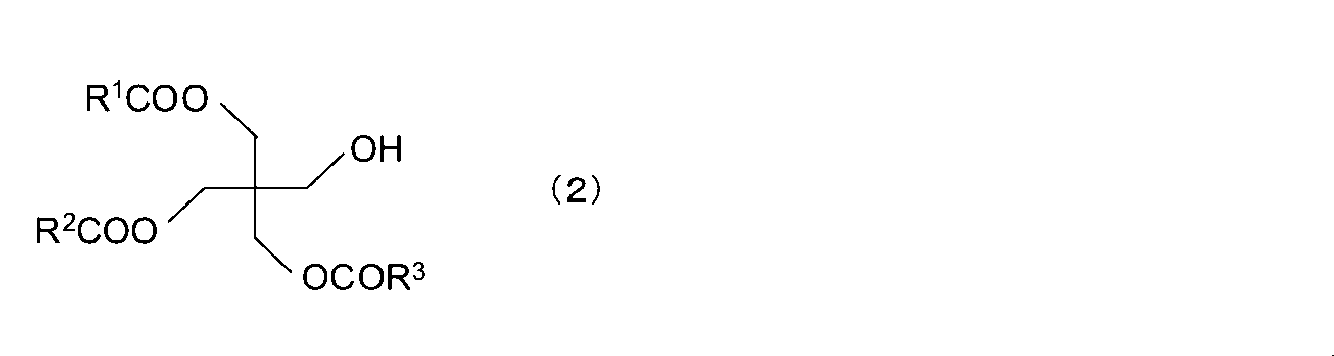
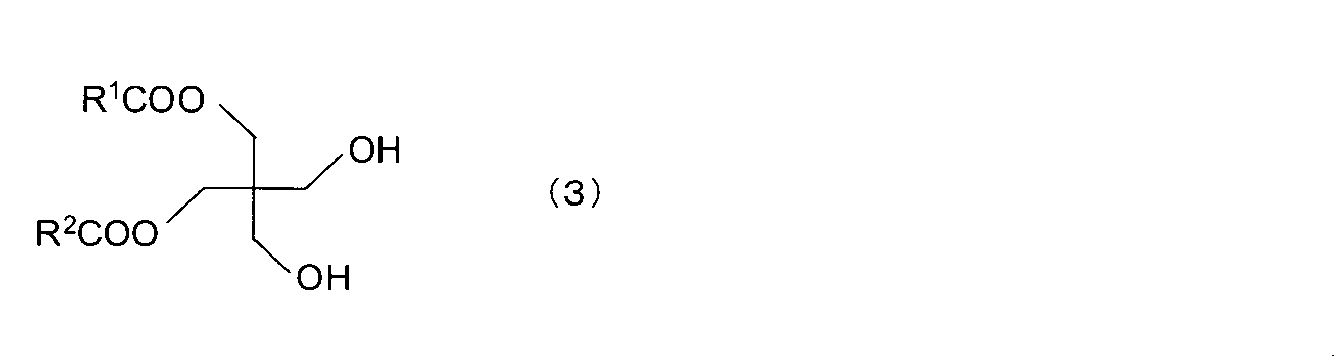
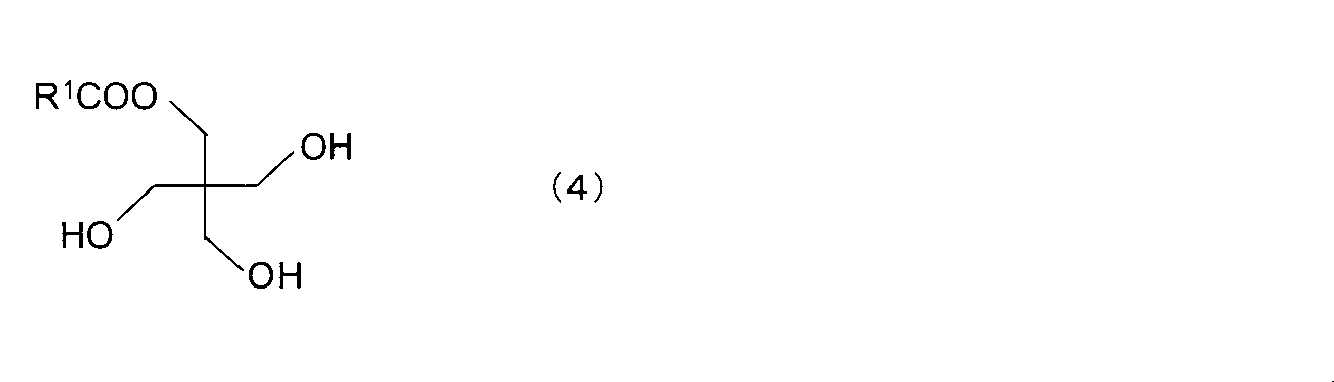
(式中、R1~R4のそれぞれは、鎖状炭化水素である)
鎖状炭化水素トリオールは、上述の鎖状炭化水素の水素原子(計3つ)が、ヒドロキシル基(-OH)(計3つ)で置換された化合物を意味し、上記鎖状炭化水素トリオールと少なくとも1の脂肪酸とのエステルとしては、例えば、次の式(5):
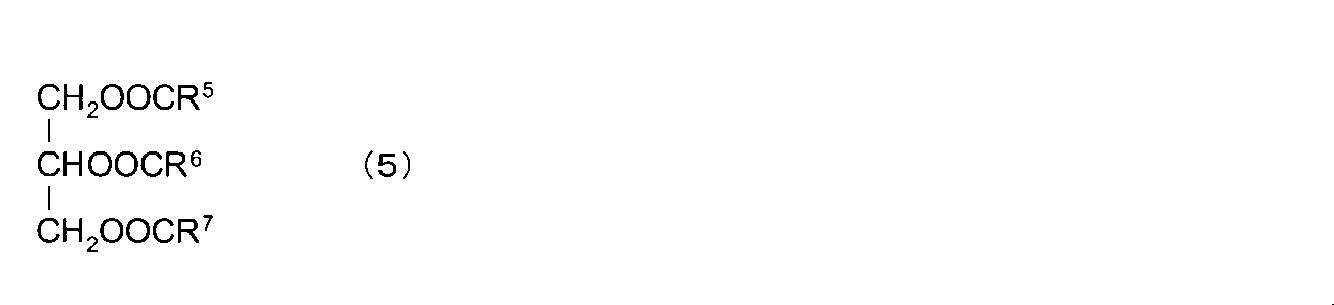
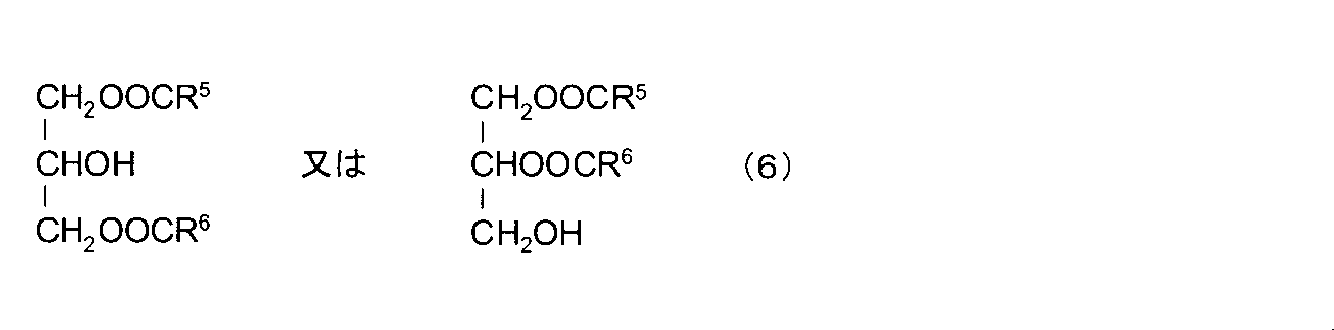
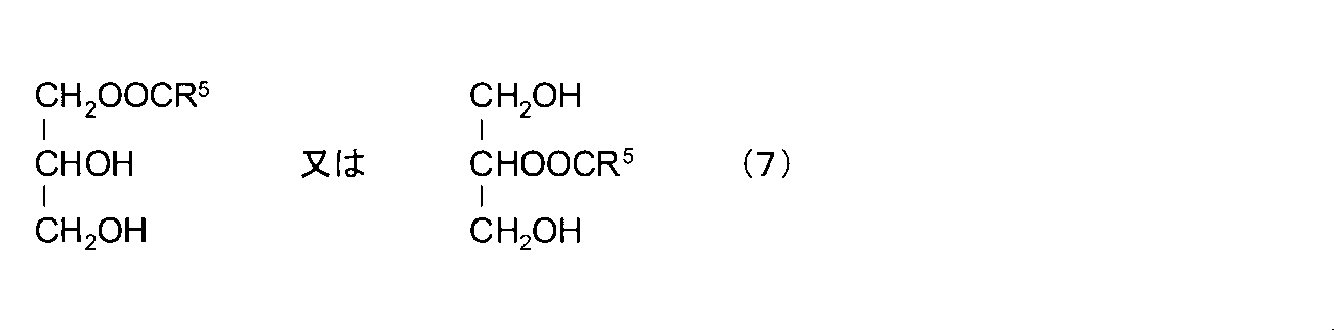
のグリセリンと脂肪酸とのモノエステルが挙げられる。
なお、脂肪酸については、上述の通りである。
上記鎖状炭化水素ジオールは、上述の鎖状炭化水素の水素原子(計2つ)が、ヒドロキシル基(-OH)(計2つ)で置換された化合物を意味し、上記鎖状炭化水素ジオールと少なくとも1の脂肪酸とのエステルとしては、例えば、次の式(8):
R8COOCkH2kOCOR9 (8)
(式中、kは、2~6の整数であり、そしてR8及びR9は、それぞれ、鎖状炭化水素である)
のC2~C6グリコールと脂肪酸とのジエステル、及び次の式(9):
R8COOCkH2kOH (9)
(式中、kは、2~6の整数であり、そしてR8は、鎖状炭化水素である)
のC2~C6グリコールと脂肪酸とのモノエステルが挙げられる。
なお、脂肪酸については、上述の通りである。
(b1)鎖状炭化水素テトラオールと少なくとも1の脂肪族1価アルコールとのエーテルとしては、例えば、次の式(10)~(13):

の、ペンタエリトリトールと脂肪族1価アルコールとのテトラエーテル、トリエーテル、ジエーテル及びモノエーテルが挙げられる。
なお、鎖状炭化水素テトラオールは、上述の通りである。
上記飽和脂肪族1価アルコールとしては、例えば、C1~C20の飽和脂肪族1価アルコール、例えば、メチルアルコール(C1)(C1は、炭素数を示す、以下同じ)、エチルアルコール(C2)、プロピルアルコール(C3)及びその異性体、例えば、イソプロピルアルコール(C3)、ブチルアルコール(C4)及びその異性体、例えば、sec-ブチルアルコール(C4)及びtert-ブチルアルコール(C4)、ペンチルアルコール(C5)、ヘキシルアルコール(C6)、ヘプチルアルコール(C7)、オクチルアルコール(C8)及びその異性体、例えば、2-エチルヘキシルアルコール(C8)、ノニルアルコール(C9)、デシルアルコール(C10)、ドデシルアルコール(C12)、テトラデシルアルコール(C14)、ヘキサデシルアルコール(C16)、へプラデシルアルコール(C17)、オクタデシルアルコール(C18)、及びエイコシルアルコール(C20)、並びに列挙されていないこれらの異性体が挙げられる。
(b2)鎖状炭化水素トリオールと少なくとも1の脂肪族1価アルコールとのエーテルとしては、例えば、次の式(14)~(16):
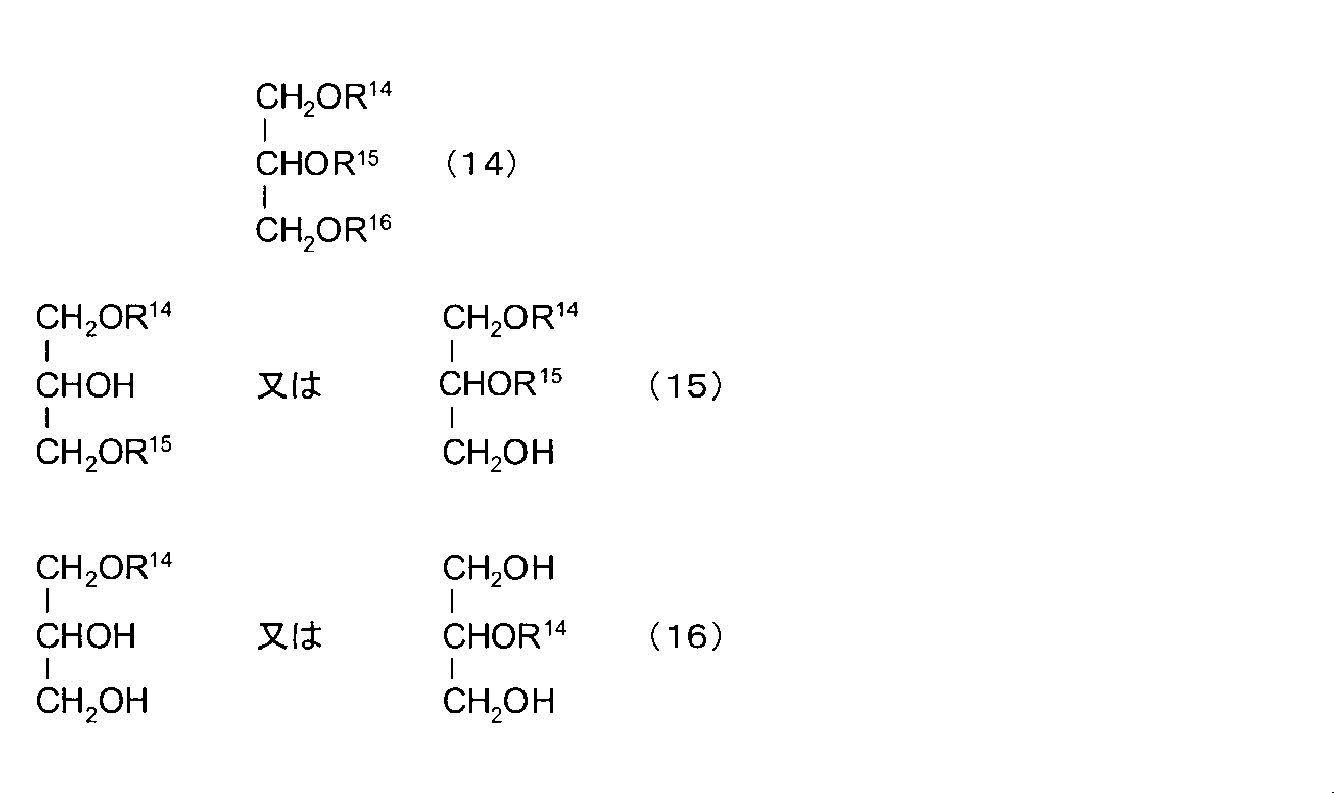
の、グリセリンと脂肪族1価アルコールとのトリエーテル、ジエーテル及びモノエーテルが挙げられる。
なお、鎖状炭化水素トリオール及び脂肪族1価アルコールは、上述の通りである。
(b3)鎖状炭化水素ジオールと少なくとも1の脂肪族1価アルコールとのエーテルとしては、次の式(17):
R17OCnH2nOR18 (17)
(式中、nは、2~6の整数であり、そしてR17及びR18は、それぞれ、鎖状炭化水素である)
のC2~C6グリコールと脂肪族1価アルコールとのジエーテル、及び次の式(18):
R17OCnH2nOH (18)
(式中、nは、2~6の整数であり、そしてR17は、鎖状炭化水素である)
のC2~C6グリコールと脂肪族1価アルコールとのモノエーテルが挙げられる。
なお、鎖状炭化水素ジオール及び脂肪族1価アルコールは、上述の通りである。
(c1)4個のカルボキシル基を有する鎖状炭化水素テトラカルボン酸、ヒドロキシ酸、アルコキシ酸又はオキソ酸と、少なくとも1の脂肪族1価アルコールとのエステルとしては、例えば、そのモノエステル、ジエステル、トリエステル及びテトラエステルが挙げられる。
(c2)3個のカルボキシル基を有する鎖状炭化水素トリカルボン酸、ヒドロキシ酸、アルコキシ酸又はオキソ酸と、少なくとも1の脂肪族1価アルコールとのエステルとしては、例えば、そのモノエステル、ジエステル及びトリエステルが挙げられる。
(c3)2個のカルボキシル基を有する鎖状炭化水素ジカルボン酸、ヒドロキシ酸、アルコキシ酸又はオキソ酸と、少なくとも1の脂肪族1価アルコールとのエステルとしては、例えば、そのモノエステル及びジエステルが挙げられる。
脂肪族1価アルコールは上述の通りであり、上記脂肪族1価アルコールと脂肪族1価アルコールとのエーテルとしては、次の式(19):
R19OR20 (19)
(式中、R19及びR20のそれぞれは、鎖状炭化水素である)
を有する化合物が挙げられる。
なお、鎖状炭化水素は、上述の通りである。
上記ジアルキルケトンとしては、次の式(20):
R21COR22 (20)
(式中、R21及びR22のそれぞれは、アルキル基である)
を有する化合物が挙げられる。
脂肪酸及び脂肪族1価アルコールは上述の通りであり、上記脂肪酸と脂肪族1価アルコールとのエステルとしては、例えば、次の式(21):
R23COOR24 (21)
(式中、R23及びR24のそれぞれは、鎖状炭化水素である)
を有する化合物が挙げられる。
なお、鎖状炭化水素は、上述の通りである。
上記ジアルキルカーボネートとしては、次の式(22):
R25OC(=O)OR26 (22)
(式中、R25及びR26のそれぞれは、アルキル基である)
を有する化合物が挙げられる。
上記ポリオキシC3~C6アルキレングリコールは、i)オキシC3~C6アルキレン骨格、すなわち、オキシプロピレン骨格、オキシブチレン骨格、オキシペンチレン骨格、及びオキシヘキシレン骨格から成る群から選択されるいずれか1種の骨格を有し且つ両末端にヒドロキシ基を有するホモポリマー、ii)上記群から選択される2種以上の骨格を有し且つ両末端にヒドロキシ基を有するブロックコポリマー、又はiii)上記群から選択される2種以上の骨格を有し且つ両末端にヒドロキシ基を有するランダムコポリマーを意味する。
HO-(CmH2mO)n-H (23)
(式中、mは3~6の整数である)
により表わされる。
上記ポリオキシC3~C6アルキレングリコールと少なくとも1の脂肪酸とのエステルとしては、「(e1)ポリオキシC3~C6アルキレングリコール」の項で説明したポリオキシC3~C6アルキレングリコールのOH末端の一方又は両方が、脂肪酸によりエステル化されているもの、すなわち、モノエステル及びジエステルが挙げられる。
なお、脂肪酸については、上述の通りである。
上記ポリオキシC3~C6アルキレングリコールと少なくとも1の脂肪族1価アルコールとのエーテルとしては、「(e1)ポリオキシC3~C6アルキレングリコール」の項で説明したポリオキシC3~C6アルキレングリコールのOH末端の一方又は両方が、脂肪族1価アルコールによりエーテル化されているもの、すなわち、モノエーテル及びジエーテルが挙げられる。
なお、脂肪族1価アルコールについては、上述の通りである。
50%ひずみ時圧縮応力が1kPaを下回ると、体圧が加わった際にゲルローションが弾性限界を超えて変形し、破壊される場合があり、そして50%ひずみ時圧縮応力が100kPaを超えると、ゲルローションの弾性が高く、体圧が加わった際にゲルローションが変形しにくく、着用者が違和感を覚える場合がある。
なお、特に規定されていない事項は、JIS K 7181:2011 「プラスチック-圧縮特性の求め方」の「3.7 x%ひずみ時圧縮応力」に従う。
(1)20℃65%RHの恒温恒湿室に、圧縮試験機を準備する。
なお、本実施例では、圧縮試験機として、小型卓上試験機EzTest(島津製作所製)を用いた。
(2)圧縮試験機に、圧縮用治具を取り付ける。
なお、本実施例では、直径120mmのステンレス製の圧縮用治具を用いた。
なお、本実施例では、直径40mm、高さ8mmの円筒形を有するゲルローションを準備した。
(4)5mm/分の圧縮速度で、圧縮量が4mm、すなわち、ひずみが50%になるまで、ゲルローションを圧縮し、圧縮力(N)を読み取る。
(5)圧縮力(N)を、圧縮応力(Pa)に換算する。
なお、圧縮応力は、異なるサンプルで実施した、3回の測定値の平均値を採用する。
上記ゲルローションは、ゲル化剤及びローションに加え、減摩剤をさらに含むことができる。上記減摩剤としては、例えば、シリコーンオイル、シリコーン系レジン、アクリル酸アルキルコポリマー、界面活性剤、長鎖脂肪族エステル等が挙げられる。上記ゲルローションが減摩剤を含むことにより、着用時に、ゲルローションと、着用者の肌との間の摩擦が少なくなり、着用者の肌がかぶれにくくなる効果が期待される。
上記静摩擦係数を達成するために、ゲルローションは、上記減摩剤を、ゲルローション100質量部(ゲル化剤及びローションの計100質量部)に対して、好ましくは0.01~20質量部、より好ましくは0.05~10質量部、そしてより好ましくは0.1~7質量部の量で含む。
(1)直径40mm、高さ8mmの円筒形を有するゲルローションを準備する。
(2)静摩擦試験機として、HEIDON トライボギア μs(ミュ-ズ) TYPE:94iを準備する(以下、「ミューズ」と略称する場合がある)。
(3)ミューズの本体に、スライダーをセットする。
(4)ミューズの電源を入れ、表示が“0.00”であることを確認する。
(6)ミューズの測定ボタンを押して、表示された値を読みとる。
(7)測定は、異なるゲルローションにおいて、計5回実施し、それらの平均値を採用する。
上記その他の成分としては、例えば、酸化防止剤、例えば、BHT(2,6-ジ-t-ブチル-p-クレゾール)、BHA(ブチル化ヒドロキシアニソール)、没食子酸プロピル等が挙げられる。
上記ビタミンとしては、例えば、脂溶性ビタミン、例えば、ビタミンA群、ビタミンD群、ビタミンE群、及びビタミンK群等が挙げられる。
上記ビタミンにはまた、それらの誘導体も含まれる。
上記その他の成分としては、例えば、アミノ酸、例えば、アラニン、アルギニン、リジン、ヒスチジン、プロリン、ヒドロキシプロリン等、並びにペプチドが挙げられる。
上記少なくとも1種の他の成分としては、例えば、コレステロール、ヒアルロン酸、レシチン、セラミド等が挙げられる。
上記皮膚収斂剤としては、例えば、酸化亜鉛、硫酸アルミニウム、タンニン酸等、油溶性皮膚収斂剤、例えば、油溶性ポリフェノールが挙げられる。上記油溶性ポリフェノールとしては、天然の油溶性ポリフェノール、例えば、オオバクエキス、オトギリソウエキス、オドリコソウエキス、カモミラエキス、ゴボウエキス、サルビアエキス、シナノキエキス、セイヨウボダイジュエキス、シラカバエキス、スギナエキス、セージエキス、サルビアエキス、テウチグルミエキス、ハイビスカスエキス、ビワ葉エキス、ボダイジュエキス、ホップエキス、マロニエエキス、ヨクイニンエキス等が挙げられる。
上記抗シワ剤としては、例えば、乳酸、サリチル酸、サリチル酸誘導体、グリコール酸、フィチン酸、リポ酸、リソフォスファチド酸が挙げられる。
上記美白剤としては、例えば、ナイアシンアミド、コウジ酸、アルブチン、グルコサミン及び誘導体、フィトステロール誘導体、アスコルビン酸及びその誘導体、並びにクワ抽出物及び胎盤抽出物が挙げられる。
上記pH調整剤としては、皮膚を弱酸性に保つためのもの、例えば、リンゴ酸、コハク酸、クエン酸、酒石酸、乳酸等が挙げられる。
上記顔料としては、例えば、酸化チタンが挙げられる。
また、上記その他の成分としては、ミネラルオイルが挙げられる。
i)2つの近接点13'及び13''の水接触角が、両方とも85°以上であること、
ii)中間点14'における水接触角が、2つの近接点相当点15'及び15''における水接触角よりも大きいこと、及び
iii)中間点14'の水接触角の、中間点相当点16'における水接触角との差が-3(°)より大きいこと、
の関係を有する。
本開示の吸収性物品では、排泄口当接域において、上述のi)~iii)の関係を有することが好ましい。本開示の効果の観点からである。
(1)20℃の恒温室に、協和界面科学製の接触角計を準備する。
(2)測定すべき試料を、上記恒温室にて24時間静置する。
(3)測定すべき試料の測定すべき箇所に、5目盛分の水滴(蒸留水)を滴下する。
(4)滴下から5秒後に、水接触角を測定する。
(5)異なる試料の、同一の場所にて測定を計10回行い、その平均値を採用する。
(1)トップシートの測定すべき範囲を、鋭利な刃物、例えば、カッターの替え刃で切り出して、サンプルを得る。
(2)サンプルの面積:S(m2)及び質量:M0(g)を測定する。
(3)サンプルを、ゲルローションが可溶な溶媒、例えば、芳香族系溶媒、例えば、キシレン等の中で、少なくとも3分間攪拌し、ゲルローションを溶媒中に溶解させる。
(5)ろ紙及びサンプルの質量を測定し、そこからろ紙の質量を減ずることにより、乾燥後のサンプルの質量:M1(g)を算出する。
(6)ゲルローションの坪量GBW(g/m2)を、次の式:
GBW(g/m2)=[M0(g)-M1(g)]/S(m2)
により算出する。
なお、誤差を少なくするために、サンプルの総面積が100cm2を超えるように、複数の吸収性物品から複数のサンプルを採取し、複数回実験を繰り返し、それらの平均値を採用する。
例えば、加熱したローションの中にゲル化剤を添加し、混合することにより塗工液を製造し、そして当該塗工液を、ゲルローションを塗工すべき吸収性物品の液透過性層に塗工することにより、吸収性物品が製造されうる。
上記非接触式のコーターとしては、例えば、スパイラルコーター、カーテンコーター、スプレーコーター、ディップコーター等が挙げられ、そして接触式のコーターとしては、例えば、スロットコーター、パターンコーター等が挙げられる。
[例1]
SEPS(スチレン含有量:20質量%,重量平均分子量:約26万)(以下、「SEPS-1」と称する場合がある)2部と、SEBS(スチレン含有量:31質量%,重量平均分子量:約16万)(以下、「SEBS-2」と称する場合がある)5部とを、約140℃に加熱したパールリーム6(日油株式会社製,流動イソパラフィン、イソブテン及びn-ブテンを共重合し、次いで水素を付加することにより生成された分岐鎖炭化水素、重合度:約5~約10,重量平均分子量:約330)90部と、シリコーンオイル(東レ・ダウコーニング株式会社製,SH200-100cs,ジメチルポリシロキサン,25℃における動粘度が100mm2/s)3部との混合物に添加し、これらを5時間、攪拌しながら混合することにより混合物を生成し、図1に示されるように、吸収性物品のトップシートの肌当接領域に塗工し、吸収性物品No.1-1を得た。吸収性物品No.1-1において、ゲル領域の幅は2mmであり、ピッチは4mmであり、そしてゲルローションの坪量は30g/m2であった。また、吸収性物品No.1-1のトップシートは、坪量:25g/m2のエアスルー不織布(以下、「不織布A」と表記する場合がある)であった。
ゲルローションの配合及び坪量を表2に示すように変更した以外は、吸収性物品No.1-1と同様にして、吸収性物品No.1-4を得た。
ゲルローションを塗工しない試料を、吸収性物品No.1-7(比較用試料)及び1-8(比較用試料)として用いた。
吸収性物品No.1-1~1-8について、水接触角を評価した。結果を併せて表2に示す。
吸収性物品No.1-1~1-8について、吸収体移行速度及びリウェット性を、以下の通り測定した。
吸収性物品のトップシートの上に、アクリル製の円筒(外径60mmφ、内径55mmφ、55g)を置き、上記円筒内に、滴下漏斗を用いて、人工尿(イオン交換水10Lに、尿素200g、塩化ナトリウム80g、硫酸マグネシウム8g、塩化カルシウム3g及び色素:青色1号約1gを溶解させることにより調製される)80mLを、8mL/秒の速度で滴下した(1回目の滴下)。
リウェット量(g)=試験後のろ紙質量(g)-当初のろ紙質量(g)
2回目の滴下におけるリウェット量と、2回目の滴下における吸収体移行速度を、併せて表2に示す。
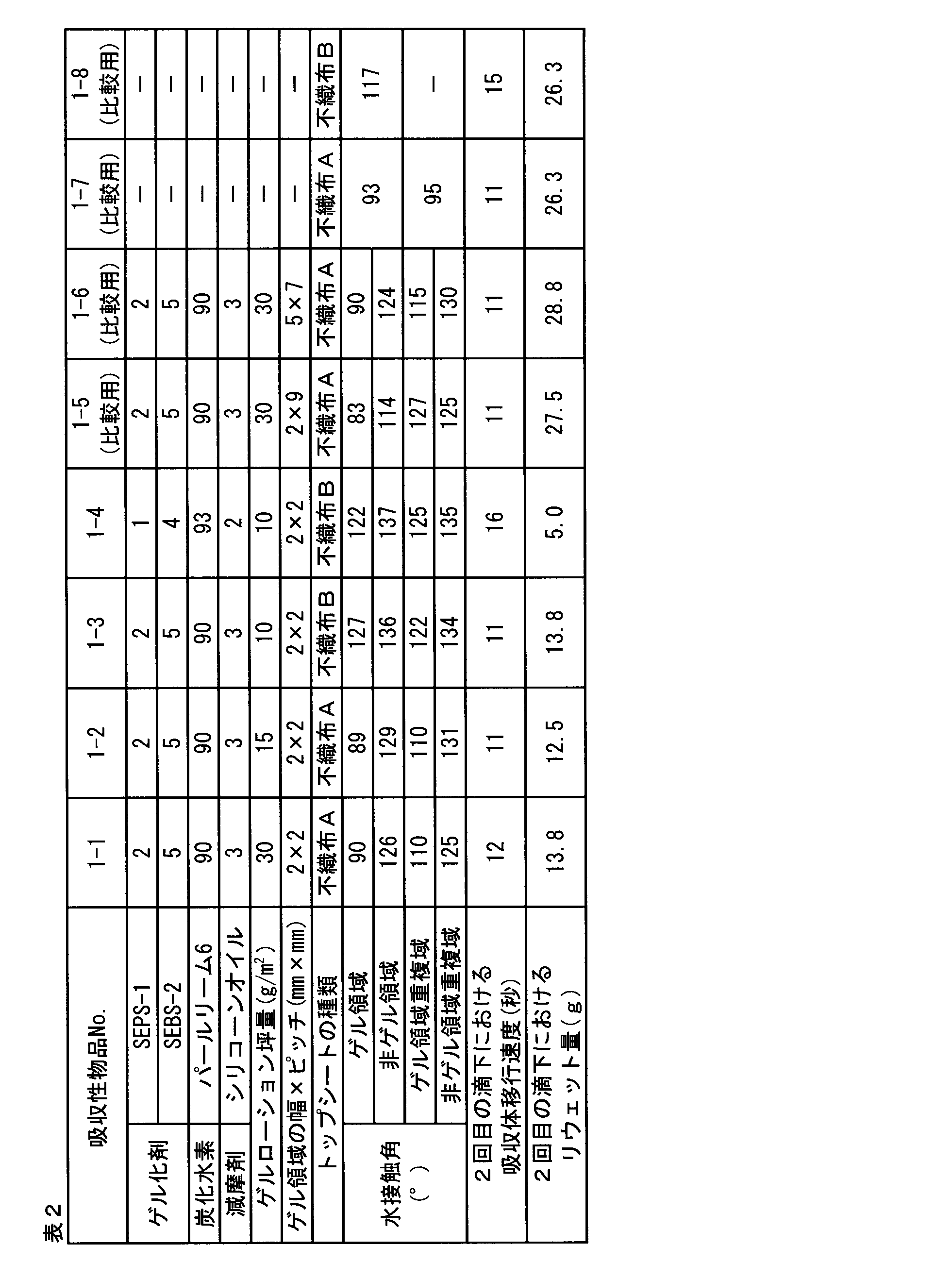
SEEPS(クラレ株式会社製,セプトン4055,スチレン含有量:30質量%,重量平均分子量:約25万)(以下、「SEEPS-2」と省略する場合がある)2部を、約140℃に加熱したパールリームEX(日油株式会社製,流動イソパラフィン、イソブテン及びn-ブテンを共重合し、次いで水素を付加することにより生成された分岐鎖炭化水素、37.8℃における動粘度が10mm2/s)98部に添加し、これらを5時間、攪拌しながら混合することにより混合物を生成し、当該混合物を直径40mmの円筒形容器に、高さ8mmまで注ぎ、次いで混合物を冷却することにより、直径40mm且つ高さ8mmの円筒形のゲルローションNo.2-1を得た。
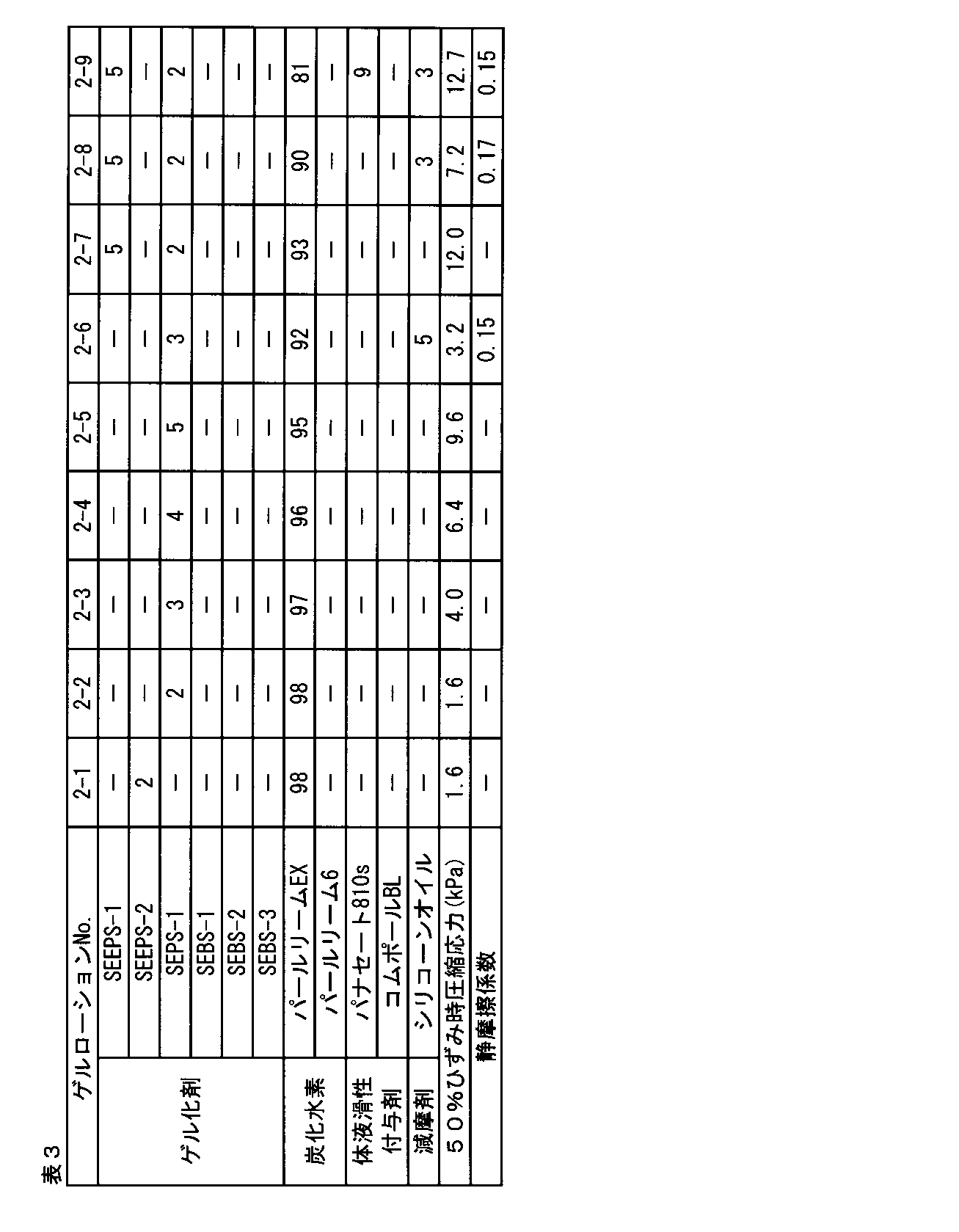
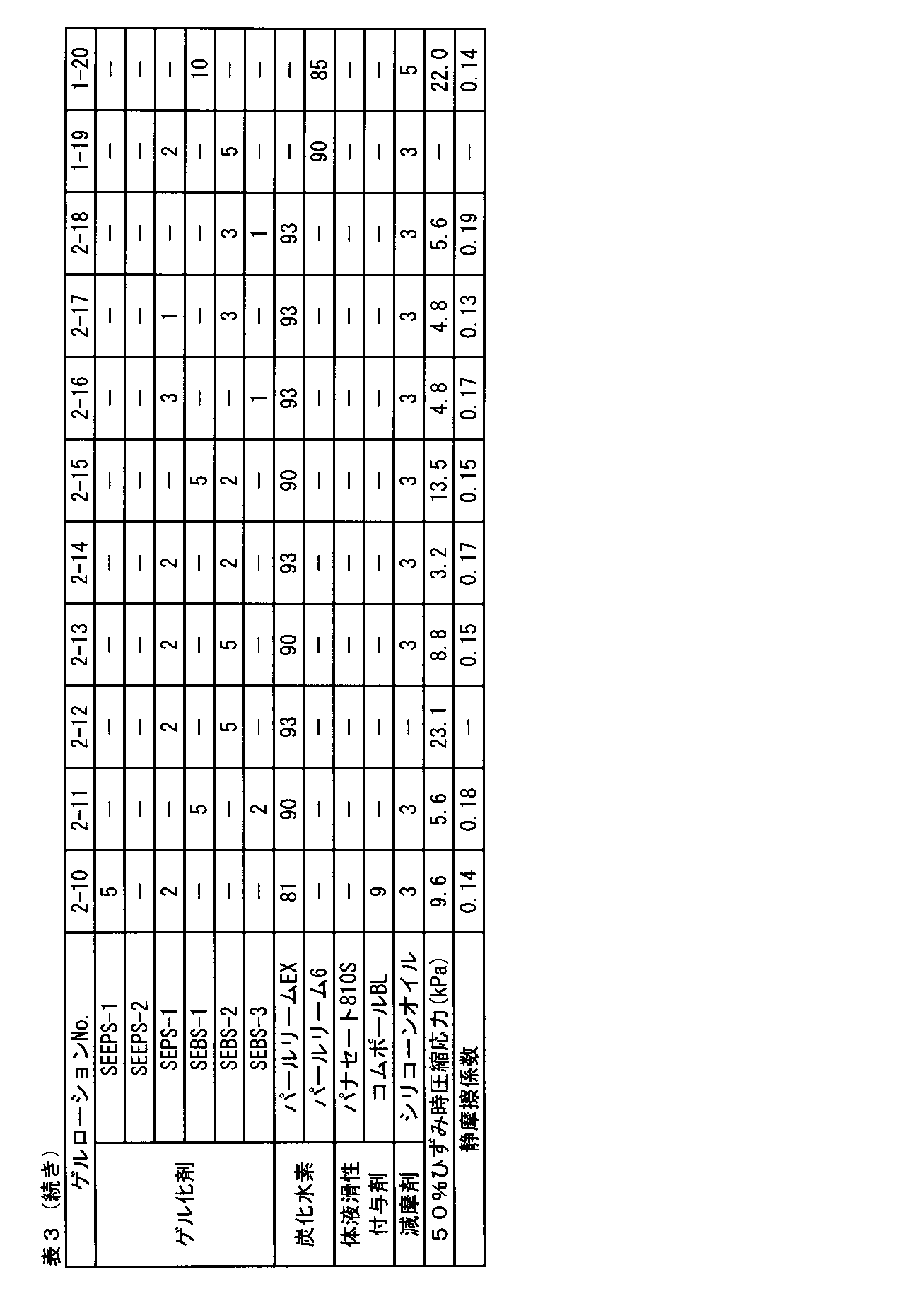
なお、表3に記載される化合物の概要は、以下の通りであるが、別の箇所で説明されているものについては、説明を省略する。
また、ゲルローションNo.2-1~2-20の50%ひずみ時圧縮応力と、静摩擦係数とを評価した。併せて表3に示す。
スチレン含有量:30質量%,重量平均分子量:約11万
・SEBS-1:
スチレン含有量:30質量%,重量平均分子量:約11万
スチレン含有量:31質量%,重量平均分子量:約16万
・SEBS-3:
スチレン含有量:33質量%,重量平均分子量:約29万
下記表4に記載される配合に従った以外は、例1のゲルローションNo.2-6を製造した手順に従って、直径40mm且つ高さ8mmの円筒形のゲルローションNo.3-1~3-4を得た。
なお、表4に記載される化合物の概要は、以下の通りである。
日油株式会社製,モノオレイン酸ソルビタン
・KP-561P
信越化学工業株式会社製,アクリレート/アクリル酸ステアリル/アクリル酸ジメチコンコポリマー
ゲルローションNo.3-1~3-4の静摩擦係数を測定した。結果を、併せて表4に示す。

下記表5に記載される配合に従い且つ内径47mmのガラス製シャーレ内に3gの量を注いだ以外は、例2のゲルローションNo.2-1又はNo.2-6を製造した手順に従って、ゲルローションNo.4-1~4-4を得た。
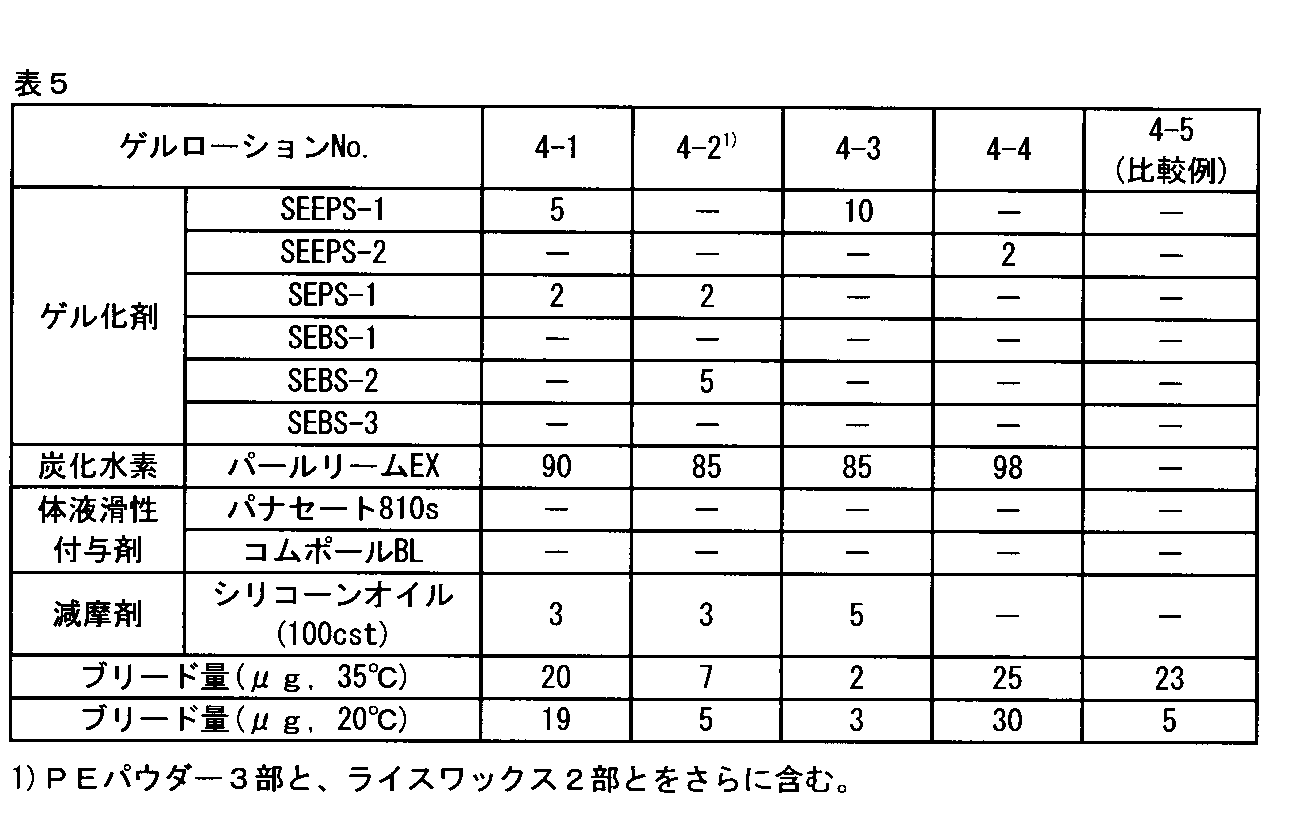
一方、ゲルローションNo.4-5(比較例)は、温度が低い場合には、ローションを放出しにくくなることが分かる。
[J1]
肌当接領域及び肌非当接領域を有する液透過性層と、液不透過性層と、上記液透過性層及び液不透過性層の間の吸収層と、ゲルローションとを備え、厚さ方向を有する吸収性物品であって、
上記ゲルローションが、ゲル化剤としてのスチレン系エラストマーと、ローションとしての炭化水素とを含み、そして
上記液透過性層が、上記肌当接領域に、上記ゲルローションを有する、複数のゲル領域と、ゲルローションを有しない非ゲル領域とを有し、そして上記肌非当接領域に、上記複数のゲル領域及び上記非ゲル領域と上記厚さ方向にそれぞれ重複する、複数のゲル領域重複域及び非ゲル領域重複域を有し、
上記複数のゲル領域のうち、お互いに隣接する2つのゲル領域の少なくとも一部において、お互いに隣接する2つのゲル領域の、お互いに最も近い点である2つの近接点と、当該2つの近接点の中間にあり且つ上記非ゲル領域に存在する中間点と、上記2つの近接点の、上記厚さ方向に重複し且つ上記ゲル領域重複域に存在する、2つの近接点相当点と、上記中間点の、上記厚さ方向に重複し且つ上記非ゲル領域重複域に存在する中間点相当点が、以下のi)~iii)
i)2つの近接点の水接触角が、両方とも85°以上であること、
ii)上記中間点における水接触角が、上記2つの近接点相当点における水接触角よりも大きいこと、及び
iii)上記中間点の水接触角の、上記中間点相当点における水接触角との差が-3(°)より大きいこと、
の関係を有する、
ことを特徴とする、上記吸収性物品。
上記ゲルローションが、1~100kPaの、50%ひずみ時圧縮応力を有する、J1に記載の吸収性物品。
[J3]
上記ゲルローションが、上記ゲル化剤及びローションを、それらの計100質量部に基づいて、それぞれ、1~30質量部及び70~99質量部の比率で含む、J1又はJ2に記載の吸収性物品。
上記スチレン系エラストマーが、両末端のポリスチレンブロックと、その間のポリオレフィンブロックとを含む、J1~J3のいずれか一項に記載の吸収性物品。
[J5]
上記スチレン系エラストマーが、10~50質量%のポリスチレンブロックと、50~90質量%のポリオレフィンブロックとを含む、J1~J4のいずれか一項に記載の吸収性物品。
上記スチレン系エラストマーが、5,000~500,000の重量平均分子量を有する、J1~J5のいずれか一項に記載の吸収性物品。
[J7]
上記ゲルローションが、減摩剤をさらに含む、J1~J6のいずれか一項に記載の吸収性物品。
上記ゲルローションが、0.01~1.00の静摩擦係数を有する、J1~J7のいずれか一項に記載の吸収性物品。
[J9]
上記ローションとして、0.00超且つ0.60以下のIOBと、40℃における0.01~80mm2/sの動粘度と、0.01~4.0質量%の抱水率と、1,000未満の重量平均分子量とを有する体液滑性付与剤をさらに含む、J1~J8のいずれか一項に記載の吸収性物品。
上記ゲルローションが、上記液透過性層の肌当接領域に、ライン状又はドット状に配置されている、J1~J9のいずれか一項に記載の吸収性物品。
[J11]
使い捨ておむつ、生理用ナプキン又はパンティーライナーである、J1~J10のいずれか一項に記載の吸収性物品。
2 トップシート
3 吸収体
4 サイドシート
5 エンボス部
6 ゲルローション
7 肌当接領域
8 ゲル領域
9 非ゲル領域
10 肌非当接領域
11 ゲル領域重複域
12 非ゲル領域重複域
13 近接点
14 中間点
15 近接点相当点
16 中間点相当点
17 ローション
Claims (11)
- 肌当接領域及び肌非当接領域を有する液透過性層と、液不透過性層と、前記液透過性層及び液不透過性層の間の吸収層と、ゲルローションとを備え、厚さ方向を有する吸収性物品であって、
前記ゲルローションが、ゲル化剤としてのスチレン系エラストマーと、ローションとしての炭化水素とを含み、そして
前記液透過性層が、前記肌当接領域に、前記ゲルローションを有する、複数のゲル領域と、ゲルローションを有しない非ゲル領域とを有し、そして前記肌非当接領域に、前記複数のゲル領域及び前記非ゲル領域と前記厚さ方向にそれぞれ重複する、複数のゲル領域重複域及び非ゲル領域重複域を有し、
前記複数のゲル領域のうち、お互いに隣接する2つのゲル領域の少なくとも一部において、お互いに隣接する2つのゲル領域の、お互いに最も近い点である2つの近接点と、当該2つの近接点の中間にあり且つ前記非ゲル領域に存在する中間点と、前記2つの近接点の、前記厚さ方向に重複し且つ前記ゲル領域重複域に存在する、2つの近接点相当点と、前記中間点の、前記厚さ方向に重複し且つ前記非ゲル領域重複域に存在する中間点相当点が、以下のi)~iii)
i)2つの近接点の水接触角が、両方とも85°以上であること、
ii)前記中間点における水接触角が、前記2つの近接点相当点における水接触角よりも大きいこと、及び
iii)前記中間点の水接触角の、前記中間点相当点における水接触角との差が-3(°)より大きいこと、
の関係を有する、
ことを特徴とする、前記吸収性物品。 - 前記ゲルローションが、1~100kPaの、50%ひずみ時圧縮応力を有する、請求項1に記載の吸収性物品。
- 前記ゲルローションが、前記ゲル化剤及びローションを、それらの計100質量部に基づいて、それぞれ、1~30質量部及び70~99質量部の比率で含む、請求項1又は2に記載の吸収性物品。
- 前記スチレン系エラストマーが、両末端のポリスチレンブロックと、その間のポリオレフィンブロックとを含む、請求項1~3のいずれか一項に記載の吸収性物品。
- 前記スチレン系エラストマーが、10~50質量%のポリスチレンブロックと、50~90質量%のポリオレフィンブロックとを含む、請求項1~4のいずれか一項に記載の吸収性物品。
- 前記スチレン系エラストマーが、5,000~500,000の重量平均分子量を有する、請求項1~5のいずれか一項に記載の吸収性物品。
- 前記ゲルローションが、減摩剤をさらに含む、請求項1~6のいずれか一項に記載の吸収性物品。
- 前記ゲルローションが、0.01~1.00の静摩擦係数を有する、請求項1~7のいずれか一項に記載の吸収性物品。
- 前記ローションとして、0.00超且つ0.60以下のIOBと、40℃における0.01~80mm2/sの動粘度と、0.01~4.0質量%の抱水率と、1,000未満の重量平均分子量とを有する体液滑性付与剤をさらに含む、請求項1~8のいずれか一項に記載の吸収性物品。
- 前記ゲルローションが、前記液透過性層の肌当接領域に、ライン状又はドット状に配置されている、請求項1~9のいずれか一項に記載の吸収性物品。
- 使い捨ておむつ、生理用ナプキン又はパンティーライナーである、請求項1~10のいずれか一項に記載の吸収性物品。
Priority Applications (5)
| Application Number | Priority Date | Filing Date | Title |
|---|---|---|---|
| CN201580029992.3A CN106413649B (zh) | 2014-06-06 | 2015-02-02 | 吸收性物品 |
| MYPI2016704488A MY182359A (en) | 2014-06-06 | 2015-02-02 | Absorbent article |
| KR1020167028783A KR102112385B1 (ko) | 2014-06-06 | 2015-02-02 | 흡수성 물품 |
| AU2015269952A AU2015269952B2 (en) | 2014-06-06 | 2015-02-02 | Absorbent article |
| BR112016028486A BR112016028486A2 (pt) | 2014-06-06 | 2015-02-02 | artigo absorvente |
Applications Claiming Priority (2)
| Application Number | Priority Date | Filing Date | Title |
|---|---|---|---|
| JP2014-117924 | 2014-06-06 | ||
| JP2014117924A JP6415119B2 (ja) | 2014-06-06 | 2014-06-06 | 吸収性物品 |
Publications (1)
| Publication Number | Publication Date |
|---|---|
| WO2015186376A1 true WO2015186376A1 (ja) | 2015-12-10 |
Family
ID=54766457
Family Applications (1)
| Application Number | Title | Priority Date | Filing Date |
|---|---|---|---|
| PCT/JP2015/052854 Ceased WO2015186376A1 (ja) | 2014-06-06 | 2015-02-02 | 吸収性物品 |
Country Status (8)
| Country | Link |
|---|---|
| JP (1) | JP6415119B2 (ja) |
| KR (1) | KR102112385B1 (ja) |
| CN (1) | CN106413649B (ja) |
| AU (1) | AU2015269952B2 (ja) |
| BR (1) | BR112016028486A2 (ja) |
| MY (1) | MY182359A (ja) |
| TW (1) | TWI648036B (ja) |
| WO (1) | WO2015186376A1 (ja) |
Cited By (1)
| Publication number | Priority date | Publication date | Assignee | Title |
|---|---|---|---|---|
| JP2017214693A (ja) * | 2016-05-31 | 2017-12-07 | 花王株式会社 | 長繊維不織布 |
Families Citing this family (9)
| Publication number | Priority date | Publication date | Assignee | Title |
|---|---|---|---|---|
| KR100436038B1 (ko) * | 2001-12-19 | 2004-06-12 | 씨제이 주식회사 | 비열처리 생식품의 제조방법 및 그로부터 수득되는 생식품 |
| CN109312530B (zh) * | 2016-05-31 | 2021-08-24 | 花王株式会社 | 无纺布 |
| WO2017209008A1 (ja) * | 2016-05-31 | 2017-12-07 | 花王株式会社 | 不織布 |
| WO2017209010A1 (ja) * | 2016-05-31 | 2017-12-07 | 花王株式会社 | 吸収性物品 |
| JP7170579B2 (ja) * | 2019-04-19 | 2022-11-14 | ユニ・チャーム株式会社 | スキンケアシート |
| CN113825476B (zh) * | 2019-04-19 | 2023-04-14 | 尤妮佳股份有限公司 | 吸收性物品 |
| JP7424874B2 (ja) * | 2020-03-13 | 2024-01-30 | 大王製紙株式会社 | 使い捨て吸収性物品 |
| CN114795670A (zh) * | 2022-03-28 | 2022-07-29 | 福建省诺华卫生用品有限公司 | 一种复合面层纸尿裤的制备方法 |
| TWI794124B (zh) * | 2022-07-04 | 2023-02-21 | 富堡工業股份有限公司 | 具氧化銦錫之尿布 |
Citations (5)
| Publication number | Priority date | Publication date | Assignee | Title |
|---|---|---|---|---|
| JP2003532803A (ja) * | 2000-04-27 | 2003-11-05 | キンバリー クラーク ワールドワイド インコーポレイテッド | ペトロラタムで改質した不織布 |
| US20040102750A1 (en) * | 2002-11-27 | 2004-05-27 | Kimberly-Clark Worldwide, Inc. | Absorbent article with a body facing liner having discretely placed lotion deposits |
| JP2004534089A (ja) * | 2001-07-03 | 2004-11-11 | ザ プロクター アンド ギャンブル カンパニー | 体液から皮膚を保護する被膜形成組成物及びそれらから製造される物品 |
| JP2009507547A (ja) * | 2005-09-09 | 2009-02-26 | ザ プロクター アンド ギャンブル カンパニー | 疎水性ローションを有する衛生ナプキン |
| JP2014068948A (ja) * | 2012-09-28 | 2014-04-21 | Uni Charm Corp | 吸収性物品 |
Family Cites Families (13)
| Publication number | Priority date | Publication date | Assignee | Title |
|---|---|---|---|---|
| JP2974693B2 (ja) * | 1988-09-06 | 1999-11-10 | 花王株式会社 | 吸収性物品の表面材 |
| US5643588A (en) | 1994-11-28 | 1997-07-01 | The Procter & Gamble Company | Diaper having a lotioned topsheet |
| US20040033750A1 (en) * | 1998-06-12 | 2004-02-19 | Everett Rob D | Layered absorbent structure with a heterogeneous layer region |
| KR100476909B1 (ko) | 1999-05-19 | 2005-03-18 | 더 프록터 앤드 갬블 캄파니 | 피부 보호 조성물을 갖는 흡수제품 |
| US20050154362A1 (en) * | 2001-10-01 | 2005-07-14 | Raphael Warren | Sanitary napkins with hydrophobic lotion and apertured topsheet |
| US20050129651A1 (en) | 2001-10-01 | 2005-06-16 | Gatto Joseph A. | Sanitary napkins with hydrophobic lotions |
| US20040170589A1 (en) | 2001-10-01 | 2004-09-02 | Gatto Joseph Anthony | Sanitary napkins with hydrophobic lotions |
| US20030082219A1 (en) * | 2001-10-01 | 2003-05-01 | The Procter & Gamble Company | Skin care compositions comprising low concentrations of skin treatment agents |
| US20060069370A1 (en) | 2004-09-30 | 2006-03-30 | Kimberly-Clark Worldwide, Inc. | Absorbent article having a liner with areas that prevent lotion and adhesive migration |
| US8211078B2 (en) | 2005-02-17 | 2012-07-03 | The Procter And Gamble Company | Sanitary napkins capable of taking complex three-dimensional shape in use |
| AR065378A1 (es) | 2007-02-16 | 2009-06-03 | Procter & Gamble | Articulo absorbente con locion que comprende un material de polipropilenglicol |
| JP6265586B2 (ja) * | 2012-02-29 | 2018-01-24 | ユニ・チャーム株式会社 | 吸収性物品 |
| CN103417337A (zh) * | 2013-07-17 | 2013-12-04 | 厦门延江工贸有限公司 | 一种无纺布 |
-
2014
- 2014-06-06 JP JP2014117924A patent/JP6415119B2/ja active Active
-
2015
- 2015-02-02 CN CN201580029992.3A patent/CN106413649B/zh not_active Expired - Fee Related
- 2015-02-02 KR KR1020167028783A patent/KR102112385B1/ko not_active Expired - Fee Related
- 2015-02-02 AU AU2015269952A patent/AU2015269952B2/en not_active Ceased
- 2015-02-02 WO PCT/JP2015/052854 patent/WO2015186376A1/ja not_active Ceased
- 2015-02-02 BR BR112016028486A patent/BR112016028486A2/pt not_active Application Discontinuation
- 2015-02-02 MY MYPI2016704488A patent/MY182359A/en unknown
- 2015-06-04 TW TW104118140A patent/TWI648036B/zh not_active IP Right Cessation
Patent Citations (5)
| Publication number | Priority date | Publication date | Assignee | Title |
|---|---|---|---|---|
| JP2003532803A (ja) * | 2000-04-27 | 2003-11-05 | キンバリー クラーク ワールドワイド インコーポレイテッド | ペトロラタムで改質した不織布 |
| JP2004534089A (ja) * | 2001-07-03 | 2004-11-11 | ザ プロクター アンド ギャンブル カンパニー | 体液から皮膚を保護する被膜形成組成物及びそれらから製造される物品 |
| US20040102750A1 (en) * | 2002-11-27 | 2004-05-27 | Kimberly-Clark Worldwide, Inc. | Absorbent article with a body facing liner having discretely placed lotion deposits |
| JP2009507547A (ja) * | 2005-09-09 | 2009-02-26 | ザ プロクター アンド ギャンブル カンパニー | 疎水性ローションを有する衛生ナプキン |
| JP2014068948A (ja) * | 2012-09-28 | 2014-04-21 | Uni Charm Corp | 吸収性物品 |
Cited By (1)
| Publication number | Priority date | Publication date | Assignee | Title |
|---|---|---|---|---|
| JP2017214693A (ja) * | 2016-05-31 | 2017-12-07 | 花王株式会社 | 長繊維不織布 |
Also Published As
| Publication number | Publication date |
|---|---|
| TWI648036B (zh) | 2019-01-21 |
| CN106413649A (zh) | 2017-02-15 |
| JP6415119B2 (ja) | 2018-10-31 |
| AU2015269952B2 (en) | 2018-12-06 |
| MY182359A (en) | 2021-01-20 |
| JP2015229071A (ja) | 2015-12-21 |
| CN106413649B (zh) | 2019-07-19 |
| BR112016028486A2 (pt) | 2017-08-22 |
| TW201545726A (zh) | 2015-12-16 |
| KR20170016321A (ko) | 2017-02-13 |
| KR102112385B1 (ko) | 2020-06-04 |
| AU2015269952A1 (en) | 2016-12-08 |
Similar Documents
| Publication | Publication Date | Title |
|---|---|---|
| JP6415119B2 (ja) | 吸収性物品 | |
| CN104661628B (zh) | 吸收性物品 | |
| CN104684517B (zh) | 吸收性物品 | |
| CN104334138B (zh) | 吸收性物品 | |
| JP6416509B2 (ja) | 吸収性物品 | |
| CN104684522B (zh) | 吸收性物品 | |
| CN104363868B (zh) | 吸收性物品 | |
| CN104684518A (zh) | 无纺布及吸收性物品 | |
| CN104487034B (zh) | 吸收性物品 | |
| CN104684520B (zh) | 无纺布及吸收性物品 | |
| CN104703565B (zh) | 吸收性物品 | |
| JP6695397B2 (ja) | 吸収性物品 | |
| TWI594739B (zh) | Absorbent article | |
| JP7499913B2 (ja) | 清浄化用シート、及び拭取性向上組成物の使用 | |
| JP7101636B2 (ja) | 吸収性物品、清浄化用シート、及び拭取性向上剤の使用 | |
| JP2024021483A (ja) | 吸収性物品 |
Legal Events
| Date | Code | Title | Description |
|---|---|---|---|
| 121 | Ep: the epo has been informed by wipo that ep was designated in this application |
Ref document number: 15802908 Country of ref document: EP Kind code of ref document: A1 |
|
| ENP | Entry into the national phase |
Ref document number: 20167028783 Country of ref document: KR Kind code of ref document: A |
|
| NENP | Non-entry into the national phase |
Ref country code: DE |
|
| ENP | Entry into the national phase |
Ref document number: 2015269952 Country of ref document: AU Date of ref document: 20150202 Kind code of ref document: A |
|
| REG | Reference to national code |
Ref country code: BR Ref legal event code: B01A Ref document number: 112016028486 Country of ref document: BR |
|
| 122 | Ep: pct application non-entry in european phase |
Ref document number: 15802908 Country of ref document: EP Kind code of ref document: A1 |
|
| ENP | Entry into the national phase |
Ref document number: 112016028486 Country of ref document: BR Kind code of ref document: A2 Effective date: 20161205 |