WO2015159922A1 - ニンジン抽出物の製造方法 - Google Patents
ニンジン抽出物の製造方法 Download PDFInfo
- Publication number
- WO2015159922A1 WO2015159922A1 PCT/JP2015/061617 JP2015061617W WO2015159922A1 WO 2015159922 A1 WO2015159922 A1 WO 2015159922A1 JP 2015061617 W JP2015061617 W JP 2015061617W WO 2015159922 A1 WO2015159922 A1 WO 2015159922A1
- Authority
- WO
- WIPO (PCT)
- Prior art keywords
- carrot
- extract
- ethanol
- volume
- carrot extract
- Prior art date
- Legal status (The legal status is an assumption and is not a legal conclusion. Google has not performed a legal analysis and makes no representation as to the accuracy of the status listed.)
- Ceased
Links
Classifications
-
- A—HUMAN NECESSITIES
- A61—MEDICAL OR VETERINARY SCIENCE; HYGIENE
- A61K—PREPARATIONS FOR MEDICAL, DENTAL OR TOILETRY PURPOSES
- A61K36/00—Medicinal preparations of undetermined constitution containing material from algae, lichens, fungi or plants, or derivatives thereof, e.g. traditional herbal medicines
- A61K36/18—Magnoliophyta (angiosperms)
- A61K36/185—Magnoliopsida (dicotyledons)
- A61K36/23—Apiaceae or Umbelliferae (Carrot family), e.g. dill, chervil, coriander or cumin
-
- A—HUMAN NECESSITIES
- A23—FOODS OR FOODSTUFFS; TREATMENT THEREOF, NOT COVERED BY OTHER CLASSES
- A23L—FOODS, FOODSTUFFS OR NON-ALCOHOLIC BEVERAGES, NOT OTHERWISE PROVIDED FOR; PREPARATION OR TREATMENT THEREOF
- A23L33/00—Modifying nutritive qualities of foods; Dietetic products; Preparation or treatment thereof
- A23L33/10—Modifying nutritive qualities of foods; Dietetic products; Preparation or treatment thereof using additives
- A23L33/105—Plant extracts, their artificial duplicates or their derivatives
-
- A—HUMAN NECESSITIES
- A61—MEDICAL OR VETERINARY SCIENCE; HYGIENE
- A61P—SPECIFIC THERAPEUTIC ACTIVITY OF CHEMICAL COMPOUNDS OR MEDICINAL PREPARATIONS
- A61P15/00—Drugs for genital or sexual disorders; Contraceptives
- A61P15/10—Drugs for genital or sexual disorders; Contraceptives for impotence
-
- A—HUMAN NECESSITIES
- A61—MEDICAL OR VETERINARY SCIENCE; HYGIENE
- A61P—SPECIFIC THERAPEUTIC ACTIVITY OF CHEMICAL COMPOUNDS OR MEDICINAL PREPARATIONS
- A61P25/00—Drugs for disorders of the nervous system
-
- A—HUMAN NECESSITIES
- A61—MEDICAL OR VETERINARY SCIENCE; HYGIENE
- A61P—SPECIFIC THERAPEUTIC ACTIVITY OF CHEMICAL COMPOUNDS OR MEDICINAL PREPARATIONS
- A61P25/00—Drugs for disorders of the nervous system
- A61P25/28—Drugs for disorders of the nervous system for treating neurodegenerative disorders of the central nervous system, e.g. nootropic agents, cognition enhancers, drugs for treating Alzheimer's disease or other forms of dementia
-
- A—HUMAN NECESSITIES
- A61—MEDICAL OR VETERINARY SCIENCE; HYGIENE
- A61P—SPECIFIC THERAPEUTIC ACTIVITY OF CHEMICAL COMPOUNDS OR MEDICINAL PREPARATIONS
- A61P3/00—Drugs for disorders of the metabolism
- A61P3/02—Nutrients, e.g. vitamins, minerals
-
- A—HUMAN NECESSITIES
- A61—MEDICAL OR VETERINARY SCIENCE; HYGIENE
- A61P—SPECIFIC THERAPEUTIC ACTIVITY OF CHEMICAL COMPOUNDS OR MEDICINAL PREPARATIONS
- A61P35/00—Antineoplastic agents
-
- A—HUMAN NECESSITIES
- A61—MEDICAL OR VETERINARY SCIENCE; HYGIENE
- A61P—SPECIFIC THERAPEUTIC ACTIVITY OF CHEMICAL COMPOUNDS OR MEDICINAL PREPARATIONS
- A61P7/00—Drugs for disorders of the blood or the extracellular fluid
- A61P7/02—Antithrombotic agents; Anticoagulants; Platelet aggregation inhibitors
-
- A—HUMAN NECESSITIES
- A61—MEDICAL OR VETERINARY SCIENCE; HYGIENE
- A61P—SPECIFIC THERAPEUTIC ACTIVITY OF CHEMICAL COMPOUNDS OR MEDICINAL PREPARATIONS
- A61P9/00—Drugs for disorders of the cardiovascular system
-
- A—HUMAN NECESSITIES
- A61—MEDICAL OR VETERINARY SCIENCE; HYGIENE
- A61P—SPECIFIC THERAPEUTIC ACTIVITY OF CHEMICAL COMPOUNDS OR MEDICINAL PREPARATIONS
- A61P9/00—Drugs for disorders of the cardiovascular system
- A61P9/08—Vasodilators for multiple indications
-
- A—HUMAN NECESSITIES
- A61—MEDICAL OR VETERINARY SCIENCE; HYGIENE
- A61P—SPECIFIC THERAPEUTIC ACTIVITY OF CHEMICAL COMPOUNDS OR MEDICINAL PREPARATIONS
- A61P9/00—Drugs for disorders of the cardiovascular system
- A61P9/10—Drugs for disorders of the cardiovascular system for treating ischaemic or atherosclerotic diseases, e.g. antianginal drugs, coronary vasodilators, drugs for myocardial infarction, retinopathy, cerebrovascula insufficiency, renal arteriosclerosis
-
- A—HUMAN NECESSITIES
- A61—MEDICAL OR VETERINARY SCIENCE; HYGIENE
- A61P—SPECIFIC THERAPEUTIC ACTIVITY OF CHEMICAL COMPOUNDS OR MEDICINAL PREPARATIONS
- A61P9/00—Drugs for disorders of the cardiovascular system
- A61P9/12—Antihypertensives
Definitions
- the present invention relates to a carrot extract production method, a coloring reduction method, and a color stabilization method.
- Carrot (Ginseng, Panax ginseng) is a medicinal plant that has been known for a long time. Ginsenoside is known as a medicinal component, and 50 or more ginsenosides have been isolated from carrots so far. In addition to the well-known tonic effect of carrots or ginsenosides, in recent years, antitumor action, anti-arteriosclerosis / antihypertensive action, anti-stress action, immunoregulatory action, anti-inflammatory / anti-allergic action, anti-diabetes mellitus Various effects such as action, action on central nervous system, improvement of memory and learning, neuroprotection, neurotransmitter release or uptake action have been found (Non-patent Documents 1 and 2). More recently, it has been found that an extract of carrot has an action of promoting responsiveness of CGRP (Patent Document 1).
- the ginsenoside contained in the carrot is mainly ginsenoside Rb1 or Rb2, and hardly contains ginsenoside Rg3. It is known that ginsenoside Rg3 is slightly contained in red ginseng steamed with carrot and dried.
- Ginsenoside Rg3 can be used for blood circulation improvement, erectile dysfunction improvement, fatigue recovery, hypertension, arteriosclerosis, antithrombosis, treatment and prevention of stroke, brain function improvement, vascular relaxation action, platelet aggregation inhibitory action, cranial nerve It has been reported to have a cytoprotective action and an anticancer action (Patent Documents 2 to 4).
- Patent Document 2 In order to improve the content of such ginsenoside Rg3, after extracting carrot with water or an organic solvent, the extract is hydrolyzed with an acid, and the hydrolyzed solution is adsorbed by a macroporous resin (Patent Document 2). ), A method of adding vinegar to carrot and extracting by heating (Patent Document 3), and a method of heating carrot at a high temperature (Patent Document 5).
- Patent Document 1 Japanese Patent Application Laid-Open No. 2012-116763
- Patent Document 2 Japanese Translation of PCT International Publication No. 2009-500432
- Patent Document 3 Japanese Patent Application Publication No. 2007-520418
- Patent Document 4 Japanese Patent Application Publication No. 2006-502082
- Patent Document 4 Reference 5] Japanese Patent Publication No. 11-501322
- Non-Patent Document 1 Advances in Food and Nutrition Research, 2009, 55: 1-99
- Non-Patent Document 2 Phytochemical Analysis, 2008, 19: 2-16
- the present invention relates to the following.
- a method for producing a carrot extract comprising the following steps (1) to (3). (1) Step of heating and extracting carrot in water at 95 to 100 ° C. for 0.5 to 50 hours (2) The heating extract obtained in (1) is adjusted so that the ethanol concentration becomes 60 to 90% by volume. (3) Step of purifying the crude carrot extract obtained in (2) with an adsorption column packed with macroporous resin 2) 1 The carrot extract obtained by the production method described in 1). 3) A carrot characterized by purifying a heated extract of carrot with an adsorption column filled with a macroporous resin after adding ethanol so that the ethanol concentration is 60 to 90% by volume and removing the precipitate. A method for reducing the coloration of an extract. 4) A carrot characterized by purifying a heated extract of carrot with an adsorption column filled with macroporous resin after adding ethanol so that the ethanol concentration is 60 to 90% by volume and removing the precipitate. Method for color stabilization of the extract.
- the method of hydrolyzing the carrot by heating is preferable from the viewpoint of simplification of the treatment, but there is a possibility that the reaction solution obtained may be colored and the obtained treatment liquid may be colored.
- the present invention relates to providing a method for producing a carrot extract containing Rg3 at a high concentration, reduced in coloration and excellent in color stability.
- the present inventors reduced the coloration by treating the heated extract with ethanol and then purifying it with an adsorption column packed with resin.
- the inventors have found that the color stability can be improved and that Rg3 can be contained at a high concentration, and the present invention has been completed.
- carrot refers to Panax ginseng belonging to the genus Tochibaninjin.
- various types of carrots such as fresh dried carrots that are dried as they are, dried white ginseng excluding pericards and fine roots, dried red ginseng after steaming, and all of them are used in the present invention.
- Red ginseng is particularly preferable because malonylated ginsenoside is demalonylated in the steaming step and contains ginsenoside Rg3 from which the sugar at position 20 of ginsenoside Rg2 is eliminated.
- the carrot can be used in any arbitrary part, for example, whole grass, leaves, stems, buds, flowers, buds, roots, rhizomes, corms, corms, tubers, seeds, etc., or a combination thereof. Rhizomes are preferably used, and fine roots are most preferably used.
- the part may be subjected to heat extraction as it is, or may be subjected to heat extraction after being pulverized, cut or dried.
- Heat extraction In this process, water is added to the above-mentioned carrot, and heat extraction is performed to obtain a heat extract. It does not restrict
- the heating temperature is 95 ° C. or more and 100 ° C. or less and 95 to 100 ° C. from the viewpoint of Rg3 production. Preferably it is 100 degreeC.
- the said heat time is 0.5 hour or more from a viewpoint of a process improvement, Preferably it is 1 hour or more, More preferably, it is 15 hours or more, and is 50 hours or less, Preferably it is 30 hours or less. Further, it is in the range of 0.5 to 50 hours, preferably 1 to 50 hours, more preferably 15 to 30 hours.
- ethanol is added so that the concentration of ethanol is 60% by volume or more, preferably 70% by volume or more, 95% by volume or less, preferably 90% by volume or less, from the viewpoint of removing the coloring components. Further, ethanol is added so as to be in the range of 60 to 95% by volume, preferably 70 to 90% by volume.
- the amount of ethanol used is preferably 5 mL or more, more preferably 10 mL or more, preferably 200 mL or less, more preferably 100 mL or less with respect to 1 g of carrot (in terms of dry mass). Further, it is preferably 5 to 200 mL, more preferably 10 to 100 mL.
- the treatment temperature is 0 ° C. or higher, preferably 10 ° C. or higher and 40 ° C. or lower, preferably 30 ° C. or lower. Further, it is in the range of 0 to 40 ° C., more preferably in the range of 10 to 30 ° C., or room temperature. Further, the treatment time is 30 minutes or longer, preferably 1 hour or longer and 20 hours or shorter, preferably 5 hours or shorter from the viewpoint of improving the processing. Further, it is in the range of 1 to 20 hours, preferably 1 to 5 hours.
- the solution from which the precipitate has been removed after the ethanol treatment can be made into a crude carrot extract by removing ethanol under reduced pressure.
- This step is a step of purifying the crude carrot extract obtained in (2) with an adsorption column packed with a macroporous resin. Specifically, the crude carrot extract is passed through the adsorption column to adsorb hydrophobic components, and then preferably 10 to 50% by volume of ethanol is passed through to remove non-adsorbed substances ( After removing sugars, organic acids, etc.), the hydrophobic component is preferably eluted with 30 to 80% ethanol, and the eluate can be collected to obtain a carrot extract.
- a solvent such as a mixed solvent of water, ethanol, methanol, and isopropyl alcohol can be added.
- the macroporous resin to be filled those described in JP-T-2009-500432 can be used. Specifically, a hydrophilic vinyl polymer resin (“Toyopearl HW40” manufactured by Tosoh Corporation), styrene-divinylbenzene. Resin (“Separbeads SP-850” manufactured by Mitsubishi Chemical Corporation) and gel type synthetic resin ("Diaion HP-20” manufactured by Mitsubishi Chemical Corporation).
- Toyopearl HW40 manufactured by Tosoh Corporation
- Resin Synparbeads SP-850
- Gel type synthetic resin Diaion HP-20 manufactured by Mitsubishi Chemical Corporation
- the adsorbate adsorbed on the resin can be recovered by elution with an eluent such as methanol or isopropyl alcohol in addition to ethanol.
- an eluent such as methanol or isopropyl alcohol in addition to ethanol.
- the amount of eluate used is preferably 1 mL or more, more preferably 5 mL or more, preferably 100 mL or less, more preferably 50 mL or less, with respect to 1 g of carrot (in terms of dry mass). Further, it is preferably 1 to 100 mL, more preferably 5 to 50 mL.
- the carrot extract that has undergone the above-described steps has reduced coloration (Test Example 1) and excellent color stability (Test Example 2).
- the content of Rg3 represented by the following formula in the carrot extract obtained is a solid content that is the remaining amount when dried, preferably 1% by mass or more, more preferably 3% by mass or more, preferably 20% by mass. % Or less, more preferably 10% by mass or less. Further, it is preferably 1 to 20% by mass, more preferably 3 to 10% by mass.
- the carrot extract thus obtained can be used as it is or as a diluted solution diluted with an appropriate solvent, or it can be concentrated, dried powder, or prepared as a paste. Also, freeze-dry and dilute with a solvent usually used for extraction, such as water, ethanol, propylene glycol, butylene glycol, water / ethanol mixture, water / propylene glycol mixture, water / butylene glycol mixture, etc. It can also be used. It can also be used by encapsulating in vesicles such as liposomes or microcapsules.
- a method for producing a carrot extract comprising the following steps (1) to (3).
- the heating extract obtained in (1) is adjusted so that the ethanol concentration becomes 60 to 90% by volume.
- Step of adding ethanol to the mixture and removing the precipitate to obtain a crude carrot extract (3) Step of purifying the crude carrot extract obtained in (2) with an adsorption column packed with a macroporous resin ⁇ 2>
- the carrot extract is characterized in that the heated extract of carrot is purified by an adsorption column filled with macroporous resin after adding ethanol so that the ethanol concentration becomes 60 to 90% by volume and removing the precipitate. Coloring reduction method.
- a heated extract of carrot is purified by an adsorption column filled with macroporous resin after adding ethanol so that the ethanol concentration is 60 to 90% by volume and removing the precipitate. Color stabilization method for carrot extract.
- the heat extract of carrot is obtained by a heat extraction step in water at 95 to 100 ° C. for 0.5 to 30 hours.
- the amount of water used in the heat extraction step is preferably 1 mL or more, more preferably 5 mL or more, preferably 100 mL or less, with respect to 1 g of carrot (in terms of dry mass). More preferably, it is 50 mL or less, preferably 1 to 100 mL, more preferably 5 to 20 mL.
- the heating temperature in the heating extraction step is preferably 100 ° C.
- the heating time in the heating extraction step is preferably 1 hour or more, more preferably 15 hours or more, 50 hours or less, preferably 30 hours or less. Further, it is preferably in the range of 1 to 50 hours, more preferably 15 to 30 hours.
- the ethanol concentration is 60% by volume or more, preferably 70% by volume or more and 95% by volume or less, preferably 90% by volume or less, and 60 to Ethanol is added so as to be in the range of 95% by volume, preferably 70 to 90% by volume.
- the amount of ethanol used in the ethanol treatment step is preferably 5 mL or more, more preferably 10 mL or more, preferably 200 mL or less, with respect to 1 g of carrot (in terms of dry mass). More preferably, it is 100 mL or less, preferably 5 to 200 mL, more preferably 10 to 100 mL.
- the treatment temperature in the ethanol treatment step is 0 ° C. or higher, preferably 10 ° C. or higher, 40 ° C. or lower, preferably 30 ° C. or lower, and 0-40 ° C. or higher. A range of 10 to 30 ° C.
- the treatment time in the ethanol treatment step is 30 minutes or more, preferably 1 hour or more, 20 hours or less, preferably 5 hours or less, and 1 to 20 hours, preferably Is in the range of 1 to 5 hours.
- the crude carrot extract obtained in the ethanol treatment step is passed through an adsorption column to adsorb hydrophobic components, and then preferably 10-50 volume% ethanol is passed through to remove non-adsorbed substances (saccharides, organic acids, etc.) in the column, and then the hydrophobic component is eluted with preferably 30-80% ethanol, and the eluate Recover.
- the Rg3 content is a solid content which is a remaining amount when dried, preferably 1% by mass or more, more preferably 3% by mass or more, preferably 20% by mass or less, more preferably It is 10% by mass or less, preferably 1 to 20% by mass, more preferably 3 to 10% by mass.
- Test Example 1 Coloring reduction effect by ethanol treatment and adsorption column treatment
- Extraction treatment Red ginseng obtained from Shinwa Bussan 20 g was crushed, 200 mL of ion-exchanged water was added, and a Chinese-style decoction machine (EK-SA10 type) was used. After extraction with hot water at 100 ° C. for 30 hours, each of the solvents shown in Table 1 below was added, and the mixture was allowed to stand for 1 hour and then filtered to obtain treatment liquids 1 to 3.
- the degree of coloration of each treatment solution obtained was measured by dropping a sample into a glass cell using a HITACHI spectrophotometer (model U-2001 type).
- the measurement wavelength of the spectrophotometer at the time of analysis was set to 450 nm.
- the amount of Rg3 is a value determined by HPLC under the conditions shown in Table 2 below.
- the treatment liquids 1 and 2 obtained by treating the heated extract of carrot with ethanol or an aqueous ethanol solution reduce the amount of Rg3 in the crude carrot extract compared to the treatment liquid 3 not subjected to the ethanol treatment. And coloring was reduced.
- Example 2 60 mL of ethanol and 140 mL of water were added to 200 mL of the treatment liquid 2, and the mixture was passed through an adsorption column packed with Diaion HP-20 (manufactured by Mitsubishi Chemical Corporation). Subsequently, it was washed with 0.6 L of 40 volume% ethanol, and finally recovered with 1 L of 60 volume% ethanol, and the 60 volume% ethanol fraction was dried to obtain 1.90 g of the solid content of Example 2 in Table 3. .
- Test Example 2 Color stability The coloration degree of carrot extract A obtained by the same method as in Example 1 and carrot extract B obtained by the same method as in Comparative Example 1, and 1 at 60 ° C. The degree of coloring after standing for months was measured by the same method as above, and the results are shown in Table 4 below.
- the carrot extract A subjected to the ethanol extraction treatment and the adsorption column treatment has improved color stability compared to the carrot extract B not subjected to the adsorption column treatment.
- Test Example 3 Examination of extraction conditions 100 g of red ginseng (obtained from Shinwa Bussan) was pulverized, added with 850 mL of ion-exchanged water, and extracted under the conditions shown in Table 5 below. After adding 3400 mL of ethanol to the crude extract, the mixture was filtered to remove the solvent to obtain an extract. About each, the amount of Rg3 per 1g of solid content (solid content) which is a residual amount when an extract was dried was calculated
- carrot extraction is preferably performed at a temperature exceeding 90 ° C., and optimally performed at 100 ° C. for 30 hours.
Landscapes
- Health & Medical Sciences (AREA)
- Life Sciences & Earth Sciences (AREA)
- Engineering & Computer Science (AREA)
- Chemical & Material Sciences (AREA)
- Pharmacology & Pharmacy (AREA)
- Bioinformatics & Cheminformatics (AREA)
- Veterinary Medicine (AREA)
- Public Health (AREA)
- General Health & Medical Sciences (AREA)
- Medicinal Chemistry (AREA)
- Animal Behavior & Ethology (AREA)
- Chemical Kinetics & Catalysis (AREA)
- Nuclear Medicine, Radiotherapy & Molecular Imaging (AREA)
- General Chemical & Material Sciences (AREA)
- Organic Chemistry (AREA)
- Heart & Thoracic Surgery (AREA)
- Natural Medicines & Medicinal Plants (AREA)
- Cardiology (AREA)
- Biomedical Technology (AREA)
- Neurology (AREA)
- Neurosurgery (AREA)
- Mycology (AREA)
- Botany (AREA)
- Hematology (AREA)
- Diabetes (AREA)
- Nutrition Science (AREA)
- Hospice & Palliative Care (AREA)
- Obesity (AREA)
- Gynecology & Obstetrics (AREA)
- Endocrinology (AREA)
- Reproductive Health (AREA)
- Psychiatry (AREA)
- Alternative & Traditional Medicine (AREA)
- Biotechnology (AREA)
- Vascular Medicine (AREA)
- Medical Informatics (AREA)
- Microbiology (AREA)
- Urology & Nephrology (AREA)
- Epidemiology (AREA)
- Food Science & Technology (AREA)
Abstract
Rg3を高い濃度で含有し、着色が低減され、且つ色安定性に優れたニンジン抽出物の製造方法の提供。 下記の工程(1)~(3)を含むニンジン抽出物の製造方法。 (1)ニンジンを、水中で95~100℃、0.5~50時間、加熱抽出する工程 (2)(1)で得られた加熱抽出物を、エタノール濃度が60~90容量%となるようにエタノールを添加し、沈殿物を除去して粗ニンジン抽出物を得る工程 (3)(2)で得られた粗ニンジン抽出物を、マクロポーラス樹脂を充填した吸着カラムで精製する工程
Description
本発明は、ニンジン抽出物の製造方法、着色低減方法及び色安定化方法に関する。
ニンジン(オタネニンジン、Panax ginseng)は古くから知られる薬用植物である。薬効成分としてはジンセノシドが知られており、これまでに50種以上のジンセノシドがニンジンから単離されている。ニンジン又はジンセノシドの効果としては、よく知られている強壮作用に加え、近年では、抗腫瘍作用、抗動脈硬化/抗高血圧作用、抗ストレス作用、免疫調節作用、抗炎症/抗アレルギー作用、抗糖尿病作用、中枢神経への作用、記憶や学習向上、神経保護、神経伝達物質放出若しくは取り込み作用等の多岐にわたる効果が見出されている(非特許文献1、2)。更に最近、ニンジンの抽出物にCGRPの応答性を促進する作用があることが見出されている(特許文献1)。
ニンジンに含まれるジンセノシドは、主としてジンセノシドRb1やRb2であり、ジンセノシドRg3はほとんど含まれていない。ジンセノシドRg3はニンジンを蒸して乾燥した紅参において、わずかに含まれることが知られている。
ジンセノシドRg3は、血液循環改善、勃起不全改善、疲労回復、高血圧、動脈硬化、抗血栓、脳卒中の治療及び予防、脳機能改善に使用することができ、また血管弛緩作用、血小板凝集抑制作用、脳神経細胞保護作用、抗癌作用を有することが報告されている(特許文献2~4)。
斯かるジンセノシドRg3の含有量を向上させるために、ニンジンを水又は有機溶媒を抽出した後に、その抽出物を酸で加水分解して、加水分解溶液をマクロポーラス樹脂により吸着させる手法(特許文献2)や、ニンジンに酢を加えて加熱抽出する手法や(特許文献3)、ニンジンを高温で加熱処理する手法(特許文献5)が試みられている。
〔特許文献1〕特開2012-116763号公報
〔特許文献2〕特表2009-500432号公報
〔特許文献3〕特表2007-520418号公報
〔特許文献4〕特表2006-502082号公報
〔特許文献5〕特表平11-501322号公報
〔非特許文献1〕Advances in Food and Nutrition Research, 2009, 55:1-99
〔非特許文献2〕Phytochemical Analysis, 2008, 19:2-16
〔特許文献2〕特表2009-500432号公報
〔特許文献3〕特表2007-520418号公報
〔特許文献4〕特表2006-502082号公報
〔特許文献5〕特表平11-501322号公報
〔非特許文献1〕Advances in Food and Nutrition Research, 2009, 55:1-99
〔非特許文献2〕Phytochemical Analysis, 2008, 19:2-16
本発明は、下記に係るものである。
1)下記の工程(1)~(3)を含むニンジン抽出物の製造方法。
(1)ニンジンを、水中で95~100℃、0.5~50時間、加熱抽出する工程
(2)(1)で得られた加熱抽出物を、エタノール濃度が60~90容量%となるようにエタノールを添加し、沈殿物を除去して粗ニンジン抽出物を得る工程
(3)(2)で得られた粗ニンジン抽出物を、マクロポーラス樹脂を充填した吸着カラムで精製する工程
2)1)に記載の製造方法により得られるニンジン抽出物。
3)ニンジンの加熱抽出物を、エタノール濃度が60~90容量%となるようにエタノールを添加し、沈殿物を除去した後に、マクロポーラス樹脂を充填した吸着カラムで精製することを特徴とするニンジン抽出物の着色低減方法。
4)ニンジンの加熱抽出物を、エタノール濃度が60~90容量%となるようにエタノールを添加し、沈殿物を除去した後に、マクロポーラス樹脂を充填した吸着カラムで精製することを特徴とするニンジン抽出物の色安定化方法。
1)下記の工程(1)~(3)を含むニンジン抽出物の製造方法。
(1)ニンジンを、水中で95~100℃、0.5~50時間、加熱抽出する工程
(2)(1)で得られた加熱抽出物を、エタノール濃度が60~90容量%となるようにエタノールを添加し、沈殿物を除去して粗ニンジン抽出物を得る工程
(3)(2)で得られた粗ニンジン抽出物を、マクロポーラス樹脂を充填した吸着カラムで精製する工程
2)1)に記載の製造方法により得られるニンジン抽出物。
3)ニンジンの加熱抽出物を、エタノール濃度が60~90容量%となるようにエタノールを添加し、沈殿物を除去した後に、マクロポーラス樹脂を充填した吸着カラムで精製することを特徴とするニンジン抽出物の着色低減方法。
4)ニンジンの加熱抽出物を、エタノール濃度が60~90容量%となるようにエタノールを添加し、沈殿物を除去した後に、マクロポーラス樹脂を充填した吸着カラムで精製することを特徴とするニンジン抽出物の色安定化方法。
上記のニンジンを加熱により加水分解する方法は、処理の簡便化の点で好ましいが、低い反応効率や、得られる処理液が着色するおそれがあり、改良の余地があった。
本発明は、Rg3を高い濃度で含有し、着色が低減され、且つ色安定性に優れたニンジン抽出物の製造方法を提供することに関する。
本発明は、Rg3を高い濃度で含有し、着色が低減され、且つ色安定性に優れたニンジン抽出物の製造方法を提供することに関する。
本発明者らは、ニンジンを熱水抽出して得られるニンジン抽出物の調製法について検討した結果、加熱抽出物をエタノール処理し、その後樹脂を充填した吸着カラムで精製することにより、着色の低減及び色安定性を向上させることができ、更にRg3を高い濃度で含有できることを見出し、本発明を完成した。
本発明の製造方法によれば、着色が低減されるとともに、色安定性の優れたRg3高含有ニンジン抽出物を得ることができる。
本明細書において、ニンジンとは、ウコギ科トチバニンジン属のオタネニンジン(Panax ginseng)をさす。
またニンジンには、新鮮根をそのまま乾燥した生干ニンジン、周皮や細根を除いて乾燥した白参、蒸したのちに乾燥した紅参などの種類があり、本発明においては、いずれも用いることができる。特に紅参は、蒸す工程でマロニル化ジンセノシドの脱マロニル化が進行するとともに、ジンセノシドRg2の20位の糖が脱離したジンセノシドRg3を含むため好ましい。
またニンジンには、新鮮根をそのまま乾燥した生干ニンジン、周皮や細根を除いて乾燥した白参、蒸したのちに乾燥した紅参などの種類があり、本発明においては、いずれも用いることができる。特に紅参は、蒸す工程でマロニル化ジンセノシドの脱マロニル化が進行するとともに、ジンセノシドRg2の20位の糖が脱離したジンセノシドRg3を含むため好ましい。
上記ニンジンは、いずれの任意の部位、例えば全草、葉、茎、芽、花、蕾、根、根茎、仮球茎、球茎、塊茎、種子等、又はそれらの組み合わせを使用することができるが、根茎を用いるのが好ましく、細根を用いることが最も好ましい。上記部位は、そのまま加熱抽出に付されてもよく、又は粉砕、切断若しくは乾燥された後に加熱抽出に付されてもよい。
(1)加熱抽出
本工程では、上述のニンジンに水を加え、加熱抽出し、加熱抽出物を得る工程である。
抽出方法としては、特に制限されず、既知の方法、例えばバッチ攪拌式、連続流通式や、ソックスレー抽出器等の抽出器具を用いて行うことができる。加熱処理の際には蒸留水、イオン交換水等を用いることができる。また、抽出時間を短縮する場合には、攪拌を伴う抽出が望ましい。
得られる加熱抽出物の酸化を防止するため、煮沸脱気や窒素ガス等の不活性ガスを通気して溶存酸素を除去しつつ、いわゆる非酸化的雰囲気下で抽出する手段を併用してもよい。
本工程では、上述のニンジンに水を加え、加熱抽出し、加熱抽出物を得る工程である。
抽出方法としては、特に制限されず、既知の方法、例えばバッチ攪拌式、連続流通式や、ソックスレー抽出器等の抽出器具を用いて行うことができる。加熱処理の際には蒸留水、イオン交換水等を用いることができる。また、抽出時間を短縮する場合には、攪拌を伴う抽出が望ましい。
得られる加熱抽出物の酸化を防止するため、煮沸脱気や窒素ガス等の不活性ガスを通気して溶存酸素を除去しつつ、いわゆる非酸化的雰囲気下で抽出する手段を併用してもよい。
水の使用量としては、ニンジン(乾燥質量換算)1gに対して好ましくは1mL以上、より好ましくは5mL以上、好ましくは100mL以下、より好ましくは50mL以下である。また、好ましくは1~100mL、より好ましくは5~20mLである。
加熱温度は、Rg3生成の観点から、95℃以上100℃以下であり、また95~100℃である。好ましくは100℃である。
また、上記加熱時間は、処理向上の観点から、0.5時間以上、好ましくは1時間以上、より好ましくは15時間以上であり、50時間以下、好ましくは30時間以下である。また0.5~50時間、好ましくは1~50時間、より好ましくは15~30時間の範囲である。
加熱温度は、Rg3生成の観点から、95℃以上100℃以下であり、また95~100℃である。好ましくは100℃である。
また、上記加熱時間は、処理向上の観点から、0.5時間以上、好ましくは1時間以上、より好ましくは15時間以上であり、50時間以下、好ましくは30時間以下である。また0.5~50時間、好ましくは1~50時間、より好ましくは15~30時間の範囲である。
(2)エタノール処理
本工程は、(1)で得られた加熱抽出物に、エタノールを加えて、濾過等で沈殿物を除去して、粗ニンジン抽出物を得る工程である。当該工程では、抽出したRg3量を低減することなく、着色成分を除去することができる。
本工程は、(1)で得られた加熱抽出物に、エタノールを加えて、濾過等で沈殿物を除去して、粗ニンジン抽出物を得る工程である。当該工程では、抽出したRg3量を低減することなく、着色成分を除去することができる。
本工程ではエタノールの濃度が、着色成分の除去の観点から、60容量%以上、好ましくは70容量%以上、95容量%以下、好ましくは90容量%以下となるようにエタノールを添加する。また60~95容量%、好ましくは70~90容量%の範囲となるようにエタノールを添加する。
エタノールの使用量としては、ニンジン(乾燥質量換算)1gに対して好ましくは5mL以上、より好ましくは10mL以上、好ましくは200mL以下、より好ましくは100mL以下である。また、好ましくは5~200mL、より好ましくは10~100mLである。
エタノールの使用量としては、ニンジン(乾燥質量換算)1gに対して好ましくは5mL以上、より好ましくは10mL以上、好ましくは200mL以下、より好ましくは100mL以下である。また、好ましくは5~200mL、より好ましくは10~100mLである。
処理温度は、処理向上の観点からから、0℃以上、好ましくは10℃以上、40℃以下、好ましくは30℃以下である。また0~40℃、より好ましくは10~30℃の範囲、又は室温である。
また、処理時間は、処理向上の観点から、30分以上、好ましくは1時間以上、20時間以下、好ましくは5時間以下である。また1~20時間、好ましくは1~5時間の範囲である。
また、処理時間は、処理向上の観点から、30分以上、好ましくは1時間以上、20時間以下、好ましくは5時間以下である。また1~20時間、好ましくは1~5時間の範囲である。
エタノール処理の後に沈殿物を除去された溶液は、減圧下でエタノールを除去して、粗ニンジン抽出物とすることができる。
(3)吸着カラム処理
本工程は、(2)で得られた粗ニンジン抽出物を、マクロポーラス樹脂を充填した吸着カラムで精製する工程である。
具体的には、上記粗ニンジン抽出物を、上記吸着カラムに通液して、疎水性成分を吸着させ、次いで好ましくは10~50容量%のエタノールを通液し、カラム中の非吸着物質(糖類、有機酸類等)を除去した後、好ましくは30~80%のエタノールで疎水性成分を溶出させて、その溶出物を回収して、ニンジン抽出物を得ることができる。
本工程は、(2)で得られた粗ニンジン抽出物を、マクロポーラス樹脂を充填した吸着カラムで精製する工程である。
具体的には、上記粗ニンジン抽出物を、上記吸着カラムに通液して、疎水性成分を吸着させ、次いで好ましくは10~50容量%のエタノールを通液し、カラム中の非吸着物質(糖類、有機酸類等)を除去した後、好ましくは30~80%のエタノールで疎水性成分を溶出させて、その溶出物を回収して、ニンジン抽出物を得ることができる。
粗ニンジン抽出物を、吸着カラムを通液させる前に、水とエタノール、メタノール、イソプロピルアルコールの混合溶媒等の溶剤を加えることができる。
充填するマクロポーラス樹脂としては、特表2009-500432号公報に記載されたものを用いることができ、具体的には、親水性ビニルポリマー樹脂(東ソー社製「トヨパールHW40」)、スチレン-ジビニルベンゼン樹脂(三菱化学社製「セパビーズSP-850」)、ゲル型合成樹脂(三菱化学社製「ダイヤイオンHP-20」)が挙げられる。
樹脂に吸着した吸着物は、例えばエタノール以外にも、メタノール、イソプロピルアルコール等の溶出液で溶出させて、回収することができる。
溶出液の使用量としては、ニンジン(乾燥質量換算)1gに対して好ましくは1mL以上、より好ましくは5mL以上、好ましくは100mL以下、より好ましくは50mL以下である。また、好ましくは1~100mL、より好ましくは5~50mLである。
後記実施例に示すように、上述の工程を経たニンジン抽出物は、着色の低減(試験例1)、及び優れた色安定性(試験例2)を有する。
また、得られるニンジン抽出物における下記式で示されるRg3の含有量は、乾燥した時に残る残量である固形分量で、好ましくは1質量%以上、より好ましくは3質量%以上、好ましくは20質量%以下、より好ましくは10質量%以下である。また好ましくは1~20質量%、より好ましくは3~10質量%である。

斯くして得られるニンジン抽出物を、そのまま又は適宜な溶媒で希釈した希釈液とすること、或いは濃縮や乾燥粉末としたり、ペースト状に調製することができる。また、凍結乾燥し、用時に、通常抽出に用いられる溶剤、例えば水、エタノール、プロピレングリコール、ブチレングリコール、水・エタノール混液、水・プロピレングリコール混液、水・ブチレングリコール混液等の溶剤で希釈して用いることもできる。また、リポソーム等のベシクルやマイクロカプセル等に内包させて用いることもできる。
上述した実施形態に関し、本発明は更に以下の態様が開示されるが、本発明はこれらの実施態様に限定されない。
<1>下記の工程(1)~(3)を含むニンジン抽出物の製造方法。
(1)ニンジンを、水中で95~100℃、0.5~50時間、加熱抽出する工程
(2)(1)で得られた加熱抽出物を、エタノール濃度が60~90容量%となるようにエタノールを添加し、沈殿物を除去して粗ニンジン抽出物を得る工程
(3)(2)で得られた粗ニンジン抽出物を、マクロポーラス樹脂を充填した吸着カラムで精製する工程
<2>ニンジンの加熱抽出物を、エタノール濃度が60~90容量%となるようにエタノールを添加し、沈殿物を除去した後に、マクロポーラス樹脂を充填した吸着カラムで精製することを特徴とするニンジン抽出物の着色低減方法。
<3>ニンジンの加熱抽出物を、エタノール濃度が60~90容量%となるようにエタノールを添加し、沈殿物を除去した後に、マクロポーラス樹脂を充填した吸着カラムで精製することを特徴とするニンジン抽出物の色安定化方法。
<4>前記<2>又は<3>において、ニンジンの加熱抽出物は、水中で95~100℃、0.5~30時間、加熱抽出する工程により得られたものである。
<5>前記<1>又は<4>において、加熱抽出工程における水の使用量としては、ニンジン(乾燥質量換算)1gに対して好ましくは1mL以上、より好ましくは5mL以上、好ましくは100mL以下、より好ましくは50mL以下であり、また好ましくは1~100mL、より好ましくは5~20mLである。
<6>前記<1>、<4>又は<5>において、加熱抽出工程における加熱温度は、好ましくは100℃である。
<7>前記<1>、<4>~<6>において、加熱抽出工程における加熱時間は、好ましくは1時間以上、より好ましくは15時間以上で、50時間以下、好ましくは30時間以下であり、また好ましくは1~50時間、より好ましくは15~30時間の範囲である。
<8>前記<1>~<7>において、エタノール処理工程では、エタノールの濃度が、60容量%以上、好ましくは70容量%以上、95容量%以下、好ましくは90容量%以下、また60~95容量%、好ましくは70~90容量%の範囲となるようにエタノールを添加する。
<9>前記<1>~<8>において、エタノール処理工程におけるエタノールの使用量としては、ニンジン(乾燥質量換算)1gに対して好ましくは5mL以上、より好ましくは10mL以上、好ましくは200mL以下、より好ましくは100mL以下であり、また好ましくは5~200mL、より好ましくは10~100mLである。
<10>前記<1>~<9>において、エタノール処理工程における処理温度は、0℃以上、好ましくは10℃以上、40℃以下、好ましくは30℃以下であり、また0~40℃、より好ましくは10~30℃の範囲又は室温である。
<11>前記<1>~<10>において、エタノール処理工程における処理時間は、30分以上、好ましくは1時間以上、20時間以下、好ましくは5時間以下であり、また1~20時間、好ましくは1~5時間の範囲である。
<12>前記<1>~<11>において、吸着カラム処理工程では、エタノール処理工程で得られた粗ニンジン抽出物を、吸着カラムに通液して、疎水性成分を吸着させ、次いで好ましくは10~50容量%のエタノールを通液し、カラム中の非吸着物質(糖類、有機酸類等)を除去した後、好ましくは30~80%のエタノールで疎水性成分を溶出させて、その溶出物を回収する。
<13>前記<1>、<5>~<12>に記載の製造法により得られるニンジン抽出物。
<14>前記<13>において、Rg3含有量は乾燥した時に残る残量である固形分量で、好ましくは1質量%以上、より好ましくは3質量%以上、好ましくは20質量%以下、より好ましくは10質量%以下であり、また好ましくは1~20質量%、より好ましくは3~10質量%である。
<1>下記の工程(1)~(3)を含むニンジン抽出物の製造方法。
(1)ニンジンを、水中で95~100℃、0.5~50時間、加熱抽出する工程
(2)(1)で得られた加熱抽出物を、エタノール濃度が60~90容量%となるようにエタノールを添加し、沈殿物を除去して粗ニンジン抽出物を得る工程
(3)(2)で得られた粗ニンジン抽出物を、マクロポーラス樹脂を充填した吸着カラムで精製する工程
<2>ニンジンの加熱抽出物を、エタノール濃度が60~90容量%となるようにエタノールを添加し、沈殿物を除去した後に、マクロポーラス樹脂を充填した吸着カラムで精製することを特徴とするニンジン抽出物の着色低減方法。
<3>ニンジンの加熱抽出物を、エタノール濃度が60~90容量%となるようにエタノールを添加し、沈殿物を除去した後に、マクロポーラス樹脂を充填した吸着カラムで精製することを特徴とするニンジン抽出物の色安定化方法。
<4>前記<2>又は<3>において、ニンジンの加熱抽出物は、水中で95~100℃、0.5~30時間、加熱抽出する工程により得られたものである。
<5>前記<1>又は<4>において、加熱抽出工程における水の使用量としては、ニンジン(乾燥質量換算)1gに対して好ましくは1mL以上、より好ましくは5mL以上、好ましくは100mL以下、より好ましくは50mL以下であり、また好ましくは1~100mL、より好ましくは5~20mLである。
<6>前記<1>、<4>又は<5>において、加熱抽出工程における加熱温度は、好ましくは100℃である。
<7>前記<1>、<4>~<6>において、加熱抽出工程における加熱時間は、好ましくは1時間以上、より好ましくは15時間以上で、50時間以下、好ましくは30時間以下であり、また好ましくは1~50時間、より好ましくは15~30時間の範囲である。
<8>前記<1>~<7>において、エタノール処理工程では、エタノールの濃度が、60容量%以上、好ましくは70容量%以上、95容量%以下、好ましくは90容量%以下、また60~95容量%、好ましくは70~90容量%の範囲となるようにエタノールを添加する。
<9>前記<1>~<8>において、エタノール処理工程におけるエタノールの使用量としては、ニンジン(乾燥質量換算)1gに対して好ましくは5mL以上、より好ましくは10mL以上、好ましくは200mL以下、より好ましくは100mL以下であり、また好ましくは5~200mL、より好ましくは10~100mLである。
<10>前記<1>~<9>において、エタノール処理工程における処理温度は、0℃以上、好ましくは10℃以上、40℃以下、好ましくは30℃以下であり、また0~40℃、より好ましくは10~30℃の範囲又は室温である。
<11>前記<1>~<10>において、エタノール処理工程における処理時間は、30分以上、好ましくは1時間以上、20時間以下、好ましくは5時間以下であり、また1~20時間、好ましくは1~5時間の範囲である。
<12>前記<1>~<11>において、吸着カラム処理工程では、エタノール処理工程で得られた粗ニンジン抽出物を、吸着カラムに通液して、疎水性成分を吸着させ、次いで好ましくは10~50容量%のエタノールを通液し、カラム中の非吸着物質(糖類、有機酸類等)を除去した後、好ましくは30~80%のエタノールで疎水性成分を溶出させて、その溶出物を回収する。
<13>前記<1>、<5>~<12>に記載の製造法により得られるニンジン抽出物。
<14>前記<13>において、Rg3含有量は乾燥した時に残る残量である固形分量で、好ましくは1質量%以上、より好ましくは3質量%以上、好ましくは20質量%以下、より好ましくは10質量%以下であり、また好ましくは1~20質量%、より好ましくは3~10質量%である。
試験例1:エタノール処理及び吸着カラム処理による着色低減効果
(1)抽出処理
紅参(新和物産より入手)20gを粉砕し、イオン交換水200mLを加え、漢方煎じ器(EK-SA10型)で100℃、30時間熱水抽出した後、下記表1の各溶媒を添加し、1時間放置した後に濾過して、処理液1~3を得た。
(1)抽出処理
紅参(新和物産より入手)20gを粉砕し、イオン交換水200mLを加え、漢方煎じ器(EK-SA10型)で100℃、30時間熱水抽出した後、下記表1の各溶媒を添加し、1時間放置した後に濾過して、処理液1~3を得た。
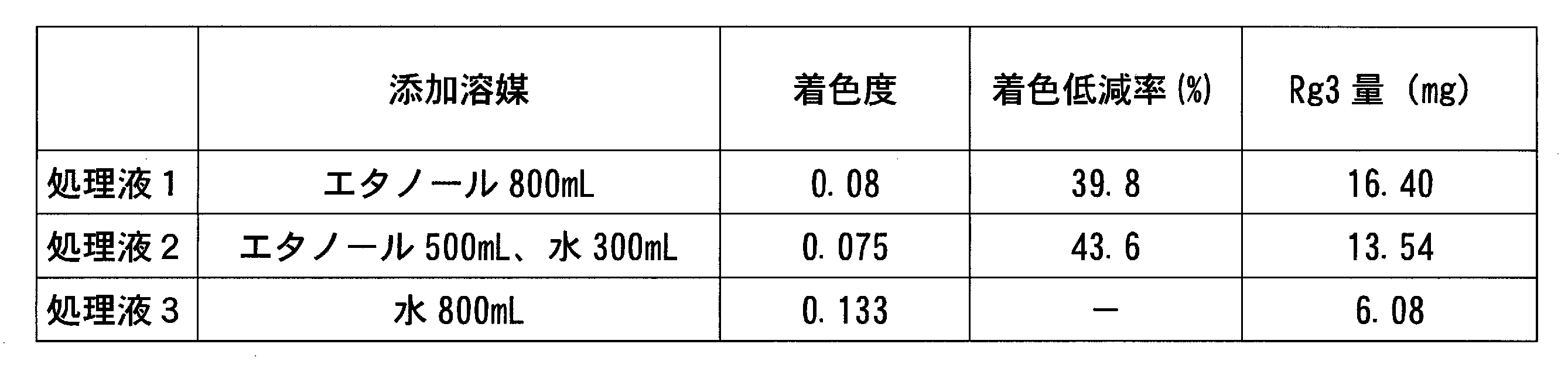
得られた各処理液の着色度は、HITACHIの分光光度計(型式U-2001型)を用い、ガラスセルにサンプルを滴下して測定した。分析時の分光光度計の測定波長は450nmに設定した。
着色低減率は、「着色低減率(%)=1-(処理液の吸光度/処理液3の吸光度)×100」により求めた。
Rg3量は、下記表2の条件のもと、HPLCで定量した値である。
着色低減率は、「着色低減率(%)=1-(処理液の吸光度/処理液3の吸光度)×100」により求めた。
Rg3量は、下記表2の条件のもと、HPLCで定量した値である。

上記表1より、ニンジンの加熱抽出物をエタノール又はエタノール水溶液で処理した処理液1、2は、エタノール処理を行ってない処理液3に対して、粗ニンジン抽出物中のRg3量を低減することなく、着色が低減された。
(2)カラム吸着処理
上記処理液1の200mLに水200mL加え、ダイヤイオンHP-20(三菱化学社製)を充填した吸着カラムに通液させた。次いで、40容量%エタノール0.6Lで洗浄し、最後に60容量%エタノール1Lで回収して、60容量%エタノール画分を乾燥して表3の実施例1の固形分1.45gを得た。
上記処理液1の200mLに水200mL加え、ダイヤイオンHP-20(三菱化学社製)を充填した吸着カラムに通液させた。次いで、40容量%エタノール0.6Lで洗浄し、最後に60容量%エタノール1Lで回収して、60容量%エタノール画分を乾燥して表3の実施例1の固形分1.45gを得た。
上記処理液2の200mLにエタノール60mL及び水140mL加え、ダイヤイオンHP-20(三菱化学社製)を充填した吸着カラムに通液させた。次いで、40容量%エタノール0.6Lで洗浄し、最後に60容量%エタノール1Lで回収して、60容量%エタノール画分を乾燥して表3の実施例2の固形分1.90gを得た。
また、上記処理液1、2の各10mLに、活性炭(カルボラフィン(日本エンバイロケミカルズ社製))100mgを混合し、室温で1時間撹拌を行った後に、濾過を行って、表3の比較例1、2のニンジン抽出物を得た。
また、上記処理液3の200mLに、エタノール140mL及び水60mL加え、ダイヤイオンHP-20(三菱化学社製)を充填した吸着カラムに通液させた。次いで、40容量%エタノール0.6Lで洗浄し、最後に60容量%エタノール1Lで回収して、60容量%エタノール画分を乾燥して表3の比較例3の固形分1.98gを得た。
得られた各抽出物を、上記と同様の方法で着色度及びRg3量、並びに着色低減率(着色低減率(%)=1-(処理前の吸光度/処理後の吸光度)×100)を測定し、その結果を下記表3に示す。

上記表3の結果より、吸着カラム処理をした実施例1、2のニンジン抽出物は、吸着カラム処理前のものに比べて、着色を低減した。また活性炭処理をした比較例1、2は、着色を低減するが、ニンジン抽出物中のRg3量が大幅に低減した。また、エタノール処理をしない比較例3は、着色が低減されなかった。
試験例2:色安定性
上記実施例1と同様の方法で得られたニンジン抽出物A、及び上記比較例1と同様の方法で得られたニンジン抽出物Bの着色度、並びに60℃で1か月放置した後の着色度を、上記と同様の方法で測定し、その結果を下記表4に示す。
上記実施例1と同様の方法で得られたニンジン抽出物A、及び上記比較例1と同様の方法で得られたニンジン抽出物Bの着色度、並びに60℃で1か月放置した後の着色度を、上記と同様の方法で測定し、その結果を下記表4に示す。
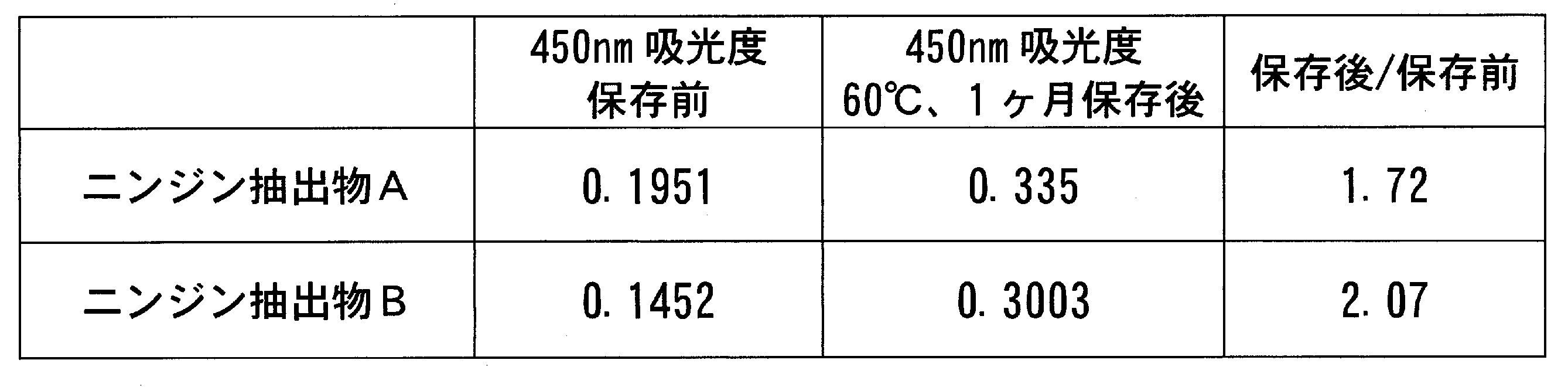
上記表4の結果より、エタノール抽出処理及び吸着カラム処理をしたニンジン抽出物Aは、吸着カラム処理をしなかったニンジン抽出物Bに対して、色安定性が向上した。
試験例3:抽出条件の検討
紅参(新和物産より入手)100gを粉砕し、イオン交換水850mLを加え、下記表5に示す条件で抽出した。粗抽出液にエタノール3400mLを加えた後、濾過し、溶媒を除き抽出物を得た。それぞれについて、抽出物を乾燥した時に残る残量である固形分量(固形分)1g当たりのRg3量を求めた(Rg3の定量は、試験例1で示した方法と同様)。結果を表5に併せて示す。
紅参(新和物産より入手)100gを粉砕し、イオン交換水850mLを加え、下記表5に示す条件で抽出した。粗抽出液にエタノール3400mLを加えた後、濾過し、溶媒を除き抽出物を得た。それぞれについて、抽出物を乾燥した時に残る残量である固形分量(固形分)1g当たりのRg3量を求めた(Rg3の定量は、試験例1で示した方法と同様)。結果を表5に併せて示す。

表5より、ニンジン抽出は、90℃を超える温度で行うことが好ましく、100℃、30時間で行うことが最適であることが確認された。
Claims (5)
- 下記の工程(1)~(3)を含むニンジン抽出物の製造方法。
(1)ニンジンを、水中で95~100℃、0.5~50時間、加熱抽出する工程
(2)(1)で得られた加熱抽出物を、エタノール濃度が60~90容量%となるようにエタノールを添加し、沈殿物を除去して粗ニンジン抽出物を得る工程
(3)(2)で得られた粗ニンジン抽出物を、マクロポーラス樹脂を充填した吸着カラムで精製する工程 - 加熱抽出の時間が15~30時間である請求項1記載の方法。
- 請求項1又は2記載の製造方法により得られるニンジン抽出物。
- ニンジンの加熱抽出物を、エタノール濃度が60~90容量%となるようにエタノールを添加し、沈殿物を除去した後に、マクロポーラス樹脂を充填した吸着カラムで精製することを特徴とするニンジン抽出物の着色低減方法。
- ニンジンの加熱抽出物を、エタノール濃度が60~90容量%となるようにエタノールを添加し、沈殿物を除去した後に、マクロポーラス樹脂を充填した吸着カラムで精製することを特徴とするニンジン抽出物の色安定化方法。
Priority Applications (1)
| Application Number | Priority Date | Filing Date | Title |
|---|---|---|---|
| CN201580001600.2A CN105473006B (zh) | 2014-04-16 | 2015-04-15 | 人参提取物的制造方法 |
Applications Claiming Priority (2)
| Application Number | Priority Date | Filing Date | Title |
|---|---|---|---|
| JP2014084453 | 2014-04-16 | ||
| JP2014-084453 | 2014-04-16 |
Publications (1)
| Publication Number | Publication Date |
|---|---|
| WO2015159922A1 true WO2015159922A1 (ja) | 2015-10-22 |
Family
ID=54324125
Family Applications (1)
| Application Number | Title | Priority Date | Filing Date |
|---|---|---|---|
| PCT/JP2015/061617 Ceased WO2015159922A1 (ja) | 2014-04-16 | 2015-04-15 | ニンジン抽出物の製造方法 |
Country Status (4)
| Country | Link |
|---|---|
| JP (1) | JP6527744B2 (ja) |
| CN (1) | CN105473006B (ja) |
| TW (1) | TWI641377B (ja) |
| WO (1) | WO2015159922A1 (ja) |
Families Citing this family (1)
| Publication number | Priority date | Publication date | Assignee | Title |
|---|---|---|---|---|
| CN106727018B (zh) * | 2017-01-09 | 2020-07-24 | 江苏康缘药业股份有限公司 | 一种人参提取物的提取方法 |
Citations (10)
| Publication number | Priority date | Publication date | Assignee | Title |
|---|---|---|---|---|
| WO1997018824A1 (en) * | 1995-11-22 | 1997-05-29 | Cheil Je Dang Co. | Vasodilating composition |
| WO2003056929A1 (en) * | 2002-01-05 | 2003-07-17 | Lotte Confectionery Co., Ltd. | Method for processing ginseng and the uses of extract of processed ginseng |
| WO2004012651A2 (en) * | 2002-07-31 | 2004-02-12 | Tianjin Tasly Pharmaceutical Co., Ltd., China | Composition for heart disease, method to prepare same and uses thereof |
| WO2006115307A1 (en) * | 2005-04-26 | 2006-11-02 | Ko, Boong-Kyung | Method of extracting ginsengnoside rg2m, pharmaceutical composition including ginsengnoside rg2, and uses thereof |
| WO2007118363A1 (en) * | 2006-04-19 | 2007-10-25 | Jianxun Liu | A chinese medicine composition and preparation method and use thereof |
| US20100136146A1 (en) * | 2003-07-31 | 2010-06-03 | Xijun Yan | Composition for heart disease, its active ingredients, method to prepare same and uses thereof |
| CN102028700A (zh) * | 2009-09-24 | 2011-04-27 | 昆明制药集团股份有限公司 | 一种药物组合物及其制备方法 |
| CN102100737A (zh) * | 2009-12-17 | 2011-06-22 | 北京大学 | 包含人参总皂苷与丹参总酚酸的药物组合物及其制备方法 |
| CN102755512A (zh) * | 2011-04-28 | 2012-10-31 | 陈春 | 一种提高cik细胞增殖速率的中药提取物及其制备方法和应用 |
| CN102772462A (zh) * | 2011-05-11 | 2012-11-14 | 河北以岭医药研究院有限公司 | 一种从西洋参中提取分离人参总皂苷的方法 |
Family Cites Families (4)
| Publication number | Priority date | Publication date | Assignee | Title |
|---|---|---|---|---|
| CN1161140C (zh) * | 2001-11-09 | 2004-08-11 | 天津天士力制药股份有限公司 | 一种预防和治疗冠心病心绞痛的药物及其制备方法和其它用途 |
| CN1221267C (zh) * | 2003-07-17 | 2005-10-05 | 吉林省中医中药研究院 | 一种西洋参及西洋参茎叶精制总皂苷冻干粉针剂及生产工艺 |
| CN101744991B (zh) * | 2008-12-05 | 2013-04-10 | 天津天士力之骄药业有限公司 | 一种人参、麦冬、五味子的单独提取方法及其制剂 |
| CN108498576A (zh) * | 2012-04-20 | 2018-09-07 | 北京盈科瑞创新医药股份有限公司 | 一种治疗心脑血管疾病的药物及其制备方法 |
-
2015
- 2015-04-15 CN CN201580001600.2A patent/CN105473006B/zh active Active
- 2015-04-15 TW TW104112117A patent/TWI641377B/zh active
- 2015-04-15 WO PCT/JP2015/061617 patent/WO2015159922A1/ja not_active Ceased
- 2015-04-15 JP JP2015083566A patent/JP6527744B2/ja active Active
Patent Citations (10)
| Publication number | Priority date | Publication date | Assignee | Title |
|---|---|---|---|---|
| WO1997018824A1 (en) * | 1995-11-22 | 1997-05-29 | Cheil Je Dang Co. | Vasodilating composition |
| WO2003056929A1 (en) * | 2002-01-05 | 2003-07-17 | Lotte Confectionery Co., Ltd. | Method for processing ginseng and the uses of extract of processed ginseng |
| WO2004012651A2 (en) * | 2002-07-31 | 2004-02-12 | Tianjin Tasly Pharmaceutical Co., Ltd., China | Composition for heart disease, method to prepare same and uses thereof |
| US20100136146A1 (en) * | 2003-07-31 | 2010-06-03 | Xijun Yan | Composition for heart disease, its active ingredients, method to prepare same and uses thereof |
| WO2006115307A1 (en) * | 2005-04-26 | 2006-11-02 | Ko, Boong-Kyung | Method of extracting ginsengnoside rg2m, pharmaceutical composition including ginsengnoside rg2, and uses thereof |
| WO2007118363A1 (en) * | 2006-04-19 | 2007-10-25 | Jianxun Liu | A chinese medicine composition and preparation method and use thereof |
| CN102028700A (zh) * | 2009-09-24 | 2011-04-27 | 昆明制药集团股份有限公司 | 一种药物组合物及其制备方法 |
| CN102100737A (zh) * | 2009-12-17 | 2011-06-22 | 北京大学 | 包含人参总皂苷与丹参总酚酸的药物组合物及其制备方法 |
| CN102755512A (zh) * | 2011-04-28 | 2012-10-31 | 陈春 | 一种提高cik细胞增殖速率的中药提取物及其制备方法和应用 |
| CN102772462A (zh) * | 2011-05-11 | 2012-11-14 | 河北以岭医药研究院有限公司 | 一种从西洋参中提取分离人参总皂苷的方法 |
Non-Patent Citations (1)
| Title |
|---|
| JIANG C. A ET AL.: "A strategy for adjusting macroporous resin column chromatographic process parameters based on raw material variation", SEPARATION AND PURIFICATION TECHNOLOGY, vol. 116, 2013, pages 287 - 293, XP028682859 * |
Also Published As
| Publication number | Publication date |
|---|---|
| JP6527744B2 (ja) | 2019-06-05 |
| TW201545752A (zh) | 2015-12-16 |
| TWI641377B (zh) | 2018-11-21 |
| CN105473006B (zh) | 2017-09-26 |
| CN105473006A (zh) | 2016-04-06 |
| JP2015212260A (ja) | 2015-11-26 |
Similar Documents
| Publication | Publication Date | Title |
|---|---|---|
| CN101912480B (zh) | 一种黑果枸杞原花青素提取物的制备方法 | |
| CN106243172B (zh) | 一种提取黑果枸杞花色苷的方法 | |
| CN107898868B (zh) | 从枸杞中同步分离制备枸杞红素、枸杞多糖和枸杞黄酮的方法 | |
| CN113854533A (zh) | 一种用鲜罗汉果制备罗汉果甜苷、罗汉果酚酸、罗汉果浓缩汁的方法 | |
| CN103665059A (zh) | 一种天然藏红花素提取分离方法及其降血脂药物的制备 | |
| JP5524971B2 (ja) | 高麗人参からジンセノサイドRg1またはRb1が強化された抽出物分画を製造する方法 | |
| KR20110052940A (ko) | 인삼으로부터 진세노사이드 Rg3가 강화된 추출물 분획을 제조하는 방법 | |
| CN104292366A (zh) | 从落叶松中同时提取阿拉伯半乳聚糖和二氢槲皮素的方法 | |
| JP6903622B2 (ja) | 赤シソ葉抽出物の製造方法 | |
| JP2001046030A (ja) | ブルーベリー抽出エキスの製造法 | |
| WO2017181303A1 (zh) | 东革阿里有效成分的制备方法及其用途 | |
| CN110981921A (zh) | 一种从无花果同步提取多种有效成分的连续化方法 | |
| JP6527744B2 (ja) | ニンジン抽出物の製造方法 | |
| CN101343298A (zh) | 阳离子交换树脂二次纯化紫甘薯花色苷的制备方法 | |
| KR20190101063A (ko) | 천연물질 추출물을 함유하는 기관지 질환 예방 및 개선을 위한 조성물 및 그 제조방법 | |
| CN1762428A (zh) | 从桑叶中提取有效成分的方法 | |
| KR101832710B1 (ko) | 활성탄 처리에 의한 흑삼 농축액의 유해성분 저감화 방법 | |
| KR20040020693A (ko) | 효능이 증강된 인삼추출물의 제조 방법 | |
| KR101768084B1 (ko) | 홍삼 추출물 및 그의 제조 방법 | |
| KR20140142477A (ko) | 진세노사이드 Rg2의 제조방법 | |
| CN104435015A (zh) | 一种高品质银杏黄酮提取工艺 | |
| CN101810317A (zh) | 一种海棠果多酚的制备方法及其应用 | |
| CN1245415C (zh) | 三七叶皂苷的提取方法 | |
| KR20050097698A (ko) | 감 껍질을 이용한 올레아놀산 및 우르솔산의 제조방법 | |
| CN114106214B (zh) | 黄花多糖及其制备方法和应用 |
Legal Events
| Date | Code | Title | Description |
|---|---|---|---|
| WWE | Wipo information: entry into national phase |
Ref document number: 201580001600.2 Country of ref document: CN |
|
| 121 | Ep: the epo has been informed by wipo that ep was designated in this application |
Ref document number: 15779324 Country of ref document: EP Kind code of ref document: A1 |
|
| NENP | Non-entry into the national phase |
Ref country code: DE |
|
| 122 | Ep: pct application non-entry in european phase |
Ref document number: 15779324 Country of ref document: EP Kind code of ref document: A1 |