WO2015159703A1 - 積層フィルムおよびそれを用いたタッチパネル - Google Patents
積層フィルムおよびそれを用いたタッチパネル Download PDFInfo
- Publication number
- WO2015159703A1 WO2015159703A1 PCT/JP2015/060121 JP2015060121W WO2015159703A1 WO 2015159703 A1 WO2015159703 A1 WO 2015159703A1 JP 2015060121 W JP2015060121 W JP 2015060121W WO 2015159703 A1 WO2015159703 A1 WO 2015159703A1
- Authority
- WO
- WIPO (PCT)
- Prior art keywords
- resin layer
- resin
- laminated film
- particles
- layer
- Prior art date
- Legal status (The legal status is an assumption and is not a legal conclusion. Google has not performed a legal analysis and makes no representation as to the accuracy of the status listed.)
- Ceased
Links
Images
Classifications
-
- B—PERFORMING OPERATIONS; TRANSPORTING
- B32—LAYERED PRODUCTS
- B32B—LAYERED PRODUCTS, i.e. PRODUCTS BUILT-UP OF STRATA OF FLAT OR NON-FLAT, e.g. CELLULAR OR HONEYCOMB, FORM
- B32B7/00—Layered products characterised by the relation between layers; Layered products characterised by the relative orientation of features between layers, or by the relative values of a measurable parameter between layers, i.e. products comprising layers having different physical, chemical or physicochemical properties; Layered products characterised by the interconnection of layers
- B32B7/02—Physical, chemical or physicochemical properties
- B32B7/022—Mechanical properties
-
- B—PERFORMING OPERATIONS; TRANSPORTING
- B32—LAYERED PRODUCTS
- B32B—LAYERED PRODUCTS, i.e. PRODUCTS BUILT-UP OF STRATA OF FLAT OR NON-FLAT, e.g. CELLULAR OR HONEYCOMB, FORM
- B32B15/00—Layered products comprising a layer of metal
- B32B15/04—Layered products comprising a layer of metal comprising metal as the main or only constituent of a layer, which is next to another layer of the same or of a different material
- B32B15/08—Layered products comprising a layer of metal comprising metal as the main or only constituent of a layer, which is next to another layer of the same or of a different material of synthetic resin
- B32B15/082—Layered products comprising a layer of metal comprising metal as the main or only constituent of a layer, which is next to another layer of the same or of a different material of synthetic resin comprising vinyl resins; comprising acrylic resins
-
- B—PERFORMING OPERATIONS; TRANSPORTING
- B32—LAYERED PRODUCTS
- B32B—LAYERED PRODUCTS, i.e. PRODUCTS BUILT-UP OF STRATA OF FLAT OR NON-FLAT, e.g. CELLULAR OR HONEYCOMB, FORM
- B32B27/00—Layered products comprising a layer of synthetic resin
-
- G—PHYSICS
- G06—COMPUTING OR CALCULATING; COUNTING
- G06F—ELECTRIC DIGITAL DATA PROCESSING
- G06F3/00—Input arrangements for transferring data to be processed into a form capable of being handled by the computer; Output arrangements for transferring data from processing unit to output unit, e.g. interface arrangements
- G06F3/01—Input arrangements or combined input and output arrangements for interaction between user and computer
- G06F3/03—Arrangements for converting the position or the displacement of a member into a coded form
- G06F3/041—Digitisers, e.g. for touch screens or touch pads, characterised by the transducing means
Definitions
- the present invention relates to a laminated film suitable for a touch panel, an electromagnetic wave shield, a receiving antenna, an electric heater, and the like, and a touch panel using the same.
- a film in which a metal layer formed in an arbitrary pattern shape is provided on a resin film such as a polyester film is known.
- circuit materials using a transparent film have been proposed for various applications such as automobiles and display applications because of their light weight and good visibility.
- a metal foil having a thickness of about 10 ⁇ m or more is usually used for uniform bonding, but a metal having a thickness of 10 ⁇ m or more is used.
- the etching speed varies in the thickness direction, so that the cross section of the line formed by etching becomes a wedge shape and the line is transparent. It becomes easy to peel off from a substrate such as a film, and the linearity in the longitudinal direction of the line is deteriorated (for example, the line is distorted).
- a metal layer is directly formed on a polyester film such as polyethylene terephthalate by a vapor deposition method, and the metal layer is processed into a fine line pattern using a printing method, a photolithography method, an etching method, or the like.
- a method of forming a metal layer having a pattern shape has been proposed.
- high conductivity can be obtained even with a metal layer having a relatively small thickness (for example, 4 ⁇ m or less). Therefore, by reducing the thickness of the metal layer, the workability of the fine line pattern is improved and the line width is relatively large. It is possible to easily form a high-definition pattern shape with a small (for example, less than 10 ⁇ m).
- Patent Documents 2 and 3 describe a pattern-shaped metal layer forming method using the metal layer formed by the above-described vapor deposition method.
- Patent Documents 4 to 7 In order to improve the adhesion between a substrate such as a transparent film and a metal layer, it is known that a laminated film such as a primer layer is provided on the substrate in advance (for example, Patent Documents 4 to 7).
- Patent Document 4 discloses a method for producing an electromagnetic wave shielding film in which an undercoat layer made of a urethane resin is applied to a molded article such as ABS resin or polycarbonate, and a metal layer is vacuum-deposited thereon.
- Patent Document 5 It is disclosed that a primer layer made of an epoxy resin, a polyester resin, a phenol epoxy resin, an acrylic resin, a urethane resin, or the like is provided on a transparent film, and a conductive treatment layer is formed thereon by vacuum deposition.
- An optical polyester film provided with a coating layer composed of an acrylic resin and a crosslinking agent on a film is applied to a conductive film for a plasma display.
- Patent Document 7 discloses a urethane resin on a transparent substrate made of a polyamide resin or the like. And a primer layer containing epoxy resin, and an electromagnetic shielding film is formed on it It discloses an electromagnetic wave shielding molded article.
- Patent Document 8 proposes a method of adding particles in order to prevent winding defects such as blocking that occur when a laminated film is wound. With only control, it is difficult to satisfy both optical characteristics such as haze and prevention of winding defects, and there is an optimum range of particle sizes depending on the thickness of the outermost layer of the laminate I found.
- the object of the present invention is to provide a laminated film having surface scratch resistance and excellent adhesion to a metal layer, and a touch panel using the same, in view of the above-described conventional technology.
- the said subject of this invention is achieved by the laminated film which concerns on the following this invention.
- a resin layer (B) having a pencil hardness of H or higher and a resin layer (C) having a pencil hardness lower than the pencil hardness of the resin layer (B) are provided on at least one surface of the resin film (A).
- the thickness of the resin layer (B) is 0.5-2 ⁇ m, and the ratio of the thickness of the resin layer (B) to the resin layer (C)
- the resin layer (C) contains particles, and the ratio (R / t (C)) between the average particle diameter R of the particles and the thickness (t (C)) of the resin layer (C) is 0.
- the particles are at least one kind of particles selected from the group consisting of silicon oxide particles, barium sulfate particles, alumina particles, and calcium carbonate particles.
- the present invention also provides the following touch panel using the above-described laminated film. (10) A touch panel using the laminated film according to (8) or (9).
- the metal layer which has a pattern shape, and resin which can obtain a high-definition pattern shape at low cost can prevent defects, such as drop-off
- a laminated film with improved adhesion to the film can be provided in roll form.
- multilayer film of this invention can provide the film for touch panels with favorable light transmittance at low cost.
- the laminated film of the present invention is 1) A resin layer (B) having a pencil hardness of H or more and a resin layer (C) having a pencil hardness lower than the pencil hardness of the resin layer (B) are provided on at least one surface of the resin film (A).
- the laminated film is characterized in that t (B) / t (C) is 5 to 20.
- Resin film (A) is not particularly limited.
- the resin constituting the resin film (A) is preferably a polyester sheet having excellent optical properties such as transparency, polycarbonate (PC), polycycloolefin, and bisphenol A as a main monomer.
- the resin film (A) may be a film obtained by bonding a plurality of resin films.
- polyester is preferable as the resin constituting the resin film (A) from the viewpoints of excellent flexibility, low cost, high transparency, and excellent heat resistance and chemical resistance.
- polyester is a general term for polymers having an ester bond as the main bond chain of the main chain.
- examples of such polyester include ethylene terephthalate, ethylene-2,6-naphthalate, butylene terephthalate, ethylene- ⁇ , ⁇ -bis (2-chlorophenoxy) ethane-4,4-dicarboxylate, and the like.
- polyesters containing ethylene terephthalate are particularly preferable in view of quality and economy.
- the resin film (A) has various known additives such as antioxidants, heat stabilizers, weather stabilizers, ultraviolet absorbers, organic lubricants, pigments, dyes, organic or inorganic fine particles, fillers. Further, an antistatic agent, a nucleating agent and the like can be contained to such an extent that the effects of the present invention are not impaired.
- the thickness of the resin film (A) is preferably 15 ⁇ m to 250 ⁇ m, more preferably 50 ⁇ m to 200 ⁇ m.
- a resin layer (B) having a pencil hardness of H or higher and a resin layer (C) having a pencil hardness lower than the pencil hardness of the resin layer (B) are provided on at least one surface of the resin film (A). It is a laminated film laminated in this order from the film (A) side.
- the laminated film of the present invention is a laminated film having a resin layer (B) having a pencil hardness of H or more and a resin layer (C) having a pencil hardness of 2B or less in this order from the resin film (A) side. More preferred.
- “pencil hardness” means a value based on the pencil scratch value described in the test method defined in JIS K5600-5-4 (1999). The pencil hardness is in the order of 6H, 5H,... HB, B,.
- a film in which the pencil hardness of the first layer on the resin film side is smaller than the pencil hardness of the second layer that is the outer layer has been proposed (for example, JP-A-2013-2003). No. 101177).
- the purpose of this document is to prevent the curling caused by the difference in hardness between the resin film serving as the base layer and the resin layer serving as the hard coat layer, and to laminate by the hardness difference between the first layer and the second layer.
- the purpose is to increase the hardness of the film surface.
- a resin layer having a high pencil hardness generally exhibits a pencil hardness of H or higher.
- a coating composition containing a polymerizable monomer or a polymerizable oligomer of an active energy ray-curable resin is applied, although it can be obtained by forming a polymerizable monomer or a polymerizable oligomer by a crosslinking reaction and / or a polymerization reaction, a resin mainly composed of an acrylic monomer or a urethane acrylate oligomer which is a representative component thereof.
- the adhesion strength with the metal layer formed by the vapor phase lamination method, which will be described later, is low. Particularly, when the metal layer is patterned with high definition, there is a drawback that the line is easily peeled off or is easily lost. It was.
- the idea was to prevent scratches by increasing the relative hardness of the resin layer (C), and to increase the adhesion strength of the metal layer.
- the resin layer (B) and the resin layer (C) are respectively a resin layer (B) having a pencil hardness of H or more and a resin layer (C) having a pencil hardness of 2B or less, thereby further preventing scratches and improving the metal layer.
- a coating composition containing a polymerizable monomer or polymerizable oligomer of the aforementioned active energy ray curable resin is applied, and the polymerizable monomer or polymerizable oligomer is subjected to a crosslinking reaction and / or Or it can obtain by forming by carrying out a polymerization reaction.
- Such a functional group of the active energy ray-curable polymerizable monomer or polymerizable oligomer is preferably an ultraviolet, electron beam or radiation polymerizable functional group, and an ultraviolet polymerizable functional group is particularly preferable.
- the ultraviolet polymerizable functional group include ethylenically unsaturated polymerizable functional groups such as (meth) acryloyl group, vinyl group, styryl group and allyl group.
- the coating composition is not particularly limited, but a coating composition mainly composed of an acrylic monomer or a urethane acrylate oligomer is preferred. Furthermore, it is particularly preferable to form from a composition containing both urethane acrylate and (meth) acrylate.
- the thickness of the resin layer (B) is 0.5 to 2 ⁇ m, preferably 0.8 to 1.8 ⁇ m, and more preferably 1.0 to 1.5 ⁇ m. If the thickness is less than 0.5 ⁇ m, sufficient hardness may not be obtained. On the other hand, if the upper limit of the thickness is 2 ⁇ m or less, the object can be achieved sufficiently. When the thickness exceeds 2 ⁇ m, the time for obtaining the integrated light amount of the active energy ray necessary for curing the resin layer (B) becomes long. When the illuminance of the active energy ray irradiating device is increased, the resin film (A) is caused by excessive heat. This may cause disadvantages in terms of economy and quality.
- the thickness of the resin layer (B) is set to 0.5 to 2 ⁇ m for the following reasons. That is, one of the purposes of the resin layer (B) of the present invention is to have abrasion resistance, and a preferable thickness range for this purpose is from 0.5 to 2 ⁇ m. If the thickness is less than 0.5 ⁇ m, the rigidity is poor and sufficient hardness may not be obtained. On the other hand, when the thickness exceeds 2 ⁇ m, the hardness is sufficient, but the flatness such as curl is likely to occur due to the shrinkage stress due to curing, which may cause a problem in the subsequent process. In addition, a long time is required for curing, and variations in curing are likely to occur, which may be complicated in quality control.
- the ratio of the thickness (t (B)) of the resin layer (B) to the thickness (t (C)) of the resin layer (C), t (B) / t (C) is 5-20. It is. (T (B) / t (C)) (hereinafter referred to as (t (B)), which is the ratio of the thickness (t (B)) of the resin layer (B) to the thickness (t (C)) of the resin layer (C) / T (C)))) is more preferably from 8 to 16, and even more preferably from 6 to 15.
- the present inventors have found that (t (B) / t (C)) has a preferable range in order to achieve both wear resistance and adhesion with the metal layer.
- the laminated film of the present invention has a wear resistance by adjusting the ratio of the thickness (t (B)) of the resin layer (B) to the thickness (t (C)) of the resin layer (C). The adhesiveness with the metal layer mentioned later can be made compatible.
- the resin layer (C) preferably has a pencil hardness of 2B or less.
- a material constituting the resin layer (C) having a pencil hardness of 2B or less for example, there is a polyester resin or a thermosetting product thereof. Since the resin layer (C) is soft as described above, it is possible to absorb stress when laminated with a metal layer described later, which is preferable.
- the resin layer (B) preferably contains an acrylic resin.
- an acrylic monomer or a urethane acrylate oligomer is included.
- Resin layer (B) can raise hardness by including these monomers or oligomers.
- the acrylic resin is not particularly limited and may be either a monomer or an oligomer. Further, the number of functional groups of the acrylate that is the main component of the acrylic resin is not particularly limited, and may be monofunctional or polyfunctional, but is preferably bifunctional or more and hexafunctional or less. More preferably, it is bifunctional or more and trifunctional or less. Acrylates may be used in combination of two or more.
- content of the acrylic resin contained in a resin layer (B) 10 mass% or more and 90 mass% or less are preferable when the whole resin layer (B) is 100 mass%, 15 mass% or more 85 mass% or less is more preferable, and 20 mass% or more and 80 mass% or less is further more preferable.
- content of the acrylic resin contained in the resin layer (B) exceeds 90% by mass, the wear resistance and the coating film hardness may be lowered.
- flexibility falls that a content of the acrylic resin contained in a resin layer (B) is less than 10 mass%, and a crack may generate
- the content of the acrylic resin contained in the resin layer (B) is 10% by mass or more and 90% by mass or less, while maintaining appropriate wear resistance and coating film hardness, moderate flexibility and cracking are maintained. Since generation
- glass transition temperature of an acrylic resin 40 to 100 degreeC is preferable and 40 to 80 degreeC is more preferable. It is preferable that the glass transition temperature of the acrylic resin be 40 ° C. or higher and 100 ° C. or lower because the hardness and durability of the resin layer (B) at room temperature can be improved.
- Examples of the acrylic resin contained in the resin layer (B) include (meth) acrylate, but are not particularly limited, and may be either a monomer or an oligomer.
- the number of functional groups of such (meth) acrylate is not particularly limited, and may be monofunctional or polyfunctional.
- durability can improve the acrylic resin contained in a resin layer (B), for example by using trifunctional or more than (meth) acrylate.
- the (meth) acrylate may have a molecular structure having a polar group or a low-polar molecular structure.
- (Meth) acrylates may be used alone or in combination of two or more.
- examples of the polar group of (meth) acrylate include a hydroxyl group, a carboxyl group, an amino group, and an amide group.
- Examples of the (meth) acrylate containing a hydroxyl group include 2-hydroxyethyl (meth) acrylate, 2-hydroxypropyl (meth) acrylate, 2-hydroxybutyl (meth) acrylate, and 2-hydroxy-3-phenoxypropyl (meth).
- Acrylate 2- (meth) acryloyloxyethyl-2-hydroxypropyl phthalate, glycerol mono (meth) acrylate, 3-hydroxypropyl (meth) acrylate, 3-hydroxybutyl (meth) acrylate, 4-hydroxybutyl (meth) acrylate And (meth) acrylic acid hydroxyl group-containing esters.
- Examples of the (meth) acrylate containing a carboxyl group include ethylenically unsaturated carboxylic acids such as acrylic acid, methacrylic acid, crotonic acid, maleic acid, itaconic acid, citraconic acid, and 2- (meth) acryloyloxyethyl succinic acid. Acid, 2- (meth) acryloyloxyethyl phthalic acid, 2- (meth) acryloyloxyethyl hexahydrophthalic acid and the like.
- carboxylic acids such as acrylic acid, methacrylic acid, crotonic acid, maleic acid, itaconic acid, citraconic acid, and 2- (meth) acryloyloxyethyl succinic acid.
- Acid 2- (meth) acryloyloxyethyl phthalic acid, 2- (meth) acryloyloxyethyl hexahydrophthalic acid and the like.
- Examples of (meth) acrylates containing amino groups include monomethylaminoethyl (meth) acrylate, monoethylaminoethyl (meth) acrylate, monomethylaminopropyl (meth) acrylate, and monoethylaminopropyl (meth) acrylate. And (meth) acrylic acid monoalkylamino esters.
- Examples of the (meth) acrylate containing an amide group include acrylamides such as (meth) acrylamide, N-methyl (meth) acrylamide, and N-methylol (meth) acrylamide.
- examples of the (meth) acrylate having a low polar molecular structure include (meth) acrylic acid alicyclic ester or (meth) acrylic acid alkyl ester.
- Examples of such (meth) acrylic acid alicyclic esters include cyclohexyl (meth) acrylate, isobornyl (meth) acrylate, dicyclopentenyloxyethyl (meth) acrylate, dicyclopentadienyl (meth) acrylate, and tricyclodecanyl.
- (Meth) acrylate, norbornyl (meth) acrylate, etc. are mentioned.
- Examples of the (meth) acrylic acid alkyl ester include lauryl (meth) acrylate, 2-ethylhexyl (meth) acrylate, isodecyl (meth) acrylate, benzyl (meth) acrylate, stearyl (meth) acrylate, butyl (meth) acrylate, 1,6-hexanediol acrylate may be mentioned.
- compositions other than an acrylic resin there are resins such as polyester, polyurethane, and epoxy, but there is no particular limitation.
- the resin layer (C) preferably contains a polyester resin.
- the term “polyester” is a general term for polymers having an ester bond as the main bond chain of the main chain. Examples of such polyester include ethylene terephthalate, ethylene-2,6-naphthalate, butylene terephthalate, ethylene- ⁇ , ⁇ -bis (2-chlorophenoxy) ethane-4,4-dicarboxylate, and the like.
- the resin layer (C) includes urethane resin containing isocyanate, polyester resin having amide bond, polyester resin having a plurality of functional groups, resin having oxazoline group, resin having carbodiimide, melamine resin having amide group, etc. It is preferable to include a resin obtained by mixing and heat-curing because the adhesion strength with the metal layer is improved.
- a polyester resin having a plurality of functional groups a polyester polyol obtained by dehydration condensation of a plurality of carboxylic acids and a polyhydric alcohol is preferable.
- Carboxylic acids include, but are not limited to, adipic acid and phthalic acid.
- Examples of the polyhydric alcohol include ethylene glycol, 1,4-butanediol, and 1,6-hexanediol, but are not limited thereto.
- Examples of the resin having an oxazoline group include resins obtained by radical polymerization of monomers containing an oxazoline group such as 2-isopropenyl-2-oxazoline and 2-vinyl-2-oxazoline. However, it is not limited to these.
- Examples of the resin containing carbodiimide include dicyclohexylhexicarbodiimide, diisopropylcarbodiimide, and 1-ethyl-3- (3-dimethylaminopropyl) carbodiimide hydrochloride, but are not limited thereto.
- melamine resin examples include, but are not limited to, monomethylol melamine and hexamethylol melamine obtained by reacting melamine and formaldehyde under alkali.
- the polyester resin contained in a resin layer (C) Although it does not specifically limit as content of the polyester resin contained in a resin layer (C), When the resin layer (C) whole is 100 mass%, 10 mass% or more and 90 mass% or less are preferable, and 15 mass% or more 85 mass% or less is more preferable, and 20 mass% or more and 80 mass% or less is further more preferable.
- content of the polyester resin contained in a resin layer (C) exceeds 90 mass%, the adhesion hardness with a resin layer (B) may fall.
- the adhesive strength with a metal layer may fall that content of the polyester resin contained in a resin layer (C) is less than 10 mass%.
- the content of the polyester resin contained in the resin layer (C) is 10% by mass or more and 90% by mass or less because high adhesion strength can be obtained with both the resin layer (B) and the metal layer. .
- the resin layer (C) contains particles, and the ratio (R / t) between the average particle diameter R of the particles and the thickness (t (C)) of the resin layer (C). (C)) is preferably 0.5 to 2.0.
- the laminated film of the present invention is preferably handled in a roll shape. If it can be handled in a roll shape, it can be continuously processed in post-processing, which is economically preferable. In order to handle it in a roll shape, it is preferable to wind the laminated film into a roll shape. In order to take up a roll while preventing defects such as winding wrinkles, scratches, and misalignment, it may be necessary to optimize the surface structure. On the other hand, when the laminated film of the present invention is used for optical applications such as a touch panel, optical characteristics may be important, and high light transmittance and low haze may be required. As described above, the laminated film of the present invention has a structure having both winding properties and optical properties, and also having adhesiveness to the metal layer. As described above, the thickness of the resin layer (C) in the present invention and the average particle size of the particles The optimum value of the ratio to the diameter was found.
- the average particle diameter is an index representing the particle diameter of the added particles, and means the particle diameter having the highest existence probability.
- the supplied particles should be monodispersed and have a narrow particle distribution. However, when the particle size is selected, the yield of the particles is poor, a special manufacturing method is required, or an expensive manufacturing method is required. There is a case.
- the particles used in the present invention are preferable because the distribution thereof shows a normal distribution and the average particle size is within a specified range because the object can be achieved.
- the particles are preferably at least one kind of particles selected from the group consisting of silicon oxide particles, barium sulfate particles, alumina particles and calcium carbonate particles.
- examples thereof include particles (including spherical particles and aggregated particles), alumina particles (including spherical particles and aggregated particles), and calcium carbonate particles (including spherical particles and aggregated particles), but are particularly excellent in transparency. From the viewpoint, silica particles are particularly preferable.
- the laminated film of the present invention preferably has a total light transmittance of 88% or more and a haze of 2% or less.
- An optical film used for a touch panel or the like is better as the light transmittance is higher, and at least the total light transmittance is preferably 88% or more, and more preferably 90% or more.
- the haze is preferably 2% or less, and more preferably 1.5% or less.
- the laminated film as described above further has a metal layer.
- a method for laminating the metal layer various methods such as a method of laminating a metal foil with an adhesive, a method of forming by wet electroplating, a method of applying metal particles, and the like other than the vapor phase laminating method can be exemplified.
- the thickness of the metal layer is preferably 0.05 ⁇ m or more, and if it exceeds 10 ⁇ m, it is difficult to produce by the vapor deposition method described later. Therefore, the upper limit is preferably 10 ⁇ m or less.
- a metal constituting the metal layer an alloy or a multi-layered one or a combination of two or more of metals such as copper, aluminum, nickel, iron, gold, silver, stainless steel, chromium and titanium can be used. Among these, copper is preferably used as the metal constituting the metal layer from the viewpoint of easy processing into a pattern shape and low cost.
- the metal layer may be a single layer or a metal laminate composed of two or more layers.
- a layer composed of at least one metal selected from the group consisting of nickel, chromium, and nichrome is preferable as the underlayer.
- Such a metal laminate is preferable because the adhesion strength with the resin layer (C) of the present invention is further improved.
- the metal layer of the laminated film of the present invention preferably has a pattern shape.
- a pattern shape By having a pattern shape, it can be set as a laminated film suitable for formation of an electrode or a circuit. Therefore, the metal layer can be suitably used for an electrode or a circuit finally by making the metal layer into a pattern shape.
- the pattern shape is not particularly limited, but a mesh shape and a stripe shape are preferable.
- a photoresist-etching method or the like can be used as a method for forming the metal layer in a pattern shape.
- the metal layer is preferably laminated by a vapor phase lamination method.
- a vapor phase lamination method there are various methods for laminating a metal layer, such as a method of laminating a metal foil with an adhesive, a method of forming by wet electroplating, a method of applying metal particles, etc., from the viewpoint of uniformity of the metal layer thickness.
- the laminated film of the present invention is preferably formed by laminating metal layers by a vapor phase lamination method.
- Examples of the vapor deposition method include sputtering, ion plating, electron beam vapor deposition, vacuum vapor deposition by induction heating, chemical vapor deposition, and the like, and these one method or a combination of two or more methods can be used.
- at least one method selected from the group consisting of sputtering, ion plating, and vacuum deposition is preferred, and sputtering and / or vacuum deposition are particularly preferred.
- the laminated film of the present invention can be suitably used for a touch panel. Since a laminated film obtained by further laminating a metal layer on the laminated film of the present invention can easily form a pattern shape, it can be suitably used for a touch panel. In particular, it is suitable for an electrode film of a capacitive touch panel. By using the laminated film of the present invention, a touch panel can be obtained with high productivity.
- the laminated film of the present invention can also be used for electromagnetic wave shields, receiving antennas, electric heaters, and the like.
- Total light transmittance and haze The total light transmittance and haze were measured according to JIS-K 7136 (2000) using a Nippon Denshoku haze meter NDH-4000.
- Adhesive strength with metal layer was evaluated by measuring 90 degree peeling strength (F) of the metal layer created by the vapor phase lamination method on the laminated film of the present invention.
- a sample for measurement is a laminated film obtained by laminating a metal layer on a laminated film by a gas phase lamination method to a width of 50 mm and a length of 100 mm, and a clear line tape No. 1 manufactured by Nichiban Co., Ltd. is formed on the surface of the metal layer.
- Five patterns of 557 (tape width 2 mm) were attached to the entire length in the length direction of the laminated film at intervals of 2 mm in the width direction to make a pattern mask for pulling.
- the laminated film provided with the pattern mask was immersed in a 30% by weight ferrous chloride aqueous solution at a liquid temperature of 30 ° C. for 5 minutes, etched, washed with water, dried, and the pattern mask was peeled off to obtain a sample. .
- a tensile tester (peeling tester) conforming to JIS B 7721 (2009) is equipped with a gripping tool for holding the sample horizontally and making the pulling direction of the sample vertical, and the peeling angle is Fix the sample to the gripping tool with double-sided tape # 500 made by Nitto Denko Co., Ltd. so that it is 90 degrees, peel off only the metal layer with tweezers, and fix it with the clip on the pulling wire of the load cell. Measured. Specifically, Tensilon manufactured by Orientech Co., Ltd. was used, and the peeling rate was 30 mm / min and the measurement length was 50 mm. The average intensity was used as the measurement value, and the average value of the values measured five times was defined as F (N / cm).
- Example 1 As the resin film (A), a polyethylene terephthalate (PET) film (“Lumirror” (registered trademark) U48, thickness: 100 ⁇ m) manufactured by Toray Industries, Inc. was used. This was cut into a 100 mm ⁇ 100 mm square and used.
- PET polyethylene terephthalate
- urethane acrylate resin type U-4205 manufactured by DIC Corporation was diluted with methyl isobutyl ketone (hereinafter referred to as MIBK) so that the solid content was 35% by mass, and used as a photopolymerization initiator.
- MIBK methyl isobutyl ketone
- the resin layer (B) was formed by irradiating with a high pressure mercury lamp at a distance of 15 cm between the lamp and the resin layer (B) at a light amount of 80 W / cm 2 for 1 second.
- the resin layer (B) had a thickness t (B) of 1.0 ⁇ m.
- the hardness was H.
- the resin layer (B) 24 g of oil-free alkyd (polyester) resin (trade name: “Beckolite” (registered trademark) M-6451-60) manufactured by DIC Corporation as a polyester resin is added to DIC Corporation.
- oil-free alkyd (polyester) resin trade name: “Beckolite” (registered trademark) M-6451-60
- melamine curing agent (trade name: “Super Becamine” (registered trademark) L-117-60) and melamine curing agent (trade name: “Super Becamine” (registered trademark) L) manufactured by DIC Corporation -105-60) 2.8 g was added, and 0.1 g of a curing accelerator (alkyl acidic phosphate ester, trade name: “Beckamine” (registered trademark) P-198) manufactured by DIC Corporation was mixed with 360 g of N butanol. A paint having a solid content of 1% by mass diluted with 360 g of methyl ethyl ketone (hereinafter, MEK) was prepared.
- MEK methyl ethyl ketone
- Silicon oxide particles having a nominal particle diameter of 200 nm (trade name: Organosol, MEK-ST-2040, manufactured by Nissan Chemical Industries, Ltd.) were added to the prepared paint in an amount of 5% by mass to obtain a trial paint.
- the prototype paint was applied with a metering bar and dried at 150 ° C. for 30 seconds using a hot air oven to form a resin layer (C).
- the thickness t (C) of the resin layer (C) was 0.1 ⁇ m, and the ratio of the thickness of the resin layer (B) to the resin layer (C) (t (B) / t (C)) was 10. .
- the hardness was 2B.
- the evaluation of the scratchability of the resin layer (C) was S without scratches.
- the roll-up property was S without any defects.
- the average particle diameter of the particles was measured and found to be 200 nm, so the ratio (R / t (C)) between the average particle diameter R of the particles and the thickness t (C) of the resin layer (C) was 2.0. there were.
- the total light transmittance of the laminated film was 91%, and the haze was 1.2%.
- Example 2 In the same manner as in Example 1, a resin layer (B) is formed, and an oil-free alkyd (polyester) resin (trade name: “Beckolite” (registered trademark) manufactured by DIC Corporation as a polyester resin is formed on the resin layer (B).
- an oil-free alkyd (polyester) resin (trade name: “Beckolite” (registered trademark) manufactured by DIC Corporation as a polyester resin is formed on the resin layer (B).
- DIC Corporation melamine curing agent trade name: “Super Becamine” (registered trademark) L-117-60) 1.4 g
- DIC Corporation melamine curing agent Product name: “Super Becamine” (registered trademark) L-105-60) (2.8 g) was added, and DIC Co., Ltd.
- a paint having a solid content of 1% by mass was prepared by mixing 0.1 g and diluting with 360 g of N butanol and 360 g of MEK. Silicon oxide particles having a nominal particle diameter of 200 nm (trade name: Organosol MEK-ST-2040, manufactured by Nissan Chemical Industries, Ltd.) were added to the prepared paint in an amount of 5% by mass to obtain a trial paint.
- the prototype paint was applied with a metering bar and dried at 150 ° C. for 30 seconds using a hot air oven to form a resin layer (C).
- the thickness t (C) of the resin layer (C) was 0.2 ⁇ m, and the ratio of the thickness of the resin layer (B) to the resin layer (C) (t (B) / t (C)) was 5. .
- the hardness was 6B.
- the evaluation of the scratchability of the resin layer (C) was S without scratches.
- the roll-up property was S without any defects.
- the ratio (R / t (C)) between the average particle diameter R of the particles and the thickness t (C) of the resin layer (C) was 1.0. there were.
- the total light transmittance of the laminated film was 90%, and the haze was 1.2%.
- a metal layer having a thickness of 1 ⁇ m was formed in the same manner as in Example 1.
- the adhesion strength with the formed metal layer was 3 N / cm.
- Example 3 In the same manner as in Example 1, the resin layer (B) is formed, and on the resin layer (B), an oil-free alkyd (polyester) resin (trade name: “Beckolite” (registered) manufactured by DIC Corporation as a polyester resin. (Trademark) M-6451-60) 24 g, DIC Corporation melamine curing agent (trade name: “Super Becamine” (registered trademark) L-117-60) 1.4 g and DIC Corporation melamine curing agent (Product name: “Super Becamine” (registered trademark) L-105-60) (2.8 g) was added, and DIC Co., Ltd.
- an oil-free alkyd (polyester) resin trade name: “Beckolite” (registered) manufactured by DIC Corporation as a polyester resin. (Trademark) M-6451-60) 24 g, DIC Corporation melamine curing agent (trade name: “Super Becamine” (registered trademark) L-117-60) 1.4 g and
- a paint having a solid content of 1% by mass was prepared by mixing 0.1 g and diluting with 360 g of N butanol and 360 g of MEK. Silicon oxide particles having a nominal particle diameter of 100 nm (trade name: Organosol MEK-ST-L, manufactured by Nissan Chemical Industries, Ltd.) were added to the prepared paint in an amount of 5% by mass to obtain a paint for trial production.
- the prototype paint was applied with a metering bar and dried at 150 ° C. for 30 seconds using a hot air oven to form a resin layer (C).
- the thickness t (C) of the resin layer (C) was 0.05 ⁇ m, and the ratio of the thickness of the resin layer (B) to the resin layer (C) (t (B) / t (C)) was 20. .
- the hardness was 2B.
- the evaluation of the scratchability of the resin layer (C) was S without scratches.
- the roll-up property was S without any defects.
- the average particle diameter of the particles was 100 nm, and the ratio (R / t (C)) between the average particle diameter R of the particles and the thickness t (C) of the resin layer (C) was 2.0. there were.
- the total light transmittance of the laminated film was 90%, and the haze was 0.5%.
- a metal layer having a thickness of 1 ⁇ m was formed in the same manner as in Example 1.
- the adhesion strength with the formed metal layer was 2 N / cm.
- Example 4 A PET film ("Lumirror” (registered trademark) U48, thickness: 100 ⁇ m) manufactured by Toray Industries, Inc. was used as the resin film (A). This was cut into a 100 mm ⁇ 100 mm square and used.
- urethane acrylate resin type U-4205 manufactured by DIC Corporation is diluted with MIBK to a solid content of 35% by mass, and a photopolymerization initiator manufactured by Ciba Specialty Chemicals Co., Ltd.
- a composition obtained by adding 5% by mass of “Irgacure” (registered trademark) 184 and dissolving it was applied with a bar coater to a dry film thickness of 0.5 ⁇ m, dried in a hot air oven at 80 ° C. for 5 minutes, and then subjected to high pressure.
- the resin layer (B) was prepared by irradiating with a mercury lamp at a distance of 15 cm between the lamp and the resin layer (B) at a light quantity of 80 W / cm 2 for 1 second.
- the thickness t (B) of the resin layer (B) was 0.5 ⁇ m.
- the hardness was H.
- the resin layer (B) 24 g of oil-free alkyd (polyester) resin (trade name: “Beckolite” (registered trademark) M-6451-60) manufactured by DIC Corporation as a polyester resin is added to DIC Corporation.
- oil-free alkyd (polyester) resin trade name: “Beckolite” (registered trademark) M-6451-60
- melamine curing agent (trade name: “Super Becamine” (registered trademark) L-117-60) and melamine curing agent (trade name: “Super Becamine (registered trademark) L-) manufactured by DIC Corporation” 105-60) 2.8 g was added, 0.1 g of curing accelerator (alkyl acidic phosphate ester, trade name: “Beccamin” (registered trademark) P-198) manufactured by DIC Corporation was mixed, and 360 g of N butanol and MEK were mixed. A paint having a solid content of 1% by mass diluted with 360 g was prepared, and silicon oxide particles having a nominal particle diameter of 100 nm (trade name: Organosol MEK-ST were used in the prepared paint.
- the average particle diameter of the particles was 100 nm, and the ratio (R / t (C)) between the average particle diameter R of the particles and the thickness t (C) of the resin layer (C) was 2.0. there were.
- the total light transmittance of the laminated film was 91%, and the haze was 0.5%.
- Example 2 a metal layer was formed in the same manner as in Example 1.
- the adhesion strength with the formed metal layer was 3 N / cm.
- Example 5 A PET film (“Lumirror” (registered trademark) U48, thickness: 100 ⁇ m) manufactured by Toray Industries, Inc. was used as the resin film (A). This was cut into a 100 mm ⁇ 100 mm square and used.
- Limirror registered trademark
- urethane acrylate resin type U-4205 manufactured by DIC Corporation is diluted with MIBK to a solid content of 35% by mass, and a photopolymerization initiator manufactured by Ciba Specialty Chemicals Co., Ltd.
- a composition obtained by adding 5% by mass of “Irgacure” (registered trademark) 184 and dissolving it was applied with a bar coater to a dry film thickness of 2.0 ⁇ m, dried in a hot air oven at 80 ° C. for 5 minutes, and then subjected to high pressure.
- the resin layer (B) was prepared by irradiating with a mercury lamp at a distance of 15 cm between the lamp and the resin layer (B) at a light quantity of 80 W / cm 2 for 1 second.
- the resin layer (B) had a thickness t (B) of 2.0 ⁇ m.
- the hardness was 2H.
- the resin layer (B) 24 g of oil-free alkyd (polyester) resin (trade name: “Beckolite” (registered trademark) M-6451-60) manufactured by DIC Corporation as a polyester resin is added to DIC Corporation.
- oil-free alkyd (polyester) resin trade name: “Beckolite” (registered trademark) M-6451-60
- melamine curing agent (trade name: “Super Becamine” (registered trademark) L-117-60) and melamine curing agent (trade name: “Super Becamine” (registered trademark) L) manufactured by DIC Corporation -105-60) 2.8 g was added, and 0.1 g of a curing accelerator (alkyl acidic phosphate ester, trade name: “Beckamine” (registered trademark) P-198) manufactured by DIC Corporation was mixed with 360 g of N butanol.
- a curing accelerator alkyl acidic phosphate ester, trade name: “Beckamine” (registered trademark) P-198) manufactured by DIC Corporation was mixed with 360 g of N butanol.
- Silicon oxide particles with a nominal particle size of 200 nm are prepared with a paint prepared by diluting with 360 g of MEK and having a solid content of 1% by mass. K-ST-2040 Nissan Chemical Industries, Ltd.) was added 5 wt% at a weight ratio of coating material, and a prototype paint.
- the prepared prototype paint was applied with a metal ring bar and dried at 150 ° C. for 30 seconds using a hot air oven to form a resin layer (C).
- the thickness t (C) of the resin layer (C) was 0.1 ⁇ m, and the ratio of the thickness of the resin layer (B) to the resin layer (C) (t (B) / t (C)) was 20. .
- the hardness was 2B.
- the evaluation of the scratchability of the resin layer (C) was S without scratches.
- the roll-up property was S without any defects.
- the average particle diameter of the particles was measured and found to be 200 nm, so the ratio (R / t (C)) between the average particle diameter R of the particles and the thickness t (C) of the resin layer (C) was 2.0. there were.
- the total light transmittance of the laminated film was 91%, and the haze was 1.2%.
- Example 2 a metal layer was formed in the same manner as in Example 1.
- the adhesion strength with the formed metal layer was 3 N / cm.
- urethane acrylate resin type U-4205 manufactured by DIC Corporation is diluted with MIBK to a solid content of 35% by mass, and a photopolymerization initiator manufactured by Ciba Specialty Chemicals Co., Ltd.
- a composition obtained by adding 5% by mass of “Irgacure” (registered trademark) 184 and dissolving it was applied with a bar coater to a dry film thickness of 2.0 ⁇ m, dried in a hot air oven at 80 ° C. for 5 minutes, and then subjected to high pressure.
- the resin layer (B) was prepared by irradiating with a mercury lamp at a distance of 15 cm between the lamp and the resin layer (B) at a light quantity of 80 W / cm 2 for 1 second.
- the resin layer (B) had a thickness t (B) of 2.0 ⁇ m.
- the hardness was 2H.
- the evaluation of the scratchability of the resin layer (B) was S and there was no scratch, but the winding property was B due to frequent occurrence of wrinkles and scratches.
- the total light transmittance of the laminated film was 91%, and the haze was 0.3%.
- Example 2 a metal layer was formed in the same manner as in Example 1.
- the adhesion strength with the formed metal layer was 0.2 N / cm.
- the resin layer (B) 24 g of oil-free alkyd (polyester) resin (trade name: “Beckolite” (registered trademark) M-6451-60) manufactured by DIC Corporation as a polyester resin is added to DIC Corporation.
- oil-free alkyd (polyester) resin trade name: “Beckolite” (registered trademark) M-6451-60
- melamine curing agent (trade name: “Super Becamine” (registered trademark) L-117-60) and melamine curing agent (trade name: “Super Becamine” (registered trademark) L) manufactured by DIC Corporation -105-60) 2.8 g was added, and 0.1 g of a curing accelerator (alkyl acidic phosphate ester, trade name: “Beckamine” (registered trademark) P-198) manufactured by DIC Corporation was mixed with 360 g of N butanol.
- a curing accelerator alkyl acidic phosphate ester, trade name: “Beckamine” (registered trademark) P-198) manufactured by DIC Corporation was mixed with 360 g of N butanol.
- Silicon oxide particles with a nominal particle size of 300 nm (trade name: “Light Star” (registered trademark) Nissan Chemical Industries, Ltd.) adjusted to a paint with a solid content of 1% by weight diluted with 360 g of MEK The Ltd.)) was added to a 5 mass% when the total 100 wt% coating was a coating. This was applied with a metering bar and dried at 150 ° C. for 30 seconds using a hot air oven to form a resin layer (C).
- the thickness t (C) of the resin layer (C) was 0.1 ⁇ m, and the ratio of the thickness of the resin layer (B) to the resin layer (C), t (B) / t (C), was 10.
- the hardness of the resin layer (C) was 4B.
- the evaluation of how easily the resin layer (C) was damaged was B in which linear scratches were partially observed.
- the roll-up property was S with no defects and scratches.
- the total light transmittance of the laminated film was 88%, and the haze was 3.1%.
- Example 3 In the same manner as in Example 1, a resin layer (B) is formed, and an oil-free alkyd (polyester) resin (trade name: “Beckolite” (registered trademark) manufactured by DIC Corporation as a polyester resin is formed on the resin layer (B).
- an oil-free alkyd (polyester) resin (trade name: “Beckolite” (registered trademark) manufactured by DIC Corporation as a polyester resin is formed on the resin layer (B).
- DIC Corporation melamine curing agent trade name: “Super Becamine” (registered trademark) L-117-60) 1.4 g
- DIC Corporation melamine curing agent Product name: “Super Becamine (registered trademark) L-105-60) 2.8 g was added, and DIC Co., Ltd.
- curing accelerator alkyl acid phosphate ester, product name:“ Beccamin ”(registered trademark) P- 198) 0.1 g mixed, diluted with 360 g of N butanol and 360 g of MEK, coated with a coating with a solid content of 1% by weight with a metalling bar, dried in a hot air oven at 150 ° C. for 30 seconds,
- the oil layer (C) was formed, and the thickness t (C) of the resin layer (C) was 0.02 ⁇ m, and the ratio of the thickness of the resin layer (B) to the resin layer (C) was t (B) / t ( C) was 50.
- the hardness was B.
- the evaluation of the susceptibility of the resin layer (C) to scratches was S, with no scratches. The properties were wrinkles and B.
- the total light transmittance of the laminated film was 91%, and the haze was 0.3%.
- a metal layer having a thickness of 1 ⁇ m was formed in the same manner as in Example 1.
- the adhesion strength with the formed metal layer was 0.5 N / cm.
- Example 4 In the same manner as in Example 1, a resin layer (B) is formed, and an oil-free alkyd (polyester) resin (trade name: “Beckolite” (registered trademark) manufactured by DIC Corporation as a polyester resin is formed on the resin layer (B).
- an oil-free alkyd (polyester) resin (trade name: “Beckolite” (registered trademark) manufactured by DIC Corporation as a polyester resin is formed on the resin layer (B).
- DIC Corporation melamine curing agent trade name: “Super Becamine” (registered trademark) L-117-60) 1.4 g
- DIC Corporation melamine curing agent Product name: “Super Becamine” (registered trademark) L-105-60) (2.8 g) was added, and DIC Co., Ltd.
- curing accelerator alkyl acid phosphate ester, product name: “Beccamin” (registered trademark) P -198) Apply 0.1 g of a solid, 1 wt% solid paint diluted with 360 g of N-butanol and 360 g of MEK with a metalling bar, and dry at 150 ° C. for 30 seconds using a hot air oven.
- lipid layer (C) The thickness t (C) of the resin layer (C) was 0.5 ⁇ m, and the ratio of the thickness of the resin layer (B) to the resin layer (C), t (B) / t (C), was 2.
- the hardness was 6B.
- the evaluation of the susceptibility of the resin layer (C) to the scratch was severe and B.
- the windability was B with scratches.
- the total light transmittance of the laminated film was 91%, and the haze was 0.2%.
- a metal layer having a thickness of 1 ⁇ m was formed in the same manner as in Example 1.
- the adhesion strength with the formed metal layer was 3 N / cm.
- the present invention when a metal layer is formed on a resin film and etched to form an electrode or a circuit, scratches in a metal layer forming process such as vapor deposition are prevented, and the adhesiveness with the formed metal layer is excellent.
- a laminated film suitable for a touch panel can be provided.
- the present invention can be suitably applied to the processing of electrodes and circuits into pattern shapes, but the application range is not limited thereto.
Landscapes
- Engineering & Computer Science (AREA)
- Mechanical Engineering (AREA)
- General Engineering & Computer Science (AREA)
- Theoretical Computer Science (AREA)
- Human Computer Interaction (AREA)
- Physics & Mathematics (AREA)
- General Physics & Mathematics (AREA)
- Laminated Bodies (AREA)
Abstract
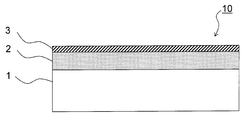
樹脂フィルム(A)(1)の少なくとも一面に、鉛筆硬度がH以上の樹脂層(B)(2)、鉛筆硬度が樹脂層(B)(2)の鉛筆硬度より低い樹脂層(C)(3)を、樹脂フィルム(A)(1)側からこの順に積層してなる積層フィルムであり、樹脂層(B)(2)の厚みが0.5~2μmであり、かつ樹脂層(B)(2)と樹脂層(C)(3)の厚みの比であるt(B)/t(C)が5~20であることを特徴とする積層フィルム、およびそれを用いたタッチパネル。
Description
本発明は、タッチパネルや電磁波シールド、受信用アンテナ、電熱ヒーター等に好適な積層フィルム、およびそれを用いたタッチパネルに関する。
タッチパネルや電磁波シールドに用いられる導電性フィルムとして、ポリエステルフィルム等の樹脂フィルム上に任意のパターン形状に形成された金属層が設けられたものが知られている。特に、透明フィルムを用いた回路材料は、軽量かつ視認性が良いなどの理由から、自動車やディスプレイ用途など種々の応用が提案されている。
このような導電性フィルムの製造方法として、透明フィルムに銅箔などの金属箔を、接着剤層を介して積層した後、レジストフィルムを貼り付け、所望のパターン形状のフォトマスクを介して露光後、現像、エッチング、レジスト剥離するフォトリソグラフィー法を利用して、透明フィルム上にパターン形状に形成された金属層を設ける方法が知られている(例えば特許文献1)。
そのなかでも、透明フィルムと金属箔(銅箔)と貼り合わせる方法においては、貼り合わせを均一に行うために通常厚みが10μm程度以上の金属箔が用いられているが、厚みが10μm以上の金属箔をエッチング処理して線幅が比較的小さい(例えば10μm未満)パターン形状を形成する場合には、厚み方向でエッチング速度が異なるためエッチングで形成された線の断面が楔形になり、線が透明フィルムなどの基板から剥がれやすくなったり、線の長手方向の直線性が悪くなったりする(例えば線が歪む)。一方、厚み5μm以下の金属箔を用いる場合には、厚み5μm以下の金属箔(銅箔)が高価であるという問題や、透明フィルムと金属箔とを積層するための接着剤層の開口部(エッチングにより金属箔が除去された部分)に金属箔表面の微細な凹凸形状が転写され透明性が悪化するという問題、安価な金属箔の場合は線幅を細くすることが困難であるという問題がある。
上記問題点に対して、ポリエチレンテレフタレート等のポリエステルフィルムに直接、気相積層法で金属層を形成し、該金属層に印刷法やフォトリソグラフィー法とエッチング法等を利用して、細線パターンに加工してパターン形状を有する金属層を形成する方法が提案されている。この方法は、比較的厚みが小さい(例えば4μm以下)金属層であっても高い導電性が得られるため、金属層の厚みを小さくすることによって細線パターンの加工性が向上し、比較的線幅が小さい(例えば10μm未満)高精細のパターン形状を容易に形成することが可能となる。
上記の気相積層法で形成された金属層を用いた、パターン形状の金属層の形成方法としては、例えば特許文献2、3に記載されている。
一方、透明フィルム等の基材と金属層との密着性を改良するために、基材に予めプライマー層等の積層膜を設けることが知られている(例えば特許文献4~7)。
特許文献4は、ABS樹脂、ポリカーボネート等の成形品にウレタン樹脂からなるアンダーコート層を塗布し、その上に金属層を真空成膜する電磁波シールド膜の製造方法を開示し、特許文献5は、透明フィルムに、エポキシ樹脂、ポリエステル樹脂、フェノールエポキシ樹脂、アクリル樹脂、ウレタン樹脂等からなるプライマー層を設け、その上に導電処理層を真空蒸着により形成することを開示し、特許文献6は、ポリエステルフィルムにアクリル樹脂と架橋剤からなる塗布層を設けた、光学用ポリエステルフィルムをプラズマディスプレイの導電性フィルムに適用することを開示し、特許文献7は、ポリアミド樹脂等からなる透明基材にウレタン樹脂とエポキシ樹脂を含有するプライマー層を設け、その上に電磁波シールド膜を成膜した電磁波シールド成形体を開示している。
一方で、プライマー層を設ける場合、積層フィルムを巻き取ったときに生じるブロッキングなどの巻き取り欠点を防止するために粒子を添加する方法が特許文献8に提案されているが、単に粒子の大きさのみの制御では、ヘイズなどの光学特性と、巻き取り欠点の防止の両方を満足させるのは困難であり、積層の最表層の厚みに応じて粒子の大きさには最適な範囲が存在することを見出した。
特許文献4~8に記載の方法を用いて製造された金属層は、ポリエステルフィルムとの密着性は向上するものの、金属層との密着性が良い樹脂ほど表面の硬度が低いため、ロール状に巻き取る工程においてキズを生じやすく、結果として積層フィルムの上に設けられた金属層の表面にキズが生じ、パターン形状の金属層を形成するときにはこのキズが原因でパターンの断線が生じる問題があった。特に、金属層を気相積層法で形成する場合には、金属層を積層するための密着層を設けることがあるが、製造工程における搬送プロセス、すなわち、金属層を積層する工程における搬送プロセスにおいて密着層にキズが起こりやすくなっていた。また、密着層に単に粒子を添加する方法では、パターン形状の金属パターン端部が粒子の影響で真っ直ぐにならないという問題も生じ、密着層と粒子の最適化が必要である。
本発明の課題は、上記した従来技術に鑑み、表面の耐キズ付き性を持ち、かつ金属層との密着性に優れた積層フィルム、およびそれを用いたタッチパネルを提供することにある。
本発明の上記課題は、以下の本発明に係る積層フィルムによって達成される。
(1)樹脂フィルム(A)の少なくとも一面に、鉛筆硬度がH以上の樹脂層(B)、鉛筆硬度が樹脂層(B)の鉛筆硬度より低い樹脂層(C)を、前記樹脂フィルム(A)側からこの順に積層してなる積層フィルムであり、前記樹脂層(B)の厚みが0.5~2μmであり、かつ前記樹脂層(B)と前記樹脂層(C)の厚みの比であるt(B)/t(C)が5~20であることを特徴とする積層フィルム。
(2)前記樹脂層(C)の鉛筆硬度が2B以下である、(1)に記載の積層フィルム。
(3)前記樹脂層(B)がアクリル樹脂を含む、(1)または(2)に記載の積層フィルム。
(4)前記樹脂層(C)がポリエステル樹脂を含む、(1)~(3)のいずれかに記載の積層フィルム。
(5)前記樹脂層(C)が粒子を含み、該粒子の平均粒子径Rと前記樹脂層(C)の厚み(t(C))との比(R/t(C))が0.5~2.0である、(1)~(4)のいずれかに記載の積層フィルム。
(6)前記粒子が酸化ケイ素粒子、硫酸バリウム粒子、アルミナ粒子および炭酸カルシウム粒子からなる群より選ばれる少なくとも1種類の粒子である、(5)に記載の積層フィルム。
(7)全光線透過率が88%以上、かつヘイズが2%以下である、(1)~(6)のいずれかに記載の積層フィルム。
(8)(1)~(7)のいずれかに記載の積層フィルムが、さらに金属層を有することを特徴とする積層フィルム。
(9)前記金属層が気相積層法で形成されている、(8)に記載の積層フィルム。
(1)樹脂フィルム(A)の少なくとも一面に、鉛筆硬度がH以上の樹脂層(B)、鉛筆硬度が樹脂層(B)の鉛筆硬度より低い樹脂層(C)を、前記樹脂フィルム(A)側からこの順に積層してなる積層フィルムであり、前記樹脂層(B)の厚みが0.5~2μmであり、かつ前記樹脂層(B)と前記樹脂層(C)の厚みの比であるt(B)/t(C)が5~20であることを特徴とする積層フィルム。
(2)前記樹脂層(C)の鉛筆硬度が2B以下である、(1)に記載の積層フィルム。
(3)前記樹脂層(B)がアクリル樹脂を含む、(1)または(2)に記載の積層フィルム。
(4)前記樹脂層(C)がポリエステル樹脂を含む、(1)~(3)のいずれかに記載の積層フィルム。
(5)前記樹脂層(C)が粒子を含み、該粒子の平均粒子径Rと前記樹脂層(C)の厚み(t(C))との比(R/t(C))が0.5~2.0である、(1)~(4)のいずれかに記載の積層フィルム。
(6)前記粒子が酸化ケイ素粒子、硫酸バリウム粒子、アルミナ粒子および炭酸カルシウム粒子からなる群より選ばれる少なくとも1種類の粒子である、(5)に記載の積層フィルム。
(7)全光線透過率が88%以上、かつヘイズが2%以下である、(1)~(6)のいずれかに記載の積層フィルム。
(8)(1)~(7)のいずれかに記載の積層フィルムが、さらに金属層を有することを特徴とする積層フィルム。
(9)前記金属層が気相積層法で形成されている、(8)に記載の積層フィルム。
また、本発明では、上述した積層フィルムを用いた以下のタッチパネルも提供する。
(10)(8)または(9)に記載の積層フィルムを用いたタッチパネル。
(10)(8)または(9)に記載の積層フィルムを用いたタッチパネル。
本発明によれば、金属層のキズによる配線の脱落や欠けなどの欠点を防止し、低コストで高精細なパターン形状を得ることができ、かつパターン形状を有する金属層と基材である樹脂フィルムとの密着性が改良された積層フィルムをロール状で提供することができる。また、本発明の積層フィルムを用いることによって得られる高精細なパターン形状により、低コストで光透過率の良好なタッチパネル用フィルムを提供することができる。
以下に、本発明について、実施の形態とともに詳細に説明する。
本発明の積層フィルムは、
1)樹脂フィルム(A)の少なくとも一面に、鉛筆硬度がH以上の樹脂層(B)、鉛筆硬度が樹脂層(B)の鉛筆硬度より低い樹脂層(C)を、前記樹脂フィルム(A)側からこの順に積層してなる積層フィルムであり、前記樹脂層(B)の厚みが0.5~2μmであり、かつ前記樹脂層(B)と前記樹脂層(C)の厚みの比であるt(B)/t(C)が5~20であることを特徴とする積層フィルムである。以下、各要件について説明する。
本発明の積層フィルムは、
1)樹脂フィルム(A)の少なくとも一面に、鉛筆硬度がH以上の樹脂層(B)、鉛筆硬度が樹脂層(B)の鉛筆硬度より低い樹脂層(C)を、前記樹脂フィルム(A)側からこの順に積層してなる積層フィルムであり、前記樹脂層(B)の厚みが0.5~2μmであり、かつ前記樹脂層(B)と前記樹脂層(C)の厚みの比であるt(B)/t(C)が5~20であることを特徴とする積層フィルムである。以下、各要件について説明する。
樹脂フィルム(A)は特に限定はされない。該樹脂フィルム(A)を構成する樹脂としては、透明性等の光学特性に優れているポリエステル、ポリカーボネート(PC)、ポリシクロオレフィン、ビスフェノールAを主たるモノマーとするポリカーボネートシートなどが好ましい。また、樹脂フィルム(A)は、複数の樹脂フィルムを貼り合せたフィルムであってもよい。このような中でも、屈曲性に優れ、コストが低く、透明性が高く、耐熱性、耐薬品性に優れるという点から、樹脂フィルム(A)を構成する樹脂としては、ポリエステルが好ましい。
ここでポリエステルとは、エステル結合を主鎖の主要な結合鎖とする高分子の総称である。かかるポリエステルとしては、エチレンテレフタレート、エチレン-2,6-ナフタレート、ブチレンテレフタレート、エチレン-α,β-ビス(2-クロロフェノキシ)エタン-4,4-ジカルボキシレート等が挙げられる。これらの中でも、品質、経済性など総合的に判断するとエチレンテレフタレートを含むポリエステルが特に好ましい。
なお、樹脂フィルム(A)には、公知の各種添加剤、例えば酸化防止剤、耐熱安定剤、耐候安定剤、紫外線吸収剤、有機の易滑剤、顔料、染料、有機または無機の微粒子、充填剤、帯電防止剤、核剤などを、本発明の効果を阻害しない程度に含有することができる。
また、樹脂フィルム(A)の厚みは、15μm~250μmであることが好ましく、より好ましくは50μm~200μmである。
本発明の積層フィルムは、樹脂フィルム(A)の少なくとも一面に、鉛筆硬度がH以上の樹脂層(B)、鉛筆硬度が樹脂層(B)の鉛筆硬度より低い樹脂層(C)を、樹脂フィルム(A)側からこの順に積層してなる積層フィルムである。また、本発明の積層フィルムは、鉛筆硬度がH以上の樹脂層(B)、鉛筆硬度が2B以下の樹脂層(C)を、樹脂フィルム(A)側からこの順に有する積層フィルムであることがより好ましい。なお、本発明において、「鉛筆硬度」とは、JIS K5600-5-4(1999年)に規定する試験方法に記載の鉛筆引っかき値に基づく値をいう。また、鉛筆硬度は硬度が高い順に6H、5H、・・・HB、B、・・・5B、6Bの順である。
二層構造の積層樹脂層を有する積層フィルムとしては、樹脂フィルム側である第一層の鉛筆硬度が外層である第二層の鉛筆硬度よりも小さいものが提案されている(例えば特開2013-101177号公報)。この文献の目的は、基材層となる樹脂フィルムとハードコート層となる樹脂層との硬度差に起因して生じるカールを防止しつつ、第一層と第二層との硬度差によって、積層フィルム表面の硬度を高めることにある。しかしながら、鉛筆硬度の高い樹脂層は一般的に鉛筆硬度H以上を示し、鉛筆硬度H以上を達成するには活性エネルギー線硬化樹脂の重合性モノマーや重合性オリゴマーを含む塗布組成物を塗布し、重合性モノマーや重合性オリゴマーを架橋反応及び/又は重合反応させることにより形成することで得ることができるが、それらの代表的な成分であるアクリルモノマーやウレタンアクアレートオリゴマーを主成分とする樹脂は、後述する気相積層法で形成される金属層との密着強度が低く、特に金属層を高精細にパターン形成した場合には、線が剥がれやすかったり、欠落が生じやすかったりするという欠点があった。
そこで本発明では、鉛筆硬度がH以上の樹脂層(B)、鉛筆硬度が樹脂層(B)の鉛筆硬度より低い樹脂層(C)を樹脂フィルム(A)側からこの順に積層した積層フィルムとすることにより、樹脂層(C)の相対的な硬さを増すことでキズ防止を図り、併せて金属層の密着強度を高めることを着想した。さらに、樹脂層(B)、樹脂層(C)をそれぞれ鉛筆硬度がH以上の樹脂層(B)、鉛筆硬度が2B以下の樹脂層(C)とすることで、よりキズ防止効果および金属層の密着性が向上することを着想した。
鉛筆硬度がH以上の樹脂層(B)としては、前述の活性エネルギー線硬化樹脂の重合性モノマーや重合性オリゴマーを含む塗布組成物を塗布し、重合性モノマーや重合性オリゴマーを架橋反応及び/又は重合反応させることにより形成することで得ることができる。
かかる活性エネルギー線硬化性の重合性モノマーや重合性オリゴマーの官能基としては、紫外線、電子線又は放射線重合性のものが好ましく、紫外線重合性官能基が特に好ましい。紫外線重合性官能基としては、(メタ)アクリロイル基、ビニル基、スチリル基、アリル基等のエチレン性不飽和重合性官能基等を挙げることができる。
上記塗布組成物としては、特に限定されないが、アクリルモノマー又はウレタンアクリレートオリゴマーを主成分とするものが好ましい。更にはウレタンアクリレートと(メタ)アクリレートとを共に含有する組成物から形成されることが特に好ましい。
本発明では、樹脂層(B)の厚みは0.5~2μmであり、0.8~1.8μmであることが好ましく、1.0~1.5μmであることがさらに好ましい。0.5μm未満の場合には十分な硬さが得られない場合があり、一方厚みの上限は2μm以下であれば十分目的を達成できる。2μmを超える場合は、樹脂層(B)の硬化に必要な活性エネルギー線の積算光量を得るための時間が長くなり、活性エネルギー線照射装置の照度を上げると過剰な熱により樹脂フィルム(A)の熱変形を生じるなど、経済的にも品質的にも不利となる場合がある。
また、本発明においては、以下のような理由によっても、樹脂層(B)の厚みを0.5~2μmとしている。すなわち、本発明の樹脂層(B)の目的の1つは耐摩耗性を有することであり、そのための好ましい厚みの範囲が0.5~2μmであることにある。0.5μm未満の場合は剛性に乏しく十分な硬さを得ることができない場合がある。一方で、2μmを超える場合は、硬度は十分だが硬化による収縮応力でカールなどの平面性不良が生じやすく、後工程に問題が生じる場合がある。また、硬化に長い時間が必要であったり、硬化のばらつきが生じ易く、品質管理上も煩雑となったりする場合がある。
本発明においては、樹脂層(B)の厚み(t(B))と樹脂層(C)の厚み(t(C))との比であるt(B)/t(C)が5~20である。樹脂層(B)の厚み(t(B))と樹脂層(C)の厚み(t(C))の比である(t(B)/t(C))(以下、(t(B)/t(C))と記載することもある)が8~16であることがより好ましく、6~15であることがさらに好ましい。本発明者らは、(t(B)/t(C))には、耐摩耗性と金属層との密着性を両立するために好ましい範囲が存在することを見出した。(t(B)/t(C))が5未満の場合には硬度の小さい樹脂層(C)の厚みが厚すぎるため耐摩耗性が低下する場合がある。一方、(t(B)/t(C))が20を超える場合には樹脂層(C)と金属層との密着性が十分発現しない場合がある。本発明の積層フィルムは、樹脂層(B)の厚み(t(B))と樹脂層(C)の厚み(t(C))との比を特定の範囲にすることで、耐摩耗性と、後述する金属層との密着性を両立することができる。
本発明においては、上記樹脂層(C)の鉛筆硬度は2B以下であることが好ましい。鉛筆硬度が2B以下の樹脂層(C)を構成する材料としては、例えば、ポリエステル樹脂またはその熱硬化物がある。このように樹脂層(C)が柔らかいことにより、後述する金属層と積層された際の応力を吸収することが可能になるので好ましい。
また、本発明においては、上記樹脂層(B)がアクリル樹脂を含むことが好ましい。とくに、アクリルモノマー又はウレタンアクリレートオリゴマーを含むことがより好ましい。樹脂層(B)は、これらのモノマー又はオリゴマーを含むことで、硬度を高めることができる。
アクリル樹脂としては、特に限定されるものではなく、モノマー又はオリゴマーのいずれであってもよい。また、アクリル樹脂の主成分であるアクリレートの官能基数としては、特に限定されるものではなく、単官能であっても多官能であってもよいが、2官能以上6官能以下であることが好ましく、2官能以上3官能以下であることがより好ましい。アクリレートは、2種以上を含んで用いてもよい。
樹脂層(B)に含まれるアクリル樹脂の含有量としては、特に限定されないが、樹脂層(B)全体を100質量%としたとき、10質量%以上90質量%以下が好ましく、15質量%以上85質量%以下がより好ましく、20質量%以上80質量%以下がさらに好ましい。樹脂層(B)に含まれるアクリル樹脂の含有量が90質量%を超えると、耐摩耗性及び塗膜硬度が低下する場合がある。また、樹脂層(B)に含まれるアクリル樹脂の含有量が10質量%未満であると、柔軟性が低下し、割れを発生する場合がある。一方、樹脂層(B)に含まれるアクリル樹脂の含有量が10質量%以上90質量%以下であると、耐摩耗性及び塗膜硬度を好適に保ちつつ、適度な柔軟性を保持し、割れの発生を抑制することができるため好ましい。
アクリル樹脂のガラス転移温度としては、特に限定されないが、40℃以上100℃以下が好ましく、40℃以上80℃以下がより好ましい。アクリル樹脂のガラス転移温度が40℃以上100℃以下であることにより、常温下での樹脂層(B)の硬度及び耐久性を向上させることができるため好ましい。
樹脂層(B)に含まれるアクリル樹脂の例としては(メタ)アクリレートが挙げられるが、特に限定されるものではなく、モノマー又はオリゴマーのいずれであってもよい。かかる(メタ)アクリレートの官能基数としては、特に限定されるものではなく、単官能であっても多官能であってもよい。なお、樹脂層(B)に含まれるアクリル樹脂は、例えば3官能以上の(メタ)アクリレートを使用することにより耐久性を向上することができる。また、かかる(メタ)アクリレートは、極性基を有する分子構造でもよいし低極性の分子構造でもよい。(メタ)アクリレートは単独で用いてもよいし、2種以上を組み合わせて用いてもよい。
例えば(メタ)アクリレートの極性基としては、水酸基、カルボキシル基、アミノ基、アミド基等を挙げることができる。
水酸基を含有する(メタ)アクリレートとしては、例えば2-ヒドロキシエチル(メタ)アクリレート、2-ヒドロキシプロピル(メタ)アクリレート、2-ヒドロキシブチル(メタ)アクリレート、2-ヒドロキシ-3-フェノキシプロピル(メタ)アクリレート、2-(メタ)アクリロイルオキシエチル-2-ヒドロキシプロピルフタレート、グリセロールモノ(メタ)アクリレート、3-ヒドロキシプロピル(メタ)アクリレート、3-ヒドロキシブチル(メタ)アクリレート、4-ヒドロキシブチル(メタ)アクリレートなどの(メタ)アクリル酸ヒドロキシル基含有エステル等が挙げられる。
カルボキシル基を含有する(メタ)アクリレートとしては、例えばアクリル酸、メタクリル酸、クロトン酸、マレイン酸、イタコン酸、シトラコン酸などのエチレン性不飽和カルボン酸の他、2-(メタ)アクリロイルオキシエチルコハク酸、2-(メタ)アクリロイルオキシエチルフタル酸、2-(メタ)アクリロイルオキシエチルヘキサヒドロフタル酸等が挙げられる。
アミノ基を含有する(メタ)アクリレートとしては、例えば(メタ)アクリル酸モノメチルアミノエチル、(メタ)アクリル酸モノエチルアミノエチル、(メタ)アクリル酸モノメチルアミノプロピル、(メタ)アクリル酸モノエチルアミノプロピルなどの(メタ)アクリル酸モノアルキルアミノエステル等が挙げられる。
アミド基を含有する(メタ)アクリレートとしては、例えば(メタ)アクリルアミド、N-メチル(メタ)アクリルアミド、N-メチロール(メタ)アクリルアミドなどのアクリルアミド類等が挙げられる。
また、低極性の分子構造の(メタ)アクリレートとしては、例えば(メタ)アクリル酸脂環式エステル又は(メタ)アクリル酸アルキルエステルが挙げられる。
かかる(メタ)アクリル酸脂環式エステルとしては、例えばシクロヘキシル(メタ)アクリレート、イソボロニル(メタ)アクリレート、ジシクロペンテニルオキシエチル(メタ)アクリレート、ジシクロペンタジエニル(メタ)アクリレート、トリシクロデカニル(メタ)アクリレート、ノルボルニル(メタ)アクリレート等が挙げられる。
上記(メタ)アクリル酸アルキルエステルとしては、例えばラウリル(メタ)アクリレート、2-エチルヘキシル(メタ)アクリレート、イソデシル(メタ)アクリレート、ベンジル(メタ)アクリレート、ステアリル(メタ)アクリレート、ブチル(メタ)アクリレート、1,6-へキサンジオールアクリレートが挙げられる。
また、アクリル樹脂以外の組成を用いる場合としては、ポリエステル、ポリウレタン、エポキシ等の樹脂があるが、特に限定するものではない。
本発明に係る積層フィルムにおいては、上記樹脂層(C)がポリエステル樹脂を含むことが好ましい。ここでポリエステルとは、エステル結合を主鎖の主要な結合鎖とする高分子の総称である。かかるポリエステルとしては、エチレンテレフタレート、エチレン-2,6-ナフタレート、ブチレンテレフタレート、エチレン-α,β-ビス(2-クロロフェノキシ)エタン-4,4-ジカルボキシレート等が挙げられる。
また、樹脂層(C)にはイソシアネートを含むウレタン樹脂、アミド結合を有するポリエステル系樹脂、複数の官能基を有するポリエステル樹脂、オキサゾリン基を有する樹脂、カルボジイミドを有する樹脂、アミド基を有するメラミン樹脂などを混合し熱硬化させた樹脂を含むと、金属層との密着強度が向上するので好ましい。複数の官能基を有するポリエステル樹脂としては、複数のカルボン酸と多価アルコールを脱水縮合して得られるポリエステルポリオールが好ましい。カルボン酸としてはアジピン酸やフタル酸などがあるが、これらに限定されるものではない。多価アルコールとしてはエチレングリコール、1,4-ブタンジオール、1,6-ヘキサンジオールなどがあるが、これらに限定されるものではない。オキサゾリン基を有する樹脂としては、2-イソプロペニル-2-オキサゾリン、2-ビニル-2-オキサゾリンなどのオキサゾリン基を含むモノマーをラジカル重合して得られる樹脂があるが、オキサゾリン基を有するものであればこれらに限定するものではない。
カルボジイミドを含む樹脂としては、ジシキロヘキシルカルボジイミド、ジイソプロピルカルボジイミド、1-エチル-3-(3-ジメチルアミノプロピル)カルボジイミド塩酸塩などがあるが、これらに限定するものではない。
メラミン樹脂としては、メラミンとホルムアルデヒドをアルカリ下で反応させて得られるモノメチロールメラミンやヘキサメチロールメラミンなどがあるが、これらに限定するものではない。
樹脂層(C)に含まれるポリエステル樹脂の含有量としては、特に限定されないが、樹脂層(C)全体を100質量%としたとき、10質量%以上90質量%以下が好ましく、15質量%以上85質量%以下がより好ましく、20質量%以上80質量%以下がさらに好ましい。樹脂層(C)に含まれるポリエステル樹脂の含有量が90質量%を超えると、樹脂層(B)との密着硬度が低下する場合がある。また、樹脂層(C)に含まれるポリエステル樹脂の含有量が10質量%未満であると、金属層との密着強度が低下する場合がある。一方、樹脂層(C)に含まれるポリエステル樹脂の含有量が10質量%以上90質量%以下であると、樹脂層(B)と金属層との双方と高い密着強度を得ることができるため好ましい。
また、本発明に係る積層フィルムにおいては、上記樹脂層(C)が粒子を含み、該粒子の平均粒子径Rと樹脂層(C)の厚み(t(C))との比(R/t(C))が0.5~2.0であることが好ましい。
本発明の積層フィルムはロール状で取り扱い得ることが好ましい。ロール状で取り扱うことができれば、後加工において連続加工ができ、経済的に好ましい。ロール状で取り扱うためには、積層フィルムを巻き取りでロール状にすることが好ましい。巻きシワ、キズ、ズレなどの欠点を防止しながらロール状に巻き取るには、表面構造の最適化が必要となる場合がある。一方で、本発明の積層フィルムをタッチパネル等の光学用途に用いる場合は、光学特性が重要となる場合があり、高い光線透過率と低いヘイズが要求されることがある。本発明の積層フィルムは、巻き取り特性と光学特性を両立し、更に金属層との密着性を併せ持つ構造として、上記のように、本発明における樹脂層(C)の厚みと、粒子の平均粒子径との比の最適値を見出した。
ここで、平均粒子径とは、添加する粒子の粒子径を表す指標であり、最も存在確率が多い粒子径を意味する。供給される粒子は単分散で粒子分布が狭い程良いが、粒子径を選別する場合は粒子の収率が悪かったり、特別な製造方法が必要であったり、コストの高い製造方法が必要になる場合がある。本発明に使用する粒子は、その分布が正規分布を示し、その平均的な粒子の大きさが規定内であれば目的を達成することができるため好ましい。
粒子の平均粒子径Rと樹脂層(C)の厚みt(C)との比(R/t(C))が0.5未満の場合は粒子が樹脂層(C)から隆起する高さが低くなり、巻き取り特性が低下する場合がある。すなわち、適度な摩擦が得られずキズが生じ易くなる場合がある。一方で、(R/t(C))が2.0を越える場合は、樹脂層(C)から隆起する高さが高くなりすぎ、金属層との密着性を阻害したり、金属層をパターン形状に形成するときにパターン形状の端部が粒子により曲げられてしまい端部がガタついて綺麗なパターンが得られなかったりする場合がある。特に、パターン形状の端部がガタついた場合は、高周波を利用する電極に使用するときに電流ロスが大きくなり、適用が困難になるなどの不具合を生じる場合がある。粒子の種類は(R/t(C))が0.5~2.0を満たす範囲であれば複数の平均粒子径の粒子を用いてもよい。巻き取り性と密着性を両立するには2種類以上の粒子を用いると好ましい領域に設計し易くなる。一方で粒子の種類が多くなると、粒子同士の凝集が生じることもあるので、2~3種類が好ましい。
上記粒子としては、酸化ケイ素粒子、硫酸バリウム粒子、アルミナ粒子および炭酸カルシウム粒子からなる群より選ばれる少なくとも1種類の粒子であることが好ましい。粒子の種類として、酸化ケイ素粒子、球状酸化ケイ素粒子、中空酸化ケイ素粒子、凝集酸化ケイ素粒子(一次粒子としての酸化ケイ素微粒子が凝集して二次粒子を形成したもの。以下同様。)、硫酸バリウム粒子(球状粒子、凝集粒子を含む。)、アルミナ粒子(球状粒子、凝集粒子を含む。)、炭酸カルシウム粒子(球状粒子、凝集粒子を含む。)を挙げることができるが、特に透明性に優れるという観点からシリカ粒子が特に好ましい。
また、本発明の積層フィルムは、全光線透過率が88%以上、かつヘイズが2%以下であることが好ましい。タッチパネルなどに用いる光学用フィルムは光線透過率が高いほど良く、少なくとも全光線透過率が88%以上であることが好ましく、より好ましくは90%以上である。また、ヘイズが高いと画像の鮮明性を損ねる場合があるので、ヘイズは2%以下が好ましく、より好ましくは1.5%以下である。
また、本発明に係る積層フィルムにおいては、上述したような積層フィルムに、さらに金属層を有することが好ましい。金属層を積層する方法としては、気相積層法の他、金属箔を接着剤で貼りあわせる方法、湿式電気メッキで形成する方法、金属粒子を塗布する方法など種々挙げることができる。
本発明における金属層は、高い導電性を有する層であることが好ましいので、金属層の厚みは0.05μm以上であることが好ましく、10μmを超えると後述する気相積層法では製造し難い場合があるので、上限は10μm以下が好ましい。金属層を構成する金属としては、銅、アルミニウム、ニッケル、鉄、金、銀、ステンレス、クロム、チタンなどの金属の内、1種または2種以上を組み合わせた合金あるいは多層のものを使用できる。これらの中でも、パターン形状への加工が容易で、かつ低価格であるなどの点から、金属層を構成する金属としては、銅が好ましく用いられる。
金属層は単層でもよいし、2層以上からなる金属の積層体でもよい。例えば金属層が銅である場合は、下地層としてニッケル、クロム、及びニクロムからなる群より選ばれる少なくとも1つの金属から構成される層が好ましい。このような金属の積層体は本発明の樹脂層(C)との密着強度が更に向上するので好ましい。
また、樹脂層(C)の表面をコロナ処理するなどの方法を用いると更に密着強度を向上させることができるため好ましい。
本発明の積層フィルムの金属層は、パターン形状を有することも好ましい。パターン形状を有することで、電極や回路の形成に好適な積層フィルムとすることができる。そのため、金属層をパターン形状とすることで、最終的に電極や回路へ好適に用いることができる。ここでパターン形状は特に限定されないが、好ましくはメッシュ状やストライプ状を挙げることができる。金属層をパターン形状とするための方法は、フォトレジスト-エッチング法などを用いることができる。
本発明の積層フィルムにおいては気相積層法にて金属層を積層してなることが好ましい。前述したとおり、金属層を積層する方法は金属箔を接着剤で貼りあわせる方法、湿式電気メッキで形成する方法、金属粒子を塗布する方法など種々あるが、金属層厚みの均一性の観点から、本発明の積層フィルムは気相積層法にて金属層を積層してなることが好ましい。
気相積層法としては、スパッタリング、イオンプレーティング、電子ビーム蒸着、誘導加熱による真空蒸着、化学的蒸着等が挙げられ、これらの1つの方法あるいは2以上の方法を組み合わせて用いることができる。本発明における金属層を形成する際には、スパッタリング、イオンプレーティング、及び真空蒸着からなる群より選ばれる少なくとも1つの方法が好ましく、特にスパッタリング及び/又は真空蒸着が好ましい。
[用途]
本発明の積層フィルムはタッチパネルに好適に用いることができる。本発明の積層フィルムにさらに金属層を積層させた積層フィルムはパターン形状を形成し易いため、タッチパネルに好適に用いることができる。特に、静電容量式タッチパネルの電極フィルムに好適である。本発明の積層フィルムを用いることで生産性良くタッチパネルを得ることができる。また、本発明の積層フィルムは、電磁波シールド、受信用アンテナ、電熱ヒーター等にも用いることができる。
本発明の積層フィルムはタッチパネルに好適に用いることができる。本発明の積層フィルムにさらに金属層を積層させた積層フィルムはパターン形状を形成し易いため、タッチパネルに好適に用いることができる。特に、静電容量式タッチパネルの電極フィルムに好適である。本発明の積層フィルムを用いることで生産性良くタッチパネルを得ることができる。また、本発明の積層フィルムは、電磁波シールド、受信用アンテナ、電熱ヒーター等にも用いることができる。
以下、実施例により本発明をさらに詳細に説明するが、本発明はこれらの実施例によって限定されるものではない。尚、本実施例で作製された各サンプルの評価方法を以下に示す。
(1)樹脂層(B)、樹脂層(C)の厚み測定
ミクロトームにて、作製したサンプルの断面を切り出し、その断面を電界放射型走査電子顕微鏡((株)日本電子製、JSM-6700F、加速電圧10kV、観察倍率20,000倍)にて観察し、それぞれの樹脂層の厚みを測定した。測定は、20cm×20cmサイズのサンプル1枚から任意の5箇所について測定し、平均した。
ミクロトームにて、作製したサンプルの断面を切り出し、その断面を電界放射型走査電子顕微鏡((株)日本電子製、JSM-6700F、加速電圧10kV、観察倍率20,000倍)にて観察し、それぞれの樹脂層の厚みを測定した。測定は、20cm×20cmサイズのサンプル1枚から任意の5箇所について測定し、平均した。
(2)鉛筆硬度
実施例および比較例で作製した樹脂層(B)、樹脂層(C)について、それぞれJIS K5600-5-4(1999年)に準拠して測定した。荷重は750g、速度は30mm/minである。測定装置は、新東科学(株)製の表面性硬度計(HEIDON;タイプ14DR)を用いた。測定時の環境は、23℃±2℃、相対湿度55%±5%である。
実施例および比較例で作製した樹脂層(B)、樹脂層(C)について、それぞれJIS K5600-5-4(1999年)に準拠して測定した。荷重は750g、速度は30mm/minである。測定装置は、新東科学(株)製の表面性硬度計(HEIDON;タイプ14DR)を用いた。測定時の環境は、23℃±2℃、相対湿度55%±5%である。
(3)樹脂層(C)の傷つき易さ
実施例および比較例で作製した樹脂層(C)について、学振磨耗試験機(テスター産業社製、商品名:学振型摩擦堅牢度試験機)を用いて評価を実施した。具体的には、擦過部として10mm2のベンコットン(旭化成株式会社製、BEMCOTTM タイプAZ-8)を用い、荷重500g、速度1往復/2秒の条件で摺動距離100mmを25往復し(すなわち、200mmの摺動を1往復とし、25往復した)、樹脂層(C)の表面を擦過した。擦過後の樹脂層(C)の表面を目視観察し、傷の状態を以下の基準で判定した。
S:表面に傷が生じて無い状態
A:部分的に線状の傷が見られる状態
B:著しく傷が生じて白濁した状態。
実施例および比較例で作製した樹脂層(C)について、学振磨耗試験機(テスター産業社製、商品名:学振型摩擦堅牢度試験機)を用いて評価を実施した。具体的には、擦過部として10mm2のベンコットン(旭化成株式会社製、BEMCOTTM タイプAZ-8)を用い、荷重500g、速度1往復/2秒の条件で摺動距離100mmを25往復し(すなわち、200mmの摺動を1往復とし、25往復した)、樹脂層(C)の表面を擦過した。擦過後の樹脂層(C)の表面を目視観察し、傷の状態を以下の基準で判定した。
S:表面に傷が生じて無い状態
A:部分的に線状の傷が見られる状態
B:著しく傷が生じて白濁した状態。
(4)粒子の平均粒子径
積層フィルムをヘキサフルオロイソプロパノールで溶解して粒子を分離し、得られた粒子30個について、走査型電子顕微鏡(株式会社日立製作所製、S-3100)で観測し、それぞれについて面積相当円の直径を粒子径として測定し、平均値を求めて平均粒子径とした。
積層フィルムをヘキサフルオロイソプロパノールで溶解して粒子を分離し、得られた粒子30個について、走査型電子顕微鏡(株式会社日立製作所製、S-3100)で観測し、それぞれについて面積相当円の直径を粒子径として測定し、平均値を求めて平均粒子径とした。
(5)全光線透過率、ヘイズ
JIS-K 7136(2000年)に準じ、日本電色社製ヘーズメーターNDH-4000を用い、全光線透過率、ヘイズを測定した。
JIS-K 7136(2000年)に準じ、日本電色社製ヘーズメーターNDH-4000を用い、全光線透過率、ヘイズを測定した。
(6)金属層との密着強度
本発明の積層フィルムに気相積層法で作成した金属層の90度剥離強度(F)を測定することで金属層との密着性を評価した。測定用試料は積層フィルムに気相積層法で金属層を積層した積層フィルムを幅50mm、長さ100mmに切り出し、その金属層表面にニチバン(株)製クリアラインテープNo.557(テープ幅2mm)を幅方向間隔2mmで積層フィルムの長さ方向全長に5本貼って、引っ張り用のパターンマスクを作った。さらに、パターンマスクを施した積層フィルムを、液温30℃の塩化第1鉄30質量%水溶液に5分浸漬して、エッチングを行った後、水洗し、乾燥後パターンマスクを剥がして試料とした。
本発明の積層フィルムに気相積層法で作成した金属層の90度剥離強度(F)を測定することで金属層との密着性を評価した。測定用試料は積層フィルムに気相積層法で金属層を積層した積層フィルムを幅50mm、長さ100mmに切り出し、その金属層表面にニチバン(株)製クリアラインテープNo.557(テープ幅2mm)を幅方向間隔2mmで積層フィルムの長さ方向全長に5本貼って、引っ張り用のパターンマスクを作った。さらに、パターンマスクを施した積層フィルムを、液温30℃の塩化第1鉄30質量%水溶液に5分浸漬して、エッチングを行った後、水洗し、乾燥後パターンマスクを剥がして試料とした。
JIS B 7721(2009年)に準拠する引張試験機(剥離試験機)に、試料を水平に把持して、かつ、試料の引き上げ方向を垂直方向とするための把持具を装着し、剥離角度が90度になるように、把持具に日東電工(株)製両面テープ#500で試料を固定し、金属層のみをピンセットで一部剥がしてきっかけとし、ロードセルの引き上げワイヤーにクリップで固定して引き上げて測定した。具体的には、オリエンテック(株)製テンシロンを用い、剥離速度は30mm/分、測定長50mmで測定した。測定値には平均強度を用い、5回測定した値の平均値をF(N/cm)とした。
(7)塗布外観
樹脂層(B)、樹脂層(C)の形成において、塗布外観に問題がない場合をSと表記した。すなわち、30Wの蛍光灯のもとで塗布表面を反射で目視検査し、塗布スジやムラが無き場合をA、塗布スジやムラがある場合をBと判定した。
樹脂層(B)、樹脂層(C)の形成において、塗布外観に問題がない場合をSと表記した。すなわち、30Wの蛍光灯のもとで塗布表面を反射で目視検査し、塗布スジやムラが無き場合をA、塗布スジやムラがある場合をBと判定した。
(8)巻き取り性
ロール状に巻き取った際のシワ、巻きズレ、キズなどの外観欠点を30Wの蛍光灯のもとで目視検査し、シワ、巻きズレ、キズが無い場合をS、それらの欠点がある場合をBと判定した。
ロール状に巻き取った際のシワ、巻きズレ、キズなどの外観欠点を30Wの蛍光灯のもとで目視検査し、シワ、巻きズレ、キズが無い場合をS、それらの欠点がある場合をBと判定した。
(実施例1)
樹脂フィルム(A)として東レ(株)製ポリエチレンテレフタレート(PET)フィルム(“ルミラー”(登録商標)U48、厚み:100μm)を用いた。これを100mm×100mm角に切り出して使用した。
樹脂フィルム(A)として東レ(株)製ポリエチレンテレフタレート(PET)フィルム(“ルミラー”(登録商標)U48、厚み:100μm)を用いた。これを100mm×100mm角に切り出して使用した。
樹脂層(B)として、DIC(株)製ウレタンアクリレート樹脂タイプU-4205を固形分で35質量%になるようにメチルイソブチルケトン(以下、MIBKと記載する)で希釈し、光重合開始剤としてチバ・スペシャリティ・ケミカルズ(株)製“イルガキュア”(登録商標)184を5質量%添加し溶解した組成物を、乾燥膜厚が1.0μmになるようにバーコーターで塗布し、熱風オーブンで80℃で5分間乾燥した後、高圧水銀ランプにて80W/cm2の光量にてランプと樹脂層(B)との距離15cmで1秒間照射し、樹脂層(B)を形成した。樹脂層(B)の厚みt(B)は1.0μmであった。樹脂層(B)の鉛筆硬度を評価したところ硬度はHであった。
さらに、樹脂層(B)の上に、ポリエステル樹脂としてDIC(株)製オイルフリーアルキド(ポリエステル)樹脂(商品名:“ベッコライト”(登録商標)M-6451-60)24gに、DIC(株)製メラミン硬化剤(商品名:“スーパーベッカミン”(登録商標)L-117-60)1.4gとDIC(株)製メラミン硬化剤(商品名:“スーパーベッカミン”(登録商標)L-105-60)2.8gを加え、DIC(株)製硬化促進剤(アルキル酸性リン酸エステル 商品名:“ベッカミン”(登録商標)P-198)0.1gを混合し、Nブタノール360gとメチルエチルケトン(以下、MEK)360gで希釈した固形分1質量%の塗料を調製した。調製した塗料に公称粒子径200nmの酸化ケイ素粒子(商品名:オルガノゾル MEK-ST-2040 日産化学工業(株)製)を塗料の質量比で5質量%添加し、試作用塗料とした。試作用塗料をメタリングバーで塗布し、熱風オーブンを用いて150℃で30秒間乾燥し、樹脂層(C)を形成した。樹脂層(C)の厚みt(C)は0.1μmで、樹脂層(B)と樹脂層(C)の厚みの比である(t(B)/t(C))は10であった。樹脂層(C)の鉛筆硬度を評価したところ硬度は2Bだった。また、樹脂層(C)の傷つき易さ評価はキズが無く、Sであった。巻き取り性は欠点が無く、Sであった。
粒子の平均粒子径を測定したところ、200nmであったので、粒子の平均粒子径Rと樹脂層(C)の厚みt(C)との比(R/t(C))は2.0であった。積層フィルムの全光線透過率は91%、ヘイズは1.2%であった。
次に、バッチスパッタ装置でニッケル(下地層)を10nm付けた後に、バッチ式蒸着装置で銅を蒸着した。その際の条件は、到達真空度を0.02Paとして、厚み0.3mmのタングステンボートに銅を5gのせ、電流200Aにて3分間蒸着し、厚み1μmの金属層を形成した。形成した金属層との密着強度は3N/cmであった。
(実施例2)
実施例1と同様に、樹脂層(B)を形成し、樹脂層(B)の上に、ポリエステル樹脂としてDIC(株)製オイルフリーアルキド(ポリエステル)樹脂(商品名:“ベッコライト”(登録商標)M-6451-60)24gに、DIC(株)製メラミン硬化剤(商品名:“スーパーベッカミン”(登録商標)L-117-60)1.4gとDIC(株)製メラミン硬化剤(商品名:“スーパーベッカミン”(登録商標)L-105-60)2.8gを加え、DIC(株)製硬化促進剤(アルキル酸性リン酸エステル 商品名:“ベッカミン”(登録商標)P-198)0.1gを混合し、Nブタノール 360gとMEK 360gで希釈した、固形分1質量%の塗料を調製した。調製した塗料に公称粒子径200nmの酸化ケイ素粒子(商品名:オルガノゾル MEK-ST-2040 日産化学工業(株)製)を塗料の質量比で5質量%添加し、試作用塗料とした。試作用塗料をメタリングバーで塗布し、熱風オーブンを用いて150℃で30秒間乾燥し、樹脂層(C)を形成した。樹脂層(C)の厚みt(C)は0.2μmで、樹脂層(B)と樹脂層(C)の厚みの比である(t(B)/t(C))は5であった。樹脂層(C)の鉛筆硬度を評価したところ硬度は6Bだった。また、樹脂層(C)の傷つき易さ評価はキズが無く、Sであった。巻き取り性は欠点が無く、Sであった。
実施例1と同様に、樹脂層(B)を形成し、樹脂層(B)の上に、ポリエステル樹脂としてDIC(株)製オイルフリーアルキド(ポリエステル)樹脂(商品名:“ベッコライト”(登録商標)M-6451-60)24gに、DIC(株)製メラミン硬化剤(商品名:“スーパーベッカミン”(登録商標)L-117-60)1.4gとDIC(株)製メラミン硬化剤(商品名:“スーパーベッカミン”(登録商標)L-105-60)2.8gを加え、DIC(株)製硬化促進剤(アルキル酸性リン酸エステル 商品名:“ベッカミン”(登録商標)P-198)0.1gを混合し、Nブタノール 360gとMEK 360gで希釈した、固形分1質量%の塗料を調製した。調製した塗料に公称粒子径200nmの酸化ケイ素粒子(商品名:オルガノゾル MEK-ST-2040 日産化学工業(株)製)を塗料の質量比で5質量%添加し、試作用塗料とした。試作用塗料をメタリングバーで塗布し、熱風オーブンを用いて150℃で30秒間乾燥し、樹脂層(C)を形成した。樹脂層(C)の厚みt(C)は0.2μmで、樹脂層(B)と樹脂層(C)の厚みの比である(t(B)/t(C))は5であった。樹脂層(C)の鉛筆硬度を評価したところ硬度は6Bだった。また、樹脂層(C)の傷つき易さ評価はキズが無く、Sであった。巻き取り性は欠点が無く、Sであった。
粒子の平均粒子径を測定したところ、200nmであったので、粒子の平均粒子径Rと樹脂層(C)の厚みt(C)との比(R/t(C))は1.0であった。積層フィルムの全光線透過率は90%、ヘイズは1.2%であった。
次に、実施例1と同様に厚み1μmの金属層を形成した。形成した金属層との密着強度は3N/cmであった。
(実施例3)
実施例1と同様に、樹脂層(B)まで形成し、樹脂層(B)の上に、ポリエステル樹脂としてDIC(株)製オイルフリーアルキド(ポリエステル)樹脂(商品名:“ベッコライト”(登録商標)M-6451-60)24gに、DIC(株)製メラミン硬化剤(商品名:“スーパーベッカミン”(登録商標)L-117-60)1.4gとDIC(株)製メラミン硬化剤(商品名:“スーパーベッカミン”(登録商標)L-105-60)2.8gを加え、DIC(株)製硬化促進剤(アルキル酸性リン酸エステル 商品名:“ベッカミン”(登録商標)P-198)0.1gを混合し、Nブタノール 360gとMEK 360gで希釈した、固形分1質量%の塗料を調製した。調製した塗料に公称粒子径100nmの酸化ケイ素粒子(商品名:オルガノゾル MEK-ST-L 日産化学工業(株)製)を塗料の質量比で5質量%添加し、試作用塗料とした。試作用塗料をメタリングバーで塗布し、熱風オーブンを用いて150℃で30秒間乾燥し、樹脂層(C)を形成した。樹脂層(C)の厚みt(C)は0.05μmで、樹脂層(B)と樹脂層(C)の厚みの比である(t(B)/t(C))は20であった。樹脂層(C)の鉛筆硬度を評価したところ硬度は2Bだった。また、樹脂層(C)の傷つき易さ評価はキズが無く、Sであった。巻き取り性は欠点が無く、Sであった。
実施例1と同様に、樹脂層(B)まで形成し、樹脂層(B)の上に、ポリエステル樹脂としてDIC(株)製オイルフリーアルキド(ポリエステル)樹脂(商品名:“ベッコライト”(登録商標)M-6451-60)24gに、DIC(株)製メラミン硬化剤(商品名:“スーパーベッカミン”(登録商標)L-117-60)1.4gとDIC(株)製メラミン硬化剤(商品名:“スーパーベッカミン”(登録商標)L-105-60)2.8gを加え、DIC(株)製硬化促進剤(アルキル酸性リン酸エステル 商品名:“ベッカミン”(登録商標)P-198)0.1gを混合し、Nブタノール 360gとMEK 360gで希釈した、固形分1質量%の塗料を調製した。調製した塗料に公称粒子径100nmの酸化ケイ素粒子(商品名:オルガノゾル MEK-ST-L 日産化学工業(株)製)を塗料の質量比で5質量%添加し、試作用塗料とした。試作用塗料をメタリングバーで塗布し、熱風オーブンを用いて150℃で30秒間乾燥し、樹脂層(C)を形成した。樹脂層(C)の厚みt(C)は0.05μmで、樹脂層(B)と樹脂層(C)の厚みの比である(t(B)/t(C))は20であった。樹脂層(C)の鉛筆硬度を評価したところ硬度は2Bだった。また、樹脂層(C)の傷つき易さ評価はキズが無く、Sであった。巻き取り性は欠点が無く、Sであった。
粒子の平均粒子径を測定したところ、100nmであったので、粒子の平均粒子径Rと樹脂層(C)の厚みt(C)との比(R/t(C))は2.0であった。積層フィルムの全光線透過率は90%、ヘイズは0.5%であった。
次に、実施例1と同様に膜厚1μmの金属層を形成した。形成した金属層との密着強度は2N/cmであった。
(実施例4)
樹脂フィルム(A)として東レ(株)製PETフィルム(“ルミラー”(登録商標)U48、厚み:100μm)を用いた。これを100mm×100mm角に切り出して使用した。
樹脂フィルム(A)として東レ(株)製PETフィルム(“ルミラー”(登録商標)U48、厚み:100μm)を用いた。これを100mm×100mm角に切り出して使用した。
樹脂層(B)として、DIC(株)製ウレタンアクリレート樹脂タイプU-4205を固形分で35質量%になるようにMIBKで希釈し、光重合開始剤としてチバ・スペシャリティ・ケミカルズ(株)製“イルガキュア”(登録商標)184を5質量%、添加し溶解した組成物を、乾燥膜厚が0.5μmになるようにバーコーターで塗布し、熱風オーブンで80℃で5分間乾燥した後、高圧水銀ランプにて80W/cm2の光量にてランプと樹脂層(B)との距離15cmで1秒間照射し、樹脂層(B)を作成した。樹脂層(B)の厚みt(B)は0.5μmであった。樹脂層(B)の鉛筆硬度を評価したところ硬度はHであった。
さらに、樹脂層(B)の上に、ポリエステル樹脂としてDIC(株)製オイルフリーアルキド(ポリエステル)樹脂(商品名:“ベッコライト”(登録商標)M-6451-60)24gに、DIC(株)製メラミン硬化剤(商品名:“スーパーベッカミン”(登録商標)L-117-60)1.4gとDIC(株)製メラミン硬化剤(商品名:“スーパーベッカミン(登録商標)L-105-60)2.8gを加え、DIC(株)製硬化促進剤(アルキル酸性リン酸エステル 商品名:“ベッカミン”(登録商標)P-198)0.1gを混合し、Nブタノール 360gとMEK 360gで希釈した、固形分1質量%の塗料を調製した。調製した塗料に公称粒子径100nmの酸化ケイ素粒子(商品名:オルガノゾル MEK-ST-L 日産化学工業(株)製)を塗料全体を100質量%としたときに5質量%となるよう添加し、試作用塗料とした。試作用塗料をメタリングバーで塗布し、熱風オーブンを用いて150℃で30秒間乾燥し、樹脂層(C)を形成した。樹脂層(C)の厚みt(C)は0.05μmで、樹脂層(B)と樹脂層(C)の厚みの比である(t(B)/t(C))は10であった。樹脂層(C)の鉛筆硬度を評価したところ硬度は2Bだった。また、樹脂層(C)の傷つき易さ評価はキズが無く、Sであった。巻き取り性は欠点が無く、Sであった。
粒子の平均粒子径を測定したところ、100nmであったので、粒子の平均粒子径Rと樹脂層(C)の厚みt(C)との比(R/t(C))は2.0であった。積層フィルムの全光線透過率は91%、ヘイズは0.5%であった。
次に、実施例1と同様に金属層を形成した。形成した金属層との密着強度は3N/cmであった。
(実施例5)
樹脂フィルム(A)として東レ(株)製PETフィルム(“ルミラー”(登録商標)U48、厚み:100μm)を用いた。これを100mm×100mm角に切り出して使用した。
樹脂フィルム(A)として東レ(株)製PETフィルム(“ルミラー”(登録商標)U48、厚み:100μm)を用いた。これを100mm×100mm角に切り出して使用した。
樹脂層(B)として、DIC(株)製ウレタンアクリレート樹脂タイプU-4205を固形分で35質量%になるようにMIBKで希釈し、光重合開始剤としてチバ・スペシャリティ・ケミカルズ(株)製“イルガキュア”(登録商標)184を5質量%、添加し溶解した組成物を、乾燥膜厚が2.0μmになるようにバーコーターで塗布し、熱風オーブンで80℃で5分間乾燥した後、高圧水銀ランプにて80W/cm2の光量にてランプと樹脂層(B)との距離15cmで1秒間照射し、樹脂層(B)を作成した。樹脂層(B)の厚みt(B)は2.0μmであった。樹脂層(B)の鉛筆硬度を評価したところ硬度は2Hであった。
さらに、樹脂層(B)の上に、ポリエステル樹脂としてDIC(株)製オイルフリーアルキド(ポリエステル)樹脂(商品名:“ベッコライト”(登録商標)M-6451-60)24gに、DIC(株)製メラミン硬化剤(商品名:“スーパーベッカミン”(登録商標)L-117-60)1.4gとDIC(株)製メラミン硬化剤(商品名:“スーパーベッカミン”(登録商標)L-105-60)2.8gを加え、DIC(株)製硬化促進剤(アルキル酸性リン酸エステル 商品名:“ベッカミン”(登録商標)P-198)0.1gを混合し、Nブタノール 360gとMEK 360gで希釈した、固形分1質量%の塗料を調整した塗料に公称粒子径200nmの酸化ケイ素粒子(商品名:オルガノゾル(登録商標ではない)MEK-ST-2040 日産化学工業(株)製)を塗料の質量比で5質量%添加し、試作用塗料とした。調製した試作用塗料をメタリングバーで塗布し、熱風オーブンを用いて150℃で30秒間乾燥し、樹脂層(C)を形成した。樹脂層(C)の厚みt(C)は0.1μmで、樹脂層(B)と樹脂層(C)の厚みの比である(t(B)/t(C))は20であった。樹脂層(C)の鉛筆硬度を評価したところ硬度は2Bだった。また、樹脂層(C)の傷つき易さ評価はキズが無く、Sであった。巻き取り性は欠点が無く、Sであった。
粒子の平均粒子径を測定したところ、200nmであったので、粒子の平均粒子径Rと樹脂層(C)の厚みt(C)との比(R/t(C))は2.0であった。積層フィルムの全光線透過率は91%、ヘイズは1.2%であった。
次に、実施例1と同様に金属層を形成した。形成した金属層との密着強度は3N/cmであった。
(比較例1)
樹脂フィルム(A)として東レ(株)製PETフィルム(“ルミラー”(登録商標)U48、厚み:100μm)を用いた。これを100mm×100mm角に切り出して使用した。
樹脂フィルム(A)として東レ(株)製PETフィルム(“ルミラー”(登録商標)U48、厚み:100μm)を用いた。これを100mm×100mm角に切り出して使用した。
樹脂層(B)として、DIC(株)製ウレタンアクリレート樹脂タイプU-4205を固形分で35質量%になるようにMIBKで希釈し、光重合開始剤としてチバ・スペシャリティ・ケミカルズ(株)製“イルガキュア”(登録商標)184を5質量%、添加し溶解した組成物を、乾燥膜厚が2.0μmになるようにバーコーターで塗布し、熱風オーブンで80℃で5分間乾燥した後、高圧水銀ランプにて80W/cm2の光量にてランプと樹脂層(B)との距離15cmで1秒間照射し、樹脂層(B)を作成した。樹脂層(B)の厚みt(B)は2.0μmであった。樹脂層(B)の鉛筆硬度を評価したところ硬度は2Hであった。また、樹脂層(B)の傷つき易さ評価はキズが無く、Sであったが、巻き取り性はシワとキズが多発し、Bであった。積層フィルムの全光線透過率は91%、ヘイズは0.3%であった。
次に、実施例1と同様に金属層を形成した。形成した金属層との密着強度は0.2N/cmであった。
(比較例2)
樹脂フィルム(A)の一方の側に、水酸基を有するアクリル系樹脂(b)として東レファインケミカル(株)製アクリル樹脂(商品名:“コータックス”(登録商標)LH404、ガラス転移点[以下Tgと称す]40℃)3.5gに、日本ポリウレタン(株)製イソシアネート(タイプHX)0.6gを加え、MEK2.95gとMIBK2.95gで希釈した固形分10質量%の塗料をメタリングバーで塗布し、熱風オーブンを用いて120℃で1分間乾燥し、樹脂層(B)を形成した。樹脂層(B)の厚みt(B)は1.0μmであった。樹脂層(B)の鉛筆硬度を評価したところ硬度はHBであった。
樹脂フィルム(A)の一方の側に、水酸基を有するアクリル系樹脂(b)として東レファインケミカル(株)製アクリル樹脂(商品名:“コータックス”(登録商標)LH404、ガラス転移点[以下Tgと称す]40℃)3.5gに、日本ポリウレタン(株)製イソシアネート(タイプHX)0.6gを加え、MEK2.95gとMIBK2.95gで希釈した固形分10質量%の塗料をメタリングバーで塗布し、熱風オーブンを用いて120℃で1分間乾燥し、樹脂層(B)を形成した。樹脂層(B)の厚みt(B)は1.0μmであった。樹脂層(B)の鉛筆硬度を評価したところ硬度はHBであった。
さらに、樹脂層(B)の上に、ポリエステル樹脂としてDIC(株)製オイルフリーアルキド(ポリエステル)樹脂(商品名:“ベッコライト”(登録商標)M-6451-60)24gに、DIC(株)製メラミン硬化剤(商品名:“スーパーベッカミン”(登録商標)L-117-60)1.4gとDIC(株)製メラミン硬化剤(商品名:“スーパーベッカミン”(登録商標)L-105-60)2.8gを加え、DIC(株)製硬化促進剤(アルキル酸性リン酸エステル 商品名:“ベッカミン”(登録商標)P-198)0.1gを混合し、Nブタノール 360gとMEK 360gで希釈した、固形分1質量%の塗料に調整し、公称粒子径300nmの酸化ケイ素粒子(商品名:“ライトスター”(登録商標)日産化学工業(株)製)を塗料全体100質量%としたときに5質量%となるよう添加し、塗料とした。これをメタリングバーで塗布し、熱風オーブンを用いて150℃で30秒間乾燥し、樹脂層(C)を形成した。樹脂層(C)の厚みt(C)は0.1μmで、樹脂層(B)と樹脂層(C)の厚みの比であるt(B)/t(C)は10であった。樹脂層(C)の鉛筆硬度を評価したところ硬度は4Bだった。樹脂層(C)の傷つき易さ評価は部分的に線状キズが見られ、Bであった。巻き取り性は欠点キズが無く、Sであった。積層フィルムの全光線透過率は88%、ヘイズは3.1%であった。
次に、バッチスパッタ装置でニッケル(下地層)を10nm付けた後に、バッチ式蒸着装置で銅を蒸着した。その際の条件は、到達真空度を0.02Paとして、厚み0.3mmのタングステンボートに銅を5gのせ、電流200Aにて3分間蒸着し、厚み1μmの金属層を形成した。形成した金属層との密着強度は3N/cmであった。
(比較例3)
実施例1と同様に、樹脂層(B)を形成し、樹脂層(B)の上に、ポリエステル樹脂としてDIC(株)製オイルフリーアルキド(ポリエステル)樹脂(商品名:“ベッコライト”(登録商標)M-6451-60)24gに、DIC(株)製メラミン硬化剤(商品名:“スーパーベッカミン”(登録商標)L-117-60)1.4gとDIC(株)製メラミン硬化剤(商品名:“スーパーベッカミン(登録商標)L-105-60)2.8gを加え、DIC(株)製硬化促進剤(アルキル酸性リン酸エステル 商品名:“ベッカミン”(登録商標)P-198)0.1gを混合し、Nブタノール 360gとMEK 360gで希釈した、固形分1質量%の塗料をメタリングバーで塗布し、熱風オーブンを用いて150℃で30秒間乾燥し、樹脂層(C)を形成した。樹脂層(C)の厚みt(C)は0.02μmで、樹脂層(B)と樹脂層(C)の厚みの比であるt(B)/t(C)は50であった。樹脂層(C)の鉛筆硬度を評価したところ硬度はBだった。また、樹脂層(C)の傷つき易さ評価はキズが無く、Sであった。巻き取り性は、シワが発生し、Bであった。積層フィルムの全光線透過率は91%、ヘイズは0.3%であった。
実施例1と同様に、樹脂層(B)を形成し、樹脂層(B)の上に、ポリエステル樹脂としてDIC(株)製オイルフリーアルキド(ポリエステル)樹脂(商品名:“ベッコライト”(登録商標)M-6451-60)24gに、DIC(株)製メラミン硬化剤(商品名:“スーパーベッカミン”(登録商標)L-117-60)1.4gとDIC(株)製メラミン硬化剤(商品名:“スーパーベッカミン(登録商標)L-105-60)2.8gを加え、DIC(株)製硬化促進剤(アルキル酸性リン酸エステル 商品名:“ベッカミン”(登録商標)P-198)0.1gを混合し、Nブタノール 360gとMEK 360gで希釈した、固形分1質量%の塗料をメタリングバーで塗布し、熱風オーブンを用いて150℃で30秒間乾燥し、樹脂層(C)を形成した。樹脂層(C)の厚みt(C)は0.02μmで、樹脂層(B)と樹脂層(C)の厚みの比であるt(B)/t(C)は50であった。樹脂層(C)の鉛筆硬度を評価したところ硬度はBだった。また、樹脂層(C)の傷つき易さ評価はキズが無く、Sであった。巻き取り性は、シワが発生し、Bであった。積層フィルムの全光線透過率は91%、ヘイズは0.3%であった。
次に、実施例1と同様に膜厚1μmの金属層を形成した。形成した金属層との密着強度は0.5N/cmであった。
(比較例4)
実施例1と同様に、樹脂層(B)を形成し、樹脂層(B)の上に、ポリエステル樹脂としてDIC(株)製オイルフリーアルキド(ポリエステル)樹脂(商品名:“ベッコライト”(登録商標)M-6451-60)24gに、DIC(株)製メラミン硬化剤(商品名:“スーパーベッカミン”(登録商標)L-117-60)1.4gとDIC(株)製メラミン硬化剤(商品名:“スーパーベッカミン”(登録商標)L-105-60)2.8gを加え、DIC(株)製硬化促進剤(アルキル酸性リン酸エステル 商品名:“ベッカミン”(登録商標)P-198)0.1gを混合し、Nブタノール 360gとMEK 360gで希釈した固形分1質量%の塗料をメタリングバーで塗布し、熱風オーブンを用いて150℃で30秒間乾燥し、樹脂層(C)を形成した。樹脂層(C)の厚みt(C)は0.5μmで、樹脂層(B)と樹脂層(C)の厚みの比であるt(B)/t(C)は2であった。樹脂層(C)の鉛筆硬度を評価したところ硬度は6Bだった。また樹脂層(C)の傷つき易さ評価は激しいキズが生じ、Bであった。巻き取り性はキズが発生し、Bであった。積層フィルムの全光線透過率は91%、ヘイズは0.2%であった。
実施例1と同様に、樹脂層(B)を形成し、樹脂層(B)の上に、ポリエステル樹脂としてDIC(株)製オイルフリーアルキド(ポリエステル)樹脂(商品名:“ベッコライト”(登録商標)M-6451-60)24gに、DIC(株)製メラミン硬化剤(商品名:“スーパーベッカミン”(登録商標)L-117-60)1.4gとDIC(株)製メラミン硬化剤(商品名:“スーパーベッカミン”(登録商標)L-105-60)2.8gを加え、DIC(株)製硬化促進剤(アルキル酸性リン酸エステル 商品名:“ベッカミン”(登録商標)P-198)0.1gを混合し、Nブタノール 360gとMEK 360gで希釈した固形分1質量%の塗料をメタリングバーで塗布し、熱風オーブンを用いて150℃で30秒間乾燥し、樹脂層(C)を形成した。樹脂層(C)の厚みt(C)は0.5μmで、樹脂層(B)と樹脂層(C)の厚みの比であるt(B)/t(C)は2であった。樹脂層(C)の鉛筆硬度を評価したところ硬度は6Bだった。また樹脂層(C)の傷つき易さ評価は激しいキズが生じ、Bであった。巻き取り性はキズが発生し、Bであった。積層フィルムの全光線透過率は91%、ヘイズは0.2%であった。
次に、実施例1と同様に厚み1μmの金属層を形成した。形成した金属層との密着強度は3N/cmであった。

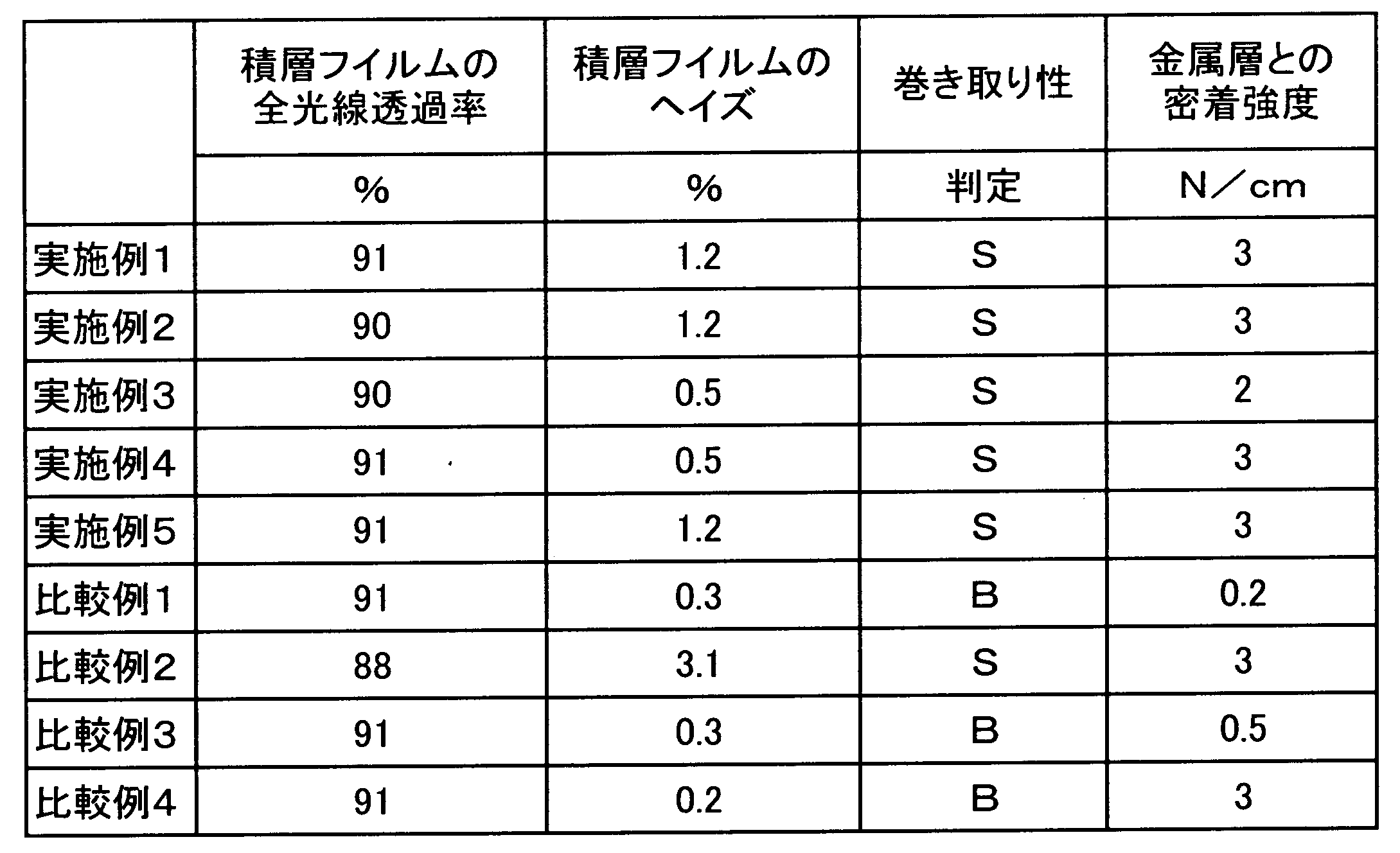
本発明は、樹脂フィルムに金属層を設けエッチングして電極や回路を形成するに際し、蒸着などの金属層形成工程等でのキズを防止し、かつ形成した金属層との密着性に優れた、タッチパネル用に好適な積層フィルムを提供できる。さらに、本発明は、電極や回路のパターン形状への加工に好適に適用できるが、その応用範囲がこれらに限られるものではない。
1:樹脂フィルム(A)
2:樹脂層(B)
3:樹脂層(C)
10:積層フィルム
2:樹脂層(B)
3:樹脂層(C)
10:積層フィルム
Claims (10)
- 樹脂フィルム(A)の少なくとも一面に、鉛筆硬度がH以上の樹脂層(B)、鉛筆硬度が樹脂層(B)の鉛筆硬度より低い樹脂層(C)を、前記樹脂フィルム(A)側からこの順に積層してなる積層フィルムであり、前記樹脂層(B)の厚みが0.5~2μmであり、かつ前記樹脂層(B)と前記樹脂層(C)の厚みの比であるt(B)/t(C)が5~20であることを特徴とする積層フィルム。
- 前記樹脂層(C)の鉛筆硬度が2B以下である、請求項1に記載の積層フィルム。
- 前記樹脂層(B)がアクリル樹脂を含む、請求項1または2に記載の積層フィルム。
- 前記樹脂層(C)がポリエステル樹脂を含む、請求項1~3のいずれかに記載の積層フィルム。
- 前記樹脂層(C)が粒子を含み、該粒子の平均粒子径Rと前記樹脂層(C)の厚み(t(C))との比(R/t(C))が0.5~2.0である、請求項1~4のいずれかに記載の積層フィルム。
- 前記粒子が酸化ケイ素粒子、硫酸バリウム粒子、アルミナ粒子および炭酸カルシウム粒子からなる群より選ばれる少なくとも1種類の粒子である、請求項5に記載の積層フィルム。
- 全光線透過率が88%以上、かつヘイズが2%以下である、請求項1~6のいずれかに記載の積層フィルム。
- 請求項1~7のいずれかに記載の積層フィルムが、さらに金属層を有することを特徴とする積層フィルム。
- 前記金属層が気相積層法で形成されている、請求項8に記載の積層フィルム。
- 請求項8または9に記載の積層フィルムを用いたタッチパネル。
Priority Applications (1)
| Application Number | Priority Date | Filing Date | Title |
|---|---|---|---|
| JP2015516930A JP6497592B2 (ja) | 2014-04-15 | 2015-03-31 | 積層フィルムおよびそれを用いたタッチパネル |
Applications Claiming Priority (4)
| Application Number | Priority Date | Filing Date | Title |
|---|---|---|---|
| JP2014083450 | 2014-04-15 | ||
| JP2014-083450 | 2014-04-15 | ||
| JP2014129978 | 2014-06-25 | ||
| JP2014-129978 | 2014-06-25 |
Publications (1)
| Publication Number | Publication Date |
|---|---|
| WO2015159703A1 true WO2015159703A1 (ja) | 2015-10-22 |
Family
ID=54323914
Family Applications (1)
| Application Number | Title | Priority Date | Filing Date |
|---|---|---|---|
| PCT/JP2015/060121 Ceased WO2015159703A1 (ja) | 2014-04-15 | 2015-03-31 | 積層フィルムおよびそれを用いたタッチパネル |
Country Status (3)
| Country | Link |
|---|---|
| JP (1) | JP6497592B2 (ja) |
| TW (1) | TW201606591A (ja) |
| WO (1) | WO2015159703A1 (ja) |
Cited By (1)
| Publication number | Priority date | Publication date | Assignee | Title |
|---|---|---|---|---|
| JP2017114036A (ja) * | 2015-12-25 | 2017-06-29 | 東レKpフィルム株式会社 | 金属化フィルムおよびその製造方法 |
Families Citing this family (2)
| Publication number | Priority date | Publication date | Assignee | Title |
|---|---|---|---|---|
| TWM536158U (zh) | 2016-11-03 | 2017-02-01 | Cheng-Chi Lu | 一種高硬度軟膜結構 |
| CN116406331A (zh) * | 2020-10-08 | 2023-07-07 | 太阳控股株式会社 | 感光性层叠树脂结构体、干膜、固化物和电子部件 |
Citations (4)
| Publication number | Priority date | Publication date | Assignee | Title |
|---|---|---|---|---|
| JPH08290542A (ja) * | 1995-04-25 | 1996-11-05 | Dainippon Printing Co Ltd | 熱硬化性樹脂化粧板 |
| JP2001353835A (ja) * | 2000-06-13 | 2001-12-25 | Hamada Mokuzai Kogyo Kk | 家具,建具等に使用する化粧板、及びその製造方法 |
| JP2008209877A (ja) * | 2007-01-31 | 2008-09-11 | Fujifilm Corp | 光学用積層フィルム及び画像表示装置 |
| JP2010253683A (ja) * | 2009-04-21 | 2010-11-11 | Tsukishima Kikai Co Ltd | プラスチック積層体及びその製造方法 |
-
2015
- 2015-03-31 WO PCT/JP2015/060121 patent/WO2015159703A1/ja not_active Ceased
- 2015-03-31 JP JP2015516930A patent/JP6497592B2/ja active Active
- 2015-04-14 TW TW104111869A patent/TW201606591A/zh unknown
Patent Citations (4)
| Publication number | Priority date | Publication date | Assignee | Title |
|---|---|---|---|---|
| JPH08290542A (ja) * | 1995-04-25 | 1996-11-05 | Dainippon Printing Co Ltd | 熱硬化性樹脂化粧板 |
| JP2001353835A (ja) * | 2000-06-13 | 2001-12-25 | Hamada Mokuzai Kogyo Kk | 家具,建具等に使用する化粧板、及びその製造方法 |
| JP2008209877A (ja) * | 2007-01-31 | 2008-09-11 | Fujifilm Corp | 光学用積層フィルム及び画像表示装置 |
| JP2010253683A (ja) * | 2009-04-21 | 2010-11-11 | Tsukishima Kikai Co Ltd | プラスチック積層体及びその製造方法 |
Cited By (1)
| Publication number | Priority date | Publication date | Assignee | Title |
|---|---|---|---|---|
| JP2017114036A (ja) * | 2015-12-25 | 2017-06-29 | 東レKpフィルム株式会社 | 金属化フィルムおよびその製造方法 |
Also Published As
| Publication number | Publication date |
|---|---|
| JP6497592B2 (ja) | 2019-04-10 |
| TW201606591A (zh) | 2016-02-16 |
| JPWO2015159703A1 (ja) | 2017-04-13 |
Similar Documents
| Publication | Publication Date | Title |
|---|---|---|
| CN103890700B (zh) | 带电容式触摸面板的显示装置、电容式触摸面板 | |
| JP4576808B2 (ja) | 光学用積層フィルム、反射防止用積層フィルム、タッチパネル用積層フィルムおよびディスプレイ部材用積層フィルムの製造方法 | |
| JP6070547B2 (ja) | 積層フィルムおよびその製造方法 | |
| CN102112309B (zh) | 层叠聚酯膜及防反射膜 | |
| JP7226308B2 (ja) | 積層ポリエステルフィルムおよびその製造方法 | |
| KR20140138775A (ko) | 투명 도전성 필름 기재용 적층체 | |
| JP2013010323A (ja) | ハードコートフィルム | |
| JP7298665B2 (ja) | ドライフィルムレジスト用ポリエステルフィルム | |
| TW201013234A (en) | Filter for displayer | |
| CN102762371A (zh) | 硬涂层膜及其制造方法 | |
| JP6624054B2 (ja) | 積層フィルムおよびその製造方法 | |
| JP2019188612A (ja) | ドライフィルムレジスト用ポリエステルフィルム | |
| JP6497592B2 (ja) | 積層フィルムおよびそれを用いたタッチパネル | |
| JP7156204B2 (ja) | 硬化膜、その製造方法及び積層体 | |
| JP2009086138A (ja) | 光学用易接着フィルムおよび光学用積層フィルム | |
| JP7167877B2 (ja) | 硬化物、積層体 | |
| JP2012128157A (ja) | ハードコートフィルムおよびその製造方法 | |
| JP2018154004A (ja) | 積層フィルム | |
| JP7419817B2 (ja) | 樹脂フィルムおよびその製造方法 | |
| JP5963489B2 (ja) | 積層ポリエステルフィルム | |
| WO2017022765A1 (ja) | 積層フィルムおよびその製造方法 | |
| JP2016078455A (ja) | 積層フィルムおよびその製造方法 | |
| JP6539954B2 (ja) | 積層フィルム | |
| JP2011183644A (ja) | ハードコートフィルム | |
| JP5489971B2 (ja) | 積層ポリエステルフィルム |
Legal Events
| Date | Code | Title | Description |
|---|---|---|---|
| ENP | Entry into the national phase |
Ref document number: 2015516930 Country of ref document: JP Kind code of ref document: A |
|
| 121 | Ep: the epo has been informed by wipo that ep was designated in this application |
Ref document number: 15779191 Country of ref document: EP Kind code of ref document: A1 |
|
| NENP | Non-entry into the national phase |
Ref country code: DE |
|
| 122 | Ep: pct application non-entry in european phase |
Ref document number: 15779191 Country of ref document: EP Kind code of ref document: A1 |