WO2015159564A1 - ニッケル酸化鉱石の湿式製錬方法 - Google Patents
ニッケル酸化鉱石の湿式製錬方法 Download PDFInfo
- Publication number
- WO2015159564A1 WO2015159564A1 PCT/JP2015/051508 JP2015051508W WO2015159564A1 WO 2015159564 A1 WO2015159564 A1 WO 2015159564A1 JP 2015051508 W JP2015051508 W JP 2015051508W WO 2015159564 A1 WO2015159564 A1 WO 2015159564A1
- Authority
- WO
- WIPO (PCT)
- Prior art keywords
- ore
- nickel oxide
- nickel
- leaching
- screen
- Prior art date
- Legal status (The legal status is an assumption and is not a legal conclusion. Google has not performed a legal analysis and makes no representation as to the accuracy of the status listed.)
- Ceased
Links
Images

Classifications
-
- C—CHEMISTRY; METALLURGY
- C22—METALLURGY; FERROUS OR NON-FERROUS ALLOYS; TREATMENT OF ALLOYS OR NON-FERROUS METALS
- C22B—PRODUCTION AND REFINING OF METALS; PRETREATMENT OF RAW MATERIALS
- C22B23/00—Obtaining nickel or cobalt
- C22B23/04—Obtaining nickel or cobalt by wet processes
- C22B23/0407—Leaching processes
- C22B23/0415—Leaching processes with acids or salt solutions except ammonium salts solutions
- C22B23/043—Sulfurated acids or salts thereof
-
- C—CHEMISTRY; METALLURGY
- C22—METALLURGY; FERROUS OR NON-FERROUS ALLOYS; TREATMENT OF ALLOYS OR NON-FERROUS METALS
- C22B—PRODUCTION AND REFINING OF METALS; PRETREATMENT OF RAW MATERIALS
- C22B23/00—Obtaining nickel or cobalt
- C22B23/005—Preliminary treatment of ores, e.g. by roasting or by the Krupp-Renn process
Definitions
- the present invention relates to a method for hydrometallizing nickel oxide ore. More specifically, the present invention relates to a hydrometallurgical method for selecting ore particles having a high Ni / Mg ratio by pulverizing and classifying nickel oxide ore and leaching the ore particles.
- High-pressure pressurization is a high-pressure acid leaching method (HPAL: High Pressure Pressure Acid Leaching) using sulfuric acid as a hydrometallurgical process for recovering valuable metals such as nickel and cobalt from low-grade nickel oxide ores such as limonite ore.
- HPAL High Pressure Pressure Acid Leaching
- a sulfuric acid leaching method is known.
- a pretreatment step (1) As shown in FIG. 1, in the hydrometallurgical process for obtaining a nickel / cobalt mixed sulfide from nickel oxide ore, a pretreatment step (1), a high-temperature pressurized sulfuric acid leaching step (2), and a solid-liquid separation step (3 ), Neutralization step (4), dezincification step (5), sulfurization step (6), and detoxification step (7) (for example, Patent Document 1).
- nickel oxide ore is crushed and classified to produce ore slurry.
- sulfuric acid is added to the ore slurry obtained in the pretreatment step (1), and stirred at 220 to 280 ° C. to obtain high temperature pressure acid leaching to obtain a leaching slurry.
- the leaching slurry obtained in the high-temperature pressurized sulfuric acid leaching step (2) is subjected to solid-liquid separation, and a leachate containing nickel and cobalt (hereinafter referred to as “crude nickel sulfate aqueous solution”). A leach residue is obtained.
- the neutralization step (4) the crude nickel sulfate aqueous solution obtained in the solid-liquid separation step (3) is neutralized.
- hydrogen sulfide gas is added to the crude nickel sulfate aqueous solution neutralized in the neutralization step (4) to precipitate and remove zinc as zinc sulfide.
- the sulfidation step (6) hydrogen sulfide gas is added to the dezincification final solution obtained in the dezincification step (5) to obtain a nickel / cobalt mixed sulfide and a nickel poor solution.
- the detoxification step (7) the leaching residue generated in the solid-liquid separation step (3) and the nickel poor solution generated in the sulfidation step (6) are detoxified.
- the size of the ore particles sent to the high-temperature pressurized sulfuric acid leaching process is subject to equipment limitations due to the size of the pump or valve slurry passing part of the ore slurry. Therefore, in the pretreatment process, the nickel oxide ore is classified so as to have a size equal to or smaller than a size determined based on facility restrictions.
- the pretreatment process is roughly divided into a crushing / classification stage in which nickel oxide ore is subjected to a crushing process and a multi-stage classification process (sieving process), and an ore slurry concentration stage in which ore components are concentrated. .
- a pulverization process of nickel oxide ore and a classification process to remove oversized ore particles and contaminants are performed by a wet classifier, and an ore slurry composed of undersized ore particles is produced.
- the size of 250mm or more is excluded by the first stage static grizzly
- the size of 150mm or more is excluded by the second shakeout machine
- the size is 25mm by the third stage drum washer.
- the above are excluded, and those having a size of 1.4 mm or more are excluded by the fourth-stage vibratory screen, and an ore slurry containing undersized ore particles that have passed through the vibratory screen is produced (Patent Document 2). reference).
- the solid component ratio of the ore slurry obtained at this time is low, if sent to the high-temperature pressurized sulfuric acid leaching process as it is, the nickel concentration in the process after the high-temperature pressurized leaching process is low, and the amount of liquid for processing the same nickel amount Therefore, nickel cannot be recovered efficiently. Therefore, a thickener is used to increase the solid component ratio of the ore slurry and then send it to the high-temperature pressurized sulfuric acid leaching process. Thereby, the amount of nickel passing per unit time to the high-temperature pressurized sulfuric acid leaching process increases, and the nickel recovery efficiency is increased.
- nickel oxide ore contains magnesium as impurities in addition to valuable metals such as nickel and cobalt.
- Ni / Mg ratio the nickel content relative to the magnesium content of nickel oxide ore
- the amount of sulfuric acid added is increased, there is a problem that not only the unit of sulfuric acid increases and the cost increases, but also the progress of equipment corrosion in the high-temperature pressurized sulfuric acid leaching process is accelerated. Therefore, in actual operation, the unreacted sulfuric acid concentration (free sulfuric acid concentration) contained in the slurry after the leaching reaction is monitored, and the amount of sulfuric acid added is controlled so that the free sulfuric acid concentration falls within a predetermined range. Yes.
- classifying nickel oxide ore in the pretreatment process also selects nickel oxide ore with a high Ni / Mg ratio, improving the nickel leaching rate in the high-temperature pressure sulfuric acid leaching process, and saving costs. There is also an effect. However, it is difficult to select ore particles having a high Ni / Mg ratio more effectively with a classification device in a conventional pretreatment process.
- an object of the present invention is to provide a method for hydrometallizing nickel oxide ore that can effectively select ore particles having a high Ni / Mg ratio.
- the method for hydrometallurgy of nickel oxide ore according to the first aspect of the present invention comprises a pretreatment step of classifying nickel oxide ore to produce an ore slurry containing undersized ore particles, and a leaching step of leaching the ore slurry.
- nickel oxide ore is classified using a lattice screen.
- the nickel oxide ore hydrometallurgy method according to the second aspect of the present invention is characterized in that, in the first aspect, the screen has an aperture of 0.5 mm to 2 mm.
- the nickel oxide ore hydrometallurgy method according to the third aspect of the present invention is characterized in that, in the first aspect, the screen has an aperture of 1.4 mm.
- the first invention by classifying nickel oxide ore using a lattice screen, flat ore particles can be removed, and non-flat ore particles having a high Ni / Mg ratio can be selected. . As a result, the nickel leaching rate in the leaching process is increased.
- ore particles having a high Ni / Mg ratio can be selected by classifying nickel oxide ore using a screen having an opening of 0.5 mm to 2 mm. As a result, the nickel leaching rate in the leaching process is increased.
- ore particles having a high Ni / Mg ratio can be selected by classifying nickel oxide ore using a screen having an aperture of 1.4 mm. As a result, the nickel leaching rate in the leaching process is increased.
- the nickel oxide ore wet smelting method according to an embodiment of the present invention is applied to a hydrometallurgical process using a high-temperature pressurized sulfuric acid leaching method for recovering nickel from nickel oxide ore.
- a low-grade nickel oxide ore represented by limonite ore is used as the nickel oxide ore.
- Nickel oxide ore contains magnesium as an impurity in addition to valuable metals such as nickel and cobalt.
- the overall flow of the hydrometallurgical process is the same as the conventional one, so the explanation is omitted (see FIG. 1).
- the hydrometallurgical method according to the present invention includes at least a pretreatment process for producing ore slurry and a leaching process for leaching the ore slurry (corresponding to the high-temperature pressurized sulfuric acid leaching process in FIG. 1). Of course, the remaining steps may be added or omitted.
- nickel oxide ore is crushed and classified to produce an ore slurry containing undersized ore particles.
- crushing means loosening a large lump of nickel oxide ore solidified into dumplings into small lump. Therefore, the operation of “breaking” can be performed with a weaker force than the operation of “crushing”, which is usually used for the purpose of crushing contaminants such as gangue into small chunks.
- undersize means ore particles having a size smaller than the sieve mesh of the classifier and having passed through the sieve mesh.
- oversize means ore particles having a size larger than the sieve mesh of the classifier and remaining on the sieve without passing through the sieve mesh.
- the pretreatment process is roughly divided into a crushing / classification stage in which nickel oxide ore is subjected to a crushing process and a multi-stage classification process (sieving process), and an ore slurry concentration stage in which ore components are concentrated. .
- a pulverization process of nickel oxide ore and a classification process to remove oversized ore particles and contaminants are performed by a wet classifier, and an ore slurry composed of undersized ore particles is produced.
- the size of 250mm or more is excluded by the first stage static grizzly
- the size of 150mm or more is excluded by the second shakeout machine
- the size is 25mm by the third stage drum washer.
- the above items are excluded, and those having a size of 1.4 mm or more are excluded by the fourth stage screen, and an ore slurry containing undersized ore particles passing through the screen is manufactured.
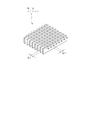
- the hydrometallurgical method according to the present embodiment is a nickel oxide ore using a grid screen 1 as shown in FIG. 2 in the pulverization / classification stage, particularly in the final stage (the fourth stage in the above example). It is characterized by the classification.
- a material having an original lattice such as a wire mesh or a punching plate may be used.
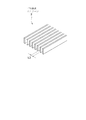
- the lattice screen 1 may be configured by placing a wire mesh with a predetermined mesh on a parallel line screen 2 (for example, a wedge screen) as shown in FIG.
- the type of lattice screen 1 is not particularly limited, and an inclined bar type, a vibration type, or the like is used.
- the parallel linear screen 2 is configured by arranging wire rods in parallel at a predetermined interval. Therefore, if the thickness of the ore particle is smaller than the interval (opening) between the wires, the ore particle passes through the parallel linear screen 2 even if the remaining dimensions (width and length) are larger than the opening. As a result, flat ore particles are also mixed into the ore slurry as undersize.
- Ni / Mg ratio nickel content relative to the magnesium content than flat ore particles. Therefore, as in this embodiment, by classifying nickel oxide ore using the lattice screen 1, flat ore particles can be removed, and non-flat ore particles having a high Ni / Mg ratio are selected. Can do. As a result, the nickel leaching rate in the leaching process is increased.
- the amount of sulfuric acid added to maintain the target nickel leaching rate in the leaching process is reduced. Therefore, the sulfuric acid basic unit can be reduced, the cost can be suppressed, and the progress of the equipment corrosion in the leaching process can be delayed.
- the opening L 1 of the lattice screen 1 is preferably 0.5 mm to 2 mm, and more preferably 1.4 mm. This is because ore particles having a high Ni / Mg ratio can be selected depending on the particle size by classifying nickel oxide ore using a grid screen 1 having an aperture of 0.5 mm to 2 mm. In particular, if the opening L 1 of the lattice screen 1 is 1.4 mm, the selection by the particle size and the selection of the non-flat ore particles are combined to effectively select the ore particles having a high Ni / Mg ratio. Can do. As a result, the nickel leaching rate in the leaching process is increased.
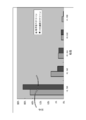
- Ni / Mg ratio of nickel oxide ore Ni / Mg ratio with respect to particle diameter was measured about nickel oxide ore.
- the measurement method is as follows. First, a sample of ore species A was screened using four types of lattice screens having openings of 2.8 mm, 2.0 mm, 1.4 mm, and 0.71 mm in order of increasing openings. By this sieving operation, the sample of ore species A is 2.8mm or more (+ 2.8mm) in particle size, 2.0mm or more and less than 2.8mm (+ 2.0mm), 1.4mm or more and less than 2.0mm (+ 1.4mm) ), Particle size of 0.71mm to less than 1.4mm (+ 0.71mm), particle size of less than 0.71mm (-0.71mm).
- the nickel weight and the magnesium weight were measured by chemical analysis for the samples classified by particle diameter, and the Ni / Mg ratio was calculated as a value obtained by dividing the nickel weight by the magnesium weight.
- the mineral species B to D were also classified by particle size, and the Ni / Mg ratio was calculated.
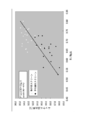
- Ni / Mg ratio of ore slurry (Ni / Mg ratio of ore slurry)
- the ore slurry produced in the pulverization / classification stage of the pretreatment process was sampled, and the Ni / Mg ratio with respect to the particle diameter of the ore particles contained in the ore slurry was measured.
- a parallel line screen 2 shown in FIG. 3 was used in the final stage of the crushing / classifying stage.
- the mesh L2 of the parallel line screen 2 is 1.4 mm.
- the measurement method is as follows. First, ore particles contained in the ore slurry were sieved using five types of lattice screens having openings of 1.400 mm, 0.850 mm, 0.355 mm, 0.150 mm, and 0.075 mm in descending order.
- the ore particles contained in the ore slurry have a particle size of 1.400 mm or more (+1.400 mm), a particle size of 0.850 mm or more and less than 1.400 mm (+0.850 mm), a particle size of 0.355 mm or more and less than 0.850 mm (+ 0.355mm), particle size of 0.150mm to less than 0.355mm (+ 0.150mm), particle size of 0.075mm to less than 0.150mm (+ 0.075mm), particle size of less than 0.075mm (-0.075mm) .
- the nickel weight and the magnesium weight were measured by chemical analysis, respectively, and the Ni / Mg ratio was calculated as a value obtained by dividing the nickel weight by the magnesium weight.
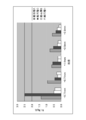
- the measurement method is as follows. First, nickel oxide ore was sieved using four types of lattice screens with openings of 1.400 mm, 0.850 mm, 0.355 mm, and 0.150 mm in order of increasing openings. By this sieving work, the nickel oxide ore has a particle size of 1.400mm or more (+ 1.400mm), particle size of 0.850mm or more and less than 1.400mm (+ 0.850mm), particle size of 0.355mm or more and less than 0.850mm (+ 0.355mm), Particle size is classified by particle size, 0.150mm or more and less than 0.355mm (+ 0.150mm), particle size less than 0.150mm (-0.150mm). Next, the weight of each nickel oxide ore classified according to particle size was measured, and the particle size distribution was determined.
- the nickel oxide ore was classified according to particle size by using four types of parallel line screens having similar openings, and the particle size distribution was obtained.
- the graph shown in FIG. 6 was obtained.
- the particle size distribution when the lattice screen 1 is used is shifted to the larger particle size as a whole compared to the particle size distribution when the parallel line screen 2 is used. I understand.
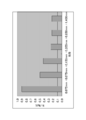
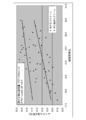
- Nickel leaching rate by screen nickel oxide ore mixed with ore species A to D in the same ratio is classified into lattice screen 1 and parallel line screen 2 to produce ore slurries, and these ore slurries are heated and pressurized sulfuric acid. Supplied to the leaching process. And the nickel leaching rate in the high temperature pressurization sulfuric acid leaching process with respect to Ni / Mg ratio of an ore particle was measured.
- the measurement method is as follows. First, after the nickel oxide ore was classified in the pulverization / classification stage of the pretreatment step, the obtained ore slurry was concentrated in the ore slurry concentration stage until the solid content became 40 to 41% by weight. At this point, sample the concentrated ore slurry, measure the nickel weight and magnesium weight by chemical analysis on the dried solids, and calculate the Ni / Mg ratio as the value obtained by dividing the nickel weight by the magnesium weight did.
- the ore slurry obtained in the pretreatment step was supplied to the high-temperature pressurized sulfuric acid leaching step at a flow rate of 240 to 250 m 3 / hour, and nickel leaching treatment was performed at a predetermined temperature, pressure and residence time.
- the amount of sulfuric acid added is controlled so that the unreacted sulfuric acid concentration (hereinafter referred to as “free sulfuric acid concentration”) contained in the slurry after the leaching reaction is 50 to 52 g / L. did.
- the nickel leaching rate was determined using the amount of nickel leached out of the amount of nickel supplied to the high-temperature pressurized sulfuric acid leaching step as a value expressed by weight%.
- the Ni / Mg ratio of the ore slurry supplied to the high-temperature pressurized sulfuric acid leaching process is higher when the lattice screen 1 is used than when the parallel-line screen 2 is used.
- the nickel leaching rate was confirmed to be high. From this, it is possible to select ore particles having a high Ni / Mg ratio and to increase the nickel leaching rate in the leaching process by using the lattice screen 1 rather than using the parallel line screen 2. Was confirmed. This is probably because non-flat ore particles have a higher Ni / Mg ratio than flat ore particles.
Landscapes
- Chemical & Material Sciences (AREA)
- Engineering & Computer Science (AREA)
- Organic Chemistry (AREA)
- Materials Engineering (AREA)
- Mechanical Engineering (AREA)
- Metallurgy (AREA)
- Manufacturing & Machinery (AREA)
- Life Sciences & Earth Sciences (AREA)
- Environmental & Geological Engineering (AREA)
- General Life Sciences & Earth Sciences (AREA)
- Geochemistry & Mineralogy (AREA)
- Geology (AREA)
- Manufacture And Refinement Of Metals (AREA)
Applications Claiming Priority (2)
| Application Number | Priority Date | Filing Date | Title |
|---|---|---|---|
| JP2014-086026 | 2014-04-18 | ||
| JP2014086026A JP2015206064A (ja) | 2014-04-18 | 2014-04-18 | ニッケル酸化鉱石の湿式製錬方法 |
Publications (1)
| Publication Number | Publication Date |
|---|---|
| WO2015159564A1 true WO2015159564A1 (ja) | 2015-10-22 |
Family
ID=54323783
Family Applications (1)
| Application Number | Title | Priority Date | Filing Date |
|---|---|---|---|
| PCT/JP2015/051508 Ceased WO2015159564A1 (ja) | 2014-04-18 | 2015-01-21 | ニッケル酸化鉱石の湿式製錬方法 |
Country Status (2)
| Country | Link |
|---|---|
| JP (1) | JP2015206064A (enExample) |
| WO (1) | WO2015159564A1 (enExample) |
Families Citing this family (5)
| Publication number | Priority date | Publication date | Assignee | Title |
|---|---|---|---|---|
| JP6298947B1 (ja) * | 2016-10-11 | 2018-03-28 | 住友金属鉱山株式会社 | ニッケル酸化鉱の洗浄装置、及びニッケル酸化鉱の洗浄方法 |
| JP2018184629A (ja) * | 2017-04-25 | 2018-11-22 | 住友金属鉱山株式会社 | 鉱石スラリーの製造方法および鉱石スラリーの製造装置 |
| JP6589950B2 (ja) * | 2017-08-16 | 2019-10-16 | 住友金属鉱山株式会社 | 浸出処理方法、ニッケル酸化鉱石の湿式製錬方法 |
| JP6729536B2 (ja) * | 2017-11-08 | 2020-07-22 | 住友金属鉱山株式会社 | 浸出処理方法、ニッケル酸化鉱石の湿式製錬方法 |
| JP7155639B2 (ja) * | 2018-06-14 | 2022-10-19 | 住友金属鉱山株式会社 | ニッケル酸化鉱石原料の前処理方法 |
Citations (2)
| Publication number | Priority date | Publication date | Assignee | Title |
|---|---|---|---|---|
| JPH11117030A (ja) * | 1997-08-06 | 1999-04-27 | Le Nickel Sln Soc | ニッケル含有酸化物鉱石の富化方法 |
| JP2013095998A (ja) * | 2011-11-04 | 2013-05-20 | Sumitomo Metal Mining Co Ltd | 鉱石スラリーの製造方法及び金属製錬方法 |
Family Cites Families (2)
| Publication number | Priority date | Publication date | Assignee | Title |
|---|---|---|---|---|
| JP5446226B2 (ja) * | 2008-09-19 | 2014-03-19 | 住友金属鉱山株式会社 | ニッケル酸化鉱石の湿式製錬方法 |
| JP5692313B2 (ja) * | 2013-09-02 | 2015-04-01 | 住友金属鉱山株式会社 | 鉱石スラリー製造工程におけるシックナー装置及びその固体成分率制御方法 |
-
2014
- 2014-04-18 JP JP2014086026A patent/JP2015206064A/ja active Pending
-
2015
- 2015-01-21 WO PCT/JP2015/051508 patent/WO2015159564A1/ja not_active Ceased
Patent Citations (2)
| Publication number | Priority date | Publication date | Assignee | Title |
|---|---|---|---|---|
| JPH11117030A (ja) * | 1997-08-06 | 1999-04-27 | Le Nickel Sln Soc | ニッケル含有酸化物鉱石の富化方法 |
| JP2013095998A (ja) * | 2011-11-04 | 2013-05-20 | Sumitomo Metal Mining Co Ltd | 鉱石スラリーの製造方法及び金属製錬方法 |
Also Published As
| Publication number | Publication date |
|---|---|
| JP2015206064A (ja) | 2015-11-19 |
Similar Documents
| Publication | Publication Date | Title |
|---|---|---|
| PH12019502827A1 (en) | Beneficiation of values from ores with a heap leach process | |
| JP2015206064A (ja) | ニッケル酸化鉱石の湿式製錬方法 | |
| Fattahi et al. | Reductive leaching of zinc, cobalt and manganese from zinc plant residue | |
| JP2015114241A (ja) | 鉱石中の微細金の存在形態分析方法 | |
| Dong et al. | Response surface design for nickel recovery from laterite by sulfation-roasting-leaching process | |
| JP2015114240A (ja) | 鉱石の金分配率分析方法 | |
| Velázquez-Martinez et al. | A recycling process for thermoelectric devices developed with the support of statistical entropy analysis | |
| JP6969262B2 (ja) | ニッケル酸化鉱石の湿式製錬方法 | |
| Zheng et al. | Pilot scale test of producing nickel concentrate from low-grade saprolitic laterite by direct reduction-magnetic separation | |
| JP5790839B2 (ja) | クロマイト回収方法 | |
| WO2019093053A1 (ja) | 浸出処理方法、ニッケル酸化鉱石の湿式製錬方法 | |
| KR20170035898A (ko) | 망간 광석 가공 공정 | |
| WO2010032513A1 (ja) | サプロライト鉱のニッケル濃縮処理方法 | |
| JP5163387B2 (ja) | サプロライト鉱のニッケル濃縮処理方法 | |
| Sutama et al. | Recovery of cobalt and molybdenum from consumed catalyst using hydrochloric acid | |
| CN105112655B (zh) | 一种土状高结合率氧化铜矿的分级浸出方法 | |
| JP5835961B2 (ja) | 金属の浸出方法 | |
| Agacayak et al. | Leaching of a Turkish lateritic nickel ore in nitric acid solution | |
| JP2013019004A (ja) | 酸化ニッケル鉱石のニッケル濃縮方法 | |
| Kumar et al. | Recovery of high-grade cobalt oxide from zinc plant residue (ZPR) generated at zinc processing plants | |
| BR112013007588B1 (pt) | Método para classificação de minério | |
| Yan et al. | Selective leaching of nickel from low-sulfur Ni-Cu matte at atmospheric pressure | |
| JP6977458B2 (ja) | ニッケル酸化鉱石の湿式製錬方法 | |
| Yang et al. | Effect of ferrite content on dissolution kinetics of gibbsitic bauxite under atmospheric pressure in NaOH solution | |
| Cahyari et al. | Simulation of precious metals recovery from nickel smelter slag under high-pressure oxidative acid leaching (HPOXAL) |
Legal Events
| Date | Code | Title | Description |
|---|---|---|---|
| 121 | Ep: the epo has been informed by wipo that ep was designated in this application |
Ref document number: 15780258 Country of ref document: EP Kind code of ref document: A1 |
|
| NENP | Non-entry into the national phase |
Ref country code: DE |
|
| 122 | Ep: pct application non-entry in european phase |
Ref document number: 15780258 Country of ref document: EP Kind code of ref document: A1 |